Page 1 of 8contents
[Mailing label: [52?] Dr W Mendelson 209 W [46th?] st]

[Mailing label pasted diagonally across the cartoon in columns 3–4; first figure “52” and street “46th” partly uncertain (could be “32” / “48th”). No town given.]
THE STANDARD
VOL. I.—NO. 19. | NEW YORK, SATURDAY, MAY 14, 1887. | PRICE FIVE CENTS
p. 1, col. 1
MR. GODWIN’S BENCH SHOW
The Commercial 1, edited by Parke 2, who, before he got so rich, was something of a radical, proposes a bench 3 of anarchists and communists, after the manner of the dog show recently held in Madison square garden. It would have the anarchists and communists well collared and chained, arranged according to their different breeds, “for all to view,” and thinks there would be money in such a show for anybody who has no dread of Mr. 4.
If Mr. Parke Godwin, as he saunters from his office to the elevated station, will stop in front of a picture store on the east side of Nassau street, he will see in the window a fine colored reproduction of a French painting that will surely arrest his attention if only for its grouping of figures and wealth of color. It represents a certain famous show of “anarchists and communists” given to the best society of Rome, some time before Mr. Bergh appeared, by one Nero Claudius Cæsar. The “anarchists and communists,” young men and graybeards, matrons and maids, to whom the Commercial Advertisers and Evening Posts of that day were then attributing the recent disastrous conflagration in the seven hilled city, enveloped, all but their heads, in masses of combustible material, are bound to the upper parts of high posts which extend in long rows through the garden. And in obedience to a signal from the giver of the show—whose gorgeous litter, surrounded by the elite of Rome, has been borne from his grand palace to a place of commanding view upon the portico—the lamplighters are just applying fire to these human torches. The picture is worth Mr. Parke Godwin’s consideration, and might suggest to him that the “anarchists and communists” of the present are sometimes the “martyrs” of the future, and that if there are in our community any such bloodthirsty destructives as he fancies, they are in reality the products of a system of injustice which the respectable classes uphold.
But as for gathering in ten-cent pieces by merely putting people on exhibition without outraging Mr. Bergh, any showman will tell him that a bench show of millionaires would draw far better than a bench show of anarchists and communists.
5 Gould has been making one of his periodical trips of inspection over his southwestern railroad system, and a correspondent of the Times interests its readers by telling how he travels like a rocket, and who accompanies him in the special train on which he eats and sleeps, of the quiet and methodical manner in which he sees how his vast property is getting on, and of the way in which people come from far and near to look even at his car. “He is quite as much of a curiosity in the eyes of the country folk as a circus,” says the correspondent, “and if he were to stand on the platform after the manner of James G. 6 would attract quite as big a crowd.”
And why not? Is not the man who, starting with a mouse trap, has, while yet in the prime of his intellectual powers, already made himself the master of fifty millions, as natural an object of curiosity as a famous politician, or an elephant who walks on his hind legs? Who, even in our cities, would not give ten cents for a good, square look at Jay Gould if he were placed on exhibition? while as to the curiosity as to how he eats and sleeps and lodges and generally conducts himself in those affairs which link him to the rest of humanity, this very letter in the Times is itself testimony.
Nor is the curiosity entirely an ignoble one—it is largely curiosity of the same kind that holds the thoughtful before the picture of one who in his time was a controller of great affairs and a master of men. Here is a live master of men; a man of the type of the Cæsars and Napoleons, who, strong, unscrupulous and fortunate, push, with insatiable ambition, their way to power by the shortest road their times may offer.
If Cæsar or Napoleon were to come back to earth again as a citizen of the American republic in our times, the one would not run for public office nor the other seek a military career. The shortest road to the greatest power here and now is through the control of the corporations whom we have allowed to possess themselves of the highways of a continent.
Having escaped in the early part of his career the fate with which poor, unsuccessful Jacob Sharp is now threatened, Jay Gould is no longer in any danger of the penitentiary; having got him fifty millions of dollars, and the virtual ownership of some six thousand miles of road, besides newspapers, judges, state legislatures and members of congress too many to count, Jay Gould now plays for further millions with loaded dice. The only ones who can play with him on equal terms are the masters of the other railroad provinces into which the American republic is now divided. But they only fight to really hurt, where combination is impossible. Not only under present conditions must the growth of his already monstrous fortune go on with accelerating rapidity, but in the concentration of power to which everything now tends, Jay Gould would bid fair, if life were long enough, to come out from among those who are now his rivals and peers as Cæsar came out in Rome or Napoleon in France. But as it is, so boldly, so skillfully, so unscrupulously has he played the great game that he is 7 to die the richest man in the country, probably the richest man in the world.
“A man can live comfortably on less than fifty millions,” says Jay Gould, according
p. 1, col. 2 to the Times reporter. So he can. On very much less than fifty millions one might have all that command over material conditions which makes wealth to the civilized man what wings are to the bird; and Jay Gould might now retire from his conquests, like 8, to live as superbly. But if he did, it would probably be, like Lucullus, to have his faculties decay. For good or bad, man cannot live by bread alone. And to live comfortably would no more content a Jay Gould than it would have contented a Cæsar or Napoleon. It is the insatiable ambition of power which drives on such men.
We are only now beginning to enter the era of great fortunes in the hands of the second generation. On a new continent, which we have been settling and “fencing in” with greater rapidity than any similar area on earth was ever settled and “fenced in” before, and in the earlier days of the industrial revolution caused by the utilization of steam and electricity—a revolution greater and quicker than the world has ever before known—our great fortunes have been largely in the hands of the men who laid their foundations. Our Jay Goulds, our Stanfords, our Huntingtons, Rockefellers, Carnegies and Corbins are “self-made men,” from which certain people are ever ready to argue that “in a free country like this” every workman might become a millionaire. It is still our habit, when we first hear of a rich man, to ask, “How did he make his money?” but we are rapidly passing into the times when the presumption in the case of every very rich man will be that he inherited the foundation of his fortune.
Already we are developing a large class of jeunessc sic9—of young men born to fortunes sufficient to enable them to live in the most luxurious idleness, and of young women whose hands are sought by European aristocrats as the means of restoring wasted fortunes. And many of these can spend the whole of their large incomes and still grow richer without thought on their part, for their estates, consisting of land, increase in value with the growth of the community.
Some may be contented with this, and some great fortunes may be dissipated by division or by reckless extravagance, though it is to be remembered that the rich have generally the power of putting their children in the way of making money or in some way pensioning them on the men who have to work for a living, and that the social habits of our time do not favor the reckless extravagances which dissipate large fortunes.
But some of these fortunes will pass into the hands of men with all the money getting ability of their predecessors. The present Astors, and at least some of the Vanderbilts, the second Garrett, and others who will suggest themselves, are examples of millionaires of the second and third generation who go steadily along, adding to the fortunes they inherit. As for Jay 10 (and there are others like him), he seems to be training the son who is to inherit his mighty fortune, as sic trained Hannibal to the art of war. Should present social conditions continue, how much may another Gould, starting where the first Gould leaves off, be worth before he dies? It is at least a suggestive question.
In the mean time, the papers that tell us all they know about Jay Gould, even to the fact that he has lately taken to eating snails, and carries home a quart of them every afternoon in a brown paper parcel, say that young George attends strictly to business and displays great financial ability. He has been educated as a broker, is a member of the stock exchange and a partner in the stock firm that does most of his father’s business; is one of the three vice-presidents of the Western Union telegraph company; is a director and large stockholder in the Missouri Pacific, the Missouri, Kansas and Texas, the Wabash, St. Louis and Pacific, the St. Louis and Iron Mountain and the Manhattan elevated, and is shortly to be made president of the Pacific Mail Steamship company. Already, says the Times correspondent, “he probably owns as much land—railroad land grants not considered—in the southwest as his father, and is always on the lookout for bargains. These are always to be had at the close of a disastrous agricultural or cattle season.” Starting as he starts, it is not unreasonable for this bright young man to look forward to a fortune of at least a thousand million dollars, or it may even be to a fortune of two or three thousand millions, as the result of a close attention to business. For doubtless young George Gould thinks, as the daily papers tell him, that Dr. McGlynn has only lifted the cross of a Quixotic crusade, and that despite the Anti-poverty society, poverty must continue. And if poverty must continue, the great fortunes of the next generation will be to those of this as whales to minnows. The world is moving fast in our day, and at constantly accelerating speed.
Minister Denby writes home from China that his salary is not enough to enable him to hold his own with the ministers of other powers at Pekin. This is probably true. But do we really need a minister to China? One might be worth having if we always got as capable a man as Mr. Denby’s predecessor, John Russell Young. But he came to go to China through the personal influence of General Grant, and in the ordinary grind of our system our ministers are likely, at best, to be useless. But if there is any reason for keeping a minister at Pekin we certainly have no need whatever for our ministers at the European courts. About the only purpose they seem to serve that could not be better
p. 1, col. 3
“THY KINGDOM COME ON EARTH!”
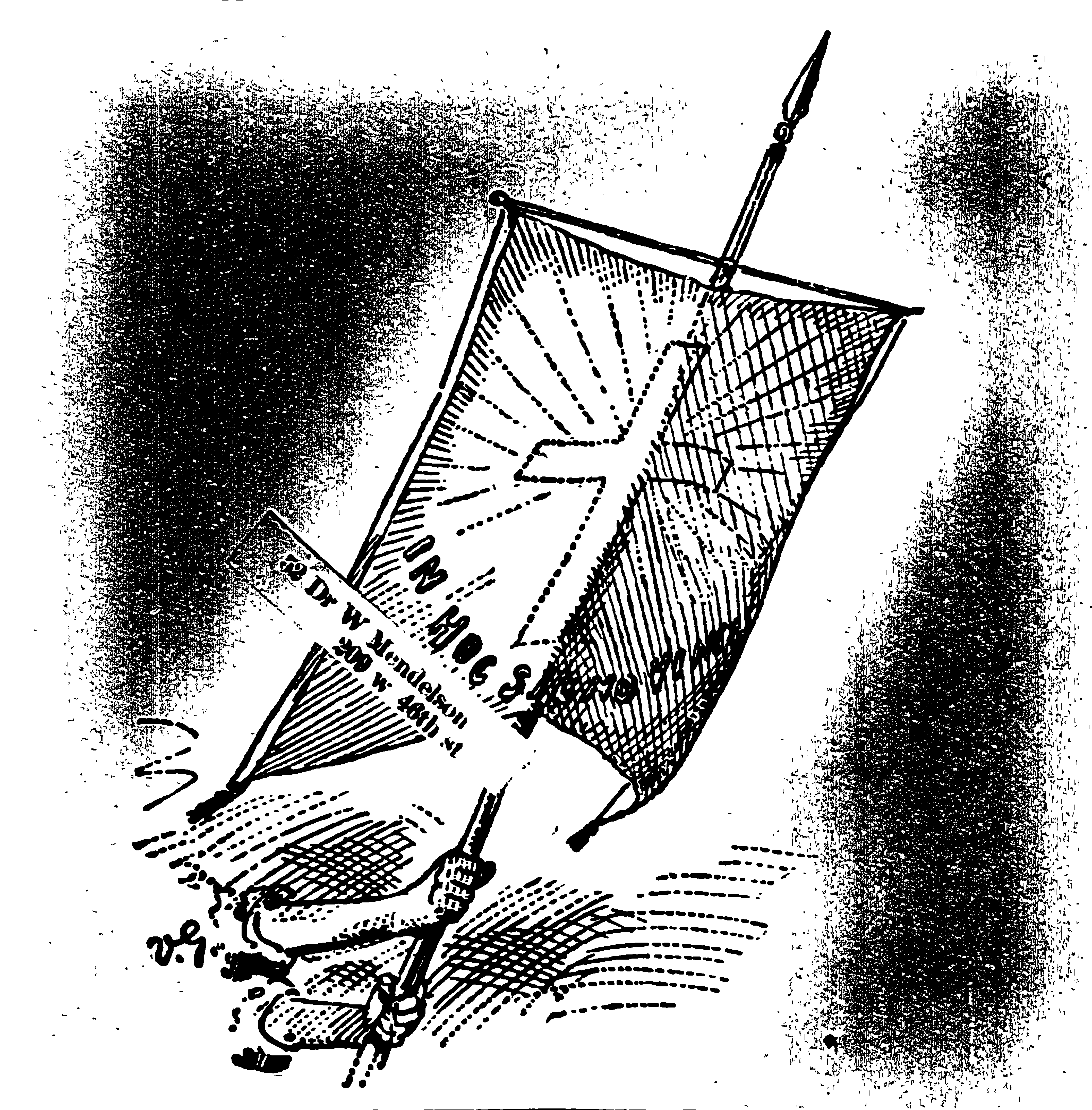
[Cartoon: a hand and forearm thrust up from below hold aloft a banner on a spear-tipped staff, against dark clouds; the banner shows a radiant cross with the lettering “IN HOC S[IGNO VINCES?]” (the end of the motto is lost in the cross-hatching, and the mailing label is pasted over part of it). Signed at lower left “V.G.”]
THE CROSS OF OUR CRUSADE.
By Rev. John Anketell.
And our lips shall spread the tidings of His providence abroad;
For He comes to break oppression—to give labor its reward,
As our cross goes marching on!
Glory, glory, hallelujah!
Glory, glory, hallelujah!
Glory, glory, hallelujah!
Our cross goes marching on.
He made the earth to feed our race—He made it passing fair;
For we are all His offspring, the dear children of His care,
And the cross is marching on!
Glory, etc.
We are coming, we are coming, to obey His mighty call,
We have chosen for our leaders now the bravest of us all,
With a bodyguard around them of true hearts—a living wall—
Now our cross goes marching on!
Glory, etc.
Let us crush the powers of darkness that would drive us from our place;
Let us save the poor and needy, and [the?] haughty thief abase,
For the cross is marching on!
Glory, etc.
The poor shall see its glory through the tears that dim their sight;
Like the Labarum of Constantine, it shines with holy light,
As our host goes marching on!
Glory, etc.
Come, brothers, join our army, take the Cross of our Crusade;
One God hath made us brothers—in His image we are made;
And he who loves his brother hath the Father’s voice obeyed,
For His Cross is marching on!
Glory, etc.
[continued from p1 c2]
served by direct communication is that of getting rich Americans presented at court. Mr. Phelps, it seems, served this purpose on Tuesday, and a waiting world on this side of the Atlantic has been informed by special Commercial company cable, copyrighted by James Gordon Bennett, that Mrs. Phelps wore “a petticoat and bodice of white and black striped velvet and a train of black velvet.” But this is nothing compared with the “holy shows” which Mr. Henry L. Horton, described in the dispatch as “the well known New York banker,” and Mrs. Henry L. Horton made of themselves. Mr. Horton, who it is to be inferred from the dispatch, was only allowed to get as far as the royal ante-room, was arrayed in velvet court dress and sword. As for Mrs. Horton, this, according to the Herald, is the way she was attired:
The material of her dress was white satin silver brocade; the front of the skirt was trimmed with pearl in the pattern of antique silver point lace; the corsage, which was cut V shaped with stomacher, was embroidered in the same way; the train, of silver brocade on poult de soie, was trimmed with white ostrich tips at bottom; the train had a blue satin lining, and was fastened at the right shoulder with a plume of feathers; in the hair were the traditional court feathers, tipped with diamond aigrettes. Mrs. Horton’s ornaments were diamonds in necklace and earrings.
If Mr. Parke Godwin were to get hold of this couple when they get back and make a ten-cent exhibition of them, it might be more remunerative than a bench show of communists.
But titles and court dresses, however, don’t amount to much, one way or the other. Boss McLaughlin of Brooklyn, who quietly whittles his stick all the afternoon in a Willoughby street auction room while his courtiers come and go, and Jay Gould, eating his snails and adding millions to his millions, are the true types of our real aristocracy, and would draw better even than American citizens in monarchical finery.
This is the way the Telegram describes what is to be seen in Central park these bright May mornings:
There is the young girl awkwardly driving a village cart, her small brother beside her and a groom behind looking wofully uncomfortable. There is the small boy who drives his mother in a handsome 13, with a lap-robe lined with ermine, and a groom behind. A smaller boy in a sailor suit follows, driving a village cart, with a groom sitting beside him. Then there are young girls in village
p. 1, col. 4 > carts, without grooms, laughing and talking at their pleasure, and older women in the same style of vehicle. A few elderly men on horseback, or driving handsome horses attached to a 1114?16? or buggy, always with a groom, have apparently sic that for brain and nerves weakened by age, disease or dissipation there is no tonic like the fresh morning air.
Occasionally a 12 will have a maid and two or three children inside, and one child sitting delightedly by the coachman and held by his arm. A quaint little donkey cart painted white is driven by a little girl in a big hat, and was stared at with big round eyes by the children on the walk who were playing with their dolls. A sick-looking man is seated in a handsome victoria with a daughter by his side, driven by a substantial looking coachman and drawn by a pair of quiet horses. A handsome phaeton with a pair of horses is driven by a stylish girl with a young man beside her looking insignificantly small on a seat so much lower than her own, and a sedate colored groom behind. A swell young man, in his spring suit of the latest English cut, drives a powerful, handsome horse attached to a stylish dog cart, and a liveried groom sits behind. A boy on a pony canters carelessly along, and two pretty girls, one wearing the regulation high hat, and the more youthful of the two wearing a low cloth cap, have a groom following them at some distance, and occasionally a solitary horseman is seen going at a brisk canter.
There are hordes of children, of course.
Little girls, charmingly dressed, are gravely pushing before them miniature baby carriages containing dolls, who recline upon their cushions in a very natural manner. Maids in neat gowns and aprons are reading while the children in their charge play about, and the smaller ones go to sleep in their carriages under embroidered parasols hugging a pet doll. Little boys in sailor suits, with those long, loose, wobbling trousers that give them such a comical look, are playing with other little boys in short trousers, short socks and bare knees, and little girls in quaint gowns and big hats are running about picking dandelions and showing violent intentions of making mud pies.
The sky is very blue, the green grass is very green and studded with brilliant yellow dandelions; the morning breeze is fresh and cool, and mingled with the children’s voices, the rumble of the many vehicles and the thud of the horses’ hoofs, are heard the songs of the little birds—singing their own songs in their own way, at the top of their voices.
It is a pretty sight, and the man who would realize what the tendencies of our civilization are ought to see it. He ought to stay in the park till afternoon, when in these early spring days, ere “everybody is out of town,” he will see no end of handsome equipages, no end of stylish liveries, and more grooms than he will care to number, sitting with folded arms. Then let him take the Second avenue elevated and ride down town through the solid blocks
p. 1, col. 5 of 15 houses! It is as if from earthly heaven to earthly hell. But the population of the hell is more than ten to one that of the heaven.
Dr. A. S. Daniels, writing to the Tribune in behalf of its “fresh air fund,” thus describes the conditions under which the great majority of New York children are growing up:
A house from four to six stories high, with four families on each floor, each family having only two, possibly three, rooms, with only two windows either looking out into the dusty, noisy street or into a dirty yard; in this one room all the domestic processes are carried on, a sitting and eating room by day and a sleeping room by night, no privacy, no individual rights—this is a tenement. I have yet to find a child who owns a bureau drawer, or a shelf in a closet, or even a nail to hang her clothes on which does not belong in common to all members of the family or the boarders. Below Fourteenth street, where about half the population live, nearly every house contains some kind of manufacturing, usually tailoring, so that the parlor, dining room, sitting room and kitchen is also by day and far into the night a workshop. The sound of the everlasting sewing machine is the last thing heard at night and the first thing in the morning. The children’s playground is the street or the yard. Then there are many unfortunate ones who live in rear houses, to enter which one passes through a narrow hallway or alley into a yard always dirty. The rooms are as sunless as the lives of their occupants. One is struck with the extraordinary early maturity of these little ones. I have babies of six months to two years brought to me daily by boys and girls of eight to nine years who answer my questions as well as the mothers could. We have a terrible problem before us in the tenement house question. You can never teach a child that “God is love” in a tenement house. They see only “envy, hatred, malice and all uncharitableness.”
To the same effect spoke Rev. Dr. Rainsford of St. George’s Episcopal church, in the Nineteenth Century club on Tuesday evening. There are tens of thousands of families in New York, he said, living in one room, under such conditions that it is impossible that religious or even moral training should be had at home. And to remedy this he advocated the reading of a chapter of the Bible each morning in the public schools!
Why not some Buddhist prayer wheels, run by steam power? They would be quite as efficacious.
The Morning Journal, which makes a specialty of “booming realty,” has also been publishing for some time past a number of noteworthy articles by Charles F. 1718?, the sanitary engineer, making a terrible showing of the squalor and mortality in the tenement districts. By way of palliation that should not interfere with the value of “realty,” it has also been advocating the buying up of some of these tenement blocks and turning them into small public parks. A bill appropriating $1,000,000 annually for the erection of small parks south of 155th street, has now passed the legislature. But the bill makes no provision, direct or indirect, for the people who are to be turned out of their hives and driven to find quarters elsewhere. They will crowd all the more closely. The passage of a bill like this is evidence of the growing revolt against the system which crowds tenement houses while one-half of the city is yet unbuilt upon. But such measures in themselves are practically useless. Here and there a noisome block may be turned into a breathing space, but the result will be that land values will advance around it, and the poorer people will be crowded back into new centers of disease and death. Mr. Wingate himself has come to the conclusion that there can be no grappling with the tenement house problem short of the radical proposition of exempting improvements from taxation and taxing land up to its full value, and so declared on Monday night, in a meeting of the Brooklyn Henry George club, of which he is president.
Representative Grennell of Detroit has introduced a bill into the Michigan legislature for the exemption from taxation of all property that is the result of human labor. This is the first move for putting all taxes on land values. The bill will not pass at this session of the legislature, but it will stimulate discussion, and before long a bill of that kind will pass. In the meantime it would be well to have a bill for the imposition of all taxes on land values introduced in the New York legislature. It would not, of course, pass at this session, but a vote on it might aid us in the next election to separate the sheep from the goats.
The Sun makes the publication of the call for a state convention of the united labor party an occasion to observe that—
They (the united labor party) contemplate, first of all, an enormous increase in the functions of government. They wish to add to its powers, to multiply its agents, to render them personages of greater importance and to authorize interference in private affairs far beyond any American experience. . . . For this reason we are opposed to this new party. We are for liberty, first, last and forever.
This is pretty cool from the Sun—a paper that is a staunch supporter of a system that will not let an American citizen bring a carpet-bag across the border without searching it, and that is maintained for the avowed purpose of dictating to American citizens what they shall buy, what they shall sell, what they shall eat, drink and wear, and how they shall employ their labor and their capital.
What the united labor party first proposes, the abolition of all taxes save on land values, would at one stroke effect an enormous simplification in the functions of government, and abolish what are now the most fruitful causes of official and political corruption. Instead of authorizing interference in private affairs the united labor party contemplates the very reverse of this. If the principles it contends for were carried out every one would be at liberty to buy or to sell, to produce or accumulate,
p. 1, col. 6 without question or interference further than was necessary for proper police and sanitary regulations. Possibly the Sun considers the curtailment of the privileges of the national banks and the assumption by the state of control of the railroads as “interference with private affairs.” If so, its notions of liberty are very much like the notions of those Englishmen who are in favor of dragooning Ireland in order to give the Irish “liberty to pay their rents.”
William Euclid Young, secretary of the committee of the Christopher Columbus Exposition of 1892, wants to get up a world’s fair in this city. What is the use of getting up a world’s fair so long as we maintain a tariff designed to repress our commerce with the rest of the world? After the united labor party carries out its programme it will be time to get up a world’s fair.
Mr. 19 and the committee who went down the bay to bring him off the Umbria complain of unseemly conduct on the part of the captain, crew and some of the passengers of that British steamship. The worst of it is—and this is something worth the committee’s thinking about—that there is no boycotting of the British steamships possible, unless, indeed, one chooses to take a French or German steamer and go to Ireland via the continent. And even in that case he will be obliged to cross the channel under the British flag. This is one of the results of what is called “protection to American industry.” We have by our taxes literally driven American commerce off the ocean.
But although, thanks to “protection to American industry,” Mr. O’Brien was subjected to much annoyance from an English captain, and even in American waters was compelled to listen to “God save the queen,” he got safely to land, and is now in Canada stirring up Canadian indignation against Lord 20’s treatment of his Irish tenants.
To be sure, Lord Lansdowne has done no more than Canadian and American landlords do every day. He has merely refused to allow other Irishmen to use that part of Ireland which the law declares to be his property except upon his terms, and has called upon the law to enforce his legal rights. There can be no logical objection to his demanding, not what rent the tenants please, but what rent he pleases, except upon the ground that God made Ireland for all Irishmen, and not for the Lord Lansdownes, and that no rent whatever is justly due him. Mr. O’Brien and his fellows do not take this logical position, but their agitation will lead the people to take it all the same.
It is to be hoped, however, that Mr. O’Brien will not confine his missionary efforts to Canada. The truth is that evictions in Ireland are nothing like as numerous and nothing like as heartless as they are in New York. In the last quarter of last year the total number of evictions in all Ireland was only 650. More than that often take place in New York city in a month. And while in Ireland the poor law officers are required to be present at every eviction, and evicted tenants are frequently put back as care-takers, here people who can’t or won’t pay their rent are thrown out on the street or on the road and left to shift for themselves. Only last week an item was printed in our papers telling how a widow and seven children were evicted in Long Island, and left with their little effects on the roadside all night during a heavy storm, and how they were subsequently taken to the poorhouse, where five of the children sickened and died.
If Patrick Ford and ex-Mayor Grace and Eugene Kelly and Chauncey Depew and Charles A. Dana and other friends of Mr. O’Brien and his mission will lay such facts as these—and they can find plenty of them—before the eloquent Irish patriot, they can doubtless get him to stay here long enough on his return from Canada to address a big meeting and give them a start in inaugurating a “plan of campaign” for New York. There is, to be sure, no final settlement of the land question in any such movement, but if the 21-rented population of New York—about ninety- six per cent of the whole—were to refuse for a while to pay any more rent to their landlords, and were, instead, to put the money in the hands of such men as Patrick Ford, and ex-Mayor Grace and Chauncey Depew to fight for reductions, it would cause a great deal of thinking to be done. When such newspapers as the Sun have already got so far as to denounce Lord Lansdowne’s plea that he has a right to charge what rent he pleases for his own land as feeble and brazen, such a movement in New York could certainly count on much moral support.
HENRY GEORGE.
England Not a Free Trade Country.
Thomas Briggs, president of the council of the free trade league, asks in the London Echo the pertinent question: “How can we expect that other countries can believe that we have faith in true free trade, when they see us violate the principles of free trade in taxing our industry to the extent of £[45?],000,000 a year through customs and excise?” England will not really be a free trade country, Mr. Briggs truly holds, until all taxes, direct and indirect, upon the productions of labor are abolished, and the national revenues raised by taxation on land values.
And the Land Question Includes Them All.
EVANSTON, Ill., May 6.—It is a happy omen for the future that the labor question, the temperance question and the woman’s suffrage question are together at the front in the great battle field of reform.
Pres. Woman’s National Christ. Temp. Union.
Page 2 of 8contents
2 THE STANDARD, SATURDAY, MAY 14, 1887.
p. 2, col. 1
ANTI-POVERTY.
A SENTIMENT THAT IS ROUSING NEW YORK TO ENTHUSIASM.
The Second Public Meeting of the Anti-Poverty Society, With Double the Attendance of the First—Scenes Without Parallel at the Academy of Music—Large Collection of Money—The Third Meeting to be Held on Sunday at the Academy.
In the latter part of last week many knowing people in New York were pleasing themselves by enjoying in anticipation a failure. It had reached their ears that those fantastic theorists—the members of the 23?-poverty society—intended to hold their second public meeting in the 2425? of Music. Well, well! The poor, deluded enthusiasts were not aware that the success of the first meeting was largely due to public curiosity. The novelty could not last. It was folly to expect the 2,300 seats of the Academy to be filled. The great public must quickly come to its senses, and the result would be the thinning out of the attendance at the meetings of this nonsensical body. Let the audience at the Academy be a small one, and that would be the end of of this sic organized to take away men’s property. There was a great difference between overcrowding Chickering hall and filling the Academy. So it was thought.
The crowd that was gathered in Irving place at 7 o’clock on Suuday sic last was not one to cheer those who had doubted the success of the meeting. People at that hour were ranged in front of every door leading into the building, and they continued to gather as the minutes rolled on until the great platform which runs along in front of the building, the broad flight of steps leading to the platform, and the wide sidewalk below the steps were all filled with a multitude awaiting the opening of the doors. When, at 7:20, the doors were flung open, the pressure of the people at the entrances was such as to give rise to apprehensions of danger to the weaker ones. Once inside and seated, those who had been in the van witnessed the inpouring of such an audience as the Academy has seldom contained. In almost the twinkling of an eye the 26 was filled, and a moment after the parquet circle had every seat occupied. and sic and women then began to range themselves along the wall. A rumbling in the gallery next testified to the hurry and scramble for seats in that part of the house. The boxes were the last to fill, but in a quarter of an hour after the doors had been opened the house was packed, from the reporters’ tables at the footlights to the area at the rear of the top gallery. But people still pressed into the building—some of the aisles and all the doorways were choked up with men and women. The corridors and the outer entrance had their knots of people looking for a place where they might push in so as to be within earshot of the stage. Then people began to turn away; but others continued to come, and more and more. There were thousands who could not get in and who went away. They who had anticipated a failure were doomed to disappointment.
The enormous size of the auditorium of the Academy, and perhaps the traditions of the coldness of its audiences, served to have the effect for a time of preventing the people from expressing any feeling that they entertained, for the gathering was at first a quiet one. But when the lights were turned on and a moment afterward Heury sic entered from the wing at the right of the stage with James 27, still pale and weak from his recent illness, leaning on his arm, there was a burst of applause that struck the ear with the suddenness and force of a thunder clap. That warmed up the house, and thenceforward there was no lack of demonstrations of every sort known to an appreciative gathering. When Mr. George stated, as he did at once, that Dr. 111 found that he could not preside at the meeting after attending to his duties at Ellenville, on account of being unable to reach the railroad trains on time, there was a prolonged “A-a-ah!” of disappointment, but when he thereupon announced James Redpath as chairman, cheers went up that shook the building. The applause that subsequently greeted Mr. George throughout his speech was such as bursts forth spontaneously from people who hear what they recognize as truth and have felt that they have been denied hearing it. Before Mr. George began his address, the Concordia 112 with Miss Agatha 29 as conductor, sang the “Anthem of 30” and “To Thee, Oh, My 31,” Mr. Will MacFarland being the organist. Miss Munier evidently was a favorite with the public, and the chorus won the hearts of the audience. “The Cross of Our 32,” a composition by Rev. John Anketell, was also sung, all present being invited to join.
Mr. George’s address was as follows:
Dr. McGlynn (great applause)—Dr. McGlynn (great applause)—Dr. McGlynn (great applause)—in Chickering hall last Sunday night said it was a historic occasion. He was right. That a priest of Christ, standing on Sunday night on a public platform and addressing a great audience—an audience embracing men and 28 of all creeds and beliefs—should proclaim a crusade for the abolition of poverty, and call on men to join together and work together, to bring the kingdom of God on earth, did mark a most important event. Great social transformations, said 35, never have been and never will be other than the application of great religious movements. sic.) The day on which democracy shall elevate itself to the position of a religious party, that day will its victory begin. (Great applause.) And the deep significance of the meeting last Sunday night, the meaning of this Anti-Poverty society that we have joined together to inaugurate, is the bringing into the struggle of democracy the religious sentiment, the sentiment alone of all sentiments powerful enough to regenerate the world. (Applause.)
The comments made on that meeting and on the institution of this society are suggestive. We are told, in the first place by the newspapers, that you cannot abolish poverty because there is not wealth enough to go around. We are told that if all the wealth of the United States were divided up there would only be some eight hundred dollars apiece. Well, if that is the case, all the more monstrous then is the injustice which to-day gives single men millions and tens of millions, and even hundreds of millions. If there really is so little, then the more injustice in these great fortunes. But we do not propose to abolish poverty by dividing up what wealth there is, so much as by creating more wealth. We propose to abolish poverty by setting at work that vast army of men, estimated last year to amount in this country alone to one million, that vast army of men only anxious to create wealth, but who are now, by a system which permits dogs in the manger to monopolize God’s bounty, deprived of the opportunity to toil. (Applause.)
Then again, they tell us, you cannot abolish poverty because poverty always has existed. Well, if poverty always has existed, all the more need for our moving for its abolition. It has existed long enough. We ought to be tired of it; let us get rid of it. (Applause.) But I deny that poverty, such poverty as we see on earth to-day, always has existed. Never before in the history of the world was there such an abundance of wealth, such power of producing wealth. So marked is this that the very people who tell us that we cannot abolish poverty, attribute it in almost the next breath to over-production. They virtually tell us it is because mankind produces so p. 2, col. 2 much wealth that so many are poor; that it is because there is so much of the things that satisfy human desires already produced, that men cannot find work, and that women must stint and strain. Poverty attributed to over-production; poverty in the midst of wealth; poverty in the midst of enlightenment; poverty when steam and electricity and a thousand labor saving inventions have been called to the aid of man, never existed in the world before. There is manifestly no good reason for its existence, and it is time that we should do something to abolish it. (Applause.)
There are not charitable institutions enough to supply the demands for charity; that seems incapable of being supplied. But there are enough, at least, to show every thinking woman and every thinking man that it is utterly impossible to eradicate poverty by charity, to show everyone who will trace to its root the cause of the disease that what is needed is not charity, but justice—the conforming of human institutions to the eternal laws of right. (Applause.) But when we propose this, when we say that poverty exists because of the violation of God’s laws, we are taunted with pretending to know more than men ought to know about the designs of Omnipotence. They have set up for themselves a God who rather likes poverty, since it affords the rich a chance to show their goodness and benevolence; and they point to the existence of poverty as a proof that God wills it. Our reply is that poverty exists not because of God’s will, but because of man’s disobedience. (Applause.) We say that we do know that it is God’s will that there should be no poverty on earth, and that we know it as we may know any other natural fact. The laws of this universe are the laws of God, the social laws as well as the physical laws, and He, the Creator of all, has given us room for all, work for all, plenty for all. If to-day people are in places so crowded that it seems as though there were too many people in the world; if to-day thousands of men who would gladly be at work do not find the opportunity to go to work; if to-day the competition for employment crowds wages down to starvation rates; if to-day, amid abounding wealth, there are in the centers of our civilization human beings who are worse off than savages in any normal times, it is not because the Creator has been niggardly; it is simply because of our own injustice—simply because we have not carried the idea of doing to others as we would have them do unto us into the making of our statutes. (Great applause.)
This Anti-poverty society has no patent remedy for poverty. We propose no new thing. What we propose is simply to do justice. The principle that we propose to carry into our laws is neither more nor less than the principle of the golden 38. We propose to abolish poverty by the sovereign remedy of doing to others as we would have others do to us; by giving to all their just rights. And we propose to begin by assuring to every child of God who, in our country, comes into this world, his full and equal share of the common heritage. Crowded! Is it any wonder that men are crowded together as they are in this city, when we see men taking up far more 43 than they can by any possibility use, and holding it for enormous prices? Why, what would have happened if, when these doors were opened, the first people who came in bad sic all the seats around them, and demanded a price of others who afterward came in by the same equal right? Yet that is precisely the way we are treating this continent. That is the reason why people are huddled together in tenement houses; that is the reason why work is difficult to get; the reason that there seems, even in good times, a surplus of labor, and that in those times that we call bad, the times of industrial depression, there are all over the country thousands and hundreds ot sic of men tramping from place to place, unable to find employment. (Applause.)
Not work enough! Why, what is work? Productive work is simply the application of human labor to land; it is simply the transforming into shapes adapted to gratify human desires, the raw material that the Creator has placed here. Is there not opportunity enough for work in this country? (Applause.) Supposing that, when thousands of men are unemployed and there are hard times everywhere, we could send a committee up to the high court of Heaven to represent the misery and the poverty of the people here, consequent on their not being able to find employment. What answer would we get? “Are your lands all in use? Are your mines all worked out? Are there no natural opportunities for the employment of labor?” (Applause.) What could we ask the Creator to furnish us with that is not already here in abundance? He has given us the globe, amply stocked with raw material for our needs. He has given us the power of working up this raw material. If there seems scarcity, if there is want, if there are men who cannot find employment, if there are people starving in the midst of plenty, is it not simply because what the Creator intended for all has been made the property of the few? (Great applause.)
In moving against this giant wrong, which denies to labor access to the natural opportunities for the employment of labor, we move against the cause of poverty. We propose to abolish it, to tear it up by the roots, to open free and abundant employment for every man. We propose to disturb no just right of property. As Dr. McGlynn said last Sunday night, we are defenders and upholders of the sacred right of property—that right of property which justly attaches to everything that is produced by labor; that right which gives to every one a just right of property in what he has produced—that makes it his to give, to sell, to bequeath, to do whatever he pleases with, so long as in using it he does not injure any one else. That right of property we insist upon, that we would uphold against all the world. To a house, a coat, a book—anything produced by labor—there is a clear individual title, which goes back to the man who made it. That is the foundation of the just, the sacred right of property. It rests on the right of the individual to the use of his own powers, on his right to profit by the exertion of his own labor; but who can carry the right of property in land that far? Who can claim a title of absolute ownership in land coming from the man who made it? (Applause.) And until the man who claims the exclusive ownership of a piece of this planet can show a title originating with the Maker of this planet; until he can produce a decree from the Creator declaring that this city lot or that great tract of agricultural land, or that coal mine, or that gas well, was made for him—until then we have a right to hold that land was intended for all of us. (Great applause.)
Natural religion and revealed religion alike tell us that God is no respecter of persons; that He did not make this planet for a few individuals; that He did not give it to one generation in preference to other generations, but that He made it for the use during their lives of all the people that His providence brings into the world. (Applause.) If this be true, the child that is born to-night in the humblest tenement in the most squalid quarter of New York, comes into life seized with as good a title to the land of this city as any Astor or Rhinelander. (Tumultuous applause.)
How do we know that the Almighty is against poverty? That it is not in accordance with His decree that poverty exists? We know it because we know this, that the Almighty has declared, “Thou shalt not 3334?37?.” (Applause.) And we know for a truth that the poverty that exists to-day in the midst of abounding wealth is the result of a system that legalizes theft. (Great applause.)
The women who by the thousands are bending over their needles or sewing machines thirteen, fourteen, sixteen hours a day; these p. 2, col. 3 widows straining and striving to bring up the little ones deprived of their natural breadwinner; the children that are growing up in squalor and wretchedness, underclothed, underfed, under-educated even, in this city without any place to play—growing up under conditions in which only a miracle can keep them pure—under conditions which condemn them in advance to the penitentiary or the brothel—they suffer, they die, because we permit them to be robbed, robbed of their birthright, robbed by a system which disinherits the vast majority of the children that come into the world. (Great applause.) There is enough and to spare for them. Had they the equal rights in the estate which their Creator has given them, there would be no young girls forced to unwomanly toil to eke out a mere existence, no widows finding it such a bitter, bitter struggle to put bread in the mouths of their little children; no such misery and squalor as we may see here in the greatest of American cities (applause), misery and squalor that are deepest in the largest and richest centers of our civilization to-day. (Great applause.)
These things are the results of legalized theft, the fruits of a denial of that commandment that says, “Thou shalt not steal.” (Applause.) How is this great commandment interpreted to-day, even by the men who pretend to preach the gospel? “Thou shalt not steal.” Well, according to them, it means: “Thou shalt not get into the penitentiary.” (Laughter.) Not much more than that with any of them. You may steal, provided you steal enough, and you do not get caught, and you may have a front seat in the churches. (Laughter and applause, and cries, “That is so!”) Do not steal a few dollars—that may be dangerous, but if you steal millions and get away with it, you become one of our first citizens. (Applause.) “Thou shalt not steal;” that is the law of God. What does it mean? Well, it does not merely mean that you shall not pick pockets! It does not merely mean that you shall not commit burglary or highway robbery! There are other forms of stealing which it prohibits as well. It certainly means (if it has any meaning) that we shall not take that to which we are not entitled, to the detriment of others. (Great applause.)
Now, here is a desert. Here is a caravan going along over the desert. Here are a gang of robbers. They say, “Look! There is a rich caravan; let us go and rob it, kill the men if necessary, take their goods from them, their camels and horses and walk off.” But one of the robbers says, “Oh, no; that is dangerous; besides, that would be stealing! Let us, instead of doing that, go ahead to where there is a spring, the only spring at which this caravan can get water in this desert. Let us put a wall around it and call it ours, and when they come up we won’t let them have any water until they have given us all the goods they have. sic.) That would be more gentlemanly, more polite and more respectable; but would it not be theft all the same? (Great applause.) And is it not theft of the same kind when men go ahead in advance of population and get land they have no use whatever for, and then, as people come into the world and population increases, will not let this increasing population use the land until they pay an exorbitant price? That is the sort of theft on which our first families are founded. (Applause.) Do that under the false code of morality which exists here to-day and people will praise your forethought and your enterprise, and will say you have made money because you are a very superior man, and that anybody can make money if he will only work and be industrious! (Laughter and applause.) But is it not as clearly a violation of the command,”Thou shalt not steal,” as taking the money out of a man’s pocket? (Applause).
“Thou shalt not steal.” That means, of course, that we ourselves must not steal. But does it not also mean that we must not suffer anybody else to steal if we can help it? (Applause.) “Thou shalt not steal.” Does it not also mean, “Thou shalt not suffer thyself or anybody else to be stolen from?” (Applause.) If it does, then we, all of us, rich and poor alike, are responsible for this social crime that produces poverty. (Applause.) Not merely the men who monopolize land—they are not to blame above anyone else, but we who permit them to monopolize land are also parties to the theft. The Christianity that ignores this social responsibility has really forgotten the teachings of Christ. Where He in the gospels speaks of the judgment, the question which is put to men is never, “Did you praise me?” “Did you pray to me?” “Did you believe this or did you believe that?” It is only this: “What did you do to relieve distress; to abolish poverty?” To those who are condemned, the judge is represented as saying: “I was ahungered and ye gave me not meat, I was athirst and ye gave me not drink, I was sick and in prison and ye visited me not.” Then they say, “Lord, Lord, when did we fail to do these things to you?” The answer is, “Inasmuch as ye failed to do it to the least of these, so also did you fail to do it unto me; depart into the place prepared for the devil and his angels.” On the other hand, what is said to the blessed is, “I was ahungered and ye gave me meat, I was thirsty and ye gave me drink, I was naked and ye clothed me. I was sic and in prison and ye visited me.” And when they say, “Lord, Lord, when did we do these things to thee?” the answer is, “Inasmuch as ye have done it unto the least of these ye have done it unto me.” (Applause.)
Here is the essential spirit of Christianity. The essence of its teaching is not, “Provide for your own body and save your own soul!” but, “Do what you can to make this a better world for all!” It was a protest against the doctrine of “each for himself and devil take the hindermost!” It was the proclamation of a common fatherhood of God and a common brotherhood of men. (Applause.) This was why the rich and the powerful, the high priests and the rulers, persecuted Christianity with fire and sword. It was not what in so many of our churches to-day is called religion that pagan Rome sought to tear out—it was what in too many of the churches of to-day is called “socialism and communism,” the doctrine of the equality of human rights! (Great applause.)
Now imagine when we men and women of to-day go before that awful bar that there we should behold the spirits of those who in our time under this accursed social system were driven into crime, of those who were starved in body and mind, of those little children that in this city of New York are being sent out of the world by thousands when they have scarcely entered it—because they did not get food enough, nor air enough, nor light enough, because they are crowded together in these tenement districts under conditions in which all diseases rage and destroy. Supposing we are confronted with those souls, what will it avail us to say that we individually were not responsible for their earthly conditions? What, in the spirit of the parable of Matthew, would be the reply from the judgment seat? Would it not be, “I provided for them all. The earth that I made was broad enough to give them room. The materials that are placed in it were abundant enough for all their needs. Did you or did you not lift up your voice against the wrong that robbed them of their fair share in what I provided for all?” (Great applause.)
“Thou shalt not steal!” It is theft, it is robbery that is producing poverty and disease and vice and crime among us. It is by virtue of laws that we uphold; and he who does not raise his voice against that crime, he is an accessory. The standard has now been raised, the cross of the new crusade at last is lifted. Some of us, aye, many of us, have sworn in our hearts that we will never rest so long as we have life and strength until we expose and abolish that wrong. We have declared war upon it. Those who are not with us, let p. 2, col. 4 us count them against us. For us there will be no faltering, no compromise. no turning sic until the end. (Great applause and cheering.)
There is no need for poverty in this world, and in our civilization. There is a provision made by the laws of the Creator which would secure to the helpless all that they require, which would give enough and more than enough for all social purposes. These little children that are dying in our crowded district for want of room and fresh air, they are the disinherited heirs of a great estate.
Did you ever consider the full meaning of the significant fact that as progress goes on, as population increases and civilization develops, the one thing that ever increases in value is land? Speculators all over the country appreciate that. Wherever there is a chance for population coming; wherever railroads meet or a great city seems destined to grow; wherever some new evidence of the bounty of the Creator is discovered, in a rich coal or iron mine, or an oil well, or a gas deposit, there the speculator jumps in, land rises in value and a great boom takes place, and men find themselves enormously rich without ever having done a single thing to produce wealth.
Now, it is by virtue of a natural law that land steadily increases in value, that population adds to it, that invention adds to it; that the discovery of every fresh evidence of the Creator’s goodness in the stores that He has implanted in the earth for our use adds to the value of land, not to the value of anything else. This natural fact is by virtue of a natural law—a law that is as much a law of the Creator as the law of gravitation. What is the intent of this law? Is there not in it a provision for social needs? That land values grow greater and greater as the community grows and common needs increase, is there not a manifest provision for social needs—a fund belonging to society as a whole, with which we may take care of the widow and the orphan and those who fall by the wayside—with which we may provide for public education, meet public expenses, and do all the things that an advancing civilization makes more and more necessary for society to do on behalf of its members? (Great applause.)
To-day the value of the land in New York city is over a hundred millions annually. Who has created that value? Is it because a few land owners are here that that land is worth a hundred millions a year? Is it not because the whole population of New York are here? Is it not because this great city is the center of exchanges for a large portion of the continent? Does not every child that is born, every one that comes to settle in New York, does he not add to the value of this land? Ought he not, therefore, to get some portion of the benefit? And is he not wronged when, instead of being used for that purpose, certain favored individuals are allowed to appropriate it? (Applause.)
We might take this vast fund for common needs, we might with it make a city here such as the world has never seen before—a city spacious, clean, wholesome, beautiful—a city that should be full of parks; a city without tenement houses; a city that should own its own means of communication, railways that should carry people thirty or forty miles from the City hall in a half hour, and that could be run free, just as are the elevators in our large buildings; a city with great museums, and public libraries, and gymnasiums, and public halls, paid for out of this common fund, and not from the donations of rich citizens. (Applause.) We could out of this vast fund provide as a matter of right for the widow and the orphan, and assure to every citizen of this great city that if he happened to die his wife and his children should not come to want, should not be degraded with charity, but as a matter of right, as citizens of a rich community, as co-heirs to a vast estate, should have enough to live on. (Applause.) And we could do all this, not merely without imposing any tax upon production; not merely without interfering with the just rights of property, but while at the same time securing far better than they are now the rights of property and abolishing the taxes that now weigh on production. We have but to throw off our taxes upon things of human production; to cease to fine a man that puts up a house or makes anything that adds to the wealth of the community; to cease collecting taxes from people who bring goods from abroad or make goods at home, and put all our taxes upon the value of land—to collect that 3940?41? revenue due to the growth of the community for the benefit of the community that produced it. (Applause.)
Dr. 4244?45?, bishop of Meath (great applause), has said in a letter addressed to the clergy and laity of his diocese that it is this provision of the Creator, the provision by which the value of land increases as the community grows, that seems to him the most beautiful of all the social adjustments; and it is to me that which most clearly shows the beneficence as well as the intelligence of the creative mind; for here is a provision by virtue of which the advance of civilization would, under the law of equal justice, be an advance toward equality, instead, as it now is, an advance toward a more and more monstrous inequality. (Applause.) The same good Catholic bishop in that same letter says: “Now, therefore, the land of every country is the common property of the people of that country, because its real owner, the Creator, who made it, hath given it as a voluntary gift unto them. ‘The earth has He given to the children of men.’ And as every human being is a creature and a child of God, and as all His creatures are equal in His sight, any settlement of the land of this or any other country that would exclude the humblest from his equal share in the common heritage is not only an injury and a wrong done to that man, but an impious violation of the benevolent intention of his Creator.” (Great applause.) And then Bishop Nulty goes on to show that the way to secure equal rights to land is not by cutting land up into equal pieces, but by taking for public use the values attaching to land. (Applause.) That is the method this society proposes. I wish we could get that through the heads of the editors of this city. We do not propose to divide up land. (Laughter.) What we propose to do is to divide up the rent that comes from land; and that is a very easy thing. sic).
We need not disturb anybody in possession, we need not interfere with anybody’s building or anybody’s improvement. We only need to remit taxes on all improvements, on all forms of wealth, and put the tax on the value of the land, exclusive of the improvements, so that the dog in the manger who is holding a piece of vacant land will have to pay the same for it as though there were a sic upon it. In that way we would treat the whole land of such a community as this as the common estate of the whole people of the community. And as the Sailors’ Snug Harbor, for instance, out of the revenues of comparatively a little piece of land in New York can maintain that fine establishment on Staten Island, keeping in comfort a number of old seamen, so we might make a greater Snug Harbor of the whole of New York. (Great applause.)
The people of New York could manage their estate just as well as any corporation, or any private family, for that matter. But for the people of New York to resume their estate and to treat it as their own, it is not necessary for them to go to any bother of management. It is not necessary for them to say to any land holder, this particular piece of land is ours, and no lorger sic. We can leave land titles just as they are. We can leave the owners of the land to call themselves its owners; all we want is the annual value of the land. Not, mark you, that value which the owner has created, that value which has been given to it by improvements, but simply that value which is given to the bare land by the p. 2, col. 5 fact that we are all here—that has attached to the land because of the growth of this great community. (Applause.) And, when we take that, then all inducement to monopolize the land will be gone, (applause); then these very worthy gentlemen who are holding one-half of the area of this city idle and vacant will find the taxes upon them so high that they either will have to go to work and build houses or sell the land, or, if they cannot sell it, give it away to somebody who will build houses. (Great applause.)
And so all over the country. Go into Pennsylvania, and there you will see great stretches of land, containing enormous deposits of the finest coal, held by corporations and individuals who are working but little part of it. On these great estates the common American citizens who mine the coal, are not allowed even to rent a piece of land, let alone buy it. They can only live in company houses; and they are permitted to stay in them only on 36 (and they have to sign a paper to that effect) that they can be evicted at any time on five days’ notice. The companies combine, and make coal artificially dear here and make employment artificially scarce in Pennsylvania. Now, why should not those miners, who work on it half the time, why shouldn’t they dig down in the earth and get up coal for themselves? (Applause.) Who made that coal? There is only one answer—God made that coal. Whom did he make it for? Any child or any fool would say that God made it for the people that would be one day called into being on this earth. (Applause.) But the laws of Pennsylvania, like the laws of New York, say God made it for this corporation and that individual; and thus a few men are permitted to deprive miners of work and make coal artificially dear. (Applause.)
A few weeks ago, when I was traveling in Illinois, a young fellow got in the car at one of the mining towns, and I entered into conversation with him. He said he was going to another place to try and get work. He told me of the condition of the miners, that they could scarcely make a living, getting very small wages and only working about half the time. I said to him, “There is plenty of coal in the ground; why don’t you employ yourselves in digging coal.” He replied, “We did get up a co-operative company, and we went to see the owner of the land to ask what he would let us sink a shaft and get out some coal for. He wanted $7,500 a year. We could not raise that much.” Tax land up to its full value and how long can such dogs-in-the-manger afford to hold that coal land away from these men? And when any man who wants work can go and employ himself, then there will be no million or no thousand unemployed men in all the United States. (Applause.)
The relation of employer and employed is a relation of convenience. It is not one imposed by the natural order. Men are brought into the world with the power to employ themselves, and they can employ themselves wherever the natural opportunities for employment are not shut up from them. No man has a natural right to demand employment of another, but each man has a natural right, an inalienable right, a right given by his Creator, to demand opportunity to employ himself. (Great applause.) And whenever that right is acknowledged, whenever the men who want to go to work can find natural opportunities to work upon, then there will be as much competition among employers who are anxious to get men to work for them as there will be among men who are anxious to get work. Wages will rise in every vocation to the true rate of wages, the full, honest earnings of labor. That done, with this ever increasing social fund to draw upon, poverty will be abolished, and in a little while will come to be looked upon as we are now beginning to look upon slavery—as the relic of a darker and more ignorant age. (Great applause.)
I remember—this man here remembers (turning to Mr. Redpath) even better than I, for he was one of the men who brought the atrocities of human slavery home to the heart and conscience of the north—I well remember, as he well knows, and all the older men and women in this audience will remember, how property in human flesh and blood was defended just as private property in land is now defended; how the same charges were hurled upon the men who protested against human slavery as are now made against the men who are intending to abolish industrial slavery. (Applause.) We remember how the dignitaries of the churches, and the opinion of the rich members of the churches branded as a disturber, almost as a reviler of religion, any priest or any minister who dared to get up and assert God’s truth—that there never was and there never could be rightful property in human flesh and blood. (Applause.)
So it is now said that men who protest against this system, which is simply another form of slavery, are men who propose robbery. Thus the commandment, “Thou shalt not steal,” they have made, “Thou shalt not object to stealing.” When we propose to resume our own again, when we propose to secure its natural right to every child that comes into being, such people talk of us advocating confiscation—charge us with being deniers of the rights of property. The real truth is that we wish to assert the just rights of property, that we wish to prevent theft. (Applause.) Chattel slavery was incarnate theft of the worst kind. That system, which made property of human beings, which allowed one man to sell another, which allowed one man to take away the proceeds of another’s toil, which permitted the tearing of the child from the mother, and which permitted the so-called owner to hunt with bloodhounds the man who escaped from his tyranny—that form of slavery is abolished. (Applause.)
So far as that goes the command, “Thou shalt not steal,” has been vindicated, but there is another form of slavery.
We are selling land now in large quantities to certain English lords and capitalists who are coming over here and buying greater estates than the greatest in Great Britain or Ireland; we are selling them land, they are buying land. Did it ever occur to you that they do not want that land? They have no use whatever for American land; they do not propose to come over here and live on it. They cannot carry it over there to where they do live. It is not the land that they want. What they want is the income from it. They are buying it not that they themselves want to use it, but because by and by, as population increases, numbers of American citizens will want to use it, and then they can say to these American citizens, “You can use this land provided you pay us one-half of all you make upon it.” What we are selling those foreign lords and capitalists is not really land; we are selling them the labor of American citizens; we are selling them the privilege of taking, without giving any return for it, the proceeds of the toil of our children. (Applause.)
So here in New York you will read in the papers every day that the price of land is going up. John Jones or Robert Brown has made a hundred thousand dollars within a year in the increase in the value of land in New York. What does that mean? It means he has the power of getting so many more coats, so many more cigars, so much more wine, drygoods, horses and carriages, houses or food. He has gained the power of taking for his own so much more of these products of human labor. But what has he done? He has not done anything. He may have been off in Europe or out west, or he may have been sitting at home taking it easy. If he has done nothing to get this increased income, where does it come from? The things I speak of are all products of human labor—some one has to work for them. When the man who does no work can get them, necessarily the men who do work to produce them must have less than they ought to have. (Applause.) p. 2, col. 6 This is the system that the Anti-poverty society has banded together to war against, and it invites you to come and swell its ranks. It is the noblest cause in which any human being can possibly engage. What, after all, is there in life as compared with a struggle like this? One thing and only one thing is absolutely certain for every man and woman in this hall, as it is to all else of human kind—that is death. What will it profit us in a few years how much we have left? Is not the noblest and the best use we can make of life to do something to make better and happier the condition of those who come after us—by warring against injustice, by the enlightenment of public opinion, by the doing all that we possibly can do to break up the accursed system that degrades and embitters the lot of so many? (Applause.)
We have a long light and a hard sic before us. Possibly, probably, for many of us, we may never see it come to success. But what of that? It is a privilege to be engaged in such a struggle. This we may know, that it is but a part of that great, world wide, long continued struggle in which the just and the good of every age have been engaged; and that we, in taking part in it, are doing something in our humble way to bring on earth the kingdom of God. to sic the conditions of life for those who come afterward, those which we trust will prevail in heaven. (Long continued applause.)
Mr. George then announced that the collections amounted to [$334.61?], and that the initiation fees inclosed in the envelopes amounted to $80 more. A number of people all over the hall shouted that the collectors had passed them by, and they wished to contribute and make applications for membership. From the proscenium boxes and from various parts of the hall silver dollars rained down upon the stage, and a number of new applications for membership were handed in. Mr. George thereupon asked the reporters to observe this—a significant thing in connection with this movement—that people in the audience complained that the contribution box was not passed around.
A patriarchal looking gentleman in the gallery called out: “I would like to make an application for membership from the very far west. You don’t recognize me, Mr. George.” Mr. George replied: “Mr. Spencer? Yes, that is he. Ladies and gentlemen, I have the pleasure of introducing to you one of our good friends, Mr. Richard Spencer of Burlington, Iowa, a gentlemen who sic one of the first to write to me on the publication of ‘Progress and Poverty,’ expressing his sympathy for our cause, and who in his sphere has done good work. sic).
“Such men are joining us from all parts of the country; aye, and they will come from over the sea. In England, in Scotland, in Wales, in Australia and on the continent of Europe are those who rejoice in the establishment of this society. And I trust that it will spread and have its branches, and that in a little while every city in this country will have its Anti-poverty society, bringing men together to unite in one great crusade against the giant crime of our time. (Applause.) Let all who are in favor of poverty stay outside. (Laughter and applause.)
“I have to announce that we will meet again in this hall next Sunday night at the same hour, and I hope you will all be here.”
An application for membership was passed up to Mr. George, on the back of which was written: “Can I be of any use to the society? I shall be most happy to respond at once if you inform me. Faithfully yours, William J. Clark.”
Mr. George said: “Yes, we hope to have work for all members of the society. We shall soon have a membership meeting, notice of which will be given by postal card this week, when we will organize a plan for doing missionary work.”
Mr. George then announced that the extra collections amounted to $44.48, with one basket still to be heard from.
“I now propose that before we adjourn we give a hearty vote of thanks to our chairman, Mr. Redpath.” (Great applause.)
Mr. Redpath, rising, said: “I shall hand over the vote of thanks to my capable assistant chairman.”
Mr. George—“The next time he comes here I hope he will be so far recovered that we can hear his ringing voice again.”
The meeting then adjourned to next Sunday evening at the same place.
The number of members of the Anti-poverty society is now 441, and all application fees have been paid. The amount of cash in the hands of the treasurer is over $500, all bills being paid. The treasurer will acknowledge the receipt of all moneys by mail. Persons not receiving such notice will please communicate with the treasurer.
The following telegram arrived too late last Sunday evening to be read at the meeting:
WATERBURY, Ct., May 8.
The Chairman of the Anti-Poverty Meeting, Academy of Music: The Waterbury labor lyceum, by rising vote, sends greeting to the Anti-poverty crusaders in the Academy of Music, wishing Fathers McGlynn and Curran God speed in their battle against the foul slanders that true Catholics dare not unite as American citizens without regard to creed or sect against social wrong and political corruption.
WILLIAM DILLON, Chairman.
A business meeting of the members of the Anti-poverty society will be held on Wednesday evening next, May 18, at 8 o’clock p. m., in room 24, Cooper institute. It is hoped that every member of the society will find it convenient to attend. Dr. Edward McGlynn will preside.
Will Do All He Can.
NEW YORK, May 8.—Inclosed you will find three names, with initiation fees, for membership in the Anti-poverty society. We have asked you to “put down our names” in the spirit of the man shown to Christians in the Interpreter’s sic, and trust we also “will not be at all discouraged” by any opposition or persecution we may meet with, but will “set about hacking and cutting fiercely” to the discomfiture of those who would consign the great mass of humanity to hopeless poverty and consequent degradation. Convey to our lovable president, the soggarth aroon, our admiration of the Christ-like course he has taken, and be assured that our prayers, in which he will be remembered before the throne of grace, will be accompanied by efficient work, for faith without works is indeed dead.
C. F. 46.
If God Be For Him, Who Can Be Against Him?
Exchange.
And Christ has conquered sorrow and sin,
When priests are ranked where they should rank,
Dressed in column from front to flank,
When God shall speak to the quick and dead,
You shall see, O friends—he’s bound to win—
On His right hand the Priest McGlynn!
The Gamut of Theft.
Washington Post.
Taking $100,000 is called Shortage.
Taking $50,000 is called Litigation.
Taking $25,000 is called Insolvency.
Taking $10,000 is called Irregularity.
Taking $5,000 is called Defalcation.
Taking $1,000 is called Corruption.
Taking $500 is called Embezzlement.
Taking $100 is called Dishonesty.
Taking $50 is called Stealing.
Taking $25 is called Total depravity.
Taking one ham is called War on society.
Page 3 of 8contents
THE STANDARD, SATURDAY, MAY 14, 1887. [page] 3
p. 3, col. 1
ST. STEPHEN’S PARISH.
AN ENTHUSIASTIC MEETING IN INTERNATIONAL HALL.
Archbishop Corrigan Helping on the Good Cause—The Parishioners Taking the Cross of the New Crusade—A Telling Speech From Editor Gahan.
His grace the archbishop of New York was not present at the St. Stephen’s parishioners’ meeting in International 4849?50? last Friday night. The greater was his loss, for had he been there he would have gained a knowledge of the growing strength of the Catholic revolt against hierarchical interference in non-doctrinal matters that might prove of use to him hereafter—when in response to the fervent prayers of thousands of Catholic Christians he shall have been translated to some other and far distant archiepiscopate. Also, he would have been surprised and doubtless pleased to observe what good missionary work he himself has been doing on behalf of the new crusade, whose cross the persecuted priest of the poor is so gallantly bearing. The parishioners of St. Stephen’s are realizing that in no way can they more speedily secure the return of the pastor whom they love than by defending and advocating the principles of justice, for announcing which he has been deposed. If indeed actions speak louder than words, the Anti-poverty society and the new crusade have few warmer friends than Archbishop Corrigan, for certainly few men have done more than he to win recruits to their ranks.
The hall was crowded before half-past 7, and by 8 o’clock it was simply jammed, the throng filling not only the hall proper, but a large portion of the ante room as well. Precisely at 8 o’clock President John R. Feeny advanced and called the meeting to order. Mr. Feeny said that notwithstanding the fears expressed by some that these meetings might in time get “talked out”—be left without fresh subjects of discussion—he himself had always had a firm faith in the archbishop’s ability to give them something new to talk about at each meeting—a confidence so far thoroughly justified by events. He then, in a few moving words, announced the expulsion of Sister Frances from the children’s home established by the doctor, an act of tyranny which had for its moving cause simply the devoted loyalty of the sister to Dr. McGlynn.
Mr. J. J. Bealin next made a stirring speech, in the course of which he urged the parishioners, in the strongest terms, to show their loyalty to their pastor by upholding and advancing the principles for which he was suffering. There was nothing in these principles discordant with the purest Catholic doctrine. He (the speaker) had authority for saying this. He had written to an eminent ecclesiastical authority in Ireland upon the subject, and read aloud the letter he received in reply, in which the doctrine of the land for the people was commended in the strongest terms. Mr. Bealin announced the meeting of the Anti-poverty society at the Academy of Music on Sunday night, and urged a full attendance; and the applause with which the announcement was received showed the hearty determination of the audience to uphold the banner of the new crusade.
Dr. J. T. Coughlin was the next speaker. Referring to Dr. McGlynn’s expression in his Chickering hall speech that he hoped some day to see a democratic pope walking down Broadway in a stovepipe hat, with an umbrella under his arm, the doctor said that it embodied a truly religious and truly American doctrine—the doctrine that it is the man that dignifies the clothes and not the clothes that lend dignity to the man. Cardinal 51 was an American citizen, who made a good cardinal and would certainly make a good pope; yet when some of his Baltimore friends offered him a carriage and horses he declined, with the remark that he had learned to use the horse cars as a parish priest. Would such a man be likely to walk down Broadway in any other costume than that of a plain American citizen?
Dr. Henry Carey next made a few remarks, congratulating the parishioners on their constancy, and urging them to redouble their efforts, in the sure confidence that they would win in the end. The doctor was greeted with applause and loud expressions of a determination to keep up the fight.
Editor Gahan of the Catholic Herald was then introduced. After an eloquent eulogy of Dr. 52 and an sic appeal to the parishioners to keep up the fight, Mr. Gahan said:
All of you have heard of, as indeed most of you were present at, the great meeting of the Anti-poverty society in Chickering hall. And on that occasion Dr. McGlynn made clear to all his unalterable allegiance to that church of whose ministry he is such a distinguished ornament; and he there again gave testimony of his zeal in the service of his Master by pleading for that even-handed justice which necessarily follows recognition of the fatherhood of God and the brotherhood of man. (Applause.) He is not the manner of man to lead the people astray. He is not the kind of man to bring his friends, his followers among the Catholic community, on any path which is not in strict consonance with Catholic theology. Where he goes they may well go, his God may well be their God, and his people may well be their people.
Referring to the absence of the priesthood from Dr. McGlynn’s recent lecture in Brooklyn, Mr. Gahan said:
The ringsters and the shysters and the whole brood of disreputable politicians in Brooklyn were dismayed at the sight of the great crusader leveling his spear against public wrong and political injustice. Every effort to frustrate and weaken his influence was resorted to. The priests of Brooklyn—or rather those of them suspected of sympathy with Dr. McGlynn—were first quietly fettered, and then the false impression was allowed to go abroad that in all Brooklyn Dr. McGlynn was left without a priestly friend or sympathizer. But there was one priest in Brooklyn who could not and would not be fettered. With hairs grown gray in the service of the church, he is at the same time a man whose reputation is a treasure in the national gallery of honor in this country—I mean Father Malone of 5354?. (Here a whirlwind of applause greeted the speaker’s eulogy of Father Malone.) He was [sent for?] and requested as a matter of courtesy not to attend the lecture. He made known, however, that were he commanded not to go he would go. He had no special reason to attend. He had publicly manifested his approval of Dr. McGlynn, and in courteous deference to his bishop’s request he refrained from attending, while at the same time he made it clear that the bishop would not be obeyed if the words of the request were framed or intended to be framed in the nature of a command. No! the glorious old man who, at a critical period in the nation’s life, ran up the stars and stripes, could not have been commanded not to go hear Dr. McGlynn. Had such a command been given him he would have gone there to assert his sovereign rights as an American citizen—those rights of political sovereignty which he feels, and we proclaim, are beyond the undue interference of pope, propaganda, archbishop or bishop. [Here again the audience broke out into wild cheering, again and again renewed.] I hope now, my friends, we shall hear no more croakings on this subject. You know Dr. McGlynn is right. Then follow him, though it lead to the mount of 5556? itself. He has given his all to you. Therefore, be true to him, and then the Olivet of victory will glorify the Calvary of his suspension.
Before closing his address, Mr. Gahan tore the flimsy nonsense about Dr. McGlynn’s alleged irreverence for the pope to pieces, to the intense satisfaction of his hearers, who laughed and cheered alternately. Dealing with this feature of the case he said:
“An American citizen holds the position of a sovereign, bound by law alone. He is the
p. 3, col. 2 peer of any king on the face of this planet. Some people pretend to be horrified because Dr. McGlynn spoke of the pope wearing a ‘stovepipe’ hat. Surely they would not have the man make himself a laughing stock by wearing his grandmother’s bonnet.”
“DOSE FOOL CATLIC VOMANS.”
Father Ballies Pitches Into the Anti-Poverty Society—The Parable of the Ten Virgins in Dutch-English.
Rev. Father Ballies of the little 57? Catholic church in Brooklyn, in his sermon last Sunday, made a fierce attack on Dr. McGlynn and his followers. He described the latter and their actions in a manner not very flattering, especially to the ladies. He was very energetic in his denunciation of the fair sex. He classed McGlynn and Beecher as modern Luthers and infidels. The old gentleman, in his peculiar style and dialect, began 58?
“Mine frents, I vas aboud to shpeak of some dings vat I dink is going to make you met, but I vant you to schmoter your metness like goot Chrischuns. I vas going to shpeak von der vurchins, dose ten vurchins. Und ven I shpeak of dose vurchins, I yust vant some dings to koompare vomans to. Now, you all oonterstant vat dose ten vurchins did; hef uv dem vas vise, und der oder hef vas fools; und dot is yust so same as dose Catlic vomans; more as hef vas yust so big fools like dose vurchins. Dose vomans! vomans!! vomans!!! [Here he got greatly excited, throwing his arms about, stamping his feet and shaking his head.] Dose vomans vat are frents mit dot ricket, bat, eenfidel mans, dot backschlider, dot pat breest! Oh-h-h!! Vat you tink? Hey! S-e-e-h! See dot now! Vat dose vomans do at dot meetin? Ven dot man’s name vas shpeakin see how dey der hankerchifs vaved! So! (waving his handkerchief) und der hents vas klepped so! (clapping his hands.) Huh! See! See!! Vat fur is dis? Hey! Dose fool Catlic vomans hef tooken dot man’s part gainst de Catlic shurch. Dey are like dose vurchins vat go to shleeb (nodding violently), and ven dey vake up dey vill go crying arount, ‘Vere is my lighd? vere is it?’ und dey vill knock at the door, but vill be tolt, ‘Who you vas? Go vay, ve don’t know you!’
“Dot mans, dot vicket mans! He hef in his lecture sait dot de Catlic shurch vill be lost ven ve don’t hef a democratic bope. Hey! See? See dot now! Vat you tink? A democratic bope! Hah! (disgustedly.) Und dot anarkeest, dot rioter und dot fool leeder, dot Hendry Chorch, vould like to see dot bope coom down Broatvay mit a shtovebipe het un his hed! Ain’d dot nice? Vat you tink uv dot mans? De bope mit a shtovebipe het, und a seegar on von hant und an oomprella shtuck unter his arm! Oh, dot is so nice, ain’d it? Vat you tink von dot now? (with a screech and violent gestures.) Dot is vat dose men vat fafer McCleen und Chorch vant, ain’d it? Und if dot eenfidel coot shpeak German I vood tink dot he hef ret Looter und vas follerin in his footshtebs. Oh-o-o, dot mans! He sait dot he vas a goot Catlic, und he het been to comoonion dot morning und vas going again dis morning. Oh-o-o, dot vas turrible! Who vas dot men’s confessor? Who vas it, enahow? Hey? Oh, dot sacraligus mans. He vas oiful vicket! Und dose fool, fool vomans; dey hef klept der hants and vaved der hankerchiffs at dot blessfeemus eenfidel mans! Oh my! Oh my! See dot now! Hey? Vat you tinks now uv dose vomans, dose vomans? Oh, dose mans, dose rioters—vicket temakoks. Dey hef shtood oop against Got like a shtone und dalk aboud Looterism, Beecherism, McCleenism and Chorchism. Heh! See dot? [He got so excited that he had to stop for breath.] Und dot men hef mate fun mit de holy fader, de bope. He hef callt him dot olt mans! Hey! See? See? De bope an olt mans, und dot he vas in his totage! Oh-o-o, dot is nice! Hey? Vat you tink? Und he hef koompare dot archpishop to dot rich mans vat is in hell! Yust look at dot! He hef sait dot ve all liff in balaces, und dot de poor Irish built dem. Oh-o-o, dot rioter! Vat fur a mans is dot? Heh? Vat you tink von dose vomans vat braise dot mans? Dey vas fools! fools! fool vomans! Und dose goot bapers (sarcastically), dot Chorch baper, DE STANDURT, und de Catlic Heralt und udders. Dey vas frightened. See? Frightened! Dey hef written to us und sait dot dey did not mean vat dey sait. Hey! See? und dot it vas tooken up wrong! Vat you tink of dot? Hey? But dey hef, like dot bat frent, dey hef cut avay de pridge pehint dem und can’t go pack. Hey? See? See dot now! Und dey sait dot de archpishop hef told all de breests to tell the congrecashuns to not go to dot men’s lecture. See? Und hef callt us boor breests numschools for peing afrait to dishopey him. Vat you tink of dot, now? Dot is all a lies! a bat lies! See? Hey? See dot now? Und dose fool mans dey hef a lot of olt fool vomans to cheer dem, und dey tink dey are all right, ain’d it? See dot, now? Dose mans are all alike. Dey vas a bat lot. Dot McCleen und dot Chorch und Looter, dey vas all bat mans, und vill coom to a bat ent.
“I vood like to shpeak more, but I cane not make a shpeech like dose vicket mans, ober I vill inshtrookt you goot Catlics some oder dime aboud dose beeple already.”
The Archbishop on His Knees.
New York Independent.
This is a remarkable series of documents, and it presents our metropolitan archbishop in a peculiar and unexpected light. It is not strange, perhaps, that he should threaten a free newspaper that it can proceed in its course only “at its peril,” for Rome has often attempted to suppress free thought in that way, although it is to be considered whether such a threat is not an illegal interference with personal rights. But it is strange enough to see a proud prelate suing for the indorsement of his clergy. It is a proof of the strength of public opinion, which has gone very strongly against him, and against which he appeals in this way. Still more, it is a part of his defense at Rome. It is very evident that Cardinal Gibbons does not at all approve of the high-handed measures taken by the archbishop of New York, and has said as much at Rome. These indorsements will come handy, perhaps, to prove to the holy father that Dr. McGlynn has no friends in the diocese.
All this is evidence that however strong the church organization is, and however able it is to correct Dr. McGlynn, the sentiment of independence is rising, and even the highest church dignitaries have to take it into consideration. Loyal Catholics will claim the right of private judgment, and they help to make an independent public sentiment to which church authorities must bow.
The Lord’s Prayer in May Fair.
Alsager Hay Hill.
With delicate cross incrust with precious gems;
O fairy faces with divinest looks,
Meek as the lilies on their fairy stems!
“Give us this day our daily bread,” ye pray.
So softly move your lips, never more fair
Touch of twin blossoms on the virgin may.
And all the old serpent’s slime has vanished here.
Here falls no shadow on the velvet sod,
Here comes no 60 of the passing tear.
The storm is up, and from the heavens o’erhead
There comes a voice that says, or seems to say,
“A hundred thousand have no daily bread!”
p. 3, col. 3
ENGLISH DEMOCRACY.
The Situation as Pictured by H. M. Hyndman—Peculiarities of the Police—The English Weekly Press.
LONDON, May 3.—It is useless to disguise the truth that the whole country is getting terribly weary of this eternal Irish question. Always Paddy is as palling on the political palate as never-ending partridge on the physical. The lobby gossipers have actually run dry. The luckless “London correspondents,” the hub of whose universe comes up just beyond the two cerberi in blue who keep watch and ward over honorable members at the gate of that inferno of mediocrity, the entrance to the house of commons, survey the land for tittle-tattle from Dan even unto Beersheba, and find it all barren of topics for “copy” for them. Their faculty of invention is dried up within them; even the tongue of scandal cleaves to the roof of the reporting mouth. M. P.’s without bills or cabinet crises show all their native boredom in its irredeemable staleness. Their ingrained stupidity is exposed to the world in all its intolerable monotony of flat and respectable ignorance. No wonder that those who have to earn their living by making out that these hopeless house of commons men now and then get off a good thing are in the depths of despair. Alas for them! Their position is pitiable. The Irish question is exhausted, and yet the talkee, talkee on coercion knows no end. If only, by way of variety, now, one tory would shoot another tory, just for fun, as it were! They are all as much alike as peas or Chinamen, and there are such a lot of unionists or coercionists that one or more would never be missed. But no, they stick at revolvers and bowie knives; bad language to their opponents is the limit of their homicide, and insult to Irishmen and democrats the acme of their wit. And so a dreary debate on a monstrous measure to save landlords and capitalists from defeat is steadily supported by capitalists and landlords against men who are striving for the good of their country, and 30,000,000 of English people, more or less, outside are powerless to stop the display which is making their country at one and the same time the contempt and the laughing stock of the civilized world. Seriously, if there be a more weariful, self-sufficient, unscrupulous and ignorant animal than the ordinary English parliament man I don’t know him. Do you? But this same 61 of melancholy ignorance, this animated dude or galvanized moneybag can take away the liberties of a people all the same. There are horse, foot and artillery, army, navy and royal Irish constabulary to do their bidding for them; and their big boom of 101 guns of majority sounds across St. George’s channel to notify the birth of yet another coercion bill. The mother of parliaments has surely been prolific enough of that sort of progeny. So one would think. But here she is brought to bed of yet another. Let us hope it will perish in 62?
But this weariness on the question of Ireland is very serious, no matter how it arises; very serious indeed. For the reactionary party is more firmly seated in power than it has ever been in our time, and so long as Hartington and his cold whig following, and Chamberlain with his nice little gang of traitors support the tories, they can do, to speak vulgarly, what they damned please. And they are going to do it. Let there be no mistake about that. They have seen—it was not difficult to see—that the tide of revolutionary agitation is moving steadily in England, as well as in Ireland. So they steadily work coercion, calculating upon the wearisome effect of these protracted debates in producing a feeling of utter disgust among the public at large. Then the measure will become law, it will be used during the parliamentary recess to crush the national league, which has become practically the national government of the greater part of Ireland, and similar steps to check freedom will be then taken in Great Britain, too. For the immediate future the lookout is bad. Though the agitation against coercion goes on vigorously, though I have no doubt whatever that the mass of the working classes are becoming imbued with revolutionary ideas as they never have been in this generation, the change of opinion will not come soon enough to save Ireland from another squeeze of tyranny, or England from a taste of the same awkward embrace.
In fact, they have already begun here. I won’t tire your readers with details of the woes of social democrats. Suffice it to say that the police are attacking our meetings and stirring up strife against us all over London. And curiously enough, a London police magistrate, Mr. De Rutzen, has given an excellent example of how the coercion act will be worked in Ireland in connection with the powers to be given to resident magistrates. Seven men were summarily condemned at the instance of the crown prosecutor by the magistrate to six months’ hard labor—the punishment permitted by the new act—without any chance of being tried by a jury. This was done wholly and solely on police evidence, and one man who was sentenced was not on the spot at all. If this can be done in London, with the house of commons in session, and with a considerable portion of the metropolitan press on our side, what may not be expected in Ireland when the tories are acting almost without restraint? The lookout, I say again, is, in my judgment, very bad.
What, however, makes this attempt to suppress any thorough democratic propaganda the more disgraceful is the accumulated evidence which is constantly brought forward to the effect that the condition of the workers in the metropolis and in all the great centers of industry is even worse than it has been represented to be. This is now being shown, not by extreme men, but by cool statisticians, who regard the ills that human flesh is heir to with much the same eye of practical indifference as the ills of cattle, pigs or sheep on the other side of the world. Thus Mr. Noel A. Humphreys, in a paper read the other day before the statistical society, fully confirmed all the statements that have been made to the effect that the workers in our great cities live but half the number of years that the upper and middle classes live; that their children in many districts die five or six times as fast as the children of the well-to-do in the same districts, and that they are far more susceptible to disease than their comfortable neighbors. All this we have had, but upon the authority of one who has no sympathy whatever with advanced opinions. Yet nothing is done. These are the facts which will condemn our governing classes utterly in the judgment of posterity. The facts are there—analyzed, tabulated, admitted, reported upon—and are neglected, deliberately neglected. Agitate about them, point at their meaning, urge the workers to recognize that this is a relentless class war waged by the land-owning and commercial classes against them, all the killed and wounded being on their side. Do this, I say, and straightway the police make their appearance, run them in, take them before a compliant magistrate, and six months’ hard labor with starvation and a plank bed is their reward for taking the side of their oppressed fellow workers. So it ever was, and so, I suppose, it ever will be, until the toilers combine for their last final effort and conquer for themselves the control of the future.
Nor should Americans forget that the London police and the Royal Irish constabulary are alike in this, that they are both under the direct control, not of the ratepayers or of the people at large, but of the central government, which can use them to support the policy of the moment in any way which they please. And here comes in the bad effect of
p. 3, col. 4 discipline and esprit de corps. Men who have sprung from the working classes, who have been forced by circumstances to sell themselves, as in the case of the Royal Irish constabulary, to act against their fellow countrymen, but who, when discharged, return to the ranks of the working classes, do act during their term of service as if enemies of their own kith and kin. Nay, not content with doing their ordinary duty, they will trump up charges and perjure themselves to support the charges when trumped up. This, too, although they will admit in private that the cause against which they are officially striving is a just one, and that if they were free from the trammels of discipline they themselves would be acting vigorously against the very principles which they champion as paid men. That is the reason why so often in periods of revolution the forces of the governing classes have melted suddenly away. Up to the very moment when the success of the agitators seemed certain, discipline and camaraderie have kept the forces of repression together. That the moment that it sic at all safe to do so, the very men who were most relied upon give up the ungrateful task of protecting their natural enemies against the rightful claims of men of their own class. So I venture to predict it will be in England and Ireland. But not quite yet.
Meanwhile, the tories are of course jubilant and prognosticate for themselves twenty years of continuous domination.
One thing also which shuts out a knowledge of what is going on among the people is the close division of the press in Great Britain into the upper and middle class press, and the working class press. In America the workers read the daily papers. Here, speaking broadly, they don’t. They read only their weekly journals. They have no time to do more. The middle class, including the shopkeepers, see the London dailies, and so do they the dailies in the great provincial towns. But the workers do not. Now these weeklies, though not nearly as good as they might be, are a good deal more advanced in every way than the dailies. Reynolds’, the Weekly Dispatch, Lloyd’s and similar papers in the provinces circulate by the hundreds of thousands. But no well-to-do person sees them as a rule. Their opinion has no weight in the political world. A journal with not a twentieth part of their circulation has more direct influence on the course of sic ten times over than one of those sheets which numbers its readers almost by millions. I don’t believe, and I never have believed, that a newspaper could ever either make or unmake—I am not of course, speaking of money—a man or a party. But it can render much assistance in spreading ideas and in forming the judgment of the people by putting before them plain facts in a readable shape. In my opinion, therefore, there is an enormous future here in Great Britain before the cheap weekly penny press. I believe, in the democratic days we have entered upon, it will be well worth the while of statesmen and politicians to lay their views before the mass of their working countrymen through the columns of the journals which alone they can afford to buy and which alone they have the time—Sunday is the working man’s only leisure day—to read. The original saying of Mr. Robert Lowe, now Lord Sherbrooke, “We must now begin to educate our masters,” had a good deal of truth in it after all. And how can they be educated except through the literature which goes straight to their homes? Now it is worthy of remark that the weekly papers are, as a whole, beginning to deal more with social questions than they did, and that ideas of revolution and class now find find sic in them to an extent which I could never have anticipated would “pay.” A newspaper is, after all, a commercial enterprise dependent on advertising for success. That even so they should be talking plainly about the need for very complete political social sic shows that we are moving on.
There is a very uneasy feeling here that the passage of the coercion bill—and I repeat that it will become law—will be marked by some violent action on the part of the extreme Irish party, and that of this Mr. Parnell has already been specially notified. Well, as I once said, I am opposed to dynamite, and, for that matter, I am opposed to an earthquake. I take no stock in conflagrations, and I don’t want to see or hear of any man’s weasand being slit with a surgical instrument. Besides, Mr. Goschen lives within a few yards of us, and an awkward conspiracy might aim at the crow and hit the pigeon—that’s me. So that I trust for personal reasons this will not come. But for other reasons, too. Public public sic is veering. That men like Lord Spencer, Lord Rosebery, Lord sic, etc., etc., should be forced to declare for home rule, which they hate, shows that but a little patience is needed to win justice in place of oppression—to emancipate Ireland once for all. If, therefore, I counsel patience for yet a short period, I believe that as a revolutionist who stood by the cause of Ireland at some risk when the liberals were all against her, I am urging what is really for the benefit of the Irish and democracy generally.
Yes, and yet at this time of writing “Buffalo Bill” is the hero of the day, the coming Wild West show is the talk of all London. Coercion, anti-coercion, dynamite, daggers, devilment galore, what is all that to bucking stallions, genuine scalping Indian chiefs and a border man who has held his own at all sorts of break neck and dare devil pastimes? Nothing, dearly beloved brethren. And so the world wiggle-waggles on, and we with it. Farewell.
H. M. 63.
Mr. Gahan and Bishop Loughlin.
Mr. Gahan, editor of the Catholic Herald, has forwarded the following letter to the New York Sun:
To the Editor of the Sun—Sir: On Friday evening last, at a meeting of the parishioners of St. Stephen’s, it pleased me to make some reference to Father Malone’s absence from Dr. McGlynn’s lecture, and to give what I knew to be the reason for such absence. In doing so I was necessarily obliged to mention Bishop 64’s name and his connection with it. A partial and imperfect report of what I then said was published in your esteemed paper on Saturday. On Sunday there appeared in the Sun the report of an interview with the bishop, in the course of which it is alleged he said that he did not want any newspaper controversy about the matter, but that what I said at the meeting was a lie—an untruth from the beginning to the end. I do not desire any newspaper controversy, because as I am obliged, and willing, to earn my living, I have no time for the recreation of a controversy with even such a personage as the bishop of Brooklyn. But that gentleman evidently supposes that in sic asserting he wishes no controversy, at the same time describing my statement as an untruth, that he has disposed of the case. He does not seem to understand the temper of the times, nor does he appear to know that the day is past when the mere ipse dixit of an ecclesiastic was sufficient to brand a layman as a falsifier of fact. I know that interviews are frequently unreliable, and it is possible that the bishop did not utter the words ascribed to him. But to set myself right with those of my fellow-citizens, whose opinion I value, and assuming the interview to be correct, I will say that if over his signature the bishop denies that he sent an intimation of his wish to see one of the priests of his diocese, and that when that priest called on him the bishop requested him not to attend Dr. McGlynn’s lecture, I will join issue with the bishop at once and furnish proof that the statement I made is not an untruth from beginning to end, and that the falsification of facts rests on shoulders other than those of yours respectfully,
JAMES J. GAHAN.
73 Park row, New York, May 10, 1887.
An Address Wanted.
Will “Admirer” please send his address to THE STANDARD?
p. 3, col. 5
DR. M’GLYNN IN BOSTON.
An Immense Audience Listens to His Lecture on the Cross of the New Crusade—“They Read in the Fathers that I am Wrong, but I Read from Christ that I am Right”—Comments of the Boston Press.
Dr. McGlynn delivered his lecture on “The Cross of a New 65” under the auspices of the Irish societies of Boston before an enthusiastic audience that filled the great Boston theater on Sunday evening last. The Boston Globe says: “Over 3,000 people, mostly young and middle-aged workmen, heard his talk and applauded his sentiments frequently. Every seat was occupied from the gallery to the orchestra; some 200 people sat in chairs on the platform, and there were hundreds more who were unable to get any kind of a seat, and were only too happy to stand up and hear the great disciple of Henry George expound the relations of the cause of labor to Christianity, and particularly to Catholicism. Whatever may have been the religion or political opinion of the audience, every man was pleased with the force and logic of the argument made. . . . The reverend reformer arose, bowed, smiled, and the audience yelled an old style Boston yell, such as is heard nowhere away from the”Hub,” and heard here only when a very sic event takes place. The event of last night was Father McGlynn, so the people yelled and cheered and applauded.”
The doctor preceded the lecture with a personal declaration, in the course of which he said:
“I have no quarrel with the holy Roman Catholic church. I shall never say aught against the precepts I have taught and tried to inculcate by my life and conduct. I love her. Her memory is dear and fragrant. (Applause.) When I arose this morning I took my way to a Catholic church in this city, and with many more I knelt before the holy altars and partook of the holy sacrifice. (Applause.) I know I was never a more devout Catholic than I am to-day. The lessons I have learned are dearer and sweeter—far sweeter—now than ever before. No man and no propaganda shall tear me from my first love. (Tremendous applause and cries of”That’s right.”) But there is nothing in the doctrine of this new crusade that is not in keeping with the teachings of Christ, who is the light of the world. Our faith and our religion are founded on the lessons given by Him who spoke as never man spoke. This cannot be against the Catholic church. I say it cannot be, for I love the church and I love the new crusade, and in my mind—in the mind of every honest, well meaning man—their teachings are alike.
“The Catholic church has not demanded, it does not require, the absolute obedience, of the mind to priest, to propaganda, or to pope. Are we Catholics such fools that our opinions are the playthings of priests and bishops? If the propaganda were to make an order which would be abhorrent to reason, should we bow and submit without question? Can we have no revelations? What if they do prohibit me from ministering at the altar, I am not cut off from the church. I can still feed the hungry, clothe the poor and minister to the wants of the needy. In this 1 am a true sic, and I shall always love the sacred duties which make my church the foremost church in the world. (Applause.) I am a Catholic, and I know, I swear, I shall always be a true Catholic as long as I live. No power can bar me out from this. What if the pope has ordered me to be suspended? He has done it to better men than I, and they have lived and died true Catholics. Suspended is ecclesiastical for hiding. (Laughter and applause.)
“I am suspended now, waiting the action of those above me in ecclesiastical power. If the time shall come when my superiors think I must be sacrificed, I am willing to have my head cut off. I shall not falter. I am in for the cause. They read me the sayings of St. Augustine and many of the fathers, and show me where I am in the wrong. I read from Christ and find I am right. I, too, can read from the holy fathers and show that many went far beyond me. I do not try to go as far as they. I am more moderate. (Laughter.) The love of man for God’s sake, and the love of God for His own sake is the essence of true religion.
“There are unknown millions fighting in our ranks. The people are not with me because I, a simple priest, have come out to defend them, but I am with the people. And many are with us. Only last week I was talking with a learned bishop of our church about the teachings of that great, that glorious man, Henry George, (cheers and long applause), and he told me there was nothing in the doctrine of Henry George that was contrary to the spirit of Catholicism. If the church should say that two and two make five I should say it was impossible. The church has no right to say such a thing. God has no right, because it is impossible. The man who could suppose that God could issue an order making two and two five would be guilty of blasphemy. But you ask if the propaganda has not condemned me. Yes, but the sic is not the church, and I owe my fealty to the church.”
All of the Boston papers give personal descriptions of Dr. McGlynn. The Globe, which, by the way, itself prints a picture of him, says: “The pictures of Father McGlynn are libels on his physiognomy. He looks far better than any alleged likeness of him that has yet been printed. He has the heavy mouth, to be sure, and a nose that is far from handsome; but that magnificent 66 forehead, poised on a big neck, above a broad pair of square shoulders, causes everybody to forget all other features and look at his head alone. This is worth looking at. Broad, deep and high, with a 67 width above the eyes, and a Socratic bulge in front, that head would attract the attention of an anatomist if it were stripped of flesh and put up inside a show case in a museum. Under his two black brows a pair of kind brown eyes burned with a subdued and steady fire. Below them were the ordinary features of a large, strong man. Above them, crag on crag, towered that great forehead, in which lurk many thoughts that cannot crowd themselves into lesser brains. A thin coat of straight black hair, with a bald spot behind, completed his head-gear. Like his head, his body is large and deep and strong. A full chest, holding lungs that are as tireless as bellows, large arms, with big, fat hands for knobs, muscular legs, and feet with an aristocratic arch at the instep, make up the body of the man who has caused the great convulsion.
“For two hours and a half he talked, sic, arguing and beseeching, telling of the great good done by the holy church and the great wrong suffered by the working people, and trying to reconcile the duty he owed to one to the allegiance he had sworn to the other. There was no rhetorical trick in his speech, no attempt to make a point out of sentiment at the expense of reason, and no Ingersollian appeal to the selfish nature in order to bolster up his theory or convince his auditors. The speech was not so brilliant as some of Wendell Phillips’, nor so cultured as those of George sic Curtis, but it did not have a tame passage in it. Cut it in half, quarter it, and then halve the quarters, and every bit was a gem of eloquence and logic, no better and no worse than any other part that could be selected.”
The Boston Herald says: “Dr. McGlynn was received with tremendous applause, which lasted considerable time and was renewed again and again. He is rather above the medium height, stout and muscular, and has a remarkably expressive and pleasing face. A benignant smile forever plays about his mouth, from out of which flow those mellow sentences, tipped with Irish brogue, just marked enough to make stronger the utterances, and one scarcely notes the frown which lowers at times upon his brow. So smooth and polished,
p. 3, col. 6 and filled with imagery, was his discourse at times that he seemed to be talking blank verse. Dr. McGlynn’s art seems to be rather of the captivating and the fascinating than of the persuading kind, his vivid pictures and uplifting aspirations carrying the hearer along irresistibly rather than willingly. In many respects there is a striking resemblance to Henry Ward Beecher.”
The Journal says of the doctor: “He is a man of decidedly impressive appearance, being above medium height and very well proportioned. His forehead is high and projects over deep-seated yet penetrating eyes, while his clean shaven face reveals a firm chin and square cut, resolute mouth. As he spoke in clear, decisive tones, reaching every part of the theater without apparent effort, he might well stand for a leader in a crusade, firm and uncompromising, and yet with a suavity of address and a play of native wit that would make him more friends than enemies.”
The Advertiser refers to him as “a man with the dome shaped head of a thinker and the square jaw of a fighter, of broad shoulders and commanding stature,” and says: “Dr. McGlynn is an eloquent speaker. He was by turn argumentative, impassioned and witty, but earnest throughout; and very few speakers could drop as he did from a noble moral strain to the level of a funny pun without making the judicious grieve.”
The Way They Look at It in Ohio.
Columbus, O., Capital.
The Journal of yesterday says:
Dr. McGlynn has probably played his last card in asserting that the opposition to him by Archbishop Corrigan is because he (McGlynn) supported Cleveland and refused to vote for Blaine. It is a reckless assertion, and unless most definitely established cannot but react with fearful effect upon the man who makes it.
Dr. McGlynn is simply misquoted by the Journal. He did not, as the above paragraph implies, assert that his refusal to vote for Blaine was the only cause for the archbishop’s hostility. It was one of many causes, however, which operated to incite the tyrannical spirit of the archbishop against a dauntless American priest, whose spirit the college of cardinals, much less the pompous Corrigan, could not and cannot break. The principal or chief cause of the archbishop’s hostility to Father McGlynn came out long ago in the newspapers, in the publication of the letters which passed between Mr. Henry George, the archbishop and Dr. McGlynn. The archbishop opposed the Irish national league and prohibited Dr. McGlynn from aiding “that agitation.” To this mandatory command the doctor gave a partial submission, but when the archbishop, following out his first tyrannical act, attempted to coerce the political conscience of the priest and dictate to a free born American citizen the ticket he should vote, or rather the ticket he should not vote (the George workingman ticket), then it was that Dr. McGlynn threw down the gage of battle and defied Rome itself! And then it was that his suspension took place.
The capitalistic press, dreading the spread of Georgeism, are now actively engaged in a crusade against a humble priest, who had the manhood, the American manhood, to stand up for his birthright—for the political freedom guaranteed him by the constitution of the United States—and this same capitalistic press unanimously sustains the tyrannical interference of both Corrigan and Rome with the political convictions of an American citizen. The workingmen and the liberty loving masses of the United States understand the issue, and
Rome and Corrigan must back down!
The Press Belittles the Movement, But the Reporters are Clearly Impressed.
Rochester, N. Y., Post-Express.
In the accounts given of the meetings held by Dr. McGlynn, in forwarding his new crusade, we cannot find any evidence of a disposition on the part of the New York papers to exaggerate their importance. On the contrary, there seems to be a tendency to belittle them as far as possible. But the reporters are clearly impressed with the earnestness and power of the speaker and the wonderful enthusiasm of the crowds that gather to listen to him.
From the first moment that action was taken against Dr. McGlynn by the authorities of his church in New York, we foresaw some such popular revolt in his favor. He was so much beloved by the people of his large congregation, so much a leader among the priests, and so powerful an orator that he could not be put down without a struggle. It is doubtful now whether anything can quiet him or destroy his prestige except a papal condemnation of the theories of Henry George about land; and though it is said such a condemnation is in preparation, it is not easy to see how the Catholic church, which exists where every system of land tenure prevails, can pronounce against a particular one.
A Screw Loose Somewhere.
The Hon. Joseph H. Choate, in a recent speech in Boston, said that the machinery of Massachusetts alone is equal to the labor of one hundred million men.
Mr. Edward 68, in his recent speech in Boston, said that the laboring men of Massachusetts get for their share 91 62-100 per cent of all the wealth produced by the aid of machinery.
There’s a screw loose in that machinery somewhere.
On Earth as It is in Heaven.
H. T. R. Marston.
Who sicken in city slums,
Where never a flower puts forth her bloom,
And never a wild bee hums?
On mountain, moor and lea;
But the human swarms in alley and court
The glory do not see.
And when the autumn, with ruddy sheaves,
Brings in the bounteous time,
The moiling million still grinds and grieves
In poverty, dirt and crime.
Have they not human lives to live,
And human souls to save?
Are they foredoomed to be cradled in want,
And to lie in a pauper’s grave?
Have they no hope of the life to come?
No claim on the Father’s love?
Did not the Lord of the angels stoop
For them from His throne above?
Oh! slander no longer the love of God
With the arch deceiver’s lie—
That the poor were meant to slave on earth,
And be happy when they die!
The rich in their pomp, and the great in their pride,
Have their purple and linen fine;
But the poor are the heirs of the kingdom of God,
And the land of corn and wine.
No. The poor shall enter His kingdom now,
For its portals are free and wide,
Though Mammon and luxury block the path,
And prejudice leagued with pride.
All beautiful, true and holy things
The poor with the rich shall share;
And theirs shall a double portion be
Who have double of want and care.
For the human life in us all is one,
And a sweet and a sacred thing;
And the one great God is the lover of all,
The Father of all and King.
For the broad green earth He made for the poor,
As well as the broad blue sky;
And He means that the poor shall be happy here,
As well as when they die.
Page 4 of 8contents
4 THE STANDARD, SATURDAY, MAY 14, 1887.
p. 4, col. 1
THE STANDARD.
HENRY GEORGE, Editor and Proprietor.
25 ANN STREET, NEW YORK.
TERMS, POSTAGE FREE:
One year, $2.50, six months, $1.25; single copies, 5 cents.
Entered at the post office, New York, as second class matter.
Communications and contributions are invited, and will be attentively considered. Manuscripts not found suitable for publication will be returned if sufficient stamps are sent for return postage. No notice will be taken of anonymous communications.
Contributions and letters on editorial matters should be addressed to THE EDITOR OF THE STANDARD, and all communications on business to the PUBLISHER OF THE STANDARD.
THE STANDARD wants an agent to secure subscribers at every post office in the United States, to whom liberal terms will be given.
THE STANDARD is for sale by newsdealers throughout the United States. Persons who may be unable to obtain it will confer a favor on the publisher by notifying him promptly.
Sample copies sent free on application.
SATURDAY, MAY 14, 1887.
THE STANDARD is forwarded to subscribers by the early morning mails each Friday. Subscribers who do not receive the paper promptly will confer a favor by communicating with the publisher.
THE POLITICAL OUTLOOK.
Grover Cleveland for president carried the state of New York in 1884 by a plurality of 1,047 on a total vote of 1,171,312, and a change of one vote in each thousand cast would have caused him to lose New York and the presidency. David B. Hill, democrat, was elected governor in 1885 by a plurality of 11,134 in a total vote of 1,026,239. In 1886 Rufus W. Peckham, democrat, was chosen associate judge of the court of appeals by a plurality of 7,797 in a total vote of 970,807. In each case the prohibition vote was much larger than the plurality of the successful candidate. These are facts that must be borne in mind by any one who seeks to arrive at any reasonable opinion as to the effect of the labor vote on existing political parties. They show that the democratic majority in this state is so narrow that any appreciable loss of votes that did not equally affect the republican party would give the state to the latter. A perception of this fact has recently caused several of the papers that seek to retain the democratic party in power to make frantic appeals to the voters of the new party to “return” to their allegiance to the democracy, and has even led some to pretend to a belief that there is an understanding and compact between the leaders of the new movement and the bosses of the republican machine. It would be useless to argue with those who can only view public events through the disturbing lenses of old-time partisanship; but it is worth while for those capable of taking rational views of current events to consider the political situation of to-day as affected by the rise of the united labor party. In fact, no man taking an intelligent interest in public affairs can any longer ignore the question, now that the new party has issued a call for a state convention.
The daily press has so misrepresented the situation from the beginning of the new movement, that any thorough understanding of the facts requires a brief review of the history of the labor party as it now exists in this city and state. Attempts to establish a labor party in this city have been frequent in the past, and the movement of last fall is, in some sense, the outgrowth of these attempts; but that movement differed radically from all previous efforts, and quite as much in character and purpose as in the strength it developed. The earlier political labor movements had contented themselves with a protest against the wrongs and hardships of workingmen, and they proposed mere palliatives for the evils of which they complained. The movement of last fall struck at the very roots of industrial slavery and political corruption, and proposed a radical remedy for the wrongs under which all actual producers suffer. An effort was made within the ranks of labor to confine the movement to the old lines and make it a mere appeal to the class sympathies of ’those who sic with their hands; but the time was ripe for a great step forward, and when the convention called by the Central labor union came together, it adopted what has since become known as the Clarendon 69 platform by an overwhelming majority, and nominated by a vote of 360 to 49 for all others a candidate identified with the principles here enunciated.
The assumption of the politicians of the old parties, and of probably the great mass of those opposed to the new movement, is that this platform was blindly adopted by men to whom it meant nothing. This is a grave mistake. A steadily increasing agitation of the land question has been going on in this city for years. One after another the strongest men in the labor movement have been brought to see in the 7072? of land the one remedy for the evils that have grown up with the material progress of our country. The similar movement in Ireland has had a powerful influence in preparing the great body of our citizens of Irish birth for the application of the same principle to this country. The gallant and successful fight made by Irish bishops and priests to prevent the success of English intrigues to array the Catholic authorities in Rome against the doctrine that the land belongs to the whole people has had a wonderful effect in educating Catholics here into an understanding of the proper limitations of ecclesiastical power. Furthermore, the Central labor union, which took the initiative in starting the new movement, is a body that sprung directly out of the land agitation, having had its origin in a meeting held in Cooper Union in the winter of 1881-82 to express the sympathy of New York workingmen with the Irish revolt against landlordism. That the union accepts the principle in defense of which it was originally organized was shown clearly by the testimony of its members and selected witnesses before the senate
p. 4, col. 2 committee on education and labor which sat in this city in the summer of 1883. The platform of the union was submitted to that committee and is printed in its 71. The first plank is as follows: “The land of every country is the common inheritance of the people in that country, and hence all should have free and equal access to its settlement.” To suppose that men who had stood for years for such a principle adopted the Clarendon hall platform blindly and unintelligently is simple folly. It is one of the many mistakes into which the body of the people have been led through dependence for news on journals that persistently exalt the sensational at the expense of the important.
Of course it is not claimed that every member of the united labor party is a full-fledged political economist, able to trace to its ultimate consequence the application of the doctrine enunciated in the first plank of the platform of the Central labor union. There are very few of its voters, however, who do not comprehend that there is something radically wrong in the system that enables men to withhold land from human use on the upper portion of this island, while men, women and children are packed like sardines in a box in downtown tenement houses. There are very few men in the labor party who do not also understand that taxation of land values is the only practicable way in which the community as a whole can obtain the publicly created values now appropriated by individuals. If the newspapers would devote one-half the space they now give up to divorce cases and other corrupting scandals to really reporting the substance of the proceedings at the district meetings of the labor party, they would not excite the derision of all its members by attributing to that party a desire to divide up the land. Let any one seriously make such a proposal to any one hundred members of the new party, and he would be laughed at, and a number would step forward at once to disconcert him with the question. “If that were done, where would the baby born to-morrow get its share?” The great fundamental truths of the land plank of the Clarendon hall platform are understood by the mass of the new party, and they are clearly set forth at all its meetings by those whom the saviors of society would call “mere ignorant laborers.”
The new party, then, is based on a principle, and its end and aim is to bring that principle into action by the enactment of laws placing all taxation on land values and thereby taking for common use and benefit the vast increase in values that has put a thousand millions of dollars in the pockets of rich New Yorkers during the past sixty years, and which, once secured to the public, would easily give New York city an annual revenue of a hundred millions, to be expended on works of public necessity, utility, comfort and luxury while forcing the utilization of land now held vacant by speculators. To the accomplishment of this object the new party is committed, and it accounts as equally its foes both of the old political organizations, which, however divided in other matters, are equally opposed to this system, and thus opposed, too, through sheer ignorance, since nine-tenths of those composing either would be benefited by the enactment of the laws proposed by the new party, while none among them would suffer except monopolists and the professional politicians who are dependent on these monopolists for their living.
Such being the case, it is a matter of absolute indifference to the new party which of the two old parties shall survive to become its antagonist in the final struggle. Appeals to its members to avert the overthrow of the democratic or the republican party will be made in vain, while any attempt by either to make any alliance with it will be futile, unless such party proposes to accept the principles of the united labor party. Looking at the question as one of practical politics, as understood by the daily press, it does seem, however, as if the democratic party would be the first to suffer from the labor movement, and for a reason very similar to that which accounts for the fact that the republican party has been the chief sufferer by the prohibition movement. The republicans have always pretended to be the friends of temperance, but their leaders have never for a moment had any intention of alienating the powerful support given to the party by numerous liquor sellers. Hence sincere prohibitionists, when finally convinced that the republican party would never grant their demands, withdrew from its ranks, making it the chief loser by the political prohibition movement. In a similar fashion the democratic party has always professed a peculiar solicitude for the rights and interests of workingmen, without the slightest thought of sundering the close relations existing between its managers and powerful sic and corporate cormorants. The workingmen are beginning to find out the falsity of its pretenses, and their establishment of a separate party here tells most against the party that had embraced the larger number of New York workingmen. In states where the tariff delusion or some other fraudulent pretense has given the majority of their votes to the republican party, that organization will be the first to suffer by the new movement. These are results for which the new party is not responsible, and its members view them with perfect indifference. That the leaders of the old parties should, however, regard them with lively interest is quite natural.
In New York city last fall, 18,551 republicans who voted for Daniels for judge of the court of appeals deserted Roosevelt and voted for George for mayor. Of 132,373 democrats who voted for Peckham for judge of the court of appeals, 41,821 deserted Hewitt and voted for the labor candidate. Nearly 7,000 voters voted for George who voted for no candidate for any other office. The loss to the republicans was twenty-three per cent, and to the
p. 4, col. 3 democrats thirty-one per cent. Had the new movement extended to state offices the result would have been as follows:
Peckham, 468,815 less 41,821……………………426,994
Republican majority…………………… 15,473
This calculation is, of course, based on the assumption that the movement is confined to New York city: but it is no longer thus confined. The united labor party now has a complete organization in every district in Brooklyn, which has also been a democratic city; and the probability is that it will draw from both the old political organizations in proportions similar to those shown in this city, thus increasing the disaster of the democratic party. In the other cities of the state and in the rural districts the same proportion may not hold good, but it certainly appears that the new movement renders any hope of democratic success at a state election impossible of fulfillment.
This conclusion is one that will fill short-sighted republicans with joy; but if there be any thoughtful men in that party they must see cause for trouble in the march of events that puts their party forward as the champion of monopoly and corporate power against the great mass of producers. When sham democracy gets out of the way and the mass of those composing it, joining with a numerous body of republicans, go over to the new party of real democracy, the republican party will find itself in an attitude as hopeless as that of the federal party at the time of the second Jefferson campaign. It will be the party of caste, privilege, money and reaction in a democratic country, and its extinction will be inevitable. Nor is it certain that the republican party will profit even temporarily by the great change now in progress. It has already missed all chance of profiting by it in this city. The last election placed it third in the race and left the labor party facing the democratic party as its only real antagonist. The new party with but an impromptu organization, and believed by all outside its own ranks to be doomed to inevitable defeat, polled over 68,000 votes in 1886. It is now organized in every election district, and has never permitted its efforts or its enthusiasm to flag for a moment. There is every reason to believe that it, will sic the city this year, and certainly any hope the republicans may have had last fall of creeping to power between it and the democrats is at an end. If the labor party carries New York city this year and the democratic party loses the state, the latter organization may as well abandon any thought of electing any candidate of its own to the presidency if the new party has a candidate in the field.’ sic comprising the democratic party will then find themselves at the parting of the ways, and will have to choose whether they will join the republican party in supporting privilege and monopoly or the party of the people in assuring to every inhabitant of our land that equal right to the earth which is his heritage from the Creator, and without which all the parchments in the world cannot assure to him either life, liberty or the pursuit of happiness.
Some time ago it looked as if the problem would be far more complex than it now appears. It seemed likely that in western republican states the drain made by the new movement would fall most heavily on the republican party, but the stampede of democrats to the republican party in Chicago and the attitude in which coal oil politics has placed the democratic party in Cincinnati appear to indicate that the republican party will alone survive to fight the new party in the north and west. How it will be in the south it is difficult to say, but the probability is that the race prejudice which separates the producers there into two hostile camps will make the southern states for some time longer a ghostly battlefield for the specters of two parties already dead.
For the men who have led the democratic party into its opposition to the workingmen in this state, the prospect is dismal enough. They are still blind to the truth, however, and are casting about for means to lasso a thunderbolt or dam a Niagara. They eagerly grasp at suggestions of a division in the labor party, which have no foundation in fact. A number of individuals, most of them well intentioned and some of them ambitious, recently attempted to start a national labor party in Cincinnati. New York’s labor party had started long before, and was an existing party when that convention met. It was ready to corporate sic any labor party that might grow up elsewhere, but it had no occasion to join a number of men, having no constituency back of them, who proposed to put themselves at the head of a national party not yet formed. This new society of the Cincinnati has called a conference of its own sort in this state. There is no objection to that, and it is to be hoped that those concerned in it will decide to join the labor party already existing here. They do not now belong to it, however, and it has not hitherto looked to them for help. They are welcome, but they are not necessary to its success. They may perhaps erect an asylum for soreheads that will prove useful to prevent an envious or disappointed man here and there from stultifying himself by going back to the democratic or republican party, but they can no more retard the growth or shape the progress of the united labor party than they can give its vote to David B. Hill, James G. Blaine, or any other politician of the old parties. Sensible politicians may as well dismiss all false hopes of division from their minds. The party that they must consider is that which cast over 68,000 votes in New York last November, which has since extended to Brooklyn, and is now rapidly extending through the state, and which will in August next meet in state convention at Syracuse. It is a party already organized, with definite principles and known leaders, and its aim is neither to help the republican nor the democratic party, but to win success for itself. It
p. 4, col. 4 proposes to fight the old parties singly or together, and eventually to defeat the combination, or the survivor, as events may decide.
That politicians or political newspapers can get this fact into their heads is perhaps now impossible, but it will be hammered home, even there, in time, and meanwhile the new party goes ahead, indifferent to the blunders of its enemies, gathering strength as it goes and fighting for the ultimate triumph of the principles it has deliberately adopted and to which it proposes to give effect by whatever changes in laws, constitutions, courts, legislatures and officials may prove to be necessary.
A glimmering of the truth appears to have dawned on the mind of at least one old-school politician. Senator McPherson of New Jersey is a shrewd man, who has always been solicitous that the democratic party shall keep itself solid with the workingmen. Believing fully that the tariff delusion had a strong hold on the minds of the laboring people of his own state, he made a determined effort at the last democratic national convention to have inserted in that platform two words pledging the party to protection. As originally drafted, the platform declared for tariff reduction, but went on to say that a tariff framed solely with a view to revenue could levy duties sufficient for the protection of American labor against the competition of the lower paid labor of Europe. Senator McPherson insisted on the insertion of the words “and must” in order that his party should pledge itself to give effect to the abstract principle thus enunciated. He succeeded in the effort, and openly rejoiced that those two words made the labor vote of New Jersey safe for the democratic party. This incident shows that Mr. McPherson was keenly alive, at that time, to the importance of that vote. Furthermore, he has an office in New York, took part in the last municipal campaign here, and is probably quite as familiar with our local politics as most New Yorkers. He has recently told a Herald correspondent that Cleveland will be renominated, without opposition, by the democratic party, and he predicts his re-election. The situation in New York, however, he admits, “on account of the labor vote, is very uncertain.” “There is a wonderful shifting of parties going on at present,” says the senator, “and there is a large draft from both parties into the labor party.” Nevertheless Mr. McPherson professes to believe that Mr. Cleveland will be re-elected by the vote of New York, even if the labor party has a presidential candidate of its own. In that event he thinks it will probably be with Mr. Cleveland “as it was with Mr. Hewitt in the election of mayor–men, regardless of party, will turn in and vote for him.” Perhaps Mr. McPherson is right. At present the turn that affairs will take is purely a matter of speculation, and it does not matter to the labor party whether the democrats and republicans thus unite in an enlarged mugwump party or whether they continue to fight on their present lines, with democratic defeat assured in advance. Either condition will weaken party ties in one or both and thereby assure to the labor party thousands of new votes.
There is certainly nothing in such talk as that of Senator McPherson to discourage or alarm the leaders of the new movement. Probably never before in the history of American politics did a new political party, after a single local campaign, and an unsuccessful campaign at that, carry such consternation into the camps of existing political organizations. Here we actually find one of the acknowledged leaders of the democratic party confessing publicly the apprehension with sic the new movement fills him, and declaring that his dependence for any hope of democratic success is on a coalition between democrats and republicans. If in a single campaign the labor party has made itself thus formidable to its foes, who are ready to enter into a partnership against it, it has every reason to hope for speedy triumph over both, and frantic appeals to it to show tenderness in the choice of its first victim can only excite derision among its members. It is in this fight to win, and it leaves to the old parties themselves the decision of the question as to which shall first go down before its blows. “First come, first served.”
IN a column of serio-comic observations about the Anti-poverty movement, the Brooklyn Eagle gravely announces that after 250 years of hard work the people of the world have accumulated subsistence for only four years to come. Will the Sir Flippants of the pro-poverty press ever understand what any school boy who thinks should know, that the world actually lives from hand to mouth? If work stopped for one year, to say nothing of four, the richest man left above ground would have an empty stomach. When Sir Flippant lays down his pen which was in the ore last summer, and parts his hair in the middle with a comb that was then oozing through the bark of a South American plant, brushing it with bristles that last fall were growing on a hog’s back, and walks to his home in boots made from the skin of a last year’s calf, he does not enter a house built 250 years ago, nor sit down to a dinner that was cooked in colonial days and saved for him by a provident ancestor. His house was built after he had reached the fullest maturity of which he is capable, of materials that were in the mine, the quarry and the forest when he was learning how to make editorial ignorance appear like wisdom and its foolishness like wit; and the food on his table was passing through the hands of the producer even while he was wrestling with the statistics out of which he figured an accumulation of subsistence for four years to come.
But Sir Flippant is not wholly to blame for this form of idiocy. His opinions, like his facts and his jokes, are second hand, and like them are about the only part of his “subsistence” that has been accumulating during the past 250 years or that will
p. 4, col. 5 be sufficient for four years to come. He has learned from the special pleaders, for a class that needs an explanation of affairs which will harmonize their idleness with their luxury, that wealth is accumulated by hoarding; and he forthwith concludes that it needs only to divide the sum total of values by the sum total of population and the quotient by the cost of living for a year to ascertain how much leisure the people might enjoy after their 250 years of hard work. It would very much promote economic inquiry if the advocates and beneficiaries of the hoarding theory, Sir Flippant included, were compelled to feed for a time on the subsistence that their ancestors had hoarded. A breakfast or two of ancient eggs and Queen Anne toast would stimulate economic thought and greatly advance the hand-to-mouth theory of life.
It must be interesting to the many sincere men of the greenback and labor movement—the Weavers and Gillettes, the Potters and Trevellicks, the Winstons, Nortons and Howes—to see the old political strikers and organizers of discord in the greenback party popping up serenely in the “union labor party.” They, at least, will not wonder that the united labor party of New York declines to turn its constituency and organization over to the traffickers.
WHETHER it will profit the people of Rhode Island to substitute democratic for republican control in their little ring ridden commonwealth remains to be seen, but they certainly run no risk in trying the experiment, since no sort of rule, even that of a czar, could well be less entitled to be called either democratic or republican than that to which the state has for many years been subjected. The people have unquestionably voted for a change, and the question now is whether their expressed will shall be respected or defied. The defeated party has, through its holding-over members, still control of the state senate, and the method of choosing state officers is their election in a joint convention of the two houses. The republicans of the senate, it is reported, have entered into a conspiracy to prevent the holding of any joint convention in order that the present republican state officers may be enabled to hold over through a failure to elect their successors. The plain purpose of this conspiracy is to defeat the will of the people expressed at the polls, and it is morally just as flat treason to the sovereign power as an open rebellion against a czar would be. Brayton, chief of the state police, who would certainly have been removed by the new general assembly, has resigned, the expectation being that the governor, whose term is about to expire, will appoint some man to the vacancy who can also hold over through the failure of the legislature to elect. Brayton is so objectionable to the prohibition republicans that it was feared that if he held on to his place the conspiracy to prevent a joint convention could not be carried out. If the retiring governor, Mr. Wetmore, makes the appointment thus expected, he will become a party to the conspiracy to defeat the expressed will of the people. Mr. Wetmore is a wealthy citizen of Newport, and he occupies one of the finest of the residences in that abode of luxurious plutocracy. He belongs to the class anxious to save society from the machinations of the anarchists, and yet he is evidently counted on by his fellow saviors of society in a conspiracy to strike at the very foundations of law and order, by defying the sovereign power of the state. The other saviors are evidently not only ready, but eager to attempt this.
THERE have been many expressions of apprehension that the present movement of the masses against the classes in this country may result in a bloody conflict. Those of us who understand the spirit and purpose of the labor movement see in it no reason for such apprehension. It can readily secure the necessary votes to enable it to carry out the programme by peaceable and lawful means. The only danger of violence lies in the disposition of the privileged classes to prevent obedience to the will of the people after it has been once lawfully expressed. In this state the republican legislature has thus defied the expressed will of the people in their demand for a constitutional convention. In Rhode Island a similar defiance is to be attempted for the purpose of retaining republican office holders in power. The people who do such things are the only really dangerous anarchists and revolutionists in this land. They strike deadly blows at the very foundations of law and order and they invite violence. Should trouble come at any phase of this struggle it will be due to the insolent treason of just such people, and woe be unto those by whom it comes. Rhode Island may prove to be the most convenient, because happily it is the most restricted, stage on which to play out the tragedy that will teach the saviors of society the danger of defying the people’s will.
THE governor has vetoed the republican bill for a constitutional convention. He did right. The people having ordered this convention, it was the first duty of the legislature to provide for holding it at an early day and under circumstances favorable to securing an organic law in harmony with public sentiment. This the republican machine determined should not be done. Its manipulators were opposed to any convention. Accordingly, after long delay and toward the close of the session, they fixed up a bill which would not only put the convention in the hands of the republican party, but would practically exclude new questions from its deliberations and bring its work before the people for adoption in the heat of a presidential election. Perhaps they expected and hoped for the veto that has come, trusting that this would prevent a convention altogether and cast the responsibility on the governor. If they did
p. 4, col. 6 they have miscalculated. It may be that the democrats as well as the republicans would like to avoid a convention, but if they would their wish has not taken shape in action. Democratic representatives in the legislature have professed, at least, to want a convention, and the veto of the governor does not by any means belie their professions. To have approved the republican bill would have sic to aid in foisting a fraudulent convention on the people. There is yet time to enact a proper law, and if the republican majority in the legislature desires to thrust upon the democracy the responsibility of defeating or evading the popular will it must give the governor a bill that he ought to sign.
THE Saturday half holiday bill gives the sanction of law to a movement that has already largely acquired the force of custom. Were it otherwise, the law would probably remain a dead letter, and after a few spasmodic attempts at its enforcement, would become obsolete. It is still a question, however, whether any benefit will be derived from the new enactment by those wage-workers who most need the additional hours of leisure which the law proposes to give them. The great retail stores of New York are governed, as to their hours of closing, by the wishes of their customers, and not by a regard for the comfort of their employes. If people want to make purchases on Saturday afternoons, stores will necessarily be kept open to supply them; and it is quite possible that the conferring of a half holiday on one class of wage-workers may have the unfortunate effect of imposing additional labor upon another. Nevertheless, the law is unquestionably a step in the right direction, and will hasten the recognition of the truth that society requires from the producers who support it an amount of toil totally incommensurate with the meager reward it offers them.
THE BIBLE IN THE PUBLIC SCHOOLS.
Dr. McGlynn’s Well-Considered Views—The Bible Should Not Be Made an Object of Mere Fetich Worship.
The meeting of the Nineteenth Century 73 on Tuesday evening last was devoted to the consideration of the question of the Bible in the public schools. After Judge Hoadly had urged that the reading of the Bible should be forbidden because it was the province of the parent rather than of the school to teach religion, Dr. McGlynn took the floor, and in a few weighty words defined the true Catholic view of this important question. The idea that mere reading of the Bible, without note or comment, to the children of a school was in any sense a step toward religious education, was, he said, practically to make a fetich of the Bible; while to do more would be to force upon children religious teaching to which their parents might object.
“The Hebrews,” said Dr. McGlynn, “have a perfect right to object to the singing of hymns in schools where their children must pray to Christ as the son of God. Suppose that the Roman Catholics should demand their religion taught in the public schools in places where they have the power to do so ?”
Dr. McGlynn then pointed out that so far as Catholics are concerned, if the Bible was to be taught in school, it would do them no harm, and if it was not taught there the Catholic would hear the truths of his religion in the parochial school. He closed by referring to the decrees of the last plenary council regarding the position of the Catholic church on the question.
Dr. McGlynn’s appearance was greeted with applause, and the serious attention paid to his remarks, and the evident approval with which they were received, evidenced the importance attached to his opinion by the members of the club.
Plain Common Sense.
Montreal, Can., Witness.
> At present the Dominion of Canada gives to the domestic producer of a ton of pig iron a bounty of one dollar and a half, and it fines every importer of a ton of iron two dollars, so that a Canadian iron maker has an advantage of three dollars and a half and the cost of transportation over the British producer. A determined attempt is now being made to induce the government to prohibit the importation of pig iron by increasing the duty upon it to six dollars and seventy-two cents per ton, which is the duty levied under the American tariff. The instigators of this movement—the managers of the Londonderry smelting works—admit that the imposition of such a duty will be followed by an increase of three dollars a ton in the price of pig iron. As under existing circumstances the price of pig iron is artificially increased by about two dollars a ton, the cost of the pig iron used in Canada will, under the proposed tariff, be increased by five dollars a ton. An increase in the protective duties on pig iron will involve a corresponding increase in the protective duties upon all castings and manufactures of iron, and a corresponding increase in the cost of all stoves, machinery, agricultural implements, railway iron, etc. This is an extremely heavy bill to pay for the satisfaction of knowing that the Londonderry iron works are running at full blast and that its managers are growing rich. Every farmer, lumberman and manufacturer in the country will have the cost of production considerably increased, and a few workmen in Nova Scotia, now healthily employed at sea, in the fisheries or on the farm, will work their lives out for wages, the aggregate amount of which will not approach the sum paid yearly by the country to provide this work for them. Would it not be cheaper to pay the Londonderry iron makers and smelters their ordinary wages to do nothing and permit us to import our iron from where we can get it the cheapest? The farmers should also remember in this connection that if the importation of iron is prohibited they will have to pay an increased freight rate on their produce, as iron now makes up an important portion of the cargoes of steamers arriving at Canadian ports, and if they cannot get full cargoes on their voyage from Great Britain to Canada the steamers must recoup themselves by charging the expenses of two passages on the one cargo eastward.
A Pamphlet by Blanton Duncan.
The Bradley & Gilbert publishing company of Lousville, sic., have issued a pamphlet by Blanten sic on “The Near Approach of Christ’s Second Advent,” showing the probable occurrences prior thereto, and reprinting Fleming’s prophetic sermon on Revelations, delivered in 1701.
God Will Speed the Movement.
NEW YORK, May 10.—Inclosed please find five names to be added to the list of members of the Anti-poverty society. I wish they were a thousand instead of five I had secured for the noble work. If I can serve the cause command me. God is in the movement and will speed it.
CARRIE V. CHORPENNING.
Page 5 of 8contents
THE STANDARD, SATURDAY, MAY 14, 1887. 5
p. 5, col. 1
THE WEEK.
Since Guilford 7475? got his farm back there has been a general shaking up of that branch of the interior department which has charge of public lands. The president has directed that the so-called indemnity belts of the transcontinental railroads shall be thrown open to settlement; the old Spanish land grants in the southwest are to be rigorously investigated; and generally every one who, by force or fraud, has got hold of public land that doesn’t belong to him, is to be forced to make restitution.
The activity thus displayed and the discussion thus awakened are encouraging, not for any immediate good the people of the United States are likely to derive from them, but because they serve to extend the comprehension of the evils of land monopoly. People are asking themselves why, if these things are wrong in New Mexico and Washington territory, they are not equally wrong in New York and New Jersey. If a man who stole a lot of land in Montana ten years ago can be forced to make restitution, why should a man whose grandfather stole land in New York a hundred years ago have his title unquestioned? Is there any statute of limitations for the benefit of land grabbers? Because a man has collected unrighteous tribute from his fellow men for a generation or more, is that a reason for permitting him to go on collecting it forever? These are the questions people are considering, and to which they are finding very conclusive answers.
The common council of Utica, N. Y., have the courage of their convictions. They have been reading up the protectionist authorities on political economy, and considering the protection policy of the United States, and they have concluded that the sure way for a community to grow rich is to exact a fine from every member of any other community who wants to trade with it. In this way, home industries are inexpensively encouraged, plenty of work is provided for everybody, and incidentally a very considerable revenue is raised for public purposes. The Utica common council having, we say, the courage of their convictions, and knowing that the law that molds a planet also rounds a tear, determined to do on a small scale what the United States does on a large one, and to make Utica the hub and center of prosperity on the American continent by giving it the blessing of a protective tariff. To this end they some months since passed an ordinance requiring every farmer who brings eggs, or butter, or vegetables, or anything else into Utica with intent to sell from house to house to pay a license fee of five dollars. According to all precedent this should have resulted in a very considerable development of Utica industries, bringing business to the grocery stores and encouraging the domestic industries of chicken raising and vegetable culture.
But somehow the scheme hasn’t worked. The Utica merchants protest against it, the Utica housekeepers are disgusted with it and even the Utica grocers want the tax removed. The merchants say that when the farmers used to come into Utica to peddle eggs and things, they bought dry goods and other necessaries to take home with them, but alas! they do so no more: the housekeepers complain that the prices of eggs and butter have seriously advanced, and the grocers—the men who were to be chiefly benefited—are horrified to find that since the farmers can’t come to the housekeepers, the housekeepers are actually going to the farmers, and buying not only eggs and butter from them, but other things as well for which they used to go to the grocers. And, withal, the tax isn’t producing any revenue. So now that a cunning man in Utica has discovered that the tax was illegal anyhow, being contrary to the laws of the state, there is general rejoicing, and the protective system is about to be abandoned, to the satisfaction of everybody.
Somehow, it is strange that the current political economy is the only science whose laws don’t seem to work the same in small things as in great. That a protective tariff should be bad for Utica, but good for the United States, is much the same as though the attraction of gravitation, which pulls the earth toward the sun, should be powerless to make an apple fall.
Mr. George T. Leslie, as trustee for his daughter, has recovered a verdict against the Manhattan elevated railroad for damages to the rental value of a house in Division street, from which the elevated road shuts off the light. Of course Mr. Leslie has not got his money yet, and if he ever gets it at all, it will be only after years of vexatious appeal litigation; but at all events, the judge and jury have decided that he ought to get it.
The same daily paper that reports Mr. Leslie’s case gives a glowing account of the appreciation of values of uptown vacant lots, due to the same elevated system that has injured Mr. Leslie’s daughter so seriously.
The funds to reimburse Mr. Leslie’s daughter, and the increased rents which will be pocketed by Harlem land owners, all come out of the earnings of the producing members of the community. It really seems questionable if rapid transit in New York has improved anybody’s condition, except the landlords.
Mr. Daniel Hand was, in 1861, a partner in the wholesale grocery house of George W. Williams & Co. of Charleston, S. C. Mr. Hand was a union man, and not inclined to disavow his principles; and when the war broke out, and he had to choose between remaining in Charleston at the cost of forswearing his allegiance to the United States and coming north at the cost of jeopardizing his business interests in Charleston, he promptly chose the latter alternative, came north at a day’s notice, and left the affairs of the firm entirely in the hands of his partner, Mr. George W. Williams, a South Carolinian born.
Time passed; Mr. Williams speculated and lost, speculated and won, speculated and came out square—in short, carried on his business on business principles. Mr. Hand stayed up north, and apparently thought the prospect of getting anything out of Mr. Williams not sufficiently good to justify the expense of a journey to Charleston. But at last, in 1887, twenty two years after the war was ended, Mr. Hand did hunt up Mr. Williams and ask him for a settlement, and got it, receiving a very considerable sum of money.
And now the papers, north and south, are going into a paroxysm of amazement and delight over Mr. William’s sic! The Charleston press points to him proudly as a sample of South Carolinian honesty; the northern journals express their admiration, with which there seems to mingle just the slightest flavor of contempt, as for a man who had a chance and missed it; the republican papers hail him as a shining exception; the mugwumps look on him as an efficient shoveler of dirt into the bloody chasm—but one and all seem queerly shocked at the spectacle of a man who could have taken more or less of somebody else’s money without being put in prison for it, and actually didn’t do it. Eighteen centuries of Christianity, one sic of free American institutions, have brought us to this pass, that the whole country turns to look with surprise on the man who had a chance to steal a few dirty dollars without risk, and actually didn’t do it!
The grocers of New York are organizing and holding meetings to protest against and put a stop to food adulterations. A meeting was held at the Mercantile exchange, in this city, last week, which was largely attended, not only by New York grocers, but by visitors from Brooklyn, Yonkers, Long Island City, Nyack and other near-by places. The subject p. 5, col. 2 was fully discussed, the evils of food adulteration were pointed out, and urgent resolutions were passed, invoking legislative protection for the community from an evil whose magnitude is universally acknowledged.
This is all very well, and we wish the movement all the success it deserves. It is decidedly unpleasant, when shaking a pepper castor, to know that we are flavoring our food with ground cocoanut shell; it is nice to get pure olive oil when you pay for it, and not to be haunted with a vision of cotton seed and peanuts; it is altogether comforting to know that your sardines really are sardines and not young herrings and moss bunkers; but we question very much if these blessings can be secured by any law, however stringent, such as the grocers’ association proposes. If laws could put an end to rascality, the millennium would have come long ago.
The truth is that people buy adulterated food products because they are cheaper than the genuine, and the margin between rent and income, out of which subsistence must be provided, is for most people so very small that they are absolutely forced to take the risk, or even the certainty, of adulteration for the sake of saving money. Grocers sell adulterated food products partly because their customers demand low priced goods and partly because the margin of profit above rent is so small that without the advantage of adulteration they would be forced out of business. There are people who insist on having pure food, and there are grocers who make a specialty of furnishing it to them; but a law which should effectually prevent the sale and consumption of adulterated food would, under present social conditions, simply prevent many people from using groceries of any kind, and would drive many grocers out of business altogether. The cause of the evil against which the grocers are combining is deeper than they think.
The St. Paul, Minn., Globe has started a novel scheme, which shows that the thin end of the land idea wedge has entered the editor’s brain. The scheme is thus described by the paper: “With the object of giving some one of the great mass of struggling humanity a start in life, the Globe has determined to originate and carry out a plan, which it is pleased to designate ‘The Babies Benefit.’ The general public, it is hoped, will give it a cordial support when they come to realize its merit. The Globe has purchased a lot in the center of the present limits of St. Paul—in one of the most eligible spots in the city, and property there is bound to become very valuable in after years. There is nothing rash or improbable in the assertion that the lot will easily bring $10,000 before a baby at the present time becomes of age. A great many of the wealthy people of St. Paul to-day gained riches in this way—holding on to property owned by their parents when they were babies or children. It is proposed to give this lot, free of any incumbrance, to some baby who is fortunate enough to hold the lucky number. The deed will be made to the parents, who will be required to hold the lot in trust for the child until it becomes of age. Then the rightful owner can do with it as he or she pleases. By that time it will be a valuable start in life for its possessor. There is no charge for tickets. They are free to all—who have babies born between Jan. 1, 1887, and Aug. 1, 1887. The parents have simply to comply with the requirements laid down, and their baby has as good a chance as anybody’s.”
The only criticism on this scheme is that the benefit is to be confined to one baby, while all the babies born in St. Paul and all who swell the city’s population by immigration will contribute to the creation of the $10,000 value that the lot is expected to acquire during the growth of this fortunate baby to manhood or womanhood: sic, this is an advantage that the prize baby will share—as the Globe points out—with numerous other babies who have the good luck to be born of parents who happen to hold other vacant lots to which the whole community of St. Paul is expected to give value during the next twenty-one years, while meanwhile thousands of other babies born into that fair western city will grow up with no share in the increasing value of its lands and no title or interest in a foot of the soil of the earth into which they are born.
What the Globe proposes to do for one baby in St. Paul, the Anti-poverty society proposes eventually to do for all the babies born in this great republic. It cannot guarantee them a lot worth $10,000 on their arrival at their majority, because to do that would give them values that thousands of others must assist in creating, but it proposes that all the lots in St. Paul, for instance, that increase during the next twenty-one years from a few hundreds of dollars in value to $10,000 each, shall yield that value to the whole body of its citizens through a tax on land values. The money thus obtained will make the city a beautiful and comfortable place of residence and keep many of its people busy on works of public utility and benefit.
The Globe will do well to broaden its aims and sympathies and try to secure justice for all the babies hereafter born in St. Paul instead of trying to give to one by a lottery the chance to lord it over others by demanding of them an unusual tribute for the privilege of living and working within the city limits.
There was an earthquake at Guaymas, in Mexico, on May 3, which shook down a good piece of a mountain and laid bare some extensive deposits of precious metals. Providentially, several prospecting parties were on hand and located claims. To a religio-scientific mind, tracing effect from cause, it would seem as though Providence arranged the earthquake for the benefit of the prospectors; and, at all events, it is undeniable that the prospectors profited hugely by it. Incidentally, some two hundred persons were killed, and several towns destroyed.
Misleading the Unemployed.
SACRAMENTO, Cal.—I wish you would contradict the statements made in California papers, by informing the readers of your paper in the east that there is not a scarcity of mechanics in this locality. Every day our assembly has calls for assistance from good mechanics, members of the order, out of employment. Carpenters are running all over the country and offering to work for any price to get work. Machinists, blacksmiths, molders and boilermakers are as plenty as mosquitoes in summer here.
The papers here are booming up this country, and they are deceiving eastern people in a shameful manner. All they care for is to get pay for their work in deceiving people in the east. They have people come here and run all over this country to find land in the Sacramento valley that they say can be got at government prices. And some people believe it. I have been in this country for thirty years, and am acquainted with every foot of land in this valley, and I do not believe that you can find an unoccupied piece of land in the whole Sacramento basin, not excepting 76 land, which is flooded every year.
J. P. B.
Reading the Handwriting on the Wall.
Syracuse, N. Y., Evening Herald.
This morning the announcement is made that the united labor party, which last fall cast 68,000 votes in New York city alone, will meet in state convention in this city on the 17th of August. This party has developed unexpected strength in the larger cities, and, with the democrats and republicans so nearly equal in voting strength, the followers of Henry George probably hold the balance of power in this state. This makes that party an important factor in the political problem, and the old parties may be expected to do all in their power to capture the newcomer. The convention can but be a most notable one, and in all likelihood far-reaching in its influence.
p. 5, col. 3
ST. PAUL, MINN.
Poverty Developed in Less than Forty Years—An Object Lesson in Political Economy.
ST. PAUL, Minn., May 6.—Here in the northwest more than any other place, perhaps, can be seen how the grabbing up of nature’s resources breeds poverty for the million. It is a comparatively new country, and its quick strides toward the poverty line are remarkable.
Forty years ago land values in this region had no existence. The wealth-producing power of St. Anthony’s falls and all the other vast natural resources, were nearly valueless in a money sense. A man at that time appropriated but few of nature’s resources—enough merely for his own use and benefit. The early pioneers found no trouble in placing a claim on enough of the virgin soil to assure themselves of a competence, by which I mean enough of nature’s resources to keep them from want. Population grew, and land values were born. The speculator came in due time. All the natural opportunities yet available were seized and held tenaciously. Late comers, unless possessed of wealth, found it hard to gain a foothold, until, at the present time, a poor man coming here is as badly off as his brother who remains in the thickly settled and poverty-stricken east. The grand natural power of St. Anthony’s falls, instead of bringing a just revenue to the people, has been turned into a monopoly on which greed waxes fat.
So with the other great resources of this grand northwest. Nature, it seems, produced them for the few, while the million must look on and wonder why things are thus. Duluth, with her great natural advantages, offers another example of how monopoly grows as speculation runs riot.
THE STANDARD is the brave pioneer of justice, the beacon light to lead the millions out of the dark night of despond. Keep boldly on your way. Truth is traveling fast, and even here the “light is spreading,” and “the land for the people” will soon be the universal cry.
J. J. BRENNAN.
Introducing Un-American Ideas.
NEW YORK, May 5.—The tendency of ignorant foreigners to introduce un-American and anarchical ideas into this country has been much commented on by the press lately, and a great deal of editorial regret has been expressed that any native born citizen should be foolish enough to listen to the ravings of these imported apostles of disorder. A peculiarly aggravated case of the kind is now attracting much attention throughout the 77?79?80?
The people of Ireland are setting the laws at defiance and ignoring the sacred rights of property in a thoroughly “un-American” way. They decline to pay their rents; and, not content with that, they actually refuse to move out when their landlords tell them to; and, not content with that either, they make it extremely hot for any just minded and law-abiding tenant who does pay his rent, or does move out when ordered. Anything more “un-American” it would be difficult to imagine. Any American tenants—say those of Mr. Scully, in Illinois, for example—who should do the like would find themselves in jail in short order.
Well, these Irish anarchists have, or think they have, a grudge against a gentleman named Lansdowne because, 78, he owns some land in Ireland and wants his rent from the poor devils who live on it, just as the landlords of New York want their rents from the people who live on their lands. And as Lansdowne is a public servant in Canada, they have combined to send an “abandoned ruffian” named O’Brien over to Canada to make speeches and excite popular prejudice against him, and force him, if possible, to stop demanding rent.
Mr. O’Brien arrived in New York the other day, accompanied by a Catholic prelate, one Bishop Ireland, who shamelessly approved his principles and proceedings, and who will doubtless, as soon as Archbishop Corrigan can telegraph to Rome, be suspended. Luckily, he has spent but little time in New York, leaving almost immediately for Canada. Among those who called on him here, and who have expressed their approval of his criminal intentions, are ex-Mayor Grace, Amos J. Cummings, Joseph I. C. Clarke, Eugene Kelly, Judge Browne, General James R. O’Beirne, Major John Byrne, Bryan G. McSwyny and Chauncey M. Depew. The police will do well to look after these un-American fellows who have thus avowed their sympathy with a “doctrine of lawlessness and confiscation.”
E. J. EDWARDS.
A Bank Cashier Takes Up the Cudgels.
A late number of the New York Journal of Commerce contains what Matthew Arnold would call an “immense misunderstanding.”
It says: “It has been generally supposed that laziness and intemperance are prolific causes of poverty. But according to Dr. McGlynn and Henry George, ‘we are all wrong. It is the law alone that makes paupers.’”
Dr. McGlynn and Henry George do not say that. They, and all who hold their views, agree with the Journal of Commerce about the effect of “laziness and intemperance,” but they say also that poverty is a necessary “result of human laws that allow individuals to claim as private property that which the Creator has provided for the use of all.”
Again. “They (George and McGlynn) want the land of the country divided up even.”
Mr. George is opposed to division. That is the gist of his opposition to private holding of land.
Again. “And this reminds us to ask Mr. George if he would carry out his system of land taxation after the whole country has been parceled out among his followers?”
Is this simple misunderstanding? When—where—has Mr. George taught the idea of “parceling out to his followers?” What he proposes is simply that the state shall appropriate by taxation the land’s full rental value which is produced by the presence of population, and which is to be used for common purposes.
The evils of poverty press upon rich as well as upon poor, and all have equally good reason to “look into things,” and if the land system is at fault, there must be reform.
Cashier Farmers’ National Bank.
The Anti-Poverty Society in Wall Street.
NEW YORK, May 3.—Poverty is certainly mitigable, if not eradicable—mitigable by judicious applications of superior means to more equitable ends—and it may even be said that slavery in the United States at one time seemed less likely to be abolished than poverty now in its more grinding forms, and so I send to you the inclosed initiation fee for membership in the Anti-Poverty society. It was a great stroke of genius, the origination of this name, the Anti-Poverty society.
18 Wall Street. C. N. BOVEE.
An Active Club in Yonkers.
YONKERS, N. Y., May 11.—We have an active land and labor club here, the membership of which is steadily increasing. We hold regular meetings every Saturday night, and have instructive addresses and discussions. William Ewing, Jr., addressed the club at an extra meeting on Monday evening. The officers of the association are Duncan Mackenzie, president; George F. Bidder, secretary, and Thomas S. Nichols, treasurer. We are doing what we can to “spread the light.”
GEORGE F. BIDDER.
So Say We All of Us.
NEW YORK, May 10.—My earnest hopes are with the Anti-poverty society. May its success be one of the wonders of the nineteenth century.
CHARLES D. ORTH.
p. 5, col. 4
“THE SANCTITY OF LABOR.”
Dr. McGlynn’s Eloquent Discourse on Monday Evening Last in Behalf of the “Leader” Fund.
Dr. McGlynn delivered a brilliant and eloquent discourse on the “Sanctity of Labor” before a big audience in Cooper Union, on Monday evening, in behalf of the Leader fund. The audience, composed in large part of ladies, was very intelligent and paid marked attention. Dr. McGlynn said that he found in labor a peculiar dignity which comes from a necessary law, the law of nature, the law of our being. When we speak of labor we speak of something very different from the eager pursuit of its prey by the beasts of the forest; we speak of something that is peculiarly characteristic of man, who, while he shares with the beast creation qualities that go to make up an animal body, is yet conscious that he is something more than an animal. He, above all visible things, is able to ask: “Whence am I? Why am I here? and whither am I journeying?” This rational animal, conscious of his capacity to know the truth, is conscious of a dignity immeasurably superior to anything else in creation. He becomes conscious, at the same time, that he is capable of loving the good and discriminating it from evil; he is conscious of a liberty within him that makes his soul the mistress of its choice, and so he is conscious that he alone of all the visible creation walks this goodly habitation that God has made for him, a free man, the master of himself.
Man thus becomes conscious of an æsthetic sense that requires æsthetic satisfaction. He is conscious that man requires something more than material food or raiment or shelter, that if he had nothing higher than these things to seek in the world he would be but like the brute that perishes. . . . In laboring man is conscious that he is obeying a law, and he of all creation alone is capable of understanding what law is. The stone falling to the earth is totally unconscious of the law governing its fall. The brute animal, with some kind of dim consciousness of appetites and instincts, is yet governed by those appetites and instincts in the pursuit of the things which satisfy its wants. The wild beast of to-day is the counterpart of the wild beast of a thousand years ago, while man can introduce, and by a law of his nature is required and compelled to introduce, even into the pursuit of those material things necessary to satisfy the appetites, something of the spiritual. Thus, man finds in labor the symbol and promise of a future existence.
It is not labor that we should quarrel with, but excessive labor; it is the unduly heavy burdens that are put upon some of the laborers, while others labor not, toil not, neither do they spin. It is the unwholesome, unhealthful, unhygienic surroundings of labor that we complain of. It is the condemning to labor of little men and little women whose muscles are not yet properly hardened for labor. It is the confining in the workshop of little children who should be at play. It is the condemning to irksome and ill-requited toil in unwholesome rooms of mothers who should have no other care but that of their little ones. It is the condemning to toil of women who should be venerated with a peculiar deference, It sic of the unjust, the harsh, the horrid burdens that are placed upon the laborer that we complain, and not of labor itself. . . . We are the children of God, and therefore brethren, 83 to the other, from the fact of the great truth that is the text and the gospel of this labor movement—the fatherhood of God and the brotherhood of man. Man being a land animal, it is a violation of the dignity and sancity of sic to discriminate as against any one of God’s children, or to deprive any of them of the perfect, absolute, equal access to all the bounties of nature. In order to assert and reassert and vindicate the sanctity of 8182?, it is necessary to give to all men what they absolutely need, in order that they may have the freedom of exercising their labor; and that is equal access to the workshop and the magnificent, boundless stores of materials with which God has enriched it. . . . There are in the world and there have been for many a day sets of men—a privileged few—who, by the sanction of unjust laws and customs, are permitted to monopolize these bounties and to charge the highest prices that they can extort for the use of these bounties that God made equally for all. Now, it is a necessary part of the reassertion of the dignity and sanctity of labor that we shall abolish all such monopoly, because it is by the abolition of private ownership in the general gifts of nature that we shall be able to assert the God-given freedom of labor, without which it matters not whether you call the man a slave or not. By the necessary operation of a law which will work as mercilessly as the law of gravitation, man will sooner or later become worse than the chattel slaves of those who own the land. So you cannot have free men without absolute equality in the distribution of nature’s goods.
FROM THE COAL DISTRICT.
The Hard Lives of Some Citizens and Facts That Are Making Them Think.
WILKESBARRE, Pa., April 26.—In this city there is much destitution and misery. Men, unable to support their families, send their boys, some even at the age of eight, to work in the “breakers.” To do this many of them must make false affidavits regarding their children’s ages, the law prohibiting the employment of any under fourteen.
There is not another spot in the country where the evils of land monopoly are so apparent as here. Legitimate capital and honest, willing labor are unable to employ themselves without making the hardest kind of terms with the owners of land. There are a number of buildings in this city that have been erected upon leased ground. The owner of the land dictates the kind of a building to be erected, and the person who puts up the building agrees to pay all taxes to be levied upon his improvements and to keep up the insurance upon the improvements. Upon the expiration of ten years, and sometimes only six years, the whole thing reverts to the “owner” of the land; and yet the newspapers talk about “Henry George confiscating private property.”
The owners of the coal lands do not work themselves, but compel capital and labor to pay a royalty often of fifty cents per ton before taking the coal out of the ground that the Creator placed there thousands of years ago for the use of all men equally. The land for building purposes is held at such high prices that even the better class of working mechanics are unable to secure homes without going to the outskirts of the city and paying from $250 to $350 for a small lot that has perhaps been undermined, and is liable to “cave in” at any moment, as was the case in Mahanoy City, Pa., a short time since, wrecking the buildings and losing lives.
The monopolists have seen the “handwriting upon the wall.” They are trembling with fear, because American labor has asked the question, “How much longer will we allow land monopoly to rob and despoil us?” And they hear the answer to labor’s question coming from New York, Cincinnati, Chicago, Milwaukee, Dubuque, Denver and other places: “Courage, brothers! not long! not long!”
AN AMERICAN MECHANIC.
Spreading the Light.
Louis Pilcher of Nicholasville, Ky., has recently been doing good work. A working newspaper man, filled with the fire of the great reforms, he got leave of absence and jumped into Ohio, speaking in Dayton and some other towns. By public and private p. 5, col. 5 speeches and the distribution of tracts and the sale of more exhaustive literature, he has induced many to take up the “cross of the new crusade” and to make every effort to “spread the light” far and wide.
ONE SERMON OF MANY.
Utterances the Like of Which Are Beginning to Be Made in Many Pulpits.
The sermon preached by the pastor of the Second street Methodist church, Rev. C. S. Williams, on last Sunday, contained many expressions that indicated the earnest desire of an intelligent man to eradicate the evils of our social organization. Mr. Williams said, in substance, that we are living amid new developments in commerce and industry, and we are vainly trying to regulate the new order of things by inadequate laws. The law and the government need adjustment to the newer and larger life, but not to the prejudice of any one’s real rights. A man has a right to all he can properly produce. An undue aggregation of wealth in the possession of a few is dangerous to the state. He believed that a graded income tax might effect a beneficial limitation of a man’s possessions. If he had half a million dollars he could afford to pay fifty per cent of his income as a tax, and if he was worth a million the state ought to take dollar for dollar above that. Five hundred acres of land are enough for anyone, and it ought to be the maximum allowed to be held. Every man owed something to society, and a million dollars is ample compensation to the highest talent for the benefits it might bestow upon society. It would give full scope to a man for a devotion of his talent to his country’s interests. The law should prevent corners in coal, wheat, iron, etc. In such cases as those recently brought to public notice, in which men forget what had been the manner of the disposal of large sums of money, he thought the man having a memory so bad ought to be put in a dark cell until he recovered it. The state, it seems, cannot fortify itself against perjurers, and the law is too lenient with men who testify in connection with bribery cases involving large amounts. A poor man might be put in jail, unable to get bail, but a rich perjurer could furnish bail and go free. There should be such changes in the law as would afford justness and fairness to all the people, and the law should be administered impartially. The people must be intelligent and virtuous if anything like justice is to be attained. Ignorance and vice are always victimized.
Mr. Williams, on being spoken with in relation to his sermon, said that he had in mind no required legislation other than such as in a general way would bring about the just conditions he had described. He believed corporations to be inevitable, but believed that they should be subjected to law to the same extent as the individual. The workingmen were going in the right direction. Wealth alone should not be represented in the law-making power. Mistakes are being made by the wage workers in their progress toward reforms, but apprentices were always expected to spoil some of their work.
About Mr. Hyndman’s Letter.
BALTIMORE, Md., May 8.—I feel bound to protest against the gross misrepresentations of H. M. Hyndman in his letter in the current number of THE STANDARD. His statement that even Gladstone could not carry a resolution in open meeting in London “against us” is so misleading a statement and one so far from the truth that I feel bound to speak. As an Englishman and Londoner into the bargain I protest as misleading in the extreme both the matter and manner of it in Hyndman’s letters. I deny the fact that his views are at all in the ascendant, for were it so we should not be exiled here and in other foreign lands, while in our own the class Mr. Hyndman would lead us to suppose is underneath, still has its hand on the throat of the rest of us in the shape of their pernicious land system. Samuel Bennet, who you mentioned was with you a few weeks ago, would, I feel sure, bear me out. I feel bound to protest.
H. W. R.
[We print H. W. R.’s letter with pleasure; but we must point out to him that what Mr. Hyndman claims is simply that the ideas he advocates have taken firm hold on the great mass of London laborers. Mr. Hyndman is careful to point out that these laborers are practically disfranchised, and have, for the present, little or no influence on legislation.
ED. STANDARD.]
A Member of the New Church Becomes a McGlynn Catholic.
EAST ORANGE, N. J., May 7.—Please find inclosed $1 for initiation fee for membership to the Anti-poverty society. I noticed in THE STANDARD of this date that among those welcomed to membership, Swedenborgians are not mentioned. I am called a Swedenborgian, and do not deny the justice of the imputation; but in a spirit similar to that of the socialist mentioned in THE STANDARD, I avow myself a “McGlynn Catholic.” As I think there are other Swedenborgians also of the McGlynn faith, please do not leave us out of the descending New Jerusalem which Dr. McGlynn is ministering for.
ALBERT SMITH.
[There was no intention of doing a slight to the people of the New Church, often called Swedenborgians, as may be seen from the fact that we give considerable space in this issue of THE STANDARD to the report of a stirring sermon by a clergyman of that faith, Rev. S. H. Spencer of Henry, Ill. The chairman of the first Anti-poverty society meeting extended a general welcome to the peoples of all denominations, and named some simply to show the broad and catholic scope of the movement. The movement is one to help our fellow men, and all are exhorted to take a hand in it.—Ed. STANDARD.
Anti-Poverty is the Right Name.
ST. PAUL, Neb., May 2.—The name “anti-poverty” is a most fortunate hit. It takes the place now vacated by “anti-slavery.” It suggests the whole scope and field of the movement without preamble or explanation. Anti-monopoly is but a side-show compared with it.
J. B. PACKARD.
Anti-Corn Law and Anti-Poverty.
BURLINGTON, Ont., May 6.—I have enjoyed reading THE STANDARD, and am delighted to know that Dr. McGlynn means to maintain to the end the manly stand he has taken. What John Bright was to the anti-corn law agitation Father McGlynn will be to the new movement.
R. G. BAXTER.
The Landlord.
Mathilde Blind.
To him the pastures spreading in the plain;
To him the hills whence falling waters gleam;
To him the salmon swimming in the stream;
To him the forests desolately drear,
With all their antlered herds of fleet-foot deer;
To him the league-long rolling moorland bare,
With all the feathered fowl that wing the autumn air.
For him he plowed and sowed and broke the soil;
For him the golden harvests would he reap;
For him would tend the flocks of woolly sheep;
For him would thin the iron-hearted woods;
For him track deer in snow-blocked solitudes;
For him the back was bent, and hard the hand,
For was he not his lord, and lord of all that land.”
p. 5, col. 6
THE WEEK IN WALL STREET.
For the past week affairs in Wall street have been stale, flat and dull. Speculation is at a standstill and the street is anxiously waiting for something to turn up—an earthquake, an epidemic, a war, a big fire, or anything, for in Wall street the ill wind scatters just as much profits as the good. The impression is strong that prices have seen their climax and every day deserters from the bull side are added to the ranks of the bears. Several of the largest operators in the street are talking lower prices, while the commission houses counsel great caution in buying stocks. Last week’s bank statement contained a big surprise for the brokers and for some of the bankers, too. A further addition to the surplus was looked for all round, and a $2,600,000 decrease in the reserve was a matter the street could not understand, and “an inconsistent and conflicting bank statement” was the general verdict. The clearing house banks are themselves borrowers from the savings banks, in times of stringency, and on the 1st of May a number of these loans were paid back, and though everything indicated cheaper money and more of it, the payment of these loans reduced the reported surplus very considerably, though the real surplus is as great as ever, because the banks can borrow from the savings banks should money get tight again. Then, again, money is likely to be sufficiently plentiful because the absorptions of the treasury will, to a great extent, be deposited with the city banks, and these deposits, like any others, can be used as loanable funds. The new Western National bank has just opened for business with a capital of $3,500,000, with several ex-United States treasury officials in command. These people have discovered a way to use the people’s money and employ, with a profit to them, a portion of the million dollars that are now collected daily by the tariff and internal revenue. A while ago the treasury surplus was to be reduced by the purchase of bonds in the open market, but this seems to have fallen through, and interest on the bonds to the time of maturity may be offered to holders as a substitute. Thus further still a [tight?] money market could be averted, because the large institutions that hold government bonds could anticipate their interest payments and create in this way a considerable addition to the ordinary loanable funds. This payment in advance of the interest on the bonds would to a great extent destroy their negotiability, and the high premium which they now command would evaporate, and thus the government could step in and take advantage of this disappearance of the premium and buy the bonds much cheaper than it can now. The plan is under discussion, and it may relieve the people somewhat of their burdens and the treasury somewhat of its surplus if carried through.
The possible strike of 90,000 anthracite coal miners was contemplated by the street with no little apprehension of danger. The railroads have been preparing for a struggle by shipping thousands of carloads to the seaboard that the market could not take. A few weeks ago they claimed that these shipments were not above the ordinary and that the mines would have to be closed down until the supply was exhausted. It now appears that the companies had wind of the trouble and were anticipating it by these heavy shipments. If the miners would only strike against the receivers of the twenty per cent royalty, paid to mine owners, a much speedier way out of their trouble would be found and they would not antagonize the railroad companies who are forced into bankruptcy by these heavy charges.
The loss of two steamers and a large quantity of coffee gave a remarkable impetus to speculation in that commodity during the week. Wheat is also rather active, though unsteady, the reported estimates for the coming crop being somewhat contradictory.
With the local improvement movement is revived the old Hudson river tunnel scheme. Some work in a small way is now being done on it. Its control has changed hands several times, but the impression of its necessity and feasibility has not wholly disappeared from the minds of some of our foremost local improvement promoters. The close of the century will very likely witness the entrance into the city through the Hudson river tunnel of those great railroads that are now using the ferry for their passengers. City real estate is still booming. The sales thus far this year aggregate considerably over $50,000,000, and though the summer months will naturally lessen the speculation, dullness is not anticipated by those who see a gold mine in every vacant city lot.
X. Y. Z.
A Glut of Labor in California.
Local assembly No. 3337, K. of L., of Eureka, Humboldt county, Cal., has issued a circular to the workingmen of the country, notifying them that northern California is completely overrun with men out of employment, and that notwithstanding this, employers are shipping laborers in large numbers to that section, with the evident design of breaking down wages, this being particularly the case in Humboldt and Mendocino counties.
Abolish Involuntary Poverty.
NEW BRIGHTON, S. I., May 8.—I heartily approve of your course in behalf of Dr. McGlynn, and hope that you and he may live to see your fondest hopes fully realized. I think that in suspending the doctor, Archbishop Corrigan has greatly aided the labor movement, as Dr. McGlynn is now enabled to give more time to the cause than he otherwise could have done.
JOHN COSTELLO.
A Movement True to Catholic Teachings.
ALBANY, N. Y., May 10.—With my initiation fee to the Anti-poverty society, which you will find inclosed, I wish to say a word in approval of Dr. McGlynn’s course. He is doing the greatest work of the nineteenth century by enlisting in this cause. I am a Roman Catholic and I think he preaches the true gospel and will live long in the hearts of the people.
JOSEPH C. ROSHIRT.
Doing What He Can.
LION’S HEAD, Ontario, Can.—I attended your first Anti-poverty society meeting in Chickering hall, May 1, and was much interested. I have read all of your works, and am proud to say that I have made many converts during these six years past.
DAVID WEBSTER.
A Good Suggestion.
Catholic Herald.
> His Holiness Leo XIII is not above receiving petitions, and one should be gotten up with the signatures of a million Catholic adults asking, in the first instance, that Dr. McGlynn be reinstated, and in the second that he and Dr. Corrigan be ordered to Rome, each to advance his land theories before the propaganda, so that Rome would know which side to take in the mighty conflict between labor and capital that is coming. The petition might also set forth that while there are in this country but 10,000,000 Catholics there should be 15,000,000 at least, and these from immigrants and their natural increment alone since the year 1820. It might be advanced in the petition that the Catholic church loses to Methodism and the Baptists every year at least 50,000 and that the cause is poverty. But what does an archbishop who lives in a marble palace know about this? Or what will he know? He never by chance comes in contact with the poor wretches who are liable to be perverted, but Dr. McGlynn does. I sometimes think in the interest of the Catholic church it would be a good thing to have an intellectual junta of American priests in supreme control of the Catholic church in America, subject only to the Vatican.
Page 6 of 8contents
6 THE STANDARD, SATURDAY, MAY 14, 1887.
p. 6, col. 1
QUERIES AND ANSWERS.
Wealth and Land.
NEW YORK.—Please inform us what reply you would make to the argument that all values and all wealth are simply transmuted land values, and should therefore be taxed.
CHARLES THOM.
There are too many replies for our space. Briefly, we should say that the argument is due to a confusion of thought. The fact that wealth is transmuted land gives rise to the notion that it is not more an appropriate object of ownership than land. But it is the transmutation that makes all the difference. The ice in your cooler is transmuted North river; but there is a vast difference between the North river and that ice as a subject of ownership. And if it so happened, through the improvidence of our ancestors, that the North river was privately owned, there would be a vast difference between taxing the value of the river and taxing the value of your ice. The latter tax would be paid by you, the consumer; the former would be paid by the owner of the river, the sic. If you tax the value of transmuted land, you discourage transmutation; but if you exempt that and tax the value of the land, you encourage transmutation and discourage land-grabbing.
It is not true that all values are transmuted land values. The basis of wealth values is labor. No one will transmute land unless he wants the product or can exchange it for a product that he does want, and consequently when any product ceases to have value it ceases to be produced. But it is not so with land values. Their basis is not labor, but population.
Perhaps the simplest reply, and one which is conclusive with any one familiar with the fundamental laws of taxation, is that a tax on wealth values is paid by the consumer, and one on land values is paid by the owner.
Will the Tax Increase Values?
BOSTON, Mass., April 19.—Suppose two men to own an acre of land apiece, side by side, one acre with improvements and the other without. By levying a tax on the two acres, according to your idea, would it not increase the value of the unimproved land? J. C. T.
No. The tax would fall generally upon all land values, and would be so high that no one could afford to keep land idle. Therefore, all improvements that were needed would be made at once, and land that was not needed for use would be abandoned, since all possibility of speculating in its future value would be gone. This land being free, would afford an outlet which would react upon the value of improved land, bringing it down to its real, as distinguished from a speculative. sic. When that point was reached the value would rise again. sic it would be actual value for use. sic would be appropriated to the common good.
Interest in Dakota.
OKOBOJO, Dak.—1. What is the meaning of rack rent? 2. Also of “soggarth aroon?” 3. In Dakota money is being loaned on chattel security at from two to five per cent per month. Will your land taxation scheme do anything to lessen the rate of interest, or won’t it have the opposite tendency, because it will add to the earnings of capital? 86?
An application to land of the railroad phrase “all the traffic will bear.”
Priest of the poor.
That depends. If capital in Dakota is now earning to the borrower, over and above his wages, from two to five per cent a month, the land value tax will not reduce the rate of interest, but will increase it for the reason you give. But if people are now paying from two to five per cent a month because the monopoly of land makes it difficult for them to produce their own capital, the land value tax will reduce it. With that tax in force, no one will pay more for your capital than it is worth—that is, than it will earn for him. Read chapters two and three of book nine of “Progress and Poverty.”
Eight More Questions.
MINNEAPOLIS, Minn., April 15.—As your works are largely read here, of course discussions of your theory are very spirited, and there are many different opinions. Please answer through your paper the following questions for the benefit of 87?
- Is your theory to raise tax by assessing such a per cent on the amount that a piece of land would rent for, or have the amount of rent paid as taxes? (2) Does your theory do away with all titles to lands? (3) If so, how are the present owners to be recompensed for amounts they have paid for their titles in fees simple? (4) In case of all land being owned by the government, what guarantee would a settler have that he could hold a piece of land; or if some other person should offer to pay more rent or tax to the government than he could afford to pay, what would become of his improvements? How would he be secured from losses by competition in rent? Would he have to lose his improvements, or would his successor have to pay him for them? If so, how would the value be reached? (5) Would you have assessors appointed or elected to appraise what rent a piece should pay, or how would you come at the tax value? (6) Would not taking the tax off of all personal property and improvements make the taxes on land a great deal higher than they are now? (7) If the private ownership in land is not done away with, how would your theory help the poor man? (8) If it is done away with, how will it be accomplished?
W. D. MORRILL.
Ultimately to have the ground rent paid as taxes; but in the beginning to shift all taxes to land values. Precisely as real estate values are now taxed, we would tax land values alone.
Ultimately and in effect, yes; but in form titles would be the same as now, and for a time they would have a selling value.
We do not propose to recompense any one. Read chapter three of book seven of “Progress and Poverty.”
The value of land would not be fixed as you suppose. It would be fixed as it is now—by general demand. No one could dispossess the settler by offering more to the government than the settler could pay. If any one wanted the settler’s place, he would have to buy it of the settler. Government would have nothing to do with the matter.
We would come at the tax value as large land owners and their tenants under renewal leases come at rental values now: by appraisement. Whether the assessor was appointed or elected would make little difference, though we believe in electing public officers.
On land values it would; but a great deal of land that is now taxed would then be free and untaxed.
It would make free all untaxed land, and much sic was used; it would take for the common good all that income which results from common effort; it would secure to the individual, free even from taxes,
p. 6, col. 2 all that income which results from individual effort; and it would make the poor man independent, so that his contracts for wages would be free contracts.
- It is not necessary to do away with it in form. When the owner of land pays its rental value to the community, he may be permitted to call the land his. It might amuse him, and would hurt no one else. The private ownership of land may be done away with in effect by taxing away its rental value.
An Interesting Letter.
OAK PARK, Ill.—I am very much interested in the land question, which you have brought and are bringing so prominently before the American people in your books and your paper. I believe, with all my heart, that the only adequate remedy for the social evils of our time, and the still greater social evils which appear to me to threaten us in the not distant future, is in the nationalization of the land—God’s free gift to all men. But it does not seem to me that taxing the land to its full rental value is going to enable the dwellers in the tenement houses of our great cities to erect homes for themselves on the vacant land in those cities, for this reason: If the tax be so high as to destroy the selling value of that land, it will be so high that a workingman cannot pay it. Suppose a lot to be valued at $7,000 and the tax to be five per cent per annum, the tax would be $350 a year. This sum the workingman must pay out of his wages—earned just as they are earned now. Of course the money thus paid would be used for the benefit of the community, but it would be just as difficult for the workingman to pay it to the tax collector as it would be to hand it over to the agent of an estate for the benefit of some private 88?
Again, suppose a compositor, for example, having saved a little money, finds a lot in the suburbs of the city in which he wishes to live, upon which he can afford to pay the tax, builds a cottage and makes himself a home there. Gradually, as the city grows, the land becomes more valuable and the tax higher while his earnings do not increase in the same proportion. You can see that a time might come when he could not pay the tax. Then, I suppose, he must be dispossessed and his improvements sold for the payment of taxes.
Also, it seems to me that this method of taxation would cause the working farmer in a well settled and well cultivated section of country to pay a considerably larger tax on his land than he now has to pay on land and improvements both.
In order to obviate these difficulties, I believe we ought to look forward to, and labor for, a time when the people of the United States in congress assembled shall declare all titles to land in this country null and void; also, that anyone may take possession of any vacant land in the United States which he may wish to use; further, that all taxes shall be levied upon land, but that the taxes shall be only so large as to provide for the expenses of the government, and to make such improvements as the people of the state, town or city shall vote ought to be made at public expense. By this plan the “dogs in the manger” would be effectually “choked off,” while the taxes would not be so high as to prevent any workingman from holding possession of a city lot where, perhaps, his home had been established for years; and the working farmer, no matter how well settled the community about him might be, would find his taxes far less than at present.
Perhaps my ideas are crude and not well expressed, but, even if it be so, please do not throw this into the waste-basket, but show the folly of it in your paper, for I am willing, nay, anxious to learn. By so doing you will oblige one of the 68,000, who has wandered a considerable distance, but is trying, to the best of his ability, to preach the gospel of “the land for the people” here.
WARREN J. MCCARTER.
Your ideas are by no means ill-expressed, but they are crude, as you say. Your letter is one of the most important that has found its way to this column, for it expresses well the vague notions that are the weapons of our enemies and frighten off so many who would be our friends. If it had been much less important, however, it would not have gone into the waste basket. We make it a point to answer all inquiries; and if an answer is long delayed the inquirer may be sure that he is not ignored, but is waiting his turn among hundreds of others whose letters are in hand for reply.
A tax so high as to appropriate the rental value of really valuable land would make all non-valuable land free; and while the dweller in a tenement house might not be able to erect a dwelling on the valuable land of a city, he might erect one on the non-valuable land of the city. It is not probable that dwellers in tenement houses would want to live on land worth $350 a year; they would prefer, until their condition improved, to live on free land and enjoy their share of the $350 which some one else paid to the community for the valuable land. If you and your brother owned a farm, part of which was mountainous and rocky and the other fertile, it would make very little difference whether you occupied the fertile part and paid your brother half its rental value, or the mountainous part and received half the rental value of the fertile part from him.
While, under this system, contract wages would be earned just as they are now, the amount would not be fixed as it is now. Now, workmen must take what employers will give, or starve; there is no freedom of contract. Then, they would take no less than they could earn working for themselves on free land; there would be absolute freedom and perfect equality of contract.
It would not be so difficult to pay ground rent to the tax collector as it is to pay it to a landlord. The landlord, in consequence of the scarcity and inaccessibility of free land takes all that tenants can afford to pay; but the tax collector would be able, in consequence of the ample supply of free land, to take only what occupiers would be willing to pay rather than to go upon free land.
If a compositor found a vacant lot in the suburbs of the city in which he wished to live, the question of his ability to pay the tax would not arise. There would be no tax on such a lot. If he built, and the city grew until other people needed his lot—that is, until his lot was more desirable than the nearest free land—his lot would have a rental value which he would have to pay as a tax for the special privilege he would enjoy. A time might come when the tax would be more than he would be willing to pay; but that could be only because the capabilities of the lot were greater than he could utilize, in which case he would sell his real estate to some one who could and would utilize the special advantages of the lot, and go upon a lot the value of which accorded better with his abilities and desires.
The working farmer in a well settled section of country might have to pay a land value tax higher than the aggregate of what are called direct taxes that he pays now; but farmers in sections not so well settled and owners of the poorer farms in well settled sections would pay less direct
p. 6, col. 3 taxes than now; and when all taxes are considered. direct as well as sic, every working farmer would pay less taxes than now, to say nothing of the better wages for his work and the better interest on his capital that he would receive. There are some difficulties in the way of your proposition to authorize any one to take possession of any vacant land which he may wish to use, and that all taxes shall be levied on land, which you overlook. If one man took 100 acres in Illinois, why should not another take 100 acres in the city of New York? Or if one wanted a block on which to erect a great building, why should another not take a block on which to erect a shanty? Or, if one took up an acre in the heart of the metropolis on which to construct an Equitable building, why should not another take up an acre in the heart of the metropolis for a cabbage garden? And if you tax land. regardless of sic, the country farmer with his 100 acres, must pay a hundred times as much as the Equitable building with its one acre, although the acre of the Equitable is worth dollars where the 100 acres of the farmer are worth pennies. The only equitable and practicable way of nationalizing land is to nationalize, or townshipize, rent. That would give the value of sic land to the community and make all vacant land, as well as a great deal that is not vacant, free.
The Meaning of “Land.”
BALTIMORE, Md.—The Henry George social science club of Baltimore asks a reply to the following query: Are the forces, heat, light, electricity, chemical affinity, etc., included in the economic term “land?” W. N. H.
Yes. These forces cannot be utilized without access to land, and whoever owns land owns them. As Daniel Webster said, a title to land does not include the surface merely, but reaches upward as high as to heaven and downward as deep as to hell; or, as sic puts it, a landlord owns a cone with its apex at the center of the earth and its base at the uttermost limit of space.
Taxes on Waste Land.
As a constant reader of THE STANDARD—the workingman’s educator—I beg to ask if there is a tax on waste or unimproved land. One of your energetic agents says there is. I said there is not.
I thought that if a man bought a piece of ground and hedged it in, as we see done around us, he paid no taxes on it while waste or unimproved. H. J. DAVENPORT.
There are waste lands on which there is no tax; but in the city of New York unimproved land is taxed. You are in a large measure correct however, for unimproved land is taxed much less than improved land of the same market value. In the growing part of the city the basis of taxation on unimproved land is less than forty per cent of its value, while that on improved land is sixty per cent; and in the annexed district large areas of unimproved land of immense market value are taxed at farm valuations, while improved lots adjoining are taxed on a sixty per cent basis.
Small Owners.
HOUSTON, Tex., April 17.—Deprived of all other resources of making an honest living, I find myself a laborer on the great Southern Pacific system. I expect to toil this summer under the rays of a Texas sun for the miserable pittance of $1 a day of ten hours, [out?] of which I shall clear about $12.50 a month. This is what the magnanimous Leland Stanford deems “adequate remuneration.” And often, especially during the winter months in this “boundless, illimitable west” have I seen strong, able-bodied men unable to obtain extra work even on these 89?
The reading of “Progress and Poverty” a year ago was a revelation to me, and I have often wished to put the following query to its author:
If the private ownership of land gives such an immense advantage to the owner, why is it that the few small farmers of this state who hold their farms free of indebtedness do not seem to make farming much more profitable than their neighbors who are encumbered or merely sic. SNIPE.
The private ownership of land gives no advantage to the owner unless it is land which many people want. The only value of the land to which you refer is a speculative value. It would not sell for anything if it were not for the probability that in the future the population of Texas will increase to an extent that will make it saleable at a good price. And as land having only a speculative value yields no rent, its owners are dependent for a living on the produce of their labor and stock. They get no advantage from owning the land, except the independence that comes from having a home and the probability that they or their children may in the future, as population grows, be able to live upon the labor of other Texans. Until then their net income is little if any more than it would be if they invested the value of their improvements in four per cents and got a job like yours on the railroad. Their real advantage over you is that they cannot be discharged at the caprice of a boss. If they are any better off in the matter of income than you or than the tenant and mortgaged farmers of their section, it is because their land has a rental value; and you will find on inquiry that their prosperity is greater or less than their neighbors according to that value. Read number twelve of the “Land and Labor Library” and inquire again if the matter is not clear to you.
A Poor Man’s Question.
BALTIMORE —If your system of taxation was put in operation, would it not force the poor man from the most desirable places into the back alleys, etc.? To explain: Suppose I located on the corner of Fifty-ninth street and Fifth avenue when that spot was not so much in demand as at present, and suppose I am working for $10 per week; then as the value increases, my taxes also increasing until they reach the wage standard of $10, would I not be forced to vacate to some back street and let some rich usurer or cornerer step into the desirable spot, to whom $10 was but a drop in the bucket? J. SALMON.
The poor day laborer or mechanic who lives in a brownstone front on Murray hill might be forced into a side street. But poor people who now live in back alleys would be released. There would be so many better places to be had for less rent, so many places where there would be no ground rent at all, and wages would be so much higher, that the back alleys as places of residence would be deserted.
The only advantage to a $10 a week man of owning a lot at Fifty-ninth street and Fifth avenue would be the power it would give him to draw unearned rent from other people. No man who earned only $10 a week would think of retaining possession of such a spot if he were not allowed to rent it to others and keep the rent. On those terms, however, men who earn nothing at all are glad to keep it. If you had
p. 6, col. 4 located there when the spot was not so much in demand and its value had increased until the tax had reached your wages standard of $10 a week, you would not pay that tax out of your wages; you would pay it out of your income from the land. It would make no difference, therefore, how high the value went; the taxes would never touch your wages. It would be only in case you kept the lot vacant, actually or virtually, that your tax would have to be paid out of your earnings. If you chose to do that, it would be your own affair as long as you paid the tax; and when you could not pay any longer, it would be the people’s affair. We do not believe that a poor man has any more right to close in opportunities to labor and monopolize building sites than rich men. Under this system of taxation, if you had discovered a coal mine on your lot, you would have been free to do one of three things: to work the mine, paying its value as a natural coal deposit to the community, and enjoying the full benefit of the labor and capital you expended; to rent it to somebody who would work it, turning the unearned rental over to the community and plodding away on your $10 a week; or, to keep it closed. If you adopted the latter course you would have no right to complain if the people said: “This mine of ours must either be worked, or paid for every year the same as if it was worked!” It is the same thing whether a piece of land acquires great value through the discovery of its advantages for mining purposes or for residence purposes.
If you would not work your mine or improve your lot, and could not pay its rental value in taxes, you would certainly be forced to vacate. But you would have an advantage over the army of people who, under present conditions, have to vacate from inability to pay rent. They have nowhere to go to without paying rent, while you would find a lot near at hand that would cost you no rent. As to the usurer and cornerer who would take your lot, if he thought it a profitable operation to pay an annual tax equal to the rental value of the lot without improving it, it would make no more difference to you or to any one else, except to the fool who did it, than it makes to the storekeeper when a spendthrift buys candies to throw into the gutter. But usurers and cornerers are not hunting for such opportunities so anxiously as you seem to suppose; nor are $10 a week men much terrorized at the prospect of being compelled to vacate building lots on Fifth avenue.
A Yankee Wants to Know.
MERIDEN, Conn.—(1) Suppose your land reform is accomplished. I go out on the free land and select a few acres which I cultivate myself, having had it marked off on the map, and get my paper for it in the assessor’s office. Now, after a little while, another man comes along and gets his eye just on the same strip and makes up his mind this is just the piece he wants, but finding that I have been first, he comes to me and offers a sum of money to let him occupy it; but I refuse, and tell him to take some of the other free land, but he declines. Now can that man make the assessor put a tax on my piece up to the sum he offered me for it?
- If a man holds ten lots on a street in the city, five of which are swampy, would his land value tax be the same on the poor lots as on the good ones. sic the rest of the lots on the street were valuable?
CHARLES JENSEN.
If one man was willing to pay something for the privilege of using your land rather than go on the other land, it would not compel you to pay a tax; but if enough men were willing to do so to give your land a value in the market, you would be taxed on that value. No one would be willing to buy your land if other free land just as good were near at hand.
If the swampy lots were worth as much, without being improved, as the others, he would pay the same tax; otherwise not?
“A BLOW AT PROSPERITY.”
The Buyer of a City Lot Investigates the Benefits to the Public Arising from Land Speculation.
Correspondence Dubuque, Ia., Industrial Leader.
I observe that the Herald of the 8th inst. copies the eighth and ninth planks of the labor platform, and sees therein reason to fear—
That a blow is aimed at the prosperity of the city; that activity in real estate will cease; that investments will be driven away; that building enterprises will be retarded; that taxes will be greatly increased; and that, in a word, rich men will be made to sweat.
Now, the Herald is a first-class paper, conducted by excellent friends of mine—men with a generally level head, but somehow I find it a little difficult to see through this logic. Let me begin at the end of the paragraph quoted, and work my way back, pointing out what I do not quite understand.
When I came to Dubuque, beginning the world penniless, I went to work diligently, and lived economically, with a view to obtaining a home. A rich real estate dealer in the city had on Seminary hill a number of lots, that probably cost him (as a forty acre tract) $5 apiece. Possibly in the course of the dozen years he owned them he paid in taxes upon them the equivalent of their original cost—making a total of $10 each. He sold me one for $260. He thus cleared $250 without even lifting a finger to earn it. (I am assuming that he did honestly earn the $10 the lot cost him.) The $250 that went into his pocket without any labor on his part was the savings of five years’ hard work, on a low salary on my part. Now the Herald “fears” that the labor party will put an end to all that sort of financiering; “in a word, that rich men will be made to sweat.” The thing that puzzles me is—though I frankly acknowledge that I have always been considered a little thick skulled regarding financial matters—what injury would have resulted to “the prosperity of the city,” if the rich man who sold me that lot had done his share of the sweating, instead of my being compelled to do it for him?
“Building enterprises will be retarded.” As before stated, it took me five years to save enough money to buy that lot. If the prior proprietor had been content with simply doubling his money, and charged me only $20, I could soon have saved that much, and begun at once to lay up money toward building a house—five years earlier than I did. But according to the Herald, if I had needed to pay only $20 for that lot, instead of $260, my building enterprise would have been “retarded.” That is one of the things I do not quite understand just yet.
“Activity in real estate will cease.” That is, if in any way a land speculator could be prevented from charging high prices for lots, people would not be so willing nor able to buy. According to the Herald’s logic, it seems probable that if the prior proprietor of my lot on Seminary hill had only thought of it and charged me $800 or $1,000, I would have bought three or four lots, within a few weeks after coming into the city penniless and going to work on a salary of $12 a week. I used to study arithmetic when I was a boy, but I do not think I ever reached the rule whereby the Herald works out its financial problems.
“Investments will be driven away.” In
p. 6, col. 5 other words—if I understand the Herald—had the government (general, state or municipal, as the case might be) owned that lot, and offered to lease it to me perpetually at a rental equivalent to its taxes, I would have been “driven away” and never would have invested $3,000 in a house there; but the instant I found a rich real estate man standing between me and the little parallelogram of earth on which I wished to set my foot and settle my family, and demanding of me $260 for the privilege, that beatific vision invested the spot with most alluring charms, and rendered it the place of all on earth where I longed to live and die. Now, strange as it may appear to the Herald, yet looking back to those days I do not recollect feeling that way.
And I am afraid I am not alone in my stupidity. Several times, in Dubuque, I have seen “activity in real estate” work out about thus: A would buy a tract of land for $200 and sell it to B for $300. who sic sell it to C for $450, who would sell it to D for $700, who would sell it to E for $900, who would sell it to F for $1,050, and so on till X had paid $2,500 for it. About that time Y, Z & Co. would come along looking up a location for a little manufacturing enterprise; X would ask $3,000 for the tract, but Y, Z & Co. would conclude the price was too high and go on to some other city—and there that Dubuque lot still lies, untouched, unused, unproductive, almost untaxed. Now, I am getting so near-sighted in my old age that I really cannot discern at this distance how that sort of “activity in real estate” invites “investments” or redounds to “the prosperity of the city.”
The Herald speaks of the following as the “communistic” plank in the platform of the labor party:
“The full increase of value made by the community should be drawn for the public use.”
Let me see whether I understand that. The same real estate man from whom I purchased my lot (as square in his dealings and as moderate in his prices as any in the city, or I should have gone elsewhere), owned about a hundred other lots on Seminary hill. From a hundred other purchasers he pocketed $250 each—a total of $25,000—without ever lifting a finger to earn it. This profit resulted from the labor and enterprise of the community in pushing their improvements in that direction. And your labor platform holds that this increase should have gone to those whose labor and enterprise created it, and not into the pockets of the one man who did nothing whatever toward it. In other words: if between the time when he purchased those lots and the time when we hundred Seminary hillers bought them of him they really did increase in value $250 each, that increase being caused by the labor of the surrounding community, should have been placed in the city treasury, to reduce by $25,000 the amount necessary to be raised by taxation. And the Herald fears that, in case the taxes were thus reduced, “taxes would be greatly increased.”
So far, I have gone on the assumption that the alleged owner of that Seminary hill addition had a clear title from God Almighty to that portion of the earth, and an unquestioned right to sell. I do not ask my money back—let the dead past bury its dead. But if—as your labor platform intimates, though it is a little tenderfooted about saying it squarely—if the general government, for the protection of the honest, hard workingmen against the idlers and Shylocks of the community, should decide to change its policy, and henceforth retain possession of the priceless heritage which God gave the race for the common welfare; to let every man have control and use of so much land, for a perpetual home or for business purposes, as he could use, on the same terms as now—that is, that he should pay the taxes on it, but prohibit A from charging B an enormous bonus for the use of what belongs to B as much as to A. Then, according to the Herald, it would cost a great deal more, in the shape of taxation, to support the government (general, state and municipal) than it now does to support the government and maintain in idleness and luxury the whole multitudinous swarm of land speculators and land renters besides!
For we workingmen now do both—and the latter is the heavier burden of the two.
As I remarked before, I cannot quite understand the Herald’s logic.
J. L. MCCREERY.
[Advertisement] An Editorial Statement.
From the Indicator, Detroit, March, 90?
The thirty-fifth annual report of the Berkshire Life Insurance Company, giving the result of its business for 1886 and its condition on January 1st, 1887, shows, as was to be expected, gains in every direction, where gain tends to strength and security; and that the conservative prudence and good business judgment which has so long characterized the company, and with which the name “Berkshire” is always associated, still prevails in its management.
We wish, however, to call attention to the following facts, shown by this report, which illustrates most forcibly the difference in results to the members of a solid company like the Berkshire, doing business upon legitimate, approved and scientific methods, and the results to members in assessment societies.
In 1886 the policy holders in the Berkshire paid in premiums the sum of $711,2[0?]2.64.
What did the company do with this amount?
They paid to members……………………………$686,155 35
They increased their net assets………………….[46?],091 84
They therefore paid to and invested for the members..$752,247 19
This is a clear gain of $[21?],044.55 to the policy holders of the Berkshire over their premium payments during the year, or a virtual receipt of $1.0[3?] for each $1 paid.
Carrying this line of comparison back to the date of organization of the company, we find the figures to be as follows:
Total payment to members………………………..$7,921,561 77
Invested and on hand for members…………………3,824,555 05
Total paid and in hand………………………….$11,746,116 82
Total premiums received…………………………10,920,369 08
Gain to members over premiums……………………$825,747 74
Again, this report shows that for each dollar of liability, including its reserve fund, fixed by the highest standard, that of Massachusetts, the Berkshire has in well invested assets, $1.1[3?]. The Berkshire therefore can stop taking new business to-day, and never insure another man, and yet meet all its obligations as they mature. Yes, more. If the Berkshire should to-day not only close its doors to new business, but if, also, the present policy holders should never pay another dollar in premiums, the company would still be able to meet all liabilities under its policy contracts, and when the last one has matured and been paid, would have a handsome sum of money left. Most emphatically the Berkshire is solid, and gives insurance that insures.
Now, contrast all this with the results in any assessment company doing, or pretending to do, a life insurance business. No one of them can, or claims to, return to its members all they pay in; but the Berkshire, as we have seen, does this and more. Insurance in the Berkshire, as a whole, is therefore not only cheaper than it can be in any assessment company, but every dollar of premium paid is sure to be returned to its members. The Berkshire does not depend upon new members to keep the company going and to enable it to meet its existing policy contracts as they mature. An assessment company, on the contrary, necessarily depends entirely upon its ability to secure new members, and upon their willingness and ability to respond to the assessments when made.
For the purposes of comparison we have selected the three most prominent assessment companies doing business in Massachusetts, and give herewith the results of their business for the year as tabulated in the last report of the Massachusetts insurance commissioner. We combine the figures of the three, which are as follows:
Total payments by the members for the year were…..$2,387,469 36
The total payments to members were……………….1,553,558 44
Loss to members………………………………..$833,910 92
That is, the members of these three assessment companies paid $833,910 92 more than they received.
It is true that these companies increased their assets during the year $320,106.31; but as they had $502,350 of unpaid claims, this gain “doesn’t count.”
For each dollar paid to these assessment companies, the members received in return 65 cents, and have no security for the payment of their policies or certificates except the ability of the managers to secure, for many years to come, new members who will pay assessments as they may be called.
For each dollar of premium paid to the Berkshire last year the members received, as above stated, $1.03, and each member holds a policy contract, the fulfillment of which is secure, whether new members join the company or not.
The moral is obvious: Insure where insurance is cheapest and safest. Insure in the Berkshire.
George W. English, manager for New York and New Jersey, will send circulars descriptive of the new five-year dividend policy now being issued by this old and reliable company, by addressing him at company’s agency, 271 Broadway, New York.—Adv.
p. 6, col. 6
PRESS ON THE NEW CRUSADE!
Rev. Dr. Easton of Newark, N. J., Exhorts the Churches to Teach This, the True Gospel of Christ Crucified.
There are thousands of Christian men who stand opposed to any presentation of the “land question” or “labor and capital agitation” in the pulpit. They are the stanch defenders of orthodoxy. They feast on dogma. They demand that all such themes and living issues of the hour shall be handled by the public press. Their watch cry is “Preach the Gospel.” What do they mean? Their answer is “Not politics, not political or social questions, but Jesus Christ and Him Crucified.” Now, we grant at the outset that the one theme towering over all others in importance and which should be ringing out from every pulpit in the land is “Christ crucified.” But what is meant by preaching Christ crucified? Is it to dwell upon the scenes enacted upon Calvary over eighteen centuries ago—its gory cross and agonizing victim, a mere spectacular panorama of shame and suffering? Does it mean an utter exclusion of all its relations to human want and woe in this nineteenth century? Is it to ignore the gaunt poverty and disease in the body politic? Is it to repudiate the oppressions of monopolists and the serfdom of men, so-called “citizens of a glorious republic?” Is it to pass by the grim want and woe found in the homes of American wage workers in whom Christ is crucified to-day? If so, then we have a mutilated gospel—a gospel only for rich and sanctimonious hypocrites destitute of a spark of living sympathy for those in whom Christ to-day is 91?
This is nothing new. In the days of American slavery we had men come to us fired with a holy zeal for dogma, creed and liturgy, and say: “Oh, don’t bring politics into the pulpit; let slavery alone. If you discuss that question you will create schism; let the churches preach only Christ and Him crucified.” Who were these men? They were worshipers of old King Cotton. They were blinded with cotton; cotton in their ears, cotton in their noses and consciences; like the Egyptian mummies, wrapped up in cotton. They could not see Christ crucified in the bleeding, manacled, lashed slaves, sold like cattle upon an auction block. So it is now. History repeats the wickedness of some of our churches. Our boasted march of progress is simply the tramp, tramp, tramp of millions to greater poverty. There is but one remedy, and that is for every pulpit and press in the land to show up Christ as He is crucified to-day in the person of the American wageworker.
But says one, “That will be dragging politics into the pulpit, and we cannot allow that.” Let me say: Ye do err, not knowing the word of God. Exclude political questions and you cannot have Christ preached. The crucifixion of Jesus Christ by Pontius Pilate was a political act. It was a political murder. It was so understood by the apostles and preached by them as among the political crimes of their day. Now, Christ is no longer visible among us, but He is found in all His living representatives. The widow, oppressed by a grinding landlord for rent and driven to the streets; the wronged and injured workingman—in these I hear the cry from a wounded and crucified Savior exclaiming, “Why persecutest thou Me?” Press on! Press on the new crusade! When our preachers get the golden padlocks off their mouths and can stand up boldly and honestly and with clean consciences charge home the truth of God, “woe unto them that lay house to house and land to land till there be no room,” we shall see true progress toward the dawn of the millennium, and not till then.
W. G. EASTON.
The Party’s Name.
CINCINNATI, May 2.—We have become more and more convinced here that it is becoming necessary, and vitally necessary, to find a distinctive name for the new party that is gradually forming throughout the country. All names like “united labor,” “union labor,” “land and labor” have the signal drawback that they come inevitably to be looked upon as class measures.
I had felt this personally, and was particularly impressed by the fact that I was constantly meeting persons who were more or less imbued with the fundamental reforms that we hold to be necessary, but whom no persuasion could prevail to join a “labor” party.
I had hesitated (being a professional man) to voice my doubts as to a name of this stamp being the most advisable, knowing the sensitiveness of the men in all labor organizations upon points of just this character; but I find that many of our intelligent, thoughtful leaders among the workingmen are entertaining the same doubts as to the advisability of such names.
Of course names representing but a single class, or indicative of but one reform, are not to be considered for the new party.
Unfortunately the name “democratic” is already taken, and very much taken in vain. The term “union” is general and vague. It does very fairly as an adjective, but when made into a noun is misleading. A “unionist” is generally understood to be a member of a trade union; so a party name containing the word “labor” does not afford a word which can designate an individual.
My reading of the land movement in Ireland and England had led me to choose the name “national” as best suited to our purpose for a party name here also.
If we come to place under a few concise headings what we want, I find that we propose:
To “nationalize” the land.
To “nationalize” our means of distribution (railroads, etc.)
To “nationalize” our means of sic (telegraph, etc.)
To “nationalize” our medium of exchange.
To “internationalize” our commerce.
A man who believed in such a broad and fundamental, such a clear and logical, such a complete and symmetrical system of principles could very properly and accurately be designated a “nationalist.”
It would indicate that in those social functions that are by their very nature monopolies, he would advocate national control, while in those functions that are properly a matter of individual action, he would be in favor of national freedom.
I had come to these same conclusions some time since, and am led to give them public expression by the fact that Judge Magibben of Newport, Ky., has begun the issue of a most excellent weekly, the National Herald, in which paper he advocates most strongly the adoption of this name, the “national” party.
Some others in THE STANDARD have expressed in favor of this name, and I notice in the last number, just at hand, that you recognize the fact that some distinctive name must soon be selected. DAVID 92, M. D.
In Norwegian.
[Huseby?] & Co., limited, of Kristiania, Norway, who published last year a translation of Henry George’s “Progress and Poverty” into 93?, by V. Ullmann, have now published a Norwegian translation of “Social Problems,” which has been made by Hans Brekke. The Norwegian title of “Progress and Poverty” is “Fremskridt og Fattigdom,” and that of “Social Problems” is “Samfundssporgsmaal.” Both books are beautifully printed and bound. The same firm also announce a translation of Mr. George’s “Protection and Free sic” under the Norwegian title of “Beskyttelse eller Frihandel.”
Page 7 of 8contents
THE STANDARD, SATURDAY, MAY 14, 1887. 7
p. 7, col. 1
[IT?] IS THE LAW OF CHRIST.
[UP?] WITH THE CROSS OF THE NEW CRUSADE.
[Another?] Clergyman Unfurls the Banner—An Exhaustive Sermon by the Rev. S. H. Spencer of Henry, Ill.—Might Does Not and Cannot Make Right.
[Henry?], Ill., Republican.
And all that believed were together, and [had?] all things in common; and sold their possessions and goods, and parted them all as [every?] man had need.—Acts ii, 44, 45.
Here is communism, a term which has lately come to have a very unpopular meaning. How long or to what extent this communism existed among the early Christians we have no certain means of knowing. But whatever else we may infer from the account here given, this generous division of property certainly indicates a high degree of brotherly love.
I have selected this text, not because I think it points out the course to be generally pursued, nor because I think it sanctions what is now commonly understood as communism or socialism, terms suggestive of anarchy as the means and of encouragement of idleness as the object of social reform; but because, while this generous division of property would be impracticable in society at large, it nevertheless suggests that brotherly love, or the golden rule, is the true foundation principle. And if this principle can be embodied in civil law, and at the same time offer sufficient incentive to individual exertion, it must, if the Christian religion is to be depended upon, be the only hope of society for permanent happiness and peace and ele vation to that high condition which this religion contemplates.
Society, as it now exists, is not founded on Christian principles. The corner-stone is not Christ, but selfishness—just the opposite of the spirit shown in the text. True, we have free institutions, such as free representative governments, free competition in business, free schools, free churches, and so on; but having sprung from a stock whose rights were those of conquest, we have but transplanted the branches of the parent tree in a newer soil and freer atmosphere. We have charitable institutions, too—asylums, almshouses, hospitals, secret fraternities and church missions of various kinds, all tending to alleviate present suffering, and making poverty a little more endurable; but all of these charities together give no more than temporary relief, merely healing over the eruptive diseases that originate in the impure blood of the social system. And the more radical the defects of this system, the more need will there ever be of charities of this kind; so that multiplicity of charities, instead of indicating the Christian character of our civilization, do rather indi cate the opposite. The theory of our social system is not the golden rule. It is Darwin’s “survival of the fittest.” It is every fellow for himself. While it is not impossible for an individual to live by the golden rule, even in a country where monopoly flourishes under the protection of law, it must certainly be admitted that “the game of grab” is not favorable to the cultivation of Christian principles, when played in earnest, and when the whole country is put into the bag. The acquisition of all that God has provided in this country for the sustenance and well-being of his children is only a “game of grab.” It is just as if a parent having many children of various ages and degrees of strength should bring home every day their food, clothing and toys in a basket, and overturning the basket, allow big and little, strong and weak, to grab and struggle for the contents, some getting more than they can appropriate, others going half clad and half starved, and some even dying of privation and disease. Such conduct among God’s children is not conducive to the [real?] happiness or welfare of those even who are successful in the strife, because it is destructive of sympathy, mercy, justice and every other element of Christian manhood.
The true theory for the formation and welfare of civil society lies between the generous and unregulated extreme shown in the text, and the other extreme now exhibited on so grand a scale in the greedy monopolies of the civilized world. Both of these, wherever tried, have been productive of bad results, and can end only in the downfall of any nation or community that is built upon them.
This golden mean we find in the theory of Henry George. The key words of this theory, as nearly as I can see, are community of benefits by means of laws founded on natural justice. Surely this ought not to be objectionable, providing the theory can be realized in practice without violent change. Anarchy may well be dreaded by any people, and wise heads are necessary in the conduct of great reforms. Henry George is not an anarchist. Neither is he a socialist according to the common acceptation of the term. That he has been so regarded because supported by the laboring class as candidate for mayor of New York city is not strange; for when people are inflamed against anarchists, they are 101 to be too sweeping in their denunciations. Ex cited prejudice is blind to just distinctions. I find his writings pervaded with a deep sense of justice and right. They indicate a more genuine love of God and humanity than I have seen in any other writings on political economy. And as “the fear of God is the beginning of wisdom, and to depart from evil is understanding,” he seems from his regard for the eternal principles of God, to comprehend the problem of our national future with a clearness unknown to others. The eye that is single is full of light. His careful regard for existing interests also goes to show that his aim is only good, and his judgment not that of an sic or excited anarchist. He has certainly every quality to commend him to the candid consideration of any Christian and humanity-loving people. If what he says in his writings or his speeches adds to the discontent already prevailing among wage laborers, it also controls and wisely directs this discontent. He is law-abiding, and urges reform by constitutional methods. He appeals not to lawless passions, but to reason and conscience.
But the ideas this man has, these are what you want; and then you want to know how these will better the condition of society.
The main feature of this reform relates to the ownership of land. We are land animals, so to speak. We are made to live on the land. Every human being, then, has a birthright here—a birthright to the land—and an equal right. The land is as truly God’s natural gift to all as is the air for breathing or the water for drinking; and no one has any god-given right, whatever other right he may have, to appropriate to himself, and own for himself, what is common property. Natural right is before legal right. Individual ownership of land came originally by conquest, or superior might. Might does not and can not make right; but right, though it be ignored and rejected of men and buried in the tomb of forgetfulness for centuries, can and will eventually rise to unmake and overflow sic: for what is of man must come to naught, and only what is of God can stand. Thus men are finally compelled to recognize the laws of God, because every wrong has its consummation. “Because sentence against an evil work is not executed speedily, therefore the heart of the sons of men is fully set in them to do evil;” but no sentence of God goes unexecuted. Neither individual nor nation can disregard divine laws, whether spiritual or natural, with impunity. These laws are written in the nature of things, and must supersede all human laws not in harmony therewith. It is just as much a transgression of divine law that a few
p. 7, col. 2 men, or many men, acquire and hold all the land, as it is that they acquire and hold the bodies of all the rest of mankind. This is illustrated by supposing a people on an island, and having no means of getting away. If a few men own the entire island, they thereby own the bodies of all the other inhabitants, having the power of life and death; for if the tenants do not accede to the terms of the land owners, they must be ejected into the sea. The land is the basis of all property and all means of subsistence; and they who monopolize this monopolize freedom and even earthly existence. It is God’s law that land be held by governments for the common benefit. Here is the justice of George’s theory.
As to wealth produced by labor, this is altogether different. It is just that every man have the products of his own labor. Wealth represented by labor cannot justly be made common property. It cannot justly be taxed for public uses. Only land—naked land—should be taxed, whether farms, city lots or harbors—taxed without reference to improvements upon them, but with reference to location and to such other values as have been created by the whole people. It is unjust that speculators, whether small or great, hold land for increase of value made only by increase of settlement; and it requires no over-scrupulous conscience to perceive this.
Here a number of questions present themselves; and I will endeavor to answer them one by one:
What will be done with lands already owned by individuals or companies? Nothing, except to put all the taxes of that individual or that company upon the land, and none upon improvements or personal property. All will hold their lands as they do now while they pay the tax, which is only another name for rent paid to the people.
What benefits will result from this? It will induce all land speculators in country and in city to give up all the land they cannot profitably make use of, withholding it no longer from settlement or occupation. If, for instance, I own a piece of land which is bringing me a certain sum annually in rent or in increase of value, it will cease to be a profitable investment if I can get no more rent or rise of value from it than I have to pay as tax to the state or government. I will then sell my improvements on that land, the land going with them, if I cannot utilize the land myself. This will furnish homes to the homeless upon equal terms with their more fortunate neighbors. It will make wage workers scarce, or in demand; and manufacturers and merchants, who will have no other taxes to pay but on their lots, will pay what they now pay as other taxes in higher wages to workmen. It will also, in time, put a check upon the accumulation of interest-drawing capital by equalizing the opportunities for money making and lessening the opportunities for speculating and monopolizing; but this involves some other questions which I must not now stop to consider. It will set all people to work, every one at some useful avocation, and eventually break down these artificial class distinctions now widening to such an extent as to threaten the safety of our republic.
What will be done with the taxes or rents received by the people’s agents, the tax collectors? They will be used for the common benefit. Besides the expenses of government, which will be greatly reduced by the incentives given to industry, these funds will be expended upon national, state and local improvements for the convenience, happiness and education of the people; so that all will realize the benefits; and even the aged and helpless, being provided for from these funds, will not feel humiliated at the thought of an almshouse, but feel that they are receiving only what is justly due them.
How will this reform affect other reforms? It lies at the bottom of all others. As all wealth comes originally from the earth through the labors of men, and the whole vast superstructure of civilization rests upon the land as its foundation, so the character of civilization begins here. When the stone which the builders of our present civilization have rejected shall have become the head of the corner, then will the whole “building, fitly joined together, grow into a holy temple of the Lord.” Enforced idleness removed, crime and vice are removed. What is a tramp? It is a man who, unable to find living employment where he is, starts out in quest of employment elsewhere; but, finding nothing better, becomes discouraged, begs, loses self-respect, steals from necessity, is treated as a nuisance, and ends his career in a wretched death, 94 in a civilized prison! From this discontented and suffering element of society, whether composed of actual tramps or not, our saloons derive no small portion of their support. Troubled men seek temporary relief in the intoxicating bowl and in all sorts of sensual diversions. And pampered wealth is the other root of the giant evil tree intemperance, which we are vainly trying to destroy by cropping off its branches. Give men opportunities and they will rise in the scale of being. The downtrodden are the criminals. Give them incentives to procure homes and provide comfortably for their wives and little ones, and natural affection will stimulate them to improve such opportunities. If you say there is an element in this country from the slums and jails of European cities, who have nothing human left in them to be ap pealed to, remember what has brought them into this condition, even in their native land, on whose God-given soil they had no legal right. Our present land system is the same in substance.
There is now a great rush to California. Land speculators are reaping a golden harvest because this tide of population is giving increased value to those unoccupied lands. But what does all this boom called national prosperity do for the great army of wage workers in this country? National prosperity! It is to them a mockery and robbery; and say what we may against their expressing the sentiment, it is a sad and fearful fact that the American flag, while it floats over such partial prosperity, cannot, in the nature of things, appeal strongly to their patriotism. They feel that both state and church are against them, and as outcasts indeed they naturally become infidels and rebels. Let reformers look to the origin of things—to the root of all our evils—to the necessities that drive men to crimes and drunkenness and women to prostitution, and let them apply the ax to this root. Self-examination is as wholesome for nations as it is for individuals.
Besides its productiveness of want, crime, vice, and finally of revolution, this land system, now upheld by all civilized governments, has given rise to the Malthusian doctrine that population naturally tends to increase faster than means of subsistence; and that it is necessary, therefore, that famines, pestilences, disasters and wars shall come to kill off occasionally the surplus in order that the rest may be supported. This not only unchristian but murderous doctrine is the legitimate conclusion of our present social system. Our christianity is one thing, and our civilization quite another. Religion, it is admitted, is incompatible with business. If we should appeal to the God and Father of us all for a solution of all our national questions, I think the solution would be plain and easy.
There are some important but minor problems that would demand consideration in a more elaborate effort to present this theory—problems whose solution would make what I have said more complete. But I must be content with the fundamental principles and with showing that these are just and divine principles. They are the principles of the “New Jerusalem” ultimated in civil government; and any one whose perceptions have been quickened by that higher sense of the sacred Scriptures, which is the Lord’s coming, cannot with unprejudiced eyes, it seems to me, fail to see that this yet unpopular and yet to be persecuted theory of Henry George, Herbert
p. 7, col. 3 9596?97? and others, is that embodiment of heaven-revealed justice, unselfishness, mercy and divine purpose, which will verify the prophesy not only of a new heaven but a new earth. The writings of Henry George abound in these heaven-born sentiments, and this is the very secret of the bitter enmity they must incur. It is the dragon against the new-born child of the church. That “old serpent which deceiveth the whole world,” disturbed and writhing under the painful light of heaven, will misrepresent, will sneer in his glitter of wealth and pride, and will use every possible means to devour this child of the new age.
The better to show the spirit of this reform, I will quote from the writings of the author:
“All we need do to secure a just distribution of wealth is to do that which all theories agree to be the primary function of government—to secure to each the free use of his own powers, limited only by the equal freedom of all others; to secure to each the full enjoyment of his own earnings, limited only by such contributions as he may be fairly called upon to make for purposes of common benefit.
“I wish,” he says, “to emphasize this point, for there are those who constantly talk and write as though whoever finds fault with the present distribution of wealth were demanding that the rich should be spoiled for the benefit of the poor; that the idle should be taken care of at the expense of the industrious, and that a false and impossible equality should be created, which, by reducing every one to the same dead level, would destroy all incentive to excel and bring progress to a halt. In the reaction from the glaring injustice of present social condition, such wild schemes have been proposed and still find advocates. 9899?102?103? to my way of thinking, they are as impracticable and repugnant as they can seem to the loudest denunciators of ‘communism.’”
Speaking of the communistic state of society existing among the early Christians, he goes on to say that such state can be attained only by what these wild schemers, the modern socialists, ignore—“a deep, definite, intense religious faith, so clear, so burning as to utterly melt away the thought of self.” “But the possibility of such a state of society seems to me,” he says, “in the present stage of human development, a speculation that comes within the higher domain of religious faith rather than that of practical statesmanship. . . . Yet it is manifest that the only way by which man may attain to higher things (than he now enjoys) is by conforming his conduct to those commandments which are as obvious in his relations with his fellows . . . as though they were engraved by the finger of Omnipotence on tablets of imperishable stone. In the order of moral development, Moses comes before Christ. ‘Thou shalt not kill’—‘not commit adultery’—‘not steal,’ before ‘Thou shalt love thy neighbor as thyself.’ . . . That justice is the highest quality in the moral hierarchy, I do not say; but it is the first. That which is above justice must be based on justice, and include justice, and be reached through justice. It is not by accident that the old testament declaration, ‘The Lord thy God is a just God,’ precedes the sweeter revelation of a God of love. Until the eternal justice be perceived, the eternal love must be hidden. As the individual must be just before he can be truly generous, so must human society be based upon justice before it can be based on benevolence.”
Such are the sentiments, and such is the theory, of a man whom wealth and partisanship combined to represent to us as one of the rabble when he ran for the mayoralty of New York city. Such is the man of whom, when he had since spoken in one of our smaller western cities, it was said, “Our people did not turn out largely to hear him, because they were not much interested.”
Concerning the man, I will not venture a prediction. In the ultimate triumph of his theory I have much confidence, because it is founded on the eternal and omnipotent principles of true religion. It is the only theory, it seems to me, that can solve permanently and peacefully the greatest and most serious problem of the ages. It is the only remedy for the 104 strife that threatens to des troy our republic, and indeed disturbs the peace of all civilized nations. In this view I am not influenced by its unpopular reception. Only a moment’s reflection is necessary to convince us that such is the first reception of every doctrine or theory that aims at radical and thorough reform. It is the persecuted Babe of Bethlehem over and over again. If we want to be on the side of truth, we shall most likely find it on the unpopular side. But it is none the less the duty of the watchman on Zion’s walls to watch for the morning, so that when inquirers shall ask, “What of the night,” he may be ready to answer, “The morning cometh, and also the night; if ye will inquire, inquire ye: return, come.” (Isa. xxi. 12). “O earth, earth, earth, hear the word of the Lord.” (Jer. xxii. 29.)
This Settles It.
Wilkesbarre, Pa., Record.
The objects of this Anti-Poverty club, as set forth in its declaration of principles, are not only chimerical and impracticable, but, worse than that, they are dishonest, for they are founded on theft.
The Cross of the New Crusade.
Though heavy ’tis to bear;
In time to come ’twill light become,
And free all souls from care;
And they shall dance for very joy
Who now are in despair.
The light of love surrounds our Cross,
For it is heaven-made,
And Heaven bids us courage take
And never be dismayed,
And smiles the while we raise the Cross
Of this, the New Crusade.
What though the many on us gaze—
With looks of cruel scorn,
And say our Cross a phantom is,
Our hope is but forlorn,
We’ll mind them not, for know we this,
Our hope is heav’n-born.
We seek but what the dear Christ sought;
And He hath died in vain
If we refuse to rise and seek
Again and yet again;
For surely what He sought must be,
And we shall yet obtain.
Oh, perfect life! The light of love
Is leading unto thee;
The brotherhood of man shall bring
Peace and prosperity;
And they whom want does now enslave,
In that day shall be free.
Crusaders, we; our fight’s against
Th’ oppression that is rife;
But though we war ’gainst what is wrong,
Ours is a peaceful strife.
We seek to make men simply men,
Not to destroy their life.
Crusaders we! O ye who fear
To join our little band,
Know ye that He is leading us
And holds us by the hand?
And He hath said—we hear His voice—
Rise up, possess the land.
Fear not to lift the mighty Cross,
’Twill daily lighter grow,
And as we feel its burden less,
So will we earthly woe.
On him who bravely bears, behold!
Peace will its gifts bestow.
The Cross, we cry, as lifted high
Its flaming light is seen,
The Cross of this Crusade shall lead
To Jordan’s peaceful stream.
Rise up, O men! Join our crusade—
It is not all a dream!
—FRED F. KNAUFFT, JR.
p. 7, col. 4
MY LANDLORD.
I met him first some five-and-thirty years ago. I was a little shaver then, and he a man just verging on middle age; and I remember him patting me on the head one afternoon when he called to collect the rent, and telling my father I was a bright looking boy, and would be sure to make my way in the world. I asked my father who he was, after he had gone, and learned that he owned the house we lived in. “He’s a lucky fellow,” said my father; “he’s got plenty, and can live without work; but never mind, my boy, there’s a chance for every man in this country, and if you’re only industrious and saving, you’ll be as well off some day as he is 171?
sic was a darling house we lived in, in those old days. It was on Prince 106174?, not a great way from Broadway; a nice, roomy, twenty-five foot front house, two stories and a half high, with a great long garden in the rear, where I and my sisters used to play. It seems to me now as though that garden must have been at least a quarter of a mile long. I suppose it really was about fifty feet. Any way, it was a noble playground, and there was a beautiful elm tree in it, where we children had a swing rigged up in summer time. We paid $600 a year rent, and I remember my father saying $600 was as much as he could afford, and that if the landlord should raise the rent we should have to move.
Well, at last the landlord did raise the rent. He was very nice about it—so nice that to my boyish mind it almost seemed as if he were doing us a favor. He said we were good tenants, and he was really anxious to keep us; but the house was actually worth a great deal more than we were paying for it. “You see, Mr. Jones,” he said to father, “the city is really growing at a prodigious rate, and property is advancing all over, I am offered a thousand a year for this house, and in justice to myself I can’t refuse it. But I don’t intend to lose you for a tenant if I can help it, so I tell you what I’ll do. I’ve been buying some houses up in the Ninth ward lately, near Greenwich avenue—delightful neighborhood, quiet and respectable—and I’ll let you have one of those for the same rent you’ve been paying here.” So of course we moved.
The new house wasn’t anything like as pleasant as the dear old Prince street home. To begin with, it was only twenty feet wide, and the rooms were so much smaller that we really felt cramped in them. Then, in place of our beautiful garden we had a miserable yard, too small to play “tag” or anything else in; as for the tree and swing, of course they were out of the question. When mother asked a lady neighbor where her children went to play she laughed and said, “Why, in the street, of course.” It gave mother quite a shock at first, but she soon got over it, and we youngsters played in the streets like the rest of the children. Mother used to cry once in a while, and say we were getting into bad company and learning bad habits, but father told her it couldn’t be helped, and indeed I don’t believe it could.
I was some years older by this time, and was beginning to think a little and to ask questions about things; and one day I asked my father how the landlord got the house—a subject that had been bothering me for some time.
“Why, my son,” replied the governor, “he owns it because he built it. He hired the men to lay the brick and mix the mortar and do the carpenter work and all the rest of it, and so the house is his.”
“But where did he get the money to hire them?” I asked.
“Oh! he saved that out of the rents he got from his other houses.”
I was a persistent youngster, and I was bound to understand this thing, so I kept on:
“But where did he get those houses?”
“Why,” said my father, “his grandfather owned a farm when New York was quite a little town, and when the city grew bigger and people wanted land to build houses on he sold them part of the farm, and with the money he got for it he built houses on the rest of the farm land, and then he died and left it all to his son, and then the son died and left it all to his son, the landlord. That’s how he got his houses first.”
Well, I couldn’t quite see through it all, and it seemed to me as though neither the landlord, nor his father, nor his grandfather had ever done any work for the houses; but father said it so straightforwardly that I supposed it must be all right and asked no more questions.
We lived in that Ninth-ward house for ten years or more, and the landlord raised the rent on us three times, until at last we were paying $1,200 a year, and mother had to take in boarders to make both ends meet. Then father died, and I had to tell the landlord that I couldn’t pay the rent any longer. He was very sorry and very kind; said we had been his tenants for a great many years, and he would like to do something to help us along; he had some houses up in Sixtieth street that he was sic for $600 a year; wouldn’t we like to take one of them? Mother and the girls and I talked the thing over. I was a clerk then at $15 a week, and on that and what she could get from boarders, mother thought she might get along, and so we took the house. We had to sail pretty close to the wind, but we clung together, and somehow we managed to pull through.
One day about this time I was in the neighborhood of Prince street, and I turned down it to have a look at the dear old house I remembered so well. But the house and the one next it had disappeared, and in their place there stood a magnificent seven-story granite building, full of stores and offices. When next I saw my landlord, I spoke to him about it, and said I supposed he had sold the old house.
“Oh dear no!” he answered. “I never sell. I’ve leased the lots; that’s all.” He was quite confidential, being always friendly and good humored with me, and told me how he had leased the land for forty-two years. The tenant paid $3,000 a year ground rent and erected the building; and at the end of the lease the building would belong to my landlord. “I shan’t be here to enjoy it,” he said, “but it will be a comfortable thing for the children, and meantime I get my rent, so I don’t grumble.”
After a time my sisters got married one by one, and our little circle grew smaller and smaller, until at last only mother and I were left. Sixtieth street got to be quite thickly settled, and it really seemed to me as though every time somebody else built a new house my landlord raised my rent. Of course I couldn’t blame him, but I couldn’t help wishing people would stay away and not come up there to live. It used to make me blue every time I saw the workmen starting to dig a new foundation, for I knew it meant at least fifty dollars a year more out of my salary. At last, one March day, my landlord called to say that he would have to charge me $1,200 for the next year, and if I couldn’t decide to stay I mustn’t object to his putting up a bill. I couldn’t afford it, and so he advertised the house; but before May day came mother sickened and died and I was left alone in the world.
I was a young fellow still, ambitious and determined to get on. I was getting a good salary, and I made up my mind, now that I was alone in the world, to save money to get into business for myself. So I sold off all our furniture, lived in a boarding house, put by every cent I could spare, and in a couple of years found myself possessed of a little capital of $2,000, and began to look around me for something to go into. I knew I must begin small and work hard, and I was quite ready to do it.
One day my landlord called on me. He had been building a whole block of houses in
p. 7, col. 5 a new neighborhood on one of the up town cross streets, and if I cared to rent the store on the ground floor of the corner house, why, he wanted to give me a lift, and I should have it cheap. How cheap? Well, he’d strain a point, and say $600 a year. It was just the place for a book and stationery store—nothing of the kind within half a mile in any direction; and if I chose to say yes, he would give me a three years’ lease, and fit the store up for me just as I wanted it.
It seemed to me that this was just about the chance I had been looking for. I knew something about the stationery trade, and I felt as though I had it in me to build up a tidy business. I didn’t look forward to being rich, but I thought I could make a good living, be my own master, and lay up some sort of decent provision for my later days.
And then there was Eva. I haven’t said anything about her yet; but Eva was the girl I loved—and I love her still, though she is no longer a girl. Eva and I were engaged, and being both practical minded, sensible young folks, we had postponed our marriage until the great question of my going into business should be settled. Now that it was settled, of course the wedding followed as a matter of course. Eva had no high and mighty ideas, and was quite willing to begin life with me in a very modest way. So we decided that we would fit up the little room back of the store for a living apartment, and avoid the expense of boarding. The future looked very rosy to Eva and myself just about that time, and we used to amuse ourselves with planning how at the end of two years we would take a little house, at the end of five years move into a bigger one, and by the time the children began to grow big—this was my own private air castle which I didn’t speak of to Eva then, though I have since learned that her thoughts ran very much in the same direction—be able to buy a house somewhere, with a big garden behind it, like the dear old Prince street home. Those were happy days.
So I signed the lease and bought the stock, and Eva and I were married, and we moved in and went to work. And we really did work, too. I canvassed the neighborhood for blocks around, and developed a really paying paper route. We started a circulating library, which was well patronized. We dealt in plain and fancy stationery, and books of every kind, and Christmas and Easter cards, and toys, and, in short, in everything by which we could turn an honest penny. Eva made a most successful little saleswoman. I did all the buying, delivered the papers and the parcels, and managed the outdoor department generally, and at the end of the first year we found we had more than doubled our stock, didn’t owe a dollar in the world, and felt we were on the high road to prosperity.
The time came when Eva had to stop being saleswoman for a space, and her sister came on a visit and took her place behind the counter, while I had to take my meals at odd times in the store and sleep where I could; but all was happily over at last, and then it was pleasant to see how our lady customers flocked to the little store to congratulate dear Mrs. Jones and take just one peep at that darling little baby. My blushing little Eva was really popular, and though an opposition store was started less than two blocks away, it never hurt our business one bit, and the opposition store was vacant within a month.
At the end of the second year we were doing better still, and could have gone to housekeeping in a house of our own if we had wanted to. But Eva was prudent; she said we could increase our stock to advantage, and so we decided to wait another year.
My landlord commenced to come round pretty often this third year, and was loud in his praises of our enterprise and thrift. He told Eva how I had been a tenant of his practically all my life, and what an interest he took in my getting on. It was very pleasant. I spoke to my landlord several times about renewing my lease, but he always told me it was all right, I needn’t worry—and I didn’t.
And so the 1st of May drew near, when our lease was to terminate. The 1st of April came, and my landlord called to collect his rent as usual. The good man’s face was troubled, as though something lay heavy on his mind.
“Jones,” he said, “I’m really very sorry, but I’ve got to raise your rent.
Well, I had expected to pay a little more, so I wasn’t very much troubled, and asked him, half carelessly, how much more he expected to squeeze out of me.
“Well, Jones,” said he, “the simple fact is, there’s another man after this store, and he wants it badly. He offers $3,000 a year for it.”
“And have I got to pay you $3,000 a year? Why, work as hard as we may, we can hardly earn that much.”
“I’m afraid that’s about the size of it,” said my landlord.
“But we’ve made this place! Good heavens! if we hadn’t worked and slaved as we have this location wouldn’t be worth a $1,000 a sic! And now you want to take it all! Why, it’s simply infamous!”
“Tut! tut! my boy,” said my landlord, “don’t lose your temper. I’m just as sorry for you as one man can be for another; but business is business, you know. I’ve got a family and I must do my duty by them. I’ll leave you now and call to-morrow for your answer.” And then he went away.
Eva and I slept none that night. We talked the matter over and tried to find a way out of the trouble; but there was no way. We might move our stock, but we couldn’t move the good will of our business, and to sell the stock at auction would be simple ruin to us. We were caught in a trap, and my landlord had us in his power and could flay us at his pleasure. So we stayed and were flayed exceedingly. But the spring and energy and push were gone out of us. At the end of the year we were $1,500 in debt, and when my landlord clapped another $500 on the rent we just gave up. Our stock was sold at auction and barely realized enough to pay what we owed; and with four wasted years of life behind us we faced the world again.
My landlord was very kind. He offered to do anything in his power to help us, and showed us that he really wasn’t responsible for our misfortunes; it surely wasn’t his fault if rents went up; and we were so broken spirited and down hearted that we accepted his assistance eagerly. He got me a situation as clerk with one of his friends down town, and rented me a flat at $25 a month. He seemed to expect to be thanked for his kindness, and so I thanked him.
We live in that flat now. Its rent has risen by degrees to $40 a month, which is all we can afford by the closest economy; and now that our landlord says he really must charge us $45, we have made up our minds to move. We have been in some doubt where to go, but my landlord is still our friend. He has some cottages on the outskirts of a village over in Jersey, and he offers us one of these cheap until the place develops. We are going to take it, sic we shall put up a fervent prayer to God each night that the development may be slow.
My landlord is seventy years old, and I am forty-five. He is in good health, lives well, has a happy family around him, and looks forward to another ten years of life. I am bowed and broken, and my Eva is pale and faded before her time. My children are at work, and between us all we manage to get along, though if sickness or death should come to me, God knows what my darlings would do. I often look back to that dear old house in Prince street, with its shady tree where the swing hung in the summer days, and I and my sisters played together. I have tried to do my best. I have risen early and toiled late; been honest, frugal and industrious. I have earned money and saved money, and my landlord has it all.
JOHN JONES.
p. 7, col. 6
FARM MORTGAGES.
The Tenant System Forcing Its Way at [An?] Alarming Rate—Men to Whom the Tax on Land Values Would be Nothing But [a?] Benefit.
The Chicago Inter-Ocean has been lately investigating the question of farm mortgages. To its interrogatories sent to trustworthy correspondents, the following are among the replies received, no two from the same county:
“What proportion of improved farms in your county are under mortgage?”
Two-thirds.
One-half to two-thirds.
Most all.
Nine-tenths.
About seventy per cent.
Nearly all.
Probably three-fourths.
Nine-tenths.
Three-quarters.
Two-thirds.
I should say at least nine-tenths, possibly nineteen-twentieths.
Nine-tenths.
Seventy-five per cent.
About four-fifths.
Seventy-five per cent.
Four-fifths.
Three-fourths of them are mortgaged for some amounts.
At least four-fifths.
Seven-tenths.
About seven-eighths.
A very large number.
Three-fourths.
Three-fourths or four-fifths.
Three-quarters.
Three-fourths or four-fifths.
Seventy-five per cent.
Four-fifths.
Three-fourths.
At least three-quarters.
Two-thirds.
Seventy-five per cent.
Nine-tenths.
Three-fourths.
Ninety-nine one-hundredths.
Seven-eighths.
Five-eighths.
One-half.
About three-fourths.
Nearly all mortgaged.
Three-fourths.
Sixty per cent.
Three-quarters.
Three-fourths, possibly more.
Four-fifths.
I should judge nearly all.
Fully three-fourths.
According to the Inter-Ocean there are 134 companies organized for making real estate loans which have been incorporated in the states of Kansas and Nebraska alone, besides a large number of eastern insurance companies, as well as mortgage loan companies in Iowa and Missouri, not to mention the various eastern money loaning companies. In answer to the question: “What in your opinion is the largest per cent of the present selling value which any of said companies loan on farm?” the opinions ranged from fifty per cent to full value.
In answer to the question: “In case of a general failure of crops, is there sufficient accumulation of capital in the hands of your farmers so that they could purchase the farms owned by those who are unable to pay, in case of numerous foreclosures among those mortgaged?”
The substance of the general reply was to the effect that there was no accumulation of capital in the hands of the farmers, and in the event of a failure of crops the farms would fall into the hands of the loaners.
Where Will the Poor People Live?
Pittsburg Times.
It can hardly escape the observing person that a large proportion of the houses going up now on the leading streets of Pittsburg, even at a long distance from the center of this city, whether for sale, for rent or for the use of the owners, are houses of no mean 178. There is a very faint response to the constant demand that people with money to invest should put it in small and cheap houses.
Why? Several reasons might be given, but the ruling one undoubtedly is that the people building are doing so with the conviction that as a result of the improvements of the streets and of the means of transit, their houses will soon be surrounded by others larger and finer. They are building with a view to the new era. On a piece of ground two miles from the court house, which could have been bought three years ago for $1,500, and which a certain gentleman came very near buying with the intent to erect on it a row of cheap frame houses, there are now three eight-roomed brick houses which will soon be ready for occupancy. No cheap frames there. Three thousand dollar houses are better investments than nine hundred dollar ones.
The men who are building houses like these are not complaining of the cost of the anticipated public improvement; in the first place, because they know that the improvements will themselves be good investments, and in the second place because they know, as their interest requires them to, that there is not a city in the country that can show more for the money it is spending than Pittsburg can. The results are to be seen and known of all men who care to look.
That is true not only of the public works, but of the public service, The sic who pay the taxes know that in sanitary protection, police protection, in protection against fire and in the water supply they receive the worth of their money. A comparison between the outlays and results in this and other cities may be made in their departmental reports, and Pittsburg is willing that it should be made by anybody.
The new era means a liberal expenditure of money, but it is to be an expenditure which will bring back dollar for dollar. That is why men who are building with a view to it are building good houses, where a few years ago poor tenements were contemplated.
Rack Renting in Chicago.
Chicago Labor Enquirer.
Not a day goes over this city of Chicago in which some unfortunate family is not dispossessed, ejected and despoiled exactly as the tenants of Ireland have been, and finds itself powerless because by its own act it has surrendered the rights which the land-owning legislators of the British parliament now in tend to deprive the tenants of Ireland.
[Advertisement] TAILORS. — Graham’s, 212 Bowery
TAILORS.

[Display cut: white lettering on black panel] WHO WOULDN’T BE DRESSED WELL
TROUSERS TO MEASURE, FROM….. 4.00
BUSINESS SUITS TO MEASURE, FROM 16.00
DRESS SUITS TO MEASURE, FROM.. 20.00
BLUE, BLACK OR BROWN CORK-SCREW CUTAWAY COAT & VEST TO MEASURE, FROM………… 12.00
OVERCOATS, QUILTED SILK OR SATIN LINED THROUGHOUT, TO MEASURE, FROM……………… 20.00

[Display cut: white lettering on black panel, ornamental initial G] GRAHAM’S 212 BOWERY N.Y.
OPPOSITE RIVINGTON ST.
Samples and Self-Measurement Chart Mailed on Application.
Page 8 of 8contents
8 THE STANDARD, SATURDAY, MAY 14, 1887.
p. 8, col. 1
UNITED LABOR PARTY.
The Week’s Testimony to the Waxing Strength of the City Organizations.
THURSDAY, May 5.—The general committee of the county met at Clarendon hall, with John McMackin in the chair. The committee on credentials reported favorably on all the new credentials submitted to them, with the exception of that of George D. Lennon, from the Sixth district, and the report was approved. There was considerable debate over the report of the committee appointed at the previous meeting to call a state convention. Some of the delegates were disposed to criticise the action of the committee because the call it had sent out did not embrace in its scope all the measures of the county platform. But it was pointed out that no convention should have its platform made up for it in advance. When the vote was finally taken only two or three votes were polled against adopting the report of the committee. The executive committee reported that the district organizations were generally in splendid condition; also that they intended during the coming month to visit all the assembly district clubs and assist in strengthening the united labor party forces still further. A resolution was read from the Fourteenth, stating that in the opinion of that organization the general executive committee was the servant of the general county committee, and not of the district clubs; also one denouncing the action of the United States government agreeing with Russia to extradite political offenders as criminals. Resolutions were handed to the committee on resolutions denouncing the prison labor system, the attempted coercion in Ireland, the persecution of the German people by its government, and the puritanical blue laws at present being enforced in this city. A resolution indorsing the general course of the Leader was 109?181?
All the delegates to the general committee will be furnished by mail with new membership cards. Mr. O’Meara, corresponding secretary, desires all district chairmen to send in the names and addresses of the delegates to him, at room 28, Cooper union.
The Fifth assembly district held its usual business meeting at Warren hall to arrange for a grand picnic to be held on the afternoon of the 25th June at the Atalanta Casino. Mr. Wm. Anderson is president, Mr. Chas. White vice-president, and Mr. George Grieve corresponding secretary. The work in the election districts is progressing most satisfactorily, and the fortnightly entertainments are a great success. Next entertainment Thursday, May 19, 8 p. m.
A largely attended meeting of the members of the Eighteenth assembly district was held to arrange for the lecture to be delivered under the auspices of the district association by Dr. McGlynn at Cooper Union on Monday, May 23. The title of the lecture is “The duties of labor.” Arrangements are being made for a grand picnic to be held on the 2d August in Brommer’s Union park. This district is full of talent, and it is proposed to start fortnightly entertainments as soon as possible. Ten new members joined.
FRIDAY, May 6.—The Ninth district held its weekly meeting at the hall, corner of Hudson and West Twelfth streets. The executive committee approved of forty-eight applications for membership. Action was taken in reference to the qualifications of new members. The picnic committee reported that a member had offered a marble top table as a prize to the person selling the largest number of tickets for the picnic of Aug. 17 at Atalanta Casino. Mr. Hunter, chairman of the district executive committee, addressed the meeting on the principles of the organization and the duty of attending the meetings of the Anti-poverty society.
At the meeting of the Eighth district, 153 Forsyth street, the amendments to the constitution of the general county committee were debated, and the delegates to the county committee were instructed to vote against the adoption. New members were enrolled.
The Twelfth adjusted its difficulties in regard to a meeting place. The meetings will continue to be held in Paul Wilzig’s hall.
MONDAY, May 9.—The Fourteenth district association held its first regular meeting in the new headquarters, 178 First avenue, and heard reports concerning organization in the various election districts. This club had a house warming on the previous Thursday night. Mr. Philip McGrath, a carpenter member of the club, volunteered to make a number of benches. Joseph McCloskey presented a picture, John Murphy, Sr., presented ten chairs, F. H. Koenig sent in a table and three chairs, and other members brought in a chair or two apiece and other necessary furniture. Mr. Thiele, one of the most active members of the club—a painter—painted a transparency for the front of the rooms, and other members will make the frame. M. J. Murray put in the gas fixtures. A secret subscription to pay the rent and expenses of the rooms has been almost filled up. These actions show that the members are in earnest. Within two weeks the rooms will be completely furnished, without having cost the association a cent. The rooms will be open from 7 in the morning until half-past 10 at night, excepting Sundays, so that any friends who may not be working will have a pleasant place to read the papers and spend their leisure time, and not have to resort to beer saloons to kill time.
The Twenty-first district association met at 705 Seventh avenue. The committee having the Dr. McGlynn mass meeting in charge reported that, in conjunction with the Eleventh district, a demonstration would be given in Lyric hall on Sunday, May 15. The Henry George mænnerchor of the Twenty-second district will be requested to furnish music, and John Swinton, Louis F. Post and other good speakers asked to make addresses. The resignation of Abner C. Thomas from the county committee was accepted with regret, and the business of electing a successor, and also electing delegates to the state convention, was fixed for the next regular meeting.
The English branch of the Twenty-second district association adjourned until the evening following (Tuesday), in order that members might attend the lecture of Dr. McGlynn at Cooper institute. The German branch met, however, at 1422 Second avenue, having been compelled to postpone their meeting from Sunday morning, as was their custom, on account of the enforcement of the excise law, which closed up the hall in which they hold their sic. There was little business, other than considering where the association had better locate its permanent headquarters.
After the reading of the minutes in the Twenty-third district association, the meeting adjourned until Friday evening, and those present went to hear Dr. McGlynn lecture on the “Dignity of Labor.”
TUESDAY, May 10.—The Sixteenth district met at Gossweiler’s hall, 350 First avenue. Preparations are being made for a picnic on May sic, and the committee in charge reported progress. The resignation of Charles A. Maxwell as a delegate to the county convention was accepted with regret, and Mr. Christopher J. Williams elected to fill the vacancy. The committee on the McGlynn fund reported that there were about $60 in its treasury. Preparations were made for the organization of the election districts.
At the adjourned meeting of the Twenty-second district, the hall 1438 Third avenue was selected as permanent headquarters. Meetings will be held hereafter on Tuesday fortnightly. James Redpath was elected delegate to the county convention. A resolution denouncing the blue laws was adopted. The organization of election districts was discussed. The adoption of rules preventing the calling of the [previous?] question or the laying
of a matter on the table until all wishing to speak had done so was debated.
Regular meeting of the Fifteenth assembly district was held at its headquarters, Mansman’s hall, 475 Ninth avenue. Vice-president Larkin presided. After the regular order of business had been transacted, the privilege of the floor was granted to James T. Coughlin to open the debate, the subject of which was that private ownership in land should be abolished. The gentleman defended the question in a very satisfactory manner, bringing out many very fine points in the affirmative. Edward Conkling opposed the question, but he failed to show why it should not be abolished. Several other sic followed, defending each side of the question. On a vote of the house the debate was decided in favor of the affirmative.
WEDNESDAY, May 11.—The Tenth district organization admitted a number of new members. The election district organization committee reported the work as progressing favorably, and was given power to expend the necessary money. The evening was mainly taken up with a debate on the call sent out last week for a state convention, and at adjournment it was resolved to hold a special meeting on Wednesday evening to discuss the merits of the call.
The Thirteenth assembly district met at 208 Eighth avenue for the transaction of business. The committee on entertainment presented their report, recommending a complimentary entertainment for the 28th inst., at the regular meeting hall of the assembly, the programme to consist of music and recitations.
A lengthy discussion was held as to the propriety of choosing new delegates to the county general committee in place of those who persistently fail to attend the meetings of the committee. The assembly already has on its minutes a resolution providing that any delegate who shall fail to attend three consecutive sessions shall be held to have resigned, and his successor shall forthwith be elected. It was decided by the chair that as the general committee had met only twice since the passage of the resolution, no vacancies could yet be declared. The discussion will be resumed at the next meeting.
The Central land and labor committee, 28 Cooper Union, has appointed Mr. Robert Pyne of the Hartford Examiner to be state organizer for Connecticut; Mr. F. Harvey Lincoln of the Berkshire Leader to be organizer for Berkshire county, Mass.; and the executive committee of the Henry George club of Cincinnati to be ex officio organizers for the states of Ohio and Kentucky.
True Protection to Industry.
Adelaide, South Australia, Our Commonwealth.
> The first condition necessary to enable us in this colony to develop our native industries is cheap land. There is nothing surer than that if we send away the enormous profits made from land in the shape of rent rolls to mount our “lords and ladies in Rotten row,” the laborers’ cottages here must go short proportionately. The next consideration must be to secure to the producers the cheapest possible cost for living; and this will not be done by taxing everything we eat and drink and wear, as well as the houses we live in; on the contrary, we must free our food, our light, and every species of raw material, cheapen the cost of living, and cheapen the access to land and minerals. This would so cheapen the cost of production as to give the real and true and sufficient protection to every industry worth protecting. Every penny tax on industry in any form, direct or indirect, is by so much a handicap to the protection of all kinds of industries.
[Advertisement] A Wonderful Machine and Offer.
A Wonderful Machine and Offer.
To introduce them we will give away 1,000 Self-operating Washing Machines. No labor or washboard. The best in the world. If you want one write now to THE NATIONAL CO., 25 Dey st., N. sic.
[Advertisement] Anti-Poverty Society
ANTI-POVERTY SOCIETY.
REV. EDWARD McGLYNN, D. D., PRESIDENT.
ACADEMY OF MUSIC,
SUNDAY EVENING, MAY 15.
Address by
HENRY GEORGE,
Who Will Answer Questions as to the Purpose and Principles of the Society,
Singing by
CONCORDIA CHORUS,
Under the direction of
MISS AGATHA MUNIER.
ADMISSION FREE.
Tickets can be had from members on application in front of the Academy on the night of the meeting.
RESERVED SEATS:
All other boxes (each seat)………………….25 cents.
Box office open Saturday and Sunday from 9 a. m. to 5 p. m. and on evening of lecture.
[Advertisement] Wine of Cinchonia, Calisaya and Cacao
WINE OF
CINCHONIA, CALISAYA AND CACAO,
as a
NUTRITIOUS TONIC AND SPRING MEDICINE
IT HAS NO SUPERIOR.
The extensive patronage accorded to this preparation by the faculty and the public for many years, sufficiently guarantee its efficacy in the treatment of those affections in which tonics and recuperatives are indicated.
Its agreeable taste particularly recommends it to persons of delicate stomachs and children.
Sole Agent for the United States,
301 Third ave., cor. 23d st.——1148 Third ave., cor. [67th?] st.
NEW YORK.
[Advertisement] To Secretaries of Trade and Labor Organizations
A.—TO SECRETARIES
OF TRADE AND LABOR ORGANIZATIONS AND LAND AND LABOR CLUBS.
We have received an order to send a copy of “PROTECTION AND FREE sic” to every trade and labor organization or land and labor club that may wish to have it, up to the number of one thousand. A copy will be accordingly forwarded to the secretary of any labor organization, local assembly of the K. of L. or land and labor club on receipt of twelve cents for postage.
HENRY GEORGE & CO.
[Advertisement] Major’s Cement
[Display heading (white on black): MAJOR’S CEMENT / MAJORS LEATHER CEMENT. / MAJORS RUBBER CEMENT.]
A. MAJOR, Proprietor, 232 William st., New York city.
[Advertisement] Spencerian

[Display heading in script: Spencerian]
At the Spencerian, 26 East 14th st., a paying business education; also typewriting and Munson’s shorthand; day and evening; weekly and term rates.
[Advertisement] Marks’
GROCERY AND DELICATESSEN STORE.
FRUITS AND VEGETABLES.
First-class goods sold as low as the lowest in the city.
Cor. 123d street and Pleasant avenue.
[Advertisement] Holland’s
COFFEE AND DINING ROOMS,
148 Fourth avenue,
Bet. 12th and 13th sts.
[Advertisement] Printing. Concord Co-operative Printing Company
PRINTING.
CONCORD CO-OPERATIVE PRINTING
COMPANY (Ld.),
47 and 49 Centre st., N. Y.,
BOOK, JOB AND NEWSPAPER PRINTING.
[Advertisement] Help Wanted—Females.
HELP WANTED—FEMALES.
COOKS, HOUSEWORKERS AND OTHER good servants guaranteed a situation in 48 hours for $1 or the money returned. Mrs. [SYMTH’S?] Bureau, [illegible] West [illegible] st. [line partly obscured by smudged bottom edge of scan]
p. 8, col. 3
[Advertisement] Members of Labor Organizations
MEMBERS OF LABOR ORGANIZATIONS and others wishing to canvass for subscribers to this paper on a liberal commission are invited to send their names and addresses to the publishers of THE STANDARD, 25 Ann street, New York.
[Advertisement] “The New Crusaders.”
“THE NEW CRUSADERS.”
“I care not who write the laws of a country so long as I can write the people’s songs.”
We want to re-write some of the laws of our country. Let us begin the work by writing and singing the new songs of the people.
MISS AGATHA MUNIER,
known so well, not only as the former Leader of the Choir of St. Stephen’s Roman Catholic church, but for her earnest sympathy and active endeavors in behalf of the Labor Movement in this city, has decided to organize and instruct several Great Choruses of Male and Female voices, enlisted from the ranks of the people themselves. It is Miss Munier’s hope to drill these united voices for active work in the Political Campaign of the coming fall, when by concerts for the benefit of the Labor fund, and by free music at lectures and public meetings, the voice of the people may be heard in the songs of labor.
Applicants for admission to these classes may address or call on MISS MUNIER, at 223 East Thirty-second street.
[Advertisement] Cigars. Always the Same.
CIGARS.
ALWAYS THE SAME.

[Illustration: a cigar with a decorated band; the lettering on the band is too small to read]
STRAITON & STORM’S CIGARS.
UNITED LABOR PARTY.
NEW YORK TO THE COUNTRY.
Central Labor Union,
New York, November, 1886.
To Organized Labor throughout the United States, Greeting:
The great moral victory which we have won in this city by the polling of 68,000 votes for our candidate in the campaign begun by the Central labor union, and the congratulations which the men of New York have received from all parts of the country, encourage us to believe that it is now within the power of organized labor to begin a national movement that shall carry to triumphant success the great principles on which industrial and political emancipation must be based.
This campaign has shown us that by ignoring minor differences it is possible to unite the political power of labor on a platform confined to fundamental principles. What we have done in New York has been accomplished in the face of greater obstacles than exist anywhere else in the United States. We see that it is only necessary to improve our organization here to carry this city, and we believe that general organization must result in the formation of a national party that will sweep the country.
We call on organized labor everywhere to form political associations based on the principles of the platform of the convention of trade and labor associations of New York, and having in view political action, local, state and national, at the earliest possible moment.
It is desirable that organized labor, wherever it exists, should take the initiative in this movement. But it is our opinion, confirmed by our recent experience, that the most effective organizations for political action are to be formed outside of labor associations, though as far as possible animated and controlled by their members. In this way we may avoid any conflict with the rules and regulations that forbid political action on the part of associations primarily designed for industrial purposes; may bring into our ranks a large class now outside of labor associations, but whose sympathies are thoroughly with us; may secure that organization by election districts which is necessary to efficient political work; and by means of reunions, lectures, the dissemination of literature, readings from sound works on social science, and debates, carry on the work of education. This is the course we have resolved to adopt in this city, and we commend a similar course to our brethren throughout the land. We believe the time has come when, for the accomplishment of its purposes, labor must step into the political arena, and, rallying all the forces that are upon its side, make an open fight for the assertion of those equal rights which the great charter of American liberty guarantees to us all, but which both the old political parties have heretofore ignored.
The difficulty which everywhere confronts us, in our efforts to raise wages and secure leisure, is the existence of an impoverished mass, forced by their necessities to accept work on any terms. Until we can lessen the intensity of that struggle for existence which makes so many men and women ready to do anything to procure the mere necessaries of life, the work of our labor associations must be conducted under tremendous disadvantages. Men who cannot find employment are everywhere the force which those who oppose us utilize to resist our just demands. It is therefore necessary that we should make war upon the great wrong which causes poverty—the primary injustice which makes the land on which and from which all of us must live the exclusive property of individuals, and denies to the rest of us the right to live and to work, unless we pay blackmail for the privilege.
We therefore ask you to form political associations based upon the principles set forth in our platform, and, through the central committee, room 28, Cooper Union, New York city, which has been appointed for that purpose, to put yourselves in communication with other similar associations throughout the land.
As soon as this work shall have gone far enough, a national conference will be called to organize the new party—a party powerful enough to re-write the laws and execute the people’s will.
By order of the executive committee.
JOHN McMACKIN, Chairman.
[Advertisement] Wanted—Citizens of Minnesota
WANTED—CITIZENS OF MINNESOTA who believe in the principles of the United Labor party, and who desire to aid in the organization of the state, to communicate with C. S. HIGLEY, Secretary Central Committee, 42 Third street south, Minneapolis, Minn.
[Notice] 23rd Assembly District Meets
23RD ASSEMBLY DISTRICT MEETS every Monday evening. German speaking members every Tuesday evening at Vincent hall, 1897 Third avenue, corner 105th street. Open every evening for enrollment of members. Thursday and Saturday evenings free debates of the Progress and Poverty club.
LAND AND LABOR PARTY.
LAND AND LABOR.
The Central Committee has been organized for the purpose of carrying into state and national politics, by means of tracts, circulars, correspondence, lectures, etc., the principles of the United Labor Party of New York.
We oppose the stupid fiscal system that piles up hundreds of millions of dollars in our treasury vaults, while we are paying interest on an enormous debt; we aim at the abolition of the system which makes the railroad and the telegraph a means for the oppression of the people and the aggrandizement of an aristocracy of wealth and power; and we advocate the raising of all public revenues from a tax on land according to its value, throwing the burden of taxation upon mining lands and upon the wealthy monopolizers of land values in and near our great cities, thus relieving, on the one hand our crowded tenement population, and on the other the farming interest of our country, lifting all taxes from the products of industry.
Members of trade and labor organizations, and all citizens in favor of independent political action who are desirous of taking part in the formation of land and labor clubs, or in tract distribution, are requested to address
Chairman Central Committee,
28 Cooper Union, N. Y. City
[Notice] Citizens of Ohio
CITIZENS OF OHIO WHO INDORSE the principles of the United Labor Party and desire to lend active aid in the great movement now beginning for the emancipation of labor are requested to communicate with
258 Vine street, Cincinnati, O.
[Notice] Citizens of Indiana
CITIZENS OF INDIANA WHO INDORSE the principles of the United Labor Party and desire to lend active aid in the great movement now beginning for the emancipation of labor are requested to communicate with the State organizer for Indiana,
Editor News, Vincennes, Ind.
IRON AND STEEL WORKERS.
TO THE IRON AND STEEL WORKERS OF THE UNITED STATES:—Lochiel Assembly No. 5543, K. of L., located at Harrisburg, Pa., has issued a call for a convention to be held in National Hall, Fourth and State streets, Harrisburg, Pa., on Saturday, June 4, 1887, for the purpose of forming a National Trade District of Iron and Steel Workers of the United States. All assemblies of iron and steel workers are requested to send delegates to said convention. All delegates must come with credentials properly signed and having the seal of the Local to which they belong. For further information address JOHN CONKLING, Chairman, 1103 Montgomery st.
GEORGE B. MILLER,
Committee.
CO-OPERATIVE COLONY.
PERSONS DESIRING HOMESTEAD OR seeking investments should join or subscribe to the Co-operative Colony Association now organizing for the purpose of securing and locating of a sufficient tract of available land in the Rio Grande Valley for the carrying on of the business of agriculture and stock raising on the co-operative plan.
For information and map of New Mexico, address
P. O. Box [214?], Pueblo, Col.
p. 8, col. 4
NEW PUBLICATIONS.
[Advertisement] Funk & Wagnall’s Publications
FUNK & WAGNALL’S
(18 AND 20 ASTOR PLACE, N. Y)
Publications.
SAM HOBART, THE LOCOMOTIVE ENGINEER.
A Workingman’s Solution of the Labor Problem. By Justin D. Fulton, D.D. 12 mo. 239 pp.; paper 25 cents; cloth, $1.00.
“The memoir is exceedingly well written, and should be read and pondered. Mr. Hobart’s solution of the labor problem indicates the possession of an unusual amount of common sense, and is worthy of special attention.”—Interior, Chicago.
LETTERS TO WORKMEN AND LABORERS.
By John Ruskin, LL.D. 4to. in two volumes. Vol. I. 48 pp.; vol. II. 38 pp.; paper, each, 15c.
“Ruskin always fills his readers with delight. One goes back to his books with the pleasure felt on their first perusal. They are a mine of riches.”—The Presbyterian, Philadelphia.
THOUGHTS ON MODERATION.
By Axel Gustafson, author of a Study of the Drink Question. “The Foundation of Death.”
A valuable and convenient hand book, full of clear and potent arguments against that most insidious foe to the temperance reform—moderation. 12mo, cloth, 40 cents.
A STUDY OF THE DRINK QUESTION
“The Foundation of Death.” By the great English temperance reformer, Axel Gustafson. Pronounced to be “The Bible of Temperance. Reformers for Years sic Come.” Highly commended by all prominent workers in this reform. Send for descriptive circular. Price reduced from $2.00 to $1.60. By mail, $1.75.
“BEFORE AN AUDIENCE;
Or the Use of the Will in Public Speaking.” By Nathan Sheppard. A splendid book for all public speakers. The New York Evangelist says: “They are very racy and earnest talks, full of sense and most delightfully dogmatic. The author knocks to flinders the theories of elocutionists and opposes all their rules with one simple counsel: ‘Wake up your will.’” 12mo., cloth, 75 cents. Send for descriptive circular.
“BATTLE OF BIETIGHEIM.”
An American book that is creating great interest in Europe. Its author is unknown, and he is safer in Europe to-day because unknown. Just now attention is called in Europe to the striking verifications of portions of the remarkable prophesies in this book. In the democratic circles of Rome it has created a veritable sensation. A copy of it has been confiscated on the Austrian frontier, and the German government is believed to be taking steps to suppress it. Soldiers and statesmen in Europe and America have spoken of it in the highest terms. Illuminated paper cover, 12mo., 50 cents.
CAPTAIN OF THE JANIZARIES.
A historic novel of great value. By James M. Ludlow, M. D. It is both a model of romance and standard history. Dr. Field in the New York Evangelist says: “It stirs the blood in our veins and makes us eager to revisit those lands of the east, the scene of such great events, and on which the curtain is to rise again.” The Atlanta Constitution says: “The events move in a dazzling procession, with raids, battles and intrigues, culminating in the capture of Constantinople, which is described with lurid power.” Price $1.50.
DADDY DAVE.
By Mary Frances. 12mo., paper 50 cents. Is a charming story of southern home life in sic days. It presents a graphic picture and dissipates many false ideas.
“Apart from the character of Daddy, which is drawn with consummate art, and his lingo, which is genuine negro speech, the description in certain scenes, both in point of pathos and humor, are above the average of the general tale writer.”—Sunday States, New Orleans, La.
[Advertisement] Prisoners of Poverty.
PRISONERS OF POVERTY.
MRS. HELEN CAMPBELL’S
“PRISONERS OF POVERTY”
Is a collection of articles written for the New York “Tribune,” giving her personal experience with working women and employers, and the facts that she has gathered with regard to trade, wages and hours of work. Her story is horrible. The great, respectable firms of New York are steeped in crime; and the vast mass of the 200,000 working women of that city living in appalling misery. . . . . . No arraignment of Christian civilization has ever been printed more severe than this record of facts vouched for by Mrs. Campbell. . . . There cannot be a country on the globe, heathen or savage, where the condition of women is not better than that of the working women in the cities of the United States.—(Boston Correspondent Worcester sic.
12mo, cloth, $1.00; paper covers, 50c.
Sold by all booksellers. Mailed, post paid, by the publishers, ROBERTS BROTHERS, Boston.
[Advertisement] German Edition of “Progress and Poverty.”
GERMAN EDITION OF “PROGRESS AND POVERTY.”
FORTSCHRITT UND ARMUTH.
Von HENRY GEORGE.
Price $2.00.
312 California street, San Francisco, Cal.
[Advertisement] Henry George’s Solution of the Labor Problem
HENRY GEORGE’S SOLUTION OF THE LABOR PROBLEM.
WHY I PREACHED ON IT.
by
HUGH O. PENTECOST,
Minister to the Belleville Avenue Congregational Church in Newark, N. J.
A sixteen-page pamphlet. Price 5 cents.
Sent by mail on receipt of price. Address as above.
[Advertisement] Natural Rights, Natural Liberty and Natural Law
’NATURAL RIGHTS, NATURAL LIBERTY and NATURAL LAW. An inquiry into the causes of social maladjustments. The rational, just and adequate remedy.” is what its title indicates and should be read by everyone. Price, postage prepaid, single copy 15 cents; in quantities of 100 copies and upward 10 cents per copy. Address, F. Q. STUART, Symes Block, Denver, Colo.
[Advertisement] The Democrat.
THE DEMOCRAT.
A RADICAL REVIEW MONTHLY.
The Democrat advocates Land Resumption and those reforms which are necessary to make the English people a free people. It asks “compensation” not for those who have benefited by unjust legislation, but for those who have suffered thereby.
For one dollar the Democrat is supplied for 18 months to any address in the United States or Canada.
Address 5 New Bridge street, London, E. C.
[Advertisement] The Phonographic Magazine
THE PHONOGRAPHIC MAGAZINE
JEROME B. HOWARD, Editor.
A 24 page monthly. The authentic exponent of the Benn Pitman System of Phonography. $1.50 per annum. Specimen copy free. The Phonographic Institute, Cincinnati, O.
[Advertisement] News, Vincennes
NEWS, Vincennes, Ind. First Land Reform Paper in the U. S. Established 1879. W. W. Bailey, Ed. Only $1 per yr.; 25c 3 mos.; 1 mo. 10c. Active agents wanted. Liberal terms.
FURNITURE.
[Advertisement] B. M. Cowperthwait & Co.
ESTABLISHED 1807.
B. M. COWPERTHWAIT & CO.,
New York.
Four minutes’ walk from Brooklyn Bridge.
Furniture, Carpets, Bedding, Ranges, Refrigerators, Shades, Crockery,
EVERYTHING FOR HOUSEKEEPING.
CASH OR CREDIT.
Goods sold at New York Prices.
Price Lists mailed.
Goods sent everywhere every day.
153, 155, 157, 159, 161, 163, 165 Chatham st., 193, 195; 197, 199, 201, 203, 205 Park Row, New York.
B. M. COWPERTHWAIT & CO.
[Advertisement] Coogan Bros.
COOGAN BROS.,
CARPET AND FURNITURE DEALERS,
COR. BOWERY AND GRAND STS.
p. 8, col. 5
NEW PUBLICATIONS.
[Advertisement] Henry George’s New Book, Protection or Free Trade?
HENRY GEORGE’S NEW BOOK,
PROTECTION OR FREE TRADE?
AN EXAMINATION OF THE TARIFF QUESTION WITH ESPECIAL REGARD TO THE INTERESTS OF LABOR.
12mo. Cloth. Price, $1.50.
(From Preface.)
I have not only gone over the ground generally traversed, and examined the arguments commonly used, but, carrying the inquiry further than the controversialists on either side have yet ventured to go, I have sought to discover why protection retains such popular strength in spite of all exposures of its fallacies; to trace the connection between the tariff question and those still more important social questions, now rapidly becoming the “burning questions” of our times; and to show to what radical measures the principle of free trade logically leads. While pointing out the falsity of the belief that tariffs can protect labor, I have not failed to recognize the facts which give this belief vitality, and, by an examination of these facts, have shown, not only how little the working classes can hope from that mere “revenue reform” which is miscalled “free trade,” but how much they have to hope from real free trade. By thus harmonizing the truths which free traders perceive with the facts that to protectionists make their own theory plausible, I believe I have opened ground upon which those separated by seemingly irreconcilable differences of opinion may unite for that full application of the free trade principle which would secure both the largest production and the fairest distribution of wealth.
By thus carrying the inquiry beyond the point where Adam Smith and the writers who have followed him have stopped, I believe I have stripped the vexed tariff question of its greatest difficulties, and have cleared the way for the settlement of a dispute which otherwise might go on interminably. The conclusions thus reached raise the doctrine of free trade from the emasculated form in which it has been taught by the English economists to the fullness in which it was held by the predecessors of Adam Smith, those illustrious Frenchmen, with whom originated the motto Laissez faire. and sic, whatever may have been the confusions of their terminology or the faults of their method, grasped a central truth which free traders since their time have ignored.
My effort, in short, has been to make such a candid and thorough examination of the tariff question, in all its phases, as would aid men to whom the subject is now a perplexing maze to reach clear and firm conclusions. In this I trust I have done something to inspire a movement now faint hearted with the earnestness and strength of radical conviction, to prevent the division into hostile camps of those whom a common purpose ought to unite, to give to efforts for the emancipation of labor greater definiteness of purpose, and to eradicate that belief in the opposition of national interests which leads peoples, even of the same blood and tongue, to regard each other as natural antagonists.
OTHER WORKS BY THE SAME AUTHOR.
” ” paper……………….. .20
Social Problems, 12mo. cloth………………….. 1.00
” ” paper……………….. .20
Property in Land, paper………………………. .15
The Land Question, paper……………………… .10
For sale by all booksellers, or sent postpaid on receipt of price.
HENRY GEORGE & CO., 25 Ann street, New York.
[Advertisement] Just Out. An Account of the George-Hewitt Campaign.
JUST OUT.
AN ACCOUNT OF THE GEORGE-HEWITT CAMPAIGN.
By Louis F. Post and Fred. C. Leubuscher.
1 vol., paper covers. Price, 20 cents.
CONTENTS:
CHAPTER I.: History of George’s nomination.—His letter to the labor conference.—The platform.—The Chickering Hall meeting addressed by Dr. McGlynn. CHAPTER II.: Formal nomination.—George’s speech of acceptance. CHAPTER III.: Nomination of Hewitt.—Hewitt’s letter to the “Saviors of Society.”—His speech at Cooper Union. CHAPTER IV.: The correspondence between George and Hewitt. CHAPTER V.: Mr. George declares his position and answers questions at Chickering Hall. CHAPTER VI.: Hewitt’s miscellaneous speeches. CHAPTER VII.: George’s meetings and speeches. CHAPTER VIII.: Irving Hall. CHAPTER IX.: Father McGlynn.—The O’Donohue-Preston correspondence.—Archbishop Corrigan’s Pastoral.—George’s Reply. CHAPTER X.: The parade. CHAPTER XI.: The election.—Official canvass of the vote by election districts.—George’s midnight speech. CHAPTER XII.: Permanent organization. CHAPTER XIII.: A review of the principles advocated by Henry George.
25 Ann street, New York.
[Advertisement] The Land and Labor Library.
THE LAND AND LABOR LIBRARY.—
We are now publishing under the title of “The Land and Labor Library” a series of short tracts on various phases of the social problem. These pamphlets contain facts, figures and arguments expressed in concise, vigorous language easily understood. As a means of propaganda we recommend them to all who desire to help on the movement for social reform. Those who wish to have these tracts placed where they will do good but who are unable personally to attend to their distribution, can remit the price to us, as we have every facility for sending them where they are needed and will be read.
The following have already appeared:
No. 1. “First Principles.” By Henry George. 4 pages. No. 2. “Land and Taxation.” A conversation between David Dudley Field and Henry George. 4 pages. No. 3. “The Right to the Use of the Earth.” By Herbert Spencer. 4 pages. No. 4. “A Christian Minister on the Remedy for Poverty.” A sermon by the Rev. Hugh O. Pentecost of Newark, N. J. 2 pages. No. 5. “A Sum in Proportion.” By T. L. McCready. 2 pages. No. 6. “The Settler’s Nightmare.” By Louis F. Post. 4 pages. No. 7. “New York’s Docks: The True Mode of Raising Revenue.” By. J. W. sic. 4 pages. No. 8. “Unemployed Labor.” By Henry George. 4 pages. No. 9. “Voices for Reform.” 4 pages. No. 10. “A Mysterious Disappearance.” By Lewis Freeland. 6 pages. No. 11. “How to Increase Profits.” By A. J. Steers. 2 pages. No. 12. “The American Farmer.” By Henry George. 4 pages. No. 13. “[Sailers’?] Snug Harbor and the Randall Farm.” By W. T. Croasdale. 12 pages. No. 14. “The Collegiate Church and the Shoemaker’s Field.” By W. T. Croasdale. 12 pages. No. 15. “Only a Dream.” By Abner C. Thomas. 4 pages.
Prices, free by mail: 2-page tracts—50 copies, 10 cents; 100 copies, 15 cents; 1,000 copies, $1; 5,000 copies, $4.25. Four-page tracts—25 copies, 10 cents; 100 copies, 25 cents; 1,000 copies, $2; 5,000 copies, $8.50. Six-page tracts—25 copies, 15 cents; 100 copies, 37 cents; 1,000 copies, $3; 5,000 copies, $12.75. Ten-page tracts—25 copies, 30 cents; 100 copies, 75 cents; 1,000 copies, $6; 5,000 copies, $25.50.
Other numbers in preparation.
25 Ann st., New York City.
[Advertisement] Tax Reformer.
TAX REFORMER.
The first paper published in America devoted to the advocacy of the principles of “Progress and Poverty.”
Subscription, one year, with a copy of “Progress and Poverty,” given free, 50 cents; with “Progress and Poverty” and “Social Problems,” 75 cents.
New York.
p. 8, col. 6
MISCELLANEOUS.
[Advertisement] Keystone Watches

[Illustration: the movement of a pocket watch, with the display lettering KEYSTONE WATCHES arched above it and ARE THE BEST at the foot. Engraved on the movement: “Adjusted”, “154019”, “PAT DUST PROOF”, “KEYSTONE WATCH Co.”; smaller lettering on the plate illegible]
BECAUSE They contain everything essential to Accurate Time Keeping found in any watch, and in addition have the following important improvements, for which we have patents:
The PATENT DUST PROOF protects perfectly the balance and hair spring (the most delicate and vital parts) from damage, dirt and dampness.
Our Patent Compound Regulator has absolutely no lost motion.
Our PATENT STEM WIND is the strongest and simplest made.
Our Patent Dust-proof movements are free from all variations caused by dirt or dampness; an advantage which no other maker does or dare claim.
We are the only Factory using only Genuine Ruby Jewels in every grade, and all our Watches are made of the best material, and are accurate time keepers, under our own guarantee.
General Agents for the Keystone Standard Watch Co.
[pointing hand] ASK YOUR JEWELER FOR THEM. [pointing hand]
[Advertisement] Silk and Assorted Ribbons
[Illustration: a bundle of ribbon remnants hanging in folds]
SILK AND ASSORTED RIBBONS.
We have purchased at recent wholesale auction sales several large lots of Remnants of sic at prices which will enable us to offer splendid bargains. These remnants are all from two to three yards and upwards in length, and many of them are the finest quality of Ribbons in the market, of different widths, in a variety of fashionable shades, in fact, nearly all colors are represented; also different kinds of Ribbons adapted for bonnet strings, neckwear, trimming for hats and dresses, bows, scarfs, etc., etc. No lady can purchase such fine ribbons as these at any store in the land for four times the money. If you will agree to show the goods to friends, and aid us to make sales, we will send a sample box of these elegant ribbons for 33 cts. in stamps. Two Boxes 60 cts. Four Boxes $1. Ten Boxes, $2.
37 College Place,
NEW YORK, N. Y.
[Advertisement] Dr. Walker’s California Vinegar Bitters
Dr. Walker’s California

[Display heading (white on black): VINEGAR BITTERS]
Only Temperance Bitters Known.
The Old Reliable Remedy of 25 years standing counts its cures by the million of all Disease[s?] arising from a Torpid Liver or Blood Impurities.
It is free from alcohol or any kind of mineral poisons, being purely vegetable.
Vinegar Bitters is no uncertain medicine, made to please the palate, or to mislead the suffering. When taken it “proceeds to business,” and the patient soon obtains the relief hoped for.
The friends of Vinegar Bitters are Legion! We have yet to hear of any one who has used this invaluable medicine without being benefited.
Try it then, if in poor health, and you will soon find good health return. It is put up in two styles, viz.: Old Style, slightly bitter, and New Style, pleasant taste.
Price, $1.00 per bottle. Sold by all Druggists.
Cor. Washington and Charlton Streets, New York.
[Advertisement] Good News to Ladies. The Great American Tea Co.
[Illustration: T-shaped trademark block lettered THE GREAT AMERICAN TEA COMPANY, the letters T E A running down the stem]
GOOD NEWS TO LADIES.
Greatest offer. Now’s your time to get orders for our celebrated Teas, Coffees and Baking Powder, and secure a beautiful Gold Band or Moss Rose China Tea Set, Dinner Set, Gold Band Moss Rose Toilet Set, Watch, Brass Lamp, Castor, or Webster’s Dictionary. For particulars address
P. O. Box 289. 31 and 33 Vesey St., New York.
[Advertisement] Piso’s Remedy for Catarrh
[Display block, CATARRH in white on black within a cross-shaped border]
Piso’s Remedy for Catarrh is the Best, Easiest to Use, and Cheapest.
CATARRH
Sold by druggists or sent by mail. 50c. E. T. Hazeltine, Warren, Pa.
GARDEN SEEDS.
[Advertisement] Reliable Garden Seeds. A. B. Cleveland
RELIABLE GARDEN SEEDS.
ASK YOUR STOREKEEPER FOR THE
A. B. CLEVELAND
GARDEN SEEDS.
ALWAYS FRESH AND RELIABLE.
FOR SALE EVERYWHERE.
PHOTOGRAPHERS.
[Advertisement] Charles B. Schaidner, Photographer
CHARLES B. SCHAIDNER,
PHOTOGRAPHER,
2230 Third avenue, cor. 12[illegible]th street,
New York.
Children’s Photographs by instantaneous process a specialty.
SHOES.
[Advertisement] James Bogan’s Blue Card Union Shoe Store
BLUE CARD UNION SHOE STORE.
Gents’ Fine Shoes from $2 to $6. All styles, shapes and widths. BOGAN, 225 Bowery, near Prince street. Closed on Sunday.
[Advertisement] The Belden Agency, “Belden” Double-Barrel Breech-Loader
[Illustration: a double-barrel breech-loading shotgun, broken open, with display lettering arranged around it: THE GREATEST OFFER EVER MADE TO SPORTSMEN. A FINE $12.50 / IMPORTED DOUBLE-BARREL BREECH-LOADER with Outfit only $12.50 / HANDSOME ENGLISH CARVED & CHECKERED WALNUT STOCK. / FINEST STEEL BARRELS & LOCKS. / MOUNTINGS ALL CASE HARDENED [first word partly illegible] / CHOKED BORED. / AUTOMATIC-SHELL EJECTOR. / USES CENTRE FIRE PAPER [shells?] / OR BRASS SHELLS / SNAP ACTION / MODERN IMPROVEMENTS. / WARRANTED HAND MADE / WILL KILL AT 100 YARDS. Lettering on the trigger guard and stock: BORE 12 SIZE / BARREL [illegible] / WEIGHT 7½ TO 10 LBS. Several small labels are partly illegible.]
We have just purchased AT A GREAT SACRIFICE from a LEADING NEW YORK GUN IMPORTING FIRM [who have recently failed] their entire stock of the well-known and standard “BELDEN” DOUBLE BARREL BREECH-LOADING SHOT GUNS. AS ABOVE DESCRIBED. It is equal in every respect to a COLT, PARKER or REMINGTON for brilliant execution AND OTHERWISE. As we bought a large number, we have decided to offer a LIMITED NUMBER at only $12.50 each, UP TO AUG. 15, 1887 [for the purpose of introducing them more thoroughly in the United States]. AFTER AUG. 15, we shall charge the REGULAR RETAIL PRICE of $32.00. SPORTSMEN AND OTHERS can now lay aside their muzzle loaders and secure this most SUPERIOR BREECH-LOADER at the UNPARALLELED LOW PRICE of $12.50 The Barrels of the “BELDEN” AS OFFERED BY US are made of the fine Sheffield Steel, and each Gun is so BRANDED, besides we will send a GUARANTEE with each one. NO OTHER FIRM WILL DO THIS. Upon receipt of part of the amount, to show good faith in ordering and to cover us on Express charges, we will ship C.O.D. by Express, with privilege to examine before you accept it, or if the full amount of $12.50 is sent with order, we will send A CARTRIDGE BELT FREE and 25 Shells with each gun. ORDER NOW. CUT THIS ADVERTISEMENT OUT, to save confusion, AND RETURN WITH YOUR ORDER. This advertisement will not appear again, and it will be a very long time before we will ever again be able to make such another great and most ADVANTAGEOUS OFFER. Nothing gained by correspondence, as the Gun is fully described above. No [Catalogues?]. Money returned, less Express charges, if it is not as represented and satisfactory. AT $12.50 IT IS THE BARGAIN OF ALL BARGAINS. Complete Set of Reloading Tools only $2.00.
[Offices at?] THE BELDEN AGENCY, 9 West Broadway, NEW YORK.
[The foot of the advertisement is smudged at the bottom edge of the scan; the last line is partly obscured] 193?