Page 1 of 8contents
THE STANDARD
HENRY GEORGE, EDITOR AND PROPRIETOR.
NO. 60—VOL. III, [NO?]. 8.
NEW YORK, SATURDAY, FEBRUARY 25, 1888.
PRICE FIVE CENTS
p. 1, col. 1
SOCIETY, PARTY AND PRINCIPLE.
———
I have been in the west for over a week and return too late to write much for this issue of THE STANDARD.
———
As to the split in the anti-poverty society, it is, I presume, necessary that I should say something; but I feel like saying as little as possible.
Dr. McGlynn’s coup d’etat in packing the executive committee of the anti-poverty society, and the views and sentiments to which he gave expression on that occasion, make it impossible for self-respecting men longer to act under his presidency, and I heartily approve of the action of the majority of the old committee.
Nevertheless I feel about the anti-poverty society as the true mother did about the infant when King Solomon proposed to divide it between the contestants. Whatever may have been the first promptings of a not unnatural indignation, I am glad to know that before I had returned to New York the majority of the committee had unanimously come to the conclusion to abandon to Dr. McGlynn the entire management of the society. The spectacle of two anti-poverty societies in New York would be both shameful and ridiculous, and could only hurt the cause we wish to help. And while it is true that legality and right are with the majority of the committee, while it is true that Dr. McGlynn did not originate the idea of the anti-poverty society, and in its formation took only the part of a friend counseling with friends, upon terms of equality, it is also true that from the first it was our plan and desire . sic Dr. McGlynn should be the head of the society, and that it should afford him a platform for preaching the gospel of peace and good will, larger than that from which he had been expelled. We all designed that he should be the central figure and chief exponent of the society, and in our unquestioning respect for what we believed to be his character, and the warm affection which his many lovable qualities inspired, we were content to put unusual power in his hands and to defer in all things to his wishes. It is also true that the great success of the anti-poverty society was largely due to the popularity and eloquence of Dr. McGlynn, and that its membership and audiences have been largely made up of that devoted personal following, which, whatever be his qualities as a politician, testify to his qualities as a priest. However offensive, therefore, the blunt sic of despotic power, and the declaration “I am the anti-poverty society,” may have seemed to the gentlemen of the committee, there is good reason why they should not dispute the claim that it is Dr. McGlynn’s society, further than by withdrawing themselves from its management and leaving the matter to the membership, and why they should not attempt to set up any rival organization that might in any way interfere with that over which Dr. McGlynn presides. This, at any rate, is my feeling. Under happier circumstances I should have desired, in laying down the position of vice-president of the anti-poverty society, to say words of thanks and fellowship to the great audiences that have so often warmly greeted me in the Academy of Music, but lest my appearance there should be misconstrued I shall content myself with sending a brief letter of resignation to the president of the society.
I do not propose to be put in a false position when I can help it. But so long as it takes two to make a quarrel there shall be no quarrel between me and one who has rendered such service to the good cause, and who is yet I trust so capable of rendering further service, as Dr. McGlynn. If, owing to personal idiosyncrasies or divergent views of policy, we cannot work together, we shall at least accomplish some good by working separately, each in his own way, for the same great end.
———
As I feel with regard to the anti-poverty society so do I feel with reference to the united labor party. Even when, in 1860, I cast my first vote for Abraham Lincoln, as the nearest representative I could find of my desire to protest against property in human flesh and blood. I sic parties but as means to ends, and this feeling has strengthened as my views of public policy have become more mature and definite. And certainly my faith in party organization has not been increased since I have seen how readily a little machine may be developed even in a little party. I shall certainly enter into no unseemly squabble over the policy of the united labor party. I have frankly stated my own views, and in the columns of THE STANDARD the views of others have had free and fair opportunities for expression. This is as far as any loyalty I may owe to those who have twice selected me as their standard bearer, and to those who in other states have been prepared to gather under the same political standard, calls on me to go.
———
Some of our friends in the west—where all our friends, so far as I have been able to learn, are free traders—write that while they approve my position, they think I ought not to have expressed my intention p. 1, col. 2 to support Mr. Cleveland in case he represents the free trade side of the tariff question until a national conference of single tax men had debated and decided what would be best. They seem to think that such delay was incumbent on me from a regard for the opinions of those who, as they phrase it, had been prepared to act under my leadership in a national party. Such a conference, they say, I could have been absolutely certain would not have consented to ignore the tariff question. But the national party of which they speak has no existence; it has as yet not passed the nebulous and expectant state. And the conference of which they have been thinking, I know moreover, would be called by some semblance of authority with a pre-determined purpose, and probably in such terms as to exclude those who think as I do, and to include those with whom neither I nor the friends who thus write me have any thing in common. Such a conference, moreover, if intended to serve the purpose of republican protectionism in the doubtful states, as I have for some time known to be intended, could most easily be packed at the cost of a comparatively trivial sum. For outside of a few localities we have no organizations that could even elect representative delegates, much less defray the expenses of delegates to a national conference. Such a conference must therefore be necessarily in greater part made up of volunteers who could afford to pay their own expenses without thought of return. What proportion even of our most enthusiastic friends could do that? And how easy it would be by the intelligent use of a comparatively small fund to pack such a conference with the representatives of the views of a minority by simply furnishing, unknown to each other, men of that way of thinking with part or all of the money needed to enable them to attend? How efficacious the use of even a small amount of money may be in securing control of a nebulous party can be seen in the fact that the ability to hire an office, to pay a few salaries and to buy stationery and postage stamps has in New York given to three men such importance that they virtually assume dictatorship. The reason why there has been but one meeting of the state committee of the united labor party of New York, and that but slimly attended, since they were chosen at Syracuse, is that the majority of its members cannot well bear the expense of meeting together.
———
Dr. McGlynn has on several occasions spoken with much stress of a conference held in Cincinnati by the citizens of a number of western states, which he appears to consider the voice of the west demanding that, no matter how circumstances may have changed, we must forthwith proceed to make a national party and put a presidential candidate in the field. I happen to know a good deal more about that than does Dr. McGlynn, since I was present and he was not. It was a small gathering of friends of our cause, most of whom are now against any presidential nomination. The resolution which was offered verbally by Mr. Williams of Indiana and put into shape and sent on here after I had returned, was as follows:
Be it resolved. That we, the representatives of the Henry George idea of Ohio, Indiana and Kentucky, in conference assembled at Cincinnati, deem it expedient and necessary that a national conference or convention be held in October, 1887.
We authorize and request Mr. John McMackin of New York to appoint a committee of five, of which he shall be chairman, to issue a call for said convention, fixing the time, place, ratio of representation and details of said convention.
Comment is unnecessary.
———
But all this, though it may be suggestive to those disposed to think truly representative national conferences easy things to hold, is only incidental. The reasons why I have not waited for any conference to declare my intention is, in the first place, that I have no need of any conference to tell me what, under certain conditions, I ought to do; and, second, that if any weight attaches to my intention it was important that it should be declared at once. In matters of doubt I am ready enough to take counsel with my friends and to be guided by the weight of opinion. But on matters of clear conviction, matters which involve principle. I never have been, and I trust I never shall be, in the habit of conforming my position to majority votes, even of my friends.
The friends of whom I am now speaking seem to think that I have announced some months too soon where I should be found in the event of the struggle between the two great parties turning on the tariff question. They are too moderate. If I have been too soon in such an announcement it is years too soon, not months too soon. For the principles which I have thus declared shall govern me in the national contest this year are principles which I have held for years and avowed again and again.
In 1872 I cast my first vote for a democratic candidate for the presidency. I was then as strong a free trader as I am now. But I not only voted for the arch protectionist, Horace Greeley, but worked for his nomination, because it then seemed to me that his nomination and election would clear the way for bringing up economic p. 1, col. 3 issues by burying the issues that grew out of the war. In the same way I am now in favor of the nomination and election of Grover Cleveland because his nomination and election on the tariff issue would, it seems to me, best clear the way for bringing into practical politics something far more important than tariff reform. It makes no difference to me what Mr. Cleveland may think of my ultimate aims. To force the issue which he stands for in practical politics will clear the way to bring into practical politics what I aim at. If I have miles to walk I do not refuse the chance to get a lift on a wagon that will go but a mile and then turn back, especially if that mile be a steep grade, after which my road lies down hill. I take advantage of the wagon and thank the driver, and when he comes to where he proposes to turn back, I get off and continue on.
———
Puck publishes a cartoon representing me as a pigmy laying a paper marked “Henry George’s indorsement of Cleveland’s message” on the scale on which, in gigantic ponderosity, Mr. Cleveland stands. This may properly represent the political value of any indorsement from me. But no matter of how little weight my support of Mr. Cleveland may be, I have hastened to avow it as soon as I was reasonably satisfied that he would not go back on his tariff message. And I did this at once, not merely because the best and timeliest conference of single tax men was being held in the columns of THE STANDARD, but because scheming to defeat Mr. Cleveland’s nomination on the plea that his tariff message would prevent his election was going on in the democratic party, and every feather’s weight of evidence that he would be stronger, not weaker, because he had assumed to lead his party toward freedom, would tell as against this plea and help to defeat this scheme.
Now for my part I regard Mr. Cleveland’s nomination as far more important than his election. The stand he has taken in his message and the public attention that has been aroused will give to his nomination the certainty of a campaign on the tariff issue, no matter what the platform of his party may say. Believing as I have long believed, that the fight against the protective tariff is not merely the first great national step that can be taken toward the real and permanent emancipation of labor, but that it will do more to educate the American people in economic principles, to send the old hack politicians of both parties to the rear, and to bring to the front men of thought and principle, I regard the nomination of Mr. Cleveland as a more important political event than anything that has occurred since the close of the war. I should be false to my very highest convictions of political duty if I delayed to do anything I honorably could to bring about so desirable an event.
———
If, as I hardly think now possible, the intrigues of the banded cormorants should succeed in defeating Mr. Cleveland’s nomination, and sidetracking the tariff issue between the old parties, then the whole situation would be changed, and a conference to see if we, in concert with mere tariff reformers and free traders, cannot run a candidate who shall uplift the standard of the anti-protection fight, would become imperatively necessary.
———
An d sic, having fully explained to my friends my position and opinions, I trust that I may have no more to say in anything like criticism of those who, differing from me in minor matters, have at heart the same great purpose, and I trust that enough of the space of THE STANDARD has been given to mere questions of party policy, and that hereafter we can devote more of it, not to the advocacy of men, but to urging forward the issue which lies immediately before us, that of free trade as against the robbing and demoralizing system of protection.
———
I spent last week in the west. I lectured on Monday before the state university in Bloomington, Ind., on Tuesday at the state normal school in Terre Haute, Ind., on Wednesday at De Pauw university in Greencastle, Ind., on Thursday at Evansville, Ind., on Friday at Indianapolis, and on Monday of this week at Dayton, O.
It is cheering to observe how the discussion of single tax doctrines is steadily increasing in that part of the country, especially in the colleges and higher schools. What is also very gratifying was to find that all through this part of the west the discussion of the tariff question is now the popular theme, and men are avowing themselves not merely revenue reformers, but absolute free traders, who a little while ago would have feared to look cross-eyed at the fetish of protection. And among all the many single tax men I met I did not meet a single one who was not an out and out free trader, anxious for the abolition of all tariffs and turning all custom houses to some useful purpose. We are indeed moving fast and in the right direction.
———
Who knows! Before the Ides of November we may have great bodies of democrats shouting “Egypt’s” spirited verses, that Miss Munier sings with such hearty zest— p. 1, col. 4 > Then down with all the tyrants that have cheated us so long, > Chaining with tariffs all our freedom, > And up with honest free trade, so lusty and so strong, > Free trade’s the crown of all our freedom. > > Let the custom houses turn into homes for Yankee tars, > Free, all, to roam the sea in freedom; > Let the snowy sails of sic whiten all our harbor bars, > All sailing in and out with freedom. > > Then hurrah for our Columbia, and rally for the fight, > For free land, free trade and freedom; > Till Pacific and Atlantic both shall thunder their delight— > Oceans around the home of freedom. > > Freemen ask for no protection but freedom to the land— > There lies the base of all sic freedom— > For we know that trade and liberty go ever hand in hand; > Free land’s the nursery of freedom. > > Freedom forever! man, trade and land. > Down with the tyrants! Stand, brothers, stand! > And we’ll rally for our rights, boys, rally hand in hand! > Man, trade and land must have their freedom!
The democrats have not had a decent campaign song for a generation. Our anti-poverty poets can supply their “long felt want.”
HENRY GEORGE.
———
Withdraws His Former Declaration.
DETROIT, Mich.—I was at first strongly inclined to favor a national ticket, and so expressed myself in THE STANDARD, but I now withdraw my former declaration for a full ticket from coroner to president, provided, as seems probable, the old parties make a square issue on the tariff question. It seems evident that we are on the fence as regards that question, though how any advocate of the single tax can be a protectionist is beyond my comprehension. It is a conundrum how a man who sees the cat can fail to see the rat the cat is after. I do not believe we can get any substantial tariff reform from either of the two old parties; but I do believe the question of taxation will be more thoroughly presented to the people if the protectionists are forced to tell the people what they gain by protection.
S. G. HOWE.
———
A Suggestion for a Tract.
NEW YORK CITY.—I read with much pleasure your terse and well timed comments upon the views of General Master Workman Powderly upon the land question which he made public in 1882.
I suggest that there is no better way to reach the ten thousand assemblies of the Knights of Labor than to issue those views of the general master workman in a tract of the land and labor library. Such a tract would be read and commented on in thousands of homes where probably THE STANDARD is never seen. I speak from experience when I say that thousands of men and women look to the words of the general master workman as the utterances of a strong man who will deliver them from the chains that bind them.
C. W. HOADLEY.
———
Anti-Poverty in Baltimore.
BALTIMORE, Md.—At the last regular weekly meeting of the Baltimore anti-poverty society T. Fulton Ganth of Laurel, Md., delivered an address on Thomas Jefferson. Mr. Gantz showed that the work of our anti-poverty societies was but the carrying out of Jefferson’s principles. He read the famous “usufruct letter,” and said that if the principles given therein had been applied to our government the late fratricidal war and the heavy debt as its consequence would have been avoided. The audience listened attentively and seemed to thoroughly appreciate the privilege of attending a meeting at which principles, rather than men, were discussed.
W. N. HILL, M. sic
———
What Difference Does it Make Whether Our Landlords are Aliens or Citizens?
Some one who loves his country should look after this new amendment to the alien law now being passed in Washington. It is proposed to amend the law so as to permit foreigners to acquire titles to mines, lands and water courses in the territories. In other words, the land grabbers of our own country, not satisfied with the unexampled rise in land values now going on, propose to thrown sic the flood gates and call in the land hungry sharks from everywhere, that our substance may be more readily disposed of. Land and mining companies which cannot sell their stock abroad under the present law, are said to be pushing this amendment.
———
Were the Negroes Really Freed?
NEW ORLEANS, La.—I have been a constant reader of your paper ever since July last, and have noticed in the writings of several of your correspondents where they refer to the freeing of the negro; and now Mrs. S. E. Smith of Santa Cruz, Cal., comes to the front in her article of the 4th inst. and says: “We freed the negroes; we can free ourselves.”
To hear some people talk and write one might think the negro had nothing else to expect or ask—that he has been in paradise these twenty-three years—that he was enjoying all the freedom the word implies. But with all due respect to those who assert that the negroes have been freed, allow me to say a word in the negative, and if my way of looking at the question is correct our friends have been laboring under a delusion.
Chattel slavery was bad enough, but for heaven’s sake give it to me in preference to industrial slavery. Any one posted on the two will agree with me that it was nothing to compare with the industrial slavery of to-day.
To hear some people talk (that know but little about it), you would think that chattel slavery involved the most inhuman treatment that could be invented and inflicted; but knowing something of both, I swear before the world I would not swop the negro’s condition before the war for his situation as an industrial slave to-day.
Do you suppose a chattel slave owner would have been guilty of not giving his slaves sufficient food, clothing, comfortable house room and proper care of them when too old to work? Do you suppose he would have allowed his slaves, living like beasts, as the white slaves are living in the tenement houses of New York city, to be kicked out to starve p. 1, col. 5 and die when not able to work and pay the rent? I answer no!
I had an opportunity this last year of seeing about as much of the north and west as the average traveler sees in a lifetime. I visited about sixty cities and towns, and saw sights that should have made a chattel slave owner howl with rage.
The emancipation you gave the chattel slave was worse than none; it was nothing more than shifting the shackles from his hands to his feet. I met our old cook some time ago whom I had not seen for twenty years. It’s useless to say it was a warm greeting between us, and I said to her: “Aunt Dachy” (that’s what we called her), “how have you been getting along since freedom?” She said:
“Law, Mr. Johnny, I’se had a hard time of it; sometimes you’s got sumtin’ to eat and sometimes you’s got nuthin’. You know me and de old man am gittin old and de ain’t much work, and de old man don’t make moan a dollar a day, cause he ain’t able, and it jes takes ev’ry cent we can make to keep body an’ soul togedder. I makes all I can washin’, but since dem injines does de work so cheap I don’t make salt. I sends my chilluns to school ‘cause I don’t want dem to grow up widout ejication and be bad like some of dis poor trash, and after you’s done dat, paid de landlord, paid de groc’ry bill and got a few cloes, what’s you got? Nuthin’. If you ain’t got de rent de landlord run you out; if you ain’t got work you kin starve. When we was with Marse Henry you didn’t have anythin’ like dat to bother you; always had plenty to eat, cloes to wear an’ house to live in and didn’t have to work any harder. Law, chile; give give me dem days agin in place dis kind o’ livin’.”
This is a sample of the so-called freedom you gave the negroes, and I will venture to say the old aunty voices the sentiments of thousands. The work has to be finished. Will you help complete it?
JOHN C. GIBBS, A slave overseer’s son.
———
The East Side Branch Anti-Poverty Society.
A number of the sic of St. Stephen’s met in International hall in East Twenty-seventh street on Friday evening last, and organized the east side branch of the anti-poverty society. The following officers were chosen: President, E. J. McConnell; vice-president, Thomas Rock; treasurer, Dr. Carey; secretaries, M. M. Rorty, M. J. Healy, Mrs. Purcell. Messrs. McDermott and McConnell were appointed a committee to invite Dr. McGlynn to open the first public meeting of the branch.
———
Its Progress Can’t be Stopped.
DETROIT, Mich., Feb. 20.—We had a rousing open meeting this evening of Henry George assembly, K. of L., at which Mr. Henry Robinson made a telling speech on “The Cause and Cure of Poverty.” Monopoly the cause, and free land, free trade and freedom, in the full meaning of the term, the cure.
The trouble in New York is much regretted, but our friends here have no fear of the “fly on the chariot wheel” stopping its progress.
WM. SPALDING.
———
Bayonne Wants a Candidate.
FEBRUARY 18.—At a regular meeting of the Bayonne land and labor club, on the 16th inst., the question of having a labor candidate for president came up for discussion. The members were unanimous that the labor party should take a firm stand on this point and run their own candidate for that position. And I was instructed to communicate their views to you to use them as you saw fit for the good of the cause.
THOMAS WARD, J. P., Secretary.
———
Victor A. Wilder Withdrawn.
BROOKLYN, Feb. 21.—At a regular meeting of the united labor party of the Twenty-second ward on last Friday evening their delegates to the county convention of Kings county were withdrawn for introducing and voting for resolutions without consulting the ward association. Mr. V. A. Wilder was a delegate from this ward.
T. P. RYAN, Sec. Twenty-second Ward Association.
———
The West End Labor Club.
The West End labor club have established themselves at 247 West 125th street, where a well appointed reading room is open to the public every evening. Special meetings will be held every Tuesday night for the discussion of the labor question and many well known lecturers will deliver addresses. The officers of the club are Eugene Muret, president, and F. C. Wells, secretary.
———
Unity Circle Entertainment.
’Unity circle” will give a musical and dramatic entertainment at Masonic hall, Twenty-third street and Sixth avenue, on this Saturday evening. Unity circle is a voluntary organization composed of some of the attendants of Mr. Pentecost’s services at Masonic temple and they propose to hand over any profits arising from the entertainment to that congregation.
———
Has His Hearty Approval.
ST. LOUIS, Mo.—This is indeed a critical time for our cause—the peoples’ cause. I have just finished reading the last number of THE STANDARD, and it almost makes my heart sick to think of the trouble in the anti-poverty sosociety. I am far from being a Cleveland man, but I must say that your action has my hearty approval.
K. PERRY ALEXANDER.
———
No Mistake About This Man.
NEW YORK CITY.—Call it by whatever name you will, policy, tactics, caution, or what not, it is downright cowardice; nothing more, nothing less. I have bought my last STANDARD.
PATRICK HENRY FOY, 192 Mulberry street.
———
Farmers’ Feelings on the Wool Tariff.
St. Louis Chronicle.
Tariff Man—Farmer, eh! Well now just tell me frankly how the farmers feel on the wool tariff question?
Stranger—It’s this way. We always feel like throwing up our hats and shouting when we sell our wool——
“Ah, ha! I thought so.”
“Yes; but we feel like kicking up a row and swearing when we buy our clothes.”
———
The Right Kind of Emigration.
London Truth.
We hear a good deal about emigration as a remedy for distress in certain parts of the highlands, and indeed it has been carried out to a ruinous extent. I am in favor of emigration, too, but the persons whom I would transport are Winans and his kind. It would cost less, and at the same time be more efficacious: for I suppose there can be no doubt that it is better to get rid of one man in order to make room for a thousand, than sic rid of a thousand in order to make room for one. p. 1, col. 6
EXTRACTS FROM LETTERS.
From numerous letters received by the editor of THE STANDARD, the following extracts are made, all criticism of the course of others being excised:
T. A. Merrill, Concord, N. H.—“Keep straight on in your own way and your friends will not leave you.”
D. Briggs, Brooklyn.—I verily thought, until this rupture, that it would be nothing but right to nominate a full ticket and make a show of our increasing strength, but the recent action of the sidetrack committee has virtually cut us in twain, and it seems to me to have settled the matter of ticket or no ticket for the present at least.
J. B. Carroll, Chicago.—If we are to go into a national campaign at all the tariff question should be avoided, “though I think that it is rank folly to put up a candidate for the presidency, and I hope it won’t be done.”
———, Peoria, Ill.—“Last winter you published a letter from me in which I took ground in favor of nominating a candidate for president. I take it all back now.”
James H. Babcock, Norwalk, Conn.—“As a difference has existed, I am very glad that it has come to the light of day. . . . It will set in motion many idle brains and give them food for thought.”
F. W. C., Albany.—“I think Mr. George is right in advising that no nominations for president and vice-president be made by our party next summer. The reasons [he?] gives in support of his views are such [as?] should convince any one open to conviction.”
A disgusted member of the U. L. P., New York.—“The friends of organized labor and of progress will rejoice at the firm stand that you have taken for tariff reform and against placing a presidential candidate in the field.”
Wm. Chadewyne, Cornwall, N. Y.—“I believe your position in regard to the proper course of the believers in the equal-right-to-land theory is unimpeachable. How any one who believes that all taxes should be collected from land values can also believe in a tariff is beyond my comprehension.”
George Hains, Augusta, Ga.—“It appears to my mind that it were better for us to leave national affairs entirely alone in so far as the united labor party is concerned. . . . The question with which we are concerned is one that will have to be solved by the people of the different states. What good will it do us to run a national ticket?”
Rev. C. M. Morse, New Castle, Pa.—“What we who understand the matter want is that the people should be led to think. I am satisfied that a national ticket would arouse antagonisms and influence many to condemn a truth, without examination, that otherwise might find lodgment and produce results in time. I believe you are right in your opinion that the coming campaign must ventilate the protection question—farce is a better word. In this heart-center of protectionism the workingmen are beginning to see that the employers are clothed in purple and fine linen, while the hands are giving up jobs to imported Italians and Hungarians.”
Samuel Quinn, Lowell, Mass.—“The course pursued . . . at the recent meeting of the anti-poverty society will, so far as I am able to judge, prove detrimental to the best interests of the society.”
Albert Walkley, Manistee, Mich.—“Thank you for your clear statement of the position of those interested in the free land movement. It seems strange how any one can fail to see that this tariff question is really a means by which we can indoctrinate the people with land reform ideas.”
———
A Practical Argument to the People of Pensacola.
Pensacola, Fla., Commercial.
Recurring to what we have said lately in reference to selling and giving away public and common lands belonging to the whole community as such, and also to what has been said by others, we note in the same connection the sale attempted to be made on the first Monday in this month of another portion of the people’s property. The lot put up for sale was bid off for $1,525.
The growth of the city, the energy and labor, the enterprise and thrift of the whole body of the people will enhance the value of this property until it reaches fifteen, twenty and probably fifty thousand dollars for the naked land alone. Of this enhanced value the purchaser and claiming owner only contributes his individual share, which, with our present population is a one-fifteen thousandth part. The whole of the balance of increase in value is contributed by the body of the community. Is there any sense, reason or justice in giving the earnings of the whole body of the people to the purchaser of this lot, and depriving them not only of their present property, but of its increased value to which their labors have mainly contributed and will hereafter contribute?
The ground rent of this property would have brought the city an income of $75 per year for ten years on a lease; added to this would have been the tax on the improvements. In ten years, with the growth of the city and in its future development, the enhancement of value of this property would have created a revenue to the city greater in any one year than the whole price for which the city has attempted to sell and alienate it away from the rightful owner—the people of Pensacola.
———
Laborious Land Owners.
London Echo.
“Are rich land owners idle?” asks Lady John Manners in a monthly magazine, and, of course, she answers the question in the negative. She tells us that a rich land owner nearly always exercises much hospitality, that he is often a magistrate, and sometimes an assiduous attendant at the board of guardians; that if he is a master of hounds, or a first-rate shot, he has to go through a large amount of physical labor and mental exertion; that he must read endless newspapers, English and foreign, and that he ought to read half a dozen monthly magazines besides; that, when in town, he must give and attend dinners and receptions, and that very likely his doctor will prescribe for him a daily constitutional walk or ride. Further, he must expect to receive and answer thirty or forty letters a day, though, of course he can turn over the heavier part of this duty to a private secretary. As for his wife, she is, or ought to be, the Lady Bountiful of a large district, beside exercising a general supervision over her household and graciously receiving every guest. At all this the busy toilers of the world will smile, and many of them will be inclined to say, “Give us only a quarter of the pay, and we will engage to do four times the work.” The absolutely idle man is necessarily unhappy, whether he dwells in a palace or a prison, and, as a rule, he will welcome any occupation, from potting pigeons to picking oakum.
———
From the City With a Boom.
Wichita, Kan., Dispatch.
For some time the city has been infested with numerous tramps. Their numbers have increased to such an extent that the city council is discussing the propriety of passing a law which will drive them out. Nightly they go to the police station and demand shelter, and their begging has long been [a?] nuisance.
Page 2 of 8contents
THE STANDARD, SATURDAY, FEBRUARY 25, 1888. page 2
p. 2, col. 1
ANTI-POVERTY.
An Interesting and Exhaustive Debate—The Real Question to be Settled—The Committee Decide to Abandon the sic to Dr. McGlynn.
The executive committee of the anti-poverty society met in room 22, Cooper union, on Monday evening, February 20, pursuant to the sic! of the chair. The members present were William T. Croasdale, chairman; Everett Glackin, Jerome O’Neill, Hugh O. Pentecost, William McCabe, A. J. sic, Louis F. Post, J. W. Sullivan, T. L. McCready, Benjamin Urner and Father Huntington. In the absence of Secretary Michael Clarke A J. Steers was chosen secretary pro tem.
After the minutes of the previous meeting had been read and approved unfinished business was taken up and the motion for the suspension of the president, introduced by Treasurer Shriver’s in sic of Dr. McGlynn’s attempt to pack the previous meeting, was taken from the table for consideration.
The debate which followed was a highly interesting one. It was evident that every member present felt that the president had placed himself completely in the wrong by his high handed attempt to so pack the committee as to destroy its character as a deliberative body. Not a word was uttered in defense of Dr. McGlynn’s claim to despotic authority. But the feeling was general that the committee owed a duty to the cause which the anti-poverty society was organized to advance—the duty to spa[re no?] pains to preserve to the society whatever of usefulness might even yet remain to it. It was clearly seen that to suspend the president from his functions would be to involve the whole society in an unseemly wrangle, and to utterly destroy its usefulness. On the other hand it was to be considered that Dr. McGlynn had a large number of devoted followers of his own faith, who were perfectly satisfied to accept his despotic authority, and to whom he could and unquestionably would preach the doctrine of the anti-poverty society more efficaciously than any other man.
The question, to the minds of the committee, resolved itself into this: Shall we, because of Dr. McGlynn’s disrespect for our rights, hamper his unquestionably able efforts to advance the cause we have at heart? or shall we abandon the society to his undisputed individual control, knowing that those who may choose to remain in it will at least be led in the direction of economic truth? The committee decided that they could better afford to pass unnoticed the insult to their authority than to jeopardize the existence of the society; and the motion for Dr. McGlynn’s suspension was unanimously voted down.
Mr. Louis F. Post then announced that, as directed, at a previous general meeting of the anti-poverty society he had taken the necessary steps to secure a charter of incorporation, and that the application for a charter was then under consideration by a justice of the supreme court, being opposed by Dr. McGlynn. Mr. Post was instructed to prepare and submit to the court an affidavit embodying all the facts in the receut dispute, and to leave the question of the charter to be settled by the court without argument by him.
The committee then adjourned subject to the call of the chair.
The members supporting Dr. McGlynn form a small minority of the original committee. They are Dr. McGlynn, Gaybert Barnes, John McMackin, Dr. J. Coughlin, James [O’]Flaherty, James P. Archibald, Hugh [illegible]sky, Michael Clarke and Dr. Gottheil—nine in all. William B. Clarke, who rarely attends, is supposed to sympathize with Dr. McGlynn.
The members who are known to be opposed to Dr. McGlynn’s action are Henry George, Benjamin Urner, Rev. Hugh O. Pentecost, Father Huntington, E. J. Shriver, Louis F. Post, T. L. McCready, J. W. Sullivan, W. T. Croasdale, William McCabe, John R. Waters, A. J. Steers, Jerome O’Neill, Walter Carr, Tom L. Johnson, Henry W. Sackett, Everett Glackin and John V. George—eighteen in all.
Rev. J. Anketell, Edward Johnston and Charles F. Wingate have resigned because of Dr. McGlynn’s action, while J. P. Cranford declares that he is not a member of the committee. James Redpath is too ill to be consulted, and John C. Fleming has not attended any meeting for months, and his views are not known. Of the thirty-four men who were recognized members of the committee on the night that the attempt to pack it was made but ten support Dr. McGlynn in the course he there adopted.
THE MEETING AT THE ACADEMY.
Dr. McGlynn Again Asserts His Devotion to the Cause—St. Stephen’s Parishioners Present in Force—Incidents of the Meeting.
John McMackin presided at the forty-third public meeting of the anti-poverty society at the Academy of Music last Sunday night. The house was crowded and the audience was very enthusiastic, welcoming all the points of the speakers in reference to the land doctrine with the wildest applause. St. Stephen’s parishioners were present in full force, and when John R. Feeney, who has hitherto presided at the parishioners’ meetings, appeared on the platform the tumult was almost as great as that which greeted Dr. McGlynn. The official stenographer of the society was present and took a full report of the speeches and proceedings, but was instructed to furnish no copy of his report to THE STANDARD under any consideration. A slight dispute occurred in the ante room of the theater, the secretary, Michael Clarke, for a time refusing to entrust the collection baskets to the regular collectors unless they would avow themselves on Dr. McGlynn’s side in the recent dispute. With this exception the meeting was orderly and uneventful.
Mr. McMackin announced that a verbatim report of Dr. McGlynn’s address would be published, and that steps were being taken for the early publication of a newspaper which should contain full reports of the meetings of the society. He congratulated the audience that there had been no change, no laxity, no falling off in the attendance or in the devotion of those who had pledged their word to carry out a great reform.
Dr. McGlynn was introduced by Mr. McMackin after the collection had been taken up, and was again greeted with cheers and applause, and the waving of handkerchiefs on the part of the female portion of the audience. His lecture was an earnest explanation of his position on the land question, such as has been frequently given in his previous discourses. He made no reference whatever to the Roman machine, the presidential campaign or the late difference of opinion in the executive committee of the anti-poverty society. Beginning with the text “Vanity of vanities; all is vanity,” he discussed the problem of human life, showing that its real object is the knowledge of the truth, the love of the good, and the enjoyment of the beautiful, as it exists in the infinite mind of God. If God were not the object of the soul then life would not be worth the living or the burden
p. 2, col. 2 worth the bearing, and men might truly justify the act of ceasing to live as speedily as possible. Then indeed “all is vanity.”
The object of the anti-poverty society was entirely consonant with this only true wisdom. It was based on the essential doctrine of all religion, as far as dogmatic teaching is concerned—the fatherhood of God and the brotherhood of man. Its object was to vindicate the ways of God to man, to make clear that this is God’s earth, and not the devil’s.
The existence of evil in the world was next dwelt upon, and Dr. McGlynn announced his belief in the existence of subtle forces of evil, potent agencies, that seemed to be dragging down the moral nature of man. Hence a conflict arose between the aspirations of the spiritual man toward the source of goodness and that other tendency that drags men down, the tendency of clay to clay, of dust to dust. From the proper fighting of that battle arose the inexpressible glory of the victory. The tendency of the animal man was toward the flesh. Hence the fall of man from the clear knowledge of the fatherhood of God that also led to the obscuration of the idea of the brotherhood of man. Paganism was the worship of rational sic and pagans looked upon all strangers as enemies.
The doctrine of the society was necessarily a Christian doctrine. They welcome to its sic every man who believed in God. Man had to maintain life by labor. Labor was the law of life. Hence it must have free access to the natural bounties, the common inheritance of the creator. This would abolish involuntary poverty which was only the result of injustice. The land, the natural bounties, the water power, the mines—all those things comprised in the one economic word “rent”—are as much the equal inheritance of all God’s children as was the fresh air and the sunlight. The anti-poverty society proposed to assert this equal share of all by simply appropriating the rental value of land for the benefit of the community. The community had a right to this value from its inheritance, God having given the earth to mankind, and secondly, from the title of producer because this value was always produced by the community and kept pace with its growth. By taxing this full rental value the artificial scarcity of land would be abolished. People would not hold land without wanting to use it. Large portions would be thrown back on the public domain. There would be plenty for all.
How could something practical be done to bring about the change? By word and work. By teaching the truth. “But it is not enough that men shall think right if they will not vote right.” The evil that was deplored had the sanction of human law. Hence the laws must be changed. The proper place to strike was at the ballot box. Although the anti-poverty society was not essentially political, it was a kind of twin sister to the united labor party. A political duty was also a religious duty. A man was a traitor to a sacred trust who sold his vote. It was time that politics should be purified. If the speaker should have to plead guilty to the charge of being a politician, he was only a politician in as much as his politics formed a part of his religion.
From the Chairman of the County Campaign Committee.
NEW YORK CITY.—Putting aside all prejudice I must honestly indorse the policy pointed out so clearly by Mr. George. Even as partisans the desire to prevent a shameful defeat ought to make us take the same view. If in the campaign of ’86 there had been a liue sic between the old parties other than that of public offices it would have been impossible for the labor party to cast the vote they did. Such is the condition to-day. The party can make a nomination, but that will only lead to final disruption and defeat. In the heat of a national campaign, with such a live issue as that of indirect taxation, the members of the party will desert their candidate and vote straight for or against the issue. The party will come out a mere handful and will lose the credit of the large vote it has already cast and consequently the confidence of the workingmen in its power to do them any service.
As Mr. George says, our object is not so much the forming of a party as the abolishing of taxes, and any proposition to lessen indirect taxation will have the support of every one who understands our remedy and is free from prejudice. Most of those who take the opposite view are led away by their prejudice against the ecclesiastical or political machines that fought us in the last campaign.
Dr. McGlynn claims that the expressed wish of the Syracuse convention was to enter this national campaign; but to view it from that standpoint only would be to stultify our intelligence and acknowledge that which has been the curse of the world—that the past should bind the present. The doctor is still under the influence of the teaching of his church, that has strenuously opposed every change. He said he was more of a priest than a politician, and I agree with him.
Let the party keep out of a fight in which they cannot agree as to which side they ought to take, and as a party remain passive, keeping to our credit the large vote we have polled. And when in future an opportunity occurs we will have the credit of that record to help us in a state campaign in which we will be able to act as a unit and have the confidence of the workingmen in the result.
JEROME O’NEILL.
Believes in Supporting the Party Which is Going Our Way.
I am one of those to whom the idea of a national ticket is captivating, but while desirous of “a fair field and a gallant fight,” I would like to measure beforehand the chance of victory. I have, as carefully as I am capable of, examined this matter from all its points and fail to see the remotest possibility of success by assuming an aggressive attitude; on the contrary, I believe such a stand would result in temporary defeat and disorganization.
The aim of our party is the shifting of taxation, which is now so unjustly imposed on man’s labor, to land values; and the best way to accomplish this is through the control of state legislation. From present indications we may assume that the democratic party will take its stand in the coming campaign against the protective tariff, and the republicans for it. As between both parties the choice of all true united labor men should be obvious. We must support that party which is tending toward our direction.
These are my sentiments, and I shall act accordingly while still upholding my fealty to the united labor party.
F. W. WITTLER, Member executive committee North Side land and labor club.
Wants a Full Ticket.
sic, Montana, Jan. 28.—I am in favor of a presidential candidate. Any reform sentiments there may be in either of the old parties exist only from fear of our movement. Let us show that we have the courage of our convictions by nominating a full ticket from president down.
C. W. HANSCOM.
p. 2, col. 3
THE YOUNG MEN’S TAX REFORM CLUB.
They Discuss Monopolies and Trusts—Free Trade versus Protection—The Only Way to Secure a Rise in Wages.
The regular meeting of the Young men’s tax reform club of Brooklyn was held on Wednesday evening, Feb. 15. at Everett Hall, Mr. A. L. Voorhees, the president, occupying the chair. Although the club has been but a short time organized, it already numbers more than twenty members, and the indications are that many new members will be added to its roll before long.
After the reading of the minutes the chairman stated the object of the association. The club wished to call people together who were willing to discuss the great political and social questions of the day, and he was sure every man’s opinion would be respected. There would be no set dues. The object of the club should interest all and arouse much enthusiasm. Inasmuch as the club was to be supported by voluntary contributions solely, those who could afford to should contribute generously.
The subject of the evening’s discussion was then announced as follows: “Monopolies and Trusts, Their Cause, Effect and Remedy,” and the chairman read a clipping from the World on the “Iniquities of Trusts,” which he said would give the members a key for thought.
Mr. A. M. Jameson opened the discussion with the remark that the Standard oil company was about the largest monopoly the country had, possibly with the exception of the railroads. The members had scarcely any conception of the magnitude of the two monopolies. Indirect taxation killed industry. There were people who believed that unless they were paying taxes upon what they produced they were not doing their duty or paying no tax at all. Placing a tax on production was one of the worst mistakes.
Mr. R. W. Jones contended that the greatest monopoly of all was that in land, and cited the cruelties heaped upon the Irish people. What kept so many people in tenement houses? It was the monopolistic traffic in land. It crowded children into the foulest atmosphere and bred crime. What would remedy the evil? A complete change of taxation—the doing away with all taxes on labor, trade, commerce and the products of labor, and in their stead to put a single tax on land according to its value, exclusive of all improvements of whatever kind or description. The prime cause of all monopolies was selfish greed. (Applause.)
An informal discussion followed, during which the chairman stated that the cause of monopolies was due to combinations. Business men and others combined to keep up prices, and when one merchant happened to advertise a bargain he had a rush of purchasers, simply because the prices came within the means of the masses.
Mr. Aitken contended that a single tax would free people from the fear of poverty, open the land to all, and there would in that case be no involuntary poverty. He favored the removal of all tax. Free trade was the only possible exterminator of trusts and monopolies, while protection, as now construed, was the most prolific cause of trusts and monopolies.
“I believe,” continued the speaker, “that a protective tariff is without a single redeeming feature. I believe the people at large will be benefited by absolute free trade, even specifying that there was no single tax on land values. I believe a protective tariff is a very, very bad way of raising revenue and a direct tax is very much better.”
Mr. James Mullen spoke about the stove monopoly. He said that it grew out of the organization of the stove manufacturers’ association, which was started for the purpose of knocking out the molders’ union. The sale of stoves last year amounted to $33,000,000, and there were only three hundred and fifteen legitimate stove manufacturers. He was a free trader; for a high tax on the materials which composed stoves gave the men who worked in their manufacture less wages than those who worked in other trades where the trade was free or almost so. He cited a case where protection paid the monopoly in steel rails eighty per cent on the investment. If this system of protective tariff could be wiped out, the speaker said in conclusion, the cause of trusts and monopolies would be over. Free trade would increase wages with or without the issue of a single tax.
Mr. George White in a short speech held that protection was not expedient, as it encouraged monopolies of all kinds. Anything that restricted production favored monopolies. In conclusion, the speaker advised all the friends of the club to unite in pushing radical remedies for land monopoly and for the railroad and electric monopolies as the most flagrant outrages against justice.
The next meeting of the club will be held at Everett hall, Fulton street near Gallatin place, Brooklyn, on Wednesday evening, Feb. 29. The subjects for discussion will be: “Is the present system of state and municipal taxation unjust,” and, “Is the single tax preferable.” Admission to the meetings is free, and persons willing to take part in discussion are specially invited.
GEO. N. OLCOTT, Secretary, 38 Grace court.
Believes in Waiting and Weighing.
ZANESVILLE, O.—When I read Messrs. Croasdale’s and Post’s articles last fall suggesting the propriety of not nominating a candidate for president, I compared them in my own mind to the thoughtless boy who thrusts a stick into the bee hive, and was satisfied that they would soon have the whole swarm upon them. In this I was not mistaken, for I find that many like myself had envied our friends in New York the glory of their campaign last fall, and said to themselves: “Next fall we will all be in the thickest of the fight.” We could not anticipate that after our friends in New York had immortalized themselves by their glorious defeat, they would come forward and say—“Now let’s quit”—without giving us all a chance to show our colors. I could scarcely believe them in earnest. But since reading all the arguments in THE STANDARD, both for and against, I begin to realize that my impulses were those of impetuosity. I now think it will be well at least to weigh carefully the opinions of our leaders on both sides of the question.
F. M. MARQUIS.
Before the Brooklyn Anti-Poverty Society.
BROOKLYN, N. Y.—A discussion on the relative merits of prohibition and the single tax as means of abolishing poverty, will be held at the next meeting of the Brooklyn anti-poverty society, in Thayer’s hall, corner Bedford and Fulton avenues, Tuesday evening, February 28. The discussion is to be between the representatives of the Anti-poverty society and representatives of the Young men’s prohibition club, the latter being A. S. Williams, president of the prohibition club, E. J. Wheeler of the Voice, and John Lloyd Thomas. The discussion will open to the sic.
G. W. THOMPSON.
Refuse to Ignore the Tariff Question.
FOXCROFT, Me.—We have a little band of single tax men here, and to my knowledge not a single one of them favors ignoring the tariff question or entering national politics.
E. LIBBY.
p. 2, col. 4
PREACHING THE SINGLE TAX IN ENGLAND.
A recent issue of the London Echo contains an account of a large meeting, chiefly of working people, held at the Lambert sic, in London, to discuss the question of “Poverty and its Remedy.”
The principal speaker was William Saunders, who having briefly and frankly admitted that idleness, intemperance and vice were among the causes of poverty, came straight to the land question. That there was a great deal of positive poverty was shown by the recent government inquiry as to the condition of the people in the east end, from which it was seen that one-third of the people there are out of employment, and that wages do not average more than twelve shillings a week, out of which four shillings is paid for room rent, leaving only eight shillings to provide food and clothing, while a family of five persons could not be kept in the workhouse for less than twice that sum.
Mr. Saunders maintained that many are unjustly poor and many unjustly rich. The greater amount of poverty is mainly caused by unjust legislation—by class legislation. In the civil and military services there is ever too great inequality in payments. A postman was paid 4d. per hour, and some high officials £3 per hour, and if any man gets something for doing nothing, then some people have to work without being paid. We paid the commander-in-chief as much as we paid 1,500 soldiers. Recently he met a workingman in the north of Scotland who wanted to build a house on a quarter of an acre of land, rated at 1s. per acre a year, and covered with stones. The landlord demanded £30 for the site, and he had to pay it, though it was not worth 30s. Lord Salisbury sold his land in the Strand the other day for £200,000, which did not represent a single day’s work done by him or by any one belonging to his family.
Landlords, Mr. Saunders said, had no industrial, but only a legal title. They voted the land into their own title deeds, and get £150,000,000 a year in consequence of unjust legislation, i. e., on the average, £20 per annum from every family in the United Kingdom. In his own neighborhood one hundred acres of land had increased £100,000 in value in twenty years. It is not merely that they take £150,000,000 a year out of our pockets in this way, but they use their power as landlords for the purpose of diminishing employment and keeping down wages. The royal commission on the housing of the working classes affirm as much as this. The power of the landlords of London to hold back building land makes the buildings cost three times as much as they would otherwise do. The value of the land of London is £418,000,000, and of the buildings £212,000,000, and the taxes on the former were only £500,000, while the taxes on the latter are £7,000,000 a year. If a man pays 4s. for rent, he pays 1s. to the builder, 2s. to a rich landlord and 1s. for rates and taxes.
No industry is more heavily taxed than house building in London, and that is the main cause of overcrowding. What would become of our commerce if we had to pay £200 to a water lord for every ship? Agriculture in England has been almost destroyed by the landlords. Mr. Saunders cited the case of his own native parish, where the peasant holders paid thrice as much rent as the big farmer and got a living where the big farmer failed. He further cited the case of a man who took forty acres of waste land in Aberdeenshire, all heather and moss. As he improved it the landlord raised the rent up to 32s. an acre. When he got old he asked the landlord to take a little less rent so that he could employ a laborer, but the landlord replied that his children might help him to pay it—those children who had been deprived of their patrimony by that same landlord. In advocating land nationalization it was evident that Mr. Saunders had the sympathy of the majority of the audience.
Dr. Drysdale, who followed, and who, like other speakers, was limited to five minutes, while expressing sympathy with Mr. Saunders’s idea as to land reform, took the view that over-population was at the root of the evil, and bespoke the consideration of the audience to what he should say on that subject on a future evening. Every year we added 400,000 to the population; how was Mr. Saunders going to feed 400,000 fresh people every year, even if the land was nationalized? The Malthusian view did not seem to commend itself to the majority of the audience, especially when Dr. Drysdale spoke of the unkindness of nature.
Anti-Poverty in Cincinnati.
CINCINNATI, O.—The regular weekly meeting of the Cincinnati anti-poverty society was held on Sunday, Feb. 19, Rev. E. P. Foster occupying the chair. The meeting was opened with a prayer by the chairman, after which the hymn, “My Country, ’Tis of Thee,” was sung. An address by the chairman followed. Rev. John Anketell’s new hymn, “Our Creed,” was sung as a solo to new music by Mr. Harrison, and Mr. E. T. Fries delivered the principal address of the evening, taking for his subject “The Natural Way.” The further exercises consisted of a violin trio by Messrs. Goldfoyle, Cassidy and Tiffenbach, a recitation of Mackaye’s song of “Freedom” by E. Lukowski, an address by C. H. Fitch on “The Gate of Heaven,” and the closing song, “Marching to Victory.”
The feeling in regard to matters in New York may be expressed by Emerson’s lines:
Life is too brief to waste In critic peep, or cynic bark, Quarrel or reprimand; ’tis growing dark; Up, to thine own aim, and God speed the mark.
We exhort all parties to the dispute to be patient and passionless. Talk irritates; time vindicates. If a factional split cannot be averted, let each party follow the lines of conscience without needless recrimination, remembering that gentleness now will stand them in good stead when they have to stand shoulder to shoulder in the near future.
C. H. FITCH, Secretary.
Holding the Balance of Power and Using It.
BURLINGTON, Vt.—A band of determined men, bent on the spread of their principles, might indeed draw attention to themselves by forming a party and standing alone, but they would by this course simply leave the field free to the contention of the two great parties—one thing above all others that the two great parties would most desire. By thus proclaiming their principles they would indefinitely postpone the success of them. But let the same band of men be content not to form a party, but simply to hold the balance of power between the two contending parties, and at once their vote becomes indispensable to the success of either party, and, as an inevitable consequence, the parties become rivals in the adoption of the very principles that but for the stern compulsion of an unattached minority they would have ignored.
I believe that the friends of the single tax are strong enough thus to hold the balance of power in New York state, and I trust that they will use the power with unflinching resolution. With one state to point to as an example of the beneficent influence of the single tax the conquest of the whole union would be sure and speedy.
In the coming national contest we have one
p. 2, col. 5 enemy, the tariff. Let every believer in the single tax give his voice and his vote against the monstrous iniquity, miscalled protection.
H. L. KOOPMAN.
DOGS IN THE MANGER.
HUTCHINSON, Kan.—It is generally believed that the dog in the manger has a particularly good time at the expense of the cow. But this is a mistake. The dog cannot eat the hay, and if he leaves it to get something to eat the cow eats it before he can return. He therefore can only hold the hay at the sacrifice of his own comfort.
We call those dogs in the manger who hold land out of production for the rise in value, and we generally admit that the present law is in their favor, and that any law which would not permit them to do this would be injurious to their interests. We generally admit that the single tax on land values would operate against them, and are not surprised at their opposition to it. But this is a mistake. The law permitting them to hold land out of production for its rise in value is injurious even to them.
There are many people in this city who have bought from 160 to 1,280 acres of land in this county and paid one-fourth down and given a mortgage for the balance. They are paying from eight to ten per cent interest on this money and paying the taxes on the land, which is earning nothing from year to year. They do this in order that they may get a share of the rise in value of the land in this sic. But the more this is done the less the land will rise in value, because it prevents people from coming here. Holding land out of production, keeping people off of the land, prevents the increase of population, and this prevents the rise of price of land. There are men here paying eighteen per cent for money to help them to hold land out of production in order that they may get the rise of its value. They are like the dog in the manger, going hungry in order to keep labor from using the land.
These men are to be pitied more than blamed. They are trying their utmost to get their share of the rise of value. They have a right to their share, and at present they cannot get it in any other way. If the platform of the united labor party ever becomes law (and it will, if men continue to be intelligent) these men will get their share of the rise without buying land and holding it out of production. They will get their share of it without starving themselves to do it. This will be a great blessing to even this class of people whom we call dogs in the manger.
Unjust laws injure all classes of the people, some in one way and some in another. Just laws injure no person.
J. G. MALCOLM.
Mr. Doubleday’s Lecture on Political Economy.
BROOKLYN, N. Y.—At the regular meeting of the Twenty-first ward association, on February 16, Mr. E. Stillman Doubleday delivered his second lecture on “Political Economy.” The first lecture, delivered before the association on January 19, was devoted to fundamental principles, and to natural and ethical laws relating to production; the second, on February 16, to the subject of “Distribution, natural and artificial.”
These lectures have been a great help to the association, stirring up thought and determining its tendency in the direction of the most efficient and radical reforms.
At both lectures the subjects discussed were illustrated with diagrams and wall texts. In the first Mr. Doubleday began with the consideration of the economic axiom that “men seek to gratify their desires with the least exertion.” He showed the fact that the demand for consumption directs labor to its employment, and then proceeded to discuss the great problem: Why, in spite of increase in productive power, do wages tend to a minimum which will give but a bare living?
In his second lecture he discussed the problems of production and distribution, explaining the laws of rent, wages and interest, and closing with a reference to some of the humorous phases of the Pennsylvania coal miners’ strike, the letters of Mayor Hewitt, Henry Watterson and the president’s message.
Mr. Doubleday referred to the present crisis in the history of the single tax movement, and said that it would be unwise to draw sharp and unyielding lines, or to jump at conclusions from insufficient premises. He thought there was greater danger of saying too much than too little just now, and counseled the greatest caution, prudence and charity in the choice of means for the advancement of our ideas.
A vote of thanks was tendered to Mr. Doubleday for his lectures, and a resolution was adopted recommending a call for a national conference (not a nominating convention), which shall determine the most wise and most generally approved method of conducting the coming campaign.
Our association holds regular meetings on the first and third Thursdays of every month at Offerman’s hall, corner Myrtle and Nostrand avenues.
JAMES R. CAHILL, Secretary Twenty-first ward united labor party association of Brooklyn.
A Club That Wants All or Nothing.
COLUMBUS, O.—The following resolution was passed at a recent meeting of land and labor club No. 3 of Ohio:
Resolved, That this club indorse the following utterance of one of its members, and that the same be transmitted to THE STANDARD:
“The question of high tariff or low tariff is not ours. No, Mr. Politician, we have found out that monopoly of ground rent is industrial slavery, and, like chattel slavery, must go. We are out on a grand hunt with our big guns loaded for bear, and you can’t draw our fire by flushing a covey of snow birds or pee-wees.
“So away with it and its distracting influence; give us the larger and grander issue, the land for the people, with a presidential ticket and ultimate victory.”
Please make mention of this in the columns of your paper and oblige
Respectfully yours, EDW. L. HYNEMAN, Sec. L. and L. No. 3, 459 East Mound street.
A Philadelphia Club Expresses Its Opinion.
PHILADELPHIA, Feb. 16.—The following was forwarded to room 28, Cooper union, to-day:
Resolved, That in the opinion of this club the executive committee should at an early date call a conference of the representatives of those who believe in the single tax, and that all disputed questions as to the future course of the united labor party should be referred to said conference for decision.
THE HENRY GEORGE CLUB. A. H. STEPHENSON, Cor. Sec.
Sees No Benefit in a Nomination.
MONTGOMERY, Ala.—I cannot see that our party would be benefited by putting candidates in the field, as we are too young and too poor to make a good fight; but if a candidate of the old parties goes our way I think we ought to help to push him along. All we can claim in this national election is the Australian voting system and free trade.
AUG. OHLANDER.
p. 2, col. 6
THE LAND WAR IN SCOTLAND.
Brotherhood.
The island of Lewis contains about 406,000 acres, of which all but 60,000 acres is let for shooting. Most of the island was at one time occupied by industrious crofters and shepherds, but these were ruthlessly evicted to make room for deer parks. Crowded on miserable little holdings the people are literally starving. Close beside them they see land enough and to spare on which, if permitted, they might earn a decent subsistence; they see deer browsing on the lands that once their fathers tilled.
Why should they starve when there was food at hand? they began to ask some weeks ago. One day in November last, at a meeting presided over by Mr. Donald Macrae, school master of Balallan, they resolved to make a raid upon the park and help themselves to venison. And the deed was done.
A burst of lawlessness among “the wild Irish” or among infidel socialists would have created no great surprise. But that Scottish Presbyterian highlanders, understood to be well instructed in the Bible and the shorter catechism, should rise in considerable numbers against the established “law and order,” has given quite a shock to many worthy people. Wonders will never cease!
From this month’s Democrat we take the following:
“The fact is clear that the men of Lewis took up as a religious duty the business of rescuing the land of their fathers from the cruel and immoral purposes of sport. Whosoever has been at work among them has made use of their religious feelings and convictions as a fulcrum on which to lay his lever of social reform, and he has worked the instrument to such a degree that now they dare not leave the business undone.”
These people read their Bible morning and night, and are familiar with its leading facts and teachings. Thus it was easy to awaken within them the power contained in the declarations that God gave the earth to the children of men; that he ordered the race to increase and multiply, and replenish the earth and subdue it, and take their subsistence out of it. And when the laws of the landlords came to be urged against such commands, the answer came readily from another scripture, ‘Whether it be right in the sight of God to hearken unto you more than unto God, judge ye. For we cannot but speak the things which we have seen and heard.’
When the cotters resolved upon killing the deer they did it with their eyes open to the consequences. They knew that “the law” would be held up as a sort of divinity which must be vindicated. But they knew that this was only the behests of greedy and godless men embodied in statute law, and it possessed no power over heart or conscience. True, the law could punish them. Well, they did not fear that. They had it well grounded in their minds that it is the “wicked who flee when no one pursueth, but that the righteous are bold as a lion.” They had before them a duty and no terror would deter them from going on with it. They had caught the love of God into their hearts; that love must show itself in a practical love of their brothers and sisters in trouble, and it must cast out fear.
This is something new and ominous. It is a sort of revolution not to be easily overcome by constabulary and military.
Of the island of Lewis Lady Matheson, widow of the late Sir James Matheson, is “sole proprietor.” She does not appear to be a very tender-hearted lady. Said she recently (as reported in the Scottish Highlander) to a deputation of crofters and cotters that waited on her to ask for some more land—for the restoration of their “ancient hereditary township lands” at rents to be fixed by the land courts: “If you are not able to maintain yourselves at home you should go to foreign lands and improve your positions, and make provision for your families.”
Roderick Macleod, the crofters’ spokesman, answered: “The people would be quite willing to emigrate when they saw that all the suitable land now under sheep and deer in the island and suitable for cultivation was given to the people, but I believe that so long as they see these lands under sheep and deer they will not be inclined to emigrate.”
And the lady replied: “These lands are my property, and you have nothing to do with it.”
Her property, indeed! When or where did the Creator give it to her or to her ancestors?
Thus provoked and driven to desperation, the people have taken the law into their own hands; this is the explanation of the pulling down of fences, the driving off of sheep, and other rioting, involving serious collision with the police and military, of which we have been reading lately in the newspapers. There is evidently a good deal of human passion engaged in the land war, as well as some religious conviction. From our comfortable standpoint it is easy to condemn the raiders and to counsel meekness and patience; but how many of us, I wonder, would in their circumstances have been any wiser and more forbearing?
The acquittal of the men arrested in connection with the deer raid—acquittal by an Edinburgh jury, removed from all local prejudice in favor of the accused and strongly pressed to convict—has sent consternation among the partisans of the privileged classes. If a jury of respectable Edinburgh citizens cannot be persuaded, by any amount of skillful pleading, to take the government and landlord view of such a case, what next? At this rate, for Scotland, too, there will soon be need of a coercion bill! Either just laws that will have the conscience of all honest people on their side, or else coercion with its gags and handcuffs and plank beds, sooner or later, in Scotland as in Ireland, these will be the alternatives.
Look a Little Closer and You Will Find That Rents are Higher in Troy Than in Rockland—It Is the Landlord That Gets the Benefit of Protection.
Rockland, Me., Opinion.
That the tariff cannot raise wages is easy to be demonstrated, and that it does not do so in shirt making we can show by facts very close by. We would not ask for a better illustration of the absolute correctness of our position. We have two shirt factories in this city—that of Mr. J. H. Simonton and that of Mowry & Rose. They give employment, we suppose, to between 100 and 200 women. This is not “miserable foreign labor.” It is intelligent American labor. Most of these women can trace their lineage back several generations and not get out of New England, and we do not believe there is one of them who cannot read and write. They are just as good as the Troy girls in every particular, and we’ll bet they are every time. If the forty per cent tariff duty would raise wages of shirt makers it would certainly raise the wages of these women, who deserve high wages if any woman ever did. Rockland is within the United States, as we stand ready to prove to those who are so certain that the tariff raises wages that anything to the contrary seems impossible. If such doubters will come here we will show them that Rockland is in “protected” America by pointing out our big stone custom house, with a flag over it, the bars of which are appropriately placed vertically like the bars of a prison. We have here over 8,000 people who are taxed forty per cent on their shirts to protect American shirtmakers. And what wages do the American shirtmakers of Rockland get? Troy prices? Not by a long shot. Londonderry prices, exactly. Very few of them get $3 per week, most of them getting less, and many, we are credibly informed, getting less than the $2.50 named as the medium. If it were the tariff that makes the difference in wages between Londonderry and Troy by raising the wages of the women at the latter place, it would have the same effect in Maine. That Londonderry wages are paid here, and not Troy wages, conclusively shows the fallacy of the whole assumption on which every argument for protection is founded. Why should the people of Rockland favor the maintenance of a tariff duty which, even if it does protect the people of Troy, does not protect even the hundred or so engaged in the industry affected who are employed here, while it is a burden on everybody else here?
The Net Proceeds.
Kansas Paper.
What would a grower of wheat get for his cargo delivered in Belgium if he bought woolen goods? Just one-half his wheat would pay for goods and the other half for protection to the great American infants.
Page 3 of 8contents
THE STANDARD, SATURDAY, FEBRUARY 25, 1888. 3
p. 3, col. 1
QUERIES AND ANSWERS.
From a Farmer.
STANTON, Goodhue Co., Minn.—I have been kindly allowed to read THE STANDARD for some time past and have become a convert to the single tax. I always was a free trader. I have read “Progress and Poverty” and “Protection or Free Trade?” and now I am called a crank and fool and many other names. Still I peg away at opponents, and I intend to make them as mad as I can, for it sets them a-thinking. They say I tell some truths, but I put them too strong. I would like you to answer a few questions, if you think them worthy, to see if I am right.
Though this is a republican state it is not satisfied with the present tariff. Still everything is all right and we boast of the great benefits we are receiving from our railroads, and point to the [$8,600,000?] paid by them in taxes and say they will soon pay enough to run our state government. I claim that they do not pay one cent of taxes—that they add the taxes to the traffic of the road and the people pay it.
They say the railroad company invest capital to build the roads. I claim they are built by forged notes called bonds and we are taxed to pay them without representation and forced to do so by an unjust law.
The leaders of our grand old democratic party have made fortunes by cornering poor men’s groceries and others by mortgaging their farms, and while the voter is quarreling over the issues of those parties they are dividing the spoils. This county is one of the best counties in the state, and not less than fifty per cent of the farms are mortgaged, and a great share of the personal property.
Minneapolis mills Manitoba wheat which belongs to England, and only stops here to be made into flour. How do these millers make their profits out of it, and where does protection protect American labor?
Our sheep men want more tariff on wool, saying that now it does not pay to raise sheep. The breed mostly raised are the Vermont merino, which are brought to such perfection that they produce about seventy-five pounds of grease and dirt to every one hundred pounds of wool, which makes a pretty high tariff on waste, and is one reason why we don’t raise wool enough to supply our own demands. And still those sheep men want to tax the man that is too poor to own a sheep for the coat he wears. According to these ideas wool has no value in it except what the tariff puts on it.
JAMES POLLARD.
It is true that a large proportion of taxes paid by your railroads are ultimately paid by the people in increased cost of traffic. This is true of all taxes that fall on the real capital of the companies—on depot buildings, rails, cars, locomotives and so forth. But the tax that falls on their land values stays there, and so of the tax that falls on their other monopoly privileges. If they were deprived of their franchises, as they should be, and their land were taxed to its full value, so that they could make money only as other people make it, by legitimate uses of capital. every additional sic of tax they paid would be charged over to their customers. It is a queer notion of your people that it is a good thing to let railroads rob them so that the state sic tax away enough of the loot to pay state expenses.
You are probably right in substance. Watered stock and fraudulent bonds are devices for unjust taxation for private use.
This would not be so if land values were taxed and the products of industry were free.
The millers make a profit because they can turn wheat into flour cheaper than it can be done in Manitoba. Protection does not protect American labor.
The value which the tariff adds increases the cost of the manufactured article and limits wool manufacturing by making it necessary to bury so much capital in the cost of raw material.
Befogged.
ROME, Ga.—I would have every man who works and wants it to have a farm of 100 acres, free from taxation and debt. How, then, can I give in to your theory of putting all taxes on land?
AUGUSTUS R. WRIGHT.
You cannot, so long as your knowledge of the subject is as limited as it evidently is at present. You are an intelligent man and of a learned profession, whose sympathies are in the right place; then why do you not give a little study to the proposition you criticise? Read “Progress and Poverty.” Learn that it is not land, but land values that we propose to tax. Consider how little the agricultural land of Georgia is worth, and think of how small the farmer’s tax would be if wholly on land values, compared to what it is now when everything he consumes is taxed. When you have qualified yourself to criticise, write again.
Sufficiency of the Single Tax.
HAMILTON, O.—Do you think all the farming lands and city lots in the United States and territories capable of producing enough for the subsistence of the inhabitants and the expenses of running the government if the “single tax” on land values should be adopted? I see there are some who think such a tax would be insufficient. It is true a large proportion of the land is about worn out and population is rapidly increasing. Would not the required revenue to run the government be almost cut off, as no one would want to use land, when he was taxed for it?
THOMAS.
The land of the country now produces the subsistence of its inhabitants and the expenses of government. Under the single tax it would not produce less. And when you remember how much land and how many men are now idle, and consider that the single tax would bring idle men and idle land together, you can see how very much more would be produced then than now. The probability is that all our present taxes could be raised from land values alone without taking the entire annual value of our land, and that, until the tax was raised considerably, some landlords would still get something for nothing.
HAMILTON, O.—Please answer the following query and oblige a champion of your cause: A owns a house and lot on a business thoroughfare. Value of lot $10,000; value of improvements $5,000. B rents of A for $1,200 per year. Mr. George’s theory is in operation. We will say, for example, the tax is three per cent, which would be, on the lot exclusive of improvements, $300. In the course of time the city has improved. B has built up a good trade. A is aware of that fact and notifies B he must pay $300 more, making his rent $1,500 per year. Now, under such circum- p. 3, col. 2 stances what would the tax gatherer or community be entitled to of this rise of $300. The community certainly could not claim all of the $300 which B is obliged to pay. Otherwise, if the community was not entitled to all of the $300, what would hinder the landlords from raising the rents on their tenants as they do now?
WM. A. CROSS.
Nothing would hinder landlords from raising rents as they do now. As land increased in value rents would increase; and if the tax were not raised landlords would pocket the increase. Therefore, if land values increased while public revenues did not, there would be a profit in owning land. But if the tax rose as land values rose, which would be an almost certain result without further agitation of the principal question, there would be no profit in land owning other than the community might choose to permit, by way of wages to landlords, for collecting taxes from land users.
No Danger.
NEW BRIGHTON, Pa.—If the anti-poverty party was in power to-day, would it not cause men in business to retire and to take their money with them (from circulation)? Would not this cause depression and the poor to suffer?
FROM A READER.
It would not cause business men to retire. Retirement from business is, to the man who lives by doing business, as all but the young, the infirm and the old would then have to do, a very solemn proceeding. Nor would it cause the withdrawal of money from circulation; but if it did, as money is a mere counter of exchange, we could soon get a new supply— through the paper mills and printing press if we were sensible, and from the gold and silver mines and the mint if we were not.
A Single Tax Bill.
BOSTON, Mass.—Will you please to publish in your next issue of THE STANDARD a bill embodying the principles of the single tax theory? I think it would be of service to many as well as myself.
W. L. O’CONNELL.
Nothing more is necessary than to declare that improvements of sic, commonly included in the term real estate, together with all personal property, shall be exempt from taxation. Such a bill would bring up the whole question for discussion. For the purpose of actual enactment it might be necessary to be more definite, but even then I think it would be sufficient.
To classify all property as (a) land, including only the natural part of real estate; (b) improvements of land, including all parts of real estate not included in the term land; and (c) personal property.
To tax all taxable property according to its true selling value.
- To exempt classes b and sic from taxation.
Obscurity in Ontario.
HAMILTON, Ontario.—Having given the subject of land taxes some thought, and as it is a thing of obscurity to me, I venture to ask for information:
By the exponents of this principle is it considered necessary that the government should hold all land? And, if so, would the present holders be compensated for their loss?
If it be thought necessary for the government to hold all land, and that present holders be paid a fair value for what they give up, how could any government raise even the interest on that amount without collecting an inordinately high tax from the users of land on which taxes are laid?
Assuming that no compensation be given, can any one say that the seizure of such lands is a just one? We hear some one say the land was given by God for the use of the people. But was only the land given by the Creator for the use of the people? Was not every living thing as well? And would it not be as fair that the government claim every head of cattle in the Dominion?
If the government become landlord, who would act as agents between government and tenant? If such men be appointed by a conservative government for service rendered that party, could a sic hope for justice if his claim for a piece of land conflict with one who had been faithful to the party in power? Or if liberals be in power, could a conservative hope for justice?
If the government be landlord, how could value of land be fixed? Would it be highest in the center of a city and section by section reduced till the boundary be reached? If so, would value ever change? For instance, if a section be valued at a certain figure and by industry and the expending of money, brain and energy on that section till from a business point of view it be as desirable as a more central locality, would such property be assessed for a higher amount?
Assuming the present holders be left in possession of land, and the land only be taxed, who would care to hold vacant lots? We hear some one say we want to make it difficult for holders of vacant property. But let us suppose that all the vacant lots in Hamilton are built on. While the work is being done times, no doubt, would be good if people with money enough be found to lay it out in that way; then where would we look for people to fill all such houses? How often, even under present laws, do we hear the croaker say there are too many buildings being put up; there is sure to be a crash.
If the land only be taxed, would it not be to the advantage of the holder to put as many houses on that land as could be crowded together? and would not a front garden, lawn, or even a piece of ground where clothes are hung be an expensive luxury for the workingmen?
We hear it said sometimes, if the land only be taxed people would build so much finer houses. And at other times the same people will calmly tell you at present one-half the houses in the city are mortgaged to death. How would these people get all the money to build such houses as we are asked to imagine built when the land tax is in force?
If a house holder at present wishes a comfortable, well furnished house, does he not need to pay the tax the furniture dealer and general house furnisher claims in profit? He could possibly do with much commoner and less costly articles, but the comfort he gets repays the output of money.
W. W. NIAM.
You have no doubt given some thought to the question, but not much; and considering the amount of thought you have given to it, there is really little reason to wonder that it is a thing of obscurity to you. The subject is thoroughly analyzed in “Progress and Poverty,” which it would be well for you to read before coming to a conclusion. I shall not undertake to answer your questions fully, for they imply so much more ignorance of the elements of the subject than they express that nothing short of a volume would be sufficient for the purpose; but I will throw out a few suggestions relative to each.
It is not considered necessary or de- p. 3, col. 3 sirable for the government to hold all land. But were that done the present owners would not be entitled to any compensation. Land is not a product of labor and in no sense represents labor; it is a natural tool necessary for the exertion of labor, the ownership of which confers power on the owner to tax the laborer according to his necessity. To put an end to this power of taxation is not to take any labor product from the owner; it is only to prevent him from taking labor products from others in the future as he has done in the past. To make compensation for the abolition of such a power would be like compensating a burglar for abandoning his profession. It might be cheaper under some circumstances, but it would not be just.
This question is not worth discussion, since it is not proposed that the government shall hold land; nor, if that were advocated, that present owners should be bought off.
No, it would not be as fair that the government should claim every head of cattle as that it should take the land. Of course I use the term “government” in the sense of commonalty. Cattle are domesticated and maintained by labor. Let labor turn away from the breeding of cattle to the making of pen knives, and cattle would disappear. You are confused by the thought that cattle are living creatures which man cannot create. That is true. But neither can man create pen knives. He can create nothing. What he can do and all that he can do is to produce objects by having access to the earth from which all things from cows to pen knives are produced. Given access to the earth, and man can so direct natural forces as to produce cattle or pen knives, according to his will. Having produced either, the product is justly his property. But he cannot produce land. He cannot produce the source of production. There is nothing from which it can be produced; and if another owns that source he is dependent upon the other for leave to produce anything at all. There is as much difference between exclusive ownership of the earth and exclusive ownership of cattle as there is between exclusive ownership of a jug of water taken from the solitary spring of a desert, and exclusive ownership of the spring itself; for just as jugs of water may be produced indefinitely from the spring so long as the spring is free, cattle may be produced from the earth so long as that is free. Injustice does not result from private ownership of products which labor can reproduce; it does result from private ownership of the sole source of products.
Not material, for reasons given above; but if it were, there could be no such oppression from partisanship as there is now from landlordism.
If the government were sole landlord it might create a land monopoly, so that no one could use land without submitting to onerous terms. That is to be avoided. The value of land is fixed naturally by the rise or fall of the margin of cultivation. By permitting any one to take unoccupied land as he wanted it and where he wanted it, subject to an annual tax equal to its annual value, different lands would find their value as readily and certainly as water seeks its level.
The nearer the tax comes to the value of the land the fewer people there would be who would care to own vacant lots. This would tend to make all land cheaper and open up opportunities for work and homes. No more houses would be built than people wanted. There are other directions than in building houses in which labor would be exerted. When every one had as much of everything as he wanted he would demand things, houses included, of better quality. The “croaker” who worries about too many houses now does not mean that there are too many houses, but that there are more houses than people can afford to buy or rent. If labor were free to produce and exchange there would not be more houses than there were people able to buy or rent. What makes crashes follow “too many houses” now is not an over supply of houses, but an under supply of work and wages.
That would depend. Crowded business centers would be well roofed sic better than now, for their sic would not be punished by taxation as it is now. But in places of residence, where land was comparatively of low value, house builders would find it more profitable to make gardens and lawns. A lawn or garden in the proper place is an improvement as well as a house. Is not “a front garden, lawn, or even a piece of ground where clothes are hung” an expensive luxury for workingmen now? It would be less expensive under the single tax, for land would be cheaper in consequence of the abandonment of so many vacant lots.
Let me remind you that it is not money but labor that builds houses. Money is a mere medium of exchange. Let men be free to labor and to exchange their various products, and builders will build while farmers farm, each taking from the other what each requires of the others’ products.
Yes, he pays the furniture dealer his profit, and in addition to that he pays all taxes that have fallen on that furniture from the time its materials were taken from the land, together with compounded profits on every tax. Place taxes on land values alone and he will get his furniture for as low a price as untaxed furniture can be sold.
Taxing Seamen.
HYDE PARK, Mass.—If your land tax was to take effect to-morrow and all industry were freed from taxation and all necessary expenses for the maintenance of government were drawn from the rental of land, how would those following the seas in commerce or the fisheries pay their proportionate share of the burden?
JOHN A. [JACKSON?]
Through their natural right to the land they have the same interest in the rent fund that landsmen have; therefore, every payment of public expenses out of that fund would be as much a payment by them as by others.
Land Value and Unearned Increment
SACRAMENTO, Cal.—(1) I take the liberty to ask you to fully explain by practical illustrations in THE STANDARD the meaning of the terms “land value” and “unearned increment?” These terms constantly occur in THE STANDARD, and I am satisfied that many of p. 3, col. 4 your readers do not fully understand their import.
Let us suppose this case: A landlord rents farming or agricultural land to a tenant for ten dollars an acre for a year; should the government regard the ten dollars received by the landlord as the “land value,” and appropriate it all (in the form of taxes) for governmental purposes? Could the government take it all, or what per cent of it consistently with your theory?
Another case: A vacant city lot is valued in the market at $10,000; what is the largest sum of money the government could take from the owner in the form of taxes or “land values?” In other words, what is the land value of that lot? And can the whole land value be taken as taxes?
W. J. HYDE.
Whatever the privilege of using any land will exchange for is the value of the land. One piece of land may be of the value of another piece because they will exchange equally, or it may be of the value of a horse, or a cow, or a mow of hay, or twice or three times the value of any of these things. The annual value, that is, what the privilege is worth by the year, furnishes the basis of the selling value, just as dividends furnish the basis of the selling value of corporation stock. The term “unearned increment” is used to describe increase of selling value. A man pays $100, say, for a lot and sells it for $200; the difference would be called an unearned increment. But in fact all land value is unearned. Land has no value until it is relatively scarce, and the difference between zero, its original value, and $100, is just as truly an increment unearned as is the difference between $100 and $200.
If the $10 a year is for the use of the land alone, an additional payment being made for improvements, it would be land value; and, consistently with the single tax theory the government could take it all, though, as an economical method of collection, it might be well to leave a part to the landlord as compensation for his labor and risk.
The “land value” of the lot on which the tax would be based is $10,000. The largest sum the government could take in taxes would be such a sum as would just permit the profitable use of the lot. What that would be cannot be determined without actual experience or knowledge of the annual value. But as land which will sell for $10,000 is usually worth somewhat less than $500 a year it is safe to say that the tax in that case would have to fall short of $500.
The Cat.
ELGIN, Ill.—Please state when, where and by whom the expression “seeing the cat” was used originally. I of course refer to the anti-poverty expression so often quoted.
A CONSTANT READER.
It was first used by Judge Maguire at a meeting in Steinway hall, New York, just prior to the late election, and again the same evening at the Academy of Music. You will find the whole story in the report of his Academy of Music speech in THE STANDARD.
Local Free Trade.
ALDEN, N. Y.—When I take a load of produce into the Buffalo market I am charged ten cents each load for market privilege. Ought I to pay it? If so, then on what principle should I be admitted into the London market free?
I. C. CLARK.
There is no difference in principle between a charge for the admission of produce into the city of Buffalo and into the city of London. But you are not charged for admission into the city of Buffalo. You are charged for a place in the market. The charge is in the nature of rent. Buffalo provides a convenient place for buyers and sellers to meet, and for this it makes a charge precisely as any private owner might. I do not say that this is the best way of maintaining a market place, but only that it is a different thing from a tax for the privilege of selling anywhere in the city. The Buffalo tax is a toll, something paid for value received, while the London tax would be a tariff.
If, however, Buffalo imposes a tax on strangers as a condition of trading within the city limits, giving nothing in return by way of market house, stalls or other conveniences, the tax is a “protective” tax, and like all such taxes injurious to both buyer and seller.
Notes.
J. E. DONOVAN, Colorado.—You say your county expenses are $20,000, and that your land values would not be sufficient to meet them. The probability is that a good proportion of this expense properly belongs to the state and that more of it is due to the cost and waste of a cumbersome system of taxation. But however that may be, if the land values of your county are not $20,000, your county has no right to spend $20,000. The smallness of its land values cannot justify it in robbing its citizens. And even if that were not so, and its expenditure of $20,000 were really necessary, it has no right to tax labor products until it has exhausted land values.
LOUIS F. POST.
CHANGING HIS POSITION.
Leo Miller Gives the Battle Cry, “Free Land, Free Trade, and Freedom.”
RUSHVILLE, Ind.—When in November last Mr. Croasdale suggested in THE STANDARD the policy of keeping out of the presidential race this year I sent to the editor a private letter of remonstrance, expressing the opinion that such a course would, with apparent reason, be construed by everybody as a confession of weakness and fear very demoralizing to our friends and gratifying to our enemies. Subsequent political developments have changed the situation and with it my views.
President Cleveland in his message to congress has precipitated into the impending contest a live issue—one devoutly to be desired, and on which I think it safe to say that fully ninety or ninety-five per cent of the advocates of the single tax theory take sides with the president as against the republican party. That Mr. Cleveland and his party propose only a reduction of tariff duties to the necessities of public revenue is true; but that “man proposes but God disposes,” we may happily find to be as true in this instance as it so often seems to have been in other events of history.
The question has come up providentially, as I believe, for final settlement; and the democratic party, if it were so inclined, cannot confine the issue to the old bounds of a revenue tariff versus a protective tariff. It must go beyond that now. Henry George has introduced other principles of political economy into the tariff question which will force a p. 3, col. 5 wider range of discussion than it has hitherto ever taken. The land question will be inseparably connected with the issue, and I confidently believe that the contest once begun will never end till true free trade and the single tax principle shall have become the settled policy of the American republic.
In this view of the case and under existing circumstances I cannot but think that the wisest course for the united labor party to pursue is to hold its organization in abeyance for the present, and through the land and labor clubs and anti-poverty societies use all its influence and power to force the issue between the two old parties on to the advanced ground. What we need more than to stand up and be counted is the spread of knowledge which will come from a general discussion of the higher phases of the question, and the approaching contest affords an unexpected opportunity for us to enlighten and raise the whole mass of tariff reformers with the leaven of true free trade and the single tax.
Let our motto be, Free trade, free land and freedom.
Let us place a million copies of “Protection or Free Trade?” in the hands of leading democrats and republicans—something we can do with vastly less pecuniary cost than we could carry on a presidential campaign in opposition to a great party which is really moving on our lines of thought. We shall gain more at this time by educating and helping that party than by antagonizing it. We will make no compromises, no fusions, no dickers. We will simply accept, as did the anti-corn law league of England, the half loaf “revenue reform” and work on, as did that league, till we get the whole loaf of free trade, free land and freedom.
The discussion of the tariff henceforth will inevitably lead to the discussion of the land question. “All roads lead to Rome,” and what matters it which one we take to the eternal city of refuge—Freeland—if it so be that we get there?
If the democratic party shall prove itself too stupid to appreciate the glorious opportunity now offered to take a new lease of life it will be time enough in 1892 for the united labor party to raise the cross of the new crusade and pluck from its unworthy hands the scepter of political power. Originally an abolitionist and a republican, I for one am willing to give that party a fair trial, trusting that a divinity wiser than the world will force it to advance or abandon it to destruction.
LEO MILLER.
Why Walk When You Can Ride?
Since the beginning of time there have been chronic kickers, men more proficient in the art than is the regular army mule. What difference exists is in favor of the mule, for it will kick to get there and usually hits what it sends its hoof after. With the chronics it is otherwise; they kick at nothing and don’t even touch its shadow. When two parties are in the field and one of them offers to assist a measure in which the “chronic” is interested he will decline to reciprocate and starts in to organize a third party that will annihilate the other two.
The fact that he frequently comprises the third party himself does not in the least depress his spirits, but he cheerfully writes out his own ballot, deposits it, sees it figure in the returns as “scattering, one,” and congratulates himself that he has vindicated his “principles” and begins the work of reorganizing himself for the next campaign.
I knew a man once who wanted to go to San Francisco. He was a “chronic” of the anti-monopoly genus and detested railroad monopolies, so he determined to go by steamer, and was on the way to buy his ticket when he learned that a combination existed between the railroad and steamship companies. That settled it. He started in to walk, and for what I know, is walking yet.
Now the San Francisco we want to go to is the abolition of all taxation save that on land values. We can travel via the democratic railroad or the republican steamship line, or we can walk. Suppose that the railroad will take us only as far as the Chicago of tariff reform; that beats walking so far, and we will be in much better trim to “get there” from Chicago than if we walk all the way from New York. The “chronic” has been in every movement since movements were, but he is still walking. The mugwump has not been so much of a blower as the chronic, but he usually rides—he may not sit on the box and drive, but it beats walking anyway.
The “chronic” is always playing at politics and never attaining results. He is like a boy I used to know who owned a drum, sword, gun and flag. He used to invite the rest of us to play soldier, but always insisted upon being captain, drum major, standard bearer and corporal himself. He was a lonely cuss and never had much fun.
The railroad is good enough for me so long as it carries me in the direction I wish to go. If it is necessary to change cars and walk when we reach Chicago, it surely don’t follow that we ought to walk to Chicago. There will be plenty of walking when we leave the train.
Don’t be a clam. If you ride on a monopoly road it is only because it is easier than to walk. You will be under no obligation to the road. It won’t carry you for nothing, and when you pay fare you can be as independent as the man who owns the road.
E. W. NELLIS.
A Plea for the National Conference.
DETROIT, Mich.—It seems to me that everything points to the imperative necessity for a national conference, in order that the question of a national ticket and other matters of common interest may be discussed and decided; and I would suggest that it be held after the two great parties have made their nominations and declared their principles, so that we may know just where they stand and from their attitude be able to determine the best course for us to pursue.
I freely admit that personally I favor a national ticket representing free land, free trade, and freedom generally, including a release from the bondage of every form of monopoly, and have no doubt but a confer ence such as I speak of would so decide. But whether so or not, I am sure they would decide wisely and in such decision I should cordially coincide. I see no force in the objection of some to a national campaign that our numbers will be divided on the protection issue. Where that fallacy caused one to drop out of our ranks, a hundred would spring up eager to fill the gap, and the more protectionists we lose the stronger we shall be. We have no room for them. “He that is not for us is against us.” The infamy of protection has no place or right among us, and how any can honestly believe in the land tax principle and advocate protection I am unable to understand, or how the two opposing principles are expected to stand together is beyond my comprehension.
Let us have a national conference, and if in its wisdom that body shall determine to put a national ticket in the field—as I hope and believe they will—let us move forward confident of the justice of our cause and deserve the support of the millions who are only waiting such a movement to join our ranks. It is no time for irresolution and inaction.
WILLIAM SPAULDING. p. 3, col. 6
RESOLUTIONS THAT RING TRUE.
The Braceville Miners Send Words of Sympathy and Cheer to Their Brethren in Pennsylvania.
BRACEVILLE, Ill.—At a mass meeting of Braceville miners held Sunday, Feb. 12, for the purpose of considering the situation of the striking miners in Pennsylvania and agreeing on material aid to be sent them, the following resolutions were passed and ordered to be published:
Resolved, That we extend our heartfelt sympathy to the employes of the Philadelphia and Reading coal company and those of the Lehigh region, and that we urge them to strike still higher, at the ballot box, for equal and exact justice.
That equal justice demands, and industrial freedom requires, the practical recognition of the fact that the land is the equal inheritance of the children of all generations.
That the land is the reservoir from which all wealth is drawn, the storehouse in which everything for human comfort is kept.
That they who thus own and control natural opportunities can and do absorb from their fellows all but a bare living for the privilege of being let live. For shut out from natural opportunities men must “beg, steal or die.”
That the right to life implies the right to the means of sustaining life, i. e., the right of access to the bounty of nature without having to pay individuals or corporations for the privilege.
That since natural quality of soil and wealth of mineral deposit, as well as the advantages resulting from social growth, vary with locality and density of population, to equalize those advantages we favor the proposed tax on land values. For in the taxation of land values we recognize a law sic in its design, wise and just in its conception, which will open natural opportunities and keep them open; while this natural fund, increasing as it does with the growing needs of society, will be ample for public improvements and to provide for the fatherless, the infirm and needy; and that, too, without the degradation that attaches to public charity.
That the tax on land values accomplishes the object for which we have instituted a scale of prices, as it places all competitors on an equal footing allowing the laws of trade to regulate prices in place of obstructing those laws to foster monopoly and rob the people.
That we favor the abolition of all other taxes on the ground that he who makes two blades of grass grow where one grew before is a human benefactor and should be encouraged rather than fined and discouraged for the blessings he adds to human comfort.
JAMES MAKEPEACE, Chairman. JOHN POSTLE, Secretary. ROBERT CUMMING, JOHN POSTLE, Committee on Resolutions.
A Practical Illustration.
ST. JOHN, N. B.—The harbor of the city of St. John, N. B., valuable for its fisheries, is one of those harbors into which the tidal wave of the Bay of Fundy rushes with that swiftness and volume for which it is so remarkable. In this harbor the water at high tide is thirty feet higher than at low tide. With the flood tide, twice each day, immense shoals of fish come in with the currents, and make a feeding ground of the harbor. At some places the fish are more abundant than at others. At one time in the early history of St. John the title to this fishing ground, or the privilege of fishing in the harbor, was vested in the “freemen” (and, I think, their widows) of the city. The fishing grounds were divided off into a specified number of lots, according to their value, and these lots were drawn for on the lottery system by the freemen every year.
Various public improvements being projected in St. John, the general taxpayers, who were to be assessed more heavily on that account, became restive, claiming that the fishing ground privileges should not be confined to the favored “freemen,” but that they should be so disposed of that their proceeds might be applied to a reduction of the city’s indebtedness. The freemen raised the cry of “vested rights,” but after a process of reasoning it was concluded to change the system of disposing of the lots by lottery, and the title to them became ultimately vested in the people by legislative enactment. The fishing grounds of the harbor are divided off into lots as before, but they are now leased each year to the highest bidder. The proceeds go into the revenues of the city and are applied to the sinking fund and payment of interest on debentures issued to erect a city building and waterworks. It is now nearly two decades since the change was effected, and notwithstanding the timorous forebodings of some, it has worked most satisfactorily. The last auction brought five thousand dollars in excess of what the lots brought at the previous annual leasing auction, in anticipation of the increased demand for fish when they should be admitted free of duty into the United States.
It is here apparent that equal rights in a natural opportunity can be accorded to all, and the improvement of this just arrangement is manifest to the people who are benefitted by it. It proves that the rights of all can be asserted without infringing on the rights of any.
Since We Cannot Command Circumstances, We Must Adapt Ourselves to Them.
CHESTER, Pa.—The principle we are fighting for is freedom. How then can we ignore free trade? The best policy would be to fight protection as we go along. The mere refuting of the protection theory would bring many men to see the truth we preach. Judge Maguire states a valuable truth in THE STANDARD of February 11—that the federal government has practically nothing to do with our proposed single tax reform except in the matter of abolishing the tariff and internal revenue taxes on personal property. The tariff tax was enacted by the national congress and can only be repealed by that body. I think this simple statement clears up the ground for us. It would be useless to bring the question of taxing land values into the national field this fall.
We could not stand the expense of a vigorous campaign, and a candidate, without an effort to elect him, would prove disastrous to us.
The real question is, is the democratic party going to stand upon the principle of reducing the tariff? If so it is our duty to support it, but not as a political party. I am opposed to any dealing with an old party as an organization. It will surely result, more or less, in thwarting our principles.
Had I written upon the subject three months ago I would have written in favor of running a full ticket. But as we cannot bend circumstances to our own will, we will have to adjust ourselves to circumstances. We cannot help it if men will not work and vote for our principles, but we can prevent the wasting of an opportunity to bring the laws of the country and the minds of men one step nearer to us. This is what Mr. George sees.
WM. L. MIGGETT.
Page 4 of 8contents
4 THE STANDARD, SATURDAY, FEBRUARY 25, 1888.
p. 4, col. 1
THE STANDARD.
HENRY GEORGE, Editor and Proprietor.
Published weekly at 25 ANN STREET, NEW YORK.
TERMS, POSTAGE FREE.
One year, $2.50; six months, $1.25; single copies, 5 cents. Entered at the postoffice, New York, as second class matter.
Communications and contributions are invited, and will be attentively considered. Manuscripts not found suitable for publication will be returned if sufficient stamps are sent for return postage. No notice will be taken of anonymous communications.
Contributions and letters on editorial matters should be addressed to THE EDITOR OF THE STANDARD, and all communications on business to the PUBLISHER OF THE STANDARD.
THE STANDARD wants an agent to secure subscribers at every postoffice in the United States, to whom liberal terms will be given.
THE STANDARD is for sale by newsdealers throughout the United States. Persons who may be unable to obtain it will confer a favor on the publisher by notifying him promptly.
Sample copies sent free on application.
SATURDAY, FEBRUARY 25, 1888.
THE STANDARD is forwarded to subscribers by the early morning mails each Thursday. Subscribers who do not receive the paper promptly will confer a favor by communicating with the publisher.
PLATFORM OF THE UNITED LABOR PARTY.
Adopted at Syracuse August 19, 1887.
We, the delegates of the united labor party of New York, in state convention assembled, hereby reassert, as the fundamental platform of the party, and the basis on which we ask the co-operation of citizens of other states, the following declaration of principles adopted on September 23, 1886, by the convention of trade and labor associations of the city of New York, that resulted in the formation of the united labor party.
“Holding that the corruptions of government and the impoverishment of labor result from neglect of the self-evident truths proclaimed by the founders of this republic that all men are created equal and are endowed by their Creator with unalienable rights, we aim at the abolition of a system which compels men to pay their fellow creatures for the use of God’s gifts to all, and permits monopolizers to deprive labor of natural opportunities for employment, thus filling the land with tramps and paupers and bringing about an unnatural competition which tends to reduce wages to starvation rates and to make the wealth producer the industrial slave of those who grow rich by his toil.
“Holding, moreover, that the advantages arising from social growth and improvement belong to society at large, we aim at the abolition of the system which makes such beneficent inventions as the railroad and telegraph a means for the oppression of the people and the aggrandizement of an aristocracy of wealth and power. We declare the true purpose of government to be the maintenance of that sacred right of property which gives to every one opportunity to employ his labor, and security that he shall enjoy sic fruits; to prevent the strong from oppressing the weak, and the unscrupulous from robbing the honest; and to do for the equal benefit of all such things as can be better done by organized society than by individuals; and we aim at the abolition of all laws which give to any class of citizens advantages, either judicial, financial, industrial or political, that are not equally shared by all others.”
We call upon all who seek the emancipation of labor, and who would make the American union and its component states democratic commonwealths of really free and independent citizens, to ignore all minor differences and join with us in organizing a great national party on this broad platform of natural rights and equal justice. We do not aim at securing any forced equality in the sic of wealth. We do not propose that the state shall attempt to control production, conduct distribution, or in any wise interfere with the freedom of the individual to use his labor or capital in any way that may seem proper to him and that will not interfere with the equal rights of others. Nor do we propose that the state shall take possession of land and either work it cr rent it out. What we propose is not [the?] disturbing of any man in [his?] holding or title, but by abolishing all taxes on industry or its products, to leave to the producer the full fruits of his exertion and by the taxation of land values, exclusive of improvements, to devote to the common use and benefit these values, which, arising not from the exertion of the individual, but from the growth of society, belong justly to the community as a whole. This increased taxation of land, not according to its area, but according to its value, must, while relieving the working farmer and small homestead owner of the undue burdens now imposed upon them, make it unprofitable to hold land for speculation, and thus throw open abundant opportunities for the employment of labor and the building up of homes.
While thus simplifying government by doing away with the horde of officials required by the present system of taxation and with its incentives to fraud and corruption, we would further promote the common weal and further secure the equal rights of all, by placing under public control such agencies as are in their nature monopolies: We would have our municipalities supply their inhabitants with water, light and heat; we would have the general government issue all money, without the intervention of banks; we would add a postal telegraph system and postal savings banks to the postal service, and would assume public control and ownership of those iron roads which have become the highways of modern commerce.
While declaring the foregoing to be the fundamental principles and aims of the united labor party, and while conscious that no reform can give effectual and permanent relief to labor that does not involve the legal recognition of equal rights to natural opportunities, we nevertheless, as measures of relief from some of the evil effects of ignoring those rights, favor such legislation as may tend to reduce the hours of labor, to prevent the employment of children of tender years, to avoid the competition of convict labor with honest industry, to secure the sanitary inspection of tenements, factories and mines, and to put an end to the abuse of conspiracy laws.
We desire also to so simplify the procedure of our courts and diminish the expense of legal proceedings, that the poor may be placed on an equality with the rich and the long delays which now result in scandalous miscarriages of justice may be prevented.
And since the ballot is the only means by which in our republic the redress of political and social grievances is to be sought, we especially and emphatically declare for the adoption of what is known as the “Australian system of voting,” an order sic the effectual secrecy of the ballot and the relief of candidates for public office from the heavy expenses now imposed upon them, may prevent bribery and intimidation, do away with practical discriminations in favor of the rich and unscrupulous, and lessen the pernicious influence of money in politics.
In support of these aims we solicit the co-operation of all patriotic citizens who, sick of the degradation of politics, desire by constitutional methods to establish justice, to preserve liberty, to extend the spirit of fraternity, and to elevate humanity.
TO INVESTIGATE TRUSTS.
The indications that we are about to see a popular uprising against monopolies increase from week to week. Numerous bills have been introduced in congress and state legislatures to check the growth of trusts. A congressional committee is examining into the causes of the coal strikes in Pennsylvania, and the New York senate, just before its recent adjournment, authorized the committee on general laws to make a searching examination into the methods and organization of trusts, and report a law to wipe them out. The significance of this is all the greater because there was in the debate upon Mr. Ives’s resolution evidence that many senators wished to avoid any action of the kind; and yet, when delay was no longer practicable, there was not a vote cast against the resolution. This affords the best evidence that the servants of corporations in the state senate have a suspicion that public opinion on this subject is now aroused to an extent that threatens them with the loss of their seats if they openly
p. 4, col. 2 side with monopoly. Politicians are pretty shrewd judges of popular opinion, and when they begin to defer to it in this fashion it is a sign that a storm is rising that threatens to overwhelm them. Under such circumstances, and such only, do they seek to ascertain the popular will, and, if there be no escape, even to obey it.
An investigation by an Albany committee does not always give assurance of a public disclosure of important facts. In too many instances the only persons to profit by such investigations are the committeemen, and information as to the character and extent of their profit is the very reverse of public. The daily papers, however, declare that there are enough honest men on the senate committee on general laws to give assurance that the investigation now ordered will be a bona fide one, designed to elicit the truth for the public benefit, and if such is the case, its report can hardly fail to be interesting and instructive. Whether the committee will be able to devise a bill that will remedy the evils arising from this latest device of monopoly is another matter. Be this as it may, anything like an honest and thorough investigation cannot fail to still further arouse the wholesome public sentiment that has already shown a strength that even corrupt senators have feared to openly defy.
One singular feature of the proceeding ordering this investigation is casually noted by the daily papers without special comment and as a mere matter of course. Mr. Ives, says the Herald report, was most anxious to have action taken on his resolution on Thursday of last week because “he knew that the lobby were not on hand to defeat it,” and the same report declares that some of the senators urged him to let the matter go over, as otherwise “the boys” could not get there in time to do anything. It appears that the house had already adjourned after postponing the consideration of a similar resolution, and that the lobbyists, not anticipating such a move in the senate, had gone off with the members of the house. Mr. Ives seems to have had the same view, for he declared that a delay of one hour might prove fatal to his resolution and that “the reasons for delay are manifest.”
Now if all this means anything, it means that, had opportunity been afforded, the monopolies affected by this investigation would have hired lobbyists to bribe senators to defeat the resolution, and that senators were anxious for delay in order that the lobby might have opportunity to arrange terms with them. If this be so obviously true that it is referred to without hesitation by reputable newspapers and even covertly alluded to on the floor of the senate, it will appear to ordinary people that it is high time that some power should appoint a committee to examine into the condition of affairs at Albany. If our great dailies would devote some of the energy and money that they expend in catering to the vicious taste for sensationalism to a thorough exposure of corrupt and questionable practices in the legislature, they would do a great public service and assist effectively in purifying our politics.
The investigating committee began operations by an inquiry into the organization of the sugar trust. Mr. Henry O. Havemeyer was the first witness, and he described the trust as a beneficial and almost beneficent arrangement among refiners to “steady” the price of sugar. In the face of the market quotations he insisted that it had not raised the price of sugar. Closer questioning brought out the fact that nearly every refinery in the whole country had been surrendered to the control of a “board,” the stockholders in such refineries receiving trust certificates in lieu of their stock certificates entitling them to a pro rata share of the profits of the whole refining industry. These certificates have already been issued to the amount of $45,000,000, and the agreement provides for increasing the issue. The board has power to close or suspend any refinery, but the holders of the certificates representing such idle refinery go on drawing their dividends all the same, the only sufferers by the closing being men thereby thrown out of work, and the consumers who must eventually pay higher prices for one of the necessaries of civilized life. When Mr. Havemeyer was pressed further he refused to answer questions, substantially on the ground that answers might subject him to criminal prosecution. He refused to produce the written agreement signed by all members of the trust, and his counsel, John E. Parsons, who is also a member of the board, when placed on the stand, refused to produce the agreement, pleading his privilege as counsel, and declaring that he would submit to be committed for contempt by the committee rather than furnish the paper or indicate its contents. If the trust is the innocent business device described by Mr. Havemeyer, it is singular that secrecy concerning its organization should be so desperately maintained. Possibly Mr. Havemeyer’s fears indicate the true method of acquiring information, and an indictment for criminal conspiracy to enhance prices and limit production may bring out the facts.
The Evening Telegram recently printed a London dispatch declaring that the Rothschilds were about to abandon the business of loaning money to governments in straitened circumstances, with a view to investing their capital in the combinations known as trusts. The dispatch declared that the immediate object of Jay Gould’s visit to Europe is to arrange with the Rothschilds for the joint control of the
p. 4, col. 3 American and European markets for certain products. The output of copper and tin in the whole world has already been “cornered,” and the new scheme is said to contemplate the formation of a trust to acquire the control of “all articles that are produced directly from the earth, especially minerals and oil.” One of the combinations will be a diamond pool, while Mr. Gould is understood to be organizing a trust for controlling all the gold and silver in the world. This story, except that portion of it relating to a diamond trust, has not thus far been confirmed by subsequent dispatches, but as such operations are generally conducted in secret this does not necessarily discredit it.
It is undeniable that the tendency is in the direction indicated. The copper and tin combinations prove that the rage for trusts that has prevailed for some time in this country and has been fostered by the protective tariff, tends now to enlarge into worldwide combinations. The effect of the tariff walls with which civilized countries surround themselves is to divide the world into as many compartments as there are nations, in which these combinations may pile up in one place and produce an artificial scarcity in another in a way they could not do if the natural tendency of commerce to bring prices to a common level were not restricted. The same protective tariff which compels American consumers of copper to pay an artificially enhanced price for the metal which nature has stored up within the bowels of their country enables a copper trust to artificially reduce the price of copper in any country where they may desire to “freeze out” rebellious producers, without danger of a return flow, and thus to conquer the world in detail, making one set of consumers pay the expense of subduing another set of producers.
This craze for trusts by monopolists who sigh for new worlds to conquer is but the natural culmination of the system that makes land monopoly possible. In the political world the insane tyranny of rulers glutted with power usually paves the way for the overthrow of the tyrant. It provokes an answering rage on the part of the victims that sweeps away the superstitions of divine right and the paper enactments with which despotism hedges itself, and if the people thus aroused be capable of establishing freedom for themselves, the effect is permanent. An uprising of free people in America and Europe against monopolies and trusts may lead to the establishment of the only system that can effectually and perpetually provide against the recurrence of the evil.
As things now stand there is no real barrier to the successful formation of an “earth trust.” The land and all that it contains can be owned by a very limited number of men, and co-operation and combination between these few could put all mankind at their mercy. The only argument against such a possibility is the difficulty and danger attending such a conspiracy, but recent experience has shown that capital unhesitatingly combines for gigantic operations of this kind, and there is no evidence thus far that public sentiment can be educated up to taking effective measures against such a combination. Unless men are ready to strike at the root of the evil, instead of depending on restrictive legislation by bodies largely controlled by the monopolists whom they propose to restrain, there is no serious obstacle to the formation of an earth trust. The dispatch announcing such an effort may lack confirmation just now, but it is at most premature.
Along with the tariff reform agitation and the agitation to repeal the internal revenue taxes comes Mayor Hewitt’s proposal to abolish all taxes on personal property, which is meeting with general approval in the press. The Independent, commenting on the mayor’s message, says:
The recent utterances, referred to by the mayor, are evidently those of Governor Hill in his last message to the legislature of this state, recommending that the tax system of the state should be so changed as to compel personal property to bear its just proportion of public burdens. This never was done and never can be done. The law on its face now makes no distinction between personal property and real estate for the purpose of taxation; and yet it is a notorious fact that not one-fifth of the former, either in this city or anywhere else in the state, is reached by the tax assessor. This would be true under any system which the legislature can devise, owing to the difference between the two kinds of property. The wiser way is to abandon the impracticable efforts, and simply levy a tax on real estate. Mayor Hewitt is the wise man and Governor Hill the foolish man on this subject.
Another significant production is the able article copied in another column from the Commercial and Financial Chronicle.
And so the work goes on in ways and through channels that we, in our most sanguine hopes a few months ago, did not suppose to be possible in our generation. With the tariff and internal revenue taxes abolished and all taxation shifted to real estate, how short and easy will be the only remaining step, that of exempting landed improvements from taxes. Then the single tax will be in force, and the taking of all land values for public use will be but a matter of rapid progression.
WHICH SHALL DEVOUR THE OTHER?
There is bad news for the Western Union telegraph company. As all the world knows, the company has two functions, one being to send dispatches and the other to absorb rival companies, watering its stock to pay their cost. Just as it has finished convincing people, by swallowing the Baltimore and Ohio line, that no opposing telegraph company need try to
p. 4, col. 4 fight it, a competitor of a different kind steps into the arena to challenge its capacity. If the positive assertions of the usually well-informed Electric sic are to be credited, the Bell telephone company, masked as the American telephone and telegraph company, is quietly making rapid progress down east in establishing a gigantic telegraph-telephone plant. It is a small place, indeed, nowadays that is not the proud possessor of a “Central” with many connecting “Hellos!” Recently it actually flashed on some genius that, as it is now just as easy to carry on talk with a telephone station five hundred miles away as one only five miles, the New England towns with telephone plants might be connected with copper wires, and—there you have it, another capable fighter in the ring, to describe it with literal accuracy, with the Western Union! So the new company has already run lines to connect Boston, Springfield, Albany, Providence, Stamford and “all intermediate points.” The necessary millions for this great scheme were long ago banked by the telephone fortune makers, and now the last obstacle in the way of the scientists and mechanicians has been improved away—parallel induction, metallic circuit loops, and litigable hooks for combination, all these things are settled. Soon the rest of the country will have caught on to New England, and ten thousand legislators will be electrified at the thought of the new franchises to be issued. Postal telephone discussion ought to run through at least three sessions of congress, and the color of government telephone stamps will furnish a topic for the pens of duplex editors. Disturbing news, all this, for Western Union. It means expenditures by it for more arguments, more legislation, more public opinion from the press—just as everything was in such beautiful shape, too. And then, withal, there is danger that people may prefer talking to each other over the wires rather than trusting to dispatches, precisely as they took to railroad trains in preference to stage coaches. After all, Western Union, the great American line swallower, may be compelled to combine with the telephone octopus simply by going down its maw.
THE SAVINGS BANK ARGUMENT.
You are saying to a keen, unsympathetic and incredulous well-to-do fellow citizen that all monopolies ought to fall under the control of the public, so that opportunities would be equalized for everybody, and that that ubiquitous and all-devouring monopoly which expresses itself in the value of land ought to pass into the hands of the community. And you tell him that all men have natural rights in the land, and that if these rights are not recognized the landless must perforce finally become slaves to the land holders.
You receive as a reply the assurance that it is not true that the rich are growing richer and the poor poorer. Look at the figures, you are told. The comptroller of the currency reported that at the close of 1886 the number of depositors in the savings banks of the country was 2,158,950, the deposits averaging $361.36. New York alone had 1,298,045 open accounts, the total amount on deposit being $496,038,000, or nearly $100 apiece for every man, woman and child in the state. Massachusetts savings banks had last October nearly $300,000,000, with 906,039 depositors. Do not these figures, you are asked, show sic workingman is the one who has the money, and that he is a prosperous fellow?
Reasoning as to rights is one thing, and getting at the facts as to savings banks accounts is another. But your opponent is quite convinced that if the poor are so rich as figures show them to be, they sic exhibit a pestiferous discontent in sic on such minor matters as rights. So it s worth while to look behind his array of figures.
As here sic 18,000,000 actual workers in sic the savings banks statistics sic some 16,000,000 unaccounted for. sic is their spare money? One-half this sic are men who make no more than he sic of common laborers. The sic among them that own their home is very small, in New York not one in sic hundred being a house owner. The most of the workers in the city wear poor clothes, as one may see if he wl look at the passers-by on any street except Broadway and Fifth avenue. A visit to every house in a sic would not reveal many sic in furniture, and two-thirds of Nw sic population live in tenements. It may be questioned whether the factor sic in New England or the miner of sic or the farm laborer of New sic is any better off than the dwell in a New York tenement. Suppose very one of these workers had a hundred dollars in a savings bank, what even hen would his condition be? He sic cash enough on hand to pay a sic bill or an undertaker’s bill, not muchmore. But, as your sic on figures prove, a very large sic the workers are not savings bank deposors. They have neither house nor fine sic, neither good clothes nor a hundred dollars.
sic to who are the depositors. The Bower savings bank has 104,000 depositors, sic average of the accounts being more sic $400. The business world has many ousand cautious men who set aside a few ndred or a few thousand dollars, in sic of wife or child, so that if bankrtcy overwhelms them they may save snething from the wreck. The savings sic affords a perfectly safe four per cent iestment for the odd dollars of such men, sic the additional advantage of paying
p. 4, col. 5 cash on demand from the principal in case of need.
It will be observed that New York and Massachusetts have the bulk of the savings bank deposits of the country. This is not due to the fact that the poor men of these states are richer than are poor men elsewhere. It indicates that on the whole the savings banks of these states have earned public confidence and have had better opportunities for investment than savings banks in other states. It would be a mistake to infer that the accounts of the Bowery bank are with people living down town on the east side. Its depositors are scattered all over the country. The New York savings banks attract the money of estates in settlement, of widows and orphans, from points far and wide.
It is possible for a family of six persons to deposit a very large fortune in the savings banks of this metropolitan community, to wit, New York and Brooklyn. Just calculate what it would amount to if twenty banks were to take on deposit from six persons $3,000 apiece.
There is one class of wage working savings bank depositors—the unmarried. Servant girls and young clerks and mechanics who are “saving to go to housekeeping” when married, deposit their few hundred dollars in bank. Wages would be low indeed if single men and women, fired with the hope of matrimony, could not put by a dollar a week for a year or two.
So it comes to pass that, recognizing these facts, that tireless delver after significant truths, the editor of the Real Estate Record and Guide, states that the fact is now very well established that “the chief patrons of the savings institutions are not the wage receiving poor, but members of the middle classes, who take advantage of the machinery and privileges of the savings banks to make safe investments. There are doubtless thousands of persons in this city who have accounts in a dozen savings banks and yet never worked for wages in their lives.”
The same writer calls the attention of his readers to what the disastrous effects would be if the poor, one and all, should be provident. If the 16,000,000 workers of the country, he says, were to save $100 per annum, the $1,600,000,000 abstracted even temporarily from the channels of trade would put a stop to all business.
The contemplation of such a possible misfortune by your friend, who has thought that the poor save a deal of money, or if they don’t they ought to, may alter his views. He may find himself in the position of the youthful debater who argued that high wages depend on education, skill and industry, but who, when it was pointed out that if all workers were educated, experts at their trade, and hard workers, his own good situation would be endangered by numerous well qualified applicants, declared he thanked providence that the poor were ignorant, thriftless and lazy. The cigarmakers, as a matter of fact, have as a body rejected the theory that the more men work the better off they are. By reducing the work day to eight hours they have, for the time being at least, made their labor scarce in the market and prevented an over production of cigars. In like manner capitalists may be reconciled if the poor spend their money liberally, keep up the consumption of goods and leave the savings banks to the uses of the middle and richer classes.
But is it not possible for one to have the magnificent sum of a thousand dollars in a savings bank and still see that the monopoly of natural agencies is the radical wrong in the existing social order? Such a capitalist is apt quickly to see the power of monopoly in his gas bill and in the price of a ton of a sic. If he is no more than a vigilant defender of his dollars, he will be satisfied with attacking those who rob him. But if he seeks justice he will make it his business to help arrange affairs so that none may be robbed, legally or illegally.
CONSUMERS NOT CONSIDERED.
General Manager Whiting of the Reading coal and iron company gave some testimony before the congressional investigating committee at Philadelphia last week that ought to produce an impression on that portion of the public which has been led by subservient newspapers to believe that the “protected” laborers in the Pennsylvania mining regions have no reasonable cause for complaint. Mr. Whiting made out the best possible case for the companies, and denied that his own company maintained “pluck-me” stores or taxed its men for doctors and priests. Such being the case, his admissions were all the more remarkable.
Some of the New York newspapers have insisted that striking miners can go back to work whenever they choose and obtain $2.50 a day in wages. Mr. Whiting testified that the average wages of miners is from $12 to $12.40 a week, and that the demand of the men is for an advance of eight per cent on these prices. How many weeks in the year the men can find work at these prices the witness did not say, though his subsequent testimony showed that they were frequently thrown out of work by the company’s own action. When he was asked if it is not true that men had been induced or compelled to become idle to check the supply of coal, he answered, “I presume they have been; when the supply exceeds the demand with us we close up.”
Another question gave a glimpse of the method by which the company ascertains when the supply is too great. Mr. Whiting said that, so far as he knew, there was at present no combination to restrict the supply of coal, but that as recently as 1884 there had been an “allotment system” by
p. 4, col. 6 which the probable demand for coal was ascertained each month and an allotment made to each operator of the share he or it was to contribute toward meeting the demand. This allotment was made to prevent over production and to keep up prices. This explanation led to the following interesting colloquy:
“How about the consumers in that allotment?”
“Oh, we did not consider the consumer. It was, I was about to explain, of advantage to me”——
Chairman Tillman (interrupting): “Well, you did not consider the consumer. Of course not. But we do; and we propose, if we can, to pass a law that will protect the consumer, whom you don’t consider. It is the consumer whom we represent, and we propose to see to that.”
In relation to the present strike, Mr. Whiting admitted that all of the mines in the Schuylkill region, except that of the Reading company, were open and paying the eight per cent advance, but he insisted that if the Reading company granted the advance and put its men to work the price of coal, which had advanced one dollar a ton in Philadelphia, would drop, and the individual collieries be compelled to lower wages to the price insisted on by the Reading company. Another brief extract from the report of the examination of this witness gives frank evidence of the cold blooded calculation of chances on which the company depends. It is as follows:
“Have you made no effort to supply the places of the striking miners?”
“No, sir.”
“Why?”
“Because we desire and expect our old men to come back.”
“On your own terms?”
“At the old rates, yes.”
“What force do you rely upon to bring these men back?”
“Well, sir, their necessities.”
Mr. Anderson—That is to say, starvation.
Witness—It’s only necessity that compels any of us to work.
How a congressional committee can listen to such an explanation and fail to see the cause of this ability to compel submission by the threat of starvation, it is difficult for those who have studied the question to understand. Further light on this subject was given when Mr. Whiting testified that probably not one in a thousand of the miners owned their own homes, all others hiring them from the company. How could it be otherwise than that these men should be at the mercy of their employers when the latter own the mines in which they work and the ground on which they live, and have the power of cutting off work when it pleases them and of exacting rent continuously? The wonder is, that with starvation thus leveled like a pistol at them, the men have the heart or courage to resist any demand that permits them and their families to live at all.
If Chairman Tillman would only see the full significance of this testimony he would be compelled to report that there is little that congress can do to remedy the evil so long as the state of Pennsylvania neglects to consider the consumer, and permits these greedy corporations and individuals to monopolize her magnificent natural resources and to use them only as suits their own selfish interests. Let the committee of investigation find out how large an area of unworked coal land there is in the Schuylkill region alone. Let it ascertain the actual cost of transportation, exclusive of dividends on capital sunk in crazy speculation long ago. Let it ascertain what the taxes are that these monopolists pay for the privilege of holding this coal land out of use, and what would be the rate of increased taxation necessary to compel the holders to use these lands or abandon them to the workmen who would do so, and they will have all the data for a calculation that will show that the miners, after paying such a tax, could make good wages, own homes of their own on land freed to their use by the same process, and at the same time send coal to market at a rate much lower than that now paid.
It is true that under existing circumstances congress may have no power to apply the remedy thus discovered, but Mr. Tillman’s committee will pave the way for its speedy establishment by the people if it will merely gather the full facts and point out the inevitable conclusion. The investigation has already been of some use in bringing out the frank acknowledgement by this superintendent that the Reading company does not so much as consider the rights of consumers, and that it depends on starvation for coercing its men into submission.
HOW TO GET AT THE LAND.
The assembly at Albany has adopted a resolution declaring that because of the high price of land in the lower part of this city poor people cannot have decent homes in sic so long as the railroads running out of the city neglect or refuse to furnish cheap and quick transportation. Such being the case the house calls upon the railroad commissioners to report within thirty days what additional facilities can be had for travel between New York and points not over twenty miles away, and what the rates for such transit should be. The commission is also instructed to inquire into the operation of suburban roads in other states and to recommend legislation to improve the service in this state.
Every movement of this kind affords new evidence that the agitation for land restoration has had an effect far beyond the immediate circle in which it has been carried on. Here the acknowledgment is explicitly made that the overcrowding in this city and its attendant evils are due to the high price of land. But if increase of land values is increase in wealth, the greater the value of land the richer the community should be, and this increase in riches ought not to cause poverty. The legislature sees, however, that the high price of land does aggravate poverty, but instead of asking continued on p. 5 →
[Column and page end here mid-sentence; no “continued” line is printed. Presumably continued on page 5.]
Page 5 of 8contents
THE STANDARD, SATURDAY, FEBRUARY 25, 1888. 5
p. 5, col. 1 [continued from page 4]
← continued from p. 4 why this should be while large portions of Manhattan island, to say nothing of the annexed district, have not yet been built upon, it proposes to find means to sic men to escape from the evils for which it suggests no remedy.
Of course our assemblymen are not yet sufficiently enlightened to see the remedy, and they therefore are doing the best they can in proposing a plan to enable the people to get at land in some way, even if they must fly beyond the city limits to do so. Such resolutions, and all the talk about rapid transit within the city limits, are invaluable in their educational effect. They compel thought on the land question by thousands whose attention to it could never be attracted in any more direct way, and gradually it must dawn on their minds that all of the problems arising from overcrowding and increasing poverty in great cities resolve themselves at last into the single question—how shall the people get at the land?
Suburban railroads are proposed by the assembly, and rapid transit by the mayor, simply as answers to this all-absorbing question. Both of them may be good answers in time, but they never will solve the problem so long as private individuals are permitted to appropriate the land values that would arise through the success of such schemes. The speculator can easily keep several miles in advance of the civil engineer, and many miles in advance of the railway builder. The mere adoption of such a scheme as is suggested by the assembly resolutions would send up the price of land throughout the whole area affected by it, and long before the roads were completed, poor men would begin to find the high price of land in Westchester county absorbing nearly the whole advantage they might obtain through a legislative restriction on rapid transit fares. We welcome all such projects because they offer some prospect of temporary relief, but most of all because they direct public attention to the real cause of overcrowding and of the increase of poverty where the greatest aggregations of wealth are found. The single tax ought to precede the construction of elevated viaducts and suburban railroads, and be made to pay for them, but the inevitable failure of all such attempts to obtain relief without the appropriation of rental values to public uses will, in the end, compel the adoption of the single tax.
THE WORLD WIDE QUESTION.
The Real Estate Record and Guide refers with approval to the radical character of a land act now being considered by the government of New Zealand. The purview of the act is recognition of state proprietorship of land and antagonism to land monopoly. By its provisions perpetual leases are to be given holders, the rentals being based on the capital value of the land; no allotment is to exceed 320 acres, and stipulations are made for the cultivation of certain progressive proportions of leaseholds in stated periods of time, with an actual residence on a holding for six consecutive years. In commenting on this scheme the Record and Guide remarks that the land question is world wide and that some day we may repent as a nation for having parted with our land under conditions that benefited only monopolies and really injured the country. It says further: “We have given it (the public land) away in large sections to railroad companies and have sold it outright, in large blocks, to spec- ulators. Had leases been given, the ‘unearned increment’ would have gone to the community, or to the actual tillers of the soil, instead of as now to speculators and monopolists.”
This is cheerful reading for the advocates of a tax to absorb as nearly as possible the “unearned increment.” The Record and Guide represents a thoughtful constituency of readers, most of whom are largely interested financially in improving land, mere speculators in vacant land having interests antagonistic to those of architects and builders, and even brokers. These men, one might think, would demand above everything else land laws giving unquestionable title, enabling speedy and inexpensive transfers of real estate, and reducing the first cost of homes and places of business to the lowest point consistent with the remuneration of labor and capi- tal. They, of all occupations, would profit abundantly if the vacant land about New York were thrown open for building. A tax on land values would open up a prospect of continued good times for architects and builders, as it would quickly remove the one obstacle they must now always overcome before they can go to work—the price of the privilege to build. Even brokers might hail with joy a change from the present system. A great deal of land in comparatively a few hands cuts away business from them. A great many small properties changing hands occasionally would give those of them content with moderate gains a steady business, and under the operations of a tax on land values they would still continue useful to the community as house brokers.
That a journal like the Record and Guide shows a disposition to discuss the question of land tenure and take up with the idea of giving to the community the “unearned increment,” indicates the untenableness of the position of those newspapers that insist that land reform has no place to-day among the live questions before this country. When the authorities on real estate matters point to grave wrongs as arising from the land laws now in operation, the ordinary newspaper that will not have it so may be set down as the mere defender of a class interest. In such cases its purchased opinions may be comforting to its supporters, but they make
p. 5, col. 2 no headway with people who want the truth.
These remarks, of course, are not to be construed as a recognition of correct principle in the proposed New Zealand land laws, any further than that they are intended to check land monopoly, and will, if passed, transfer to the public the present value of land. The method prescribed is very cumbrous, and the laws will foster an oppressive landlordism wherever population becomes dense, though in less degree, perhaps, than does the land system of this country. But the adoption by any people of the principle that the land belongs to all, that it is not property in the sense that the product of labor is property, is an advance toward a true system and a matter for congratulation.
THE FISHERIES TREATY.
After long negotiation, during which concessions have been made by this and that representative of the high contracting parties, a treaty has at last been patched up between the governments of the United States and Great Britain for the settlement of the dispute between our New England fishermen and the Canadian authorities. The right to “touch and trade” has been granted for a consideration, the “three-mile limit” has been more accurately defined, and the American secretary of state and the British and Canadian negotiators are described as highly satisfied with the result of their labors. Even ex-Secretary Hamilton Fish is happy, which is a great thing, and the only thing that dims the general joy is the fear that the Gloucester fishermen may not be entirely satisfied.
What nonsense! Why should any treaty be necessary between two friendly powers about such a matter? Why should any man not fish in any part of the sea where fish are to be caught? No private individual owns the ocean yet. Why should any American fishing vessel not go into a Canadian port to buy bait, ship fish, or for any other honest purpose? Some Canadian will be paid for handling the freight or for furnishing the bait, and be all the better off on account of such reward. Why should any Canadian vessel be refused access to our ports, and if her skipper wants to sell us fish, or even give them to us, why should we throw any obstacles in his way?
If the negotiators of this treaty had simply agreed that neither country should interfere with any man who wanted to catch fish, so long as he did not interfere with the equal right of every other man to do the same, and that every man who carried fish to the ports of either country should be free to buy whatever he could pay for, and sell whatever he could find a customer for, there would be some sense in rejoicing over the treaty as an evidence that men were beginning to have common sense about their intercourse with foreigners. As it is, the treaty is merely a new patching up of the old notion that “foreigners” are our natural enemies, and it reflects no great credit on anybody engaged in negotiating it, while it offers no permanent assurance against the renewal of a stupid wrangle that has continued for more than a century. The one thing that would end all disputes with Canada and virtually annex the whole northern part of the continent to the United States would be the mutual abolition of all tariffs and customs regulations.
A correspondent of the New York Star, is sic facts and figures intended to show that the protective system utterly fails to increase the wages of workingmen while it unquestionably increases the cost of living for wage earners and everybody else. This is not new, but it is important as an evidence of the fact that every attempt to defend the very moderate tariff reduction urged in the president’s message leads ultimately to an attack on the delusion that a high tariff protects workingmen. If this notion be once eradicated the system will soon come to an end.
The fact that the advocates of Mr. Cleveland’s renomination are impelled to attack the protective idea is significant; but even more significant is the other fact that the professedly democratic papers that oppose Mr. Cleveland are lauding protection as the mainstay of workingmen and appealing to worn out prejudices in favor of the theory. So far from being able to dodge this great economic issue it now looks as if the democratic nomination of a presidential candidate would turn on it. If Mr. Cleveland is defeated in the convention on that issue the sincere friends of tariff reform, as well as free traders, will be forced to abandon a party that differs on no vital question from the republicans.
An amusing illustration of the impossibility of escaping the tariff discussion is found in a recent humorous letter of Bill Nye to the World. After describing with a humor, that is here and there tinged with genuine pathos, the hard lot of the American farmer, the writer quotes an old farmer as saying that “the government is rich, but the men that made it, the men that fought perarie fires and perarie wolves and Injins and potato bugs and blizzards, and has paid the war debt and pensions, and everything else, and hollered for the Union and the republican party and high tariff, and everything else they was told to, is left high and dry this cold winter with a mortgage of seven billions and a half on the farms they have earned and saved a thousand times over.” The old man tells how his wife died from overwork and his boys have left for the cities, until the farmer “gets left at last to run his farm with nobody to help him but
p. 5, col. 3 a hired man and a high protective tariff.” Such fun as this is often more effective than serious argument. The World, which prints this letter, is exceedingly anxious to confine the discussion within the narrowest tariff reduction lines and to avoid any attack on the protective idea; yet here it is, probably, without any editorial idea that it is doing so, attacking the fundamental idea of protection in what is to a great many people the most telling way.
Nor is the discussion confined to the democratic party. The farmers of the west who have so long borne the frightful burden imposed upon them by the tariff tax are beginning to break out into open revolt. A special election was held in the Eleventh congressional district of Michigan on Tuesday, February 14, to fill a vacancy caused by the death of Mr. Moffatt, republican, who was elected in 1886 by 2,243 majority. The counties comprising the district have a large mining population and they gave Blaine in 1884 over 7,000 majority. This was a portion of the state that has been depended on to offset the growing free trade sentiment among the Michigan farmers, but at the recent election, with tariff made the issue by the republicans, their candidate barely pulled through with a majority of less than 500, and it is asserted that this victory was only accomplished by extensive bribery and the coercion of miners by their bosses. Be this as it may, the cutting down of the majority when the tariff issue had been raised is a hopeful sign of a great change.
In Minnesota, also, the republican party is rent by the tariff discussion. The Minneapolis Journal recently sent out inquiries to all editors of republican county papers in the state. Replies from thirty-six of the number declare strongly for a radical reduction of the tariff and express the opinion that if the republican party persists in upholding a war tariff it will incur grave danger of losing the electoral vote of sic. Another paper published in the Swedish tongue at St. Paul comes out strongly for tariff reduction and declares that its 15,000 subscribers, 12,000 of whom live in the northwest and usually vote the republican ticket, agree with it.
Some enthusiastic democrats in the northwest predict that Minnesota, Wisconsin and Iowa will all vote for Cleveland if his tariff reform message is the issue. This is a very sanguine prediction, but surely the time cannot be far distant when the people of the great agricultural states will cease to use their votes to im- pose needless burdens on their own shoulders. However plausible the high tariff doctrine may sound to the comparatively small number of workmen employed in the industries subsidized by protection, there is no argument whatever to recommend the system to the farmers, the price of whose products is fixed by the price they can obtain in foreign markets. But are not these northwestern democrats counting their chickens before they are hatched? It yet remains to be seen whether the tariff reformers in congress have the courage to present a satisfactory bill and abide by the result. If they intend to surrender to Randall and bring in a bill that will satisfy nobody, they will alienate the timid and ignorant men who are still under the delusion that protection helps them, and fail to win the support of the republican free traders, who will need a very positive inducement to cause them to abandon the party with which they so long have acted, to support one that they have long regarded with a sentiment closely akin to hate. If the democratic leaders imagine that any agreement they may make to run with the hare and hunt with the hounds will enable them to win success they are gravely mistaken.
Nor is this their only danger. Never was a party cursed with such advocacy as the democratic party. There is no plea in behalf of tariff reduction so potent with the masses as the claim that the measure is leveled at monopolies. The democratic party cannot make this plea effectively if it shows that it is the friend to monopoly of any kind. During the investigation of the Reading coal strike Chairman Tillman has put to Austin Cor- bin and other officers of the Reading company questions that were offensive and alarming simply because they went to the very root of the matter under consideration. The Evening Post denounces Mr. Tillman with characteristic bitterness for this course, and displays its well-known sympathy with all monopolies that center in Wall street. This would not matter were it not for the fact that the paper professes an obsequious devotion to Mr. Cleveland, and claims to be in some way his organ.
Taking the situation as a whole the outlook for a thorough discussion of a great economic question in the next presidential campaign is cheering. It is becoming every day more evident that the logic of events will overcome all the cowardly tendencies of political trimmers and precipitate a crusade against monopolies in general. This impulse once given to a great popular movement there can be no possible stopping, until the attack is made on the greatest of all monopolies, the parent of the whole iniquitous brood, the monopoly of land.
“I venture to say,” said Chauncey M. Depew at a recent dinner given to Colonel Cockerill of the World, that “of the million of inhabitants of this town, not more than two hundred ever think at all.” Mr. Depew may some day awake to a
p. 5, col. 4 realization of the fact that he underestimates the number of thinkers. It is to be presumed that he includes himself in the two hundred; and he is certainly very much included in the stock company of talkers on which a certain class in this community depends for its postprandial enjoyment on most public occasions. Yet we cannot recall among his utterances anything that seemed designed to encourage the great mass of men to contract the habit of thinking, or that was likely to have such an effect on his immediate auditors. It is unfortunately true that a vast number of people here, as elsewhere, do very little thinking for themselves, and let newspapers do it for them, but we greatly doubt if this is a thing to be regretted by modern railway prssidents.
The Produce exchange of this city has joined in a vigorous protest against the discrimination in export freights by the trunk line railroads, by means of which it is made to cost less to ship grain and produce from western cities to London, Liverpool and Glasgow than to New York. It is well that influential merchants thus have brought home to them the ill effects of the kind of paternal government that the railroad companies have set up by means of the sovereign power over highways unwisely delegated by our government to private individuals and corporations.
Our friends in Texas are carrying on a lively and well sustained campaign. Not only is the Tax reform association, under the leadership of H. F. Ring, extending its branches over the entire state, but wherever an opening for discussion is afforded by the local press, some friend of the cause stands ready to spring to the front and do battle for the right. The Plaindealer and Crescent, of Waco, has had its columns enlivened lately by a prolonged discussion of the question—“Is the Title to Property in Land Just?” Mr. J. L. Caldwell of Waco maintaining the negative in a closely written and very readable argument. It is by such means as this that the knowledge of the single tax principle can be most quickly spread. Texas, is setting a good example.
What the Anti-Tariff Agitation is Doing.
MANISTEE.—I am of your opinion regarding the putting of a candidate in the field. While I believe that our campaigns do educate the people, yet for all that the land tax education is now going on just as fast as is perhaps healthy. Our Chicago papers—the Daily News and Tribune—are doing more than they are aware of. The Tribune calls free traders “cranks,” yet its every article on the tariff leads to free trade, and one article in particular, where it spoke of the cause sic high wages in this country being due to the natural resources of the country, was much nearer our single tax idea than the Tribune thought for. Down into the minds of the people the idea is going; the truth is taking deep root, and out of this will come a party which will be not a piece of patchwork but a living organism. The party will be composed of men who know why they vote, and that they vote for the single tax. But supposing we never have a party, what of it? I mean a united labor party. Some one in the future must take up our idea; for we are making it impossible to win without our idea. It is the winning idea—it must come, and that sooner than we perhaps now hope for.
I wish also to thank you for the open words of THE STANDARD. It is a manly journal. By it I get at a few men’s real opinicns on political subjects. I detect no subterfuge. Such a paper coming once a week helps me in my life, for back of all its discussions on tariff reform and the single tax there is in it the deep religious spirit of human brotherhood and God’s fatherhood. These two terms have been horribly abused in our religious world. We talk and preach and pray brotherhood, but see so little of it among those who like to hear it preached. In my church—the great Unitarian body—we make it the central thought, but it has become a cant, meaningless term with too many of our churches. Real brother—awful sic, that sends a man with flaming words of love and help and hope and inspiration to those in the byways and hedges, inviting them to come in and partake of our feast, is very rare. The old Christ is lost. THE STANDARD is helping us to find him. I mean just these words; for into my life this new work for humanity has brought something very rich. When I read that article from the Chicago schoolmistress I felt that the spirit of religion is again taking hold upon us. And indeed to me came a feeling which made position and place and world’s honor look mean if I could only serve men by opening their eyes to the real cause of much distress and the way to remove it. In fact I was foolish enough to imagine it was real conversion, for I felt that I had something which was worthy of a man’s whole soul, and for which trial was really no sacrifice. It is this religious enthusiasm you are enkindling. And now let us go on blowing sparks into flames and little flames into prairie fires, so that when the party comes it will seem to have come like lightning from a seemingly clear sky.
Figures and facts are good, but we are getting at the moral sense of the community; we are drawing the conscience to our side, and when that comes what shall we fear? For conscience is the vote God Almighty puts into the ballot boxes, and it always wins. Yours for the religion in the single tax.
ALBERT WALKLEY, Unitarian Pastor.
The Indianapolis Anti-Poverty Society Speaks.
INDIANAPOLIS, Ind., Feb. 19—The resolutions given below were unanimously adopted by the anti-poverty society of Indianapolis at its meeting to-night. We are of the opinion that Mr. George is right, and we commend his firm adherence to principle.
The action to-night was taken without any influence other than that of a feeling that it would be ruin to enter a national campaign upon a straddled issue, and that any effort put forth by one man, or a half dozen men, to shape the opinions of all the thousands of adherents, is wrong and unjustifiable. We have favored a national campaign all along, but we people out here, and ninety-nine out of every hundred in the west, northwest and southwest, are free traders, pure and simple, as well as single tax men. We feel that we should be allowed to have a voice in the shaping of the platform, and if denied this privilege there will be not a division but a thorough repudiation of any preconcerted agreement by a few inconsistent men who [imagine?] that they can float along [upon?] [the?] [illegible] [en-?]
p. 5, col. 5 thusiasm engendered by the great doctrine enunciated by Henry George, and hide from the voters the true principles of a single tax, viz: the abolition of all species of taxation, both national and state, except that upon land values. Our faith in Dr. McGlynn’s integrity is unbounded, but we believe his impulsive nature has misled him, and that he has miscalculated the feeling upon the subject of free trade versus protection. People, irrespective of class, in this vicinity, look upon the idea of protection as a delusion and a snare, and in our Knights of Labor assemblies cheer enthusiastically every mention of the words “free trade.”
Whereas, Differences of opinion in New York have led to a division of the parent anti-poverty society; and
Whereas, Such division threatens the success of the united labor party; therefore be it
Resolved, That we believe such division to be needless; that we have unbounded confidence in the single tax theory of Henry George to solve the industrial problem, but we believe in a full expression from the entire country and are opposed to a few men in New York doing the work of molding opinions for the entire party.
Resolved, That we favor the calling of a conference at some central point in the United States not earlier than the 15th of June to agree upon some plan by which harmony can be restored.
Resolved, That a copy of these resolutions be sent to THE STANDARD, and that anti-poverty societies and land and labor clubs throughout the United States be asked to express their opinions in a like manner.
GILBERT SEIBERT, President. C. H. KRAUSE, Secretary.
How a Protectionist Can Support the Single Tax.
BROOKLYN, N. Y.—At the recent meeting of the Brooklyn anti-poverty society, an organization which exists for the sole purpose of furthering the adoption of the single tax, regardless of whether the means taken for the accomplishment of that purpose may seem to favor one or the other or neither of the two principal parties, a gentleman not entirely unknown to fame and the united labor party gave utterance to some rather original and remarkable opinions regarding the possibility of being at the same time a protectionist and a logical single tax man. He asserted that this seeming paradox could be proved entirely logical. For, said he, a simon pure protectionist advocates a tariff tax that will be positively prohibitory and which will thus necessarily deprive the national government of all revenue and force some other method of taxation to be imposed for the support of the government. And thus the united labor party is released from all necessity of pronouncing either for or against the tariff. The gentleman was drawn into this matter by certain remarks which he credited to Mr. Shearman, in which the latter cast some reflections either on the honesty or intelligence of those who entertain such antagonistic beliefs.
It would seem clear that the destruction of revenue would not in this case mean the destruction of the burden which the tariff imposes on the people; but leaving that question, and calling to mind the only tenable reason for the virtual abolition of private ownership of land, it is somewhat difficult to under- stand why the reason the gentleman had for seeing the justice of the single tax did not also convince him that protective tariffs are assailable on the same grounds. For it is manifest that if one be entitled to the right to live, and consequently to the use of the earth for the sustaining of life, he is on the same grounds entitled to an equal share of personal liberty with every other individual, both as to freedom of exchange and freedom from serfdom. So, when some of the people are deprived of the right to exchange their products in any market they see fit, and are forced to buy at an enhanced price, the benefit of which accrues to another class, is it not clear that somebody’s personal liberty has been abridged? And can it be defended without demolishing the whole foundation on which the right of the people to the land rests?
On the whole, it will probably not be generally considered that the gentleman was either “logical” or “sensible” (he claimed to be both) in assuming the position he did, or that he maintained a successful negative to Mr. Shearman’s statement of the intellectual or moral status of men holding those views
E. O. ROSCOE.
The Twentieth Ward Association of Brooklyn Expresses Its Views.
At the meeting of the Twentieth ward association, united labor party of Brooklyn, held last Thursday evening, there was an exhaustive discussion of the merits of the controversy raised by the resolutions recently introduced in the Brooklyn county committee by Mr. Wilder and the subsequent utterances of Dr. McGlynn and Messrs. George, Post, Croasdale and others. The feeling of the association was clearly expressed in these resolutions, which were adopted with only one dissenting vote:
Whereas, A serious division has occurred in the united labor party over the question of the future policy of the party; and
Whereas, We are familiar with the arguments advanced by some prominent members of the party favoring a presidential campaign; and
Whereas, We have read or heard the state- ments of Messrs. George, Post, Croasdale and others on the merits of the controversy;
Resolved, That we deem it inexpedient for the united labor party to enter the next national campaign, but that state organizations and the work of propaganda should be, as far as possible, maintained; and
Resolved, That we hereby express our full confidence in the judgment, honesty and sincerity of Henry George, whose advice and leadership we believe might form a wise guidance for the future conduct of the party.
Resolved, That copies of these resolutions be sent to the county committee and THE STANDARD.
Free Trade and Free Land.
EVANSVILLE, Ind., Feb. 19.—Henry George’s lecture here on Thursday night has done much to arouse thought and provoke discussion. We are rapidly gaining ground. Our enemies are at last beginning to understand that we can neither be laughed nor sneered down, but must be met and answered, and they are also beginning to realize that this is not an easy thing to do. The most hopeful sign of the times here, is the rapid growth of the free trade sentiment. A few years ago a radical free trader was hard to find and now we have plenty of them. When a man believes that all men should have freedom to trade, he will be forced to admit that they should also have freedom to labor. Free trade and free land are not two distinct doctrines. They are the same doctrine, or two forms of the same grand truth.
CHARLES G. BENNETT.
From a Paterson Anti-Povertyite.
PATERSON, N. J.—To ignore the tariff question in the coming presidential campaign would be like trying to run a ship across the ocean without a rudder.
JAMES HILL.
p. 5, col. 6
TO ABOLISH THE INTERNAL REVENUE SYSTEM.
Journeymen Cigarmakers Discuss the Effect of the Internal Revenue Tax on Their Business—A Strong Organization Working for the Repeal of the Internal Revenue System.
A very significant mass meeting of journeymen cigarmakers was held in the large hall of Cooper union on the 17th. As the room was more than half full the meeting was a large one considering the fact that it was composed of the members of but a single organization, and rebellious members at that. It had been called to demand the repeal of the internal revenue tax on cigars and to protest against the efforts of the officers of the cigarmakers’ union to retain the internal revenue system. The audience was sympathetic and enthusiastic.
Among the speakers were William J. Gorsuch, T. J. Walters, Louis F. Post and Everett Glackin. An attack was made upon indirect taxation in general and the indirect tax on cigars in particular. The speakers clearly pointed out the freedom that cigarmakers could enjoy if it were not for the internal revenue machinery, which makes it impossible for a journeyman cigarmaker to work except for a “boss” unless he can give heavy bonds, and showed the tendency of the system to create monopolies in the business.
It was an indication of the drift of opinion that every unfriendly allusion to the customs tariff and every favorable allusion to the single tax on land values were received with hearty applause.
A strong organization for the repeal of the internal revenue system has already been formed in the cigarmakers’ union.
A Voice From the Young Men.
JERSEY CITY, N. J.—I demur to Montague R. Leverson’s statement that most of the young men will be found to advocate a national fight, nor do I think that old men are any more apt to be good counselors than the young men. At any rate, I wish to be recorded as one of the latter who strenuously opposes entering the national campaign as a waste of powder and energy.
Let us ask ourselves what a good general would do under these circumstances. Here are a handful of men, a hundred and fifty thousand at most, advancing upon the outworks of the enemy, when along comes a reinforcement of five million or more who are going to dislodge the enemy from the very strongest position he occupies, who promise, and who are forced for the time, at least, to train their guns with us. What fools we would be to try to defeat them, to throw these powerful if unwilling allies overboard, and then “strike at the ballot box,” “show our strength” and “stand up and be counted.” And all for what? For a principle with which the national sic, if we are to ignore the tariff, has no concern whatever.
But the thing has another absurd side. We say “no taxation but a tax on land values,” and with that war cry we enter the campaign, and say nothing about the biggest tax of all! If we are not for “downing” the tariff then we have no business in a national campaign; the state is the battle field; and those of us who are against protection have no business in this national campaign either, since we might defeat the very object we wish to attain. And to ignore the tariff when everybody is shouting tariff would be a mean, miserable and cowardly policy. And for my part I could not vote with such a party, which might represent a principle in agitation but none in purpose. I should vote for the victory at hand, not for the ultimate victory. ’First steps first.”
JOSEPH DANA MILLER, Aet. twenty-five years.
He Agrees With Judge Maguire.
PENSACOLA, Fla.—Seeing so much discussion in THE STANDARD about running a candidate for president this year, I have made several inquiries among your friends in this neighborhood, and I find that the prevailing sentiment is in favor of Judge Maguire’s decision not to run any sic, for several reasons: First, because it is too expensive; second, we don’t think Florida could be represented in a national convention, because we have no state organization, and for that reason we could not get any representation at the convention; third, as Judge Maguire says, the shifting of taxation from the products of labor to land values is a matter which must be attended to by the states themselves, and cannot be entered into, especially by running a national ticket. There are some counties in this state which can probably elect their assembly representatives by forming a good local organization; and by so doing they will no doubt do a great deal more for the cause than if they were to try to run a presidential candidate, which could only be done on a clean cut free trade platform. To remove the burden of commerce is very good; but to remove the burden of taxation from the products of labor is far better.
JOHN A. WALES.
Thinks We Should Vote With the Party That Goes Furthest With Us.
BOSTON, Mass.—Montague R. Leverson’s suggestion in last week’s STANDARD interested me very much, and I don’t see why his suggestion is not a good one. I am an American citizen, but of foreign birth; and when I came over here sic the intention of making the United States my future home, I considered it my duty to familiarize myself with the different political platforms.
In studying the history of the two big parties I found that the difference in principles that had originally divided them existed no longer. The only real distinction I was able to see, was that one party was in power, and the other wanted it. I concluded that if the party in power abuses it, independent men with an eye open for justice and right should vote for the party out of power.
If all single tax men vote for the party that will go furthest with them, I think that the time when the end for which they work will be an accomplished fact won’t be very far distant.
ALBERT BJORCK.
Fears Protectionists Will be Hard to Convert.
NEW YORK CITY.—I am a free trader, but I have always found it much easier to convince a man of the justice of a single tax on land values than it is to show a protectionist that protection does not protect. I don’t like to think this, but from the discussions I have had I am convinced it is true. Hammer away at the land monopoly in season, and out of season; the rest will follow.
EDWARD HARKS.
The Road is Clear.
CLEVELAND, O.—I want to say a few words by way of encouragement on the position you have taken in this matter of policy. I think you have acted wisely. The road seems perfectly clear; let us therefore continue to struggle on. I have been a supporter of the single tax since the fall of ’86, and shall continue so.
H. SHERMER.
Page 6 of 8contents
6 THE STANDARD, SATURDAY, FEBRUARY 25, 1888.
p. 6, col. 1
THE BOSTON ANTI-POVERTY SOCIETY.
BOSTON, Mass.—At the twenty-first meeting of the Boston anti-poverty society, held in Horticultural hall, the Rev. Samuel Brazier delivered an address, of which the substance is given below:
Mr. Brazier said:
The present tenure of land is so ancient and so interwoven with the laws, customs and habits of the nation that to many persons any other system than that of landlord and tenant is almost inconceivable. But antiquity is no proof of the value of any custom or institution. Slavery is more ancient than private ownership of land. Many systems of government, many ancient institutions, has to be sic or abolished as human progress required; whether peaceably or by violence and bloodshed, depended on the degree of resistance offered to necessary change. The custom that sanctions private ownership of land has resulted from force, fraud or economic ignorance; it is founded on injustice, and must pass away.
To understand the origin and growth of the land system you must study it in English history. Your fathers adopted it as it existed in England.
The present land system originated at the Norman conquest. It has a disreputable origin—it was the result of successful invasion and robbery. In 1066 William, duke of Normandy, invaded England, defeated Harold at the battle of Hastings and seized the crown. He divided the land of England among his followers. It is a mistake, however, to suppose that he gave them the lands or made them freeholders. They were land holders—not land owners. The right of private property in land was not recognized in those days They were sic of the king and held their lands subject to many conditions. There were money payments to be made and duties to be performed, on neglect of which their lands were forfeited.
How important were the conditions on which land was held in those times may be judged by the fact that for one hundred and fifty years after the Norman invasion the land paid all the national expenses and taxation was unknown. Only in later times, and very gradually, was taxation introduced for shifting the national burdens off land on to labor.
This feudal system was very different from the present system of landlord and tenant. The landlord of those days could not alienate or sell his land without consent of the king, and the farmers held their lands from the knight or baron or lord of the manor, just as he held from the king, and could not be dispossessed. They held for life. Their lands descended from father to son. The men and the land went together, and the land was of less value than the men who lived on it and tilled it.
During these rude periods of English history, when the central government was feeble and communication slow and difficult, this was the best or perhaps the only system possible. It became slowly modified however as the power of the barons increased and that of the king declined. And it was modified always in the interest of the land holder, not of the serf or cultivator.
There were lawyers in those days, and in history the grave charge extends against the race of lawyers in England that they have always lent themselves to increase the power of the landlords, and by unrighteous customs and laws have helped to defraud, degrade and enslave the tillers of the soil.
But the greatest and most scandalous act of robbery was that perpetrated by the convention parliament of Charles II in 1660. At the restoration the landlords persuaded the king to release them from all the conditions on which they had held their lands, promising that they would raise a larger revenue than that yielded by the land from the excise. That is, they obtained his consent to a scheme for raising the revenue from the drunkenness and vices of the people, so that they might escape the performance of those duties which for hundreds of years had been required of all land holders, and also might put into their own pockets the rents which they had hitherto paid into the national exchequer. This shameful act of national robbery was carried in the house of commons by a majority of two. It was probably the first time in English history in which any one had raised the cry of “no rent.” It was raised very successfully. For thirty years the landlords paid no rent, and therefore the people had to pay more taxes.
In [1692?] William of Orange was king of England, and he endeavored to compel the landlords to pay into the national treasury the rents of which they had so long defrauded it. A compromise was made and an act was passed requiring land holders to pay to the nation four shillings on the pound on the annual value of their lands. That law is on the English statute book to-day, and if it was honestly administered the English landlords would pay rents to the government equal to about £35,000,000 a year. As a matter of fact, however, they only pay about £1,000,000, because for the purposes of this rent or land tax they have never allowed the land to be assessed since [1692?]. Their four shillings in the pound, therefore, is being paid on an assessment nearly 200 years old and averages for the whole of England only one penny and three-quarters in the pound on present values. By this means the people of England are being defrauded by their landlords of more than £30,000,000 a year.
English landlords possess enormous power in parliament, but down to 1832 no man could sit in parliament at all unless he was a large land holder. They have, therefore, had the government in their hands, and have made laws to suit their own purposes. Gradually the lord of the manor came to be regarded as the “owner of the soil,” and while the power of the landlord increased, the rights of the people diminished. For long periods, down to modern times, people enjoyed the right to use the commons for grazing; but the commons have been gradually stolen by the landlords. Hundreds of acts of parliament have been passed for giving these commons away, till there is very little common land left in England.
This gradual but pernicious change in customs and ideas respecting the holding of land has proceeded so far that to-day landlords claim a power which no king or government, however despotic, ever dared to claim. The most absolute monarch living dare not proclaim his intention to use the land over which he reigns solely for the purpose of increasing his personal wealth. Yet this is just what landlords are allowed to do. The landlord says “the land is mine,” and the people are unwise enough to allow his claim. If he chooses he can allow men to cultivate the land, or he can turn his estate into a wilderness. He may expatriate hundreds of families, burning their homes and driving them from the lands which for generations they have tilled more for his benefit than their own. At his pleasure villages, schools, churches may disappear from the landscape, and smiling fields and gardens be changed into a desert for wild beasts.
Mr. Brazier read accounts of terrible wholesale evictions which had taken place in Scotland and Ireland, and reminded the audience that America had essentially the same land system as that under which these enormities were committed.
They must get rid of the idea that any man can own the land. By the poverty which it
p. 6, col. 2 entailed on the community land monopoly may at that hour be causing more human suffering than would be caused by a civil war. They gloried in America as a free and democratic country, yet they allowed one or two men to control thousands of miles of railway and to appropriate millions of dollars, which had been created by the labors of others, while in more parts of the country he had been told colliers were paid less than a dollar a day. Was that a democratic idea? He would give them a better democratic idea than that from the pages of Thomas Carlyle: “The tiller of the soil, the toiler for the bread of life—these are in the way of duty, to adopt who may; these in all their degrees I honor—the rest are but chaff and dust, which let the wind drive wherever it listeth.”
Let them accept another democratic idea from John Ruskin: “Whereas, it has long been known and declared, sic the poor have no right to the property of the rich, I desire it to be known and declared that the rich have no right to the property of the poor.” Every cent of ground rent that went into private pockets was a robbery of the poor. The great question of poverty and increasing wealth was coming up for settlement. They must take sides. They must stand either with the robber or the robbed.
Mr. Brazier concluded with an earnest appeal to stand on the side of justice, and to labor for a more equal division of wealth and happiness.
The Iowa Tax Reform Association.
The following circular is being distributed as extensively as possible throughout Iowa. STANDARD readers in that state, who may not have received a copy, will do well to communicate with Mr. Bellangee:
DES MOINES, Feb. 8, 1888.
Dear Sir: At this time, when the minds of all earnest thinkers are bent upon the solution of the problem of good government, it seems imperative that those who have become convinced of the efficacy of the “single tax on land values” as a remedy for existing political evils, should unite in a determined effort to spread the knowledge of this, sic among the people of the state.
With this end in view there has been organized in Des Moines a society which is styled the Iowa tax reform association, whose object is to point out the evils of existing methods of taxation and the benefits that will arise from the placing of all taxes upon land values.
It is not an effort to form a distinct political party, but to embrace in an organization men of all shades of political beliefs as to other matters who are in unison upon this one point, and to interest, convince and inspire the patriotism, intelligence and heart of all parties. In the existing condition of political thought and feeling in Iowa an appeal to partisan politics it is believed would not be wise. We think, however, that with the intelligent of all sic a careful examination of the doctrine is almost invariably followed by a conviction of its truth, and it is our aim to secure such examination on the part of the intelligent leaders of public opinion.
Our plan embraces a series of local councils, or associations, composed of capable, earnest men, deeply imbued with the spirit of reform, who shall thoughtfully, carefully and persistently make use of those influences that mold public opinion without arousing partisan prejudice.
Trusting that you are in sympathy with the movement, we desire your co-operation in organizing the work in your locality. Being still in the formative period, we would be especially pleased to have your best thought upon the subject of organization and methods of work.
We hope to hear from you immediately, as we wish to put into immediate execution some plans in which we will need your assistance. Please address all communications to the secretary.
J. BELLANGEE.
M. W. WILKINS,
J. BELLANGEE, Sec’y,
MOSES HULL,
Committee on Co-operation.
Louisiana Experiences.
VILLE PLATTE, La.—Riding along the road with a friend I saw a number of people building a house. “Just look at those folks,” said I: “they are committing a misdemeanor. Strange that people will continue to do these things when they know they will inevitably be punished for it.”
My companion stared at me in astonishment and asked for an explanation, which, of course, I gave him very easily. He saw the point at once. Indeed, it was so simple that he wondered he had never seen it before. Then he said:
“But we must have a revenue. How are we going to get a revenue if we don’t lay any taxes?”
This was my chance, and I talked the land value tax to him. He saw it. Everybody sees it when it is put to them rightly.
Sometimes I think it is only the simplicity of our doctrine that prevents people from grasping it. During the rebellion my brother was just on the point of starting for the army when a squadron of Yankee cavalry charged the house. My brother had a narrow escape, and left his knapsack lying in the middle of a room. The Yanks hunted high and low for that knapsack, turning out closets and almost stumbling over it, but never found it, because it lay right before their eyes.
D. C. DAVID.
From a Cigarmaker.
NEW YORK.—The only thing that would better our condition would be to tax the land to its full value. Then those land grabbers and speculators who are in possession of thousands of good building lots would either have to build or allow others who are willing to pay the full tax to build. This would give the bricklayer, the carpenter and other mechanics required to build a house plenty of work, and with plenty of work they could demand living wages. That means a comfortable home, plenty to eat and a few shillings left to buy cigars; but the way things are at present, with thousands of people out of work, if they have five cents they must buy bread for themselves and children instead of buying cigars, no matter how cheap they are. The market is glutted now because the bosses are reducing the wages or else they work on half or three-quarter time; but if the whole building trades were employed they would buy cigars and our trade would be just as busy as theirs, and we would thereby make enough money to make THE STANDARD a morning and evening paper.
WM. DEYOUNG.
How Would the “Tax Reform” Party Do?
GALVESTON, Tex.—After reading “A Suggestion from Minnesota” in a late number of THE STANDARD, I was sorry to have proposed “free soil” as name for our sic. “Tax reform” is the name we want. That suits exactly. Besides a new name is better than an old one, anyhow. I am surprised that I and others did not think of this name before. It fills the bill, and includes everything. Instead of calling ourselves “united laborers,” let us be tax reformers. Let us unite on that excellent suggestion and hurrah for tax reform.
O. F. YOUNG.
p. 6, col. 3
THE RIVERSIDE BRANCH ANTI-POVERTY SOCIETY.
Almost a Scene at Its Organization—Hereafter Only Members Will be Admitted to Its Meetings.
The first or organizing meeting of the Riverside branch of the anti-poverty society was held at Park hall, 247 West Forty-sixth street, on Friday evening, Feb. 17. Mr. E. J. Shriver, treasurer of the society, who is a resident of this district, was in attendance to organize the branch in accordance with the instructions of the executive committee. Dr. McGlynn, president of the society, and Michael Clarke, secretary, both residents of Brooklyn, and Dr. Jeremiah Coughlin, chairman of the down town branch of the society, were also in attendance; and besides the residents of the neighborhood a large number of the parishioners of St. Stephen’s church came from their own district with the evident purpose of sustaining Dr. McGlynn in any action he might take.
Dr. McGlynn claimed the right, as president of the society, to call the meeting to order, which Mr. Shriver yielded. Having opened the meeting the doctor nominated Dr. Coughlin as temporary chairman, and without putting the question directed him to take the chair, disregarding a protest against his action. The following temporary officers were then chosen: James T. Coughlin, sic; Felix McGarry, secretary, and R. H. Silverbrandt, sergeant-at-arms. Some little discussion arose as to the advisability of electing further officers, during which Mr. Shriver had occasion to explain the usual procedure in organizing branches and refer to the course which it had been his intention to pursue had not he been led to alter it by the unexpected presence of the executive com mittee who did not belong to the branch.
Mr. James Nugent inquired what executive committee Mr. Shriver represented; to which question Dr. McGlynn asked permission to reply.
The doctor began by asserting that Mr. Shriver had been expelled from the executive committee, intimating that he was about to be expelled from the society, and declared that he had come to this meeting as an enemy of the society.
The doctor was at last called to order, and modified his tone materially. Mr. Shriver responded briefly, and in spite of frequent abusive interruptions from the female parishioners of St. Stephen’s, explaining the status of the executive committee and its responsibility to the whole body of the society. Dr. McGlynn then severely criticised the recent action of the executive committee, claiming that the society had been organized chiefly to provide him with a platform, that its affairs should be conducted in accordance with his wishes, and that his services to the society might fairly be reckoned as worth $250 a week.
It was then moved that the meeting pro ceed with its business of organization, and that no further acrimonious debate be allowed, which motion was carried. Dr. McGlynn then took his leave. The rest of the transactions were of a routine character, except that a resolution was adopted that no one be admitted to further business meetings of the branch except its qualified members.
Did He See the Cat?
NEW YORK CITY.—Captain Marryat, writing about the railroad from Brussels (“Olla Podrida,” chap. vi), May 5, 1835, says:
“And will this powerful invention prove to mankind a blessing or a curse? . . . The axiom of our political economists is that the grand object to be sought and obtained is to produce the greatest possible results by the smallest possible means. The axiom, as an axiom by itself, is good; but the axiom to be opposed to it is that the well being and happiness of any state depends upon obtaining full employment for the whole industry of the people.
“. . . The subdivision of land will do more to relieve agricultural distress than anything else. At present large farms are preferred both by landlord and tenant, because a large farm can be cultivated with a fewer number of men and horses; but how does this act? It throws a certain quantity of laborers out of employ, who are supported in idleness.
“Is the sum gained by farmers by employing fewer men on large farms more than their proportion of the poor rates paid for unproductive industry? That it may be more to the farmers is possible, as they shift a great part of the onus upon others; but to the nation it certainly is not, for the man who does not work must still be fed. May we not then consider the following propositions as correct?
“That producing the greatest possible results from the least possible means is an axiom which can only hold good when it does not interfere with the industry of the people. That as long as the whole population are employed such powers become a benefit and a source of extra wealth. But in proportion as it throws the population out of employment, so much the more does it prove an injury, and must finally lead to a state of things which must end in riot, anarchy and confusion. Quod est sic—I hope it will be in our time.”
Fifty-three years have come and gone since the foregoing was written. Has not its truth been—to our sorrow—fully demonstrated?
WARREN JAMES.
Thinks We Should Work With the Party That Proposes to Reduce the Tariff.
READING, Pa.—I do not believe it would be good politics for us to enter the national field this year as a separate party. It is now morally certain that the tariff will be the issue between the two great parties. The only plan whereby even a single tax party could accomplish its purpose would be by abolishing, one after another, the various taxes on commodities and by gradually increasing the tax on land values.
Of all the taxes on products the tariff, it seems to me, is the one that more than any other, prevents people—working people especially—from seeing the beauty and the justice of our plan of taxation. Let us work for the present with the party that proposes to reduce the tariff. When this party stops going our way it will be time for us to go on alone.
In the meantime this free trade and protection controversy furnishes every advocate of the single tax with an admirable opportunity to show what real free trade would do for our country.
I am a commercial traveler, and have been preaching the single tax doctrine at home and on the road for the past five years. I find that I can secure a more respectful hearing and can do better work by starting out to discuss the tariff and by leading up from that to our central principle, than I can by starting out with the assertion that every citizen has an equal right with every other to the land of his country.
CHARLES S. PRIZER.
Of Interest to Delaware Readers.
DOVER, Del.—I am desirous of forming some sort of an organization here for the more efficient spreading of the single tax doctrine in this part of the country, and for that purpose I would like to confer with any others who may favor the same object in Kent county, Delaware.
W. BROTHERS.
p. 6, col. 4
THE THEORY AND OBJECTS OF TAXATION.
A Prominent Business Paper Considers the Question—Why Land Values Should be Taxed in Preference to Personal Property—How to Assess Franchises.
The following paper on “The Theory and Objects of Taxation” appeared in the editorial columns of the New York Commercial and Financial Chronicle of February 18. The fact that the Chronicle is one of the oldest and most widely circulated business papers in the United States gives additional weight to such an utterance, showing how, little by little, the leaven is leavening the lump, and bankers, capitalists and business men generally are learning to listen tranquilly to, if not to applaud, economic doctrines which but a few years ago they denounced as the wildest heresies:
When Mayor Hewitt urged that the taxation of personal property should be abolished, and all taxes collected either from real estate or from corporate franchises, he did a wise thing. It is a suggestion which deserves to be strongly indorsed and often repeated. The amount of taxes collected on personal property is small; the amount of evil involved in the collection is large.
In the first place the tax bears hardest on those who can least afford it. Trust funds pay it fully; scrupulous men pay it largely; dishonest men do not pay it at all. This inequality creates trouble all out of proportion to the amount involved. It is like a secret rebate given by a railroad to its more shrewd or unscrupulous customers. It is a handicap against conscience; and, as far as it goes, it tends to throw business into the hands of those who are less scrupulously honest.
But this is not all. It also tends to drive away much capital which would otherwise increase the wealth of the city. “Never tax anything which can run away from you,” is sound sic. The mobility of capital is so great that a very slight difference is sufficient to determine the place of its investment. Even without any real change of place, a formal evasion of the law is often quite sufficient to put such capital beyond the reach of the city or state authorities. Our whole system of personal property taxation is based upon traditions derived from a time when such property consisted chiefly of jewels, plate or furniture. It was easy to tell where those belonged. The owner, to enjoy them at all, had to keep them with him, and to keep them more or less in sight. They were about as easy to find as real estate, and very much easier of access. But to-day, when personal property consists mainly of business documents, it can readily be concealed or removed, and is extremely difficult to assess. Its collection is an endless source of vexation and annoyance; powerful enough to frighten away a great deal of capital, but not power ful enough to collect the taxes on what remains at home. It is safe to say, as Mayor Hewitt does, that the remission of taxes on personal property would attract so much additional business to New York that the increased value of real estate would directly prevent any loss to the grand list.
But we have by no means exhausted the grounds for the change. There is another reason, closely connected with the last. It is because in taxing land we tax what is to a certain extent a monopoly, whose value has resulted from the growth of the city rather than from the efforts of its owner. As the capital and population of a city increase, its land values increase. The former causes the latter; the latter does not cause the former. By taxing capital we tax those who have produced the result; by taxing land we tax those who have derived the benefit from it. On general grounds there can be no question which is the wiser policy.
But further than this, the free capital which is used in business will not generally earn inordinate profits. It is subject to competition; if there is a specially large return new capital will come in and cause the benefits to be more widely distributed. Only by his own exertions can the capitalist make large gains. On the other hand, if a man has invested his property in land, he has in a sense a monopoly. Whether it is worth nothing or worth a great deal depends upon the growth of the city rather than the activity of the owner. If it increases in value its owner has a means of taxing the public, uncontrolled by competition. To relieve such land from any share of the public burdens simply invites land speculation, which is bad; but to relieve personal property from taxes invites increased business activity, which is good.
A good reason for associating corporations with land as subjects of taxation is that they also have a kind of monopoly, though in a different way. The value of the franchise of a corporation is something to which it is hard to fix any very definite meaning; but it may be described as the excess of value of the business as a whole over that of the individual pieces of property assessed separately. The aggregate local assessment of railroad property, for instance, if estimated on the same basis as the surrounding pieces of prop erty, will in general be very much smaller than the value of the whole business. The difference may fairly be described as constituting the value of the franchise. Of course such franchise values may be the property of individuals; and they are to some extent subject to competition. But, as a general rule, they are owned by corporations, and are due to a virtual monopoly, which the extent of the organization furnishes. And with the growth of the community and the increased complexity of organization the exceptions to this rule become fewer and fewer. A tax on a corporate franchise, if properly assessed, is generally a tax on a monopoly; and if, as an indirect result, it prevents thoughtless duplication of such corporations, the community is by no means a loser.
The proper method of assessment in case of a corporation is a hard question to settle. We cannot altogether agree with Mr. Hewitt in what he says under this head. It sounds plausible to say that “any proposition to impose taxation upon what people or corporations owe instead of what they own, is absolutely unsound.” But really there is a se rious practical fallacy involved.
Let us take a specific case. Massachusetts and Connecticut have railroad laws which are much alike in their general form. Each estimates the value of the franchise by taking the aggregate market value of the securities, or titles to the property, and deducting the value of those individual pieces of property which can be assessed locally. The difference between the practice of the two states is that Massachusetts estimates the value of the franchise by the value of the stock, while Connecticut takes stock and debt as a basis of valuation. To see how this difference operates, suppose we have two roads, each of which has cost $3,000,000, and each of which is earning a fair return on the investment, but one of which has $2,000,000 stock and $1,000,000 bonds, while the other has $1,000,000 stock and $2,000,000 bonds. Under the Connecticut system these two roads will be taxed nearly alike, which seems fair; under the Massachusetts system one will have to pay about twice as much as the other. This last is obviously unfair, the two roads being substantially alike; and, what is worse, the unfairness operates in favor of the road
p. 6, col. 5 which is built with borrowed capital, and against the one which has relied on stock subscriptions. In theory, of course, the inequality might be made up by taxing the bonds in the hands of the holders; but we know that in practice such bonds would for the most part escape taxation altogether.
The error, as it seems to us, is in confusing the value of a corporate franchise with the value of the stockholders’ rights to that franchise. A really well-laid corporation tax should assess, not a set of persons, but a thing—a very complicated thing, it is true, but none the less something distinct from any set of personal rights. Now, to estimate the value of this thing or object, if you attempt to assess rights at all, you must assess all the rights over it, and not merely a few of them. This is the reason for making market value of debt a basis for assessment. We are not taxing the debt, but the security for the debt; and to find out what the security for the debt is worth, we have to add together first the creditors’ estimate of the value of their evidences of the debt, and, second, the debtors’ estimate of the value of their rights after fulfilling all obligations. If we take the two together, we have the public estimate of the value of a piece of property. If we take either of them separately, we have only assessed a certain set of personal interests in that property. We believe that the former procedure is less liable to evasion, more just, and more in accordance with the general spirit of Mr. Hewitt’s utterances.
A Criticism on Judge Maguire.
NEW YORK CITY.—Judge Maguire, in an article in the issue of THE STANDARD of February 11, makes this statement:
“The right to select the subjects of taxation and exemption, and the right to take the rental value of land for public purposes resides in the people and the legislatures of the several states and not in the federal government.”
The law seems to be well settled to the contrary. As long ago as 1796, in the case of Hylton against United States, reported in 3 Dallas’s reports, at page 171, the supreme court of the United States decided that congress had full power over every species of taxable property except exports, but that duties, imports and sic must be uniform throughout the United States, and direct taxes must be apportioned among the states according to population. This has always been the law, and it is hard to understand how any other interpretation could fairly have been given to the provisions of the constitution on these points, found in article I, section 2, subdivision 3; section 8, subdivision 1, and section 9, subdivisions 4 and 5.
A tax on land has always been acknowledged to be a direct tax within the meaning of the constitution, and the authority of congress to apportion such a tax among the several states has been recognized by the supreme court. In 1869, in the case of Veazie bank against Fenno, reported in 8 Wallace’s reports, at page 533, and in 1880, in the case of Springer against United States, reported in 102 United States reports, at page 586, and also in other cases, the supreme court held that taxes on land were direct taxes which the national government had a right to impose by apportioning the same among the states; and the court referred to several acts passed by congress imposing direct taxes on land.
The supreme court also, in 1820, in the case of Loughborough against Blake, reported in 5 Wheaton’s reports, at page 317, held that congress had power to impose a direct tax in the district of Columbia in proportion to the census directed to be taken by the constitution, and also to impose one in the territories; and in 1879, in the case of National bank against Yankton, reported in 101 United States reports, at page 129, it held that all territory within the jurisdiction of the United States not included in any state must necessarily be governed by or under the authority of congress, which had com plete legislative authority over the people of the territories and all the departments of the territorial governments.
A tax on the value of land is, therefore, a direct tax, which the national government can “lay and collect” in all the states and territories and the district of Columbia for national purposes, provided it is laid in proportion to the census or enumeration directed to be taken, and the national government can lay and collect such a tax in the district of Columbia and the territories for local purposes.
DANIEL J. M. O’CALLAGHAN.
Seeing Through a Glass Darkly.
NEW YORK CITY.—You say that in a national campaign for free land free trade must be indorsed, because when people ask us how we propose to bring about one reform we shall have to tell them by gradually shifting taxes from labor products to land values, and the only way the United States government can begin to do that is by gradually reducing and finally abolishing the tariff. In point of fact, in a national campaign there is no logi cal connection between free trade and free land—congress having absolute power to bring about free trade but absolutely no power to bring about free land. It cannot levy taxes on land values except in the territories. It can abolish the tariff and exact so much revenue from each state; but it cannot dictate the method of raising it.
If you say that the discussion of free trade will clear the way to a knowledge of our basic principle, why, then you admit we have no business in a national campaign except as propagandists, and as propagandists we can work just as efficiently by standing squarely on our Syracuse platform and refusing to meddle with petty side issues. I am a free trader, but free trade without free land would be such an insignificant advantage that it would be the rankest folly to split our ranks on account of it. I am for running a federal ticket.
W. P. CUNNINGHAM.
Was It Part of the Programme?
NEW YORK, Feb. 20.—On reading the resolutions passed by the Twenty-first assembly district organization regarding the question of a presidential nomination, printed on the first page of the last issue of THE STANDARD, it seemed to me that advantage was being taken of a disposition on the part of THE STANDARD to be more than fair. Out of town readers of the paper, not knowing how many men were present at the meeting or under what circumstances the resolutions were passed might infer that a large and influential body in the party had, after impartial debate, adopted them. The fact is that the Twenty-first district, with the exception of the Eleventh, polled the smallest united labor vote in the city last fall, the exact number being 549 votes, and it is doubtful whether more than the usual number of twenty or thirty men attended the meeting in question. One of the most active men in pushing through the resolution was the chairman of the executive committee of the county committee, whose relations with room 28, Cooper union, have of late been very close. Do not these facts suggest that the pushing through of these resolutions by the Twenty-first was a part of the programme of attack on Mr sic arranged at room 28?
A. E.
p. 6, col. 6
Mary’s Lot, With Apologies to the Little Lamb.
Read before the Indianapolis A. P. S. on Jan. 29, 1888.
Mary had a little lot,
The soil was very poor;
But still she kept it all the same,
And struggled to get more.
She kept the lot until one day
The people settled down—
And where a wilderness had been
Grew up a thriving town.
Then Mary rented out her lot—
(She would not sell, you know)—
And waited patiently about
For prices still to grow.
They grew, as population came,
And Mary raised the rent.
With common food and raiment now
She could not be content.
She built her up a mansion fine;
Had bric-a-brac galore—
And every time the prices rose
She raised the rent some more.
“What makes the lot keep Mary so?”
The starving people cry—
“Why, Mary keeps the lot, you know,”
The wealthy would reply.
“And so each one of you might be—
Wealthy, refined and wise—
If you had only ‘hogged’ some land
And held it for the rise.”
MARY C. HUDSON.
STRAWS WHICH SHOW THE WIND.
However, many are seeing and coming to the knowledge of the truth on the industrial questions. There is a rattling among the dry bones of existing economic problems. Lands for the landless, homes for the homeless, a reasonable share of the products of labor for the laborer, is the earnest demand.—[Portsmouth, O., Leader.
Judge Casy says that the Iowa railroads cost $340,000,000. How is it that they are only paying taxes on less than $40,000,000? Why are railroads so valuable when there is a talk of reducing freight and passenger rates and so worthless when the assessor comes around?—[Des Moines Herald.
Free trade is no panacea for labor’s ills. With the monopoly of land, money and sic in the hands of a class, labor will still be kept in poverty, still be compelled to work long hours, still be left to the evils of competition in a restricted labor market. The principal thing free trade will do will be to clear the labor atmosphere, and so enable the masses to see more clearly the real enemy to material prosperity—monopoly.—[Detroit Advance.
Mayor Hewitt, in his annual message to the board of aldermen, advocates a municipal system of railroads, to be leased to the New York Central company at a rental of five per cent, this money to go to a sinking fund, and the bonds issued to build the roads to be paid out of this fund. Then the roads should revert to the city’s control after thirty-five years. Hewitt’s idea would be very good—with the New York Central part left out.—[Chicago Herald.
Mayor Hewitt, the representative of conservatism, the man whom America’s great mercantile city brought forward to stem the tide of socialism and silence wild theorists, has become a convert to the Henry George land heresy. The mayor is hardly willing to acknowledge this fact, but a fact it is all the same. In a recent letter he declares that the hundreds of charitable and religious institutions in New York city that occupy valuable land exempt by law from taxation, should be compelled to remove to the outskirts of the city or to streets where property is less valuable, so that the sites at present occupied may be built upon, either for the purpose of business or residence, and taxed at the governing rate. In taking this position Mr. Hewitt has virtually indorsed one of the main planks in the united labor party platform. Thus we see that the principles first taught by Henry George have taken root, and despite the jeers of orthodox political economists, the land question will not be downed.—[Pittsburg Trades Journal.
Effects of the Duty on Coal.
Chicago Tribune.
It is not only Nova Scotia soft coal that is excluded, but any foreign coal. The English, Scotch and Irish sailing grain ships which visit San Francisco and Portland, Ore., to load there with our wheat have to carry ballast of some kind. They often ballast with British soft coal, but the seventy-five cents a ton tax discourages it. When they ballast with coal that pays part of the expense of the voyage, it enables the captains to pay higher prices for the wheat; at the same time it cheapens fuel to the manufacturers and householders of those cities, and in California generally, which has little or no coal of its own fit for use.
Those grain vessels would also bring more or less coal as ballast to Boston and Portland, Me., when they call there for cargoes of wheat, corn, oats, pork, flour and beeves, but for the foolish prohibition tax on it. The cotton ships from England and Germany that visit Galveston, New Orleans, Savannah and Charleston carry coal there as ballast and sell it for cotton, turpentine and tobacco when there is any profit in so doing; but the fool tax on coal injures the exchange of products. The effect of the tax is to add seventy-five cents a ton to anthracite by increasing the cost of soft coal by that amount to eastern consumers. As soft coal is the only competitor of anthracite, if the soft is made artificially dearer the hard can be also. And that is just the way it is now working to the injury of the American people and to the damage of all classes and interests except the coal monopoly barons and “trusts.” The coal miners themselves have to lead a slave’s life and receive pauper wages. The continuance of the tax is an infamous outrage on the public. The tax really exceeds $1 per ton, as the consumer has to pay not only the seventy-five cents duty, but the middlemen’s profit on the tax, as people are obliged to do on all tariff taxes, and this serious fact to consumers should not be forgotten.
Another folly of the coal tax is that it has provoked a retaliatory impost of 75 cents per ton on all Illinois and Iowa coal shipped to the Manitoba country, and a like tax on all Illinois, Indiana and Ohio coal shipped to Upper and Lower Canada, cutting off the sale of western coal by some millions of tons, while all New England has to pay a full dollar a ton too much for both hard and soft coal in consequence of the stupid, injurious impost.
Ex-Congressman [Horr?] at Ashtabula.
Ashtabula, Ohio, News.
Wednesday evening, January 25, was very cold and stormy, but a fair audience assembled to hear this able lecturer reply to the theories of Henry George. Only about half as many, however, as greeted Dr. McGlynn.
The honorable gentleman is an able speaker, and was often applauded. His sharp hits were numerous, and told well on those who had not read the great work of Henry George, “Progress and Poverty,” but to those who had studied “the theories of Henry George” it was not very satisfactory, so far as we have been able to learn. Without an exception, so far as we can learn, these last considered his lecture as a “reply” a complete failure. He did not even make a demonstration to recover the strong outpost captured by Henry George, and which is the key to the position, viz.: the Malthusian theory of population and subsistence. Much less did he attempt to show that Henry George’s basic theory was wrong, viz.: that the Creator made this world for all His children and that all have equal rights here. So far as the Georgian theories were concerned he wasted his time in a light and amusing fusillade, pleasing to the boys and unthinking part of his audience. It does not take a very smart man to pick out brief sentences in any book and hold them up for thoughtless ridicule. The lecture of so able a man as the Hon. R. G. Horr on such an important subject reminded some of his hearers of Nero’s fiddle at the burning of Rome.
Page 7 of 8contents
THE STANDARD — Vol. 3, No. 8 (Whole No. 60), Saturday, February 25, 1888 — Page 7
[Running head:] THE STANDARD, SATURDAY, FEBRUARY 25, 1888. | 7
p. 7, col. 1
A SUCCESSFUL MAN.
Peter Clinch died and was buried last week. He had reached the age of sixty, and for thirty years or more had been spoken of in our inland town as a successful man. Somehow when men of our acquaintance die we find ourselves involuntarily reviewing their lives, summing up their value to mankind and drawing inferences as to the influence of their character and their life work upon the people who have known them. Since the close of the last chapter of Peter Clinch’s earthly history I have been thinking of his success and some of its consequences. In talking with John Norman I find that he has been doing the same thing.
John has been telling me that when he was a boy of ten years he was passing Peter Clinch’s new house one evening with his mother, and she told him that there was Mr. Clinch’s new house, that he himself earned all the money to build it, and that from being a poor boy he had become a successful man. A few steps further they met Peter Clinch, and, being neighborly, John’s mother repeated to Mr. Clinch what she had said to her son. Mr. Clinch spoke with becoming modesty of his house. It was only a two story brick, he said, but to be sure it ran pretty far back on the lot. Before he built he had owned the lot for some time; he had thought of putting an ordinary tenant’s house on it, but when folks uptown wanted a big price for a lot up there it occurred to him he would build right among his tenants, save the price of a lot, and have much of his business under his eye. Mr. Clinch spoke freely of the cost of his house, pointing out where in building it he had saved a dollar at one point and at another. He seemed confident that in making these economies he had done what men ordinarily could not have done. When John and his mother left him John’s mother repeated that Mr. Clinch had become well to do through his own unaided efforts, and little Johnny had an idea that his mamma’s didacticity had led her into making an object lesson of Mr. Clinch and his new house for the benefit of her son’s budding mind.
Once, when John Norman and I, who were of an age, were lads nearly full grown, we spent a half day with Mr. Peter Clinch in a stage coach that ran across country to a place that could be reached by rail only through a roundabout journey. Mr. Clinch liked to talk, and his choice of subjects was himself. He told us some interesting things about his rise to success. He had been “bound out” to a small farmer when a boy, and at twenty-one he had not a dollar, and was barely able to read and write. He married as soon as he was “free.” The farmer that he had served his time with had followed shoemaking in the winter, and so when Peter Clinch brought his young wife to town he began life as a cobbler. He hired a shanty of two rooms at the outskirts of the town for three dollars a month. He must have got all the work he could do, for he told us that he worked fourteen, fifteen, and many a day sixteen hours in the twenty-four. In addition, in the summer he cultivated the small garden attached to the shanty. Besides the vegetables he raised, the only food that he and his wife ate for more than a year was dried herring and various dishes made of corn meal. There was no carpet on their floors. He sat at his bench in his bare feet, excepting in cold weather, and then he wore a pair of shoes that some one had thrown away and that he had softened with dubbin and patched up. The dining table was a dry goods box; the chairs he made himself. Tallow dip candles were too dear, so at night he burned grease tapers, the material for which, bones and castaway meat, his wife bought for a few pennies from a butcher. His wife wore calico gowns, and he had but one suit of clothes. His wife knit stockings and mittens for both; and she bought a web of muslin and a piece of flannel, out of which she made underclothing not only for themselves but for some neighbors, who traded chickens for the goods. They kept two pigs, feeding them cabbage leaves, turnip tops, a little corn and kitchen slops which the neighbors were glad to get rid of.
At the end of the first year Peter Clinch had a little more than $300 saved and hidden away. One day he waited on the owner of the shanty he lived in feeling conscious that the latter could not charge him with having a bank account or of having put a penny’s worth of repairs on the shanty. In fact, the property had run down a good deal during the year. The pigs had had the run of the garden after the vegetables had been taken up, and they had made it unsightly. Some window panes in the shanty had been broken accidentally and sheets of dirty yellow paper had been put in their places. The fence looked badly weather beaten. When Peter Clinch told this part of his story his small gray eyes twinkled.
The landlord, a wealthy man, did not care to be bothered much about Peter Clinch’s shanty, so when Peter told him he was going to move, as the place was in such bad repair, he gave Peter the answer that the latter was fishing for, namely, that he would sell the place and be done with it if he could find a purchaser. A month later Peter owned the place. He had negotiated for it through a lawyer and had bought it for $250. His landlord had given $400 for it.
During the second summer Peter worked every foot of his garden, raised four pigs, whitewashed the fence, set out fruit trees in the yard and shade trees at the curb. He not only repaired the windows of the shanty, but planed off and nicely painted the woodwork outside and in. The little loft above the two rooms of the ground floor he altered into an attic. When he had driven the last nail and put on the last touch of paint, Peter’s rough shanty had become a neat cottage.
Peter about this time put in his living room a new shoemaker’s bench to face his own and took on a lad to learn the trade. He did not change his way of living in the slightest, excepting that he bought a barrel of flour and occasionally he had fresh
p. 7, col. 2 meat. At the end of his second year in town he was possessor of his own dwelling place and had about five hundred dollars in bank. He considered himself worth a thousand dollars. That, he told John Norman and me, was the hardest thousand dollars to get that he ever earned. When he had made it both he and his thousand worked for more money, and he had found out that pretty often money earned more than men. Until he had a thousand dollars he was in fear of wanting enough to eat, but after he got it he wanted a good deal more. A man was somebody when he had money.
With this much of Peter Clinch’s history from his own lips, its thread thenceforward is easily followed by a fellow townsman. One may imagine that he was at about the thousand dollar stage when he discovered that the world is a chorus, forever chanting over the deeds of the men who do something. Some gossip singers doubtless tendered him the sweet music of flattery to his face. Now and again, perhaps, the discordant notes of envy reached his ears. But praise and blame had upon him the same effect. They drove him to redouble his efforts toward achievement, in order to keep the eyes of the chorus upon him and its thousand voices repeating laudations of his prowess. Whereas his first year of freedom had been spent battling with the wolf of poverty, his third year saw him indefatigably sewing uppers and hammering soles while thinking of what folks were saying about him. He found delight in reflecting that some elder in the community had said to him that he was a rising young man and would surely make his mark in time. He was sensible that people who when he came to town only regarded him as an ignorant clodhopper were beginning to concede him a place among its substantial men. He remembered with satisfaction that he had taken a good lot of trade from that shoemaker who had the showy store with the lit-up bulk window. The spur of want had hard driven him at first and its sharp-pointed rowel had seemed to be dipped in something that imparted embitterment to his blood; but the spur of ambition that now touched him intoxicated him with pleasure and caused him to dream day and night of fortune and of power over men.
Peter Clinch’s experience with his shanty pointed out a way to make money. He observed that property in the best streets of the town required a large investment, and in proportion did not yield as much rent as tenements for the poor, providing the landlord of the latter watched his tenants closely. Here was his chance right around him. With his $500 he bought a mean looking little place near his cottage, improved its appearance and doubled its rental. He soon showed that he was a landlord not to be trifled with. If a tenant did not pay on rent day the law was brought to bear on him. A tenant would not dream of trying to play on him the trick he had served his landlord in permitting his property to run down.
Another year saw him owner of another small house. Men of some capital now began to notice him. They saw that they could invest money through him to their own advantage, and when he wished to buy a tumble-down house they were prepared to lend him money on it. So he went on. In ten years he was nominally the owner of nearly forty dwellings occupied by laboring men and their families—that class which pays the highest prices for all that it consumes.
It was about this time that he built his two-story brick house in a quarter where he would be near his tenants. When he moved into it the pæans of the chorus of his little world swelled loud upon the ear—“Success! success! success!” He never tired of the sic of the strain. Since men seemed to admire him so much he fell into the habit of enabling them to see precisely what they ought to admire, and therefore he employed many an hour in rehearsing the particulars of his wonderful works.
Thenceforth he developed his business naturally, usually being cautious not to enter into speculations with which he was not familiar. He left the bench entirely when he moved into his new house, but he put a man in his place and kept his shoe shop, as it had grown to be, running in other respects the same. In time he bought a share in a tan yard—he knew leather—and let some of his tenants work out their rent in it. He purchased a small farm near town, put up a barn at the rear of his lot, and thus gave more work to his tenants. He felt himself yet a young man when he found himself possessed of lands, houses, horses, cattle and the command of men.
He had two sons and a daughter. They grew up the most considerable young people of their not very choice neighborhood. They had better clothes than the poor children around them, and their father’s table, after he had got along in the world, was always well supplied. They early became used to deference and to giving orders. The mother died at forty. A few people whispered that the causes that led to her death were overwork and under feeding when the children were young and she ought to have been taking care of herself.
A poor child playing in his house with Peter Clinch’s youngsters would have seen in it what would have appeared to it some wonderfully fine things. There hung on the wall a large photograph of the tan-yard in a real gilt frame, and photographs of Mr. and Mrs. Clinch in square walnut frames, keepsakes of a trip they had once made to the city. The only piano in that part of the town stood in the parlor. It had also a full set of seven pieces of hair cloth furniture. Even the dining room had carpet on the floor. And the piles of cord wood out in the woodshed and the twelve squeaking porkers in the big pen told impressively of wealth that seemed to a poor child to be without limit.
Peter Clinch reared his children to work and to thoughts of gain. Having noticed that passengers from the city on the fast railroad trains were apt to be hungry when they reached the station of our town, he sent one of his boys and his half-grown daughter there one day with pies and apples to sell. The venture was profitable, and for several years the two carried on the trade, Peter giving them all they
p. 7, col. 3 made, his wish being to lead them to success in the trail he had blazed. He saw that his children were taught to read and write, but knew no reason for them to bother about fine learning.
When his children were about on the threshold of manhood and womanhood, Peter Clinch made a move in a direction different from any that he had tried before. Old Colonel Gresham, who had lived in the part of our town habited by families of means, died, and a lease of his residence, furnished, was offered by his lawyer. A good many people were surprised when Peter Clinch took the lease for a year. Nobody was surprised, however, when at the end of the year Peter went back to the two-story brick with his family. Neither he nor his children ever included in their habitually copious flow of reminiscence the experiences of this year among those they termed the “big bugs” of the town.
Peter’s business life for the rest of his days may be summed up briefly. Collecting rents and seeing to the repairs of his houses and the supervision of his farm work kept him moderately busy. A large tannery with a steam bark mill was set up in town and drove him out of that business. An unfortunate purchase of stocks in a railway that passed dividends nipped off from his fortune the accumulations of ten years or more. His sixtieth year saw him worth about as much as had his fortieth. The plaudits he had received while making his first thousands grew fainter as men saw he had about touched his culminating point and as greater stars rose in the financial firmament.
Peter’s oldest son grew to be a man with only enterprise enough to make him live from day to day. On perceiving that his first was dull, Peter centered his hopes in his second son until this one became nothing more than a confirmed, reckless and good humored tippler. The girl, who caught glimpses at the passenger trains of what city life must be, clandestinely married a smartly dressed commercial traveler, and went to live in the city. Her husband proved to be an average skirmisher for bread, whose worst drawback as a spouse was an extremely low salary.
Peter went into politics just once, and the majority against him in his own ward he attributed to the revenge of tenants whom he had prevented from defrauding him. He could have been appointed school director, but he stood in awe of the inscrutable knowledge of the teachers. He did not find it pleasant to mingle with the business men of the town; they had ways and words that he could not get the hang of. But he did find social refuge and consolation in a church, where his money got him a cushioned pew near the pulpit, and the consideration of the pastor.
Peter believed his way of life was not the best, but the only way—first save $1,000 and then make it earn for you. When John Norman saved $500 or $600 and actually went to Germany to study medicine, going a good deal into debt before he got through, Peter talked to him when he returned as if John had affronted him. And when John settled down to a practice of a few hundred dollars in town instead of working his father’s scrub-oak farm, Peter held him down under an hour’s talk about his degeneracy. When, one day, John and I, perhaps a trifle too carefully dressed, met Peter in overalls and an old brown shirt, he bluntly said he believed we would yet come to want.
Well, Peter died last week. He met with a violent end. He went into his stable alone, and, entering the stall of a young horse, tried to clean out the rack. The horse viciously bit at him, Peter struck the horse, and in a moment he was kicked, knocked down and trampled upon. He lay there a long time before he was found.
I was at his funeral. It was not very largely attended, though his pastor was eloquent in prayer and preaching. The second son was not to be seen, some one saying he was indisposed. The first son was no more moved than he would be sitting up on a load of hay. The daughter was there with her husband and two nice little girls. She behaved with becoming grief and wore fashionable mourning. By the will she takes most of the fortune to the city.
The town paper has published a short obituary notice of Peter Clinch, in which biographical snags are delicately avoided. Its author said that he was, considering his opportunities, a very successful man.
HAGAN DWEN.
Selling Sunbeams.
Bobcaygeon Independent.
This subject of coal is one on which a good deal can be said. The coal beds are only the sunbeams of a bygone age stored away in the bowels of the earth for man’s use in the future. When you burn a bit of coal you are merely extracting from the coal the heat and light which originally came from the sun, and which has been stored away in that coal for millions of years. Please bear that in mind, as it has an important connection with the subject in hand. Now let us imagine that all the coal beds belonging to one man, or to one syndicate, and that that man or syndicate decided on the first of every month how much coal should be taken from the beds, and sold to the people. If such were the case that man or syndicate would be practically deciding how much of God’s sunshine should be enjoyed by the people. Is not that so? Very well, then, the case is not an imaginary one, but actually exists, for a committee of the American coal companies meets monthly and decides how much coal shall be taken out during the following month, and thus dictates what quantity of concentrated sunbeams shall be sold to the American people. Have they the moral right to do so? Do those concentrated sunbeams belong to the syndicate or to the whole human race? Did God store up those rays of light and heat for the benefit of the syndicate or for the benefit of all humanity? When that syndicate meets, the problem it sic to solve is not how it can most easily and expeditiously distribute those concentrated sunbeams among the population, but how can it exact from a suffering people the largest possible tribute in return for the least possible supply of coal. The few are laying a tax on sunbeams, and, after levying that tax on the poor, are confiscating the proceeds to their own use and benefit. This journal pronounces such levying of tribute to be unjust, immoral and wicked. It is not prepared at this moment to bring forward a cut and dried remedy, but if once this journal can convince the world that it is wicked for the few to possess themselves of God’s gifts to the many, then the remedy will soon be found and the wickedness will terminate. This journal will not pause in its labors until it has torn, not coal alone, but all the gifts of God to man, from the grasp of monopoly. It has considerable labor before it.
p. 7, col. 4
THE PROBLEM OF THE SCHOOLS.
The following extracts are from a speech of Henry W. Stein before the teachers’ meeting held at Lititz, Pa., on the 21st of January:
The questions I have set myself the task to answer are these: What is the foundation of our common school system; is the system safely founded, and not believing it thus safely founded, I shall attempt to answer the question, What is the proper basis on which to build up a system of popular education?
Let us go directly to the heart of the first question, by asking, “What real or supposed want was the common school system designed to supply; what need did it satisfy; what made it so important in our political economy?” The answer is at hand. While ignorance among a people to whom self-government is foreign may be viewed in that light with indifference, among us, where every individual has a stake in the government, such ignorance is not only dangerous, but assuredly fatal. To these temples of learning we look for salvation. Out of them must come the intellectual power to rule us, and the virtues to keep pace with the intellect. To them we look to nurture and train the moral faculties, to inculcate right principles, and teach the loftiest patriotism.
But “what are the results?” must still be the great question in anything. Are the schools doing for the nation what they promised? Do we to-day stand on a higher plane of morality? Is our material condition better than before the establishment of the free school? Has increased knowledge added strength to the individual—are his burdens lighter? Do the eyes of To-day fall or rise to look on Yesterday? Are we nearer to Him who dared to eat with publicans and sinners?
Look around to-day. The public schools were established to educate free men. We are educating paupers; not the children of misfortune, but the outcasts of our civilization. We teach the duties of citizenship to our boys, and, as men, see them sold as merchandise in a market; we teach morality, and the echo of our voices comes back to us multitudinous with crime. The ballot is sacred—and for sale. Millions of dollars are annually thrown away in charity—demanding more millions with the rolling years, as Dives gathers his garments away from Lazarus. Magnificent churches are building to a new deity with the old name, and colleges are adding sophistry to sophistry—while “looped and windowed raggedness” begs shelter and food. As Henry George says: “Poverty is the Slough of sic which Bunyan saw in his dream, and into which good books may be tossed forever without result.”
On what then must we found popular education? On the economic independence of the individual. We must needs make man perfectly free. Truth has home among free men. True learning cannot flourish on the soil of slavery.
We must set labor free. On the economic independence of the individual rests all liberty and learning. Until the race enters upon its birthright—the right to the earth—no improvement in methods of teaching, no philosophy of any school, no industrial training, can lift it to a higher plane. Until they that build homes shall inhabit them, and they that plant vineyards shall eat the fruit of them, and not before, will peace, plenty, content and true learning spring up as wayside flowers along the path of industry.
What the Manufacturers Think.
Providence Journal.
The question of reducing the tariff on wool is now uppermost in the minds of many of our leading manufacturers. Probably no community is more interested in the subject than our own. There are many millions of dollars interested in the woolen industry in this state, and any movement looking toward a reduction of the tariff on the raw material is of material consequence to the manufacturers, and consequently to the thousands of laborers in their employ. In view of the discussion that is at present in progress here and elsewhere the ideas of manufacturers themselves on this question and what they would desire to have done are timely and appropriate. A number of manufacturers therefore have been interviewed in reference to the matter. The majority of those who have expressed their views are in favor of taking off the duty on wool, believing that it will enable them to produce goods at such prices that the foreign manufacturers will be unable to come into our market and undersell them, and that ultimately it will be of benefit to the wool grower by causing an improved demand for wools as the result of the increased production by our mills that would follow. There are those, however, who are opposed to the reduction of the duty on the raw material, but they are in the minority, opposition to such reduction being based on the belief that the removal of the tariff on wool would ultimately lead to a corresponding reduction in the tariff on the manufactured goods.
NEW PUBLICATIONS.
[Advertisement] The Railway News
ANNUAL SUBSCRIPTION $2. [printed vertically, left of the cut]
[Illustration: engraved cover/title cut of the periodical, with a railway landscape, locomotive and banner; lettering: “The RAILWAY NEWS Devoted to RAILWAY INTELLIGENCE”; on the banner below: “Construction, Operation, Management, [illegible] Extensions, Earnings, Projects, Appointments, Elections, Personal Mention”; at foot: “Published by the Railway News Printing & Publishing Co” (small lettering partly illegible)]
ANNUAL SUBSCRIPTION $2. [printed vertically, right of the cut]
The RAILWAY NEWS is a monthly journal which discusses all the railway problems and specially undertakes the protection of all railway employes.
Mechanical and technical articles by leading experts.
This journal notes all industrial advance and is in sympathy with its progress. Offices, 40 Broadway, New York.
[Advertisement] THE UNSEEN.—32-PAGE PAMPHLET.
CONTENTS:
The immortal nature of man proved by science. The creation of the material universe. That which is without beginning. The difference between reason and instinct. The philosophy of poverty—its cause and cure.
Price 10 cents, in stamps.
FORBES & CO., 52 BROADWAY, N. Y.
[Advertisement] MACHINE POLITICS AND MONEY IN ELECTIONS IN NEW YORK CITY,
by
WILLIAM M. IVINS.
As there is much demand for information about the Australian system, City Chamberlain William M, sic has placed at the sic of the readers of “The Standard” a number of copies of his pamphlet entitled “Machine Politics, and Money in Elections in New York City,” in which a full account is given of the Australian system of voting, and the gross evils in our politics which it would remedy are vividly portrayed.
Those who desire a copy of this pamphlet can procure it by forwarding a two-cent stamp, for postage, to “The Standard” office.
Blank petitions to the New York legislature in favor of the Australian system of voting can also be obtained by application to this office.
Address THE STANDARD, 25 Ann street, New York.
[Advertisement] $5.00 LABOR LIBRARY.
$5.00 LABOR LIBRARY.—30 STANDARD works by 24 authors—Marx, Darwin, Spencer, Huxley, sic, sic, Hyndman, Gronlund, Bebel, Annie Besant, Lassalle, Bradlaugh, George. Speeches of anarchists and trial, etc., bound in 3 vols.; cloth, $5; postpaid, $5.50. Complete list mailed free.
MODERN PRESS, 250 1-2 Bowery, New York.
[Advertisement] THE SINGLE TAX.
THE SINGLE TAX. Special editions of ready-printed newspapers containing current Single Tax reading matter. All sizes; low prices. UNION PRINTING CO., 15 Vandewater street, New York.
p. 7, col. 5
[Advertisement] HENRY GEORGE’S WORKS.
PROGRESS AND POVERTY,
An Inquiry Into the Cause of Industrial Depression and of Increase of Want With Increase of Wealth—The Remedy.
BY HENRY GEORGE.
250 pages.
CONTENTS:
Introductory.—THE PROBLEM.
Book I.—WAGES AND CAPITAL.
Chap. 1. The current doctrine—its insufficiency. 2. The meaning of the terms. 3. Wages not drawn from capital, but produced by the labor. 4. The maintenance of laborers not drawn from capital. 5. The real functions of capital.
Book II.—POPULATION AND SUBSISTENCE.
Chap. 1. The Malthusian theory—its genesis and support. 2. Inferences from fact. 3. Inferences from analogy. 4. Disproof of the Malthusian theory.
Book III.—THE LAWS OF DISTRIBUTION.
Chap. 1. The inquiry narrowed to the laws of distribution—necessary relation of these laws. 2. Rent and the law of rent. 3. Interest and the cause of interest. 4. Of spurious capital and of profits often mistaken for interest. 5. The law of interest. 6. Wages and the law of wages. 7. Correlation and co-ordination of these laws. 8. The statics of the problem thus explained.
Book IV.—EFFECT OF MATERIAL PROGRESS UPON THE DISTRIBUTION OF WEALTH.
Chap. 1. The dynamics of the problem yet to seek. 2. Effect of increase of population upon the distribution of wealth. 3. Effect of improvements in the arts upon the distribution of wealth. 4. Effect of the expectation raised by material progress.
Book V.—THE PROBLEM SOLVED.
Chap. 1. The primary cause of recurring paroxysms of industrial depression. 2. The persistence of poverty amid advancing wealth.
Book VI.—THE REMEDY.
Chap. 1. Insufficiency of remedies currently advocated. 2. The true remedy.
Book VII.—JUSTICE OF THE REMEDY.
Chap. 1. Injustice of private property in land. 2. Enslavement of laborers the ultimate result of private property in land. 3. Claim of land owners to compensation. 4. Property in land historically considered. 5. Property in land in the United States.
Book VIII.—APPLICATION OF THE REMEDY.
Chap. 1. Private property in land inconsistent with the best use of land. 2. How equal rights to the land may be asserted and secured. 3. The proposition tried by the canons of taxation. 4. Indorsements and objections.
Book IX.—EFFECTS OF THE REMEDY.
Chap. 1. Of the effect upon the production of wealth. 2. Of the effect upon distribution and thence upon production. 3. Of the effect upon individuals and classes. 4. Of the changes that would be wrought in social organization and social life.
Book X.—THE LAW OF HUMAN PROGRESS.
Chap. 1. The current theory of human progress—its insufficiency. 2. Differences in civilization—to what due. 3. The law of human progress. 4. How modern civilization may decline. 5. The central truth.
Conclusion.—THE PROBLEM OF INDIVIDUAL LIFE.
The new Land and labor library paper edition of “Progress and Poverty” is now ready, price thirty-five cents. This is printed on better paper, in larger type, is better bound and a considerably larger book than the previous twenty cent edition.
PROTECTION OR FREE TRADE?
An Examination of the Tariff Question with Especial Regard to the Interests of Labor.
BY HENRY GEORGE.
CONTENTS:
I. Introductory. II. Clearing ground. III. Of method. IV. Protection as a universal need. V. The protective unit. VI. Trade. VII. Production and producers. VIII. Tariffs for revenue. IX. Tariffs for protection. X. The encouragement of industry. XI. The home market and home trade. XII. Exports and imports. XIII. Confusions arising from the use of money. XIV. Do high wages necessitate protection XV. Of advantages and disadvantages as reasons for protection. XVI. The Development of manufactures. XVII. Protection and producers. XVIII. Effect of protection on American industry. XIX. Protection and wages. XX. The abolition of protection. XXI. Inadequacy of the free trade argument. XXII. The Real Weakness of Free Trade. XXIII. The Real Strength of Protection. XXIV. The Paradox. XXV. The Robber that Takes All that is Left. XXVI. True Free Trade. XXVII. The Lion in the Way. XXVIII. Free Trade and Socialism. XXIX. Practical Politics. XXX. Conclusion.
THE LAND QUESTION.
What It Involves, and How Alone It Can Be Settled.
BY HENRY GEORGE.
87 pages.
PROPERTY IN LAND.
A Passage-at-Arms Between the Duke of Argyll and Henry George.
77 pages.
FORTSCHRITT AND sic.
(Progress and Poverty in German.)
TRANSLATION OF C. D. F. GUTSCHOW.
430 pages.
PRICE LIST.
Progress and Poverty, paper…. $ 35 ” ” cloth…. 1 00 ” ” half calf or half morocco…. 2 50 Social Problems, paper…. 20 ” ” cloth…. 1 00 ” ” half calf or half morocco…. 2 50 Protection or Free Trade? paper…. 35 ” ” cloth…. 1 50 ” ” half calf or half morocco 3 00 Property in Land, paper…. 15 The Land Question, paper…. 10 Progress and Poverty, German, paper…. 35
For sale by all booksellers, or sent postpaid on receipt of price. Foreign editions of these books imported on order.
HENRY GEORGE 25 Ann street, New York.
p. 7, col. 6
[Advertisement] NEW PUBLICATIONS.
THE LAND AND LABOR LIBRARY.—
We are now publishing under the title of “The Land and Labor Library” a series of short tracts on various phases of the social problem. These pamphlets contain facts, figures and arguments expressed in concise, vigorous language easily understood. As a means of propaganda we recommend them to all who desire to help on the movement for social reform. Those who wish to have these tracts placed where they will do good but who are unable personally to attend to their distribution, can remit the price to us, as we have every facility for sending them where they are needed and will be read.
The following have already appeared:
No. 1. “First Principles.” By Henry George. 4 pages. No. 2. “Land and Taxation.” A conversation between David Dudley Field and Henry George. 4 pages. No. 3. “The Right to the Use of the Earth.” By Herbert Spencer. 4 pages. No. 4. “A Christian Minister on the Remedy for Poverty.” A sermon by the Rev. Hugh O. Pentecost of Newark, N. J. 2 pages. No. 5. “A Sum in Proportion.” By T. L. McCready. [2?] pages. No. 6. “The Settler’s Nightmare.” By Louis F. Post. 4 pages. No. 7. “New York’s Docks: The True Mode of Raising Revenue.” By. J. W. sic. 4 pages. No. 8. “Unemployed Labor.” By Henry George. 4 pages. No. 9. “Voices for Reform.” 2 pages. No. 10. “A Mysterious Disappearance.” By Lewis Freeland. 6 pages. No. 11. “How to Increase Profits.” By A. J. Steers. 2 pages. No. 12. “The American Farmer.” By Henry George. 4 pages. No. 13. “Sailors’ Snug Harbor and the Randall Farm.” By W. T. Croasdale. 12 pages. No. 14. “The Collegiate Church and the Shoemaker’s Field.” By W. T. Croasdale. 12 pages. No. 15. “Only a Dream.” By Abner C. Thomas. 4 pages. No. 16. “The Anti-Poverty Society.” Dr. McGlynn’s address at the first meeting. 8 pages. No. 17. “The Cross of the New Crusade.” A poem. By David Rorty. 2 pages. No. 18. “It is the Law of Christ.” By Rev. S. H. Spencer of Henry, Ill. 4 pages. No. 19. “My Landlord. By John sic. 4 pages. No. 20.”Thou Shalt Not Steal.” An address by Henry George before the Anti-Poverty Society. [8?] pages. No. 21. “Christianity and Poverty.” An address by Father Huntington before the Anti-poverty society. 4 pages. No. 22. “Poverty and Christianity.” An address by Rev. Hugh O. Pentecost before the Anti-poverty society. 8 pages. No. 23. “The Single Tax.” By Thomas G. Shearman. 8 pages. No. 24. “Hymns of the New Crusade”—No. 1. 4 pages. No. 25. “Hymns of the New Crusade”—No. 2. 4 pages. No. 26. “Religion vs. Robbery.” Address by Rev. Dr McGlynn before the New York Anti-poverty society, June 12, 1887. 8 pages. No. 27. “Back to the Land.” Bishop Nulty’s letter to the clergy and laity of his diocese. 16 pages. Price, 5 cents. No. 28. “Anti-Slavery and Anti-Poverty.” An address by the Rev. Hugh O. Pentecost before the New York Anti-Poverty Society, June 19. 8 pages. No. 29. “Tenement House Morality.” Rev. J. O. S. Huntington in the Forum. 4 pages. No. 30. “The Case Plainly Stated.” A speech by H. F. Ring before the Knights of Labor at Houston, Texas. 8 pages. No. 31. “Questions and Answers.” Questions by Rev. Howard Henderson of the Sixty-first street M. E. church of New York; with answers by Henry George. 2 pages. No. 32. “Objections to the Land Tax.” By Thomas G. Shearman. 4 pages. No. 33. “Socialism—Its Truth and Its Error.” Henry George. 4 pages. No. 34. “Horse Sense.” W. C. Woods. 2 pages. No. 35. The Syracuse Platform. 2 pages. No. 36. “Citycus and Rusticus.” Tudor S. Jenks. 4 pages. No. 37. “Taxing Land Values.” Henry George. 8 pp. No. 38. “God Wills It.” Henry George. 4 pages. No. 39. “What We Want.” Everett Glackin, president Typographical Union No. 6. 2 pages. No. 40. “Protection or Free Trade.” Henry George. Price, 35 cents. No. 41. The Syracuse Platform. (German.) 2 pages. No. 42. “First Principles.” (German.) Henry George. 4 pages. No. 43. “Socialism—Its Truth and Its Error. sic.) Henry George. 4 pages. No. 44.”How John’s Father Saw the Light.” W. C. Woods, M. D. 2 pages. 45. Platform of the United Labor sic. 2 pages. No. 46. “Taxing Land Values.” (German.) Henry George. 8 pages. No. 47. “It is the Law of Christ.” (German.) Rev. S. H. Spencer. 4 pages. No. 48. “The Case Plainly Stated.” (German). H. F. Ring. 8 pages. No. 49. “The Distribution of Wealth.” Thomas G. Shearman. 16 pages. No. 50. “Progress and Poverty.” (German.) Henry George. No. 51. “Ten Thoughts for Christian Thinkers.” Rev. John W. Kramer. 4 pages. No. 52. “The Case Plainly Stated.” (Swedish). H. F. Ring. 8 pages. No. 53. “Sailors’ Snug sic (German.) Wm. T. Croasdale. 12 pages. No. 54.”What the United Labor Party Want.” Henry George. 2 pages. No. 55. “Stories for Farmers.” 4 pages. No. 56. “Electoral Reform.” A. T. Rice. 4 pages. No. 57. “Protection as a Universal Need.” Henry George. 4 pages. No. 58. “To a College Professor.” Bartholomew Appleby. 4 pages. No. 59. “Before a Royal Commission.” W. A. Douglass. 4 pages. No. 60. “The Tariff Question.” Henry George. [4?] pages. No. 61, “A Practical Illustration.” Hugh B. Brown. 2 pages. No. 62. “Progress and Poverty.” Henry George. Price, 35 cents. No. 63, “American Protection and British Free Trade.” Henry George. 4 pages. No. 64. “Hints as to What You Can Do.” Henry George. 4 pages. No. 65. “To a Bookkeeper.” Bartholomew Appleby. 2 pages. No. 66. “A Lawyer’s Reply to Criticisms.” Samuel B. Clarke. 16 pages.
GERMAN TRACTS.
No. 41. The Syracuse Platform. 2 pages. No. 42. “First Principles.” Henry George. 4 pages. No. 43. “Socialism—Its Truth and Its Error.” Henry George. 4 pages. No. 46. “Taxing Land Values.” Henry George. 8 pages. No. 47. “It is the Law of Christ.” Rev. S. H. Spencer of Henry, Ill. 4 pages. No. 48. “The Case Plainly Stated.” H. F. Ring. 8 pages. No. 50. “Progress and Poverty.” Henry George. No. 52. “The Case Plainly Stated.” (Swedish.) H. F. Ring. 8 pages. No. 53. “Sailors’ Snug Harbor.” Wm. T. Croasdale. 12 pages.
SWEDISH.
No. 52. “The Case Plainly Stated.” H. F. Ring. [8?] pages.
Prices, free by mail: 2-page tracts—50 copies, 10 cents; 100 copies, 15 cents; 1,000 copies, $1; 5,000 copies, $4.25. Four-page tracts—25 copies, 10 cents; 100 copies, 25 cents; 1,000 copies, $2; 5,000 copies, $8.50. Six-page tracts—25 copies, 15 cents; 100 copies, 37 cents; 1,000 copies, $3; 5,000 copies, $12.75. Eight-page tracts—25 copies, 20 cents; 100 copies [50?] cents; 1,000 copies, $4; 5,000 copies, $17. Twelve-page tract —25 sic, [30?] cents; 100 copies, 75 cents; 1,000 copies, $6; 5,000 copies, $22.50. Sixteen-page tracts—25 copies, 40 cents; 100 copies, $1; 1,000 copies, $8; 5,000 copies, [$34?].
Other numbers in preparation.
Address HENRY GEORGE, 25 Ann st., New York City.
[Advertisement] HEAVEN AND HELL,
From things heard and seen by Emanuel Swedenborg. Cheap edition, paper, fifteen cents, postpaid. This work unfolds the laws of the spiritual world and describes the condition of both good and evil men after death. It treats, among other things, of the sun of heaven and the light and heat thence proceeding, of the garments and habitations of the angels, their government, worship, occupations, conjugal relations, etc., of the state of the heathen and young children, of the rich and poor, and of the wise and simple in heaven.
Intercourse Between the Soul and the Body, paper, five cents; and all other writing of sic and of New Church authors. Catalogue free. Address New Church Board of Publication, Room 20, Cooper Union, New York.
J. C. JACKSON, Business Manager.
[Advertisement] ANTI-POVERTY DOCTRINES IN A NUTSHELL.
Thirty pamphlets on various phases of the social problem. The question of the hour. All should understand it. Will be sent post paid on receipt of fifteen cents in stamps, or will be sent free to any one sending twenty-five cents for six months’ subscription to the Tax Reformer, a sixteen page journal. Address, ANTI-POVERTY PRESS, [1791?] Lexington ave., N. Y.
[Advertisement] THE DEMOCRAT.
A RADICAL REVIEW MONTHLY.
The Democrat advocates Land Resumption and those eforms which are necessary to make the English people a free people. It asks “compensation” not for those who have benefited by unjust legislation, but for those who have suffered thereby.
For one dollar the Democrat is supplied for 18 months to any address in the United States or Canada.
Address 5 New Bridge street, London, E. C.
[Advertisement] DR. M’GLYNN, POWDERLY, HENRY GEORGE, Pentecost.
DR. M’GLYNN, POWDERLY, HENRY GEORGE, Pentecost. 4 Cabinet Photos, 25 cents. McGILL, 304 Henry street, New York city.
Page 8 of 8contents
8 THE STANDARD, SATURDAY, FEBRUARY 25, 1888.
p. 8, col. 1
A PIECE OF LAND.
BY THE LATE FRANCIS G. SHAW.
Scene—A Common. Labor digging the ground with a stick to plant potatoes. Capital passing with a spade on his shoulder.
Labor. I say, Capital, shall you use your spade this year?
Capital. No, I’m going a fishing.
Labor. Lend it to me, then.
Capital. Why should I?
Labor. As a good neighbor. You don’t want it, and it would be a great help to me. I could plant more ground, and, perhaps, raise fifty more bushels of potatoes, if I had it.
Capital. That’s a very one-sided reason. You’d wear it out by the end of the year. You’d have your fifty bushels extra, and I should have no spade. You’d be so much better off, and I should be so much worse off than I am now. There’s not much good neighborhood in that.
Labor. Oh, I’d give it back to you just as good as it is now, or I’d make a new one for you.
(Note.—This is the necessary maintenance or replacement of capital which is consumed by use.)
Capital. That’s rather better, but still it’s not fair. You’d have your fifty bushels more, which you couldn’t have raised without my spade, while I should be no better off than I am now. No, thank you! I’ll keep my spade. Go make one for yourself. It took me ten days to make this.
Labor. Yes, but this is the season for planting and I haven’t the time to spare; I want to use it now. I can’t see why you shouldn’t let me have it as well as leave it to rust, which it will since you’re not going to use it.
Capital. It’s not going to rust. I’ll tell you what I mean to do with it; Farmer wants a spade as well as you, and offers to give a yearling heifer in exchange for this one. I’m on my way now to make the swap, and get her. I shall turn her out on the common, and by the end of the year I shall have a cow with, perhaps, a calf by her side. Don’t you think she’ll be worth a good deal more than the new spade you offer?
(Note.—Capital proposes to take advantage of the active forces of nature which manifest themselves in the growth as well as in the productiveness of land, and which can be made available by Labor, or by Capital, the result of Labor.)
Labor. Certainly she will. I never thought of that! Yes; if you can swap your spade for the heifer, you’ve a right to as much return from one as from the other. But how much do you expect to gain if you do make the exchange?
Capital. I suppose quite as much as ten bushels of your potatoes will be worth when you dig them.
Labor. I’ll take the spade and give you a new one and ten [bushels?] of potatoes. Will that satisfy you?
Capital. I’ve rather set my heart on the heifer, and, besides, your crop may fail.
Labor. I hope not; it never has. However, there is some little risk, I admit, and I’ll give you twelve bushels instead of ten. What do you say?
Capital. It’s a bargain! Here’s the spade, and I’ll go and see about my boat.
(Note.—Thus Labor employs the wealth which Capital has accumulated by his past labor, and as both are interested in the crop, Labor and Capital become partners. The ten bushels which Capital is to receive for the use of the spade may be called interest, to which he is justly entitled, from his ability to exchange the spade for something which will give him an equal profit by its mere growth, and the other two bushels are for insurance against the risk of a failure of the crop.)
Enter Land Owner.
Land Owner (leaning over the fence). Hullo, Labor! What are you at work on that moorland for? The soil is much better on this side of the fence. You can raise fifty bushels more potatoes here than you can there, with the same work. You’d much better hire this lot of me; I wouldn’t charge you much for the use of it.
Labor. It’s true that the soil is better, and I should plant there if you hadn’t fenced it in; but you know as well as I do that this common is free, and that everything I can raise on it is mine; while if I should plant on that side of the fence you’d clap me into jail for trespassing, or else you’d let me raise a crop and then take all away from me, unless I came to your terms. The laws seem to be made for you land owners! What right had you to fence in the best land? It was all common once. If you were cultivating it I wouldn’t have a word to say; your right to it is as good as mine, or that of anybody else; but it’s no better, and I don’t see what right you have to keep me off of it, when you don’t want to cultivate it yourself.
Land Owner. I did cultivate it for some years, and I fenced it to keep the cattle away; I hauled off the stone and drained it, and got good crops.
Labor. Did the crops repay you for what you laid out?
Land Owner. Pretty well, you may believe; you don’t suppose that I was such a fool as to make the improvements if I hadn’t been sure of that. But I’ve got some better land that I mean to till this year, and I should like to let this lot to you at a fair rent.
Labor. Yes; I suppose you have taken the cream out of this. But what do you call a fair rent?
Land Owner. Let me see. The land is still a good deal better than the common and easier to work than when I inclosed it. The drains are there and there are no stones on the ground; besides, the fence is good for three years, and you’ll have to fence your common lot if you want to make a crop. That’s something for you to consider. These are real advantages.
Labor. Yes, that’s so. Well! I think it will be fair if I agree to give you one-third the value of the fence, say ten bushels of potatoes and five bushels more on account of the other improvements.
Land Owner. Will you keep the fence in as good repair as it is now?
Labor. No; fifteen bushels is as much as I can afford to give.
Land Owner. And how much will you give for the use of the land?
Labor. Nothing whatever. I pay you so much for the use of your improvements, and that’s so much gain to you, for you’ve already been well paid for them by the crops you’ve taken off, which have diminished the fertility of the soil. I’m willing to pay for the benefit I shall derive from them, and nothing else. If you won’t let me have the land for the fifteen bushels, I’ll stick to the common; I can do about as well here. But you haven’t told me what right you had to fence in the best land, and call it yours?
Land Owner. The king gave it to me.
Labor. What right had the king to take away the people’s land and give it to you?
Land Owner. No matter whether he had the right or not; he had the might. The land is mine and you cannot cultivate it without my permission.
Labor. Well! We won’t discuss the question of right just now. Will you let me have the lot for the year at the price I offer?
Land Owner. Yes; you may have it. It’s so much gained to me; but if it wasn’t for that confounded common you should pay more.
ANOTHER YEAR.
(In the meanwhile Land Owner has succeeded in getting through parliament an act authorizing him to inclose the common, and has taken possession. He has accordingly fenced in the whole of it. Not against cattle this time, but against Labor.)
p. 8, col. 2 Labor, going to Land Owner. Please, sir, as the common is inclosed, I’ve now no free land to work upon, and I should be very glad to hire that same lot of you for another year.
Land Owner. Humph! You did pretty well on that lot last year, didn’t you?
Labor. Yes, sir! I was able to give Capital a new spade, besides paying him for the use of his; and I had enough over to keep my family in comfort after paying you the rent.
Land Owner. And you expect to get the land for the same rent this year?
Labor. I hope that you will let me have it on the same terms, sir. If I’m obliged to pay more I shall not be able to give Capital so much for the use of his spade, and my family will suffer for want of the comforts to which they have been accustomed.
Land Owner. That’s none of my business. Capital must be content with a smaller return, and you must reduce the expenses of your family. There’s no common for you to cultivate now or for him to pasture his heifer on. You must both of you cut your coat according to your cloth and wear your old clothes when you have no cloth.
Labor. I’m aware of that, sir, and can only hope that you will consider my circumstances.
Land Owner. What I shall consider will be my own interest. I shall manage my estate on strictly business principles. You paid me fifteen bushels of potatoes on account of my improvements last year. We agreed upon that as fair. didn’t we?
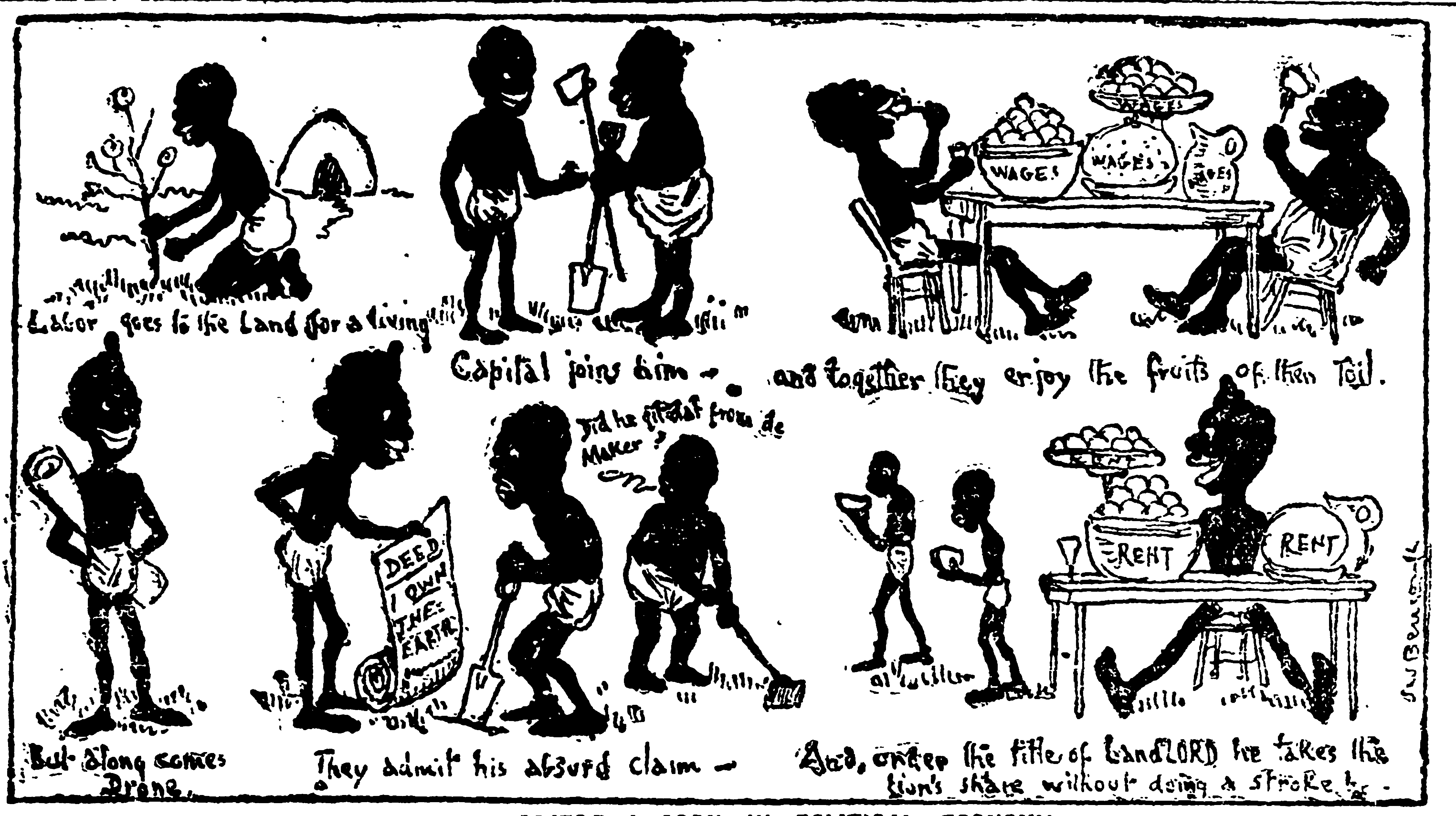
[Cartoon spanning columns 2–4, eight panels in two rows, hand-lettered captions. The figures are drawn as racist “blackface”-style caricatures, typical of the period; the source is the Toronto Grip. Row 1: a kneeling figure plants seedlings near a hut; a second figure carrying a spade shakes hands with him; the two sit at a table eating from a heaped bowl, a sack and a raised dish each labelled WAGES, with a jug labelled [WA]GES. Row 2: a grinning figure with a rolled paper under his arm; the same figure displays a scroll reading “DEED / I OWN / THE EARTH” to the other two; the two bend to dig with spade and hoe; the two stand with empty bowls while the third sits at a table with a heaped bowl and dish labelled RENT. Artist’s signature at right, vertical: J. W. Bengough[?].]
Captions (as lettered): “Labor goes to the Land for a living” / “Capital joins him —” / “and together they enjoy the fruits of [their?] Toil.” / “But along comes Drone.” / “They admit his absurd claim —” / “And, [under?] the title of LANDLORD he takes the lion’s share without doing a stroke.” Speech balloon: “Did he git dat from de Maker?” Label on scroll: “DEED / I OWN / THE EARTH”. Labels on vessels: “WAGES” (bowl), “WAGES” (sack), “WAGES” (raised dish), “[WA]GES” (jug); “RENT” (bowl), “RENT” (jar).
ANOTHER OBJECT LESSON IN POLITICAL ECONOMY.
From the Toronto Grip.
Labor. Yes, sir.
Land Owner. Well! I’ll be easy with you and charge you no more this year; but you must keep the fence in repair.
Labor. It will be very hard on me, sir; taking so much from the support of my family, but I suppose that I must do as you say; and if I must, I must.
Land Owner. Now how much will you agree to give me for the use of my land? Last year you wouldn’t give me anything, and I had to come to your terms, because you had the common to fall back upon. This year there’s no common, and you’ve got to come to mine.
Labor. I hope, sir, that they will be such as to enable me to live and keep my family comfortably, which will be hard work enough now, with the additional work I’m obliged to put upon the fence.
Land Owner. Comfortably! I don’t know and I don’t care. You ought to be satisfied with the necessaries of life, and not talk about luxuries. But there’s no use in wasting any more talk about the matter. The rent of the lot for this year is fifty bushels in all.
Labor. But, sir—
Land Owner. But me no buts. That’s the rent.
Labor. We shall starve, sir, and then your land will be of no use to you. You must have somebody to cultivate it.
Land Owner. There’s something in that; but, as I said, fifty bushels is the rent. You know that you must take the land at my price, and I know you’ll make the shift to pull through. If you can’t, and I find that you really haven’t enough to live on, perhaps I’ll not exact the whole of the rent, but let a part remain in arrears, for you to make up when you have an extra good year, and I will give you some of the small potatoes in charity, to keep you alive and out of the poorhouse—where (aside) I should have to pay for the whole support of you and your family.
Parties Are Only Instruments, to be Used and Thrown Aside.
BALTIMORE, Md.—I do not know whether THE STANDARD will continue its discussion as to the sic of running a candidate for the presidency on the basis of the principles of the united labor party, but I wish to be allowed the privilege of expressing my regret that anything savoring of personality should have been allowed to enter into the matter. The cause we advocate is greater than any man or set of men, therefore no one can enter into our work from selfish considerations. If they do they will find themselves thrown overboard before they know it. While “my sympathies,” as Judge Maguire says, “are with the idea of a candidate of the united labor party, my judgment is against it.”
In attempting to apply the principles springing from the single tax, men will move slowly. I, for one, never expected any success from the united labor party as a party. I looked upon it simply as an advertisement of our principles, and in that light I think it is an abundant success. Parties are nothing to me. I have changed parties a half dozen times in the last five years. I am not a personal admirer of Jay Gould, but I think it would not be a bad idea for single tax advocates to follow him in his methods outlined in his statement: “In republican states I am a republican; in democratic states a democrat, but everywhere always an Erie man.” We might be democrats in democratic states and republicans in republican states, but everywhere and always single tax men.
I do not pretend to say that this is the most exalted view to take, but it is a practical business view. I want to live to see the day when some benefit is to be derived from the application of our principles. I have no particular admiration for either the democrats or republicans, but if we can gain a vantage ground with either it would be the utmost folly to throw it away. A solid body of men, even if small, can accomplish a great deal more than a large disorganized mass. The republican and democratic parties are but masses of men without specific objects, while we have positive aims clearly defined, and our principles must win, therefore, in the long run.
WM. N. HILL, M. D.
Wants a Lively Party.
NEW HAVEN.—Let us have a new party, a diffused sense of responsibility, a resurrected conscience, a new republic. Plant its standard in every state, city, town and hamlet in the country.
T. W. CURTIS.
p. 8, col. 3
WHOM TO PRAY TO.
Hugh O. Pentecost’s Address before Unity Congregation—The Real Gods of the Earth.
Hugh O. Pentecost’s sermon before the Unity congregation on Sunday last, was on the subject of Prayer. After pointing out to his hearers how the form and nature of men’s prayers depend upon men’s conceptions of the deity addressed, the speaker turned to the consideration of the efficacy of prayer. He said:
I do not wish to discourage prayer, but only to increase its quality. Each soul must decide for himself in how far and to what purpose it is possible for him in soul matters to find God. Each must decide, too, how much God helps him in what we call temporal concerns. But I think we may safely say that he who runs his prayers along the line of natural law, even in mental and spiritual concerns, will get more of them answered than in any other way. He who prays for righteousness will get it best by being careful to be honest and truthful in his relations to men and pure and respectful in his relations to women. He who prays for health will get it best by looking after his food, sleep and exercise. He who prays for the kingdom of God to come on earth as in heaven will bring it about best by studying the constitution of society, in order to clearly understand what conditions stand in the way of it and tend to make it possible.
There are many men in this country who are prominent in the church on Sunday and are prominent in “pools,” “combines” and “trusts” on Monday. On Sunday they pray, “Thy kingdom come,” but on Monday they say by their doings: “Not if we can help it.” All this is wretched hypocrisy.
Many people are beginning to understand this: that the miseries which mankind suffer are not such as God can relieve them of unless he leads them to see how entirely they depend upon our arrangement of society. Those persons, for instance, who are sending petitions to Austin Corbin beseeching him to make some terms upon which coal can be had at a cheaper rate, are beginning to understand the situation. If God owned the coal mines and the people could get at them it would be proper to pray to God, “Give us this day our daily coal,” and then we could go and answer our own prayers, by digging the coal or buying from somebody else who did dig it. But since Austin Corbin owns the coal mines and the people can’t get at them, they are quite right in praying to Austin Corbin instead of to God. Whatever else God can do he can’t control the output of Pennsylvania coal. Other gods control that. It is right, therefore, to pray to the gods who really hold the power in their hands. Nor is the case hopeless.
The Chinese and other idolatrous people pray to their idols, and if after repeated prayers they get no answer they pull the idol down and spank it, and then fling it on the ash heap or into the fire. Now, since the people are at last beginning to pray to the right gods there is this hope, that if our coal gods will not give us this day our daily coal at righteous prices we shall find a way of dethroning them.
Already men are beginning to say: “Did God, indeed, put the coal in the earth for Austin Corbin or for all people? If for all the people, how comes it that Austin Corbin holds the key to the mines?” Now, if they follow up this line of thought they will some day say to these coal gods: “You are not really gods and this coal does not belong to you. It belongs to the All-Father and was placed here for all his children. You must give up these mines or you must pay rent to all the people for the privilege of working them.” When that day comes we can cease to petition Austin Corbin and begin to thank God for abundance of coal.
As long as a few men are allowed to own the earth it is useless to ask God for anything that must necessarily come from the earth. We are told that when the Israelites were in need of food in the wilderness God fed them by raining down manna from heaven. The same method of relieving distress would not be successful now. The manna would all go to the land owners, who would form a “trust” and put just so much of it on the market as would enable them to sell it at the highest price that the traffic would bear, after they had passed a law that any one caught picking up manna in the streets and highways should be arrested as a tramp.
“Consider the lilies of the fields; they toil not neither do they spin, and yet I say unto you that even Solomon in all his glory was not arrayed like one of these.” Perhaps. But whether the lily grows at all will depend altogether upon whether the land owner wants to plant a more profitable crop in his field.
“Consider the birds of the air; they sow not, neither do they reap nor gather into barns, yet your Father feedeth them.” It may be so; but it will depend altogether upon whether the land owner has a gun.
“Take no anxious thought of the morrow.” Good words in any case, because it is no use to fret over what we can’t help; but mighty hard to put into practice with a man earning only what he can pick up by odd jobs in the street, or a woman making vests for five cents a piece, or a child stripping tobacco for not enough to buy good food to counteract the poison of the weed.
“I was young, and now am old: but never have I seen the righteous forsaken or his seed begging bread.” So said the psalmist; but either conditions have changed or that is a pious lie, for once I was young and am not yet old, but I have seen the the sic forsaken and his seed begging bread.
And all this while millions of acres of life giving land are given up to deer and grouse, and other millions are kept out of use by greedy speculators, every acre of which represents a starving human being.
All this while the people’s money and the people’s opportunity to live in peace and comfort p. 8, col. 4 are permitted to be stolen by shameful laws which enrich the rich and impoverish the poor.
Pray! There never was more need of it. But think, too! And know that God cannot do anything for the betterment of the human family until we ourselves arise and unmake the miserable laws under which we groan; until we evolve a new social system which shall not by the same turn of the wheel bring forth a land-grasping, trust-forming monopolist on the one hand and a shuffling pauper, with a haggard wife and a starving child on the other.
No Nomination, but a Full Discussion of Principles.
NEW YORK, Feb. 13.—After reading the many various opinions offered to you by your followers presenting their views on the advisability of nominating a presidential candidate in the coming campaign I believe that your opinion in firmly opposing any such intention ought to be most seriously considered. I honestly believe you will never regret the step you have taken. Let the sentiment be what it may, you ought at least to be congratulated on having the good fortune of being able to foresee an available opportunity of bringing into discussion all the vital principles of true democracy. To carry on the propaganda of our party more successfully than we have done in the last campaign, you have suggested, in my humble opinion, the most desirable plan, and that is to teach the advocates of a “tariff for revenue only,” that they are virtually maintaining an issue which will eventually give way to a “single tax” only. They would more readily take to our doctrines in that way than if we were to open hostilities toward them. Yours, forever in the cause,
PHILIP BAUSCH, Jeffersonian Democrat.
From the Cleveland Land and Labor Club.
CLEVELAND, Ohio, Feb. 22.—At our meeting February 21, the following resolutions were unanimously passed:
In view of recent complications that have arisen among the leaders of the united labor party in New York, causing calamitous (although it is to be hoped purely local) division of the party that is much to be deplored, we, the members of land and labor club No. 9 of Cleveland, do hereby unanimously tender the following resolutions for publication in THE STANDARD:
Whereas, It seems an open question whether it be wise or advisable to put forth a national ticket for the ensuing election,
Resolved, That we deem it absolutely necessary to call a national conference of representative men of the united labor party to discuss and decide whether a convention should be held.
Resolved, That should this representative conference decide on running an independent ticket, said conference can resolve itself into a national convention.
Whereas, The right to take the rental value of land for public purposes belongs to the people of each individual state and not to the federal government, and it seems to us absurd to think of entering the national campaign as a single tax party and utterly ignore the tariff question:
Resolved, That we deem Henry George’s whole course of action through the recent trouble as consistent and honorable, and we consider his changed relations to some of his late colleagues as none of his ordering; and further we enter our most emphatic protest against the assumption of arbitrary and despotic power by any three or more men to control and direct the whole party. We object taking our politics from New York as much as from Rome.
LESTER E. SIMEON, Sec.
State Organization in Kansas.
TOPEKA, Kan.—The Topeka anti-poverty society, co-operating with parties in other parts of the state, effected on the 9th of the present month an organization for the state of Kansas. The Syracuse platform was adopted, and a state central committee was elected, with headquarters at Topeka, in the offices of the Topeka Post. The convention was quite respectable in numbers, and the utmost harmony and good feeling prevailed throughout. In view of the fact that our party is mainly composed of men whose circumstances will not permit them to incur the expense necessary for an active propaganda, it is proper to say that any assistance in the way of printed matter for distribution will be gratefully received.
S. S. GASKILL, Chairman Central Committee, State of Kansas.
Do Nothing to Hinder Them.
NEW YORK CITY.—As long as the president of the United States, the mayor of the city of New York and many other influential officials and citizens are coming our way, consciously and unconsciously, we should do nothing that would impede their approaching steps, and much less should we do anything to weaken or destroy a party capable of such great possibilities in the state, in the early future, and consequently in the national field by and by.
WALTER CARR.
His Eyes are Opened.
AUBURN, Me.—For some time I believed as Dr. McGlynn, Mr. Wilder and Mr. Barnes do now; but the debate in THE STANDARD upon the question of a presidential nomination has opened my eyes.
It seems very strange to me that friends of the single tax should do anything to hinder the abolishing of tariff taxes, when they know that all other taxes must be swept away before the single land value tax can be adopted.
F. W. WHITE.
p. 8, col. 5
FARMING IN CANADA.
Rent $600, and Net Profit for the Year $70—What the Landlord and the Protective Tariff are Doing for the Farmer.
Montreal Daily Witness.
Though all coming from different districts, there is no difference of statement between the five farmers who have responded to our questions as to their prosperity. Farmers did not last year, even with fair crops, make interest on their investment of sic for their work, and the past decade is declared by all to be worse than the preceding. The information given in the detailed balance sheet of a tenant farmer is of particular interest. The farm that in Ontario can sic a rent of $4 an acre, must be good, well tilled land, with adequate barn and stable room, and a comfortable house. Its position must also be in its favor, and, in short, this farm of 170 acres must represent a capital value of about $15,000. As a result of a year’s work on this farm, its tenant, after paying merely the expenses of raising his crop and what cannot be equivalent to more than four or five per cent on the capital invested, had seventy dollars to reward himself, one man and a boy for their toil. As no mention is made in the expenses of groceries, etc., it is fair to presume that the surplus of butter, eggs, poultry, etc., met these expenditures, but it is evident that seventy dollars is not enough to meet the remaining wants of a family of ten people, no matter how moderate these wants may be. His past savings, moreover, count for nothing, as he has no interest on the value of his stock. That in the case of this tenant farmer the lack of profit is not caused by any sort of bad farming, we can assert from a personal knowledge of the man, than whom there is none better in all Ontario. The position of the ten farmers in the county of Stormont, one of whom has made money, one of whom had been forced to mortgage, while four have got along and four have gone behind, is probably about the position of the Ontario farmers generally, and that not only for the last year, but for several years. What other result could be expected? The farmers either sell their product in the open market of Great Britain or they force them over the tariff wall into the United States, and they are compelled to buy all the necessaries of life and the machinery they use in production in an artificial market where everything they need is increased in price twenty-five or thirty per cent for the benefit of the cotton combine, the sugar combine, the chair combine, the woolen combine, the stove combine, the twine combine, the implement combine and the rubber monopoly.
It Will Be Felt in a Reduction of Wages.
Kansas City Star.
John Wanamaker, the philanthropist and merchant prince of Philadelphia, has carried to a highly successful issue his experiments in the direction of devising a cheap method of living for his employes. He has provided a boarding and lodging house for women employed in his mammoth establishment, in which the cost of living has been brought within the moderate sum of $3.25 per week. This includes comfortable and attractive rooms, apartments for the reception of visitors, baths, and all of the conveniences of a well-ordered home. The table is supplied with an abundance of wholesome food prepared in the best possible manner. That is the kind of an anti-poverty movement that makes itself felt.
MISCELLANEOUS.
[Advertisement] Ollendorf’s Neurodontine
OLLENDORF’S NEURODONTINE.
Instantaneous cure for Toothache, Headache and Neuralgia. 25 cents. Central depot, [203?] E. 14th st., N. Y.
[Advertisement] Charles B. Schaidner, Photographer
CHARLES B. SCHAIDNER, PHOTOGRAPHER, [2280?] Third avenue, cor. 124th street, New York.
Children’s Photographs by instantaneous process a specialty
[Advertisement] Holland’s Coffee and Dining Rooms
HOLLAND’S COFFEE AND DINING ROOMS, [113?] Fourth avenue, Bet. 13th and 14th sts.
[Advertisement] James Bogan
JAMES BOGAN, PRINCIPAL AGENT for James Means’ $3 and $4 shoes. 226 BOWERY, near Prince street.
[Advertisement] The New Christianity
THE NEW CHRISTIANITY.—A bi-weekly independent journal, recognizing the fatherhood of God and brotherhood of man as the essentials of religion, and Emanuel Swedenborg as the illumined instrument of the new dispensation and era now so manifestly beginning.
In sympathy with every movement toward the realization of the Lord’s kingdom on earth, and having no desire to build up a sect or to interfere with any one’s church relation, it opens its columns to all religious, moral and social questions, guided by one principle alone—the thought and love of USE.
Editors, B. F. Barrett and S. H. Spencer. Price, $2 a year. Sample copies free. Address NEW CHRISTIANITY, Germantown, Pa.
[Advertisement] Coogan Bros.
[Engraving: street front of a five-storey store building, horse-drawn carts and pedestrians in the street. Signs on the building, top to bottom: “COOGAN BROTHERS” / “WHOLESALE & RETAIL FURNITURE CARPETS &c” / “BEDDING WAREROOMS” / “MANUFACTURERS” [partly legible] / “125 COOGAN BRO’S 121”.]
COOGAN BROS.,
CARPET AND FURNITURE DEALERS,
COR. BOWERY AND GRAND STS.
MINING NOTICE.
[Advertisement] Annual Report of La Abra Silver Mining Company
ANNUAL REPORT OF LA ABRA SILVER Mining Company.—The amount of the capital of said company is [$300,000?]; the amount actually paid in on said capital is [$235,000?], and the existing debts of said company amount to [$135,831.06?]. Dated New York, January 20, 1888. J. G. Baldwin, President. J. G. Baldwin, S. S. Ely, Fletcher Westray, George C. Chase, majority of trustees.
State of New York, City and County of New York, ss.—James G. Baldwin, being duly sworn, says that he is the president of La Abra Silver Mining Company, the corporation above named, and that the foregoing report, which is signed by him and a majority of the trustees of said company, and the matters therein contained are correct and true according to the best of his knowledge, information and belief.
J. G. BALDWIN.
{Notarial Seal.} Sworn to before me, January 25, 1888. Wm. E. Trotter, Notary Public, N. Y. Co.
PRINTING.
[Advertisement] Concord Co-operative Printing Company
CONCORD CO-OPERATIVE PRINTING COMPANY (Ld.) 47 and 49 Center st., N. Y. BOOK, JOB AND NEWSPAPER PRINTING.
p. 8, col. 6
[Advertisement] Unity Congregation
UNITY CONGREGATION. REV. HUGH O. PENTECOST, MINISTER. MASONIC HALL, Sixth avenue and Twenty-third street. SERVICES, Sunday Morning, 11 o’clock.
[Advertisement] Unity Circle
UNITY CIRCLE. Musical and dramatic entertainment for the benefit of the UNITY CONGREGATION, SATURDAY EVENING, Feb. 25, MASONIC TEMPLE, 23d street and 6th ave. Reserved seats, 50 cents. Unreserved, 25 cents.
[Advertisement] Anti-Poverty Society in Philadelphia
ANTI-POVERTY SOCIETY IN PHILADELPHIA.
The Society will hold meetings every Sunday evening at 8 o’clock at Lincoln hall, corner of Broad street and Fairmount avenue.
Everybody invited. Admission free.
WM. J. ATKINSON, President. J. H. M’INTYRE, Secretary.
MISCELLANEOUS.
[Advertisement] Braham’s (suits to order)
SUITS TO ORDER FROM $13.50.
PANTS TO ORDER FROM $3.50.
Samples and self-measuring chart mailed on application by stating price and as near as possible design desired.
BRAHAM’S, 212 BOWERY, sic CITY.
[Advertisement] Keystone Watch Club Co.
THOUSANDS OF THE BEST $38 GOLD WATCH EVER MADE ARE SELLING IN OUR CO-OPERATIVE CLUBS.
This is the Best, Cheapest, Most Convenient,
And only co-operative System of selling watches. The watches are American Lever Stem Winders, containing every essential to accuracy and durability, and have, in addition, numerous patented improvements found in no other watch. They are absolutely the only Dust and Dampproof Movements made in the World, and are jeweled throughout with GENUINE RUBIES. The Patent Stem Wind and Set is the strongest and simplest made. They are fully equal for appearance, accuracy, durability and service, to any $75 Watch.
Our Co-operative Club System brings them within the reach of every one.
We want an active, responsible representative in EVERY CITY and TOWN.
Heavy profits guaranteed on limited investment. Write for full particulars.
The Keystone Watch Club Co. P. O. Box 928, Philadelphia, Pa.
[Trade emblem: a keystone enclosing an open-faced pocket watch, lettered “THE KEYSTONE WATCH CLUB Co.”]
REFERENCES:—Keystone National Bank, or any Commercial Agency.
AGENCIES:
New York, N.Y. | Harrisburg, Pa. Chicago, Ill. | Denver, Col. Pittsburgh, Pa. | Baltimore, Md. Boston, Mass. | St. Louis, Mo. Philadelphia, Pa. | Wilmington, Del. Detroit, Mich. | Etc., etc.
[Advertisement] Canned Goods (C. M. M. P. A. stamp)

[Circular stamp lettered “HAND MADE / C. M. M. P. A.” around a central emblem.]
Canned Goods WITH THIS STAMP IN THE BOTTOM OF CANS ARE Free from Poison. AND ARE MADE BY ORGANIZED LABOR.
Trade-Mark.—Registered.
[Advertisement] Piso’s Remedy for Catarrh
Piso’s Remedy for Catarrh is the Best, Easiest to Use, and Cheapest. CATARRH Sold by druggists or sent by mail. 50c. E. T. Hazeltine, Warren, Pa.
[Advertisement] The Great American Tea Co.
[Emblem: a block letter T lettered “THE GREAT AMERICAN TEA COMPANY”.]
GOOD NEWS TO LADIES.
Greatest offer. Now’s your time to get orders for our celebrated Teas, Coffees and Baking Powder, and secure a beautiful Gold Band or Moss Rose China Tea Set, Dinner Set, Gold Band Moss Rose Toilet Set, Watch, Brass Lamp, Castor, or Webster’s Dictionary. For particulars address
THE GREAT AMERICAN TEA CO., P. O. Box [289?]. 31 and 33 Vesey St., New York.
UNITED LABOR PARTY.
[Notice] United Labor Party state organizers
UNITED LABOR PARTY—Citizens of the following named states who indorse the principles of the United Labor Party and desire to lend active aid in the movement, are requested to communicate with the State Organizers of their respective states, as follows:
California—Judge James G. Maguire, San Francisco. Connecticut—Robert Pyne, [281?] Asylum st., Hartford. Pennsylvania—Henry George club, box 190, Philadelphia. Indiana—Warren Worth Bailey, Vincennes. Kentucky—Land and Labor Club No. 1, box 99, Cincinnati. Louisiana—Jere. J. Sullivan, [705?] Fulton street, New Orleans. Massachusetts (Berkshire county)—F. Harvey Lincoln, box 115, Zylonite. Maryland—T. H. Garside, [1517?] West Lexington street, Baltimore. Minnesota—Central Committee, United Labor Party, [42?] Third st. south, Minneapolis. New York—John McMackin, 28 Cooper Union, New York city. Ohio—Land and Labor Club No. 1, box 99, Cincinnati. South Carolina—Benjamin Adams, Charleston. West Tennessee, Eastern Arkansas and Northern Mississippi—Land and Labor Club No. 2. Rooms, 9 and 10, Cotton Exchange, Memphis, Tenn.
[Notice] Illinois
ILLINOIS.—Readers of the “Standard” in the state of Illinois, and all others interested in the great principles it advocates, are requested to send names and addresses to W. H. Van Ornum, president of land and labor club No. 1, Room [63?], 170 Madison street, Chicago, with a view to effecting some plan of organization for the state. Persons in Chicago not already members of land and labor clubs, as well as secretaries of such organizations, are especially requested t sic.
[Notice] First Assembly District
ALL READERS OF THE STANDARD IN favor of a united labor party in the First assembly district, composing the First, Second, Third, Fourth and Fifteenth wards, also the counties and towns included in the district will please send their names and addresses to the undersigned, for the purpose of organizing the district thoroughly. JOS. H. ROSHIRT, President First assembly district, united labor party, [22?] Third avenue, Albany, N. Y.
[Notice] 23rd Assembly District
23RD ASSEMBLY DISTRICT MEETS every Monday evening. German speaking members every Tuesday evening at Vincent hall, 1897 Third avenue, corner 105th street. Open every evening for enrollment of members. Thursday and Saturday evenings free debates of the Progress and Poverty club.
[Notice] Voters of Maryland
VOTERS OF MARYLAND WHO ARE desirous to aid in propagating the principles of the united labor party, as set forth in the New York platform, adopted at Syracuse, Aug. 19 are requested to send their names and addresses to
JOHN SALMON, 415 N. Eutaw st., Baltimore, Md.
[Advertisement] Briggs’ Pianos
[Display advertisement: engraving of an upright piano at left with a leafy spray beneath; a pointing tag reads “SEND FOR CATALOGUE”; ornamental lettering at right.]
BRIGGS’ PIANOS C. C. BRIGGS & Co. 5 APPLETON ST. BOSTON MASS. MANUFACTURERS OF GRAND · SQUARE & UPRIGHT PIANO FORTES GRACEFUL DESIGNS · SOLID CONSTRUCTION MATCHLESS TONE · BEAUTIFUL FINISH.
SOCIAL PROBLEMS.
BY HENRY GEORGE.
342 pages.
CONTENTS: