Page 1 of 8contents
THE STANDARD
NO. 85—[VOL. obscured by a pasted mailing label] IV, NO. 7. | NEW YORK, SATURDAY, AUGUST 18, 1888. | PRICE FIVE CENTS
p. 1, col. 1
THE STANDARD F[OR THE C?]AMPAIGN.
Subscriptions to THE ST[ANDARD fr?]om now to the close of the campaign [will be?] received at the following rates:
Single subscription . . . . . 52c Ten or more, each . . . . . 48c One hundred or more, each . . . 44c
[Note: a subscriber’s mailing label is pasted over the top of this notice; the bracketed words are hidden by it.]
“The Standard” is sent this week to a number of persons whose friends have paid to have the paper forwarded to them for four weeks in the hope that they may be induced to read it, examine the principles it advocates and become regular subscribers. Those who receive the paper without having ordered it will understand that it has been sent in this manner and will be sent for four successive weeks without charge to them.
Terms of subscription will be found on the fourth page.
CONTENTS:
Cartoon. The Democratic National Committee. The Single Tax Cleveland Campaign. Mr. Powderly on Immigration. Mr. Blaine’s Trunks. Albert Johnson. Immigration (An Interview with Congressman Ford.) Straws Which Show the Wind. Cleveland and Hill—Opinions of New York Single Tax Men on the Political Situation. Editorial Notes. Personal. In Southern California. A Single Tax Assessor. Society Notes. Queries and Answers. Delegate Jones. Pen, Paste and Scissors. A Protected Industry. The Beating of the Drums. Keep Your Faces to the Light (poem). Under the Gilded Cross (story). Notes from Correspondents. A Menacing Irruption. New Ideas, Methods and Inventions. Current Thought. At a Garden Party of King Demos. To Single Tax Cleveland Voters.
From all parts of the country, and especially from the doubtful states, where the hard battle must be fought, there have been coming for some time complaints, first of apathy, and then of treachery in the democratic national committee. The New York Herald, which, ever since the nomination and long before it, has been doing the most splendid service for Mr. Cleveland and the cause he represents, was the first to put any suggestions of these complaints into print. Since, has come the statement in the Cincinnati Enquirer, by Mr. William McBride, a journalist of this city, of a conversation between Colonel Bryce, chairman of the democratic national executive committee, Colonel Brown of the New York News, and himself. The point of this interview was the doubt on the part of Colonel Bryce of Cleveland’s doctrine and his desire that the tariff issue should be put in the background, and that the president should resort to the old methods of promising patronage to secure the activity of “leaders” now laggard.
This interview derives more weight from the comments of the Sun, which is endeavoring to the best of Mr. Dana’s great ability to get the democratic party to run instead of to attack, and thus ignominiously beat Mr. Cleveland. Colonel Bryce has denied this interview, but in a way that leaves no question as to its correctness on the main point—that is, his attitude on the tariff question.
There can be no doubt that Mr. Cleveland has in the official lead of his fight men who are against him upon the issue on which he must either win or lose. How he came to consent to the appointment of a protectionist like Barnum to the chairmanship of the national committee, is a matter that passes comprehension. But there Barnum is, and democratic protectionists seem to have control of the executive committee.
As an indication of the temperature at the democratic headquarters, I am informed by Donn Piatt, editor of Belford’s Magazine, that he called there a few days ago with Mr. Robert Belford, publisher of the magazine. They met there Colonel Tracy, one of the confidential men in charge of an important department. Colonel Piatt said to Colonel Tracy: “From information received from the agents of Belford, Clarke & Co., who have been instructed to inquire into and report on the condition of the country politically, I have learned that we have at the present lost Connecticut and New Jersey beyond doubt, and that we will lose New York unless something is done.” Colonel Tracy replied, “It is of no use; we need not try to blind ourselves to the fact that we cannot stand up against the cry of ‘free trade.’”
Like master like man. This Colonel Tracy is editor of the Star, and under his management that professedly democratic paper has been doing all it can to throw cold water upon the tariff fight. He is a thoroughgoing protectionist, like Mr. Barnum and Mr. Dana, and was at one time editor of the Protectionist, a weekly paper published here with the money of one of the tariff rings. Yet he is one of the managers in a national struggle which can only win by convincing the masses that protection is a sham and a robbery.
Mr. Cleveland entered this campaign p. 1, col. 2 with the most splendid chances. They have thus far been frittered away by the cowardice and treachery of those whom he has had the weakness or the misfortune to allow to run his campaign, and who will “Hancock” him if he permits it. I believe he will be elected yet, and perhaps all the more triumphantly, if this error is quickly rectified. The people have got hold of the tariff issue and will pull Cleveland and Thurman through. But Mr. Cleveland is launched in a race and he ought to cut the balky horses in his lead from the traces. Let him do this as best he can, but do it.
In the meantime, however, there is one good indication, The sic of democratic clubs is pushing forward, and Chauncey F. Black, the chairman, and Edward B. Whitney, the secretary, are democrats who will not make an apologetic fight.
However, all this is the business of the democrats. As for us who support Mr. Cleveland because we are believers in the single tax, our business is simply to do what we can to infuse aggressiveness into the campaign and to swell the vote for Cleveland and Thurman as much as possible. The committee appointed by the conference of single tax men have decided to hold their first meeting at Cooper union on Monday, August 27. James P. Archibald will preside and William Lloyd Garrison and myself will make speeches.
The interviews which we publish on the third page show the temper of our friends, and indicate how large a vote, which at the last election went for Blaine, the single tax idea will this year bring to Cleveland.
The enrollment is progressing extremely well, and the committee asks our friends to push it on. The blank is published in THE STANDARD again this week. If you have already signed it yourself, cut it out, paste on a sheet of paper and get others to sign it.
We print this week an interview with Congressman Ford, chairman of the special house committee on immigration, which may be considered a concise statement of what has been discovered by the voluminous testimony taken during the two weeks’ inquiry of that committee. We also reprint from the North American Review the substantial part of an article in which the general master workman of the Knights of Labor urges the further restriction of immigration.
We are not likely to get from the committee much more than we have already got. They are gunning for snipe; they are not “loaded for bear.” As Congressman Ford frankly says, they do not care to venture upon the problem that lies at the root of this question of immigration, as of all social questions. Congressmen are only good searchers for what they think voters want to find; and, especially just before an important election, the strong instinct of the politician is to afford the maximum of satisfaction to what he believes to be the “labor sentiment” with the minimum of offense to sic. We can hardly, therefore, expect the Ford committee to go further than does the Herald, which has had a good deal to do with getting up this investigation, and has devoted a great deal of space to the publication of the testimony and other matter of the same kind. And in treating the “immigration question” as though immigration in itself were injurious to labor, the Herald pretty well represents the press of the whole country.
To talk of immigration as though that were the cause of scant employment and low wages, is at once to make a pretense of devotion to the interests of labor and to turn the attention of the laboring masses in a direction that will not threaten “vested interests.” And just now the out cry against immigration seems to line with the policy of both the great parties. On the cne sic anti-protectionists can utilize it to show the hollowness of the pretense that the tariff on goods protects American labor. On the other side protectionists can use it to excite those prejudices against “foreigners” which have so powerfully aided them in imposing their scheme of robbery on the American people. To preserve the one Chinese wall which they have induced the masses to erect around our coasts, they would be willing, if need be, to have another erected. To save protection on goods, they would, if necessary, give up free trade in labor. They are the more ready to countenance this idea, because they well know that it is really impossible to im pose any substantial restrictions upon European immigration without resorting to the complete Chinese plan of non-intercourse. They well know that the foreign contract labor law is a mere sham,
p. 1,
col. 3 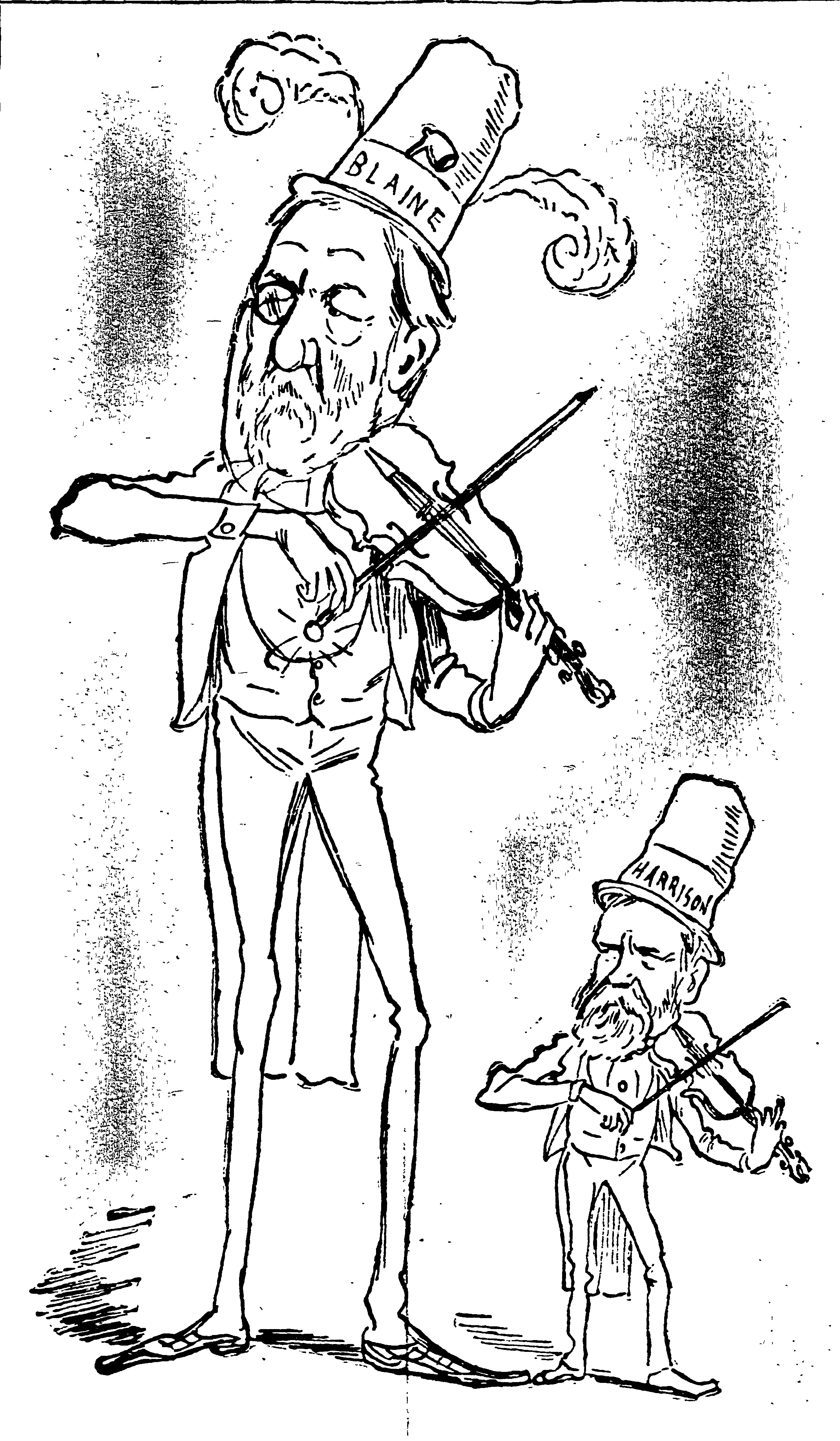
[Cartoon, spanning columns 3–4: James G. Blaine, tall, wearing a monocle and a tall plumed hat lettered “BLAINE,” plays the violin in the foreground; beside him a much smaller Benjamin Harrison, in a tall hat lettered “HARRISON,” also plays a violin.]
Labels: BLAINE / HARRISON
SECOND FIDDLE.—Never mind me; I’m only the candidate.
[Column 2 text continues below the cartoon in column 3:]
and that any amendment that congress can make to it will be but the casting of another tub to the whale.
It is disheartening to note the ardor with which Master Workman Powderly rushes in to draw a red herring, as the expressive Irish phrase goes, across the trail of the true labor movement. Timid as a mouse, as he has latterly become in declaring for honest principle, he is bold as a lion in his efforts to arouse prejudices through which the working masses have in all countries and in all times been most readily enslaved. He sees men working with brass checks at their waist-bands, going to bed with their boots on under blankets of gunny sacks, and marched up to the polls by employers, but he lisps no word that this is under the system of “protection to American labor,” and that these employers are the advocates and beneficiaries of that system. He has nothing to say of certain other suggestive things he must have seen where he saw these things—native American citizens mere tenants-at-will on five days’ notice of some lord of the manor, living in his houses, buying in his stores, dependent for the right to work upon his will, while on every hand lay unused the abundant natural opportunities that nature had provided. Utterly ignoring the question of how American workingmen come to be so dependent that they can be thrown out of work and compelled to take lower wages by the endeavor of other men to get a living, Mr. Powderly concentrates all his attention on the foreigner, just as the English agri cultural laborer stones the Irish harvest hand, but takes off his hat to “my lord,” the representative of a usurpation of natural rights which makes both him and the Irishman beggars for “leave to toil.”
Mr. Powderly disclaims knownothingism, but he writes in the worst spirit of knownothingism. The railing charges that he, the son of an Irishman, brings against these later comers are simply a revamping of the charges which in the earlier days of Irish immigration were brought against the Irish—that they crowded together and lived meanly; that they did not wash themselves enough; that they not only had “dining room, smoking room, sitting room, kitchen and bed-chamber all in one,” but kept the pig in the parlor; that they worked cheaply and sent their money home; that they filled almshouses and prisons, and could not understand our institutions nor appreciate our liberty, but were naturally serfs. What Mr. Powderly says of these Italians, Hungarians and Poles is precisely what was said of the Irish by the knownothings, except that he does not charge them with being superstitious and priest-ridden.
p. 1, col. 4 But to supply this omission he accuses them of speaking a language he does not understand!
There is no more truth in the allegations which are made by Mr. Powderly against the Italians, Hungarians and Poles than in the similar allegations against “the low Irish,” which were made by knownothings in the United States, and are still made by orangemen in Ireland and tories in England. Already in the mining districts of Pennsylvania, where the feeling against these new immigrants was at first so bitter, the members of the order of which Mr. Powderly is the head are beginning to entertain a far juster and kindlier feeling. They have discovered that the Italian, the Hungarian or the Pole does not work for low wages because he likes to, but because he has to; and in all the strikes which the Pennsylvania miners have for some time won, they have had the co-operation of these people. They have discovered, too, that these immigrants like to lodge well and fare well, whenever they can; that as soon as they can afford it their scale of living improves, and that their children, when they have opportunities for education and contact, are growing up Americans. Among the prominent Knights of Labor, representatives of various neighboring towns and districts, who filled the stage when I spoke for free trade last month in Mauch Chunk, was one native Hungarian—a bright young fellow who spoke English that anyone could understand. Instead of the other members of the order looking askance at him they seemed to be proud of him.
There is one valid, and at least in the present stage of our civilization, insuperable, objection to the immigration of the Chinese in any numbers. Besides the vast differences that separate them from us in language, religion, customs and habits of thought, there are also physical differences sufficiently marked to prevent assimilation, and to secure the perpetuation of all other differences. To admit them would thus be to admit an unassimilable element, which would continue, perhaps for long generations, to arouse prejudices and enkindle strife. But the people who are coming to us from Europe belong to the same great family of mankind as we ourselves, have the same religious beliefs that exist among us, speak for the most part different variations of what philologists tell us is the same mother tongue, and when not massed together as are the French in Canada, become in a generation undistinguishably blended with the rest of our people.
It is not true, as Mr. Powderly asserts, that there is any essential difference be-
p. 1, col. 5 tween the immigration that reached us prior to 1860 and that which is coming now. With the extension of railroads and the cheapening of steamship transportation we are drawing from a wider range, but the immigrants are of about the same class. It is not the rich who emigrate, but the poor; not those who are satisfied with their lot, but those who hope to make it better. From the first, the human flow across the Atlantic has contained criminals, paupers, refugees, assisted immigrants, contract laborers. In the colonial days these labor contracts were specifically enforcible, and men, women and children sold themselves to service for a term of years, in order to secure passage. But while, both in its own character and in the manner of its coming, the immigration in the earlier days of the republic was at least as open to objection as that which is coming now, it rapidly fused into a homogeneous population. Among our “first citizens,” even among Mr. Ward McAllister’s four hundred, are to be found descendants of redemptionists and bond servants, of men who started with packs on their backs, of men and women whose “dining room, smoking room, sitting room, kitchen and bed-chamber were all in one.” Yet, save the knownothing ebullition, which was more a manifestation of religious prejudice than anything else, there was until recently no objection from those already here to the coming of others. On the contrary, we looked on immigration as a source of national wealth and national strength, as an indication of the rapidity with which the star of empire was passing from the old world to the new. It was our boast that our country was the refuge of the downtrodden, the asylum of the oppressed; that in our broad territory there was room for the whole population of Europe. We sang—whoever remembers the other side of ’60 know how heartily—
Come along, come along, make no delay; Come from every nation, come by every way.
Why the change, when our population is as yet only sixty-five millions, and while we have single states and territories larger than the Austrian empire, or the German empire, or France, or Italy, or Great Britain? If, as Mr. Powderly says, we owe our greatness as a nation to the immigration that came prior to 1860, why should that now coming not increase our greatness? If, as he says, that gave us brain and bone and muscle, made our rivers navigable, dug our canals, built our railroads, and gave us mechanics, laborers and statesmen, why should not this also have such good results?
Surely the Italians, of whom just now most complaint is heard, are not an inferior race. Their language is the modern representative of the language that was once the master tongue, and is yet the sacred language of the Catholic church. Their capital was during centuries the political capital of the known world, and is to-day the religious capital of the greatest and most widespread form of Christianity. It was to Italians that Mr. Powderly offered awhile ago to submit the constitution and work of the order of which he is head. Raphael and Michael Angelo, and Dante and Leonardi da sic were Italians, and Garibaldi and Mazzini were Italians. It was an Italian who discovered America. Shall we say that the Italians are an inferior race, and not fit to come here?
What is it that the investigating committee have discovered against this people? Is it that they have believed what our leading journals, our leading ministers, our leading professors and our leading “statisticians” are yet saying—that this is a land where every one willing to work can find work? Is it that Italians borrow money at fifteen per cent, when they can’t get it any cheaper? Is it that they keep their agreements even when such agreements cannot be enforced by law? Is it that they crowd together closer than sanitary regulations prescribe, in a city where land speculation permits only some two or three per cent of the families to live under separate roofs and the police will not permit sleeping in the streets?
And so far from it being true of these people, as Mr. Powderly asserts of “the surplus population of Europe transported to this country”—that “they regard liberty as license and soon find their way into the police courts, the New York sic authorities say that they have very little trouble with them, while Chairman Ford as the result of his investigation pays the highest compliment to their honesty.
In truth, all this talk about the innate inferiority and depravity of European immi gration to the United States has about the same foundation as the stories Chinese boatmen tell of the vicious monkeys on the upper waters of their rivers, who have a passion for crushing steamers by throwing rocks. Mr. Powderly is not only wild
p. 1, col. 6 but disingenuous when he talks of the “paupers and criminals who have been dumped by the hundred thousand upon the already over-burdened backs of the workingmen of this country.” The real gravamen of his charge is, that these immigrants do not come here to prey upon the community or to live on the community, but that they are willing to work and anxious to work, and that it is their competition for work which deprives the American workingman of his right to work.
In Mr. Powderly’s protectionist philosophy, which, as he declared awhile ago, leads him to break ginger beer bottles in order to make more work for bottle blowers, the coming of criminals and paupers would not be such a bad thing. On the contrary, while criminals and paupers would not come into competition for work, the watching, and catching, and trying, and keeping, of them would much increase the amount of work to be done.
And this is the real bottom of the sentiment against immigration; the real cause of the largely changed feeling in regard to it. Work is growing scarce in the United States, and the competitors for work not unnaturally view with jealousy and dislike any new comers who may deprive them of the share of the work they might otherwise get.
But why is work growing scarce? Why is it that we seem to have what Mr. Powderly calls a “surplus population?” These are questions which Mr. Ford, who is only a congressman, and who as a congressman cannot afford to go ahead of his constituents, may with some reason decline to answer. But they are questions which Mr. Powderly, who is the head of what he claims to be a great educational order—an order which, as he declares, has taken as its function not only the enlightenment of the toiling masses of America but of Europe as well—cannot decline.
Is work growing scarce because there is less need for work?
What is the need for work? Is it not the supplying of wants—the satisfaction of desires? Are all wants supplied? are all desires for the things that work produces satisfied?
Surplus population! What does the general master workman of the world-instructing order mean by the phrase “surplus population,” which he uses so glibly? Does he mean a greater population than there are natural resources to support—a greater population than the Creator, in whom, as a Catholic, he believes, intended to exist? Or does he mean a greater population than there is any use for?
He calls for a party which will “take the same interest in the reduction of the surplus population as is taken in the reduction of the surplus in the treasury of the nation?” How does Mr. Powderly propose that this reduction of surplus population shall proceed? Surely, he would not think of exporting it to Europe, for there, also he says, there is a surplus population? Nor to Asia, nor to Africa? How then would he have his suggested party propose to get rid of it? By war, by pestilence, or by electricity?
To one who will simply look with a desire to see, it must be perfectly clear why even in such a sparsely settled land as this there should be a seeming scarcity of work, a seeming surplus population. Without the use of land men can neither work nor live. If one man owned the earth all the rest of its people, save such as he permitted to work, would be unnecessary laborers—surplus population. Whether, in holding vast areas idle, he were prompted by caprice or merely by the desire to get great speculative prices for for the sic of the earth, the result would be the same, except as to the definiteness of the line, the tension of the pressure. What would be true of the earth must be true of a continent or a country? And what is troubling our civilization to-day is that we have, throughout the civilized world, made the earth private property.
Or look at the matter in another way:
There are five thousand Italians out of employment in the city of New York, says Mr. Ford. They are nearly all agricultural laborers, and they are honest enough to find bankers who will lend them at least some capital if they have any prospect of repaying it.
Why don’t they go upon the Newark marshes and convert them into gardens? Why don’t they go upon any of the large amount of unused land that is to be found around New York? “The price is too high,” replies Congressman Ford, and he replies truly. Why don’t they go west? Because wherever they went they would find the same obstacle, in a degree proportioned to the difficulty of getting there, and the difficulty of getting produce transported from there. If they were to go to sic, they would find a great concourse waiting for the territory to be continued on p. 2 →
[Page ends here mid-sentence; the paper gives no “continued” line. The text presumably runs on to page 2.]
Page 2 of 8contents
[Running head:] 2 THE STANDARD, SATURDAY, AUGUST 18, 1888.
p. 2, col. 1 [continued from page 1]
← continued from p. 1 opened. And as soon as it was decided that they should go anywhere, there, as Congressman Ford truly says, would the price of land go up.
Now if these Italians could get this unused land, Mr. Powderly’s surplus population would be reduced at once by five thousand. That number of competitors for employment would be taken out of the overstocked labor market of New York city. But this would be only the beginning. These Italians, no matter how cheaply they tried to live—and no blame to them for thinking of wife and children, or sister or mother at home—would, by their demand for other things, set other now unemployed men at work, and those, again, others still.
In New York to-day one-half of the men in the building trades are said to be idle. Of those at work, one-half are said to be employed only half their time. Thus virtually five-eighths of the men engaged in all the different branches of house building are now unemployed. And this condition of things is said to be general through the country. Why do these New York builders stand idle? More houses are needed. People in New York—people of all incomes below the rich, are crowded together by high house rents closer than people ought to live. Why, if house rents are so high, don’t those who have capital go to sic and employ these idle builders to put up more houses?
Because, in the first place, there are high taxes on most of the materials used in building—taxes for the benefit of what is called in protectionist parlance, “American labor,” but which really means lumber kings, shingle trusts, steel and iron combinations, tin plate associations, etc., etc., etc. This is by virtue of the laws of the United States.
Then, by virtue of the laws of the State of New York, no sooner does a man build a house than he is fined for having done so, and the fine is repeated every year while the house he had the temerity to build holds together.
And lastly, but most important of all, to build a house one must have a lot to put it on. Now, wherever about the city of New York there is a lot on which a house can be built, or is likely to be built, there sits a dog in the manger, who, while he will not build himself, will not let anybody else build until he is first paid an enormous price—a price which he is constantly advancing as the city grows, and which, whenever increasing pressure of population makes the building trades brisk, leaps upward so fast and so far that building droops; the builders are idle again, and their enforced idleness forces idleness on others.
Here is the cause—the one great, fundamental cause of unemployed labor and “surplus population.” And the remedy is as simple and as plain.
Abolish all the duties and taxes that are now levied in any shape on the useful products of labor and put them, instead, on the value of land. What would become of the trusts and the combinations? How long would the dogs-in-the-manger keep their hold of natural opportunities they are not using? How long would the Italians be unemployed? How long would the builders stand idle? How long would it be before sic man in all this broad land who was willing to work would find all the work he wanted to do, and instead of looking with jealous, hateful eyes at our kindred from beyond the sea who seek our shores, the cry would go up, “Come over and help us! Help us subdue a continent; help us build up a republic stronger, greater, richer, purer, than any nation the world ever has seen before—a republic where there shall be work for all, leisure for all and plenty for all.”
All Europe would come? What if they did? We would have room for them, and work for them, and plenty for them. But nothing of the kind would happen. The spectacle sic such a republic across the western sea; the return visits of those who had come; the letters that went back; the close intercourse which a free trade would give, would arouse such a moral force that thrones would totter and fall, and standing armies would disappear, and a United States of Europe, before a generation had passed away, would clasp hands with a United States of America.
If there were nothing else, Mr. Powderly’s article on immigration proves him unfit to be at the head of an order whose emblem is the globe, whose motto is “An injury to one is the concern of all!” an order that must turn its face to freedom or perish of dry rot.
The Indianapolis Journal, which, since it is John C. New’s paper, is supposed to be General Harrison’s personal organ, expresses the belief that my championship of Mr. Cleveland’s election is likely to lose him votes, and says “The republicans might do worse than to hire George to preach Cleveland and free land.” Very well. I am quite willing to be hired, and won’t let any matter of terms stand in the way. In fact, if the republicans of Indiana would like to have me preach Cleve-
p. 2, col. 2 land, free trade and free land at one of their big meetings, I am willing to oblige them, even though I have to come for nothing and board myself. But I am quite safe in the offer. The republicans well know that the fallacies of protection cannot stand before the full gospel of freedom.
Congressman Fitch of this city has resigned from the republican organization in a “powerfully weak” letter. Now if Mr. Merriman will resign from the democratic party and take Mr. Fitch’s place in the republican he will do what is perhaps the best he can to honor the memory of Thomas Jefferson.
Albert Johnson of Cleveland, who came over with Mr. Blaine, and tangled him up so on a “tariff talk” that the protectionist leader was glad to “seek the seclusion which the cabin grants,” is a free trader and a single taxer, a brother of Tom L. Johnson, and a member of the recently formed Cleveland free trade club, which is making up for democratic apathy by the vigorous work it is doing in Ohio. We expect to have Mr. Johnson on the single tax platform at one of the single tax Cleveland meetings at the Cooper union during the campaign. It will be useless to ask Mr. Blaine to debate with him. Protectionists may debate with tariff reformers, but hardly with single tax men.
Thirty-two trunks, twenty bags and four baskets contained the pauper labor goods Mr. Blaine brought from Europe. What a pity Messrs. Porter and Price had not sent him a copy of the Press to tell him he could buy clothes cheaper in the United States!
HENRY GEORGE.
Good Work.
The American Machinist is doing good educational work on its editorial page, and of the many large manufacturers of machinery who advertise in its columns sic read its editorials, not a few must by this time “see the cat.” It says in its issue of August 18:
A great deal has been said and written regarding the immense value to this country of the immigration to it of able-bodied, industrious citizens of other countries, coming here to seek their fortunes by the creation of wealth out of our boundless resources; but it is certainly pertinent to inquire to whom this benefit accrues, and if it be found to benefit only a few, comparatively, and to be a positive injury to the many, including in many cases the immigrant himself, as recent investigations have unmistakably shown to be the case, then it surely becomes the right and duty of the people, through their representatives, to interpose. Under our present social system, labor has little opportunity for self-employment, but must seek employment of those who control the factors or elements to which labor must apply itself in order to create wealth. The control of these elements has not yet been developed, and we hope never will be developed, to the extent that it has been in the older countries, and it is undoubtedly this fact which makes immigration from those countries and the seeking of new homes in this, desirable.
We showed a few weeks since how the control of the coal and mineral lands of England, by a comparatively few “gentlemen” (in the English sense of the term) resulted in the laying of heavy burdens upon all those industries of England in which coal and iron are important factors, and the lowering of the wages of miners and the profits of mine operators to the lowest possible limit, in their unequal struggle with the miners in other countries, where the government interposes to prevent the impositions of these burdens, by itself controlling the mines and allowing them to be worked upon easy terms.
As the control of such natural resources becomes more and more complete, and a few men become better able to dictate the terms upon which the rest of the people shall be allowed to make use of that which is necessary to their prosperity and happiness, and which nature has provided for their use, it becomes more and more difficult for those skilled in the management of mines, and having the necessary capital to carry on mining operations successfully, to obtain access to the storehouses of nature, and to make money, and at the same time pay living wages to those whom they employ to assist them in the work of producing wealth.
It is the development of this system of monopolistic control which makes labor (not simply labor of the hands only, but all kinds of labor) a commodity for which the possessors must find a purchaser in order to live. It is this which accounts for the fact that there are, every winter, thousands of families who suffer with cold on account of the high price of coal, while upon the other hand there are thousands of miners suffering the privations consequent upon idleness forced upon them for the double purpose of lowering their wages and still sic increasing the price of coal.
That this control of the opportunities for producing what the people need and are willing to pay a fair price for, in order to carry on their industrial operations and make themselves comfortable, has developed to a point where the condition of the workmen in the branches of industry directly sic is nearly as low as in any of the countries from which our immigrants come, no one who takes the trouble to investigate the matter can doubt. And every thoughtful man must admit that it is far below the condition in which it is safe for any considerable portion of the citizens of this country long to remain.
History has shown, over and over again, that the power and greatness of nations does not depend upon the accumulation of wealth per se, so much as upon the distribution of that wealth among the people; and any cause which may be working to produce extreme wealth on the one hand and extreme poverty on the other, should be removed, if possible.
For Use in the Arts.
Exchange.
“I will take,” said the tramp to the bartender, “a little free whisky to be used in the arts.” “What’s that?” growled the drink dispenser. “Ah,” said the tramp loftily, “you are probably a democrat, and haven’t the platform which we republicans adopted. We there demand free whisky for the arts, and I will take a little just now to be used in painting my nose.”
Logic.
Toronto Grip.
The compositors in the (Toronto) World office marched out in a body a few days ago, and then the worthy proprietor locked the door and kept them out. According to that gentleman’s account it was all because he refused to submit to an unreasonable demand. The printers wanted to charge two prices for a certain piece of composition. The proprietor says he is a free man and insists on running his business to suit himself. But why does he teach the doctrine of protection in his editorials, if he does not believe in it? What is protection but the interference of the government with the private business affairs of citizens? If Mr. McLean believes that every man should have the right to “conduct his affairs to please himself,” he is simply a free trader in disguise.
p. 2, col. 3
IMMIGRATION.
AN INTERVIEW WITH CHAIRMAN FORD OF THE CONGRESSIONAL COMMITTEE.
The special committee of the house of representatives, appointed to investigate the subject of immigration, have been taking testimony in this city for over two weeks. To enable our readers to get a better idea of the net result of the investigation so far as it has progressed than they are likely to obtain from the voluminous reports of the daily papers, a STANDARD reporter requested an interview with Mr. Ford, chairman of the committee, which was courteously granted. Mr. Ford is a democrat, representing the Grand Rapids district of Michigan, where he overcame a previously strong republican majority by aggressively arraying the protectionist policy. He is a native of Michigan, of mixed English and Irish blood, a lawyer by profession and a stenographer by trade. In response to a question as to what had been discovered by the inquiry he is conducting, Mr. Ford replied:
“To commence at the beginning, we have discovered that several of the steamship companies make it a business to employ a crowd of agents in Europe, particularly in southeastern sic, Silesia, Hungaria, Italy and certain portions of Greece—among the lower classes of people, chiefly in the villages and among the agricultural laborers. These agents and their assistants go through the country posting up placards and advertisements, and holding meetings in inns and public squares, where they make speeches setting forth the advantages of this country for the common laborer, who, they say, can obtain employment without any trouble. Several of these circulars have been submitted to the committee, but not one of them represents the true state of affairs as to the industrial situation in the United States. A slightly different method is pursued by one company—the North German Lloyd. This company’s agents find some laboring man who seems to be a sort of leader among his companions, and say to him that America is a first rate place for such a man as he to find work; that he is naturally fitted to be a boss, and can readily find such a position here. Then he is given a ticket to this country free, and in return is asked to persuade as many of his friends to accompany him as possible. These others, of course, pay full fare. As there is a law in Germany prohibiting the emigration of citizens who have no money, these people, if they are without money, are given checks on the steamship company for a small sum, say, twenty marks or so, and with these in their possession they are allowed to pass the inspector. When they reach Bremen, the shipping port, they are obliged to give these checks back to the company. In addition to the steamship companies, there are the contractors, a class of men who have for many years carried on a business of importing laborers. These men are willing to risk about twenty-four or twenty-five dollars, which they have to pay for the passage of each man, and take the chances of reimbursing themselves afterward from the earnings of the men. They carry on this business very extensively, furnishing the laborers to railroad companies and mining companies in large gangs—sometimes as large as two thousand men. On the West Shore road, for instance, there were fifteen hundred in one body.”
“Where do the contractors get the money necessary for such large contracts?”
“If they have not sufficient themselves, they go into partnership with some one of these Italian bankers, of whom there are several who are very rich, and the banker will put up the money.”
“And how do these contractors and bankers get back their money?”
“They make the men agree to pay back their passage money. This is done on the other side. The men pay not merely the cost of the tickets, but a good deal more, which is looked on as interest. Thus a passage usually costs say 115 francs, but the men are charged from 200 to 300 francs. This they pay to the contractor out of their earnings here. Then, too, the contractor or banker contracts with the railroad or other company which employs the men, to board them, and they arrange that this pay for board shall come out of the men’s wages before they are paid. The men are often obliged to pay say fifty cents a month apiece as a doctor’s fee, and the contractors make money out of their shanty rent. In the case of the West Shore road the contractor was paid two dollars per day for laborers; he also had a contract for furnishing all the food, and he swore before our committee that he charged a cent and a cent and a half per pound more than the provisions cost him for every article of provisions furnished them. I have not figured out the profits he must have made, but they must have been something enormous.”
“That is to say, he had adopted the ‘protection-to-American-industry’ plan, and set up a ‘pluck-me store,’ such as is common in Pennsylvania and other states where highly protected industries are carried on.”
“That is it.”
“Have these contractors who advance passage money any security that they will get it back?”
“Generally nothing but the promise of the immigrants. In some cases it seems there are speculators (acting independently of the agents I have spoken of) who buy up tickets when fares are low on account of some cut of rates, and then go round getting men to emigrate. They will go to a man who has no money, but who owns perhaps a horse, or a house, or a mule, and then offer him a ticket worth say 115 francs, taking in payment a mortgage on the house or horse or whatever it may be, say for 300 francs. As long as this mortgage remains unpaid the man pays fifteen per cent interest on it. But the great majority of the Italian immigrants—the mass of the laborers brought over by the contractors—have no security to give. They take their chances that the men will work for them as they have agreed or pay the passage money back.”
“That is to say, their only security is the honesty and good faith of those they bring over?”
“Yes; that is all. And I must say that these laborers are very honest; they always pay back the passage money if they can, and the contractors have never lost money on their speculation until recently. Of late, however, they have overdone the matter and overstocked the market. Many of them have grown very rich in the business. There are many cases of Italians who have come here without a cent, and who have in a few years become very rich in this way. It is the effort to make money out of the immigration that has increased it so amazingly. Indeed, very few of the Italians who come here come as a result of their own investigation.”
“Has not the fact that these Italians came here poor and in a little while become rich, also had a stimulating effect on immigration?”
“I suppose it has; but we have had no testimony on that point.”
“What about the effect on the minds of the people of the thousands of Americans who visit Europe every year and spend money lavishly?”
“We have had no testimony as to that point.”
“What about the effect of such books as
p. 2, col. 4 Mr. Andrew Carnegie’s ‘Triumphant Democracy,’ and of Mr. Carnegie’s castle and his coaching trips? You know that Mr. Carnegie dwells most eloquently upon the greatness of our country, the beauty of our institutions, and our boundless natural resources, and asserts practically that any one here can become as rich as he has if he is only industrious, sober and intelligent.”
“Yes, and says nothing about the protective tariff that has put millions in his pocket, by taking it out of other people’s. I have read Mr. Carnegie’s ‘Triumphant Democracy,’ and said to myself: ‘Here is matter for a hundred screaming Fourth of July orations.’ But our investigation has been confined to the immigration from southeastern Europe. We have only touched the subject of sic from the British isles with regard to assisted immigration.”
“But our papers have been sic the same things, and not only have our railroad companies been spreading through Europe the most rose colored accounts of what a good country this is, and how little it is occupied as compared with its boundless natural resources, but many of our newer states have appropriated money to stimulate immigration by establishing bureaus, issuing circulars, etc. Have you any testimony as to the effect of this?”
“No. I think that kind of thing has been discontinued. My own state, Michigan, has stopped doing it, as has also Wisconsin, and I think Texas. We had too much immigration.”
“What about the assisted Irish and English immigrants?”
“Well, that consists mainly of paupers and vagrants; but it is enormous. I do not believe a single man in this country has any idea of the extent to which the government there has assisted emigration. Under the poor laws the guardians are allowed to use the funds for the purpose of sending the poor away, and even permitted to borrow money for this purpose. These paupers are many of them shipped to Canada, and, as there is no law against Canadian paupers coming here, owing to the refusal of the senate to agree to the house bill so long as it applied to our land boundaries, we often have these people here in our almshouses within a week after they have landed in Canada. In one instance it was within forty-eight hours. The law defines paupers as those without the means or unable to perform the work necessary for a living. It has been very poorly enforced.”
“How about the enforcement of the contract labor law?”
“I confess I am astounded at the way it has been disregarded. As enforced it does not amount to sic.
“Can such a law be enforced? Since the contracts are merely verbal, and merely on honor, what way can there be of finding out about them?”
“It is true that the contracts are not written. But while we have the law we should try to enforce it. My idea would be to increase the consular service and have a force of inspectors in each foreign port to make careful investigations and prevent the shipping of contract laborers.”
“Consular detectives?”
“Yes. As it is now American employers and their agents violate the law openly. The Lees manufacturing company of Bridgeport, Conn., for instance, advertised openly in English papers for woolen operatives.”
“Theirs is a highly protected industry, is it not?”
“Oh, yes! These manufacturers who import their labor are always the ones who howl the loudest for protection. The firm I have mentioned was one of those who appeared before the ways and means committee and testified that if the duty on woolen goods was cut down they would be obliged to cut down wages. They said they wanted to protect American labor. Yet only recently an American operative, a foreman by the name of Haddy, who wanted a position in their factory, was told that he could not have it, as a foreman was coming from England to take it.”
“Has your investigation shown anything as to the effect of this immigration in reducing wages?”
“Oh, yes; it has that effect, especially in New York and Pennsylvania. Thousands and thousands were taken to the coal fields at Wilkesbarre, Hazleton and other places when the workingmen were absolutely starving. Mr. Swoyer, a prominent coal operator, told Senator Hines of Pennsylvania that the iron and coal operators had put up this job for the express purpose of overstocking the labor market. They are all high protectionists and howl for protection to American labor. Every man who has been detected violating this law is a highly protected manufacturer or employer. So far as our investigation goes the very men who demand high duties to keep out foreign ‘pauper goods’ are the very men who make a practice of employing foreign pauper labor.”
“Has the investigation thrown any light upon the difference in wages and the cost of living between this country and Europe?”
“In Italy the wages of common laborers seem to be about ten cents a day, with three meals; without meals, twenty-five cents a day. Of the wages in other countries we have learned nothing to speak of. The cost of living is, of course, much less than here. One thing that shows that is that the great majority of Italians go back when they save a little money. Of the fifteen hundred employed on the West Shore work, all returned to Italy except the paupers or the sick. All their surplus earnings are sent home, too. I can mention one instance relating to skilled labor that has come under my notice, however, that of Paul Glouton, a skilled silk worker, imported by McCallum, Constable & Co. of Northampton, Mass. He received 7 francs a day in France, and was offered 12 francs to come here; but sic testified before our committee that the other factors were such that he would much prefer to do the same work in France for 7 francs that he did here for 12 or 14. Had he known what the circumstances were before coming, he would have demanded $25 a week. A granite cutter testified that the wages here were about the same as in England.”
Does your sic throw any light upon the number of men, citizens as well as immigrants, now out of work?”
“No; we have not touched upon that point. But as to these men I have been talking about, it is said there are now five thousand Italians in New York out of employment.”
“Are there not a good many who have come from Europe to this ‘land of plenty’ who would gladly go back if the passage were furnished them?”
“Undoubtedly; thousands and thousands of them.”
“How would it do to appropriate from the surplus enough to send all back who wanted to go?”
“That is a new proposition I am not prepared to answer. But as to these 5,000 Italian laborers in New York, if they could be transported west they would not interfere with American laborers.”
“How far back does this feeling against immigration date?”
“About five years, I think.”
“We used to look on it as a source of national wealth and strength did we not?”
“Indeed we did. My own state of Michigan had agents in every country in Europe. I think to-day if these people would go to
p. 2, col. 5 the far west we would not have much trouble. Much of our Michigan immigration is of Scandinavians, an energetic, industrious people, who make splendid farmers. They will take up land just cleared by the lumber barons and left bare and desolate, and turn it into fine farms. But these poor Italians, although mostly agricultural laborers, have not the money to stock a farm; they are therefore obliged to herd in the cities.”
“But why should they herd in the cities when there is plenty of land nobody is using all around the cities? These Italians are agricultural laborers, and, as they prove around San Francisco, are splendid gardeners. If they are energetic enough to come over here, and honest enough to get trusted for the passage money, why don’t they go across the river to the Newark flats and turn them into gardens, or go on the vacant land in the upper part of New York city and go to work there?”
“I suppose the price is too high.”
“Is there not some connection between the increase in the price of land in the United States and the changed feeling with regard to immigration?”
“That is a bigger subject than we have undertaken to investigate.”
“But this is the kernel of the whole matter. There would be no complaint of the coming here of men able and willing to work if there was work for everybody. This there does not seem to be. What is the reason? We have as yet only some sixty-five millions of people. Is there not room enough here for say a thousand millions?”
“I should think there was. But the question you raise is too big a one. If we were to go into the question of why labor cannot readily find employment in a country where there are such abundant natural opportunities for employment we would be going to the very heart of the labor question, and of all social difficulties, and should raise no end of controversy. What we are trying to do is to find an immediate remedy for some specific difficulties. I can only say that as far as our investigation has shown, a large proportion of the immigrants coming to the United States are agricultural laborers, but they arrive here in an absolutely penniless condition. If they were possessed of sufficient means to transport them to the vast agricultural regions of the west, or to any place where they could prosecute their occupation of agriculture, in my opinion, the present surplus of laboring men in the large cities would be largely reduced, and the excessive competition among laborers would be to a large extent abated.”
“Do you know of any part of the west into which this flood of immigrants could be turned with the assurance that they could freely prosecute their occupation of agriculture?”
“No—with a pause—I do not. Of course, if it was turned into any section, the price of land there would go up.”
“Then, in short, while we have an abundance of natural opportunities for work, the trouble is that these natural opportunities are monopolized.”
“Yes; that is about it. Of course I have my own private opinion. But we cannot go into the greatest of all questions in an investigation like this.”
Will They Break Through the Crust?
Republican—Well, you’re making a great fuss over this admission of the Chinese into this country; but, really, you know, there is a force which is drawing the two races toward each other which is stronger than any human law.
Democrat—What’s that?
Republican—The attraction of gravitation.
STRAWS WHICH SHOW THE WIND.
There are seven presidential tickets in the field, representing seven separate and distinct political parties. Among all the platforms put forth by these parties there is only one that favors high tariff and that is the republican platform.—[Duluth, Minn., Age.
Certainly the old issues are dead when the son of William Lloyd Garrison is a free trader, the son of Owen Lovejoy a democratic candidate for congress, and the son of Hugh McCullough an admirer of President Cleveland. On the other hand old democrats are going into the republican camps on the tariff issue, which would show that it is time to talk something other than war and slavery.—[Rockville, Ind., Tribune.
The Hamilton, sic., Times makes a very full and lurid explanation of the single tax, and says: “When opponents of the single tax say that it is a scheme to turn men out of their homes, they either do not understand the question or they are endeavoring to deceive the ignorant. We affirm that the adoption of the single tax on land values, in lieu of all other taxes, would hurt nobody but land speculators, and we would like to be informed of any benefit land speculators have yet, in that capacity, conferred upon any community.”
The burden of taxation that house owners will have to bear under the single tax system will depend upon the value of the land upon which they build. If they adorn their grounds, embellish their house, enlarge their living sic or otherwise improve their homes their taxes will be no more than if they let their homes run down to the level of pig styes. Which is better for the home owner—to be taxed on every improvement he makes as he now is or to be taxed only for the special privilege by way of location that he enjoys and left free to the extent of his desire?—[Topeka, Kan., Post.
If Henry George’s single tax idea was in operation now, and a man wanted a load of sand, instead of paying a private individual for it, as he does now, in the bed of the Miami river, he would pay it into the city treasury. This then would enable the city to give employment to idle men in keeping our streets and alleys clean, and lessen the burden of taxation on all of us who contribute for this purpose. One man has just as much right to the bounties of nature as another man. You might with the same propriety permit every man along the Miami river to sell the running waters.—[Dayton, O., Workman.
The Henry Georgeites are delighted with the report of the select committee on town holdings, which in concluding, asks leave to resume its sittings at the next session of parliament. This indicates a strong feeling in favor of taxing ground rents and counseling land owners to compensate tenants for improvements. This question upon which popular opinion is making enormous strides receives tremendous impetus through the recent action of Lord Portman in exacting fines aggregating £1,500,000 and doubling the rents of his tenants when their leases of London property expired.—[London letter to St. Louis Post-Dispatch.
To state a belief in the fact that “the earth was made for the people” is almost as superfluous as to state a belief in the fact that the sun shines and that water runs down hill. And that the earth and its resources should be seized upon by idle and aristocratic monopolists for the purpose of exacting tribute from their fellow creatures is a wrong equally obvious. The only question should be as to what is the proper and successful remedy. A home for every man, woman and child should be the highest purpose of the state, as it is the dearest hope of the individual. That nation where there are no homeless people—that is, where one’s home does not depend upon the payment of interest money or rent—would be the grandest, the mightiest and happiest nation that the sunlight of heaven ever smiled upon.—[Chicago Sentinel (Greenback)
p. 2, col. 6
CAMPAIGN WORK.
Enrollment of Single Tax Free Traders—Preparing for the Big Mass Meeting—The Campaign Committee.
The enrollment of single tax free traders who propose to vote for Cleveland and sic goes rapidly along. Blanks with signatures attached have come pouring into THE STANDARD office. This work should be pushed. Single tax men everywhere should cut out the blank form to be found on the eighth page of THE STANDARD this week, paste it on a sheet of paper, obtain as many signatures as possible and forward it at once to this office.
There have been several meetings of the single tax Cleveland campaign committee, and plans have been laid and subcommittees appointed for the big Cleveland ratification meeting in Cooper union on Monday, August 27.
At the mass meeting on Monday, August 27, in the large hall of Cooper union, James P. Archibald, master workman of the paper hangers’ district of the Knights of Labor, who was one of the principal originators of the labor party movement in the mayoralty election of 1886, will preside, and William Lloyd Garrison of sic and Henry George of New York will speak. Other mass meetings will be held at an early day, which it is hoped will be addressed by Hugh O. Pentecost of New Jersey, Judge Reid of Tennessee, Thomas G. Shearman of New York, and other absolute free traders.
In the report in THE STANDARD of last week of the proceedings of the conference of single tax men held at Cooper union on the 6th of August, an error occurred as to the resolutions. Two sets of resolutions, having the same purport, but somewhat different in phraseology, had been prepared. Only one, however, was offered, which was adopted. By a singular blunder the set that was not offered was printed in our report as the set that was adopted. The resolutions, as adopted by the conference, were as follows:
Whereas, The democratic party has nominated Grover Cleveland and Allen G. Thurman for president and vice-president on a platform demanding a reduction of tariff taxation;
And whereas, The democratic majority in the house of representatives has passed a bill reducing tariff duties generally and relieving a few important products from all custom house taxation;
And whereas, A reduction of tariff duties, however slight, is a step toward the abolition of all taxes on the products of industry, and their consequent transfer to land values, and a blow at the false pretense that taxes on goods can “protect” labor;
Resolved, That as advocates of the single tax on land values, we pledge our votes and efforts to assist in securing the success of the democratic national ticket.
Resolved, That we do not by this action constitute ourselves adherents of the democratic party or pledge ourselves in any way to the support of its candidates for state or municipal offices.
Resolved, That in order to secure concert of action during the present canvass the chairman of this meeting be requested to appoint a committee of nine (with power to add to their numbers) whose duty it shall be to procure the enrollment of single tax men who propose to vote for Cleveland and Thurman, to provide for the holding of public meetings and for the distribution of single tax free trade literature.
Campaign “Standard” Fund.
The following subscriptions to the fund for special circulation of THE STANDARD during the presidential campaign have been received this week:
Robert Baker, Albany………. $1 00 Benjamin Adams, Charleston, S. C………. 10 00 A Friend, Pittsburg, Pa………. 2 00 F. W. Shepard, Brooklyn, N. Y………. 1 00 By W. R, Peabody, Hyde Park, Mass.: W. R. Johnson, sic, Vt………. 1 00 F. H. Clarke, Putney, Vt………. 1 00 F. A. Clarke, Putney, Vt………. 1 00 M. H. Pember, Putney, Vt………. 1 00 W. K. Peabody, Hyde Park, Mass………. 2 00 | 6 00 C. P. Cooper, Brooklyn………. 4 00 [rule] $24 00 Previously acknowledged………. 1,784 88 [rule] Total to date………. $1,808 88
WHAT IS BECOMING OF THE UNITED LABOR PARTY?
Trying to Fuse With the Union Labor Party—The Latter Demand Unconditional Surrender—Ohio United Labor Men Have Drawn in their Horns and Abandoned their Candidates.
A Chicago dispatch says that a conference of the executive committees of the union ond sic labor parties was held there August 1 to see if some settlement of their disagreements could not be reached. The united labor party was represented by Robert E. sic of Chicago, candidate for the presidency; W. H. T. Wakefield of Council Grove, Kansas, candidate for the vice-presidency; John McMackin of New York, Warren W. Bailey of Chicago and C. A. Henrie of Topeka, The union labor men demanded as a basis of compromise nothing less than the complete withdrawal of the united labor party’s candidates without conditions, and their support of the union labor party, and the united labor committee, after much argument, withdrew.
A Cincinnati dispatch dated August 6 says that J. W. sic, chairman of the executive committee of the union labor party, has announced that at a meeting of 100 leading members of the union and united labor parties, held in that city, it was unanimously agreed that the united labor party of Ohio should support the national union labor party. The state consolidation was made by the following resolution, offered by Dr. A. S. Houghton, secretary of the executive committee of the united labor party: “That we indorse the candidates and platform of the union labor national convention, and believe that the land plank can best be put in operation by the taxing of the annual rent of all land, whether in use or not, for the benefit of the whole community. And we further desire to see the tax laws so amended as to permit the abolition of taxation on homes and improvements and all other products of sic.
Mr. Goshorn also stated that while in Chicago Mr. Wakefield, vice-presidential candidate of the united labor party stated that he would withdraw from his ticket and support the union labor party.
The Single Tax in the District of Columbia.
New York Press.
Henry George’s land theory is in a fair way to partial adoption in the District of Columbia. Several thousand names have been secured in Washington to petitions to congress to relieve real estate improvements from taxation and to place all necessary real estate taxes on land alone. The movement does not include the controverted part of Mr. George’s idea—the concentration of all taxes on land, and the confiscation of ground rents in full—but only the reduction of the cost of building, the cheapening of homes and the stimulus to improvement which would follow the abolition of taxes on artificial structures of all kinds. The country would like to see the experiment tried.
He Didn’t Know They Were the Same.
Detroit Free Press.
Politician—Well, what do you think of taking the duty off chloride of sodium?
Saginaw Salt Man—Oh, I don’t care a hang about making drugs cheap, but I don’t want them to take the duty off salt.
Page 3 of 8contents
THE STANDARD SATURDAY, AUGUST 18, 1888. 3
p. 3, col. 1
CLEVELAND AND HILL.
SOME ACTIVE NEW YORK SINGLE TAX MEN VOICE THEIR SENTIMENTS.
Hearty Indorsement of the President Because His Course Leads On to Real Free Trade—Strong Opposition to Hill for His Vote of the Electoral Reform sic.
Following will be found a number of interviews with representative single tax men in this city. We will print more next week:
Theodore Schmidt was sitting in Battery park listening to a cornet solo by Bayne’s “Baby” when the reporter saw him. When Mr. Schmidt arrived in this country twenty years ago he was an ideal socialist; but his residence here, free from the tyranny under which he was brought up, imbibing the spirit of our free institutions, has given him a true idea of what freedom is, consequently he has thrown his socialism aside and fallen in with the reform which means real freedom. Two years ago he did his share for the labor party in his district, and now he is in line with the single tax men who will vote for Cleveland. He said: “I cannot understand how there can be a difference of opinion in this matter. Clearly the democrats are going our way for the present, and any man who really has the interests of his fellows at heart should fall in and do what he can for Cleveland. I don’t like him or his party; but he will get my vote. Why, see: The thing the single tax men have been claiming is that taxes should be taken from production and placed on that which does not get its value through labor. Well, here comes the democratic president, asking congress to take off some taxation, and the house of representatives carries out his wishes. What is that but taking taxes off production! And yet I meet single tax men who are going to vote against the very principle they advocate. They are single tax and double tax men. I am doing my little best in my own way. I shall not only vote against Hill, but I shall do all I can to defeat him.”
Michael J. Murray was chairman of the Fourteenth assembly district in 1886 and 1887. It was mainly through his efforts that the district was carried for Henry George for mayor. Mr. Murray is at present united labor state committeeman for the Ninth congressional district, member of the county executive committee and of the general committee. He is president of the general council of the laborers’ unions of New York, Brooklyn and vicinity. and is held in high esteem, and wields great influence among the laborers.—“I am a single tax man and an absolute free trader. Being such, I have about come to the conclusion to support the national democratic ticket, for I realize that through that party we can make a great advance in the movement we are engaged in. I know our movement is right, but I also know that the people will not ac cept any new idea all at once. They are generally willing to try a little of it, and if that is a success they will try a little more. It is in that way our reform will be accomplished. The democrats are working our way. I will do what I can to down Hill if he is renominated by the democrats.”
J. O’Neill, 340 East 117th street, chairman of the campaign committee of the united labor party in 1887.—“In 1884 I voted for Benjamin F. Butler. I will vote this year for Cleveland because he has forced into the political field an issue that is of interest to every citizen—that which politics has lacked for many years, causing the people to neglect their first duties as citizens and leaving the machines and bosses full control of legislation in the interest of those who were willing to pay the most; because on that issue he has taken the side of the people as against that of the privileged few; because he has attacked the outer wall that defends monopoly, which we must break down before we can get at the stronghold; because he has turned to real democratic principles. About two-thirds of those who last year voted for George will this year vote for Cleveland. About half of the balance will vote for Harrison. In the tariff discussion among the people free trade is gaining. It is showing the effect that taxes have on wages; that taxes must lessen wages since they are paid out of wages; that tariffs do not regulate wages; that taxes on products increase the price of the products, limit the demand for them and therefore lessen the demand for labor. All this prepares the way for the single tax. Workingmen are heartily in favor of electoral reform, and will vote against any man who is not in favor of it. I will not vote for Hill if he is renominated.”
Matthew Barr has been for three years the walking delegate of the tin and slate roofers of this city, and secretary of the board of walking delegates. He is also one of the oldest members of the Central labor union, and a man of influence among his fellow workers.—“You can say for me that there is nothing to conceal. I am a single tax man, with all that phrase implies. I worked as hard for the success of the united labor ticket as anyone in the party, and I did it on principle. I shall do the same for the democratic national ticket, and on principle. I am for absolute free trade, because I know it will be for the benefit of my kind; but I am not going to kick at anybody who will not go as far as I will. If they can help me by going part way with me, I am going to accept their help. I shall do the best I can against Hill if he is renominated for governor. For the balance of the candidates I shall take my pick.”
James P. Archibald is an old delegate to the Central labor union, having been almost continually a member since 1883. He is master workman of the paper hangers’ national district, including the United States and Canada in its jurisdiction. He was an active member of the labor party in 1886 and 1887.—“As a single tax man I am in duty bound to support the national democratic ticket, and I shall do so to the best of my ability.”
James J. Crossen, chairman of the Sixth assembly district association, united labor party, in the campaigns of 1886 and 1887.—“The organization has practically broken up. The headquarters have been given up, and whatever meetings are held are at the houses of some of the members. We used to have big meetings, but now if eight men get together it is considered good. I shall support Cleveland and Thurman this time. I don’t like Cleveland for a cent, but I do like his courage. Whenever our friends decide to begin active work I will organize the district for the campaign and will be able to show up with an active membership of at least two hundred.”
John J. Flanagan, 157 East Twenty-seventh street.—“Grover Cleveland got my vote in 1884, and this year I shall vote for him again because of his views on the tariff question, which have been adopted by the democratic party. I think about sixty-five per cent of those who voted for George will vote for Cleveland this year, and fifteen per cent for Harrison. Intelligent discussion is fast removing old ideas and deep rooted prejudices. The protection mists are clearing away before the eyes of workingmen. They now realise that protection, instead of meaning, as they once believed, ‘Plenty of work at high wages,’ really means fewer markets, restricted manufacture, limited amount of labor, low wages and high prices. There is a p. 3, col. 2 natural tendency toward the single tax idea arising from a logical necessity; the speeches of Congressmen Mills, Breckenridge and others in favor of tariff reform are in substance arguments declaring a tax on goods to be a tax on labor. Among the labor people, and all others who understand the purport of the vetoed electoral reform bill, there is indignation over the opposition of Governor Hill and the New York state democracy to the measure. No one with whom I have spoken who favored the bill will vote for Hill if renominated. I will not; nor for any candidate the New York state democracy may nominate, unless their opposition to the electoral reform bill is withdrawn.”
August Paul, (wood carver) who was an active member of the Fourteenth district.—“I shall support the national democratic ticket because if it is successful our movement will be largely benefited. I will not vote for Hill if he is again a candidate for governor, for he did a disgraceful thing when he vetoed the bill which would have given us an honest ballot. If the machine democrats want him they will have hard work to win with him.”
Manheim Bittiner, 212 West Thirty-third street.—“I voted for Grover Cleveland in 1884, and will vote for him again this year because he has been bold enough to declare that a reduction in our tariff will benefit the whole American people, and because I firmly believe that such reduction will lead to the entire abolition of the tariff, and finally to the placing of a single tax on land values. A year ago I had hopes that all this could be brought about by a single tax party. I have now come to the conclusion that this work will have to be done by one or the other of the two old parties; and as the democratic party has taken the first step in the right direction, I hope they will continue on that road until the end of the journey is reached. The democrats who claim that they are protectionists are, in spite of their assertions, sup porting free trade. The discussion of the tariff question among thinking men will naturally lead them to the single tax. I intend to vote against Hill if he is nominated.”
Chas. O’Neill, 360 West Thirty-sixth street.—“I voted for Butler in 1884. I will vote this year for Cleveland because he has brought to the front a real issue—protection vs. free trade. But the democrats are playing the cowards, for while they are compelled to fight protection they are repudiating the name of free trade. The New York Herald, for instance, declares as often as any machine democrat that it is not for free trade. But it presents facts and figures that knock the very bottom out of protection. The testimony of an unwilling witness is doubly effective before an intelligent jury. But all workingmen are not intelligent. New York is a close state, and when party leaders, after wiping the floor with the protection rag, sic and say, ‘We do not mean anything,’ I think there will be found many men to exclaim with disgust, ‘We cannot vote for such a pack of know-nothings.’ The way in which men are talking is illustrated by a friend of mine who is out of work. He said: ‘I would much rather compete with pauper labor three thousand miles away than right here. I shall vote for Cleveland.’ All my friends are in favor of a secret ballot. If Hill is renominated, with the democrats it will be up Hill, and with us real down Hill work.”
Thomas F. Byron, 2099 Second avenue.—“I did not vote, as I was not a citizen, but I favored Cleveland. Nor can I vote this year, but I will do what I can to gain votes for Cleveland, because he is on the side of the people as against the monopolies and money rings. I think that fully seventy-five per cent of those who voted for George in 1887 will this year vote for Cleveland. Harrison may get twenty per cent, while the remaining five per cent may throw their votes away by voting for one or the other of the labor parties. Protection seems to have a stronger hold upon the minds of the masses of men than has free trade, and is holding its own, if not gaining strength. This is due to various causes, but to my mind chiefly to the vacillating policy of the democratic party and the trickery of its leaders. All tariff discussions must necessarily advance the single tax idea by forcing men to think and look through the present unjust system of taxation, which allows the idler to plunder the producer. The popular feeling is in favor of electoral reform. I will do what I can to defeat Hill if he is renominated.”
B. N. Nadal, 339 Lexington avenue.—“I voted in 1884 for Cleveland as a mugwump. I will vote next November for Cleveland because he advocates tariff reform, which tends toward free trade and the final adoption of the single tax. Further, I believe him to be courageous and honest in every sense of that word. Those George men whom I know will vote for Cleveland. I think free trade is gaining with the people. It is perfectly evident to me that in advocating free trade or even tariff reform the papers and speakers unconsciously use arguments that point toward the single tax. Among the people I know the feeling is strong for electoral reform. They would of course not vote for Hill.”
A. F. Holmes, 3 Charlton street.—“I did not vote in 1884, but I will vote for Cleveland this year because his re-election will kill the free trade bugaboo, and start an agitation which will only stop when justice is done. Of those in this district who voted for George in 1887 about seven-tenths will vote for Cleveland, two-tenths for Harrison and the rest scattering. In my opinion the cause of protection is gaining, but chiefly from the fact that the cause of free trade is so weakly presented. One good, rousing George free trade speech will be worth twenty democratic banner raisings. The people I mix with favor electoral reform. I think Hill’s veto will lose him from ten to twenty thousand votes. As for myself, I say Hill must be beaten.”
Sidney Ulrich, 75 East Fourth street.—“I voted for Blaine in 1884, but I will vote for Cleveland this year because I am for free trade. I am against Hill and will vote for the man who is put up against him. We single tax men should have plenty of public meetings.”
C. F. Goeller, 105 East 134th street.—“In ‘84 I voted for Cleveland, in the hope that if the democrats got in new issues would arise. A new issue has arisen, therefore I shall vote for Cleveland this year. He favors a reduction of the tariff looking toward free trade, the discussion of which I believe will lead to the land question. I am a single tax man. Judging from the expressions of those around me, probably sixty per cent of those who voted for George in ’87 will vote for Cleveland this year, and of the remaining forty per cent twenty per cent will go for Harrison, fifteen per cent for Cowdrey and five per cent for prohibition. Undoubtedly free trade is gaining ground, but this is only because of the strength and positiveness of the single tax men. In an informal meeting of workingmen the tariff question came up, and the democrats were thrown out of the debate at once by the question, ’If a little protection is good, why won’t twice as much of a duty give double the benefit?’ If we could eliminate the prejudices arising from the war, appeals to which form the largest part of the republican politician’s stock in trade, there is no question in my mind that the workingmen who have heretofore voted with the republicans would become single tax men. I have yet to hear a single expression commendatory of Governor Hill’s veto of the electoral re p. 3, col. 3 form bill; on the contrary, many have told me they will not vote for him if he is renominated. I shall not vote for Governor Hill if he is renominated, and, further, I shall make a personal appeal to all those who signed a petition for the electoral reform bill at my solicitation not to do so.”
George Seward, 203 West Thirty-fourth street.—“In 1884 I favored the election of Blaine; this year I shall vote for Cleveland, first, because I believe in one tax, and secondly, because I think the adoption of Cleveland’s recommendations will largely disabuse the minds of my fellow workmen of that fallacy so many of them hold that high tariffs make work plenty and wages high. Of eighteen acquaintances who voted for George in 1887 to whom I have spoken, twelve are for Cleveland and six for Harrison. Free traders are scarce, tariff reformers plentiful. Protection thus far has the best of the fight. Workingmen are afraid of John Bull. The single tax baby is feeding and growing on the present discussion. I think the people will demand electoral reform. I have not heard any man say he would vote for Hill. I certainly shall not.”
George Hawkins, 712 Ninth avenue.—“I voted in 1884 for Blaine, not that I liked to, but I could not trust the democratic party. This time I will vote for Cleveland because he makes my road easier by clearing some of the obstructions out of my way. The majority of those who voted for George last year will certainly vote for Cleveland this year. Free trade is gaining. My experience is that I never lose in the argument, and I have many. A tariff argument never fails to introduce the single tax. All of my friends are enthusiastic for electoral reform, and Hill’s veto against it will cause him to be buried out of sight if he is renominated. Please find one dollar for the single tax Cleveland campaign committee against expenses.”
Michael Fernen, 118 Mulberry street.—“I voted for Cleveland in 1884, and I will vote for him this election because I am convinced that a protective tariff, or any other kind of a tariff, is nothing short of robbery. And although his party is only in favor of taking a little of the fine off our backs, still I recognize that as a step in our direction. Discussion is in favor of the democrats. The peo ple in my neighborhood don’t faint when you tell them you are a free trader, as they would have done three months ago. They are fast getting over their fear of free trade, thanks to the free trade tariff talks in the Daily News. The single tax doctrine is not well understood yet, but a knowledge of it is spreading. Friends of mine used to pat me on the back and advise me not to associate”with socialists.” One friend in particular was very anxious about my morals. That was four months ago. But such has been the change since that this man last Thursday walked out of the shop and bought a STANDARD. I will work against Hill if he is renominated.”
H. B. Epstein, 346 Third avenue.—“I voted for Cleveland in preference to Blaine. This year I will vote for Cleveland, as by his message he has provoked a discussion which I sincerely believe cannot be stopped until labor gets the full reward of its exertions. About two-thirds of last year’s George voters will this year support Cleveland. Not many will vote for Harrison. In discussing the tariff, it is impossible to show why wages are higher in one part of the country than an other, why they are higher here than in Europe, and why the people in England with so-called free trade are little better off than they were, without explaining the single tax, and therefore it must gain in the discussion. I found when soliciting signatures to the petition for the electoral reform bill, when the proposed reform was explained it readily found favor. His veto will greatly reduce Hill’s vote if he is nominated for re-election. Would I vote for Hill? No, with a big N.”
Joseph J. Quinn, 413 Ninth avenue.—“My first vote will be cast for Grover Cleveland. I will vote for him because of the stand he has taken for taxation reform in this campaign. Free trade is becoming popular. It has already made great progress, when you consider the fact that you could not meet a free trader in a day’s walk until this year. This tariff discussion is doing the rough work and making the road much smoother for the single tax idea. If Hill is renominated, he will be defeated. I know personally of ten young men who will vote against sic on account of his veto of the electoral reform bill.”
John J. Meade, 743 Second avenue.—“I voted for Cleveland in 1884. Cleveland will be my choice this time an account sic the stand he has taken on the tariff question and because his public record is clean. From a careful study of the 1886 and 1887 vote for George I am satisfied that 80 per cent of that vote will be cast for Cleveland. Free trade is making slow but sure progress. It requires patience and sound argument to convince the hardfisted sons of toil that cheap imports do not necessarily mean low wages. I feel very sanguine. When the campaign opens the converts will be numbered by thousands. The single tax seems to be lost sight of for the present, except among the students of ‘Progress and Poverty.’ Yet it must eventually come to the front, for in discussions relating to tariff men will naturally ask where, if free trade is established, is the fund coming from to run the government. The feeling against Hill is not bitter. You must be aware that at least 70 per cent of the wage earners are either associated with democratic clubs or identified with them through being dependent on the political heelers for the opportunity to labor. Being so situated you cannot get them to openly condemn the governor’s action. From present indications it will not affect his chances of election, should he get the nomination. If I was certain that it would not place the national candidates in danger I would not vote for Hill.”
John Brown, 43 Seventh avenue.—“I voted for Grover Cleveland in 1884, and I will vote for Grover Cleveland this year because that is one step in the direction of the single tax. About seventy per cent of the men who voted for George in 1887 will vote for Cleveland this year. The remainder will vote for Harrison. I think about thirty per cent of those that voted for George had little notion of why they voted that way, and still believe in restrictions. If there is a gain in the tariff discussion it is on the free trade side. The democratic party must stir itself. It should make no mistake about this. I am employed in the sterling silver industry. In our trade most of those who voted for Cleveland before will, it now appears, do so this time. Yet there are some shaky ones, and it would be well for the democratic party to look after those men. In discussing the tariff question I can easily lead up to the single tax. We (that is the single tax men) can do more to make Governor Hill’s election uncertain if he is nominated than the party to which he belongs gives us credit for at this time. Under no circumstances will I vote for him if he is renominated. I will support the party that will advocate an electoral reform bill like the one vetoed by Governor Hill.”
Henry Ware Jones, 162 Ninth avenue.—“I voted for James G. Blaine last campaign. I will probably vote for the democratic candidate this year, because: 1. I believe free trade to be the natural and protection the artificial way of transacting business or commerce. 2. The democrats are at present moving in the direction of free trade. 3. Their movement is also in the direction of a p. 3, col. 4 single tax, which tax is the only tax on a people of which I approve. The majority of New York city voters who cast their ballots for George last year will vote for Cleveland, and the majority of outlying district voters who voted for George in 1887 will vote for Harrison. In my opinion free trade sentiment is growing. I think the single tax idea is affecting the discussion more than the tariff discussion affects the single tax idea. Most of my friends and acquaintances want electoral reform. Hill’s veto will decrease the vote for him somewhat. I shall not vote for Hill if he is renominated. I shall vote the republican state ticket this year.”
David F. Munroe, 14 Hamilton street.—“I voted for Grover Cleveland in 1884, and I think that I cannot do any better than vote for him again, for he has taken a step in the right direction. Two-thirds of the George vote of last year will go to Cleveland and one-third to Harrison. I am in favor of electoral reform. Hill’s veto will hurt him very much. Will I vote for Hill? No, never!”
Edward Moran, [206?] Elm street.—“I voted for Blaine in 1884. I will vote for Cleveland this time for the reason that he has declared for a reduction in the tariff, and a reduction of the tariff is a step toward concentrating all expenses of government on land values. All whom I know who voted for George in 1887 will vote for Cleveland. I think that those George voters who are opposed to Cleveland will vote the prohibition ticket. Free trade is gaining ground. There is a strong feeling against Hill for his action against the electoral reform, but I do not think it will lose him many votes. I shall not vote for him. I have left the united labor party and so-called anti-poverty society. I shall hereafter contribute what money I can to the single tax party.”
Jesse Dimelow, 493 Tenth avenue.—“Cleveland received my vote in 1884. He will receive it again because it will bring on discussion, and discussion will open the way to the single tax. I am a free trader to the back bone and work on new buildings, and talk single tax day and night. With free trade I talk single tax. I will not vote for Hill again. He is a rank governor.”
E. P. Ingersoll, editor Jeweler’s Review, Astor house.—“I voted in 1884 for Cleveland. I shall do likewise this year because I am a free trader. In the discussion of the tariff question among the people free trade is gaining ground. It leads to the abolition of all special privilege and class legislation. It widens the vision and is fostering a more democratic (in the non-partisan sense) spirit among our people, which will ere long fit them for the realization of that liberty which the founders of this nation so well described in the Declaration of Independence. I find most ‘mugwumps’ ripe for the single tax. I will never vote for Hill.”
Edward Polak, 408 East Eleventh street.—“I voted for Benjamin Butler in 1884. I will vote this year for Grover Cleveland, because I believe that will be striking a blow at our unjust system of taxation which keeps the masses in industrial slavery. Grover Cleveland is opening the way for us single tax men, and we would be worse than fools if we refused his assistance. All the thinking men I know who voted for George in 1887 will vote for Cleveland in 1888. I believe that free trade is gaining ground. People are beginning to see that protection is a sort of a bunco game, and that the monopolists are doing the steering. It is bringing the single tax into favor. Right minded men whom I know, no matter of what party, are in favor of electoral reform. Governor Hill has, by vetoing the bill, shown himself to be a tool of the local democratic machine. He will be defeated if the republicans make the bill a state issue. I will not under any circumstances vote for him.”
T. E. Lane, 167 East Eighty-third street.—“In 1884 I wrote newspaper articles, spent money, and shouted for James G. Blaine until my throat was sore. At the coming election I will vote for Grover Cleveland because I believe in the single tax. As the settler clears away before he plants his crops, so we must clear away all tariffs and taxes before we apply the single tax on land values. The democratic party is clearing our way and I shall oil their machine with my vote. I have met but one man who is opposed to electoral reform, and I am certain that Hill’s action in that matter will injure his chances of election if renominated. I shall vote and work against him.”
George W. Williams, 561 Tenth avenue.—“Blaine received my vote in 1884. Cleveland will get it this time if his free trade backbone remains stiff. Free trade ideas are spreading. Electoral reform is popular, and Hill will meet with defeat if he stands for re-election. I am for single tax and am no Nicodemus.”
John A. Pickens, 158 East 114th street.—“I voted for Cleveland in 1884, but previous to that I had always voted the republican ticket. I will vote for the democratic candidate next election because I have been convinced of the great injustice of a protective tariff, and shall do all in my power to aid in its destruction. I am an earnest single tax free trader, and shall support in the coming election the democratic candidate, with the hope that the democratic party may be induced to utterly abolish the tariff. I think Cleveland will get the large majority of the George votes of last year. Free trade principles are spreading, and with them the single tax idea. I have yet to find among all my acquaintances one single man who is not in favor of electoral reform. Governor Hill may be renominated, but will have no more chance than a snowball in h—l.”
Wm. B. DuBois, 410 West Twenty-second street.—“In 1884 I voted for Benjamin F. Butler. I lose my vote this year because of a change of residence, otherwise I should vote for Cleveland, because I think his administration has been a good one and because of the advanced step he has taken on the tariff question. I think a large majority of the voters for George in 1887 will vote for Cleveland in 1888. Most of the loud talking that I have heard in my travels in this city and vicinity has been for protection. Many democrats are afraid of the name”free trade.” On the other hand I find many republicans who cannot swallow the Chicago platform, who are strongly in favor of a reduction in the tariff and are not afraid even of free trade. My own father-in-law, who has heretofore been a strong sic and has voted for every republican president, declares his intention to vote for Cleveland this time. The republicans are the first in the field and the democrats will have to exert themselves to the utmost to offset this influence and stay the protection tide. My opinion is the demo crats are going to win, but it will be no walk over. Governor Hill’s veto of the electoral reform bill will cut down his vote if he is renominated. I will not vote for him.”
Augustus Huff, 87 Fulton street.—“I will vote for Cleveland this year because he wants freer trade, and I think about half of the men who voted for George in 1887 will do the same. The free traders are gaining in the fight now going on. I will not vote for Hill in case of his renomination.”
John Welsh, 555 West Thirty-seventh street.—“My first vote cast for president will go for Cleveland, for I think so far he is going our way. I believe the majority of the votes cast for Henry George last year will go to Cleveland this year. In the discussion of the tariff question free trade is gaining and leading to the single tax. I can now get men to talk with me on the land question who a year p. 3, col. 5 ago said we were cranks, which is owing to the discussion of the tariff. The feeling toward Hill for vetoing the electoral reform bill is very bitter. If he is renominated he will get his political death blow. I for one will do all I can against him.”
John Anderson, 59 Broome street.—“Blaine received my vote in the last contest. Cleveland will receive it in this one, because I believe that a vote toward tariff reduction is a step in the direction of the single tax. Of fifteen men whom I know who voted for George in ’87, thirteen will now vote for Cleveland, the other two are doubtful. Free trade is growing in favor, and it is placing the single tax idea in a more and more favorable and clearer light. The feeling in favor of electoral reform is very strong, and Hill’s veto of the reform bill will lose him many votes. He will not get my vote.”
Arthur Fiegel, 117 East Eighty-ninth street.—“I shall vote for Cleveland in order to help break down the idol of protection. This district (22d Assembly) will give a tremendous majority for Cleveland, as most of the voters are free traders. I think protection is losing ground rapidly through those parts of the state where I have traveled. There is a great demand for tracts on the subject. You can’t talk free trade without bringing in the single tax. I think Hill is dead with the masses. I won’t vote for him.”
John H. Dougherty, 79 Montgomery street.—“I voted for Cleveland in 1884, and I intend to vote for him this year because I believe that his administration has been clean, wise and economical, and because by his message he has forced his party for the first time in twenty-five years to come before the people as the representatives of a principle that in the days when the government was honestly conducted received the attention and support of the wisest statesmen of the democracy. I am an absolute free trader and single tax man, and I feel confident that the election of Grover Cleveland means the eventual abolition of all taxes on the products of labor, necessitating a direct tax apportioned to the different states. From conversation with many of those who voted for Mr. George last year, I am of the opinion that fully fifty per cent intend this year to vote for Cleveland, while twenty-five per cent will vote for Har rison, leaving the other twenty-five per cent to vote for the other candidates. I find that many workingmen who were rabid protectionists are inclined to take the view I have of the benefits that would accrue to them if we had absolute free trade and all taxes were laid upon land values, and I am inclined to the belief that the free trade doctrine is gaining ground. I believe that a large majority of workingmen are in favor of some such measure as the Saxton bill and most of those with whom I have talked are very emphatic in their sic of Governor Hill for having vetoed that bill; and I feel confident that if he is renominated he will be beaten by a large majority. I certainly will vote against him.”
Amos S. Reeves, 289 Third avenue.—“I shall this year vote for Cleveland, because I am a believer in the single tax, sic I know that to obtain this reform it is necessary to proceed step by step, and he has started the movement against ignorance and poverty. If there is as much discussion on economic questions in other factories as there is in the place where I am employed the chances for free trade becoming our national policy are exceedingly good. In all the arguments that I have had against the protectionists I have always been compelled to finish with single tax logic, and can say that the single tax is gaining ground rapidly, as far as my experience goes. I think that if Hill is nominated he will be defeated on the ballot reform issue, and he certainly ought to be defeated.”
Wilbur O. Eastlake, 120 East 122d street.—“In 1884 I voted for Blaine, but shall this year vote for Cleveland, because in advocating a reduction of import duties and the enlargement of the free list he is opening the way to the complete emancipation of labor. Of those whom I know who took an active part in behalf of the united labor party in last year’s campaign, probably one-half to three-fourths will vote for Cleveland. At this writing I know of very few, if any, who will support Harrison. Of course I only speak of my associates who live in this assembly district. I know of no free trader being converted to protection, while I might instance any number of former believers in protection who are now free traders. As this discussion proceeds and men begin to appreciate the wonderful impetus to be given to production by the repeal of laws which restrict and hamper industry, their thoughts instinctively turn to some plan by which labor may be secured all it produces, and the government guaranteed a revenue sufficient to meet its necessary expenses. This is the opportunity for the advocacy of the single tax. I now find thoughtful men patient to listen, quick to grasp its far reaching effect and, in many cases, honest enough to acknowledge its justice. The feeling with regard to electoral reform is unanimously favorable. If Hill is renominated and the republicans promise a sic reform of our present system of voting Hill will have a ‘hard row to hoe.’ My vote will go against him.”
Dr. David Wark, 306 West Thirty-fifth street.—“I shall vote for Cleveland this year because he has been an able, faithful and fearless executive, and has set his face and directed the policy of his party toward free trade. I believe that the folly and injustice of our high ‘protective’ tariff are becoming increasingly apparent to the masses. The democratic party can carry the country for freer trade, but could not for absolute free trade. The people are not ready for that this year. Economic milk for babes: the strong meat of the one tax idea can only be assimilated by those who have obtained politico-economic manhood. The single tax idea is making many enthusiastic converts all the time. A large class of voters of both parties admit the necessity of electoral reform. If Hill be renominated his veto of that bill will reduce his vote. I would not vote for him under any circumstances.”
W. Mendleson, M. D., 179 West Seventy-fourth street.—“I was a mugwump in 1884, voting for Cleveland, and shall this year vote for Cleveland, as I think that the ‘tariff reform’ he represents is a step toward free trade as commonly understood, and because from that to absolute free trade and the single tax the transition will be easy. I think the greater proportion of those who voted for George in 1887 will vote for Cleveland this year. Those who only partly understand the principles of the single tax will probably vote for Harrison. The free trade idea has taken wonderful strides among the working classes during the past two years, and this is largely due to the spread of single tax ideas. The single tax idea grows with the free trade movement. Many admit in daily conversation, without being aware of it, all the fundamental truths of the land value tax. The feeling that little good can be accomplished until secrecy of the ballot is secured is shared, I think, by all who have thought on the subject; and I find in conversation with thinking democrats that they are all against Hill for vetoing the Australian ballot bill. I shall vote against him myself if he is renominated.”
John Hamilton, 343 East Thirteenth street.—“I intend to vote for Cleveland this year because I see plainly that he is going in our direction. I find in discussing the tariff question that men who formerly laughed and p. 3, col. 6 jeered at me when I talked of free trade now come and ask me for information regarding it. When they begin to open their eyes I produce the single tax idea, and it is working wonderfully. A great many workingmen see that reform is needed in the elective system, and Hill will be defeated if renominated. I, for one, will do my utmost to prevent him from vetoing any other bills.”
T. R. Shaw, 417 West Forty-seventh street.—“On account of his free trade principles I shall this year vote for Grover Cleveland. The tariff discussion I find to be very general and the tariff reformers are gaining ground. The discussion of the single tax is not so general. In my opinion Hill will be defeated if renominated. I shall vote against him if he runs.”
Andrew W. Eastlake, 120 East 122d street.—“In 1884 I voted for Blaine, but at the coming election shall vote for Cleveland, because it appears to me that his success upon the issue as now made would be a long step toward free trade, and therefore a step in the direction of the single tax. My opinion is that from one-half to two-thirds of those who voted for Henry George in 1887 will vote for Cleveland this year. As to the tariff question, the vast majority of the people have been neither protectionists nor free traders, having, in fact, given no thought to the tariff, and among these people the free trade principle must, of course, make gains; but the protective theory seems to be gaining most. It is easier for a free trader or tariff reformer to become a single tax advocate than for a protectionist to become a free trader. The democrats are beginning to feel that Hill made a great blunder. The 37,000 George votes of 1887 will go solidly against him if he is renominated.”
Emanuel M. Klein, 188 Rivington street.—“I will vote for the democratic presidential candidate because I think as a single tax man I should help the party that goes at least part of my way. Free trade is gaining with the people. I find by discussing the tariff I can switch off to the land tax ultimately, as they generally ask, ‘Where are you going to get your revenue to support the government?’ I find that the people want electoral reform very badly, and I think Hill would be defeated if put up, on account of his anti- electoral reform record. Would I vote for Hill? No!”
Wm. J. Browne, 413 Ninth avenue.—“Grover Cleveland will get my vote because I believe his election will give the death blow to the false theory that workingmen can be protected by a tariff. Free trade is gaining in spite of the sluggishness of the democratic managers and the cowardice of the democratic papers. The discussion is tearing up the weeds and shrubs, plowing the ground and actually sowing the single tax seed for us. If electoral reform is made an issue in the state campaign it will defeat Hill, as there is not a man whom I have spoken to, even his most ardent admirers, who have not promised to vote against him.
T. J. Hawkins, president Empire city pressman’s union, No. 34, 437 East Seventy-ninth street.—“Benjamin F. Butler received my vote in 1884. I shall vote this year for Grover Cleveland, for his honesty and courage in forcing an issue on the reputed leaders of his party, which they would obscure. And also because I believe that the democratic party is now committed to a policy that will lead to freedom. I have not met a single George voter of 1887 who proposes to vote for Harrison. Free trade is making the most decided headway, as the advocates of protection are reduced to an appeal to the selfishness of human nature, and even in that their stand is not logical. Workingmen generally are in favor of electoral reform, and I have heard nothing but condemnation of Governor Hill for his action in vetoing the bill passed by the legislature. I shall certainly vote and work against his re-election.”
John B. Hayden, 2299 Eighth avenue.—“In 1884 I voted for James G. Blaine. I shall vote this year for Grover Cleveland, not because he is a democrat in the general acceptance of the turn, but because I believe from the tone of his last message to congress that he is far ahead of his party on the way to freedom. Of those who voted for George in 1887 and see the cat, I believe ninety per cent will vote for Cleveland. In the discussion of the tariff question among the people who have brains and use them the free trade idea is certainly prevailing; and I find from personal experience that I can talk single tax now to persons who would not listen to me a year ago. The general opinion of those I come in contact with is that there is need of electoral reform; and I will not vote for Hill if he should be renominated, on account of his veto of that measure.”
Thomas H. McGeoch, 2360 Third avenue.—“As a mugwump I voted for Cleveland in 1884. On account of his tariff message I will vote for Cleveland this year, too. Cleveland will get the bulk of the George votes of last year. Free trade is spreading and is driving democrats toward the single tax in spite of themselves. Laboring men, that is, organized labor, do not like Hill’s veto of the electoral reform bill, and many of them will scratch him. No, sir; I won’t vote for Hill.”
Chas. O. Allen, 335 Eighth avenue.—“I was a free trader in 1884, and on that account voted for Cleveland, and I shall again this year for the same reason and with a better will, for he is a partial free trader, and the degraded republican party advocates a tariff policy that its leaders at least must know to be absurd. Of five men who I know voted for George in 1887, four will vote for Cleveland, one for Harrison, but he is not and never was a George man, nor does he know what the single tax is. Free trade is gaining and always must. With protectionists it is all one can do to tell them of and get their attention to the beauties of free trade; with free traders and tariff reductionists one can make progress toward the single tax idea. Of twenty-four men whom I know and who say they will vote for Cleveland eight say they will not vote for Hill, four say they will vote for Hill, and the rest have not yet said anything to sic. Of twenty-two men of whom I know who mean to vote for Harrison, not one will vote for Hill. I need hardly say I will vote against him.”
W. H. Faulhaber, Editor Weekly Fish Journal.—“At the last presidential election I was one of the republicans in favor of civil service reform who voted for Grover Cleveland. This election I shall vote for Grover Cleveland because I am now a single tax man and believe President Cleveland’s message is a step in our direction. In the Tenth assembly district, in which I live, I think four-fifths of those who voted for Henry George in 1887 will vote for Cleveland. The only work of much account which has been done in this district so far in the tariff line has been done by the republicans, who are working hard on the prejudices of the ignorant classes. The democrats are acting the part of cowards in denying free trade. The feeling of the intelligent voter in the district, without regard to parties, is very bitter against Governor Hill, on account of his veto of the electoral reform bill. I think he will run much behind the democratic ticket if he is renominated. I shall vote and work against him.”
Henry Huff, 87 Fulton street.—“I shall vote for Cleveland and”natural trade” this year. From conversations I have held I judge that the free trade side is gaining ground. As to Hill, I think he would be defeated if nominated. I should vote against him.”
Page 4 of 8contents
p. 4, col. 1 [Running head, across page:] 4 THE STANDARD, SATURDAY, AUGUST 18, 1888.
THE STANDARD.
HENRY GEORGE, Editor and Proprietor.
Published weekly at
[12?] UNION SQUARE, NEW YORK CITY.
TERMS, POSTAGE FREE.
One year, $2.50; six months, $1.25; single copies, 5 cents.
Entered at the postoffice, New York, as second class matter.
Communications and contributions are invited, and will be attentively considered. Manuscripts not found suitable for publication will be returned if sufficient stamps are sent for return postage. No notice will be taken of anonymous communications.
Contributions and letters on editorial matters should be addressed to THE EDITOR OF THE STANDARD, and all communications on business to the PUBLISHER OF THE STANDARD.
THE STANDARD wants an agent to secure subscribers at every postoffice in the United States, to whom liberal terms will be given.
THE STANDARD is for sale by newsdealers throughout the United States. Persons who may be unable to obtain it will confer a favor on the publisher by notifying him promptly.
Sample copies sent free on application.
SATURDAY, AUGUST 18, 1888.
THE STANDARD is forwarded to subscribers by the early morning mails each Thursday. Subscribers who do not receive the paper promptly will confer a favor by communicating with the publisher.
Henry Smith, the labor congressman from Milwaukee, has introduced into the house the Knights of Labor bill to provide for the establishment of a postal telegraphic system. It requires the appointment of a skillful electrician and telegrapher as fourth assistant postmaster-general, who, under the postmaster-general, shall establish telegraphic lines and open offices in the post offices of towns of four hundred inhabitants and upward. The appropriation proposed for the purpose is $10,000,000. There is no prospect of the passage of the measure this year, but the telegraph monopoly cannot delay its passage much longer, and as this bill appears to have been intelligently prepared, candidates for congress will lose nothing by making themselves familiar with its provisions.
Mr. Blaine has described a new device which will be very useful to popular leaders. At his reception it was announced that there would be no hand shaking, as Mr. Blaine had injured his right hand; but after the crowd had passed and the guest was using his right hand with some freedom, he explained that the injury was only temporary. After this precedent, temporary injuries of the right hand are likely to become general on similar occasions.
In describing the arrival of Leary’s famous lumber raft, the Sun says that “the only persons who looked at the water pageant with regret were those vessel owners who are engaged in the lumber trade.” Why do not those vessel owners raise a lobby fund and send a committee to congress to plead for a protective tariff on lumber rafts? That is the way to encourage American industry.
All roads lead to Rome. The conservative press finds it impossible to discuss the tariff question on either side without actually leading up to or at least broadly suggesting the land question. Even the Herald, in a thoughtful discussion of the tariff question “in its deeper aspects,” is compelled to acknowledge that the difference between workingmen abroad and here is due solely to the fact that “the vast landed possessions of the republic afford an outlet” for labor.
Mr. Postmaster Pearson, in a card addressed to the daily papers, says:
First class matter (letters and postal cards) should—and under the regulations of the post office department must—have preference in delivery and dispatch whenever the accumulation of mail matter renders it necessary to make discrimination in that regard. Second class matter (regular newspapers and periodicals mailed from the publication office) is treated as promptly as first class matter, so far as the current issues, addressed to subscribers, is concerned.
This statement is distinctly untrue. Regular periodicals, mailed from the publication office, are not treated as promptly as first class matter. THE STANDARD, mailed from its publication office, frequently fails to reach subscribers not twenty-five miles away in less than three days.
The Sun is always funniest when it means to be serious. One of its latest efforts in this direction appears in a reply to the Providence Journal which bewailed the decline of American shipping through the absurd protection law that prohibits the purchase of ships in a free market—“And mighty lucky it is for American capitalists,” exclaims the Sun, “that they are no longer owners and navigators of ships on the high seas!” Now, why is it lucky for that branch of American labor which the Sun styles “American capitalists” that they are no longer owners and navigators of ships? Why, “if our navigation laws were altered so that we could buy in what the Journal calls a free market all the ships we could undertake to run, we should only lose money by the operation!” Here is a benefit from protection which no one ever thought of before. If our American capitalists had a free market they would rush stupidly in and buy things which they could not profitably use. It seems that protection is intended to protect the idiotic American capitalist as well as the poor, helpless American laborer. But, if for no other reason than the improvement of the breed, would it not be well to abolish protection for a while, and let the fool killer have his way?
A familiar piece of protection chop logic is that by which protectionists aim to show that high tariffs keep foreign products p. 4, col. 2 out of our markets, and at the same time, through domestic competition, reduce the prices of domestic products to a level with the price of the foreign article. Thus, it is claimed, protection secures the American market for American producers without increasing prices to American consumers. An instance of this was given by Congressman Whiting of Massachusetts, in objecting to any reduction of the tariff on paper. “The price of all grades of paper,” he said, “is, on an average, about the same as it is abroad, and the quality is not inferior to that made elsewhere.” He further said there is no demand here for the foreign article, excepting certain specialties, such as photographic paper. “Why,” he then asks, “should the committee reduce the tariff on paper?” And the Press in its tariff talks submits the question as an appeal to business men.
The more appropriate question would be, “Why retain any tariff at all on paper?” If the price of paper here is the same as it is abroad, the cost of transportation secures the home market to our manufacturers; and if there is no demand here for the foreign article, the tariff on paper affords no revenue to the government. There is therefore no excuse whatever for continuing it, either from the standpoint of the protectionist or from that of the “tariff for revenue” advocate. The “infant industry” of paper manufacture is by Mr. Whiting’s own admission finally established. The market is secured to us even at foreign prices, and no possible excuse for maintaining the tariff can be imagined except that it would protect our manufacturers in forming and maintaining trusts to artificially raise prices.
So obvious is the objection to keeping the paper tariff on under the condition which Mr. Whiting describes, that he endeavors to meet it. His answer is that “We want the tariff to prevent the European manufacturer from sending his surplus production here.” Mr. Whiting has queer ideas about surplus production. Any accidental surplus sent here to be got rid of at a loss will be sent tariff or no tariff, and cannot affect our market. To affect our market the surplus would have to be deliberately made—it would not be a surplus at all, but a regular output; and a regular output of competitive products cannot be sent to our market at lower rates than the same products are sent elsewhere.
Mr. Whiting embellishes his speech with a few figures showing reductions in the price of American paper since 1860. His inference is that these reductions are due to our protective tariff. Evidently he has never heard of the inventions in paper manufacture since 1860, which have cheapened production, nor of the enhanced demand for paper, which has encouraged production; and he is careful to obscure the fact that foreign prices of paper, as well as American prices, have fallen since 1860.
In showing how the protective tariff has forced home prices down, Mr. Whiting quotes newspaper paper at from eight to ten cents a pound in 1860 as against four cents now. But if this is due to the tariff, how does he explain the rise in 1879-80—after twenty years of protection—from less than six cents to ten and a half, or more than the price in 1860?
He also compares the wages of skilled labor in paper manufacture in 1860, which he fixes at $1.50 to $1.75 a day, with those of the present time, which he gives at $2.75 to $3.50 a day; but carefully refrains from comparing the annual earnings in 1860 with those of the present time. This is the same figure trick that is resorted to in estimating coal miners’ wages. When given by the day they seem, as wages go, to be quite reasonable; but when estimated by the year, irregularity of employment reduces them to an average of about $7 a week.
If it is true, as Mr. Whiting says, that the price of paper here is about the same as it is abroad, not only is no tariff on paper needed to keep out foreign competition, but if paper making materials were free we could undersell foreign manufacturers and supply the markets of the world with American paper. Would that reduce the wages of American paper makers? Would that be a bad thing for paper manufacturers and paper dealers? But instead of supplying the world with American paper the tariff burden threatens to destroy our paper industry as well as other industries, some of which it has already destroyed. Read this complaint from Connecticut to the Springfield Republican, and compare it with Congressman Whiting’s plea for protection:
To the Editor of The Republican: The advertisement of the sale at public auction, August 16, of the Delaney and Munson paper mill, located at Unionville, Conn., which I asked you to insert in your columns for the next two weeks, is, I fear, but the forerunner of many similar advertisements which are to appear in New England papers if our republican friends in congress continue the policy of taxing New England industries out of existence. We are taxed on wood pulp, taxed on jute, taxed on lumber, taxed on coal, taxed on chemicals. We are shut out of our harbors, which are the natural sources of the supplies for New England factories, and compelled by law to satisfy our wants from Pennsylvania and the west; and we are compelled to pay 20 per cent, 30 per cent and 100 per cent sometimes, advance for the materials we need more than we would be obliged to pay except for our so called protective tariff. As a natural result, we have New England factories for sale at auction, New England towns abandoned, New England men driven from New England soil. Now if there are any of our so-called protectionist friends who will take these ruined properties off our hands at two-thirds or even p. 4, col. 3 one-half their value, we should be glad to make their acquaintance.
JAMES L. COWLES,
Farmington, Conn., Aug. 2, 1888.
“Fifty seconds of agony!” That, said the Herald of a recent fire, was all the victims suffered. A few feet from the Bowery, hemmed in on all sides by tall buildings, stood the factory tenement of Abraham Stern, with its swarm of tenants from cellar to roof. A flame burst from the first floor and roaring up the stairways turned the hive into a furnace. Many of the occupants escaped, but twenty were burned to death. It was the sensation of an hour, already forgotten by all but those who knew the sufferers.
It is not probable that Mr. Stern was any more at fault for this horror than any other one of the 220,000 of New York’s voting population. He bought the property last winter, and in remodeling it seems to have faithfully complied with the building law. But while Mr. Stern may not be individually responsible for the awful death of these hived up men and women, this community is responsible for it. There is plenty of room on Manhattan island for the housing of its inhabitants, where they might have safe and comfortable homes for no more rent than they pay for vile rooms in these tenement houses. The reason they do not have these homes is not because they do not want them, or will not go to them, but because the land values of Manhattan island force upon its inhabitants just such crowding as cost these poor people their lives. It is difficult to express the indignation that thoughtful and sympathetic men must feel when they compare the death traps of the tenement districts with the acres upon acres of vacant ground that lie even below the Harlem river.
The intimation now comes from Washington that the senate finance committee has already discovered its inability to frame a tariff bill, either for buncombe or for more serious purposes, that would command sufficient support in that body to give it any political potency or even to save it from political contempt. Pig Iron Kelley was right when he took the position that it was dangerous to “tinker” with the tariff at all lest the whole thing topple over, and that the only way to save protection was to preserve it intact. The Chicago convention was of the some sic as were the republicans of the senate at first. But unfortunately there came an sic demand for tariff reform from all quarters, and at a caucus the finance committee was instructed to at least make a feint at tariff reduction. The committee soon found that with the single exception of rice, perhaps, there is no article of consequence on which the tariff can be reduced without provoking the obstinate opposition of some republican senator or a demand for a compensating reduction on some other articles, which a larger number of senators do not desire. Senator Hiscock is reported to be opposed to putting salt on the free list. Senator Allison and other northwestern senators will not consider any tariff measure which does not place both salt and lumber on the free list, while word comes that Senator Plumb is still firm in his determination to oppose any reduction on sugar, unless the sorghum growers of his section are compensated by a reduction of taxes on barbed wire and lumber. Verily the end of tariff protection is near at hand.
A Little Knowledge is a Dangerous Thing.
The first prize of $250, of several prizes which were offered some time ago by the American protective tariff league to the students of an American college who should write the best essays on the benefits of a protective tariff, was won by Crawford D. Herring of the University of Pennsylvania. After capturing this prize, however, Mr. Herring continued his researches, and apparently changed his ideas. As the New York Times puts it:
He came to the conclusion that protection did not protect, and the result is he has written an essay on “The Tariff and the Surplus,” which proved to be of such extreme merit that it attracted the attention of leading political economists and finally that of Chairman Kisner of the Democratic Committee of Pennsylvania. In consequence thousands of copies of the essay have been ordered printed and will be sent broadcast over the country as an intelligent and convincing argument in favor of tariff reform and the arguments used in President Cleveland’s message.
Drafting Men from Scotland to the sic.
London sic.
The tide of emigration keeps on flowing. A week or two ago one hundred and sixty people left the port of Dundee for Queensland. They have been drafted from almost every county in Scotland, and belong to the classes which are most wanted in the colony—plowmen and domestic servants. They obtain a free passage out. On arriving at Queensland the emigrants are provided with board and lodging at the expense of the government until situations are found for them. This is a form of socialism which completely satisfies the land owning classes both in Queensland and the mother country. Every addition to the labor market in the colonies cheapens the price of labor, while emigration is a safety valve for discontent. Is it out of respect for the landlords that the Scottish representatives of the people stand idly by while Scottish men and women are being swept by the hundred to distant shores? Will the “vast solitudes” of the highlands never be re-peopled?
To Help Single Tax Strangers.
The following list contains the names and addresses of men prominent in the single tax cause in their respective localities, with whom believers wishing to join in the movement may communicate:
Chicago, Ill.—Frank Pierson, secretary Land and labor club No. 1, 45 La Salle street.
Peoria, Ill.—J. W. Avery.
Trenton, N. J.—H. R. Mathews, 9 Howell street.
Youngstown, O.—Billy Radcliffe, Radcliffe house.
Memphis, Tenn.—R. G. Brown, Sec. Tariff reform club.
Nashville, Tenn.—P. H. Carroll, [235?] N. High street, Sec. American land league.
Brooklyn, N. Y.—J. [Hickling?], 41 Sidney place, Pres. Single tax club.
Philadelphia, Pa.—Wm. J. Atkinson, 926 Chestnut street, Pres. Anti-poverty society.
Houston, Tex.—H. F. Ring.
Washington, D. sic—Dr. William Geddes, 221 E street, N. W., Sec. anti-poverty society.
Minneapolis, Minn.—C. J. Buell, Pres. anti-poverty society.
Boston, Mass.—Edwin M. White, 45 Elliott street.
Arkansas City, Kas.—James B. Hassett.
Hutchinson, Kas.—J. G. Malcolm, M. D.
p. 4, col. 4
PERSONAL.
Isaac Dow, one of the pioneers of Grand Traverse county, Michigan, a prominent farmer there and a life long republican, has written an open letter to the republican county committee of that county in which he says: “With due respect for the committee, I will give you my reasons for not attending the republican county convention, as requested: As a republican farmer I find that I have been a victim of misplaced confidence in regard to your republican doctrine of protection. Last year over $500,000,000 of our farm products were exported to foreign markets; therefore we farmers are competing with the world, yet we are taxed forty-seven per cent to protect the manufacturers in a home market. As I am in favor of reducing taxation on the necessaries of life instead of whisky, I shall support Cleveland and Thurman instead of the republican party; and I believe it is the duty of every farmer to do likewise.”
Mr. Levi North of Kewanee, Illinois, has an article in the Fulton, Ills., Journal, in which he shows that he does not love any part of the tariff, and that he would be for absolute free trade if he knew a better way of raising revenue than by customs duties. Mr. North should read “Protection or Free Trade?”
The eighteenth number of Martin Battle’s Tax Reformer is just out. This was among the first publications to advocate the single tax. Mr. Battle understands the subject well, and it is therefore not surprising that the Tax Reformer is heartily in the free trade fight on the side of freedom.
The labor cause has met with a loss in the death of Wallace Gruelle, editor of the Indianapolis Labor Signal. The Signal is one of the brightest and most progressive labor papers that reach THE STANDARD office.
J. G. Malcolm of Hutchinson, Kan., says he has asked probably twenty farmers if they would sign a petition to have the owners of vacant land taxed as much as themselves, and everyone so far says yes in a very decided manner. They will start the petition there soon. Mr. Malcolm sends us the following items about friends in that vicinity:
E. B. Pierce was four years ago one of the strongest republicans in the county, but on reading “Progress and Poverty,” which he got from me, he came to be an enthusiastic worker in our cause. We are now called upon to mourn his loss, and his loss is very deeply regretted. He died of apoplexy a week or so ago.
Mr. J. M. Zinn is also a very steady worker in our cause and adds great strength to our ranks. Also Mr. Karstadt, a very intelligent German, is a thorough convert and will work for us among the Germans as well as the other citizens.
Prof. Charles Purdy is a recent and very enthusiastic convert. He was a union labor man, but he now sees the whole cat and is an every day worker among the Knights of Labor, the Germans and others. He is a good speaker and cannot fail to bring a great many to see the truth.
Elder C. H. Rodgers of the Universalist church here is with us and is a power. He will make an excellent campaign speaker, and in the future will do good work in this state for the cause of truth and justice.
IN SOUTHERN CALIFORNIA.
Workingmen Petitioning to Have the Single Tax Embodied in a Law—The Strength of Free Trade Sentiment.
The board of free holders of Los Angeles, Cal., recently engaged in framing a new city charter, were petitioned by the labor organizations to make certain public reforms, chief of which were the substitution of a tax on land values for a personal property tax; a more economical system for the expenditure of public money and the enforcement of the eight hour law. In his address tendering the petition, W. H. Dodge of the Knights of Labor said: “The workingmen have been aroused to a sense of their duty by the enormity of their increasing grievances and the difficulty of getting satisfactory redress. Being burdened with the bulk of public expense, which has kept them poor while others have made splendid fortunes, they are resolved to have an equitable system of taxation and an honest expenditure of public funds.”
The taxation clause of the petition declares that “as taxation on personal property is unjust, an unmerited burden on labor, a sic to industry, an insult to common sense, a cause of dishonesty, a premium to perjury, and makes a fair assessment an impossibility; and as land values are created by the community, are the property of all people collectively, and can therefore be justly taken for public revenue, we request that all personal property be exempt from taxation and a single tax on land values be levied, the assessment to be made at full selling prices.”
W. A. Cole, writing on the subject, says: “The members of the labor organizations here are, with few exceptions, single tax men, as their petition, which was fully discussed by them, shows.” Referring to the recent announcement that the single tax organization there had decided to vote for the union labor presidential candidates, he says: “The attempt to organize a Streeter and Cunningham club did not prove a success. As soon as the tariff was mentioned we found that it did not harmonize with the union labor platform. So we dropped the union labor scheme and we are now to a man supporting Cleveland and Thurman. I have every reason to believe that Cleveland will carry California, and if he does it will be due to the support of the single tax men. The people are studying the tariff and kindred questions as never before.”
Governor St. John’s Story of the Kansas and the Nova Scotia Tailors.
CLEVELAND, O., Aug. 9.—I listened to one of the most interesting and instructive speeches last night, that I have ever heard. The speaker was John P. St. John, the prohibitionist, and he touched upon the topics of the day, among them what he termed “the most vicious and unrighteous system of taxation ever devised,” meaning protection. This he attacked root and branch and handled his subject in such a forcible manner that I almost believed I was listening to a single tax free trader. He fully demonstrated the utter folly of the idea of protecting labor by levying duties on the products of labor.
He instanced one case of “protection,” which he said was illustrative of the working of the whole system. About a year ago while traveling through Nova Scotia he wore a suit of clothes that cost him, custom made in Kansas, seventy dollars. The leading tailor at the town where he stopped in Nova Scotia was John Chisholm, a friend of his, and he stepped in and asked for prices.
This tailor made Mr. St. John a better suit of clothes than the one he had on for $35. Expressing surprise at the difference between the Nova Scotia and the Kansas prices, the tailor wrote across the face of the receipt these words: “I certify that the tailor who made this suit has been in my employ seventeen years and that I have paid him one hundred dollars per month during all that time.”
When Mr. St. John got home he dropped into the establishment where his first suit was p. 4, col. 5 made and inquired as to the wages paid the highly protected Kansas tailor and found that he was getting sixty-five dollars per month! Mr. St. John dwelt at such length and with such vigor and effectiveness on the absurdity of the assertions that protection benefits labor that one gentleman in front of me, who did not seem to relish it, finally said, “I wish he would talk a little more prohibition and less free trade.”
Thus the leaven is working. Economic questions are being brought to the front, prejudice and ignorance are melting away and men are beginning to see that what they need is not protection from honest competition, but absolute and unqualified freedom.
L. E. SIEMON.
A SINGLE TAX ASSESSOR.
Mr. Pentecost Tells About His Trip to Sparrowbush and Port Jervis.
WATCH HILL, R. I.—On Thursday, August 9, I had the pleasure of addressing a very intelligent audience of Knights of Labor and their friends at a picnic at Sparrowbush, N. Y., about three miles from Port Jervis, where I met a number of enthusiastic and able single tax men, not all of whose names I can now remember. The impression left upon my mind is that our cause is very strongly represented in that neighborhood.
Two interesting facts were elicited, of which I have been asked by THE STANDARD to speak:
The first is that in Sparrowbush at the last election Mr. George was second in the race, polling over one-third of all the votes cast by four parties. This result, I was told, was largely due to Mr. C. L. Dedrick, the master workman of the local assembly of knights in that place, in co-operation with other stanch friends of the cause.
The second fact is that Mr. Vail, tax assessor in Port Jervis, was elected on the democratic ticket, running far ahead of his ticket, because he promised that if elected he would materially increase taxation of vacant lots. This he has done, with the result of deriving about $70,000 from vacant lot owners instead of about $9,000, as before. Mr. Vail’s course is approved by the whole business community and has forced a good deal of land into the market. Vacant land in Port Jervis is now taxed nearly as heavily as the present law allows and probably more heavily than anywhere else in the country. Of course Mr. Vail is a single tax man and knows just what he is about. The general satisfaction with his course except among the land speculators, indicates how popular the single tax principle must become when its practical bearing is once understood.
I was told that the single tax men control one ward in Middletown, twenty miles from Port Jervis, and that one vote for the electoral reform bill in the last legislature was undoubtedly influenced by the strong single tax influence in Orange county.
All the “George men” that I talked with will vote for Cleveland and many of them are actively working for him.
HUGH O. PENTECOST.
From Charles Frederick Adams.
WASHINGTON, D. C., August 12.—Inclosed please find my enrollment as a single tax free trader who means to vote for Cleveland and Thurman, and a small contribution to the campaign committee fund. I regretted much not being able to attend the meeting, but am very glad that the movement has at last taken this shape. Our votes will count for Mr. Cleveland, no matter what our reasons may be for casting them; though, of course, he cannot be held committed to our more radical policy by our choosing to support him. He suits us, as—for different reasons—he suits so many others, and we do well to help elect him. Those who wish only “moderate reduction” should support him, too, since that is all that he now proposes. Unless we are right in being more radical, his success will not lead to anything more; if we are right in demanding more, then his success ought to lead to more.
Meantime I think we ought to act—whether in supporting him or following up the matter afterward—as an organized body.
CHAS. FRED. ADAMS.
The Texas Single Tax Organization.
DALLAS, Tex., Aug. 6.—We have perfected a state organization for the propagation of the single tax doctrine, and made H. F. Ring of Houston president, empowering him to appoint a chairman for each congressional district throughout the state. It will be the duty of each of these sic to organize and push the work in his territory. I was appointed chairman of the Sixth district, which embraces Dallas, Kaufman, Ellis, Hill, Johnson and Tarrant counties. I will commence on Dallas county, and will issue a call for a meeting in a few days.
If you have any of Shearman’s free trade speeches, I would like some. I am a thoroughbred free trader. It is not protection the American people want, but freedom—free access to all natural opportunities.
JOHN C. BURGE.
To Organize in New Haven.
NEW HAVEN, Conn., Aug. 10.—Please add my name to the roll of single tax Cleveland voters. I hope that a conference of New Haven single tax free traders can be held soon, and I will try to see if it can be done. It seems imperative that some effort should be made to save Connecticut for Cleveland, and revive Jeffersonianism. I believe that after this election the cowardly, un-American cry for “protection” will be heard no more in the land.
ALFRED SMITH,
93 Whalley avenue.
A Clever Cartoon.
Grip of Toronto, in its issue of August 4, has a cartoon illustrating the landing of a ship load of pauper immigrants. As they pass down the gang plank and along the dock they come to a gate, at which the custom house officer stands pointing to a sign which reads “Customs Department Notice! For the Protection of Canadian labor a duty of $1 per lb. and 35 per cent ad valorem will hereafter be collected on all Emigrants.”
The Beauties of Our Present System.
Philadelphia Record.
A Bellefonte correspondent of the Evening Herald says that gentlemen from Hungary and Italy are taking the places of native laborers in the ore banks and furnaces in Centre county, with wages ranging from 80 to 90 cents a day. Some of them are digging ores for the supply of Mr. Carnegie’s Braddock steel works. The disparity between the wages of an ore digger, who gets 90 cents a day, and the profits of Mr. Carnegie, who makes $5,000 a day, staggers the mind. It would take the ore digger more than fifteen years, working every day—Sunday and week days—to earn as much as one day’s profit for Mr. Carnegie. An honest blacksmith or farmer who could save $500 a year, at the end of ten years labor would find himself possessed of a sum equal to the Carnegie income for twenty-four hours. Mr. Carnegie is a clever fellow; but he is only a fellow mortal and there is something monstrously wrong in a tax system that so discriminates between man and man that one shall swim in affluence whilst the other barely lives upon his earnings.
p. 4, col. 6
SOCIETY NOTES.
Mrs. Mary A. Scott, widow of General Thomas A. Scott of Louisiana, and daughter of General W. A. Sparks, was found dead in a scantily furnished room in the Waldron block, Memphis, a few days ago. By her side was a half emptied vial of chloroform. She came to Memphis six years ago, after her husband’s death, and had since struggled to make a living by needlework. A short time ago her eyes began to give out, and as she would not consent to live on charity, there was nothing but suicide or starvation for her. Mrs. Scott was, in her better days, a leader of the fashionable circles of New Orleans, and in her possession when she died were letters from distinguished people showing that she had been on terms of intimacy with them.
The garden lunch is superseding the afternoon lawn party at Lenox and Bar Harbor. One of the reasons for this among fashionable people is that it is more expensive. The idea is to ask people at one o’clock and give them a good lunch, half in the house and half in the gardens, some under tents, some under trees and the older people on the verandas. A band plays under the trees while the feast goes on, and sometimes the young people come in for a turn or two of the waltz in the long drawing rooms before they scatter for drives and afternoon teas.
It is appalling to walk through the great broad streets of Glasgow, to plunge into the labyrinth of the various slums, to follow for miles the walls of house after house, without a break in the soul crushing monotony. A gloomy church or chapel is seen here and there, but where are the theaters, where are the pleasure gardens, where the dancing saloons, where the merry fair, with its loud noise of children laughing the laughter of innocence, which is the truest hymn of praise! Where can the Glasgow worker, with his wife and child, spend a pleasant evening when his daily work is done? Throughout Glasgow, in spite of its population of half a million, there was but one theater open. And this, but for the exhibition, would have been the only diversion available for the seething population of Glasgow!—[Correspondence Philadelphia Telegraph.
A Boston firm is at work on two coffins, which are to cost $5,000 each. They are made of mahogany, elaborately carved and on the top of each is the coat of arms of the future occupant. Two silken hammocks are suspended within the caskets. These costly boxes are to rest in a mausoleum in a Boston cemetery that will cost over $100,000.
CHICAGO, Aug. 10.—For some time past a widow woman, Mrs. Mary Gray, has lived in two rooms in a tenement house on West Fifteenth street in this city, endeavoring to support herself and little girl by sewing for some of the large clothing houses. For some days she had not been seen and on Wednesday night the people on the floor below were alarmed by groans coming from Mrs. Gray’s rooms. The woman was found lying on the floor moaning in delirium, while in the corner lay the little girl sleeping. A physician was summoned and he declared that the woman was at the point of death from starvation. Nothing else , he sic, ailed her. The doctor looked all about the rooms after administering some nourishment and could not find a single scrap of anything. The little girl said she had not eaten since Monday morning. He is sure from the condition the mother was in that she had deprived herself of all food for days before that time, in order to feed the child. The woman was removed to the county hospital and every care given her, but it is thought that she cannot recover. The little girl was taken by one of the neighbors after being cared for by the doctor, and will be well in a day or two.
The food for the sultan of Turkey is cooked by one man and his aids, and none others touch it. It is cooked in silver vessels, and when done each kettle is sealed by a slip of paper and a stamp, and this is broken in the presence of the sultan by the high chamberlain, who takes one spoonful of each separate kettle before the sultan tastes it. This is to prevent the sultan’s being poisoned. The food is almost always served up to the sultan in the same vessels in which it is cooked, and these are often of gold, but when of baser metal the kettle is set into a rich golden bell shaped holder, the handle of which is held by a slave while the sultan eats. Each kettle is a course, and is served with bread and a kind of pancake, which is held on a golden tray by another slave. It requires twice as many slaves as there are courses to serve a dinner to him. His estimated household expenses are $41,000,000 a year.
Thomas McIntosh of Steelmanville, N. J., attempted to commit suicide by drowning. He is a farmer with a wife and three children. It is said that his being in debt drove him crazy and led to his attempt to kill himself.
The most splendid entertainment which was given at Peterhof during the visit of the Emperor William was the state dinner, which took place at seven o’clock. One hundred and ninety covers were laid. There were 5,000 roses on the tables, and the plates, epergnes, dishes and covers were solid gold.
We have an elite directory that was published here in Chicago about twelve years ago. Comparing it with the elite directory of 1887 we find that the elite element of 1876 has almost wholly passed away; what remains is doubtless owing either to a lack of opportunity or a failure to convict. Many of our old elite are in the penitentiary, or have moved to Kansas City, or are otherwise under a cloud. The average age of an eliter is seven years and of an elitress ten years—at least this is the estimate given by the wisest of our local savants.—[Chicago News.
“Carmen Sylva,” the Roumanian queen, is having a poet’s chamber built, wherein to write her poems. The little room is constructed of reeds, surrounded by a high hedge of roses. In the niche of the flowering hedge hidden cages are placed, tenanted by singing birds, and in one corner a tiny fountain gives the pleasant sound of falling water. The water itself is perfumed. In the middle of the little room is a mossy bank, and a great block of rock that is also covered with moss, and hewn in the form of a writing desk. Upon this mossgrown stone the queen poetess will indite her verses. The ground is covered with a thick, soft carpet of green turf, and a hammock slung with golden cords offers the means of sweet rest after the labors of poetical composition.
And There’s a Tariff on Peanuts.
Detroit Free Press.
A peanut vender near the market was asked the other day by a policeman if the boy in his employ, and who was left at the stand alone at meal time, was strictly honest.
“Oh, no, no, no!” he replied. “He is one cheat.”
“Did he ever steal from you?”
“No, but he liked to.”
“Why do you keep him?
“Because he works so cheap.”
“How do you protect yourself ?”
“Well, you see I go away and leave him alone. When I come back I look all around and call out: ‘Boy, you was a tief! I take twenty cents off your wages or have you arrested!’”
“And what does he say?”
“What can he say? He was an orphan and have no home, or money, and he must give in or I bounce him.”
“It must take all his wages?”
“Oh, yes, and more. That keeps him honest. It was an original plan with me, and it works like grease.”
Here’s an Illustration.
Chicago Herald.
There is but one citizen on the north side. His name is Yerkes. He owns all the territory between the river and Lincoln park, and the people who reside on it are his bondmen, whom he uses for his mirth, yea for his laughter.
Page 5 of 8contents
THE STANDARD, SATURDAY, AUGUST 18, 1888. 5
p. 5, col. 1
QUERIES AND ANSWERS.
A Western Student.
LONG PRAIRIE, Minn.—(1) In “Progress and Poverty” you state that one of the factors in human progress is the “law of least exertion” in satisfying our desires. Now, since this is a law, and since you propose to eliminate “the fear of want,” will not that state of affairs tend to make men lazy, retard production, stagnate industries, kill all ambition, make men as well as countries poor, make men content themselves with merely having what they absolutely need, and finally bring humanity back to the “root digger” state?
On free trade the question has occurred to me: What assurance have we when we take off tariff and offer the people cheaper goods that they will be any better off, i. e., retain the present wages and be enabled to “lay up” more?
And if free trade is to be beneficial to the farmer by giving him a better market for his produce, and therefore a higher price, how will free trade then benefit the mechanic classes, who have to buy these products?
And if we have no assurance for higher wages (pay for work), or even if they remain the same, and free trade is to raise the price of products necessary for the laboring classes (wheat, butter, eggs, etc.), it seems to me that the people and the country as a whole would be worse off than under the present system. THORWALD WILSON.
(1) It is stated in “Progress and Poverty” that men seek to gratify their desires with least exertion. This law needs but to be expressed to be accepted. It is also stated that want and the fear of want would be removed by freeing land. But it is nowhere stated that human wants will be either abolished or diminished. Men will still want; they will want in greater degree than they do now, because they will then be free to satisfy their wants by their work. And instead of production being retarded by the absence of starvation and fear of it, men will be stimulated to greater production by the certainty they will have of enjoying what they produce.
You have confused two things. In saying that want and fear of want will no longer be known, it is meant that there will be no involuntary poverty—that men will not suffer for want or fear of want of the necessaries of life; but you have taken it to mean that human desires will be obliterated. If men should cease to desire to live according to high standards they would not put forth the exertion necessary to enable them to live up to such standards; but having the desire to live according to the highest possible standards, their disposition to put forth the necessary effort of brain and muscle will be enhanced if they cease to fear the probability of falling into a condition in which they cannot even with great exertion maintain themselves in comfort.
When it is said that men seek to gratify their desires with least exertion you are not to understand that they seek to go through life with least exertion, for that is not true; what they seek is to produce given results with least exertion.
It is not the mere fact that goods will be cheaper that assures higher wages. Cheaper goods will be but one result of a condition of which higher wages will be another. The less restriction there is upon labor the better off laborers are. Protection is a restriction. It diminishes opportunity to work which reduces wages and limits the supply of goods which increases prices. Free trade will at once increase opportunities to work and augment the supply of goods.
It does not follow that prices of farm products will be increased to the consumer by free trade. They may or may not be. But whether they are or not the farmer will get more commodities for his labor than he gets now. Such a condition will make a greater demand for commodities and consequently afford larger opportunities for employment in all industries. And this will benefit farmers and mechanics alike.
As the assumption is unfounded the question calls for no answer.
A Whirlpool of Figures.
BOSCOBEL, Wis.—Please answer in your next STANDARD the following: The number of inhabitants, total wealth, number of paupers in 1860 in the following states: Massachusetts, Pennsylvania, Illinois, Iowa; same in same states in 1870 and last census. ED. MEYER.
Massachusetts: Inhabitants, 1860, 1,231,066; 1870, 1,457,351; 1880, 1,783,085. Paupers, 1860, not given; 1870, 8,036; 1880, 5,423. Assessed valuation of real estate, 1860, $475,413,165; 1870, $901,037,841; 1880, $1,111,160,07[2?]. Assessed valuation of personal property, 1860, $301,744,651; 1870, $690,945,271; 1880, $473,596,730. Estimated true valuation of all property, 1860, $815,237,433; 1870, $2,132,148,741; 1880, not given.
Pennsylvania: Inhabitants, 1860, 2,906,215; 1870, 3,521,951; 1880, 4,282,891. Paupers, 1860, not given; 1870, 15,872; 1880, 12,646. Assessed valuation of real estate, 1860, sic; 1870, $1,071,680,934; 1880, $1,540,007,957. Assessed valuation of personal property, 1860, $158,060,355; 1870, $241,555,108; 1880, $143,451,059. Estimated true valuation of all property, 1860, $1,416,501,818; 1870, $3,808,340,112; 1880, not given.
Illinois: Inhabitants, 1860, 1,711,951; 1870, 2,539,891; 1880, 3,077,871. Paupers, 1860, not given; 1870, 6,054; 1880, 4,275. Assessed valuation of real estate, 1860, $287,219,940; 1870, $348,433,906; 1880, $575,441,053. Assessed valuation of personal property, 1860, $101,987,432; 1870, $134,465,669; 1880, $211,175,341. Estimated true value of all property, 1860, $871,860,282; 1870, $2,121,680,579; 1880, not given.
Iowa: Inhabitants, 1860, 674,913; 1870, 1,194,020; 1880, 1,624,615. Paupers, 1860, not given; 1870, 1,543; 1880, 2,133. Assessed valuation of real estate, 1860, $149,433,423; 1870, $226,610,638; 1880, $297,254,342. Assessed valuation of personal property, 1860, $55,733,560; 1870, $75,904,780; 1880, $101,416,909. Estimated true valuation, 1860, $247,338,265; 1870, $717,644,750: sic, not given.
These figures are taken from the United States census reports.
The Ballot Bill.
COHOES, N. Y.—On a question of censuring Governor David B. Hill for vetoing the ballot p. 5, col. 2 reform act” some of the members claim that the act was unconstitutional, while others claim that the law passed and signed by the governor of Massachusetts was identically the same as the one vetoed by governor Hill.
Please state the difference, if there be any, between the bill passed in New York and the one passed in Massachusetts in the next issue of THE STANDARD, if possible. ALFRED MURRAY.
On the point of constitutionality, I understand that there is no essential difference between the Massachusetts law and the bill which Governor Hill vetoed.
The constitutional objections urged to the latter by the governor were, in my opinion, frivolous. You will find the reasons for this opinion in the review of the Governor’s veto published in THE STANDARD of June 30, 1888.
The Protection Clinchers.
EAST ORANGE, N. J.—Following are three statements made by protectionists which are thought by them to settle the entire question:
If I can manufacture certain goods cheaper than you I can run you out of the market. It would make no difference where we were located—in the same town or state, or different states, or if we were separated by oceans. England can manufacture cheaper than we because of her cheaper labor, and if it were not for protection would drive our goods out of our home market even.
A smart fellow dealing with the theory of free trade can make it quite plausible, but it is all a theory, and is crushed out by the logic of facts when it runs against them. The one fact that overthrows the theory and theorists is that with free trade the worker gets fifty cents per day, under protection he is paid $1. Everybody knows this and it settles the whole question.
The English manufacturers through the Cobden club have contributed £1,000,000 to aid in the re-election of Cleveland. This is a proof of what free trade in this country would be worth to them. E. C. ALPHONSE.
(1) If I can manufacture certain goods and bring them to market cheaper than you can, I can run you out of the market as a manufacturer of these goods. That is true. And, except for differences in the expense of transportation, it would be immaterial where we were located. If laborers everywhere turned over to their employers the same quantity and quality of product for the same wages, an argument like that in question might be plausibly made. Even then the argument would involve a fallacy, which it is not necessary here to expose, because laborers in different places do not turn over to their employers the same quantity and quality of product for the same wages. Take coal for example. In America the miner turns over to his employers a ton of coal for from 40 to 70 cents, while in England he gets 80 cents and upward. The same thing is true of most of our industries. Now it is absurd to suppose that the coal operators of England would supply us with coal because “of her cheaper labor,” the labor cost of mining a ton of coal there being more than it is here. This is illustrated by protection figures about farming. Protectionists say that farm wages here are about $220 a year while they are as low as $30 in India; and yet, American wheat sells in the same market with India wheat. This could not be if the American farm laborer did not give to his employer more value for his wages than the Indian farm laborer gives to his employer.
Where does the worker get $1 a day under protection as against fifty cents under free trade? Are the United States and England compared? That would be begging the question. If workers got twice as much wages here as in England, and in fact they do not, it would only prove that wages in America are twice as high as in England. It would not prove the benefits of protection which we have and England has not any more than it would prove the benefits of a presidential electoral college which we have and England has not. If protection is to be made to account for the difference it must be shown not only that the difference exists in favor of all protected countries, but also that there is no other rational way of accounting for the difference between this country and England. But the difference does not exist in favor of all protected countries. Witness Germany, France, Russia, Italy and Spain, where they have protection and where wages are lower than in England. And there are rational ways of accounting for the higher wages of this country, not the least of which is that this is a vast continent with only 60,000,000 inhabitants, while England is a little island with 40,000,000. Wages would naturally be higher here, where land is comparatively cheap and labor, therefore, comparatively free, than in thickly populated countries. They would be higher still in this country if speculation in land had not withdrawn so much land from use.
This is a typical protection statistic. As with all protection statistics the strength of the argument lies in the brazenness of the lie. English manufacturers have made no such contributions, nor will they; for few know better than they that free trade here would reduce them to an equality with our manufacturers in the markets of the world. Our salt and lumber monopolists are just about as anxious to contribute to Cleveland’s election as are the English manufacturers. LOUIS F. POST.
An Illustration of the Law of Wages.
HELENA, Montana.—The extract in your issue of the 4th from the New York Times concerning the gold find in Michigan, and your comments thereon remind me that the operation of the mining laws of the territories affords a striking illustration of your theory of the regulation of wages by the access to natural opportunities.
Helena is in Last Chance Gulch which, twenty-five years ago, was one of the most famous “placer diggings” ever discovered. It produced sixty millions of gold. The “gravel” whence the gold was taken, after three or four washings, still contains gold enough to pay an industrious washer about $2.50 per day, and in the immediate vicinity of the town there are hundreds of acres of it. Free access to these abandoned placer claims absolutely fixes the wages of the common laborer in Helena at $2.50 per day.
Would not the adoption of the mining laws of the territories by the state of Pennsylvania break the back of the coal monopoly? DOCTRINAIRE.
p. 5, col. 3
DELEGATE JONES.
The State of the Painting Trade Affects His Nerves and Causes Him to Lose Flesh.
I met J. G. Jones the other night. All journeymen painters know Delegate Jones, for he has been the walking delegate of one of the painters’ organizations for four years or more. He is not looking well. When I used to know Jones he seemed to me a large, robust, round cheeked, bright eyed fellow, full of life and vim; when I met him the other night he had shrunken in flesh, was nervous and his eyes were sunken, with many crows’ feet about them.
He and Conklin were standing by a lamp post on the corner of Fourteenth street and Fourth avenue. I asked after his health, and he said he was feeling all right, except that his nerves were unstrung. Was it a result of his illness or change in his life? Neither; it was business trouble; matters were not running smoothly. Why, what could be the matter? I asked. He replied that an answer to that question involved a long story, which he would tell if I would have the patience to listen. He suggested that we should go somewhere where we could sit down and talk, so we repaired to an adjacent hostelry, where he proceeded to unload his mind.
Now Jones has never troubled himself much about matters outside his trade. He understands the painting business, and could tell you almost without hesitation how many painters are employed on any job you might name and what they are getting. Whenever a painter is wanted he knows where he can be found, the interests of his own organization being, of course, always uppermost in his mind. But Jones, while an active sympathizer and worker with all labor movements, has never devoted his time to a study of the principles involved. While he has been a recognized leader in painting matters, he has been content to be a follower in the large movement which looks to the emancipation of all labor. He has a dim, very dim, perception of the truth, but that is all.
“You want to know what is the matter?” said Jones to me, after he, Conklin and I were seated. “Well, I can hardly tell, except that matters are taking such a turn that I do not know what to do.” After a pause: “You know I have been the walking delegate of the Progressive painters for four years, don’t you? Well, I think, I do twice as much work now as I did four years ago and I seem to accomplish less than a fifth of the results. I don’t know whether or not I am falling away in ability, or whether these frequent fits of nervousness have to any extent incapacitated me; but I do know that I am not as able to do the work of my society as I used to, notwithstanding the fact that I work harder.”
Jones began to puff slowly at his pipe and to lose himself in thought; but I brought him back by saying: “Give us some details, Jones; show what you think you used to be able to do, and why it appears to be so much harder to do the same work now.”
“I’ll do it. These books,” said he, unstrapping a package of them “will give you an idea. Here,” said he, as he opened a book, “are the memoranda of my weekly collections of dues and initiation fees during my first year. You know, of course, that it is a part of the delegate’s duty to examine the cards of men at work, to see that they are in good standing in the society, and, if they are in arrears, to make them pay up, giving them a receipt; also, to induce non-society men to join, giving them a”protection card” which allows them to work with union men until the next meeting of the society. Well, this time four years ago I used to turn into the society a weekly average of nearly one hundred dollars, and I maintained that average almost up to the close of last season. But this year—and I believe that is what is affecting me so—I haven’t so far been able to turn in enough to pay my salary; and though I am working harder than I ever did the men of my organization are twitting me with laziness and saying that it is about time a new man was selected as delegate, and some of them seldom lose an opportunity to insult me by saying that the cause of the falling off in my collections is due more to ‘crookedness’ than anything else.”
“Well,” said I, “if the feeling of the men seems to be turning against you, why don’t you resign, and give some one else a chance to do better?”
“I would be perfectly willing to do that if I could get a job; but, you see, I have in the course of my duty as delegate had to meet all the boss painters of this city at some time or another; and the business we have had together has not been calculated to cause them to entertain any feelings of good will toward me. The bosses lay all the blame for the differences which have occurred between their men and themselves on the walking delegate; whereas the delegate only carries out the instructions of his union—instructions, as a rule, given by the very men in whose behalf he visits the employer. The result is that the boss painters would give me nothing to do. If I were to lay down my office I would have to go to another part of the country for work; and the chances are that the bosses association’s enmity would even then follow me.”
“What is the reason for the falling off in your collections?” I asked.
“Well, the men simply won’t pay, and the new men won’t join the society,” Jones answered.
“Why won’t they?—why would they pay and join four years ago, and last year, and not this year?”
“Well,” answered Jones, “I think the one and principal reason is that trade is not as good as it has been.”
Here was the key to the thing that puzzled Jones—“trade is not as good as it has been.” I don’t think he realized that he had struck the key note, so I questioned him further. I asked:
“What is the cause of the dullness in your trade this year when it has been so good for the past four years?”
“Well,” he answered, ruminatingly, “we can’t paint unless we have something to paint. The carpentering trade is dull, for instance; and so is the bricklayers’, and so are all the building trades. Yes,” said he, looking as if he had solved the question, “the building trade being dull makes our trade dull.”
“But,” I persisted, “what has suddenly made the building trade dull, when it was good up to last year?”
My question set him thinking again; but after a pause he answered, “Why, the building trade is dull because very little new building is being done. Do you know,” he said, “that there is not fifty per cent of the work doing in our line this year that there was last? The builders are doing practically nothing; and the men with capital who have heretofore invested in building properties are keeping their money in their pockets. Do you know that?”
Yes, I knew that, but I didn’t say so to him. I contented myself with putting another question or two to him.
“Why is very little building being done, and why are men keeping their capital in their pockets, instead of investing it in building properties?”
The question gave Delegate Jones pause. It also seemed to give him food for thought; p. 5, col. 4 but after revolving it in his mind he confessed he didn’t know.
“But,” he said after some time, “one of our men said the other evening that ‘the reason the builders are not putting up buildings was because the price of land had gone up so high that men with money could not afford to take the risk of buying it and building on it. It had become a risky investment.’”
“Well, Jones,” said I, “does that strike you as a good reason?”
I had asked the question in such a way as in my opinion would not influence his answer, for I wanted him to express his own judgment in the matter; and after leaning back in his chair and taking several pulls at his pipe, watching the smoke curl up and fade away, he turned his face toward me and said, thoughtfully:
“The remark didn’t make any impression on me at the time; but it seems to me now, in view of the light you have thrown on the question, that the man was not far out of the way.”
I wish to remark here that I didn’t throw any light on the matter at all, but that Jones did so himself. Jones seemed to be comforted. He could see, at least, that the dull times in the painting business was through no fault of his; if he saw no further, he knew that the cause of the prevailing dullness in his trade was because the building trade was dull. He may be satisfied to stop there; but if he is, the building trade and builders and men with money to invest will not.
As he was disposed to talk freely, I asked Delegate Jones how business was generally. He answered that it was very bad. There were in the various trades of the building industry old, well known hands who had not yet struck a lick.
“I could,” he continued, “at a few hours’ notice, furnish five hundred painters to any man requiring their services. And I know the same can be done in several other trades. I know one large union in the building trade which last year had seventeen hundred members in good standing. This year one thousand of that seventeen hundred are in bad standing; and it is so in all the trades.”
“How about the contingent which comes here every year from England and other countries to work in the building industries during the busy season?” I asked.
“Well, they’ve all been badly left this year. They are here. They brought just money enough to keep themselves for a few days, relying on their usual luck to get work, and they are all broke. If they had the money they would go back where they belong; but they haven’t, and they are stuck. I am afraid that the general dullness is going to affect the rates of wages; and I don’t see the way out.”
“Piling on more protection might prevent wages from falling,” I suggested.
“He gave me a scornful sic, took a few vigorous pulls at his pipe, and said:
“I think it’s after your bed time. You want to go home and take a sleep.”
I thought his advice good and we parted. WM. MCCABE.
PEN, PASTE AND SCISSORS.
There is good story sic in the French war office to the effect that for ten years a soldier was stationed in the passage leading to the minister’s private apartments with orders not to let people touch the walls; but no one seemed to understand why this was done. A new minister of an inquisitive turn of mind determined to find out the explanation of a circumstance that his fifty predecessors had never remarked; but no one could give him any information, not even the chief clerks or the subordinates who had been in service half a century. A certain door keeper, however, an old fellow with a good memory, recollected that on a certain occasion a soldier was placed there because the walls had been painted and the minister’s wife had got a spot on her dress. The paint had dried, but the sentinel had been left.—[Household Words.
Two parcels of real estate have recently been sold which come within the high priced boundary of choice properties on Manhattan island. The first is No. 207 Broadway, on the southwest corner of Fulton street. It contains a five story office building, with a lot 16.10x97 in size, and has been purchased for $226,250. There are 1,632 square feet in this corner, which gives an average of $138.55 per square foot for the property, making it the fifth in rank among the highest priced parcels of realty in New York sold during recent years. The next is No. 137 Broadway, which sold for $356,200, or $141.10 per square foot; the next in precedence is the northeast corner of Pine street and Broadway, which sold for $762,500, or $155.75 per square foot; the second in precedence is No. 7 Wall street, corner of New, which sold for $240,000, or $155.37 per square foot, and the first in rank—reported to be the most costly parcel in the new world—is the southwest corner of Wall and Broad streets, which, with but 508 square feet, brought $168,000, or $330.70 per square foot. The average piece of ground in New York city is probably not worth over $[3?] or $4 per square foot.
There is a well known idiot in Philadelphia whose memory is astonishingly keen and reliable. He is a faithful deliverer of groceries for a large retail house, and is well cared for by the firm. His head is shaped like a sugar loaf, projecting conically upward and backward from the crown, but the forehead is low and receding, and his hair grows thickly upon it, down almost to his eyes. Whenever a new customer gives an order the idiotic carrier has to be shown the house, and told that John Brown, Bill Jones or James Clark lives there, as the case may be, and thereafter he is always to be relied on to deliver goods to that house. He cannot learn a letter of the alphabet, and does not read the numbers on the houses, yet what is most remarkable he remembers every fire that has occurred in Philadelphia for the last ten years, and will tell you what number was struck in calling out the engines, how many and what companies responded, what accidents, if any, occurred, and the character of the fire to the recounting of details of loss. He rushes to all fires within running distance of his room, night or day, and seems to enjoy the excitement on the streets near the conflagrations. As a man with the memory faculty of the brain alive and developed, but with all the other powers of that essential ruling organ dormant or absent, he is an unusual subject of scientific interest.
There have been recently in Germany a number of queer accidents and crimes. At Munich, for instance, a stampede of four elephants through the crowded streets during a great procession is something new in the way of accidents. The elephants charged through the crowds lining the streets, upsetting and trampling upon a dozen people. They were scared originally by steam from a locomotive in the procession. The beasts became frantic with terror at the shrieks of the people all around them, and at umbrella thrusts and knife cuts they received in trampling through the crowd. At one point the crowd was caught in a corner and compressed, partly by fear, partly by the actual impact of the elephants, almost to suffocation. They battered down the doors of the mint, but quickly came out of that building again. In Heilige Geist street they upset a cab. At the Cafe Heck the elephants scared a man, who swung himself upon a big sic, which broke and nearly caused a tremendous gas explosion. Finally in Baum street they battered down the doors of a small house, and getting inside wrecked the whole ground floor, while the people were on the roof praying and shrieking. One elephant attempted to go up stairs, but broke through with a crash which nearly caused the people on the roof to jump off. At last the elephant tamer got control of the animals, and after hours of hard work they were gotten out of the house through a hole in the wall.—[New York Herald.
p. 5, col. 5
A PROTECTED INDUSTRY.
A Protectionist Paper Tells the Story of the New York Shirtmakers.
New York Press.
“Stitch, stitch, stitch,” in Hood’s sic “Song of the Shirt” means more, and at the same time less now, than it did when it was written half a century ago. It means more because the ceaseless stitching is done faster by machinery than any woman who
Sat in womanly rags, Plying her needle and thread,
ever dreamed of, and less because, although with its aid she is able to accomplish much more than formerly, she is not in the least benefited by the change, but has to be satisfied with wages that are constantly decreasing rather than augmenting in size.
Sewing has been stamped as a work which unquestionably belongs to women, so unquestionably that she has hardly been permitted to picture to herself anything that she could like better, although perhaps born with as deadly a hatred for sewing as her father or brother. When the time arrives, as it does in so many thousands of homes that both daughters and sons have to turn out and earn their living, the boys learn carpentry, plumbing, mechanics, masonry and other trades, and the girls shirt making. If each year new employments are ventured upon by a few women more strong minded than their sisters, still there is no diminution in the number to be found at sewing. Shirts must be made, however, and women must win their bread and butter. It is hardly likely that the demand and supply will ever cease, unless the custom of wearing shirts is given up, or a way of making them invented without the use of fingers. Hope for bettering the wages and conditions of women who make shirts need never be relinquished, only the women must band together and make themselves strong by force of numbers before they can hope to accomplish very much. A girl who has worked for five years at the shirt trade, and told the writer of some of her experience, said: “Women are slow to organize, as every one knows who has talked to them about the reforms that would surely come through organization, but I cannot help thinking the spirit is in them from the way they behave toward each other in the factories. They seem to be absolutely united on one point, and that is that they will treat each newcomer as if she were one of them.”
“Do you mean when the girl comes to work at the factory for the first time?”
“Yes. Each girl naturally feels some embarrassment when she enters a room full of strange women, and sometimes she does not speak at all, but sits down at her machine, pale and frightened. Before the day is over she find sic quite at her ease, for the girls have taken pains to speak to her, helped her about her tea at dinner time perhaps, and, in short, made her feel at home. This is my experience, and I think that their very feeling of helpfulness toward one another will finally result in their uniting to protect themselves against the low wages they receive.”
“What does a girl earn who makes shirts?”
“The average wages earned in a week are $6 or $7, but it is possible for the very best and most rapid workers to earn $12 during occasional weeks, when trade is very brisk. Others less competent receive $4 or even less. I can explain to you just how the work is done. Through the middle of the room there is a double line of machines. They run by steam power, and are arranged so that the women face each other at their work. There is a space between the machines which is filled by a receptacle for the work, which looks like a trough. The different parts of the garment are allowed to fall into this as they are finished. It takes ten different pairs of hands to make a shirt as it is done in factories, and it would be difficult to find a half dozen women in any single factory who could make the garment entire. For instance, the backs are made by one person, the bosoms by another, the sleeves by another, and so on.”
At the suggestion of the writer a little memorandum was made by the young shirtmaker of the different parts of the garment, with prices attached, which will be given below:
Bosoms, 15 to 20 cents a dozen. Backs, 15 cents a dozen. Joining and banding, 18 to 20 cents a dozen. Putting in sleeves, 10 cents a dozen pairs. Seaming shirts, 8 cents a dozen. Felling shirts, 8 cents a dozen. Hemming shirts, 5 cents a dozen. Making waistbands and neckbands, 30 cents a dozen. Putting on the waistbands and neckbands, 10 cents a dozen. Buttonholes, 12 cents a hundred.
“These prices are for an ordinary white shirt; they vary somewhat according to the quality of material and niceness of work,” said the girl. “They must have to work very fast to earn even $6 or $7 a week,” remarked the writer. “They learn to make their fingers fly at a remarkable rate, and anxiety to accomplish much puts the women under a nervous strain that is a great tax upon the strength.”
“Why is it that each woman works only on one portion of the garment?”
“Because she can finish quickest that which she is doing over and over again. Her fingers follow their calling mechanically, and she would almost be able to accomplish her work if she were blindfolded. The bosom is the best paying part of shirtmaking. It is possible to make eight or ten dozen in one day, but of course that is not the rate of work for the average woman. A girl may be proficient at making sleeves, in which case she will often make one dozen pairs in one hour. The work consists in putting on the facing at the wrist and making it ready for the one who seams the shirt or the one who puts on the wristband. We sit at our work from eight o’clock in the morning until six at night. Sometimes three-quarters of an hour is given for dinner, but oftener half an hour. At Wallach’s shirt factory in Thomas street the factory law has recently been posted in the work rooms. There are two hundred girls who may read, and long for the three-quarters of an hour’s rest they are entitled to at noon, but it hasn’t been granted them yet, and perhaps will not be until the factory inspectors follow up their preliminary attempts to enforce the law. Giving fifteen extra minutes at dinner time would mean the loss to employers of thirty hours’ work during the week. Would the consciences of these power holding individuals prick to any effect if they thought they were shortening the life of each employe at the rate of fifteen minutes a day, I wonder?”
With a little calculation it will be seen that the cost of labor on a shirt at the rate of payment given above is eleven cents and one sixteenth of a cent, and the prices are not by any means the lowest. Few men buy shirts that cost as little as $1 each, but if they do, what a difference there is in the price received by the worker and that received by the dealer, even taking into account rent, machinery and other expenses—and it must not be forgotten that the sic himself often assumes management of the retail business, although in the disguise of Mr. Smith or Mr. Brown, and thus makes all the profit himself. It may take as much ingenuity to sell a shirt as to make one, but it certainly does not take any more, and why may not the hard working women be worthy of something other than a mere pittance?
It is already known that any number of the shirts sold in the stores of New York pass through the hands of one, sometimes two contractors, and then are given out by them to the tenement house workers. They pay just half the price of the regular manufacturer. They always live in the tenement house districts and a sign that is hung without the door:
[Boxed notice, dotted border:] SHIRTMAKERS WANTED
may attract the same persons over and over again, who come for their “lot” of four dozens of shirts with regularity and precision, or it may call in fresh seekers for work with the appearance of each succeeding day. If there is an inclination to join with the legitimate shirtmaker in her bitterness of feeling toward the manufacturer, who pays only from $4 to $7 a week to his employes, can there but be a cry of “war” toward the contractor, who gives out flannel shirts to make at the rate of 36 cents a dozen to women who toil
In poverty, hunger and dirt,
from early morning until late at night? How p. 5, col. 6 that “stitch, stitch, stitch,” as the [machine?] keeps up its constant throbbing, must penetrate to the very center of the tired brain. The fingers, with their nervous trembling over their work, must sometimes, aye, frequently, steal to the eyes and brush away tears of sorrow and weariness, and with a kind of hopeless persistence reach back to their work again. If the women are mothers and have family cares and interruptions, what can they earn? It takes a woman who is thoroughly accustomed to the work, and without interference from outside matters, two days to do four dozens of flannel shirts, and that is working steadily from 8 o’clock in the morning until 10 o’clock at night. She receives $1.34 for twenty-six hours of work.
Sometimes the shirtmakers are obliged to turn from necessity to the contractors for work when, at certain periods of the year, their regular employer closes his factory. He may or may not have informed his employes of his intentions, in order that they may quickly supply themselves with other work; the probability is that he has not done so. He may take their addresses with the purpose of sending for them when he begins work again, but very likely such a good intention is forgotten if new applicants present themselves in the meantime. There are employers, too, who tell beginners that if they will work two days for nothing they will be paid; then at the end of the two days they say it will be necessary to work a week, perhaps two weeks, before they can expect pay. Practicing that policy with a number of persons, they get a great deal of their work done for nothing. The highest price paid to workers in the shirt trade is for custom shirts. These, the manufacturer has made within the walls of his own building, where he may oversee the work himself if necessary; but a large part of his business is done in the shops of the retailers themselves, and for this work a good hand may earn from $3 to $3.50 a dozen shirts. The hours are usually less severely observed and a shirtmaker usually considers herself in luck if she gets such a position. There is a laundry attached to all large shirt factories, where a business is made of “doing up” the shirts and also collars and cuffs before they are ready for the dealers. There are machines to do the washing and women are only employed for the ironing. Their places are gradually being usurped there, however, by the convict laborers, although their peculiar fitness for shirt ironing above other trades when they come out of the reformatories and prisons is to be questioned. It is a very different trade from ordinary laundry work, and the women employed would scorn ironing what is technically called a “family” shirt. The most skillful worker is given custom shirts and she must have a very clever hand for her business in order to gain a livelihood at ironing the garments, for which she earns 4¾ cents apiece.
THE BEATING OF THE DRUMS.
Protection is driving millions of workers out of European countries. Why is this so? Why don’t a tariff raise wages in Europe.—[Grand Rapids, Mich., Workman.
Mr. Harrison says that what we want is the establishment of American steamship lines. So we do. We want steamships more than we want protection, but we can’t have both.—[Chicago Herald.
The senate has amended the sundry civil appropriation bill by adding a grant of $250,000 to pay the expenses of investigating the extent to which the arid region of the United States can be redeemed by irrigation.
American voters who voted and shouted for high tariff are turned off by the wholesale and foreign pauper labor fills the places and proves beyond a question just how effectually a high tariff protects home industries!—[Mapleton, Iowa, Disseminator.
Protective tariff is only one link in the protective system of robbery built up by the republican party, and it is to the manufacturing interests what the national banking law is to the money power, but to the people it is damnation and death.—[Emporia Kansas Workman.
A more over-estimated man than Henry George probably never lived in the United States. A bigger ass never lived in any other country. Who shall say that it is not well to once and forever put a quietus upon anything and everything that savors of Henry Georgeism.—[Chicago Sentinel.
What has the high tariff done for the workingmen? It has made food, clothing and other necessaries of life higher than they ought to be. It has kept many of the workingmen from owning their own homes by making building materials dear.—[Binghamton, N. Y., Democratic Leader.
The working classes, I think, are largely against Harrison, and sentiment is rapidly crystalizing against protection. I would be for protection if it protected, but it doesn’t. It helps the manufacturer at the expense of the consumer, and labor is not in the least benefited.—[Farmer Jones, the labor candidate for governor of Illinois.
As greenbackers we do not oppose the republican party from dislike, nor favor the democratic party from love. Our love is the greenback party, and we are acting in the belief that the reform proposed by that party cannot be made dominant until one or the other of these old parties are killed off, and because the republican party is the easiest killed we favor a combined effort to give it its death blow now.—[Grand Rapids, Mich., Leader (Greenback).
Of the representatives of the republican party at Washington, not one in a hundred does not declare that the tariff plank adopted at Chicago, in a moment of excitement and without consultation with the delegates of all sections, is not good republican doctrine. The republican party, by all its traditions and declarations, by the expressions of its honored leaders, and by its acts when in power, is a party of tariff reform.—[St. Paul Pioneer Press (Rep).
If you happen to see a hand thrust into a farmer’s or workingman’s pocket that does not belong to the owner of the pocket, don’t call attention to the circumstance if you wish to avoid hearing the San Francisco republican organs screech out that you are an sic of “protection to American industry.” That is the view they take of the Examiner’s exposure of the robbery of the people by the jute bag schemers and the lumber ring.—[San Francisco Examiner.
The declaration of A. B. Farquhar of York, Pa., in favor of Cleveland and tariff reform will be an eye opener for the republican managers in his section of the state. Mr. Farquhar was an original republican, and is extensively engaged in the manufacture of agricultural implements, employing 500 workingmen. Nevertheless he sees that the tax reform policy as outlined in the democratic programme could not but redound to the welfare of the American people.—[Philadelphia Record.
That every atom of the protective feature of tariff taxation could be abolished without in the least injuring any material industry, is beyond question. There may be a few unimportant little interests, foreign to our soil or climate, that are being nourished into a sickly existence (such industries as would be the raising of oranges in Iowa, for instance) that might be partially destroyed by removal of the tariff. But even protectionists will hardly urge that a tariff sufficient to foster orange culture in Iowa would be wise.—[Farmington, Iowa, Herald.
This presidential campaign, in its essence, is a struggle between the privileged classes and the laboring masses of the country. The republican party, in all vital points, is a reproduction on this side of the Atlantic of the tory party of England. The English tories have always made it their boast, and never more arrogantly than to-day, that they represent the wealth, property and culture of England. The republicans are constantly asserting that they represent the same things here. And the claim in both cases is accompanied by a constant assumption of superior patriotism, character and social standing, which the common, vulgar million, who labor in the mine, the factory and the workshop are expected to recognize and defer to as a matter of course.—[Boston Globe.
Page 6 of 8contents
6 | THE STANDARD, SATURDAY, AUGUST 18, 1888.
p. 6, col. 1
Keep Your Faces to the Light.
From the Secular Review.
There’s a ringing, glorious measure In the march of life, my brothers; If we listen, we may hear it all day long, With an undertone of triumph No discordance wholly smothers, And this is the cheerful burden of the song: “Forward! keep the column moving! Perfect rest shall be our guerdon When our missions are fulfilled—our labors done; Duty’s path lies plain before us, Whatsoe’er our task and burden, If we bravely set our faces to the sun.
“Disappointments may o’ertake us, Losses, griefs and grim surprises May assault us in the weary way we go; Look not back; but onward, ever, Lo! the goal before us rises, And the valley of the shadow lies below! With a hand to help the fallen, Where the rugged steeps delay us, Though the reddening summits warn us of the night, We shall conquer all the evils That assail us and betray us, While we keep our faces bravely to the light!
“Steady! keep the ranks in motion! Though we only be retrieving The disasters and mistakes of yesterday. There is shame in dull inaction, There is glory in achieving If we take one step on the upward way! Day by day the distance dwindles, Foot by foot the steeps surrender And we dread no more the barriers overpast; While we breathe the airs serener, And our eyes behold the splendor Of the gates where we shall enter in at last. Wayside thorns may rend and goad us, Driving mist and cloud may blind us, As we struggle up the last stupendous height; But remember, and take courage, All life’s shadows lie behind us While we keep our faces bravely to the light.”
UNDER THE GILDED CROSS
It was a singular little woman who stood irresolutely at the threshold just as the lights were being lit at the desk. She was in the prime of middle life, rather quaintly dressed in oldish garments. Her face at another time must have been soft and kind, but it was now flushed with excitement.
She glanced around and seeing me she came swiftly forward.
“Is not this the Young women’s aid association?” she asked in a tone of suppressed emotion.
I assented, curious to know what agitated her.
“Some quieter place than this,” she said, glancing about.
I led her across the room, through another apartment, into a secluded place where noises from the office were lost. We sat down at an open window in the twilight. Outside, the world drowsed: its noises were smothered into a monotonous hum. The great church windows just before us were black and somber; the ornaments in the stone work were twisted into curious and fantastic shapes; and the steeple, with its cross that glittered so brightly by day, loomed up a huge black mass in the gloaming. As we gazed, the cross became radiant with light and gleamed star like in the darkness; the bell rang out solemnly in the upper air; the arched windows lit up with the splendor of a hundred colors, and the organ broke out into melody. Faintly the notes came at first, like a light evening wind, then strengthening, threw off all restraint and burst into sic acclaim, piercing the soul and thrilling it with harmony; again weakening, they sank away and died in mournful cadence.
The cool of the evening and the voice of the music seemed to bring a fitting conclusion to a day spent in the doing of good deeds. I felt a silent elation at having given succor to suffering fellow beings and a satisfaction in the thought that there was at least that much less misery in the world. The music soothed my spirit and my mind was floating away with the rapture of its harmony, when a touch on my arm startled me from my revery. The woman opposite me was bending forward and looking straight at me.
“There’s famine down the street. Do you know it?” she said.
“Famine!” I cried.
“Yes. They are dying of starvation.”
“Why don’t they come here?” I cried. “We will save them.”
The woman sat silent for a moment, gazing intently into my face.
“You save them?” she said slowly. “There would be half the city upon you. You save them? You have but a bucket with which to bail a sea. You know of only the few who have strayed from the long column marching in the valley of death! You save them?”—
She stopped short and gazed out of the window. The sacred music swelled into glorious tones of triumph—stopping short almost as suddenly as had the woman’s voice. But she was not heeding it. Her thoughts were of another kind and she spoke as if to herself:
“The vicars of Christ wear purple and fine linen and fare sumptuously while the outcast beat at the gates. Has God forsaken the poor?”
She leaned forward and peered out into the night. Suddenly she drew back and wheeling around so that she faced me, she commenced abruptly to tell her story as if she had already related a part of it.
“They came to me, mother and daughter, more than a month ago,” she said. “The mother was a weakly body unaccustomed to poverty, but she had a patient face, and I afterward found that she never complained. The daughter had a wild, startled expression in her dark eyes, which, with her pale complexion and sharp features, gave her a hunted look.
“It may have been an air of refinement that worn clothes could not conceal; or soft manners or beseeching eyes that appealed to me. Or perhaps it was their appearance of utter helplessness. At any rate, my sympathy was moved, and I bid them come in. It was against my better judgment: for, I am a close business woman, hardened by experience. I try to avoid tenants with poor prospects, though, God knows, the best of us are poor enough. And these two women had little more than the clothes they wore and a few effects in a trunk. The girl
p. 6, col. 2 thought she would be able to earn enough to keep them, poor, innocent soul!
“I gave them the best vacant room I had. True, it was on the top floor, and there were a good many stairs to climb, and the place was pretty hot during these summer days when the sun came beating down on the roof, but then it was a front room, and was cool enough at night.
“There were white half curtains at the windows, which the former tenant had put there, to ‘keep one from peering into one’s neighbors’ affairs,’ she said, though I suspect her motive was to keep out sight of the ugly, over crowded houses opposite. Then there were some geranium plants in wooden boxes beside the windows, and these, with the curtains, which I had just washed, gave a wonderfully cheerful appearance to things. There wasn’t much furniture, but then one can live without furniture.
“I made them as comfortable as I could, fussing around here and there in little odd ways, and twice I found the girl regarding me with tears in her eyes. She only smiled and said, ‘Thank you for your great kindness,’ but I was well pleased. From that day forward I—well, I did what I could for their comfort.
“The girl each morning came to read the advertisements in my paper, and then went out to look for work. Of course she didn’t find it. How could she, a slight, delicate girl, unaccustomed to any kind of physical labor, while so many stronger ones, long used to push and struggle for themselves, were unable to get it? At evening she would come home with tired face and go up to her mother.
“The widow went out but seldom. She was too old to climb the stairs, she said, but I say she was too weak from lack of food. She told me something of their history on one of those days. They had not always been so poor. But death had carried off their loved ones, leaving them to battle against the odds of the world as best they might. They had come to the big city, where the girl expected to get a position as governess. But the hope was a delusion. Some obstacle always interposed—her inexperience or her sic to live apart from her mother or something else. A few times she had obtained some small work to do. But this did not last, and she was as badly off as before. Turn this way or that way, wherever she would all opportunities were closed to her.
“This was as much of their story as the poor body’s pride would permit her to tell me. She did not complain, however. She was a pious soul. She said she trusted God, and that all would surely come right in the end. With these thoughts she would wait alone there all day long for her daughter’s return.
“It was toward the close of that very day that the girl came home, with a face even whiter than usual. She stopped at my door and turned out the contents of her purse into her hand. It was a little money, only a very little, and she offered it to me, as something toward the week’s rent which was several days overdue.
“I asked if she had found work.
“No, she had not yet found work.
“Then the money—ah, the pretty locket was gone. No, I would not take the money. I was in no need of it just then. I didn’t hear her reply; I walked away and closed the door behind me.
“Goodness knows I needed the money badly enough, little as it was. The butcher, the baker and the others (poor souls, they must have a hard time getting along with us poor bodies) were nagging for pay. But there was nothing to do but to harden my face and let them nag. I should have been able to get along tolerably well if I could have got a tenant for the fifth story front. The place had been vacant since I turned out the young man who practiced there on his cornet. The two women above, I made up my mind, had enough trouble without his goings on, and I tried to change him off to some other apartment, but nobody was willing to be moved. So there was but one thing to do, and I did it. I got rid of him.
“In the evenings the two lonely women would sit in the darkness—they could not afford a light—and sic they sang, mother and daughter together, some of memory’s songs that cause the eyes to fill and bring a fluttering at the heart. It was only last night that they sang in this way. The house was never so quiet and the sound of their voices came through the open door, down the dark stairway, with peculiar mournfulness. There was a pitiful plaintiveness in the girl’s voice, a cry of anguish. I understood it too well. She had come in the morning to talk with me about a letter she had sent about a situation. Four days had elapsed since she had mailed the letter, but there had come no reply. She read me the copy she had saved and expressed fear that it was not sufficiently clear and business like. Perhaps she had asked for too much pay? She talked for a long while about it. Plainly she was beside herself with worriment. I was glad for her sake and for my own when she went out, though I had misgivings of those fruitless wanderings. In going out she dropped the copy of her letter, and I picked it up. I read it over and over again until now it stands in my memory as clearly as if it were before my eyes.”
“‘If you will pay me three dollars a week,’ wrote the poor, innocent heart, ’I will make it my business to observe persons and hand them a little slip of paper on which I had written the words:
[in a dotted box:] Excelsior Eye Water might help you
and to others I thought proper I could give another slip on which I had written:
[in a dotted box:] The Excelsior Remedy would benefit you
The latter slips would not be so many in number, but as there are many people wearing glasses and many suffering with cataracts in their eyes, the former little papers might bring you in a great many customers. If you wish to employ me in any way, please inform me.’”
The little woman’s voice trembled as she recited these words, and she paused. While she had been speaking her whole manner had changed. She seemed to have forgotten self and spoke with unwonted dignity. After a moment she continued:
p. 6, col. 3 “When the girl got home at night her dark eyes burned brighter than usual. There was in them a wild frightened expression, that, with the hunted look in the face, made me uneasy. She stopped at my door. No, no letters had come. She said nothing, but her lips quivered, and turning, she went slowly upstairs.
“I could touch nothing at supper time. I was too uneasy, why, I could not tell. When it grew dark I crept up stairs, stopping at the foot of the top flight. There I sat down and listened to the singing. Some of the songs were old, old ones which my mother had sung long years ago; others were strange to me. But through them all was a strain of sadness that caused hot tears to well up into my eyes, sic a time the singing ceased and they fell to talking, and I started to creep away, when something the widow said rooted me to the spot. They had been living for the past two days on bread and water.
“‘Cheer up, my darling!’ I heard the widow say. ‘The night must soon break. Let us have faith in heaven. Remember the words of the Scripture, ’Come unto me all ye that labor and are heavy laden and I will give you rest.’
“Down to my room slowly and noiselessly I crept. I went to bed, but not to sleep. I closed my eyes and fell into a drowse, only to awaken in a moment with a start, as if some one had touched me. Thus I tossed and turned until late in the night, when, tired out, I must have fallen into a sound sleep. I suddenly awakened and started up. Something had happened. Surely something had happened. I did not know what it was but something was wrong. ‘They want me up stairs,’ I said to myself, and I folded something around me. As I climbed up the fancy that I was needed became a conviction. On reaching the top landing I noticed that the lid of the scuttle in the roof was off and a draft of the morning air came fanning against me. At the front chamber door I met the widow.
“‘Where is my daughter?’ she asked in an alarmed tone.”She is not sic. She has not been herself for two days.’
“Where was she, indeed?
“We both of us went to the foot of the ladder leading to the roof.
“‘She must have gone on the roof,’ I said.
“‘She is not there,’ said somebody coming up the stairs. ‘She is below. She has either jumped or has fallen. She is dead!’”
. . . . . .
The woman opposite me ceased speaking and bowed her head down with emotion. I turned and gazed out into the night. The organ’s tones no longer charmed my spirit. They seemed far away. The cross in the steeple gleamed on with its golden light, but it now looked cold and distant and immovable. The great windows blazed with undiminished splendor. In one of them was a picture of the Christ. It stood out clear and distinct in the blackness around. Sadness and peace and love blended in the face. The outstretched sic moved with life; the lips parted and uttered the blessed word. At the feet was a fallen heap of white—a young girl lying dead. Clearly above the organ’s hushed tones came the words:
“I was a hungered, and ye gave me no meat; I was thirsty, and ye gave me no drink; I was a stranger and ye took me not in; naked, and ye clothed me not; sick and in prison, and ye visited me not. For, inasmuch as ye did it not unto the least of these ye did it not to me.”
JOHN GREY.
NOTES FROM CORRESPONDENTS.
A. Richardson, Philadelphia, Pa.—The campaign looks all right, but if defeated it will be owing to the cowardice of a portion of the democratic party in not standing up to principle. Many of them don’t seem to know what true democracy means. Yours for free trade and equal rights.
Theta, Lynchburg, Va.—A lot here assessed at $9,000 sold for $20,700. The improvements had been burned away when the lot was sold.
G. F. of Elizabeth, N. J.—I was very much pleased with the old time enthusiasm that prevailed at the Cooper union conference. I and others whose names are on inclosed list have been doing good work among our shopmates, a good many of whom are protectionists. But we have set them to thinking and we already see good results.
F. S. Arnold, Poughkeepsie, N. Y.—I am determined, and there are many like me here, to aid the election of Cleveland and Thurman by every means in my power, not because I favor the democratic party, but because looking beyond party and platforms and Mills bills I see in this step a movement toward the single tax. Cleveland’s election means more than a victory for tariff reform, it means a victory for free trade. This town is republican, but the workingmen are slowly shaking off old beliefs and coming to understand what free trade and the single tax really mean.
A correspondent in Springfield, Mass., writes: I have always been a republican, and, like Judge Reid of Tennessee, am yet. I have hitherto believed in a tariff as beneficial to the workingmen of this country and often wondered why they did not make it higher. And lots of other things puzzled me—why, for instance, there should be so many strikes under “protection,” but I see the cause now, thanks to Henry George and others who believe as he does. The consequence is I am thoroughly converted to the single tax doctrine. I think the democrats made a big mistake in not coming out for free trade. I am an employe in a manufactory where all the steel used is imported from Germany. This is a republican city, but there is lots of thinking on the tariff question being done. I am for the election of Cleveland and Thurman, not because they are democrats, but because they are for freedom.
William Chadeayne, Cornwall, N. Y.—I herewith signify my intention to support Cleveland and Thurman in the coming election on the ground that any step toward tariff reduction tends toward the abolition of all taxes on the products of labor and the final transfer of such taxes to land values. I hope Henry George can arrange to meet Mr. Blaine in debate. At least if nothing else can be done a smart single tax man ought to be present wherever Blaine speaks, to ask questions. We tangled up a republican orator in this town Thursday evening so that the members of his own party were much dissatisfied with his speech.
James Warren of 298 Henry street, New York, sends us a suggestion for a campaign button for Cleveland single tax men. His idea is a white button bordered with metal or black. In the middle a large “C,” and in the white space within the C, the letters S. T. for single tax.
p. 6, col. 4
A MENACING IRRUPTION.
GENERAL MASTER WORKMAN POWDERLY ON IMMIGRATION.
North American Review.
. . The immigrant of the sixties found it comparatively easy to earn a living, and he was not obliged to crowd his neighbor in order to make room for one more. To the immigration which came previous to 1860 we owe our greatness as a nation; it gave us brain, bone and muscle; it made our rivers navigable, and when they could not carry our merchandise it made the canals and then the railroads; it gave us laborers, mechanics and statesmen; it was healthy and good. Could we say the same of the immigration of the present day there would be no fault to find and none but narrow minded bigots would complain. It is still dangerous to say anything concerning the restriction of immigration for fear of being charged with sic. Whatever knownothingism meant in former years, the man who advocates a restriction of immigration to-day is a patriot who loves his country better than the opinion of demagogues, or of those who will not speak the truth because it may temporarily sic their interests. I do not base my objections to unrestricted immigration on race hatred, prejudice or bigotry. In what I have to say I am actuated by a sincere desire to benefit humanity. Nine million seven hundred thousand immigrants have landed since 1860; more than the combined population of New York and Pennsylvania.
. . The population which came previous to 1860 was civilized, that which comes to-day is, in a great proportion, semi-barbarous. Who doubts that statement has only to travel along the line of railroad nearest to him until he meets with a gang of laborers and sic to converse with them. He has only to go into the mining regions of Pennsylvania, the mills of Ohio, the factories of New England, the lumber camps of Michigan, or Mulberry street, New York, to find a class of beings that are far from being civilized. One or two illustrations will suffice. Eight years ago I visited a mining camp and investigated the condition of the men who were imported, free of duty, to take the places of the American workmen who had demanded higher wages for labor done. Dining room, smoking room, sitting room, kitchen and bedchamber all in one. Five rows of bunks, three deep, each one thirty inches in width and seventy-eight inches long. The first bunk, eighteen inches from the floor, the next supported by rough hemlock posts but two feet above it, and a third two feet above the second one. Each bunk was filled with straw and covered with the coarsest kind of coffee sack material for bed clothing. Two rows of hemlock boards, each one twenty feet in length by three feet in width, constituted the tables. The men came in from the mines while I was there, and before washing face or hand, sat down to a meal of salt pork, meal and water. One hundred and five men lived in a building 160 feet in length by 50 feet in width. Addressing one of them in the English tongue I received no answer. I waited until it was time to retire, and saw these men lie down without divesting themselves of a single article of clothing; some of them took off their shoes, but the greater portion of them did not.
These men took the places of American workmen who were receiving from $2 to $2.50 a day. The compensation allowed to them was but 75 cents a day and board. A careful estimate showed that 5⅛ cents would provide a meal such as I saw spread on that table, thus making the outlay on each man but 90⅜ cents a day. One year ago I visited the same place in company with the same escort, and found but one of the 105 men who were there seven years before. Inquiry developed the fact that the others had at different intervals returned to their homes across the sea. I have witnessed hundreds of scenes like that in several states, and inquiry always elicited the same information regarding the movements of such men. They return to their homes when they have accumulated a few hundred dollars. They receive the lowest possible wages while in this country and take nearly all of it home with them when going. The greater portion by far of what they spend in America is for strong drink. Two weeks ago I saw a number of men at work on a railroad. Attached to the waistband of each man was a leather strap fastened to a large brass check similar to those used by railway companies when checking baggage. Every check bore a number, and the man who carried it, or to whom it was fastened, was known by the number on his check. On the pay rolls of the company he was known by his number, and if he had the misfortune to lose his check he at the same time lost his wages unless the foreman would identify him for a consideration. These men spoke a tongue unknown to me, and the same story was told of their habits as was told of the men of eight years ago. Shanties of the roughest boards made up the homes of these poor fellows, and fare of the coarsest and filthiest kind was given, or supplied them by the contractor. Fancy the future of the American laborer, whose name is forgotten, and whose only means of identification rests with a brass check, which may be substituted for another while he sleeps.
Investigation has demonstrated that those who remain in this country, of that class of immigrants, do not learn to speak our language with any degree of accuracy; they never read of the affairs of our government in the language of the country, and seldom know how to read any other language.
The majority of that class of immigrants comes here under contract or after undue influence has been brought to bear on them by agents of American employers. Another class of aliens rush hither fleeing from oppression at home. Others come as our cashiers go to Canada, because of the offenses committed at home; with this difference, those who go to Canada bring American dollars with them, while those who commit crime in foreign lands bring nothing with them but depraved habits and vengeful hearts, and when those who can do so return to their own lands, they, too, take American dollars with them.
Every European country is infested with agents of American and English syndicates who offer tempting inducements to Europeans to emigrate to America. That this is true is beyond question. That these poor foreigners are welcomed by mercenary-hearted Americans, whose selfishness has killed their patriotism, is true. In verification of that assertion let me quote from the secret circular sent out by Henry Clews & Co., last year, and published in the papers a year ago. It reads:
“The tide of immigration this way, the arrivals yesterday at least ten thousand, which is the largest on record for any one day, should be considered as a favorable feature, especially as the new comers are largely from the continent and bring funds with them for their immediate support. In the present disturbed condition of labor this large flow of immigration comes at an opportune time. What this country needs more than anything else is the same competition in the labor market as is found in all manufacturing and product markets. Competition alone will outmaneuver in the end all the generals who are leading the Knights of Labor. Competition alone will prove the only pacifier of labor dissatisfaction and uprising. All American citizens here who want peace and prosperity should unite in encouraging the European surplus population to flock to our shores to bring about the true remedy for the present labor evils, which is the only cloud now overhanging our present prosperous country.”
In the same circular reference is made to the gloomy outlook for all Europe which has made investment in European securities unprofitable, yet Henry Clews & Co. would transfer that surplus population which has unsettled Europe to American soil for the purpose, not of building up the country, but that it might become the willing instrument in the hands of money getters here. No thought of the country’s welfare inspired that circular.
Let us consider what the surplus population of Europe means when transplanted to this country. Dissatisfied with their surroundings at home many come with sic in their hearts. Coming from lands where oppres
p. 6, col. 5 sion reigns they regard liberty as license on this side and soon find their way into the police courts. Unacquainted with our laws they do not know how to obey them. Being a surplus on the other side, they cannot, as alleged by Henry Clews & Co., “bring funds with them.” They come as paupers and as paupers they remain; they come to compete in the struggle for food with the American workman.
Place a few intelligent but unscrupulous men of their own race at the head of these men, and continue to turn the screws as they have been turned for the past few years in the field of competition, and the safety of the republic will be seriously threatened. Brought to America to occupy that sphere of life outlined in the circular of Henry Clews & Co., deceived and cheated by those of their own race who may understand the language and customs of this country, robbed by their employers, their ignorance taken advantage of on every hand, it must not be expected that they will entertain any feeling of love or respect for this country or her institutions. Having been used as the club with which employers struck down the independence of the American laborer, it must not be expected that the latter will cherish a very friendly feeling for either immigrant or employer. Every dead wall in the cities of Europe is placarded with highly colored handbills which set forth the advantages of emigration to America. When on landing in New York, when the illusion is dispelled and every future step is in an opposite direction from that which was expected, we must not hope that such as have been deceived will ever become good and useful citizens. The object in bringing them hither is not that they may become citizens, but slaves. Those who do not come up to the requirements of citizenship cannot be called freemen, and their influence on the labor market is so degrading and baneful that they are every day reducing the condition of the American workman to a parallel with their own. Our land laws are not based on equity, for under them it is possible for the man of wealth to possess millions of acres. Our railroads enjoy privileges which give their owners a power which the emperor of Russia does not possess, and that power is being directed toward the complete overthrow of our republican form of government. Our factories, great and small, our mines and water privileges, are being cornered under the sway of the “trust.” Our legislatures are already of so purchasable a character as to be regarded as the rightful property of the highest bidder. There are men in New York city who claim that they can tell within a thousand dollars of what it will cost to buy up sufficient of the legislature of the state of New York to put through any scheme desired by the railroad or monopoly interests of that state. As a nation we must within the next ten years completely divest the railroads and other corporations of their autocratic power, or they will subject us to the sway of an oligarchy, which will rule, not by divine right or by reason of superior birth, but through the power which wealth confers upon its possessors. Humane, but short sighted, men assert that it is wrong to stem the tide of immigration; that this is the land of the oppressed, and we should so frame our laws as to deal equitably by all who seek a shelter within our borders. The day for such sentiment has gone by, and we must open our eyes to sic and face the danger which confronts us. This is not only the land of the oppressed, but the oppressor as well, and a nation born under such auspices as the American republic should contain neither. It is conceded that to remedy existing evils, such as I have mentioned, we must enact wise legislation. How can that be with the source, the fountain head of legislation, within the power of wealth and ignorance? Two illustrations will explain as well as a volume.
In a lumber town in Michigan at the last general election over four hundred votes were cast. Citizens who have a right to know tell me that there are not more than fifty legal voters in the town; the remainder is made up of that class of immigrants of which I write. The owner of the lumber mills acted as judge of election. Owning the mills which make the town, he also owns the people so far as their right to act independently is concerned. That man required the services of an unscrupulous, willing tool in the legislature, and obliged his employes, the majority of whom were not residents of this country over one year, to go to the polls and vote for the man of his choice. The qualifications of citizenship were disregarded, not by the willful act of the ignorant workman, but by the intelligent, unscrupulous employer, whose love of pocket overshadowed love of country. It was “vote as I dictate or you are discharged,” and the poor wretches had no alternative but to obey. That one instance, and its parallel can be duplicated by the hundred, shows what can be done with ignorant men; and to hope for a reform of existing evils, to expect that our laws can be amended while the tide of raw, undisciplined, willing serfs is swelling in on us by the million, while they are being used as voting instruments which neutralize the best efforts of patriots, is little short of madness. Those who are serfs at home do not become freemen in a day when transplanted to other soil. How can a law which allows one man to rule a million acres be repealed when we import millions of slaves to vote as that man wills?
Seneca once asked: “How great would be our peril if our slaves began to number us?” How great will be the peril of the republic if the number of those who do not appreciate it ever sic a majority? With poverty staring the workman in the face, with competition driving the children out of the school room and into the work shop, with immigration pouring its unlettered hordes upon our coast, it is but fair to presume that ignorance will increase in spite of our best efforts, sic ignorance dominates slavery is the result; where ignorance exists race hatreds, prejudices and distinctions will create strife and internal warfare. Where ignorance prevails citizenship is a farce, and the ballot in the hands of those who know not how to use it becomes the most powerful aid to the money held by the few.
American employers do not, as a rule, care to employ independent American citizens. In Reading, Pa., there is an iron manufacturing company which employs several hundred men. Four years ago that firm employed only citizens of the United States; previous to an election these men were told by the owner of the mill that he expected that they would vote in accordance with his wishes; some of them complied, and others disregarded his mandate. To-day only three men, outside of his clerks and foremen, are American citizens—the remainder have been imported; and while more men are required to do the work, they do not command the wages that their predecessors did, they are more docile, and though they may never be able to understand the English tongue, if they become citizens they will know how to vote as the owner of that mill wishes.
On Saturday, July 7, over two thousand Americans sailed from New York to various parts of Europe. They go to spend the summer abroad. It is estimated that the cheapest three months’ tour that can be made in Europe will exceed five hundred dollars. Many of those who sailed on the 7th will spend ten times that amount while abroad; but it is safe to say that the two thousand tourists will average a thousand dollars each, which will in the aggregate reach the sum of two millions of dollars. On the week ending Saturday, July 7, the number of immigrants which landed at Castle garden was 5,161. I doubt if they brought two millions of dollars with them for their “immediate support,” and if they did, this country made nothing by the exchange. But it is estimated that the total sum which they brought with them did not exceed thirty thousand dollars, which leaves the balance of one million, nine hundred and seventy thousand dollars in favor of Europe. Those who went to Europe did not leave vacancies in the ranks of labor, and they took with them what had been earned for them by the American workman, and in their place we find 5,161 foreigners dumped in upon the American laborer’s shoulders, demanding that he divide up what little of his earnings he has left, after paying the expenses of his employer to Europe.
So long as this tide of unrestricted immigration is permitted to sweep in they will
p. 6, col. 6 take no steps to reform conditions at home. We must check it at once, or instead of Americanizing those who come they will Europeanize us.
It is suggested that we oblige the foreigner to reside twenty-one years in the United States before allowing him to become a citizen. Those who advocate such a course of treatment should remember that we do not require these people simply to work; they should bear a portion of the burdens of citizenship and should be taught what it means. To my mind the better plan would be to oblige every person who contemplates emigrating to this country to file a declaration of such intention with the American consul next to his place of residence at least three years before date of emigration. Make it the duty of the representative of the United States government abroad to ascertain what the character of the applicant is, what his qualifications for citizenship are, and what his intentions are. Allow only those who come bearing a certificate from the United States consul to land. Oblige the immigrant to declare his intentions to become an American citizen the day he lands, and instruct him that unless he qualifies by learning to read the Declaration of American Independence and the constitution of the United States, so as to be able to interpret these documents in an intelligible manner, he will forfeit his right to remain longer than five years.
There are other considerations aside from the question of citizenship which demand that we take steps at once to check the influx of immigration. If “self preservation is the first law of nature,” it is high time that we yield obedience to that law. We placed a barrier between the Chinaman and our coast, not because he did not behave himself, not because he was vicious or particularly bad, but because he interfered with the right of the American to earn his living; and for that same reason must we say to the people of all lands that they are not wanted here so long as the conditions are such as to inflict hardship on immigrant and citizen (native and naturalized) alike.
The Irish land league taught the doctrine of Ireland for the Irish, and sought to prevent the people of Ireland from emigrating. The Knights of Labor, as an organization, is spreading throughout the world, and its principal feature is to teach its members and others that the land in which a man is born owes him something more than oppressive laws and unjust restrictions which prevent him from earning a living. In every country abroad that organization is to place a declaration of principles before the people, selecting some particular feature around which to rally. The members are to be taught to reform existing abuses at home, so that emigration for the purpose of bettering their lot will not be necessary; they are to be taught that the right to enjoy life in the land of his birth is inherent in man. Once these doctrines begin to spread abroad the people will begin to take more of an interest in home affairs. To assist foreigners to improve their condition at home it is not necessary to reduce our own people to a condition bordering on serfdom by loading us down with a helpless surplus population which can at best be used only to the advantage of monopoly.
During the next few months we will hear a great deal concerning the protection of American labor from the products of the pauper labor of Europe. Nine out of ten will know but little about the subject unless he has worked for wages himself. Which of them will have the manhood and courage to demand that we be protected from the paupers and criminals who have been dumped by the hundred thousand upon the already over burdened backs of the workingmen of this country?
Which man—which party—will have the courage to say: “From this day forward no person shall be allowed to land on American soil who has not filed an application with an American consul to be permitted to emigrate to the United States, at least three years prior to date of sailing? No person who cannot read and write shall be admitted, no paupers, imbeciles, or criminals shall be permitted to land, and all who do come must declare their intentions to become citizens the day they land, and shall study the principles, the constitution and laws of our country before being accepted as citizens.”
Which party will take the same interest in the reduction of the surplus population as is taken in reducing the surplus in the treasury of the nation? Who will say we have imported enough for the present, let us stop until the surplus is exhausted? I believe it should be done.
T. V. POWDERLY.
NEW IDEAS, METHODS AND INVENTIONS.
A recently invented process is for purifying water by means of an electric current. In this process the water is used in developing the electricity which purifies it.
The “land yacht” has recently become a popular traveling conveyance. It is a caravan on wheels, something like the wax works caravan of Mrs. Jarley in “The Old Curiosity Shop,” or those traveling photographers’ caravans. With one of these land yachts containing one or two rooms, cooking utensils, dishes, one or two cots and chairs, clothing, books, etc., a small party can travel at very little expense. One pair of horses suffices.
A French inventor, M. Pagan, has discovered a way to stop the headway of a steamer in short order, and consequently lessen considerably the dangers of collision at sea. The Havre and Bordeaux papers speak of a coming test of the machine by one of the French war steamers. The machine consists of a number of parachutes so placed that they can be tossed overboard readily and towed by a cable. The resistance, without being great enough to produce a shock, rapidly overcomes the headway of the vessel.
Several of the south side glass factories, says the Pittsburg Dispatch, are now using electricity for a novel purpose. Heretofore when they wanted to cut one of the large cylinders of window glass a simple but primitive method was used. This consisted of the pulling out from the furnace a thin shred of glass heated white. This was quickly wrapped around the bottle shaped end of the cylinder and it burned through or fractured the glass. A pair of tongs had to be used in the process. By the new method the glass cylinder is encircled with a fine wire, the extremities of which are put in connection with a small electric battery. It is necessary that the wire adhere closely to the glass. When a current of electricity is passed through the wire the latter becomes red hot and heats the glass beneath it. Then a single drop of water deposited on the heated place will cause a clean breakage of the glass clear around in the path of the wire. Contrary to what takes place with the usual process in the treatment of this fragile material, it is found that the thicker the sides of the cylinder are the better the cut.
All That San Francisco Needs to Become a a Great Wool Manufacturing Center.
San Francisco Examiner.
San Francisco will never realize the full advantage of its geographical position till it becomes a center of the woolen manufacturing industry. For many reasons no other city on this coast, or on the opposite shore of Asia, can become that center. To establish such a center a variety of conditions must be combined; there must be capital, there must be a favorable climate, there must be ingenuity in the people, there must be an adequate supply of raw material, and there must be a market adequate to consume any probable supply. At no point so well as San Francisco can all these conditions be combined. Indeed, the only thing that is needed here is the raw wool of Australia. With free wool from that continent we could drive every competitor out of the Pacific markets.
Why Should Telephones Not be as Cheap Here?
Memphis Avalanche.
Telephone rates are comparatively low in Sweden. At sic, for instance, the subscriber pays an annual rental of but $4 and gets the use of a telephone system extending 100 miles into the country.
Page 7 of 8contents
THE STANDARD, SATURDAY, AUGUST 18, 1888. 7
p. 7, col. 1
Waiting.
The world is strong with a mighty hope Of a good time yet to be, And carefully casts the horoscope Of her future destiny; And poet, and prophet, and priest, and sage, Are watching with anxious eyes To see the light of that promised age On the waiting world arise.
A. R.
The Canal Appearances on Mars.
Leisure Hour.
The name assigned to these objects (some of which are probably at least fifty miles across) is perhaps not very happy, though (as in the cases of the “seas” and “rills” on the moon) it is difficult to suggest a better; designations of the kind must be taken in a technical sense, and non-scientific persons must be careful not to be misled by terms with which they are familiar in a different sense. These formations are in fact of the nature of long straits separating the so-called continents on Mars into large islands. Indications of such are found in the drawings made by that excellent observer, the late Rev. W. R. Dawes, who died at Haddenham more than twenty years ago, though special attention was first called to them under a distinct name by Prof. Schiaparelli of Milan in the year 1877. That they were not seen earlier than they were with the less powerful telescopes formerly in use is no more remarkable than if some one observing our earth with a telescope from a distance should first see Europe, Asia and Africa as an unbroken mass of land, and afterward, obtaining a more powerful glass, perceive indications of inlets, such as the Mediterranean and Red seas. If he rushed to the conclusion that these were dug like canals by the inhabitants of the earth, he would certainly form much higher ideas of the muscular powers of those beings than we who belong to them know to be justified, and would probably expect also to discover in time buildings compared with which the pyramids of Egypt are small indeed. A very remarkable feature respecting the so called canals on Mars is the fact that several of them are double, or run in lines nearly parallel to each other at a comparatively small distance. Schiaparelli, who first noticed this in the winter of 1881, considered it to be a periodical phenomena due to seasonal changes on the planet; but, whatever be the cause, the fact sic the doubling has been so well seen recently by the astronomers of the Nice observatory (using, in that fine atmosphere for observing, the powerful glass, fifteen inches in diameter, which has during the last few years been at their disposal) that it is no longer possible to doubt its reality.
M. Perrotin, of that observatory, claims indeed to have noticed very recently some remarkable changes on the planet. Thus he thinks a large tract of land in the northern hemisphere has been submerged; one of his own drawings, however, taken about six years ago, shows it then to have been in nearly the same state, so that if change has taken place, it is vicissitude of change, perhaps periodic, and therefore probably seasonal. He also noticed an extension of one of the so called canals—a single extension of a double canal running nearly parallel to the planet’s equator; and the existence of a so called canal traversing one of the masses of ice which surround the planet’s poles. These facts (particularly the last named) have led M. Fizeau to the very probable suggestion that the surface of Mars is in a glacial condition, and that the so called canals are in fact appear- ances produced by extensive crackings and ruptures likely to take place in that condition.
An Idea to be Acted On.
Chicago Farmer’s Voice.
Make your candidate for congress write a letter giving his views on tariff reform, dear money, and railway monopoly. If his manifesto is not satisfactory, don’t vote for him. Every man nominated for congress in the west can readily be put under moral bonds, that will hold him through his self-interest, if not through his conscience.
[Advertisement] THE PEOPLE’S REAL ESTATE TONTINE.
Chas. Fred. Adams, Secretary, Washington, D. C.,
Receives “Tontine” subscriptions from $1 up and groups them into “Year Funds,” according to the ages of the subscribers, so that the subscriptions of all born in the same year constitute the year fund of that year. The income of each year fund is annually divided on the 1st of May among the living subscribers to such fund, in proportion to amounts subscribed, so long as any of them live.
All the subscribers to each one year fund having been born in the same year, start with an equal “chance of life,” but as time passes their number, of course, grows smaller and smaller, as one after another of them dies, until finally all born in that year are dead. And since only the living subscribers share in the annual division of the income of the fund, as the number is gradually reduced each survivor’s share of the total income grows larger and larger, improving as he grows older.
After the death of the last surviving subscriber te any fund, the principal of such fund becomes a part of the “endowment” of the society, the income of which is every year divided equally among all living Tontine subscribers of whatever year.
Since the 1st of May the number of subscribers have increased
FIFTY-FIVE PER CENT.
Look into it.
See whether you can’t afford to invest at least $1 to secure an improving life income for your wife, child, or friend, if not yourself, which may amount to thousands before death.
[Advertisement] sic Vol’s in ONE — Boston Pub. Co.
[Illustration: a thick cloth-bound book lying at an angle; the spine reads “100 Vol’s in ONE”; the cover lettering is mostly illegible (“…TRADE”). Labels: “551 Pages. Good, Clear, Print.” and “Fine Cloth Binding.”]
This book contains all the best articles written by Protectionists and Free Traders, and Tariff Reformers, from the time of Adam Smith to the present. Fifty Authors.
“Its authors are the best writers on either side of this question.”—N. Y. Tribune. “This book is the only work extant that is authority on both sides of the Tariff question.”—N. Y. Herald. Agents wanted. A complete outfit with sample copy post-paid on receipt of $1.50.
BOSTON PUB. CO., Boston, Mass.
[Advertisement] HEADQUARTERS FOR POLITICAL NET BANNERS
HEADQUARTERS FOR POLITICAL NET BANNERS, TRANSPARENCIES, AND CAMPAIGN EQUIPMENTS. M. B. LEVY & CO., 27 WOOSTER STREET, NEW YORK.
[Advertisement] HOLLAND’S
HOLLAND’S COFFEE AND DINING ROOMS, 12[illegible] Fourth avenue, Bet. 13th and 14th sts.
[Advertisement] Mrs. Agatha Munier Atkins
MRS. AGATHA MUNIER ATKINS WILL continue to receive pupils in solo singing and vocal sight reading at her residence. 23 E. 32d street, New York.
PRINTING.
[Advertisement] Concord Co-operative Printing Company
CONCORD CO-OPERATIVE PRINTING COMPANY (Ld.) [illegible] Elm street, cor. Canal, N. Y. BOOK, JOB AND NEWSPAPER PRINTING.
p. 7, col. 2
[Advertisement] CAMPAIGN BANNER AND OUTFIT CO.
CAMPAIGN BANNER AND OUTFIT CO., 46 VESEY STREET, NEW YORK.
[Illustration: an American flag on a staff with cords and tassels.]
OPEN WORK POLITICAL NET BANNERS, With first-class Portraits of all Candidates.
Largest Manufacturers of Net Banners and Campaign Equipments in the United States.
[Advertisement] R. Crowe, Tailor
R. CROWE, TAILOR, 11 ANN STREET (Third Floor), New York. General Repairing, Altering, Cleaning and Scouring Done. Communication by Postal Card promptly attended to.
MISCELLANEOUS.
[Advertisement] The Keystone Watch Club Co.
[Illustration: display advertisement in an ornamented frame; at upper right a picture of an open-face pocket watch whose dial bears a keystone emblem and the legend “THE KEYSTONE WATCH CLUB CO. PHILADELPHIA”; around the watch: “PHILA. OFFICE 904 WALNUT STREET”. The lettering in the side borders of the frame is illegible.]
THE BEST WAY To get a First-Class Watch is in our Co-Operative Clubs. Fine Watches at the Lowest Cash Prices, ONLY $1.00 A WEEK.
Thousands of the best $38.00 Gold Watch ever made are selling in our Co-Operative Clubs. This is the Best, Cheapest, Most Convenient, and only co-operative System of selling watches. The watches are American Lever Stem Winders, containing every essential to accuracy and durability, and have in addition, numerous other improvements found in no other watch. They are absolutely the only Dust and Damp-proof Movements made in the World, and are jeweled with genuine Rubies. The Patent Stem Wind and Set is the strongest and simplest made. They are fully equal for appearance, accuracy durability and service to any $75 Watch. Our co-operative Club System brings them within the reach of every one.
The Keystone Watch Club Co. 904 Walnut St. PHILADELPHIA, PA.
$10 OUR 14-Karat Gold Filled CHAIN is guaranteed to wear 20 Years, and is 33⅓% 14-Karat Solid Gold Look for the stamps —K. W. C. Co. 14 K. FLD.— and buy the BEST.
AGENTS WANTED.
We refer to any Commercial Agency.
For Sale by
[Advertisement] Canned Goods — Organized Labor
[Illustration: a round trade-mark stamp lettered “HAND MADE C.M.M.P.A.” beside display lettering.]
Canned Goods WITH THIS STAMP IN THE BOTTOM OF CANS ARE Free from Poison, AND ARE MADE BY ORGANIZED LABOR.
Trade-Mark.—Registered.
[Advertisement] GOOD NEWS TO LADIES. — The Great American Tea Co.

[Illustration: T-shaped trade mark lettered “THE GREAT AMERICAN T[EA] COMPANY”, reading “T / B / A” down the stem as printed (badly inked).]
GOOD NEWS TO LADIES.
Greatest offer. Now’s your time to get orders for our celebrated Teas, Coffees and Baking Powder, and secure a beautiful Gold Band or Moss Rose China Tea Set, Dinner Set, Gold Band Moss Rose Toilet Set, Watch, Brass Lamp, Castor, or Webster’s Dictionary. For particulars address
THE GREAT AMERICAN TEA CO., P. O. Box 289. 31 and 33 Vesey St., New York.
[Advertisement] Charles B. Schaidner, Photographer
CHARLES B. SCHAIDNER, PHOTOGRAPHER. 2280 Third avenue, cor. [124th?] street, New York. Children’s Photographs by instantaneous process a specialty
[Advertisement] James Bogan
JAMES BOGAN, PRINCIPAL AGENT for James Means’ $3 and $4 shoes. 226 BOWERY, near Prince street.
[Advertisement] Coogan Bros.
[Illustration: engraving of a five-story store front with horse-drawn wagons in the street. Signs on the building: “COOGAN BROTHERS”; “WHOLESALE & RETAIL FURNITURE CARPETS &c.” (partly legible); “BEDDING WAREROOMS” (partly legible); “MANUFACTURERS”; and over the ground floor “125 COOGAN BRO’S 121”.]
COOGAN BROS.,
CARPET AND FURNITURE DEALERS,
COR. BOWERY AND GRAND STS.
[Advertisement] A. J. Steers, General Broker
A. J. STEERS, GENERAL BROKER, [39?] NASSAU STREET, NEW YORK.
LOANS ARRANGED ON
Real Estate. On Endowment, Tontine and Life Insurance Policies in Regular Companies; On Undivided Interests in Estates, and on Staple Lines of Merchandise on Storage.
PROMPT ATTENTION. LOWEST RATES.
SINGLE TAX CLUB MEETINGS.
TO THE SINGLE TAX MEN OF WEST VIRGINIA: Will the single tax men in West sic please send their addresses to me at this point. Send the names of all the George men you know of in your neighborhood and be particular to give post office address. A state organization is proposed and any sug- gestions or information will be carefully considered. W. I. BOREMAN, Parkersburg, Wood county, West Virginia.
KANSAS STATE LECTURER.—THE undersigned state lecturer and member of the state central committee is now ready to respond to calls for work anywhere in the state of Kansas. Address Rev. W. M. GOODNER, box 353, Larned, Kan.
REGULAR MEETINGS OF THE CLEVELAND land and labor club are held on Monday evenings at 8 o’clock, room 6, No. 56 Public square. Everyone is cordially invited to attend our meetings.
[Advertisement] BRIGGS’ PIANOS
[Illustration: display advertisement; at left a framed, heavily inked picture of an upright piano with foliage; a ribbon/banner reads “SEND FOR CATALOGUE”.]
BRIGGS’ PIANOS C. C. BRIGGS & Co. 5 APPLETON ST. BOSTON MASS. MANUFACTURERS OF GRAND · SQUARE · & · UPRIGHT PIANO FORTES GRACEFUL DESIGNS · SOLID CONSTRUCTION MATCHLESS TONE · BEAUTIFUL FINISH.
p. 7, col. 3
HENRY GEORGE’S WORKS.
PROGRESS AND POVERTY,
An Inquiry Into the Cause of Industrial Depression and of Increase of Want With Increase of Wealth—The Remedy.
BY HENRY GEORGE.
250 pages.
CONTENTS:
Introductory.—THE PROBLEM.
Book I.—WAGES AND CAPITAL.
Chap. 1. The current doctrine—its insufficiency. 2. The meaning of the terms. 3. Wages not drawn from capital, but produced by the labor. 4. The maintenance of laborers not drawn from capital. 5. The real functions of capital.
Book II.—POPULATION AND SUBSISTENCE.
Chap. 1. The Malthusian theory—its genesis and support. 2. Inferences from fact. 3. Inferences from analogy. 4. Disproof of the Malthusian theory.
Book III.—THE LAWS OF DISTRIBUTION.
Chap. 1. The inquiry narrowed to the laws of distribution—necessary relation of these laws. 2. Rent and the law of rent. 3. Interest and the cause of interest. 4. Of spurious capital and of profits often mistaken for interest. 5. The law of interest. 6. Wages and the law of wages. 7. Correlation and co-ordination of these laws. 8. The statics of the problem thus explained.
Book IV.—EFFECT OF MATERIAL PROGRESS UPON THE DISTRIBUTION OF WEALTH.
Chap. 1. The dynamics of the problem yet to seek. 2. Effect of increase of population upon the distribution of wealth. 3. Effect of improvements in the arts upon the distribution of wealth. 4. Effect of the expectation raised by material progress.
Book V.—THE PROBLEM SOLVED.
Chap. 1. The primary cause of recurring paroxysms of industrial depression. 2. The persistence of poverty amid advancing wealth.
Book VI.—THE REMEDY.
Chap. 1. Insufficiency of remedies currently advocated. 2. The true remedy.
Book VII.—JUSTICE OF THE REMEDY.
Chap. 1. Injustice of private property in land. 2. Enslavement of laborers the ultimate result of private property in land. 3. Claim of land owners to compensation. 4. Property in land historically considered. 5. Property in land in the United States.
Book VIII.—APPLICATION OF THE REMEDY.
Chap. 1. Private property in land inconsistent with the best use of land. 2. How equal rights to the land may be asserted and secured. 3. The proposition tried by the canons of taxation. 4. Indorsements and objections.
Book IX.—EFFECTS OF THE REMEDY.
Chap. 1. Of the effect upon the production of wealth. 2. Of the effect upon distribution and thence upon production. 3. Of the effect upon individuals and classes. 4. Of the changes that would be wrought in social organization and social life.
Book X.—THE LAW OF HUMAN PROGRESS.
Chap. 1. The current theory of human progress—its insufficiency. 2. Differences in civilization—to what due. 3. The law of human progress. 4. How modern civilization may decline. 5. The central truth.
Conclusion.—THE PROBLEM OF INDIVIDUAL LIFE.
The new Land and labor library paper edition of “Progress and Poverty” is now ready, price thirty-five cents. This is printed on better paper, in larger type, is better bound and a considerably larger book than the previous twenty cent edition.
PROTECTION OR FREE TRADE?
An Examination of the Tariff Question with Especial Regard to the Interests of Labor.
BY HENRY GEORGE.
CONTENTS:
I. Introductory. II. Clearing ground. III. Of method. IV. Protection as a universal need. V. The protective unit. VI. Trade. VII. Production and producers. VIII. Tariffs for revenue. IX. Tariffs for protection. X. The encouragement of industry. XI. The home market and home trade. XII. Exports and imports. XIII. Confusions arising from the use of money. XIV. Do high wages necessitate sic XV. Of advantages and disadvantages as reasons for protection. XVI. The Development of manufactures. XVII. Protection and producers. XVIII. Effect of protection on American industry. XIX. Protection and wages. XX. The abolition of protection. XXI. sic of the free trade argument. XXII. The Real Weakness of Free Trade. XXIII. The Real Strength of Protection. XXIV. The Paradox. XXV. The Robber that Takes All that is Left. XXVI. True Free Trade. XXVII. The Lion in the Way. XXVIII. Free Trade and Socialism. XXIX. Practical Politics. XXX. Conclusion.
THE LAND QUESTION.
What It Involves, and How Alone It Can Be Settled.
BY HENRY GEORGE.
87 pages.
PROPERTY IN LAND.
A Passage-at-Arms Between the Duke of Argyll and Henry George.
77 pages.
FORTSCHRITT AND sic.
(Progress and Poverty in German.) TRANSLATION OF C. D. F. GUTSCHOW.
430 pages.
PRICE LIST.
Progress and Poverty, paper ………. $ 35 ” ” cloth ………. 1 00 ” ” half calf or half morocco ………. 2 50 Social Problems, paper ………. 20 ” ” cloth ………. 1 00 ” ” half calf or half morocco ………. 2 50 Protection or Free sic? paper ………. 35 ” ” cloth ………. 1 50 ” ” half calf or half morocco 3 00 Property in Land, paper ………. 15 The Land Question, paper ………. 10 Progress and Poverty, German, paper ………. 35
For sale by all booksellers, or sent postpaid on receipt of price. Foreign editions of these books imported on order.
HENRY GEORGE, 12 Union square, New York.
p. 7, col. 4
NEW PUBLICATIONS.
PROBLEMS OF TO-DAY.
A Discussion of Protective Tariffs, Taxation and Monopolies.
By Prof. Richard T. Ely. 12mo., 1.25.
This work appeals to all classes and conditions of men—republicans, democrats, independents, legislators, private citizens, merchant princes, mechanics and day laborers. All are alike interested in the question of a protective tariff, the nature of monopolies, the welfare of labor, the national surplus, the morality of subsidies, sic,
The topics sic are among the live issues of the political campaign now before us, and the author’s views will be found of interest even to those who do not accept his conclusions.
TAXATION IN AMERICAN STATES AND CITIES.
By Richard T. Ely, Ph.D., Associate Professor at Johns Hopkins University, member of Maryland Tax Commission, author of “The Labor Movement in America,” etc., etc. 12mo, $1.75.
Prof. Ely has written the first broad and critical treatise upon the sic systems of taxation that obtain in our chief cities and states. It is a work of immense research and presents in a masterly manner the whole complex subject of taxation as well as the inconsistencies which prevail in parts of this country. The volume is made especially valuable by numerous and carefully compiled tables showing the various methods of levying taxes and the comparative results in every state of the Union, and while it will not fail to interest every tax payer it will appeal especially to tax assessors, lawyers, legislators, and all engaged in public affairs.
POWER AND LIBERTY.
By Count L. N. Tolstoi. Translated from the French by Huntington Smith. 12mo., 75 cents.
“Man is free in his motives, conditioned in his actions.” Such is Count Tolstoi’s explanation of the paradox of Fate and Free Will. “Power and Liberty” is a sequel to the recent treatise on “Napoleon and the Russian Campaign,” which awakened such sic in all students of history. It is an attempt to rescue the study of history from the hands of those who devote their energies in searching for unknown causes, and to bring it back to the simple and mighty laws that govern the life of humanity.
T Y. CROWELL & sic., 13 Astor Place, New York.
[Advertisement] THE GOLDEN WEST.
SONOMA COUNTY AND RUSSIAN RIVER VALLEY ILLUSTRATED.
COMMENTS OF THE PRESS.
As a work of art nothing so costly, so faithful and so profuse in illustrations has ever been done for any county in California. Of the eighty-four pages of reading matter, historical, topographical, statistical and descriptive, it is sufficient to say it is the work of one of the best known and ablest writers in the state, and one who, from a journalistic experience of nearly a quarter of a century, has the history of the coast almost at his fingers’ ends. Altogether the work is one deserving of the highest praise.—San Francisco Examiner, June 20.
A large number of pamphlets describing and pictorially illustrating the beauties of different counties of the state have been issued from time to time. The latest, completest and ablest which has been issued for some time past is that which describes Sonoma county’s fertile soil, energetic people and beauteous scenery. The pamphlet, or more properly speaking, the volume, is a perfect encyclopedia in its particular line, treating the county geographically, geologically and historically. The illustrations of the scenes in the Sonoma valley are very faithful and have been prepared with great care and attention to detail. Different sections of the valley have been selected, and their suitability for the production of all classes of fruit is carefully pointed out.—San Francisco Chronicle, June 19.
Bell & Heymans have issued another of their magnificently illustrated descriptions of a central California county. Their work on Marin was acknowledged by the daily press to be the finest of the kind ever published in California. Yet in their “Sonoma County and Russian River Valley Illustrated” they have outdone themselves and published a work that would do credit to any author or publishing house in the United States. The views, tinted and chromo, and plain lithographs and vignettes, over seventy in number, are worth five times the money. The historical, statistical and descriptive portion of the work is full, correct, and complete, and when the reader lays it down after perusal and examining the views, even though he never was in California, he will be better acquainted with the topography, products and condition of the county and its many towns than many people who have lived in Sonoma for years. It is a model book, for it gives in a concise and complete form the very information that an intelligent home seeker, who is a stranger to California, could wish to have.—San Francisco Herald of Trade, June 21.
For sale by BELL & HEYMANS, 434 California street, San Francisco. Price, 50 cents; or by mail, 60 cents.
TARIFF TRACTS.
The following Tracts on the Tariff Question are published in the Land and Labor Library:
No. 57. “Protection as a Universal Need.” Henry George. 4 sic. No. 60. “The Tariff Question.” Henry George. 4 pages. No. 63. “American Protection and British Free Trade.” Henry George. 4 pages. No. 69. “Protection and Wages.” Henry George. 8 pages. No. 70. “The Common Sense of the Tariff Question.” Thomas G. Shearman. 8 pages. No. 72. “Protection the Friend of Labor?” Thomas G. Shearman. 8 pages. No. 75. “A Short Tariff History.” Thomas G. Shearman. 2 pages. No. 76. “Plain Talk to Protectionists.” Thomas G. Shearman. 4 pages. No. 77. “An Address to Workingmen on the Tariff sic.” Henry George. 4 pages.
A set of these Tracts will be sent to any address for ten cents.
Prices in quantities free by mail. Two-page tracts—50 copies, 10 cents; 100 copies, 15 cents; 1,000 copies, $1; 5,000 copies, $4.25.
Four-page tracts—25 copies, 10 cents; 100 copies, 25 cents; 1,000 copies, $2; 5.000 copies, $8 sicsic.
Eight-page tracts—25 copies, 20 cents; 100 copies, 50 sic; 1,000 copies, $4; 5,000 copies, $17.
Address PUBLISHER STANDARD, 12 Union Square, New York.
THE TARIFF QUESTION.
PROTECTION OR FREE TRADE? by Henry George; paper, 35 cents.
THE EXISTING TARIFF, fully indexed so that the rate on each article can readily be found, 25 cents.
LEADING SPEECHES ON THE MILLS BILL, containing the speeches of Mills of Texas, McMillan of Tennessee, Wilson of West Virginia, Scott of Pennsylvania, Cox of New York and Carlisle of Kentucky on the democratic side, and Reed of Maine, McKinley of Ohio, Burrows of Michigan, Butterworth of Ohio and Kelley of Pennsylvania on the republican side: 50 cents.
Sent, postage paid, on receipt of price, or
THE THREE BOOKS FOR ONE DOLLAR.
PUBLISHER STANDARD, 12 Union Square, New York.
BOUND VOLUMES OF THE STANDARD.
A limited number of bound volumes of THE STANDARD, in heavy boards, are offered for sale at the fol- lowing prices:
Volumes 1 and 2, bound in a single volume, $5.00. (Postage 75 cents extra.) Volume 3, bound separately, $3.50. (Postage 50 cents extra.)
Address THE STANDARD, 12 Union square, east, New York.
[Advertisement] THE SINGLE TAX.
THE SINGLE TAX. Special editions of ready-printed newspapers containing current Single Tax reading matter. All sizes; low prices. UNION PRINTING CO., 15 Vandewater street, New York.
[Advertisement] Heaven and Its Wonders — American Swedenborg Printing and Publishing Society
HEAVEN AND ITS WONDERS, THE WORLD OF SPIRITS AND HELL, described from things heard and seen, by EMANUEL SWEDENBORG, “Servant of the Lord Jesus Christ.” Also THE LAST JUDGMENT, as witnessed by him in the spiritual world in 1757; The Doctrine of Life, The Sacred Scriptures, The New Jerusalem and its Heavenly Doctrine, in all, 750 octavo pages mailed prepaid for $1.00. Discount to the trade. Address, American Swedenborg Printing and Publishing Society, 20 Cooper Union, New York City.
p. 7, col. 5
NEW PUBLICATIONS.
[Advertisement] BELFORD, CLARKE & CO.’S NEW PUBLICATIONS.
BELFORD, CLARKE & CO.’S NEW PUBLICATIONS.
A Novel with a Plot:
THE TRUTH ABOUT TRISTREM VARICK.
By Edgar Saltus, author of “Mr. Incoul’s Misadventure,” etc.
12mo., Cloth, $1. Paper Covers, 50 cents.
In this novel Mr. Saltus has treated a subject hitherto unexploited in fiction. The scene is Fifth avenue, the action emotional, the plot a surprise. “There is,” some one has said, “as much mud in the upper classes as in the lower; only in the former it is gilded.” This aphorism might serve as epigraph to “Tristrem Varick.”
Thirteenth thousand ready April 1.
THE TARIFF ON IMPORTS INTO THE UNITED STATES AND THE FREE LIST,
As contained in act of March 3, 1883, also the Hawaiian Reciprocity Treaty, and extracts from the Navigation and Oleomargarine acts.
Indexed. 12mo., Paper Covers, 25 cents.
ASHES OF THE FUTURE.
By Edward Heron-Allen.
Beautifully printed in the best French style, with an illustrated cover, 50 cents.
“The story is of absorbing interest.”—Chicago Journal.
“The work of a very vigorous and cultivated pen, as well as of a deep thinking and fervid brain. It is the story of a restless lover of too many things, and of too many good women whose hearts he breaks and whose lives he shatters.”—Brooklyn Eagle.
“MES AMOURS.”
Confessions: Passionate and Playful.
Written to me by people, celebrated and obscure, and my answers to some of them. With an introduction and notes. Illustrated, small 4to, with portrait, $1.25. Selina Dolaro, author of the play, “In the Fashion.”
“It is seldom that the English reader happens upon a book of verses so full of French humor as this pretty volume. ‘Ma Belle Amie,’ the opening selection . . . is edited with a running fire of comments that renders it delightful. The ‘afterthoughts’ affixed to all the verses are often very clever and womanish.”—New York Herald.
PRINCE COASTWIND’S VICTORY;
OR,
The Fairy Bride of Croton Lake.
By Mrs. Miles H. McNamara.
With illustrations. Small 4to, cloth, illustrated cover, $1,00.
“A pretty fairy story, which will delight while it taxes the credulity of young readers. The book is tastefully printed and in handsome covers, and inclosed in a box ready for mailing.”—Chicago Inter Ocean.
THE ROMANCE OF A QUIET WATERING PLACE.
12mo. Cloth, $1.00. Paper, 50 cents.
Thirty French illustrations by Graves.
By a New York Society Lady.
A SLAVE OF CIRCUMSTANCES.
By E. DeLancey Pierson.
12mo. Cloth, $1.00. Paper, 50 cents.
A Novel of Incident, Plot and Action. Scene, Fifth Avenue, New York.
IN PRESS:
A DREAM AND A FORGETTING.
By Julian Hawthorne.
12mo. Cloth, $1.00. Paper, 50 cents.
Mr. Hawthorne’s latest and most interesting novel.
HIS WAY AND HER WILL.
Author unknown.
12mo. Cloth, $1.00. Paper, 50 cents.
A great New York Society Novel.
SOPHIA-ADELAIDE.
Illustrated with Portraits of the Princess.
Paper covers, 50 cents.
“The Deserted Daughter of Queen Victoria and Prince Albert.” An awful story of romantic life by a Princess.
CHESTNUTS NEW AND OLD.
By Bill Nye.
12mo., cloth, $1; paper cover, 50 cents.
His Last and Funniest Book.
THE POLITICS OF LABOR.
By Phillips Thompson.
Cloth, gilt top, $1.25.
“An original and masterly work on the great question of the hour, the relations between capital and labor.” Written for workingmen in a clear, plain and forcible style. Competent critics predict that it will be the hand book for laboring men wherever the English language is spoken.
PECK’S IRISH FRIEND, PHELAN GEOGHEAGAN.
By George W. Peck, jr.
Illustrated by True Williams.
12mo., cloth, $1; paper, 25 cents.
“Mr. Peck has made quite a reputation as a dialect writer, and his Geogheagan Sketches have been well received.”—Milwaukee News.
THE QUESTION OF THE DAY.
ANTI-POVERTY AND PROGRESS.
By Sister M. Frances Clare (The Nun of Kenmare.)
12mo, paper, 50 cents.
“Discusses some of the questions recently brought to public notice by Henry George and Father McGlynn.” She is opposed to the land theory of the former on the ground that it is not in accord with the Christian religion. . . . She criticises somewhat severely several of the clergy of her own church.”—New York Sun.
THE LAND OF THE NIHILIST RUSSIA.
By W. E. Curtis.
12mo, cloth, $1.
Over one hundred engravings. A guide book.
Send for complete catalogue.
BELFORD, CLARKE & CO., PUBLISHERS, Chicago and New York.
p. 7, col. 6
NEW PUBLICATIONS.
THE LAND AND LABOR LIBRARY.—
We are now publishing under the title of “The Land and Labor Library” a series of short tracts on various phases of the social problem. These pamphlets contain facts, figures and arguments expressed in concise, vigorous language easily understood. As a means of propaganda we recommend them to all who desire to help on the movement for social reform. Those who wish to have these tracts placed where they will do good but who are unable personally to attend to their distribution, can remit the price to us, as we have every facility for sending them where they are needed and will be read.
The following have already appeared:
No. 1. “First Principles.” By Henry George. 4 pages. No. 2. “Land and Taxation.” A conversation between David Dudley Field and Henry George. 4 pages. No. 3. “The Right to the Use of the Earth.” By Herbert Spencer. 4 pages. No. 4. “A Christian Minister on the Remedy for Poverty.” A sermon by the Rev. Hugh O. Pentecost of Newark, N. J. 2 pages. No. 5. “A Sum in Proportion.” By T. L. McCready. [3?] pages. No. 6. “The Settler’s Nightmare.” By Louis F. Post. 4 pages. No. 7. “New York’s Docks: The True Mode of Raising Revenue.” By J. W. Sullivan. 4 pages. No. 8. “Unemployed Labor.” By Henry George. 4 pages. No. 9. “Voices for Reform.” 2 pages. No. 10. “A Mysterious Disappearance.” By Lewis Freeland. 6 pages. No. 11. “How to Increase Profits.” By A. J. Steers. 2 pages. No. 12. “The American Farmer.” By Henry George. 4 pages. No. 13. “Sailors’ Snug Harbor and the Randall Farm.” By W. T. Croasdale. 12 pages. No. 14. “The Collegiate Church and the Shoemaker’s Field.” By W. T. Croasdale. 12 pages. No. 15. “Only a Dream.” By Abner C. Thomas. 4 pages. No. 16. “The Anti-Poverty Society.” Dr. McGlynn’s address at the first meeting. 8 pages. No. 17. “The Cross of the New Crusade.” A poem. By David Rorty. 2 pages. No. 18. “It is the Law of Christ.” By Rev. S. H. Spencer of Henry, Ill. 4 pages. No. 19. “My Landlord. By John sic. 4 pages. No. 20.”Thou Shalt Not Steal.” An address by Henry George before the Anti-Poverty Society. 8 pages. No. 21. “Christianity and Poverty.” An address by Father Huntington before the Anti-poverty society. 4 pages. No. 22. “Poverty and Christianity.” An address by Rev. Hugh O. Pentecost before the Anti-poverty society. 8 pages. No. 23. “The Single Tax.” By Thomas G. Shearman. 8 pages. No. 24. “Hymns of the New Crusade”—No. 1. 4 pages. No. 25. “Hymns of the New Crusade”—No. 2. 4 pages. No. 26. “Religion vs. Robbery.” Address by Rev. Dr. McGlynn before the New York Anti-poverty society, June 12, 1887. 8 pages. No. 27. “Back to the Land.” Bishop Nulty’s letter to the clergy and laity of his diocese. 16 pages. Price, 5 cents. No. 28. “Anti-Slavery and Anti-Poverty.” An address by the Rev. Hugh O. Pentecost before the New York Anti-Poverty Society, June 19. 8 pages. No. 29. “Tenement House Morality.” Rev. J. O. S. Huntington in the Forum. 4 pages. No. 30. “The Case Plainly Stated.” A speech by H. F. Ring before the Knights of Labor at Houston, Texas. 8 pages. No. 31. “Questions and Answers.” Questions by Rev. Howard Henderson of the Sixty-first street M. E. church of New York; with answers by Henry George. 2 pages. No. 32. “Objections to the Land Tax.” By Thomas G. Shearman. 4 pages. No. 33. “Socialism—Its Truth and Its Error.” Henry George. 4 pages. No. 34. “Horse Sense.” W. C. Woods. 2 pages. No. 35. The Syracuse Platform. 2 pages. No. 36. “Citycus and Rusticus.” Tudor S. Jenks. [4?] pages. No. 37. “Taxing Land Values.” Henry George. 8 pp. No. 38. “God Wills It.” Henry George. 4 pages. No. 29. “What We sic.” Everett Glackin, president Typographical Union No. 6. 2 pages. No. 40. “Protection or Free Trade.” Henry George. Price, 35 cents. No. 41. The Syracuse Platform. (German.) 2 pages. No. 42. “First Principles.” (German.) Henry George. 4 pages. No. 43. “Socialism—Its Truth and Its Error. sic.) Henry George. 4 pages. No. 44.”How John’s Father Saw the Light.” W. C. Woods, M. D. 2 pages. 45. Platform of the United Labor sic. 2 pages. No. 46. “Taxing Land Values.” (German.) Henry George. 8 pages. No. 47. “It is the Law of Christ.” (German.) Rev. S. H. Spencer. 4 pages. No. 48. “The Case Plainly Stated.” (German). H. F. Ring. 8 pages. No. 49. “The Distribution of Wealth.” Thomas G. Shearman. 16 pages. No. 50. “Progress and Poverty.” (German.) Henry George. No. 51. “Ten Thoughts for Christian Thinkers.” Rev. John W. Kramer. 4 pages. No. 52. “The Case Plainly Stated.” (Swedish). H. F. Ring. 8 pages. No. 53. “Sailors’ Snug Harbor.” (German.) Wm. T. Croasdale. 12 pages. No. 54. “What the United Labor Party Want.” Henry George. 2 pages. No. 55. “Stories for Farmers.” 4 pages. No. 56. “Electoral Reform.” A. T. Rice. 4 pages. No. 57. “Protection as a Universal Need.” Henry George, 4 pages. No. 58. “To a College Professor.” Bartholomew Appleby. 4 pages. No. 59. “Before a Royal Commission.” W. A. Douglass. 4 pages. No. 60. “The Tariff Question.” Henry George. 4 pages. No. 61, “A Practical Illustration.” Hugh B. Brown. 2 pages. No. 62. “Progress and Poverty.” Henry George. Price, 35 cents. No. 63, “American Protection and British Free Trade.” Henry George. 4 pages. No. 64. “Hints as to What You Can Do.” Henry George. 4 pages. No. 65. “To a Bookkeeper.” Bartholomew Appleby. 2 pages. No. 66. “A Lawyer’s Reply to Criticisms.” Samuel B. Clarke. 16 pages. No. 67. “A Piece of Land” sic the late Francis G. Shaw. 2 pages. No. 68. “The Tax on Buildings,” sic T. Croasdale. [3?] pages. No. 69. “Protection and Wages.” Henry George. 8 pages. No. 70. “The Common Sense of the Tariff Question.” Thomas G. Shearman. 8 pages. No. 71. “My Butcher Woman and My Grocery Man. sic McCabe. 4 pages. No. 72.”Protection the Friend of Labor?” Thomas G. Shearman. [8?] pages. No. 73. “Property in Land.” Henry George. Price, 15 cents. No. 74. “Social Problems.” Henry George. Price, 35 cents. No. 75. “A Short Tariff History.” Thomas G. Shearman. 2 pages. No. 76. “Plain Talk to Protectionists.” Thomas G. Shearman. 4 pages. No. 77. An Address to Workingmen on the Tariff Question. Henry George. 4 pages.
GERMAN TRACTS.
No. 41. The Syracuse Platform. 2 pages. No. 42. “First Principles.” Henry George. 4 pages. No. 43. “Socialism—Its Truth and Its Error.” Henry George. 4 pages. No. 46. “Taxing Land Values.” Henry George. 8 pages. No. 47. “It is the Law of Christ.” Rev. S. H. Spencer of Henry, Ill. 4 pages. No. 48. “The Case Plainly Stated.” H. F. Ring. 8 pages. No. 50. “Progress and Poverty.” Henry George. No. 52. “The Case Plainly Stated.” (Swedish.) H. F. Ring. 8 pages. No. 53. “Sailors’ Snug Harbor.” Wm. T. Croasdale. 12 pages.
SWEDISH.
No. 52. “The Case Plainly Stated.” H. F. Ring. 8 pages.
Prices, free by mail: 2-page tracts—50 copies, 10 cents; 100 copies, 15 cents; 1,000 copies, $1; 5,000 copies, $4.25.
Four-page tracts—25 copies, 10 cents; 100 copies, 25 cents; 1,000 copies, $2; 5.000 copies, $8.50.
Six-page tracts—25 copies, 15 cents; 100 copies, 37 cents; 1,000 copies, $3; 5,000 copies, $12.75.
Eight-page tracts—25 copies, 20 cents; 100 copies 50 cents; 1,000 copies, $4; 5,000 copies, $17.
Twelve-page sic,—25 copies, 30 cents; 100 copies, 75 cents; 1,000 copies, $6; 5,000 copies, $22.50.
Sixteen-page tracts—25 copies, [40?] cents; 100 copies, $1; 1,000 copies, [$8?]; 5,000 copies, $34.
A special selection, comprising thirty or more of the most popular tracts, will be sent for 20 cents.
Other numbers in preparation.
Address HENRY GEORGE, 12 Union square, New York city.
[Advertisement] THE NEW CHRISTIANITY.
THE NEW CHRISTIANITY.—A bi-weekly independent journal, recognizing the fatherhood of God and brotherhood of man as the essentials of religion, and Emanuel Swedenborg as the illumined instrument of the new dispensation and era now so manifestly beginning.
In sympathy with every movement toward the realization of the Lord’s kingdom on earth, and having no desire to build up a sect or to interfere with any one’s church relation, it opens its columns to all religious, moral and social questions, guided by one principle alone—the thought and love of USE.
Editors, B. F. Barrett and S. H. Spencer. Price, $2 a year. Sample copies free. Address NEW CHRISTIANITY, Germantown, Pa.
[Advertisement] ANTI-POVERTY DOCTRINES IN A NUTSHELL.
ANTI-POVERTY DOCTRINES IN A NUTSHELL. Thirty pamphlets on various phases of the social problem. The question of the hour. All should understand it. Will be sent post paid on receipt of fifteen cents in stamps, or will be sent free to any one sending twenty-five cents for six months’ subscription to the Tax Reformer, a sixteen page journal. Address, ANTI-POVERTY PRESS, [1791?] Lexington ave., N. Y.
[Advertisement] THE DEMOCRAT.
THE DEMOCRAT.
A RADICAL REVIEW MONTHLY.
The Democrat advocates Land Resumption and those reforms which are necessary to make the English people a free people. It asks “compensation” not for those who have benefited by unjust legislation, but for those who have suffered thereby.
For one dollar the Democrat is supplied for 18 months to any address in the United States or Canada.
Address 5 New Bridge street, London, E. C.
Page 8 of 8contents
8 THE STANDARD, SATURDAY, AUGUST 18, 1888.
p. 8, col. 1
CURRENT THOUGHT.
Judge Kelley’s Notions.
Judge William D. Kelley, in the August issue of the Forum, presents us with a curious and by no means uninstructive essay on “The Sources of National Thrift.” The judge is one of those extraordinary men who think they know more than God, and strive, as far as in them lies, to run the universe according to their own funny ideas without reference to the laws of nature. In his present effort he explains how, by allowing him and a few other philosophers to instruct them what they shall eat and drink and wear and shelter themselves with, the people of the United States may attain to such a condition of prosperity that when the wealth of the philosophers is added to the poverty of the common herd, and the sum divided by the total of population, the quotient shall show an average of a couple of hundred dollars per head. This Judge Kelley evidently considers a vast improvement on anything Dame Nature could have done in her crude, unscientific way. It is a pity that Judge Kelley was not called on to assist in making the world. To give nature full sway for millions of years, and then expect the judge to set things straight within the short compass of a human lifetime. sic surely short sighted in Providence.
This is the way in which Judge Kelley approaches his subject:
The terms production, distribution and consumption include all the material interests embraced in the consideration of political economy. The nation which has within the limits of its territory the amplest facilities for producing the means of human sustenance and enjoyment, of transporting its native materials and the productions of its people with greatest speed and regularity and at least cost of labor per unit of measurement, and the enterprise and labor of whose people is so generously rewarded that they are able freely to consume one another’s productions, must lead all other nations in the race for intellectual, social, and industrial supremacy; for, as has been tersely said, “both the foundation and the limit of the growth of wealth are in the profitable exchange of products. Given that condition, it cannot grow too fast or too far.” This aphorism is a condensed statement of results possible of attainment by a nation in the enjoyment of the conditions just enumerated; for such a nation may produce and distribute among its people limitless wealth and provide for all the reasonable desires of its citizens without exacting exhausting labor from any.
Except for the misuse of the term “distribution,” which he evidently confounds with the final processes of production, this is a very handsome indorsement of the natural law and should make the ruler of the universe proud indeed. Then the judge goes on to chant the praises of that favored portion of the earth whose economic destinies he feels it is his self imposed mission to guide:
No people ever possessed so vast or richly endowed a country, or one so happily situated for complete and symmetrical development. The natural wealth of the United States is marvelous, not only by reason of its magnitude and universality of kind, but for the beneficence with which it has been so distributed as to furnish employment and profit to the people of every section of the country. All the elements of life and manufacture are found distributed throughout our country in such relations as to stimulate a vast system of internal exchanges. The sense of mutual interdependence thus produced is our strongest bond of union.
This is what the judge says; but it isn’t what he means. The agony of collecting his notions has paralyzed his faculty of expressing them. He doesn’t mean that “no people ever possessed,” etc. He means that no other people ever possessed. He tells the truth by mistake, when he meant to insinuate a falsehood—a not uncommon lapsus among doctrinaires of his peculiar school.
However, let that pass. A man who knows more than God is not to be measured by ordinary standards. The judge goes on to sing the praises of the United States. He tells us of its variant climate, its far reaching water courses, its magnificent harbors, its fertile soil, and all the rest of its advantages. Ordinary common sense people who believe in the attraction of gravitation and other natural laws might be apt to say that all the inhabitants of so favored a country could possibly need would be to be put in possession of their country, and left alone. Their natural instincts might be trusted to do the rest. If they wanted iron, they would go and take it; if they wanted coal, they would go and take that; if they needed wheat, or corn, or oats, they would set to work and raise them; if they were short of things like tea or coffee, that other peoples could produce while they couldn’t, they would dig, or make, or grow things that those other peoples needed, and make a trade profitable to both parties. Judge Kelley, however, knows better than all that. He and his brother doctrinaires will take care of the American people and lay out their occupations for them. Just listen to the gospel according to St. Kelley:
While England is dependent upon other countries for food and materials for fabrication, in order that her people may be fed, clothed and employed, the resources of our country are sufficient for all our needs in these respects, and our most profitable market is found in the interchanges of our own productions between our own people. The accomplishment of these magnificent results, which are attainable by any other sic, does not fully indicate the capacity of the American people for such achievements. Their roads have been built without reference to the fact that profitable production and commerce must be symmetrical, and in spite of the requirements of harmonious proportions. The gravest troubles that have afflicted us, and which now beset us and threaten our future, are traceable to uneven growth. That they have not been greater and more frequent is due to the fact that our domain was so large, its wealth so varied and abundant, and so wholly undeveloped, that there was room for every sort of hurried growth. But interests became antagonistic just in proportion as they were brought into contact, by becoming large enough to demand improvised but imperative means of exchange. . . . The growth of the west in agriculture has been marvelous, but contemporaneous growth in mining and manufactures has supplemented it largely, and by creating a home market has prevented much of the evil effect which must have followed more exclusive agricultural development. p. 8, col. 2 But in spite of these mitigating circumstances, the fact still stands that the undue production of wheat is creating unrest and poverty in the northwest, as exclusive cotton culture arrested the growth and development of the south, reduced her people to poverty, and finally drove the cotton states into armed rebellion, because their great planters believed that, in the absence of the protective system, these states would command the commerce of the world.
And to all this the judge appends this table, which he says was compiled from official statistics:
Average export prices of certain commodities for the fiscal years from 1854 to 1861, compared with 1885, 1886 and 1887.
Corn per bushel. Wheat per bushel. Cotton per pound. 1854 to 1861…….. $0.75 $1.33 $0.10 5-6 1885, 1886, 1887….. .50 6-10 .87 3-10 .10 Difference…… $0.24 4-10 $0.45 7-10 $0.00 5-6
The full significance of these figures doesn’t seem to have occurred to Judge sic. From 1861 up to the present time he and his fellow experimenters have been arranging the American people’s occupations for them—forbidding them to buy things unless produced in certain places, and generally abridging their freedom. And for doing this their constant justification has been the welfare of the American farmer, and especially the western farmer. He was the boy whom protection was to enrich. And now the end of it all is that there is “unrest and poverty in the northwest!” The grain buying people are going off to other countries to buy their food; wheat and corn have tumbled a third or more in price, and only cotton—of which we have a practical monopoly—has come anywhere near holding its own. Judge Kelley, in his superdivine wisdom, has been trying to make Europe buy grain from us, while forbidding us to take anything from Europe in exchange. His protectionist policy has developed the wheat fields of Russia, India, Chili and Australia, and brought about “unrest and poverty” in our own northwest. Phaeton, when he tried to drive the chariot of the sun, never made a greater mess of things.
Judge Kelley, however, doesn’t see matters in this light. What we need, he thinks, is to provide something else for our western farmers and southern cotton planters to do. We must put a lot of them to work making something and compel the rest to buy it when it’s made. This will make everybody rich. Because the fellows who are thus set to work will be able to pay big prices for their grain and cotton out of the money the grain and cotton raisers will be forced to give them; and the grain and cotton raisers will be able to buy the things produced by the fellows who are thus set to work with the extra prices they will get for the grain and cotton. To be sure, there won’t be as much wealth as there is now; but in some mysterious way everybody will have more of it. Here is the way the judge puts it:
This discussion of the necessity for more symmetrical development of our resources is demanded by its opportuneness. Just when our leading crops have ceased to be remunerative, great agricultural industries, adapted alike to the lowlands of the gulf states, the overflowed lands of Florida, and the wheat and corn fields of the west and northwest, have become available. The inauguration of the jute and ramie industry, including the manufacture of both these fibers, and of the growing of cane, beet, and sorghum, and their conversion into sugar, will largely reduce our foreign disbursements, assure to the planters of the south immense profits from the growth of two additional crops, and in an equal degree benefit the farmers of the west and northwest, by enabling them to devote in part to sorghum and beets land now wholly devoted to corn and wheat.
The rest of Judge Kelley’s article is of slight importance. It is chiefly a lamentation over the sinfulness of southern members of congress in presuming to put their trust in God rather than in a Pennsylvania protectionist. Judge Kelley is apparently surprised that the experience of the war did not convince them that the surest way to make a country prosperous is to blockade its ports and cut it off from intercourse with the outside world.
The Russian Political Exiles.
Mr. Kennan’s contribution to the August Century is highly interesting, and withal somewhat disappointing. He tells us so much about his meeting with the Russian political exiles that we cannot help wishing he had told us more. We are introduced to a small colony of them resident in Semipalatinsk on the great Kirghis steppe. Mr. Kennan takes us with him to their houses, presents them by name, lets us chat with them, shows us the books they are reading, the work they are doing, the manner of their daily life—and then whirls us off across the arid steppe, and so on to a struggle through mountain passes and valleys. And we should have so liked to linger—to hear from each of these persecuted ones the story of his life, now he came to be sic, what treatment he had endured, what hope he had for the future. Doubtless Mr. Kennan has good reasons for not detailing these things; but the regret arises nevertheless.
Mr. Kennan was introduced to the exiles of Semipalatinsk by a government official secretly in sympathy with them. Here is his account of an evening spent at the hut of an exile named Lobonofski:
At 8 o’clock that evening Mr. Frost and I knocked at Mr. Lobonofski’s door, and were promptly admitted and cordially welcomed, We sic him living in a small log house not far from our hotel. The apartment into which we were shown, and which served in the double capacity of sitting room and bed room, was very small—not larger, I think, than ten feet in width by fourteen feet in length. Its log walls and board ceiling were covered with dingy whitewash, and its floor of rough unmatched planks was bare. Against a rude unpainted partition to the right of the door stood a small single bedstead of stained wood, covered with neat but rather scanty bed clothing, and in the corner beyond it was a triangular table, upon which were lying, among other books; Herbert sic “Essays: Moral, Political, and Æsthetic,” and the same author’s ’Principles of sic.” The opposite corner of the room was occupied by a what-not, or etagere, of domestic manufacture, upon the shelves of which were a few more books, a well filled herbarium of coarse brown wrapping paper, an opera glass, and an English new testament. Between two small deeply set windows opening into the court yard stood a large unpainted wooden table, without a cloth, upon which was lying p. 8, col. 3 open the book that Mr. Lobonofski had been reading when we entered—a French translation of Belfour sic “Conservation of Energy.” There was no other furniture in the apartment except three or four unpainted wooden chairs. Everything was scrupulously neat and clean; but the room looked like the home of a man too poor to afford anything more than the barest essentials of life.
After Mr. Lobonofski had made a few preliminary inquiries with regard to the object of our journey to Siberia, and had expressed the pleasure which he said it afforded him to meet and welcome Americans in his own house, he turned to me with a smile and said, “I suppose, Mr. Kennan, you have heard terrible stories in America about the Russian nihilists?”
“Yes,” I replied; “we seldom hear of them except in connection with a plot to blow up something or to kill somebody, and I must confess that I have had a bad opinion of them. The very word ‘nihilist’ is understood in America to mean a person who does not believe in anything and who advocates the destruction of all existing institutions.”
“‘Nihilist’ is an old name,” he said, “and is no longer applicable to the Russian revolutionary party, if, indeed, it was ever applicable. I don’t think you will find among the political exiles in Siberia any ‘nihilists,’ in the sense in which you use the word. Of course there are, in what may be called the anti-government class, people who hold all sorts of political opinions. There are a few who believe in the so called policy of ‘terror’—who regard themselves as justified in resorting even to political assassination as a means of overthrowing the government; but even the terrorists do not propose to destroy all existing institutions. Every one of them would, I think, lay down his arms, if the czar would grant to Russia a constitutional form of government and guarantee free speech, a free press and freedom from arbitrary arrest, imprisonment and exile. Have you ever seen the letter sent by the Russian revolutionists to Alexander III upon his accession to the throne?”
“No,” I replied; “I have heard of it, but have never seen it.”
“It sets forth,” he said, “the aims and objects of the revolutionary party, and contains a distinct promise that if the czar will grant freedom of speech and summon a national assembly the revolutionists will abstain from all further violence, and will agree not to oppose any form of government which such assembly may sanction. You can hardly say that people who express a willingness to enter into such an agreement as this are in favor of the destruction of all existing institutions. I suppose you know,” he continued, “that when your President Garfield was assassinated the columns of the Messenger of the Will of the People (the organ of the Russian revolutionists in Geneva) were bordered with black as a token of grief and sympathy, and that the paper contained an eloquent editorial condemning political assassination as wholly unjustifiable in a country where there are open courts and a free press, and where the officers of the government are chosen by a free vote of the people?”
“No,” I replied; “I was not aware of it.”
“It is true,” he rejoined. “Of course at that time Garfield’s murder was regarded as a political crime, and as such it was condemned in Russia, even by the most extreme terrorists.”
Our conversation was interrupted at this point by the entrance of three young men and a lady, who were introduced to us as Mr. Lobonofski’s exile friends. In the appearance of the young men there was nothing particularly striking or noticeable. One of them seemed to be a bright university student, twenty-four or twenty-five years of age, and the other two looked like educated peasants or artisans, whose typically Russian faces were rather heavy, impassive and gloomy, and whose manner was lacking in animation and responsiveness. Life and sic seemed to have gone hard with them, and to have left them depressed and embittered. The lady, whose name was Madame Dicheskula, represented apparently a different social class, and had a more buoyant and sunny disposition. She was about thirty years of age, tall and straight, with a well proportioned but somewhat spare figure, thick, short brown hair falling in a soft mass about the nape of her neck, and a bright, intelligent, mobile face, which I thought must once have been extremely pretty. It had become, however, a little too thin and worn, and her complexion had been freckled and roughened by exposure to wind and weather and by the hardships of prison and etape life. She was neatly and becomingly dressed in a Scotch plaid gown of soft dark serge, with little ruffles of white lace at her throat and wrists; and when her face lighted up in animated conversation, she seemed to me to be a very attractive and interesting woman. In her demeanor there was not a suggestion of the boldness, hardness and eccentricity which I had expected to find in women exiled to Siberia for political crime. She talked rapidly and well; laughed merrily at times over reminiscences of her journey to Siberia; apologized for the unwomanly shortness of her hair, which, she said, had all been cut off in prison; and related with a keen sense of humor her adventures while crossing the Kirghis steppe from Akmola to Semipalatinsk. That her natural buoyancy of disposition was tempered by deep feeling was evident from the way in which she described some of the incidents of her Siberian experience. She seemed greatly touched, for example, by the kindness shown to her party by the peasants of Kamishlová, a village through which they passed on their way from Ekaterineburg to Tiumen. They happened to arrive there on Trinity Sunday, and were surprised to find that the villagers, as a manifestation of sympathy with the political exiles, had thoroughly scoured out and freshened up the old village etape, and had decorated its gloomy cells with leafy branches and fresh wild flowers. It seemed to me that tears came to her eyes as she expressed her deep and grateful appreciation of this act of thoughtfulness and good will on the part of the Kamishlova peasants.
About nine o’clock Mr. Lobonofski brought in a steaming samovar, Madame Dicheskula made tea, and throughout the remainder of the evening we all sat around the big pine table as if we had been acquainted for months instead of hours, talking about the Russian revolutionary movement, the exile system, literature, art, science and American politics. The cool, reasonable way in which these exiles discussed public affairs, problems of government, and their personal experience impressed me very favorably. There was none of the bitterness of feeling and extravagance of statement which I had anticipated, and I did not notice in their conversation the least tendency to exaggerate or even to dwell upon their own sufferings as a means of exciting our sympathy. Madame Dicheskula, for instance, had been robbed of most of her clothing and personal effects by the police at the time of her arrest; had spent more than a year in solitary confinement in the Moscow forwarding prison; had then been banished, without trial, to a dreary settlement in the Siberian province of Akmolinsk; and, finally, had been brought across the great Kirghis steppe in winter to the city of Semipalatinsk. In all this experience there must have been a great deal of intense personal suffering; but she did not lay half as much stress upon it in conversation p. 8, col. 4 as she did upon the decoration of the old etape with leafy branches and flowers by the people of sic as an expression of sympathy with her and her exiled friends. About eleven o’clock, after a most pleasant and interesting evening, we bade them all good night and returned to our hotel.
It is not surprising that Mr. Kennan, after his meeting with this body of nihilists, should tell us that he finds it impossible to “bring back the unreal, fantastic conception of them which I had when I crossed the Siberian frontier.” What is surprising is to find him expressing astonishment that the Russian government should have thought it necessary to send such people as these out of its territory. If he had but thought a little, he would have remembered that not ignorance but education is the deadly enemy of tyranny, the fast and firm friend of freedom. The ignorant proletarian can be kept in subjection by force, or cheaply appeased with bread and games. It is the man who knows his rights whom it is dangerous to rob of his heritage.
The Trappist Monks of Kentucky.
The same issue of the Century tells the story of an entirely different sort of exiles from those of Siberia; men who have voluntarily withdrawn themselves from home and all that makes life dear; who have abandoned even their very names; the Trappist monks of Kentucky.
It is a terrible life, as James Lane Allen described it; a prolonged death, from which actual dissolution must be a joyful awakening:
Upon them all, like a spell of enchantment, lies the sacred silence. The honey has been taken from the bees with solemnity; the grapes have been gathered without song and mirth. The vow of life-long silence taken by the Trappist must of course not be construed literally; but after all there are only two occasions during which it is completely set aside—when confessing his sins and when singing the offices of the church. At sic other times his tongue becomes, as far as possible, a superfluous member; he speaks only by permission of his superior and always simply and to the point. The monk at work with another exchanges with him only the few low, necessary words, and those that provoke no laughter. Of the three so-called monastic graces, Simplicitas, Benignitas, Hilaritas, the last is not his. Even for necessary speech he is taught to substitute a language of signs, as fully systematized as the speech of the deaf and dumb. Should he, while at work, wound his fellow workman, sorrow may be expressed by striking his breast. A desire to confess is shown by lifting one hand to the mouth and striking the breast with the other. The maker of cheese crosses two fingers at the middle point to let you know that it is made half of milk and half of cream. The guest master, whose business it is to act as your guide through the abbey and the grounds, is warily mindful of his special functions and requests you to address none but him. Only the abbot is free to speak when and as his judgment may approve. It is silence, says the Trappist, that shuts out new ideas, worldly topics, controversy. It is silence that enables the soul to contemplate with singleness and mortification the infinite perfections of the eternal.
In the abbey it is this all-pervasive hush that falls like a leaden pall upon the stranger who has rushed in from the talking universe and this country of free speech. Are these priests modern survivals of the rapt solitaries of India? The days pass and the world, which seemed in hailing distance to you at first, has receded to dim remoteness. You stand at the window of your room looking out, and hear in the autumn trees only the flute-like note of some migratory bird, passing slowly on toward the south with all its kind. You listen within and hear but a key turning in distant locks and the slow, retreating footsteps of some dusky figure returning to its lonely self-communings. The utmost precaution is taken to avoid noise; in the dormitory not even your guide will speak to you, but explains by gesture and signs. During the short siesta the Trappists allow themselves, if one of them, not wishing to sleep, gets permission to read in his so-called cell, he must turn the pages of his book inaudibly. In the refectory, while the meal is eaten and the appointed reader in the tribune goes through a service, if one through carelessness makes a noise by so much as dropping a fork or a spoon, he leaves his seat and prostrates himself on the floor until bidden by the superior to arise. The same penance is undergone in the church by anyone who should distract attention with the clasp of his book. . . The dress consists, if he be a brother, of the roughest dark brown sergelike stuff, the overgarment of which is a long robe; if a father, of a similar material, but white in color, the overgarment being the cowl, beneath which is the black scapular. He changes it only once in two weeks. The frequent use of the bath, as tending to luxuriousness, is forbidden him, especially if he be young. His diet is vegetables, fruit, honey, cider, cheese, and brown bread. Only when sick or infirm may he take even fish or eggs. His table service is pewter, plain earthenware, a heavy wooden spoon and fork of his own making, and the bottom of a broken bottle for a salt cellar. If he wears the white cowl he eats but one such frugal repast a day during part of the year; if the brown robe, and therefore required to do more work, he has besides this meal an early morning luncheon called “mixt.” He renounces all claim to his own person, all right over his own powers. “I am as wax,” he exclaims; “mold me as you will.” By the law of his patron saint, if commanded to do things too hard, or even impossible, he must still undertake them.
For the least violations of the rules of his order; for committing a mistake while reciting a psalm, a responsory, antiphon or lesson; for giving out one note instead of another, or saying dominus instead of domino; for breaking or losing anything, or committing any fault while engaged in any kind of work in kitchen, pantry, bakery, garden, trade or business—he must humble himself and make public satisfaction forthwith. Nay, more; each by his vows is forced to become his brother’s keeper, and to proclaim him publicly in the community chapter for the slightest overt transgression. For charity’s sake, however, he may not judge motives nor make vague general charges.
The Trappist does not walk beyond the inclosures except by permission. He must repress all those ineffably tender yearnings that visit and vex the human heart in this life. The death of the nearest kindred is not announced to him. Forgotten by the world, by him it is forgotten. Yet not wholly. When he lays the lashes of the scourge on his flesh—it may be on his carious bones—he does it not for his own sins alone. but for the sic of the whole world; and in his searching, self-imposed humiliations, there is a silent, broad outreaching of sympathetic effort in behalf of all his kind. Sorrow may not depict itself freely on his face. If a suffering invalid, he must manifest no interest in the progress of his malady, feel no concern regarding the result. In his last hour he sees ashes strewn
p. 8, col. 5 > upon the floor in the form of a cross, a thin scattering of straw made over them, and his body extended thereon to die; and from this hard bed of death he knows it will be borne on a bier by his brethren and laid in the grave without coffin or shroud.
Enough of such horrors. A deity who could approve such a system of prolonged suicide would find pleasure in condemning a man to poverty. His most fitting temple would be a tenement house.
AT A GARDEN PARTY OF KING DEMOS.
Pall Mall Gazette.
King Demos has taken a new departure this summer, which has hitherto hardly received the attention which it deserves. He has taken to holding garden parties in Trafalgar square on Saturday afternoons. The institution is novel but popular, and promises to become very useful. It supplies a great need, and staves off a great danger. The need is that of a common rallying point where the more active and earnest leaders of London democracy can meet to discuss informally with their followers the progress of events, and the danger was that Trafalgar square might be lost entirely to the people owing to the lack of any efficient mode of maintaining peacefully and legally the popular protest against the usurpation of Mr. Matthews and Sir Charles Warren. The Saturday garden party in the square which Mr. Saunders has initiated has now become one of the features of London life, and there is no saying what useful purposes this new departure may not serve. There is no place in all London so handy as the square for the purpose of a political exchange. It is the most central point in the metropolis. It lies in a hollow, so that any one seeking a friend or acquaintance can easily pick him out from above; and it is sufficiently small to preclude the possibility of missing any one whom you wish to meet.
On Saturday the square began to fill about half-past three. Sir Charles Warren had taken precautions against the holding of the formal orderly public meeting which the authorities have forbidden, but his precautions were worse than useless against the gathering of an assemblage much more numerous than used to meet in the days when the unemployed held their continuous meetings in the square. Twenty policemen were picketed along the parapet above the square. About the same number stood on guard around the Nelson column, and some fifty or sixty others were stationed in threes and fours about the square. Reserves were massed in Scotland yard. No mounted men were present. About four o’clock the body of police in the square was reinforced, and as several hundred persons had collected, who were kept moving, the scene, looked at from above, was somewhat striking. All the seats in the square were full; all round the basins of the fountains men were sitting, while the pavement was filling with a continually increasing crowd, who moved about slowly, talking and laughing. The fountains were playing. From the windows of the adjacent hotels, as from boxes in a theater, gaily dressed ladies looked down on the moving scene below. Across the square streamed the usual flood of traffic which makes Charing cross the busiest and liveliest center of western London. About four o’clock a hearty cheer, breaking out near one of the fountains and running like wildfire along the crowd, announced the arrival of Mr. Saunders, the original projector of these al fresco conversaziones. He wore a light coat and was easily recognizable. He walked about slowly, greeting his friends, and returning their salutations. As soon as any cheering was heard in any part of the square the fluid mass of people surged toward the cheering point to see what was going on; and then as soon as they collected in a tolerably compact mass, a band of twenty or thirty police would swoop down into their midst, chanting, “Pass along, sic. Pass along.” Mr. Saunders kept moving, and at first the police behaved decently enough. There was no attempt at speaking. The people chaffed the police, and some of the constables, so far from resenting the jeers, privately remarked that they had little taste for the job in which they were engaged. But there was the nameless, numberless inspector in charge, sweeping them hither and thither, and leaving them little time for confidential colloquies. Another cheer and a rush, followed by the police, whose silver topped helmets showed like stars above the dark mass of the crowd announced the arrival of Mr. Cuninghame Graham, M.P., to watch whom a squad of police was told off. An unknown person on horseback rode round the square cheered by the crowd, who followed him out of the square into the street in front of Morley’s hotel.
The square now became less crowded. Dr. Clark, M.P., was there discoursing of the iniquities perpetrated in our name by the Shepstones and the Osbornes in Zululand. The war was a put up job, of that he had no doubt. Put General Smith in complete control of the country and you need not fire another shot. He had just received letters from the seat of war, and he was running over with details which the house will hear to-night. Just as he was discoursing in conversation about the doings of Usibepu and the Usutus, we were stopped by the sudden fall of a short, poorly clad fellow. He dropped as if in an epileptic fit and lay for a moment perfectly flat. The police were around him, and he seemed to think they had flung him down, for the moment he got his breath he sprang to his feet and attacked the nearest constable. Instantly a wild hubbub arose. Policemen ran up from all quarters and the luckless wight was seized by a dozen stalwart constables and marched off to the lock-up amid a chorus of groans and cries, “Take his number,” “Down with Warren’s murderers,” etc., etc. The departure of so many police restored quiet, nor was there any attempt to hold a meeting. The Rev. Malcolm MacColl, bronzed with the northern sun, sauntered across the square, where last November he had been mauled by the police, exchanging notes of his yachting experiences off the north of Scotland for gossip about high personages in Petersburg society. Mr. MacColl disappeared. In his place came the Rev. Stewart Headlam, fresh from paying out of the strike fund nearly seven hundred of Bryant and May’s match girls. Next Saturday, mayhap, some of the match girls themselves may come down to tell their story to their friends in the square. Meanwhile the crowd in front of Morley’s hotel was increasing. A fresh contingent had left the square after the last arrest, and the road was tolerably blocked. Mr. Graham, “shepherded” by the police, had sought refuge on the steps of Morley’s hotel. A friend tried to get him a glass of water. “We don’t want none of yer —— socialists in ’ere,” said the waiter, slamming the door in his face. The crowd cheered Graham, who acknowledged the cheers by taking off his hat. Standing on the steps of the hotel it seemed as if he were going to address a meeting. The pathway was densely crowded. In the street there was a hopeless p. 8, col. 6 block—’buses, hansoms, and cabs. The obstruction to traffic in front of Morley’s hotel was worse than that which has been occasioned by any of the meetings held in the square in the days when they were permitted as a matter of course. At last a column of policemen marched down the pavement from St. Martin’s church, driving the crowd into the street. Then they marched up the steps of the hotel and pitched Mr. Graham and the others down stairs. Mr. Graham was thrown against a cab, which ran over his foot, laming him so severely that he had to go home. Mild and modest Mr. Massingham who was present professionally thus describes the police charge in the columns of the Daily News:
“A band of police came, literally charging down on the few dozen moving men and boys, with several journalists among them, and scattered them like chaff. Harmless persons—spectators or sympathizers—were seized by the clothes or the throat, and violently thrown out of the roadway. A ruffian numbered 429 L simply tore up and down assaulting everybody in turn, myself included. Another man, whose number was M 64, seized me and threw me half across the road—mark you, though I was not even loitering, but walking briskly along. It was one of the most maddening sights I ever saw. The assaults I have described and scores of others were made without a shadow of a shade of provocation. The people were only too ready to get out of the way of the police.”
“Back to the square” was the cry, and the crowd streamed back to the square, where numbers both of the police and of the public were much increased.
The police were now getting rough. Boys were selling a patter song about Sir Charles Warren and his pugilistic sic. Socialist publications were being cried vigorously, and now and then an irate citizen would express in a loud voice his disapproval of the conduct of “Charley Warren.” “They are worse than the royal Irish,” said the correspondent of an Irish newspaper who had just seen a colleague rescued from a stalwart ruffian who had pinned him by the throat. “Yes,” chimed in another pressman, “but you have no idea how they hate the job. The whole force is seething with discontent. Warren means well, no doubt, but he is driving the constables to mutiny. Their discipline has been made much severer, at the same time that the atmosphere in which they live has become much more hostile. Superintendents and inspectors have lamented repeatedly the change. The sympathy of the crowd now is not with the policeman, but with the man he arrests.” The conversation was interrupted by an ugly rush of fifty policemen who were stampeding Mr. Saunders. He had been walking about quietly, when the police decided to harry him out of the square. Imagine a human football driven before a compact mass of forty or fifty constables amid hooting and groaning, until at last it is driven through the line of pillars and then flung violently to the ground, and you have the scene. Mr. Saunders, much shaken, took a cab and went home. Then the police took to chevying the Rev. Stewart Headlam. He was not speaking. He was smoking a cigarette and moving about talking to friends. But the word seemed to be passed to drive him out of the square. A rush of constables was made upon him, and he was driven from behind the whole length of the square into the street. He then walked round to another entrance and came in again. No sooner was he recognized than he was driven out again, and this time was roughly treated. His hat was knocked into a pancake, and he was almost pulled out of his clothes. Among those who were most violent in their handling of him were Constables A R 71, A R 74, A R 96, and M 114. They harried him through the street nearly to St. Martin’s church, where he was rescued by a friend with a stout stick. The crowd then swept back to the square, where they remained sauntering about, enjoying their garden party as best they could. sic about six o’clock, when a large body of men of the B reserve came up, and the police swept all out of the square.
There was no violence and no disorder, except on the part of the police, whose interference with what would have been a perfectly quiet assemblage caused more obstruction and commotion than we have seen at Charingcross since last November.
No; but Because It is the Truth.
Boston Transcript.
Henry George comes out strong in defense of copyright as an abstract principle, but thinks the inventor has no natural right of ownership which should be secured to him by a patent. Is this because Mr. George has written one of the most universally translated books since “Robinson Crusoe” or “Uncle Tom’s Cabin,” and has not invented corkscrews and ice cream freezers?
MASS MEETING
of advocates of
THE SINGLE TAX ON LAND VALUES,
at
COOPER UNION,
MONDAY EVENING, AUGUST 27, 1888,
to indorse the nomination of
CLEVELAND & THURMAN,
On the ground that any reduction of tariff duties is a step toward the abolition of all taxes on the products of industry and their consequent transfer to land values.
THE MEETING WILL BE ADDRESSED BY
WILLIAM LLOYD GARRISON
of Massachusetts,
and
HENRY GEORGE
of New York.
All who wish to hear a bold and thorough discussion of the great issue of this campaign are invited.
TO SINGLE TAX CLEVELAND VOTERS.
The conference of single tax men held at Cooper union, New York, on Monday, August 6, decided to make an enrollment of all single tax men who propose to support Cleveland and Thurman. All who desire to have their names added to this roll can do so by signing the blank given below and forwarding it to this office. One blank can be made to serve for a number of signatures by clipping it out and pasting it on a sheet of paper.
I authorize the enrollment of my name on the list of voters who propose to support Cleveland and Thurman in the coming election, on the ground that any step toward tariff reduction tends toward the abolition of all taxes on the products of labor, and the final transfer of such taxes to land values.
NAME,……………………………………….
ADDRESS,……………………………………….
Send this blank when signed to THE STANDARD office, 12 Union square, New York.
SOCIAL PROBLEMS.
BY HENRY GEORGE.
342 pages.
CONTENTS: