Page 1 of 8contents
THE STANDARD
NO. 87—VOL. IV, NO. 9. | NEW YORK, SATURDAY, SEPTEMBER 1, 1888. | PRICE FIVE CENTS
p. 1, col. 1
THE STANDARD FOR THE CAMPAIGN.
Subscriptions to THE STANDARD from now to the close of the campaign will be received at the following rates:
Single subscription . . . . . 40c Ten or more, each . . . . . 36c One hundred or more, each . . . 32c
“The Standard” is sent this week to a number of persons whose friends have paid to have the paper forwarded to them for four weeks in the hope that they may be induced to read it, examine the principles it advocates and become regular subscribers. Those who receive the paper without having ordered it will understand that it has been sent in this manner and will be sent for four successive weeks without charge to them.
Terms of subscription will be found on the fourth page.
CONTENTS:
The Single Tax Ratification Meeting. Protected Manufacturers who are for Free Trade. Democracy in the Keystone State. Chauncey F. Black and the Democratic Societies. Judge Thurman. Gubernatorial Nominations in New York. The Fishery Message. For Cleveland and For Freedom; a Rousing Single Tax Ratification Meeting. The True Ring—Speech of Governor Chauncey F. Black. The Reform Club Meeting. Sunlight on Trusts. A British Institution. The Campaign “Standard” Fund. Notes from Correspondents. Society Notes. As Others See Us. Men and Things. Campaign Letters. Straws Which Show the Wind. Queries and Answers. To Tackle the Man from Maine. The Land Question on the High Seas. New Ideas, Methods and Inventions. Freedom of Speech in the South. Current Thought. The Story of Two Blankets (illustrated).
The single tax Cleveland and Thurman meeting on Monday night was a great success. It showed not merely the ardor with which the men, whose aim is the emancipation of labor and the abolition of poverty, are rallying to the support of the candidates who in this campaign represent the side of freedom, but it proves how enthusiastically men of the very kind to whom the timid democratic politicians most dread to whisper them, welcome the words “free trade.” The burst of applause that rang through the hall, packed to the last inch of available space, when Mr. Archibald—an Irishman, a “workingman” a sic representative of organized labor—declared for absolute free trade, and the enthusiasm with which every reference to the total abolition of tariffs was greeted must have been a revelation to the politicians who imagine that it will be fatal to democratic hopes to let it be known that the democratic candidates are more than mere “tariff reformers.”
Whatever in this issue of THE STANDARD any reader passes by, let him not pass by the speech of William Lloyd Garrison. For vigor of thought, for loftiness of sentiment, for clearness and grace of diction, it is worthy of the cause. No stronger testimony could be borne to the value of Mr. Garrison’s accession to our ranks than the fact that the Evening Post, for so long the meanest and most malignant of all the journalistic opponents of the single tax, prints his speech in full, though with an editorial disclaimer of his principles.
A short note from August Lewis, who, besides a liberal contribution to the funds of the single tax Cleveland campaign committee, sends a thousand dollars to the campaign STANDARD fund, also speaks for itself. Mr. Lewis, as it may be worth the while of timid democrats to know, is head of the house of August Lewis & Co., protected manufacturers of straw goods. That there are at least some protected American manufacturers who, because of their belief in the single tax, are not only willing but anxious that our whole tariff should be swept away, is shown by the fact that the largest contributors to THE STANDARD campaign fund are protected manufacturers. W. J. Atkinson, Tom L. Johnson and A. J. Moxham are all “protected” Pennsylvania manufacturers, the first of Keystone watches and the other two of steel rails. They are not for tariff reform; they are for tariff abolition. Mr. Johnson voted for Cleveland last time. Messrs. Lewis, Atkinson and Moxham voted for Blaine. Not one of the four would this year vote for Mr. Cleveland if it were not for his stand on the tariff question.
The old Keystone state, shackled as she has been for almost a generation by monopolies and corporations, may yet be indeed the keystone of the true democratic arch. Readers of THE STANDARD know how the leaven of the single tax idea is working among the toilers of Pennsylvania. And it is significant that the paper that has probably, in late years, exerted the strongest influence on the side of free trade, though it repudiates the name—the Philadelphia Record—is published in Pennsylvania; that the most radical free trade speech made in congress during the tariff debate was by a Pennsylvania congressman, William L. Scott; and that the most ringing assertion of
p. 1, col. 2 democratic ideas yet made by any regular democratic speaker in this campaign is from a Pennsylvania democrat, Chauncey F. Black.
This most significant speech which we print in this issue is that of the president of the Pennsylvania democratic society, the head of the national association of democratic clubs. Chauncey F. Black, sic of the famous democrat, Attorney General Jeremiah S. Black, has once served the commonwealth of Pennsylvania as lieutenant governor, and at the last gubernatorial election headed the democratic state ticket. He certainly did not care for the office as much as he cared for democratic principle, for the man had actually the audacity not only to arraign before the people the ring rule which disgraces his state, but even to denounce in no measured terms the Pennsylvania edition of the Royal Irish constabulary—the Coal and Iron police and the toleration in an American commonwealth of Pinkerton detectives. He was of course beaten by 40,000 votes. The wonder was that he came so near election, for democratic monopolists, like republican monopolists, threw their money and their terrorism into the scale against him. But times have changed and are changing fast, and even in Pennsylvania—perhaps faster in Pennsylvania than anywhere else—the spirit of Jeffersonian democracy is beginning to rattle the dry bones of a so-called democracy devoid of true democratic principle.
How strong the traditions of the better days of the democracy are in the mind of the president of the democratic society of Pennsylvania may be seen even in the phraseology of the speech we reprint. In the appeal, “Let there be no trimming, no mean and cowardly evasions, to catch the favor of monopoly in any of its protean shapes,” there is the spirit that is certain if invoked to carry the democratic national ticket this year to certain victory. And no more concise arraignment of protective robbery was ever framed than is involved in the question “Shall the government take the earnings of the many and confer them upon the few without even the ceremony of passing them through its own treasury?”
Here is what Mr. Black has to say in the Philadelphia Record of the democratic societies, and the hope and aim of their organizations:
The Democratic society of Pennsylvania was established by the unanimous judgment of the best minds of the party. It contemplated the formation of primary democratic societies in all the political subdivisions of the state.
But why shall these primary organizations be called “societies” instead of “clubs?” Briefly, because the “Democratic society” was the original organization of the democratic party in the United States; because the democratic societies elected Jefferson and seated him, notwithstanding the federalists’ plot to defraud the people of their choice; because the name is historic, patriotic, and is intimately associated with the first great triumph of the constitutional party; because it implies doctrine, not less than work; because it is Jeffersonian, and, accepting the paramount authority of Jefferson, every such society must, by the very law of its existence, favor a strict construction of the constitution, taxes only for specified objects, uniformly and equally laid, with justice to all and bounties to none. Jefferson having been the greatest of all merely human anti-monopolists, the democratic societies must necessarily become the natural political homes of the granger and workingman, and of all who hold that taxes should be moderate and expenses limited “that labor may be lightly burdened.” And because “democratic society” is ours, not merely by right of adoption, but by right of inheritance. It is not shared like “club” and “league” and divers other names and styles, with monopolist fanatics and base ball players. It does not, as “club” too frequently does, imply dissipation; but gravity, deliberation, doctrine, sturdy and enlightened patriotism.
The greatest of all the democratic societies of last century was that of Philadelphia, of which the illustrious Rittenhouse was the president, and Duponceau the secretary. Its influence was co-extensive with the country. Its deliberations were watched with intense interest, and the results were notified to all sister societies and to all the people. The public records of the time are filled with its glorious work. Mr. Jefferson said the democratic societies were “the nurseries of republicanism;” and it is well known that the democratic societies of Pennsylvania, headed by the great society of Philadelphia, were the most powerful of all the agencies which contributed to make and to keep this state for so many years what the fathers designated it, “Our ever faithful Pennsylvania.”
Nothing, then, could be more appropriate than the lead which Pennsylvania has taken in the establishment of democratic societies. Let them be instituted in every school district in the state; and nothing can be more certain than that, sooner or later, they will bring Pennsylvania to her proper place—the keystone state of the democratic arch.
No more efficient scheme could be devised for the education of the democratic masses in democratic principles than such societies as Mr. Black is endeavoring to found. With these and with the Australian ballot reform, we can rely on what Jefferson relied on, the common sense and the generous patriotism of the masses to make this indeed the republic of which he dreamed. Mr. Black, follower of Jefferson though he is, has perhaps not yet realized all that the Jeffersonian philosophy involves. But for
p. 1, col. 3 the present that is of minor moment. In time he will. The truth grows and grows upon him who embraces it. In the meantime he represents a democracy with which we single tax men, we democrats of democrats, can cordially work.
Judge Thurman’s speech at Port Huron has made clear even to Mr. Dana that the democracy is headed toward the destruction of protection. I would suggest to that most able journalist that he might possibly do as much toward beating Mr. Cleveland if he would resume his place in the republican party as if he continues to call himself a democrat.
The republican convention of New York has nominated Warner Miller of Herkimer for governor. What is much more important, it has followed the lead of the republican convention of Connecticut in pledging the candidates and the party to the Australian ballot reform. Here is the plank. The rest of the republican platform counts for nothing to us as compared with this:
Fifth—The purity of the ballot, the security of elections and the guarantee of honest returns are the foundation of our free institutions, and good citizens of all parties should gladly aid in all practical measures for promoting these conditions and for checking all hostile and corrupting influences. The republican party favors the payment by the state of the legitimate expenses for ballots and their distribution, and the punishment by disfranchisement and other severe penalties of bribery and fraud at elections. The efforts of the last legislature in this direction deserve commendation, while Governor Hill merits censure and rebuke for his veto of a measure aiming to purify the ballot and to assure absolute independence to vote at the polls. The time has come for an appeal to the people and for action for elections free from the control of money, and guaranteeing to every elector the right to vote as he pleases, and to have that vote honestly counted.
In view of the fact that the republicans in the last legislature did carry through both branches a ballot reform bill which was vetoed by Governor Hill, they are certainly to be trusted in this. Mr. Miller is a double-dyed protectionist, but I shall certainly vote for him as against Governor Hill or any other democratic candidate not sound on the question which in state politics is the greatest of all issues. And from the interviews already published in THE STANDARD it is certain that this will be the attitude of a great number of men who will earnestly support Mr. Cleveland.
The New York Herald is vigorously urging the nomination of Mr. Hewitt on the democratic side. Whatever may be said against him, is trivial as compared to three most important things that may be said for him. He is, I am informed, warmly in favor of the ballot reform bill. He is in favor of local self government, a primary democratic principle outraged in New York: he has pronounced in favor of abolishing the taxation of personal property.
The message of the president which so quickly followed the rejection by the senate of the fishery treaty is the event of last week. It has so promptly and so completely checkmated the design of the republicans in refusing assent to the treaty by a strict party vote, that both by friends and opponents, and in Canada and England as well as in the United States, the first impulse is to regard it as a shrewd political move. The republican majority in the senate have deliberately rejected a treaty negotiated by the executive for the settlement of our difficulties with Canada, with the obvious purpose of giving color to the charge that the president of the United States is too susceptible to British influence and has consented to give up too easily the rights of American citizens. At once, the president responds by asking congress for power to assert those rights by retaliatory measures. At one stroke the object of this partisan treatment of a question of international moment is destroyed, and the effect upon the promoters of the precious scheme to make political capital by appealing to miserable prejudices and dangerous passions can only be described by the expressive, if not classical word, “flabbergasted.” If this were the motive of the message, while it would be exceedingly creditable to Grover Cleveland the politician it would be disgraceful to Grover Cleveland the president; and the occupant of that high office who could even defensively use its powers to suggest retaliatory measures against another nation for the purpose of political effect at home, ought to be distrusted by thinking men.
There is, however, nothing to bear out such an assumption.
In his tariff message Mr. Cleveland gave evidence that it is as president, not as candidate, that he occupies the executive chair. From the standpoint of the politician, he had everything to lose, and nothing to gain, by raising the tariff question. As William Lloyd Garrison said on Monday night, “any politician of shrewdness would have predicted personal and party defeat from the message which has turned the whole country into a debating club.” And as a matter of fact, the “flabbergasting” of the republican politicians by the fishery message was as
p. 1, col. 4 nothing compared with the “flabbergasting” of the democratic politicians by the tariff message. It is safe to say that for ten days the mail rained into the White house a perfect storm of protests and appeals from democratic politicians who believed that a sure success would be converted into a sure defeat if the leader of their party maintained his attitude of defiance to the Mumbo Jumbo of protection, of which they had long been in such craven fear.
And just as the tariff message bears the unmistakable stamp of a man who prefers to be right rather than politic, so does the fishery message bear the same impress of an honest conviction of duty. If it has shattered the plans of those who proposed to keep open an international sore for the purpose of playing before the groundlings the cheap act of bearding the British lion, it is only because they have put themselves in the wrong.
The president has tried to adjust our differences with our northern neighbors by the rational method of friendly discussion and mutual agreement. The senate, which under our constitution is a necessary part of the treaty making power, and thus holds an absolute veto upon what the president may do to adjust international differences, definitely and finally refused concurrence in the treaty. It did not seek to amend it; it flatly rejected it, leaving the president no ground on which to reopen negotiations.
What in such case was he to do? To do nothing, and leave the international sore, still more inflamed by our rejection of the treaty, to the dangerous irritation that might be produced at any moment by the action of some individual or minor official? Or to exercise the powers conferred on him last year by congress, of forbidding Canadian vessels entrance into our waters and Dominion products from crossing our boundaries? For him to take the one course would have been to neglect a clear duty. To take the other would have been to declare a passive war. The president, avoiding both alternatives, has taken a course at once dignified and moderate in asking congress to give him power to adopt, if needed to secure fair treatment of our citizens, that minimum of retaliation which consists in refusing to Canadians the same privileges in this country which are refused to our citizens by them. And he has asked this power in a way well calculated to bring before congress and the people of both countries the mingled gravity and absurdity of the situation in which the failure of the attempt to settle amicably these trivial disputes has left us. He could hardly have done less without disregard of official duty. He could hardly have done more without disregard of conscience.
The president in addressing a co-ordinate branch of the government on the subject of a difficulty with a foreign power does not, of course, allude to the greater meanness on our part which is in reality the provoking cause of the little meannesses of the Canadians. But it is none the less obvious. We need have no differences with our Canadian neighbors—there need be no more jarring nor friction between us and them than there is between New York and Pennsylvania, if we did not insist on keeping a lot of utterly useless men in uniform at the American end of the suspension bridge, with authority first to swear and then search, any one who comes across it, and to confiscate any merchandise he may bring, from a handsaw to a bible, unless he ransom it by the payment of a fine. If we would only forego the luxury of paying these gentlemen, who, however high their private characters, are, economically considered, merely destructive loafers, exercising by authority of a great nation the functions, sometimes of pickpockets and sometimes of highwaymen, there would be nothing to prevent our virtually adding Canada, fishing banks and all, to the United States. For there is no question that the Canadians would give us free ingress and egress to and from all the territory and waters of the Dominion and all commercial, industrial and social privileges therein, if we would but extend to them like courtesies.
How queerly inverted everything is when viewed by logical eyes through protectionist spectacles may be seen if we but look in that way at some of the things suggested by the president’s message. If Senator Edmunds and Patrick Ford will only have the courage of their convictions they may find abundant reason to denounce President Cleveland as designing to enrich Canada at the expense of the United States and scheming to build up Dominion industries at the expense of those of his own country. For what is it that this unpatriotic free trader proposes? He proposes to coerce Canada by refusing to let her imports from other countries pass through our territory without becoming subject to our tariff duties as well as her own. What would this be but to give to Canada the benefit of two tariffs instead of one? If American prosperity is due to one protective tariff, would not two tariffs give Canada double that prosperity? If one tariff makes wages here so high, would not two tariffs make wages in Canada twice as high? If one tariff makes goods cheap, would not two tariffs make goods cheaper still? Who but Mr. Robert
p. 1, col. 5 Porter could figure out how cheaply a suit of clothes might be had in a country blessed with two tariffs?
Surely, any protectionist could prove that under pretense of retaliating on Canada, President Cleveland, bribed, of course, with enormous sums raised by the Beaver club, is trying to secure her an additional blessing. How, indeed, upon the protectionist theory, could our levying on goods sent to Canada hurt the Canadians, when every protectionist knows that duties levied on goods which go into a country are always paid by those foreign producers whose sole aim in life is to lay waste other countries by deluging them with goods. Clearly, on all protectionist principles, the effect of granting President Cleveland the power he asks would simply be to enable him to so increase profits in Canada, to so augment wages there, to so doubly secure to Canadians their own home market, to so reduce the cost of Canadian goods, to so stimulate the prosperity of the Dominion, that every American who could travel would want to leave this country of only one tariff to share in the blessings of that which rejoiced in two. And besides this double tariff on the one side, it must be remembered the British dominions in North America are secured on the other side by what is still more protective even than a tariff—desolate wastes and eternal ice.
And then how queerly must protectionists, if true to protection principles, view the idea of the possible war which President Cleveland’s message suggests. A war with England, viewed through protectionist spectacles, would certainly hurt American industry in one way, for the people of the United States, in the headlong passion which war would arouse, and which would overcome their good sense, would certainly take the whole of British North America and annex it to the Union, thus destroying for Canada the certain blessing of one tariff and the possible blessing of two. And think of the dreadful consequences on our side of the line! Canadian lumber, Canadian coal, Canadian potatoes and wheat and oats, and everything else that Canadian labor produces, would then come into the United States as freely as Canadian cheap labor does now. The dire results that would clearly ensue ought to make a patriotic American protectionist shudder to think of. On the other hand we should certainly gain from a protectionist standpoint by the destruction of what is left of the little American shipping that custom house protection has not driven off the ocean. And a war with England would surely secure for us such thorough protection of all our seaboard as the north gave to the south during the civil war. On the other hand, it is certain that England, in spite of all her ironclads and big guns, could not throw a shell into an American city, for electricity and torpedoes handled by American ingenuity would certainly keep those ships and guns at such a distance from our cities that no shells could reach them. This would be a matter of great regret to Mr. Powderly in contemplating a possible war, if he is logical enough to follow his premises to their legitimate conclusion. For all the breaking of ginger beer bottles that he could do in a lifetime would not “make so much work” as one big shell falling into the center of a city such as New York or San Francisco. It would be doing injustice to Mr. Powderly’s heart to imagine that he could contemplate with indifference the effusion of blood that might result from a war. But, then, leaving the dictates of the heart aside, how satisfactory to his protectionist head would be the diminution of what he evidently regards as the great curse both of America and Europe—surplus population.
Altogether, the more it is thought about, the more it seems as though the simple straightforwardness of Mr. Cleveland had indeed landed the republicans in the pit they dug for him.
We send two copies of this issue of THE STANDARD to each of our mail subscribers. We do this in order that each one of them may hand or send the extra copy to a friend or political opponent, selecting the one whom it is most likely to benefit, and marking what may seem the most telling article for him. We also forward a large number of copies to those whose names have been sent us for that purpose. We urge our friends who can to swell the campaign fund, and those who cannot help with money, to at least send us names of persons to whom STANDARDS may with advantage be sent.
Above all, we urge that the enrollment blank, published again in THE STANDARD, be used. We want to know our friends.
It was announced at Monday night’s single tax meeting that another meeting would be held on September 10. But it is said that Judge Thurman will speak in New York on that night. Though two halls could easily be filled to overflowing, our committee does not wish to incur the appearance of discourtesy that would be involved in holding another meeting on the same night. And they want moreover, if possible, to testify by their presence to the esteem in which they hold the sturdy old democratic free trader and anti-monopolist. So the meeting thus announced has been postponed to a time hereafter to be stated.
HENRY GEORGE.
p. 1, col. 6
FOR CLEVELAND AND FOR FREEDOM.
THE SINGLE TAX MEN TO THE FRONT.
A Rousing Ratification Meeting at Cooper Union—Speeches by William Lloyd Garrison, James P. Archibald, William T. Croasdale and Henry George—Free Trade Principles Cheered to the Echo—Questions and Answers—A Revelation to the Democratic Politicians.
The first public mass meeting of the single tax men of New York in support of Cleveland and Thurman, on Monday night, was a magnificent success. The large hall of Cooper union was crowded to the doors, and enough persons were turned away to have filled another hall of the same size.
At quarter past seven a side door was opened for the admission of those bearing tickets, and fifteen minutes later the front doors were flung apart and the crowd surged in, filling up every seat and every square foot of available standing room long before the hour set for the proceedings to commence. Every one was handed a tract entitled “A Republican’s Reasons for Supporting Cleveland”—an interview with Judge Frank T. Reid of Tennessee—and a large committee was kept busy circulating blanks for the enrollment of single tax Cleveland voters.
The platform was tastefully adorned with flags and streamers, and overhead stretched a banner bearing the legend:
FREE TRADE. FREE LAND. FREE MEN.
The assemblage was a most intelligent one and many ladies were to be seen. That some persons not in sympathy with the aims of the meeting were present was apparent from questions asked. Their interruptions, however, but added zest to the proceedings, so that the old time enthusiasm prevailed and the enunciation of a radical sentiment was a signal for a demonstration.
Notwithstanding the fact that Mr. Garrison, in consequence of a severe cold, could not be heard by the great mass of the audience standing packed together in the rear and at the sides of the big hall, not a man stirred out of his place.
Promptly at 8 o’clock William T. Croasdale, chairman of the single tax Cleveland campaign committee, stepped to the front of the platform and called the meeting to order. In a few well chosen words he explained how the meeting came to be called and what its object was. He said:
The plan sketched out by the conference held in this building a few weeks ago aims simply to secure the co-operation in this campaign of those men who two years ago were denounced as outcasts and branded as enemies of society, to help elect a man, not because we have for him any personal sympathy, not because he is a democrat, but because he is right. sic.)
With a view to best accomplishing that object the conference decided to confine the action in this campaign solely to national issues. On state and municipal tickets we propose to take no action, and every individual engaged in this movement will vote according to the dictates of his own conscience. It is probable from present appearances that Mr. Hill will be the gubernatorial candidate of the democrats. (Long interruption by loud hissing and groaning and some cheering.) This is a sufficient demonstration of the wisdom of the committee in confining the policy of this meeting to the tariff, but I have no doubt whatever from what I know of the men before me, that the Australian system of voting is also going to enter into this campaign. (Applause.)
Mr. Croasdale then presented James P. Archibald, master workman of the national paper hangers’ district of the Knights of Labor, who was the secretary and a prime mover in the organization of trades and labor associations that nominated Mr. George for the mayoralty two years ago, as chairman of the meeting. Mr. Archibald said:
I feel profoundly grateful for the honor done me to-night in being called upon to preside at this meeting, chiefly for the reason that I had the pleasure of presiding at the meeting that gave birth to the Henry George movement. (Applause.) In this campaign, as Mr. Croasdale has suggested to you, we have nothing whatever to do with state politics outside of the election of two men who are likely to advance the principle of the single tax on land values. We expect, every man of us by his vote and every woman by her influence, to sic these men and to make the way clear for the accomplishment of free trade. (Applause.)
Very many years ago (many men in this hall may remember it well) there was a movement for the abolition of chattel slavery. Many of the original supporters of that movement were humiliated, belied and belittled in the name of the cause for which they strove. Every one of them bore his share of the ignominy which was heaped upon them by those who did not know what they were thinking or what they were speaking of. But after many years their victory came—the total abolition of chattel slavery was accomplished. (Applause). Our efforts are solely directed to the abolition of another kind of slavery (applause), more widespread, more disastrous to the prosperity of the people of this great republic than ever chattel slavery was. sic).
This is the task to which we set ourselves, and with us in this task, I rejoice to say, we have the son and the successor of the man to whom more than to any other belongs the honor of leading that anti-slavery movement that has accomplished its noble work. It gives me great pleasure to be the medium through which you shall become acquainted with him. I introduce to you Willaim Lloyd sic.
When Mr. Garrison came forward he was saluted with loud and prolonged cheering. When at length silence had been restored, he began his speech, every point he made being taken with a quickness which showed the close sympathy of the audience, and being followed by a surge of applause or a roar of laughter:
No man who follows his own convictions can foresee the path his steps must take, or the companionship that he must share. What previous impulse has brought me into your camp is not of moment now. Suffice it that I am here. The philanthropist and thinker whose leadership in social reform you recognize has touched me also with his potent wand. Starting with antipathy and prejudice, I come to acknowledge to-night my in- continued on p. 2 →
[Column ends mid-word; no continuation line printed on this page. The report presumably continues on a later page.]
Page 2 of 8contents
2 THE STANDARD, SATURDAY, SEPTEMBER 1, 1888.
p. 2, col. 1 [continued from page 1]
← continued from p. 1 debtedness to Henry George. Believing, without reflection, that the single tax meant confiscation and spoliation, I read with eagerness the learned treatises which were intended to demolish the heresy, and lo! it has taken root in my own soil. (Applause.) My understanding cannot resist its reasoning, and my humanity responds to the object it proclaims. (Applause.)
I remember how many times “Uncle Tom’s Cabin” was answered and exposed, and how the literature of opposition which it called forth would fill a library of itself. And I recognize the fact that all these publications, as powerless at the time as the pope’s bull against the comet, are now deader than American slavery itself, while every nation speaking the English tongue still weeps over the sorrows and the sufferings of Uncle Tom. The book which placed our friend in the fore front of social thinkers, although annihilated again and again by the foolish and the learned, still holds its right of way; and librarians the land over will testify that “Progress and Poverty” is as active in circulation as a trout in a New Hampshire stream. If one measures the force of a blow by its rebound, he has only to look at the multitudinous opponents of the single tax to learn its power. (Applause.)
It is true we are idealists. We aim at a regeneration not probable in the lifetime of the youngest here, but none the less is it practical and vital. We must be content to labor in the trenches to throw up the highway over which a later humanity may walk to justice and opportunity with unbruised feet. We are content to break up the fields of thought,
“Knowing this, that never yet, Share of truth was vainly set In the world’s wide fallow; After hands shall sow the seed, After hands from hill and mead Reap the harvest yellow.”
What pertinence therefore, in our mixing in a half-hearted political campaign like this? On one side is a grand old party with proud traditions, content to dwell upon the issues of the past. The mighty leaders have passed away and the old principles have won their eternal recognition. Forgetting that “new occasions teach new duties,” the present captains who wear so loosely the mantles of their predecessors, are conjuring with worn-out charms. No permanent victory can be conquered by these signs. No plume, however flowing, can conceal the absence of the true knight, and the claimant king will never wear the crown all undeserved. (Applause.)
On the other side also is an unwonted sight. The democratic party stands equally bewildered. Taught for so many years to respond to the bugle of oppression and deceit, it is dazed at the tones of a leader who orders a progressive march. The sunrise dazzles its eyes and the bummers listen restively to the familiar blast now coming from the opposite camp. And over there the old soldiers of freedom are troubled and uneasy, while between the two are a multitude crossing and recrossing, each tending toward the voice that he has been used to follow. (Applause.)
We wear no party badge. It is our privi lege to give help and comfort to the side which aids the cause of humanity. And more than this, we have the right of criticising the party we most approve. We can support with earnestness the democratic president, who, better than his party, drags it to a higher ground, and we can attack with equal zeal the democratic governor and spoilsman who debases the empire state. (Applause.) No muzzle fetters our mouths, and we are able to “plunge deep the rowels of our speech.” (Applause.)
If I understand rightly the purpose of this meeting, it is to stimulate the apathetic party whose success we wish, and to intimate that victory is to be won by unrelenting energy and courage, and not by a half hearted timidity. (Applause.) More effective than democratic explanation and denial is the thorough and audacious attitude of the protectionists. “Do not mistake me for a free trader,” beseeches the democrat. “I am for protection for the sake of protection,” says the republican protectionist, with an aggressiveness that is forceful and effective. “No matter,” he continues, “what pretexts you democrats may offer; you are in reality free traders. (Ap plause.) You pluck out stones from the protective structure that must result in its ruin.” I remember in old times how anxious the republicans were to differentiate themselves from the abolitionists. They were for a moderate curtailment of slavery extension, but as for being confounded with those fanatics, the abolitionists, heaven forbid! (Laughter and applause.) But the distinction was never recognized south of Mason and Dixon’s line, and a republican ornamented a South Carolina gallows as quickly as a radical abolitionist. Slavery reasoned right. “Whoever is not for me is against me,” it averred, and protection is logically right in resisting the first steps to undermine it.
We have no desire to conceal that our attitude is one of absolute free trade. (Applause.) We war not only against the spirit of protection, which is a relic of despotism and monarchy, but against the raising of the indirect revenue from customs. (Applause.) We want no discouragement to universal commerce, no restrictions on the natural exchange of sic products. And for what end? That labor, which in the last resort is made to bear the chief burdens of taxation, may be relieved. That natural opportunities, which belong to all, may not be appropriated by the few. (Applause.) It is the farthest remove from communism. It does not seek an equality of possessions, which fly by natural gravitation from the hands of the lazy and the thriftless to those of the industrious and self denying. We would not contravene a single law of the universe; but striking down the artificial barrier which the greed of man has erected against his less fortunate fellows, we ask only a fair field and an equal chance to the prizes of life for all the children of God. If this be heresy make the most of it. (Great applause.)
The democratic party suffers in this campaign from its past character, and many who are in accord with us regarding tariff reform are afraid to trust it. With Maryland and Indiana as samples of democratic civil service, with the executive interference in behalf of a questionable district attorney in New York, with other blunders and shortcomings, there is little wonder that doubt paralyzes many of our sincere friends from supporting Mr. Cleveland. Unfortunately we can offer no valid excuses for these grave lapses, and if the parties were divided on these lines we should not be here to urge the re-election of the present incumbent.
But it is necessary to be just. Only one who has been president knows the immense pressure exerted.
“What’s done we partly may compute, But know not what’s resisted.”
Against these faults we can assert a great and positive virtue. We have the unusual spectacle of a leader in the presidential chair. With a courage not common in politics, Mr. Cleveland has planted himself and his reluctant party upon a platform of right and progress. (Applause.) Any politician of shrewdness would have predicted personal and party defeat from the message which has turned the whole country into a debating club. Nor can I withhold an admiration for the sturdy independence that insisted on forcing the issue in language ringing with sincerity. The avalanche of prejudice hung
p. 2, col. 2 above his head, and he dared the heroic whisper that might bring it down. (Applause.) It has not buried him yet, nor shall it if the American people can appreciate a manly appeal to their reason and better sense. Let us make his lesson an encouragement for future presidents. (Applause.) The right way is the safe way. In anti-slavery days the strongest allies of the abolitionists were the slaveholders themselves. History repeats itself, and there comes to Mr. Cleveland’s aid an ally, more potent than an army with banners, in the magnetic man from Maine. (Laughter and applause.) Men call him statesman, yet he has been in public life for almost a generation, and what act do the statute books record worthy to be remembered, bearing his impress?
Magnetism that ceases with the grave is held to be a higher claim to statesmanship than exalted public service which embodies principles in law and lives when lips are mute. This man seems not to know the meaning of a principle, nor can the time be traced when one seemed to govern him. He had what some value more, the instinct that always scented a majority. Has he lost it in the streets of Paris or dropped it from the top of Mr. Carnegie’s coach in the land of cakes? (Applause and laughter). If not, would he have come home to bank upon the ignorance of American workmen and insult the intelligence of the people whose votes he hopes to capture? Is it the madness that precedes destruction, or the Samson-like desperation that would pull down upon himself the ruins of the party that nominated in his place the harmless gentleman from Indiana? (Renewed laughter). Is it that providence, working in its mysterious way, is using him to chastise the party which has waxed fat and kicked against its righteous laws? (Applause). Maria Weston Chapman, the great anti-slavery leader and life long free trader, was accustomed to wonder that “The Lord sometimes makes use of instruments that I wouldn’t touch with a boat hook.” What ever the solution of our doubt, the occupant of the White house may well rejoice for the home coming of Mr. Blaine, and the single tax men of the country can afford to tender him the assurance of their most distinguished consideration. They have to thank him that when republicans were anxious to obscure the issue by asserting that it was civil service, or a fair vote and an honorable count at the south, or prohibition, or what not, that would serve as a red herring to draw across the path and mislead the scent, he pronounced all such attempts as impertinences, and stated the single point of difference in these emphatic words: “Whether the great mass of American citizens who can earn their bread by the sweat of their brows shall be seriously reduced from their emoluments from day to day—that is the whole pith and moment of this question. Anything that diverts the question from that single point is a weakening of the campaign.” Sagacious statesman! to single out the feet of clay upon which the brazen image of protection rests as its strongest point. (Applause).
It is a concrete and definite proposition, which the democratic party cannot too will ingly accept for discussion, nor can it too eagerly force the fighting. Mark the dishonest imputation that the statement implies, which is that the democratic party is striving to seriously reduce the daily emolument of the bread earner. This from the advocate of the robber tariff that lays its heavy tax on everything that labor buys with its hard earnings. (Applause.) Where partisans decline to argue, and trust to carry the day by impudent assertion, it becomes necessary to denounce the humbug in such terse and telling phrase as Mr. Thurman’s.
I hate the appeal to workingmen in the conventional phrase. It is both affected and patronizing. sic line is not so easily sic. We are all workers, whether we earn our bread by the sweat of our brows or serve in the multifarious occupations that bring us the wherewithal to live. (Applause.) There is an arrogant assumption of exclusive right to the title of “workingmen.” There is no especial virtue in hand labor above that of the head, and the horny palm of the unskilled laborer is no nobler than the softer one of the professional worker. But it is the function of demagogues, especially at election time, to magnify hand toil because the many toilers have votes. As the destruction of the poor is their poverty, so the curse of the unskilled laborer is his ignorance. The exacting call for bread leaves little time for thought or education, and he becomes the victim of his prejudices and the tool of unscrupulous men. It is for this reason that Mr. Blaine, leaving the infant industry argument and the diversifying of manufactures, the former strongholds of protection, loads his dice with labor prejudice and stakes confidently upon the game. November is near at hand, the time for discussion is short, the hatred of England by the vast number of Irish workmen, the misunderstanding of the law of wages, the willingness of the victim to assist at his own funeral (laughter), are all factors on the republican side. My own lines are cast largely among the operatives employed in the protected textile industries, and the delusion that the restriction of trade is the only salvation of the American workman is well nigh universal. It recalls the pathetic memory of the poor southern whites, who suffered almost as much as the negro because of the contempt for labor which slavery bred, and who were always counted upon to vote for the institution, lynch a northerner, hunt fugitive slaves, and at last to offer themselves with heroic courage to be food for gunpowder in the rebellion. I think of this when the mill hands turn out in procession with their delusive mottos to rivet their own fetters, and when the chief of the Knights of Labor avows himself a protectionist. (Hisses.)
It is no easy task to open such minds as these to the sunlight of truth. If the democratic party is in earnest in this campaign, it has no time to lose in forcing light into these benighted though well meaning souls. (Applause.) Every manufacturing town should have its propaganda, and printed arguments and frequent debates should be furnished abundantly. With thinking men the tax imposition will soon reveal itself.
It is the custom to belittle tariff reform by asserting that the question is simply one of dollars and cents, and the brilliant senator from this state, Mr. Evarts, tried jocosely to figure out how many cents burden the tariff imposed upon each individual. It has a deeper meaning than that, Mr. Senator; and that this great state has no one in the upper house of congress to discuss the subject upon the broad line of principles indicates the poverty of its statesmanship. (Applause.) Triviality and shallowness usurp the place of soberness and thought. Mr. Powderly would deprive all men from voting who do not understand the Declaration of Independence. Would the United States senate have a quorum in this case? (Laughter).
We have yet to learn the meaning of a republic. A nation that tolerates a white minority representation in congress and disfranchises one-half its adult population on account of sex, has need to reconstruct the definition of the word republic. (Applause.) It was a pleasing sight that Representative McKinley furnished us the other day in his willingness to go to Georgia and discuss in a spirit of fairness the protective issue. We are not yet accustomed to republican free speech in the south, and I for one thank the distinguished gentleman from Ohio for the
p. 2, col. 3 good example he has set, and for the tone and temper of his address, vulnerable as it was. By such action he does more to break up the solid south than the republicans who simply emphasize the color line, and that chiefly at election time to intimidate independent voters. When Mr. Hayes, a republican president, surrendered the control of the franchise to the rebellious states, the practical question of suffrage was taken from the nation and relegated to the states. None of his party successors was able to guarantee a free and fair election in the black states. It is but justice to Mr. Cleveland to admit that under his administration, to say the least, the colored voter has been no more defrauded of his legal rights than under Grant and Garfield and Arthur. Certainly the murderous brutality has been less. The people have yet to comprehend the wrong and absurdity of allowing suffrage to be a state instead of a national regulation, for state injustice reaches into national affairs and enables oligarchies to govern masses. Granted all that, the single feasible remedy which lies within our grasp to-day is to divide the south on questions alien to race, and Mr. McKinley rendered us a service by his attempt. I have read his address with care and interest. He seems to be an able, eloquent and sincere man. The subject is opened with a clearness of statement that contrasts with the usual fog bank that obscures the threshold of a protection appeal. It has not the rhetoric of the demagogue. And yet none of the time-honored fallacies are omitted. We come upon our familiar acquaintances one by one. “A purely revenue tariff,” he says, “can have but one effect—that of opening up our markets to the foreign producer, impoverishing the home producer and enriching his foreign rival.” What reasoning! In trade one must lose what the other gains. (Laughter.) Commerce is a faro game, with the chances always in favor the foreigner, who holds the bank. We build great railways across the continent. What for? That New England may exchange with California the products native to each. Can this have but one effect, Mr. McKinley, opening up the market of New England to the California producers, impoverishing the home producer and enriching our transcontinental rival? (Renewed laughter.) What pabulum for thinking men! “A revenue tariff,” he says, “invites the product of foreign labor and foreign capital to occupy our markets free and unrestrained in competition with the product of our own labor and capital.” Well, a protective tariff invites the foreign laborer himself to compete with the native laborer. (Applause.) Which lowers wages most? The product of foreign labor has to be paid with the product of American labor, and the more importation of such, the more native labor to produce the goods to exchange. The shutting out of goods and the bringing in of labor, does that increase the result of domestic labor? And when was foreign capital considered hurtful? Does Wall street tremble when London buys its stocks? (Applause.) Do railroad shares go down when Berlin bankers take millions of American bonds and save from bankruptcy transcontinental enterprises? Do the farmers of Kansas or Minnesota feel wronged when their farm mortgages are sought as investments in Great Britain and the continent? If the foreign capital invested in American enterprises and substantial property were taken away to-day, no panic in our financial history would equal this cyclone. Foreign capital indeed! The eyes of all American exploiters of native enterprises turn toward it as wistfully as the good Mohammedan turns his longing face toward Mecca.
And the balance of trade comes up again in Mr. McKinley’s speech with all the terror of Hamlet’s stage father. (Laughter.) No one behind the footlights feels affrighted. The workman is again assured that only one way remains for the American to compete with the foreign industries—wage reduction; “and common is the common place, and much the chaff well meant for grain.”
It is the schoolmaster that is wanted here. (Applause.) It is the much abused college professor that is called for to teach the alphabet of the science—that part of it, at least, which by the world’s consensus of thought has long since been added to the terra firma of political economy. To such the speech of Mr. McKinley must seem much as the astronomical works written before Copernicus discovered his system seem to modern astronomers, or as the scientific value of the first chapter of Genesis must have appeared to Mr. Darwin. (Laughter.)
What wonder, when such intelligent men as the representative from Ohio are tangled in the protective web, that the less favored laborer should also walk into the spider’s parlor? No patience can be too great, no explanation too plain, no temper too serene, when employed to open such blind eyes and guide such uncertain feet.
It may be that the party of reform will fail of success in November. What then? Will a republican triumph remove the national dilemma? Will the surplus down at the sic of Mr. Harrison? Events themselves will compel the republican party in power to register the progress of freer trade upon the nation’s dial. Sir Robert Peel came into office in the sole interest of protection, and the moral sentiment of England forced him to repeal the corn laws and leave the regenerated government a convert and leader of free trade.
Abraham Lincoln (applause) had for his object the salvation of the Union and the preservation of slavery; but a higher power at length taught him that without emancipation there could be no Union to save, and greater than the savior of any political system he stands immortal in history as the liberator of four million slaves. (Applause.)
Never fear. The lips now dumb in the republican ranks on the question of the hour, which gave eloquent utterance in earlier times on the side of tariff reform, will gladly find excuses for again speaking their suppressed convictions. The cold blast of party exigency has frozen the music in their bugles, and it will be resumed with milder seasons. We must create the warmth to thaw it out. (Applause.)
I love to argue the interesting questions which this many sided subject suggests, but the master is to follow me, and I have chosen only to touch briefly upon the aspects of the struggle. The aspirations that we cherish obliterate all national bonds, anticipating the time when to be a citizen of the world will be greater than to be a citizen of any country. (Great applause.) When a wrong done to the humblest being bearing the image of humanity will stir the generous impulses of mankind; when a petty quarrel about fish and bait shall cease to make enemies of neighbors (applause); when the custom houses shall be turned into useful service, and the multitude of employes enlisted in a more profitable occupation (applause); then commerce, free as the air, shall prove more protective than Chinese walls and forts and ironclads, and governments find ample support in the direct tax, which combines most efficiently economy and justice, and the brotherhood of man shall be a reality and not a sentiment. May such things be! (Great applause.)
A roar of applause went up when Mr. Garrison ceased speaking, which lasted for several minutes. As soon as the chairman could be heard he announced that a collection
p. 2, col. 4 would be taken up, which called forth a very liberal response. Then Henry George was introduced as the next speaker. He was greeted with the same warmth of enthusiasm which had welcomed Mr. Garrison. Mr. George said:
Mr. Chairman, Ladies and Gentlemen: Two years ago I stood on this stage to accept what I deemed a compliment of the highest kind—the unsolicited, unpledged nomination of the representatives of the labor associations of New York. (Applause.) I accepted that nomination, believing that in doing so I should help advance the standards of human liberty; believing that in doing so I should aid in beginning a movement that should have for its ultimate end the emancipation of labor. (Applause.) In that same spirit, for that same purpose, I stand here now to ratify with you the nomination of Grover Cleveland (applause) and Allen G. Thurman (applause) for president and vice-president of these United States. (Cry of “What about the two labor candidates?”) These to-day are the true labor candidates.
You remember, many of you, how on the night of the last election when we were disheartened and dispirited because our vote had fallen short of what we expected, I said to you, that after one momentary pang my hope and my faith had flashed up again; that though I knew not how, I believed we would yet live to see that out of what for the moment seemed disaster would come a quicker success—and that if one path had closed, another and a broader one would open. (Applause.) My faith has been justified. In that message of Grover Cleveland, in which he turned his face toward freedom, in which he gave the signal for the advance of the democratic party toward democratic principles (applause), the contest which we began opened again on a wider field. And in this struggle through the whole nation between protection and free trade, the vital principle for which we stood is brought into clearest issue. I am a free trader; I am a free trader abso lute. (Great applause, and cries “We, too!”) I know it, and in speaking for myself I speak for you. And the applause with which this great audience greets the term free trade should show the men who fear to be branded as free traders that they do not know the power there is in the word free! I do not pretend that Grover Cleveland is a free trader. I do not believe he is a free trader such as we are. I know that the Mills bill, judged from our standpoint, is but a poor and halting measure. But to Cleveland belongs the honor, and the Mills bill is the medium, of bringing this question of free trade into the arena of practical politics.
It is not the message, it is not the Mills bill that is being discussed to-day. (Confusion in rear of hall, occasioned by persistent interrupting and cries of “Put the disturbers out.”) If there are any protectionists let them stay, for heaven’s sake, if they will only keep quiet. (Applause.) They are the men we want to convert. The question to-day in the issue before the American people, the question that is being discussed wherever men meet, is the question of principle, not of details—the question whether in protection or in free trade lies the way to augment prosperity, to increase wages, to make this a better country to live in. We who are free traders absolute, we who would abolish not merely tariff taxes but all other taxes that fetter industry, see in the practical measures proposed by the democratic party at least a great step in our direction that demands for those who would make it our heartiest support. Some few of those who previously stood with us do not stand with us in this. They say that the democrats do not go far enough. But the man is foolish who refuses to take the first step toward his goal, because that first step will not reach it. (Applause.) Step by step, and only step by step, all human progress goes on. To reduce and repeal some of the protective duties will make it easier to get rid of all protective duties. To get rid of protective duties will clear the way to attack revenue duties. And to get rid of indirect taxes levied for the support of the federal government will inevitably bring about that great object which we aim at—the raising of all revenues by the single tax on land values. (Applause.)
But it is not merely this that should bring us to the side of Cleveland and Thurman in this election. What the democratic position may lack in definiteness the republican position supplies. Between the two great parties that now confront each other an issue is clearly made that involves the principle which to us is most vital. We stand for the equal rights, the equal freedom of all. (Applause.) Our greatest obstacle—one that we must overcome before we can succeed, is the belief in protectionism as a remedy for industrial and social evils—the belief that the elevation of labor lies in the imposition of restrictions, in the securing of special advantages from government—in preventing other men and other peoples from seeking the same prosperity that we desire for ourselves. (Applause.) Until that is done we can never succeed. When that is done, when the masses of the United States make up their minds that however the few may be “protected” the great body of the people can never be protected by governmental restrictions, then will their eyes be opened to the beauty and the promise of liberty—then will they turn with us to destroy the restrictions which pre vent men from enjoying that abundance which a beneficent Creator has provided for all.
Protection! Protection for American labor! Protection to advance wages! The pretense is a sham and a fraud, and a lie that insults labor! (Applause.) Monopoly may need protection, and special privilege may need protection, but what is labor that it should need protection? Labor is the producer of all wealth. (Applause.) What labor needs, and what alone labor needs, is freedom—the freedom to exert itself—the freedom to enjoy its natural rewards. Protection! (Laughter and cries of “Freedom to starve!”)
No! Men never starve because of freedom. (Applause.) Starvation comes from restriction; starvation comes from the denial of liberty; from the refusal of natural rights. (Applause.) Go over in imagination this vast country to-day—this broad land, rich in all the natural materials of wealth—sixty-five millions of us only as yet scratching the surface of a country that would support hundreds of millions. Everywhere you see fields untilled, mines un opened, natural opportunities unused; and yet the protectionists actually tell us that in a land like this, our people—a people as a whole, the quickest, the most intelligent, the most inventive and adaptive and self-reliant in the world—can only get a living through baby acts, and that in the midst of all these abundant natural opportunities labor—poor labor—needs the protection of custom houses, else it will starve! (Laughter and applause.)
In such a country, and to such a people, they declare that the only thing that keeps the masses above the level of the low paid laborers of Europe is the blessed tariff wall; and that if we reduce that by ever so little pauper labor will gobble us up. (Laughter). It reminds me of the story of a friend of mine, a southern man, educated under slavery, of how a black boy used to make his flesh creep when a child with horrible descriptions of “gobblums,” and of how, whenever the little fellow had anything the slave boy wanted, he would get him out in the twi
p. 2, col. 5 light to a quiet place and then begin to snuff the air and declare that he smelled ghosts (laughter), and would smell ghosts stronger and stronger until the little fellow in his fright would promise anything he had if he would only agree to use his influence to placate the ghosts! (Laughter). And so Mr. Blaine (hisses and cries of “Ugh”) no sooner landed from the pauper labor ship that brought him from the pauper shores of Europe than he began to smell ghosts! (Applause).
Heavens and earth, if protection can raise wages, why are not wages higher than they are now? (Applause.) If protection can provide employment, how is it, as Mr. Powderly, the protectionist, says, there are a million unemployed laborers in the United States to-day? Protection! Have we not had enough of it? (Cries of “Yes.”) The whole power of the government has for years been in the hands of protectionists. They have had their way; what is the result? If this is all, if this is the best that protection can do for labor in the United States, is it not about time that we tried freedom? {Applause and a sic, “Let us all go to England.”)
No; do not let us go to England; let us civilize this country first. (Applause.) Let us establish here the true American republic upon the lines laid down by Thomas Jefferson? And when we of the great democratic republic are true to democratic principles, thrones will topple over all the earth and we can go to England as brethren visiting a sister republic. (Applause.)
It is an insult to the intelligence of men to tell them that protection can promote prosperity or raise wages. What is this thing they call protection? (Cries of “Restriction.”) Restriction, yes; the imposition of fines, the imposition of penalties, the raising of artificial barriers, the denial of liberty. How can that promote prosperity? How can that increase wages? Protection! I think it was the republican candidate who the other day attempted to justify protection by saying that the first thing a man needed was the protection of clothes. (Laughter.) That is true. We do need protection from bad things—from undue cold, from undue heat, from rain and snow and hail, from poisonous snakes and raging beasts, from plagues and conflagrations, from public enemies. But is the defending of man against these things what is called “protection?” On the contrary, it is not against cold that this system of tariff taxes protects us, but against fuel. It is not against the heat of the summer sun or the chill of the winter blizzard, but against the lumber, and the iron, and the tin plate, and the window glass, out of which we could construct houses. (Applause.) It does not protect us by clothes; it protects us from clothes (laughter and applause). It cuts a piece out of every blanket; it makes every suit we buy cost us more than it ought to. It does not keep away from us what we don’t want; it makes it harder for us all to get what we do want. Protection by tariff! It is protection against what? Protection against those good things we call goods, or commodities; protection against the things that we all desire and are all striving to get. (Applause.)
The pretense that protection of this sort is for the benefit of labor is a lying fraud. The true aim and end of protection is to rob the many for the benefit of the few—to give certain people an advantage that they otherwise would not have (applause); to enable certain people to get more of the products of labor than their honest toil would give them (applause); to permit certain people to levy taxes upon the rest of their fellow citizens. (Applause.) Protectionism is simply a compound of greed and ignorance, upheld by knaves and believed in by fools. (Great applause.)
I know there are many good and honest men who are believers in protection, as I was once. But I know that wherever there is an honest man—who would seek no advantage over another—that believes in protection, he is deluded. And when, as is sure to be the case if he fairly considers the subject, his eyes are at last opened, he will see that he has been fooled. (Applause.)
Here we are to-day, 65,000,000 souls of us, in a land that can support hundreds of millions. We are told that to create a suffi cient demand for labor to keep sic employed we must keep up a high tariff wall all around it. What is it that causes the demand for labor? Is not the demand for labor in the needs of the laborer? Have the masses of our people got all they want of the things that labor produces? So long as men willing to work for more have not all they want of the things that work produces, there is a demand for labor. And if men willing to work stand idle, if the competition of the unemployed forces wages down, it is not that nature has not furnished employment enough; not that the Creator has not provided abundantly enough; but simply that His gifts have been monopolized—simply, in short, that while we have scarcely scratched this great country, all the accessible land is fenced in. That is the reason, and the only reason, for scarcity of employment, for low wages and hard times! And that is the reason why all over the civilized world you find, in varying degrees, the same state of things that causes the discontent of the masses here. The remedy is simple—it is to break down the fences that shut out labor from the natural opportunities for labor. But what protection tells us to do is to put up more fences. Men seem to crowd each other while there is really room and to spare for all, because they are shut out from the natural opportunities for employment, and selfishness and greed and designing cunning come to them and say “You are crowded by the competition of other workingmen. Put up barriers against importing goods; put up barriers preventing other workingmen coming here; put up barriers around each occupation, and keep those who want employment from entering.” And every barrier that is put up and every restriction that is imposed but adds to the power of monopoly (applause); but winds a new coil around the limbs of labor. (Applause.) The remedy is in freedom—in breaking down all restrictions!
What we single tax men want to do is to point this out. What do we seek in the single tax? Not merely a fiscal change. That is only the manner and the mode. What we seek is freedom. (Applause.) What we seek is equality. Not the equality of condition, but the equality of right; equality in the use of natural opportunities and common advantages; equality in the opportunity to employ our own powers, and security that we shall enjoy their fruits. That is what we seek by the single tax—to break down all the monopolies and restrictions that our present system of taxation creates, and raise public revenues by a tax that will break down the greatest of monopolies, the monopoly of land. (Applause.) In our path stands this spirit of protectionism, which turns men from tearing down the fences that shut them out from plenty, and sets them to building fences against each other. (Applause and a voice: “Why don’t the laboring people of America emigrate to the old country?”)
Why don’t they emigrate to the old country? Because this is still a better country than the old country (applause)—not because of what is called protection, but because here there has been greater freedom. But this is capable of being a better country yet, if we seek not less, but more, freedom; and, please God, we single tax men intend to make it a better country. (Applause and cry of “Free trade won’t do it.”)
p. 2, col. 6 Free trade, the gentleman says, won’t do it. Free trade, in the narrow sense of the term, I agree with him, won’t do it, but freedom will do it (applause), and what is called free trade is simply a part of freedom. What is usually called free trade—the mere abolition of a protective tariff and the substitution of a revenue tariff would do a great deal. It would start into life many industries; it would open new avenues of employment; it would make for awhile better times. But if we stopped, there the sic of land values would steadily go on, and ultimately the benefit that would come by such free trade would be taken by the monopolists who held the land. (Applause). But we do not propose to stop there. Whatever any one else may do, we propose to go on to the end. When protection is abolished, then we want to abolish the revenue tariff, and when that is abolished—and side by side of the move ment—we propose to go on and abolish every tax that bears on labor or the products of labor; every tax that hampers capital, that restricts enterprise, that takes any of its natural reward from industry and energy and thrift; and to raise the whole revenues necessary for the carrying on of our government from that value which attaches to land by reason of the growth and improvement of society—that value which belongs to the whole and not to any individual. That will do it. (Applause). And why we stand in this campaign as we do; why we rally enthusiastically to the support of a man who proposes to go only a little way toward even free trade, is, that we know that when once started the American people will go further. (Applause). Aye, and we know that when once started the democratic party will go further. With all its sins of commission and omission, the democratic party is yet the successor of that party founded by Jefferson himself. (Applause). Says James Parton in the preface to his life of Jefferson:
It is even possible that the party which Jefferson founded, such vitality did he breathe into it, may again, instructed by defeat and purified by adversity, deliver the country from the evils which perplex and threaten it, employing the only expedient that will ever long succeed in a free country—the expedient of being right. (Applause.) Jefferson’s principles will do this if his party do not—a government simple, inexpensive and strong, that shall protect all rights, including those of posterity, and let all interests protect themselves, assuming no functions except those which the constitution distinctly assigns it. These are the principles which Jefferson restored in 1801, and to which the future of this country may be safely trusted. (Applause.)
In the position taken by Mr. Cleveland, in the response of the masses of his party to his message, in the utterances and actions of many members of the democratic party taking part in this campaign, in the higher and nobler tone of the democratic press, I hail a coming back to those Jeffersonian principles, a raising again of the standard of true democracy. (Applause.) As the movement that Mr. Cleveland has begun advances; as the democratic party comes nearer the Jeffersonian standard; as it casts out from its ranks those who are not of it, and calls again under its banners those who really believe in the Jeffersonian principles, then will it address itself to do the work which Jefferson intended should be done. (Applause. A voice from audience, “Is competition the life of trade?”)
Yes, competition is the life of trade, and no class of men who want only what is their due can suffer from competition. (Applause.) When it is said that labor suffers from competition only a half truth is told. It is not competition, it is one-sided competition. It is the competition of men shut out from the natural opportunities of making a living. The mere laborer is of himself helpless. Labor is the producer of all wealth in the sense that it is the active factor in production, and that alone. No amount of labor could produce the slightest thing if it had not access to the material, and forces and opportunities of the universe—unless it had access to land. (Applause.) When the barriers that fence out labor from land are thrown down, then will the men who are willing to earn their living by toil of hand or brain cease to fear competition.
But what competition does this line of custom house officers and coastguards that are “protecting” us, shut out? It is competition of the men who want to furnish us with the things we want. And for whose benefit? Merely for the benefit of the men who want to sell us these things at much higher prices. It is simply a device for restraining competition, not in the labor market, but in the goods market, so as to enable a favored few to rob the many.
What have we to fear from the influx of goods from abroad? (A voice, “We don’t want them here.”)
Then, why do we bring them here? Mr. Blaine, the arch-apostle of protectionism, came the other day from Europe, and he brought with him according to the papers, thirty trunks, twenty bags and two hand baskets. He wanted them. (Applause.)
A voice, “He did not pay any duty on them.”
I do not ask whether he paid any duty. I think he paid no duty. I am certain from what I know of protectionists that he never paid any duty if he could help it. I don’t blame Mr. Blaine for that. If I were rich enough to bring over that much goods I would not pay any duty either, if I could help it. (Applause.) Now, what injury did Mr. Blaine do anybody by bringing those thirty trunks and twenty bags and two baskets of goods into the United States? Do you say that he diminished the employment of labor? How? Mr. Blaine could have got those things only in one of three ways: He might have stolen them, he might have begged them, or he might have bought them. I do not believe he either stole them or begged them, so he must have bought them. Now, having bought them, what did he pay for them with? With money? Money is a mere counter of exchanges. Something has to go from here to pay for those clothes and knick-knacks brought over by Mr. Blaine, and that something can be nothing else than the produce of labor. (Applause.) As he brought that much of the products of foreign labor into this country, unless he stole them, or unless he begged them, so much of the produce of American labor had to go abroad to pay for them. Would this country have been any richer if Mr. Blaine had burned these things up before he came over here, or if he had cast them into the ocean on the passage? On the contrary, the country is so much richer by his bringing that much good things into the United States. (A voice, “Why didn’t he get them here?”)
What difference would it make whether he bought them here or there? (A voice: “He would have given somebody employment.”)
Not necessarily. Somebody had to have employment here to send to Europe the produce of American labor that pays for the produce of European labor Mr. Blaine brought here. (Applause.) This is the truth, but not a truth stated by Mr. Blaine. In his philosophy he did deprive Americans of employment by bringing over here that much produce of European labor, and therefore I would like you, my friend, to ask him the questions you have put to me. What I object to is not Mr. Blaine bringing these things here. I do not want any tariff on Mr. Blaine’s trunks, no matter how many he chooses to bring, but I do object to his wanting a tariff upon things continued on p. 3 →
[continued on page 3]
Page 3 of 8contents
THE STANDARD, SATURDAY, SEPTEMBER 1, 1888. 3
p. 3, col. 1 [continued from page 2]
← continued from p. 2 brought over here for other people. (Applause.) I do not object to his going over to that terrible country that he talks about, and getting himself dressed in pauper made clothes, and rolling over pauper made turnpikes in Mr. Carnegie’s coach; but I do object to his coming back here and telling us, who have not money enough to go abroad and enjoy all these things, and bring trunks full of good things home, that we cannot have any of the things that are made on the other side of the water without paying 40 or 50 or 70, and in some cases over 100 per cent of a duty, and all the profits upon it. (Applause.) Look at this theory that labor must be protected; that we must keep goods from coming into the United States; that we must compel people to buy what they want of American manufacturers, in order to give employment to labor—— (Cries of “That is right!” “That is the doctrine!” “Sound sense!” etc.)
Did you ever ask yourself who employed labor? (A voice, “Capital.”)
Capital, some one says—capital employs labor! Which was here first, labor or capital? (Applause.) But that is the protective theory! They are very vague about it, and never dare to put it into words; but under all the appeals to prejudice and ignorance that protectionists are making, is the notion that labor is a poor, helpless thing that somebody or something else must employ or it will starve; the notion that there is only a fixed quantity of work in the country, and, therefore, if anybody else does our work we won’t have any work to do; the notion that wages are a fixed quantity given to labor by the classes that furnish labor with employment. Now, as a matter of fact, what is labor paid in? What does the laboring man get, when after his work, he gets his pay? (Cries of “Labor.”)
Yes; he gets the results of labor. (Applause.) Money is a mere counter which the laborer exchanges for goods. Labor is paid in the products of labor. The wages of labor are really a part of what labor itself brings into being. What is the demand for labor? (A voice, “Somebody’s wants.”)
Yes; somebody’s wants—or, rather, to make the demand what the economists call an effective demand—somebody’s wants coupled by somebody’s willingness to satisfy his wants by the proceeds of his work. Thus, the only limit to the demand for labor is the ability of labor to find work. Is the amount of work to be done in this country fixed? (A voice, “No.”)
Have we need for any more work? (Cries of “Yes!”) Are our cities well enough built? Are we all well enough housed? Are we all well enough clothed? Have we all our wants satisfied? (Cries of “No, no!”)
So long then, as wants exist, there exists a demand for work. And so long as the natural opportunities abound, so long as there is raw material of nature that can be worked up by the hand of labor into clothing, into houses, into any thing that satisfies man’s desires, there is employment for labor. (Applause.) The difficulty is simply in restriction, in the shutting out of labor from the opportunity to satisfy wants. But taking advantage of the very difficulties—the very suffering created by restriction, by the denial of natural rights—protectionism cries, “Do some more fencing, make some more restrictions!” And men, suffering from monopoly, are led in their ignorance to create more monopolies! (Applause.) So we see such men as Mr. Powderly seeking to lead those who are suffering from restriction to ask for more restrictions still; and urging us to go back on American traditions and shut out those who seek what we have so long boasted was the safe asylum of the oppressed, the sure refuge of the down trodden! (Applause.)
What reason is there that any man willing to earn his living by his toil should view with jealousy another man coming to this country willing to do the same thing? Why should labor be afraid of labor? Open to labor the natural opportunities for labor and we can welcome from all Europe those who choose to come. They will not only not hurt us, they will help us. The more who come the better. Just as one thousand men working together can produce more than a thousand times as much as one man, so every additional laborer who comes to this country ought to add not merely to our aggregate wealth, but ought to make easier the opportunity for every one of us to get a living. If that is not the case now, it is simply from the restrictions imposed upon the exertions of labor. (Applause.)
In the interests of labor we want to abolish these restrictions wherever they may be. And the quicker we abolish such restrictions as those imposed by the tariff, the quicker we destroy the protective superstition, the sooner we shall bring men to face the fact that the only thing that makes labor fear labor is this disinheriting of men from what their Creator intended they should enjoy. (Applause.)
(A voice, “Are you in favor of importing contract labor?”)
I am not in favor of importing contract labor, but I would not shut out any man who comes here to make a living by honest work and is capable of assimilating with us. And I do not think your contract labor law amounts to a row of pins. It is a mere tub to the whale. We single tax men are not afraid of freedom. We trust her and would follow her. We are free traders because we seek freedom. We are not “British free traders,” who would have a tax for revenue only, but free traders of an older and higher school. This very appellation that we give ourselves of “single tax men” embodies what was first proposed by that school of great Frenchmen who were the predecessors of Adam Smith, and whose idea of free trade was not a revenue tariff, but no tariff at all—the abolition of all restrictions upon production and the raising of public revenue from that value which arises from the growth and progress of the community. We cannot hope to attain our end at one step; but in each step that gives greater freedom we know that we are moving toward the emancipation of labor. And in supporting in this campaign the man who was bold enough, even when he had the presidential nomination in his grasp, to raise an issue that the mere politicians were afraid of, we know that we are on the side of right, of truth, of justice, that we are working for the highest good of the nation and of the race. We know that his triumphant election will advance the cause of liberty one great step. (Applause.)
This robbing tariff of ours; this restriction of trade that is called protection, is not merely an absurdity, it is an sic of the natural rights of man. The right to trade freely is as truly a natural right as is the right to speak freely, and it is as important. What is trade? Simply the last and final step in production—simply that step which brings to those who want them the various articles that have been produced by the labor of others; that step which multiplies the powers of man and adds most enormously to his resources. Trade has ever been the civilizer, the enricher—the great promoter of progress. To check it, to restrict it, is to turn our faces toward barbarism. To strike off restrictions, to make it fully free, is to turn our faces toward the light, to increase all the forces that make for a higher and nobler civilization. (Applause.)
We single tax men have, in this campaign, an important work to do. Let us do our best to support the men who in the issue that is [joined?] represent the side of freedom. (Ap-
p. 3, col. 2 plause). Not apologizing for free trade, but advocating it and demanding it—declaring wherever we can that it is in freedom, not in restriction, that the emancipation of labor is to be sought, that the rights of man are to be regained, that the reign of peace and plenty is to be brought about. (Applause). Meanest and vilest of all the prejudices that have been utilized to enslave men are the prejudices of creed, nationality and race. Whoever appeals to men by these sic, whoever tells us that our prosperity is dependent upon keeping back the prosperity of other peoples, is no friend of labor. (Applause.) The spirit that alone can emancipate labor is the spirit that accepts the brotherhood of all men—that seeks the good of each in the advancement of all, and sees in an injury to one the concern of all! (Applause.)
Protection! It has been under that plea that the greatest crimes of history have been perpetrated. It was under the plea of protecting the masses from heresy that the fagot was laid and the rack was strung; it was under the plea of protecting them from evil teachers that the liberty of the press, the liberty of speech, was trodden down. Restriction is in its nature enslaving, and the march of men from oppression toward liberty has always been in the tearing down of restrictions imposed in the name of their protection. Protection! So far from being an American system, it is the reverse—the negation of everything that is truly American. The true American spirit is not that of restriction, but that of freedom. That we to-day speak the English tongue, and not the Spanish or the French, is due to the fact that the English colonies were the freest, the least protected. All our great traditions point to freedom. The American Declaration of Independence contains in that grandest of its clauses the very epitome of freedom, the most concise declaration, not merely of the rights of Americans, but the rights of man. “We hold these truths to be self evident: that all men are created equal; that they are endowed by their creator with certain unalienable rights; that among these are life, liberty and the pursuit of happiness!” (Great applause.)
We have grown because of our freedom, not because of our restrictions. That we have so rapidly increased is due to the fact not merely that our institutions were the freest, but that we had here in this vast expanse of unused land more ready access to natural opportunities than was possessed by the nations on the other side of the Atlantic. But with all our boasts of devotion to liberty we have installed here the great curse that on the other side of the Atlantic has brought forth aristocracy on the one hand and pauperism on the other. While asserting in words the equal rights of all men, we have made the very land itself—the natural element indispensable to all—the private property of some. And American citizens must pay tribute to other American citizens, or to foreign corporations or subjects, for the privilege of living and working in the land of their birth. (Applause.) And American children are daily coming into life with as little legal right to live or to work in their own country as any child born in England or Ireland or Germany! Copying again other restrictions that belong to old world despotism, we have surrounded ourselves with a Chinese wall to hamper our intercourse with other nations, and to build up here vexatious and burdensome monopolies. We who can see within our own borders the advantages of free trade, we who glory in a union whose greatest blessing is that it forbids the erection of any tariff barriers between state and state, what should we have to do with tariffs between nation and nation? (Applause.)
How these restrictions have hampered our growth and lessened our wealth; how they have diminished our enterprise and destroyed the self reliance of our people, we can see in many ways; but there is one example so striking as to be worth dwelling on for a moment:
Thirty years ago, when I was a boy, American ships were the fleetest and best that clove the seas. In every port of the world the American flag was known. American sailors deemed themselves and were deemed by their countrymen the very best seamen that sailed the ocean. We built not merely for ourselves, but for other nations. No one then thought of crossing the Atlantic in a British vessel. We had almost become the first commercial nation in the world, and a few years it seemed certain would put us at the head of the list. How is it to-day? Why, in the seaports of the world an American ship is almost as rare as a Chinese junk. (Applause.) Who crosses the Atlantic on an American vessel? No matter how much you may hate England, if you don’t want to cross on an English vessel, you must travel on a French or a German or a sic vessel. In a little while, we who once deemed ourselves the first of the sea going nations will not be known on the high seas. And now comes up the complaint that even in our coasting trade foreigners are running American seamen out. The very character of our seamanship has deteriorated. Why, an American naval officer told me a week ago of a three masted schooner coming home from Aspinwall to Philadelphia. At night the captain told his men to keep a good lookout for the Delaware light, and before morning that schooner was high and dry on one of the Bahamas. (Applause.) We build yachts for our sic, but they are for the most part manned by Scandinavians and Danes, and the complaint came before the Ford investigating committee that even what few ships we have are sailed by foreigners (applause), and to protect American seamanship a “foreigner” has been arrested in Chicago for acting as captain of a coal barge! (Laughter.) What is the cause of this? Thirty years ago no one would have dreamed it possible. (Applause and cries of “Iron!” “Steel!” “Cheap capital!” “Cheap labor!”)
No; nothing of the kind. Thirty years ago our shipwrights got more wages than they do to-day (applause); thirty years ago there was a greater difference between wages on one side of the Atlantic and the other than there is now; thirty years ago there was a greater difference in interest. Many of the vessels that are sailing to-day under the English and other foreign flags are owned by American capitalists. It has simply been protection—the applying of the baby act to the industries of a great nation. (Applause.) Our commerce upon the high seas has been taxed out of existence. There is no reason why we could not build iron and steel ships as well as any people in the world. Talk about protection on iron and steel. We, to-day, as Andrew Carnegie himself told me just before he went to Europe, are the greatest steel producing country in the world. For the sake of this system of robbery, for the sake of enhancing the illegitimate profits of iron masters and steel rings and lumber kings, down to the manufacturer who had 120 per cent duty laid on the bunting of which the flag is composed, the American merchant marine has been sic. (Applause, and a voice, “Coal rings.”)
Coal rings! Aye, rings of all sorts; you know them, and they are too numerous for me to mention. (Applause.)
These tariff duties can no more benefit the employer who has no monopoly than they
p. 3, col. 3 can benefit the laborer. They benefit the men who can make trusts and combinations, or who through the monopoly of natural opportunities have some advantage. And it is for the sake of such monopolies, and for their sake alone, that the whole American nation are robbed, and a people once independent, once self-reliant, reduced to the point of begging congressional protection. When we were much fewer than now, our people were afraid of no other people in the world. But to-day we are told that little England—Great Britain with her 35,000,000 of people, will clean us out (laughter), will destroy our industries, will bring American laborers to pauperism, unless we hire a lot of custom house officers to protect us, poor things! (Applause.) Let us spurn the idea; let us repel it as an insult! The American people, if they can’t “whip all creation,” can hold their own on any free field. (Applause.) Labor, the producer of wealth, the creator of capital, don’t want any of Jim Blaine’s protection (applause); it can get along without the benevolence of Mr. Carnegie. (Applause).
(From the audience, “How are the protected countries of Europe?”)
Poor and miserable. Italy is a highly protected country, and I read in the report of one of our consuls not long ago that a shepherd could be hired there for two cents a day and his board. (Applause and many other questions.) No, no; it is getting too late. I will take any night this committee may name and stand on this platform and answer questions all the night if you wish to ask them of me. But the evening is now too far gone.
I only want to say one word more, a word suggested by the presence of the speaker who preceded me. It is fifty-five years since a William Lloyd Garrison was first announced to speak in New York. (Great applause.) The meeting was well advertised. It was denounced by the newspapers, by the most respectable citizens, by the most influential politicians. Wealth, conservatism and influence joined in the cry that such a wretch should not be permitted to speak in New York. Five thousand men with tar and feathers, and ropes and clubs, went to that meeting place to greet William Lloyd Garrison. Only that they could not recognize him, a William Lloyd Garrison would not have addressed us to night. (Applause.) What was his crime? It was that he stood for freedom. (Applause.) Unknown, uninfluential, a poor printer, the genius of freedom came to him and called him to follow and to speak for her! (Applause.) The young man obeyed her mandate, accepted her cross, followed her path. It brought him into prison, it brought to him hatred, obloquy, insult. A price was put upon his head, and mobs hunted him through American cities because he asserted the brotherhood of man, the dignity of labor. Churches denounced him because he preached, as applicable there and then, the gospel of liberty and fraternity that One they pretend to worship preached eighteen hundred years before in Galilee. He was accused of the crime of wanting to rob men of property that they had bought—property in men! (Applause.) But the truth it was given him to see, that truth he proclaimed, without thought of abatement or compromise. A freedom led him on. To him it was given to see the accomplishment of his work; to hear cursing changed to praises. To-day in Boston, where that man was once hated and threatened and maligned and mobbed—in the finest avenue of the city, stands the statue of William Lloyd Garrison. (Applause.) And (turning to Mr. Garrison) we of New York have welcomed you to-night, son of that father, not only for your own sake, but because you bear a name that liberty has made her own—a name that the world over is linked with a great struggle for freedom. It is fitting that you should be here and join with us in this movement that has for its object the destruction of industrial slavery, the breaking away of all the fetters that bind and enslave and impoverish men. (Applause.) We are the abolitionists of this day and generation. Not merely abolitionists as to our mode of procedure, which is the abolition of one tax after another until no tax is left, but the tax which stifles no industry, oppresses no enterprise, hampers no natural right, takes from no one the earnings of hand or brain, but simply takes for common use what the common growth creates. (Applause.) Not merely because we stand on the side of freedom in the struggle now beginning for industrial freedom! (Applause). But because, like the abolitionists of the last generation, we recognize the common brotherhood of man, the common fatherhood of God! Because we would restore to all men—not to one class, but to all—that liberty with which their Creator has endowed them. As your father stood for freedom so with us do you stand for freedom now! (Great applause).
Let us go forward with courage, taking heart of hope from the lessons of the past, taking faith and determination from what we have seen with our own eyes, and what we see to-day. Let us go forward striving for quick success, doing our best to bring it on; but with a confidence that nothing can shake; that, no matter what the morrow may bring forth, we are on a sida that must ultimately triumph—the side of truth, and hope and righteousness! (Applause.) Let us go on in the campaign doing our best, not merely to strike away commercial restrictions, but to destroy the superstition that turns to restriction for what freedom alone can give—to bring to our children, if it may be not to ourselves, that happy day when liberty from her western home shall indeed enlighten the world—when there shall be work for all, plenty for all, leisure for all. (Great applause.)
Concerning the Great Meeting.
New York Evening News.
The calm and deliberate but eager search for instruction concerning the important features of the canvass has taken the form of calls for public meetings of workingmen throughout the land, and especially in the great industrial centers, to hear what the orators of their class, or that have been students of the problem of equitable adjustment of the conditions of the toil of the masses, may have to say upon the subject. There was an assemblage of that kind at Cooper Union last night that was eloquently addressed by Lloyd Garrison and Henry George, in support of the national democratic ticket and tariff reform.
It is because these men speak rather as reformers in the cause of labor than as political partisans that their words have influence with the workingmen beyond that ordinarily exercised by campaign speakers.
Both men spoke to the purpose and without ventilation of ideas not immediately pertinent to the questions to be determined through the ballot box next November. Mr. George said: “What we must crush out is the belief in protection. When the masses make up their minds that there is nothing in protection for them then they will learn the beauty of liberty. Protection is a sham, a fraud and a lie. Monopoly may need protection, but labor certainly does not.”
There is reason to believe that the workingmen of this country are following this channel of thought and will be prepared on election day to assist with their ballots in the vindication of the principles preached by the great labor agitator and reformer last evening and that are in this contest the strength and the politics of the democratic party.
p. 3, col. 4
THE TRUE RING.
SPEECH OF CHAUNCEY F. BLACK AT THE CONVENTION OF DEMOCRATIC CLUBS OF NEW JERSEY.
The Standard of Jeffersonian Republicanism Raised in the Democratic Line—“Let There be No Trimming; No Mean and Cowardly sic.”
The state convention of the democratic clubs of New Jersey was held in Trenton, on Wednesday, Aug. 22. Chauncey F. Black, president of the democratic society of Pennsylvania, and president of the national association of democratic clubs, made a ringing address which we reproduce from the Trenton True American:
The democracy of New Jersey, intelligent, true and sturdy, as it has ever been, has never been assembled for the transaction of more important business than that which you are here to do. The establishment of a perfect system of democratic societies—the embodiment of the rank and file in local popular assemblies—informed and inspired by the gospel of free government and pure, as we have it from the fathers, at once of our Union and our party, and which, whenever and wherever received, has carried every blessing of liberty, order and peace, is an object of the highest moment to every citizen of this state. I designate these primary associations of sound hearted and sound minded sic, for the support of republican principles, “democratic societies,” because the designation comprehends every other. I personally prefer it to any other, because it was the glorious name under which our forefathers accomplished “the civil revolution of 1800;” replaced Adams, Hamilton and the monocrats, with Jefferson, Madison and the democrats; and instead of the tyranny, corruption and monopoly of British federalism, gave us sixty years of democratic liberty, home rule, light taxes and administrative purity.
But you cannot go wrong. However you shall designate yourselves you are the political descendants of Thomas Jefferson, the apostle of democracy, the emancipator of labor, the greatest of all merely human sic. Whether following the less orthodox nomenclature of the day, you call your primary organizations “clubs,” or following the example of our fathers in the first great struggle with Bourbon federalism, you call them democratic societies, rejoicing in all that the historic name implies, these voluntary associations of true democrats must, nevertheless, be what Mr. Jefferson so aptly described them, “the very nurseries of republicanism.” A glance at the several clear and comprehensive propositions, constitutional and economic, unanimously adopted by the Baltimore convention and incorporated in the charter of the national association, will reveal the important fact that the entire democratic club system of the United States is built upon Jefferson. Upon that broad rock it stands, and the storms of all the future will beat against it in vain. The superstructure is large enough and secure enough to afford shelter for every honest citizen of the United States—for every anti-federalist, every anti-monopolist, every opponent of Bourbon paternalism, and every friend of labor, who would gladly see the shackled giant freed and at liberty once more to enjoy, at least, a portion of the wealth he produces.
The democratic societies are the natural political homes of the common people; of the tax-earners, as distinguished from the tax-eaters. Where shall the workingmen of America—the wage earners and the land tillers—go, if they do not follow the fadeless banners of Jefferson, their own immortal apostle? And where, in this contest, upon issues so identical with those of 1800—where shall those banners be found, but waving over the sic ranks of the Jefferson democratic societies? Push them to the front, push them everywhere. Wherever they go the hearts of the people leap to greet them. Place them in the myriad hands of honest labor reaching for them on every side, hands that have ever been raised to grasp them, but were not always able to find them. Let there be no trimming, no mean and cowardly evasions to catch the favor of monopoly in any of its protean shapes. At length we are true to ourselves and true to the historic doctrines of our party, under a leader who follows the logic of his principles with the courage of Jefferson himself. The contest is nothing less than a contest for the emancipation of American labor. Shall the government take the earnings of the many and confer them upon the few, without even the ceremony of passing them through its own treasury? That is the question, simple and naked. The monopolists understand it perfectly, and they are pouring out money wrung from the hands of the producers to have it decided affirmatively. If we can only make the plundered understand it as clearly as do the plunderers, there will be no doubt about the result. But the monopolists, it appears, have concluded that they can slide back into power upon a road greased with their own fat. It is, however, a dangerous experiment. The British government once put up cartridges for the Sepoy troops with hogs’ lard, and the consequence was a mutiny that well nigh shook the Indian dependency from the crown. May not the American monopolists commit a similar mistake? Is it quite certain that American freemen will care to deposit ballots greased with this nasty subsidy fat? It is possible that the barefaced insolence of this proposition, so early in the campaign, will explode the whole body of their false pretenses, and instead of being able to purchase enough votes of workingmen to give them a majority, they will lose those who have heretofore been deceived by their absurd talk of “protection to American industry.”
For one thing we have reason to be grateful. The federalists no longer try to disguise the issue. They boldly declare that, under their construction of the constitution, congress may exercise the power of taxation, not for the purpose of raising revenue to support the government, but for the sole purpose of “protecting” the Ammidowns, the Carnegies, and the whole list of the beneficiaries of tariff subsidies, and of huge trusts in the possession of a monopolized American market, so that they may, at pleasure, raise prices on the one hand and reduce wages on the other. It is the most monstrous proposition ever advanced in American politics. Until recently even the most besotted federalist, the most benighted advocate of Bourbon paternalism, hesitated to assert it. Like other people, they insisted that protection was an “incident” in the use of the power to raise money for public purposes and that the monopolies which grew out of it were evils to be deprecated and corrected. Their presidents and their secretaries of the treasury; their tariff commissions; even their Blaines and their Harrisons—to say nothing of their national conventions—have solemnly declared, time and again, in favor of tariff revision, to relieve in some measure the needless burdens of the people, and above all to eliminate the most palpable of the monopolies. But all that has changed. The tariff now must not be touched unless it be to raise duties where at present they fall a little short of being prohibitory. They propose not merely to maintain the
p. 3, col. 5 monopoly system, but to enlarge and perfect it. Incredible as this may seem it is literally true—the attitude of the so-called republican party deliberately maintained! Now, if this power exists in the general government, and is to be exercised—this discrimination in favor of the few against the many—this gigantic scooping of the earnings of labor into the coffers of monopoly by a gross and plainly unconstitutional perversion of the taxing power—what becomes of our free institutions? If they do not protect us in the enjoyment of that which we produce, or that which we earn, what are they worth? And if we submit, what, in God’s name, are we? Are we the sovereign citizens of a free country, or the slaves of monopolies, combined, and still combining in mighty trusts, for the restraint of trade, the advance of prices, the reduction of wages? When you lay a hand successfully upon a man’s earnings, you have made him a serf. And this is precisely what the so called republican party seeks to do by means of prohibitory tariffs and great trusts. The tariff excludes competition; the trust puts up prices to the consumer and puts down wages to the workingman. The tariff makes the trust possible, and the trust turns in a percentage of its fabulous profits to swell the corruption funds in support of the tariff.
But workingmen, in these alleged “protected” industries, how do they fare? Surely they are well cared for by their benevolent and highly subsidized employers! Well, when the trust concludes to close an establishment, the men wait until it suits the royal pleasure of the trust to start it. When the trust puts up prices, and the men foolishly imagine themselves entitled to a share in the advance, do they get it? Once in a while, under very peculiar circumstances, they do, but in almost every instance they learn, in want and sorrow, the bitter lesson that he who places his wages under the control of another has no resource in the last pinch but humble submission. When they strike—the last desperate remedy—they are too often simply turned adrift, their families evicted and their places occupied by imported laborers. Such is the “protection” which the republican tariff and the trusts award to “American labor” in the “protected” industries. Meanwhile the monopolists fatten, and logically enough yield layer after layer of the accumulated fat, to the party which enables them to accumulate it.
How long shall this process go on? How long will the mass of men submit to be openly fleeced to enrich the subsidized few? Into what further depths of dependence upon the lords of the trusts will the intelligent workingmen of America consent to be sunk?
They will answer for themselves in November. They have the power to determine the whole matter if they will. And they are so very likely to determine it in the right way, in their own interest and that of the country, that already the subsidy party has summoned its “leader of leaders” to put in a defense of the trusts as private business concerns, with which neither the president nor any one else has any right or power to intermeddle. This is the royal caveat entered in advance of the verdict of the ballot boxes: No judgment of the people must be permitted to extend to the impairment of the trusts, which, whether “advantageous or disadvantageous,” must stand forever, above and beyond the reach of the law.
Did the man who thus rushed to the rescue of the trusts merely Burchardize, that is, blurt out what was deep down in his inner heart without calculating its legitimate consequences? I do not believe it. He spoke what he was required to speak. The so-called republican party is wholly and entirely dependent upon the monopolies. They—the aggregation of them—are the party. They own it, control it, and prostitute it. In the Chicago convention they brought it up to the point of declaring in favor of an eternal maintenance of prohibitory tariff duties, and against all practical relief for the overburdened people by a revision eliminating from the system even the plainest swindles. But the convention paused at trusts. It shrank from indorsing them. On the contrary, it mildly intimated that they were not entirely “advantageous,” and might possibly be dispensed with if the tariff were kept high enough. And now, as the price of their further support, as the consideration of the enormous outlay demanded of them in this wretched campaign of rich men’s money against honest men’s votes, the monopolists require that a greater than the convention, a greater than Harrison—the “uncrowned king” of the half breeds, whose baleful shadow is projected over the party from the Penobscot to the Wabash, and on to the Pacific, shall unequivocally declare in favor of the sanctity and perpetuity of trusts. There can be no other explanation. This man knows the meaning of words, and he knows also—none know better than he—that combinations in restraint of trade, conspiracies to forestall, to advance commodities and to lower wages, have been unlawful ever since the race to which we belong learned the first elementary principles of human freedom. He spoke, as he felt himself compelled to speak, for those who have made him what he is, and are to-day the backbone of his party.
Nor was it the first time that he has received their command with reluctance, and obeyed it with fatal consequences. Four years ago he sat down to the sic feast with the lords of the trusts, begging to be spared the public exposure of his dependence, and timidly intimating the inevitable results of their imprudence. But they were merciless then, and they are merciless again. With them he is no king; he is but a royal puppet, decked out in mock purple and used, sic the captive Montezuma, to delude and enslave his own people. It is only among the treacherous half breeds that he is a real king. Under Garfield he decreed the exile of Grant, and Conkling, and Logan, and Cameron and all the historic chiefs of the old republican party. He decreed the ruthless slaughter of Folger in New York and of Beaver in Pennsylvania. He decreed, in pursuance of personal revenges, the rending of the republican party into warring factions. And all these decrees his obedient subjects executed to the last letter. Do decent republicans—do self-respecting stalwarts—sigh for another reign of this remorseless king, and another carnival of the perfidious half-breeds? He is at present confessedly “uncrowned,” though his sovereignty is freely acknowledged by the republican party, from Chairman Quay down to the last heeler hired to walk up Broadway in their alleged workingmen’s processions. Shall he be actually crowned? Shall the only hand in America that is openly raised to defend the rapacious and infamous trusts be sceptered and armed to make that defense effectual?
The Way to Become Rich in this Country is to be Industrious and to Work Hard.
A dispatch from Athens, Ga., in a recent issue of the Atlanta Constitution says:
We have in the southern portion of Athens a most striking example of the increase in Athens real estate. About forty years ago Governor Lumpkin sold to Mr. Lilly about one hundred and fifty acres of land near Athens at three dollars per acre. To-day Mr. Lilly would not sell the place for $150 per acre, or fifty times what he paid for it. This land has not been improved, and is in the same primeval forest as when purchased.
p. 3, col. 6
THE REFORM CLUB MEETING.
Ex-Governor Daniel H. Chamberlain Talks Straight Out for Free Trade.
The New York reform club is doing a great educational work on the economic questions of the day. At its weekly meetings the living political questions are discussed by able men on the high plane of clean-cut reason, and with a boldness and honesty which present a striking contrast to the cringing, dishonest methods employed usually on the political stump. The club rooms at 12 East Thirty-third street were crowded last Friday night to hear a telling free trade speech by ex-Governor Daniel H. Chamberlain.
Among those present were Louis F. Post, J. Hinman, Edgar M. Johnson, Nelson Smith, General Hermann Leib, E. J. Shriver, R. G. Munro, and E. B. Whitney.
In beginning his talk, Mr. Chamberlain referred to the encouraging fact that the American people are considering the tariff question as they never did before. Taking up his subject, “Political Aspects of the Tariff with some Special Reference to Wages,” he said that the world moves toward free trade as surely and necessarily as it moves toward other forms of freedom. Free trade was a normal condition, protection a temporary expedient at best. Is an import duty a tax? Is a tariff a method of taxation? It is rather a sum of money laid on and collected on the private property of a citizen for the public use. It must be paid by the man who buys the imported goods, for the object of laying it is to increase the price of the cloth manufactured here by my neighbor. It is a tax. When, after the Boston fire of 1872, the legislature authorized the city to tax herself to rebuild or help rebuild the waste places, the supreme court of sic promptly declared the act unconstitutional, because it was using taxation for private ends, contrary to common justice, equity and law.
Commenting on the Mills bill, Mr. Chamberlain said it is inadequate even for the reduction of the surplus, as its whole estimated reduction in receipts from duties is only fifty and a half millions annually. So far from being a free trade measure it is scarcely more than a beginning of the tariff reduction necessary to remove the surplus. The great features of this measure are free wool, free tin plates, free lumber and free salt.
Referring to steel rails, he said:
They were produced here as cheap as, or cheaper, than in England from 1875 to 1878. Will some protectionist say why they cannot be in 1888? The average price of steel rails in England in 1887 was $20.16, and the average price of steel rails in America was $37.13, a difference of just $16.97, and the tariff duty was just $17. This tariff was a pure and simple gift of $16.97 per ton to steel rail manufacturers, and it was, of course, robbing you and me to put money directly into the pockets of Andrew Carnegie and other steel rail makers.
Colonel Ingersoll Has Not Yet Accepted.
Marinette, Wis., Daily Eagle.
Colonel R. G. Ingersoll will discuss the issue of free trade or protection with Henry George at Cooper union, in New York city, some time during the coming month. As it is declared, so it will be, “a battle of the giants.” Colonel Ingersoll is by far the most flowery orator, but Henry George is much the closest reasoner. It will pay to get New York papers containing full reports of this debate, for it will be one of the great events of the present campaign.
sic, Pa., Spirit.
The debate will take place in New York city some time in September. As Henry George is perhaps the most plausible talker on the subject of free trade in America, and Colonel Ingersoll is conceded to be our greatest all around orator, we may expect something rich.
Probably True.
Marinette, Wis., Eagle.
> Henry George talks of committing suicide. He wants to meet James G. Blaine in political discussion.—Chicago Journal.
If Henry George never dies until he commits suicide by discussing economic questions publicly with James G. Blaine on the same platform, with Blaine’s consent, he is liable to live until he is older than Methuselah.
Why Does Not Mr. Blaine Accept?
New York Telegram.
Why does not James G. Blaine accept the challenge Henry George made a short time ago to meet him in joint debate upon the respective merits of protection and free trade?
Mr. Blaine is the acknowledged spokesman of the republican party, and that party asks the suffrage of the people on the ground that a protective tariff is essential to the welfare of the country.
The republican newspapers have not yet explained the situation or demonstrated the republican theories. The people have simply been asked to take the republican word for it, that protection is a better thing for them than free trade.
Henry George goes even further than the democratic party in his views upon tariff revision and declares for free trade out and out, so that a debate between him and Mr. Blaine might bring about an exposition of the abstract principles of the question at issue more clearly than if the discussion was carried on by Mr. Blaine and an antagonist who takes the position of the Mills bill.
It would also simplify matters for Mr. Blaine and make things easier for him.
And Mr. Blaine need not decline to meet Mr. George on the ground that he is not of sufficient caliber. Mr. Blaine will find Mr. George a foeman worthy of his steel.
And what a grand feature of this educational campaign a debate between these two men would be!
We wonder if Mr. Blaine is afraid to meet Mr. George?
Conspiracy Laws.
Matthew Barr, delegate of the tin and slate roofers, has, on behalf of the Central labor union, issued a call to all labor organizations in the state of New York for a convention to be held in Troy, Sept. 17, for the purpose of taking action with regard to the conspiracy laws. The call says:
Our highest courts have decided that under the present laws it is a crime to organize for the purpose of shortening the hours of labor, regulating the employment of apprentices, and that until those laws are repealed any of us may be sent to a felon’s cell for refusing to work with a person who is objectionable to us, and that we cannot take united action in refusing to purchase the goods of an unfair employer; in short, we cannot combine for any purpose except that of maintaining or raising wages. Some of our most active members are now under indictment and liable at any time to be sent to jail for exercising what we have always considered to be our rights as men and American citizens.
We believe we are being deprived of those rights guaranteed by the constitution, and that on behalf of the workers of this state it is our sacred duty to take such action as may best bring about the repeal of such laws as are referred to.
The Leader of His Party on Trusts.
James G. Blaine, at Portland, Aug. 15.
When President Cleveland delivered his message he had something to say to the American people about the danger of trusts. I think there have since been no democratic papers in the country, whether they understood the meaning of the word or not, that have not been constantly warning the people as to the horrible danger of trusts. Well, I shall not discuss trusts this afternoon. I shall not venture to say that they are altogether advantageous or disadvantageous. They are largely private affairs, with which neither president nor any private citizen has any particular right to interfere.
Page 4 of 8contents
4
THE STANDARD, SATURDAY, SEPTEMBER 1, 1888.
p. 4, col. 1
THE STANDARD.
[HENRY?] GEORGE, Editor and Proprietor.
Published weekly at
[12?] UNION SQUARE, NEW YORK CITY.
TERMS, POSTAGE FREE.
[One?] year, $2.50; six months, $1.25; single copies, 5 cents.
[Entered?] at the postoffice, New York, as second class [matter?].
[Communications?] and contributions are invited, and [will?] be attentively considered. Manuscripts not found [suitable?] for publication will be returned if sufficient [stamps?] are sent for return postage. No notice will be [taken?] of anonymous communications.
[Contributions?] and letters on editorial matters should [be?] addressed to THE EDITOR OF THE STANDARD, [and?] all communications on business to the PUBLISHER [OF?] THE STANDARD.
THE STANDARD wants an agent to secure subscribers at every postoffice in the United States, to whom liberal terms will be given.
THE STANDARD is for sale by newsdealers throughout the United States. Persons who may be unable to obtain it will confer a favor on the publisher by notifying him promptly.
Sample copies sent free on application.
SATURDAY, SEPTEMBER 1, 1888.
THE STANDARD is forwarded to subscribers by the early morning mails each Thursday. Subscribers who do not receive the paper promptly will confer a favor by communicating with the publisher.
SUNLIGHT ON TRUSTS.
True to its protectionist principles, the Sun rushes to the defense of trusts, and in a leading editorial advises its readers that there is no use making a fuss about this latest form of monopoly; first, because the trust is a perfectly legitimate business evolution, to interfere with which would be to infringe the law of equal freedom; and second, because no legal enactment could do more than to force the trust managers to change the form of their organizations without in any way changing their essential purposes and methods. “The denunciation of trusts,” says the Sun, “is perhaps the greatest humbug of the hour.” And then the Sun goes on to explain wherein the humbug consists:
A trust is a vast partnership, a combination in trade or manufactures. The objects of trade being to buy as cheap as possible, to sell as dear as possible, and to get control of the market as far as possible, the formation for these purposes of these gigantic and widely extended partnerships is just as natural and regular as the partnership of two shoemakers or two blacksmiths.
At present these great combinations are usually confined to business in one community or in one country; but the immense copper trust, with Mr. Secretan of Paris at its head, shows that with capital enough the arrangement can be extended so as to take in all the countries of the world. International trusts may become as plenty hereafter as those that are confined to a single state.
Against this new and enlarged form of commercial partnership ordinary legislation is pretty sure to be powerless, because in itself the thing is consistent with the principles of civilization. Penal statutes cannot prevent it, neither can political blatherskites arrest its development.
Just as laboring people have the right to form unions to keep up and regulate wages, so merchants and manufacturers have the right to form trusts to keep up and regulate the prices of their merchandise.
Liberty is the true law for all. If a trust makes very much money, other trusts will rise up to compete with it. A big capital may be requisite, but the experience of this country demonstrates that where there is free competition the thing will be done. The West Shore railroad required a big capital, but it was forthcoming.
Penal statutes and prosecutions cannot suppress commercial enterprise. Take the sugar trust, for instance; how is that going to be broken down or its extension prevented by such a petty attack as the attorney general of New York has set on foot? Suppose it be proved that this trust has made use of a corporate seal when it had no right to do so, and that it is liable to be mulcted on that account, what then? They will pay the fine, and change the method of their combination, and go on in business without the seal; or they will move their headquarters to some place where they will be free from such annoyance, and where the principle that men can go into partnership with each other for wholesale business as well as for retail will be respected.
When the rights of individual property are once recognized, the right to organize partnerships and associations on the largest possible scale follows as a necessary consequence.
When two shoemakers—say in the village of Podunk Four Corners—agree to form a partnership and combine their two businesses into one, what they are really doing is to economize production—to make shoes cheaper. They use one store where they formerly used two, one set of salespeople where two were formerly needed. They have less dead stock, fewer bad debts, and less expense for advertising, and by working together they avoid that utterly useless form of competition which consists in selling certain goods below cost for the sake of attracting custom; a competition the cost of which falls in the end upon the whole shoe buying community. The object of their partnership is, not to get higher prices for their shoes, but to sell shoes at lower prices and make more money by doing it. They attract trade from surrounding villages; and as their business grows they introduce further economies and supply better goods at lower prices. Their partnership is a distinct gain to Podunk; the inhabitants are better shod at less cost. The shoemakers act in this way because self-interest forces them to. They know perfectly well that if they ask higher prices for their shoes they will only drive the Podunk people away from their store and encourage some other shoemaker to settle in the village.
But suppose the people of Podunk Four [Corners?] were compelled by law to buy their shoes in Podunk and forbidden to do any shopping outside the village limits under penalty of fine. How different would be the interest and action of the two shoemakers in such a case? They wouldn’t form a partnership; they would come to an agreement. Shoemaker A would say to Shoemaker B: “What’s the use of our cutting each other’s throats with competition. Every man in Podunk must buy his shoes from one or the other of us. Let us
p. 4, col. 2 agree to stop all advertising and foolishness of that kind, mark our goods up, and agree that if one sells more shoes than the other the profit on the excess shall be equally divided. And if any outsider tries to start an opposition shoe store in Podunk, we’ll ruin him by competition if he’s a poor man, or take him into our combination if he’s a rich man.” To such a proposition Shoemaker B would sooner or later agree, simply because it would be to his interest to do so.
Now, what we have supposed the two Podunk shoemakers to do in this second case is precisely what the protected manufacturers of this country are doing when they organize themselves into trusts. They are not seeking to develop trade by reducing the cost of production and so increasing the demand. They don’t want to make sugar, and oilcloth, and jute bagging, and other things cheaper; they distinctly want to make them dearer. They are striving by combination to reap the full advantage of the monopoly which the protective tariff confers on them. They aim to plunder the people of the United States by taking advantage of the laws which forbid them to buy in the markets of the world. This is what the Sun would have its readers believe is an illustration of the grand truth that “liberty is the true law for all.”
Consider the genesis and strength of any one of the trusts that now afflict us. The sugar refiners’ trust, for example. How was it born? What are its purposes? How does it maintain its strength?
When congress in its wisdom decided that Americans were too feeble to do any work unless their industries were “protected,” a heavy tariff tax was imposed upon refined sugar with the avowed purpose of compelling consumers to buy only sugars that were refined in the United States. This, it was said, would induce people to go into the sugar refining business, and when once the sugar refineries were established, we were told, competition between them would drag down the price of sugar to the level at which it would have stood had the tariff never been enacted. The American sugar refiner would have control of the home market, but the American consumer wouldn’t have to pay any more for his sugar. The whole ridiculous theory can be found in the editorial columns of the Tribune or the Press almost any day.
Well, the sugar refineries were established; and being established, they began to compete among themselves, first, by cutting prices, and then by smuggling, using deleterious chemical processes, and reducing the wages of their laborers. And when they found that in spite of starvation wages, in spite of chemistry, in spite of bribery and false swearing at the custom house, the friction of competition was likely to make their business profitless, why they followed the example of the two protected shoemakers of Podunk, and came to an agreement. The price of sugar was put up, the production of sugar was lessened, the laborers in the refineries were brought under more perfect subjection. And if Mr. Claus sic, or anybody else, should start a new sugar refinery, the trust will either fight him to extinction or take him in as a partner.
And how completely the power of the trust depends on the protective tariff no one can fail to see who will take the trouble to look and think. If it were not for the tariff every trust in the country would collapse within twenty-four hours. The mere fact that American citizens could buy sugar, bagging, oil cloth, or anything else, in any market they chose, without let or hindrance, would render any plundering combination of protected manufacturers impossible. Liberty is, indeed, “the true law for all.” And it is to the denial of liberty, and to that alone, that the trusts, whose existence the Sun so complacently contemplates, owe their birth and their strength.
And as it is with the local trusts, whose operations are confined within the limits of a national tariff wall, so is it with those larger combinations that take the entire planet for their field. Injustice—the denial of liberty—the abridgment of natural rights—is in every case the sole source of their strength. The copper trust, to which the Sun refers—how long could it exist were men not denied the right of access to the vast stores of copper contained in the bowels of the earth? Were the holders of natural opportunities taxed to the full extent of the opportunities they control, the quick result of a rise in the price of copper would be an increase in the value of all copper bearing lands, and consequently in the taxes their controllers would have to pay. Under such conditions the copper trust not only couldn’t make any money, but it could not even maintain its existence for an hour. As well might men attempt to establish a monopoly of fresh air on an open, wind swept prairie.
The Sun mistakes talk for argument; or, rather it believes its readers will.
A BRITISH INSTITUTION.
The approaching trial of the Rev. Eliphalet G. Thinkstone on the charge of heresy is of more than merely ecclesiastical interest. Technically, of course, there can be no doubt that the reverend gentleman is guilty. It were vain for him to deny—and, indeed, he does not attempt it—that he has promulgated from his pulpit ideas and sentiments utterly at variance with the canons of his church and with the principles of Christianity. Had he done this after the fashion of an ordinary infidel, his case would excite only a passing sentiment of pity or disgust. But Mr. Thinkstone claims, many of his parishioners
p. 4, col. 3 think justly, that his so-called apostasy is in reality a reversion to the true principles of religion; and he gives as his reason for standing a trial, of which the result is absolutely a foregone conclusion, his desire to secure greater publicity for the doctrines he has embraced. “The church,” says Mr. Thinkstone, “is on trial; not me. And though the verdict of the court may be against me, the verdict of the public will, I hope, be in my favor.” The case has come into prominence so suddenly that many people are still ignorant of its details, and while it would be improper for us to pass an opinion on its merits, pendente lite, we can have no hesitation in telling the story of Mr. Thinkstone’s offense, condensed from the printed brief in the hands of his counsel.
The reverend gentleman is the pastor of a church in southern Ohio, over which he has presided for the best part of a generation. Until within the past few months no doubt of his thorough orthodoxy was ever entertained. He was not specially noted for eloquence, but preached good old fashioned sermons, whose chief characteristic was their common sense. He was fond of insisting on consistency. Whatever was right, he would insist, was right from top to bottom and all the way through; what was true in church was true out of church. On the whole, he seems to have been rather a commonplace man, of kindly heart and good impulses, but the last man in the world from whom anything original was to be expected.
Mr. Thinkstone had always been a republican. It would have seemed like blasphemy to him to be anything else. Republicanism and Christianity were to him almost convertible terms. He subscribed to the weekly Tribune and read its pages with unquestioning faith. Whatever the Tribune said, he felt sure, was true; whatever the Tribune advised was right. With the Tribune and the bible to guide his feet, he felt sure of never going astray.
So, when Cleveland sent in his free trade message, Mr. Thinkstone read about it in the Tribune and was horrified; when the Mills bill was introduced he felt that the liberties of the country were in danger; when the democratic convention met, indorsed the message and renominated the president, it seemed to him that the fate of Sodom and Gomorrah impended over the United States. Each week the Tribune painted the situation in blacker and still blacker colors, and the Rev. Eliphalet G. Thinkstone grew more and more unhappy. At last he couldn’t stand it any longer. He felt that he must speak. He called his chief parishioners together, got them to write him a letter requesting a sermon on the questions of the day, and preached in response a thrilling, political discourse.
The sermon was a very successful one, and sounded like an extended Tribune editorial. Mr. Thinkstone began by giving his hearers a synopsis of English history. He told how sic had oppressed Ireland, how she had enslaved India, how she had goaded our forefathers into rebellion, how she had forced opium upon the Chinese, introduced rum among the savages of Africa, and well nigh exterminated the bushmen of Australia. He worked himself up into a fever of anglophobic patriotism and so excited his audience that they several times broke out into a tumult of applause. Then he described the Cobden club, their deadly machinations and deep-laid schemes for enslaving other nations by persuading them to buy things; and in a wild burst of eloquence he asked his hearers if they were willing to undo the work of their fathers and degrade their country into a dependency of the hated Britisher. “Whatever comes from England,” he shouted, “must be wicked. It should be enough for us to know that England is a free trade country to make us scorn and reject the doctrines of free trade.” The sermon, as we have said, was a great success, and the republican club of the neighborhood held a meeting in the church porch and resolved to publish it as a campaign document.
But that afternoon a dreadful thing happened to the Rev. Eliphalet G. Thinkstone. We cannot do better than to let him tell the story in his own words:
I was sitting in my study endeavoring to prepare myself for the services of the evening. My mind was still agitated with the excitement of the morning’s discourse, and I sought to quiet it, as I had often done before, by reading a portion of scripture. My bible lay close at hand. It was a venerable volume, my honored father’s family bible, printed in the early part of the century. As I drew it toward me it opened at the title page, and I saw the dedication to King James. It seemed to me as though I had never read it before. My sermon of the morning was still ringing in my ears; and here, confronting me, was the deadly, damning proof that the religion I had been preaching all my life was a religion that had come to us from England.,
I spent the next week in careful study. I procured a list of the members of the Cobden club. Judge of my horror when I found on it the names of English bishops and of English clergymen. I read a number of the publications of the club and was amazed and disgusted to find that the wretched English free trade doctrine was only English Christianity in disguise—that the golden rule I had been reverencing for so many years was really the foundation and justification of free trade. Re-reading my New Testament by the new light that had come to me, I quickly saw how closely free trade and what we call Christianity are bound together so that it is impossible to accept the latter without believing in the former. The whole terrible truth became clear to me. I saw that our Christianity was a fraudulent system of ethics, cunningly devised by the sycophantic ecclesiastical flatterers of King James I, for the sole purpose of spreading the free trade heresy and thus ultimately bringing the world beneath the British yoke.
Of course, after making this discovery, the Rev. Eliphalet G. Thinkstone
p. 4, col. 4 could not conscientiously keep quiet about it. Having made sure he was right, he went ahead, and preached that now famous sermon that has brought him into trouble. It was an exact duplicate of the political discourse already referred to, save that instead of the Cobden club he spoke of the society for promoting the gospel in foreign parts, and wherever in the earlier sermon the term “British free trade” was used, he substituted “British Christianity.” It did not excite as much enthusiasm as had been evoked by his protectionist sermon, and it will not be published as a republican campaign document. But it set many of the reverend gentleman’s congregation to thinking, and it broke the church all to pieces. The members who were convinced by Mr. Thinkstone’s arguments of course couldn’t attend a service where the English liturgy was used; and the rest of the congregation refused to continue their connection with a church where the religion they loved was denounced from the pulpit.
What the ultimate outcome of this extraordinary case will be, it is impossible to say. When the Rev. Eliphalet G. Thinkstone’s trial shall have been concluded, we may revert to the subject.
“The soil, out of which comes the food of the people, ought to belong to those who owe allegiance to the government.’ So says the Press of this city. Samson’s riddle is as pertinent to-day as when he tried to pose the Philistines with it.
The free trade club of Cleveland is doing good work in Ohio. Among other things it is distributing a large envelope containing free trade documents. Around the edges of the envelope are printed such pithy sentences as these:
Free trade is a natural right. Protection is a theory that the natural law should be repealed by congress.
The center of the envelope contains this in large type:
This envelope is from the envelope trust. Tax on $100 of envelopes, $25. Labor on $100 of envelopes, $11. Who gets the difference? Who pays it all?
Mr. C. C. Shayne, a gentleman who has accumulated a fortune by advertising and selling London dyed sealskins and other furs, made a speech in his native town of Galway, N. Y., the other day, in which he presented this terse statement of the tariff question, quoted with applause by the Tribune:
Suppose a man can make two pairs of shoes a day. It costs $1.20 to make them in this country and only forty cents to make them in Europe. Take off the protective tariff and every manufacturer and merchant in America will have his shoes made on the other side, bring them over here and sell them until our people are too poor to buy.
So. sic to Mr. Shayne the American laborer can get for his day’s work two pairs of American shoes, or six pairs of English. His prosperity depends on his contenting himself with the two pairs. If he takes the six pairs he is to be ruined. Because in the latter case he will have to buy shoes until he becomes too poor to buy any more. It is a pity Mr. Shayne has not explained to us what would happen if the American laborer went barefoot, and got no shoes at all for his day’s work.
We would like to make a suggestion to Mr. Shayne. Let him make a canvass of his fur sewers, and find out how many of them really think they would be irretrievably ruined by being flooded with $1.20 shoes at forty cents a pair. And having collected their suffrages on that question, let him go round among them again and see how it would suit them to have the importation of London dyed sealskins absolutely prohibited, and the Shayne factory shut up.
A new eight-page paper, The Union, has made its appearance in Cleveland, Ohio. It leads off by forcibly reminding the democratic party that the votes of men who work for wages can never be won by the cowardly policy of fighting the principle of protection when compelled to, and at the same time denying the justice and wisdom of free trade. The Union says:
If the tariff is purely a question of wages, and to reduce it would benefit wage earners proportionately, to abolish it altogether, they reason, should be still better for them. Hence they question the sincerity of that party’s claim to being their especial champion and friend.
Why should they change for so trifling an advantage, and ally themselves with a party which attempts to show that they are being robbed and yet insists upon temporizing with the robber? A bold stand for the principle which it has been compelled by anti-reductionists to so loudly defend, would attract seceders from the enemy and swell its ranks with men eager to reward a consistent champion with continued power.
The old tactics are played out. Labor is thinking out loud. The time has come for democracy to prove its claim as labor’s champion by taking up the gauntlet flung arrogantly to its very feet. Does it lack the the courage? Half heartedness invites defeat; the bull may be thrown if taken by the horns.
The same issue contains a vigorous article a column long, by Milton Allen, showing how free trade leads to the single tax, and finishing with these encouraging words:
Knights of Labor assemblies are sic coming over to the single tax idea as the only rational remedy for labor’s wrongs; and hundreds of newspapers are molding public sentiment in the same general direction. When all these rivers of economic thought blend into one common stream, which ultimately they must do, who can forecast the result? Will democracy go back to the Jeffersonian doctrine that the land belongs to the people in usufruct (use while living) and thus perpetuate itself, or will the party which boasts of its achievements in freedom’s cause be first to absorb the resistless tide and fly the banner of universal liberty?
p. 4, col. 5
THE CAMPAIGN “STANDARD” FUND.
BURLINGTON, Iowa.—Please use the inclosed where it will do the most good. New York is the great battle ground. The plumed knight has mounted his war horse Tariff, armed with his burnished sword Audacity and his painted lance Mendacity; his esquires are beating the Chinese gong to drown the cries of distress that rise from the protected miners of Pennsylvania, and the free imported non-strikers of Mulberry street. The powers of darkness expect to defeat the “men-afraid-of-their-horses” and will do so, unless the single tax men, under their STANDARD, spread the light of truth broadcast, with tracts and papers, among the voters. “Truth is mighty and will prevail;” even though Cleveland be beaten by the timidity of democrats, education will have gained a victory. No single tax man has doubts of the final issue. Yours for the cause.
J. HAGERTY.
SHARON, Conn.—Please find herewith check for $6.50 for campaign STANDARD fund from “Friends of the single tax of Sharon, Conn.” I also send a list of names to whom THE STANDARD might be sent with advantage whenever your STANDARD fund will admit.
G. ST. J. LEAVENS.
GRAND VIEW, near Nyack, N. Y.—Nothing has made me appreciate the opportunities of this campaign to make thorough single tax converts so much as the starting of the campaign STANDARD fund. I have found that the tariff discussion has put thinking caps on most people; at least it is so with those I have met, and they are only too glad to get hold of any economic writings. I live in a democratic election district of 260 votes. Last year I organized a land and labor club. We polled 49 votes for the labor party, giving the district to Grant. Now I will organize for Cleveland and Thurman. As soon as we get well organized I will start a subscription to THE STANDARD fund, even though it may be a small one. I will soon send you a lot of sic to the single tax Cleveland and Thurman enrollment.
E. STUART HINTON.
NEW YORK CITY.—I thoroughly enjoyed the single tax campaign meeting on Monday night. It was delightful to find the single tax men rallying again with all the old-time enthusiasm. I inclose check for $1,000 for THE STANDARD campaign fund. Push on the work. Yours,
AUGUST LEWIS.
So the letters and subscriptions come pouring in. The fire of enthusiasm is fairly started, and the flame bids fair to spread. All over the country the men and women who love and long for freedom, whose souls are eager for the day when man’s birthrignt shall be restored and the phrase “our country” cease to be a mockery, are awaking to the fact that the present offers an opportunity which it were treason to neglect. And results are justifying their confidence. Men who never thought before are thinking now. Men who have heretofore regarded the doctrine of the single tax as a mere idle speculation, are being forced by circumstances to consider it, and discover with astonished delight that it contains the bottom principle of freedom. Our cause is gaining ground as it never gained it before; and every day increases its momentum.
The fund is growing! But the work it has to do is growing faster still. We want to give to every one willing to listen the opportunity to know the truth. We are broadcasting tracts and STANDARDS, but the field is widening daily, and if the work is to be efficiently done, the means at our disposal must be proportionately increased. Were they doubled, trebled or quadrupled they could still be sic.
The receipts for the current week have been:
| F. S. Churchill, Iowa | $8 44 |
| J. Hagerty, Burlington, Ia. | 1 00 |
| Friends of the single tax of Sharon, Conn. | 6 50 |
| H. O. B., New York | 5 00 |
| G. H. Winslow, New York | 1 00 |
| J. S. Atwood, Brooklyn | 1 00 |
| F. M. Marquis, Bellefontaine, Ohio | 1 00 |
| W. T. Winters, New York | 1 00 |
| J. B. Hawarth, Detroit, Mich. | 1 70 |
| L. E. Siemon, Cleveland, Ohio | 5 00 |
| W. J. Atkinson, Philadelphia | 4 50 |
| J. R. Dunlap, Brooklyn | 10 00 |
| G. H. Moll, St. Louis, Mo. | 50 |
| W. Wallstood, New York | 1 00 |
| John T. Lutterell, Brooklyn | 1 00 |
| A Volunteer, New York | 2 00 |
| R. McMahon, Chacahula, La. | 10 00 |
| August Lewis, New York | 1,000 00 |
| $1,060 64 | |
| Previously acknowledged | 1,808 88 |
| Total to date | $2,869 52 |
Have you forwarded your subscription yet? If not, remember it is needed NOW.
The Canadian Plan.
On August 21, at a meeting of Hand-in-Hand assembly, K. of L. (book-binders) of Toronto, Canada, the following resolution was unanimously adopted and forwarded to the forthcoming labor congress at London: “Whereas, in the judgment of this assembly, the only effectual remedy for labor troubles and true solution of the labor problem is presented in the George plan of appropriating land values for public use, thereby destroying monopoly, that great blackmailer of industry which discourages labor and makes the free born workingman a serf; therefore be it resolved, that Hand-in-Hand assembly support the demand for a $600 exemption on dwelling houses as a step in that direction.”
The next day these resolutions of the bookbinders’ association were indorsed by the Central land tax club as being a step toward the single tax.
Single Tax Men and the Democratic Party.
New York Star, Sunday, Aug. 26.
> The single tax people, or, as they are more commonly called, the George men, intend to hold a mass meeting in Cooper union on Monday evening to indorse Cleveland and Thurman. The George men believe in the abolition of all taxes on the products of industry and the shifting of such taxes to land values. They further insist that the single tax on land values shall be gradually increased until it sic the whole rental value of bare land without improvements. Their theory is that such a system will relieve labor of all burdens now imposed on production, and that by destroying all inducement on the part of any one to hold any more land than he can actually use, it will throw open natural opportunities to labor for self-employment.
Such being their doctrine, the single tax men’s policy toward any tax on commodities is very much like that of the traditional Irish man at Donnybrook fair. When they see a tax they hit it. The tariff is a tax on commodities, and the democratic party proposes some reduction of that tax. No other party proposes any such policy, and hence the single tax men say that they will help the party that proposes to reduce any one of the taxes to which they object. They do not claim that the democratic party agrees with their views or that they are members of it. On the contrary, they take some pains to repudiate any such idea.
Under these circumstances their support of Cleveland and Thurman comes to the democratic party unsolicited, and it can be accepted without embarrassment. The democratic party does not accept Mr. George’s land theories or his radical free trade views, but it does propose to take taxes off the necessaries of life, while maintaining a tariff to protect labor; and if Mr. George and his co-believers in the single tax want to help reduce taxes, and propose to do so by voting the democratic electoral ticket, democrats have neither the desire nor the power to prevent them.
Some of our republican contemporaries appear
p. 4, col. 6 > to be distressed because the democratic party does not get out an injunction to prevent any George man from voting for Cleveland. We are not doing that this year. We are engaged in politics, and accepting cheerfully all the votes that are freely offered to us.
SOCIETY NOTES.
Mrs. George Westinghouse is credited with an income of $7,000 a month from natural gas stocks alone.
It is said that in New York city alone 36,000 families were fed by charity last winter, and in Chicago there are sic children that live on the street without shelter or food except what they can beg or steal.
Mr. J. J. Van Alen, who is the son-in-law of William B. Astor, has just completed an English wall seven feet high and 3,500 feet long around his grounds at Newport. Mr. Van Alen is a great admirer of English customs, and his house is built in English style and furnished throughout with English furniture. The house and wall are said to have cost him $500,000.
When Herman Stein, the shirt contractor, testified before the Ford congressional committee the other day he admitted that he had reduced the wages of the employes and would do it again. Mr. Stein is a man of his word, and accordingly last Saturday he took a reef in the wages of his button hole makers. The button hole makers formerly received ten cents per 100. They were reduced to nine cents, and they now get eight cents. The present reduction takes from their average wages about twenty-two cents a day, or about $1.50 a week.
Dowager Empress Victoria, widow of Frederick III, has an annual income of $200,000, $40,000 of which is derived from England. She will be obliged to make Germany her nominal residence and to visit Berlin every year.
Many object to all indications of bereavement in a child’s clothes, but the fashion is nevertheless followed in many cases. When entire black is worn, the material may be India silk, cashmere or nun’s veiling, but never crape. Clear and entire white means mourning, if it be a bluish white. Cream white is no more indicative of mourning than pink would be, according to usage. It must be a blue shade of white. Nainsook white dresses are tucked and hemistitched, or with tucks hemistitched in, but never with a bit of embroidery or lace. Mourning hats for children are trimmed with blue-white gros grain ribbon or dead white flowers. The stockings with these toilets must be plain black, or white and black striped.—[New York Sun.
Sally Dowd, twenty years old, a homeless woman was removed from the East Thirty-fifth street station to Bellevue hospital this morning, suffering from insanity.—[New York Mail and Express.
Mr. and Mrs. R. J. Dobbins and family are occupying the Swiss cottage adjoining the Howland hotel at Long Branch. Mr. Dobbins is one of Philadelphia’s millionaires, having made his fortune there as a contractor and builder. He is a self made man, having begun in the Quaker city as a laboring mason. In Long Branch he owns five hotels, about thirty-five cottages and a great amount of land, all of which is managed by his son, R. Percy Dobbins, who is one of the commissioners of Long Branch. Mr. Dobbins owns a large number of houses in Philadelphia and vicinity.—[New York Herald.
A sad instance of destitution and bereavement is presented in the case of Mrs. Robert Toole, of No. 301½ Elizabeth street. Her youngest child, a boy ten months old, died yesterday morning, and she had no money to defray the expense of burial. The family occupy two rooms in the basement of the rear building, and although entirely without means of support, everything is neat and clean. Mr. Toole has earned a living as a ticket speculator and an employe of circus troupes. He has been troubled with a disease of the eyes, and recently spent seven months in a hospital. The circus he was with disbanded recently, and Mr. Toole claims that he was thrown out of work with five weeks’ pay owing to him. Mrs. Toole had supported herself and the three children in the meantime by working in a restaurant for [$2.30?] a week. When the youngest child became ill she was obliged to leave her work to nurse it, and was thus cut off from her only means of support. Mr. Toole says that he is willing to work at anything, but is unable to obtain employment. The two elder children have been sent to the country by the Fresh air fund society. The remains of the child are on ice in the larger of the two rooms occupied by the family. Mrs. Toole, in company with a couple of kind hearted women who live in the neighborhood, is sitting in the room awaiting assistance from the charitably inclined. The St. Michael’s missionary society has given her a grave in Cypress hills cemetery, in Brooklyn, but she has no money whatever with which to employ an undertaker. Her husband is out trying to obtain the necessary means, but up to noon had not met with success.—[New York Mail and Express.
AS OTHERS SEE US.
The followers of Henry George, made up of a few extremists who still stand by him in the decadence of his political fortunes, held a meeting in New York last night and indorsed Cleveland, because his candidacy and platform are a long step toward free trade. The president is playing in hard luck, surely.—[Pittsburg Chronicle-Telegraph.
The Journal cites Henry George as “good democratic authority” for saying that the Mills bill is a free trade bill. There are only two things wrong about this. Mr. George is “good democratic authority,” and he has explicitly declared that the Mills bill is not a free trade bill. He likes it because, being a general free trader himself, he thinks it “promotes free trade discussion.” But what really promotes free trade discussion is not the Mills bill, but republican misrepresentations of it.—[Boston Globe.
The most zealous advocate of Cleveland’s reelection among the New York papers is Henry George’s STANDARD. The most rabidly free trade paper in the United States is THE STANDARD. THE STANDARD was originally started to promulgate Henry George’s single tax ideas, but it is devoting most of its space now to showing how free trade will benefit the workingman and urging the election of Cleveland on that ground. Henry George and the English free traders recognize Cleveland as an exponent of the free trade idea, and they ought to know what his propositions lead to, notwithstanding the vigorous protest that he is not a free trader.—[Minneapolis Journal.
Henry George wants to meet Blaine on the stump. George is a rank free trader and he is fierce for Cleveland because he says that he knows that Cleveland is at heart as much of a free trader as he is.—Record.
Mr. George has never said any such thing. On the contrary, he has emphatically declared that Mr. Cleveland is not a free trader at all. Mr. George is the ablest free trader in this country, and he certainly ought to know a free trader when he sees one. He does say that he is for Cleveland because this campaign “provokes free trade discussion” and so it does—in the republican papers.—[Boston Globe.
He Struck It Rich.
Puck.
Stone—Hello, Upson, old sic, you’re looking fine; you must have struck luck since I last saw you.
Downes—Yes, old boy; I’ve struck the boss fake; no more poverty for me, no more small salaries; I’ve written a book and my fortune is made.
Stone—I’d like to know what you could write about?
Downes—Hush! don’t give it away; great snap; have written on “How to live comfortably on ten dollars a week.”
Stone—But you never could.
Downes—Nor anyone else—that’s why they all buy the book to find out.
Stone—H’m, yes—I see.
Page 5 of 8contents
THE STANDARD, SATURDAY, SEPTEMBER 1, 1888. 5
p. 5, col. 1
MEN AND THINGS.
The report of the British board of trade for the six months ending June 30, 1888, presents some interesting and instructive figures. During the period named the United Kingdom bought from other countries:
[181,317?] beeves and calves, valued at………… £2,800,508 [440,453?] sheep and lambs, valued at………… 760,153 [10,198?] swine, valued at………… 34,193 [3,290,109?] cwt of dead meat, valued at………… 7,130,651 [61,001,347?] cwt of grain and flour, valued at…. 21,446,517 [1,975,548?] cwt of butter, margarine and cheese, valued at………… 7,556,642 [4,544,801?] great hundreds of eggs………… 1,503,556
Total………… £41,232,215
In round numbers, England, Scotland and Ireland have paid the other countries $200,000,000 in six months for food which they could more economically have raised at home. There is no lack of land in the United Kingdom. There is no lack of men to labor on the land. The only thing that lacks is the permission of the landlord to bring land and labor together. Wheat fields are being converted into pastures; pastures are being turned into deer forests; and the men who should guide the plow and wield the sickle are being crowded into the great cities, or forced on board of emigrant ships.
It would be amusing, were it not that human happiness and human lives are involved, to listen to the wailing of the British landlord over this state of affairs. The British landlord howls for protection with howlings that are like unto the howlings of the American infant industry man. But he doesn’t howl for protection against cheap labor. It’s cheap land that troubles him. “Look at Dakota,” wails the British landlord. “How can we compete with the wheat fields of Dakota unless we have a protective tariff on corn?” He doesn’t dispute that English land will produce as many bushels of wheat to the acre as Dakota land. He doesn’t dispute that labor is cheaper in England than in Dakota. He doesn’t dispute that Dakota wheat is burdened with transportation charges for 4,000 miles of rail and ocean, while English wheat finds its market alongside the field. “But, hang it, you know,” says the British landlord, “what can we do against fellows that get their land for nothing? Of course my tenants could raise wheat and make money by it if they had no rent to pay. But then, what would become of me?” And so he swears that English agriculture is gone to the demnition bowwows, turns his tenants out of doors, converts his arable land into pasture, and clamors for protection. And if he has any money to spare he slips cannily across the Atlantic and buys a lot of that same Dakota land. Not because he wants to raise wheat—bless you! nothing so foolish as that—but because he wants to blackmail other people for the privilege of raising it. The British landlord will come out all right within a generation or so. He’s having a little set back just at present, but it won’t last long. When once he gets control of enough land on this side of the Atlantic he will revive British agriculture by a very simple method. He’ll raise his American rents.
But where does John Bull get this $200,000,000 that he has paid out for food within the last six months? Indeed, he must provide a good deal more than $200,000,000, for besides the list quoted above, he has spent nearly $150,000,000 for rice, sugar, tea, coffee, wine, brandy and tobacco. Where does the $350,000,000 come from? Much as they admire and respect Mr. Bull, foreigners won’t give him beef and bread and brandy without getting paid for it in some way. Mr. Porter of the Press thinks they will, but they won’t. Let us dig into the board of trade report a little more, and see if we can get no information from that. During the six months mentioned Mr. Bull has sold to the world at large, outside his own particular three kingdoms:
Living animals, valued at………… £394,878 Food and drink, valued at………… 4,670,606 Raw materials, valued at………… 6,241,168 Manufactured articles, valued at………… 101,371,293 Foreign merchandise re-exported, valued at. 32,075,238
Total………… £144,753,183
Say, in round numbers, $710,000,000, and besides the $350,000,000 for his food and drink supply, he has had to pay $400,000,000 for raw materials, and $171,000,000 for boots and shoes, gloves, watches and things of that sort that he has seen fit to use. His account with the outside world for the six months, then, stands:
Paid for food and drink………… $350,000,000 Paid for raw materials………… 400,000,000 Paid for manufactured goods………… 171,000,000
Total expenses………… $921,000,000 Less total sales………… 710,000,000
Deficit………… $211,000,000
A pretty heavy balance against Mr. Bull and one which he somehow must have made good, or he would have gone into bankruptcy. It might seem at first sight as though this represented Mr. Bull’s profits on his manufacturing labor; but that hypothesis is overthrown when we remember that he has had to provide from his own resources all the coal and iron and a great part of the tin and copper he has sent abroad. But if he didn’t earn it by manufacturing, where did he get it?
Well, the truth is, Mr. Bull has been collecting his rents. He has been gathering in tribute from the various countries, states and cities which he owns, more or less, in fee simple. Pittsburg sent him a lot of money in the shape of remittances to the Schenley family. Because the Schenley family own a good deal of Pittsburg, and a good many Americans have to pay them for the privilege of living there. Mr. Scully’s tenants have sent their little remittances, doubtless accompanied with their love and duty, and best wishes for his honor’s health. Dukes, marquises, earls, viscounts and simple gentry have received the accounts of their agents, with balances as per statement. The coal miners of Pennsylvania have stinted themselves that Mr. Bull might have wherewithal to pay for his bread and butter or margarine. The shippers and passengers on our railways have done their share by providing dividends on watered stocks and bogus securities. Our sacred protective tariff has thrown millions into our treasury only that Mr. Bull might draw them out again in the shape of interest on his United States bonds. The whole Ameri
p. 5, col. 2 can people, it may be said, have worked together for the greater glory and emolument of Mr. Bull, and so long as we keep on doing it he can regard the situation with equanimity and keep on forwarding his surplus population to our shores, in the well justified faith that they will work for him as efficiently in Dakota or in New York as ever they could in England. And on each successive Fourth of July we can read the Declaration of Independence and tell our children how nobly their ancestors fought to shake off the yoke of Britain. John Bull won’t mind.
Christ church, in the borough of Southwark, London, is one of the oldest religious foundations in England; and like many other old English churches, it has in bygone centuries received numerous sic money and land to be applied in doles to the poor of the parish, the total amounting to about £350 yearly. Lately a queer thing has come to light. It sic tenement house property in the neighborhood of Christ church is abnormally valuable, the tenants competing for the privilege of living within reaching distance of the weekly doles. The dead and gone Englishmen who fondly imagined they were providing for the relief of future generations have really succeeded in doing nothing more than putting a lot of money into the pockets of the Southwark landlords
According to evidence given before a parliamentary committee, the value of the sic within the “metropolitan area” of London is £418,000,000, and of the buildings £212,000,000. The rates and taxes paid by the land amount in all to £500,000 yearly, while the buildings pay £7,000,000.
The advertising columns of the English papers are now displaying lengthy announcements of the issue of $2,500,000 worth of first mortgage bonds of the Hudson tunnel company of New York, being the first installment of a total issue of $10,000,000. The bonds are offered at a discount of 12½ per cent, bear five per cent interest, and are secured by pledge of the entire property of the company, present and prospective—franchise, tunnels, railways, terminal land and buildings, and rolling stock.
The prospectus which accompanies the announcement is interesting reading. We learn from it that the share capital of the tunnel company is $10,000,000. Out of this the cost of building the tunnels as far as they have already gone is to be defrayed. The rest of the $10,000,000 is apparently to be absorbed by the holders of the franchise without anything given in return, as, according to the prospectus, the money realized from the bonds will be sufficient to complete the tunnels and put them in working order. About $900,000, the prospectus states, will complete and equip the north tunnel, whose operation, it is estimated, will from the start produce a net revenue of more than $200,000. As for the earnings of the two completed tunnels, the prospectus figures them out after this fashion:
It is next to impossible to determine the magnitude of the traffic passing between New York city and the railways terminating at Jersey City, or of the local traffic which crosses the river; but it is estimated that the total passenger traffic now carried by the ferries exceeds 75,000,000, and the total freight traffic 60,000,000 tons yearly. About seventy-five per cent of the meats, vegetables, milk and other food and garden products consumed in New York city go from the lines of the railways terminating at Jersey City.
The uses of the tunnels and the conveniences which they will render to the public, with large profit to the company, are so numerous and apparent as to leave no doubt that they will be employed to their full capacity, fourteen hours by day for passenger traffic, and ten hours at night conveying food supplies, market products and miscellaneous quick freight.
It is proposed to charge for hauling the through passenger trains of the railways five cents per passenger, and the same for local passenger traffic carried by the company’s trains running every few minutes, which is the rate now charged by the elevated railways and tramways of New York city for any distance. It has been carefully estimated that the working expenses will not exceed thirty per cent of the gross returns, as the tunnels will require but little care and expense to keep them in order, the tracks being protected from the elements and subject to little or no variation of temperature.
Estimating that the tunnels only accommodate thirty per cent of the passengers (say 22,500,000), and five per cent of the freight which now crosses the river, the yearly traffic returns would yield a net profit of more than three times the amount required ($500,000) for interest on the total issue of $10,000,000 of bonds.
It is interesting to trace the genesis of a monopoly of this kind. New York and New Jersey bestow on certain individuals the right to run a brace of tunnels under the Hudson river. The hypothesis is that these people will build the tunnels and then content themselves with such traffic charges as will pay them a liberal interest on their outlay. But the individuals in question don’t build the tunnels. They build only a small portion of them, and then hie them over to England, explain what a magnificent taxing franchise they’ve got, and propose that the Englishmen should build the tunnels and furnish the equipment for five per cent yearly interest on the cost, leaving the original owners of the franchise to pocket whatever they can squeeze out of the public over and above the interest on the bonds. Then if the tunnels prove successful an additional issue of stock can easily be made, or a second mortgage can be placed, or a new company organized to lease the tunnels; in one way or another the golden stream can be kept flowing into the pockets of the lucky fellows who were smart enough to induce the people of two states to bestow on them the power of taxation which is supposed to be, and ought to be, inalienable from the people themselves.
A railway tunnel between New York and New Jersey is unquestionably a good thing; but the people of the two states, who are to use the tunnel, ought to build it and operate it for themselves. They have the necessary money. They have the men standing idle in the streets. To allow private individuals to build and operate it is to grant away the liberties of the people.
Another ocean tragedy comes to em
p. 5, col. 3 phasize the lesson of the Thingvalla-Geiser collision. The steamer City of Chester is feeling her way, through a thick fog, outward from the harbor of San Francisco, while the Oceanic from Yokohama is cautiously working in. There is an interchange of whistles, a misunderstanding, a collision, and the City of Chester goes down, carrying with her a considerable part of her passengers and crew.
It is nonsense to say that disasters of this kind are unavoidable. There is no difficulty about arranging an intelligent code of fog signals. There is no difficulty about building ships that cannot be sunk by collision. The only trouble is that it pays ship owners better to neglect precautions than to take them. As a rule, the most profitable thing that can be done with a vessel is to lose her—in ship owners’ parlance, to “sell her to the underwriters.”
The Sun draws attention to the manner in which the railway lines to the west discriminate against American travelers. An immigrant, for example, passing through Castle garden, can purchase a ticket to St. Paul for $10, or to Chicago for $5, while outside the garden the lowest fares to the same point are $27 and $17, respectively. The result is that the public lands in the far west are really more accessible to Europeans than they are to Americans of the eastern states. It is rather amusing, in the face of a fact like this, to listen to the parrot talk of the advantages possessed by the American pauper over his European brother.
Mr. Blaine has risen to explain. He did it at Bangor, in the state of Maine, and the substance of his explanation was that when he asserted that the wage workers of Massachusetts had more money in the savings banks than the wage workers of Great Britain and Ireland, he meant what he said, and was prepared to prove it. His demonstration was ingenious.
The total deposits in the savings banks of Great Britain and Ireland, says Mr. Blaine, amount to $520,000,000, while those in the Massachusetts savings banks amount to $317,000,000. Apparently this shows a heavy balance in favor of the Britishers; but, says Mr. Blaine, “the best authorities” estimate the wage workers’ share of the British deposits at only twenty-five per cent, while another set of “best authorities” certify that the Massachusetts wage workers’ share is at least seventy-five per cent. This proves that one workingman in Massachusetts is able to save as much as twelve workingmen in Britain, all on account of the protective tariff. Then the Bangor audience applauded, and the newspaper correspondents rushed to the telegraph office to spread the news.
It is a pity that Mr. Blaine, instead of dropping into the poetry of figures, and inventing “best authorities” to certify to imaginary percentages, could not have taken his Bangor audience on a little excursion to some Massachusetts manufacturing town, and shown them how the protected wage workers of Massachusetts really do live, and how much chance they actually have to save anything. He might have shown them a village of French Canadians, living in their employers’ houses, trading at their employers’ store, working or standing idle at their employers’ bidding, and receiving at the end of each month an amount barely sufficient to pay their debts for the month preceding. He might have shown them parents perjuring themselves as to their children’s ages, and employers conniving at the perjury. He might have shown them families to whom the sacred word “home” conveys no more meaning than to a tribe of Hottentots—girls growing into womanhood with no trace of womanly grace or culture, boys growing to manhood ignorant of the rights and duties of citizenship, fathers and mothers with no conception of parental responsibilities. But he would have been puzzled to find the savings bank, or the line of eager depositors before its doors.
Such statistics as Mr. Blaine cites, and as the protectionist press broadcasts over the land, have no more bearing upon the condition of wageworkers than the weekly statements of the New York banks. The Pennsylvania miner’s hovel, the New England factory boarding house, the New York tenement, the tramps that throng the roads, are not to be wiped away by a set of figures and a hypothesis. They tell the story of the wageworker in language that he who runs may read. And the story is one of injustice, extortion and robbery.
The Austrian government believes in sitting on the safety valve. A recent decree suspends for one year the right of trial by jury in the case of persons accused of socialistic offenses.
Charles Mackay’s admirers—and who is there who loves freedom and believes in the future of humanity who doesn’t admire him?—Charles Mackay is in broken health and in actual want. His English friends are striving to raise a fund sufficient to insure the comfort of his declining years. Dr. L. C. Alexander, of Holly lodge, Putney, England, is the treasurer of the fund.
Mayor Hewitt has declined to be the candidate of the “American” party for president; less, apparently, because of the absurdity of the new party’s notions, than because he thinks the issue of the present campaign is revenue reform, and no other question would have any chance of serious consideration. Then Mr. Hewitt goes on to say:
The time will come, however, when the question of home rule will have to be settled, and I have no doubt that it will be settled in favor of the doctrine that “America should be governed by Americans.”
Talk of this kind is the veriest claptrap. Who are the “Americans” by whom America should be governed? Has a man who lives by the labor of other men, who spends a great part of his life abroad, and in his life at home apes the usages of a foreign aristocracy—has such a man, merely because he happens to have been born in this country and is mighty sorry for it—a better right to the franchise than a European who comes here to make a home for himself and his family? Has Mayor
p. 5, col. 4 Hewitt himself any more right to a vote than the poorest of the serfs who toil for him at Ringwood? If God has made one set of men to rule and another to be governed, by what canon will Mayor Hewitt separate the two classes?
The “American” party is a good five hundred years behind the age; and Mayor Hewitt when he addresses them should write in monkish Latin, with a gray goose quill, on a palimpsest.
Coal is to be twenty-five cents a ton dearer after September! There is, for all practical purposes, just as much coal in the ground as ever, it is just as easy to mine it, it costs no more to bring it to market, and the miners get no better wages. But the men who own the railway franchises, and the men who own the coal mines, have settled that people ought to pay the extra twenty-five cents, and that ends it. Taxation without representation was what our forefathers fought against, but we of the present generation don’t seem to mind it much.
The Irish commissioners of national education have established an “agricultural and dairy school” at Cork, and are devoting special attention to butter making. The report just issued shows that 450 pupils have graduated from the school within the past year. The commissioners assert that the value of the Irish butter product can be raised from $30,000,000 to $60,000,000 by improved methods of manufacture.
The marquis of Lansdowne has been speaking and writing considerably of late of the advantage of peasant proprietorship of land. A company was recently formed to carry out the idea practically; and one of the first things it did was to pay Lord Lansdowne £30 an acre for a farm which he had before vainly offered to sell for £20. Lord Lansdowne is now a stronger advocate of peasant proprietorship than ever.
His grace the archbishop of York, who is supposed to be somehow on more intimate terms with heaven than most other Englishmen, has been delivering his mind on the subject of the problem of poverty. He did it at the closing of the Lambeth conference, in a sermon to the Episcopal bishops of the British empire and the United States.
“We cannot,” said this prince of the church, “shut our eyes to the terrible problem of the poor. Never was wealth so enormous and poverty so prevalent. In the west end we see palaces fitted from roof to basement with every appliance of luxury. In the east end are buildings with hardly any conveniences, where women barely keep off starvation with the few daily pence their work produces.” And so on. It was a terrible picture of modern civilization.
Then the archbishop spoke of the duty of the church in the matter. The evils of poverty, he told the assembled bishops, are mainly caused by thoughtless marriages, intemperance and want of thrift. The church ought to preach against these things. The rich, also, should be preached to. They should be told that avarice is a deadly sin, and that luxury must pay its dues. With this, and a sufficiency of well administered charities, poverty might in time be overcome. At all events, the church would have done her duty.
Well, it is some satisfaction that a chief priest of a great church has progressed so far as to confess that poverty is an evil that ought to be overcome. It really is a great thing that an archbishop should admit that want and misery are not divinely ordained factors of salvation. Perhaps, after a time, his grace may condescend to study the sayings and precepts of one Jesus, called the Christ, to see if in them can be found no hint of the cause and cure of poverty. It may astonish him a little to find that the founder of Christianity didn’t, on the whole, disapprove of marriage, and instead of preaching thrift, urged his followers to take no thought for the morrow.
One iniquity begets another. Since the refiners of sugar have banded together to force the price of their product up to an abnormal figure, the middlemen who stand between the refiners and the people have no choice but to follow suit. The wholesale grocers of New York and vicinity have effected a permanent organization and mutually agreed that the price of sugar to retail dealers shall hereafter never be less than one-quarter of a cent of sic above the prices fixed by the refiners. It only remains now for the retail grocers to make a similar agreement, and the chain of monopoly will be complete.
But now suppose that a paterfamilias who objected to paying ten cents a pound for sugar worth seven and a half could write a note to a grocer in England, France or Germany, and have a barrel of sugar sent to him by return steamer, burdened with no extra expenses save the trifle of freight? How long would the sugar refiners’ trust, and the wholesale grocers’ association hold together?
When the A B C of Free Trade Has Been Taught the D E F of Single Tax Will Follow.
NEWARK, N. J.—In 1884 I voted for Grover Cleveland, and I will vote for him again because I believe in the principles of democracy, because I am a free trader and because Mr. Cleveland has proven himself worthy of the support of the people.
Free trade beyond any question is growing among the people. All single tax men whom I know are free traders. Many of them were republicans in 1884. When the A B C of free trade has been taught the D E F of single tax will follow. Absolute free trade is possible only under single tax. Single tax should be taught first to have best results; but as free trade was talked about first the single tax must get in where it can. I am in favor of electoral reform. I have no friend who is not.
ALBERT C. BATES, 108 Belleville avenue.
Let Mr. Dana Take Notice.
St. Louis Post-Dispatch.
The truth is, the republicans know they are in a bad hole on the tariff question and want to get the democrats into it. But the game will not work. It was tried successfully on General Hancock with disastrous results to that gallant leader and his party. This was too good a lesson to be soon forgot, and the republicans will find they cannot “Hancock” Grover Cleveland.
p. 5, col. 5
CAMPAIGN LETTERS.
H. C. Watson and Charles E. Ohlenslager, New York.—We have seen the cat from the tip of the nose to the end of the tail.
A. E. Todd, Providence, R. I.—Write me down a single tax man who will vote for Cleveland and Thurman. I was a Blaine protectionist in 1884.
Edward Ferguson, Brooklyn.—I send the names of nine men who will cast their votes for Cleveland and Thurman. They are nearly all old republicans.
Henry Rose, Paterson, N. J.—I shall vote for Cleveland and Thurman, but mincingly; for I hate those old parties as the devil does holy water. The choice is a nasty pill. I am a single tax man.
C. B. Boyle, New York.—I always voted the republican ticket until Garfield was nominated. That made me sick of it. From that time I “just went sloshin’ round” until the George revelation of the single tax theory brought me something worth voting for.
J. A., Memphis, Tenn.—At the last presidential election I voted the republican ticket. It was the same year that Judge Reid was nominated by the republicans for governor. I shall vote for Cleveland this year for president.
James G. Hayden, Junction City, Ohio.—I authorize the enrollment of my name on the list of single tax voters who propose to support Cleveland and Thurman, and would further say that I have always heretofore voted the republican ticket.
M. A. Washburn, Evanston, Ill.—Find inclosed a list of names to be added to the single tax Cleveland voters. There are a great many earnest single tax workers in our village, and a great many more among the workingmen who are in favor of a reduction of the tariff.
C. Rembe, M. D., Fayettesville, Ill.—Please add the above names to the roll of single tax Cleveland voters. There are five more such men in our little community, all of them formerly strong supporters, like myself, of the republican party, and we will have lots more before the 6th of November.
W. B. Mendum, Boston, Mass.—I send you my name and address as one who will always support the cause of free trade and single tax to the extent of my power. I have been an unequivocal free trader for over forty years, but have always voted with the republican party until four years ago, when I voted for Cleveland.
John H. Stone, Philadelphia, Pa.—I have been reading THE STANDARD about ten months. I never voted the democratic ticket in my life, and I am now forty-one years of age, but if I live I will vote for Cleveland and Thurman. I believe you to be the workingman’s friend, and if they take your advice they will not be left.
W. J. Atkinson, Philadelphia, Pa.—Inclosed find signatures of myself and brother, George H. Atkinson. Four years ago there were three votes for Blaine from our house; this year there are three single tax votes for Cleveland, and we all believe that if the father was home enough we could convert him, but he is constantly traveling. Ninety per cent of our Henry George club were republicans.
Albert S. Cushman, Oxford, Mass.—I inclose herewith a signed blank for enrollment in your single tax Cleveland list. I voted for Blaine in 1884, but the study of Henry George’s books and THE STANDARD have radically changed my political beliefs, and I shall cheerfully vote for Mr. Cleveland in the hope that his election may advance our cause.
S. J. Dennis, Arlington, N. J.—Inclosed blank with my name attached is respectfully submitted for enrollment on the single tax list. I am far from being a raw recruit. I was converted long ago, in California, where I read “Progress and Poverty” when it was first published there. I have been a true believer ever since, and may God speed the cause and hasten the day when taxing land values will be made a national issue.
T. Tideman, Grand Rapids, Mich.—Please find inclosed list of signatures for enrollment as Cleveland and Thurman voters. One of the subscribers on it is my latest convert. He never cared for politics before, but now he is the most earnest political missionary you can find. There are many George men here, “the woods are full of ’em,” but there is not much show of work as we have no organization yet. Our splendid labor paper, The Workman, of which Mr. Hathaway is editor, is doing a great deal of good for the cause.
Alfred C. Swain, New York.—Please add my name to the list of single tax voters who will support Cleveland and Thurman. In my opinion Cleveland’s re-election is the beginning of the end of the long struggle for equal rights and justice to all. With the Mills bill a law the people will be convinced that “protection” never did protect any one but the monopolist, and will demand a still further reduction of the tariff until the entire system is banished. And then when we have real free trade let us ask the platform makers what they think of the single tax.
Frank Norris, Brooklyn.—Inclosed you will find my signature for the Cleveland enrollment. Two years ago I was a democrat holding a position under Surveyor Beattie as a laborer, but by attending the anti-poverty meetings and reading THE STANDARD I soon saw the cat jump, and not being a John Smith who hid his light under a bushel, I resigned from the democratic party and joined the united labor party. By doing so I lost my position. And now because I have said I would vote for Cleveland I am charged with wanting to go back to the democrats. I stamp it as a lie.
Ph. D. Lafayette, Middletown, Conn.—You may count me as one of those who will vote for Cleveland and Thurman next November. Four years ago I voted for James G. Blaine because I believed that the tariff protected the workingmen and that any reduction of the tariff would cause a reduction of wages. But since then I have read “Progress and Poverty” and “Protection or Free Trade?” and have come to the conclusion that a tariff does not protect the workingmen at all, and that the only true solution of the industrial problem is through the principle of the single tax.
David Mogey, New York.—Please enroll my name as a single tax voter for Cleveland and Thurman. I voted twice for Henry George, and as this is my first vote for president, I look forward with pleasure in casting it for Cleveland as a great step toward the single tax. Indeed, this seems to me the greatest opportunity we single tax advocates can have of advancing our principles. We should hold a number of public meetings with strong single tax speakers, and keep literature afloat. In this way we will catch the eyes or ears of those who are willing to learn the true economy of taxation.
A. A. Orcult, Rutland, Vt.—Inclosed I hand you a list of names of men who will support Cleveland and Thurman on the ground that a reduction of the tariff is a step in advance that will lead to a tax on land values only. We have a goodly number of single tax men here who are working diligently in the cause. District Master Workman K. of L. Thomas H. Brown is doing the best work of any laboring man in the state. He is out lecturing in support of Cleveland and Thurman. In closing his speech here in
p. 5, col. 6 the town hall, Aug. 19, he said, in effect: “Our object this fall is to elect Cleveland and Thurman; but our work will not be done until all over our land, from north to south, from east to west, wherever the American flag floats, it shall float over the heads of no starving poor.”
Wm. L. Keefe, New Orleans.—Inclosed pleased sic blank clipped from THE STANDARD with my signature attached. Please mark me down as an humble and earnest worker in this cause of humanity. I shall feel proud to know my name will find a place among so many whose object is the elevation of mankind, furthering the pure principles of a god-like civilization, and upon whose banner shall be inscribed “Freedom forever.” Would that I could send on a thousand names to swell the rising tide of so noble an army. We workmen of the south have many obstacles to encounter ere we can march onward as our northern brothers, and the greatest obstruction, I think, is universal ignorance and opposition to a change ever so beneficial. However, the south is solid for Cleveland and Thurman. Their pictures adorn many households, and the people appear confident of a democratic success. I would like to suggest that Henry George visit New Orleans, as he would create quite a stir amid the icebergs. Also that the single tax men of New Orleans come together for the purpose of organizing a single tax club, and making preparations for Mr. George’s visit.
Be Brave, My Heart.
Edith Sessions Tupper.
Be brave, my heart, through every ill That cruel fate to thee doth send, To every struggle comes an end, And so to thine there surely will.
Be brave, my heart, remember all The brave hearts that have lived before— Their hard-fought combats now are o’er— No more they start at trumpet call.
Be brave, my heart—thy battles fight With steady nerve, unfalt’ring hand, And hope that thou the promised land May one day view from some far height.
Be brave, my heart, and should’st thou know Thyself defeated—done to death— Be brave—be brave till thy last breath, And die—thy face turned toward the foe.
STRAWS WHICH SHOW THE WIND.
The country owes a debt of gratitude to the tariff discussion for one thing, at least. It appears to have wrung out the bloody shirt and laid it on the shelf to dry.—[Cleveland, O. Union.
The democratic state convention of Minnesota declared: “We favor a reform of our methods of voting, based upon the principles of the Australian system, thus making impossible the coercion or purchase of voters.”
The way to get at the trusts is to first determine what circumstances enable them to control production. If it is a tax, as it probably is, repeal the tax. Nature creates no monopolies or trusts. Law does. What is wanted is a thorough revision of the laws and the repeal of all which enable such combinations to exist.—[Houston, Texas, Echo.
If land values were taxed the man who has a lot of unproductive real property will either let it go to a tax sale, or else he will build on it or garden it. He will have to make it produce something. Instead of hunting out objects for taxation, strike the shackles off both capital and labor by making them free from taxation.—[Royalton, Minn., Banner.
How have the sic acquired their enormous wealth? By grinding down the wages of the toilers, often to starvation point. By speculating in lands and properties that by right should belong to the people. By availing themselves of the advantages given them through the operation of unjust and oppressive laws.—[Montreal Canadian Workman.
Those people who own the lands own the people, from whom the rents must come. To cultivate the soil, one-third of a hard working man’s labor must be paid for the privilege; to build a home or a business house a large cash consideration must be forthcoming. So long as land remains a subject of speculation and accumulation, so long will a landed aristocracy be a sic to our republican institutions and the laborer will be enslaved.—[San Antonio, Texas, Tribune.
The coal trust has fixed the price of freight to Chicago at $4.25 by rail, and will levy a new tax the 1st of September. There is no economical reason for the new tax. Householders should not forget that when labor was better paid than it is now, coal sold in the cellars of Chicago residences for less money than the cost of freight under the present private despotism. Our forefathers cast the taxed tea in the harbor. What would they do with the coal engrossers were the pilgrims and puritans to come back to power?—[Chicago Herald.
The Beaumont, Tex., Free Speech is putting a series of questions to Messrs. Swinford, Pedigo and Dark, candidates for state representatives and senator in its district, among which is the following: “Are you not in favor of changing the present system of taxation, which fines the industrious man for his industry and lets the speculator who does not create any values go free?” It then makes this request: “Please answer the above questions, gentlemen, ‘yes’ or ‘no,’ and give good reasons for opposing any of these questions. If you do not answer them, we will put you down as being opposed to reform. We will give you space free.”
There is this about Henry George and his theories. He is a closer reasoner than those who oppose him, and however impracticable his single tax doctrine may appear to his opponents, that theory cannot be put down by simple assertion. To say that the adoption of this theory would drive householders from their homes, and drop the subject right there, is not argument. The News does not see its way clear to adopt the single tax system, but at the same time confesses that it cannot go far beyond mere assertion in meeting the reasoning of Henry George on the subject. The subject is worthy of fair investigation, to say the least.—[Sheboygan County, Wis., News.
For Canadian Readers.
TORONTO, Aug. 23.—The members of the Toronto anti-poverty society decided to petition the Ontario legislature at the next session to exempt all dwellings valued at $600 or less from taxation of values; those worth more than $600 to be taxed only on the excess over that sum, while the assessment of the land will remain unchanged. By this means we expect to make a step toward getting taxes removed to land values. It was also decided to present another petition asking for the removal of all taxation from improvements and the concentration of taxation on land values. We are anxious to obtain the co-operation of every land tax reformer in the province, and, therefore, we ask all Canadian readers of THE STANDARD to write to our secretary, Mr. S. T. Wood, 29 Temperance street, Toronto, for one or both of these petitions. We have found a great advantage in agitation for the $600 exemption. Many people fight shy of the full land tax reform as too remote, others who cannot see the justice of moving all taxes on to the land values can yet see the wisdom of thus exempting small house holders and encouraging mechanics to secure their own homes. It gives us also facility in discussions by showing how easily we can bring the subject into active politics. So far as we have had time to canvass the citizens a large majority of those spoken to favor the $600 exemption.
W. A. DOUGLASS.
Page 6 of 8contents
6 THE STANDARD, SATURDAY, SEPTEMBER 1, 1888.
p. 6, col. 1
QUERIES AND ANSWERS.
Customs Receipts and Expenditures.
CUBA, N. Y.—Will you please answer through THE STANDARD what the receipts of the custom house are, and what the expense of collecting the same for the last year sic! A friend claims only one per cent of the receipts. I contend a great deal more.
GEO. FORBES.
The report of the secretary of the treasury for 1886 puts the customs revenue of 1685 at $181,171,939.34, and for 1886 at $192,905,023.44.
It is impossible to say exactly what the expenses of these years were, for they are “lumped” with other expense. Thus for 1885, “customs, lighthouses, public buildings, etc.,” are charged with $27,125,972.67, and in 1886 with $24,165,246.36. This makes the proportion of expense a little short of 15 per cent in 1885 and 12½ per cent in 1886. An approximate deduction of the cost of “lighthouses, public buildings, etc.,” from these percentages will give the approximate expense of collecting duties for the two years, relatively to the duties collected. It must be considerably more than one per cent.
Question of Wages.
BUFFALO.—Please answer the following questions in your next issue, giving authority for figures so far as possible:
What year did our nation have the least protective tariff?
What was the average yearly earnings of a day laborer on farms in this (New York) state; also factory operatives in the now protected industries; also mechanics (as building trades, machinists, molders, etc.); also in coal mining, etc?
What are the yearly average wages in the same industries now under a high protective tariff?
I am hammering away at every chance I can get, and I want the best information that I can get on the above points, though I am aware that it will be difficult to give full information on all the points.
L. H. YOUNG.
You must not expect to be able to meet the protectionists with figures on every point. They have a figure factory and we have not. Respecting the questions you ask, statistical information is very meager, and for that reason, if for no other, very untrustworthy. You will do better to make inquiries among your elder neighbors than to attempt to meet cooked protection figures by hunting for reliable statistics which cannot be found in sufficient volume and with sufficient definiteness to make them useful in forming conclusions.
The highest protection we ever enjoyed was during the operation of the embargo prior to the war of 1812, when foreign commerce was prohibited. The lowest after that period was 1857 to 1860, when the average duty, as computed by Taussig in his “Tariff History of the United States,” was 19.67 per cent.
I know of no statistics of farm wages. They were probably at some point between $10 and $15 a month, with board. In 1860, according to the census, the number of hands employed in the Middle states in sic was, males, 432,424; females, 113,819; total, 546,243. sic the total annual cost of labor was $152,828,841. This would give an average of $278 per year for each hand employed, and as the total value of their products was $802,338,392, the proportion of wages to value of product, the most important consideration, was 19 per cent.
I am unable to give you statistics of miners’ wages prior to 1860.
- By the census of 1880 it appears that the number of hands employed in manufactures in the United States was, males over sixteen, 2,019,033; females over fifteen, 531,639; children, 181,921; total, 2,732,595; and the total amount paid in wages was $947,953,795. This gives an average of $383 per year or an increase of $105 per annum over the wages of 1860. But as the value of products in 1880 was $5,369,579,191, the proportion of wages to product was 17½ per cent. So you will see that though the wages were nominally lower in 1860 than in sic, yet the workman in 1860 was able with his wages to buy 19 per cent of what he produced, while in 1880 he could buy only 17½ per cent.
Taxing Churches.
NEW YORK.—In a recent argument on taxation I said that real estate owned by churches was free from taxation whether there were buildings upon it or not. Was I right?
JOS. F. WEBER.
If the property is used for public worship you are right. But the real estate that a church may own is not lawfully exempt unless so used.
Percentage of Mechanics.
TOLEDO, Ohio.—What percentage of our population is engaged in manufactures!
A READER.
In 1880 the number of persons in the United States engaged in “manufactures and mechanical and mining industries” was $3,837,112, or something over 7½ per cent.
Protection and Prices.
ST. JOSEPH, Mo.—Please say if there is any truth in the contention of some protectionists that the ultimate effect of removing the duty from any article has always been the rendering of that article more expensive! The statement is that as soon as English competition has crushed the home industry the English manufacturers have invariably raised the price of the production to double its former amount. Was this the case in regard to steel rails when the duty was removed, I think, in 1873! This is the assertion of my protectionist informant. The whole statement seems so highly improbable that I cannot give it credence. To be true it would have been necessary at that time for a “trust” or “combine” to have been formed among English manufacturers, even if it would not needs have included those of some continental nations.
A. K. MAYNARD.
The statement about steel rails is not only improbable, but false. The history of this product is given by Mr. Taussig, in his work on the history of the tariff, in substance as follows: Prior to 1870 steel rails were taxed as “manufactures of steel not otherwise provided for” at forty-five per cent ad valorem. The price in England then was about $50 per ton, so that the duty amounted to about $22.50 a ton. In 1870 the duty was made specific at $28 per ton; and as the English price advanced between 1870 and 1873 there was not much
p. 6, col. 2 difference between the old ad valorem rate and the specific duty. But after 1873 the English price went down until, in 1877, it was as low as $31; this made the specific duty of $28 a very high ad valorem duty—nearly 100 per cent, and reduced our imports from 160,000 tons in 1873 to 101,000 in 1874, 18,000 in 1875, and none in 1876, 1877 and 1878. In 1879 such a great demand for steel rails set in in this country that 25,000 tons were imported in 1879, 158,000 in 1880 and 249,000 in 1881, during which time the price in England was from $36 to $31, while here it was from $67 to $61. For domestic rails, therefore, the entire tariff rate of $28 a ton was pocketed by our protected manufacturers. Their profits were enormous, and they invested more largely in steel making establishments, until, what with increase in supply and a check in demand, prices here fell almost to the English rates, and imports fell off to 182,000 tons in 1882, 38,000 in 1883, 3,000 in 1884 and 2,400 in 1885. In 1883, which is the year to which your friend probably refers, the tariff was reduced from $28 a ton to $17, where it has ever since remained. The difference between the English and American price at that time, by reason of the relative over supply, was only about $12. Now to show that your friend is wholly wrong when he says that the effect of removing the duty on steel rails was to increase the price, I quote from Mr. Taussig the English and American prices from 1881, the time of highest importation:
| Year. | American price, | English price. | Difference. |
|---|---|---|---|
| 1881……………….. | $61 10 | $31 20 | $29 90 |
| 1882……………….. | 48 50 | 30 00 | 18 50 |
| 1883……………….. | 37 75 | 25 40 | 12 35 |
| 1884……………….. | 30 75 | 22 90 | 7 85 |
| 1885……………….. | 28 50 | 23 65 | 4 85 |
| 1886……………….. | 34 50 | 20 65 | 13 85 |
| 1887……………….. | 37 10 | 20 65 | 16 45 |
Here you see that the English price has continually fallen from the time of our reduction of the tariff, except for a slight fluctuation in 1884-5, while the price in this country has fluctuated from $4.85 to $16.45 above the English rate, but always within the limits of the tariff duty.
It is absurd to say that the ultimate effect of removing duties on competitive products is to increase prices. That is not true, and cannot be true of anything that is not a monopoly. When a tariff is laid on a monopoly the foreign monopolists may reduce prices to prevent greater loss from a breaking up of their trade, just as a railway monopoly will often reduce fares to attract business to the territory through which it passes; and in these cases a removal of the tariff may be followed by a rise of prices. But these are cases in which the doctrine of “all the traffic will bear” applies. In competitive industry that doctrine has no application.
A monopolist fixes his prices at the highest profitable point, and from that point he descends as government fixes taxes on his goods, and to it he returns as the taxes are removed; while a competitive producer fixes his prices at the lowest profitable point, and from that point he rises as taxes are imposed, and to that point he returns as they are removed. This is the law; and by remembering it you will readily understand any actual instances of a rise in prices following a reduction of taxes.
LOUIS F. POST.
“What Might Have Been.”
T. L. MCCREADY, ESQ.—Dear Sir: I was very glad indeed to see in last week’s STANDARD your answer to my criticism of “The Story of My Exile,” and of course your explanation is very satisfactory and presents a picture of what we may all hope with you will be at least approximately reached at no very distant day as civilization advances.
It is evident that I had totally misapprehended the ground of your complaint in the former article, which I had supposed to be the fact that you were obliged to leave your native city, whereas you have now made it clear that that was not the point, and therefore my comments were not applicable.
I wish, however, to ask for space to disown for myself the opinions which you found between the lines of my letter. Of course my opinions are of no consequence to the readers of THE STANDARD, but for my own satisfaction I must protest against your extracting from an honest inquiry, written under a misapprehension, such hopeless, and therefore senseless, views as you say you discovered in it. I am no pessimist, but believe absolutely in the possible and sic of future improvements in the condition of the human race as great and greater than any you have described. I object as earnestly as you do to the condition of society which gives “a superabundance to the lucky rich,” and I think that there are probably very few worse uses to which that unfortunate superabundance can be put than the relieving therewith “the distress of the deserving poor,” if by that phrase you mean anything approaching almsgiving, though I do believe that there are many channels through which, pending a better social state, the superabundance of the rich may be made useful to those who have neither superabundance nor abundance. Truly yours,
———.
August 14, 1888.
I am sorry to have misunderstood my correspondent, and I am equally sorry that my correspondent should have misunderstood me.
When I wrote “The Story of My Exile” I certainly did intend to point out how, under existing social conditions, a man is liable, without any fault of his own and against his own wishes, to be driven from the city of his birth. My correspondent acknowledged the hardship, but did not see any way in which it could possibly be avoided. In “What Might Have Been” I tried to show how industrial emancipation, by throwing open the use of natural opportunities to labor, and securing to each the full reward of his exertions, would enable a man to live wherever he might choose to live. And I tried to illustrate the way in which men’s divergent tastes would lead them to prefer different localities and prevent that crowding toward one central point which my correspondent seemed to think would be inevitable.
The injustice of which I complain is not that it costs more money to live in New York than in a country town twenty miles from New York; it is that the rent tax for living in New York is diverted into private pockets, and that while a blackmail is demanded of me as a condition of living in my native city, the opportunities of applying my labor are so narrowed, and the reward of my labor so unjustly diminished, that there is nothing left for me to do but to give up my citizenship and move away, nolens volens. Surely, it ought to be a good thing for New York’s citizens that she should grow in wealth and importance, and undeniably there is many a family stifling in a tenement house to-day who, if New York had increased less rapidly, would be occupying a happy home.
T. L. MCCREADY.
p. 6, col. 3
TO TACKLE THE MAN FROM MAINE.
Chicago Single Tax Men Planning a “Reception”—A Granger and a Car Conductor.
CHICAGO, Aug. 24.—Single tax men in Chicago are not idle. At least three-fourths of them will support Cleveland and Thurman. It must be confessed, though, that many of us could not lay our course in that direction for some time, but “Protection or Free Trade?” has proved the clincher, and many who otherwise would have gone with the united labor party have, only after reading that book, become awakened to the importance of the issue. It is indeed surprising to meet so many who claim to have “seen the cat” who are yet so blind to the significance of the first step in the right direction.
Single tax men are now in constant requisition to address democratic meetings, and the democratic managers are alive to the fact that it takes our men to give a sound argument against protection.
There are in this city some 20,000 labor votes which have hitherto been pulled here and there by a half dozen leaders who, though men of high purposes, had no definite principle to offer. Joseph R. Buchanan, George Schilling and John Z. White are doing more perhaps than any other three men in the city to bring this labor constituency to a proper understanding of their grievances. They are instilling first principles into them, and with no little success are showing them that free trade is a live issue.
“Town meetings” are being held here every Sunday afternoon, which are attended by men of all shades of political belief. Free trade and protection are the themes most debated, and many of the most radical advocates of independent political action are becoming convinced of their folly.
Land and labor club No. 1 of Illinois passed resolutions at its last meeting provided for a committee of three to wait upon Mr. Blaine and other prominent protectionists who are to speak here next month and propound a series of questions for their worships to answer. Of course it is perfectly ridiculous that a few ordinary men, who have not had the advantage of European travel nor the experience of a long term in congress, should expect to corner the most prominent and magnetic statesman in the United States, but they’re going to try it.
Verily, these free traders are cheeky.
One can easily imagine how the possessor of such a gigantic intellect as the man from Maine will in a few neatly arranged phrases and a majestic wave of the hand dissipate to the four winds any free trade argument which such humble citizens as Mr. Van Ornum and his committee may dare to advance.
The probabilities are, however, that Mr. Blaine and his companions will prefer to treat our committee with dignified silence and contempt. If they do, though, “we’ll publish ’em,” and every voter in Chicago shall know that Mr. Blaine could not or would not answer a few simple questions propounded by three common workmen.
I met a man in a restaurant last week who handed me Thomas G. Shearman’s tract, and commenced to tell me how to cure poverty. Before he spoke twenty words I discovered that he was one of those “George cranks.”
During the republican convention here a friend, who was by no means a free trader or single tax sic, related the following: As he was riding home on the rear end of a street car he overheard a free trade discussion between the conductor and a Wisconsin granger who had evidently come to town to see the sights. The conductor seemed to be a pretty intelligent fellow, and well read up on protection; but the granger was more than a match for him on the free trade side. It was an early hour in the morning, the conductor had little else to do but talk, and the battle waxed warm, until the granger’s destination had been reached. As the car slacked up the granger drew from the innermost depths of a seemingly bottomless pocket a silver quarter and handed it to the conductor, saying, “Young man, you jis’ add ‘nuther quarter to that and buy Henry George’s ’Protection or Free Trade?’ an’ if that don’t knock some of them pesky notions about protection out’n your head I’ll give you a month’s board in Wisconsin this summer for nothin’.”
The friend who related this incident is now a single tax man and a free trader.
J. H. GRIFFIS.
They Have an Organization in St. sic, Too.
ST. LOUIS, Mo., Aug. 19.—The St. Louis single tax league held its first meeting since organization last night at Excelsior hall, Ninth and Franklin avenue, under the most favorable auspices. The audience, though small, was very enthusiastic, and the spirit manifested showed that what it really wanted was not so much talk as a determined effort to do effective work in the coming campaign for free trade and the single tax.
A resolution was passed indorsing THE STANDARD’S course in supporting Cleveland. The resolutions of the New York league were adopted as our own platform.
To be able to do effective and particularly aggressive work we concluded to rent an office down town for permanent headquarters. Inclosed please find money order for tracts. We shall send for more literature as soon as our revenue increases. I also inclose the names of the members who signed the roll, and will continue to send all that are added, We sic sent out challenges through the public press to any and all protectionists to come before the league to discuss the tariff question.
I was instructed to request you to insert inclosed notice in THE STANDARD. Please do so by all means in your next issue, and if there is any charge for it please send the bill to me.
BENJAMIN E. BLOOM, Secretary, 3,925 Lucky street.
A Straw.
NEW YORK.—At the corner of Sixtieth street and First avenue on most any pleasant evening may be seen a congregation of workingmen; they are most all temperate men, in religion Catholic, and by nationality Irish. I asked some of them to-night how they were going to vote; they most all told me for Cleveland, and while they seem not to grasp the subject of real free trade, they understood enough of it to say that by free raw material we could control the markets of the world and give more employ to the unemployed. They also told me that “Patrick Ford could not fool them as they thoroughly understood him.”
I. S.
Chicago Might as Well Enjoy the Rental of All the Land Within Her Limits.
Council Grove, Kan., Anti-Monopolist.
> While in Chicago last week we were shown a practical application of the rental value tax. We looked through a new office building, said to be the finest on this or any other continent, built entirely of granite, marble, iron and brass, twelve stories high and cost over a million and a half dollars. This building stands on a lot belonging to the school fund of the city of Chicago, which is leased for ninety-nine years to the owners of the building at an annual cash rental of $35,000 per year. In addition to the $35,000 yearly paid for rental value of the lot, the building reverts to the city at the end of ninety-nine years, or an average of $15,000 per year to be added to the $35,000, making the total rental value of the lot $50,000 per year, which now goes to relieve the inhabitants of taxation, but which otherwise would go to enrich a landlord.
p. 6, col. 4
THE LAND QUESTION ON THE HIGH SEAS.
BELFAST, Ireland.—I shall not easily forget my ten days’ existence on board the steamship which sailed from New York in July for Glasgow and Belfast.
In the saloon we numbered some 130 passengers, the major portion of whom were of Scotch nationality, and bitterly opposed to any and every species of reform which in their selfish calculations might in any way interfere with the tangible grip they they sic of this world’s good things. We had among others six clergymen on board and one Roman Catholic student, four medical doctors, one judge from Cincinnati and several lawyers. Then there were merchants, farmers, store keepers, mechanics—altogether a most representative body of visitors en route for the old country.
From the start to the finish the weather was very cold, and consequently we smokers kept up a full attendance in the little deck cabin devoted to lovers of the weed.
Our discussions at first were, of course, of that general and artificial character which men pursue when thrown together for the first time, but by and by became more interesting, and on the second day I managed to guide them into an economical channel by the introduction of queries bearing upon the industrial problem.
Two ex-military officers (one of whom I subsequently learned had been for years manager of an estate) immediately smelt a rat, and the senior, whom I may call Colonel Jones, a bilious looking, overbearing bully, with the natural instinct of a slave driver, snorted out two ignorant and impotent remarks to try and turn the channel of the discussion.
Metaphorically, I let him have it straight from the shoulder and silenced him. From that moment he looked upon me with the same characteristic affection that a rat bestows upon a weasel, and forthwith he began to poison the minds of every passenger on the ship against me, and sneaked round to the captain, who was a timid, narrow minded old Scotchman, to tell that officer that sic was a dangerous man, probably an emissary of the dynamite and nitro-glycerine faction of America!
To an extent and for a time he succeeded, and it was exceedingly amusing to me to note the change of manner toward myself shown by some of his converts.
The smoking room debates, however, went on just the same, and single handed I wrangled and fought for the good faith.
It was hard work, but splendid practice. The whole magnetic current of sympathy turned on full flood against me, the odds being as a rule one to twenty. We all kept our temper fairly well, and the idiosyncracies of the individual participants made matters at times lively and amusing.
One gentleman, who, from the character of his dress, we nicknamed the “Cowboy,” was singularly obtuse. It seemed impossible to convince him. His command of polite language was very small, but his knowledge of the ruder Saxon was almost, I might say, phenomenal. He was rough in his way, and I am sure an honest follow, but he had absolutely no power of co-ordinating facts or understanding logical sequence. He would listen to my arguments with a ludicrous expression of mixed puzzledom, and invariably settle the whole question entirely to his satisfaction, thus: “My good fellow, you don’t know a d—— thing about it!” Then, when I had drawn out sic from the heat of the battle, he would buttonhole me to give me the very facts on which I had based my arguments, describing with simple, truthful accuracy the land grabbing of the west and the increasing poverty, the decline of wages, etc., etc., but ever winding up somewhat in this fashion: “You may have very fine theories, but they won’t work, and I tell you, my good friend, you don’t know a,” etc., etc.
One evening I ran foul of the most argumentatively aggressive member of the clerical order on board. He was a D.D. and a kind of inspired real estate agent for an American missionary society.
Our conversation grew from whispered generalities to loud and applauded debate. As an orthodox Christian he quoted the bible, and I answered him out of the same book and made his quotations boomerang home to smite himself. For an hour the war raged, every one against me except one little Irishman who had attended our anti-poverty meetings in New York, and who had a thorough heart knowledge of the justice of our remedy. The smoking room was full, and the doors and passages lined with passengers listening to the doctor of divinity wiping the floor with the Henry George man.
Next day an intelligent Scotch gentleman came to me. There were, he said, several passengers on board who really wanted to know exactly what Henry George’s theories were. Would I consent to give an address at 10 a. m. the following day in the state room? I consented, and so the matter was arranged. Meanwhile the bilious colonel and my other enemies spent their time going about the ship saying I was a superficial fellow and could not put two sentences together and tried to dissuade as many as possible from coming to hear me. But in spite of this, at the appointed time, the stateroom was packed.
I spoke for an hour and a half, entirely without notes, or indeed any comprehensive preparation, for I had not a single book or tract at hand. I gave first a sketch of Mr. George’s life, then a history of “Progress and Poverty,” then dwelt on the subject of chattel slavery and its abolition and then attacked industrial slavery. I then returned to Mr. George and defined his position. I explained, by comparison and full definition, the terms socialist, anarchist, communist. Then I passed on to explain the economical definitions, forces of production, etc., etc., and reviewed the present condition of industrial life in America and elsewhere. I showed how the new world was pregnant with the very same social evils as the old, and after a general description of monopoly and the great parent monopoly, that of the land, I proceeded to the remedy. I would have spoken longer but we had to move for the stewards to prepare dinner. But the effect of the address was far beyond my expectations. I received great applause and a vote of thanks was tendered me. I had my arm nearly shaken off by dozens of the passengers at the conclusion, who for the most part began to question me as to where they could get Mr. George’s works.
It was arranged on the following day that an opportunity for reply should be given and questions asked. At 10 a. m. we met accordingly in the same place, and they fired away at me for an hour and a half. The objections were of the usual character, mixed occasionally with some stormy vituperation and an ingenious blending of my individuality by one caustic ecclesiastic servant of the Lord with anarchists, socialists, demagogues and radicalists, whom he said he would settle with one line, and that should have a noose at the end of it.
Two clergymen, however, nobly defended me and stated that my arguments were convincing, and that since they now heard Mr. George’s views they believed he was right. A young lawyer mystified the whole company by astounding statistics of the Atkinsonian character tending to prove that there was nothing the matter—that the condition of the working classes was steadily improving. As for the other sic, they were of the usual chestnutty character.
I found no difficulty in answering the
p. 6, col. 5 reasonable objections, and for the rest of our journey the whole topic of conversation was the land question.
HENRY [ANCETILL?].
THE BEATING OF THE DRUMS.
The protective principle is to turn by burdensome taxation every natural advantage in a country into a disadvantage, and to make the necessaries of life dearer to consumers in order to enrich a small class of producers.—[Richmond, Va., State.
Labor is a commodity, and its price is regulated by the law of supply and demand, hence a lower tariff, or even free trade, will not reduce wages; but it will reduce the prices of the articles consumed by labor.—[Cedar County, Neb., Nonpareil.
To reduce the present tariff is to reduce a war tax which is producing a ruinous surplus. Opposition to it must take the ground that a people will be harmed by lower taxation. That is like saying that a man will starve if he has a plenty to eat.—[Indianapolis News (Harrison supporter.)
The trust system cannot exist without its complement. The socialism which takes from the many to give to the few cannot be successful without producing the socialism which takes from the few to give to the many. The liberty they deny others will surely be denied them.—[St. Louis Republic.
The protectionist game: First clap a heavy duty on imported stuffs in order to “protect labor.” Then import cheap labor to manufacture home made stuffs. Nothing further will remain to be done but to keep shouting for “protection to labor” and pocket the swag.—[Philadelphia Record.
The tariff question is one upon which locality, avocation and personal interest naturally lead to differences of opinion; but the more the matter is discussed the more evident it becomes that a high tariff is a heavy tax paid by the farmer and the laborer, who receive no benefit in return.—[Portland, Or., World.
The essence of high protection, as a recent writer said, is the placing of obstacles in the way of trade. People are expected to build ships, to promote importations, invert sic to increase and cheapen production; then the tariff steps in to prevent the one and defeat the other.—[Memphis Appeal.
The protective tariff is misnamed; it should be the robbery tariff. It does not protect, but does rob, American labor. The less “protection” of this sort the better off will American labor be. As for us, we have no patience with those who prate about the tariff being a protection to labor.—[Cedar County, Neb., Nonpareil.
Trusts and tariff protection go together. Neither without the other would have made Mr. Carnegie the millionaire he is. Hence the Portland speech declaring that trusts are largely private affairs, with which neither the government nor any private citizen has any right to interfere.—[St. Louis Post-Dispatch.
The protectionists of this country claim that protection tends to increase wages. Workingmen, stop for a moment and consider. If this be true, why is it that the great monopolists who import pauper labor in the country are in favor of this protection system? The simple fact of the matter is plain to be seen—it is all a humbug.—[Cheboygan, Mich., News.
The tax on thread is one of the meanest of tariff exactions. It is a tax on the worst paid form of labor: but the beneficiaries of protection are not satisfied with dividing among themselves a part of the wages of poor sewing women; they insist also on cutting down the wages of thread makers as well as thread users. These are the persons who are loudly crying out against the Mills bill lest wages be reduced.—[Philadelphia Record.
Workingmen and the Tariff.
Chicago Democrat.
> A great many democrats are spending more time denying that the party desires free trade than they are in exposing the sophistries of protection. Are they wise in so doing? > > Since the parties have adopted their platforms, the writer has attended probably one hundred meetings of laboring men, democrats, greenbackers, and non-political societies in Chicago where political economy has been discussed. At these meetings men from rolling mills, foundries and all sorts of factories have spoken, and instead of being protectionists the laboring men of Chicago are overwhelmingly for outright free trade. And they are posted on the question. Many of them will not support the democrats sic they claim that the party is not really for free trade, but wedded to the protection fetich. > > In but half a dozen instances did any laboring men speak for a protective tariff, and they were quickly routed by the free traders. If any republican orator desires to test this matter, let him go before any organized labor society in Chicago and yawp about pauper free trade labor and he will find himself completely knocked in ten seconds by some rolling mill man, who can give him more facts about the tariff and wages than he ever dreamed. The workmen know that protection only enhances the price of goods after they are made. > > They deny in toto that the high tariff is the cause of better wages in America than in Europe. They say with great reason that the manufacturers are only solicitous about their own welfare, and that they are ever ready to hire the cheapest pauper labor they can get. > > The workmen maintain that the present scale of labor is wholly due to organization among the laboring men—that the manufacturer, for fear of the influence of the federation of trades, pay higher wages, treat their men better, and dare not import pauper labor. > > This being so, the labor societies jealously resent the proposition that the tariff instead of sic has sic upheld wages above those of Europe. > > The democrats are wasting their time by attempting to prove that they are not free traders, because the workingmen of Chicago are for free trade beyond all doubt.
Immigration and the K. of L.
Boston Labor Leader.
> Is it true, Mr. Knight of Labor, that the globe is the symbol of your organization, the people of all countries your brothers, the barriers of bigotry and race broken down? > > If it is true, what right have you to try to keep for yourself this star spangled country? What right have you to say, “I am here first. I have got my seat at the table. Let the less fortunate go and eat grass?” > > Restrict immigration if you want to. Self preservation is the first law of nature, and if you really think you are going to starve if your cousin from Ireland, or Germany, or Italy comes here, why slam the door in his face, but don’t be a hypocrite about it and pretend to believe in the “solidarity of the labor of the world.”
To Help Single Tax Strangers.
The following list contains the names and addresses of men prominent in the single tax cause in their respective localities, with whom believers wishing to join in the movement may communicate:
Washington, D. C.—Dr. William Geddes, 221 E street, N. W., Sec. anti-poverty society.
Chicago, Ill.—Frank Pierson, secretary Land and labor club No. 1, 45 La Salle street.
Peoria, Ill.—J. W. Avery.
Arkansas City, Kas.—James B. Hassett.
Hutchinson, Kas —J. G. Malcolm, M. D.
Boston, Mass.—Edwin M. White, 45 Elliott street.
Minneapolis, Minn.—C. J. Buell, Pres. anti-poverty society.
St Louis, Mo.—Benj. E. Bloom, Single tax league, 3925 Lucky street.
Trenton, N. J.—H. R. Mathews, 9 Howell street.
Albany, N. Y.—Robert Baker, 178 Madison avenue.
Brooklyn, N. Y.—J. Hickling, 41 Sidney place, Pres. Single tax club.
Cleveland, O.—Frank L. Carter, 182 Chestnut street.
Youngstown, O.—Billy Radcliffe, Radcliffe house.
Philadelphia, Pa.—Wm. J. Atkinson, 9[3?]6 Chestnut street; or A. H. Stephenson, 214 Chestnut street, Sec. Henry George club.
Memphis, Tenn.—R. G. Brown, Sec. Tariff reform club.
Nashville, Tenn.—P. H. Carroll, 235 N. High street, Sec. American land league.
Houston, Tex.—H. F. Ring.
Weatherford, Tex.—William M. Buell.
p. 6, col. 6
NEW IDEAS, METHODS AND INVENTIONS.
A resolution has been introduced in congress authorizing the appointment by the post office department of a commission to examine the question of the advisability of the employment of pneumatic tubes in connection with the service of the post office in New York city. It is understood that the sic is not only to secure an examination and report upon the various systems which have been brought forward, but of the extent to which such facilities are employed by the post offices in foreign cities and the methods of operation.
The Age of Steel says: Several mornings during last week in Boston, before vehicles and street cars began to occupy Columbus avenue, an early pedestrian would have noticed and been astonished to see a machine moving along with lightning like rapidity without evidence of human aid as its propelling agency. It was simply a tricycle equipped with a small electric motor and two accumulator cells undergoing a series of experiments. The tricycle thus operated gave satisfaction to the experimenters as regards speed attained.
Electric light men are never troubled with rheumatism, says a St. Louis paper. The stiff-jointed portion of humanity hover around the big dynamos in the Brush light company’s works just the same as consumptives seek a slaughter house for the blood of a freshly killed bullock. The discussion upon the subject of electricity as a curative agent in certain chronic cases, notably rheumatism, has excited much interest among electricians and all classes of workmen engaged in handling heavily charged wires. Numerous cases are cited in different parts of the country to prove that men engaged in these employments are free from all rheumatic and neuralgic troubles.
The Baxter electric motor company is now considering the question of how to utilize to the best advantage the water power possessed by many towns. Many of the best electrical experts believe that the old suggestion about harnessing Niagara falls for useful work will be carried out in some shape before the end of this century. The power now going to waste at Niagara is so tremendous that if for every horse-power utilized at the falls, one-fifth of a horse-power were delivered in Buffalo workshops there might be a profit in the enterprise; the present state of the art would in all probability enable far better results to be attained at once. At Appleton, Wisconsin, the street railway cars are moved by electric motors supplied by dynamos which are run by turbine water wheels.—[New York Evening Post.
The Pennsylvania railroad company recently sent their chemist, Dr. Charles B. Dudley, abroad to investigate the methods of using petroleum as a fuel, with a view to trying some such method on their road. Dr. Dudley reported that the Urquhart method used on Russian railways is a success. On his return the Pennsylvania people tried the system on their lines, and found it worked well, but the net cost of running a locomotive with the oil was double that of a coal burner. The probability is, however, that oil will displace coal in other branches of machinery. A petroleum engine is now being exhibited in England, and is attracting a great deal of attention. The petroleum is placed in a tank in the bed of the engine, and is forced through a pipe into an apartment where a blast of air turns it into a fine spray. A small battery in the rear supplies an electric spark, and the spray coming in contact with this electric spark furnishes the motive power. This engine is said to be very simply constructed, and works with admirable regularity. The piston needs no oiling.
An appropriation of $250,000 for the purpose of investigating the extent to which the arid region of the United States can be redeemed by irrigation, which was attached to the sundry civil appropriation bill by the senate, will be agreed to by the house. A careful canvass of the members shows that a sufficient number will vote for it, whether the committee report favorably or otherwise upon it. In authorizing the beginning of this important work, the government enters upon an enterprise of greater magnitude than any of the kind it has ever engaged in. Director Powell of the geological survey has estimated that of the arid region now not susceptible of cultivation fifteen per cent, or 150,000 square miles, or an area exceeding that of one half the land now cultivated in the United States, may be redeemed. At $30 an acre, which is a low estimate of the value of the rich lands of the west when plentifully supplied with water, this land, which is now worth almost nothing, would have a value of $2,880,000,000. By comparison the building of the Pacific railroad sinks almost into insignificance as a means of adding to the wealth of the nation.—[Science.
The principle involved in electric welding is that of forcing through a conductor an amount of current that the conductor will not carry without heating. Any conductors, when placed in contact, have as their point of greatest resistance the point of contact, and consequently it is at this point that the heat is first generated; and, as is well known, this heat increases the resistance of the conductors at that point so greatly that more heat is developed at a remarkably rapid rate. The localization of the heat at the points or point at which it is desired saves an enormous amount of energy which is usually wasted in welding with the forge or flame. So absolutely is the heat localized that two pieces of iron three inches long and an inch in diameter can be welded together and then held in the hands for some time without any danger of burning, the only heat which is felt at all being that which is conducted along the metal to the hands after the welding is completed. It is possible by the Thompson process to weld any metal, including even those which melt at a very low temperature, such as lead, zinc, and tin, and those which melt at enormously high temperature, as for instance, iridium, platinum, etc.
The experiments with the oil exploding rocket invented by W. Missell, of the steamship Werra, have proved very successful. They were tried on shore at life saving stations and at sea by the officers of the Werra. A pamphlet which describes the experiments says: “Trials were made during a fresh wind and moderate sea off the mouth of the Elbe, and the rockets were exploded outside the breakers, in the breakers, and inside of the same. Outside the breakers, oiled areas of about three hundred feet long and nearly one hundred feet wide formed and calmed the sea very much, and remained a long time on the surface of the water. Those which exploded among the breakers exercised a remarkable quieting effect, and gave evidence of their value in facilitating the handling of lifeboats in case of shipwreck, as the resulting oil areas will enable the boat to get through the breakers without shipping water. A trial was made at sea on board the Werra by firing a rocket from the bridge. It flew directly ahead against the wind, and the oil cylinder exploded in the water. The oil at once smoothed the sea, the heavy waves facilitating its rapid spread, and no seas were seen to break within the oiled area. Above the rocket composition the shell is prolonged one and a half inches to receive the oil cylinder, which contains within it an exploding chamber filled with powder. Some loose powder is poured on top of the fuse composition, and the cylinder then shipped on the rocket. The stick is weighted with lead to balance exactly, so as to prevent trembling. All being ready, the rocket is set off from a tube, and follows the direction given it. The burning composition finally reaches the loose powder, and the flame is communicated through a small hole in the bottom of the cylinder to the bursting charge of powder within the exploding chamber, the cylinder is thrown forward and exploded, and the oil spread upon the surface of the water.”
Coaching.
Louisville Courier-Journal.
“First class in political economy, stand up:
“Where did Mr. James G. Blaine get his recent facts about workingmen and wages in Europe?”
All—“Please, sir, he was coached by Andy Carnegie!”
Page 7 of 8contents
THE STANDARD, SATURDAY, SEP EMBER 1, 1888. 7
p. 7, col. 1
FREEDOM OF SPEECH IN THE SOUTH.
The Chairman of the Labor Party of Alabama Denies Statements of the Republican Press—The Masses Not Afraid of Free Trade.
MOBILE, Ala., Aug. 24—The assertion made by republican papers throughout the north and west, that freedom of opinion and speech is not allowed in the south, is absolutely false. The writer has traveled all over the south for the last twelve years, and has lived south continuously the last three years, and has never known of any case where there was not the same liberty of expression as would be allowed anywhere in the United States. When the labor party was organized in this state last March, there were the fullest reports given by the democratic papers of our proceedings, and the labor convention was treated fairly and invited by the Montgomery press to make that city the yearly meeting place. Only one paper in this state spoke disparagingly of any person who took part in that convention, and even that paper has seen its mistake and has so intimated. The men who composed that convention were not after office, but after needed reforms, and the managers of the democratic party in this state were impressed with that fact, and are now disposed to deal justly with the labor question, as they understand it; and it only remains for the real friends of reform to educate the leaders, and thus bring them to the support of the masses. Because I know the south to be as free to-day as in my own native state of Maine, I wish to deny the lies that are circulated for campaign purposes.
So long as one is law abiding, he is left to express his opinion freely upon any subject, and where one meets with opposition, it is because his conduct or speech is such as would excite trouble north or west. If the republican campaign committee wish to send speakers into what they call the “solid south” they will be listened to attentively and treated respectfully, but may be asked some knotty questions upon the benefits to the workingmen of a protective tariff.
The more I go among the farmers and working (trades) people, the more I see that they are not afraid of the “free trade” scare. They are in this state doing their own thinking, and at our last election, Aug. 6, the labor element elected several county tickets, also several sheriffs, tax assessors, and road commissioners. In Baldwin county, the largest in the state, they elected their ticket by a two-third majority.
E. Q. NORTON, Chairman Executive Committee Labor Party of Alabama.
Which is $3.75 a Week for His Wife and Children.
New York World, Aug. 26.
Painter—A painter and paper hanger wanted; salary $15 a month, with board, room and washing. Goodyear’s retail rubber warehouse, 484 Grand street, New York.
“DEMOCRATS,” ATTENTION!
It is proposed to organize an “INTERNATIONAL DEMOCRATIC FEDERATION,” through which true “Democrats” the world over, without regard to national lines, may effectively co-operate to promote the reform of government (town, county, state, national and international) in accordance with the following principles:
I. That the one legitimate end of government is to guarantee to every one his just freedom: i. e., the largest liberty compatible with justice.
- That in order adequately to “guarantee to every one his just freedom,” government must, as fully as practicable—
- Guarantee to every one, by adequate legal sanctions, the following civil rights:
- The right to share equally with all others in the benefit of all naturally existing materials, liberties and opportunities (by personal use, occupation or control, where such use, occupation or control can be specifically had or enjoyed by all in common; and in all other cases by receiving, or otherwise profiting by, the current rent of all such “materials, liberties or opportunities,” the specific use, occupation or control of which cannot properly be had or enjoyed by all in common).
(b). The right to immunity from all aggressions on either person or property—whether direct, by violence, or indirect, by fraud, neglect, extortion, or breach of contract.
- Guarantee to every sane and non-criminal adult in the community to be governed by an appropriate political constitution—a really equal participation in the governmental function; directly, where their personal action is practicable and expedient; and indirectly, through really “responsible” and “representative” agencies, wherever the personal action of the citizens themselves is either impracticable or inexpedient.
- That the reforms involved in, and which would constitute the democratization of society, may be most efficiently, properly, and conveniently advocated, tested and introduced, by the organization of the International Democracy, itself upon democratic principles, and therefore under a constitution substantially similar to the political one recommended for society.
As, in some countries for all, and in all countries for some, it might be dangerous to avow membership of this body, the names of all desiring it will be kept secret.
A “Constitutional Convention,” representing the entire Federation, is called to meet in Washington, D. C., on the first Monday of May, 1889. It is to consist of the [500?] (or fewer) candidates who shall have been named as proxies by more (actual or intending) members of the Federation than any other candidates not included in the number; no member to have more than one acting proxy (though each may name alternates), and each proxy to have in the convention not a single vote only, but precisely as many votes as he has principals to represent.
Every true democrat desiring to be represented is invited to send his or her designation of a proxy (and alternates), and every candidate for appointment as proxy, his name, address and personal policy (for publication, or private communication to inquirers, as he may choose). The results of the voting will be announced from time to time, the polls closing on the 1st of February, 1889.
Address, without delay,
I. D. F., Box 15, Station D, New York City.
FOR THE CAMPAIGN.
Much effective work in the campaign can be done by thepublication of a local paper. Even men who are opposed to our ideas will read a little paper which is published at home. We have made arrangements by which we can furnish 500 [20?]-column papers, containing much free trade, single tax matter, for $2.50 per issue. These will be headed and dated at any village or city. At a little extra expense items of local interest, making points against local protectionists, will be inserted. The publisher will have complete control over his own paper; he can insert in it any reading matter or advertisements he pleases, collecting his own pay for subscriptions, sales and advertising. All we have to do with the plan is to furnish the work from a central office and divide the expense among the publishers. These papers can be entered at local post offices as second class matter, and can then be mailed at a cost of four cents per 100 copies for postage. This is a very important item for clubs and groups to consider.
We ask immediate orders, or requests, for sample copies, etc. We can furnish any number of papers at once. We are single tax free traders, and our object is to help the cause. Address
TAX REFORM COMPANY, 32 Concord street, Brooklyn, N. Y.
[Advertisement] Headquarters for Political Net Banners
HEADQUARTERS FOR POLITICAL NET BANNERS, TRANSPARENCIES, AND CAMPAIGN EQUIPMENTS. M. R. LEVY & CO., 27 WOOSTLR STREET, NEW YORK.
[Advertisement] Holland’s
HOLLAND’S COFFEE AND DINING ROOMS, [13?] Fourth avenue, Bet. [illegible] and [illegible] sts.
p. 7, col. 2
[Advertisement] Campaign Banner and Outfit Co.
CAMPAIGN BANNER AND OUTFIT CO., 46 VESEY STREET, NEW YORK.
 [Illustration: an
American flag on a staff with tasseled cords]
OPEN WORK POLITICAL NET BANNERS, With first-class Portraits of all Candidates.
Largest Manufacturers of Net Banners and Campaign Equipments in the United States.
[Advertisement] R. Crowe, Tailor
R. CROWE, TAILOR, 11 ANN STREET (Third Floor), New York. General Repairing, Altering, Cleaning and Scouring Done. Communication by Postal Card promptly attended to.
MISCELLANEOUS.
[Advertisement] The Keystone Watch Club Co.
 [Illustration:
advertisement in an ornamental border lettered with city names (partly
legible: “NEW YORK,” “PHILA.,” “WASHINGTON,” “BALTIMORE”), with a
pocket-watch case at upper right showing a keystone emblem. Lettering
around the watch: “PHILA. OFFICE 904 WALNUT STREET”; on the watch dial:
“THE KEYSTONE WATCH CLUB CO. NEW YORK PHILA. BALTO.”]
THE BEST WAY To get a First-Class Watch is in our Co-Operative Clubs. Fine Watches at the Lowest Cash Prices, ONLY $1.00 A WEEK.
Thousands of the best $38.00 Gold Watch ever made are selling in our Co-Operative Clubs. This is the Best, Cheapest, Most Convenient, and only co-operative System of selling watches. The watches are American Lever Stem Winders, containing every essential to accuracy and durability, and have in addition, numerous other improvements found in no other watch. They are absolutely the only Dust and Damp-proof Movements made in the World, and are jeweled with genuine Rubies. The Patent Stem Wind and Set is the strongest and simplest made. They are fully equal for appearance, accuracy durability and service to any $75 Watch. Our co-operative Club System brings them within the reach of every one.
The Keystone Watch Club Co 904 Walnut St. PHILADELPHIA, PA.
$10 OUR 14-Karat Gold Filled CHAIN is guaranteed to wear 20 Years, and is 33⅓[%?] 14-Karat Solid Gold *Look for the stamps —K. W. C. Co. 14 K. FLD.— and buy the BEST.
AGENTS WANTED. We refer to any Commercial Agency.
For Sale by
[Advertisement] Canned Goods (C. M. M. P. A.)
 [Illustration: circular
trade-mark stamp lettered “HAND MADE C. M. M. P. A.”]
Trade-Mark.—Registered.
Canned Goods WITH THIS STAMP [ON?] THE BOTTOM OF CANS ARE Free from Poison, AND ARE MADE BY ORGANIZED LABOR.
[Advertisement] Good News to Ladies (The Great American Tea Co.)
 [Illustration: T-shaped
trade-mark block lettered “GREAT AMERICAN” across the top, “TEA” down
the stem, “COMPANY” across the base (partly illegible)]
GOOD NEWS TO LADIES.
Greatest offer. Now’s your time to get orders for our celebrated Teas, Coffees and Baking Powder, and secure a beautiful Gold Band or Moss Rose China Tea Set, Dinner Set, Gold Band Moss Rose Toilet Set, Watch, Brass Lamp, Castor, or Webster’s Dictionary. For particulars address
THE GREAT AMERICAN TEA CO., P. O. Box 289. 31 and 33 Vesey St., New York.
[Advertisement] Charles B. Schaidner, Photographer
CHARLES B. SCHAIDNER, PHOTOGRAPHER. [2280?] Third avenue, cor. 124th street, New York. Children’s Photographs by instantaneous process a specialty
[Advertisement] James Bogan
JAMES BOGAN, PRINCIPAL AGENT for James Means’ $3 and $4 shoes. 226 BOWERY, near Prince street.
[Advertisement] Coogan Bros.
 [Illustration: engraving
of a five-story store building with horse-drawn wagons in the street.
Lettering on the facade: “COOGAN BROTHERS”; “WHOLESALE & RETAIL
FURNITURE CARPETS &c.” (partly illegible); “BEDDING WAREROOMS”
(partly illegible); “MANUFACTURERS”; and on the signboard “125 COOGAN
BRO’S 121”]
COOGAN BROS., CARPET AND FURNITURE DEALERS, COR. BOWERY AND GRAND STS.
[Advertisement] A. J. Steers, General Broker
A. J. STEERS, GENERAL BROKER, [39?] NASSAU STREET, NEW YORK.
LOANS ARRANGED ON Real Estate. On Endowment, Tontine and Life Insurance Policies in Regular Companies; On Undivided Interests in Estates, and on Staple Lines of Merchandise on Storage.
PROMPT ATTENTION. LOWEST RATES.
[Advertisement] Pennsylvania Agricultural Works
Pennsylvania Agricultural Works, York, Pa. Farquhar’s Standard Engines and Saw Mills.
 [Illustration: a portable
steam engine on wheels belted to a saw mill]
Send for Catalogue. Portable, Stationary, Traction and Automatic Engines a specialty. Warranted equal or superior to any made.
Address A. B. FARQUHAR & SON, York, Pa.
[Advertisement] Mrs. Agatha Munier Atkins
MRS. AGATHA MUNIER ATKINS WILL continue to receive pupils in solo singing and vocal sight reading at her residence. [222?] E. [22d?] street, New York.
[Advertisement] Briggs’ Pianos
 [Illustration: display
advertisement with a framed picture of an upright piano wreathed in
foliage, and a pointing banner lettered “SEND FOR CATALOGUE”]
BRIGGS’ PIANOS C. C. BRIGGS & CO. 5 APPLETON ST. BOSTON MASS. MANUFACTURERS OF GRAND · SQUARE · & · UPRIGHT PIANO-FORTES GRACEFUL DESIGNS · · SOLID CONSTRUCTION MATCHLESS TONE · · BEAUTIFUL FINISH.
p. 7, col. 3
HENRY GEORGE’S WORKS.
PROGRESS AND POVERTY,
An Inquiry Into the Cause of Industrial Depression and of Increase of Want With Increase of Wealth—The Remedy.
BY HENRY GEORGE.
[250?] pages.
CONTENTS:
Introductory.—THE PROBLEM.
Book I.—WAGES AND CAPITAL. Chap. 1. The current doctrine—its insufficiency. 2. The meaning of the terms. 3. Wages not drawn from capital, but produced by the labor. 4. The maintenance of laborers not drawn from capital. 5. The real functions of capital.
Book II.—POPULATION AND SUBSISTENCE. Chap. 1. The Malthusian theory—its genesis and support. 2. Inferences from fact. 3. Inferences from analogy. 4. Disproof of the Malthusian theory.
Book III.—THE LAWS OF DISTRIBUTION. Chap. 1. The inquiry narrowed to the laws of distribution—necessary relation of these laws. 2. Rent and the law of rent. 3. Interest and the cause of interest. 4. Of spurious capital and of profits often mistaken for interest. 5. The law of interest. 6. Wages and the law of wages. 7. Correlation and co-ordination of these laws. 8. The statics of the problem thus explained.
Book IV.—EFFECT OF MATERIAL PROGRESS UPON THE DISTRIBUTION OF WEALTH. Chap. 1. The dynamics of the problem yet to seek. 2. Effect of increase of population upon the distribution of wealth. 3. Effect of improvements in the arts upon the distribution of wealth. 4. Effect of the expectation raised by material progress.
Book V.—THE PROBLEM SOLVED. Chap. 1. The primary cause of recurring paroxysms of industrial depression. 2. The persistence of poverty amid advancing wealth.
Book VI.—THE REMEDY. Chap. 1. Insufficiency of remedies currently advocated. 2. The true remedy.
Book VII.—JUSTICE OF THE REMEDY. Chap. 1. Injustice of private property in land. 2. Enslavement of laborers the ultimate result of private property in land. 3. Claim of land owners to compensation. 4. Property in land historically considered. 5. Property in land in the United States.
Book VIII.—APPLICATION OF THE REMEDY. Chap. 1. Private property in land inconsistent with the best use of land. 2. How equal rights to the land may be asserted and secured. 3. The proposition tried by the canons of taxation. 4. Indorsements and objections.
Book IX.—EFFECTS OF THE REMEDY. Chap. 1. Of the effect upon the production of wealth. 2. Of the effect upon distribution and thence upon production. 3. Of the effect upon individuals and classes. 4. Of the changes that would be wrought in social organization and social life.
Book X.—THE LAW OF HUMAN PROGRESS. Chap. 1. The current theory of human progress—its insufficiency. 2. Differences in civilization—to what due. 3. The law of human progress. 4. How modern civilization may decline. 5. The central truth.
Conclusion.—THE PROBLEM OF INDIVIDUAL LIFE.
The new Land and labor library paper edition of “Progress and Poverty” is now ready, price thirty-five cents. This is printed on better paper, in larger type, is better bound and a considerably larger book than the previous twenty cent edition.
PROTECTION OR FREE TRADE?
An Examination of the Tariff Question with Especial Regard to the Interests of Labor.
BY HENRY GEORGE.
CONTENTS:
I. Introductory. II. Clearing ground. III. Of method. IV. Protection as a universal need. V. The protective unit. VI. Trade. VII. Production and producers. VIII. Tariffs for revenue. IX. Tariffs for protection. X. The encouragement of industry. XI. The home market and home trade. XII. Exports and imports. XIII. Confusions arising from the use of money. XIV. Do high wages necessitate protection XV. Of advantages and disadvantages as reasons for protection. XVI. The Development of manufactures. XVII. Protection and producers. XVIII. Effect of protection on American industry. XIX. Protection and wages. XX. The abolition of protection. XXI. Inadequacy of the free trade argument. XXII. The Real Weakness of Free Trade. XXIII. The Real Strength of Protection. XXIV. The Paradox. XXV. The Robber that Takes All that is Left. XXVI. True Free Trade. XXVII. The Lion in the Way. XXVIII. Free Trade and Socialism. XXIX. Practical Politics. XXX. Conclusion.
THE LAND QUESTION.
What It Involves, and How Alone It Can Be Settled.
BY HENRY GEORGE.
87 pages.
PROPERTY IN LAND.
A Passage-at-Arms Between the Duke of Argyll and Henry George.
77 pages.
FORTSCHRITT AND ARMUTH.
(Progress and Poverty in German.) TRANSLATION OF C. D. F. GUTSCHOW.
430 pages.
PRICE LIST.
Progress and Poverty, paper……………..$[0?] 35 ” ” cloth……………..1 00 ” ” half calf or half morocco….2 50 Social Problems, paper……………..20 ” ” cloth……………..1 00 ” ” half calf or half morocco………2 50 Protection or Free Trade? paper……………..35 ” ” cloth……………..1 50 ” ” half calf or half morocco 3 00 Property in Land, paper……………..15 The Land Question, paper……………..10 Progress and Poverty, German, paper……………..35
For sale by all booksellers, or sent postpaid on receipt of price. Foreign editions of these books imported on rder.
HENRY GEORGE, 12 Union square, New York. p. 7, col. 4
NEW PUBLICATIONS.
[Advertisement] The Golden West
THE GOLDEN WEST.
SONOMA COUNTY AND RUSSIAN RIVER VALLEY ILLUSTRATED.
COMMENTS OF THE PRESS.
As a work of art nothing so costly, so faithful and so profuse in illustrations has ever been done for any county in California. Of the eighty-four pages of reading matter, historical, topographical, statistical and descriptive, it is sufficient to say it is the work of one of the best known and ablest writers in the state, and one who, from a journalistic experience of nearly a quarter of a century, has the history of the coast almost at his fingers’ ends. Altogether the work is one deserving of the highest praise.—San Francisco Examiner, June 20.
A large number of pamphlets describing and pictorially illustrating the beauties of different counties of the state have been issued from time to time. The latest, completest and ablest which has been issued for some time past is that which describes Sonoma county’s fertile soil, energetic people and beauteous scenery. The pamphlet, or more properly speaking, the volume, is a perfect encyclopedia in its particular line, treating the county geographically, geologically and historically. The illustrations of the scenes in the Sonoma valley are very faithful and have been prepared with great care and attention to detail. Different sections of the valley have been selected, and their suitability for the production of all classes of fruit is carefully pointed out.—San Francisco Chronicle, June 19,
Bell & Heymans have issued another of their magnificently illustrated descriptions of a central California county. Their work on Marin was acknowledged by the daily press to be the finest of the kind ever published in California. Yet in their “Sonoma County and Russian River Valley Illustrated” they have outdone themselves and published a work that would do credit to any author or publishing house in the United States. The views, tinted and chromo, and plain lithographs and vignettes, over seventy in number, are worth five times the money. The historical, statistical and descriptive portion of the work is full, correct, and complete, and when the reader lays it down after perusal and examining the views, even though he never was in California, he will be better acquainted with the topography, products and condition of the county and its many towns than many people who have lived in Sonoma for years. It is a model book, for it gives in a concise and complete form the very information that an intelligent home seeker, who is a stranger to California, could wish to have.—San Francisco Herald of Trade, June 21.
For sale by BELL & HEYMANS, 434 California street, San Francisco. Price, 50 cents; or by mail, 60 cents.
TARIFF TRACTS.
The following Tracts on the Tariff Question are published in the Land and Labor Library:
No. 57. “Protection as a Universal Need.” Henry George. 4 pages.
No. 60. “The Tariff Question.” Henry George. 4 pages.
No. 63. “American Protection and British Free Trade.” Henry George. 4 pages.
No. 69. “Protection and Wages.” Henry George. 8 pages.
No. 70. “The Common Sense of the Tariff Question.” Thomas G. Shearman. 8 pages.
No. 72. “Protection the Friend of Labor?” Thomas G. Shearman. 8 pages.
No. 75. “A Short Tariff History.” Thomas G. Shearman. 2 pages.
No. 76. “Plain Talk to Protectionists.” Thomas G. Shearman. 4 pages.
No. 77. “An Address to Workingmen on the Tariff sic.” Henry George. 4 pages.
A set of these Tracts will be sent to any address for ten cents.
Prices in quantities free by mail. Two-page tracts—50 copies, 10 cents; 100 copies, 15 cents; 1,000 copies, $1; 5,000 copies, $4.25. Four-page tracts—25 copies, 10 cents; 100 copies, 25 cents; 1,000 copies, $2; 5,000 copies, $8 50. Eight-page tracts—25 copies, 20 cents; 100 copies, 50 cents; 1,000 copies, $4; 5,000 copies, $17.
Address PUBLISHER STANDARD, 12 Union Square, New York.
THE TARIFF QUESTION.
PROTECTION OR FREE TRADE? by Henry George; paper, 35 cents.
THE EXISTING TARIFF, fully indexed so that the rate on each article can readily be found, 25 cents.
LEADING SPEECHES ON THE MILLS BILL, containing the speeches of Mills of Texas, McMillan of Tennessee, Wilson of West Virginia, Scott of Pennsylvania, Cox of New York and Carlisle of Kentucky on the democratic side, and Reed of Maine, McKinley of Ohio, Burrows of Michigan, Butterworth of Ohio and Kelley of Pennsylvania on the republican side: 50 cents.
Sent, postage paid, on receipt of price, or THE THREE BOOKS FOR ONE DOLLAR.
PUBLISHER STANDARD, 12 Union Square, New York.
BOUND VOLUMES OF THE STANDARD.
A limited number of bound volumes of THE STANDARD, in heavy boards, are offered for sale at the following prices:
Volumes 1 and 2, bound in a single volume, [$5.00?]; (Postage 75 cents extra.) Volume 3, bound separately, $3.50. (Postage 50 cents extra.)
Address THE STANDARD, 12 Union square, east, New York.
[Advertisement] Heaven and Its Wonders (American Swedenborg Printing and Publishing Society)
HEAVEN AND ITS WONDERS, THE WORLD OF SPIRITS AND HELL, described from things heard and seen, by EMANUEL SWEDENBORG, “Servant of the Lord Jesus Christ.” Also THE LAST JUDGMENT, as witnessed by him in the spiritual world in 1757; The Doctrine of Life, The Sacred Scriptures, The New Jerusalem and its Heavenly Doctrine, in all, 750 octavo pages mailed prepaid for $1.00. Discount to the trade. Address, American Swedenborg Printing and Publishing Society, 20 Cooper Union, New York City.
[Advertisement] The Democrat
THE DEMOCRAT. A RADICAL REVIEW MONTHLY.
The Democrat advocates Land Resumption and those reforms which are necessary to make the English people a free people. It asks “compensation” not for those who have benefited by unjust legislation, but for those who have suffered thereby.
For one dollar the Democrat is supplied for 18 months to any address in the United States or Canada.
Address 5 New Bridge street, London, E. C.
[Advertisement] The People’s Real Estate Tontine
THE PEOPLE’S REAL ESTATE TONTINE.
Chas. Fred. Adams, Secretary, Washington, D. C.,
Receives “Tontine” subscriptions from $1 up and groups them into “Year Funds,” according to the ages of the subscribers, so that the subscriptions of all born in the same year constitute the year fund of that year. The income of each year fund is annually divided on the 1st of May among the living subscribers to such fund, in proportion to amounts subscribed, so long as any of them live.
All the subscribers to each one year fund having been born in the same year, start with an equal “chance of life,” but as time passes their number, of course, grows smaller and smaller, as one after another of them dies, until finally all born in that year are dead. And since only the living subscribers share in the annual division of the income of the fund, as the number is gradually reduced each survivor’s share of the total income grows larger and larger, improving as he grows older.
After the death of the last surviving subscriber to any fund, the principal of such fund becomes a part of the “endowment” of the society, the income of which is every year divided equally among all living Tontine subscribers of whatever year.
Since the 1st of May the number of subscribers have increased
FIFTY-FIVE PER CENT.
Look into it.
See whether you can’t afford to invest at least $1 to secure an improving life income for your wife, child, or friend, if not yourself, which may amount to sic before death.
SINGLE TAX CLUB MEETINGS.
TO THE SINGLE TAX MEN OF WEST VIRGINIA: Will the single tax men in West sic please send their addresses to me at this point. Send the names of all the George men you know of in your neighborhood and be particular to give post office address. A state organization is proposed and any suggestions or information will be carefully considered. W. I. BOREMAN, Parkersburg, Wood county, West Virginia.
KANSAS STATE LECTURER.—THE undersigned state lecturer and member of the state central committee is now ready to respoud to calls for work anywhere in the state of Kansas. Address Rev. W. M. GOODNER, box 353, Larned, Kan.
THE ST. LOUIS SINGLE TAX LEAGUE meets every Sunday evening at 7:30 p. m., at Ninth street and Franklin avenue. Secretary, B. E. Bloom, 3925 Lucky street. p. 7, col. 5
NEW PUBLICATIONS.
[Advertisement] Belford, Clarke & Co.’s New Publications
BELFORD, CLARKE & CO.’S NEW PUBLICATIONS.
A Novel with a Plot:
THE TRUTH ABOUT TRISTREM VARICK.
By Edgar Saltus, author of “Mr. Incoul’s Misadventure,” etc.
12mo., Cloth, $1. Paper Covers, 50 cents.
In this novel Mr. Saltus has treated a subject hitherto unexploited in fiction. The scene is Fifth avenue, the action emotional, the plot a surprise. “There is,” some one has said, “as much mud in the upper classes as in the lower; only in the former it is gilded.” This aphorism might serve as epigraph to “Tristrem Varick.”
Thirteenth thousand ready April 1.
THE TARIFF ON IMPORTS INTO THE UNITED STATES AND THE FREE LIST,
As contained in act of March 3, 1883, also the Hawaiian Reciprocity Treaty, and extracts from the Navigation and Oleomargarine acts.
Indexed. 12mo., Paper Covers, 25 cents.
ASHES OF THE FUTURE.
By Edward Heron-Allen.
Beautifully printed in the best French style, with an illustrated cover, 50 cents.
“The story is of absorbing interest.”—Chicago Journal.
“The work of a very vigorous and cultivated pen, as well as of a deep thinking and fervid brain. It is the story of a restless lover of too many things, and of too many good women whose hearts he breaks and whose lives he shatters.”—Brooklyn Eagle.
“MES AMOURS.”
Confessions: Passionate and Playful.
Written to me by people, celebrated and obscure, and my answers to some of them. With an introduction and notes. Illustrated, small 4to, with portrait, $1.25. Selina Dolaro, author of the play, “In the Fashion.”
“It is seldom that the English reader happens upon a book of verses so full of French humor as this pretty volume. ‘Ma Belle Amie,’ the opening selection . . . is edited with a running fire of comments that renders it delightful. The ‘afterthoughts’ affixed to all the verses are often very clever and womanish.”—New York Herald.
PRINCE COASTWIND’S VICTORY; OR, The Fairy Bride of Croton Lake.
By Mrs. Miles H. McNamara.
With illustrations. Small 4to, cloth, illustrated cover, $1,00.
“A pretty fairy story, which will delight while it taxes the credulity of young readers. The book is tastefully printed and in handsome covers, and inclosed in a box ready for mailing.”—Chicago Inter Ocean.
THE ROMANCE OF A QUIET WATERING PLACE.
12mo. Cloth, $1.00. Paper, 50 cents.
Thirty French illustrations by Graves.
By a New York Society Lady.
A SLAVE OF CIRCUMSTANCES.
By E. DeLancey Pierson.
12mo. Cloth, $1.00. Paper, 50 cents.
A Novel of Incident, Plot and Action. Scene, Fifth Avenue, New York.
IN PRESS:
A DREAM AND A FORGETTING.
By Julian Hawthorne.
12mo. Cloth, $1.00. Paper, 50 cents.
Mr. Hawthorne’s latest and most interesting novel.
HIS WAY AND HER WILL.
Author unknown.
12mo. Cloth, $1.00. Paper, 50 cents.
A great New York Society Novel.
SOPHIA-ADELAIDE.
Illustrated with Portraits of the Princess.
Paper covers, 50 cents.
“The Deserted Daughter of Queen Victoria and Prince Albert.” An awful story of romantic life by a Princess.
CHESTNUTS NEW AND OLD.
By Bill Nye.
12mo., cloth, $1; paper cover, 50 cents.
His Last and Funniest Book.
THE POLITICS OF LABOR.
By Phillips Thompson.
Cloth, gilt top, $1.25.
“An original and masterly work on the great question of the hour, the relations between capital and labor.” Written for workingmen in a clear, plain and forcible style. Competent critics predict that it will be the hand book for laboring men wherever the English language is spoken.
PECK’S IRISH FRIEND, PHELAN GEOGHEAGAN.
By George W. Peck, jr.
Illustrated by True Williams.
12mo., cloth, $1; paper, 25 cents.
“Mr. Peck has made quite a reputation as a dialect writer, and his Geogheagan Sketches have been well received.”—Milwaukee News.
THE QUESTION OF THE DAY.
ANTI-POVERTY AND PROGRESS.
By Sister M. Frances Clare (The Nun of Kenmare.)
12mo, paper, 50 cents.
“Discusses some of the questions recently brought to public notice by Henry George and Father McGlynn.” She is opposed to the land theory of the former on the ground that it is not in accord with the Christian religion. . . . She criticises somewhat severely several of the clergy of her own church.”—New York Sun.
THE LAND OF THE NIHILIST RUSSIA.
By W. E. Curtis.
12mo, cloth, $1.
Over one hundred engravings. A guide book.
Send for complete catalogue.
BELFORD, CLARKE & CO., PUBLISHERS, Chicago and New York. p. 7, col. 6
NEW PUBLICATIONS.
THE LAND AND LABOR LIBRARY.—
We are now publishing under the title of “The Land and Labor Library” a series of short tracts on various phases of the social problem. These pamphlets contain facts, figures and arguments expressed in concise, vigorous language easily understood. As a means of propaganda we recommend them to all who desire to help on the movement for social reform. Those who wish to have these tracts placed where they will do good but who are unable personally to attend to their distribution, can remit the price to us, as we have every facility for sending them where they are needed and will be read.
The following have already appeared:
No. 1. “First Principles.” By Henry George. 4 pages. No. 2. “Land and Taxation.” A conversation between David Dudley Field and Henry George. 4 pages. No. 3. “The Right to the Use of the Earth.” By Herbert Spencer. 4 pages. No. 4. “A Christian Minister on the Remedy for Poverty.” A sermon by the Rev. Hugh O. Pentecost of Newark, N. J. 2 pages. No. 5. “A Sum in Proportion.” By T. L. McCready. [2?] pages. No. 6. “The Settler’s Nightmare.” By Louis F. Post. 4 pages. No. 7. “New York’s Docks: The True Mode of Raising Revenue.” By J. W. Sullivan. 4 pages. No. 8. “Unemployed Labor.” By Henry George. 4 pages. No. 9. “Voices for Reform.” 2 pages. No. 10. “A Mysterious Disappearance.” By Lewis Freeland. 6 pages. No. 11. “How to Increase Profits.” By A. J. Steers. 2 pages. No. 12. “The American Farmer.” By Henry George. 4 pages. No. 13. “Sailors’ Snug Harbor and the Randall Farm.” By W. T. Croasdale. 12 pages. No. 14. “The Collegiate Church and the Shoemaker’s Field.” By W. T. Croasdale. 12 pages. No. 15. “Only a Dream.” By Abner C. Thomas. [4?] pages. No. 16. “The Anti-Poverty Society.” Dr. McGlynn’s address at the first meeting. 8 pages. No. 17. “The Cross of the New Crusade.” A poem. By David Rorty. 2 pages. No. 18. “It is the Law of Christ.” By Rev. [S. H.?] Spencer of Henry, Ill. 4 pages. No. 19. “My Landlord. By John Jones. 4 pages. No. 20.”Thou Shalt Not Steal.” An address by Henry George before the Anti-Poverty Society. [8?] pages. No. 21. “Christianity and Poverty.” An address by Father Huntington before the Anti-poverty society. 4 pages. No. 22. “Poverty and Christianity.” An address by Rev. Hugh O. Pentecost before the Anti-poverty society. 8 pages. No. 23. “The Single Tax.” By Thomas G. Shearman. 8 pages. No. 24. “Hymns of the New Crusade”—No. 1. 4 pages. No. 25. “Hymns of the New Crusade”—No. 2. 4 pages. No. 26. “Religion vs. Robbery.” Address by Rev. Dr. McGlynn before the New York Anti-poverty society, June 12, 1887. 8 pages. No. 27. “Back to the Land.” Bishop Nulty’s letter to the clergy and laity of his diocese. 16 pages. Price, 5 cents. No. 28. “Anti-Slavery and Anti-Poverty.” An address by the Rev. Hugh O. Pentecost before the New York Anti-Poverty Society, June 19. 8 pages. No. 29. “Tenement House Morality.” Rev. J. O. S. Huntington in the Forum. 4 pages. No. 30. “The Case Plainly Stated.” A speech by H. F. Ring before the Knights of Labor at Houston, Texas. 8 pages. No. 31. “Questions and Answers.” Questions by Rev. Howard Henderson of the Sixty-first street M. E. church of New York; with answers by Henry George. 2 pages. No. 32. “Objections to the Land Tax.” By Thomas G. Shearman. 4 pages. No. 33. “Socialism—its Truth and Its Error.” Henry George. 4 pages. No. 34. “Horse Sense.” W. C. Woods. 2 pages. No. 35. The Syracuse Platform. 2 pages. No. 36. “Citycus and Rusticus.” Tudor S. Jenks. [6?] pages. No. 37. “Taxing Land Values.” Henry George. 8 pp. No. 38. “God Wills It.” Henry George. 4 pages. No. 39. “What We Want.” Everett Glackin, president Typographical Union No. 6. 2 pages. No. 40. “Protection or Free Trade.” Henry George. Price, 35 cents. No. 41. The Syracuse Platform. (German.) 2 pages. No. 42. “First Principles.” (German.) Henry George. 4 pages. No. 43. “Socialism—Its Truth and its Error. (German.) Henry George. 4 pages. No. 44.”How John’s Father Saw the Light.” W. C. Woods, M. D. 2 pages. 45. Platform of the United Labor Party. 2 pages. No. 46. “Taxing Land Values.” (German.) Henry George. 8 pages. No. 47. “It is the Law sic Christ.” (German.) Rev. S. H. Spencer. 4 pages. No. 48. “The Case Plainly Stated.” (German). H. F. Ring. 8 pages. No. 49. “The Distribution of Wealth.” Thomas G. Shearman. 16 pages. No. 50. “Progress and Poverty.” (German.) Henry George. No. 51. “Ten Thoughts for Christian Thinkers.” Rev. John W. Kramer. 4 pages. No. 52. “The Case Plainly Stated.” (Swedish). H. F. Ring. 8 pages. No. 53. “Sailors’ Snug Harbor.” (German.) Wm. T. Croasdale. 12 pages. No. 54. “What the United Labor Party Want.” Henry George. 2 pages. No. 55. “Stories for Farmers.” 4 pages. No. 56. “Electoral Reform.” A. T. Rice. 4 pages. No. 57. “Protection as a Universal Need.” Henry George. 4 pages. No. 58. “To a College Professor.” Bartholomew Appleby. 4 pages. No. 59. “Before a Royal Commission.” W. A. Douglass. 4 pages. No. 60. “The Tariff Question.” Henry George. [4?] pages. No. 61, “A Practical Illustration.” Hugh [B.?] Brown. 2 pages. No. 62. “Progress and Poverty.” Henry George. Price, 35 cents. No. 63. “American Protection and British Free Trade.” Henry George. 4 pages. No. 64. “Hints as to What You Can Do.” Henry George. 4 pages. No. 65. “To a Bookkeeper.” Bartholomew Appleby. 2 pages. No. 66. “A Lawyer’s Reply to Criticisms.” Samuel B. Clarke. 16 pages. No. 67. “A Piece of Land” By the late Francis G. Shaw. 2 pages. No. 68. “The Tax on Buildings.” William T. Croasdale. 8 pages. No. 69. “Protection and Wages.” Henry George. 8 pages. No. 70. “The Common Sense of the Tariff Question.” Thomas G. Shearman. 8 pages. No. 71. “My Butcher Woman and My Grocery Man. William McCabe. 4 pages. No. 72.”Protection the Friend of Labor?” Thomas G. Shearman. 8 pages. No. 73. “Property in Land.” Henry George. Price, 15 cents. No. 74. “Social Problems.” Henry George. Price, [35?] cents. No. 75. “A Short Tariff History.” Thomas G. Shearman. 2 pages. No. 76. “Plain Talk to Protectionists.” Thomas G. Shearman. 4 pages. No. 77. An Address to Workingmen on the Tariff Question. Henry George. 4 pages. No. 78. “Election Reform.” Louis F. Post. 10 pages. No. 79. “A Republican’s Reasons for Supporting Cleveland.” Judge Frank T. Reid. 2 pages.
GERMAN TRACTS.
No. 41. The Syracuse Platform. 2 pages. No. 42. “First Principles.” Henry George. 4 pages. No. 43. “Socialism—Its Truth and Its Error.” Henry George. 4 pages. No. 45. “Taxing Land Values.” Henry George. [8?] pages. No. 47. “It is the Law of Christ.” Rev. S. H. Spencer of Henry, Ill. 4 pages. No. 48. “The Case Plainly Stated.” H. F. Ring. [8?] pages. No. 50. “Progress and Poverty.” Henry George. No. 52. “The Case Plainly Stated.” (Swedish.) H. F. Ring. 8 pages. No. 53. “Sailors’ Snug Harbor.” Wm. T. Croasdale. 12 pages.
SWEDISH.
No. 52. “The Case Plainly Stated.” H. F. Ring. [8?] pages.
Prices, free by mail: 2-page tracts—50 copies, 10 cents; 100 copies, 15 cents; 1,000 copies, $1; 5,000 copies, $4.25. Four-page tracts—25 copies, 10 cents; 100 copies, [25?] cents; 1,000 copies, $2; 5,000 copies, $8.50. Six-page tracts—25 copies, 15 cents; 100 copies, 37 cents; 1,000 copies, $3; 5,000 copies, $12.75. Eight-page tracts—25 copies, 20 cents; 100 copies [50?] cents; 1,000 copies, $4; 5,000 copies, $17. Twelve-page tracts—25 copies, 30 cents; 100 copies, [75?] cents; 1,000 copies, $6; 5,000 copies, $22.50. Sixteen-page tracts—25 copies, 40 cents; 100 copies, [$1?]; 1,000 copies, $8; 5,000 copies, [$34?].
A special selection, comprising thirty or more of the most popular tracts, will be sent for 20 cents.
Other numbers in preparation.
Address HENRY GEORGE, 12 Union square, New York city.
[Advertisement] The New Christianity
THE NEW CHRISTIANITY.—A bi-weekly independent journal, recognizing the fatherhood of God and brotherhood of man as the essentials of religion, and Emanuel Swedenborg as the illumined instrument of the new dispensation and era now so manifestly beginning.
In sympathy with every movement toward the realization of the Lord’s kingdom on earth, and having no desire to build up a sect or to interfere with any one’s church relation, it opens its columns to all religious, moral and social questions, guided by one principle alone—the thought and love of USE.
Editors, B. F. Barrett and S. H. Spencer. Price, [$2?] a year. Sample copies free. Address NEW CHRISTIANITY, Germantown, Pa.
[Advertisement] Anti-Poverty Doctrines in a Nutshell
ANTI-POVERTY DOCTRINES IN A NUTSHELL.
Thirty pamphlets on various phases of the social problem. The question of the hour. All should understand it. Will be sent post paid on receipt of fifteen cents in stamps, or will be sent free to any one sending twenty-five cents for six months’ subscription to the Tax Reformer, a sixteen page journal. Address ANTI-POVERTY PRESS, 1791 Lexington ave., N. Y.
PRINTING.
[Advertisement] Concord Co-operative Printing Company
CONCORD CO-OPERATIVE PRINTING COMPANY (Ld.) [104?] Elm street, cor. Canal, N. Y. BOOK, JOB AND NEWSPAPER PRINTING.
Page 8 of 8contents
8 THE STANDARD, SATURDAY, SEPTEMBER 1, 1888.
p. 8, col. 1
CURRENT THOUGHT.
Harper’s Magazine for September.
Elizabeth Robins Pennell’s first installment of “Our Journey to the Hebrides” is one of those somewhat exasperating pieces of work that is so good one cannot help wishing it were better. Here and there the author shows such genuine power of seeing and describing that the reader perforce regrets that she had not exercised the faculty more freely, even at the cost of expanding her “first paper” into a first and second. One would like to know of so good an observer not only that she visited Inverary, but also what she saw there and what she thought there. It annoys the sense of fitness to have Inverary mentioned as a round on a ladder instead of being shown as a terrace.
And that Mrs. Pennell can observe closely and describe faithfully she gives ample evidence. What can be more lifelike than this picture of a highland village:
But the cottages which to the right of our road straggled down to a rocky stream below had no redeeming whitewash, no vines about their doors. The turf around them was worn away. Some were chimneyless; on others, the thatch, where weeds did not hold it together, had broken through, leaving great holes in the roof. On a bench tilted up against the wall of the lowest of these cottages sat an old gray haired man in a Tam o’ Shanter, his head bent low, his clasped hands falling between his knees. It was a picturesque place, and we camped out awhile under an old cart near the road side. Perhaps it would have been wise if, like Mr. Hamerton, we could have seen only the picturesqueness of the highland clachan, only the color and sublimity of the huts, only the fine women who live within them. But how could we sit there and not see that the picturesqueness was that of misery, that whatever color and sublimity there might be—and to the sublimity I must confess we were blind—were but outward signs of poverty and squalor, and that the huts sheltered not only strong young women, but feeble old men like that pathetic figure with the clasped hands and bent head? We have seen the old age of the poor when we thought it but a peaceful rest after the work of years. In English alms houses we have found it in our hearts to envy the old men and women their homes. But here despair and sadness seemed the portion of old age. I do not know why it was, but as we watched that gray haired man, though there was a space of blue sky just above him, and the day was warm and the air sweet, it was of the winter he made us think, of the time soon to come when the cold winds would roar through the pass, and snow would lie on the hills, and he would shiver alone in the chimneyless cottage with its one tiny window. A few miles away, men in a fortnight throw away on their fishing more than these people can make in years. Scotch landlords rent their wild uncultivated acres for fabulous sums, while villages like this grow desolate. If when you are in the highlands you would still see them as they are in the romance of Scott or in the sickly sentiment of Landseer, or as a mere pleasure ground for tourists and sportsmen, you must get the people out of your mind, just as the laird gets them off his estate. Go everywhere, by stage and steamboat, and when you come to a clachan or to a lonely cottage, shut your eyes and pass on. Else you must realize as we did—and more strongly as we went further—that this land, which holiday makers have come to look upon as their own, is the saddest on God’s earth.
Before we left the shade of the cart a little girl went by, and we asked her the name of the village.
“Kilchrennan,” she said, with impossible sic, and then she spelled it for us.
It was a good sign, we thought. If highland children to-day are taught to spell, highland men and women to-morrow may learn to think; then, let the landlord remember, they will begin to act.
And here is what Mrs. Pennell saw on the duke of Argyll’s property in the Hebrides:
Just in front of us, close to the inn, a handful of bare black cottages rose from the mud in among rocks and boulders. No paths led to the doors; nothing green grew about the walls. Women with pinched, careworn faces came and went, busy with household work, and they were silent as the people we had met on the road. Beyond was barrenness; not another tree, not another bit of pasture land, was in sight. And yet, before the people were brought unto desolation, almost all the island was green as the meadows about the laird’s house; and so it could be again if men were but allowed to cultivate the ground. Where weeds and rushes and ferns now cover the hills and the level places were once fields of grain and grass. To-day only the laird’s crops are sowed and reaped. Once there could be heard the many voices of men and women and children at work or at play, where now the only sounds are the roaring of the waters and the crack of the rifle. Of all the many townships that were scattered from one end of the island to the other, there remains but this wretched group of hovels. The people have been driven from the land they loved, and sent hither and thither, some across the narrow sound, others far over the broad Atlantic.
The highlands and Hebrides are the home of romance. There is a legend for almost every step you take. But the cruelest of these are not so cruel as, and none have the pathos of, the tales of their own and their fathers’ wrongs and wretchedness which the people tell to-day. The old stories of the battlefield and of clan meeting clan in deadly duel have given way to stories of the clearing of the land, that the laird or the stranger might have his shooting and fishing as well as his crops. At first the people could not understand it. The evicted went to the laird, as they would have gone of old, and asked for a new home. And what was his answer? “I am not the father of your family.” And then, when frightened women ran and hid themselves at his coming, he broke the kettles they left by the well, or tore into shreds the clothes bleaching on the heather. And, as the people themselves have it, “in these and similar ways he succeeded too well in clearing the island of its once numerous inhabitants, scattering them over the face of the globe.” There must have been cruelty indeed before the western islander, who once loved his chief better than his own life, could tell such tales as these, even in his hunger and despair. I know it is pleasanter to read of bloodshed in the past than starvation in the present. A lately published book on Ireland has been welcomed by critics, and I suppose by readers, because in it is no mention of evictions and crowbar brigades and horrors of which newspapers make good capital. I have never been to Ireland and it may be you can travel there and forget the people. But in the Hebrides the human silence and the ruined homes and the almost unbroken moorland would let us, as foreigners, think of nothing else. Since our return we have read Scott and Mr. Hamerton and Miss Gordon p. 8, col. 2 Cumming and the duke of Argyll and many others who have helped to make or mar the romance and history of the highlands. But the true story of the highlands as they are, we learned for ourselves when we looked, as we did at Ulva, from the laird’s sic to the crofter’s hovel. It is the story of the tyranny of the few, the slavery of the many, which can be learned still more fully from the reports of the royal commission, published by the English government.
Mrs. Pennell sees the highlands and Hebrides as they really are, and has the rare art of enabling her readers to see them too.
Is “Annie Kilburn” the coming novel? Has Howells learned that instead of all the stories having been told, the story has not yet been attempted? It begins to look like it. Into the little fictional world of Hatboro are crowding the types of the characters that throng the great real world and illustrate our nineteenth century civilization. Miss Kilburn, the woman of wealth and leisure, clear brained, introspective, eager to do something for humanity, but bewildered to find that between herself and her neighbors who live by working there is a great gulf which she may pass, indeed, but across which she can never stretch her arm; Gerrish, the “self made” storekeeper, mistaking the bloat of degeneration for healthy growth; Putney, the cynic, keeping closer touch with humanity because of his moral infirmity; Peck, the preacher, refusing to be humbugged even by himself; the coarse fibered fashionable and would-be fashionable women who make up Hatboro “society” and treat themselves to philanthropy as to caramels; out of the blending, divergent, conflicting interests and thoughts and actions of these, how true a picture of modern life may be woven! And so far Mr. Howells handles the shuttle deftly. Listen to this bit of dialogue. Miss Kilburn, eager to do something, has persuaded a mother to take an ailing child to the seaside at her expense. The child dies; and the mother, returning, shows by her manner that she feels as if the little one had been trifled out of the world that a rich young woman might enjoy the satisfaction of “doing good.” Miss Kilburn distressfully tells the story to Mr. Peck:
“I want to tell you something, Mr. Peck—an experience of mine,” she said, abruptly, and without trying to connect it obviously with what had gone before, she told him the story of her ill fated beneficence to the Savors. He listened intently, and at the end he said: “I understand. But that is sorrow you have caused, not evil; and what we intend in good will must not rest a burden on the conscience, no matter how it turns out. Otherwise the moral world is no better than a crazy dream, without plan or sequence. You might as well rejoice in an evil deed because good happened to come of it.”
“Oh, I thank you!” she gasped. “You don’t know what a load you have lifted from me?”
Her words feebly expressed the sense of deliverance which overflowed her heart. Her strength failed her like that of a person suddenly relieved from some great physical stress or peril; but she felt that he had given her the truth, and she held fast by it while she went on.
“If you knew, or if any one knew, how difficult it is, what a responsibility, to do the least thing for others! And once it seemed so simple! And it seems all the more difficult, the more means you have of doing good. The poor people seem to help one another without doing any harm; but if I try it—”
“Yes,” said the minister, “it is difficult to help others when we cease to need help ourselves. A man begins poor, or his father or grandfather before him—it doesn’t matter how far back he begins—and then he is in accord and full understanding with all the other poor in the world; but as he prospers he withdraws from them and loses their point of view. Then, when he offers help, it is not as a brother of those who need it, but a patron, and sic of the false state of things in which want is possible; and his help is not an impulse of the love that ought to bind us all together, but a compromise proposed by iniquitous social conditions, a peace offering to his own guilty consciousness of his share in the wrong.”
“Yes,” said Annie, too grateful for the comfort he had given her to question words whose full purport had not perhaps reached her. “And I assure you, Mr. Peck, I feel very differently about these things since I first talked with you. And I wish to tell you, in justice to myself, that I had no idea then that—that—you were speaking from your own experience when you—you said how working people looked at things. I didn’t know that you had been—that is, that—”
“Yes,” said the minister, coming to her relief, “I once worked in a cotton mill. Then,” he continued, dismissing the personal concern, “it seems to me that I saw things in their right light, as I have never been able to see them since—”
“And how brutal,” she broke in, “how cruel and vulgar, what I said must have seemed to you!”
“I fancied,” he continued, evasively, “that I had authority to set myself apart from my fellow workmen, to be a teacher and guide to the true life. But it was a great error. The true life was the life of work, and no one ever had authority to turn from it. Christ himself came as a laboring man.”
“That is true,” said Annie; and the words transfigured the man who spoke them, so that her heart turned reverently toward him. “But if you had been meant to work in a mill all your life,” she pursued, “would you have been given the powers you have, and that you have just used to save me from despair?”
The minister rose, and said, with a sigh: “No one was meant to work in a mill all his life. Good night.”
Tolstoi? Oh! yes. But Tolstoi, let us hope, with a difference. Blinded by the mists of aristocratic education the Russian apostle sees no way of bringing mankind into touch and sympathy with each other, save that all should work in the mill together. Mr. Howells, we think, will avoid that error.
“Two Montana Cities,” by Edwards Roberts, is a well written account of the cities of Helena and Butte, illustrated in the style which has made Harper’s Magazine famous. It is mainly a story of wealth—of magnificent buildings, rapid fortune making, glowing prospects—to read which one might suppose that at last a land had been discovered in which wealth followed work, and where only the persistently idle need ever come to want. But alas! right at the end of the story comes this passage:
Our hotel at Butte was in nearly the center of the city. Close by ran the main street, with its ever changing pictures, and from the upper end of which we could look down upon the famous camp. The sight was novel in the extreme. On every hand were tall smoke p. 8, col. 3 stacks pouring forth smoke and flames like miniature volcanoes, and great heaps of mineral refuse were scattered around promiscuously. There was nothing to see but stamp mills and smelteries, nothing to do but visit them. Mines and mining were the talk of the hour. No one thought of anything else. The very ground seemed honey combed, and we knew that by day and night an army of men was at work in the dimly lighted “cross cuts,” industriously searching for the treasures nature so long refused to disclose. Rough looking, pale, worn and baggard are these miners of Butte. Many of them have lived the greater part of their lives in the horrible chambers that, lined as they are with precious metals, have still no charm for their inmates. Life in the mines is modern slavery. The looks of the men prove this; the wan faces of the children bear painful evidence of the fact.
Above the city proper, on the road to Walkerville, were grouped the cabins of these laborers. Nothing more desolate than their appearance can be imagined. Perched on rocky ledges, crowded into narrow gulches, unpainted, blacked by the smoke, unrelieved by tree or shrub or grass plot, they bore not even the suggestion of home, but were more like hovels—untidy, neglected and oppressive to look upon.
This is discouraging. It would almost seem as though the easiest way to make money in Montana were by getting other people to work.
Prohibitory Law and Personal Liberty.
This is the question discussed in the North American Review for August by President Seelye, Rev. I. K. Funk, Neal Dow, President Bascom, Rev. Charles F. Deems, Hon. G. F. Stewart, and Senator Blair. In every case the verdict is in favor of prohibition. The accursed thing should be put away utterly and completely. Men should be forbidden to make it, to buy it, to sell it, to use it. It is the parent of pauperism and crime, the enemy of thrift, the deadly foe of religion and morality. Without a dissenting voice the gentlemen whose names we quote assert that the foremost need of the age is the suppression of the use and traffic in intoxicants.
That these men are sincere goes without saying. That the end they have in view is a righteous one is equally indisputable. Mankind would be better off, the future of humanity would be more hopeful, if drunkenness were utterly abolished. But the question remains, Can intemperance be abolished by statute?—in other words, Will prohibition prohibit? And this is really the question to which the essays in the North American Review are devoted.
The weakness of the prohibition argument is that it is, in great measure, not an argument at all, but a succession of undemonstrated and unaxiomatic postulates, which, however readily they may be accepted by those who only seek to justify their faith, do not commend themselves to men who want to build the edifice of their belief from the foundation up, instead of from the roof tree down. Dr. Funk, for example, tells the readers of the North American Review that “the strongest argument for prohibition” is that “with the masses that which the law permits is right and that which the law forbids is wrong”—ergo, if drinking is prohibited by law, the masses will come to believe drinking morally wrong. But if Dr. Funk would think a moment he would see that this is utter nonsense. The law prohibits smuggling; yet people not only refuse to consider smuggling immoral, but actually justify false swearing because smuggling can’t be carried on without it. Scarce a day passes that hundreds of otherwise honest and reputable men and women, many of them active and sincere Christians, do not solemnly call God to witness falsehood, and excuse the deed on the ground of “mere legal formality.” The law forbids usury; but nobody objects either to paying or receiving usury. The law forbids the employment of young children in factories; and parents unhesitatingly lie about their children’s ages. So far from its being true that men regard as immoral that which the law forbids, the converse is the rule, and men unhesitatingly defy or evade laws which forbid actions not in themselves immoral. The sympathy of civilization is with the Irish members of parliament imprisoned for addressing prohibited meetings; yet in the eye of the law the imprisoned members are as criminal as any other misdemeanants. If Dr. Funk’s “strongest argument for prohibition” is really his strongest argument, his cause is in a bad way indeed.
Here, too, is the Rev. Charles F. Deems damaging the cause he seeks to benefit with this amazing series of statements:
The result of the spending of those six hundred millions of dollars [the estimated “drink bill” of the United States] was the causing of the death of more people than all other causes combined. The country lost a host of men who might be working in mines and factories, who might be engaged in a thousand productive arts. Each dollar spent in intoxicant beverages represents a dollar lost from the wealth of the country, in the sense that the dollar failed to be added to the general wealth. And every one knows that that is a very small part of the pecuniary loss. There were seven hundred thousands of drinking men who did not die, but who “lost” whole months of time by the inability and the diminution of ability wrought in them by the drink. If each lost six days only in the whole year, it would aggregate the loss of labor of a thousand men for thirteen years. The question of the tariff is insignificant when compared with the question of the rum traffic, if this question be regarded only in a financial light.
This appears more clearly if we take into account the army of about 400,000 men who are engaged in the manufacture, transportation and sale of intoxicants. These are grown, able-bodied men. They are removed from all the profitable pursuits of human beings. They are engaged in a business which adds nothing to the bodily, intellectual or spiritual advancement of a single human being. The world would have been no worse, the country no poorer, if every man of them had been buried on the first of January of the preceding year. Is there any other business in which these hundreds of thousands of men could have been engaged which would not have added, at least, one dollar to the general wealth of the country? But that great body of workers did not enhance the property of the country by the amount of one solitary dime! Their business was such that they could not.
It is a wicked business, even where it is lawful. This is shown by the fact that none but the lower class of men can engage in it. p. 8, col. 4 Search the grogshops of New York, and see if you will find a single respectable Israelite engaged as a saloonist. His religion would forbid. Is there a Protestant church in the city that would permit a grog seller to remain in its membership? Would public opinion outside the church tolerate such a communion? Is that a proper business to be allowed to exist, a business in which no Mohammedan, Jew or Christian can engago without violating the sanctions of his religion?
If Dr. Deems would use his senses to observe facts, and his understanding to digest them, he would not write thus. The men who now make a living by the liquor traffic couldn’t get work in mines and factories, and in a thousand productive arts, if they wanted to. There are thousands of idle men, not liquor dealers, nor liquor makers, nor liquor drinkers, who are looking for work in mines and factories and productive arts, and can’t find it. There are other thousands who make liquor, or sell liquor, because they are denied the privilege of doing any other kind of work. The “seven hundred thousands” of drinking men who lost whole months of time simply yielded their places in the work army to other hundreds of thousands who must otherwise have stood idle. The chief and proper business of workers is not to “enhance the property of the country,” but to provide their own comfortable subsistence. And as for the amazing assertion that none but the lower class of men can engage in the liquor traffic, it is the very blindness of reckless misstatement. Are no hotel keepers church members? Are all importers and dealers in alcoholic beverages disreputable men? Dr. Deems knows better.
Through six out of the seven essays in the North American Review there runs this recklessness of misstatement—the assumption that certain things must be true because they make for righteousness. Senator Blair informs us that “science has proven alcohol to be a poison as indisputably as strychnine;” which if it were true would be a queer argument for prohibition, since strychnine, in moderate doses, is one of the safest and most commonly used of tonics. General Dow asserts that “prohibition has failed nowhere that it has been adopted,” yet admits in a succeeding paragraph that “the liquor traffic, so far as its interests are concerned, controls absolutely the legislation of the nation and of the states and cities; so we find it difficult everywhere, and in Maine impossible, for the moment, to obtain such legislation as we require for the extermination of the fraction of the liquor traffic yet remaining.” President Bascom urges us to “dry up the streams of intoxicants that flow into our cities, and appetite will no more create beer and whisky than thirst furnishes water, or than hunger supplies food;” an argument which, to say the least, is as strong against the efficacy of prohibition as for it. And the Hon. G. F. Stewart, calmly assuming, as a proposition which none will deny “whose minds are not clouded by personal participation in the evil,” that the manufacture and sale of alcoholic beverages in any form is a moral crime—which is a sheer begging of the question—goes on to argue that to license or regulate the liquor traffic would be as absurd as the licensing or regulation of petit larceny.
President Seelye, alone, discusses the subject with anything like judicial calmness. He sums up his conclusion in these temperate words:
The presence of the prohibitory party in our national politics is itself a moral education. I hold that the end it seeks is wise statesmanship and sound ethics, and while I do not anticipate an immediate victory from the use of this weapon, nor an ultimate victory, if we do not employ other weapons also; while I do not believe that prohibition alone will stop the sale of strong drink any more than it will stop the continuance of gambling, or of theft, or of any other crime, I would make it clear by statute that it is a crime, believing, with Mr. Gladstone, that “it is the duty of government to make it as hard as possible for a man to go wrong, and as easy as possible for him to go right.”
The presence of the prohibition party in politics is a moral education. It is distinctly a good thing, a glorious thing, a hopeful thing, that men should be willing to work as the prohibitionists are working, for a great moral principle. And their labors are, we think, destined to achieve a result nobler and more lasting by far than the mere passage of a sumptuary law. For the prohibitionists are bringing men by thousands to see the evils of intemperance and to investigate its causes; they are forcing men to see that beneath the polished surface of our civilization lies a festering mass of misery and corruption. They are causing men to think. That they will succeed in securing the legislation they desire, or that such legislation, if they should secure it, will produce the effects they hope for, we cannot believe. But all the same they are working toward the elevation of humanity; and labor of that kind is never wasted. Only, their leaders will do well to remember that intemperate statements, rash assumptions and false arguments are weapons apt to injure those who use them.
Addressed a Republican Meeting and Shook ’Em Up.
HARTFORD, Conn., Aug. 19.—I wrote you a few weeks ago explaining how things were in South Manchester. I was there last week. I was invited to attend a republican meeting, which I did. One of the Cheneys, silk manufacturers, was in the chair. I was allowed the privilege of the floor for half an hour, to show how protection injured the American workman. I made them a good, square free trade speech, giving numerous illustrations of the benefits of free trade and answering several questions put to me by men in the audience. I rounded off my speech with an explanation of the single tax, declaring that this was the only true, lasting remedy for social ills, and I used Dr. Wood’s illustration of the boys and the marbles in Mr. Brown’s meadow. The effect was very gratifying, for men whom I am sure were never before out of the house after nine o’clock were still standing in knots at eleven o’clock discussing my speech. It was a revelation to some of them. I since addressed an open air meeting in North Manchester, with similar results. This is what the Herald, a non-partisan paper of that place, had to say about it:
A disciple of Henry George, turning an honest penny by the sale of campaign badges, gave local politicians a few points, at the depot square, last Tuesday evening.
Selling campaign badges is a good way for opening up discussion. I will send a roll of voters next week.
JOHN CAIRNS.
p. 8, col. 5
THE STORY OF TWO BLANKETS.
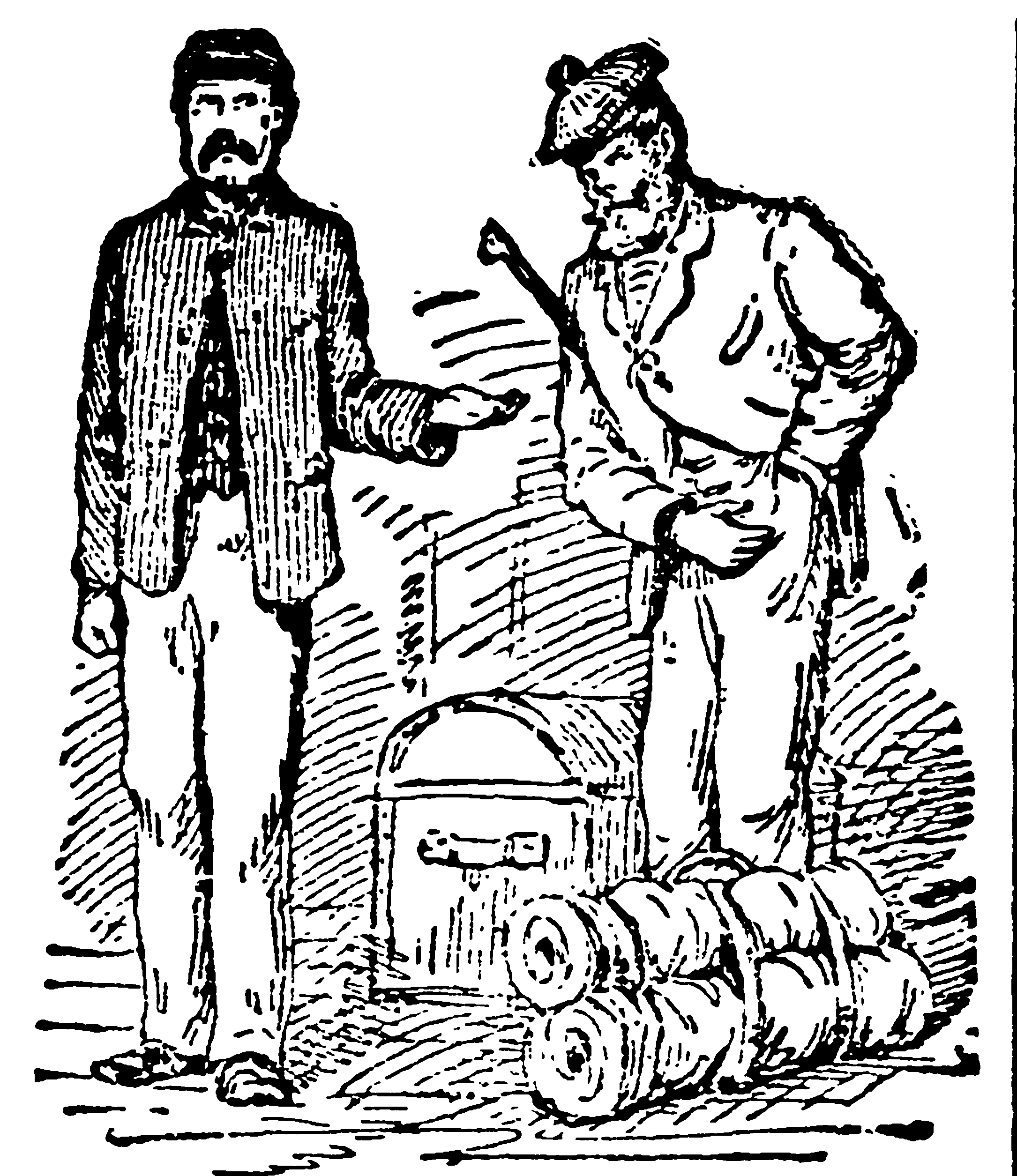
[Cartoon: a mustached customs inspector in a striped jacket holds out his hand to a tourist in a tam-o’-shanter and jacket, who carries a walking stick and reaches into his pocket; a trunk and two rolled blankets lie at the tourist’s feet.]
1.—United States custom house inspector and foreign tourist just arrived in New York Bay.
Inspector.—Hold on! You have a couple of new blankets there and must pay duty on them.
Tourist.—They are for my own use.
Inspector.—No matter. They are new.
Tourist.—How much duty must I pay?
Inspector.—Let me see. I know those goods. They are made in Glasgow and weigh fully eight pounds apiece. They cost you fifteen shillings, or say $3.75 each. There is an ad valorem duty of 35 per cent. Then there is a duty on wool of 35 cents a pound. The duty on those blankets is $4.12½ apiece, or $8.25 for both. Pay it or the goods will be confiscated.
(Tourist pays).
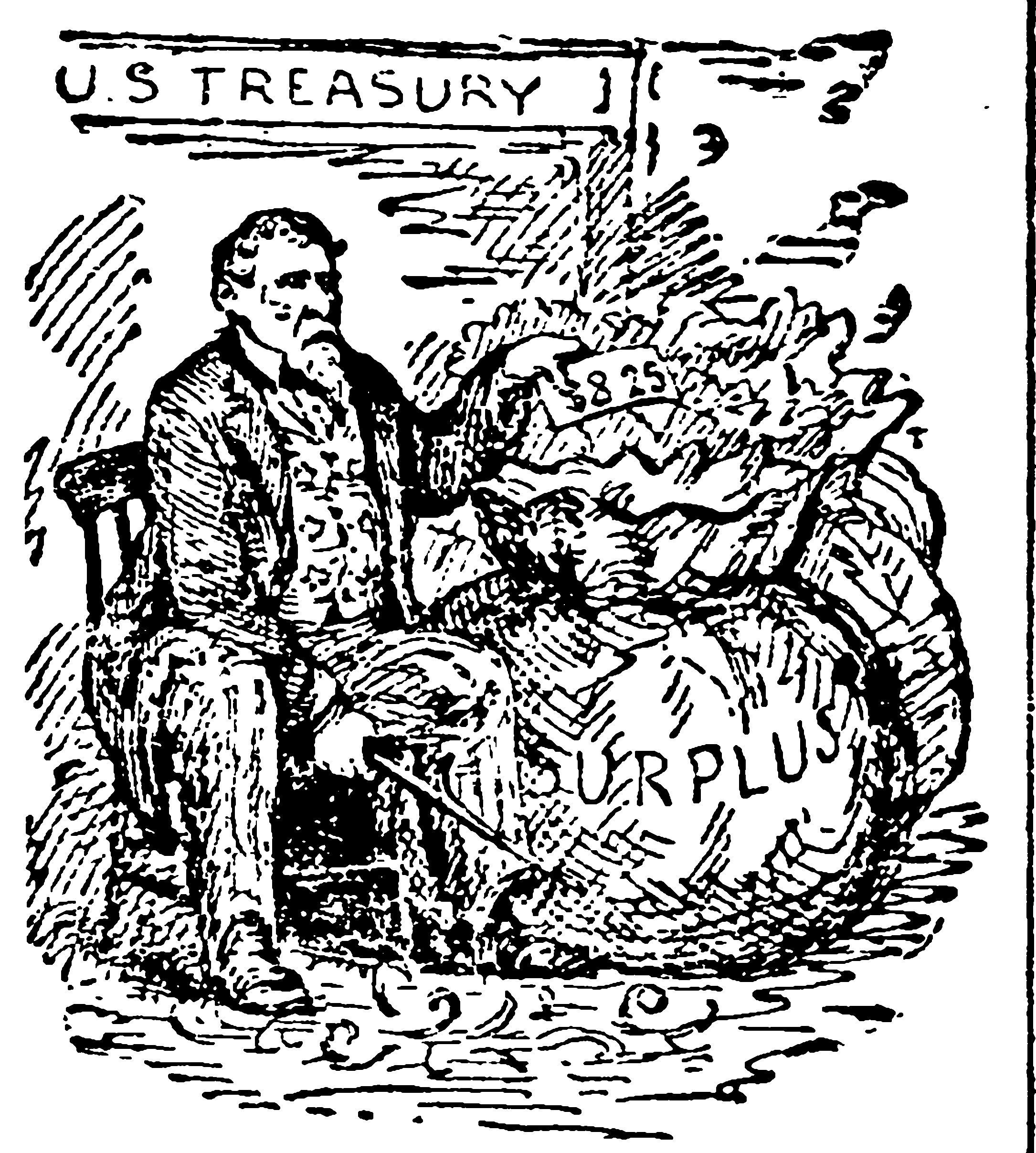
[Cartoon: Uncle Sam, white-bearded and seated in a chair beneath a sign reading “U.S TREASURY”, rests his arm on an overflowing heap of money bags; the largest bag is lettered “SURPLUS” and a note on top reads “$8 25”.]
2.—Where the $8.25 goes to.
Uncle Sam.—Really, I don’t need this. Have more now than I know what to do with. The masses are being skinned for the benefit of a few. If the few can’t make a living at the business they are in, without the aid of charitable contributions from the masses, then the few ought to get into some kind of business that they can make a living at. Them’s my sentiments.
[Cartoon: a large, bald, white-bearded manufacturer in spectacles sits at a desk with two rolled blankets on it; a thin bookkeeper with a quill pen behind his ear stands beside him holding an account book. Faint marks under the desk top may be the artist’s initials (“D. E. C.”?).]
3.—American infant manufacturer and confidential bookkeeper.
Bookkeeper.—Here’s a couple of blankets from the factory. The foreman left them here as samples of the new grade you ordered him to make. How shall I price and grade them sic the books.
American infant manufacturer.—Well I must admit that they are of inferior quality to the eight pound blankets that sell abroad for fifteen shillings or about $3.75 apiece. But you may price them at $4, as that will give me a fair profit. Then there is the protective duty of $4.12½ each—so you may add that to the $4, and make the price $8.12½. That protective duty gives me a chance to accumulate something, and my heart is set on buying a Scotch castle.
[Cartoon: the tourist in tam-o’-shanter, holding his walking stick, stands at a shop counter on which a pile of folded blankets lies; a clean-shaven proprietor in a dark coat stands behind it with his hand on the blankets.]
4.—Foreign Tourist Ashore. (He strolls along the streets until he sees the sign of a mercantile house; enters and accosts the proprietor.)
Tourist.—I have just arrived in this queer p. 8, col. 6 country—just to take a look about. I fetched a couple of new blankets with me, but I notice you have inns here just as we have at home. So, as I shall not have to sleep in the woods, I do not particularly need the blankets. I want to sell them.
Merchant—What is your price?
Tourist—Eight dollars and twenty-five cents apiece.
Merchant (examining them)—They are of a finer quality than I generally sell; but I have a customer who has been inquiring for just such a pair. I will take them at the price you name, as I would have to pay an American manufacturer $8.12½ for an inferior pair.
[Cartoon: a bald man lies asleep on his back in tall grass and weeds, mouth open, covered to the chin by a large blanket; a scythe lies across the foreground and a spade or hoe stands upright behind him.]
5.—Portrait of the Sleepy American Consumer.
Now, who pays the protective duty on imported blankets? The foreign manufacturer or the American consumer? And who pays for the American manufacturer’s Scotch castle?
See his portrait above.
DAVID EDWARD CRONIN.
Making Plate Glass.
Leisure Hour.
A lofty, gloomy shed, with a few flickering gas jets. Noise there is none except the pattering of the rain against the panes overhead from which the semi-darkness is admitted that the gaslights help. All the light worth mentioning comes from the furnace at the far end. One of its five doors is open, and, in a cave of flame so vivid with heat that even the broad tongues of fire are colorless, we can just make out a glowing crucible. Men with no other clothing than canvass trousers and a shirt hung loosely over them, come past us with a two-wheeled trolly, fitted with a pair of long projecting nippers. The carriage is run up to the furnace; the long arms plunge into the cave, embrace the crucible, and drag it out into the shed. Our eyes can see nothing but the crucible, the darkness around is so deepened by the glare. As the trolly turns near us we get a peep into the huge incandescent fire-clay vat, in which the whitehot dough is rapidly darkening into redness and covering itself with scale. As it disappears under one of the arches we follow it, and find ourselves in a better lighted shed, in which there at first sight seems to be a series of billiard tables. The tables are of iron, some twenty feet broad and thirty feet long, built up of many slabs, true and smooth as they can be planed, and fitted with a full width roller at one end.
The trolly runs the glowing crucible under a crane; the crane stoops and seizes it, and slowly swings it round high in the air until it is in front of one of the rollers. Steadily the crucible is turned over, and out of it on to the table in a thick cataract pours the glowing dough. At the same instant the roller begins to move; like a rolling-pin it squeezes the fiery viscous glass into a thin slab, and when it reaches the end the plate is made. The waste squeezed out, now cooling into transparency, is cut away; the annealing furnace opens at the back of the table; and with a roar as of sheet iron, the still flexible glass is pushed in to cool. When the kiln is cool enough a sic will have to enter it to examine the plates, and in the case of such as are cracked, to lead the cracks with a red-hot iron in the way to do least harm. The side of the plate over which the roller passed is undulating, that on the casting table is rough; the roller is slightly concave, otherwise it would not work the glass properly; the reason of the table being in separate blocks is, that if it were in one piece it would curve upward with the heat and make the plate curved. Even as it is, no sheet of glass is a true plane.
As it leaves the annealing oven it is “rough plate,” with a crust on both sides. We follow our guide to the grinding room, where this roughness is ground off. It is a spacious room, with two long rows of grinding slabs. The slabs are as big as the casting tables, and on them the huge sheets of glass are bedded, and ground with sand under a heavy iron “fly frame,” said to have been invented by James Watt. The mechanism is ingenious enough, and with its double crank arrangement quite worthy of the crank’s inventor. Between each pair of frames a sort of capstan revolves, and the extraordinary way in which the linkwork moves the frames over the whole area of the slabs is really remarkable. When the plates have been ground they are taken to another room to be smoothened, on another series of low tables on which one plate is rubbed over the other with a little emery between. Again the same eccentric motion brings the whole area into play at every revolution of the capstan. The smooth plate then finds its way to the polishing room, where the tables travel under a double series of rubbers that, with rouge red as blood, rub crossways, while the plate passes lengthways beneath them. Then the plates, transparent as we see them in our shop fronts, are taken to the warehouse and stacked side by side, with paper between to prevent them sticking together, for so true in flatness should they now be that, if laid flat on each other, there would be no room for air, and they would never come apart.
The Single Tax in Texas.
Houston, Texas, Echo.
Mr. George’s theory may be an abstraction, but it would take a hard lot of politicians to tax the working farmers more than they are now taxed. Country real estate may have little value apart from improvements. If these were exempted, it would remain to be seen whether the valuable real estate of the manufacturers, wharf owners, the railroads and other enterprises would not have to pay more tax. Of course the unused valuable sites now held for speculation would be forced upon the market by George’s tax method. It would not be worth while, apparently, to examine in what proportions corporative enterprises would be taxed, for their taxes are distributed upon the people and must necessarily be so distributed in the long run.
TO SINGLE TAX CLEVELAND VOTERS.
The conference of single tax men held at Cooper union, New York, on Monday, August 6, decided to make an enrollment of all single tax men who propose to support Cleveland and Thurman. All who desire to have their names added to this roll can do so by signing the blank given below and forwarding it to this office. One blank can be made to serve for a number of signatures by clipping it out and pasting it on a sheet of paper.
I authorize the enrollment of my name on the list of voters who propose to support Cleveland and Thurman in the coming election, on the ground that any step toward tariff reduction tends toward the abolition of all taxes on the products of labor, and the final transfer of such taxes to land values.
NAME,……………………………………….
ADDRESS,……………………………………….
Send this blank when signed to THE STANDARD office, 12 Union square, New York.
SOCIAL PROBLEMS.
BY HENRY GEORGE.
342 pages.
CONTENTS: