Page 1 of 7contents
[Faint line of small type above the masthead, illegible in the scan: [line obscured]]

[Masthead: display title THE STANDARD]
NO. 91–VOL. IV, NO. 13. | NEW YORK, SATURDAY, SEPTEMBER 29, 1888. | PRICE FIVE CENTS
p. 1, col. 1
THE STANDARD FOR THE CAMPAIGN.
Subscriptions to THE STANDARD from now to the close of the campaign will be received at the following rates:
Single subscription . . . . . 40c Ten or more, each . . . . . [36c?] One hundred or more, each . . . 32c
“The Standard” is sent this week to a number of persons whose friends have paid to have the paper forwarded to them for four weeks in the hope that they may be induced to read it, examine the principles it advocates and become regular subscribers. Those who receive the paper without having ordered it will understand that it has been sent in this manner and will be sent for four successive weeks without charge to them.
Terms of subscription will be found on the fourth page.
CONTENTS:
The Handle to the Ax—By William M. Ivins. March of the Workers (poem). H. K. Thurber, San Francisco Chronicle & Co., Attention. Mr. Jarrett’s Hard Road. Explaining Things—Henry George Answers Questions In Chicago. Comparing the Tariffs. The Black Country. The New York Farmer and the Tariff. Little Homes and Little Farms. The Beating of the Drums. Goods for Gold. A Poser for Protectionists. The Campaign “Standard” Fund. Campaign Work. Notes from Conversations. At Hot Springs, Arkansas. Society Notes. The Vision (poem). An Australian “Uncle Tom’s Cabin.” New Ideas, Methods and Inventions. The Protectionist’s Prayer. The Economy of Human Life. Queries and Answers. Ballot Reform in Rhode Island. Current Thought.
THE HANDLE TO THE AX.
When Ferdinand Lassalle was beginning his agitation for the liberation of the workingmen in Germany he tried to get Rodbertus, who even before Karl Marx had formulated the idea of “mehrwerth,” or surplus value, to join him in the cause. Lassalle contended that “the working classes must constitute themselves an independent political party, and must make universal, equal, direct suffrage their watchword.” The representation of the working classes in the legislature, he claimed, “alone could satisfy their legitimate interest in a political sense.” Rodbertus, on the other hand, preferred that they should avoid all political agitation, and insisted that the question of their welfare was purely economic; whereupon Lassalle, in one of his letters, replied: “Without universal suffrage—that is, a practical handle by which to realize our claim—we may be a philosophical school, or a religious sect, but never a political party. Thus it appears to me that universal suffrage belongs to our social demands, as the handle to the ax.”
I tell this story not because I am a follower of the great German, but because when he spoke for himself and his own cause he spoke for the cause of all great reforms whatever. With his clairvoyant logic he states the proposition which is fundamental to all true and lasting social reform. It is our boast that in this country we have universal manhood suffrage; but if the boast be true, why is it that we have as clearly marked a governing class, even though it be of variable constitution and not hereditary, as in any country in the world? And why is it that for every reform whatever we have to appeal to the representatives of this class? It is true that all citizens not under the ban of the law for cause may go to the polls and vote; but it is equally true that unless they vote for the representative of one or the other of the wings or parties into which the organization of the governing classes is divided, they have practically to vote in the air, and so to no purpose. The law, by taking only a part of the machinery of elections into its own hands, and leaving the remaining and most essential part subject to the exploitation of irresponsible individuals and associations or parties, has made the government and the offices the property of existing parties, and directly limited the suffrage to the single alternative of selecting between them. This is equivalent to placing the government in commission, and relegating all citizens whatever for their effective political action to their rights within one or the other of the old political parties, notwithstanding the fact that they are irresponsible voluntary associations; and the law imposes no obligation on them to receive or recognize any one within their ranks, and does not vest any one with the right to vote at their primary meetings without submitting to their principles. The party leaders may declare any policy they please; may and do use the offices of the people as a means of maintaining the effective working force of their organization; are enabled to raise vast sums of money from office holders and from the sale of nominations with which to print and distribute the ballots; and can, failing a secret ballot, buy votes at wholesale in an open market—and all because the law has left one-half of the machinery of elections at the mercy of men whose profession it is to disfranchise the masses when they cannot use them. The law has said to us all, “You are entitled to the suffrage, and one man’s vote shall count as much as another’s;” and then, with its tongue in its cheek, has added, “provided you can take care of yourselves,” much as though it had said: “Every man is entitled to life, liberty and property,” and had nevertheless
p. 1, col. 2 failed to provide any police or any courts of justice.
It was originally believed that it was enough for the law to accord to all the right to go to the polls and vote. Our early law makers seem to have taken it for granted that this was all that was needed. They took no thought of the fact that the world is made up of the strong and the weak, the rich and the poor, the honest and the dishonest; and that without the safeguards and securities of the law, the strong and the rich and the dishonest [will?] always get and keep the upper hand [illegible] and the weak and the hone[illegible] seemed to think that the [illegible]itution and the law was ex[illegible] the right to cast a ballot was accorde[illegible]d did not ask where the ballot was to come from, where and how the voter was to get it, and how and under what limitations of secrecy he was to deposit it. They did not foresee that some of these things involved—in fact, necessitated—a vast and expensive machinery, possession of which at once produced a hopeless inequality between those who control it and those who do not, and that the failure of enforced secrecy left free the means for organizing bribery. They did not foresee that the individual was always left at the mercy of those strong, rich and dishonest men who, acting in concert and as political organizations, could supply a part of this machinery by men paid out of the public treasury and the remainder by men paid out of the proceeds of the sale of nominations, until at last equal suffrage should become a mockery, party nominations a purchase and public elections a game of skill and chance between two or, at most, three organized parties, and in which the people have no interest except to protect themselves against the worst. They did not foresee that in according a right without supplying the guarantees of that right they were placing the unorganized majority at the mercy of the organized minority and providing the means for the growth of a class of professional politicians who believe in the voice of the people only when they can make that voice echo their purposes. Little by little the legislature learned how defective our legislation was, and some of the worst evils were cured after the persistent opposition of one of the great parties. The democratic party of the past reaped the fruit of the inefficient registration and canvassing laws, and to-day the democratic party is the chief beneficiary in the state of the absence of legal guarantees as to the right to nominate, as to the printing and distribution of the ballots, and as to the enforced secrecy of the ballot. Like the democratic party of the past, which was the party of Tweed, the democratic party of to-day, which is the party of Hill, is opposed to any reform that shall make the declaration of the law that all men are politically equal something more than a mischievous lie.
[Note: a later handwritten/stamped owner’s mark (“[1]04 Dr Walter Mendelson 167 / 179 W 74th st”) overlies five lines of this paragraph, and the type beneath it is lost; the gaps are marked [illegible].]
In a representative government the citizen cannot govern at all. He and his fellows can issue their commission through the ballot, and there their power ends. Thenceforth, as a body and as individuals, except those of them who have been chosen or elected, none can take any official part in the government. But the whole government springs from the election. The election is the greatest and only act of government performed directly by the people, and yet it is the only act of government which has not been placed in its entirety under the control of the law, and the whole of the machinery for which is not provided for or protected by statute. The result of this anomaly is not the practical disfranchisement of the minority by the majority, but of the majority by the minority, so that in the city of New York its quarter of a million of voters, unless they are prepared to submit to the terms of an unequal and hopeless contest, are powerless to do more than select between the candidates nominated by the few thousand persons who form the active nucleus of the three local machines. This is not disfranchisement. It is worse. It is enfranchisement only on condition that we use our franchise to vote ourselves into political servitude by electing those who do not, can not and will not represent us.
Is it any wonder, then, that our legislatures are venal and that our governor is corrupt—that our so-called representatives know only three motives, hope of gain, fear of punishment, and political prestige and power? Is it any wonder, then, the law prescribing no sufficient limitations to dishonest and fraudulent practices, and so offering a high premium on those practices through the possession of office and influence—is it any wonder, I say, that the offices of the people should in so many cases be in the hands of the enemies of the people, and that the rum power and the money power should take possession of the machinery of election which the law does not guarantee to the people themselves? Is it any wonder that our legislature is no longer a deliberative body? Is it any wonder that no great reform is possible of accomplishment, not only, but that even a plain letter of the constitution, like the requirement for a census, or a clear and unmistakable mandate of the people, like that for a constitutional convention, is disregarded with the most shameless impunity?
Now, whatever we want in the way of reform, whether it be tax reform, or land
p. 1, col. 3 reform, or reform of the law governing corporations, or municipal reform, or reform of the liquor law, there is one reform which we all want, and which we must all have before there is any hope of any of these other reforms, or any practical use, even, of their discussion, and that is electoral reform, whereby the whole machinery of elections shall be surrounded by the safeguards of law; whereby the ballots shall be printed and distributed at public expense; whereby all nominations for the same office shall be printed on the same ticket, and any respectable and representative number of citizens shall have the right to nominate; whereby an end shall be put to the assessment of candidates and the use of money in elections, and whereby the secrecy of the ballot shall be compulsory.
When we get that we shall have true representative government, and we may then abide by the consequences. To-day our evils arise out of the fact that we have the ax without the handle; and while we strike with one hand we cut off the other, instead of the evil at which we aim. We must have the handle to the ax.
WILLIAM M. IVINS.
March of the Workers.
Tune: “John Brown’s Body.”
Ours are the voices that for ages were unheard, Ours are the voices of a future long deferred. Cry all together: we shall speak the final word, Let the Cause go marching on. Glory! glory! hallelujah! Glory! glory! hallelujah! Glory! glory! hallelujah! Let the Cause go marching on.
Ours are the votes that give us the weapons we can wield, Ours are the votes that make our proud opponents yield. Vote all together, and our charge shall clear the field, And the Cause go marching on. Glory! glory! hallelujah! Glory! glory! hallelujah! Glory! glory! hallelujah! Let the Cause go marching on.
Ours are the millions, though it may not be in gold, Ours are the millions who will right the wrongs of old. Move all together as the ocean waves are rolled, When the storm goes marching on. Glory! glory! hallelujah! Glory! glory! sic! Glory! glory! hallelujah! Let the Cause go marching on.
GERALD MASSEY.
The United Labor Party.
The state convention of the united labor party was held in Cooper union in this city on Wednesday, 19th, and Thursday, 20th. The largest number of delegates present was 276, mainly from New York and Brooklyn. The united labor party paper, The People, filled with articles in favor of protection, was distributed among the delegates. The presidential candidates, Messrs. Cowdrey and Wakefield, were present. The convention resolved that, in addition to the regular united labor electoral ticket, democratic and republican tickets should also be printed, with the substitution of the two united labor electors-at-large. Messrs. Redpath and Wilder, both protectionists, were chosen for electors-at-large. The convention also indorsed the republican sic for governor, Warner Miller, and nominated John H. Blakeney for lieutenant governor and Lawrence J. McParlin for judge of the court of appeals.
On Sunday night a meeting was held in Madison Square garden, where the anti-poverty fair is going on, at which Dr. McGlynn declared his intention of voting for the thirty-four republican electors and the two united labor electors-at-large. But at the meeting of the executive committee on Tuesday night Dr. McGlynn introduced a resolution, which was adopted, declaring that all officers of the party must support the whole united labor party electoral ticket.
In the Eighth Congressional District.
NEW YORK CITY, Sept. 21.—The Single tax club of the Eighth congressional district held its first public meeting in support of Cleveland and Thurman last evening at its headquarters, No. 412 Grand street. Owing to the stormy weather and short notice the attendance was not so large as might have been expected. But those who were present had no reason to regret having come out in the storm.
After a few introductory remarks by the chairman Mr. William J. Gorsuch was introduced. He delivered an exceedingly interesting and able speech on the subject of free trade. He had the closest attention of the audience, and received their hearty applause. Then came Mr. William McCabe, who spoke on the single land tax theory, interspersing his remarks with apt illustrations from his experience in the early golden days of California. Mr. John H. Docherty closed the meeting with a fiery attack on the principle of protection.
The club will hold public meetings at its headquarters every Thursday evening, and in order to cover the entire congressional district, will shortly arrange for one or two other meetings in the week for other parts of the district.
HERMAN G. LOEW, President.
Henry George in Newark.
The single tax Cleveland and Thurman meeting held in Newark on Thursday of last week, at which Henry George spoke, was a very large and successful one. Over 1,200 persons crowded into the rink, many being compelled to stand. Hugh O. Pentecost introduced Mr. George in a neat and appropriate address. There was much enthusiasm shown during Mr. George’s speech, especially near the close, when he explained the land tax. Many prominent members of both parties were present. A little balcony that had been used as a band stand when the hall was a skating rink, broke down during the speech, but it caused no excitement, and no one was seriously injured.
The Hot Place Left for the Other Fellows.
Detroit Free Press.
The earth is but a shallow crust, Around a core of heat and flame. Some people on it don’t ask much; The crust is good enough for them.
p. 1, col. 4
H. K. THURBER, SAN FRANCISCO CHRONICLE & CO., ATTENTION.
Something for All sic Distributing That Circular to Lie Awake o’ Nights and Think About—J. B. Sargent Gets Down to Facts.
Mr. Walter Carr, of Walter Carr & Co., produce commission merchants, 180 Chambers street, not long since wrote to Mr. J. B. Sargent, of Sargent & Co., New Haven, Conn., one of the largest hardware manufacturing firms in the United States, asking for comparative figures in cost of labor and materials entering into Belgian car springs and the same kind of springs made here. Accompanying his reply, Mr Sargent sent the following circular:
SIXTY CENTS A DAY.
While in Brussels, Belgium, last summer (said W. H. Perkins), I saw some skilled laborers making spiral steel springs, such as we use in our freight cars. They receive sixty cents per day, while our blacksmiths receive $2 for the same work. I asked the Belgian proprietor why he didn’t pay more. He said: “I am handicapped. When I get $100 worth of car springs into New York harbor (for I sell my car springs in America) I have to salute your Yankee flag and give up $50.”
“Where does that come from?” I asked.
“It comes off my men’s wages,” he said.
“But suppose America had free trade?”
“Free trade!” he exclaimed; “why, I would flood the Yankees with car springs. I would treble my works to-morrow.”
“But wouldn’t that break our steel springs makers up?” I asked.
“Yes, for a while.”
“How long?”
“Why, till your men worked for sixty cents per day, as our men do.”—[San Francisco Chronicle.
This tells the whole story. How any wage earner in the country can vote for President Cleveland’s re-election is more than I can understand. Bread, meat and clothing should be more to any man than even life long affiliation with any party whose policy becomes antagonistic to his best interests.
H. K. THURBER.
In reference to the foregoing Mr. Sargent says:
It is strange that such smart men as Mr. Thurber know so little out of their own lines where they have never investigated.
In the first place, M. W. H. sic or the San Francisco Chronicle or Mr. Thurber or the Belgian proprietor lied if they intended to state that a Belgian blacksmith got only 60 cents per day for the same work for which an American blacksmith in spring making (spiral steel springs for cars) gets $2. And there is another fib in saying that the Belgian springmaker deducts $50 in New York for the $100 worth of springs sent there. And it is another fib to say it comes off the man’s wages.
In the first place, the Belgian or English manufacturers are always talking to green Yankees about their cheap labor in order to dissuade the Yankees from going into the business of making the goods.
Then that spring maker buys his steel rods or large wire at not over half their cost in America, for the reason that having only ten per cent protection in Belgium the maker of the steel has rubbed up his wits and has invented and planned and studied his business so [that?] Belgium has now the very best and most economical steel plants in the world, that will get more good solid steel out of a ton of iron ore and at a less price per pound than any other, not excepting the Englishmen, to this date. He gets his plant at a very low cost for construction, because the whole thing was made out of duty free materials. His ore is duty free, as are his fluxes and coal. The living of his men is duty free, and all the various expenses are duty free, so that he is able, and does, produce so much better steel in his unprotected condition than the American protected and half learned steel maker, that no economical railroad manager would have springs made from the uncertain American steel at any price when he could get Belgian steel made springs.
The “protection” that forces the American consumers to put into the pockets of the American steel maker is not a protection to his laborers, but to his ignorance of the science of fine, tough steel making, and he will never learn till he is unprotected.
The American manufacturer of good reliable steel springs must import the steel at a duty in cash of forty-five per cent. And that is about all there is to it. The forty-five per cent, with the same on expenses of freight in Europe, packing, broker’s custom house fees, etc., makes the forty-five per cent equal to fifty per cent. The making of the steel into a coil spring is of very little cost. The steel is cut into proper lengths, heated in a furnace and each piece long enough for a spring is put into a machine and turned into a spring in less than half a second, and a $3 per week boy can do the work as well as anybody. They may take long rods of steel, anneal them, and then turn them into one long spiral spring, six or eight feet long, and then saw them up into proper lengths with a circular saw, and then heat and temper—a quick job and very little labor.
If we paid eighty cents for the same amount of work that is done in Belgium for sixty cents and the living cost were the same, all the Belgian workmen would be here in two months if wages did not go up equal to ours before they all left. But the fact is that we do not pay more for the same amount of work (counting by result), not more than to make up for our higher cost for the same living. And skilled to medium Belgians almost never stay in America and only few come.
J. B. SARGENT.
On the reverse side of the circular above quoted is printed a table of comparative wages in England and the United States, in which iron molders are quoted as getting $7.50 in wages in England and $15 in the United States; hatters, $6 in England and from $12 to $24 in the United States; machinists, $8.50 in England and $18 in the United States; clockmakers, $7 in England and $18 in the United States; shoemakers, $6 in England and $12 in the United States, and so on.
Mr. Sargent said in regard to this table:
In small cities of ordinary living expenses United States wages are not near the printed rates. Iron molders at hardware factories don’t average over $10 and do double the work done in English factories of the same class. How many hatters in a factory earn $24 per week? Machinists in America get from $1.50 to $2.75 for prime only. Clockmakers are put at $18, but men in Connecticut clock factories do not average over $9. Shoemakers $12; they do not average over $9 in shoe factories for journeymen; some fine workmen get more. Englishmen are very scarce in the United States in the employments on the card, and when they try they usually back out of the big day’s work required in the factory or shop.
Why don’t the table on the card show the wages of Austria, Hungary, Bohemia, Italy,
p. 1, col. 5 Spain, France, Germany and Russia—all high tariff countries?
J. B. SARGENT.
MR. JARRETT’S HARD ROAD.
Single Tax Men in Indianapolis Give Him a Little Reception and Tender Him an Address—Roger Q. Mills’s Big Meeting.
INDIANAPOLIS, Ind., Sept. 23.—The inclosed clipping from the Sentinel of the 21st will give you an idea of the “picnic” the single tax men down here can have with a protectionist like John Jarrett. Those mentioned in the report are all single tax men and rank free traders, and the questions we propounded to Mr. Jarrett soon led that gentleman into deep water and a strong current. In fact, the current was so strong that the chairman of the meeting was forced to come to the rescue with the excuse that the carriage was waiting, the hour late, etc. Here is the newspaper extract:
John Jarrett, the lily fingered and well fed agent of the American iron and steel ring, spoke to about three hundred people at the Virginia avenue rink last night. It was supposed to be a meeting of workingmen, but for some inexplicable reason the speaker of the evening was introduced by Kelleher, whose fight against the early closing association has made him especially obnoxious to the workingmen of Indianapolis.
Mr. Jarrett’s speech was of the stereotyped monopoly sort. He said the Mills bill (42 per cent tariff) was free trade, and told his hearers that trusts, monopolies and combines were the “offspring of free trade ideas.” Speaking of the “abuse” with which he had been assailed by the democratic press since he began doing the dirty work of the tariff rings, he said:
“The reports in the Indianapolis Sentinel and the Brooklyn Eagle, to the effect that I said that the tariff had nothing to do with high wages in this country, are incorrect. What I did say was, that were it not for labor organizations wages would not be so high as they are.”
He closed his speech, which was about an hour and a half long, with a eulogy of Andrew Carnegie, who made $1,500,000 in a year out of the tariff, and locks out his men whenever they ask a small share of the tariff fat. He also praised Harrison, and said all workingmen ought to support him.
Mr. John Jarrett was somewhat surprised at the close of his remarks at being approached by six gentlemen who have heretofore always voted the republican ticket, but will not do so this time.
Their names are Thomas J. Hudson, 155 Elm street; Gilbert Seibert, 362 East McCarty street; Charles H. Krause, 119 North Liberty street; John F. Gibson, 36 Fayette street; James L. LeFevere, 1 Fayette street, and John Dougherty, Jefferson avenue. Mr. Dougherty introduced the delegation and said:
“We have listened intently to your speech, Mr. Jarrett, but can’t agree with your sentiments. We are all of us workingmen and we have heretofore been good republicans. But we won’t be with you this time—and there are dozens more like us in this city, and don’t you forget it.”
Mr. Mills spoke here in Tomlinson hall on Friday evening last. Standing room was at a premium even in that vast hall, without music or any unusual advertisement. This we regard as a good omen, as it goes to show that the people are thinking on economic questions, and through such rifts in the clouds we see the single tax sun shine with the light of universal brotherhood and [liberty?] [illegible]
[THOS. J. HUDSON?]
[Note: the end of this paragraph and the signature are blurred/smudged in the scan; the signature is partly legible as “THOS. J. [H]U[DS]ON”.]
A Significant Straw.
KANSAS CITY, Mo., September 15.—Last night Judge Chester H. Krum of St. Louis addressed a large gathering of democrats and others in Turner hall, this city, in favor of tariff reduction. Judge Krum, as you probably know, was until recently one of the prominent republicans of this state. His speech last night was one of exceeding ability—free from all pyrotechnical, spread-eagle tinsel, moderate in tone, dignified, solid, polished. It was the effort not merely of a strong man, but of a cultured scholar. It was listened to with the closest attention throughout. He made it plain that no man of the least independence of thought, familiar with the traditions of the republican party and the utterances of its great leaders, could consistently do otherwise than support Cleveland and Thurman. It was pre-eminently a speech to convince—and it did convince, for I know of at least one republican protectionist who at the end admitted that he had been wholly mistaken, and that protection is a fraud and a humbug.
In showing what the tariff is, and citing the definitions of various authorities, Judge Krum said, “I assume that there are working men here to-night. . . . Has Henry George lost his right to their confidence?” When he uttered the name of Henry George there was an instantaneous, vigorous, hearty applause from all parts of the hall. That this should have occurred at a democratic meeting is certainly a significant “straw.”
J. P. GILMER.
Organized in Detroit.
DETROIT, Mich., Sept. 21—There is now an association here founded for the purpose of pushing tariff reform in this campaign. The name (Tax reform association) invites the co-operation of all without respect to political creed. Weekly meetings will be held for discussion. There are among its membership men of all faiths, as may be seen from the officers: President, W. G. Brownlee, free trader; vice-president, H. A. Robinson, single tax; treasurer, P. Dee, free trader; secretary, J. F. Duncan, single tax.
A fine meeting room, very central, has been secured.
J. K. sic, 45 Waterloo street.
Twelfth Congressional District Organized.
The single tax men of the Twelfth congressional district, consisting of the Twentieth, Twenty-first and Twenty-second assembly districts, met last Monday evening, Sept. 24, at 1,621 Second avenue, and organized a Cleveland and Thurman single tax club of the Twelfth congressional district. The next meeting will be held Friday evening, Sept. 28, at the same place, at which all single tax men in the above district are requested to be present. Order of business, election of permanent officers. Regular meetings every Monday evening.
ARTHUR FIEGEL, Chairman pro tem.
Unity Congregation.
The first meeting of Unity congregation this fall was held last Sunday morning at Masonic temple. The hall was well filled. Mr. Pentecost described the objects of the congregation and declared the entire independence of his pulpit. Services will be held every Sunday morning at 11 o’clock.
On the Highway to Jerusalem.
TORONTO, Canada, Sept. 21.—With the English liberal party advocating taxation of ground rents and the “protection” party in the States on the eve of breaking up, I feel that we are already far on the highway to Jerusalem.
WILLIAM A. DOUGLASS.
p. 1, col. 6
EXPLAINING THINGS.
HENRY GEORGE ANSWERS QUESTIONS ABOUT THE ISSUE OF THE DAY.
A Great Gathering at the Third Single Tax Meeting—Where the Protective System Originated—How the Revenue Should be Collected—The True Principles of Commerce, Etc.
The meeting at Cooper union on Friday evening, Sept. 21, was remarkable, not only for its size, but for its character. A large proportion of the audience was evidently composed of men who had come with a serious purpose to learn something concerning a great political issue, and a determination to do their own thinking—to hear the evidence and weigh it for themselves. The questions asked were no mere chance inquiries propounded on the spur of the moment. The questioners had evidently considered matters before hand, and each one in turn placed before the speaker of the evening what he considered the strongest point against the doctrine of free trade. The meeting was thoroughly orderly and thoroughly in earnest. There was little of that hurrahing for men and phrases that ordinarily distinguishes political meetings; but there was quick apprehension of argument and illustration, and applause that betokened thought. Many present had never before attended a single tax meeting; and to them the tone and temper of the proceedings were a revelation, and satisfied them that the democratic party leaders were acting foolishly in not pressing the tariff question on the attention of workingmen in all its fullness.
William T. Croasdale, chairman of the single tax committee, called the meeting to order, and introduced Mr. George with the following remarks:
CHAIRMAN CROASDALE’S REMARKS.
Ladies and Gentlemen: I suppose that we all understand the nature of the meeting we are to hold here to-night. A great question has come recently into American politics about which men differ, and they differ chiefly because in the past twenty years there has been no rational discussion of the principles that underlie it. This meeting is a meeting to consider precisely what there is in the tariff for all men—not for workingmen alone, but for the whole American people. (Applause.) Is it a good thing or is it a bad thing to tax commodities?
There are men here of all shades of opinion, men of all political parties and of no political party. After Mr. George has made a brief address, and after we have gone through the usual ceremony necessary to enable us to continue these meetings—taking up a collection—he will then stand here and answer all questions that bear upon the principles underlying the tariff discussion. And to make it sure that the meeting may proceed with regularity and order it is absolutely necessary that we shall have only one man on his feet asking questions at a time. The audience wants to hear the question as well as the answer. And, therefore, no man’s question will be answered unless he is first recognized by myself as chairman of the meeting. I will endeavor to be perfectly fair and recognize everybody, but I cannot recognize everybody at once, and I will therefore have to recognize the particular man whose eye catches mine at the moment; but all will have a chance.
We want all men who have come here loaded with questions with which they think they can break down the speaker to have a fair chance to try. (Applause and laughter.)
It is possible to conduct such a meeting as this in entire order and with perfect good nature. The fact that there are men here who are devoted adherents of the existing tariff I am glad of; and I hope that the large number of absolute free traders present will bear with patience the fallacies of their questions. (Applause and laughter.)
After announcing several meetings in different parts of the city, the chairman introduced Mr. George, who was received with long continued applause. He said:
HENRY GEORGE’S REMARKS.
Ladies and Gentlemen: At our first meeting, when I spoke here with William Lloyd Garrison, (applause) I was much interrupted by questions. I answered them as far as I could, but finally said that if the questioners would allow me to finish I would ask the committee to set another night, when I would stand upon this platform and answer all questions as to the principles involved in the tariff question that might be propounded by the audience. I am here to do that to-night. (Applause).
And let me say for the sake of the audience, that those who ask questions should put them briefly and concisely, that they should not be accompanied by long comments, explanations or statements, because the audience may grow restive. I will try to answer all questions propounded as fairly as I can. I shall not, however, answer any questions relating to statistics, or to facts that are not commonly known; first, because I am not an encyclopedia (laughter), and second, because I have—and it is proper that we all should have—a great distrust of any argument upon a subject like this, founded upon facts [or?] statistics that are not generally known. (Applause.) “Figures cannot lie,” it is said; but in the collection and arrangement and invention of figures, it is easier to give a falsehood an appearance of truth than in any other way. And this great question that we are to-night to talk about does not require any knowledge of statistics, any knowledge of special facts. Anyone of ordinary intelligence and with knowledge of the great general facts that are common property, is able to settle for himself the tariff question. (Applause.)
I am a free trader (long-continued applause), a free trader not by inheritance or by education, for, like most of us, I presume, I was educated a protectionist and continued to believe in protection until I came to think for myself and examine the question. When I did I saw the fallacies of protection and I saw the strength and beauty of free trade; and I believe that will be the case with every man who, using his own intelligence, will fairly examine the subject.
I stand here to-night representing the belief in free trade. (Applause.) Not in British free trade (applause), not in what those people who are in favor of a tariff for revenue only call free trade, but real free trade—trade free of all restrictions whatever. (Applause.) I believe that it is a natural right of men to trade. I believe that protection is a robbery of the many for the benefit of the few (great applause); I believe that the carrying out to its full logical conclusion of the free trade continued on p. 2 →
[Article continues beyond page 1; no continuation line is printed at the foot of the column.]
Page 2 of 7contents
2 THE STANDARD, SATURDAY, SEPTEMBER 29, 1888.
p. 2, col. 1 [continued from page 1]
← continued from p. 1 principle will solve all social difficulties, will do away with the impediments that now prevent labor from employing itself, and will make wages what they ought to be—the full earnings of labor. (Applause.)
When that is done, all necessary may not be done; but the great wrong and injustice that lies at the foundation of our social system will be done away with. We shall have no more deep, involuntary poverty, and the roads sic be clear to move forward to other reforms. And, therefore, I think that this campaign that we have now entered upon is the most important that has taken place for almost a generation; that it is what the campaign in 1860 was—the beginning of a great movement for the extension of human freedom. (Great applause.)
The collection was then taken up. As soon as it was finished Mr. Croasdale called for questions. Several men in different parts of the hall sprang to their feet, Mr. Croasdale recognized one of them, and in this way the questions and answers proceeded as follows:
Question.—If all the sister states of New York would impose a duty on all goods coming from her, what would be the consequences?
Answer.—It would be bad for the sister states and bad for New York.
Q.—Is it possible to open natural opportunities under a protective tariff?
A.—Theoretically, yes; but we would still suffer under the disadvantage of the protective tariff. Practically, I think no, because so long as this superstition of protection blinds them, men will not turn to see the great advantage that would come from opening natural opportunities. I speak, as I understand the gentleman to refer, to the natural opportunities of the country itself. A protective tariff, of course, bars us out from the advantages we ought to get from the natural opportunities of other countries. (Applause.)
The First Questioner.—I should like to refer to my first question. I believe that the question was not understood. I mean, with things left as they are now; with the only change that all the sister states of New York should impose a duty on all goods coming from New York, all other things as they now are. What would be the consequence?
A.—I said that it would be bad for the sister states and bad for New York. It would be bad for the sister states, since it would place an impediment in the way of their getting things produced in New York—things they now get from New York because they want them; because they can get them better or cheaper than they can get them at home. And this restriction upon the export trade of New York to the sister states would also restrain the import trade of New York. We could get less of the productions of the sister states. Bad for us all around. (Applause.)
Q.—Where did the protective system originate?
A.—Where, it is rather hard to say. We got it from Europe. But China has a still more ancient and a more logical and effective protective system. (Applause and laughter.) Her policy has been the shutting out of all trade with other countries and forbidding the use of labor saving machinery. In China the protective system has been carried to some approach to its logical conclusion. To carry it out fully a tariff wall would have to be imposed between every family and every other family. (Laughter.)
The history of protectionism is, however, about this. The primitive mode of raising revenue is substantially that which we propose in going back to the single tax. (Applause.) Freedom, if you will consider it, always antedates slavery. And in the beginning nothing was more clearly recognized than that all the citizens of a country had an equal right to the use of the soil of that country. Those who by common consent were given the advantages of the use of more land or better land than their fellows were expected in return to do something for the rest. Even under the feudal system, what economists call rent—what we generally speak of as the value of land—provided for the expenses of government. In England, for instance, out of the rents of one portion of the lands the king was maintained and the expenses of the civil list borne. They were the crown lands. Out of another portion came the expenses of public worship, of the support of schools and the care of the poor. Those were the church lands. Out of a third portion the expenses of war. They were the lands held on military tenures. The holders of those tenures were obliged to do the fighting or to furnish men to do the fighting. And in those times England had no public debt. War was declared and waged, and peace came, without leaving any burden upon the body of the people. There was a fourth portion of land, called the commons, that around every village was open for the use of all the inhabitants. Gradually profligate monarchs gave away the crown lands. The reformation came, and the church lands were divided among greedy nobles. And finally, in the reign of Charles II, the military tenures were abolished and the revenues they had brought were replaced by indirect taxes on consumption. From that day dates the vast national debt of Great Britain. And from the time of the Tudors to the present the appropriation of the commons has gone on in England.
We know that the Roman emperors levied some sort of import duties on things brought into Italy; and to governments, as distinct from the people, such taxes have always sic themselves. The advantage of indirect taxes to a monarch is clear. A direct tax, as President sic (applause) says, always puts people upon inquiry. No one pays a direct tax for public expenses without inquiring pretty closely as to what those expenses are. The difference between direct tax and an indirect tax is this: A direct tax falls upon the man who pays it to the government, while the man who pays an indirect tax to the government is able to push it off on somebody else. (Applause.) All taxes upon commodities in the course of exchange, all taxes on the processes or materials of production, are indirect taxes. The person who pays is enabled to add the tax to his prices, and generally to add it with a profit; and so it passes from hand to hand. The payer gets back his money and ordinarily gets back something more, too. All such taxes favor monopoly—they tend to concentrate business by requiring more capital. Therefore, as we see it universally, the men who first pay indirect taxes never grumble about it. On the contrary, they like it. You know how we levied a tax on the manufacture of matches during the war. So far from the match manufacturers growling, they welcomed it. So far from asking for its repeal, they fought against its repeal with all their power. To-day we have an indirect internal revenue tax on cigars. The cigar manufacturers do not object; on the contrary, they want that tax continued. So with the whisky manufacturers. They bitterly opposed the reduction of the tax, and they would exert all their efforts to-day to prevent its repeal. The reason is, that such taxes concentrate the business—tend in favor of the man who has the most money. (Applause.) Thus, indirect taxes, provoking no remonstrance from the people who first pay them, and not being consciously felt by the people who ultimately pay them in higher prices, are the easiest way in which monarchs and their ministers or governments, as distinct from the people, can raise money for p. 2, col. 2 profligate expenditures. Therefore they early came into favor. And indirect taxes upon commodities brought into the country are very easily raised. By stationing officers at a few ports the whole volume of trade can be intercepted. as the sic in Spain at Tarifa—from which we get our word “tariff”—used to levy blackmail on passing ships. (Applause.) A “tariff for revenue” being thus established, the manufacturers or producers of certain kinds of goods within the country found that by this shutting off of foreign competition they could get higher prices for their own goods. So they became protectionists and said, “This tax is a good thing for the whole country.” And aided by certain confusion of thought growing out of the use of money, the idea of protection—or the mercantile system, as Adam Smith calls it—became general in Europe, and with the exception of a few free cities every government acted upon it. That is, in short, the history of protection. (Applause.)
It is not an American idea. (Applause.) It is one of those incongruous things that do not fit our institutions or our principles, and that we, in the mere spirit of servile imitation, have adopted from Europe.
We owe to the constitution of the United States, not the protective tariff—that is a violation of the spirit of the constitution (applause)—but we owe to the constitution the free trade that exists between our states. If, instead of a union that by constitutional provision secures to all the people of that union the benefit of free trade among themselves, the revolution had left here thirteen independent states with no league between them, there can be no doubt that the spirit of protection would have grown up between the states, and that to-day we would have tariff barriers between New York and New Jersey, New Jersey and Pennsylvania, Pennsylvania and Ohio, and so on, and that there would be the same effort to keep up these tariffs that we have now to keep up our present protective duties, for the essence of protection is that somebody profits by it. (Applause.) Its whole purpose is to give certain people more wealth, that is to say, more of the products of labor, than they could get without it. (Applause.) It is a clumsy and inefficient and costly way of doing what is done by the bounty system. It is the creation of favored monopolies, just as was the direct creation in the time of the Tudors. When we put on a tariff duty for the purpose of enhancing the prices of articles produced in this country, and thus “encouraging” the producers of those articles, the beneficial effect to them is of the same nature as would be a tax levied directly on the people to provide for bounties paid directly to them. But it is an exceedingly clumsy and inefficient system. It costs the people far more than it would cost to have the bounty taken by direct taxation, and it can only be applied to some producers and not to all. The great body of our industries are of a kind that no tariff can protect. How can you protect the bricklayer, the housebuilder, by a tariff? How can you protect the farmer by a tariff? (Applause.) But under the bounty system, if we were to levy a tax upon the whole people. and then pay sic the proceeds in direct bounties, we might encourage everybody, or try to. We might give every man a bounty. And if we taxed everybody to protect everybody, what would it come to? (Laughter and applause.)
Q.—How is it that while we raise cotton which is exported to England, the English manufacturer can weave it into the finished goods cheaper than we can here and at the same time pay higher wages than exist to-day in Lowell?
A.—If English manufacturers can weave cotton cheaper than can be done in the United sic it is because we suffer from protection and [they?] do not. (Applause and laughter.) Raw cotton is only one of the elements in cotton spinning. Machinery is made very much higher in the United States than it ought to be. I remember some years ago—I don’t know how it is now—reading a statement that a cotton mill in the United States costs twice as much for the same machinery as in England. Dye stuffs, chemicals, etc., cost more because of our tariff.
Again, England having a comparatively free trade with other nations, and taking their goods in return, can sell to them her goods. The shutting out, by our protective tariff, of the commerce we would otherwise have with Australia, South sic and other portions of the world that are large demanders of cotton goods, checks their importation of our cotton goods. (Applause.)
Q.—Would the necessities of life—the food stuffs—be cheaper under free trade or under protection or reduced tariff?
A.—They would be cheaper under reduced tariff, and still cheaper under free trade. For instance, one of the very important food stuffs is sugar. Sugar is made I think at least fifty per cent higher—at any rate very much higher—in the United States because of the tariff. We have made sugar higher for years and years under the pretense of encouraging a few sugar planters near the mouth of the Mississippi, with the effect to-day of allowing a trust of sugar refiners to bleed the people of the United States (applause) at their mercy. So with all food stuffs that are imported; the tariff causes an enhancement of cost. It also increases the cost of producing food here. For instance, one of the great machines for producing food in the country—for production is not completed until the article is carried to the consumer—is the railroad. How enormously our protective duties on iron and steel have increased the cost of railroads every one knows. So with agricultural implements, and so on.
The Same Questioner.—The main food is bread and beef. I would ask you to dwell on that question and not on sugar.
A.—The gentleman asks me to dwell particularly on bread and meat. I have endeavored to show how our protective duties add to the costs of producing bread and meat in the United States. But further than that, wealth is interchangeable. If, as our phrase goes, a man makes money, it gives him a command of all commodities. Now, the effect of a tariff is to reduce production. We produce less wealth in the United States because of protection, and therefore it becomes harder for the masses of the people to get bread and meat, just as it becomes harder for them to get clothes. (Applause.)
Q.—How will the American manufacturer be able to compete with the European manufacturer if he is compelled to import certain kinds of his raw material from Europe; Europe having, besides the natural advantage of its own raw material, the benefit of cheap and unpaid labor? (Applause.)
A.—As to the first: The American manufacturer is hardly likely for a good while to come to manufacture things of which the raw material is all produced in Europe. The great basis of manufacture is likely to be articles which to a large extent are produced in the United States; but in making those things up it is very likely that he will need some raw materials from Europe. At the same time he needs raw materials from all parts of the world, as, for instance, silk from China, rubber from South America, that most important raw material, wool, from Australia, and that most important raw material, lumber, from Canada. The cheaper he can get such things the better he can compete with European manufacturers. The great advantage which the English manufacturer has to-day, the advantage which puts him at the head of the trade of the world, is simply his ability to get p. 2, col. 3 materials of all kinds where he can get them cheapest.
As to the second point, “How can he compete with the cheap labor of Europe?” I answer that cheap labor is never an advantage in production. (Great applause.) It is true that a manufacturer in any particular community who got his labor cheaper than his fellows in that community would have an advantage over them, and if the difference was great might gradually drive them out of the business, for the quality of his labor, the general conditions which fix the efficiency of labor, would still be largely determined by the higher standard of wages paid by others. But between a country where labor generally is well paid and a country where labor generally is poorly paid, the advantage is with the manufacturer or other producer in the country of high wages. (Applause.) Wherever wages are high—look over the world and it will bear witness to what I say—there is also a high standard of comfort and a high standard of intelligence. (Applause.) Where wages are highest, invention is most active, all sorts of labor appliances are most quickly introduced, and production goes on most powerfully and most efficiently. Take the cheap labor countries of the world. There is China. In China goods are yet transported on the backs of men, and production goes on by the old costly modes that were in use thousands of years ago. Look at India. India is another low wage country. Is the Indian manufacturer crowding out the British manufacturer? Take our own continent. In Mexico you can have peon labor for four or five dollars a month. Do Mexican manufacturers clean out American manufacturers? (Applause.) Up to the war the southern half of this Union had the cheapest possible labor so far as wages are concerned. The slaves were paid only what kept them in life and vigor. Was it the south or the north that excelled in manufactures? (Applause.)
I saw yesterday a little protectionist paper; I think it was called the People; (laughter and hisses); no, it was not the People (cries of “the Press”); no, no; there are other protectionist papers than the Press—there is the Sun (laughter and hisses). Anyhow, this was an illustrated paper. On the first page there were two cuts, probably you have seen them. One represented Russian agricultural laborers at work with hoe and sickle. There were miserable huts in the background. Underneath was a picture of a fine American farm, a comfortable home, a large barn, grain being cut by machinery and thrashed by steam, and in the distance a railroad train. There was printed beneath something to this effect: “See the difference protection has made!” (Great laughter.) Now in Russia agricultural wages are at the lowest and in the United States they are at the highest; yet grain can be produced cheaper in the United States than in Russia. (Applause; a voice, “Why?”) Why? because wages here are higher. Because the laborer gets a greater proportion of his product. Because, therefore, labor is more intelligent, and it pays to adopt labor saving machinery. The great factor in production is not the force of human muscles. It is the power of the human mind. (Applause, and “Three cheers for Henry George.”) Physically considered, man is one of the weakest of the animals. It is in the godlike power that resides in the human mind. the sic of adapting means to ends, that makes him the master of all other animals and enables him to bend the very forces of nature to his service. Where the standard of general intelligence is high and labor receives such a reward as will enable men to enjoy leisure and to develop the higher qualities, this power rises and grows. (Great applause.)
Why was it that the ancients never invented the electric telegraph or the railroad or any of the wonderful appliances that in this nineteenth century have in every department added to the power of man? It was because in the ancient world slavery was universally accepted. (Applause.) Why is it that even in modern times the slave countries were never inventive? that it was from a northern state, a free state, that even the inventor of the cotton gin came? Because labor was looked down upon and robbed. Just as the general standard of comfort and intelligence rises, so will invention go on; and what it will give us if we fully accept freedom no man dare predict. (Great applause.) But I believe that He who eighteen centuries ago, by the sea of Galilee, told the common people that if men would but observe the rule of doing to others as they would have others do to them they need take no more thought what they should eat and what they should drink and wherewithal they should be clothed than do the lilies of the field, spoke but sober reason. (Applause.) There is no natural reason why we should have to strain and scheme and worry merely to live. If we but follow freedom and hold fast to justice, if we do away with all restrictions, if we get over this mean spirit which teaches us that foreigners are our enemies, that men can only benefit themselves at the expense of other people, the time will come when not merely a few, but all, shall enjoy leisure, shall enjoy luxury, shall have at their command all the opportunities for developing the highest part of man’s nature. (Great applause.)
Q.—By putting wool on the free list how will it affect the wool growers of this country?
A.—I do not think it will affect them injuriously. I think they will sell as much wool and get as high prices as they do now. But it will very much cheapen the foreign grades of wool that are necessary to mix with our wool, and thus give our wool manufacturers the same advantage that foreign manufacturers enjoy. It will kill shoddy, probably. But to my mind it is quite a secondary and unimportant question whether putting wool on the free list will hurt or benefit the wool growers. There is a larger body of people to consider; and that is the people who use the wool. (Great applause.) They are the millions; the wool growers are but the hundreds.
Q.—I want to know, if you abolish custom houses, how are you going to raise a revenue to meet the expenses of government?
Before answering I would like to observe that these custom houses have made it necessary for us to raise far more federal revenues than we ought to raise. The whole system always has been and always will be an incentive to governmental extravagance. The people who wish tariff taxes kept up are casting about for ways to spend the revenue and get rid of the surplus. General Harrison, for instance, wants to get rid of the surplus by buying bonds at a premium (laughter); and we are to-day building war ships for which we have no more need than a dog has for two tails. We are indulging in extravagance of every kind just to make an excuse for this thing which is called a protective tariff. (Applause.)
If we were to abolish the custom houses we could raise federal revenue in several ways. We could raise it by an income tax, by a tax on legacies and successions, by taxes on the manufacture and sale of liquor. We could raise it in the constitutional way by apportioning the sum needed among the several states. If we were to do that we would get what we need for the federal government at a very small cost to the people as compared with what the present system now costs them. But the way we, who are holding these meetings, wish to raise all revenues is by a tax upon the value of land. (Tumultuous applause.) And if our scheme were carried p. 2, col. 4 out, with the abolition of the custom houses congress would enact a law, which would be perfectly constitutional, calling upon the various states to raise sums, proportioned to their populations, from taxes on the value of land.
Now let me explain why we would raise a tax upon the value of land. A tax of any kind upon commodities has a tendency to lessen the amount of those commodities. A tax upon wool, upon wood, upon food, upon horses, upon buildings, upon pianos, upon anything produced by human labor, and which must be constantly produced in order to satisfy the demand, has the effect of lessening the quantity of those things in the country. Therefore, as a country which has the most of those things is the richest—as none of us, or at least few of us, have now enough of those things—it is stupid to put any tax upon wealth in any of its forms. (Applause.)
We say, moreover, that in principle it is unjust to tax articles of wealth. We, so far from being deniers of the right of property, are sticklers for the right of property. We believe in the sacred right of property. We believe it to be a right that exists not by virtue of human laws, but by divine enactment. We believe that a respect for the right of property lies at the basis of all civilization. We say that when anyone by his own exertion brings forth from the reservoirs of nature an article of wealth, it belongs to him and him alone—to him as against all the world. To a house, to a ship, to a railroad, to a cambric needle, there does attach an exclusive right of property. It is an absolute right—a right which empowers the producer to give, to bequeath, to sell, to pass on from hand to hand. Whoever adds by his exertion anything to the wealth of the world is entitled to that thing.
Any tax resting upon the produce of labor is therefore, to the extent to which it goes, a denial of the right of property. (Applause.) We say that it is wrong as well as stupid to levy a tax upon men who are bringing good things into the country from abroad, and therefore making the country richer. We say that it is unjust as well as stupid to levy a tax upon men who in the country are bringing such things into being. If a man builds a house, or plows a field, or opens a mine, or raises sheep, we say that he ought to have the full advantage of his labor, the natural reward of his toil; and the government ought not to levy a tax upon him or take any part of those things so long as any common property remains that can be taken for common purposes. (Applause.) And all these taxes, as I indicated some time ago, are taxes in favor of monopoly. (Applause.)
Now there is one tax that, so far from being a tax in favor of monopoly, is a tax against the greatest and most fundamental of all monopolies—one tax that does not interfere with or impair the sacred right of property—but which, on the contrary, is necessary to establish it; one tax which does not take from any individual an iota of what belongs to him, but simply takes for public purposes that value which grows with the growth of the community; that value which, attaching to land by reason of the growth of population and common improvement, belongs not to individuals but to the community. (Great applause.) And therefore we would go back, in forms adapted to our times and to modern conditions, to the old system of our fathers. We would take what economists call rent—that value which attaches to land, not by reason of anything which the owner or improver does, but by reason of the growth of the community around it. We would take that for public revenue. And in doing so we would not merely carry out the principle of free trade to its logical conclusion, but break down the greatest of all impediments to production, the greatest of all causes of inequality—the monopoly of land. (Great applause.)
Here in this country, where there are only sixty-five millions of people upon an area which would support hundreds of millions, there are, we are told, a million men out of work. In every part of the sic we hear of the tramp. What is the reason for that? People say there is no demand for labor. Why not? What is the object of labor? Is it not the satisfaction of human needs? Until every one in the community is well enough sheltered, well enough clothed, well enough fed, has all he wants of the thousand things that minister to man’s desires and satisfy his wants, there is need for labor. (Applause.) And the natural opportunities for the utilization of labor lie on every hand. We have unused land, unopened mines, city lots that might be built upon, sites for factories that might be used. But although nature has given abundantly, although the land is wide enough. and the sic fruitful enough, we have allowed the monopolist to come in and take up more than he can use, in the expectation that the increased value that attaches to land by reason of the growth of the community will redound to his benefit; and when a man who must use it comes along he must pay tribute.
This tax on land values would not merely allow us to abolish all sorts of other restrictions, but by doing away with the temptation to monopolize land, it would break up the most important of all restrictions—that which denies labor access to land. If imposed, land would then be of no benefit save to the man who wanted to use it (applause); and that being the case those who wanted to use land could get it; and there would no longer remain any reason why there should be in the United States a man willing to work and not able to find work. (Applause.)
Q.—If the condition of the laborers of England, France and Germany is inferior to that of the laborers here, why will competition with them differ in effect from the competition of the Chinese in our country?
A.—For this reason, that the question of protection or free trade, the question of the terms on which foreign goods are allowed to come into a country, is a question of the production of wealth. The question of the competition of cheaper labor within the country is a question of the distribution of wealth. The competition that affects wages in the United States is not the competition of the labor market. (Applause.) Here, let us say, are two countries—(illustrating)—on this side of the stage is one country of the lowest possible wages. Here, on the other side of the stage is another country of the highest possible wages. Now extend in imagination an impassable wall between the two, and make here a hole, through which goods can pass but not men. Commerce can go on. These cheap wage people can shove sic through the hole, and these high wage people can shove goods back again. Now, you can be absolutely certain that no matter how cheap wages are here, these cheap wage workers would not keep on shoving goods through that hole unless they get goods back again. (Applause.) Now, if that pushing of goods backward and forward goes on forever how is it going to affect wages? But if you knock down the wall and let the cheap laborers on this side come into the high wage country on that side, then, if wages are fixed by the competition of laborers with each other, you will reduce wages; but not till then. (Applause.)
Q.—What is the difference between the old whig party system of taxation and the present system advocated by the republican party?
Mr. George—I think I had better decline to answer that question, as it lies outside the p. 2, col. 5 line I have drawn, and I think it not advisable to enter into questions of history.
There were some cries of disapproval and some derisive laughter from the quarter whence the question came, whereupon Mr. George turned and said:
Some of our friends in the audience think that I do not answer the question because I can’t. I will therefore depart from the rule and answer it. (Applause.) Protection was advocated in the old whig days for the sake of our “infant industries,” for the purpose of giving them a start and of protecting the American capitalists against the cheaper capital and lower interest of Europe. It was asked then for only a few years. Now it is asked for the benefit of the American laborer, not the capitalist, oh no!—not the trust, oh no!—but the poor American laborer! (Laughter.) It is now asked, not for “infant industries,” but for industrial giants! It is now asked, not for a few years, but permanently! The United States in the old whig days contained only fifteen or twenty millions of people, and we were inferior in power to Great Britain or any of the first-class nations of the continent of Europe. Now with our sixty-five millions of people, that by the close of the century, in twelve years more, bids fair to be a hundred millions, we will be the strongest nation on the earth. (Applause.) Yet where a little protection was then asked for a few years, now enormous protection is demanded as a permanent thing. Where the whigs told us that protection for a little while would build up new industries, the republicans now tell us that our existing industries would be destroyed but for protection. When I was a little boy I was brought up to believe that the American nation could stand against the world. And now I am told that if we are not protected by these custom house officers, by this seizing and searching and fining, that Europe and the pauper labor bugaboos will sweep down on the American nation and kill every industry. (Laughter.)
Andrew Carnegie (hisses)—oh! why do you hiss him; he is a good man, in his way. He has done some charitable things in Scotland, and has given liberally in this country; he is making a million and a half a year, his concern five millions a year—why do you hiss him? wouldn’t you do it? (Laughter.) You have given him the power; he is simply exercising it, and no wonder he thinks well of protection. But what I wished to say of him is that he is the greatest steel manufacturer in the world; that the United States, and not Great Britain, stands at the head of the steel industry of the world; but this overgrown industry still begs and begs harder for protection than it did in the old whig days, when it claimed to be only a little “infant industry.” (Applause.)
Q.—If free trade is put into practice, wouldn’t it bring us to the level of the European workingmen as to wages?
A.—It would not, for the reasons I have already given.
Q.—(the same questioner)—You misunderstand me. Were all goods from abroad admitted free, what will become of the American workingmen when we can buy everything cheaper from Europe?
A.—What, in that case, would we buy them with? (Applause and laughter.) What we get from Europe we must pay for. Europe does not send us these things for nothing; and the only thing we can pay for the products of Europe with is the products of our own labor. As I said before, these cheap labor people (pointing to one side of the stage) would not go on putting the products of their labor through this wall to this high priced country without getting something back in return. (Applause.) The American workingman would then be making things to pay for the things brought here from Europe.
Q.—I would like to ask how workingmen here would be benefited by allowing dress goods and silks to come here free of duty? Certain dress goods coming over here are not paid for by return manufactures, but go to large importing houses through the clearing house.
A.—The gentleman will see that all goods brought here in trade, if settled for at all, must be settled for with the products of American labor. The importing house may pay with a draft; but the draft is drawn against goods exported from here. (Applause.) How will these dress goods and silks benefit the workingman? He can buy more of them for his wife. (Applause.) They would add to the comfort and convenience of the whole population. How this would affect the particular workingman in those particular industries is a secondary question. The real point is how it would sic the great mass of the people of the United States. (Applause.) It would affect them beneficially, and by affecting the mass of the people beneficially it would benefit also workingmen in those particular industries. So far from free importations discouraging manufactures here, they would encourage them by giving them cheaper materials. What is the finished product of one process of production is the raw material of another. Silk, for instance, is raw material for clothes, umbrellas, etc. But what the workingman in any particular industry must look to as the final regulator of his wages is the general condition of the whole working people. (Applause.) The protected industries do not constitute one-seventeenth of the laborers of the United States. The great governing industry, that which governs the wages of all the rest, is the farming industry. The man to be looked out for is the man who has nothing but his labor and such ordinary knowledge and skill as any man can acquire. Raise his wages, look out for him, and all kinds of wages will increase. (Applause.) But if men in this trade and that trade attempt selfishly to look out for themselves alone, they can not, no matter how strongly they combine or what laws they get passed, raise their wages but a little, and temporarily; for outside of their circle lies this vast body of competing laborers. (Applause.)
Q.—Why should we introduce this new theory of free trade, when we already know that protection has benefited American industry?
A.—It is not a new theory, but an old theory. Freedom is always ancient, and free trade is simply natural trade. (Applause.) Protection has not benefited American industry. It has injured American industry. For a generation protection has had its own way. Ever since the war everything that the protectionist could ask has been granted. How has American industry prospered? We have seen great fortunes rolling up faster than they ever have before. Millionaires have increased, but so have the tramps. (Applause.) So far from it becoming easier for the mass of the people to make a living, the struggle for existence is constantly growing harder. (Applause.) Is this country to-day prosperous enough? (Cries of “no.”) Are wages high enough? (“No, no.”) All that protectionists claim is to keep this country as prosperous as it is and keep wages as high as they are. If this is all they can do, isn’t it about time that we tried freedom? (Great applause.)
Q.—What effect would free trade have on this country?
A.—To increase its prosperity. Give us free trade and all the wheels of industry would begin to revolve. Give us free trade, and you would find a quick, strong and effective demand for labor. I am speaking of free p. 2, col. 6 trade only in its narrow sense. We would go on increasing in wealth far more rapidly than we are now. We would have higher wages and better times for a considerable period. But at length, if we were to stop there, the advantage, like all other advantages, would ultimately go to the owners of land. And, therefore, to secure the full benefits of free trade with other nations for the whole people, we must go on to free production from all restrictions, taking the value of land for public revenue. (Applause.)
Q.—If certain industries are protected and others are not, if a man on this side gets a dollar a day for making shoes and he puts them through that hole to a man who makes shoes at two dollars a day, the two-dollar man would have to go to work at something else, like brick laying, thus increasing the number of brick layers; and so on through all the industries.
A.—Very well; something would have to be passed back again; and these two-dollar men would make something they did not make before.
Q.—Will Mr. George please explain how and why rents will fall when the single tax is instituted, and how it would do away with all crowding in our cities?
A.—Do you mean the rental of houses?
Q.—Places that people live in.
A.—The single tax would destroy speculative land values. These vacant lots that you see around cities could not be held for the high prices for which they are now held. When a man who holds a vacant lot is taxed just as much as a man who owns a similar lot but has built a house on it, land will no longer be held at a speculative price based on the expectation of what a future demand will give. Consequently, lots could be had very easily for the erection of houses. The taxes on building materials would be done away with. The tax that now falls on buildings when erected would be abolished. Thus houses could be built much more easily and cheaply, rents would fall, and people, instead of crowding together in such cities as this, would separate and live as they ought to live, with breathing spaces between them. People would not be congested in great cities like this nor scattered as they now are in the agricultural districts. (Great applause.)
The chairman here stated that it would now be necessary to answer questions briefly as it was drawing close to ten o’clock.
Q.—When protection was abolished in England, what was the effect of free trade on the industries of that country?
A.—They took an enormous leap forward. Such free trade as she has has put England at the head of the manufacturing nations of the world.
Q.—Various nations of Europe have tried free trade but have gone back to a protective tariff. Why is this?
A.—That differs from my history. They have not in modern times. On the contrary, a little while ago all those nations had their interior tariffs as well as their exterior. If you go to France to-day you will yet find cities surrounded by a customs tariff. During the present century these interior tariffs have been largely abolished, though civilization has not yet advanced to the abolition of the exterior tariffs.
Q.—I should like to ask if the democratic party is consistent in trying to prove to the working people of America that the tariff does not raise wages, while yet maintaining they are protectionists?
A.—Of course they are not consistent (applause); but you must not look for consistency to politicians. The democrats of to-day are no more consistent than in 1859 and 1860 the republicans were consistent in saying that they did not propose to meddle with slavery where it existed, and yet denouncing slavery. (Applause.)
Q.—If free trade decreases the price of goods, will not this fact be of great advantage to the fixed income class and place the wage earners at a disadvantage as compared with them?
A.—It would be of advantage to both classes. Possibly it might be of a little more advantage, immediately considered, to the class of fixed incomes; but its advantages would be general, and extend to the whole people.
Q.—Is the price of a domestic article increased by the whole amount of the duty on the foreign article of the same kind?
A.—Not always; generally not. There are some cases in which it is increased fully, but generally not. Protection can not protect the producer as a producer. Put a duty on the importation of any article, and the first effect is, by increasing prices, to increase the rate of profit in the production of that article. The consequence is to induce the competition of other capitalists in the business. And if there is nothing to prevent a man from getting into the business, profits in that industry will go back to the normal level. Prices will probably stand above the foreign price, because every duty makes production more costly, and people can only get one duty by consenting to other duties. But unless there is some way of shutting out competition, profits in the protected industry will be no larger than in the unprotected industry. If, however, the protected producers can form a trust or combination to exclude domestic competition, then they can get a larger advantage. Or if they have the possession of natural opportunities that confer an advantage, such as coal mines, copper mines, forests, salt deposits, they can get the advantage. So it follows from the law of competition that while protection cannot protect labor, neither can it for any length of time be of any advantage to the employing producer. It can only protect and encourage monopoly. (Applause.)
Q.—If the Mills bill passes, how much good will it do?
A.—It will do a great deal of good. It will give us free wool. It will give us free lumber. It will remove duties on other important articles of importation, and it will reduce duties on a good many other things. But the great advantage of the Mills bill is that it is a beginning. It inaugurates a reform that can never stand still, but must go on.
Q.—Will Mr. George state his opinion as to the effect which the adoption of free trade in the United States will have upon the trade between that country and Europe? Would it most benefit the United States or Great Britain?
A.—It would most benefit the United States. It would also benefit Great Britain and the rest of the world.
Q.—In a circular put in my hands to-day certain clothing and cloak manufacturers threaten to reduce the men’s wages if the Mills bill becomes a law. What remedy has the workingman?
A.—The threat is all humbug. (Applause.) If those people can reduce wages they will do it, Mills bill or no Mills bill. (Tumultuous applause.) And it is about time that the American workingmen got over the degrading superstition that they get work and get wages by the favor of any class.
Now I must close. It is in freedom, not in restriction, that the whole hope of labor lies. And in this Mills bill, small as it is, lies the beginning.
This year, with all the defects of the democratic party, the democratic national candidates, Grover Cleveland (great applause) and Allen G. Thurman (great applause) lead the van of labor’s fight. Let us elect them triumphantly. (“Three cheers for Cleveland, Thurman and George.”)
Page 3 of 7contents
p. 3, col. 1
IN CHICAGO.
PLENTY OF LIFE AND ENERGY THERE.
Men Who Will Vote for Cleveland—England’s Hostile Attitude—Graphic Picture of the Horrible Things too Imminent—Those Long Lines of Men That Wait Outside the “Daily News” Office—The “Herald” Out for Absolute Free Trade—Something About a Dr. Jekyll and Mr. Hyde Concern.
CHICAGO, Sept. 21.—I send herewith list of 50 names of single tax Cleveland voters, some of which were collected by Mr. Van Ornum. You have received many other smaller lists from Chicago, and yet it is safe to say that you have in all but a very small portion of the names of the aforesaid voters in this city. The woods are full of single tax men these days and one can scarcely walk a square in the heart of the city without running against one or two of them. Many of them, for reasons of their own, will not sign the lists, though they are heartily in sympathy with our principle; more cannot be reached, and many more still are unknown to one another. Of those approached on the subject by Mr. Van Ornum and myself, but three refused to sign because they believed in independent political action.
Now that the weather is getting cold and we are thus being reminded that winter is coming on apace, our workmen and those of our population who would be workers if they could get employment, are beginning to get alarmed at the hostile attitude of England toward the masses of this country. It makes our intelligent workmen shudder to think of the horrible revenge she is ready to heap upon us should those nefarious free traders succeed in breaking down our great wall of protection. Picture the woful scene to yourself.
Imagine the first of December is here. Cleveland and Thurman have been elected. The Mills bill, or a much-more-so bill, is in a fair way to become a law despite the obstructionists in the house of lords. Coal is $9 per ton. Blankets $3 to $5. Over half of our working population is out of employment. Our streets are covered with snow and ice, and the thermometer vacillates between twenty above and twenty below. The overcoats we have been wearing these two or three winters past are shabby or ragged—or pawned. The printers are on a strike. The brass workers are locked out. We are just beginning to reap our annual winter crop of labor troubles. Our soup societies and other charitable institutions, our jails and the Bridewell reformatory institution, even, are crowded to the utmost. Theater parties, germans and soirees are the rage on the boulevards—not to mention sleighing parties and champagne suppers given by the various wealthy clubs. In fact everything is lovely, and poverty and riches seem to be on the best of terms (with the exception, of course, of a few crank agitators, who are paid for teaching the masses to be discontented), when down comes the British lion with a demoniac wag of his sore tail that Grover twisted last September, and a malevolent twinkle in his eye, to work out his dastardly revenge upon us.
Gunpowder? O, no; he is too wise an animal to attempt the use of firearms on America a third time. Dynamite! No. He is afraid to carry such a dangerous weapon. He is more knowing than of yore, and has learned from our magnetic statesman how to use a weapon which cannot harm himself, but which is much more deadly to his enemies. No armed fleets and countless troops will he come with to break down our coast defenses and bombard our seaports. Mark the subtility of his wickedness. He comes with an enormous fleet of merchantmen laden with blankets, coats, hats, shoes, cloths and all the countless products of his cheap foreign labor. These he relentlessly heaps upon our shores and then, with a fiendish grin, sets sail for more pauper products.
And then, O the anguish, the increased misery, the weeping and gnashing of teeth of our poor masses, when they awake to the terrible realization that blankets and coats and dresses can be purchased for less than one-half their former prices! Heaven forbid that such things should come to pass in our free land! Imagine our laborer coming home on pay nights burdened with cheap priced necessities for his shivering family! Imagine, if you can, what a fearful scene it would be to witness the parents of a numerous progeny going out shopping on a Christmas eve and purchasing almost double the number of jackets and mittens and fur caps and toys for the little mill hands at home than they did last Christmas. Picture to yourself the horror with which the children would wake and find that from the few dollars which had been saved by many weeks of pinching economy, Santa Claus had managed to nearly double his presents. O, the picture is too heartbreaking to contemplate—and whisky $5 a gallon!!
The above truthful statement did not appear in the editorial columns of the Chicago Inter Ocean last Tuesday, but columns of much the same bosh have been appearing therein for weeks past.
Apropos of idle men and would be workers. Come with me at noon time to Chicago’s busiest center and I will show you a sight you will not care to see again. Calhoun place is a narrow alley running between Madison and Washington streets. The back entrance of the Daily News opens on to this court near Fifth avenue, and here the newsboys congregate for their papers. Ranged along the entire length of the rest of the alley up to La Salle street are from 100 to 300 men of all ages waiting to snatch the first papers from the press and scan the “want” columns. Some are standing or leaning against the buildings, others sitting on the steps and boxes, others again sitting on the curb, and still others gathered about in little knots, or sometimes thronging the entire center of the thoroughfare. These are some of Chicago’s idlers, and but a very small portion of them. Pass down through the alley, if you can push your way through. Look at the pinched and careworn faces. Note how listless and lacking of energy some of them appear. These are the ones who are losing or have already lost all hope. See their shabby genteel clothes, their summer coats and hats, their jagged edged collars and time worn neck gear. Note the fact that they are clean and tidy, though often very shabby, and note also the absence of vicious and wicked countenances. Note, too, that the only distinctive look betrayed by them as they scan the “want” columns of the News is that of eagerness. See one here and there hurriedly rise and make his way through the crowd. He has seen a “want” that he is hastening to answer before his slower brothers in want get there. Finally half or more of them are gone off on similar errands. Note now how eager and hopeful the look is in some of their countenances as they hurry from the alley in search of the much needed employment. And then come back to-morrow and the day after tomorrow and see the same faces over and over again. And those that remain, or do not hurry away—do we only imagine that we see the gloom settle deeper in their countenances? They slowly fold up their papers, lounge around awhile, and finally go away. Where? Aye, where? O, yes; some of them get situations occasionally, though the want columns
p. 3, col. 2 are mostly filled with fraudulent employment bureau advertisements; but the crowd never diminishes.
Last Saturday the Herald, democratic, came out squarely for free trade and advised the democratic party to do likewise. This is part of what it said:
The Herald, having the truth at heart as its safest stronghold, while campaigns wax and wane, knows there is no authority, human or divine, for the taxation of one man in order that another may benefit thereby. As protection, however slight, is such a tax, then liberty, equality and fraternity demand its abolition.
The Herald has long been leaning this way. When Martin J. Russel was on its staff it used to talk pretty boldly for a “great daily,” and now John McGovern finds it impossible to curb his truth telling propensities.
Mark the prophecy. When the single tax comes into practical politics, as come it will in “times’ own sic,” the Herald will be its stanchest advocate in the west. If there is one journal in Chicago that has stood nearer to the masses than all the others combined, that journal is the Herald, and the masses know it.
The Times-Mail concern, T. J. West, runs a democratic morning and a republican evening paper—sort of a Dr. Jekyll and Mr. Hyde racket, only the changes are more rapid and regular. Wonder if the denouement will be the same as in the play.
Sept. 22.—THE STANDARD for this week has just come to hand. In it I find the following paragraph: “To a Herald reporter Mr. Cowdrey stated that he expected the party would poll 30,000 votes in Chicago alone.”
It may be worth while remarking, in view of this statement, that the united labor party will not poll 1,000 votes in the whole state of Illinois. Chicago in its balmiest labor days, never polled a distinctive labor vote of even 25,000, and the last election showed a decrease to 5,000. Even the radical labor party, composed of 40 or 50 socialists, which T. J. Morgan carries around with him to break up peaceable assemblages and stop debates on live questions wherever it is possible to pack the meeting, have declared for Streeter, the union labor nominee, and it is entirely safe to assert that Mr. Cowdrey will not poll 300 votes in Chicago.
J. H. GRIFFES, No. 905 Sawyer avenue.
COMPARING THE TARIFFS.
What the People of Various Countries Pay for the Privilege of Buying Things—Facts About the Sewing Machine.
WASHINGTON, D. sic..—Preston A. Parker of Auburn, N. Y., asks “What is the average tariff in Germany and France?” The minister of finance of France states that in 1883, the last year in which results have been published, the total value of importations of manufactured articles into France amounted to 768,000,000 francs, and the amount of duty collected on them was 50,000,000 francs. The average percentage being 6½; the proportional duties on certain articles is less than 1 per cent, and in no case exceeds 25 per cent, and the latter tax is imposed only in exceptional cases.
If the calculations were made on the entire volume of French imports instead of upon manufactured articles only the average percentage of tax would be still smaller, amounting to about 3½ per cent.
In the United States the average ad valorem duty amounts to 38.9 per cent, and the specific duty 61.1 per cent.
The percentage of duties on the importations of the various countries is as follows:
| Per cent. | |
|---|---|
| United States . . . . . . | 31.54 |
| United Kingdom . . . . . . | 6.89 |
| German Empire . . . . . . | 9.02 |
| France . . . . . . . . | 7.86 |
| Austria-Hungary . . . . . . | 7.15 |
| Italy . . . . . . . . | [13.93?] |
| Russia . . . . . . . . | 15.45 |
Taking the tariff tax in the United States, it will be found to bear the heaviest upon the common necessaries of life. For instance, on woolen and mixed cloths, the highest priced cloth known to the trade, west of England broadcloth, the tax is 50.3 per cent, while on cotton warp reversible, the cheapest grade on which our workingmen have to depend, the tax is 180.7 per cent.
Take an article used in every household, the sewing machine. The tax is 45 per cent ad valorem. On needles the tax is 25 per cent; on thread, 55 per cent; on scissors, 35; on pins, 30. and so sic the entire list.
Now, let us see what it costs to construct a sewing machine, in detail:
Materials— Sheet and low steel, cast and malleable iron, 16 pounds, at 4½ cents. $0.72 Screws, nuts, bolts, pins, collars . . . . .35 Shuttle . . . . . . . . . . . . . .18 Bobbins (6), needles (6) . . . . . . . .12 Screw driver (2), direction book (2) . . . .04 Stand . . . . . . . . . . . . . . 1.50 Table, 2 drawers, cover and drop leaf . 2.50 Labor— Turning—Shafts, needle bars, presser bars, eccentrics, band wheel, shaft heads, needle and feed sic . . . . .25 Japanning and ornamenting . . . . . .25 Plating . . . . . . . . . . . . . .05 Polishing . . . . . . . . . . . . .25 Assembling . . . . . . . . . . . . .50 Machine work—Drilling, reaming, cleaning, tapping, facing, counter boring, milling and press work . . . . . 1.25 Total . . . . . . . . . . $7.96 Add incidental variations in price of labor and material . . . . . . . . .37⅓ Grand total . . . . . . . . . $8.33⅓
A machine of this class will retail at $50. It will wholesale at $12.50, leaving a profit to manufacturer of $4.16⅔—a very neat profit all around. The same machine may be bought “across the pond” at about one-half the price our “highly protected” workmen are asked in order to keep our impoverished manufacturer from “going out of business.”
W. S. WAUDBY.
The Period of 1840-47.
SUPERIOR, Wis., Sept. 22.—Two old men, now residents of this village, who were citizens of New York in 1840–47, tell me that for the most of the high protective period there was an extraordinary labor depression in New York and other parts of the country. One, a laborer then, says there was so little demand for labor that he, with hundreds of others from his part of the state, was forced to go to Canada and work on the Welland canal. The other, a mechanic, says that skilled mechanics (men who had served full apprenticeships under competent masters) had to work for $18 to $20 a month. They say at industrial sic set in about 1847 and continued throughout the low tariff period.
E. R. OTIS.
The “Standard” Among Baltimore Democrats.
BALTIMORE, Md.—Your papers and tracts were gladly received. I took them to our democratic ward meeting and all the men grabbed for them. The next day all the talk was the George doctrine. I think some of them will subscribe for THE STANDARD. Maryland will give Cleveland at least 8,000 majority.
GEO. H. MCPHAIL.
p. 3, col. 3
THE BLACK COUNTRY.
SOME FACTS THAT THE PRESS AND NAT. M’KAY FORGOT TO STATE.
Rev. Harold Rylett Shows How Our Protectionist Friends Gather their Material About England—The Actual Condition of Things Among the Miners and Chain Makers—The People are “Protected” to a State of Starvation.
DUDLEY, England, Sept. 3.—I see from references in THE STANDARD that Mr. McKay has wasted no time in putting to what I suppose he would call “good use” the information which he obtained in England. This gentleman was in the Black country for a few days, and while at Cradley sic he arranged for some photographs to be taken. He was very anxious to have them taken in a particular way. For instance, he wanted some of the female chain makers to have their portraits taken in their most ragged attire and with chains round their necks. Having been consulted upon the matter, I advised that the people should be photographed with chains in their hands—for neither the men nor the women ever work with chains around their necks.
It is rather amusing to us here to find that the condition of our poor chain makers and nail makers should be laid at the door of free trade. The fact is it is due to protection, for there is nowhere in the world a more strictly protected district. The land is strictly monopolized. The minerals are strictly monopolized. The railways are strictly monopolized. If the land values were appropriated to state purposes by means of a tax upon them, and if the railways were run in the interest of the community, instead of in the interest of a corporation of shareholders, there would be no poverty in the Black country. Chain making and nail making are strictly domestic industries—that is to say, the people work at them in little shops which are attached to their dwellings. If at the same time they could have land attached to their houses—which at present they cannot have—they would be able to subsist upon the land and would be in a position to refuse to make either chain or nails unless they were better paid for doing so. There are cases, though they are very few in number, where small gardens are attached to the cottages, and in every instance that I have seen these gardens are admirably cultivated, and this is proof that what is wanted to improve the condition of the poor chain and nail makers is the alternative—opportunity of working the land; which, however, they are at present denied, because it is to the interest of the land owners to hold the land while the people cut each other’s throats in a desperate competition or struggle for life.
This view of the matter I shall more carefully elaborate in the series of articles which I am at this moment contributing to the Labor Tribune as “Industrial Life in the Black Country,” but as I have several articles yet to write upon the actual condition of things before I deal with its causes and its remedy, I have thought it might be well to discount the use which may be made of these articles by telling you that I have no doubt that the real cause of the poverty of the people in the Black country is land and mineral and railway monopoly, and that the remedy lies in the direction of the overthrow of these monopolies by a tax on land and mineral values and the appropriating of the railways by the state. I am much interested in your presidential election, for the victory of either party will be fraught with very serious consequences to England. The commercial classes here are anxious for a democratic victory, because they think that will mean money in their pockets. But for my part I have no doubt that if America adopts a free trade policy, England would have to bid a long farewell to her commercial greatness. I wonder rather that the American people do not see this more clearly. It was solely by our free trade policy that we commanded the commerce of the world, and under that policy we have reached almost the limit of our available natural resources; and unless the landed interest in England loosened their grip upon our remaining natural resource you, with your much greater resources, by a free trade policy, could beyond a doubt compel the center of commercial gravity to move west. Our landed interest, however, is not at all likely to loosen its grip except at the imperious mandate of a starving nation. And if you adopt a free trade policy, it will be all over with the commerce of England before we learn sense. A republican victory would give us breathing space.
I rather think this view is entertained, sub rosa, by many of our editors who advocate Cleveland’s election. They understand that their advocacy of Cleveland is the best way of securing his defeat. And they also know that a democratic victory with a free trade policy in America would mean a commercial crisis here in a very short time, and a very rapid and drastic dealing with the landed interest.
I suppose there is no doubt that free trade will triumph in America, if not in November, still at no distant date. For the protectionism of the republicans—to judge by some recent experiences of mine—is a very hollow business. I have had a young Boston republican staying here with me quite lately. He was apparently on the same errand as Mr. McKay. I took him all over the Black country, and as he is a very determined protectionist, he did his best to convince me that all the misery we saw was due to free trade. But as I found that one of the main objects of his visit was to secure for himself and wife a three years’ supply of clothing at free trade prices—which clothing, by wearing once or twice, he told me, should get past the custom house officials duty free—you may be sure I was not convinced of the superior advantages of American protection.
The fact is, as I have already said, whatever poverty we have in England is due to the fact that in the landed and railway monopolies we have what are practically tariffs on production and distribution. When we can bring the people to see that trade is exchange, and that anything that hampers production or hinders distribution is in restraint of trade, then we shall witness such a development of the facilities to labor, and we shall have such a demand for labor, that a product wage will take the place of a subsistence or competitive wage, and none but the idle and thriftless will starve.
However, we are working away on the lines laid down by Mr. George on his last visit, but the Irish question blocks the way. My own opinion is that that question will not be settled on its merits, after all. The present has been a most disastrous year for agriculture, and a “condition of England question” of [ominous?] proportions is beginning to make itself felt.
Altogether I fear that we shall have a bad winter. I don’t know what the very poor will do. I suppose we shall have soup kitchens everywhere. But this I am confident of: We shall not return to protection. Our workers—at all events the most intelligent among them—see clearly that their poverty is due to to the sic that the land of the country is out of their reach, and they will go for the land with a vengeance if hunger becomes acute.
p. 3, col. 4 And, accordingly, I shall not be surprised to find the home rule question dealt with under the stress of a great wave of popular agitation against the landed interest.
HAROLD RYLETT.
THE NEW YORK FARMER AND THE TARIFF
The republican party in the ensuing presidential election confidently expects to come down to Harlem river with a majority of 65,000 or thereabouts, sufficient to overcome any possible democratic majority in the cities of New York and Brooklyn; and in this manner it is hoped that New York will cast her thirty-six electoral votes for Harrison and Morton, and thereby secure their election. This expectation is based upon the belief that the New York farmer will vote the republican ticket now, as in the past. But, however much the republican party may have reasonably felt confidence in the farmer vote hitherto, the great issue raised in this campaign renders it by no means certain that a continuance of this support will be maintained.
The tariff issue overshadows all others this year, since the question of taxation affects pecuniarily every voter in the state, and the farmer is quite as wide awake to his own interests as the mechanic.
What then is and has been the effect of the tariff upon the New York farmer?
The stock republican argument produced for the benefit of the farmer is that, while it is true that the farmer competes with the entire world on a free and equal basis, and that while the value of his products cannot be directly enhanced by a protective tariff, nevertheless his share of the benefits accruing from the blessed tariff arises from the great value of the home market thus produced. The vast superiority of the home market over that pernicious fallacy, the “foreign market,” will be found demonstrated in any issue of the Tribune or the Press, and requires no demonstration here.
What the New York farmer has gained under protection, as compared with the nearest approach this country has had to free trade, will be shown by the favorite protectionist method—that is, by a resort to statistics.
The decade from 1850 to 1860 was a low tariff period, and from 1860 to 1880 and since then the New York farmer, as well as the rest of us, have enjoyed the blessing of a high protective tariff.
The following tables are taken from the United States census reports:
TABLE I. Number of farmers in New York state: 1850………………..170,621 1870………………..216,253 1860………………..[196,990?] 1880………………..241,058
TABLE II. Average number of improved acres in each farm: 1850………………..72.7 1870………………..72.3 1860………………..72.5 1880………………..73.4
TABLE III. Total valuation of farm lands, buildings, improvements, agricultural implements, and live stock: 1850…………… $650,202,067 1870 (1)………$1,179,950,[536?] 1860…………… 936,366,584 1880………… 1,216,[637?],765
TABLE IV. Value of all farm products for the year prior to the census year: 1849……………not taken 1869 (1)…………202,82[0?],923 1859……………not taken 1879……………178,025,695
TABLE V. Average value of each farm: 1850……………….. $4,051 1860……………….. 4,749 Increase………… $698 1870……………….. 5,456 Increase………… 707 1880……………….. 5,047 Decrease………… 409
TABLE VI. Average value of products for each farm: 1870……………….. $937 1880……………….. 738 Decrease………… $199
TABLE VII. Average value of products for each acre under cultivation: 1870……………….. $12.96 1880……………….. 10.05 Decrease………… $2.91
The deductions from these tables are self-evident. According to table II, the number of acres under cultivation in each farm was substantially the same at each period. Under ten years of our nearest approach to free trade the value of each farm increased $698, or at the rate of almost $70 a year. Under twenty years of protection the increase in value of each farm was sic, or at the rate of not quite $20 a year; while under the last ten years of protection, when its baneful effects had time to show themselves, each farm decreased in value at the rate of $41 a year. Instead of a gain of $70 a year, each farmer has lost $41 a year, so that his total annual loss as the result of protection has been $111. That is, each New York farmer is at the end of a year $111 worse off under protection than he would have been under a low tariff.
So much for the effect of protection upon the value of the farmer’s property. What has been to him the value of his home market, which was to reimburse and compensate him for the higher prices he is obliged to pay for everything he buys, owing to protective duties?
The only way the farmer can be compensated is by obtaining higher prices for products, which under the theory of protection he should obtain, since the protectionists agree that protection brings consumers to the farmer’s door and offers employment for men who otherwise would become farmers and enter into competition with them. But that the “home market” of the protectionist is a myth is shown by tables IV., V. and VI.
The aggregate value of the yearly products of the New York farmer was less in 1880 than in 1870 by over ten per cent. And, there being 30,000 more farms in 1880, the value of the products for each farm decreased in the same period $199, or over twenty per cent. No wonder that the value of each farm decreased over $400 in ten years’ time.
That this aggregate decrease is due to decrease sic of what the farmer has to sell, in spite of the home market, is shown by the increased production in 1880 over 1870. For example, the total number of bushels of wheat, corn, oats, barley, buckwheat, rye and potatoes in 1870, was 106,299,281, and in 1880, was [123,386,185?]. Pounds of tobacco in 1870 were 2,349,798; in 1880 were 6,481,431. And the number of milch cows in 1870 was 1,350,661, and in 1880 was [1,437,855?].
A perusal of these tables will show to the New York farmer that he is not a sharer in the benefits of protection, and will explain to him where the money comes from which enriches the millionaire beneficiaries of protective tariff extortion and robbery. An annual contribution of $111 from each New York farmer through the instrumentality of protection suffices to furnish tariff monopolists with castles in Scotland and the means to lobby bills through congress which weave closer fetters about the wealth producers of New York.
ARTHUR S. BROWNE.
- The values given for 1870 in tables III, IV, V and VI are gold values, so that a uniform standard of value is given throughout the tables for the several periods. The census figures for 1870 are: Value of farms, improvements, buildings, implements and live stock, $1,474,938,910; value of products, $253,526,153. The average value of a gold dollar in the census year was $1.25, and the figures given in the tables are deduced from the census figures on this basis. If any protectionist farmer can get any comfort out of using the census figures he is at liberty to use them. He will thus find that the average value of a farm in New York was $6,820 in 1870, and its product was $1,171. Adopting these figures, each farm diminished in value in ten years $1,773, or $177 a year; and the annual product fell off $[433?]. He can make his choice between Scylla and Charybdis, and may be sure, while he intrusts his prosperity on the bark “Protection,” that shipwreck will be the inevitable result.
p. 3, col. 5
LITTLE HOMES AND LITTLE FARMS.
How the Single Tax Would Effect sic—A New England Man Who Knows sic He is Talking About—He Produces Facts and Figures.
OXFORD, Mass.—Just after the election last fall the Springfield (Mass.) Republican, after congratulating itself that the result “practically disposed of Henry George as a political factor of moment for some time to come,” went on in another long editorial to show how little it really understood of the principles of the author of “Progress and Poverty.” “Think,” the Republican said, “what a heavy land tax would mean to the already overburdened New England farmer; think what it would mean if carried to the point of confiscating these little farms and these little homes about which cluster the tenderest memories of New England life.”
Now I hate to see the Republican make a fool of itself, because I like the paper. I have taken it for over sixteen years, or ever since I was seventeen years old. It is right on almost all political questions, and is even now doing the best work in behalf of tariff reform and free trade of any paper I know, save only THE STANDARD. Accordingly, when it makes such assertions as the above or, nullifying the teachings of all the great political economists, declares that a tax on land values could be turned over by the landlord to the tenant and charged for in extra rent, it is all the more to be regretted.
Let us see about these “little homes” and these “already overburdened New England farmers.” I assert that the great majority of all the little homes known to me would be worth more in cash the morning after Henry George’s principles were put in practice than they ever were before. I assert that the realization of those principles would lift the load off the overburdened New England farmer, so that the half idle or vacant farms now so common even here in densely populated Massachusetts could be brought into use again.
Facts and figures will talk to us if we use them aright. Let us look at some of the “little homes” that I know of here in Oxford. Here is a description and inventory of one a mile from the village, copied from our last printed valuation book, owned by an old gentleman who is unable to see anything beneficial in “Progress and Poverty.” “House valued at $500, barn $200, house lot, two acres, $250”—total $950.” This lot was originally cut off from the adjoining pasture, overrun with blackberry briars and sweet fern bushes. The land of the farm to which the pasture belongs is assessed, improved and all, at less than $20 an acre. Most of the $250 valuation of this two-acre house lot belongs to the thirty vigorous bearing apple trees that are growing upon it. The record of actual sales shows that real estate in this town is generally assessed for every dollar it is worth, save only an occasional wood lot which may be worth more. The taxes will average nearly one and one-half per cent; the town has within a few years been able to borrow money on long time for three and one-half per cent. There is a relation here which would show that the tax on land values ought to be five per cent. This old gentleman paid a tax of $16.21, including his poll tax and the tax on his cow. The tax on the homestead was $13.78. Now we have something to figure with.
Leaving the valuation of the lot at $250, the George tax on this place at five per cent would be but $12.50, or $1.38 sic than the present homestead tax, or $3.71 less than all his present taxes. Deduct the value of the apple trees at $5 each and the land would be worth but $100, and the tax on this would be but $5, and at this rate of taxation this place ought to sell for $200 or $300 more than it will now.
Let us take another homestead, this time in the village, owned by another old gentleman who “fires up” when anything is said about Henry George. “House $1,300, barn $150, house lot, one acre, $700”—total $2,150. The tax on this place was $31.18, so that, leaving the land value at $700, the rate of five per cent would make the taxes about $4 more than now; but on the other hand then all new improvements would go untaxed.
Let us next take one of the best places in town as follows: “House $8,000, barn $300, house lot one and one-eighth acres $2,000.” The land tax at five per cent would reduce the taxes on this place by some $50; and so it goes with every grade of homesteads, not including extensive grounds. Of course, if we can “suppose” a little $500 house on a $10,000 lot we shall meet with a different result, but we are not figuring in “supposition” to-day, we are figuring with facts.
To be sure, there are cases where the taxes would be increased. Here is one of the worst cases: “House $2,300, barn $200, home lot four acres $2,200.” The sic here would be increased from $68.15 to $110 if we allow nothing for improvements on the lot; this is the result of holding four acres of vacant land in the center of the village. Restrict the home lot to one acre, and the taxes would be reduced by some $40. In such cases as this we should remember that the proposition to “abolish all taxation save that upon land values” includes free trade and absolute relief from those indirect taxes that for ordinary householders are far more of a burden than the direct taxes they pay. By this means the owner of this last piece of property could keep his four acres of land, and still be benefited pecuniarily by the change in the system of taxation.
Look through our valuation book from end to end and I defy any one to find any confiscation of homesteads in the single tax. In the great majority of cases it will reduce the taxes on these little homes, and with the tax permanently reduced they ought to sell for more after the change was made than they will now.
It is the same with “little farms” as it is with “little homes.” Where there are any buildings or improvements worthy of the name, their owners would quite generally pay the same or sometimes less taxes than now, when the direct taxation is alone considered. It was these “little farms” and “little homes” which the Republican coupled together as to be confiscated by the single tax. The result with both sic classes would be just the contrary. It would generally add to their value.
But among the big farmers some of them would have to catch it. “Big farmers,” I mean, in the sense that they hold a great deal of land, not in the sense that they are putting it to its best use, for if they were the single tax would benefit them. Here is a place that belongs to such a big farmer: “House, [$375?], barn, $600, farm, 180 acres, $2,700.” He keeps three cows on this place and does about all the work himself, and a precious poor living he is getting, according to all appearances. His fences are mostly down and a great fringe of weeds and bushes grows around the outside of all his mowing lots, diminishing their crop bearing area by several acres. The single tax would raise this farmer’s direct tax from $60 to about $110, but, being exempt from a great burden of taxation which is not now apparent to him, it is easy to see that even then he might keep all his land and be as well off. The single tax, as we have said, includes free trade, and even on his poor scale of living the advantage so gained would make up to him as much as he lost in the other direction.
Taking at random half-a-dozen large farms well known to me, this would be the effect of
p. 3, col. 6 the single tax if imposed upon them: one of 113 acres, increase $20; 145 acres, increase [$30?]; 128 acres, increase $60; 180 acres, increase $55; 624 acres, increase $200; 168 acres, increase $70. Now all these people hold more land than they can use to advantage. They every one just scratch the surface of their farms here and there, and that is all. Should the single tax force a division of these places it would be better for everybody. It is evident that after such division, their owners under the new system would have less direct taxes to pay than on such places at present. The farmer now has to bear the whole burden of our tariff taxes—for him there is no protection worthy of mention. He “sells under free trade and buys under protection.” He belongs to the class whose earnings are taxed away for the benefit of more favored classes. Under the new system every cent of all possible earnings would come to himself alone. The load would be taken off his shoulders, and the now “overburdened farmer” would realize that the successful fight for the emancipation of labor brought to no class more benefit than it did to him—landlord and capitalist as he now foolishly counts himself to be, denouncing strikes and looking down with contempt sometimes on labor which does not pretend to own its home.
ALBERT S. CUSHMAN.
THE BEATING OF THE DRUMS.
Tariff trusts are right if the protective tariff is right.—[Wichita, Kan., Beacon.
Free trade is not intended this year, nor possibly next, but it is our “ultimate aim” to nibble at protection until there is nothing left.—[Pittsburg National Labor Tribune.
The wages of American labor are higher than those of Europe, not, as Mr. Blaine affects to believe, by reason of the duties levied in this country on foreign goods, but because the product of sic American labor is larger.—[San Francisco Examiner.
The great body of our people of Pennsylvania, especially the laboring people, know a great deal more about this tariff taxation system now than they did a year ago. They are not only ready out sic for a change. Their reasoning is: “If what we now have is free trade, then give us protection; but if what we now have is protection, then for God’s sake give us free trade and be very quick about it.—[Mauch Chunk, Pa., Democrat.
Probably the most specious plea that protectionists use to workingmen is their well known assertion that if the tariff is abolished and cheap goods are freely admitted wages in this country will have to be the same as wages abroad.—[Grand Rapids, Mich., Workman.
The value of wages consists, not in money, but in the articles which money buys; and the express object of a high tariff is to make these articles dear, thus decreasing the real reward of labor.—[Wichita, Kan., Beacon.
High tariffs, by making higher prices to manufacturers no doubt make it possible to pay higher wages. Yet the manufacturer pays only what he must pay, not what he can pay.—[Brockwayville, Pa., Record.
It is rather significant that the republicans of Minnesota, in order to elect their candidates, should have deemed it necessary to stand them on a democratic platform favoring tariff reform and tax reduction.—[Philadelphia Record.
It is cheaper raw material and not cheaper labor that enables England and other foreign countries to undersell America in the markets of the world.—[Cedar Rapids, Iowa, New Era.
The logic of protection is that we can protect ourselves from other nations only by submitting to over-taxation to the amount of $60,000,000 a year.—[Memphis Appeal.
They may rant and preach about protection and the beauties of our tariff system, but the truth and the whole truth in a nut shell was uttered by the “Old Roman” when he said, “The tariff taxes everybody, and is an intolerable burden.”—[Fulton, Ill., Journal.
Indirect taxation acts on the same principle as the sneak thief, and yet it finds defenders among those who suffer by it the most keenly.—[Naugatuck, Conn., Agitator.
It is to be doubted if any depth of poverty in christendom cannot find its counterpart in this young country, where we are free from the poverty producing cause of a standing army and navy, and the long accumulation and possession of the land by a comparative few. The suffering in England’s mines can be matched in Pennsylvania. The “sweating” system of East London finds its counterpart in New York and Chicago.—[Indianapolis News (Rep.).
We have no right to interfere with the vote of any man—and yet it riles us that men should vote to compel us to turn over a portion of our earnings to benefit some manufacturer in the east who would not chip in a nickel to save us from the poor house, or to buy us a coffin if we should die.—[Cedar County, Neb., Nonpareil.
Through the insolence and greed of many highly protected employers there is a rapidly growing sentiment among workingmen in favor of free trade. There is a strong industrial element following Henry George.—[Johnstown, N. Y., Democrat.
A country can’t get rich by taxation any more than a man can lift himself by pulling on the straps of his boots. Rather less, for here the action and reaction are the same—but in a tariff tax you are taking from the consumers (all the people) and giving to the manufacturer (the few). The pretense is wages. Wages were higher in this country than in Europe before we had a tariff, and they will remain higher after we shall not have it, if that time should ever come, and would continue to remain till density of population, the burden of standing armies and the crushing weight of national debt should do their work here as there. The tariff so far as the workingman is concerned is mostly a fraud.—[Indianapolis News (Rep.)
People have learned that it is the most surprising folly that 65,000,000 hard working people should consent to be taxed for the purpose of enriching 1,000,000 people who have made up their minds to live on the fat of the land.—[Pittsburg Trades Journal.
The greatest enemy of the greenback doctrine has been the republican party. It is no less the enemy of that doctrine to-day than it was in former years. Its hatred of greenbackism is emphasized by the nomination of a man who declared the greenbackers were idiots and should be confined in an idiot asylum. The greenbacker who favors in any way the election of Harrison and sic deserves a straight jacket and confinement on account of idiocy.—[Grand Rapids, Mich., Leader.
The tariff baron is a corsair who pillages farmers, mechanics and laborers just as the buccaneers once pillaged the islands in the Spanish main.—[St. Paul Globe.
At Work Down in the West Indies.
KINGSTON, Jamaica, W. I.—At a public meeting to protest against an increase of taxation, held on Sept. 6, in the town hall here, the following was carried by acclamation:
Resolved, That this meeting disapproves of the present system of assessing taxes on the condition of repair or painting of houses as being a fine or punishment on the owner who improves his property and a bar to owners repairing or painting their houses, and consequently an injury to mechanics, workmen and the building trades; and this meeting would suggest that the tax be laid on the land value alone, and not on the improvements or buildings on the land.
A SINGLE TAX MAN.
Page 4 of 7contents
4 THE STANDARD, SATURDAY, SEPTEMBER 29, 1888.
p. 4, col. 1
THE STANDARD.
[HENRY?] GEORGE, Editor and [Proprietor?].
Published weekly at
[12?] UNION SQUARE, NEW YORK CITY.
TERMS, POSTAGE FREE.
One year, [$2.50?]; six months, $1.25; single copies, [5?] cents.
Entered at the postoffice, New York, as second class matter.
Communications and contributions are invited, and will be attentively considered. Manuscripts not found suitable for publication will be returned if sufficient stamps are sent for return postage. No notice will be taken of anonymous communications.
Contributions and letters on editorial matters should be addressed to THE EDITOR OF THE STANDARD, and all communications on business to the PUBLISHER OF THE STANDARD.
THE STANDARD wants an agent to secure subscribers at every postoffice in the United States, to whom liberal terms will be given.
THE STANDARD is for sale by newsdealers throughout the United States. Persons who may be unable to obtain it will confer a favor on the publisher by notifying him promptly.
Sample copies sent free on application.
SATURDAY, SEPTEMBER 29, 1888.
THE STANDARD is forwarded to subscribers by the early morning mails each Thursday. Subscribers who do not receive the paper promptly will confer a favor by communicating with the publisher.
THE STANDARD advocates the abolition of all taxes upon industry and the products of industry, and the taking, by taxation upon land values irrespective of improvements, of the annual rental value of all those various forms of natural opportunities embraced under the general term, Land.
We hold that to tax labor or its products is to discourage industry.
We hold that to tax land values to their full amount will render it impossible for any man to exact from others a price for the privilege of using those bounties of nature in which all living men have an equal right of use; that it will compel every individual controlling natural opportunities to either utilize them by the employment of labor, or abandon them to others; that it will thus provide opportunities of work for all men and secure to each the full reward of his labor; and that as a result involuntary poverty will be abolished, and the greed, intemperance and vice that spring from poverty and the dread of poverty will be swept away.
GOODS FOR GOLD.
Protectionists are ostentatiously parading what they call the “goods for gold” theory in support of their doctrine. The theory, like the doctrine, is both antique and grotesque. Before political economy was seriously studied there was a current delusion, now known as the mercantile theory, that profitable commerce consists in the importation of precious metals in return for the exportation of other commodities; but since the time of Adam Smith it has been gradually conceded by serious students of the subject that it consists in the importation of goods of high home value in return for the exportation of goods of low home value. The latter idea is the “goods for goods” theory, though it is an axiom rather than a theory, and it is to it that protectionists oppose the old mercantile delusion of “goods for gold.”
The form in which the “goods for gold” theory is stated holds out a temptation to dismiss it with the self evident proposition that a trade of goods for gold is a trade of goods for goods, inasmuch as gold, being a labor product, is goods. But such summary treatment of the “goods for gold” theory would not be fair; it would be taking advantage of a habit the protectionist has of saying what he doesn’t mean, and meaning what he doesn’t say. By this use here of the term “gold” he does not intend to describe a product of labor—goods; but something that, according to his philosophy, is the employer of labor, namely, money. Gold being generally regarded as in itself money, the term is wholly dissociated in his mind from the material which human labor extracts from quartz, and relates exclusively to the money function of that material. The “goods for gold” theory is, therefore, a “goods for money” theory, inculcating that goods are not exchanged for goods, but for money.
What is money? It is not the employer of labor, but a common measure of values and medium of trading labor products. It is not goods, but something by means of which goods may be conveniently bartered. It is not what men work for or consume, but an evidence in their hands that they have worked, and a draft upon the store houses of the world for the value of their work in forms to suit their desires. It bears the same relation to goods that bank checks bear to it. It has no function but that of a medium and measure to facilitate the trade of goods for goods. And unless there be such trade money is nothing. The material of which it is composed, gold, for instance, is something; but as material it is not money, but goods. While, therefore, trading goods for the material of which money is composed is trading goods for goods, trading which ends with the exchange of goods for money—for a mere medium of trade—is trading goods for nothing. Hence the “goods for gold,” or more correctly, the “goods for money” theory may be formulated as follows:
Goods—money—nothing;
or, eliminating the common medium,
Goods—nothing,
which expresses precisely what happens when goods are lost, burned, stolen, given away, or exchanged for counterfeit money or the bills of a broken bank.
But if the transaction involves not only the selling of goods for money by one party, but also his purchase of other goods with that money, both of which are [essential?]
p. 4, col. 2
to trade—no trade being complete without them—the formula is as follows:
Goods—money—goods;
or,
Goods—goods.
Mr George sic of Brooklyn illustrates the same point in this way:
Gold may be called international money, provided it be used as money. Just as long as it is used as money, however, it is nothing more than a counter, a ticket, good anywhere for a certain amount of goods. Regarding it as money, let the outlines in the diagram
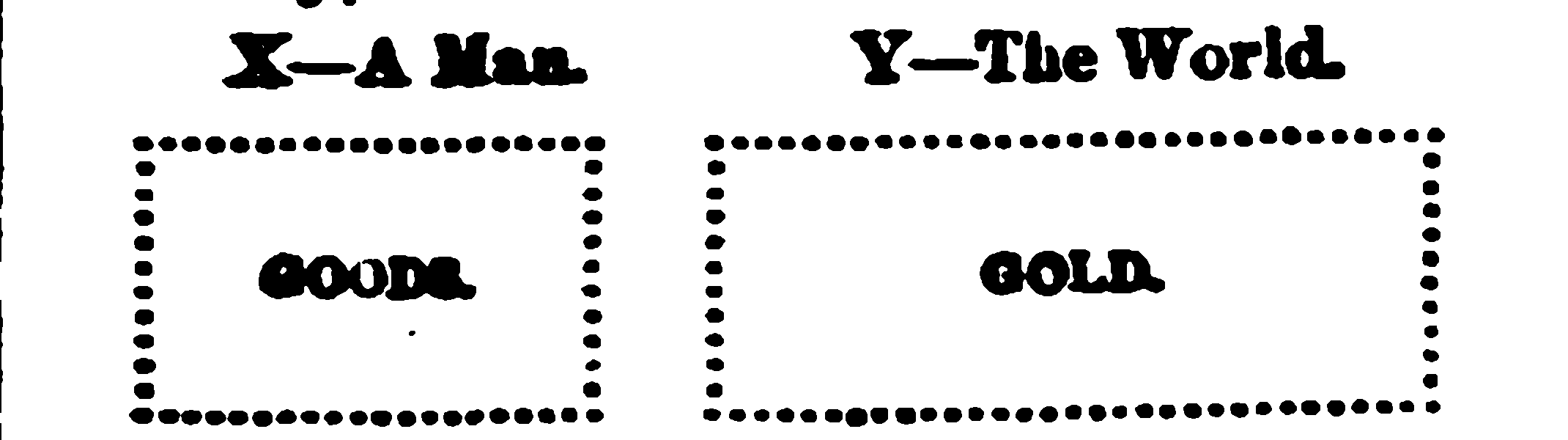
[Diagram: two dotted-rule boxes (“fences”). Labels: “X—A Man.” over box containing “GOODS.”; “Y—The World.” over box containing “GOLD.”]
represent a fence around a man and another around the rest of the world. X has goods, Y gold. If an exchange is made the case stands thus:
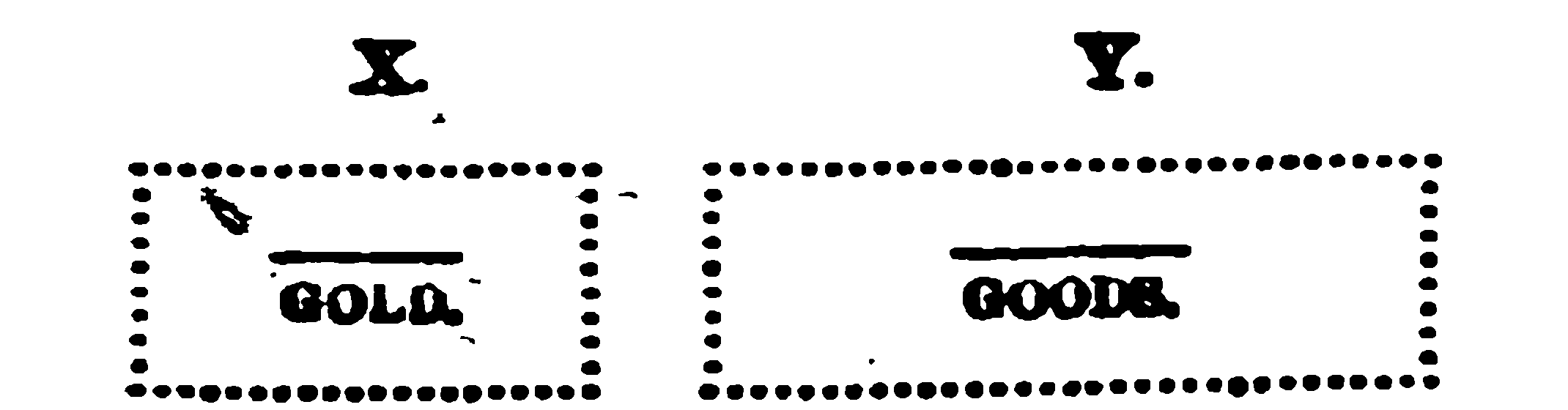
[Diagram: two dotted-rule boxes. Labels: “X.” over box containing “GOLD.” (with a short rule above the word); “Y.” over box containing “GOODS.” (with a short rule above the word)]
It is all very fine for X to exchange goods for gold, but is he not poorer until he lets the gold go outside his fence in exchange for other goods? Certainly he is. Then let X represent the United States and examine whether the case is any different:
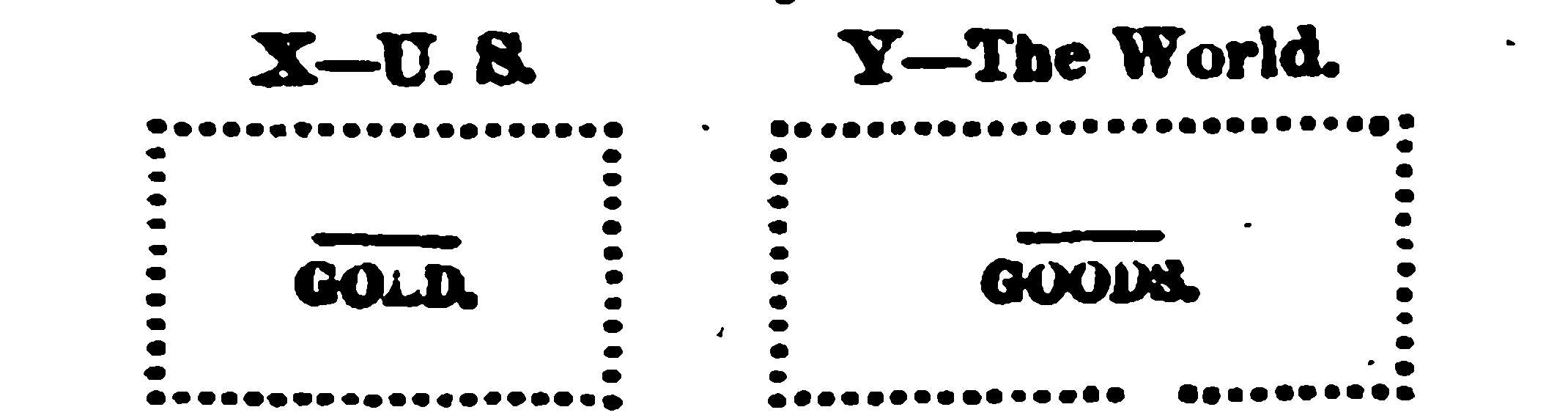
[Diagram: two dotted-rule boxes. Labels: “X—U. S.” over box containing “GOLD.”; “Y—The World.” over box containing “GOODS.” (each word with a short rule above it)]
The gold is a mere counter of exchange while used as money, and its receipt within the X fence does not add to the wealth inclosed by it, while the fence Y has gained in wealth by receipt of goods.
Therefore, when Americans buy of the world commodities for gold, the United States and not the world has most profited by the the sic; the very opposite of the protectionist idea. And when Americans sell commodities for foreign gold, the foreigners get the best of the transaction; the very opposite of the protectionist’s claim. To part with good things for gold is to be put exactly in the position of the boy who trades a rosy apple for a circus ticket; and for us to keep the gold here is just as nonsensical as for the boy to keep his ticket. To get pay for his apple, he must go to the show; to get real pay for our goods we must import good things.
Of course, it is not disputed that gold, unlike the circus ticket, has intrinsic value; but when goods are traded for gold for its own sake, as to make it into jewelry, the trade is a trade of goods for goods.
The demonstration could stop here, but if it did protectionists might say, “That may be as between man and man, but as between nation and nation it is different,” for the protectionist has not yet learned that trade is nowhere carried on between nation and nation, but everywhere between man and man.
To protectionists there is an esoteric meaning in the phrase “goods for gold,” which, if brought to light, could be fairly stated as follows:
“When one man trades with another in the same country, the transaction is in effect a trade of goods for goods; but when the people of one country trade with the people of another country, balances occur which are settled by the delivery by the debtor country to the creditor country of the common medium of trade—gold, and to the extent of such deliveries the trade is not a trade of goods for goods but of goods for gold. If, then, one of these countries long continues to be the creditor country its receipts of money will so facilitate its production and domestic trade as to make it more prosperous than the debtor country.”
Consider, first, the proposition that in trade between nations balances are paid with money, and therefore, to the extent of those balances, is a trade of goods for gold, and not of goods for goods.
How can trade between nations differ from trade between individuals? Are there not balances between individuals, and are not those balances settled with money? Does not the farmer sell to the storekeeper and buy from the storekeeper, and upon the adjustment of their accounts does not the debtor pay his balance in money? But can it, therefore, be said of this storekeeper and that farmer that the balance represents a trade of goods for money? If the creditor lost the money, it would; and in that case he, to the extent of the balance, would be giving goods for nothing. So, if the farmer and the storekeeper traded only with each other, and one of them was continuously the creditor, the settlement of balances between them would represent a trade of goods for money, and would be as unprofitable to the creditor as if he lost the money; for if they traded only with each other he would be compelled in future to sell less or buy more, thereby becoming the debtor when balances were settled. If he did neither his money would be useless.
But the trade of the farmer and the storekeeper is not confined to each other. The money paid one of them in settlement of balances in his favor goes to settle balances in favor of others, so that in the long run every balance is settled with goods; and when a surplus of money remains in the hands of any man in the circle of trade, he promptly seeks what he calls an “investment,” which, when analyzed, is an opportunity to exchange his money for something else.
As with individuals, so with nations. One country may import more from another than it exports to the other, thus leaving a balance between those countries. But the trade of nations is no more confined to two nations than the trade of individuals is confined to a farmer and a storekeeper. A nation which is debtor to one country is creditor to another, and the mutual [debits?] and credits are, in the [long run?], balanced off with goods. This
p. 4, col. 3
is not to say that international balances are never settled with gold; but when they are, the countries that export gold are the countries which, either by production from their mines or in consequence of their extensive commerce, have a relative oversupply of gold, and therefore find profit in exporting it. Gold exported in such circumstances is not money, but goods.
The formula as to individuals holds between nations,
Goods — money — goods;
therefore, goods — goods.
Settlements of so-called balances, equally with the trading out of which the balances arise, are ultimately exchanges of goods for goods. Until that ultimate is attained the trade is incomplete; and if in any case it be never attained, the creditor, be he an individual or a nation, has, to the extent of his balance, given his goods away; for, when trade terminates with the receipts of money:
Goods — money — nothing;
therefore, goods — nothing.
But, as already stated, nations do not trade. Brown, Jones and Robinson trade, and whether they live in different countries or are compatriots can in no wise affect the principles governing their trade. In neither case can any trade between them be complete until the money which one receives for goods he does not want has been expended in the purchase of goods he does want.
Now, consider the proposition to which the “goods for gold” theory is as the mythical turtle was to the earth in the physical science of the ancients—the proposition that as the settlement of balances in international trade consists of the exchange of goods for money, the receipt of money by the country which long continues a creditor country will so facilitate its production and domestic trade as to make it more prosperous than the debtor country. This proposition falls with the “goods for gold” theory; but waiving that, examine the proposition by itself. Its core is the exploded notion that capital employs labor, together with the notion, also exploded, that money, instead of being a medium of trading different forms of capital, is itself capital; and around this core the thread of protection philosophy is wound. If, in the course of the trade of goods for goods between nations, so the argument runs, one nation is a creditor nation, that is, exports more goods than it imports, the difference will be paid in money; the money so received increases its capital fund; and its larger capital fund enables it to employ more of its citizens, and thereby to augment its production. Also, by having more capital, that is, more money, at home and supplying its wants as far as nature permits from its own commodities, it will be a richer nation than if it sent away its money in exchange for imported commodities.
Now, capital does not employ labor. Labor both employs and makes capital. If, therefore, capital is needed in any country the labor of that country has but to be applied to its land to produce all the capital required; and if the country is not adapted to the production of some forms of required capital, forms to the production of which it is adapted may be produced by its labor and traded in foreign parts for the required forms.
But even if capital employed labor, and labor were helpless without it, a flow of money into a country without any flow out would not provide the capital. Money can give the advantages of capital only as it is traded for capital. Goods—and capital consists of goods—can be bought with money, but they cannot be made of money without putting an end to its function as money and turning it into goods. If a country wants capital it is better that its imports should exceed its exports, for in that case its capital is increased; whereas, if its exports exceed its imports, its capital is diminished and its money is increased.
To this, however, a protectionist might say, exchange your money at home for goods of your own production, thereby at once augmenting your goods and retaining your gold, instead of exchanging the money for foreign productions which, though it may augment your goods, will diminish your gold. But he forgets that if the money be sent abroad for goods the goods received cost the buying country no present labor, but only that past labor of which the money is the representative; and, therefore, that the labor of the buying country may be devoted to new productions instead of wasting its energies in the production of goods which can be imported for past instead of present labor. The notion that this expenditure of money abroad will limit employment at home is transparently fallacious. The goods imported are in greater or less degree raw material for domestic workmen; the importation, by exciting foreign industry, enhances exportation, the goods for which must be produced by labor; and it is not money, but demand for goods, that makes employment—a demand that is made effective by means of checks, drafts, notes, paper currency and book accounts in a degree to which gold bears an infinitesimal proportion. These and other reasons make it impossible that the exportation of money should diminish employment.
The conclusion that the aggregate wealth of a country is augmented by making exports exceed imports and keeping gold at home is equally fallacious. Gold is not more valuable than goods of equal value; and if the gold be exchanged for foreign goods the wealth of the country is as great, plus the profit of the trade, as it would be if the trade were not made.
This corollary of the “goods for [gold”?]
p. 4, col. 4
theory is illustrated by Mr. Robert P. Porter, when he says that if we pay $32.50 per ton to American manufacturers for steel rails we have the rails and the $32.50, while if we send $22.50 abroad for steel rails, we have only the rails! Even Mr. Porter must have smiled at his joke when he asked whether it is not cheaper for us to buy the rails of an American manufacturer for the higher price than to buy them of England for the lower.
There are several ways of looking at that joke.
If we look at it from the point of view of the American steel rail manufacturer who is empowered by the government to charge his fellow citizen $10 more for rails than they are worth, it is no doubt entertaining.
If we look at it from the point of view of the fellow citizen, however, the humor is not so apparent; for though he may habitually accept the “goods for gold” theory, and realize the importance of keeping money in the country, he will be apt in lucid intervals to remember that the extra $10 he pays for those rails is received from the sale of goods which he is at considerable pains to produce, and to wonder why the country wouldn’t be as rich if himself, instead sic the American steel rail manufacturer, were the custodian of the extra ten dollars.
If we look at it from the point of view of the steel rail employe we shall be tempted to inquire whether his share of the extra ten dollars is deducted from his wages or added to his expenses!
But supposing for the moment that the exportation of gold is a national calamity, let us see what happens when an American buys a ton of steel rails from an English manufacturer for $22.50. Does he put $22.50 into a package and express it across the water? No. He does $22.50 worth of work, with the proceeds of which he buys a draft on England from a New York bank and mails that draft—a mere piece of paper, the loss of which does not diminish our wealth, for any of our paper mills can reproduce it in an instant—to the English manufacturer. The English manufacturer deposits this draft in his bank, from which it finds its way to the English bank on which it is drawn, where it is paid, not with American gold—God forbid!—but with English money, probably a Bank of England note. The bank on which it is drawn then charges the New York bank with its amount. Does the New York bank pay this debt by shipping gold? No. It is paid by a counter entry in the books of both banks, caused by a draft drawn in England on New York, or a draft drawn in France, Germany, Brazil, or some other country, on New York, and which has found its way into the English banks. And what does this counter draft mean? It means, no matter what country draws it, that some American has produced $22.50 worth of goods which he has sold to somebody in that country. Then, so far as this country is concerned, an exchange of goods for goods has been made and the American consumer of steel rails gets his rails at an expenditure of $22.50 worth of labor, while we have in the country both the rails and the money.
“But,” says the protectionist, “while this may be true of one transaction, the result of the multitude of transactions is a balance which we owe and must pay by a shipment of money.” As the balance does not run that way the criticism is without foundation. But aside from that, the real trade balance never can run that way. When it appears to, and we are shipping gold to settle balances, it is either because it is then profitable to export gold as goods, or because we are paying rents, bonds, corporation dividends, or donations to foreigners, for none of which do we receive either money or goods.
And now let us see what happens when an American buys a ton of steel rails of an American manufacturer for $32.50. First, he must do $32.50 worth of work, instead of $22.50, and that $32.50 he forwards to the American manufacturer, who returns the rails. Here, too, there is an exchange of goods for goods; but whereas before it was an exchange of $22.50 worth of goods for $22.50 worth, it is now an exchange of $32.50 worth for $22.50 worth. The American consumer pays $10 more for his rails, and, just as in the case of the foreign trade, we have in the country both the rails and the money. The only difference between the two transactions is the bonus our consumers are in the latter case compelled to pay to our monopoly manufacturers, a bonus which the manufacturer is disposed to distribute among his workmen, but never does, as his workmen well know.
Is it cheaper for us to buy of an American manufacturer for the higher price than to buy of England for the lower? Assuming that this is not a joke, after all, let us inquire. It might be, if it were not for the fact that our labor must be diverted from other and more profitable pursuits to make the rails. If, by rubbing money between our thumb and forefinger and saying “presto,” we could conjure up steel rails, then, indeed, would it be cheaper for the country, as a whole, to keep the money at home than to send it to England, even though it circulated at home at the rate of $32.50 per ton of rails, when the covetous Englishman was willing to give a ton for [$22.50?]. It would be cheaper for the country, as a whole, mind you, but not for the buyer of rails, if he had to drop $32.50 of his magical money into Mr. Carnegie’s hat every time he did the trick, when an Englishman would do the trick for him for $22.50.
But since money does not conjure up steel rails in any such way, and has no more to do with steel rails than to bring
p. 4, col. 5
about trades between the man who makes them and men who make other things, it is not cheaper either for the country or for the rail consumer to pay an American manufacturer more than the English price. For if we buy rails abroad we must pay for them in goods of our own production or (in deference to the “goods for gold” theory) with money. If we pay for them in goods the country has the rails, while its supply of money is undiminished; if we pay for them in money the labor released from rail making produces for us other goods equal in value to the money exported, and in such case the country has the rails and the other goods. In either event the country, without considering how much richer it may be, is fully as rich as if an exorbitant price were paid to the American manufacturer.
If it were cheaper by the amount of money kept in the country, to buy rails of an American manufacturer at a high price than to buy them abroad at a low price, we should save $22.50 if that were the English price, and $10 if the English price fell to that sum; while we should strike an equilibrium if the Englishman should give them to us for nothing. I suggest, therefore, that Mr. Porter vary his question. Instead of asking if it is not cheaper for us to buy rails of American manufacturers for $32.50 than to buy them of England for $22.50, let him ask if it is not just as cheap to buy them of American manufacturers for $32.50 as to get them of England for nothing. The answer to one question answers the other.
Could anything be more absurd than this “goods for gold” theory, unless it be its favored corollary that it is more profitable for a citizen and cheaper for his country to pay a fellow citizen high prices for domestic goods than to pay a foreigner low prices for the same quantity and quality of goods?
By the “goods for gold” theory, receiving without giving impoverishes, and giving without receiving enriches; while its corollary makes greater labor for a less result preferable to less labor for a greater result.
LOUIS F. POST.
A POSER FOR PROTECTIONISTS.
Senator George’s proposed amendments to Senator Sherman’s anti-trust bill have scarcely received from the press, and especially from the protectionist press, the attention they deserve. Mr. George proposes:
That when any action or suit in law or equity shall be commenced or shall be pending in any court of the Uuited sic, it shall be lawful for any defendant therein to except to the jurisdiction of such court upon the ground that the cause of action or suit is for the enforcement of a right based on a contract for the sale, exchange, or transportation, or on any damage arising from any wrong committed in respect to any article of merchandise manufactured, transported, imported, or sold in violation of the provisions of the first section of this act, and if such ground of exception shall be proven to the satisfaction of the court, judgment of dismissal shall be entered with double costs to the defendant, and with such reasonable sum for the attorney’s fees for the defense thereof as may be allowed by the court.
That when the president of the United States shall be satisfied that any arrangement, sic, contract, agreement, or combination, as described in the first section of this act, has been formed and that in consequence thereof there has been a rise in the price of any article of merchandise, he shall have power and it is hereby made his duty to issue his proclamation suspending the collection of all customs duties or import taxes on similar articles when imported into the United States from any foreign country. Such suspension shall continue for ninety days after the president, upon being satisfied that such enhancement in prices no longer exists, shall issue his proclamation withdrawing his former proclamation of suspension, and the president of the United States may from time to time, as may in his judgment be proper, reissue or withdraw any proclamation he may have issued.
That when any article of merchandise shall have been raised in price, by reason of the unlawful means described in the first section of this act, such article, when owned by any of the persons, companies or corporations mentioned in the first section of this act, or by any person, corporation or company claiming or holding, either directly or through any number of successive transfers under any of the first named persons, companies or corporations, shall not be the lawful subjects of interstate or foreign commerce, and such commerce or transportation is hereby prohibited. It shall be the duty of the president of the United States, through the interstate commerce commission and such other agencies as he may see proper to employ, to make such investigations as may be necessary to carry out the provisions of this section. To tha sic every officer of the United States who may be employed in such investigation is hereby authorized to summon witnesses and to examine them under oath, and the said interstate commerce commission shall make all such needful rules and regulations as may be deemed proper to carry out the provisions of this section, which rules and regulations shall, before they go into effect, be approved by the president of the United States. When such commerce and transportation as to any article of merchandise shall have become unlawful under the provisions of this act, the aforesaid interdict on the same may be removed whenever the president of the United States shall so proclaim, upon his being satisfied that the enhanced price, as herein provided against, shall no longer exist, and that commerce in such article is free, and not restrained or affected in any way by reason of the matters mentioned in the first section of this act.
That whenever it shall appear to the president of the United States that the manufacturers or producers of any article of merchandise or a majority of them in the United States shall not pay in regular weekly wages, in lawful money, to the workmen, artisans, and laborers, excluding superintendents and officials engaged in such manufacture or production, the full sum realized by them in excess of the wholesale price in the city of New York of similar and competing articles manufactured or produced in any foreign country, such wholesale price being diminished by a reduction therefrom of the customs duties on said foreign articles, it shall be his duty to issue his proclamation suspending all duties on such similar articles when imported in excess of [30?] per cent ad valorem, and such suspension shall continue till otherwise ordered by congress, but no act of congress shall have the effect to allow the collection of the suspended
p. 4, col. 6
duties on articles which shall have been imported during the time of such suspension under the proclamation of the president of the United States. He shall also have in respect to the matters of this section all the powers of investigation through officers of the United States provided for in section 6 of this act.
Here is a splendid opportunity for our protectionist statesmen to demonstrate to the whole country, beyond possibility of doubt or cavil, the sincerity of the professions made in the platform of their party. They have placed on record their unalterable hostility “to all combinations of capital organized in trusts or otherwise to control arbitrarily the condition of trade among our citizens.” They have affirmed, from platform and from stump, their eager affection for labor, and have asserted, again and again, that they love the protective tariff only in so far as it secures higher wages for American workingmen. Of these professions wicked free traders have dared to speak in terms of doubt and even of derision. The more blasphemous have gone so far as to say that protectionists don’t really hate the trusts, and only pretend to attack them because they think that the best sic to really defend them. They have quoted Mr. Blaine’s unfortunate slip of the tongue—made when the poor man had just come from Europe and before he had grasped the situation—and pretended that it expressed the real protectionist view of the trust question. They have not scrupled to cast doubts on the protectionist affection for the workingman, saying openly that it was all humbug, and that protectionists loved protection because it enabled them to rob the workingman. They have said these things, and have even gone so far as to support them with facts and figures, to say nothing of arguments ingeniously contrived to appear founded on common sense and justice. All this has hurt the good protectionists, and may injure them still more before the campaign is over.
But now, at last, the enemies of protection have made a fatal blunder. Senator George has proposed legislation to secure the doing of the very things that protectionist sic most anxious to see done. All that the protectionist friends of high wages and no trusts have to do is to enact Mr. George’s amendments into law, and the dearest wishes of their hearts will be fulfilled, and the wretched assailants of the great protective system be forever put to shame.
Will not Mr. George’s amendments do all that we have claimed? Just look and see. The sugar trust, for instance—we name the sugar trust because it is the one that the protectionist leaders are attacking with most especial sound and fury. How long could the sugar trust survive such legislation? A vessel arrives here from Cuba with a cargo of raw sugar for, say, the Havemeyer refinery. The master can enter the sugar as his own property, sell it, and pocket the proceeds, and the Havemeyers cannot say him nay. The refinery sells a hundred barrels of sugar to a Philadelphia grocer. The sugar cannot go to Philadelphia; the railroads are forbidden to transport it. And as if all this were not enough, out comes an emancipation proclamation by the president of the United States, granting everybody in the country permission to buy refined sugar in France, in Germany, anywhere he pleases, without let or hindrance. And as if even this were not enough, along comes an officer, under the provisions of Mr. Sherman’s original bill, and claps the Havemeyers and all the other members of the sugar trust into jail, there to languish till they shall have paid each a fine not exceeding $10,000, or suffered imprisonment for not more than five years, or both. The man who could continue to operate a sugar trust in the face of such obstacles as these, must have more than mortal powers of action and endurance.
So, too, with regard to wages in protected industries. The good protectionist says to the worker in the sugar refinery: “Son, all this protection is imposed for your benefit. The extra three or four cents that the fainting sewing woman pays for the weekly half pound of sugar that sweetens her tea, is yours.” And when, at the end of the week, the worker goes to get his pay, if the sewing woman’s pennies are not in his envelope, Mr. George’s legislation gives him satisfaction, if not positive relief. If he doesn’t get the three cents, the sewing woman needn’t pay them. This, at all events, will be an indirect benefit to him, especially if, as is very apt to be the case, the sewing woman happens to be his wife or sister.
It is strange that the protectionists should have left it for one of their opponents to suggest these simple methods of removing the sic that still mar the symmetry and smoothness of the protective system. Now, however, that Senator George has thoughtlessly pointed them out they will of course adopt them promptly. Otherwise people will be apt to say that the protective system is a humbug.
News item from the Age of Steel:
The snath and cradle makers’ union, comprising all of the manufacturers in the United States, held their annual meeting at Rochester, N. Y., Aug. 17. Ten concerns were represented, and W. H. Withington presided. After a thorough discussion of the situation it was determined to organize the Central snath and cradle company, with H. P. Sullivan, commissioner. Each factory becomes an agent of the Central company, a considerable amount of money being deposited with the commissioner as a guarantee of good faith. Prices were advanced to fifty per cent discount off the standard list. The terms are sixty days, or two per cent discount for cash in ten days.
Certainly. The manufacturers have con- continued on p. 5 →
[text breaks off at foot of column; no “continued” line visible on this page]
Page 5 of 7contents
THE STANDARD, Vol. 4, No. 13 (Whole No. 91), Saturday, September 29, 1888 — page 5
THE STANDARD, SATURDAY, SEPTEMBER 29, 1888. 5
p. 5, col. 1 [continued from previous page]
← continued from p. 4 cluded to stop competing with each other and put the prices up. Why shouldn’t they? The duty is forty-five per cent, and the farmer who has wheat to cradle, or grain to mow, must buy from them, because he isn’t allowed to buy from anybody else.
By the way, though, wasn’t there somebody who said the tariff was invented for the benefit of the American farmer?
In the free trade scheme, the revenue necessary to pay the expenses of the government, economically administered, will be raised from internal revenue taxes, and these will fall principally upon whisky and tobacco. Both of these articles, however, will then need to be protected by duties levied upon their foreign competitors. It will be impracticable, for instance, for the free trade statesmen, in that time of bliss and perfection, to admit French brandy free of duty when they are heavily taxing the products of Bourbon, Monongahela and Robertson county. It will be equally impracticable for them to [exult?] in the delights of free trade in Sumatra tobacco, when they are heavily taxing the tobacco of Kentucky, Virginia and Pennsylvania.—[New York Sun.
Let the Sun possess its soul in patience. When the system of robbing labor by tariff taxes is swept away, the system of robbery by internal revenue taxes will soon follow. And the revenue for the payment of public expenses will be raised, not by fines imposed on industry, but by taking for the common use the ever-growing fund which, produced by common effort, attaches itself to that element which Thomas Jefferson declared the Creator has intended for common use.
Mr. S. E. Jennison of Saratoga Springs, writes from Brushton, N. Y., to THE STANDARD, saying that our opposition to the re-election of Governor Hill will have a tendency to increase the trading of votes in Hill’s interest and against Cleveland, and asking if we think we ought to continue our fight against Hill. In the course of his letter Mr. Jennison speaks of the “Harrison, Morton and Hill” banners in different towns in the northern part of the state, reminds us that Cleveland’s election is the most important consideration in this campaign, verifies the rumors that Hill’s supporters are already offering democratic votes for Harrison in exchange for republican votes for Hill, repeats the governor’s plea that the ballot bill he vetoed would not have accomplished the object aimed at, and urges us to “press forward and elect all the democrats we can,” assuring us that “then we shall have a better chance to make good democratic laws.”
Mr. Jennison’s letter reads more like an appeal from a thick and thin democratic partisan, than an advisory message from a single tax advocate. Assuming, however, that he supports Cleveland and Thurman for the same reason THE STANDARD does, because they represent a powerful political movement in the direction of “free trade, free land and free men,” his fear of hurting Cleveland by opposing Hill [is?] quite a natural feeling. But the danger is not so great as he supposes.
There are, it is true, “Harrison, Morton and Hill” banners in different parts of the state, and behind them there are Harrison, Morton, and Hill voters and whippers in. But banners, voters, and whippers in were at work long before Hill’s nomination. They do not serve Hill because large bodies of Cleveland’s supporters oppose him, but because Hill, as governor, has served the barroom interest, which they represent.
It is no doubt true also that Hill’s henchmen are engaged in trading off Cleveland, but this they would do quite as energetically, though possibly less openly and therefore more dangerously, if Cleveland’s non-partisan supporters were weak enough to submit to the dictation of Governor Hill’s state convention.
But against Hill’s treachery to the national ticket must be considered the independent democrats, of whom George Foster Peabody of Brooklyn is a type; the independent republicans, and the single tax men. All these will support Cleveland, and but few of them will support Hill. To offset this unfavorable difference between his own vote and Cleveland’s, Hill must have more “Morton, Harrison and Hill” banners than he has, and do more trading than even his dexterity in that line is equal to.
On the question of mere expediency, there is not enough in the threats of Hill’s followers against the national ticket to silence opposition to Hill.
But even if his threats were dangerous to the national ticket, no independent voter—much less a single tax voter—who is withholding his allegiance from the democratic party until he can see it as he hopes to see it, unequivocally committed to principles of real democracy, would either vote for Hill or, by silence, promote his election. Mr. Cleveland and Mr. Thurman are giving a character to the democratic party which is attracting to it the progressive elements of the community, and once established, assures it an enviable record of victory at elections and advances toward freedom in government. Governor Hill represents opposition to this, and his defeat is as important to reformers in New York as is Cleveland’s election to national reformers.
It is not by electing, as Mr. Jennison says, “all the democrats we can that we shall have a better chance to make good democratic laws,” but by distinguishing between the real democrat and the sham democrat—electing the one and beating the other. And especially, if we want a really democratic government and really democratic laws, must we insist upon that electoral reform which Governor Hill [prevented?], and which [can alone?] [illegible]
p. 5, col. 2 of bribery, intimidation and boss rule which render our nominal democracy a sham and a disgrace, and for the rule of the people substitutes the rule of “bosses” and “machines.”
The governor says the ballot bill he vetoed would not have accomplished the object aimed at. It was not for that reason he vetoed the bill. He vetoed it because it would have accomplished the object aimed at. It would have prevented bribery, and therefore he vetoed it. It would have prevented intimidation, and therefore he vetoed it. It would have enforced and secured secrecy in voting, and therefore he vetoed it. Above all, it would have made political machines powerless is sic both to nominations and elections, and therefore he vetoed it. His opposition to the details of the bill was a superfluous pretense, as his opposition to it on constitutional grounds was a transparent sham. In his veto memorandum he placed himself on record as opposed to the very spirit and purpose of the bill, and it is there that the true reasons for his veto stand out.
We shall support Cleveland and Thurman because they represent in part what we proclaim in full. And we shall oppose Hill because he represents the worst phases of American politics, and is personally responsible for delaying electoral reform. And in doing this we have no fear of injuring the national ticket either by confusing issues or by causing trades that would not be otherwise made.
A. M. Warner, a merchant of Lispenard street, prefers a specific and formidable indictment against the protection party. He has been a republican for twenty years and has never voted any other ticket, and for this fidelity to his party, so he charges, he is rewarded by being made the victim of various forms of oppression, extortion and robbery. In a letter and interview in the Herald he says he is a manufacturer of table covers, piano covers and so forth. His raw material is wool felt, which is taxed from 100 to 125 per cent, and even more. This tax is heavy enough to prevent Mr. Warner from importing wool felt, and compels him to buy of domestic producers, of whom there are not more than five or six. These producers have formed a trust among themselves, and for three years have fixed prices at about 100 per cent above the market in other countries—just enough below the tariff rate to prevent importing.
The tariff which permits this outrage upon men in Mr. Warner’s business and their customers is said to be imposed for the benefit of workingmen. Yet the number of men employed in making wool felt in this country Mr. Warner puts at less than 400, who are but little better paid than the same kind of labor abroad and not so well paid as car and truck drivers here. It is, as he says, “a lie and a fraud” to say that this felt trust is in the nature of protection to American industry.
And Mr. Warner is evidently no mere tariff tinker. In supposing that the Mills bill will enable us to buy in a natural market, he gives it greater credit than it deserves; but it will bring us nearer to a natural market than we are at present, and for that reason, in supporting this bill Mr. Warner is logically reaching out toward the business methods in which he believes. “I am an American,” he says, “and favor American industry; but I am not fool enough to imagine that supporting this trust helps my fellow countrymen or the workers in the wool felt industry. It only sets aside natural laws, or rather makes unnatural that which is natural. A divine providence gives this country many great advantages which other countries have not. There are many things we can produce better and cheaper than any other nation. I say, then, let us produce all we can within our advantages. But don’t let us attempt to produce that which we cannot do according to the common understanding of profit and loss—to make our people pay a fancy price for an article simply because it is produced here at a cost of a hundred per cent more than it can be produced for elsewhere.”
George Foster Peabody, who has always been a democrat and a supporter of the democratic party, and who, as a free trader as well as a democrat, is now earnestly supporting Cleveland and Thurman, declares himself without any indistinctness both on the tariff issue and the Hill issue. Having been invited to serve as vice-president of a mass meeting in Brooklyn, he said, replying to [the?] chairman of the democratic campaign committee:
I recognize the compliment you tender me, and as a life long democrat and free trader I am most reluctant to ask you to drop my name from the list; but as you propose to ratify among the nominations the name of David B. Hill for governor I have no other alternative. I am from personal observation and knowledge firmly persuaded of the unfitness of Mr. Hill for the high office which, to my mind, he has disgraced as no other man ever did during the four years of his incumbency, and thereby brought more discredit upon the democratic party than any man since the days of Tweed (who was also renominated and re-elected, I recall, notwithstanding his crimes). I count it the first duty of an honest democrat to try to secure the defeat of any candidate named by delegates in the face of open and undeniable charges of betraying his public obligations. As witness the aqueduct deal, and the high license and other vetoes. As I am proposing to do all I can for the election of Mr. Cleveland and the rest of the democratic ticket except Mr. Hill, for whose defeat I shall work equally hard (I think it more necessary for the [permanent?] [welfare?] of the democratic party [illegible] [last line of column illegible]
p. 5, col. 3 than the election of any one), I shall have to work outside of your organization, which I very much regret.
Thomas G. Shearman will be back from Europe on the 2d or 3d, and will at once throw himself into the single tax Cleveland and Thurman campaign. His first speech will be at the next big single tax meeting at Cooper union, Friday, October 5th, and after that he will enter actively upon campaign work, and speak through New York and New Jersey, as the committee may arrange.
THE CAMPAIGN “STANDARD” FUND.
The contributions to the fund this week have been:
J. R., Washington territory………. $ 5 00 C. P. Cooper, Brooklyn………. 2 00 W. Wellstood, Jersey City………. 1 00 George Harnwell, Whitestone, L. I………. 1 00 Helen Weston, Staten island………. 10 00 Emil Gent [Geat?], St. Paul, Minn………. 5 00 Frank Conn [Coun?], St. Johns, Mich………. 2 00 John R. Waters, New York………. 150 00 H. M. Mundy, Norfolk, Va………. 1 00 D. R. Hutton, Brooklyn………. 75 E. T. Shelly, Atchison, Kan………. [3?] 00 Bernard Dwyer, Brookline, Mass………. 7 20 Friends in Boston Herald composing room………. 4 25
Total for the week………. $[192?] 20 Previously acknowledged………. 3,0[illegible] 82
Total to date………. $3,2[illegible] 02
The days are slipping away. And as each one vanishes its possibility of work goes with it. The opportunity of to-day must be used to-day, or not at all. To-morrow will present its own opportunity, to be in turn improved or neglected; but the vanished chance of yesterday is gone forever.
STANDARD readers, we want to improve these daily opportunities as they present themselves. Men are inclined to listen to us now as they have not been before, and may not for some time be again. We want to preach our gospel to as wide a circle as possible—to put THE STANDARD into the hands of men before the present fierce debate between protection and free trade culminates in the election. You can help us do this. You ought to help us do it. Will you help us do it?
From a Michigan Tax Assessor.
LEETSVILLE, Kalkaska County, Mich.—This county, hitherto a republican stronghold, will this year greatly increase the vote for Cleveland over that of 1884. In this township there are fifteen democrats against only two eight years ago. The democrats could carry the state by a little good management, but the republicans are working hard.
The weekly edition of the New York Press is sent free to most of the people in this region. A friend of mine came to me a little while ago and said: “See what a fine paper I am getting for nothing; I wonder who sends it.” I told him that if he followed the directions of that paper it would cost him a good deal before he got done with it. About a week later he came to me and said he had had enough; that the paper was not fit for any man to read.
I have been a tax assessor in this township for three years, and have applied in some measure our theories. When I was elected the pine lands in this county were assessed at only one-fourth of their value. My committee recommended to the state board that there should be a large increase in the assessment on pine lands. Our report was adopted, and as a result the township I live in saved two per cent on the state and county taxes. It is a fact that if all taxes were laid on land values in this county, regardless of improvements, the farmers would save more than fifty per cent of the taxes they pay. If our literature could be distributed here we would gain many recruits.
L. N. MEAD.
Preparing for a Single Tax Campaign in Passaic County, New Jersey.
The following named gentlemen compose the Passaic county Cleveland and Thurman single tax campaign committee: George Agnew, Thomas Hogg, Charles R. McGinness, Jacob Mick, William Masker, Robert Hewson, John O’Brien, Frank Poirier, Frank Fisher, J. Hill, W. Gray, George Adams, J. J. Barnard, John Craig and E. W. Nellis.
The committee proposes to hold meetings at different places in the county in advocacy of tariff abolition and the single tax. The campaign will be opened with a mass meeting in Paterson, at which Henry George will speak. Funds have already been paid in to meet the necessary expenses.
Passaic county readers of THE STANDARD who desire to co-operate in spreading the light should communicate at once with the secretary, John Craig, 192 Hamburgh avenue, or with its chairman, E. W. Nellis, 89 North Main street, Paterson, N. J.
The committee will meet sic evening, Sept. 27, at Helmet hall, Market street.
From an Anti-Corn Law Man.
Thomas Briggs of London, who played an active part in the corn law fight, writes under date of Sept. 13:
Mr. Briggs presents his compliments to the editor of THE STANDARD, and begs to congratulate him on the success of the meeting of single tax men as reported in issue of the New York STANDARD of Sept. 1. The speech of William Lloyd Garrison reminds one of the stirring times of emancipation of the colored slaves. The speech of Henry George calls for the reflection of every well wisher of his race. It reminds one of the speeches we were used to listen to from the late lamented Richard Cobden in 1838 to 1846, which forced the partial free trade that has effected so much good to Great Britain but which would have done more had it been free trade absolute.
He Did Not Vote for Blaine.
SING SING, Sept. 20.—I wish to deny the report that I voted for Blaine in ’84. I have always been a Cleveland man.
H. GREEN GRANNIS.
The Leading Paper of the Northwest Declares for Free Trade.
Chicago Herald.
The Herald, having the truth at heart as its safest stronghold, while campaigns wax and wane, knows there is no authority, human or divine, for the taxation of one man in order that another may benefit thereby. As protection, however slight, is such a tax, then liberty, equality and fraternity demand its abolition. That the system can be swept away in a day, a month, a year, or a decade, need not be maintained. But there can be no harm to honest men in declaring candidly that protection to workingmen is fallacious. The only thing labor needs or can get is the product of labor. No tax can add to that product. All “imposts, duties, excises and taxes” take from that product. Because protection came slowly, it will go slowly, but go it must. Its shadow will wither the [industries?] long after its [apologists?] have ceased to [defend?] it.
p. 5, col. 4
CAMPAIGN WORK.
The work of the Single tax Cleveland and Thurman campaign committee is making steady progress. The original committee for the Metropolitan district has divided, as previously noticed, into separate committees for New York, Brooklyn and New Jersey. Each committee is busily engaged in organizing and holding meetings.
Since the last STANDARD went to press two great meetings, under the directions of the committee, have been held, one at Newark, N. J., on September 20, which was addressed by Messrs. George and Pentecost; one at Cooper union, on September 21, at which Mr. George answered questions.
Mr. George also spoke at a big meeting at Reading, Pa., in the Grand opera house, on Tuesday, Sept. 25, under the auspices of the Teachers’ institute of Berks county.
On Thursday, 20th, a meeting was held in the Eighth congressional district, at which speeches were made by Messrs. Gorsuch and McCabe.
On Monday, 24th, the enrolled men of the Twelfth congressional district met for organization and elected officers whose names are given elsewhere.
Circulars have been sent to the signers in the Sixth and Seventh congressional districts, asking them to call at headquarters and arrange for small meetings in these districts.
During the coming week arrangements will be made for a large meeting, probably to be addressed by Mr. Post, in the Eleventh congressional district.
The Ninth congressional district is organized for holding meetings, and the Tenth will be organized in the course of a few days.
On Thursday of this week Mr. George and others will, by the time this number of THE STANDARD reaches its readers, have addressed a meeting of the Thirteenth congressional district at Temperance hall, Harlem. The Harlem branch of the Free trade club is taking care of the work in the eastern half of this district, while the Single tax club on the west side will soon arrange for a meeting in that neighborhood.
A large meeting will also be held on Saturday of this week in Albany in the Academy of Music. Mr. George will be the principal speaker.
On Friday, Oct. 5, a big mass meeting will be held in Cooper union, at which Thomas G. Shearman and William J. Gorsuch will speak.
Louis F. Post and others will speak in Elizabethport, N. J., on Tuesday, Oct. 9.
But a small portion of the Fourteenth district is within the city limits. The work of organizing that district should be conducted from Yonkers, and the committee would be glad to hear from single tax Cleveland and Thurman voters in that city.
This committee is informed that the single tax campaign committee for the state of Pennsylvania held its first meeting on Tuesday evening of last week at No. 1026 Ridge avenue, Philadelphia. John F. Hallach was elected chairman, J. C. Frost secretary, and S. F. Moffit treasurer. The New York and New Jersey committee will co-operate cordially with this new committee, and I hope that all our friends in Philadelphia will put themselves as speedily as possible into communication with it. I would, however, again urge on them the importance of having their names on our general enrollment at these headquarters. Campaign organizations fall to pieces after election, but this enrollment of names that we are putting in type will be pushed after the present campaign is over, and I hope to make it in the end a directory and mailing list of single tax people everywhere. It will then become the basis of whatever organization the future may render necessary.
Much as has been said on the subject, there still seem to be people who utterly fail to understand our plan of enrollment. We do not want lists of names made up by anybody. We want signatures of single tax men who are going to vote for Cleveland and Thurman as single tax men. Of course where a man verbally authorizes another to put his name on a blank there is no objection, but any lists that are not authorized by those whose names appear on them are not wanted.
On the other hand I wish to urge those who have received blanks to solicit signatures. These names are not published. sic the lists are shown only to the committee and those acting with it. Therefore none need hesitate to sign. Wherever earnest work has been done many signatures have been sent in. Let all of the thousands who now have these blanks in their possession now make a special effort, and the number of names will soon be doubled. I cannot now tell the exact number of signers, as many blanks are in the hands of the printers, but it is steadily growing.
It is by no means confined to New York, but includes many names in Alabama, Arkansas, California, Colorado, Connecticut, Dakota, Delaware, District of Columbia, Florida, Georgia, Illinois, Indiana, Iowa, Kansas, Kentucky, Louisiana, Maine, Maryland, Massachusetts, Michigan, Minnesota, Missouri, Montana, New Jersey, Nebraska, New Hampshire, North Carolina, New Mexico, Ohio, Oregon, Pennsylvania, Rhode Island, South Carolina, Tennessee, Texas, Vermont, Virginia, West Virginia, Wisconsin and Washington territory.
The work in the state will depend very largely on our financial ability to carry it on, but we unquestionably will have a considerable number of meetings, and Mr. George and Mr. Thomas G. Shearman will speak in most of the cities from here to Buffalo. Mr. Estell has been traveling recently through the southern tier, and will shortly make speeches at Binghamton, Port Jervis and elsewhere, while Mr. Hopkins of Syracuse has begun organizing and preparing for meetings in the western part of the state. In New Jersey, also, there is active work in progress.
WM. T. CROASDALE.
NOTES FROM CONVERSATIONS.
A Single Tax Man Shows How the Yeast Works.
Question protectionists and see how inconsistent they are. Not long since a tailor related to me, as a proof of the futility of Americans attempting to compete with foreigners, how an American manufacturer had charged $16 for making a certain kind of uniform for the Panama police, which a French manufacturer afterward made for $8, and for which the latter received all subsequent contracts.
I asked him what he thought the American manufacturer paid his tailors to make a complete uniform.
“Five dollars,” he replied.
“What did the Frenchman pay his tailors?”
“Two dollars.”
“Then,” I said, “if the American manufacturer had got his labor for nothing his price would have been $11 per suit, $3 more than the Frenchman asked after paying the French tailors’ wages.” And continuing, I pointed out to him that what made this great difference in prices was the enhanced cost of the material which the American manufacturer had to use. The cost of everything which entered into the garment, from the brass button down to the thread, was abnormally high because of—protection.
This was a case in which “protection” not
p. 5, col. 5 only failed to raise wages—it made it impossible to earn any wages at all.
One night while walking home from the Reform club after listening to Louis F. Post discourse on the tariff, I heard something that threw a side light on this “cost of American goods.” My companion, a young man who had worked in American woolen mills, said there was little wonder to him that the Americans preferred foreign to domestic woolen goods, because the domestic goods were not pure. “When I was working in one of A. T. Stewart’s mills up the state,” he said, “they used to weave in cows’ hair and sell the material for all wool. We didn’t dare open our mouths about it, for Stewart owned the mill, the houses we lived in and all the land for miles around, and if we had been discharged from the mill we would have been compelled to leave that section of the country. It was a flagrant fraud, but he had to do it to successfully compete.”
“Perhaps he paid too much in wages,” I suggested.
“No,” the young man answered. “Stewart reduced us from $35 a month to $26 and later to $20.”
“Was his machinery and labor as efficient as the foreigner’s?” I asked.
“Every piece of machinery was English and the ‘hands’ were all of them Europeans,” he answered. “What would have put those mills on a footing with those in Europe and made them a paying investment, were free wool and free dyes, as now provided in the Mills bill.”
At another time I was talking politics and tariff with a salesman for an American woolen factory. He wore a fine piece of cloth in his coat, which he explained was “imported” and “the best the market” could afford.
“Who are you going to vote for?” he asked me, and when I answered, “Cleveland,” he was shocked. “Why, Cleveland meant free trade, and I ought to know from my experience in the tailoring business that the English and German and French manufacturer could turn out a better quality of goods than our manufacturers, and with free trade we might as well close up our mills.
“The people would all buy the foreign goods,” he exclaimed.
I took hold of the lapel of his coat. “When you bought this imported coat,” I said, “did you think of the American manufacturer? How much consideration did you have for the American laborer?”
“But I protected them,” he protested, in some confusion. “I paid sixty-five per cent duty!”
And then he said he didn’t want to debate the question any more with me.
BENJAMIN DOBLIN.
Greenbackers in Michigan.
SAGINAW CITY, Mich., Sept. 18.—In addition to sending in my name to be enrolled as a single tax supporter of Cleveland and Thurman, I have distributed blanks among my friends.
I am an old time greenbacker. I voted for Peter Cooper, General Weaver and Ben Butler. I shall both vote and work for the principle—the great issue now before the people—represented by Cleveland and Thurman.
The old greenback party is again organizing in this state, and will ultimately raise the standard of the single tax doctrine.
Nearly all single tax men here will vote for Cleveland and Thurman, and after next November we will organize a single tax club, or, to be more accurate, a propaganda society.
More About Things in St. Louis.
ST LOUIS, sic.—We are having excellent meetings every Sunday night. We organized about five weeks ago with only ten names on the roll; our membership has since increased until it now numbers 113, and the enthusiasm and interest is growing. Last Sunday night the hall was crowded, the attractions being a debate between Senator Davisson and G. W. Hummel, the former favoring protection and the latter free trade. After the debate was over, Mr. H. Martin Williams was called for and made a grand speech for Cleveland and Thurman, in which he advocated absolute free trade and was applauded to the echo.
G. S. B.
They Mean to Stir Up Lynn.
In accordance with the programme adopted at a public meeting of single tax free traders, held in Lynn, Mass., recently, a campaign organization is being formed. Mr. T. P. Perkins, 14 South Common street, has been making an enrollment of men who have signified their wish to join. Every believer in the gospel of equal rights should see that his name is put down, and in that way make his influence felt.
Edwin M. White and Levi H. Turner of the Charlestown free trade club were the principal speakers at the recent meeting and they spoke out so fearlessly and made such telling points that the crowd pressed around the stand until after ten o’clock.
SOCIETY NOTES.
Miss Virginia MacTavish, who is reported to have captured England’s premier duke and hereditary earl marshal, may be said in a measure to have been born to the purple, as her paternal great-aunts, the Misses Caton of Baltimore, were almost the first American women to wear coronets. And if in this country anything may be conceded in the way of hereditary distinction, the F. F.s of Virginia have the first claim to it. Miss MacTavish has the sic of Carrolls, Scotts and Mayos in her veins. Her mother, formerly Marcella Scott, is the only surviving child of General Winfield Scott, and has the same blonde beauty and haughty bearing that distinguished all his daughters, although perhaps possessing both in a less degree than did her sisters, Mrs. Goold Hoyt or Mrs. Henry Scott.—[New York Sun.
David White, aged nineteen, was arraigned at the Jefferson market police court last week. He was arrested while eating some hot rolls with milk that he had stolen from a flat in Clinton place. He was committed for trial.
A. E. Bateman, Phil Armour’s stockbroker, is said to have made $500,000 on the fall in the price of St. Paul stock, which took place when the directors refused to declare a dividend. Mr. Armour himself, who runs the road, allowed the statement to be spread broadcast that the road was sure to declare a dividend.
Thomas Gaffney, a middle aged man, living at No. 344 East 113th street, attempted suicide last night by shooting sic in the left breast. He was taken to the Harlem hospital, where he lies in a critical condition. He had been out of work for a long time, and had become despondent.—[New York Star, Sept. 21.
The New York World prints this description of a well known Wall street speculator: “His entire career has been built up upon the misfortunes and calamities of life. He is a man who never opens the morning paper but what he hunts the report of some calamity. His every investment is made with a view of some possible misfortune making his investment good. War, pestilence, famine are the three sweetest words in the vocabulary of this speculator, who has made a great fortune in discounting and anticipating the woes and misfortunes of other people.”
Last Saturday an old man was seen to jump from the roof of a house in Williamsburg down on to the pavement. He was picked up dead. On investigation he turned out to be John Crowley, aged seventy-five, who had up to that time kept himself alive by peddling [needles?].
p. 5, col. 6
AT HOT SPRINGS, ARKANSAS.
A Single Tax Man Who Goes There to Take Some Baths Gathers Some Interesting Facts and Makes Some Converts.
MEMPHIS, Tenn.—I went some three [weeks?] ago to Hot Springs, Ark., in order to [test the?] efficacy of the water as a malaria [extractor?]. I found the everyday condition of [things in?] Hot Springs so exemplary a text for [our?] doctrine that I could scarcely refrain [from?] preaching all the day long to willing or [illegible] restive auditors. In sober truth, I found [illegible]
“Sermons in stones, books in [running?] brooks,” and good in but one thing—that [being?] the perpetual reservation of the Hot [Springs?] mountain by the United States [government?] and the consequent control of this great [sanitarium?] by the people and for their benefit.
There has been a constant litigation [between?] various parties since 1867, all of whom [were?] desirous of monopolizing the privilege of [taxing?] their afflicted brothers whenever [they?] should desire to avail themselves of [the?] bounty provided by the All-Father; but in [the?] court of last resort the sic [intervened?], and showed that none of the [various?] claimants had any right to this very [valuable?] taxing franchise, but that the title was still [in?] the general government. After this [decision?] of the United States supreme court, the [greatest?] efforts were made by those on the [ground?] to induce the government to sell the [Hot?] Springs mountain, but without avail; the [best?] they could do being to have the [adjacent?] property to the springs “sold forever” [to?] various individuals. Could anything be [more?] nonsensical? If private ownership of [natural?] opportunity be a good thing, then the [government?] was acting most wrongfully in [preventing?] the best possible utilization of this [most?] valuable of nature’s bounties; if, however, such ownership is bad, and the [government?] seems to be of that impression (as it [refuses?] to consent to it), then why, in the [name of?] common sense, should the approach to the springs be rendered difficult by the sale of the adjacent property, although it is insured [from?] ever being rendered impossible by the reservation of the Hot Springs mountain?
The good and the bad resulting from [this?] mixed policy is very apparent. Just at [the?] foot of the Hot Springs mountain, upon [the?] reserved land, are located the bath [houses?], built under cutthroat leases. These [bath?] houses are the only decent structures in [the?] place, with, perhaps, the exception of a [few?] private dwellings. All the rest appear to [be?] used as the lackeys were in Queen [Anne’s?] time at the theaters—merely to hold the [best?] places until their masters should [come?]. Buildings costing anywhere from $50 to $[illegible] were occupying land worth from $250 to $[illegible] per foot front, thus forcing the invalids ([to?] whom every foot of space to traverse [means?] just so many pangs and spasms of pain) [to?] seek for accommodations a mile away [from?] the life giving streams.
On the other hand, the benefits of [governmental?] control are plain to everyone. [The?] income derived by the government [from?] leasing the water to the bath houses at $[30?] per annum for each tub is devoted to improving the service. The creek, which formerly was open and unsightly, has been arched over and a fine esplanade has been constructed upon its site. All the springs yet located have been arched over and the water conveyed by pipes to the reservoirs. By the provisions of the leases under which the bath houses are held the price charged for the use of the water can be raised whenever the secretary of the interior sees fit so to do, and the amount that may be charged for a series of baths may be fixed. Under such a system no pools, trusts or combines can make goods dearer by annihilating competition. When one thinks how great a power for good to afflicted humanity the United States surrendered when it divested itself of the title to the land lying just opposite the bath houses, and what might have been the present aspect of the city, of the large incomes, which the leasing of this ground, instead of the sale of it, would have assured, had been devoted to to sic parks, hospitals and roadways—it is enough to cause a single tax man to weep!
I labored with a strong minded, brainy mining expert whom I met there, and, to my delight, found that the cat grew more and more visible day by day. At last, just two or three days before I was going away, he told me that he had made up his mind to join the new crusade and wanted to be enrolled among its soldiers. He was reading “Progress and Poverty” when I came away and has offered his shop as a depository of single tax literature and a general meeting place at night for all who are interested in the subject. His name is W. Albert Chapman. He is in a position to do a great deal of good for the cause, as his shop is on Central avenue, just opposite the “Superior” bath house, and the Arkansas crystals, ores and minerals he deals in attract nearly all of the 35,000 visitors that each year seek health at this world’s sanitarium.
R. G. BROWN.
If There’s No Rent to Pay He Ought to be Glad.
Exchange.
Chaplain—“So poor Hopkins is dead. I should have liked to speak to him once again and soothe his last moments; why didn’t you call me?”
Hospital Orderly—“I didn’t think you ought to be disturbed for ’Opkins, sir, so I just sooth’d him as best I could myself.”
Chaplain—“Why, what did you say to him?”
Orderly—“‘’Opkins,’ sez sic, ‘you’re mortal bad.’ ‘I am,’ sez ‘e.’‘Opkins,’ sez I, ‘I don’t think you’ll get better.’ ‘No,’ sez ‘e.’‘Opkins, sez I, ’you’re going fast.’ ‘Yes,’ sez ‘e.’ sic’Opkins,’ sez I, ‘I don’t think you can ’ope to go to ’eaven.’ ‘I don’t think I can,’ sez ‘e. ’Well then, ’Opkins,’ sez I, ‘you’ll go to ’ell.’ ‘I suppose so,’ sez ‘e.’‘Opkins,’ sez I, ‘you ought to be very grateful as there’s a place perwided for you, and that you’ve got somewhere to go.’ And I think ’e ’eard sir, and then ’e died.”
[Advertisement] MASS MEETING
MASS MEETING,
Under the Auspices of
THE SINGLE TAX
CLEVELAND & THURMAN
COMMITTEE
in
COOPER UNION
on
FRIDAY, OCTOBER 5.
THOMAS G. SHEARMAN
and
WILLIAM J. GORSUCH
WILL ADDRESS THE MEETING.
Page 6 of 7contents
[Running head:] THE STANDARD, SATURDAY, SEPTEMBER 29, 1888.
p. 6, col. 1 [Scan note: the left part of column 1 is missing from the scan (page edge cut off), so the beginning of every line is lost. Lines are given one per line as fragments; “[…]” marks the lost text at the start of each line. Line-end hyphens are kept as printed; “[…]” alone marks a line that is wholly lost or blank.]
The Vision.
[…]f the Dreamer is dying; […]n is about to be born! […]t Old Time is untying […]rrow’s Crown of Thorn; […]with its shadows is flying, […]hall see clearer at morn: […] first airs that come sighing, […]ly to waken, and warn […]in which tears shall be drying, […]fires no longer can burn; […]th shall cease from her crying, […]y to heaven will yearn— […]which mortals are vying […] the fall’n and forlorn. […]midst the dawning and dying, […]de the verge and their bourne— […] his shroud shadow, trying […]s face, tortured and torn; […]before us outlying […] of the Millennial Morn. […]f the Dreamer is dying; […]n is about to be born.
GERALD MASSEY.
[AU]STRALIAN “UNCLE TOM’S CABIN.”
[…]y in Cassell’s Family Magazine. […]om! Uncle Tom!” […]ssie; me here.” […]longa house, tell plenty Mary […] […]ceremony[?], missie?” […] dim dim master want to see […]“—and Uncle Tom departed, […]th a smile that reached from […]f his black, shining face. […]d to question my hostess on […] strange sounding appellation […]stowed upon me. […] replied laughingly,”dim dim […]ite man. And now tell me, […]u think of our plantation […] […]e from the far south to spend […] the sugar plantation of my […]Jack Hamblin. I do not care […] many years had passed since, […]ys in the old country, we […] each on his separate path in […]t to Australia to make my for- […]y one in those days was sup- […] who exiled himself to “the […]golden fleece.” It has yet to […] […]s afterwards I heard indirect- […]one-time chum had taken the […]t he went to Queensland, the […]r and eternal summer, whilst […]down in far-distant Sydney. […]we met at the house of a mu- […]and renewed our friendship. […] his way to England to bring […]e. When he returned I must […]This was my visit. And Jack’s […]d expected to meet a staid, […]n—for the rascal was forty if […]ay—but imagine my surprise […]urse, my delight (one being […]d to enjoy the society of a […]n), when I found, dressed in […]ft Indian silk with the tint […] in it, a beautiful girl, who […]ave been more than twenty, […]r the cool green shade of the […]sh to greet us. […],” said Jack, “the first thing […]o, old fellow, is to get out of […]nd city togs into something […]e to the climate. We’ll soon […]lar of you.” […], on my return, clad in spot- […] […]heon in a dark, cool room, […]ed “niggers” waiting at your […] the fruit! Delicious pine- […]mangoes, if you liked them, […] curry. Back to the veran- […]ious cane-chair and a well- […]r. I felt that I was going to […]good time.” […]. Hamblin, if all plantation […]is, I am afraid I shall be un- […] of adjectives, to express my […] Whew! Think of the […]y old city! I’m afraid you […]e as a permanent lodger.” […]ll like this, as you will learn. […]e has its dark as well as its […] […] side, I suppose, is the ‘nig- […] […] afraid he is one of the very […]Do you know, that is the only […]usband and I have quarreled […]not like this—” […]le?” […]s an unpleasant name, but […]what it means. You are, my […]me, a very old—” […] […]very good friend of his, and […] quite freely to you. Well, […] been here—and that is not […]—I have seen enough of the […]as they call it, to make me […]positively hate it. Oh, if you […]ut here is Uncle Tom. What […]ys! I believe he has hunted […]on the plantation.” […]he want speak some, missie,” […]Tom, having marshaled the […]e. […]? Liza, I may tell you, is a […] afraid it was very much a […]onvenience. Sam, her hus- […]ry full box.” […] no like Sammy,” said Liza, […]oung wench, whose personal […]re accentuated by a long […]into a hole drilled in the tip […] “Sammy he no speaks me. […]p. He always sleep.” […]d to the ranks, and her tem- […] doubt ruffled through the […] somnolent Sammy, fell out […]mother by her side. […]u g’ long, woman; you no […]me. ’Cos you got little fel- […]y, you plenty proud. You!” […]rb scorn. […] picturesque group, clad in […]f bed chintz, with bright […] kerchiefs bound around […]r background a clump of […]es. There is a great show […]white teeth, and the black, […]ear an expression that is a […]idity and curiosity. The pic- […]he quaintest little creatures […]l out of a bric-a-brac shop. […]es done in ebony with head […] weak moment I venture […]f the babes with my hand. […]e with a hearty laugh that […]ound, or there would be a […]ng the mothers. There was […]der of excitement all about [The bottom of column 1 is lost to paper damage (curled/torn corner in the scan); probably a few lines missing here.]
p. 6, col. 2 the youngsters which did not add to the delight of the task, but it had to be done; and this duty concluded, Uncle Tom headed the procession and marched the women away. The moment the last petticoat vanished round the corner of the house, we heard the women break into an animated “gabble.” I was being criticised, no doubt.
“That is the more pleasant side of slave life, I suppose.”
“Yes, but you must not call it ‘slave life.’ This is a British colony, you know, and people would be very much offended if you called their laborers slaves. If you wait a moment till I put on my hat, we will go round the quarters. I have some sick calls to make.”
We know what a lady’s “moment” means. Whilst we wait for “missie” to return let me briefly describe to you a planter’s home. Picture to yourself a large, low roofed house, with broad verandah shut in by creepers which trail their length along the side walls, and even interlace across the roof itself. It is a home in a nest of foliage. Seated upon the verandah, you can see rising from a gully not far distant the graceful crests of a group of palms, and the porcupine like cluster of sword shaped leaves that crown the twisted stem of the pandanus. In among the dense foliage of semi tropical plants the brilliant scarlet blossoms of the hibiscus glow like lamps among dark leaves. The sun pours its rays from a cloudless sky, and but for the motion of a few fluttering butterflies and the monotonous sound of the water as it plashes over the miniature falls in the fern valley below, you might think you were in some enchanted land of sleep. There is a drowsy air upon everything; Sancho, the big Newfoundland, his mistress’s pet, sleeps peacefully at the side of her chair. I feel that I shall follow his example if I do not rouse myself. A book—ah, happy idea! Let me take you with me into the cool, matted dining room. No stuffy padded chairs; all are of cane. No heavy hangings, but green Indian mats sloped outside the windows to exclude the sun. My friend Jack has a capital library, and from the pile of literature, just received by the weekly mail, I see that he keeps himself well abreast of the times—a couple of months behind, say; no more. Here are many familiar “mags.” That is a very old friend, and so is this yellow one; no need to look at the title—“Cassell’s Magazine,” of course; and newspapers, too, both English and colonial. No lack of reading matter, anyhow.
“I hope I haven’t wearied you waiting.”
“Oh, dear, no!” Folk fib with equal glibness in Australia as in England.
A few minutes’ walk through an avenue of lovely tree ferns, and we reach a little village of neat huts, or sic,” as they are termed. The “boys” are away in the corn fields, so we may enter.
“These are quite model houses,” my hostess says. “The hardest task we have is to train the boys to anything approaching the ways of civilised life. Presently I shall take you to a very different class of village.”
Uncle Tom, all smiles, meets us.
“Boy longa hut, he plenty better to-day. Doctor say he go home next ship. He stay no more moons.”
“How many more moons [months] have you to stay, Tom?”
“Me stay—ten fellow, one fellow moon,” referring to a piece of notched stick in the corner of the cabin.
“How is it he is not out in the field with the others?”
“Oh, we keep him and Liza about the house. He is not strong, poor fellow. So many of them die. In the wet season there are deaths every day. One year twenty-five per cent—it seems heartless, does it not, to calculate one’s fellow creatures in that way, like—”
“Colored mechanical figures, so much per gross?”
“Just so. Well, one year twenty-five per cent of the boys died on the next plantation. The kanaka hospital was full that year, and boys and women, crowded together, died like sheep. They took them away by the drayful of a morning. Some masters treat their kanakas worse than cattle—a horse is worth something, a boy or two is, or used to be, of less consequence. I have seen boys sent into the field when they could scarcely stand, and forced to work with an overseer watching them. I have seen them knocked down, kicked and lashed with a whip. And yet”—this with a bitterness that should have been foreign to lips so young —“this is an English land, where there is no slave. Poor Uncle Tom—I called him so from some fancied resemblance to the Uncle Tom—he will never see his home again. Before eleven moons are past he will have gone to a land of real freedom.”
There is little use of moralising. and sic I make no reply. We go into one of the huts, Tom leading the way. The place is dingy and dark, but there is an air of tidiness about it; the bed clothing is not of the cleanest, but the floor is well swept. On the walls are some rude attempts at decoration, a scrap of broken looking-glass and a gaudy print. Uncle Tom eyes us closely as we make our inspection. This is his “humpie.”
“Boccus plenty full, Tom?”
With great care he raised the lid of a wooden chest, and lifting off a piece of old newspaper, showed us the most heterogeneous collection of treasures it has ever been my lot to see—bits of crockery, hoop iron, scraps of colored flannel and cloth, some brass buttons, a worn out table knife, a “thunder and lightning” shirt, a pair of old boots, and a paper bag full of colored beads.
“That is Tom’s wealth,” said “missie.” “He is quite a capitalist.”
“Ten fellow, one fellow moon, take boccus all along island. My people cry me go Queensland, no cry me go home, show boccus.”
“Do you get plenty kai kai (food)?”
“Oh, yes, me get plenty kai kai; bulamakow (beef), taro, sweet sic, rice, bocca[?]. Oh, yes, me plenty. Some fellow boy no like bulamakow; he get sick, die.”
“How did you come here, Tom?”
“Oh, white man come island longa ship. He say, ‘You go Queensland, three yams?’ Me no like go. White man pull me and Wanukata, all same brother, in boat. White man no look, we jump in water. I
p. 6, col. 3 swim strong. I hear two shots. I stop quiet, white man pull me in boat sic he swim strong long way. White man pull boat, catchem Wanukata. He fight very much and try pull me. White man jump in water with knife. I no see any more; I ‘fraid, shut my eyes. Wanukata he cry very strong, ’Towewa! Towewa!’—then him stop, me look—”
“That will do, Tom.” I was thankful “missie” had gone ahead. A shudder I could not restrain passed through me as I stepped out of the dark close cabin into the bright sunlight. A short walk across a cleared paddock brings us to a clump of bananas, where another village has been established. This is the home of the new recruits, wild, timid creatures, who cannot be prevailed upon to adopt the habits of their less uncivilized fellows. The “homes” are “detached villas” built of thatchwood, old kerosene tins, pieces of sacking, and the like. As I pull aside the mat that serves for the door of one of the humpies a cloud of smoke rolls out. The evening is closing, and warm as the air is to me, it must, I suppose, be cold to the group of “sick boys” clustered round the pan of wood burning on the earthen floor. Dull eyed, dejected, inert, some but living skeletons, they present a piteous sight. Squatted on their hams, some lean over the handful of burning embers, thinking perhaps of the far away island, and the many moons which must rise and wane before they see the cocoa palms of their coral home again.
We walk silently home. The evening bell is ringing. In the distance rises the sharply sloped roof of the mill, and along the roadway cut between the high walls of cane “the boys” return from work, some running and playing, others linked hand-in-hand—a tribal custom. The drays and plow horses go rumbling and jingling by. The sinking sun sends its rays of crimson and orange across the fields of rustling cane. A very lovely scene!
The last of my holidays has come, and to-morrow I shall set out for my southern home, not without regret, not without a confusion of idea that somehow it has all been a dream, in which I have recalled some half forgotten pictures of a planter’s home in Kentucky, or “way down in ole Virginny.”
It is after dinner, and I stand on the verandah contemplating the perfect night and enjoying a quiet smoke. Jack has returned to the mill for an hour.
A rustle at my side, and I see my friend’s young wife with her hat on and a basket in her hand.
“I am going to the huts. You have heard the new rule to be enforced. Uncle Tom has been ordered to go into the field, and of course we all know what that means. He sent Eliza, our house girl—they have driven her into the field also—to ask me to see him. Would you like to come?”
Of course I go, though I feel loth to leave the glorious moonlight for that stifling humpie.
Uncle Tom is in his bunk, his big eyes bright, his head hot as a coal of fire. Eliza sits on the floor, her hands clasped round her knees.
“Uncle Tom he go die; he say, send missie.”
“Well, Uncle Tom?”
“Missie! plenty good, all a same missionary man.”
She held up the rude light burning in a pannikin of fat. Uncle Tom had adorned himself for the end—it is their custom—he had on a gaudy shirt; in his ears were great shell earrings, round his neck a string of shark’s teeth—a strange picture, the slight, girlish, white clad figure, the compassionate face bent over the dying boy in his barbaric trappings. She put her hand in his black palm and let it rest there.
“Boccus? boccus?”
Liza rose and drew the clumsy box to the bedside, and opened it for him to look upon his treasure.
“Ten fellow moon no come. People cry, ‘Towewa!’ all same Uncle Tom. He no come; no go home.” Then his mind wandered, and he muttered, “Nea, Tacomala, Iela all along a beach, plenty my people. My mother she say, ‘Where Wanukata?’ Uncle Tom say, ‘Wanukata he no come any more.’ She cry very strong, ‘Oh, Towewa! Towewa!’”
When he awoke he turned to his mistress. “Missie, all same missionary fellow say God.”
With broken voice she murmured, “Our Father, which art in heaven”—the familiar words of the prayer fell with little meaning on the ears of this poor dying creature, but he had heard them on his island, and had been told they were good words, a sort of white man’s fetish against the evil one—“God bless Uncle Tom.”
“God, He good master?”
“Very good.”
“I go work along His plantation.” He moved weakly and gazed with fast glazing eyes on his box of treasure trove. “Missie she have boccus. Now I go die.”
I lifted her from the bunk at the side of which, sobbing, she had knelt. No more moons need pass for Uncle Tom. He is free. He has gone home, home to an island that lies beyond the canebreak, beyond sun, moon and stars.
Prince sic.
New York Staatszeitung.
The cable brought the brief statement that the deceased Prince Adolph von Schwarzenburg left behind him a fortune estimated at $50,000,000. This may be very interesting to some readers, the more so as they may rest assured that this estimate is a very moderate one, being based perhaps only on the inheritance tax which was paid. But it is not the most interesting information about the head of the house of Schwarzenburg. This man, who could call more than the thirtieth part of the whole kingdom of Bohemia his private property, ruled his possessions with the terrorism of an absolute monarch. Not only the worldly goods, but also the religious and political opinions of the people who lived on “his” territory were at the disposal of the arbitrary decision of the “lord,” as if the law had not long ago abolished the feudal relation. The enormous army of employes on his colossal estates and in his industrial enterprises were at the same an elite sic of political agitators; whole election districts were governed in the same autocratic way in which English barons parceled out their “rotten boroughs.” Germans and liberals were “boycotted” by the prince, and persecuted till they gave place to others or changed their views. Year after year new landed estates were added to the [patrimony?], partly by acts for which only a [Schwarzenburg?] could escape unpunished.
p. 6, col. 4
NEW IDEAS, METHODS AND INVENTIONS.
The fifteen great American inventions of world wide adoption are: 1. The cotton gin; 2. The planting[?] machine; 3. The grass mower and reaper; 4. The rotary printing press; 5. Navigation by steam; 6. Hot air engine; 7. The sewing machine; 8. The utilization on a large scale of india rubber; 9. The machine manufacture of horseshoes; 10. The sand-blast for carving; 11. The gauge lathe; 12. The grain elevator; 13. Artificial ice making on a large scale; 14. The electric magnet and its practical application; 15. The telephone.
The following method of burnishing iron and steel by means of the electric current was recently communicated to the International electric society of Paris by M. A. de Meritens. The metal to be covered is placed in a bath of water at about 170 degrees Fahr. and is connected to a source of electricity just strong enough to decompose the water. Under these conditions the plate becomes coated with a layer of the magnetic oxide, which is firmly adherent and which will take a high polish. If too strong a current is employed, the layer of oxide will not adhere to the metal.—[American sic.
It is reported in a Scotch newspaper that a Professor Henry Fried of New York had for several years and up to the time of his death in March of this year been experimenting with utmost secrecy upon the manufacture of sugar, and it is claimed that he made a great discovery relative to refining sugar by electricity. No details of the new process are given, but it is declared that it renders the boiling of sugar no longer necessary, and thus saves much that is now wasted. The raw sugar is put into his machine and the first batch is converted into refined product in four hours. After that the process is continuous, the machine working as long as raw sugar is supplied and turning it into refined sugar in an hour and three-quarters from the time it is put in. Ninety-nine per cent of the saccharine matter in the raw sugar is secured, it is asserted, and the total cost is only about eighty cents a ton. An English syndicate with a capital of sic will use the process providing experiments prove its utility.
Many attempts (says Engineering) have recently been made to employ the electric light as a means of attracting fish to a particular place so as to facilitate their capture. The arrangement generally adopted has been to plunge an incandescent lamp in the water, connection being made by leads with some source of electricity on board the fishing craft. When, however. this sic is adopted in deep-sea fishing, it is found that the mains to the lamp are very liable to foul the fishing appliances or the cable of the vessel. In short, it has been found impossible to maintain a permanent communication with a lamp plunged to a considerable depth below the surface of the water. M. Paul Regnard has got over this difficulty by adopting a lamp worked by a primary battery, the whole of which can be tossed overboard and reclaimed at some future time. The battery used consists of six Bunsen cells, in which, however, the nitric acid is replaced by chromic acid. These cells are connected in tension with a twelve-volt Edison lamp.
The contrast between English and American ingenuity and inventiveness in the art of minimizing friction and reducing dead-weight is forcibly illustrated by the American bogie truck freight cars which were exhibited yesterday at St. Pancras railway station. These cars are built of tubular steel, are supported on two four-wheeled bogies, and weigh eight tons for goods and ten tons for coal. The English car weighs five tons and carries eight. The American, which weighs eight or ten, carries thirty. The result is that if the American superseded the English truck on the Midland (according to an interesting calculation by Mr. Roberts in the Railway Herald), all the goods traffic could be carried at a saving of 19[8?],735 tons of dead weight on every 681,368[?] tons carried. The following figures are instructive:
| English. | Americ’n. | Saving by Americ’a | |
|---|---|---|---|
| Wagons required (No.)….. | 85,171 | 22,712 | 62,459 |
| Weight of wagons (tons)… | 425,855 | 227,120 | 198,735 |
| Wheels needed (No.)…….. | 170,342 | 90,848 | 79,494 |
| Buffer springs (No.)…….. | 170,342 | 45,424 | 124,918 |
| Length of rail occupied by wagons (miles)………… | 290 | 142 | 148 |
[Table figures are heavily inked; several digits were read with the help of the row arithmetic (English − American = Saving), which checks in every row.]
—[Pall Mall Gazette.
The enormous increase in the price of jute bagging for cotton, which the protected jute bagging trust brought about, has led to the utilization of substitutes. A planter in the neighborhood of Columbia, S. C., is reported to have sic the necessity of using bagging by packing bales in thin sheets of wood cut by machinery from timber grown in the vicinity. By this, risk of fire is obviated to a great extent. The wood bagging can be sold at a profit at five cents a yard. Another substitute is a fine wire gauze, which has been, it is claimed, subjected to all kinds of tests, including sic and compression, and it has proved to be equal to jute bagging in every respect. A great advantage claimed for it is that it is almost or quite fire proof. One experimenter states that he has built fires under a bale of cotton encased in this wrapper and heaped live coals of fire on top of it, without even scorching the cotton. The price of the new material is at present about the same as that charged for jute bagging under ordinary competition, but it is thought it might be made considerable sic by a large demand. Cotton cloth has also been used to some extent.
In the recent electric light convention Mr. Leonard read a paper on the use of oil as a fuel. He said that the best burner for the oil is one that thoroughly vaporizes it before it is burnt, steam and hot air being used with it. As to economy over coal, there is a saving of from twenty to twenty-five per cent in fuel, and from forty to fifty per cent in labor. From tests recently made, the cost of oil was 70 cents per 100 horse-power per hour; of coal, at the rate of 86 cents per 100 horse-power per hour. Another test gave the cost as 80 cents for coal and 62 cents for oil. As for labor, one man can attend from seven to ten 150-horse-power boilers, while there is no dirt or ashes to haul away. Mr. Wheeler described the plan of burying wires now being carried out in New York city. Parallel iron tubes, four or five inches in diameter, are embedded in concrete. There are water-tight man holes at intervals. The electric wires are drawn into the tubes and the circuits for the lamps, etc., are taken off at the man holes. Conduits constructed in this manner seem perfectly water tight. There are in New York to-day 420 miles of single duct, containing some 4,000 miles of telephone and telegraph wire, and some hundreds of miles of incandescent electric light conductors. The conduits for high potential wires are separated from those for telephone and telegraph wires. Summing up, Mr. Wheeler stated that the telegraph and telephone problems were practically solved; 4,000 miles of their wires were already under ground, and 12,000 more were to go this fall. The saving in the cost of maintenance is estimated at $100,000 per year. The laying of electric light wires is not so fully developed; but when the initiative is once taken, the difficulties will be overcome and the undergrounding will become a settled and accomplished fact.
A new car, driven by the Julien electric storage batteries, is now running on the Fourth avenue surface railway. The car has several structural peculiarities, one of which is the mounting of the body of the vehicle on two four wheeled trucks. This prevents the teetering movement noticeable in the ordinary four wheeled horse car. The problem to be solved in making this improvement was to build the trucks so that the car might round corners where the curves have ordinarily the small radius of twenty-five feet, or even less. This was accomplished by two devices never before employed in car building. The “wheel base,” the distance between the two axles attached to a truck, has always heretofore been the same as the gauge of the truck. On the Fourth avenue road this is four feet eight and a half inches. In the new car the wheel base was reduced to three feet. The other peculiarity was in placing the pivots of the
p. 6, col. 5 trucks on the ends nearest the platforms instead of in the center. Both these devices had been pronounced impracticable by experienced railroad men. John Brill, the Philadelphia car builder, at whose works the new car was constructed, said it would never go around the short curves of a street railway. But the operation of the car has shown it to be a great success, experts to the contrary. It runs as smoothly as a Pullman car. A number of the cars on this line will be equipped with electrical apparatus, and if they run satisfactorily all of the cars of the company will be similarly altered, and horses will be dispensed with. A recent improvement in the machinery for manufacturing the plates for the batteries for these cars enables two girls to do the work formerly accomplished by fifty men, and has reduced the price of each cell from $15 to $4.50. It is estimated that the cost of operating a street railway by the Julien system will be about equal to that of operating it by horse power.
The Protectionist’s Prayer.
O. H. W. in Tax Reform Advocate.
Grant, Uncle Sam, blue laws, I pray, To keep competitors at bay; Put locks upon the nation’s doors, Stifle its breath and stop its pores.
Grant, Uncle Sam, to me the cheek To tell the thoughtless and the weak That bees, imprisoned in a hive, Are sure to make their calling thrive.
Grant, Uncle Sam, to me, I pray, The power to prove, the gall to say, That burdens to a weary man Are welcome blessiugs—if you can.
Grant, Uncle Sam, that I may show, The malcontents who howl to know, Why A should claim paternal care At B’s expense and wear and tear.
Grant, Uncle Sam, thy servant skill To sugar coat the bitter pill— That millionaires and tramps abound Where trade restricting laws are found.
Grant, Uncle Sam, thy loving smiles Till we, thy pets, rake in our piles, And clinch our grip with trusts and pools, That we may bleed the dupes and fools.
ECONOMY OF HUMAN LIFE.
Edwin Chadwick in The Sanitarian.
Sir Robert Kane, in his work on the “Industrial Resources of Ireland,” declares that the cultivable land of that country is capable of a threefold production greater than is now obtained from it, but that the landlords of Ireland are generally incompetent from want of skill to obtain it by labor saving machinery. In England it is in evidence that the labor saving machinery in use in agriculture is not so productive by one-half as the like machinery in use in the United States. And yet in England the yield, say, of wheat, is double what it is in France or in Germany, and according to the examinations of the late Mr. Jenkins, the owner of land in petite culture works twice as hard for this reduced produce and for half the wages of a well paid laborer in England. German authorities have declared that the produce there of every sort is one-half what it is in England. In England, however, more than half the land that would be largely improved for profitable production by drainage is as yet undrained. Of the possible augmentation of production in England by high culture it may be stated that, while the common production is as one, the high production of market garden culture is as three and a half, while the liquefied manure culture, as set forth by De Candolle as the future of agriculture, by giving food and water at the same time, is as five. And yet in the metropolis, prepared plans for the distribution of fresh sewage have been set aside, and the fresh sewage which would yield the milk of 200,000 cows is thrown into the river Thames in a condition of putridity, to its gross pollution.
It may be mentioned as an incident in analogy with the course of population in Lancashire, that in Norfolk, where the greatest amount of labor saving machinery has yet been introduced, the agricultural population appears rather to have increased.
Now, in regard to the doctrine of the assumed natural check of pestilence to increase of population. In the investigation on the subject of poor law relief, I found that in the healthy agricultural districts the intervals of births, where the mothers suckled their own children, was about two years, and that where there was a family of eight children, the eldest would be sixteen years of age, the second fourteen and the third twelve, capable of earning their own subsistence. In the depressed districts, on the other hand—the slums of the metropolis, more heavily ravaged by epidemics—the intervals of births were only one year. Extended experience shows that, except in such extraordinary pestilences as the black death, ordinary pestilences do not diminish population, but only leave it weakened. This may be exemplified from India and elsewhere. As health and the duration of life is advanced, the proportion of births appears to be rather diminished, as with the well to do classes. To sum up: It is shown that where wages increase, the pressure of population on the means of subsistence is diminished; that, instead of the cost of the production of land being fixed, it is generally reducible largely by science and machinery, while the amount of produce may be everywhere augmented, and that mostly in the regions of petite culture; that, instead of pestilence being the natural check to population, it does not diminish that pressure, but serves to weaken population and diminish its productive power, and increase the pressure of population on the means of subsistence.
I cannot descry the limits of a further advance of prosperity in this country with a further increase of population. I expect it will be found with a fifth or a fourth more of population. And then as to external relief. It is declared by a French authority that only one-sixth part is yet inhabited of the cultivable parts of the world. Mr. Justice Cunningham declares that in India “there are still seventy-nine millions sicsic cultivable acres not utilized, and that the rate of produce might be increased so as to provide for an additional population of 400,000,000.” Mr. Bence Jones succeeded to an estate in Ireland when the wages were threepence a day and the rental ten shillings an acre. He advanced the wages to two shillings a day, and the valued rental to forty shillings an acre and was proceeding to advance it still further at the time of his death. But scarcely an instance was known of a similar advance in all Ireland. In France and Germany a similar augmentation of production is proved to be practicable.
Experiences show that, with science, the biggest farm, as well as the biggest manufactory and the biggest ship, are the cheapest to work and the best for the workers and for the prevention of the pressure of the population on the means of subsistence. Large families, with the middle classes, as a rule, stimulated exertion and enterprise and in the districts in which there are the largest birth rates, there is the greatest amount of prosperity and the least pressure on the means of subsistence.
Just So.
Textile Record.
Napoleon’s best tactics were to divide his enemy and to beat him in detail. These are the tactics of our free trade contingent. They strike a deadly blow at one industry, and then try to quiet the popular fear by talking about the small aggregate percentage of reduction proposed by their scheme. But, if you take from a house the corner stone, which is but a small percentage of the building, you will probably tumble the edifice in ruins. The wool industry is one of the foundation industries of the country. It occupies the attention of two million Americans. It is pursued in every county in the land but thirty-seven. Wipe it out, as it will be wiped out by removal of the wool duties, and you make every man who is hurt a free trader.
They Prefer to “Meet” the Free Traders at a Distance.
Rockville Ind., sic.
The advocates of freedom have never been found backing out of a fight. As Garrison and Lovejoy, and Beecher and Curtis sought
p. 6, col. 6 to defend the principle of free men against all its enemies, so now do the advocates of commercial freedom seek to meet the protectionists on equal terms. Everywhere the challenges are refused acceptance by the protectionists. Nearly a month ago the New York free trade club sent a challenge to the American tariff league offering to put Henry George against Colonel Ingersoll, or any other man of national reputation. The champions of high taxes were apparently not spoiling for a fight, for it was not until last Friday that a reply was received by the chairman of the free trade club, declining to accept the challenge.
Quite as Sensible.
Boston Globe.
It costs American “infant industries” $60,000,000 a year to pay dividends on American stocks owned by Englishmen. Why not impose a duty on imported foreign capital in order to protect American capital? That would be quite as sensible as some other things in the tariff system.
[Advertisement] Scott’s Emulsion
[Illustration: display advertisement; at left a fisherman in sou’wester and oilskins carrying a huge cod over his shoulder, with a ship and sea behind him; ornamental lettering at top and right.]
Scott’s EMULSION of Pure Cod-Liver Oil AND HYPOPHOSPHITES
ALMOST AS PALATABLE AS MILK.
So disguised that the most sic can take it.
Remarkable as a FLESH PRODUCER. Persons gain rapidly while taking it.
SCOTT’S EMULSION Is acknowledged by Physicians to be the FINEST and BEST preparation of its class for the relief of CONSUMPTION, SCROFULA, GENERAL DEBILITY, WASTING DISEASES OF CHILDREN, and CHRONIC COUGHS.
ALL DRUGGISTS. Scott & Bowne, New York.
[Advertisement] Canned Goods (C. M. M. P. A.)
[Illustration: round stamp, lettered “HAND MADE” around the top and “C.M.M.P.A.” around the bottom.]
Trade-Mark.—Registered.
Canned Goods WITH THIS STAMP ON[?] THE BOTTOM OF CANS ARE Free from Poison, AND ARE MADE BY ORGANIZED LABOR.
[Advertisement] The Great American Tea Co.—Good News to Ladies
[Illustration: T-shaped trade-mark block, white on black, lettered “THE GREAT AMERICAN TEA COMPANY”.]
GOOD NEWS TO LADIES.
Greatest offer. Now’s your time to get orders for our celebrated Teas, Coffees and Baking Powder, and secure a beautiful Gold Band or Moss Rose China Tea Set, Dinner Set, Gold Band Moss Rose Toilet Set, Watch, Brass Lamp, Castor, or Webster’s Dictionary. For particulars address THE GREAT AMERICAN TEA CO., 31 and 33 Vesey St., New York.
P. O. Box 289.
[Advertisement] George Wilson, Importing Tailor
“’TIS sic in mortals to command success; But we’ll do more, Sempronius; we’ll deserve it.”
New Imported Fabrics,
Latest Choice Patterns,
An Elegant Selection.
The Best Looms in the West of England
contribute to an entirely new and valuable stock of goods, which for richness of quality, durability of wear and moderation of price, possesses advantages not held by other houses receiving goods through resident buyers. Why? They were bought in London by
GEORGE WILSON,
(Formerly with Henry Poole, London.)
Importing Tailor.
206 East Fourteenth St., N. Y.
[Advertisement] Concord Co-operative Printing Company
CONCORD CO-OPERATIVE PRINTING COMPANY (Ld.)
104 Elm street, cor. Canal, N. Y.
BOOK. JOB AND NEWSPAPER sic.
[Advertisement] James Bogan
JAMES BOGAN, PRINCIPAL AGENT for James Means’ $3 and $4 shoes. 226 BOWERY, near Prince street.
[Advertisement] Holland’s
HOLLAND’S COFFEE AND DINING ROOMS, 125[?] Fourth avenue, Bet. 13th and 14th sts.
[Advertisement] Mrs. Agatha Munier Atkins
MRS. AGATHA MUNIER ATKINS WILL continue to receive pupils in solo singing and vocal sight reading at her residence. 223 E. 32d street, New York.
SINGLE TAX CLUB MEETINGS.
TO THE SINGLE TAX MEN OF WEST VIRGINIA: Will the single tax men in West sic please send their addresses to me at this point. Send the names of all the George men you know of in your neighborhood and be particular to give post office address. A state organization is proposed and any suggestions or information will be carefully considered. W. I. BOREMAN, Parkersburg, Wood county, West Virginia.
THE ST. LOUIS SINGLE TAX LEAGUE meets every Sunday evening at 7:30 p. m., at Ninth street and Franklin avenue. Secretary, B. E. Bloom, 3925 Lucky street.
NEW PUBLICATIONS.
[Advertisement] The Golden West
THE GOLDEN WEST.
SONOMA COUNTY AND RUSSIAN RIVER VALLEY ILLUSTRATED.
COMMENTS OF THE PRESS.
As a work of art nothing so costly, so faithful and so profuse in illustrations has ever been done for any county in California. Of the eighty-four pages of reading matter, historical, topographical, statistical and descriptive, it is sufficient to say it is the work of one of the best known and ablest writers in the state, and one who, from a journalistic experience of nearly a quarter cf a century, has the history of the coast almost at his fingers’ ends. Altogether the work is one deserving of the highest praise.—San Francisco Examiner, June 20.
A large number of pamphlets describing and pictorially illustrating the beauties of different counties of the state have been issued from time to time. The latest, completest and ablest which has been issued for some time past is that which describes Sonoma county’s fertile soil, energetic people and beauteous scenery. The pamphlet, or more properly speaking, the volume, is a perfect encyclopedia in its particular line, treating the county geographically, geologically and historically. The illustrations of the scenes in the Sonoma valley are very faithful and have been prepared with great care and attention to detail. Different sections of the valley have been selected, and their suitability for the production of all classes of fruit is carefully pointed out.—San Francisco Chronicle, June 19.
Bell & Heymans have issued another of their magnificently illustrated descriptions of a central California county. Their work on Marin was acknowledged by the daily press to be the finest of the kind ever published in California. Yet in their “Sonoma County and Russian River Valley Illustrated” they have outdone themselves and published a work that would do credit to any author or publishing house in the United States. The views, tinted and chromo, and plain lithographs and vignettes, over seventy in number, are worth five times the money. The historical, statistical and descriptive portion of the work is full, correct, and complete, and when the reader lays it down after perusal and examining the views, even though he never was in California, he will be better acquainted with the topography, products and condition of the county and its many towns than many people who have lived in Sonoma for years. It is a model book, for it gives in a concise and complete form the very information that an intelligent home seeker, who is a stranger to California, could wish to have.—San Francisco Herald of Trade, June 21.
For sale by BELL & HEYMANS, 434 California street, San Francisco.
Price, 50 cents; or by mail, 60 cents.
[Advertisement] Single Tax Doctrines in a Nutshell
SINGLE TAX DOCTRINES IN A NUTSHELL.
Thirty pamphlets on various phases of the social problem. The question of the hour. All should understand it. Will be sent post paid on receipt of fifteen cents in stamps, or will be sent free to any one sending twenty-five cents for six months’ subscription to the Tax Reformer, a sixteen page journal. Address, SINGLE TAX PRESS, [illegible] Lexington ave., N. Y.
Page 7 of 7contents
THE STANDARD, SATURDAY, SEPTEMBER 29, 1888. 7
p. 7, col. 1
QUERIES AND ANSWERS.
Free Cotton.
PIQUA, Ohio.—If free raw material would enable American manufacturers to compete with foreigners, why is it that cotton, which is raised in the United States to such a large extent, is not more extensively manufactured here? It has been free for a long time, but England has taken it from America, manufactured it and sent it back here. Is this because the standard of wages is higher here than in England?
JOHN C. HUBBARD.
It is not because our standard of wages is higher. Daily or weekly wages do not determine price; that is determined, so far as wages affect it, by the wages paid for a given product. If weekly wages were three times as high here as in England, the labor cost of producing cotton goods would be less here if our workmen turned out more than three times as much goods in a week’s work. And in fact, cotton mill operatives here do turn out enough more work in a given time to more than equalize any difference in time wages. It is not difference in wages, therefore, that enables England to manufacture our cotton.
The principal explanation is that while cotton is part of the raw material of cotton goods, it is only part. And though this raw material is free, the other raw material, which includes machinery, is not free.
Wages of Carnegie’s Workmen.
WEST NEWTON, Mass.—Can you conveniently inform me what are the maximum and minimum, or average wages, that Andrew Carnegie’s workmen receive.
W. M.
According to the last census the wages in the fifty-six establishments engaged in manufacturing iron and steel in Allegheny county, Penn. (where Carnegie’s works are located) averaged [$508?] per year, or less than $10 per week. This includes the skilled labor as well as the ordinary $1.10 a day workers. It is said that Carnegie pays slightly more than the average, but it is certainly not enough more to put him at a disadvantage.
Protection and Hard Times.
LANCASTER, Pa.—(1) It is claimed by those who favor a high protective tariff that in 1840 all prices had ruinously fallen; that production had greatly diminished, and in many departments of industry had practically ceased; that thousands of workingmen were idle, with no hope of employment, and their families suffering from want; that our farmers were without markets, their products rotting in their barns, and their lands, teeming with rich harvests, were sold by the sheriff for debts and taxes. These evils are laid at the door of the compromise tariff of 1833.
- Similar disastrous effects are said to have been caused by the tariff of 1846. Did the condition just described generally prevail; and if so, how much of it can be justly attributed to these tariffs? What were the real causes?
H. K. MYERS.
I am unable to say with certainty whether your description of hard times in 1840, when the tariff was considerably higher than twenty per cent, is correct or not; but I am able to say that it is a remarkably vivid description of the hard times of 1873-79, when we had high protection.
The times which followed the revenue tariff of [1846?] are said to have been remarkably prosperous. Mr. Carey concedes this, but claims it to have been due to the impulse given to business by the tariff of 1842. It is certain that there was but one period of business depression —1857—which was very slow in making its appearance if it was due to the low tariff of 1846. That depression was due to wildcat banking and land speculation, and lasted but six months.
Confusion.
PROVIDENCE.—In your last issue of THE STANDARD, under Queries and Answers, if I understand you, you say that if an owner has a lot on which the ground rent to the state is $500 and there is a boarding house on it, the boarders will have to pay ground rent (I suppose in the shape of board). That is, the owner must pay $500 to the state and the boarding house keeper $500 to the owner.
If so, why does not the owner have a valuable lot free of tax to the state?
JOHN R. RANDOLPH.
The owner has a valuable lot—a lot worth $500 a year, which comes to him in the form of rent from the boarding house keeper; but as he pays $500 in taxes, it can hardly be said that he has a valuable lot free of tax.
Effect on Workingmen.
NEW YORK.—How will an American workman, whose hours are ten a day, derive any benefit from reduction of tariff, when the hours of European workmen are from ten to twelve a day.
A. BAUMEL.
The prices of many things he buys will be less; the expense of manufacturing will be reduced, and a greater demand for workmen will set in which will tend to raise his wages; and, above all, a blow will be struck at the superstition that employers must be given large profits by act of congress to enable them to pay ordinary American wages.
You need have no fear of foreign competition. If you inquire you will find that though European mechanics work ten or twelve hours they do not accomplish nearly so much as the American workman accomplishes in ten. The only way cheap foreign laborers can reduce wages here is by coming here. By sending cheap goods here they increase our wages, both by enabling us to extend our field of employment in working up these goods and by reducing the prices of the commodities we consume.
LOUIS F. POST.
AN OPEN LETTER.
BROOKLYN SINGLE TAX CLUB, 44 COURT STREET, Sept. 15, 1888.
To the Clergy of the City of Brooklyn—
REVEREND SIRS: Believing that no legislation that affects the well being of the masses can be matter of indifference to you, we feel assured of a courteous hearing. We trust you will also accord careful and earnest thought to the weighty question to which we invite your attention.
The moral tendency of legislation on economic matters depends largely on the underlying principles recognized by that legislation. We think that an unbiased study of the moral tendency of protective tariffs as opposed to unrestricted trade will lead you to the conviction at which we have arrived. The central thought of the protective system is selfish. Its inquiry is, “How shall we keep
p. 7, col. 2 all the advantages of position to ourselves, preventing our fellows of other nationalities from reaping any benefit from the overflowing abundance with which God has crowned our national life?” The protectionist replies, “By excluding as far as possible all the produce and manufactures of other lands and selling them only our superfluity in exchange for ready cash.” This ignoble proposition is but the outgrowth of the evil thought that because we are the richest, strongest, most intelligent nation on earth we are entitled to make all contribute to our welfare, while we ourselves contribute to the welfare of none. It is true that no nation can carry out such a shameful programme in its entirety, and if they could it would yield only bitter disappointment; yet if it is in our heart to do so, it will react on us as a people and prove a prolific source of evil. It is in deadly antagon ism to the law of Christ. Its recognition constitutes a malign and unholy education to our children and young men, teaching them that man’s chief end is to accumulate wealth at whatever cost. We have already reaped the first fruits of the harvest in the alarming increase of defaulters among our business men, in the corruption of our legislatures and municipal authorities, and in the rapid development of a passion for gambling.
One result aimed at by protective tariffs is to sweep out of existence a divinely ordained agency by which God would knit all nations into one holy sic by the bond of mutual dependence and mutual helpfulness. This holy thing protective legislation teaches us to regard as common and unclean, while it elevates to the dignity of patriot hero the man who most efficiently overreaches his brother of a different race. International jealousies are cherished by protective tariffs; commerce itself is reduced to a conflict of sharpers; the peace of nations is threatened, or changed into an ignoble and precarious truce.
Nor are the tendencies of protective systems less dangerous to our social and mate rial well being. The system itself is a deliberate violation of the constitution of the United States, inasmuch as it is founded on class legislation. It gives exclusive privileges to a small but favored class of the community. It not only taxes directly the whole community for the benefit of a few, but its reflex action gives them the power to collect blackmail to a much larger amount than the revenue which goes into the national treasury. It as distinctly calls into existence a privileged class as did William the Conqueror when he divided England among his followers. It is generally claimed that it benefits the working man, and some, we doubt not, sincerely believe it. Such a claim we believe to be unfounded, and to be distinctly contradicted by the facts. While the tariff accords to the employer a bonus equal to three or four times the entire sum spent in wages, it makes no provision for any part of that sum going to the employe. On the contrary, it leaves the manufacturer at liberty not only to beat down the price of labor, but to substitute foreign labor for native whenever it is available. It thus tends to widen the breach between capital and labor instead of healing it.
A high tariff directly encourages the formation of trusts by excluding foreign competition, the only efficient means of breaking them down. It ties the hands of the nation and delivers it thus bound to the mercies of unscrupulous and greedy monopolists. It compels the farmer to buy in a protected market whatever he can not produce on his farm, enhancing the cost of his building, machinery, clothing, furniture and stock, but leaves him to compete in a free trade market with the cheap agricultural products of Russia and India and Egypt. It causes wealth to gravitate toward the great land monopolist, who has laid his grip on mines and railways, on millions of acres of fertile land, and the sites of rising cities, enabling him to crush out all competitors and to tap all the channels of the nation’s wealth to increase his own vast accumulations. It even compels the protected manufacturer himself eventually to disgorge the lion’s share of the extra profit it professes to give him. The ruinous result to the agricultural interest was strongly brought out by Congressman McKinley in his Atlanta speech, where he quoted statistics to show that, while the rental or selling value of farms has increased 300 per cent., the produce of those farms has certainly not increased 100 per cent.
Finally, we call your attention to the fact that the conflict now agitating the nation does not turn on the question of protection or free trade, but on the question whether a small portion of the burden that is straining the springs of national prosperity shall be lifted from our shoulders or whether that burden shall be indefinitely increased, even at the cost of flooding the country with cheap liquor and untaxed tobacco, if necessary to secure that end.
As worthy successors of the heroic men who hesitated not, when the cries of the oppressed negro reached their ears, to step forth amid obloquy and misrepresentation, and range themselves on the side of truth, we doubt not that in this great conflict your voices will be heard in behalf of what you believe to be the cause of truth and equity—the cause of God.
This is pre-eminently the cause of the weak against the strong, of the simple minded against the crafty, of the struggling artisan against the wealthy monopolist. The men of brawn and muscle and manual skill are already beginning to suspect that they have been deluded by false pretenses into the sup
p. 7, col. 3 port of a system which enriches the capitalist at their cost. Stand by their side in the struggle which is imminent. Help them to arrive at a wise decision and you will secure the confidence of thousands who have strayed far from the sanctuary because they have been trained to believe that they have little share in your interest or regard.
We ask you, then, to approach this question with unbiased minds and an earnest desire to know what is true. May the God of truth guide you to a decision that shall be for the welfare of the nation and for His glory.
On behalf of the club,
WM. A. SMITH, Vice-President. J. T. O’NEILL, Secretary.
To Help Single Tax Strangers.
The following list contains the names and addresses of men active in the single tax cause in their respective localities, with whom believers wishing to join in the movement may communicate:
Albany, N Y—Robert Baker, [176?] Madison avenue; also J C [Roshirt?], 22 Third avenue. Amsterdam, N Y—Harvey Book. Avon, N Y—Homer Sabin. Bayside, Long Island, N Y—Antonio M Molina. Binghampton, N Y—L S Hinman, 42 Prospect ave. Brooklyn, N Y—J Hickling, 41 Sidney place, president Single tax club. Elmira, N Y—William Bergman, 712 East Market street. Glen Cove, Long Island, N Y—Herbert [Doromer?]. Glens Falls, N Y—John H Quinlan. Gloversville, N Y—Wm C Wood, M D. Grand View-on-the-Hudson, N Y—Henry L Hinton. Hornellsville, N Y—George H Van Winkle. Ilion, N Y—George Smith, P O box 502. Kingston, N Y—Theodore M Romeyn. Middletown, N Y—Chas H Fuller, P O box 115. Piermont, N Y—Charles R Hood, P O box 12. Pulaski, N Y—C V Harbottle. Seneca Falls, N Y—Wm H Adkinson, P O box 56. Sparrow Bush, Orange county, N Y—C L Dedrick, president Progressive association; John Sheehan, secretary. Syracuse, N Y—Charles S Hopkins, 9 Seymour street; A R Perry, 140 South Clinton street; or F A Paul, [illegible] Walton street; or James K McGuire, secretary Single tax club, [89?] Greene street. Troy, N Y—B B Martin. Tuckahoe, N Y—Albert O Young. Utica, N Y—Thomas Sweeney, 136 Elizabeth street, or Daniel M Buckley, grocer, southwest corner First and Catharine. Whitestone, Long Island, N Y—George Harnwell. West New Brighton, Staten Island, N Y—A B Stoddard. Yonkers, N Y—Joseph Sutherland. Hot Springs, Ark—W Albert Chapman. Cornwall, Cal—Jeff A Bailey. Diamond Springs, Eldorado county, Cal—J V Lanston. Los Angeles, Cal—W H Dodge, 30 North Alameda street; W A Cole, 149 South Hill; or A Vinette, P O box 482. San Francisco, Cal—Judge James G Maguire, Superior court. San Luis Obispo, Cal—Mrs Frances M Milne. Denver, Col—Charles G Buck, chairman State executive committee National tax reform association, new Fritch block. Thomaston, Conn—Andrew Leary, sec Land and labor club, P O box [298?] Unionville, Conn—John McAuliffe. Chamberlain, Dak—James Brown. Anacostia, D C—Carroll W Smith, office Anacostia tea company, Harrison and Monroe streets. Washington, D C—Dr. William Geddes, 221 E street, N W, secretary anti-poverty society. Braceville, Ill—William Matthews, secretary Tariff reform club. Chicago, Ill—Frank Pearson, secretary Land and labor club No 1, sic La Salle street. Gardner, Ill—T S Cumming. Murrayville, Ill—William Camm, president Democratic club. Peoria, Ill—J W Avery. Ravenswood, Ill—W H Van Ornum. Woodstock, Ill—A W Currins. Indianapolis, Ind—Herman Kuehn, 14 Talbot block. Vincennes, Ind—Hon Samuel W Williams, rooms 2 and 3 Opera block. Farmington, Iowa—F. W. Rockwell. Arkansas City, Kas—James B Hassett. Hutchinson, Kas—J G Malcolm, M D. Newport, Ky—Joseph L Schraer, secretary Single tax league, 247 Southgate street. Auburn, Me—F W Beals, secretary Single tax club. Baltimore, Md—John W Jones, sec Single tax league of Maryland, 125 N Bond street; John Salmon, Pres Henry George club, 415 N Eutaw street; Dr Wm N Hill, 1438 E Baltimore street. Boston, Mass—Edwin M White, 45 Eliot street; J R Roche, president Anti-poverty society, 15 Bowdoin street. East Cambridge, Mass—J F Harrington, St John’s Literary Institute. Haverhill, Mass—Arthur F Brock. Neponset, Mass—Q A Lothrop, member Henry George club, 43 Walnut street. Plymouth, Mass—C E Marks, box 51. Worcester, Mass.—E K Page, Lake View. Detroit, Mich—J K [Finehart?], 45 Waterloo street; J F Duncan, secretary Tax reform association. Manistee, Mich—Rev Albert Walkley. Minneapolis, Minn.—C J Buell, president Anti-poverty society, 402 W Franklin avenue. St. Louis, Mo—Benj E Bloom, Single tax league, [3925?] Lucky street. South Gaston, N C—W L M Perkins. Elizabeth, N J—Benjamin Urner. Jersey City, N J—Joseph Dana Miller, secretary Hudson county Single tax league, 86 Ege avenue. Newark, N J—Rev Hugh O Pentecost, 58 Oriental street. Passaic, N J—J J Barnard, P O box 181. Paterson, N J—E W Nellis, Chairman Passaic county Single tax Cleveland campaign committee. Roselle, N J—Read Gordon. Trenton, N J—H R Mathews, 9 Howell street. Cincinnati, O—Charles H Fitch, care Henry George club. Cleveland, O—Frank L Carter, 132 Chestnut street. Columbus, O—E J Brackens, president Single tax club 505 North High street. Dayton, O—W W Kile, 33 E Fifth street; J G Galloway, 263 Samuel street. Massillon, O—Samuel T Wright, 63 West Main street. Nickel Plate, Lorain Co, O—Edw B Haskell. Youngstown, O—Billy Radcliffe, Radcliffe house. Bradford, Pa—J C De Forest, secretary Land and labor club, 26 Newell place. Zanesville, Ohio—W H Longhead, 27 Van Buren street. Portland, Ore—S B Riggen, 48 Stark street, or James P Kohler, 134 Grand street. Philadelphia, Pa—Wm J Atkinson, 926 Chestnut street; or A H Stephenson, 214 Chestnut street, secretary Henry George club. Reading, Pa—Chas S Prizer, 1013 Penn street. Lonsdale, R I—Dr Garvin. Pawtucket, R I—Edward Barker, 23 Gooding street. Memphis, Tenn—R G Brown, secretary Tariff reform club, Cotton exchange. Nashville, Tenn—P H Carroll, 235 N High street, secretary American land league. Harrison, Tex—[illegible] J McCollum. Houston, Tex—H F Ring, corporation attorney. Mart, Tex—J L Caldwell, chairman Ninth congressional district organizer. Waco, Tex—Frank Grady. Weatherford, Tex—William M Buell. Parkersburg, W Va—W I Boreman. River Falls, Wis—George H Bates.
Free Trade Sentiment Growing.
Philadelphia Times.
The fact that Henry George can command a well attended and earnestly interested mass meeting in the Philadelphia Academy of Music means much more than an exhibition of popular vagaries.
It is simply notice that there is widespread and profound unrest among the industrial people because of the inequality and oppression of present taxes on the necessaries of life. They have heard organs and orators talk about the tariff; they have had liberal promises of relief from partisans, but thus far all such promises have not been realized. The result is a strong industrial element fol- [continued at top of column 4]
BALLOT REFORM IN RHODE ISLAND.
The Rhode Island ballot reform association is circulating a petition to the general assembly of the state, asking for the passage of an electoral reform bill. The following circular accompanies the petition:
SAMPLE OF AN OFFICIAL BALLOT UNDER THE “AUSTRALIAN SYSTEM.”
The voter places a cross (X) on the right hand side of the name of the person for whom he wishes to vote.
[Specimen ballot, two ruled panels side by side, each with “VOTE FOR ONE.” printed vertically at the left and a blank box at the right of each name for the voter’s cross]
For Governor, ROYAL C. TAFT, Republican, of Providence. JOHN W. DAVIS, Democrat, of Pawtucket. GEORGE W. GOULD, Prohibition, of North Providence.
For Senator, CHARLES SIDNEY SMITH, Rep. OSCAR LAPHAM, Democrat. ANDREW J. CROSSMAN, Prohib.
BALLOT REFORM.
To the people of Rhode Island:
The Australian system of voting—so-called because originating in the Australian colonies—has been enacted by the legislature of sic, and takes effect in the November election of 1889. The New York legislature, at its last session, passed a bill embodying the essential features of this system, and it failed to become law only by the veto of Governor Hill. The bill will undoubtedly be again passed at the next session of the legislature. In Connecticut and Minnesota public opinion has been strongly manifested in favor of the immediate adoption of the system.
The essential features of the “Australian system” are,—
A compulsory secret ballot.
The printing and distribution of ballots at public expense, one official ballot containing all nominations made and blank spaces which the voter can fill by writing his own choice, voting if he chooses for one of the nominees by indicating his choice by a X mark.
The advantages of these reforms are easily seen. The objects to be secured are:
A secret ballot, cast as proposed in this plan, interposes the most effectual preventive of the bribery of the voter ever devised.
A secret ballot secures the voter against the coercion or undue solicitation of others, and enables the most dependent elector to vote as his conscience dictates, in perfect freedom.
Excuse for assessments of candidates is taken away. A poor man is placed on an equality with a rich man as a candidate. Money will be less of a factor in politics.
The voter will be “alone with his country, his conscience and his God,” and elections will be more than ever the intelligent and conscientious registering of the popular will.
This method of ballot reform has been much discussed in the United States for several years, and has received general favor, being recognized after careful scrutiny as a practical and salutary measure.
At the May session of the general assembly of Rhode Island, a bill substantially identical with the reform law enacted in Massachusetts, was introduced into the house of representatives. Its early enactment by the general assembly will give to Rhode Island the honorable distinction of being the first state to actually conduct an election under the system destined to immediate general adoption.
The Rhode Island ballot reform association asks every good citizen to give his influence and his aid in favor of this indispensable reform, circulating as widely as possible the petitions for signatures.
ALFRED DAWSON, Secretary, Providence.
p. 7, col. 4 [Free Trade Sentiment Growing, continued from column 3] lowing Henry George into the brambles of absolute free trade, and the movement is one not to be despised. Between dissatisfied labor and labor theorists, and the insolence and greed of many highly protected employers, there is a rapidly growing sentiment among workingmen in favor of free trade.
Free Trade “Goes” in New Hampshire.
Exeter, N. H., Weekly Protest.
We have found only one man who stopped his paper with the intimation that “he did not like free trade,” and he votes with the party that “wants the earth.” The same man was an old whig and would have stopped any paper, forty years ago, had it advocated the abolition of human slavery; and both slavery and protection are relics of barbarism.
NEW PUBLICATIONS.
[Advertisement] THE LAND AND LABOR LIBRARY.
THE LAND AND LABOR LIBRARY.—We are now publishing under the title of “The Land and Labor Library” a series of short tracts on various phases of the social problem. These pamphlets contain facts, figures and arguments expressed in concise, vigorous language easily understood. As a means of propaganda we recommend them to all who desire to help on the movement for social reform. Those who wish to have these tracts placed where they will do good but who are unable personally to attend to their distribution, can remit the price to us, as we have every facility for sending them where they are needed and will be read.
The following have already appeared:
No. 1. “First Principles.” By Henry George. 4 pages. No. 2. “Land and Taxation.” A conversation between David Dudley Field and Henry George. 4 pages. No. 3. “The Right to the Use of the Earth.” By Herbert Spencer. 4 pages. No. 4. “A Christian Minister on the Remedy for Poverty.” A sermon by the Rev. Hugh O. Pentecost of Newark, N. J. 2 pages. No. 5. “A Sum in Proportion.” By T. L. McCready. 2 pages. No. 6. “The Settler’s Nightmare.” By Louis F. Post. 4 pages. No. 7. “New York’s Docks: The True Mode of Raising Revenue.” By J. W. Sullivan. 4 pages. No. 8. “Unemployed Labor.” By Henry George. 4 pages. No. 9. “Voices for Reform.” 2 pages. No. 10. “A Mysterious Disappearance.” By Lewis Freeland. 6 pages. No. 11. “How to Increase Profits.” By A. J. Steers. 2 pages. No. 12. “The American Farmer.” By Henry George. 4 pages. No. 13. “Sailors’ Snug Harbor and the Randall Farm.” By W. T. Croasdale. 12 pages. No. 14. “The Collegiate Church and the Shoemaker’s Field.” By W. T. Croasdale. 12 pages. No. 15. “Only a Dream.” By Abner C. Thomas. [6?] pages. No. 16. “The Anti-Poverty Society.” Dr. McGlynn’s address at the first meeting. 8 pages. No. 17. “The Cross of the New Crusade.” A poem. By David Rorty. 2 pages. No. 18. “It is the Law of Christ.” By Rev. S. H. Spencer of Henry, Ill. 4 pages. No. 19. “My Landlord. By John sic. 4 pages. No. 20.”Thou Shalt Not Steal.” An address by Henry George before the Anti-Poverty Society. 8 pages. No. 21. “Christianity and Poverty.” An address by Father Huntington before the Anti-poverty society. 4 pages. No. 22. “Poverty and Christianity.” An address by Rev. Hugh O. Pentecost before the Anti-poverty society. 8 pages. No. 23. “The Single Tax.” By Thomas G. Shearman. 8 pages. No. 24. “Hymns of the New Crusade”—No. 1. 4 pages. No. 25. “Hymns of the New Crusade”—No. 2. 4 pages. No. 26. “Religion vs. Robbery.” Address by Rev. Dr McGlynn before the New York Anti-poverty society June 12, 1887. 8 pages. No. 27. “Back to the Land.” Bishop Nulty’s letter to the clergy and laity of his diocese. 16 pages. Price, 5 cents. No. 28. “Anti-Slavery and Anti-Poverty.” An address by the Rev. Hugh O. Pentecost before the New York Anti-Poverty Society, June 19. 8 pages. No. 29. “Tenement House Morality.” Rev. J. O. S. Huntington in the Forum. 4 pages. No. 30. “The Case Plainly Stated.” A speech by H. F. Ring before the Knights of Labor at Houston, Texas. 8 pages. No. 31. “Questions and Answers.” Questions by Rev. Howard Henderson of the Sixty-first street M. E. church of New York; with answers by Henry George. 2 pages. No. 32. “Objections to the Land Tax.” By Thomas G. Shearman. 4 pages. No. 33. “Socialism—Its Truth and Its Error.” Henry George. 4 pages. No. 34. “Horse Sense.” W. C. Woods. 2 pages. No. 35. The Syracuse Platform. 2 pages. No. 36. “Citycus and Rusticus.” Tudor S. Jenks. 4 pages. No. 37. “Taxing Land Values.” Henry George. 8 pp. No. 38. “God Wills It.” Henry George. 4 pages. No. 39. “What We Want.” Everett Glackin, president Typographical Union No. 6. 2 pages. No. 40. “Protection or Free Trade.” Henry George. Price, 35 cents. No. 41. The Syracuse Platform. sic.) 2 pages. No. 42. “First Principles.” (German.) Henry George 4 pages. No. 43. “Socialism—Its Truth and Its Error. (German.] Henry George. 4 pages. No. 44.”How John’s Father Saw the Light.” W. C. Woods, M. D. 2 pages. 45. Platform of the United Labor Party. 2 pages. No. 46. “Taxing Land Values.” (German.) Henry George. 8 pages. No. 47. “It is the Law of Christ.” (German.) Rev. S. H. Spencer. 4 pages. No. 48. “The Case Plainly Stated.” (German). H. F. Ring. 8 pages. No. 49. “The Distribution of Wealth.” Thomas G. Shearman. 16 pages. No. 50. “Progress and Poverty.” (German.) Henry George. No. 51. “Ten Thoughts for Christian Thinkers.” Rev. John W. Kramer. 4 pages. No. 52. “The Case Plainly Stated.” (Swedish). H. F. Ring. 8 pages. No. 53. “Sailors’ Snug Harbor.” (German.) Wm. T. Croasdale. 12 pages. No. 54. “What the United Labor Party Want.” Henry George. 2 pages. No. 55. “Stories for Farmers.” 4 pages. No. 56. “Electoral Reform.” A. T. Rice. 4 pages. No. 57. “Protection as a Universal Need.” Henry George. 4 pages. No. 58. “To a College Professor.” Bartholomew Appleby. 4 pages. No. 59. “Before a Royal Commission.” W. A. Douglass. 4 pages. No. 60. “The Tariff Question.” Henry George. 4 pages. No. 61, “A Practical Illustration.” Hugh B. Brown. 2 pages. No. 62. “Progress and Poverty.” Henry George. Price, 35 cents. No. 63, “American Protection and British Free Trade.” Henry George. 4 pages. No. 64. “Hints as to What You Can Do.” Henry George. 4 pages. No. 65. “To a Bookkeeper.” Bartholomew Appleby. 2 pages. No. 66. “A Lawyer’s Reply to Criticisms.” Samuel B. Clarke. 16 pages. No. 67. “A Piece of Land” By the late sic G Shaw. 2 pages. No. 68. “The Tax on Buildings,” William T. Croasdale. 8 pages. No. sic. “Protection and Wages.” Henry George. 8 pages. No. 70. “The Common Sense of the Tariff sic. Thomas G. Shearman. 8 pages. No. 71.”My Butcher Woman and My Grocery sic. William McCabe. 4 pages. No. 72. “Protection the Friend of Labor?” Thomas G. Shearman. 8 pages. No. 73. “Property in Land.” Henry George. Price, 15 cents. No. 74. “Social Problems.” Henry George. Price, 35 cents. No. 75. “A Short Tariff History.” Thomas G. Shearman. 2 pages. No. 76. “Plain Talk to Protectionists.” Thomas G. Shearman. 4 pages. No. 77. An Address to Workingmen on the Tariff Question. Henry George. 4 pages. No. 78. “Election Reform.” Louis F. Post. 10 pages. No. 79. “A Republican’s Reasons for Supporting Cleveland.” Judge Frank T. Reid. 2 pages.
GERMAN TRACTS.
No. 41. The Syracuse Platform. 2 pages. No. 42. “First Principles.” Henry George. 4 pages. No. 43. “Socialism—Its Truth and Its Error.” Henry George. 4 pages. No. 46. “Taxing Land Values.” Henry George. 8 pages. No. 47. “It is the Law of Christ.” Rev. S. H. Spencer of Henry, Ill. 4 pages. No. [48?]. “The Case Plainly Stated.” H. F. Ring. 8 pages. No. 50. “Progress and Poverty.” Henry George. No. 52. “The Case Plainly Stated.” (Swedish.) H. F. Ring. 8 pages. No. 53. “Sailors’ Snug Harbor.” Wm. T. Croasdale. 12 pages.
SWEDISH.
No. 52. “The Case Plainly Stated.” H. F. Ring. 8 pages.
Prices, free by mail: 2-page tracts—50 copies, 10 cents; 100 copies, 15 cents; 1,000 copies, $1; 5,000 copies, $4.25.
Four-page tracts—25 copies, 10 cents; 100 copies, 25 cents; 1,000 copies, $2; 5,000 copies, $8.50.
Six-page tracts—25 copies, 15 cents; 100 copies, 37 cents; 1,000 copies, $3; 5,000 copies, $12.75.
Eight-page tracts—25 copies, 20 cents; 100 copies 50 cents; 1,000 copies, [$4?]; 5,000 copies, $17.
Twelve-page tracts—25 copies, 30 cents; 100 copies, 75 cents; 1,000 copies, $6; 5,000 copies, $22.50.
Sixteen-page tracts—25 copies, 40 cents; 100 copies, $1; 1,000 copies, $8; 5,000 copies, $34.
A special selection, comprising thirty or more of the most popular tracts, will be sent for 20 cents.
Other numbers in preparation.
Address HENRY GEORGE, 12 Union square, New York city.
[Advertisement] THE DEMOCRAT.
THE DEMOCRAT.
A RADICAL REVIEW MONTHLY.
The Democrat advocates Land Resumption and those reforms which are necessary to make the English people a free people. It asks “compensation” not for those who have benefited by unjust legislation, but for those who have suffered thereby.
For one dollar the Democrat is supplied for 18 months to any address in the United States or Canada.
Address 5 New Bridge street, London, E. C.
p. 7, col. 5
NEW PUBLICATIONS.
[Advertisement] BELFORD’S MAGAZINE.
BELFORD’S MAGAZINE.
Edited by Donn Piatt.
BELFORD’S MAGAZINE, published monthly, is devoted to politics, fiction, poetry, general literature, science and art.
In politics the new magazine will give an independent support to the democratic party and to the present administration. It will advocate the extinguishment of the surplus by a reform of the present iniquitous and burdensome tariff in the direction of free trade, or of a tariff for revenue only.
The department of fiction will be exceptionally full. Instead of a serial story, dragging its length through several months, and exhausting the patience of the reader, a complete novel will be published in each number; and each issue will also contain one or more short stories complete.
Colonel Donn Piatt is assisted by a staff of sub-editors, and also by a large number of able contributors, among whom are
David A. sic, | Gen. H. V. Boynton, Hon. Frank H. Hurd, | Sarah B. M. Piatt, Prof. W. G. Sumner, | Edgar Fawcett, J. S. Moore (Parsee Merchant), | Joel Benton, Hon. John G. Carlisle, | Ella Wheeler Wilcox, Henry Watterson, | Rev. George Lorimer, Henry George, | E. Heron-Allen, Julian Hawthorne, | Coates-Kinney, Edgar Saltus, | James Witcomb sic, John James Piatt, | Soule Smith (“Falcon”), Thos. G. Shearman, | Gertrude Garrison.
BELFORD’S MONTHLY is a first class medium for advertising, as the publishers guarantee a bona-fide circulation of at least 70,000 copies per month.
Price, $2.50 a year, or 25 cents per number.
[Advertisement] TARIFF BOOKS.
THE TARIFF ON IMPORTS INTO THE UNITED STATES, AND THE FREE LIST,
As contained in act of March 3, 1883; also the Hawaiian Reciprocity Treaty, and extracts from the Navigation and Oleomargarine acts. Indexed. 12mo. Paper covers, 25 cents.
A most useful book. In a moment you can find the exact tax on any article imported into the United States, and the names of everything on the free list. Invaluable to editors and all interested in the great tariff question now so freely discussed.
AN APPEAL TO THE AMERICAN PEOPLE AS A JURY.
SPEECHES ON THE TARIFF delivered in the House of Representatives in the great debate, April 17—May 19, 1888.
SPECIALLY SELECTED FROM BOTH SIDES.
Carefully revised and published by authority. Compiled by William G. Terrell. Large 12mo. cloth, $1; paper, 50 cents.
The following is a list of the names of the honorable gentlemen whose speeches are printed in the work:
Hon. Mr. Mills of Texas. Hon. Mr. Kelley of Pennsylvania. Hon. Mr. Scott of Pennsylvania. Hon. Mr. Wilson of West Virginia. Hon. Mr. McKinley of Ohio. Hon. Mr. McMillin of Tennessee. Hon. Mr. Butterworth of Ohio. Hon. Mr. Cox of New York. Hon. Mr. Burrows of Michigan. Hon. Mr. Reed of Maine. Hon. Mr. Carlisle of Kentucky.
Special editions of not less than 2,000 copies for campaign purposes made at greatly reduced prices. If required, all the republican speeches can be had in a separate volume, or all the democratic ones likewise.
THE PROTECTIVE TARIFF: WHAT IT DOES FOR US.
BY GENERAL HERMANN LIEB.
Fourth edition, with revisions and additions. 12mo. Cloth, $1.00.
THE PRESS UNANIMOUS IN ITS PRAISE.
This book shows the practical effect of the protective system upon the country. Perhaps the most conspicuous feature of the book is its exact alignment with the message of President Cleveland. But for the fact that the General’s work was in print before the message was made public, it might be supposed he had written it to defend the president’s position on the tariff.
The position of Mr. Blaine’s “Twenty Years in Congress” is taken up, his assertions upon the tariff are analyzed, criticised and made to furnish their own refutation.
The arrangement of the subject is in a most convenient form, and renders what is usually considered a most sic subject easy of comprehension. It would serve as a tariff primer for the learner as well as a text book for the learned.
For sale everywhere, or may be had of the publishers on receipt of price, free of postage.
A Great Literary Hit.
OLD MAN GILBERT.
By Elizabeth W. Bellamy.
Small 8vo, cloth….$1.00 Paper covers….50 cts.
Originally published in Belford’s Magazine.
WHAT DREAMS MAY COME.
A Romance by Frank Lin.
12mo., Cloth, $1.00. Paper Covers, 50 cents.
A book, which although undoubtedly unconventional, yet is in no wise dependent upon that quality for its success. Its interest lies in its absorbing plot, in its strong dramatic treatment, and in the bold yet logical handling of one of the most difficult and least used subjects in literature.
WHY WAS IT?
A Novel. By Lewis Benjamin.
12 mo., Cloth, $1.50. Paper Covers, 50 cents.
This book tells the story of the loving devotion of a gifted woman who gives up her life to the task of saving a man, equally gifted, from threatened ruin.
The scenes are laid in Washington, California and the new West. The incidents at the Capital are true to life, and deeply interesting. The descriptions, especially the war scenes and scenes in the west, are very clear and graphic, and in parts very beautiful. Each dramatic climax is well brought about, and the tone and sentiment is pure throughout. Whoever reads the first chapters of this book will read it to the end, and the publishers believe that it will be warmly welcomed by a very large class of readers.
MARIE, A SEASIDE EPISODE.
By J. P. Ritter, Jr. With Illustrations by Coultaus.
Cloth, $1. Paper Covers, 50 cents.
In this poem the author tells an interesting love story in an exceedingly bright, clever and amusing fashion that reminds one a good deal of Byron’s “Beppo.” Incidentally, he satirizes society in a light vein of humor, and in a style that is graceful and epigrammatic. The volume contains over forty illustrations, and is an admirable specimen of the book maker’s art.
THE PRINCESS DAPHNE.
12mo. Cloth, $1.00.
In paper covers, illustrated by a remarkable and unique drawing by E. Hamilton Bell, 50 cents.
The heroine of this thrilling story is a creole descended from two of the original settlers of New Orleans. The story deals with phases of Bohemian life in New York and London; with love, mesmerism, death, transmigration and reincarnation; it is told in an undisguised realistic fashion that reminds one of Daudet’s “Sapho;” and it has a most startling denouement.
EDEN.
By Edgar Saltus,
Author of “The Truth About Tristem sic,” etc.
Cloth, $1.00. Paper, 50 cents.
In this novel Mr. Saltus describes an episode in a honeymoon. The plot is dramatic, the action nervous, and the scene Fifth avenue. As a picture of contemporaneous life it will be condemned by every lover of the commonplace.
EROS.
A Novel by Laura Daintrey,
Author of “Miss Varian of New York,” “Caprice,” etc., etc.
12mo., cloth, $1; paper cover, 50 cents.
Strong, interesting and a seller.
Order at once to secure a supply from first edition.
BELFORD, CLARKE & CO.,
PUBLISHERS,
Chicago, New York and San Francisco.
p. 7, col. 6
[Advertisement] American Swedenborg Printing and Publishing Society
HEAVEN AND ITS WONDERS, THE WORLD OF SPIRITS AND HELL, described from things heard and seen, by EMANUEL SWEDENBORG, “Servant of the Lord Jesus Christ.” Also THE LAST JUDGMENT, as witnessed by him in the spiritual world in 1757; The Doctrine of Life, The Sacred Scriptures, The New Jerusalem and its Heavenly Doctrine, in all, 750 octavo pages mailed prepaid for $1.00. Discount to the trade. Address, American Swedenborg Printing and Publishing Society, 20 Cooper Union, New York City.
[Advertisement] THE NEW CHRISTIANITY.
THE NEW CHRISTIANITY.—A bi-weekly independent journal, recognizing the fatherhood of God and brotherhood of man as the essentials of religion, and Emanuel Swedenborg as the illumined instrument of the new dispensation and era now so manifestly beginning.
In sympathy with every movement toward the realization of the Lord’s kingdom on earth, and having no desire to build up a sect or to interfere with any one’s church relation, it opens its columns to all religious, moral and social questions, guided by one principle alone—the thought and love of USE.
Editors, B. F. Barrett and S. H. Spencer. Price, [$2?] a year. Sample copies free. Address NEW CHRISTIANITY, Germantown, Pa.
[Advertisement] OWN A SINGLE TAX PAPER.
OWN A SINGLE TAX PAPER. MUCH effective work in and after the campaign can be done by the publication sic a local paper. We can furnish 500 30-column papers, containing much free trade single tax matter, for $2.50 per issue. These will be headed and dated at any village or city. At a little extra expense items of local interest, making points against local opponents, will be inserted. The publisher will have complete control over his own paper; he can insert in it any reading matter or advertisements he pleases, collecting his own pay for subscriptions, sales and advertising. All we have to do with the plan is to furnish the work from a central office and divide the expense among the publishers. These papers can be entered at local post offices as second class matter, and can then be mailed at a cost of four cents per 100 copies for postage. This is a very important item for clubs and groups to consider. Samples free. Write for fuller information to
TAX REFORM COMPANY, 52 Concord street, Brooklyn, N. Y.
[Advertisement] HENRY GEORGE’S WORKS.
PROGRESS AND POVERTY.
An Inquiry Into the Cause of Industrial Depression and of Increase of Want With Increase of Wealth—The Remedy.
BY HENRY GEORGE.
[illegible] pages.
Cloth, $1.00. Paper covers, 35 cents.
Half calf or half morocco, $2.50.
PROTECTION OR FREE TRADE?
An Examination of the Tariff Question with Especial Regard to the Interests of Labor.
BY HENRY GEORGE.
Cloth, $1.50. Paper covers, 35 cents.
Half calf or half morocco, $3.00.
THE LAND QUESTION.
What It Involves, and How Alone It Can Be Settled.
BY HENRY GEORGE.
87 pages.
Paper covers, 10 cents.
PROPERTY IN LAND.
A Passage-at-Arms Between the Duke of Argyll and Henry George.
77 pages.
Paper covers, 15 cents.
FORTSCHRITT AND sic.
(Progress and Poverty in German.)
TRANSLATION OF C. D. F. GUTSCHOW.
430 pages.
Paper covers, 35 cents.
For sale by all booksellers, or sent postpaid on receipt of price. Foreign editions of these books imported on order.
HENRY GEORGE, 12 Union square, New York.
[Advertisement] TARIFF TRACTS.
The following Tracts on the Tariff Question are published in the Land and Labor Library:
No. 57. “Protection as a Universal Need.” Henry George. 4 pages. No. 60. “The Tariff Question.” Henry George. 4 pages. No. 63. “American Protection and British Free Trade.” Henry George. 4 pages. No. 69, “Protection and Wages.” Henry George. 8 pages. No. 70. “The Common Sense of the Tariff Question.” Thomas G. Shearman. 8 pages. No. 72. “Protection the Friend of Labor?” Thomas G. Shearman. 8 pages. No. 75. “A Short Tariff History.” Thomas G. Shearman. 2 pages. No. 76. “Plain Talk sic Protectionists.” Thomas G. Shearman. 4 pages. No. 77. “An Address to Workingmen on the Tariff Question.” Henry George. 4 pages.
A set of these Tracts will be sent to any address for ten cents.
Prices in quantities free by mail. Two-page tracts—50 copies, 10 cents; 100 copies, 15 cents; 1,000 copies, $1; 5,000 copies, $4.25.
Four-page tracts—25 copies, 10 cents; 100 copies, 25 cents; 1,000 copies, $2; 5,000 copies, $8.50.
Eight-page tracts—25 copies, 20 cents; 100 copies, 50 cents; 1,000 copies, $4; 5,000 copies, $17.
Address PUBLISHER STANDARD, 12 Union Square, New York.
[Advertisement] THE TARIFF QUESTION.
PROTECTION OR FREE TRADE? by Henry George; paper, 35 cents.
THE EXISTING TARIFF fully indexed so that the rate on each article can readily be found, 25 cents.
LEADING SPEECHES ON THE MILLS BILL, containing the speeches of Mills of Texas, McMillan of sic, Wilson of West Virginia, Scott of Pennsylvania, Cox of New York and Carlisle of Kentucky on the democratic side, and Reed of Maine, McKinley of Ohio, Burrows of Michigan, Butterworth of Ohio and Kelley of Pennsylvania on the republican side: 50 cents.
Sent, postage paid, on receipt of price, or
THE THREE BOOKS FOR ONE DOLLAR.
PUBLISHER STANDARD 12 Union Square, New York.
[Advertisement] BOUND VOLUMES OF THE STANDARD.
BOUND VOLUMES
OF
THE STANDARD.
A limited number of bound volumes of THE STANDARD, in heavy boards, are offered for sale at the following prices:
Volumes 1, 2, and 3, bound in single volumes,….$3 50 The three volumes…. 9 00
(Expressage extra.)
Address THE STANDARD, 12 Union square, east, New York.
[Advertisement] CAMPAIGN BANNER AND OUTFIT CO.
CAMPAIGN BANNER AND OUTFIT CO., [46?] VESEY STREET, NEW YORK.
[Illustration: small cut of an American flag flying from a staff with a cord and tassel, at the left of the advertisement text; no caption]
OPEN WORK POLITICAL NET BANNERS,
With first-class Portraits of all Candidates.
Largest Manufacturers of Net Banners and Campaign Equipments in the United States.
SOCIAL PROBLEMS.
BY HENRY GEORGE.
342 pages.
Cloth, $1.00. Paper covers, 35 cents.
Half calf or half morocco, $2.50.