Page 1 of 8contents
THE STANDARD
HENRY GEORGE, EDITOR AND PROPRIETOR.
NO. 72—VOL. III, [NO. 2?]0. | NEW YORK, SATURDAY, MAY 19, 1888. | PRICE FIVE CENTS
[Stamped/pasted subscriber address label lies diagonally across the volume number: “104 Dr Walter Mendelson 167 179 w 74th st” (handwritten or stamped, not printed text)]
p. 1, col. 1 “The Standard” is sent this week to a number of persons whose friends have paid to have the paper forwarded to them for four weeks in the hope that they may be induced to read it, examine the principles it advocates and become regular subscribers. Those who receive the paper without having ordered it will understand that it has been sent in this manner and will be sent for four successive weeks without charge to them.
Terms of subscription will be found on the fourth page.
CONTENTS:
Free Trade—Protection (cartoon.) Protection and the Workmen. The Irish Situation. Society Notes. Confiscation in Allegheny County. Reporter versus Editor. A Preacher of Iniquity. Men and Things. Foreign Notes. The People’s Advent (a poem). Among the Rose Roots. An Illustration. The Beating of the Drums. Single Tax League Notes. Queries and Answers. The St. Louis Workhouse. Current Thought. Straws Which Show the Wind. Cold Facts.
The Boston Globe very properly says “the Massachusetts legislature will have done a good season’s work if it makes the Australian bill a law.” And so we may well say that, in spite of all its sins of omission and commission, the New York legislature of 1888 has done a good season’s work.
The bill was brought up in the senate on the night before adjournment by Senator George Z. Erwin, republican, of Potsdam, and was passed by a vote of 20 to 8. Eighteen of the twenty were republicans—Messrs. Arnold, Coggeshall, Deane, Erwin, Hawkins, Hendricks, Kellogg, Lewis, Laughlin, O’Connor, Raines, Robertson, Russell, Sloan, Sweet, Vedder, Walker, Worth—and but two were democrats. These honorable exceptions to their party associates ought to be remembered. They were:
JOHN J. LINSON of Kingston, DONALD McNAUGHTON of Rochester.
And these are the eight senators—all democrats—who voted against the bill. They also ought to be remembered:
JACOB A. CANTOR, New York. EUGENE S. IVES. New sic. GEORGE F. LANGBEIN, New York. MICHAEL C. MURPHY, New York. EDWARD F. REILLY, New York. CHARLES A. STADLER, New York. JAMES F. PIERCE, Brooklyn. JOHN FOLEY, Saratoga Springs.
We printed last week, in convenient form for cutting out and pasting, the names of the assemblymen—thirty-five democrats and one republican—who voted against the bill in the lower house. To make the record complete, it may be worth while giving the full vote in the assembly. Here it is, republicans in roman and democrats in italics:
YEAS—Messrs. Acker, Adams, Ainsworth, Aspinall, Bagley, Baucus, Beatty, Brown, Brownell, Brundage, Burns, Bush, Cashow, Harrison Cheney, W. W. Cheney, Clark, Comstock, S. M. Coon, Cottrell, Cromwell, Crosby, Curtis, Davis, Defendorf, De Witt, Dinehart, Edwards, Emery, Enz, Flaherty, Fort, Frost, Fuller, Gallagher, Gallup, Goerss, Greene, Hadley, Hamilton, Hughes, Hunting, Husted, Kimball, Latimer, Lewis, Mabie, Magner, John Martin, Mase, Mathison, Maynard, McAdam, McEvoy, McKenzie, Moody, Morgan, Nixon, O’Reilly, Prime, Rhodes, Roesch, Rosenthal, Savery, Saxton, M. A. Smith, Tallmadge, Thompson, Tisdale, Van Gorder, Weidner, Whipple, White, Yates, Youngman and the speaker—75.
NAYS—Messrs. Blumenthal, Brennan, Church, Conger, Connelly, A. B. Coons, Dalton, Endres, Finn, Gordon, Gorman, Guenther, Hagan, Haggerty, Hayes, Herrmann, Hogins, Kent, Longley, McCann, McKenna, McLaughlin, O’Connor, O’Neil, Platt, Rannow, Ryan, Shea, Sheehan, Sheldon, Thomas Smith, sic.; P. A. Sullivan, T. D. Sullivan, Weed, Wemple and Wissig—36.
The full names and districts of the democrats who in the assembly broke their party line and voted for election reform are as follows:
JOHN H. BAGLEY, JR., Greene county. ROBERT P. BUSH, Chemung county. JOHN CASHOW, Queens county. FLETCHER A. DEFENDORF, Monroe county. GEORGE W. GREENE, Orange county. THOMAS F. MAGNER, Kings county. JOHN MARTIN, New York. GEORGE F. ROESCH, New York. SOL. D. ROSENTHAL, New York. CHARLES H. WEIDNER, Ulster county.
To the republicans of New York as a party belongs the honor of passing this bill. It may be sic that the republican party in New York is as corrupt as the democratic party. It may be true that the reason why all the republican members of both houses, with a single exception, voted for the bill, and the majority of democrats voted against it, was merely that the democrats, having control of the administration of the state and of the great cities, are in a position to get a greater partisan advantage out of the present corrupt and corrupting system than can the republicans. But all this should make no difference to the voter who is bent upon breaking up bribery and intimidation, and destroying the power of the rings. The fact is that the bill which will do more than anything else to purify
[Cartoon, two panels. Left: a barefoot young farm couple embrace in a field, a hat and a hay rake lying on the ground beside them. Right: a lone, stout barefoot farmer hunches away clutching papers labelled with debts. Captions: “FREE TRADE” (left) and “PROTECTION” (right). Labels on the papers in the right panel, partly hidden by his arm: “FARM [MO]RGAGES” and “BONDS” / “[MO]RGAGE” (letters partly obscured). Artist’s signature in both panels, partly illegible: “Fran[k?]… Gillam[?]”.]
p. 1, col. 2 elections and destroy ring rule has been passed through both houses of the legislature by republicans, assisted by a few democrats, and that it was opposed by the majority of democrats in both houses. This ought to be remembered by independent voters in the next election to the credit of the republican party in this state.
The bill is now in the hands of Governor Hill, and he can kill it by merely not signing it. The responsibility is now clearly and plainly on him. Possibly he may sign it. Daniel did come out of the lion’s den. If it does, the one act ought sic atone for many sins. If he does not, it ought to sink him politically deeper than ever plummet sounded.
In the meantime the rings, gangs and bosses have taken the alarm. The county democracy has requested the governor to pocket the bill, and the great gathering of professional politicians in the New York state democratic convention has passed this resolution against it:
Resolved, That the so called Saxton electoral reform bill, passed by the legislature and now before the governor for executive action, is a partisan measure, subversive of democratic principles, destructive of the secrecy of the ballot; efficacious to promote fraud and corruption; opposing needless and useless obstacles to the suffrages of the busy and hard working voter; intended as the first blow at universal suffrage of citizens by disfranchising the unlearned elector and introducing into our simple system of elections a method which may be necessary under the rule of the British empire, but is not desirable among this free people.
“Our simple system of elections”—it is the system which gives saloon keepers and gamblers the control of our politics, which makes the holding of public office a matter of bargain and sale, which fills our legislative bodies with men who look on their votes as articles of merchandise, and puts low intriguers in the places that ought to be held by men of brains and character. No wonder the combined machines of the democratic party in New York protest against the bill that would reform this “simple system of elections” by securing that absolute secrecy of voting that would make bribery and intimidation impossible, and that by doing away with the expense of printing and distributing ballots and putting “workers” at the polls, would enable independent candidates to run and new parties to present tickets.
This bill, if it becomes law, will work a thorough revolution in our politics. It will ruin the bosses, break the machines, and send out to work for a living the professionals who constituted the majority of this convention. Until it becomes a law pure government and honest politics are impossible.
Even if the bill gets no further than Governor Hill’s pocket, much has been gained. It will remain with its friends to make it the one supreme object in state politics, to which all other things should give way. If any considerable body of the people will show they stand ready to vote for the man who is in favor of it, and to vote against the man who opposes it, they can have the Australian bill.
The very convention that thus adopted a resolution against the Australian bill showed the obedience of politicians to pub- p. 1, col. 3 lic sentiment where it is clearly expressed, by unanimously instructing its delegates to the national convention in favor of Mr, sic, and by adopting resolutions indorsing his tariff policy. The Hill boom was not even heard of, nor the governor’s name presented as a candidate for delegate at large, he getting five votes in the committee. And as in New York so all over the Union—the honest sentiment of the party is rallying around the president in a way that compels the politicians to obey.
The tariff debate still goes on in the house, the whole line of democratic speeches showing how rapidly the spirit of the party is rising to the unequivocal enunciation of free trade principles. The speech of Representative Scott of Pennsylvania was especially remarkable, not only because of the close relations which Mr. Scott holds with the administration and his influential position in his party’s councils, but because sic its strength and vigor.
Mr. Scott did not weaken his position by protesting that he was not a free trader, but attacked the whole robbing system with an aggressiveness that could hardly have been more pronounced if the bill he was supporting had been a bill to abolish the tariff. He scorned the idea that a great country like this needed to be girt around with a Chinese wall of duties, and derided the notion that “the true way to advance the interests of the industrial classes is to tax their earnings, not into the treasury, but into the pockets of a favored few, monopolizing American markets under a protective tariff, and regulating both production and price by that last, most effective and most terrible expedient in restraint of trade—the irrepressible trust.” The true American policy—the true democratic policy, he declared, was to break down restrictions and give freedom.
The body of Mr. Scott’s speech dealt in “facts and figures,” though hardly of the sort that protectionists cry for. Among others he brought out some peculiarly interesting facts and figures with regard to the enormous profits of those highly protected Pennsylvanians, the Carnegie Bros. The cost of producing a ton of structural steel at the Edgar Thompson sic during 1887, he declared, amounted to about $28.02, in which the cost of labor was $5.33. But with a duty of $28.88 per ton, and the domestic monopoly secured by a steel trust, they are to-day getting $66 per ton from the American consumer. The cost of producing steel rails at the Edgar Thompson works in 1887 he showed, from statements submitted by the firm as a basis of arbitration with their employes, to be $26.79, of which the cost of labor amounted to $4.09. Yet to enable them to “encourage American labor” they have the benefit of a protective duty of $17.
Regarding the profits of the Edgar Thompson works, Mr. Scott declared that no intelligent business man would put them at less than $5,000,000 per year in prosperous years, and he reasserted a statement made by him in 1886, that one of the members of the firm declared that he had drawn out of this company as dividends in one year the sum of $1,500,000, “the equivalent of $5,000 a day for three hundred days in the p. 1, col. 4 year, with no statement of profits undivided.”
As for the “skilled American workman,” who is made the pretense for empowering the Messrs. Carnegie and few other concerns like theirs to wring such enormous profits from the American people, Mr. Scott read from the same document a statement of their number with the wages paid in 1887. The total number of skilled workmen employed in the Edgar Thompson works in that year was 673. The wages paid them ranged from $3.02 to $1.93—an average of $2.58 per day each.
It is no wonder that the genial author of “Triumphant Democracy,” the generous host of Clunie sic, Scotland, should think this indeed a great country, and though a free trader on the other side of the Atlantic, should be a stanch protectionist on this.
A good many other interesting figures were given by Mr. Scott. But the most important part of his speech really was his clear assertion of democratic principle as utterly opposed to any “protection” whatsoever. Listen to this from the outset of the speech of a Pennsylvania democrat, the close friend of the democratic administration, the man who has broken Randall’s prestige in Pennsylvania, and who, it is said, is to replace Barnum of Connecticut as chairman of the national democratic committee:
The illustrious Gallatin, for over fifty years a citizen of my own state, the most enlightened financier who has appeared in all American history, third in the great republican triumvirate—Jefferson, Madison, and Gallatin—secretary of the treasury eight years under Jefferson and four years under Madison, in that famous memorial of 1832 containing the ripened fruits of his vast experience and profound reflection, said of the alleged protective system in general:
The system is in itself an infraction of an essential part of the liberty of the citizen. The necessity must be urgent and palpable which authorizes any government to interfere in the private pursuits of individuals, to forbid them to do that which in itself is not criminal, and which every one would most certainly do if not forbidden. Every individual, in every community, without exception, will purchase whatever he may want on the cheapest terms within his reach. The most enthusiastic restrictionist, the manufacturer most clamorous for special protection, will each individually pursue the same course and prefer any foreign commodity or material to that of domestic origin if the first is cheaper and the law does not forbid him. All men ever have acted, and continue, under any system, to act on the same principle. It is impossible that they should universally act in that manner, unless it was evidently their interest so to do. The tariff system is founded upon the principle that what is true of all men individually is untrue when applied to them collectively. We cannot consider the adherence of enlightened nations to regulations of that description but as the last relic of that system of general restrictions and monopolies which had its origin in barbarous times.
We sit here under a written constitution, exercising only those powers which are expressly granted, and nowhere in that instrument do we find the power to tax for any but a public purpose, and even a tax for a public purpose must be uniform in operation.
I quote the constitution, as follows:
Sec. 8. The congress shall have power: 1. To lay and collect taxes, duties, imposts, and excises to pay the debts and provide for the common defence and general welfare of the United States; but all duties, imposts and excises shall be uniform throughout the United States.
I hold:
First. That we have no power to lay a tax which, by excluding the article taxed, defeats the object of taxation, namely, revenue for the economical support of government.
Second. That we have no power to lay a p. 1, col. 5 tax which carries nothing to the treasury, but which draws money from one man’s pockets to put it in the pockets of another. A tax with this avowed object is as manifestly unconstitutional as would be a law taking the life of one man because his existence was inconvenient to another man.
Third. That we have no power out of moneys actually collected and in the treasury to grant largesses, or to make gifts to any man or class of men, and still less can we by the use of the taxing power constitutionally transfer the earnings of the many to the few.
These are cardinal principles of the democratic party.
These are not the cardinal principles of the democratic party as it has been of late years—that huckstering party has had no principles. But they are, indeed, the cardinal principles of the democratic philosophy. And if made the principles of that new democracy which Mr. Cleveland’s timely action has evoked, and of which Mr. Scott is a leader, a mighty power for good has indeed entered the political arena. The Pennsylvania congressman has carried the democratic standard to impregnable ground in taking this position. His facts and figures are telling; but there is more strength in the principle of “equal rights for all and special privileges for none” than in any arraying of facts or comparison of figures. Facts may be denied and figures twisted; but the self-evident truth that all men are created equal strikes at once to the first perceptions of men.
All tariffs are in restraint of natural liberty, and the right to freely trade is just as essential to free men, and ought by them to be held as sacred, as the right to freely speak. No tariff can be justified unless it can be shown that it is for the good of all. But the protective system is simply a system of bold, bare, brazen robbery. It taxes one man for the purpose of enriching another. It restrains one citizen in his natural rights with the express design of compelling him to pay tribute to another. It is utterly undemocratic and utterly un-American.
Mr. Scott is right in his reading of the constitution. That instrument gives the congress no power to levy protective taxes. The supreme court has in fact already declared the principle of protection unconstitutional. In the case of the Loan association vs. Topeka, as quoted by Mr. Hooker of Mississippi, who ably brought out the same points as Mr. Scott, Justice Miller, delivering the opinion of the court, said:
To lay with one hand the power of the government on the property of the citizen, and with the other to bestow it upon favored individuals to aid private enterprises and build up private fortunes, is none the less a robbery because it is done under the forms of law and is called taxation. This is not legislation. It is a decree under legislative forms. Nor is it taxation. A “tax,” says Webster’s Dictionary, “is a rate or sum of money assessed on the person or property of a citizen by government for the use of the nation or state.” Taxes are burdens or charges imposed by the legislature upon persons or property to raise money for public purposes. . . We have established, we think, beyond cavil that there can be no lawful tax which is not laid for a public purpose. . . If it be said that a benefit results to the local public of a town by establishing manufactures, the same may be said of any other business or pursuit which employs capital or labor. The merchant, the mechanic, the inn keeper, the banker, the builder, the steamboat owner, are equally promoters of the public good, and equally p. 1, col. 6 deserving the aid of the citizens by forced contributions. No line can be drawn in favor of the manufacture which would not open the coffers of the public treasury to the importunities of two-thirds of the business men of the city or town.
That protective taxes have been levied so long that a great part of our people have come to think it the business of congress to “protect” favored interests, is by virtue of an evasion practiced in the passage of every protective act, in entitling it an act for raising revenue. The supreme court has never declared protection unconstitutional, because it cannot go behind an act to inquire into the motive of the act. If the protectionists in congress do not agree with Mr. Scott there is a very easy way of submitting the matter to the court. Let a bill for the protection of some little infant industry be passed with its real purpose clearly expressed in its title, and let it be brought before the supreme court. But it is safe to say that so far from protectionists voting for a bill that thus really stated its purpose, it could not be passed until a majority in both houses stood ready to strike down the whole protectionist system. at one sic. Now, however, that the lost is being found—that the democratic party is discovering democratic principles—the day in which such a majority will sit in both houses cannot be far off.
And this was the way in which, after giving the protectionists “facts and figures until they couldn’t rest,” Mr. Scott closed his speech, amid prolonged applause from the democratic side of the house:
We are here, sir—we, the majority of the ways and means committee, and of this house—in defense of American industry. We alone offer it protection; we alone seek the independence and aggrandizement of domestic labor by liberating it from unnatural restraints and allowing it the undisturbed possession and the complete enjoyment of its own earnings. The other side offer it—what? A monopolized market in which to buy the necessaries of life on the one hand, and on the other a labor market subject to the caprice of trusts! In short, they promise it the inestimable boon of working in the protected industries, where no share of the bounty that alleged protection affords is allotted to labor, and of bearing in common with the rest of the people of the United States the terrible exactions of the protective system, to enrich the privileged classes.
Will laboring men accept that generous tender and vote with the monopoly party under the coercion of the employer? If they do, the hideous disaster, foreseen by Jefferson as the natural result of the restrictive and subsidy policy, will rush down upon us, and the government of the Union will pass into the hands of those who openly propose to pervert its powers and employ them to plunder the people for their own enrichment. I do not believe, sir, that American liberty is destined to be extinguished in this ignominious fashion. Surviving, as it has, armed assault and every form of intrigue, it will not perish of the base corruption of subsidy—it will not be throttled by mere greeds or smothered by vile monopoly.
As to the spirit of this side of the house, the spirit in which we enter this struggle for the very life of the constitution and the emancipation of American labor, I can not better express it than in the language of Andrew Jackson, the illustrious democrat and beloved patriot, who, like our presidential leader of to-day, summoned the people to the reclamation of precious rights, slowly and almost imperceptibly filched away by the money power in a long course of years. “No,” said the immortal hero:
No; the ambition which leads me on, is an anxious desire and a fixed determination to return to the people, unimpaired, the sacred trust they have confided to my charge—to heal the wounds of the constitution and preserve it from further violation; to persuade my countrymen, so far as I may, that it is not in a splendid government, supported by powerful monopolies and aristocratical establishments, that they will find happiness or their liberties protected, but in a plain system, void of pomp—protecting all, and granting favors to none—dispensing its blessings like the dews of heaven, unseen and unfelt, save in the freshness and beauty they contribute to produce. It is such a government that the genius of our people requires—such a one only under which our states may remain for ages to come, united, prosperous, and free!
Could there be any more striking proof of the political revolution that has gone on in the democratic ranks since December than that an acknowledged leader of the democratic party should, on the verge of a presidential campaign, thus oppose the principle of freedom to the principle of restriction?—should thus clearly, distinctly, enthusiastically, declare the cardinal principle of true democracy, in the large, wide, noble sense of the term?
Let us be thankful, we who have waited so long! What we have hoped for is coming like the rush of waters when the ice breaks up. The question of industrial slavery is this very day as certainly in our politics as the question of chattel slavery was thirty years ago. And the standards of a great national party are uplifted in the direction in which emancipation can alone be won.
Mr. Scott, as was to be expected, has very much roused the protectionist organs, and they are answering his arguments and his facts by asserting that he gets his labor at the lowest rate, and keeps a pluck-me store. What if he does? How long has that been held by protectionists a reason why an employer should have nothing to say on the subject of the tariff? On the contrary, the large employers of labor, who one and all get their labor at the lowest rates, and wherever they can do keep pluck-me stores, have been put forward by protectionists as the only men who knew anything about the tariff and had any right to discuss it. Even if these protectionist charges are true, Mr. Scott is not professing to help labor by benevo- continued on p. 2 →
[text breaks off mid-word at the foot of column 6; no continuation line printed on this page]
Page 2 of 8contents
2 | THE STANDARD, SATURDAY, MAY 19, 1888.
p. 2, col. 1 [continued from page 1]
← continued from p. 1 lence, but to accord that justice that will enable labor to help itself. Labor has nothing to gain from the kindness of employers; it has everything to gain by the abolition of monopolies, that will enable it to empioy itself and to treat with the employer on equal terms.
Mr. Scott may or may not see how far the principles that he asserts really go. He may or he may not realize how far the spirit he invokes may beckon on. That makes no difference. He is really standing for the best interests of labor. Sufficient for the day is the battle of the day. Protection is the great outer bulwark of monopoly. When that has been stormed, those who now think of going no further will still be impelled on.
Among the protectionists are some who begin to see where free trade must lead. By way of bolstering up protection, the Press declares that the only alternative to tariff taxation is land taxation, and thus Mr. McAdoo wound up in the house last week his plea for “protection:”
Mr. Chairman, it is well, in conclusion, for those who deride all tariffs and glorify free trade, to remember that the logic of the situation is with Mr. Henry George, that clever writer, who rightfully argues that with the abolition of custom houses the single land tax comes within the domain of practical politics. While giving no sanction to the radical features of his sic concerning the law, I am in perfect accord with him when he contends that tariff agitation is but a ripple on the surface, an air bubble on the stream of deep and powerful currents that now give direction to the great ocean of human thought.
Mr. McAdoo, protectionist though he is, can certainly see a hole through a ladder.
We print this week a full report of the speech recently delivered by Thomas G. Shearman before the Harlem democratic club. That club, which seems to be of a far higher order than the ordinary political clubs of New York, is doing splendid educational work. It proposes to publish this speech in pamphlet form, and distribute it throughout its district. We shall also publish it as a tract in the land and labor library that it may have the widest possible circulation. It would be like trying to gild gold to say anything to readers of THE STANDARD in praise of any paper that bears Mr. Shearman’s name; but this speech is peculiarly appropriate. Its succinct history of American tariffs and their influence on wages is just what is needed to meet protectionist misrepresentations.
As Mr. sic is throwing himself into this struggle against protection, so should, each in his way, every other advocate of the singie tax. From seeing the impolicy and injustice of levying protective taxes on imported goods, it is but one step to seeing the impolicy and injustice of levying revenue taxes not only upon imported goods but upon any of the products of labor.
On the other side of the Atlantic the good cause seems to be making as rapid headway as here, and much in the same way.
Mr. Goschen’s budget is being vigorously discussed in parliament, and, what is most encouraging, the principles involved in the proposed changes of taxation are being critically examined, and people are asking why so heavy a burden should be laid upon industry and so light a one upon the landlord. Mr. Gladstone attacked the budget in a powerful speech, in which he thoroughly dissected Mr. Goschen’s proposals, and showed how, by a dexterous hocus pocus of finance, the tory chancellor had managed to leave the great landed interests practically untouched and unmolested.
How fast public opinion is moving in England may be judged by this extract from the Star, T. P. O’Connor’s new London paper, which has already attained a circulation of nearly 200,000:
The fact that taxes are levied on industry instead of on land values arises from the manipulation of the machinery of taxation by the landlords. Landlords, indeed, they never were till they made themselves so, and converted the variable rent charge they paid to the state into a fixed annuity. That charge of four shillings in the pound has for nearly two centuries been unaltered. It is calculated on the valuation of 1697 and is simply a mockery of an impost. Since then the history of taxation, so far as the landed interest is concerned, has simply been one long record—we use Mr. Cobden’s words and not our own—of “robbing” and “bamboozling.” Till 1853, when the trifling succession duty was imposed amid curses both loud and deep, the landlords paid no death toll at all. Now, while £138,000,000 of personalty paid in 1886–7, £6,900,000, or a duty of over five per cent, £70,000,000 of land paid £560,000, or thirteen-sixteenths per cent; i. e., the payment of personalty was over six times the payment of sic. All that Mr. Goschen does to reduce this gross inequality is to add a wretched £50,000 to the succession duty, which is paid on the life interest and not on the capital value, while, on the other hand, he doubles the period of payment and pays about £5,000,000 to the relief of rates.
. . But we shall get it in time, and with it the concession of the principle that the proper basis of taxation is the unearned value, the great and silently formed fund built up by the energies of the workers and absorbed by the greed of the idlers.
At a recent meeting of Liverpool carters, cart owners, team owners and others interested in the proposed tax on wheels resolutions were adopted declaring for the abolition of the duties upon tea, coffee, cocoa, chicory and dried fruits, goid and silver plate, and the tax upon carriages, and the substitution of a tax upon land values.
The interference of the pope in behalf of the Irish landlords will unquestionably prove of great aid to the tory government,
p. 2, col. 2 and has probably, as Davitt said, added three months to Dillon’s sentence. But the spirit of the Irish people is unmistakably rising against it, and it will do more to lessen the papal power in Ireland than anything that has occurred since Adrian’s bull.
As THE STANDARD goes to press the labor convention in Cincinnati have come to no conclusion further than to repudiate Henry George and all his works.
According to telegrams in the New York papers, Vice-Chancellor Bird of New Jersey has decided that the bequest made to me by the late George Hutchings of Camden county, for the purpose of making a distribution of my books, is void. The ground taken by the vice chancellor is, according to the telegrams, that the bequest was neither charitable, benevolent nor educational, and that I advocate practices in respect of real estate in violation of the laws of the land. If this be so, the vice chancellor must be an immortal ass.
HENRY GEORGE.
The Rev. Edward Everett Hale has abandoned Christianity and taken up with protectionism. He no longer believes that men should love their neighbors as themselves and do to others as they would others should do to them. On the contrary, he holds that if our neighbor happens to live in another country we should be perfectly willing to injure him to any extent if only we can thereby somewhat benefit ourselves.
For instance: Less than ten days’ journey distant from us, is a kindred people, speaking the same language, worshiping the same God, reading the same books, thinking the same thoughts. The majority of this people—our brothers and our sisters, not merely by the common fatherhood of God, but by actual tie of blood—are in a wretched and destitute condition—short of food, short of clothing, short of shelter. Their destitution, it is true, is due to their own fault, in allowing a few individuals to engross the natural opportunities of their country, sic the poor creatures don’t realize that; nor does the fact diminish their suffering. There they are, our fathers and our grandfathers, and our brothers and our sisters, and our cousins, wallowing, many of them, in a sic pit of poverty than can be found in this country, and that’s saying a great deal.
Now what is the Rev. Edward Everett Hale, who has no personal poverty to trouble him, and is solemnly sworn to the preaching of a gospel of peace on earth, good will to men, doing to help along these poor kinsmen of ours? Is he going about like a flame of fire, telling men the story of this distress beyond the sea, and urging them in the name of Christ, who died for all mankind alike, to do something about it? “If these men can give us anything we can possibly use, in exchange for the food they need, for God’s sake let us buy it of them,”—is that what we hear the Rev. Edward Everett Hale saying, with tears in his voice? Well, hardly! “These men are poor—better have nothing to do with them. Do our own work for ourselves, and let them starve and be damned.” That’s the sort of talk we hear from this degraded minister of Christ, as he grovels before a fetich that Dahomey’s king might count it foolishness to worship. And then he sits down and begins to write fairy tales for the New York Press inculcating such astounding principles as the following, which we take from his latest Sunday performance:
To sell perishable stuff you must have closely inhabited cities. That means you must have manufacture. If you have to create your manufacture, create it, if you mean to have any roses and eggs and celery and fresh milk at breakfast even.
We don’t blame the Press for hiring the Rev. Edward Everett Hale to write for it. For though the Press antagonizes the sublime teachings of the Savior, yet it does it openly and makes no pretense of belief in any other gospel than that of selfishness. But Edward Everett Hale is in another case. We can ridicule the Press’s crude economics and point out the fallacies of its arguments; but we can’t treat Mr. Hale that way. A man who swears to preach the gospel of God’s love and providence, and then goes about telling men that it will surely ruin them to love and trust each other, is worthy only of contempt.
All Things to All Men.
In the House on May 9th Representative Richardson of Tennessee thus wittily described “protection” according to protectionists:
To the manufacturer the protectionist says, we give you a protective tariff that you may get higher prices for your goods; that is the avowed object of it. To the consumer of these goods—the farmer, the lawyer, the mechanic, the doctor—he says, we will give you a protective tariff, that you may get goods you buy of the manufacturer cheaper. And to the labor he says, we give you protective tariff that you may get higher wages from the manufacturer. And the people believe him in each case. Let us suppose the object of the protective tariff was to enable lawyers to charge larger fees for their legal services, and as a lawyer I was to say to my clients, you ought to favor this law, for while it enables me to charge you larger fees it also enable sic to get my services more cheaply. Let the miller say to his customers, you should favor this law, because it enables me to take more toll from you and at the same time give you more meal. So with the physician. So with the mechanic who builds your house. This argument would not work at all in any of these cases, but just apply it to the manufacturer and it acts like a charm, It sic a wonderful antidote.
It seems to be a kind of medicine which stimulates the patient, yet reduces his fever; acts as a powerful laxative, yet produces constipation; feeds the system, yet depletes the patient; a fat, and yet an anti-fat; a wine that may be taken for the stomach’s sake
p. 2, col. 3 > when it is sick, yet a powerful emetic; it is a narcotic, and yet an atropine; it brings smiling happiness and solid comforts to those who toil in the workshops, and yet it is prolific of strikes and lock outs; it richly rewards labor, yet fills the land with paupers and tramps. There is nothing in all nature like it. It is a centripetal, yet a centrifugal force. It contracts and expands under the same influence and condition. Administered to a democrat in perfect health, in full doses, he begins forthwith to preach the gospel of republicanism. It does these things, and is all this and more; it gives the men who make the goods higher prices, and the men who buy them cheaper goods. Surely there is nothing else like it on earth, or in the waters under the earth.
Mr. Pentecost’s Creed.
“What I Believe” is the title of a book by the Rev. Hugh O. Pentecost, which he has just published over his own imprint. The reasons he gives for publishing the book himself are partly because he had not the courage to submit it to a publisher, and partly because he supposed no publisher would handle it even if acceptable unless it was copyrighted.
Five subjects are discussed by the author: Inspiration, Miracles, God, Jesus and The Church. As will be inferred from the titles, the subjects offer Mr. Pentecost an opportunity to present in readable form his personal opinions respecting the principal phases of modern Christianity. These opinions are not such as would have harmonized with the views of orthodox pulpits a quarter of a century ago, but neither do they do violence to the religious sentiment of the present time.
The idea of divine inspiration is not rejected, but the superstitions with which that idea has been overgrown are pulled away. Without admitting the possibility of miracles, he believes that wonders in harmony with natural laws not understood, were performed, and have been exaggerated in the telling. He has no difficulty for himself in considering “the existence of God one of the closed questions, never to be opened for doubt,” and while believing that the idea of God includes personality, he does not believe it is limited by personality. The theological Christ he regards as “a sort of dried mummy, from which many shrink away as being only a sad symbol of what was once living and real,” but “the historical Jesus is a sweet spirited peasant saint who disarms opposition and invites esteem and affection. . . . He was a great teacher, a profound philosopher, a sublime moralist, but he was also more than all these. . . . There is a quality in him which we do not find in any other great leader of the race.” Of the church, he does not believe that she expresses true Christianity and therefore does “not believe she is the kingdom of heaven for which Jesus prayed.” His ideal of the true church is one “formed of all men everywhere who love the right and therefore love God, and who keep their minds free to think and their consciences clear; who are seeking above all things to live as Jesus lived.”
The book is written in a reverential tone, and while carefully considerate of opposing opinions and prejudices, is characterized by the terse and vigorous style which Mr. Pentecost both as a writer and speaker commands.
The Claws Beneath the Sheepskin Cloak.
The following letter, which appears in the columns of the London Star, is significant of the tone of thought in England:
To the Editor of the Star: Sir—A little close scrutiny of every tory measure laid before parliament will reveal the claws beneath the sheepskin cloak.
It sounds very plausible indeed that “those who use the roads should pay for them,” but a little consideration will show us that the wheel tax is but another sic of landlordism to rake the people’s money into their insatiable maws.
Land without roads and inaccessible is of no value, and the value of land increases as the square of its accessibility. It is therefore evident that the construction of roads and their maintenance and improvement could be paid for over and over again by the increase of ground values which are caused thereby.
But our good, benevolent, patriotic landlord legislators want every last penny of the benefit sicsicsic public improvements which increase land values to reach their pockets, and the present is but another instance of the old ways of “these pharisees and hypocrites who lay upon the people burdens which are grievous to be borne, which they will not so much as touch with their little finger.”
Instead of this wheel tax, the increased land values brought about by road building and improvements should be taken to pay for the roads and improvements, which they would do and leave enough besides to pay all the public expenses of every kind if ground rents or values created by the public were taken in taxes for public purposes instead of being presented to the landlords through the neglect to tax land, as it used to be taxed until landlords and their hirelings changed the laws for their own enrichment at the public expense.
If radicals and liberals are on the alert, this tory landlord trick to rob the public will but serve to expose the whole grand steal which has made the landed aristocracy of this country the wealthiest in the world. Through their plausible laws, which give artful reasons for the taxes which they have laid upon the industrious and the products of industry, they have blinded us to the great truth that all taxes except upon ground rents and values are unjust because unnecessary, and unnecessary because ground rents are a creation of the public, and would be sufficient for all its expenses. Yours, etc.,
SILAS MAINEVILLE.
Bournemouth, April 15.
Miss Munier’s Marriage.
The numerous friends of Miss Agatha Munier in this city and elsewhere will be glad to hear of the marriage of the distinguished leader of the New York anti-poverty chorus to Mr. Joseph F. Atkins of Brooklyn. The marriage ceremony took place on Wednesday, May 9, was a very quiet one, and was performed by Mayor Hewitt, at his office. They were accompanied by Colonel Charles B. Morton, ex-assistant postmaster of Brooklyn; Mrs. Morton, and Miss Eglee Le Brun.
Mr. Atkins is engaged in the engineering department of the Edison illuminating company. He has for some time past been an active participant in the anti-poverty movement. Mr. and Mrs. Atkins have taken up their residence in this city.
What “Nothing” Means in Texas.
San Marcos, Texas, Free Press.
> The magnificent granite capitol has cost the state virtually nothing for its construction. Cannot the state now well afford to furnish it in conformity with its grandeur, be the amount necessary for such furnishing two, three or even five hundred thousand dollars?—[Austin Statesman. > > It cost 3,000,000 acres of land, the just patrimony of the landless poor. No such price was ever before paid for any one building. And now the legislature, as above, are urged to spend $500,000 more of the people’s money in order to furnish it. Rather a costly house, we should say.
p. 2, col. 4
PROTECTION AND THE WORKMEN.
FACTS, FIGURES AND LOGIC.
A Masterly Review of the History of American Protection by Thomas G. Shearman.
Before the Harlem Democratic club, April [23?], 1888.
Mr. Chairman and gentlemen: The question which I have been asked to answer this evening is, Is protection the friend of labor? Upon that question I have the misfortune to differ from both parties to this great controversy. The free trader generally will tell you that he believes that protection is not the friend of labor. The protectionist will tell you that protection is the friend of the laboring man. Now, my belief is that protection is the friend of labor, but is the enemy of the laboring man. There is no better friend to labor in this country than the system of protection, because there is nothing which tends to make men work harder and longer and for less result than a protective tariff.
I start out, therefore, conceding that protection is the friend of labor, that protection does promote American labor. But for my own part, I do not care to have my labor protected. If there is any protection going around, I prefer to have protection for myself; and it seems to me that what the laboring man wants is that men shall be protected, not that their labor shall be increased.
MORE WAGES OR MORE WORK?
What the laborer wants is more wages, not more labor. What he wants is more result, not more walking around the block in order to get at the result. What he wants is to get to the end of his journey and to have the good things of his life, and not to spend his life walking upon the road. All that protection does is to lengthen his road, to make the cobble stones bigger, over which he has to drive, to make it harder for him to get a living, and then pat him on the back and tell him that it is the great friend of American labor.
THE SOURCE OF OUR PROSPERITY.
So much for the general proposition. But now, look at it from the protectionists’ side of the question. The protectionist maintains practically that your prosperity is not due to your own industry, virtue, economv or skill; it is not due to your application; it is not due to your perseverance; it is not due to the strength of your own right arm. The blacksmith, who toils all day with his sledge hammer upon the anvil, does not earn his own living; something else earns it for him. The carpenter, with chisel, saw and plane, does not extract from his own toil or skill or patience or industry the small degree of wealth which he enjoys: no, it is produced for him. And all the prosperity of this prosperous country is due to something entirely outside of and above the people. What is the source of it?
BLESSED TARIFF!
Gentlemen, I try always to carry the source of American wealth with me, and here it is [showing the tariff]. This (says the Tribune) is the “pedestal upon which our national credit and prosperity rest.” From this blessed little book flow all the wealth and all the prosperity and all the happiness of this great American continent. Without that little book it is vain for you to rise up early, to sit up late; vain for you to exercise care, and wisdom, and skill, and industry, and patience. O, blessed little book! O, adorable little book! which ought to be enshrined as appies of gold in pictures of silver, which ought to be framed in every house and before which children ought to bow, morning and evening, as the source of all good things, from thee, thee only, flow wealth and wages, food and clothing, peace and plenty, to the American people. What should we be without a tariff? Where would manufacturers be without a tariff? Why, in the poetical language of Judge Kelley and of Mr. Robert P. Porter, but for this blessed, blessed tariff, there would not be, among 60,000,000 of Americans, a single spindle spinning, a single loom clattering, a single anvil ringing; cobwebs would spread over our machinery; our furnaces would be silent; our workingmen, with haggard looks and starving wives and children, would be howling for bread; no more would there be a single bright or hopeful feature in the vista of this country; no more would the farmer plow his land or the husbandman sow his seed; no more would the carpenter, the mason, the builder, the iron worker, the smith, the weaver or the tailor go forth to his daily work; but all would sit, with pallid faces and wringing hands, praying God in his wisdom again to send down from heaven an omnipotent tariff.
WHAT WE WERE WITHOUT A TARIFF.
And yet, gentlemen, there was a day when we had no tariff at all. And, strange to say, even then, in this country, without any tariff to protect it, with tariffs raised in every other country in the world against it, with every attempt made to restrict its industry, by the tariffs of other countries, and no attempt to foster its industries by a tariff of any kind, with no “protection for American labor,” but any amount of it for English and French and Spanish and German labor, with American products nearly shut out from every country in the world and all manner of English products allowed to pour in, even in those days Americans managed to live. How could they do it? How could they earn even twenty-five cents a day? They had no aid from Judge Kelley or Mr. Robert P. Porter or Mr. Reed of Maine, or Senator Morrill of Vermont. They lived without the help of those gentlemen, or of anybody like minded. What is still more astonishing (and it is indisputable), they actually grew and prospered more rapidly under that system, allowing for the inevitable smallness of immigration, at that time, than they ever did when they had a high tariff. How did they do it?
A REAL “WAR TARIFF.”
It is inconceivable, of course; but it is true. America was not blessed with any tariff down to the opening of the revolutionary war. It did not get any tariff until that war had gone on for some time. The war itself stood in the place of a tariff, because it stopped the flow of commerce between Europe and America, and to that extent it operated as effective “protection.” And yet the people did not think themselves prosperous. They were so inappreciative of the blessings God had bestowed upon them, in the shape of that wall of fire for which protectionists now pray, that, when they got through the war, they all declared that they were poor, that they had lost their former prosperity, and that they wanted the commerce of which they had been deprived by the war.
PROSPERITY UNDER A FIVE PER CENT TARIFF.
Under these circumstances, one of the things for which some of them clamored was a protective tariff; and they got a little bit of it, not very much. The tariff of 1789 only averaged from five to seven per cent ad valorem. Strange to say, again they prospered. To-day we cannot live without a tariff of forty-seven per cent on the average of dutiable articles, and a hundred per cent on many articles which were then taxed only five per cent; and yet it is a remarkable fact that under that little bit of a tariff the
p. 2, col. 5 American people, then having an outflowing and inflowing commerce which had been stopped during the war, prospered amazingly. They grew more rapidly, they became prosperous more rapidly from 1789 to 1808, than they have at any time since, with the exception of the period between 1846 and 1860, which we will come to by and by. The percentage of progress never was greater than during that period. In some respects it never has been so great. The development of shipping and commerce never has been so rapid as it was under that low tariff.
RUIN UNDER AN EMBARGO TARIFF.
Well, in 1808, owing to the conduct of England, which was then governed by a high tariff administration, and, like all protectionist governments, wanted to quarrel with anybody and everybody around the world, the most efficient “protection” was given to the infant industries of this country by shutting off all commerce, by means of the embargo law, throttling our commerce at once and compelling us to employ our own workmen and encourage our home industry. Now that ought, surely, to have brought the most unbounded prosperity and satisfaction to America. And yet the people of New England declared that they were reduced almost to starvation under it; that their business was destroyed; that they were a great deal poorer than before; and never was the public dissatisfaction so intense as it was during the year and a half of that embargo.
THE ENGLISH PROTECT OUR HOME INDUSTRIES.
When that embargo was taken off, there was still so much trouble between England and this country that soon came the war of 1812, which cut off our commerce again; and surely that ought to have brought to us unbounded prosperity. The English were kind enough to blockade all our ports. What a benevolent action that was! They compelled Americans to employ their own workmen and produce their own wares. They put a full stop to that terrible “flood of foreign goods,” at the bare prospect of which every true protectionist turns pale. And yet our people were so unappreciative of these blessings that they actually hated the English for blockading our ports and protecting our home industries. Now, they bless the people who do the same thing, and regard them as the source of our prosperity. Instead of leaving England to do it without charge, we actually employ revenue cutters at a large expense to do precisely, on a small scale, what the tory protectionists of England beneficently did for us on a large scale. When we do it ourselves, at our own expense, blessed be the tariff! it is the foundation of all our prosperity! But when England does it for us, free of charge, then cursed be England! for she is ruining our prosperity!
AMERICAN WAGES HIGHEST IN THE WORLD UNDER NO TARIFF AT ALL.
But, passing over those periods, we will come at once to the point of what American protection and American revenue cutters have done for the development of our industries in this country, and especially what they have done for the good of the laboring man. We are told on every hand that American wages are very high; and therefore we need a tariff. And we are told, also, that if we did not have a tariff, American wages would be reduced to the level of the pauper labor of Europe. Again, to recur once more to the period in which we had no tariff, you will tind, by the admission of everybody on both sides of the water, that American wages during the century and a half in which we had no tariff at all were always very much higher than they were in England or Germany or any part of Europe. So much higher were American wages in the period between 1700 and 1760, that it is an actual fact, the records of which have long been accessible, but which have only recently been compiled by a German writer, that during that period more than 30,000 Germans actually sold themselves into slavery, for periods ranging from five and seven sic, simply to pay their passage to this country, in order that, at the end of their seven years’ slavery, they might participate in the high wages paid in this country. Can there be any stronger testimony to the fact that wages then were so much higher than they were in Europe, that this country, even then, was looked upon as the paradise of all the oppressed and all the poor of the earth? You don’t hear of anybody doing that now; the difference is not great enough to induce men to do it now; it is not great enough to induce any man to do anything at all like it. But in those days men and women by the thousands actually sold themselves into limited slavery for the sake of sharing in the enormous prosperity of America, yet there was no tariff at all. Not so much as one per cent levied upon imports. And when the English tried to levy a tariff duty upon the import even of tea, as you know well, our ancestors, not seeing again that England was trying to protect American labor, to foster American industry, and to encourage the growth of tea in American hot houses, actually had the stupidity to rise in rebellion and to kick the English and the tea together out of the sic.
CAN TARIFFS INCREASE WAGES?
But can any increase in wages arise from a tariff? I don’t care at which end of this subject we begin, whether, as Judge Kelley is fond of saying, in his rolling periods, we reason a priori or a posteriori. The truth is he always does begin behind the subject; and he never gets in front of it. But whether we begin behind or before the result is all the same.
THE FACTS OF HISTORY.
In the first place, suppose we look a little at the facts. We have tried all sorts ot tariffs in this country, and therefore we have a pretty good opportunity of knowing what are their results. The first tariff which was imposed avowedly for protection was that of 1816. The tariff of 1789 was imposed mainly for revenue. There was a little said about protection, but from five to seven per cent was not protection enough to hurt anybody. The trouble was, as it is with all these small duties, that it is the small end of the camel’s nose getting inside of the tent; and wherever you let the camel get his nose inside of the tent the whole of the beast’s body is pretty sure to follow. And that was the history of our small tariff. It very soon grew oppressively large.
TARIFFS MADE HIGHER AND HIGHER.
But in 1816 a tariff was imposed which was in part avowedly framed for protection and not for revenue. Oddly enough, that tariff was carried by the votes of John C. Calhoun and two other members from South Carolina whom he influenced; and without the vote and influence of John C. Calhoun we should not have had this protective system fastened upon us. Calhoun lived bitterly to repent of what he had done; but he had done it; and the mischief could not be undone.
The consequence of enacting that tariff was that the protected industries grew fat and waxed impudent from what they fed on; and in 1820 they wanted a higher tariff, which Calhoun refused to give. In 1824, by a very small majority, they passed it over the votes of both Calhoun and Webster; for Webster was then a free trader, and Massachusetts was in favor of free trade. All the congressmen in Massachusetts then, but one or two, voted against that tariff of 1824.
Of course, even this larger dose of protection did not content the people who had got their profits raised by protection. They
p. 2, col. 6 clamored for more and got a higher tariff in 1828, the highest that ever existed: in some respects even higher than that which exists now.
That tariff was very slightly relaxed in 1833 and again, every second year, from 1836 until 1842. But the period from 1824 down to the close of 1839 included fifteen years of the highest tariff which had then ever been known in this country, and as high a tariff, upon the whole, as has ever been known since.
WAGES LOWER AND LOWER.
What became of wages during that period? Why, if you can ever get hold of the tracts of the iron and steel association, issued in 1880, you will find out. They actually had the impudence to quote statistics of the year 1829, which was a year of the very highest tariff ever known in the history of the United States, and to call it a sample of free trade times! In those times a duty of $12 a ton was imposed on pig iron, being nearly twice as much as now, with duties on other iron in proportion, and enormous duties on woolen and cotton goods. Yet they actually have the impudence to refer to the wages of 1829 to tell the American people that mechanics were then getting only fifty to sixty cents a day and farm laborers only $6 a month, and they ask if we want to go back to those times! No, we don’t; but the protectionists do.
They circulate, even now, a tract in which they quote from a statement of Henry Wilson, vice president of the United States, in which he alludes to the period of 1831 and 1832, when this beneficent tariff was having its fullest effect. He says that he then worked from daylight until after dark at the hardest kind of work for $6 a month; that the highest wages, paid even in harvest time, were fifty to sixty cents a day, payable in store goods, not in money; and that the best wages paid to women for housework and weaving were $3 a month. Those were the wages which existed, after years of a tariff which imposed a duty of $12 a ton on pig iron; whereas the duty even now is only $6.72, and never since 1839 has been allowed to go beyond $9.
WAGES NOT RAISED UNDER THE HIGHEST TARIFF.
A protectionist committee in congress in the winter of 1841 and 1842 called upon protectionist manufacturers to testify before them, as to what they wanted in the way of a tariff. The subject of wages was not thought of much at that time. Down to that period no one ever said that he wanted a tariff in order to increase wages. And accordingly this protectionist committee, having no idea of what inferences could be drawn from the facts, asked the iron manufacturers, who wanted the duty of $12 a ton on pig iron renewed, what wages they had been paying to their men. They said about seventy-five cents a day. The committee asked whether there had been any change in the rate of wages. No; one of the manufacturers said; no change since 1828. Just think of it! They had had thirteen years of high protection; certainly for ten years the tariff on pig iron had not been less than $10 a ton; and yet they had not raised the wages of their workmen one cent.
LOW WAGES UNDER TARIFF OF 1842.
Now, when you come down to 1845, Robert J. Walker, the ablest secretary of the treasury we ever had in this country, instituted inquiries. He issued circulars asking manufacturers, among other things, whether wages had risen or fallen, and what wages they paid in their various industries. He received answers from some hundred manufacturers. Hundreds more remained silent and refused to answer. Not one manufacturer in the whole United States ventured to say, although he might have said it without fear of contradiction or cross examination, that, during the three years in which the tariff of 1842 had been in effect, imposing enormous duties on all imports coming in competition with their manufactures, he had raised the wages ot his workmen a single cent. Not one cent. Several of these manufacturers actually said that they had been able to increase their profits somewhat by effecting a reduction in wages.
You cannot find any testimony to contradict that. That was the testimony of the manufacturers themselves, and it is confirmed by all statistics. Mr. Carroll D. Wright, a good sound republican, who was appointed commissioner of statistics by the republican state of Massachusetts, compiled a lot of statistics, covering wages for that period; and they showed the same thing. No rise in wages under the tariff of 1842.
FARM WAGES REDUCED.
But how about farm wages under the blessed high tariff of 1842? The evidence was unanimous that they had been cut down one-half, and were lower in 1845 than they had been during the panic of 1837.
THE TARIFF OF 1846.
Then the tariff of 1846 came into effect, cutting down duties on an average about one-third, and on many articles sixty and seventy per cent. What happened under that? Did the furnaces close? Did the mills stop work? Did the looms cease their clattering? Did cobwebs form over the spinning machines? Read the books of the protectionists themselves. I don’t say read the books of honest protectionists, because such books are scarce. But read Henry C. Carey’s books, full of misrepresentation, full of twisted and perverted facts; and yet what are the facts that Henry C. Carey himself states? He says that the manufacture of iron increased under the tariff of 1846, during the first two years in which it was in operation, fifty per cent. Well, of course, he has got a theory to explain that. He says that this was all due to the tariff of 1842, which had been abolished two years before. It was due to the tremendous impetus which that tariff had given, so that the impetus went on long after the tariff was dead. But the people in congress who resisted the introduction of the tariff in 1846 did not think the tariff of 1842 was going to have beneficent results after it was dead. On the contrary, Mr. Lawrence, who was then a distinguished man in Massachusetts, with the full concurrence of other protectionist champions, declared that if the tariff of 1842 was reduced there would be within less than eighteen months universal ruin over the country and all the mills and furnaces would stop.
IRON UNDER TARIFF OF 1846.
But what was the result? That the iron manufacture was never so great as it was under the first two years of the tariff of 1846. It never increased so rapidly as it did when the duty was cut down; and, what is more, it went on with a healthy development until, in 1860, under the lowest rate of duty which had ever been sic in the history of this country, since the year 1816, the manufacture of iron in this country was very much greater than it ever had been before. The production of pig iron in that year was 987,000 tons. It increased at a more rapid ratio than under any previous protective tariff; and the proportion of English iron imported into this country was smaller in proportion to the total consumption than it ever had been before. And, which is a striking fact, the proportion of foreign iron imported under that low tariff of 1860 was very much smaller than it has been during the last eight years under the high tariff which we have now. Whereas, in 1860, we imported only one-fourteenth of all the iron we used in this country, in the year 1880, under an enormously high tariff, we imported about one-fifth of all the continued on p. 3 →
[article continues; no continuation line printed on this page]
Page 3 of 8contents
THE STANDARD, SATURDAY, MAY 19, 1888. 3
p. 3, col. 1 ← continued from p. 2 iron—in other words, about three times as large a proportion.
WAGES RISING UNDER TARIFF OF 1846.
Now to come to question of sic again. Did wages fall under the tariff of 1846? On the contrary, they rose more rapidly than they had done before for thirty years. The rise was constant, steady, unbroken, except during one period of six months in the autumn of 1857 and beginning of 1858; and the reason for that break was exactly the reason which we have for danger now, that, under the tariff of 1846, we accumulated, relatively for the times, an enormous surplus in the treasury which led to a speculation in land. That is the most dangerous form of speculation into which men can enter, because it blocks industry, checks the channels of honest labor, and diverts men from attention to other legitimate business in order to look after that which can produce nothing whatever for the community at large. And it was in consequence of this wild speculation that the panic of 1857 ensued, which lasted about three months; at the end of which time industry recovered itself; and in less than nine months the country had resumed its steady development of prosperity.
RISE IN WAGES LESS RAPID UNDER PRESENT TARIFF.
So, the average wages of the American mechanic had risen from $247 in 1850 to $289 in 1860; that is $42 in the ten years. Now mark this. If our mechanics’ wages had gone on rising in the same ratio, during the next twenty years, they would have been about $50 a year higher in 1880 than they actually were. If they had gone on increasing, not in proportion, but merely by adding the same amount which was added to them during the ten years of low tariffs, they would have amounted to an average of $373 in 1880; whereas the actual average, by the census reports, was only $346. So that, after making all allowances which you please, it is shown that, if the low tariff had been maintained, the wages of American workmen would have been on the average $30 a year higher in 1880 than they actually were.
I could adduce figures to any extent, in order to show that. as a matter of sic, wages rise under any approach to free trade, and that wages are to a large extent hindered from rising by every increase in the tariff.
WAGES RISE WHEN IMPORTS INCREASE.
But there is one broad, general fact, which illustrates that. You must remember that the mere increase of nominal protection in a tariff may or may not be effectual. It all depends on circumstances. It is very easy for congress in its wisdom to put on an extra duty; but there are many ways of getting around those duties, of circumventing the tariff and getting in goods in spite of the increase of duty. The goods may come in under a new form. You shut out wool and let in finished woolens. You shut out pig iron and let in bar iron. In some way or another these things work in. Therefore, the test of the power of the tariff to raise wages, if there is any truth in the protectionist theory, must be found in its power to exclude imports. If the goods which are said to compete so ruinously with the American workman still pour in, how on earth can the tariff be doing him any good? If they come in increased quantities he has to bear the increase of competition, and the tariff is not answering its purpose. Therefore, if we find that during the years in which imports increased the wages of the American workman advanced, we may be very sure that the whole theory must be false: because the very object of the tariff is to keep out foreign goods. And if when they come in the workman still gets better wages it is very evident that the tariff can not do him any good by trying to shut them out. Now you will find that such is the exact fact. You may go back for sixty years and look at the records of imports of foreign goods for all those years, and you will find that with the nominal exception of one year whenever imports have increased the wages of American workmen have advanced, and whenever imports have fallen off the wages of American workmen have declined.
HIGH WAGES IN BAD CURRENCY.
Now for the one exception. It is for the year 1865. Congress rushed through a high tariff on the first of July, 1864, with the result of retarding imports considerably. And it does at first look, if you read the statistics of the time, as if the wages of workmen increased during that year. But how? In paper money. Gold went up to a premium, as you know, of over 150 per cent during a large part of that time. The average price of gold, from July 1, 1864, to July 1, 1865, was not less than 225 per cent. Did the wages of the workman go up as much? No; nothing like it. Prices of food and clothing were inflated even more than the currency, and, therefore, the wages of the American workman in reality were less during the years 1864-5 than they had been before in fifteen years. The workman was simply deceived by getting a larger amount of pay in paper, which was worth less than forty per cent in gold or goods.
“IT CAN’T BE SO!”
Now, perhaps, it is time to try the a priori method. For the answer which every protectionist will make to this is: ’It is absurd; a man must be a crank to say that wages rise under free trade and fall under protection. For Mr. Blaine has told me it is not so, and Judge Kelley has told me it is not so; and even a democrat like Mr. Randall says it is not so.” And, moreover, he looks at the democratic platform of 1884, and he finds there a statement which, boiled down, amounts to this: That the American workman needs a high tariff to protect him from the injury which he suffers by receiving high wages! So, altogether, the practical man, who boasts his belief in figures and his disbelief in theories, has some excuse for telling you that he does not believe your figures and that the fact cannot be so.
WHY IT IS SO.
Let us look at it for a minute and see why it can be so. What does the tariff do? Suppose we begin without a tariff, just as we did at one time. Let us go back to about 1784, when we first had a tariff put on. What does the tariff do? It finds an industry in existence and it kills it. It found, for example, the business of importing pig iron in existence to a very small extent at the close of the revolutionary war. They put a tariff on pig iron and stopped its importation. They put a tariff on bar iron and stopped the importation of bar iron. Now what happened? What was the bar iron imported for? For fun? Did men carry it about in their arms sic on their backs? Did they carry it in their houses to show it to their children? Why, no. They put it in their workshops and went to work upon it. The blacksmith, the stove maker, the nail maker, heated it and hammered it; and nail making was a great trade at the formation of our constitution, a great and active trade. When bar iron was imported it was bought by these men to work up. But its importation was made difficult. Then the nail makers could not get iron as cheaply as they used to do, and what was the very first effect? Why, we used to export nails and spikes in large quantities from this country, before we had any tariff; and the very first effect of the tariff, a very small tariff as it was, was actually to kill the exportation of nails; and nails were imported. Then the protectionists of that day clamored: “Good heavens! we are importing nails!”
p. 3, col. 2 And the very nail makers rushed to congress and said: “What we want is a duty on foreign nails.” They didn’t have sense enough to see that what they wanted was to take the duty off bar iron. So congress clapped an extra duty on nails. Did the importation of nails decrease? No; it increased. They put still more duty on; and still they could not stop the importation of nails. But they did stop the exportation.
TARIFFS KILL AMERICAN INDUSTRIES.
Now, what is the philosophy of this? Just this, that whenever you put a tariff duty on the importation of any article, you kill some American industry. Americans are engaged in importing that article. Americans are engaged in working it up. Americans are engaged in selling it, in storing it, in transporting it, in making useful articles out of it, and in using these articles in some fresh form. By protection you kill those industries you drive Americans out of work. You don’t drive the foreigner out of work, but the American.
WHAT DO THEY CREATE?
But you say: “If we have killed the nail industry, we have helped the bar iron industry, and these men can go to work making bar iron.” Can a bar iron rolling mill be put up in a day or a week or a month? No, very seldom in a year. It takes about two years to get one of these foundries running. And, therefore, for about two years, you have driven these men out of work and to the farm. In the course of two or three or four years, the new form of industry begins to rise; and surely now Americans should begin to make pig iron and bar iron, and the men who were driven out of nail making gradually drift back to work. But do they? No; it is folly to suppose that the Americans go back to the work. What happens is, as shown by the testimony of the protected manufacturers themselves, running back for a period of more than fifty years, that invariably, when they have opened these new industries, they have imported foreign workmen to do the work. They were right, as a cold matter of business; because they could get foreign workmen who understood exactly how to do that work, and Americans had not learned to do it, though they had learned to do something better. Therefore they had to employ foreigners to take the place of American workmen in manufacturing industries. And that is the reason why you have always had, and have to-day, such a very large proportion of foreign workmen in manufacturing industries. Now for my part I am glad to have foreigners come here, so long as they can understand us and assimilate with us. I am not anxious to have the Slavs, Poles and Hungarians, though I respect them at home; because I think it is hard for them to assimilate with us. But the manufacturers are importing these men to-day, as they have been doing for many years, importing them by thousands, to do what? To take the places of American workmen. By their tariff they have driven American workmen out of the employments which they naturally seek, which they like and for which they are fitted, and introduced a new class of work of a lower and meaner kind, for which they can get Poles, Bohemians, Russians and Hungarians at lower wages. Any race will suit them so long as they are neither Americans nor British nor Irish nor French nor Germans; but to the intelligent races of the world they have a very decided objection.
HOW CAN TARIFFS INCREASE WAGES?
Look at the realities; and ask yourselves how any tariff can possibly increase wages. When we stop importing goods from a foreign country what happens? Or rather what happened when we did import the goods? Did we get the goods for nothing? Are sic so charitable that they will send us their iron and steel and woolen manufactures for nothing? Not at all. They expect to be paid for them. Now the skill of our artisans is such that if we could have iron and steel and wool and cotton free they would make the finished articles out of the raw materials and export them. Look at our exports of manufactures; and you will find that they consist mainly of goods in which a great deal of skilled labor has been put; and that is because American skilled labor is really cheaper than other in the sic.
TARIFFS MAKE LABOR LESS PRODUCTIVE.
The consequence is that when a tariff is put on to shut out imported materials we shut our own exports from going out. There is no more work given to workmen, there is no increase of employment; there is simply a diversion of employment. Industry is turned from one channel into another, from something profitable to something not nearly so profitable. Now when you have a domestic industry that brings to the manufacturer two dollars and a half, the workman may perhaps squeeze two dollars out of him, though he has to be pretty clever to do that. But when you drive the manufacturer into the line of employment which only brings to him two dollars, you cannot, by any laws of trades unions or combinations of any kind extract two dollars from sic in wages. The tariff therefore cuts down wages; because it diverts industry into less profitable employments than those which it would naturally take, and so makes it impossible that as high wages should be paid as would be paid if industry were let alone.
COST OF MATERIALS INCREASED, WAGES REDUCED.
Again, the tariff cuts down wages, because it increases the cost of materials of manufacture. It is quite useless to argue as to the effect of some tariff which is conceivable but which never existed in the United States. No tariff ever did exist here or ever will which did not impose comparatively heavy taxes upon materials which are used in working up manufactures. But the inevitable effect of every such tariff is and must be to reduce wages. Thus, for example, pig iron is utterly useless for any other purpose than as a basis for manufacturing finished iron products, such, for example, as stoves, kettles, iron pillars, beams, rails, etc. So crude steel is of no use whatever, except as a material out of which to make steel rails, steel ships, saws, cutlery, edged tools, etc.
PIG IRON AND STOVES.
Take, as a single illustration, the use of pig iron in the stove manufacture. When a heavy tax is imposed on pig iron, as now, the New York stove maker has to pay a tax of at least fifty per cent on his pig iron; and he must, therefore, add one-half to the price of his stoves in order to get back the tax on his pig iron. But when he has thus raised the price of his stoves the demand falls off, since nine-tenths of his customers do not have an income of as much as $500 a year; and when stoves are made fifty per cent dearer, ordinary men have to content themselves with fewer stoves. An addition of one-half to the price of stoves results in a reduction of fully one-half in the amount of sales. If the stove maker can screw down the wages of his men, he may be able to sell the stoves a little cheaper, and yet to pay the tax on pig iron; and thus he may succeed in selling more stoves. The tariff on pig iron thus puts a pressure on the stove maker to compel him to reduce the wages of his workmen. If they will not accept this reduction of wages, then he cannot sell his stoves cheaply; the demand for stoves is only one-half of what it would be if they were cheap; the
p. 3, col. 3 stove maker, therefore, requires only one-half the number of men he might employ if he could sell twice the number of stoves; and thus, so far as his trade is concerned, wages are inevitably cut down; because he either discharges half the men whom he employed before any duty was put on, or, if the duty has always been levied on this pig iron, he never employs more than half the number of men whom he could and would employ if pig iron were free. Thus, whenever the duty on pig iron is increased, the tendency of wages in the stove manufacture is to decrease; and so long as the duty on pig iron remains as it is, wages in the stove manufacture can never rise as much as they would otherwise do; because it is impossible for the stove maker to sell half the number of stoves which he could sell if there were no tariff on pig iron. As a matter of fact, the stove manufacture is even now very largely driven out of the state of New York and is going to Alabama, where pig iron is $6 a ton cheaper than in New York. Yet we have a duty of $6.72 on each ton of pig iron which comes into New York; and if we would only take that off, stoves could be manufactured in New York just as cheaply as in Alabama; in fact, more cheaply, because laborers in New York are more intelligent, active and quick than they are in Alabama.
The principle illustrated in this particular case governs every branch of industry; and every tariff levied upon the materials of manufacture tends directly to reduce wages in that manufacture.
WAGES FALL TO A LEVEL.
But it will be said, in answer to this, that the duty on pig iron keeps up wages in pig iron. If that were true, still, as the workmen engaged in using pig iron outnumber by probably six to one those who are engaged in making it, this would be no justification for the tariff on pig iron. But it is not true; because wages in pig iron must fall in proportion to wages in other industries; and when six workmen have their wages reduced in other branches of iron and steel manufacture, as the result of a bounty paid to the employer of one man engaged in making pig iron, we may be very sure that this employer will not pay his one man any higher wages than are received by the other six; because if he did, he would very soon find six workmen knocking at his door, asking him to take them in at much lower wages than he was paying to his one man. In other words, wages will find their level; and 50,000 men engaged in making pig iron will not receive any higher wages on the average than 300,000 men engaged in making the higher forms of steel and iron.
NINETEEN-TWENTIETHS UNPROTECTED.
There are certainly not more than 800,000 men, women and children employed in all the various branches of manufacture and mining in this country, which are even supposed, by any man of the slightest common sense, to be protected by our tariff. There are over 16,000,000 men and women (that is, twenty times as many) engaged in other branches of industry which receives no sic whatever from the tariff. If, then, the tariff had any tendency to raise the wages of the 800,000, which, in fact, it has not, the whole benefit of that tendency would be lost, because the 16,000,000 unprotected workmen would rush into competition with the 800,000 protected ones, if the latter really got any higher wages by reason of protection. The tariff, therefore, begins by reducing the wages of all who are engaged in unprotected industries; and this is almost instantly followed by a corresponding reduction in the wages of those who are engaged in the protected industries.
DIFFERENCES IN WAGES NO GROUND FOR TARIFFS.
It is next claimed that there is an absolute necessity for a tariff between countries in which there are different rates of wages. If there is any such necessity it arises between sections of the United States far more emphatically than between the United sic and Europe. There are greater differences between the rates of wages in different towns and cities of these United States than between the average wages in the United States in any line of industry and the average wages in England. Our protectionist friends deliberately ignore this fact. They cannot deny it; because it is a fact proved by the census. It is an actual fact that in 1880 the difference between the rates of wages paid to carpenters in New York and Brooklyn on the one hand, and in Jersey City on the other, was greater than the difference between the wages paid to carpenters on an average in the United States and those paid to carpenters on an average in England; very much greater.
THE PAUPER CARPENTERS OF JERSEY CITY.
In Brooklyn the average rate of wages paid to carpenters for the whole year was $700; in Jersey City, only $477; in Philadelphia, Providence and Pittsburg, only $500; in Poughkeepsie, about $360; in different towns of the interior of this state it was from $350 to $400; in New York city it was $640. Why didn’t New York and Brooklyn carpenters need a tariff of forty-five per cent against the pauper labor of Jersey City? Why didn’t they need a tariff of eighty per cent to protect them from the pauper competition of Poughkeepsie? They didn’t have it and didn’t need it. You all know why. You know very well that the carpenters who settle in New York and Brooklyn are more skillful, more productive and more profitable to their employers than the carpenters who live in the country districts. We don’t need sic about that question. Look at the census figures. It sic the average rate of wages was $698. What was the net product, deducting the cost of materials, which the carpenter produced for his employer in Brooklyn? $1,136. Turn to Philadelphia. Wages $496. Why, what a fine thing the Philadelphia carpenter must have had. He was $200 ahead of his New York competitor, wasn’t he? Wages only $496. Ah! but his product was only $784. The Brooklyn boss carpenter had a product of $438 more than the wages which he paid. The Philadelphia boss carpenter had a product only $288 in excess of his wages.
THE PAUPER TAILORS OF PHILADELPHIA.
That same principle runs all through the line of wages. Turn to tailors. There is a tremendous contrast between Brooklyn and Philadelphia on tailors. Brooklyn must need a protective tariff of something like 300 per cent to protect her against the pauper competition of Philadelphia. For whereas the average wages in Brooklyn were $545, those in Philadelphia were only $232. Isn’t that a dreadful state of things? How those Philadelphians must have been cutting out the Brooklyn tailors! But look at the product: Brooklyn, wages, $545; product, $1,083. Philadelphia, wages, $232; product, $378.
AMERICAN LABOR MOST PRODUCTIVE.
Here is the simple explanation of this whole question of difference in wages. The average production of each English workman in the metal and textile industries, taken collectively, for the year 1880, was $780. The average production of each American workman engaged in those industries was $1,684. That is why he got higher wages. Yet his wages were not on an average more than forty to forty-five per cent higher than those of the Englishman; although his production was 120 per cent higher. And all over the world, without any exception,
p. 3, col. 4 whether in this country or in England, or in Germany, or in Ireland, or in China, wherever you go, you will always find that low wages mean low production and high wages mean very much higher production, that high wages are accompanied with large profits to the manufacturer, and low wages mean just as poor returns to the manufacturer as to the workman.
HIGH WAGES MEAN HIGH PRODUCTION.
Now I am not going to say that if you take a poor workman who hardly earns a dollar a day and give him two dollars a day he will forthwith earn for you a large profit. No, that will regulate itself. A man wouldn’t stay a week if he didn’t earn his wages. Trust the employer to take care sicsic that. Don’t trouble yourself with any question of charity for the employers or think that American employers are paying more wages than they can afford to pay. When they pay high wages, it is because they can afford to pay them. When they cannot afford to pay them, they will shut up shop very quickly.
WAGES CUT DOWN BY TARIFFS.
Wages, then, are hindered, not helped, by a tariff. I beg you, therefore, not to yield for one moment to the delusion that a tariff in any way benefits or increases wages. That is a delusion which is the source of all our trouble at this time. It is utterly unsustained by any facts or by any sound theory. It is right dead against common sense; because it amounts to saying that if we only shut out wealth we can afford to pay more wages. A tariff simply shuts out the wealth of the world from coming in to us. Its enactment means that we will not consent to let other nations buy of us; because they have nothing to pay with except their productions. And when you stop trade, you by so much diminish our wealth; for you prevent us from receiving into this country things which we don’t sic, and which other countries do want; and so you load us up with things which are valueless to us and prevent us from sic goods which are valuable to us. How can that tend sic improve the condition of the workman?
HIGH PRICES NO CAUSE OF HIGH WAGES.
Well, they say: “You must keep up high prices in order to enable the master to pay high sic. How can the poor master pay to these greedy workmen what he is benevolently disposed to pay, unless you help him to make large profits?” So Dennis Kearney came on to Washington, not long ago, to urge that the Central Pacific railroad should be allowed to charge very high rates of freight; and sic went before a committee of congress and said that if they are allowed to charge a high rate they could afford to pay high sic. That is all very well; they may afford it, but will they do it? They are talking about raising the fare on these elevated roads from five to ten cents. Do you think that if they do they will double the rate of wages to the gatemen and trainmen and engineers? If they raise the fare to seven cents, will they add forty per cent to the wages of any of their employes? You know very well that these matters are settled without the least reference to any such considerations.
BESSEMER STEEL WAGES $5. PROFITS $10.
Let us take another case. That is the Bessemer steel industry; that great industry which has undoubtedly been fostered by the tariff. What is the duty imposed upon Bessemer steel? It was $28 a ton for many years. It is now $17 a ton. What is the highest amount of wages which has been paid at any time for the last ten years in the manufacture of Bessemer steel? Five dollars a ton. What has been the average profit on Bessemer steel rails put into the pockets of the manufacturers? Taken year by year, it has, during the last seven years, been certainly not less than $10 a ton; during most of the time $15 and $20. The manufacturers admit that they can now make rails at $25: and the lowest price they get is $32. What are they paying the workmen? They do not pay as much as $5 per ton. It does not cost them as much as $5 a ton altogether, including the wages of the highest foreman and superintendents; and yet they are making $7 a ton clear profit at the present time.
Gentlemen, I will not detain you further. This subject might be illustrated without end. Statistics might be poured upon you, until you would be actually lost in a wilderness and quagmire of figures. But if I have succeeded in impressing upon your minds at all the one elementary fundamental truth which lies at the bottom of this whole tariff discussion, that the tariff cannot and does not, never did and never will, raise wages one penny, but that on the contrary the effect of every tariff, whether high or low (and the higher it is the worse it is), is to cut down wages and to deprive the American workman of honest employment and of fair wages, I shall have rendered some little service in this great controversy.
FROM RICHMOND, VA.
How the Lehigh Miners Made a Single Tax Man.
RICHMOND, Va.—At our last meeting the tariff question was debated for three hours with good effect, and the eyes of more than one were opened to the false doctrine of high tariff as a wage and labor prop. One member said that the scales had at last fallen from his eyes, and that he now saw the hideous monster of protection in all his ugliness, and had come to believe that government duties on imports were a positive curse to the working element.
This radical change, he said, was thus brought about: During the struggle between the miners and mine owners of the Lehigh valley in Pennsylvania a committee was sent to this city to solicit aid for the destitute miners. The member of whom I am speaking was brought face to face with some of the boasted beneficiaries of a “protective tariff,” and, being an officer in the district assembly of the Knights of Labor located here, he was forced to listen to the recital of the state of affairs existing in that highly protected region.
He began to ask himself why is it, that while the laboring miner in Pennsylvania is only getting between seventy and eighty cents per car load of two and a half tons to the car for mining coal, out of which he is required to pay his helper, furnish his own powder, lights. sic, etc., the working man in the city of New York is required to pay eight dollars and fifty cents per ton for the privilege of consuming it. This caused him to wonder where all of the money went to that was exacted of the consumer, and what it was that made it possible for a man who paid so little for an article to have the power of forcing another to pay so much. It is useless for me to tell THE STANDARD readers that after having discovered the cause of the evil, the “cat” was at once made visible and another soul converted and made happy.
J. T. C., Secretary L. L. Club No. 1.
Progress.
Philadelphia Record.
The retail price of Record coal has been reduced to $5.25 per gross ton. This figure is 77 cents higher than the sum paid in Philadelphia thirty years ago, when transportation had not been reduced to a science and when the laws of the state prohibiting a carrying company from engaging in the mining of Schuylkill coal were properly enforced.
p. 3, col. 5
THE IRISH SITUATION.
THE NATIONAL LEAGUE BLOCKS THE WAY OF PROGRESS.
A Policy of Expediency in Ireland and Ono of Opposition to Single Tax Radicalism in England—Meanwhile the Work of Eviction Goes Merrily Along and Thousands of Men and Women are Weekly Driven From Their Native Land.
BELLAGHY, Ireland.—Ireland is slowly going to ruin. The pith and marrow of her population are flying away in thousands every week, farmers and traders are in a state of chronic insolvency, and the general condition of the country is becoming every year more deplorable. Emigration to the United States alone is going on at the rate of 3,500 a week, and the dregs of the population are remaining at home. If there is a bright boy or girl in the family, it is he or she who emigrates. The invalids, the dullards and incurables remain at home. It does not require far reaching ken to see that this must produce most disastrous results on the well being of the country, and yet no efforts are being made by the presumed friends of the people to stop this fatal hemorrhage. In ’81 our population was 5,147,836; to-day it is little above four and a half millions. At the same rate of decrease, about fifty years would convert our island into a desolate waste. Landlord exaction has completely ruined the country.
For the past number of years, owing to a variety of causes, the Irish farmer has been quite unable to meet the landlords’ exorbitant demands. But backed up by the powerful aid of the British government, the landlords have insisted rigorously on the “pound of flesh,” and the helpless tenants were forced “by hook or by crook” to pay. They have sold off their stock, they have borrowed from the gombeen man and they have left their grocers’ and seed merchants’ bills unpaid, to settle with the landlord, with the result that large numbers of them are now in a hopeless state of insolvency and the land is becoming sterile for want of stock to properly carry on its cultivation. A gentleman remarked to me a short time ago that ninety per cent of the people you will meet in a days’ sic through Ireland are sunk irretrievably in debt, and I consider his statement no exaggeration. Eviction notices are falling like snow flakes through the country—silently but with terrible omen to thousands of our people—and civil bill processes are the order of the day. Under the “ejectment-made-easy” clause of the land act of ’87 the landlord has merely to mail a notice to the tenant and post a notice on the local police barrack or court house, and this has the effect of converting the tenant into a caretaker. A period of six months is given for redemption, and if at the end of this time the tenant fails to settle with the omnipotent, the sic swoops down on him with a petty sessions summons and drives him from his house and levels it to the ground. This is of nearly every day occurrence in Ireland at present, and so accustomed have the people become to it that it excites little or no attention. Five thousand eight hundred and six notices of eviction were filed from the 1st of January till the 31st of March.
Here are a few items clipped at random from the daily papers of the past few days: “Upward of 200 ejectments,” writes the Dungannon correspondent of the Freeman’s Journal, “have been posted up on the Carrickmore court house, County Tyrone., sic families are concerned, numbering over 400 people, and they are all in the greatest misery and sunk under a load of arrears. Many of them tried to raise the money but could get no credit.” “At the recent quarter sessions held at Castlebar, County Mayo, near 200 ejectments were heard and decrees granted in nearly every case.” In Kerry, we are told, “that the landlords are contemplating hostilities against the tenantry this spring,” and as an evidence of it 35 tenants have been already served with ejectment notices. The central news agency wires: “Over 400 ejectment decrees have been issued at Galway quarter sessions which closed on the 20th (April). Decrees were granted in batches of 20, 30, and 50, and scarcely a tenant defended.” Decrees are not got to be hoarded in a safe. They are put in execution, and hardly a paper in the country is without reports of evictions.
What is being done by the popular organization to save the people? Nothing. True, small money grants to evicted tenants are continued from the headquarters of the national league in Upper O’Connell street, Dublin; a few meetings have been held to denounce landlord ravages in two or three instances, but otherwise there has been a masterly inactivity.
In the summer of last year Michael Davitt told the people to defend their homes and firesides from the ruthless attack of the exterminator, for which the secretary of the national league took the first opportunity to soundly rate Davitt, and told the people to stand by and “fiddle” when their houses were being leveled to the ground.
The national organization admits the right of the landlord to rent in its late patent for the destruction of landlordism, the “plan of campaign” and of course it cannot cry out if the landlord exercises the right of eviction, which is the logical corollary of his right to rent. When men ignore bottom principle they get entangled in a maze of absurdities and inconsistencies, and the longer they persist in the course the more they get entangled. This has been the fatal policy pursued by the Irish leaders, and it has caused the agitation to lose its virility and to dwindle into grooves which cannot effect any good to the people. The national league is now merely a registration association, as its secretary admitted last year in the house of commons. It has its network of branches over the whole country, but the chief work done by them is to pass condemnatory resolutions cf Mr. Balfour and see that the O’s and Mac’s are well represented on the register. The priests boss the branches, and anything savoring of independence of thought is scrupulously stamped out. In many parts of the country it is being industriously circulated that the “single tax” is equivalent to heresy and the national press in Dublin will not give space to its discussion. The official organ of the sic party published a few articles some time ago advocating twenty years’ compensation to the landlords, and it would not give a line to one who proposed criticising the proposal. The priests seem to have made a dead set against Henry George and his doctrine. A curate, not a hundred miles from where the writer lives, recently denounced him as an enemy of society, and another declared that the “George” doctrine borders on heresy. Mark well the reason the latter gave for the faith which is in him: “Because the church holds private property in land,” therefore it is heresy to teach that private property in land is unjust.
It will be clearly seen from this that it is not the despotism of Balfour that is crushing the agitation, but the weak, temporizing, vacillating policy of its leaders, lay and clerical. The hearts of the people are sound. Ninety per cent of the people would go in with [enthusiasm?] for the true remedy for the social cancer that [is eating?] at the heart of
p. 3, col. 6 Ireland if the leaders had the moral courage to pronounce for it. As it is the “leaders” prefer to see the people being sic and driven from their native land as effectually as the inhabitants of Acadia rather than pursue a policy that offers the only prospect of their salvation. The egregious blunder committed by them in thus rejecting from their platform the plank of true land reform is every day becoming more apparent. A few years ago they said, “It is inexpedient for us to adopt a radical programme; it will never do for us to frighten the English people by putting forward revolutionary proposals.” They went their way; they ignored all principle; they stopped educating the people and adopted a policy of temporization and Micawberism, and as a result we now find them stranded high and dry upon the rocks of expediency while the great tide of progress sweeps on unheeded by them.
And there is no mistaking the course of events. Even such men as Mr. Gladstone see the way the cat is going to jump. He lately declared that land taxation is inevitable. John Morley, in a late speech at Newcastle, ominously proclaimed that mining royalties “will not go on forever.” Mr. Randall, an advocate of land nationalization, was elected for Glamorganshire a few weeks ago by 700 of a majority, and Mr. Kier sic, an enthusiastic champion of the single tax is candidate, and candidates standing on the same platform are making the fight in other constituencies.
These are unmistakable signs of the times, and they knock the Irish leaders’ policy of expediency into a “cocked hat.” But having adopted this policy, they are compelled to logically follow it up, and now we find Parnell sending out his Mrs. Partingtons, with their besoms, to stop the tide of the social revolution, which is rapidly rising in England. In elections where there is a labor candidate in the field the Irish electors are pressed to vote against their consciences and their own welfare in order to support the untenable position of the Parnellite spokesmen. In the Mid Lanark contest—the result of which is not known as I write—Irish members were down nightly speaking against Kier Hardie, who is a single tax candidate, and using tremendous exertions to secure the Irish vote for a London lawyer, who, if elected, will work in the interests of his own purse rather than for the welfare of English and Irish toilers. It is hard to see where the evil of such a policy will end if the Irish people allow it to continue. A spirit of antagonism to the Irish cause will be aroused among the British democracy, and Ireland’s demand for a home government will be spurned and repudiated for another generation. Gladstone declared in ’86 that the masses would carry his policy to ultimate triumph; but if the masses find themselves opposed at the polling booths by the constituted leaders of the Irish people, is it likely they will support a policy of conciliation toward Ireland? And if they are alienated, what then? - Where are the forces to come from to win home rule? Davitt should speak out and tell the British masses that this shortsighted and stupid policy has not the approval of the Irish people; that it is adverse to their desires, and is repudiated by them, and that they are with Britain’s sons of toil heart and soul in their struggle against the intolerable system by which both are ground down.
JOSEPH DAVISON.
SOCIETY NOTES.
Save for the presence of a titled Englishman, and its attendant duties and obligations, not a wave of trouble rolled across the peaceful breast of “society” last week. The presentation at the court of St. James to the queen on Wednesday, caused a pleasurable amount of gossip, and the friends of those presented rejoiced that nothing happened at Berlin to stop the drawing room. According to the cabled accounts thereof, the American women wore gowns of elegance and value, well adapted to make their native land proud. It really looks now as if the queen’s drawing room would soon become as interesting to New York society as it is to London.—[New York Tribune.
Party slippers are of bronze. undress sic, or black kid, with large silver buckles or embroidery of beads, while brides’ slippers and shoes are made of the material of their wedding gowns either with or without embroidery of pearls, and cost $15 or $18. Perhaps the most bewitching piece of foot gear manufactured is a ladies’ riding boot, with its patent leather vamp and top and soft kid legs. Sometimes a fringe of gold bullion finishes these boots at the top with tiny depending tassels of gilt.
Twenty-six Italians arrived at Grand Rapids, Mich., from New York city some days ago and claimed that they had been sent there to work on one of the railways. They camped in a lot and were all arrested for vagrancy.
A waif in Bridgeport named Nellie Harris was picked up by the police last night in a drunken condition. She was but ten years old, and had been engaged in “canning” beer for shop girls in order to buy bread, as she said, for her three sisters. The shop girls coaxed her to drink and she had been overcome by the beer. Her mother is a widow, and destitute.—[Chicago News.
Nellie Gould is probably the richest heiress in America. At her father’s death she will come in for $20,000,000 or $30,000,000.—[New York Herald.
A tramp eighty years of age was arrested the other day in Indianapolis.
The earl of Dudley, who will attain his majority May 25, will be an elegant catch for some tuft hunting American woman. His income is estimated at $1,000,000 a year.
Mrs. Cornelius Vanderbilt is said to have twenty-seven carriages for her own use.
William Sherwood of Baltimore, Md., has been sentenced to one year’s imprisonment for stealing a bible.
Charles Edwards Lester, who in 1841 wrote “The Glory and Shame of England,” the literary sensation of that time, is now in Bellevue hospital. He wrote many books since then, but was not enriched by them, and now in his old age finds himself in the depths of poverty from which it is impossible that he ever should raise himself.
The princess of England whose complexion is not only the finest, but who has best stood the wear and tear of time, takes her morning plunge regularly, and in water fairly cold, but she is particularly careful to promptly make use of the flesh brush, using gloves of moderate roughness rapidly over the surface of the body, and, finally, the rough towel in a quick, general rub, occupying both for the bath and this massage, if one may call it such, twenty minutes in all. At night the same lady’s bath is prepared tepid and of distilled water, the admirable advantage of which is not properly understood. Every particle of foreign matter is removed from distilled water, so that it is absolutely pure. It costs about twelve cents per gallon, and can be used, a quart at a time, for a quick sponge bath, with admirable effect, especially when combined with a little glycerine and rose water.—[Philadelphia Times.
At present there are over one million people out of employment in the United States. In New York alone there are 67,000 men and 50,000 women who are idle.
A New York woman recently appeared at the theater wearing a blue silk waistcoat with gold dollars for buttons.
Henry Ford of New York was a sober, steady cooper, who could get no work, and his family were suffering. He tried to borrow a trifling sum of money, and failing, cut his throat with a razor. In a note to his wife he said, “I must die that you and my children may live.” He had his life insured for a small amount.
Page 4 of 8contents
p. 4, col. 1 [Page number: 4. Running head across the page: THE STANDARD SATURDAY, MAY 19, 1888.]
THE STANDARD.
HENRY GEORGE, Editor and Proprietor.
Published weekly at
[12?] UNION SQUARE, NEW YORK CITY.
TERMS, POSTAGE FREE.
One year, [$2.50?]; six months, $1.25; single copies, 5 cents.
Entered at the postoffice, New York, as second class matter.
Communications and contributions are invited, and will be attentively considered. Manuscripts not found suitable for publication will be returned if sufficient stamps are sent for return postage. No notice will be taken of anonymous communications.
Contributions and letters on editorial matters should be addressed to THE EDITOR OF THE STANDARD, and all communications on business to the PUBLISHER OF THE STANDARD.
THE STANDARD wants an agent to secure subscribers at every postoffice in the United States, to whom liberal terms will be given.
THE STANDARD is for sale by newsdealers throughout the United States. Persons who may be unable to obtain it will confer a favor on the publisher by notifying him promptly.
Sample copies sent free on application.
SATURDAY, MAY 19, 1888.
THE STANDARD is forwarded to subscribers by the early morning mails each Thursday. Subscribers who do not receive the paper promptly will confer a favor by communicating with the publisher.
CONFISCATION IN ALLEGHENY COUNTY.
The “confiscation” scarecrow which is so often thrust at single tax men might lead one to infer that under present systems of taxation property rights are sacredly respected. A protective tariff confiscates the earnings of industrious men to enrich a few beneficiaries, but that is justified as “the American policy.” Local tax collectors annually appropriate to public use, without compensation, part of the value of improvements and personal property, but that is excused for its antiquity and by the fallacy that it forces all to contribute to public burdens according to their means. A comparatively small number in the community live luxuriously without working by compelling their fellow citizens to contribute handsomely out of their earnings for the privilege of using choice bits of the earth, but that finds sanction in the fact that a comparatively few have done the same thing since before the foundation of the government. All this is really confiscation, but that ugly word is reserved for a proposition to abolish the taxation of labor products and terminate the private privilege of charging for the use of land. Sometimes, however, existing laws operate so absurdly as to expose their plundering character to the most obtuse. An instance may be found in a recent decision of the court of appeals against the Bradford oil company.
In 1879 petroleum was discovered in Allegheny county, and the Bradford oil company bought of one James Hill a tract of 360 acres of land in that county for the purpose of producing petroleum. No oil had as yet been found in the tract, but the company had confidence enough to risk a good deal of capital in drilling wells. After a time this confidence was rewarded, for the tract proved to be exceedingly rich in oil, and within a year over $300,000 worth of it was put upon the market. The company continued actively in the work, and while vast quantities of oil which the creator had stored in that tract for the benefit of mankind was released, the tract itself rose to a great value, for it was a sluice through which an inexhaustible supply of oil could be made to flow.
Since the oil was not stored for the special advantage of the Bradford oil company, single tax men hold that the company is entitled only to the value of its service in discovering and producing the oil, and that neither the company nor any one else, except the community at large, is entitled to the value that attaches to the tract of land because it happens to command an opportunity to produce oil. It is this opinion that is stigmatized in so many quarters as “confiscation.”
But existing laws, on the authority of the court of appeals, go further in the way of confiscation than single tax men are accused of going. According to these laws, the Bradford oil company is entitled neither to the value of its past service in discovering and sic oil, nor to the value of the tract of land, nor to the land itself, nor to the improvements it has placed upon the land; for all, including the value of every gallon of oil the company has produced, belongs to one Griffith Jones absolutely without compensation to the company.
This is the way of it:
The tract of land in question once belonged to James Hill, who found it such a hardscrabble, though it was the best he could get for the money, that he quit paying taxes for it and removed, and in 1871, Griffith Jones, the Griffith Jones, bought it at a tax sale. Jones bought “on sight unseen,” and when he looked at the land, concluded to waste no more money upon it, and never bothered about it again except to take his tax deed, which he did on the 23d day of September, 1873, two years after his purchase. This gave to Jones the legal title. Jones should have given Hill notice to redeem, but he did not, and “all unbeknown” to Griffith Jones—the Griffith Jones—Hill returned to the tract in 1879, when the oil excitement broke out in the county, and soon after sold the land to the Bradford oil company, which went to work producing oil, as already stated.
After it had attached expensive machinery to the land, and drilled wells at heavy cost, and sold $300,000 worth of oil, Griffith Jones came forward with his musty tax deed. The first intimation of his existence that the company had was the service of a summons in a suit to compel
p. 4, col. 2 the company to surrender to Griffith Jones the tract of land in question and to pay him for all the oil they had taken out of it. One might have expected to see the local press denounce Griffith Jones as a tangle haired, scrubby bearded, beer guzzling socialist, who, too lazy to work or too shiftless to honestly thrive, wanted to get something for nothing by robbing an industrious and thrifty corporation of its well earned wealth; but the press was silent, and this shameless socialist went on with his law suit.
The company fell back on Hill’s title, claiming that when the tax deed passed to Griffith Jones, Hill was occupying the premises, and that he was never served with a redemption notice. This defense, if true, made Jones’s tax title invalid, and it was true, except that part of it which alleged that Hill was occupying the premises; that was a fiction which the company undertook to clothe in the flesh of legality by showing that although Hill was not then actually living on the place, he had left a quantity of hay there when he moved, and the hay lived there for him in his name, place and stead. Hill had left the hay, but he left it because it wasn’t worth the carting off. However, the hay held the fort, and Griffith Jones, the Griffith Jones, was beaten.
But this was only a Bull Run for Jones; now he has reached his sic.
Immediately after the decision against him he hunted for evidence until he was able to prove that on the 22d day of September, 1873, one day before the tax deed was issued to him, a cow made an assault upon the hay and ate every wisp of it. That fixed it. Griffith Jones’s suit was won. The cow, in one brief day, had eaten up Hill’s title to the land; and, having no title, he could convey none. Therefore, the Bradford oil company must give to Griffith Jones this valuable tract, must return to him the value of all the oil they have marketed, must relinquish to him all the improvements they have added to the land, and instead of being compensated for the loss of their property, must pay the costs of the law suit by which it was confiscated.
A DILEMMA FOR THE “PRESS.”
A favorite protectionist argument, and one to which the Press of this city is sic addicted, is that everything ought to be made at home, because all the price paid for an article goes out of the country and is a dead loss to it. Thomas G. Shearman exploded this queer notion in a letter which the Press published on the 8th of May, pointing out that the only way in which an American workingman can buy the product of a foreign workingman is by first producing something which some foreigner wants to buy; and that the result of buying from foreigners those things that they can produce more easily than we can, would be that we should get more for our labor than if we insisted on doing all our work for ourselves. This is an elementary principle that every housewife acts upon when she buys a bar of soap from the grocer, instead of starting a leach tub in the back yard and making soap for herself; and Mr. Shearman paid the Press the compliment of assuming that it would not deny it. And the Press did not deny it; but feeling that it could not afford to make the admission, sidled out of the difficulty by asking Mr. Shearman “whether he has other grounds for his acceptance of the goods-for-goods doctrine than those presented by Professor Cairnes.”
And now Mr. Shearman comes forward with another letter to the Press, explaining, as requested, just why he believes “that goods imported must be settled for, directly or indirectly, in goods of home production.”
I believe this doctrine principally because the statistics of this and all other countries in the world, taken together, show that it is proved to be a fact by universal experience. I believe it because it is utterly impossible that goods imported could be settled for in any other way. I believe it, therefore, mainly as a matter of fact, because it agrees with the facts which now exist and always have existed, and I believe it as a matter of theory, because if there is one theory in this world which may be sic upon with absolute certainty it is this: that foreigners will never be generous enough to give us the goods, which we now import to the amount of $700,000,000 a year, for nothing, and that, since there is not gold enough in the world to pay this large amount for five years running, they will never be such fools as to refuse to take the only things with which we could possibly pay them, to wit, our home productions.
I am quite aware that we only pay indirectly in our own goods for an immense amount of imported goods. We import many millions worth of goods from Cuba and Brazil in excess of what we export to them. But that is only because we export many millions worth of goods to England in excess of what we import from England. England pays our debt to Cuba and Brazil by exporting to them or to other countries, which in their turn export to Cuba and Brazil. With this explanation, I claim that the facts of our own country’s commerce prove the truth of this doctrine.
Upon this the Press offers the following comment:
Mr. Shearman claims that the facts of American foreign trade prove the truth of the doctrine that goods are paid for with goods. He will not—he cannot rationally—deny that those facts can be explained by the circumstance that a large number of people in this country bought foreign goods, while a large number of foreigners bought American goods. This being the case, his reasoning on this point may be illustrated thus: A certain body of facts, X, can be explained either by (A), the goods for goods doctrine, or by (B), the accidental circumstance of a mutual demand between the United States and foreign countries. Then, since X may be due to either A or B, the existence of X proves that A alone was the cause of it.
Considering that the thing Mr. Shearman is told he cannot rationally deny is the very thing he positively asserts, and which completely proves his case, there is
p. 4, col. 3 a sublimity of impudence about this that pen and ink cannot do justice to. We simply invite the Press to announce its own choice between A and B.
REPORTER VERSUS EDITOR.
The Press is a bright and active penny newspaper, which began life in this city a few months ago. Editorially it is devoted to the doctrine of “protection to American industry,” and its news columns, though filled with a variety of well selected matter, usually pay that decent regard to editorial sentiment which is demanded of well regulated journals. But the facts of daily observation and the theory of protection, like an ox yoked to a jackass, make an unsightly team, and the Press often finds that they do not pull evenly together.
The strength of protection lies in its appeals to the working classes. Tariffs are advocated as the means of maintaining a high rate of wages in this country. The pauper wages of Europe are compared to the magnificent wages of America, and “our work people” are warned that if they would not sink to the level of the European they must vote to preserve the tariff, but sometimes the protectionist is alarmed by insinuations that working people in America are rapidly approaching the level of foreign pauper labor, and in many instances have already reached it. Such insinuations have prompted the Press to increased activity, and specially instructed reporters have been sent about the city, and even into the country, to gather and judiciously select “facts” suited to the emergency.
But the editorial eye cannot always keep the news columns in focus, nor can a full corps of reporters, each thoroughly imbued with protection doctrines and alive to the exigencies of protection controversy, be organized while the paper is yet in its youth. Even the city editor must be pardoned if at times his “nose for news” gets the better of his unripened judgment and skill as a missionary of the protective idea. These considerations will account to any candid mind for the appearance in the Press last Sunday of a three-column account of the way servants are compelled to live in first class hotels.
The account opens with the following startling declaration of “a rosy cheeked, intelligent English girl,” whose “dark eyes snapped as she talked:”
There were thirty-three of us, ma’am, and we slept in a room about as big as your front parlor. It was under the sidewalk, in a cellar, and had no light whatever, excepting the little that was strained through the glass in the pavement. There was no entrance for the air except through two little slit like windows that were let in on either side of the steps to the ladies’ entrance above. The girls could not have their trunks by their beds, so they were piled up at one end of the room. The beds were so close together that they looked like one long bed—not an inch between any of them. They were made of wood, and the mattresses were stuffed with wood shavings. The blankets were very coarse and old, but that wouldn’t have mattered if they’d been clean. Everything was dirty, and bedbugs crawled over the clothes, on the walls and on the girls’ dresses that hung on nails at the head of the beds.
As it was an English girl who spoke, and the description of her mode of life was similar to the protectionist’s idea of working class life in free trade England, though a little worse, her words might have been regarded as a rich addition to the stock of protection statistics and in perfect harmony with the editorial policy of the paper. But she was not describing a hotel servant’s life in the land of the Cobden club; she was, as the Press says, “describing the state of things that for five years has existed in a fashionable up town hotel—a hotel on Broadway,” in the city of New York, and in a country where labor is as well protected by tariffs as it is in Germany, and almost as well as in Russia.
Notwithstanding this fact, of which the city editor was apprised and which should have warned him of the embarrassment in which he was likely to involve his superiors of the sanctum, he sent out a reporter to investigate servant life in various other leading hotels of the city.
And what a reporter he selected!
Here was an investigation of the most delicate character, requiring the nicest discrimination and demanding the highest professional skill in the adjustment of fact to doctrine. Even the talents of the editor in chief might have been appropriately called into requisition. Had he regarded a reportorial expedition as beneath his dignity, Mr. Price, who recently accomplished the exploit of showing statistically and under oath that a clerk can live in New York in comfort and not altogether without luxuries on something like $5 a week, might have discharged the duty consistently with editorial policy. At any rate, some one should have gone who could have given, in the usual ingenious way, a free trade coloring to the horrible facts that were discovered. But instead, a woman was sent—a mere woman, who knew nothing about protection or free trade and cared as little; a simple, but vigilant and intelligent fact gatherer of a woman, who had no other object in her mission than to discover and expose the worse than slavery life of servants in first class hotels.
The result is that the Press has produced the most worthy piece of sensational news that has appeared in any paper for many a day, but at the cost of making mush of nearly every protection argument the editors of the paper have addressed to the working classes since it was established.
The reporter, knowing that it would be necessary to have some legal authority to enable her to make the inspection she wished, sic the co-operation of the
p. 4, col. 4 board of health, and, accompanied by an inspector and a special police officer, started upon her rounds. At every hotel she visited it was with great difficulty, and only by official compulsion, that the inspection was permitted, but in each case it was well worth the trouble it involved.
At the first hotel the reporter and her escort were conducted to subterranean apartments immediately under the ground floor, and as they entered—
The gleams from the candle threw a faint light over the beds that were crowded together against the walls. Upon them, in every conceivable attitude, for the most part graceful, because natural, lay the tired working girls. Many of them were without night dresses, their bare arms flung over dirty coverlids, and their hair, in most cases long and beautiful, half concealing the grimy pillow cases.
Alert even in their sleep, they jumped up, and exclamations of “What’s up?” “What’s the matter?” “Good Lord!” “Holy mother!” etc., filled the air. One of them, a nervous girl with a quantity of fair hair and a white face, became nearly hysterical, but was soothed at once by the explanation, which the writer made as brief as possible, and, bidding the girls cover themselves up and remain quiet, opened the door and asked the officers to enter and take the dimensions of the room.
Forty-eight girls slept in those underground boxes, and while it can be said that there was no violation of the sanitary law in regard to space, there was every violation as regards decency. The nauseous and putrefying stench from the closets directly at hand filled the room and sickened the midnight callers. The disgusting presence of vermin was evident at every turn. The floors were so filthy that a sort of sticky slime had formed upon them which stuck to the feet.
The word vile absolutely fails to describe the condition of things. No person of ordinary sensibilities could look unmoved at the surroundings of this portion of wretched working humanity. A dark haired girl, whose refined face and sweet voice showed that she came from a superior class, rose on her elbow, called the writer to her side and said in a low whisper:
“Thank God, you have come here. It is an act of charity, for the smell from those closets has made many of us ill, and some of the girls who are unable to stand it and have little strength are sick when they get up every morning, and cannot eat even the poor breakfast given us.”
The rooms that are occupied up stairs are in the same abominable condition as those down stairs. Everywhere are foul smells and a disgusting disregard of the ordinary requirements of civilization.
This was no ten cent lodging house, but a hotel where the price of board for a day would support a clerk, according to the Press’s estimate, for nearly a week.
The next hotel was of the same class. Here there was no cause for legal complaint, for the health department deals only with sanitary conditions; but the sleeping room of the pantry girls, kitchen girls and some of the laundresses was in the basement and resembled an immense barrack—
utterly devoid of any of the reminders of civilization. It looked like the temporary shelter, out on the frontier, for a regiment of raw recruits. The apartment contained twelve double beds and a good sprinkling of trunks. The girls slept two in a bed, with army blankets over them, which strengthened the suggestion of a barrack.
Eighteen scrub girls slept in the cupola, in which, as it was high and well ventilated, “the air was tolerably good;” and while little criticism could be made in regard to sleeping accommodations and in point of ventilation and space, yet should a fire break out, “the lives of those eighteen scrub girls would be mercilessly sacrificed.”
The third hotel in which the investigation was conducted was a “well bred family hotel,” where “all was quiet and serene.” After the proprietor had gone through the formality of arousing the housekeeper, “the party descended into the bowels” of the house—
which, like the bowels of the wicked, are of little compassion. In the cellar—for an apartment under the sidewalk and into which the light of day never penetrates cannot be dignified by the name of basement—sleep twenty odd kitchen, pantry and cleaning girls, and one of the latter said that until lately the chambermaids slept there also. The ventilation and sanitary appointments did not outrage the law, but they did the senses.
The atmosphere was headachy, and there was proof to the nostrils that closets were in most unpleasant proximity. We were then escorted up stairs to the sleeping quarters of the chambermaids. Here were found, in a room the size of an ordinary hall bed room, six trunks a la steerage, and one cot. Five girls were in bed at the time, and the housekeeper said the other occupants of the room sometimes went “home” to sleep, as they did not like to be so cramped for room.
The atmosphere was suffocating, and the officers promptly took the dimensions of the room, which confirmed what eyes and nose had already discovered, the infringement of the law, the alloted space per capita being less than the law’s very scanty demand. There was not a chair in the room, nor convenience of any kind.
Thence the party proceeded to a particularly first class hotel, of which the reporter writes:
That hotel, so well ordered, so tranquil and cool, and so dainty in its appointments, surely could have no festering canker of dirt, neglect and discomfort at its core. Nevertheless, the dickey bird of the Press did say there was something wrong there, so the commission descended into the subterranean regions. The experience is identical with that of a visit to the steerage quarters on a third class European steamship. There were the same dirt, the same smells, the same untidy bunks, one over the other, and under foot the grimy, sticky accumulation of all manner of filth.
There is less light than the steerage commands, and certainly less soap and water.
Nothing more disgusting, unwholesome and neglected could well be imagined. Some of the girls were asked why on their own account they did not clean the rooms. The answer was: “We have to work from 5:30 in the morning until 10 o’clock at night, and then we are too tired to begin again on our own account.” What these places must be in the fever heat of summer and the depth of winter is too dreadful to imagine.
Here the account ends and the reporter moralizes. The saleswoman, for whom protection does nothing; the factory girl, whose hardships are not relieved by tariffs; the sewing girl, whose employers never
p. 4, col. 5 share their protection with her; the hired girl in private families, whose only experience with the tariff is when she pays more than it is worth for what she buys, live luxurious lives when compared to the women and girls employed as servants in large hotels.
The customary badly ventilated, barricaded nine story or subterranean sleeping apartments, or what you may call ’em, usually provided for them, the needlessly stringent rules and regulations to which they are generally subjected, as well as the rest of their inferior accommodations and surroundings, must help to make their mortal existence well nigh unsupportable.
There seems to be no law for the numerous chamber maids, kitchen maids, laundresses and scrub women in the average city hotel, which the proprietor, manager, chief cook or housekeeper deems it worth while to respect.
And if there were a law? It might reach the few hotels in which this beastly mode of servant life prevails; but even then it would only touch the surface of the mass of degradation and misery among the working poor in America which the Press’s exposure slightly uncovers. If women will work from 5.30 in the morning till 10 at night, day by day, year in and out, for their pittance of wages, with places like these in which to sleep, and animal food consisting of “a sort of stew made up of the scraps left from the guests’ plates,” it is because better employment is difficult to get; and the fact that the places of these women are so readily filled that they are in constant fear of discharge gives but a faint suggestion of the vast number of women whose condition is worse than the pitiable lot of the hotel servants. Laws may compel hotel keepers to be more humane to their help, but cannot compel workers, equally or more poorly paid, but who live at “home,” to be more humane to themselves. Nothing but the independence of working people can do that, and independence they cannot have until they may cease to beg for work. Then they can require the wages their work is worth, and demand the comforts, whether at home or where they work, that decent human existence requires.
But no tariff can secure them this. What better illustration of that truth could be desired than this exposure of servant life in hotels? Despite the depth of poverty in England, London cannot offer more striking examples of the degradation of working women than the Press has found in the metropolis of this protected nation. But free trade would secure a greater degree of independence. By making it easier to satisfy wants outside the servants’ dormitories of hotels, it would assure their satisfaction to the same extent inside. By widening opportunities for employment away from hotels, it would compel the payment of better wages by hotels. That hotel servants are subjected on this vast continent, with its population of only sixty millions, to treatment as bad as they can possibly be subjected to on the little English island, with its comparatively large population of forty millions, is a significant commentary on the efficacy of protective tariffs as a specific for cheap labor.
Free trade, however—commercial free trade—would not emancipate working women or working men. It would meliorate their condition by increasing their independence. But the complete independence of the individual, which is the only solution of the social problem, cannot be attained short of freeing natural opportunities—the land—to which labor must resort in the first instance to supply those wants for which alone labor is exerted. That is the ultimate of free trade.
Freedom to produce, which is now obstructed by private ownership of the source of all products, and freedom to exchange what is produced, which is now obstructed by tariff and other taxing laws, will open varied and limitless fields for the labor of women as well as men, and by a law more unyielding than any legislative act, compel him who would hire to render a full equivalent for the service he receives. This law would require no sanitary commission to inspect, no policeman to threaten, no reporter to expose, no court to execute it. It is a law that would execute itself. And in operation it would reach so far and penetrate so deep that the worker who lived at home, equally with the servant in a hotel, would have all the comforts that his labor entitled him to.
It is refreshing to see genuine democratic sentiments in the editorial columns of the Sun. Last week it briefly discussed republican institutions in America, the perpetuity of which, it admitted, “depends on the independence and intelligence of the men and women who live on the wages of labor.” And following this remark, it observed, with a regard for the truths of political philosophy which does not always characterize the utterances of the Sun, that “the distinctively American feeling of equality, which is the root of democracy, cannot be maintained except inside of good clothing, in the ownership of a comfortable home, a supply of wholesome food and education of the children.” It also supposes that to maintain this American feeling the Sun and a savings bank deposit are essential. But we may doubt this without violence to sound reason. The important admission is that bodily comforts are essential to the perpetuity of republican institutions, and that “high wages are indispensable” to the enjoyment of bodily comforts.
But the Sun casts a cloud over its excellent philosophy by falling into one of its unfortunate habits in the statement of facts. With an utter disregard of what is patent to common observation, it says that our men and women now generally enjoy high wages and the bodily comforts
p. 4, col. 6 it enumerates as essential to democracy. Do our working men and women generally receive high wages? Do they generally enjoy good clothing, a supply of wholesome food and education for their children? Do they generally own comfortable homes? Can they own comfortable homes? We have public schools, but of what use are they to thousands of children whose incessant toil is necessary to eke out the pitiful wages of their fathers? Some mechanics get what, as wages go, are high wages while they work; but as they are out of work two or three months in the year, their high daily wages are very low yearly wages. Still others, whether they work regularly or not, get low wages, even as wages go? What of the cigar makers who are fortunate if they get $10 a week? What of the shop girls who get $4 a week? What of car drivers and conductors, elevated railway guards, ticket sellers and gatemen, whose wages would not keep a “gentleman” in cigars? And as to homes, let Mr. Dana make an excursion to the east side of the city, where the people who are distinctively known as working people live, and say how many homes he can find. Let him explore our first class hotels as the Press has done, and say what kind of homes are the cellars in which hotel servants live. Let him go to the west side in the quarters where higher paid laborers live, and say how many homes are there. Let him visit the towns, villages, and agricultural regions of the country and report whether tenants or home owners are in the majority; and of the home owners he finds let him select the fortunate few who are not groaning under mortgages. Homes! Why, we are becoming a nation of homeless people.
The Sun’s curious mixture of solid philosophy and vapory fact is a prelude to the statement that a committee of the iron and steel workers of Pittsburg were to go to Washington to use their influence against the Mills bill, and it advises this committee not to return until they have made congress feel that they are in “blood earnest” in their determination to be protected “not only against cheap labor, but also against the importation of cheap goods.” Why iron and steel workers should want protection against cheap labor is readily understood, but why they should want protection against cheap goods is quite another matter. They have had that kind of protection for a long time. Cheap labor has been landed at their doors to compete with them for work and cheap goods have been kept beyond their reach by a tariff wall. But if we may judge by the labor troubles that are frequently reported from the neighborhood of Pittsburg, this arrangement is not altogether satisfactory. What workmen want is high wages and cheap goods, and it is high wages and cheap goods that will insure to our workingmen and women those bodily comforts which, as the Sun truly says, are essential to democracy. But high wages do not make dear goods any more than cheap goods make high wages. Wages are high or low as opportunities to work relatively to the number seeking work are many or few, while goods are cheap or dear as the supply of goods relatively to the number who want to buy is great or small. If opportunities to work are limitless, goods will be plentiful and therefore cheap; but no one will have to beg for work and therefore wages will be high. On the other hand, if opportunities for work are few goods will be few, and therefore dear; but some workmen will have to beg for work, and therefore wages will be low.
This is the reason that high wages and cheap goods naturally go together. And if we are to have those conditions on which, according to the Sun, the perpetuity of republican institutions depends—good clothing, wholesome food, comfortable houses, and education—we must demand the removal of those artificial obstacles to production and exchange which makes labor sic and the products of labor dear. These are, chiefly, taxes hampering exchange, and land values hampering production; and both can be removed by abolishing all taxation and collecting from the rent of land.
John Most was announced to lecture on anarchy in Odd fellows’ hall at New Haven last week, but when he arrived the owners of the hall locked him and his audience out. This conduct of the hall owners will no doubt receive the approval of public sentiment generally as it did that of the public sentiment of New Haven; nevertheless, repression in cases like this, is by no means the sic policy. When an obnoxious priest of the church of England, named Johnson, had been sentenced, in the time of James the Second, to be whipped from Newgate to Tyburn, and a Catholic priest pleaded for the victim with James, the king’s final reply was: “Mr. Johnson has the spirit of a martyr and it is fit that he should be one!” A few years later William the Third said of a Jacobite: “He has set his heart on being a martyr, and I have set mine on disappointing him!” From these two incidents which Macaulay narrates, that historians sic a moral which it would be well to consider with reference to cases like that of Most. “These two speeches,” said Macaulay, “would alone suffice to explain the widely different fates of the two princes.”
The people of St. Louis have made a beginning in the adoption of the single tax principle. Like most American cities the street sprinkling in St. Louis has heretofore been done at the expense of residents, and the streets in front of vacant lots have been left dry. Now the street sprinkling is done by the city, and is paid for by a tax levied upon lots irrespective of improvements. The people of St. Louis are much gratified by the change.
Page 5 of 8contents
THE STANDARD, SATURDAY, MAY 19, 1888. 5
p. 5, col. 1
MEN AND THINGS.
The legislature at Albany closed its session May 11. It has done one thing for which, unless Governor Hill fails in his duty to the people, it will long be remembered. It has passed the electoral reform bill. Save for that one measure its record has been more than usually unimportant.
Governor Hill’s motives in vetoing the Crosby high license bill may or may not have been such as a rigid moralist could approve; but his published reasons for the veto are certainly sound. He points out that the well defined policy of the state toward the beer and liquor traffic is one of regulation, not prohibition, whereas the bill really provides for prohibition in smaller towns and villages. Again, it bears with peculiar hardness on a class of dealers in no sense objectionable, the store keepers, namely, who sell beer and wine and liquor in packages like any other merchandise. Moreover, the least objectionable retailers—those who sell beer only—may be saddled with a heavier license fee than the saloon keepers who peddle whisky. And finally, as the governor points out:
No law should be passed which cannot well be enforced, or is so unpopular that it will inevitably be successfully evaded. High license of itself will not necessarily prevent the evils of intemperance. It may not produce a much greater revenue, even if that is so very desirabie. It may create a monopoly in the liquor business by concentrating it in the hands of a few dealers, and thereby crush out those of ordinary means; but the benign results anticipated from it in the promotion of the cause of temperance will not be realized.
These are words of wisdom, which should be carefully considered. There are many people who, in their enthusiastic hatred of the liquor evil, allow themselves to believe that opposition to prohibition, or to high license, or to any license at all, is a denial of the evils of intemperance. They can see no way to fight the “rum fiend,” save by increasing the difficulty of getting liquor; and they lose sight of the fact that in their efforts to destroy one form of vice they are inevitably increasing other forms by placing a premium upon lying, upon bribery, and upon malfeasance in office.
We, who believe in freedom, should be consistent in our faith. Seeing, as we do, the absurdity of the idea that it is possible to make a community rich by protective legislation, we should acknowledge also the absurdity of trying to make them moral in the same way. It is a truism to say that the chief causes of intemperance are poverty and idleness. By restoring to men the right of access to the earth we shall take away at once the cause of the first, and the excuse for the second, and when they are gone we shall find that men in general will remain temperate without the protective aid of prohibition or license of any kind.
The copyright bill as passed by the senate is a step in the right direction, albeit a very short one. Foreign authors of established reputation, who know beforehand that they can count on a large sale of their books in this country, will be benefited by it; but to new men, who have not yet learned how far they can depend on popular favor, the act will be of little use. The bill is, in truth, an acknowledgment that an author, even though a foreigner, has a right of ownership in the productions of his brain, coupled with an assertion that a great nation declines to acknowledge that right, save to a limited extent.
The house of representatives has, after all, passed the bili appropriating some $20,000,000 for the improvement of rivers and harbors. The local maps of the whole country have been scanned with care to find creeks and bayous and little babbling brooks on which a pretense of spending money for improvements could be made; and with scant discussion, and in several cases in direct disregard of the recommendations of surveying officers, the $20,000,000 has been parceled out among the various states.
It is needless to point out the peculiar evils of such legislation. Everybody knows the principle on which the river and harbor bill is made up—the log rolling, scratch-my-back-and-I’ll-scratch-your-back idea that runs through it all. It is an annual debauch of extravagance.
But there is this to be said for the river and harbor bill—that while it illustrates a thoroughly bad principle of legislation it also illustrates a good one. For it certainly asserts in the most unmistakable manner the right of congress to construct and control highways of transportation. The whole purpose of the bill is to render communication easier and less expensive between different parts of the country and with foreign lands; and that this is to be done by the improvement and construction of water ways rather than by the building of railways merely shows that congress in its wisdom has preferred not to take hold of the land routes—just yet.
Not less positive is the assertion of the right to build competing lines, without regard to the interests of railway corporations as affected thereby. The maintenance and improvement of the canal at Sault Ste Marie is a direct blow at the traffic of the railways running eastward from Chicago; yet $1,000,000 is appropriated toward new lock, dam and approaches, and the lock alone will cost $5,000,000 before completion. It is difficult to see wherein would consist the difference if congress, instead of spending millions to make the Sault Ste Marie navigable, should use the same money to parallel the Lake shore road. So with the improvements at the falls of the Ohio; so with the dredging and snag pulling in the Mississippi; so, in short, with every important improvement named in the bill—there is not one that does not, more or less directly, oppose the interests of some railroad corporation or system.
Bad as it is, the river and harbor bill is not without its uses. It establishes a precedent which it will be hard to defy hereafter.
Six years ago the fish commissioners of New York began the work of stocking the Hudson with salmon, and annually since that time, several hundred thousand fry have been set free in the river, to find their way to sea, and return in due season.
p. 5, col. 2 Eighty-four of the grown fish were caught in 1886, 90 in 1887, and this year a dozen have been taken in New York bay in a single day. Commissioner Blackford regards this as evidence of the success of the work, and states that all that is needed to revive the salmon fisheries of the Hudson is the completion of the ladder to enable the fish to pass the falls above Troy on their way to the spawning grounds above. A more signal instance of the power of man to utilize the forces of nature it would be difficult to find. And as nobody is likely to step forward with a piece of paper in his hand to claim that God made the Hudson river for his exclusive use, the people of New York will in this case get the benefit of nature’s bounty.
But suppose that, instead of the fish commissioners, some private individual or corporation had undertaken the stocking of the river with salmon, merely asking in return the exclusive privilege of taking the fish after they should return full grown. Such a franchise would be no more absurd than many that have been granted—the elevated railway franchise for example—and, indeed, could be better defended on grounds of public utility than most franchises. Then we might have seen the salmon men lobbying at Albany for a bill to prevent shad fishermen from catching salmon, and another bill to prohibit fly fishing, and still another making it penal to be in possession of salmon under a certain length and weight; while congress would be plaintively told of the infant salmon industry not yet ready to be weaned, and urged to lay a specific duty on Canadian salmon of goodness knows how many cents a pound, and an ad valorem duty of goodness knows how many cents on the dollar; and we should be paying double price for salmon in the market; and the Tribune and Press would point to the salmon industry with tears of joy and pride, and tell us in dollars and cents just how much richer the whole thing had made us. All this might have been, but it’s too late now. The infant industry fellows have missed a chance.
It is difficult to understand why a bill to assist a man to build a ship to navigate the air should be referred to the committee on ventilation and acoustics; but that is what the house of representatives did in the case of Mr. De Bausset. And now the committee have reported a bill to assist Mr. De Baussett in building his ship to the extent of $150,000, to be paid under certain conditions. The members of the committee who have examined the inventor’s plans and models speak very highly of them, and the fact that they recommend so large an appropriation shows that, at all events, his idea cannot be absolutely absurd.
This is a matter that our protectionist congressmen ought to look after pretty closely; for if once we get to navigating the air, it will cost a great deal more to collect the duties than they can ever possibly amount to. How on earth—or more properly, how in the sky—are you going to deal with an aerial express that can fly from Canada to Mexico in a couple of days, and deliver packages C. O. D. on the house tops all along the route? What will be the use of studding the coast line with custom houses and revenue cruisers, and employing inspectors, and searchers, and examiners, and tip takers, and blank forms of perjury, and bibles to lie on, and all the rest of it, when the European passengers can come sailing into the country overhead, like a flock of crows, and make disrespectful gestures at the whole protective system as they pass? That bill to appropriate $150,000 may have in it the germ sic greater evils to the infant industries than fifty Mills bills.
Absurd? And why absurd? Not nearly so absurd as the locomotive, and the telegraph, and the telephone, and the phonograph — before they were invented. Wouldn’t you think it absurd to be told that a bird could fly—if you’d never seen one fly? Just so absurd, and no more so, is it for any one to say that man can invent a flying machine. In the times we live in, the mere statement of a physical problem of that sort is the sure guarantee of its solution. Man will yet learn to navigate the air with speed, economy and safety. And when he does, let the protection monopolists look out.
The Pittsburg Times asserts that a large brewery in that city is preparing to distribute beer direct from the brewery to private houses, by means of pipes laid through the streets. The proposition looks rather startling at first sight, but really there is nothing extraordinary in it. The license law would be rendered practically inoperative, and the men who make their living by selling beer and driving beer wagons would have to compete for work with the men who now buy beer to drink. There would be on the whole less work to do, not because of the new economy in distributing beer, but because the men thrown out of work would have to wait for some man’s permission before applying their energies in a fresh direction.
A story comes from Philadelphia, which, whether strictly true or not, is sufficiently instructive to be worth telling in these columns.
The story begins in 1792, when the city of Washington was being laid out under the direction of commissioners appointed by the federal government. The commissioners had no money—it should make a modern legislator’s mouth water to think what a magnificent chance was missed for an appropriation—but they found a way to pay the expenses of laying out streets and erecting public buildings notwithstanding. They called together the people who owned the land on which the new metropolis was to stand, pointed out to them the rise of land values that would inevitably follow the founding of the city, and invited them to contribute toward the expenses by executing deeds to the commissioners for one-half their lands, which deeds the commissioners would sell, and thus get the money they needed. It was an ingenious idea, and it is pleasant to learn that our government thus early recognized the principle of taxing land values, even to so slight an extent. And the land owners saw the profit there would be to them in the scheme, and agreed to it. All of them—that is, save one, a Mr. Waring. Waring didn’t believe
p. 5, col. 3 the founding of the new city would make his land more valuable; and whether it would or not, he refused to take any chances. He would sell his land, the whole of it, for a reasonable price, but he wasn’t giving away any of it in the hope of making the rest more valuable.
This was where Mr. Samuel Blodgett of Philadelphia came in. Living in a city himself, Mr. Biodgett knew something about city land values and wasn’t afraid to speculate in them. He bought Mr. Waring’s 500 acres for $40,000, gave the commissioners a deed for 250 acres, and when the city of Washington was laid out found himself the owner of forty-one squares and twenty-one half squares within its limits.
From that day to this the Blodgetts—there are some fifty of them now, all descended from the original Blodgett—seem never to have done anything with this land except to own it. Other people, seeing it unoccupied, have built upon it, until there are now some 200 houses on it, but the Blodgetts owned it all the time.
The story from Philadelphia is that the case was brought to trial last summer in the equity court at Washington. None of the householders on the property had been in possession for twenty years, and consequently none of them could claim title under the common law of occupancy, and the upshot of the matter was that the title of the Blodgetts was confirmed and the estate, worth some $8,000,000, is to be turned over to them.
The failure of William T. Coleman & Co. of San Francisco is a sad and warning example of the danger of laying incautious hands upon any American industry. The mere possibility of the passage of the Mills bill has been enough to pull down one of the strongest houses on the Pacific coast.
This was the way of it: There is a lot of borax lying in the ground and on the ground in California, which belongs to William T. Coleman & Co. Not that that firm put the borax there—of course, that would be ridiculous—that wasn’t the way of it at all. God put the borax there. But years and years ago somebody passing that way saw the borax, and of course that made it his. Then he sold it to somebody else, and he to some other man, and so on until William T. Coleman & Co. got it. Then William T. Coleman & Co. began to study out how they could use this borax to the best advantage—that is, not use the borax themselves, but get other folks to pay them for the privilege of using it. The American people at that time were getting borax from Thibet, an almost inaccessible country in Central Asia, and of course the Coleman firm, with their borax lying close at hand in California, felt that it would be impossible for them to sell borax in competition with the pauper Thibetans. So they sent to Washington and represented their hard case, and a patriotic congress at once enacted that if any American should presume to buy the borax of Thibet he should be fined three cents on every pound of it. This enabled the Coleman firm to charge just so much more a pound for their borax, and was a great blessing to the infant industry of getting borax. As for the industry of using borax, perhaps the less said the better.
But after a time other borax fields were discovered in the United States; and as the whole quantity required for annual use was a good deal less than the whole annual output of the various fields, of course there was competition again—and competition, too, that couldn’t be destroyed by a protective duty. But William T. Coleman & Co. were equal to the emergency. They summoned all the other borax men to a council and formed an innocent little trust, and agreed that each concern should only produce so much borax every year, and in this way keep the price up where they wanted it. And so everything was lovely.
But now these unscrupulous free traders come along and threaten to knock the whole trust on the head by allowing American citizens to buy the borax of Thibet without being fined for it. And the mere suggestion of such a thing has been enough to force William T. Coleman & Co. into bankruptcy.
A me sic of the firm thus explained its difficulties to a reporter of the San Francisco Examiner:
This borax property we value at $2,000,000, and we have had until recently great hope of selling it. In fact, negotiations were in a fair way to be consummated, when the tariff bill, placing borax on the free list, tended to defeat our efforts in that direction. We are, therefore, reluctantly compelled to assign.
It is a sad thing to see a great concern like William T. Coleman & Co. brought low. The founder of the firm especially deserves, as he is receiving, the sympathy of all who know him. But there should be no mistake about the cause of the disaster. The protectionists have simply led Mr. Coleman into a trap. They have encouraged him to build a house of cards. They have promised, without warrant or authority, that the American people would tax themselves for his benefit. It is the protectionist system that has brought disaster upon the California firm, as it has upon thousands of lesser enterprises.
Of course the protectionist organs are terribly cut up about the failure—though they seem to find a queer sort of joy in it, too—and point to it as an example of the way in which all business will be prostrated if that terrible Mills bill isn’t squelched pretty soon. It isn’t the mere money loss to the firm that worries them so much as the terrible blow struck at American labor. It is interesting, therefore, to know just how much and what kind of American labor is to be thrown out of employment by the paupers of Thibet; and most opportunely the Sun gives us the very information we want. Here is an extract from its description of the Coleman borax works in Death valley.
The proportion of pure borax contained in the mass ranges from thirty to over ninety per cent. Great quantities of pure crystals are found. Vast masses are porate of sic, containing ninety per cent of borax. The crude stuff is shoveled into large wagons and hauled to the reduction works close by. Here it is put through a process of boiling, purifying and crystalizing; it is then dried and sacked, ready for shipment. The solution in
p. 5, col. 4 > which the borax is first dissolved is drawn off from the tanks, run into ground vats and is then evaporated. The residuum is taken up and worked over; it contains a large percentage of borax and soda. Twenty horses are constantly employed delivering the crude borax at the reduction works. Seven white men and twenty-nine Chinamen are employed.
Seven white men and twenty-nine Chinamen! The Mills bill is a dreadful thing!
Indianapolis did a bright thing lately. There is a supply of natural gas near the city, and the Indianapolitans, with an indistinct appreciation of the truth that God didn’t put that gas in the ground for the exclusive benefit of a few individuals, made up their minds to secure the use of it for the entire community. So they laid pipes through the streets, and brought the natural gas into every house, and bragged considerably about how they had cut the claws of monopoly, and given every family in the city the benefit of nature’s supply of light and fuel.
But now a dreadful thing has happened. The Indianapolis landlords are actually raising rents, because Indianapolis has become a more desirable place to live in. One unfortunate, who signs himself “An Old Citizen,” sends this complaint to the Indianapolis News:
I took a dilapidated cottage about two years ago, repainted it, repaired it, and spent about $150 in repairs, and now the owner wishes to raise the rent, in view of using natural gas, twenty-five per cent; and that owner has not paid one cent to bring the gas to the city, while I have paid my proportion of this expense. But we are asked, “What are you going to do about it?” followed by the taunt, “You can’t help yourself.”
And then this innocent old citizen warns the landlords that if this sort of thing is persevered in “the boom so often boasted of will end in the depreciation of property and the sic of the laboring class, whose wages are not correspondingly raised as rents go up.”
If this old citizen would but do a little not very hard thinking, he would realize that what Indianapolis really did when she brought natural gas into the city was to give every owner of a building lot a private gas well of his own. If the owner of a lot had got gas by boring for it, the old citizen wouldn’t have blamed him for charging rent for the use of the gas. Why then should he expect him to let a tenant use the gas for nothing, simply because the city has been fool enough to bore the well, or, which is the same thing, to lay the pipes for him for nothing? It wouldn’t be human nature.
But if Indianapolis had said, This improvement will increase the rental value of every lot in the town, and that increase clearly belongs, not to the lot owners, but to the whole community, so we’ll let the lot owners collect it in the shape of rent and then take it away from them in the shape of tax—suppose Indianapolis had done that, how would the old citizen have been affected? He would have paid twenty-five per cent more rent, just as he must now, but he would have been relieved of all other taxes. Not only this, but he would be enjoying the benefit, in the shape of free surface cars, public libraries, better schools and a dozen other things, of the vastly greater increase of rent paid by those Indianapolitans whose houses are more desirably situated or who use the natural fuel for manufacturing purposes. For while the increase of rents would be in proportion to value, the enjoyment of them would be in proportion to population—each citizen getting an equal share.
Of course all this would make Indianapolis a still more desirable place to live in. People would go there thick and fast, and land values would rise rapidly. But what of it, if the increase were taken by taxation? The higher they might rise the better off our old citizen would be.
On the other hand, let the old citizen ask himself whether, as things are now, any large increase in the population of Indianapolis would not compel him to move to a still more dilapidated cottage in a worse quarter of the town?
A certain Herr Schultz has been inventing an apparatus for preserving fish in perfectly fresh and eatable condition for an indefinite length of time. He puts his fish into a steel barrel, full of fresh water with which an antiseptic solution has been mixed. Then a pressure of five atmospheres is applied, and the water, carrying the solution with it, is forced into the pores of the fish. After that it is only necessary to keep the barrel tight, and the fish are ready for use at any time.
Herr Schultz exhibited his process at the very last place in the world where one would think it would be welcomed—to wit, at Gloucester, Mass. And the foolish fishermen were actually delighted with the invention, and commenced to build castles in the air of the most wonderful kind. They are going to put up fresh codfish and ship them to Germany, where they are worth ten cents a pound, and everybody in Gloucester will be rich, and every protected American fisherman when he goes home to Canada for the winter will carry a pocket full of dollars with him. It hasn’t occurred to these imaginative fishermen that they understand the great protective principle quite as well in Germany as in the United States, and will clap a duty on that fresh codfish that will make Gloucester howl. Nor have they bethought themselves that the new invention will vastly enlarge the area from which fresh fish can be brought to our Boston and New York markets and thus seriously increase competition and lower prices.
Herr Schultz’s invention, if it prove a success, will be a good thing for the world at large, a good thing for the United States, and probably a pretty good thing for Herr Schultz. But it will not be a good thing for the Gloucester fishermen. For it will make a serious breach in that monopoly wall that they have been so carefully strengthening with the protective tariff.
Getting to Work in Philadelphia.
The anti-poverty society of Philadelphia has disbanded and advised its members to join “The Henry George club,” recently formed in that city. The latter club has issued a challenge for a debate with any political organization favoring a protective tariff, on the question of free trade vs. protection.
p. 5, col. 5
FOREIGN NOTES.
Our own Mrs. Sherwood not long ago warned the women of America to be careful what charities they subscribed to, as there were only a select few in which membership sufficed to secure an entrance into society. She mentioned particularly one organization which had been so frequently utilized by aspirants for social recognition that it had come to be known as “the stepping stone.” They have a sort of a stepping stone to society in England, and they call it the “Primrose league.”
The Primrose league is an association of ladies of rank and position sworn to defend those true blue tory principles which have made England what she is. They call it the Primrose league because of a notion that the late Benjamin Disraeli was partial to primroses—which he wasn’t at all, his taste running to peacocks and similar gorgeousnesses — and they apparently spend their time in lobbying for votes and running a sort of political side show. The lady members are called dames, which in itself is a title of distinction; and a very considerable number of English women have hastened to become members.
But all things are vanity, and the Primrose league is no exception. The dames complain that the countess of Salisbury and other titled leaders of the society are polite enough to them at the meetings, but cold and haughty elsewhere—don’t ask them to the dinner and the dance, and other fashionable revels; and, in short, rather snub them than otherwise. This they feel is unjust, because naturally they never would have joined the league if they hadn’t hoped to get into society by it. Of course they can’t help themselves, but they don’t think it’s fair. And so the English stepping stone, like the American one Mrs. Sherwood told us about, is falling into disfavor.
The revolt of the Roumanian peasant laborers has been a pretty serious affair; and had the peasants possessed any organization or had any definite aims it might easily have risen to the dignity of a revolution. While to the outside world Roumania has been represented as principally disturbed by questions of international politics, internally she has been racked with discontent and suffering. As in Ireland, in England and elsewhere, the landlords are at the bottom of the trouble. The lands are owned in great estates, whose proprietors seldom visit them, but leave them to be governed by stewards and agents. Rents, which were originally fixed at one-tenth of the produce, have been raised to fifty and sixty per cent, and in many cases more. The common lands have been inclosed, and the peasants, deprived of pasturage, have been forced to sell their cattle for whatever pitiful prices they could obtain. The farmers have been badly enough off, but the common laborers are reduced to literal starvation.
An overflow of the Danube, destroying crops and houses, precipitated a crisis. The peasants rose in arms, sacked the villages and manor houses, slaughtered the officials, plundered the granaries and indulged in all manner of excesses. Troops were called out, and the rising was quelled with some difficulty.
The Roumanian government promise to profit by the lesson, and announce their intention to reform the land laws at the next meeting of the legislature. Meantime the wretched peasantry must endure their sufferings as sic as they can.
It is a dangerous thing to do anything to stir up discontent in happy rural England. A certain Mr. Young, who lives at Boston in Lincolnshire, was anxious to ameliorate the condition of the farm laborers around him, and accordingly rented some land from the London vestry that owns it and announced his intention to divide it up into allotments, and sublet it to the laborers. This stirred the neighborhood to wrath, because an agricultural laborer who is lucky enough to have the use of a bit of land, even at a heavy rent, can earn enough by spade culture to make him uncomfortably independent in the matter of wages. Rev. Joseph Holden, vicar of the parish, forbade Mr. Young to use the school room for a laborers’ meeting. Mr. Young secured another room, called the laborers together, explained his plan, and distributed the allotments. Then the farmers took the matter up and discharged the laborers who had accepted the allotments. Lastly, the Rev. Mr. Holden wrote a letter to the local paper in which he says:
Who is Mr. Young, and what is he, that he should stir up discord in this and many other parishes, apparently having such an overweening opinion of himself that he fancies that he has a mission to set everybody right? No, sir, people will not bear it much longer; they are already tired of such interference. If he would attend to his own affairs, and let other people alone, it would be far better for him and for his reputation.
Truly, the way of the transgressor is hard; and an Englishman who tries to benefit Englishmen is a transgressor indeed.
Ever since the days of John Knox, organized Christianity has been nearer to the people in Scotland than anywhere else on earth. The free kirk is a national church in the true sense—it is the people’s church, supported by them out of pure love, and standing by them loyally in return. Here, for example, is a resolution passed by a unanimous vote of the synod of Sutherland and Caithness:
Whereas, the state of the highlands is at present very unsettled; whereas this state arises from the impoverished condition of the people, who were deprived of their former lands, and who are without holdings sufficient for their maintenance in comfort, and this while much of the best land in the country is lying waste and desolate; and whereas the people of the highlands, as a whole, are warmly attached to the free church; it is hereby humbly overtured by the free church synod of Sutherland and Caithness to the venerable the general assembly, to meet in Inverness in May, to take the whole circumstances in consideration, and express their sympathy in such a practical way as may best tend to ameliorate their condition, or deal with it in such a way as to their wisdom may seem meet.
A resolution like this means something,
p. 5, col. 6 in view of what is doing by the highlanders. The Lewis crofters have quietly resumed possession of some of their lands without asking permission or paying tribute to the “owner,” and proceeding to cultivate them as of old, before the Mathesons or any other landlords came to trouble them. And being arrested and tried for trespass, these crofters have actually been acquitted.
Advices from Rio Janeiro state that the Brazilian chamber of deputies has passed a bill for the immediate abolition of slavery within the limits of the empire. The slaves are to be kept in a state of tutelage or serfdom for two years, during which time they will be forbidden to travel, and severely punished for idleness. On the other hand, it is gratifying to observe that not a word is said about compensation to the people to whom the slaves have been in the habit of turning over the product of their labor.
The world moves—and it moves faster all the time. It is only fifty years since Great Britain set the example of emancipation, and felt morally bound to give the ex-owners a solatium of $100,000,000; yet to-day Brazil strikes the fetters from 600,000 slaves without a thought of paying anybody for their freedom. Ten years ago the idea of sweeping away industrial slavery by abolishing the private ownership of land was looked upon as an impracticable dream. The compensation stage came next, and men admitted that it might indeed be weil to free the land, but of course the land owners must be paid for pulling down their fences. And already men like the lord chief justice of England, are admitting that for land owners to talk of their “right” to compensation if the system of land tenure be changed, is simple absurdity. No form of human slavery can long survive after it once begins to defend itself.
A man would be thought rather foolish who shouid spend several hundred dollars in importing a valuable horse and then leave the animal unused and untended to suffer exposure and starvation. But when the importer is not an individual, but an entire community, and the thing imported is not a dumb four legged brute, but a thinking, talking human being, made in God’s own image, why then the case is entirely altered and the political economy comes into play. Here is the dominion of Canada maintaining agents abroad to induce immigration, and paying passage money, and making all sorts of promises to the pauper laborers across the Atlantic to induce them to come to Canada, and behold, the news comes from Toronto that hundreds of these assisted immigrants are living under sheds in that city “literally destitute and starving.” Is Canada, like New York, getting overcrowded? Or has the protective system somehow failed to do its work?
Evidence of the waste and idle ostentation of those who live on others’ industry comes to light sometimes in queer ways. The duchess of Montrose, whose food and clothing and spending money are provided for her by a lot of simpie minded Scotchmen, was sued the other day by a florist whose bill she had neglected to pay. One item of the bill was $6,000 for orchids used as decorations on the occasion of a visit from the prince of Wales.
The Farmer and the Mortgage.
Below are given a few extracts from the comments of A. H. Heath, commissioner of labor statistics for Michigan, on the annual report of his department, which is devoted mainly to the question of farm mortgages. This is the same report of which Mr. Edward Atkinson recently wrote to Bradstreet’s to the effect that it furnished a sufficient answer to those individuals who said that the American farmer was being crushed by the mortgage system. It will be seen that Mr. Heath, who makes the report, evidently does not think it furnishes a sufficient answer to these people, but rather confirms their views. He says:
That the number of mortgages and amount of indebtedness is not over stated we know to be a fact beyond peradventure, while we are equally certain that the mortgage indebtedness is under estimated. While the actual figures given in our reports show that 47.4 per cent of the farms reported are mortgaged, it is evident that the real facts if frankly given would indicate a much larger percentage. This showing is upon farm mortgages only. In sections of northern Michigan, where the farms are not yet improved, chattel mortgages are resorted to as a means of raising money. These we have no record of. If their number could be ascertained the total mortgage indebtedness would be greatly increased. . . .
So far as the matter has been inquired into the indications are that mortgage indebtedness is rapidly increasing and that farmers are not getting out of debt. . . .
From the work of this bureau can be deducted: first, that one-half of the farmers of Michigan are mortgaged and are paying a double tax; second, that by reason of this mortgage indebtedness and double taxation business of all kinds is seriously affected. . . .
The estimated mortgage indebtedness on real estate in Michigan is [$129,229,553?]. The amount of capital invested in manufacturing institutions in this state is [$136,697,397?], according to the census of 1884. It will be seen there is only $7,000,000 less invested in mortgages than in manufacturing. While the mortgage indebtedness operates as a mammoth sponge, constantly and unceasingly absorbing the labor of others, on the other hand the amount invested in manufacturing institutions is a benefit to the whole community, as it gives employment to men, women and children, who annually receive in wages the sum of [$44,213,739?]. . . .
It now depends entirely upon the farmers whether or not, through legislation, they will ask and insist that justice be done them by the enactment of equitable tax laws.
Justice for Protective Tariff Beggars.
PENSACOLA, Fla., May 9.—In these southern states we have a law which makes it a criminal offense for any one to go around soliciting alms, or, in other words, begging, and it works admirably. City and county officials are always on the look out for beggars, and the result is that we have very few beggars. Now I think that what is good for the goose ought to be good for the gander. If it can be made a criminal offense to solicit alms in Florida it ought to be the same in sic, and any one found begging in the national capital—asking aid for private enterprise in the shape of a protective tariff—ought certainly to be punished by being sent to the national workhouse for a term.
I offer this suggestion, as I think we ought to give these protective tariff beggars justice for justice they are entitled to.
J. A. W.
Page 6 of 8contents
6 THE STANDARD, SATURDAY, MAY 19, 1888.
p. 6, col. 1
The People’s Advent.
Gerald Massey.
’Tis coming up the steep of time, And this old world is growing brighter; We may not see its dawn sublime, Yet high hopes make the heart throb lighter. We may be sleeping in the ground When it awakes the world in wonder; But we have felt it gathering ’round— And heard its voice of living thunder! ’Tis coming! yes, tis sic!
’Tis coming now, the glorious time Foretold by seers and sung in story, For which, when thinking was a crime, Souls leapt to heaven from scaffolds gory! They pass’d, nor see the work they wrought Nor the crowned hopes of centuries blossom; But the living lightning of their thought And daring deeds, doth pulse earth’s bosom. ’Tis coming! yes, ’tis coming!
Creeds, empires, systems, rot with age, But the great people’s ever youthful! And it shall write the future page To our humanity more truthful; The gnarliest heart hath tender chords To waken at the name of “Brother,” And time comes when scorpion words We shall not speak to sting each other. ’Tis coming! yes, ’tis coming!
Freedom! Thy tyrants kill thy braves, Yet in our memory live the sleepers, And though doomed millions fill thy graves Dug by death’s fierce red-handed reapers, The world shall not forever bow To things which mock God’s own endeavor! ’Tis nearer than they wot of now, When flowers shall wreath the sword for ever! ’Tis coming! yes, ’tis coming!
AMONG THE ROSE ROOTS.
Caroline L. Eckel in Harper’s Monthly, November, 1882.
“It must be delightful to earn one’s own living, as you do, Dolores. As for me, besides having no special necessity, I never had any special talent for anything that I could find out; I was made to fill a chink, I suppose.”
“And you do your duty beautifully, if your chink is your chair, and filling it completely the end and aim of life.”
“Dolores, I am not always sitting.”
“Nay, I know it. When Felicia is not lounging, she is probably lying on the sofa; or if not there she is swinging in the hammock. If not so engaged, perhaps she is in bed.”
“Am I so useless, then, or is Dolores envious?”
“In our social system that Felicia and all of her ilk have their appointed place there is no doubt. For a dozen perfect roses lifted heavenward there must be a thousand rootlets delving in underground darkness. Do the roots envy the glowing blossoms? Nay, but they demand that they too shall do their duty.”
“Don’t tell me, æsthetic one, that the very flowers have duties. Would you
“‘soil these pare ambrosial weeds With the rank vapor of this sin-worn mould?’”
“‘Ilka blade o’ grass carries its ain drap o’ dew,’ and every flower can cast the grateful shadow which protects its roots from the scorching sunlight. In that parable of Dives, do you know what I grudged him most? Not the sumptuous fare, nor the purple and fine linen. These he was born to, no doubt, and they impressed him as little as the air we breathe and never think of. But I envied him his leisure.”
“Tell me now, Dolores, if you had the leisure which I at times find it so hard to dispose of, what would you do with it?”
“I, who am one of the roots, who have scarcely one waking hour which is not spent in work, or the preparation for work, how can I advise what the life of a rose should be? At least distill your dew, and cast your shadow below. But you who have hours and hours to call your own—you who like a prodigal are spending the golden sunshine and drinking the wine of the winds, do you know, or can you dream even, how we live, some of us? Did you ever ‘smell the mould above the rose?’ Let me tell you the story of one of my girls—not a rare nor exceptional tale, but simply such a one as we hear every day.
“It was on one of those trying days when we advertise for hands that I first saw Marie Antoinette Moore. When she told me her name. I sic inwardly why any mother ever consecrated her child to the misfortunes that seem to cling to the very memory of that unhappy queen. I never knew a prosperous Marie Antoinette. I sat at my desk on the third floor of that old warehouse, where everything is covered so richly with ‘the bloom of Time,’ as Oscar Wilde calls dust. I had interviewed a small army of poor women and girls; for while we wanted two dozen, hundreds applied. Every one brought a different manner, a different costume, and a different odor within the narrow limits of my shabby throne, and their histories were as distinct as their faces. Not beggars, you remember; though beggary might have stood in the same relation to most of them as Mirabeau said the sun did to God: ‘Si ce n’est pas Dieu, c’est du moins son cousin germain.’
“Work they asked for, and my business was to select the most likely to become useful, and give them a trial. Simple as that task seemed, you can never dream of its difficulty. The work must be done in the building, and so many asked the impossible favor of taking it home, so many knew nothing about it, so few knew anything about it! All were willing to try it, and all were driven by hard necessity. At last, toward night, the girl whose story I shall tell you approached my desk. If, as the French say, a woman is only as old as she looks, she may have been twenty-two or twenty-three; not strikingly pretty, but tall, decidedly sic, and what women call ‘nice looking.’ As she came toward me she did not walk with that awkward gait born of moving in cramped spaces; she bore herself like one used to a long room and a trained skirt; she impressed me as well dressed; yet on closer inspection her mourning was old, and her shoes visibly bad. Her manner was certainly the manner of a lady; indeed, when she spoke she reminded me vaguely of a sister of charity whom I had met at the death bed of another worker. You do not hear the tone they use in the voices of many working girls. I have not looked into so p. 6, col. 2 many faces without having learned to read something of the souls behind the masks, so I knew this one was in trouble. In our business, too, so much depends upon the hands and fingers! They need not be handsome, but they must be clean and long and slender. Hers were all three, as I saw by the one she had ungloved, and I noticed that she wore a ring, so heavy that it must have been a man’s. The seal was turned inward toward the palm.
“‘I have never done the kind of work you want done,’ she said, ‘and shall detain you but a few minutes, you look so tired, and there are still so many for you to talk to. I am willing to come and try, and will be very patient. I hope you can give me a trial; I am quick to learn, and would be as little trouble as possible. In almost any corner’—glancing anxiously around—‘I would do my best.’
“Of all I had seen since morning, she was the only one whom I asked: ‘Are you not capable of doing something better than running a sewing machine? What have you been doing?’ She had been teaching school, she said, but had lost her place through ill health. All the fall she had been ill, but was now better, ‘though a little behindhand.’ Ah, owes her board, probably, I thought; no wonder she looks anxious. ‘I want work so badly, even if it pays but little, for then I shall know just what I have to depend on. Indeed, I must do something.’ I recognized the quiet desperation in her voice; I had heard it so often.
“‘Well, you may come to-morrow, and I will give you a corner and work. You must do your best, and I will help you all I can.’
“She thanked me and departed, and as she vanished down the dingy staircase she left behind a curious feeling that she was out of place in the factory, that some mystery shrouded her like the black veil she wore. That night I dreamed of her in my uneasy sleep. Her image rose before me clothed like a sister of charity, and whispering, ‘You must be tired; there are so many still to talk to,’ and while I looked at her she was no longer a nun, but that unhappy queen, and my workroom a prison, and she swept over the floor and held her head; it ached with the crown and the weight of woe.
“She was there next day, uncrowned except for her beautiful and abundant hair. No mystery about her in the bright sun shine of the wintry morning. I did not have much time to notice her, except to congratulate myself on my accurate judgment in regard to slender fingers, for the garments which she finished and sent to me by Eugenie, my little Jewish hand maiden, if not perfect, had enough of promise in it to point to better things, and I was satisfied.
“‘Miss Nettie’s eyes are bloodshot and her head aches so that she can’t see; may she go home?’ says Eugenie.
“‘And who is Miss Nettie?’ I asked.
“‘Oh, the tall young lady in black with the ring, you know. She seems so different from Mary McGuire and the rest who came yesterday that I didn’t know what to call her, so I asked her if she wouldn’t tell me the short of Marie Antoinette, as I am always in a hurry, and she said, ’Just call me Nettie.’”
“The request to go home was not an unusual one, so many have headache or grow nervous the first day in a strange work room. The noise of the machines, the confinement and anxiety, are distracting enough until use becomes a second nature. After that she was in her seat regularly, though often late on the short, dark mornings. She would come gliding in noiselessly, with cheeks brilliant from her rapid walk, but how soon the color faded!
“‘You just ought to see Miss Nettie’s shoes, Miss Dolores,’ says Eugenie; ‘they are worse than my old ones, if anything could be worse, when they wear out all over and fly all to pieces everywhere and all at once. Her skirts are wringing wet, too, with the snow and slush, and she walks five miles to work every morning, and back at night in the dark. She has a lonely lot to pass, too, and she runs all the way by for fear some one will grab her and kill her.’
“Think of it, Felicia! To rise in the cold and darkness of a January morning when the fires are all low and the world asleep; to dress by candle light, and quietly cut a crust from the loaf, and wash it down with a cup of last night’s tea. Do this in a very poor home, miles from your work; let stern necessity drive you out into the nipping, eager air of a winter’s dawn; walk quickly over the frosty ground to your accustomed place with the shoes that need to be ‘half soled and heel tapped,’ and with your poor frozen feet on the treadle, and your fingers stiffened with cold, work all the golden hours of your life into the garments you are fashioning, and by the way of spur remember when you stop working you stop eating.”
“But, Dolores, if the fires at home are low, there is surely a fire in the factory.”
“You remind me of that princess who wondered why the starving people did not eat cake when they had no bread. Yes, there is a fire in every manufactory. We have one stove on the third floor of an old warehouse, with the stairway open from the street, hatchways, elevators and doors that never stay closed, immense windows that rattle in their frames, and a draught sweeping over the floor that freezes the very mice in their nests. I have seen fifty girls who were never warm all winter except at 12 o’clock, when the sun shines out. Every one is warm then. But you seldom hear complaints of the cold, for to operate you must sit near the window where it is light, and you cannot pass the stove around very well. It is only in a case like Nettie’s that it seems especially hard.”
“She could have lived nearer, surely?”
“Yes, she could; but, Felicia, once your feet are set in that steep downward path called poverty, you go down with a run. You are not only poor yourself, but all your associates are poor. You have heard that in a wagon load of potatoes jolting over a rough road all the small potatoes go to the bottom. Being ill all the fall, Nettie left her trunk voluntarily and all her little treasures with the woman to whom she was in debt—about $20, she said. She had been staying till she could procure work with a friend whom she called ‘Anna,’ and p. 6, col. 3 who, having married, had a little home, the one in which Nettie was now. Husband and wife were kind to her, but now, alas! he was lying ill, almost at the point of death, having unavoidably inhaled the poisonous vapor in the laboratory where he was employed. ‘It seems so unkind to leave them just when I have work, and they are almost depending on my board,’ she said, when I urged her to come nearer to the factory, and pointed out to her the fact that our employers were quite deaf to any such reasons for unpunctuality.
“‘Miss Nettie has a new dress, Miss Dolores,’ said Eugenie one day, ‘and a new pair of shoes, and a new boarding place. If it wasn’t that she has the headache so often, she could do even better than she does. I think she just lodges with this woman she speaks of, and does not board with her, but gets her own breakfast and supper.’
“‘Why do you think so, Eugenie?’
“‘Well, she does not bring anything but bread for lunch, and it never has any butter on it. If she boarded, they’d have to give her butter on her bread, even if it was bad.’
“You have heard of woodsmen who wet their fingers and by holding them out can tell which way the faintest breeze is blowing; who by examining the moss on the trunks of the trees can point to the north or south in the thickest forest; who by bent twigs and leaves can follow a trail for miles. Such an observer in her small world is Eugenie. Generous too, and will share her dinner with any one, but if you give her a cent she can always buy two cents’ worth with it, and for this reason she does all the financiering for the girls. A favorite with all, she has her own little notions of ladyhood, or the want of it, and no accomplished courtier is better able to read the hearts and faces of those around her than Eugenie.
“‘There is one thing queer about Miss Nettie; she will tell you anything if you ask her, but she would never tell you if you didn’t ask her.’
“‘What have you been asking her, Eugenie?’
“‘That ring, you know, looks so much like a man’s that I wanted to find out whose it was; so I said, “Do you wear it to remember somebody by?” and she said, “Yes.” Then I said, “It’s a wonder he never wants to wear it himself, it is so handsome,” and she told me that the gentleman to whom it had belonged was dead, and she would never part with it. Her mother is dead too, Miss Dolores; she dropped down right in the street with heart disease. That is what first gave Miss Nettie the headache. When her mother died, then all their money stopped, so Miss Nettie had to teach school. It was in some big institute where there are soldiers’ orphans, and there was a lady manager who was dreadfully bossy, and when Miss Nettie was done teaching the lady thought she ought to spend her evenings at work in the sewing room. So she did it till at last the pain in her head that blinds her sometimes got so bad that she had to give up. Then there was another rich lady who was kind to her, and had her for a companion, but she went away to Europe. Did you know that Miss Nettie was educated in a convent school?’
“Ah, I thought, that accounts for the tone and manner that remind me so much of the sisters.”
“‘Yes, and, Miss Dolores, her father put her there to keep her from her mother; but she loved her mother and would not live away from her. Then her father died and she ran away from school to her mother, and now she has no one in the world, which is a howling wilderness, I think.’
“Eugenie imparted these small confidences on the evenings when she went home with me for a treat, and it took but a short time to tell me what she had been for months piecing together in her wise little head. She had taken a great fancy to Nettie, in whose life, you see, there was no mystery except that of an inscrutable providence dealing out to her sorrow upon sorrow. As the winter wore away, and she became not only expert, but quite perfect at her work, I hoped that once out of debt there were better days in store for her.
“The last time that I ever saw her in the work room was at the close of one of those bleak March days which preceded Easter. We had been so busy that some must be detained at night to finish the orders, but Nettie was free to go. I saw her pause on her way out beside a girl who had still an hour’s work before her. ‘Could I help you if I stayed?’ she said. You can never realize the graciousness of that offer. A whole day out of your life, Felicia, could not outweigh it. How the wheels can fly so fast, and the hands of the clock creep so slowly, is one of the mysteries and agonies of life in a factory. It is a sacrifice to remain an instant longer than duty demands.
“This was on Friday, and next day Nettie was absent. ‘She had that pain in her head all week, and said she felt so stupid, still it is a wonder she did not try to come on pay day, for she will need her money.’
“Eugenie knew the needs of every girl in the room, and many a favor her quick sympathy obtained for them when she imparted to me, in her Judische Deutsche, the troubles which I for myself would never have found out. During the day I received a note from Nettie saying she was ill, would be better by Monday, and would I please send the money by bearer, a delicate looking boy.
“Monday came—no Nettie. The week rolled round until Friday, and still no Nettie. We missed her, and so one of her three companions at the window where she sat volunteered to go and see her. The small pox had been raging during the winter, and the girls were often scared by the horrors of contagion. It meant so much to us, so much more than death, which was scarcely dreaded in comparison to the hospital. ‘I’m not so much afraid of taking it while I’m doing my duty as I am when I’m running away from duty; so I’ll go to-night,’ said this brave Irish lass, who had also been drawn to Nettie.
“Next day she came to me and said: ‘It is only her head, Miss Dolores; but she is quite out of her mind, and recognizes no one. I think we ought to do something p. 6, col. 4 for her, as you can see that the widow woman she lodges with is poor, and has that delicate boy with heart disease to look after. Nettie cannot help herself at all, and indeed it is all they can do to keep her in bed. She gets up in her delirium and tries to go to work. The woman seemed quite out of patience last night.’
“‘Do you think, if we sent Nettie some money, and kept her way paid, that this woman would take care of her?’
“‘I don’t know, I am sure; but I will go again to-night and see. If Nettie were only just sick, I do not think there would be any trouble; but the delirium makes it impossible to keep her in bed.’
“We come from all parts of the world to this work room, and are as well assorted in nationality as in sic, but when help for a suffering companion is asked, you see only common sisterhood. A girl who gives away twenty-five cents has had twenty-five different calls for her money, and answering one, the other twenty-four must go unheeded. No one who can part with a dollar and never miss it can realize what it is to be poor for a week by giving away a quarter. Knowing this, I would allow no strain on the slender purses beyond the trifle that would make up Nettie’s wages, and this, with some crackers and oranges, we sent to her by Mary.
“It was a relief to hear that she was better, ‘much better,’ she said, and conscious, and so grateful for the help that she strove to rise in bed and kiss the hand that slipped the little gift in hers. It was not possible for Mary to go every night, but she would call at the door on Tuesday morning; and so bidding Nettie keep a good heart, they parted. Tuesday morning my first inquiry was for Nettie, and I shall never forget how Mary rose up in her place and said, ‘They have taken her away!’
“Where?’
“And then, with a face like driven snow, ‘To the almshouse!’
“Oh, impossible! Cold horror seized us every one. Now, oh, heaven, for just two of those precious hours which I had sold in labor’s market! For me they were not obtainable at any price. We could only hope it was a cruel mistake, for Mary had called at the door in the bleak dawn, and some one had answered her from a window, and she could learn no particulars—did not even see her informant.
“One hour at least remained to us, our dinner time, and Eugenie flew to the house from which they had taken Nettie, to hear what had befallen. She came back panting, with cheeks aflame, and eyes both flashing and streaming.
“‘Nettie got bad so fast and raved so that the lady could not manage her alone, and she paid a neighbor to come and sit with her until she could find some place were they sic take care of her. She ran everywhere all Sunday and Monday, and they sent her from one place to another, until she was worn out. At the hospital the doctor asked her if Nettie was suffering with any nervous disease which would be likely to disturb the other patients, and of course she could not say no. “Then,” said he, “we can’t admit her here, for each nurse has thirty now, and she would be just one more than we could take care of.” The neighbor said, “Why don’t you go for the guardians?” So they sent, and a man came, who said Nettie must be removed immediately. They got a carriage, but oh, Miss Dolores! Miss Nettie was in her right mind just long enough to understand what they were going to do, and she fell down on her knees and begged them for the dear God’s sake not to take her there; she would pay every cent if it took a hundred years! But when the man came to lift her into the carriage, she fell as if she was dead at his feet. “Let her stay, let her stay; she is a dead lass,” he said. But they took her away, and she is dying now, and we can’t get her out of that place if we want to.’
“We would try, anyhow. Night came at last, and the wheels stopped. Dead or alive, we would rescue her. Some of us would take her home. Who thought of tired body or aching eyes? We had but one thought, and that was for Nettie. Think of it! A day or two ago she was with us, worked, ate, clasped hands with us, and to-day she is in a pauper’s bed, and will fill a pauper’s grave—if the pit where dissected bodies are flung can be called a grave—unless we her sisters demand her.
“We went for her. ‘Quite useless trouble,’ they said; ‘she is sinking rapidly.’ And then, ‘Dead; died at eleven o’clock in the night.’
“How did she die? how do people die in such a place? They had strapped her to the bed to keep her from forever wandering to her work, and one who sat by and held her hand to the last told us that in an interval of consciousness she strove to tell them something, but vainly.
“‘Are you better, Nettie?’
“Yes,’ in a sic.
“‘Do you know me?’
“‘Oh, yes.’
“‘Do you know where you are, poor girl?’ And the deepening horror in her answering eyes told them she did.
“She had such magnificent hair, now tossed around in her delirium, and pain lent such brightness to her eyes and cheeks, that she looked far handsomer dying than she ever did living. ‘This sic,’ said the physician, ‘is evidently assuming hysteria. If she does not make up her mind to get better shortly, I shall have her removed to another ward, and shall use the battery.’
“With such a face above her, and such words sounding in her ears, with her stiffening tongue shaping her protestations against the cruel mistake, she passed again into unconsciousness, and so died. And it is all as true as it is that there is a God in heaven!
“What did he call it, then, when she had in dying given him the lie, aud been sic of the only discourteous act of her life? Oh, he said it was ‘acute meningitis.’
“And now, how to get her away from there in the thirty-six hours grace allowed us to remove the body. Will you believe it, Felicia, I could have found a dozen homes open to receive her amongst us, living, but not one of us knew where to turn to find her a grave. Working like slaves from dawn till dark, our greatest concern is life, not death, and few of us know where we shall be buried.
“Some one suggests that we find the p. 6, col. 5 rich lady who was Nettie’s friend. Alas! she is in Europe. But her family are famously aristocratic, and not difficult to find; we will go to her sister, whom we delay just as she is about to step into her carriage. ‘I really have not time to attend to such a matter,’ she said, ‘even if I knew exactly what to do. I do remember the person you speak of, but I do not think she had any particular claim on my sister. At all events, there is not time to write and find out. She died, you say, in the almshouse. I do not see what better could be done than to allow the authorities to bury her. I have no doubt such burial would be—’
“‘We are sorry to have troubled you needlessly, madame, and will not further waste your time. We are not so poor but that we can find a grave for Nettie.’ And so, departing, we resolved to keep the sorrowful business strictly in the hands of the humbler friends who had known her last.
“One among us heard of a lady, not rich, who had twice given a resting place in her lot at Mount Peace to friendless strangers. She heard how we wished to save our companion from the coarse sack, the dissecting table and the ‘dead pit,’ and her soul melted in pity. ‘Whatever is to pay we will cheerfully make up from our wages, if it takes months to come; but we want a grave secure from those who, they tell us, would steal her at night and carry her back to the almshouse.’
“There was nothing to pay; she freely gave us permission to lay Nettie at rest in her ground.
“We never asked gratuitous help, but no one heard the story unmoved. ‘Tell them,’ said the old grave digger, ‘that I will dig the grave for nothing.’ ‘And say for me that I will help him,’ said his comrade. Poor men, Felicia, with hands like horn, but hearts like silk.
“‘You may have some difficulty in getting the body from the authorities; for though numbers of women die there, they are of a different class—old or bad, mostly—all the doctors do not get a chance like this very often. However, I will attend to the business for you,’ said the undertaker. ‘They shall not put me off. And now, since the young lady seems to have no relatives, and you are all doing your part, I too will do mine. The coffin you can have at cost, my labor for nothing, carriages you will not need, and I will arrange it so that you can hold the burial service in the office of the superintendent at the cemetery; you can meet each other there.’
“‘I, too, would like to help you,’ said his wife. ‘If you will allow me, I will make her a shroud, and dress her for the grave. We will give you our best. It shall all be just as if she were a lady; no doubt she was; poverty seems to have been her only fault.’
“Imagine, if you can, Felicia, the misery of working all day with tears thick in your eyes, and such a load on your heart! We would lay her in the grave Saturday afternoon; but as all could not go, with what nervous haste the few appointed strove to finish their task, that they might not be missed! We slipped away, one by one, and almost at sunset stood around the coffin of our companion. It was Easter eve, and Eugenie had brought a few flowers, bought with her dinner money, and laid them gently between the slender fingers. They had robed her in black, and now, indeed, with hands crossed peacefully on her breast, she looked like some fair nun, with the aureole of bright hair like a halo around her head. They had spared that, but the ring was gone. Protestant, Jewess, Catholic, sisters all, with clasped hands and wet eyelids we knelt and said, ‘Our Father,’ and then they carried her to her resting place. We have marked her grave with a cross of wood, and covered it with myrtle.”
“If any, moved of kindlier blood, Should ask, What maiden lies below? Say only this: A tender bud, That tried to blossom in the snow, Lies withered where the violets blow.”
AN ILLUSTRATION.
RED BUD, Ill., May 8.—In “A,” a modern business block, we find nearly everything desirable to do business. The owner furnishes elevator, light, heat, power and such other things as he can economically furnish to his tenants and their visitors and customers. He charges rent only to his tenants.
Imagine another like building called “B” placed alongside of “A.” “B” charges a duty on some things before they are allowed to be brought in, collects a tax on everything of value owned by the tenants, collects a special license for some branches of business and allows a private elevator, light, heat, water and power company to charge toll. The result will be “B” can only flourish when “A” cannot supply the demand for room. “A’s” sound business principles practically illustrate what we single tax men advocate—to tax only those who own natural opportunities and collect full rent value therefor. Our national government is administered on “B” principles and the disastrous results are visible on all sides; grinding, unjust monopolies oppress capital and labor; idleness, poverty and corruption are primarily the fruits of our present land laws and modes of taxation. Criticism is invited.
LOUIS SESAULNIER, Druggist.
How the Land Owner Eats His Cake and Keeps It Too.
BROCKWAYVILLE, Pa.—About two miles from this city is a 200 acre tract of timber land, which is held at a valuation of about $5,000. A few years ago it was offered for $1,500, but was not sold. The man who owns it now bought it for $64 a good many years ago—that is as years go in one man’s life time. Since he bought it he has taken from it over a million feet of pine timber, worth about $7,000 on the stump before a stroke of labor is done. Counting this $7,000 and the $5,000 that it is still held at we have $12,000—a pretty good sum to realize from a $64 investment. It was desired to buy this tract and another adjoining piece to put up a board mill, but the price was so high as to drive away the men who came to purchase.
These lands are assessed for tax purposes at the rate of $2 to $2.50 an acre. About twenty years ago an acquaintance of mine took a few acres adjoining the land which is assessed at this ridiculously low rate. He cleared it, and put good buildings on it. His industry is rewarded by an assessed value of $125 an acre. Thus you see it pays to take timber land and hold it, but it is foolish to improve the land aud make it sic.
BION H. BUTLER.
p. 6, col. 6
THE BEATING OF THE DRUMS.
“High taxes and big appropriations” is a war cry that will suit the spoilsmen; but the taxpayers, who know that every dollar in the public treasury is a dollar torn from the hand of labor, can not quite understand the reasoning of republican orators.—[Philadelphia Record.
If for no other reason than its traditional tenet of “the greatest good to the greatest number” the democratic party should inflexibly oppose the policy of protection, for it has been shown beyond controversy that this policy enriches a favored few at the expense of the great body of the people.—[Galveston News.
The tariff and 100 of Pinkerton’s armed men are protecting Carnegie’s steel works and his imported labor. His locked out laborers can fill their stomachs with the east wind and shout for a high tariff while Carnegie revels in the old baronial castle in Scotland, where he is to spend the summer.—[St. Louis Post-Dispatch.
There is no lie that will longer deceive the people. There is no iron master like Carnegie whose striking workmen do not at last discern his insincerity and selfishness. The friends of the people may not now be in congress, but they will get there. They are coming. The worry is on the Randalls, Reeds, McKinleys, Brownes, Burrowses and all that kidney, who have levied on this country seven or eight billions too much taxes.—[Chicago Herald.
Protection feeds monopolies, cripples industry, impoverishes the people, corrupts the government, makes thieves in high places and is ruining the nation. It not only blasts every honest enterprise at home, but spreads its corrupting and baneful influence over foreign nations. Under its delusive influence thousands of people of various climes who are living in simple comfort come to this country and are absorbed by our great cities and left to drag out a life of misery and want.—[Clinton Labor Review.
Our own congressman (by the grace of boodle), George West of Ballston, in a recent interview in the New York Press makes argument to show that all the advantages offered to a working man in a new and partially settled country like America, over his condition in a country where a population equal to half that of the United States is crowded into a territory about the size of one good state, should be credited to the existence of a protective tariff. No man capable of tracing a correct connection between cause and effect should be fooled by such wretched sophistry.—[Amsterdam Labor Stage.
Naturally the protected monopolist like the sic, both because it enables them to add a tax profit to the price of their goods, and because, by excessively stimulating immigration, it gives them a constantly increasing supply of cheap labor and reduces the market price of the labor they must hire. Is it not time for the plain people, the workmen, the clerks, the small merchants and the great ones, the farmers and the professional men of the country, to see clear and think straight on this subject, and to make the results of their thinking known to the men in congress who are obstinately obstructing a measure of sorely needed relief?—[New York Commercial Advertiser (republican.)
The protected monopolies are swiftly gathering their forces for the conflict that has already begun between the theory of protection and the theory of free trade—the friends of the robber “trusts” on one side and the friends of the people on the other. According to the last official report of J. J. Snouffer, overseer of the poor, there are 171 unfortunate poor in this city who are receiving public aid. One per cent of the population paupers If the sic percentage holds true throughout the United States there are over six hundred thousand paupers in the entire country: add to these the ones who are aided by private benevolence, those who are cared for in charitable institutions and the tramps, and the whole number must be over a million. Not a very good showing for a people who talk about “pauper labor of Europe.” There ought not to be a single pauper on either continent, and there would not be but for the crimes of the ruling classes against the rights of those who are too ignorant or too weak for self-defense.—[Cedar Rapids, Iowa, New Era.
SINGLE TAX LEAGUE NOTES.
The clerk of the Single tax league furnishes the following notes for publication:
W. J. B. writes: “The formation of the Single tax league is something that has been in my mind since the unhappy break in the anti-poverty society. It will do much to educate and enlighten the masses. I wish to be one of the first to enroll, so that in after years I can point with pride and satisfaction to that fact.”
A. L. E. incloses his annual dues and regrets that age and illness prevents his taking an active part in the work. He rejoices to see such a band of younger men taking hold of the work, and feels sure that having taken hold of the plow they will not turn back.
The first lady member of the league is Mrs. Isadora P. Dunlap of Brooklyn.
J. H. W. of Brooklyn writes encouragingly of prospects in his locality, and promises to be an active worker.
A. R. W. of Toledo, Ohio, becomes a member and is likely to organize a group.
Walter Carr is among the first to join the league.
J. W. J. suggests a small gold cross to be prepared by the committee and worn by members as a distinguishing symbol of their being in the army of the new crusade.
A Good Suggestion—Send Them Along.
ST. LOUIS, Mo., May 5.—I have a suggestion to make, which is: That the various societies throughout the United States, under whatever name they meet to advocate the single tax, cause their addresses to be published in THE STANDARD, so that when any of our friends are traveling from one city to another they can find a congenial place to pass the time and exchange either in conversation or by addresses such ideas as they may have on the subject named. They need not be very long, and to get a practical idea I would ask what would be your charge to insert for three months, payable in advance, the following notice: “The St. Louis anti-poverty society meets every Sunday afternoon at 3 o’clock in Excelsior hall, corner Ninth street and Franklin avenue.” You could say at the bottom of a column of such notices that “all advocates of the single tax are welcome at any of the above named societies.”
THOS. MANSILL, President of the St. Louis Anti-poverty Society.
[We will print such notices at the rate of one dollar a month, and in the case of societies not able to pay that we will print them for nothing.—Publisher STANDARD.]
Why Mexico is Poverty Stricken.
Mexican Letter to Denver (Col.) Road.
The Mexican government has used the utmost ingenuity to secure revenue. There is nothing used for the maintenance of life, comfort or luxury that is not taxed to the utmost limit. There is one exception, however, to this rule, and that is real estate. The municipal taxes in the cities are nominal, and on outside property there is no tax at all. Consequently the land in general is held in large blocks by people who do not develop its possible resources and make it productive, as they are at no expense in holding it. If there were a just tax levied on this land it would work great benefits to this people, and would make it impossible for individuals to own one hundred miles square of unimproved property and at the same time make it possible for the poor man to get a small farm and become a producer.
Page 7 of 8contents
THE STANDARD, SATURDAY, MAY 19, 1888. 7
p. 7, col. 1
QUERIES AND ANSWERS.
Protection for Hatters.
SOUTH ORANGE, N. J.—I inclose a portion of the address of President Haggerty of the international hat finishers’ association, in which he gives his views on the tariff in relation to hats, and recommends that congress be petitioned to raise the duty on the manufactured hats and abolish the tariff on fur and other materials. Such a petition was circulated and received the signatures of 2,170 hatters in this county alone; and if more time had been allowed, many more could be secured, as the hatters are almost to a man strong protectionists.
The wages in the United States are much higher than in England, France, Germany or Italy, and it is the firm belief of. the sic of hatters that under a reduction of the tariff their wages would descend to the level of the European countries.
Will you kindly give your views in regard to this industry, and state the probable result of absolute free trade, or a moderate reduction on finished goods, with the raw materials free?
CHARLES J. BARRETT.
It is quite probable that the wages of hatters in the United States are much higher than in England, France, Germany or Italy. There are several reasons why they should be; but the tariff is not one of them. If protection made higher wages, the wages of hatters would be higher in France than in England, and higher in Germany than in either, for France has a moderate protective tariff, while Germany has one as highly protective as our own. Yet if you inquire you will find that wages are lower in Germany and France than in England. That it is not the tariff that makes our wages higher than European wages is also shown unconsciously by B. J. Brown of the national hat manufacturers’ association, whom President Haggerty quotes in the address which you inclose. Mr. Brown claims that wages are $8 higher per dozen hats in America than in Europe; and after making all allowance for our internal revenue taxes and our duty on raw material, exhibits a balance of $10.53 per dozen in favor of Europe. We are thus brought into competition with a clear advantage of $10.53 a dozen in favor of the European product, and according to the protectionist theory that cheap foreign goods bring our wages down, hatters’ wages in the United States would be about $10.53 less a dozen than they are if it were not for the tariff on hats. But as the tariff on hats is only $5.39 per dozen our wages ought still to be $5.14 less than they are; and the fact that they are not that much less than they are goes to show their bad taste in not adapting themselves to the theory of protection.
To say, however, that it is probable that hatters’ wages here are much higher than in England, France, Germany and Italy is not to say they are much higher in fact. Mr. Brown asserts that European wages are $8 less per dozen hats than American wages. But that is a pure assumption unaccompanied by any figures to show how far true it may be. I cannot tell whether it is true or not, but as you are in the business you ought to be able to ascertain in a general way. Suppose you make an investigation on some such plan as this: Find out what wages are paid in America, in England, in France, and in Germany; find out the regularity of employment in each country; if wages are by the day or week, instead of by the piece, in any of these countries, ascertain whether the American workman does not turn out a larger product; compare these figures, and see then how much higher American wages are than the wages of any one of these other countries, always remembering that protection prevails in both France and Germany.
The most important part of President Haggerty’s address is his recognition of the fact that the tariff question is occupying a great deal of the attention of the people and should receive more attention from hatting associations. The more attention it receives from candid men the more certain is the destruction of the protective idea. But as you request it, I will go over the various points which Mr. Haggerty makes.
Once, he tells us, some of our American hat manufacturers carried on a large and profitable trade, exporting hats to South America and Mexico, but now no American manufacturer can do it. Why, Mr. Haggerty does not say definitely. Is it because Mexico and South America now make their own hats? If it is, then Mexico and South America, are simply doing what, according to the protectionists, every country ought to do—manufacturing at home. But these countries are not making their own hats; they are made for them in Europe, and that is Mr. Haggerty’s implication. But why do not Mexico and South America make their own hats? Labor is cheaper there than in Europe, and if it is the price of labor that governs, as protectionists claim, those countries ought to be making their own hats. They are protected against Europe because Europe, as compared with Mexico, for example, is not a country of pauper labor. Mexico could give odds to England and still drive her out of every Mexican market if wages were the governing factor. Why does she not do it? Because the price of goods is neither raised nor lowered by the price of labor.
Because 42,365 dozen hats were imported into this country in 1887 Mr. Haggerty argues the American workman is deprived of the wages for making that many hats. If we made nothing but hats in this country, and these 42,365 dozen had been sent to us as a gift Mr. Haggerty’s inference would be justified. But as we are not all hatters, and as those hats had to be paid for with other products of American labor, it is transparently false that our workmen were deprived of the wages for making that many hats. The equivalent of those wages was earned by American workmen in producing the things that were sent abroad in payment for the hats imported, and the importation of those hats made a demand for labor quite as much as would have been required had the hats been made in America. The demand for the labor of hatters was less, and the demand for the labor of other workmen greater than if the hats had been made here. But is there any justice in legislating for the benefit of hatters against other kinds of workmen? If there is, why not be honest about it, and p. 7, col. 2 instead of petitioning for a tariff to sic hatters’ petition for bounties or pensions?
But would the tariff really benefit hatters by making more work for hatters and less for other people? Do you suppose that hatters’ wages would go up or stay up if wages in other employments went down? Do you not know that wages seek a common level?—that men in poorly paid employments are constantly passing to those that are better paid?
Mr. Haggerty’s proposition for equalizing the prices of foreign and domestic hats is characteristic of the protectionist. He would make fur and sic spirits, the hatters’ raw material, free, and impose almost twice the present duty on hats. That is, he would have free raw material for the hatter and protected raw material for the hat dealer; a protected product for the hatter and an unprotected product for the furrier and spirit manufacturer. He would sacrifice the American fur industry and the American spirit industry on the altar of the American hat industry. He would make American producers of his raw material pay nearly $4 more per dozen for hats and take nearly $1.50 less for the the material they furnish for making a dozen hats. And he proposes to have committees of journeyman sic go before the ways and means committee of congress to urge this benevolent change in the tariff laws! Suppose his committee should meet a committee there from his raw material producers, what does he think would happen?
According to the figures which Mr. Haggerty quotes European manufacturers can enter this market with hats at $5.14 per dozen less than the American producer can offer them, and yet, according to the same figures, only five per cent of our hats are imported. Now, if the internal revenue and tariff taxes, amounting to $2.53 (according to the same figures), were abolished, the European’s advantage in our market would be reduced to $2.61; and if the tariff on the hats was also abolished it would be increased to $8, or $2.86 a dozen more than it is a sic. If with an advantage of forty-three cents for a hat in favor of the European manufacturer we import only five per cent of the hats we use, how much would the proportion be increased if the advantage were sixty-seven cents instead of forty-three? Does Mr. Haggerty think the increased importation would be very great? And whatever it was, would it not be more than offset by the greater opportunities for labor in other directions, which the necessity of paying for these importations would create?
Mr. Haggerty’s figures are not calculated to inspire confidence. For that, however, he is not responsible, for he quotes them from a member of the hat manufacturers’ union, who, if we may judge him by the conduct of his associates in the hatters’ strikes of a few years ago, would be the first to oppose protection if he really thought it increased or maintained the wages of journeymen hatters. But, bad as they appear to be, taken in connection with one remark of Mr. Haggerty, a very important line of investigation in the hat trade is suggested by them.
It is stated that labor in this country is about $12.50 per dozen hats, while in Europe it is $4.50, the difference in favor of Europe being, therefore, about $8. Now, whether labor is regular in Europe in the hat trade I do not know; but for the sake of suggesting to you a line of further inquiry, let us suppose that it is, and that the European hatter works twelve months in the year, while, as Mr. Haggerty says, “the American hatter does not average over two-thirds work the year round.” Then it is obvious that if the American hatter had regular employment he could make hats for $8.33 a dozen without any reduction of his annual wages, leaving a difference in favor of the European manufacturer of $3.83 instead of $8. From this must be taken the cost of importation, which Mr. Haggerty gives at $1.96, leaving $1.87 per dozen, or sixteen cents per hat, in favor of the imported article. That free trade would make employment more regular is certain. It would reduce the value of mines, forests and some other lands adapted to special purposes, and increase the demand for labor employed in mining, lumbering, etc.; it would increase the demand for labor in handling imported goods; it would reduce the price of all goods which foreign countries can put on our markets cheaper than we now do, and thus by enhancing purchasing power enhance demand for labor; the greater demand for labor would raise wages and still further enhance purchasing power, which, reacting, would again increase demand for labor; and the increased demand for products would make it possible to reduce the price of goods while increasing profits and wages.
When journeymen hatters learn that the sun does not rise and set in a hat they will not fall such easy victims to the flattery of members of hat manufacturers’ associations, who, when the tariff is up for discussion, are for high wages, and when wages are up for discussion are for low wages. No industry stands by itself alone, and the interests of none can be considered except in connection with the interests of all. If one is “encouraged” by burdening others, all will in the end languish; but if each is set free to find its normal place in the complicated network of exchanges, all will flourish. Such an industry as hat making, which is not by nature restricted to a locality, will thrive most not where wages are lowest but where workmen are best.
LOUIS F. POST.
From the Garden of California.
LOS ANGELES, Cal.—The growth of this city is extraordinary. Buildings valued at sic are in course of construction. A million dollar hotel will soon be finished and ground has just been broken for one of the finest theaters in the United States. A route for another line of transportation, the Salt Lake and Los Angeles railroad, is being surveyed and graders will soon be at work. Southern California, especially Los Angeles, has become a winter resort for eastern people and land has increased in value many fold within a short period.
All this building and improving has of course made a brisk demand for mechanics. High wages have prevailed until within the p. 7, col. 3 last few months; since then the general business prosperity has received a check, caused by extensive land speculation, which has seized upon us like a contagion. Land has advanced extraordinarily in price in prospect of still greater growth, until it is getting to be too expensive to use; and if the boom continues things will go to smash.
A lumber trust rules the market here. It taxes the people $50 per thousand feet for lumber that could be laid down here profitably for $20.
It is only of late that the scales have fallen from my eyes. I have always been a stanch republican, but henceforth I will use my influence for the party that represents free trade.
W. I. WATERHOUSE.
THE ST. LOUIS WORKHOUSE.
The Dreamy Life Led Within its Walls.
ST. LOUIS, Mo.—That stanch pro-poverty journal, the Missouri Republican, keeps plodding right along toward anti-poverty. The other day it contained a descriptive article on the poorhouse and its inmates. The institution, it seems, has capacity for 300 inmates, but last year 455 were squeezed within its walls, and thus far this year the number has increased to 471.
These “offenders, whose transgressions are not sufficient to send them to the penitentiary” are many of them “worthless, broken down men and women, whose profession and highest ambition is to be sent to the workhouse. They won’t work and they seek the workhouse as a retreat where they can find shelter and obtain something to eat.”
So says the Republican, and it is a life of delightful ease and comfort which these “worthless, broken down men and women,” who “won’t work,” lead. They have, in the first place, a charming ride from the court room to the work house in a vehicle known as “the black Maria,” and after being registered and tagged and searched they are stripped and dumped into a big bath. Then they are given supper and locked up in cells for the night. At 5 o’clock in the morning a trumpet sounds; at 5:30 the cells are unlocked and prisoners perform their morning ablutions. Breakfast is served at 6:15, and at 7 o’clock all are at work.
The work is not work at all. It’s only play. All a man has to do is to crack a “task” of fifty cubic feet of rock a day. In fact, its too sic. There is so much exhilaration about it that most men’s nerves can’t stand the strain of doing much more than his simple task. When some ungrateful wretch tires of the place and goes to recklessly cracking away with might and main with the object of shortening his stay, he is justly punished. He cracks himself out before he knows what he is about and gets laid up in his cell. This is one of the benevolent provisions of the workhouse and compels a proper time for meditating on the beautiful and beneficent workings of the institution.
“Formerly,” the Republican says, “it was the custom to employ the women at cracking rock, but Superintendent Kunz thought they could be used more advantageously at other work and so he put them to making brushes.” This is too bad! for though they might be “used more advantageously” at brush making these “broken down” women must certainly have found more pleasure in cracking their “task” of fifty cubic feet of rock a day!
However, take it all in all, it is a glorious institution, is this St. Louis workhouse. No wonder 461 broken down men and women, who are anxious to escape work, push and press and squeeze to get into it. Such enjoyments are not to be had for nothing every day. If one can get food and shelter and raiment free (no matter what humiliation accompany them), and a chance to crack a “task” of fifty cubic feet of rock a day thrown in, is he [not a fool?] not to snatch at them? Who of us would not do the same with such a chance open before him? What a glorious thing it will be when our civilization has so far advanced that a sufficient number of workhouses are established to afford every boy and girl in the land the hope of some day enjoying for at least a few months of his or her life time the dreamy comforts to be found within these walls!
ONE WHO HAS HOPE.
Burning Words of the Elder Henry James.
A correspondent in St. Paul, Minn., signing herself “A Mother,” sends the following extract as applicable to her communication published in THE STANDARD last week relative to an article by H. B. Blackwell in the Women’s Journal. The extract is taken from the “Secret of Swedenborg” by the elder Henry James:
. . . I have been living all my days in great comfort and plenty, when the great mass of my fellow men are sunken in poverty, and all the ills physical and moral which poverty is sure to breed. From the day of my birth till now I have not only never known what it was to have an honest want, a want of my nature, ungratified, but I have also been able to squander upon my mere fantastic want, the will of my personal caprice, an amount of sustenance equal to the maintenance of a virtuous household. And yet thousands of persons directly about me, in many respects my superiors, have never in all their lives enjoyed an honest meal, an honest sleep, an honest suit of clothes, save at the expense of their own personal toil, or that of some parent or child, and have never once been able to give the reins to their personal caprice without an ignominious exposure to severe social penalties. It is, to be sure; perfectly sic that I should be conveniently fed and lodged and clad, and that I should be educated out of my native ignorance and imbecility, because these enjoyments on my part imply no straitening of any other man’s social resources, and are indeed a necessary condition of my own social worth. But it is a monstrous affront to the divine justice or righteousness that I should be guaranteed, by what calls itself society, a life long career of luxury and self-indulgence, while so many other men and women every way my equals, in many ways my superiors, go all their days miserably fed, miserably lodged, miserably clothed, and die at last in the same ignorance and imbecility, though not, alas! in the same innocence that cradled their infancy. It is our wont, doubtless, to submit more or less cheerfully to this unholy social muddle or chaos, and many of us indeed, are to be found rejoicing in it as the fit opportunity for our own lawless aggrandizement, material and moral. But be assured that no one, be he preacher or philosopher, statesman or churchman, poet or philanthropist, artist or man of science, can reconcile himself in heart to it, can reflectively justify it on grounds either of reason or necessity, either of principle or expediency, without ipso facto turning out an unconscious but most real abettor of spiritual wickedness in high places, and reaping a spiritual damnation so deep that he will himself be the very last to feel or suspect its reality.
Has Changed His Opinion.
NEW YORK.—My letter in THE STANDARD of Dec. 10, 1887, shows that I urged a presidential ticket as a missionary project. Now I particularly favor the free trade ticket instead, as it would help our cause along very rapidly. E. J. Shriver’s suggestion to place the name of one single tax man on either electoral ticket is good. Another matter, as free trade will alone fully restore American shipping, why should “our friends—the enemy” waste time advocating a bounty to ship owners?
ROBERT M. MANCHESTER. p. 7, col. 4
[Advertisement] HENRY GEORGE’S WORKS.
PROGRESS AND POVERTY,
An Inquiry Into the Cause of Industrial Depression and of Increase of Want With Increase of Wealth—The Remedy.
BY HENRY GEORGE.
25[0?] pages.
CONTENTS:
Introductory.—THE PROBLEM.
Book I.—WAGES AND CAPITAL.
Chap. 1. The current doctrine—its insufficiency. 2. The meaning of the terms. 3. Wages not drawn from capital, but produced by the labor. 4. The maintenance of laborers not drawn from capital. 5. The real functions of capital.
Book II.—POPULATION AND SUBSISTENCE.
Chap. 1. The Malthusian theory—its genesis and support. 2. Inferences from fact. 3. Inferences from analogy. 4. Disproof of the Malthusian theory.
Book III.—THE LAWS OF DISTRIBUTION.
Chap. 1. The inquiry narrowed to the laws of distribution—necessary relation of these laws. 2. Rent and the law of rent. 3. Interest and the cause of interest. 4. Of spurious capital and of profits often mistaken for interest. 5. The law of interest. 6. Wages and the law of wages. 7. Correlation and co-ordination of these laws. 8. The statics of the problem thus explained.
Book IV.—EFFECT OF MATERIAL PROGRESS UPON THE DISTRIBUTION OF WEALTH.
Chap. 1. The dynamics of the problem yet to seek. 2. Effect of increase of population upon the distribution of wealth. 3. Effect of improvements in the arts upon the distribution of wealth. 4. Effect of the expectation raised by material progress.
Book V.—THE PROBLEM SOLVED.
Chap. 1. The primary cause of recurring paroxysms of industrial depression. 2. The persistence of poverty amid advancing wealth.
Book VI.—THE REMEDY.
Chap. 1. Insufficiency of remedies currently advocated. 2. The true remedy.
Book VII.—JUSTICE OF THE REMEDY.
Chap. 1. Injustice of private property in land. 2. Enslavement of laborers the ultimate result of private property in land. 3. Claim of land owners to compensation. 4. Property in land historically considered. 5. Property in land in the United States.
Book VIII.—APPLICATION OF THE REMEDY.
Chap. 1. Private property in land inconsistent with the best use of land. 2. How equal rights to the land may be asserted and secured. 3. The proposition tried by the canons of taxation. 4. Indorsements and objections.
Book IX.—EFFECTS OF THE REMEDY.
Chap. 1. Of the effect upon the production of wealth. 2. Of the effect upon distribution and thence upon production. 3. Of the effect upon individuals and classes. 4. Of the changes that would be wrought in social organization and social life.
Book X.—THE LAW OF HUMAN PROGRESS.
Chap. 1. The current theory of human progress—its insufficiency. 2. Differences in civilization—to what due. 3. The law of human progress. 4. How modern civilization may decline. 5. The central truth.
Conclusion.—THE PROBLEM OF INDIVIDUAL LIFE.
The new Land and labor library paper edition of “Progress and Poverty” is now ready, price thirty-five cents. This is printed on better paper, in larger type, is better bound and a considerably larger book than the previous twenty cent edition.
PROTECTION OR FREE TRADE?
An Examination of the Tariff Question with Especial Regard to the Interests of Labor.
BY HENRY GEORGE.
CONTENTS.
I. Introductory. II. Clearing ground. III. Of method. IV. Protection as a universal need. V. The protective unit. VI. Trade. VII. Production and producers. VIII. Tariffs for revenue. IX. Tariffs for protection. X. The encouragement of industry. XI. The home market and home trade. XII. Exports and imports. XIII. Confusions arising from the use of money. XIV. Do high wages necessitate sic XV. Of advantages and disadvantages as reasons for protection. XVI. The Development of manufactures. XVII. Protection and producers. XVIII. Effect of protection on American industry. XIX. Protection and wages. XX. The abolition of protection. XXI. Inadequacy of the free trade argument. XXII. The Real Weakness of Free Trade. XXIII. The Real Strength of Protection. XXIV. The Paradox. XXV. The Robber that Takes All that is Left. XXVI. True Free Trade. XXVII. The Lion in the Way. XXVIII. Free Trade and Socialism. XXIX. Practical Politics. XXX. Conclusion.
THE LAND QUESTION.
What It Involves, and How Alone It Can Be Settled.
BY HENRY GEORGE.
87 pages.
PROPERTY IN LAND.
A Passage-at-Arms Between the Duke of Argyll and Henry George.
77 pages.
FORTSCHRITT AND sic.
(Progress and Poverty in German.)
TRANSLATION OF C. D. F. GUTSCHOW.
4[8?]0 pages.
PRICE LIST.
” ” cloth | 1 sic |
” ” half calf or half morocco | 2 50 |
Social Problems, paper | 20 |
” ” cloth | 1 00 |
” ” half calf or half morocco | 2 50 |
Protection or Free Trade? paper | 35 |
” ” cloth | 1 50 |
” ” half calf or half morocco | 3 00 |
Property in Land, paper | 15 |
The Land Question, paper | 10 |
Progress and Poverty, German, paper | 35 |
For sale by all booksellers, or sent postpaid on receipt of price. Foreign editions of these books imported on order.
HENRY GEORGE, 12 Union square, New York. p. 7, col. 5
[Advertisement] NEW PUBLICATIONS. BELFORD, CLARKE & sic.’S NEW PUBLICATIONS.
NEW PUBLICATIONS.
BELFORD, CLARKE & CO.’S
NEW PUBLICATIONS.
A Novel with a Plot:
THE TRUTH ABOUT TRISTREM VARICK.
By Edgar Saltus, author of “Mr. Incoul’s Misadventure,” etc.
12mo., Cloth, $1. Paper Covers, 50 cents.
In this novel Mr. Saltus has treated a subject hitherto unexploited in fiction. The scene is Fifth avenue, the action emotional, the plot a surprise. “There is,” some one has said, “as much mud in the upper classes as in the lower; only in the former it is gilded.” This aphorism might serve as epigraph to “Tristrem Varick.”
Thirteenth thousand ready April [1?].
THE TARIFF ON IMPORTS INTO THE UNITED STATES AND THE FREE LIST,
As contained in act of March 3, 1883, also the Hawaiian Reciprocity Treaty, and extracts from the Navigation and Oleomargarine acts.
Indexed. 12mo., Paper Covers, 25 cents.
ASHES OF THE FUTURE.
By Edward Heron-Allen.
Beautifully printed in the best French style, with an illustrated cover, 50 cents.
“The story is of absorbing interest.”—Chicago Journal.
“The work of a very vigorous and cultivated pen, as well as of a deep thinking and fervid brain. It is the story of a restless lover of too many things, and of too many good women whose hearts he breaks and whose lives he shatters.”—Brooklyn Eagle.
“MES AMOURS.”
Confessions: Passionate and Playful.
Written to me by people, celebrated and obscure, and my answers to some of them. With an introduction and notes. Illustrated, small 4to, with portrait, $1.25. Selina Dolaro, author of the play, “In the Fashion.”
“It is seldom that the English reader happens upon a book of verses so full of French humor as this pretty volume. ‘Ma Belle Amie,’ the opening selection . . . is edited with a running fire of comments that renders it delightful. The ‘afterthoughts’ affixed to all the verses are often very clever and womanish.”—New York Herald.
PRINCE COASTWIND’S VICTORY;
OR,
The Fairy Bride of Croton Lake.
By Mrs. Miles H. McNamara.
With illustrations. Small 4to, cloth, illustrated cover, $1,00.
“A pretty fairy story, which will delight while it taxes the credulity of young readers. The book is tastefully printed and in handsome covers, and inclosed in a box ready for mailing.”—Chicago Inter Ocean.
THE ROMANCE OF A QUIET WATERING PLACE.
12mo. Cloth, $1.00. Paper, 50 cents.
Thirty French illustrations by Graves.
By a New York Society Lady.
A SLAVE OF CIRCUMSTANCES.
By E. DeLancey Pierson.
12mo. Cloth, $1.00. Paper, 50 cents.
A Novel of Incident, Plot and Action. Scene, Fifth Avenue, New York.
IN PRESS:
A DREAM AND A FORGETTING.
By Julian Hawthorne.
12mo. Cloth, $1.00. Paper, 50 cents.
Mr. Hawthorne’s latest and most interesting novel.
HIS WAY AND HER WILL.
Author unknown.
12mo. Cloth, $1.00. Paper, 50 cents.
A great New York Society Novel.
SOPHIA-ADELAIDE.
Illustrated with Portraits of the Princess.
Paper covers, 50 cents.
“The Deserted Daughter of Queen Victoria and Prince Albert.” An awful story of romantic life by a Princess.
CHESTNUTS NEW AND OLD.
By Bill Nye.
12mo., cloth, $1; paper cover, 50 cents.
His Last and Funniest Book.
THE POLITICS OF LABOR.
By Phillips Thompson.
Cloth, gilt top, $1.25.
“An original and masterly work on the great question of the hour, the relations between capital and labor.” Written for workingmen in a clear, plain and forcible style. Competent critics predict that it will be the hand book for laboring men wherever the English language is spoken.
PECK’S IRISH FRIEND, PHELAN GEOGHEAGAN.
By George W. Peck, Jr.
Illustrated by True Williams.
12mo., cloth, $1; paper, 25 cents.
“Mr. Peck has made quite a reputation as a dialect writer, and his Geogheagan Sketches have been well received.”—Milwaukee News.
THE QUESTION OF THE DAY.
ANTI-POVERTY AND PROGRESS.
By Sister M. Frances Clare (The Nun of Kenmare.)
12mo, paper, 50 cents.
“Discusses some of the questions recently brought to public notice by Henry George and Father McGlynn.” She is opposed to the land theory of the former on the ground that it is not in accord with the Christian religion. . . . She criticises somewhat severely several of the clergy of her own church.”—New York Sun.
THE LAND OF THE NIHILIST RUSSIA.
By W. E. Curtis.
12mo, cloth, $1.
Over one hundred engravings. A guide book.
Send for complete catalogue.
BELFORD. CLARKE & CO.,
PUBLISHERS,
Chicago and New York. p. 7, col. 6
[Advertisement] NEW PUBLICATIONS. THE LAND AND LABOR LIBRARY.
NEW PUBLICATIONS.
THE LAND AND LABOR LIBRARY.—We are now publishing under the title of “The Land and Labor Library” a series of short tracts on various phases of the social problem. These pamphlets contain facts, figures and arguments expressed in concise, vigorous language easily understood. As a means of propaganda we recommend them to all who desire to help on the movement for social reform. Those who wish to have these tracts placed where they will do good but who are unable personally to attend to their distribution, can remit the price to us, as we have every facility for sending them where they are needed and will be read.
The following have already appeared:
No. 1. “First Principles.” By Henry George. 4 pages. No. 2. “Land and Taxation.” A conversation between David Dudley Field and Henry George. 4 pages. No. 3. “The Right to the Use of the Earth.” By Herbert Spencer. 4 pages. No. 4. “A Christian Minister on the Remedy for Poverty.” A sermon by the Rev. Hugh O. Pentecost of Newark, N. J. 2 pages. No. 5. “A Sum in Proportion.” By T. L. McCready. 2 pages. No. 6. “The Settler’s Nightmare.” By Louis F. Post. 4 pages. No. 7. “New York’s Docks: The True Mode of Raising Revenue.” By. J. W. sic. 4 pages. No. 8. “Unemployed Labor.” By Henry George. 4 pages. No. 9. “Voices for Reform.” 2 pages. No. 10. “A Mysterious Disappearance.” By Lewis Freeland. 6 pages. No. 11. “How to Increase Profits.” By A. J. Steers. 2 pages. No. 12. “The American Farmer.” By Henry George. 4 pages. No. 13. “Sailors’ Snug Harbor and the Randall Farm.” By W. T. Croasdale. 12 pages. No. 14. “The Collegiate Church and the Shoemaker’s Field.” By W. T. Croasdale. 12 pages. No. 15. “Only a Dream.” By Abner C. Thomas. 4 pages. No. 16. “The Anti-Poverty Society.” Dr. McGlynn’s address at the first meeting. 8 pages. No. 17. “The Cross of the New Crusade.” A poem. By David Rorty. 2 pages. No. 18. “It is the Law of Christ.” By Rev. S. H. Spencer of Henry, Ill. 4 pages. No. 19. “My Landlord. By John sic. 4 pages. No. 20.”Thou Shalt Not Steal.” An address by Henry George before the Anti-Poverty Society. 8 pages. No. 21. “Christianity and Poverty.” An address by Father Huntington before the Anti-poverty society. 4 pages. No. 22. “Poverty and Christianity.” An address by Rev. Hugh O. Pentecost before the Anti-poverty society. 8 pages. No. 23. “The Single Tax.” By Thomas G. Shearman. [8?] pages. No. 24. “Hymns of the New Crusade”—No. 1. 4 pages. No. 25. “Hymns of the New Crusade”—No. 2. 4 pages. No. 26. “Religion vs. Robbery.” Address by Rev. Dr McGlynn before the New York Anti-poverty society, June 12, 1887. 8 pages. No. 27. “Back to the Land.” Bishop Nulty’s letter to the clergy and laity of his diocese. 16 pages. Price, 5 cents. No. 28. “Anti-Slavery and Anti-Poverty.” An address by the Rev. Hugh O. Pentecost before the New York Anti-Poverty Society, June 1[9?]. 8 pages. No. 29. “Tenement House Morality.” Rev. J. O. S. Huntington in the Forum. 4 pages. No. 30. “The Case Plainly Stated.” A speech by H. F. Ring before the Knights of Labor at Houston, Texas. 8 pages. No. 31. “Questions and Answers.” Questions by Rev. Howard Henderson of the Sixty-first street M. E. church of New York; with answers by Henry George. 2 pages. No. 32. “Objections to the Land Tax.” By Thomas G. Shearman. 4 pages. No. 33. “Socialism—Its Truth and Its Error.” Henry George. 4 pages. No. 34. “Horse Sense.” W. C. Woods. 2 pages. No. 35. The Syracuse Platform. 2 pages. No. 36. “Citycus and Rusticus.” Tudor S. Jenks. [4?] pages. No. 37. “Taxing Land Values.” Henry George. 8 pp. No. 38. “God Wills It.” Henry George. 4 pages. No. 39. “What We Want.” Everett Glackin, president Typographical Union No. 6. 2 pages. No. 40. “Protection or Free Trade.” Henry George. Price, 35 cents. No. 41. The Syracuse Platform. (German.) 2 pages. No. 42. “First Principles.” (German.) Henry George. 4 pages. No. 43. “Socialism—Its Truth and Its Error. sic.) Henry George. 4 pages. No. 44.”How John’s Father Saw the Light.” W. C. Woods, M. D. 2 pages. 45. Platform of the United Labor sic. 2 pages. No. 46. “Taxing Land Values.” (German.) Henry George. 8 pages. No. 47. “It is the Law of Christ.” (German.) Rev. S. H. Spencer. 4 pages. No. 48. “The Case Plainly Stated.” (German). H. F. Ring. 8 pages. No. 49. “The Distribution of Wealth.” Thomas G. Shearman. 16 pages. No. 50. “Progress and Poverty.” (German.) Henry George. No. 51. “Ten Thoughts for Christian Thinkers.” Rev. John W. Kramer. 4 pages. No. 52. “The Case Plainly Stated.” (Swedish). H. F. Ring. 8 pages. No. 53. “Sailors’ Snug Harbor.” (German.) Wm. T. Croasdale. 12 pages. No. 54. “What the United Labor Party Want.” Henry George. 2 pages. No. 55. “Stories for Farmers.” 4 pages. No. 56. “Electoral Reform.” A. T. Rice. 4 pages. No. 57. “Protection as a Universal Need.” Henry George. 4 pages. No. 58. “To a College Professor.” Bartholomew Appleby. 4 pages. No. 59. “Before a Royal Commission.” W. A. Douglass. 4 pages. No. 60. “The Tariff Question.” Henry George. [4?] pages. No. sic, “A Practical Illustration.” Hugh B. Brown. 2 pages. No. 62. “Progress and Poverty.” Henry George. Price, 35 cents. No. 63, “American Protection and British Free Trade.” Henry George. 4 pages. No. 64. “Hints as to What You Can Do.” Henry George. 4 pages. No. 65. “To a Bookkeeper.” Bartholomew Appleby. 2 pages. No. 66. “A Lawyer’s Reply to Criticisms.” Samuel B. Clarke. 16 pages. No. 67. “A Piece of Land” By the late sic G. Shaw. 2 pages. No. 68. “The Tax on Buildings.” William T. Croasdale. 8 pages. No. 69. “Protection and Wages.” Henry George. 8 pages. No. 70. “The Common Sense of the Tariff Question.” Thomas G. Shearman. 8 pages. No. 71. “My Butcher Woman and My Grocery Man.” William McCabe. 4 pages. No. 72. “The Plumleys.” William McCabe. 4 pages.
GERMAN TRACTS.
No. 41. The Syracuse Platform. 2 pages. No. 42. “First Principles.” Henry George. 4 pages. No. 43. “Socialism—Its Truth and Its Error.” Henry George. 4 pages. No. 46. “Taxing Land Values.” Henry George. 8 pages. No. 47. “It is the Law of Christ.” Rev. S. H. Spencer of Henry, Ill. 4 pages. No. 48. “The Case Plainly Stated.” H. F. Ring. 8 pages. No. 50. “Progress and Poverty.” Henry George. No. 52. “The Case Plainly Stated.” (Swedish.) H. F. Ring. 8 pages. No. 53. “Sailors’ Snug Harbor.” Wm. T. Croasdale. 12 pages.
SWEDISH.
No. 52. “The Case Plainly Stated.” H. F. Ring. 8 pages.
Prices, free by mail: 2-page tracts—50 copies, 10 cents; 100 copies, 15 cents; 1,000 copies, $1; 5,000 copies, $4.25.
Four-page tracts—25 copies, 10 cents; 100 copies, 25 cents; 1,000 copies, $2; 5,000 copies, $8.50.
Six-page tracts—25 copies, 15 cents; 100 copies, 37 cents; 1,000 copies, $3; 5,000 copies, $12.75.
Eight-page tracts—25 copies, 20 cents; 100 copies 50 cents; 1,000 copies, $4; 5,000 copies, $17.
Twelve-page tract[s?]—25 copies, 30 cents; 100 copies, 75 cents; 1,000 copies, $6; 5,000 copies, $22.50.
Sixteen-page tracts—25 copies, 40 cents; 100 copies, $1; 1,000 copies, $8; 5,000 copies, $34.
A special selection, comprising thirty or more of the most popular tracts, will be sent for 20 cents.
Other numbers in preparation.
Address HENRY GEORGE, 12 Union square, New York city.
[Advertisement] THE NEW CHRISTIANITY.
THE NEW CHRISTIANITY.—A bi-weekly independent journal, recognizing the fatherhood of God and brotherhood of man as the essentials of religion, and Emanuel Swedenborg as the illumined instrument of the new dispensation and era now so manifestly beginning.
In sympathy with every movement toward the realization of the Lord’s kingdom on earth, and having no desire to build up a sect or to interfere with any one’s church relation, it opens its columns to all religious, moral and social questions, guided by one principle alone—the thought and love of USE.
Editors, B. F. Barrett and S. H. Spencer. Price, $2 a year. Sample copies free. Address NEW CHRISTIANITY, Germantown, Pa.
[Advertisement] ANTI-POVERTY DOCTRINES IN A NUTSHELL.
ANTI-POVERTY DOCTRINES IN A NUTSHELL.
Thirty pamphlets on various phases of the social problem. The question of the hour. All should understand it. Will be sent post paid on receipt of fifteen cents in stamps, or will be sent free to any one sending twenty-five cents for six months’ subscription to the Tax Reformer, a sixteen page journal. Address, ANTI-POVERTY PRESS, 1791 Lexington ave., N. Y.
[Advertisement] THE DEMOCRAT.
THE DEMOCRAT.
A RADICAL REVIEW MONTHLY.
The Democrat advocates Land Resumption and those reforms which are necessary to make the English people a free people. It asks “compensation” not for those who have benefited by unjust legislation, but for those who have suffered thereby.
For one dollar the Democrat is supplied for 18 months to any address in the United States or Canada.
Address 5 New Bridge street, London, E. C.
Page 8 of 8contents
8 THE STANDARD, SATURDAY, MAY 19, 1888.
p. 8, col. 1
CURRENT THOUGHT.
It seems an elementary proposition that a free people can deal as it thinks fit with its common stock, and can prescribe to its citizens rules for its enjoyment, alienation and transmission. Yet in practice this seems to be anything but admitted. There are estates in these islands of more than a million acres. These islands are not very large. It is plainly conceivable that estates might grow to fifteen million acres or to more. Further, it is quite reasonably possible that the growth of a vast emporium of commerce might be checked, or even a whole trade lost to the country by the simple will of one, or it may be more than one, great land owner. Sweden is a country, speaking comparatively, small and poor; but I have read in a book of authority that in Sweden at the time of the reformation three-fifths of the land were in mortmain, and what was actually the fact in Sweden might come to be the fact in Great Britain. These things might be for the general advantage, and if they could be shown to be so, by all means they should be maintained. But if not, does any man possessing anything which he is pleased to call his mind, deny that a state of law under which such mischiefs could exist, under which a country itself would exist, not for its people but for a mere handful of them, ought to be instantly and absolutely set aside? Certainly there are men who, if they do not assert, imply the negative. A very large coal owner some years ago interfered with a high hand in one of the coal strikes. He sent for the workmen. He declined to argue, but said, stamping with his foot upon the ground, “All the coal within so many square miles is mine and if you do not instantly come to terms not a hundred weight of it shall be brought to the surface and it shall all remain unworked.” This utterance of his was much criticised at the time. By some it was held up as a subject for panegyric and a model for imitation, the manly utterance of one who would stand no nonsense, determined to assert his rights of property and to tolerate no interference with them. By others it was denounced as insolent and brutal; and it was suggested that if a few more men said such things, and a few men acted on them, it would very probably result in the coal owners having not much right of property left to interfere with. To me it seemed then, and seems now, an instance of that density of perception and inability to see distinctions between things inherently distinct of which I have said so much. I should myself deny that the mineral treasures under the soil of a country belong to a handful of surface proprietors in the sense in which this gentleman appeared to think they did. That fifty or a hundred gentlemen, or a thousand, would have a right, by agreeing to shut the coal mines, to stop the manufactures of Great Britain and to paralyze her commerce, seems to me, I must say, unspeakably absurd.
These are not the reckless words of a labor agitator, inflaming the passions of a lot of Pennsylvania miners by a crude attack upon the sacred rights of property. They are the calm, deliberate utterance of the lord chief justice of England(1).
It adds nothing to the truth of such words that Lord Coleridge should say them. Yet the fact of his saying them has a vast significance; for it marks a wondrous change in the drift of public opinion. How wondrous, we may better appreciate if we imagine, instead of Lord Coleridge in an English publication, the Chief Justice of the United States talking in that fashion in the columns of an American magazine.
It would be misrepresenting Lord Coleridge to say that he has given any warrant for believing him an advocate of land nationalization or of taxing land values. What he has done is to assert, in language that admits of no misconstruction, that these are matters to be discussed and settled solely with reference to the good of the community, and not in any way with reference to the wishes or “vested rights” of individuals. “The right of property,” he tells us, “that is, the right to possess peaceably what you have yourself acquired, underlies all society. . . . Without some such right no society could exist.” And then Lord Coleridge defines this aboriginal right of property as one depending altogether upon occupancy. All other property rights and customs are mere creatures of the law, existing only at the pleasure of the power that created them:
All laws of property must stand upon the foot of general advantage; a country belongs to the inhabitants; in what proportions and by what rules its inhabitants are to own it must be settled by the law; and the moment a fragment of the people set up rights inherent in themselves, and not founded on the public good, “plain absurdities” follow.
These are words of serious import; and that Lord Coleridge has well weighed them is evident from his language on the subject of compensation:
But then it is said you have no right to do it, except on proper compensation. I ask respectfully, however, what is the exact meaning of these words, “right” and “proper?” Is the absolute right, right, I say, not power, for that no man questions, is the absolute right of the state intended to be denied, to deal with the common stock with or without compensation? . . . All history, and, in a high degree, the history of these islands, is full of examples, in which the principle has been unhesitatingly applied to whole classes in the name of the public good. To corporations it has been constantly extended, artificial persons so far as the corporation itself goes, we know, yet made up of individuals who have had to submit to deprivation of property and consequent loss of position without a shadow of compensation. Monasteries, colleges, convents, corporation boroughs and other corporations have all at different times of our history, and in different circumstances, been thought either partly or entirely inconsistent with the general welfare, and accordingly their property has been taken from them, sometimes wholly, sometimes in part, sometimes by compulsory sale, sometimes by simple removal. Great proprietors in many cases now stand in the place of these corporations without any injury to the principle of property, though as a consequence of great changes in the laws regulating its enjoyment. And if in times to come, by the same means, and for the same reasons, other classes of the nation were to stand in the place of these great proprietors, it would no more follow then than it has followed now that the principle of property would be assailed, though the laws by which it is enjoyed might change.
We have given but sufficient extracts from Lord Coleridge’s article to indicate its general tone. The entire essay is worth careful and thoughtful reading.
The Rev. Dr. Field has defended Christianity; Colonel Robert G. Ingersoll has issued a Reply to Dr. Field; in the current issue of the North American Review we have Mr. Gladstone’s remarks on the reply; and a red letter notice on the cover of the magazine tells us that the June number of the North American will contain Colonel Ingersoll’s reply to Mr. Gladstone. Who next will take up the discussion, we are not informed.
All these letters and replies and criticisms are in a certain way interesting reading. Dr. Field’s arguments are luminous; Colonel Ingersoll’s brilliant rhetoric dazzles like a skillful feat of horsemanship or sleight of hand; and Mr. Gladstone’s criticism of the colonel’s methods is beautiful in its lofty serenity and confidence. But after all, one is tempted to ask: Is this a tournament with blunted lances, or a genuine combat to the death? Is this a real religion over which these men are disputing, or the mere corpse of a faith that once was all alive, but now has perished from
p. 8, col. 2 the earth? It is as though a knot of surgeons, gathered round a body, should dispute as to its nobility of soul, its truthfulness of character, its open handed disposition; and attempt to reach a decision by explorations with the scalpel. Alas! the vital organs are all in place, the brain is healthy, the venous and arterial systems are in perfect order; but all this is nothing to the purpose. For the man himself is gone.
Colonel Ingersoll asks Dr. Field what he thinks of Jephthah and of Abraham? Mr. Gladstone eloquently reviews the two cases and shows that on neither of them can an argument be based against Christianity. Colonel Ingersoll cites the teachings of Darwin. Mr. Gladstone interposes a demurrer and argues at considerable length in support of it. Colonel Ingersoll claims that belief cannot be controlled by operation of the will, and asserts the “innocence of honest error.” Mr. Gladstone denies in five pages. This way and that they turn the stark and rigid cadaver, plunging their scalpels into it and disputing as to what they find. Such a discussion might go on forever.
[Footnote printed at foot of c1:] (1)The Laws of Property. Lord Coleridge in Macmillan’s Magazine for April.
> Come unto me, all ye that labor and are heavy laden, and I will give you rest. Take my yoke upon you, and learn of me; for I am meek and lowly in heart; and ye shall find rest unto your souls. For my yoke is easy, and my burden is light. > > And he stretched forth his hand toward his disciples and said, Behold my mother and my brethren. For whosoever shall do the will of my Father which is in heaven the same is my brother and sister and mother.
It was by such words and deeds as those that Christ won men to believe in Christianity—not by arguments about Jephthah’s daughter and Abraham’s interrupted sacrifice. And the common people heard him gladly. For He loved them and they knew it. He healed their sicknesses, and brought light to their blinded eyes, and fed them when they were hungry, and scorned them not because of loathsome disease. He gave them rules of life, the loftiest, the purest, and withal the most pre-eminently practical and practicable that ever a teacher taught. He mixed with them and was of them—their guide, their brother and their friend. He died for them. In His hands Christianity was a real religion—a bright, flaming, unquenchable torch to enlighten the world. And when the lawyer Ingersoll of that day stood forth to trap him with vain questionings of unseen things, Christ told him the story of the good Samaritan and bade him simply love God and love his neighbor and show his love by deeds.
How little heed men would pay to the outcries against Christianity if the church were but indeed the church of Christ—if she not only idly babbled the teachings of the Savior, but raised hand and voice in never ending struggle against everything that stands in the way of putting them in practice. How little we should hear then of Jephthah’s slaughter of his child, and Abraham’s cruelty to Isaac, and Darwin’s interference with the Mosaic story of creation. For it is not against the religion that bids man love his neighbor as himself, and take no thought for the morrow, trusting God for all, that men like Colonel Ingersoll uplift their voices; but against that which, while pretending to teach these things, in reality bids men be selfish lest they starve, and careful for to-morrow, or God can do nothing for them.
There is one way in which any rifleman, however poor his aim, can make a record of marksmanship. He can fire through the fence and draw a target round the bullet hole. After that the question of his skill is simply one of assertion on his part and belief on the part of the other people.
An anonymous writer in the Unitarian Review has constructed a magazine article on this principle(1). It isn’t done very skillfully. The writer has used a blunderbuss instead of a rifle, and a miscellaneous handful of missiles instead of a single ball; the consequence being that to get all his shot holes within the bull’s eye he has to draw his target of devious outline and asymmetrical shape. But for better or worse he has fired his piece, and drawn the target, and he invites the world to look on the performance as a refutation of “Henry George’s theories.” It may be interesting to THE STANDARD readers to examine his shot holes—or, to drop the metaphor, his arguments—first, and then see the sort of “Henry George’s theories” he has constructed to fit them.
Wages, this anonymous writer tells us, are not paid “from the increased value already given to the product. Say that they are paid for that increased value (real or imaginary), and you are right; but that value has got to be discounted by capital before it can be turned into wages. . . Theoretically, indeed, all these are paid for out of the general increase of wealth to which the particular task in hand is expected to contribute; but practically they are paid for by a draft upon the accumulated stock.” In other words, the shoemaker doesn’t produce his wages in producing shoes; he only produces something that can be sold for money with which to pay his wages. It was hardly worth while putting that bullet in the blunderbuss.
Next we learn that “if human beings are allowed to breed without restraint, like rabbits, they, and the community or class made up of them, will in due time come to grief. . . This is exactly what is happening in the most crowded dens of English misery to-day. It is practically what happens in the island of Lewis, where a population of twenty-eight thousand persist in staying upon a territory reckoned fit to maintain only eight thousand.” This is a pretty serious aspersion to cast upon the fair fame of Lady Matheson, and the other inhabitants of Lewis; but, as we shall see more glaringly illustrated later, truth is the last thing in the world that troubles this handler of the blunderbuss.
However, these and a dozen other queer utterances are merely the holes made by stray pellets from the blunderbuss. The central statement that marks the location of the bull’s eye is this:
Directly or indirectly, the maintenance of every human being must come from the soil; and the earth is not at all like what Mr. George (p. 218) compares it to—the hold of “a well provisioned ship,” where you have only to lift the hatches and take out what you want. Harvests of food do not (as he seems to suppose) lie underground like layers of clay or beds of gravel, but must be got into existence by slow, hard and thrifty labor. To an average factory operative, a hundred acre farm would be worse than worthless, provided he had to live on what he could get from it. The occupant must have not only industry and skill, but the strongest inducement to make the most of it. That strongest inducement has been found, hitherto, in actual, independent, unmolested ownership.
Besides, a farmer needs time. A five years’ lease would encourage him to raise good corn crops and would be just about long enough to let him thoroughly exhaust an average soil. The arbitrary term of fifteen years, by which Mr. Gladstone attempted in 1881 to regulate the value of leases in Ireland, has proved of no service whatever. An apple orchard wants twenty-five years to come to its best, and an olive orchard perhaps fifty. How long shall the state’s lease be? If twenty years at most (as Mr. George seems to imply), what shall we do for apples and
p. 8, col. 3 > olives? Nobody will take the pains to raise what will only have the effect to double his rent without giving him any claim of tenure. If the lease is long enough to insure any permanent advantage it is practically “copyhold” right of possession and the theory of state ownership goes to the ground. It is impossible that the public, as against the occupant, should get the benefit which Mr. George speaks of, unless the cultivator should be virtually a tenant-at-will with his lease renewable at short intervals, which would be ruinous to him as a farmer. The twenty years’ interval looks long, but is far too short to give the encouragement essential to a task that must be done at best under such hard conditions as the agriculturist’s. > > There is, further, a practical inconvenience which this scheme invites, and which Mr. George would apparently welcome. It is turning the agricultural population of the country from a stable and prudent into a migratory and speculative population. Just in proportion as the scheme is effective, it must have this result. We say nothing of the destruction of home feeling, the impossibility of rooted local attachment, with the damage done to what have always been held to be the finest moral qualities of a people; we speak here only of the enormous political and economical disadvantage of setting the great body of a population afloat, with no permanent abiding place, and no inducement (such as proprietorship alone creates) to make the best of their position, and go patiently about remedying its worst, both for their own and for the public interest. > > . . The great land holders of the present day are doing a positive service to the next generation by holding their property in large blocks which will be cut up to supply the markets of the future. . . . Even the lordly estates of England, which seem at this day such an unmitigated wrong to the laboring class, may be found in a hundred years from now to have been the previous condition, making possible then a far more prosperous condition of things than would have come about in any other way. . . . It is always hazardous, and it is often ruinous, to hold unimproved lots in a city; they are such an easy and open prey to the tax gatherer. But most great cities have grown—almost by accident, and as it were unexpectedly—from not very promising beginnings. Who can tell how far their growth has been due to the private enterprise which begins by taking a large stake in land?
As for the “Henry George theory” which the Unitarian Review writer describes around this farrago, it can be stated in a very few words. Land is to be taxed up to the point that will compel occupiers to abandon it to the state. Then it is to be declared national property and rented out or otherwise administered by the state. And by way of proving that this is the “Henry George theory,” the target drawer tells us:
For convenience we copy here Mr. George’s “remedy for the unjust and unequal distribution of wealth apparent in modern civilization, and for all the evils that flow from it,” as given in his own words: “To abolish all taxation, save that upon land.”
It is needless to tell those who have studied “Progress and Poverty” that no such proposal as this was ever made by Henry George. The destroyer of theories has deliberately cut out the word “values” after “land,” and thus completely changed the meaning of the italicized sentence.
The anonymous writer in the Unitarian Review is not to blame for being an ass. Providence has its own mysterious reasons for permitting such men to be, and doubtless they serve some purpose in the scheme of creation. But want of sense is no justification for dishonesty, and the writer we have been considering is a literary forger and a cheat.
[Footnote printed at foot of c2:] (1)“Aspects of the Social Question. Henry George’s Theories,” in Unitarian Review for May.
STRAWS WHICH SHOW THE WIND.
Think about it, talk about it, write about it. Show the people the beauties of the single tax, and the advantages of its use. Keep the subject before them; anon the fruits will appear.—[Topeka Post.
The Progress publishing company has started a bright little monthly in Boston called Progress, beginning with an edition of 10,000 copies. Among other good things it advocates the single tax. The first number contains articles by Professor Hamlin Garland, E. M. Chamberlain, Mrs. J. Ellen Foster, Rev. Dr. Miner, O. P. Gifford, and others. Its price is five cents a copy, or 50 cents a year.
General John H. Thomas, speaking recently, at their request, to workingmen of Springfield, O., said: “Some people are thoughtless enough to imagine these large fortunes to be signs of prosperity. But, to the thinking man, they are sure indications of rottenness somewhere. The rottenness consists mainly in allowing them to be accumulated by the vicious methods of appropriating other people’s earnings, through forms of law, and thereby producing the street beggar and the tramp, as their necessary victims.”
The Boston Journal in commenting on Representative Hayes’s ballot reform bill says: “If public opinion were not ripe for the changes proposed in the ballot reform bill, or if those changes were to take effect at once, there would be good ground for urging that the whole matter be allowed to go over to the next session of the legislature. Neither of these things is true, however. Public opinion is ripe for the change and desirous of it, and the expressions of the press of the state upon the bill reported have been practically unanimous in its favor.”
A California manufacturer recently stated, as the cause of ill success of a certain mill he was interested in: “We have always had too cheap labor; the management has been averse to paying high wages, consequently we have gone astern; but now we are getting in a better class of help.” This man was a protectionist to the bone and did not see that he was stating an out sic free trade axiom. High wages, cheap production; low wages, high cost of production. American labor is the cheapest in the world, because it is the most efficient, the most intelligent, the most thrifty and the most ambitious.—[San Francisco City Argus.
The land sharks of the west and south are offering all sorts of highly colored inducements to come west where land is cheap. Texas is crowded with men and families who cannot raise the means to leave. Only think of 70,000 tenant farmers in a state where land sharks have 40,000 acres of land in one field! Only think of paying 50 to 150 per cent profit on what you buy and wearing your finger nails off to pay rent and interest on the mortgage! Only think of men and families moving away from Ohio and other states where not half of the land is used, because they can’t get at it—in truth, because their party prejudice will not permit them to think and vote in their own interest. Only think!—[Toledo Industrial News.
An Apt Illustration.
Philadelphia Record.
The Pittsburg Post notes as a remarkable fact “that the reduction of the consumption of coal in the Pittsburg district of more than 10,000 tons a day, by reason of the introduction of natural gas, was met so promptly by increased trade elsewhere that the second year of gas showed a larger output of coal than any preceding year.” Nothing could illustrate more perfectly than this experience the fatuity of protectionist prophecies of the dire things that will happen if the proposed changes shall be made in the tax rate on imported commodities. There will be precisely such difficulty as was made in Pittsburg by the substitution of one fuel for another, or such derangement as has been caused in a thousand instances by the introduction of improved machinery. This displacement of labor is only temporary. The advantage of cheaper facilities or of labor saving devices is a permanent addition to the comfort and convenience of everybody. The few suffer temporarily; the many are benefited for all time.
p. 8, col. 4
COLD FACTS.
Where the Advantages of Public Improvements and the Profits of Protection Go.
Detroit Advance.
Thirty years ago the value of pine timber in Michigan, standing near the small streams upon which it could be floated to market, was seven cents per thousand feet, or $1.25 an acre, and at that price all of it considered available was bought up. The cost of delivering logs at the mills was $3.50 per 1,000, and the cost of manufacturing at the mills was $3.25. At that time $7 would buy 1,000 feet of common pine lumber.
Wages in the pine woods in those days averaged $18 per month. Wages in the mills were from $6 to $18 per week, and twenty men in a mill manufactured about 8,000 feet per day. The cost of transporting 1,000 feet from the mills to New York state was $7, and to Ohio $5. Now the cost of transporting 1,000 feet of lumber from the Michigan mills to New York state is less than $2, and to Ohio it is not more than $1.50. The cost of manufacturing is less than $2.50 per 1,000 feet, and the cost of cutting and delivering the logs at the mills is less than $2.50. Wages in the pine woods are $12 to $16 per month; in the mills they average $1.60 per day, and fifty men, with improved machinery, manufacture 50,000 per day. The average value of standing pine last year was $6 per 1,000, and the total manufactured product, reckoning shingles as lumber in the proportion of six to one, was 6,000,000,000 feet.
Thirty years ago this 6,000,000,000 feet was bought by speculators for seven cents per 1,000 or $420,000. Last year the lucky purchaser sold his lumber back to the public for $36,000,000—a clear gain in thirty years of over $35,000,000. The manufacturers and the men made less per day, last year, considering the capital employed, than thirty years ago. The holders of the pine lands absorbed all the increase in the price of pine lumber.
This remarkable absorption by speculators of wealth which is the result of increased population and of the profits of a tariff that makes the owners of pine land the owners of a monopoly, is further illustrated in the mineral fields of northern Michigan. Land which cost $1.25 an acre when it cost $4.50 to sic transport a ton of ore from Marquette to Cleveland, is now worth $300 per acre when the cost of transporting ore is $1.20. In the copper region an even greater increase in land values has taken place, because there is a greater monopoly. Yet both the labor and capital engaged in manufacturing articles from copper and iron are making far less wages and profits now than twenty years ago.
Everywhere is seen the same absorption of wealth by land owners, whether that wealth is in the shape of labor saving machinery or in better facilities for transportation.
In 1820, in New York state, it cost $120 to transport a ton of merchandise from New York to Buffalo. At that time the land between the two places, except in favorably situated localities, had no market value. The completion of the Erie canal, at a cost to the state of sic, reduced the cost of transportation to $16 a ton. It seemed reasonable to suppose that such a saving would have increased both wages and profits, but it did neither. The land along the canal had been secured by speculators, who got it for a song and sold it for from $10 to $50 an acre. Consequently both the laborer and the manufacturer had to pay to the land speculator all the surplus this great improvement saved, and which ought to have gone to themselves.
With these facts before them wage workers may see that the question of wages and the number of hours that should constitute a work day is in a great measure governed by the question of land ownership, and that the evils arising from the monopoly of land are aggravated in respect to pine lands by a tariff that enables the pine barons to give the screw another turn.
The English parliament has said to the land owner in Ireland: “We will decide what is a fair rent for you to charge your tenants.” It would be no greater “outrage” for the people of Michigan, through their legislature, to say to these pine barons: “We will decide what is a fair valuation of your pine lands, and we propose to put it at a price that will enable the manufacturers to both shorten the hours of labor and pay a higher rate of wages, by simply taking in the form of taxation those values created by the community, and thus relieving productive labor and active capital from the excessive and unnecessary burdens they now bear.”
First Principles.
Chicago Herald.
Honest government means honest treatment of the government. Men were not born to be taxed.
[Advertisement] George Wilson, Merchant Tailor
“THE APPAREL OFT PROCLAIMS THE MAN.”—Shakespeare.
Spoken three hundred years ago, is no less a fact to-day!
GEORGE WILSON,
MERCHANT TAILOR,
Formerly with Henry Poole, London,
Importer of Leading Novelties,
ENGLISH AND FRENCH CASSIMERES,
206 East Fourteenth street, New York.
P. S.—Send postal card and you will be waited on with samples at office or residence.
[Notice] CHICAGO, ILL., APRIL 6, 1888.
CHICAGO, ILL., APRIL 6, 1888.—To Single Tax Advocates, Greeting—By virtue of the authority invested in me by letters on file in my office from the several states and territories, a call is hereby issued for a national conference of the single tax advocates of the several states and territories and the district of Columbia of the United States, to convene in the city of CHICAGO, Ill., at ten o’clock a. m., on WEDNESDAY, JULY 4, 1888.
All persons who believe that the public revenues should be raised by a single and direct tax upon relative land values are invited to attend and take part in the deliberations.
The following is the general committee on arrangements:
Chairman, Warren Worth Bailey, No. 231 South Hoyne avenue, Chicago.
Secretary, M. K. LaShelle, Times building, Chicago.
Treasurer, Robert H. Cowdrey, 160 Quincy street, Chicago.
Judge James G. Maguire, San Francisco, Cal.
H. F. Ring, Houston, Tex.
H. Martin Williams, St. Louis, Mo.
L. P. Custer, Indianapolis, Ind.
Benjamin Adams, Charleston, S. C.
Freeman Knowles, Ceresco, Neb.
C. A. S. Higley, Minneapolis, Minn.
Thomas A. McCann, Detroit, Mich.
Richard L. Atkinson, Philadelphia, Pa.
E. Q. Norton, Mobile, Ala.
WARREN WORTH BAILEY, Chairman Provisional Committee.
Chicago, April 8.—All those who sic attending the national conference of single tax advocates, to be held in this city July 4 will confer a great favor on the committee by notifying the secretary of their intentions as soon as possible, sic work of the committee will be made much easier if it may know about how many visitors to expect. Where a number of persons will come from any club or organization let the names be given. Where there is no concerted action it is requested that each person will write, saying that he will come. This will enable the committee to proceed in its arrangements intelligently, and also be a great aid in bringing the conference prominently before the local public.
Address all letters to M. K. LA SHELLE, Secretary Provisional Committee, Times Building, Chicago, Ill.
[Advertisement] Kansas State Lecturer
KANSAS STATE LECTURER.—THE undersigned state lecturer and member of the state central committee is now ready to respond to calls for work anywhere in the state of Kansas. Address Rev. W. M. GOODNER, box 353, Larned, Kan.
[Advertisement] Holland’s
HOLLAND’S COFFEE AND DINING ROOMS, [135?] Fourth avenue. Bet. 13th and 14th sts.
[Advertisement] James Bogan
JAMES BOGAN, PRINCIPAL AGENT for James Means’ $3 and $4 shoes. 226 BOWERY, near Prince street.
[Advertisement] The Single Tax
THE SINGLE TAX. Special editions of ready-printed newspapers containing current Single Tax reading matter. All sizes; low prices. UNION PRINTING CO., 15 Vandewater street, New York.
p. 8, col. 5
NEW PUBLICATIONS.
[Advertisement] Bound Volumes of The Standard
BOUND VOLUMES
OF
THE STANDARD.
A limited number of bound volumes of THE STANDARD, in heavy boards, are offered for sale at the following prices:
Volumes 1 and 2, bound in a single volume, $5.00. (Postage 75 cents extra.) Volume 2, bound separately, $3.50. (Postage 50 cents extra.)
Address THE STANDARD, 12 Union square, east, New York.
[Advertisement] Belford’s Magazine
ANNOUNCEMENT.
BELFORD’S MAGAZINE.
Messrs. Belford, Clarke & Co. beg to announce that in May they will issue the first number of a new monthly magazine, to be devoted to politics, fiction, poetry, general literature, science and art.
In politics the new magazine will give an independent support to the democratic party and to the present administration. It will advocate the extinguishment of the surplus, not by squandering it in extravagant expenditures, which are usually merely a thinly disguised form of widespread corruption, but by a reduction in taxation. It will advocate the consummation of this reduction by a reform of the present iniquitous and burdensome tariff in the direction of free trade or of a tariff for revenue purposes only; such reform to be effected in the interests of the farmers, the workingmen, and the great mass of the population, as opposed to the manipulators of rings and trusts, and other monopolists whom the present tariff enables to accumulate vast fortunes at the expense of the general community. These and other political and social questions of general interest will be treated in a popular manner, suitable to the pages of a magazine which is intended to reach all classes of the people.
The department of fiction will be exceptionally full. Instead of a serial story, dragging its slow length through several months, and exhausting the patience of the reader, a complete novel will be published in each number; and each issue will also contain one or more short stories complete.
In these departments of politics and fiction, and also in those of general literature, science, and art, the very best talent of the country will be enlisted.
As the publishers are convinced that the illustration of magazines has been greatly overdone in this country, they have decided to dispense with illustrations altogether. They intend that their magazine shall be read, not that its pages shall be merely turned over for the purpose of looking at pictures.
As editor-in-chief, the publishers are glad to be able to announce that they have secured the services of Col. Donn Piatt, a gentleman of long and varied literary experience, both as a journalist and as a litterateur, and also a patriot well known throughout the land by reason of his connection with the history and politics of the country during the past twenty-five years.
He will be assisted by a staff of sub-editors, and also by a large number of able contributors, among whom will be:
DAVID A. WELLS, HON. FRANK HURD, PROF. W. G. SUMNER, J. S. MOORE (Parsee Merchant), HON. JOHN G. CARLISLE, HENRY WATTERSON, HENRY GEORGE, JULIAN HAWTHORNE, EDGAR SALTUS, JOHN JAMES PIATT, THOS. G. SHEARMAN, GEN. H. V. BOYNTON, SARAH B. M. PIATT, EDGAR FAWCETT, JOEL BENTON, ELLA WHEELER WILCOX, REV. GEORGE LORIMER, E. HERON-ALLEN, COATES-KINNEY, JAMES WHITCOMB RILEY, SOULE SMITH (“Falcon”), GERTRUDE GARRISON,
BELFORD’S MONTHLY will be a first-class medium for advertising, as the publishers guarantee a bona fide circulation during the first six months of at least 70,000 copies per month.
Price, $2.50 a year; or 25 cents per number.
N. B.—All business communications should be addressed to the publishers, 384 and 386 Broadway, New York city. Contributions and editorial correspondence should be sent to the editor at the same address.
BELFORD, CLARKE & CO., Publishers, New York, Chicago and San Francisco.
[Advertisement] Cost and History of the Encyclopædia Britannica
COST AND HISTORY OF THE ENCYCLOPÆDIA BRITANNICA, REPRINT EDITION.
Great Reduction in Price by Use of the Gelatine Process.
The greatest and most valuable work in the English language is the first work produced by this secret process.
HOW IT IS DONE
is the simplest thing in the world—that is, to explain on paper.
Gelatine, when prepared by this secret process, has the property of becoming almost as hard as metal when exposed to the sunlight, and remaining soft and soluble when kept in the dark. When in a liquid state it is run out into thin sheets about “type high.”
A copy of the latest English edition of the Encyclopædia is cut up and carried to the photographer’s room in the engraving establishment. The pages are put in front of large cameras and photographed. The result is a black and white negative—densely black and absolutely translucent—making a fac-simile of the type pages. In the negative the black part of the page—that is, the paper—is densely black.
These negatives are next placed in frames over the sheets of gelatine, and exposed to the sunlight. Where the sun shines through the negative the gelatine becomes almost as hard as metal; where the black part of the negative protects the gelatine it remains soft and soluble. The gelatine sheet thus “printed” is taken into a dark room and washed with a brush and ordinary water. The solution portion disappears, leaving the hardened part—that is, the type—standing up in bold relief.
It is, practically, exactly like a page of type set up and ready for the press.
The illustrations are made in the same way.
Other Cyclopædias have been sold, not because people preferred them, but because the price of the Britannica placed it beyond their reach. At $2.50 per volume it is the cheapest set of books in the world and can be afforded by every family.
Why should you buy an inferior Cyclopædia when the grandest work the world has ever produced can be had at the same or lower figure?
THINK OF IT!
Five dollars per month will pay for this set of books in one year. Giving you more matter of the most valuable sort than can be found in any library of fifty times its cost.
17 CENTS A DAY.
That amount seems small, yet laying aside that meager sum each day for a twelve-month pays for a set of books whose value is beyond estimate.
SOLD BY SUBSCRIPTION ONLY.
THE HENRY G. ALLEN COMPANY, PUBLISHERS, Chicago and New York, 739 and 741 Broadway.
p. 8, col. 6
[Advertisement] Unity Congregation
UNITY CONGREGATION.—MASONIC TEMPLE, Sixth avenue and Twenty-third street.
HUGH O. sic, MINISTER.
SERVICES: Sunday Morning, 11 o’clock.
Sermons published weekly in the Twentieth Century. [3c.?] a number. $1.00 a year. “What I Believe.” By Hugh O. Pentecost. 200 pages. Elegantly printed. Large type. Wide margin. Price 25c. Address, 56 Oriental st., Newark, N. J.
MISCELLANEOUS.
[Advertisement] Braham’s (suits and pants to order)
SUITS TO ORDER FROM $13.50.
PANTS TO ORDER FROM $3.50.
Samples and self-measuring chart mailed on application by stating price and as near as possible design desired.
BRAHAM’S, 212 BOWERY, NEW YORK CITY.
[Advertisement] The Keystone Watch Club Co.
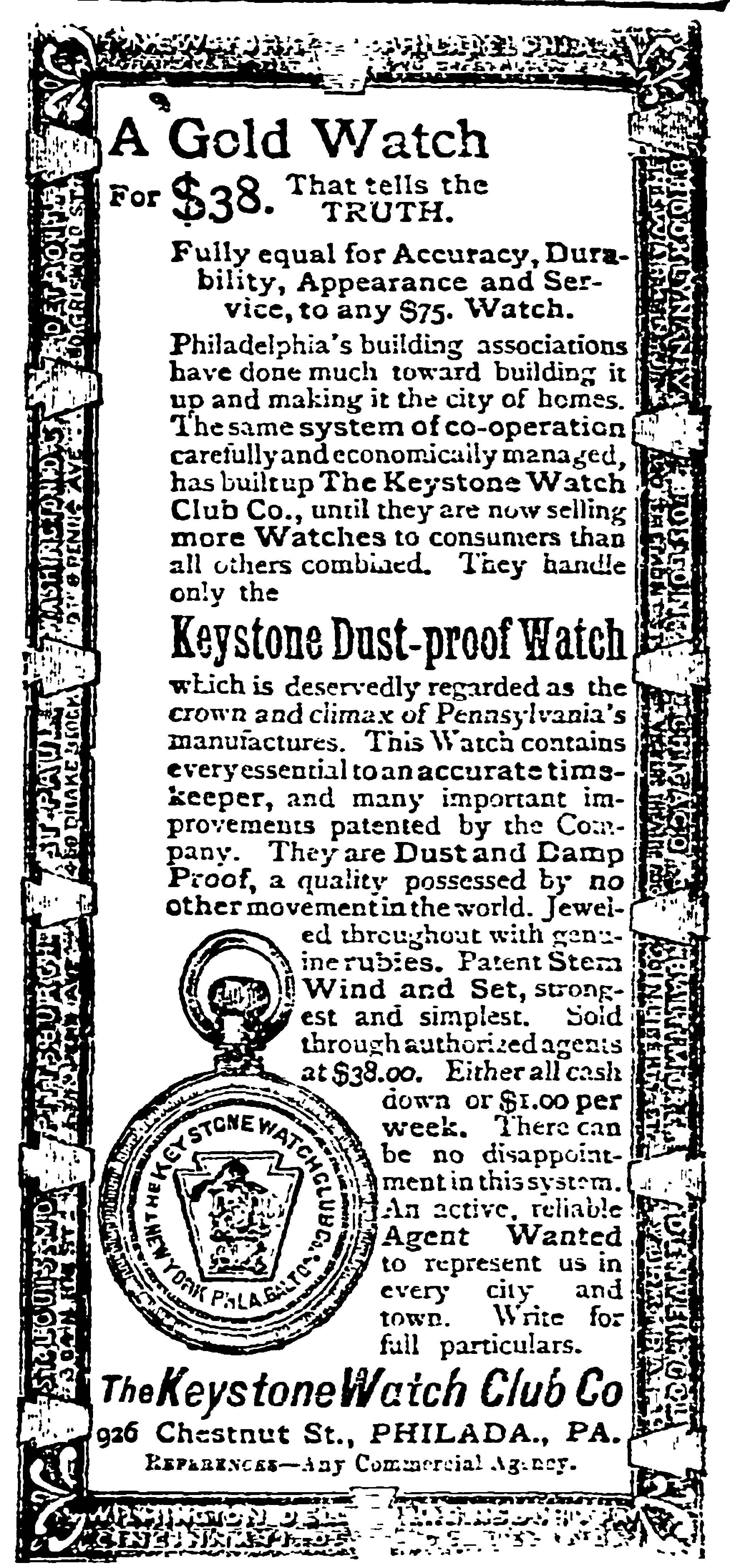
[Advertisement in an ornamental frame: border panels with keystone emblems carry the company’s branch offices; a drawing of an open-face pocket watch, its case engraved with a keystone and “THE KEYSTONE WATCH CLUB CO. NEW YORK PHILA. BALTO.”, is set into the lower left of the text.]
Border lettering (much of it blurred): top: NEW YORK [illegible] · PHILADELPHIA [illegible]; left side: ST. LOUIS, MO. 304 N. [illegible] ST. · PITTSBURGH [illegible] AVE. · ST. PAUL 450 DRAKE BLOCK · WASHINGTON, D. C. [illegible] PENN. AVE. · DETROIT, MICH. [illegible] GRISWOLD ST.; right side: BROOKLYN, N. Y. [illegible] · BOSTON, MASS. [illegible] TREMONT ST. · CHICAGO [illegible] · BALTIMORE, MD. 201 N. LIBERTY ST. · DENVER, COL. [illegible] · [illegible]; bottom: WASHINGTON [illegible] · CINCINNATI, O. [illegible] · [illegible].
A Gold Watch For $38. That tells the TRUTH.
Fully equal for Accuracy, Durability, Appearance and Service, to any $75. Watch.
Philadelphia’s building associations have done much toward building it up and making it the city of homes. The same system of co-operation carefully and economically managed, has built up The Keystone Watch Club Co., until they are now selling more Watches to consumers than all others combined. They handle only the
Keystone Dust-proof Watch
which is deservedly regarded as the crown and climax of Pennsylvania’s manufactures. This Watch contains every essential to an accurate timekeeper, and many important improvements patented by the Company. They are Dust and Damp Proof, a quality possessed by no other movement in the world. Jeweled throughout with genuine rubies. Patent Stem Wind and Set, strongest and simplest. Sold through authorized agents at $38.00. Either all cash down or $1.00 per week. There can be no disappointment in this system. An active, reliable Agent Wanted to represent us in every city and town. Write for full particulars.
The Keystone Watch Club Co 926 Chestnut St., PHILADA., PA. REFERENCES—Any Commercial Agency.
[Advertisement] Canned Goods, C. M. M. P. A. stamp
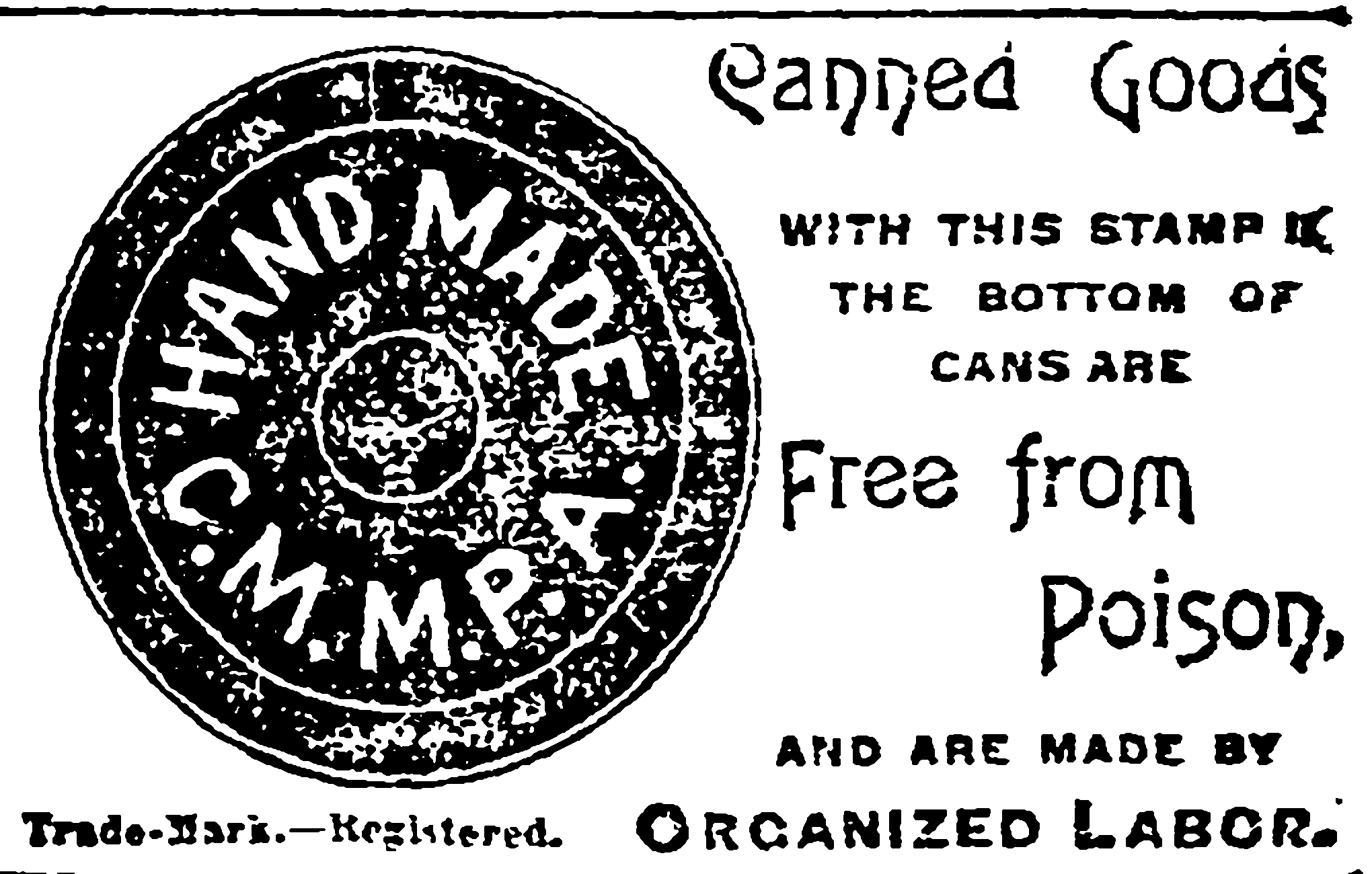
[Advertisement illustration: large circular stamp lettered “HAND MADE · C. M. M. P. A.” around a central disc.]
Canned Goods WITH THIS STAMP [IN?] THE BOTTOM OF CANS ARE Free from Poison, AND ARE MADE BY ORGANIZED LABOR.
Trade-Mark.—Registered.
[Advertisement] Piso’s Remedy for Catarrh
[Advertisement illustration: the word CATARRH in white display letters on a dark cross-shaped panel.]
Piso’s Remedy for Catarrh is the Best, Easiest to Use, and Cheapest.
CATARRH
Sold by druggists or sent by mail. 50c. E. T. Hazeltine, Warren, Pa.
[Advertisement] The Great American Tea Co.
[Advertisement illustration: a dark T-shaped panel lettered “THE GREAT AMERICAN TEA COMPANY”, the word TEA running down the stem, beside the display heading.]
GOOD NEWS TO LADIES.
Greatest offer. Now’s your time to get orders for our celebrated Teas, Coffees and Baking Powder, and secure a beautiful Gold Band or Moss Rose China Tea Set, Dinner Set, Gold Band Moss Rose Toilet Set, Watch, Brass Lamp, Castor, or Webster’s Dictionary. For particulars address
THE GREAT AMERICAN TEA CO., P. O. Box 2[8?]9. 31 and 3[3?] Vesey St., New York.
[Advertisement] Charles B. Schaidner, Photographer
CHARLES B. SCHAIDNER, PHOTOGRAPHER. 2280 Third avenue, cor. 124th street, New York. Children’s Photographs by instantaneous process [a?] specialty.
[Advertisement] Coogan Bros., Carpet and Furniture Dealers
[Advertisement illustration: engraving of the firm’s five-story store front, with horse-drawn carriage and delivery wagon and pedestrians in the street.]
Lettering on the building: COOGAN BROTHERS · WHOLESALE & RETAIL FURNITURE [illegible] · BEDDING & WARE[ROOMS?] [illegible] · [illegible] · 125 COOGAN BRO’S 12[1?]
COOGAN BROS., CARPET AND FURNITURE DEALERS, COR. BOWERY AND GRAND STS.
[Advertisement] Miss Agatha Munier
MISS AGATHA MUNIER IS NOW forming classes for instruction in vocal sight reading for ladies and gentlemen, as well as in solo singing in all its branches, and in elocution. For terms, etc., address MISS MUNIER, 223 East Thirty-second street, New York.
PRINTING.
[Advertisement] Concord Co-operative Printing Company
CONCORD CO-OPERATIVE PRINTING COMPANY (Ld.) 104 Elm street, cor. Canal, N. Y. BOOK, JOB AND NEWSPAPER PRINTING.
[Advertisement] Briggs’ Pianos
[Advertisement illustration: an ornate upright piano in a framed vignette with foliage, beside a turned-down catalogue page and display lettering.]
Text in the illustration:
SEND FOR [A?] CATALOGUE
BRIGGS’ PIANOS C. C. BRIGGS & CO. 5 APPLETON ST. BOSTON MASS. MANUFACTURERS OF GRAND · · SQUARE · · & · · UPRIGHT PIANO FORTES. GRACEFUL DESIGNS · · SOLID CONSTRUCTION MATCHLESS TONE · · BEAUTIFUL FINISH.
SOCIAL PROBLEMS.
BY HENRY GEORGE.
342 pages.
CONTENTS: