Page 1 of 8contents
THE STANDARD
HENRY GEORGE, EDITOR AND PROPRIETOR.
NO. 73–VOL. III, NO. 21. | NEW YORK, SATURDAY, MAY 26, 1888. | PRICE FIVE CENTS
p. 1, col. 1 “The Standard” is sent this week to a number of persons whose friends have paid to have the paper forwarded to them for four weeks in the hope that they may be induced to read it, examine the principles it advocates and become regular subscribers. Those who receive the paper without having ordered it will understand that it has been sent in this manner and will be sent for four successive weeks without charge to them.
Terms of subscription will be found on the fourth page.
CONTENTS:
Cartoon. The New York Election Law. Close of the Great Debate. How to Bring Up Our Daughters. The Agony of Tennessee. The Greatest of All Taxes. The Cincinnati Conference. The Papal Rescript. Police Court Philosophy. Old Opinions (poem). Society Notes. Men and Things. Straws Which Show the Wind. Foreign Notes. Is Labor Better Off? Sergeant Miller. Fewmensland. Queries and Answers. Current Thought. Pen, Paste and Scissors.
In this issue of THE STANDARD will be found two decisions of appellate courts of this state which show—what probably not one in ten thousand of our voters even dreams—that the law of New York, as indorsed and expounded by the highest judicial authority, not only forbids all contributions for corruptly influencing elections, but actually forbids all contributions, whether from candidates or from other persons, for even such innocent purposes as the hiring of halls, the holding of meetings or the keeping open of headquarters—in short, for any purpose “intended to promote the election of any particular person or ticket,” except for defraying the expenses of printing and circulating votes, handbills and other papers, and the conveyance of poor, sick or infirm electors to the polls.
This is the law. It has been duly enacted and re-enacted. It is printed in our statutes. It has been sustained and expounded by our courts. Every official from highest to lowest is sworn to obey and uphold it. Yet it might as well be the enactment of a legislature in Saturn for any effect it has in New York. Although it received its last judicial exposition not three years ago, nobody obeys it; nobody heeds it; nobody even appears to know of it. On the day of its enactment it seems to have dropped to the depths of “innocuous desuetude,” and there to have remained, except that the courts have twice fished it up and applied it to civil cases. Mayor Hewitt certainly knows as much as most men—yet he has evidently never dreamed of the existence of such a law. For not only has he, like all other men prominent in our politics, made many and large contributions to funds intended to promote the election of particular persons or tickets in ways very different from those alone permitted by the law, but at the beginning of his term as mayor, he laid down the principle that every law as it stands upon the statute book ought to be enforced, contending that if the people did not want a law enforced it was their business to have it repealed. Mayor Hewitt could hardly have known of the existence of this law when he laid down such a principle, for the effect would have been to subject him and all the city officials, the governor and all the state officials, and in fact, with scarce an exception, all our office bearers (to use a good Scotch term), from United States senators and judges of the court of appeals down to pound masters and dog catchers, as well as a great number of non-office holding citizens, to fine or imprisonment. Even the president of the United States, when he visited New York, might under this law have been caught and thrust into jail. All this Mayor Hewitt could hardly have contemplated.
There is in this utter disregard of a law solemnly enacted and re-enacted by the legislature, approved by the governor, and sustained by the courts, a wide and most important lesson. It is a tendency of the popular mind, fostered by the press and encouraged by men who at least might be expected to know better, to find in legislative prohibition a remedy for every evil. Is there vice, crime, corruption or extortion? Instead of tracing these evils to their cause and removing their cause, which in most cases will be found to be in some legislative restriction, our childish method is to call for a prohibitive law. Then we go to sleep again, while the vice, crime, corruption or extortion goes on as before, and our prohibitive law, if it is not utterly forgotten, produces new complications of social and political disease. Thus are our statute books crowded with obsolete and half obsolete laws, while every legislative session increases the flood of enactments. And while we play at forbidding
[Cartoon: A doorway in a brick wall, lettered “ACCESS TO NATURAL OPPORTUNITY”, is shut off; inside, a monopolist lounges with his feet up on a pedestal while an armed guard stands behind him. To the right a “High Wall of Protection” is built of bricks each lettered with an article and its tariff rate. A woman in a classical gown, her belt lettered “LABOR”, stands in front of the wall and points to a posted notice. Torn pieces of the Declaration of Independence lie on the ground before the doorway; newspapers lie at her feet. Signed at lower left “Franklin G[illegible]”.]
Over the doorway: ACCESS TO NATURAL OPPORTUNITY
On the pedestal: ALL WHO WORK MUST PAY TRIBUTE HERE
Notice posted on the wall: NOTICE / WE OWN THE NATURAL RESOURCES OF AMERICA / WE SHUT OUT FOREIGN COMMERCE BY THE PROTECTIVE sic NOW. / AMERICANS, PAY US OUR BLACK-MAIL OR STARVE. / BY ORDER / LEAGUED MONOPOLY.
Top of the wall: HIGH WALL OF PROTECTION / BUILT BY DELUDED WORKERS
Bricks of the left pillar (top to bottom): STICKING PLASTERS [54?] % / UMBRELLAS 50 % / BAY RUM 150 % / FEATHERS 50 % / FIRE CRACKERS 100 % / TOYS 35 % / BIBLES [25?] % / CARPETS 67 % / HORSE SHOES [55?] %
Bricks of the wall: CHURCH ALTARS [50?] % / [THREAD?] [47?] % / TIN WARE 45 % / DRESS GOODS 82 % / TACKS [50?] % / WOOD SCREWS [14?] % / EARTHENWARE [55?] % / WINDOW GLASS [94?] % / PLATE GLASS [101?] % / BORAX [42?] % / TIN PLATES [84?] % / RICE [113?] % / CASTOR OIL 194 % / [illegible] / LUMBER 28 % / NAILS [77?] % / STEEL [101?] % / COAL [24?] % / WOOL 74 % / SUGAR 82 %
On the woman’s belt: LABOR
Torn papers on the ground: DECLARATIO[N] / [WE] HOLD THE[SE] / SELF-EVIDENT / CREATED EQU[AL] / INDEPENDENCE / TRUTHS TO BE / [illegible] / [PU]RSUIT / [H]APPINESS / [ME]N / ALL / LIFE / LIBERTY
Newspapers at the woman’s feet: [World?] — 957 ANSWERS TO ONE ADD. / NEW YORK HERALD — [9?]57 ANSWERS TO ONE “WANT”
[A small paper on the pedestal under the monopolist’s feet bears lettering too small to read.]
p. 1, col. 2 results the great causes that produce these results continue to operate.
Is there not something worth thinking of in the proposition that Jefferson drew as a corollary from the self-evident truth that the land of a country belongs in usufruct to the living people of that country—the proposition that all laws should be deemed void at certain short intervals, unless reenacted!
The purpose of the prohibition of election contributions by the act of 1829 was the reasonable and salutary one of keeping the power of money out of elections—of preventing the rich candidate or the wealthy party from having an advantage over the poorer one. If any debate took place upon it, and it was objected that it would prevent contributions for hiring halls, employing speakers and paying for the clerical work of party organizations, the answer doubtless was that costly halls, and paid speakers and hired clerks were unworthy of the dignity and intelligence of the American citizen, and that to permit them would be to give the party of moneyed power an advantage over that which could only rely on reason and patriotism. But this vain prohibition has not had the slightest effect. Money is not merely most powerful in our politics. It is indispensable. Our very judges virtually buy their seats on the bench with enormous assessments, expended largely for the vilest purposes; great bodies of voters are habitually bought at every election, and save in rare conjunctures no man can have the honorable ambition of serving city, state or nation in high position unless he be either rich or not scrupulous.
How Judge Danforth, with the knowledge of practical politics in New York that any man must have before he gets to the highest bench, must have chuckled to himself as he put into his decision that fine touch of irony when he says of the hiring of a room and the payment of a secretary by the committee of seventy, “It would be difficult indeed to find a transaction which should present more elements of political corruption than the one devised by the plaintiffs.”
It is utterly useless to attempt to prevent the use of money in elections unless we make it possible that elections can be carried on without the use of money. and so sic our elective machinery as to minimize as far as possible the advantage which the use of money gives. Our election laws, as they now stand, compel the use of money. And this compulsion to collect and spend money for legitimate purposes, gives excuse for, and easily passes into the collection and spending of money for illegitimate purposes. The first step on the line of true reform is that which the last legislature has happily taken in the passage of the ballot reform bill, which is now in the hands of the governor.
The enactment of this bill may not do everything that is needed to make our elections what they should be, but it will
p. 1, col. 3 do what is most important. It will make the vote of the citizen really secret, so that if one man bribes another he can have no security that he gets what he pays for. It will prevent intimidation, now in various forms so common. It will do away with the necessity on the part of the candidates and their friends of printing and distributing tickets and paying men to stand around the polls. It will enable a few citizens, without expense, to present a candidate for the suffrages of their fellow citizens as well as he could be presented by a regular nomination. Thus it will kill the machine.
So important is the bill; so far reaching is the political revolution that it would work; so completely would it destroy the corrupt political organizations now all powerful in our politics, that I for one have not dared to say much about it, as under the almost silent pressure of enlightened public opinion, aided by a fortunate political conjuncture, it has quietly passed both houses. Now, however, the machines have taken the alarm. Even the republican state convention refused to claim for the republican party the credit which is its due for the passage of the bill, and declined to pass a resolution in its favor. As for the democratic convention, it, as was to be expected, resoluted against it with snorts of alarm. To the politicians of the sort that composed that convention it would indeed be as salt to snails.
The best testimony to the efficacy of the electoral reform bill is, perhaps, indeed, the resolution which was passed at the recent democratic state convention against it. For that convention was necessarily controlled by the very class of men whom true reform would strip of political power. As showing the relation of its members to the system which is now all-powerful in filling public offices, save when fortunate circumstances and strong personal qualities, as in President Cleveland’s case, compel the machines to follow a popular demand, the following analysis of the seventy-two delegates representing the city of New York in this convention is instructive. Among them were:
Eleven judges, 5 members and ex-members of congress, 8 state senators and ex-state senators, 4 aldermen and ex-aldermen, 3 fire commissioners and ex-fire commissioners. 3 county sic and deputy county clerks, 3 members of the board of education, 2 acqueduct contractors, 1 ex-warden of the Tombs, 1 corporation counsel, 1 register of deeds, 1 commissioner of jurors, 1 ex-mayor, 1 deputy coroner, 1 ex-member of assembly, 1 court interpreter, 1 city printer, 1 assistant corporation counsel, 1 foreign minister, 1 revenue officer, 1 sheriff, 1 city collector, 1 quarantine commissioner, 1 counsel for the board of aldermen.
The names of the other seventeen delegates would be recognized by all familiar with New York city politics as those of beneficiaries of the political machines or aspirants for their favors.
A recently published analysis of the “leaders” of the two great city organizations which sent the delegates to this convention is very striking. It is as follows:
p. 1, col. 4 Tammany Leaders.
| Number holding office . . . . . . | 22 |
| Number of ex-office holders . . . | 1 |
| Number in liquor business. . . . . | 1 |
| Number in gambling business . . . | 1 |
| Total . . . . . . . . . | 25 |
County Democracy Leaders.
| Number holding public office . . . . | 20 |
| Number of ex-office holders . . . . | 3 |
| Number in the liquor business . . . . | 3 |
| Number in other business . . . . . | 3 |
| Total . . . . . . . . | 29 |
Yet how the men who profit by the present system which makes politics a business are the men whose opposition to electoral reform was expressed by the democratic convention, can perhaps be even more clearly seen in the controlling power of the two democratic city machines. To go no further back, the combined nominations of Tammany and the county democracy were dictated last year by two committees of seven. These committees were as follows:
| County Democracy: | Tammany Hall: |
|---|---|
| Police Justice Power, | Fire Com’r Croker, |
| Police Justice White, | Sheriff Grant, |
| Police Justice Murray, | County Clerk Flack, |
| Police Justice O’Reilly, | Register sic, |
| Police Com’r Voorhis, | Police Justice Welde, |
| Congressman Campbell, | Congres’m’n Cochran, |
| City Printer Mitchell, | Ex-Ald. Barker. |
The official emoluments of the thirteen members of this committee holding office are as follows:
| Police Justice Power, salary, . | $8,000 |
| Police Justice White, salary, . . | 8,000 |
| Police Justice Murray, salary, . | 8,000 |
| Police Justice O’Reilly, salary, . | 8,000 |
| Police Commissioner Voorhis, salary, | 5,000 |
| Congressman Tim Campbell, salary, | 5,000 |
| City Printer Mitchell, profits, . . | 25,000 |
| Fire Commissioner Croker, salary, . | 5,000 |
| Sheriff Grant, fees, . . . . . | 60,000 |
| County Clerk Flack, salary, . . | 15,000 |
| Register Slevin, salary, . . . | 15,000 |
| Police Justice Welde, salary, . . | 8,000 |
| Congressman Cochran, salary, . . | 5,000 |
| Total, . . . . . . | $175,000 |
The number of police justices on this list is remarkable. Of all office bearers the judges, and of all judges, the police judges, whose power is relatively greatest, are the ones who should most scrupulously keep, and be kept, out of the strife and partisanship of “practical politics.” Yet in New York the police justices are most active and most powerful politicians. And the reason is notorious. It is that their power on the bench gives them, through the system of open voting, the power of controlling votes on election day. They are necessary parts of that combination that governs New York by putting ballots in the hands of the criminal, the disreputable, the intimidatable and the purchasable, and seeing how they vote.
All this influence was used to the full for the election of Mayor Hewitt, and his testimony as to the police justices is therefore of all the more weight.
This is what, as chief magistrate of the city, he says of them in his message to the board of aldermen of the 17th of January last:
Cases of arrests for violations of law punishable as crimes must be heard before the police justices. These officers very properly are entrusted with a large discretion, because they have to deal with the poor and friendless, whose rights they are bound to protect.
p. 1, col. 5 > Certainly no one would be disposed to censure them for erring on the side of mercy in such cases. But when the keepers of dives and of other disreputable places of resort are brought before the police justices this discretion should be exercised on the side of law and order, and there should be a stern determination to aid and not thwart the police in the suppression of these dens of infamy. Unfortunately this is often not the case. Repeated instances have occurred since I have been in office in which the sympathy of the police justice seems to have been with the offender; and recently in two cases the complaints were dismissed, although the evidence of the police officers was sufficient to show facts of the most revolting character. I have no language in which to express the feeling of indignation which the dismissal of these cases has excited in my mind. I do not know that the justices in these cases exceeded the discretion which is allowed to them by law; but I do know, as the result of their decision, that two of the vilest dens that have ever infested a civilized community were allowed to continue in existence, and I have been forced to resort to other means for their suppression. . . I do not assert too much when I declare that the position of a police justice is more important to the community than that of a judge of the court of appeals. The latter finally settles the law, but the former applies it in the first instance in nearly all cases affecting the life, liberty and property of the citizen. He has, in minor cases, the power of pardon, and often after judgment revokes the sentence and releases the offender. The exercise of this power in order to oblige political friends, gives to the justice an influence which is as dangerous as it is indefensible.
In the same message Mayor Hewitt thus speaks of the civil justices in connection with violations of the city ordinances:
These violations it is the duty of the police to report, and of the corporation attorney to bring suit for the penalty imposed by the law. I find that the police have been very remiss in reporting these violations that in this city are almost innumerable. The excuse given is that complaint and arrest are rarely followed by punishment, and this excuse is well founded. Moreover, there has been great partiality shown in making the complaints. Last year over 38,000 complaints were filed, but these were made against only 8,000 persons, showing nearly five complaints to each person, while the great mass of the violators are not reported at all. This discrimination necessarily gives rise to very unfavorable opinions as to the means employed to propitiate the police. The corporation attorney does not appear to have been remiss in the performance of his duty. On the contrary, he has brought suit and collected the penalties where he could do so; but the civil justices, with some honorable exceptions, seem to have regarded it as their duty to protect the citizens against the complaints of the police. In numberless instances cases have been marked “dismissed” without a hearing. In others, they have been adjourned from time to time, even to the extent of eight adjournments, and then finally dismissed. The witnesses have been compelled to attend at these several adjournments, greatly to the demoralization of the police, whose time was thus fruitlessly wasted.
The truth is that the terror of the law is, through the police, the justices and the attorneys, used by the dominant machines as a means for compelling votes and enlisting the political influence of the keepers of saloons and of disreputable places. And the remedy not sic, as the mayor says, in the election of civil justices on a general ticket, and in putting the power of removing police justices, as well as of appointing them, in the hands of the mayor—whatever there may to be sic for these changes on other grounds—but in making the ballot really secret, and allowing no one to put a ballot in the hands of the voter and see that he votes it. This simple change—the change proposed in the electoral reform
p. 1, col. 6 bill now in the hands of Governor Hill—will effectually destroy the means whereby the power of making charges for violation of law and punishing crime is now transmuted into the power of carrying elections.
The resolution passed by the democratic convention is as follows:
Resolved, That the so-called Saxton electoral reform bill, passed by the legislature and now before the governor for executive action, is a partisan measure, subversive of democratic principles, destructive of the secrecy of the ballot; efficacious to promote fraud and corruption; opposing needless and useless sic to the suffrages of the busy and hard working voter; intended as the first blow at universal suffrage of citizens by disfranchising the unlearned elector and introducing into our simple system of elections a method which may be necessary under the rule of the British empire, but is not desirable among this free people.
We have seen who it is that are thus solicitous for democratic principles and electoral purity. Here is something that may show what manner of man is the busy and hard working voter, to whose activity on election day the democratic machines are so anxious that no obstacles shall be presented. I quote from an abstract of the report of the City reform club, published in the New York World on the 30th of March, 1888:
On election day the most disgraceful scenes were enacted, especially in some of the lower election districts, notably the First, the Twenty-sixth, the Twenty-seventh and the Twelfth. It appears from the evidence in the possession of the committee that the entire election business was under the control of the criminals, who carried things with a high hand, not only without molestation from the police on duty, but in very many instances with the aid and connivance of these officials. Honest and respectable citizens were in some cases driven from the polls by the officers, and the purchasing of votes and the intimidation of voters were openly and defiantly carried on before the eyes of the police. In some instances liquor and beer were frequently carried into the polling places contrary to law, and drank, not only by the election officers, but also by the police.
Among the most active persons about the polls who were seen to be running up repeaters, buying votes and intimidating citizens were the following, according to the City reform club; George Johnson, gambler; Charles Hoffman, dive keeper; Thomas F. Nichols, notorious burglar and ex-convict; “Red” John Sullivan, ex-convict and burglar; Patsy Conroy, burglar; Manassa L. Goldman, formerly receiver of stolen goods; Daniel Curtain, dive keeper; Robert Corson, alias “Butter,” thief and burglar; “Blink” Kelly, burglar; “Lifty” Crowley, colonizer; “Sap” Driscoll; Dennis Sullivan, prize fighter; Ed. Sparenburg, receiver of stolen goods; “Yaller” Cullen, burglar and ex-convict; “Chick” McDermott, fighter and tough; John McGurk, keeper of thieves’ resort; “Kid” McManus, celebrated burglar, now under indictment for the Bridgeport jewelry robbery, for whom O’Rourke secured bail: Henry Loewy, an alibi witness for “Kid” McManus; “Paddy the Smasher” Quinn; “Juggy” McCarthy, counterfeiter; “Minnehaha” Devors; “Big Tom” Sullivan, notorious crook; Bill Diamond, ex-convict; James McManus, dive keeper; Billy Burke, shooter and burglar; Jack Pye, burglar; Frank Clark, burglar; Barney Dugan, pickpocket, and “Mushhead Jim.”
As an instance of the colonization of lodging houses the Windsor theater hotel, Nos. 41 and 43 Bowery, is mentioned. Up to the day of the election John Schmitt, the proprietor, was working in the interest of the Charles Smith faction. There were 132 votes registered from this house, most of which are known to have been fraudulent. On the morning of election day, however, the faction headed by Barney O’Rourke purchased the entire vote of Schmitt’s little colony, and the agents of the City reform club saw them taken out in pairs to the polls under the escort of the O’Rourke workers. The report suggests that Police Court Clerk Victor Heimberger should be examined about the purchase of these votes, as it is alleged that he acted for O’Rourke in the matter.
The agents of the club discovered the methods of the political workers by sending Mr. Timothy J. Daly, a member, to take lodgings at the Windsor theater hotel. He was button holed by George A. Hughes, known as “the Colonel,” and told to come up and register whether he had been in the city thirty days or not. Hughes offered to swear that Mr. Daly had been in the town thirty days, and he would see that no harm came to him from the false registration. Six days before election Hughes said that an officer had called at the Windsor theater hotel that day and demanded to see the hotel register to find out who were properly there, but Hughes refused to let the register be seen. Another notable case is instanced where thirty-seven voters were registered at a notorious house of ill repute at No. 33 Bowery. After it became known that this number of voters had been registered from this house the matter became a laughing stock among the tramps on the Bowery by reason of the barefacedness of the fraud. The proprietress, Mrs. Steffen, maintained that she did not wish to encourage this fraud as the house had been colonized in the interest of O’Rourke and O’Brien, while her sympathies were for Smith. Detective Frank Wilson of the Eleventh precinct went to see Mrs. Steffen and handed her a list of voters registered from her house, which she said came from Captain Allaire, who wanted her to verify them in case anybody called. Detective Wilson, it is alleged, took away the register of the house to doctor it up with new names. Shortly, afterward, when Inspector Williams called to investigate the matter, Mrs. Steffen became frightened and sent for Captain Allaire, who brought back an old register and substituted it again for the one that had been doctored. It is claimed that five persons, whose names are given, heard the conversation of Detective Wilson and witnessed a portion of this transaction. Among the other establishments which are said to have been colonized in a similar manner are the Cunard house, 4 Rivington street; Phœnix, 53 Bowery; Spencer, [93?] Bowery; 54 Chrystie street, 91½ Bowery; New transit hotel, 123 Canal street; 39 Bowery, 110 Chrystie street, 183 Bowery, 37 Bowery, 20 Bayard street, and 114 Hester street.
Agent A. F. King will testify to the following effect: “I saw the following transactions take place: Jerry Sullivan and ‘Red’ John Sullivan were working the lodging continued on p. 2 →
[Text breaks off mid-sentence at the foot of column 6; the page gives no “continued” line. The continuation is presumably on page 2.]
Page 2 of 8contents
2 THE STANDARD, SATURDAY, MAY 26, 1888.
p. 2, col. 1 [continued from page 1]
← continued from p. 1 houses all day. Both of them would go up into the lodging house and bring down the man who was to vote; they would be met at the corner of Bayard street by ‘Kid’ McManus, who, after questioning them, would lead them to Martin Kerby, who took the man to the polling place, and if he was too intoxicated, as was the case very frequently, to go up the steps to the polls he was kindly helped up by the two policemen and sergeant who were on duty into the arms of Tom sic, who was inside the polling place. As soon as the man had cast his vote he was hustled out of the place double quick, dropped into the arms of Kerby, who, in turn, turned him over to one of his henchmen, generally ‘Red’ Sullivan or ‘Kid’ McManus, who hustled him into the back room of the Kenwood house and there received the money which had been promised him. At the Twenty-sixth election district polling place, No. 19½ Bayard street, ‘Big Tom’ Sullivan was in charge for Barney O’Rourke. His heelers would bring men up to the vicinity of the polls and Tom Sullivan would take hold of them and ask which way they were going to vote. If it did not suit him he would hustle them around the corner, give them a good talking to and watch them drop their ballots, then pull out a roll of bills right under policemen Nos. 1,675 and 48’s noses and give the voter sometimes $2 and sometimes $3. It was the most astounding piece of rascality to see the way the police snubbed any respectable person who wanted to go into or near the polling places but who had already voted, while as soon as ‘Kid’ McManus or any of his crowd made toward the door the police would step aside and make way for them.
Detective Etienne Bayer, of the Eleventh precinct, was very active in behalf of one of the factions. He called upon a pawnbroker on Canal street and ordered him to remove a picture of Charles Smith, a candidate for assembly, from his show window. During election day he intimidated many voters. The conduct of Officer John J. Herrick is characterized in the above illustrations, as well as that of policemen Nos. 2,078, 1,006. 1,416, [1,336?], 2,149, 1,366, [833?], 1,675, 48 and 2,076.
All this evidence and much more of the same sort has been laid before the late District Attorney Martine and the present District Attorney Fellows, and an effort made to independently get action from the grand jury, It sic without saying that nothing has been done. Well may the machines say to the people: “What are you going to do about it?”
Nothing can be done so long as our present election law makes the question of who shall hold office merely a question between one machine and another machine.
Until the power of expressing their will at the ballot box is restored to the people machines and bosses will rule, and what ex-Superintendent of Police Walling says in an incidental and matter of fact way, in his recent volume of reminiscences, must remain true:
The city of New York is actually ruled by some twenty thousand office holders, most of whom are taken from and controlled by the very worst element in the community.
Our judiciary and prosecuting officers are elected and controlled in a great measure by the very elements they are called upon to punish and keep in check.
The objections that are made to the electoral reform bill are the veriest excuses. It is not a new experiment. The system of voting which it would substitute for the present is in actually sic in Australia, in Great Britain and Ireland, and in Canada. It has everywhere worked well, and has everywhere secured the great benefits which we look for from it here. The people of Great Britain and Ireland, and of the other English speaking countries, are no more honest, no more patriotic, no more public spirited, than are the people of American cities. Yet the rings and bosses and the elective corruption which we of the United States are getting to consider as a matter of course, are unknown there.
The electoral reform bill is in the hands of Governor Hill. On him alone now rests the responsibility. He has, perhaps, the grandest opportunity to accomplish a great and beneficent reform, that will cause him to be remembered with honor, that ever came to any governor of New York. Will he embrace it? That we must wait to see.
Since Representative William L. Scott of Pennsylvania made his great speech against protection, the protectionist papers are devoting columns to abusing him as a foe of labor—declaring that he grinds his men to the lowest wages; “gobbles up” Huns and Poles; keeps “pluck me” stores at which his employes are compelled to trade; forces his miners to sign the cut-throat leases so common in Pennsylvania; evicts them when they strike or leave his employment; refuses to recognize labor associations and committees; and pays only by the month, when the state law requires weekly payments.
There is nothing intrinsically improbable in these charges, for this is the way in which the highly protected American workmen, for whom we are told the tariff has done so much, are usually treated in the coal fields of Pennsylvania; and that William L. Scott is a millionaire is presumptive evidence that he pays no more for labor and treats it no more benevolently than do other large Pennsylvania employers. But it is only just to say that so far as these charges have been made in congress, Mr. Scott denied them in the debate of the 17th in this straightforward fashion:
I will stand upon my record at home and with my people. And if I have ever been the oppressor of labor, if I have ever ejected a man from his home, if I have ever endeavored in my life, although I have been, I may say, a large employer of labor, to put one laborer in the place of another, or to force one man in the place of another; if I have
p. 2, col. 2 > employed a detective—not a Pinkerton detective, merely, but any other kind of a detective—to come and protect my property or to protect it against the men that are working for me, or have worked for me, l. sic, will resign my seat and leave this hall the day it is proved. . . I have been identified with the laborers of this country all my life; I have worked and toiled with them; and when I start out to rob anybody or to get anybody’s money it will not be the money of the wage worker of this country.
But supposing it were all true, what then? What has Mr. Scott’s personal character or personal actions got to do with the right or wrong of protection—with the question whether labor is or is not to be benefited by taxing the things that laborers must buy? What has it got to do with Mr. Scott’s showing of the enormous profits which our duties upon steel enable the Carnegies and similar concerns to extort from the American people?
Do the protectionist papers who are bringing these charges against Mr. Scott mean to tell workingmen that they ought on the tariff question to vote in the way that the employers who fight labor associations, employ Pinkerton detectives, keep pluck-me stores and screw down wages as low as they can, do not want them to vote? If this is what they mean, and this is what workingmen ought to do, then it is perfectly clear that the vote of workingmen ought to be cast for free trade and against protection, for whatever be true of Mr. Scott it is notoriously true that the great majority of the employers who do these things are the stanchest and loudest upholders of protection.
But are not the protectionist papers making a fatal admission in these charges against Mr. Scott? How does the picture that they draw of the highly protected American workingman, as employed in Pennsylvania by William L. Scott, consort with what they are saying in other columns of the great prosperity which the system of protection has brought the American workingman? Granted that what they say of Mr. Scott’s employes is true, how much worse off would those employes be under free trade? Granted that Mr. Scott is a hard employer, why don’t “protection to American labor,” which these Pennsylvania workingmen have been voting for so long, protect them from a hard employer? Does “protection” only protect labor where labor can get good, kind, charitable employers? If protection—even the protection that has been lavished on the “infant industries” of Pennsylvania—leaves the laborer in such a condition that an employer can compel him to sign a “cut throat lease” and an “iron clad agreement,” and to trade in a “pluck me store,” is it not about time that workingmen should stop voting for protection and begin to vote for freedom?
The Press seems to think that in our comments on its servant girl exposures last week, we took the ground that “no public journal should make an investigation unless it is going to fit in with some preconceived theory which it advocates.”
On the contrary we heartily commend the Press and would have it push along its investigations. But it is worth while to point out that such exposures as those to which we referred and which are being continued by Mrs. Robert P. Porter, and such facts as that with which it began a similar article on homes for working women in last Sunday’s issue—“there are at least 200,000 working women in New York city, and many of them receive wages as low as $2 per week”—and in direct sic of all that it is saying about the superior condition of American labor over the pauper labor of Europe that has been produced by the protective tariff.
By all means let the Press go on with its investigations, and God speed it! It will certainly succeed in convincing its readers, if not itself, that if tariff “protection” leaves women to work for two dollars a week and servant girls to be stabled like beasts, and the only protective remedy is more protection by state law, it is about time to abandon protection and try the way of freedom.
The Cobden club bogy does not seem to frighten much this year. Nevertheless the following letter from Thomas G. Shearman to Representative Bynum is timely:
Dear Sir: Observing that Mr. Woodburn of Nevada undertook to enlighten the house concerning the Cobden club, and that you took part in the running debate, I beg to ask you to make a statement in the house in correction of his gross error in asserting that Mr. Balfour, the present tory Irish secretary, is a member of that club. He never was. No tory ever is. No member of the present English government is or ever was, except Mr. Goschen, and he resigned five years ago because although he was then a liberal, the club was too liberal for him.
Secretary Balfour’s name is Arthur J. Balfour. Sir George Balfour, who is a member of the Cobden club, is a well known liberal and a stanch supporter of Gladstone and Irish home rule. The two Balfours are only distantly related and have never acted together in politics. The Cobden club includes among its members all the noted advocates of home rule among English statesmen, and its managers are solid on that side.
It has also had among its members every member of parliament who stood by the north during the civil war, and the men who founded it were the identical men who organized that popular movement in England in 1863, which defeated the project of the French emperor for a joint intervention of England and France on behalf of the re p. 2, col. 3 bellion, and who thus saved our country from destruction.
For an Irishman to abuse the Cobden club is more absurd than to abuse Gladstone, because Mr. T. B. Potter, who is in fact the Cobden club, declared himself in favor of Irish home rule before even Gladstone did.
Yours obediently,
THOMAS G. SHEARMAN.
New York, May 14, 1888.
Mr. Shearman is right about the Cobden club. Mr. T. B. Potter bears about the same relation to the Cobden club that Mr. Charles F. Wingate of this city does to the Twilight club. He arranges for a dinner every year in the Twilight club fashion, and occasionally sends out a circular asking contributions to make some publication. I met him in London some years ago, and found him a high minded, broad minded man—one of those free traders who really want free trade, and not like the great majority of the members of the Cobden club, mere revenue tariffists.
I have been an honorary member of the Cobden club for some eight years, but have never heard of the vast amounts they are ready to spend in breaking down protection in the United States, except from American protectionists. However, if they have any money that they would like to devote to missionary work in the United States THE STANDARD will gratefully acknowledge and faithfully apply it. A judicious distribution of THE STANDARD and the tracts of the land and labor library, and the sending of real free trade speakers through Pennsylvania, would easily win that state for Mr. Cleveland this year, and for a single tax candidate in 1892. For sure as the mountain laurel is blooming, the old Keystone state is beginning to awake from the long sleep of protectionist superstition.
The fiasco of the Cincinnati convention ought to be the final proof of the absurdity of the attempt to run a united labor candidate for the presidency this year. The platform adopted is the Syracuse platform, with some verbal changes; and the candidate nominated, Mr. Robert C. Cowdrey of Chicago, is, as has been shown by some recent contributions of his to THE STANDARD, a true single tax man—that is an absolute free trader. The best thing he can do is to throw up his straw of a nomination and go to work in the real, mighty contest that is to be urged this year.
There is now an industrial labor candidate, Redstone; a union labor candidate, sic; a united labor candidate, sic, and an equal suffrage candidate, Belva Lockwood. There is also to be, it seems, a socialistic labor candidate, Swinton, a George O. Jones greenback candidate, yet to be named, and a prohibitionist candidate. And there is also down in Georgia Henry Abram, the “cobbler of Savannah and genius of the national finances,” who will launch himself on the American people as another candidate for president as soon as he can get a vice-president.
Complaint comes from Washington of the over production of “epauletted office holders,” as Don Piatt truthfully styles the graduates of our military and naval academies. The West Point graduating class comprises forty-four members; the naval academy twenty-five. In the army there exist twenty-three vacancies in the grade of second lieutenant, with prospects for six or eight more between now and June 11, when the glass sic. In the navy there are but seven vacancies and only two prospective. “Fortunately for the West Point class,” the dispatch goes on to say, “there is a law of recent date which authorizes the assignment of all surplus graduates as additional second lieutenants until vacancies occur for them.” But as for the Annapolis graduates, “half the class will be compelled to accept a year’s pay and an honorable discharge,” congress having failed to make any provision for doubling the offices in the navy.
As soon as the democratic sentiment in this country fully awakes, this whole system will be abolished. It is utterly undemocratic, utterly un-American, and entirely stupid. If we have military and naval academies they ought to be schools where men who have entered the service in the ranks and shown their fitness, should have opportunities for instruction, not institutions where a few favored boys may be taught to consider themselves as a superior caste. We would not tolerate institutions that should educate from the cub, presidents, senators, governors and judges, and to which influential people might send their sons with the assurance that they should be thereafter pensioned on the nation. But this is the way we officer our army and navy, making a distinction of caste between the graduate of West Point or Annapolis, and the enlisted man, as broad and as clear as that which existed in Bourbon France between the noble of four quarterings and the peasant. The aristocratic distinction of blood is, in truth, the origin of our caste distinction between commissioned officer and enlisted man. It has been largely abandoned in Europe, but it is still retained here, where all citi p. 2, col. 4 zens are, theoretically, equal, mainly because the power of appointing to our military and naval schools forms part of the perquisites of congressmen. The whole system ought to be abolished, and such officers as we need taken from the ranks.
The Revenue reform club of Brooklyn, of which Mr. Beecher was so long president, seems to have revived again, and with new energy. A single tax man, Mr. Charles C. O’Connor Hennessy, has been elected president, and the club held its first public meeting for the campaign at Avon hall, Brooklyn, on Monday night, with a large and highly intelligent audience. Thomas G. Shearman was the principal speaker, and even more effective than his speech were his answers to the questions that were invited. This is what our friends ought to do everywhere—throw themselves into the tariff fight, and urge it into a fight for all we understand by real revenue reform. Mr. Shearman is setting a magnificent example.
The death of Abraham L. Earle is announced. He was for years one of the few who steadily urged the abolition of the tariff and the resort for federal revenue to direct taxation. Though he has gone just as the struggle he so long hoped for is coming on, his work will tell.
I have not yet received a copy of the decision of Vice-chancellor Bird of New Jersey declaring Mr. Hutchins’s bequest for the circulation of my books void, although I telegraphed for it. At last advices it had not yet been filed, the vice-chancellor being probably engaged in polishing it up. I hope next week to lay it before the readers of THE STANDARD. 1 shall of course sic to the Court of Errors, and, if necessary, to the United States courts.
HENRY GEORGE.
THE NEW YORK ELECTION LAW.
IT WILL SEND GOVERNOR HILL, MAYOR HEWITT, ALL OUR JUDGES, AND THE THE REST OF OUR OFFICIALS TO JAIL IF ENFORCED.
Two Notable Decisions of the Supreme Court.
Very few citizens—and even, it is probable, very few lawyers of this state, know that the existing law makes it a misdemeanor to contribute money to promote the election either of oneself or any other person, except for certain specified purposes, viz.: the expenses of printing and circulating votes, handbills and other papers, and for conveying sick, poor and infirm electors to the polls. Yet this is the law in the state of New York to-day, as it has been for nearly sixty years. Not the slightest pretense has been made of enforcing it; but it is the law nevertheless, and how strictly the courts have construed and upheld it when brought before them in civil cases the following decisions will show:
Case of Jackson Against Walker.
The decision in this case was rendered by the supreme court in 1843, Justice Greene C. Bronson delivering the opinion. The statement of facts and the opinion of the court are taken from volume V of Hill’s reports, beginning on page 27:
STATEMENT OF CASE.
Error to the superior court of the city of New York. Walker sued Jackson in the court below, and declared that in the year 1840 the plaintiff erected a certain building on Broadway, in the city of New York, commonly called a log cabin, the same being intended and calculated for public and other meetings of a certain political party known and designated as the whig party, and for the sale of refreshments; that he suffered great loss and damages by erecting and continuing the log cabin, and was about to tear it down; and that in consideration that the plaintiff would suffer the log cabin to remain and be kept open for the benefit of the said whig party until after the election of members of congress and electors of president and vice-president and other officers to be elected in November of that year, the defendant promised to pay the plaintiff one thousand dollars on the 20th day of November. On the trial it was proved that the plaintiff built the log cabin in 1840 at an expense of $1,600 or $1,800. In August of that year he said he would take it down unless a certain sum of money was raised. A subscription was opened and nearly $200 were subscribed. The plaintiff and defendant then met, and the defendant told the plaintiff that “the log cabin must not be taken down until after the election; that he (the defendant) would not permit the whig flag across Broadway to be struck,” and that he would raise the balance of the $1,000, or pay it out of his own pocket by the 20th of November. The plaintiff said “he wished no ifs and ands about it, but wanted the money to be forthcoming for certain,” and requested the defendant to give him his note. The defendant replied that his “word was his bond,” and said to the plaintiff, “I will pay you the $1,000 out of my own pocket on the 20th of November next.” The plaintiff then agreed to it, and “the log cabin was kept open until after the election, and was used by the whig party for political meetings, and was the whig headquarters, in a measure.” It was kept open to promote the election of the electoral ticket in favor of General Harrison for president; and after the election it was removed. On this evidence the plaintiff claimed to recover the $1,000. The defendant moved for a nonsuit on the ground that the contract was illegal, being a violation of the election law. Motion denied and exception taken. The defendant then insisted that the jury had a right to determine from the whole evidence whether the contract was or was not within the meaning of the statute. The court charged the jury that the contract as proved was not within the statute, and if the jury believed the evidence the plaintiff was entitled to recover. Exception. Verdict and judgment for the plaintiff of $1,000. The defendant sued out a writ of error.
DECISION OF THE COURT.
By the court, Bronson, J. The first section of the act of 1829, “to preserve the purity of elections,” is in these words: “It shall not be p. 2, col. 5 lawful for any candidate for an elective office, with intent to promote his election, or for any other person, with intent to promote the election of any such candidate, either, 1st. To provide or furnish entertainment at his expense to any meeting of electors, previous to, or during the election at which he shall be a candidate: or, 2d. To pay for, procure, or engage to pay for any such entertainment: or, 3d. To furnish any money or other property to any person for the purpose of being expended in procuring the attendance of voters at the polls: or, 4th. To engage to pay any money, or deliver any property, or otherwise compensate any person for procuring the attendance of voters at the polls: or, 5th. To contribute money for any other purpose intended to promote an election of any particular person or ticket, except for defraying the expenses of printing and the circulation of votes, handbills and other papers previous to any such election.”
The third section declares that “every person offending against the provisions of this act shall be deemed guilty of a misdemeanor.”
If, at the time the promise was made, it would have been unlawful for the defendant “to contribute money” for the purpose of preserving and keeping open the log cabin, it is quite clear that his promise to pay money for that purpose at a future day cannot be enforced. Now, to what end was the log cabin to remain? The plaintiff tells us in the declaration that the building, besides the sale of refreshments, was “intended and calculated for public and other meetings of a certain political party, known and designated by the name of the whig party;” and the consideration for the promise was that the plaintiff would not tear down or remove the log cabin, but would suffer the same to remain, and would keep, or cause the same to be kept, open “for the benefit of the said whig party until after the election” of members of congress, presidential electors, etc. The plaintiff then avers that he performed the agreement on his part; and so is the proof. The witness says “the log cabin was kept open until after the election, and was used by the whig party for political meetings, and it was the whig headquarters, in a measure. It was kept open to promote the election of the electoral ticket in favor of General Harrison for president.” The statute, after forbidding several things, declares that money shall not be contributed “for any other purpose intended to promote an election of any particular person or ticket.” It requires no argument to prove that this money was to be paid to promote the election of particular persons, to wit, General Harrison, and the whig candidates for congress, etc.; and a particular ticket, to wit, the electoral ticket in favor of General Harrison for president, and the ticket for whig members of congress, etc. The parties intended to accomplish the very thing which the statute declares to be illegal. No one can wink so hard as not to see it. Every contribution of money “intended to promote an election of any particular person or ticket” is forbidden, except “for defraying the expenses of printing and the circulation of votes, handbills and other papers previous to any such election.” There can be little doubt that large sums of money are expended upon elections for other purposes; but the statute says, “it shall not be lawful” to do so, and the enactment should be either enforced or repealed.
It is said that the statute only forbids the contribution of money for corrupt purposes. But the statute says nothing about corruption. It declares that the thing shall not be done. With two specified exceptions, it provides that money “intended to promote an election” shall not be contributed. The legislature evidently thought that the most effectual way “to preserve the purity of elections” was to keep them free from the contaminating influence of money. They said you may contribute money to pay for printing and circulating votes and information, but not for any other purpose.
If this contract is void, it is said that money cannot be contributed to hire a room for holding political meetings. That is undoubtedly true, if the object be “to promote an election of any particular person or ticket.” I will not discuss the policy of the law. The legislature have said that the thing shall not be done, and that is enough.
Judgment reversed.
Case of John Foley et al., Appellants, Against Gilbert M. sic et al., Respondents.
This case is a recent one, having been decided by the court of appeals in 1885, the decision being rendered by Judge George F. Danforth. The reform association spoken of was popularly known as “The Committee of Seventy.” The opinion of the court sufficiently states the facts. The case is reported in vol. 55, New York sic, beginning page 552:
Danforth, J. So far as appears the plaintiffs in October, 1873, composed a body styled “the Reform association,” which was brought into being and made complete in all its parts, both of membership and officers, when they “came together and called themselves ‘its executive committee.’” Its object was to promote the election of such candidates for office, irrespective of political considerations, as should be recommended by the association. Preparatory thereto they hired rooms and made an estimate of such expenses as would probably be required for that purpose at the then coming elections. A schedule of items was prepared, and of the aggregate, $2,000 “set down” thereon to the defendant as his share. This was shown to him the day after his nomination for the office of judge, and the evidence is that after looking it over, and some conversation, he said “it was all right; I will pay it.” Expenses were incurred and money paid out by the plaintiffs on account thereof. This action was commenced in October, 1879, to recover the above sum of $2,000.
The answer of the defendant put the material allegations of the complaint in issue, and upon trial, after evidence had been given by the plaintiffs as to the matters above referred to, the kind and character of the services rendered, and the objects for which expenses were in fact incurred, the complaint was dismissed upon the ground that the contract and expenditures were in violation of the statutes which make it unlawful for a candidate for any elective office to contribute money to promote the election of himself or other person, except as therein stated. (Laws of 1842, chap. 130; chap. 6, tit. 7, sec. 6.)
No other question is presented upon this appeal, and in regard to it we concur in the conclusion reached by the trial court and affirmed by the general term. The paper or schedule submitted to the defendant was not left with him, but retained by the plaintiffs and not produced upon the trial. They, however, testified; Foley saying, “we went on and ordered the printing and the other necessary work, we employed the necessary clerks and men to attend to the boxes, we ordered the printing and folding of ballots, and we performed all the necessary work, for which we paid out that amount of money for him, and in fact more.” “In all, the expenses were between $8,000 and $10,000.” This included $600 rent for rooms at a hotel, and it also formed part of the expenses to the payment of which the defendant agreed to contribute. Besides these there were also expenses in maintaining the rooms and running the association, and money paid for the general purpose of assist p. 2, col. 6 ing the election of their candidates, but in what particular way, or for what, the plaintiff could not remember.
Another plaintiff, McLaren, referring to the same interview with the defendant, says:
The matter was talked over and a schedule was shown the judge of the probable expenses, and the amount set down for the judge as his share of them was $2,000; and my recollection of that conversation is that he said it was all right and that he would pay it. Q. Toward what purpose? A. Toward the expenses of the association. Q. State what the expenses were for? A. The expenses to be incurred were for printing ballots, supplying one man at each polling district with those ballots for election, and for boxes to be placed in each district; I think there were some five hundred in all—the expenses were to include advertising, clerk hire, room hire, postage stamps—every thing incidental to the business of an election.
He also testified that the plaintiffs “had a book for each assembly district; each man took a district and enrolled the names of the voters in that district; that occasioned a great deal of work, and a considerable portion of these expenses; we had a book of each assembly district, and we took the name of each voter, his occupation and residence; we sent out circulars saying that this enrollment would take place, and the parties would be waited upon.”
The plaintiffs had been paid by other candidates on account of these expenses, but there remained unpaid a balance of $2,842.09.
Both the statute and the principles settled in Jackson v. Walker (5 Hill, 27) are decisive against the appellants. In that case the law upon the subject, after full discussion by learned and able counsel, was stated in the opinion of the court in a manner to which we think no just exception can be taken. It may have been an extreme case, but to it rules of construction were applied from which there should be no departure. The act of 1829 (Chap. 373) was entitled “An act to preserve the purity of elections.” With two specified exceptions it was declared to be unlawful to contribute money to promote an election of any particular person or ticket. The exceptions were, (1) for defraying the expenses of printing; (2) the circulation of votes, handbills and other papers. A third was added for conveying poor, sick or infirm electors to the polls. These provisions were re-enacted and now form part of the act of 1842. Everything else is forbidden. The complaint recognizes and states these three things as the cause of action. It is very clear the evidence goes beyond it. The agreement as proven includes the rent of rooms—the headquarters of this self appointed association for promoting the interest of particular candidates—and so comes within the very letter of the case cited. So is it within the express condemnation of the statute; for it is not one of the excepted purposes. So generally the claim includes “any thing incidental to the business of an election.” One thing incidental to that event is “procuring the attendance of voters at the polls,” and that is expressly prohibited. So, also, and for the purpose of procuring the election of the same candidates, was the payment of $1,000 to one of the plaintiffs for his services in taking charge of the rooms and running the association. Upon the plaintiff’s showing the agreement included illegal and forbidden items. It would be difficult indeed to find a transaction which should present more elements of political corruption than the one devised by the plaintiffs. They present themselves to the public under the specious and attractive guise of a reform association, while they are in fact actuated by a desire for pecuniary profit, and are indemnified against expenses which professedly are incurred in the cause of good government, by the obligations of individuals who are personally interested in the result. We think it is not only prohibited and made criminal by statute, but void because contrary to public policy and the welfare of the community.
. . . The judgment should, therefore, be affirmed.
All concur.
Judgment affirmed.
The Single Tax League Notes.
The clerk of the league reports as follows:
J. H. Wells sends the following quotations from Revised Statutes, state of New York, chap. ii, title 1, art. 1: “The people of this state, in their right of sovereignty, are deemed to possess the original and ultimate property in and to all land within the jurisdiction of the state.” He adds that it would seem then that we own the land in common, not as individuals, but as citizens. And when we tax such a property as the Evening Post plot $40 a day, when it is worth $140, what is it but giving to the owner a sinecure of $100 a day?
Moses Stearns makes the valuable suggestion that the league make arrangements to supply to its members for use in their general correspondence, postal cards, envelopes and writing paper, with brief, succinct mottoes printed thereon illustrating the principles for which we contend. This plan would no doubt do much to enlighten the public as to the aims and motives of the league and will be submitted to the executive committee.
Sergeant A. C. Alphonse joins the league and says that our principal work should be to convince the judgments and consciences of men; the voting will take care of itself at the proper time. The American people have little sympathy with weak political parties. Our organization and work should be such as to hold all of our present strength and to agitate and educate for constant increase. To this end the Chicago conference should outline, at least, a national organization, platform and title. If the platform is clear it cannot be too short. The Single tax union or league would be a proper name.
During the week three ladies have joined the league, two from Massachusetts and one from this city, all promising active work.
The first clergyman to join the association is the pastor of a Congregational church of this city. He joins the league bravely, without secrecy or subterfuge, to stand with the small but noble band of his profession who prefer their master’s work to the applause of men.
George W. White places the columns of the Tax Reform Advocate of Brooklyn at the service of the league.
Martin Battle also tenders the services of himself and his paper, the Tax Reformer.
The Discussion Widening.
LADUE, MO.—Discussion is warming up in this section. We single tax men have no longer to do all the talking. The democrats are helping us. So many of their champions use our weapons that they might be called tax instead of tariff reformers. Our men are working hard. One man, who has to support a family of six on a small salary, has distributed two or three hundred tracts and nine copies of “Progress and Poverty,” and has circulated copies of “Protection or Free Trade?” “Social Problems” and “The Land Question,” and his efforts are telling. I am contributing a series of articles on the tariff question to my county paper, which are attracting attention. Many of my protectionist friends who a short time since welcomed the tariff discussion are already “tired” of it. They are worn out with futile attempts to meet free trade arguments.
ONE OF THE JOHN SMITHS.
Page 3 of 8contents
THE STANDARD, SATURDAY, MAY 26, 1888. 3
p. 3, col. 1
CLOSE OF THE GREAT DEBATE.
The tariff debate in the house of representatives was fitly closed last week with an admirable speech by Speaker Carlisle. The whole discussion has been one that has given those who followed it a higher idea of the abilities of congressmen and has demonstrated the power of a great principle to call forth evidences of abilities that had apparently lain dormant so long as the great political parties were divided merely by the prejudices of the past or the wretched question as to who should enjoy the spoils of party victory. Not merely in the speeches of the great leaders, but in the utterances of members less known, ideas are expressed that show how far beyond the narrow limits of the Mills bill as a final measure the hopes of many of its supporters run. To the end of the debate the attack has been not on the inequalities of the existing tariff, but on the whole protective system, and the pretense that American labor is protected by the tariff has been denounced with indignation and punctured with ridicule.
Mr. Stone of Kentucky, after showing how the farmers’ incomes had been steadily reduced, turned to the labor question and said:
Protection is only furnished to capital. The product of the factory is protected against the importation of like articles from foreign countries, but the importation of labor is free. No duties are imposed on labor that comes to compete with American labor, but on the contrary bounties in the way of free transportation are paid to foreigners to come to America to swell the army of those who are seeking labor. Notwithstanding the strikes, lock outs, and other evidences of the depression of the labor market, almost every railroad corporation, every state and territory, has its immigration bureau, filling all the world with highly colored pictures and graphic descriptions of the prosperous condition of labor in America.
The absurdity of the pretense that the great majority of workers derive any benefit from the tariff was demonstrated by Mr. Abbott of Texas, who, after quoting figures from the president’s message and citing a declaration by Mr. Cox that 64 per cent of the persons employed in mining and manufacturing are of foreign birth or parentage, came to the defense of American labor in this fashion:
Will gentlemen on the other side tell me that it is right or in the interest of American labor that the 7,670,493 farmers and 7,098,517 persons engaged in trade and in other occupations and professions shall be taxed many millions of dollars in order that high wages may be paid to the 2,623,089 persons engaged in such industries as are claimed to be benefited by a high tariff? Now, sir, I have as kind feelings and as much respect for the foreign laborer who comes to this country with the bona fide intention of becoming a citizen as any gentleman on this floor; but, sir, I earnestly protest against that policy which gives him opportunity and advantages not enjoyed by American citizens.
Mr. Montgomery of Kentucky said:
I shall not stop now to discuss the question whether this three fourths of the enormous toll gathered by these manufacturing capitalists, combines and trusts, while the government gathers one-fourth, is ever, by a peculiar process of legerdemain which no human being has ever yet been able to understand, voluntarily transferred from the pockets of these charitable capitalists back to the pockets of the laboring men and farmers whence it was taken. I leave that question for the manufacturing laborer, struggling with capital and Pinkerton’s armed detectives for enough of his hard earnings to keep want and hunger from the door of his cabin, to answer. I leave the answer to that question to the western and southern farmer, competing single handed and unprotected in the markets of the world against the cheapest labor in the world with his wheat and cotton for enough money to pay the annual interest on the mortgages that tariff-fatted capital has fastened on his humble home.
As the debate has waxed warm the defense of free trade has grown bolder. Mr. O’Neill of Missouri said:
My distinguished colleague, who has so long and so ably represented the Sixth Indiana district upon this floor (Mr. Browne), told us a few days ago that “free trade is only safe between nations having equal industrial conditions. The nation possessing industrial advantages always destroys or cripples the trade of its weaker and less fortunate rivals.” In my judgment the industrial conditions in our own country are inferior to none, and on his own theory we ought to court free trade with every nation, but I deny that free trade with each other hurts either, so long as the weaker is not yoked to the stronger, and compelled to do its trading there. If there be other places with which it can trade and it is denied that right and compelled to trade with the stronger, then the stronger puts the weaker to the wall. What is true between nations is equally true between states. The mere fact of the jurisdictional line dividing the two being in the one case a line between nations wholly separate and independent of each other, or a line between states only partially separate and independent of each other, makes no sort of difference whatever.
If diversified industry is a thing to be acquired by legislation, then the more legislation the better. The nearer brought home to our own doors the better. Let us change our federal constitution and allow states to obstruct the right of its citizens to purchase from other states. Let the states so amend their constitutions as to allow counties and townships the right to obstruct the purchase of things not made within their own little narrow limits.
This is no mere advocacy of “tariff tinkering” but straightforward free trade talk.
Mr. S. S. Cox of this city made an amusing speech on the subject that kept both sides in a roar for a time, but in a considerable portion devoted to the laudation of Cobden and the English free traders and a gallant defense of the much abused Cobden club, of which Mr. Cox is proud to be a member, Mr. Cox managed to get off a bit of very sound political economy as follows:
What is business? It is the adaptation of means to an end, the employment of three factors for the general and individual welfare of the people. These factors are labor, capital and land. Any legislation which shackles in any way these wealth producing forces is, in its very nature, tyrannical and unjust. It is the result of discriminations and combinations in which the interests of the people suffer.
Nothing in Mr. Cox’s speech was more amusing or more true than his description of the tariff combination as a conspiracy to rob the people. He said:
Kentucky wants cheap copper stills for her whisky. She gets even with the Michigan robber by demanding a tariff on hemp. Now hemp is to be on the free list, and why not copper? Maine steals on lumber to make up for the Massachusetts roguery on fabrics. Massachusetts howls for cheap coal; Pennsylvania says, no; and so Massachusetts goes out with a home market club and knocks down the west and south, to rifle them of half their gains on raw cotton. Tennessee, Virginia,
p. 3, col. 2 and North Carolina, being fleeced all round in clothing, sugar, and what not, go for goobers at a cent a pound. [Laughter.] California demands a large reprisal for her lumber, because she is fleeced on salt by New York, West Virginia, Ohio and Michigan. The gulf states form a band of brigands and march forth with precious little hope for any steal worth the powder; but being reduced to extremities, they call on Fra Diavolo from Louisiana to lead against the robber gang of cut throats on cotton ties and trace chains. Pennsylvania, the Robert Macaire of the lot, steals boldly on all articles from a plate glass to a locomotive; and to make up for the general loss, the northwest masks herself behind her forests and demands timber reprisals; and so on. Nothing is sacred. Even the corsets of Connecticut, around which hover so many happy associations [laughter], or the brier wood pipes of Knickerbocker are not safe from the interchangeable piracies of the tariff. [Laughter and applause.] Oh, the beauty of reciprocal rascality! [Laughter.]
Most of the republicans who spoke during the week emphasized the fact that the difference between the two parties was as to the existence of a protective tariff rather than one as to the extent of the protection to be given. Mr. Butterworth of Ohio, without calling forth any protest from the democrats, said:
Whether the tariff needs revision is not the issue joined between us. Upon that point there is no controlling difference of opinion. Whether the duty is too high upon this article or too low upon that is not the line upon which we divide.
* * * * * *
The controversy arises out of an irreconcilable difference of opinion between the political organizations represented upon this floor as to the wisdom and justice of the protective system. You assail it as being unsound in principle and iniquitous in its operation. We defend it as being alike wise in theory and beneficent in its results.
* * * * * *
You assert, and have endeavored to prove, that the direct and inevitable result of a tariff levied for the purpose of protection, and to the extent that it is so levied, is to exact tribute of the many for the benefit of the few; that the direct tendency of the system is to found and foster monopoly, to make the rich richer and the poor poorer; that all these evil results are the legitimate outgrowth of the system, and that being so, it is the irresistible logic of the situation that if you are honest, as you are, your end, aim and deliberate purpose must be to destroy this system.
What we account a blessing in the present system our democratic friends condemn as a curse. It follows, therefore, that the political parties divide on the wisdom of protection as an economic policy.
The week was notable for two speeches by members who openly antagonized the position of their respective parties on the pending question. Mr. Randall spoke in opposition to the Mills bill and in support of his own abortive measure that enjoys the favor of no one but himself. His speech was a weak defense of his own position, which is that he is as much in favor of protection as the wildest protectionist but opposed to giving to “labor” quite so much protection as the protectionists insist that it needs.
The other speech was that of Mr. Fitch, the republican representing the democratic Thirteenth district from this city. Speaking of his district, Mr. Fitch said:
The upper part of the city of New York is mainly a residence district. The majority of the people who live there live on fixed incomes paid them as salaries or wages every month, or by the proceeds of professional employment in which their incomes are limited. Some of them are architects, artists, clergymen, clerks in banks, insurance and law offices, journalists, musicians, lawyers, physicians, teachers, bookkeepers, railroad employes, drivers, conductors, policemen, firemen, telegraph and telephone operators, salesmen, mechanical engineers, civil engineers, stenographers, printers, and skilled mechanics of all sorts not employed in industries which have protection under the present tariff.
In that district lives, too, an army of deserving women who earn their living by unprotected labor, and often that of others dependent upon them.
* * * * * *
Perhaps an impartial examination may show that these people are as intelligent, as patriotic and as deserving of consideration in the matter now before the house as are the Rhode Island mill operators or the Kansas farmers. Their wishes and views may be even as important to the republican party. If you are to get any republican votes in New York city you must get them from these people. These classes gave you under the wise management of Arthur votes enough to keep down the democratic majority in the city so that a republican president was elected by the vote of the state of New York. They gave in my district a republican an election to congress, largely because his democratic opponent refused to support any measure of tariff reform and voted against the consideration of the Morrison bill.
You can hardly afford to pass these voters over in your desire to conciliate the factory operatives and the farmers, unless, indeed, you have decided to elect your candidate without the vote of New York state. I have had it explained to me that this can easily be done. It is a favorite theory, apparently, of the same gentlemen who have decided that the city workingmen who gave the most out spoken and determined free trader in this country, Mr. Henry George, 68,000 votes at an election when we could only get 60,000 for so good a candidate as Theodore Roosevelt, are wild with enthusiasm for the absolute maintenance of the present tariff; and of those other wise leaders of the party whose declared policy is to alienate the German voters who are still true to the republican party, in order to please the prohibitionists, who laugh at their concessions and have always sought and always will seek the downfall of that party.
I for one am not willing to accept such theories or acknowledge such leadership. In the interest of the republican party, and in the interest of common fairness, I propose to ask gentlemen on this side of the house to consider for a moment how the present tariff, which we have promised to revise, now affects the people whom I have described, and to consider what they pay taxes on in the general distribution of the customs taxes now in force.
They pay upon everything. Look for a moment at what they eat. There is a tariff duty on beef, on pork, hams and bacon, butter and lard, cheese, molasses, grapes, wheat, flour, oats, corn meal, rye, barley, potatoes, raisins, vinegar, honey, rice and rice meal, sugar, extract of meat, pickles, currants, apples, salt and condensed milk. The list is substantially an inventory of the stock of the grocery store at which they buy. There is a duty on the coal which warms them, on their cooking and household utensils, on their entire clothing from their hats to their stockings, on the medicines given them when they are sick, and on the roofs over their heads.
* * * * * *
The history of the bill before it came before us is as immaterial to me as was the political history of the voters who sent me here before their appearance at the polls. I did not decline their suffrages on account of their antecedents, and if 6,500 of them could afford to forget their democracy and give that district to a republican I can in my turn forget the origin of this bill in the consideration of the question whether it is in the interest of my district and in the line of what I claimed in the canvass to be the belief of my party and my own belief. There is something better than republicanism or democracy, and that is common honesty. I have insisted, over and over for years in my district, that the republican party was committed to tariff reform. I have attacked, in the canvass, my democratic opponent for doing exactly that which gentlemen here propose that the republican party should do. If the gentlemen in charge of the
p. 3, col. 3 party interests on this floor propose to abandon the position which I and others have defended and insisted upon, it is not for me to criticise their wisdom; but I cannot recognize their authority to make me give up the convictions which were good republican doctrine when I adopted them and to break promises which I feel bound in honor to fulfill.
It is needless to say to any of the many New Yorkers who have heard him speak, that Mr. Breckinridge of Kentucky made one of the most masterly and eloquent arguments in support of the bill. He confessed that the bill was by no means so sweeping a measure of tariff reduction as he desired, and his address broadened into a presentation of the whole economic problem. Speaking of western farm mortgages, he said, “No one, in the true sense of the word, owns the soil he tills unless the profits of his toil belong to him; otherwise he is merely a tenant, no matter under what name he may work.” Again, great as has been the service he has rendered to tariff reform in this debate, Mr. Breckinridge had the courage to say:
I am not one of those who in my zeal for revenue reform undertake to prove that the country has not grown richer during this past quarter of a century. Nor am I one of those who ascribe to the protective tariff all those troublesome problems which press upon us for solution. We have daily increased in wealth. There have been sufficient causes for this increase. We have had and now have evils which need remedy. There are other causes than the protective tariff which have helped to produce these evils. We deceive ourselves and we weaken our cause when we are not frank and just about these matters. But there are evils which a protective tariff either produces or, uniting with other causes, aids in producing.
Again, he shows his real preference for absolute free trade by indicating his belief that the best possible system of indirect taxation can only continue “until we may be ready for direct taxation.” He also has the courage, too rare of late in public men, to warn the supporters of monopoly that they may go too far, and he declares that “if enormous capital, through organized effort, can control the ballot box and return its servants to congress, discontent, founded on justice, will find a remedy.” Finally he thus pictures the future of this people if we will but unshackle the limbs of labor and give it access to the splendid opportunities of our country:
If one standing on the banks of the Mississippi river eighty-five years ago, when Thomas Jefferson acquired that great western territory for America and free institutions, could have foreseen what has occurred during these years, not longer than the life time of some venerable citizens who linger yet among us, and had given utterance to the heavenly vision which passed before his eyes, he would have been held to be a mere dreamer.
If one, standing here in this hall to-day, and looking into the future, could be able to see what the years would bring us under a system where the untrammeled activities of a free Christian people find fruition, under a climate so salubrious and with a soil so fertile, all burdens to progress thrown aside, all the passions of the past removed, and every one engaged in a generous and unselfish rivalry to make for and out of the opportunities to which he is called all that is possible, no hand could paint and no orator picture what would be the result.
Then we, the children of exiles and emigrants, could welcome our kinsmen of all lands to cast their lot with us, for willing hands would find waiting work to yield a livelihood. The silence of rivers now broken only by the occasional boat would be turned into the sweet hum of profitable commerce. The secret lodges of anxious and discontented operatives would become the open assemblies of happy and contented families from whose hearthstone the shadow of want had given place to the mild radiance of permanent comfort. The husbandman, no longer sowing in tears, would yet reap in joy—that joy which springs from content, and is founded in the certainty of an assured market at remunerative prices.
The legislation of the country, having for its object the public good and freed from the domination of private greed, would successfully grapple with the problems which progress will present, and a free people be represented by free representatives neither owned, seduced, nor terrified by organized interests.
Slowly will this future come. We have had our backs to it; to-day let us turn our faces to its rising sun. If we can do no more, we can lift our eyes toward this east of new hopes and resolve that from this hour our steps shall be in that direction. (Loud and long continued applause.)
Mr. Carlisle apparently began his speech with the intention of dwelling on the importance of reducing the surplus rather than on the necessity of reducing of the burdens imposed on the people by the tariff, and the general press reports give prominence only to this portion. But later on he made a most effective argument for the reduction of the tariff to a revenue basis. He declared that if there be any serious danger now threatening our institutions it arises from the scramble by special interests to secure for their own benefit money unnecessarily taken from the people. In answer to the declaration that the present rate of taxation should be continued and the proceeds applied to the reduction of the public debt, Mr. Carlisle showed by figures from the treasury the enormous premiums exacted by bond holders and declared that “it would be ruinous to perpetuate a fiscal policy which compels the people to pay to the public creditors twenty-five cents on the dollar more than the obligations of the government call for. Coming sic to the question of protection he said:
There is a fundamental and irreconcilable difference of opinion between those who believe that the power of taxation should be used for public purposes only, and that the burdens of taxation should be equally distributed among all the people according to their ability to bear them, and those who believe that it is the right and duty of the government to promote certain private enterprises and increase the profits of those engaged in them by the imposition of higher rates than are necessary to raise revenue for the proper administration of public affairs.
This from the acknowledged leader of the democrats in the house is a confirmation of the similar declaration by Mr. Butterworth on behalf of the republicans and is the formal taking up of the gage of battle thrown down by the protectionists. Continuing on the same phase of the question:
Whenever an attempt is made to emancipate labor from the servitude which an unequal system of taxation imposes upon it, whenever it is proposed to secure as far as possible to each individual citizen the full fruits of his own earnings, subject only to the actual necessities of the government, and whenever a measure is presented for the removal of unnecessary restrictions from domestic industries and international commerce, so as to permit free production and freer exchanges, the alarm is sounded and all the cohorts of monopoly are assembled to hear their herald proclaim the immediate and irretrievable ruin of the country.
Mr. Carlisle met this pretense of alarm by a careful review of the effects of the revenue tariff of 1846. He showed how
p. 3, col. 4 New England representatives had then protested that the reduction of duties would ruin their manufactures, and he then showed from official statistics that so far were these apprehensions from being realized that, on the contrary, New England manufactures experienced a healthy and rapid growth, and that in the woolen industry, the ruin of which had been so confidently predicted, the increase in the product was 42 per cent, the increased number of hands employed 18½ per cent, and the increase in the total wages paid nearly 37 per cent. Taking the country as a whole, the increase in the product of cotton goods was 77 per cent, in the number of hands employed 28½ per cent, and in the total wages paid 39 per cent. In New England the increase was much greater proportionately, and the consequence was that the representatives of that portion of the country in 1857, in a republican house, presided over by Hon. N. P. Banks, with substantial unanimity, under the lead of Hon. Justin S. Morrill, voted for a further reduction of tariff duties for the express purpose of promoting manufactures. Mr. Carlisle’s quotations from the speeches of republicans at that time must be quite confusing to those of them who are anxious to maintain a reputation for consistency. In answer to the protectionist false declaration that this reduction of tariff brought about the crisis of 1857, Mr. Carlisle said:
It is customary in all our debates on tariff for gentlemen on the other side to depict in the darkest colors the condition of the country during the financial depression of 1857. That depression, from which the country recovered in a few months, was an insignificant incident in our history in comparison with the great industrial, commercial, and financial storm which began here in 1873 and devastated the country for five years, closing mills and factories, extinguishing the fires in our furnaces, ruining banking and mercantile houses, and throwing hundreds of thousands of laboring people out of employment. Under a low tariff our industries soon revived and the country started again, like an awakened giant, on its march to wealth and power, but under a high tariff it struggled on for five weary years, and, for the first time in its history, was brought face to face with those difficult and dangerous social problems which still confront us, and which it will require all the wisdom and patriotism of her ablest and best citizens to solve.
Referring to the proposal by some republicans that the tariff should be taken off of sugar and a bounty given to the Louisiana sugar planters, Mr. Carlisle, after showing that the tax on sugar is merely a revenue tax, said:
The proposition to pay a bounty of two cents per pound out of the treasury to the sugar grower is a confession of all that has been charged against the present system of tariff taxation. It is a confession that the tariff tax is a bounty to the manufacturers or other producers of domestic articles of the same character as the imported article, and it is a confession that the amount of the duty on the foreign product is added to the price of the domestic one; for if these charges be not true there is no semblance of justice or propriety in the proposition to pay a bounty of two cents per pound as a compensation for the repeal of the duty.
In answer to the protectionist claim that a high tariff reduces the price of manufactured goods to the consumer and at the same time increases the wages of labor, Mr. Carlisle said:
LABOR IS PAID OUT OF ITS OWN PRODUCT, and unless that product can be sold for a price which will enable the employer to realize a reasonable profit and pay the established rates of wages, the business must cease or the rate of wages must be reduced. When the price of the finished product is reduced by reason of the increased efficiency of labor, or by reason of the reduced cost of the raw material, the employer may continue to pay the same or even a higher rate of wages and still make his usual profits. But the tariff neither increases the efficiency of labor nor reduces the cost of the raw material.
There was no attempt at ornate oratory on the part of Speaker Carlisle, but as a refutation of the sophistries of the protectionists or as a presentation of facts and arguments against the protective delusion it was a speech worthy to be the closing argument of the great debate that has given the American people cause to regard their representatives in congress with a respect long denied to them, and which is the beginning of the great contest for the overthrow of monopoly, the emancipation of industry, and the opening up of natural resources to our people.
Telling Work in Minneapolis.
MINNEAPOLIS, Minn., May 1.—Less than two weeks ago I drew up a petition which, after considerable paring down, assumed the following shape:
To the legislature of the state of Minnesota: We, the undersigned, citizens of Minnesota, petition your honorable body to submit to the people of the state, at their next regular election such amendments to the constitution as will permit the exemption of personal prop- erty and improvements on land from all taxation.
I headed the petition and took it to the meeting of the anti-poverty society, where about thirty names were added. Since then I have used parts of rainy days, confining myself to the two principal business streets from the river to Sixth, and have secured the names of about nine-tenths of all the business men I have called on. This includes the best retail section of the city, and I have the names of many of our sic retail dealers. Several, who wanted to think the matter over, have since signed and others will undoubtedly do so.
I am astonished at the number of people who are thinking about this matter, and the eagerness they show to add their names to the list, which now numbers over two hundred and fifty.
We have since had a hundred and fifty copies printed and over fifty men are now getting signatures.
I expect to see some greatly astonished people here in Minnesota before many years. The “North Star” state will not lag behind.
C. J. BUELL,
President Anti-Poverty Society.
The Right Kind of Protection.
Minersville, Pa., Free Press.
The right to protect your labor is a sacred one. It is your duty to secure for the products of your toil wide sales in free markets. You have a right to compete with the world by the use of the facilities providence has given you in a rich and fertile land.
No monopolist has any right whatever to interfere with you. Shut him out! And do not forget that the toll the monopolist takes to protect his capital is levied at your expense and is taken out of your wages in every thing you have to use, from the dinner pail you carry to work to the house you have to pay rent for. Fight to protect your wages, but do not be fooled into cutting your own throats for the sake of increasing the unnatural profits of the men who treat you as machines and will give you no chance to live at moderate cost or to work in freedom.
p. 3, col. 5
HOW TO BRING UP OUR sic.
Shirley Dare Tells How the American Mother of a Peeress Manages—Simple Hints and Advice for Dwellers on Avenue A.
The Sun, which, in its zeal for the interests of American workers, is sacrificing its democratic principles upon the altar of protectionism, is solicitous that its readers should understand not only how to make a good living, but also how to really enjoy life. It employs the most expensive Pennsylvania talent to demonstrate to the sewing women, factory girls and sales ladies of America that their present high wages can only be enjoyed beneath the fostering umbrella of protection; and it engages cunning women, versed in society’s ways, to teach them the rules that should govern them in their social intercourse with each other, as well as in the rearing of their children, and kindred matters. Mrs. M. E. W. Sherwood has instructed them in the etiquette of exchanging calls, of joining fashionable charities, of comparing their gentleman friends drunk and sober, and of giving evening parties in the front parlor; and now Shirley Dare is telling them how they must bring up their girls so as to endow them with an “ideal beauty.” Truly, if the working women of New York are not completely happy it must be their own fault, in not reading the Sun and following its directions.
In the Sun of Sunday last Shirley Dare continues her lectures, and tells us the “cardinal rules” adopted “for the training of a young peeress by her American mother.” There is a suspicion of free trade and pauper labor about this reference to a “young peeress”—who is presumably English, and therefore a foster child of the Cobden club—which we think Shirley would have done better to omit. Still, the rules are good rules; and if American mothers, in their cosey flats on Avenue A, will only observe them strictly, the result cannot fail to be beneficial to the rising generation of female wage workers:
The Persian women are clever at developing the growing beauty of girls from ten to fourteen, feeding them for plumpness, bathing their faces with lotions and pastes, which leave the skin like velvet, and fumigating their persons over braziers of burning aromatics till the scent is absorbed by the freely opening pores, and the flesh is perfumed for days.
Shirley Dare merely mentions this treatment, and doesn’t indorse it, or tell us whether it is pursued by the American mother who is bringing up the peeress. It has, however, points to recommend it and might perhaps be tried. The “girls from ten to fourteen” will enjoy the feeding for plumpness, and the fumigating of the person over a brazier is doubtless not half so disagreeable as it sounds. Still the treatment should be used with caution and the flesh frequently smelt to make sure that the correct perfume is being absorbed. There would be a certain danger, too, that the scent of the “burning aromatics” might linger in the “brazier” and impart to the family beefsteak or fried liver the flavor intended to be peculiar to the girl “from ten to fourteen.” On the whole it would be better to try no rash experiments, or, at all events, get another frying pan.
The American mother doesn’t believe in feeding her peeress on bread and milk:
Bread and milk have been the food of infancy so long that it is like speaking against the pulpit cushions to object to them. But bread and milk and porridge and milk after a child is four years old should not form the staple food that it does in many strictly kept nurseries. This diet makes plump, fair, stout children, but it also makes stupid ones. It always seems as if girls brought up on this conventional diet had curds for brains. Nervous girls dislike it, for they need essence of meats to supply their craving for nerve fluids. Milk, too, is so susceptible of taint and so ready for carrying disease that in ordinary conditions it must be a relief to know how excellently broths take its place. Well seasoned broth of beef, mutton, or fowl, thickened with fine oatmeal or cracked wheat, cerealine or farina, or finely cut vegetables, is an ideal food for children and girls, who are also the better for lean fresh meats, boiled or broiled, once a day. . . . Give young people a pleasing variety, the freshest that can be had, of meats and vegetables or fruits, with bread from whole wheat flour—no other kind being allowed—and teach them how to eat, as well. There will be no doubt as to the suitability of their food.
These are simple rules, and easily carried out—especially on wash days, when the mother must have a fire, anyhow. The “bread from whole wheat flour” should, of course, be made in the house. With a breakfast of beef broth, dinner of broiled lean beef, vegetables and fruit, and supper of chicken soup, thickened with oatmeal, all accompanied with bread from whole wheat flour, the haughtiest American girl ought to be content. And it may safely be assumed that, with such a bill of fare, the little girls of Avenue A will need no instruction “how to eat.” It will come quite natural to them.
But man cannot live by bread alone, even when the bread is made from whole wheat. The little girl’s education must be looked after as well as her diet. Shirley Dare is very strong here. It is far better that no serious study should be undertaken till after the age of twenty.
The craving and faintness felt by growing girls, especially nervous ones with quick, large brains, is a sign that nature is taxed to its utmost to keep up with study or intense thought, and at the same time perfect physical development. Girls of a sensitive temperament are studying their busiest just at an age when they should be living an easy, active life, learning to grow flowers and em broider them, to sing, to draw, to dance, to converse, how to keep house, and having a good time till they are twenty, when they can take up the serious studies in earnest if they choose. The instinct of the girls to have a good time in spite of everything is their salvation from the entire nervous wreck which school systems propose for them. Having a good time does not imply being out at parties or prayer meetings five nights a week. Neither dissipation, nor close study, nor intense occupation of any kind is tolerable for girls under eighteen if they are to know health or good looks after they are twenty. The poor little, nervous, snappish wretches one sees at twelve and thirteen years, carrying on nine studies at once, are pitiable signs of the folly of parents and teachers. A girl can learn and retain more in three hours’ study a day than she can in seven, and the mind receives better training by taking up few studies at a time and fastening on them than by the modern public school method of skipping about topics, hardly two days on the same study in a week. The effect is simply to destroy the power of concentration, and the system of study is enough to wreck the brain of an Agassiz.
Shirley Dare doesn’t say definitely whether she thinks it wise or not to allow a girl to accept a cash girl’s position at the age of thirteen, working from 8 to 6 on ordinary days, and from 8 a. m. to 10 p. m. on Saturdays, with occasional instructions to “come round Sunday” under penalty of discharge. Yet among the rules adopted by the American mother of the peeress is one which certainly might lead anybody to suppose that it was rather a good thing than otherwise to be a cash girl:
Keep a girl from fretting by all means right and fair to others; but, since life is strewn with daily discipline, it is well for her health and good condition to feel herself under direction to which she is bound to submit. It is a mercy to our excitable girls to give their capricious wills the support of a kindly and
p. 3, col. 6 > certain control. It quiets the nerves and helps them against themselves.
Certainly the cash girl gets plenty of “daily discipline” and feels herself “under direction to which she is bound to submit.” In fact, if she doesn’t submit, and pretty promptly, too, she’ll be discharged. Shirley ought to be more explicit. Our society ladies may be allowing their daughters to take positions in stores just for the sake of the discipline and $1.50 a week, and because the American mother of a peeress manages her girl that way, and all the time it may be a total mistake. The truth is, there is a sad lack of definiteness about the Sun, both in its protection arguments and in its society department.
But the loving avenue A mother wants still something more for her daughter besides health and discipline. She wants her to be beautiful as well. How is she to manage this? Bless you, its the simplest sic in the world:
If her family are stocky, not over tall, and she follows the type, train her for height and longer contours by sending her to a dry mountain region, if possible, and accustom her early to exercises for suppleness, letting her live out of doors, but not setting her to close work or hard tramps. She should dance, ride horseback or tricycle, or drive; eat venison, kid, game, and dry meats, with watery vegetables like radishes, turnips, cabbage salads, cucumbers, and melons, hard graham crackers, and water or grape juice. She should sleep alone, in a very airy room, keeping the limbs straight, not going to sleep curled up with the knees half way to her chin. Pulley exercises, swinging by the hands, long, smooth strokings, and gentle, firm pulling of the limbs daily tend to length of limb and increase of stature if kept up year after year. . . .
To keep down flesh, the salt water bath mornings, a handful of rock salt to a basin of water, is safe and strengthening to the system. Sassafras tea, without milk, may be taken, and cream of tartar, making a drink by pouring a pint of fresh boiling water on a tablespoonful of the tartar, letting it cool, and flavoring with lemon and a little sugar. A draught of this half an hour before meals is a notable purifier of the blood, and an occasional dose of Epsom salts, jalap, seltzer aperient, or congress water may be taken, always with advice of a physician. To check abnormal craving for food, Dr. Napheys recommends chewing a grain or two of roast coffee. Jellies of Iceland moss without milk are excellent to supply appetite without making flesh, so are watercress and tender radishes, and all these are among the best purifiers of the blood and preventives of consumption. Scrofulous and delicate girls should be brought up on these simple but potent relishes, together with carrots and parsnips, which last are the best food for quick and healthy plumpness. The richness of the milk of Alderney cows is due to long feeding on parsnips in the channel islands, and the finest, fairest children in some parts of Scotland use it as the daily food. A carrot poultice is admirable for softening the face, acting as a purifier by absorption, and mechanically as a moist application.
Thin, dyspeptic girls, or those with poor appetite, should be given twelve drops of acid phosphate in a small glass of water three times a day, half an hour before meals, till they feel hungry, and then feed them on crusty brown bread and muffins, with change of the sweet succulent roots daily, beside fruit and meats, and you will be surprised how they will tone up. The dose of phosphate is not to be exceeded, as a very little is better borne than sharp doses, which are apt to produce rush of blood to the head. . . . It is more to the point to study a girl’s diet and personal habits than to veil and shade her till her breath is half cut off. When a rosebud will eat eight warm cakes at a sitting, dullness of complexion must follow, though she lives indoors. But when her appetite is regulated, and she lives out of doors on beach and hill top, the sun bleaches and brings out the vivid rose tints, provided always that she eats brown bread, home made, goes to bed at half-past 9, bathes twice or thrice a week in cold weather, oftener in warm, and is out of door three hours at least every day of her life when well enough.
How exquisitely simple all this is. What possible excuse can there be for any American mother neglecting the physical and moral training of her daughters after Shirley Dare and the American mother of the peeress have been so good and kind as to give her these simple hints. All in the world she need do is to make her husband strike for a few thousand dollars a year more wages; have her cosy little $15 a month flat transformed into a roomy mansion with pleasant grounds around it; get a good cook, a horse, a tricycle and a few other unimportant matters of that kind; and there she is, as well fixed and as happy as any mother of a peeress that ever lived.
There’s just one trouble—a very slight one, which Shirley Dare and the Sun can, between them, no doubt arrange. If all the American mothers move away from those delightful little flats on avenue A and parts adjacent, what the mischief will the owners of east side property do for a living? How will they manage to support their daughters?
Get Into the Democratic Wagon and Ride.
INDIANAPOLIS, Ind.—I must, unequivocally, give my assent to Mr. Croasdale’s position, as stated in THE STANDARD of May 12. I can do this without the least taint of prejudice, as I was born and raised a republican and voted for James G. Blaine, and it has only been a couple of years since I plucked the the regulation republican partisanism from my eyes sufficiently to see where the country is gradually drifting under a system nurtured by a legalized, privileged aristocracy. One year ago I could not see the ghost of a difference between the methods pursued by both old parties, but, happily, the discontent of the masses threatened an uprising which boded evil to old party organizations, and the man who sits at the helm of state recognized it and met it by sending out a message which proclaimed for a measure of relief, thus setting an example which has been the means of solidifying the ranks of the party of which he is the head, on the side of the people and against an inflated and conscienceless aristocracy based upon monopoly in its most aggravated form. Democrats have been forced to reassume their ancient principles, and are to-day securely intrenched upon the people’s side, and face to face with the people’s foe, the classes’ champion, monopoly’s defender and the regulation English tory party in disguise. This is so apparent that it is only necessary to think of it to see it.
I have been reading the Congressional Record almost from the commencement of the session, and I have noticed that it is the democratic members who attack monopoly, combines, trusts, etc., the privileged classes generally, and rarely, if ever, does such an attack fail to bring a republican to his feet in defense. The situation to my mind is almost exactly the counterpart of that in England, where the tory party sides with the aristocracy and sic classes and the Gladstone party with the people.
Now, what are we single tax men going to do about it? The democratic wagon is going our way. Shall we get in and ride? I believe nearly all, or quite all, of the friends of the single tax in this vicinity agree with me heartily.
L. P. CUSTER.
The Principle of Free Trade vs. the Theory of Protection.
Philadelphia Record.
No matter what shall be the fate of the Mills bill, it is evident that at last the two great parties are to be brought face to face on an issue of principle; and the democracy are stripping themselves for the contest.
Page 4 of 8contents
4 THE STANDARD SATURDAY, MAY 26, 1888.
p. 4, col. 1
THE STANDARD.
HENRY GEORGE, Editor and Proprietor.
Published weekly at
[12?] UNION SQUARE, NEW YORK CITY.
TERMS, POSTAGE FREE.
One year, $2.50; six months, $1.25; single copies, 5 cents.
Entered at the postoffice, New York, as second class matter.
Communications and contributions are invited, and will be attentively considered. Manuscripts not found suitable for publication will be returned if sufficient stamps are sent for return postage. No notice will be taken of anonymous communications.
Contributions and letters on editorial matters should be addressed to THE EDITOR OF THE STANDARD, and all communications on business to the PUBLISHER OF THE STANDARD.
THE STANDARD wants an agent to secure subscribers at every postoffice in the United States, to whom liberal terms will be given.
THE STANDARD is for sale by newsdealers throughout the United States. Persons who may be unable to obtain it will confer a favor on the publisher by notifying him promptly.
Sample copies sent free on application.
SATURDAY, MAY 26, 1888.
THE STANDARD is forwarded to subscribers by the early morning mails each Thursday. Subscribers who do not receive the paper promptly will confer a favor by communicating with the publisher.
THE AGONY OF TENNESSEE.
During to the tariff sic in congress Representative Houk of Tennessee, who spoke on the republican side, compared the condition of the farmer of Tennessee under the Walker tariff to that of the farmer of the same state under protection. As usual with protectionist debaters, he resorted to figures after the manner of the schoolboy’s conundrum in which ten horses are made to occupy nine stalls with only one horse in each stall.
For convenience we tabulate Mr. Houk’s figures:
THE FARMERS’ SELLING PRICES.
| Under the Walker Tariff. | Under Protection. |
|---|---|
| Corn—10½ to 12 cents per bushel. | 60 cents. |
| Wheat—25c. to 35c. per bushel. | 80c. to $1.25. |
| Hogs—2c. to 3c. per pound. | 5c. to 7c. |
| Pony horse—$60. | $125 to $140. |
| Cow—$8 to $12. | $25 to $45. |
| Sheep—50 cents. | $1.50 to $2.50. |
| Butter—6c. a pound. | 25 cents. |
| Eggs—2c. to 3c. per dozen. | 25 cents a dozen. |
THE FARMERS’ BUYING PRICES.
| Under the Walker Tariff. | Under Protection. |
|---|---|
| Calico—1 shilling to 25 cents a yard. | 4c. to 8c. |
| Trace chains—$2 a pair. | 60 cents. |
| Wool hat—$2.50 to $4. | 50 cents to $1.25. |
To these figures Mr. Houk added the statement that under the Walker tariff a Tennessee farmer had to haul fifty bushels of corn to pay for one pair of boots, whereas, under protection, fifty bushels of corn would furnish boots and shoes for a family of a dozen people for at least two years, and in his peroration he made the startling prediction that the Mills bill, if enacted, would “put out every furnace, close up every marble quarry and destroy every coal interest” in Tennessee.
The force of this speech as an argument for protection lies in the assumption (supposing the figures to be true) that the great changes indicated are due to protection. Advances in labor saving machinery, tending to reduce the cost of manufactures; growth of population, tending to minimize the labor necessary to produce a given result; extension of transportation facilities; introduction of electric communication; and numerous minor considerations must be ignored or Mr. Houk’s argument has no more point than an empty pin cushion.
Ignoring these considerations and attributing to protection the differences in prices which Mr. Houk specifies, his speech might entertain farmers, but it would have to be radically revised for delivery before an audience of mechanics. It shows that prices of farm products have risen while prices of manufactures have fallen; and inasmuch as by the protection theory high prices mean high wages, and low prices low wages, protection appears to have been as injurious to mechanics as it has been beneficial to farmers. To illustrate with Mr. Houk’s farmer, who for a pair of boots gave fifty bushels of corn, which would now buy boots and shoes for his whole family for two years (keeping always in mind that it is protection that is to be credited with the difference), what are we to suppose the shoemaker must think of protection? If under protection he has to make boots and shoes for a whole family for two years for fifty bushels of corn, whereas under the Walker tariff he could get fifty bushels of corn for only one pair of boots, what good has protection done him? Has it not made him work harder and longer for his corn? To this the reply may be made that it requires less labor now to make boots and shoes than it did when the Walker tariff was in force, but almost as much to raise corn; and, therefore, that lower prices of boots and shoes do not imply lower wages for shoemakers. And that is true. But the protectionist who makes this reply has no right to attribute the difference in price to protection, for whatever else that beneficent system of putting money into your pocket by taking money out may have done or not done, it certainly did not invent shoe making machines. And, irrespective of that, to make such a reply is to abandon the protection theory.
Whatever increase there may have been in the price of farm products in Tennessee, and whatever decrease there may have been in the price of manufactures sold there, the difference, so far from being due to protection, is due to progression toward free trade, which has been going on all these years in spite of tariffs, and in ways that custom houses can only partly obstruct. Tennessee was a more perfectly protected state when, under the Walker
p. 4, col. 2 tariff, tariffs on imports were levied for revenue alone than now when protective duties are imposed.
Transportation was slow and uncertain then; now it is rapid and reliable. Eggs and butter were almost confined to domestic sale, while corn, wheat, pork, mutton and beef, with the high cost of transportation, could not compete with the east. Tennessee almost literally had her own market for her own products. She lacked but little of the protectionists’ ideal. She was more highly favored even than by poor transportation facilities. There was no telegraph or cable, by which such of her products as were not too perishable for the primitive modes of shipment of the time, might have been dealt in on the exchanges of the world as effectually as if they were actually on hand for delivery. Besides such advantages a mere tariff pales to insignificance.
But the progression of free trade along the lines of invention and improvement has changed all that. Tennessee can now send her eggs to any part of the world where they may be wanted, in a few days, at slight cost, and with reasonable certainty that they will not change on the way into sic fit only for political uses. And, thanks to the telegraph, though the buyer be at the antipodes, Tennessee can sell while the product is on its way to market, or before it leaves the state, or before it is produced, and with complete knowledge at the time of sale of the value of such products wherever they are dealt in.
But not alone has her progression toward free trade enabled Tennessee to enter the markets of the world on an equality with every producer of similar commodities (barring the adverse effects of the tariff); but (again barring the tariff) the products of the world come to her as speedily and cheaply as products go out. In consequence of labor saving machinery these outside commodities are produced cheaper, and she gets the benefit of it; they are transported to her cheaper, and she gets the benefit of that; the population of the state having increased, and exchange having become more active owing to greater freedom of exchange, they are retailed cheaper, and she gets the benefit of that. And, further, owing to all these conditions and others of which the tariff is not one, her greater consumption of some manufactured commodities is sufficient to encourage their production within her borders, something that could never have happened when, having neither railroads nor telegraphs, she was protected as no state would now care to be.
Mr. Houk’s peroration in which he predicts the putting out of every furnace, the closing of every marble quarry and the destruction of every coal interest in Tennessee if the Mills bill passes is after the standard Pennsylvania pattern. If Tennessee’s furnaces are put out it will be because Tennesseeans can make more by working some other way than by working in furnaces. But it is just as absurd to suppose that her furnaces will be put out as that her marble quarries and coal mines will be closed; and that is as absurd as to suppose that a thirsty horse won’t drink at a running brook. The Mills bill cannot abolish coal mines nor marble quarries, though it may compel the owners of these reservoirs of raw material to allow them to be worked on better terms, and it is to be hoped it will. But that, instead of making Tennessee a smaller producer of marble and coal, will tend to make her a greater producer.
“THE GREATEST OF ALL TAXES.”
Under this title the Pittsburg Times advocates what to the bridge owners of Pittsburg must appear like the baldest kind of “socialism.” The smoky city is cursed with—not exactly with bridges, for a good bridge where it is needed is not a curse—but with bridges that belong to private parties, and for the use of which tolls are collected. These tolls, the Times declares, constitute the most onerous of all the taxes which the business and citizens of Pittsburg, Allegheny and their environs are compelled to pay, and in the course of its comments expresses a great deal of first class common sense, not unmixed with a fair supply of sound political economy, as a good newspaper is very apt to do when the connections are cut between the counting room and the sanctum.
These bridge tolls, it complains, are levied for private profit; fortunes are collected annually at the ends of the bridges; the vigilance of the collectors is wonderful; every laborer going to and coming from his work contributes to the stream of money that flows into the pockets of stockholders; the bridges are necessary, of course, but is it necessary in order to have them to tax the community to give a few men the privilege of making fortunes? The bridge tolls collected are many times the original cost of the structures; the bridges are huge monopolies in private hands, chasing up citizens and every description of business every hour and every moment of the day, from morning till night, from night till morning; it is a system of taxation that throws the taxation even of despotic governments into the shade; they are huge tax collectors that demand night and morning and noonday a part of every laborer’s wages, a share of every description of business, and that put the money into private pockets. And what is to be done? Why, “the bridges should be free as the streets, of which they are a part!” Thus says the Pittsburg Times.
Think of that! A Pittsburg paper, actually proposing that the city of Pittsburg shall go into the business of maintaining bridges—running them, as it were; and of all things, running them for nothing, too!
p. 4, col. 3 Now, why does not every word of this apply as well to street cars, and elevated railroads, and underground railroads, and ferries, as to bridges? Why not make them all free? It would increase taxes, to be sure; but so would free bridges increase taxes. That is, it would increase the taxes that are paid into the public treasury; but as it would at the same time abolish a much greater tax which now goes into private pockets, it would not really increase taxes after all. And if the taxes for maintaining free bridges, free ferries, free street cars, free elevated roads, and free underground roads, were made a charge on land according to its value, there would be, not only a decrease of taxation, but an actual opening up of cheaper opportunities for living and doing business.
This might be hard on that class of land owners who make money by letting other people use land; but then there is a very striking analogy in this respect between land owners and bridge owners. Land is like bridges, only more so. Bridges are convenient, while land is both convenient and necessary. If you are not allowed to go over a bridge, you may wade, swim, or stay on this side; but if you are not allowed to use land you are in a bad fix. Rent for land, like bridge tolls, is levied for private profit; fortunes are annually collected from it, and the vigilance of the collectors is fully equal to that of the bridge toll collectors; every laborer contributes to the stream of money that flows into the pockets of land owners; the land is necessary, of course, just as bridges are, but is it necessary, in order to have land, to tax the community to give a few men the privilege of making fortunes? The rents collected for land are many times the original cost of the land—in fact the original cost of the land was nothing; the land is a huge monopoly in private hands, and its rental a system of taxation more despotic than any other, even than bridge tolls. What is to be done? Why, just what the Pittsburg paper proposes regarding bridges? It must be free!
And it can be made free by taking its rent, so as to maintain free bridges, free city railways and free ferries, besides paying the other legitimate expenses of government; or if not made wholly free in that way, it can be made more nearly free than it is now, and by extending the process it can be made so free that whoever wants land can get it without putting a price into somebody else’s pocket, just as Pittsburgians, with free bridges, could cross the river without putting toll into the exchequer of a corporation.
THE CINCINNATI CONFERENCE.
It Resolves Itself Into a Convention and Nominates Robert H. sic and W. H T. sic for President and Vice-President.
The conference summoned in the name of the united labor party of New York, assembled in the Grand Opera house at Cincinnati at noon of May 15. On the calling of the roll eighty-six accredited delegates answered to their names; the representation from the various states being as follows: New York, 41; Ohio, 25; Kentucky, 5; Michigan, 5; Kansas, 3; Maryland, 2; Illinois, 1; Iowa, 1; Wisconsin, 1; Rhode Island, 1; New Jersey, 1. William B. Ogden of Kentucky was elected temporary chairman, and C. F. Henry of Kansas and J. F. Duncan of Michigan were chosen to act as secretaries.
The conference at once resolved itself into a convention, and the chairman appointed committees on resolutions and platform. The subject of a fusion with the union labor party was next discussed, and on motion of John McMackin the secretary was instructed to notify the chairman of the union labor convention that the united labor party was prepared to appoint a committee to confer with them, if agreeable. An invitation to visit the Banner brewery was then announced amid great applause, and the convention at once adjourned to meet at 8 p. m.
At the evening session the chair announced that official notice had been received that the union labor party would be pleased to hold the proposed conference, and had appointed a committee of five to represent them. The announcement was received with cheers, and on motion Chairman Ogden appointed Dr. McGlynn of New York, A. S. Houghton of Ohio, Robert H. Cowdrey of Illinois, John H. Duncan of Michigan and Gaybert Barnes of New York a committee to represent the united labor party. The committee at once proceeded to the conference, and the convention adjourned to meet at 10 a. m. Wednesday.
The session of Wednesday morning was a very short one, the conference committee merely reporting progress. At the afternoon session Dr. McGlynn reported that, though the two committees had come to an agreement, the union labor party convention had refused to ratify it, and the idea of a fusion must therefore be abandoned. During the evening session the committee on platform presented their report, which was enthusiastically adopted.
The platform is largely a reproduction of that adopted at Syracuse in August, 1887. It declares for the abolition of all taxes on industry and its products, and the taxation of land according to its value, and not according to its area; advocates the issue by the government of legal tender notes, without the intervention of banks, and the administration by government of railroads and telegraphs; and favors legislation reducing the hours of labor, prohibiting child labor and convict competition, providing for sanitary inspection of tenements, factories and mines, and repealing the conspiracy laws. It also declares strongly in favor of the Australian system of balloting, demands the simplification of legal procedure, and denounces the democratic and republican parties.
On Thursday the convention proceeded to the nomination of candidates, and Messrs. Robert H. Cowdrey of Illinois and W. H. T. Wakefield of Kansas were chosen as candidates for president and vice-president respectively. Mr. Cowdrey acknowledged the compliment paid him, spoke of the united labor party in eulogistic terms, and offered some remarks upon the tariff that were greeted with applause. The convention shortly after adjourned.
To be Answered in November.
Chicago Herald.
Have not the workmen of the west come to see that Carnegie, rather than Carnegie’s hired man, is happy under the present system?
p. 4, col. 4
THE PAPAL RESCRIPT.
Hotly Denounced by the Irish People—It Has No Right to Obedience—O’Connell’s Cry of “No Politics From Rome” Again Heard—The People Ready to Resist—Cheering News of the Single Tax Movement in Scotland.
BELLAGHY, Ireland, May 7.—The rescript has caused a fever of excitement in Ireland. The news of the papal decision was at first received with general incredulity, but when confirmation arrived in the shape of the rescript itself incredulity gave way to alarm and alarm to repudiation and denunciation. The rescript has superseded all the questions of the hour, and is the universal topic of conversation. In the fairs and markets, going and coming from mass on Sundays, and wherever groups of men congregate, it is the all-absorbing subject of discussion, and earnest and vehement are the comments it provokes. The duties of Rome to the people, the relations and obligations of Irish Catholics to it, are eagerly canvassed and debated, and an amount of healthy criticism indulged in which would astound and scandalize the ecclesiastics on the Tiber if they heard it. The feeling uppermost in the minds of all is one of bitter indignation. I have conversed with a large number of nationalists on the subject, and the universal opinion is that the rescript has no right to obedience, and that the Irish leaders should repudiate and denounce it. One of my friends said he would be a unionist sooner than submit to the dictation of Rome in Irish politics, for it is better, he said, to live under the shadow of a representative government than under an autocracy. Another characterized the pope an “Italian emergency man.” These may be extreme opinions, but that the popular mind share in them there cannot be the slightest doubt. Everywhere one goes one hears O’Connell’s sledge hammer epigram being quoted: “We will take our theology from Rome, but we would as soon receive our politics from Constantinople.”
The counselors of the Vatican come in for a very large share of denunciation. The duke of Norfolk and Monsignor Persico, the papal envoy to Ireland, are considered by the people the guilty conspirators against their liberty. So high is popular feeling running against the latter that the boycott has been put in force against him in a convent in Cork, where he is now residing. The local baker has refused to supply the convent with bread so long as he remains in it. It is very likely that to Persico is largely attributable the decision of the Vatican. I am informed on good authority that during his visit to Ulster he said he was greatly impressed with the signs of prosperity he beheld in the northern towns. His aristocratic confreres, with whom he associated, could easily point the moral. What more likely than that they would say, “Because Ulster has been comparatively free from agitation, therefore it is prosperous; and because the plan of campaign and boycotting have flourished in the south, therefore the southern provinces are poor.” This presentment of the case would seem to one unacquainted with the history of Ireland irrefutable, and it is to be supposed that it had something to do with influencing the mind of the papal envoy in the direction indicated by the rescript. On the surface of Irish politics there is nothing to show that anything unusual had happened. The national leaders are dormant with the exception of John Dillon, but as the cable may inform you of some action on their part before this reaches you 1 will not sic.
If the peasantry are to be saved from the devastation threatened by the landlords, organization is necessary, and the only organization they possess practically for their defense is the plan of campaign. If this is abandoned in obedience to the despotic command of Rome the tenants will be left completely at the mercy of the landlords, and we shall see the clearances of ’48 and ’49 repeated in Ireland. This is the crisis we are face to face with now.
A question of morals, forsooth! Is it a “question of morals” for men to organize themselves in defense of their homes and families when landlordism exists in the country, spreading havoc and destruction on every hand? Is it a “question of morals” for men to protect themselves from legalized burglars who roam through the country at will, mercilessly fleecing their victims, with the might of England at their backs?
Here are some of O’Connell’s words, spoken at a meeting in Dublin in proposing a resolution disclaiming the right of any foreign power to assured sic or control over the political concerns of Irish Catholics: “How dare Cardinal Quarantotti,” he said, “dictate to the people of Ireland? We disclaim his authority in making us accept of any act of parliament. He desires us to be grateful for it; how dare he talk of gratitude to us? By his orders we are to accept it as beggars—like aliens, with our hats in our hands and a submissive bend of the body! Never will we obey such orders!” If the Irish members and publicists of the present day would take their stand on this impregnable position they would shed more honor on the cause, and they would prove to Ulster Protestants once and for all that home rule does not mean Rome rule.
As to the rescript itself. The study of it will show that the good of religion is not the only factor that is taken into account by the congregation of the inquisition. Says the rescript: “In contests between letters and holders of land or farms in Ireland it is not lawful to have recourse to those means known as the plan of campaign and boycotting. How equitable this decision is one will see who reflects that a rent fixed by mutual consent cannot, without violation of contract, be reduced at the arbitrary will of the tenant alone. This the more since for the settling of such contracts courts have been established.”
Could General Workman Powderly have believed his eyes when he read these words? Is this the same congregation of the inquisition that but a short time ago decided in favor of the morality of the order of the Knights of Labor, and that permits trades unions in England, and has left it at the “arbitrary will” of the landlord for centuries in Ireland to fix rents, break contracts and confiscate the improvements of tenants? The order of the Knights of Labor and the plan of campaign are strictly analogous. The one proposes to fix wages without the consent of the employer; the other to fix rent without the consent of the landlord. The only difference is that the Knight of Labor has not so abundant justification for his action as the Irish campaigner. The former can leave his employer without any difficulty and seek better wages elsewhere, but the latter has his capital sunk in improvements on his farm and it is impossible for him to realize their value in money, and if he could so, endeared is he to the home where he was born and reared, and his ancestors for generations before him, that he would pay treble a just rent before doing so and allowing a stranger to occupy his place at the familiar hearth. With this difference in the favor of the Irish organization the analogy between the order of the Knights of Labor and the plan of campaign is complete. The land courts do not count, as they are closed to a vast body of the tenantry, and at the best can only be called into requisition once in every fifteen years. Now what can be said of the tribunal that claims equal
p. 4, col. 5 jurisdiction over both, but that absolves the one and condemns the other, that acquits the one of sin and error and finds the other guilty of gross immorality. If the order of the Knights of Labor is moral, so also is the plan of campaign, and the inquisition errs in condemning it; and if the plan of campaign is immoral, so also is the Knights of Labor, and the inquisition errs in acquitting it. There can be no escape from this position, and what a flood of light it throws on the action of the Roman propaganda, and how peculiarly suggestive it is that it was the poor faithful Irish Catholics; sic against fearful odds who were selected for the indignity of condemnation.
The election contest in Midlanark, Scotland, has been a magnificent triumph for the single tax movement. The large vote cast for Mr. Kier sic for parliament has caused to flame up afresh the fire of enthusiasm, and presages a large single tax representation from Scotland in the early future. Already the liberal party is down on its knees making proposals of conciliation and trying to arrange a modus sic with the labor advocates. But the latter are not going to be caught with chaff. They are getting ready a declaration of war, which they will issue to the friends of the cause in Scotland. This they will follow up by a conference and by the selection of men to fight seats and by the naming of the seats they intend fighting. It is calculated that the labor party will hold the balance of power in at least twenty constituencies, and we may have the fullest confidence that its able leaders will use this power to the best advantage.
The Irish leaders have put themselves in bitter antagonism to this great and growing party by their action in Midlanark, and what the consequence will be it is hard to foretell. Home rule may be put back for fifty years. As Mr. Richard McGhee pointed out during the contest, “Home rule is but an incident in the cause of the toiling masses of these three kingdoms, and it is to the workers rather than to the comfortable classes that the Irish people must look for home rule. Accordingly, instead of denouncing Kier Hardie, the Irish party ought to be helping him, for it will only be in the triumph of the toilers’ cause that the cause of home rule can be won.” The profound truth of these words must be apparent to all who have observed recent events on British sic; and if the Irish people don’t wake up to the blind policy that is being pursued by their leaders, they need not hope for the early triumph of their cause.
J. DAVISON.
POLICE COURT PHILOSOPHY.
A New York Justice Talks About Criminals and Paupers.
Justice Duffy has an article in the Epoch entitled “Official Experiences With Criminals and the Poor,” in which he gives some hard facts without trying to soften them with his customary judicial humor. From the article one might almost suppose the judge to be a confirmed pessimist, as he sees so clearly how thick is the layer of social conditions separating the under from the upper crust and keeping whole classes of men down, and yet proposes no adequate remedy. He says:
Young criminals are born bad. You cannot expect that the sons or the daughters of a thief or a burglar will be naturally good. Their whole surroundings are bad; nearly every influence that is exerted upon them from childhood up tends to make them as bad as their progenitors. Even girls and boys inclined to be good may, by contagion, become bad.
We have many institutions in this city for the reformation of criminals of both sexes, but I think that very few of the vicious are reformed in such places. My experience with law breakers justifies the truth of the saying, “Once a thief always a thief;” once let a boy get contaminated with the poison of crime and he will live and die an outlaw of society. In the court room I can tell at a glance children who have been brought up in reformatories—their manner is deceitful and they have a hang-dog, crouching expression of countenance. In my official career I have met a great many criminals, and I must confess that among them I have never known of a genuine case of reform.
He draws this conclusion from his experience in New York; but he claims that this city is no exception. “Crime,” he says, “is no more prevalent in New York than it is in any country village in proportion to the population.” But cities have some disadvantages which overcome all the possible advantages:
Free reading rooms, lectures, etc., diminish crime to a certain extent, but the ten-cent lodging houses more than counterbalance the good done by all the former. Such lodging houses have caused more destitution, more beggary and crime than any other agency I know of. Mechanics and laborers were better off years ago when they had to pay from $2.50 to $5 a week for their board in regular boarding houses. In those days men worked and liked to work. Nowadays many a mechanic and laboring man, I am sorry to say, with his stomach full of beer or whisky, will be satisfied if, by doing some little chore or by begging, he can get ten cents for a night’s lodging. When I was a young man mechanics and laborers received less wages than they do now, but they lived better and dressed better than they do to-day. You might then meet, on Fifth avenue, a mechanic and the owner of a mansion, and it would be hard to distinguish one from the other.
Possibly the judge would have the $15 a week mechanic masquerade as a Fifth avenue mansion owner, in a $50 overcoat, a $60 suit, an $8 silk hat, $2 gloves and $10 boots. At a low estimate that kind of amusement would use up his whole salary; in which case perhaps the judge looks to the wife to provide for the rent, groceries and other items. But even this would not solve the problem. The judge favors tenement house supervision, wants more parks, less alms giving and less drinking. Then, as “there is really work enough for all,” he says:
I would like to see a stringent law passed making it obligatory upon every able-bodied man, rich or poor, to perform some kind of work. Every man in the community should be compelled to produce something. In my opinion, the saddest sight to be seen in a large city like this is the number of idlers, young and middle-aged men, looking out of windows on such thoroughfares as Broadway and Madison avenue—club men, sighing for some new pleasure; men who never did a stroke of real work and who never had a dozen original thoughts in their lives. It would be a good thing if such men, even if they are the sons of rich parents, were compelled to work. It might be well if our mayor, in his walks through the streets, should do as old Peter the Great did, to wit, beat the corner idlers with his stout cane and compel them to find something better to do than loafing.
The Twenty-third District Association Breaking Up.
At the regular weekly meeting of the Twenty-third assembly district association of the united labor party on Monday evening, May 21, at McGowan hall, 171 East 105th street, J. Hamilton Dillon tendered his resignation as recording secretary and delegate to the county general committee, and withdrew from membership in the party. On motion of Mr. Vanderporten, a vote of thanks was unanimously tendered to Mr. Dillon for the sic services which he had rendered the association. The following members also resigned: Messrs. Jerome O’Neill, Wilber O. Eastlake and Charles E. Ohlenslager. A large portion of those who formerly took a prominent part in the councils of the district have long since ceased active membership, and it is probable that a number of resignations will follow.
p. 4, col. 6
Old Opinions.
Charles Mackay.
Once we thought that Power Eternal Had decreed the woes of man; That the human heart was wicked Since its pulses first began; That the earth was but a prison, Dark and joyless at the best, And that men were born for evil, And imbibed it from the breast; That ’twas vain to think of urging Any earthly progress on. Old opinions! rags and tatters! Get you gone! get you gone!
Once we thought all human sorrows Were predestined to endure; That, as man had never made them, Men were impotent to cure; That the few were born superior, Though the many might rebel— Those to sit at Nature’s table, These to pick the crumbs that fell; Those to live upon the fatness, These the starvelings lean and sic Old opinions! rags and tatters! Get you gone! get you gone!
Once we thought that holy Freedom Was a curst and tainted thing; Foe of Peace, and Law, and Virtue; Foe of magistrate and king; That all vile, degraded passion Ever follow’d in her path; Lust and Plunder, War and Rapine, Tears, and Anarchy, and Wrath; That the angel was a cruel, Haughty, blood stained Amazon. Old opinions! rags and tatters! Get you gone! get you gone!
Once we thought it right to foster Local jealousies and pride; Right to hate another nation Parted from us by a tide; Right to go to war for glory, Or extension of domain; Right, through fear of foreign rivals, To refuse the needful grain; Right, to bar it out till Famine Drew the bolt with fingers wan. Old opinions! rags and tatters! Get you gone! get you gone!
Once we thought that Education Was a luxury for the few; That to give it to the many Was to give it scope undue; That ’twas foolish to imagine It could be as free as air, Common as the glorious sunshine To the child of want and care; That the poor man, educated, Quarrel’d with his toil anon. Old opinions! rags and tatters! Get you gone! get you gone!
Old opinions, rags and tatters; Ye are worn—ah, quite threadbare! We must cast you off for ever— We are wiser than we were; Never fitting, always cramping, Letting in the wind and sleet, Chilling us with rheums and agues, Or inflaming us with heat. We have found a mental raiment Purer, whiter, to put on. Old opinions! rags and tatters! Get you gone! get you gone!
SOCIETY NOTES.
Police Superintendent Campbell of Brooklyn received a few days ago a letter from Mrs. Sarah J. Greenslade, saying: “My children are starving. I have neither money nor food. The eldest is now sick in bed. The doctor has written a prescription for him, but I have no cash to procure the medicine myself. I can cheerfully starve to death, but life is sweet to the young, and I have no right or wish to let them remain hungry in this land of plenty. Will you kindly do something?” A call at their home confirmed these statements. The husband was a helpless imbecile and the wife had hitherto worked as a barber, but was forced out of business by the other barbers. She is about thirty-six years of age, and has three children, living in two rooms almost destitute of furniture.
Floral weddings are the latest nuptial whim of wealthy people. At a recent ceremony in Washington the house of the bride’s parents was transformed into a veritable bower of roses. The carpet of the drawing room was covered with a glistening white canvas; the ceiling decorated with a delicate tracery of smilax, studded with pink and white roses; ropes of smilax and rosebuds draped the walk, while curtains of the same concealed the lace hangings of the bay window where the bridal couple stood. The mantels, stands, cabinet shelves and window ledges were banked with moss and roses, while in the corners stood large, tall vases filled with roses of red and white. Throughout the whole house there was the same abundance of flowers, while the ball room was decorated with tropical plants and festooned with rose wreaths. The musicians’ gallery was draped with smilax and bonsilene buds, and the dining room was decorated with a profusion of pink and white roses, white carnations and pink azaleas. The white cloth on the table was relieved by a broad band of pink silk plush laid down the center, in the middle of which was a triple silver epergne upholding bowls of Venetian glass of pale pink, crowded full of pink and white buds, and the bridal cakes were wreathed with rosebuds.
George Zeibold, arrested in Philadelphia the other day for stealing two tubs of butter, and over whom sentence was suspended, said that he had been unable to obtain work and was two months in arrears with his rent. Fearing that he might be forced to remove his sick wife he had stolen the butter, sold it for $12, and turned the money over to his landlord. His landlord was called and testified to the receipt of the money about the time of the theft. He also testified to Zeibold’s good character. A. M. Klein, by whom Zeibold is now employed, also testified to Zeibold’s good character and said should Zeibold be sentenced he would re-employ him at the expiration of his term of imprisonment.
The solitaire diamond ring worn by Mrs. W. K. Vanderbilt cost $48,000.
Lillie Smith, a pretty young girl in Brooklyn, tried to end her life last Saturday night by taking poison. She was found on the sidewalk at the corner of Cambridge place and Fulton street. In a letter found in her possession, she said: “I am tired of poverty and have tried hard to keep up my courage, but it has failed at last. I am alone in the world and there is no one to love me, and I have nothing to live for. I am tired of being poor, and I have taken poison.”
There appears to be very little doubt in New York about the duke of Marlborough having set his heart upon marrying the beautiful widow Hamersley, who has a little fortune of $5,000,000.
Some of the very poor of Philadelphia get their small children taken care of in public institutions during the winter and draw them out in the spring.
“Buck” Grant’s wife, who is the daughter of the late Senator Chaffee of Colorado, will have about one million of dollars, owing to the appreciation of real estate.
Last week fifty-four bodies were taken by the steamboat Fidelity from the New York morgue to Potter’s field, on Hart’s island. Thirty-one of the bodies were those of adults and twenty three of children.
There was a pitiful sight in Justice Kersten’s court when Joseph Gager was arraigned to answer to the charge of burglary. The prisoner wept bitterly as he pleaded guilty, and his wife, who stood by his side, broke down completely. Until about two months ago Gager had been employed at Reedy’s elevator works on Illinois street, when he left, as he expected to obtain a more remunerative position elsewhere, but it did not turn out favorably. Sunday morning Gager went to the shop, and, gathering up all the brass scraps he could find, secreted them under a sidewalk. In the evening he was caught by an officer while carrying the plunder down Wells street. The superintendent of the works was present this morning, and he said Mr. Reedy didn’t want to prosecute Gager, as he believed he had been driven to the act by poverty.—[Chicago Mail.
Page 5 of 8contents
THE STANDARD, SATURDAY, MAY 26, 1888. 5
p. 5, col. 1
MEN AND THINGS.
While on the other side of the Atlantic they are studying how to get rid of brain, brawn and sinew with the least expense—organizing emigration aid societies and carefully selecting the strongest, healthiest and most enterprising men and women to send out of the country—we on this side are puzzling over what we shall do with the brain and brawn and sinew after it gets here, and organizing our little societies to help solve the question. There was a meeting of the Woman’s home missionary society held in Brooklyn the other night, at which Chaplain McCabe sang, and a bishop and others spoke, and the question of what should be done with the immigrants was pretty fully discussed. Somebody has presented the society with five acres of land in West Brooklyn, and on this it is proposed to erect a school of domestic industries in the shape of a series of cottages. To these cottages immigrant girls will be taken on their arrival in this country for instruction in our language and customs; and from them it is hoped there may be graduated a constant succession of workers trained as domestic servants, and in other industries. A worthy charity, from which, if properly administered, much good may be hoped.
Yes, a worthy charity. But what a comment on our civilization that such a charity should be needed! If these were soft handed princesses or peeresses whom it was proposed to shelter on their arrival here, and provide for while they learned to work and take care of themselves, there would be a certain fitness of things. But they are working women—women who already know how to work, who are accustomed to work, and who only need to be turned loose and allowed to go to work, to make a living for themselves immediately. There is scarce a female immigrant comes here who cannot do useful work of some kind. One is an agriculturist, another a dairy maid, a third a lace maker, a fourth a needle woman—every one of them can do something that our whole community would be better off if she did. Why should there be any trouble about their all going to work at once, and becoming self supporting? There used to be none, in days when wealth production was ten times more difficult than it is now. There would be none now, were it not that we have allowed natural opportunities to be fenced in and held unused, so that men and women, whether native born or immigrants, must find a master to employ them or go without work. The question greeting an immigrant as he comes ashore should simply be, What can you do? To that he could give a prompt and ready answer. But it is, instead, What can I give you to do? and to answer that question a charitable society is needed.
The society of the New York hospital announces that they have decided to abandon the immense plot of land in the upper part of the city, now used as a site for their lunatic asylum, and erect new buildings on property owned by them in White Plains. A positive hindrance to the settlement and improvement of a very considerable part of New York city will thus be removed.
But it is to be noted that though the hospital society talk very glibly about abandoning their Bloomingdale land, any real abandonment of it is the last thing in the world they are thinking of. They will abandon it, in the sense that they will take their lunatics off to Westchester; but as for letting anybody else have the use of it now that they have finished with it—well, you know, that land is worth something like a million and a half of dollars, and if anybody wants to use it of course they must pay for the privilege. What they mean when they say they will abandon it is that they will allow streets to be cut through it, and will lay off building lots, and rent them out on twenty-one year leases, and all that sort of thing. To do more would be an actual flying in the face of providence.
And yet, consider. The New York hospital society was chartered as a charitable institution. It received state aid in its early and struggling days. The aid extended was purposely very small, because legislators at that time didn’t believe in taxing the people to any great extent for the benefit of privately administered charities. The character and purposes of the society were very fully discussed, and it was settled that it would be safe to give them so much assistance and no more. If any one had proposed to bestow on them authority to levy a steadily increasing tax on the people of New York to all eternity the idea would have been laughed to scorn.
And yet the society does levy just such a tax. Their hospital building has long since been removed from its original location, and heavy rentals are collected for the use of the land on which it stood. Their land in Bloomingdale has been held free of taxes and assessments until its value has risen to a fabulous sum. And now that the pressure of population compels them to seek a new site for their lunatic asylum, instead of returning the land they have no more use for to the people of New York, with apologies for occupying it so long, they propose to keep their clutch upon it, and refuse to allow a cellar to be dug, or a foundation to be laid, save after contract to pay them yearly so much tax. All this is perfectly legal; but the less said about its morality the better.
It is reported from San Francisco that the First infantry, United States army, now stationed at San Francisco, is to be ordered to Santa Barbara for a “summer camp” of three months, certain persons in that place and San Francisco having subscribed sufficient funds to pay for the transportation of the troops. In the scheme is involved a long march from Port Harford, illustrating field movements.
The Herald correspondent, who sends the report, asserts that the proposed summer camp is simply a scheme to “boom” Santa Barbara land values by inducing an inflow of summer visitors. Santa Barbara had a “boom” last year, which of late has languished, and it is hoped that the presence of a regiment of soldiers may revive it.
The corporation of Trinity church has
p. 5, col. 2 added to its landed possessions by the purchase of a large piece of property on Ninety-first and Ninety-second streets, near Ninth avenue, and will shortly begin the erection of a large church edifice, which will form the center of a new parish.
It is well that the gospel should be preached—even though its noble simplicity and symmetry be somewhat marred in the preaching: and as long as the Trinity corporation is permitted to levy taxes on the citizens of New York, it is right enough that it should spend the money in building churches. But it is singular that the rejoicing over the prospect of the new place of worship doesn’t come so much from residents in the neighborhood of Ninety-second street and Ninth avenue as from the owners of land thereabouts.
What an inconsistent, self contradictory set of people we Americans are. We want to eat our cake and have it, too. We want to do things and yet not do them. We want to develop our home industries by making it a penal offense to trade with foreigners, and at the same time to foster the special home industry of ship building by increasing our foreign trade. We build a wall of tariffs, and custom houses, and treasury regulations round our country, and then go to work and knock holes in it in the most reckless manner possible.
Detroit is getting ready to do something of this kind now. Detroit, as everybody knows, is close to Canada—so close that many unpatriotic Detroitans actually live and keep their families in Canada, while continuing to do business on the American side. We maintain a custom house, and a collector, and a corps of inspectors, and other protectionist institutions at Detroit, all for no other purpose than to prevent those wicked Canadian paupers from crossing over and exchanging things that we want for things that they want. We haven’t been as successful as we might be in fencing Canada out, but still we’ve done the best we could.
And here those wicked Detroiters are actually going to make intercourse with Canada still easier, by digging a tunnel under the Detroit river. A pauper English engineer, Mr. Baker of London, has made the preliminary surveys, and a syndicate, of which D. O. Mills and George Bliss of New York, and Mr. Laidlaw of the Bank of California, are members, is to undertake the work. Of course the expenses are really borne by the Cobden club, and the purpose of the whole scheme is to deluge Michigan with things to eat, and drink, and wear. The Tribune ought to expose Mr. Mills and his associates without delay.
The Chicago Times tells the story of a telegraph system which has gradually developed in one of the counties of Michigan. It began by two farmers connecting their houses by wire for their own convenience in exchanging messages about every day matters. A third farmer saw the advantage these two were enjoying, and so extended the wire to his house. Then a fourth joined on, and a fifth, and an enterprising store keeper brought his store into the circuit. And so the system grew, until now it has sixty-five miles of wire and ninety offices, two-thirds of the latter being in farm houses and the rest in stores and offices dependent on the farmers’ patronage. For convenience of management the farmers and store keepers have organized themselves into a corporation, but each share holder continues to be his own operator and line repairer. The Times asserts that there are already two or three independent systems of this kind in operation, arranged so that they can be connected at intersecting points, and the business is conducted cheaply and successfully.
All this may or may not be strictly true. But no one can deny that it is absolutely possible. There is no reason why it shouldn’t be true. And one need but to consider a case of this kind to understand how utterly ridiculous is the oft repeated statement that labor cannot possibly be employed in enterprises of any sic until capital steps forward as a wage payer. Just as these Michigan telegraph systems are being constructed, just so, in years gone by, used ships to be sic along our eastern coast. One set of men supplied the lumber; another did the actual building; the blacksmith furnished bolts and iron work; the store keeper the canvas for the sails; the sail makers the labor of making them; some lone widow found occupation for her leisure hours in making the flags, and bed and table linen. From keel to truck the vessel was completed almost without the spending of a cent of money—and even that little might have been saved if necessary—by men and women who received for wages shares in the completed product of their industry. And when such a vessel went to sea she was manned, from skipper to cabin boy, by her owners, or her owners’ sons and brothers—men who felt the responsibility of property and had all the energy of ambition. Those were the days when America had ships and sailors.
For some years past a company has been operating, in a limited way, a patent process for reproducing plates for book printing. The process consists in producing by photography a rubber negative of the printed matter. This negative is then applied to a sheet of sensitized gelatine, and exposed to sunlight, as in ordinary photography. The portions of the gelatine upon which the light strikes are hardened, while the rest remains in its originally soft and soluble condition, and is easily washed away by a douche of warm water. From plates thus made editions of 40,000 have been printed; and as the cost of making the plates is less than three cents an inch, the economy of the process as compared with type setting is apparent, especially where the printed page includes diagrams, illustrations or rule and figure work. The process has already been applied to the reproduction of the Encyclopædia Britannica, a really beautiful reprint of which is now almost completed, and has been extensively sold, without the setting of a single type, or the making of a single engraving.
Publishers have at last awakened to the possibilities of this invention and are preparing to utilize it freely. A syndicate
p. 5, col. 3 has contracted for the exclusive use of the process during a term of three years, and will apply it to the reproduction of European books. It is easy to figure out the consequences.
Another of those mysterious dispensations of divine providence. Salt has been discovered in Kansas. It was pretty effectually concealed, but it has come to light at last for our affliction. They have found it near Hutchinson, a solid bed twenty-five feet thick, and thirteen companies are already formed to work it.
It is hard upon the American people to have another infant industry thus thrown upon them for support. Because, of course, those Kansas salt mines must be developed, and we must pay for doing it. There’ll be a cry for a bigger protective duty to begin with, so as to shut out the foreign pauper salt. And then the Kansas men will call the other American controllers of salt production to a convention, form a trust, stop domestic competition that way, and hold the price of salt high enough to make the privilege of working those Kansas deposits sufficiently valuable. We must indeed have sinned greatly to be afflicted so grievously.
It is said that the Lehigh coal operators intend to go back to their old system of paying their employes monthly instead of semi-monthly; and two firms, Pardee & Co. and Linderman & Skeer, are reported to have notified their miners to that effect. The excuse given is that paying off involves a large amount of clerical labor; and that it is less expensive to keep the miners waiting for their money than to hire clerks. To be sure, it is against the law; but laws are made for miners, not for mine operators and owners.
STRAWS WHICH SHOW THE WIND.
We want to see all laws which put a fine on industry removed.—[Northwestern Labor Union.
None of the franchises of this city should ever be given away. They are valuable property, to be only rented for value received.—[Indianapolis News.
Talk about it being necessary to keep up a war tariff to keep up American wages! The way to keep up American wages is to enlarge the market for labor and American products by breaking down all the monopolies—the land monopoly, the railroad monopolies, the money monopoly and the oppressive war tariff monopoly.—[Illinois State View.
Mr. David A. Wells, who has studied and written much on political economy, social and material progress, has reached the conclusion, which he fortifies by an array of facts, that the present is a period that has no parallel in the advancement of humanity. He believes that the day approaches when poverty will mean “physical disability, mental incapacity or unpardonable viciousness or sic.
If every man has an inalienable right to life, then every landlord holds an infringement upon such patent right, as all life depends upon the use of the soil. It was not the intention of our forefathers that speculators should amass wealth by infringing upon the necessary and natural rights of human life; therefore speculation in land should never be allowed in any country, as it militates against the sustenance of life.—[Omaha Truth.
Justice gives to all the people access to all the natural spontaneous productions of the earth. A just government will protect each citizen in the use of his necessary share, and will not authorize nor allow any monopoly of these natural resources by individuals, classes or corporations. Any monopoly of these spontaneous productions—which man has no agency in producing—is criminal injustice, tyranny and robbery, whether done legally or illegally.—[American Liberty.
The objections heard in Massachusetts against the ballot reform bill now pending there are either owing to a misapprehension of the practical working of the plan, or else are such as really prove the desirability of the measure. Certainly a system that works successfully with English, Scottish and Irish voters cannot be impracticable in Massachusetts; and, indeed, a system that compels the voter to use his head, as well as the muscles of his arm, in performing the chief duty of citizenship is a good thing for that reason alone. As for the argument on the score of expense, it is plain that a ballot printed and distributed by the state would mean an immense saving, instead of an added burden.—[Providence, R. I., Journal.
The people of New Orleans are felicitating themselves that they will soon be supplied with cheap coal. They expect coal will be floated from both the Tennessee and Alabama coal fields to their wharves and sold at $1.80 to $1.90 per ton. It is to be hoped that their expectations may be verified. A great deal of money was expended years ago in connecting Philadelphia by water sic with the anthracite coal fields. But the water system has fallen into the control of the railroad companies, and the charges for transportation have been so increased as to seriously imperil the industrial prosperity of Philadelphia and of all eastern Pennsylvania. Happily for New Orleans, the great navigable rivers of the country cannot readily be monopolized, and water freights will always be so cheap as to preserve the trade of that city from the clutches of scheming corporations.—[Philadelphia Record.
In For the Fight.
ARCHER, Laramie Co., Wyo. T., May 16.—Until now I have patiently awaited developments as to the course the democratic party would take on President Cleveland’s famous tariff message. It is plain to me now that they mean business. For them to straddle the issue means certain defeat. Nothing could convince me more of the magnitude of the coming struggle than the alarm evinced by protectionist journals. Twelve long years this Goliath of protection has strutted through this land with a chip on his shoulder. He has found his David in Grover Cleveland. And now I am ready to follow the fearless leader.
You are right, we must strike where our blows will be most keenly felt. If the leaders of the democracy falter may it not devolve upon us to watch the banner of free trade and rush to the front? True to a resolution long ago made, I will take the field and fight that insidious siren of protection to the hilt.
I fondly hoped that the united labor party would lead, but that is now a vanished dream. The American protective tariff league of New York city furnished me with irritants.
A. G. GROH.
Single Tax Men in South Brooklyn.
BROOKLYN.—The single tax club of South Brooklyn has removed to 44 Court street, corner of Joroleman sic, and meets in the hall of the Franklin literary society, room 2, every Wednesday night. The club is gaining rapidly in membership, and has profited by the change, as well as by the abolition of all dues and initiation fees. Collections are now taken up to defray expenses. Politics are not indulged in, and are kept out of discussion. Communications should be addressed to the secretary of the single tax club, 44 Court street, room 62, Brooklyn.
p. 5, col. 4
FOREIGN NOTES.
The free traders don’t have things all their own way in England, by any means. There is a strong party there which believes that salvation lies in protection, and abominates the Cobden club as heartily as any tariff advocate on this side the Atlantic could desire. And, curiously enough, the English protectionists justify their demands on precisely the same ground as their American brethren. It’s the laborer they want to benefit—the poor, hard working laborer, who is suffering because nobody can give him anything to do. “Look at these broad acres lying fallow,” shouts the protectionist, “and the idle laborers standing round them. Give us a duty on corn, so as to protect us against Dakota, and we can make work for every man of them, instead of having to put our hands in our pockets to help them leave the country.” “Why don’t you let them go to work as it is?” asks some irreverent and ignorant one. “The land will surely produce some wheat, even without a protective tariff. Why don’t you let them do the best they can?” “Impossible,” answers the protectionist. “At present prices they couldn’t raise wheat enough to pay the rent!”
A lot of these English protectionists called on Lord Salisbury the other day to talk to him about hops. They represented the hop industry, so they said. There were Lord Winchilsea; Mr. Gathorne-Hardy, M. P.; Mr. Pomfret, M. P.; Mr. Norton, M. P.; Colonel Brookfield, M. P.; Sir E. Lechmere, M. P.; Mr. Knatchbull-Hugessen, M. P., and Mr. Rankin, M. P., and others who were not peers of the realm or members of parliament, but doubtless were just as good hands in the hop field. Mr. Gathorne-Hardy was the spokesman. He told Lord Salisbury that something must be done about hops, and pretty quickly, too, or a great English industry—they don’t call them “infant” industries over there—would be extinguished. There must be a duty laid upon hops, so as to keep the tramp hop pickers of New York from competing with the English yeomen. But there need be no disturbance of the beer making industry on that account. Because, when the hop duty was imposed, an equivalent reduction could be made in the beer excise. It was a beautiful protectionist argument.
Then Mr. Gathorne-Hardy dropped into sentiment. He didn’t speak as a landlord, he said, though he had a very large interest through his father in land in Kent. But he felt that this was a question affecting the labor and happiness of the country. Right in his own neighborhood there was a village, formerly prosperous and populous, in which thirty or forty cottages were now empty, owing to the low price of hops. The deputation he spoke for represented landlords and tenants with between 12,000 and 20,000 acres of hops grown in the county of Kent and other counties. The hop growers were practically unanimous on this question, not only on selfish grounds, but also on the great question of employment, which threatened to bring very great social evils upon the counties with which they were connected. He felt it right, too, to point out to Lord Salisbury that there was politics in the hop business. A question which was not of little importance to the government was that the county of Kent showed a unique example of a tory constituency. They were a happy, a prosperous and contented population, that had come in a great measure from the prosperity of the hop trade. He need hardly say that if the population was to be depressed and their prosperity to be destroyed in this way, while they did their best to preserve their good feeling toward their laborers, it would be impossible to suppose that they would be any longer happy and contented. His view always had been that, taking all political questions into consideration, happiness and contentment were the origin of conservatism. And so on. And then Lord sic spoke, and the other hop pickers said their little pieces, all to the same effect.
Of course Lord Salisbury didn’t tell these representatives of the hop growing industry that he could do nothing for them—that if they wanted their tenants and laborers to keep on raising hops they must reduce their rents. That would have been bad politics. He assured them of his sympathy, and said he would look into the matter and see what could be done. But he knew all the time, and they knew that he knew, that to propose an import duty on food products of any kind would be ruin to any English political party. And he doubtless thought, and they knew that he thought, that the deputation of landlords before him might consider themselves very lucky if they were asked to submit to nothing worse than a slight reduction in the rental of their hop fields.
It is wonderful to see the eager anxiety of the people who own England to get rid of the people who live and work in England—or would work there if they were allowed to, while thousands upon thousands of acres of fertile land are going out of cultivation. While wheat has to be brought from Dakota, and mutton from New Zealand, the chief aim of the people who rule England seems to be to drive away the men who would be only too glad to raise wheat and mutton on those idle English acres. Emigration societies hold meetings at which Englishmen are told what happiness awaits them in Queensland, in New South Wales, in Victoria, at the Cape of Good Hope, in Canada—anywhere, it would seem, except right there in England, where the Almighty put them and they fondly want to stay. They even pay men to get out of the country, subscribing money for passenger fares and outfits.
There was a meeting of the national association of certified reformatory and industrial schools in London the other day, over which Lord Monkswell presided, and at which Mr. James Rankin, M. P., read an interesting paper on “child emigration.” It was best to send them away while they were little, Mr. Rankin said. Best, and, what was more important, cheapest. It cost $45 a year to maintain a child in a work house, and $85 in an industrial school. And then after you had
p. 5, col. 5 raised the child, what good was he? You had only one pauper the more, perhaps a criminal. Whereas for $60 cash, the child could be sent to Canada and “comfortably settled.” In Canada, he said, “there is practically an unlimited demand for children of an age ranging from twelve to fourteen years. I have come to the conclusion that emigration is the most successful way of rescuing poor children, and the most effectual way of cutting off the supply of paupers and possible criminals.”
Then another member of parliament, Mr. Samuel Smith, spoke in the same strain, and the meeting adjourned. And on the succeeding Sunday Mr. Rankin, M. P., and Mr. Smith, M. P., probably went to church, and possibly heard the story of Him who said: Let the little children come to me, for of such is the kingdom of heaven. But the kingdom of heaven and the kingdom of England are two very different places.
That titled pauper, the duke of Bedford, who is allowed to sic a private custom house in London under the pretense of a public market, is having a pretty strong light thrown upon him by the London Star. Recently the lease of a public house on his grace’s property expired. The tenant was a widow, a Mrs. Best, whose husband had paid $2,500 for the good will of the business years before. She received a peremptory notice to quit, and, applying for a renewal of the lease, was told that she would be accepted as a tenant, but of course must pay several thousand dollars for the good will, which now belonged to the duke of Bedford. She left her house ruined and broken hearted. Another case was that of a salesman retiring from business. He had sold his good will to the incoming tenant for $4,000, but the duke’s agent demanded that the money should be paid to him, and refused to give the new tenant a lease until this was done. Take it altogether, the duke of Bedford seems to be doing a good deal for the cause of land reform in England.
The poor fellahs of Egypt have had a fresh burden laid upon their weary backs, and the British financiers who sit in Pharaoh’s seat are filled with a noble pride. Something over £100,000 annually is to be added to the already crushing weight of taxes. And this is called “getting Egypt out of her difficulties.”
There is no country in the world that could more justifiably consent to saddle herself with a national debt than Egypt. For her system of agriculture is of necessity such that private enterprise can do comparatively little for its improvement. How to control the Nile flood has been the problem of the centuries. The ancients solved it by the construction of a gigantic artificial lake in which the superabundant waters of one year were stored to supply the deficiency of the next. Modern engineers assert that what was done three thousand years ago can be even more successfully done to-day, and that the expenditure of a comparatively small amount of money would well nigh double the average annual production of Egypt. If ever the mortgaging of the property of future generations be justifiable, it would surely be so for such a purpose. For the improvement, so far from imposing a tax upon labor, would increase its reward. The rental value of every inch of the Nile valley would be increased, and thus provide a fund for the payment of interest on the debt as well as for its extinguishment within a reasonable time.
But it is for no such beneficent end that the wretched fellahs groan and sweat in poverty. The fruits of their toil have for years been torn from them to support the extravagances and caprices of an Arab plunderer camped in their country and ruling it by no law or right save that of force; and now that to his barbaric rapacity is added the steady, crushing pressure of civilized English administration, their case is hard indeed.
Signatures to the Texas Single Tax Petition Rolling Up.
Fourteen hundred and eighty-three voters of Harris county, Texas, have signed a petition to the legislature asking for a constitutional amendment, exempting personal property and improvements on land from taxation, and requiring all taxes to be levied on relative land values.
Mr. M. McMahan, in charge of the headquarters of the Texas association, says that four men out of five, if not nine out of ten, approached by him on the subject, and who had the matter explained to them, signed the petition, and that many of them, after reading the single tax literature, which is liberally furnished in the form of tracts, had become enthusiastic workers in the movement. He thinks by the 1st of July he will have the names of a majority of the voters of Harris county.
There are tax reform clubs circulating petitions in over forty counties in Texas. The reports show that in most localities nine farmers out of every ten sign, and Mr. McMahan feels assured that by the time the legislature meets a majority of the voters of the state will have joined in this formal demand for justice.
A Straw from Philadelphia.
At the regular business meeting of the Henry George club of Philadelphia, last evening at the club room, 1338 Race street, the present political situation came up for discussion in an informal way.
Before entering upon the discussion it was agreed that each member should give an account of how he had formerly voted and his former position on the tariff question. By this means it was ascertained that of those present seventy per cent had been protectionists and had voted for Blaine, twenty per cent had been protectionists and voted for Butler, while ten per cent had been tariff reform democrats. In the discussion that ensued it was the unanimous opinion that if Cleveland is nominated at St. Louis it will be the duty of single tax men to give him their active support in the coming campaign. Many of our people will attend the Chicago conference.
A. H. STEPHENSON, Cor. Secretary.
Wide Awake in Auburn, Me.
AUBURN, Me., May 20.—The single tax men here were greatly encouraged this week by the effect of three lectures by Professor Garland of Boston. The meetings, under the management of the Henry George club, were well attended and excited much interest in the cause. The most significant sign of our growing importance is that the Auburn Press reported the three lectures in full.
FRED W. BEALS, Secretary.
p. 5, col. 6
IS LABOR BETTER OFF?
The Opinion of Workingmen.
NEWCASTLE, Pa.—It is the constant assertion of a certain class of writers on economic subjects that wages have been for many years steadily increasing in the United States while the cost of living has been growing less. In support of this assertion they once in a while bring up figures to show higher rates of wages and lower prices for certain staple articles, mainly manufactured goods. I have a suspicion that certain important elements are ignored, and that while it may be true that labor organizations have improved the condition of workmen in certain occupations, the truth as to labor in general is the reverse. So without going into the question further, I determined the other morning to interview some of the workingmen who daily pass my door, as to whether in their opinion it was any easier for a laboring man to get a living now than it was years ago.
I did not pick out my men; I simply hailed the first ones I happened to see, without reference to occupation or political affiliations, making no distinctions whatever, save that I questioned only such individuals as were old enough to remember the conditions of society before the war, and who were not members of close labor organizations. I wish to emphasize the fact that I have given the testimony of every man I approached, have omitted nothing, colored no statement, but simply written out the things that were said.
The question put to each individual was, in substance, as follows: “Taking the comfort of yourself and family as a standard, how much better off are you to-day than you were twenty, thirty or forty years ago?” The replies were as follows:
No. 1.—“I am tax collector. I go into the home of every family in the township. There are unemployed men whose families are in rags and almost starving. I know men who are willing to work for fifty cents a day. How many? I will say twenty-five families in the township. Where there is work to be had the Italians are given the preference.”
No. 2.—“I have been hunting a job for the last ten weeks, and I am now looking for a man who promised to give me work in a stone quarry. I was a great deal better off twenty years ago. Yes, I was better off before the war.”
No. 3.—“I worked for a dollar and three quarters a day twenty years ago and I get a dollar and a quarter now. My house rent then was three dollars a month; I pay eight dollars for the same kind of a house now. I could live much better then than I can now.”
No. 4.—“Before the war I got my house for three dollars a month. A suit of clothes that cost twenty dollars then costs forty now. Ham was five cents a pound, now fifteen; whiskey (he does not use it) twenty-five cents a gallon, now four dollars. I had a much better living in Buchanan’s time than I have now. Nowadays a poor man must be dishonest in order to get a living, because he has nothing to live on and he can’t starve. During the war sic spoke on the public square and said that the increase of prices that would follow the tariff would not be felt by the poor man, as it would all be paid by the merchant. Coffee, tea, clothing, all the necessaries of life, nearly, are higher now in proportion to the amount of wages paid than they were before the war.”
No. 5.—“I consider that in Buchanan’s time we were no worse off than we are to-day. A man had a chance to live a little better then than he has to-day—he could get work at something. Money was very close, but, if he could not get money he could get truck—anything he wanted to live on—in exchange for his work. I could get more produce for my labor than I can get to-day. From 1865 to 1870 everybody had money. It was no trouble for a man to get work and ask what he pleased for it. But to-day the employer will say, ‘You must work for what I will give you!’ For the commonest labor there was two dollars and a half a day paid. If I had been able to work during the year after I came out of the army I could have made more money than I have made during the last three years. Much of produce was cheaper then than it is now. From 1872 times have been growing worse. I do not see that times are growing any better.”
No. 6.—“In 1848 I would get $6 a ton for boiling iron—they now get $5.50; it came down to $4 in ’59 and ’60. Four dollars then would buy more than $8 now. I could get a lot and a five room house for $3 a month, the same as now costs me $12 or more. I had as good a house as this (indicating), which now rents for $15. Flour was $3.50 a barrel, chickens twenty-five cents a pair, coffee was a shilling, sugar six and a half and seven cents, you got over twice the amount of tobacco for the money that you can get now; our two for five cigars were a cent, and what we called half Spanish cost the same as our common stoga to-day; a broadcloth suit, tip-top, cost $25—the same over $40 now; if butter went to twelve cents it was frightfully dear; eggs ran from five to six cents a dozen, and other things in proportion.
“There was no difference between people—if you behaved yourself, that was the only line of distinction. Is it my deliberate judgment that the laboring men were as well off before the war as they are now? Yes, sir, it is! I always made a good living for myself and family of six boys. Storekeepers could collect their accounts easier then than they can now. People now seem to be trying to beat you, and your best friend, almost, will cheat you if he can get a chance. I could do then in six hours what a man in the same occupation now does in twelve hours.”
No. 7.—“Before the war, and twenty years ago, I never saw the time when I wanted a day’s work. I always was employed—always had plenty of men to come to me and ask me to go to work. To-day I cannot get a day’s work, hardly. Before the war I would not wear the kind of clothes I have got on now—would not be seen with them on. I was dressed as fine as any man in the community—could wear a broadcloth suit and a fine hat. As a class laboring men are not, indeed, better off than before the war. I do not know that I ever heard of a tramp or ever saw a man that was willing to work that was unemployed. All men in this section were employed, or could get employment. Now they are not generally employed. Times are getting worse all the time.”
No. 8.—“Twenty years ago I could make three times the money digging coal that I can now, and now everything that I have to buy, nearly, costs more. The Italians ought to have their throats cut and be thrown back into the ocean.”
No. 9.—“I have to give one-half of all that I can produce to the man who owns the farm. Can a man rent a farm and get rich? Indeed he can’t! He can’t get anything but a bare living, and he ought to be mighty glad if he gets that.”
No. 10.—(A professional man)—“In 1850-’60 my father got [$25?] a month and house rent. He sent my brother and sister to college and we all lived well. I do not know how he did it, but I do not see how I can do any better with my family, and I get $75 a month.”
I think I could fill a page of THE STANDARD with similar interviews. I have since talked informally with scores of men and they seem all to be of one mind.
C. M. M.
Page 6 of 8contents
6 THE STANDARD, SATURDAY, MAY 26, 1888.
p. 6, col. 1
SERGEANT MILLER.
A Story to Read on Decoration Day.
I knew him first in California. He and I were in the same regiment together—he as sergeant and I as private in his squad. We learned to know and like each other well, and I helped him to desert. This is his story that I am going to tell you.
Sergeant Miller was a German by descent, but born and brought up in New York city, with no trace of his German ancestry about him save a knowledge of the language and the blond complexion, yellow hair, and bright blue eyes that bespoke his Saxon ancestry. He was one of the men of whom America used to be proud—stalwart and tall, fearless as a lion, full of fun and good humor, and with a quiet, serene confidence that an American citizen was just a little bit better than any duke, count or king that ever lived, and that he, Gustav Miller, was the equal of any man that trod the earth.
When the war broke out Gustav Miller was a private in the Fifth regular infantry. He served his term with credit, and was honorably discharged, his regiment being then somewhere west of Salt Lake City. Miller thought this was a piece of great good luck. He had heard of the ease with which fortunes were made in gold mining, and had seen plenty of returned Californians in New York. He made up his mind to stay in the far west awhile, try and get together some gold, and then return to his beloved New York, to live in comfort.
But when he reached the gold regions he found things were not as they used to be in early days. In those olden times a man owned a claim just so long as he worked it, and no longer. He could sell his cabin, sluices or any improvements to another man, who held the claim, on the same conditions. But the moment the claim was left unused it might be taken and held by the first man who cared to use it. All this had been changed by the time Miller got to California. Congress had made a law by which men could get patent titles to mineral lands, so that the man who “owned” a paying claim could get rich by the simple process of making other people pay him for the privilege of working it. To Gustav Miller’s simple mind this seemed like nothing else than a system of robbery and swindling: and rather than submit to it, he passed through the placer mining districts, and eventually found himself in San Francisco. His money was all spent by that time, and of course he had to look for work.
Now a man who has just finished serving a term of enlistment in the army is in a peculiar frame of mind. He feels almost as if he had been released from jail. He rejoices in his new found freedom—in the liberty to come and go. There is no roll call to be answered at “reveille,” “retreat” and “tattoo,” no going to bed and blowing the candle out at “taps.” He doesn’t have to stand at “attention” when an officer is near, nor salute every boy from West Point who bears the commission of a lieutenant. All this Miller felt and delighted in. He had an honest pride in having for a time sacrificed his liberty for his country’s sake. He felt that he had earned the right to follow fortune for himself; and he was resolved to pursue her vigorously.
But somehow fortune was coy about responding to Miller’s wooing. It seemed as if there was just so much work to be done in San Francisco, and a good many more men to do it than were needed. Miller hunted jobs faithfully; but there was always a man just ahead of him who had influence, or special experience, or a pull of some kind—there seemed to be no place for him. Gradually he began to look back on his life in the army with a kind of desperate regret; it had been a sort of prison existence, to be sure, but at least he had always been certain of food and clothes and shelter. Not that he had never gone hungry, or suffered privations in the army; but when he was hungry everybody around him was hungry, too; whereas, in San Francisco, he found himself well nigh starvation, with mountains of food on every side; and homeless, with dwelling houses all about him. Every man who has ever suffered from hunger knows what Gustav Miller did. He surrendered his freedom for the assurance of food, and re-enlisted. He tried to persuade himself that he was doing it from pure patriotism, but in his heart of hearts he knew better—it was the pressure of want, and not the love of country, that brought him into the army for the second time.
But he was thoughtful for the future withal. He looked back longingly to his native New York, where he had plenty of friends and had never had any trouble in getting work. He would choose a regiment under orders for the east, so that when he once more secured his discharge he might find himself near home. There was an infantry regiment then forming for service in the east, and Miller and I joined it on the same day, and were assigned to the same company. His previous experience stood him in good stead, and when the men elected their officers Miller was chosen to be a sergeant.
Eight days after the colonel reported our regiment ready for duty our orders for the east were countermanded, and some of our companies—among others that to which Sergeant Miller and I belonged—were ordered to southern California. We wintered at Santa Barbara, were transferred to Los Angeles, thence to Arizona, then back to Alcatraz in California, then to Fort Humboldt, and finally to the Hoopa valley in the northern part of the state. In all this time Sergeant Miller and I got pretty well acquainted. I think he took quite a fancy to me; I know I did to him. In fact, every man in the company liked him, he was such a pleasant dispositioned, good natured fellow, with such a fund of anecdote and talk.
The sergeant had a good deal to say about New York, and as all the men in our squad were westerners, with very vague ideas of eastern life and manners, we were never tired of listening to him. The sergeant was proud of his native city—proud of her growth, of her commerce, p. 6, col. 2 of her institutions, of her people. A man could always get along in New York, he said—there was room for everybody there—it wasn’t like San Francisco, where a man could only get a job of work by favor. And then one could enjoy life in New York, and without spending a great deal of money either. He used to tell us about the Elysian fields, near Hoboken—a beautiful grove stretching back from the river shore, with soft grass beneath. That was the place for a picnic. A half dozen families would go together on a summer afternoon, each with a well filled basket. The children would stray along the shore, gathering shells and sea weed, or paddling in the water; the young men and maidens would stroll toward the Sibyl’s cave and drink the water of the magic spring; the old folks would sit beneath the trees, the women with their sewing, the men with their pipes, all in pleasant talk. Then an expedition would be organized—a tin bucket brigade—to scale the rocky palisades and storm the farm houses above, where delicious fresh milk could be had for three cents a quart, and buttermilk for sic to nothing. And then the baskets would be opened, and the rounds of beef brought out, and the home made bread and cake and pies, and the pickles and the coffee, and a bottle or two of honest beer, and spread upon the grass. And so, in simple, kindly, honest style, the picnickers would gather round, the old folks and the young folks, the grandmothers and toddling tots, and eat and drink and be merry underneath the branching trees. I have never seen the Elysian fields; they had vanished into bricks and mortar before I came to New York. But I never look across the river to the rocky palisades without thinking of Sergeant Miller as I used to know him in those days—cheery, good humored, and forever talking about the city of his soul.
But I noticed that the more the sergeant talked about New York, the more home sick he became. I couldn’t see that the other boys observed it, but I could detect a shade of sadness in his manner. When we were alone together he would dwell upon his disappointment that the regiment had not been ordered to the east, and speculate upon the chances of our going there after all. I fancy he gave more of his confidence to me than to any other of his comrades; and to me he made no secret of his willingness to resort to almost any expedient to get away. Of course I pointed out to him the unreasonableness of all this; but home sickness is an altogether unreasonable complaint, and my talk didn’t produce the slightest effect upon him.
At last the crisis came. We learned that our regiment would serve out its time on the Pacific coast, and heard at the same time that a cavalry battalion was being enlisted in San Francisco for service east. Sergeant Miller confided to me that if he could only manage to scrape together money enough to see him through he had made up his mind to desert, go down to San Francisco, and enlist in that cavalry battalion. It was no use reasoning with him. His mind was thoroughly made up, and the only thing to be settled was whether I would help him get away or not. I resolved to help him.
As luck would have it, the paymaster, who had been long overdue, arrived in camp and paid us off; then the sergeant was able to lay his plans. It was somewhat dangerous to desert in that region. The next settlement was fully fifty miles away; the mountain Indians were hostile, and those in the valley would be only too glad to earn a reward by capturing a runaway. Another trouble was that the sergeant was known to all the Indians round the camp. But he was desperately resolved to run the risk, and I had promised to assist him.
Our first care was to cache some provisions, a rifle and a wood knife, in the woods near the camp. And when next we found ourselves on pass after a turn of guard duty we started off, got the things from the cache and pushed towards the nearest settlement. I traveled about ten miles with the sergeant, leaving him at nightfall and getting back to the camp about midnight, having seen him safely over the most dangerous part of his journey.
Of course there was a good deal of trouble when it was found that Miller had deserted, and search parties were sent out after him, and friendly Indians engaged, but to no purpose. The sergeant had got clean off; and, luckily for me, my share in his evasion was never even suspected. I got a letter from him after a while, telling me that he had arrived safely in San Francisco, had enlisted in the cavalry battalion, and was about to sail in a day or two for the seat of war in the east. A second letter, written on board the Golden Gate, at Acapulco, told me that on the trip down the coast he had surrendered himself as a deserter, at the same time frankly telling the commanding officer his whole story. In violation of all military law, the major in command not only allowed him to return to duty, but appointed him a sergeant. So he was still Sergeant Miller.
So we drifted apart. I heard afterward, indirectly, that Sergeant Miller had been promoted to a lieutenancy for gallant conduct, but I never got a letter from him again.
——— I used to get through my work on Truth about one o’clock in the morning, and after a late supper or early breakfast—whichever you choose to call it—would take the cars for home. Traveling homeward thus one stormy night, in company with one of Truth’s reporters, I happened to observe a knot of men gathered round the storm door of the entrance to the office of the sic. I drew my companion’s attention to the gathering, and asked him if he had any idea of its meaning.
“Oh, yes,” he replied; “they are men looking for work, and they are waiting for the Staats to come out, so they can read the advertisements for help in time to make early application.”
“But,” said I, surprised, “it is only about half-past one o’clock, and the Staats doesn’t go to press until about three.”
“Some of them,” said my friend, “have been standing there since eleven o’clock. They are standing in line; the man who is nearest the door will get the first paper; p. 6, col. 3 and I believe it is considered worth while to get into line early on that account.”
This was something new in my experience. I had not supposed that people in want of work had to get up in the middle of the night and stand for several hours in the rain to look for it. But, thought I—I didn’t know as much about New York then as I do now—this may be an exceptionally dull time.
“Not at all,” said my companion when I put the question to him. “It’s just like that every morning. Within an hour from now there’ll be a big crowd round the Staats office, waiting for the paper—many of them, poor devils, without three cents to buy it with.”
“Do you mean to tell me,” I asked, “that men will stand in the cold and wet for three or four hours for the mere chance of seeing an advertisement as soon as it comes out?”
“That’s what I mean to tell you.” Then, after a pause, he said: “You seem to be interested. Would you like to be one of that crowd to-morrow night? I’ll go with you if you’ll see the thing through.”
“All right,” I replied. “We’ll go together after the paper is up.”
And we went accordingly. It was again a cold and stormy night—not a steady rain, but a fierce east wind that chilled us to the marrow, and ever and anon swept down fierce gusts of sleet and mist. The crowd was there, as my companion had promised, and as the hours wore on it grew denser and denser. Most of them, of course, were Germans. Some had overcoats, some none. All were shivering with cold. But not a man fell out of his place, or showed any sign of wavering in his purpose. It was a dreadful sight to watch their faces, pinched with poverty and lined with care, not lighted with any ray of hope, but simply set in half despairing determination. It was a sight to make a man curse the power that thrust human beings into the world only to find that there was no place there for them.
“Pretty tough, ain’t it?” whispered my companion. “And when some of these chaps go begging bread to-morrow, folks ’ll turn ’em away and ask why the devil they don’t go to work! They’re just fools, these fellows! You bet, if I was hard up as they are, I wouldn’t be standing here freezing and soaking.”
“Why, what else could you do?” I asked.
“Do! Why I’d just get a brick, wait till a policeman came along and smash a plate glass window! That’d get me work, and food and lodging with it, for six weeks at least. There are plenty of men support themselves every winter that way. These men ’ll do so next winter—those of them that live so long. They haven’t learned how to be poor yet—that’s all the matter with them.”
At last the Staats office began to show signs of life. Through the plate glass doors we could see a couple of clerks moving leisurely about. One stopped and said something, at which both laughed. Then they lighted their cigars and began lazily turning over a couple of big books. It seemed maddening to me to see that crowd of want and wretchedness and enforced idleness without, the warmth and comfort within, and the locked door between the two. But the crowd didn’t seem to mind it. They just looked as dogged and patient as before.
Presently a man in his shirt sleeves appeared behind the counter, with a pile of papers in his arms. Then the crowd outside showed signs of life. They pressed each other more closely, and wedged themselves into a solid mass. The two clerks counted the papers, while the shirt sleeved porter walked slowly toward the doors. I could feel the men next me gathering themselves together, and bracing their muscles as a runner does when waiting for the word to start. Then the doors were opened, and at once, as it seemed to me, the whole crowd surged into the office in a great wave, and a hundred hands were stretched out for papers. Some, when they got their papers, rushed to the office gas lights and began eagerly to scan the advertising pages. Others went outside and read beneath the street lamps and by the store windows. Wherever in the neighborhood there was light enough to read a paper by, there a reader was to be found. A stranger passing might have thought the paper contained the news of some commercial panic, of some terrible disaster, or of the outbreak of a war.
“Let’s follow that chap,” said my companion; “he seems to have got on to something.”
The man he pointed out was moving at a rapid pace toward Chatham square. We turned and followed him. When near the square he turned and saw us, turned again and saw us still behind him, and then moved on faster than ever. “He thinks,” said my companion, “that we have got on to the same snap as himself.” The sleet and mist drove in our faces, and we could see that the man ahead was lightly clad. But still he pushed along, and we followed. Straight up Chatham street he walked, up the Bowery, up Fourth avenue—would he never stop?
Yes, at last. The man turned down Forty-eighth street, and halted a few doors from the corner, in the doorway of a little chop house. There we found him, squeezed up against the door to get what little shelter he could, and shivering with cold. I said:
“A cold night, friend, to be standing in the streets.”
“Well,” he replied, “I wouldn’t be here if I didn’t have sic,”
“You look cold.”
“I’m most froze to death.”
“Come and get warm,” said my reporter friend. “We’re most frozen, too. There must be an all-night saloon round here somewhere.”
At first the man wouldn’t listen to the proposal—said he wanted to be on hand as soon as the chop house opened, and before anybody else answered the advertisement for a waiter that he had found in the Staatszeitung. He had a wife and three children, he said, and their lives depended on his getting work. But his own sufferings seconded our invitation, and at last he came.
I had thought the poor fellow’s voice sounded familiar to me as we talked together in the darkness of the doorway; and as soon as I got a good look at him in the bright light of the saloon, I recognized p. 6, col. 4 him in a moment, and clapped him on the shoulder.
“Your name is Miller,” I said, “and you served in company I, Second California infantry. Don’t you know me?”
He looked at me closely with a curious, scared glance. Then with a sob that was half a groan he said: “My God! It’s Mac! It’s Mac!” And then his poor head went down upon the arm that rested on the bar, and Sergeant Miller cried like a little child. I saw him do it through the misty veil of my own tears. I couldn’t keep them back. There are moments when a man must either weep or kill somebody!
Yes, it was my old friend the sergeant, come back after a score of years. Sergeant Miller here in the city of his birth, that he had loved so fondly and used to speak about so proudly. The yellow hair was faded into a dryish brown; the ruddy cheeks were pinched and drawn; the martial front and ready smile were gone. But it was Sergeant Miller still—my comrade of years gone by—and my soul went out to him. I put my arm around his neck and grasped the hand on which his face was lying. “Come, take me where you live, old man,” I said; “this is no place for us to talk.”
My reporter friend had vanished. Sergeant Miller passed his arm about my shoulder, and together we went forth into the city he had so often wished to show me.
———
Ah, well! it was the same old story. You can hear it a hundred times a day from American citizens who are sawing wood in charity wood yards, or rushing eagerly after situations as clerks, and book keepers, and salesmen, and envelope addressers, at wages that will barely suffice to keep soul sticking to body. You can hear it, too, from American citizens who have given up the struggle and thrown self-respect to the winds, and get a living as tramps or jail birds. Improvidence, the philanthropists call it—the good philanthropists, who once a week confess themselves miserable sinners, and beseech the good Lord to hear them, that it may please Him to defend and provide for the fatherless children and widows, and all who are desolate and oppressed. Sergeant Miller had married without first making his fortune. He had a little business which might have become a sicɹ one if he had kept single and lived close, or could have escaped the rapacity of his landlord. But the little business couldn’t support the wife and children, and the landlord too, and so—well, all the rest is easy to imagine. It was improvidence that ruined Sergeant Miller—the improvidence of supposing that God meant a man to marry a woman when he loved her. He got soundly punished for his sin.
———
I passed the hat sic for Sergeant Miller, and got him some work. But his soul was turned against the city of his birth, and he longed to get away from it. “It’s a hell of a city, Mac,” he said, and I could see that his words meant more than mere profanity. One day I got a note from him to say that he was going. He didn’t say where. I went to his rooms that night, but he was gone. I have never seen him since. New York had squeezed the life and soul out of this one of her children, and then flung him aside, as a boy flings away the orange from which he has sucked the juice and meat.
WILLIAM McCABE.
Cheap Production and High Wages.
Baltimore Sun.
The report of Consul Schoenhof of the department of state on “Technical education in Europe” contains a number of interesting facts which demonstrate the illusory character of economic deductions drawn from comparisons of the day wages in different countries. The results of a day’s labor in one and the same industry per hand employed in different countries are of a most divergent nature. The means employed, the tools, machines, methods and standard of living are seldom the same. Where the conditions are sufficiently similar to justify comparisons the product per hand per day, and not the wages paid per hand per day, it is found, is the standard of measurement to be kept in mind by those who would ascertain where production is cheapest, and whether the manufacturers of the United States require a high tariff, or any tariff at all, to enable them to compete with foreign manufacturers. Mr. Schoenhof finds that weavers of cotton cloth receive from 44 to 49 cents per day in Switzerland; 48 cents in Germany; from 53 to 58 cents in France, with twelve working hours; in England about 65 cents, with nine working hours, and in America 85 cents, with ten working hours. If all else were equal—if with the same machines and working agencies the results of a day’s work per hand were the same—of course the countries where the higher wages prevail would be in a hopeless condition in competing with the others. But the reverse is the truth; the higher the wages the cheaper the product. In Switzerland and Germany the labor cost of weaving 100 yards of cloth is 60 cents; in England 55 cents and in the United States 40 cents. The labor which costs most in wages per day costs least per unit of product. How this can be is shown by the fact that in America a single expert weaver operates from six to eight looms, while in England the single expert weaver operates but three or four looms, and in Switzerland, France and Germany but two or three. Of 306 weavers employed in a factory at Lowell, Massachusetts, 232 operated six looms, 43 operated seven looms, 20 operated eight looms and only eleven operated as small a number as five looms The sic hand produced from 1,200 to 1,300 yards of print cloth per week to 709 produced by the English weaver and 466 produced by the Swiss weaver. Spinners at Fall River receive 45 cents per 100 pounds of cotton yarn, while in Lancashire, England, they receive 50 cents. Where machinery performs the most of the work and the product per day is large, the labor cost per article produced, it is shown, is trifling and the wages per day high. Great quickness, deftness and uninterrupted attention and application are qualities which can be supplied only by labor enjoying the highest standard of living, and the employer finds his advantage in paying a high price for them. In view of facts like these, showing the great productiveness and cheapness of American labor, the protectionist is certainly precluded from claiming that the tariff makes wages high in the United States. A tariff tax being a tax on products and not on labor, ought in this country, in view of the considerations here adduced, to be a very low tax indeed. If proportioned to the cost of labor per article produced, it ought to be lower here than in Germany and France, where the cost of the labor in each article is so much higher.
Christianity Advancing.
New York Sun.
The trustees of the West Presbyterian church in Forty-second street, at a meeting on Wednesday night, unanimously voted to increase the salary of the Rev. John R. Paxton from $12,000 to $15,000.
p. 6, col. 5
FEWMENSLAND.
A true account of my adventures in Fewmensland will be received with incredulity by my readers, but I feel it my duty to record them, trusting to future discoveries to justify my statements and place my name on the honorable roll of explorers rather than that of the novelists and romancists.
I suppose that such a country surpasses the wildest flights of the sober imagination. I cannot find words to express the impressions that filled my mind on the occasion of my first visit, and that increase in intensity and interest as my recollection calls up the incidents of that truly remarkable experience. I find myself able to attempt only a brief and inadequate description of some of the salient features of that strange locality and people.
My first impression on looking about me was that all of the improvements were of the finest and most substantial kind. The houses, bridges, fences, roads and other structures could not be improved upon by human skill and labor. The residences were, without exception, magnificent—such as might befit a Vanderbilt or a Rockefeller of our own luxurious land and age. But to my astonishment I failed to discover a store, mill or factory of any description. This fact caused me to wonder exceedingly, but it finally occurred to me that such necessary adjuncts to a high and refined civilization must be located in some remote spot, so that the elegant tastes of this exalted people might not be offended by the reminders of commonplace toil.
The next thing to excite my astonishment was that the heating and lighting of the community was accomplished by burning a peculiar aromatic gas, which gave a brilliant illumination, and, when desired, intense heat. As the gentleman with whom I was stopping was about to ignite a jet I noticed that he used a peculiar kind of match, the like of which I had never seen before. I examined one of them and found that it was a finished product of nature, procured in great abundance from a certain thornlike shrub that grew in every locality. The gas, as I afterward learned, came from natural fountains and afforded an unfailing supply the season through. As I examined further, enlightened by information freely accorded by my host, the awesome truth dawned upon me that all the products of nature were supplied to the people by their creator in a complete and finished state, instead of, as with us, in the raw material which must by skill and labor be worked up into conditions and shapes adapted to human comfort. This explained why there were no stores or factories to be seen—none were needed, as everything that the heart could desire was provided by a superhuman artificer.
Bread, for instance, was found in inexhaustible quantities on a certain broad leaved tree; when taken from the branches it was enwrapped or enveloped in a peculiar tissue, much like the Japanese paper napkins we sometimes use at our tables, and was always fresh and sweet. Milk was taken from natural springs, and butter, in beautiful prints, was suspended in the midst of cool and sparkling fountains of water. And so on through the long list of articles of human comfort and utility—everything was supplied by nature without cost either of money, time or labor. The one exception was in the matter of buildings, they being erected by the labor of human hands. When I inquired about this, my host—who seemed to be a pious and devout man—said that while in other lands God had placed in the earth the raw materials to be wrought by intelligence and toil into such designs as would conduce to the comfort of man, he and his fellows had nothing to do except take their ease. New and improved residences were being erected as occasion demanded, but the work was all done by the gentlemen of the community. He said that as there was no work to do they felt the need of exercise and recreation, and they found delight and pride in building residences, as, in our land, men enjoy coaching, pedestrianism and other methods of setting the blood in motion and developing the muscles; that building houses was a sort of gymnastic exercise, as it were, which sic the demands of the physical organization and left a pleasing and enduring monument of their skill and industry.
I expressed my astonishment in such terms as I could command—for, indeed, I was filled with wonder and awe—and inquired if they had no poor people among them. I remembered his reply because it seemed singular at the time: “We have poor people, but not among us exactly. To-morrow I will take you to the district occupied by them, and give you some information concerning that phase of our civilization.”
The next day we drove some twenty miles over the splendid roads, reaching, in a surprisingly brief time, a massive stone wall much like the wall of China, as described by travelers. In this wall was a massive gate which was opened by my friend, he using for the purpose a peculiar key which he took from his pocket. While so doing he explained that the barrier was so constructed that it was absolutely impossible for any one to surmount it, or gain the far side, without the assistance of such a key as the one in his hand, these keys being exclusively in the possession of the gentry who lived on the same side as himself. I was at a loss to understand all this, until it was explained to me as I shall describe farther on.
As we passed through the gate I noticed a startling change from the conditions which I had previously observed, and of which I have given a brief and very imperfect description. The ground was exceedingly broken and the soil unproductive. I found that on this side of the wall nature did not produce articles in their completed state; in fact did not yield anything but the barest and most meager subsistence in return for the severest and most laborious application. The people were wan, ignorant, hopeless, brutal, immoral—broken by unceasing toil and insufficient subsistence. They dwelt in the rudest huts and burrows, and were, in all respects, the very opposite of the people on the other side of the wall. In a little while I was overcome with a feeling of oppression, of great sorrow and pity that made me sick at heart, and I requested my friend—who seemed to look upon the matter as something familiar and unworthy of sympathy—to take me away from a scene of misery and degradation such as I hope never to look upon again.
During our return drive I learned that during the course of years there had grown up a class of landless people. Some were castaways, others had been disinherited, a number were criminals whose property had been confiscated by the state, and a few had gambled away their inheritance. For a time this lower, or pariah, class had been supported as a matter of charity by the landed proprietors, but as they increased rapidly in numbers they became a great nuisance to the gentry, and something had to be done. The poor lands beyond the wall had never been occupied because of their unproductiveness and general physical disadvantages. The matter was canvassed and arranged, the poor people were set to work building the wall, and when it was completed they were formally banished, to exist as I have described. The separation was as complete as that between Dives and Lazarus when the one was in paradise and the other in hell.
I could not desist from remarking that it p. 6, col. 6 seemed very strange to me, if not inhuman, that a class of favored ones should monopolize the inexhaustible store of God’s bounty in nature while another class were deprived of the very essentials of a comfortable existence. I suggested, furthermore, that as the bounty was abundant for all, and could be procured by access to the soil, and without loss to the proprietors of the earth, that it would be no sacrifice to give all an equal chance to that which was provided by the mother of us all for the wants of all.
“I can see that you do not understand our civilization,” replied my friend. “I speak in all kindness, but I must say that your suggestion, if put in operation, would be subversive of the rights of property. Being a stranger among us, you can talk freely with me, but I beg of you do not express yourself so recklessly to any one else. This land is ours; we have a clear and irrefragable title to it, and we simply claim our own and insist upon our legal rights. We have no arbitrary or oppressive laws; every man is protected in the possession of his property; if a man has nothing, that is not our fault—it is the fault of his ancestors; we cannot be expected to support a lot of uncouth and worthless trash, and, as we are justified in our course by all precedent, we are perfectly satisfied, and shall resist all socialistic or communistic notions. There was a man once who tried to preach some anarchistic system of division of property, but we soon put him where he was beyond hearing.”
“But,” said I, “do you not feel that it is an arbitrary and unjust procedure to shut this class out from the freedom of the land and the inexhaustible store of bounties which God has provided?”
“I see you do not understand our advanced, and, I may say, perfect, social system. Your implication does not follow by any means. The soil, and all it contains, belongs to us; we have a rightful claim to the possession of our own property, and that wall of separation is simply a legal procedure to prevent trespassing upon property, and the annoyance of our people. If it were not for that no man’s possessions would be safe for an hour.”
I was afraid I was going too far, but I could not help saying, “You believe in God; you admit that he created all these things and that he brought these unfortunates into the world without consulting their wishes; and it does seem to me that they have a right to a subsistence at least.”
“I see that you are not familiar with the scriptures,” he said. “If you were a theologian you would be aware that all this is directly in harmony with divine providence. All things are providential; you will see that if you but remember that if God wanted things different from what they are he could so order it; affliction is doubtless for their good, and if they are pious and submissive I have no doubt that in heaven they will be rewarded for all their sufferings here. I have no doubt that there is some strange and wise design in it all. Thus we are not only justified in our social system, but if we should change it we might find ourselves flying in the face of providence and disarranging some of the divine plans for the good of the human family. No, sir. Our ministers have investigated this matter to our satisfaction and we find abundant scriptural warrant for our truly beneficent institutions.”
The slight and unvarnished story which I have given you presents some idea of the state of things existing in that land. I record it in the hope that it may be of service to our own law makers in settling some of the questions that vex us at the present time. I am very sure there is a class of grumblers, socialistic agitators who advocate a division of property, whom I would like to see banished beyond some similar wall. We have a class of idle, incompetent laborers, men who do not save and get rich, and whose personalities are offensive, who should be placed in some situation where they could not offend the refined tastes of our better classes.
As I think it all over I am encouraged to hope that a better day is dawning. Our lower classes are now nearly as degraded as those of Fewmensland, and in our caste lines I see the foundations of a future literal wall of separation. We have our civil enactments against trespassing, and it needs only a little additional legislation to prevent such outrages altogether by placing men who would violate the law of the land in a position where they would be unable to follow their depraved inclinations.
We cannot have as refined an elegant sic as they, because with them there is absolutely no necessity for a class of rude and unlovely workingmen. But providence has been good to us, for, if we did not have laborers who were willing to toil, we should be compelled to work ourselves. You remember that the artist saw the angel in the block of marble and meditated that all that was necessary to reveal it to mankind and make it a thing of beauty and a joy forever, was the work of chipping away the stone. So in the raw materials provided for us in nature I see articles of utility and comfort, and all that we need to do in order to secure them is to grant the laboring class the privilege of working them up into such forms as we desire, in the meantime permitting them to retain enough to sustain existence.
TRAVELER.
Light Breaking in Pennsylvania.
A private letter to the editor of THE STANDARD from a clergyman in a Pennsylvania iron town says:
In re-reading your “Protection or Free Trade?” I find that you have described the condition of things here. The workingmen are convinced that protection does not benefit them, but as they see that wages are lower in the old country, as evidenced by inpouring immigration, they fear that free trade may make their condition worse. If they once get a glimpse of the cat they will desert the republican party as rats do a sinking ship. In a little meeting of the Knights of Labor I recently explained that a tariff does not make big wages, showing how wages are subject to the competition of the unemployed. The new railroad now building near here employs Italians, though scores of our own idle men have tried in vain to get work. I stuck to that illustration and convinced the men that protection, so far as their interests are concerned, is a fraud. I hope now to get them to see that the single tax is their only hope.
The three STANDARDS that I ordered our newsdealer to get, offering to take off his hands any that remained, are now taken and I have ordered three more. One intelligent mechanic who has always been a republican because of his belief in protection, was soundly converted by reading a single copy. The cause is sure. I trust you may be given strength to continue your efforts until all men are made free.
Free Papers for Free Trade.
Detroit News.
The tariff is supposed to be for the special benefit of the workingman, and yet whenever there is a labor paper that has no local or personal ax to grind, there will be found an open advocate of commercial freedom. The labor papers of Michigan are no exception to this rule. The Alpena Labor Journal, semi-labor, is for free trade; the Manistee [Broadaxe?], labor and temperance, is for free trade; the Grand Rapids Workman, independent labor, is for free trade, and the Detroit Advance, independent labor, is an outspoken advocate for full commercial freedom.
Page 7 of 8contents
THE STANDARD, SATURDAY, MAY 26, 1888. 7
p. 7, col. 1
QUERIES AND ANSWERS.
Misleading Figures.
EUREKA, Cal.—How near to the truth is this clipping from the Humboldt Times: “The Singer sewing machine company has two machine works, one in Scotland and one in New Jersey. The wages in the former average $5 per week and in the latter $13. The work is precisely the same in both factories, and if the policy of free trade should be carried in the United States, the wages would become nearly the same in both countries—that is, the $13 given in New Jersey would be reduced to little more than the wages in Scotland.” This is a lumbering and wool raising country, and of course the people here are very much worried over the Mills bill, lest the laboring man may be ruined if it should pass, and the clipping is a fair specimen of the arguments brought to bear on men sic have to work eleven hours a day in the mills for $40 a month. They think free trade would reduce their wages about the same here as it would the wages of the sewing machine workers above referred to. I have been talking with some of the laboring men here, and learn that something recently happened which is making them do some thinking. About three years ago the price of lumber dropped from $11 per thousand to $9, so the mill men had to reduce the wages of all their men who were getting more than one dollar per day. They told the men it was a necessity and the men took the reduction as a matter of course. But about one year ago lumber took a jump up to $14 per thousand, and the workmen expected their wages would be raised to as much if not more than before the price of lumber went down. They said nothing however until a few days ago when some of these workmen went to one of the richest of our redwood kings and asked him to raise wages as the price of lumber had gone up. But he told him that the price of lumber had nothing to do with the price of their labor as he could get plenty of men who would be glad to work for the wages he was paying them. Some of these workmen have now come to think that it won’t make much difference if lumber is put on the free list.
H. D. WAGNER.
I do not know how much the Singer sewing machine company pays its New Jersey workmen, nor how much it pays its workmen in Scotland; but it does not require an eye capable of penetrating a grindstone to see that if the Singer sewing machine company were really paying almost three times as much for Jerseymen as it is paying for Scotchmen it would waste no time in bringing a supply of Scotchmen to New Jersey.
If you choose to take the trouble to investigate you will find a striking difference in cost of living, in regularity of employment, and probably in the figures them-selves; and if you carry your investigations somewhat further it is safe to say, judging from the results of similar investigations, that the workmen in New Jersey are as cheap as the workmen in Scotland in that they turn out their work more rapidly. But assuming that sewing machine makers wages were to fall to $5 a week under free trade, what would happen? Every man employed in that industry would go into something that paid better; and that they would not have to do this is proved by the fact that even with our alleged higher wages we now export sewing machines.
Your red wood king understood the philosophy of wages perfectly. They are governed by the supply of labor, and not by the price of product, whether the product be lumber or sewing machines. The mill men did not have to reduce wages when lumber fell; they reduced them because it so happened that a large supply of labor in the lumber regions and the fall of lumber prices were coincident. All that the tariff does for lumber regions is to make lumber land more valuable. If it increased the profits of lumber dealers, so many would go into the business that the profits would fall again; if it increased the wages of lumbermen, so many would apply for jobs at lumbering that the wages would fall; but as it increases the value of lumber land that value sticks because other lumber land is shut out from competition. Take the tariff off of lumber and our lumber land will be cheaper, because it must then compete with all lumber land; increase the tariff and it will be dearer, because it will then be still more difficult for foreign lumber land to compete with it. You people in lumber regions ought to see very clearly that the tariff benefits not the workingman, but the landlord.
NEW HAMPTON, N. H.—Why is it that a duty on an imported article makes every article of the same kind manufactured at home just so much higher?
In a discussion on this point I mentioned the fact that ninety per cent of our manufactures could, even without a duty, be produced cheaper here than anywhere else. Then the question was asked me, if that were true, why with the duty are not the ninety per cent sold cheaper here than they could be brought in for? Or, in other words, then competition would even render them cheaper here, so the duty would not have any effect nor make the articles any higher. Now, I believe they do come higher here than they would without the duty.
H. L. BUZZELL.
A duty on an imported article does not make every article of the same kind manufactured here just so much dearer. Domestic competition may reduce the price of an article of general use considerably below the cost of production plus the tariff. But, if it reduces it so that the foreign article cannot compete, there is no excuse for a tariff; and if it does not reduce it so low as that, American consumers are compelled by law to pay arbitrary prices to certain American producers.
I do not know whether ninety per cent of our manufactures could be produced here cheaper without a duty than somewhere else; nor do you. Neither does any one else. But we know that many articles are produced here cheaper than abroad—all of them articles in the production of which labor here is higher than foreign wages. And we believe with good reason that a great many other articles could be produced here, if it were not for the tariff, cheaper than they are produced abroad. Your friend’s question is as pertinent to this proposition as to your specific statement that these articles would amount to ninety per cent of our manufactures.
The reason that we could manufacture cheaper than they can abroad, if it were not for the duty, when we cannot do it with the duty, is that the duty does not fall on the finished product alone, but on the materials as well. Take for illustra-
p. 7, col. 2 tion the manufacture of phosphate fertilizers. Our manufacturers of this product can barely compete with the English manufacturers; if there were a duty on the product they could keep the English product out, and might very easily form a trust; but to make their profit the American consumer of fertilizers would be heavily taxed, for if such a duty were imposed our fertilizers would be dearer than the imported article. Now, if instead of putting a duty on fertilizers we abolish the duty on phosphates and acids, our producers of fertilizers could manufacture cheaper than foreigners can. Take an arbitrary illustration which will present the point “on all fours:” Here is a finished product worth, considering the effect of duties on material, say $1; it is protected with a duty of fifty cents, which, if it were not for home competition, would make the price $1.50; but suppose home competition brings it down to $1.25, but cannot bring it lower because the land from which the raw material is taken has risen to a point which, with duties on material, will not permit cheaper production. Suppose, also, that the duties on the various grades of material aggregate fifty cents, which the final producer must pay. Suppose, also, that the foreign article is worth seventy-five cents. Now, if you take off the duty on the product, the domestic article will have to sell for seventy-five or go out of the market; and as it cannot be manufactured for less than $1.25, it will go out of the market unless duties on material are also abolished; in that case it can be manufactured for fifty cents less, or for the same price for which it is manufactured abroad. This will bring down the value of land from which the raw material is produced. Suppose that reduction to be one cent, and you have an instance of our ability to manufacture cheaper than foreign countries, if we have no tariff, where we cannot do it with a tariff. The illustration also exhibits the truth that cheap products do not imply cheap labor.
Land Tax—Profit Sharing.
PHILADELPHIA, Pa.—(1) In a talk with a friend he interposed this objection to the land tax theory. He said: “The tax being fixed on a given land value, suppose a center of business which many people want. There can be no extra tax demanded from the land: but should business make the erection of superior buildings sic, a greater price for the privilege of using the buildings owned by another could be had. Is not this extra price necessarily taken from industry, and is it not really a tax on building, and not on land? Please explain.
- Discuss John Wanamaker’s profit sharing scheme as exhibited in the papers a few days ago.
WILLIAM FINDLAY.
This objection is so puerile that you ought to be able to answer it off hand. If superior buildings were erected, of course a greater price would be paid for their use; but that would not be because the land was worth more. The extra price, instead of being taken from industry, would be paid to industry. The tax, being fixed on a given land value, would stay fixed as long and no longer than the land value stayed fixed. When the place became a center of business which many people wanted the land value would rise, whether superior buildings were erected or not, and when it rose the tax would rise too. But the tax would rise with the rise of the land value, not with the erection of better buildings. Imagine a rookery well located in this business center; tear it down and put a good building in its place; the good building will command a higher rent than the rookery did, but the difference will be due to the labor exerted in erecting the building, and the tax will be no higher than before. But if you allow the rookery to stand while the land increases in value, a higher rent will be required; this difference will not be due to labor, but to increased land scarcity and the tax will follow it.
Wanamaker’s profit sharing scheme will to some extent benefit his employes so long as it is not generally adopted. But if it should be generally adopted, competition for work would bring wages and profits down to the level of present wages. And even though not generally adopted, such a tendency would be manifest. When it is understood that a clerk in Wanamaker’s will get a share of profits at the end of the year, Wanamaker will find it easier than any of his competitors to get as good clerks for less wages than he pays now, or better clerks for the same wages.
Notes.
PHILIP BAUSCH, New York.—(1) From my statement that under free trade this country can under sell the world in all commodities to the production of which our natural conditions are better, or even equally well adapted, you are not to infer that the world’s market would take more of our products than its wants would require or than it could consume. You are to infer that our labor would have a wider range for choice of occupation and better opportunities for profitable employment. To say that we could under sell respecting all such products is not to say that we would. By under selling as to some, we could make more than by under selling as to others, and we would devote ourselves to the production of the former. If I say that A, the hatter, can make either hats or boots cheaper than B, the shoemaker, it is not to be inferred that A will devote himself to both hat making and boot making. While he can make either cheaper than B can, he can make boots only a little cheaper and hats a great deal cheaper. He will, therefore, naturally make hats, and trade with B for boots. In doing so he will pay a little more for boots than it would cost him to make them himself, but he will more than make up the difference by devoting himself to making hats. Let me remind you, too, that in speaking of “natural conditions” for production I do not allude to agricultural products alone. Natural conditions here are better than abroad respecting many other than agricultural pursuits.
- You say protection has diversified the industries of the west. You forget that the west has had no protection against the established industries of the east. It is true western industries have been largely diversified during the era of protection; but that was also the era of paper money, the era of gold gambling, the era of resumption, the era of national banks, the era of public debts, the era of the civil war, the era of slave emancipation in the south, the era of the prohibition party, and, in part, the era of spiritualism, to say nothing of the fact that it was the period in which John Brown was hanged, in which the seven-by-eight commission sat, and which was ushered in with a grand display of northern lights and the firing on Fort Sumter. Why do you ignore the increase of trans-
p. 7, col. 3 portation facilities in accounting for growth in the west?
LOUIS F. POST.
If the Owners Resume Possession of Stolen Goods, of Course the Thief Must be Deprived.
Boston Globe.
It is impossible to reduce taxes in any way that will give relief to the people without disturbing, to some extent, interests that have adjusted themselves to the present state of things. This, however, is true of all reforms and improvements. The building of railroads affected an incalculable economy in trade, just as a judicious reform of the tariff would do; but the railroads very much disturbed the serenity of stage coach drivers and innkeepers, some of whom doubtless thought they had acquired a “vested right” to be protected against the modern improvement.
NEW PUBLICATIONS.
[Advertisement] Bound Volumes of The Standard
BOUND VOLUMES
OF
THE STANDARD.
A limited number of bound volumes of THE STANDARD, in heavy boards, are offered for sale at the following prices:
Volumes 1 and 2, bound in a single volume, $5.00.
(Postage 75 cents extra.)
Volume 2, bound separately, $3.50.
(Postage 50 cents extra.)
Address THE STANDARD,
12 Union square, east, New York.
[Advertisement] Belford’s Magazine
ANNOUNCEMENT.
BELFORD’S MAGAZINE.
Messrs. Belford, Clarke & Co. beg to announce that in May they will issue the first number of a new monthly magazine, to be devoted to politics, fiction, poetry, general literature, science and art.
In politics the new magazine will give an independent support to the democratic party and to the present administration. It will advocate the extinguishment of the surplus, not by squandering it in extravagant expenditures, which are usually merely a thinly disguised form of widespread corruption, but by a reduction in taxation. It will advocate the consummation of this reduction by a reform of the present iniquitous and burdensome tariff in the direction of free trade or of a tariff for revenue purposes only; such reform to be effected in the interests of the farmers, the workingmen, and the great mass of the population, as opposed to the manipulators of rings and trusts, and other monopolists whom the present tariff enables to accumulate vast fortunes at the expense of the general community. These and other political and social questions of general interest will be treated in a popular manner, suitable to the pages of a magazine which is intended to reach all classes of the people.
The department of fiction will be exceptionally full. Instead of a serial story, dragging its slow length through several months, and exhausting the patience of the reader, a complete novel will be published in each number; and each issue will also contain one or more short stories complete.
In these departments of politics and fiction, and also in those of general literature, science, and art, the very best talent of the country will be enlisted.
As the publishers are convinced that the illustration of magazines has been greatly overdone in this country, they have decided to dispense with illustrations altogether. They intend that their magazine shall be read, not that its pages shall be merely turned over for the purpose of looking at pictures.
As editor-in-chief, the publishers are glad to be able to announce that they have secured the services of Col. Donn Piatt, a gentleman of long and varied literary experience, both as a journalist and as a litterateur, and also a patriot well known throughout the land by reason of his connection with the history and politics of the country during the past twenty-five years.
He will be assisted by a staff of sub-editors, and also by a large number of able contributors, among whom will be:
DAVID A. WELLS, HON. FRANK HURD, PROF. W. G. SUMNER, J. S. MOORE (Parsee Merchant), HON. JOHN G. CARLISLE, HENRY WATTERSON, HENRY GEORGE, JULIAN HAWTHORNE, EDGAR SALTUS, JOHN JAMES PIATT, THOS. G. SHEARMAN, GEN. H. V. BOYNTON, SARAH B. M. PIATT, EDGAR FAWCETT, JOEL BENTON, ELLA WHEELER WILCOX, REV. GEORGE LORIMER, E. HERON-ALLEN, COATES-KINNEY, JAMES WHITCOMB RILEY, SOULE SMITH (“Falcon”), GERTRUDE sic,
BELFORD’S MONTHLY will be a first-class medium for advertising, as the publishers guarantee a bona fide circulation during the first six months of at least 70,000 copies per month.
Price, $2.50 a year; or 25 cents per number.
N. sic.—All business communications should be addressed to the publishers, 384 and 386 Broadway, New York city. Contributions and editorial correspondence should be sent to the editor at the same address.
BELFORD, CLARKE & CO.,
Publishers,
New York, Chicago and San Francisco.
[Advertisement] Cost and History of the Encyclopædia Britannica
COST AND HISTORY
OF THE
ENCYCLOPÆDIA BRITANNICA,
REPRINT EDITION.
Great Reduction in Price by Use of the Gelatine Process.
The greatest and most valuable work in the English language is the first work produced by this secret process.
HOW IT IS DONE
is the simplest thing in the world—that is, to explain on paper.
Gelatine, when prepared by this secret process, has the property of becoming almost as hard as metal when exposed to the sunlight, and remaining soft and soluble when kept in the dark. When in a liquid state it is run out into thin sheets about “type high.”
A copy of the latest English edition of the Encyclopædia is cut up and carried to the photographer’s room in the engraving establishment. The pages are put in front of large cameras and photographed. The result is a black and white negative—densely black and absolutely translucent—making a facsimile of the type pages. In the negative the black part of the page—that is, the paper—is densely black.
These negatives are next placed in frames over the sheets of gelatine, and exposed to the sunlight. Where the sun shines through the negative the gelatine becomes almost as hard as metal; where the black part of the negative protects the gelatine it remains soft and soluble. The gelatine sheet thus “printed” is taken into a dark room and washed with a brush and ordinary water. The solution portion sic, leaving the hardened part—that is, the type—standing up in bold relief.
It is, practically, exactly like a page of type set up and ready for the press.
The illustrations are made in the same way.
Other Cyclopædias have been sold, not because people preferred them, but because the price of the Britannica placed it beyond their reach. At $2.50 per volume it is the cheapest set of books in the world and can be afforded by every family.
Why should you buy an inferior Cyclopædia when the grandest work the world has ever produced can be had at the same or lower figure?
THINK OF IT!
Five dollars per month will pay for this set of books in one year. Giving you more matter of the most valuable sort than can be found in any library of fifty times its cost.
17 CENTS A DAY.
That amount seems small, yet laying aside that meager sum each day for a twelve-month pays for a set of books whose value is beyond estimate.
SOLD BY SUBSCRIPTION ONLY.
THE HENRY G. ALLEN COMPANY,
PUBLISHERS,
Chicago and New York,
739 and 741 Broadway.
p. 7, col. 4
[Advertisement] HENRY GEORGE’S WORKS.
PROGRESS AND POVERTY,
An Inquiry Into the Cause of Industrial Depression and of Increase of Want With Increase of Wealth—The Remedy.
BY HENRY GEORGE.
[250?] pages.
CONTENTS:
Introductory.—THE PROBLEM.
Book I.—WAGES AND CAPITAL.
Chap. 1. The current doctrine—its insufficiency. 2. The meaning of the terms. 3. Wages not drawn from capital, but produced by the labor. 4. The maintenance of laborers not drawn from capital. 5. The real functions of capital.
Book II.—POPULATION AND SUBSISTENCE.
Chap. 1. The Malthusian theory—its genesis and support. 2. Inferences from fact. 3. Inferences from analogy. 4. Disproof of the Malthusian theory.
Book III.—THE LAWS OF DISTRIBUTION.
Chap. 1. The inquiry narrowed to the laws of distribution—necessary relation of these laws. 2. Rent and the law of rent. 3. Interest and the cause of interest. 4. Of spurious capital and of profits often mistaken for interest. 5. The law of interest. 6. Wages and the law of wages. 7. Correlation and co-ordination of these laws. 8. The statics of the problem thus sic.
Book IV.—EFFECT OF MATERIAL PROGRESS UPON THE DISTRIBUTION OF WEALTH.
Chap. 1. The dynamics of the problem yet to seek. 2. Effect of increase of population upon the distribution of wealth. 3. Effect of improvements in the arts upon the distribution of wealth. 4. Effect of the expectation raised by material progress.
Book V.—THE PROBLEM SOLVED.
Chap. 1. The primary cause of recurring paroxysms of industrial depression 2. The persistence of poverty amid advancing wealth.
Book VI.—THE REMEDY.
Chap. 1. Insufficiency of remedies currently advocated. 2. The true remedy.
Book VII.—JUSTICE OF THE REMEDY.
Chap. 1. Injustice of private property in land. 2. Enslavement of laborers the ultimate result of private property in land. 3. Claim of land owners to compensation. 4. Property in land historically considered. 5. Property in land in the United States.
Book VIII.—APPLICATION OF THE REMEDY.
Chap. 1. Private property in land inconsistent with the best use of land. 2. How equal rights to the land may be asserted and secured. 3. The proposition tried by the canons of taxation. 4. Indorsements and objections.
Book IX.—EFFECTS OF THE REMEDY.
Chap. 1. Of the effect upon the production of wealth. 2. Of the effect upon distribution and thence upon production. 3. Of the effect upon individuals and classes. 4. Of the changes that would be wrought in social organization and social life.
Book X.—THE LAW OF HUMAN PROGRESS.
Chap. 1. The current theory of human progress—its insufficiency. 2. Differences in civilization—to what due. 3. The law of human progress. 4. How modern civilization may decline. 5. The central truth.
Conclusion.—THE PROBLEM OF INDIVIDUAL LIFR.
The new Land and labor library paper edition of “Progress and Poverty” is now ready, price thirty-five cents. This is printed on better paper, in larger type, is better bound and a considerably larger book than the previous twenty cent edition.
SOCIAL PROBLEMS.
BY HENRY GEORGE.
342 pages.
CONTENTS:
- The increasing importance of social questions.
- Political dangers.
- Coming increase of social pressure.
- Two opposing tendencies.
- The march of concentration.
- The wrong in existing social conditions.
- Is it the best of all possible worlds?
- That we all might be rich.
- First principles.
- The rights of man.
- Dumping garbage.
- Over-production.
- Unemployed labor.
- The effects of machinery.
- Slavery and slavery.
- Public debts and indirect taxation.
- The functions of government.
- What we must do.
- The great reform.
- The American farmer.
- City and country.
- Conclusion.
PROTECTION OR FREE TRADE?
An Examination of the Tariff Question with Especial Regard to the Interests of Labor.
BY HENRY GEORGE.
CONTENTS:
I. Introductory. II. Clearing ground. III. Of method. IV. Protection as a universal need. V. The protective unit. VI. Trade. VII. Production and producers. VIII. Tariffs for revenue. IX. Tariffs for protection. X. The encouragement of industry. XI. The home market and home trade. XII. Exports and imports. XIII. Confusions arising from the use of money. XIV. Do high wages necessitate sic XV. Of advantages and disadvantages as reasons for protection. XVI. The Development of manufactures. XVII. Protection and producers. XVIII. Effect of protection on American industry. XIX. Protection and wages. XX. The abolition of protection. XXI. Inadequacy of the free trade argument. XXII. The Real Weakness of Free Trade. XXIII. The Real Strength of Protection. XXIV. The Paradox. XXV. The Robber that Takes All that is Left. XXVI. True Free Trade. XXVII. The Lion in the Way. XXVIII. Free Trade and Socialism. XXIX. Practical Politics. XXX. Conclusion.
THE LAND QUESTION.
What It Involves, and How Alone It Can Be Settled.
BY HENRY GEORGE.
87 pages.
PROPERTY IN LAND.
A Passage-at-Arms Between the Duke of Argyll and Henry George.
77 pages.
FORTSCHRITT AND sic.
(Progress and Poverty in German.)
TRANSLATION OF C. D. F. GUTSCHOW.
430 pages.
PRICE LIST.
Progress and Poverty, paper ………. $ 35 ” ” cloth ………. 1 sic ” ” half calf or half morocco ………. 2 50 Social Problems, paper ………. 20 ” ” cloth ………. 1 00 ” ” half calf or half morocco ………. 2 50 Protection or Free Trade? paper ………. 35 ” ” cloth ………. 1 50 ” ” half calf or half morocco 3 00 Property in Land, paper ………. 15 The Land Question, paper ………. 10 Progress and Poverty, German, paper ………. [55?]
For sale by all booksellers, or sent postpaid on receipt of price. Foreign editions of these books imported on order.
HENRY GEORGE, 12 Union square, New York.
p. 7, col. 5
NEW PUBLICATIONS.
[Advertisement] Belford, Clarke & Co.’s New Publications
BELFORD, CLARKE & CO.’S
NEW PUBLICATIONS.
A Novel with a Plot:
THE TRUTH ABOUT TRISTREM VARICK.
By Edgar Saltus, author of “Mr. Incoul’s Misadventure,” etc.
12mo., Cloth, $1. Paper Covers, 50 cents.
In this novel Mr. Saltus has treated a subject hitherto unexploited in fiction. The scene is Fifth avenue, the action emotional, the plot a surprise. “There is,” some one has said, “as much mud in the upper classes as in the lower; only in the former it is gilded.” This aphorism might serve as epigraph to “Tristrem Varick.”
Thirteenth thousand ready April 1.
THE TARIFF ON IMPORTS INTO THE UNITED STATES AND THE FREE LIST,
As contained in act of March 3, 1883, also the Hawaiian Reciprocity Treaty, and extracts from the Navigation and Oleomargarine acts.
Indexed. 12mo., Paper Covers, 25 cents.
ASHES OF THE FUTURE.
By Edward Heron-Allen.
Beautifully printed in the best French style, with an illustrated cover, 50 cents.
“The story is of absorbing interest.”—Chicago Journal.
“The work of a very vigorous and cultivated pen, as well as of a deep thinking and fervid brain. It is the story of a restless lover of too many things, and of too many good women whose hearts he breaks and whose lives he shatters.”—Brooklyn Eagle.
“MES AMOURS.”
Confessions: Passionate and Playful.
Written to me by people, celebrated and obscure, and my answers to some of them. With an introduction and notes. Illustrated, small 4to, with portrait, $1.25. Selina Dolaro, author of the play, “In the Fashion.”
“It is seldom that the English reader happens upon a book of verses so full of French humor as this pretty volume. ‘Ma Belle Amie,’ the opening selection . . . is edited with a running fire of comments that renders it delightful. The ‘afterthoughts’ affixed to all the verses are often very clever and womanish.”—New York Herald.
PRINCE COASTWIND’S VICTORY;
OR,
The Fairy Bride of Croton Lake.
By Mrs. Miles H. McNamara.
With illustrations. Small 4to, cloth, illustrated cover, $1,00.
“A pretty fairy story, which will delight while it taxes the credulity of young readers. The book is tastefully printed and in handsome covers, and inclosed in a box ready for mailing.”—Chicago Inter Ocean.
THE ROMANCE OF A QUIET WATERING PLACE.
12mo. Cloth, $1.00. Paper, 50 cents.
Thirty French illustrations by Graves.
By a New York Society Lady.
A SLAVE OF CIRCUMSTANCES.
By E. DeLancey Pierson.
12mo. Cloth, $1.00. Paper, 50 cents.
A Novel of Incident, Plot and Action. Scene, Fifth Avenue, New York.
IN PRESS:
A DREAM AND A FORGETTING.
By Julian Hawthorne.
12mo. Cloth, $1.00. Paper, 50 cents.
Mr. Hawthorne’s latest and most interesting novel.
HIS WAY AND HER WILL.
Author unknown.
12mo. Cloth, $1.00. Paper, 50 cents.
A great New York Society Novel.
SOPHIA-ADELAIDE.
Illustrated with Portraits of the Princess.
Paper covers, 50 cents.
“The Deserted Daughter of Queen Victoria and Prince Albert.” An awful story of romantic life by a Princess.
CHESTNUTS NEW AND OLD.
By Bill Nye.
12mo., cloth, $1; paper cover, 50 cents.
His Last and Funniest Book.
THE POLITICS OF LABOR.
By Phillips Thompson.
Cloth, gilt top, $1.25.
“An original and masterly work on the great question of the hour, the relations between capital and labor.” Written for workingmen in a clear, plain and forcible style. Competent critics predict that it will be the hand book for laboring men wherever the English language is spoken.
PECK’S IRISH FRIEND, PHELAN GEOGHEAGAN.
By George W. Peck, jr.
Illustrated by True Williams.
12mo., cloth, $1; paper, 25 cents.
“Mr. Peck has made quite a reputation as a dialect writer, and his Geogheagan Sketches have been well received.”—Milwaukee News.
THE QUESTION OF THE DAY.
ANTI-POVERTY AND PROGRESS.
By Sister M. Frances Clare (The Nun of Kenmare.)
12mo, paper, 50 cents.
“Discusses some of the questions recently brought to public notice by Henry George and Father McGlynn.” She is opposed to the land theory of the former on the ground that it is not in accord with the Christian religion. . . . She criticises somewhat severely several of the clergy of her own church.”—New York Sun.
THE LAND OF THE NIHILIST RUSSIA.
By W. E. Curtis.
12mo, cloth, $1.
Over one hundred engravings. A guide book.
Send for complete catalogue.
BELFORD, CLARKE & CO.,
PUBLISHERS,
Chicago and New York.
p. 7, col. 6
NEW PUBLICATIONS.
[Advertisement] The Land and Labor Library
THE LAND AND LABOR LIBRARY.—We are now publishing under the title of “The Land and Labor Library” a series of short tracts on various phases of the social problem. These pamphlets contain facts, figures and arguments expressed in concise, vigorous language easily understood. As a means of propaganda we recommend them to all who desire to help on the movement for social reform. Those who wish to have these tracts placed where they will do good but who are unable personally to attend to their distribution, can remit the price to us, as we have every facility for sending them where they are needed and will be read.
The following have already appeared:
No. 1. “First Principles.” By Henry George. 4 pages. No. 2. “Land and Taxation.” A conversation between David Dudley Field and Henry George. 4 pages. No. 3. “The Right to the Use of the Earth.” By Herbert Spencer. 4 pages. No. 4. “A Christian Minister on the Remedy for Poverty.” A sermon by the Rev. Hugh O. Pentecost of Newark, N. J. 2 pages. No. 5. “A Sum in Proportion.” By T. L. McCready. 2 pages. No. 6. “The Settler’s Nightmare.” By Louis F. Post. 4 pages. No. 7. “New York’s Docks: The True Mode of Raising Revenue.” By. J. W. sic. 4 pages. No. 8. “Unemployed Labor.” By Henry George. 4 pages. No. 9. “Voices for Reform.” 2 pages. No. 10. “A Mysterious Disappearance.” By Lewis Freeland. 6 pages. No. 11. “How to Increase Profits.” By A. J. Steers. 2 pages. No. 12. “The American Farmer.” By Henry George. 4 pages. No. 13. “Sailors’ Snug Harbor and the Randall Farm.” By W. T. Croasdale. 12 pages. No. 14. “The Collegiate Church and the Shoemaker’s Field.” By W. T. Croasdale. 12 pages. No. 15. “Only a Dream.” By Abner C. Thomas. 4 pages. No. 16. “The Anti-Poverty Society.” Dr. McGlynn’s address at the first meeting. 8 pages. No. 17. “The Cross of the New Crusade.” A poem. By David Rorty. 2 pages. No. 18. “It is the Law of Christ.” By Rev. S. H. Spencer of Henry, Ill. 4 pages. No. 19. “My Landlord. By John sic. 4 pages. No. 20.”Thou Shalt Not Steal.” An address by Henry George before the Anti-Poverty Society. 8 pages. No. 21. “Christianity and Poverty.” An address by Father Huntington before the Anti-poverty society. 4 pages. No. 22. “Poverty and Christianity.” An address by Rev. Hugh O. Pentecost before the Anti-poverty society. 8 pages. No. 23. “The Single Tax.” By Thomas G. Shearman. 8 pages. No. 24. “Hymns of the New Crusade”—No. 1. 4 pages. No. 25. “Hymns of the New Crusade”—No. 2. 4 pages. No. 26. “Religion vs. Robbery.” Address by Rev. Dr sic before the New York Anti-poverty society, June 12, 1887. 8 pages. No. 27. “Back to the Land.” Bishop Nulty’s letter to the clergy and laity of his diocese. 16 pages. Price, 5 cents. No. 28. “Anti-Slavery and Anti-Poverty.” An address by the Rev. Hugh O. Pentecost before the New York Anti-Poverty Society, June 19. 8 pages. No. 29. “Tenement House Morality.” Rev. J. O. S. Huntington in the Forum. 4 pages. No. 30. “The Case Plainly Stated.” A speech by H. F. Ring before the Knights of Labor at Houston, Texas. 8 pages. No. 31. “Questions and Answers.” Questions by Rev. Howard Henderson of the Sixty-first street M. E. church of New York; with answers by Henry George. 2 pages. No. 32. “Objections to the Land Tax.” By Thomas G. Shearman. 4 pages. No. 33. “Socialism—Its Truth and Its Error.” Henry George. 4 pages. No. 34. “Horse Sense.” W. C. Woods. 2 pages. No. 35. The Syracuse Platform. 2 pages. No. 36. “Citycus and Rusticus.” Tudor S. Jenks. [4?] pages. No. 37. “Taxing Land Values.” Henry George. 8 pp. No. 38. “God Wills It.” Henry George. 4 pages. No. 39. “What We Want.” Everett Glackin, president Typographical Union No. 6. 2 pages. No. 40. “Protection or Free sic.” Henry George. Price, 35 cents. No. 41. The Syracuse Platform. (German.) 2 pages. No. 42. “First Principles.” (German.) Henry George. 4 pages. No. 43. “Socialism—Its Truth and Its Error. sic.) Henry George. 4 pages. No. 44.”How John’s Father Saw the Light.” W. C. Woods, M. D. 2 pages. 45. Platform of the United Labor sic. 2 pages. No. 46. “Taxing Land Values.” (German.) Henry George. 8 pages. No. 47. “It is the Law of Christ.” (German.) Rev. S. H. Spencer. 4 pages. No. 48. “The Case Plainly Stated.” (German). H. F. Ring. 8 pages. No. 49. “The Distribution of Wealth.” Thomas G. Shearman. 16 pages. No. 50. “Progress and Poverty.” (German.) Henry George. No. 51. “Ten Thoughts for Christian Thinkers.” Rev. John W. Kramer. 4 pages. No. 52. “The Case Plainly Stated.” (Swedish). H. F. Ring. 8 pages. No. 53. “Sailors’ Snug Harbor.” (German.) Wm. T. Croasdale. 12 pages. No. 54. “What the United Labor Party Want.” Henry George. 2 pages. No. 55. “Stories for Farmers.” 4 pages. No. 56. “Electoral Reform.” A. T. Rice. 4 pages. No. 57. “Protection as a Universal Need.” Henry George. 4 pages. No. 58. “To a College Professor.” Bartholomew Appleby. 4 pages. No. 59. “Before a Royal Commission.” W. A. Douglass. 4 pages. No. 60. “The Tariff Question.” Henry George. [4?] pages. No. 61, “A Practical Illustration.” Hugh B. Brown. 2 pages. No. 62. “Progress and Poverty.” Henry George. Price, 35 cents. No. 63, “American Protection and British Free Trade.” Henry George. 4 pages. No. 64. “Hints as to What You Can Do.” Henry George. 4 pages. No. 65. “To a Bookkeeper.” Bartholomew Appleby. 2 pages. No. 66. “A Lawyer’s Reply to Criticisms.” Samuel B. Clarke. 16 pages. No. 67. “A Piece of Land” By the late Francis G. Shaw. 2 pages. No. 68. “The Tax on Buildings.” William T. Croasdale. 8 pages. No. 69. “Protection and Wages.” Henry George. 8 pages. No. 70. “The Common Sense of the Tariff Question.” Thomas G. Shearman. 8 pages. No. 71. “My Butcher Woman and My Grocery Man.” William McCabe. 4 pages. No. 72. “Protection and the Workmen.” Thomas G. Shearman. 8 pages.
GERMAN TRACTS.
No. 41. The Syracuse Platform. 2 pages. No. 42. “First Principles.” Henry George. 4 pages. No. 43. “Socialism—Its Truth and Its Error.” Henry George. 4 pages. No. 46. “Taxing Land Values.” Henry George. 8 pages. No. 47. “It is the Law of Christ.” Rev. S. H. Spencer of Henry, Ill. 4 pages. No. 48. “The Case Plainly Stated.” H. F. Ring. 8 pages. No. 50. “Progress and Poverty.” Henry George. No. 52. “The Case Plainly Stated.” (Swedish.) H. F. Ring. 8 pages. No. 53. “Sailors’ Snug Harbor.” Wm. T. Croasdale. 12 pages.
SWEDISH.
No. 52. “The Case Plainly Stated.” H. F. Ring. [8?] pages.
Prices, free by mail: 2-page tracts—[50?] copies, 10 cents; 100 copies, 15 cents; 1,000 copies, $1; 5,000 copies, $4.25.
Four-page tracts—25 copies, 10 cents; 100 copies, 25 cents; 1,000 copies, $2; 5,000 copies, $8.50.
Six-page tract—25 copies, 15 cents; 100 copies, 37 cents; 1,000 copies, $3; 5,000 copies, $12.75.
Eight-page tracts—25 copies, 20 cents; 100 copies 50 cents; 1,000 copies, $4; 5,000 copies, $17.
Twelve-page tract—25 copies, 30 cents; 100 copies, 75 cents; 1,000 copies, $6; 5,000 copies, $22.50.
Sixteen-page tracts—25 copies, 40 cents; 100 copies, $1; 1,000 copies, $8; 5,000 copies, $34.
A special selection, comprising thirty or more of the most popular tracts, will be sent for 20 cents.
Other numbers in preparation.
Address HENRY GEORGE,
12 Union square, New York city.
[Advertisement] The New Christianity
THE NEW CHRISTIANITY.—A bi-weekly independent journal, recognizing the fatherhood of God and brotherhood of man as the essentials of religion, and Emanuel Swedenborg as the illumined instrument of the new dispensation and era now so manifestly beginning.
In sympathy with every movement toward the realization of the Lord’s kingdom on earth, and having no desire to build up a sect or to interfere with any one’s church relation, it opens its columns to all religious, moral and social questions, guided by one principle alone—the thought and love of USE.
Editors, B. F. Barrett and S. H. Spencer. Price, $2 a year. Sample copies free. Address NEW CHRISTIANITY, Germantown, Pa.
[Advertisement] Anti-Poverty Doctrines in a Nutshell
ANTI-POVERTY DOCTRINES IN A NUTSHELL.
Thirty pamphlets on various phases of the social problem. The question of the hour. All should understand it. Will be sent post paid on receipt of fifteen cents in stamps, or will be sent free to any one sending twenty-five cents for six months’ subscription to the Tax Reformer, a sixteen page journal. Address, ANTI-POVERTY PRESS, [1791?] Lexington ave., N. Y.
[Advertisement] The Democrat
THE DEMOCRAT.
A RADICAL REVIEW MONTHLY.
The Democrat advocates Land Resumption and those reforms which are necessary to make the English people a free people. It asks “compensation” not for those who have benefited by unjust legislation, but for those who have suffered thereby.
For one dollar the Democrat is supplied for 18 months to any address in the United States or Canada.
Address 5 New Bridge street, London, E. C.
Page 8 of 8contents
p. 8, col. 1
CURRENT THOUGHT.
In sic his “Story of Lasserre’s Version”(1) Dr. Wright assures us that “I have taken pains, both in France sic Italy, to make myself thoroughly acquainted with the leading incidents of the case and shall limit myself to ascertained facts.” Were it not for this assurance and that the statements made are fortified with official documents and signatures, an impartial reader would be strongly inclined to believe the “story” the crude invention of some over zealous anti-Catholic. It certainly illustrates in a most remarkable manner the unreliability of a certain class of papal utterances.
Every one in Christendom has heard of “Our Lady of Lourdes.” Colonel Henri sic is the man who made her famous.
M. Henri Lasserre was a colonel of artillery in the French army. He was also an old friend of M. de Freycinet. M. Lasserre was troubled with sore eyes, and his friend, M. de Freycinet, knowing him to be a devout man, encouraged him to go to Lourdes, then famous in France for miraculous cures. He went to Lourdes and his eyes got better. His own account of the matter is simple: “Our Lady of Lourdes has cured my sore eyes.”
In gratitude M. Henri Lasserre wrote the history of the alleged appearance of the Blessed Virgin Mary to the peasant girl Bernadette of Lourdes. The book was called “Notre Dame de Lourdes.” It was written in charming French. Each incident was narrated with the picturesque directness of a polished French officer, and the persons and localities referred to were set forth in well executed engravings. The book created “Notre Dame de Lourdes.” The archbishop of Albi wrote thus to M. Lasserre: “Sir, our Lady of Lourdes owes you a recompense.” In fact, she owed him, everything. . . . For without his prismatic and potent pen the wonders now so famous would scarcely ever have been heard of beyond the little Pyrennean village of Lourdes. . . . The poverty stricken cabins of Lourdes rose into a pretty and prosperous town and the nine days’ wonder of the place bloomed out into the greatest miracle of modern times.
. . . . . . .
The book accomplished a second object, which may interest prose writers generally. It created for M. Henri Lasserre a colossal fortune. One in communication with M. Lasserre declares the work “the greatest book selling success of this century.”
No one ever drank once only from a desert fountain, or wrote a successful book and then retired from authorship. Henri Lasserre wrote “Bernadette.” “Les Episodes” and “Mois de Marie,” but as he was still working on the material exhausted by his great book, his new works added little to either his fame or fortune.
On a happy day he discovered the four gospels. He felt the spell of the simple but profound narratives which reveal Jesus of Nazareth in all the tenderness and loveliness of perfect manhood, and in all the might and majesty of Godhood. He saw that the fourfold story of Jesus was the very book that the French people needed. He believed that the Gospels would be received with joy by his countrymen, and he resolved to prepare for them a version worthy of their acceptance.
Prompt and zealous, he began the work of translation, his aim being, not to render the Gospels in the French as it ought to be, but in the French as it was The sic was a living translation, in the sparkling current language of Alexandre Dumas. or sic in the brilliant, picturesque style of Henri Lasserre, so familiar to the faithful in the glowing pages of “Notre Dame de Lourdes.”
The work appeared in perfect form. Every page said “read me.” The arbitrary divisions of chapters and verses with numbers, which trip up Frenchmen who attempt to read the bible for the first time, had wholly disappeared. The narrative fell into natural clauses and paragraphs, well spaced out, and the current of the “Book of Life” flowed on the page in abundant light. The Gospel of the Kingdom, uncramped by closely packed type or jerky verses, was made as attractive to the reader as the most trashy novel. The most charming book in the world was printed in such a charming form that “a man of the world or a beginner, a woman of fashion or a servant, might read, understand, enjoy and love it without the help of any one.”
To his version of the Gospels, Colonel Lasserre added a remarkable preface. In this he deplores the “notorious fact that the Gospels are scarcely ever read by those who profess to be fervent Catholics, and never by the multitude of the faithful.” “The Gospel—the most illustrious book in the world—is becoming an unknown book,” and in its place the church has offered for the reading of her disciples books in the majority of which “the sugar of devotion replaces the salt of wisdom, the eternal verities and true teaching of the Gospel become quickly diluted and lost in strange waters, special and party doctrines, æsthetic or mystic considerations, rules of piety, methods, means, processes of perfection, and all sorts of prayers. Many of them are enervating by their intellectual sic, by their narrowness of conception, by their false ideas, or their absence of ideas, by their absolute ignorance—ignorance of the real world, ignorance of the human heart, ignorance of the true ways of God. But all together, the best as well as the most lamentable, are something else; yes, absolutely something else than the Gospel whose apostolic mission they have noiselessly usurped.”
The book was published late in 1886 or early in 1887. On the first page appeared the imprimatur of the archbishop of Paris, making known in a formal manner that “the diocesan authority had examined the work and declared that it contained nothing contrary to the doctrine of the church or the edification of the faithful,” and that consequently the faithful might read it in perfect safety.
This was backed up by a letter from the pope, written by Cardinal Jacobini, secretary of state of the holy see, and officially communicated through the nuncio of France. The letter, in the original Italian, and in a French translation, followed the title page. It ran as follows:
To M. Henri Lasserre of Paris—Most Illustrious Seignor: The holy father has received in regular course the French translation of the holy gospels which you have undertaken and accomplished, to the delight, and with the approval of, the archiepiscopal authority.
His holiness commissions me to express to you his approval of the object with which you have been inspired in the execution and the publication of that work, so full of interest. He thanks you for the homage of filial devotion which accompanies the volume which you offer him; and he charges me to make known to you his earnest desire that the object which you pursue and which you indicate in the preface of your book, may be fully attained.
[footnote at foot of column 1:]
(1)The Power Behind the Pope; The “Story of Lasserre’s Version.” William Wright, in Contemporary Review for May.
p. 8, col. 2 > Yielding most willingly to your desire, his holiness sends you, from the bottom of his heart, his apostolic benediction. > > And I, myself, profit by this opportunity to declare myself, with much esteem, Your very affectionate servant, > > L. Cardinal JACOBINI. > > Rome, 4th December, 1886.
Such a book, so vouched for, could hardly fail to succeed. And the success of “Les Saints Evangiles” was phenomenal. Within less than a year twenty-five editions were published.
When the book had reached the twenty-fifth edition, a splendid edition was issued “at the request of a great number of bishops and priests.” All the ages were called on to illustrate and adorn the universal history of the God-man. The volume is illustrated from the ancient catacombs and from the modern surveys of Palestine. It is adorned with the masterpieces of Perugino, Raphael, Michel Angelo, Fra Angelico, Van Dyck, Albert Durer, Rubens, Leonardo da Vinci, Rembrandt, Lebrun, Overbeck, etc., and with a great many photographs of the places referred to in the gospel narratives. In no instance, as far as I know, have the Gospels ever been published with such wealth of illustration, artistic and accurate. To adopt the language of the editor’s preface: “Like the royal magi at the cradle of Jesus Christ, art, history and nature have brought their treasures to illustrate the sacred record of his life here below.”
From preliminary matter in this edition de luxe, we learn still further “the verdict of the supreme authorities that govern the church.” “A month after the first letter from Rome, his excellence, the cardinal vicar of his holiness, the illustrious Cardinal Parocchi, wrote a second letter. also sic from the Vatican.”
He had not read the entire work, but from what he had read he declares:
The famous author of the History of Notre Dame de Lourdes has just published a French translation of the holy gospels, which is an illumination of genius. He has been as faithful to the text as to the purest French. I do not hesitate to state that the diffusion of your work will be very useful for the reading of the new testament.
The archbishop of Albi, Monsignor Fonteneau, wrote:
In vain shall I try to tell you with what joy I have read this new and true French translation. I have been pained for a long time to see that the book above all others, the book which is found everywhere, and is quoted every day, the book which God has placed in the foundations of the church, the gospel, is in reality scarcely ever read by those who profess to be fervent Catholics, and that it is never read by the multitude of the faithful. From this day I feel certain the gospel will be read, thanks to you and the protection of the Immaculate Virgin. I say thanks to you, sir, for your translation is most charming and attractive. For many it will be a revelation of the gospel. Following in your train this divine and enchanting history, I am constantly recurring to the words of the Savior, which I have never before so well comprehended: “They are spirit and life the words which I have spoken unto you.”
In similar terms wrote also Monsignor Fava, the bishop of Grenoble; Mgr. Bourret, the bishop of Rodez; Mgr. Soubrier, the bishop of Oran, in Algeria; Mgr. Isoard, the bishop of Annecy; Mgr. Ardin, bishop of Rochelle; Mgr. Blanger, bishop of Limoges, etc.
The book became the family bible of France, and a few illuminated pages were prepared to receive the family record. According to the last edition: “The holy gospel, by this translation, has begun to be the habitual reading, the strong food and the daily delight of the church’s children. To catechists and Catholic schools the book was given as a prize, and in many places the new version was the”Evangile de Dimanche.” In the words of Bishop Rodez: “Under the blessing of God, the book goes more and more where its author wishes to send it—unto all tables, and into all Christian homes.”
And then, while the book was in the full tide of popularity, receiving daily fresh testimonies of approval from bishops, priests and laymen, this thunderbolt was launched:
[Translation.] DECREE
MONDAY, DECEMBER 19TH, 1887.
The Sacred Congregation of the Most Eminent and Reverend Cardinals of the Holy Roman Church—by OUR MOST HOLY LORD POPE LEO XIII and the Holy Apostolic See appointed and delegated for the Index of books of degraded doctrine, and for proscribing, expurgating and sanctioning the same throughout the whole Christian State—held in the Apostolic Palace of the Vatican on December 19, 1887, condemned and condemns, proscribed and proscribes, or if previously condemned and proscribed, commanded and commands, the following works to be put on the Index of forbidden books:
. . . . .
Les Saints Evangiles, traduction nouvelle, par Henri Lasserre. Paris, 1887.
. . . . .
And so let no one of whatsoever rank or condition, dare in any place or in any tongue, either to publish in the future, or if published to read or to retain the forementioned condemned and proscribed works, but let him be held bound to deliver them to the Ordinaries of the place, or to the Inquisitors of heretical iniquity, under the penalties proclaimed in the Index of forbidden books.
These having been referred to OUR MOST HOLY LORD POPE LEO XIII from the Secret Councils of the Sacred Congregation of the Index by me the undersigned, HIS HOLINESS approved the Decree and ordered it to be issued. In token whereof, etc.
Granted at Rome on December 20, 1887.
Fr. THOMAS MARIA Card. MARTINELLI, Episc. Sabinem. Praef.
Fr. HIERONYMUS PIUS SACCHERI Ord. Praed. S. Ind. Congreg. a Secretis.
The immediate result of this decree, Dr. Wright informs us, was the withdrawal of Lasserre’s version from circulation:
So completely was this done that it was only after a weary search I found a copy at Pau. When I asked for the book I got the uniform reply: “All copies have been recalled.”
Any additional words from me would only lessen the effect of this astounding decree A few sic, however, deserve consideration.
Does this decree place the pope in the index? The pope publicly and officially sanctioned and approved the book and its preface, and his letter accompanies all the copies.
How does the infallibility stand in the transaction? We are told that the pope is only infallible in the discharge of his teaching office. In officially blessing and applauding Lasserre’s version of the Gospels, he was acting in the discharge of his teaching office. Is not the infallible teaching sic in the index?
Can the congregation of the index annul the imprimatur of the archbishop of Paris, given in accordance with the decree of the council of Trent? The archbishop acted with calm deliberation. He had the book twice examined by the priests of St. Sulpice, and he was within his well ascertained rights in officially sanctioning the book for his diocese.
Dr. Wright’s “Story of Lasserre’s sic p. 8, col. 3 is indeed a strange one, and sheds a perfect glare of light upon the methods of what Dr. McGlynn has aptly called”the papal machine.” It is something gained to know—as Dr. Wright’s expose leaves no room to doubt—that behind the papal throne there stands a right sic even the devoutest Catholic must acknowledge to be prejudiced and fallible, but which claims and exercises the power of reversing the judgment and overruling the publicly expressed opinion of the titular head of the church.
In the latest issue of the Presbyterian Review the reverend principal George Monro Grant, D. D., discusses the single tax on land values, and decides that on the whole it will not do. There is no such urgent need of it as its advocates pretend. It would be a doing of evil that good might come. And, finally, it would fail to accomplish its object:
It will be seen that I am constrained to differ from Mr. George all the way through. I am prepared, therefore, to be counted as “one of the bond slaves of the ruling classes.” None the less do I consider Mr. George a benefactor to society. And this not because I agree with him in regard to such reforms as, among others, free trade, the taxation of land speculators, and even a single land tax as probably a good substitute for our present system of municipal taxation, each of which reforms can be argued on its own grounds apart from his fundamental theories, but simply because he is calling attention with a trumpet voice to the social evils of our times. How these evils can be gradually remedied any one who reads the life of the late Lord Shaftesbury may see. The whole tendency in Christian countries now is, not to treat labor as a commodity, but to raise the status of labor; not to abolish property, but to make it possible and as easy as possible that every man shall possess property. Work in this direction is going on, and the more it is accelerated the better. But we must use and encourage a great variety of means—trades unions, conferences between employers and employed, boards of arbitration, co-operative undertakings, education—meaning thereby the development of character and not mere instruction in vocables, training in political and social questions, ceaseless improvement in the laws of every country to meet every evil or shortcoming proved to [exist?], and in the widest sense the preaching of the gospel unfettered by pew rents or patronage. The tendency of the times is all in the direction of complete equality. The triumph of democracy certainly means this. But the work cannot be done by one stroke. There is a long stairway to climb, to the top of which we shall get most surely by taking one step at a time.
It would be altogether untrue to say of Dr. Grant that his chief objection to the single tax on land values is the simplicity of the remedy it offers for existing social evils. As we shall see presently, he bases his rejection of it on quite other grounds. But it is clear from the passage quoted above that he is of those who believe it useless to seek a single general cause for a complexity of evils. “Little wonder,” he exclaims elsewhere, speaking of those who doubt that so simple a reform can produce such great results:
Little wonder that they cannot believe! That they cannot help asking, Would the poverty that has been the destruction of the poor from time immemorial; would the unspeakable suffering, degradation, and crime that have been the long entail of humanity; would the overwhelming sins and sorrows of the great cities of Christendom and heathendom have all been escaped, if only this simple remedy had been discovered sooner?
It is curious to observe the frequency with which this charge of over-simplicity is brought by Christian ministers. One would think they of all men should be the readiest to find in the very simplicity of the single tax an argument in its favor. For what can be simpler than the remedy that they themselves urge men to accept for spiritual poverty? The road to the kingdom of God in heaven is straight and easy to find. Why should the road to the kingdom of God on earth be necessarily tortuous and difficult to learn? The argument from analogy, at least, is opposed to their assumption. continued on p. 8 →
← continued from p. 8 Dr. Grant’s avowed—or it may be more correct to say, his conscious—objections to the single tax doctrine are very plainly put.
First, is the problem correctly stated? Is it true that under the present system the rich are becoming richer and the poor poorer, and that “material progress actually produces poverty?’ . . . The fact is, that so far as statistics have been adduced they prove the very opposite of that which Mr. George has assumed. The report of the commission on trade depression in Great Britain shows that the working classes are steadily getting a better share of the good things of life. Mr. Goschen’s inaugural address as president of the royal statistical society proves, further, that wealth in the same country is being more evenly distributed, and that the great central body of society is being reinforced both from below and from above. . . . Other statistics, such as the enormous deposits in savings banks, benefit societies, co-operative undertakings, and similar investments, lead to the same conclusions. Indeed, the statistics are all on one side. . . Mr. Harris points out that the United States now produces as a nation forty cents daily per inhabitant. The average rate in 1850 was only twenty-five cents, and the forty cents now purchases more than forty-two cents did in 1850. . . . According to the census each person enrolled in a gainful occupation supports on an average two and nine-tenths persons. It follows that if all production was distributed pro rata to the wage earners, nothing whatever going for interest, for rent, for superior skill or wages of superintendence, each could receive only $34.80 per month. But we know that in most of the states skilled labor receives much higher wages.”If some persons get more than the average sum of $34.80 per month it is clear that others must get less. What laborers get less than the average annual product? It is easy to reply; it is the farm laborer, who gets only $22.29 without board, etc.” . . . Poverty persists, but so far as can be ascertained it is not true “that the rich are growing richer and fewer, and the poor are growing poorer and more numerous; the middle classes are growing poorer and fewer.”
Secondly, Mr. George, in proceeding to examine why wages tend to the minimum of a bare living, lays down as his fundamental proposition “that wages, instead of being drawn from capital, are in reality drawn from the product of the labor for which they are paid.” . . . And he sums up, “the payment of wages in production, no matter how long the process, never involves any advance of capital or even temporarily lessens capital.”
These extraordinary propositions, an ardent follower has recently declared, have “never been gainsaid by one single antagonist.” Gainsay Don Quixote! Every political economist laughs at them. Every man with his p. 8, col. 4 eyes open must see that they are inconsistent with fact. Take one of Mr. George’s own illustrations—the building of the Great Eastern. Could the giant steamship have been built without capital? Or, when it failed to realize the expectations of its projectors, and almost ruined every man and company that had anything to do with it, where was to be found the wealth or the value that every day’s labor expended on it had produced? The laborers had received their wages. What had the capitalists received? An annual burden. M. de Lesseps has drawn hundreds of millions of francs from industrious Frenchmen to build the Panama canal. Skilled engineers tell us now that the money has been wasted and that the work cannot be completed unless the French government guarantees indefinite additional capital. According to Mr. George there has been no waste. What kind of consolation will it be to the thousands of poor people who have lost their savings to tell them that the laborers, skilled and unskilled, among whom their money was spent were all the time adding to the value of the ditch? Before the Suez canal was constructed various attempts had been made, all of which ended in failure. What did the failures produce? On the other hand, Mr. George must know that since Thornton exposed the fallacy no political economist believes in “a wages’ fund;” that Mill gave it up, just as Adam Smith gave up his defense of usury laws, and Malthus every position he was unable to maintain. We know perfectly well that wages “are always meant to be paid out of the gross returns, and in every sound business really are so.” But Mr. George’s position is very different from that of the economists. He must surely be aware that no capitalist can be certain when he is employing labor that he will realize his expectations. We do not need to go for illustrations to vast undertakings like Great Easterns, Panama canals, or projected tunnels though the Rocky sic. Who has not seen chimneys standing bare, untenanted houses, roofless factories? In every case the laborer got his wages. Because of flood or fire, change of trade, new inventions, lack of capital, or other causes, the capitalist got nothing.
Thirdly, there is Malthus. Dr. Grant, who, however carefully he may have studied the rest of the volume, has evidently merely glanced at Book II of “Progress and Poverty,” asserts that Henry George is evidently but superficially acquainted with the writings of Malthus. “Malthus’s main position,” he tells us, “that all living things, animal and vegetable, tend to increase more rapidly than the means of subsistence,” has been “found to be simply incontrovertible.”
But men cry loudly, Are you not libeling providence in asserting that people tend to increase more quickly than their food. We need not be eager to vindicate the ways of God. . . Even when the voice of the Almighty breaks in on the windy clamor of Job’s friends, it is not to reveal to Job the mystery of his sufferings, but to ask, Will you, who know not why I made or how I control even the stars and the brutes, presume to question that I may use poverty, bereavement and pain as ministers of good to man?
Fourthly, Dr. Grant denies that increase in population and improvement in the methods and powers of production tend constantly to increase the proportion of the aggregate produce which is taken in rent, and to reduce that which goes to wages and interest:
It would take a volume to do justice to the whole of his ingenious argument, and to point out the ambiguities of language and thought that have led to his conclusions. But as the facts are on the other side, it is really unnecessary. Land increases in value in the circumstances referred to. So does wealth of every kind. Any one who is acquainted with the facts of the case in Europe or America knows how absurd it is to say that all the increase goes to the land holder. It would take far too much space to give details. Wealth has increased enormously in England and Scotland during the last quarter of a century, but the vast proportion of it has gone to the masses of the population, and to the classes who hold little or no land. Land in many districts has depreciated in value, and rents have had to be lowered to such an extent that the condition of land owners is almost as bad as it can be. The premier declares that it excites in him a feeling akin to despair because he can suggest no remedy that will be at all adequate. Of course men lucky or far-sighted enough to own land in and about London or Manhattan island and other spots of limited extent to which population is flowing from all quarters, have had their wealth indefinitely increased. But if the state proposes to rob the lucky and wise, it must compensate the unlucky and stupid. In how many towns, cities and villages are land values stationary or even on the down grade? So with the value of farm lands, because of the fall in the prices of agricultural products. Some land owners are wealthier than they were. So are many manufacturers, iron masters, owners of telegraphs, telephones and railways, bankers, brokers, lawyers, doctors, orators, singers, artists, engineers and mechanics. In every case the increase is due to society. In no case would it be possible to distinguish what proportion is due simply to the labor of the individual.
Lastly, Dr. Grant briefly considers the proposition to appropriate land values by taxation, to which he thinks the author of “Progress and Poverty” has been led, “not only by his premises, but by his crude views on the constitution of society:”
It is unnecessary to say much on this proposal. In most cases society at first received from private individuals what was then considered an equivalent for land, and these lands have since undergone so many divisions and transformations, and passed through so many hands, all the time, too, treated like other commodities, that it is simply impossible to consider the proposal, except as a breach of public faith, of which no civilized people will ever be guilty. . . .
We are told that the land is from God. So are we, and all things that are or can be made. When Mr. George prefers to use language not theological, we are told that land gets its value from society. So does every product. We owe to society what we are and everything we enjoy. Therefore were men sinless and unselfish, socialism would be the right state for men. We are told that the land is limited in extent. Then the question to be asked is, Will it produce more under a system of private ownership, or when owned in common? Hitherto wise men have answered that question only in one way.
We have quoted at sufficient length to convey a fair idea of Dr. Grant’s somewhat schoolboyish essay. It is safe to say that ere many years shall have passed, its author will regret having written it. Yet it is a fair sample of the arguments by which the upholders of “things as they are” seek to check the march of freedom. It would answer as well for a defense of chattel slavery, did that sort of bondage still exist, as for one of industrial slavery.
Dr. Grant has but to open his eyes and look around him, to see how utterly inconsequential his arguments are. Nay, he need p. 8, col. 5 but look at the arguments themselves to appreciate their weakness. Let him take his table of statistics, figure out how many men appropriate each $10,000 of the daily national production, how many $5,000, how many $1,000, how many $100, how many $10, and then ask the next tramp he meets what proportion of Americans must receive nothing at all to bring the daily average to forty cents. Or let him look again at his “chimneys standing bare, untenanted houses, roofless factories,” and say if in every case some laborers, somewhere, did not therefore have to suffer loss in wages. Let him pay a laborer to dig a useless ditch in his own garden and see if his own wages are not diminished by its cost. Let him re-read the gospel of Christ and consider how utterly incompatible its teachings are with the existence of poverty. Let him visit the natural gas regions of Pennsylvania and say whether the discovery of that wondrous bounty of nature has increased the earnings of capital or the wages of labor. And let him finally consider whether, he himself being created by God, the only question to be asked is, “Will he produce more under a system of private ownership than in a state of freedom?”
PEN, PASTE AND SCISSORS.
A landlord’s protective association has been formed at Baltimore.
A Michigan editor advertises that he will take fish or frogs on subscription this spring.
The land and labor club of Montreal is holding public debates on the economic questions of the day.
In Augusta, Ga., the other day, a tree was cut in the forest at 6 o’clock in the morning and by night it had been turned into printed papers containing the news of the day.
The revenue of the duchy of Cornwall, in England, for 1887 was little less than $500,000. Of this the prince of Wales received $300,000, $45,000 remains on hand, and the balance is stated to have been absorbed by “certain expenses.”
At the time Ben Franklin was minister plenipotentiary to France there was a craze about balloon navigation. Great things were expected of the new air ships. Franklin’s opinion was of course in demand, and one day some one asked him, “After all, of what use are these balloons?” “Of what use is a new born baby?” was the reply.
At Bournemouth, England, the streets are sprinkled with salt water, which is conducted from the ocean to certain hydrants. The salt water is found particularly advantageous for macadamized roads, as it makes the immediate surface more compact. It is further found that the surface holds the moisture about three times as long as when watered with fresh water.
A young Perigord workman recently won the $100,000 prize in the Nice lottery, and has since had applications for help from the starving poor that would have consumed his winnings ten times over, and has, besides, been pestered almost to death by personal calls from all sorts of people, while many applicants have written for permission to marry his daughters, one of whom is ten and the other eight years old.
Build the Bridge and Take the Land Values It Creates to Pay for It.
Philadelphia News.
A number of West Philadelphians are moving unitedly in favor of the long talked-of Walnut street bridge over the Schuylkill. The necessity for such a bridge has been apparent for years.
As the News has often stated, the construction of a Walnut street bridge would be a good business investment for the city, for the increased taxes which would result from it, on account of a rise in real estate values in West Philadelphia, would be very considerable.
[Notice] CALL FOR A MEETING TO FORM A MEMPHIS, TENN., SINGLE TAX LEAGUE.
CALL FOR A MEETING TO FORM A MEMPHIS, TENN., SINGLE TAX LEAGUE.—All those persons interested in the single tax are requested to attend a meeting to be held on Monday evening, the 28th of May, in the Cathedral Gymnasium, corner Alabama street and Jones avenue. Those advocating this system of taxation believe that all taxes that now rest upon personal property, buildings and other improvements should be abolished and replaced by a single tax on land values, which will discourage the withholding of valuable lands from use. The discussion of the tariff question which will result from President Cleveland’s manly message, and the introduction of the Mills bill into the house, suggest the presentation of the single tax question to the public. It is hoped that this meeting will result in the formation of a Single Tax League to be of a purely educational character. Those desiring information, as well as those believing in the Single Tax, will be welcome.
BOLTON SMITH, M. H. McDONELL.
[Notice] CHICAGO, ILL., APRIL 6, 1888.—To Single Tax Advocates
CHICAGO, ILL., APRIL 6, 1888.—To Single Tax Advocates, Greeting—By virtue of the authority invested in me by letters on file in my office from the several states and territories, a call is hereby issued for a national conference of the single tax advocates of the several states and territories and the district of Columbia of the United States, to convene in the city of CHICAGO, Ill., at ten o’clock a. m., on WEDNESDAY, JULY 4, 1888.
All persons who believe that the public revenues should be raised by a single and direct tax upon relative land values are invited to attend and take part in the deliberations.
The following is the general committee on arrangements:
Chairman, Warren Worth Bailey, No. [281?] South Hoyne avenue, Chicago.
Secretary, M. K. LaShelle, Times building, Chicago.
Treasurer, Robert H. Cowdrey, 160 Quincy street, Chicago.
Judge James G. Maguire, San Francisco, Cal.
H. F. Ring, Houston, Tex.
H. Martin Williams, St. Louis, Mc.
L. P. Custer, Indianapolis, Ind.
Benjamin Adams, Charleston, S. C.
Freeman Knowles, Ceresco, Neb.
C. A. S. Higley, Minneapolis, Minn.
Thomas A. McCann, Detroit, Mich.
Richard L. Atkinson, Philadelphia, Pa.
E. Q. Norton, Mobile, Ala.
WARREN WORTH BAILEY, Chairman Provisional sic.
Chicago, April 8.—All those who sic attending the national conference of single tax advocates, to be held in this city July 4 will confer a great favor on the committee by notifying the secretary of their intentions as soon as possible, The sic of the committee will be made much easier if it may know about how many visitors to expect. Where a number of persons will come from any club or organization let the names be given. Where there is no concerted action it is requested that each person will write, saying that he will come. This will enable the committee to proceed in its arrangements intelligently, and also be a great aid in bringing the conference prominently before the local public.
Address all letters to M. K. LA SHELLE, Secretary Provisional Committee, Times Building, Chicago, Ill.
[Advertisement] Kansas State Lecturer
KANSAS STATE LECTURER.—THE undersigned state lecturer and member of the state central committee is now ready to respond to calls for work anywhere in the state of Kansas. Address Rev. W. M. GOODNER, box [353?], Larned, Kan.
[Advertisement] Holland’s
HOLLAND’S COFFEE AND DINING ROOMS, 1[illegible]3 Fourth avenue, Bet. 13th and 14th sts.
[Advertisement] James Bogan
JAMES BOGAN, PRINCIPAL AGENT for James Means’ $3 and $4 shoes. 226 BOWERY, near Prince street.
[Advertisement] The Single Tax
THE SINGLE TAX. Special editions of ready-printed newspapers containing current Single Tax reading matter. All sizes; low prices. UNION PRINTING CO., 15 Vandewater street, New York.
p. 8, col. 6
[Advertisement] Unity Congregation
UNITY sic TEMPLE, Sixth avenue and Twenty-third street.
HUGH O. sic,
MINISTER.
SERVICES:
Sunday Morning. 11 o’clock.
Sermons published weekly in the Twentieth Century. 3c. a number. $1.00 a year. “What I Believe.” By Hugh O. Pentecost. 200 pages. Elegantly printed. Large type. Wide margin. Price 25c. Address, [56?] Oriental st., Newark, N. J.
MISCELLANEOUS.
[Advertisement] Suits to Order
SUITS TO ORDER FROM $13.50.
PANTS TO ORDER FROM $3.50.
Samples and self-measuring chart mailed on application by stating price and as near as possible design desired.
BRAHAM’S,
212 BOWERY, NEW YORK CITY.
[Advertisement] The Keystone Watch Club Co.
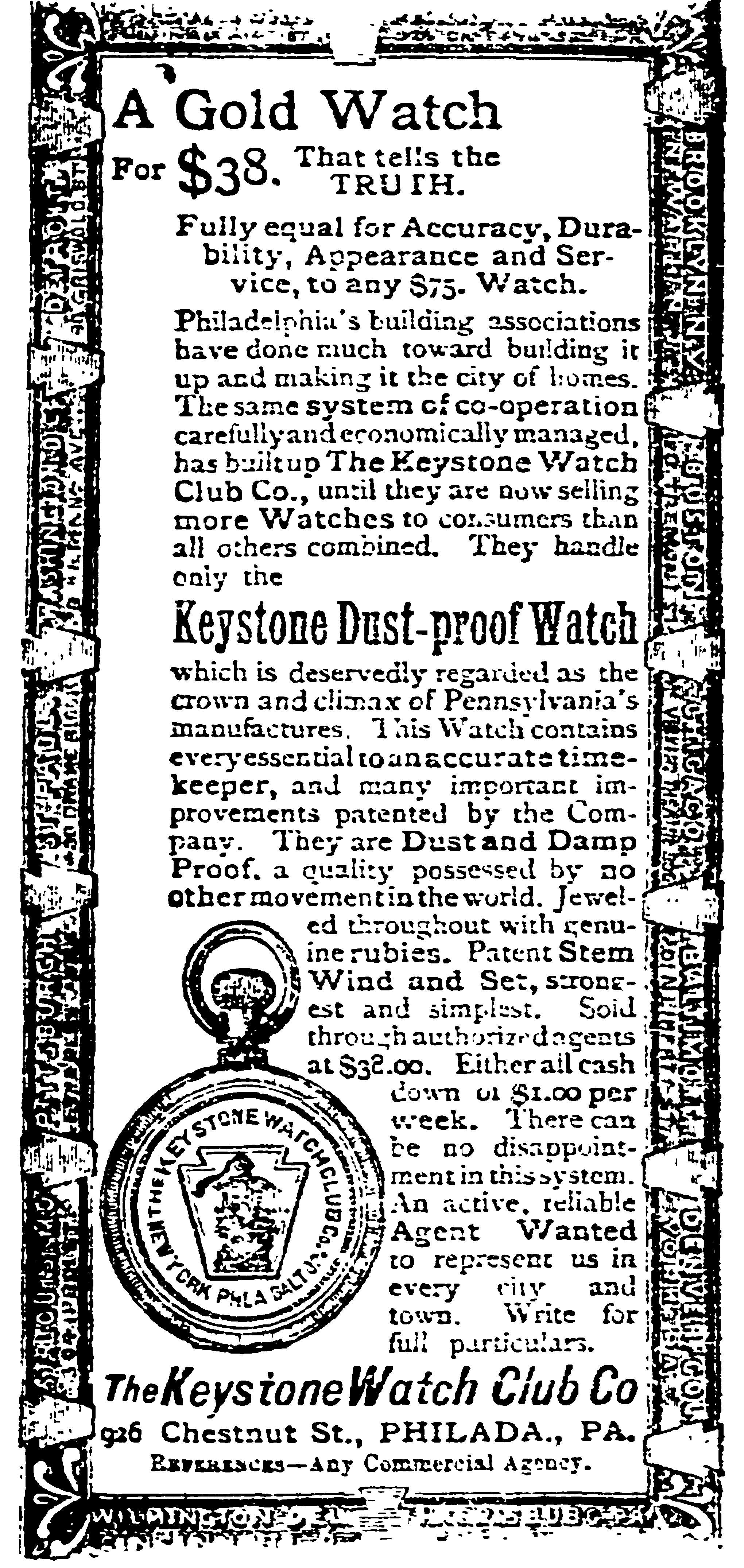
[Illustration: advertisement in an ornamental border of ribbon-like labels naming branch offices (legible in part: DETROIT, 30 GRISWOLD ST.; WASHINGTON; ST. PAUL; PITTSBURGH; ST. LOUIS, MO.; BROOKLYN, N.Y.; BOSTON, … TREMONT ST.; CHICAGO; BALTIMORE; DENVER, COLO.; WILMINGTON, DEL.; the street addresses and the top and bottom-right labels are [illegible]), with an engraving of a pocket watch whose dial reads “THE KEYSTONE WATCH CLUB Co. NEW YORK PHILA. BALTO.”]
A Gold Watch For $38. That tells the TRUTH.
Fully equal for Accuracy, Durability, Appearance and Service, to any $75. Watch.
Philadelphia’s building associations have done much toward building it up and making it the city of homes. The same system of co-operation carefully and economically managed, has built up The Keystone Watch Club Co., until they are now selling more Watches to consumers than all others combined. They handle only the
Keystone Dust-proof Watch
which is deservedly regarded as the crown and climax of Pennsylvania’s manufactures. This Watch contains every essential to an accurate timekeeper, and many important improvements patented by the Company. They are Dust and Damp Proof, a quality possessed by no other movement in the world. Jeweled throughout with genuine rubies. Patent Stem Wind and Set, strongest and simplest. Sold through authorized agents at $38.00. Either all cash down or $1.00 per week. There can be no disappointment in this system. An active, reliable Agent Wanted to represent us in every city and town. Write for full particulars.
The Keystone Watch Club Co 926 Chestnut St., PHILADA., PA. REFERENCES—Any Commercial Agency.
[Advertisement] Canned Goods (C. M. P. A.)
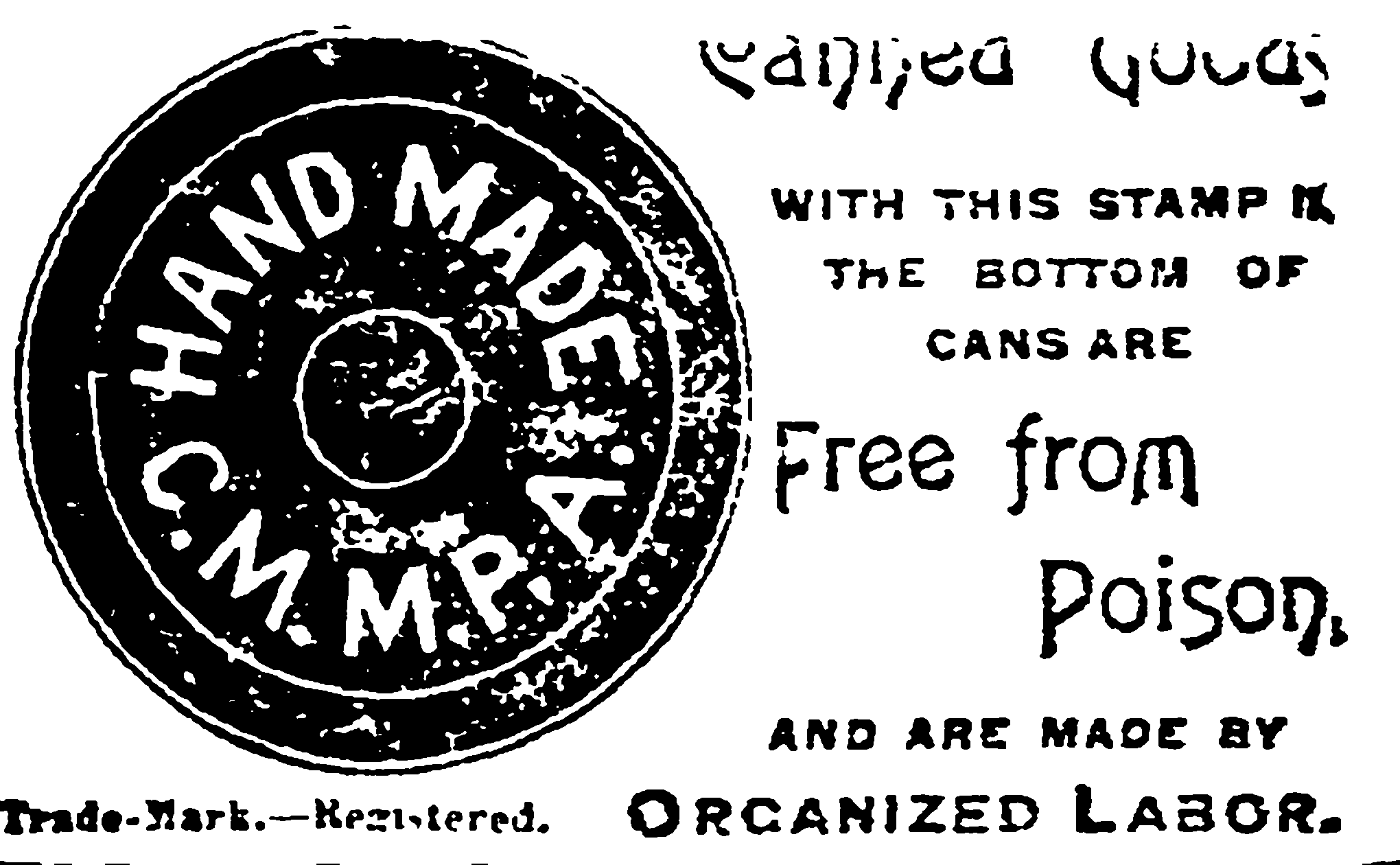
[Illustration: circular trade-mark stamp lettered “HAND MADE · C. M. P. A.” beside display lettering.]
Canned Goods
WITH THIS STAMP sic THE BOTTOM OF CANS ARE
Free from Poison,
AND ARE MADE BY
ORGANIZED LABOR.
Trade-Mark.—Registered.
[Advertisement] Piso’s Cure for Consumption

[Illustration: display advertisement in a black-barred frame; “25 CTS.” printed vertically at each end.]
PISO’S CURE FOR CONSUMPTION
CURES WHERE ALL ELSE FAILS. Best Cough Syrup. Tastes good. Use in time. Sold by druggists.
25 CTS. | 25 CTS.
[Advertisement] The Great American Tea Co.
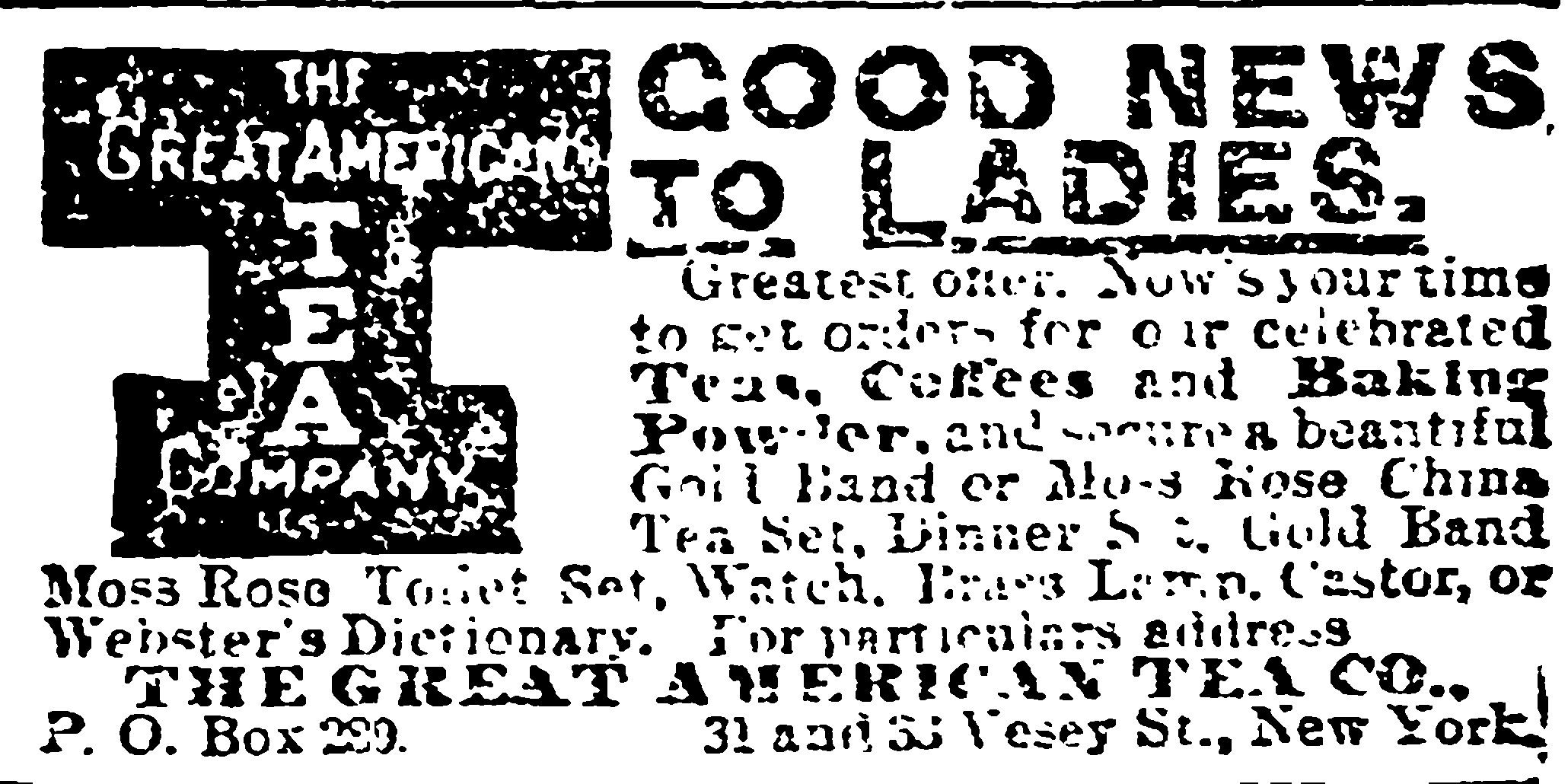
[Illustration: black block logo in the shape of a T, lettered “THE GREAT AMERICAN T E A COMPANY” (a further line at the foot of the logo is [illegible]), beside the display heading.]
GOOD NEWS TO LADIES.
Greatest offer. Now’s your time to get orders for our celebrated Teas, Coffees and Baking Powder, and secure a beautiful Gold Band or Moss Rose China Tea Set, Dinner Set, Gold Band Moss Rose Toilet Set, Watch, Brass Lamp, Castor, or Webster’s Dictionary. For particulars address
THE GREAT AMERICAN TEA CO., P. O. Box [289?]. 31 and 33 Vesey St., New York.
[Advertisement] Charles B. Schaidner
CHARLES B. SCHAIDNER,
PHOTOGRAPHER.
2280 Third avenue, cor. [124th?] street, New York.
Children’s Photographs by instantaneous process a specialty
[Advertisement] Coogan Bros.
[Illustration: engraving of the front of a five-storey store building with horse-drawn wagons and pedestrians in the street. Signs on the building read “COOGAN BROTHERS”; “WHOLESALE & RETAIL FURNITURE CARPETS” [partly illegible]; “BEDDING WAREROOMS”; “MANUFACTURERS”; and across the shop front “125 COOGAN BRO’S 121”.]
COOGAN BROS.,
CARPET AND FURNITURE DEALERS,
COR. BOWERY AND GRAND STS.
[Advertisement] Miss Agatha Munier
MISS AGATHA MUNIER IS NOW forming classes for instruction in vocal sight reading for ladies and gentlemen, as well as in solo singing in all its branches, and in elocution. For terms, etc., address MISS MUNIER, 223 East Thirty-second street, New York.
PRINTING.
[Advertisement] Concord Co-operative Printing Company
CONCORD CO-OPERATIVE PRINTING COMPANY (Ld.) 104 Elm street, cor. Canal, N. Y. BOOK, JOB AND NEWSPAPER PRINTING.
[Advertisement] Briggs’ Pianos
[Illustration: display advertisement with an engraving of an upright piano in a frame decorated with foliage, and a folded card lettered “SEND FOR CATALOGUE”; the lettering is part of the engraving.]
SEND FOR CATALOGUE
BRIGGS’ PIANOS C. C. BRIGGS & Co. 5 APPLETON ST. BOSTON MASS. MANUFACTURERS OF GRAND · · SQUARE · · & · · UPRIGHT PIANO FORTES GRACEFUL DESIGNS · · SOLID CONSTRUCTION MATCHLESS TONE · · BEAUTIFUL FINISH.