Page 1 of 8contents
THE STANDARD
NO. 74—VOL. III, NO 22. | NEW YORK, SATURDAY, JUNE 2, 1888. | PRICE FIVE CENTS
p. 1, col. 1
“The Standard” is sent this week to a number of persons whose friends have paid to have the paper forwarded to them for four weeks in the hope that they may be induced to read it, examine the principles it advocates and become regular subscribers. Those who receive the paper without having ordered it will understand that it has been sent in this manner and will be sent for four successive weeks without charge to them.
Terms of subscription will be found on the fourth page.
CONTENTS:
Cartoon. Anti-Poverty in England. United Labor Party in New York. Straws Which Show the Wind. Words of Thomas Carlyle. The New Jersey Censor. Pen, Paste and Scissors. Slavery at Home and Abroad. The Anderson Bill. Unfelt Taxation. Mr. Cox on the Tariff. Society Notes. Men and Things. Foreign Notes. Coal Mining, Protection and Royalties. The Indians. Plain Truth About Protection. An Immigrant’s Story. Flurscheim Opposed to Party Action. The Beating of the Drums. Queries and Answers. The Labor Question. Current Thought.
The written opinion of Vice-Chancellor Bird of New Jersey in support of his decision declaring void the bequest of the late George Hutchins of that state for the circulation of my books, has now been filed, and on another page a certified copy of it is printed in full.
The reason assigned for this astonishing decision is, if possible, more astonishing still. After the most ridiculous travesty of my aims and teachings, Vice-Chancellor Bird goes on to show why, even if my books were what he assumes them to be, both reason and authority would forbid him from presuming to declare that they should not be circulated. He suggests, when he does not state, the preposterous and tyrannical consequences which would be involved in such an interference with the liberty of speech and of discussion; he admits that there is nothing in the books of an irreligious, rebellious or treasonable character, or that is “directly calculated to foment public disturbances or to incline the masses of the people to revolt;” he admits that to lay down the principle that the courts would not permit bequests for the circulation of books advocating changes in the laws (which is all that my books advocate) would condemn all donations for the spread of the gospel and for foreign missions. He does all this, and then, forsooth, he proceeds to annul Mr. Hutchins’s bequest because of one solitary declaration in my books—viz., that private property in land is robbery. This he specifically declares is the one thing—the only thing—on which he bases his decision.
If Vice-Chancellor Bird, being called upon to pass on a bequest for the distribution of bibles, were to quote from the scriptures in this fashion:
Judas went and hanged himself. . . . Go, thou, and do likewise.
If he were then to go on and draw a horror-stricken picture of the ruin that would overtake society and the desolation that would come upon the earth if everybody were to go and hang themselves; and if, admitting that he could find in this proposal that men should extirpate themselves, nothing which gave him legal warrant for breaking the bequest, he were to still go on and break the bequest because he found in the book such expressions as “Swear not at all,” or “Woe unto ye, lawyers! for ye lade men with burdens grievous to be borne, and ye yourselves touch not the burdens with one of your fingers”—taking the ground that these utterances denounced a custom observed in the courts and were calculated to bring the bench into disrepute, he would be doing just what he does in this opinion.
If in the fact that in commenting on Herbert Spencer’s declaration, “Had we to deal with the parties who originally robbed the human race of its heritage we might make short work of the matter”—I say “It is not merely a robbery in the past, it is a robbery in the present;” if in the fact that preliminary to a historical review of the origin of the idea which attaches to land the same exclusive right of ownership that justly attaches to the things produced by human labor, I say “Historically, as ethically, private property in land is robbery,” Vice-Chancellor Bird finds the only reason for breaking Mr. Hutchins’s will, why does he prostitute a judicial opinion by making it the vehicle for a false and malicious travesty of my views and aims? All that, on his own showing, is, as the lawyers say, aliunde—has nothing to do with the reason he gives for his decision. It is simply the lying appeal of the demagogue to the ignorance of the mob. If Mr. Bird were an irresponsible stump speaker, a vicar general writing for a magazine, or an editor of the *Evening
p. 1, col. 2
[Subscriber’s mailing label printed diagonally across the top of column 2, obscuring several words: “134 Dr Walter Mendelson 167 179 W 74th st”]
Post*, [he mi?]ght smile contemptuously at his pic[illegible]eories of “Progress and Poverty” [illegible] earth to a common, destroying th[illegible]on of all property, and turning “the sweet, reviving, life-giving sunshine of our present civilization” into the darkness of nomadic barbarism. But it should arouse a graver feeling when the man who makes this travesty is a vice-chancellor of New Jersey—a judge sitting on the bench, going through the form of administering justice, and bound by the most solemn obligations to speak truthfully and deal fairly.
Vice-Chancellor Bird had the books he misrepresents officially before him. He says he has gone through them, and from two of them he makes extracts. Now it is utterly impossible that he should even have glanced over them without seeing that what they propose is no disturbance of the exclusive title to the possession and use of land; no reduction of tenures to the momentary occupation of the soil under one’s feet; no lessening of the security that he who plows may reap; no throwing open for any one to enter, the houses or the barns that labor has raised; no depriving the widow and the orphan of the fruits of the toil of husband or father; no taking from Astor or Vanderbilt of any portion of any structure they may have erected, or of any article produced by man of which they have become possessed; no question of what shall be done with “the billions of dollars of improvements which now beautify and adorn the earth.” When Vice-Chancellor Bird, with my books before him, in an official opinion, delivered under the sanction of his judicial oath, declares that this is what he finds in them, he is guilty of the solemn assertion of a deliberate, gratuitous and malicious falsehood. Not only is it impossible that he could even glance through these books without seeing that they fully recognize the rightfulness and necessity of the exclusive, individual possession of land, and that they assert most emphatically and propose to secure far more fully than is at present secured, the absolute right of the improver to his improvements, the absolute right of the producer to all that he produces; but it is impossible that the vice-chancellor should have read the connecting passages between the sentences he quotes without clearly seeing this.
He not only quotes from my books the declaration that “the land of every country belongs to the people of that country,” without telling his hearers that it was John Stuart Mill that said this. He not only quotes from my comments on Herbert Spencer without telling his hearers that Herbert Spencer, as well as I, declares private property in land to be founded on robbery. He not only quotes from my exposition of Thomas Jefferson’s doctrine that no generation can rightfully bind another to the payment of a public debt, without saying one word of Thomas Jefferson. But he carefully cuts out and eliminates by asterisks passages that lie between the sentences and parts of sentences he quotes, which, if left in their proper places, would show the utter falsehood of the travesty of my doctrines that he makes.
I do not call names. I merely state facts. No one can read—I will not say my books, which Vice-Chancellor Bird says he has gone through; but simply the context of the sentences he has quoted from these books—without seeing that in this opinion the vice-chancellor has resorted to deliberate suppression in order to give currency to a falsehood, and that he is in this the worst kind of a false witness—a false witness sitting on the bench of justice and bound by the judicial oath.
But all this is beside the decision. The elaborate misrepresentation, in which Vice-Chancellor Bird indulges, he throws in sic merely for the prejudicing of the groundlings. Although the ridiculous and destructive doctrine which he pictures me as advocating “involves our homes and our firesides, our church and our state, and all the institutions established and regulated thereby,” although it would “sweep away every thought or sentiment or link which binds individuals to locality, to home, to society, or to government, and send him adrift without rudder, or sail, or guiding star, or beacon light, or a tent to shelter, or a cabin for himself or his little ones,” the vice-chancellor cannot find any law for forbidding a bequest for its dissemination, and has too much regard for “freedom of speech and liberty of the press” to try. He formally declares that any citizen sic New Jersey may safely leave whatever he pleases for the dissemination of doctrines that would set not only all Jerseymen, but everybody else adrift in this helpless fashion, and the New Jersey courts will permit it. It is for no such little
p. 1, col. 3
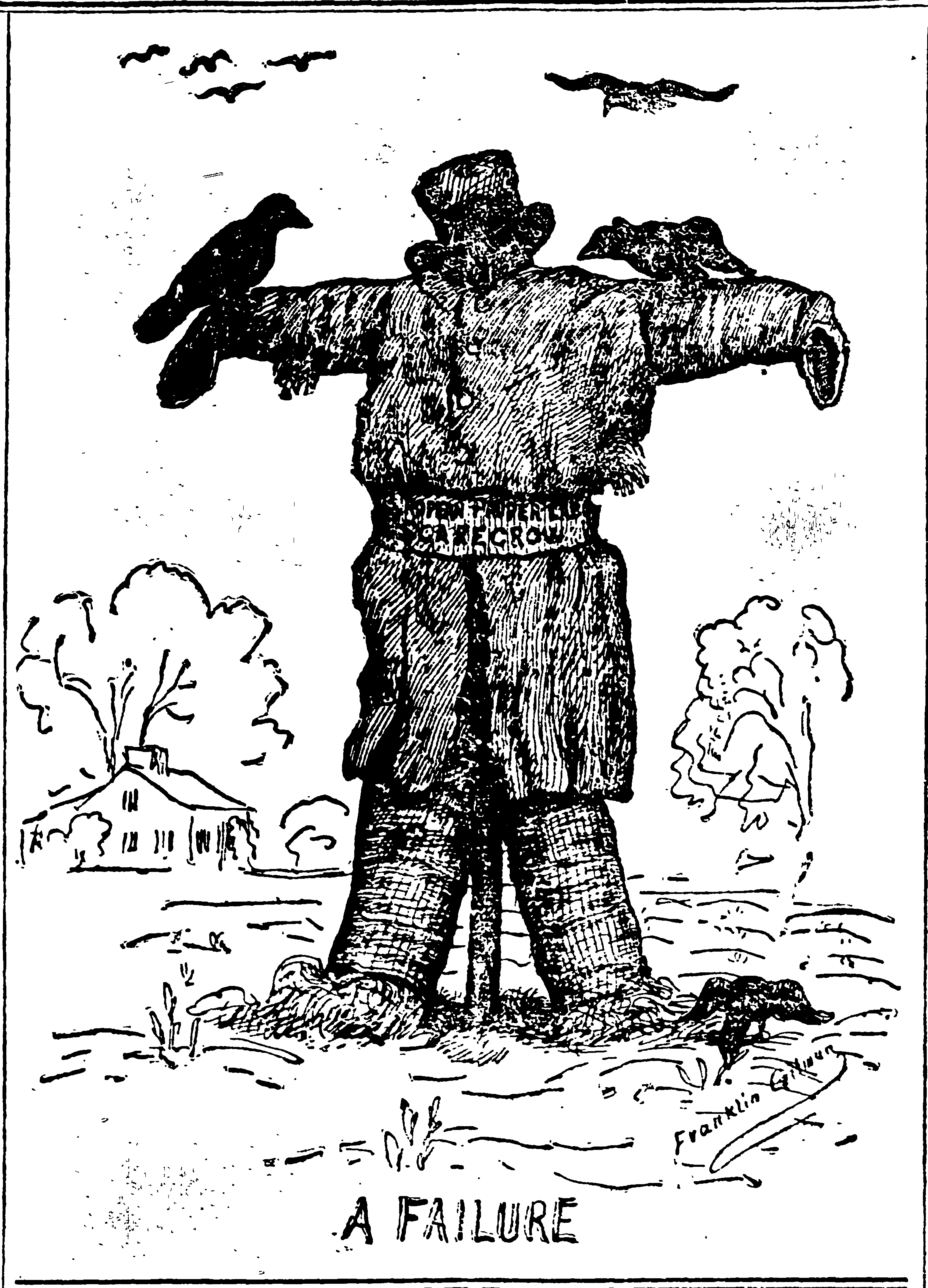
[Cartoon, spanning columns 3–4: a ragged scarecrow in a top hat and tattered coat, propped on a stake in a ploughed field, arms outstretched; crows perch on both arms, another stands at its feet and more fly overhead; a farmhouse and trees in the background. Lettering on the scarecrow’s belt, partly illegible: “[illegible] PAUPERISM[?] / SCARECROW”. Artist’s signature, lower right: “Franklin [Gillam?]”. Caption below:]
A FAILURE
[editorial continued from column 2:] things that this most cautious vice-chancellor declares the Hutchins bequest invalid. It is for something infinitely worse, as he seems to think, than the destruction of church and state and home and fireside, and the setting of people adrift in this ruthless fashion—it is for saying that private property in land is robbery!
This, then, is freedom of speech and liberty of the press in New Jersey, according to this New Jersey vice-chancellor! You may freely write, speak, print or utter your sentiments with regard to anything that is sanctioned by the laws, provided, you say nothing disrespectful of it! The free trader may oppose a tariff which levies taxes on one man to give a bounty to another man, but must not say protection is theft. The Sabbatarian may oppose the moving of trains on sic, but he must not say it is a sin. The anti-monopolist may respectfully object to the conferring of public franchises upon private corporations, but must not say that this involves robbery. The prohibitionist may urge the legal suppression of the liquor traffic, but so long at least as it is recognized by the law, must not say that it is a murderous one, or a poverty-breeding one, or any of the many things of the kind that temperance people are constantly saying about the liquor business. To say, in short, that anything which the laws of New Jersey permit and the courts uphold is contrary to the moral law is, according to the principle of Vice-Chancellor Bird’s opinion, forbidden in New Jersey—not because it may not be true, but because it is to intimate that what the courts may be obliged to uphold is in itself wrong! How many reasons for declaring void a bequest for circulating the bible might not the vice-chancellor find, on this principle, if he searched for them as industriously and with as much determination as he has searched for a reason for declaring void the Hutchins bequest!
But the reason which Vice-Chancellor Bird assigns for declaring void the Hutchins bequest is one he has not found—he has deliberately manufactured it. In order to do this he makes two quotations from “Progress and Poverty”—the one, a paragraph beginning “It is not merely a robbery in the past, it is a robbery in the present,” and the other the sentence “Historically as well as ethically private property in land is robbery.” Then he goes on:
Clearly the author in these passages not only condemns existing laws, but denounces the fact of the secure title to land in private individuals as robbery—as a crime. It is this aspect of the case which leads me to the conclusion that the court ought to refuse its aid in enforcing the provisions of this will. Whatever might be the rights of the individual author in the discussion of such questions in the abstract, it certainly would not become the court to aid in the distribution of literature which denounces as robbery—as a crime—an immense proportion of the judicial determinations of the higher courts.
Clearly, and as an absolute matter of fact, I have done nothing of the kind. Here are the two passages from which the vice-chancellor makes his two quotations, the words he has quoted being inclosed in brackets. They are both from Book VII of “Progress and Poverty,” entitled “Justice of the Remedy.” The first is sic Chapter III, entitled, “Claim of
p. 1, col. 4
Land Owners to Compensation.” It is as follows:
Herbert Spencer says: “Had we to deal with the parties who originally robbed the human race of its heritage, we might make short work of the matter.” Why not make short work of the matter anyhow? For this robbery is not like the robbery of a horse or a sum of money, that ceases with the act. It is a fresh and continuous robbery, that goes on every day and every hour. It is not from the produce of the past that rent is drawn; it is from the produce of the present. It is a toll levied upon labor constantly and continuously. Every blow of the hammer, every stroke of the pick, every thrust of the shuttle, every throb of the steam engine, pay [it?] tribute. It levies upon the earnings [of?] the men who, deep under ground, risk their lives, and of those who over white surges hang to reeling masts; it claims the just reward of the capitalist and the fruits of the inventor’s patient effort; it takes little children from play and from school, and compels them to work before their bones are hard or their muscles are firm; it robs the shivering of warmth; the hungry, of food; the sick, of medicine; the anxious, of peace. It debases, and embrutes, and embitters. It crowds families of eight and ten into a single squalid room; it herds like swine agricultural gangs of boys and girls; it fills the gin palace and groggery with those who have no comfort in their homes; it makes lads who might be useful men candidates for prisons and penitentiaries; it fills brothels with girls who might have known the pure joy of motherhood; it sends greed and all evil passions prowling through society as a hard winter drives the wolves to the abodes of men; it darkens faith in the human soul, and across the reflection of a just and merciful creator draws the veil of a hard, and blind, and cruel fate!
[It is not merely a robbery in the past; it is a robbery in the present—a robbery that deprives of their birthright the infants that are now coming into the world! Why should we hesitate about making short work of such a system? Because I was robbed yesterday, and the day before, and the day before that, is it any reason that I should suffer myself to be robbed to-day and to-morrow! any reason that I should conclude that the robber has acquired a vested right to rob me?]
If the land belong to the people, why continue to permit land owners to take the rent, or compensate them in any manner for the loss of rent? Consider what rent is. It does not arise spontaneously from land; it is due to nothing that the land owners have done. It represents a value created by the whole community. Let the landholders have, if you please, all that the possession of the land would give them in the absence of the rest of the community. But rent, the creation of the whole community, necessarily belongs to the whole community.
Try the case of the land holders by the maxims of the common law by which the rights of man and man are determined. The common law we are told is the perfection of reason, and certainly the land owners cannot complain of its decision, for it has been built up by and for land owners. Now what does the law allow to the innocent possessor when the land for which he paid his money is adjudged to rightfully belong to another? Nothing at all. That he purchased in good faith gives him no right or claim whatever. The law does not concern itself with the “intricate question of compensation” to the innocent purchaser. The law does not say, as John Stuart Mill says: “The land belongs to A, therefore B who has thought himself the owner has no right to anything but the rent, or compensation for its salable value.” For that would be indeed like a famous fugitive slave case decision in which the court was said to have given the law to the north and the nigger to the south. The law simply says: “The land belongs to A, let the sheriff put him in possession!” It gives the innocent purchaser of a wrongful title no claim, it allows him no compensation. And not only this, it takes from him all the improvements that he has in good faith made upon the land. You may have paid a high price for land, making every exertion to see that the title is good; you may have held it in undisturbed possession for years without thought or hint of an adverse claimant; made it fruitful by your toil or erected upon it a costly building of greater value than the land itself, or a modest home in which you hope, surrounded by the fig trees you have planted and the vines you have dressed, to pass your
p. 1, col. 5
declining days; yet Quirk, Gammon & Snap can mouse out a sic flaw in your parchments or hunt up some forgotten heir who never dreamed of his rights, not merely the land, but all your improvements, may be taken away from you. And not merely that. According to the common law, when you have surrendered the land and given up your improvements, you may be called upon to account for the profits you derived from the land during the time you had it.
Now if we apply to this case of The People vs. The Land Owners the same maxims of justice that have been formulated by land owners into law, and are applied every day in English and American courts to disputes between man and man, we shall not only not think of giving the land holders any compensation for the land, but shall take all the improvements and whatever else they may have as well.
But I do not propose, and I do not suppose that any one else will propose, to go so far. It is sufficient if the people resume the ownership of the land. Let the land owners retain their improvements and personal property in secure possession.
And in this measure of justice would be no oppression, no injury to any class. The great cause of the present unequal distribution of wealth, with the suffering, degradation and waste that it entails, would be swept away. Even land holders would share in the general gain. The gain of even the large land holders would be a real one. The gain of the small land holders would be enormous. For in welcoming Justice men welcome the handmaid of Love. Peace and Plenty follow in her train, bringing their good gifts, not to some, but to all.
How true this is we shall hereafter see.
If in this chapter I have spoken of justice and expediency as if justice were one thing and expediency another, it has been merely to meet the objections of those who so talk. In justice is the highest and truest expediency.
The second is from Chapter IV, entitled, “Property in Land Historically Considered:”
The observations of travelers, the researches of the critical historians who within a recent period have done so much to reconstruct the forgotten records of the people, the investigations of such men as Sir Henry Maine, Emile de Laveleye, Professor Nasse of Bonn, and others, into the growth of institutions, prove that wherever human society has formed the common right of men to the use of the earth has been recognized, and that nowhere has unrestricted individual ownership been freely adopted. [Historically, as ethically, private property in land is robbery.] It nowhere springs from contract; it can nowhere be traced to sic of justice or expediency; it has everywhere had its birth in war and conquest, and in the selfish use which the cunning have made of superstition and law.
Wherever we can trace the early history of society, whether in Asia, in Europe, in Africa, in America, or in Polynesia, land has been considered, as the necessary relations which human life has to it would lead to its consideration—as common property, in which the rights of all who had admitted rights were equal. That is to say, that all members of the community—all citizens, as we should say—had equal rights to the use and enjoyment of the land of the community. This recognition of the common right to land did not prevent the full recognition of the particular and exclusive right in things which are the result of labor, nor was it abandoned when the development of agriculture had imposed the necessity of recognizing exclusive possession of the land in order to secure the exclusive enjoyment of the results of the labor expended in cultivating it. The division of land between the industrial units, whether families, joint families, or individuals, only went as far as was necessary for that purpose, pasture and forest lands being retained as common, and equality as to agricultural land being secured, either by a periodical re-division, as among the Teutonic races, or by the prohibition of alienation, as in the law of Moses.
This primary adjustment still exists, in more or less intact form, in the village communities of India, Russia, and the Sclavonic countries yet, or until recently, subjected to Turkish rule; in the mountain cantons of Switzerland; among the Kabyles in the north of Africa, and the Kaffirs in the south; among the native population of Java and the aborigines of New Zealand—that is to say, wherever extraneous influences have left intact the form of primitive social organization. That it everywhere existed has been within late years abundantly proved by the researches of many independent students and observers, and which are (to my knowledge) best summarized in the “Systems of Land Tenure in Various Countries,” published under authority of the Cobden club, and in M. Emile de Laveleye’s “Primitive Property,” to which I would refer the reader who desires to see this truth displayed in detail.
Are the deductions which the vice-chancellor draws from these passages warranted? Do I, as a matter of fact, denounce “the secure title to land in private individuals as a robbery—as a crime?” Do I, as a matter of fact, “denounce as a robbery—as a crime—an immense proportion of the judicial determinations of the higher courts?” Even in those passages which the vice-chancellor has selected as best suiting his purpose, it may be seen, as is clearly stated in all my books, that I regard the secure title to land in private individuals as necessary to the best use of land, and instead of weakening it would strengthen it. Even in those passages it may be seen, what in other parts of “Progress and Poverty,” as in my other books, is stated with the utmost clearness, that in speaking of private property in land as a robbery I do not mean the private possession of land, as Vice-Chancellor Bird would make it appear, but what M. de sic calls quiritary property—the attaching to land of the same full rights of exclusive ownership that justly attach to things produced by labor. Even in those passages may be seen, what in other parts of the same book, and all my books, is clearly stated, that I do not regard private property in land as an individual robbery or crime, but as a
p. 1, col. 6
social robbery or crime, for which, not land owners as a class, but the whole people, are responsible. Neither in the passages, from which he selects, nor in any part of my writings can Vice-Chancellor Bird find the slightest justification for his deductions.
I have never recommended that the laws which relate to property in land should not be obeyed; I have never denounced the courts for enforcing them; I have merely urged that the law should be changed, in the appointed and constitutional way—and in this what I have urged is, not a change in the laws relating to the tenure of land, but the laws regarding taxation—laws which are in course of constant change.
Whether Vice-Chancellor Bird’s law be good or bad, his facts are false—are not facts at all, but gross, unwarranted inventions of his own.
In concluding this remarkable opinion, Vice-Chancellor Bird alludes (for he probably felt that he could not entirely ignore it), to a legal decision rendered when slavery was as fully recognized by the laws of the United States, and of many of the several states, as private ownership of land is now—a decision in which the court upheld a bequest for the dissemination of anti-slavery literature. He says he has sought to bring my books within that opinion, but has not been able to do so “for the reasons given”—i. e., that they contain allegations that “private property in land is robbery.”
Did Vice-Chancellor Bird ever see or hear of an anti-slavery book, paper, tract, lecture or speech that did not contain the assertion that slavery was robbery? Did not all the anti-slavery literature teem with such declarations, and with assertions that the slave trade was piracy, that slave owners were criminals, and that those who attempted to recapture what under the laws of the United States was legal property were kidnappers and man stealers; that they and all who abetted or encouraged them, even though acting by direct authority of the laws and the express commands of the courts, were guilty of far more heinous offenses against the moral law than simple theft, and that there was a higher law that made the constitution and laws of the United States null and void whenever they came in conflict with it?
And yet he declares that while the law would permit bequests for the dissemination of such literature, it will not permit the dissemination of books containing the passages with regard to property in land which he has quoted.
Governor Hill gave a hearing on the electoral reform bill in Albany last Friday. Charles L. Crain and Alderman Forster opposed the bill on behalf of Tammany, and Assemblyman Charles T. Saxton, the Rev. Dr. McGlynn, Michael Clarke, secretary of the anti-poverty society, Peter R. Gatens of the New York committee of the united labor party, Judge Shannon and myself spoke briefly in its favor. The objections urged were as to matters of trivial detail, but although the governor declared himself in favor of the principle of the bill, such objections seemed to lie in his mind. There is no mistaking, however, the popular sentiment in favor of the reform. All the labor associations of New York that have met during the week have passed resolutions urging Governor Hill to sign it and have sent telegrams and letters to him to that effect. In the meantime what is substantially the same measure has passed both houses of the Massachusetts legislature, with a few unimportant amendments in the assembly, which require its going back to the senate, and will doubtless be again passed by the senate and promptly signed by Governor Ames.
What is left of the Twenty-third district association of the united labor party formally expelled me on Monday night on charges of abandoning the great principle of the single tax for the lesser one of free trade, of having spoken of the party as a paper organization, and of supporting President Cleveland upon inspiration from Washington. The Star has a local article intimating that Dr. McGlynn is also likely to find his room wanted in what is now left of the united labor party. Mr. Gaybert Barnes, the secretary, has denied the report which the Star gives of a difference between himself and Dr. McGlynn, and it is probable that the only ground for it is the fact, asserted by other prominent men in what is left of the united labor party, that the nomination of a separate candidate at Cincinnati was by Dr. McGlynn’s influence and against the views of Mr. Barnes. As for the talk of getting rid of Dr. McGlynn, it is suggestive of the difficulties that the doctor is not unlikely to find in his political way. continued on p. 2 →
Page 2 of 8contents
2 THE STANDARD, SATURDAY, JUNE 2, 1888.
p. 2, col. 1 [continued from page 1]
← continued from p. 1 The financial power in keeping together what is left of the united labor party seems now to be Colonel James J. Coogan, who is reported to have paid the expenses of most of the delegates that went from here to Cincinnati. Colonel Coogan is a man of great wealth and strong ambition. He has not only made a fortune for himself in the furniture business, but has inherited, through his wife, a great tract of real estate in the upper part of the city, which he is now improving and which has enormously increased in value. He is in fact one of the principal owners of Manhattan island, and the estate which he controls will ere long, if it does not already, rank among the first in the list which begins with the Astors. He is, moreover, a strong protectionist.
Colonel Coogan has for some years ardently desired to be mayor of New York, and there is no reason why he should not be, as in ability, education and business reputation he is quite up to the ordinary standard of mayors. The only way to get to be mayor of New York under our present system of elections and consequent machines is to spend a great deal of money. Colonel Coogan is an extremely liberal man; in many respects, perhaps, the most liberal man in the city, and makes no secret of his willingness to spend as much, or more, than any candidate for mayor has ever invested in politics. He is, of course, not particular as to what ticket he runs on, since what he wants is to “get there,” and proposes, as it is understood, to use what is left of the united labor party as a pawn upon his chess board, thinking that its nomination will help him to get the republican nomination on an understanding that the united labor boxes, on election day, shall run out the republican presidential ticket. There would be no great sacrifice in this, as, from the talk of what is now left of the united labor party in New York, its members are bent, as their primary object in politics, on defeating Mr. Cleveland, and would naturally be inclined to cast their votes for the republican candidate, rather than throw them away for Cowdrey. Colonel Coogan, however, is a strong Catholic, and from his affiliations would naturally get a large Catholic vote, were he to run. For this reason he might think Dr. McGlynn’s continued presence in the united labor party rather an encumbrance than an advantage, in which case it is quite conceivable that his money would tell in the little united labor machine for much more than Dr. McGlynn’s popularity.
One thing is certain. These little side-show parties inevitably degenerate into little machines for local trading, and Dr. McGlynn, with his chivalrous but unpractical idea of standing up and being counted, is likely before election comes to find what is left of the united labor party engaged in transactions which will make his connection with it intolerable to him.
HENRY GEORGE.
The Liquor Traffic and the Single Tax.
After the destruction of the “protective” tariff I suppose the next effort of single tax men in the field of national politics should be the abolition of the internal revenue. I, for my part, am not in favor of imposing a fine even on what I believe to be misdirected industry, especially as other fields of industry will be more and more opened by the gradual fall of monopolies. Nor do I consider that the poor man would be taxed more justly through the price of his liquor than through the price of his other articles of consumption, although I believe he would be better off without the liquor and hope he will learn to do without it.
What I do want—in common, I think, with all prohibitionists that are not of the crank order—is, first, the downfall of the “rum power in politics;” second, the extermination of the open saloon. Electoral reform, with the abolition of the internal revenue, should accomplish the first. The open saloon, which exists only to tempt the weak and unwary, will gradually fall before an enlightened public sentiment working legitimately through local option or by direct state legislation.
Meanwhile how can its admitted evils be better checked than by methods in harmony with the principles of the single tax? Before moving against the internal revenue we must have a solution of that problem, for the revenue will be defended not only by those who have monopoly opportunities under it, but also by those temperance people who believe, as I believed two years ago, that revenue and license taxes are at once a legitimate mode of raising funds for public use and a real check on the consumption of liquor.
N. H. WHITNEY BROWN.
A Word for the Single Tax League.
POMONA, Cal.—A few months since I was a protectionist, “though,” in the language of Little Buttercup, “I could never tell why.” I read “Progress and Poverty,” and that settled the matter. I watch anxiously for the arrival of THE STANDARD every week and devour every line.
I heartily indorse the constitution of the Single tax league. The single tax men would be playing into the hands of the republican party by placing a candidate in the field. God deliver us from a republican victory just at this time!
ALBERT CALDWELL.
The Origin of Boycotting.
An English paper, the Norfolk News, has discovered the earliest boycott on record. It was proclaimed by the council of Tours in 1163 in the following words:
We command all bishops and priests to keep a watchful eye upon the heretics, and to forbid all men, under pain of excommunication, to harbor, or assist, or trade with them, that so, through deprivation of the benefits of society, they may be forced to repent of their error. And whosoever shall attempt to oppose the decree shall be smitten with the same anathema.
p. 2, col. 2
ANTI-POVERTY IN ENGLAND.
A REMARKABLE CONFERENCE OF REPRESENTATIVE CHRISTIANS IN LONDON.
Clergymen, Members of Parliament and Other Influential Men Gather in the City Temple and Discuss the Problem of Poverty—Stirring Speeches—Present Social Conditions Denounced as Anti-Christian—Complete Advocacy of the Single Tax Doctrine—Rev. Dr. Parker in the Chair.
A recent issue of the London Christian Commonwealth contains a lengthy report of one of the most important meetings yet held in Great Britain in furtherance of the anti-poverty movement—a conference of representative Christians to consider the cause of poverty and to point out its remedy. The meeting was held in the City temple, and was attended by a large number of clergymen and other public and influential men. Rev. Dr. Parker presided. Rev. George Brooks, editor of the Christian Commonwealth, was first introduced. He said:
The projectors of the conference have long been deeply convinced that, in spite of the widespread interest which is now being manifested in regard to the social situation, the condition of the poor has not received from the followers of the Lord Jesus Christ that degree of consideration which its gravity demands, and that consequently the practical effort put forth to alleviate that condition has been too sporadic to produce much fruitful result. This has been as “the burden of the Lord” upon the hearts of those who have taken the initiative in convening this assembly. They have long desired such an occasion as this, when the whole question might be boldly faced, frankly discussed and vigorously handled. In the realization of this aim we have succeeded, for probably no more influential gathering than this has been held on the social problem for years. We are here for conference, discussion, mutual enlightenment and encouragement, and it is hoped that there will go forth from this meeting such an expression of opinion as will guide you in any further steps which it might be found necessary to take. On one point, however, we ventured to express a conviction which we firmly hold, and it is that a social condition which produces such results as we see around us is largely anti-Christian and calls for immediate and radical treatment at the hands of the church of Christ. If the direct practical result of that conference shall be to awaken the disciples of Christ to their duty, and to organize the mass of Christian opinion which exists on these matters so as to bring it to bear more immediately and influentially on the misery and poverty which surround us, we who have convened it will have abundant reward.
The first speaker was the Rev. Newman Hall, LL.B., who attributed the prevalence of poverty to intemperance, and announced that if the government would take the matter in hand and close public houses, thereby diminishing the drink traffic, there would be a very large increase in useful industry and a very great diminution of poverty.
William Saunders, late M. P. for East Hull, and one of the foremost men in the single tax movement in Great Britain, next spoke on the subject, “Unjust legislation the chief cause of poverty.”
The drift of his address was that hitherto our legislation, made by the privileged classes in their own interests, bore most unjustly and almost crushingly on industry. He specified three methods in which this was illustrated, viz., as regards taxation, wages and rent. He first showed how the taxation of the country had been so arranged as to fall very heavily upon the toiling masses and very lightly upon the upper classes. In proof of which he said that if £[1?],000 was spent in land it paid 15s. in taxes; if it were spent in building houses it paid £15 in taxes. The greatest of industries—agriculture—was taxed fifty per cent, not for the benefit of the public, but for the benefit of idle land owners, and building industry was taxed not less than 200 per cent for the benefit of idle land owners. As regards wages, he showed that while an ordinary postman in London received 4d per hour, many civil servants were paid £3 per hour. Of course one man might be worth 180 times as much as any other man, but he (Mr. Saunders) failed to see how that could apply to whole classes of men. While industry was paid semi-starvation wages, privilege enjoyed luxurious salaries. The industrial classes were heavily mulcted in the matter of rent, mainly again for the benefit of privileged classes. Thus working people in London, living in one room for which they pay 4s. a week rent, paid 2s. of this to the ground landlord, 1s. to the builder, and 1s. to the rates. Was it surprising that on one hand there was a want of employment and on the other want of accommodation with all the evils of overcrowding?
Mr. Walter Hazell declared that emigration was the chief remedy for poverty, referring to his own experience in sending emigrants to Australia and Canada, where they had met with success and thrived.
The next speaker, Silas M. Burroughs, whose special subject was “Causes of poverty among the industrial classes,” said:
To find the true cause of the prevailing poverty among the working classes is the most pressing problem of the hour, and the removal of that cause will be the glory of that generation which carries out the great reform. Both divine and natural law decree that wealth is produced only by industry. “In the sweat of thy face shalt thou eat bread.” “He that will not work neither shall he eat.” If a ship be wrecked on an uninhabited island who will have houses, clothing, food? Naturally those who build, weave and sow, while those who will not trouble themselves to work will naturally have nothing.
Both natural and divine law have evidently been supplanted in this world by human laws, which reverse the natural order of things, because we see all round us, and hear from other lands, that the industrious are always either in want or fearing its approach, while the traditionally idle, who are proud that neither they nor their ancestors ever did any work, have plenty to eat, and a great deal too much to drink, and an abundance of all things. If this subject involved but a trifling inconvenience to a few people, if it were but a harmless superstition, we need not think seriously about it, but it is the one great question of most tragic importance, and if it is to be settled peacefully now is the best time, when the people’s minds are not agitated with wars and rumors of wars, and when they are in a mood to quietly investigate the failure of our civilization to supply the necessaries of life and its comforts, and a fair share of its pleasures to those who produce them all, the “working classes.” The common, contemptuous, pitiful usage of the term “working classes” should fill the minds of those who hear it so pronounced by the idlers, with the gravest doubts of the justice of those social arrangements which are responsible for such unnatural conditions as at present exist. But the masses, though very well meaning, with good hearts, industrious hands, are so busy earning a living by physical and mental exertion, so little accustomed to the application of logical reasoning to social conditions, that too many of us are ready to accept as divinely right the laws that are made for us. Superstitions, despotisms and slavery of mind and body have flourished in past times to such a degree that we laugh at their absurdities, but, at the same time, cannot but admit that people who were unwilling to exert their god-given wits to perceive the way they were deceived and robbed deserved their fate. Succeeding
p. 2, col. 3 > generations will think of us as we think of those that have gone before. As they pitifully read the history of these times, and consider the present absurd social conditions, the superstitions which sustain them, and the various wise opinions which are given by good people as to the causes of poverty among the industrious and of wealth among the idle, they will laugh at our folly.
Some are afraid to make inquiries into the problem in question, for fear of being considered reformers, but our great example, Jesus Christ, and also his disciples, were reformers. Some are so afraid of interfering with vested interests that they will not for a moment consider if the “vested interests” would not be greatly benefited by a change in human laws which would bring them into harmony with divine law and common sense. Christ’s pure commandment is: “Seek ye first the kingdom of God and his righteousness and all these things shall be added unto you.” Let us not fear that houses, food, and all the necessities of life shall be given if we will but seek first to do what is right.
As idleness tends to poverty, and industry to sic, a state of society in which opposite conditions prevail must evidently be wrong. We may leave entirely out of the question those who justly enjoy the results of the industry of their parents, or who have come into inheritances of wealth earned by industry, for that we believe to be their rightful property.
Let us consider solely as pertaining to this question, the reprehensible communistic and socialistic state of our present society, whereby the law appropriates the earnings of the industrious, and divides them among the idle. There surely cannot be a worse system of communism and socialism than this. If the principle to render to every man that which is his due is to apply to the state as well as to the individual, then there must be some great changes in the distribution of wealth; if this injunction be regarded, then the individual will receive the results of his industry, and the state will tax the unearned increment which is created by the growth of the population and wealth of the community, and labor will be unburdened.
It has been pointed out as a remarkable coincidence and inevitable result that as a community increases in numbers and wealth there is a sure and proportionate increase in land values. It is on the principle that as a man will give everything for his life he will give all he can spare of his possessions for that which is essential to life, viz., air, water and earth.
Does it not appear as if it was the intent of the creator that these values which the public create should be taxed for the public expenses, thus fully supplying them with public requirements of roads, schools, etc.? Is it right that these values should be given away and the public burdened to compensate for it? If this commonwealth be given to individuals they are unduly exalted and placed beyond the necessity of labor, while at the same time it becomes necessary to tax the industrious in various ways, to compensate for the public patrimony having passed into the hands of the idlers who form a distinct class in the community, interested in the perpetuation of their privilege of having all things without the labor of earning them. This problem of the cause of poverty among the industrious is very deep, and requires a little careful searching to find it out, so remote and subtle are its ramifications, but the taxation of industry and the neglect to tax land values can readily be proven to be the cause, if its effects are carefully traced.
If improvements or the fruits of industry in any form are taxed, employment is hindered or stopped. The tax is added to the cost of the production, making production dearer and preventing many from using the product in question who would otherwise use it. If the tax on any production be so great as to absorb its value, or if it absorb its profits or earnings, then the production will cease entirely, throwing out of employment those who are engaged in the heavily taxed industries. If houses were taxed to their full rental value men would be driven to live in caves and carpenters would be compelled to dig.
On the other hand, though it seems paradoxical, a tax on land values instead of being a hindrance to the employment of the land, is the greatest incentive to its proper use, and the only thing that will insure its best employment, for the reason that no one can afford to hold land from use if he has to pay a tax upon it. Besides this, having paid his land tax, the laborer will be relieved of taxation on his industry; land will be cheaper from the destruction of speculation, and new fields for labor at an increased rate of wages will be opened.
Anyone or anything that prevents or hinders people from employing themselves, or working for others, forces them into beggary. The neglect to tax land leaves accruing to it the unearned increment to be presented to the owner as a free gift from the state. Whether he uses it or not it goes on increasing value if the community upon it or near it is increasing in numbers and prosperity. The tax upon the land, being trifling if it is out of use, but very heavy upon its produce or improvements if it is in use, the owner has the strongest possible incentive to withhold it from use and await higher prices. Thus the whole community is repressed and deterred from exercising its industry.
If the improvements be equal in value to the land, and the taxation be transferred from the improvements to the land, the owner will pay exactly the same tax as before, but with the advantage to himself that he may go on making improvements without having to pay any additional tax and with the advantage to the community of a greatly increased demand for labor, with a consequent increase of wages and of the general prosperity of the nation.
The foremost rank of reformers in America demand the repeal of all forms of taxation, except those on land values, and they are prepared to prove that all taxation but this is but for the enrichment of the idle at the expense of the industrious.
People then are beginning to see that tariff and all other forms of indirect taxation are but schemes of blind leaders of the blind, whose object is protection, but whose end is the taking from the industrious for the benefit of the idle.
These principles were further elaborated and illustrated by Rev. Philip S. Wicksteed. He was followed by Dr. G. B. Clark, M. P., who, meeting Rev. Mr. Hall’s remarks, answered that even if men were always sober they would still be affected by the causes of involuntary poverty:
One of the chief of these causes is private property in land. You have here in London warehouses full of goods, but the people have not the means to purchase. This over production is a great anomaly. The only proper basis for wealth is that the man who by his industry creates it should have the advantage of it.
Rev. J. P. Gledstone called attention to the scriptural aspects of the matter. He believed there was teaching in the bible, which if followed would clear away social difficulties:
The making of big fortunes is a thing the old book is dead against. It seems to me that in the making of great fortunes there must be some pinching and grinding and somebody not getting his fair proportion. If I thought the bible justified men in making fortunes in this way and justified the existence of poverty as we now have it, I would have nothing to do with it. I would question whether it could have come from heaven.
Rev. Charles Leach said he regarded emigration not as a remedy, but as something which for the moment relieved the distress:
But how is it in the name of Jesus Christ, whose followers we are, that so many thousands of acres of land are out of cultivation? If Christ were to come back among us, he would soon tell us we ought to go to the very roots of these matters. If we had laws bearing hardly on the poor, we ought at once to alter these laws.
After further speaking of the same radical tenor, Rev. G. Brooks moved a vote of thanks to Dr. Parker for presiding and for permitting the use of the City temple, James C. Durant, late M. P. for Stepney, second, and the vote passed with a hearty cheer.
p. 2, col. 4
THE UNITED LABOR PARTY IN NEW YORK
Newspaper Gossip About the Coming Expulsion of Dr. McGlynn.
New York Star, May 29.
The bond of friendship which has held Dr. McGlynn and Gaybert Barnes so closely together for the past year has suddenly snapped and each will hereafter pursue his own way. Their few followers are also divided. Some will follow the ex-priest and others will cast their lot with the wily secretary. Mr. Barnes will have the larger number of voters in his little clique, but Dr. McGlynn will have more strength numerically, owing to the fidelity with which the ladies of St. Stephen’s parish cling to him in his erratic course.
The friendship between the two leaders was as firm as ever when the delegates left here for the Cincinnati convention. They were even more demonstrative than usual in their affection for each other about that time. They were hopeful that a union would be made with the union labor party. But Colonel Norton, an old greenbacker, was chosen to preside over the union labor party meeting and he would not even let Dr. McGlynn enter the hall to make a speech on single tax.
A conference committee was chosen by the union labor men out of courtesy to the New York delegation. Dr. McGlynn led the committee from his party and made a stirring plea for unity. He would not yield, however, to any compromise upon the principle of single tax, and the other side would have none of his doctrine. He took upon himself the authority of stating that his followers would insist on that proposition, while his followers were only too willing to yield everything if they could only get an office for Barnes, McMackin or some other practical politician.
“I am sorry, doctor, that you did not first come back and report to our meeting before making an ultimatum to the union labor people,” said Mr. Barnes in his blandest tones.
“I am the leader of this party,” retorted the doctor, “and I am the best judge of what course it should pursue.” Thus did the first coolness spring up between these friends. Mr. Barnes swallowed the rebuke in silence, but did not forget it. One of the delegates to Cincinnati said yesterday:
“I am a practical politician. We thought we had weeded all the visionary cranks out of the party, but the way Dr. McGlynn acted in Cincinnati convinces me that he is not a good politician. I wish he would stick to his anti-poverty business and let us manage the political party our own way.”
“What does Mr. Barnes think about that?” he was asked.
“Oh,” said he, “Mr. Barnes will not submit any longer to be bulldozed by the doctor in political matters. He wants to make this party a success, and the doctor simply stands in his way.”
“Has Mr. Barnes spoken to you of this?”
“Yes, and so has John McMackin. Both of them are determined to keep the doctor in his place hereafter.”
“Does Dr. McGlynn know that Secretary Barnes has taken that stand?”
“Yes, I believe he does, but he thinks, I suppose, that Barnes will be all right when the campaign gets hot and the funds begin to come in; but I wouldn’t be surprised if the doctor would be read out of the party at the next meeting of the county general committee. I tell you, when we make up our minds to do anything we do it. See how we fired out the socialists and then shelved Henry George? Do you think we would hesitate to get rid of Dr. McGlynn when we know that he is a Jonah who will sink us? We are waiting for instructions from Secretary Barnes, and if he says the word, out goes the doctor.”
Single Tax League Notes.
The clerk of the league reports the accession of several new members to the roll during the week.
The first break in the league’s family occurred on May 22 by the death of Abraham L. Earle, a man of sterling worth and devoted to the cause. His loss is much lamented.
L. O. M. of this city and J. L. D. of Sharon, Conn., are the first to report having organized groups to work on the plan of the league. Stated meetings are held at the homes of members of the groups, and a few persons, strangers to our principles, but whose philanthropic tendencies and intelligence give promise of their becoming converts, are invited to attend; a chapter of “Progress and Poverty,” “Protection, or Free Trade?” or other pertinent matter is read, and a conversational discussion follows, participated in by all present. The meetings are sometimes enlivened by music, and perhaps by simple refreshment prepared by the ladies of the household. In addition to holding such meetings, the members of the groups work individually by personal intercourse, the distribution of tracts, securing mention of our views in the local press, or whatever means seem to them wise; and can often gather the fruits of their work by obtaining subscribers to the newspapers which advocate our principles, or by bringing in recruits.
The clerk has replied to inquiries as to whether it would be admissible to give names to groups, that he thinks that to do so would be proper and wise, the group to choose its own name.
The executive committee met on May 26, and added to its number by the election of Louis F. Post, Rev. Hugh O. Pentecost and Henry George. The committee has now eight members, and one is still to be added to complete the number prescribed by the constitution of the league.
Applications for membership, inquiries as to the purposes of the league, or other correspondence, should be addressed to the clerk of the single tax league, No. 6 Harrison street, New York city.
The Work in London.
Mr. Frederick Verinder, secretary of the English land restoration league, writes casually to a friend in this city as follows: “We are having some good meetings this month in London. On the 3d an anti-poverty conference, largely attended, was held at the City temple, Dr. Parker (who is, I believe, not unknown in the United States) presiding. On May 14 a very successful meeting was held in a great non-conformist center, the Memorial hall, under the auspices of the Christian socialist society. The annual meeting of the Land nationalization society took place last week. The leaders of the society are mostly in favor of compensation to landlords, but the meeting held quite another opinion. On the 30th the annual meeting of the English land restoration league is to be held. I hope to be able to send a copy of its annual report shortly, giving some account of the movement in England. I need hardly say how eagerly we follow the course of events on your side in the New York STANDARD.
A Good Suggestion.
BALTIMORE, Md., May 28.—An idea has struck me that may be of possible utility in the coming presidential campaign. It is well known that while the people desire to hear orations in which the political problems of p. 2, col. 5 the day are discussed, the constant reiterations of well known truths becomes tiresome from the monotony. I would like your opinion on the advisability of arranging tableaux representing the operations of economic humbugs of the time. For instance, a very effective representation illustrating protection might easily be made of the traditional workingman on one side and monopolists on the other, with Uncle Sam between the two. Our venerated uncle might go through the act of picking Mr. Workingman’s pocket and dividing the proceeds between himself and the monopolist; all the time both are clapping Mr. Workingman on the back and telling him he is the best fellow in the world, and that they only pick his pocket to protect him from the pauper labor of Europe and that they really increase his wealth by so doing.
My idea is that such representations might be added with effect to the ordinary mass meeting. Other and better illustrations would no doubt be forthcoming from artists who possess histrionic talent. I only make the suggestion in the hope that it may attract the attention of those more qualified than I am to carry it out.
Our anti-poverty society continues its quiet and regular work and we are making progress.
We are nearly unanimous in our intention to vote for Mr. Cleveland.
WM. N. HILL, M.D., 1438 E. Baltimore street.
Belford’s Magazine.
If Belford’s Magazine maintains the promise of its first number—and under the guidance of Donn Piatt it is tolerably safe to do so—it will force its way at once to the front rank of the host of American periodicals. It caters at once to the instruction and amusement of its readers; offering for their serious consideration the ripened thoughts of men of reputation and knowledge, and for their general reading a sufficient assortment of fiction, poetry, and lighter essays. The issue for June contains articles by Thomas G. Shearman, J. S. Moore, Julian Hawthorne, Frank H. Hurd, and Henry George; a complete story entitled “Old Man Gilbert,” by Elizabeth W. Bellamy, with a press notice by Augusta Evans Wilson; poems by Ella Wheeler Wilcox, Coates, Kinney, and others; and a variety of well chosen shorter stories and sketches.
Brooklyn Revenue Reform Club.
EDITOR STANDARD: Kindly correct the erroneous statement that I have been elected president of the Brooklyn revenue reform club. I was simply honored by being asked to preside at its first public meeting for 1888. The club has had no president since Mr. Beecher’s death, and when a necessity for an election appears I assume the members will honor the gentleman whose energy and liberality have stimulated the organization in its good work, past and present—Mr. Thomas G. Shearman.
C. O’C. HENNESSY.
Working for the Cause at Three Score and Ten.
SEATTLE, Wash. Ter., May 22.—I wish to send greeting to Rev. John S. Brown of Lawrence, Kan., whose letter appeared in THE STANDARD May 5, and who was eighty-two years of age on April 26. I was three-score and ten last February, and I wish to show him that my hand also is in to add my humble strength to the movement for the suppression of industrial slavery.
GEORGE W. HATCH.
STRAWS WHICH SHOW THE WIND.
The Boston Traveller tells us of a man who tried a long time to find a paper that had nothing to say about the tariff. And the only paper he could find was a paper of pins.
Let the poor have more of the enjoyments of life resulting from their own labor and there will be less drinking and crime to contend with in society.—[Dayton Workman.
By all means give us the Australian, or any other system of voting, that will purify Rhode Island elections. The party objecting to this purification of the ballot may well be looked upon with sincere disgust.—[Rhode Island Democrat.
The single tax men should help the anti-protection movement. It is a long step in the direction they are going, and the discussion of free trade will open up inquiry into the policy they wish to inaugurate—to lift the burden from production and tax land values.—[Hempstead, Tex., Advance Guard.
THE STANDARD, which, by the way, is one of the most influential and able journals published, states the issue in the approaching presidential contest very clearly and pithily. It says it is a battle between the principle of special privilege and the principle of equal rights. And that is the whole thing in a nutshell.—[Saratoga, N. Y., Sun.
In our country we had labor abundantly; we had capital in abundance, and the only complaint about it was that it was not fairly and equitably distributed; we had an area of land greater than any other nation except Russia. All we lacked was some sort of wisdom in the application of law to those factors of our social order.—[Congressman Cox’s Speech.
If ignorant people are willing to sell that which they do not know the value of—great tracts of land for a few bales of cloth or strings of beads—nobody can deny their right to do so. But what of their children or their children’s children? Have they no rights? Suppose that I should enter into a deed forever bargaining away the right of my descendants to the sunshine, would anyone suppose that I was warranted in doing so?—[Brooklyn Tax Reform Advocate.
Speculators have been the bane of the west by preventing actual settlement and causing the sparely settled districts to tax themselves exorbitantly to build up institutions to raise the value of their lands. The pioneers build the school houses and colleges and churches and roads and bridges without which lands would be valueless and tax their own property for the purpose while the eastern speculator looks on with selfish approval, knowing that every dollar expended will add to the value of the lands he holds from market for the advance.—[North Bend, Neb., Flail.
The business of supplying water has been advantageously assumed and managed by the city government. Whatever jobbery or extravagance may have been connected with it has been more than compensated for by cheap and universal service, not to mention the revenue that has lightened the burdens of taxpayers. If we must enter into more contracts with illuminating corporations, let it be on some such basis as that which has worked so well in London, where the dividends of the company are limited and the price of gas to consumers regulated by the city according to the cost of production.—[St. Louis Post-Dispatch.
The ballot reform bill, introducing the Australian system, has passed the New York assembly by a large majority. It will probably pass the senate and go to Governor Hill for his signature. This bill has several features that should be incorporated into the election laws of every state. The clause providing for a secret ballot would tend to eliminate much of the bribery and intimidation that is common at elections, both north and south. The public printing of ballots would be of great advantage to new political organizations. The bill on the whole is a very important one, and if it becomes a law will strike a deadly blow at some of the corrupt political methods used in the Empire state.—[Willimantic (Conn.) Home.
p. 2, col. 6
WORDS OF THOMAS CARLYLE.
MILWAUKEE, Wis.—In broaching the subject of the land question to those who have given it but a passing thought, I am very often met with remarks like this: “What is the matter with our present system of treating land? No one ever thought of finding fault with it until Henry George figured out some theory about it which I understand the newspapers have confuted long ago. It’s strange no one ever thought of considering property in land as different from any other property until he raised all this row about it.” Such people are usually intelligent and bright, but are not given to reading much outside of the daily newspapers. They all know something of Herbert Spencer and John Stuart Mill, and have heard them quoted as the best of authorities by men who are known to be the very embodiment of conservatism, and when they are shown that the opinions of these distinguished economists, with reference to property in land, are substantially the same as those held by Henry George, they are at first surprised, then interested and begin to look the question up for themselves. That usually settles it. They soon become converted to our views.
But the names of many great and distinguished men could be mentioned who took high ground against the present land system. Take, for instance, Thomas Carlyle. No one will question his transcendant ability, his earnestness, sincerity and rugged honesty. This is what he says in “Unworking Aristocracy:”
It is well said land is the right basis of an aristocracy. Whoever possesses the land, he, more emphatically than any other, is the governor, vice king of the people on the land. It is in these days as it was in those of Henry Plantagenet and Abbot Samson, as it will in all days be. The land is mother of us all—nourishes, shelters, gladdens, lovingly enriches us all; in how many ways from our first awakening to our last sleep on her blessed mother bosom, does she, as with blessed mother arms, enfold us all.
The hill I first saw the sun rise over, when the sun and I and all things were yet in their auroral hour, who can divorce me from it? Mystic! deep as the world’s center are the roots I have struck in my native soil; no tree that grows is rooted so. From noblest patriotism to humblest industrial mechanism; from highest dying for your country to lowest quarrying and coal boring for it, a nation’s life depends upon its land. Again and again, we say, there can be no true aristocracy but must possess the land. Men talk of “selling” land. . . . But the notion of selling the land of the world-creator is a ridiculous impossibility! We buy what is salable of it, nothing more was ever buyable. Who can, or could, sell it to us? Properly speaking the land belongs to these two: To the Almighty God; and to all his children of men that have ever worked on it or shall ever work well on it. No generation of men can, or could, with never such solemnity and effort, sell land on any other principle; it is not the property of any generation, we say, but that of all the past generations who have worked on it, and of all the future ones that shall work on it. . . . The soil of all countries belongs evermore in a very considerable degree to the Almighty Maker! The last stroke of labor bestowed on it is not the making of its value, but only the increasing thereof.
It is very strange the degree to which these truisms are forgotten in our days; how in the whirling chaos of formulas we have quietly lost sight of fact, which it is so perilous not to keep forever in sight. Fact, if we do not see it, will make us feel it by and by. From much loud controversy and corn law debating there rises loud, though inarticulate, once more in these years this very question among others, Who made the land of England? Who made it, this respectable English land, wheat growing, metalliferous, carboniferous, which will let readily hand over head for seventy million pounds or upwards as it here lies? Who did make it? “We,” answer the much consuming aristocracy. “We,” as they ride in, moist with the sweat of Melton Mowbray. It is we that made it, or are the heirs, assigns and representatives of those who did. My brothers, you. Everlasting honor to you, then, and corn laws as many as you will, till your own deep stomachs cry enough, or some voice of human pity bids you hold. Ye are as gods, that can create soil. Soil creating gods there is no withstanding. They have the might to sell wheat at what price they list, and the right, to all lengths, and famine lengths, if they be pitiless infernal gods. Celestial gods, I think, would stop short of the famine price; but no infernal nor any kind of god can be bidden stop. Infatuated mortals, into what questions are you driving every thinking man in England?”
So wrote Thomas Carlyle many years ago. Indeed, he went on writing and speaking in a similar strain of denunciation and warning to the landed aristocrats of Britain, until his trenchant pen fell from his nerveless fingers and his clarion voice was stilled in death. And although he (like most men who would do something for their fellows) may have despaired of making any lasting impressions on the thought of his time, the influence of his writings and lectures are widespread, and the passionate, half supplicating, half threatening, and altogether reproachful question which he propounded “Into what questions are you driving every thinking man in England?” has been answered by the birth of the land restoration leagues of England and Scotland.
To those who ask me what the evils of the land system in Great Britain have to do with the land system of America, I have simply to say that in America as in Great Britain two and two make four, and that the system that we all see working evil in Britain is actively at work in America and producing the same results.
PETER MCGILL.
Who Gets the Difference?
Philadelphia Evening Call.
The people are asked to submit to war taxes averaging over 40 per cent to offset the difference between our high wages and European low wages. The argument is that to be put on a fair basis of competition with the foreign manufacturer the American manufacturer should be protected with a duty equal to the amount he pays in wages over and above what the European pays in wages. . . .
To illustrate: Suppose a man in this country, working for a dollar a day, makes an article which sells for $5. His fellow in England makes the same article in a day and receives, say 50 cents. Now to offset the difference in wages a duty of only 50 cents, or something over 10 per cent, is necessary. Suppose a duty of 40 per cent were levied, would the workingman get it? He might get 10 per cent, or one quarter of it, if his labor market were not overstocked; but where would the rest go? An answer may perhaps be found in the zeal of manufacturers to raise wages by a high tariff. Now our supposed case is a fair sample of the present tariff. Of the total value of our annual production of manufactures less than 20 per cent represents what was paid for labor. What is the tariff? Over 40 per cent. Do the foreigners work for less than nothing?
Take a few cases: The labor cost of a ton of steel rails is given at $7.57, the tariff is $17. The labor cost of a certain grade of blankets is 61 cents, the tariff is $2.55. The labor cost of a cheap woolen suit is $2, the tariff is $6.48. Where does the excess go to? The answer is plain. Some goes to pay for taxed machinery, taxed coal, taxed raw material which the Englishman gets untaxed. Some of it is absorbed in unprofitable enterprises, and some of it, no one knows how much, goes into the manufacturers’ pockets. Do we need a forty per cent tariff when the total cost of our products is less than twenty per cent of their value? If the tariff tax is twice as much as is paid in wages, how do you prove that the laborer gets it?
Page 3 of 8contents
THE STANDARD, SATURDAY, JUNE 2, 1888. 3
p. 3, col. 1
THE NEW JERSEY CENSOR.
FULL TEXT OF VICE-CHANCELLOR BIRD’S DECISION IN THE HUTCHINS’ WILL CASE.
He Pictures the Horrors the Single Tax Would Bring, but Draws the Line at the Declaration that “Historically as Ethically Private Property in Land is Robbery.”
Hutchins’ executor vs. Henry George et als., in Chancery of New Jersey.
A bequest for the distribution of books in which the author describes the system by which the land owners of the country hold the title to their lands, as robbery, is not such a charity as the courts will enforce.
Mr. George [A.?] Vroom for complainant.
Mr. John T. Woodhull for defendant Henry George.
Mr. Schuyler C. Woodhull for defendant Mary Hutchins.
Mr. C. V. D. Joline for defendant James Hutchins.
BIRD, V. C.—William S. Braddock, the executor of the last will and testament of George Hutchins, deceased, by his bill, asks for the construction of the will of the said deceased. The will, first, makes provision for the wife of the testator and makes other disposition of a small amount of his property, and then, and lastly, makes the provision for the construction of which this bill is filed.
Lastly, all the rest and residue of my estate of any and every form, kind and description whatsoever, I hereby give, devise and bequeath, under the name of “the Hutchins fund,” to Henry George, the well known author of “Progress and Poverty,” his heirs, executors and administrators in sacred trust for the express purpose of “spreading the light” on social and political liberty and justice in these United States of America by means of the gratuitous, wise, efficient and economically conducted distribution all over the land of said George’s publications on the all important land question and cognate subjects, including his “Progress and Poverty,” his replies to the criticisms thereon, his “Problems of the Times,” and any other of his books and pamphlets which he may think it wise and proper to gratuitously distribute in this country; provided, first, that the said George, his heirs, executors and administrators shall regularly furnish true annual reports of the management and disbursements of the said Hutchins fund to the paper called the Irish World and the American Industrial Liberator or its acknowledged successor, and shall also annually mail or otherwise send a copy of said paper containing such annual reports to each of the following persons, to wit, my aforementioned wife, Mary Hutchins, now of this place; William S. Wood, now of Parker, county of Randolph, state of Indiana, and James Hutchins, now of Selma, county of Delaware, and state of Indiana; and provided, second, that said George, his heirs, executors and administrators shall cause to be inserted or printed opposite the title page of every free copy of his books distributed by means of this fund, this, my solemn request, virtually, to wit, that each recipient shall read it and then circulate it among such neighbors or other persons as in his best judgment will make the best use of it.
The bill shows that the executor had been warned by the heirs at law and next of kin of the said testator, that the said bequest is void, and that he will not be justified in attempting to comply with the provisions of the will respecting it. He prays, therefore, for the court to declare whether or not such gift, in trust, of the residue, is legal and valid, and whether it will be enforced in a court of equity or not; and whether, under the terms of the will, he is authorized to make sale of the real estate mentioned therein; and whether the said Mary Hutchins, the widow, is entitled to dower in the real estate; and fourth, whether or not, if the said gift to the said Henry George be declared invalid, the said testator died intestate as to the said residue, and in that case how shall the said residue be distributed; and in case the said residuary clause be declared invalid, whether or not the said executor is authorized to sell the real estate, and if so, as to the disposition of the proceeds thereof; and whether one-third of the proceeds of the sale shall be considered as personal estate and be distributed as such.
The defendants, Mary Hutchins, the widow, and George Hutchins, one of the sic, insist that the said residuary clause is invalid and therefore cannot be enforced; first they insist that it is not a charitable bequest, within the meaning of the term as understood by all text writers and judges who ever have had occasion to pass thereupon. Much reliance is placed upon the statute 43 Elizabeth, chapter 4, by the defendants. They urge that every adjudication since that time has gone upon the theory that nothing will be supported of the character named which is not clearly and indisputably a charity. It is said that this view was the view presented by Chief Justice Marshall in Baptist association vs. Hart’s executor, 4 Wheaton 1, in which he says: “We have no trace in any book of any attempt in the court of chancery, anterior to the statute, to enforce one of these vague bequests for charitable uses.” Notwithstanding this eminent authority, the opinion of the court in Vidal vs. Girard’s executors, 2 How. 126, 194, seems to establish the fact that the court of chancery had such power and exercised it before the act referred to was passed. And it is insisted that whether or not the said statute be enforced in New Jersey, the spirit and intent thereof prevails. Thompson’s executors vs. Norris, 5 C. E. G. 522. And to support this, Story’s Equity, section 1,155 is cited.
What is a charity? Since it often happens that definitions are framed from and for particular cases, I will not attempt defining it; but will be content with the views of others of great experience and learning and which are relied upon by counsel for defendants. Perry on Trusts, section 709 is cited, where the learned editor says: “Charity has obtained a significance in law, and courts do not uphold or administer trusts for particular purposes which are not charitable within the meaning of the law.” Mr. Story adds: “A bequest may, in an enlarged sense, be charitable, and not within the purview of the statute.” Another authority, it is said, writes: “Such charitable bequests only as are within the letter and spirit of the statute” are sustained, citing Story, section 1,155, 1,158, 1,164; Kendall vs. Gandure, 5 Bea. 311; Williams vs. Williams, 4 Seld. 547; Brown vs. Yeald, 7 Beas. 50, and note; Owen vs. Miss. Society, 4 Kern, 307, 397, 403.
Again it is said that all of the purposes to which any charitable bequest can be made may be classified under those which are ecclesiastical, educational or eleemosynary. Attorney General vs. Calvert, 23 Bea. 258. And it is claimed that the gift which we are now considering cannot be brought within either of these classifications; for it is said that in no sense does the gift in question have a tendency to benefit or to improve mankind, being in no sense a school of learning to educate mankind. The claim further is that there must be an indubitable benefit, a tendency to humanize, to elevate and to improve mankind before a gift of this nature can be declared valid or enforced by the courts.
It is said further that in Brown vs. Pancoast, 7 Stew. 321, Chancellor Runyon said that a gift by the testator for the purpose of creating a fund, the income of which should be devoted to the purchase of books in
p. 3, col. 2 founding a useful library, was charitable. Counsel says with respect to this: “Incontestibly this was a good bequest and should be enforced,” but says: “Far different is the purpose under consideration; here the bequest is to spread light on the land question by purchasing and distributing books written by the trustee on that question. And it is a bequest for spreading abroad a man’s theories on the question of land tenures and their abuses and cognate subjects.
A bequest then of a fund to perpetuate a useful library is good. The bequest under consideration is to spread the light on the land question; in other words, on the question as to who shall hold the title to lands, or how that title shall be held, or for whose benefit. Now if the gift [be good] to establish a library without classification of the books or without reference to their character (except that they be useful), certainly a gift to establish a library to be composed of a certain class of books, or of books upon certain subjects, would be good also. Would not a gift for the purpose of founding an institution to publish the works of Newton, or of Bacon, or of Milton, or of Shakespeare, or of Edwards, or of Bancroft, or of Irving, or of sic, or Webster, or Marshall, be good? Incontestibly so. If not, then I do not see how we can sustain the numerous gifts to the Bible society within the control of various denominations of Christians in this country. But if I am right in this, then it must follow that a gift to circulate any portion of these works, or any one of them, would also be lawful, and look to high authority.
There can be no doubt but that the circulation of one book may be the object of a testator’s bounty. A testatrix provided that the residue of her estate should be applied toward the printing, publishing and propagation of the sacred writings of the late Joanna Southcote. The heir filed a bill alleging that the gift for such purpose was either void in law on the ground that the writings were of a blasphemous and profane character, or that the trust so declared was for the propagation of doctrines subversive to the Christian religion. It seems that Joanna Southcote taught in her books that she was with child by the Holy Ghost, and that a second Messiah was about to be born of her body. In speaking of her, Sir John Romilly, master of the rolls, said: “In the history of her life, her personal disputations and conversations with the devil, her prophecies and her intercommunings with the spiritual world, I have found much that, in my opinion, is very foolish, but nothing which is likely to make persons who read them either immoral or irreligious.” Again, he says, “I cannot say that the bequest of a testator to publish and propagate works in support of the Christian religion is a charitable bequest, and at the same time say that if another testator should select for this purpose some three or four authors whose works will in his opinion produce that effect, such a bequest thereupon ceases to be charitable. Neither can I do so if the testator should select one single author.” The bequest was sustained. Thornton vs. Howe, 31 Bev. 14.
If it be so that a bequest for the distribution of the works of Joanna Southcote or of the bible by an institution founded for that purpose is valid, then it is clear that a bequest for any other single and definite purpose which will, if carried out, have a tendency to enlighten or improve mankind with respect to a given subject or theory, such gift must also be valid as a charity, and can be enforced by the courts. It will be noted that I say to enlighten or to improve mankind. And it is not necessary that I should more particularly define the object to be had in view in every such discussion. Certainly if the purpose of the testator was to disseminate doctrines immoral in their character, tendency or influence they could not be called charitable in any sense, nor could they in any sense be said to elevate or improve mankind. I cannot but add that it is not the individual judgment which is to be the guide in every such case, for manifestly that may be regarded as hostile to the public welfare by one individual which by another would be deemed most useful or beneficial. This assertion is founded upon what we are taught in all the pages of history. It is everywhere written that the efforts of enlightened individuals upon one hand to break through the clouds of darkness and of ignorance or to overcome oppression and resistance have upon the other hand been as stoutly opposed, if not by persons equally intelligent, yet by persons enjoying the benefits and advantages which came to them from the existing condition of things, and placed them in positions of supremacy, or of happiness above their fellows. Suffice it to say that our national history had its origin in this great truth, and gives us numerous illustrations of the inestimable value of it.
Now with these suggestions as to the law, and as to the fundamental principles which should control, let us see what it is which the testator in the case before us desires to disseminate. A few quotations from the books which have been offered in evidence are essential, and a few will suffice; those which have been presented by counsel for the defense I will give. Chapter 1 of book 7 in the work on “Progress and Poverty,” the author heads with the phrase, “The injustice of private property in land.” Among many of his declarations in that chapter he says:
There is in nature no such thing as a fee simple in land. There is on earth no power which can rightfully make a grant of exclusive ownership in land. If all existing men were to unite to grant away their equal rights, they could not grant away the right of those who followed them. For what are we but tenants for a day? . . . Let the parchments be ever so many, or possession ever so long, natural justice can recognize no right in one man to the possession and enjoyment of land that is not equally the right of all his fellows. Though his titles have been acquiesced in by generation after generation, to the landed estates of the duke of Westminster, the poorest child that is born in London to-day has as much right as his eldest son. Though the sovereign people of the state of New York consent to the landed possessions of the Astors, the puniest infant that comes wailing into the world in the squalidest room of the most miserable tenement house, becomes at that moment seized of an equal right with the millionaires. And it is robbed if the right is denied. . . . The wide spreading social evils which everywhere oppress men amid an advancing civilization, spring from a great primary wrong—the appropriation as the exclusive property of some men of the land on which and from which all must live. . . . As for the deduction of a complete and exclusive individual right to land from priority of occupation, that is, if possible, the most absurd ground on which land ownership can be defended. Priority of occupation give exclusive and perpetual title to the surface of a globe on which, in the order of nature, countless generations succeed each other! Had the men of the last generation any better right to the use of this world than we of this, or the men of a hundred years ago, or of a thousand years ago?
The title of chapter three suggests the contents of it, namely: “Claim of land owners to compensation.”
The truth is, and from this truth there can be no escape, that there is and can be no just title to an exclusive possession of the soil, and that private property in land is a bold, bare, enormous wrong, like that of chattel slavery. . . . The examination through which we have passed has proved conclusively that private property in land cannot be justified on the ground of utility—that, on the contrary, it is
the great cause to which are to be traced the poverty, the misery and degradation, the social disease and political weakness which are showing themselves so menacingly amid advancing civilization. Expediency, therefore, joins justice in demanding that we abolish it. . . .
“The land of Ireland, the land of every country, belongs to the people of that country.” . . . The common right to land has everywhere been primarily recognized, and private ownership has nowhere grown up save as the result of usurpation. . . . Historically, as ethically, private property in land is robbery. It nowhere springs from contract; it nowhere can be traced to perceptions of justice or expediency; it has everywhere had its birth in war and conquest, and in the selfish use which the cunning have made of superstition and law.
In his work on “Social Problems” Henry George says:
The more we examine the more clearly we see that public misfortunes and corruptions of government do spring from neglect or contempt of the natural rights of man. . . . The institution of public debts, like the institution of private property in land, rests upon the preposterous assumption that one generation may bind another generation. If a man were to come to me and say, “Here is a promissory note which your great-grandfather gave to my great-grandfather, and which you will oblige me by paying,” I would laugh at him, and tell him that if he wanted to collect his note he had better hunt up the man who gave it; that I had nothing to do with my great-grandfather’s promises. And if he were to insist upon payment, and to call my attention to the terms of the bond, in which my great-grandfather expressly stipulated with his great-grandfather that I should pay him, I would only laugh the more, and be more certain that he was a lunatic. To such a demand any one of us would reply in effect: “My great-grandfather was evidently a knave or a joker, and your great-grandfather was certainly a fool, which quality you certainly have inherited if you expect me to pay the money because my great-grandfather promised that I should do so. He might as well have given your great-grandfather a draft upon Adam or a check upon the First national bank of the moon. . . . While, as for the great national debts of the world, incurred as they have been for purposes of tyranny and war, it is impossible to see in them anything but evil. Of these great national debts that of the United States will best bear examination; but it is no exception.”
Some observations seem to be necessary in order to understand the full measure of the subject we are dealing with. The sentiments or expressions which I have above recited are leveled at the foundation of laws and customs as they have existed for many centuries wherever civilization has had the slightest foothold; are leveled at principles, which, in all ages where men have been at all enlightened and made progress from barbarism, have been fostered as amongst the foremost incentives to human action; and at principles which have, during all the period named, been regarded as the very bulwarks of freedom and stability among the nations of the earth. Indeed, in one sentence it may be said that nothing, excepting only the gospel, has done so much toward lifting man from the degrading superstition and slavery of heathenism as the possibility, by generous effort, of acquiring a certain foothold upon the soil which, if he improves, shall be his own, and shall descend as an inheritance to his posterity, or shall be disposed of according to the owner’s will and pleasure. But our author, by a stroke of the pen or an act of legislation, would sweep away every thought, or sentiment, or link, which binds individuals to locality, to home, to society, or to government, and send him adrift without rudder or sail, or guiding star, or beacon light, or a tent to shelter, or a cabin for himself or his little ones.
Take away this inducement to labor; that is, say to the hungry, You have no more right to plow and sow a given tract of land than any other of the millions who tread the earth; and if you do plow and sow and cultivate, another has the same right to reap; or if you do these things and die before you have gathered, strangers may enter and reap, and your children, for whom you have wrought, may go crying for bread; say to those who go a step beyond and waste the energies of a lifetime in improving the soil, in erecting comfortable dwellings and barns, that another has equal claim not only to the soil itself, but to all that has been put upon it for its adornment, and that even the distress of advanced years and the necessities of a growing household will not protect the possessor nor insure his posterity in a title thereto, then, indeed, will the sweet reviving, life giving sunshine of our present civilization disappear more rapidly than did the Roman at the appearance of the Goths and Vandals.
The laws, the customs, the institutions amid which we have been brought up and which have shed that influence which we regard as hallowed or sacred upon us, have so influenced us that we cannot look at this subject in any other light than above expressed. These laws, customs and institutions may stand upon a false foundation and may shed a false or misleading light; but to ignore the fact of their influence, or the fact of their existence, cannot be conceived of for one moment, and much less are we inclined to reject and overthrow them when we consider that they have been sanctioned and maintained by the judgment, the labor and the skill of the best and wisest of men which the past generations have produced. But the importance of the subject warrants another observation.
Suppose the theories of our author should prevail, and the determination be to resolve society into its original elementary or first principles; what is to be done with the billions of dollars of improvements, which now beautify and adorn the earth? Who would be entitled to them? Could another, who had spent neither a moment of time nor a dollar in their construction, say to the Astors or the Vanderbilts that he had an equal claim to such improvements with them? Could the tramp say to the day laborer who, by dint of industry, had procured for himself the title to a lot and erected thereon a dwelling for himself and family, that that was as much his dominion and inheritance? And if such difficulties as these were to be securely removed or overcome and the wide world lay open before all men equally, and all the laws on the subject of titles were abolished and it were to be considered that each man, woman and child had an equal right to the whole and to every part, with all the other millions of inhabitants, what then would the order of affairs be? Or what then would be the sequence of the first demonstration? Indeed, it may be, there would be no human effort. Perhaps if there was no such thing as a holding, as a title, as a tenure, there would be no labor expended. The whole social system thus transformed, if not deformed, and the self-imposed edict that no one had any right to the soil under his feet except during the momentary occupation, have we not then a picture of what would ensue in the mighty hordes that roamed over Asia nearly two thousand years ago?
While these suggestions show us the extent and importance of the discussion they do not seem to terminate the discussion. I have said this question is not to be determined by the judgment of a single individual, nor of a single court composed of many individuals; but it is to be determined by the true reason or spirit of law as it has been declared and upheld for long periods of time. And the
law, as I have shown, for many centuries has acknowledged and sustained the right of individuals to hold title to lands, to dispose of those titles at their own will and pleasure, and upon their death, if not otherwise disposed of, said lands to descend to their heirs at law.
It is said, however, that while this is a historical fact, it is, nevertheless, only the semblance of a right, and has nothing to commend it but the veneration which we pay to antiquity. It is urged that this great fallacy, like many others, is doomed to vanish before the light of true inquiry. It is also claimed that oftentimes the greater the wrong the more deep rooted and irresistible does it become; and that what has been growing for ages and winning the admiration of men because it fostered their greed and pampered their vices and sustained their indulgences, will take ages to remove. It is claimed that these vices and indulgences, and this greed of mankind, have imposed the fetters which now enslave and degrade the millions of earth. This, of course, is upon the theory that our habits of thought have been such that we are at present unable to distinguish the truth from error. Nor have any of the enlightened men in former ages been protected by their nearer approach to the point of departure from falling under the same hallucination.
But the process of a proper mental training must be begun. The alphabet and spelling book of a new departure must be learned. This, although the work of time, it may be of ages, the beginning cannot be postponed. Illustrations we are assured may be had. The ignorance of people during the feudal ages, and the hardship which they endured and submitted to at the hands of their chiefs, though few in number, were not removed nor overcome until generation after generation had gone down in the mighty struggle for freedom from that bondage which was gross in its character, debasing in its influences and demoralizing upon the whole body politic. Century after century were human beings held in sic bondage still, and sold like chattels in the public markets; and to remove this blight upon civilization, the discussion, though feeble in its inception, waxed warmer and warmer throughout the ages, until horrid war came to the front and marked an era of unexampled devastation and blood.
The brief glance, above given, shows us that the revolution contemplated involves every moral, social, political, and economical problem; and that the only hindrance to its triumph is said to be the ignorance, prejudice or selfishness of the rulers, sages and philosophers of the present age. Whilst it is both difficult and unpleasant to believe our moral capacities are so blunted or blinded, as is indicated, that nothing but another deluge can regenerate mankind, yet in this undertaking we have no concern, in that direction, any farther than to survey the plan designed and declared to be a mark of safety for the people as against all social, political and economical ills. With this to guide us, I conceive the extent of our duty to be to declare whether or not it is within the pale of the law for the testator to undertake, by the means indicated, the work of accomplishing such a revolution.
And this brings me to the last and most serious view of this branch of the subject. Notwithstanding the practical working out of this problem by our author and his adherents involves our homes and our firesides, our church and our state, and all the institutions established and regulated thereby, yet there is one fundamental principle that lies so hard by, and is so interwoven with all the rest that I cannot forget nor mistrust it, nor even venture to say that it, too, is not involved in this controversy—I refer to the liberty of speech and the freedom of the press. But it is asked how is this principle involved? I answer, much every way. Think a moment and it will appear plain. One testator says, by his bequest, circulate the bible, another the tract, and another establish libraries which circulate everything that is not of an immoral tendency and much that is, which issues from the press. In many of these last institutions doubtless may be found books most questionable in their character, including many infidel publications of every type. This fact was admitted on the argument. These, without the slightest discrimination, have been upheld by the courts as charitable institutions. It would be impossible upon principle to say otherwise, for whenever the courts undertake the work of the critic or the censor, and to declare this or that is bad, or this or that is good, when dealing with questions of this character, unless the book be irreligious or immoral, then indeed the system of charities which is designed to elevate mankind by the diffusion of knowledge through books must at once begin to decline. I am not required to say what the court should do in case of a bequest providing for the circulation of an infidel or blasphemous or immoral publication. According to the enlightened training of the present age, we cannot believe that such a case will ever arise, although the generous efforts of many, the most God fearing, do, though unintentionally, encourage the circulation of such books, by their indiscriminate donations establishing public libraries. Whether the courts could undertake the winnowing process is not now material.
But the most that I can say of the books before me is that they are not indifferent on the subject of Christianity. It seems to be recognized throughout. I do not find anything in them of a rebellious or treasonable character, or that is directly calculated to foment public disturbances, or to incite the masses of the people to revolt, although they contain many assertions to the effect that every one has an equal right with every other one to the land; and these assertions the author endeavors by various forms of argument to sustain and enforce, and sometimes by the use of statements couched in very strong language; yet it cannot be said, so far as I have been able to ascertain, that any other principle or doctrine is comprehended, which should induce the court to refuse to aid in enforcing the trust, except as will hereafter appear.
Now, can the court, according to its past history and former adjudications, lay its hand upon this gift, and restrain the executor from such disposition of it by declaring the bequest void or illegal, because it is not a charity. In my judgment this would be contrary to the true spirit and meaning of the law, because, as I have intimated, I fear it would be aiming a blow at the liberty of speech and the freedom of discussion. This consideration is at the very threshold. The present advanced stage of civilization has no other bond so securely sealed, no other bond cemented by so many precious yet sometimes conflicting interests, no other bond made so sacred by innumerable ties, recollections and historic events, as the bond that vouchsafes to us the liberty of speech and the freedom of discussion. I am sure that the most of those who enjoy this civilization feel too proud of the vantage ground attained by the instruments of free speech and free discussion to lay the foundations for the surrender of them by depriving any other one of the use of such means when they seek to advance their views with respect to fundamental principles which they insist would procure for us a still higher, nobler and purer civilization.
From these observations it will appear that, upon the whole case, I am disposed to
sustain the bequest in the will and would do so, notwithstanding the clear and strong expressions in the very learned and most able opinion in the case of Jackson vs. Phillips, 14 Allen 539, sic, in which it is declared “that a trust to secure the passage of laws granting women, whether married or unmarried, the right to vote, to hold office, to hold, manage and devise property and all other civil rights enjoyed by men, cannot be sustained as a charity” were it not for the exception to be referred to. The reason given in that case is that the bequest aimed directly and exclusively at the change of the laws and that it was not for the court to determine whether laws were wise or unwise, but simply to expound them as they stand. It was observed “those laws do not recognize the purpose of overthrowing them or changing them in whole or in part as a charitable use.” It seems to me that if this principle be followed to all its logical consequences all donations for the spread of the bible, and to foreign missions to aid in the accomplishment of their work, would fall under judicial condemnation, for most clearly the work of spreading the gospel, as carried on by foreign missions, is successful only in proportion as it overturns and obliterates existing laws, customs, institutions and religions whose origin is so remote as to be beyond discovery. And to avoid a consequence so disastrous has induced me to pay no little attention to the subject matter, and to intimate, as I have, that the cause of truth, virtue and good government can never suffer by the utmost liberality of discussion, even though the courts, when called upon to sustain bounties as charities, do so, unless such right of discussion should be abused.
The exception to which I have adverted has reference to what Mr. George says with respect to the claim of land owners to compensation. He says:
It is not merely a robbery in the past, it is a robbery in the present—a robbery that deprives of their birth right the infants that are coming into the world. Why should we hesitate about making short work of such a system? Because I was robbed yesterday, and the day before, and the day before that, is it any reason that I should suffer myself to be robbed to-day and to-morrow? any reason that I should conclude that the robber has acquired a vested right to rob me?
Again he says:
Historically, as ethically, private property in land is robbery.
Clearly the author in these passages not only condemns existing laws, but denounces the fact of the secure title to land in private individuals as robbery—as a crime. It is this aspect of the case which leads me to the conclusion that the court ought to refuse its aid in enforcing the provisions of this will. Whatever might be the rights of the individual author in the discussion of such questions in the abstract, it certainly would not become the court to aid in the distribution of literature which denounces as robbery—as a crime—an immense proportion of the judicial determinations of the higher courts. This would not be charitable. Society has constituted courts for the purpose of assisting in the administration of the law and in the preservation of the rights of the citizens, and of the public welfare; but I can conceive of nothing more antagonistic to such purpose than for the courts to encourage by their decrees the dissemination of doctrines which may educate the people to the belief that the great body of the laws which such courts administer concerning titles to land have no other principle for their basis than sic
I have sought to overcome the view just expressed by striving to bring the books of Mr. George within that branch of the opinion in Jackson v. Phillips, supra, which maintained that efforts to produce a change in public opinion on the subject of slavery, by the publication of books, newspapers, speeches and lectures was charitable, but I have not been able so to do, for the reason given. However radical the works of Mr. George may be; however much in conflict with prevailing convictions or prejudices; I can find but one thing in them that in any sense makes it my duty to say that the court cannot regard the bequest as charitable.
If I am correct in the foregoing view, the testator died intestate as to all of his estate not disposed of by the three first paragraphs of his will.
I will advise a decree in accordance with these views.
The Story of the Irish Famine.
Reynolds’s Weekly.
The extent to which the “vital juices” of Ireland were drained from her during the period of her bitterest agony is almost incredible. There was no real famine in Ireland at any time from ’41 to ’51. But for the rent tribute there was abundance of every kind of produce, minus the “dirty root,” to feed twice the population. According to a revenue return for the three famine years ending January 5, 1849, there were paid by the starving people in taxes to the British exchequer £13,293,681. In the same year they exported to England as rent tribute to absentees 595,926 cattle, [839,118?] sheep, 698,021 pigs, 959,640 quarters wheat flour, and 3,658,875 quarters oats and meal. And this estimate of exports, the report significantly adds, “is of necessity defective.” “It was only the potato that rotted,” comments Mr. Healy, “There was plenty of other produce in the country if the people had only eaten it; but they paid their rents and died!” John Stuart Mill thus luminously summed up the situation: “Returning nothing to the soil, they (the landlords) consume its whole produce, minus the potatoes strictly necessary to keep the inhabitants from dying of famine.” Had they even had the grace to consume less than one-half of their accustomed superfluities, the lives of more than a million victims of starvation might have been preserved.
On March 4, 1848, commenting upon an inquest held on a family named Boland, who tilled a farm of twenty acres, and died of starvation, John Mitchel exclaims in his United Irishman (for editing which he was transported two months later), “Now what became of poor Boland’s twenty acres of crop? Part of it went to sic to victual the garrison; part to the south of Africa, to provision the robber army; part went to Spain, to pay for the landlord’s wine; part to London, to pay the interest of his honor’s mortgage to the Jews. The English ate some of it; the Chinese had their share; the Jews and the Gentiles divided it among them, and there was none for Boland.[blot: closing quotation mark, if any, hidden]
On June 26, 1845, the Times wrote: “The facts of the Irish destitution are ridiculously simple. The people have not enough to eat. They are suffering a real, though an artificial, famine. Nature does her duty. The land is fruitful enough. Nor can it be fairly said that man is wanting. The Irishman is disposed to work. In fact, man and nature together do produce abundantly. The island is full and overflowing with food. But something ever interposes between the hungry mouth and the ample banquet. The famished victim of a mysterious sentence stretches out his hand to the viands which his own industry has placed before his eyes, but no sooner are they touched than they fly. A perpetual decree of Sic vos non vobis condemns him to toil without enjoyment. Social atrophy drains off the vital juices of the nation.” Where went the “vital juices” during the famine years as after and before then? The Times of Feb. 25, 1847, tells us most truly, “Property ruled with savage and tyrannical sway. It exercised its rights with a hand of iron and renounced its duties with a front of brass. The ‘fat of the land, the flower of its wheat,’ its ‘milk and its honey’ flowed from its shores, in tribute to the ruthless absentee, or his less guilty cousin, the usurious lender. It was all drain and no return. . . . England stupidly winked at this tyranny. Ready enough to vindicate political rights, it did not avenge the poor. It is now paying for that connivance.”
p. 3, col. 6
PEN, PASTE AND SCISSORS.
The morphine habit is said to have assumed alarming proportions in Paris, among the well-to-do women especially. Morphine disks are dissolved in a small bottle of water and this is placed in a case which includes a tiny syringe. The whole apparatus can be carried in the muff, and the drug can be hypodermically injected by means of the syringe without attracting attention in the theater or parlor at any time.
According to Mr. Mookerjee, a Hindoo authority on fish culture, the results of fish farming are remarkable. Professor Huxley has stated that an acre of land will produce in a year a ton of grain or two or three hundred weight of meat. The same area of water, however, will yield a greater weight of fish in a week. There seems to be no good reason why fish should not be a more important part of the diet, and with a well managed fish pond on every farm a large amount of nutritious, valuable and excellent food could be easily produced at a very small expense.
Thomas de St. Bris of New York city has written a pamphlet on the origin of the name America. His investigations show that this continent was not named after Amerigo Vespucci, but that America is a corruption of the native name for Central America, which was the first region visited by the Spaniards. The early navigators wrote what they took to be the name as well as they could in Spanish characters, and thus it was spoken of at that time as Amaraca, Ameroco, Ameroca, Maraca, Moraca, and finally America. To this was frequently added the native word “pana,” which, according to Sir Walter Raleigh, is the equivalent of country.
Two generations of flabby muscles will obliterate intellectual superiority and courage. One generation will impair it. Take the case of an exceptional intellect in a weak body. It is the fruit of physical energy in parents, and it is the end unless the weak youth is strengthened by regular physical exercise. The application of these truths is first of all to the public schools, and it has been shown by positive experiment that children playing four hours and studying four hours make more progress than children studying eight hours. A Mr. Chadwick, in England, has even taken factory children and taught them four hours a day and worked them four hours, and has shown that they excelled scholars kept at study eight hours.
According to Professor Proctor, many of the most stupendous structures of ancient times were constructed for the observation of the heavenly bodies. To the astronomer the great pyramids of Egypt are easily explained on these grounds. They are built on strictly astronomical principles, and were among the first observatories known. The long passages were used as telescopic tubes, and the fact that they were subsequently cased over with stone and used as tombs rather confirms than otherwise this view; for a pyramid built in honor of one sic who was born under a certain star would manifestly be useless for another individual born under a different star. From these early and crude astronomical instruments a gradual development may be traced to the perfected telescopes of modern times.
The Indianapolis News says that the greatest of all changes in the material and methods of manufacture will be accomplished when, as is likely, the metal aluminium is substituted for iron and steel. It is now proposed to extract this metal from common clay and thus cheapen it, as its cost is now $500 a ton. The new metal would be the very material for ship building, for its specific gravity is less than that of glass. It is a white metal, like silver, but with a bluish tint. It is more malleable and ductile than iron, is equal in tensile strength, and takes a high polish. It melts in a furnace heat, and is easily cast into any form. It does not rust in moist air like iron, and does not oxidize like lead or zinc. No gas tarnishes it. When fused and cast into molds it is soft like silver. Hammering hardens it as hard as iron, but it is only one-third of the specific gravity of iron. Its light weight caused Napoleon III to have eagles on the standards made of it, taking off two-thirds or more of the weight with an eagle of the same size. It is very sonorous, and rings with a musical tone when in such a shape as to allow vibrations. It forms very hard and valuable alloys with copper and gold, the latter being much used for jewelry and various forms of ornamental work.
Why the Railroads do Not Make Meat Cheaper.
It has often been asked, Why did not the building of our Pacific railroads lessen the cost of meat? This question is answered by the St. Louis Globe-Democrat, as follows:
The farmers who attempt to raise stock for beef purposes are compelled to abandon the undertaking because the profits which they should realize are arbitrarily taken from them by processes which are little short of robbery. For the past five or six years the prices of cattle have been steadily diminishing, in spite of the fact that the demand for beef has been constantly increasing. It is notorious that the man who ships cattle according to the quotations of a given day is almost certain to have to take less when he reaches the market. The rates do not depend upon any fixed and honest system of commercial logic, but upon the ipse dixit of a ring of speculators who have obtained a species of power that that sic to a practical tyranny. Generally speaking, the prices are fifty per cent less than they were when the cattle syndicate began its nefarious operations. And yet the supply of cattle is much smaller now than it was then, and the consumption of beef is a great deal larger. The prices of beef to the consumers have gone up meanwhile, year after year, and are now higher than they have ever been before in all our history. Thus the knife of the monopolists cuts both ways. It forces the producer to take a beggarly price for his cattle on the one hand, and on the other it forces the consumer to pay an exorbitant price for his beef, the whole profit being pocketed by the select circle of conspirators who have the markets absolutely at their mercy.
Mr. Blaine on Low Tariffs.
Blaine’s “Twenty Years in Congress.”
The tariff of 1846 was yielding abundant revenue, and the business of the country was in a flourishing condition. Money became very abundant after the year 1849; large enterprises were undertaken, speculation was prevalent, and, for a considerable period the prosperity of the country was general and apparently genuine. After 1852 the democrats had almost undisputed control of the government, and had gradually become a free trade party. The principles involved in the tariff of 1846 seemed for the time to be so entirely vindicated and approved that resistance to it ceased, not only among the people but among the protective economists, and even among the manufacturers to a large extent. So general was this acquiescence that, in 1856, a protective tariff was not suggested or even hinted at by any one of the three parties which presented presidential candidates. It was not surprising, therefore, that in 1857 the duties were placed lower than they had been since 1812.
And There’s But One Way to Sober Up.
New York Commercial Advertiser (rep.)
The fact that the Mills bill is seriously regarded by many persons as a free trade measure affords a curious illustration of the way in which the demand for paternalism in government grows by what it feeds upon. The Mills bill, which proposes to leave the protective tariff more protective than was ever contemplated or desired by the original protectionists, seems to the beneficiaries of the system to be in effect a withdrawal of the stimulant of protection to an extent which their nerves are wholly unable to endure. It is the worst feature of paternal interference that the demand for it increases with its gratification. It is a species of industrial tippling, which leads directly to industrial drunkenness.
Page 4 of 8contents
4 THE STANDARD SATURDAY, JUNE 2, 1888.
p. 4, col. 1
THE STANDARD.
HENRY GEORGE, Editor and Proprietor.
Published weekly at
[12?] UNION SQUARE, NEW YORK CITY.
TERMS, POSTAGE FREE.
One year, $2.50; six months, $1.25; single copies, 5 cents.
Entered at the postoffice, New York, as second class matter.
Communications and contributions are invited, and will be attentively considered. Manuscripts not found suitable for publication will be returned if sufficient stamps are sent for return postage. No notice will be taken of anonymous communications.
Contributions and letters on editorial matters should be addressed to THE EDITOR OF THE STANDARD, and all communications on business to the PUBLISHER OF THE STANDARD.
THE STANDARD wants an agent to secure subscribers at every postoffice in the United States, to whom liberal terms will be given.
THE STANDARD is for sale by newsdealers throughout the United States. Persons who may be unable to obtain it will confer a favor on the publisher by notifying him promptly.
Sample copies sent free on application.
SATURDAY, JUNE 2, 1888.
THE STANDARD is forwarded to subscribers by the early morning mails each Thursday. Subscribers who do not receive the paper promptly will confer a favor by communicating with the publisher.
SLAVERY AT HOME AND ABROAD.
“Slave life in London!” “A terrible indictment against free trade employers of pauper labor!” “What we may come to if a united effort is not made to protect labor!” “Unprotected English workers!” These head lines, well displayed, stared warningly at the reader of last Sunday’s Press, our bright but unbalanced protection contemporary. They were intended for the double purpose of calling attention to a truly sickening story from the columns of the London Globe, in which the life of the “sweater’s victim” is graphically portrayed, and of making it appear that such horrors as the article describes are peculiar to free trade countries and will be experienced in this “land of the free” if the doctrine of protection does not prevail. But we need go no further than the columns of the Press itself to find that such conditions already exist here, despite the tariff protection which we enjoy. Our contemporary has not yet described the life of New York “victims of the sweater,” though investigations of other newspapers give assurance that the London horror can be paralleled here; but it has described the condition of a more opulent labor class—hotel servants, and in the very number of the Press in which appears the description of the awful condition of “unprotected English workers” (who, by the way, were Polish Jews) the condition of a still more opulent labor class—hotel waiters, as well as that of servants, is described.
These descriptions of New York life might be headed, “Slave Life in New York!” “A terrible indictment against protection employers of pauper labor!” “What New Jersey may come to if a united effort is not made to protect her labor!” but it is evident that they did not pass under the eye of the politico-economic editor, which accounts probably for the free trade flavor of the facts.
Week before last we made liberal extracts from the Press’s first article on the slave life of hotel servants. Since the publication of that article others have appeared, some of them from the eloquent pen of Mrs. Robert P. Porter, the editor’s wife, in which particular attention is paid to the food upon which these workers must subsist, as in the first article particular attention was paid to their sleeping accommodations. Here we are told is a girl—the Press calls her Bridget for convenience—who has just arrived from the realms of free trade, where “she has always been poor, but the air of heaven has never been measured out to her in feet and inches:”
She has the strength and good spirits of youth, and to enter service in “the land of the free” through the doors of a magnificent hotel seems to open a paradise of hope and prosperity before her. Bridget gets a place and is put to work from twelve to fifteen and eighteen hours at a stretch. It may be scrubbing or bedroom work, ironing, washing linen or dishes. Hard work all of it, and if Bridget has a good constitution, it will give her a hearty appetite for her breakfast. If she is not strong, there will be no appetite, but exhaustion makes her anxious to eat that she may go on. Here is the menu of the first meal of the day that is to keep these human mills running:
Ends of loaves with crusts.
“Patent butter.”
Coffee “a la bogwater.”Before Bridget gets this she has, if a scrub girl, worked four hours; if a chambermaid, two. She is Irish and makes the best of the bad fare. She is more inclined to joke than to sulk, and any way she will make up for it at dinner, she thinks. As noon approaches, Bridget is more and more bothered by the sinking sensation that she has had all the morning, and looks forward with eagerness to the meal that will enable her to pick up after flourishing an iron or tossing mattresses for half a day. Anything will taste good and the summons is eagerly answered.
The appetizing bill of fare is composed of the following dishes: The standard hotel plate which the steward dignifies by the name of “stew,” but more popularly known as “swill.” This stew is composed of the refuse of the dining room after the waiters have picked it over for their own dinner. If asked to analyze it Professor Doremus himself would be staggered, for it is literally all manner of things diluted with grease and water.
Bread for dinner is that burned or soured in baking; potatoes with their skins on, and cold water complete the feast. Pudding and vegetables are unknown, and there is not a hotel in this city which gives its help a decent piece of roast meat for their dinner. When Bridget sits down to the table her heart fails her. The stew is offensive to the eyes, and meat, if there is any, is offensive to the nose, so she hurriedly eats a potato or two, a piece of broken bread, swallows a glass of water and returns to her work.
When 10 o’clock comes Bridget is thoroughly worn out, and feels as if the soft side of a plank would be a luxurious bed. She hurries to the common nest up among the chimneys, or, worse still, down under the sidewalk, and is soon in her own particular bunk or sharing
p. 4, col. 2 > a bed with another girl. There is a bad smell, and she pulls the blanket over her head to avoid it. > > Soon she is in a heavy sleep that lasts until midnight, when she begins to pitch and turn and mutter. She is vaguely aware that the air is choking, that horrid things are crawling about her, and that the other girls are muttering and turning, too. A concluding nightmare is banished by a summons to get up, and, with aching head and fevered brain, she hurries to dress and resume eternal toil. The end of it all is a stoop, a cough, the hospital and the grave.
If protection offers any advantages to workers it is quite certain that Bridget may be pardoned for not having discovered it.
A housekeeper of a Broadway hotel gives, through Mrs. Porter, the result of her observation and experience, as follows:
To-day I had to discharge two poor Irish girls because they had complained of the food that was given them, and which was too vile for even an animal. They had come of respectable parents, but arrived in this country in a penniless condition, and were obliged to go to work in a hotel and to put up with the worst kind of treatment, but they didn’t murmur until made ill by eating the tainted meat furnished the servants. They then rebelled and went to the proprietor of the hotel, who cursed them and told them to go back to the table at which they had been eating. He then commanded me to throw them into the street if they didn’t eat the meat. The poor things wept bitterly when they were told of the proprietor’s last orders. Although I pleaded with him to continue them in his service he refused, and with an oath said if I didn’t obey his orders he would kick me out also.
The housekeeper of a hotel is placed in an undesirable position. She is supposed to obey the ‘boss’ and close her eyes to any injustice that he may inflict on the poor girls. If she doesn’t do as he says why she receives her discharge, and others can easily be obtained who will fill her place.
The cleaning and laundry women suffer the most. The former are required to be at work at 4 a. m., and the latter at about the same hour. The chambermaids go on at 6 a. m. The laundry girls are obliged to work until 10 or 11 o’clock at night about four days in the week. When there is much ironing to do the ironers are obliged to work until midnight.
There is no slavery that could be compared with that which is undergone by the laundry girls. I have had many of them carried from the suffocating laundry room in a dead faint. During the summer months the work is something terrible. And it is of quite frequent occurrence to have the girls faint, as they don’t have proper food or nourishment and are overworked.
The food the help in some of the hotels get is unfit for even the dogs to eat. It is only the heads of the departments and the pantry and kitchen girls who get food that is any way fit to eat. The latter get it because the hotel proprietors can’t help themselves. I don’t mean to infer that the women or men expect dainties or food that compares with that served to the hotel guests, but what they do want and require in order to have strength to perform their work is a piece of sound meat occasionally and not meat that is tainted and diseased.
I do not exaggerate in the least when I say that I know that diseased meat is given the servants to eat in a number of the New York hotels. It was only a fortnight ago that all the servants in a hotel not far from the one where I am employed refused to eat the meat given them, and the entire force of servants got up from the table. The proprietor came down and ordered them all out of the dining room. Those who could afford it went out to a cheap restaurant and got their supper, while those who couldn’t afford it went to bed hungry.
When they discharge a poor girl who has no money nor friends they say to the heads of the departments: “We can run this hotel without them, and we can get plenty of greenhorns who will take their places.”
I am willing to make affidavit to the statement that I have known girls to become ill from overwork and poor food, and then go to their friends or to the hospital to die. I can remember more than a score of just such cases in the hotel that I have been employed in for the past few years. It is a living death for the poor girls in some of the hotels, who come to this country, and even with proper treatment oftentimes take ill owing to the change in climate.
I wonder if the board of health is aware that in some of the hotels on Broadway there are from seventeen to twenty women sleeping in a small room. If they don’t take some action in the matter before the heat of July and August comes there will be more deaths than there were last year among the hotel employes.
In summing up her investigations, Mrs. Porter plaintively says:
You see it is the same everywhere, this universal cry of “Give us food or we perish.” These daughters of toil do not ask to be fed on turtle soup with a golden spoon, nor even to fare as well as help in families. All they demand is plain but nourishing food that will enable them to do their work well, and without becoming premature old women or cases for a public hospital.
But they do not get the nourishing food, and the reason is that it does not concern the proprietor to lose any of his help because he “can get plenty of greenhorns who will take their places.” What worse than folly—how nearly criminal it is—to pretend that free trade causes poverty in pent up England, when conditions like these confront us on this vast American continent.
Pursuing its investigations, the Press has learned that hotel waiters, those enviable gentlemen who get wages from the proprietor and “tips” from the public, are not the nabobs they are supposed to be. There are more people wanting work than there are open opportunities for work; so if the waiter gets “tips,” he must take lower wages, and his “tips” and wages together cannot long be more than waiters generally are willing to work for. Referring to this subject, one of the waiters interviewed by the Press reporter, says:
It has become a matter of jeer and gibe that a waiter is a shark after tips and fees from the public; but if the public only knew that our anxiety for tips is an anxiety to give bread and butter and a home to our families, they might sometimes excuse a man if he expects a little. It is a fact notorious among us that our wages are actually cut down low because of the tips which we receive. The hotel men profit as much as we do by the tips, for they get our services at a less rate because of them. A head waiter will be appointed in a hotel and at once there is a scramble to cut down expenses. He desires
p. 4, col. 3 > to make himself popular, and cuts us. We are then obliged to depend on the public for our living, practically, through tips.
But it is not alone that waiters must piece out their scant wages with tips, of which waiters complain. The same man said, and others corroborate him:
That, however, is not by any means our greatest grievance. We are treated more like dogs in the matter of food than we are like Christians. Day after day there is put in the swill barrel remnants of choice food from the table that would feed many families and would be most grateful to us, but, hungry as we may be, we dare not touch a morsel of it. If we did we would be fined and be told not to do it again in a tone that would be suited to telling a man that he would be hanged if he dared to do it. A second offense means a discharge. We are on duty fourteen hours a day on an average. We are supposed to get our breakfasts when we arrive, but time after time we have gone and found the tables bare, and have been told that if we didn’t like that we might leave. And then for our dinner—that is simply disgusting. It is filthily prepared.
The dish of mystery—the hotel stew—is thrown at us. The tables are not cleaned, the food is of the vilest kind, while, as I said, barrels full of good food is thrown away, and then we are asked to eat what is fit for no Christian.
Get any waiter and let him feel that he can speak to you with confidence, and he will confirm what I say. If the public wish to corroborate it let any of those who go regularly to the dining room of any of the hotels, and who have gotten to know any of the waiters, just inquire for themselves, and they, too, can learn the truth. Our hours are too long and we are practically starved.
If some of the food that is left from the orders of the guests were given us for our dinner instead of being thrown into the swill barrel we would be comparatively happy. People may laugh sometimes, but I tell you that it is hard for a man who is hungry to have to throw good food into a swill barrel without touching it, and then be invited to go to a meal not fit for a Christian. We get nothing to eat but the refuse, and that not served to us clean.
Then, again, the hours are entirely too long. I work one day fourteen hours and the next day sixteen hours, and our watches are so arranged that the only off time we have is a few hours in the afternoon every second day—just time enough to go home and change linens and shave and get back.
The Press would have it understood that the degradation of hotel servants and waiters is due to the inhumanity or negligence of hotel proprietors, and that a remedy may be found in bringing the force of public opinion to bear upon the hearts of these men. To a slight extent this may be effectual, and in its effort the Press has THE STANDARD’S best wishes and most fervent prayers. But the benefit can be but slight and must constantly depend upon the good will of the hotel men as against pressure of self interest and business maxims, for the fundamental reason for such treatment of hotel servants is not that hotel proprietors are more inhuman or negligent than other men, but because the dependence of working people generally makes all labor contracts of the jug handle order. When the man who has work to give has but to raise his finger to attract a mob of workers, and men who want work to do must beg and scramble for a chance, the worker cannot make terms; and in those conditions, if the employer is kind, it is the kindness of the humane slave owner, not the courtesy of equals to equals.
And even if the lot of the hotel servant were meliorated by exciting a sentiment of condescending goodness on the part of his employer, that would not benefit the man or woman who works by the piece, or the day or the week, in crowded stores or factories, on the street, in festering tenements, or in cellar and attic “homes.” These people can be helped only by open and debasing charity, or by sweeping away artificial conditions that destroy natural independence. The latter mode is the true, the only effectual reform. That would build up men; the other makes servile dependents and sturdy beggars.
And one of these artificial conditions is “protection,” which protects by prohibiting freedom of contract, and knows no other lawful way of extending its benefits from the monopolist whose fortune it fosters, to the serf whose labor he commands, than by soliciting public opinion to compel him to be kind to his “help.”
Free trade is the channel that leads to freedom; and freedom secures equality of opportunity and consent in contracting. Given these, and no man needs tariff protection or will accept humiliating charity.
But we are not confined to the news columns of the Press for proof that the London poor have no advantage over ours in the matter of poverty. Here is what the special commissioner of the New York Tribune says about the way the work women of New York live under the lash of their sweaters:
In a room ten feet square, low ceiled, and lighted by but one window whose panes were crusted with the dirt of a generation, seven women sat at work. Three machines were the principal furniture. A small stove burned fiercely, the close smell of red hot iron hardly dominating the fouler one of sinks and reeking sewer gas. Piles of cloaks were on the floor, and the women, white and wan, with cavernous eyes and hands more akin to a skeleton’s than to flesh and blood, bent over the garments that would pass from this loathsome place saturated with the invisible filth furnished as air. There were handsome cloaks, lined with quilted silk or satin, trimmed with fur or sealskin, and retailing at prices from thirty to seventy-five dollars. A teapot stood at the back of the stove; some cups, and a loaf of bread, with a lump of streaky butter, were on a small table absorbing their portion also of filth. An inner room, a mere closet, dark and even fouler than the outer one, held the bed; a mattress, black with age, lying upon the floor. Here such a rest as might be had was taken when the sixteen hours of work ended—sixteen hours of toil unrelieved by one gleam of hope or cheer; the net result of this accumulated and ever accumulating misery being $3.50 a week. Two women using their utmost diligence could finish one cloak a day, receiving from the “sweater,” through whose hands all must come, fifty cents each for a
p. 4, col. 4 > toil unequaled by any form of labor under the sun, unless it be that of the haggard wretches dressed in men’s clothes, but counted as female laborers, in Belgian mines.
It will be hard for the Press to find, in its English exchanges, any story of wretchedness among the sweater’s victims in London to match this narrative of Helen Campbell’s. And these horrors are not confined to New York or to the “thickly settled” Atlantic states. In another column of this issue of THE STANDARD we tell in brief the story of the working women of Minneapolis who are striving by combination and appeals to public sympathy to improve their wretched wages of six cents each for making shirts. We commend it to the attention of the Press.
Freedom of opportunity is the only remedy for these things, and freedom of opportunity comprehends not only freedom of opportunity to trade, but also freedom of opportunity to produce from or upon the land. Looking at Ireland through the large end of its spy glass, the Press vaguely sees the importance of equal rights to the land. But only vaguely. The landlords of Ireland own the land of Ireland, it says; but it immediately qualifies the acknowledgment with an utterly inconsistent declaration: “The land is theirs, but the law has the right to define the uses they may make of it! The people have some rights in the land!” And pray what rights have the people in the land if the landlords own it? If John owns his hat, what moral right has the law to define the uses he may make of it, and what rights have the people in that hat?
The fact is that this qualification which the Press makes of the landlord’s alleged right, is a distorted recognition of the truth that all men have a natural right to land, a truth which the Press, either for prudential reasons or because its vision is not yet clear, does not express in its fullness. In their struggle “for this right to live upon the land which God created for them,” it says of the Irish, they have “the sympathy of the American people, the Press included;” but it sic to regard their “right to live upon the land which God created for them” as “subject to such reasonable rent as they can afford to pay.” Did God place a rent charge on Irish land when he created it for the Irish people?
And now listen to this magnificent peroration from the Press:
When God created the earth he gave the fishes a home in the waters; to the birds of the air he gave resting places on the trees. It was surely his intent that man should live upon the land. He made the earth ample for all his creatures, and he never intended that a thousand men should exercise the absolute right to consign five millions to emigration or starvation.
No; “he never intended that a thousand men should exercise the absolute right to consign five millions to emigration or starvation.” He only intended, according to the Press’s distorted conception of an eternal truth, that a thousand men should exercise the qualified right to consign five millions to emigration or starvation, unless they pay “such reasonable rent as they can afford to pay!”
THE ANDERSON BILL.
If there is any real desire in congress to bring the Pacific railroad conspirators to justice, the bill introduced on April 23 by Mr. Anderson of Iowa will receive an earnest support. The facts stated in the majority and minority reports of the Pacific railway commission are clearly presented in the preamble, which also makes the new and important point that the time given the companies for the payment of their debts is among the rights, grants and privileges obtained by them from the United States, and has, like all other privileges and franchises, been forfeited through frauds practiced by the managers and the numerous failures of the companies to meet their obligations. This seems to dispose of the claim that congress can do nothing now to bring the conspirators to justice, but must stand idle and see the remaining property alienated or impaired until the indorsed bonds fall due, its only alternative being a new bargain with the men who have frequently betrayed it by which they will secure a new term of from thirty to fifty years in which to tax the business of the country and to continue their robbery of the government.
The one thing of supreme importance at this session of congress is the prevention of this scheme. Ordinarily one congress can be depended on to remedy the blunders of a preceding congress, but under the unfortunate and undemocratic ruling of the supreme court in the Dartmouth case it is possible in cases of contract, like this, for one legislature to tie the hands of its successors, and the scheme to extend the time for the payment of the Pacific railroad bonds is such a scheme. It should, therefore, be resisted by means of every possible parliamentary device by the opponents of monopoly in the present congress, and if the Anderson bill accomplishes nothing more, it will serve an admirable purpose if it shall become the rallying point of those congressmen who are determined to prevent the new lease of power now sought by the Pacific railroad ring.
Mr. Anderson’s bill does not go so far as we could wish. Instead of providing for the acquisition by the federal government of these roads, built by its money and credit, it merely requires the appointment of receivers for the several companies; but this leaves the door open for wiser action in the people’s interests a few years hence, when the principal of the bonds falls due, and is, for that reason alone, greatly superior to any other proposal for dealing with the pending question. Any measure that takes the management of these roads
p. 4, col. 5 out of the hands of the men who hold them in trust for people whose claim to own them rests on robbery and fraud is a good one; but in view of the threatened extension, such a measure becomes one of vital importance.
Thus far the tariff debate has pushed the Anderson bill, along with many other measures, into the background; but it is to be hoped that before the session closes the bill will either be passed or else be made an efficient obstacle to the success of the inexcusable legislation recommended by a majority of the Pacific railway commissioners.
UNFELT TAXATION.
The old argument that indirect taxation is to be commended because it is unfelt by the people has cropped out in the course of the recent tariff debate, and was boldly met, in at least one instance, by Mr. Breckinridge’s bold declaration of his own preference for direct taxation. The argument is as unsound as would be one in favor of an odorless sewer gas on the ground that its victims would inhale it unconsciously. Such an argument for indirect taxation might be sound if urged upon a tyrannical government which has reason to deceive its subjects as to the weight of the burden imposed upon them, but it is worse than foolishness when addressed to a democratic people whose duty, as well as privilege, it is to know and scrutinize the expenditures of their government. The evil results of unfelt taxation are admirably set forth in an essay on democracy by the late Charles O’Conor.
The evil art of the politician who calls himself a statesman consists in perceiving and acting upon the absurd preference for being robbed exclusively through the secret and unfelt instrumentality of duties, excises and the like, rather than paying directly moderate exactions in the form of taxation. This weakness of the citizen forms the strength of those evil counselors who misgovern the state. It must be corrected or intolerable evils will ensue. In the action of congress, of the state legislatures, and of the municipalities, official extravagance has been probed to a shocking extent by allowing these unfelt methods of raising revenue, borrowing money for long terms on the public credit being the most prominent. Unless the numerous governments intertwined in the American system can be checked in this career, the system itself must ere long perish. This cannot be accomplished otherwise than by absolutely forbidding all methods of obtaining revenue or funds for outlay other than immediate taxation. The use of those other methods is the root of every avoidable governmental abuse that exists in the United States, or that, in the nature of things, can exist in a country blessed with a democratic constitution. If taxes form the only allowed sources of expenditure, frugality will ensue, and under the shadow of frugality mischiefs can scarcely prevail.
The argument here is perfectly sound, and it is as effective against a tariff for revenue only as against a protective tariff. There is absolutely no justification or excuse for such a system, and the debate now begun will make this clear to a rapidly increasing number of our people. No such vital question as that of slavery can again obscure the great problem of relieving the people from onerous taxation; and now that the agitation has been resumed, it must ultimately reach its only logical result, the release of all products of labor from taxation, and dependence on land values, created by the people, as the sole and sufficient source of public revenue. The tendency that way is manifest, and the argument quoted from Mr. O’Conor is frequently found in the records of the old debates on the tariff question. The advocates of the single tax who fail to recognize the tendency of the tariff agitation to add to their number are blind to the logic and the facts of the situation.
MR. COX ON THE TARIFF.
One of the best speeches in the whole course of the tariff debate in the house was that delivered by the Hon. S. S. Cox of this city. Though it abounded in the wit and humor that characterize all of Mr. Cox’s utterances, and frequently called forth roars of laughter from both sides of the house, it was nevertheless a serious argument for tariff reform, as was shown by the extracts from it printed in the last number of THE STANDARD. In no particular is it more worthy of commendation than in its clear assertion of the truth that any valuable, practical legislation must be based on sound principle.
“Very pretty in theory, but it will not work in practice,” is one of the phrases frequently used by the protectionists in their comments on free trade, and of late some professed adherents of the single tax have formed a habit of declaring that though that doctrine leads ultimately to free trade that a tariff is still necessary for practical purposes. Referring to the protectionist criticism Mr. Cox said:
These maxims, Mr. Chairman, may seem abstract. They may be placed within the category of doctrine; but I hold now, as I have ever held here, that there can be no wise, practical legislation unless we deduct it from, or find it crystalized in, correct theory. The sneer against scholastics and doctrinaires come from ignorance of the philosophy and economy of legislation.
Nothing could be more true, and in this, as in many other parts of his speech, Mr. Cox demonstrated that he has been a close student of economic science, and that he is one who appreciates the necessity of such study in fitting a man to grapple with the problems that must henceforth for many years occupy the attention of all who aim to win for themselves the name of statesmen.
Mr. Cox’s speech was as courageous as it was able. He boldly met the silly protectionist chatter about the Cobden club by eloquent tribute to Richard Cobden and his fellow free traders and a eulogy of the club named in his honor. How broad the contrast between such a course and that of
p. 4, col. 6 the cowards who meet this stupid cry by denouncing the men whose opinions they share and whose hospitality they gladly accept when in England.
Mr. Cox has chosen the part of a laughing philosopher in congress, but those who enjoy his wit sadly mistake the man if they fail to see beneath his mirth the serious purpose, the ability and the courage that characterize his speeches on this and other subjects of real importance to the welfare of the country.
Certain business men of Los Angeles, California, have objected to the action of the Southern Pacific and Atchison railroads in giving outside towns and cities the same low rates on through freights as is enjoyed by Los Angeles. From the standpoint of the protectionist, this objection is very near sighted. Why should Los Angeles want to get outside goods at low rates of transportation? Do not these merchants know that the more it costs to bring outside goods into Los Angeles the more prosperous and happy her people will be? What are these Los Angeles merchants doing but playing right into the hands of other towns? If foreign goods are admitted into Los Angeles at low rates of freight, while other towns are charged high rates, these other towns will soon grow to be magnificent cities with home markets for home producers, while Los Angeles, overwhelmed with cheap goods from outside, will have no industries in which her citizens can engage, and will die the death of the free trader. And yet the residents of surrounding towns do not appreciate the kindness toward them of the Los Angeles merchants. The Pomona (Cal.) Times, a protection paper, regards the objection of the Los Angeles merchants as “rather cool,” and says it simply means that “they ask the railroads to ‘hold down’ our local merchants so that they will be obliged to sell at prices which will force the people to go to Los Angeles to trade.” Why in the world should the people of Pomona want to go to Los Angeles to trade? Why should they want to go anywhere to trade? Has not the Times been able yet to teach them the wickedness of trade and the essential goodness of making for yourself whatever you want?
SOCIETY NOTES.
Between the Wallack testimonial, the races, the coaching club parade and a wedding or two of some interest, the members of fashionable circles in New York (or those of them who are still in town) managed to have a comfortable time last week. Not many of them were seen at the Metropolitan opera house on Monday night, yet a sufficient number turned out to give the gathering a fashionable air. The bad weather, cold, damp and dreary, kept many pretty dresses away from Cedarhurst, but enough bright colors were worn to make the sporting places on Tuesday and Friday pretty effective.—[New York Tribune.
Sixteen thousand children under five years of age are said to die every year in New York city. Last summer 4,119 were carried off, and nearly a thousand in a single week.
“I think that this year will see a great depression in all branches of labor; in fact, almost a complete paralysis in many branches. That, of course, means great suffering and privation for the poor. It is a very sad prospect, but I can see no remedy just at present, under the existing state of things.—[Andrew sic in New York Tribune.
One of the most delightful outings of the summer has been planned by Mr. and Mrs. Andrew Carnegie, who sailed last week for England. They, in company with Mr. and Mrs. James G. Blaine, Miss sic Blaine, the Rev. Charles A. Eaton and Mr. and Mrs. Henry Phipps, jr., will take coach a little out of London and will make a trip of over 700 miles along the east coast of England and Scotland, stopping at all the interesting places. The journey, it is expected, will last over five weeks, and it will end in Cluney sic, Mr. Carnegie’s Scotch home, where the party will be entertained upon their arrival, and where all the guests are expected to remain for some weeks.—[New York Journal.
A Greenville, S. C., correspondent of the Journal of United Labor says of wages paid there: Field hands are paid 50 cents per day, and factory hands, who are principally children, are paid from 15 to 65 cents per day. Corn is 80 cents per bushel; flour, from $6 to $8 per barrel; bacon, 10 cents per pound.
There are said to be 1,000 women in the city of Pittsburg who work in iron mills making bolts, nuts, hinges, and barbed wire.
The leading social incident of the week, perhaps, was the parade of the four-in-hand coaches through Central park. Not so many drags were in line as in former years, which is a little strange, since, it is said, the club limit has recently been enlarged to take in more members. Possibly the fact that it is pretty difficult to find a reasonable excuse for making oneself conspicuous in this way has made it hard to sic ladies to ride on the drags. Still, so long as the parade is mainly in the park little objection, if any, can be advanced on this score. The dinner at the Brunswick in the evening was like its predecessors, so far as preparations indicated anything.—[New York Tribune.
The Pennsylvania railroad company has sent out a corps of detectives on a crusade against the tramps who infest the line between Jersey City and Philadelphia. “We don’t want to hear from you until the war is over,” the railroad officials said to the detectives, “and the tramps are either in jail or in the Delaware.” The detectives say that there are from one thousand to fifteen hundred tramps along the line.—[New York Herald.
A morning contemporary announces that owners of fine equipages in New York complain bitterly that since Fifth avenue has been repaved it is so crowded with trucks and grocers’ wagons, from Fifty-ninth street to Washington square, that there is no pleasure or safety in driving on it.
A Chicago landlord has been arrested for brutally assaulting a widowed tenant who was unable to pay her rent. He is reported to have entered the house before mother or daughter had risen, seized a sewing machine as security for back rent and then hustled the family and furniture into the street, striking the women over the head with a chair when they attempted to feebly protest against such treatment.
Frank Hurd and Free Trade.
TOLEDO, O., May 27.—Hon. Frank H. Hurd of this city delivered a lecture on the tariff question at Whalen’s opera house, Friday, May 25. The house was crowded, in spite of a heavy rain. Every point the speaker made in favor of free trade was warmly applauded; in fact, the audience became enthusiastic. As Mr. Hurd proceeded I could see the door open wider and wider to the single tax that will surely take the place of the taxes now levied on industry. Let the discussion go on, and let us help them to open the door.
Page 5 of 8contents
THE STANDARD, SATURDAY, JUNE 2, 1888. 5
p. 5, col. 1
MEN AND THINGS.
Dr. Rainsford, the rector of St. George’s church in this city, has started a movement which may be the means of saving many lives during the coming summer. His congregation embraces many wretched dwellers in tenement houses, as well as a number of people lucky enough to have homes. The latter will be leaving the city for the summer, while the former will be compelled to stay in town. Dr. Rainsford proposes that the home owners should lend their houses to the tenement dwellers during the hot months. It is pleasing to hear that the idea has been favorably received. A committee of wealthy women have taken the matter in hand, and are selecting respectable and trustworthy poor people to act as caretakers of rich men’s houses during the absence of their owners. Preference is being given, as is very proper, to widows with children.
It is actions such as this—and there is no lack of them—that give the lie to the oft repeated assertion that the tendencies of human nature are in direct opposition to the precepts of Christ. The truth is that men and women are as a rule anxious to do just what Christ told them to do. They want to love their neighbors as themselves. They have a genuine anxiety to do to others as they would others should do to them. They would prefer to take no thought for the morrow, but to enjoy each day to the fullest, trusting that the inexhaustible bounty of the Father will provide for to-morrow as amply as it has done for yesterday and to-day. Who is there that is not anxious to relieve distress when he sees it? Who would not gladly avoid the petty falsehoods and cheatings of commerce, if he could afford to? How few are there who do not rebel against the necessity of hoarding—of stinting to-day lest there be nothing to eat to-morrow? The trouble is, not that men don’t want to obey Christ’s teachings, but that social conditions are such that they dare not obey them. Just as our wicked tariff laws compel Christians to stain their souls with false oaths, and excuse the sin with the plea of “mere formality,” just so does the great social injustice that robs men of their heritage of God’s bounty to the race compel them to deny themselves the joy of living as Christ bade them live, and as their own hearts urge them to live. Men cheat and lie, because skillful, undetected cheating and lying enable them to avoid poverty. They stifle their loving impulses, or do their helpful deeds shamefacedly and with apologies in the shape of committees and organizations, because to do otherwise would be to risk poverty for themselves and to encourage poverty in others. They deny themselves innocent amusement, and spend their lives in ignoble grubbing for wealth, because behind them stands the poverty phantom whose clutch they fear for themselves and those dear to them.
Ah! if Dr. Rainsford would but really believe in the Christ he preaches! If he would but acknowledge that the Master knew, and uttered no fool platitudes when from the Judean mount he told men how he would have them live, and warned them, with terrible straightforwardness, that disobedience would be punished with damnation. If he would but realize that to talk of the impossibility of men doing precisely what Christ bade them do, or to acquiesce in laws and customs that forbid men to follow His precepts, is to blaspheme the Savior whom he thinks to serve. How quickly would he learn that what the poor he so loves and pities really need is not alms, but justice—not the humiliating permission to occupy rich men’s homes for a season while the rich men are not using them. but sic freedom to apply their labor to the earth that God created for the equal use of all men living, and make by honest toil happy homes for themselves.
“In my Father’s house are many mansions.” Does Dr. Rainsford think that in that land beyond the grave some spirits will be forced to humbly borrow mansions from happier souls? Yet if not, why not? For even in heaven itself it would be difficult for the Father to make more abundant provision for the housing of His children than He has done here on this earth of His love.
A German young woman, Miss Hedwig Heule, has had a pleasant little experience of American manners and customs. She was standing on one of the North river piers when a party, consisting of a woman and several men, accosted her, ordered her to accompany them into a building on the pier, and intimated that if she didn’t go quietly they would drag her there. Seeing no way to help herself, Miss Heule obeyed. The woman followed her into the room, forced her to strip, and took from her a quantity of silk and other things which she had concealed beneath her clothing. It makes an American blush to write it, but the truth must be told. The ruffians who committed this outrage were in the employ of the United States government, and the stripping of Miss Heule, as well as the taking of her property, was regarded, not as a crime against a helpless woman, but as an act to be commended. Miss Heule had done her best to comply with the law as she understood it. She had perjured herself as the law required, and concealed her property to the best of her ability. But she didn’t understand that she would be compelled to pass an examination in puris naturalibus as well as in the art of lying, and so she had to suffer for her ignorance.
The business men’s association of Buffalo have offered a prize of $100,000 for the discovery and sole right to use the best appliance to utilize the power of the Niagara river at or near Buffalo. It is not the cataract of Niagara that they propose to use, but the swift current of the river as it flows past the city, and this they expect to put in harness for the benefit of the whole community, so as to supply Buffalo with an amount of wheel turning power that will give her a front place among manufacturing cities.
In the attempt to bring such a scheme as this into practical operation the absurd [in]justice of the system which permits [pr]ivate appropriation of natural oppor[tun]ities becomes easily apparent. p. 5, col. 2 Suppose the business men who belong to this association succeed in getting hold of an invention that will utilize this vast water power now running to waste. The evident result will be that Buffalo rents will rise to such an extent that neither capital nor labor will derive any ultimate benefit. Nor will things be much better if the municipality of Buffalo should collect rent directly from all who make use of the power. For under our present system of taxation the effect will be felt chiefly in a reduction of the taxes on Buffalo lands; and to a landlord a reduction of taxes is equivalent to an increase of rent.
How different would it be if Buffalo simply took in taxes the full annual value of all lands within her limits. The harnessing of the Niagara river would then be a direct advantage to every one of her citizens. For it would mean an increase of the fund to be expended for the general benefit.
The church of the Holy Trinity here in New York evidently don’t believe in rendering unto Cæsar the things that are Cæsar’s. They imported the Rev. E. Walpole Warren, under a contract to preach for them, notwithstanding the express statutory prohibition of such actions. And now that their guilt has been duly proved in a court of law they announce that they intend to pay the fine of sic and retain the Rev. Warren to preach for them just the same. It seems clear that if they had imported a lot of bibles on the same steamer with their contract preacher they would have thought it no sin to attempt to evade the customs duty on the word of God. For evidently they think that the laws of the United States were made to be laughed at.
We shall watch the action of the United States district attorney in this matter with interest. The law distinctly provides not only that the importer of a contract laborer shall be fined $1,000, but that the laborer himself shall be returned to his country. If the church of the Holy Trinity had any respect for Caesar they would give Cæsar his due by sending Mr. Warren back on the first steamer. After that, of course, they could re-import him without a contract and make up their minds to employ him after he got here. Any shrewd manufacturer might have advised them to do that in the first place.
The Pennsylvania railroad company has found it necessary to do something about the tramps who infest its line between Philadelphia and Jersey City. There are said to be between 1,000 and 1,500 of them, and the company is determined to drive them away. A corps of detectives has been given charge of the matter, with brief but comprehensive instructions. “We don’t want to hear from you,” the railway officials are reported to have said, “until all the tramps are either in jail or in Delaware.” This is a little rough on Delaware.
The people of Iron Mountain City, in Michigan, will have to do without the circus this year. It isn’t Mr. Barnum’s fault. He was willing and anxious to take his greatest show on earth there and give the miners and their children a chance to see the elephant go around, and all the rest of it. But Mr. Barnum can’t pitch his show tent unless he can find ground to pitch it on, and the fellows who own the bowels of the land thereabouts also own the surface, and won’t allow it to be used for any such purpose as a circus exhibition. They can’t afford to have their miners called away for a day, they tell Mr. Barnum; and, besides, they don’t think circuses are moral agencies, anyhow.
There was a public meeting held in Minneapolis one evening lately which is worth telling about. It was a well attended meeting—over 2,000 persons being present. It was a meeting of citizens of Minneapolis, male and female, assembled to let the world know what sort of a chance Minneapolis, with her unrivaled natural advantages and under the blessing of a high protective tariff, offers to the people who are willing to go to work and produce wealth by the sweat of their brows. Specimens of the products of Minneapolis were displayed upon the platform; and to each article was attached a placard showing the price paid for the labor of production. Here is a list of the articles exhibited, with the labor price of each:
A shirt . . . . . . . . $0.06 A pair of pantaloons . . . . . . .12 A pair of overalls . . . . . . .05 A blouse . . . . . . . . .04½ A blouse shirt . . . . . . . .03½
The assemblage, in short, was a mass meeting of Minneapolis working girls and their friends, and its object was to see if some way couldn’t be devised by which the girls should get nine cents apiece for shirts, fourteen and a half cents for pantaloons, and six cents each for overalls, blouses, and blouse shirts; those being the prices paid by the more open handed manufacturers of St. Paul. It must be confessed that the Minneapolis girls didn’t ask much.
One of the speakers at this meeting was Mrs. C. O. Van Cleve, an elderly lady who for years has devoted such time as she could spare to philanthropic work among the poor of Minneapolis. She gave some curious pictures of Minneapolis society:
I have worked a great deal among girls who are known as outcasts and I have found they became such because they could not earn decent wages. It was ruin or starve. . . . I visited one woman that I found in a dead faint over a sewing machine, and all I found in the house to eat was a little corn meal that she made into gruel for her sick husband and two little children. She was starving herself for them; she was making shirts for six cents apiece and of course could not earn enough to live on.
Let me tell you that girls who work out are frequently tempted to do wrong. They generally have to live in small, dingy rooms, and have but few comforts, with poor food, with ten hours of hard work every day. It becomes like a tread mill. I know of six girls that live in one room, living on bread, cheese and crackers, and hardly enough of that. Such a way of living cannot help but become demoralizing. They lose their self-respect; then come temptations, and they frequently yield and go down to ruin.
Another speaker was Mrs. E. S. Marble, who also related some of her personal experiences:
I know one case of a girl that came here from St. Cloud to earn her living because her folks were so poor; she promised her parents p. 5, col. 3 to live an honest, upright life. Got sewing on overalls at sixty cents a dozen; she had to mortgage her furniture in her room; the mortgage was sold to another man, and he called on her and she told him she was only making a bare living. She had but little fire and no comforts. The party was convinced she was honest and went away. Down on the floor below was another girl who had a handsomely furnished room, and who hired all her sewing and washing done, who told this girl she was a fool for living as she was when she could have all the comforts of the city, but the girl would not yield. When the man who held the mortgage came again he found the girl had been sent to the hospital, sick from overwork and want, and from the hospital she was sent home to St. Cloud to die, because she chose to live an honest life—killed because she would be honest.
Another girl I tried to save told me that for years she tried to earn an honest living in this city, but had to yield.
It is awful to read stories like these. It is dreadful to think of them. But more terrible still is it to think that this is but an accidental lifting of a single corner of the veil, a momentary exposure of a mere fraction of the horrors that civilization decorously hides from view. Through what months and years of misery have these Minneapolis girls been dumbly making shirts at six cents each, fighting off sin with wan and toil worn hands, and martyring their bodies that their souls might live? How long will it be before the women of St. Paul will see their pitiful wage of nine cents a shirt cut down to the still more pitiful Minneapolis standard? What unimagined horrors may not women be enduring in other cities?—in Chicago? in St. Louis? in Cincinnati? in every place where fortunes are accumulated by the employment of female labor? And in every city, behind the wretched army making shirts at six and nine cents each, stand, hungry and despairing, the still more wretched ones who cannot get shirts to make at any price at all.
And how utterly needless it all is. How quickly would these congested masses of humanity disperse if only they were left free to do so. How many of these poor women might be happy wives and mothers were it not that the men who should have married them are forbidden by poverty to do so. How many of them are fitted for pleasant, gainful occupations, in which they are forbidden to engage unless some master can be found to employ them. Between them and happiness stands nothing but the fence of land monopoly, preventing them and the men who might have wooed and won them from applying their labor to the natural elements of production. Think of women starving, or compelled to sell their souls for bread, in Minnesota!
The New York coaching club held its tenth annual parade in Central park on May 25. The members wore a tasteful livery of bottle green coat with brass buttons, kerseymere waistcoats, light trousers and black hats. Colonel Jay’s coach was red and yellow, with chestnut, gray and roan horses. Dr. Seward Webb had a yellow coach with chestnut horses; Mr. Prescott Lawrence a primrose and yellow coach, with brown and gray horses; and the other members drove coaches of various colors, with chestnut, gray, roan and other colored horses. The driving was very fairly done, the coaches and horses were successfully got back to their respective stables, and the members of the club went to dinner at the Hotel Brunswick, where a double horseshoe table was spread in the ball room, and the walls were adorned with whips, horseshoes, and other emblems of the coachman’s and farrier’s crafts.
Wages of Lumbermen and the Tariff.
CLEARFIELD, Pa., May 24.—For the last few days I have been sojourning in the pine timber portion of Pennsylvania. The laboring men here I find, like those of other parts of the state, are in favor of high tariff, being captivated with the word “protective.” Coal is mined here to a considerable extent, but I confined my inquiries particularly to the manufacture of lumber—to learn what part of the product the wage worker received. The factories are located at Clearfield and Phillipsburgh, and this information was received from men that “feed the machine:”
1 inch or 1⅛ inch doors: Cost of material (for 20 doors) . . . . . . $10 00 Labor (1 man at $2.25, helper at $1) . . . . . . 3 25 Value of finished product . . . . . . 25 00
1⅜ inch doors: Cost of material . . . . . . 20 00 Labor (1 man, 1 day, $2.25; helper, $1) . . . . . . 3 25 Value of finished product . . . . . . 80 00
1 3-16 inch sash: Cost of material . . . . . . 10 00 Labor (3 men at $1.75, 3 men at $1.50) . . . . . . 9 75 Value of finished sic . . . . . . 50 00
Check rail sash: Cost of material . . . . . . 15 00 Labor . . . . . . 11 37 1-2 Value of finished product . . . . . . 70 00
Thus on common doors and sash the laborer gets of the value added to the raw material an average of less than eighteen per cent. On higher grades of work, and that made of odd sizes to special order, the proportion that goes to the machine feeder is proportionately less. Would a high tariff help these men or free trade hurt them?
O. C. STEWART, M. D.
To Our Friends on the Route from Boston to Minneapolis.
The following, from the corresponding secretary of the Boston anti-poverty society, will explain itself. Professor Garland is a very effective speaker and has been doing good work in Boston and vicinity:
As a matter of interest to those wishing to arrange for lectures on either the tariff or the land questions, I would announce that Professor Hamlin Garland, vice-president of the anti-poverty society of Boston, and an experienced writer and lecturer, will start from Boston early in June with Minneapolis as the objective point. He proposes to make the journey in easy stages and to deliver lectures at all intermediate points where his services may be required. The only charge for these lectures will be the expense incident to a stop over or delay, and of traveling expenses where it is necessary to make a deviation from the direct route, which route will be by way of Albany, Syracuse, Buffalo, Cleveland, Toledo, Chicago. All who wish to arrange dates for these lectures should write at once to Mr. Garland, whose address is Jamaica Plain, Boston, Mass.
EDWIN M. WHITE, Cor. Sec. Boston Anti-poverty Society.
Harlem Single Tax Club.
The Harlem single tax club has a vigorous organization, and holds weekly meetings at 247 West 125th street, at 8:30 p. m.
p. 5, col. 4
FOREIGN NOTES.
What contradictions our civilization involves. Here, while England is shuddering at the possibility of armed invasion and trying to keep the laborers of continental Europe from coming to work in her factories and mines—while France is fencing herself off from the rest of the world with a perfect wall of a protective tariff—here are a number of French and English engineers maturing plans for building a bridge across the English channel and making intercourse between England and the rest of Europe easier than ever before.
And it is curious to observe how the world stands aghast at the idea of spending on a peaceful improvement of this kind a sum of money which would be thought moderate if it were to be spent on some scheme of wholesale slaughter. It is estimated that the proposed bridge will cost £30,000,000, to be expended in six years. The English people will probably, without a growl, allow themselves to be taxed to about that extent to build new ships of war and equip them with improved monster guns. But it seems well nigh impossible to them that France and England together can raise such a sum for the purpose of building a bridge which, by facilitating exchanges and intercourse between the two peoples, will do far more to avert a war than any mutual menacing of ships of war and guns could ever do.
The engineers assert that the Channel bridge presents no extraordinary difficulties in its construction. The depth of water nowhere exceeds thirty fathoms, and over much of the proposed route is not more than fifteen or twenty. The bridge is to be built in spans 1,600 feet long, resting on piers raised to sufficient height to avoid interference with navigation; and it will be equipped with four railway lines, carriage roads, and foot paths.
Whether the plan is feasible or not must be left to the engineering experts to decide; but if the proposed bridge can be built, it should be. And it ought to be erected, not by a private corporation, but by the English and French governments conjointly. To place such a great thoroughfare under private control would simply be to bestow on a few individuals the right to regulate and levy taxes on the commerce of two great nations.
They are beginning to talk seriously in England of nationalizing the canals; and it is significant of the progress of economic thought that the leading men in parliament, both in opposition and in the government, admit that there are strong arguments in favor of such a measure.
The pressure of population in the island of Lewis is being relieved by emigration. Lady Matheson, the “owner” of the island, has been one of the first to go. The crofter and cotter agitation was too much for her ladyship’s nerves, and besides, she wasn’t getting any rent. So she shook the dust of the ungrateful island from her feet and took the steamer from Stornoway. A considerable crowd assembled to see her off, but no demonstration was made of either joy or sorrow.
Next appeared the government commissioner to arrange for sending off other emigrants who, like Lady Matheson, were willing to leave the island, but, unlike her, had no money to pay their passages. Quite a number of crofters announced their willingness to go, but the commissioner would take only “middle aged, strong ard healthy families,” of whom he selected twenty-five, whose passages will be paid to Manitoba, where they will be settled on government land.
It really looks as though the English authorities had deliberately made up their minds that the only way to solve the social problem is to take all the bone and sinew and energy and enterprise in the country and bundle it neck and crop across the Atlantic.
The island of Rum, in the inner Hebrides, has been sold by one Scotch gentleman to another Scotch gentleman, who intends to use it purely and simply as a game preserve. Rum is not a large island. It measures only eight miles by seven, and contains a little over 30,000 acres. Neither is it a very fertile island, for it has several steep mountain peaks incapable of tillage. But even under the rude Hebridean system of cultivation more than two thousand acres of its surface were profitably worked twenty years ago, and the fisheries around it are sufficient to support several hundred families in comfort. In 1851 it had a population of 162. Since that time the people have been steadily crowded off to make room for deer, until now the only inhabitants are a few gamekeepers. This is humorously called the pressure of population upon subsistence.
London is going to have a new sensation—not quite equal to the Wild West show, but much in the same line. The earl of Leitrim is going to erect and put on exhibition a complete Irish village, with thatched cottages, peat fires, boiled potato dinners, and other naturalistic features. The houses will be arranged “to form a picturesque village street,” with a “holy well” in the center, and a real Irish cross above it. The cottages will be occupied by genuine Irish peasants, who will live in true Donegal fashion, pigs and all. The girls will card flax, spin it, and weave it into linen, and pursue other Irish industries. The landlord and the landlord’s agent will form no part of the exhibition, which is intended to be one of idyllic peace and contentment.
It is worth something to an Englishman to be able to write esquire after his name, and to appear in the directory as “gentleman.” A certain Mr. Toone—or, to speak by the card, a certain William Hastings Toone, Esq.—of Portman square, London, has been amusing himself with a little practical joke on the British public. He went down to Birmingham, took lodgings there, and advertised in some seventy papers for clerks at a salary of $750 a year. When the answers commenced to pour in, which they did by the thousand, he sent every applicant a circular, stating that he was the sole agent for a large commercial p. 5, col. 5 undertaking which was about to open offices in the principal cities of Great Britain, and requesting a remittance of five shillings to cover expenses of inquiries about character, etc. Several thousand unfortunates sent the five shilling remittance; and William Hastings Toone, Esq., was reaping a rich harvest, when one of the correspondents got suspicious, communicated with the Birmingham police and had the gentleman arrested. The case was duly tried and Toone was found guilty, his only defense being that the whole thing was a joke founded on a bet with another gentleman. The judge said that there was no evidence of fraud, and as the prisoner did not belong to the criminal classes, he should simply bind him over in two sureties of £50 each to be of good behavior. The sureties were at once forthcoming, and William Hastings Toone, Esq., was discharged. It seems a little funny that they should have gone to the expense of trying him.
Mrs. Frances sic Burnett has succeeded where, hitherto, every one else has failed. She has managed, by an ingenious quibble, to get the English courts to protect her right to dramatize her own novels. It had to be done by a quibble, for the letter of the law is just the other way. If Smith copyrights a book in England, Brown has a right to found a play upon it, and Smith can’t stop him.
Now a gentleman named Seebohm, seeing the dramatic possibilities of Mrs. Burnett’s famous story “Little Lord Fauntleroy,” worked it over into a play which he produced at a London theater, notwithstanding Mrs. Burnett’s emphatic protest. Being requested to withdraw the play, and threatened with legal proceedings, Mr. Seebohm pointed to the law, and refused point blank. Then Mrs. Burnett’s lawyers brought an action against him for infringement of copyright, on the ground, not that he had made a play, but that in producing the necessary copies of his drama for the lord chamberlain and the actors, he had reproduced portions of Mrs. Burnett’s copy. The court decided the point well taken, and issued an injunction “to restrain Mr. Seebohm from printing or otherwise multiplying copies of his play containing any passages copied, taken, or colorably altered from Mrs. Burnett’s book.” Mr. Seebohm has been directed “to state upon oath what copies of the work exist, and to extract from these copies in his power or possession and deliver up to the plaintiff for cancellation all passages copied, taken, or colorably imitated from the plaintiff’s book,” and to pay the costs.
New South Wales bids fair to enter the ranks of silver producing countries with a rush. Immense deposits have been discovered in the Broken Hills district, near the South Australian border, a single mine yielding already more than 70,000 ounces weekly. The Australian papers are crowded with the prospectuses of new silver mining companies, and men are flocking to the mines from every direction. If the silver deposits prove to be as ample as is now asserted, the question of the bimetalic standard will be settled in a very practical way.
COAL MINING, PROTECTION AND ROYALTIES.
Letter from a Western Coal Operator to a Protection Journal.
Charles G. Buck, vice-president of the Baker coal mining company of Colorado, which operates mines at Baker, Boulder county and has its main office at Denver, has sent this letter to the Mining World, a new coal paper published at Youngstown, Ohio. It is too good to be lost, so we present it to the readers of THE STANDARD:
DENVER, Col., May 17, 1888.
Editor Mining World: Received to-day the initial number of your beautifully printed journal. We should be pleased to subscribe for it as we feel it to our interest to keep abreast of the latest intelligence in coal mining circles, but for the fact that the policy of “protection” which appears to dominate your reading matter is repugnant to all fair minded persons in the coal business or out of it. The Colorado operator does not, it is true, compete with foreign producers employing “paupers,” but with Pennsylvania, Ohio and Illinois producers employing men at pauper wages. The wages paid here in Colorado under free trade (for the tariff can do us no good) are double those paid in the east where protective tariffs are said to be needed, and the only protection we require in the west is the raising of wages in the east. If our eastern mining interests which, according to a statement in the World, would be nowhere without governmental assistance and with our ports open to foreign coal, then the operator must be paying, in the east, too much for his coal. Royalties, as they are rightly called, or payments made by operators to landlords for the privilege of producing coal, are about one-fourth in the west what they amount to in the east. This arises from the fact that land containing coal is as yet much cheaper here than there. It is not the foreign coal, but the home landlord that the eastern operator should fear and ask protection from. Not from taxes levied on coal, but from taxes levied on land according to its value will come the real benefits which ignoramuses now seek in vain from protective tariffs. Both wages and interest are low enough to allow any operator to control the home market and keep “free foreign coal” out. It is the cost of raw material, coal in the ground, not that of capital or labor, that now hampers and threatens our eastern mining interests. This cost can sic be reduced by abolishing tariffs and other taxes on finished products and taxing land high enough to bring plenty of it into use. Coal in the ground will then be cheaper in price and easier to get at. Legitimate coal operators, not those who would limit the output of coal, but those who would increase it, demand freedom, not protection.
C. G. BUCK, Vice-Pres. Baker Coal Mining Company.
The Late Abraham L. Earle—Resolutions of the Harlem Single Tax Club.
Whereas death has taken from our midst our honored member, Abraham L. Earle; and,
Whereas, We deeply feel the loss of his fellowship, sound counsel and sage advice; be it
Resolved, That this club extends its sympathy to his bereaved family in their affliction; and be it further
Resolved, That a copy of these resolutions be sent to his family and to THE STANDARD.
T. C. WILLS, Cor. Sec. Harlem Single Tax Club, No. 247 West 125th street.
p. 5, col. 6
THE INDIANS.
A Presbyterian Missionary Declares That All They Need is the Single Tax and No Whisky.
The following letter was refused publication by several religious papers to which it was sent, because of what they styled its “Georgeism.” We gladly give it place:
FORT PECK AGENCY, Montana.—A life of fifteen years among the Indians has shown me some light on the Indian problem, which it seems to me important to bring before the citizens of the nation which is trying, vainly thus far, to solve it. I lived among the Ottawas in Michigan more than two years before and nearly five years after their reservations were opened to the white settlers. I have been more than eight years among the Sioux on reservations in Dakota and Montana. I have seen the working of both policies and become convinced that the following truths contain the key to the solution of the problem.
The Indians are men and cannot be saved without recognizing the rights of manhood. The longer they are treated as children the more childish they become. They are sinking deeper in pauperism. At this agency it costs the government as much to support them as it did when there were three times as many.
What they need is not special legislation in their behalf, but the protection of laws securing equal justice to all men. The government appropriates money to feed them, but that does not teach them to earn their own living. The government undertakes to give their youth an education, both literary and industrial. A few learn to read and write English to a very limited extent. Some have acquired considerable skill in some kind of work. The government hires a few laborers, and the rest are left to eat the bread of idleness, as before. The favored laborers receive wages, and the rest get about rations enough to save them from being starved to death. The government sets apart reservations to protect them from the intrusion of white people and keep out settlers who would give them employment. The Indians are induced to scatter with a view to farming, and the only result is that their time and strength are consumed in coming to the agency for their rations. Children are educated by forcibly kidnapping them, in utter disregard of parental rights, the authorities thus repeatedly committing the crime which aroused the indignation of all Europe a few years ago, when it was committed in Italy against one Jewish child. Many become sick, and some die in the school, away from home and kindred. Those who live to graduate become “camp Indians” again, no better for the “education” they have received at the expense of the government.
Our present policy is unjust in pauperizing the Indians and then making their pauperism an excuse for invading family rights on the plea that their children must be taught to support themselves. And the Indians’ hearts are broken and our money is spent in vain. To educate Indians under present conditions is to enable a few of them to support themselves and to leave the rest to fall back into pauperism.
I refer to the government plan of wholesale education. There are mission schools where a limited number of Indian youth can obtain a better education than in government schools. The supply of those who obtain this higher education is not equal to the demand. But graduation at a government school gives no assurance of self-support.
What then can be done for the Indians?
They, like other races, need the reform for which the single tax men are working. “Have the workers of iniquity no knowledge,” says God in Psalm 53, “who eat up my people as they eat bread?” As long as we continue our present unjust policy, we are are “workers of iniquity;” we “eat up” God’s red children. We cannot plead the lack of knowledge for God has given to this generation light on political economy, which shows how we can stop it. To redeem the Indians from pauperism the first thing is to relieve the glut in the labor market by abolishing taxes on industry. Then the poor white man, the Chinaman, the negro and the Indian can all find something to do, and can all get for their labor whatever it is worth.
The next thing which the Indians need is the reform which the prohibition party proposes. The only way in which the reservation system benefits the Indians is by enabling the agent to keep liquor away from them. If the traffic was suppressed among white people, their settlement among the Indians would not be an injury, but a benefit.
A homestead should be given to every Indian, and the rest of the reservations should be open to other settlers. As far as I know their feelings, the Indians would be glad of the change. There would be district schools, and their children would not be arrested like criminals and put into boarding schools by force. Partly by cultivating a little land for themselves, and partly by working for their white neighbors, they could support themselves and dispense with government rations.
All distinctions of race should be abolished, and the laws administered impartially. A crime against an Indian should meet with the same punishment as when the victim is a white person.
How will these principles solve the Indian problem? Apply them, and the Indians will solve it themselves. They are made of human nature as well as we, and all they want is a fair chance, equally with ourselves.
GEORGE W. WOOD, Presbyterian Missionary.
A Word to the “Press.”
STANTON, Goodhue Co., Minn.—We have of late been receiving in this neighborhood copies of the weekly edition of the New York Press for which some kind friend has subscribed for six months. Not being acquainted with the Press or the friend, I wish to thank them through THE STANDARD. I like the Press. It talks right out for the poor, oppressed laboring man. It don’t say much about us old soldiers, but of course it will protect us along with other bond holders, for it wants the tariff kept up so that the government can pay interest on the bonds and pensions to the soldiers. Of course the pensions are small—over half of them are less than four dollars a month—but even if soldiers do pay fifty per cent of this pension in the shape of duties and taxes they ought to get along. I like the Press’s treatment of us Irish Americans, too. A few years ago, with the republican papers, it was Paddy that drank all the whisky and voted the democratic ticket, but now it is: Brave Irish patriots, arise and protect your new country from the Cobden club and British free trade; join the republican high tariff army!
I would just like to ask the Press: If the English own [20,000,000?] acres of our land, have millions invested here, own mortgages, railroads, mines, cattle, and the ships that come here, how is it that they want to ruin us with free trade? Ah, no! The Press has too much to say about the beautiful Jordan of the republican party, but it never tells us that the Jordan empties into the Dead sea.
JAMES POLLARD.
Page 6 of 8contents
6 THE STANDARD, SATURDAY, JUNE 2, 1888.
p. 6, col. 1
PLAIN TRUTH FOR PROTECTIONISTS.
THOMAS G. SHEARMAN GIVES A TARIFF TALK TO PROVIDENCE MANUFACTURERS.
Here is the first part of the address of Thomas G. Shearman before the Providence commercial club. This is a club composed entirely of manufacturers (mostly of cotton and woolen goods) and of business men dealing with them:
Gentlemen: I understand that you are practically all manufacturers and that there is not another absolute free trader present in this room. It is therefore a positive pleasure for me to appear before you and tell you plainly that I am an absolute, unconditional and immediate free trader. (Senator Chace—“Good! that’s honest!” Applause.) You need not think that I have any apology to make for my principles or my beliefs. Something has been said with regard to other gentlemen who have appeared before this club and who are said to have been careful to explain that they were only tariff reformers and not free traders. I am a tariff reformer, it is true, but the kind of reform which I favor would be one which would reform the tariff altogether out of existence. Like some of the missionaries whom you send out to foreign countries, I do not expect to convert any of you. As they labor with sinners, and, hoping against hope, point out the way in which they should go, so, on this occasion, I intend to tell you candidly the truth, without expecting to turn you from the errors of your ways. Somewhat like your famous New England divine, Jonathan Edwards, who faithfully preached to sinners whom he nevertheless believed to be eternally elected to reprobation, it is my purpose to give you, for once in your lives, a plain and sincere statement of the true doctrine.
I am not particularly anxious to conciliate your favor for the Mills’ bill, or for any other moderate measure of tariff reform. The longer you hold out against such measures, the greater the obstacles which you put in their way, the sooner will come the final triumph of complete free trade; and even more than free trade, of that thorough revenue reform in which I believe, and the name of which I favored for our organizations, because I wanted and still want a great deal more than free trade, a thorough and radical reform in our entire system of raising revenue. Not excitedly, and not passionately, but soberly and from the depth of conviction, I pronounce the whole system of indirect taxation accursed. It is the greatest curse which exists to-day among us. Under this system you rich men plunder the poor by wholesale, and do it by the votes of the poor themselves; and, taken in conjunction with that other bane of our age, the system of public debts, it is possible, as the history of more than one state has shown, for the men who seize control of the government to strip the country far more effectually than ever did Tamerlane or Gengis Khan. The whole resources of the state can be mortgaged for an indefinite period of the future; and the whole burden of taxation for the payment of the debt thus created can be and is settled upon the poor. You cannot make any man pay taxes out of what he has spent; but you can make him pay out of his savings in proportion to what he has spent; and this is precisely what you accomplish by the system of indirect taxation. When you also use this system as a lever for effecting what you call protection, you not merely make the poor man pay out of his small savings an enormously disproportionate share of taxes for the support of the government and the general good, but, in addition thereto, you make him pay an even greater proportion of his savings in tribute to a few rich men like yourselves.
Much has been said this evening about the delightful condition and the pleasant homes of American workingmen. What, in point of fact, is the actual condition of the American workingman? He does not make, on an average, as much as $350 a year upon which to support his family. Take the five million farm laborers and similar common laborers in this country, and look at the statistics furnished by Jacob R. Dodge, a man who has furnished nearly all the brains for the protectionists during the last five years. His statistics show that in the year 1879, which was the year of the census and the year of the great boom in manufactures, when you made enormous profits, and boasted of the prosperity of the country, the average earnings of these five million laborers were only $120, with board, and $194, without board. All these men were taxed, not merely for the support of the government, but in order to enable you to make large profits, not in proportion to what they could save out of this magnificent income, but in proportion to what they were obliged to spend out of it. Their taxes, however, had to be paid out of what they saved and not out of what they spent. According to Governor Gear of Iowa, a republican and protectionist, every laborer in this country pays, upon the average, seventeen per cent of his income in indirect taxation, partly to the government, and partly to the support of manufacturers. If this calculation is correct, and it is substantially the same at which I have arrived by an independent examination, the average farm laborer in 1879 paid taxes to the amount of [$33?] out of a gross income of $194. Now, a farm laborer must be deadly economical, if he can support himself, and even the smallest family, free of taxation, on sic. Let us suppose that he was thus economical in 1879. This would leave him $40 out of which to pay taxes. Out of this $40 the government took $33; half of it to support the government, and the other half of it to support the manufacturers.
Now, contrast this with the burden of taxation thrown upon a great capitalist, to whom I refer with no intention to be offensive, but simply because I know something about his habits. In the year 1880, his income was certainly not less than $2,000,000. It was probably vastly more than that. He once publicly exhibited $53,000,000 worth of securities standing in his own name, exclusive of those which he had pledged or mortgaged in any way. His income upon these securities alone would have been $3,000,000 a year. At that time he was never in the habit of spending so much as $30,000 a year. The government tax upon him was, therefore, about $8,500 on his surplus of fully $2,000,000, or less than half of one per cent, whereas the same tax upon the laborer was $33, to be taken out of his little surplus of $40, or over eighty per cent. That is the way in which indirect taxation always deals with the poor, as contrasted with the rich; and this system of taxation is the indispensable foundation of that beneficent system of protection of which you are so proud. Out of this fair, equitable and peculiarly American system, somehow or other, there results to the laborer, so you say, higher wages; and there is no doubt that out of this come many of your beautiful mansions and much of your accumulated wealth.
Senator Chace has referred to the fact that Mr. Breckinridge and Mr. Mills have denounced protection as robbery when they were at home, but said nothing of the kind
p. 6, col. 2 when they addressed you. You shall not have an opportunity to make the same criticism upon me. I tell you now and here that I believe protection to be robbery, and robbery of the meanest and most unchristian kind. The supreme court of the United States, consisting almost exclusively of republicans and protectionists, has practically declared the same thing, having expressly decided that any tax which is raised for the purpose of supporting or encouraging manufacturers in private hands, is nothing but robbery. Any system of taxation which taxes private property for private use is robbery, and you cannot make anything else out of it. The fact that a majority of the people consent to it does not alter the fact that it is a robbery of the minority who do not consent. Whether 200 manufacturers combine to take the money of 2,000 laborers for their own use, or 2,000 laborers combine to take the money of 200 manufacturers for their own use, makes no difference; the one is robbery as much as the other. If 2,000 persons vote upon the question, and 1,200 vote against the protests of 800, to tax the whole of their property for the purpose of enriching 100 of the majority, the minority are robbed. no sic under what delusion the 1,100 disinterested men may act. Their motive may not be bad; but many a robbery has been committed with good motives by men who were deceived and deluded through the influence of the few who were to benefit by the act.
I hate this whole system of protection, because in its very nature it does and must always tax the poor for the sole benefit of the rich. I hate it because it is thoroughly unchristian. Think for a moment of its practical operation. It is founded upon appeals to international prejudices and hatreds. Its very life and essence consist in stirring up jealousies between one nation and another. More than this, as a practical fact and a necessary result of its working, it stimulates hatred toward other nations in precise proportion to the degree in which they are of the same race and religion as ourselves.
You subscribe liberally for the conversion of the heathen. Suppose that some missionary were to come among us now and demonstrate that if we would only send out fifty missionaries forthwith, we should certainly succeed in converting the entire population of some heathen country to Christianity within a year. How liberally you would all subscribe! My friends Senators Chace and Aldrich would undoubtedly gladly contribute $1,000 each. But, toward the end of the year, a telegram would come announcing that 500,000 heathens had been converted to Christianity and instructed in civilization! On the instant that this news reaches my friend Chace he will rush across the sic, with a face white as a sheet, in search of the ways and means committee, and as soon as he recovers his breath he will cry out: “Gentlemen, for heaven’s sake clap a new tariff upon all the productions of Borioboola Gha!” The ways and means committee would inquire, with surprise: “Why, what has happened?” Your Christian senator would feebly reply: “Good heavens! gentlemen! have you not heard the news? The whole population of Borioboola Gha has been converted from cannibalism to Christianity; they are wearing clothes, have become civilized, and are going, as a matter of course, to manufacture. Unless you put a duty of at least fifty per cent upon all their productions, we shall be ruined by Christian cheap labor.”
Do you say that this is an exaggeration? We do not need to enter the realm of fancy in order to prove that this is the natural result. Do you protect yourselves against heathen countries? No; anything from China, Tartary and Patagonia, which is not produced in Christian countries, is admitted free. Raw silk and tea, which are peculiarly heathen productions, are not taxed. But the Mohammedans are a little nearer to us. They believe, as we do, in one God; and the next consequence is that everything which is produced by Mohammedans pays, as a rule, higher duties than the productions of heathens. But the moment that you come to deal with countries where the people profess to believe in the same God and the same Savior in whom we believe you instantly raise the tariff to a much higher rate. The productions of Catholic countries, such as France and Italy, pay three times as heavy duties as those which you impose upon heathen countries. When you deal with Protestant countries, such as North Germany and Holland, you raise your rates of protection still higher. But you never attain the climax of your fear and hate until you begin to deal with England, the country whose people speak your language, from which you have derived all your literature and all your religion, with the ministers of which your ministers exchange pulpits, the people of which believe in the same God and the same Savior, have the same forms of religion and read the same bible. You and they pray from the same prayer book if you are Episcopalians, sing the same hymns if you are Puritans; or as Methodists, Baptists, Catholics or Quakers, believe and worship precisely alike. In short, you have just the same religion, you desire to go to just the same heaven, and you are all dear brothers in Christ until the English Christian wants to sell you some of his goods, when you instantly cry for a wall of fire to separate you from your dear brother Christians; and you put up this wall to the best of your ability in a high tariff. And this is what you call Christianity! The Mohammedans are incapable of such meanness and selfishness toward each other. It is reserved for Christians to set such an example to the world that both Mohammedans and pagans, looking upon us, shall say truly, “See how these Christians hate one another!”
You have a great aversion, as you think, to English ideas, as well as to English goods. Yet your high tariff really owes its main support to Englishmen, both in votes and in arguments. If the British born voters of this country were even equally divided, you could not maintain protection through one congress. Your best arguments are furnished by Robert P. Porter, an Englishman by birth and education; and your only professor of political economy worth mentioning is Professor Robert Ellis Thompson, who was born in Ulster, and therefore represents the Scotch-Irish element. All the arguments which you present on behalf of protection are borrowed from old and obsolete English books and papers. You have not an original idea among you. You have nothing but a few old cast clouts and old rotten rags of precedent, disease-infected and fever-stricken, long ago cast off by England as beneath contempt, thrown by her into her dust bin, and carefully hooked out by Americans, to be imported here. What a blessing would have been a prohibitory tariff on English idiocy! You have never shown any capacity among all your practical statesmen to frame any method of taxation, except upon the basis of old and long discarded English statutes. When old Thad Stevens undertook to frame an internal revenue bill, he scorned to take notice of the perfected measure which Gladstone had framed, as the result of England’s century of experience, but instead of that, took as his exact model the old and long repealed statute of William Pitt, which had proved most disastrous to England, and had been an utter failure, even as a method of taxation, and fastened that upon us, to the enormous detriment of
p. 6, col. 3 the whole country. In less than two years it ruined many important branches of manufacture in this country, and brought about the most enormous system of bribery, corruption and general rascality which had ever been known in public affairs. Yet, where were your practical gentlemen, who boast so much of your exclusive knowledge of such matters and your exclusive right to dictate the financial legislation of this country? Was there one of you who was able to foresee the disastrous results of that abominable internal revenue bill of 1863? It was reserved for a young lawyer in the city of New York, with no practical experience in business, to point out the defects of this bill and to predict its evil results. And all his predictions were verified, while many evils followed from it which he did not venture to predict.
Who devised a cure for these evils? A “practical man?” No; a “theorist” by the name of David A. Wells, who did more to rescue the manufacturing interests of America by wise legislation than all the manufacturers put together.
AN IMMIGRANT’S STORY.
“No Man Should Land in this Country With Less Than £100.”—Wishing They Had Money to Go Back to England.
The Sheffield, England, Independent publishes the following letter from Eli Ward of 51 King street, Toronto, Canada:
I will give you a few plain facts of how things are out here. Last week a vessel arrived here from Liverpool. Among its passengers were a number of Sheffield men—one I knew. They had been led to believe that the moment they landed some one would be waiting to give them work. They stayed at the emigration depot paying 15 cents and 25 cents per meal (that is in English, 7½d. and 1s. 0½d.), the same amount for bed per night. Some were compelled to sell little presents given by dear friends in order to meet these demands. In some instances some accepted situations with farmers at $10 per month. These men I know have from three to six children each in Sheffield, while others are working on the city public works at $1 per day. One poor fellow I took and got him a situation on a sewer at 13 cents per hour (6½d.). He had been getting from 24s. to 30s. per week in the Nunnery pits, and has a wife and six children near Sheffield. Here he will have to pay $3.25 per week board (13s. 6½d.); he is only allowed to work nine hours per day, and must be idle for rain and heat.
Two young men from Sheffield arrived here the week before last, and, after staying two days in the depot, they were hired for $10 per month by a farmer. And after being absent three days they returned, saying it was as bad as slavery. They were called at 4 a. m., and kept hard at work until 10 p. m., having two hours out of the sixteen for meals. I could give names and addresses of the people I have mentioned above, and to anyone doubting my word I shall be pleased to give them. There are hundreds of men here in Toronto who do not know where to get the next meal from. Upon the public works you can find—working with pick and shovel—watchmakers, school masters, clerks, commercial travelers, etc. Do not let me lead you to believe that there is no room for intending emigrants. There is plenty, but labor now by far exceeds capital, and no man should land in this country with less than £100, and even with that amount he will find himself heavily handicapped. House rents are very high. Houses such as can be had in Sheffield for from 3s. to 3s. 6d. per week, are here $8 and $9 per month (33s. 4d. to 37s. 8d.), clothes are much dearer, and food, take it on the whole, is also much dearer. Sugar, such as was offered in Sheffield six months ago at 2d. and 2½d. per pound, is 9 cents here (4½d.).
As a further proof of the above facts, I may say that cattle boats plying between Canada and Liverpool were in the habit of giving £4 per trip for men to look after the cattle, but last week the captain of one of these boats told a particular friend of mine that they could get any number of men who would go for nothing on purpose to get back to England. In conclusion, let me beg of men not to spend money in coming out here to starve, losing the comforts of home, the company of wife and children, with nothing but hard fare staring them in the face. On the other side of the bridge (as the Canadians call America) there is no better prospect at present. Having traveled through the states of New York, Pennsylvania, Maryland, West Virginia, Indiana, Illinois, and Missouri, I found the same cry from old countrymen—“I wish I had money to go back to England.”
The Protected American Workingman.
From the Philadelphia Evening Call.
The American workingman returns at night from his toil clad in a woolen suit taxed 55 per cent, stockings and undershirt taxed 75 per cent, a cotton shirt taxed 45 per cent, a woolen hat taxed 75 per cent, and, perchance, a pair of gloves in winter, taxed 75 per cent.
He carries in his hand his tin dinner pail taxed 45 per cent, and greets his wife with a cheery smile as she looks at him through the window pane taxed 60 per cent, from which she has drawn aside the curtains taxed 40 per cent.
After scraping his boots on a scraper taxed 45 per cent he wipes them on a mat of bagging taxed 40 per cent; he lifts the door latch taxed 45 per cent, steps in on a carpet taxed 68 per cent, and gives a kiss to his wife in a woolen dress taxed 70 per cent. She has a needle taxed 25 per cent in her hand with which she has been mending, with thread taxed 46 per cent, an alpaca sic taxed 50 per cent.
It is a small brick house, which they have bought with their hard earnings of a building association. The bricks were taxed 20 per cent; the lumber taxed 16 per cent and the paint 54 per cent. The wall paper, taxed 25 per cent, makes the room brighter, with its plain furniture taxed 35 per cent.
Hanging his hat on a brass pin taxed 45 per cent, he hangs his pail on a steel pin taxed 45 per cent, and proceeds to get ready for his supper. He washes his hands with castile soap taxed 20 per cent in a tin basin taxed 45 per cent, and wipes them on a cotton towel taxed 45 per cent. He then goes to the looking glass taxed 45 per cent and fixes his hair with a brush and comb taxed 30 per cent.
He is now ready for his supper which his wife has cooked on a stove taxed 45 per cent, with pots and kettles taxed 53 per cent. The table is spread with the commonest crockery taxed 55 per cent, and he drinks his water out of a cheap glass tumbler taxed 45 per cent. The little sugar that he puts in his tea is taxed 82 per cent, and he stirs it with a spoon taxed 45 per cent. His meal is a frugal one, because hard times have cut his wages down, and he is saving every cent he can to pay the next installment due on his house.
With an appetite worthy of an ampler meal he takes up his knife and fork taxed 45 per cent and begins to eat a piece of salted fish taxed 25 per cent. He pours on it a little vinegar taxed [86?] per cent. Upon his boiled potatoes taxed 40 per cent he sprinkles salt taxed 80 per cent and eats a small pickle taxed 35 per cent. He ends his meal with a pudding of rice taxed 112 per cent and an orange taxed 20 per cent.
After supper he smokes a pipe and enjoys the happiness of his wife who has this day bought a woolen shawl taxed 65 per cent, a black silk dress taxed 50 per cent and a pair of scissors taxed 45 per cent.
Democrats Groping After Land Rents as a Source of Revenue.
Courier-Journal.
No one considers the internal system of taxation a thing of beauty or a joy forever. To the average democrat all forms of taxation are obnoxious. Democrats do not believe taxation to be helpful, but hurtful and oppressive. They do not defend the system of internal taxation as a means of grace nor as a marvelous invention which is multiplying the wealth of the country. They do not endow it with any of the virtues ascribed by Mr. Randall to the tariff.
p. 6, col. 4
FLURSCHEIM OPPOSED TO PARTY sic
He Comes Out in His Magazine in Favor of Forming a Non-Partisan League Instead of a Party in Germany.
Deutsch Land, the monthly organ of the German land reformers, edited by Michael Flurscheim, has raised a fund for a propaganda edition of 40,000 copies. A conference to consider the best mode of advancing the cause in Germany is shortly to be called. In the meantime Deutsch Land comes out against an independent party organization; and for the proposed association it prefers the name “league” to “society,” because league, to use a common phrase, “sounds more like business.” It says:
Our readers know that we thought of a land reform party that should strive for the one fundamental principle that the German soil should belong in common to the Germans, and in reference to all other questions should leave its members perfectly independent. But events which are taking place on the other side of the ocean furnish us with a valuable lesson. There, too, they thought of having the land reformers in one party, united as to the great cause, and free as regards all questions, no matter how important, not inseparably connected with the first. What was the result? Simply that the first of such questions that arose split the existing organization in two. In the next presidential election the question of “protection or free trade” will divide the great nation into two well defined camps. In such mighty movements no political organization has any outlook that does not join with one or the other side. With us, too, there are questions which will divide the people into two camps, and no party can live for any time that does not decide for one direction.
Is then the war that we wage the first of its kind in the world’s history? Are there not many more examples from which we can learn what is best for us to do? Let us take first that great reform movement which separates two epochs of history from each other, that movement which ended with the victory of Christianity over heathenism. Can we picture to ourselves the early Christians organized as a political party, putting up their own candidates for the Roman senate, who should be bound not only to religious tenets, but to a defined political programme? Certainly not. The league turned to men of all parties and in the end won them all. The parties remained or changed; the principles of the new league were taken up by all, at least, with the lips, for real Christians are even to-day comparatively rare.
Let us look at the history of the abolition of negro slavery in the United States and we will find that although the abolitionists gained most recruits from the ranks of the whigs, yet they were never an independent party till their cause had grown so strong that they grafted their principles on the whig party and aided them in their victory.
Twenty years before that the English anti-corn law league pursued the same tactics with even more remarkable results. The league was non-partisan, had both whigs and tories against it, and few followers. Even the laboring people were against free trade in industry, as they had been made to fear continental pauper wages. A great agitation was carried on. What was the result? Not only were the whigs won over, but a tory minister, Sir Robert Peel, was the one who brought forward the proposed enactments which opened the door to the free trade principle.
We lay before our friends the following propositions for their ripe consideration:
First.—As experience has shown us that we cannot at once win over one of the existing democratic parties, should we form an independent party, that is, bring about a still further division in the ranks of the free thinking voters, it would be anything but favorable to the cause of democracy.
Second.—We would keep back that body of our friends who take other political sides, among them very worthy colaborers, as for instance our courageous friend Von Selchow-Rudnik, a conservative, but a true, upright friend of the people.
Third.—We would as an independent party by this fact call out the opposition of existing parties and create enemies where we could have made friends. As a league, which does not directly ask for the suffrages of the people, we will, if we are able to spread our ideas, be sought by every party as allies at election times, and we will have the power of making some one of the candidates agree to help our ideas when he has the opportunity. . . . In parliament, too, it will be much easier for a league to gain the support of the representatives of the most opposite views than it would be for a party. We remember in this connection various successful agitations of late years. For instance, that of the protectionists. The pioneer of protection, the society of German iron workers, would never have won a victory worth speaking of if it had formed a special party; it would then never have won friends, as happened, in the ranks of all the parties from right to center.
Fourth, and, in our opinion, the principal point.—We are far from being so advanced that we can think of forming a party. We would simply make ourselves laughable, and only hurt our cause. A party is the fruit of the seed of ideas. . . .
Then for the truth, the great eternal truth, that was already proclaimed in the time of our fathers, but has been lost to us through legislative trickery, for the great truth that is contained in German law, and which reads: “Die Erde den Menschen, Deutsch Land den Deutschen” (the earth for men, Germany for the Germans)—for this truth let men of all parties strive under the name of the “league for German right.”
Mr. Flurscheim also calls attention to the way our ideas are spreading here in America, although our vote in New York city fell off in the last election. He instances Mayor Hewitt’s proposition to abolish personal property taxes as a remarkable sign of how the doctrine spreads among those apparently against us.
The movement in Germany now counts many influential men among its friends, and if not at present, then in a short time, a strong association will unquestionably be formed.
Speculation as Gambling.
THE STANDARD is hardly as fair as usual when commenting on bucket shops and exchanges in the issue of May 12. My own view of the subject may be deemed prejudiced by the fact that I get my living from one of the exchanges that foster and systematize speculation in trade; but even after making some allowance for such prejudice, I still think I have good grounds for the belief which impelled me to start the organization of a metal exchange, and maintain that all such institutions are not an inevitable evil but a most useful part of the important machinery of commerce.
The illustration which you give of a transaction in stocks as a mere betting operation, is as plausible as familiar; but if it is true, then so is every importation of goods on a banker’s credit—the usual mode of doing that business—a mere bet, if it involves any profit or loss on fluctuation in price, as is usually the case. The banker advances the money necessary to pay for the goods abroad in consideration of a certain amount for margin and commission deposited by the merchant, retains the bills of lading as security, and in many cases delivers the goods to another purchaser, settling the difference with the importer; a precisely similar proceeding to that gone through with by the stock broker. Yet to import goods in this way is rightly seen to be a mere utilizing of capital for the exchange of commodities.
Organized speculation in stocks makes possible the flow of capital for investment into needed enterprises, as would not otherwise be possible, and organized speculation in commodities cheapens the cost of transferring them
p. 6, col. 5 from producers to consumers and diminishes the fluctuations of price in extent and intensity; both kinds of speculation operating through the creation of a distinct class of speculators. Of course the genesis of the system and the motives of men who profit by it are equally to be found in the love of acquisition. Neither officials of exchanges nor the speculators who trade in them are spurred on by a high and holy ambition to advance civilization; but none the less they materially contribute toward that end in advancing their own interests.
When buyers and sellers do not have to hunt for each other, but whether they want to buy or sell, can do so at any moment, and with the minimum of trouble, the cost of exchange is naturally lessened and the risk of fluctuation reduced. And as the original seller and the final buyer of anything have other duties to perform than simply buying and selling, they can only be sure of meeting each other through the medium of some one who makes a business of only buying and selling, of always taking the risk of the market—in other words, of speculating. In the old way of doing business, the merchant had two functions, that of speculating in prices and that of the actual exchanging of goods as securities. Now these functions are separated, and the division of labor here is as productive of reduced cost as elsewhere. As the result of a speculative class, producers and consumers can escape speculation. The cotton spinner does not have to buy his raw cotton in advance or make contracts for cloth that he has not provided material for. Through the cotton exchange, he can cover himself instantly on either side, throwing the chance of loss on those whose sole business is to attend to that essential part of the exchange. The miller buys his grain and sells his flour simultaneously, simply because trading in futures, together with telegraphic communication, have made it possible for him to do so. The flow of capital from one industry to another is rendered easier, and the clogging of channels of trade to that extent is prevented.
Concentrating speculation at a few points has the further good effect that it accumulates stocks that serve as a balance wheel to steady prices. Men who take the chance of fluctuation only as an occasional incident to their business are more subject to panic than men who do it daily; and so the constant friction of the “bull” and “bear” interests among the latter has a marked tendency to stop both advances and declines before they reach extremes, and to change the chart of prices from a succession of sharp straight lines to a series of more gentle undulations.
Nor is this a mere fancy picture of what might be the beneficial results of speculating on margins; it is the actual history. Articles that are dealt in this way always fluctuate less violently and the fluctuations are confined within narrower limits than those that are not so dealt in. The same article will demonstrate the fact when we compare its statistics before and after it became an object of systematic speculation, as may be readily done with coffee and cotton. Stocks that are “listed” on the stock exchange show less wide variations of price than do unlisted securities, and usually the strength of this tendency will bear a very close relation to the proportion of speculative attention devoted to a given article.
Whatever then may be the motives of those who engage in it, the result of this modern speculation is beneficial, as might be inferred from the indisputable fact that it is the product of a natural evolution. By their fruits ye shall know them. And it is on this test that bucket shops, on the other hand, fail to justify their existence. Stock exchanges act as great reservoirs of capital, without which the interchange of credits from bank balances into productive enterprises, which we call the investment of money, could never take place to any great extent, because the investor always wants to be sure of an open, easily accessible market, in which he can sell whenever he wants to. The “gambling” of the stock exchange affords this, the “gambling” of the bucket shops does not, because there is no real transfer of real stock, even on a margin. Unless, indeed, when this bucket shop business is developed to so great an extent that it amounts to the combining of a great many small orders to buy or sell into a few large ones, which can then form part of the general speculative market—a condition which does oftener prevail in bucket shops that handle grain options than in those where stocks only are quoted. To return to my simile of a reservoir, the stock exchange has a genuine inlet of capital and an outlet of investment, the flow of which both regulates and is regulated by the height of the water in the pond, while the bucket shop is usually simply an artificial pool, into which capital is pumped, and out of which it is bailed, without affecting in the least the national irrigation of wealth; although if it were connected with the larger reservoir it would aid in the latter’s function.
All this is apart from the question of relative immorality, which is mere cant. Mr. Fellows’s portrayal of the purity of stock brokers and the essential wickedness of bucket shops, is only a trifle less absurd than the spectacle of Mr. Fellows himself as the chosen guardian of public virtue. Nor does it touch on the abuses of stock manipulation by means of stock watering, fraudulent statements, etc., which occur quite as often in the shares that are never quoted in a market report as in any others; or on the evil practices of corners and other gigantic operations in the necessaries of life, which are likewise not confined to those that are dealt in, as it is commonly called, on paper. Some of the worst of these evils will be remedied by taking from individuals the power of monopoly; others carry with them their own punishment. But the system itself, by which speculation is carried on nowadays, serves a most useful purpose, in the dissemination of capital, the more even regulation of values, and the facilitating the exchange of commodities.
EDWARD J. SHRIVER.
The Game of Reciprocal Brigandage Properly Played.
Mr. Cox in Congress.
He did not want to quarrel with gentlemen who had local interests at stake. He would not quarrel with the gentleman from Michigan (Mr. Burrows) because he wanted lumber and salt protected; nor with the gentleman from Vermont (Mr. Stewart), who appealed for wool. He would like them to commit what Bastiat said ought to have been done—commit reciprocal brigandage. If Pennsylvania robbed too much from Massachusetts, let Massachusetts rob something from Pennsylvania; let Connecticut, the land of nutmegs and corsets, which recalled tender memories to members of congress (laughter), make a raid upon Tennessee and North Carolina and Virginia after peanuts. (Laughter.) That was the way to carry on a tariff reciprocal rascality.
A Darling Child of Mother Protection and Father Land-Monopoly.
New York Herald.
The Carnegies, who pocket a million and a half dollars profit each in a single year while they are kicking out their workmen for refusing to accept ten per cent less pay—these monopolists naturally oppose a bill which, after all, would only slightly lessen their monstrous profits. But a business which allows its few owners to pocket a million and a half a year apiece while they are cutting down the wages of their workmen is not a legitimate industry.
p. 6, col. 6
THE BEATING OF THE DRUMS.
The best thing about the Mills bill is that it will lead to free trade. As Judge Kelley says, when you take the bounty away from a protectionist you turn him into a free trader.—[Philadelphia Justice.
The protectionists claim that taxation in excess of national expenses, to the tune of $140,000,000 yearly, is a fruitful source of national prosperity. The farmer who has to sell a cow to pay his part of it can’t see it in that light.—[[Mascoutah?], Ill., Herald.
Our protective policy of the past twenty-five years has perverted more wealth from the general public into the coffers of a few thousand protected manufacturers than has ever been accumulated in the same period of time in the history of nations.—[Minneapolis Free Lance.
The democrats of Ohio went through the usual democratic formula of indorsing Mr. Cleveland’s free trade policy. Only a year or so ago these same democrats passed a resolution favoring the restoration of the war tariff on wool.—[Pittsburg Commercial Gazette sic).
The politicians, instead of leading, are nearly always in the rear of the people in the political procession. Witness the onward movement of the Ohio democracy in behalf of tariff reform and the halting, hesitating steps of some of the so-called leaders.—[Philadelphia Record.
The action of democratic conventions in all parts of the country continues spontaneous and unanimous in demanding the renomination of President Cleveland, and the carrying out of his recommendations for the reduction of the redundant national revenue by cutting down the tariff taxes.—[Saratoga Sun.
A tariff reform organization has sprung up in Braddock, Pa., the center of the iron and steel producing region, among men who have been educated in the doctrine of high protection under the fostering eye of Andrew Carnegie, and we find intelligent craftsmen contributing letters to the press giving approval to the principles enunciated in the tariff message of President Cleveland.—[Buffalo Courier.
Not the least significant sign of the times is the deep interest that workingmen are showing in the question of tariff reform. They are realizing that they ultimately pay the great bulk of the taxation of the country, and that the huge surplus yearly rolled up is, in the main, money unnecessarily taken from their earnings.—[Buffalo Courier.
The war found us with a levy of $50,000,000, or sixty cents per capita; it left us with twenty years of taxation at the rate of $6.33 per capita per annum. The average man feels that this war account ought to be closed as soon as possible, and that the nation should be restored to the financial blessings it enjoyed before the war.—[Chicago Herald.
A body of organized labor which recently convened in this city, refused to adopt a tariff resolution and condemn the Mills bill. This goes to show that while the tariff has been instrumental in fostering industry, and through it great fortunes and wealth have been acquired, the masses are [dissatisfied?] with the way they get left in the lurch in the distributing of the benefits.—[Pittsburgh Trade Journal.
The earnestness of the debate in congress has carried the speakers far enough beyond the mere question of tariff reduction, to indicate very plainly that nothing short of free trade will satisfy the democratic party, or the great body of the American people, when through agitation the veil of sophistry will have been swept aside and the outrageous wrong of the protection steal is made manifest.—[Hempstead (Texas) Advance Guard.
If all the amendments to the Mills tariff bill submitted in the democratic caucus should be adopted there might be established a basis for harmony, but there would also be an end of tariff reform. If special interests are going to be considered in the work of reforming the tariff, the democratic majority may as well shut up shop and go a trolling for suckers (Cyclopterus lumpus) in the muddy waters of the Potomac.—[Philadelphia Record.
There are more “infant industries” in the west than in the east, but the fact has been developed in the present congress that republican members from the western states incline to a more liberal tariff policy than is held by the republican representatives of the eastern states. McKinley of Ohio, Kelley of Pennsylvania, and Reed of Maine are the high priests of high protection.—[Kansas City Star.
This is an exceedingly patient people, but there are some things it will not stand. The tribute collected by the lumber pool comes directly or indirectly out of every man’s pocket. If Mr. Morrow considers himself the mouthpiece of the trust instead of the representative of the people of San Francisco, he will find it advisable to transfer his candidacy this fall to some district in which the trust casts all the votes.—[San Francisco Examiner.
The democratic party of the United States is going to fool very few voters. It can hope for no better success than came to the Jacobins if it deserve no better. There are in it a number of politicians who evidently expect to pursue the wicked course of high taxing republicans under the name and style of the party of reform and reduction of expenses incurred by war. All these men must be cast out of office or the democratic party will be cast out of power.—[Chicago Herald.
Is it surprising, therefore, that tariff agitation cannot be suppressed when the whole people as voiced through the great party organizations, are pledged to tariff revision and revenue reduction? If every member of congress and all the political leaders of all parties were to unite in demanding that tariff agitation shall cease, it would only make the people the more vehemently demand the just modification of our war tariff and the reduction of our war taxes. Tariff agitation is upon us because the demand for it is so imperious that all parties bow to it.—[Philadelphia Times.
There is an old story of slave days in South Carolina which we recommend to the attention of the monopolist “protected” interests which are opposing the Mills bill. At a colored Baptist “immersion” the clergyman held one of his flock, a burly colored brother, somewhat too long under the water. He came up spluttering, and as soon as he could get back his breath shouted out, “Look heah; ef you don’t stop dis foolin’ fust ting you know some gentleman will lose a nigger!” Monopolies, as everybody knows, die hard; but all history shows that they perish mainly because of their own stubborn resistance to the most moderate reformers.—[New York Herald.
Insist that the “laboring people” are “ranging themselves” not only on the side of low tariff, but in favor of free trade; and that the laboring people are beginning to see that wages are not regulated by the condition of the tariff, but by the demand for their services as such. They are also having their eyes opened to the fact that the high protectionists have taken advantage of their spread eagle patriotism—which has ever induced them to antagonize foreign industry, particularly that of England—to maintain high protection in the interest of wealthy manufacturers and at the expense of the toiler.—[Clinton (Iowa) Labor Review.
When Land Values Are Taxed, the Horse Will be Caught Again.
American Machinist.
It is turning out to be with natural gas as with most every other natural product, those who have been able to secure the ground which produces it, and the franchises for piping it into the cities where it is to be used, are beginning to squeeze the people who use it, and measures are being taken to see if there is any relief to be had. In Allegheny, Pa., numerous meetings have been held on the subject, and it is proposed to take the matter into the courts, which looks like case of locking the sic after the stealing the horse.
Page 7 of 8contents
THE STANDARD, SATURDAY, JUNE 2, 1888. 7
p. 7, col. 1
QUERIES AND ANSWERS.
Exports and Imports.
OBERLIN, O.—It is asserted by protectionists that if our imports exceed our exports we must ship money to pay for the excess. In the published bulletins of imports and exports is it not the fact that all money payments are included?
E. H.
I do not so understand it. Nor is it true, as protectionists assert, that money must be exported to pay for an excess of imports. The precious metals are used for that purpose in part, but it should never be forgotten that the precious metals are themselves a product. But shipment of these metals is not the only mode of balancing an excess of imports, nor does an excess of exports mean, necessarily, that we are selling more than we are buying. When a foreigner takes title to our land, or invests in our bonds, mortgages or corporations, he contributes to the settlement of an exchange balance against us; and when we send drafts abroad to pay interest on public debts, or when servant girls or laborers send drafts home to help the old people, or when drafts are sent over to help the Irish cause or to relieve a famine, or when tourists take drafts to pay their expenses, these drafts contribute to the settlement of an exchange balance in our favor. In the former case our excess of imports and in the latter our excess of exports is to that extent balanced without any transhipment of gold. The transactions are cleared or set off through the medium of banks.
The Speculator.
ST. AUGUSTINE, Fla.—There is a real estate speculator here who owns a valuable vacant tract of land in the very heart of the city, for which he asks, say, $10,000. In argument he claimed that under the land tax system he could hold said land, pay the taxes on it, and at the end of several years could sell it for enough to refund his taxes and make a big profit, as some one would want it badly enough to buy at his own price. Also, he claimed he could buy vacant land in the suburbs and do the same thing, as this is a resort and not a manufacturing place. In other words, that the George theory would not prevent land speculation. An answer will give light to several here who are seeking it.
If what this speculator says were true, it would only prove that a more drastic remedy than the single tax for the wrong of private ownership is necessary. But it is not true.
If all taxes but the land value tax were abolished, and the tax that fell upon the particular land you mention were less than its annual value, there would be a margin for speculation; but that margin would be less than it is now, and if the tax rate were raised to the full value for public improvement it would be extinguished.
Your speculator’s land is worth, you say, $10,000. Let us suppose that the single tax should be three per cent. Then he would have to pay $300 a year for the privilege of keeping that land out of use. If he did that for ten years, how much would it be necessary for him to hold the land at to get his money back in addition to the present value? At the end of ten years his account would be like this:
Present value, - - - - - - $10,000 Interest on present value, ten years at five per cent, - - - - - 5,000 Taxes, ten years at three per cent, 3,000 Interest on taxes, say - - - - 825 ———— $18,825
Unless, then, he could get in round numbers sic for the land at the end of ten years the speculation would not be particularly profitable; and if he got less than [$18,000?] it would be a dead loss. This he will acknowledge.
He will say, however, that at the end of ten years the land will be worth a great deal more than now. Very likely. But he could not, under the single tax, count on that for profit, for two reasons: First, the increase in value will not be a sudden jump at the expiration of ten years, but a more or less gradual advance during that period, which advance would be attended with a corresponding increase of taxation; and, second, selling values will rather decline than advance when land is burdened with a full value tax.
If land that will yield an annual rent of $10 will sell for sic under the existing system of taxation, it will sell for more if the rate of land value tax be reduced, and for less if the rate be increased. And if the increase be so great as to take the entire rent it will not sell for anything.
Protection for Land.
ROCHESTER, N. Y.—In the issue of May 10, under “Queries and Answers,” you say: “It (free trade) would reduce the value of mines, forests and some other lands adapted to special purposes, and increase the demand for labor employed in mining, lumbering,” etc. Will you not in your next enlarge upon and explain this statement? as I do not think its truth is readily grasped, whereas the article, as a whole, is a very useful one to the free trade missionary.
I. H. SANDERS.
Protective tariffs tend to increase the value of those lands in the protected jurisdiction from which protected commodities are taken. The reason is that such lands are withdrawn from competition with lands of the same kind elsewhere. This tendency is more or less marked according to the supply in the protected jurisdiction of lands yielding protected products. Thus a protective tax on agricultural products might not noticeably increase the value of our agricultural land, even if we were not already exporters, because we have such a vast acreage of such land; but a protective tariff on copper increases the value of copper mines to a marked degree, because it compels all American consumers of copper to get the product from American mines, which are few. And what is true of copper is true in greater or less degree of coal, iron, lumber, etc. To abolish the tariff on these commodities would reduce the value of copper, coal, iron and lumber lands, which would permit to their more extensive use and thus increase the demand for labor.
Take lumber land for illustration. With a protective tariff on lumber our lumber lands are kept out of competition, so far as home consumption is concerned, with the lumber lands of all the rest of the world, while our lumberers are in competition with every laborer of the world who chooses to bid against them. It is obvious
p. 7, col. 2 that this must enhance the value of lumber land and diminish the wages of lumberers. But if the tariff on lumber be abolished our lumber lands must compete with lumber lands everywhere without other restriction than the cost of transporting the product, and it is equally obvious that this would reduce the value of our lumber lands, and by thus making it possible for men of less capital to use such lands would enhance the demand for labor, which, as labor could not be any more readily supplied than now, would increase wages.
The Liquor Traffic.
PRINCETON, Ill.—I have been reading THE STANDARD since the first of January. With some things in it I agree; but why is it, may I ask, that in all you have to say you ignore entirely the main living issue, and the one evil of all others that overshadows this nation and is the blight and curse that rests upon us as a nightmare—the liquor traffic?
A. W. BROKAW.
It is not the liquor traffic but the liquor appetite that is the curse you mean. Let the appetite die away and the traffic will disappear; but while the appetite remains the traffic cannot be stopped. You prohibitionists are riding your hobby hind side before. Here is a traffic caused by an appetite which is chiefly due to unnatural social conditions that make life a tissue wearing, nerve exciting, brain destroying struggle; and instead of trying to give social conditions a chance to be natural, and thus by removing the appetite for liquor putting an end to the liquor traffic, you start out to prohibit the traffic. You might as well try to abolish Canada thistles by cutting off the tops. If the liquor traffic is ever abolished it will be through free trade instead of prohibition.
THE STANDARD does not ignore the temperance question. It simply does not approve the back somersault method of eradicating intemperance which the prohibitionists propose.
Notes.
AUGUST PETRY, New York.—The statement of fact on which your reasoning is based, namely, “It is beyond contradiction that the laborer in the United States receives a larger proportion of the product than does the European laborer,” is not true. Without going into detail, let me quote this extract from Mr. Shearman’s article in the June number of Belford’s Magazine: “The value of production per hand in all the combined metal and textile industries in 1880 was, in America, $1,684, and in England only $780. Thus the value of each American sic to his employer was 116 per cent greater than the value of each sic.
LOUIS F. POST.
THE LABOR QUESTION.
It is Only to be Solved by Freedom.
Judson Grenell in Detroit Advance.
Give the laborer an opportunity to get a living, and no matter how hard the work may be or how many the hours, so long as he receives the full results of his toil, he will not “strike.” He gets all he earns, and he is satisfied. To-day he has not this opportunity, even in free America, even in free Michigan. Let a man be never so anxious to go to work for himself; let him be never so intelligent, never so strong, never so determined to “get on,” he must first ask permission of somebody else and accept his terms before he will be allowed to work for himself. Is not this so? And is it not natural that those who have the power to make the terms should make them as much for their own benefit as they can? The conditions imposed in this country are much milder than in some others, it is true, and in this much is the laborer better off in America than in Europe. Those who impose the conditions here are not such a close corporation as there. Our natural resources are too vast to be absorbed in so short a time. But we are coming to it rapidly, and it is only a question of a few years when the condition of the wage worker here and in the old world will be on a level.
When any one who wishes to, has the opportunity to go to work, the necessity which now sic for poor houses and poor commissions will have ceased. For then it will be possible to enforce, without doing anyone a wrong, the command of St. Paul, “He that will not work, neither shall he eat,” at least at the public expense.
Equally as important as the opportunity to produce is the liberty to exchange. Given freedom in one direction and restriction in the other, and the producer is robbed of some of the fruits of his toil, the same as when he is compelled to pay a tax for the liberty to work. That man will be best protected in his rights who is given the greatest liberty, and that nation will be the happiest and most prosperous which is left to exchange its products where it can get the largest return.
Closely interwoven with the liberty to produce and the freedom to exchange is the question of taxation. If one be allowed full liberty in both directions, of what will it avail him if his sustenance is taken from him by that polite form of robbery called taxation? It is safe to say that two-thirds of all the eight hundred million dollars of taxes paid in this country are worse than thrown away. Were the wealth that is thus diverted destroyed it would be a loss, but used as it is now to sustain a horde of useless officials, it is not only a loss but a detriment. It keeps people doing useless things, when they should be at some useful work; it keeps others keeping track of the first lot, and it unsettles nearly all who are brought in contact with its red tapeism, its class privileges, and its comparatively easy way of gaining a livelihood. It changes workers into drones; it enables a select class to live off the sweat of other men’s brows.
Whatever restrictions are made for the benefit of one class are to the detriment of all the other classes. Whatever business is by a tax on all other business made prosperous, is at the expense of all other business. Artificial barriers to trade are as detrimental to the welfare of the laborers as are natural barriers, yet we are continually erecting the one kind, while at the same time, with our railroads and steamboats, we are trying to overcome the other. Who dare say, except he be a fool or knave, that the liberty to exchange is not of as great importance as the liberty to produce? Who dare say that robbery in one direction is not as great an iniquity as in the other?
The solution of the labor question, then, depends on such a rearrangement of conditions as shall give the humblest person an opportunity to use to the best advantage his abilities on those things that belong as much to him as those who are better endowed, either mentally or physically; in the repeal of all laws that restrict freedom of trade; and in the abolition of those numerous bureaus, commissions, offices and courts that do much more harm than the evils they are created to prevent. When these reforms are consummated the labor question will have been solved.
How to Get Rid of Horses.
Marshal, an English writer of the last century, had an idea that horses were useless animals which ought to be discouraged. Accordingly he proposed respecting horses what our beneficent governments, state and national, are actually doing respecting all kinds of useful property, horses included:
“In these days of famine and taxation,” he said, “what political blindness must that be which suffers the produce of the country to
p. 7, col. 3 be consumed by animals that make no return to the magazine of human food, nor make any adequate recompense to the community for the expense they are hourly creating—animals that are preying on the sustenance which is wanted to suppress the cravings of the species, animals for whose support the country may be said to be now paying sums sic. And surely they ought to be made accountable for an adequate part of the debt they are lavishly incurring. A tax of one guinea a year (on every horse, whether used in husbandry or otherwise), for the first three years, with an additional tax of one guinea a year every third year, so long as sound policy shall see right (thus allowing time for the rearing of cattle), will raise an immense revenue, will lessen essentially the consumption of grain, and throw into the markets an abundant increase of animal food.”
The Cause of Poverty in the Azores.
In a paper on the Azores as a “health resort,” by Dr. I. M. Junkin, in the Medical and Surgical Reporter, appears the following:
The remains of the old feudal system still exist, though it is nearly worn out; but the land, especially on San Miguel, is held by a comparatively few proprietors. The evil effects of this are evident in the poverty of a large portion of the people; many of them, even old men and women, go entirely bare footed, and are thinly clothed; they must be rather uncomfortable in the cooler days of the winter months, for sometimes the thermometer gets as low as 50 degrees.
NEW PUBLICATIONS.
[Advertisement] Bound Volumes of The Standard
BOUND VOLUMES
OF
THE STANDARD.
A limited number of bound volumes of THE STANDARD, in heavy boards, are offered for sale at the following prices:
Volumes 1 and 2, bound in a single volume, $5.00. (Postage 75 cents extra.) Volume 2, bound separately, $3.50. (Postage 50 cents extra.)
Address THE STANDARD, 12 Union square, east, New York.
[Advertisement] Announcement. Belford’s Magazine
ANNOUNCEMENT.
BELFORD’S MAGAZINE.
Messrs. Belford, Clarke & Co. beg to announce that in May they will issue the first number of a new monthly magazine, to be devoted to politics, fiction, poetry, general literature, science and art.
In politics the new magazine will give an independent support to the democratic party and to the present administration. It will advocate the extinguishment of the surplus, not by squandering it in extravagant expenditures, which are usually merely a thinly disguised form of widespread corruption, but by a reduction in taxation. It will advocate the consummation of this reduction by a reform of the present iniquitous and burdensome tariff in the direction of free trade or of a tariff for revenue purposes only; such reform to be effected in the interests of the farmers, the workingmen, and the great mass of the population, as opposed to the manipulators of rings and trusts, and other monopolists whom the present tariff enables to accumulate vast fortunes at the expense of the general community. These and other political and social questions of general interest will be treated in a popular manner, suitable to the pages of a magazine which is intended to reach all classes of the people.
The department of fiction will be exceptionally full. Instead of a serial story, dragging its slow length through several months, and exhausting the patience of the reader, a complete novel will be published in each number; and each issue will also contain one or more short stories complete.
In these departments of politics and fiction, and also in those of general literature, science, and art, the very best talent of the country will be enlisted.
As the publishers are convinced that the illustration of magazines has been greatly overdone in this country, they have decided to dispense with illustrations altogether. They intend that their magazine shall be read, not that its pages shall be merely turned over for the purpose of looking at pictures.
As editor-in-chief, the publishers are glad to be able to announce that they have secured the services of Col. Donn Piatt, a gentleman of long and varied literary experience, both as a journalist and as a litterateur, and also a patriot well known throughout the land by reason of his connection with the history and politics of the country during the past twenty-five years.
He will be assisted by a staff of sub-editors, and also by a large number of able contributors, among whom will be:
DAVID A. WELLS, HON. FRANK HURD, PROF. W. G. SUMNER, J. S. MOORE (Parsee Merchant), HON. JOHN G. CARLISLE, HENRY WATTERSON, HENRY GEORGE, JULIAN HAWTHORNE, EDGAR SALTUS, JOHN JAMES PIATT, THOS. G. SHEARMAN, GEN. H. V. BOYNTON, SARAH B. M. PIATT, EDGAR FAWCETT, JOEL BENTON, ELLA WHEELER WILCOX, REV. GEORGE LORIMER, E. HERON-ALLEN, sic, JAMES WHITCOMB RILEY, SOULE SMITH (“Falcon”), GERTRUDE sic,
BELFORD’S MONTHLY will be a first-class medium for advertising, as the publishers guarantee a bona fide circulation during the first six months of at least 70,000 copies per month.
Price, $2.50 a year; or 25 cents per number.
N. B.—All business communications should be addressed to the publishers, 384 and 386 Broadway, New York city. Contributions and editorial correspondence should be sent to the editor at the same address.
BELFORD, CLARKE & CO., Publishers, New York, Chicago and San Francisco.
[Advertisement] The Single Tax. (Union Printing Co.)
THE SINGLE TAX. Special editions of ready-printed newspapers containing current Single Tax reading matter. All sizes; low prices. UNION PRINTING CO., 15 Vandewater street, New York.
[Advertisement] Coogan Bros.
[Illustration: engraving of the Coogan Brothers building, a four-story store front with awnings, pedestrians and horse-drawn delivery wagons in the street. Signboards on the facade read: “COOGAN BROTHERS” / “WHOLESALE & RETAIL FURNITURE CARPETS &c” / “BEDDING WAREROOMS” / “MANUFACTURERS” / “125 COOGAN BRO’S 121”. Lettering on the wagons is not legible.]
COOGAN BROS.,
CARPET AND FURNITURE DEALERS,
COR. BOWERY AND GRAND STS.
[Advertisement] Holland’s
HOLLAND’S COFFEE AND DINING ROOMS, [123?] Fourth avenue, Bet. 13th and 14th sts.
p. 7, col. 4
HENRY GEORGE’S WORKS.
[Advertisement] Progress and Poverty
PROGRESS AND POVERTY,
An Inquiry Into the Cause of Industrial Depression and of Increase of Want With Increase of Wealth—The Remedy.
BY HENRY GEORGE.
[250?] pages.
CONTENTS:
Introductory.—THE PROBLEM. Book I.—WAGES AND CAPITAL. Chap. 1. The current doctrine—its insufficiency. 2. The meaning of the terms. 3. Wages not drawn from capital, but produced by the labor. 4. The maintenance of laborers not drawn from capital. 5. The real functions of capital. Book II.—POPULATION AND SUBSISTENCE. Chap. 1. The Malthusian theory—its genesis and support. 2. Inferences from fact. 3. Inferences from analogy. 4. Disproof of the Malthusian theory. Book III.—THE LAWS OF DISTRIBUTION. Chap. 1. The inquiry narrowed to the laws of distribution—necessary relation of these laws. 2. Rent and the law of rent. 3. Interest and the cause of interest. 4. Of spurious capital and of profits often mistaken for interest. 5. The law of interest. 6. Wages and the law of wages. 7. Correlation and co-ordination of these laws. 8. The statics of the problem thus sic.! Book IV.—EFFECT OF MATERIAL PROGRESS UPON THE DISTRIBUTION OF WEALTH. Chap. 1. The dynamics of the problem yet to seek. 2. Effect of increase of population upon the distribution of wealth. 3. Effect of improvements in the arts upon the distribution of wealth. 4. Effect of the expectation raised by material progress. Book V.—THE PROBLEM SOLVED. Chap. 1. The primary cause of recurring paroxysms of industrial depression. 2. The persistence of poverty amid advancing wealth. Book VI.—THE REMEDY. Chap. 1. Insufficiency of remedies currently advocated. 2. The true remedy. Book VII.—JUSTICE OF THE REMEDY. Chap. 1. Injustice of private property in land. 2. Enslavement of laborers the ultimate result of private property in land. 3. Claim of land owners to compensation. 4. Property in land historically considered. 5. Property in land in the United States. Book VIII.—APPLICATION OF THE REMEDY. Chap. 1. Private property in land inconsistent with the best use of land. 2. How equal rights to the land may be asserted and secured. 3. The proposition tried by the canons of taxation. 4. Indorsements and objections. Book IX.—EFFECTS OF THE REMEDY. Chap. 1. Of the effect upon the production of wealth. 2. Of the effect upon distribution and thence upon production. 3. Of the effect upon individuals and classes. 4. Of the changes that would be wrought in social organization and social life. Book X.—THE LAW OF HUMAN PROGRESS. Chap. 1. The current theory of human progress—its insufficiency. 2. Differences in civilization—to what due. 3. The law of human progress. 4. How modern civilization may decline. 5. The central truth. Conclusion.—THE PROBLEM OF INDIVIDUAL LIFE.
The new Land and labor library paper edition of “Progress and Poverty” is now ready, price thirty-five cents. This is printed on better paper, in larger type, is better bound and a considerably larger book than the previous twenty cent edition.
[Advertisement] Social Problems
SOCIAL PROBLEMS.
BY HENRY GEORGE.
342 pages.
CONTENTS:
- The increasing importance of social questions.
- Political dangers.
- Coming increase of social pressure.
- Two opposing tendencies.
- The march of concentration.
- The wrong in existing social conditions.
- Is it the best of all possible worlds?
- That we all might be rich.
- First principles.
- The rights of man.
- Dumping garbage.
- Over-production.
- Unemployed labor.
- The effects of machinery.
- Slavery and slavery.
- Public debts and indirect taxation.
- The functions of government.
- What we must do.
- The great reform.
- The American farmer.
- City and country.
- Conclusion.
[Advertisement] Protection or Free Trade?
PROTECTION OR FREE TRADE?
An Examination of the Tariff Question with Especial Regard to the Interests of Labor.
BY HENRY GEORGE.
CONTENTS:
I. Introductory. II. Clearing ground. III. Of method. IV. Protection as a universal need. V. The protective unit. VI. Trade. VII. Production and producers. VIII. Tariffs for revenue. IX. Tariffs for protection. X. The encouragement of industry. XI. The home market and home trade. XII. Exports and imports. XIII. Confusions arising from the use of money. XIV. Do high wages necessitate sic XV. Of advantages and disadvantages as reasons for protection. XVI. The Development of manufactures. XVII. Protection and producers. XVIII. Effect of protection on American industry. XIX. Protection and wages. XX. The abolition of protection. XXI. Inadequacy of the free trade argument. XXII. The Real Weakness of Free Trade. XXIII. The Real Strength of Protection. XXIV. The Paradox. XXV. The Robber that Takes All that is Left. XXVI. True Free Trade. XXVII. The Lion in the Way. XXVIII. Free Trade and Socialism. XXIX. Practical Politics. XXX. Conclusion.
[Advertisement] The Land Question
THE LAND QUESTION.
What It Involves, and How Alone It Can Be Settled.
BY HENRY GEORGE.
87 pages.
[Advertisement] Property in Land
PROPERTY IN LAND.
A Passage-at-Arms Between the Duke of Argyll and Henry George.
77 pages.
[Advertisement] Fortschritt and Armuth
FORTSCHRITT AND sic.
(Progress and Poverty in German.) TRANSLATION OF C. D. F. GUTSCHOW.
430 pages.
[Advertisement] Price List (Henry George’s works)
PRICE LIST.
Progress and Poverty, paper……………………$ 35 ” ” cloth…………………… 1 00 ” ” half calf or half morocco…. 2 50 Social Problems, paper…………………… 20 ” ” cloth…………………… 1 00 ” ” half calf or half morocco…….. 2 50 Protection or Free Trade? paper…………………… 35 ” ” cloth…………………… 1 50 ” ” half calf or half morocco 3 00 Property in Land, paper…………………… 15 The Land Question, paper…………………… 10 Progress and Poverty, German, paper…………………… 35
For sale by all booksellers, or sent postpaid on receipt of price. Foreign editions of these books imported on order.
HENRY GEORGE, 12 Union square, New York.
p. 7, col. 5
NEW PUBLICATIONS.
[Advertisement] Belford, Clarke & Co.’s New Publications
BELFORD, CLARKE & CO.’S
NEW PUBLICATIONS.
A Novel with a Plot:
THE TRUTH ABOUT TRISTREM VARICK.
By Edgar Saltus, author of “Mr. Incoul’s Misadventure,” etc.
12mo., Cloth, $1. Paper Covers, 50 cents.
In this novel Mr. Saltus has treated a subject hitherto unexploited in fiction. The scene is Fifth avenue, the action emotional, the plot a surprise. “There is,” some one has said, “as much mud in the upper classes as in the lower; only in the former it is gilded.” This aphorism might serve as epigraph to “Tristrem Varick.”
Thirteenth thousand ready April 1.
THE TARIFF ON IMPORTS INTO THE UNITED STATES AND THE FREE LIST,
As contained in act of March 3, 1883, also the Hawaiian Reciprocity Treaty, and extracts from the Navigation and Oleomargarine acts.
Indexed. 12mo., Paper Covers, 25 cents.
ASHES OF THE FUTURE.
By Edward Heron-Allen.
Beautifully printed in the best French style, with an illustrated cover, 50 cents.
“The story is of absorbing interest.”—Chicago Journal.
“The work of a very vigorous and cultivated pen, as well as of a deep thinking and fervid brain. It is the story of a restless lover of too many things, and of too many good women whose hearts he breaks and whose lives he shatters.”—Brooklyn Eagle.
“MES AMOURS.”
Confessions: Passionate and Playful.
Written to me by people, celebrated and obscure, and my answers to some of them. With an introduction and notes. Illustrated, small 4to. with portrait, $1.25. Selina Dolaro, author of the play, “In the Fashion.”
“It is seldom that the English reader happens upon a book of verses so full of French humor as this pretty volume. ‘Ma Belle Amie,’ the opening selection . . . is edited with a running fire of comments that renders it delightful. The ‘afterthoughts’ affixed to all the verses are often very clever and womanish.”—New York Herald.
PRINCE COASTWIND’S VICTORY;
OR,
The Fairy Bride of Croton Lake.
By Mrs. Miles H. McNamara.
With illustrations. Small 4to, cloth, illustrated cover, $1,00.
“A pretty fairy story, which will delight while it taxes the credulity of young readers. The book is tastefully printed and in handsome covers, and inclosed in a box ready for mailing.”—Chicago Inter Ocean.
THE ROMANCE OF A QUIET WATERING PLACE.
12mo. Cloth, $1.00. Paper, 50 cents.
Thirty French illustrations by Graves.
By a New York Society Lady.
A SLAVE OF CIRCUMSTANCES.
By E. DeLancey Pierson.
12mo. Cloth, $1.00. Paper, 50 cents.
A Novel of Incident, Plot and Action. Scene, Fifth Avenue, New York.
IN PRESS:
A DREAM AND A FORGETTING.
By Julian Hawthorne.
12mo. Cloth, $1.00. Paper, 50 cents.
Mr. Hawthorne’s latest and most interesting novel.
HIS WAY AND HER WILL.
Author unknown.
12mo. Cloth, $1.00. Paper, 50 cents.
A great New York Society Novel.
SOPHIA-ADELAIDE.
Illustrated with Portraits of the Princess.
Paper covers, 50 cents.
“The Deserted Daughter of Queen Victoria and Prince Albert.” An awful story of romantic life by a Princess.
CHESTNUTS NEW AND OLD.
By Bill Nye.
12mo., cloth, $1; paper cover, 50 cents.
His Last and Funniest Book.
THE POLITICS OF LABOR.
By Phillips Thompson.
Cloth, gilt top, $1.25.
“An original and masterly work on the great question of the hour, the relations between capital and labor.” Written for workingmen in a clear, plain and forcible style. Competent critics predict that it will be the hand book for laboring men wherever the English language is spoken.
PECK’S IRISH FRIEND, PHELAN GEOGHEAGAN.
By George W. Peck, jr.
Illustrated by True Williams.
12mo., cloth, $1; paper, 25 cents.
“Mr. Peck has made quite a reputation as a dialect writer, and his Geogheagan Sketches have been well received.”—Milwaukee News.
THE QUESTION OF THE DAY.
ANTI-POVERTY AND PROGRESS.
By Sister M. Frances Clare (The Nun of Kenmare.)
12mo, paper, 50 cents.
“Discusses some of the questions recently brought to public notice by Henry George and Father McGlynn.” She is opposed to the land theory of the former on the ground that it is not in accord with the Christian religion. . . . She criticises somewhat severely several of the clergy of her own church.”—New York Sun.
THE LAND OF THE NIHILIST RUSSIA.
By W. E. Curtis.
12mo, cloth, $1.
Over one hundred engravings. A guide book.
Send for complete catalogue.
BELFORD, CLARKE & CO.,
PUBLISHERS,
Chicago and New York.
p. 7, col. 6
NEW PUBLICATIONS.
[Advertisement] The Land and Labor Library
THE LAND AND LABOR LIBRARY.—We are now publishing under the title of “The Land and Labor Library” a series of short tracts on various phases of the social problem. These pamphlets contain facts, figures and arguments expressed in concise, vigorous language easily understood. As a means of propaganda we recommend them to all who desire to help on the movement for social reform. Those who wish to have these tracts placed where they will do good but who are unable personally to attend to their distribution, can remit the price to us, as we have every facility for sending them where they are needed and will be read.
The following have already appeared:
No. 1. “First Principles.” By Henry George. 4 sicsic. No. 2. “Land and Taxation.” A conversation between David Dudley Field and Henry George. 4 pages. No. 3. “The Right to the Use of the Earth.” By Herbert Spencer. 4 pages. No. 4. “A Christian Minister on the Remedy for Poverty.” A sermon by the Rev. Hugh O. Pentecost of Newark, N. J. 2 pages. No. 5. “A Sum in Proportion.” By T. L. McCready. 2 pages. No. 6. “The Settler’s Nightmare.” By Louis F. Post 4 sic. No. 7. “New York’s Docks: The True Mode of Raising Revenue.” By J. W. Sullivan. 4 pages. No. 8. “Unemployed Labor.” By Henry George. 4 pages. No. 9. “Voices for Reform.” 2 pages. No. 10. “A Mysterious Disappearance.” By Lewis Freeland. 6 pages. No. 11. “How to Increase Profits.” By A. J. Steers. 2 pages. No. 12. “The American Farmer.” By Henry George. 4 pages. No. 13. “Sailors’ Snug Harbor and the Randall Farm.” By W. T. Croasdale. 12 pages. No. 14. “The Collegiate Church and the Shoemaker’s Field.” By W. T. Croasdale. 12 pages. No. 15. “Only a Dream.” By Abner C. Thomas. 4 pages. No. 16. “The Anti-Poverty Society.” Dr. McGlynn’s address at the first meeting. 8 pages. No. 17. “The Cross of the New Crusade.” A poem. By David Rorty. 2 pages. No. 18. “It is the Law of Christ.” By Rev. S. H. Spencer of Henry, Ill. 4 pages. No. 19. “My Landlord. By John Jones. 4 pages. No. 20.”Thou Shalt Not Steal.” An address by Henry George before the Anti-Poverty Society. 8 pages. No. 21. “Christianity and Poverty.” An address by Father Huntington before the Anti-poverty society. 4 pages. No. 22. “Poverty and Christianity.” An address by Rev. Hugh O. Pentecost before the Anti-poverty society. 8 pages. No. 23. “The Single Tax.” By Thomas G. Shearman. 8 pages. No. 24. “Hymns of the New Crusade”—No. 1. 4 pages. No. 25. “Hymns of the New Crusade”—No. 2. 4 pages. No. 26. “Religion vs. Robbery.” Address by Rev. Dr McGlynn before the New York Anti-poverty society June 12, 1887. 8 pages. No. 27. “Back to the Land.” Bishop Nulty’s letter to the clergy and laity of his diocese. 16 pages. Price, 5 cents. No. 28. “Anti-Slavery and Anti-Poverty.” An address by the Rev. Hugh O. Pentecost before the New York Anti-Poverty Society, June 19. 8 pages. No. 29. “Tenement House Morality.” Rev. J. O. S. Huntington in the Forum. 4 pages. No. 30. “The Case Plainly Stated.” A speech by H. F. Ring before the Knights of Labor at Houston, Texas. 8 pages. No. 31. “Questions and Answers.” Questions by Rev. Howard Henderson of the Sixty-first street M. E. church of New York; with answers by Henry George. 2 pages. No. 32. “Objections to the Land Tax.” By Thomas G. Shearman. 4 pages. No. 33. “Socialism—Its Truth and Its Error.” Henry George. 4 pages. No. 34. “Horse Sense.” W. C. Woods. 2 pages. No. 35. The Syracuse Platform. 2 pages. No. 36. “[Citycus?] and Rusticus.” Tudor S. Jenks. [4?] pages. No. 37. “Taxing Land Values.” Henry George. 8 pp. No. 38. “God Wills It.” Henry George. 4 pages. No. 39. “What We Want.” Everett Glackin, president Typographical Union No. 6. 2 pages. No. 40. “Protection or Free Trade.” Henry George. Price, 35 cents. No. 41. The Syracuse Platform. (German.) 2 pages. No. 42. “First Principles.” (German.) Henry George 4 pages. No. 43. “Socialism—Its Truth and Its Error. (German.) Henry George. 4 pages. No. 44.”How John’s Father Saw the Light.” W. C. Woods, M. D. 2 pages. 45. Platform of the United Labor sic. 2 pages. No. 46. “Taxing Land Values.” (German.) Henry George. 8 pages. No. 47. “It is the Law of Christ.” (German.) Rev. S. H. Spencer. 4 pages. No. 48. “The Case Plainly Stated.” (German). H. F. Ring. 8 pages. No. 49. “The Distribution of Wealth.” Thomas G. Shearman. 16 pages. No. 50. “Progress and Poverty.” (German.) Henry George. No. 51. “Ten Thoughts for Christian Thinkers.” Rev. John W. Kramer. 4 pages. No. 52. “The Case Plainly Stated.” (Swedish). H. F. Ring. 8 pages. No. 53. “Sailors’ Snug Harbor.” (German.) Wm. T. Croasdale. 12 pages. No. 54. “What the United Labor Party Want.” Henry George. 2 pages. No. 55. “Stories for Farmers.” 4 pages. No. 56. “Electoral Reform.” A. T. Rice. 4 pages. No. 57. “Protection as a Universal Need.” Henry George, 4 pages. No. 58. “To a College Professor.” Bartholomew Appleby. 4 pages. No. 59. “Before a Royal Commission.” W. A. Douglass. 4 pages. No. 60. “The Tariff Question.” Henry George. 4 pages. No. 61, “A Practical Illustration.” Hugh B. Brown. 2 pages. No. 62. “Progress and Poverty.” Henry George. Price, 35 cents. No. 63, “American Protection and British Free Trade.” Henry George. 4 pages. No. 64. “Hints as to What You Can Do.” Henry George. 4 pages. No. 65. “To a Bookkeeper.” Bartholomew Appleby. 2 pages. No. 66. “A Lawyer’s Reply to Criticisms.” Samuel B. Clarke. 16 pages. No. 67. “A Piece of Land” By the late Francis G. Shaw. 2 pages. No. 68. “The Tax on Buildings.” William T. Croasdale. 8 pages. No. 69. “Protection and Wages.” Henry George. 8 pages. No. 70. “The Common Sense of the Tariff Question.” Thomas G. Shearman. 8 pages. No. 71. “My Butcher Woman and My Grocery Man.” William McCabe. 4 pages. No. 72. “Protection and the Workman.” Thomas G. Shearman. 8 pages.
GERMAN TRACTS.
No. 41. The Syracuse Platform. 2 pages. No. 42. “First Principles.” Henry George. 4 pages. No. 43. “Socialism—Its Truth and Its Error.” Henry George. 4 pages. No. 46. “Taxing Land Values.” Henry George. 8 pages. No. 47. “It is the Law of Christ.” Rev. S. H. Spencer of Henry, Ill. 4 pages. No. 48. “The Case Plainly Stated.” H. F. Ring. 8 pages. No. 50. “Progress and Poverty.” Henry George. No. 52. “The Case Plainly Stated.” (Swedish.) H. F. Ring. 8 pages. No. 53. “Sailors’ Snug Harbor.” Wm. T. Croasdale. 12 pages.
SWEDISH.
No. 52. “The Case Plainly Stated.” H. F. Ring. 8 pages.
Prices, free by mail: 2-page tracts—[50?] copies, 10 cents; 100 copies, [15?] cents; 1,000 copies, $1; [5,000?] copies, $4.25.
Four-page tracts—25 copies, [10?] cents; 100 copies, 25 cents; 1,000 copies, $2; 5,000 copies, $8.50.
Six-page tracts—25 copies, 15 cents; 100 copies, 37 cents; 1,000 copies, [$3?]; 5,000 copies, $12.75.
Eight-page tracts—[25?] copies, 20 cents; 100 copies 50 sic; 1,000 copies, $4; 5,000 copies, $17.
Twelve-page [tracts?]—25 copies, [30?] cents; 100 copies, 75 cents; 1,000 copies, $6; 5,000 copies, [$22.50?].
Sixteen-page tracts—25 copies, 40 cents; 100 copies, $1; 1,000 copies, [$8?]; 5,000 copies, [$34?].
A special selection, comprising thirty or more of the most popular tracts, will be sent for 20 cents.
Other numbers in preparation.
Address HENRY GEORGE, 12 Union square, New York city.
[Advertisement] The New Christianity
THE NEW CHRISTIANITY.—A bi-weekly independent journal recognizing the fatherhood of God and brotherhood of man as the essentials of religion, and Emanuel Swedenborg as the illumined instrument of the new dispensation and era now so manifestly beginning.
In sympathy with every movement toward the realization of the Lord’s kingdom on earth, and having no desire to build up a sect or to interfere with any one’s church relation, it opens its columns to all religious, moral and social questions, guided by one principle alone—the thought and love of USE.
Editors, B. F. Barrett and S. H. Spencer. Price, $2 a year. Sample copies free. Address NEW CHRISTIANITY, Germantown, Pa.
[Advertisement] Anti-Poverty Doctrines in a Nutshell
ANTI-POVERTY DOCTRINES IN A NUTSHELL.
Thirty pamphlets on various phases of the social problem. The question of the hour. All should understand it. Will be sent post paid on receipt of fifteen cents in stamps, or will be sent free to any one sending twenty-five cents for six months’ subscription to the Tax Reformer, a sixteen page journal. Address, ANTI-POVERTY PRESS, 1791 Lexington ave., N. Y.
[Advertisement] The Democrat
THE DEMOCRAT.
A RADICAL REVIEW MONTHLY.
The Democrat advocates Land Resumption and those reforms which are necessary to make the English people a free people. It asks “compensation” not for those who have benefited by unjust legislation, but for those who have suffered thereby.
For one dollar the Democrat is supplied for 18 months to any address in the United States or Canada.
Address 5 New Bridge street, London, E. C.
Page 8 of 8contents
8 THE STANDARD, SATURDAY, JUNE 2, 1888.
p. 8, col. 1
CURRENT THOUGHT.
If he outlives his mamma, and the British social system holds together, the prince of Wales will some day become the Defender of the Faith and the head of a great Christian organization. It is therefore pleasing to learn that even in his present caterpillar condition of heir apparent he has done something for the cause of God. And it is doubly pleasing to Americans to know that his doughtiest—perhaps even his only—blow on behalf of pure religion and undefiled was struck right here in the city of New York. The fact will reconcile many to Christianity and increase, if possible, their respect for the good prince. Mr. H. E. sic tells the story in the June number of Harper’s Magazine.
For a generation or more before the civil war members of Trinity sic congregation had been trying, without success, to have portions of the service sung by surpliced choirs of boys, after the fashion in English cathedrals. Mr. Cutler, the organist, was peculiarly active in the matter and succeeded so far as to drive all the women out of the choir and substitute boys in their places. But there he stuck. The congregation wouldn’t stand the surplices, as savoring too much of Romanism. Somebody presented a full set of choir vestments, but Mr. Cutler was forbidden to use them, and they were consequently put away among the other treasures of the church:
This was the aspect of the case when Mr. Cutler found an unexpected but very powerful ally in the heir apparent to the throne of Great Britain. In the fall of 1860 New York prepared to receive a visit from the prince of Wales. He was to be in the city from the 11th to the 15th of October, and the 14th being Sunday, he accepted an invitation to attend divine service at Trinity church. Mr. Cutler’s opportunity had arrived. Without delay he and his associates in the cause laid before the church authorities a request for permission to use the idle vestments. Their argument was as simple as it was effective. They represented that the spectacle of a lot of boys in roundabouts and neck gear of assorted styles and colors sitting in the chancel would be disturbing to the prince’s sense of propriety. Forthwith Mr. Cutler was instructed to put the boys in the new fangled frocks for the edification of the prince, and lest the wearers should mar the solemnity of the occasion by awkward movements in them . . sic were donned two or three Sundays before the prince’s visit, for rehearsal. . . . It had taken a long time to get the choir into vestments, but once in, it was not taken out. Surpliced choirs had come to stay in Trinity parish.
There! Isn’t that a delightful story? Doesn’t it illustrate beautifully the intense Americanism, the deep religious feeling, the anxiety to know the right and to do it, of the Trinity people. The church, you see, was the house of God—specially set apart for and consecrated to his service. Everything done in it was to be ad majorem Dei gloriam. The congregation kicked against a surpliced choir as savoring of Romanism, and consequently disrespectful to the Most High. But the prince of Wales came along, with his fine sense of religious propriety, and the rulers of the congregation saw a new light. In their revised version of the scriptures they found the text, What the prince of Wales hath cleansed, that call not thou common. So they put the choir boys into surplices; and to make sure that they should wear them gracefully before the future king of England they made them first rehearse for two or three Sundays before God Almighty.
Mr. Joel sic makes a savage attack on something which he appears to think is the theory of the single tax on land values, (1) and apparently demolishes it to his own satisfaction. What sort of a man of straw he is doing battle with may be judged from his opening sentence:
Readers of Henry George’s empiric philosophy have been told—and his acolytes peddle out the platitude with much phrasing and infinite iteration—that society is greatly wronged by something which he calls an “unearned increment.”
Who has been making this extraordinary statement to the “readers,” or to whom the acolytes have been peddling this platitude, Mr. Benton does not say. But he clearly believes that the statement has been made and the platitude peddled. For the whole of his little essay is devoted to an attempt to prove—not that the unearned increment does not belong to the community—but that there isn’t any unearned increment, anyhow. And this is the sapient conclusion at which he arrives:
Seeing, as all may, how little land does for its owner everywhere, and for an owner who has the utmost possible incentive that the strong motive of human selfishness supplies to enable him to succeed (which the state could not have), what possible hope can there be of any betterment of things by transferring all land to the state or to society collectively? Through what magic or engineery is it that the state is to conduct all its farms to a profit, and so rent city lots as to produce more benefits than now exist? No one not stricken with asinine idiocy can begin to tell. . . . This whole scheme is all as shallow a piece of folly as the history of delusions will have to record. It will very properly take its place with “the moon hoax,” and with Captain Symmes’s tubular theory of the earth, when the nine days’ wonder of it, now waning, shall have collapsed.
Somebody has been humbugging Mr. Benton. It would be a kindness to send him a copy of “Progress and Poverty,” and a subscription to THE STANDARD.
Projecting his mind into the future, Mr. Bellamy (2) has drawn a picture of a society from which poverty, greed and crime have been completely banished, and in which the teachings of Christ are actual laws of life and conduct. Nobody feels the pressure of want; nobody denies himself the pleasure of to-day for the sake of security to-morrow; nobody marries for money, or remains unmarried for the want of it; nobody is envious of his fellows; nobody is richer than another; nobody is idle, and nobody is overworked.
The supposed narrator of the story, a young Bostonian, being a sufferer from sleeplessness, has had constructed an underground chamber, where he can work undisturbed by the noises of the outer world. The existence of this apartment is known only to himself, his servant, and a professor of mesmerism, whom he employs to put him to sleep when sleep is unattainable by other means. In this
(1)The Earned Increase vs. The Unearned Increment. Joel Benton in Popular Science sic for June.
(2)Looking Backward: 2000-1887. By Edward Bellamy, Boston. Ticknor & Co.
p. 8, col. 2 secret chamber he falls into a mesmeric trance one night in 1887, and in it he is discovered by some workmen digging a cellar toward the close of the year 2000. How he came to be so forgotten he never learns positively; but from the existence of a layer of ashes above the vault he concludes that the dwelling house must have been burned on the first night of his sleep, and that he himself was supposed to have perished in the flames. Having thus ingeniously accounted for the prolongation of his life during 113 years, the narrator proceeds to describe the society in which he finds himself on awakening.
The economic problem has been solved by the adoption of state socialism. The whole nation is resolved into an industrial army, in which every man and woman is compelled to serve, save when incapacitated by sickness or the duties of maternity, between the ages of twenty-one and forty-five. Dr. Leete, who throughout the narrative is the guide, philosopher and friend of the narrator, gives this description of the system of production:
The principle on which our industrial army is organized is that a man’s natural endowments, mental and physical, determine what he can work at most profitably to the nation and most satisfactorily to himself. While the obligation of service in some form is not to be evaded, voluntary election, subject only to necessary regulation, is depended on to determine the particular sort of service each man is to render. As an individual’s satisfaction during his term of service depends on his having an occupation to his taste, parents and teachers watch from early years for indications of special aptitudes in children. Manual industrial training is no part of our educational system, which is directed to general culture and the humanities, but a theoretical knowledge of the processes of the various industries is given and our youth are constantly encouraged to visit the workshops and are frequently taken on long excursions to acquire familiarity with special industries. Usually, long before he is mustered into service, a young man, if he has a taste for any special pursuit, has found it out and probably acquired a great deal of information about it. If, however, he has no special taste and makes no election when opportunity is offered, he is assigned to any avocation among those of an unskilled character which may be in need of men.
. . The rate of volunteering for each trade is closely watched. If there be a noticeably greater excess of volunteers over men needed in any trade, it is inferred that the trade offers greater attractions than others. . . It is the business of the administration to seek constantly to equalize the attractions of the trades. . . This is done by making the hours of labor in different trades to differ according to their arduousness. The lighter trades, prosecuted under the most agreeable circumstances, have in this way the longest hours, while an arduous trade, such as mining, has very short hours. . . If any particular occupation is in itself so arduous or so oppressive that, in order to induce volunteers, the day’s work in it had to be reduced to ten minutes, it would be done. If even then no man was willing to do it, it would remain undone.
Of the wealth thus produced every member of the community, old and young, sick and well, skillful and unskillful, is entitled to an equal share. That one man produces more or does better work than another is considered no reason for giving him a larger reward. Each is expected to do the best he can.
“But what inducement,” I asked, “can a man have to put forth his best endeavors when, however much or little he accomplishes, his income remains the same? High characters may be moved by devotion to the common welfare under such a system, but does not the average man tend to rest back on his oar, reasoning that it is of no use to make a special effort, since the effort will not increase his income nor its sic diminish it?”
“Does it then really seem to you,” answered my companion, “that human nature is insensible to any motives save fear of want and love of luxury, that you should expect security and equality of livelihood to leave them without possible incentives to effort? Your contemporaries did not really think so, though they might fancy they did. When it was a question of the grandest class of efforts, the most absolute self devotion, they depended on quite other incentives. Not higher wages, but honor and the hope of men’s gratitude, patriotism, and the inspiration of duty, were the motives which they set before their soldiers when it was a question of dying for the nation, and never was there an age of the world when those motives did not call out what is best and noblest in men.”
Reading all this, we cannot but regret that the author’s devotion to an idea should have impelled him to impose on his fancied industrial system the tremendous weight of state social- ism. Nor can we avoid a feeling of surprise that with his power of analysis—to which the whole book bears abundant testimony—he should have failed to see that his whole picture of twentieth century life is an attempt, not to justify socialism, but to excuse it—to show how men might be happy in spite of it. Thus his device of varying the hours of labor, so as to make occupations attractive or distasteful, according as production in them is carried too far or not far enough—what is it but a clumsy imitation of freedom? an attempt to effect, by state regulation, results which the natural, unhindered law of supply and demand would effect more certainly, more quickly, and at vastly less expense. Suppose men with equal rights of access to natural sic. Would not the reward of labor—in other words, the daily hours of toil necessary to secure subsistence—vary as production fell short of or exceeded the demand? Would not young men entering life select vocations according to their tastes and abilities? And would not the mere fact of their doing so diversify occupations that over production in any direction would be an impossibility? The boy with a taste for carpentering would become a carpenter, and in doing so would give employment to lumber men, to iron and coal miners, to nail and tool makers, to farmers, butchers, bakers, clothiers and a dozen other classes of men, all of whom in turn, impelled by the gentle but steady force of inclination, would be doing just the things for which they were best fitted, and increasing the demand for one another’s product. In pleasant and easy vocations, as those of brokers, bank presidents, book-keepers, etc., wages would be low, as in Mr. Bellamy’s ideal community. In the more toilsome and disagreeable ones—mining, street sweeping, car driving and the like—they would range at higher figures. In every calling industry would of necessity receive on the average just that reward which would suffice to secure such production as the needs of the community required. If there should be not enough street sweepers, and too p. 8, col. 3 many brokers, street sweepers’ wages would rise slightly and brokers’ wages fall; and the result would be, not that men already brokers would become street sweepers, but that of the young men entering life at that time, some, who would otherwise have become brokers would take to street sweeping. Natural law would effect instantaneously that adjustment of the balance of industries which state socialism would clumsily and tardily bring about by compilation of immense volumes of statistics and orders trickling from a central power through successive bureaux of administration.
But it is in the attempt to solve the problem of distribution that our author’s supposititious state socialism breaks down most completely. Money and trade are completely done away with. Between private individuals there is neither buying nor selling. The nation, being the sole producer, is also the sole distributor. To every individual there is issued, once a year, a credit card for a certain number of dollars. With this card he can purchase at the public store houses whatever he wishes, the amount of each purchase being punched out of the card. An immense central warehouse in each city or district is kept supplied with such proportion of products as statistics show will be needed; and in each ward or village a public building is devoted to the display of samples. A purchaser selects by sample, gives his order to an attendant, has the amount of his purchase punched from his card, and the desired goods are delivered at his house by pneumatic tube.
It is easy to see from this illustration that there has been no real abolition of money, and that what has been done is not to abolish trade but to put it in fetters. Between a credit card for $1,000 and government notes to the same amount, it is hard to find any difference except in kind, or that is not entirely in favor of the latter. And it would be impossible to imagine anything more clumsy than the attempt by a national bureau to keep a hundred thousand different sic supplied with just the needed quantities of perishable goods, and to so regulate prices as not only to cover the cost of labor and distribution, but also avoid inducing scarcity by low prices or superfluity by high ones. Mr. Bellamy indeed defends his credit card system on the ground that, the cards being non-transferable, the possession of a card demonstrates the owner’s ethical right to it; whereas the ordinary money might be obtained by force or fraud. But he seems to forget that in banishing poverty he has done away with the chief incentive to those vices; and he forgets, too, that, granting the survival of the impulse to rob or defraud, a thief or swindler would exercise his talents in getting possession of goods bought with money quite as cheerfully as in securing the money with which to buy goods.
Here is the way in which, under the credit card and national production system, a newspaper is produced. Dr. Leete is speaking:
“Supposing some of my neighbors or myself think we ought to have a newspaper reflecting our opinions and devoted especially to our locality, trade or profession. We go about among the people till we get the names of such a number that their annual subscriptions will meet the cost of the paper, which is little or big according to the largeness of its constituency. The amount of the subscriptions marked off the credits of the citizens guarantees the nation against loss in publishing the paper, its business, you understand, being that of a publisher purely, with no option to refuse the duty required. The subscribers to the paper now elect somebody as editor, who, if he accepts the office, is discharged from other service during his incumbency. Instead of paying a salary to him, as in your day, the subscribers pay the nation an indemnity equal to the cost of his support for taking him away from the general service. He manages the paper just as one of your editors did, except that he has no counting room to obey or interests of private capital as against the public good to defend. . . .”
“How is the staff of contributors recompensed, since they cannot be paid in money?”
“The editor settles with them the price of their wares. The amount is transferred to their individual credit from the guarantee credit of the paper, and a remission of service is granted the contributor for a length of time corresponding to the amount credited him, just as to other authors. As to magazines, the system is the same. . .”
What a frightful number of government book keepers will be needed in the year 2000 if Mr. Bellamy’s dream should become reality. How long will it be before Dr. Leete and the rest of them will conclude that the most economical way to run a newspaper is not to hire an editor from the government, with punching of credit cards, and complete or partial release from labor in the national workshops, but just to let the editor go ahead and do the best he can; secure that if he have no vocation toward editing a paper, he will surely and speedily find it out?
Mr. Bellamy is better skilled in social pathology than in social therapeutics. He sees clearly enough that before vice and selfishness and greed can be driven from the world, the poverty which engenders them must first be abolished. He sees, though with less clearness of vision, that the cause of poverty is the denial to mankind of their natural god-given rights. What he fails to see is that the way to abolish poverty is not by imposing fresh restrictions on men’s freedom, but by sweeping away the restrictions that already exist. The way to abolish slavery—to make the slave the equal of the master, is, not to fetter the master’s hand and make all men slaves alike, but to strike the fetters from the slave, and make all men equal in freedom.
Let Mr. Bellamy consider and see what an impossible task he has supposed his men of the twentieth century to have accomplished. Within a hundred years they have elaborated a system of production and distribution so complicated, with such an infinity of parts whose co-ordination must be artificially adjusted and maintained, that the mind fairly reels before the attempt to imagine it. What infinite convolutions of tape, what tons upon tons of daily reports, what armies of lightning calculators and statisticians would be needed for its carrying out. And through what violence of confiscation, through what terrific social convulsions, is it to come into being? How is it to be started? Mr. Bellamy dismisses these questions very briefly, simply supposing the various commercial trusts to finally center in a grand trust of trusts, from which he leaps to his socialistic edifice at a single bound. But across how vast a chasm!
Yet, despite all its absurdities of socialism, “Looking Backward” is a delightful book. The p. 8, col. 4 mind dwells with delight on the picture of a society from which poverty has been banished, in which every individual exhausts the rational possibilities of life day by day, taking no thought for the morrow, and in which men dwell together in peace and harmony, loving one another like brothers, and rejoicing in the equal enjoyment of the common Father’s bounty and the good of one another. Such a society, founded, not on the tyranny of state socialism, but on the equal freedom of men, is no idle dream. How soon it may develop, how long it may be delayed, no man can tell. But that it is coming is certain. Let him who doubts its possibility look round him and reflect! The palaces of our cities, the wealth that crowds our warehouses, the ships and steamboats that throb across the ocean and dash to and fro upon our rivers, the iron roads and rushing trains that make Atlantic and Pacific neighbors, the electric wires and the cables annihilating space and time—what are these but trifling samples of the transforming power of human labor exercised upon the raw material of nature. Out of the earth they came, conjured by human industry, and to earth they will return, to be succeeded by fresh forms of beauty and of use to man. Let the single tax be imposed on land values, so that those who now control natural opportunities must either utilize them to the utmost or abandon them to be used by whomsoever will, and with what energy of delight will industry apply itself to the task of wealth production. Who is there among us, sound of mind and body, who cannot produce things he wants himself or that others stand in need of? Like the dew of heaven, wealth would gather round us. Poverty would flee from within our gates. And as its black shadow vanished the crime and greed that now flourish in its darkness would wither in the full glare of freedom’s day. And then, indeed, Mr. Bellamy’s sweet dream of the millennium would become a living truth.
It must be a delightful corner of Europe, that part of Portugal in which Oswald Crawfurd lives(1), and about which he writes so charmingly:
Northern Portugal is a highland country, full of springs and water runlets. The hill tops are covered with woods of pine and chestnut, the waste land is overgrown with furze, and white and yellow broom, and flowering cistus, and the narrow valley sides down to the brooks which run through their bottoms, are terraced everywhere into tiny meadows, each one bordered with vines borne on espaliers of wood, and each meadow is green throughout the winter with grass or clover, and in summer rich with waving crops of maize. In this gladsome landscape are set innumerable small, gray, granite built farm houses, surrounded by cattle yards and lairs, and the sheds that cover the wine vats and wine presses. The farmers are themselves owners of the land they till and of the houses they dwell in, and there are signs of their ownership in the richness and comfort of their surroundings. Near each house is a kail yard, and generally orange and lemon trees grow hard by. Often there is a garden patch, gay with old fashioned country flowers, dahlias, and carnations, salvias, monthly roses, and the like. Very often there is a camellia tree or two, as large as apple trees with us, covered in very early spring with white or red blossoms.
Whatever else of plant growth there may be near the farmer’s house, there never fails to be the broad flat expanse of trellised vines, covering arbor-wise a perch or two of ground, the trellised wood work supported on tall stone pillars. Beneath the shade of the vine branches the ground is sic flat and firm by the naked feet of men and women: for here, beneath the shadow of the vines, all the summer and autumn through, is the peasants’ drawing room. Here, to the tinkling of their mandolins, they dance their rustic rounds and chant their strange old world songs and madrigals.
Isn’t that a pretty picture of rural simplicity and happiness! How beautiful must such a country be in the springtime—and spring begins early in Portugal—when the pulses of the earth are beginning to stir and nature is just putting on her robe for the gladsome summer. The nightingales are singing in the hedges and the thickets, “the meadows and woods and every bank and corner of the land are gay with wild flowers. Everything is fresh and green in the sunny air of spring, and everywhere there is an incredible wealth, and force, and luxuriance of life.” The whole population is astir and hard at work. They have plenty to do, indeed; for before the seed time of the land has well begun, the harvest time of the sea is upon them.
It is then that the huge shoals of sardines and of hake, which prey upon them, come nearest the Portuguese coast, and are drawn ashore in nets so long and heavy that I have seen the whole population of a sea hamlet—men, women and children—at the haul ropes, and drawing home, with shout, and song, and laughter, the harvest of the sea. Sometimes even this force will not suffice for the weight of fish, and one may see oxen, and even cows—for they, too, do their share of yoke work—harnessed to the net and helping in the haul.
And the day’s work done, the happy peasants gather in the arbor with their mandolins and songs, while the head of the family, following a custom that has lasted, Mr. Crawfurd says, well nigh two thousand years, draws the first jug of wine from the cask that holds the vintage of the previous autumn. For they actually drink wine, these pauper laborers of Portugal, and Mr. Crawfurd assures us that it is pretty good wine, too. The custom has descended from the ancient days of Roman domination, and “the grapes are still crushed, and their liquor fermented, in northern Portugal, precisely as Pliny and Cato directed.”
I am not asserting that a golden age ever existed anywhere out of a poet’s imagination, far less that it exists here in Portugal; but I will say this, that after traveling over most of the countries of Europe, I have found nothing that so nearly approaches it. I have seen no pastoral life so like what the poets have fabled in their legend of the golden age.
In this country of his love, a region extending some thirty miles either side of the river Douro, from the coast to the frontier mountains of Spain, and containing about a million of people, Mr. Crawfurd has lived for many years, a farmer among farmers. He finds the people not merely stupidly content, but actually prosperous.
It is a remarkable circumstance in regard to the broad district I have described, and to parts of the land far beyond its borders, that the great wave of adversity which has come over the farmers of all western Europe, with cheap corn from the west, and from the east,
(1)Springtime in Rural Portugal. Oswald Crawfurd in Fortnightly Review for April.
p. 8, col. 5 and from the south, starving the peasantry and bringing discontent and mutiny in its train, has never reached this corner of the continent. . . . I do not say so on the authority of returns and statistics. There are no such documents in this country, and I should not trust to them if there were. I say so because I have had a farm of my own for many years past, and because I have seen much of my brother farmers and am acquainted with their ways, and knowing the men I know their present welfare.
Several things, Mr. Crawfurd seems to think, have conduced toward this happy condition. In the first place, the landlords have fallen into a state of “innocuous desuetude.” They still collect rent, but it is the rent fixed generations ago, and is never raised; and they live at a distance, where the farmers can’t be bothered with them.
Though a nominal landlord exists as a person to whom rent is periodically paid, he does not live on or near the land, and he has no interest in it beyond the rent, has no power over it whatever save the wholesome one for the community, that he can evict in certain specified cases of deliberate and hurtful waste. The rent was no doubt a fair one, but now it has dwindled to a mere quit rent. Therefore the small farmer is a yeoman who practically owns the farm he tills.
Such a “rent” is clearly not rent at all. It is a fixed annual tax or tribute, burdensome, of course, but becoming lighter instead of heavier with improvements in cultivation, and increased facilities of access to market.
Next among the causes of prosperity is one that seems to puzzle Mr. Crawfurd—the protective tariff. “Every member of the Portuguese community is weighed down by a burden of protective duties varying from twenty-five per cent to seventy-five per cent or more on the value of everything from abroad that they eat, or drink, or wear, or sleep on, or drive in, ride on, play with, or smoke.” Mr. Crawfurd avows himself a free trader, yet he feels himself compelled in candor to declare that the protective duties of thirty-seven and one-half cents a bushel on corn and on other cereals in proportion really do enable him and other farmers to cultivate their lands “with a comfortable profit.” It may be that this “protection” does benefit the land owning farmer in Portugal, just as it benefits the owner of some kinds of mineral land in the United States, by enabling him to lay a special tax upon his fellow countrymen. But as in the United States, so in Portugal, we find that the effect of protection is to keep up the use of antiquated methods and tools and to prevent natural opportunities being utilized to anything like their fullest extent.
Traveling through this Minho province, this garden of Portugal, made so by man’s incessant, loving labor, no one can fail to notice how the land is most unscientifically ill-tilled and every mistake and shortcoming apparent that a modern enlightened farmer would smile at—the “unimproved” plow, made of a crooked tree branch, the “unimproved” cows, that give but a fifth of the milk of a Gloucester or an Alderney, the grass blades slowly and painfully reaped by a toy reaping hook and carried long distances on the heads of men and women.
Free trader as he calls himself, Mr. Crawfurd thinks he sees in this wasteful system of cultivation one of the causes of the happiness around him. It makes work. Improved farming tools, better breeds of cattle, the use of machinery in agriculture, would diminish the demand for labor and convert the working people into tramps and paupers. He fails to see that his farmers and laborers are happy simply because with a nearly stationary population they have abundant access to natural opportunities on land and sea. Their crude, unscientific farming is simply a careless wasting of the proceeds of the tariff tax they collect from less fortunate Portuguese, and would come to an end very quickly if the 37½-cent-a-bushel duty on imported corn were done away with. It is true that, in that case, many of the non-land owning laborers who now dance to mandolins beneath the leafy arbors, and make merry on the honest country wine, would drift away to the cities, or enter local poor houses. But this sad change in their condition would illustrate, not the blessings of protection, but the truth that when men are disinherited of their right to use the earth, material progress, instead of benefiting them, turns into a curse, and they must either perish miserably or be kept alive at the expense of those who have usurped their heritage.
Meantime it might not be a bad idea if the authorities of Ohio, and Minnesota, and Colorado and others of our states where overcrowding population is breeding pauperism, would consider the advisability of some plan of assisted emigration to this happy country Mr. Crawfurd tells about:
The little houses are snug and warm, the cattle sleek under their masters’ kindly eyes, the tiny granaries full to overflowing, the men on Sundays and feast days well dressed, well fed, and light hearted, the women comely and gay in their colored bodices and bright silk kerchiefs, and their necks covered with a sensible weight of old fashioned gold jewelry. The valleys are ringing with the joyous antiphons of youths and girls, that speak as plainly of their content with life and of their hopefulness as the spring song of the birds tells of theirs.
There are millions of American citizens who can never hope for anything of that kind in their own country. And it costs only $20 or $30 to get to Portugal.
[Advertisement] Miss Agatha Munier
MISS AGATHA MUNIER IS NOW forming classes for instruction in vocal sight reading for ladies and gentlemen, as well as in solo singing in all its branches, and in elocution. For terms, etc., address MISS MUNIER, 223 East Thirty-second street, New York.
PRINTING.
[Advertisement] Concord Co-operative Printing Company
CONCORD CO-OPERATIVE PRINTING COMPANY (Ld.)
104 Elm street, cor. Canal, N. Y.
BOOK, JOB AND NEWSPAPER PRINTING.
p. 8, col. 6 [Note: the right edge of this column is clipped by the edge of the sheet in the scan; letters lost at line ends are supplied below only where the word is certain, otherwise marked.]
[Advertisement] Unity Congregation
UNITY CONGREGATION.—MASONIC TEMPLE, Sixth avenue and Twenty-third street.
HUGH O. sic,
MINISTER.
SERVICES:
Sunday Morning, 11 o’clock.
Sermons published weekly in the Twentieth Century. 3c. a number. $1.00 a year. “What I Believe.” By Hugh O. Pentecost. 30 pages. Elegantly printed. Large type. Wide margin. Price 25c. Address, 5[illegible] Oriental st., Newark, N. J.
MISCELLANEOUS.
[Advertisement] The Keystone Watch Club Co.
[Illustrated advertisement: ornamental border carrying the names of branch offices (top: “NEW YORK … PHILADELPHIA …”; bottom: “WILMINGTON, DEL. … HARRISBURG, PA. … CINCINNATI, O. …”; side panels with further city and street names, largely [illegible]); engraving of an open-face pocket watch whose dial reads “THE KEYSTONE WATCH CLUB CO. NEW YORK PHILA. BALTO.” around a keystone emblem.]
A Gold Watch For $38. That tells the TRUTH.
Fully equal for Accuracy, Durability, Appearance and Service, to any $75. Watch.
Philadelphia’s building associations have done much toward building it up and making it the city of homes. The same system of co-operation carefully and economically managed, has built up The Keystone Watch Club Co., until they are now selling more Watches to consumers than all others combined. They handle only the
Keystone Dust-proof Watch
which is deservedly regarded as the crown and climax of Pennsylvania’s manufactures. This Watch contains every essential to an accurate time-keeper, and many important improvements patented by the Company. They are Dust and Damp Proof, a quality possessed by no other movement in the world. Jeweled throughout with genuine rubies. Patent Stem Wind and Set, strongest and simplest. Sold through authorized agents at $38.00. Either all cash down or $1.00 per week. There can be no disappointment in this system. An active, reliable Agent Wanted to represent us in every city and town. Write for full particulars.
The Keystone Watch Club Co
926 Chestnut St., PHILADA., PA.
REFERENCES—Any Commercial Agency.
[Advertisement] Hand Made Canned Goods (C. M. P. A.)
[Illustrated advertisement: circular trade-mark stamp lettered “HAND MADE” and “C. M. P. A.”]
Canned Goods
WITH THIS STAMP [ON?] THE BOTTOM OF CANS ARE
Free from Poison,
AND ARE MADE BY
ORGANIZED LABOR.
Trade-Mark.—Registered.
[Advertisement] Piso’s Remedy for Catarrh

[Display advertisement: the word CATARRH in large white letters on a black band.]
Piso’s sic for Catarrh is the Best, Easiest to Use, and Cheapest.
CATARRH
Sold by druggists or sent by mail. 50c. E. T. Hazeltine, Warren, Pa.
[Advertisement] The Great American Tea Co.
[Display advertisement: T-shaped logo lettered “THE GREAT AMERICAN T E A COMPANY”.]
GOOD NEWS TO LADIES.
Greatest offer. Now’s your time to get orders for our celebrated Teas, Coffees and Baking Powder, and secure a beautiful Gold Band or Moss Rose China Tea Set, Dinner Set, Gold Band Moss Rose Toilet Set, Watch, Brass Lamp, Castor, or Webster’s Dictionary. For particulars address
THE GREAT AMERICAN TEA CO.,
P. O. Box 289. 31 and 33 Vesey St., New York.
[Advertisement] Charles B. Schaidner, Photographer
CHARLES B. SCHAIDNER,
PHOTOGRAPHER.
2280 Third avenue, cor. 124th street, New York.
Children’s Photographs by instantaneous process a specialty.
[Notice] Call for a Meeting to Form a Memphis, Tenn., Single Tax League
CALL FOR A MEETING TO FORM A MEMPHIS, TENN., SINGLE TAX LEAGUE.—All those persons interested in the single tax are requested to attend a meeting to be held on Monday evening, the 28th of May, in the Cathedral Gymnasium, corner Alabama street and Jones avenue. Those advocating this system of taxation believe that all taxes that now rest upon personal property, buildings and other improvements should be abolished and replaced by a single tax on land values, which will discourage the withholding of valuable lands from use. The discussion of the tariff question which will result from President Cleveland’s manly message, and the introduction of the Mills bill into the house, suggest the presentation of the single tax question to the public. It is hoped that this meeting will result in the formation of a Single Tax League to be of a purely educational character. Those desiring information, as well as those believing in the Single Tax, will be welcome.
BOLTON SMITH, M. H. McDONELL.
[Notice] Chicago, Ill., April 6, 1888.—To Single Tax Advocates (call for a national conference)
CHICAGO, ILL., APRIL 6, 1888.—To Single Tax Advocates, Greeting—By virtue of the authority invested in me by letters on file in my office from the several states and territories, a call is hereby issued for a national conference of the single tax advocates of the several states and territories and the district of Columbia of the United States, to convene in the city of CHICAGO, ILL., at ten o’clock a. m., on WEDNESDAY, JULY 4, 1888.
All persons who believe that the public revenues should be raised by a single and direct tax upon relative land values are invited to attend and take part in the deliberations.
The following is the general committee on arrangements:
Chairman, Warren Worth Bailey, No. 281 South Hoyne avenue, Chicago.
Secretary, M. K. LaShelle, Times building, Chicago.
Treasurer, Robert H. Cowdrey, 160 Quincy street, Chicago.
Judge James G. Maguire, San Francisco, Cal.
H. F. Ring, Houston, Tex.
H. Martin Williams, St. Louis, Mo.
L. P. Custer, Indianapolis, Ind.
Benjamin Adams, Charleston, S. C.
Freeman Knowles, Ceresco, Neb.
C. A. S. Higley, Minneapolis, Minn.
Thomas A. McCann, Detroit, Mich.
Richard L. Atkinson, Philadelphia, Pa.
E. Q. Norton, Mobile, Ala.
WARREN WORTH BAILEY, Chairman Provisional Committee.
Chicago, April 8.—All those who sic attending the national conference of single tax advocates, to be held in this city July 4 will confer a great favor on the committee by notifying the secretary of their intentions as soon as possible. The work of the committee will be made much easier if it may know about how many visitors to expect. Where a number of persons will come from any club or organization let the names be given. Where there is no concerted action it is requested that each person will write, saying that he will come. This will enable the committee to proceed in its arrangements intelligently, and also be a great aid in bringing the conference prominently sic the local public.
Address all letters to M. K. LA SHELLE, Secretary Provisional Committee, Times Building, Chicago, Ill.
[Notice] Kansas State Lecturer
KANSAS STATE LECTURER.—THE undersigned state lecturer and member of the state central committee is now ready to respond to calls for work anywhere in the state of Kansas. Address Rev. W. M. GOODNER, box [353?], Larned, Kan.
[Notice] Cleveland Land and Labor Club
REGULAR MEETINGS OF THE CLEVELAND land and labor club are held on Monday evenings at 8 o’clock, room 6, No. 56 Public square. Everyone is cordially invited to attend our meetings.
[Advertisement] James Bogan, Principal Agent
JAMES BOGAN, PRINCIPAL AGENT for James Means’ $3 and $4 shoes. [226?] BOWERY, near Prince street.
[Advertisement] Briggs’ Pianos
[Illustrated advertisement: engraving of an upright piano in a frame with a sprig of foliage beneath it; a pennant-shaped scroll lettered “[SEND FOR?] CATALOGUE”; display lettering to the right.]
BRIGGS’ PIANOS
C. C. BRIGGS & Co.
5 APPLETON ST. BOSTON MASS.
MANUFACTURERS OF
GRAND · · SQUARE · · & · · UPRIGHT
PIANO FORTES
GRACEFUL DESIGNS · · SOLID CONSTRUCTION
MATCHLESS TONE · · BEAUTIFUL FINISH.