Page 1 of 6contents
THE STANDARD
NO. 100—VOL. IV, NO. 22.
NEW YORK, SATURDAY, DECEMBER 1, 1888.
PRICE FIVE CENTS
[Note: a rubber-stamped mailing address, printed upside down, overlaps the right end of the masthead; it is not part of the printed page and has not been transcribed.]
p. 1, col. 1
“The Standard” is sent this week to a number of persons whose friends have paid to have the paper forwarded to them for four weeks in the hope that they may be induced to read it, examine the principles it advocates and become regular subscribers. Those who receive the paper without having ordered it will understand that it has been sent in this manner and will be sent for four successive weeks without charge to them.
Terms of subscription will be found on the fourth page.
Subscribers of the “Chicago sic” will receive “The Standard” until the expiration of their terms of subscription to that paper.
CONTENTS:
The Past and the Future—By William Lloyd Garrison. The Australian System. Why Defeat Came. What We Should Do. Concentrate on One State. A Reflection (a poem). The New Democracy. In Rhode Island. An American Eviction. Electoral Reform. Among the Siberian Exiles. To Help Single Tax Strangers. Editorial Notes. Bedell and Goss. Facts About Wages. Atomic Worlds and their Motions. In a Theater, B. C. [72?] (a poem). Society Notes. Markheim (a story), by Robert Louis Stevenson. Queries and Answers. Current Thought. The Teachings of Annie Kilburn.
[No headline printed; the following article is listed in the Contents as “The Past and the Future—By William Lloyd Garrison” and is signed at its end.]
The post-election homilies and explanations have been many and from different standpoints. Their great variety indicates the complex nature of the struggle. Motives that were dominant in one quarter were without influence in another, and men of high aims who have heretofore acted in political harmony, found themselves widely separated in this campaign.
My own limited field of observation included many voters who stubbornly declined to face the issue which the parties had accepted and which the public speakers and the press made the one topic of consideration. Side issues were held to be paramount. I except from this those favoring prohibition, which, taking on a legitimate political form, fought on its own lines. But to many of the old abolitionists and most of the colored voters, the suppression of the negro vote in the south obliterated every argument for the overthrow of that kindred oppression, the protective tariff. In the name of freedom free trade was antagonized; under the pretense of doing justice to a portion of the people, a system of injustice to all was upheld. Logic was powerless to convince where this sentiment prevailed, because minds were closed against argument on a subject declared to be insignificant beside the unlawful suppression of legal votes. After the failure of Grant and Garfield and Arthur to correct this injustice, no reason could be given to show how Harrison could succeed where his predecessors failed; but that white democrats were the unlawful transgressors, and the fact that states thus carried would sic their electoral vote for Cleveland were reasons enough for declining other considerations. And there was much to respect in this attitude, when sincerely taken, although it evinced a color blindness to other evils. The memories of the war are still potent, intensified by a widespread inability to recognize that the standpoints of men and parties have changed in twenty-five years. Keen politicians were not slow to avail themselves of this condition of mind, and the southern question was worked “for all it was worth,” with a modicum of scruple, in all colored districts where race prejudice could be aroused. This was illustrated in the Third Massachusetts congressional district, where a faithful and lifelong abolitionist like Colonel T. W. Higginson was defeated by colored votes in favor of General Banks, his opposite in character, ability and fidelity to freedom.
Aside from the feeling alluded to, party spirit controlled a multitude. To many, a party is as a church, and its tenets are to be accepted with unquestioning faith. It would have made no difference to the regular party voter whether the republican platform had advocated free trade or protection. Principles do not trouble him. His one reply to adverse arguments is the astonished inquiry, “What! vote the democratic ticket? I would cut off my right hand first.”
One strong reason for clinging to the republican party was the attitude of the Hill democracy in New York. Confessedly embracing the vicious elements of the community, which made it possible to elect its corrupt leader and defeat the incorruptible president, it is not surprising that many pure minded men declined to be counted in that category, exclaiming, “Unto such assembly mine honor, be not thou united.”
In Massachusetts the president obtained little help from the old democrats. They were dazed by his proclamation and at no time lent an earnest support to the campaign. The leaders in the state fight were the independents and the young democrats. They supplied the brains and the enthusiasm; they championed the reform of the tariff with a courage and ability that will yet bear abundant fruit. General Butler again threw himself into the arms of his old love, and few old democrats wept when the election returns showed Harrison’s success.
But enough of the past. What of the future? The cast is radiant with the dawn. As principles are not dependent p. 1, col. 2 on numbers, no majorities against them can for a moment alter their truth or ultimate success. They create parties and breed conditions. No numerical reverses block for a moment their imperial march. The seeming defeat of to-day turns into the sure victory of the morrow. What though the party that opposed tariff reform takes the helm of state? Its very safety will compel it to steer toward the port where shelter lies. It must follow in Mr. Cleveland’s wake or go upon the rocks. It may be that a democratic triumph would have been a hindrance to our purpose. Party success might have been mistaken for the success of principles, and apathy and self satisfaction tend to paralyze agitation. Moreover, as the republican party contains a larger portion of the intelligence, the conscience and the moral purpose of the country than its opponent, it must of necessity gravitate to our reform. Our future converts lie within its ranks to a large degree. For a political purpose all these high qualities have been derided by the republican leaders in the recent campaign, but a party which deliberately scoffs at conscience because it leads to independence of party, and at the scientific study of political economy because it conflicts with the stupidity and crass ignorance underlying the protective system, must change its tactics or lose its vital constituency.
But we who have no personal ambitions to serve or offices to seek can look unmoved upon the mutations of parties. It is our work to spread the light. The Polks and Pierces and Buchanans of this new era may for a few administrations discourage the weary workers and confirm the croakings of the pessimists, but in due season, when the time is ripe, another Abraham Lincoln will bring a clearer atmosphere to the White House, and sign the waiting proclamation that shall bring emancipation to labor.
WM. LLOYD GARRISON.
Cardinal Gibbons Advises the Pope Regarding the Single Tax.
A special dispatch to the New York Herald says:
The Rome correspondent of the Daily Chronicle telegraphs the following: “Cardinal Gibbons recently wrote another letter to the pope wherein he insisted upon the advisability of not condemning the writings of Henry George, as has been contemplated. The letter has created a great impression on the pope, and the matter will be considered at the next meeting of the holy office, which will, it is expected, follow the precedent set in the Knights of Labor case and decide against the condemnation.
The reasons on which this decision will probably be based will be that the condemnation would, in the first instance, be useless, and, second, it would be dangerous to the Roman Catholic interest in America.
Henry George in England.
The New York World on Sunday last published the following cable dispatch:
Henry George has haunted parliament all week listening to the debate on the land purchase bill. He has a great deal stronger support among the masses here than in New York. He came here for rest, but has been compelled to promise to address three big meetings. He will speak at Lambeth on Tuesday night and go to Glasgow on Wednesday night, where he is to have a public reception. On the following evening he goes to Liverpool to address the financial reform club. He speaks in London on Saturday night, and sails for New York on board the Ems on Sunday from Southampton, addressing the workingmen there from the pier before going aboard the steamer. Mr. George has been interviewed by nearly all the papers here.
It Answered Just as Well.
An enthusiastic single tax advocate is Mrs. X., who lives in the Fourteenth assembly district, and X., as everybody knows, is the name of an equally enthusiastic single tax man—her husband. In fact, so strong is their adherence to the cause that the fact of their being X.’s is lost sight of by some people in view of the better known fact of their being “cranks”—witness this anecdote:
Mrs. X. has a habit of dealing with the local tradesmen entirely on a cash basis. She never runs any accounts or “books.” One day, some months ago, she went into a butcher store, and when she had finished her purchases found she had not enough money with her to pay for them. So she went to the proprietor and said, “You can charge these things to me; I’ll be in to-morrow and pay for them.” Next day she went to the store and asked for her bill. The man took his book, and running his finger down the page, stopped when he had reached the order. “Ah yes,” he said, “here it is, ‘Henry George, one dollar and thirty-two cents.’”
“What’s that?” said Mrs. X. “Henry George don’t deal here, does he? He lives way up-town.”
“Oh, no. You see, madam, we didn’t know your name because you never have kept an account here, but we knew you were a strong believer in Mr. George’s ideas, and we just put you down as Henry George.”
Across the Water.
LONDON, Nov. 19.—The arrival of THE STANDARD every week, especially for the last three months has been to me quite an event. I have listened for the postman’s knock on Monday evenings with breathless interest something like a youth waiting for a letter from his lady love accepting his offer to make her his wife. All other literature is thrown aside until the current STANDARD has been read, almost every line of it.
One of the chief reasons why I doubted Cleveland’s election was the veto of the ballot reform bill in New York. When I heard of that it gave my confidence the greatest shock.
I beg to inclose pamphlet copy of the speeches of William Lloyd Garrison and Henry George in Cooper union, two or three thousand of which I have distributed in the workingmen’s and liberal and radical clubs.
I hope the work of educating the public mind on the importance of the free trade and single tax questions will go steadily on. I am delighted to think that it will not be long now ere a free trade party after my own heart will be making the fight in the United States.
THOS. BRIGGS.
p. 1, col. 3
THE AUSTRALIAN SYSTEM.
The Australian system of voting, so-called because first used in Australia, has been for several years in successful operation there, and, with non-essential variations, in England, Scotland, Ireland and Canada. It has also been adopted in Massachusetts, where it goes into effect in 1889. Its principal objects are to prevent bribery and intimidation, to place all candidates upon an equality before the law, and to undermine the dangerous powers of political machines.
The system will be readily understood by reference to the accompanying drawing:
The voter, upon entering the polling
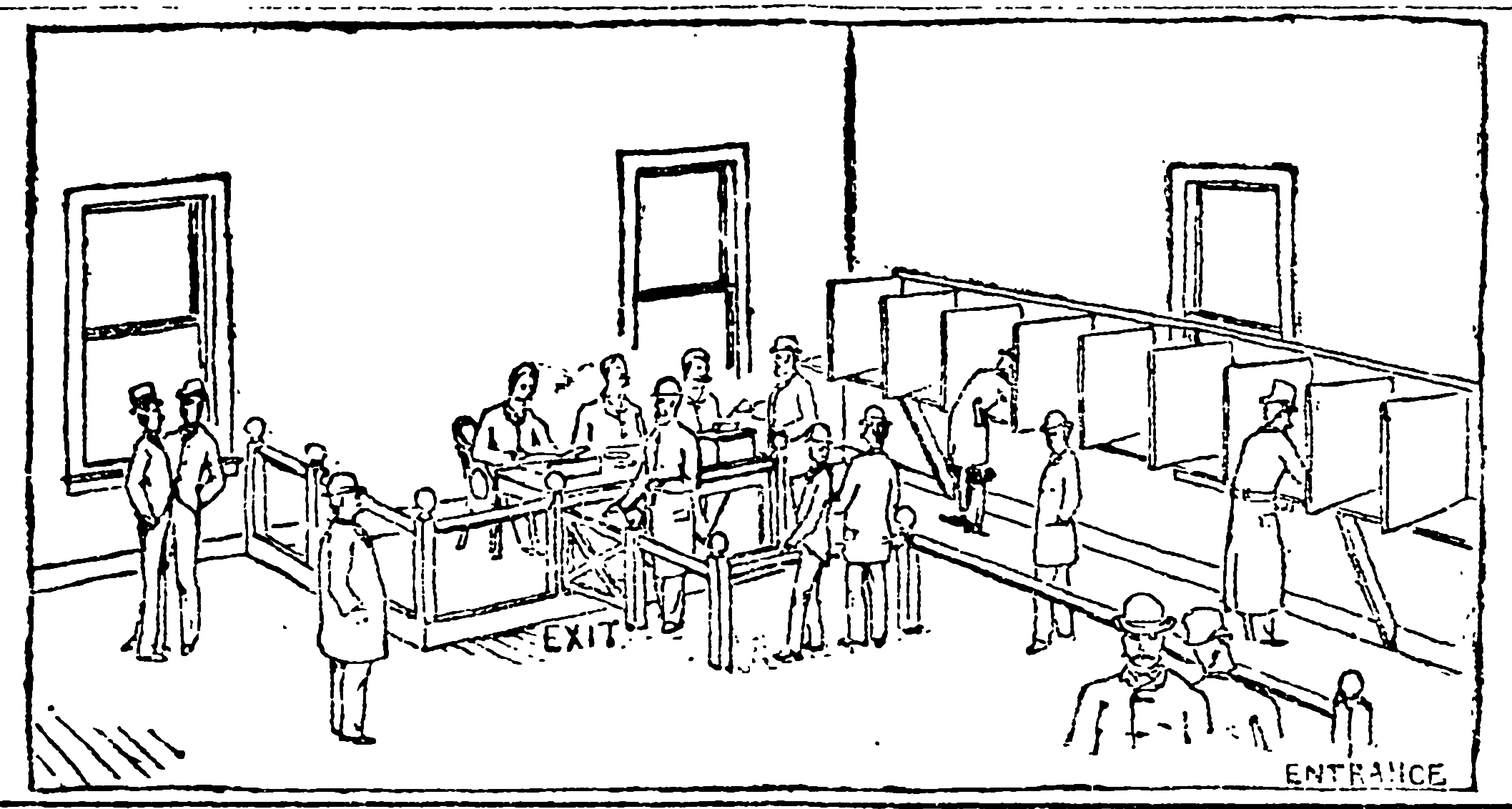
[Illustration (spans columns 3–4): interior of a polling place under the Australian system — at right a row of voting booths along the wall with voters inside and waiting; in the center a railed enclosure with election officers seated at a table with a ballot box; policemen and voters standing about. Labels in the drawing: “EXIT” (at the rail in the center), “ENTRANCE” (lower right corner).]
place, turns to his right at the point marked “ENTRANCE,” where he receives, from two election officers selected from opposing political parties, a single ballot or a single set of ballots according to the local custom of voting. On the back is indorsed a stamp or signature, sufficient and only sufficient to identify the ballot as official; and on the face are plainly printed the names of the candidates for each office, with a designation of their respective political parties, after this manner:
[Sample ballot, ruled table:]
| For Mayor. | Vote For One. | |
|---|---|---|
| Democratic, | John Doe. | |
| Republican, | Richard Roe. | |
| Prohibition, | David Smith. | |
| Independent, | Samuel Jones. |
| For Coroners. | Vote For Two | |
|---|---|---|
| Democratic, | Alanson Jacobs. | |
| Harvey Sylvester. | ||
| Republican, | Martin Rawson. | |
| Wyman Simpson. | ||
| Prohibition, | sic. | |
| Victor Sampson. | ||
| Independent, | Erastus Myers. | |
| Samuel Bixby. |
Having received his ballot the voter enters one of the booths back of the railing, where, secluded from observation, he prepares the ballot by placing in the blank column a cross opposite the name of each candidate for whom he desires to vote; or, if he prefers, by writing the names of candidates of his own nomination in place of those already there. If there are several candidates for the same kind of office, as coroners in the sample ballot above, or presidential electors, and he wishes to vote the “straight” ticket of his party, he places the cross under the name of the party, or draws it through the space in the blank column sic to the party’s candidates, which signifies that he votes for each candidate named in that space. Thus, in the sample ballot, a cross under the word “democratic,” or through the first two spaces of the blank column to the right, is one vote each for Alexander sic and Harvey Sylvester.
After preparing his ballot by indicating every candidate for whom he votes, the voter folds it in such manner as to conceal the face and expose the indorsement, and, withdrawing from the booth, gives the ballot to the inspectors, who identify it by the indorsement as official. It is then deposited in the box and the voter passes out at the gate marked “EXIT.”
From the time he receives his ballot until he casts it, the voter is permitted to have no communication with any one but the election officers, and with them only for official purposes; and only election officers and persons actually engaged in voting are ever admitted within the railing.
Upon proof of inability from physical infirmity or illiteracy, a voter may call into the booth officers appointed and sworn for the purpose, to aid him in preparing his ballot; and when a ballot is accidentally destroyed or defaced it may be exchanged for a clean one. The importance of the latter requirement may not at once be apparent; but to secure secrecy every ballot delivered to a voter must be either cast or returned. This explains the necessity for indorsing ballots. But for the indorsement a blank paper outwardly resembling a ballot might be cast by a voter, who would then be able surreptitiously to carry away an official ballot. This could be prepared for a bribed voter, the proof of its use being his production of a second official ballot. That could be similarly prepared and used, and so on. Such a fraud, known as the “Tasmanian dodge,” was successfully perpetrated in Australia in the early days of the system; but its repetition was prevented by requiring ballots to be officially indorsed.
As it is essential that ballots be printed p. 1, col. 4 at public expense and distributed by public officers, the system must include some mode of certifying nominations to the proper authorities a reasonable time before elections. That proposed by the Yates-Saxton bill of New York was perhaps as convenient as could be desired. Under it, state nominations were to be certified fifteen days, and local nominations ten days, before election; nominations of a political party which at the next preceding election polled three per cent of the whole vote were to be certified by party officers; and independent nominations, if for a state office were to be certified by a thousand voters and if for a local office by a hundred.
A brief explanation of the way in which this system effects its objects cannot anticipate or answer captious objections, but will be useful to candid inquirers.
Penal laws are ineffectual to prevent bribery and intimidation. The primary remedy is a secret ballot. And this is best secured when the only proof of an elector’s vote is his own uncorroborated assertion. Under the Australian system no other proof can be made. That fact gives to the most timid among dependent voters a sense of security which makes him free. And to bribery it is fatal. Bribers are not likely to invest money on the faith of a bribed man’s naked assertion; if there be such a virtue as “honesty among thieves,” it is not acceptable security to the thieves themselves.
But secrecy, though the primary remedy for bribery and intimidation, is not all that is required to purify elections, nor the only remedy the Australian system offers.
The printing and distribution of ballots is a most important part of election machinery, and, left to private enterprise, inevitably tends, as does the farming out of any other public function, to breed corruption and build up monopoly. It makes a necessity for irresponsible organizations which come to wield autocratic power over the political party they claim to serve, and in turn, through discipline almost military in severity, are dominated by an inner circle of “leaders.” As ballots can neither be printed nor distributed without money, and may not be faithfully handled unless trusty workers are rewarded with more than an election day stipend, the organization undertaking the work has a plausible if not reasonable claim for money from its beneficiaries and official patronage for its retainers. It is the necessity of raising these funds and employing these “workers” that justifies assessments, gives color of voluntary contributions to what in truth are sales of nominations, excuses the submission of official patronage to the distribution of the machine, provides ample cover for collecting a corruption fund, and, through “workers” at the polls, a convenient channel for disbursing the fund in bribes. And as corruption funds increase, masked in increasing demands for legitimate expenses, assessments grow, the price of nominations rises, independence is shackled, and the organization becomes more indifferent to party principle as its monopoly of political power strengthens. Born of the necessity of volunteer machinery for preparing and distributing ballots, it develops into a powerful instrument, which, in the hands of political jobbers, enables them to buy and sell office “as the Pretorians sold the Roman purple.” Already, poor men rarely obtain political advancement without assuming obligations to be redeemed by official perfidy, and the obstacles to unallied candidacy have become so great as often to prevent and always to discourage independent nominations.
This political monster would be destroyed by the Australian system. If the state assumed its function of providing ballots, there would be no necessity for “workers” at the polls, and the excuse for raising, as well as the best mode of using, corruption funds would disappear. Assessments could not then be levied upon candidates, for when “workers” at the polls are not required, machines can neither serve nor injure. Nor would nominations be sold; for when candidates stand upon an equality in respect to election machinery, and there is no opportunity for bribing voters, organizations merely as organizations, have nothing worth buying, while organizations as representatives of principles cannot be approached through commercial channels. Trafficking in office would be replaced by political discussion, the power of the machine by the voice of the party.
The evils of machine organization and the remedy of the Australian system, are p. 1, col. 5 summarized as follows by William M. Ivins, than whom no one has done more intelligent, energetic and effective work for electoral reform:
[Two-column comparison in small type; the numbered items are set side by side across the column. Given here as two lists.]
The Evil.
The necessity for voluntarily printing and distributing the ballot justifies organization for this purpose.
It practically vests the machine with the monopoly of the election machinery;
And, as a consequence, with the monopoly of nomination.
It involves the necessity of defraying the expenses of both printing and distribution by means of assessments on or contributions by candidates, office holders or party leaders,
Which facilitates bribery and corruption by affording them convenient covers.
The Remedy.
The printing and distribution of all ballots at public expense does away with the necessity of organization for this purpose.
And will deprive the political machines of the monopoly of an essential part of the election machinery.
It will enable anybody of sic of the number prescribed by law to have the name of their candidate printed on the same ballot with the names of all other candidates for the same office, so that before the law and before the voters all candidates and all party organizations will stand on a perfectly even footing.
This will dispense altogether with the necessity of and excuse for levying political assessments,
And leave no legal cover for bribery.
To this system it is objected that by requiring nominations to be made in advance of elections it denies a constitutional right of voters to select candidates from the whole body of voters. From such eminent authority as Judges Cooley, McCrary and Folger, and the highest courts of Pennsylvania, Massachusetts and New York, it may be safely inferred that a restriction of the franchise to candidates nominated a short time before election is a reasonable regulation and not an unconstitutional interference; but the inference is not necessary, since the system allows each voter to reject all candidates and write new names upon his ballot.
It is objected, also, that by requiring the blind and illiterate to expose their vote to election officers’ sic of the ballot is as to them violated. Under our present system voting is not secret; it was for that reason rejected by the British parliament and the Australian system adopted. The object now is to secure secrecy, but in aiming at that we are confronted with a class of voters to whom exposure of their ballots to somebody is necessary, and an exception must be made in their favor to prevent their disfranchisement. What form which shall be consistent with the highest degree of secrecy can that exception take? If allowed to carry their ballots away these voters fall into the hands of irresponsible and perhaps dishonest persons, and may be made, innocently or otherwise, instruments for perpetrating some form of the “Tasmanian dodge.” If, for their benefit, official ballots are generally circulated, all efforts for secrecy are frustrated. And if they are permitted to take a “friend” into the booth, a door is opened for the bribery of every venal voter who is, or can successfully pretend to be, unable to read English. Exposure of ballots must be prevented by every means that ingenuity can suggest; but in exceptional cases in which it cannot be avoided it may most safely be confided to election officers, who represent opposing parties, are under oath of secrecy and fidelity, can be readily detected in malfeasance, and when detected are liable to severe penalties. As to blind voters this seems to be the only course, but respecting the illiterate any exception to the general rule may be avoided by identifying the names on the ballots with numbers, or by printing them with inks of different colors.
There is reason to believe that the Australian system of voting is about to receive favorable consideration in all the states where election abuses have been seriously felt; but its adoption would so surely dispense with machine organizations that there is reason to fear attempts at essential modification. These are likely to be in the direction of allowing the delivery of ballots to parties and candidates before election, and distribution as well by “workers” at any time or place as by sworn officers at the polls. A little thought will show that this would continue the power of political machine and endanger secrecy. Any such modification no intelligent and sincere advocate of electoral reform can accept, for in this matter it is not true at this time that “half a loaf is better than no bread.” It were better that the reform be delayed with the force of public opinion pressing it forward, than that inefficient measures should allay public opinion by seeming to meet its demands. Details may be compromised, but essentials must be required at every step in the agitation. These are, that ballots containing the names of all candidates be printed at public expense; that one official ballot or set of ballots be delivered by sworn officers to each voter as he appears to vote; that the voter be immediately secluded for the purpose of preparing to vote; that he deliver his ballot to the inspectors so folded as to conceal its face and expose the official indorsement; that immediately after voting he withdraw from the secluded part of the polling place; that there be no intercourse with him except by election officers for official purposes from the time he receives his ballot until he votes; and that no voter be allowed to cast any ballot but the one he receives from the election officers.
LOUIS F. POST.
New York, November 26, 1888.
The big trusts do not intend to go out of business the next four years.—[St. Paul Globe.
p. 1, col. 6
WHY DEFEAT CAME.
Single tax men who can recall their own sensation one year ago, when our movement had apparently been overwhelmed by disastrous defeat, can appreciate the feelings of democrats over the defeat of Cleveland. In our own counsels there was difference and division. What to do next was a question that called forth a multitude of divergent answers. With hope and enthusiasm we had championed a principle that promised to remedy a great wrong to the masses, and we found that the very men whose good we had sought had turned their backs upon us.
Many earnest and thoughtful men in the democratic party are to-day similarly stunned and confused by unexpected defeat. They, too, have made a gallant fight against one of the delusions that blind the eyes of the masses to their own true interests and they find themselves defeated by the votes of those whose interests they had sought to serve. Many of them are even yet overwhelmed with despair and some of them say it is useless to make a fight in behalf of a great principle. Politicians of the baser sort and satanic newspapers, like the New York Sun, encourage this feeling and advise the democratic party to put aside all contact with the living issues of the present and appeal to prejudice, passion and greed in order to win back power and patronage. and they sic the party that until it adopts this course it can have no hope of success. Is this true? The question is a serious one to those of us who have aided the democratic party because it has championed a principle and who see no reason for desiring the success of that or any other party unless its triumph does advance principles in which we believe. I therefore propose to consider calmly and without prejudice, the probability of democratic success as the exponent of the doctrine of tariff reform as laid down in the president’s message of last December, and as a necessary preliminary I shall here review the events of the campaign of 1888.
After years of exclusion from power the democratic party barely achieved success four years ago in a contest replete with passion and prejudice, but singularly devoid of real principle. The responsibility of power forced the president thus elected to face a situation, from which there was no retreat if he was to perform his sworn duty. The enormous surplus piling up day by day in the federal treasury compelled the president to at least state the facts to congress and propose some plan for meeting a serious exigency. So far Mr. Cleveland had no choice. Necessity compelled him to speak. No mere doctrinaire enthusiasm moved him, and the whole tone of his message showed that he yielded with some reluctance to the pressure of events. But having determined to act, he proposed to solve the problem by legislation in accord with the traditional principles of his party. Had he done less he would have justly deserved the spoilsmen’s sneer at the quality of his democracy—a sneer that found concentrated expression in the spoilsman Hill’s declaration: “I am a democrat.” Mr. Cleveland was therefore bound to recommend that the problem of the surplus should be solved by reducing protective duties and adding to the free list. How little inclined he was, on mere doctrinaire grounds, to push the traditional doctrines of his party to the front was clearly shown in his declaration that: “It is a condition which confronts us—not a theory.” The whole tone of the message leaves on the mind of the careful reader the impression that had it not been for the “condition” the president would gladly have escaped the discussion of the “theory.”
The president having done his duty the democratic leaders of the house prepared to do their part. It is a known fact that a large number of the democratic members shrunk even more than the president from opening the tariff question. Fortunately, however, real democrats, like Mills, Carlisle, the two Breckinridges and others were in control of the party’s policy in the house, and they determined that the now inevitable bill should be framed on correct lines, however moderate its provisions. They, too, faced a “condition” rather than a “theory,” and the condition was the presence in their party of several nominal democrats in full sympathy with the republican views concerning a protective tariff. Everything that could be yielded was yielded to conciliate these men, and finally a measure was framed that secured the support of all who even pretended to any belief in the traditional principles of the democratic party. In its details the measure was moderate to a fault, but in principle it antagonized the protectionist theory.
Then began the great debate in the house. At once the “condition” was to a large extent lost sight of, and both parties found themselves plunged into a hot discussion of the “theory” of protection. All attempts to conceal this fact were soon abandoned. Mr. Butterworth’s declaration on behalf of the republicans that the contest was not over the details of tariff revision, but one that arose out of an “irreconcilable difference” between the two parties “as to the wisdom and justice of the protective system” was met by Speaker Carlisle, on behalf of the democrats, with the assertion that the contest was a fundamental one “between those who believe that the power of taxation should be used for public purposes only . . . and those who believe that it is the right and duty of the government to promote certain private enterprises and increase the profits of those engaged in them” through the exercise of its taxing power. The issue was thus clearly and unmistakably joined, and that issue continued on p. 2 →
[The article breaks off at the foot of the column; no continuation line is printed. It presumably continues on a later page.]
Page 2 of 6contents
2 THE STANDARD, SATURDAY, DECEMBER 1, 1888.
p. 2, col. 1 [continued from page 1: “WHY DEFEAT CAME.”]
← continued from p. 1 was not the “condition” of the surplus, but the “theory” of protection.
While the debate was still in progress the democratic national convention met. The renomination of President Cleveland was a foregone conclusion, but the machine politicians, who have so long controlled the democratic national organization, were on hand to prevent any clear cut declaration of the party’s principles as expounded by its leaders in the discussion in congress. They succeeded in securing a reaffirmation of the cowardly and ambiguous tariff plank in the platform of 1884, but were compelled to accept a clause making the president’s message the official interpretation of that plank. In so doing they unwittingly helped their opponents by authorizing an interpretation of the platform of four years ago that partially wipes out a disgraceful blot on the party,s otherwise unbroken tariff record. The victory of the reformers was made even more complete by the convention’s endorsement of the principles on which the Mills bill, sic pending, had been drawn. Thus far, a contest into which the democratic party had been reluctantly driven by the force of circumstances had, from a timid beginning, broadened more and more into a conflict of principles such as dignifies political parties and justifies their existence. The Mills bill passed the democratic house and was flung aside by the republican senate and the discussion so well begun in congress was transferred to the stump.
Now began the era of political management. The machine men who had sought to control the St. Louis convention succeeded in retaining their grip on the national committee. The blunder of 1880 was repeated. Then a campaign in behalf of Hancock was committed to a Tilden committee. Eight years later a campaign against protection was committed to a committee dominated by protectionists. The immediate result was alarm and timidity. Despite Carlisle’s bold acceptance of the challenge of Butterworth, the national committee was foolish enough to seek to conceal from the people the fact that the real issue was the indefinite continuance of the protective policy. In newspapers under the control of the national committee the president’s declaration that “It is a condition which confronts us—not a theory,” was paraded in bold type. Such newspapers insisted that the democratic party was not opposed to the protective idea. They sought to denude the contest of principle and reduce it to insignificance by showing that the reduction proposed by the Mills bill would not average over five per cent. One such paper even went so far as to garble the speeches of leading democrats and to cut out radical utterances that had called forth enthusiastic applause, in order to conceal the issue. At a county democracy mass meeting held in Cooper institute Senator Gray of Delaware made the principal speech, and he is thus reported by the Herald:
You have been told that the tariff is so intricate that a plain man cannot understand it. Who are telling you this? Those who are taking the money out of your pockets would be glad to have you think so. (Applause.) If it is intricate, then, in God’s name, let us do away with it altogether and have a system we can understand, (applause) and that we will know all about. (Cheers.)
Do the interruptions by applause and cheers of so radical a free trade utterance indicate that the national committee was right in supposing that such declarations would scare workingmen? Yet this is the way in which the Star, then controlled by employes of the national committee, under its close and immediate advice, pretended to report the same part of Senator Gray’s speech:
You are told that the tariff was too deep for you to understand it. The gentlemen who tell you that would only be too glad to be there themselves to look after it for you.
There are numerous instances that go to show that the national committee, while pretending to fear that “free trade” talk would alarm the workingmen, deliberately shut their eyes to abundant evidence that their pretended fear was unfounded, and it is impossible for any man familiar with all the facts to avoid suspecting that the real solicitude of the committee was for the feelings of the individual protectionists among its members—men whose devotion to protection arises from their own immediate pecuniary interests and not from any such sentiment in the communities they pretend to represent.
There are many other evidences of the persistency with which the committee sought to disguise and conceal the real issue unmistakably revealed to the country by the debate in the house. There is no question that they sought to muzzle speakers. I am credibly informed that in some localities they circulated the tariff plank of 1884 instead of that of 1888. Thurman’s great speech at Port Huron, vigorously attacking protection, was not printed promptly, and it was not widely circulated. Miserable demagogic appeals to the class prejudices of workingmen were scattered broadcast, and, for a little time at least, the hopes of democratic salvation were based on convincing farmers that the success of the republican policy of abolishing internal revenue taxes would remove the tax on oleomargarine. There was a positive screech of delight over the president’s retaliation message, and men close to the committee jubilantly declared that the new issue would cause the people to forget all about the tariff. The committee was ready to do anything with the tariff question but discuss it.
Yet what did it all amount to? The question discussed before the people was that on which Messrs. Butterworth and Carlisle so boldly joined issue in the house debate. It was the one question of the contest, and it would not down at the bidding of Mr. Barnum, Mr. Brice or anyone else. In the great commercial centers, before bankers and wholesale merchants, some attention was given to the dangers of the growing surplus, but before the masses speakers found themselves compelled to attack the protective policy or else concede that workmen
p. 2, col. 2 ought to vote for Harrison and protection. However a speaker started out, before he had spoken many times the burden of his argument was against the delusion that a tariff on goods enhances wages or protects labor. The fisheries treaty, the retaliation message, and even the sensational Sackville incident, all fell flat, and men would listen to nothing but talk about the tariff. One evening, after speaking from a truck, I got down and stood among the crowd. The speaker who followed me was handed a telegram, which he at once read aloud. It announced the dismissal of Lord Sackville. It did not produce even a ripple of excitement, and a workman near me clearly expressed the unanimous opinion of the crowd when he exclaimed, “Never mind England or Ireland; let us hear about the tariff.” Every man who spoke from these trucks, whether he is a tariff reformer, a free trader or a single tax man, will bear me out in the assertion that the crowds thus hastily gathered in the streets listened intently to tariff argument, and showed an intelligent interest in every detail of the discussion.
It was just such debate of the real issue before the masses that saved the democratic party from a much more disastrous defeat. Wherever workingmen, educated to think on economic subjects by their long struggle against oppression, and influenced to no small extent by their familiarity with single tax free trade literature, were found in large numbers, there the cause of tariff reform gained votes. Such men were not for a moment deceived by the stupid attempts of the national committee to hide the true issue. So far as those efforts had any effect they tended to drive workmen to the support of Harrison. To them there was in that canvass one question of supreme importance: “Does a protective tariff assure us better wages than we would otherwise get?” Those who believed it did voted against the party that proposed to reduce the tariff, and they would have voted against it whether the proposal was to reduce it seven per cent or seventy per cent. If tariff helped them they wanted all they could get of it, and they knew perfectly well which party would give them the higher tariff. Every effort by the democratic national committee to disclaim hostility toward protection merely caused such men to believe it had been caught in an attempt to injure them and was trying to lie out of it. They distrusted it all the more on that account.
Fortunately there is a large body of workmen whose observation and experience, during years of struggle against the class that insists on protection for its own special benefit, has caused them to doubt the value of the system to wage earners. These were the men who listened so eagerly to tariff discussions and, in the end, they voted for tariff reduction. They understood as well as any one the silly tactics of the national committee, but they were not alarmed by them. Their attitude was that of a man I once questioned as to why it was that he and his fellow jurors had given a manifestly just verdict in defiance of an adverse charge by an exceedingly stupid judge. “Oh,” he answered, “the judge hadn’t talked five minutes before we saw he didn’t know the first thing about the case, and we paid no attention to what he said.”
The democratic national committee never understood the first thing about the tariff issue as it presented itself to workmen. The “free trade” scare did not work where they had supposed it would be effective, among workingmen in the towns, and it did work, apparently, among the farmers over whom it was expected that it would have no influence. Of course many minor causes contributed to Mr. Cleveland’s defeat. The rage of disappointed office seekers against his civil service policy—a rage fed and fanned by Governor Hill and his friends—was one important factor in the result in New York. Revolt against boss rule in other states jeopardized democratic success. Bribery and intimidation played a not unimportant part, and yet the fact remains that, taking the country as a whole Mr. Cleveland failed of re-election to the presidency because of the failure of his party to educate the country up to his views on the tariff question in a single campaign. This is partly due to the natural difficulty of uprooting suddenly an error that has not been seriously assailed for more than a quarter of a century, and quite as largely due to the cowardice and bad faith of the protectionists who dominated the democratic national committee throughout the campaign. Such being the situation, the most interesting political question of the present is: “Can the democratic party ever carry the country on the issue of tariff reform?” Personally, I think this a debatable question, and I propose to consider it in the next issue of THE STANDARD.
WM. T. CROASDALE.
Up and At It in Detroit.
DETROIT, Mich.—As to the election in this state the results seem to point to a clear case of self-sacrifice on the part of the voters. In the mining regions of Lake Superior, in the lumber regions of the Saginaw and Grand rivers, and in the three counties most largely interested in wool raising, the democrats either elected their ticket or showed substantial gains; while in the counties not supposed to be in any way benefited by protection, the voters have piled up good round majorities for the good of the other fellows, who have become educated enough to try and save themselves, and the country generally, from that protection. We are not depressed here. The Young men’s democratic club have reorganized since election as the Young men’s political reform club, pledged to tariff and ballot reform, and the free trade republicans and independents will probably do likewise. Several single tax men belong to the above club, and you may depend upon it that no one who has seen the cat here will rest until its claws are thoroughly clipped and its tail amputated close behind its ears.
S. G. HOWE.
What Does It Mean?
That is probably what the man says who receives the postal card which some Toledo, O., single tax man is industriously putting into the mails. The card reads like this:
Toledo, O., Nov. 25, ’88.
THE SINGLE TAX WILL DO IT.
[Card reproduced within a dotted-rule border.]
p. 2, col. 3
WHAT WE SHOULD DO.
A. R. Wynn, Toledo, O.—I think Professor Hamlin Garland’s suggestions are all good—particularly the one about the sticker. I would suggest as an appropriate illustration for the sticker two roosters—one crowing and the other lying dead—with the inscription underneath, “Single tax did it. Single tax will kill land monopoly.” These stickers could be used on envelopes, newspapers, packages sent out by business men, or in public places, on fences, posts, or the like. I want a thousand as soon as they are got out.
John Cairns, Hartford, Conn.—I believe that the campaign just ended was one of the greatest if not the greatest educational campaign ever conducted in these United States—an education of a kind that should make every single tax man feel happy. Already I have met eight men who have expressed their sorrow for voting the republican ticket. They said they thought they were voting for protection to American industries, but when I exposed the falsity of the whole protective fake, as only a single tax free trader can do, they said they saw through the whole thing, and would vote for free trade principles next time. And so the good cause keeps making converts. I was surprised to see in THE STANDARD that Higgins, the carpet manufacturer, had got rid of half his help since election day. While I was in South Manchester, Conn., a few days ago, I learned that Cheney Brothers, also, silk manufacturers of that place, had got rid of a considerable part of their help since election day. On the afternoon the news reached South Manchester of Harrison’s election the works were stopped for three hours. All the operatives thought that of course they would be paid for their lost time; but they were mistaken. When one of the girls, whose house I happened to be visiting, came home, she was very much chagrined. She had been “docked” thirty cents, ten cents an hour for the three hours lost. She was doubtless more chagrined later on when the number of operatives was cut down.
Henry Sterling, Detroit, Mich.—I began talking single tax in the spring of 1887. I always found the subject to be distasteful to any sic. I was seldom snubbed, but single tax talk was received with an indifference that frequently approached contempt. Nevertheless talk I must, and talk I did. But the tariff agitation changed this completely, and there has been no lack of interested listeners for the last six months. Where I work there are about twenty-five voters, and among them just three democrats. Not one of the democrats pretended to understand much about the tariff question, and I had one end of the argument all to myself. I tried always to direct the talk toward single tax on land values and met with gratifying success. There is now scarcely one among my acquaintances who would not sign a single tax petition—at least on state issues. We need to be thankful for the issue the campaign was fought upon. It has done us more good then we dream of, and we have gained more by democratic defeat than the republicans have gained by victory.
F. W. Moore, Brooklyn.—What the single tax and free trade cause needs is individual work. It isn’t enough for us who are of the rank and file, to simply lend our presence to the movement, but we must labor to bring in new recruits. We can’t all be leaders and not many would want to be, but every man who believes that the laboring man does not receive justice in the distribution of the products of his industry has already pointed out to him the duty as well as the grand privilege of earnest work.
It is our work that must count—we who have never been heard from; we who are poor, with comparatively little time for study or speech making. Each man who feels himself in this position can be a power; and the work of all together must inevitably sweep with rapid strides towards the single tax and free trade. The more earnestly we advocate this cause the greater becomes our own intelligence; and the wider and more intensely we extend our sympathies the grander and truer becomes the solid religious foundation of our character. Let us use every righteous means to advance our cause; let our policy be to win adherents, not simply to get the best of them in an argument; let us incite people to think, to study. Now, just after the campaign, when we as well as our opponents are still warm to the subject, is the time to begin. If every true free trader, and a true free trader must be a single tax man, would get a few friends or acquaintances to meet once a week or once in two weeks to discuss these questions, to read a little, to get various points clear in his own mind as well as that of his friends, it would be of immense advantage to him personally while it would be sending forth shoots in every community and would be extending an intelligent appreciation of these questions which would be of incalculable advantage to the cause.
Let us put our hearts into the work; let us antagonize in so far only as it will awaken a desire to know more. Nothing perhaps would do more to stir a man to thought than to get him to pay a trifle for literature on the subject—a few months’ subscription to THE STANDARD would do an immense amount of evangelizing work—or get him to pay for a small book or pamphlet; this means practical work. Let us not be discouraged and however diffident we may feel on account of our own lack of knowledge we may feel sure of the greater ignorance of those who have voted to pay more taxes under the name of protection.
W. B. Steers, Englewood, Ill.—I find that we have advanced the cause of free trade and the single tax more than we could have possibly done by any independent action. Men who would not listen to us a year ago will now do so with eagerness. I find that a great many of my acquaintances who never considered what free trade or protection was before, have now come out for absolute free trade.
It would be a grand thing to have a lecture bureau in each of the large cities and keep agitating and pushing the single tax and free trade discussion all we can till 1892. Now is our opportunity. Let us begin at once.
John B. Young, Beaver, Pa.—I once heard a man say that there were more votes in a barrel of whiskey than there were in the “Ten Commandments,” and it is evident, from the facts and figures stated in THE STANDARD, that there are more votes in a barrel of money than there are in the whole bible. My opinion is, first, that we should work under cover, by organization and education, and not show our hands at any ballot box in any locality where we cannot carry the county; second, that we should have a small newspaper, one-fourth the size of THE STANDARD, that could be furnished weekly to every reformer at fifty cents per annum. Such a newspaper could easily be pushed up to a half million subscribers the first year. The three great monopolies of land, money and transportation could be briefly discussed in each issue sufficiently to put all our men upon inquiry after books, pamphlets and documents, which would give them a sound political education—and this would lead to a more extended circulation of THE STANDARD and other valuable anti-monopoly papers.
J. G. Galloway, Dayton, O., Nov. 18.—The result of the election has not affected the faith of single tax men in this region. Right onward, straight to the one great idea is the watchword. The Dayton Journal, a protection
p. 2, col. 4 sheet of this city, said the morning after election, “We will have to stop and look around to account for the large democratic gains in this city.” Mr. Williams, candidate for congress on the republican ticket, two years ago received 1,300 majority; this year he gets 415 and if the democrats provided a district committee, who would have listened to the appeals of workingmen for speakers on the wage question, Mr. Houk would have been the congressman from the Third district.
The little village of Miamisburg, twelve miles southwest of us has asked for a meeting of the free land club in this town, to explain the single tax and organize a club. It will be held next Sunday. The club here has commenced its weekly open meetings and will push things.
Theodore J. Werner, Newark, N. J.—Now that time enough has elapsed for us to estimate the result, it looks as if the democrats had lost the offices, the republicans had gained the offices, and the absolute free traders had won the fight for the only principle at issue. I have always, ever since I became convinced of the falsity of the doctrine of protection, felt that the great majority of the men that would make the winning fight for the single tax and real free trade in this country would come out of the republican party. I see that Mr. William Walter Phelps of this state is quoted as saying in an interview, that if the republicans will adjust the inequalities of the tariff they will remain in power twenty-four years, but if not, 1892 will see them turned out. If the G. O. P. will keep at the tariff till they adjust all the inequalities out of it, they will be in a fair way to get the fervent thanks of single tax free traders. It would take a microscope to see a tariff with no inequalities in it.
E. Norris, Boston.—Our first move should be in advocacy of appropriating land values for public purposes. Let the democratic party fight the free trade battle, and all join in who wish, while the radicals press the rightful claims of the government to the rental value of lands.
It can hardly be the proper order to say if we, society, can get our just dues we shall not need to collect money in any way from our citizens, therefore we should first drop this method of collecting taxes. I shall regret to see the now really great body of single tax men and women of the country turned from this great humane issue to that of free trade, an indirect issue. The resources of nature are tied up. They must be first freed, that the people may again come direct to their great inheritance. We must thrust out from our temples the money changers who buy and sell that which God has designed for a common good to his great family.
Ulysses Tanner, Cannon Falls.—After the battle it is in order to rub shins. I think a great fault of our government is the despotic power of the majority. I believe the best means to obtain perfection of government is to have a fair representation of all classes and opinions, in executive as well as judicial departments. Therefore, I now propose: First, that we work by concert of action in petitioning the powers that be. Second, that we insist on minority representation. Third, that we make the principle of the tontine insurance of universal application.
A Good Plan for a Spread the Light Club.
NEW YORK.—No safe convert is made by an hour’s argumentation—thousands have been won by an hour’s careful reading; therefore it is proposed that we organize “spread the light clubs” on the following plan: A number of the books written by Henry George are purchased. A blank is pasted in each book on which is printed:
“SPREAD THE LIGHT CLUB.”
——, Secretary, —— st., —— city.
This book is the property of the above club. We trust to the reader’s honor to obey the conditions upon which it is loaned to him.
When finished reading this book, please fill in the first blank space below with your name and address, and say whether you approve or disapprove of the author’s views; then transfer the book to a friend with the request to do as you have done—this circulating to be continued until ten readers have signed their names, address, etc. The tenth reader is requested to return the book to the secretary of this club.
This book has been placed in circulation by —— —— for the —— Spread the light club.
Name of reader. | Address. | Approve or disapprove of this book. ……………. | ……………. | ……………. ……………. | ……………. | …………….
(And so on up to ten spaces.)
If you agree with the doctrines expounded in this book and wish to help sic them communicate with the secretary and he will furnish you with all the necessary information.
Public meetings every —— evening at —— street. Informal debate open to all.
A memorandum should be kept of all books sent out, when and to whom, with space for ten names. When the book is returned, enter the names and addresses and send the readers tracts and copies of THE STANDARD until they too join in and help spread the light of the single tax.
Would also suggest that a monthly resume of the work done should be sent to THE STANDARD for publication.
BENJ. DOBLIN.
He Speaks as a Coal Miner.
WEST WARREN, Mass., Nov. 25.—If there is one class of workmen that need free trade more than any other, it is the men working in the anthracite coal fields. Every right thinking man knows that if the tariff was abolished coal would become much cheaper; consequently poor people would be able to buy more of it, with a greater consumption there would be a greater demand, which would insure to the miner steadier employment. That this system of protection protects the coal mine owners is shown by the millions they keep piling up. It enables them to combine and compel their slaves to eat to-day what they earn to-morrow, and as long as this state of things exists the outlook for the miner cannot be very promising. Two years ago I was a miner in the state of Pennsylvania, and therefore know the wrongs the coal producers receive from the hands of these protection monopolists—wrongs from which the slaves can get no redress. Their tyranny became so unbearable to me that I made up my mind that, sink or swim, survive or perish, I would work there no more. And neither I have. It does seem strange that workingmen will vote directly against their own best interests by voting the “protection” ticket.
WM. CHAPMAN.
About That Club House.
BROOKLYN, Nov. sic suggestion of Mr. A. J. Steers is a good one. Let us have a single tax club house in New York for a starter. If 500 members of a benefit organization in Brooklyn can build and maintain a $25,000 club house, surely the single tax men of the two cities can do more. If Mr. Steers will mature his plan, he can get help from this city, either on a tontine or a stock company plan.
G. W.
p. 2, col. 5
CONCENTRATE ON ONE STATE
And Raise a Single Tax School Fund to Support the Work.
HONEOYE, N. Y.—That the present plan of instructing the people in the single tax system is slow and discouraging, must be evident to all, and in my opinion it is largely owing to a lack of concerted and concentrated action. Would it not be well for our adherents to concentrate all their efforts for a short time on some one state, a state showing the least sic, a state so small that it would be within our means to give the inhabitants of every election district in the state a thorough understanding of the principles of taxation? We could then work as a majority or a large minority and would get respect and attention accordingly.
I assume that every believer in this principle of taxation is from the bottom of his heart desirous for a speedy trial of the system. Let us then raise a fund that shall be known as the single tax school fund by asking every adherent of the principle to contribute a nominal sum, say one dollar, this, if I mistake not, would raise in the aggregate a large fund. Then appoint a board of trustees to control the fund; this board to select some state of our union where the conditions such as size, closeness of vote, large latitude given in the organic law as regards taxation, are the most favorable. Then call for volunteers from out the ranks of single tax people, one for each township in the state selected, to act as teachers and to be paid from the fund their necessary expenses and a small personal remuneration; these teachers to be thoroughly examined by the board of trustees or by persons appointed by the board as to their qualifications and fitness for the position before they are sent to their field of labor, and then let the attack on that state be made simultaneously and earnestly with the full purpose and determination to make the people understand what is wanted.
To illustrate: Suppose Connecticut were the state selected. It has 167 townships. 167 volunteers would be called for and when examined and appointed they would each start a class in six election districts of their townships, giving one night a week to each. Teaching to be rudimentary. All references to party politics avoided, and scholars requested to ask questions. No election district class should be given up until the ground principles are thoroughly understood.
I believe that after two months of this kind of work in a state like Connecticut a memorial to the legislature could be circulated that would not only bring on a general discussion of the principle but its adoption.
VERITAS VINCIT.
A Reflection.
LOOKING BACKWARD.
Lo, the poor farmer, who, from wilds way back, Sees in “protection,” God; and hears him in the clack Of the whole mad, monopolistic crew, That in his sweat and blood their hands imbrue, Yet marvel much at his bucolic sense, The while they dance and feast at his expense.
Lo, the reformer of the tariff—bent On slight reform; an undefined per cent. And scarce disturbed by smell of nauseous fat That doth exude from saintly Foster’s hat, As ’long the line, among the thieving hive, It circulates to purchase—“blocks of five.”
LOOKING FORWARD.
Hail, the free trader, whose unerring ax Hews to the line of truth—“the single tax.” No quarter asks, the same to foe denies, His motto this—“With thieves no compromise.” Then nail your flag, free traders, to the mast; Yield ignorance, monopoly and caste!
Nov. 25. E. H. P., Providence, R. sic.,
“Written Sarkastic.”
SPRINGFIELD, Ill.—What blockheads we have been with our British free trade notions, and how the intelligent voters of the country have sat down on us; and you with your cranky notions on taxation as set forth in “Progress and Poverty” and “Protection or Free Trade?” have brought us to this pass.
Now, I have a plan which, in spite of the glamor of British gold, even you must see is just the thing for us. Let us abolish all forms of taxation, except customs duties, which we will make so high that they will yield an enormous surplus. Then we will divide the surplus equally among the people in the form of a pension to every citizen, amending the naturalization laws so that a foreigner must reside twenty-one years in this country to become a citizen. If the tariff does not yield sufficient surplus to give a handsome pension, we can levy an export tax, and the thing is done. The tariff and export tax are the two forms of taxation that the foreigner always pays, and so we would be killing two birds with one stone. We would keep our home market, and the foreigner would pay our taxes. Besides, indolent persons could live on their pensions, and thus leave the work for the industrious.
I think an independent party with such a platform would sweep the country and bury both the corrupt old parties. Of course you in your egotism will sneer at it; but the intelligent workingmen of the country that don’t belong to any labor organizations are in accord with it almost to a man.
The expenses of maintaining schools might be met by levying a license on saloons in the prohibition states; the other states would not need any schools.
I find your STANDARD quite interesting (though fallacious).
HENRY WALKER.
A Suggestion to Knights of Labor.
WARREN, Pa., Nov. sic protected monopolists of this country went to work and organized a great “American protective tariff league,” and then they poured out rivers of their hard earned money in getting their good man Harrison elected president of these United States. And why put themselves to all this great trouble? Bless you, haven’t they already told us why! It was all done because these kind hearted gentlemen are so intensely anxious to secure to American toilers the just fruit of their labor—the exact thing the Knights of Labor themselves want! Don’t you see? The knights ought to initiate these good monopolists into their order and make leaders of them; and right off, too.
A. G. BEECHER.
The Way to Get at Business Men.
ALBANY, N. Y., Nov. 23.—I would like to make a suggestion for the new campaign of education upon which we have entered. All who have ever engaged in the advocacy of real ideas will agree with me that condensation—short and pithy arguments—the crowding of much reasoning into a few words—is far more effective with the masses than long drawn homilies, however eloquent. I am a busy man myself, with little time to spare, and in the recent presidential dispute addressed a single brief, unanswerable argument to those whom I desired to reach, thus: Cheap goods make quick sales; quick sales create a demand for more goods; demand encourages production; increased production makes more work; more work requires more
p. 2, col. 6 men; the more men employed the less competition for places; the less competition for work (the greater scarcity of labor), the higher wages become. Free materials would enable the producer to start the big wheel (cheap goods) that would start all the others, and once started they must go on indefinitely.
This little argument, once understood, never failed in its effect where the man addressed was amenable to logic, and I flatter myself that I was thus enabled to show the free trade tail of “the cat” to a good many who had before imagined themselves invulnerable high tariffites. Condense, brothers; it saves time, labor and the taxing of careless and unretentive memories.
JOHN F. HART.
Important Advance in Passaic County.
PASSAIC, N. J., Nov. 22.—The effect of the two single tax meetings in Passaic during the campaign has been very great. Since the tax bills were distributed men have been discussing them as I never heard them discussed before. They are questioning the justice of taxing houses and other improvements and asking why they should pay as much tax on one or two improved lots as the speculator pays on an acre or more of vacant but equally valuable land. Many have said to me, “George is right. I never saw it in that light before.”
I feel safe in saying that a few more such single tax lectures as the two we have had would give us a strong hold on politics in Passaic and make us the leading party on election day. Our republican paper has not seen fit to print a single disrespectful word of the cause or those engaged in it since November 3. This is something new.
During the past two or three weeks I have been trying to find how men of both parties feel about the Australian method of voting and also about separating the land from the improvements on the assessment roll and all with whom I have spoken are in favor of both and willing to sign a petition. Of course I have not consulted speculators.
I am beginning to feel that our defeat will hasten the final result. Had Mr. Cleveland been elected we could hardly have got the single tax in operation soon enough to have prevented the hard times which seem certain to come upon us before 1892. With the republicans in power we can go on and secure the Australian method of voting, and get land and its improvements separated on the tax list so as to take advantage of the depression that protection must bring, to educate the masses. Hard times are great educators. Should wages continue to fall and times become dull about 1892, then, with the Australian method of voting and the single tax in operation in a few states, it does seem as though success would be certain.
O. D. WOOD.
Meeting of the Twenty-second District Club.
NEW YORK, Nov. 25.—The single tax men in the Twenty-second assembly district have formed a permanent club and have engaged rooms at 1,506 Second avenue, where an open meeting will be held every Thursday evening at 8 p. m. All single tax men are requested to come and join us in making the association a success.
ARTHUR FIEGEL, Pres. AUGUST SCHULTZ, Sec.
To Toledo Single Tax Men.
TOLEDO, Ohio, Nov. sic single tax friends please enter into correspondence with the undersigned for the purpose of devising means for organizing a single tax club in our city. Yours for the right,
A. R. WYNN, 319 Huron street.
THE NEW DEMOCRACY.
As the question of justice to Ireland will not be suppressed at the command of tory landlords, neither will the question of tariff reform be silenced at the dictates of monopolies, trusts and petted manufacturers. The discussion of it has only begun.—[Albany N. Y. Argus.
The way to discuss the tariff question is to advocate free trade and direct taxation. Aim at the bull’s eye and a little above it—sure.—[Exeter N. H. sic,
To go before the people with free trade on every democratic banner, and assure the people that on their account the intention is to reduce the protective tariff on manufactures as fast and as far as it can be done with safety, guided at every step by experience, until trade with other nations shall be carried on with unrestricted reciprocity, is the winning policy of the future, if the democracy will adopt it.—[Oswego N. Y. Palladium.
Destroy the curse of land monopoly, and all others must go with it. The coming labor struggle must proceed upon this line, and here will be fought the decisive battle for human rights.—[Dubuque, Iowa, Industrial Leader.
That the issue Mr. Cleveland made will go on gathering momentum and power, we verily believe, until four years from now there will be no question about protection being swept away.—[Farmington, Iowa, Herald.
We believe the democrats would have fought a stronger fight had they accepted the republican term of reproach as their battle cry. They could have suffered nothing worse than the defeat that apparently befell them Tuesday, and they would have laid the foundation for a successful fight four years hence, between the west and south, or producing states, under the banner of democracy, and the eastern, or money lending and tax eating states, under the banner of organized piracy.—[Evansville, Ind., Courier.
If labor gets its share of created wealth, why is it that a million men have been on strikes and lockouts in this country at one time? Any law restricting the trade of a country to its home market must necessarily reduce wages. This paper has always been soundly against the so-called system of protection.—[Rockville, Ind., Tribune.
The issue of tariff reform has come to stay. On it there will be no step backward. Its certain triumph is a mere question of time.—[New Jersey Unionist.
After Bull Run comes Appomattox; please give us the same time between the two that the Union generals required and we will show you the same result.—[Indianapolis Labor Signal.
The tariff agitation having been used by us to good advantage, we should now go to work within state lines for ballot reform and for the instruction of the people in single tax ideas.—[Deer Park Citizen (single tax).
The election was the voice of the people, spoken with emphasis. But in this emphasis there are ominous undertones which statesmanship, in the presence of communism, labor agitations and social perils everywhere, would do well to consider.—[N. Y. Herald.
The tariff is a tax. It is a tax that falls with special weight upon the masses of the people. It is a tax that builds up great monopolies, and is rapidly dividing this republic into classes of very rich and very poor. The imposition of this tax is a flagrant abuse of the powers of government, and a monstrous outrage upon the people. Sooner or later it must be wiped out.—[Indianapolis Sentinel.
The fight against the existing predatory tariff has now gained an impetus which will not be satisfied with a mere reduction of the surplus. Four years hence the fight will not be over the surplus, but over the system of taxing one man for the benefit of another. The democratic party will face the issue boldly, and with four years sic of education and experience, we believe that the American people will render the only verdict that will stand the test of truth and justice—a verdict that will sound the death knell of every tax-born monopoly in the republic.—[New York Evening Post.
Page 3 of 6contents
The Standard, Vol. 4, No. 22 (Whole No. 100), Saturday, December 1, 1888 — Page 3
THE STANDARD, SATURDAY, DECEMBER 1, 1888. 3
p. 3, col. 1
IN RHODE ISLAND.
TWO STRONG MOVEMENTS ON FOOT TO SHAKE THINGS UP.
Starting Out in Earnest for Ballot Reform—A Convention of Influential Business and Professional Men—Single Tax Men on the War Path, Too—To Hold a State Conference and Adopt Measures for Thorough and Systematic Work.
Preliminary steps for the winter campaign for ballot reform in Rhode Island were taken at the first regular meeting for the season of the Rhode Island ballot reform association at Providence, on Thursday evening, November 15, in room 15 of the Phœnix building, 129 Westminster street. There was a good attendance.
A committee of three was appointed to confer with the Rhode Island reform club and arrange for concerted action of the two associations. The reform club is an influential organization of well known business and professional men, formed during the presidential campaign, primarily for the purpose of furthering tariff reform, but incidentally committed to various other reforms, among them that of the ballot.
The petition blanks that had been circulated were reported to have been very generally signed, Mr. Alfred Dawson, the secretary, announcing that he personally had obtained over 400 signatures. It was decided to present these petitions to the legislature at its next meeting through the representatives of the district in which they were obtained.
Among those who spoke at the meeting were J. H. Banks, a colored democrat, and representative in the general assembly last year; E. C. Pierce, republican representative and author of the ballot reform bill; and Dr. L. F. C. Garvin, lately democratic representative.
The next meeting of the ballot reform association will be held at the same place on Thursday evening, Dec. 20.
The votes cast for the new suffrage amendment last spring, were counted Nov. 16, and its adoption officially declared, so that at the next state election in April, 1889, many foreign born citizens will for the first time have the right to vote in Rhode Island. A total of probably about 4,000 voters will be added to the voting population by this amendment. There were some doubts expressed as to the operation of the registry law under the new departure but the supreme court in answer to questions by the attorney general, rendered an opinion Nov. 24 that the present registry law covered the whole matter.
Thus successfully terminates the equal suffrage agitation in Rhode Island, which has had a most interesting history. The Equal rights club intend to have a banquet, December 6, at the Central hotel in Providence, to celebrate this victory, and to formally disband as an organization, now that their aims have been realized. The members, however, have all entered the new reform organizations, so that the era of agitation for them has not yet closed. It will be apparent then, that with an increased vote and with ballot reform secured in the near future, the facilities for political agitation will be much greater in this state than ever before.
—
And while we are thus active for electoral reform, we are not allowing the single tax idea to stop. A conference of enthusiastic believers was held in Providence on Friday evening, Nov. 16. The large attendance gave gratifying evidence of the strength of the idea in Rhode Island. Old men as well as young men traveled through the rain from all sections of the little state to be present, one enthusiastic participant having come a distance of forty miles.
The meeting was organized by the election of Dr. William Barker as chairman and Robert Grieve as secretary.
The proceedings were remarkable for that earnestness which characterizes a Methodist gathering when “the spirit is moving.”
After some discussion it was resolved to adopt the name of the Rhode Island single tax association, and to hold another meeting on Friday evening, November 23. Messrs. Louis Kranz of Providence, Dr. L. F. C. Garvin of Cumberland, and Edward Barker of Pawtucket, were appointed a committee to perfect organization and report at the next meeting. All present, with two or three exceptions, at once joined the new organization.
In the discussion many interesting facts were brought up, and as to “plans of campaign” preference seemed to prevail for the circulation of a petition to the legislature in behalf of the single tax and for the holding of public meetings at which men could be instructed.
Among those who addressed the meeting were Mr. Robert Grieve, president of the Pawtucket single tax club; Mr. David Harrower of Wakefield, a manufacturer and enthusiastic single tax sic; and Hon. James Charles Monaghan of Providence, who has United States sic to Mannheim, Germany, for the past four years. Mr. Monaghan said events were so shaping in Germany that the land question must soon be a great national issue there. He said, furthermore, that he had been a believer in Mr. George’s plan for years and his residence in Germany had gone to strengthen his belief, and also to show him clearly the absurdity of the protectionist cry of pauper labor.
Mr. Thomas Corscarden of New Britain made a telling speech. Mr. Corscarden was elected on the democratic ticket to the legislature at the last election, though the fact was generally known that he was a “Henry George crank.” He delivered a lively speech that made things bubble over with merriment and enthusiasm.
At the second meeting on Friday evening, November 23, there was even a larger attendance than at the former meeting. The committee on organization reported a constitution and by laws, which were partially adopted. The following officers were elected: President, Dr. Wm. Barker; vice-presidents, John Francis Smith of Providence, Dr. L. F. C. Garvin of Lonsdale and David Harrower of Wakefield; secretary and treasurer, George D. Liddell. The next meeting will be held at the same place on Thursday evening, Nov. 29, when the organization will probably be perfected.
Our men are thoroughly in earnest, and may be relied on for good work during the winter.
ROBERT GRIEVE.
The Two Kinds of Slavery.
HUTCHINSON, Kansas.—Thirty years ago the slaves were negroes, bought in Africa from some petty king of that country. They were brought over to this country and sold for about a thousand dollars per capita, mostly to cotton planters who built houses for them to live in, furnished them food and clothing and medical aid when sick. They cared for the aged and infirm. The slaves worked mostly out of doors in the good air, and were not overworked. They were taught something of the Christian religion and encouraged to hold religious meetings on Sundays. The owners had an interest in their welfare, and many of their owners were good, pious, Christian gentlemen.
Slaves now are mostly white people, brought from Ireland, Italy, Hungary, Poland and other European countries. They
p. 3, col. 2 are induced to come here by advertising this country as the land of freedom. Agents in those countries post bills offering great inducements to all willing to emigrate.
When they arrive here they are not sold but turned loose where they can find nothing to do and nowhere to live but in the streets. They wander about until they get tired and hungry, and are glad to hire for wages hardly sufficient to enable them to live, to go into the coal mines or into dusty factories to run looms or sewing machines. They work long, tedious hours for wages that do not clothe, shelter and feed them as well as the negro slaves fared thirty years ago.
They sell themselves every four years to politicians, some of whom are pious Christian gentlemen, teachers of Sunday schools, leaders of prayer meetings and main props in the Christian churches. These men buy them (for four years) at from two to ten dollars per capita on election days. It is said that the pious John Wanamaker of Philadelphia invested $200,000 in these slaves on the sixth day of this month.
The purchaser often turns his slave out of doors, takes no interest in him when hungry or naked, gives him no attention when sick, makes no provision for the infirm or aged, works them seven days in the week and fifteen hours per day.
The main cause of this latter kind of slavery is that the natural opportunities for making a living are nearly all monopolized by the rich who are holding them out of use to enable them to catch and hold those fellow beings, deprived of these natural opportunities, in slavery.
J. G. MALCOLM.
AN AMERICAN EVICTION.
Men, Women and Children Driven From Their Homes in Iowa at the Beginning of Winter—Heart Rending Scenes.
“It is not necessary to go to Ireland to witness the barbarism of evictions,” says the Fort Dodge, Iowa, correspondent of the New York Times, and then he proceeds to give a detailed account of the eviction of some settlers 30 miles south of Fort Dodge. The title to the lands on which they had settled is somewhat doubtful, as they are part of a grant to a navigation company which never did what it agreed to do in payment for them. Court decisions, acts of congress and acts of the Iowa legislature have helped to throw more doubt on the matter and the settlers thought it safe to locate on the lands.
But recently there appeared a man who held the title by inheritance from another man who held it by purchase from another man who was one of the stockholders of the company that didn’t do what it agreed to do. And this claimant has enforced his title in a summary manner. A United States marshal and posse of six men armed with Winchester rifles and revolvers and certain writs came down on the unhappy settlers last week and turned them out in the most approved Hibernian fashion. The settlers were small farmers who had occupied their places for from five to thirty years. Furniture and household goods were dumped out of windows; farm machinery was scattered on the roads; cattle and poultry turned loose to wander off, and human beings, American citizens, driven from their own houses, with winter close at hand.
One of the farmers was Chance Pigman, who had bought his farm from a man named DeWitt, who in turn had paid $1,800 for it. This Pigman had a comfortable two-story house, a stable, granary, corn crib and the appurtenances of a well kept farm. When the posse approached, Pigman said:
“Can’t you move some one else and give us a day to get ready? I have got a little boy I’ve had to set up with two nights. He’s croupy. I’m afraid it’ll kill him to carry him out in the cold.”
He went on to say that he had four children and one of them was a six weeks old baby. The marshal had already been in the house and looked into the condition of the family, with a view to the removal. He shook his head in reply to the farmer’s urging. “We can’t help it,” he said; “we’ve got to move you off the place.”
“Well,” said Pigman, who was a manly looking young fellow, “there ain’t no use of kicking, I reckon.” He began to climb down from his wagon, when his wife, a sprightly woman, but still pale from her recent illness, came out to where her husband and the officers were talking. “It don’t seem like the law would uphold moving off people where they are so poorly,” she said, alluding to the condition of her little ones. “It seems like they ought to let a person know it.” But getting no encouragement to talk further she went back to the house and commenced packing her dishes. Pigman was soon working as hard as anybody at his own eviction, stopping once in a while to comment on his hard luck.
Finally the house was clear. Pigman and his wife held a consultation about where they could find shelter for the night. They finally thought of somebody who didn’t live on river land, and who might take them in at least for the night. The woman and the babies were loaded into the spring wagon, and away they went two miles and a half through the frosty evening air to find shelter.
The sun had been down some time, and Pigman’s figure looked dim as he stalked away through the brush to watch over his household goods scattered along the roadside. As he was disappearing in the twilight he turned and in a choking voice said, “I don’t blame you boys, but it looks sic for a good man to be set out this way in a big free country like this.”
The Sort of Lawbreakers Protection Breeds.
Lewiston Journal.
After a few puffs from his cigar, a Bath man who is interested in shipping began an anecdote. “Captain,” said he, “that story of yours reminds me of something in about the same line in which I was interested. A friend of mine, who was master of a large ship, promised he would bring me home some excellent liquor on the next voyage he made, and he accompanied the promise by the boast that there would not be any duty paid on it, either. Well, I had not thought much about the matter until one day I noticed in a Boston paper that the ship bad arrived in port. But the next day’s issue of the same paper contained the interesting story of the manner in which the custom house officials discovered that about half of one of the spare spars which the vessel carried was hollow, and that the hole contained fifteen gallons of liquors. I never got my five gallons, and my friend got four months in jail, while the ship made the next voyage under the charge of the mate.”
A little, short man now took up the conversation and said: “I remember a pretty neat thing once, which was done in this very port only a few years ago by the captain of one of the ships of the Houghton fleet. He came across from Liverpool, and on the voyage he treated the sailors unusually well—so well, in fact, that when the captain asked twelve of them, shortly before going into port, to do him a little favor, they readily consented. The result was that when the ship was moored to the wharf those twelve sailors walked ashore, each with an imported leather shooting coat on under his own rough pea jacket. The captain followed them to a rendezvous, where the sailors divested themselves of the English coats. The captain ‘set ’em up’ all around several times and parted from his sailors like an old friend.”
No sooner had this anecdote been concluded than another old sea captain, rich and retired now, broke in quietly with, “Yes, that’s a good scheme, but it don’t always work. It didn’t when I tried it, anyhow. You see, I was in England and I bought a handsome shawl for my wife, who was not with me, paying £20 ($100) for it. When I got into New York I asked the stewardess of the ship if she would wear the shawl ashore for me. She said she would, and, putting it on, wore it over the side and out of the reach of the in-
p. 3, col. 3 spectors. I followed her ashore, but when I overtook her, well up town, the hussy refused to give the shawl back to me and threatened to call a policeman if I attempted to take the shawl from her. What could I do? I couldn’t prove the shawl was mine, and so I was obliged to stand there and see that woman walk off with a $100 shawl that I had written to my wife about. You may believe that I never tried anything in that line again.”
A hearty laugh went round at the captain’s expense, and as soon as it died away the mate of a large four masted schooner, now discharging in port, spoke up. “Two years ago,” said he, “I was mate of a large ship, with Captain S—— of this city as master. In Birmingham, England, one day, we both purchased silk umbrellas. They were very good ones, and we paid $12 apiece for them. We came across to New York, and after we had been in port a few moments the captain and myself started to go ashore. The day before I had removed the covering from my umbrella and wiped up all the dirt I could find in my room to make it look old. The captain had thought this precaution unnecessary, and we started ashore, I having mine all waving in the wind and the captain having his with a silk wrapper around it and done up in its original package as well. An inspector stood on the wharf, and as soon as we passed him he turned and followed us. He stepped up to the captain and took his umbrella away from him, and later in the day the captain was sic $25 for petty smuggling. A madder man I never saw.”
A Question of Compensation.
London Democrat.
A woman was charged before the magistrate at Westminster with having stolen a cloth dress valued at £5, which she had subsequently pawned for 15s. The owner of the dress not wishing to press the case, the woman was discharged. The question then arose, who was to have the dress? The magistrate directed that it should be given back to its rightful owner. “But why,” asked the pawnbroker, “should I lose all the money?” “You will have to give it up,” said the magistrate, “it is a risk pawnbrokers run. The sic thought it very hard that he should be made to restore the dress without compensation. Yet the dress was undoubtedly the property of the lady from whom it was stolen, and the thief having no title, either moral or industrial, to it, and no right to dispose of it, could not give the pawnbroker a right to keep it. People who in past times have bought land, or have lent money on land, are in precisely the same position. The land has been stolen from the people, and the thieves cannot transfer to others what they have not themselves, a valid title to. The agitation for land restoration is now widely advertising the fact that the people are the real owners of the land, and those who in the future buy land will be acting exactly like a pawnbroker who should take goods in pledge”well knowing,” or, at least, having a reasonable suspicion “that they were stolen.” In any case, the land must be restored to its true owners, the people. To talk of compensation is absurd.
ELECTORAL REFORM.
The threatening peril to the republic lies in the debauching of its voters by the corrupt use of money. The evil has grown rapidly of late years, and has now attained such gigantic proportions that a remedy must be applied at once or it will be too late.—[Cleveland Plain-Dealer (dem).
No fair minded man and believer in the sacredness of the ballot, will deny that reform is very necessary, and no election takes place but there are abundant evidences on every hand that the sooner some reform can be had, the better for the country.—[Big Rapids, Mich., Herald.
Other devices may be hit upon, but the main thing to be achieved is the secrecy of the ballot. That point attained, the system of bribery would languish rapidly.—[Newark Evening News.
Election reform is the question of the hour in Indiana.—[Indianapolis Sentinel.
So long as the ballot is open to the influence of the political thugs and heelers of election day, there can be no such thing as an honest expression of the will of the people. The secret ballot must come, and the Argus insists that Representative-elect Lacy shall do everything in his power to bring it about.—[Clinton, Ind., Argus.
Until our elections are made a registry of the honest sentiments of electors, instead of, as at present, a mere contest of boodle, it is useless to hope for or work for other great reforms. We will get honest legislation and pure government when we get honest elections, and not before.—[Indianapolis Sentinel.
The unprecedented employment of money for the purchase of votes by the republican party at the recent election, not only in the cities but throughout the rural districts in the doubtful states, has given a boom to the Australian electoral system, which provides the most complete safeguard against this species of corruption. Politicians will not buy a pig in a poke.—[Paterson, N. J., Guardian.
Voting is everywhere more or less vitiated by illegitimate influences, such as intimidation, political trades, and bribery. To these evils only preventive and punitive measures can be applied. The most effective means of prevention is some form of regulation for distributing and receiving ballots which shall preclude their manipulation by political workers and insure secrecy in depositing them.—[New York Times.
Ballot reform is one of the necessities of the immediate future in this country. It is a necessity, to stop the purchase of votes. The ballot must be secret, the voter must be removed from all chances of being overlooked and watched when depositing his vote, so as to take away all motive for the purchase of votes.—[Toledo Blade (rep.)
The mind of the country is moving in the matter of electoral reform, and it may be accepted as certain that an improved method of securing a free ballot and a fair count will be adopted before long in every State of the Union.—[Brooklyn Standard Union (rep.)
The democrats of Indiana are thoroughly aroused on the question of ballot reform. They demand radical action upon the subject from the new legislature, and we think they will not be disappointed.—[Indianapolis Sentinel (dem).
It is said that Governor Hovey will recommend the Australian system of voting in his first message to the legislature. This is sufficient to entitle the newly elected governor to the respect and hearty support of all good citizens. Let the people “spot” every member of the legislature who refuses to vote for the bill, and give him to understand that his name is Dennis when he asks for further political preferment.—[Rockville, Ind., Tribune (dem).
The agitation for ballot reform in New York, to which the Post has repeatedly called attention, appears to be growing rather than diminishing in strength with the continued consideration of the subject.—[Boston Post (dem).
There was no opposition to it (the Australian system) in this state two years ago that was not democratic. Now that the Free Press has changed from bitter oppositon to advoeacy, or at least tolerant consideration, the democratic opposition next winter, when it will again be considered, will, we trust, be considerably modified. But in any event, we confidently expect the bill to become law this winter, as democratic opposition in the approaching legislature will aid rather than retard any measure.—[Detroit Evening News (ind).
Just now the press with one accord and without regard to party is declaring that Indiana is in need of and must have a new election law. Year by year our elections are growing more and more corrupt, and the perpetuity and purity of the government demand heroic legislation.—[Lafayette, Ind., Journal.
p. 3, col. 4
AMONG THE SIBERIAN EXILES.
The Penalty for Importing Pernicious Books—A Magazine Editor in Exile.
The Century Magazine.
I met in Tomsk, for the first time, political exiles who had taken part in the so-called “propaganda” of 1872–75; who had been banished by sentence of a court, and who might fairly be called revolutionists. They did not differ essentially from the administrative exiles in Semipalatinsk, Ulbinsk and Ust Kamenogorsk, except that they had been longer in exile, and had had a much wider range of experience. One of them, a bright and talented publicist about thirty-five years of age, named Chudnofski, told me that he was arrested the first time at the age of nineteen, while in the university; and that he had been under police surveillance, in prison or in exile nearly all his life. He was held four years and three months in solitary confinement before trial, and spent twenty months of that time in a casemate of the Petropavlovsk fortress. For protesting against illegal treatment in that great state prison, and for insisting pertinaciously upon his right to have pen, ink and paper, in order that he might address a complaint to the minister of the interior, he was tied hand and foot and was finally put into a strait jacket. He thereupon refused to take food, and starved himself until the prison surgeon reported that his condition was becoming critical. The warden, Colonel Bogarodski, then yielded, and furnished him with writing materials, but no reply was ever made to the complaint that he drew up. He was finally tried with “the 193,” in 1878, upon the charge of importing pernicious books. was found sic and was sentenced to five years of penal servitude, with deprivation of all civil rights. In view, however, of the length of time that he had already been held in solitary confinement while awaiting trial—four years and three months—the court recommended to the Tsar that his sentence be commuted to exile in Western Siberia for life.
Most men would have been completely broken down by nearly five years of solitary confinement and seven years of exile; but Mr. Chudnofski’s energy and courage were invincible. In spite of the most disheartening obstacles, he completed his education, and made a name and a career for himself even in Siberia. He is the author of the excellent and carefully prepared history of the development of educational institutions in Siberia, published in the “Official Year Book” of the province of Tomsk for 1885; he has made two scientific expeditions to sic the Altai under the auspices of the West Siberian branch of the imperial geographical society; he has been an indefatigable contributor to the Russian periodical press; and his book upon the Siberian province of Yeniseisk took the prize offered by the Krasnoyarsk city council for the best work upon this subject. Mr. Chudnofski impressed me as a man who, if he had been born in America, might have had a career of usefulness and distinction and might have been an honor to the state. He happened to be born in Russia, and was therefore predestined to imprisonment and exile.
Among the most interesting of the newly arrived political exiles in Tomsk was Mr. Constantine Staniukovitch, the editor and proprietor of the Russian magazine Diello, whose history I gave briefly in an article upon “Exile by Administrative Process,” in the Century Magazine for September. He was a close and accurate observer of Russian social life, a talented novelist, a writer of successful dramas and a man of great force, energy and ability. His wife, who had accompanied him to Siberia, spoke English fluently with the least perceptible accent, and seemed to me to be a woman of more than ordinary culture and refinement. They had one grown daughter, a pretty, intelligent girl seventeen or eighteen years of age, as well as two or three younger children, and the whole family made upon us an extremely pleasant impression. Some of the most delightful evenings that we had in Tomsk were spent in their cozy little parlor, where we sometimes sat until long after midnight listening to duets sung by Miss Staniukovitch and Prince Krapotkin; discussing Russian methods of government and the exile system, or comparing our impressions of London, Paris, Berlin, New York and San Francisco. Both Mr. and Mrs. Staniukovitch had traveled in the United States, and it seemed not a little strange to find in their house in Siberia visiting cards of such well known American officers as Captain James B. Eads and Captain John Rodgers, a photograph of President Lincoln and Indian bead and birch bark work in the shape of slippers and toy canoes brought as souvenirs from Niagara Falls. We had not expected to find ourselves linked to political exiles in Siberia by such a multitude of common experiences and memories, nor to be shown in their houses such familiar things as bead embroidered moccasins and birch bark watch pockets made by the Tonawanda Indians. Mr. Staniukovitch was struggling hard, by means of literary work, to support his family in exile; and his wife, who was an accomplished musician, aided him as far as possible by giving music lessons. Their term of exile was three years, and if the government has not arbitrarily added a year or two, they will be free before the appearance of this article.
To me perhaps the most attractive and sympathetic of the Tomsk exiles was the Russian author Felix Volkhofski, who was banished to Siberia for life in 1878, upon the charge of “belonging to a society that intends at a more or less remote time in the future, to overthrow the existing form of government.” He was about thirty-eight years of age at the time I made his acquaintance, and was a man of cultivated mind, warm heart, and high aspirations. He knew English well, was familiar with American history and literature, and had, I believe translated into Russian many of the poems of Longfellow. He spoke to me with great admiration, I remember. of sic “Arsenal at Springfield,” and recited it to me aloud. He was one of the most winning and lovable men that it has ever been my good fortune to know; but his life had been a terrible tragedy. His health had been shattered by long imprisonment in the fortress of Petropavlovsk; his hair was prematurely white; and when his face was in repose there seemed to be an expression of profound melancholy in his dark brown eyes. I became intimately acquainted with him and very warmly attached to him; and when I bade him good-bye for the last time on my return from Eastern Siberia in 1886, he put his arms around me and kissed me, and said, “George Ivanovitch, please don’t forget us! In bidding you good-bye, I feel as if something were going out of my life that would never again come into it.”
p. 3, col. 5
[Columns 5 onward of page 3 not transcribed: the automated run was stopped twice by an API content check — transcribe by hand from the scan.]
Page 4 of 6contents
p. 4, col. 1 [Running head, printed page number 6:] 6 THE STANDARD, SATURDAY, DECEMBER 1, 1888.
MARKHEIM.
Robert Louis Stevenson in “The Broken Shaft,” Appleton, Publisher.
“Yes,” said the dealer, “our windfalls are of various kinds. Some customers are ignorant, and then I touch a dividend on my superior knowledge. Some are dishonest,” and here he held up the candle, so that the light fell strongly on his visitor, “and in that case,” he continued, “I profit by my virtue.”
Markheim had but just entered from the daylight streets, and his eyes had not yet grown familiar with the mingled shine and darkness in the shop. At these pointed words, and before the near presence of the flame, he blinked painfully and looked aside.
The dealer chuckled. “You come to me on Christmas day,” he resumed, “when you know that I am alone in my house, put up my shutters, and make a point of refusing business. Well, you will have to pay for that; you will have to pay for my derangement, when I should be balancing my books; you will have to pay, besides, for a kind of manner that I remark in you to-day very strongly. I am the essence of discretion, and ask no awkward question; but when a customer cannot look me in the eye, he has to pay for it.” The dealer once more chuckled; and then, changing to his usual business voice, though still with a note of irony, “You can give, as usual, a clear account of how you came into possession of the object?” he continued. “Still your uncle’s cabinet? A remarkable collector, sir!”
And the little pale, round shouldered dealer stood almost on tiptoe, looking over the top of his gold spectacles, and nodding his head with every mark of disbelief. Markheim met his gaze with one of infinite pity, and a touch of horror.
“This time,” said he, “you are in error. I have not come to sell, but to buy. I have no curios to dispose of: my uncle’s cabinet is bare to the wainscot; even were it still intact, I have done well on the stock exchange, and should more likely add to it than otherwise, and my errand to-day is simplicity itself. I seek a Christmas present for a lady,” he continued, waxing more fluent as he struck into the speech he had prepared; “and certainly I owe you every excuse for thus disturbing you upon so small a matter. But the thing was neglected yesterday; I must produce my little compliment at dinner; and, as you very well know, a rich mar riage is not a thing to be neglected.”
Then followed a pause, during which the dealer seemed to weigh this statement incredulously. The ticking of many clocks among the curious lumber of the shop, and the faint rushing of the cabs in a near thoroughfare, filled up the interval of silence.
“Well, sir,” said the dealer, “be it so. You are an old customer after all; and if, as you say, you have the chance of a good marriage, far be it from me to be an obstacle. Here is a nice thing for a lady, now,” he went on, “this hand glass—fifteenth century, warranted—comes from a good collection, too; but I reserve the name, in the interests of my customer, who was just like yourself, my dear sir, the nephew and sole heir of a remarkable collector.”
The dealer, while he thus ran on in his dry and bitter voice, had stooped to take the object from its place; and as he had done so, a shock had passed through Markheim, a start both of hand and foot, a sudden leap of many tumultuous passions to the face. It passed as swiftly as it came, and left no trace beyond a certain trembling of the hand that now received the glass.
“A glass,” he said, hoarsely, and then paused, and repeated it more clearly. “A glass! For Christmas! Surely not!”
“And why not?” cried the dealer. “Why not a glass?”
Markheim was looking upon him with an indefinable expression. “You ask me why not?” he said. “Why, look here—look in it—look at yourself? Do you like to see it? No! nor I—nor any man.”
The little man had jumped back when Markheim had so suddenly confronted him with the mirror; but now, perceiving there was nothing worse on hand, he chuckled. “Your future lady, sir, must be pretty hard favored,” said he.
“No,” said Markheim, with great conviction. “But about you. I ask you for a Christmas present and you give me this—this damned reminder of years, and sins, and follies—this hand conscience! Did you mean it? Had you a thought in your mind? Tell me. It will be better for you if you do. Come, tell me about yourself. I hazard a guess now, that you are in secret a very charitable man.”
The dealer looked closely at his companion. It was very odd, Markheim did not appear to be laughing: there was something in his face like an eager sparkle of hope, but nothing of mirth.
“What are you driving at?” the dealer asked.
“Not charitable?” returned the other, gloomily. “Not charitable; not pious; not scrupulous; unloving, unbeloved; a hand to get money, a safe to keep it. Is that all? Dear God, man, is that all?”
“I will tell you what it is,” began the dealer, with some sharpness, and then broke off again into a chuckle. “But I see this is a love match of yours, and you have been drinking the lady’s health.”
“Ah!” cried Markheim, with a strange curiosity. “Ah, have you been in love? Tell me about that.”
“I,” cried the dealer—“I in love! I never had the time, nor have I the time to-day for all this nonsense. Will you take the glass?”
“Where is the hurry?” returned Markheim. “It is very pleasant to stand here talking; and life is so short and insecure that I would not hurry away from any pleasure—no, not even from so mild a one as this. We should rather cling, cling to what little we can get, like a man at a cliff’s edge. Every second is a cliff, if you think upon it—a cliff a mile high—high enough, if we fall, to dash us out of every feature of humanity. Hence it is best to talk pleasantly. Let us talk of each other: why should we wear this sic. Let us be confidential. Who knows, we might become friends?”
“I have just one word to say to you,”
p. 4, col. 2 said the dealer. “Either make your purchase, or walk out of my shop!”
“True, true,” said Markheim. “Enough fooling. To business. Show me something else.”
The dealer stopped once sic, this time to replace the glass upon the shelf, his thin blond hair falling over his eyes as he did so. Markheim moved a little nearer, with one hand in the pocket of his great coat; he drew himself up and filled his lungs: at the same time many different emotions were depicted together on his face—terror, horror, and resolve, fascination and a physical repulsion; and through a haggard lift of his upper lip his teeth looked out.
“This, perhaps, may suit,” observed the dealer: and then, as he began to re-arise, Markheim bounded from behind upon his victim. The long, skewer-like dagger flashed and fell. The dealer struggled like a hen, striking his temple on the shelf, and then tumbled on the floor in a heap.
Time had some score of small voices in that shop, some stately and slow, as was becoming to their great age; others garrulous and hurried. All these told out the seconds in an intricate chorus of tickings. Then the passage of a lad’s feet, heavily running on the pavement, broke in upon these smaller voices and startled Markheim into the consciousness of his surroundings. He looked about him awfully. The candle stood on the counter, its flame solemnly wagging in a draught; and by that inconsiderable movement the whole room was filled with noiseless bustle, and kept heaving like a sea; the tall shadows nodding, the gross blots of darkness swelling and dwindling as with respiration, the faces of the portraits and the china gods changing and wavering like images in water. The inner door stood ajar, and peered into that leaguer of shadows with a long slit of daylight like a pointing finger.
From these fear-stricken rovings Markheim’s eyes returned to the body of his victim, where it lay both humped and sprawling, incredibly small, and strangely meaner than in life. In these poor, miserly clothes, in that ungainly attitude, the dealer lay like so much sawdust. Markheim had feared to see it, and, lo! it was nothing. And yet, as he gazed, this bundle of old clothes and pool of blood began to find eloquent voices. There it must lie; there was none to work the cunning hinges or direct the miracle of locomotion—there it must lie till it was found. Found! ay, and then? Then would this dead flesh lift up a cry that would echo over England, and fill the world with the echoes of pursuit. Ay, dead or not, this was still the enemy. “Time was that, when the brains were out,” he thought; and the first word struck into his mind. Time, now that the deed was accomplished—time, which had closed for the victim, had become instant and momentous for the slayer.
The thought was yet in his mind when, first one and then another, with every variety of pace and voice—one deep as the bell from a cathedral turret, another ringing on its treble notes the prelude of a waltz—the clocks began to strike the hour of 3 in the afternoon.
The sudden outbreak of so many tongues in that dumb chamber staggered him. He began to bestir himself, going to and fro with the candle, beleaguered by moving shadows, and startled to the soul by chance reflections. In many rich mirrors, some of home design, some from Venice or Amsterdam, he saw his face repeated and repeated, as it were an army of spies; his own eyes met and detected him; and the sound of his own steps, lightly as they fell, vexed the surrounding quiet. And still, as he continued to fill his pockets, his mind accused him, with a sickening iteration, of the thousand faults of his design. He should have chosen a more quiet hour; he should have prepared an alibi; he should not have used a knife; he should have been more cautious, and only bound and gagged the dealer, and not killed him; he should have been more bold, and killed the servant also; he should have done all things otherwise; poignant regrets, weary, incessant toiling of the mind to change what was unchangeable, to plan what was now useless, to be the architect of the irrevocable past. Meanwhile, and behind all this activity, brute terrors, like the scurrying of rats in a deserted attic, filled the more remote chambers of his brain with riot; the hand of the constable would fall heavy on his shoulder, and his nerves would jerk like a hooked fish; or he beheld, in galloping defile, the dock, the prison, the gallows, and the black coffin.
Terror of the people in the street sat down before his mind like a besieging army. It was impossible, he thought, but that some rumor of the struggle must have reached their ears and set on edge their curiosity; and now, in all the neighboring houses, he divined them sitting motionless and with uplifted ear—solitary people, condemned to spend Christmas dwelling alone on memories of the past, and now startlingly recalled from that tender exercise; happy family parties, struck into silence round the table, the mother still with raised finger: every degree and age and humor, but all, by their own hearths, prying and hearkening and weaving the rope that was to hang him. Sometimes it seemed to him he could not move too softly; the clink of the tall Bohemian goblets rang out loudly like a bell; and, alarmed by the bigness of the ticking, he was tempted to stop the clocks. And then, again, with a swift transition of his terrors, the very silence of the house appeared a source of peril, and a thing to strike and freeze the passer by; and he would step more boldly, and bustle aloud among the contents of the shop, and imitate, with elaborate bravado, the movements of a busy man at ease in his own house.
But he was now so pulled about by different alarms that, while one portion of his mind was still alert and cunning, another trembled on the brink of lunacy. One hallucination in particular took a strong hold on his credulity. The neighbor hearkening with white face beside his window, the passer by arrested by a horrible surmise on the pavement–these could at worst suspect, they could not know; through the brick walls and shut
p. 4, col. 3 tered windows only sounds could penetrate. But here, within the house, was he alone? He knew he was; he had watched the servant set forth sweethearting, in her poor best, “out for the day,” written in every ribbon and smile. Yes, he was alone, of course; and yet, in the bulk of empty house above him, he could surely hear a stir of delicate footing—he was surely conscious, inexplicably conscious, of some presence. Ay, surely; to every room and corner of the house his imagination followed it; and now it was a faceless thing, that yet had eyes to see with; and, again, it was a shadow of himself; and yet, again, behold the image of the dead dealer, reinspired with cunning and hatred.
At times, with a strong effort, he would glance at the open door which still seemed to repel his eyes. The house was tall, the skylight small and dirty, the day blind with fog; and the light that filtered down to the ground story was exceeding faint, and showed dimly on the threshold of the shop. And yet, in that strip of doubtful brightness did there not hang wavering a shadow?
Suddenly, from the street outside, a very jovial gentleman began to beat with a staff on the shop door, accompanying his blows with shouts and railleries in which the dealer was continually called upon by name. Markheim, smitten into ice, glanced at the dead man. But no! he lay quite still; he was fled away far beyond earshot of these blows and shoutings; he was sunk beneath seas of silence; and his name, which would once have caught his notice above the howling of a storm, had become an empty sound. And presently the jovial gentleman desisted from his knocking and departed.
Here was a broad hint to hurry what remained to be done, to get forth from this accusing sic, to plunge into a bath of London multitudes, and to reach, on the other side of day, that haven of safety and apparent innocence—his bed. One visitor had come; at any moment another might follow and be more obstinate. To have done the deed and yet not to reap the profit, would be too abhorrent a failure. The money, that was now Markheim’s concern; and as a means to that, the keys.
He glanced over his shoulder at the open door, where the shadow was still lingering and shivering; and with no conscious repugnance of the mind, yet with a tremor of the belly, he drew near the body of his victim. The human character had quite departed. Like a suit half stuffed with bran, the limbs lay scattered, the trunk doubled, on the floor; and yet the thing repelled him. Although so dingy and inconsiderable to the eye, he feared it might have more significance to the touch. He took the body by the shoulders and turned it on its back. It was strangely light and supple, and the limbs, as if they had broken, fell into the oddest postures. The face was robbed of all expression; but it was pale as wax and shockingly smeared with blood about one temple. That was, for Markheim, the one displeasing circumstance. It carried him back, upon the instant, to a certain fair-day in a fishers’ village; a gray day, a piping wind, a crowd upon the street, the blare of the brasses, the booming of drums, the nasal voice of a ballad-singer, and a boy going to and fro, buried overhead in the crowd and divided between interest and fear, until, coming out upon the chief place of concourse, he beheld a booth and a great screen with pictures, dismally designed, garishly colored; Brownrigg with her apprentice; the Mannings with their murdered guest; Weare in the death grip of Thurtell; and a score besides of famous crimes. The thing was as clear as an illusion; he had shrunk back into that little boy; he was looking once again, and with the same sense of physical revolt at these vile pictures; he was still stunned by the thumping of the drums. A bar of that day’s music returned upon his memory; and at that, for the first time, a qualm came over him, a breath of nausea, a sudden weakness of the joints, which he must instantly resist and conquer.
He judged it more prudent to confront than to flee from these considerations; looking the more hardily in the dead face, bending his mind to realize the nature and greatness of his crime. So little a while ago that face had moved with every change of sentiment, that pale mouth had spoken, that body had been all on fire with governable energies; and now, and by his act, that piece of life had been arrested, as the horologist, with interjected finger, arrests the beating of the clock. So he reasoned in vain; he could rise to no remorseless consciousness; the same heart, which had shuddered before the painted effigies of crime, looked on its reality unmoved. At best, he felt a gleam of pity for one who had been endowed in vain with all those faculties that can make the world a garden of enchantment, one who had never lived and one who was now dead. But of penitence, no, not a tremor.
With that, shaking himself clear of these considerations, he found the keys and advanced toward the open door of the shop. Outside, it had begun to rain smartly; and the sound of the shower upon the roof had banished silence. Like some dripping cavern, the chambers of the house were haunted by a faint incessant echoing, which filled the ear, and mingled with the ticking of the clocks. And, as Markheim approached the door, he seemed to hear, in answer to his own cautious tread, the steps of another foot withdrawing up the stair. The shadow still palpitated loosely on the threshold. He threw a ton’s weight of resolve upon his muscles, and drew back the door.
The faint, foggy daylight glimmered dimly on the bare floor and stairs; on the bright suit of armor posted, halbert in hand, upon the landing; and on the dark wood-carvings and framed pictures that hung against the yellow panels of the wainscot. So loud was the beating of the rain through all the house that, in Markheim’s ears, it began to be distinguished into many different sounds. Footsteps and sighs, the tread of regiments marching in the distance, the chink of money in the counting, and the creaking of doors held stealthily ajar, appeared to mingle with the patter of the drops upon the
p. 4, col. 4 cupola and the gushing of the water in the pipes. The sense that he was not alone grew upon him to the verge of madness. On every side he was haunted and begirt by presences. He heard them moving stealthily in the upper chambers; from the shop, he heard the dead man getting to his legs; and, as he began with a great effort to mount the stairs, feet fled quietly before him and followed gradually behind. If he were but deaf, he thought, how tranquilly he would possess his soul! And then again, and hearkening with ever fresh attention, he blessed himself for that unresting sense which held the outposts and stood a trusted sentinel upon his life. His head turned continually on his neck; his eyes, which seemed starting from their orbits, scouted on every side, and on every side were half rewarded as with the tail of something nameless vanishing. The four-and-twenty steps to the first floor were four-and-twenty agonies.
On that first story, the doors stood ajar, three of them like three ambushes, shaking his nerves like the throats of cannon. He could never again, he felt, be sufficiently immured and fortified from men’s observing eyes; the sole joy for which he longed was to be home, girt in by walls, buried among bedclothes, and invisible to all but God. And at that thought, he wondered a little, recollecting tales of other murderers and the fear they were said to entertain of heavenly avengers. It was not so, at least, with him. He feared the laws of nature, lest, in their callous and immutable procedure, they should pre serve some damning evidence of his crime. He feared tenfold more, with a slavish, superstitious terror, some scission in the continuity of man’s experience, some willful illegality of nature. He played a game of skill, depending on the rules, calculating consequence from cause; and what if nature, as the defeated tyrant overthrew the chessboard, should break the mold of their succession? The like had befallen Napoleon (so writers said) when the winter changed the time of its appearance. The like might befall Markheim; the solid wall might become transparent and reveal his doings like those of bees in a glass hive; the stout planks might yield under his foot like quicksands and detain him in their clutch; ay, there were soberer accidents that might destroy him; if, for instance, the house should fall and imprison him beside the body of his victim; or the house next door should fly on fire, and the firemen invade him from all sides. These things he feared; and, in a sense, these things might be called the hands of God reached forth against sin. But about God himself he was at ease; his act was, doubtless, exceptional, but so were his excuses, which God knew; it was there, and not among men, that he felt sure of justice.
When he had got safe into the drawing room, and shut the door behind him, he was aware of a respite from alarms. The room was quite dismantled, uncarpeted besides, and strewn with packing cases and incongruous furniture; several great pier glasses, in which he beheld himself at various angles, like an actor on a stage; many pictures, framed and unframed, standing with faces to the wall; a fine Sheraton sideboard, a cabinet of marquetry, and a great old bed, with tapestry hangings. The windows opened to the floor; but by great, good fortune, the lower part of the shutters had been closed, and this concealed him from the neigh bors. Here, then, Markheim drew in a packing case before the cabinet, and began to search among the keys. It was a long business, for they were many; and it was irksome, besides; for after all, there might be nothing in the cabinet, and time was on the wing. But the closeness of the occupation sobered him. With the tail of his eye he saw the door; even glanced at it from time to time directly, like a besieged commander pleased to verify the good estate of his defenses. But in truth he was at peace. The rain falling in the street sounded natural and pleasant. Presently, on the other side, the notes of a piano were wakened to the music of a hymn, and the voices of many children took up the air and words. How stately, how comfortable was the melody! How fresh the youthful voices! Markheim gave ear to it smilingly, as he sorted out the keys; and his mind was thronged with answerable ideas and im ages; church-going children and the pealing of the high organ; children afield, bathers by the brookside, ramblers on the brambly common, kite flyers in the windy and cloud navigated sky; and then, at another cadence of the hymn, back again to church, and the somnolence of summer Sundays, and the high genteel voice of the parson (which he smiled a little to recall), and the painted Jacobean tombs, and the dim lettering of the Ten Commandments in the chancel.
And as he sat thus, at once busy and absent, he was startled to his feet. A flash of ice, a flash of fire, a bursting gush of blood, went over him, and then he stood transfixed and thrilling. A step mounted the stair slowly and steadily, and presently a hand was laid upon the knob, and the lock clicked and the door opened.
Fear held Markheim in a vise. What to expect he knew not; whether the dead man walking, or the official ministers of human justice, or some chance witness blindly stumbling in to consign him to the gallows. But when a face was thrust into the aperture, glanced round the room, looked at him, nodded and smiled as if in friendly recognition, and then withdrew again, and the door closed behind it, his fear broke loose from his control in a hoarse cry. At the sound of this the visitant returned.
“Did you call me?” he asked pleasantly, and with that he entered the room and closed the door behind him.
But Markheim stood and gazed at him with all his eyes. Perhaps there was a film upon his sight, but the outlines of the newcomer seemed to change and waver like those of the idols in the wavering candlelight of the shop; and at times he thought he bore a likeness to himself; and always, like a lump of living terror, there lay in his bosom the conviction that this thing was not of the earth and not of God.
And yet the creature had a strange air of the commonplace, as he stepped in and
p. 4, col. 5 stood looking on Markheim with a smile; and when he added: “You are looking for the money, I believe?” it was in the tones of everyday politeness.
Markheim made no answer.
“I should warn you,” resumed the other, “that the maid has left her sweetheart earlier than usual and will soon be here. If Mr. Markheim be found in this house, I need not describe to him the consequences.”
“You know me?” cried the murderer.
The visitor smiled. “You have long been a favorite of mine,” he said; “and I have long observed and often sought to help you.”
“What are you?” cried Markheim; “the devil?”
“What I may be,” returned the other, “can not affect the service I propose to render you.”
“It can,” cried sic; “it does! Be helped by you? No, never; not by you! You do not know me yet; thank God, you do not know me!”
“I know you,” replied the visitant, with a sort of kind severity, or rather, firmness; “I know you to the soul.”
“Know me!” cried Markheim; “who can do so? My life is but a travesty and slander on myself. I have lived to belie my nature. All men do; all men are better than this disguise that grows about and stifles them. You see each dragged away by life like one whom bravos have seized and muffled in a cloak. If they had their own control—if you could see their faces, they would be altogether different, they would shine out for heroes and saints! I am worse than most; myself is more over laid: my excuse is known to me and God. But had I the time, I could disclose myself.”
“To me?” inquired the visitant.
“To you before all,” returned the murderer. “I supposed you were intelligent. I thought—since you exist—you would prove a reader of the heart. And yet you would propose to judge me by my acts. Think of it; my acts! I was born and I have lived in a land of giants; giants have dragged me by the wrists since I was born out of my mother—the giants of circumstance. And you would judge me by my acts! But can you not look within? Can you not understand that evil is hateful to me? Can you not see within me the clear writing of conscience, never blurred by any willful sophistry, although too often disregarded? Can you not read me for a thing that surely must be common as humanity—the unwilling sinner?”
“All this is very feeling sic,” was the reply, “but it regards me not. These points of consistency are beyond my province, and I care not in the least by what compulsion you may have been dragged away, so as you are but carried in the right direction. But time flies; the servant delays, looking in the faces of the crowd and at the pictures on the hoardings, but still she keeps moving nearer; and remember, it is as if the gallows itself was striding toward you through the Christmas streets! Shall I help you; I, who know all? Shall I tell you where to find the money?”
For what price?” asked Markheim.
“I offer you the service for a Christmas gift,” returned the other.
Markheim could not refrain from smiling with a kind of bitter triumph. “No,” said he, “I will take nothing at your hands: if I were dying of thirst, and it was your hand that put the pitcher to my lips, I should find the courage to refuse it. It may be sic, but I will do nothing to commit myself to evil.”
“I have no objection to a death bed repentance,” observed the visitant.
“Because you disbelieve their efficacy!” Markheim cried.
“I do not say so,” returned the other; “but I look on these things from a different side, and when the life is done my interest falls. The man has lived to serve me, to spread black looks under color of religion, or to sow tares in the wheat field, as you do, in a course of weak compliance with desire. Now that he draws so near to his deliverance, he can add but one act of service—to repent, to die smiling, and thus to build up in confidence and hope the more timorous of my surviving followers. I am not so hard a master. Try me. Accept my help. Please yourself in life as you have done hitherto; please yourself more amply, spread your elbows at the board; and when the night begins to fall and the curtains to be drawn, I tell you, for your greater comfort, that you will find it even easy to compound your quarrel with your conscience, and to make a truckling peace with God. I came but now from such a death bed, and the room was full of sincere mourners, listening to the man’s last words; and when I looked into that face, which had been set as a flint against mercy, I found it smiling with hope.”
“And, do you, then, suppose me such a creature?” asked Markheim. “Do you think I have no more generous aspirations than to sin, and sin, and sin, and, at the last, sneak into heaven? My heart rises at the thought. Is this, then, your experience of mankind? or is it because you find me with red hands that you presume such baseness? And is this crime of murder indeed so impious as to dry up the very springs of good?”
“Murder is to me no special category,” replied the other. “All sins are murder, even as all life is war. I behold your race, like starving mariners on a raft, plucking crusts out of the hands of famine and feeding on each other’s lives. I follow sins beyond the moment of their acting; I find in all that the last consequence is death; and, to my eyes, the pretty maid who thwarts her mother with such taking graces on a question of a ball, drips no less visibly with human gore than such a murderer as yourself. Do I say that I follow sins? I follow virtues also; they differ not by the thickness of a nail, they are both scythes for the reaping angel of death. Evil, for which I live, consists not in action but in sic. The bad man is dear to me; not the bad act, whose fruits, if we could follow them far enough down the hurtling cataract of the ages, might yet be found more blessed than those of the rarest virtues. And it is not because you have killed a dealer, but because your name is Markheim, that I offer to forward your escape.”
“I will lay my heart open to you,”
p. 4, col. 6 answered Markheim. “This crime on which you find me is my last. On my way to it I have learned many lessons; itself is a lesson, a momentous lesson. Hitherto I have been driven with revolt to what I would not: I was a bond slave to poverty, driven and scourged. There are robust virtues that can stand in these temptations; mine was not so, I had a thirst of pleasure. But to-day, and out of this deed, I pluck both warning and riches—both the power and a fresh resolve to myself. I become in all things a free actor in the world; I begin to see myself all changed, these hands the agents of good, this heart at peace. Something comes over me out of the past; something of what I have dreamed on Sabbath evenings to the sound of the church organ, of what I forecast when I shed tears over noble books, or talked, an innocent child, with my mother. There lies my life; I have wandered a few years, but now I see once more my city of destination.”
“You are to use this money on the stock exchange, I think?” remarked the visitor; “and there, if I mistake not, you have already lost some thousands?”
“Ah,” said Markheim, “but this time I have a sure thing.”
“This time, again, you will lose,” replied the visitor, quietly.
“Ah, but I keep back the half!” cried Markheim.
“That also you will lose,” said the other.
The sweat started upon Markheim’s brow. “Well, then, what matter?” he exclaimed. “Say it be lost, say I am plunged again in poverty; shall one part of me, and that the worst, continue until the end to override the better? Evil and good run strong in me, haling me both ways. I do not love the one thing; I love all. I can conceive great deeds, renunciations, martyrdoms, and though I be fallen to such a crime as murder, pity is no stranger to my thoughts. I pity the poor; who knows their trials better than myself? I pity and help them; I prize love, I love honest laughter; there is no good thing nor true thing on earth but I love it from my heart. And are my vices only to direct my life, and my virtues to lie without effect, like some passive lumber of the mind? Not so; good, also, is a spring of acts.”
But the visitant raised his finger. “For six-and-thirty years that you have been in this world,” said he, “through many changes of fortune and varieties of humor I have watched you steadily fall. Fifteen years ago you would have started at a theft. Three years back you would have blenched at the name of murder. Is there any crime, is there any cruelty or [meanness?], from which you still recoil? Five years from now I shall detect you in the fact. Downward, downward lies your way; nor can anything but death avail to stop you.”
“It is true,” he said huskily; “I have in some degree complied with evil. But it is so with all; the very saints, in the mere exercise of living, grow less dainty, and take on the tone of their surroundings.”
“I will propound to you one simple question,” said the other; “and as you answer, I shall read to you your moral horoscope. You have grown in many things more lax; possibly you do right to be so; and, at any account it is the same with all men. But granting that, are you in any one particular, however trifling, more difficult to please with your own conduct, or do you go in all things with a loose rein?”
“In any one?” repeated Markheim, with an anguish of consideration. “No,” he added, with despair, “in none! I have gone down in all.”
“Then,” said the visitor, “content yourself with what you are, for you will never change; and the words of your part on this stage are irrevocably written down.”
Markheim stood for a long while silent, and indeed it was the visitor who first broke the silence. “That being so,” he said, “shall I show you the money?”
“And grace?” cried Markheim.
“Have you not tried it?” returned the other. “Two or three years ago, did I not see you on the platform of revival meetings and was not your voice the loudest in the hymn?”
“It is true,” said Markheim; “and I see clearly what remains for me by way of duty. I thank you for these lessons from my soul; my eyes are opened and I behold myself at last for what I am.”
At this moment the sharp note of the door bell rang through the house, and the visitant, as though this were some concerted signal for which he had been waiting, sprang instantly upon his feet.
“The maid!” he cried. “She has returned, as I forewarned you, and there is now before you one more difficult passage. Her master you must say is ill; you must let her in, with an assured but rather serious countenance—no smiles, no overacting, and I promise you success. Once the girl within and the door closed, the same dexterity that has already rid you of the dealer will relieve you of this last danger in your path. Thenceforward you have the whole evening—the whole night, if needful—to ransack the the treasures of the house and to make good your safety. This is help that comes to you with the mask of danger.”Up!” he sic; “up, friend; your life hangs trembling in the scales; up and act!”
Markheim steadily regarded his counselor. “If I be condemned to evil acts,” he said, “there is still one door of freedom open—I can cease from action. If my life be an ill thing, I can lay it down Though I sic, as you say truly, at the beck of every small temptation, I can yet, by one decisive gesture, place myself beyond the reach of all. My love of good is damned to barrenness; it may, and let it sic! But I have still my hatred of evil; and from that, to your galling disappointment, you shall see that I can draw both energy and courage.”
The features of the visitor began to undergo a wonderful and lovely change; they brightened and softened with a tender triumph, and even as they brightened, faded and dislimned. But Markheim did not pause to watch or understand the transformation. He opened the door and went down stairs very slowly, thinking to himself. His past went soberly before him; he beheld it as it was, ugly and strenuous like a dream, random as chance continued on p. 5 →
[Text breaks off mid-sentence at the foot of the column; no continuation line is printed on this page.]
Page 5 of 6contents
THE STANDARD, SATURDAY, DECEMBER 1, 1888. 7
p. 5, col. 1 [continued from page 6]
← continued from p. 4 medley—a scene of defeat. Life, as he thus reviewed it, tempted him no longer; but on the further side he perceived a quiet haven for his bark.
He paused in the passage and looked into the shop, where the candle still burned by the dead body. It was strangely silent. Thoughts of the dealer swarmed into his mind, as he stood gazing. And then the bell once more broke out into an impatient clamor.
He confronted the maid upon the threshold with something like a smile.
“You had better go for the police,” said he; “I have killed your master.”
Typographical Errors.
Who is there, says the London Echo, that has any claim to the name of author that has not been shocked or amused, at some time or other of his existence, by the appearance in print of a word or a sentence that he has written, which, by the simple change of a letter, has turned perhaps a sublime thought into perfect nonsense? Of course, in newspapers, misprints of this character are to a certain extent excusable, and particularly when it is remembered how rapidly they have to be produced in order to satisfy the demands of a public ever clamoring for the “very latest.” Still, errors sometimes creep into the columns of our daily journals for which there is no accounting—hurry, bad “copy,” and everything else considered.
Sir Robert Peel was the victim of a misprint in the earlier part of the present century, which was contained in one of the most ludicrous announcements that ever appeared, perhaps, in a newspaper. Sir Robert was with a shooting party in Ireland, and the chagrin of the politician may be imagined when he read that “Sir Robert Peel and a party of friends are shooting peasants in Ireland.”
Speaking of Ireland, a curious blunder occurred the other day in an editorial on the all absorbing question, wherein it was intended to state that “a reduction of rents on a certain estate was to the tenants a matter of living and thriving—of life and death;” but the alteration of a couple of words made it read “a matter of lying and thieving,” and thus somewhat diverted the sense.
Poets just budding forth, of an unsuspecting nature, have suffered much from the confidence they have placed in overworked proof readers. What must have been the thoughts of the man who wrote
See, the pale martyr in a sheet of fire!
when he saw his effusion translated
See, the pale martyr with his shirt on fire!
Of course the error was discovered by some lynx eyed reviewers, with the result that the aspiring poet was momentarily extinguished. Burns has not escaped the misprint misfortune, for there is an edition of his works well known to book collectors which contains the line,
O gin my love were yon red nose!
This is an old substitution—the word “nose” for “rose”—a passage in one of the Christmas books a year or two since, relating that though young ladies sometimes affected, through coyness, a dislike to be kissed under the mistletoe, “they did not object to it under the nose.”
Misprints of substitution and omission are not the only errors poets have to reckon with. Pope had an addition made to [some?] abbreviations, which gave quite another color to their meaning. In a note in “Measure for Measure,” he gave as an authority “‘Cinthio,’ dec. 8, nov. 5,” meaning eighth decade and fifth novel. The abbreviations were distasteful to the printer, who altered the note thus: “‘Cinthio,’ December 8th, November 5th.”
Numerous other instances, just as ludicrous, might be given. For instance, where a railway train is described as running into a cow and cutting it into “calves” instead of “halves;” or a soldier is called a “bottle scarred” instead of a “battle scarred” veteran; or a lady is spoken of as having sung very sweetly Gounod’s “Avenue Maria” and a pianiste entranced her audience by her rendering of a celebrated symphony in “A Fat Major.” But these must suffice. One other form of error may, however, be mentioned, and this is that of mixing up two separate items of news in the same paragraph. An instance lately occurred. It read: “A large cast iron wheel, revolving 900 times a minute, exploded in that city yesterday, after a long and painful illness. Deceased was a prominent member of the local temperance association.
Printers, however, are only human, and have the same propensity to err as any other of their race. So, probably, thought Tom Moore, when, in his “Fudges in England,” he recounts where—
. . . To please my own aunt I had tried To commemorate some saint of her clique who had died. Having said, “he had taken up in heaven his position,” They made it, “he had taken up to heaven his physician.”
A request was once sent to rare Ben Jonson to revise some proofs full of typographical errors, but he respectfully declined, and recommended sending them to the house of correction. Many an author has wished an unfortunate proof reader there, no doubt, ere now.
A Connecticut Incident.
The attention of Hon. David A. Wells may may be called to the following facts regarding real estate taxation in his own state. The name of the town and the identity of the persons mentioned are not disclosed, but I will guarantee to furnish them if needed:
1880—Two building lots assessed for about $200 each, owned by Mr. A.
1884—The two lots are sold to Mr. B., whose father owns adjacent land, a house and barn. The assessors are given to understand that B., senior, has bought the lots, and, as the addition of their area does not make his plot over two acres (exempt by law), he pays no more taxes than before. B., junior, thus has two lots which he can hold vacant as long as he pleases without any expense whatever in the way of taxation, and the two lots are erased from the assessor’s list.
1885—B., junior, holds on.
1886—Ditto.
1887—He builds a double tenement, on exactly the same plans, giving the work to the same contractors as neighbor C., but paying $150 less than C. did because he allowed the work to be done in the winter when the carpenters were not busy. Cost of B.’s house, exclusive of the land, $3,100.
May, 1888—C.’s house, being very near the depot, on the main street, was rented by two families even before completion. B.’s house is half rented. No one at present seems to want the other half.
July—Two assessors, both farmers, one republican, one democratic, call on B.’s mother. She says B.’s house cost him $3,100 without the lots. Assessors look it over, admire its surroundings and plank it down on their list for $1,600. About half cost—the usual custom—the lots omitted from consideration under the two acre homestead exemption.
Later—B., who is a drummer, comes home. Hears of his assessment at $1,600. Guesses it’s about right. However, he calls on C. How much is C. assessed? Thirteen hundred dollars. B.’s gorge rises. His house cost less than C.’s, or at least no more, although he had expended more than C. on grading, etc. His house was only half rented; C.’s was full. C.’s tenants each paid one dollar a month more than he expected or asked. The location of C.’s house was much more valuable than his. He was assessed $1,600; C. only $1,300.
Same Afternoon—B. finds both assessors in a store down town. He pitches into them and fires off all the arguments he knows of why his assessment should be $100 at least less than that of C. A crowd collects and all seem to side with B. Assessors offer to reduce B. to $1,400, but he insists that he will be satisfied with nothing less than the same amount as C. Assessors go off.
Next Day—Word comes to B. that his assessment is $1,300, and he is satisfied.
GEO. WHITE.
p. 5, col. 2
QUERIES AND ANSWERS.
Land Tax and Income Tax.
PHILADELPHIA, Pa.—(1) Does not the single tax philosophy, in the case of an insufficiency for government purposes of the tax on land values, provide for a tax on incomes?
- Does Mr. George anywhere discuss this subject?
No; very few, if any, single tax men doubt the sufficiency for all expenses of government of the revenue to be obtained by the single tax. Many on the contrary think there would be far too much if the entire rental value of land were taxed away, and some of these, though single tax men, do not want to take the whole of this value.
Mr. George has declared himself as opposed to any taxing of incomes, and has shown in THE STANDARD that an income tax, although a direct tax, cannot be collected and is a premium on dishonesty.
Are Profits Just?
EAST ORANGE, N. J.—If a lock manufacturer has in his employ 800 men and pays an average wage of $18 per week, is this manufacturer robbing his employes if he is reaping a profit of $1,600 per sic. E. E. MARSH.
No; if he were robbing them and making unfair profits you would quickly see other men going into the lock making business, who would be content with fair profits and who would not rob their employes. Both the wages and the profits are determined (patents aside) by competition; only, land monopoly and other monopolies, by limiting opportunities, change fair competition into a cut throat struggle for existence.
Where to Find the Drawback Law.
DAYTON, Ohio.—Where is the “drawback law” to be found? I mean the full text.
J. G. G.
The drawback law is to be found in the United States revised statutes, sections 3,019, 3,020 and 3,026. It is called the drawback law because it entitles the American manufacturer, who has used foreign material on which he has paid a duty, to get back nine-tenths of the duty when the finished goods are exported.
High Wages and Cheap Goods.
NEW YORK.—What is the answer to the protectionist assertion that cheap goods mean cheap labor?
A SUBSCRIBER.
The answer is that the facts show the reverse. England, which pays the highest wages of any European country, makes the cheapest and best goods, taking all manufactures into consideration. Articles made with the help of machinery are cheaper than hand made articles, but the places where machinery is invented and used most are invariably the places where wages are highest.
[Schoenhof?] and others have furnished many facts which go to prove that the American workers in metal and textile industries, although they receive more wages than workers abroad, yet do more work in proportion to the wages they receive than the foreign workers do. That is, they produce goods cheaper. The reason the goods do not sell cheaper is on account of the dear materials and the monopoly of the market.
Is the Tariff Added to the Price?
ORANGE, Mass.—Is it true that articles manufactured here are sold to the consumers with the import duty added to the costs, and that, when exported, the foreign consumer has the advantage of being free from this addition?
Name a few instances.
H. W. HAMMOND.
The tariff tax, sometimes the whole tax, at other times in part, is added to the price of goods. Home competition often prevents manufacturers or producers from adding more than a small part of the duty. The fact that almost every American who returns from a trip abroad tries to smuggle in as many foreign articles as he can, and those mostly necessaries such as are made here and not mere foreign oddities and nic nacs, is a proof that necessaries cost more here on account of the tariffs.
John H. Allen, a merchant, author of “The Tariff and its Evils,” shows that the American consumer pays the following rates in excess of the English consumers:
For soap he pays 25 per cent more, crockery and glass ware 65 to 115 per cent more, window glass 95 per cent more, wool hats 50 per cent more, mixed woolen goods 78 per cent more, etc., etc., etc. These figures are made up mostly from recent actual transactions.
In some cases our producers sell their articles abroad for less than they do here. For instance the Disston (Philadelphia) manufacturing company’s hardware is sold cheaper in Mexico than in the United States. It is said there are other articles of which the same is true, but no proof of the statements is at hand.
W. B. SCOTT.
About Cotton sic,
NEW YORK, Nov. 26.—The “Queries and Answers” column is not often wrong, but its comment this week on my remarks about cotton manufacture, are not, to my mind, conclusive. The matter is not in itself, perhaps, worth disputing; but we are busy educating just now, and it is all-important to our work for the next few years that we should educate aright and furnish our people with ammunition which will not miss fire. Now, here is an anomaly that has puzzled many a free trader, and even did important service for the republicans in the last campaign as an illustration of how, under the most favorable conditions, we cannot compete with foreign nations, and must therefore protect our manufacturing industries if we are to retain them at all. Raw cotton is cheaper here than abroad, by the difference in ocean freights; and very careful computations by free trade statisticians have demonstrated that our cotton operatives work for lower wages than foreign operatives. Protectionists say that either our figures are wrong or that some mysterious cause exists to increase the cost here of making cotton goods. It will not do to answer this with the bold assertion that we can manufacture as cheaply and do not export only because, as a whole, this nation will not trade with others. However true that might be of our people in the aggregate, individual spinners would certainly seek out foreign markets to sell in if they could do so at a profit. Nor is it correct to say that high prices paid for machinery account for the discrepancy, and that they constitute an especially heavy handicap because they involve the disbursement of a large lump sum. p. 5, col. 3 Manufacturers do not count such a payment as a part of the cost of their goods in the year when it is made; but treat it properly as an investment, the interest only on which each year has to be charged as part of the goods cost, together with allowance for wear and tear. And yet, when these considerations are put aside, our cotton goods still cost more than English makes, and just enough more to keep us out of the field of free competition. Just what the difference is, I am not prepared to say, for I have never examined all the figures, and partial figures are useless. It was not of my own knowledge, but on the authority of a large cotton manufacturer that I spoke, when I said that the difference against us in cost was only on bleached and print goods, and that it consisted principally in higher priced bleaching powders and dyestuffs. As there must be very little else than these articles in cotton goods besides the cotton, it is quite probable that all of the $15,000,000 which you say was spent for “other material,” went in this way, and that your estimate of two per cent extra cost added by tariff on dyestuffs was correct. Two per cent is about four times the margin which allows or forbids competition in any market for almost any staple article. Then as to the other figures you give, those relating to exports are again incomplete, because they give values only, and not quantities. The bleached goods are the cheaper, not only because bleaching and printing require a little additional material, but because also they involve considerably more labor. So, even if your estimate is correct, that of our very small total exports, half were unbleached and half more highly finished, reckoning by values only the unbleached goods would be a good deal more in quantity.
EDWARD J. SHRIVER.
More About Cotton.
NEW YORK, Nov. 26.—Reading Mr. E. J. Shriver’s communication and your answer, published in THE STANDARD of the 24th inst., prompts me to contribute a word on exports of cotton manufactures.
It seems to me that there is little or no reason why we should not compete successfully with England or any country on the face of the globe, so far as prices are concerned, in supplying the markets of the world with cotton goods—especially white—and I am of the opinion that the reasons why we do not export cotton wares much more largely, are involved in the tariffs, beyond the mere matter of exchange which they limit or prohibit. It seems to me that exports of cotton goods are greatly curtailed by the high prices of other manufactures which are made dear by protection. Let us suppose a merchant in South America, Africa, Asia or elsewhere desires to purchase ten articles by order, and on account of our high prices for many of them, due to our protective tariffs, he is compelled to send to England for nine, eight or even seven of them, or any portion the prices may dictate, the order for the few articles of cotton he could buy in America at the same price, quality, etc., being equal, naturally go along with the rest of the order to England. Such merchants will not divide their orders and send the minor part to a new market without some great inducement in price. The conclusion is that, if we wish to increase our cotton exports to an extent commensurate with our capacity to produce at competing prices, we must put ourselves in a position to sell our other principal manufactures as cheaply as England; or to control any considerable portion of the world’s markets for specialties, we must sell such specialties considerably cheaper than England or those countries which, under our protected prices, are in a position to defy American competition in furnishing the great majority of manufactured necessities.
WALTER CARR.
The Philadelphia Record Can Answer Questions Almost as Well as The Standard.
The following query and answer appeared in the Philadelphia Record of November 21:
“Is the density of population of civilized countries a factor in making the price of labor in such countries?
“For example: If in a country like Great Britain and Ireland a hundred thousand acres of land could be thrown open to settlement, would it not result in making higher wages and better living to workers of all classes, without regard to tariff?
T. J. O.
“Middletown, Pa., Nov. 19.”
As population increases the necessity of more land from which to obtain sustenance is apparent, and the cheapness or dearness of land has a direct bearing upon the rate of wages. The cheap land in the United States is the chief factor in sustaining the rate of wages, is the poor man’s resource, and the only resource which cannot be taken away from him. The tariff has nothing to do with sustaining the rate of wages in any country.
Only an Exaggeration of the Truth.
St. Paul Pioneer Press.
Family man—What is the rent of this house?
Renting agent—What salary are you getting a month?
Family man—One hundred and ten dollars.
Renting agent—Well, that will be the rent.
[Advertisement] Scott’s Emulsion
WHY YOU SHOULD USE
Scott’s Emulsion
OF Cod Liver Oil WITH
HYPOPHOSPHITES.
It is used and endorsed by Physicians because it is the best.
It is Palatable as Milk.
It is three times as efficacious as plain Cod Liver Oil.
It is far superior to all other so-called Emulsions.
It is a perfect Emulsion, does not separate or change.
It is wonderful as a flesh producer.
It is the best remedy for Consumption, Scrofula, Bronchitis, Wasting Diseases, Chronic Coughs and Colds.
Sold by all Druggists.
SCOTT & BOWNE, Chemists, N.Y.
[Advertisement] The Single Tax Military Band and Orchestra
THE SINGLE TAX MILITARY BAND AND ORCHESTRA.
JAMES BEGGS, DIRECTOR.
Music Furnished for All Occasions. Address 154 SEVENTH AVENUE, BROOKLYN.
[Advertisement] Holland’s
HOLLAND’S COFFEE AND DINING ROOMS,
[143?] Fourth avenue,
Bet. 13th and 14th sts.
[Advertisement] Mrs. Agatha Munier Atkins
MRS. AGATHA MUNIER ATKINS WILL continue to receive pupils in solo singing and vocal sight reading at her residence. [223?] E. 32d street, New York.
[Advertisement] Wanted—Agents
WANTED—Agents for the Milward’s Calyx-eyed, Self-threading Needle; preserves failing sight, a help to good sight. Perfect bonanza for canvassers; sample package 10 cents. Send for circular to headquarters, STANER & CO., Providence, R. I.
p. 5, col. 4
[Advertisement] Belford’s Magazine
BELFORD’S MAGAZINE.
Edited by Donn Piatt.
Published monthly and devoted to literature, politics, science and art.
A complete long novel in each number.
The publishers of BELFORD’S MAGAZINE recognizing the fact that “revolutions never go backwards,” have nailed the colors of TARIFF REFORM to the mast and “prepare to fight it out on this line” until the uninformed are educated up to the truth, that “unnecessary taxation is unjust taxation.”
The well known reputation of the editors, is a guarantee that BELFORD’S MAGAZINE in all its departments will be kept up to a high standard, and that the monthly bill of fare, set before its readers, will be alike welcome in the home, the office and the workshop.
Subscription price, $2.50 a year; 25 cents a number.
Subscriptions received by booksellers, newsdealers and postmasters everywhere, or remit by P. O. order, bank check, draft or registered letter.
Sample copies sent to any address.
New volume begins with the December number.
SPECIAL RATES TO CLUBS.
BELFORD’S MAGAZINE
New York.
[Advertisement] Belford, Clarke & Co.: New Books
NEW BOOKS.
The Tariff on Imports Into the United States, and the Free List,
As contained in act of March 3, 1883, also the Hawaiian Reciprocity Treaty, and extracts from the Navigation and Oleomargarine acts. Indexed. 12mo. Paper covers, 25 cents.
A most useful book. In a moment you can find the exact tax on any article imported into the United States, and the names of everything on the free list. Invaluable to editors and all interested in the great tariff question now so freely discussed.
An Appeal to the American People as a Jury.
SPEECHES ON THE TARIFF delivered in the House of Representatives in the great debate, April 17—May 19, 1888. SPECIALLY SELECTED FROM BOTH SIDES. Carefully revised and published by authority. Compiled by William G. Terrell. Large 12mo. cloth, $1; paper, 50 cents.
The Protective Tariff; What It Does For Us.
By General Hermann Lieb. Fourth edition, with revisions and additions. 12mo. Cloth, $1.00. THE PRESS UNANIMOUS IN ITS PRAISE.
The Professor’s Sister.
A Novel. By Julian Hawthorne. Author of “A Dream and a Forgetting,” etc. Cloth, $1.00. Paper, 50 cents.
The Mapleson Memoirs—1848-1888.
By John H. Mapleson. With a Portrait of the Author. 2 vols. 8 vo. Cloth, $4.00.
Divided Lives.
A Novel. By Edgar Fawcett. Author of “The Ambitious Woman,” “The False Friend,” “A Hopeless Case,” “Tinkling Cymbals,” etc. Cloth, $1.00. Paper Covers, 50 cents.
A Friend to the Widow.
By Maja Spencer. Author of “Calamity Jane,” “A Plucky One,” etc. Cloth, $1.00. Paper Covers, 50 cents.
The Veteran and His Pipe.
By Albion W. Tourgee. Author of a “Fool’s Errand,” etc. Cloth, $1.00.
A Boston Girl.
At Boston Bar Harbor and Paris. Paper Covers, 50 cents.
Carlotta Perry’s Poems.
12mo. Cloth, $1.00.
Kady.
A Novel. By Patience Stapleton. Cloth, $1.00. Paper Covers, 50 cents.
Swedish Folk Lore.
By Herman Hofberg. Translated by W. H. Myers. With 41 full page and other illustrations. Small quarto. Cloth, full gilt edges. Price, $1.50.
Florence Fables.
By William J. Florence (comedian). Cloth, $1.00. Paper covers, 50 cents.
Miriam Balestier.
A novel. By Edgar Fawcett. Cloth, $1.00. Paper, 50 cents.
Yone Santo: A Child of Japan.
A novel. By E. H. House. (The serial just completed in the Atlantic Monthly.) Cloth, $1.00. Paper, 50 cents.
Under the Maples.
A novel. By Walter N. Hinman. Cloth, $1.00. Paper, 50 cents.
Adventures on the Mosquito Shore.
By E. George Squier, M. A., F. S. A. With 60 Illustrations. 12mo, cloth; $1.00.
Edition de Luxe of Poems of Passion.
By Ella Wheeler Wilcox. Fully illustrated with photogravures, wood cuts and Ives process plates, by Graves, Rhodes, Cady and others. Large quarto. Cloth, $4.00. Full Morocco, $7.50.
Songs of a Haunted Heart.
By Minna Irving. With portrait of the author. Uniform with “Poems of Passion.” Cloth, $1.00.
The Wrong Man.
A Novel. By Gertrude Garrison. Paper, 25 cents.
The Shadow of the Bars.
A Novel. By Ernest DeLancey Pierson. Paper, 25 cents.
Aunt Sally’s Boy Jack.
A Novel. By N. J. W. LeCato. Paper, 25 cents.
An Impossible Possibility; or, Can Such Things Be.
A Novel. By Charles E. L. Wingate. Paper Covers, 25 cents.
Rochefoucauld’s Moral Maxims.
With Steel Portrait of Author. Cloth, $1.00.
Rousseau’s Confessions.
Fully and beautifully Illustrated. Two volumes in one. Cloth, [$1.50?].
The Positive Philosophy.
By Auguste Comte. Translated by Harriet Martineau. 8vo. Cloth, [$4.00?].
An American Vendetta.
By T. C. Crawford. Illustrated. Cloth, $1.00. Paper, 50 cents.
BELFORD, CLARKE & CO.,
PUBLISHERS,
Chicago, New York and San Francisco.
[Advertisement] Everlasting Wick
[Cut: outline of a lamp-chimney or wick-holder shape bearing the words below]
A LIGHT EQUAL TO GAS.
Everlasting Wick The Great Invention of the Age. Requires no trimming as it will never burn out. Nothing but the oil burns, as the wick is made of “Mineral Wool,” which cannot burn, and so there can be no escape of black smoke or soot to discolor the chimney, &c. Gives a white, clear, brilliant light. We guarantee satisfaction. Agents can make fortunes with it. Retail price, 10 cts. each. We will send 3 sample wicks for 10 cts. Small size wicks, 20 cts. per doz., $2.25 per gross. Medium size, 25 cts. per doz., $2.75 per gross. Large size, [30?] cts. per doz., [$3.25?] per gross. One gross, assorted sizes, $2.75. All postpaid.
Address, F. O. WEHOSKEY, Providence, R. I.
[Advertisement] The Great American Tea Co.
[Cut: T-shaped trade mark reading “THE GREAT AMERICAN TEA COMPANY”, with “TEA” set vertically down the stem; a line of small lettering at the foot is illegible]
GOOD NEWS TO LADIES.
Greatest offer. Now’s your time to get orders for our celebrated Teas, Coffees and Baking Powder, and secure a beautiful Gold Band or Moss Rose China Tea Set, Dinner Set, Gold Band Moss Rose Toilet Set, Watch, Brass Lamp, Castor, or Webster’s Dictionary. For particulars address
THE GREAT AMERICAN TEA CO.,
P. O. Box [289?]. 31 and 33 Vesey St., New York.
[Advertisement] George Wilson
GEORGE WILSON,
(Formerly with Henry Poole, London.)
Importing Tailor,
206 East Fourteenth St., N. Y.
“’Tis not in mortals to command success; But we’ll do more, Sempronius; we’ll deserve it.”
SAMPLES AND RULE FOR SELF MEASUREMENT SENT ON APPLICATION.
New Imported Fabrics;
Latest Choice Patterns,
An Elegant Selection.
The Best Looms in the West of England contribute to an entirely new and valuable stock of goods, which for richness of quality, durability of wear and moderation of price, possesses advantages not held by other houses receiving goods through resident buyers. Why? They were bought in London by G. Wilson.
[Advertisement] Own a Single Tax Paper
OWN A SINGLE TAX PAPER. MUCH effective work in and after the campaign can be done by the publication of a local paper. We can furnish 500 20-column papers, containing much free trade single-tax matter, for $2.50 per issue. These will be headed and dated at any village or city. At a little extra expense items of local interest, making points against local opponents, will be inserted. The publisher will have complete control over his own paper; he can insert in it any reading matter or advertisements he pleases, collecting his own pay for subscriptions, sales and advertising. All we have to do with the plan is to furnish the work from a central office and divide the expense among the publishers. These papers can be entered at local post offices as second class matter, and can then be mailed at a cost of four cents per 100 copies for postage. This is a very important item for clubs and groups to consider. Samples free. Write for fuller information to
TAX REFORM COMPANY,
52 Concord street, Brooklyn, N. Y.
[Advertisement] Unity Congregation
UNITY CONGREGATION.
HUGH O. PENTECOST,
MINISTER.
MASONIC TEMPLE,
Sixth avenue and Twenty-third street.
SERVICES,
Sunday Morning, 11 o’clock.
[Advertisement] Concord Co-operative Printing Company
CONCORD CO-OPERATIVE PRINTING COMPANY (Ld.)
104 Elm street, cor. Canal, N. Y.
BOOK, JOB AND NEWSPAPER PRINTING.
p. 5, col. 5
[Advertisement] Prang’s Art Publications
NEW PUBLICATIONS.
PRANG’S ART PUBLICATIONS.
WHO TAKES THE PRIZE?
[Illustration: outline engraving of six babies seated in a row on a draped couch, the one at left in a bonnet facing the others (the “baby judge” of the text); no caption]
The above illustration gives only the outlines of a picture which bids fair to be one of the most popular we have ever issued. It is one of our latest productions, and has all the charm of novelty. It is called the
PRIZE BABIES
and represents a baby judging upon the respective merits of a row of the most bewitching little babies that the suns of six months have shone upon. The face of the sweet baby judge is clothed in doubt, and well it may be, for surely such a collection of ideal darlings was never seen before.
The colors are exquisitely soft and tender, and the expression of the baby faces run the whole gamut of delight and wonder. It is a picture which will appeal forcibly to every mother’s heart, and is altogether an admirable selection for a Christmas gift.
The picture comes mounted with a wide mat of two styles, one plain and one on which in choice hand decoration are daisies on meadow grass. Size, ready for framing, 17 by 11 inches.
Copies of this latest and most attractive picture can be found at any leading stationers. Ask for Prang’s “Prize Babies.” We will supply them by mail, if not found in stores, post paid on receipt of price, viz.: In plain mat, $1; in daisy mat, $2.
We want also to call the attention of mothers and fathers to our
NON-POISONOUS COLORS
for the use of children learning to paint.
These paints represent all the latest art colors and tints, and can be given to even the youngest children with absolute safety. They come mounted upon neat, tin palettes, or in tin boxes. They are all specially prepared for us by the most eminent manufacturer of colors in Europe—Mr. Gunther Wagner, of Hanover, Germany. They must not be classed with ordinary children’s paints, put up in cheap form and made of injurious and poisonous materials. They are really fine art colors in convenient form for use and made especially non-poisonous for the needs of children.
PRANG’S OUTLINE PICTURES.
With these non-poisonous colors for children we issue several series of outline illustrations of familiar subjects as practice sheets. The original design is furnished in each case by some leading artist, and is strictly correct in form and detail. Directions how to paint them are furnished with every series. One specimen sheet of each series is furnished, colored by hand, in order to serve the children as a guide for sic coloring, and as an example of artistic work is the foundation of taste. The instruction is all the more successful because supplied in the form of amusement.
PRICE OF PRANG’S NON-POISONOUS COLORS:
Palette Colors—
Palette A, containing six colors with brush, 10 cents.
Palette B, containing nine colors with brush, 15 cents.
Eagle Colors—
Box No. 2, containing eight colors and brush, 25 cents.
Box No. 4, containing twelve colors and two brushes, 40 cents.
One box No. 2 of Prang’s non-poisonous colors and one package of Prang’s outline pictures (eight in a package with an extra copy of one of them painted by hand and full directions) 50 cents.
Or one box No. 2 of Prang’s non-poisonous colors and three packages of Prang’s outline pictures (each package different in design), $1.00.
To be found at all leading stationers, or will be sent by mail postpaid on receipt of price.
L. PRANG & CO., ART PUBLISHERS,
Boston, sic,
NEW YORK—38 Bond street.
CHICAGO—79 Wabash avenue.
SAN FRANCISCO—[529?] Commercial street.
A descriptive list of Christmas and New Year cards, novelties, booklets and satin art prints sent on application.
[Advertisement] The Forum
“A YOUNG American could scarcely qualify for citizenship better than by reading The Forum.”
THE FORUM.
Contents for December.
“Count Tolstoi’s Religious Views.” Archdeacon F. W. Farrar.—A specific explanation of the error of Tolstoi’s interpretation of Christ.
“The Price of Life.” Edward Atkinson.—A bird’s eye view of the earnings of all classes of Americans.
“A Possible Revolution in Medicine.” Dr. Austin Flint.—Discoveries in bacteriology; the possibilities of preventing all infectious diseases; perhaps the greatest advance in medicine.
“The New System of Naval Warfare.” Park Benjamin.—Absolute safety against invasion; the new dynamite cruiser “Vesuvius.”
“Teaching the Mechanic Arts.” Prof. Thomas Davidson.—No man a gentleman who cannot earn his living.
“A Simpler Southern Question.” George W. Cable.—The bugbear of negro domination.
“The South as a Field for Fiction.” Judge A. W. Tourgee.—The romantic aspects of the confederacy and of the freedmen.
“Prison Labor Competition.” Z. R. Brockway, superintendent of the Elmira (N. Y.) reformatory.—Productive labor the only method of reforming criminals.
“A Reign of Law in Spelling.” Prof. Francis A. March of Lafayette college.—The moderate demands of scientific spellers.
“To Marry or Not to Marry.” Junius Henri Browne.—A common sense view of marriage; how romance has idealized and misrepresented it.
“The Role of Chemistry in Civilization.” Prof. W. Crookes, president of the London chemical society.
“The Forum” has taken the foremost place in public discussion because it has dealt with important subjects honestly, impartially and at the hands of those who know something about them.—Boston Herald.
Fifty cents; $5 a year. All dealers.
THE FORUM PUBLISHING CO.,
253 Fifth avenue New York.
Send subscription and mention “The Standard.”
[Advertisement] Ten Complete Novels Free!
TEN COMPLETE NOVELS FREE!
We have just published, in one large and handsome volume, neatly bound in colored covers, and beautifully illustrated, Ten Complete Novels, by celebrated authors, as follows: Jasper Dane’s Secret, by Miss M. E. Braddon; Gabriel’s Marriage, by Wilkie Collins; A Bride’s Tragedy, by Miss Mulock; The Rector’s Daughter, by Mrs. Ann S. Stephens; Under Life’s Key, by Mary Cecil Hay; The Heiress of Earnscliffe, by Etta W. Pierce; The Double House, by Miss Mulock; The Girl at the Gate, by Wilkie Collins; The Rightful Heir, by M. T. Caldor; Twice Saved, by Mrs. Mary A. Denison. Special Offer: We will send The People’s Home Journal, our large 16-page, 64-column illustrated Literary and Family paper, Three Months on trial upon receipt of only Twelve Cents in postage stamps, and to each subscriber we will also send, Free and post-paid, the Ten Complete Novels as above; five subscriptions with the ten novels free to each for 50 cents. This great offer is made to introduce our paper into new homes. Satisfaction guaranteed or money refunded. Address: F. M. LUPTON, Publisher, 63 Murray Street, New York.
[Advertisement] Single Tax Doctrines in a Nutshell
SINGLE TAX DOCTRINES IN A NUTSHELL.
Thirty pamphlets on various phases of the social problem. The question of the hour. All should understand it. Will be sent post paid on receipt of fifteen cents in stamps, or will be sent free to any one sending twenty-five cents for six months’ subscription to the Tax Reformer, a sixteen page journal. Address, SINGLE TAX PRESS, 1791 Lexington ave., N. Y.
[Advertisement] The Standard Association
ANY PERSON holding a receipt for one year’s subscription to THE STANDARD may become a member of “The Standard Association” by applying to W. C. BOHANNON, Secretary, [2,219?] Chestnut street, St. Louis, Mo.
[Advertisement] Coogan Bros.
[Illustration: engraving of a five-story store front with horse-drawn carriages and a delivery wagon in the street. Lettering on the building, partly illegible in the engraving: “[illegible] COOGAN BROTHERS [illegible]” / “WHOLESALE & RETAIL FURNITURE CARPETING [partly illegible]” / “[illegible] BEDDING WAREROOMS [illegible]” / “MANUFACTURERS”; on the shop-front sign: “125 COOGAN BRO’S 121”]
COOGAN BROS.,
CARPET AND FURNITURE DEALERS,
COR. BOWERY AND GRAND STS.
p. 5, col. 6
[Advertisement] Henry George’s Works
HENRY GEORGE’S WORKS.
PROGRESS AND POVERTY.
An Inquiry Into the Cause of Industrial Depression and of Increase of Want With Increase of Wealth—The Remedy.
BY HENRY GEORGE.
[illegible] pages.
Cloth, $1.00. Paper covers, 35 cents.
Half calf or half morocco, $2.50.
PROTECTION OR FREE TRADE?
An Examination of the Tariff Question with Especial Regard to the Interests of Labor.
BY HENRY GEORGE.
Cloth, $1.50. Paper covers, 35 cents.
Half calf or half morocco, $3.00.
THE LAND QUESTION.
What It Involves, and How Alone It Can Be Settled.
BY HENRY GEORGE.
87 pages.
Paper covers, [10?] cents.
PROPERTY IN LAND.
A Passage-at-Arms Between the Duke of Argyll and Henry George.
77 pages.
Paper covers, 15 cents.
FORTSCHRITT AND sic.
(Progress and Poverty in German.)
TRANSLATION OF C. D. F. GUTSCHOW.
430 pages.
Paper covers, 35 cents.
For sale by all booksellers, or sent postpaid on receipt of price. Foreign editions of these books imported on sic.
HENRY GEORGE, 12 Union square, New York.
[Advertisement] Land and Labor Library
LAND AND LABOR LIBRARY
The following is a list of tracts in print:
- First Principles. Henry George. 4 pages.
- Land and Taxation. David Dudley Field and Henry George. 4 pages.
- Right to the Use of the Earth. Herbert Spencer. 4 pp.
- A Christian Minister on the Remedy for Poverty. Hugh O. Pentecost. 2 pages.
- A Sum in Proportion. T. L. McCready. 2 pages.
- Settler’s Nightmare. Louis F. Post. 4 pages.
- New York’s Docks. J. W. Sullivan. 4 pages.
- Unemployed Labor. Henry George. 4 pages.
- Mysterious Disappearance. Lewis Freeland. 6 pp.
- How to Increase Profits. A. J. Steers. 2 pages.
- The American Farmer. Henry George. 4 pages.
- Sailors’ Snug Harbor and the Randall Farm. W. T. Croasdale. 12 pages.
- The Collegiate Church and Shoemaker’s Field. W. T. Croasdale. 12 pages.
- Only a Dream. Abner C. Thomas. 4 pages.
- It is the Law of Christ. Rev. S. H. Spencer. 4 pp.
- My Landlord. John Jones. 4 pages.
- “Thou Shalt Not Steal.” Henry George. 8 pages.
- Christianity and Poverty. Father Huntington 4 pp.
- Poverty and Christianity. H. O. Pentecost. 8 pages.
- The Single Tax. Thomas G. Shearman. 8 pages.
- Religion vs. Robbery. Rev. Dr. McGlynn. [8?] pages.
- Back to the Land. Bishop Nulty. 16 pages.
- Anti-slavery and Anti-poverty. H. O. Pentecost. 8 pp.
- Tenement House Morality. J. O. S. Huntington. 4 pp.
- The Case Plainly Stated. H. F. Ring. 8 pages.
- Questions by Rev. Howard Henderson, with answers by Henry George. 2 pages.
- Objections to the Land Tax. Thos. G. Shearman. 4 pp.
- Socialism—Its Truth and Its Error. Henry George. 4 pages.
- Horse Sense. W. C. Woods, M. D. 2 pages.
- Taxing Land Values. Henry George. [8?] pages.
- “God Wills It.” Henry George. 4 pages.
- What We Want. Everett Glackin, ex-president Typographical union No. 6. 2 pages.
- How John’s Father Saw the Light. W. C. Woods. 2 pp.
- The Distribution of Wealth. T. G. Shearman. 16 pp.
- Ten Thoughts for Christian Thinkers. Rev. John W. Kramer. 4 pages.
- What the United Labor Party Want. Henry George. 2 pages.
- Stories for Farmers. 4 pages.
- Electoral Reform. A. T. Rice. 4 pages.
- A Practical Illustration. Hugh B. Brown. 2 pages. [64?]. Hints as to What You Can Do. Henry George. 4 pp.
- To a Bookkeeper. Bartholomew Appleby. 2 pages.
- A Lawyer’s Reply to Criticisms. Samuel B. Clarke. 16 pages.
- A Piece of Land. The late Francis G. Shaw. 2 pp.
- The Tax on Buildings. William T. Croasdale. 8 pp.
- My Butcher Woman and My Grocery Man. William McCabe. 4 pages.
- Election Reform. Louis F. Post. 12 pages.
- The Single Tax in Canada. 2 pages.
- The Onward March. William Lloyd Garrison. 4 pp.
- A Republican’s Reasons for Supporting Cleveland. Judge Frank T. Reid. 2 pages.
- A Catechism. D. A. 46. 2 pages.
- Jefferson and Hamilton. Chauncey F. Black. 8 pp.
GERMAN TRACTS.
- First Principles. Henry George. 4 pages.
- Socialism—Its Truth and Its Error. Henry George. 4 pages.
- Taxing Land Values. Henry George. [8?] pages.
- It is the Law of Christ. Rev. S. H. Spencer of Henry, Ill. 4 pages.
- The Case Plainly Stated. H. F. Ring. [illegible] pages.
- Sailors’ Snug Harbor. Wm. T. Croasdale. 12 pages.
SWEDISH.
- The Case Plainly Stated. H. F. Ring. [8?] pages.
TARIFF TRACTS.
- Protection as a Universal Need. Henry George. 4 pages.
- The Tariff Question. Henry George. 4 pages.
- American Protection and British Free Trade. Henry George. 4 pages.
- Protection and Wages. Henry George. 8 pages.
- The Common Sense of the Tariff Question. Thomas G. Shearman. [8?] pages.
- Protection the Friend of Labor? Thomas G. Shearman. 8 pages.
- A Short Tariff History. Thomas G. Shearman. 4 pages.
- Plain Talk to Protectionists. Thomas G. Shearman. 4 pages.
- An Address to Workingmen on the Tariff Question. Henry George. 4 pages.
- Protection, the Enemy of Wages. Thomas G. Shearman. 4 pages.
A set of these Tracts will be sent to any address for ten cents.
Prices, free by mail: 2-page tracts—50 copies, 10 cents; 100 copies, 15 cents; 1,000 copies, $1; 5,000 copies, [$1.25?].
Four-page tracts—25 copies, 10 cents; 100 copies, 25 cents; 1,000 copies, [$3?]; 5,000 copies, [$8.50?].
Six-page tracts—25 copies, 15 cents; 100 copies, 37 cents; 1,000 copies, [$3?]; 5,000 copies, [$12.75?].
Eight-page tracts—25 copies, [20?] cents; 100 copies 50 cents; 1,000 copies, $4; 5,000 copies, $17.
Twelve-page tracts—25 copies, [30?] cents; 100 copies, 75 cents; 1,000 copies, $6; 5,000 copies, [$25.50?].
Sixteen-page tracts—25 copies, 40 cents; 100 copies, $1; 1,000 copies, [$8?]; 5,000 copies, [$34?].
A special selection, comprising thirty or more of the most popular tracts, will be sent for 20 cents.
Other numbers in preparation.
Address THE STANDARD, 12 Union square, New York city.
[Advertisement] The Tariff Question
THE TARIFF QUESTION.
PROTECTION OR FREE TRADE? by Henry George; paper, 35 cents.
THE EXISTING TARIFF fully indexed so that the rate on each article can readily be found, 25 cents.
LEADING SPEECHES ON THE MILLS BILL, containing the speeches of Mills of Texas, McMillan of Tennessee, Wilson of West Virginia, Scott of Pennsylvania, Cox of New York and Carlisle of Kentucky on the democratic side, and Reed of Maine, McKinley of Ohio, Burrows of Michigan, Butterworth of Ohio and Kelley of Pennsylvania on the republican side: 50 cents.
Sent, postage paid, on receipt of price, or
THE THREE BOOKS FOR ONE DOLLAR.
PUBLISHER STANDARD
12 Union Square, New York.
[Advertisement] Bound Volumes of The Standard
BOUND VOLUMES OF THE STANDARD.
A limited number of bound volumes of THE STANDARD, in heavy boards, are offered for sale at the following prices:
Volumes 1, 2, and 3, bound in single volumes,…..$3 50 The three volumes……………………………… 9 00
(Expressage extra.)
Address THE STANDARD, 12 Union Square, east, New York.
[Advertisement] The Democrat
THE DEMOCRAT.
A RADICAL REVIEW MONTHLY.
The Democrat advocates Land Resumption and those reforms which are necessary to make the English people a free people. It asks “compensation” not for those who have benefited by unjust legislation, but for those who have suffered thereby.
For one dollar the Democrat is supplied for 18 months to any address in the United States or Canada.
Address 5 New Bridge street, London, E. C.
Page 6 of 6contents
8 THE STANDARD, SATURDAY, DECEMBER 1, 1888.
p. 6, col. 1
CURRENT THOUGHT.
A Significant Defection.
I am not a republican, and probably I shall not vote a republican ticket in many years; and yet there was nothing in my bringing up which should have made me naturally a democrat according to my friend’s conception of a democrat; for I have been taught to believe Andrew Jackson a humbug, Andrew Johnson a dangerous obstructionist, the democratic policy in 1861-65 treason, and their reconstruction ideas wholly bad; and I do not deny my belief that if the republicans had chosen to hang Jefferson Davis for treason, instead of extending a noble and wise clemency to him, they would have been perfectly justified in doing so. I am not a Bourbon democrat; but, while nothing could make me swear unqualified allegiance to all the principles of Jefferson, Jackson, Benton or Seymour, no more could I endure to be a Bourbon republican. To my mind, the democratic party stands in 1888 with four years’ good service behind it, and an honest object to fight for; whereas I can see nothing good in a party which is appealing steadily and persistently to self-interest, greed and avarice; which is praising the dynamiter and reviling the college professor; and whose policy is directed, from the platform convention to the senate, by a disreputable politician whom the people have once rejected; and whom this infatuated body insist upon still maintaining (with all the dignities and honors appurtenant to such an office) as their “uncrowned king” and faithful counselor.
These are the closing words of an article by Mr. Lloyd M’Kim Garrison, in the Harvard Monthly for November, entitled “Why I Am Not a Republican.” They are a terse summary of the reasons which have induced their author, at the very outset of his manhood, to forsake and oppose the party toward which many might have thought he would be irresistibly drawn by the forces of education and inherited principle and prejudice. Like many another thinking man, Mr. Garrison sees plainly that the real republican party, the party of freedom, and of self-sacrifice for freedom’s sake, has long since perished and dissolved into its elements. He sees that its mantle has been assumed as a cloak and disguise by that very party of slavery and monopoly which the real republican party, when alive, fought to rout and ruin. And because he believes in the principles of the dead and vanished party that burnt chattel slavery out of the land, he declines to do homage to the party whose whole present aim is to cultivate and develop a system of industrial slavery more blighting to humanity than chattel slavery ever was.
Here is an extract from Mr. Garrison’s article that is worth reading. He is speaking of a well known four-page leaflet, of which the protectionist campaign managers distributed probably a million or more:
The rest of this page is especially recommended to the “attention” (in large letters) of workingmen, and purports to be a comparative table of wages under free trade in England and protection in the United States. I have sent one of these papers to my republican friend, and he sees “nothing strange” in it; is sure that workingmen “are concerned” in the campaign; and (though he doesn’t say so) seems to imply that this is honest argument. I will try to show the kind of argument it is. Seventy-four trades, including the ambiguous ones of “servant,” “polisher,” “pattern sic,,” “chemical,” and “laborer,” are enumerated with the corresponding wage rate for each in England and the United States. Let us begin: “Book binders, England, $6.00; United States, sic.” “Brush makers, England, $6.00; United States, $15.00—$20.00.” These are the first two trades on the list, and this is all the information we have to go by. What is meant by “$6.00”? Weekly wages, most likely—but it is not stated so. Neither is it stated how book binders and brush makers are paid. Now I know of one brush factory where the payment is entirely by piece; and I am sure the rate of pay in my friend McNamee’s bookbindery varies very greatly with the skill and amount of work done by each man in the shop. What a bald assertion to say that in America bookbinders “get $15.00,” in England, “$6.00!” From what authorities are the figures derived? What English statistics? What American reports? Are the wages for skilled workmen or apprentices? By piece, week or month? Is there the same rate for bookbinders in South Carolina and Boston? Or even in the two binderies in Cambridge? Would any business man (like my friend) consult a table like this to find out how much to pay a typesetter or a “servant”? Would he not first insist upon an authoritative verification of the figures? Suppose we look further: “Butchers,” it is interesting to know, earn “$12.00 in the United States,” against “$6.00 in England.” This is well, surely; but is this the wages of the proprietor of the shop (who often is his own journeyman) or of the journeymen, or of the prentices, who both chop joints and deliver them? And what is the time for which their services exact “$12.00”? “Carpenters,” I find, receive “$15.00,” in this country. I had an idea they were paid by the hour or day, and $15 is a rather extravagant allowance for either alternative. “Hatters,” we are told, get from “$12 to $24,” a most favorable exchange for the paltry “$6” England offers. It would be interesting to know how hatters are paid in Norwich and Orange, and whether at both places they are equally prosperous; I had formerly understood, on pretty good authority, that the Orange hatters got a beggarly pittance per hat in the finishing room, while the other inferior branches were still worse paid; and I even now wonder how it can be that “hatters,” as a rule, are such a discontented, turbulent class of men, if they “get” as much as “$24!” I am forced to believe that these imaginary “hatters” must be Norwich hatters; for the kind I have known all my life are neither well paid nor well treated, nor well satisfied with hatting. Some of the Pennsylvania miners will be pleased to know that American “iron ore miners” (apparently without regard to age or strength, or whether they are pit men or workers outside the mine’s mouth) also “get” “$12” (presumably per week). I fancy some of them who are striking for $1.25 per day would like to know where this opulence is. So would the “longshoremen” of New York like to know who pays the “$15.00” this table allows them, and what it is paid for. In fact, the whole catalogue is the merest obiter dictum of an invisible omniscient; it is so silly, so incomplete, so vague and general in its statistics, that there is not a rational man in the country who would go to it for any real information concerning wages. Yet many of these same men do not think it improper to frighten workingmen (who cannot know or ascertain the imposition except in their own particular craft) with an absurd comparison of figures which never were tabulated in any official document in the world; and they are the leaders of the “party of moral ideas[!?]”
Still worse than this is the laughable table on the third page, in which Mr. Robert P.
p. 6, col. 2 Porter triumphantly “disposes forever” of “the fiction that you can get more for $7.50 per week in free trade London than in protection New York;” and which Mr. Robert P. Porter has gone through the solemn and perfectly harmless farce of swearing to the truth of. In this table there are three, instead of two columns of figures; the English values being given in £., s., d., with their equivalent, in a parallel column of dollars and cents, in which a shilling is always reckoned as 25 cents and a pound as $5! This would have considerably raised the English wages on the other page had the same method been pursued there; but Mr. Robert P. Porter was entirely too clever—that was not what the tables were meant for. “Meat” is the first article on Mr. Porter’s list of necessaries, though “beer, 3 pts.,” is not far off. “Meat: 4s. equal $1—$1.” We are not told whether it is beef, mutton or sausage; of what cut or weight; what quality or what quantity; we only know that in London “meat” for a “family” is “4s.” ($1!) per week, and in New York “$1” also. “Bread, per loaf,” is shown to be 5½ cents in London in English currency’s real equivalent (though Mr. Porter’s arithmetic makes it 5 7-10), against 5 cents in New York. “Eighteen pounds of potatoes” (I had thought one bought them by the peck or bushel) come to “1 shilling” (25 cents), in London, against “22½ cents” in New York. Then bold fancy takes another flight. “Other vegetables” are in London: “4d.” (8 cents)—in New York, “10 cents.” “Other vegetables!” Shade of sic! What kind? Are they juicy tomatoes or January asparagus, or only carrots, beets and onions? Are they sold singly like cabbage heads, or in baskets? What, and how many “other vegetables” can one buy with a shilling? But the protection oracle is mute, and we shall never know. Not only are we compelled to get by conjecture every thing we can’t deduct by reason from these tables, but we are confronted with some most extraordinary items, such as “shoes: $2.50,”—“repairing shoes: $1.50,” an item which would seem to prove that the shoes bought at this ridiculous figure cost almost as much to cobble as would buy a new pair; and it does seem extravagant, to find that a man wearing “one suit Sunday clothes,” which only cost him “8.00”—“London price, £2 10s. ($12.50,” sic), should lay out “$2.50” more on “one silk hat,” and 25 cents on a “necktie,” especially when he can get “two sic—doubtless much more serviceable—for the paltry price of”$1.50.” In short, this whole incongruous patch work, from its first of “meat, $1.00,” to its last, of “medical attendance, 6 cents,” is the most misleading rubbish ever set before an honest man for his sober guidance; an appeal to ignorance which completely belies all claims of the party which makes use of it to being the champions of American intellect and progress.
After such rigmarole as this, one need not be surprised at the sheet further containing everything that is calculated to frighten or prejudice an ignorant voter. The crowned British flag labeled “Free trade,” and its forged quotations from London papers, which have been so often exposed as to become tedious to look upon, are there; and an extract from a renegade democratic sheet—the Sun—which argues German, Italian and Swiss wages as evidences of the perniciousness of free trade (regardless of the truth that these countries are most highly “protected”) is but a fitting climax to a collection of falsehood and disingenuousness, which, from the mongrel song on the first sheet, to the sophistical republican platform on the last, is intended to appeal solely and only to ignorance, poverty and race hatred.
To the men who now guide the policy of the republican party, the defection of a young man like Lloyd McKim Garrison probably has little significance. Indeed it is not unlikely that they would rather be left without the embarrassment of his support. But to the honest voters of their party it will mean a great deal.
A Bundle of Fallacies.
The Toronto Week—a journal, it may be remarked in passing, highly esteemed in Canada for its scholarly tone and the attention it devotes to questions of principle—presents its readers, in a recent issue, with a brief discussion of the wages problem, by Mr. J. Clark Murray, into which are crowded about as many false ideas as would suffice an ordinary economist of the Van Buren Denslow type for a folio volume. It is a perfect arsenal of exploded weapons.
Mr. Murray begins by stating that the very nature of the contract between employer and laborer makes them essentially co-partners, contributing each a share toward the production of a joint result.” Hence he infers that “in the remuneration of labor there can be no adequate fulfillment of the claims of justice until there is a full recognition of this sic:”
This inference, however, is merely an abstract principle; and it must be borne in mind that in practice the main difficulty is, not to find the abstract rules of action, but to apply these to the concrete circumstances in which we happen to be placed. For these circumstances are often so complicated that the acutest mind is baffled in attempting to clear a satisfactory path through their entanglements. The perplexity, we shall now see, becomes peculiarly bewildering amid the vast and complicated enterprises of modern industry.
What is meant by this, Mr. Murray explains, is that it is impossible to formulate any general rule by which the proportionate shares of employer and laborer should be settled. But why it should be necessary to have such a rule of division, Mr. Murray doesn’t stop to ask. It has not occurred to him that a natural law may be safely left to work out its own fulfillment, if only interfering circumstances are removed; and that when a natural law does not fulfill itself, it is a sure sign that there are interferences needing removal. When a brick doesn’t fall to the ground, we know there must be something holding it up. When water fails to find a common level, we know there must be a dam restraining the higher portion of it. The brick would fall, and the water would find its level, if they could; and what we have to do is not to study the formulas of gravitation, but simply to clear away the impediments and give gravity a chance. God makes laws. Man can only make obstructions. Mr. Murray has not found this out yet.
Observe with what unerring certainty of equity the value of a product is divided among the various persons who have co-operated in the labor of production, when natural law is left to run its course unchecked. A farmer in Dakota plows a field, and thus begins a process of production which is completed only when a lot of people in London go to a baker’s shop and buy bread to eat. Besides the farmer, we may assume that there are concerned in the production of that bread a railway
p. 6, col. 3 company, a steamship line, a merchant, a miller, a banker and a baker. Can any process of production be more complex than this, in which the work begins and ends at points four thousand miles apart? And yet without any formula, or any working of problems in the rule of three, each co-partner in the bread production gets just the share that belongs to him. The farmer plants his wheat, reaps it, threshes it and hauls it to the railway station. The value of the wheat at the station is his share of the ultimate product, bread. The railway and steamship companies transport the wheat across the continent and the ocean, and the measure of their reward is the average increase of value which commodities acquire by being transported over four thousand miles of sea and land. But the value of the wheat is still further increased by the labor of the merchant, who collects information, studies markets and directs the wheat toward that point at which it is most needed; and this added value is the merchant’s natural wages for his labor. The miller grinds the wheat into flour, and finds his just reward in the difference in value between them. The banker, all along, has added to the value of the product in every stage, by enabling each man to receive the wages of his labor as soon as the labor was performed, and that added value comes naturally into his hands. Finally, the baker completes the work of production, by baking the flour into bread, and appropriates the difference between the value of the flour and the value of the bread as the reward of his industry. Along the whole line, every member of the producing co-partnership has been paid for the value of his production. Natural law, left unimpeded, has performed its function unerringly, and without the necessity of any human interference.
But now, suppose that some gentleman has been wise enough to buy the Dakota prairie, and demands of the farmer a certain portion of his earnings in return for the privilege of cultivating it; suppose the railway company has united with other railway companies to form a monopoly, and refuses to transport the wheat except on receipt of far more than the natural rate of freight; suppose the merchant is refused permission to take wheat into England, except on payment of a heavy tax; suppose the miller is not allowed to grind it until he has paid a tax; nor the baker to make it into bread till he has paid another tax—is it not evident that the equitable distribution among the co-operating producers, of the value of the final product, bread, will be very seriously interfered with? And is there any way in which the injustice can be prevented, save by sweeping away the monopolies and the taxes? Apparently Mr. Murray thinks there is. But he will look a long time before he finds it. And if he would understand the reason why the laborer fails to get his fair share of production, let him imagine our supposititious Dakota farmer hired by his landlord to raise wheat on a salary; and he will see a light on the subject that will astonish him.
But when Mr. Murray tells us what he understands by co-operation in production, we cease to wonder at his gropings after a solution of the wages puzzle. He calls it co-operation when one man lets another man do all the work and pockets half the product. He does indeed. Here are his own words:
In point of fact, the general principle of equity has in numberless instances been adopted for determining the relative proportion between the wages of laborers and the profits of their employers. Since the subject of co-operation has attracted attention, and inquiries have in consequence been started into its history, it has been found that industries of various kinds have, almost from time immemorial, been carried on under some form of this principle. Not to multiply examples, it is sufficient to point out that the metayer system of cultivating land is essentially a case of co-operation. Under all variety in its forms the system implies an agreement between the land owner and the tenant who is the actual cultivator of the soil, that the whole annual produce shall be divided between the two, either share and share alike, or in some other proportion determined by an equitable regard for all the circumstances of the case.
The man who gave a boy permission to steal a basket, go begging and keep half he got, was a co-operator after Mr. Murray’s own heart. The Dakota farmer, carrying a sic on his back, would doubtless be considered by him as co-operating with the landlord in the labor of walking.
Mr. Murray thinks the chief reason why wages are not universally settled on the metayer plan, is that the laborers couldn’t do anything with their share of the product if they should get it. In the case of a railway, or a canal, or a large public building, for instance, “the work may require years for its completion, it can yield no return in its incomplete state, and therefore during its progress the laborers must be supported by means derived from the unconsumed fruits of former labor.” Mr. Murray probably does not mean by this that the laborers must eat stale eggs, and stinking fish, and putrid meat. The idea in his mind is that they must be supported by the otherwise unconsumed fruits of contemporaneous labor. But as that would happen to them in any event it is difficult to see the force of the remark. And it is certainly untrue that a railway, a canal, or a great public building yields no return in its incomplete state. The men who make a business of supplying railways, canals and public buildings almost invariably dispose of their product piecemeal, bit by bit as it progresses, and are as a rule, quite sufficiently careful to collect the purchase money before they pay out any wages to their laborers. Mr. Murray evidently believes that a Dakota farmer can get nothing for his wheat crop until it has been sent to England and baked into bread.
Such are a few of the fallacies that Mr. J. Clark Murray has contrived to condense into the space of some fifteen hundred words. There are others which it would be wearisome and unprofitable to notice. He promises to return to the consideration of the problem at some future time. It is to be hoped that before he does so he will do a little genuine thinking and use a mental looking glass.
p. 6, col. 4
THE TEACHING OF ANNIE KILBURN.
NEW YORK.—Whether the novel “with a purpose” be a novel of the highest order, artistically considered; whether Mr. William D. Howells, as the writer of such novels, be thereby forfeiting his title to one of the highest pedestals in the pantheon of letters, are questions with which readers of THE STANDARD, as such, have little concern. If, as many suppose, the next phase through which the art of novel writing must pass be that in which the liberalizing scientific spirit peculiar to our century is woven into the story, and the author so weaving be recognized as the agent—and therefore rightful beneficiary—of a legitimate process of evolution, then will the aforesaid pedestal gravitate towards Mr. sic irresistibly, though the whole army of critics stand between and strive to bar the way.
Notwithstanding, therefore, your strictures, in a recent issue of THE STANDARD upon Mr. Howells’s story, “Annie Kilburn,” and your decision that the work is comparatively a failure, I venture to believe that there is an aspect of the case the consideration of which must lead us to pronounce the book not only satisfactory, but a distinct and unqualified success. It is the aspect presented to the single tax reformer as he views the matter from his peculiar standpoint. To him, the mere writing of such a story is a fact of the highest significance—a sure indication that certain seed scattered, it may be at random, has sprouted, and will soon bear fruit. He cannot but say to himself, “Here is an entire new region—the region of art—suddenly invaded by a powerful ally of the vital reform I seek to further.” Mr. Howells does not, indeed, attempt to solve the social problem, since he abruptly ends the story—after the manner of the modern sic—just where the old fashioned novel would begin to be most interesting; but he asserts that it cannot be solved by our present methods. He explicitly declares, through the lips of Mr. Peck and Annie Kilburn, that charity can never take the place of justice. Here is the condition precedent clearly laid down—the conviction that must penetrate and pervade the consciousness of every effective worker before even the first step can be taken towards a genuine reform. That this is not an overstatement, witness the following extracts:
“If you knew, or if any one knew, how difficult it is, what a responsibility, to do the least thing for others! And once it seemed so simple! And it seems all the more difficult, the more means you have of doing good. The poor people seem to help one another without doing any harm, but if I try it——”
“Yes,” said the minister, “it is difficult to help others when we cease to need help ourselves. A man begins poor, or his father or grandfather before him—it doesn’t matter how far back he begins—and then he is in accord and free understanding with all the other poor in the world; but as he prospers he withdraws from them and loses their point of view. Then, when he offers help, it is not as a brother of these who need it, but a patron, an agent of the false state of things in which want is possible; and his help is not an impulse of the love that ought to bind us all together, but a compromise proposed by iniquitous social conditions, a peace offering to his own guilty consciousness of his share in the wrong.”
“Yes,” said Annie, too grateful for the comfort he had given her to question words whose full purport had not perhaps reached her. “And I assure you, Mr. Peck, I feel very differently about these things since I first talked with you.” . . . “Yes,” said the minister, “I once worked in a cotton mill. Then,” he sic, “it seems to me that I saw things in their right light, as I have never been able to see them since. I fancied that I had authority to set myself apart from my fellow workmen, to be a teacher and guide to the true life. But it was a great error. The true life was the life of work, and no one ever had authority to turn from it. Christ himself came as a laboring man.”
“That is true,” said Annie, “but if you had been meant to work in a mill all your life, would you have been given the powers you have, and that you have just used to save me from despair?”
The minister rose and said, with a sigh, “No one was meant to work in a mill all his life.”
And this from the sermon of Mr. Peck:
In the political world we have striven forward to liberty as to the final good; but, with this achieved, we find that liberty is only a means and not an end, and that we shall abuse it as a means if we do not use it, even sacrifice it, to promote equality; or, in other words, equality is the perfect work, the evolution of liberty. Patriotism has been the virtue which has secured an image of brotherhood, rude and imperfect, to large numbers of men within certain limits, but nationality must perish before the universal ideal of fraternity is realized. Charity is the holiest of the agencies which have hitherto wrought to redeem the race from savagery and despair, but there is something holier yet than charity, something higher, something purer and farther from selfishness, something into which charity shall willingly grow and cease, and that is justice. Not the justice of our Christless codes, with their penalties, but the instinct of righteous shame which, however dumbly, however obscurely, stirs in every honest man’s heart when his superfluity is confronted with another’s destitution and which is destined to increase in power till it becomes the social as well as the individual conscience. Then, in the truly Christian state, there shall be no more asking and no more giving, no more gratitude and no more merit, no more charity, but only and evermore justice.”
It is not likely that either the tract or missionary society will ever fee Mr. Howells largely for such writing, since the former, even if it does not entertain the ancient prejudice against novels, chooses rather to have its morality carefully differentiated from the narrative proper, unmistakably labelled and thrust at the reader, as it were, by means of a long stick; while the stay at home, searching character of Mr. Howells’s challenge of injustice, revealed in the above words, is clearly at variance with the remote indirection of the methods of the latter. There is nothing, however, even in the “Shepherd of Salisbury Plain,” more essentially tract like or reformatory, more fundamentally Christian, than the spirit and purpose of “Annie Kilburn.” Nor is this all of Mr. Howells’s service. A fit preliminary and companion to this latest story of his is his larger one, “A Modern Instance.” Bartley Hubbard’s career is a life-like portrayal of that to which every young American entering the world of business is urgently invited by the conditions around him, and which a majority of them, with a certainty progressively increasing, are sure to run. The one story supplements the other; between them, the bane and antidote are both presented. That Mr. Howells is doing inestimable service in thus thrusting upon the attention of the artistic world the underlying principle of a new and higher political economy is not only evidence of his courage and sincerity of purpose but matter of congratulation to every lover of his kind.
In sharp contrast with Mr. Howells’s aggressive, radical suggestions for the solution of the social dilemma is an article by Mr. Cable entitled “Home Culture Clubs” which appeared in the August number of the Century. It is a curious and instructive study thus to find two contemporary writers of prominence treating essentially the same subject but headed in exactly opposite directions. Mr. Cable’s title is to a certain extent a misnomer since the design of the article is to show, not how persons living at home may cultivate themselves, but how persons living in comfortable and even affluent homes may in a
p. 6, col. 5
[Advertisement] Pears’ Soap
[Display advertisement across the tops of columns 5 and 6, in large display type: Pears’ Soap]
Pears’ Soap
Fair white hands
sic complexion
Soft healthful skin.
[The Teaching of Annie Kilburn, continued from column 4]
measure merge their home life with that of other less fortunately situated with a view to the elevation of the latter. Its object, therefore, is primarily charitable rather than educational. It begins with a careful analysis of the methods usually employed in this kind of work, explaining inferentially when not directly the reason for the frequent failures, and conveying in every line a conviction of the gingerly manner in which such work must be conducted to be even measurably successful. The article is inspired throughout with the spirit of Malthus and betrays no consciousness of the freer air already stirring in the social world. It is surprising that a writer usually so acute, a writer who on the negro question has shown himself not only abreast of but in advance of his time, should, on a larger though kindred subject, be caught in such a Rip Van Winklish nap.
If this world be fashioned on any such carefully elaborate plan as the article implies; if men’s relations to each other are so delicately adjusted that beneficent intercourse is only possible with such painful circumspection, then civilization may as well be abandoned as a hopeless problem, a labyrinth of ever active, reciprocally destructive influences the intricacy of whose interplay mere human intelligence can never solve. How easily might the door to the relief of poverty be opened, if, instead of regarding its fastening as a complicated lock requiring for its opening the many warded key of charity, men could only see that justice needed only to stretch out her hand and turn the knob!
DAVID L. THOMPSON.
Getting Down to Business in Minnesota.
A number of single tax men of Minneapolis recently met at the office of Howe Paige, and formed a permanent organization. The chief work of the winter, which has been already begun, will be the circulation of a petition to the legislature asking for the submission to the people of a constitutional amendment permitting the exemption from taxation of personal property and improvements on land. A considerable number of signatures have already been obtained embracing the names of some of the most substantial business men of the city and state. Charles J. Buell, temporary president of the league, writes that the Australian electoral system is almost sure to be adopted at the next session of the legislature.
They’ll Know Us After a While.
Here is what the London Echo prints in all seriousness:
Americans undoubtedly take the presidential election very seriously. The amount of personal enthusiasm they impart into it is shown by the following fact: A few days back a notice was posted outside a church door not many miles from New York, fraternally exhorting the congregation not to wipe their foreheads during service with bandanas—bandanas being the colors of the democratic party. The reason assigned was, that the sight of a bandana “encouraged democrats to cheer for Grover Cleveland, and proved a serious interruption to divine service.”
Mr. Blaine is All Right.
Baltimore Sun.
No special concern need be felt regarding the future of Mr. Blaine. He has been eminently capable of taking care of himself in the past, and is pretty certain to keep to the fore in the future. That he will exercise a great deal of influence in times to come, as he has in the past, may be set down as unquestionable. He is one of those stirring spirits not destined to obscurity. His health is seemingly pretty good, and that he will be heard from always at the proper time is a certainty.
A Million Live in Tenements.
A second semi-annual inspection of the New York tenements has just been completed by the sanitary police. It showed that there are 32,3[9?]0 tenements, with a total population of 1,079,728 persons, of whom 142,519 are under five years of age.
> Ah! when shall all men’s good > Be each man’s rule, and universal peace > Lie like a shaft of light across the land, > And like a lane of beams across the sea, > Through all the circle of the golden year? > sic.
[Notice] All Single Tax Men of the Ninth
ALL SINGLE TAX MEN OF THE NINTH congressional district and of other districts where there are no single tax clubs are requested to call at the Free trade club, 1[3?]5 Second avenue, to confer with a committee in regard to organizing a single tax club. The committee will be there every evening until further notice. Should a sufficient number become members we propose to organize clubs in every congressional district. Public meeting Sunday evening, December 2. All are invited. Bring your friends.
[Advertisement] Piso’s Cure

[Illustration: a young man with a moustache, in a buttoned jacket, pours medicine from a bottle labeled “PISO’S” into a spoon; display lettering arched around him.]
PISO’S CURE
BEST COUGH MEDICINE
25 CTS. PER BOTTLE.
SOLD BY ALL DRUGGISTS
FOR CONSUMPTION
Piso’s Cure is our best selling medicine. I have a personal knowledge of its beneficial effects, and recommend it.—S. LARRY; Druggist, Allegheny, Pa.
[Advertisement] Bible & Land
BIBLE & LAND. Rev. JAMES B. CONVERSE. $1.00, post-paid. MORRISTOWN, TENN.
[Advertisement] James Bogan
JAMES BOGAN, PRINCIPAL AGENT for James Means’ $3 and $4 shoes. 225 BOWERY, near Prince street.
p. 6, col. 6
[Advertisement] The Keystone Watch Club Co.
[Advertisement in a decorated border. Top right: a keystone-shaped emblem lettered “THE KEYSTONE WATCH CLUB CO.” around a pocket watch, with “904” and “PHILA.” and, up the right edge, “WALNUT ST.” The side borders are panels with branch-office addresses, printed sideways, partly illegible: left border, NEW YORK [illegible]; DETROIT, 90 GRISWOLD ST.; WASHINGTON, D.C., [illegible] PENNA AVE.; PITTSBURGH, [illegible] PENN AVE. Right border, BOSTON, [illegible] TREMONT ST.; CHICAGO, [McVicker’s Theatre Bldg?]; BALTIMORE, [illegible] LIBERTY ST.; DENVER, COL., [York Bl’k?]; ST. LOUIS, MO., [304 N. 8th St.?]. Bottom right: a cut of a muscular figure (Ajax) holding up a large watch while lightning strikes it.]
OUR $43 RAIL ROAD WATCH is specially constructed for the most exacting use and is the BEST Railroad Watch made. It contains numerous important patented improvements of vital importance to accurate timing—Patent Dustproof, Patent Stem Wind, &c., which we control exclusively. It has 15 Genuine Ruby jewels in settings, and is accurately adjusted to heat, cold and isochronism. It is fully equal for appearance, accuracy, durability and [service?] to any $90 watch. Price $43, either all cash or in Clubs, $1 a week. Open face or hunting. Our $1 a week Club System, while as convenient to the buyer as any installment system, is a wholesale spot cash system to us. The Co-operation of the club members sells us 43 watches in each $43 Watch Club, and we get cash from the club for each watch before it goes out, though each member only pays $1 a week. This is why we give you more for your money than any one else and why we are doing the largest watch business in the world.
An Ajax Watch Insulator given free with each Watch.
The Keystone Watch Club Co
Main Office in Co’s Own Building,
904 WALNUT ST, PHILADA. PA.
Agents Wanted.
Ajax Watch Insulator, $1.00
A perfect protection against magnetism. Fit any Watch. Sent by mail on receipt of price. ☞ We refer to any Commercial Agency.
[Advertisement] Empire Wringer
[Cut of a clothes wringer with its crank handle drawn out in a curve toward the display lettering; “OUR” printed beside the crank.]
BUY THE WRINGER THAT SAVES THE MOST LABOR
[OUR] PURCHASE GEAR
Saves half the labor of other wringers, and costs but little more.
EMPIRE Does not GREASE the CLOTHES.
Solid White Rubber Rolls. Warranted. Agents wanted everywhere. Empire W. Co., Auburn, N. Y.
[Advertisement] Heaven and Its Wonders
HEAVEN AND ITS WONDERS, THE WORLD OF SPIRITS AND HELL, described from things heard and seen, by EMANUEL SWEDENBORG. “Servant of the Lord Jesus Christ.” Also THE LAST JUDGMENT, as witnessed by him in the spiritual world in 1757; The Doctrine of Life, The Sacred Scriptures, The New Jerusalem and its Heavenly Doctrine, in all, 750 octavo pages mailed prepaid for $1.00. Discount to the trade. Address, American Swedenborg Printing and Publishing Society, 20 Cooper Union, New York City.
[Advertisement] Piso’s Cure for Consumption
[Decorative frame in white-on-black lettering; short panels at the left and right ends carry sideways lettering, illegible.]
PISO’S CURE FOR CONSUMPTION
CURES WHERE ALL ELSE FAILS.
Best Cough Syrup. Tastes good. Use in time. Sold by druggists.
[Advertisement] Cure for the Deaf
[Display lettering in large ornamented type: CURE for the DEAF.]
CURE for the DEAF by PECK’S PAT. IMPROVED CUSHIONED EAR DRUMS. Whispers heard distinctly. Comfortable, invisible. Illustrated book & proofs, FREE. Address or call on F. HISCOX, 853 Broadway, N. Y. Name this paper.
[Advertisement] Orators (Piso’s Cure)

[Display word ORATORS in large ornamented type.]
ORATORS find that Piso’s Cure for Consumption not only PREVENTS, but also CURES Hoarseness.
[Advertisement] J. H. Bauerlein & Co.
KANSAS CITY, MO.
FIVE YEARS REAL ESTATE FIRST MORTGAGE COUPON BONDS.
in sums of [$1,000?] to [$10,000?] each, bearing interest at the rate of eight per cent per annum. Interest payable semi-annually. These bonds are secured by first mortgages on Kansas City property worth three and four times the amount of bonds. Prompt payment of principal and interest guaranteed at maturity. Interest collectable through your own bank, with New York exchange added. Recorded mortgage forwarded with each bond.
CERTIFICATES OF DEPOSIT
issued in amounts of [$100?] and upward, bearing interest at the rate of eight per cent per annum. Certificates of deposit are secured by first mortgage bonds deposited with a trustee, a special deposit receipt to that effect, from the trustee, is attached to each certificate issued, therefore making the certificate of deposit an absolutely safe investment.
When ordering securities write your name in full, also that of your city, county and state.
J. H. BAUERLEIN & CO.,
Security Building,
KANSAS CITY, MISSOURI.
[Advertisement] Frink’s Rupture Remedy
RUPTURED? [heading set as “R UPT U RED?” with the small words “ARE” and “YOU” printed above, so that it reads “ARE YOU RUPTURED?”]
That is the question. Are you ruptured? If so, use FRINK’S RUPTURE REMEDY, the only quick, safe, sure and permanent cure for hernia (breach) or rupture. This great remedy has cured many persons every year for the last twenty years, and they have stayed cured. It cures by penetrating through the pores of the skin and building up and strengthening the abdominal wall, at the same time closing the hernial opening. The Remedy is generally used in connection with a truss. Children in arms are cured by the remedy alone without the aid of a truss. Soreness caused by chafing or pressure of truss pads, relieved immediately. The pressure can be relaxed gradually and the truss abandoned altogether in six to eight weeks. Price of Remedy, sufficient to cure an ordinary case, $5; sample package, containing enough to show good effect, $1. Sent by mail, postpaid, upon receipt of price. Full directions accompany each package. O. FRINK, sole proprietor, [234?] Broadway, New York. (Opposite the post office.)
[Advertisement] Pennsylvania Agricultural Works
[Cut of a portable steam engine on wheels driving, by a long belt, a sawmill at the right.]
Pennsylvania Agricultural Works, York, Pa.
Farquhar’s Standard Engines and Saw Mills.
Send for Catalogue. Portable, Stationary, Traction and Automatic Engines a specialty. Warranted equal or superior to any made.
Address A. B. FARQUHAR & SON, York, Pa.
[Advertisement] Dog Buyers’ Guide
[Cut of a dog’s head (a spaniel or setter) in an ornamental frame at the left; the heading is white lettering on a black band.]
DO YOU WANT A DOG?
DOG BUYERS’ GUIDE.
Colored plates, 100 engravings of different breeds, prices they are worth, and where to buy them
Mailed for 15 Cents.
ASSOCIATED FANCIERS,
237 S. Eighth St. Philadelphia, Pa.
[Advertisement] Briggs’ Pianos (across the foot of columns 5 and 6)
[Cut of an upright piano in a frame at the left, with a scroll lettered “SEND FOR CATALOGUE” and a spray of foliage; ornamental display lettering at the right.]
BRIGGS’ PIANOS
C. C. BRIGGS & Co
5 APPLETON ST. BOSTON MASS.
MANUFACTURERS OF
GRAND · SQUARE · & · UPRIGHT
PIANO FORTES
GRACEFUL DESIGNS · SOLID CONSTRUCTION
MATCHLESS TONE · BEAUTIFUL FINISH.
SOCIAL PROBLEMS.
BY HENRY GEORGE.
342 pages.
Cloth, $1.00. Paper covers, 35 cents.
Half calf or half morocco, $2.50.