Page 1 of 16contents
## THE STANDARD {#1889-12-21-p1-a01}
NO. 155—VOL. VI, NO. 25.
NEW YORK, SATURDAY, DECEMBER 25, sic.
PRICE FIVE CENTS
p. 1, col. 1
THE STANDARD.
HENRY GEORGE, Editor and Proprietor.
Published weekly at
12 UNION SQUARE, NEW YORK CITY.
Entered at the post office, New York, as second class matter.
TERMS, POSTAGE FREE.
One year, $2.50, six months, $1.25; single copies, 5 cents.
Three or more yearly subscriptions, sent in at one time, will be received at $2.00 each.
ADVERTISING rate thirty cents per agate line each insertion.
REMITTANCES should be made payable to THE PUBLISHER OF THE STANDARD.
RECEIPTS.—The correct filling of orders is evidence of receipt of remittance.
COMMUNICATIONS and contributions are invited, and will be attentively considered. Manuscripts not found suitable for publication will be returned if sufficient stamps are sent for return postage. No notice will be taken of anonymous communications.
CONTRIBUTIONS and letters on editorial matters should be addressed to THE EDITOR OF THE STANDARD, and all communications on business to THE PUBLISHER OF THE STANDARD, and not at any time to individuals.
SIGNATURES should be in full, with full address on every communication, to prevent errors.
ERRORS.—Notice should be promptly given of undue delay or incorrect filling of orders.
CHANGES OF ADDRESS.—When changing address send old as well as new address.
Sample copies sent free on application.
TABLE OF CONTENTS.
Editorial. Silver and the Tariff—The Silver Dollar and Paper Currency—Senate Bill, No. [3?]—The Coming Poet—Going Over to the Tories—Commissioner Coleman Don’t Know—Murdering Men to Save Money.
Notes and Queries. A Stupid Grange Master in Pennsylvania—Debate on Canadian Annexation—Mr. Saxton on Cleveland’s Speech—Pittsburg’s New Park.
Our Washington Letter. Henry George, jr.
Progress in London. Harold Cox.
Foreign Notes.
Social Problems. Mr. Gladstone Does Some Figuring—Again the Land Question—The Tory View of the Question—England and Her Colonies.
“Progress and Poverty” in the New Jersey Court of Errors and Appeals.
Queer Traders and Mechanics. The Society of Mechanics and Traders.
Early Britain.
Ballot Reform. Mr. Cleveland’s Boston Speech—A Bill in Virginia—Brooklyn Organized—Saxton on Cleveland—A New Test in Boston—Numerous Cities Waking Up.
The Free Trade Fight—Work of the Reform Club—Protest Against the Methods of Art Importers—Virginia Farmers Demand Tariff Reform—A Complaint From Dakota.
Hard Times at Topolobampo.
Single Tax News. The Petition—New York and Brooklyn Clubs—What Philadelphia is Doing—The Recent Election in Chicago—Illinois Knights of Labor on the New Land sic to Gompers—Lectures in Minneapolis—A club to be Started in Milwaukee—Progress Everywhere.
Straws That Show the Wind.
EDITORIAL.
The following letter comes from Tin Cup, Colorado:
Henry George—Dear Sir: I am a “single taxer” and have been doing what I could to advance the cause here. To-day in Colorado, and in other silver producing communities, there is great interest manifested in the “silver question,” and of course the “hobbies” are free coinage and the coinage of at least four millions of dollars per month—neither of which, in my opinion, will permanently benefit the silver producing sections. The question I would like to see taken up and discussed is, What effect would free trade with foreign countries have on the silver market in the United States? This question should be introduced in all single tax and free trade clubs, and the discussion should be forced into congress, and into the newspapers and periodicals, so that the public can be set to thinking on this vital question on a higher plane than that of sectionalism.
This question, properly agitated, I think will do a great deal toward making the silver producing sections democratic, and that means, eventually, “free trade.” Knowing the great interest you have in the advancement of the masses, and that absolute free trade will have a tendency to better the condition of the producing masses, I have taken the liberty of addressing you personally on this subject so important to my state. I am a regular subscriber to THE STANDARD (although not directly from the office), and after reading I circulate it as much as I can.
p. 1, col. 2 > There are quite a number here who see more or less of the “cat.” Very sincerely yours, > > W C. sic.
I do not think there can be room for much discussion as to the effect free trade would have on the silver market in the United States. It would have the same effect that it would have on the cotton market or the wheat market—enabling our people to get more in return for the commodities they produce. And of all sections of the Union those sic which the notion that protection can be of any general benefit would seem to be most clearly absurd, are the gold and silver producing states. For whatever else may be raised in price by protection, gold and silver cannot. Their value is fixed in the markets of the world, and their portability is such that no government has ever yet been able to prevent their flow either by export or by import duties. Protection does not and cannot raise the value of gold and silver, but it can and does raise the value of other things which men dig gold and silver to pay for, and which, and not the metals themselves, are the real things they endeavor to obtain by their work.
If Mr. Davis could estimate the direct and indirect effect of the tariff in enhancing the price of those things for which the Colorado product of gold and silver is used to pay, he could get some idea of how protection operates to discourage Colorado mining. But while this is a good thing to do, it seems to me that the best way to fight protection in the silver producing states is in the way I believe it best to fight it everywhere, not on matters of detail and local interest, but on broad principles and general interests. I do not believe that any minimizing of the gospel of free trade in the hope of getting the support of local interests is ever as effective as denouncing the whole system as the robbery and fraud that it is, and advocating the equal rights principle of absolute free trade. For that men are really governed in such matters by their theories rather than by their interests is strikingly illustrated by the strength of the protective idea in Colorado and in California and other Pacific states. Whether protection does or does not benefit the east, clearly these states only lose by it. Yet this fact does not affect the eastern men who emigrate to the Pacific. Having accepted or imbibed some vague idea that protection is beneficial to a nation, they retain it, and vote for protection against the clear interests of themselves and their section, until they wake to the falsity of the whole protective theory.
Joseph P. Carbery, writing from Cincinnati, alludes to the opinion that “gold and silver are in themselves money, independent of any power or agency of the state,” and to the opposite one that “the stamp or seal of the supreme power upon any substance converts it into money within its jurisdiction,” and then adds:
The money of the United States is just what the government, within the limits of its constitutional power, declares shall be money. This constitutional limit is, that whatever is coined, the coin must have at all times the value of money—of the identical money described in the grant “of power to coin money.” That distinct idea of value possessed the minds of every member of the convention that framed the instrument—and called money that which was so called by everyone, and had been by their ancestry from the earliest landing in America. It was the “value” of the Spanish silver dollar in universal use (circulation) just in the condition of wear it was in.
The silver dollar then was, and now is, the
p. 1, col. 3 > unit of value by which all labor and its product must be measured. The constitution gives power to coin money and declare the value thereof—not to print a promise on paper and call it so. Your hostility to the silver coinage, and the inferential advocacy of paper money, is an unpleasant surprise to me, as it must be to all hard money democrats. Men will differ on expediencies, but on fundamental principles there should be a clear acceptance by members of a party.
I do not know what party Mr. Carbery has in his mind. I certainly do not belong to any party which requires of me adherence to any fixed opinions on the money question. Nor do I know of any such party as being in existence. There are “hard money democrats” and “hard money republicans,” “soft money democrats,” and “soft money republicans.” Nor do I see why what he terms my “hostility to the silver dollar and inferential advocacy of paper money” should be a surprise to him or to anybody else. Though I have not had much to say on this matter in THE STANDARD, since I believe the money question a subordinate one, yet I have set forth my views in “Protection or Free Trade?” in the chapter entitled “Delusions arising from the use of money.”
Nor have I any hostility to the silver dollar. What I object to is that the people of the United States should be taxed to buy silver and coin dollars for which they have no use, and that the nation, the far greater part of whose component individuals needs more capital, should keep great hoards of coined bullion lying in treasury vaults, where it is utterly useless to anybody. I have great hostility to that offshoot of the protective system which would have the government make a market for the produce of the silver miners, and regard it, as I regard the whole protective system, as an infringement of the doctrine of equal rights. Why should the United States buy up silver for which it has no use, any more than it should buy up iron, or copper, or spelter, or wheat, or potatoes, or copies of THE STANDARD? Why should the government become a special providence for silver miners any more than for farmers, printers, barbers, doctors or bootblacks? If any metal is to be bought up for the sake of creating a demand for it, it ought to be aluminium, since that might stimulate the progress of invention in cheapening the production of the metal of the future and thus hasten the day when aerial navigation will convert warships into old iron and enable sic to laugh at custom house officers.
Nor can I imagine where Mr. Carbery has got his notion that the constitution of the United States fixes the Spanish silver dollar as the standard of the sic that congress shall cause to be coined. The constitutional power to issue money comes from the following clauses of the constitution:
SEC. 8.—The congress shall have power:
To borrow money on the credit of the United States.
To coin money, regulate the value thereof, and of foreign coin, and fix the standard of weights and measures.
There is nothing here about the Spanish silver dollar, nor, if there were, do I believe that the people of 1787 were divinely inspired or authorized to legislate for the people of 1889.
As to the nature of money, neither of the parties to which Mr. Carbery refers is right. Gold and silver are not of themselves money, nor yet can money be made by legislative fiat. What makes
p. 1, col. 4 anything money is the common consent to receive it. Where this exists without it, no intrinsic value is needed. Where this does not exist, governments may stamp and issue and fiat in vain. The history of our own governments, as the history of all governments, proves this. One especially curious and comical instance is the way in which the caustic pen of Dean Swift, in the celebrated Drapier letters, drove the Wood copper coinage out of Ireland in the early part of the eighteenth century, though it was backed by all the fiat power of the British government, which vainly offered heavy rewards for the discovery of the author of the Drapier letters, though everybody knew that there was only one man in Ireland who could have written them.
But gold and silver, and in a less degree, copper, do possess certain natural qualities of permanence, portability and sic which peculiarly fit them for use as money so long as intrinsic value is a necessary quality, and which still give to the first of these metals something of the character of an international money as a standard of value and in the settlement of balances. But where there is a credit and confidence behind it sufficiently stable and wide, paper becomes the most convenient and least expensive material out of which money can be made.
The real thing which gives paper money its validity is not the government stamp, but the common consent and general credit which attend it. The check or due bill of a business man or capitalist of solvent repute will pass current to a certain extent and within certain limits. The check or due bill of a very rich and very well known man, such as Mr. Astor or Mr. Vanderbilt, will pass current to a larger extent and within larger limits, but the checks or due bills of the government, which has larger resources and is far more widely known than any individual, and which, as a tax collector is moreover practically a general creditor of all within its jurisdiction, will ordinarily pass current to a greater extent and over a wider area.
If there were no element of credit in our currency—that is to say, if we had no money but metallic money, and if our sic contained in all cases a value in metal equal to their face and current value, then there will be no objection to free coinage, for the government, in order to save private individuals trouble and annoyance, which would be very great if they were compelled to undertake it, would, in coining what any one chose to to sic of the coinable metals, be merely acting as the general weigher and assessor. But so long as there is an element of credit in the currency the sic should be the only issuer of money until (what the advance in civilization may some time give us) an international credit money, guaranteed by all civilized governments and current over the whole civilized world, makes its appearance. The general government should be the only issuer of money, both for the general convenience and the protection (in the true sense of the term) of those who are most liable to have inferior money passed upon them, and because the issuing of credit money for general circulation is a valuable privilege, which ought to be shared by the whole people and not suffered to enrich a few.
We have at the present time in the continued on p. 2 →
[continued on next page; the paper gives no jump line]
Page 2 of 16contents
2 THE STANDARD. Vol. VI, No. 25
p. 2, col. 1
[continued from page 1]
← continued from p. 1 United States nine kinds of money in circulation. Copper coins, nickel coins, silver coins, gold coins, silver notes, gold notes, national bank notes and sic treasury notes, or greenbacks. Of these nine kinds of money, only one kind, the gold coins, have sic intrinsic value equal to their current value. But this one kind of money, which alone has intrinsic value equal to its current value, is not at all preferred by the people on that account. On the contrary, over the far greater part of the United States (I do not know how it is now in California, as I have not been there for some sic), silver notes, national bank notes, or even greenbacks, are preferred to gold as having an equal current value and being more portable; and all these nine kinds of money, differing greatly in intrinsic value and representative character, circulate interchangeably at par with one another. The induction is irresistible that it is not the intrinsic value of the money, or anything that is pledged for the redemption of the money, or is held by the United States as its representative, but the credit of the government itself which secures the common consent by virtue of which our money circulates. Therefore it is a sheer waste that we should be buying and hoarding up in treasury vaults immense quantities of gold and silver that might as well be in the mines from which they are taken for any useful purpose they are serving. One uniform currency, consisting of paper and subsidiary coins, the direct issue of the government, and such gold coin as anybody wanted the United States to assay and stamp, would save an enormous sum annually to the people of the United States.
As for the amount of money; that makes no difference, except as to fluctuations in the standard and measure of value. Whether we reckon in dollars and cents, or in cents and sic of a cent, makes no difference whatever so long as the relation with other values is the same. But the depreciation or appreciation of a currency is injurious because it changes the real force of contracts, and because of the uncertainty introduced into all business and all pecuniary relations, and the difficulties and wastes involved in passing to a new standard of value.
As for the growth and development of a country requiring more money, the fact is that the effect of the advance of civilization, by increasing the use of checks, savings bank deposits and other forms of private credit, and increasing the swiftness and ease of communication, tends to the less use of money.
What the silver men want are two things, or rather there are two classes of silver men, each wanting a separate thing, who are uniting their forces. 1. Those who want the government to buy silver for which it has no need, in the hope that they will get a higher price for their metal. 2. Those who want to depreciate the currency by bringing it to a silver basis. I am opposed to both these projects. But if we must depreciate our currency let us at least do it in the cheapest and most manly fashion, by issuing directly currency enough to do it, without buying hundreds of tons of silver for which we have utterly no use.
For the satisfaction of a number of correspondents of THE STANDARD besides those mentioned, I have stated my views on the silver question, as far at least as is now necessary. But I should like to say that in doing so I do not invite more communications on the subject. For a man may be a hard money man or a soft money man, and yet, what is more important still, a single taxer; and I think it would be a mistake to devote the THE sic to the discussion of the money question to the exclusion of the more important matters to which it has given the first place.
I expect to sail for Australia on February 8.
HENRY GEORGE.
GOING OVER TO THE TORIES.
The tory London Standard recently complained that Lord Salisbury in his Guildhall speech missed an opportunity in not declaring his sympathy with all efforts to raise the material and moral condition of workingmen. The liberal-unionist Spectator thinks otherwise, and says it would be a mistake for a responsible minister to discuss measures of relief for the terrible disparities in the comfort of the English people until some plan for removing them is formulated, and it says no plan of the kind has yet been devised. Moreover, it insists that in agitating such questions Lord Salisbury would simply be playing into Mr. Labouchere’s hands.
The Spectator predicts a reaction against the present tendency to use state powers for the amelioration of the condition of the workingmen. It declares that “with every fresh speech from Mr. Labouchere, and every new ‘philanthropic’ scheme to be worked out through taxation, there is growing up a sincere sic that property will be attacked, a fear which every week increases the conservative forces.” It thus continues:
A party is arising, which we might describe as that of the economists, which is determined to resist all measures of expropriation, and all unfair taxation, even if defensible on the philanthropic side; a party to which we see Professor Huxley, in his admirable letter in Tuesday’s Times, has given his adhesion. This party, if once fairly alarmed. sic include not only all those who have anything to lose—a much greater number even in England than many people suppose—but all whose hope it is on some fortunate day to have something to lose, which may turn out to be a clear majority of the country. . . . Of that party Lord Salisbury is the natural leader.
This is a clear recognition of the coming conflict as one between the masses and the classes, and the liberal unionist paper unhesitatingly indicates that, when that conflict comes, it and its friends will be found with the tories and following Lord Salisbury as their natural leader. It is shrewd enough, too, to count on a force that has always in the past played an important part in every such contest, and that is the hope entertained by many of the present victims of a bad system, that they may climb out of the position of victims to that of beneficiaries. There are probably no more fierce and unreasonable defenders of the claims of caste and privilege than those whose thoughts and efforts are all devoted to securing admission to an envied class or to gaining the power to treat those under them as contemptuously as those above now treat themselves. This is true everywhere, but it is notably true in England, where the chief harm done by the retention of an aristocratic form of government is in the increase of this selfish and thoroughly ignoble tendency.
But, when the contest that the Spectator anticipates comes, that paper is likely to be disappointed as to the extent of the support it will receive from either snobbishness or the reasonable hope of men that they may acquire property. In the first place that hope is rapidly failing in the minds of the majority of the British people. Again, it will not be possible to make it appear that the fight of the masses is against property. Doctrines that the Spectator has studiously ignored, because it dare not discuss them, are going to play a part that it cannot yet realize. In the very issue from which we quote it refers to some recent letters in the Times on the land question, and remarks that as to that controversy “nothing can be more remarkable than the sharpness and point” with which “Mr. Morley’s ‘heckler,’” Mr. Laidler, “condenses the abstractions and axioms of Mr. Herbert Spencer’s youthful book, ‘Social Statics;’” and it laments the mischief likely to result from the efforts of such able agitators “in any society so inflammable under the influence of an active though superficial intellectual ferment” as the English working classes.
The Spectator is a fine specimen of the conservative liberal who has become terrified by the Irish question without understanding a tithe of all that is involved in it. It still professes sympathy with liberalism outside of England, and rebukes the fierce caste spirit of the French legitimists who socially ostracise any of their number who show common sense in accepting the republic as a fact. Yet it is itself simply a caste journal, scorning the forces with which it must soon come into fierce contest, and expecting to divide them by an appeal to their selfishness and snobbishness. It has no conception of the fact that the English democracy is born, and that it is rapidly coming to the strength of manhood. This new power will merely laugh at much that the worshippers of royalty hold sacred, and prove very inflammable indeed under the influence of what the Spectator calls “an active though superficial intellectual ferment.”
The Spectator may as well make up its mind that itself, Lord Salisbury and the whole conservative party must prepare to answer just such “hecklers” as Mr. Laidler, and to do so before the very audience that it now scorns. The conservatives may still continue to regard such intellectual ferment as “superficial”—there is no prohibition against self-conceit in the British or any other constitution—but they must nevertheless meet these arguments and abide by the decision of the “half taught” people, who will refuse to think and feel and see after the manner that the conservatives insist they ought to think and feel and see. Before the liberal unionists have gone far in such a contest they will own themselves tories and drop all pretense of sympathy with liberal ideas anywhere. They have themselves helped destroy whatever force there was in aristocracy, and will soon be marching under the banners of plutocracy in full sympathy with all the defenders of monopoly in world wide contest.
THE COMING POET.
Robert Browning is dead, and Tennyson is growing old. Who is there to succeed them? is the despairing query in literary circles. So far as Browning is sic, an interpreter rather than a successor is needed; while as to Tennyson, the question as to whether he shall find a successor arose long ago, when he ceased to be the poet whose brothers were “the workers, ever reaping something new;” the seer who
—dipt into the future, far as human eye could see, Saw the vision of the world, and all the wonder that would be; . . . . . . . Till the war-drum throbbed no longer, and the battle flags were furl’d In the Parliament of man, the Federation of the world.
The spirit of our age clips the wings of such aspiration and demands of its literary workers nice artisanship rather than those qualities which make the poet and the seer. The recognized literary guild tends to become a somewhat loosely bound trades union of highly skilled artificers, to whom words are but as bits of marble to the maker of sic. To such craftsmen high impulse is an absurdity and passion an anachronism.
Let no one fear, however, that the race of poets is ended, and that song has lost its hold on the hearts of the people. Happily the masses have not yet been made prosaic by a culture that cares more for details than for matter. The power that stirs a people to noble aspirations and great deeds is not yet dead. It is no longer even sleeping; but is making itself felt in the sic and discontent of our time, which is very shocking and incomprehensible, by the way, to the smug artificers who are engaged in sandpapering down and polishing up the poetry of the period, which promises to become as artistic as bric-a-brac and nearly as inspiring.
Who the coming poet may be no man knows. Lowell gave promise that he might be the man. There were clarion notes in his protests against slavery, and the clearest insight and tenderest human sympathy marked such of his poems as “A Parable” and “Hunger and Cold.” But culture sic the Harvard professor for her own, and the music became to him more than the words. Thenceforward, to quote one of his own odes,—
Not his the song, which, in its meter holy Chimes with the music of the eternal stars, Humbling the tyrant, lifting up the lowly, And sending sun through the soul’s prison bars.
Yet such a poet will yet come. The world is ripe for great events and wronged peoples are becoming stirred by emotion and inspired by hope. The man will surely be found fit to sing freedom’s new song to a people about to realize the dream of a new heaven and a new earth. He will probably be sneered at by authors’ clubs and hated by society, but “beautiful upon the mountains” will be the feet of that “bearer of glad tidings,” whether he comes clad in cap and gown or the coarsest kersey. He will be a greater poet than the dead Browning; greater perhaps than sic or Lowell ever promised to be. Let us hope that his verse may be as perfect as his song will be inspiring. But if such be not the case, some aspiring youths of to-day may, in the future, find themselves pointed out as sad examples of the work turned out by our colleges at a time when they were apparently fast becoming social clubs to train the young men of a democratic republic into the assumption of aristocratic contempt for the rights, the aspirations and the intelligence of the mass of their fellow men. Such institutions do not attract or hold the stuff out of which great poets are made.
SENATE BILL NUMBER 2.
Senate bill No. 2, which was introduced early in the session by John Sherman, and referred to the committee on privileges and elections, has attracted very little attention; yet it is one of the worst measures the centralizationists have proposed in a long time. It is a scheme for investing republican officials for years to come with complete control over the election of representatives in congress. Incidentally it opens new channels for escape of the surplus, thereby giving comfort to the protectionists; and so far as congressional elections are concerned, it abolishes the safeguards of the Australian ballot system wherever adopted, thereby strengthening the republican spoils machine.
The bill authorizes President Harrison to appoint, subject to confirmation by the senate, five federal canvassers of election for each state, and three members of an sic board for each congressional district; the electoral boards are to appoint one registrar and three judges of election for every voting place, and each set of judges of election is to appoint two clerks. The state canvassers and congressional boards are to hold office for life, and the judges, registrars and clerks for six years. The bill naively suggests that “the judges of election should not all be of the same political party,” but discreetly provides that “if they are it shall not invalidate the election;” and this is the only clause that even hints at non-partisanship.
It is into the hands of such officers that absolute authority over congressional elections, from the registration of the citizen to the counting of his vote and the delivery of certificates of election, would be placed by this bill. And when a state legislature authorized and directed its elections of president and vice-president to be held under the proposed law, its expenses for such election would be paid out of the United States treasury, and its vote for president and vice-president would be subject to the same partisan control.
To fair minded men here is reason enough to damn the bill along with its author and the party that dare enact it into law; but this is only a step in the proposed usurpation. Not only is the electoral machinery to be constituted wholly of republican office holders, but continued on p. 3 →
[continued on page 3]
Page 3 of 16contents
December 21, 1889. THE STANDARD.
p. 3, col. 1 [continued from preceding page]
← continued from p. 2 these partisan officials are to be expressly invested with judicial powers over sic right sicsic suffrage to the exclusion of the regularly constituted courts; for, when the name of a voter is rejected or a challenge overruled by the partisan register, an appeal is to lie to the partisan electoral board, which, after hearing evidence, shall decide, and its decision is to be final. Nor is this all. Besides making the machinery of congressional elections partisan in composition and autocratic in power, care is taken to make bribery at the polls effectual and the intimidation of dependent voters easy. To begin with, no ballot is to contain more names than there are officers to be chosen. This provision contravenes the essential features of the ballot reform laws of Massachusetts, Montana, Indiana, Missouri, Minnesota and other states where genuine ballot reform laws have been adopted, and compels the use of a form of ballot by means of which it is comparatively easy for an expert poll worker to learn how nearly every voter votes. But to remove all possibility of secrecy in voting, the bill goes further, requiring every registered voter to have a number, and making it the duty of the judges of election to write his number on his ballot just before he casts it. The ballots so numbered are to be preserved for twelve months. A better system for enabling bribers to know beyond peradventure whether the goods they buy are delivered, and for protected monopolists to know whether their men are true to the master’s interests on election day, could be devised, not even by Governor Hill.
The wonder is that any senator with a political reputation to lose should have the hardihood to propose such a law. The wonder will be greater if any senator or representative from a state where the Australian secret ballot is understood, shall have the temerity to vote for the bill. But the republican party is in need of an issue that will hush the tariff discussion. The further that discussion goes the more ground the party loses. This is apparent to shrewd observers like Senator Sherman, and it is out of this party necessity that senate bill No. 2 has come. It is the last effort of a demoralized plutocracy to divert the sic eye from its plundering operations by reviving the sectional issues of a past generation, and it is likely to have the support of a party machine anxious to maintain and extend its power over the spoils of federal office. Republican senators and representatives accustomed to obey the machine and to bask in the smiles of plutocrats, must be exceedingly sensitive to public sentiment or private conscience, if they vote against such a measure at such a time.
MURDERING MEN TO SAVE MONEY.
The people of New York appear to be willing to submit to dark streets rather than see public authority defied by private corporations. This is a wholesome state of mind, but the dark streets are nevertheless a nuisance, and something worse. It is the penalty the public pays for permitting private individuals to manage public business. If the city of New York owned and operated its own street lighting plant it would not be in the power of private corporations to leave its streets in darkness. If anything happened to its electric lights it could start up its own gas lamps, and thus have at least sufficient illumination to prevent a degree of darkness that encourages crime.
But, if Mr. Edison is to be believed, the victory the city authorities seem likely to achieve will be a barren one so far as the avoidance of danger to sic life is concerned. On the contrary the great electrician insists that the sic of high tension electric currents in underground conduits, along with telegraph, telephone and low tension lighting wires, will sic multiply the danger and make every electric wire, however harmless hitherto, a possible agency of death, not only in the streets but in residences and offices. The trouble, he insists, comes from the use of high tension p. 3, col. 2 currents, and he declares that deaths from electricity will go on multiplying until such currents are absolutely prohibited. This is not equivalent to a demand for the abolition of arc lights, Mr. Edison says, for arc lights can be just as well maintained with safe, low tension currents.
Why, then, are these dangerous, death dealing currents sent out? Mr. Edison answers the question in a way that is full of interest to single tax free traders. If low tension currents were used the number of lights in any one circuit would have to be greatly reduced. This would make necessary the use of more costly copper wire and the purchase or renting of sites for numerous new electric plants. Rather than subject themselves to this expense the electric lighting companies prefer to risk killing their own workmen and other people, now and then. Human life costs less than land and copper wire.
The high cost of copper wire is largely due to the tariff, and the high cost of sites for electric plants is due to land monopoly. Remember, that it is not the “one idea single tax man” that sets forth these facts, but one who has probably been so busy with invention that he has not bothered his head about tariff or ever heard of the single tax.
COMMISSIONER COLEMAN DON’T KNOW.
The Real Estate Record and Guide copies from a recent number of THE STANDARD a table showing the difference between the assessment on improved property and vacant lots in this city. It says it verified THE STANDARD figures, and with one unimportant exception it found them correct. In order to test the matter still further, and ascertain if the properties were a picked lot, it took another set of properties, eight in number, and compared their auction prices with their assessed valuations. Similar results were shown by its own investigation of the eight selected properties; the average assessment being 60½ per cent for improved property and 29⅛ per cent for unimproved property.
The Record and Guide next sent a reporter to Tax Commissioner Coleman, who was asked if there is an effort to keep down the assessment on ground that yields no return to its owners. Mr. Coleman sic that there was not, and declared that the assessors treated all property alike. He thought that THE STANDARD figures were not necessarily proof that unimproved property is generally favored by the assessors, and declared that sewers and other improvements not readily seen often afford a reason for justifiable differences in assessment. The commissioner said that he was not aware of any general discrimination in favor of vacant lots.
The table printed in THE STANDARD is not the only one that has appeared in this paper, for we have made such comparisons from time to time for a period of three years. Commissioner Coleman certainly knows very little about assessed valuations if he is unaware of the fact that there is a regular, systematic discrimination against improved property and in favor of unimproved property throughout the whole city of New York. In fact there is a rule among assessors that improved property shall be assessed at about two-thirds of its value and unimproved property at from one-third to one-half its value. Our own figures and those of the Guide show that in actual practice this rule is approximately obeyed.
In THE STANDARD tables the average assessment of improved property was fifty-four per cent, and on vacant lots thirty-nine per cent of the price obtained at auction for such properties. On the properties examined by the Record and Guide the average assessment ranged from sixty and one-half per cent on improved property to twenty-nine and one-eighth per cent on vacant lots. Of course, in neither case was a sufficient number of properties examined to enable us to ascertain the average throughout the city, but in no examination made for this paper during the three years of its existence has there ever been a group p. 3, col. 3 of properties found in which the unimproved was not assessed in proportion to selling value far below the improved property. We are surprised that Mr. Coleman should be ignorant of a practice so universal that everyone naturally assumed it had the approval of the tax commissioners themselves.
The tory London correspondent of the New York Tribune notes as an important bit of Irish news a report that no scheme for Irish land purchase will be tried on a large scale. The correspondent says this “is clearly a step backward.” It is, indeed, and one for which sincere land reformers have reason to be thankful. The one danger that has threatened the movement to emancipate the British people from the slavery of landlordism has been a premature success that might seek to burden the future with a debt contracted to enable children yet unborn to become idle pensioners on the product of the labor of the generations yet to come. But a short time ago this would have been the outcome of a liberal success at the polls. That danger has passed, but it did seem more than likely that the tories might have the sense to see that this is the last thing that remains for the landlords and utilize the remainder of their lease of power to consummate an extensive Irish land purchase scheme. We hope Mr. Smalley is right in saying that this programme has been abandoned. It must fill his tory soul with sadness.
The St. Louis single tax league has appointed one of its members to gather up and send to THE STANDARD the single tax news of that city and state. Mr. Percy Pepoon, in sending the first of these letters, says that their intention is to send everything they can, THE STANDARD to cut it down if pressed for room. He says their only object is to give THE STANDARD all of this kind of help that it needs, and they concluded that one man could carry it on more systematically and that the others may report to him. It is a very sensible idea, and single tax clubs throughout the country can do no better service to THE STANDARD than to follow the example.
We recently printed in THE STANDARD a part of a report by Lee Merriweather, labor commissioner of Missouri, describing the methods by which a man named Holloday prevents his workmen from obtaining cash in order to force them to patronize his “pluck-me” store. The evidence gathered by Merriweather was, in accordance with the Missouri law, laid before M. M. Sheets, the prosecuting attorney of Wayne county. Instead of performing his duty under the law, Mr. Sheets, with the evidence in his possession, signed a fulsome indorsement of Holloday. The Knights of Labor in Missouri are denouncing this faithless public official, and the St. Louis Republican says “a public officer could scarcely adopt a more flagrant way of advertising his disinclination to do his duty.”
The Hon. Leonard Rhone, worthy master of the Pennsylvania state grange, has gone out of his way to demonstrate his absolute ignorance of the single tax and its relation to agricultural industry. It is to be hoped that the single tax men of Pennsylvania will sic Mr. Rhone in hand and tenderly remove the misapprehension which leads him to such a display of ignorance. He doubtless means well, and if he saw the truth would probably advocate it.
Singularly enough, though the price of the books is advertised, some readers of THE STANDARD cut out the advertisement of the recruit subscription books printed elsewhere, fill up the blank and send it in, directing the paper to be sent to themselves or others. We have altered the advertisement in order that there shall be no further room for this misapprehension.
The St. Louis Globe Democrat, a rampant protectionist organ, publishes with great delight a story to the effect that tariff p. 3, col. 4 reform was sat down on heavily at the recent meeting of the Missouri state democratic committee. A report had been prepared which provided for the formation of tariff reform clubs in every school district of the state, and, says the Globe Democrat, throughout the proposed constitution and by-laws of these clubs, “the words ‘tariff reform’ stuck out like currants in a cake loaf.” When the reading was completed, Waller sic, of St. Joseph, wrathfully denounced the proposal and said it seemed to be a proposal to get up a third party and call it “tariff reform.” Mr. Young seems to have succeeded in demonstrating that he is a profane fellow without ideas, and who has no attachment to anything beyond the name of democracy, but nevertheless his motion carried. If this is the kind of influence that is to dominate the democratic party in Missouri, it is not to be wondered at that it loses congressional districts. If the democracy of Missouri has no ideas or principles it had better get some very soon, or it will find itself without allies in other states and without representatives in congress.
The czar of Russia has broken off diplomatic relations with Brazil, and he tells the Brazilian minister at St. Petersburg that he will never recognize the present government of that country. Brazil will get along very well without his recognition and thereby save the expense of maintaining a minister at St. Petersburg.
Many requests have been made for a fuller statement of the single tax principles than that which has for some time appeared on the editorial page of THE STANDARD. Such a sic will hereafter be found under the heading, “Single Tax News,” on another page.
The New Jersey court of errors and appeals makes short work of the preposterous decision of Vice-Chancellor Bird, which was substantially to the effect that “Progress and Poverty” is a book of such character that a bequest for its circulation is necessarily void. The full story of the case is given elsewhere. It is not often that an appellate court sits down so heavily on the court below as the New Jersey court of errors and appeals, in this instance, sits on Vice-Chancellor Bird.
Ignorance and bigotry have led some of the managers of an institution calling itself “The General Society of Mechanics and Tradesmen” to refuse to accept a paid subscription to THE STANDARD. The curiosity inspired by such a refusal has led to an investigation into the history of the society, which will be found interesting reading. What excuse can the city authorities have for handing over the people’s money to such an organization?
The Iron Age recently published an editorial expressing satisfaction with the prospect of a rise of wages in Europe, and declaring that it would be advantageous to American workmen. Mr. E. J. Shriver, secretary of the New York metal exchange, wrote to the editor congratulating him on taking a stand in favor of higher wages anywhere, but going on to show him that European competition is not what American workmen need, since the wages of the laborers in this country are already the lowest in the world when measured by product. He further informed the Iron Age that it was not the pressure of population that was making the trouble, but the monopolization of the land, access to which would relieve this pressure. The Iron Age editorially answers Mr. Shriver, sic that no argument will convince the people that tariffs do not increase wages, because the people can see for themselves that the reverse is true, despite all arguments. It nevertheless admits that it is true that “boundless opportunities for labor have been gradually cut off,” though in this country it declares that there are other boundless opportunities still existing “for those who have the brain and brawn to grasp them.” Of course this is sheer nonsense and the editor does not mean anything by it himself. The thing that is needed to enable men to grasp boundless opportunities is continued on p. 4 →
[text breaks off at foot of column; continuation not indicated on this page]
Page 4 of 16contents
4 THE STANDARD Vol. VI, No. 25
p. 4, col. 1 [continued from page 3]
← continued from p. 3 not brain or brawn but hard cash, either sic shape of purchase money or sicsicsic continuous payment of rent or interest. Mr. Shriver’s article is not answered at all, but then we suppose sic did not expect it would be. It is his pet amusement sic shake up the protectionists in the iron trade with a view, we suppose, of getting their replies to file away. We suspect that Mr. Shriver contemplates the publication of a comic political economy.
NOTES AND QUERIES.
A communication to the Pacific Rural Press urges the exemption of trees, fences and farm buildings from taxation. So do the single tax advocates.
Worthy Master Rhone of the Pennsylvania grangers, said in a speech at the state grange’s recent meeting that the trouble with the farmer was unjust tariff and revenue laws, extortion by trusts and transportation companies. Mr. Rhone sees in the single tax only another engine to oppress the farmer. The more Mr. Rhone studies taxation the better he will think of the single tax. There is hope for any Pennsylvanian who sees that the tariff does not protect sic.
C. F. Perry writes to the Chicago Herald: “I think we should neglect no opportunity of preventing state or local taxation on the products of labor, but insist that such taxes be laid on land values, where they belong. The value of land, being created by population and general industry, belongs to the people, and should be taxed to support government.”
Pittsburg is much tickled with the gift of three hundred acres for a park. Mrs. Mary sic of London is the donor. Mrs. Schenley’s only stipulation is that the park shall bear her name, and the request will be gladly complied with. One instance of the fortunes made by owners of land in the vicinity of the new park is that of a man who six years ago purchased a tract for $8,500; since the announcement of the park project he has sold it for $100,000. In the near future she will build a magnificent asylum for the blind, to be modeled after a celebrated London institution, and she will give ten acres for the purpose. Probably no single person residing in a foreign land owns so much property in any American city as does Mrs. Schenley. The value of her Pittsburg property is hard to estimate, but a Pittsburg paper says that it cannot be far from $20,000,000. Speculation in property adjoining the new park almost monopolizes the attention of some real estate brokers. An offer of $125,000 has since been made for the property mentioned above as having been originally purchased for $8,500. Haymaker Brothers signed an agreement to purchase thirty-six acres and were the next day offered $18,000 for a transfer of the option. They refused to accept. A Wood street saddler purchased forty-five acres for $72,000 and has since declined an offer of $225,000.
An active single tax man in Cincinnati says: “THE STANDARD is becoming the leader of thought among many of the prominent business men of this city—with many it requires but the favor of introduction to make them readers, and a few brief explanations soon makes them students of the single tax. It was but three days ago that the son of one of our prominent manufacturers came to me and said:”Father asks me to say for him he is almost a convert to the single tax doctrine, and finds Mr. George’s views more practical than he could have thought them to be.” He adds: “I shall soon send his name as a subscriber to THE STANDARD.”
The theological student at Chicago, a letter from whom sic in a recent number of THE STANDARD, will confer a favor sic he will send his address to this office or to the Chicago single tax club. Our Chicago friends think that they can show him ways in which he can be quietly useful to the cause in that city, even if so situated that he cannot take an active part publicly.
Erastus Wiman of New York and General James H. Wilson of Wilmington, Del., debated the question of Canadian annexation in the last named city last week. General Wilson advocated inviting the British provinces of America to enter
p. 4, col. 2 into the American union as states and territories, with the assurance that our government will assume their public debts. Mr. Wiman contended for a commercial union between the countries and the abolition of custom houses on the frontier. Of course the protectionist sentiments of General Wilson stand in the way of such a proposal. He is keenly alive to the importance of free trade between this country and the dominion. He would rather, however, forego them than consent to a blow at his pet theory.
Hon. Charles T. Saxton, senator elect and sponsor of the various ballot reform measures vetoed by Governor Hill, expresses great admiration for the position taken by ex-President Cleveland on this question. He says, “Mr. Cleveland is an absolutely fearless man, and is always ready, when the proper time comes, to express himself squarely on subjects of national importance.” Mr. Saxton says that the new ballot reform bill, which he will introduce this winter, only differs in a few details from the bill vetoed by Governor Hill last year. He has no expectation, however, that the governor will sign the bill because he is on record against the exclusive use of official ballots, and no real ballot reformer will compromise on that question. Senator Saxton will also introduce a “Corrupt Practices” law for the purpose of keeping down the expenditure of money at the polls, and requiring a statement from every candidate under oath as to their expenditures in the campaign.
OUR WASHINGTON LETTER.
A Bill to Repeal the Tobacco Tax—The Tariff Question the All-Absorbing One—“A Struggle of the Many for the Benefit of the Few”—Appreciation of the Reform Club’s Work—The Single Tax in Washington.
WASHINGTON, Dec. 16.—
The most important occurrence in congress this week was the introduction of Mr. Brower’s bill to sic the internal revenue tax on tobacco. If it does not interfere with the taxation bill to be presented by the chairman of the ways and means committee, the Brower bill has a good chance of passing. The Mills bill provided for the repeal of the tobacco tax, so that some democrats, and, of course, the mass of republicans, would vote for the Brower bill. It is too soon to say, however, what will happen.
The great overshadowing question at present seems to be the tariff. So much interest is taken in this that small attention was given to Senator Chandler’s plan for federal supervision of congressional elections; to Senator Call’s scheme for setting up an independent republic in Cuba; to Senator Butler’s bill providing three and a half million dollars to aid the emigration of persons of color from the southern states to foreign countries; to the Stewart free gold and silver coinage bill, or to a lot of lesser proposals. The tide of tariff discussion has been carrying everything with it, and the great problem with both parties is, What kind of a tariff measure will Major McKinley report to the house? His motto of “a tariff for protection with incidental revenue,” seems, to those qualified judges whom I have been able to consult, to indicate the end that he will keep in view. The democratic leaders sic of one opinion, namely, that there will be no call for reduction. “How can they reduce the tariff,” said Mr. Carlisle, “depending as they do upon such a variety of selfish interests, each bent on keeping its kind of restriction up.”
It is quite clear that Superintendent Porter has no idea of showing in the Eleventh census report what percentage of the people of this country occupy their own homes and farms, and what proportion are tenants and to what extent those homes and farms are mortgaged. His position that it would prove a failure to link the questions necessary to gain this information with the other questions put by the census canvassers and endanger the whole of the census work, is based on the assumption that, because, in taking the Massachusetts census in 1875, only nineteen per cent of the persons questioned replied that they owned their homes, this was a failure. Without entering into a discussion of the success or failure of the Massachusetts experiment I suggested to two of Mr. Porter’s experts that the facts regarding mortgage incumbrances in each county sic be obtained at the office of the recorders of deeds. This would leave only
p. 4, col. 3 the simple fact of the ownership of homes and farms to be ascertained by the canvassers. But they saw all sorts of insurmountable difficulties in the way of such a plan, and after much talk came back to Superintendent Porter’s declaration that the desired information could only be ascertained through a special house to house canvass, which would cost from “one to two millions of dollars, at least.” When I asked sic Porter if he intended to request a special appropriation in order that he might undertake this work, he suavely referred to the secretary of the interior and Mr. Hale of the senate committee. These gentlemen on their part manifest a “masterly inactivity” in the matter. Although the Eleventh census will lack this most important information concerning the material welfare of the mass of the citizens of this country, good care will be taken that the public shall be supplied with as complete a list as can be made of the surviving veterans of the late war, “to facilitate the work of the pension bureau,” as one of the census experts explained. The census enumerators, in addition to other duties, will be requested to secure the names of all veterans, name of regiment, length of service, disability, and other useful information, for which work the canvasser will be paid at the rate of five cents a name, instead of two cents, the rate the same man is to be paid for the enumeration of population.
Roger Q. Mills tells me that he has been much interested in Thomas G. Shearman’s articles showing the concentration of the wealth of this country, as he himself, some years ago, arrived in a general sort of way at similar conclusions. The democratic party, he says, is the natural adversary of this order of things, and in its fast growing enmity to the protective idea, he sees it coming to a consciousness of its great duties. Mr. Mills says he has received many evidences of a great advance of party opinion against the protective idea since the presidential election, and many assurances of a spirit to keep up the fight. He sees a particularly marked change in New York where the party leaders now sic listen to radical utterances that frightened them a few months ago. He is assured of rapid progress in the centers of population, but is apprehensive of the farmers, whose education has been very limited. Mr. Mills is confident that if the party will boldly stand forth as the champion of truly equal rights and array itself against the party of privilege and monopoly, it will quickly achieve a sic and lasting triumph.
Such men as Representatives Mills, Carlisle, Breckenridge of Kentucky and Senator Gray, have a keen appreciation of the strength and activity of the single tax men throughout the country, and are not slow to acknowledge their important services during the recent presidential fight. The Reform club of New York, too, is attracting attention. Mr. Carlisle paid it a high compliment for the educational work it is doing in New York state. Senator Gray hopes to visit the club during the winter.
A young Tammany man whose business has brought him to Washington temporarily, and who has got very much interested in the single tax idea, tells of the following conversation which he overheard while traveling to the recent Buffalo convention which nominated Hill.
First Voice—“What’s the use of this convention? Don’t we all know who’s to be nominated?”
Second Voice—“Ah, yes; but a convention now and then affords a good way of providing for the boys, see?”
Second Voice, continuing after a pause—“I’ve been voting thirty-five years and I’m something of a politician, and between you and me and the lamp post, do you know what an election is?”
First Voice—“No.”
Second Voice—“An election is a struggle of the many for the benefit of the few.”
J. L. McCreary, a member of the Washington single tax league, is supplying an instructive series of articles to the Washington Critic, the organ of the Knights of Labor here. In one article he has shown how the application of the single tax would affect the small house owner, and instances his own case. He says he now pays $24 in taxes on his house and lot, and that he would have to pay but $5.75 if the present amount of revenue were raised by taxing land values alone.
A novel feature was introduced into the proceedings of the single tax league here at this week’s meeting. It consisted of
p. 4, col. 4 short, simple talks suited to children. President Paul Bowen and Mr. Peachin two most excellent sic, had a number of interested young listeners. After a while the children were dismissed and more weighty matters taken up.
HENRY GEORGE, JR.
PROGRESS IN LONDON.
Proceedings of the County Council—Lord Salisbury a Social Reformer—Mr. Morley’s Speech.
LONDON, Nov. 28.—
At the last meeting of the county council the corporate property committee brought up a long and valuable report “on the mode of dealing with the council’s land.” The consideration of this report was wisely deferred for a fortnight, but it is worth while to say a few words about it now. The report begins by pointing out that in regard to the larger part of its property the council has not a free hand. Some of the land owned by the council is by law devoted to public parks or gardens, and cannot be applied to any other purposes. Some in a similar way is absolutely reserved for the construction of artisans’ dwellings. But in addition to these two classes of property, the council also possesses a good many acres of land let on building leases and from time to sic fresh land, which it is free to let or sell, as seems best to it. How shall this land be dealt with? Shall it be sold outright, or shall it let on sic, and, if so, what shall be the conditions of the lease? These, roughly, are the questions which were referred to the corporate property committee, and with which their report deals. The report is markedly in favor of selling outright in the majority of cases, but it dwells with some detail on three other ways of dealing with the land. First the ordinary London building lease is sic for a term of eighty years. Under this arrangement the lessee builds a house for his own use or to let again, enjoys the advantage of it for eighty years on payment of a fixed rental for the land, and at the end of that time surrenders land and house to the lessee or sic. This is an excellent arrangement for the landlord, but it generally implies an improvident bargain on the part of the tenant, who, for the sake of an immediately moderate rent sacrifices in advance his ownership in the house he builds. Another system, much in vogue in the north of England, differs from this in the length of the lease granted. Instead of eighty years the period is one thousand years. Obviously this is economically more of the nature of a sale than of a lease. The lessee practically buys the land subject to the payment of a fixed rent and subject to a right of resumption by the lessor at the end of some thirty generations. A third scheme, proposed by Mr. Saunders, differs again from this last only in one important point, namely, the certainty of the rent. Mr. Saunders’s suggestion is that the land shall be sold, not for a lump sum or for a quit rent, but for a perpetual rent, which is to be subject to periodic revaluation. Under this scheme the lessee or purchaser would have the same freedom in dealing with his land as if he owned the fee simple, only he would be always liable to pay a rent which measured the value for the time being of his land apart from the buildings upon it. In other words, under his scheme the county council would establish, with regard to the land which falls into its hands, the same principle that land reformers contend ought to be applied to all land, namely, that the whole of the economic rent should be taken by public bodies for the benefit of the whole community. On this scheme the committee remark that it is quite new, and that it has the disadvantage common to all systems of letting, that it would involve the council in a great deal of detailed work of a semi-private character. The first objection will be removed by time, but in regard to the second it may be pointed out that the council would incur no more responsibilities with regard to the land let on this plan than it now has in regard to all land within the metropolitan area. All land within this area is valued every five years for the purposes of rating, and it would be on the result of these valuations that the rents would be fixed according to Mr. Saunders’s scheme. However, the question will come up for discussion in the council a fortnight hence and I will then recur to it.
Last week I said a good deal about John Morley’s big speech on social reform. In the interval since I wrote Lord Salis- continued on p. 5 →
[continued on page 5]
Page 5 of 16contents
December 21, 1889. THE STANDARD. 5
p. 5, col. 1 [continued from page 4]
← continued from p. 4 bury has also been making an important speech on sic same subject. As might be expected, there is not much sic it to excite the enthusiasm of radicals, but it is satisfactory to find that the leader of the conservative party is apparently converted to the principle of free education. On the other hand, his remarks on the taxation of ground values show that he is unable or unwilling to appreciate the reasons why economic rent should be subject to a special tax. Leaving altogether aside disputed questions about the origin of property in land, we have this broad fact to go upon, that economic rent is a special product created by the industry and energy of the whole community, and ought not therefore to be allowed to remain in private hands. No doubt there would be hardship amounting to injustice if the whole of the economic rent of this kingdom were suddenly resumed by the nation, but there is no injustice in gradually imposing special taxation on rents until they are entirely absorbed. The question of the taxation of ground rents therefore stands quite apart from all other problems in taxation. Under existing circumstances in England it may be necessary and even desirable to have other taxes besides a tax on rent, and these taxes ought certainly to be adjusted so that they fall fairly on every class in the community. But a tax on rent is, as I have just said, a thing apart. It is not, indeed, properly a tax at all, but merely a retention by the state of part of that rent which in justice belongs altogether to the community.
HAROLD COX.
FOREIGN NOTES.
The Northern Whig has tentatively announced its belief in the single tax. After discussing the land question it asks how the share of a man who is neither farmer, farm laborer, nor landlord is to be recognized and says: “If it is to be recognized at all, the only way of doing so would seem to be by imposing a tax on every owner of land equal to a fair rent. By this means indirect taxation might be greatly reduced, and thus the advantages that would follow the proposed abolition of dual ownership would be equally participated in by every citizen of the state. But, however the thing is to be accomplished, the problem is one that must undoubtedly be faced before very long.” The Northern Whig is published at Belfast, Ireland, where it exercises a great influence upon farmers. It is the daily food of thousands who have bitterly opposed the sic rule movement.
Archbishop Walsh in an address before the Tenants’ league at Dublin warned his hearers against the proposed land purchase scheme, or extension of Lord Ashbourne’s act, which would give tenants no guarantee whatever against wholesale extortion. The state, he said, would take good care of the landlords. The league must guard the interests of tenants.
The earl of Rosebery, writing to Mrs. Reaney with reference to a suggestion in her article in the present number of the Contemporary Review, that the London county council should take over the control of the tramways of the metropolis, says: “As to the question of the tramways standing in the same relation to the municipality of London that they do in Glasgow, that will become a pressing question hereafter, but my present opinion is strongly in favor of such an arrangement.”
At the first conference of Scandinavian single tax men, recently held at Odense, the foundations of an organization were laid, and arrangements were made for the systematic distribution of literature and for the publication of a newspaper. The leaders of the movement are Mr. Ullmann, who is considered the best speaker in the Norwegian parliament; Mr. Linderberg, translator of Henry George’s works into Danish, and the Rev. A. F. Pommerencke. The last named made a speech at the conference on the religious aspect of the movement, and showed that the demand of the land for the people was no new idea, but was embodied in the most ancient of all legal codes—that given to the Hebrews in the desert.
An Ottawa dispatch says that the French government may interfere in behalf of French Canadians and ask Great Britain whether the guarantees to these people, given when France relinquished her Canadian possessions, have been fulfilled,
p. 5, col. 2
THE SOCIAL PROBLEM.
Mr. Gladstone Does Some Figuring.
Mr. Gladstone, buoyant and bristling with figures, discusses in the December Nineteenth Century “Electoral Facts of To-day.” He reviews the liberal defeat of 1886, shows the tory majority to have been 114, and notes that the bye-elections since have reduced it to 86, and says: “This is rather a remarkable decline. The question arises whether it has a political meaning: whether it constitutes a political omen. The statesmen enthroned in Downing street and Dublin castle reply that it has none whatever. It would be so bad a compliment to treat this answer as a product of their understandings, that good manners compel me to take it simply as an expression of their wish.”
Then Mr. Gladstone proceeds to a discussion of election returns. At first calculation he places the liberal majority at 100 should there be an immediate general election. By way of being perfectly fair, he allows for a moment to tory contention that bye-elections are not to be trusted, and considers the elections of municipal councils. In 1885 the Times and a tory minister found these elections cheering, but in 1889 the liberals gained 141 seats and the tories and dissentients only 57.
Mr. Gladstone then returns to the by-elections. He divides the period since the great tory defeat into three parts. The first, which was occupied in the appeal of newly appointed ministers to their constituents, he does not consider. The second, from August, 1886, to June, 1887, showed little more than an arrest of the tories’ victorious career. The third, from July, 1887, to the present date, shows a continuous liberal gain. Here are Mr. Gladstone’s figures:
The total net gain of seats by the liberals since August, 1886, has been 11. The number of contested elections has been 60; of sic elections 24; in all 84. That is to say, on the total number of elections the opposition have gained more than 1 in 8. At a general election the total of seats to be filled is 670, or deducting universities 661. The eights in 661 are 83 (nearly). But as the present majority against Ireland stands at 86, a loss of 83 seats would give to the Irish cause a majority of 80.
Next, it is to be observed that the rate of liberal gains appears to increase. In the first period of twelve months ending with July, 1887, one seat was gained. In eighteen months, to the end of 1888, a balance of five seats was won. Ten months of the present year have added another balance of five seats.
Every seat contested in Scotland and in Wales has been carried by the liberals. This is remarkable; and is highly ominous in Scotland, where anti-Irish members hold one-third part of the representation. But England has not been idle; for, of the balance of eleven seats won, she exhibits eight.
It will be said with truth that the government have a majority of uncontested seats. The uncontested seats are the strongest of all, as is shown by the fact that no seat uncontested in 1886 has yet changed hands in any following election. Since August, 1886, the uncontested seats have been as follows (excluding universities):
Tory and dissentient . . . . . 12 Liberal and nationalist . . . . 12
Taking majorities, Mr. Gladstone shows in the second period a liberal gain of 2,497 votes, in the third a liberal gain of 15,946. Now, the general election of 1886 gave the tories only 75,000 majority of votes in 560 elections. while sic is nearly 16,000 in 58 elections.
Not content with this. Mr. sic lends ear to the most extravagant tory claims and still figures out a possible liberal majority of 172, based on the elections of 1885, to which the tories have often appealed. He finally says:
What is perhaps most interesting, in a retrospect now reaching over nearly three and a half years, is the evidence it affords of a steady acceleration in the rate at which the liberal party has been and is regaining the confidence of the constituencies. Its momentum increases with every stage it covers on its journey. In this view it may be best that the dissolution should not arrive too early. There is already in view force enough and to spare for sic the next house of commons; but, the longer it is allowed to continue its growth, the more able will it be to deal also with the house of lords, or the more likely it will be, let us rather hope, to beget within that house itself the sagacious temper which eschews a hopeless and a disastrous conflict.
Again the Land Question.
“Waterford” is the simple signature appended to “Notes on the Latest Land Programme” in the December issue of the Nineteenth Century. This signature stands for nothing less august than “the most honorable, the marquis of Waterford.” The article refers to “A Resume of the Irish Land Problem” in the October issue of the same review. The author of that article proposed that the government should acquire by compulsion the entire “congested district” of Ireland and vest it in the land commission; that the population should be thinned out by emigration or migration; that holdings should be consolidated; that light railways should be promoted and the fishing industry encouraged.
As to the first proposition, the marquis thinks no compulsion would be necessary, and if the government should decide to become the landlord he would make no opposition. He does not see how propositions two and p. 5, col. 3 three can be executed without sic away in the districts under consideration the land acts, the advantages of which, Mr. Russell, the writer of the October article, has so carefully elaborated. Says the marquis, with a perception of the facts that go to make up the land question:
Mr. Russell can hardly expect that the peasant of the congested districts, who now is ready to fight for the sunny side of a ridge, and whose tenant right proportionally fetches a much higher price than that realized in the less populous localities, will sic consent to abandon his rights under the acts of 1870 and 1881, and surrender his holding to the land commission so that he himself may be emigrated or migrated at the discretion of that department.
And again, unless the act of 1881 is to be abrogated, and the rights of free sale taken away, how can consolidation of the existing holdings be secured?
If the land commissioners suggested by Mr. Russell were to be endowed with such ample and despotic powers as would enable them to deal with each individual case as they should deem fit, then it might be possible to settle the congested districts as he proposes, though in my opinion before this could be achieved a vast number of evictions on “notice to quit” must take place, which would not fail to create the utmost sic both in England and Ireland, accompanied by terrible excitement, possibly sic by bloodshed, in the localities themselves.
The marquis agrees with Mr. Russell’s fourth proposition accepting with characteristic composure the state socialism involved in encouraging the fisheries.
Then he turns to the question of encumbered estates, and affirms that compulsory sales to tenants would go far to counteract the good effects of Lord Ashbourne’s act by making purchasers discontented. Finally he sees no reason for compulsion and suspects that dual ownership, after the manner of the Ulster tenant right, is the proper thing. He declares in conclusion that “free contract, such as exists under Lord Ashbourne’s act, is the only means by which the land question, outside the congested districts, can be fairly settled by the gradual establishment of a peasant proprietary.”
A Tory View of the Question.
“The Irish Malady and Its Physicians” is the title of a tory article by Frank H. Hill in the December Nineteenth Century. Mr. Hill apparently has not discovered that there is a land question outside of Ireland, or that a very considerable number of intelligent men has come to believe that there can be no peace in Ireland or elsewhere until it is accepted doctrine that the earth belongs in usufruct to the living. Mr. Hill thinks that Ireland has greatly advanced since the famine, notes with approval the opinion that Mr. Balfour is the greatest Irish secretary of the century, and believes that Ireland would do well enough if her physicians would let her alone. Now, nobody denies that death and emigration have relieved the pressure of population in parts of Ireland, and it is true, also, that if you believe in answering well founded discontent with coercion, Mr. Balfour is an ideal Irish secretary, while those who think that Balfour and coercion are right, must of course believe that any other treatment is wrong. Mr. Hill must pardon the rest of us if we insist that a whole people, some of whose fellow countrymen have shown a remarkable faculty for progress in this country, are not quite so hopelessly beyond redemption as he imagines. The key to Mr. Hill’s attitude lies in this utterance, apropos of the proposition for state aided peasant proprietorships:
Political agitators, taking advantage of a period of distress, might bring about a general repudiation of rents, a demand for their reduction, and the wiping out of arrears—an Irish seisachtheia. The movement must be met either by capitulation—which the history of English dealings with Ireland makes too probable—or by exemplary evictions, which, if they failed, would have to be converted into a general sic. The power of England would be adequate; but the task, though great, would be odious, as justice too often is to a nation debauched by a maudlin sentimentality. It may be doubted whether English popular feeling would support such action by the government. The experiment is a hazardous one to try with a people in whom the incentives of Irish agitators, backed by the casuistry of English statesmen, has loosened the sense of the most elementary obligation—that of keeping your word and paying your debts. A system of universal and compulsory sale on the part of the landlords is, therefore, attended not only with too much danger to the British taxpayer, but with possibilities of social and civil warfare which ought not to be encountered with a light heart.
The idea of ruthless eviction here set forth is dear to the heart of the British tory, and nothing has tended more to intensify the sic of Americans with Ireland than the utterance of such opinions by Englishmen who on other subjects seem to be intelligent and humane.
Mr. Hill is troubled lest the absence of landlords might sic Ireland. A few examples will show the curious sort of political economy by which he holds:
But they [the landlords] have another function. They are, to a great extent, the nearest and best market of the small farmer. The daily wants of the great house create a demand for farm produce, for fruit and vegetables and poultry. The deserted mansions, with their closed doors and shuttered windows and grass grown court yards, p. 5, col. 4 which Mr. T. W. Russell remarks as studding every county in Ireland, account, to a large degree, for this decline of the small market towns of Ireland. Arthur Young noted a similar phenomenon in pre-revolutionary France, and attributes much of its impoverishment to this cause. Nothing, he says, but being banished from court will induce a French nobleman to live on his estate. His hatred of the grand seigneur, which almost equaled his affection for the larger farmer and his distrust of the petite culture, was directed to him as a rent drawing absentee; and this is the state of things which a system of compulsory purchase would establish in Ireland during the half-century which would be necessary for the completion of the process of turning the occupier into the owner of the land. Arthur Young noted also, as a curious phenomenon, that a small town had gathered itself together at the foot of nearly every great chateau. As the English squire likes, he says, to have his stables near his house, so the French noble insists on having his serfs within call. It is more natural to suppose that the little town in unsettled times placed itself under the castle walls for the sake of protection, and that it remained there for the sake of custom. At any rate, a system of universal and compulsory sale of land to the tenants for half a century would probably transfer to London or Paris, Rome, Florence, or Dresden the annual revenues which would otherwise be spent in Ireland. . . .
If the Irish landlord may legitimately be deprived of his rent, why may not the English landlord be legitimately deprived of his land without compensation? The difference is only that which separates petty larceny from plunder on a large scale. You take a man’s house when you take the prop which supports his house. You take a man’s land when you take the rent of his land, and you may as well complete the process while you are about it. The words folly and robbery suit the one operation as well as the other. That geographical morality which Burke censured as enabling men to do in India what they would shrink from doing in England, is no longer practicable in these days of steam and electricity, of instantaneous knowledge and simultaneous judgment. The principles which are palliated, and even defended, in Ireland are sure to be applied in England to the discomfiture of some of their apologists. . . .
If the whole duty of man is to make two blades of grass grow where one grew before, the fact would be an argument against large holdings. But all the intellectual life of the agricultural community, everything which makes a man something more than—Aristotle’s definition of a slave—a living tool, comes from the example and influence of nobles and squires who cultivate their own land. The peasant and yeoman farmer of Prussia is as much bound to the soil as when he was tied to it by feudal bonds. The great owner cultivator who can visit foreign countries and compare the implements and practices which he finds there with those in use at home, is a sort of missionary of good farming to his neighbors when he comes back. An improvement is never essayed upon a small or middle sized holding till it has been tried upon a large estate and found to answer well. The great farming noble or squire is experimenter general for the benefit of the community in which he lives, and his smaller neighbors profit alike by his failures and his successes. His loss is their gain. . . .
A fair blending of large estates, cultivated by their owners, is desirable in every part of Ireland. Its introduction on that fringe of the western coast known as congested Ireland is yet more expedient. A great portion of the so-called farmers are simply laborers with a house and a plot of land, whose wages as harvestmen in England and Scotland formerly enabled them to live up to their own idea of comfort and decency. The introduction of machinery has, however, cut off this main source of income, and if the land which they occupy were their own they could not make a living out of it.
Mr. Hill, strangely enough, realizes that home rule and the land question are closely related, but he seems to have slept for a decade while the universal land question was under discussion. He admits that the solution of home rule may lie in some sort of parliament in Dublin, if none other than a committee of Irish members from sic.
A Bishop’s Protest.
Speaking recently at a meeting in London on behalf of the bishop of Bedford’s East London church fund, the dean of Chichester said they must try to impress upon the selfish, extravagant and luxurious rich class, the appeal of the poor. Should not some great voice be lifted up and some strong protest made against the apathy of those who never stirred a finger for Christ, who were living luxurious and self-seeking lives, and creating a state of disaffection among the working classes which some called “socialism.” He often wondered at the patience of the poor in the existing conditions of their lives. When they noted the extraordinary extravagance and selfishness which existed on the part of the rich around them, he was not surprised at the disaffection which prevailed. A single meal at the Mansion house cost £2,000 or £3,000, and, after one of those costly meals lately, under the very shadow of the Mansion house, a poor woman was found dead in a doorway, starved to death for want of the common necessaries of life. These were the anomalies, these were things which were sic harm. It was not much use to go to poor and starving men with the message of peace, and of the love of God in Christ, when there were these glaring anomalies in our social life.
It would be interesting to know just what is the lord bishop’s income, ecclesiastical and private, and how much of each is made up of rent exacted from those who enjoy at his lordship’s hands the sic of using natural sic,
Page 6 of 16contents
6 THE STANDARD. Vol. VI, No. 25
p. 6, col. 1
PROGRESS AND POVERTY.
THE NEW JERSEY COURT OF ERRORS AND APPEALS ON THE BOOK.
Story of the Litigation Over George Hutchins’s Will—The Decision of Vice-Chancellor Bird sic—The Chief Justice Says That Mr. George’s Books Have Greatly sic and Enriched, in Many Ways, the Subjects of Which They Treat.
On the 8th day of September, 1883, George Hutchins, of Ancora, in the township of Winslow, county of Camden and state of New Jersey, made his will, in which, after providing for his wife, he undertook to establish what is known to the law as a “charitable trust” for the circulation of copies of “Progress and Poverty” and other works by the same author. Mr. Hutchins was an ardent advocate of the reform now generally known as the single tax. His wife was in sympathy with him, and it was with her consent that the will was made. After appointing William S. Braddock as his sole executor, and giving one-third of all his real estate, together with one-third of his preferred stock and scrip of the Northern Pacific railroad, to his wife, and a sewing machine to a distant relative, Mr. Hutchins provided in his will as follows:
Lastly—All the rest and residue of my estate, of any and every form, kind and description whatsoever, I hereby give, devise and bequeath, under the name of “the Hutchins’ fund,” to Henry George, the well-known author of “Progress and Poverty,” his heirs, executors and administrators, in sacred trust for the express purpose of “spreading the sic on social and political liberty and justice in these United States of America, by means of the gratuitous, wise, efficient and economically conducted distribution all over the land of said George’s publications on the all important land question and cognate subjects, including his”Progress and Poverty,” his replies to the criticisms thereon, his “Problems of the Times,” and any other of his books and pamphlets which he may think it wise and proper to sic distribute in this country; provided, first, that said George, his heirs, executors and administrators, shall regularly furnish true annual reports of the management and disbursement of the said “Hutchins’ fund” to the paper called The Irish World and the American Industrial Liberator, or its acknowledged successor, and shall also annually mail or otherwise send a copy of said paper, containing such annual report, to each of the following persons, to wit: My aforementioned wife, Mary Hutchins, now of this place, William S. Wood, now of Parker, county of Randolph, State of Indiana, and James Hutchins, now of Selma, county of Delaware and state of Indiana; and provided, second, that said George, his heirs, executors and administrators, shall cause to be inserted or printed opposite the title page of every free copy of his books distributed by means of this fund, this, my solemn request, virtually, to wit, that each recipient shall read it and then circulate it among such neighbors or other persons as in his best judgment will make the best use of it.
In the autumn of 1886 George Hutchins died leaving this will, and there came into the hands of his executor, Mr. Braddock, personal estate to the value of sic, which it became the duty of Mr. Braddock to distribute according to the terms of the will. .It sic, also, that the real estate was worth about $1,000. But distribution was prevented for a time by James Hutchins, a half brother of the deceased, who notified the executor that the gift of the residue of the estate to Henry George was void, and warned the executor not to pay it. This compelled Mr. Braddock to go into the court of chancery for advice or to assume the responsibility of making a payment that might be invalid. He therefore prayed the court to decide—first, whether the gift to Henry George was legal and valid; second, whether under the terms of the will it was his duty to sell the real estate; third, whether the widow was entitled to dower in the real estate; fourth, if the gift to Henry George was invalid, whether the personal estate included in the gift should be distributed to the next of kin of Mr. Hutchins; fifth, if the gift was invalid, whether the real estate should be sold and the proceeds treated as personal estate.
George A. Vroom, esq., was solicitor for the executor, and upon filing his bill of complaint setting out the foregoing facts, he obtained process against all the parties in interest to appear and answer it.
Henry George appeared by John T. Woodhull, esq., of Camden. He admitted most of the statements of the complainant, but denied that the gift to him was invalid, declaring that as it was “dedicated to a broad, useful, and educational purpose,” it was a trust that would be enforced by the court, and one which he accepted and agreed to execute according to the spirit of its dedication.
The widow of Mr. Hutchins and his half brother filed answers in which they set up the invalidity of the gift.
Meantime it had appeared that the provision for the widow was insufficient, and Mr. George proposed to relinquish his trust gift if the collateral heirs would consent to its payment to her. This they refused to do, and after the will and copies of “Progress and Poverty,” “Social Problems,” “The Land Question,” and “Protection or Free Trade?” p. 6, col. 2 were put in evidence the case came up for final hearing before Vice Chancellor Bird.
The full text of the vice chancellor’s opinion was published in THE STANDARD of June 2, 1888. It was in substance as follows:
It is insisted that the residuary clause in the will is not a charitable bequest. What is a charity? Definitions are often framed for a particular case, and I will not attempt it. I will be content with the views of others of great experience and learning. In Perry on Trusts it is said: “Charity has obtained a significance in law, and courts do not uphold or administer trusts for particular purposes which are not charitable within the meaning of the law.” Mr. Story adds: “A bequest may, in an enlarged sense, be charitable and not within the purview of the statute.” Again, it has been said that all of the purposes of a charitable bequest may be classified as ecclesiastical, educational or eleemosynary. It is claimed that the gift in question cannot be brought within either of these classifications, for in no sense does it have a tendency to benefit or to improve mankind. It has been held that a bequest of a fund to perpetuate a useful library is good. The bequest under consideration is to spread the light on the question as to who shall hold the title to lands, or how that title shall be held, or for whose benefit. A gift to publish the works of Newton, or of Bacon, or of Milton, or of Shakespeare, or of Edwards, or of Bancroft, or of Irving, or of McCosh, or Webster, or Marshall, would be good. It follows that a gift to circulate any portion of these works or any or all of them would also be lawful. There can be no doubt that the circulation of one book may be the object of a testator’s bounty. Of course the object must be to enlighten or to improve mankind. But it is not the individual judgment which is to be the guide as to what will enlighten or improve mankind, for manifestly that may be regarded as hostile to the public welfare by one individual which by another would be deemed most useful or beneficial.
With these suggestions as to the fundamental principles that must control, the vice chancellor examined “Progress and Poverty,” “Social Problems” and “The Land Question” at considerable length, to see what it was that the testator had desired to disseminate, and proceeded:
I am disposed to sustain the bequest were it not for one thing that Mr. George says with respect to the claim of landowners to compensation. He says: “It is not merely a robbery in the past, it is a robbery in the present—a robbery that deprives of their birth-right the infants that are coming into the world. Why should we hesitate about making short work of such a system? Because I was robbed yesterday, and the day before, and the day before that, is it any reason that I should suffer myself to be robbed to-day and to-morrow—any reason that I should conclude that the robber has acquired a vested right to rob me?” Again he says: “Historically as ethically, private property in land is robbery.”
Clearly, the author, in these passages, not only condemns existing laws, but denounces the laws that secure titles to land in private individuals as robbery, as a crime. It is this aspect of the case which leads me to the conclusion that the court ought to refuse its aid in enforcing the provisions of this will. Whatever might be the rights of the individual author, in the discussion of such questions in the abstract, it certainly would not become the court to aid in the distribution of literature which denounces as robbery—as a crime—an immense proportion of the judicial determinations of the higher courts. This would not be charitable. Society has constituted courts for the purpose of assisting in the administration of the law and in the preservation of the rights of the citizens, and of the public welfare; but I can conceive of nothing more antagonistic to such purpose than for the courts to encourage, by their decrees, the dissemination of doctrines which may educate the people to the belief that the great body of the laws which such courts administer concerning titles to land have no other principle for their basis than robbery.
I have sic to overcome the view just expressed, by striving to bring the books of Mr. George within that branch of the opinion in Jackson vs. Phillips (14 Allen, 589), which maintained that efforts to produce a change in public opinion on the subject of slavery, by the publication of books, newspapers, speeches and lectures, was charitable, but I have not been able so to do, for the reason given. However radical the works of Mr. George may be, however much in conflict with prevailing convictions or prejudices, I can find but the one thing in them that in any sense makes it my duty to say that the court cannot regard the bequest as charitable.
If I am correct in the foregoing view, the testator died intestate as to all of his estate not disposed of by the three first paragraphs of his will.
I will advise a decree in accordance with these views.
The syllabus printed in the official reports and written by the vice chancellor himself is as follows:
A bequest for the distribution of books, in which the author describes the system by which the landowners of the country hold the title to their lands as robbery, is not such a charity as the courts will enforce.
From the decision of the chancellor, made by advice of Vice Chancellor Bird, Henry George appealed to the court of errors and appeals of New Jersey.
A brief for Mr. George was submitted by James F. Minturn, corporation attorney of Hoboken. He said in substance:
According to the views of the vice chancellor, a trust created for the dissemination of educational literature calculated to obliterate existing laws, will be sustained by the courts after the judges have thoroughly investigated and dissected the books in vain to discover the use of the word “robber,” or the term “robbery.” p. 6, col. 3 If these views had prevailed in the days of Cæsar Augustus and his immediate successors, it is very doubtful whether we should have the bible to-day to send to foreign missions for the purpose of overturning governments and religions. Under the old dispensation, to insult the scribes and pharisees was equal to blasphemy, and yet the master said to them: “Ye hypocrites!” And to the money changers who were plying a profitable and legitimate trade in the temple, he said, as he whipped them out: “It is written my house shall be called the house of prayer, but you have made it a den of thieves.” And to the chief priests he said: “The publicans and harlots shall go into the kingdom of God before you.” And again, to the scribes and pharisees: “Woe to you, scribes and pharisees, hypocrites, because you are like to whited sepulchers, which outward appear to men beautiful, but within are full of dead men’s bones, and of all filthiness.” And even the lawyers received attention: “Woe to you, lawyers, for you have taken away the key of knowledge. You yourselves have not entered in, and those that were entering in you have hindered.”
The intense and bitter struggle for the emancipation of the colored slaves produced no judicial condemnation of strong language. Webster styled what the vice chancellor calls “the great body of laws which the courts administer” (slavery laws), “that work of hell, foul and dark—the slave trade.” “The present system of finance,” said Wendell Phillips, speaking of the same “great body of the laws,” “robs labor, gouges capital, makes the rich richer and the poor poorer, and turns a republic into an aristocracy of capital.” That “great body of the laws” which the courts administer, known as a sic tariff, has time and again upon the floors of congress been termed “robbery.” Herbert Spencer’s works would fare badly under the vice chancellor’s decision, for Spencer says that equity “does not permit property in land;” that “it can never be pretended that the existing titles to such property are legitimate;” that “violence, fraud, the prerogative of force, the claims of superior cunning—these are the sources to which those titles may be traced;” and “had we to deal with the parties who originally robbed the human race of its heritage we might make short work of the matter.”
Such use of the word “robbery” is sanctioned by the highest tribunal in the land. Justice Miller of the supreme court of the United States, in writing an opinion on taxation, said: “To lay with one hand the power of the government on the property of the citizen, and with the other bestow it on favored individuals to aid private enterprises and build up private fortunes is none the less robbery because it is done under the form of law and is called taxation.” So we find that the writer who denounces as robbery the great body of the laws which the courts administer has authority to justify him.
There is nothing illegal in seeking to bring about a change in existing laws, if the modus operandi proposed be legal.
L. A. Russell of the Cleveland, Ohio, bar also submitted a brief by courtesy of the court. Having no special knowledge of the laws of New Jersey relative to the rights of widows and heirs at law, he confined his discussion to the one question, “Whether the gift in trust of the residue of the estate to Henry George is a legal and valid one.” On this question Mr. Russell made the following points:
First—If the residue belonged to Hutchins in his life time, an essential part of his dominion over it was his power of disposition by will.
Second—As to the land, if his power over it were limited in the eye of the law, as it ought to be according to Henry George’s ideas, Henry George could get no title to it other than a continuing use of the land upon payment of its annual rental value to the public. But in the eye of the law it is not so limited, and his power over the land is as his power over his chattels so far as his power of disposition by will is concerned.
Third—Hutchins’s power of disposing by will over this residue (supposing the rights of his widow and heirs at law are preserved) was unlimited by any requirement of law which would not be of equal obligation on him if he had undertaken to make the same disposition of it in his life time.
Fourth—His power over his own after death, provided he left a will, was the same as it was before.
Fifth—This power during life was limited by law and nothing else. If he left a will the power after death was limited by law and nothing else.
Sixth—If during his life Hutchins had made a deed of gift in trust to Henry George, for the purposes expressed in the will, and had proposed to deliver the deed, could this court have restrained him? Yet if the proposed trust were unlawful the court could have restrained him.
Seventh—If the act for the performance of which the residue is by this will intended is contrary to law, the court is rightly invoked to advise the executor to withhold his hand from doing what Hutchins has directed him to do. But if the act is not unlawful, it can no more restrain the hand of the executor of Hutchins than it could have restrained Hutchins himself during his life time. In the eye of the law, the hand of the executor is the hand of the testator.
Eighth—There is no question here of morals or ethics, of best or worst, of wisdom or folly, of land tenure or taxation, of politics or religion, or of whether the men who in office are this court sympathize with, understand, or differ from the views of Henry George.
Ninth—The sole question is whether it is lawful or unlawful to circulate Henry George’s books.
Tenth—If it be lawful by the decision of the court then the court does only so pronounce and withdraw its shadow from athwart the beams of George Hutchins’s spreading light. If it be unlawful by the decision of the court, then the court does only so pronounce and withdraw its shadow from athwart the beams of George Hutchins’s descending property to his heirs at law, he being then intestate, as to said residue.
Eleventh—If it is unlawful in New Jersey to circulate any man’s decent, non-libelous utterances on any subject whatsoever, then New Jersey is not free.
George A. Vroom, esq., of Camden, who appeared for the executor, writes that he had no occasion to prepare any brief on the merits of the controversy, and Mr. Joline, who appeared for the contesting collateral heir, a distant relative of Mr. Hutchins, sic to furnish a copy of his brief, though he offers no reason for the refusal.
Schuyler C. Woodhull, esq., in behalf of the widow, filed a sic which the following is an abstract:
The statute, 43 Eliz., c. 4, is the foundation in part at least of the law of charities here. That statute is entitled “An act to redress the misemployment of lands, goods and stock of money heretofore given to charitable uses.” Bequests for charity must come within the enumeration or intendment of this statute. Charity has obtained a signification in law, and courts do not uphold purposes not charitable within the meaning of the law. A bequest may in an enlarged sense be charitable and yet not within the purview of the statute. Though a bequest “for free schools” is good under statute, “No schools for dancing or fencing are within the intent of the law because they are matters of delicacy, not of necessity.” We insist that this bequest for disseminating a man’s utopian and chimerical theories of land tenures is not a charitable purpose at law.
The trust is void for uncertainty. What does the term “cognate subjects” include, and what works may not be distributed under the latitude of these words of the trust, viz.: “And any other of his books and pamphlets which he may think it wise to gratuitously distribute in this country.” They may be utterly at variance with every idea of charity—subversive of government—revolutionary. Where the bequest can be applied to other than strictly charitable purposes, the court will not execute the trust, or where there is too much discretion in the trustee.
In Kendall v. Granger, 5 Beavan, 300, the bequest was to be applied “for the relief of domestic distress, assisting indigent but deserving individuals or encouraging undertakings of general utility.” Lord Langdale said if the sentence had ended with the word “individuals” it would have been a good bequest, but that the remainder might include purposes not charitable, and the whole was void. We insist that consistently with the will the funds may be applied for purposes entirely foreign to charity, and that the trust, as a charity, must fail.
The bequest is void as against public policy. The theories advanced in the works sought to be distributed are against the policy of the law, as also their tendency is against public policy. Trusts are illegal when they are for purposes of immorality or contravene some statute or are contrary to public policy. Courts will not carry into effect charitable donations against public policy or which tend to a breach of the laws of the land. In England bequests to superstitious uses are void as contrary to public policy. Fund given in trust to apply the income to printing and promoting the doctrines of the supremacy of the pope have been held void as against public policy. Bequest to procure discharge of persons imprisoned for non-payment of fines under the game laws was held void as against public sic.
The trust is against the policy of the law in that it seeks the dissemination of theories which do not concur with and are opposed to the existing law. The court will not permit the system of trusts to be directed to any object that contravenes the policy of the law. Gifts for purposes prohibited by or opposed to the existing laws cannot be upheld as charitable, even if for objects which otherwise would be deemed such. Speaking, in the same case, of a trust looking toward the securing of the right of franchise to women, Mr. Justice Gray said: “Whether such an alteration of the existing laws and frame of government would be wise and desirable, is a question upon which we cannot, sitting in a judicial capacity, properly express any opinion. Our duty is limited to expounding the laws as they stand, and those laws do not recognize the purpose of overthrowing or changing them in whole or in part, as a charitable use.” A trust that looks to political agitation and to attempts to alter existing laws cannot be recognized by this court as charitable. Sir Francis Moore, who drew 43 Eliz., says, in his exposition of it, that one of the requisites of a good bequest for charity is that it must be in accordance with the law. And he cites the instance of a gift for providing seats for beggars on the highway to beg in, which he says was bad, “for charity must concur with the law and the law prohibits begging.” Yet the intention of the testator here was manifestly charitable. The right to make a will is sic. A gift by will is given effect by law and must concur and be in entire consonance with law.
Attention is called to the following citations from the works of Henry George, offered in the court below: “Progress and Poverty”—p. 237; caption of book 7; pp. 239, [243?], 244, 245, [246?], 247, [248?], 249, 257, 258, 259, 261, [262?] and [263?], continued on p. 7 →
Page 7 of 16contents
December 21, 1889. THE STANDARD. 7
p. 7, col. 1 [continued from page 6]
← continued from p. 6 265, 266. “Private property in land is unjust, a usurpation and a fraud,” pp. 275, 277, 280, 281. Private ownership must be abolished, pp. 284, 287, 289, 290, 291, 346, 393, 394. “The Land Question”—pp. 9 and 10, 32, 33, 34, 35, 37, 41, 42, 43, 47, 51, 52, 53, 60. “Property in Land,”—pp. 50 and 51, 56, 57, 60, 61, 62, 67, 70 and 73. “Protection or Free Trade?”—pp. 289, 297, 342 and 349. “Social Problems”—pp. 85, 86, 173, 174, 175, 176, 177, 219, 220, 221, 222, 223, 224, 226, 227, 233, 247.
Our insistment, therefore, is upon the grounds stated—that this court cannot enforce this trust as a charitable purpose in sic.
SCHUYLER C. WOODHULL, Sol’r of Mary Hutchins.
John T. Woodhull, sic , and Samuel W. Belden, in behalf of Mr. George, filed a brief, in substance as follows:
Our contention is that this gift is a charitable trust. What is charity? The laws of New Jersey are the same as those of England in the classification of objects which are and are not charities; and, by the law of England, they include other objects of beneficence than those mentioned in the statute of Elizabeth. Lord Hardwicke defines a charity as a” gift to a general public use which extends to the poor as well as to the rich.” His definition has been approved in many cases. But the definition which seems to have been favorably accepted by our courts in New Jersey is that of Mr. Justice Gray, in Jackson v. [Phillips?], 14 Allen, 539. He says a charity is “a gift to be applied consistently with existing laws for the benefit of an indefinite number of persons, by bringing their minds or hearts under the influence of sic or religion,” etc. The principle that general education is a charity is well established in this state. And more particularly education by means of the circulation of books or delivery of lectures has been recog- nized as charitable. And still more particularly trusts for the circulation of books and the delivery of lectures upon particular subjects, are deemed charitable. The gift in question in this case is for public education by means of the distribution of books. The gift, expressed in the words of the testator, is “for the express purpose of ‘spreading the light’ on social and political liberty and justice in these United States of America, by means of the distribution all over the land of said George’s publications,” and comes directly within the cases, as the books alluded to, and which have been marked as exhibits in this case, treat of the subjects designated.
But while a general view of the gift brings it within the rule of cases which would, beyond doubt, establish it as a charity, it has been and doubtless will be urged by those who are now the appellees, that a closer inspection of the gift and of the books therein alluded to, discloses defects and objectionable features which must compel the court to withhold its protection. Those defects and features, which will be noticed in this brief, are:
That the books characterize certain existing laws and adjudications under them as criminal.
That the gift is opposed to existing law.
That the gift is too uncertain and indefinite to be administered.
The first of which the vice-chancellor bases his conclusions upon, and the last two of which are, in the form urged upon the previous argument, not approved by him.
It will be seen by an examination of the opinion of the vice-chancellor, that while it may be true that objections one and two are in some senses identical, as possibly they may both in reality rest on the reason of public policy, the objection, which is the vice-chancellor’s, differs from the second in that his objection goes only to the mode of expression of the idea and not really to the substance.
He declares that he does not follow nor concur in the opinion in Jackson v. Phillips, that “these laws do not recognize the purpose of overthrowing them or changing them in whole or in part as a charitable use,” which would go to the substance of the principles enunciated; but he rests his conclusions on the ground that the laws and the court’s adjudications are denounced as a crime by the use of the word “robbery.”
Now, it is submitted, in the first place, that the vice chancellor is mistaken in saying that a crime is charged in that the evident intention of the author is not to use the word in its technical, legal sense.
The books are not treatises upon law, nor written by one learned in the law; and, this being the case, it is unfair to put upon them a construction or to give to them an interpretation inconsistent with the sense in which a layman would use them. There are many other senses in which the word is used. The general use of the word, in fact, imparts no such meaning, and the spirit of the context, as well as the profession of the author, argue most strongly for the meaning in general use. Could it be contended for a moment that the customer who says to the tradesman, selling at a supposed exorbitant price, “It is robbery,” charges a crime? Is the use of the expression, “Robbing Peter to pay Paul,” charging upon the actor a crime against Peter? It is respectfully submitted that the ordinary use of the word carries with it no charge of crime. Nor does the exact signification given by the lexicographers limit us to the legal interpretation. The first definition of “rob,” given by Worcester, is: “To p. 7, col. 2 take away without right.” Webster gives many definitions differing from the legal acceptation: “To take away by oppression,” “to take from, to deprive,” “to withhold what is due,” and quotes: “Rob not the poor, because he is poor;” “a large tree robs smaller plants, near it, of their nourishment;” “will a man rob God; yet ye have robbed me.”
The legal definition imports a felonious intent, which is no part of the general definitions, and certainly is not within the intention of Henry George in his use of the word in any of his works. The definitions above alluded, “To take from, to deprive,” “to withhold what is due,” will fully satisfy the intent of the author, and are no charge of crime.
But even if it were true that the words used did convey the suggestion of crime, it is contended that this is no reason for holding the gift illegal, for the charge is made only against the system by which the matter is regulated and no revolutionary method is suggested for righting the wrong.
It is submitted that under the decision in Jackson v. Phillips, it is not the character of assertions or propositions concerning existing laws which determine the legality of the gift, but the means by which it is proposed to relieve from the effects of a system charged as iniquitous. Under that opinion almost any terms might be used in characterizing a social wrong, but the remedy proposed would be the part submitted to the test.
It is also submitted with reference to the conclusion of the vice-chancellor, that it is illogical.
In substance, he says that all of the arguments used by Mr. George are unobjectionable, but objects to the unavoidable conclusion. If there is nothing in any of the arguments which the law considers will prevent the books being distributed as a charity, we submit the simple conclusion to which those arguments lead cannot have that effect, providing that the conclusion is drawn logically from the arguments, for they must say the same thing.
As to the objection that the gift is opposed to existing laws the leading case upon this subject is Jackson v. Phillips. That says: “Gifts for purposes prohibited by, or opposed to, existing laws cannot be upheld as charitable, even if for objects which would otherwise be deemed such,” and decides the gift of sic to be used for procuring a change in the laws concerning the rights of women to be void for this reason. The bequest for the establishment of a fund for the “preparation and circulation of books and newspapers, the delivery of speeches and lectures, and such other means as in their judgment will create a public sentiment that will put an end to negro slavery in this country” was sustained, notwithstanding the fact that the court held, impliedly, that the laws of other states than Massachusetts were to be taken into consideration, and that the laws of some of the states recognized slavery as a part of the same, upon the ground that it was not “the necessary or the reasonable interpretation of the bequest,” that it looked to “political agitation and to attempts to alter existing laws.” “The manner stated of putting an end to slavery is not by legislation or political action, but by creating a public sentiment, which rather points to moral influence and voluntary manumission.” Do the words of this gift require any different interpretation? The distribution in that case was for “creating a public sentiment;” in this, for “spreading the light.” Clearly, both expressly point to education, and should receive the same interpretation.
But it may be suggested that the gift in the Massachusetts case was sustained because the means used were, in their absence, presumed to be lawful, but that no such presumption can arise in this case, as the books are present, and are such as should not have the sanction of the law in their distribution. It is submitted, first, that, under the Jackson v. Phillips decision, if the books are not subversive of the Christian religion or of government in their sentiments, the only portion of them which can condemn them will be the means proposed for carrying sic reforms suggested into effect. In determining whether or not their sentiments are subversive of the Christian religion or of government, all parts must be construed together. It would be difficult to select any book which would contain no single unobjectionable sic, if such phrase were separated entirely from all other parts of the book, but yet the meaning of the author might be entirely unobjectionable. At the argument below counsel commented upon certain sentences, and very few of them at that, which they were pleased to separate from all the context, to mutilate, and to so deform as to express far from the intention of the author. An illustration of this might be found in the opinion of the vice-chancellor. This is certainly an unfair method in dealing with substance. It is submitted that if all parts of these books are read together, they will be found to inculcate the very ideas upon which the Christian religion and tne best government are founded. They plead for justice and right to be secured by unselfish methods. If, then, the general effect and tendency of these books is not adverse to Christianity and government, but rather ennobling and elevating to the reader, and thereby promotes the same, which we contend is the case, by what means are the reforms advo- p. 7, col. 3 cated to be brought about? This must determine the fate of the gift under Jackson v. Phillips. Is an insurrection advocated? Is political agitation sought? Are existing laws to be changed? To the first two of these questions most decidedly, “No.” To the last one we answer, “Yes, but not such a change as will prevent the books being distributed under this gift.” The change advocated is a change in the law of taxation, nothing more. The change is all embodied in the proposition in “Progress and Poverty,” book VIII., chap. 2: “To abolish all taxation save on land sic” With all the revolutionary sentiments generally imputed to Henry George, lo! this is the only change of law proposed; a change in a law constantly the subject of change, a law admit- tedly imperfect. Can it be that, in this nineteenth century, it shall be held that advocating, by book, a change in the administration of the tax law, places the book beyond the pale of the law! It is submitted that there is no case which goes so far.
It was not urged below, and we do not believe it will be here, that this gift is void because the book, “Protection or Free Trade?” advocating a change in the tariff legislation, was to be distributed; such a proposition would seem preposterous; and yet it is not more serious to change the law of taxation than the law of the tariff. Both are incidental legislation, are matters of convenience, to be changed and reformed as occasion requires.
But should it appear that this case is within the opinion in Jackson v. Phillips, we desire to call attention of the court to the fact that that portion of the opinion which declares that “trusts whose expressed purpose is to bring about changes in the laws . . . are not charitable,” etc., is not supported by the authorities which are thereinabove cited. There is no one of the citations which goes further than to say that trusts for objects forbidden by the law. All of the other citations go to the point of inciting an insurrection or establishing a supreme power other than the one recognized, which can be classed as attacks on existing government.
If it be correct that public policy is the test, it is submitted that the general tendency of these books, as is gathered from them as a whole, must govern, and that that tendency is to make better citizens of those who read. There are no appeals to the lower natures of men, but all to the higher. There can be no improper motives inspired by these books. If they are incorrect in their theories, it is only a mistake in science, but in the heart of the books, where they speak to men’s hearts, there is no impure inspiration; the teachings would evoke no ignoble sentiment. While it may be true that that which we regard as a settled right, is pronounced unjust (and nothing more serious can be charged), no revolution, no insurrection is urged, no “demand of right,” but “moral influence and voluntary manumission.”
As to the question of indefiniteness or uncertainty. The discussion of this branch of the case is so completely covered by the discussion of the same branch in the Jackson v. Phillips case, that it is omitted here. Authorities are submitted, however; cases and discussion of cases where the gift was more uncertain than in this case.
At the November term of the New Jersey court of errors and appeals, the highest court of the state, the decision of Vice-Chancellor Bird was unanimously reversed, Chief Justice Beasley writing the opinion. Following is the syllabus prepared by the chief justice himself :
A bequest or devise to educate the public in any branch of science by the dissemination of the works of a given author, is a good charitable use, provided such works contain nothing hostile to morals, religion or law. Held, that such a testamentary disposition, for the purpose of circulating the works of Henry George, on the land question, etc., was a valid charitable use.
After quoting the contested clause of the will, Chief Justice Beasley said:
This is an executor’s bill, seeking a judicial exposition of the last will which he is called upon to execute.
The instrument in question was executed by one George Hutchins, whose domicile at the time of his death was in this state; it is dated 28th day of February, 1887, and it contains a residuary clause that is set forth at large in the statement of facts prefacing this opinion. In that clause the testator has set apart property to be devoted to the propagation of certain designated works, as will hereafter appear, and the question propounded to this court is, whether such testamentary disposition is to be established as a charitable use?
It is familiar learning that from the enumeration of certain subjects in the statute of Elizabeth, and from the judicial expositions of that act there have been evolved certain defined classes of testamentary gifts that are now universally admitted to be, in the estimation of the law, charitable uses. With regard to such classes debate and doubt have ceased, and consequently all examination of the grounds upon which such classification has been justified would, at the present time, be profitless, and nothing better than empty pedantry. For it is obvious that the instance now before this court belongs, so far as the testamentary intent is concerned, to one of such established classes. The testator’s direction is that the property designated by him shall “constitute a sacred p. 7, col. 4 trust for the express purpose of spreading the light on social and political liberty and justice in these United States of America.” That such a purpose is a charitable use, according to the legal import of those terms, is self evident in view of the present state of the decisions on that subject.
Consequently, if there be any illegality in this testamentary disposition, of necessity, it must reside in the methods contrived by the testator for the fulfillment of such legitimate purpose. Those methods are described by the testator in these words, viz.: “the gratuitous, wise, efficient and economically conducted distribution all over the land of said George’s publications on the all-important land question, and cognate subjects, including his ‘Progress and Poverty,’ his replies to criticisms thereon, his ‘Problems of the Times,’ and any other of his books and pamphlets which he may think it wise and proper to gratuitously distribute in this country.”
It is now urged that the doctrines taught in the works thus designated are of such a character that the court will not permit their dissemination.
The inquiry thus started should be preceded by a consideration of the rule or test applicable in such affairs.
It is plain that such rule has but little to do with the ordinary canons of criticism. For present purposes the scientific or literary value of these works are not to enter into the account. If I should say that I have sic, which is the truth, that these works of Mr. George have greatly elucidated and enriched, in many ways, the subjects of which they treat, and that they are very valuable contributions to the science of economics, it would not be shown that a step had been taken in the path of present duty. It is not to be doubted that the public circulation by virtue of a charitable use of the works of Sir Robert Filmer, which maintain the di- vine right of kings, would be entitled to the judicial imprimatur, equally with a treatise on government under the signature of John Locke. It matters not in the least to the judicial inquiry whether the instrumentalities appointed by the donor to fulfill his purpose, be good or bad, fit or unfit; whether they be the best possible or the worst possible. In this particular the largest discretion resides, and properly resides, in the creator of the trust. These public benefactions are properly regarded as matters of great interest to the community; as entitled to the most favorable reception by the courts, and to their amplest protection. It is not surprising, therefore, that it has heretofore been understood that the entire restriction imposed by the law on such donations is that comprised in a single sentence: the writings to be circulated must not be, when considered with respect to their purpose and general tendency, hostile to religion, to law or to morals. The rule in this definite form, in my opinion, has been, by repeated adjudications, thoroughly established; and the only difficulty inherent in the subject is to properly select the writings to which it is applicable.
Regarding then this principle of proscription as settled the question arises, has it been applied by the vice-chancellor in the present instance?
It has not been, and could not be reasonably alleged that the writings now in question are either sacrilegious or immoral; but the argument proceeds exclusively on the theory that the doctrines they teach are antagonistic to the law. It was urged that this was the case by reason of the hypothesis of this author respecting the title to land. The view on that subject, expressed by Mr. George, is, that the earth belongs to mankind, and is a heritage that is inalienable, and that, consequently, one generation, or a series of generations, of men cannot, either by act or omission, debar a succeeding generation from claiming its own. The doctrine, therefore, inculcated is, that no private absolute ownership in land can rightfully exist, the consequence being that the public, as the real proprietor, has the right to regain possession of all property of this nature by the use of any legal method.
The decree appealed from avoids the charitable use attempted to be created, and the principle of decision is thus stated in the opinion pronounced. The vice-chancellor says: “Clearly, the author, in these passages, not only condemns existing [laws?], but denounces the title to land in private individuals as robbery, as a crime. It is this aspect of the case which leads me to the conclusion that the court ought to refuse its aid in enforcing the provisions of this will. Whatever might be the rights of the individual author, in the discussions of such questions in the abstract, it certainly would not become the court to aid in the distribution of literature which denounces as robbery—as a crime—an immense proportion of the judicial determinations of the higher courts. This would not be charitable. Society has constituted courts for the purpose of assisting in the administration of the law and in the preservation of the rights of citizens, and of the public welfare; but I can conceive of nothing more antagonistic to such purpose than for the courts to encourage, by their decrees, the dissemination of doctrines which may educate the people to the belief that the great body of the laws which such courts administer concerning titles to land have no other principle for their basis than robbery.”
A single glance at the rule of judgment continued on p. 8 → [continued on page 8]
Page 8 of 16contents
p. 8, col. 1 [continued from an earlier page]
← continued from p. 7 here propounded will suffice to show that it is one of entire novelty. It does not appear to have been suggested, or even alluded to, in any former consideration of the subject. Stripped of unnecessary terms, in its ultimate analysis, it promulges this far reaching principle that a court of law will not, in view of the purposes for which it was instituted, lend its aid, by its decree, to the agitation of the question whether the laws which it is in the habit of executing have or have not any better foundation than wrong and injustice. In this analysis I have of course disregarded the presence of the term “robbery” in the foregoing quotation that gives the ratio decidendi in the court below, because I am well aware that the learned vice-chancellor did not put his judgment, either in whole or in part, upon a mere epithet, or turn of phrase. I have also put, in a general form, the judicial proposition, because it would be manifestly absurd to declare that the courts will not assist in providing for a discussion of the existing title to land, but that such refusal does not extend to the discussion, in a similar way, of the title to personalty and personal rights. It seems inevitable that the proposed principle of judgment must be applicable to the whole field of established law, if it be applicable to any part of it.
And before leaving this formula, that embraces the ground of decision in the court below, it is important to observe that its expressions convey the idea that all that the court does, or is required to do in these instances, is to refuse to aid in the circulation of the writings that are impugned; but that in this respect they are misleading, for what the court does is to adjudge that it is not permissible for any person to make provision for such circulation. The decree in this case frustrated the will of this testator, declared his trust void and diverted the property invested in it in other directions. It would seem, therefore, that the rule in question should have been, and if it is to be adopted, must be thus formulated, that a court of equity will not permit the fulfillment of a testamentary use that is designed to circulate works that call in question any of the fundamental rules and establishments of the law.
The vice-chancellor educes this principle, from a consideration of the functions and constitution of judicial tribunals, and if I were to stand on that ground and indulge in speculation it must be confessed that my conclusion would be the opposite of that which he has arrived at. I cannot perceive for what reason the testator’s scheme was designed to be educational with respect to an important branch of legal and economic science, and in his opinion the circulation of the works of Mr. George would contribute to the accomplishment of that purpose; therefore, viewing the subject from the standpoint suggested, I could not, in the line of judicial duty, have sanctioned a principle that, while it would repress the dissemination of the writings of Mr. George, would undoubtedly lend its aid to the circulation of the reply of the duke of Argyle, on the ground that the former are aggressive toward the legal establishment in question, while the monograph of the latter tends on that subject to quietism and public sic. In such a situation, if I had possessed the power, I should not only have sanctioned, but have favored the propagation of any or all of these works in the conviction that such discussions advance the cause, not of error, but the cause of truth.
If, therefore, I were to accept the principle of judgment adopted by the vice chancellor, I should have been obliged to dissent from his conclusion.
But waiving such considerations, let us turn to the question how far the principle of decision under criticism will stand the touch of judicial authority.
It is incompatible with judicial position to aid, if invested with such power, in the circulation of the works of a learned and ingenious man, putting under examination and discussion any part of the legal system. It would not seem to me that as a judge I was called upon to discard the use of means in the development of the law, which in every other science are regarded as absolute essentials. With respect to all intellectual creations embracing, of course, laws and judicial institutions, the most potent of all forces tending to improvement and evolution are those of examination and discussion, and recognizing them as the motive agents of progress, I should very confidently have concluded that it was neither proper nor becoming in me as a judge to refuse to this testator the right to use them in this instance.
According to the theory indicated, and in some degree expounded, in the beginning of this opinion, it is attempted to be shown that, on such occasions as the present, the index ex sic to be applied by the court, is formed on the principle that only such works are to be proscribed as manifestly tend to violations of law or to the corruption of morals or religion. To this catalogue the court below, as has appeared, added a class comprising such writings as a court, from its inherent nature, could not properly or becomingly aid in circulating.
It is evident that this extension of the rule will not harmonize with any of the adjudged cases. A reference to two of such authorities will be a sufficient illustration. Both of these decisions are cited in the briefs of
p. 8, col. 2 counsel, and are referred to in the opinion of the vice-chancellor without hostile comment. The first to which attention will be called is that of Thornton vs. Howe, 31, Beav. 14. It was a case embracing a charitable use, and the words of the bequest were, “to propagate the writings of Joanna Southcote.” The argument took place before Sir John Romilly, who, upon looking into the works in question, found that their authoress was under the delusion that she was with child by the Holy Ghost; that she had conversations with the devil, and intercommunings with the spiritual world. In view of these things the master of the rolls said: “I have found much that, in my opinion, is very foolish, but nothing that is likely to make persons who read them either immoral or irreligious. I cannot therefore say that this devise of the testatrix is invalid by reason of the tendency of the writings of Joanna Southcote.” And afterward his further declaration is: “But if the tendency were not immoral, and although this court might consider the opinions sought to be propagated foolish or even devoid of foundation, it would not on that account declare it void, or take it out of the class of legacies which are included in the general terms, charitable bequests.”
It needs no comment to show that this decision is irreconcilable with the rule upon which the present case has been decided. The master of the rolls, concluding that the tendency of the works was not immoral or irreligious, assented to their circulation, although he was satisfied that the doctrines taught by them were foolish and without foundation.
The second authority to which I shall refer is that of Johnson v. sic, reported in 14th Allen, 539. This controversy also related to a charitable use, the bequest being of a fund, to trustees, to be expended at their discretion “in such sums, at such times and such places as they may deem best, for the preparation and circulation of books, newspapers, the delivery of speeches, lectures and such other means as in their judgment will create a public sentiment that will put an end to negro slavery in this country.” The decision of the court, in its own language, was: “The bequest itself manifests its immediate purpose to be to educate the whole people upon the sin of a man’s holding his fellow man in bondage; and its ultimate object to put an end to negro slavery in the United States; in either aspect a lawful charity.”
It is conspicuous that this decision is diametrically opposed to the rule under criticism. In the present case the decision was that the court would not help in the circulation of books that strove to show that private ownership in lands, the validity of which had been repeatedly recognized by the courts, had no better foundation than sic; in the reported case the court helped the dissemination of writings whose object was to prove that the ownership of human beings, which was a species of property established by the federal constitution itself, and sustained as such by repeated judgments both in the national and state courts, had no better foundation than sic
The legal rule imposing limits on charitable uses is one of great importance; and influenced by that consideration I have examined, with care, the principle upon which the present case has been decided, and my conclusion is that such principle does not consort with the authorities, and if it were adopted by this court would be productive of serious mischief. If sanctioned, the subject, with respect to the rights of donors in this field, would be involved in clouds and darkness, for instead of a rule we would have a speculation. By force of the prevalence of such a change it may well be doubted whether it would not be altogether impracticable to disseminate, by means of a charitable use, the works of any of the leading political economists, either of the present or past age, for it is believed that none can be found that do not in material particulars make war, more or less aggressive, upon some parts of every legal system as it now subsists. Certain it is that neither the “Political Economy” of Mr. Mill nor the “Social Statics” of Mr. Herbert Spencer could be so circulated, for each of these very distinguished writers denies the lawfulness of private ownership in land. A principle bearing such fruits could not properly be introduced into our legal system except upon the compulsion of irresistible authority.
It is obvious that by the application of the ordinary test, and which it has been thus insisted is and always has been the legal test, the works now in question do not come under the proscription of the law. It has been heretofore stated that they do not tend to the corruption of morals or religion, and it is equally evident that they are not opposed to any legal rule or ordinance. What these writings are calculated and were intended to effect is, to cause the repeal, in a legitimate mode, of the laws at present regulating the title to land and the substitution of a different system. It would seem to be quite out of the question for this court to declare that such an endeavor is opposed to the law, for it is simply a proposition to alter the law according to the law.
The charitable use created in this will must be sustained and the decree appealed from to that end must be reversed.
p. 8, col. 3
QUEER TRADERS AND MECHANICS.
How Rich Employers Have Perverted a Trust Instituted by the Mechanics and Traders of a Century Ago.
Some weeks ago a lady, who takes a lively interest in numerous charitable enterprises, and who is also an earnest advocate of the single tax, subscribed for THE STANDARD for three months, to be sent to the Apprentice’s library at 18 East Sixteenth street, sending with it to the librarian a receipted bill for the subscription. Shortly afterward she received the following note:
GENERAL SOCIETY OF MECHANICS AND TRADESMEN OF THE CITY OF NEW YORK, APPRENTICE’S LIBRARY, 18 EAST SIXTEENTH STREET, NEW YORK, Nov. 22, 1889.
Dear Madam: The reading committee has decided not to avail itself of your kind offer to supply THE STANDARD for three months, and the bill for the same is herewith inclosed, with thanks for your kindness.
Respectfully, J. SCHWARTZ, Librarian.
The lady making the gift was naturally not a little surprised at this curt and unexpected refusal, and she mentioned the fact at this office.
A representative of THE STANDARD thereupon undertook to ascertain the cause of the refusal, but all attempts at the library to find out who composed the reading committee, referred to in the note of the librarian, were vain. An effort was next made to find the secretary, an officer whose office hours seem to be confined to a portion of one evening for each week. From this official, when found, no information could be had beyond the statement that the reading committee consists of two members of the library committee. A letter was then sent to Mr. Joseph J. Little, chairman of the library committee, stating the facts in the case, saying that such ungracious action was naturally painful to a lady who sought to do a kindness, and asking specifically why the donation was refused. Mr. Little’s reply was as follows:
J. J. LITTLE & CO. PRINTERS AND BOOKBINDERS, 10 TO 20 ASTOR PLACE. NEW YORK, Dec. 6, 1889.
Managing Editor of THE STANDARD, No. 12 Union Square, City.—Dear Sir: I beg to acknowledge the receipt of yours of the 5th inst., and to say in reply that I fail to see anything “ungracious” in the action of the reading room committee of the Apprentices’ library, or in the letter of the librarian communicating its action to the lady.
It is the duty of this committee to decide what periodicals are to be kept on file in the reading room, subject of course to the approval of the library committee. You will readily understand the impossibility of keeping on file all the periodicals that are published. The committee, therefore, make such selections as they believe to be most useful and acceptable to the members of the society and others who use the reading room. Very respectfully yours, JOSEPH J. LITTLE, Chairman of the Library Com.
It will be seen at a glance that Mr. Little evades the question put to him. There was no proposition or demand that the paper should be filed, but it was simply sent to the library by one who believed it would be useful and acceptable to any organization or body of working people.
Failing to obtain any satisfactory information from an official source, THE STANDARD began for itself to look curiously into the matter with a view to finding out what kind of a society of Mechanics’ and sic it might be that would refuse to receive as a gift a paper devoted to the discussion of plans for the amelioration of the condition of working people and the increase of the wages of the mechanic and the profits of the tradesman.
The result of the examination discloses a curious story of the gradual but persistent perversion of a trust, while there is an amusing side in the disclosure of the fact that Abram S. Hewitt, Shepherd Knapp, Douglas Taylor, Joseph J. Little, Cornelius H. Delamater, Peter S. Hoe, George P. Rowell, Robert Rutter, Richard A. Storrs, William H. Webb, Horace Metcalf and Andrew Little are posing as mechanics and tradesmen.
The history of the society is an interesting one. In November, 1785, when New York had a population of 30,000 or less, a meeting of some twenty or more mechanics and tradesmen was held at the residence of Walter Heyer on Pine street, near Broadway, for the purpose of establishing for mutual aid and encouragement, a society for the assistance of members and their families in case of sickness or death. The people engaged in this effort were mechanics and the smaller tradesmen of the time, who proposed to institute a mutual co-operative association for their own benefit, and who doubtless would have scorned the idea of organizing a sort of literary poor house. They started on a moderate membership representing thirty-one trades. The initiation fee was sixteen shillings and the dues one-eighth of a dollar per month.
The society was incorporated in 1792 under the name of the General society of mechanics and tradesmen of the city of New York, for, in the language of the charter, “the laudable purpose of protecting and supporting such of our brethren as by sickness or accident may stand in need of assistance, and for the relief of the widows and orphans of those who may die, leaving little or no property for their support.”
p. 8, col. 4 This charter limited the amount of real and personal estate the corporation was authorized to hold to $50,000. It limited the membership to mechanics and tradesmen within the city and county of New York, and provided that the initiation fee should not exceed ten dollars.
This charter expired by limitation in the year 1812 and therefore on the 3d of April, 1811, the general assembly of this state passed an act re-chartering the society under the old name, but giving it power to hold real estate worth $200,000. This charter continued the limitation of membership to “citizens of the United States, being mechanics and tradesmen, resident within the city and county of New York,” and left the limitation of the initiation fee at $10. It also contained a clause forfeiting the society’s property to the state in case its funds were spent for purposes other than set forth in the act of incorporation. In 1821 an act was passed authorizing the society to share in the common school fund in proportion to the whole number of children taught free of expense in schools maintained by it. This chapter was, however, practically sic by the new common school law passed in 1824.
In [1833?] the charter was again amended, and queerly enough one of the new clauses allowed the corporation to fix the initiation fee, provided it be not less than $30, and required that one-third of the initiation fees should be used exclusively for promoting literary and scientific knowledge. At the same time the limitation of the power of the corporation to the possession of $200,000 worth of property was re-enacted.
In 1842 the charter was again amended, and the society authorized to create and hold a separate fund for the establishment and support of the Apprentice’s library and reading room, and to hold in trust any donation or bequest for this especial purpose. This provision was subsequently repealed.
In 1856 the society was authorized to hold real and personal estate not exceeding in value $500,000, and it was also provided that the initiation fee should not be more than $50.
In 1860 there seems to have been some question about the society’s status, for an act was passed confirming its title to certain real estate. In 1872 the charter was amended so as to allow the society to hold real estate and personal property to the value of $1,500,000. In 1888 an act was passed extending and making perpetual the charter of the society, “so that the said corporation shall have perpetual succession with all the powers and privileges which it now has, except so far as the same may be modified or changed by this act, together with such additional powers as may, by this act be granted to it.” This new act to endow the corporation with immortality, repeated the clause concerning mechanics and tradesmen, so that it now reads, “Every candidate for membership being a citizen of the United States, and a mechanic or sic, shall be proposed and vouched for by at least four members of the said society, at a meeting previous to his election.” Whether this is intended to allow citizens of the United States who are not mechanics and tradesmen to come in under conditions of scrutiny less rigid, cannot be told by an inspection of the charter.
The general object of the society as stated in the codification of statutes. sic its counsel is “the cultivation of a feeling of fraternity and brotherhood among its members; the support of indigent members and of their widows and orphan children, if indigent; the maintaining of the library and reading room for the benefit of its members, mechanics and tradesmen, apprentices, and the working class generally; the support of a school where such instruction may be given to respectable males and females as will better enable them to earn a livelihood,” and the dissemination of scientific and literary knowledge by the instrumentality of lectures or other intellectual means. The charter still provides that if money is spent for other purposes than these thus set sic, the corporation will cease, and its real and personal estate shall pass into the hands of the people of the state of New York.
By the act of 1888 the admission fee for members was fixed at the sum of not less than $50 nor more than $200, and the conditions of election were left to be fixed by the by-laws. It will thus be seen that the society at the time of its incorporation was only authorized to hold personal property and real estate to the value of $50,000, and that from that time it was authorized to hold larger and larger amounts of property, the limit rising from $200,000 in 1811 to $1,500,000 at present. It will likewise be seen that as the society’s growing wealth demanded these new authorizations, the price of admission to its benefits was steadily raised, until now a poor mechanic like Abram S. Hewitt must pay $100 initiation fee in order to enjoy a “feeling of fraternity and brotherhood” with his fellow mechanics and tradesmen, and share in the other benefits of the society. However it may be with mechanics and tradesmen generally in this city, it is manifest that those among them who constitute the General society of mechanics and tradesmen have been prospering; this is not due to the fact that with the vast increase in population their number has become so great that their initiation fees give the society a splendid revenue. This would be the case if all the mechanics and tradesmen in New York were now members of the corporation, paying continued on p. 9 →
[continued elsewhere; the article breaks off mid-sentence at the foot of the column and no “continued on page” line is printed]
Page 9 of 16contents
December 21, 1889. THE STANDARD. 9
p. 9, col. 1 [continued from page 8]
← continued from p. 8 it $10 a year, but the society has achieved its great prosperity while the membership has practically stood still. In 1792 the total number of members was 413; this year, nearly a century later, the number on the 1st of January was 550. How, then, did the society so prosper that it has constantly had to apply for legislative authority to increase the amount of its lawful holdings?
The answer to this question is given by Mrs. Martha J. Lamb in her recent article in the Magazine of American History, where she says, “in reply to a recent inquiry as to how this noble society acquired such a handsome revenue, the reply was ‘because it never sold a piece of real estate that it once got possession of.’” The story of the society’s property transactions will abundantly verify this statement.
In 1802 it purchased the lot on the northwest corner of Broadway and Park place for $11,500 and erected thereon a plain five-story and basement brick building, which was called Mechanics’ hall. Some of the rooms in the building were at once leased for business purposes, and the headquarters of the federal party of the day were established there. This does not, of course, indicate that the society was a federalist organization, but it apparently had sufficient sympathy with its tenants to lead it to go into mourning for six weeks after the tragic death of Alexander Hamilton. In 1870 the lot was leased to the Security insurance company, which erected on it a handsome iron building. This was purchased by the Society of mechanics and tradesmen in [1833?], and is now, according to Mrs. Lamb, “the source of a large part of its income, the annual rental being nearly as much as the cost of the land and the erection of the first Mechanics’ hall.” That is to say, the present revenue from the building at Broadway and Park place, now occupied by the Star news- paper and other business concerns, is some $25,000 a year.
In 1820, the society leased lots Nos. 10, 12 and 14 Chambers street from the city for sixty-one years and erected a building on them, which was used for a school at first, but subsequently rented for business purposes. This lease expired in 1861 and the property reverted to the city. In the meantime a lot of ground 100 by 100 feet at No. 30 to 36 Crosby street was purchased for $20,000. The building was enlarged and in 1845 the lot at No. 472 Broadway, which runs back and joins the Crosby street property, together with the building on it, was purchased.
In 1878 the spacious old mansion at 18 East Sixteenth street, occupying a lot 37½ by 181 feet, was purchased by the society for $55,500. Alterations were made at a cost of $36,600, so that the building now covers the entire lot and is known as Mechanic’s sic. All of the society’s movable property and its offices were transferred to the building on Sixteenth street, and the Crosby property and the lot and building at No. 472 Broadway are now rented out, bringing in a revenue of $5,000 a a sic. In 1820 the society acquired some shares on sic Mechanic’s sic, when founded, and from this source it received last year an income of $1,622.
It will thus be seen that the society owns two pieces of real estate which it rents out, one at Park place and Broadway, and the other running from Broadway to Crosby street.
The total income of the society last year was as follows:
FINANCIAL TRANSACTIONS FOR THE YEAR 1888.
| Balance on hand January 1, sic | $4,600 28 | |
| Receipts. | ||
| From rents sic real estate | $32,875 00 | |
| From comptroller city of New York | 9,999 99 | |
| From initiation fees | 3,250 00 | |
| From standing committees | 2,692 00 | |
| From interest on investments | 2,[102 90?] | |
| From tax returned by Mechanics’ national bank | 1,119 18 | |
| sic interest on building and sinking fund deposits and investments | 1,070 67 | |
| From interest from other sources | 416 86 | |
| From water rents collected from tenant | 414 40 | |
| Frcm Mrs. sic. donation | 25 00 | |
| From sundry sources | 18 70 | |
| 53 984 70 | ||
| Total | $58,584 9[8?] | |
| Disbursements. | ||
| For finance committee | $4 877 sic | |
| For pension committee | 4,709 sic | |
| For school committee | 4,483 60 | |
| For library committee | 13,136 sic | |
| For literary and scientific committee | 1,514 85 | |
| For auditing committee | 10 38 | |
| For Demilt committee | 235 25 | |
| For building and sinking fund, including all interest | 6,870 67 | |
| For taxes and water rents | 5,495 93 | |
| For salaries of officers | 1,789 00 | |
| For library fund, to July 1, 1888 | 1,171 96 | |
| For general society | 1,144 70 | |
| 45,439 84 | ||
| Cash balance | $13,145 6[4?] |
The expenditures noted in the table of disbursements aside from investments and taxes were for light, heat, furniture, repairs, legal expenses, printing, etc., $4,877.72. For pensions to ten members, forty-nine widows and five children, $4,709 56. For schools $4,474, of which $3,579 was paid in teachers’ salaries. For the library, received $2,252.05; sic fines, lost books and the sale of catalogues, and its expenditures were as follows:
| Salaries of librarian and assistants | $5,630 37 |
| Books | 4,453 88 |
| Binder’s salary and supplies | 1,185 77 |
| Printing and stationery | 450 75 |
| Printing “finding lists” | [684 98?] |
p. 9, col. 2 | | | |—|—| | Periodicals and newspapers | 374 [04?] | | Sundries | 326 03 | | Total | $13,136 sic |
The total number of boys and apprentices using the books were 5,113, girls 3,010, adults of both sexes 3,472, members and their families 202, R. Hoe’s employes 24, making a total of 11,821, showing a falling off of 1,324 from 1887. In the reading room the average daily attendance was a fraction over 122. As will be seen, the total expenditures of the library committee were $13,136.22, of which but $4,438.88 was spent for sic, so that the whole cost of salaries and other expenses and over $1,000 of the money spent for books, is paid for by the tax payers of the city of New York. ’As about the only public sic among the declared objects of the society is “the sic of a library and reading room for the benefit of the members, mechanics’ apprentices, and the working class generally,” and as the expenditures for this purpose are met by public taxation, the question arises as to what public purpose is really served by the regular revenue of the society, which, after deducting taxes and water rents, sic to $48,488.77. Nearly $7,000 of this appears to have been invested to produce a future income while the people of to sic are being taxed for doing the educational work the society professes to do.
The other object of the society seems to have been carried out. As the figures show, pensions are still paid and schools are kept up for teaching modeling, type writing, etc., to about 250 pupils.
In 1820 the Mechanics’ school, founded by the society for the gratuitous education of the children of deceased mechanics and tradesmen, was started on the Chambers street lot, and subsequently moved to the Crosby street property. The free instruction of the high grade to pupils was soon sought by others than mechanics’ children, and the school took paid pupils for a time, but in 1868 the society concluded that the common schools were good enough and the Mechanics’ school was sic. In the same year that the school was started the apprentice’s sic was established, and by the time that the school and library were moved to the Crosby street property the society possessed some 10,000 volumes. The library has continued to grow; its books can be taken home and are supposably intended for the use of apprentices under twenty-one years of age. Each borrower must bring a guarantee from his employer or some responsible person. Members of the society and their minor children have the use of the books. As a matter of fact, if others than apprentices can obtain the necessary guarantee they are permitted to use the library, which now contains about 78,000 volumes and is valued at $60,000. It occupies a good part of Mechanic sic at Sixteenth street, and 233,682 books were taken out last year. Mrs. Lamb, in her sic already referred to, says of the library:
Consummate discretion seems to have been exercised in the purchase of books by the successive committees in charge, for nothing appears on the shelves objectionable in character. Here is reading matter suited to all ages and tastes—voyages and travels, books of fiction, wit and humor, rich stories of history and biography, metaphysics, engineering, mechanical arts, political and social science, law, theology, medical works, fine arts, poetry, belles lettres, etc.
The public reading room already described was started in 1856.
In 1845 a lecture course was instituted for the benefit of the members. The expenditure for the course last year amounted to $1,514.85. Of this amount $360 was paid for rent of Steinway hall, and fees to lecturers were paid as follows: Professor J. W. Churchill and Rev. T. DeWitt Talmage $150 each, and Rev. John R. Paxton, A. P. Burbank, H. H. Ragan and Leland T. Powers $100 each, while Miss H. L. Chittenden, S. G. W. Benjamin, Charles F. Wingate, Charles E. Emory, Thomas D. Stetson and Dr. Titus Munson Coan received $25 each. These lectures are not free to the public.
There are two salaried officers—the secretary and the treasurer—whose salaries are limited by the charter to $750 and $1,500 per annum respectively. As was found by THE STANDARD representative, these salaried officers make no pretense of coming regularly to the hall during the day. They each have one “office” evening in the week. The total amount paid to these officers and the doorkeeper last year was $1,789. The salaries paid for the routine work, outside of the lectures, that year were as follows:
| Librarian and assistants | $5,680 |
| School teachers, etc. | 3,579 |
| Janitor and supplies | 918 |
| Binder and supplies | 1,185 |
| Officers’ salaries (as above) | 1,789 |
| Total | $13,151 |
Deducting $600 for supplies, we get a total of salaries amounting to $12,500 for the year; the total income of the society, less taxes, being about $48,000.
The president, sic and second vice president change every year, no man occupying the same office twice, but the changes are not made indiscriminately. The man who becomes second vice-president, becomes next year vice-president, and next year president. Thus two officers are re-elected to higher positions each year, and one new man is honored. It can be seen that with a small membership, and a constantly increasing initiation fee to p. 9, col. 3 keep the membership down, if three new men were elected to officerships every year, instead of the old officers going up by this promotion system, there would be a fair chance for one in every three members of the society becoming an officer. But the existing system is more conservative.
The salaried officers, secretary and treasurer, retain their positions sometimes for as long as seventeen years. The president appoints all the standing committees—finance, pension, school, library, lecture, auditing and building and sinking fund. He also makes an inaugural address which is printed in the annual report of the society. The vice-president who was promoted to the presidency at the first of this year is Robert Rutter, and a few extracts from his address will perhaps be interesting. He said:
In view of the encroachment of business and consequent increase of values in the vicinity of the present Mechanics’ hall, an important question in the near future will be: How can we purchase land and erect a building that would be an honor and a home to the society? To many who have had a long connection with the society, the thought has occurred that, had the tide in its existence been taken at the flood, it would have led to fortune. Alas! if our faculties to see into the future were equal to our experience of the past, how different would be our actions!
“Of all sad words of tongue or pen,
The saddest are these: It might have been.”While favorable opportunities of growth in wealth may have been lost, yet to the sterling integrity and unswerving conservatism of the society are due the valuable assets we possess and the ability to carry out the object of its founders, while to be the owner of a magnificent building of proper size and architectural beauty in a prominent location, containing all the apartments and appliances adapted to the needs of the society, certainly should be the pride of every member.
. . . .
He speaks with gratification of the assets of “nearly three-quarters of a million of dollars,” and hopes that the reserve fund, and the building and sinking fund will be constantly increased.
Mr. Rutter goes on to say:
The good work of the society is limited only by the means at its command; the field is large, the harvest is ripe for much enlarged work in the direction of training our young men in the mechanic art trades, so that the American born and educated class may maintain the balance of power, and bring about a spirit of friendly co-operation between employer and employe, and aid in allaying the bitter jealousies which too often exist among the working classes.
It is a sad commentary on the so-called liberty of American citizenship that a sober, industrious, skilled mechanic should be forced to walk the streets of New York, boycotted by his own craft for maintaining his personal independence.
He alludes to the recent change made in the by-laws increasing the initiation fee to $100. He heartily approves it, although he says it cannot be doubted that a smaller number of applications for membership will result.
This completes the general view of the history and work of this prosperous little corporation. Its assets and its initiation fees have increased a good deal faster than its membership—in fact, the latter has remained almost stationary, and its good old conservative policy of holding fast to every piece of real estate it ever acquired has hardly given any reasonable ground for the mournful thought that the tide of success had not been taken at the flood.
The society really does considerable good. Many of its members appear to be the descendants of some of its founders, and their inheritance has given them a proprietary right in an excellent library and the privilege of listening to a course of lectures that it is to be presumed meet their demands in the way of literature and science. The schools furnish free instruction to a limited number of young people of both sexes, and the corporation kindly consents to administer a fund of $10,000 raised by public taxation, adding thereto $3,136 22 from its funds, for the purpose of maintaining a library accessible to certain specified persons, and a reading room accessible to everybody and frequented by about 122 persons daily sic are to be shielded from the contaminating influence of modern economic thought through the exclusion of THE STANDARD, thanks to the thoughtful conservatism sic two mechanics or tradesmen on the following list of those constituting the society’s library committee. Joseph J. Little, chairman; William H. Burras, secretary; Charles Andruss, Warren A. Conover, William K. O’Brien, James D. Buchanan, William J. Van Arsdale, Eben Peck, Henry W. Redfield, Henry Bessey, Robert Christie, Andrew Little.
No one who reads this sketch of the society’s history can fail, however, to see that it has been sic from its original purpose and that its character has completely changed. It is no longer a society of mechanics and tradesmen, co-operating for their mutual benefit and animated by a sentiment of fellowcraft to do something for their fellow workmen, and especially for apprentices to their respective trades, but it has become a rich corporation, largely managed by wealthy men. It prides itself on its growing wealth, which it sic and invests, while it begs from the public treasury more money than it actually expends in carrying out any of the public purposes for which it was instituted by the real mechanics and tradesmen who founded it.
p. 9, col. 4 Its president’s address shows clearly that it is strongly prejudiced against the practices and customs of the organized mechanics of to-day, and that it has been seized by the employing class as a convenient agency for at least checking the tendency of the employed to combine for the betterment of their condition.
In short “the general society of mechanics and tradesmen of the city of New York” is not a society of mechanics and tradesmen at all, but a rich corporation which doles out to a few, by way of charity, that which the mechanics and tradesmen of a century ago had the opportunity to acquire for themselves. This change has come about gradually, but the constant increase of the initiation fee shows that it has been intentionally promoted by sharp men who saw how valuable the property held by the society was certain to become and who were desirous that the number of those controlling that property should not increase in proportion to the advance in value. This perversion of a trust has probably been accomplished without any violation of law, but the facts here set forth demonstrate conclusively that the general public derives no such benefit from the society that the city authorities are warranted in handing over to it $10,000 of the money raised by public taxation, and that even if the public service rendered were much greater, the society would not be entitled to use public funds in paying the salaries of its own servants while setting aside a large portion of its current revenue to increase its investment in real estate.
EARLY BRITAIN.
“The Story of Early Britain” is the latest volume of the G. P. Putnam’s Sons’ “Story of the Nations” series. Alfred J. Church, M.A., who has written several semi-historical books on classical subjects, is the author of this volume on Britain. The period covered is from the Roman conquest of the island by Julius Cæsar, in the first century, down to the Norman conquest, in all about 1,000 years. It is mainly chronological, giving the battles and the lives of monarchs, with occasional brief references to literature and social conditions. Copious and exceptionally fine illustrations, however, give much information on matters not treated fully by the author.
In a short chapter devoted to “the English people,” the various inhabitants of Britain at the period previous to the Norman conquest—say between the years 600 and 900—are classified. They were divided into eorls, chief men of the villages, a sort of aristocracy; ceorls or churls, who formed the mass of the community; laets, slaves and thanes. Of the churls, the most numerous class, the the author sic: “They were free; they owned land; they had the right to bear arms.”
The laet was not a freeholder: he tilled the land of others. He could not leave either his land or his lord without permission, and he was bound to render due service to his lord in tillage or in fight. “So long, however, as these services were done the land was his own. His lord could not take it from him; and he was bound to give him aid and protection in exchange for his services.”
The slaves were sometimes war captives, sometimes criminals. The thanes were a sort of non-hereditary nobility—the immediate followers of the king.
It is to be regretted that the author did not add more of the general information which recent historians have sought to embody in their works.
Signs of the Times.
The Troy Times commenting on the decision of the New Jersey court of appeals in the case of the Hutchins bequest says:
The legacy will give “Progress and Poverty” a new boom, and operate to still further popularize the George theory, as the advertisement itself involved in the novel will contest, resulting in the unique condemnation of one judge and sic equally unique condemnation of another, has been helpful to Mr. George’s works, as it has served to keep them more conspicuously in the public eye.
Whatever may be said of the George theory, whether it is held to be praiseworthy or pernicious, desirable or destructive, it has won a formidable foothold. It has furnished a definite creed for the enemies of monopoly, and for those who are restive under the aggressions of the moneyed classes, but lacked the genius to formulate a new doctrine around which to rally. Mr. George may be said to have given political iconoclasm a sheltering place, and erected a standard to which economical revolutionists can flock. The monster meetings held throughout England during Mr. George’s recent visit to that country, and the notable additions to his followers there, are significant.
The progress of the single tax idea in this country was shown at the recent national convention of the Knights of Labor at Atlanta. It looked as though the knights contemplated going over to Mr. George in a body. The George land tax theory was favorably considered. General Master Workman Powderly told the delegates in his address that the tariff was “a wrong to labor,” and “rests with crushing weight upon the poor.” Only a year ago Mr. Powderly was earnestly in favor of the present tariff, and his change of attitude must be significant of the tendency of organized labor in respect to this great question. The land tax theory logically involves free trade as well, and followers of Henry George almost necessarily find themselves arrayed in opposition to the tariff.
These things are merely noted as among the signs of the times.
Page 10 of 16contents
10 THE STANDARD. Vol. VI, No. 25
p. 10, col. 1
BALLOT REFORM.
VIRGINIA HAS A CHANCE.
A Bill Providing for Something Like the Australian System.
Th most sic election bill ever introduced in the Virginia legislative session has een sic in the house by Mr. Flood, the democratic member for Appomattox. The bill embraces most of the important features of the Australian system. Its provisions are made to apply to federal, state and local elections. Ballots are to be printed and furnished the election officers by the state. On the first Tuesday in March, 1890, and on the same day in each succeeding year the registration books are to be kept open three days. For those who cannot read the English language separate books are to be provided, and also for the qualified white and colored voters. When an illiterate voter presents himself at the voting booth provided for in the bill, if his name appears on either of the books, he is permitted to vote. Each of the two political parties is allowed an inspector at each of the voting precincts. When an illiterate voter presents himself it is made the duty of these two officers in the hearing of the judges and clerks to read the ballot to him. They are not permitted to criticise nor to use any effort to influence the voter in choosing his ticket. Another provision of the measure forbids soliciting votes within sixty feet of the voting place. The penalty for a violation of any of the provisions of this bill by the judges, clerks or inspectors is a fine of not less than one nor more than five thousand dollars and imprisonment in jail.
The bill is understood to have been drafted by one of the most prominent democrats in the black belt. Mr. Flood, in introducing it, says that he does so by request, and he will both vote against and oppose the bill when it comes up. It is not at all likely to pass.
Governor Lee, it is understood, will in a few days send a message to the legislature embodying his views on the subject of a change in the present system of voting in the state. It is not believed that he will recommend a system as radical as that provided in Mr. Flood’s bill.
MR. SAXTON TALKS AGAIN.
Pleased With Mr. Cleveland and Unyielding Toward Governor Hill.
The Hon. Charles T. Saxton is vastly pleased with Mr. Cleveland’s attitude on ballot reform. “There,” said the senator to a Times reporter, “is an absolutely fearless man, a man who is always ready, when the proper time comes, to express himself squarely on subjects of national importance. I may differ with him on some occasions, but I certainly always admire his bravery, and in this case I am particularly gratified with his position. This position he stated clearly and decisively, and his views are shared by all who are earnestly advocating ballot reform in this state.”
Mr. Saxton will not yield the principle of the exclusively official ballot. He says that his new ballot reform bill is practically like the old one except in a few minor details. He evidently does not think that they will take up any very great amount of Governor Hill’s time. The latter will direct his attention solely to the clause providing for the “exclusive use of official ballots” at elections, and, as he has said emphatically that he will never sign a bill containing such a clause, the authors of the bill are not especially hopeful of seeing it become a law for some time to come.
Mr. Saxton told a correspondent of the New York Tribune that he had adopted the blanket ballot in the new bill. The other changes in the bill are mainly directed toward conforming it to the Massachusetts law. The bill will not provide for a system of registration.
Senator Saxton will also make another move looking toward the purification of elections, by introducing directly after the opening of the session what he now calls his “Corrupt practices” act. This will be aimed at keeping down the expenditure of money at the polls, and among other things it will provide for candidates making statements under oath of their expenditures in the campaign. A bill having practically the same end in view was introduced last winter by Assemblyman Ernest Crosby, but failed of passage. Mr. Saxton looks for some little reform through this measure, provided the other is vetoed by Governor Hill.
MR. CLEVELAND IS WITH US.
He Warmly Praises the Massachusetts Law, and Hopes New York Will Follow.
Ex-President Cleveland spoke on “Political selfishness and its antidotes” at the banquet of the Boston merchants’ association last week. Mr. Cleveland said apropos of the tariff and other forms of governmental subsidies:
Equal rights and impartial justice are stipulations of the compact we have entered into with each other as American citizens; and so nicely adjusted is this plan of our political association, that favoritism for the sole advantage of any section of our membership, inevitably results in an encroachment upon the benefits justly due to others. But these things sit so lightly upon the consciences of many that a spirit of selfishness is abroad in the land, which has bred the habit of clam
p. 10, col. 2 > orous importunity for government aid in behalf of special interests—imperfectly disguised under the cloak of solicitude for the public good. Can we see no contrast between the sturdy self-reliance of the Boston merchant in the days that are past, and the attitude you are invited to assume as dependents upon the favor of the government and beneficiaries under its taxing power? Is there not a difference between the ideas that formerly prevailed concerning the just and wholesome relations which should exist between the government and the business of the country, and the present tendency toward a government partnership in trade? And was there a hint in former days that especial advantages thus once secured, constituted a vested right which in no event should in the least be disturbed?
His utterance upon ballot reform was even more significant. After noting the growth of intimidation at the polls, he said:
The condition annexed to the founding of our government upon the suffrage of the people, was that the suffrage should be free and pure. We consented to abide by the honest preponderance of political opinion, but we did not consent that a free vote, expressing the intelligent and thoughtful sentiment of the voter, should be balanced by a vote of intimidation and fear, or by an unclean, corrupt vote disgracefully bought and treacherously sold.
Let us look with a degree of pity and charity upon those who yield to fear and intimidation in the exercise of their right of suffrage. Though they ought not thus to yield, we cannot forget that as against their free ballot, they see in the scale, their continued employment, the comforts of their homes and the maintenance of their families. We need not stifle our scorn and contempt for the wretch who basely sells his vote, and who for a bribe betrays his trust of citizenship And sic the thought will intrude itself, that he but follows in a low and vulgar fashion, the example of those who proceed upon the theory that political action may be turned to private gain.
But whether we pity or whether we hate, our betrayal is none the less complete; nor will either pity or hate restore our birthright. But we know that when political selfishness is destroyed, our dangers will disappear; and though the way to its stronghold may be long and weary we will follow it—fighting as we go. There will be no surrender, nor will there be desertions from our ranks. Selfishness and corruption have not yet achieved a lasting triumph and their bold defiance will but hasten the day of their destruction.
As we struggle on and confidently invite a direct conflict with these entrenched foes of our political safety, we have not failed to see another hope which has manifested itself to all the honest people of the land. It teaches them that though they may not immediately destroy at their source the evils which afflict them, they may check their malign influence and guard themselves against their baneful results. It assures them that if political virtue and rectitude can not at once be thoroughly restored to the republic, the activity of baser elements may be discouraged. It inspires them with vigilant watchfulness and a determination to prevent as far as possible their treacherous betrayal by those who are false to their obligations of citizenship.
This hope, risen like the star in the east, has fixed the gaze of our patriotic fellow-countrymen; and everywhere—in our busy marts of trade and on our farms—in our cities and in our villages—in the dwellings of the rich and in the homes of the poor—in our universities and in our workshops—in our banking houses and in the ranks of inexorable toil—they greet with enthusiastic acclaim the advent of ballot reform.
There are no leaders in this cause. Those who seem to lead the movement are but swept to the front by the surging force of patriotic sentiment. It rises far above partisanship, and only the heedless, the sordid and the depraved refuse to join in the crusade.
This reform is predicated upon the cool deliberation of political selfishness in its endeavor to prostitute our suffrage to the sic of private gain. It is rightly supposed that corruption of the voter is entered upon with such business calculation that the corruptor will only pay a bribe when he has ocular proof that the suffrage he has bargained for is cast in his interest. So too it is reasonably expected that if the employe or laborer is at the time of casting his ballot removed from the immediate control of his employer, the futility of fear and intimidation will lead to their abandonment.
The change demanded by this reform in the formalities surrounding the exercise of the privilege of suffrage, has given rise to real or pretended solicitude for the rights of our voters; and the fear has been expressed that inability on the part of electors to conform to the requirements of the proposed change, might produce great inconvenience and in some cases result in disfranchisement. It has even been suggested that the inauguration of the new plan might encroach upon constitutional guarantees.
It will not do to accuse of hostility to the reform all those who present these objections; but it is not amiss to inspect their ranks for enemies in disguise. Though the emergency which is upon us is full of danger, and though we sadly need relief, all rights should be scrupulously preserved. But there should be no shuffling, and no frivolous objections should be tolerated. When a dwelling is in flames we use no set phrase of speech to warn its inmates, and no polite and courtly touch to effect their rescue. Experience has often demonstrated how quickly obstacles which seemed plausible if not convincing when urged against a measure of reform, are dissipated by the test of trial, and how readily a new order of things adjusts itself to successful use.
I remember the inauguration of another reform; and I have seen it grow and extend, until it has become firmly established in our laws and practice. It is to-day our greatest safeguard against the complete and disgraceful degradation of our public service. It had its enemies and all of them are not yet
p. 10, col. 3 > silenced. Those openly and secretly unfriendly, said in the beginning that the scheme was impracticable and unnecessary; that it created an office holding class; that it established burdensome and delusive tests for entry in the public service which should be open to all; that it put in the place of real merit and sic, scholastic acquirements; that it limited the discretion of those charged with the selection of public employes, and that it was unconstitutional. But its victory came—wrought by the force of enlightened public sentiment—and upon its trial every objection which had been urged against it was completely discredited.
As it has been with civil service reform, so will it be with ballot reform, except that the coming victory will be more speedily achieved and will be more complete.
And as the grand old state of Massachusetts was foremost to adopt and demonstrate the practicability and usefulness of civil service reform, so has she been first to adopt a thorough scheme of ballot reform and to prove in practice its value and the invalidity of the objections made against it. We thank Massachusetts to-night for all that she has done for these reforms; and we of New York hope that our empire state will soon be keeping step with her sister states in the enforcement of an effective and honest measure of ballot reform.
Mr. Cleveland’s reception at the banquet and throughout his stay in Boston was of the most enthusiastic character. Mr. Carnegie, Mr. Grady and others who spoke were accorded a flattering attention, but Mr. Cleveland was the lion of the occasion. The Young men’s democratic club gave him a reception on the day after the banquet, and later Mr. Cleveland visited the Bay state club, where Mr. Grady had been making a speech. Mr. Cleveland spoke briefly. After some pleasant references to the popularity of Mrs. Cleveland, he said:
I want to say one word to you, gentlemen, as democrats, about the questions of reform which are now agitating the public mind, and I don’t propose to make a speech. I beg of you as democrats not to let us be accused of lagging in the rear on any of these topics. Tariff reform, of course, is ours (cries of “Good!” and great applause), and we don’t propose to be robbed of it under any pretence whatever. (Cries of “Good!” and renewed applause.) All things good come to those who wait, and we are willing to wait. (Great applause.)
Let me tell you, gentlemen, that other reforms are as important. Let me tell you that they should be kept abreast, and let me beg of you, so far as within you lies—I don’t believe the admonition is necessary here—that it be not laid to the democratic party that we are behind in any of them. (Applause.) We are the party of the people (applause), and they can’t get that away from us. Let us, then, keep in mind the benefits of the people, their advantages and their interests, and wherever we see them let us follow those and we shall surely be right. (Applause.)
BROOKLYN’S NEW ASSOCIATION.
Fully Organized for Ballot Reform—Some Interesting Letters.
The Kings county ballot reform association was fully organized this week at an adjourned meeting held at the rooms of the Brooklyn single tax club. Several additional letters were read from prominent citizens of all parties indorsing the movement, and offering to assist financially and otherwise. Dr. Lyman Abbott wrote:
The matter appears to me to be of the utmost importance. The constitution declares unequivocally for the five cardinal principles of a secret ballot, and recommends that other laws be presented to the legislature to provide “for a general registration of qualified voters,” and “that candidates, or their agents, be compelled to make sworn statements in detail of their election expenses.”
L. Rotwitt, secretary of Montana, wrote in answer to an inquiry as to the working of the law:
The first trial in this state at the October election gave such excellent satisfaction that Montana will never repeal the Australian system. The law worked like a charm, and is considered by the upright and thinking people of this state as one of the principal pillars of our liberty.
F. W. sic, president of the Young men’s democratic club, who had been selected for president of the new association, declined the place because all his spare time will be occupied in similar work in connection with the club of which he is president.
These officers were then elected: President, David A. Boody; treasurer, W. Cary Sanger; secretary, Edwin A. Curley.
Six prominent citizens were named vice-presidents, and an executive committee of nine was appointed. Three hundred dollars was raised on the spot to carry on the work. The executive committee will call the next meeting early in January.
Boston’s municipal election last week gave the new ballot law another test. The results only confirm the favorable opinions created at the state election. There was the same absence of confusion at the polling places, the same facility afforded the voter to record his verdict without interference or molestation, and the same air of satisfaction resting on the faces of the election officers at being able to perform their work in ease and quiet. Minor points in which the new law or its observance appeared to be defective a month ago seem to have been corrected. Especially was this the case with reference to the admission of voters behind the rail before they had given their names to the ballot clerks and received their ballots. In most cases the
p. 10, col. 4 bar closing the entrance was kept down until the required formalities had been gone through with. In a few of the precincts the ballot boxes did not work properly, having been manipulated by those who did not understand them, and they had to be replaced by others from the city hall. After the arrival of the boxes everything went on smoothly.
The New York Herald’s canvass on the subject of ballot reform has reached Kansas and Colorado. There is little interest in the subject in Kansas and Governor Humphrey says that the Australian system is not needed as Kansas is free from electoral corruption. Lieutenant-Governor Smith of Colorado would be pleased to see the reform adopted by every state in the Union. C. S. Thomas, member of the national committee for Colorado is for the reform, as are ex-Senator Hill, T. M. Patterson, John Arkins of the Rocky Mountain News, ex-Postmaster Speer of Denver, and Colonel K. G. Cooper. Senator sic is said to be of the same mind.
J. A. Beal gave notice at this week’s meeting of the Young men’s democratic club of New York that at the next meeting he would call up a resolution providing for the appointment of a committee to confer with committees from other organizations in relation to ballot reform. “The club intends to do all in its power to secure the passage of a ballot reform measure,” says the Times.
The State trades assembly, recently in session at Albany, adopted a resolution in favor of the secret official ballot and state registration. The assembly will urge before the coming legislature only three measures—the prison labor, the conspiracy and the state printing bills. The first forbids the sale of prison made articles, the second repeals the conspiracy clause in the penal code and the third establishes a state printing bureau.
Out of twenty-four district secretaries temporarily chosen by the New York ballot reform league only two declined to serve, and their places were at once filled. The organization is now complete in every assembly district of the city.
The American federation of labor declared at the recent convention in Boston for the Australian ballot, and called for agitation in its favor in all the states where it has not been adopted. A resolution to provide a strike assessment in aid of the eight hour agitation was adopted and union with the Knights of Labor was declined.
Ohio’s state grange, with a membership of 12,000, has declared for the Australian ballot.
The Union league of Philadelphia has adopted the main features of the Australian ballot for use in its elections.
“Ballot Reform” was the subject of a recent lecture by Charles C. Binney before the Wharton school of finance, a department of the university of Pennsylvania in Philadelphia. He said that the Australian ballot was the best yet devised.
Local assembly No sic, Knights of Labor at Quincy, Ill., has passed resolutions pledging its members, irrespective of party ties, to insist that candidates for representatives from Adams county shall pledge themselves to use their votes and influence in behalf of the ballot law, embracing the five cardinal points of true ballot reform.
The “Toledo society for economic inquiry” was organized on December 7 with seventeen members. Petitions were distributed to the members of the society praying the Ohio legislature to establish the Australian system of voting, to which the members are expected to obtain signatures. The next meeting will take place on Saturday evening, December 21, at the rooms of the Young men’s Christian association.
On Tuesday, 17th inst., the citizens of Cincinnati who desire to advance the cause of ballot reform, gathered at a supper to discuss the Australian method of voting. The gathering was one that disregarded party lines, and we notice that F. S. Walker, Dr. David DeBeck and other single tax men participated in the call for the meeting.
The most enthusiastic advocates of the Australian ballot law could hardly have anticipated such an unqualified approval of that measure as was given to it the other day by the people of this state.—[Weekly Republican, Rapid City, Dak.
Echo Answers, “Why?”
Philadelphia Record.
Mr. Andrew Carnegie says that steel rails can be produced in this country as cheaply as in England. Why, then, cannot iron beams, rafters, joists, columns, and all other forms of structural iron be produced as cheaply in this country as in England? And why should Mr. Carnegie be protected by a bounty of $28 a ton on these manufactures?
The Single Tax vs. State Socialism.
Union Printer.
Labor wants justice, not charity.
Page 11 of 16contents
December 21, 1889. THE STANDARD. 11
p. 11, col. 1
THE FREE TRADE FIGHT.
WORK OF THE REFORM CLUB.
It Goes On as Actively as If There Was a Campaign in Progress.
The annual meeting and election of the Reform club was held last week at the club house, 12 East Thirty-third street. Five trustees were elected to serve until 1893: Charles S. Fairchild, ex-secretary of the treasury; Gustav H. Schwab, Jason Hinman, William S. Opdyke and Louis Windmuller. There was no opposition.
Secretary Henry DeForest Baldwin read his annual report. There are now more than 1,200 members in the club, and of these 342 have been added to the rolls this year. The association has outgrown its present quarters, and it contemplates the purchase of property on which will be erected a commodious building, to be occupied next May. Secretary Baldwin did not say so, but it is a fact that the building committee contemplates the expenditure of at least $300,000 on site and building. Of this, $200,000 will remain on mortgage, and the other $100,000 will be raised by bonds taken by members of the club. At last report between $50,000 and $75,000 worth of bonds had been subscribed for. The new house will improve upon the present provisions for restaurant, cafe and the like, will provide the best possible quarters for the club’s reference and economic library, now numbering 2,500 volumes, and will contain permanent and transient lodgings for members.
Secretary Baldwin reported that the club has raised $15,000 for tariff reform work and will increase the sum to $20,000 before the opening of the next fiscal year. Of this work the report says:
As to the several lines of our work in this city, the preliminary steps have been taken toward organizing local tariff reform clubs with permanent headquarters in the several assembly districts. During the last autumn a series of tariff reform meetings were held in different parts of the city, especially in the more thickly populated southern and eastern localities. Plans have also been adopted for the organizing of drill classes for tariff reform speakers and writers. While details are not entirely arranged, it may be generally reported that the work for the immediate future will consist (a) of putting on a permanent basis tariff reform clubs in each assembly district, sic) in holding tariff reform meetings not merely under the auspices of these but in the different quarters of the city where a favorable opportunity is offered, and (c) securing such a corps of competent speakers as to be able not merely to supply the clubs and meetings proposed, but to be ready for work outside in the congressional campaign now at hand.
In New York state at large the sub-committee in charge has well progressed with the polling of voters throughout the state, exclusive of the ten or twelve largest cities. The numerous details of this work, the widespread co-operation necessary for its successful operation, and the office organization indispensable to keeping it properly supervised have been so successfully systematized that work has been completed or is now progressing in two thirds of the counties of the state. Some 300,000 voters, mainly in rural districts, have been already polled, and full details as to each are at our disposal, while the preliminary correspondence and printing for the whole work have been completed. The amount of expenditure and labor required to finish the whole work is but small in proportion compared with that already expended on what has been actually finished, and it is proposed to push it through to prompt completion. As fast as a poll is completed for a county, the data are classified and utilized in sending out literature and in systematizing local agitation. The sub-committee on state work has already one competent gentleman organizing tariff reform clubs and arranging for meetings in four counties. Another will have similar local agitation well under way in three more counties before the end of this month; and by the 1st of January still another will have commenced the work for another group of counties. For the first time since the club has been organized, and, so far as your committee is aware, for the first time in the history of tariff reform agitation, are matters in such shape that the actual propaganda among voters of this state can be economically, intelligently and effectively carried on.
As to other states, the sub-committee in charge declared that it had conducted agitation in every state in the Union save Connecticut, Maryland and New Jersey. During the last campaign there was furnished the Massachusetts democratic committee literature for “salting” protectionist meetings. In Iowa much literature was circulated among farmers, and in the Ohio campaign orators were supplied with material.
The sub-committee on press includes two newspapermen and employs a third as editor. This committee is sending out to newspapers in all parts of the country nearly 3,000 words of tariff reform matter per week, and will eventually send out nearly 5,000 words per week. This matter reaches not only the small country weeklies but many influential daily papers. It is eagerly accepted by both classes. Later it is the design of the committee to supply a fortnightly tariff reform letter of news value to fifty or seventy-five of the best morning and afternoon papers in the country.
Ex-President Cleveland wrote to John DeWitt Warner, chairman of the tariff reform committee, inclosing a check, and saying:
I have been much interested in an examination of the practical work done by your committee,
p. 11, col. 2 > and I am thoroughly convinced that the further prosecution of this work within the lines which have been laid down is of the utmost importance. There is no doubt that now is the time for efforts and activity in this direction. The coming winter months, when those you look to reach with economic truths, are of infinitely more value in your labor than double the time at another period when leisure and calm judgments are wanting.
The ballot reform work of the reform club was amply set forth in the last issue of THE STANDARD.
William Schaus, M. Knoedler & Co., Samuel P. Avery, jr.; L. Crist Delmonico, Reichard & Co., and Blakeslee & Co., art dealers, have addressed a petition to the secretary of the treasury, protesting against the manner in which several companies whose business it is to exhibit pictures obtain objects of art duty free. At the end of twelve months these associations, as the law is now construed, can either re-export the pictures or pay the duty and retain them in this country. The business advantage thus secured over the art dealers who have to pay duty on their pictures before they display them to their customers is obvious. The associations can run their business with a very much smaller expenditure of capital, and as they are able to send back to Europe any pictures they cannot sell, the risks of their business are cut down considerably. The answer of the art companies is, “Repeal the duty on pictures.”
The Farmers’ assembly of Virginia, recently in session at Richmond, called for an adjustment of the “present unjust, unequal and sic tariff laws.” They also call on congress to make in the census of 1890 a report on real estate mortgages.
The State farmers’ alliance of South Dakota says in its memorial to congress: “The cost of all our farm machinery is enhanced by reason of high duties on iron and steel, while the prices of the products of our wheat fields is fixed in a market where it must compete with the products of the cheapest labor in India and Europe.”
Editor Medill of the Chicago Tribune, republican, is unkindly reminded by the Herald, free trade, that in a letter to D W. sic, dated two years back, he wrote the words: “Where, then, is the remedy from the heavy burdens of a fifty per cent tax on the necessaries of life, both imported and sic? There is only one element or class able to remove it, and that Samson is sleeping in the lap of Delilah and will not awaken. I, of course, mean the farmers, the plundered, unprotected, twenty-five millions of geese-like farmers who permit themselves to be plucked of almost every feather by a hundred thousand protected monopolists. So long as the simple minded bucolic class do not kick off the burden laid upon them congress will not disturb the war taxes and manufacturers’ corresponding bounties. While the plowmen act like sic ass, and crouch between the two burdens, both will be kept on their backs.”
The New York state American merino sheep breeders’ association, recently in session at Rochester, called for protection to the wool grower, but found some signs of economic rebellion in its own ranks. A few spoke of the rapacity of the wool manufacturer in demanding all the protection for himself. One member said that if protection could not be accorded equally to the wool grower and the manufacturer, then there should be no protection at all. Another member asked how could the tariff be revised to reduce the surplus without touching the wool industry.
Here’s a pretty how-dye-do. The American Economist and Tariff League Bulletin, organ of the American protective tariff league, says of the Wool grower’s association’s recently renewed demand for more protection: “It is well known that the lowest grades of carpet wools are from wild sheep, and could never be produced in this country except at a cost for production which would require from 500 to 1,000 per cent of protection. It would be far better to concede this truth and endeavor to reach a combination with the carpet manufacturers based upon a reasonable and fair statement of facts. . . . If they (the wool growers) would give more attention to the wool consuming industry and make that prosperous, which is the only outlet for the wool production of this country, the chances for successful wool growing would be, in our opinion, very greatly improved.”
Press Comments.
In his speech last night before the Merchants’ association of Boston, ex-President Cleveland, from whom the country is always ready to expect the very best thought on the important questions of the day, rose to a higher plane than is usual even with him. He treated boldly and unequivocally those vital issues of reform now before the country.—[Commercial-Advertiser.
No one has ever stigmatized the enemies of ballot reform in stronger language. The followers of Hill can clearly expect no “concessions” in that quarter on this subject, sic could be better calculated than such utterances to strengthen Mr. Cleveland’s hold on the new generation of voters and on
p. 11, col. 3 men of all parties, who believe the time has at last come to provide proper bottles for the new wine.—[The Evening Post.
Mr. Cleveland’s Boston speech was exhaustive without being exhausting and massive without being heavy. It was received with marked approval by his audience, and will be received in the same way by the country at large. The protective system defends the few from the rightful claims of the many, creates what our fathers would have viewed with dismay—a moneyed aristocracy—and constitutes the greatest peril of the republic. Hamilton, the father of the republican party, believed that the government should rest on the shoulders of capitalists. His followers are trying to reduce their leader’s theory to practice.—[The Herald.
Mr. Cleveland exhibits the far-seeing sagacity and sound political sense that have characterized his whole public career by hailing the “advent of ballot reform” as affording the best hope of checking the “malign influence” and guarding against the “baneful results” of intimidation and corruption at the polls.—[The Times.
Mr. Cleveland’s tariff principles were not so sic stated in his Boston speech as they were in his historic message, but what he said of the evil influence of government partnership in private business is strong and true —[The sic.
The workingmen of America can well afford to be thankful. There are only about two a half sic out of work at present, and those who are at work are getting nearly one eighth of what they earn.—[Northwestern Labor Union.
Four pounds of steer will pay for one pound of steak, and 180 pounds of wheat will buy fifty pounds of flour, and two or three dollars in money will pay what was originally one dollar of debt. People are getting just what they voted for, and still they are not happy. As Sol said: “A fool (at the polls) and his money are soon parted.”—[Labette Co , sic., Statesman.
HARD TIMES AT TOPOLOBAMPO.
The Socialistic Colony in Sinaloa, Mexico, Struggling Against Adversity.
W. N. Slocum, one of the socialist colonists at Topolobampo, writes to the Carrier Dove, a California paper, giving a gloomy view of affairs in the colony. The last season was good for crops, but the Indian corn had to be harvested green because of attacks of innumerable birds. Other corn and barley lands were flooded by freshets, so that the crops were lost. Many orchards have died for want of rain or irrigation. He says:
As I stated in a former letter, the success of this colony appears to depend upon the success of the projected railroad from Topolobampo through to the Atlantic coast. It need not depend upon that if we had capital to purchase land, and to construct an irrigating canal from the Fuerte river to the bay; but this colony has little money at present and none in sic except such as depends upon the railroad. That is sic to as the coming savior. How long it will be coming is yet a question of doubt. Mr. A. K. Owen, the projector of the colony, still writes hopefully, but he is always hopeful, and as the people here do not know exactly what he bases his hopes on, they frequently become despondent. Then Mr. Owen writes them an encouraging letter, and they cheer up again; and so it goes from year’s end to year’s end. The last encourager is dated August 25 last.
The birds are fought as the Egyptian farmers fight them, with stones thrown from towers erected in various parts of the fields. Powder costs a dollar a pound and shot twenty-five cents a pound, so the use of firearms for this purpose would be too expensive.
The sweet potatoes planted in March promised well, but had to be dug up before maturity because of threatened destruction by floods. Those on the uplands are not promising. Tomatoes, squashes, pumpkins and melons are not doing as well as last year. As there is no way of storing vegetables they rot soon after being harvested. The main article of diet has been corn meal, which for months had been musty. Beans, the only imported article of diet, had been unobtainable for some time:
Neither sugar, coffee, tea, rice, potatoes, wheat or rye flour can be obtained here by colonists in return for their labor credits; neither can such articles as soap, matches, coal oil, or in fact scarcely any of the things which poor people in California consider as the necessaries of life. Since the settlement of the colony we have not had green vegetables to exceed three months in any year.
Of the Mexicans among whom the colonists are planted, the correspondent says:
Most of them are miserably poor; nearly all are wofully ignorant, and the vast majority are virtual slaves. The landlords only are independent, and many of them live no better than the poorest laborers of California.
Mr. Blaines Most Recent sic.
Newark Evening News.
“Lost or stolen, a vigorous foreign policy, of no value to any but the owner. The finder will please forward C. O. D. to J. G. B., state department, Washington, D. C.”
An [Inadvertent?] Admission.
Philadelphia Record.
Harrison’s hint that the farmers should have protection rather knocks the theory that they have it already.
p. 11, col. 4
SINGLE TAX NEWS.
SINGLE TAX PLATFORM.
The single tax contemplates the abolition of all taxes upon labor or the products of labor—that is to say, the abolition of all taxes save one tax levied on the value of land, irrespective of improvements.
Since in all our states we now levy some tax on the value of land, the single tax can be instituted by the simple and easy way of abolishing, one after another, all other taxes now levied, and commensurately increasing the tax on land values, until we draw upon that once sic for all expenses of government; the revenue being divided between local governments, state governments and the general government, as the revenue from direct taxes is now divided between sic local and state governments, or a direct assessment being made by the general government upon the states and paid by them from revenues collected in this manner.
The single tax is not a tax on land, and therefore would not fall on the use of land and become a tax on labor.
It is a tax, not on land, sic on the value of land. Thus it would not fall on all land, but only on valuable land, and on that not in proportion to the use made of it, but in proportion to its value—the premium which the user of land must pay to the owner, either in purchase money or in rent, for permission to use valuable land. It would thus be a tax, not on the use or improvement of land, but on the ownership of land, taking what would otherwise go to the owner as owner, and not as user.
In assessments under the single tax all values created by individual use or improvement would be excluded, and the only value taken into consideration would be the value attaching to the bare land by reason of neighborhood, etc. Thus the farmer would have no more taxes to pay than the speculator who held a similar piece of land idle, and the man who on a city lot erected a valuable building would be taxed no more than the man who held a similar lot vacant.
The single tax, in short, would call upon men to contribute to the public revenues not in proportion to what they produce or accumulate, but in proportion to the value of the natural opportunities they hold. It would compel them to pay just as much for holding land idle as for putting it to its fullest use.
The single tax, therefore, would—
Take the weight of taxation off of the agricultural districts when land has sic or no value irrespective of improvements, and put it on towns and cities where bare land rises to a value of millions of dollars per acre.
Dispense with a multiplicity of taxes and a horde of taxgatherers, simplify government and greatly reduce its cost.
Do away with the fraud, corruption and gross inequality inseparable from our present methods of taxation, which allow the rich to escape while they grind the poor. Land cannot be hid or carried off, and its value can be ascertained with greater ease and certainty than any other.
Give us with all the world as perfect freedom of trade as now exists between the states of our Union, thus enabling our people to share through free exchanges in all the advantages which nature has given to other countries, or which the peculiar skill of other peoples has enabled them to attain. It would destroy the trusts, monopolies, and corruptions which are the sic of the tariff. It would do away with the fines and penalties now levied on any one who improves a farm, erects a house, builds a machine, or in any way adds to the general stock of wealth. It would leave every one free to apply labor or expend capital in production or exchange without fine or restriction, and would leave to each the full product of his exertion.
It would, on the other hand, by taking for public uses that value which attaches to land by reason of the growth and improvement of the community, make the holding of land unprofitable to the mere owner and profitable only to the user. It would thus make it impossible for speculators and monopolists to hold natural opportunities unused or only half used, and would throw open to labor the illimitable field of employment which the earth offers to man. It would thus solve the labor problem, do away with involuntary poverty, raise wages in all occupations to the full earnings of labor, make overproduction impossible until all human wants are satisfied, render labor saving inventions a blessing to all, and cause such an enormous production and such an equitable distribution of wealth as would give to all comfort, leisure and participation in the advantages of an advancing civilization.
The ethical principles on which the single tax is based are:
Each man is entitled to all that his labor produces. Therefore no tax should be levied on the products of labor.
All men are equally entitled to what God has created and to what is gained by the general growth and improvement of the community of which they are a part. Therefore, no one should be permitted to hold natural opportunities without a fair return to all for any special privilege thus accorded to him, and that value which the growth and improvement of the community attaches to continued on p. 12 → [continued on page 12]
Page 12 of 16contents
12 THE STANDARD. Vol. VI, No. 25
p. 12, col. 1 [continued from page 11]
← continued from p. 11 land should be taken for the use of the community.
THE PETITION.
SINGLE TAX ENROLMENT COMMITTEE, 36 CLINTON PLACE, NEW YORK, Dec. 17, 1889.
Subscriptions toward the expenses of this committee’s work for the week ending December 17, are as follows:
F. Warder, St. Augustine, Fla. . . . $10 00 A. W. Eastlake, New York city . . . 13 00 John Nicolson, Winchester, Cal. . . . 6 00 $29 00 Subscriptions previously acknowledged in THE STANDARD . . . . . 2,564 70 Total . . . . . . . . . . . . . $2,593 70
The cash contributions for the week are as follows:
T. F. C., New Jersey . . . . . . $0 25 W. W. Colfax, Wyandotte, Mich. . 7 25 I. C. Brereton, Greenpoint, N. Y. . 1 00 R. B. Hollingsworth, Shiner, Tex. . 1 00 J. A. Haggstrom, St. Paul, Neb. . . 1 00 Miss May Olcott, Brooklyn, N. Y. . 10 00 W. Harmer, Manistee, Mich. . . . 1 50 Frank W. Lynch, Bakersfield, Cal. . 3 70 Adam Stormer, Jamestown, N. Y. . 1 00 Sundry stamps (two weeks) . . . . 1 00 $27 70 Cash contributions previously acknowledged in THE STANDARD . . 160 68 Total . . . . . . . . . . . $188 38
The enrollment now stands as follows:
Reported last week . . . . . . . 70,015 Received during the week ending Dec. 17 . . . . . . . . . . 280 Total . . . . . . . . . . 70,295
WM. T. CROASDALE, Chairman.
THE MANHATTAN SINGLE TAX CLUB.
News of the Movement—J. R. Abarbanell’s Address.
The club has elected these officers for the ensuing year: President, Louis F. Post; vice-president, A. J. Wolf; secretary, A. J. Steers (re-elected); treasurer, W. D. Williams; sic, William T. Croasdale, Benjamin Doblin, William H. Faulhaber, William McCabe and Joseph McDonough.
Messrs. Steers, Wolf and other members of the Manhattan single sic have been lately sic Staten island a single tax battle ground. At a meeting held at New Brighton two weeks ago, under the auspices of the Staten island single tax club, they succeeded in stirring up one of the prominent islanders. He said he was a tariff-reform democrat, but that the talk of Messrs. Steers and Wolf on their several visits to the island had made him an absolute free trader. He added that if they would arrange a special date he would get up a big mass meeting and pay all expenses. The meeting will shortly be held and he will preside.
Numerous letters are coming to the Manhattan club from local assemblies of the Knights of Labor sic the club to assign single tax speakers to them. All the visits so far made have been very successful, the knights showing their deep interest by listening closely to the speakers and asking questions.
Messrs. Steers and Wolf spoke Monday evening at Staten island, and on Thursday evening at Yonkers, before the Riverside assembly, K. of L., by invitation of the local assembly.
A number of single tax men in this city talk of forming a mixed assembly of the K. of L., to do propaganda work in the order.
J. R. Abarbanell lectured before the club last Sunday evening on “Manual training and its relation to the single tax.”
Isaac Cohen will deliver the address this Sunday evening (December 22), his subject being “The tariff as a system of robbery.”
THE SINGLE TAX IN BROOKLYN.
Holding Meetings in Various Wards to Advance the Movement.
The efforts of the Brooklyn single tax club to increase the sphere of usefulness of those members who live at a distance from the club rooms were continued on Thursday evening, Dec. 12, when a meeting was held in the sic ward at Adelphi hall, corner Myrtle avenue and Adelphi street, where Geo. W. White, president of the Brooklyn single tax club, made an address.
Mr. Jacobson spoke of the beauties of free trade, and Mr. William Spaulding, who has recently removed to Brooklyn from Chicago, showed how the single tax could be brought before the people by closely watching local affairs, so as to be able to force an application, however limited, of the single tax, as had been recently done in Chicago, where the advocates of this system had compelled the nomination by both parties of some candidates who would insist upon the cost of the proposed drainage system being levied upon those chiefly benefited—the land owners.
A club will, no doubt, be formed in the Twentieth ward in the near future.
sic to the sickness of Mr. C. O’C. Hennessey, the speaker announced for the regular Sunday evening lecture at the Brooklyn single tax club, Mr. Woerner started an informal debate upon the question whether the single tax would secure abstract justice to every
p. 12, col. 2 individual. The question was debated by Messrs. White, Rand, Thompson, Delano, Scrimshaw, Bolton and Curley.
The speaker next Sunday evening will be Mr. Fred. Scrimshaw, president of the Ocean Hill club.
Nineteen single tax men of the Tenth ward met at the residence of R. C. Utess, at 277 Smith street, on Thursday evening, December 12, to organize a single tax club for that ward. Much enthusiasm was manifested by those present, many of whom had been lukewarm in the cause for a long time, and a few of whom were new converts. R. C. Utess was elected temporary chairman and J. T. O’Neil secretary. The club holds its next meeting at Reese’s hall, 217 Court street, near Warren, on Friday evening, December 20, and invites every single tax man in the Tenth ward to be present. This club is the outgrowth of a public meeting held in the ward a few weeks ago in response to a call by the agitation committee of the Brooklyn single tax club for such meetings in every ward of the city.
WHAT PHILADELPHIA IS DOING.
Single Tax Men Watching Every Point and Their Strength Growing.
PHILADELPHIA, Dec. 17.—Our cause is making progress here in much the same way as it seems to be progressing everywhere. Not perhaps so much in the direction of public meetings, although we are having our share of them, but in the steady growth of our ideas among the people. The Henry George club has been successful from the start. It now has a membership of about 225 and is still growing. The club has leased from the Keystone watch club company one entire floor of its large building, which gives the club two rooms, one of which will seat upwards of 150 persons. Six electric lights have been put in, one of which illuminates a large transparency. The club room has been handsomely furnished and “strangers welcome” is the rule on every sic evening.
In Philadelphia, as in every other city, the assessments on real estate are very unequal, and this condition of affairs has been used by single tax men for all that it is worth in an agitation which has resulted in the raising of assessments by several million dollars on the property of the big landlords.
Several of the leading labor organizations have joined in this agitation, and the matter will not be permitted to rest here, as the committee will be enlarged and a project is under consideration to distribute throughout the city an address to the tax payers, calling attention to the injustice and recommending that taxes be levied on land values alone.
One of the significant signs of the times is the growing disposition among the churches to give us a hearing, especially among the Unitarians. This denomination has four congregations in or near this city, and three of them have invited the club to send speakers to explain the single tax theory. The ministers have also been stirred up, and through the efforts of one of our women members, Mr. George has been invited to address them next week.
The Friendship liberal league, which meets every Sunday afternoon at Broad and Wood streets to discuss economic questions, is devoting almost every meeting to a discussion of some phase of the single tax question, and the membership of the Henry George club is well represented in the debates. Here as everywhere the state socialists are about our only opponents, and they are not nearly so fierce since Edward Bellamy practically incorporated the single tax principle in “Looking Backward.”
While we may congratulate ourselves on our progress, the same cannot be said of the democrats. Randall and the protection superstition still blocks the progress of the party here, and until they are gotten rid of Pennsylvania will remain in the monopoly column.
A. H. S.
CONGRATULATIONS TO GOMPERS.
The Cincinnati Single Tax Club Commends His Position on the Subject of Foreign Immigration.
CINCINNATI, Dec. 18.—The following sic has been adopted by the Cincinnati single tax club:
Resolved, That as believers in the principle of free trade, free land and free men, and in freedom as opposed to restriction, we tender to Mr. Samuel Gompers, president of the American federation of labor, our congratulations upon the stand which he has taken against the restriction of immigration.
That it is our sincere hope that the federation of labor, in its coming convention may not give its indorsement to any such narrow-minded, unchristian and altogether pernicious policy, but rather direct their efforts to the bringing about of such changes in our system of taxation, that the unlimited natural opportunities now closed, not only to our brothers across the water, but to the great majority of our own people, may be thrown open and the fact demonstrated that we have room on this vast continent, not only for those that are here now, but for all the people of the world, if they see fit to take up their abode with us.
It is curious to note in this connection that while many people here are suggesting the restriction of immigration as a remedy for the laborer, his grace the marquis of Salisbury, premier of England, is recommending as a sic for the same trouble in that country, emigration. In other words, there are too many people in England, therefore let them emigrate to some other country, but
p. 12, col. 3 at the same time comes the cry from the other country that there are already too many people there now, and they must close the doors; so you see the poor superfluous population between his grace and the narrow minded American is really
“Between the devil and the deep sea.”
WM. C. WULFF, Sec.
THE LAND PLANK.
An Illinois Local Assembly Commends the Action of the General Assembly.
QUINCY, Ill., Dec. 9, 1889.—At the last meeting of our assembly the following resolutions were adopted with the request that they be published in THE STANDARD. Hoping they meet with your approval, I remain, fraternally yours,
JOHN B. KOHL, Rec. Sec. L. A., K. of L., 1959.
We hereby commend the wisdom of our last general assembly in amending our declaration of principles so as to demand that “taxes upon land should be levied upon its full value for use, exclusive of improvements, and should be sufficient to take for the community all the unearned increment.” When this is effected, what is known as the single tax will be in effect, to which desirable end we shall hereafter render all possible aid.
Land values, being created by population and general industry, belong to the people collectively, are ample for the support of all kinds of government; and should, as apparently designed by nature, be taken in taxation for that purpose.
Any taxation upon industry or the products of industry, that is, upon the earnings or savings of individuals, is unnecessary, unjust, impracticable, unequal; is paid in the end by consumers, is enormously expensive, promotes lying, perjury, bribery and other corrupt practices, greatly restricts the production of wealth, and results in the unfair and unequal distribution of wealth.
The fact that out of a population of about 65,000,000, about 250,000 persons practically own all the wealth in the United States, is due to our system of taxing industry and its products, which has the effect of taxing people in proportion as they use or consume these products.
The taking in taxation annually of the full rental value of all land, whether building, mining, timber, agricultural or other land, would open up such a vast number of natural opportunities for self-employment, and would result in such a demand for labor to improve land unimproved now, that all wages would rise naturally to the full earnings of labor; not manual labor alone, but all kinds.
The abolition of all taxes on buildings, building materials, food, clothing, and all other products of labor, would lessen enormously the cost of living and of improvements of all kinds.
This great increase in all wages on one hand and the great decrease in the cost of living and of improvements on the other, would raise the purchasing power of the people to a height hitherto unknown, sic “overproduction” impossible.
Stimulated by this new and continuous demand, free from the discouraging effects of any taxation upon improvements, or any commodities, the increase in business profits would be very great. Thus the change would bring prosperity to both labor and capital, proving that they are, indeed, friends. Nothing would be unprofitable but land speculation.
The tax upon land values could not be “shifted” and made to increase rents of buildings, or prices of commodities; there is too much land for that.
The abolition of all taxes on buildings would lower rents to the amount of taxes removed.
While the rental value of land, the use or occupation value, would remain, and would be the value taken in taxation, the selling or market value of lots and all other land would rapidly decline, rendering it far easier for the people to get homes of their own, while their house material, houses, all other improvements and furniture, etc., would be exempt from all taxation.
Every person and business occupies land, and in some form pays land rent; therefore under the single tax every person, firm and corporation would contribute his, their or its just share toward maintaining government.
CHICAGO.
The Election of Sanitary Trustees—The Single Tax Men Divided, but Their Doctrines Were Represented on Two Tickets.
CHICAGO, Ill., Dec. 13.—The result of the election for sanitary trustees is gratifying to perhaps a majority of our people. The candidates for whom the greater part of us voted were successful, and the nine men chosen are all more or less directly committed to our view of the question of taxation as it is involved in this improvement.
When I reported last the democrats had just pronounced in favor of the special assessment plan which we had demanded. But they added a plank which was in effect a nullification of that on which we had set our hearts. They then committed the unpardonable folly of nominating a ticket which was open to the most serious criticism.
The republicans made their nomination on the day following. If possible, they gave even less satisfaction than those previously made, and immediately the popular feeling sought expression through a non-partisan movement that culminated in the nomination two days later of a citizens’ sic made up of three republicans, two democrats and a socialist.
The citizens’ ticket was put forth on the personal respectability of its members. The question of taxation was urged, but it was parried with the claim that the nominees were
p. 12, col. 4 a platform and a guaranty which ought to satisfy the most exacting. The single taxers persisted and the citizens’ candidates finally pledged themselves to take no action in the matter of taxation until a fair discussion of the issue has been made.
Following the nomination of the citizens ticket came our convention at the Madison street theater, on the evening of the 7th. It was called by a committee of twenty-five, representing the Single tax and Tomahawk clubs. The attendance was unexpectedly large and fairly sic of the labor organizations and of our own strength. Mr. Robert Nelson presided and Messrs. Edward O. Brown, James Malcolm and Charles Seib were the secretaries. Judge Mark Bangs was chairman of the committee on resolutions, which reported a document altogether admirable in its statement of our case.
The convention proved to be a very turbulent affair after the preliminary work was dispatched. A motion to appoint a committee to consider the question of indorsements raised a tremendous storm. It was finally defeated on a close vote, and then the trouble which had been feared broke loose. A motion was made to indorse the entire Democratic ticket, and for a time it seemed that this would be done in spite of the soberer efforts of those who felt that such an act under the circumstances would be a tactical blunder. The friends of one of the democratic candidates had been massed in the convention with a determination to carry their point at whatever hazard, but eventually they were brought to a realizing sense of their folly, and they gradually yielded, but not until great heat had been developed and a feeling of intense bitterness had been engendered against those who had so coolly ignored the purposes of the gathering in their zeal to serve their man. The convention at last adjourned without troubling further, and that was done after two hours of fruitless wrangling.
Some of our people were intensely angry. They, therefore, threw themselves boldly and aggressively into the citizens’ movement, bent on avenging themselves on the democrats. This action unquestionably determined the result at the polls, for it carried with it a large labor vote which had been represented in our convention, and which was none too well pleased with the democrats on general principles.
But not all of our people went into the citizens’ movement. A portion continued faithfully with the democrats, Mr. John Z. White, Mr. R. H. Cowdrey and Mr. Clarence Moeller being among the number.
A few others, feeling that it was of great importance that voters should be given an opportunity to cast their sic for those candidates who had deserved indorsement by their pledges, acting on their private responsibility, had tickets printed bearing the names of such candidates. It is enough to say that four of the five men on this ticket were elected.
On the whole, the outcome is reassuring. We have made no blunders and we have not only commended our views to general consideration, but we have gained a practical, definite standing as a factor in affairs. Further than this, I believe we are in closer touch with organized labor than ever before and a way has been opened for work among this class that you will hear of later on. I have the largest measure of confidence in the future, and my enthusiasm is shared by every single tax man in the city.
WARREN W. BAILEY.
LECTURES IN MINNEAPOLIS.
An Attractive Course Arranged by the Single Tax League.
MINNEAPOLIS, Minn., Dec. 14.—Our league has arranged for a series of brief addresses, about fifteen in number, to be given one each Tuesday evening at our rooms, beginning shortly after the holidays. We have already had about a dozen addresses, which have helped our league considerably. The following is a partial list of what we are to have:
“The Principles of Personal Liberty;” Jas. F. Williamson, a graduate of Princeton and the leading patent attorney of Minneapolis.
“The Single Tax and the Temperance Reform;” Professor Wm. R. Dobyn, editor Progressive Age.
“Land Monopoly and the Fall of Rome;” Rev. L. G. Pervers, pastor Third Universalist church.
“The Necessity for Extending the Policy of Special Assessment for Public Improvements;” Hon. Chas. A. Pillsbury, the great flour manufacturer.
“The Northwestern Farmer and the Tariff Taxes;” Judge M. Nelund, president Minneapolis free trade club.
“The Benefits of the Protective Tariff;” Hon. John Day Smith, the most uncompromising protectionist in the northwest.
“Why the Union Soldiers Should be Free Traders and Single Taxers;” W. A. Spaulding, sic., formerly dean Minneapolis medical college.
“Causes of the High Price of Coal;” C. C. Taylor, V. P. Minneapolis coal exchange.
“Moral Aspects of the Single Tax Movement;” Rev. S. W. Sample.
“Natural Law and the Social Problem;” Rev. H. M. Simmons of First Unitarian church.
C. J. BUELL.
New York State.
F. S. Arnold, Poughkeepsie.—Our ideas are continued on p. 13 →
[continued on page 13]
Page 13 of 16contents
p. 13, col. 1 [continued from page 12]
← continued from p. 12 spreading here, and our club is busy continually holding meetings, distributing documents, etc.
Robert White of Buffalo, in forwarding petitions to the enrolment committee, says that he now finds it much easier to interest thinking men in good circumstances in our ideas than it was a year ago. He says that rapid progress is being made in all directions in Buffalo, especially among the members of the Central labor union and the Knights of Labor.
James J. Maloney, Albany, N. Y.—The meeting Sunday evening was a glorious one, the hall being packed. The subject up for discussion was the electric light question. Invitations had been sent to the various K. of L. assemblies requesting their co-operation. Brother Bowen of Lynn, Mass., was selected to visit as many local assemblies as possible and urge them to send delegates. The politicians in the order fought the proposition, but Brother Bowen’s eloquence overcame all objections. The delegates came and were among the most enthusiastic present. All the delegates were instructed to report, except from one assembly, whose delegates were instructed to lend all the aid possible to any project which bespoke reform. As we had not had time to reach all the assemblies, the conference was adjourned for two weeks, when the remaining organizations will no doubt participate. The delegates present surprised us—they must have sent the “flower” of the organizations. If Albany does not own her electric light plant in 1891, it won’t be our fault. I never saw men grasp “central truths” so quickly.
Massachusetts.
Edwin A. Hallett, Boston, writes that he attended a Knight of Labor sic on the afternoon of December 8, at which the speakers dwelt chiefly on the subject of organization. He carried with him some back numbers of THE STANDARD, and after the meeting said he would give them to any of those present who wanted to read the true solution of the labor problem. They were rapidly taken, and Mr. Hallett had ample opportunity to discuss the land question with the group that gathered around him.
Professor Richard T. Ely urged in a recent address before the Evangelical alliance in Boston that vacant lots should be assessed at their very highest value and stiffly taxed, with the object of discouraging the owners from holding them vacant for any length of time. And when houses are built the professor would have them exempted from taxation for five years; this to encourage building.
Pennsylvania.
Samuel E. Clarkson, Philadelphia —in my limited field of observation I have seen much progress in our ideas, which make me really believe that the fruition of our hopes is not far off. Three years ago, at this hotel where I am, I embraced the single tax faith. I endeavored to interest sic at that time, but did not succeed, and gave up almost in despair, resolving to bide the time when men would be ready for it. sic there is hardly a dissenter from such mild single taxism as the proposal to rent the franchise of street railways and the increase of the assessment upon vacant lots until it equals that of sic occupied lots.
In the Middletown, Pa., correspondence of the Harrisburg Sunday Capital occurs this paragraph: “Gentlemen, if town lots held out of use and vacant right here in the center of town were taxed the same as adjoining lots with improvements on them they would not remain vacant one year longer, and it would give employment to labor as well as build up and beautify our town. There is any number of vacant lots here assessed at $160, and held for speculative purposes, that cannot be bought for $1,000. Is this right, when those who are enterprising enough to build and give employment to labor are fined, in the shape of an additional tax, for every little improvement they make?”
Maryland.
The Single tax league of Baltimore has adopted a resolution requesting the general assembly of the state and the mayor and council of Baltimore to take such action as will relieve labor from the onerous burden of taxation that now rests upon it, by exempting from taxation every product of industry, whether in form of building or other improvement of personal sic, and urging that after such exemption all public revenues shall be derived from a single tax on land values. The league also asks for a law requiring that land shall be assessed separately from improvements, and that all returns of assessment in Baltimore be published in no less than two daily papers. The Baltimore Sun reports the meeting at length.
Jesse Keene of Baltimore writes that he is one of the single tax men who joined the Crescent society, and that his experience there led him to join the democratic club of the First ward. He has only been to one meeting thus far, and he then explained how he, a former republican protectionist, was brought by study of the single tax doctrine to the advocacy of free trade and to co-operation with the democratic party. His remarks were applauded, and many question were sic. Mr. Keene makes a point to write to ministers and send them documents. The p. 13, col. 2 single tax league at its last meeting was visited by a sic who said that he was a single taxer and free trader and desired to become a member of the league.
Florida.
F. Warder writing from St. Augustine says he hopes to form a single tax club there during the coming year. The Knights of Labor are beginning to display some interest in our principles.
Indiana.
The single tax club of Clinton, Ind., is discussing from week to week the subject: “Why I am a single taxer.”
Illinois.
William T. Weir, South Henderson, Ill., in sending some petitions to the enrolment committee, says that the signers, with one or two exceptions, are not yet single tax men, but they are free traders and inclined to look favorably on our proposal. Among the signatures sent in is that of one of the most prominent democrats of the county. Mr. Weir in closing his letter says: “I know you have no time to read long letters, but I wish to say that you have my heartfelt thanks for the good work you are doing. The leaders in this greatest of all reforms, are showing tact and discretion in the management of our cause, more than was ever shown before in a cause appealing so strongly to the emotions.”
Missouri.
L. F. Meyer of St. Louis urges further delay in presenting the petition, and active work for signatures, in order that names may be obtained in sufficient numbers to enable the calling of meetings in every congressional district, in order to influence candidates for congress.
Percy Pepoon, St. Louis.—D. B. Grandy argued in a recent address before the Single tax league that the single tax would benefit small holders. The league was active during the farmers’ convention. Five hundred copies of Mr. Shearman’s “Farmers and the Single Tax” and a like number of Mr. George’s “American Farmer” were distributed. There are still some active single tax men here who do not belong to the league.
Wisconsin.
Mr. Peter McGill of Milwaukee writes to THE STANDARD to request that all single tax men in that city will send their names and addresses to him at No. 801 Grand avenue. Mr. James Leedom, L. B. Benton, Henry L. Atkins, Dr. Emil Wahl and Martin Johnson have been appointed a committee to organize a single tax club. Mr. Benton is head of the firm of Benton, Waldo & Co., type founders; Mr. Atkins is head of the firm of Atkins, West & Co., shoe manufacturers; Dr. Wahl is a well known physician; Mr. Leedom holds a high position in the offices of Cudahy Brothers, a well known packing house; and Mr. Johnson is general agent of the C., R. I. & P. railway.
Nebraska.
J. A. Haggstrom of St. Paul, Neb., says that if he had time he believes he could get hundreds of signatures to the petition sic men who are compelled by our stupid land system to live in isolation ten miles from any post office.
California.
The single tax club at Oakland, Cal., has sent to the enrolment committee for several hundred petitions, and intends to go to work actively in obtaining signatures.
A correspondent writing from Santa Ana says that despite the clause of the constitution of that state requiring unimproved land to be taxed at the same rate as improved land of the same quality, he is credibly informed that the great San Joaquin grant, for which $240,000 has been offered, is assessed at but $30,000.
A newspaper man, who cannot permit his name to be used, in sending a contribution to the enrolment committee from Santa Barbara, suggests that people send in stamps to assist in defraying the postage on documents. He says there are very few single tax men in Santa Barbara, but the idea seems to be gradually gaining ground and permeating the minds of the people without their knowing precisely what it is. Men who refused to read Henry George’s works are found talking about the evils of the existing land system and advocating single tax ideas.
Oregon.
A. H. Mackinnon, Portland, Ore.—Riggen and Thompson are hummers. It is surprising what a number of single tax men one meets, often from the most out of the way places.
The single tax men of Oregon are whooping up things. An indiscreet writer named John Minto printed a letter in the Portland Oregonian (the most influential newspaper in the far northwest) in opposition sic the single tax, with the result that the columns of that paper comes to us heavily burdened with letters in answer or approval. Even tax assessors are being drawn into the controversy, one of them—Hugh Gourlay, assessor of Wasco county—having gone so far as to suggest that the assessors of the state of Oregon meet in convention and agree upon a plan on which assessments shall be made.
p. 13, col. 3
STRAWS THAT SHOW THE WIND.
The land question will, in a few years, become a political issue, and our readers should be prepared to meet it.—[Mecklenburg N. C. Times.
The strength of the Knights of Labor now lies in the country, This new land sic is likely to cause discontent among the Knights of Labor farmers, who imagine that a tax on land values will shift more burdens on their shoulders. But the discussion that must ensue will gradually dissipate this idea, and in the end give much greater stability to an order founded on this great economic truth, first popularized by Henry George.—[Detroit Evening News.
Alderman Campbell struck a new idea upon the taxation question, which seemed to appeal to the common sense of the meeting. It is based on the Henry George theory, being the abolition of taxes upon all improvements and the placing of taxes upon land only. Alderman Campbell very wisely pointed out that this would encourage people to build and improve the city, while it would discourage the holding of land for speculative purposes. Situated as sic is at present, the scheme is well worth the serious consideration of the incoming council. By all means let it be discussed.—[Winnepeg Sun.
Some of the large land owners of Tulare have hit upon an excellent scheme for securing the improvement and settlement of the county. They offer their land in tracts at low prices and on long time without payments down, on the sole condition that the settlers shall plant vineyards. This plan is commendable from the point of view of the county, of the land owner and of the landless man. If the owners dispose of alternate tracts of their lands in this manner, they can afford to put an exceedingly low price upon it, and give the buyer his own time in which to pay the debt. The improvement of the tracts by planting vineyards and orchards will increase the value of the lands still in their possession far above what the whole amount could be sold for now.—[San Francisco Examiner.
The adherence of the Knights of Labor, in a resolution which seems to have been adopted at their national convention at Atlanta Monday without opposition,to the main principle of the Henry George land doctrine, marks a significant stage in the progress of the “single tax” agitation. The Knights of Labor are not as important and influential as they were three or four years ago, but they still number a good many thousands of workingmen, and are still under the leadership of the able and judicious Mr. Powderly. That they should give in their adhesion so unreservedly to this notion, declaring that occupancy and use should be the sole title to the possession of land, that taxes upon land should be levied upon its full value for use exclusive of improvements, is fairly good proof that the agitation is progressing, and will have to be met with the serious arguments of our statesmen and publicists. A necessary preliminary toward preparing one to discuss these knotty questions is the reading of Mr. George’s book. The theory is quite susceptible of an answer, and has been answered; but it is impossible to successfully combat its ready advocates without some pretty elaborate preparation. They have become a sort of specialists in a branch of social economy, and are not to be dismissed off-hand.—[Boston Transcript.
In Alabama, when money is borrowed by mortgaging farms, the rate of interest ranges from eighteen to twenty-four per cent per annum as a rule; the tenants and croppers get about thirty-five per cent of the cotton made in the state, but it is all pledged for supplies before it is gathered; on an average ninety per cent of the whole crop is pledged before grown for supplies and interest. The same is true of Mississippi, and, to a great extent, of all the cotton states. The very worst form of indebtedness is that contracted by securing advances on growing crops. It makes life a burden, labor a punishment, without hope of enjoying its returns. It reduces the farmer and his family to a state of veritable slavery. No people can prosper under such a degrading and debasing system.—[St. Louis Christian Advocate.
Senator Raley stated in a speech Thursday, before the Farmers’ institute in Pendleton, that he was in favor of doing away with deductions for indebtedness in making assessments, and the mortgage tax law. He suggested these as beneficial legislation for farmers. The East Oregonian tenders its congratulations to the senator, and thanks him for recently changing his opinions on these subjects.—[Pendleton East Oregonian.
God has lent us the earth for our life. It is a great entail. It belongs as much to those who are to come after us, and whose names are already written in the book of creation, as to us; and we have no right, by anything we do or neglect, to involve them in any unnecessary penalties, or to deprive them of the benefit which was in our power to bequeath —[Williamsport, Pa., Labor Record.
p. 13, col. 4
[Advertisement] CATARRH.
Catarrhal Deafness—Hay Fever—A New Home Treatment.
Sufferers are not generally aware that these diseases are contagious, or that they are due to the presence of living parasites in the lining membrane of the nose and eustachian tubes. Microscopic research, however, has proved this to be a fact, and the result of this discovery is that a simple remedy has been formulated whereby catarrh, catarrhal deafness and hay fever are permanently cured in from one to three simple applications made at home by the patient once in two weeks.
N. B.—This treatment is not a snuff or an ointment; both have been discarded by reputable physicians as injurious. A pamphlet explaining this new treatment is sent free on receipt of stamp to pay postage, by A. H. Dixon & Son, 337 and 339 West King street, Toronto, Canada.—[Christian Advocate.
Sufferers from Catarrhal troubles should carefully read the above.—[Adv.
[Advertisement] Scott’s Emulsion
WHAT
SCOTT’S EMULSION CURES
CONSUMPTION SCROFULA BRONCHITIS [COUGHS?] COLDS Wasting Diseases
Wonderful Flesh Producer.
Many have gained one pound per day by its use.
Scott’s Emulsion is not a secret remedy. It contains the stimulating properties of the Hypophosphites and pure Norwegian Cod Liver Oil, the potency of both being largely increased. It is used by Physicians all over the world.
PALATABLE AS MILK.
Sold by all Druggists.
SCOTT & BOWNE, Chemists, N. Y.
[Advertisement] Luburg Chair / Baby Coaches
[Illustration: advertisement cut showing a reclining “Luburg” chair, a wheeled baby coach, and a man seated in a wheel chair. Text in the cut, word for word:]
THE WONDERFUL LUBURG CHAIR: COMBINING 5 ARTICLES OF FURNITURE IN ONE 50 CHANGES 100 STYLES BABY COACHES INVALID SUPPLIES AND WHEEL CHAIRS We retail at the lowest wholesale factory prices, and ship goods to be paid for on delivery. Send stamp for Catalogue. Name goods desired. Automatic Brake on all Coaches FREE WHEEL CHAIRS TO HIRE. SPECIAL FREE DELIVERY. LUBURG MFG. CO., 145 N. 8th St., Philadelphia, Pa.
[Advertisement] SINGLE TAX CIGAR.
SIMON VAN VEEN,
Sole Manufacturer.
These cigars are the best and cheapest in the market for the money. They are put up 50 to a box, and the inside of cover contains a beautiful photo-engraving of the Cat, with the inscription below,
“Have You Seen the Cat?”
Whenever placed on view it is sure to provoke discussion, and is an excellent method of bringing our principles before the public.
Price per box, $2.75.
A liberal discount to the trade. All orders will receive prompt attention by addressing
S. VAN VEEN, 27 Wooster st.
[Advertisement] Pennsylvania Agricultural Works, York, Pa.
[Illustration: engraving of a portable steam engine on wheels driving a saw mill by a long belt. Text in the advertisement, word for word:]
Pennsylvania Agricultural Works, York, Pa. Farquhar’s Standard Engines and Saw Mills. Send for Catalogue. Portable, Stationary, Traction and Automatic Engines a specialty. Warranted equal or superior to any made. Address A. B. FARQUHAR & SON, York, Pa.
[Advertisement] Cheap Printing
[Illustration: small cut of a hand printing press beside the display words “Cheap Printing”.]
Cheap Printing
Do it yourself. Card press $3, Circular press $8. Size for small newspaper $44. Everything easy, printed rules. Send 2 stamps for Catalogue of presses, type, paper, cards, etc., to factory.
KELSEY & CO., Meriden, Conn.
[Advertisement] E. S. Parker’s Titan Salve
THE BEST REMEDY on earth for Piles! Piles! Piles! Salt [Rheum?], Eczema and all painful itching skin diseases is E. S. Parker’s Titan Salve. By all Druggists and 320 Broadway, Room 4, N. Y. City. Agents sic
E. S. PARKER
[Advertisement] HOLLAND’S
HOLLAND’S COFFEE AND DINING ROOMS, 143 Fourth avenue, bet 13th and 14th sic
[Advertisement] Concord Co-operative Printing Company
CONCORD CO-OPERATIVE PRINTING COMPANY (Ld.), 104 Elm street, cor. CANAL, N.Y. BOOK, JOB AND NEWSPAPER PRINTING.
[Advertisement] BARGAINS IN BOOKS.
Special inducements offered just now in a desirable assortment of STANDARD MISCELLANEOUS BOOKS. Send for Catalogue or call on
JOHN R. ANDERSON CO., 150 NASSAU STREET, ROOM 1, AND 843 BROADWAY (NEAR FOURTEENTH STREET), NEW YORK.
N. B.—All of Alden’s Publications at sic Prices.
[Note: a diagonal pen or pencil stroke below this advertisement is a mark on the copy, not print.]
Page 14 of 16contents
14 | THE STANDARD. | Vol. VI, No. 25
p. 14, col. 1
[Advertisement] A NEW METHOD OF TREATING DISEASE.
Hospital Remedies.
What are sic? There is a new departure in the treatment of disease. It consists in the collection of the specifics used by noted specialists of Europe and America, and bringing them within the reach of all. For instance the treatment pursued by special physicians who treat indigestion, stomach and liver troubles only, was obtained and prepared. The treatment of other physicians, celebrated for curing catarrh was procured, and so on till these incomparable cures now include disease of the lungs, kidneys, female weakness, rheumatism and nervous debility.
This new method of “one remedy for one disease” must appeal to the common sense of all sufferers, many of whom have experienced the ill effects, and thoroughly realize the absurdity of the claims of Patent Medicines which are guaranteed to cure every ill out of a single bottle, and the use of which, as statistics prove, has ruined more stomachs than alcohol. A circular describing these new remedies is sent free on receipt of stamp to pay postage by Hospital Remedy Company, Toronto, Canada, sole proprietors.—[Adv.
[Advertisement] THE GREATEST ADVANCE in LIFE INSURANCE in the NINETEENTH CENTURY.
THE GREATEST ADVANCE
in
LIFE INSURANCE
in the
NINETEENTH CENTURY.
PAID UP AND CASH VALUES GUARANTEED
by the
PERFECTED MASSACHUSETTS INSURANCE ACT OF 1887.
THE BERKSHIRE LIFE INSURANCE CO.,
of Pittsfield, Mass.
INCORPORATED 1851.
GEO. W. ENGLISH, MANAGER,
For New York and New Jersey.
NEW YORK OFFICE:
271 BROADWAY,
Corner of Chamber St.
[Advertisement] The Keystone Watch Club Co.: What did this wreck cost?
[Illustration: photograph-style picture of a wrecked railroad car beside the track, with the lettered heading “What did this wreck cost?”]
Above is sic exact copy of a photograph of a Railroad wreck. Had the engineer carried a Keystone Dust-Proof Watch, which is not subject to variations arising from dust and dampness, the wreck would probably never have occurred. A KEYSTONE DUST-PROOF RAILROAD WATCH costs $43.00—the WRECK COST MANY THOUSANDS OF DOLLARS. These watches are for sale either for ALL CASH or in our Co-operative Clubs for ONE DOLLAR A WEEK. If we have no selling agent in your town, better write us at once for terms, &c.
THE KEYSTONE WATCH CLUB CO.,
Main Office in Co.’s own building.
904 Walnut St. Philadelphia, Pa.
[Advertisement] Can You Get One Dollar Easier?

[Illustration: pocket-watch emblem lettered around the rim “THE KEYSTONE WATCH CLUB CO.” and “904 WALNUT ST.” with a keystone figure in the centre]
Can You Get One Dollar Easier?
We want to know exactly the value of this advertising medium, and will pay you to tell us, as it may save us thousands. Mail a postal or letter giving name of this paper and we will send you absolutely free, a receipt for One Dollar on account of one of our $43 Keystone Dust-proof Railroad Watches, and a hand- some charm case-opener. You know our Keystone Dust-proof Watches are the best, and we have selling agents almost everywhere. We want one in your city. We sell watches in our Co-operative clubs at the lowest cash prices for One sic a Week.
THE KEYSTONE WATCH CLUB CO.
Main Office in Company’s Own Building.
904 WALNUT ST., PHILADELPHIA, PA.
[Advertisement] Empire Wringer: BUY THE WRINGER THAT SAVES THE MOST LABOR
[Illustration: clothes wringer with crank handle, set into display lettering]
BUY THE WRINGER THAT SAVES THE MOST LABOR
PURCHASE GEAR
It Saves half the labor of other wringers, and costs but little more
EMPIRE Does not GREASE The CLOTHES.
Solid White Rubber Rolls. Warranted. Agents wanted everywhere. Empire W. Co., Auburn, N. Y.
[Advertisement] PISO’S CURE FOR CONSUMPTION
[Illustration: decorative frame in the form of a bar sign; white lettering on black at top and bottom]
PISO’S CURE FOR
CURES WHERE ALL ELSE FAILS.
Best Cough Syrup. Tastes good. Use in time. Sold by druggists.
CONSUMPTION
p. 14, col. 2
[Advertisement] THE NEW BOSTON REVIEW. THE ARENA FOR JANUARY
THE NEW BOSTON REVIEW.
THE ARENA
FOR JANUARY
contains
BRILLIANT PAPERS BY
COL. R. G. INGERSOLL
On God in the Constitution.
DION BOUCICAULT
Spots on the Sun.
A Criticism on Shakespeare.
HENRY GEORGE
To Destroy the “Rum Power.”
JOAQUIN MILLER
A Realistic Poem of the Sierras.
LOUIS FRECHETTE
(Poet Laureate of Canada.)
The Original Blue-Beard.
H. O. PENTECOST
(Editor of Twentieth Century.)
The Crime of Capital Punishment.
LAURENCE GRONLUND
Nationalism.
With many other strong features, among which is a Legend of the Saguenay, illustrated with full-page engravings by Hamilton Gibson.
PRICE 50 CENTS. PER ANNUM, $5.00.
FOR SALE AT ALL NEWS STANDS.
[Advertisement] A CHRISTMAS GIFT (Ingersoll & Bro.)

[Illustration: lettered heading “A CHRISTMAS GIFT” above a printing outfit: a box labelled “PERFECT POCKET PRINTER CHEAPEST EVER PRODUCED”, an “INK PAD.” with tweezers, a type-holder, and a case of type]
A WHOLE PRINTING OUTFIT, Complete and Practical, 25C Just as shown in cut. 3 Alphabets of neat Type, Bottle of Indelible Ink, Pad, Tweezers, in neat case with catalogue and directions “HOW TO BE A PRINTER.” Sets up any name, prints cards, paper, envelopes, etc., marks linen. Worth 50c. The best gift for young people. Postpaid only 25c., 3 for 60c., 6 for $1. Ag’ts wanted. INGERSOLL & BRO. 45 Fulton St. N.Y. City
p. 14, col. 3
[Advertisement] GLENN’S SULPHUR SOAP. A DIVINE CREATURE.
GLENN’S SULPHUR SOAP.
[Illustration: two oval portraits of the same young woman, joined by an ornament; the left face spotted with blemishes, the right clear. Ribbon labels: “BEFORE USING” and “AFTER USING.”]
A DIVINE CREATURE.
In poetry and song we are never without enchanting descriptions of some divine creature who is the compeer of all in loveliness. But how impossible is it to imagine such a divinity without the requisite charm of
A LOVELY COMPLEXION.
And with what positive certainty a skin as fair as a
NEW-BLOWN ROSE
Is sure to follow the use of
GLENN’S SULPHUR SOAP.
This most wonderful of all purifiers removes every possible blemish from the face, and leaves the complexion as fair as a
HEAVEN-BORN LILY.
For sale by all druggists. Beware of Imitations.
Glenn’s Soap will be sent by mail for 30 cts. for one cake, or 75 cts for three cakes, by C. N. CRITTENTON, sole Proprietor, 115 Fulton Street, New York City.
[Advertisement] THE HOME SEEKER
THE HOME SEEKER—An exponent of Building Society methods and purposes. Published monthly, in the interest of those who seek homes of their own. W. H. Van Ornum, Editor. The hope that one day one “may sit under his own vine and fig tree,” and gather about him his loved ones, “with none to molest or make him afraid,” is the most natural and universal sentiment in man. We believe there is nothing in nature which would prevent the fruition of this hope, but that the causes which hinder it are solely the bad laws by means of which men are cheated out of their earnings, and prevented from enjoying equal access to the natural opportunities to make homes provided by the Author of Nature. sic this we shall strive to bring about the repeal of those laws by making plain sic how bad those laws are and what they are. Subscription price, 50 cents a year in advance. Sample copies sent on application. Published by THE HOME SEEKER PUBLISHING CO., Chicago
[Advertisement] Ely’s Cream Balm: THE CURE FOR CATARRH

[Illustration: display lettering “Ely’s Cream Balm THE CURE FOR CATARRH HAY-FEVER AND COLD IN HEAD”; at right, white profile of a head on black, lettered “THE CURE FOR CATARRH COLD IN HEAD”, “HAY FEVER”, “DEAFNESS”, “HEADACHE”, on the neck “ELY’S CREAM BALM 50c”, and small vertical “TRADE MARK”]
Ely’s Cream Balm is not a liquid, snuff or powder. Applied into the nostrils it is quickly absorbed. It cleanses the head, allays inflammation, heals the sores. Sold by druggists or sent by mail on receipt of price.
50c ELY BROTHERS, 56 Warren Street, NEW YORK. 50c
[Advertisement] A. B. Dick Company: THE EDISON MIMEOGRAPH
[Illustration: white-line cut on black of a mimeograph frame, a hand writing with a stylus on the stencil; lettered “THE —EDISON— MIMEOGRAPH”]
PATENTED BY THOMAS A. EDISON
3000 COPIES From One Original Writing, Drawing, Music, etc. Of Type-Writer Letters 1500 COPIES can be taken from one original. Recommended by over 30000 USERS
Send for circulars and samples of work.
A. B. DICK COMPANY,
152 & 154 Lake Street, Chicago.
32 Liberty Street, New York.
[Advertisement] BEECHAM’S PILLS

[Illustration: arched display lettering “PAINLESS BEECHAM’S EFFECTUAL / THE GREAT ENGLISH MEDICINE PILLS WORTH A GUINEA A BOX”]
For Bilious and Nervous Disorders, such as Wind and Pain in the Stomach, Sick Headache, Giddiness, Fullness, and Swelling after Meals, Dizziness and Drowsiness, Cold Chills, Flushings of Heat, Loss of Appetite, Shortness of Breath, Costiveness, Scurvy, Blotches on the Skin, Disturbed Sleep, Frightful Dreams, and all Nervous and Trembling Sensations, &c. THE FIRST DOSE WILL GIVE sic IN TWENTY MINUTES. This is no fiction. Every sufferer is earnestly invited to try one box of these Pills, and they will be acknowledged to be a Wonderful Medicine.—“Worth a guinea a box.”—
BEECHAM’S PILLS, taken as directed, will quickly restore females to complete health. For a
WEAK STOMACH;
IMPAIRED DIGESTION;
CONSTIPATION;
SICK HEADACHE;
DISORDERED LIVER;
they ACT LIKE MAGIC:—a few doses will work wonders upon the Vital Organs; Strengthening the muscular System; restoring long lost Complexion; bringing back the keen edge of appetite, and arousing with the ROSEBUD OF HEALTH the whole physical energy of the human frame. These are “facts” admitted by thousands, in all classes of society, and one of the best guarantees to the Nervous and Debilitated is that BEECHAM’S PILLS HAVE THE LARGEST SALE OF ANY PATENT MEDICINE IN THE WORLD. Full directions with each Box.
Prepared only by THOS. BEECHAM, St. Helens, Lancashire, England.
Sold by Druggists generally. B. F. ALLEN & CO., 365 and 367 Canal St., New York Sole Agents for the United States, who, (if your druggist does not keep them),
WILL MAIL BEECHAM’S PILLS ON RECEIPT OF PRICE, 25 CENTS A BOX.
But inquire first of your druggist. In ordering mention THE STANDARD.
p. 14, col. 4
SINGLE TAX ORGANIZATIONS.
(Secretaries of clubs are requested to send any corrections in the list below, and all newly formed organizations are asked to report promptly, either to the Enrollment committee or The Standard.)
ARKANSAS.
LITTLE ROCK.—Little Rock single tax club. Every alternate Thursday evening, 717 Main st. sicsic., Sol F. Clark; sec., O. D. Hemming, 1910 Main st.
CALIFORNIA.
SAN FRANCISCO.—California single tax society. Every Sunday evening, 909½ Market st. Reading room open every evening, 841 Market st. Pres., H. L. Pleace; sec., G. A. Hubbell, 1135 Mission st.
SACRAMENTO.—Single tax club of Sacramento. Every Friday evening, Dr. Reed’s office, 6th and K sts. Pres., Dr. Thos. B. Reed; sec., C. W. Farnsworth, 1406 4th st.
OAKLAND.—Single tax club No. 1 meets every Friday evening at St. Andrews hall, 1056½ Broadway. Pres., A. J. Gregg; sec., W. H. Messenger.
SAN DIEGO.—San Diego single tax county committee. Every Monday evening, 139 10th st. Chairman, Geo. B. Whaley, box 1088.
BLACK DIAMOND.—Contra Costa county single tax committee. Jeff. A. Bailey, sec.
COLORADO.
DENVER.—Denver single tax association. Every Thursday evening, 1448 Lawrence st. Pres,, Andrew W. Elder; sec., E. McAuley, 906 Holliday st.
PUEBLO.—Commonwealth single tax club. First and Fourth Thursdays at office of D. B. V. Reeve, Union av. Pres., D. B. V. Reeve; sec., J. W. Brentlinger, Pueblo Smelting and Refining Co.
GRAND sic—Mesa county single tax and ballot reform club. Pres., James W. Bucklin; vice-pres., W. A. Pollock; treas., Thos. B. Crawford; sec., Geo. Smith.
CANYON CITY.—Single tax committee; sec., Dr. sic P. Blake.
HAWKXHURST.—Plateau Valley single tax club. Pres., John W. Hawkxhurst; sec., E. H. Parkenson.
CONNECTICUT.
NEW HAVEN.—Tax reform club. Every Friday evening, room 11, 102 Orange st. Pres., Willard D. Warren; sec., Alfred Smith, 105 Day st.
MERIDEN.—Meriden single tax club. 3 p. m. every Sunday, Circle hall. Pres., Wm. Hawthorne; sec., Wm. Williss, P. O. box 1342.
DAKOTA.
STATE.—South Dakota single tax association. Pres., Judge Levi McGee of Rapid City; sec., W. E. Brokaw, box 146, Bristol.
RAPID CITY.—Black Hills single tax league. Last Saturday in each month, Library hall. Pres., Judge Levi McGee; sec., Francis H. Clark.
MADISON.—Lake county single tax club. Chairman, Prof. E. H. Evanson.
DISTRICT OF COLUMBIA.
WASHINGTON.—Washington single tax league; always open; regular meeting Friday evening, 609 F street, N. W. Pres., Paul T. Bowen; sec., Wm. Geddes, M. D., 1719 G st., N. W.
FLORIDA.
PENSACOLA.—Pensacola single tax club No. 1. Tuesday evenings, K. of L. hall, corner of Zaragosa and Palafox sts. Pres., J. Davis Wolfe; sec., James McHugh.
TAMPA.—Thomas G. Shearman single tax league. First Monday in each month, business meeting; Sundays, public speaking. Pres., C. E. Ainsworth; vice pres., A. G. Baker; treas., H. R. Wells; sec., John H. McCormick.
GEORGIA.
ATLANTA, Ga.—Atlanta single tax club No. 1. Pres., I. M. Beath; sec., J. Henley Smith, 43 South Broad street.
AUGUSTA.—Augusta single tax club. Every Friday evening, Hussar hall. Pres., Ed. Flury; sec. George Haines, care of Loflin & Meyer.
ILLINOIS.
CHICAGO.—Single tax club No. 1. Every Thursday evening, club room 4, Grand Pacific hotel. Pres., Warren Worth Bailey; sec. T. W. Wittler, 426 Milwaukee ave.
SPRINGFIELD.—Sangamon single tax club. Pres., Joseph Farris; sec., James H. McCrea, 623 Black ave.
JACKSONVILLE.—Morgan county single tax club. Pres., Col. Wm. Camm of Murrayville; sec., Chas. W. Alexander of Jacksonville.
SPARTA.—Single tax committee. Sec., Wm R. sic.
QUINCY.—Gem City single tax club. Every Friday evening, Opera house building. Pres., C. F. Perry; cor. sec., Duke Schroer, 327 S. 3d.
INDIANA.
STATE.—Indiana single tax league. Pres., Henry Rawie, Anderson; vice-pres., L. P. Custer, Indianapolis; sec., Thos. J. Hudson, 155 Elm st., Indianapolis. State executive committee, Henry Rawie, Anderson; S. W. Williams, Vincennes; L. O. Bishop, Clinton; Dr. C. A. Kersey, Richmond; Chas. G. Bennett, Evansville; Wm. Henry, Connersville; W. E. McDermut, Ft. Wayne; T. J. Hudson, J. F. White, L. P. Custer, Indianapolis.
CLINTON.—Single tax club; Sunday afternoons, 3 o’clock, Argus office. Pres., W. V. Wells; sec., L. O. Bishop.
FORT WAYNE.—Single tax club. Pres., W. E. McDermutt; vice pres., J. M. Schwerzgen; sec., Henry Cohen.
INDIANAPOLIS.—Indianapolis single tax league. Every Tuesday evening, 8 p. m., Mansur hall, n. e. cor. Washington and Alabama sts. Pres., L. P. Custer.
EVANSVILLE.—Single tax association. Pres., Edwin Walker; sec., Charles G. Bennett.
RICHMOND.—Single tax club. Pres., C. S. Schneider, 105 South Third st.; sec., M. Richie, 913 South A st.
IOWA.
BURLINGTON.—Burlington single tax club. First and third Wednesday of each month, 313 Jefferson st. Pres., Richard Spencer; vice pres., Robert Safely; sec., Wilbur Mosena, 920 Hedge ave.
DES MOINES.—Single tax club. Pres., H B. sic, box 4; sec., J. Ballangee.
COUNCIL BLUFFS.—Council Bluffs single tax club; second and fourth Sunday of each month, 2.30 p.m.; 724 Sixth st. Pres., Chas. Stevenson; sec., L. Kinnehan, [826?] W sic continued on p. 15 →
[The list ends at the foot of column 4 with Iowa; no continuation line is printed on this page.]
Page 15 of 16contents
p. 15, col. 1 [continued from page 14]
← continued from p. 14 ALLERTON.—Tax reform club. Every Thursday evening, Vest’s hall. Pres., A. J. Morgan; sec., D. D. Shirley.
MASON CITY.—Single tax committee; 1st and 3d evenings of each month at Dr. Osborne’s office. Pres., J. A. Scranton; sec., J. S. Mott.
KANSAS.
ABILENE.—Single tax club. Pres., C. W. Brooks; vice-pres., H. Charters; sec., A. L. Russel.
GROVE HILL.—Grove Hill single tax club. Thursday evenings, Grove Hill school house, Lincoln township, Dickman county. Pres., E. Z. Butcher; sec., Andrew Reddick.
LOUISIANA.
NEW ORLEANS.—Louisiana single tax club. Second, third and fourth Thursdays of each month, at 205 Canal st. Pres., John S. Watters, Maritime association; sec., Geo. W. Roberts, 355 Dryads st.
MAINE.
AUBURN.—Auburn single tax club. Saturday evenings, room 3, Phœnix block, Main st.; reading room open every evening. Pres., Wm. G. Andrews; sec., H. G. Casey.
LEWISTON—Single tax committee. Every Wednesday evening, 79 Summer st. Chairman, F. D. Lyford; sec., Joseph Walsh, 79 Summer st.
MARYLAND.
BALTIMORE.—Single tax league of Maryland. Every Thursday evening, 415 N. Eutaw st. Pres., Wm. J. Ogden; sec., J. W. Jones, 31 N. Caroline st.
MASSACHUSETTS.
BOSTON.—Boston single tax league, Wells’s memorial hall. Pres., Hamlin Garland; sec., Edwin M. White, 27 Pemberton square.
Neponset single tax league. Every Thursday evening, 389½ Neponset ave., Boston. Sec., Q. A. Lothrop, 43 Walnut st.
Dorchester single tax club. Every other Wednesday evening, Fuld’s building, Fuld’s Corner. Pres., Ed Frost; sec., John Lavis, 13 Leonard st.
Roxbury single tax club. Pres., Frank W. Mendum; sec., Henry C. Romaine, 250 Ruggles st.
STONEHAM.—Stoneham single tax league. Pres., Dr. W. Symington Brown, Stoneham.
LYNN.—Lynn single tax league. Pres., Willard W. Gray; sec., T. P. Perkins, 14 South Common st.
WORCESTER. — Tenth district single tax league of Worcester. Friday evenings, Swedish hall, 32 Front st. Pres., Thomas J. Hastings; sec., Edwin K. Page, Lake View, Worcester.
LAWRENCE. — Lawrence single tax club. Every Thursday evening, Col. J. P. Sweeney’s office. Pres., Col. John P. Sweeney; sec., John J. Donovan, city clerk’s office.
HYDE PARK sic tax club. Sec., F. S. Childs, 40 Charles st.
ORANGE.—Single tax league of Orange. First Wednesday of each month, pres. and secretary’s residence. Pres., H. W. Hammond; sec., Charles G. Kidder.
NEWBURYPORT.—Merrimac assembly. Saturday evenings, 48 State st. Pres., Dennis F. Murphy; sec., W. R. Whitmore, 236 Merrimac st.
MALDEN.—Single tax club. Meetings fortnightly at Deliberative hall, Pleasant st. Pres., Geo. W. Cox, Glenwood st.; sec. and treas., Edwin T. Clark, 100 Tremont st.
MICHIGAN.
STURGIS.—Sturgis club of investigation. Every Tuesday evening, C. Jacob’s justice court room. Pres., Rufus Spalding; sec., Thomas Harding.
MINNESOTA.
MINNEAPOLIS. — Minneapolis single tax league, 502 First ave. s. Pres., C. J. Buell; sec., E. L. Ryder, editor Northwest Trade.
ST. PAUL.—Pres., H. C sic; sec., R. C. Morgan, Northern Pacific railroad office.
MISSOURI.
ST. LOUIS.—St. Louis single tax league s. e. cor. 8th and Olive, meets every Tuesday evening Rooms sic every evening. Pres., H. H. Hoffman; sec., J. W. Steele,2224 Walnut street.
“Benton School of Social Science.” Saturday, 8 p. m., 6839 Waldemar ave., St. Louis. Pres., Dr. Henry S. Chase; sec., Wm.C. Little.
KANSAS CITY.—Kansas City single tax club. 3 p. m., 2d and 4th Sundays of each month, and also 1st and 3d Tuesdays, Beacon Lodge hall, 1204–6 Walnut st. (cor. 12th st.), third floor. Pres., Warren Wassen; sec., B. A. Birmingham, 16th and Woodland sts.
HERMANN.—Single tax committee. Pres., R. H. sic; sec., Dr. H. A. Hibbard.
NEBRASKA.
OMAHA.—Omaha single tax club. Sunday afternoons, Gate City hall, cor. 13th and Douglas sts. Pres., Rufus A. Parker; sec., Cyrus F. Beckett, 411 N. 23d st.
WYMORE.—Henry George single tax club. Pres., H. C. Jaynes; sec., J. A. Hamm.
NEW JERSEY.
JERSEY CITY.—Standard single tax club. Public meeting every Sunday night at Humboldt hall, 186 Newark av.; business meetings every other Friday evening at the Avenue house, “Five Corners.” Pres., E. N. Jackson, 23 Magnolia av.; sec., Joseph Dana Miller, 267 Grove st.
NEWARK.—Newark single tax club. Pres., Herbert Boggs, 82 Broad sic ; sec., M. G. Gaffney 43 Warren sic.
PATERSON.—Passaic Co. single tax club. Pres., E. W. Nellis; sec., John A. Craig, 192 Hamburg ave.
S. ORANGE.—S. Orange single tax club. Pres , E. H. sic; sec., Henry Haase.
VINELAND.—Vineland single tax and ballot reform club. Pres., Rev. Adolph Roeder; sec., Wm. P. Nichols, box 924.
JANVIER.—Janvier single tax and ballot reform club. Alternate Thursday evenings, Janvier hall. Pres. W. J. sic; sec., Sydney B. Walsh.
WASHINGTON.—Washington land and tax club. Pres., John Morrison; sec., W. H, sic.
BAYONNE.—Single tax committee. Chairman, Wm. B. DuBois.
PASSAIC.—Single tax committee of Passaic. Pres., Oscar D. Wood.
NEW YORK.
NEW YORK.—Manhattan single tax club. Thursday, 8 p. m., business meeting; Saturday, 8 p. m., Cart-tail campaign; Sunday, 8
p. 15, col. 2
[Advertisement] RECRUIT SUBSCRIPTION BOOKS.
The Books are handsomely bound in heavy “Alligator” paper, and are sold at prices regulated by the number of blanks each contains, as follows:
Five Subscriptions, . . . . . . . . . . . . . . $1 00 Twelve Subscriptions, . . . . . . . . . . . . . 2 00 Thirty-five Subscriptions, . . . . . . . . . . . 5 00
THE STANDARD, 12 UNION SQUARE.
SAMPLE PAGE.
[Illustration: facsimile of a blank from the book; a stub at left (text printed vertically) separated by a dotted line from the order form at right, set partly in script type.]
Stub (printed vertically): ☞ Keep your own record of persons to whom you have sent papers, and see them or write to them again. Name………. P. O………. State……….
This order will be accepted in full payment for THE STANDARD for four weeks. Signed……….
FOR THE STANDARD.
Form: RECRUIT SUBSCRIPTION. Publisher of THE STANDARD, 12 UNION SQUARE, NEW YORK. Please send “The Standard” for four weeks, beginning with next issue, to Name………. P. O………. State………. and discontinue same at the expiration of that time, unless the person designated shall renew the subscription. Yours truly, Name………. Address,……….
These Recruit Subscription books are designed to enable our friends conveniently to send THE STANDARD on trial to persons they hope to interest in the principles it advocates. They are in handy form for carrying in the pocket, and they enable volunteer missionaries to effectively conclude a single-tax argument by offering to send THE STANDARD for four weeks to one who will agree to read it.
Fill in the name and address of the person to whom you want the paper sent, tear off the blank at the perforated line, and mail it to THE STANDARD. The person designated will be notified that it is sent, at your request, for four weeks, and will be discontinued at the end of that time unless he himself subscribes.
A stub is attached to each blank for your convenience in keeping a record of those to whom you have ordered the paper sent.
[Single tax organizations, continued from c1]
- m., lecture. Club rooms, 36 Clinton pl.; open every day from 6 p. m. to 12 p. m. Pres., W. H. Faulhaber; sec., A. J. Steers.
Harlem single tax club, room 3, 247 West 125th st. Business meeting every Tuesday, [8.30?] p. m. Whist and social evening every Thursday. Pres., Eugene G. Muret; sec., Chas. H. Mitchell.
The West Side single tax club. Every Thursday evening, 490 Eighth ave. Pres., Dr. David Wark; sec., Daniel Cavanago, 387 8th ave.
BROOKLYN.—Brooklyn single tax club. Club house, 56 Livingston st. Open every evening. Discussions Wednesday evenings. Business meetings Friday evenings. Lectures Sunday evenings. Pres., Geo. White; cor. sec., G. W. Thompson, 56 Livingston st.
The Eastern District single tax club. Wednesday evening, Oriental hall, 316 Bedford ave. Pres., John Britton; cor. sec., Joseph McGuinness, 215 Ross st.
BUFFALO.—Tax reform club. Every Wednesday evening, Yox hall, cor. Watson and Howard sts. Pres., S. C. Rogers; sec., H. B. Buddenburg, 824 Clinton st.
ROCHESTER.—Rochester single tax union. Wednesday, 8 p. m.; Sunday, 3 p. m.; 80 Reynold’s Arcade. Pres., J. H. Bluntach; sec., J. M. Campbell, 30 Charlotte st.
ALBANY.—Single tax club. Tuesday evening, 8 p. m., 68 Washington ave. Rooms open every evening. Pres., Alexander Gregory; cor. sec., James J. Mahoney, 2 Division st.
SYRACUSE.—Single tax club of Onondaga. 26 Butler block. Pres., F.A. Paul; sec., H. R. Perry, 149 South Clinton st.
POUGHKEEPSIE.—Single tax club. Every Thursday evening, 8 p. m., 226 Union st. Pres., W. C. Albro; sec., F. S. Arnold.
AUBURN.—Single tax club. Mondays, 7.30 p. m., College hall. Pres., Dan. Peacock; sec., H. W. Benedict, 6 Morris st.
ELLENVILLE.—Single tax club of Ellenville. First and third Monday of each month, Canal st., over E. Bevier’s drug store. Pres., Wm. Lambert; sec., Benj. Hull.
FLUSHING.—Single tax club. Pres., D. C. Beard; sec., Fred Sheffield.
NEW BRIGHTON, S. I.—Richmond county single tax club. Pres., J. S. Cogan; sec., A. B. Stoddard.
NORTHPORT.—Single tax committee. Sec., J. K. Rudyard.
OWEGO.—Single tax committee. Sec.,Perry Hyde.
TROY.—Single tax club. Meetings weekly at 576 River st. Temporary pres., Henry Sterling; tem. sec., Frank H. King.
COHOES.—Single tax committee. Pres., P. C. Dandurant; sec., J. S. Crane 128 Ontario sic.
GLOVERSVILLE.—Single tax committee. Chairman, A. P. Slade; sec., Dr. Wm. C. Wood, 30 S. Main st.
SCHUYLERSVILLE.—Schuylersville single tax club. Every Friday evening, residence of J. H. Bullard. Pres., J. H. Bullard; vice pres., John McMurray; treas., Thomas E. Bullard; sec., R. S. Wells.
JAMESTOWN.—Single tax club of Jamestown. Last Saturday evening of each month. Pres., Adam Stormer; sec., F. G. Anderson, 300 Barrett st.
YONKERS.—The Jefferson club, 85 Main st. Always open. Business meeting every Tuesday evening at 7.45.
OHIO.
STATE.—Ohio Single tax league. State ex-
p. 15, col. 3 ecutive board: Chairman, C. S. Walker, foot of Evans st., Cincinnati; vice chairman, L. E. Siemon, 7 Greenwood st., Cleveland; treas., W. W. Kile, 23 E. 5th st., Dayton; sec., Edw. L. Hyneman, room 3, 348½ S. High st., Columbus.
CLEVELAND.—Cleveland single tax club Every sic evening, 8 p. m., 144 Ontario st., room 16. Pres., Tom L. Johnson; sec., C. H. Nau, room 25, Standard block.
CINCINNATI sic single tax club. Every Sunday afternoon at Douglass Castle hall, cor. 6th and Walnut sts. Pres., David De Beck, M.D., 139 W. 9th st.; vice-pres., Jas. E. Jennings, 216 Main st.; sec., Wm. C. Wulff, 272 Vine st.; treas., Jos. L. Schraer, Newport, Ky.
COLUMBUS.—Central single tax club. Sec., Edw. L. Hyneman, 348½ S. High st.
TIFEFN—Single tax sic. Sec., Dr. H. F. Barnes.
HAMILTON sic single tax club. Every Saturday evening at 314 High st. Pres., Howard Rich; sec., Ambrose Strang, 742 E Dayton sic.
GALION.—Galion single tax club. Every Monday evening, residence of P. J. Snay, 103 S. Union st. Pres., P. J. Snay; treas., Ettie A. Snay; sec., Maud E. Snay.
ZANESVILLE.—Central single tax club. Pres., C. A. Potwin; sec., W. H. Loughead, 47 Van Buren st.
DAYTON —Free land sic. Pres., John Birch; Sec., W. W. Kile; 108 E. 5th sic.
AKRON.—Akron single tax club. Pres, Jno. sic; sec., Sam Rodgers.
MIAMISBURG.—Land and labor association of Miamisburg. Pres., C. F. Beall; sec., J. F. Beals.
MANSFIELD.—Mansfield single tax club. Pres., Dr. T. J. Bristor; sec., W. J. Huggins, 66 W. 1st st.
TOLEDO.—Single tax club No. 1 meets at 112 Summit st. every Sunday at 10 a. m. Pres., A. R. Wynn; sec., J. P. Travers.
YOUNGSTOWN.—Every Thursday evening, Ivorites hall. Pres., Billy Radcliffe; sec., A. C. Hughes, 6 S. Market st.
OREGON.
PORTLAND.—Portland ballot reform and single tax club. 2d and 4th Thursdays of each month, Grand Army hall. Pres., R. H. Thompson; sec., S. B. Riggen, 48 Stark st.
PENNSYLVANIA.
PHILADELPHIA.—Henry George club. Every Thursday, 8 p.m., 904 Walnut st. Cor. sec., A. H. Stephenson, 214 Chestnut st.; rec. sec., O. F. Roller, 248 South Tenth st.
Kensington single tax club. Every Tuesday evening, 8 p.m., 2021 Frankford ave., Philadelphia. Pres., James Wright; sec., Jno. Moore, 2188 E. Huntingdon st.
PITTSBURG.—Pittsburg single tax club. 1st, 3d and 5th Sundays at 2:30 p.m., Union veteran legion hall, 77 Sixth ave. Pres., Edmund Yardley; sec., Mark F. Roberts, 147 24th st., S. S.
BRADFORD.—Single tax club, St. James place. Open every evening. Meetings Wednesday evening and Sunday afternoon at 3 p. m. Pres., Phil. D. Tangney; sec., J. C. De Forist.
READING.—Reading single tax society. Monday evenings, 402½ Penn st. Pres., C. S. Prizer; cor. sec., Grant Nagle, 208 S. Third st.
ERIE.—Erie tax reform league. Pres., W. G. McKean; sec., J. L. Babcock.
p. 15, col. 4 EDWARDSVILLE.—Jefferson ballot reform and single tax club. First Friday of each month. Pres., J. J. Smythe, M. D.; sec., J. P. Hammond.
LEBANON.—Lebanon single tax and land club. Pres., Adam Behny; sec., J. G. Zimmerman, 111 N. Fourteenth st.
SCRANTON.—Henry George single tax club. 1st and 3d Friday evenings of each month, Noake’s hall, cor. Franklin ave. and Spruce st. Pres., Duncan Wright; sec., Arthur McGee, 914 Capouse ave.
SHENANDOAH.—Single tax club. Sundays, 3 p.m., 415 W. Coal st. Pres., Morris Marsh; sec., Thomas G. Potts.
UPPER LEHIGH.—Single tax committee. Pres., [J. B.?] Carr; sec., George McGee.
JOHNSTOWN, Pa.—Henry George club. Meet[s?] every Monday evening for public discussion. Pres A. J. sic; sec., Richard Eyre.
POTTSTOWN.—Single tax club. Meetings 1st and 3d Friday evenings each month in Weitzenkorn’s hall. Pres., D. L. Haws; vice-pres. G. J. sic; rec. sec., H. H. Johnson, 53[0?] Walnut st.
RHODE ISLAND.
PROVIDENCE.—Single tax association o[f] Rhode Island. Alternate Friday evenings room sic, Slade building, cor. Washington an[d] Eddy sts. Pres., Dr. Wm. Barker; sec., Geo[.] D. Liddell, 145 Transit st.
PAWTUCKET.—Single tax association. Ev’ry sic evening, Main st. Pres., Edward Barker; sec., Edgar Farnell, 220 Mineral Spring ave.
TENNESSEE.
MEMPHIS.—Memphis single tax association. Sundays, 4.30 p. m., Luehrman’s hotel. Pres., Dr. T. J. Crofford; sec., M. H. McDowell, care of Townsend, Cowie & Co.
TEXAS.
STATE.—Texas tax reform association. Pres., H. F. Ring, Houston; sec., J. B. Cochran.
EL PASO.—El Paso tariff reform club. 1st and 3d Saturdays of each month, county court room, court house. Pres., G. E. Hubbard; sec., A. W. Thomas.
HOUSTON.—Single tax committee. Pres., H. F. Ring; sec., E. W. Brown, care of Germania house.
SAN ANTONIO.—Single tax club. Meets first and third Thursday in each month. Pres.,Geo. Marks; sec., Theo. Kunzmann, 11 Crockett st.
WEST VIRGINIA.
PARKERSBURGH.—Single tax league. Every Saturday night, 500 Market st. Pres., W. F. Thayer; sec., W. Curry.
[End of single tax organizations list]
[Advertisement] THE MANHATTAN SINGLE TAX CLUB,
No. 36 Clinton place, Eighth street, New York.
All single tax men visiting New York are cordially invited to make our rooms their headquarters while in town.
The rooms are open every evening from six to midnight, and from twelve o’clock noon to midnight on Sundays.
Lectures on economic subjects of interest to every citizen, every Sunday evening, and once during each month throughout the season, on a week-day evening.
Any information as to the club, its lectures, work and objects can be had on application to the secretary
A. J. STEERS, 39 Nassau St., N. sic.
[Advertisement] WEARY OF OFFICE ROUTINE, I DE-
WEARY OF OFFICE ROUTINE, I DEsire employment where education, address, character, [originality?], talent, musical and literary ability will find recognition. Would delight in any work for the advancement of society. [illegible]. C. OWEN, care Gibson & Simpson, 91-3 Adelaide st., East, Toronto, Canada.
Page 16 of 16contents
p. 16, col. 1
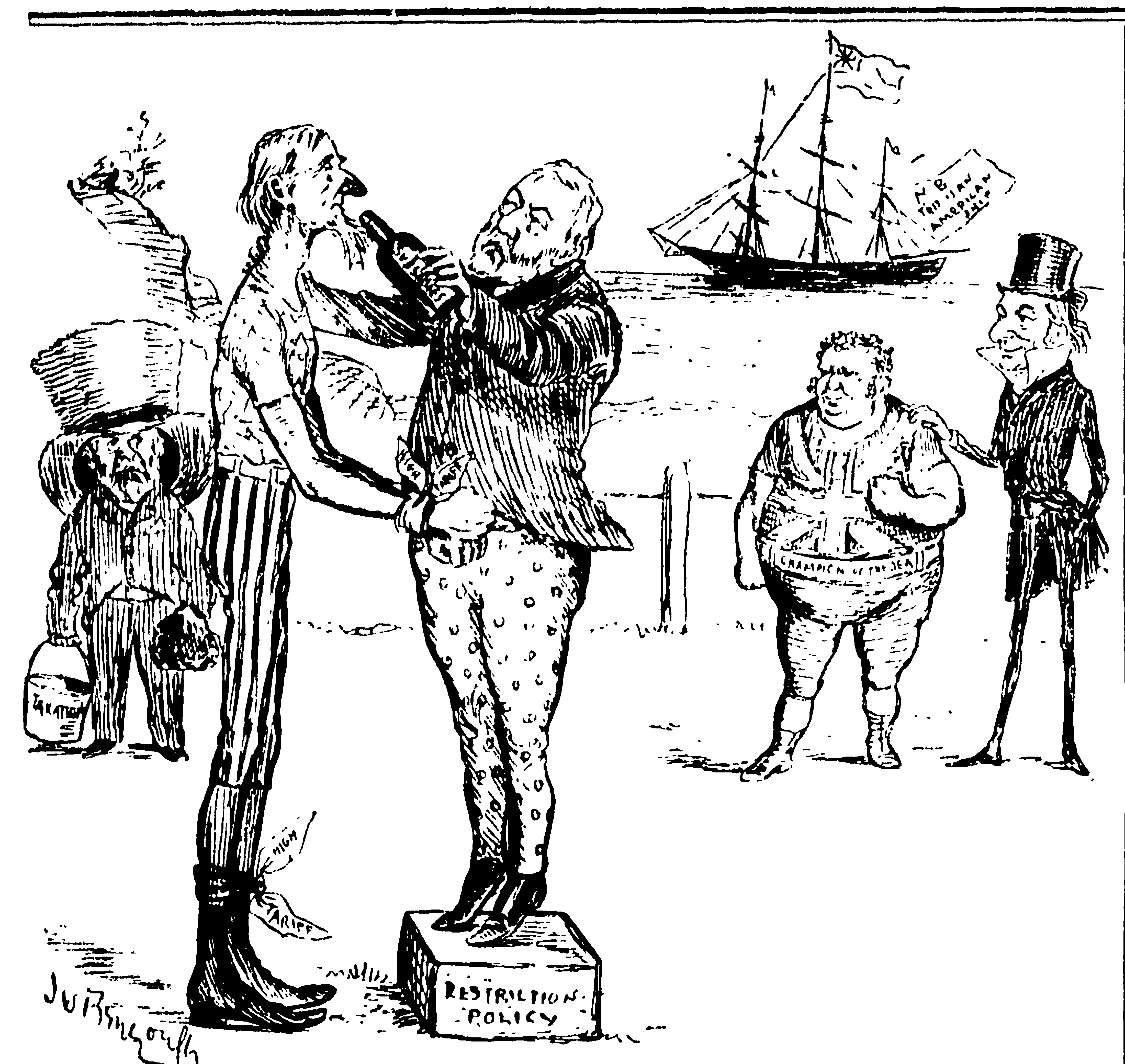
[Cartoon, spanning columns 1–2, signed lower left “J W Bengough” [signature?]: Uncle Sam, his ankles tied with a cord labelled “HIGH TARIFF”, stands while a stout figure in polka-dot trousers standing on a box labelled “RESTRICTION POLICY” pours a bottle into his mouth; Uncle Sam’s wrists are bound by cuffs with labels [illegible]. At left a ragged worker carries a pail labelled “TAXATION”. In the background a sailing ship flying a British flag bears a placard “N. B. THIS IS AN AMERICAN SHIP” [lettering partly illegible]. At right a fat John Bull with a belt labelled “CHAMPION OF sic SEA” is patted on the shoulder by a tall man in a top hat (Gladstone, per caption).]
“STIMULATING” UNCLE SAM.
(Preparing for the great fight for the championship of the carrying trade of the world.)
GLADSTONE—Never fear, John; you are more than a match for him so long as he keeps his strong limbs shackled!
NEW PUBLICATIONS.
[Advertisement] HENRY GEORGE’S WORKS
IN FINE BINDINGS.
Half Calf or Half Morocco:
Progress and Poverty………………..$2.50 Social Problems…………………….. 2.50 Protection or Free Trade……………… 3.00 In sets of three, bound alike………….. 7.00
[Advertisement] ASSORTMENTS OF TRACTS.
During the late campaign quantities of our best tracts were assorted for special work; and many of these not having been used, we now place them, with some of a more recent date, in convenient packages, at a low price.
Packages may be had at 50c. and sicsic0.
Address, THE STANDARD, 12 Union Square, NEW YORK.
[Advertisement] VOLUME FIVE OF THE STANDARD.
NOW READY.
A limited number of bound volumes of THE STANDARD in heavy boards, are offered for sale at the following prices
Separate volumes……………………………… $3.50 Volumes 3 and 4, bound together……………… 6.50 Volumes 2, 3 and 4……………………………. 9.00 Volumes 2, 3, 4 and 5………………………… 12.00
(Expressage sic.)
Address THE STANDARD, 12 Union square, New York.
[Advertisement] [untitled] As some of the back numbers
AS SOME of the back numbers of THE STANDARD are growing scarce, we will send 15 cents’ worth of tracts in exchange for any of the following
Vol. I—Nos. 5, 7, 8 and 11. Vol. II—Nos. 1 and 22.
[Advertisement] NEW ENGLAND
News and Sentiment and the Best Family Journal in the Country.
The weekly edition of the Springfield (Mass ) Republican, recently enlarged to twelve pages or eighty-four columns, affords the best weekly newspaper and family journal combined in the country. It is ably and carefully edited. In addition to a full review of the news every week, it furnishes a vast amount of interesting, entertaining and valuable reading matter, embracing a rich literary department, stories for the young and old, sermons and religious news and discussion, special correspondence, well written editorials, a department for women, another for farmers, news of the theaters and sports, original and selected poetry, frequent special articles, etc., etc. It is sold for
ONLY $1 A YEAR,
or ten cents a month for shorter periods. Send for a free sample copy. All subscriptions payable in advance.
New subscribers for a year now will receive the paper until January 1, 1891.
Address THE REPUBLICAN, Springfield, Mass.
[Advertisement] PROF. LOISETTE’S MEMORY
DISCOVERY AND TRAINING METHOD.
In spite of adulterated imitations which miss the theory, and practical results of the Original; in spite of the grossest misrepresentations by envious would-be competitors, and in spite of “base attempts to rob” him of the fruit of his labors (all of which demonstrate the undoubted superiority and popularity of his teaching), Prof. Loisette’s Art of Never Forgetting is recognized to-day in both Hemispheres as marking an Epoch in Memory Culture. His Prospectus (sent post sic ) gives opinions of people in all parts of the globe who have actually studied his System by correspondence, showing that his System is used only while being studied, not afterwards; that any book can be learned in a single reading, mind-wandering cured, etc. For Prospectus, Terms and Testimonials address
Prof. A. LOISETTE, 237 Fifth Avenue, N.Y.
p. 16, col. 2
NEW PUBLICATIONS.
[Advertisement] THE SINGLE TAX LIBRARY.
- A Syllabus of Progress and Poverty. Louis F. Post 8 sicsic.
- Australian System. Louis F. Post. 4 pages.
- First Principles. Henry George. 4 pages.
- The Right to the Use of the Earth. Herbert Spencer. 4 pages.
- Farmers and the Single Tax. Thomas G. Shearman. 8 pages.
- The Canons of Taxation. Henry George. 4 pages.
- A Lawyer’s Reply to Criticisms. Samuel B. sic . 16 pages.
- Back to the Land. Bishop Nulty. 16 pages.
- The Single Tax. Thos. G. Shearman. 8 pages.
- The American Farmer. Henry George. 4 pages
- Unemployed Labor. Henry George. 4 pages.
- The Case Plainly Stated. H F. sic. 8 pages.
- Social Problems. 342 pages, 12mo. Paper, 35c.
- Objections to the Land Tax. Thos. G. Shearman. sic.
- Land Taxation. A Conversation Between David Dudley Field and Henry George. 4 pages.
- How to Increase Profits. A. J. Steers. 2 pages.
- The New Political Economy. E. O. Brown. 4 pages
- Thy Kingdom Come. Henry George. 4 pages.
- The Functions of Government. Henry George. 8 pages.
- The Menace of Plutocracy. Thomas G. Shearman. 8 pages.
- Tenement House Morality. J.O.S. Huntington. 4 pp. 22, 23, 24, out of print.
- Taxing Land Values. Henry George. 8 pages.
- Henry George’s Mistakes. Thomas G. Shearman. 8 pages.
- The Democratic Principle. Henry George. 8 pages
- Progress and Poverty. Henry George. 512 pages. 35 cents.
Prices of Single Tax Library: Two page tracts—1 copy, 1 cent; 40 copies, 10 cents; 100 sic, 20 cents; 1,000 copies, $1.50.
Four-page tracts—1 copy, 2 cents; 20 copies, 10 cents; 100 copies, 40 cents; 1,000 copies, $3.
Eight-page tracts—1 copy, 3 cents; 10 copies, 10 cents 100 copies, [30?] cents; 1,000 copies, $6.
Sixteen-page tracts—1 copy, 4 cents, 5 sic, 10 cents; 100 copies, $1.60; 1,000 copies, $12.
No extra charge by mail.
The following numbers of the “Land and Labor Library” are still in stock:
- Settler’s Nightmare. Louis F. Post. 4 pages.
- Mysterious Disappearance. Lewis Freeland. 6 pp.
- Sailors’ Snug Harbor and the Randall Farm. W. T. Croasdale. 12 pages.
- The Collegiate Church and Shoemaker’s Field. W. T. Croasdale. 12 pages.
- It is the Law of Christ. Rev. S. H. Spencer. 4 pp.
- Christianity and Poverty. Father Huntington 4 sic. [33?]. Socialism—Its Truth and Its Error. Henry George. 4 pages. [38?]. “God Wills It.” Henry George. 4 pages.
- How John’s Father Saw the Light. W.C.Woods. 2 sic.
- Ten Thoughts for Christian Thinkers. Rev. John W. Kramer. 4 pages.
- Hints as to What You Can Do. Henry George. 4 pp.
- My Butcher Woman and My Grocery Man. William McCabe. 4 pages.
- A Republican’s Reasons for Supporting Cleveland. Judge Frank T. Reid. 2 pages. [86?]. Jefferson and Hamilton. Chauncey F. Black. 8 pp.
GERMAN TRACTS.
[42?]. First Principles. Henry George. 4 pages. [43?]. Socialism—Its Truth and Its Error. Henry George. 4 pages. [44?]. Taxing Land Values. Henry George. 8 pages. 47. It is the Law of Christ. Rev. S. H. Spencer. Henry, Ill. 4 pages. [53?]. Sailors’ Snug Harbor. Wm. T. Croasdale. 12 pages.
SWEDISH TRACTS.
52 The sic Plainly Stated. H. F. Ring. 8 pages,
TARIFF TRACTS.
- Protection as a Universal Need. Henry George. sic. [60?]. The Tariff Question. Henry George. 4 pages. [63?]. American Protection and British Free Trade. Henry George. 4 pages. [69?]. Protection and Wages. Henry George. 8 pages.
- Protection the Friend of Labor? Thomas G. Shearman. 8 pages.
- A Short Tariff History. Thomas G. Shearman. 2 pages.
- Plain Talk to Protectionists. Thomas G. Shearman. 4 pages.
- An Address to Workingmen on the Tariff Question, Henry sic. 4 pages.
A set of Tariff Tracts will be sent to any address for ten cents.
Address THE STANDARD, 12 Union square, New York City.
[Advertisement] HANDY BINDERS FOR THE STANDARD.
A lot of Handy Binders, made especially for [filing?] THE STANDARD, are now ready.
Price 75 cents to any address,
Address THE STANDARD, 12 Union Square, New York City,
p. 16, col. 3
[Advertisement] Pears’ Soap
[Display heading in script, spanning columns 3–4: “Good Morning” (letters partly covered: printed portion reads “Goo[d] M[or]ning”). Overprinted on the scan, not part of the newspaper, is an inverted rubber ownership stamp: “16[?] F A Sorge / HOBOKEN N.J”; it hides part of the script.]
“Paris Exposition, 1889.
Pears obtained the only gold medal awarded solely for toilet SOAP in competition with all the world. Highest possible distinction.”
[Advertisement] HENRY GEORGE & sic., PUBLISHERS,
NO. 12 UNION SQUARE.
PROGRESS AND POVERTY.
An inquiry into the cause of industrial depression and of increase of want with increase of wealth. The remedy.
By HENRY GEORGE.
512 pages. Cloth, $1.00. Paper covers, 35 cents. Half calf or half morocco sic.
PROTECTION OR FREE TRADE?
An examination of the tariff question with especial regard to the interests of labor.
By HENRY GEORGE.
Cloth, $1.50[?]. Paper covers, 35 cents. Half calf or half morocco, $3.00.
THE LAND QUESTION.
What it involves and how al ne sic can be settled.
By HENRY GEORGE.
87 pages. Paper covers, 20 cents.
p. 16, col. 4
PROPERTY IN LAND.
A Passage-at-Arms Between the Duke of Argyll and Henry George.
77 pages. Paper covers, 15 cents.
FORTSCHRITT UND ARMUTH.
(Progress and Poverty in German).
Translation of C. D. F. Gutschow.
430 pages. Paper covers, 35 cents.
PROGRES ET PAUVRETE.
(Progress and Poverty in French).
Translation of P. L. LeMonnier.
542 pages. Paper covers, $2.75.
PROTECTION OU LIBRE-ECHANGE?
(Protection or Free Trade? in French).
Translation of Louis Vossion.
436 pages. Paper covers, $2.75.
PROGRESSO E POVERTA.
(Progress and Poverty in Italian).
Translation of Ludovico Eusebio.
352 pages. Paper covers, $2.50.
[The following spans columns 3–4.]
SETS OF THREE.—PROGRESS AND POVERTY, SOCIAL PROBLEMS, PROTECTION OR FREE TRADE? BOUND ALIKE, IN HALF CALF OR HALF MOROCCO, $7.00.
[Advertisement] ECONOMIC WORKS.
By way of answering inquiries constantly received, we append a list of some economic and social works of various kinds, with prices, at which they will be forwarded post paid. Any work not mentioned procurable in New York will be sent on receipt of publisher’s price.
p. 16, col. 3
THE LAND AND THE COMMUNITY.—IN three books by Rev. S. W. THACKERAY, M.A. LL.D. Trin. Coll. Cantab. With preface by Henry George. 12mo, cloth Price sic.
WILLIAM LLOYD GARRISON.—THE story of his life. Told by his children. 4 vols, cloth, $12 sic.
ESSAYS ON POLITICAL ECONOMY.—By FREDERICK BASTIAT. 12mo, cloth, $1.25.
SOPHISMS OF PROTECTION.—WITH preface by Horace White. By FREDERICK BASTIAT. 12mo, cloth, $1.00.
HISTORY OF POLITICAL ECONOMY IN EUROPE.—By JEROME ADOLPHE BLANQUI. 8vo, cloth, $3.00.
THE TARIFF HISTORY OF THE UNITED STATES.—Containing “Protection to Young Industries,” and “The History of the Present Tariff, 1860–1883.” By F. W. TAUSSIG. 8vo, cloth, $1.25.
p. 16, col. 4
THE AUSTRALIAN BALLOT SYSTEM, as embodied in the legislation of various countries. By J. H WIGMORE sic, $1.50.
WORK AND WAGES.—BY THOS. BRASSEY. 16mo, cloth, $1.00.
FREE LAND AND FREE TRADE.—THE Lessons of the English Corn Laws Applied to the United States. By Hon. SAMUEL S. COX. 8vo, paper, 50 cts.; cloth, 75 cts.
THE HISTORY OF THE FREE TRADE MOVEMENT IN ENGLAND.—By AUGUSTUS MONGREDIEN. 16mo, cloth, 50 cts.
POSTULATES OF ENGLISH POLITICAL ECONOMY.—By WALTER BAGEHOT. Cloth, $1.00.
AN INQUIRY INTO THE NATURE AND CAUSES OF THE WEALTH OF sic ADAM SMITH. Edited by Theobold sic. $1.00.
[The following spans columns 3–4.]
Any of the above Books will be sent postpaid on receipt of price.
HENRY GEORGE & CO., 12 Union Square, New York City.
[Advertisement] PARIS EXHIBITION, 1889. (Burroughs, Wellcome & Co.)
[Spans columns 3–4.]
PARIS EXHIBITION, 1889.
BURROUGHS, WELLCOME & CO.,
Importers, Exporters and Manufacturing Chemists,
SNOW HILL BUILDINGS, LONDON, E. C.,
Specially invite the attention of the Medical Profession and Drug Trade to their Exhibits, as follows:
At Stand No. 575, British Food Section,
Kepler Extract of Malt,
an agreeable vitalizing reconstructive and digestive.
Kepler Solution of Cod Liver Oil,
An ideal form for the administration of fat.—British Medical Journal.
Also at Stand No. 311, British Industrial Section,
Chemical and Pharmaceutical Products, &c.
The Congo Medicine Chest, as taken by H. M. Stanley, for the relief of Emin Pasha, fitted with Tabloids of Compressed Drugs, &c.
The Livingstone, Gordon and Indian Traveler’s Medicine Pocket Cases and Portable Medicine Chests.
Vereker’s Chloride of Ammonium Inhaler, for Catarrh, &c.
The [Pinol-Eucalyptia?] Dry Inhaler, for the antiseptic treatment of Consumption and diseases of the air passages.
Lanoline, Lanoline Toilet Soap, Cold Cream Pomade and Toilet Lanoline.
Also at Stand No. 594, American Section,
Hazeline. Distilled active principles obtained by distillation from the American Witch Hazel, Hammamelis sic, for inflammation and irritated surfaces.
The Fairchild Pepsine and Pepsine Tabloids, Zymine Peptonizing Powders, &c., sic
Formulæ and price lists supplied to the Medical Profession and Drug Trade on request.
BURROUGHS, WELLCOME & CO.
[Advertisement] THE TRUE CHRISTIAN RELIGION.
By EMANUEL SWEDENBORG. 1,000 octavo pages, cloth. Mailed prepaid for $1.30 by the American Swedenborg Printing and Publishing Society, 20 Cooper Union. New York sic
[Advertisement] JAS. HOGAN
JAS. [HOGAN?], Principal Agent for James Means’ [$3?] and [$4?] shoes. [illegible] Bowery, near Prince st
p. 16, col. 4
[Advertisement] THE MASTER WORKMAN.
A simple statement of the views and aims of single tax men, designed especially for sic,
Single copies, 10 cents, ten sic, 80 cents; twenty five copies, $1.75; one hundred copies, $6.00.
Sent post or express prepaid on receipt of the above prices, sic,
HENRY J. O’NEILL, 331 Gordon St., Allentown, Pa.
SOCIAL PROBLEMS.
By HENRY GEORGE.
342 pages. Cloth, $1.00. Paper covers, 35 cents. Half calf or half morocco, $2.50.