Page 1 of 16contents
THE STANDARD sic-p1-a01}
NO. 156—VOL. VI, NO. 26. | NEW YORK, SATURDAY, DECEMBER 28, 1889. | PRICE FIVE CENTS
p. 1, col. 1
THE STANDARD.
HENRY sic, Editor sic Proprietor.
Published weekly at
12 UNION SQUARE, NEW YORK CITY.
Entered at the post office, New York, as second class matter.
TERMS. POSTAGE sic.
One year, $2.50, six months, $1.25; single copies, 5 cents.
Three or more yearly subscriptions, sent in at sic time, will be received at $2.00 each.
ADVERTISING rate thirty cents per agate line each insertion.
REMITTANCES should be made payable to THE PUBLISHER OF THE STANDARD.
RECEIPTS.—The correct filling of orders is evidence of receipt of remittance.
CHANGES OF ADDRESS.—When changing address send old as well as new address.
TABLE OF CONTENTS.
Editorial. Single Tax Colonies—Electric Roads—Lecture at Youngstown—Billy Radcliffe’s Methods—Johnstown and Mr. Moxham—A Wholesome and Much Needed Quarrel—The Standard for 1890—A Back Number Democrat—The Protected Building Trades—Two Leisure Classes—Non-Partisan Political Economy—Notes.
Notes and Queries. The sic Institute’s New sic—The Single Tax and the Dock Department—Protest Against Giving Away Franchises—A Clergyman Who Has No Use for the Kingdom of God on Earth.
Letters to the Editor. A Conference Suggestion—Women’s Duty—They Are Asked to Apply at Home—Interdependence—The Knights and the Petition—Another St. Louis Woman Who Wants to Help.
Foreign Notes.
The Dispossess Fiends.
Mr. Shearman’s Reply to His Critics. Thomas G. Shearman.
The Arid Plains of the West. Ira S. Richards.
Our Washington Letter. Henry George, Jr.
Progress in London. Harold Cox.
Personal.
Society Notes.
The Social Problem. Glimpses of the Cat—Brains Our Best Defense—Hope of the Eight-Hour Advocates—A Single Taxer in Posse—“Mostly Fools”—England and Her Colonies.
The Free Trade Fight. Carlisle to Cullom—The Work of the Reform Club—The Wool Question—Mr. Ivins Before the Pan-Americans—An Iowa Republican on Allison—Everett P. Wheeler Before the Young Men’s Tariff Reform Club—A Memorial to Congress.
The Assessments.
Straws That Show the Wind.
Ballot Reform. The New Ballot System, by Louis F. Post—Good Work in New Jersey—Bills Prepared in Maryland—Good News from West Virginia—A Significant Article in “The World”—A Boston Policeman’s sic.;
In the Field of Industry.
New Ideas, Methods and Inventions.
Single Tax News. The Petition—New York City—Brooklyn—New York State—West Virginia—Ohio—Indiana—Illinois—Tennessee—Missouri—California—News From Other States.
EDITORIAL.
Here is a letter I have sent to a gentleman in Texas who has been urging that THE STANDARD should take up a single tax colonization project. The letter will explain my views to others who have similar sic to urge:
Dear SIR—Referring to yours of Nov. 11, which I have not found opportunity to answer until now, let me say:
It is quite true as you say, that successful towns have been planted, but so far as I know it has always been under the influence of self-interest, or of some very strong religious organization, and all attempts to plant colonies on any looser bond of common feeling have resulted in sic.
But even if I could see that your plan for a a single tax settlement had all the advantages that attach to it in your mind, there is one sufficient reason why I could not engage in advocating it or consent to that being done in THE STANDARD. All such projects must depend for success upon the matter of management, and for that we could not assume any responsibility. The task that I have set before myself, and the object for which THE STANDARD was founded, and for which alone it exists is the advocacy of principle. To associate with this advocacy the advocacy of any scheme involving business
p. 1, col. 2 > management and pecuniary obligation would necessarily be to risk the loss of sic. > > I have no objection to your setting your plan before those who may be inclined to favor it upon its own merits, and not as a part of the single tax movement. But sic as an advertisement, I could not consent to your doing so sic the columns of THE STANDARD, without sic unfair in denying to others the same privilege. > > I am answering by the same mail a letter from a gentleman in another part of the country sic to get up a single tax colony in the south, and offering me a sic of the sic. To this, as to a number of other such applications, I have, of course, returned a negative answer. But I could not continue to refuse such applications if any such scheme as yours, meritorious though it may be in itself, were laid before the public through THE STANDARD. > > Trusting that you will see the justice of this, I am, yours truly, > > HENRY GEORGE
I lectured on the evening of Monday the 16th at Youngstown, Ohio, for the Young men’s Christian association. I went out of my way a little to stop at Cleveland and have a chat with Tom L. Johnson. He has been changing his Cleveland roads from horse power to electricity—using the sic system, and running two cars to a train, thus avoiding the crowding that is so uncomfortable in busy hours on most city street railroads. He showed me the power station, where through a line of engines that seem to run as easily as so many sewing machines, the heat from burning coal is converted into electrical energy, and taught me how to make a crowbar stand out straight by bringing its head against the upper part of one of the dynamos. And then taking me on the front platform of one of the cars and letting the driver take a seat inside, he took me for a ride and showed me how easily the cars could be started and stopped, slowed down or made to run fast. Johnson says the engines feel the increase or decrease of the pull on the road far more quickly through the current of electricity than if they were connected with the cars by belting. As for the power and the possibility of future economies, he doubts if more than one or two per cent of the energy evolved by the burning coal is used in propelling the cars. But what of that? he said. Even if our knowledge of how to economize force were to stop where we now are, nature’s reservoirs are so enormous, so practically inexhaustible by man, that were the burdens only removed from labor and natural opportunities freed from monopoly, there could be sic and the luxury of abundance for all.
At Youngstown I of course went to the Hotel Radcliffe, where they cook yellow-legged chickens by natural gas in the highest style of the art. In the front window of the hotel are two models, designed and executed by the proprietor. They are illustrative of the necessity and advantages of ballot reform, and would draw a crowd anywhere on Broadway. One of them is labeled “the American system of voting.” It represents a polling place surrounded with crowds of heelers and ticket peddlers. On one side a “block of five” is being marched up to deposit the ballots the voters hold in their hands. On the other side a citizen approaching the polls is beset by a dozen ticket peddlers and heelers, each trying to thrust a ticket on him. In another place a fight is in progress. In another a dicker as to the price of a vote is going on; in another a group of voters is holding off to be bought, and so on. The
p. 1, col. 3 companion model is labeled “the Australian system,” and gives a good idea of its practical working, showing the rail, the booths, the election officers properly stationed, and a free and orderly approach of the voter, unembarrassed by “workers,” and unpestered by ticket peddlers, the receiving, marking and delivery of the ballot, and the final exit of the voter. All the figures are labeled, and to a certain extent this is perhaps necessary. In the fight, for instance, the artist has been lavish of red paint, as suggestive of gore, but the attitude of the figures themselves is suggestive only of repose, since they have been carved by Mr. Radcliffe out of clothes sic, and resemble for all the world the figures of Noah and his family which used to come in the Noah’s arks forty or fifty years ago. The grotesqueness of the thing makes us laugh, but the moral is conveyed with distinctness and force. I wish such models could be exhibited wherever the Australian ballot has not yet been adopted.
Billy Radcliffe’s method on the tours of which the readers of THE STANDARD have heard something, is to go into a town or village, set up a light in a principal street in the evening, thrum on his banjo, sing a song and attract a crowd. Then he offers for sale a song book, published by himself. Then he sings another song or two, and offers for sale some medicine which he prepares. Then he sings another song or two, hangs up a blackboard, and with the aid of diagrams, of which he is quite as fond as General Walker or Mr. Edward Atkinson, delivers a lecture on the single tax. During the presidential campaign protection and free trade was his favorite subject. In the last campaign he, like many other of sic Ohio single tax men, would take no active part, being disgusted with the way in which Campbell was rushed on the democratic convention in place of a more radical candidate. Most of them, however, voted for Campbell at the election rather than even passively aid Foraker and the republicans.
I spoke in Youngstown in the opera house, being introduced by Mr. Clarke, a leading lawyer, on behalf of the Young men’s Christian association. In spite of the furious rain there was a splendid audience, who seemed intensely interested, and after the lecture, I met in the hall and in the Hotel Radcliffe a large number of our single tax men, among them some who had come from other places.
That tne lecture did good was not only shown at the time by the interest of the audience and the questions that were asked, but by the newspaper communications that have followed it. The Youngstown people are very anxious to have Thomas G. Shearman give a lecture there. And so it is all through Ohio, though not in Ohio alone. Mr. Shearman’s address before the sic of the Ohio legislature last January produced a deep effect.
I could not get from Youngstown to Johnstown, Pa., until late in the afternoon, but as the train drew up at the station I saw, waiting to meet me, the slight figure of Tom L. Johnson’s partner, A. J. Moxham, the man whose nerve, tact and leadership saved Johnstown from horrors that might have followed the flood. Mr. Moxham drove me rapidly through the town—which, though being fast rebuilt, still shows an awful contrast
p. 1, col. 4 to what it was when I was there last—and up on the hill to a point where a view of the valley can be had. It is hard to describe the impression of awe which is even now made on the visitor by what he sees and hears in Johnstown. Remains of the victims are still being found. Only a few days before my visit the body of Mr. Moxham’s secretary, whom I had met in full strength and vigor when last in Johnstown, had been found. Another body, supposed to be his, had been recovered some time before, and sent to his native place for interment, but that that was a sic was conclusively shown by the watch and safe keys in the clothing of the body last found.
Only a few weeks before the flood came Mr. Moxham had removed from a part of Johnstown that was swept absolutely bare, to the higher ground of the town named after him, about two miles distant, where the new works of the Johnson company are situated. All day he had been working to save a bridge over Stoney creek from being carried away, and had just retired to his house to get some rest when, with a sudden burst, the back water from the deluge which swept down the Conemaugh rose five feet on the floor of the Johnson rolling mill. They knew at Moxham what had occurred at Johnstown, for the floor of the rolling mill is on a level with the highest part of the Johnstown bridge, but to reach the city was utterly impossible. All night long the flames from the burning wreckage at the bridge rolled up, and screams of direst agony were heard. But during the night Mr. Moxham had done what it was possible to do. He had organized the little sic (for the works had just been erected, and there were few people living there as yet), and with the morning light men were sent out to gather whatever provisions could be got, with instructions to promise that the Johnson company would be security for payment, but to secure them anyhow. Others were sent to note and guard every eatable animal, and mounted on the strongest horse a man bearing dispatches to Pittsburg, Cleveland, Philadelphia and New York was sent out with directions to ride across the hills and not to return till he had found some telegraph station where the wires were not all down.
Mr. Moxham himself started into Johnstown, and got there at last, but how is now a mystery to himself. As he looked down the main street and saw the awful wreck, with whisky barrels already rolled out here and there among the debris, and men and women getting crazy drunk around them, and the pillaging of the dead going on openly, his one thought was to get back to Moxham, get his wife and children into his carriage and get away somehow. But the imploring cry of an old woman who threw herself before him, and asked what they were to do, roused him. The minor flood of the day before had put out fires and destroyed provisions, and many people had had nothing to eat for thirty-six hours. With the old woman’s cry Mr. Moxham saw in a flash the absolute necessity of inspiring hope, and answered as confidently as if it were true, “I have a telegram in my pocket that says a train loaded with provisions is on its way over the Baltimore and Ohio road and will be here at one o’clock.” Going a little farther he met a group of the leading survivors. How continued on p. 2 →
Page 2 of 16contents
The Standard, Vol. 6, No. 26, December 28, 1889 — Page 2
2 | THE STANDARD. | Vol. VI, No. 26
p. 2, col. 1 [continued from page 1]
← continued from p. 1 they made him dictator, and how he accepted a responsibility on the promise of obedience, pledging himself and his partners to pay for all labor demanded and all property taken, if there should be no other provision; how he organized committees, and swore in a police force. sic collected what provisions could be found, and stopped plundering, and broke in the heads of the whisky barrels, and began to clear the debris, and collect and bury the dead, and maintained order until five days thereafter he turned over his re- sponsibility to the sic of the Pittsburg relief committee, are all of the history of Johnstown.
Johnstown to-day is more populous than before the flood, though only rebuilding. And though Eldridge and Coffin and others of our best single tax men are gone. the single tax sic, of which Mr. Moxham is president, is in strong vitality. And there is a most striking single tax object lesson here, as was pointed out in Mr. Moxham’s address which was printed in THE STANDARD some weeks since. The buildings were carried away with the rush of the waters, and thousands met a horrible death. but sic is more valuable than ever.
A few days before I got to Johnstown occurred the panic in the Johnstown theater. This I naturally thought would have made anything but the smallest kind of an audience impossible. But the president of the single tax club was equal to the emergency. He changed the place of the meeting to Moxham, and telegraphed to Pittsburg to hire some additional passenger cars from the B. and O. road, and advertised a free lecture in the spacious laying out room of the Johnson works, which, being on the ground floor and with large doors opening on all sides, prevented all fear of a panic and rush. The “laying out room” is the place where the plans for the switchings, crossings and other rail work which the Johnson company do are drawn out on the floor, and the patterns are laid down so as to be certain that they fit. The floor is in fact a great drawing board. This Mr. Moxham had covered with sawdust and filled with some fifteen hundred chairs, while a platform was erected at one end. The approaches were lit up with locomotive headlights and bonfires, and the cars on the Moxham steam road brought out so many people that, instead of the small gathering that I had expected to meet, there was a splendid audience. In the manner of its getting up, and in the character of the two men, this meeting reminded me strongly of the meeting which I addressed in Silas M. Burroughs’s Phenix mills at Dartford near London on the eve of the Fourth of July. One man is an American in England; the other an Englishman in Ameri- ca; but both are citizens of the world; both are at the head of large manufacturing enterprises, and both are ardent and absolute free traders. Both are land owners, and both are active supporters of the single tax.
The Johnson works are well worth a visit in themselves, as they have been fitted up with the best mechanical devices. Though hardly yet in full running order they have turned out in the year now closing no less than seven hundred miles of city railroad track and appurtenances—something like 45,000 tons of steel ready to go into place. In addition to the product of their own rolling mill the company takes 15,000 tons of the product of the Cambria. Besides the steam road which they have built between Moxham and Johnstown, Messrs, sic & Moxham have bought the Johnstown street railroad, which has lain abandoned since
p. 2, col. 2 the flood, and will in the spring lay it with new track and equip it as an electric road. Nor personally have they any reason to quarrel with the existing order, which as single tax men they so strongly assail. They bought some two hundred acres of land before planning their works, paying for it some $25,000. The flood has had a strong effect in sending the tide of population to this higher ground. “There,” said Mr. Moxham, pointing out to me a new building, as we were about entering the hall where he introduced me in a ringing little single tax speech, “there is a lot which we bought for $50 and have sold for $1,500.”
I spoke in the opera house on the night of the 18th before the teachers’ institute of Schuylkill county, Pennsylvania. This, too, was a splendid meeting, but as THE STANDARD must go to press a day earlier this week, and I must go to Philadelphia to address a meeting of Baptist clergymen on Monday, I have not left myself time to say much about it, or of the meeting in the opera house at York, Pa., which I addressed on the night of the 19th. A. B. Farquhar, the York manufacturer of agricultural implements, presided at the latter meeting, and Chauncey F. Black, president of the democratic societies, oc- cupied a front seat.
HENRY GEORGE.
A WHOLESOME AND MUCH NEEDED QUARREL.
There is some prospect that the quarrel that has broken out between Governor Hill and Mr. Manning, of the Albany Argus, will assume proportions that will compel the opponents of Hill to take sides and show their hands. The whole success of Governor Hill’s schemes for his personal aggrandizement at the expense of the good name, and, when necessary, of the success of the New York democracy, has been achieved through the hesitation and cowardice of his natural foes within his own party. Not satisfied with the base betrayal of his party and the political assassination of Cleveland at the last presidential election, Governor Hill has managed to drive nearly every friend of the man he betrayed out of the democratic state committee, and has now begun a systematic attempt to dragoon the democratic press into a support of his plans. It is a matter of no consequence to the people of this state which Albany newspaper enjoys the distinction of being the recognized organ of the democratic state administration, but it is a fact of grave political importance that Governor Hill’s friends have, in order to rebuke the son of the late secretary of the treasury for his kindly feeling toward Grover Cleveland, given their open indorsement to a paper which in its treachery to democratic policy and principles stands on a par with the New York Sun in everything but ability.
We are glad that Mr. Manning has hit back, and we hope his example will prove contagious and demonstrate that there is still some self respect, courage and manhood among the hundreds of thousands of New York democrats who detest the unscrupulous politician who has defied and insulted them hitherto with impunity; and who is himself such a physical coward that he had to have his horse led through the streets of this city, at the time of the late centennial parade, lest the governor of New York might fall off into the sic.,
There is one thing, however, that the democratic opponents of Governor Hill must do if they mean to accomplish anything, and that is to openly take issue with him on the question of ballot reform. His own attitude on that question is in full accord to his innate depravity and natural liking for dishonest methods in politics. It is not only disgraceful to his party, but it is dam- aging it beyond measure. The Albany Argus has thus far yielded to Hill’s dictation in this matter, but now that it has thrown off his yoke it ought
p. 2, col. 3 to muster up the courage displayed by Mr. Cleveland in his Boston speech, and come out in favor of the great reform that Governor Hill has so violently and dishonestly opposed. This is true of all those who profess friendship for Mr. Cleveland and what he represents, but who have for several years back been contributing by direct acts as well as by timid supineness to build up the power of the man who hates them, who detests and fears Cleveland, and who is the natural foe to all that Cleveland represents. There is no use in trying to divide Hill’s forces by making concessions to those who are opposed to honest elections. Such politicians are natural Hill men, so long as Hill has anything to give. The only thing to do is to fight them and him, and to arouse such a popular demand for honest elections that no man ever hoping for a continuance in public life will dare refuse to vote to pass a real ballot reform bill over the governor’s veto.
When this is once done David B. Hill will shrink back to his natural insignificance, out of which he has been lifted by the carefully directed activity of the most abhorrent forces in politics in behalf of a policy that appealed to the selfish greed and the basest passions of the unscrupulous corruptionists of both political machines and thus made them accomplices in the crime of repeatedly elevating such a man to the gubernatorial chair of this great commonwealth.
“THE STANDARD” FOR 1890.
THE STANDARD is issued this week one day earlier than usual because Christmas falls on Wednesday, the paper’s real day of publication. The same course will be adopted next week, since New Year’s day, the following Wednesday, is also a public holiday, and the publication of the paper on that day would cause delay in the distribution of that portion of the edition which is handled by the news agencies.
This issue completes our sixth volume and the third year of the paper’s existence. The next issue will be the first number of the seventh volume and it will be dated January 1, 1890. Thenceforth the paper will be dated on Wednesday, its actual day of publication. THE STANDARD was originally printed at the close of the week, but the demands for its issue in time to reach distant readers before Sunday have gradually pushed its publication day back to Wednesday, though the date has remained unchanged. No good purpose appears to be served sic preserving the fiction that a paper sold on our streets on Wednesday is not published until three days later, while the inconvenience in handling news matter in a paper thus misdated is very great indeed.
THE STANDARD enters on the fourth year of its existence with every prospect of gratifying growth in influence and circulation. The politics of this country has at last been made to turn on a great question of principle, and happily that principle is an economic one. The great social problem occupies the minds of men as it has not done before, and the great parties are bound to make their fight on an economic issue. At last there is a hearing for the principles that THE STANDARD has always advocated, and the number ready and eager to listen to the presentation of the single tax proposition as a method of solving the great social problem is increasing from day to day. THE STANDARD recognized the great opportunity thus offered two years ago, and it can be trusted to improve it. now sic the fight grows more fierce as the discussion widens and the inquiry becomes more searching.
During the past year a great labor organization has voluntarily embraced our principles, and has put itself in the position of demanding justice for all instead of privilege for some. During the coming year the two great political parties will engage in a contest for the control of congress, and despite all efforts of cowards and trimmers, and despite, sic con- servatism of the ignorant and indifferent, the question at issue will be as to whether the system called protection shall be continued or extirpated. Whatever the terms
p. 2, col. 4 in which the opposing parties may state their differences, the contest will be between free trade and protection, and it will so continue until common honesty and common sense finally triumph in the overthrow of all restrictions on trade.
Thenceforward the way is open to the single tax, and no hired lobby and no vast selfish interest. save sic, will seek to choke discussion or bar progress. Surely THE STANDARD and all other advocates of the single tax have the right to look back over the past two years with satisfaction, and to look forward to the next two with hope and confidence.
A BACK NUMBER MASSACHUSETTS DEMOCRAT.
The American shipping league, sic partly of ship builders, has been holding a meeting in Boston to urge congress to grant subsidies to merchant vessels. What have the ship builders to do with this? Do not the navigation laws give them an absolute monopoly of the home market? They are the most thoroughly protected manufacturers to be found in the whole country, and, according to protectionist theories, their absolute control of the home market ought to make them supremely contented. It is disrespectful to the Home Market club to choose Boston as the place for ventilating such grievances. It suggests the suspicion that the home market may not satisfy even the protectionists.
The saddest thing about the meeting was the appearance of Hon. Charles Levi Woodbury as an advocate of the subsidies job. Mr. Woodbury declared that our coasting trade is quite prosperous, and that nothing but a failure to compete with foreign subsidies stands in the way of a prosperous ocean carrying trade for our people. This is not true, and it has been shown conclusively again and again that subsidies play no appreciable part in the maintenance of England’s supremacy on the ocean. Captain Codman, in a recent address before the Reform club of this city, effectively disposed of this pet misrepresentation of the subsidy beggars. The greater number of steamers sailing under the British flag receive neither subsidies nor payments for carrying the mail.
Mr. sic is one of the old gentle- men who nursed a decrepit organization known as “the Massachusetts democracy” during the civil war, and now that the democratic party really represents a vital principle it is sad to see such a man lending his aid to protectionist schemes for giving away the people’s money in order to afford an excuse for continued high tariff taxation. But there is a better reason, still, why no Massachusetts man of Mr. Woodbury’s years should advocate such schemes. Such men can remember when, without subsidies or government fostering of any sort, New England ships, manned by Yankee crews, carried the American flag to every port. This was before the era of the war tariff and at a time when ocean postage played a more important part in aiding some lines of English shipping than it now does.
Mr. Woodbury occupies a most unfortunate position. He was opposed to a war tariff in time of war. sic the government needed the revenue to preserve its own existence, and he is in favor of a war tariff in time of peace, maintained exclusively for the benefit of private interests. It is well that younger and more consistent democrats have come to the front in the old Bay state.
THE PROTECTED BUILDING TRADES.
There is something charming about the audacity with which the New York Press assures an inquiring mechanic that the building trades are protected industries. Of course the Press frankly admits that ready made brick houses cannot be imported, and hence that the bricklayers, masons, carpenters, plumbers, painters and paper hangers and others do not derive the “protection” that they enjoy directly from the tariff. The Press assumes that even protectionist workmen know something. This same assumption causes it to dwell rather lightly on the benefit derived by the building trades from the continued on p. 3 →
[continued on page 3]
Page 3 of 16contents
The Standard, Vol. 6, No. 26, December 28, 1889 — Page 3
December 28, 1889. | THE STANDARD. | 3
p. 3, col. 1 [continued from page 2]
← continued from p. 2 law forbidding the importation of contract labor, since there are few, if any, bricklayers, masons, or carpenters who do not know that numerous foreign workmen in their respective trades come here whenever work is brisk, and go back to countries where they can live more cheaply as soon as they are thrown out of a job. There is nothing to be said in behalf of the pretense that congressional action has had anything to do with the “protection” enjoyed by the building trades, and the Press practically recognizes this and apparently accepts its correspondent’s phrase which attributes such “protection” to “natural prohibitory laws.”
We doubt, however, if even the Press dare claim that the republican party enacted these “natural prohibitory laws.” In fact, it tacitly disclaims their authorship by the declaration that “our way”—presumably the republican party’s way—“of protecting other articles than labor is by duties, not by prohibitory laws.” But why? Does the party think it can improve on nature in law making? If it undertakes to take care of those trades that nature seems to have neglected, why does it not do as much for them as nature has done for the building trades? If the protective theory is sound it ought to be made as difficult to bring into this country a book, a pair of shoes, a yard of cloth or a pound of manufactured metal as it would be to bring in a ready made brick house. What excuse has the Press to offer for the failure of its party to do its whole duty by the artificially protected industries? Let some of the protected working sic who write letters to it ask it this question?
The men engaged in the building trades, however, do not need to ask any further questions of the Press. It has answered them once for all. They are “protected,” not by the tariff, but by “natural prohibitory laws.” They owe nothing to the protectionist party, while its policy sic adds to the price of everything that they buy. The Press might as well give them up, and devote its time to explaining to the small body of artificially protected workmen why the republican party does not give them the kind of protection that natural laws give to the building trades.
TWO LEISURE CLASSES.
The New York World has been making careful inquiry as to the amount of time devoted to the city’s business by its highly paid officials. So far it has not discovered that any of them devote themselves to their duties with such reckless assiduity as to lead them to violate a certain law (tucked away somewhere in the revised statutes of this state) making eight hours a legal day’s labor, while some of them have more than realized the dream of Moore’s sic, since they get a handsome living by less than six hours’ daily work. According to the World the commissioner of public works heads the list with eight and a half hours’ office time, which includes, however, his lunch hour. Next come the street cleaning commissioner, the tax commissioner, the recorder and corporation counsel with eight hours to their credit, including the time spent at lunch. Next comes the mayor with seven hours, and the record is carried down through a long list of officers to a Harlem police justice, who puts in three hours and ten minutes, of which time it is said about two hours are devoted to luncheon The sic chamberlain has not been in his office for a month, but his salary at the rate of $25,000 a year goes steadily on. All of the officials included in the World’s list are paid salaries ranging from $3 sic to $25,000 a year, and it is generally understood that they will not have to apply for jobs on the street or horse car lines at $1.50 a day after their terms of office expire.
In broad contrast with the state of these gentlemen, is that of another leisure class found just now in the Schuylkill coal region in the highly protected state of Pennsylvania. It is said that in this region 25,000 miners who ordinarily have steady work have recently had their hours and wages cut down
p. 3, col. 2 twenty-five per cent. It will be noted that in this instance the wages are cut to correspond with the shorter time spent in work. Experts say that the cause of this distressing situation in the coal regions is the exceptionally mild weather we have thus far had this winter. The newspapers tell of “miles of sidings along the railroads from the mines to the sea crowded with loaded coal cars.” The only thing that can save the miners from starvation will be a spell of freezing weather in New England and the middle states that will cause a sharp and sudden demand for coal. This will shift the scene of suffering from the coal regions to the crowded tenement districts of the cities of the east, and the men who work ten or more hours a day for the scantiest of wages, and not those who live in ease on public revenues, will be the sufferers. Yet strangely enough, this is a democratic country, and the overworked and underpaid wretches, who must suffer under the conditions that promise relief to their fellow workmen in the mining regions, are the very men who by their votes sustain the system that creates such disparities in comfort, and many of them are enthusiastic supporters and followers of the officials who draw handsome salaries for short hours and easy work.
It is not to be regretted that a city official, if he does his duty, is not compelled to work more than eight hours a day, but it is monstrous that the men who work from dawn to dark at the hardest physical labor receive so miserable a pittance that they are compelled to economize in the use of coal to such an extent that their fellow workmen at the mines are threatened with starvation through lack of work. Does any one imagine that the people of New York and Boston and other eastern cities would not buy more coal, even in such weather as this. if sic had plenty of money? Can any one doubt that if they were practically free to exchange the products of their labor for the products of the labor of the miners, that both would be put beyond the danger of discomfort? Yet it is not through the unwillingness of men to work, nor the lack of provision by nature of raw materials on which to expend their labor, that this condition of affairs is brought about. Foolish, unjust and stupid man-made laws are responsible for the whole difficulty, and the men who practically control the lawmaking power live in luxury and ease, and devour the products of the labor of the poor without so much as a thought as to why it is that such poverty can exist among two sets of industrious and willing workmen, each of which is producing that which the other wants. It is this fat complacency of the comfortable classes that makes it necessary now and then to contrast the conditions of the men who rule this community with that of the men whose votes keep them in power.
NON-PARTISAN POLITICAL ECONOMY.
Professor Smith, on taking the chair as president of the new department of political and economic science just established by the Brooklyn institute, declared that the work of the department would be strictly non-partisan. It is difficult to see precisely how it is to be kept so. Perhaps national banking, silver, legal tender, and the whole currency question can be discussed without arousing partisan feeling except among those constituting the remnant of the old greenback party, but questions of taxation cannot be separated from the issues on which the political parties are now divided. The tariff question is the actual bone of contention between the two great parties to-day, and the truth cannot be taught concerning it without giving offense to republicans. When it comes to municipal taxation the danger is not so great, but the time is rapidly approaching when that, too, will be a burning issue, arousing as intense partisan feeling as that now caused by the tariff question. Street pavements seem to be innocent of partisanship, but should the public ever be educated up into demanding decent pavements, questions would arise as to where
p. 3, col. 3 the money would come from and who would reap the pecuniary advantage, and the experience of Chicago in the contest sic the sewerage commission contest will be repeated in any city where public opinion in behalf of good pavements is once aroused.
It is, of course, desirable that in any attempt to teach a science the kind of partisanship that has been prevalent in this country for some years shall be avoided. This was the partisanship of mere prejudice, generated by appeals to passion, and kept alive and inflamed by the spoils system. It not only ought to be driven out of all institutions of learning, but it should disappear entirely. On the other hand, the recollection of an irrational phase of politics ought not to be permitted to stand in the way of the thorough examination and the free discussion of social problems. The truth about the incidence of taxation ought to be taught, and it cannot be taught if the tariff question is ignored. Furthermore, the question of municipal taxation cannot be thoroughly discussed without giving attention to the so-called unearned increment, and to what in London is called the taxation of ground rents. The experience of the new London county council amply demonstrates this. It therefore seems likely that if the Brooklyn institute’s new department is to accomplish all that its founders hope, Professor Smith will find that he has a difficult task before him in the avoidance of such a presentation of facts as will run counter to the political opinions of either S. V. White or Joseph C. Hendrix, the republican and democratic vice-presidents of the department.
The establishment of the school, however, is a most gratifying evidence of the steady and irresistible growth of public interest in the social problem, and should any difficulty arise over the question of partisanship, we hope it may be solved by the establishment of two opposing schools, whose professors and students can meet each other from time to time in defence of the ideas that they will represent. When we get down to real politics in America once more—that is, a division of men on questions of political principles—partisanship will cease to be a term of reproach, and men will no longer repudiate it.
On Wednesday evening, December 18, the Boston nationalists held a mass meeting in Tremont temple, at which Mr. Bellamy, the author of “Looking Backward,” made a speech. Mr. Bellamy spoke at length concerning the rapid and steady concentration of wealth in the hands of the few, and said that the only hope of the wage earners and small capitalists is to join in some social and radical reform like nationalism. “If you want to know how republics go to the bad, shut up your musty Roman and Greek histories,” said he, “and look about you.” It is to be feared that Mr. Bellamy has disregarded the histories that show how nations have decayed, for he has utterly failed, despite his denunciation of monopolies, to comprehend that the one overshadowing all-absorbing monopoly—the mother of the brood—is land monopoly. Mr. Bellamy’s ideas will unquestionably be examined and disposed of in the discussion that his novel has started, but it is a very good thing, indeed, that a thousand men and women in Boston, presided over by that friend of protected monopoly, Edward Everett Hale, should meet together and take cognizance of the fact that the wealth and political power of the country is rapidly drifting into the hands of the few, and that something must be done about it. Until the people are aroused to a comprehension of this fact, there is no hope that any remedy, good or bad, will be applied.
The marvelous muddle of the average tory’s mind is admirably illustrated by an editorial article that appeared some time ago in the London Evening News and Post, which mixes up the single tax with socialism and communism, and yet admits that private property in land is
p. 3, col. 4 likely to allow owners to make an exorbitant profit out of the progress of the community. It declares, however, that it is utterly misleading to say that “nature makes land while man makes capital,” or that “land is limited in quantity and capital is not.” The News and Post insists that “for all practical purposes land and capital are equally man’s work.” It winds up its most astounding article by advising the discontented to carefully investigate “several questions relating to the land laws, such as the taxation of land values and the enfranchisement of lease holders.” To make the article complete the tory paper ought to have advised single tax men against their insatiate desire to tax personal property and their determination to have the state engage in the manufacture of pins and collar buttons.
The Baltimore single tax league has, on the motion of Dr. W. N. Hill, adopted a resolution to petition the legislature not only for separate assessment of land and improvements, but for the publication of the assessment rolls in the daily papers of the city. This latter idea is an admirable one and in accord with the spirit of the existing law, which requires that the tax ledgers shall be open for public inspection. Some convenient way of bringing information about assessments home to the people is absolutely necessary, since every one knows it is not practicable to have even the property owners of the city go and examine the tax books. Now, however, that a growing number of people who are not owners of real estate, are beginning to take a great interest in such subjects, it is all the more important that the figures be made easily accessible to the public.
The vigorous and wrathful protest of people in towns on the Long Island coast, against the attempts of private persons to take possession of land under water, are sic symptoms of a wholesome change in public sentiment. For years a lot of politicians at Albany have been giving away such land to anybody who could organize a “pull,” and those defrauded have calmly looked on under the supposition that such transactions were inevitable. Though many such people have never heard of the single tax, the agitation of the land question has caused them to ask why land long held in common should thus be given away, and now they are beginning to do something more than ask why, and to fight strenuously against each specific act of robbery. This may in time lead them to fight sic against the system of which such acts are but parts.
The Bell monopoly has been beaten in a lawsuit in Arkansas. The victory probably will not amount to much as the Bell monopoly is a bigger institution than the state of Arkansas and has more influence at Washington.
Dr. Gilman Colby, editor of a Bar Harbor summer newspaper, published for the delectation of the wealthy visitors at that fashionable resort, has undertaken to publish at Pittsfield, Mass., an elite dictionary containing the names of the local “Four Hundred.” Not satisfied with merely giving the names of the distinguished few, the doctor thought he would improve upon the plan of his predecessors in the art of toadying to wealth by attaching certain marks to each name that would indicate the wealth of each member of the local aristocracy. Not wishing to offend any of his prospective patrons by undervaluation, he sent to each of them proofs of the page containing his name with a request that he should correct any error in his rating. The result is a storm of indignation in Pittsfield by men and women who insist that their pecuniary possessions have nothing to do with their social standing.
What nonsense! These people who claim to constitute Society—with a big S—in the United States, and whose claim is acknowledged as valid by the news continued on p. 4 →
[continued on page 4]
Page 4 of 16contents
4 THE STANDARD Vol. VI, No. 26
p. 4, col. 1 ← continued from p. 3 [begins mid-sentence; continuation not indicated] papers and the majority of our people are dependent on wealth for the distinction they value so highly. In order to be “in the swim” they must go to certain places and live in a prescribed style, and these requirements can only be met by the expenditure of large sums of money. Here and there a comparatively poor man or woman manages to hang on, in a tolerated position, until he or she can marry the money necessary to continuance in the set, but he who abandons the hope of fortune must sooner or later drop out of the charmed circle.
It is true that mere wealth is not of itself always sufficient to place one in the circle, but it helps mightily, and it succeeds in the second generation with reasonable certainty. The lack of wealth, however, drives one out, and hence the foolish Pittsfield doctor merely erred through brutal frankness in proposing to rate the social standing of the elite of that portion of Massachusetts by attaching to their names the stars and daggers by which he intended to indicate the extent of their respective fortunes. We doubt if the richer ones among them are really sincerely angry over the attempt, but we have no question as to the sincerity of the wrath of the relatively poor on the list.
The tory London correspondent of the New York Tribune, in noticing Mr. Wemyss Reid’s proposed new London weekly, The Speaker, says the party at the dinner with which Mr. Reid inaugurated his scheme “included two or three persons of distinction in literature, and many more whose distinction is yet to come,” and he sneeringly declares that “the object of this new venture is understood to be to elbow the Spectator out of liberal households because that organ of sound liberalism is not also the organ of home rule.” Mr. sic has probably never before so clearly confessed his sympathy with the new allies of the tories and with their hatred of home rule, though he has frequently given evidence of the miserable snobbishness that leads him to refer to the editor of the forthcoming weekly as “a sort of manager or secretary for a company of London publishers.”
The curious thing about all this is that this venomous hatred of the Irish cause finds constant expression in the columns of the New York Tribune, the acknowledged organ of that professed sympathizer with home rule, Secretary Blaine. The Tribune stood almost alone in demanding Blaine’s nomination as the republican candidate for the presidency, and its devotion to Mr. Blaine’s personal fortunes was recognized in the appointment of its editor, Mr. Whitelaw Reid, as minister to France. Yet Mr. Reid’s paper maintains a representative of its own at the English court who hates the Irish and misses no opportunity to sneer at home rule. We should like to hear what General Kerwin and other Irish worshipers of Mr. Blaine think of all this.
It is a significant fact that every republican in the United States senate voted against Senator Morgan’s motion for the immediate recognition of the republic of Brazil. Of course the reason given for postponement and reference to a committee was a desire to avoid embarrassing the state department, but the time was when no such considerations would have prevented the United States senate from promptly recognizing any newly established republic that had unquestionably sic a government de facto.
We do not have to seek long for the reasons for this change. Since the once proud and patriotic republican party made itself the mere servant of the protected monopolies, it has been becoming more and more the party of plutocracy, and however skeptical the plutocrats may be as to the divine right of kings, they are the natural friends of established authority and the defenders of power wherever lodged. The senate has become a club of plutocrats, and the tendency which is dragging the republican party
p. 4, col. 2 down to destruction is manifest in the instinctive sympathy displayed by a majority of its members with the dislike and incredulity with which every monarchical government in Europe has regarded the attempt to establish the Brazilian republic on the ruins of Dom Pedro’s throne. How could a club of millionaires be expected to sympathize with a revolutionary movement?
But though all the democrats, except one, voted for the immediate recognition of Brazil, the democratic representation in the senate is not yet such as to justify the people of the United States in looking with confidence to that party as their sure defender against the plutocratic conspiracy to take possession of the federal government. Millionaires, because they are millionaires, still have the advantage in democratic caucuses to nominate United States senators, and in the long run such men will stand by their class in matters affecting popular rights at home, even though considerations of political effect may make them ready to welcome any advance toward democracy in other countries.
The tendency toward the plutocratic control of the federal government is one clearly recognized by the plutocrats themselves. In conversation with the writer of this article, a gentleman who held a high place under Mr. Cleveland’s administration said he had heard, again and again, the suggestion made by men holding high rank in his own party that those who contribute the money to achieve party victories are entitled to the places of power and honor made available by such victories. A practical assertion of this claim is seen in Ohio, where money contributions to the campaign fund are the only considerations urged in behalf of two leading candidates for the United States senatorship.
The New York World is generally a pretty sound democratic paper. It has its faults, but it believes in the Declaration of Independence and trusts the people, and that is a kind of faith none too common in these days of plutocracy. Speaking of the fact that thousands of men, women and children were actually suffering for want of food in the Pennsylvania coal regions, it says:
The trouble is that the men can get no work. The reason they can get no work is that the Philadelphia and Reading coal and iron company has a monopoly of the only valuable product of the country, coal, and the rich men who own that monopoly have decided that it will pay them better to suspend operations for a few months than to continue them.
This is very sound doctrine, and not merely from the free trade, but from the single tax, standpoint.
We reprint elsewhere an article from the New York Daily News describing the the operations of the eviction officers, whom the News styles “dispossess fiends.” The chances are ten to one that the men engaged in this business are on occasion, filled with righteous indignation against the Irish constabulary who evict tenants in the interest of English landlords. There is certainly nothing to be said in behalf of the Irish landlord system, and the scenes of eviction are doubtless as heartrending as they can be, but they are not a whit worse than those occurring at these New York evictions, and as a matter of fact no Irish constable would dare treat tenants as poor people in New York are treated by these “dispossess fiends.”
In THE STANDARD of December 1, 1888, there appeared an article by Louis F. Post giving a careful description of the Australian system of voting, accompanied by a cut showing the form of booths since used at the Massachusetts election. The article was subsequently reprinted as No. 2 of The Single Tax Library. Many thousands of these tracts have been sold to friends of the reform in all parts of the country, and they have probably done more than any other single publication to familiarize people with the details of the system. Since the
p. 4, col. 3 Massachusetts election there has been a renewed call for further information on the subject, in response to which we reprint elsewhere a description of the system, a summary history of the movement in this country, and a clear statement of the reasons why an official ballot alone shall be used at elections. This article brings the discussion of the question down to date, and it will be simultaneously issued in a four-page tract as a number of the Single Tax Library, which will be sold at the low rate of $3 per thousand copies, sent post paid to any address.
Rev. Edward Everett Hale, in proposing an international supreme court for the arbitration of differences between nations in this sic, seems to take it for granted that the chief trouble would be customs duties, and he goes on to talk about “killing the mother of mischief.” The mother of mischief is the tariff. It puts nations in an attitude of hostility one toward another, but Mr. Hale is understood to be violently opposed to killing the tariff.
We are not prepared to say what effect the plan proposed by Mr. Ira S. Richards would have in causing the arid plains of the west to become fertile, but we are satisfied that if the plan were tried, and accomplished the object sought, the redeemed land would soon be covered with mortgages, and would finally fall again into the hands of speculators. On the other hand if, these sic were subjected to the operation of the single tax, speculators would instantly drop them and it would then become practicable for men to enter on them and apply the system Mr. Richards recommends. For the present, however, there is no necessity for their occupancy. There are millions of acres of better land now held idle by speculators that should be cultivated before people are forced to settle on these arid plains.
NOTES AND QUERIES.
NEW YORK.—I would like an answer to one paragraph from an editorial in the Brooklyn Real Estate Review and Record. The remainder of the article I regard as rubbish. The paragraph I refer to is as follows: “The theories of Henry George were put in operation by the ancient Governor Dongan, on Manhattan island, and they have been developed in all their blooming perfection around the water front of New York. The rental value of the lands under water in that city have been appropriated to the uses of the community strictly in accordance with the George ritual. But to whom have the chief benefits accrued? Ask the oysterman and that mysterious sic almost invisible entity known as the Union dredging company. Nay, ask the proprietors of the steamship lines and the managers of the railways.”
BOLTON HALL.
The writer of the paragraph refers to alleged frauds in the New York dock department. He sees a likeness in the dock system to the single tax system, because our water front is treated as public property and rented to users, the rent money going into the public treasury. Inasmuch as some of this money is said to have been diverted by official fraud or negligence, he thinks the system a failure, and presumably would prefer to have the water front turned over to private owners according to the system in vogue respecting other kinds of land. The essence of his criticism is that it is better to give all the rent of common property to privileged individuals than to maintain a system under which some of it is sometimes diverted from public to private use. Do you agree with him? Do you think any sane man does?
But because there are frauds in connection with the dock department, which controls an infinitesimally small part of of what is as truly common property as the air we breathe, it does not follow that such frauds would occur if all common property were treated by law as we treat our water front. Dishonesty is a child of poverty and fear of poverty. Remove the legal obstacles that now interfere with freedom to make an honest living, and temptations to make dishonest livings would be few and weak. This would be done by the single tax. It would make it unprofitable to keep land out of use, and that would open opportunities for employment. It would also remove all tax burdens from production and trade, and that by promoting the development and extension of production and trade,
p. 4, col. 4 would make those opportunities practically limitless. Under such a civilization there would be a stronger temptation to be honest than to steal, and even the editor of the Brooklyn Real Estate Review and Record might find it more profitable to write about what he really knows and honestly thinks than to deceive his readers with misrepresentations and foolishness.
Nor would the opportunities for dishonesty be as they are now. If there were but one source of public income, and every member of the community were a conscious tax payer, which would be the case under the single tax, a million eyes would be on guard against wrong. But under our present system the water front is only one of many sources of public income, and none but expert accountants can keep track of the income it yields or ought to yield. Worse, sic, the great body of tax payers do not know that they are tax payers. They unconsciously pay their taxes in the prices of their goods or the rents of their houses. What interest can they have in watching public affairs with which they have no conscious connection? Indirect taxation is death to public spirit.
Rev. Dr. Minot J. Savage of Boston lectured before a large and fashionable audience in Washington last Monday evening on the subject, “Social Dreams,” treating pretty much all ideas of social reform as “unsubstantial dreams,” running the gamut from Plato’s sic down to modern Tolstoism. “One of the most enticing of all these social dreams,” he said, “is that embodied in Edward Bellamy’s ‘Looking Backward,’ but the trouble is that in practical life people will not act as the dreamer plans.” And then he went on to consider as equally impracticable communism Henry George’s sic and industrial co-operation. As for himself, Dr. Savage said he had no “pet city of God,” which he expected to drop from the sky, but believed that whatever hope there was for the future shone out of the experience of the past. He thought progress lay along the line of general education, the destruction of monopolies and the reduction of the burdens of taxation. The “pet city of God” that Rev. Dr. Savage has no use for is that kingdom of God on earth for which Jesus taught his disciples to pray.
The Brooklyn institute’s department of political and economic science held its first meeting a few days ago. The department is devoted to the study of politics and economics. It numbers four hundred members, and is expected to run up to ten thousand. Among the citizens of Brooklyn who signed the call for the establishment of this department were: A. H. Brockway, R. R. Bowker, Frederick P. sic, William C. Beecher, L. S. Burnham, Eugene G. Blackford, S. B. Chittenden, the Rev. John W. Chadwick, William J. Coombs, G. B. Coggeshall, William A. Dunning, H. F. Gunnison, Frank J. Goodnow, John A. Hoagland, Charles H. Hall, Joseph C. Hendrix, F. W. Hinrichs, Henry Hentz, Darwin R. James, Charles E. Keator, Walter S. Logan. William G. sic, Seth Low, George M. Olcott, George F. Peabody, William Potts, Thomas G. Shearman, S. Perry Sturges, Edward M. Shepard, Stephen V. White, John B. Woodward and Robert B. Woodward.
It is an interesting sign of the way in which the single tax idea and the things that go with it are affecting the whole question of taxation that three or four cities in which the question of street car franchises is pending are urged by their local papers to see that the community does not vote away for a trifle privileges that are of constantly increasing value. The time for giving away these valuable privileges is past. “If the companies want them let them pay the city what they are worth,” says the News and Herald of Cleveland, Ohio. “The electric franchise of this town for fifty years is worth a million dollars in cash,” says the Indianapolis News in opposing a proposition to extend a street car company’s charter. “Have the streets of Memphis become so cheap that any squatter may own them?” asks the Memphis Appeal, apropos of a street car company’s insolent attempt to lay rails in several thoroughfares in defiance of municipal authority.
“Questions for debate in politics and economics, with subjects for essays and terms for definition,” is the title of a recent tract issued by the Society for political education.
Page 5 of 16contents
December 28, 1889. THE STANDARD. 5
p. 5, col. 1
LETTERS TO THE EDITOR
Woman’s Duty.
To the Editor of the Standard—SIR: When I read Mr. Hicks’s proposal for a woman’s single tax union, I felt as if a new era of hope and effort had begun. And, now in THE STANDARD received to-day, I read with renewed joy the letter from the ladies of St. Louis.
Among all the “signs of the times” concerning our movement there is none, it seems to me, more full of promise than this. From the first I have felt it a pain and a reproach that women in general seemed so coldly indifferent to a cause which, fully understood, ought to strain at their very heart strings. But now, at last, it does seem as if woman was about to assume her rightful place and share of efficient work. For my own part, although for long a believer in “woman suffrage,” since I became a single taxer, I have felt that the greater question included the less, and that even to woman herself the relative importance of the right of suffrage, under present conditions, sinks into insignificance beside the work she should and could do in helping to introduce a new order. For, unless conditions are altered, the suffrage will not benefit her any more than it has her brothers. It is true, men can by an intelligent exercise of the voting power be mainly instrumental in altering present conditions, but at the same time woman’s aid in the work does not depend on her voting—certainly not at the present stage of affairs. So let her throw herself heart and soul into the struggle for justice, and she need not doubt of her reward, nor that emancipated manhood will refuse to acknowledge her true place, or slight the value of her counsel and co-operation in the brighter day now dawning.
FRANCES M. MILNE.
San Luis, Obispo, Cal., Dec. 6, 1889.
They Are Asked to Apply at Home.
To the Editor of The Standard—SIR: In the miscellaneous “want” column of one of our great morning papers I have for some days noticed, about the third advertisement from the top, the rather startling announcement that a Mr. Croscut of Stumpage county, Ark., desires to exchange his steam saw mill, there located, for a choice residence site on Grand avenue, St. Louis. About one-third of a column further down my hair is diurnally raised by the really blood curdling statement that Mr. Vandegrand of St. Louis is anxious to trade an elegant vacant lot on Grand avenue, St. Louis, for a steam saw mill in Arkansas—Stumpage county preferred. This has been going on for some time, but I was forced this evening into an unwarranted interference with the printer’s “snap.” I mailed to Mr. Croscut and Mr. Vandegrand each a marked copy of sic other’s “want.” Truly it pays to advertise!
Down at Eighth and Olive streets, St. Louis, Mo., third floor, southeast corner, to be read from any direction, is displayed a black and gold sign reading: Single Tax League. Every Sunday morning the Republic of this same city announces:
The St. Louis single tax sic, H. H. Hoffman, president; J. W. Steel, secretary. Tuesday night at the southeast corner Eighth and Olive. Everybody invited.
The Benton school of social science every Saturday evening at 3 o’clock at the residence of Dr. Chase, 6839 Waldemar avenue, Benton, Mo.
In another part of this identical paper a space, running from a few lines to a half column, is devoted to an account of our last meeting, and the name of the speaker with the title of his address for our next meeting. In the columns of THE STANDARD can, with little trouble, be found:
MISSOURI.
ST. LOUIS—St. Louis single tax league., s. e. cor. 8th and Olive, meets every Tuesday evening. Rooms open every evening. Pres., H. H. Hoffman; sec., J. W. Steele, 2224 Walnut street.
“Benton School of Social Science,” Saturday, 8 p. m., 6839 Waldemar ave., St. Louis. Pres., Dr. Henry S. Chase; sec. Wm. C. Little.
All this has absolutely nothing to do with the somewhat aggravating fact that six ladies of St. Louis, who probably read the Republic every Sunday morning, and who are surely acquainted with the most central corner in their own city—the post-office corner, Eighth and Olive—should send a tearful appeal all the way to New York for work. And, worse yet, send it to the very paper containing our call to workers.
Really, when I started to write I had not this subject in mind, but as I have mentioned it I will add that the “wheel” to which these ladies express a desire to p. 5, col. 2 place their fair shoulders, is now slowly revolving at the address mentioned. Every additional shoulder will but accelerate its speed. If they will kindly place themselves in communication with the officers or members of the league it will not be necessary to form a “union.” Work shall not be wanting.
HENRY H. HOFFMAN.
St. Louis, Dec. 7.
Interdependence.
To the Editor of The Standard—SIR: The Kings County Gazette (protection organ), in a recent editorial, says:
To attempt to inflame one man against another is simply madness, as the rich man knows that his mortgages, deeds and notes are not worth the ink with which they are written were it not for the muscle and industry of the intelligent laboring man; and the workman, in turn, knows that his muscle and brawn and energy are only waste material without the rich man’s purse to keep them employed. We are as dependent upon each other as sunshine and shadow, as vegetation and the refreshing shower, as perpendiculars and horizontals.
Here we have the picture: The rich man, perpendicular, stands on the poor man, horizontal. Unquestionably the rich man is dependent upon, supported by, the poor man. But what is the poor man supported by? Surely not the feet of the upright rich man. By what, then? Do you see the cat?
SOCRATES.
The Knights and the Petition.
To the Editor of The Standard—SIR: Can a Knight of Labor reasonably refuse to sign our petition to congress? I think not if it is intelligently presented. It is enough that a signer sic disapprove the present system of taxation and be glad to see an intelligent investigation of the subject. No one need remind a Knight of Labor of the general assembly’s recent action, for that might lead him to suspect that the person who approached him believed that he was bound to sign. I believe there is not a single assembly of Knights of Labor in the United States that does not contain one or more single tax men. Now is their opportunity, and if they will just send for enough blanks to cover the membership of their assembly, we should—providing we can get the funds to print and send the blanks—have in three months’ time the signature of every Knight of Labor in the United States.
E. MOORE.
Another St. Louis Woman Who Wants to Help O[illegible].
To the Editor of The Standard—SIR: Will you kindly give place in your columns to a communication to those six St. Louis ladies who express a desire to work for the single tax principle?
To Mrs. Sharpe, Mrs. Widen, Mrs. McCracken, Mrs. Haig, Mrs. Carstarpher and Mrs. Spangler of St. Louis, Mo.—Dear Friends: I have read your letter in THE STANDARD of November 30, expressing a desire that women should do their part toward teaching the people the principles of the single tax theory. Permit me to request you to communicate with me, 3716 Delmar avenue, St. Louis, Mo., and if it suits you and the other women interested in this movement, we can have a meeting at my house to consider ways and means.
Permit me further to suggest that there is now an active single tax society in St. Louis, which holds meetings every Tuesday at Eighth and Olive streets. Women are always welcomed at these meetings, and it is a great pity more do not attend, for the best way to educate men is first to educate women. Women are the mothers of men, and mothers ought to sow seeds in infant minds. Never will we have a nation of truly enlightened men until the women are educated. Yours respectfully,
ELIZABETH A. MERIWETHER,
3716 Delmar ave., St. Louis, Mo.
December 8, 1889.
A Conference Suggestion.
To the Editor of The Standard—SIR: It seems to me that a conference which would be “both pleasant and profitable” might be held on some such basis as this: Place, New York; time, October, 1890; participation (either in person or by proxy) to be open to everyone, anywhere in the world, who stands on the platform printed every week in THE STANDARD; every participant, whether in person or by proxy, to contribute at least $1 to the treasury of the conference; any qualified participant not personally attending to designate in writing one proxy, and one or more alternates, all of whom must themselves be qualified participants; each proxy to have in the conference, p. 5, col. 3 over and above his own personal vote, one vote for every constituent he represents; the conference to be strictly confined, in scope, to the receiving of reports from the various regions represented, mutual consultation, the issuing of one or more addresses to the public, and the appropriation of any surplus over expenses to the spread of literature and other means of propaganda.
Under this scheme, those able to attend in person would be quite numerous enough to make a very large convention, while on the other hand some of the more conspicuous of them would among them represent as proxies pretty much all who for any reason should be unable to attend. Mr. Henry George would no doubt find himself the expressly authorized proxy of thousands of absent participants, and a sufficient variety of other well known single taxers would be in attendance to satisfy all tastes in the matter of spokesmen. Each proxy would have a voting power and a prestige measured by the number of his constituents, and the body as a whole would not only have a sufficient personnel to be a good meeting, but likewise constitute, in a very real sense, a convention of the entire body of participants, present or absent. The names of those intending to attend from any distance might be published from time to time, to help participants to choose their proxies.
In the hope that this suggestion may be adopted, I hereby request Mr. George to speak and vote for me in the suggested conference, and I will contribute $2.50 to the treasury of the same.
CHAS. FREDERIC ADAMS.
FOREIGN NOTES.
Rack rented tradesmen in London are agitating against the exactions of landlords. At a recent meeting of the aggrieved tradesmen, the chairman said that he had recently met with a man who sold for £600 the good will of his business, and whose landlord demanded that two-thirds of the money gained by the exertions of his tenant should be handed over to him.
Arthur Warren writes from Glasgow to an American paper: “In Glasgow the community regards itself as having as much right to control, within its boundaries, the manufacture and supply of artificial light as it has to claim its share of the light of the sun. Glasgow does not understand why private individuals or companies should be permitted to dispense such a necessity as light. The corporation of the city of Glasgow owns the railway lines over which the street cars run, and it proposes to own and manage the cars as well when the present leases expire; because, say the Glaswegians, the control of passenger transportation is as clearly a matter for public administration as the control of the postal system.” He adds that there is no abuse of political patronage in the management of these public works.
Speaking at a conservative demonstration at Exeter, Mr. W. H. Smith, tory leader in the house of commons, referred to the large share labor is obtaining of profits. He warned the working classes against the evil of making the cost of production rise to an amount which would exceed the power of purchasers to give. It was possible for the cost of production to reach such a point that there would be no market for the articles produced. He appealed to workingmen to exercise common sense and not to shut up the manufacture, the industry, the trade, or even the shop, because if they did they would be increasing the future difficulties of the community at large, even if they were obtaining for themselves for the moment a higher wage. Mr. Smith closed this remarkable exhibition of wrong headed political economy with a solemn warning against the danger of competition with America and the continent.
A committee of the Irish landlords who are about to hold a convention in London, has urged Lord Salisbury to decide on no land bill until the convention has expressed its opinion.
Mr. Morley, speaking at Glasgow a few days ago, said that the reception of the proposition for the endowment of a Catholic university in which everything may sic except Catholicism showed that the Protestant minority would only consent that Balfour should play the policeman and not the statesman, sic re- p. 5, col. 4 gard to his land purchase scheme, it must defeat its pretended purpose and become a stronghold of the separatist ideas, for the separatist sentiment is more likely to crystallize around a debt of £50,000,000 to buy landlords than around a home rule parliament.
Mr. Parnell, speaking at Nottingham[?] recently declared that Ireland could not be made prosperous by England’s promoting her industries. Irishmen themselves must promote Irish industries, by building harbors, clearing out the channels of rivers and reclaiming waste lands—not at the expense of the English exchequer, but of the Irish exchequer, or, best of all, through the efforts of local and individual enterprise, and with private capital. Mr. Balfour’s plan of making railways through sic districts was a vain expenditure of money. Mr. Parnell declared the tenants’ league by far the greatest and most powerful movement ever organized in Ireland. He said that Ireland was tranquil not because of content but from confidence in the good faith of Mr. Gladstone and the liberal party.
THE DISPOSSESS FIENDS.
New York Daily News.
> The household goods of poor people who have been dispossessed and have nowhere to go, may sometimes be seen on the sidewalk in this city in all kinds of weather. It may be raining or snowing, and bedding and furniture may be destroyed, but for this destruction nobody is responsible. Landlords, city marshals and their helpers, however, are responsible for breakage or damage caused by rough or careless handling in putting out the goods; but the humble victims are seldom in a position to bring them to account before a legal tribunal, and therefore there are few cases of the enforcement of such responsibiiity, and the public hear little of the wrongs that are done and the hardships that are suffered. The persons engaged, under legal warrants, in gutting the rooms of the poor, have things practically their own way, and can throw about and break and smash just about as much as they please. An attempt to bring a landlord to legal accountability for injuries in this way is rare enough to be termed a novelty. > > Mrs. Lillie sic, who, with her husband and family, now resides at 1,779 Third avenue, sic latter place she was dispossessed by the lately resided at 101 East 106th street. From landlord, Henry Fulling of 364 East 123d street, because she was “short” on the month’s rent. Two colored men, employed, she said, by the landlord, or by a city marshal, or by both, put her things out on the sidewalk. She held the landlord responsible. She claimed that her furniture was broken or damaged by gross carelessness of the colored men engaged in the work of removal, and she sued the landlord before Judge Fallon and a jury for the damage claimed to have been sustained. > > Two sewing machines which she had, she said, were broken, one, a Wheeler and Wilson, beyond the possibility of repair; the other, a White machine, so injured that it would cost several dollars to repair it. A marble top table had three of its legs broken, and a cradle, a lounge and other articles suffered. The things lay on the sidewalk from about 1 P. M. till after nightfall, with her little girl, seven years old, minding them while she was away looking for another place and trying to get an expressman. > > James E. Swinnerton, a city marshal’s “assistant,” said for the defence that it was under his directions the things were taken out. No attempt had been made to pack them or prepare them for removal. The carpets were on the floor, the pictures on the walls and everything in place, and the men who did the removing had to pack and bundle things together as best they could. sic colored men, the witness said, “handled everything with great care,” and in contradiction of Mrs. Griffin, he swore that nothing was broken during his time in the place. > > He admitted he did not see the sewing machines and some other things carried downstairs, but if they had been broken he believed he would have heard of it. It was not he who engaged the colored men. All the instructions the landlord gave, so far as he knew, were to execute the warrant. The witness said distinctly that the colored men were in the landlord’s employ. > > Wilson, one of the colored men, said that nothing at all was broken but a machine cover. His co-worker asked Mrs. Griffin’s husband, who, according to Wilson, was present, to tie up the machine so that he could hoist it on his shoulder. The man said he could not, and then Wilson’s companion took it as it was on his shoulder and the cover tipped over and fell down stairs. That was all the damage that was done, and it was not the result of carelessness. > > David Stevenson, the other colored man, described how he got the machine on his back and how the cover fell off. Mrs. Griffen herself, he said, broke a picture. > > Fulling, the landlord, said that with regard to employing the colored men, the marshal told him they would require to be paid $2.50, and he paid the marshal that sum. That was all he had to do with employing them. > > According to Mr. Fulling, the damage, if any were sustained, was caused by the exposure of the goods so long on the sidewalk practically without any one to mind them, for a little girl seven years old could not care for them properly. She could not protect them from the crowd of mischievous boys in the neighborhood who were jumping on and over them the whole afternoon. After a lengthy deliberation the jury disagreed and were discharged.
Page 6 of 16contents
p. 6, col. 1 6 THE STANDARD. Vol. VI, No. 26
SHEARMAN REPLIES TO HIS CRITICS.
A letter to the Springfield, Mass., Republican.
The candid spirit in which you have treated the questions raised by my two articles in the Forum, and the desire which you have indicated for further light upon the subject, induces me to reply to your criticisms and inquiries. You have very justly shown that my general argument is not to be weakened by pointing out, here and there, mistakes in individual estimates; and there have been some very sic criticisms made upon this ground in some newspapers. But although the list has been before the public for more than a month and has been republished in not less than a thousand newspapers, only one error has been distinctly pointed out by any of the twenty or thirty editors who have expressed their opinion that it was incorrect. This one case is that of the late I. V. Williamson, who is estimated in the list at $22,000,000. This estimate was published in several of the Philadelphia papers soon after his death. But the same papers without having the candor to admit that they published the statement, now condemn it as untrue, upon the ground that the official appraisement of Mr. Williamson’s estate amounted only to about $11,000,000. I apologize to the Philadelphia papers for having ever believed them in the past; and I will make amends for the error, by not believing them in the present. Assuming that the official appraisal of Mr. Williamson’s estate was $11,000,000, that one fact is, to the mind of every experienced lawyer, pretty good proof that it is really worth over $20,000,000. Very few large estates prove, ultimately, to be worth less than double what they are appraised at; and not unfrequently they are really worth ten times as much. In the case of Mr. Williamson there is cumulative evidence; for, if the Philadelphia papers are to be believed at all, he made a public announcement of his intention to give, during his life time, $12,000,000 to a single benevolent purpose; and it is very improbable that he would sic propose to give away, while yet living, every dollar’s worth of his property.
Much is said as to the general tendency to overestimate the wealth of rich men. It is quite true that the wealth of many is overestimated; but it is equally true that the wealth of many others is far more underestimated. The late William H. Vanderbilt was never estimated above $150,000,000 in his life time; but when he died his estate was acknowledged to amount to $182,000,000; and his children, after a lapse of about four years, beyond all question, possess $250,000,000 among them. In another well known instance a sic who never was reputed to be worth as much as $20,000,000 in his life time, left an estate which will settle up, as I am assured, on excellent authority, at nearly or quite $70,000,000. In the great majority of cases, men who have passed the sic limit become anxious to underrate the amount of their wealth, not only for the obvious purpose of avoiding taxation, but for other substantial reasons. Roughly stated, it is probable that two-thirds of those who are rated about or near $1,000,000 each, are worth considerably less, and that two-thirds of those who are rated at or over $5,000,000 are worth considerably more than the current estimate. So long as men are actively engaged in extending their personal credit, they naturally desire to have a reputation for greater wealth than belongs to them; but when they no longer need to borrow, their interest lies all in the other direction.
The present accumulation of wealth in a few hands was certainly not overstated in the Forum for November. The errors of understatement which have been since ascertained far outweigh all errors in the way of overstatement which have even been suggested. And this concentration is certain to go on with increased velocity. While there are many cases in which sons of rich men squander the parental savings, yet, in this country, that can only be done by means of such disgraceful debauchery as to exclude the squanderer from all good society. The very improvement in public morals, upon which we justly congratulate ourselves, contributes largely toward the preservation of wealth in the hands of the few, by preventing that rapid dissipation of fortunes which otherwise might take place. It is not necessary, in order to keep a fortune in a family, that the heirs should be shrewd or even careful business men. If they are simply content with low rates of in- p. 6, col. 2 terest, which will produce for them an income beyond their utmost powers of expenditure, they can put their estates in the charge of good business men at a moderate compensation, and their wealth will continually roll up. Thus there are at least two members of the third generation of Vanderbilts, each of whom is more wealthy than was the original Cornelius Vanderbilt at the height of his prosperity; while there are seven or eight members of the family, each of whom is far more wealthy than their grandfather was thirty years ago. The wealth of the family, moreover, is administered substantially in block. It is not scattered, but is as concentrated now as it ever was. There are several other families in New York, unknown to general fame, concerning which the same thing is true. Wealth has rolled on from father to son and to grandson, greatly increasing with every generation and multiplying four-fold in less than thirty years. There is not the slightest indication of any scattering of wealth; but there is every indication of a more rapidly increasing concentration. In the absence of any great change, fortunes of $500,000,000 will be as common in 1920 as fortunes of $5,000,000 were in 1850.
Thus far, if I understand you correctly, you and I agree. But you question the correctness of my belief that a radical reform in taxation would suffice to reverse this current toward excessive concentration of wealth and to secure an equitable distribution. Permit me to indicate briefly the ground of my opinions. In the first place you have overestimated the proportion which local taxation bears to federal taxation. In round numbers, federal taxation, all of which is confessedly indirect, has amounted to nearly $400,000,000 per annum, while local taxation has averaged only $300 000,000. More-over, I have never claimed that the tariff alone is responsible for the unequal burdens cast upon the poor; although I do claim that it is, to its fullest extent, the worst of any one form of taxation. The essential evil lies in indirect taxation; no matter of what kind. Now internal revenue taxes and all taxes upon personal property are, in their nature, indirect. All taxes upon buildings and other improvements upon the land are also indirect. All of these taxes, no matter whether levied by the nation or by the state or city, bear with enormous disproportion upon the poor. They are paid by men, not according to their ability, but according to their expenditures. The peculiar vice of the tariff consists in its adding to the sins of all other forms of taxation the crime of directly taxing the poor for the benefit of the rich; but every form of indirect taxation exempts the rich in order to cast more burdens upon the poor. No one really disputes this who is suffi-ciently intelligent and candid to be worth reasoning with. Of course you have not disputed it; but I think that you have overlooked the conclusions which are necessarily to be inferred from it.
Even if the claim of the protectionists that the tariff does not increase the price of domestic goods (which is, of course, absurd) should be conceded, the only result would be to reduce by about one-third the burden which I claim to be thrown upon the poorer classes. There would still be an annual burden of not less than $500,000,000 cast upon the poor, in excess of their just share. This, it must always be borne in mind, is taken out of their possible savings, and therefore represents an annual deduction from the wealth of the poor, and in effect an annual addition to the wealth of the rich. In thirty years, which is the usual estimate of a generation, there would be, even upon the protectionist theory, sic unjustly deducted from the sav-ings of the poor and unjustly left in the hands of the rich as the simple result of taxation alone. The highest estimate, so far as I am aware, of the total savings of the nation, within the last thirty years, is $40,000,000,000; and this is much too large. Let us suppose that, under a perfectly equal system of taxation, the rich would still have gained for themselves one-fourth of this amount, that is sic. Is it not plain that the addition of $15,000,000,000 to this would immediately change their share of the national wealth from a minority of one-fourth to a majority of more than two-thirds, or, more correctly, from 25 to 62½ per cent?
It is, therefore, a simple matter of mathematical demonstration that indirect taxation alone is quite sufficient to account for the concentration of wealth p. 6, col. 3 in the hands of a small minority, and that indirect taxation alone is certain to keep up this concentration in the future. Other causes there doubtless are: but no one cause, nor any ten causes, can be pointed out, which have such a controlling, inflexible, infallible result in this direction, as one cause of indirect taxation. Abolish indirect taxation, and you will not, indeed, abolish large individual fortunes; but you will certainly reverse the present current and avoid the enormous and disastrous concentration which is now going on. The only real question is whether indirect taxation can be abolished, and abolished consistently with justice to all. I insist that it can be abolished, and that such abolition will work no real injustice to any considerable number. But, having already made this letter too long, I ask your permission to reserve the explanation of methods for a second communication.
THOMAS G. SHEARMAN.
THE ARID sic OF THE WEST.
Being forced from circumstances to study the best methods of settlement in western Nebraska, Kansas, and all of Colorado east of the Rocky mountains, I have learned that irrigation, and tree culture, are of no practical utility as long as the broad acres are open to speculation through the processes of homesteading, pre-emption and timber culture. To irrigate requires water supply economically distributed. Men can argue and philosophize until doomsday, but their theories are at fault, from the fact that there is not the water supply. There is no general means of evaporation or absorption.
It is not my intention to discuss this question in order to prove these statements. Hon. George W. Dorsey has discussed it in the North American Review, looking at it from a cattle king’s standpoint. Hon. Charles F. Adams has also, looking at it from a railroad magnate standpoint, considered it quite philosophically. My object is to state a remedy. Get those vast acres unoccupied west of the 100th meridian back into the control of the government. Open up that whole country for settlement by proclamation. Permit no man to have a title for more than 640 acres, and that not until he breaks up the whole 640 acres. He can have 40, 80, 160, 320, 480 or 640 acres, but no more than he breaks and uses. Require that these lands shall be claimed, occupied and broken within two years from a given date—say January 1, extending two years. The result of this would be that the land of the whole section would be turned over. There is sufficient rain fall each year to start the moisture; the land could by this method be mulched, and absorption and evaporation would follow, resulting in an abundant rain fall.
The “hot winds” would be no more. The finest country on earth would be sic, and abundant homes be provided for the poor laboring men of the country. Railroads would find employment that they now do not have.
The title would be, and to accomplish this would have to be, a “fee simple” title. This title would be acquired by actual use of the land, and no more could be owned than was actually used, it having been earned by breaking. The theory of irrigation is good for valleys through which large streams flow, but when we consider a vast plain of 500 miles by 1,500 miles, with about three channels for water flowing eastward to the Missouri river, and these fed by the snow on the Rocky mountains, it is plainly seen that the water supply is not sufficient to invite any extended discussion of irrigation in congress or among intelligent people. The lonely homesteader only goes out on these wide plains to absorb his hard earnings; he is a man destined to become a pauper, and finally to be assisted back to his home in poverty. The whole region must be attacked simultaneously, as an army attacks a well protected foe.
I have carefully watched the conditions in southwest Kansas since the spring of 1886. Prior to that I did so in western Nebraska and northwest Kansas. It is noticed by all readers who know anything about that country that those persons who write on the subject write merely from a speculative standpoint; some, seemingly merely to make it appear that they have a superior practical knowledge of the situation and condition of that region of country. There are thousands who know better, but who have not the tact to tell it. p. 6, col. 4 There is only one great difficulty, and that difficulty is due to a prior cause, that can easily be remedied. The “hot winds” are caused by the vast area of buffalo grass prairie unbroken. Impenetrable as as a paved street, covered with short, dead-ripe grass—the ground is as hot as the sand along the shores of the gulf of Mexico. When the wind blows steadily over this grass for miles it becomes heated to that degree that it will kill all vegetation, with a few exceptions—sorghum, millet and onions. Here and there a poor homesteader in vain tries to raise a crop in the midst of this vast sea of grass. There is no remedy save a general breaking up of this sod. There is no way to have it done except the donation of the land to the poor laboring men of the country and the limiting of the time in which the work of breaking up the sod is to be done.
IRA. S. sic.
Victor, Iowa, Dec. 16.
OUR WASHINGTON LETTER.
Irrigation and the Public Arid Lands—A Practical Step Toward the Single Tax—More About Superintendent Porter and the Eleventh Census—The Fight Between the [Military?] and the Appropriation Committees in the House—[Practical?] Action Toward Public Ownership of Street Railroads—A Valuable Book on the History of Congressional Legislation—Washington’s Fine Streets—Republican Tariff Reformers in Congress.
WASHINGTON, D. C., Dec. 21.—Senator Cullom’s bill providing for ceding the public lands to the various states in which such lands lie under the plea of aiding in the irrigation of the dry and arid lands and more quickly getting them into the hands of settlers, makes way for the strong movement on foot to squander the rest of the public domain. President Oakes and General Counsel McNaught of the Northern Pacific railroad have been here recently, and not only avow themselves in favor of such a scheme, but urge that the privileges of irrigation be given to individuals or private corporations and guarantee financial backing to all such irrigating companies as may require help to establish themselves in the Northern Pacific’s section of the northwest. Opposed to this scheme is a plan formulated by Major J. W. Powell, director of the geological survey, which, if carried out, will make a most important departure in the treatment of public lands. This plan aims, for one thing, at a careful distribution of the land in small lots of forty or eighty acres to actual settlers, the cost of all irrigating works to be paid by the land owners in proportion to the benefit derived from such improvements.
It may be as well to say that prac-tically all the arable lands in the public domain that can be cultivated without irrigation are gone, and there remains but the arid lands, which, however, embrace the greater part of the vast region west of the one hundredth meridian. Of the lower lands near the water courses in the arid region it is estimated that 150,000 square miles can be brought into cultivation. These water courses have their source in a group of mountains. A dozen or a score of creeks unite to form the trunk. The creeks higher up divide into brooks. All these streams combined form the drainage system of a hydrographic basin. In such a basin of the arid region the irrigable lands lie below, not chiefly on the river’s side, but on the mesas and low plains. It is apparent that without the water supply assured these lands would be valueless. Obviously the lower and higher lands must be treated conjointly, and not separately, as though they had no relation with or dependence upon each other. It is therefore proposed to organize local self-governments by hydrographic basins, each basin constituting a great country, with right to control its own water supply, its own forests and its own pasturage.
To this end it is proposed that the general government shall make a survey of the public arid lands, segregate and designate the irrigable lands, the timber lands, the pasturage lands and the mineral lands, retaining possession of all but the irrigable lands, which it shall give to the people in severalty as homesteads, requiring that such homesteads shall be actually developed by the construction of irrigation works, in order to establish title thereto. It is proposed that the general government shall then declare and provide by statute that the people of each district may control and use, but not sell or part with, the timber and pas- continued on p. 7 →
[continued on page 7]
Page 7 of 16contents
December 28, 1889. THE STANDARD. 7
p. 7, col. 1 [continued from page 6] (Washington letter; the word “pasturage” is split across the pages: “pas-” at the foot of page 6, “turage” here)
← continued from p. 6 turage lands and the water powers, under specific laws enacted by themselves and by the states to which they belong. The general government shall further declare and establish by statute that the water of each district may be used within that district on the lands segregated as irrigable lands, thus relegating the water to certain districts. Having done this the people of a district shall, to use Major Powell’s words, “be free to regulate their own affairs in their own way, borrow money, levy taxes, issue bonds, as they themselves shall determine; construct reservoirs, dig canals, when and how they please; make their own laws, and choose their own officers; protect their own forests, utilize their own pasturage and do as they please with their own powers.”
Major Powell says that while he is not prepared to give an opinion as to the full application of the single tax idea, he considers this proposal a practical step in that direction, and thinks it should receive the support of single tax men. A bill containing the proper provisions will be introduced early in this session of congress.
Superintendent Porter’s elaborate letter to Senator Berry explaining why he would not show in the Eleventh census report the extent of farm mortgages and the number of persons owning houses and farms in the United States, seems to have been in vain, as the matter has already received attention in both branches of congress, and a bill requiring the production of such facts seems likely to be passed. In the sic Mr. Bland’s amendment to the census printing appropriation bill providing $200,000 for such work was ruled out as being not germane, but there was sufficient debate to show that there will be a fight over the matter, and to reveal the superintendent’s reluctance to give the facts. Mr. Bland told me that all the members of the house had received communications on the subject I presume sic the St. Louis single tax league, and that a majority, he believed, were of opinion that the work should be done. Acting upon a similar opinion, Mr. Dockery, Mr. Bland’s colleague from Missouri, has introduced a bill containing the proper provisions. Notwithstanding the fact that Superintendent Porter says that he cannot get the information at a cost less than “between one and two million dollars,” this bill proposes to give him $200,000 and let him try. In the senate, during a discussion raised by a proposal to increase the pay of census supervisors, Reagan of Texas declared that he desired the census to show the number of persons owning homes and the proportion of homes mortgaged. Dolph of Oregon, a republican, said he could not imagine how the information could be obtained, and Blair of New Hampshire, republican, came straight out against the proposal, taking the extraordinary ground that mortgages are not always signs of poverty. The wealthiest men, he said, are often the greatest debtors. sic grow rich by borrowing! More will no doubt be heard from these gentlemen when the house bill comes up for consideration.
John R. Goodloe may be seen any day in the south wing of the congressional library at work at the records digging out material for his history of national legislation in this country. The work is entitled a “Synopsis of Congressional Legislation for a Century, from 1789 to 1889.” It will give a digest of the debates on all the important questions and show how the members of congress voted and how the parties stood. Particular attention will be paid to tariff and internal revenue legislation, and the gist of the utterances of the ablest men of the various parties will be given. The work will be carried down to the end of the Fiftieth congress, and will cover the debate on the Mills bill. The book will be as impartial as may be, and will make about 1,000 octavo pages.
It may be remembered that Mr. Goodloe was first associate editor and then editor-in-chief of one of the four early anti-slavery papers—the National Era, published in Washington, and started in the beginning of January, 1847, just forty years before the appearance of the first number of THE STANDARD. Mr. Goodloe remained in charge of the National Era until its death in 1860, caused by the competition of the daily papers all over the north, which, immediately after Lincoln’s election, caught up and agitated the anti-slavery gospel.
The discussion aroused by Gen. Spinola’s amendment referring that portion of the
p. 7, col. 2 president’s message relating to sea coast defense to the house committee on military affairs, and not to the appropriations committee, brought up an old fight in the house, which was settled temporarily in the last congress in favor of the latter committee by the ruling of the speaker, and is now settled for good and all in favor of the same committee by a vote of the house. The committee on appropriations has, under both republican and democratic administrations, always been conservative, while the other committee has called for liberal expenditures. Hence the antagonism. However, as a leading democratic member of the house said the other day, it really makes no difference which of the committees now gets jurisdiction in the matter, since there seems to be a general determination among the republicans to spend public money.
Ex-Governor McCreary of Kentucky says he never knew of so many republican tariff reformers in congress. Each is anxious that the tariff should be cut down, but thinks the proper place to do it is on the other fellow’s interest. The governor anticipates a very interesting congress, and expects, with the republicans pulling this way and that way, that the democrats will make lots of progress toward good radical ground.
The Washington single tax league, District assembly No. 66 of the Knights of Labor and the Nationist club have joined hands in a practical movement toward public ownership of street railroads. They have directed their energies against the granting of two or three pending charters and the extension of certain privileges to a line already established. The subject will be brought into general discussion in some way, perhaps by means of a petition, in order to educate the public mind, and a proper bill will probably be introduced into congress soon after the holidays. The bill being referred to a committee, the commissioners of the District of Columbia will be consulted and testimony of the advocates of the bill taken. The promoters of the reform are confident that they can at least prevent the granting of any further charters or privileges; and that this confidence is not without foundation is shown in the apprehension of the railroad men who are already making explanations in defense. The delegates from the single tax league to the joint committee having the matter in charge are Charles F. Adams, R. J. Boyd and J. L sic.
Colonel Henry L. Cranford, brother of John P. Cranford of Brooklyn, lays most of the asphalt streets of Washington, which are the wonder of all Americans coming here. Colonel Cranford says there is no reason why New York should not have streets just as good for half the cost of her present pavements. It is not a valid objection that such pavements could not stand the test of New York’s climate, as the summers in Washington are quite as hot and the winters nearly as cold. On Broadway and a number of lower streets he would lay stone, as at present, though putting down first a solid foundation of cement, but in all the side streets and all through the upper part of the city he would use asphalt. The only real obstacle to this being done, he says, is political jobbery.
A typographical error in last week’s letter to THE STANDARD made me say that J. L. McCreary’s series of articles were appearing in the Washington Critic, instead of the Washington Craftsman.
HENRY GEORGE, JR.
WHAT LONDON IS DOING.
Socialistic Schemes That the Single Tax Would Render Unnecessary.
LONDON, Dec. 15.—The principal business at the meeting of the London county council yesterday, though it did not excite much debate, was the passing of the report of the committee for the housing of the working classes. The committee recommends that the staircases should always be close to the outer wall of the building, and should have large openings communicating with the outer air. Such a staircase could be arranged so as to give access to four tenements on each landing. The stairs should be at least four feet wide, and the lower part of the walls of the staircase should be finished with glazed bricks.
Bath rooms and wash houses should be provided to every block of dwellings, but can most conveniently be placed altogether in a separate building or in the basement for the sake of economy in the supply of hot water. A sufficient number of water closets should be supplied to each floor of dwellings, to which
p. 7, col. 3 a separate staircase is provided, together with a profusion of sinks and water supply for common use. The closets should have doors and windows opening to the outer air; and, when possible, there should be one closet for each family.
In the case of a single roomed tenement the minimum size of rooms should be 12 feet by 12 feet. In other cases, additional rooms as small as 12 by 8 may be allowed. These are the minima, but it is desirable that rooms of various sizes should be provided so that tenants may have a choice. The standard height of every room should be 9 feet.
As regards the intervals which should exist between a block of dwellings and the nearest buildings obstructing the light, under no circumstances should a less distance be allowed than the height of the obstructing building.
In presenting this report the committee point out that the buildings to which these regulations are intended to apply, are destined for the house of the poorest classes, and that therefore the committee has, on grounds of economy, only asked for the bare maintenance that is necessary for health.
The question has now got beyond the stage of theory and has passed into the hands of so-called “practical politicians.” Something must be done, says the practical politician, to get the people out of the slums, and he straightway proceeds to offer them good houses for less rent than they are now paying for bad ones. If this were effected merely by the superior skill of the county council in buying land cheaply and building upon it cheaply, well and good. But as a matter of fact the council will buy dearly and build dearly, and the difference between outlay and income will be made good out of the pocket of the rate payer.
In other words, the rate payers of London will pay part of the rents of a certain number of the poorer people of London. Considering how intensely keen competition is in the poorest strata of the London working classes, the probability is that this lowering of rents will produce an equivalent lowering of wages. But even if this does not take place, the proposals of the practical politician are still unsound. He talks of letting the rooms at a “fair” rent, i. e., not a rent calculated on the cost of the land and buildings, or on the market price of the rooms, but on the circumstances of the applicants. That is to say, the rent is to be fixed at a figure which the poorest family can afford to pay, and only the poorest people are to be admitted. The truth is, as all land reformers know well enough, that the only fair rent is a competition rent sic competition rent belongs to the whole nation by whose energy it is created, and it is as unjust to assign some of it to a poor man as to assign much of it to a rich man.
The real way to deal with London slums is to tax London ground rents. If this were done crowds of wealthy people who are now living on unearned incomes in the west end would have to clear out, along with their dependents, to cheaper quarters in the country. At the same time the speculative builder, on whom now falls a large part of the burden of local taxation, would be able to build better houses for the same money.
In connection with this point, I ought to mention that the county council is doing its best to stir up the parish authorities to exercise what powers they possess in the way of closing unsanitary dwellings, so that we are moving along. Another great victory achieved is the conversion of Mr. Gladstone to the principle of taxation of ground rents.
HAROLD COX.
TO THOSE IN SEARCH OF WORK.
You Can Get It by Applying at No. 5 West Fifty-First street, New York City.
Andrew Carnegie at Boston banquet, Dec. 12.
There does not exist under the sun such a country as this for labor. There is not a man—I make this statement advisedly as one who should know—there is not a man in these northern states (and there never were in the south, I believe)—not a man living in this country, able and willing to do a useful day’s work, a sober and industrious man, who need be out of profitable employment, and at wages which would seem riches to a man in any country but this.
If It Is In the Interest of “the People,” the “Co.” Will Approve It.
Washington sunday sic.
Major McKinley, very fortunately for the country, will draft the bill which this congress will pass, revising the present tariff. Unlike Mills, Cleveland & Co., he will not particularly care very much if the forthcoming bill fails to meet the approbation of the Cobden club, so long as it is in the interests of this country and the American people.
p. 7, col. 4
SOCIETY NOTES.
The most imposing bed in this town is slept in by Mrs. Willie K. Vanderbilt. It revives the ancient style of posts and canopies, and it stands enthroned, as it were, on a raised platform in the center of her room, whose four windows look out, two on Fifth avenue and two on Fifty-second street. This platform is two steps high. The bedstead is of rosewood and the canopy used to be lined with an enormous plate glass mirror. The mirror was taken out a year or two ago and is now replaced by the more conventional old-rose satin. The room has an inlaid floor, covered with rugs, and its windows are in part of stained glass, but this does not show from the outside, for the windows are double, [illegible] stained glass being but a screen inside with clear plate. There is no individuality in [images?], arrangement of little things about the room. All are in the same cold and stately style as the enthroned bed. Mrs. Vanderbilt is not a person to indulge in any vagaries of fancy on her own part, or to encourage by purchase such vagaries on the part of others. The room looks like one in a very high class hotel. People who are received by Mrs. Vanderbilt before she arises for the day say the place never looks as if it were a room a woman lived in or slept in. Everything is as Mrs. [Carlisle’s?] maid said of Raphael’s Madonna, “very expensive,” and that is really the most striking feature about it. The bathroom is quite a gorgeous affair, all tiled in blue and with pictures of Undines and the Lorelei and various water loving ladies in the tiles. The tub, like all the rest in the house, is hollowed out of a solid block of fine marble, with silver fittings, of course, and all the imaginable fol-de-rol of steam and shower apparatus.—[New York World.
An aged widow, well sic to residents of Milton as “Aunty Farrell” has for years occupied a room in the upper story of a tenement house on High street, Milton. Since last Saturday the old lady had not been seen by the people in the house, and yesterday afternoon they burst open the door of her room and found the woman dead, with her face disfigured by the gnawing of rats. It is supposed she had been dead since Saturday, and the cause was doubtless old age.—[Boston Globe.
If the two large dances of the week revealed the treasures of jewel caskets and ball gown wardrobes, certainly St Thomas’s church, on the occasion of Miss Strong’s and Mr. Shattuck’s marriage, made a goodly display of visiting costume. Such a kaleidoscope of color has not been seen in any sacred edifice for many a long year. And, curiously enough, it was the middle aged and elderly who blossomed out in bonnets, jackets and mantles of all the colors of the rainbow. Yellow and black, pink and green, lilac and gray were the combinations most frequently seen, and when the spectator craned his neck to get a glimpse of the face above which reposed such gaudy ribbons and flowers, he was startled to see the features and complexion of a grandmamma. The bride was extremely pretty and faultlessly costumed in white satin and lace, but the bridesmaids, who were all handsome girls, wore Russian headgear of fur and tulle combined, which was slightly suggestive of protection against toothache.—[New York Sun.
Salem, Dec. 12.—Benjamin Russell of Danvers, who was recently committed to Salem jail for non-payment of a poll tax for 1887, says that his average earnings as a carpenter for the year were not over $8 per week; that he cannot support six children and pay taxes to support a government which does but little for him, and so he goes to jail and lets the town take care of his family. He would have been out of work by Christmas, anyway, and says he might as well be in jail as anywhere, for his family had no particular comforts or luxuries to lose.—[Boston Post.
The best occupied man in town just now is Mr. McAllister, who is giving his personal attention to every detail of the coming New Year’s ball. That nothing will be left undone which taste, money and consummate skill and and sic in such matters can secure is beyond a doubt, and it will usher in the New Year with the brightest glory. Rumor has it that the opera house will be so transformed on the occasion as not to be recognizable. A false ceiling is to be suspended at about the height of the dress circle, and from that point down the fronts of the boxes will be draped with hangings, which will be decorated with greens and flowers. The arrangement of the supper room will be in accordance with the ideas expressed by Mr. McAllister at the time of the Centennial ball. The guests, it is unnecessary to say, will comprise the cream of the beauty and fashion of New York, and when they are assembled on the floor they will present a picture of surpassing richness and splendor.—[New York Sun.
President Eliot found upon inquiry that $250 a year would support any family at Mt. Desert. And yet this sum fails to support some families a single day there. Perhaps, as he says, the socialistic and nationalistic literature of the day is too despondent, but the picture of waste and want side by side throws a rather dark shading over the text of equality.—[Boston Globe.
The Difference Between the Two Men,
Kansas City Star.
The difference in the views of ex-President Cleveland and Governor Hill on the question of electoral reform can scarcely fail to attract public attention. Mr. Cleveland is in favor of throwing around the ballot box all the safeguards which can be made to promote the end of preserving its purity. If Governor Hill believes the elective franchise should be preserved inviolate against corruption, he has failed to reveal that fact to the people either by his public utterances or his official acts.
Page 8 of 16contents
8 THE STANDARD. Vol. VI, No. 26
p. 8, col. 1
THE SOCIAL PROBLEM.
Glimpses of the Cat.
Any one acquainted with the principles of the single tax must be struck with the intimate relation that those principles bear to nearly all the social problems discussed in current periodicals, and with the blindness of economical theorists who in such discussions leave the real land question out of account. Robert Giffen, who writes in the December issue of the Contemporary Review upon “The Gross and Net Gain of Rising Wages,” seems again and again just upon the point of enunciating the land theory when he suddenly swerves aside and goes on with the discussion upon conventional lines. He starts with the assumption that the money earnings of wage workers have considerably increased within the last fifty years, and then considers some facts that may have tended to make such increase vain. He admits that in some instances the gross increase of earnings has shrunk because workmen “have to submit to an increased charge for rent and railway fares, and similar expenditure.” He insists, however, that on the whole the classes of workmen affected in this way must be comparatively small, and evidently believes that what he calls monopoly rent is confined to crowded cities. He believes that there still has been within the last fifty years an enormous net gain in wages. The allegation that as wages have increased the severity of labor has intensified he meets with a partial admission, but affirms that this phenomenon is rather a revolution in the quality of labor, and to be connected with the fact of improvement generally. It is evidence of improvement in the laborer’s condition. He admits that the failure of workmen employed in running labor saving machinery to obtain their share of the saving may give them cause to suspect something wrong in the social arrangement wherein their share can be spirited away in this fashion, but this he explains by setting up the theory that the gain from such labor saving ma- chinery is distributed over the whole of sic, and finally reaches all laborers. The gain by the increased product of labor saving machinery he believes to be small in comparison with the whole product of labor, skilled and unskilled, and hence the increase in wages from this source cannot be great. There is more severe toil all round, and whether the additional remuneration is adequate or not the laborer gets all that is possible to be accorded him, and the labor itself could not be carried on with less.
An increased expenditure to maintain a necessary better style of living has been advanced as a reason why the net gain of wages is smaller than the sanguine might suppose. This Mr. Giffen regards as at once proof of improvement in the laborer’s condition and of the necessity for an improvement in his living to enable him to do the new work. This, of course, is equivalent to saying that the workingman is a better machine because he is better fed, and that he is better fed because he is a better machine. It is not easy to see, however, where the gain lies if the laborer’s sole improvement in estate is directed toward enabling him to do more work that such improvement may be maintained. This is not unlike the curious round of the southern plantation, where the master “raised more corn to grow more hogs to feed more niggers to raise more corn.”
Mr. Giffen admits that on the whole the complaint of workmen as to the difference between the alleged gross and net increase of wages is not unjustified, but believes that the fact points to “changes in their condition of a remarkable kind, which are in every way deserving of further study.” “The complaints here dealt with,” he adds, “could not exist without that improvement in society and the condition of the masses which the complaints seem to call in question.” He is sanguine enough to look for continued improvement in society “so long as science and art make progress, and heavier and heavier calls are made on the intelligence and energy of workmen.” Here, again, comes the sequence of corn, hogs and “niggers,” with the apparition of the monopolist of opportunities not far behind. The one doubtful sign, in the opinion of Mr. Giffen, is a fear that there may be an increase in what he calls the “social wreckage,” that is, a class lower still than the hardest worked skilled laborer, unfitted to bear the strain of modern society, and apparently hopeless of improvement. He has misgivings, too, about the “capitalistic classes living in idle luxury,” and not bearing the burdens of society, though he has already taken some pains to show that the returns of capital are getting small, that interest is smaller, a fact which he ascribes to labor’s increased share in production. It is astonishing that Mr. Giffen should see so much and yet so little.
Brains Our Best Defense.
To the Financier of New York it appears that “the United States government is stronger without than with naval and fortress armaments.” This opinion is based, not entirely upon the hope of permanent peace with all the world, but upon the idea that in the presence of the acknowledged uncertainty as to what is the best sort of armament money expended on aught beyond experiment is thrown away. The government, in-
p. 8, col. 2 sists the Financier, is weakened in its power to resist foreign attack in proportion to the extent of the accepted work done. The likelihood against this country ever again going to war with a foreign power is about one million to one, because England is the only power that would force such a conflict, and our commercial relations with her are so close that there is little danger that the two countries would enter upon active hostilities.
After further argument to prove the improbability of war with Great Britain, the Financier goes on to show how rapidly the advance of invention renders useless and obsolete the apparatus of war. A great armament would commit us to the policy of discouraging invention, for with the advance of naval architecture our costly ships must become practically worthless as engines of war. The writer finds an explanation of the American mechanic’s great inventive genius in the fact that he has freedom to visit all parts of the works in which he is employed. We may depend on his cleverness to invent for us what engines of war we may need, provided we do not commit the government to a conservative policy by expending great sums in armaments in this transition period. After a false note that seems to suggest subsidies, the writer closes thus: “The war strength of our government to-day consists in having no armaments, and a large surplus of inventive brains.”
Hope of the Eight-Hour Advocates.
Sidney Webb talks about “The Limitation of the Hours of Labor” in the December issue of the Contemporary Review, and finds in Greville’s picture of the ten-hours movement forty-five years ago a parallel to the eight-hours movement of to-day. He feels sure that an eight-hours bill will find unexpected support, as did the ten-hours bill. Mr. Webb believes that the spell of laissez faire is broken, and that henceforth the principle of individualism will not seriously stand in the way of legislation designed to ameliorate the condition of the masses. He regards the “factory acts,’ not as temporary expedients, but as part of a well settled social policy, and quotes the approving verdict of the duke of Argyll, Professor Newmarch and Mr. Mundella as evidence that this so-called”Jack Cade legislation” was not only relatively, but positively good. He notes with satisfaction, too, that these acts, though not directly aimed at affecting man’s hours of labor, have resulted in ameliorating the condition of the whole mass of workers—men, women and children. He cites similar legislation, chiefly designed to guard the personal safety of the laborers, and then goes on to consider the further limitation of the hours of labor.
Mr. Webb admits the difficulties of the problem. He believes that universal and compulsory restriction of the hours of labor to eight per day could not be secured by an act of parliament. “An obstinate misunderstanding of any inconvenient agitation is invariably one of the outer defenses of the existing order,” says Mr. Webb, with keen appreciation of an interesting attitude of the conservative mind. “More generous critics,” he adds, “seek to discover what is really meant by a popular agitation, endeavoring to put into reasonable form the necessarily fluid aspirations of the masses.” He then goes on to say that eight hours of labor per day can be made the rule in any particular industry only by the negotiations of those concerned in that industry. “The true inwardness of the eight-hours movement is an assertion of the necessity of a legal recognition of the general social interest in every labor contract quite as much for the sake of the influence upon public opinion of such legal recognition as for the immediate social advantages sought.” He then seeks to show the impossibility of bringing about a reduction of hours by the influence of trades unionism. He argues against the individualistic objection that legislative reduction of hours would weaken the workingman’s sic, and sees no reason why the people should suffer in this regard from having the government, which is merely an executive committee of the whole people, regulate, in accordance with the wish of all, the hours of labor. No one will be prevented from laboring as long as he chooses, but he must not sell his labor so as to lengthen the hours of others.
Mr. Webb finally outlines the measure as it is suggested by the Fabian society. It provides for an eight-hour day in public works; limitation of the hours of labor in mines and on railways; a clause empowering local legislatures to make by-laws regulating labor in local monopolies; providing for universal registration in work shops, and dealing with sanitary conditions; limitation of the hours in any particular trade throughout the United Kingdom whenever the secretary of state is satisfied that the majority of those engaged in the trade desire it; the hours thus provided for shall not exceed sixty or fall short of forty-five per week, and it shall be the secretary’s duty to investigate the conditions of various trades from time to time, so as to learn whether excessive hours of labor are exacted.
Mr. Webb fears no great falling off in product under a shortened labor day, and thinks wages will tend to rise rather than to fall. The effect on prices would be complex, some rising some falling, while as to international trade, the general result would show no ma-
p. 8, col. 3 terial change. He expects a fall in the rate of interest as one result of shorter hours.
A Single Taxer in Posse.
“Double Taxation in Massachusetts” is the title of a pamphlet written by J. P. Quincy and published by Houghton, Mifflin & Co. Mr. Quincy favors the putting of “all taxes upon real estate,” with the exception of license and succession taxes, but thinks we are not yet ready for the single tax and the abolition of custom houses. He is, however, opposed to the “double tax” on visible property and on the evidence of the indebtedness with which such property may be burdened. He insists that the taxation of evidences of indebtedness falls on poor as well as rich, and shows the peculiar disadvantage under which a town labors where it endeavors to inforce such a tax.
The teamster who sells his horse to an expressman, and then—because the purchaser has sickness in his family—kindly takes a note instead of the money, is under the same obligation to present his paper for taxation at the hands of the assessors as is the banker with his trunk full of similar evidences of debt. If both neglect to facilitate double taxation, then—if you choose to put it so—each cheats the state according to the measure of his ability, and Satan himself can do no more than that!
Mr. Quincy then makes the familiar argument that titles are not wealth, and goes on to illustrate the hardships of double taxation by many examples. He is persuaded that for the present various license taxes, taxes on luxuries and on inheritances are the proper thing, and he calls on single tax men to join him and others in removing the evil of double taxation. He admits that when this has been done other steps follow, and plainly believes the taxation of land values must be the final solution of the problem.
,’Mostly Fools.”
Guy Hampden writes for the Vox Populi series a pamphlet of sixteen pages entitled “Mostly Fools.” Mr. Hampden is mindful of Carlyle’s famous saying that the population of England was made up of “thirty million souls, mostly fools,” and he thinks that much the same proportion between wise and foolish exists in this country. “The stupid mass does not think and indolently submits to the few,” is one of Mr. Hampden’s sentences. Some of the few wise men he believes to be as dangerous to their fellow mortals as an animal with the ferocity of the wolf and the cunning of the fox would be to the denizens of the forest.
The object of “Mostly Fools” is to awaken this community to the power and rapacity of the elevated railway system of New York. The author notes that, according to the Manhattan railway company’s last annual sic, its net earnings for the year were $3,658,486. The joint capital of the two companies merged to form the Manhattan company was $13,000,000, but after the merger this was set down by the new concern at $26,000,000. The dividend last year was 8.09 per cent, equivalent to 16.18 per cent on the true capital. As the roads were built from the proceeds of bonds, the stock really cost the stockholders nothing. Mr. Hampden insists that the city might have built the roads for $16,000,000, which, in three per cent bonds, would have made an annual interest charge of $480,000.
Let it be borne in mind that, by the report, the net earnings for the past year are $3,658,486, and $480,000; deducted from that, shows a balance of $3,178,486, which is the sum the people now pay the chief gentleman and his associates for the privilege of riding through their own streets, or a tax of 1¾ cents on each ride.
Every laboring man who rides daily on this road drops into the till at the gate ten cents each day; and in the three hundred working days of the year deposits there $30. Out of this $30, $10.50, more than one-third, goes as a yearly tribute to—what shall we say? To the genius which can devise ways of wringing wealth out of beggary? To the superior sagacity which teaches men how to hold a trust for the benefit of the people, and to convert it into an inexhaustible mine for personal benefit?
The author finds that the ordinary workingman pays one-fortieth of his income to enrich the millionaire railway owner. “This the state has given to a few individuals, and with it the power to amass millions through the profit on a service it is her own duty to render at cost of supply.” The gentleman who was once the largest stockholder in the elevated railway, said that the franchise alone was worth $50,000,000. Mr. Hampden thinks this admission was a happy indiscretion for the community, and says that the reason why the whole population does not enjoy this valuable franchise by making the roads a municipal enterprise, is that “we are mostly fools.”
England and Her Colonies.
Julius Vogel occupies thirteen pages of the December Nineteenth Century magazine in answering the question: “Is it open to the colonies to secede?” As Mr. Vogel’s answer is a simple “no,” the wonder is that he has taken so much space to present it. As a matter of fact, the first twelve pages of Mr. Vogel’s article are written to set forth the facts which he afterward summarizes in these words:
We have endeavored to show—That, as Great Britain’s interest becomes more largely concerned in federation, the colonies may
p. 8, col. 4 > feel less inclined toward it. That Great Britain, while accepting unlimited liability for the defense of the colonies, has allowed them to suppose they are free to become independent. That the colonies under that persuasion have not sought and do not seek the share in the government of the empire which federation would give them. That natural causes may lead to one or more of the colonies, at a not remote time, asking for secession, and if that should be granted, the almost total disruption of the empire would sooner or later follow. That all the probabilities, however, point to an absolute refusal by the mother country of the demand for secession and to a denial of the right to claim it. That the heat arising from such demand and refusal would lead to disastrous consequences. That an authoritative assertion of the maintenance of the empire, though too late to avoid much bitter feeling, might not be too late to obtain acceptance, and that the assertion could be made in the most conciliatory manner through the medium of the sic-colonial conferences suggested by the federation league. That from the acceptance would arise the demand for federation, and that the satisfaction of the demand would lead to the establishment of an immensely powerful empire.
Those who take the trouble to read the twelve pages condensed into what is given above will discover that Mr. Vogel, in common with Matthew Arnold in particular and most Britons in general, is so well pleased with his own opinions that he thinks them worth repeating once in about every thousand words.
Having answered his own question in his own way, Mr. Vogel asks “would the colonies benefit by such federation?” He answers this by declaring that separation brought about by fratricidal war is too shocking to contemplate, and inviting us to consider the hypothetical case of a peaceable separation. He pictures the ills that must come to an insignificant country battling for itself against a hostile world, recently respectful, because the said small community was part of a powerful empire. Then, too, he says, an Australian or Canadian republic could scarcely have more liberty than a province of the British empire under the present highly developed self government. On the other hand, as federated states with a central government at London, “the colonies would enjoy all that the lovers of liberty and freedom could desire.” Mr. Vogel closes his article in these words:
If the whole subject could be dispassionately considered by the master minds of the various dominions, the advantages of federation would be as apparent as the danger of allowing the relations of the component parts of the empire to drift as at present. Sadly small occurrences, under existing sic, might lead to a conflagration which would rend the empire to its center, and make a cordial and sympathetic union impossible.
Perhaps most Americans,’ sic truly democratic convictions are less eager to see British colonies independent states than are some American conservatives, because democrats everywhere are hopeful that Great Britain will presently develop a system of government to which no genuine democrat can make serious objection.
PERSONAL.
The New York Sun speaks of the Hon. Scott Wike as “a revivified Illinois member.” Yes, Mr. Wike is a man who was beaten as a democratic candidate before the Illinois de- mocracy was revivified by the free trade spirit. The fossilized Sun is likely to see enough of these revivified democrats in congress to make it believe in ghosts.
The Rev. Harold Rylett, recently of Fansley Hill house, Dudley, England, has been called to the pastoral charge of a congregation of working people in the rapidly growing and interesting town of Hyde, about six miles from Manchester, where he will continue his effective work indoctrinating the masses with the single tax idea.
Benjamin Paul Blood of Amsterdam, this state, has devoted himself to setting the Albany Times right on economic questions. He has a letter in that paper on “The philosophy of taxation,” which has been favorably considered by the editor of that paper, for he calls Mr. Blood’s article “the thoughts of an earnest student of fundamental principles.” But Mr. Blood, while seeking to make the editor see the light, does not have everything his own way. Mr. W. Norwalk of Albany has jumped into sic, and proposes to break a lance with Mr. Blood. In the controversy the editor will be the umpire, and he will have seen clearly both sides of the question when he makes his decision.
The editor of the Long Island Times has opened the columns of his paper to A. M. Molina, who will write for it a series of articles on the single tax. In the current number Mr. Molina begins with some extracts from “The Canons of Taxation,” one of the books of “Progress and Poverty.”
An amusing story is told of Charles F. Adams of Washington, who one day, while riding home in the cars, was roused from a book he was reading by hearing the words “single tax” drop from the conversation of two passengers beside him. “Excuse me, sir,” said Adams, looking up, “but are you interested in the single tax question?” “Oh, yes,” was the reply. “I’m a plumber, and use in my business single tacks and double tacks.” “Ah!” said Adams. “I thought you had reference to the single tax idea, the financial question,” and he resumed his reading.
Page 9 of 16contents
December 28, 1889. THE STANDARD. 9
p. 9, col. 1
THE FREE TRADE FIGHT.
sic TO CULLOM.
The Ex-Speaker Shows How False is the Idea That Protection Benefits the Farmer.
Ex-Speaker John G. Carlisle answers in the January Forum, just out, Senator Cullom’s article entitled, “Protection and the Farmer,” which appeared in the October issue of the same publication. Senator Cullom sought to show that the farmer is a beneficiary of the protective system. Mr. Carlisle meets this argument by using many of the very facts and figures that Senator Cullom uses in defending protection. “No logical or consistent argument can be made to show that the policy of protection encourages the establishment or maintenance of any industry in this country, except upon the hypothesis that free competition in the sale of the products of that industry would so reduce prices that our people could not profitably engage in it,” says Mr. Carlisle. Protection accomplishes its object only when it enhances the price of the article protected. Evidently this policy can be beneficial only to the producers of those articles which would be imported to what the protectionists consider an injurious extent, if not wholly or partially excluded by the tax, and as to all those articles which we produce in greater quantities than we need for our own consumption, as well as to all those which we produce as cheaply as they can be produced in other parts of the world, the argument can have no application whatever, because they could not be imported and sold here, even if there were no tax. The natural laws of trade prevent the importation of such articles.
The prices of agricultural products sold by this country are fixed in the great markets of the world, while the prices of most things bought by the farmer are fixed by our own artificially protected market.
Mr. Carlisle insists that protection has failed to provide for the farmer the much-talked of-home sic promised him by the protectionist. And he proceeds to show from census figures and the calculations of Mr. Edward Atkinson that the whole annual ex penditure of the protected classes for purely agricultural food products grown in this country is probably not more than $160,000,000 “at the places where the purchases are made,” and that of this the farmer does not receive nearly all, for much goes to transporters and other middle men. Such is the boasted home market offered to the farmer by protection.
Mr. Carlisle then attacks Mr. Cullom’s assertion that were protection abolished half our manufacturing industries must die. Our annual products, other than agricultural, aggregate $7.000,000.000, and Mr. Cullom professes to believe that without protection these must sink to $3 sic, and then he insists that if all those who had been making the other half should go to farming they could not produce this quantity of farm products in addition to supplying their own wants; and if they could, he says, there would be no market for the sale of the surplus. Then Mr. Carlisle, quoting from Mr. Cullom, goes on in this admirable fashion:
“In other words,” he says, “we should have to do without the goods unless we could make them at home, because we could not buy them abroad at any reasonable price. and could not pay for them if we did.” This statement completely disposes of the senator’s entire argument on this subject, because it is evident that if we could not buy the goods abroad at a reasonable price, and could not pay for them if we did, we would make them at home if we needed them, and his assumption that we could not do so, which is the basis of his argument, is palpably inconsistent with his conclusion. In the case stated, it would clearly be far more profitable for our people to make the manufactured commodities than to engage in agriculture, and they would undoubtedly do so.
Mr. Carlisle then denies that a monopoly of our manufactures is dependent upon protection for existence, and says that many industries would be vastly benefited by a removal of trade restrictions. Here, too, he shows how falsely protectionists have assumed that every one of our population engaged in the protected industries is the head of a family, whereas the fact is that of the 2,110,000 engaged in the protected industries (which figures are based upon the census of 1880), considerably over a third were women and children, and of the remainder some were boys just above sixteen years of age. This fact, of course, has an important bearing on the so-called home market created for farm products by protection.
Having instanced the iniquitous proposition for an increase of the duty on tinned plate to protect an infant industry as yet unborn, Mr. Carlisle proceeds to show the facts as to steel rails, and to agree with Mr. Cullom that “this is a typical case of the workings of protection.” Taking Mr. Cullom’s figures as to this country, Mr. Carlisle shows that while between 1871 and 1882 the price of steel rails fell in the United States from $91.18 per ton to $57 per ton; in the same period their price fell in England from $54.99 per ton to $31.10 per ton. He shows, too, that the value of the steel rails produced in this country during that time would, according to the ruling price in England, from year to year, have been [$159,812,218?] less than the price actually
p. 9, col. 2 obtained in this country by the protected steel rail workers. In other words, the government has enabled the steel rail manufacturers to tax the people of this country at the rate of about $13,000,000 per year. Mr. Cullom ascribes the fall in price of American steel rails to protection, but Mr. Carlisle wishes to know whether the fall in the price of rails in England is to be ascribed to free trade, since all the materials that go to make rails as well as the finished product enter the British isles duty free. Mr. Carlisle shows, too, that many articles coming into this country duty free have greatly fallen in price since 1867 just as steel rails have.
Mr. Carlisle notes the immense increase in the cost of railway building by reason of the tariff, and suggests that farmers, who pay a good deal of freight, have an interest in cheap railways. He also shows that under the present tariff and with the domestic steel rail industry in its present condition the price of steel rails can be put in this country $17 per ton higher than the price in England, should the demand justify such a proceeding.
Mr. Carlisle closes by noting the peculiar economic difficulties that the farmer must labor under, in contrast with other workmen. Because the farmers owning and cultivating the land of a great continent did not retrograde or stand still during a period of thirty or forty years, when the world’s wealth was rapidly progressing, Mr. Cullom concludes that “the fact is due solely to a policy which compelled them to pay out of their own earnings many millions of dollars every year to establish and maintain other industries.” Mr. Carlisle thinks that the farmers might more advantageously have expended those vast sums on themselves, their farms and their children.
WORK OF THE REFORM CLUB.
A Remarkable Series of Articles Soon to be Issued.
The Reform club’s tariff reform committee, acting through its sub-committee on distribution of literature, Lawrence Dunham, chairman, will shortly issue a remarkable series of monographs on the tariff. These articles, most, if not all, of which will appear in volume two of Tariff Reform, to be completed early in February, 1890, are as follows:
- “Home market,” and how it is used for foreigners.
- The farmers’ “home market,” its limitations and results.
- The manufacturer’s “home market,”and how it is used for foreigners.
- Origin and object of our tariffs.
- Hops and the tariff.
- Grapes and the tariff.
- Stock raising and the tariff.
- The farmers’ market,“and who ruins sic.
- Tariffs, trusts and tramps.
- A year’s record of wage reduction.
- What the tariff costs each laborer.
- Sugar and the tariff.
- Pottery and the tariff.
- Potatoes and the tariff.
- Flax, hemp and the tariff.
- Canned goods and the tariff.
- Glass and the tariff.
- Masons’ materials and the tariff.
- Lumber and the tariff.
- Chemicals, dye stuffs and the tariff.
- Hats and the tariff.
- Art and the tariff.
- Carpets and the tariff.
- Clothes and the tariff.
- France and tariffs.
- Tariff enormities.
- Tariff absurdities.
- Tariff discriminating in favor of the rich.
- Criticism senate bill.
- The eastern wool grower, what the tariff costs him and what it pays him.
- Pictorial comparison tariff on (a) rich, (b) poor.
- Cartoon wool grower, wool manufacturer, wool tariff.
- Pictorial No. 1888 poster revised.
- Cartoon Irish Anti-corn law agitation, pictures.
- Tariff on incidentals, machinery, dye stuffs, etc., etc., silk, cotton and other manufactures.
- Tariffs and trusts.
- Books and the tariff.
The pamphlets will make from ten to sixteen pages, and will be sold at from $3 to $6 per hundred. They will be sent to all members of the reform club, between 1,000 and 1,200, not only in New York, but all over the country, to the 1,000 subscribers to Tariff Reform, and will be further distributed through a great number of democratic clubs, tariff reform clubs, and the like. The distribution in this state will be done through the tariff reform committee’s sub-committee on New York state, Jason Hinman, chairman. This sub-committee has obtained the names of many thousands of voters throughout the state, and has learned the politics and occupations of the persons whose names are included in these lists.
Mr. Dunham’s sub-committee is in close relations with the Massachusetts tariff reform club, and is furnishing matter to all who apply through that organization. The interest in the free trade movement, as evidenced by the continued demand for campaign documents, is surprisingly strong. For a time the strongest demand came from Ohio, Indiana and Illinois, but more recently Missouri has surpassed all other states. This is in part to be ascribed to the excellent work of the St. Louis Republic in publishing several admirable articles on the Tariff Dictionary,
p. 9, col. 3 which appeared in an issue of Tariff Reform some weeks ago. Many of the applicants from Missouri speak of having seen the articles in the Republic.
Another feature of the Reform club propaganda is the work of the sub-committee on press, already referred to in THE STANDARD. This committee is doing valuable work through a news syndicate of this city. A gratifying sign is the fact that many customers of the syndicate have promptly subscribed for the matter. Less than two years ago the syndicate found it impossible to dispose of tariff reform matter in paying quantities.
The club is also sending speakers to various parts of this state. Thomas G. Shearman has already spoken at several places, and W. B. Estell is now engaged in the same work. John DeWitt Warner and E. Ellery Anderson are also down for addresses.
William M. Ivins spoke in Spanish before the Pan-American delegates at the Delmonico dinner a few days ago, and preached free trade, to the great satisfaction of the Spanish-Americans and doubtless to the conster nation of representatives of the Harrison administration.
George Paxon, an Iowa republican, writes to the St. Louis Republic, saying: “The republican vote of Iowa on members of the legislature was a rebuke to Allison on account of his connection with the ‘senate tariff bill.’ They know that he believes in a reform of the tariff on the line of the Mills bill. For reasons purely personal he does not vote on this question according to conviction. The people of Iowa want a revision of the tariff that will cheapen wire fence, twine and all other manufactured articles that are used in an agricultural state like Iowa. They will not accept a cheapening of tobacco and whisky instead of a cheapening of those things. No honest man will say that the republicans of the western states want the tax taken off tobacco and whisky and left on the articles above referred to.”
Says the American Wool Reporter: “In our issue of November 28 we printed 216 signatures in favor of free wool and 114 in favor of ad valorem duties, as the speediest method of notifying the individual signers as to the progress which had been made with the petitions. Since that time we have received 308 additional signatures in favor of free wool and figures in favor of ad valorem sic, making a total of 524 in favor of free wool and 196 in favor of ad valorem duties. The astonishing features of this great list of names in favor of reduced duties on wool lie not only in the number but in the character of the signers. It has been many times asserted that the only manufacturers in favor of free wool were a few officers of large corporations, the number of whom did not exceed ten. Our list of signatures show that the rank and file of smaller manufacturers are as willing to express their opinions in regard to wool duties as are the great leaders of the trade.”
Congress has been addressed in a memorial by the Dry Goods Economist upon the much agitated question of the duties on raw wool and woolen manufactures. The Economist favors the enactment of an ad valorem tariff instead of the specific duties now levied. The paper declares that the American wool crop has never been adequate in quantity or variety of quality to the needs of the manufacturers, and that certain grades can never be produced here; that wool growing is on the decline; that wool manufacturing is depressed to the point of distress; that importations of foreign manufactured wool are increasing continually, and that of over 175,000,000 pounds of foreign wool, imported in the last fiscal year, over 150,000,000 pounds came in the form of finished fabrics, most of which, under normal conditions, should be made by American mills. As an instance of the way the present tariff affects the manufacturers, the treasurer of one of their companies is quoted as saying that the high duties prevent the purchase of foreign wool to mix with American wool, and that, where previous to 1883 his firm bought 1,500,000 pounds of domestic wool a year, in the past eighteen months it has bought only 6,000 pounds. This seems to be a pretty good argument for no wool tariff at all.
Everett P. Wheeler, president of the Reform club, spoke on the tariff before the Young men’s tariff reform club in the parlors of the Academy of Medicine on Monday night last. He sketched the history of the tariff of the United States up to 1828, and did not spare its iniquities. At the club’s next meeting E. M. Shepard will take up the tariff history where Mr. Wheeler left off, and continue it up to 1860. The club is organized for the study of the tariff question and the promotion of free trade.
Well, if He Meant One, He Meant the Other.
Boston Globe.
“I’m a little free trader, sir,” said a six-year-old boy, as he grasped Mr. Cleveland’s hand at the Vendome reception yesterday. “I hope you will live to be a very old one, my little man,” replied the ex-president, patting him on the head. Did our Grover really mean a free trader, or was it a slip of the tongue for “tariff reformer?”
p. 9, col. 4
THE ASSESSMENTS.
Further Evidence of the Persistent Discrimination Against Improved Property.
The following figures show the selling price and assessed valuation of a dozen properties sold within the past few weeks:
VACANT LAND.
South side of 102d street, 321 feet west of Ninth avenue, 21[1/?]x100. Sold for $5,000; assessed at $2,200, or 44 per cent of its value.
Northwest corner of 103d street and Manhattan avenue, 100.11x100. Northside of 103d sic, 100 feet west of Manhattan avenue, 25x100. Taken together were sold for $50,000[illegible] assessed at $16,000, or 32 per cent of th[illegible] value.
South side of 102d street, 160 feet [illegible] Third avenue, 50x100. Sold for $15[illegible] as sessed at $4,000, or 26[1/?] per cent [illegible] their value.
[Note: at the right edge of the column, the ends of five lines here are covered by a stray fragment of other type, apparently a scrap stuck to the forme or the sheet, reading roughly “ng / an / d with / holes, / r, as- / … d’”. The covered words are marked [illegible].]
South side of 109th street, 83 feet east of Second avenue, 17x68. Sold for $3,800; assessed at $2,000, or 52[1/?] per cent of its value.
North side of Twenty-fifth street, 75 feet east of Seventh avenue, 20x78.9. Sold for $15,000; assessed at $8,500, or 56[1/?] per cent of its value.
North side of Sixty-second street, 125 feet west of Tenth avenue, 25x100. Sold for $21,000; assessed at $2,500, or 12 per cent of its value.
The average assessment in these six parcels of land is 37 per cent of the price for which they were actually sold at auction.
IMPROVED PROPERTY.
No. 138 West 129th street, five story brick flat. Sold for $32,000; assessed at $17,000, or 53 per cent of its value.
No. [441?] Lexington avenue, three story, high stoop, brown stone dwelling. Sold for $16,500; assessed at $9,500, or 57½ per cent of its value.
No. 146 West Fifty-eighth street, four story brick house. Sold for $50,000; assessed at $19,000, or [38?] per cent of its value.
No. 413 East Nineteenth street, four story house. Sold for [$9,000?]; assessed at $4,500, or 50 per cent of its value.
No. 341 East 118th street, three story brick house. Sold for $7,750; assessed at $5,500, or 71 per cent of its value.
No. 149 Madison street. Sold for $36,000; assessed at $15,000, or 41[1/?] per cent of its value.
The average assessment on the above six buildings is 51 per cent of their auction price.
STRAWS THAT SHOW THE WIND.
The action of the general assembly of the Knights of Labor, at the meeting just closed at Atlanta, regarding the land question, is an important one, more especially at this time since the strength of the order now lies in the country and small towns. . . . A few years ago the knights would not have dared to put such a plank in their platform, and its adoption now proves that the workingman has sic to study political economy and the science of government.—[Detroit Sunday Sun.
Until land is made to contribute its fair share to taxation, it is a palpable injustice to tenants to urge them to purchase, as the taxation will have to be placed on land at their expense.—[London Democrat.
No matter whether we agree with the theories of Mr. George or not, or with the theories of any other man, fool or philosopher, let them have their say and fear not. The truth will prevail, and that is all earnest men are asking for.—[Rochester Evening Times.
This action shows that the Knights of Labor have at last struck the tap root of industrial disease, and it may fairly be regarded as the most important step ever taken by that body. The leaven of the single tax idea has for years been slowly working among the knights throughout the country.—[Cleveland American Union.
The farmer will at first thought believe that to put all taxes on land values would bear unjustly on his already overburdened shoulders. A moment’s reflection, however, will convince him that such is not the case. Under such a system he would not be compelled to pay indirectly an average tax of about forty-two per cent on all that he bought in the market. If by extraordinary energy and prudence he possessed good buildings, he would not be taxed for them. If he chose to have good stock he wouldn’t be compelled to pay tribute for the privilege. In a word, he wouldn’t be taxed as much as he now is directly and indirectly.—[Dayton Workman.
In this state one of the greatest issues is the removal of the unjust and oppressive burden of taxation now borne by the farming interests. As a proposed remedy for this great evil, the single tax theory is worthy of the careful attention of thinking men of the state.—[Schuylerville, N. Y., Standard.
Whatever fault may be found with Henry George’s views, the way to combat them is not by attempting to thus summarily suppress them. One thing is certain, Chief Justice Beasley has completely suppressed Chancellor Bird.—[Paterson Labor Tribune.
The position taken by the order (Knights of of Labor) on the land question is one of vital and far-reaching importance, and it is to be hoped will draw members to the order instead of driving them away.—[Chicago Express.
The single tax men appear to be quite active in this city. Where a multiplicity of taxes is the rule the single tax notion ought to be popular.—[Troy Morning Telegram.
Page 10 of 16contents
p. 10, col. 1
BALLOT REFORM.
THE NEW BALLOT SYSTEM.
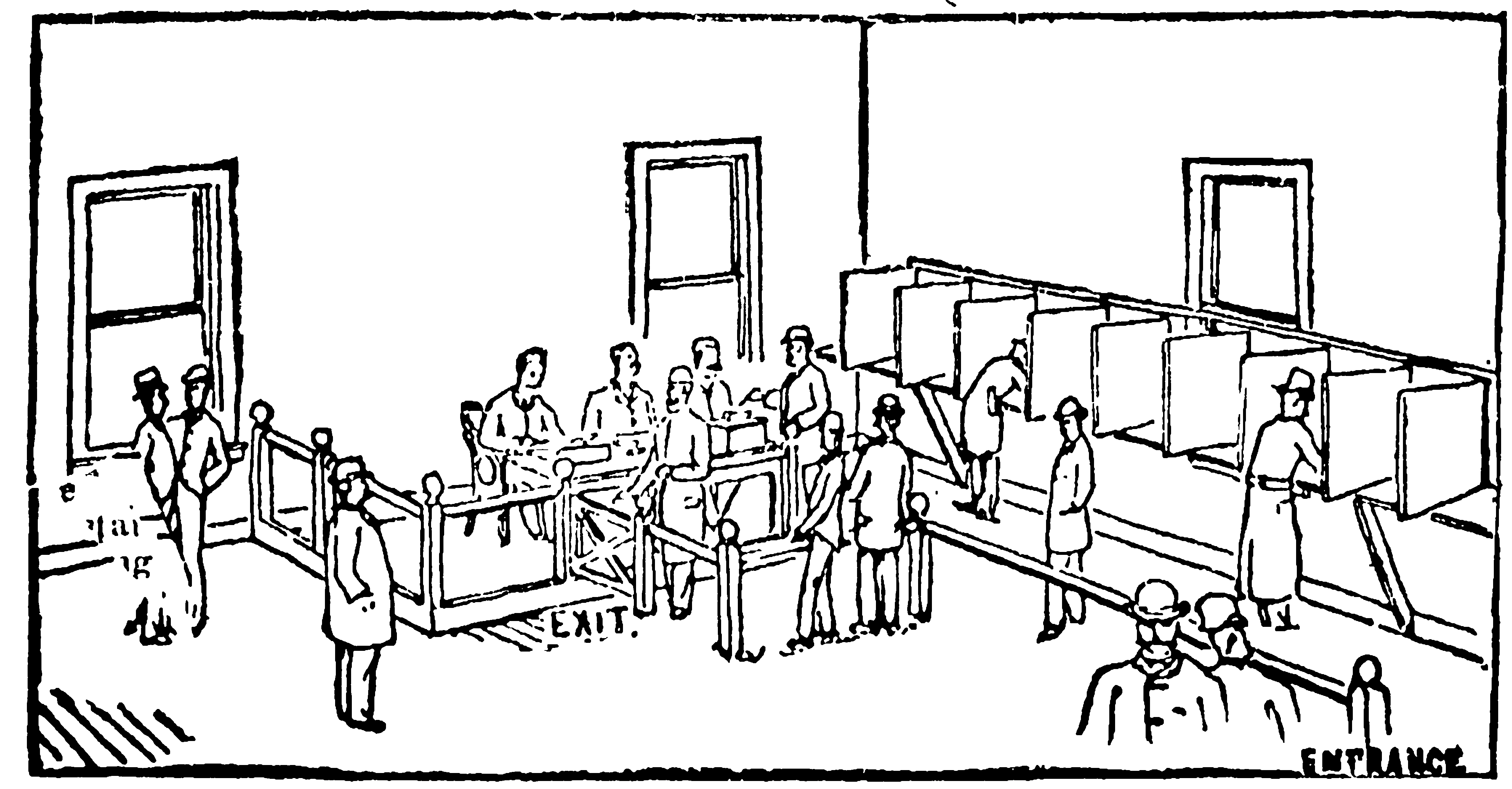
[Illustration (spans c1–c2): interior of a polling room under the Australian system. Voters enter at lower right past a railing, a row of curtained voting booths runs along the right wall, election officers sit at a table with the ballot box in the centre inside a railed enclosure, and voters leave through a gate at front centre. Labels: “ENTRANCE” (lower right); “EXIT.” (front centre); a partly lost label at far left, legible only as “e … [illegible] … ng” (perhaps “waiting”?).]
Designed by Andrews & Jaques, Architects, Boston, Mass.
The Australian system of voting may be readily understood by reference to the above drawing. The voter turns to the right at the place marked “entrance,” and there, upon proving he is entitled to vote, receives from sworn officers one ballot, containing upon the back an official indorsement, and upon the face the names of all candidates. He is then required forthwith to enter one of the booths back of the railing, where, secluded from observation, he prepares to vote by marking a cross on the face of his ballot opposite the name of the candidate of his choice; and while still in the booth, he must fold the ballot in such manner as to conceal the face and to expose the official indorsement. Proceeding, then, directly to the ballot box, he identifies his ballot as official by exhibiting the indorsement to the inspectors, and having cast it, passes out at the gate marked “exit” in the drawing. From the time he enters at the first gate until he withdraws at the second, the voter must hold no communication with anyone but the election officers, and with them only for official purposes; and none but election officers and citizens actually engaged in voting are admitted within the railing.
Where two or more classes of ballots are used, as in New York, the voter receives one ballot of each class. Where a ballot is defaced he is allowed, upon surrendering it, to get a new one. Where there is no educational qualification of the suffrage, provision must be made for voters who cannot read; and everywhere there must be provision for those who are physically incapable of marking their ballots. And inasmuch as official ballots are required, there must be regulations for certifying nominations to appropriate officials a reasonable time before election.
An idea of the details of this system may be obtained from an examination of the Massachusetts law, which, at the election of 1889, successfully underwent the test of actual operation. Its provisions, so far as they relate to state elections, are substantially as follows:
All ballots are printed and distributed at public expense. Any convention of qualified voters representing a political party which at the preceding election polled at least three per cent of the entire vote (or individual voters to the number of one thousand if the nomination be for a state office or one per cent of the voters if for a district office), may nominate one candidate for each office by filing a certificate of nomination with the secretary of state fourteen days before election.
Ballots are prepared by the secretary of state, and must contain the names of all candidates whose nominations for any offices specified in the ballot have been duly made and not withdrawn. The names of candidates are arranged in sic order, except candidates for presidential electors, which are grouped according to party. At the end of the list of candidates for each office as many blank spaces are left as there are persons to be elected to such office, in which spaces the voter may write any name he pleases. The ballots are so printed as to leave a margin sufficient to give to each voter a clear opportunity to designate his choice of candidates by a cross mark at the right of the name. On the back of the ballots are printed: “Official ballot for,” followed by a designation of the polling place, the date of the election and a fac simile of the signature of the secretary of state. All ballots must be fastened together, so that each may be detached separately; and a record of the number furnished to each voting place is kept. Every voting place is provided with two sets of ballots of not less than 100 each for every 50 voters. Full instructions as to obtaining and using ballots are to be furnished with the ballots.
Five days before election forms of ballots containing the names of all candidates are to be conspicuously posted in every voting precinct and published in two newspapers in each county; and twelve hours before election all ballots are delivered in sealed packages to the city and town clerks. One set is transmitted before the opening of the polls to the election officers of each voting place, and the packages are publicly broken at the opening of the polls and delivered to the ballot clerks. The cards of instruction are posted in the booths, and the duplicate sets of ballots are retained by the city and town clerks until called for by the election officers in case of need.
Any person desiring to vote gives his name to the ballot clerks, who announce it in a loud voice, and if the name is on the voting list the voter passes within the rail, at the
p. 10, col. 2 same time receiving one ballot and having his name checked on the list. The voter forthwith goes to one of the booths and makes a cross in the right hand margin opposite the candidate of his choice for each office, or fills in the name of a candidate in the blank space below and marks a cross opposite that. Before leaving the booth he folds his ballot, and going to the box deposits it with the indorsement uppermost.
Two voters cannot occupy the same booth at the same time, nor can any one remain in a booth more than ten minutes; and only officers and persons actually engaged in voting are permitted to be behind the railing during the election. No ballots are allowed to be taken from the polling place. If ballots are spoiled others, not exceeding three in all for any voter, may be obtained by returning the spoiled ones, which are canceled, and together with those not distributed to voters are returned to the city and town clerks.
A voter who declares that he cannot read, or from blindness or other disability is unable to mark his ballot, is entitled, upon request, to the assistance of one or two of the election officers, who are prohibited from giving information as to how he votes.
No ballot without the official indorsement may be cast, and none but those provided according to law can be counted.
A voter who willfully exposes his ballot after marking it, or places a distinguishing mark upon it, or makes a false statement as to his inability to mark his ballot, and any person who attempts to interfere with a voter when he is within the rail, or endeavors to induce him to show how he has marked his ballot, is liable to a heavy fine. For falsely marking or willfully defacing or suppressing certificates of nomination, or forging the official indorsement of ballots, or willfully destroying ballots, or removing any ballot from within the rail, or delaying the delivery of ballots, or willfully neglecting to perform an official duty, or performing it in such manner as to hinder the objects of the law, the penalty is sic fine and imprisonment.
The chief objects of this system of voting are to prevent bribery and intimidation and to undermine the autocratic power which irresponsible machines wield over the political parties they assume to represent.
Penal laws are ineffectual to prevent either bribery or intimidation. The primary remedy is a secret ballot; and this is best secured when the only possible proof of an elector’s vote is his own uncorroborated assertion. Under the Australian system no other proof can be made. When the names of different candidates for the same office are printed on different ballots according to the old system, it is possible, even when the voter retires into a booth to assort his ballots, to get a notion of how he votes, or at least to impress upon him the belief that possibly his vote is not his own secret. But when the names of all candidates for the same office are printed on the same ballot, and the voter alone in a booth distinguishes the candidate of his choice by a simple pencil mark opposite the name, and is compelled to fold the ballot before withdrawing from the booth, there is no possibility of detecting his vote, and what is more to the purpose, he knows there is none. That fact gives to the most timid of dependent voters a sense of security that makes him free; and to bribery it is fatal.
No less effective is the system in destroying the power of political machines. The printing and distribution of ballots is as important a part of election machinery as the furnishing of ballot boxes; and, left to private enterprise, it inevitably tends to breed corruption and to build up monopoly. As ballots can neither be printed nor distributed without money, and may not be faithfully handled unless trusty workers are rewarded, the organization undertaking this work has a plausible claim for money from its beneficiaries and official patronage for its retainers. It is the necessity of raising these funds and employing these workers that excuses assessments, gives color of voluntary contribution to a political party to what in truth is the price of a nomination bought from a “boss,” excuses the submission of official patronage to the distribution of the machine, and provides ample cover for collecting corruption funds and through ballot distributors at the polls a convenient channel for disbursing the funds in bribes. And as corruption funds increase, masked by increasing demands for legitimate expenses, assessments grow, the price of nominations rises, the individual voter and the
p. 10, col. 3 independent candidate are shackled, and the “machine” becomes more indifferent to party principle as its monopoly of political power strengthens. This parasite of democracy would be destroyed by the Australian system of voting. If the state provided all the ballots there would be no necessity for private ballot distributors, and the excuse for raising as well as the best mode of using corruption funds would disappear. If, also, the name of every candidate for the same office was printed on the same ballot, nominations would not be bought; for when candidates are upon an equality in respect to election machinery, and there is no opportunity for bribing voters, political “machines” have nothing to sell that is worth the buying.
When these primary objects of the system are considered and approved, is sic that any effective law, must provide—(1) for an official ballot containing the name of every candidate; (2) for the official delivery of one such ballot to each citizen when he offers to vote; (3) for secrecy in marking the ballot; and, (4) for exclusion from the ballot box of every ballot not so received and marked.
The Australian system of voting takes its name from the country in which it was first adopted. It was designed by Francis S. Dutton, a member of the legislature of South Australia, as early as 1851 and became a law in the colony of Victoria in 1856 and in South Australia in 1858. An immediate and gratifying change came over the aspect of elections in both colonies. The machinery worked with smoothness and economy, securing quietness and convenience; intimidation ceased and corrupt personal canvassing gave way to public meetings at which the merits of candidates and measures were discussed. The system has been continued there until the present time. It was adopted in Tasmania in 1858, in New South Wales the same year, in New Zealand in 1870, and by the British parliament in 1872. Before its adoption by parliament a committee carefully considered the systems of both Australia and the United States, and that of the latter was rejected because it did not secure secrecy. The effect of the new law in England was to stop bribery and to produce tranquillity at elections, while arousing greater public interest in them; and in Ireland it made possi- ble the return of Parnell and his associates by preventing intimidation by landlords. It is now a permanent feature of the English election laws. Following the example of England, British Columbia in 1873, the province of Ontario and the dominion of Canada in 1874, the province of Quebec and Nova Scotia in 1875, and Manitoba in 1886, adopted the system with the same beneficent results.
In the United States the Australian system was adopted by Kentucky and Massachusetts in 1888, by Wisconsin for cities over 50,000 inhabitants in 1887 and for the entire state in 1889, and in the same year by Rhode Island, Indiana, Missouri, Tennessee, Montana and Minnesota. In many states the reform has been confronted by the strenuous and thus far successful opposition of political machines, managed by men bright enough to see that under it neither nominations nor elections can be controlled by cliques. In Michigan and Connecticut comparatively useless laws have been enacted by way of compromise. In Oregon and Illinois the measure was pigeon holed by the senate. In Kansas and Texas it was favorably reported, but the session ex- pired before a vote could be obtained. In Nebraska and California it was defeated by a majority of both parties. In Maine it was reported unfavorably by the committee, and voted down in both houses; all the democrats and sixteen republicans in the house and one republican in the senate voted for it, the negative vote being entirely republican. In Ohio it was defeated in the senate, a majority of republicans favoring and a majority of democrats opposing it; and in Pennsylvania and Delaware it was defeated in the house, a majority of republicans opposing and a majority of democrats favoring it. In New Jersey, under the pressure of a large popular petition, the house passed the measure, but it was defeated in the senate. In New York, where the movement originated in the United States, the now famous Saxton bill passed both houses of the legislature in 1887, a large majority of the republicans and a small minority of the democrats voting for it. It was vetoed by Governor Hill, who filed a memorandum setting forth numerous objections. Some of these objections, which related merely to details, were obviated in the next bill, and nearly all the remainder have been abandoned, some because they were transparently absurd and others because subsequent experience in other states proved them to be unfounded. In 1888 the second Saxton bill was passed by a strict party vote, the republicans supporting and the democrats opposing it; but it, too, was vetoed by Governor Hill, who recommended a measure known as the Linson bill, which was so drawn as to make political machines more powerful and intimidation and bribery more effective than ever.
For these facts I am indebted principally to the book of John H. Wigmore of the Boston bar. A second edition of this book has just been issued, and, containing as it does a complete history of the reform, and annotated copies of laws and decisions of the courts, together with references to the literature of the subject, it is indispensable
p. 10, col. 4 to every one who takes an active interest either in favor of or against the reform.
It is objected to the Australian system of voting that it violates the secrecy of the ballot by compelling blind and illiterate voters to expose their votes to an officer. Under the old system voting is not secret, and in attempting to enforce secrecy we are compelled to provide for a class of voters to whom exposure of their ballots to somebody is necessary, and to prevent disfranchisement an exception must be made in their favor. How can that exception be made consistently with the highest degree of secrecy the nature of the case permits? It is not safe to allow ballots to be taken away from the polls, for by giving a bribed or dependent voter one of these ballots already marked and requiring him to bring back a clean ballot after voting, the corruptionists could make bribery and intimidation as easy as ever and more secure. It is obvious therefore that in the interest of all voters the exposure of votes when necessary must be made within the booth, and an officer sworn to secrecy is a safer person to whom to make the exposure than the briber or in- timidationist, who would always be selected by a bribed or dependent voter. As to blind voters, exposure to an officer is the only alternative of disfranchisement on the one hand or on the other of a continuance of the corrupt methods that now prevail. But respecting the illiterate, there need be no exception to the general rule. The names on the ballots may be distinguished by numbers or by printing them in inks of different colors, or the voter may take into the booth a sample ballot already marked, but of different paper from the genuine ballot, from which to copy the marks. Either of these devices will enable the illiterate to intelligently mark the official ballot.
But this objection is no longer emphasized and all others are abandoned. Opposition to the reform now takes the shape of a proposal to modify the system by permitting the use of unofficial as well as official ballots. In behalf of this it is urged that officers might be derelict and polling places be left without official ballots; or that vital errors might be accidentally or willfully made in printing official ballots, and so forth. Of course these things might happen; but they are less likely to happen when the duty of providing ballots is imposed, under penalties, upon sworn officers, than when left to the discretion of irresponsible political machines; and in actual experience no instance of serious accident or bad faith has been referred to although elections have been held under the system in Kentucky, Montana and Massachusetts, as well as in Australia, England and Canada.
The real object of the proposed modification is to nullify the law. The proposition to allow unofficial ballots does not contemplate ballots containing the names of every candidate for the same office. Yet it is of the very essence of the reform that all ballots cast shall contain the names of all candidates for the same office. Without that, the voter has no assurance that his vote is secret. Without it, “machine” candidates have an advantage over others, and the power of the “machine” is continued. Without it, fraudulent ballots may be imposed upon unsuspecting voters. And even if both the unofficial and the official ballots did contain the names of all candidates, how easy it would be to give to a bribed or dependent voter an unofficial ballot ready marked, see that he had no other ballots on his person, as is frequently done now, and require him to bring out the official ballot delivered to him by the ballot clerk, as proof that he had cast the one prepared for him. Or, how easy, after giving him a ballot ready marked, to warn him, if bribed, that he would lose his bribe, or if dependent that he would lose his employment if he did any writing in the booth or remained there long enough to change his ballot. If the voter were not compelled by law to take an official ballot as he went into the booth, it is too obvious for argument that there would be no secrecy; the voter who took an official ballot would be a marked man, and would lose his bribe if bribed, or his employment if dependent. It is because frauds would be possible under the proposed modification that ballot reformers reject it; and it is because they would be impossible without the modification that the modification is proposed.
Details may be compromised, but essentials must not, and it is essential not only that the ballot be official, and contain the names of all candidates, and be delivered to the voter only at the moment of voting, but also that no other ballot be voted. LOUIS F. POST.
BALLOT REFORM IN NEW JERSEY.
Petitions Being Circulated Throughout the State Asking the Legislature to Pass Only a Genuine Bill.
Since the election the ballot reformers of New Jersey have been actively engaged in circulating a petition for signatures calling on the legislature to pass a genuine ballot reform bill embracing all the essential features of the Australian system, at the coming session, which convenes in Trenton on January 14. The Hudson county ballot reform association sent an electro of the petition to every paper in the state with a request that it be published and that the editors call the attention of their continued on p. 11 →
[Text breaks off mid-sentence at the foot of column 4; no jump line printed. Presumably continued on the next page (page 11), but the paper does not say so.]
Page 11 of 16contents
p. 11, col. 1 [continued from page 10: BALLOT REFORM IN NEW JERSEY]
← continued from p. 10 readers to it in editorial articles. Nearly every paper in the state has complied with the request, and every mail brings a large number of signatures. An effort is to be made to hold a conference during the second week in January of delegates from all the associations in favor of this reform so that an agreement can be made to present only one bill. At present the Knights of Labor, the Federated trades, the Farmers’ alliance and the Ballot reform leagues all have separate bills. Then, too, several senators and assemblymen have drawn up bills which they intend to present. Unless there is concerted action, confusion will follow, and the legislature will delay the passage of a bill until a special committee has considered the subject and made a report.
If there are any single tax men in New Jersey who wish to help along the work by getting signatures to the petition they can secure blanks by sending their names to me, and I will mail them any number that they may desire.
J. T. ALTEMUS,
Secretary Hudson county ballot reform association, 217 York street, Jersey City.
What Do You Say to This, Mr. Hill?
New York World.
The old whig organ of this city, which virulently opposes everything that is democratic and most other things that are of good report, is opposed, of course, to ballot reform. It opposes this reform, of course, by the familiar method of false statement and absurd misrepresentation. It says:
Whether the Australian system of voting would increase or diminish the democratic strength, it is equally the duty of democrats to oppose the new fangled plan. The democratic principle is to give the widest freedom to the citizen and to allow the least possible interference with his rights. It is democratic to make voting as sic as possible and not as hard as possible.
The democratic principle is nothing of the sort and never was. The democratic principle is to make voting honest. Democracy holds that every man has a right to cast his own sic. and not to have it cast by his business employer or his political boss.
This is what ballot reform seeks. It is a device to protect the poor man in his equal rights as a citizen. It is in its essence democracy.
Ballot reform is a device made necessary by the organized conspiracy of wealth to rob poverty of its share in government, and to make of the wealthy a ruling class, carrying elections by intimidation on the part of employers and by bribery on the part of the Dudleys, with money furnished by the Wanamakers.
Nothing could be more democratic than this reform. Its opponents, whatever they may profess, are the tools, agents and attorneys of the plutocratic conspiracy against popular sic.
Profession is cheap and very easy to dishonest minds. Even those who conducted the Butler campaign in Blaine’s interest professed to be democrats.
No man is really a friend of this republic and its institutions who does not stand firmly for popular right against plutocratic encroachment. No man is on the people’s side who opposes ballot reform at this crisis.
Good News From West Virginia.
W. F. sic of Parkersburg, W. Va., writes: “Last spring we had printed a pamphlet from the sic bill, copies of which we forwarded to each of the legislators of this state, and also to Governor Wilson, at the same time calling upon all labor organizations to pass resolutions and send copies of the same to the legislature to direct its attention to the much needed reform in our elections. We have just received notice from Governor Wilson to the effect that such a bill will be framed and submitted, and that he had reason to believe that it would become a law.”
The Secret Ballot in Maryland.
The Ballot reform league of Maryland, which in the last four years has done much to prevent election frauds in this city, and has brought a number of the offenders to justice, is now preparing to make another fight in the legislature for a better election and registration law. The plan for voting decided upon by the committee on legislation is something like the Australian system, provides that on the tickets the democratic names be in one column, republican in another, prohibition in a third, the fourth to be reserved for the independent ticket. It will be like four election tickets printed side by side, and to lessen the necessity of illiterates calling upon the judges to show them their tickets, it is proposed to print some small symbol upon the head of each ticket, beside which the voter would place his mark to designate that he wished to vote that ticket. After the Australian feature has been completed, there will be added provisions governing canvassing boards and other matters. The bill is expected to be ready in pamphlet form by the time of meeting of the legislature.
Plenty of Bills in New Jersey.
The state legislative committee of the Knights of Labor of New Jersey has framed a ballot reform bill similar to that introduced by Assemblyman Kane. Allen L. McDermott will draw a bill to be advocated in the legis-
p. 11, col. 2 lature by the democrats, and the republican measure will be modeled on the Massachusetts law. Governor Abbett has publicly committed himself to the reform.
Governor-elect Abbett said at the reception of the Democratic society of Rutherford, N. J., the other night that the democratic party was pledged, and that he personally was pledged, to a reform which would put an end to intimidation and to bribery and corruption in any shape.
Said a police captain to a reporter of the Boston Traveller: “You may depend upon it, that we, including commanding officers and patrolmen, are delighted with the successful working of the Australian ballot law, and I hope it will always be in force. The old days at election time are vividly recalled by the easy time all the patrolmen had at the last state election, which is well illustrated by the fact that not one arrest was made for disorderly conduct around the polls. We have had in the past too much of the ‘bulldozing’ spirit manifested among many of the notorious ward politicians, who always controlled the minds of many innocent men upon election days.”
Interviews by a reporter of the Richmond Dispatch with members of the Virginia legislature show some in favor of the Australian ballot and many anxious for some sort of reform in the state election laws.
Press Opinions.
The Knights of Labor of Iowa may rest assured that the coming session of the legislature will pass the Australian ballot system. The democratic members are pledged to it and the republicans are too badly scared to refuse anything.—[Industrial West.
The Australian ballot system was a more conspicuous success, if possible, on Tuesday than at the state election. The governor of New York, in the face of these successes, had better surrender unconditionally.—[Boston Globe.
Even the most sceptical ought to be convinced now of the success of the Australian system.—[Boston Post.
A ballot bill embracing most of the features of the Australian system has been introduced in the Virginia legislature. That is a good movement. If all the southern states should this winter adopt a good ballot bill—such as that one, for instance, which Governor Hill vetoed in this state, or such as that which has just had its first successful trial in Massachusetts—they would disarm and disappoint the republican politicians who are urging federal control over elections, and whose real object is to “fire the southern heart” anew, and by maintaining a “solid south” to keep up also, what they depend on, a “solid north.”—[New York Herald.
If Governor Hill has read Mr. Cleveland’s speech on ballot reform, and heard of the enthusiasm with which it was received, he must recognize the necessity of getting off the track before the ballot reform engine comes along. No man who remains opposed to ballot reform can get the democratic nomination for president in 1892.—[Boston Globe.
The Australian system is civilization’s way of securing a fair vote, and please observe that Indiana is in the front of the procession in this country.—[Indianapolis News.
Ex-President Cleveland in his Boston speech sounded the keynote of ballot reform. The democratic legislature in the coming session should take up the matter and give it its earnest attention.—[Cleveland Plain Dealer.
IN THE FIELD OF INDUSTRY.
Workingmen Who Are Hunting for Work Appealed To sic “Stay Away”—Where Shall They Go and What Shall They Do?
Journal of United Labor (Official Organ of the Knights of Labor).
Cedar Mines, Iowa.—Mines and mine sic are requested to stay away from this place.
Utica, N. Y.—Shoemakers are requested to stay away from this town, as there is trouble.
Oliver Springs, sic —Miners and mine laborers are warned to stay away from here, as the men are on a strike against a reduction in prices.
Rich Hill, Mo.—Miners and sic are requested to stay away from this place. Wages are very low and many idle men are around.
Sioux City, Iowa.—Mechanics and laborers are requested to stay away from this place, as it is crowded with idle men, and work is almost at a standstill.
Greenville, Mich.—Mechanics and laborers are warned to stay away from here, as the place is now crowded with idle men, and work is at a standstill.
Sioux Falls, S. Dak.—Mechanics and laborers are warned to stay away from here, as work is at a stand still, until spring. There is nothing doing during the winter months.
Eau Claire, Wis.—Laboring men are warned to stay away, as the place is now crowded with idle men. Give no heed to advertisements encouraging men to come here.
Colorado.—All coal miners are requested to stay away from Lafayette and Canfield, Boulder county, Col. Union miners are on strike against reduction of wages.
New Derry, Pa —Miners and mine laborers are warned to stay away from this town,
p. 11, col. 3 There is a strike in progress against a reduction in wages.
Dallas, Tex.—Mechanics and laborers are requested to stay away from here, as the place is crowded with idle men.
Brazil, Ind.—Miners and mine laborers are warned to stay away from this region as there is a strike in progress, caused by the operators insisting on a twenty-five per sic reduction on last year’s prices.
Moss Point and Scranton, Miss.—Mechanics and laborers of all kinds are requested to stay away from these places as business is very dull and there are hundreds of idle men on the streets.
San Bernardino, sic —Laboring men are warned to stay away from southern California as the country is crowded with idle men. There is no work to be had as everything is dull and at a stand still.
Vancouver, B. C.—’Longshoremen, painters and decorators are requested to stay away from here as the city is full at present.
Oswalt, Iowa.—Miners and mine laborers are urged to stay away from here. There is trouble expected at the three shafts in this hollow, owing to a demand made by the men for the usual fall advance.
Fort Smith, Ark.—Stone cutters are requested to stay away from this place, as work is very dull and idle men are plentiful.
Edgecombe, N. C.—Mechanics and laborers are warned to stay away from here as there are many idle men with us, and wages are at starvation point. Those who are employed received, men, $8 per month; women, $5 per month.
Grand Rapids, Mich.—Mechanics and laborers are warned to stay away from here. The place is overrun with idle men. It is estimated that 800 are out of work at present and there is no immediate prospect of a change for the better.
Newburgh, W. Va.—Miners and mine laborers are requested to stay away from here. Reduction in prices has been made.
Moberly, Mo.—Miners and mine laborers are warned to stay away from here as a strike is in progress against sweeping reductions. The fight has been on since April 1. The men are firm and determined to win.
Defiance, Ohio.—Stove moulders are warned to stay away from this city as there is a strike on on account of a reduction in wages. The boom is only temporary and worked up to encourage all classes of labor to come here.
St. Louis, Mo.—Harnessmakers and machine operators are requested to stay away from here and to pay no attention to advertisements appearing in the papers. The city is flooded with idle men.
Cairo, sic —Mechanics and laborers are requested to stay away from this place as it is overrun with idle men, who have been induced to come here by misleading advertisements in the newspapers. Building operations are at a stand still and everything is dull at present.
Deepwater, Henry Co., Mo.—Miners and mine laborers are requested to stay away from here as work is very dull, and a reduction from $1 to 75 cents for first-class coal per ton has been forced upon the men. For second-class we receive only 25 cents per ton. Things are almost at starvation point and there are crowds of idle men.
Galveston, Tex.—Workingmen everywhere are warned to stay away. The streets are crowded with idle men caused by the pooling of the cotton presses in the city. Every bale of cotton is handled by contract, and one man is now compelled to do as much work as three men formerly did. The Santa Fe railroad has cut its men from $1.75 to $1.50 per day.
Jackson, Mich.—Carpenters are warned against the misleading advertisements of the George T. Smith purifier company of this city for men wanted. Plenty of idle men are here now. This company compels its employes to buy a lot from the company. Failure to do so means to be laid off indefinitely. Work is slack at the same time the company is advertising.
Spokane Falls, W. T.—Mechanics and laborers are advised to stay away from here. The town is almost entirely destroyed, the season is late for commencing building operations, and material is scarce. There are crowds of idle men around. Give no heed to advertisements. They are paid for by schemers who desire to be benefited by crowding the city with an army of unemployed.
Bay City, Mich.—There are advertisements in the papers from time to time that men are wanted in the Saginaw valley. Some advertise for house carpenters, some for ship carpenters and some for men to work in the woods, mills and factories. There are no men wanted here. Crowds of men are walking the streets unable to find employment. Many have spent their last cent in coming here only to find out they have been deceived by the lumber kings and contractors. Mechanics and sic heed, for the valley is no place at present in which to make a living. Keep away and give those who have homes partly paid for a chance for their lives, and you will save a good deal of suffering and hardship.
And It Will be Hot, Too.
St. Joseph Herald.
When the tariff debate begins in congress we may look for a dry spell.
p. 11, col. 4
NEW IDEAS, METHODS AND INVENTIONS.
A New Ticker That Will Revolutionize Telegraphy.
A system of telegraphy which promises to replace in great measure that now in use has been invented by J. H. Rogers of Washington, who has already achieved fame by inventing the pan-electric telephone. The system is based on the synchronous revolution of two wheels, one at the sending and the other at the receiving station. This has been attained before, but by such complicated methods that no great commercial benefits have resulted. Mr. Rogers secures the simultaneity of revolution by an arrangement for sending a spark from one wheel to the other. If the spark is not at a certain place on the wheel it is known that the wheels are not turning together and measures are taken for making them do so. The message is printed on an ordinary type writer which is connected with a machine which punctures a series of holes, corresponding to letters, in a slip of paper. The slip is then run through the sending instrument and the message is printed in Roman letters at the receiving station without any aid from an operator. Another method of sending is by a sort of a type writer having only ten keys which punches the slips directly. This can be operated fast enough to take down ordinary conversation. Only ten keys are necessary because any letter can be formed in Roman type by combining two or more of ten marks. By this system of telegraphy from two to five hundred words a minute can be transmitted, so that its advantage over the Morse system, by which only thirty words a minute can be sent, is apparent. The general adoption of the new system would therefore greatly decrease the number of wires needed for telegraphing. Besides in the synchronous system ten operators can send a message over a single wire at the same time, which is two and a half times more than is possible under the old system.
To Go 120 Knots an Hour.
A Russian inventor named Leonide Apostoloff, a Cossack engineer in the Russian army, is at work on a plan by which he hopes to cross the Atlantic, from sic to Sandy Hook, in twenty-six hours. Having explained his plans to the war department, he was allowed to take a vacation of three years in which to perfect his invention. He thereupon went to Marseilles, where the climate favors nautical experiments more than it does in St. Petersburg. Here he is building his boat. He calls it the Bateau Plongeur. Its model is that of a spindle, sharp at both ends. It is 28 meters long and 3½ meters in diameter in the middle. It consists essentially of an inner and an outer shell, the outer shell revolving around the inner one on journals fitted at each end of a horizontal shaft that runs through the axis of the spindle. Beginning at a point near the bow and winding twice around the outer shell is a blade perpendicular to the axis of the spindle, very much like the thread of a screw As the outer shell revolves this screw thread will worm the craft through the water. To drive the craft he uses an electric motor, with a storage system of his own. Electricity will, of course, light the craft. At each end of the boat and around the center are belts of bull’s eyes, through which the light will shine, but for what purpose is not evident. That the glass would be useful when on the surface is plain enough. The boat is steered by fishtail rudders—horizontal and vertical. To a correspondent who asked him about his invention Mr. Apostoloff said: “My boat will travel from 80 to 120 knots an hour—80 on the surface of the sea and 120 at full speed under water. I have applied to navigation the spiral principle, that is all. The value of this principle is seen in many places. Why does a snake swim faster than any fish? Because it twists itself through the water. Force for force, a screw is driven into a piece of wood quicker than a nail. The projectile of an old smooth bore musket traveled perhaps 100 yards with a certain trajectory. The modern rifle sends a projectile twisting through the air to ten times the distance.”
Ozone in the Treatment of Phthisis.
Ransome records the treatment of thirteen cases of pulmonary tuberculosis by the inhalation of ozone. Each cylinder used contained seven litres of pure oxygen ozonized up to nine per cent. No other treatment was employed. The cases represented various stages of the disease, and were all under obse[rva?]tion for more than one year. The au[thor?] says that the results obtained were a [con?]tinuous freedom from fever, absence of sweats, diminished expectoration, and [illegible] gain in weight and strength. The author believes that ozone does not act as a direct germicide, and that the control over the disease does not seem to come from any direct action upon the tubercle bacillus. It acts by restoring tone to diseased portions, and has a beneficial effect on the general health.
A New Dynamo.
The United States electric lighting company announce that they have perfected a new dynamo. The field magnets part along a horizontal plane, so that, by removing the yoke and unbolting the two halves, the upper half can be lifted away and the armature removed. This is convenient in cramped situations. The same construction enables it to be carried into restricted locations which would not be accessible to a dynamo built in one piece. The armature itself [is?] wound in a single layer upon a laminated core, practically obviating the liability to heating. Ball bearings are used on both ends of the shaft. The lower horn of the casting is hollow, and serves as a reservoir for oil running through the bearings. Oil can therefore be supplied copiously, and drawn off and returned to the cups without waste. The dynamo is carried on an elevated base, making it more accessible to the operator.
Page 12 of 16contents
12 THE STANDARD. Vol. VI, No. 26
p. 12, col. 1
SINGLE TAX NEWS.
SINGLE TAX PLATFORM.
The single tax contemplates the abolition of all taxes upon labor or the products of labor—that is to say, the abolition of all taxes save one tax levied on the value of land, irrespective of improvements.
Since in all our states we now levy some tax on the value of land, the single tax can be instituted by the simple and easy way of abolishing, one after another, all other taxes now levied, and commensurately increasing the tax on land values, until we draw upon that once sic for all expenses of government; the revenue being divided between local governments, state governments and the general government, as the revenue from direct taxes is now divided between sicsic local and state governments, or a direct assessment being made by the general government upon the states and paid by them from revenues collected in this manner.
The single tax is not a tax on land, and therefore would not fall on the use of land and become a tax on labor.
It is a tax, not on land, but on the value of land. Thus it would not fall on all land, but only on valuable land, and on that not in proportion to the use made of it, but in proportion to its value—the premium which the user of land must pay to the owner, either in purchase money or in rent, for permission to use valuable land. It would thus be a tax, not on the use or improvement of land, but on the ownership of land, taking what would otherwise go to the owner as owner and not as user.
In assessments under the single tax all values created by individual use or improvement would be excluded, and the only value taken into consideration would be the value attaching to the bare land by reason of neighborhood, etc. Thus the farmer would have no more taxes to pay than the speculator who held a similar piece of land idle, and the man who on a city lot erected a valuable building would be taxed no more than the man who held a similar lot vacant.
The single tax, in short, would call upon men to contribute to the public revenues not in proportion to what they produce or accumulate, but in proportion to the value of the natural opportunities they hold. It would compel them to pay just as much for holding land idle as for putting it to its fullest use.
The single tax, therefore, would—
Take the weight of taxation off of the agricultural districts when land has little or no sic irrespective of improvements, and put it on towns and cities where bare land rises to a value of millions of dollars per acre.
Dispense with a multiplicity of taxes and a horde of taxgatherers, simplify government and greatly reduce its cost.
Do away with the fraud, corruption and gross inequality inseparable from our present methods of taxation, which allow the rich to escape while they grind the poor. Land cannot be hid or carried off, and its value can be ascertained with greater ease and certainty than any other.
Give us with all the world as perfect freedom of trade as now exists between the states of our Union, thus enabling our people to share through free exchanges in all the advantages which nature has given to other countries, or which the peculiar skill of other peoples has enabled them to attain. It would destroy the trusts, monopolies, and corruptions which are the sic of the tariff. It would do away with the fines and penalties now levied on any one who improves a farm, erects a house, builds a machine, or in any way adds to the general stock of wealth. It would leave every one free to apply labor or expend capital in production or exchange without fine or restriction, and would leave to each the full product of his exertion.
It would, on the other hand, by taking for public uses that value which attaches to land by reason of the growth and improvement of the community, make the holding of [land?] unprofitable to the mere owner and [profitable?] only to the user. It would thus [make?] it impossible for speculators and [monopolists?] to hold natural opportunities un[used?] or only half used, and would throw open to labor the illimitable field of employment which the earth offers to man. It would thus solve the labor problem, do away with involuntary poverty, raise wages in all occupations to the full earnings of labor, make overproduction impossible until all human wants are satisfied, render labor saving inventions a blessing to all, and cause such an enormous production and such an equitable distribution of wealth as would give to all comfort, leisure and participation in the advantages of an advancing civilization.
The ethical principles on which the single tax is based are:
Each man is entitled to all that his labor produces. Therefore no tax should be levied on the products of labor.
All men are equally entitled to what God has created and to what is gained by the general growth and improvement of the community of which they are a part. Therefore, no one should be permitted to hold natural opportunities without a fair return to all for any special privilege thus accorded to him, and that [value?] which the growth and improvement of [the community?] attaches to
p. 12, col. 2 land should be taken for the use of the community.
THE PETITION.
SINGLE TAX ENROLMENT COMMITTEE, 36 CLINTON PLACE, NEW YORK, Dec. 23, 1889.
Subscriptions toward the expenses of this committee’s work for the week ending December 23, are as follows:
Bradford S. T. club, Bradford, Pa. . . $12 00 James R Carret (add.), Boston, Mass. . . 2 00 Walter sic, Frankfort Springs, Pa. . . . . . . . . . . . 12 00 $26 00
Subscriptions previously acknowledged in THE STANDARD . . . . 2,593 70
Total . . . . . . . . . . . . . . $2,619 70
The cash contributions for the week are as follows:
Wm. H. Hart, Connersville, Ind. . . . $1 00 G. A. Macfarlane, Jasper, Ala. . . . 3 00 August Roche, Martell, Wis. . . . 1 00 $5 00
Cash contributions previously acknowledged in THE STANDARD . . 188 38
Total . . . . . . . . . . . . . $193 38
The enrolment now stands as follows:
Reported last week . . . . . . . 70,295 Received during the week ending Dec. 23 . . . . . . . . . . 603
Total . . . . . . . . . . . . 70,898
WM. T. CROASDALE, Chairman.
The single tax enrolment committee is circulating a petition asking the United States house of representatives to appoint a special committee to make inquiry into and report upon the expediency of raising all public revenues by a single tax upon the value of land, irrespective of improvements, to the exclusion of all other taxes, whether in the form of tariffs upon imports, taxes upon internal productions or otherwise. It will send blank petitions on application to any address, and single tax men are urged to obtain petitions and obtain signatures as a most convenient and effective way of starting the discussion of our principles.
NEW YORK CITY.
The New sic Officers of the Manhattan Club Organize for the sic Year—Steers and Wolf Visit the Yonkers Heathen—Cheers for George in Cooper Union.
I. Cohen spoke last Sunday evening on “The tariff as a system of robbery” before a good audience. William T. Croasdale will deliver the lecture next sic; subject: “The battle of 1890.”
The newly elected officers and board of directors of the Manhattan single tax club met last week and organized the managing board for the coming year. A. J. Wolf was made chairman and Benjamin Doblin secretary, and the following were named chairmen of the club’s standing committees: Finance, Joseph McDonough; house, W. H. sicsic: agitation, Benjamin Doblin; library, W. T. Croasdale; membership, William McCabe. The club will work under the new constitution, sic with the new year.
On Thursday evening last, at the invitation of the Riverside association of Yonkers, Messrs. Wolf and Steers of the Manhattan club addressed a meeting of about one hundred men in the rooms of the Knights of Labor on Getty square. The chairman of the meeting, in opening, stated that the Riverside association were engaged in the study of various reforms for the betterment of social conditions, and would hold meetings throughout the winter on alternate Thursdays for the purpose of hearing lectures and engaging in discussion of the questions raised by the speakers. In the course of his remarks he said that the simplicity and practicability of the single tax method had captured him, and he would remain an adherent of that mode of correcting the evils complained of until it was made clear to him that a better way out of the trouble was possible.
Mr. Steers devoted his remarks to the “Effects of the single tax.” He calculated that [$30,000,000?] of wages not now paid would be expended in New York alone in the first year of the institution of the single tax.
Mr. Wolf followed with a lucid description of the present condition of labor, and showed what would be its condition under a just system giving the worker an alternative to employ himself if discharged from any line of business. He narrated with telling effect the story of “Geo. Washington Smith and His Big Axe” (lately printed in THE STANDARD), which seemed new to most of the audience, who greatly enjoyed it.
After the speakers closed speaking they invited questions. This invitation developed a most interesting discussion, during which Mr. Steers found a chance to get in a short appeal for ballot reform and to explain the Australian system.
A socialist, one of the gentler sort, attacked the speakers on the statement made by them as to the identity of interest between capital and labor. His remarks were taken in good part, as he acknowledged a common ground of action.
At 10.38 the speakers had to leave to catch
p. 12, col. 3 the last train for home, leaving behind them an active discussion. The Riverside association deserves credit for the work they are doing, which cannot fail to do much good in the community where they live.
There was a mass meeting held at Cooper union last week at which Erastus Wyman and others explained a scheme they had inaugurated for loaning money on advantageous terms to people who wanted to build homes. Mr. Wyman, during his address, mentioned the name of Henry George, whereat the audience broke out into loud cheers.
sic.
The Brooklyn Single Tax Club to Hold an Election of Officers on Friday Evening, December 27—Mr. Scrimshaw’s Lecture—Organizing a Musical Annex to the Club.
The election of officers for the Brooklyn single tax club will be held Friday evening, December 27, at 56 Livingstone street. All members are earnestly invited to attend and participate in the election. It seemed to be the unanimous feeling that as single tax men had been the first to declare for the Australian system of voting, it would be a fit thing for the club to elect its own officers by that method. But owing to the limited time at their disposal, and the fact that nominations had not yet been made for all the offices to be filled, it was decided to hold the election in the usual manner.
The speaker at the last Sunday evening meeting was Mr. Fred Scrimshaw, president of the Ocean hill club; the subject of his discourse was, “Some Phases of the Curse.” The address, which was a masterly arraignment of existing conditions and the upholders “of things as they are” because they are, was thoroughly enjoyed by all present. The clearness of portrayal, in seathing criticism and keenness of attack, was one of the best addresses ever delivered before the club. Had it been listened to by a majority of Brooklynites, it would have measurably decreased the time when man’s natural rights to the soil will be fully recognized. Preceding the address, and also at its close, the club was favored with several selections by a quartette. The attempt to form a musical annex to the club is meeting with considerable success. It only needs those members who are possessed of musical ability to offer their services, to make these musical selections a feature of the Sunday evening meetings.
The speaker for next Sunday evening will be Rev. H. H. Brown, who will lecture on “Nationalism.” As several members of the club have been waiting for some such opportunity to annihilate Bellamyism, and are loaded for bear, the result will no doubt be a very interesting meeting, and no member should fail to attend.
NEW YORK STATE.
Two Attempts at Land Grabbing on Long Island Which Are Being Resisted by the People—Agitating in Long Island City—A Mass Meeting at New Brighton—Encouraging News from Binghamton—The Central Labor Union of Buffalo Declares for the Single Tax—A Member of the General Executive Board of the Knights of Labor Declares in Favor of the “George Idea.”
Herbert Laromer, Glen Cove, L. I.—My newsdealer used to keep only enough STANDARDS to supply orders. Then he was a strong protectionist. But now he says he sees that the single tax people are in the right. I have a republican friend who says the single tax idea is a perfectly just idea. There has lately been quite a flurry at Oyster Bay over an incident that has served to open people’s eyes on the matter of private ownership of land. In Oyster Bay township are two islands—Dana’s and Cote’s—and between the two there was at one time a tide mill and two tide ponds. One of the ponds has been a great resort for the people of the township, who went there and gathered shell fish when the tide was low. Cote’s island was a short time since sold to a Dr. Connor. His first act was to prohibit people from fishing in the pond, he claiming that when he bought the island he also bought the pond. But the people dispute the doctor’s title to the pond, claiming that when the tide mill was destroyed the pond became town property, and that the people still have the right to fish in it. There is considerable feeling over the matter, which will be fought out in the courts.
T. J. Drake, Long Island City.—A great deal of the change in sentiment which is manifesting itself here can be attributed to the work of members of our Freedom association, who are continually visiting labor organizations in Brooklyn and Long Island. We are going to pay particular attention, for some time to come, to the street car employes of this city. William A. King, who is a fluent speaker, devotes a large portion of his time to the cause.
L. A., Bayside, L. I.—George Bradish is the name of a man who may go down to history as a principal actor in an event which happened on “Long island’s sea girt shore.” Some time ago he applied for and received from the state fish commission a grant for some bay bottom in the township of Flushing, commencing five hundred feet from the shore, in which to go into the cultivation of oysters. Having got that for the asking, he
p. 12, col. 4 evidently is sorry that he did not ask for more; but in order to make up for lost time, he has applied to the land office at Albany for the land, or rather water—between the grant he now holds and high water mark. But he has overreached himself. The people of Bayside are up in arms, and they are going to fight Bradish tooth and nail. All of which points to two things: (1) Bradish shouldn’t have been quite so very greedy. (2) This matter is going to start tongues to wagging on the right of Bradish, or anyone else, to hold land in monopoly.
A. J. Strees, New Brighton, Staten Island.—The Richmond county single tax league held a public meeting at Parabola hall last week. Messrs. Wolf, Steers and Doblin of the Manhattan simple tax sic delivered the addresses. The movement here is growing slowly but surely.
John H. Blakeney, Binghamton, N. Y.—I take occasion from time to time to write single tax articles to our local papers and they are becoming more and more willing to publish such articles. I had a conversation recently with the editor of one of our democratic dailies on the subject of ballot reform. I explained to him the difference between the exclusive official ballot and the kind advocated by Governor Hill, and I see he is becoming more favorable to the real reform. The single tax is in the air. It is not that people are becoming outspoken for it or even know themselves to favor it, but it is rapidly spreading through unconscious absorption. In the not distant future when some practical measure in our direction comes out, the movement will have vastly more friends than most people suspect. It will appear to break out by a sort of spontaneous combustion.
Buffalo.—At a recent meeting of the central labor union, which has affirmed its belief that Buffalo’s municipal revenue should be raised by means of tne single tax, the tax reform committee stated that the formal report on the principles of municipal taxation had been printed in the leading papers of the city, and so far as the committee could learn, no one had attempted to disprove the important conclusions contained therein.
The Buffalo Sunday Truth says that A. W. Wright, of the general executive board of the Knights of Labor and editor of the Journal of United Labor, lectured last week in Central labor union hall before a full house. He said, among other things, that he was looking for a reform that would give to the laboring man all that he produces by his labor. He thought that he had found it in the Henry George idea.
MASSACHUSETTS.
Professor Garland and James A. Herne in Boston—Progress in Pittsfield—The sic Single Tax Man of Salisbury.
BOSTON.—Professor Hamlin Garland delivered an address and James A. Herne read “Under the Lion’s Paw” at Chickering hall, Boston, on Sunday, December 15.
Thomas Walsh, Pittsfield.—The growth of our ideas here continues, and the single tax is the general subject of conversation and debate. The T. and [P.?] social club discussed it recently, and the question being put at the end of discussion, the affirmative vote was almost unanimous. Another literary society, one of the largest in the place, is to debate the question some time in January. It is probable that the discussion will be open to the public. For a long time nothing was known of the question in this town, and the attention it is now attracting is very encouraging to the single tax men here.
George Quincy Heywood, Salisbury.—I am the only single tax man in this town, also the only free trader; but the people here believe in tariff reform.
CONNECTICUT.
A Meeting at Which the Single Tax and a Chowder Are Discussed—The Birmingham Land Owners Will be Heard From When the Assessors Report—A Social Science Section of the Scientific Society to be Organized at Bridgeport.
Joseph Cornell, Danbury.—We single tax men are doing all we can to lead protectionists toward free trade. We order our STANDARDS from newsdealers, because in our opinion it advertises the paper. The last meeting of our committee was held at the house of John E. Jones, who after the meeting served up a good chowder and other good things prepared by his amiable spouse. Dr. Fox treated the company to an eloquent address on the single tax, and Sam A. Main read “First Principles.” Mr. Jones then appealed to those present who were not single taxers to read up. Messrs. Schoonover, Tice and others contributed their share to the evening’s enjoyment. The next meeting will be held January 3 at my house, when James Downs, master workman of D. A. 95, K. of L., will address the meeting. When we have progressed a little further we will organize a club.
C. A. Pratt, Birmingham.—I bring up the subject of the single tax wherever possible. I have just got in a little work in our direction, having served on the board of assessors, continued on p. 14 →
[Text breaks off at the foot of the column; the continuation is not on this page.]
Page 13 of 16contents
THE STANDARD — page 13
THE STANDARD. Vol. VI, No. 26
p. 13, col. 1
The [Parrot?] and th[illegible]
[Detroi?]t Evening N[e?]ws.
In the little tobacco and ne[illegible] [illegible] op[p?]osite the Goodman House, on G[illegible] [R?]iver avenue, is a parrot. This parrot is wise—for a bird—and its curiosity leads it to test with its beak these things that excite its curiosity. On the counter, a day or so ago, was a pile of Detroit Tribunes awaiting purchasers, and it proceeded to investigate their contents. It hopped up on a pile and at the first pick tore out a half-column editorial headed, “Protect American workingmen by taxing their tin pails.” The next pick disclosed to the astoniseed gaze of the parrot the startling information: “Make taxes high enough, and everybody will become prosperous, happy and rich.” The parrot may not have got the words just right, but its natural wisdom enabled it to correctly serve the announcements [of?] the sheet it was diligently tearing to [pieces?]. It stopped, scratched the back of its [head?] with its left claw, and casting a glance [at?] its cage swaying lazily in the current o[illegible] caused by the opening and shutting of the [illegible] door, then soliloquized: “Tax tin! Then [illegible] will cost more and mine will be made [illegible]r. Tax what I eat and drink! Then [illegible] less of them and my stomach will su[illegible]. [Well?], well. This doctrine may be good [for?] common men and women, but as [parrots?], all they ask is liberty to get [illegible]t with the least trouble. Shoot the [illegible]” With a scientific scratch he gave [illegible]pers a dig that scattered them over the [illegible]nd, jumping upon his perch, fell into [illegible]lumber from the soporific caused by [illegible]g the aforesaid editorials.
[Let’s?] Give Him Another Chance.
[St.?] Louis Republic.
Mr. Powderly is discovering that “protection does not protect the laborer.” Mr. Powderly is an able man, but he differs from the rest of the country in that his “off” years are those of presidential elections.
[Advertisement] [A?] NEW METHOD OF TREATING DISEASE.
Hospital Remedies.
[W?]hat are they? There is a new departure [in th?]e treatment of disease. It consists in the [illegible]ion of the specifics used by noted [illegible]ists of Europe and America, and bring[ing th?]em within the reach of all. For instance [the tre?]atment pursued by special physicians [to tr?]eat indigestion, stomach and liver [illegible]s only, was obtained and prepared. [The tre?]atment of other physicians, celebrated [for cur?]ing catarrh was procured, and so on [till the?]se incomparable cures now include [illegible] of the lungs, kidneys, female weak[ness, rh?]eumatism and nervous debility. [This n?]ew method of “one remedy for one [disease?]” must appeal to the common sense of [illegible]rers, many of whom have experienced the [illegible] effects, and thoroughly realize the absurdity of the claims of Patent Medicines which are guaranteed to cure every ill out of a single bottle, and the use of which, as statistics prove, has ruined more stomachs than alcohol. A circular describing these new remedies is sent free on receipt of stamp to pay postage by Hospital Remedy Company, Toronto, Canada, sole proprietors.—
[Advertisement] Scott’s Emulsion
[If?] You Have
[CON?]SUMPTION | COUGH OR COLD [BRO?]NCHITIS | Throat Affection [SCR?]OFULA | Wasting of Flesh
[Or any?] Disease where the Throat and Lungs [are i?]nflamed, Lack of Strength or Nerve [Power,?] you can be Relieved and Cured by
[S?]COTT’S [E?]MULSION OF [PU?]RE COD LIVER OIL With Hypophosphites.
PALATABLE AS MILK.
[Ask?] for Scott’s Emulsion, and let no ex[planatio?]n or solicitation induce you to accept [illegible]te.
Sold by all Druggists.
[SCOT?]T & BOWNE, Chemists, N. Y.
[Advertisement] [Lub?]urg Chair / Baby Coaches
[Advertisement illustration: a wheel chair with a seated man in a hat, a baby coach, and a reclining chair; display lettering in black panels; left edge of the page lost]
WONDERFUL [illegible]URG CHAIR. COMBINING 5 ARTICLES OF FURNITURE IN ONE
[1?]00 STYLES BABY COACHES
INVALID SUPPLIES AND WHEEL CHAIRS
[Sold?] at the lowest [fa?]ctory prices, and [goods t?]o be paid for on [delivery. Se?]nd stamp for [catalogue. N?]ame goods desired.
Automa[tic?] Brake on all Coaches
FREE WHEEL CHAIRS TO HIRE. SPECIAL FREE DELIVERY.
[illegible] [CO.?], 1[illegible] [illegible] [illegible] Philadelphia, Pa.
[Advertisement] [Titan Salve?]
[BES?]T REMEDY on earth for Pi[l?]es! Piles! [Sa?]lt Rheum, Eczema and all painful itching [dise?]ases is E. S. Parker’s Titan Salve. By [illegible] [illegible] and 82[0?] Broadway, Room 4, N. Y. City [illegible] [illegible]
[Advertisement] [Piso’s?] Remedy for Catarrh
[illegible] Remedy for Catarrh is the [Best?], Easiest to Use, and Cheapest.
[C?]ATARRH
[Sold?] by druggists or sent by mail. [illegible] T. [Hazeltine?], Warren, Pa.
p. 13, col. 2
[Advertisement] The Berkshire Life Insurance Co.
THE GREATEST ADVANCE
in
LIFE INSURANCE
in the
NINETEENTH CENTURY.
PAID UP AND CASH VALUES GUARANTEED
by the
PERFECTED MASSACHUSETTS INSURANCE ACT OF 1887.
THE BERKSHIRE LIFE INSURANCE CO.,
of Pittsfield, Mass.
INCORPORATED 1851.
GEO. W. ENGLISH, MANAGER,
For New York and New Jersey.
NEW YORK OFFICE:
271 BROADWAY,
Corner of Chamber St.
[Advertisement] The Keystone Watch Club Co.
[Illustration: a wrecked locomotive and a car of a railroad train, with the lettering “What did this wreck cost?”]
What did this wreck cost?
Above is an exact copy of a photograph of a Railroad wreck. Had the engineer carried a Keystone Dust-Proof Watch, which is not subject to variations arising from dust and dampness, the wreck would probably never have occurred.
A KEYSTONE DUST-PROOF RAILROAD WATCH costs $43.00—the WRECK COST MANY THOUSANDS OF DOLLARS.
These watches are for sale either for ALL CASH or in our Co-operative Clubs for ONE DOLLAR A WEEK. If we have no selling agent in your town, better write us at once for terms, &c.
THE KEYSTONE WATCH CLUB CO.,
Main Office in Co.’s own building.
904 Walnut St. Philadelphia, Pa.
[Advertisement] Can You Get One Dollar Easier?

[Illustration: a pocket watch whose face shows a locomotive inside a keystone; around the rim: “THE KEYSTONE WATCH CLUB CO. 904 WALNUT ST.”]
Can You Get One Dollar Easier?
We want to know exactly the value of this advertising medium, and will pay you to tell us, as it may save us thousands. Mail a postal or letter giving name of this paper anc we will send you absolutely free, a receipt for One Dollar on account of one of cur $43 Keystone Dust-proof Railroad Watches, and a handsome charm case-opener. You know our Keystone Dust-proof Watches are the best, and we have selling agents almost everywhere. We want one in your city. We sell watches in our Co-operative clubs at the lowest cash prices for One Dollar a Week.
THE KEYSTONE WATCH CLUB CO.
Main Office in Company’s Own Building,
904 WALNUT ST., PHILADELPHIA, PA.
p. 13, col. 3
[Advertisement] Glenn’s Sulphur Soap
GLENN’S SULPHUR SOAP.
[Illustration: two oval portraits of a young woman, the left with a blotched face, the right with a clear one; ribbon labels “BEFORE USING” and “AFTER USING.”]
A DIVINE CREATURE.
In poetry and song we are never without enchanting descriptions of some divine creature who is the compeer of all in loveliness. But how impossible is it to imagine such a divinity without the requisite charm of
A LOVELY COMPLEXION.
And with what positive certainty a skin as fair as a
NEW-BLOWN ROSE
Is sure to follow the use of
GLENN’S SULPHUR SOAP.
This most wonderful of all purifiers removes every possible blemish from the face, and leaves the complexion as fair as a
HEAVEN-BORN LILY.
For sale by all druggists. Beware of Imitations.
Glenn’s Soap will be sent by mail for 30 cts. for one cake, or 75 cts for three cakes, by C. N. CRITTENTON, Sole Proprietor, 115 Fulton Street, New York City.
[Advertisement] Single Tax Cigar
SINGLE TAX CIGAR.
SIMON VAN VEEN,
Sole Manufacturer.
These cigars are the best and cheapest in the market for the money. They are put up 50 to a box, and the inside of cover contains a beautiful photo engraving of the Cat, with the inscription below,
“Have You Seen the Cat?”
Whenever placed on view it is sure to provoke discussion, and is an excellent method of bringing our principles before the public.
Price per box, $2.75.
A liberal discount to the trade. All orders will receive prompt attention by addressing
S. VAN VEEN, 27 Wooster st.
[Advertisement] The Home Seeker
THE HOME SEEKER—An exponent of Building Society methods and purposes. Published monthly, in the interest of those who seek homes of their own. W. H. Van Ornum, Editor. The hope that one day one “may sit under his own vine and fig tree,” and gather about him his loved ones, “with none to molest or make him afraid,” is the most natural and universal sentiment in man. We believe there is nothing in nature which would prevent the fruition of this hope, but that the causes which hinder it are solely the bad laws by means of which men are cheated out of their earnings, and prevented from enjoying equal access to the natural opportunities to make homes provided by the sic of Nature. Believing this we shall strive to bring about the repeal of those laws by making plain just how bad those laws are, and what they are. Subscription price, 50 cents a year in advance. Sample copies sent on application. Published by THE HOME SEEKER PUBLISHING CO., Chicago.
[Advertisement] Missouri Steam Washer
AGENTS WANTED EVERYWHERE; Capable Men and Women to SELL the Celebrated MISSOURI STEAM WASHER. Dirtiest Clothes Washed Clean by Hot Steam. No Rubbing. Fits all Stoves. Sample for two weeks’ trial on Liberal Terms. Particulars free.
J. WORTH, Sole Manu’fr, St. Louis, Mo.
[Advertisement] The Edison Mimeograph / A. B. Dick Company
[Illustration: a hand working on a mimeograph frame, in white on a black ground, lettered “THE —EDISON— MIMEOGRAPH”]
PATENTED BY THOMAS A. EDISON
3000 COPIES From One Original Writing, Drawing, Music, etc. Of Type-Writer Letters 1500 COPIES can be taken from one original. [Recommended by?] over 30000 USERS
Send for circulars and samples of work.
A. B. DICK COMPANY,
152 & 154 Lake Street, Chicago. 32 Liberty Street, New York.
[Advertisement] Beecham’s Pills

[Display lettering: “PAINLESS BEECHAM’S PILLS EFFECTUAL”, “THE GREAT ENGLISH MEDICINE”, “WORTH A GUINEA A BOX”]
For Bilious and Nervous Disorders, such as Wind and Pain in the Stomach, Sick Headache, Giddiness, Fullness, and Swelling after Meals, Dizziness and Drowsiness, Cold Chills, Flushings of Heat, Loss of Appetite, Shortness of Breath, Costiveness, Scurvy, Blotches on the Skin, Disturbed Sleep, Frightful Dreams, and all Nervous and Trembling Sensations, &c. THE FIRST DOSE WILL GIVE RELIEF IN TWENTY MINUTES. This is no fiction. Every sufferer is earnestly invited to try one box of these Pills, and they will be acknowledged to be a Wonderful Medicine.—“Worth a guinea a box.”—
BEECHAM’S PILLS, taken as directed, will quickly restore females to complete health. For a
WEAK STOMACH; IMPAIRED DIGESTION; CONSTIPATION; SICK HEADACHE; DISORDERED LIVER;
they ACT LIKE MAGIC:—a few doses will work wonders upon the Vital Organs; Strengthening the muscular System; restoring long lost Complexion; bringing back the keen edge of appetite, and arousing with the ROSEBUD OF HEALTH the whole physical energy of the human frame. These are “facts” admitted by thousands, in all classes of society, and one of the best guarantees to the Nervous and Debilitated is that BEECHAM’S PILLS HAVE THE LARGEST SALE OF ANY PATENT MEDICINE IN THE WORLD. Full directions with each Box.
Prepared only by THOS. BEECHAM, St. Helens, Lancashire, England.
Sold by Druggists generally. B. F. ALLEN & CO., 365 and 367 Canal St., New York, Sole Agents for the United States, who, (if your druggist does not keep them),
WILL MAIL BEECHAM’S PILLS ON RECEIPT OF PRICE, 25 CENTS A BOX.
But inquire first of your druggist. In ordering mention THE STANDARD.
p. 13, col. 4
SINGLE TAX ORGANIZATIONS.
(Secretaries of clubs are requested to send any corrections in the list below, and all newly formed organizations are asked to report promptly, either to the Enrollment committee or The Standard.)
ARKANSAS.
LITTLE ROCK.—Little Rock single tax club. Every alternate Thursday evening, 717 Main st. Pres., Sol F. Clark; sec., O. D. Hemming, 1910 Main st.
CALIFORNIA.
SAN FRANCISCO.—California single tax society. Every Sunday evening, 909½ Market st. Reading room open every evening, 841 Market st. Pres., H. L. Pleace; sec., G. A. Hubbell, 1135 Mission st.
SACRAMENTO.—Single tax club of Sacramento. Every Friday evening, Dr. Reed’s office, 6th and K sts. Pres., Dr. Thos. B. Reed; sec., C. W. Farnsworth, 1406 4th st.
OAKLAND.—Single tax club No. 1 meets every Friday evening at St. Andrews hall, 1056½ Broadway. Pres., A. J. Gregg; sec., W. H. Messenger.
SAN DIEGO.—San Diego single tax county committee. Every Monday evening, 139 10th st. Chairman, Geo. B. Whaley, box 1088.
BLACK DIAMOND.—Contra Costa county single tax committee. Jeff. A. Bailey, sec.
COLORADO.
DENVER.—Denver single tax association. Every Thursday evening, 1448 Lawrence st. Pres., Andrew W. Elder; sec., E. McAuley, 906 Holliday st.
PUEBLO.—Commonwealth single tax club. First and Fourth Thursdays at office of D. B. V. Reeve, Union av. Pres., D. B. V. Reeve; sec., J. W. Brentlinger, Pueblo Smelting and Refining Co.
GRAND JUNCTION.—Mesa county single tax and ballot reform club. Pres., James W. Bucklin; sec., Geo. Smith.
CANYON CITY.—Single tax committee; sec., Dr. Frack P. Blake.
HAWKXHURST.—Plateau Valley single tax club. Pres., John W. Hawkxhurst; sec., E. H. Parkenson.
CONNECTICUT.
NEW HAVEN.—Tax reform club. Every Friday evening, room 11, 102 Orange st. Pres., Willard D. Warren; sec., Alfred Smith, 105 Day st.
MERIDEN.—Meriden single tax club. 3 p. m. every Sunday, Circle hall. Pres., Wm. Hawthorne; sec., Wm. Williss, P. O. box 1342.
DAKOTA.
STATE.—South Dakota single tax association. Pres., Judge Levi McGee of Rapid City; sec., W. E. Brokaw, box 146, Bristol.
RAPID CITY.—Black Hills single tax league. Last Saturday in each month, Library hall. Pres., Judge Levi McGee; sec., Francis H. Clark.
MADISON.—Lake county single tax club. Chairman, Prof. E. H. Evanson.
DISTRICT OF COLUMBIA.
WASHINGTON.—Washington single tax league; always open; regular meeting Friday evening, 609 F street, N. W. Pres., Paul T. Bowen; sec., Wm. Geddes, M. D., 1719 G st., N. W.
FLORIDA.
PENSACOLA.—Pensacola single tax club No. 1. Tuesday evenings, K. of L. hall, corner of Zaragosa and Palafox sts. Pres., J. Davis Wolfe; sec., James McHugh.
TAMPA.—Thomas G. Shearman single tax league. First Monday in each month, business meeting; Sundays, public speaking. Pres., C. E. Ainsworth; sec., John H. McCormick.
GEORGIA.
ATLANTA, Ga.—Atlanta single tax club No. 1. Pres., I. M. Beath; sec., J. Henley Smith, 43 South Broad street.
AUGUSTA.—Augusta single tax club. Every Friday evening, Hussar hall. Pres., Ed. Flury; sec. George Haines, care of Loflin & Meyer.
ILLINOIS.
CHICAGO.—Single tax club No. 1. Every Thursday evening, club room 4, Grand Pacific hotel. Pres., Warren Worth Bailey; sec. T. W. Wittler, 426 Milwaukee ave.
SPRINGFIELD.—Sangamon single tax club. Pres., Joseph Farris; sec., James H. McCrea, 623 Black ave.
JACKSONVILLE.—Morgan county single tax club. Pres., Col. Wm. Camm of Murrayville; sec., Chas. W. Alexander of Jacksonville.
SPARTA.—Single tax committee. Sec., Wm R. Bailey.
QUINCY.—Gem City single tax club. Every Friday evening, Opera house building. Pres., C. F. Perry; cor. sec., Duke Schroer, 327 S. 3d.
INDIANA.
STATE.—Indiana single tax league. Pres., Henry Rawie, Anderson; vice-pres., L. P. Custer, Indianapolis; sec., Thos. J. Hudson, 155 Elm st., Indianapolis. State executive committee. Henry Rawie, Anderson; S. W. Williams, Vincennes; L. O. Bishop, Clinton; Dr. C. A. Kersey, Richmond; Chas. G. Bennett, Evansville; Wm. Henry, Connersville; W. E. McDermut, Ft. Wayne; T. J. Hudson, J. F. White, L. P. Custer, Indianapolis.
CLINTON.—Single tax club; Sunday afternoons, 3 o’clock, Argus office. Pres., W. V. Wells; sec., L. O. Bishop.
FORT WAYNE.—Single tax club. Pres., W. E. McDermut[t?]; vice pres., J. M. Schwerzgen; sec., Henry Cohen.
INDIANAPOLIS.—Indianapolis single tax league. Every Tuesday evening, 8 p. m., Mansur hall, n. e. cor. Washington and Alabama sts. Pres., Dr. Brown; sec., L. P. Custer.
EVANSVILLE.—Single tax association. Pres., Edwin Walker; sec., Charles G. Bennett.
RICHMOND.—Single tax club. Pres., C. S. Schneider, 105 South Third st.; sec., M. Richie, 913 South A st.
IOWA.
BURLINGTON.—Burlington single tax club. First and third Wednesday of each month, 313 Jefferson st. Pres., Richard Spencer; sec., Wilbur Mosena, 920 Hedge ave.
DES MOINES.—Single tax club. Pres., H sic. Allison, box 4; sec., J. Ballangee.
COUNCIL BLUFFS.—Council Bluffs single tax club; second and fourth Sunday of each month, 2.30 p. m.; 724 Sixth st. Pres., Chas. Stevenson; sec., I. Kinnehan, 326 W Broadway.
ALLERTON.—Tax reform club. Every Thursday evening, Vest’s hall. Pres., A. J. Morgan; sec., D. D. Shirley. continued on p. 15 →
Page 14 of 16contents
December 28, 1889. THE STANDARD.
p. 14, col. 1 [continued from previous page]
← continued from p. 12 Two of us were democrats, the other was a republican. The latter was inclined our way, but scarcely sees the whole cat yet. I expect to hear from the landowners when the board of relief meets in January. I take five dailies as well as THE STANDARD, but would stop them all before giving up THE STANDARD.
W. J. Gorsuch, sic Friday, Dec. 27, at 8 p. m., at the rooms of the Scientific society, public library building, a section of said society will be organized, to be known as Social science section. Single tax men, as well as all others interested in solving the problem of “increasing poverty with increasing wealth,” are invited to attend this preliminary meeting.
OHIO.
The Dayton People to Look Into Certain Matters of Public Interest—L. E. Siemon to Carry On the Work of the Single Tax Letter Writing Corps.
J. A. Galloway, Dayton.—Since I have returned from Atlanta I have sent several of Mr. Shearman’s speeches before the joint committee of the Ohio legislature out into Missouri, Wisconsin and Michigan, from which I have not yet had time to receive any reply. This city has appointed a committee of one hundred (of the taxpayers) to consider all questions of public interest, street improvement, sewerage, etc. The president of our club is a member of that general committee and a member of the sub-committee on city government. There are also other single tax men on the committee. Taking everything into consideration, we have nothing to complain of here in the progress of our ideas. Things are pushing themselves quite as fast as it is well for them to sic
Leo Hoffman, Cleveland, Ohio.—I am doing all in my power to spread the great truths. There is not a man that I come in contact with that escapes hearing of the single tax. Messrs. L. A. Russell and Tom L. Johnson have delivered some very effective speeches here lately.
T. L. Carter, Cleveland.—I have been requested by L. E. Siemon, who is at present sick a-bed, to inform THE STANDARD that he has undertaken to re-establish the single tax letter-writing corps. He is in receipt of letters from W. J. Atkinson of Philadelphia, Bolton Smith of Memphis, Tenn.; T. B. Preston of Brooklyn, A. P. Brown of Jersey City, F. H. Ringeman, W. A. Cronenberger and others, who have promised to aid him in his undertaking. I feel that Mr. Siemon will conduct the corps in a successful manner if sufficiently encouraged. [Mr. Siemon issued his first circular December 2. His address is, L. E. Siemon, 7 Greenwood street, Cleveland, Ohio.]
INDIANA.
A New Convert Furnishes the Indianapolis Club With a Meeting Place at His Own Expense.
L. P. Custer, Indianapolis.—The single tax league of this city now meets on Tuesday evening of each week in Mansur hall, northeast corner of Washington and Alabama streets, at 7:30 o’clock. A wealthy young man, as heretofore noted, has generously provided the hall without cost to the league, and has also signified a desire to assist in other ways, therefore it is to be hoped that your readers here will show their appreciation of his generosity by attending the meetings and bringing their friends. They could not do less, I am sure, and still claim to be advocates of the great truth we seek to establish.
ILLINOIS.
The Society People of Quincy Organize a Social Science Club, at Which the Single Tax is Discussed—The Chicago Club Maps Out Work for the Winter.
C. F. Perry, sic club is doing nicely and steadily increasing in membership. At a recent meeting, which was devoted to a discussion of “The Law of Wages,” Mr. F. A. Metzger, a prominent cigar manufacturer, and Mr. John Bailey, a traveling salesman, joined the club. We expect in the near future to take up the subject of local assessments of improvements as compared with vacant lots, and urge the publication of the assessment rolls. Our club has decided to extend invitations to representative citizens to deliver short address before it.
A short time since, some of our leading society people concluded to establish a nationalist club, but when the point of organization was reached it was decided best not to form on these lines, but simply to organize a “social science club” for the study of social questions. At the last meeting, led by the Rev. S. H. Dana, pastor of the First union Congregational church, who is friendly to the single tax, the club discussed two chapters of Mr. George’s “Social Problems.” You will remember my writing not long since of the ladies’ “Atlantis” society here, and asking our lady friends to write to the society. Mrs. Frances M. Milne, our California poetess, was kind enough to comply, and wrote a delightful letter, which has evidently had an excellent effect, for I learn that several ladies of the “Atlantis” are active in the new club. At the last meeting of our Conversation club Dr. Edward B. sic presented an excellent
p. 14, col. 2 paper on “Socialism, Communism, Individualism and Anarchy,” and in the discussion that followed it became clear that many of the members present believe in the single tax, although the majority seemed to favor it “limited.”
Following the ringing resolutions lately passed by our Knights of Labor assembly regarding ballot reform and the single tax, the assembly recently ordered a large stock of single tax literature.
Warren Worth Bailey, Chicago.—Our club grows steadily. I have mapped out a programme for the winter which includes an agitation of questions of local taxation, and special meetings for ministers, lawyers, doctors sic, stenographers, printers and merchants, each to be addressed by representatives of its class. Edward O. Brown and Judge Bangs will address the lawyers’ meeting; Miss Beck will talk to the teachers; Mr. Wells will talk to the merchants; the stenographers will listen to Mr. James Malcolm, and John Z. White will speak from the printer’s point of view. The prospect is bright for the winter, and I see practical results not far away.
WEST VIRGINIA.
An Evening’s Work for the Single Tax in Parkersburg.
W. F. Thayer, Parkersburg.—I send you this report of several meetings held here on the evening of the 12th inst: The Farmers’ state grange, which had just concluded its annual meeting at this place, were approached by a delegation of single tax men on the last day, with a view to obtain permission to address the grange on the subject of taxation. Before the adjournment it was voted that the grange attend the evening meeting in a body to hear an exposition of the single tax. I am pleased to say about all were there. The meeting was called to order by T. E. Quinn at about eight o’clock. John Donaghho, one of our ablest exponents of the single tax, talked for an hour, and was listened to with marked attention, after which W. A. Phelps took the floor to answer questions. The meeting lasted until eleven o’clock, after which many remained to argue the question “into the wee sma’ hours” of the night. There were many present who had never heard of the single tax, while on the other hand a number had thought considerably upon the subject, among the latter a “Nicodemus.” The meeting was a success and we have reason to believe many left that hall with a new light dawning upon their minds.
On the same evening a colored society were congregated in one of their churches listening to a debate, the subject of which was, “Resolved, That the single tax on land values is the only just tax.”
The Y. M. C. A. was addressed by one of our prominent attorneys, president of the West Virginia bar association. In the course of his remarks he pronounced Mr. George one of the brightest minds in the United States and read several pages of “Social Problems.” And all of this happened in one night.
MISSOURI.
The Efficient Work of the Kansas City Single Tax Men at the Industrial Fair—Cheers for George—The “Star’s” Complimentary sic Methodist Minister Speaks in Approval of the Single Tax Idea.
Percy Pepoon, St. Louis.—The Rev. Dr. Matthews of the Centenary Methodist church recently addressed the St. Louis single tax league and had an overflowing house. His subject was “The Social Ills That Confront Us; Can They be Remedied ?” The doctor’s vigorous and radical speech was enthusiastically received. His denunciations of present social conditions were worthy of any single tax orator, and he quoted in evidence the calculations of Mr. Shearman in “The Menace of Plutocracy.” Dr. Matthews is regarded as the ablest and most popular pulpit orator in St. Louis. As to the remedy, Dr. Matthews said it would come, and its coming would be aided by the single tax men. While he was not convinced that the single tax was the remedy, he had no doubt that it was a good ingredient to mix with others in compounding the remedy. He admonished the single tax league to abate no jot of its efforts, and promised that he, in his pulpit, would try to keep up his end of the same fight in his own way.
Hamlin Russell then took the floor and made an excellent review of Dr, sic address, stating single tax ideas clearly and effectively. An interesting meeting of the league was also held Sunday afternoon. Our Sunday afternoon meetings are devoted to free and informal discussion of the ethical side of the movement. New single tax men are constantly coming to the front.
B. A. Birmingham, Kansas City.—The industrial fair opened December 2 and lasted until December 7. The members of our club distributed single tax literature, including sample copies of THE STANDARD and 5,000 circulars describing the principles of the club. Our documents were eagerly read by the crowds that thronged the fair and THE STANDARDS were all taken the first night they were placed on the stand. Several incidents show that our ideas are beginning to
p. 14, col. 3 permeate the minds of men who compose the labor organizations. Our president, Mr. Wasson, obtained permission to put up a stand and obtain signatures for the single tax petition. While engaged in obtaining signatures, a man unknown to him stepped up and said, “This is the Henry George doctrine, isn’t it?” “Yes,” replied Mr. Wasson, “this is the Henry George doctrine.” At this some one a few feet away cried out “Hurrah for Henry George.” Others took up the cry and from all parts of the room there were cheers for the author of “Progress and Poverty.”
The truth is gradually penetrating the mists of prejudice and ignorance that have obscured sic
We have lately opened permanent headquarters at the corner of Fifteenth street and Grand avenue, which are open every night after 7.30 p. m. We had a very interesting meeting there last Tuesday evening. Professor Wiener gave a very entertaining and logical lecture on the single tax, following his argument out step by step in a way calculated to carry conviction to his hearers, and the audience was quite a large one.
While we have not yet quite got the headquarters into their best condition, they are rapidly approaching that state under the care of our indefatigable president, Mr. Wasson, who assumed the laborious task of kalsomining, painting, etc., and we hope greatings sic for the future.
The Kansas City Star says the single tax club has had a thriving existence for one year, and “its followers include some of the best informed men of the city; men who have the labor problem down to as scientific a point as political economists.”
TENNESSEE.
A Large Single Tax Meeting in Memphis Under the Auspices of a District Assembly of the Knights of Labor.
Memphis.—D. A. 421, K. of L., held a large meeting of the order in their hall, corner of Second and Adams streets, Sunday, December 15, to hear the single tax discussed. M. H. McDowell ot Union sic was the principal orator of the evening, and spoke at considerable length, indorsing “the single tax idea,” of which Henry George is the recognized leader in America. He was not an extremist, but he advocated the platform boldly and eloquently, and impressed his hearers as feeling deeply all he said.
Mr. McDowell was followed by Mr. Pickering, who is noted for his high tariff proclivities, but who, nevertheless, indorsed in strong terms “the single tax.” The most earnest speaker of the evening was Mr. Robert Delaney. In addition to being a student of Mr. George he is also a free trader, and gave his reasons for both beliefs. He said if all the devils in hell were to hold a convention protection would constitute every plank in their platform. He is an absolute free trader, taking the avowed position that even the indirect taxation upon the American people, by requiring a tariff tax on articles that the people are compelled to buy, is only another form of robbery. Mr. Delaney’s speech was well received, and he was complimented by those who heard him. He is on the police force in Memphis and is popular “with the boys.” Mr. R. G. Brown was the next and last speaker. His time was given almost exclusively to the single tax question. He reviewed the history of the order, showing its immense growth and through it the spread of the single tax doctrine among the people. The assembly adjourned and all went home pleased.
Sunday evening, December 29, there will be an open meeting, at which Mr. Pickering and others will address the knights.
CALIFORNIA.
The Movement Steadily Growing—Friends Among the Enemy.
C. W. Garretson, Bishop.—Among the signers of the petition is a Methodist preacher named Andrew Clark, who is unconsciously a single tax man.
Jeff. A. Bailey, Black Diamond, Contra Costa county.—Our cause is becoming respectable in my vicinity. Last week I made a single tax speech at the little town of Clayton (at the foot of Mount Diablo). The roads were bad and the skies overcast, yet I had an audience of over fifty, who were very attentive, and who unanimously invited me to
p. 14, col. 4 come [illegible] talk to them. Am[illegible] signat[illegible] I have sent to the enr[illegible] commi[illegible]hat of a custom house emp[illegible] He is [illegible]us, but he cannot take an acti[illegible] part, as his bread and butter depends on [his?] being “true” to the party now in power. I keep the papers round here supplied with interesting reading matter.
John Nicolson, Winchester, San Diego county.—The single tax is cropping out all over this part of the country; and the opposition of the newspapers only help it along.
H. L. Pleace, San Francisco.—We are falling into line out on this side of our grand country. Our single tax society is gettin[g?] down to real work. Weekly meetings a[re?] held, where the gospel of natural justice [illegible] preached every Sunday evening; as a re[sult?] we have a regular army, and each branc[h?] [illegible] at work pointing out to plodding toiler[s?] [illegible] road that leads to their inheritance. [illegible] reading room answers as a general re[illegible] and business headquarters. We ha[illegible] bates on Thursdays and lectures o[illegible] days.
FROM OTHER STATES.
Maryland.
The Baltimore single tax league has arranged for a large meeting to be held in the academy of music in that city on the evening of January 30, to be addressed by Mr. Thomas G. Shearman. It is expected that the meeting will be the largest single tax demonstration ever had in Baltimore.
Frank V. Corr, Elkhart.—All us single taxers are going to join the Knights of Labor assemblies here, as we believe we can do better work in that way than by establishing an independent single tax club.
Wisconsin.
Milwaukee.—The single tax will be popular here before long. A good [illegible] of its advocates was held on Decemb[illegible] the office of Martin Johnson, gener[illegible] of the Chicago, Rock Island and Pac[illegible] road, 99 Wisconsin street.
Though no other notice had been [illegible] the meeting than the insertion of a paragraph in one or two of the city [illegible] there were twenty-five single taxer[illegible] little room when Chairman McGill ra[illegible] order and in a short speech stated [illegible]ject of the meeting and epitomized t[illegible] tax theory. Among them were L. B[illegible], of Benton, Waldo & Co., type founders; H. L. Atkins, of Atkins, Ogden & Co., shoe manufacturers; Col. Breed, Dr. Emil Wahl, James Leedom, Peter McGill, Martin Johnson, Isaa[c?] Smith, a well-known real estate man, N[illegible] McCallum and others, all well-known citizen[s?] and business men. A short discussio[n?] [illegible] principles of the single tax was ind[illegible] Messrs. McGill, Leedom, Benton [illegible] Krackowizer, and a committee [illegible] appointed to formulate a pla[illegible]tion, frame a constitution, draft by[illegible] devise ways and means for placing [illegible] upon a firm foundation and in a p[illegible] carry on a vigorous agitation.
Iowa.
J. S. Mott, Mason City, Iowa.—[illegible] has exempted from taxation (for fi[illegible] the plant of a factory and also agre[illegible] it city water without charge for t[illegible] The object is to encourage industry[illegible] men in other industries are beginni[ng?] why the privilege is not extended to [illegible] I tell them that is what the single ta[x?] [illegible] do, not only for five years, but forever.
Colorado.
Thomas McGauran, Denver.—Two [illegible] signatures sent to the enrolment co[illegible] are of Swedish laborers, who becam[e?] single taxers after reading Mr. Rin[illegible] Case Plainly Stated” in Swedish.
Texas.
C. von Hagen, Dallas.—I am [illegible] there is a very wide-spread sentim[ent?] [illegible] section of the country in favor of [illegible]ples. Discussion is the thing, and t[illegible] makes that easy.
Louisiana.
E. Moore, New Orleans.—Within [illegible] weeks we expect a boom for our cau[se?] [illegible] hands of the Knights of Labor.
[Advertisement] John R. Anderson Co.
BARGAINS BARGAINS BARGAINS IN BOOKS. BOOKS. BOOKS.
Special inducements offered just now in a desirable assortment of S[illegible] MISCELLANEOUS BOOKS. Send for Catalogue or call o[illegible]
JOHN R. ANDERSON CO.,
150 NASSAU STREET, ROOM 1, AND 843 BROADWAY (NEAR FO[illegible] STREET), NEW YORK.
N. B.—All of Alden’s Publications at Reduced Prices.
Page 15 of 16contents
December 28, 1889. | THE STANDARD. | 15
p. 15, col. 1 [continued from page 14: list of single tax clubs]
← continued from p. 13 MASON CITY.—Single tax committee; 1st and 3d evenings of each month at Dr. Osborne’s office. sic., J. A. Scranton; sec., J. S. Mott.
KANSAS.
ABILENE.—Single tax club. Pres., C. W. Brooks; vice-pres., H. Charters; sec., A. L. Russel.
GROVE HILL.—Grove Hill single tax club. Thursday evenings, Grove Hill school house, Lincoln township, Dickman county. Pres., E. Z. Butcher; sec., Andrew Reddick.
LOUISIANA.
NEW ORLEANS.—Louisiana single tax club. Second, third and fourth Thursdays of each month, at 205 Canal st. Pres., John S. Watters, Maritime association; sec., Geo. W. Roberts, 355 Dryads st.
MAINE.
AUBURN.—Auburn single tax club. Saturday evenings, room 3, Phœnix block, Main st.; reading room open every evening. Pres., Wm. G. Andrews; sec., H. G. Casey.
sic—Single tax committee. Every Wednesday evening, 79 Summer st. Chairman, F. D. Lyford; sec., Joseph Walsh, 79 Summer st.
MARYLAND.
BALTIMORE.—Single tax league of Maryland. Every Thursday evening, 415 N. Eutaw st. Pres., Wm. J. Ogden; sec., J. W. Jones, 31 N. Caroline st.
MASSACHUSETTS.
BOSTON.—Boston single tax league, Wells’s memorial hall. Pres., Hamlin Garland; sec., Edwin M. White, 27 Pemberton square.
Neponset single tax league. Every Thursday evening, 389½ Neponset ave., Boston. Sec., Q. A. Lothrop, 43 Walnut st.
Dorchester single tax club. Every other Wednesday evening, Field’s building, Field’s Corner. Pres., Ed Frost; sec., John Lavis, 13 Leonard st.
Roxbury single tax club. Pres., Frank W. Mendum; sec., Henry C. Romaine, 250 Ruggles st.
STONEHAM.—Stoneham single tax league. Pres., Dr. W. Symington Brown, Stoneham.
LYNN.—Lynn single tax league. Pres., Willard W. Gray; sec., T. P. Perkins, 14 South Common st.
WORCESTER.—Tenth district single tax league of Worcester. Friday evenings, Swedish hall, 32 Front st. Pres., Thomas J. Hastings; sec., Edwin K. Page, Lake View, Worcester.
LAWRENCE.—Lawrence single tax club. Every Thursday evening, Col. J. P. Sweeney’s office Pres., Col. John P. Sweeney; sec., John J. Donovan, city clerk’s office.
HYDE PARK.—Single tax club. Sec., F. S. Childs, 40 Charles st.
ORANGE.—Single tax league of Orange. First Wednesday of each month, pres. and secretary’s residence. Pres., H. W. Hammond; sec., Charles G. Kidder.
NEWBURYPORT.—Merrimac assembly. Saturday evenings, 48 State st. Pres., Dennis F. Murphy; sec., W. R. Whitmore, 236 Merrimac st.
MALDEN.—Single tax club. Meetings fortnightly at Deliberative hall, Pleasant st. Pres , sic. W. sic, Glenwood st.; sec., Edwin T. Clark, 100 Tremont st.
MICHIGAN.
STURGIS.—Sturgis club of investigation. Every Tuesday evening, C. Jacob’s justice court room. Pres., Rufus Spalding; sec., Thomas Harding.
MINNESOTA.
MINNEAPOLIS.—Minneapolis single tax league, 502 First ave. s. Pres., C. J. Buell; sec., E. L. Ryder, editor Northwest Trade.
ST. PAUL.—Pres., H. C sic; sec., R. C. Morgan, Northern Pacific railroad office.
MISSOURI.
ST. LOUIS.—St. Louis single tax league. s. e. cor. 8th and Olive, meets every Tuesday evening Rooms sic every evening. Pres., H. H. Hoffman; sec., J. W. Steele, 2224 Walnut street.
“Benton School of Social Science.” Saturday, 8 p. m., 6839 Waldemar ave., St. Louis. Pres., Dr. Henry S sic; sec., Wm. C. Little.
KANSAS CITY.—Kansas City single tax club. 3 p. m., 2d and 4th Sundays of each month, and also 1st and 3d Tuesdays. Club rooms, cor. 15th st. and Grand av.; open every evening at 7:30. Pres., Warren sic; sec., B. A. Birmingham, 16th and Woodland.
HERMANN.—Single tax committee. Pres., R. H. Hasenritter; sec., Dr. H. A. Hibbard.
NEBRASKA.
OMAHA.—Omaha single tax club. Sunday afternoons, Gate City hall, cor. 13th and Douglas sts. Pres., Rufus A. Parker; sec., Cyrus F. Beckett, 411 N. 23d st.
WYMORE.—Henry George single tax club. Pres., H. C. Jaynes; sec., J. A. Hamm.
NEW JERSEY.
JERSEY CITY.—Standard single tax club. Public meeting every Sunday night at Humboldt hall, 186 Newark av.; business meetings every other Friday evening at the Avenue house, “Five Corners.” Pres., E. N. Jackson, 23 Magnolia av.; sec., Joseph Dana Miller, 267 Grove st.
NEWARK.—Newark single tax club. Pres., Herbert Boggs, 82 Broad st ; sec., M. G. Gaffney sic Warren place.
PATERSON.—Passaic Co. single tax club. Pres., E. W. Nellis; sec., John A. Craig, 192 Hamburg ave.
S. ORANGE.—S. Orange single tax club. Pres , E. H. sic; sec., Henry Haase.
VINELAND.—Vineland single tax and ballot reform club. Pres., Rev. Adolph Roeder; sec., Wm. P. Nichols, box 924.
JANVIER.—Janvier single tax and ballot reform club. Alternate Thursday evenings, Janvier hall. Pres. W. J. sic; sec., Sydney B. Walsh.
WASHINGTON.—Washington land and tax club. Pres., John Morrison; sec., W. H, sic.
BAYONNE.—Single tax committee. Chairman, Wm. B. DuBois.
PASSAIC.—Single tax committee of Passaic. Pres., Oscar D. Wood.
NEW YORK.
NEW YORK.—Manhattan single tax club. Business meeting, first Thursday of each month, at 8 p. m.; other Thursdays, social and propaganda. Every Sunday, 8 p. m., lecture. Club rooms, 36 Clinton pl.; open
p. 15, col. 2
[Advertisement] RECRUIT SUBSCRIPTION BOOKS.
The Books are handsomely bound in heavy “Alligator” paper, and are sold at prices regulated by the number of blanks each contains, as follows:
Five Subscriptions, . . . . . $1 00 Twelve subscriptions, . . . . . 2 00 Thirty-five subscriptions, . . . . . 5 00
THE STANDARD, 12 UNION SQUARE.
SAMPLE PAGE.
[Illustration: facsimile of a recruit subscription blank, with a perforated stub at left (text printed sideways) and the order form at right in script type. Text word for word:]
[Stub:] ☞ Keep your own record of persons to whom you have sent papers, and see them or write to them again. Name………. P. O. ………. State………. This order will be accepted in full payment for THE STANDARD for four weeks, Signed………. FOR THE STANDARD.
[Form:] RECRUIT SUBSCRIPTION. Publisher of THE STANDARD, 12 UNION SQUARE, NEW YORK. Please send “The Standard” for four weeks, beginning with next issue, to Name………. P. O. ………. State………. and discontinue same at the expiration of that time, unless the person designated shall renew the subscription. Yours truly, Name………. Address, ……….
These Recruit Subscription books are designed to enable our friends conveniently to send THE STANDARD on trial to persons they hope to interest in the principles it advocates. They are in handy form for carrying in the pocket, and they enable volunteer missionaries to effectively conclude a single-tax argument by offering to send THE STANDARD for four weeks to one who will agree to read it.
Fill in the name and address of the person to whom you want the paper sent, tear off the blank at the perforated line, and mail it to THE STANDARD. The person designated will be notified that it is sent, at your request, for four weeks, and will be discontinued at the end of that time unless he himself subscribes.
A stub is attached to each blank for your convenience in keeping a record of those to whom you have ordered the paper sent.
[continued from c1]
every day from 6 p. m. to 12 p. m. Pres., Louis F. Post; sec., A. J. Steers.
Harlem single tax club, room 3, 247 West 125th st. Business meeting every Tuesday, 8.30 p. m. Whist and social evening every Thursday. Pres., Eugene G. Muret; sec., Chas. H. Mitchell.
The West Side single tax club. Every Thursday evening, 490 Eighth ave. Pres., Dr. David Wark; sec., Daniel Cavanago, 387 8th ave.
BROOKLYN.—Brooklyn single tax club. Club house, 56 Livingston st. Open every evening. Discussions Wednesday evenings. Business meetings Friday evenings. Lectures Sunday evenings. Pres., Geo. White; cor. sic., G. W. Thompson, 56 Livingston st.
The Eastern District single tax club. Wednesday evening, Oriental hall, 316 Bedford ave. Pres., John Britton; sec., Joseph McGuinness, 215 Ross st.
BUFFALO.—Tax reform club. Every Wednesday evening, Yox hall, cor. Watson and Howard sts. Pres., S. C. Rogers; sec., H. B. Buddenburg, 824 Clinton st.
ROCHESTER.—Rochester single tax union. Wednesday, 8 p. m.; Sunday, 3 p. m.; 80 Reynold’s Arcade. Pres., J. H. Bluntach; sec., J. M. Campbell, 30 Charlotte st.
ALBANY.—Single tax club. Tuesday evening, 8 p. m., 68 Washington ave. Rooms open every evening. Pres., Alexander Gregory; cor. sec., James J. Mahoney, 2 Division st.
SYRACUSE.—Single tax club of Onondaga. 26 Butler block. Pres., F. A. Paul; sec., H. R. Perry, 149 South Clinton st.
POUGHKEEPSIE.—Single tax club. Every Thursday evening, 8 p. m., 226 Union st. Pres., W. C. Albro; sec., F. S. Arnold.
AUBURN.—Single tax club. Mondays, 7.30 p. m., College hall. Pres., Dan. Peacock; sec., H. W. Benedict, 6 Morris st.
ELLENVILLE.—Single tax club of Ellenville. First and third Monday of each month, Canal st., over E. Bevier’s drug store. Pres., Wm. Lambert; sec., Benj. Hull.
FLUSHING.—Single tax club. Pres., D. C. Beard; sec., Fred Sheffield.
NEW BRIGHTON, S. I.—Richmond county single tax club. Pres., J. S. Cogan; sec., A. B. Stoddard.
NORTHPORT.—Single tax committee. Sec., J. K. Rudyard.
OWEGO.—Single tax committee. Sec., Perry Hyde.
TROY.—Single tax club. Meetings weekly at 576 River st. Temporary pres., Henry Sterling; tem. sec., Frank H. King.
COHOES.—Single tax committee. Pres., P. C. Dandurant; sec., J. S. Crane 128 Ontario sic.
GLOVERSVILLE.—Single tax committee. Chairman, A. P. Slade; sec., Dr. Wm. C. Wood, 30 S. Main st.
SCHUYLERSVILLE.—Schuylersville single tax club. Every Friday evening, residence of J. H. Bullard. Pres., J. H. Bullard; sec., R. S. Wells.
JAMESTOWN.—Single tax club of Jamestown. Last Saturday evening of each month. Pres., Adam Stormer; sec., F. G. Anderson, 300 Barrett st.
YONKERS.—The Jefferson club, 85 Main st. Always open. Business meeting every Tuesday evening at 7.45.
OHIO.
STATE.—Ohio Single tax league. State executive board: Chairman, C. S. Walker, foot
p. 15, col. 3 of Evans st., Cincinnati; vice chairman, L. E. Siemon, 7 Greenwood st., Cleveland; treas., W. W. Kile, 33 E. 5th st., Dayton; sec., Edw. L. Hyneman, room 3, 348½ S. High st., Columbus.
CLEVELAND.—Cleveland single tax club. Every Wednesday evening, 8 p. m., 144 Ontario st., room 16. Pres., Tom L. Johnson; sec., C. H. Nau, room 25, Standard block.
sic —Cincinnati single tax club. Every Sunday afternoon at Douglass Castle hall, cor. 6th and Walnut sts. Pres., David De Beck, M.D., 139 W. 9th st.; sec., Wm. C. Wulff, 272 Vine st.
COLUMBUS.—Central single tax club. Sec., Edw. L. Hyneman, 348½ S. High st.
sic—Single tax committee. Sec., Dr. H. F. Barnes.
sic —Hamilton single tax club. Every Saturday evening at 314 High st. Pres., Howard Rich; sec., Ambrose Strang, 742 E Dayton sic.
GALION.—Galion single tax club. Every Monday evening, residence of P. J. Snay, 103 S. Union st. Pres., P. J. Snay; sec., Maud E. Snay.
ZANESVILLE.—Central single tax club. Pres., C. A. Potwin; sec., W. H. Loughead, 47 Van Buren st.
sic —Free land club. Pres., John Birch; Sec., W. W. Kile; 108 E. 5th st.
AKRON.—Akron single tax club. Pres, Jno. sic; sec., Sam Rodgers.
MIAMISBURG.—Land and labor association of Miamisburg. Pres., C. F. Beall; sec., J. F. Beals.
MANSFIELD.—Mansfield single tax club. Pres., Dr. T. J. Bristor; sec., W. J. Huggins, 66 W. 1st st.
TOLEDO.—Single tax club No. 1 meets at 112 Summit st. every Sunday at 10 a. m. Pres., A R. sic; sec., J. P. Travers.
YOUNGSTOWN.—Every Thursday evening, Ivorites hall. Pres., Billy Radcliffe; sec., A. C. Hughes, 6 S. Market st.
OREGON.
PORTLAND.—Portland ballot reform and single tax club. 2d and 4th Thursdays of each month, Grand Army hall. Pres., R. H. Thompson; sec., S. B. Riggen, 48 Stark st.
PENNSYLVANIA.
PHILADELPHIA.—Henry George club. Every Thursday, 8 p.m., 904 Walnut st. Cor. sec., A. H. Stephenson, 214 Chestnut st.
Kensington single tax club. Every Tuesday evening, 8 p.m., 2021 Frankford ave., Philadelphia. Pres., James Wright; sec., Jno. Moore, 2188 E. Huntingdon st.
PITTSBURG.—Pittsburg single tax club. 1st, 3d and 5th Sundays at 2:30 p.m., Union veteran legion hall, 77 Sixth ave. Pres., Edmund Yardley; sec., Mark F. Roberts, 147 24th st., S. S.
sic —Single tax club, St. James place. Open every evening. Meetings Wednesday evening and Sunday afternoon at 3 p. m. Pres., Phil. D. Tangney; sec., J. C. De Forist.
READING.—Reading single tax society. Monday evenings, 402½ Penn st. Pres., C. S. Prizer; cor sec., Grant Nagle, 208 S. Third st.
ERIE.—Erie tax reform league. Pres., W. G. M. Kean; sec J. [L.?] Babcock.
EDWARDSVILLE.—Jefferson ballot reform and single tax club. First Friday of each month. Pres., J. J. Smythe, M. D.; sec., J. P. Hammond.
p. 15, col. 4 LEBANON.—Lebanon single tax and land club. Pres., Adam Behny; sec., J. G. Zimmerman, 111 N. Fourteenth st.
SCRANTON.—Henry George single tax club. 1st and 3d Friday evenings of each month, Noake’s hall, cor. Franklin ave. and Spruce st. Pres., Duncan Wright; sec., Arthur McGee, 914 Capouse ave.
SHENANDOAH.—Single tax club. Sundays, 3 p.m., 415 W. Coal st. Pres., Morris Marsh; sec., Thomas G. Potts.
UPPER LEHIGH.—Single tax committee. Pres , J. B. sic; sec., George McGee.
JOHNSTOWN, Pa.—Henry George club. Meets every Monday evening for public discussion Pres A. J. sic; sec., Richard Eyre.
POTTSTOWN.—Single tax club. Meetings 1st and 3d Friday evenings each month in Weitzenkorn’s hall. Pres., D. L. Haws; sec., H H. sic, 530 Walnut st.
RHODE ISLAND.
PROVIDENCE.—Single tax association of Rhode Island. Alternate Friday evenings room sic, Slade building, cor. Washington and Eddy sts. Pres., Dr. Wm. Barker; sec., Geo D. sic, 145 Transit st.
PAWTUCKET.—Single tax association. Ev’ry Wednesday evening, Main st. Pres., Edward Barker; sec., Edgar Farnell, 220 Mineral Spring ave.
TENNESSEE.
MEMPHIS.—Memphis single tax sic. Sundays, 4.30 p. m., Luehrman’s hotel. Pres., Dr. T. J. Crofford; sec., M. H. McDowell care sic Townsend, Cowie & Co.
TEXAS.
STATE.—Texas tax reform association sic., H. F. Ring, Houston; sec., J. B. Cochran.
EL PASO.—El Paso tariff reform club. 1st and 3d Saturdays of each month, county court room, court house. Pres., G. E. Hubbard; sec., A. W. Thomas.
HOUSTON.—Single tax committee. Pres H. F. sic; sec., E. W. Brown, care of Germania house.
SAN ANTONIO.—Single tax club. Meets first and third Thursday in each month. Pres ,Geo. Marks; sec., Theo. Kunzmann, 11 Crockett st.
WEST VIRGINIA.
PARKERSBURGH.—Single tax league. Every Saturday night, 500 Market st. Pres., W. H. Curry; sec., W. F. Thayer.
[Advertisement] THE MANHATTAN SINGLE TAX CLUB.
No. 36 Clinton place, Eighth street New sic.
All single tax men visiting New York are cordially invited to make our rooms their headquarters while in town.
The rooms are open every evening from six to midnight, and from twelve o’clock noon to midnight on Sundays.
Lectures on economic subjects of interest to every citizen, every Sunday evening, and once during each month throughout the season, on a week-day evening.
Any information as to the club, its lectures, work and objects can be had on application to the secretary
A. J. STEERS, 39 Nassau St., N. Y.
[Advertisement] Pennsylvania Agricultural Works, York, Pa.
[Illustration: engraving of a portable steam engine on wheels driving, by a long belt, a sawmill carriage at right; the advertisement’s display lettering is part of the same cut. Text word for word:]
Pennsylvania Agricultural Works, York, Pa.
Farquhar’s Standard Engines and Saw Mills.
Send for Catalogue. Portable, Stationary Traction and Automatic Engines a specialty. Warranted equal or superior to any made.
Address A. B. FARQUHAR & SON, York, Pa.
Page 16 of 16contents
The Standard, Vol. VI, No. 26 (Whole No. 156), December 28, 1889 — Page 16
16 THE STANDARD. Vol. VI, No. 26
p. 16, col. 1
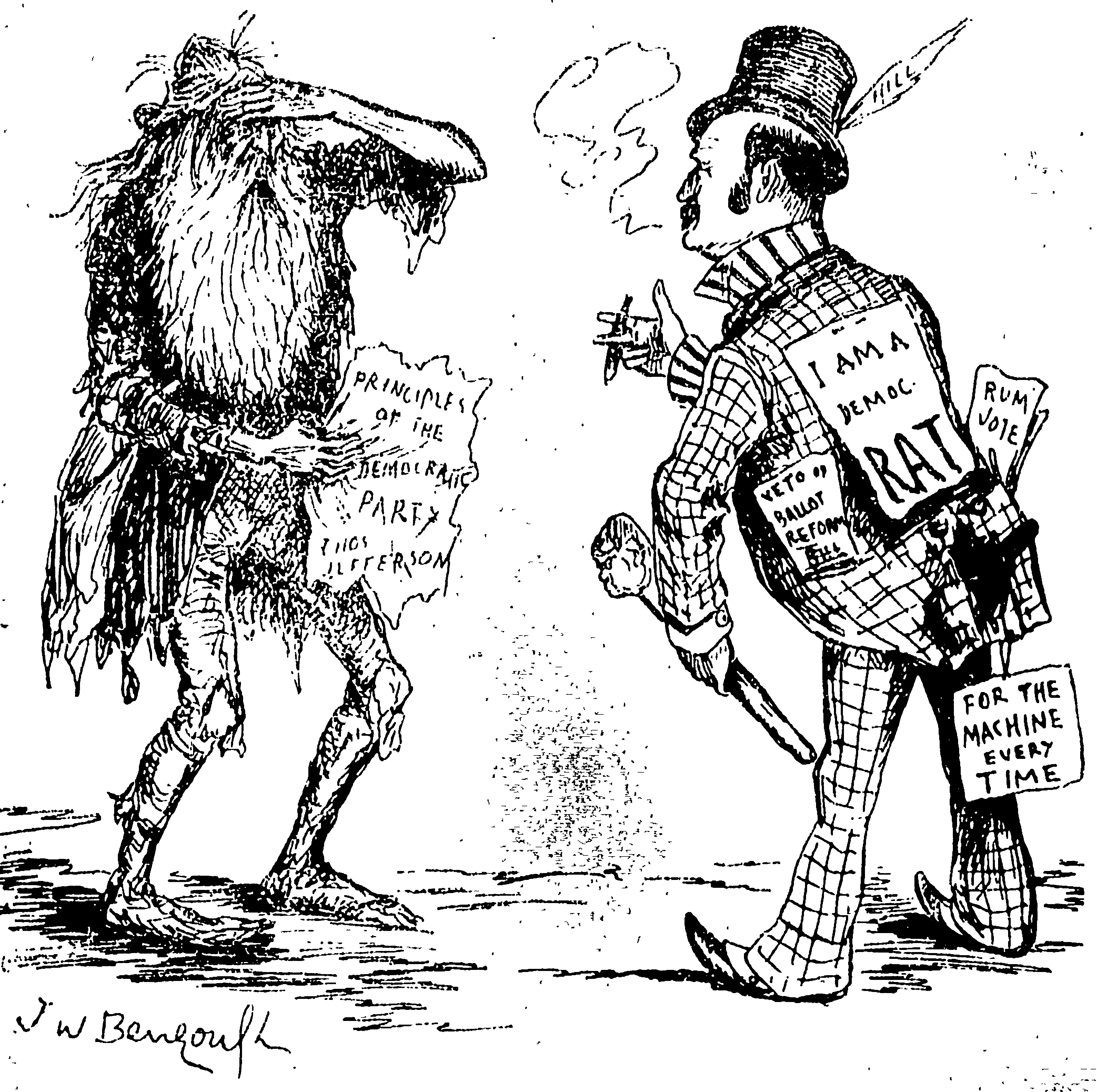
[Cartoon spanning columns 1–2: a ragged, long-bearded Rip Van Winkle figure (Jefferson) shading his eyes and holding a torn paper labelled “PRINCIPLES OF THE DEMOCRATIC PARTY THOS JEFFERSON”; facing him, a dandy in a checked suit and top hat (Hill) with a feather labelled “HILL” in the hat, smoking a cigar and carrying a club; placards on his back read “I AM A DEMOC RAT”, “VETO OF BALLOT REFORM BILL”, “RUM VOTE”, and a tag hanging at his side reads “FOR THE MACHINE EVERY TIME”. Signed: J W Bengough.]
JEFFERSON(1) AS “RIP VAN WINKLE.”
Rip—Don’d you know me? Are ve so soon forgotten ven ve’re gone?
Hill—Jefferson? Thomas Jeffersou? Never heard of you before in my life.
- Not Joe this time.
[Advertisement] CATARRH.
Catarrhal Deafness—Hay Fever—A New Home Treatment.
Sufferers are not generally aware that these diseases are contagious, or that they are due to the presence of living parasites in the lining membrane of the nose and eustachian tubes. Microscopic research, however, has proved this to be a fact, and the result of this discovery is that a simple remedy has been formulated whereby catarrh, catarrhal deafness and hay fever are permanently cured in from one to three simple applications made at home by the patient once in two weeks.
N. B.—This treatment is not a snuff or an ointment; both have been discarded by reputable physicians as injurious. A pamphlet explaining this new treatment is sent free on receipt of stamp to pay postage, by A. H. Dixon & Son, 337 and 339 West King street, Toronto, Canada.—[Christian Advocate.
Sufferers from Catarrhal troubles should carefully read the above.—[Adv.
[Advertisement] NEW PUBLICATIONS. ASSORTMENTS OF TRACTS.
During the late campaign quantities of our best tracts were assorted for special work, and many of these not having been used, we now place them, with some of a more recent date, in convenient packages, at a low price.
Packages may be had at 50c. and $1.00.
Address, THE STANDARD, 12 Union Square, NEW YORK.
[Advertisement] HANDY BINDERS FOR THE STANDARD.
A lot of Handy Binders, made especially for filing THE STANDARD, are now ready.
Price 75 cents to any address.
Address THE STANDARD, 12 Union Square, New York City
[Advertisement] VOLUME FIVE OF THE STANDARD. NOW READY.
A limited number of bound volumes of THE STANDARD in heavy boards, are offered for sale at the following prices
Separate volumes……………………………… $3.50 Volumes 3 and 4, bound together……………… 6.50 Volumes 2, 3 and 4…………………………………… 9.00 Volumes 2, 3, 4 and 5……………………………… sic
(Expressage extra.)
Address THE STANDARD, 12 Union square, New York.
[Advertisement] AS SOME of the back numbers of THE STANDARD
AS SOME of the back numbers of THE STANDARD are growing scarce, we will send 15 cents’ worth of tracts in exchange for any of the following
Vol. I—Nos. 5, 7, 8 and 11. Vol. II—Nos, 1 and 32.
[Advertisement] Cheap Printing

[Illustration: small cut of a hand printing press, heavily inked.]
Cheap Printing
Do it yourself, Card press $3, Circular press $8, Size for small newspaper $44. Everything easy, printed rules. Send [2?] stamps for Catalogue of presses, type, paper, cards, etc., to factory.
KELSEY & CO., Meriden, Conn.
[Advertisement] ATTENTION!—A YOUNG IRISHMAN
ATTENTION!—A YOUNG IRISHMAN, aged 20, desires any kind of work to earn a living. HONEST, care of Standard Office.
[Advertisement] HOLLAND’S
HOLLAND’S COFFEE AND DINING ROOMS, 143 Fourth avenue, bet 13th and 14th sts
[Advertisement] CONCORD CO-OPERATIVE PRINTING COMPANY
CONCORD CO-OPERATIVE PRINTING COMPANY (Ltd.), [106?] Elm street, cor. CANAL, N.Y. BOOK, JOB AND NEWSPAPER PRINTING.
p. 16, col. 2
[Advertisement] NEW PUBLICATIONS. THE SINGLE TAX LIBRARY.
- A Syllabus of Progress and Poverty. Louis F. Post 8 sic.
- Australian System. Louis F. Post. 4 pages.
- First Principles. Henry George. 4 pages.
- The Right to the Use of the Earth. Herbert Spencer. 4 pages.
- Farmers and the Single Tax. Thomas G. Shearman. 8 pages.
- The Canons of Taxation. Henry George. 4 pages.
- A Lawyer’s Reply to Criticisms. Samuel B. sic. 16 pages.
- Back to the Land. Bishop Nulty. 16 pages.
- The Single Tax. Thos. G. Shearman. 8 pages.
- The American Farmer. Henry George. 4 pages
- Unemployed Labor. Henry George. 4 pages.
- The Case Plainly Stated. H F. sic. 8 pages.
- Social Problems. 342 pages, 12mo. Paper, 35c.
- Objections to the Land Tax. Thos. G. Shearman. sic.
- Land Taxation. A Conversation Between David Dudley Field and Henry George. 4 pages.
- How to Increase Profits. A. J. Steers. 2 pages.
- The New Political Economy. E. O. Brown. 4 pages
- Thy Kingdom Come. Henry George. 4 pages.
- The Functions of Government. Henry George. sicsic.
- The Menace of Plutocracy. Thomas G. Shearman. 8 pages.
- Tenement House Morality. J.O.S. Huntington. 4 pp. 22, 23, 24, out of print.
- Taxing Land Values. Henry George. 8 pages.
- Henry George’s Mistakes. Thomas G. Shearman. 8 pages.
- The Democratic Principle. Henry George. 8 pages
- Progress and Poverty. Henry George. 512 pages. 35 cents.
- The New Ballot System. Louis F. Post. 4 pages
Prices of Single Tax Library: Two page tracts—1 copy, 1 cent; 40 copies, 10 cents; 100 copies, 20 cents; 1,000 copies, $1.50.
Four-page tracts—1 copy, 2 cents; 20 copies, 10 cents; 100 copies, 40 cents; 1,000 copies, $3.
Eight-page tracts—1 copy, 3 cents; 10 copies, 10 cents 100 copies, 80 cents; 1,000 copies, $6.
Sixteen-page tracts—1 copy, 4 cents, 5 copies, 10 cents; 100 copies, $1.60; 1,000 copies, $12.
No extra charge by mail.
The following numbers of the “Land and Labor Library” are still in stock:
- Settler’s Nightmare. Louis F. Post. 4 pages.
- Mysterious Disappearance. Lewis Freeland. 6 pp. [13?]. Sailors’ Snug Harbor and the Randall Farm. W. T. Croasdale. 12 pages.
- The Collegiate Church and Shoemaker’s Field. W. T. Croasdale. 12 pages. [18?]. It is the Law of Christ. Rev. S. H. Spencer. 4 pp.
- Christianity and Poverty. Father Huntington 4 pp. [33?]. Socialism—Its Truth and Its Error. Henry George. 4 pages. [38?]. “God Wills It.” Henry George. 4 pages.
- How John’s Father Saw the Light. W.C.Woods. 2 p.
- Ten Thoughts for Christian Thinkers. Rev. John W. Kramer. 4 pages.
- Hints as to What You Can Do. Henry George. 4 pp.
- My Butcher Woman and My Grocery Man. William McCabe. 4 pages. [84?]. A Republican’s Reasons for Supporting Cleveland. Judge Frank T. Reid. 2 pages. [88?]. Jefferson and Hamilton. Chauncey F. Black. 8 pp.
GERMAN TRACTS.
- First Principles. Henry George. 4 pages.
- Socialism—Its Truth and Its Error. Henry George. 4 pages.
- Taxing Land Values. Henry George. 8 pages.
- It is the Law of Christ. Rev. S. H. Spencer. Henry, Ill. 4 pages. [53?]. Sailors’ Snug Harbor. Wm. T. Croasdale. 12 pages.
SWEDISH TRACTS.
52 The Case Plainly sic. H. F. Ring. 8 pages.
TARIFF TRACTS.
- Protection as a Universal Need. Henry George. pages.
- The Tariff Question. Henry George. 4 pages.
- American Protection and British Free Trade, Henry George. 4 pages.
- Protection and Wages. Henry George. 8 pages.
- Protection the Friend of Labor? Thomas G. Shearman. 8 pages.
- A Short Tariff History. Thomas G. Shearman. 2 pages.
- Plain Talk to Protectionists. Thomas G. Shearman. 4 pages.
- An Address to Workingmen on the Tariff Question, Henry George. 4 pages.
A set of Tariff Tracts will be sent to any address for ten cents.
Address THE STANDARD, 12 Union square, New York City
[Advertisement] B. DOBLIN & CO.
B. DOBLIN & CO., Successors to [B.?] Fisher. HIGHEST GRADE HATS. No. [852?] Broadway, Morton House, New York.
We aim to maintain the highest standard of excellence.
p. 16, col. 3
[Advertisement] Pears’ Soap — “Paris Exposition, 1889.”
[Display advertisement spanning columns 3–4; “Good Morning” in large script lettering. A rectangular ownership rubber-stamp impression, not part of the printing, is struck diagonally across the script and the first words of the text; it reads “[107?] F. A. Sorge, HOBOKEN N. J.” and hides several letters.]
Good [Morning?]
“Paris Exposition, 1889.
Pe[ars’ ha?]s obtained the only gold medal awar[de?]d solely for toilet SOAP in competition with all the world. Highest possible distinction.”
[Advertisement] HENRY GEORGE & CO., PUBLISHERS,
NO. 12 UNION SQUARE.
PROGRESS AND POVERTY.
An inquiry into the cause of industrial depression and of increase of want with increase of wealth. The remedy.
By HENRY GEORGE.
512 pages. Cloth, $1.50. Paper covers, 35 cents. Half calf or half morocco $2.50.
PROTECTION OR FREE TRADE?
An examination of the tariff question with especial regard to the interests of labor.
By HENRY GEORGE.
Cloth, $1.50. Paper covers, 35 cents. Half calf or half morocco, $3.00.
THE LAND QUESTION.
What it involves and how alone it can be settled.
By HENRY GEORGE.
87 pages. Paper covers, 20 cents.
p. 16, col. 4
PROPERTY IN LAND.
A Passage-at-Arms Between the Duke of Argyll and Henry George.
77 pages. Paper covers, 15 cents.
FORTSCHRITT UND ARMUTH.
(Progress and Poverty in German).
Translation of C. D. F. Gutschow.
430 pages. Paper covers, 35 cents.
PROGRES ET PAUVRETE.
(Progress and Poverty in French).
Translation of P. L. LeMonnier.
542 pages. Paper covers, $2.75.
PROTECTION OU LIBRE-ECHANGE?
(Protection or Free Trade? in French).
Translation of Louis Vossion.
436 pages. Paper covers, $2.75.
PROGRESSO E POVERTA.
(Progress and Poverty in Italian).
Translation of Ludovico Eusebio.
352 pages. Paper covers, $2.50.
p. 16, col. 3
SETS OF THREE.—PROGRESS AND POVERTY, SOCIAL PROBLEMS, PROTECTION OR FREE TRADE? BOUND ALIKE, IN HALF CALF OR HALF MOROCCO, $7.00.
ECONOMIC WORKS.
By way of answering inquiries constantly received, we append a list of some economic and social works of various kinds, with prices, at which they will be forwarded post paid. Any work not mentioned procurable in New York will be sent on receipt of publisher’s price.
THE LAND AND THE COMMUNITY.—In three books by Rev. S. W. THACKERAY, M.A. LL.D. Trin. Coll. Cantab. With preface by Henry George. 12mo, cloth. Price $[illegible].00.
WILLIAM LLOYD GARRISON.—The story of his life. Told by his children. 4 vols, cloth, $12 00.
ESSAYS ON POLITICAL sic FREDERICK BASTIAT. 12mo, cloth, $1.25.
SOPHISMS OF PROTECTION.—With preface by Horace White. By FREDERICK BASTIAT. 12mo, cloth, $1.[00?].
HISTORY OF POLITICAL ECONOMY IN EUROPE.—By JEROME ADOLPHE BLANQUI. 8vo, cloth, $3.00.
THE TARIFF HISTORY OF THE UNITED STATES.—Containing “Protection to Young Industries,” and “The History of the Present Tariff, 1860-1883.” By F. W. TAUSSIG. 8vo, cloth, $1.25.
p. 16, col. 4
THE AUSTRALIAN BALLOT SYSTEM, as embodied in the legislation of various countries. By J. H WIGMORE sic, $1.50.
WORK AND WAGES.—By THOS. BRASSEY. 16mo, cloth, $1.00.
FREE LAND AND FREE TRADE.—The Lessons of the English Corn Laws Applied to the United States. By Hon. SAMUEL S. COX. 8vo, paper, 50 cts.; cloth, 75 cts.
THE HISTORY OF THE FREE TRADE MOVEMENT IN ENGLAND.—By AUGUSTUS MONGREDIEN. 16mo, cloth, 50 cts.
POSTULATES OF ENGLISH POLITICAL ECONOMY.—By WALTER BAGEHOT. Cloth, $1.00.
AN INQUIRY INTO THE NATURE AND CAUSES OF THE WEALTH OF NATIONS—By ADAM SMITH. Edited by Theobold sic. $1.00.
p. 16, col. 3
Any of the above Books will be sent postpaid on receipt of price.
HENRY GEORGE & CO., 12 Union Square, New York City.
[Advertisement] PARIS EXHIBITION, 1889. BURROUGHS, WELLCOME & CO.
PARIS EXHIBITION, 1889.
BURROUGHS, WELLCOME & CO.,
Importers, Exporters and Manufacturing Chemists,
SNOW HILL BUILDINGS, LONDON, E. C.,
Specially invite the attention of the Medical Profession and Drug Trade to their Exhibits, as follows:
At Stand No. 575, British Food Section,
Kepler Extract of Malt, an agreeable vitalizing reconstructive and digestive,
Kepler Solution of Cod Liver Oil, An ideal form for the administration of fat.—British Medical Journal.
Also at Stand No. 311, British Industrial Section,
Chemical and Pharmaceutical Products, &c.
The Congo Medicine Chest, as taken by H. M. Stanley, for the relief of Emin Pasha, fitted with Tabloids of Compressed Drugs, &c.
The Livingstone, Gordon and Indian Traveler’s Medicine Pocket Cases and Portable Medicine Chests.
Vereker’s Chloride of Ammonium Inhaler, for Catarrh, &c.
The Pinol-Eucalyptia Dry Inhaler, for the antiseptic treatment of Consumption and diseases of the air passages,
Lanoline, Lanoline Toilet Soap, Cold Cream Pomade and Toilet Lanoline.
Also at Stand No. 594, American Section,
Hazeline. Distilled active principles obtained by distillation from the American Witch Hazel, Hamamelis Virginica, for inflammation and irritated surfaces,
The Fairchild Pepsine and Pepsine Tabloids, Zymine Peptonizing Powders, &c., sic
Formulæ and price lists supplied to the Medical Profession and Drug Trade on request,
BURROUGHS, WELLCOME & CO.
p. 16, col. 3
[Advertisement] HEAVEN AND HELL.
HEAVEN AND HELL.
By EMANUEL SWEDENBORG.
Four hundred and twenty pages, paper cover, sic pre-paid for 14 cents by the American sic Printing and Publishing Society, 20 Cooper Union, New York City
[Advertisement] JAS. HOGAN
JAS. HOGAN, Principal Agent for James [Means’?] [$3?] and [$4?] shoes. [illegible] Bowery, near Prince st
p. 16, col. 4
[Advertisement] THE MASTER WORKMAN.
A simple statement of the views and aims of single tax men, designed especially for workingmen,
Single copies, 10 cents, ten sic, 80 cents; twenty five copies, $1.75; one hundred copies, $6.00,
Sent post or express prepaid on receipt of the above prices, Address,
HENRY J. O’NEILL, 221 Gordon St., Allentown, Pa
SOCIAL PROBLEMS.
By HENRY GEORGE.
342 pages. Cloth, $1.00. Paper covers, 35 cents. Half calf or half morocco, $2.50.