Page 1 of 16contents
THE STANDARD
NO. 163—VOL. VII, NO. 7.
NEW YORK, WEDNESDAY, FEBRUARY 12, 1890.
PRICE FIVE CENTS
p. 1, col. 1
THE STANDARD.
HENRY GEORGE, EDITOR AND PROPRIETOR.
Published Every Wednesday at
NO. 12 UNION SQUARE, NEW YORK CITY.
Entered at the post office in New York as second class matter.
TERMS:
ONE YEAR . . . . . . . . . . . . $2 50
SIX MONTHS . . . . . . . . . . 1 25
Advertising thirty cents per agate line.
All letters and communications should be addressed and all checks and drafts be made payable to “The Standard.”
When ordering change of address send old as well as new address.
The correct filling of orders is evidence of receipt of remittance.
TABLE OF CONTENTS:
EDITORIAL. Henry George at San Francisco—A Series of Ovations—The Work Will Go On—Good Work in Massachusetts—Surprising Progress in Chicago—An Alabama Legislator Almost Persuaded—The Good Work Done by Bolton Smith—Liberality of Mr. Burroughs—What Others Can Do—Something About THE STANDARD—Single Tax Buddhists—The Need of High Purpose—The Democratic Party and Ballot Reform—A Mormon Complaint — What Halstead Thinks of His Friends—The Brooklyn Row—Burying Electric Wires—Abolition Movement—The Dakota Lottery Scheme—Mr. White’s Reply to Mr. Post—Single vs. Double Tax—The Plight of the Farmers—An Irish Paper on the Labor Problem—The Weekly Payment Bill.
A REPLY TO MR. POST. Horace White.
ST. ANDREW’S COFFEE STANDS. Rev. John W. Kramer.
GOVERNMENTAL OPERATION OF RAILROADS. Edmund Yardley.
ANDREW CARNEGIE’S FIELDS OF PHILANTHROPY. Amelia W. Bate.
OUR WASHINGTON LETTER. Henry George, jr.
OUR ENGLISH LETTER. Rev. Harold Rylett.
NOTES AND QUERIES.
PERSONAL.
BALLOT REFORM. Work of the Ballot Reform League—Nearly 30,000 Signatures to the Petition—The League Wants Money, and Needs it “Right Off”—Better Outlook in Maryland—Constitutionality of the Law Sustained in Rhode Island.
HENRY GEORGE SAILS. Splendid Reception at San Francisco—Great Meetings—Welcomed by Press and People—Escorted to the Steamer—Effect of His Visit—Great Meetings and Banquet in Los Angeles.
SOCIETY NOTES.
INEFFICIENT MAIL SERVICE. An Interview with Hon. Leo Knott.
THE SOCIAL PROBLEM. A Field for the Single Tax—Cardinal Gibbon’s sic—Land Nationalization—Now it is Education—Prescribing the True Remedy—A Confused Philosopher.
THE FREE TRADE FIGHT. The Reform Club Leads the Work—A Remarkable Campaign in the State of New York—The Club has Bought a $250,000 House—Mr. Mills and Mr. Blaine—Welsh Miners Going Home—Sturdy Beggars in Dakota and California.
SINGLE TAX NEWS. The Work of Two Marylanders—Again the Letters—“Some Awful Examples”—Recent Sales and Assessments in New York and Brooklyn—The New York Manhattan Club Raises Its Dues—Renewed Activity in Brooklyn—The Buffalo Men Aggressive—Questions that Lead to the Truth—Mr. Pendleton’s Diagram—Connecticut Awake—Moving on the New Jersey Bureau of Statistics—The Single Tax from an Ohio Congregational Pulpit—The Indianapolis Club in Its New Quarters—A Chicago Speculator Just Misses the Truth—A Rabbi Addresses the St. Louis League—The Henry George Assembly of Detroit Gathering in Single Tax Men—H. Martin Williams in Topeka, Kansas—The Leading German Paper of the South Indorses the Single Tax—A State Organization Formed in Colorado—News from New Hampshire, Pennsylvania, Maryland, Georgia and Iowa—The Cause in Canada, England and New Zealand.
p. 1, col. 2
EDITORIAL.
Henry George sailed from San Francisco for Australia on Saturday last (February 8). Judge Maguire’s dispatch shows that Mr. George’s return to his old home was an event that will long be remembered. It was in San Francisco that he practically began his life work. There he married and there all four of his children were born. It was there that his abilities as a writer first were manifested, causing his rapid promotion from the printer’s case to the editor’s chair. It was there that he began his wrestle with the social and economic problems that would give him no rest until he found their solution, and gave it to the world in “Progress and Poverty.” Yet when he left San Francisco for the east, though he left behind him a circle of sincere friends, some of whom were converts to his doctrines, the mass of people there knew little of him except that he had been an editor of one of their daily papers and had written a book of which many conservative people spoke disparagingly. As his ideas began to attract attention in the east and in Europe the San Francisco newspapers misrepresented them as readily as did any others, and in the famous mayoralty contest in this city in 1886, which challenged the attention of the whole country, and started anew the world wide discussion of Mr. George’s ideas, the San Francisco press was indifferent or hostile.
Less than four years have elapsed since that time, and Mr. George has just passed through California on his way to Australia. His journey has been little less than a triumphal march. He is banqueted by friends, vast audiences gather to hear him expound his doctrines, newspapers send reporters hundreds of miles to meet him and telegraph his utterances, and they vie with each other in printing careful summaries of his once derided doctrines. In their head lines they salute him as “The Famous Californian,” “The Social Reformer of San Francisco,” “California’s Political Economist,” and so on. Editorially they treat him with every honor and proudly claim him as a man whose life and work have honored their city. The title sneeringly given him by the duke of Argyll, “The Prophet of San Francisco,” is almost accepted, and the people have vied with each other in trying to show that a prophet is not always without honor in his own city.
These evidences that he has obtained a hearing, and that the work to which he has dedicated his life is making marvelous progress, must be inexpressibly grateful to Henry George. They are hardly less so to the increasing thousands throughout his native land who have, in his works, found the answer to the “riddle which the sic of Fate puts to our civilization, and which not to answer is to be destroyed.” We have long borne ridicule and abuse, and, worse than all, indifference, and we may well rejoice as accumulate sic now crowd upon us that, from the eastern portals of the continent to the Golden Gate of the west, there are everywhere found devoted workers for our cause and a rapidly increasing number of those who, though not yet committed to our doctrines, and probably not fully familiar with them, recognize that a cure for existing evils is at least offered by an able and clear p. 1, col. 3 thinker, backed up by sane and determined people who know exactly what they want and precisely how they expect to obtain it, and who are working to accomplish their ends by practical, common sense methods. For these new sic; for this new and more favorable hearing, we are indebted to the policy that linked our movement to the thought and political activity of our fellowmen. W[e?] need have no fear that the work th[us?] begun will ever cease to command popular interest or falter in the onward course on which it at last has entered. Henry George is now well on his way to the newest continent, but when he returns by way of older lands he will find evidence that his absence has not checked activity in the land of his birth, and New York will give him an even more notable welcome than that given him last week in San Francisco.
The demonstration of the rapid growth of our principles is not confined to the ovations that Mr. George has received on his journey westward. From all parts of the country come announcements of fresh conversions, or the awakening of interest among those hitherto hostile or indifferent. In Massachusetts, where at one time there seemed to be apathy, attended with some danger of an insane diversion of a part of our strength to a foolish and hopeless third party movement, all is now life and activity, and the fight that our friends, under the lead of William Lloyd Garrison, are making before the legislative committee cannot fail to have greater effect than was possible before the efforts of Mr. Lane and the “double tax” men had aroused in Boston a keen and growing interest in the subject of local taxation. What the free trade fight has done for the country at large these local agitations are likely to do for special localities.
In the last issue of THE STANDARD we printed a report of the speech made by Judge Driggs at the annual banquet of the real estate board in Chicago. It was not, as our readers will remember, an espousal of the single tax doctrine, but it was a very fair discussion of our ideas by an evidently unprejudiced man. The incident was all the more significant because this banquet is by far the most pretentious trade or professional dinner that takes place annually in Chicago, and is attended by the most prominent and influential citizens. Judge Driggs himself was formerly the local solicitor of the Pennsylvania company, and was but recently elected to the bench. He is a prominent republican and a member of the Union league club. There is reason to believe that the men who invited him to speak to that toast were astonished beyond measure at the response it called forth. On the same evening that this speech was made Mr. Edward Osgood Brown, one of the leading lawyers of the city, was addressing an audience at the rooms of the single tax club on the legal aspects in the single sic, and was listened to by quite a number of members of his own profession. All reports from Chicago indicate a remarkable change of opinion among a large class of influential people, who at one time were strongly prejudiced against the single tax doctrine. The persistent personal work of the friends of the cause is beginning to tell, and several judges of the bench and a number of prominent lawyers, bankers p. 1, col. 4 and business men are beginning to give the subject a respectful hearing, and many of them display a positively friendly interest.
The Chicago Tribune continues in the stupid course adopted for a time by our eastern dailies. and boldly sic the facts in order to justify unfair attacks. Its course, however, is beginning to call forth remonstrances from its own readers. Since the Tribune has ceased to be identified with any good cause, its perverse hostility is the greatest service it could render to the cause of the single tax.
One of the most significant evidences of the growing interest in the subject was given by the speech of Mr. Robt. Lindblom, a highly successful operator on the Chicago board of trade, delivered at one of the economic conferences held in the Auditorium building. Mr. Lindblom’s topic was the “Influence of speculation on prices,” and though he is somewhat mixed in his political economy, he made a strong defense of the right of men to sell goods for what they can get, and defended speculation as a useful factor in the regulation of prices. But while Mr. Lindblom was ready to defend speculation in commodities, he severely denounced speculation in land. His remarks on the subject are printed elsewhere, and they show a clear appreciation of the greatest evil of the day, though Mr. Lindblom seems to look for relief to some sort of prohibitory legislation, instead of to the simpler and more efficient single tax remedy. Meantime, however, he proposes that a plan be devised for the promotion of speculation in land, and insists that if the legislature will legalize a plan for selling real estate “short,” with land graded and classified as grain and provisions now are, the bears would soon make land so plentiful that monopoly would cease, and every land owner become his own landlord. However fanciful his proposed remedy, no one who reads his speech can question Mr. Lindblom’s clearness of apprehension of the evil itself. Our friends in Chicago feel, and have a right to feel, jubilant over the many evidences of the steady growth of interest in our doctrines.
Something more than a year ago Mr. Bolton Smith of Memphis subscribed for a large number of copies of THE STANDARD, to be sent to members of the legislature of Mississippi, Arkansas and Alabama. Some time ago he wrote asking them what they thought of the paper. In a few cases replies denouncing THE STANDARD and its doctrines were received, but in many cases the replies indicated that the perusal of the paper had wrought a great change in the opinions of many. Mr. Smith forwards us the following, which he says is a sample of many letters he is now receiving from those to whom he sent THE STANDAR[D.?]
> DRY sic, Ala., January 20, 189[0.?] > > Mr. Bolton Smith—Dear Sir: Your inqu[iry?] is at hand. I have received THE STANDA[RD?] regularly each week for eight or nine mont[hs?] and have read it carefully if not critical[ly.?] From the receipt of THE STANDARD dates [my?] first knowledge of the single tax moveme[nt.?] At first I could not understand why t[he?] single tax would tend to destroy the [mo?]nopoly of natural resources. Now I see; a[nd?] if the unearned increment of the commun[ity?] would be sufficient, if taken as a tax, to d[e?]fray the expenses of government, there [is?] nothing better than the single tax. I a[m?] convinced that, so far as cities and tow[ns?] are concerned, the single tax is the panac[ea?] for the ills of existing taxation. Furthe[r?]more, when landlordism has obtained in t[he?] continued on p. 2 →
[Text breaks off mid-sentence at the foot of page 1; no continuation line is printed. The right-hand ends of the last fourteen lines of column 4, from “THE STANDAR[D.?]” down, did not print (ink failure at the right margin); bracketed letters are conjectural completions.]
Page 2 of 16contents
2 THE STANDARD. Vol. VII, No. 7
p. 2, col. 1 [continued from page 1]
← continued from p. 1 > country, it will have the same effect there. But unless the tenants of such landlords expect always to remain tenants, I cannot see of what benefit the single tax will be to them. I cannot see how you can apply the single tax to the homesteader or small land owner without doing violence to his interests. Single tax, in my opinion, would finally do away with private property in land; but whether this would be desirable among farmers is the question. Would it not tend to destroy independence rather than further that state among farmers? I think as much. > > This is the only objection I can raise to the single tax. I can see how it would down monopoly in land and destroy speculation in land values, but what I object to is that the single tax will do no good for the farmers. > > I remain, yours respectfully, > > J. D. FRENCH
The work that Mr. Bolton Smith has done in introducing THE STANDARD to the attention of members of the legislatures of Mississippi, Arkansas and Alabama is one sic cannot fail to have far-reaching results. It is not the immediate effect that counts so much as the ultimate results. Mr. sic letter shows that he is troubled by the same doubts that affect most people who look at the single tax from the farmer’s standpoint. All of his objections, however, are easily answered and have been answered again and again in THE STANDARD. No doubt Mr. Smith has seen that the proper answer has already been put before Mr. French.
The important thing about this work is that leading men of influence in their respective communities are led to familiarize themselves to some extent with our doctrine, and are at once shorn of the prejudice they once had against it. Here is a member of the Alabama legislature, who never knew anything of the single tax until a few months ago, yet he already partly sees the cat, and, without alarm or prejudice, calmly discusses the question as to whether or not the final destruction of private property in land would be a good thing. As the movement sweeps forward, and the people of Alabama, Arkansas and Mississippi begin to face the one great question of the coming politics, there will be men of influence and intelligence scattered through that state, who, whether they are for us or against us, will at least know too much of our aims and purposes to join in raising the stupid mad dog cry raised in this city during the campaign of 1886. These men will not join single tax clubs. They will probably refuse to imperil sic present political position by discussing a doctrine likely at first to create prejudice against them. But the day will come when their knowledge of the single tax will be of great value to our movement.
Mr. Smith has with great liberality subscribed for THE STANDARD for a whole year, to be sent to the legislators designated by him. Mr. S. M. Burroughs, of Burroughs, Wellcome & Co., London, Eng., has just shown similar liberality. Mr. Burroughs, as most of our readers know, is an American who has been forced to leave his own country and establish himself in England because, as a manufacturing chemist whose market is the whole world, our insane “protective” laws rendered it impossible for him to conduct his business successfully in this country. He has sent to THE STANDARD $250, to be applied in sending copies of the paper to those who may by its perusal be led to more vigorous and radical efforts in behalf of the overthrow of the whole tariff system.
Such acts of liberality cannot, however, be imitated by all friends of the cause, but there are thousands who can do something, and it is for the convenience of those that our recruit subscription books have been prepared. These books range in price from one to five dollars. All who can afford it should constantly carry one, in order that they may follow up
p. 2, col. 2 their personal arguments by sending THE STANDARD for four weeks to those in whom they have awakened an interest in our principles.
Of course this will benefit THE STANDARD as well as the cause—but what better service can be rendered to the cause than the strengthening of THE STANDARD. Without THE STANDARD where would our cause have been to-day? At the very time when our enemies were denouncing it as a mere money making agency, it was undergoing a struggle for existence that made it a burden to its founder that nothing but a conviction of the supreme necessity of its continuance would have justified Mr. George in carrying. Yet even at that time the burden was increased by demands for gratuitous circulation, and by a constant. sic for low prices for all our publications—a pressure too long yielded to.
THE STANDARD is a paper that appeals to thinking people, and to those thinking people who are concerned in the reform of existing economic conditions. It still must encounter the prejudice and dislike of the unthinking mass, which sustains existing conditions even when suffering from them. This prejudice is a potent factor in preventing it from receiving the advertising patronage to which the extent and character of its circulation entitles it. Its readers would be quick to resent any cheapening of its cost that would lower its tone or diminish its efficiency as the one recognized organ of the single tax movement. Under these circumstances it cannot be sold at a lower price. Its only hope of a long and prosperous existence lies in such a business policy as will make it pay, and the same is equally true of all the other publications issued from this office. We can surely be trusted to do everything within our power to advance its circulation, but we must at the same time exercise a business judgment as to the effort that we can afford. We have no doubt that the circulation of the paper can be largely increased, and the spread of the principles it represents be greatly furthered by the use of the recruit subscription books, but our friends who see and feel this so strongly will have to carry out their suggestion at their own expense. If we were to attempt, at our own cost, to carry out all the well meant and kindly sug- gestions we receive, the final result would be that there would be no STANDARD to send out. We fully appreciate the good will that inspires such advice, but we also know what it costs to make such a paper as THE STANDARD, and can approximate closely to a calculation as to the percentage of new subscribers that the circulation of sample copies will bring to us. A very little effort on the part of our friends generally would doubtless double the paper’s circulation, and if this increase were in mail subscriptions, instead of sales through the news stands, the paper’s revenues would justify renewed efforts to make it even better than it is and justify new expedients for advertising its attractions and extending still further its circulation.
But it is not merely in pushing the circulation of THE STANDARD that we would urge our friends to join their words to deeds. The steady onward march of the organized single tax movement is a cause for rejoicing. The even more sic spread of our ideas through the process of diffusion gives cause for supreme satisfaction. Nevertheless the day of our triumph is yet distant, and present encouragement will fail to accomplish any good if it does not stimulate us to renewed endeavor and still greater sacrifice. Ours is pre-eminently a practical movement, and acceptance of our doc-
p. 2, col. 3 trines is of little use unless it stimulates the person accepting them to take an active part in promoting their final incorporation into law.
More than twenty-five centuries have been completed since Gautama, the Buddha, overwhelmed by his sense of the sin and misery in which his father’s subjects were sunk, abandoned wife and new-born babe and his princely estate to seek in the desert, through the intense concentration of thought on intellectual and moral truth, obliviousness to the human misery, the sight of which had become unendurable. No thought of changing material conditions dawned on his mind, and he merely sought to save some from misery by leading them to the contemplation of the higher truth that is beyond the mutations of mere mortal life. The Buddha was but the type of many reformers who have unconsciously imitated his methods. With hearts melting with pity for their kind, and minds inspired by lofty ideals, they sit with folded hands, wrapped in dreams of the possible. sic doing nothing to overcome the evils that produce the misery that they deplore.
The religious impulse that underlies it would seem to assure the great movement for restoring to men their heritage and inaugurating the reign of justice on earth escape from any such tendency. Yet there are men and women—good men sic women—with tender hearts and noble minds, who, while professing to accept the doctrines that seek their prac- tical application through the single tax, are satisfied with contemplating the great end we seek. They are content to do nothing, or else indolently refuse to study the indications that point out the only practicable road to success, and devote themselves to dreaming of a shorter and easier way. The simple, practical methods by which great reforms are carried forward have in them little that captivates the imagination or produces mental exaltation. There is more joy in the dream of the possible than in the little and humble services that carry forward a great work. The dreamer finds in his dreams a more easily purchased pleasure than that which comes to the practical worker as the result of simple duties faithfully performed. Yet it is the worker and not the dreamer that achieves results. Through a long train of centuries the disciples of Buddha have escaped from the consciousness of the misery surrounding them by the contemplation of Nirvana, but the condition of the masses in India to-day is no better than it was when the daily sight of their misery caused Siddartha Gautama to flee from his father’s palace to the desert.
Let no one mistake our meaning. The lofty ideal is the surest inspiration to high endeavor. The perfect plan must precede effective building. But lofty ideals demand practical application, and men cannot find shelter in the plans of an architect, however great. Without Michael Angelo St. Peter’s might have been impossible, but with Michael Angelo it would have remained forever impossible, had not the rough hands of unskilled laborers, as well as the cunning fingers of the skilled artificers, worked out the great architect’s plans. This is as true of a political system as it is of a great cathedral, and the more enlightened the faith in the ultimate realization of the plan, the plainer will be the perception of the necessity for even the humblest necessary effort in furthering the great work. The thousands of men who have for more than a year been presenting the petition to their associates and even to strangers, and accompanying it by a verbal argument or a tract, have been as
p. 2, col. 4 useful and faithful workers for the cause as are our orators and writers; and those who out of their little means have contributed at least a mite are as worthy of honor as those who out of their greater abundance have contributed more. In short, those who have done the work that lay immediately before them instead of trying to desire something else that might be better, have been the faithful, to whom we owe the wonderful progress over which we all rejoice.
The Saturday Globe undertakes, in answer to Mr. George, to show that it was right in insisting that ballot reform is a democratic measure. THE STANDARD can have no serious discussion of this subject with the Globe, for while we cannot shut our eyes to the fact that in Massachusetts and in this state the republican party has done more for ballot reform than the democratic party, we entirely agree with the Globe that the measure is democratic in the true sense of the word, and that if the democratic party shall become what the Globe, as well as THE STANDARD, wants it to become, it will be the natural defender of the system. The Globe stands for the democracy that THE STANDARD believes in; but THE STANDARD does not shut its eyes to the fact that there are in the democratic party bosses and corruptionists as bad as the Dudleys, the Quays and the Platts. Governor Hill of this state, and many supporters of his, calling themselves democrats, Senator Gorman of Maryland and a number of others, are just as much the enemies of ballot reform and civil service reform as either Quay or Platt, and some, at least, among them are not to be trusted on tariff reform. The Globe knows this as well as we do, but as a democratic paper it does not deem it prudent to always tell what it knows.
Two representatives of the Mormons recently came east to insist that there is a desperate plot on hand to first disfranchise all of the Mormons in Utah, Arizona and Idaho, and then admit these territories as republican states. The charges are very explicit, and there is nothing in the conduct of the republican party that will lead anyone to assume that it is incapable of any possible conspiracy with a view to retaining power, and serving its masters, who pay its election expenses. Since the recent de- velopments at Washington anything may be expected. It is manifestly the duty of the democrats to examine carefully into these charges and to resist any effort to carry out such a scheme. The suppression of polygamy is clearly within the power of sic, so long as it is practiced in a territory, but congress has no right to disfranchise Mormons on account of their religious belief.
Mr. Murat Halstead appeared last week before the house committee at Washington, that is investigating the Ohio ballot-box forgeries. Mr. Halstead testified that he and Governor Foraker honestly believed that Senator Sherman and Congressmen McKinley, Butterworth and others had actually signed the disgrace- ful contract, practically pledging their votes, for personal and pecuniary reasons, to a scheme for unloading a patent ballot box on the government. Mr. Halstead knows the republicans of Ohio better than most men, and the estimate that he and Governor Foraker put on the character of their own friends and associates shows the standard morality prevalent in the politics of that state.
Naval Officer Willis, Franklin Woodruff and others have published a card attacking “Al” Daggett. They deny his assertions, but no attempt is made to deny that the appointing power was continued on p. 3 →
[continues on another page; the paper gives no “continued” line]
Page 3 of 16contents
February 12, 1890. THE STANDARD. 3
p. 3, col. 1 [continued from previous page]
← continued from p. 2 farmed out to these gentlemen, and largely used for their own benefit. In any case involving veracity anybody’s word would probably be accepted against Daggett’s, and we are prepared to assume that his opponents are right in saying that Daggett lied about them. On the other hand, they show plainly that they have all along known just what Daggett is, and yet they have, for years, been in close co-operation with him, and probably some of them helped him to get the fat contract that enables him to pay such bribes as he offered to Greenleaf Smith.
The proposal to bury the electric wires suggests to the Boston Post the advisability of securing some return to the city for the use of its streets by corporations. It quotes from a recent report of the Boston board of aldermen showing that the city of Baltimore gets over $750,000 annually from its street railways. In many places electric light, telephone and gas companies pay a certain percentage of their gross receipts into city treasuries. In several European cities the municipality owns the street railways and leases them at an annual rental to the operating company. “All these devices for securing payment for valuable privileges are admitted,” says the Post, “by those who have observed their working to be satisfactory.” It is a significant fact that the mere burial of the electric wires should suggest to this old and conservative Boston paper the necessity of taking for public use the profits now pocketed by private individuals through their use of public property as if it were their own. Street railways have been established and gas pipes laid in Boston for years without suggesting any such proposal; but the public mind is now turned to the consideration of these questions, and public interest in them will doubtless continue to grow until a settlement in accord with justice and the recognition of the true rights of property shall have been reached.
In the issue of THE STANDARD for February 26 we shall publish the part of a sic of four articles on “William Lloyd Garrison and the Abolition Movement,” by Sarah Mifflin Gay. These articles are not merely a review of the story of Garrison’s life as told by his children, but they present a sketch of the whole abolition movement that will be read with keen interest by all who were interested in it, and they will prove of great value to younger people, who have probably rarely, if ever, had opportunity to obtain in so small a compass the whole story of the great struggle of the last generation. Special orders for the four numbers containing Miss Gay’s article should be sent in before February 25.
THE DAKOTA LOTTERY SCHEME.
All the indications point to the confirmation of ex-Governor sic’s appointment as collector of the port at New Orleans. Every decent man familiar with Louisiana politics has protested against the confirmation, but Clarkson and Dudley insist on favorable action, and the obligations of republican senators to Mr. Clarkson for postmasterships, already conferred or yet to be conferred, are supposed to be sufficient to force them to obey his mandate.
According to the newspapers, the appointment of Warmouth is the culmination of the lowest of all the vile intrigues that were formed to secure Harrison’s election to the presidency. It appears, according to these statements, that the Louisiana lottery company, of which Warmouth is counsel, furnished the money for corruptly carrying some of the new northwestern states, on condition that Warmouth should receive this
p. 3, col. 2 appointment and that one of the new states should be induced to grant a charter to the lottery company, in case the state of Louisiana refuses to renew the present charter, which expires in 1892.
In accordance with this corrupt contract a bill has already been rushed through the senate of North Dakota, and there is a desperate fight to secure its passage, despite popular protest, through the house. Such a story seems almost incredible, but the revelations already brought out concerning Dudley’s conduct of the campaign—in which it must not be forgotten he appeared always as Mr. Harrison’s direct personal representative—make it possible to believe almost any story as to the methods resorted to to win a protectionist victory.
MR. WHITE’S REPLY TO MR. POST.
The real question discussed by Mr. Horace White in his reply to Mr. Louis F. Post, printed elsewhere, is the substantial identity of Mr. George’s doctrine of rent with that held by the French physiocrats. In proof of his claim of such identity Mr. White cites a definition by M. H. Passy, declaring that rent is “the net product of the land;” that is, “that portion which, after deducting the expense of production, remains and constitutes a surplus.” As M. Passy is “a French economist of eminence,” Mr. White thinks that it is to be presumed that he used the phrase “net product” as it “is understood in the country where it originated.” Accept this as true, and what proof does it offer that Mr. George accepted such a definition of rent?
We are not left in any doubt as to Mr. George’s opinion on the law of rent. He distinctly states in “Progress and Poverty” that he accepts the law of Ricardo, which is thus stated on page 123 of Lovell’s edition:
The rent of land is determined by the excess of its produce over that which the same application can secure from the least productive land in use.
This differs widely from the rule of Passy, that rent consists of the surplus over the cost of production. There might be a very large surplus over the cost of production on land absolutely free from rent, and, on the other hand, rent can and does arise on land that, in the sense in which “production” is apparently used by Passy, produces nothing whatever. Mr. George does not content himself with merely quoting Ricardo, but he states the doctrine for himself with his accustomed force and clearness. He says:
Thus rent, or land value, does not arise from the productiveness or utility of land. It in no wise represents any help or advantage given to production, but simply the power of securing a part of the results of production. No matter what are its capabilities, land can yield no rent and have no value until some one is willing to give labor, or the results of labor, for the privilege of using it; and what any one will thus give depends, not upon the capacity of the land, but upon its capacity as compared with that of land that can be had for nothing. I may have very rich land, but it will yield no rent and have no value so long as there is other land as good to be had without cost. But when this other land is appropriated, and the best land to be had for nothing is inferior, either in fertility, situation or other quality, my land will begin to have a value and yield rent. And though the productiveness of my land may decrease, yet if the productiveness of the land to be had without charge decreases in greater proportion, the rent I can get, and consequently the value of my land will steadily increase. Rent, in short, is the price of monopoly, arising from the reduction to individual ownership of natural elements which human exertion can neither produce nor increase.
Until Mr. Post criticised his recent article in the Popular Science Monthly, Mr. White says that he never before heard the identity of “net product” with economic rent disputed. To say nothing of the essential difference between the law of Ricardo and the definition by Passy, this is a singular assertion, in view
p. 3, col. 3 of the reasonable presumption that Mr. White read “Progress and Poverty” before attempting to attack the doctrines set forth in that book. The passage quoted is confessedly a mere elaboration of Ricardo’s law of rent, and it is absolutely irreconcilable with the proposition that rent is the net product over and above the cost of production, since we may have very rich land that might yield a large net product, but it would yield no rent so long as equally productive land could be had for nothing.
But Mr. White seeks to settle the question by quoting Henry George himself. Mr. White seems, in his haste, to have stopped short in the middle of a line. He quotes Mr. George correctly up to the word “land,” and there stops short. Had he but jumped an intervening period, he would have been less confident of the quality of his proof, for Mr. George in the next sentence of the same paragraph goes on to say:
As I am only acquainted with the doctrines of Quesnay and his disciples at second hand, through the medium of the English writers, I am unable to say how far his peculiar ideas as to agriculture being the only productive avocation, etc., are erroneous apprehensions, or mere peculiarities of terminology. But of this I am certain, from the proposition in which his theory culminated—that he saw the fundamental relation between land and labor which has since been lost sight of, and that he arrived at practical truth, though it may be, through a course of defectively expressed reasoning. The causes which leave in the hands of the landlord a “produce net” were by the physiocrats no better explained than the suction of a pump was explained by the assumption that nature abhors a vacuum, but the fact in its practical relations to social economy was recognized, and the benefit which would result from the perfect freedom given to industry and trade by a substitution of a tax on rent for all the impositions which hamper and distort the application of labor was doubtless as clearly seen by them as it is by me.
The habitual candor of Mr. George, which led him to thus disclaim a full knowledge of the doctrines of the physiocrats, and to point out the inadequacy of their “net product” idea as he found it quoted by English economists, makes him, in this instance, a poor witness for Mr. White in the attempt of the latter to prove that there is only a slight difference between the law of rent, as accepted and enunciated by Henry George, and the “net product” idea of the physiocrats, as accepted and enunciated by Horace White and M. Passy. The difference is deep, vital and irreconcilable.
SINGLE VS. DOUBLE TAX.
Mr. Simon W. Hatheway has a signed editorial in a recent number of the Boston Globe, in which he goes over the old, old story about the injustice of allowing the Vanderbilts and other rich men to escape taxation. Nevertheless, he discourses at some length on the difficulties of collecting taxes on personal property. There is really nothing to say to such critics but to ask them to find out what Mr. George advocates before they attempt to criticize him. There is not a single objection that Mr. Hatheway raises that has not been answered over and over again in the columns of THE STANDARD, and that was not answered in advance in “Progress and Poverty.” The exigencies of journalism render it impossible to issue a whole newspaper, for the special advantage of each man who chooses to attack a theory that he has not studied, and THE STANDARD therefore finds it impossible to attend to such cases without completely neglecting its duty to its readers.
Mr. Hatheway, however, if he cannot understand the importance of the single tax, does see the inconsistency of the Boston double tax idea. He says:
Those who favor the plan of taxing only real estate, including buildings and land, do not seem to realize that they are conceding to Mr. George every point but one, Mr. George claiming that the product of the house builder’s labor is personal property and entitled to the exemption, while Mr.
p. 3, col. 4 > Lane is unwilling to give the carpenter the same exemption he gives the goldsmith. > > When Mr. Lane concedes so much it is only a step further to agree with Mr. George for a true single tax and not say that bricks, mortar, shingles, boards and nails shall be exempt from taxation when not used and shall be taxed when built into a house by the united labor of hundreds of workmen; for if there is anything which is essentially a product of labor, that thing is a dwelling house; from the cemented floor of the hole scooped out for a cellar, to the ridge pole and the skin of paint on it, nothing but labor, labor, labor, and requiring the skill and intelligence and brawn and muscle of many kinds of laborers. > > The value of the raw material that goes to make a human habitation is a mere trifle compared with the total wages of the many men who hewed and quarried and shaped and built it into place. > > If single tax is right Mr. George is right, and site value of land—a value wholly given to it by the community—is the proper subject of the tax. The real question is between any single tax and the Massachusetts system, the theory of which is “tax everything and then there will be no kind of property that will not bear its proportion.”
Mr. Hatheway is right. The real fight is between the single tax on the one hand and the Massachusetts system plus the protectionist system of the national government on the other, and no compromise between the two is possible. The single tax cannot fail in the long run to win, because the existing Massachusetts system is as impracticable as would be an attempt to derive the state’s revenue from a fair tax on men’s shadows. No tax on personal property ever was or ever can be equitably collected. This was just as true when the tax collectors had right to use the rack, the screw, and the whip as it is to-day. The men who write newspaper editorials can find this out for themselves, if they will take the trouble to study the history of taxation.
Meanwhile we wish success to the Boston double tax movement. If it shall succeed in doing away with all other taxes save the tax cn land and the tax on buildings, the single tax men can depend on Mr. Hatheway to help them remove the absurd tax on buildings and other improvements.
THE sic OF THE FARMERS.
Mr. Harry Tracy delivered an address at a public meeting of the Farmers’ alliance at Austin, Texas, on January 10, in which he showed the decay of the farming industry, and quoted figures showing that, whereas in 1850, the total wealth of the United States was $8,000,000,000, of which the farmers held $5,000,000,000, in 1880 the farmers were worth but $12,000,000,000, while the total wealth had increased to [$45,000,000,000?]. The estimate for 1890 is a total of $62,000,000,000, of which the farmers hold $15,000,000,000, from which must be deducted $4,000,000,000 of mortgages, leaving them possessed of only $11,000,000,000, or less than one-fifth of the wealth, though they constitute fifty-one per cent of the population. Mr. Tracy quoted largely from Mr. Shearman’s Forum article, but failed to show the slightest comprehension of the remedy that Mr. Shearman points out as the only effective one.
Whenever fifty-one per cent of the people of the United States want anything, and are agreed as to what they want, they will get it. The steady diminution of their proportionate share of the total wealth has gone on among the workingmen, as steadily as among the farmers, and the only reason it has been permitted to go on is that organizations representing both classes of victims have preferred to work at cross purposes and for inadequate remedies, instead of surrendering prejudice and thinking out clearly the causes of the change. Mr. Tracy devotes his whole attention to the money problem. He thinks that if greenbacks were plentiful the mortgages of the farmers could be paid off. THE STANDARD has no controversy with Mr. Tracy or the Farmers’ continued on p. 4 →
[continued on next page]
Page 4 of 16contents
[Running head:] THE STANDARD. Vol. VII, No. 7 [figure 7 faint at the trimmed right edge of the scan]
p. 4, col. 1 [continued from page 3]
← continued from p. 3 alliance as to the propriety of the issue of a circulating medium by the federal government, but so long as the present system of taxation continues, though greenbacks were thick as autumn leaves, they would ultimately be gathered into the hands of the few, and the many would pay tribute to that few for their use. Unless, indeed, they were made absolutely worthless, in which event the people would have the greenbacks and the monopolists would have the property.
AN IRISH PAPER ON THE LABOR PROBLEM.
In editorially urging the importance of labor organizing in Ireland, the Cork Eagle insists that workingmen shall constantly keep in mind the primal source of their poverty and distress. “The truth is,” it says, “that the monopoly of capital and the power of capital are due to another power, the monopoly of land.” It thus continues:
If the unemployed labor of these islands was set to work on the land it would produce food enough to support the entire population, without the necessity of sending millions abroad every year for the very necessaries of life. That this labor cannot be so utilized is due solely to the landlords. Their exactions have so crippled the farmers that the farmers are unable to employ any more labor, even if they could employ it profitably, having regard to the landlords’ rents and to foreign competition. So that if there are more men in the labor market than there is work for, it is not the capitalist but landlordism that is to blame.
Though the Eagle speaks of the remedy for the evil thus depicted as “land nationalization,” it makes it clear that what it really proposes is the single tax. It says that if “the prairie value, or economic rent (which is the only charge that should be demanded from the farmer for the use of the soil), was paid into the state instead of being handed over, as at present, to private individuals, the government would have ample funds to meet all state expenses without imposing a tax on any kind of industry.”
These are sensible words from an Irish paper of large circulation that is a hearty upholder of the nationalist cause. It would be well if the so-called Irish-American papers, printed on this side of the Atlantic, would give like attention to the true cause of Ireland’s woes and lead their readers to study such questions, instead of appealing to their passions and prejudices. There are many Irishmen in America who are sincere and intelligent advocates of the single tax, but the organized Irish movement has little or nothing to do with questions of principle, and many of its leaders are the blind and irrational adherents of a robber tariff that imposes a most burdensome tax on industry in the interest of protected monopolists. Irishmen in America have not kept pace with Irishmen at home in intellectual progress.
THE WEEKLY PAYMENT BILL.
The bill now pending in the legislature to compel employers to pay wages weekly is open to no other criticism than that which applies to all attempts to regulate business by law. THE STANDARD holds that under natural conditions no necessity for invoking the aid of the law-making power to settle disputes as to the hours of labor, rates of wages or times of payment would ever arise. The man who could not make satisfactory terms would, under such a system, find opportunity to employ himself. This does not involve the idea that every individual dissatisfied would abandon his accustomed trade and resort to farming or mining, but that, opportunity being open, a sufficient number of men would constantly do so, and thus enable the remaining workers in trades to refuse to labor under conditions not fairly satisfactory to themselves.
So long, however, as men are com
p. 4, col. 2 pelled to compete one with the other for the opportunity to work, such legislation as that contemplated by Mr. Roesch’s bill will be persistently sought by the victims of injustice. sic it is not for those, who in all other matters insist on preserving existing conditions, to deny the justice of such demands. If the state is to interfere at all with the relations between the employers and employed, there is no direction in which such interference is more thoroughly justified than in this. The silly wage fund theory has been practically abandoned by its inventors. Men now recognize that labor is paid wages out of its own product, and that under no ordinary circumstances is it ever paid until the service has been rendered and additional wealth created. The capitalist is always in the debt of the laborer. This would be so if wages were paid daily, since they would not be paid until the end of the day, and after the service had been rendered. It is obviously true in the case where wages are paid weekly, and as Samuel Gompers said in his speech before the committee, “it is infamous that when a poor man has sold to you all that he has in this world to sell—the labor of his hands—that you should withhold from him the proceeds for your own profit.”
We, in our superior way, sneer at the Mexican habit of forced loans, yet the New York Central railroad company sends its agent before the legislative committee to protest against the weekly payment bill, because, either for its own profit or its own convenience, this rich corporation desires to compel the vast army of workers in its employ to lend it the products of their labor for thirty days without interest. No Mexican bandit ever made a more arbitrary and disgraceful forced loan.
A REPLY TO MR. POST.
I venture to ask a brief space in your columns in the way of reply to the courteous criticism of Mr. Post on my article in the Popular Science Monthly entitled, “Agriculture and the Single Tax.” I suppose that we are all seeking the truth, although we cannot all see it the same way.
I did not express any opinion as to the sufficiency of Adam Smith’s answer to the physiocratic doctrine of net product and single tax, nor did I mean to do so by inference. Therefore it is immaterial to me what Mr. J. R. McCulloch may have thought of the sufficiency of that answer. I said that the doctrine went to sleep for a century, the world having rejected it with substantial unanimity.
It is true, as Mr. Post says, that I consider “net product” the same thing as economic rent. I never heard the identity disputed before. Mr. Post draws my attention to the “Cyclopedia of Political Science, Political Economy and United States History.” Turning to the article “Rent,” I read the following opening sentence:
RENT. This is the term recognized in political economy to denote the net product of the land, i. e., that portion which, after deducting what covers the expense of production, remains and constitutes a surplus.
The italics are in the original.
This is written by M. H. Passy, a French economist of eminence, who must be presumed to use the phrase “net product” as it is understood in the country where it originated. That Ricardo did not expound the law of rent until long after the physiocrats flourished is of no importance. The weight of bodies at the earth’s surface could be ascertained as well and as accurately before Newton discovered the law of gravitation as after.
Mr. Post alludes to what he considers an “unconscious misrepresentation involved in his [my] identification of the single tax of the physiocrats with the single tax which Henry George advocates.” Well, what does Mr. George himself say? I quote from “Progress and Poverty,” page 380:
But there has been a school of economists
p. 4, col. 3 > who plainly perceived what is clear to the perceptions of men when uninfluenced by habit—that the revenues of the common property, land, ought to be appropriated to the common service. The French economists of the last century, headed by Quesnay and Turgot, proposed just what I have proposed, that all taxation should be abolished save a tax on the value of land.
The italics here are mine.
I said that there were differences in argument, but only a slight difference in results, which slight difference I pointed out. Mr. George says that the physiocrats proposed just what he proposed.
When I spoke of my adhesion to the doctrine of equal rights, I used the phrase as it is commonly understood in this country, meaning the rights to life, liberty and the pursuit of happiness.
Yours truly, HORACE WHITE.
ST. ANDREW’S COFFEE STANDS.
We have watched these coffee stands and inquired about them carefully, and we are convinced that they are patronized principally by tramps, who thus find an added facility for living without labor, and by newsboys, who thus have more money with which to gamble by policy playing, and to attend the theater.
They also invite unemployed and vicious persons from surrounding counties to come to the city and add to its number of vagrants, and to the present over-crowding of station houses at night. In so far as they invite honest people to come to New York because of cheap subsistence, they tend to injure the resident working population by overstocking the labor market and reducing wages.
A further serious objection is that they offer an unfair competition to scores of honest men and women who are struggling to maintain their families by keeping cheap restaurants, and who cannot compete with a business supported by charity, and avowedly carried on without profit.
We trust the enterprise will receive no countenance or support at the hands of our members.—Charity Organization Society.
Some sic on the above condemnation by the Charity organization society of Mrs. Lamadrid’s philanthropic work seems to be required.
All that is charged against the coffee stands is true, and even more. I can add one or two points which the writer does not seem to have discovered by watching and inquiry.
What is said in the extract may be urged in opposition to all cheap restaurants and lodging houses in our city, where profit is expected. With much more force would it tell against receiving lodgers in our station houses. But surely, under present social conditions, the gentle people who can scold recklessly at times would not declaim against the competition which lowers the prices asked for food and lodging in our city simply because undesirable results attend the good that comes of it. Let us not for a moment believe it of them, though their words sometimes express such meaning, that they would close the station houses against lodgers and be confronted some cold and bitter morning with a few hundred corpses of men and women in our streets and parks.
In confessing that I can add to the list of complaints made against the coffee stands, it becomes me to say further that many a worthy man, overtaken by disaster or awaking to mistakes that wise men may make, in his hunger and destitution has been fed by me at these stands. I could not have provided for so many had it not been for the stands. Men have been fasting over a day and more who have thus been relieved; some of them in such a physical condition that one cent’s worth of food was all that it was safe to allow them to eat at the breaking of their fast. I can send to the C. O. sic fifty picked men, moral and willing to work, only hungry and cold and weary. Can that society do any better by them, at the moment they arrive at its doors, than give them something to eat? If the society will receive these poor famished creatures, it is quite likely that fifty others, who are thieves, unwilling to work, or tramps, may be found attaching themselves to the former company, and when the procession shall find the doors of the C. O. S. my hope is that only the condition of each and every stomach would be considered while bread and meat held out.
Charity organization, with the wise
p. 4, col. 4 aims and the philanthropic promises that heralded its birth, was sorely needed. Alas! for much of its recent language and some of its deeds. There is a sad lack of wisdom in not allowing what is made necessary by underlying social wrongs that call for loudest condemnation. The society is not one for the study and condemnation of these abnormal social conditions, but it has no reason for its existence unless it continues to give a kindly patronage to all honest means for the relief of the suffering caused by such conditions.
JOHN W. KRAMER.
New York.
GOVERNMENTAL OPERATION OF RAILROADS.
I call attention to the inclosed, which appears in the Railroad sic for November 15, among a number of answers from railroad men as to the cause and the remedies for the scarcity of cars, and the inability of the railroads to move the freight with dispatch for the past season. For the benefit of those to whom the name of Mr. Prevost may be unknown, I will say that he occupies a very high position on the Pennsylvania railroad, that of general superintendent of transportation, to which place he was promoted from general superintendent of the P. R. R. division some three or four years ago. He is therefore well qualified to speak on the subject which engages his attention.
S. M. Prevost, Pennsylvania: As far as my observation goes there is a general shortage of freight cars at present. That this exists just now is due partially to the general feeling of confidence and prosperity which prevails throughout the country, and to the fact that the public seem to no longer provide storage, but are determined to live from day to day depending entirely upon the service of the railroad companies. If there were but one railroad in this country, I think it is probable that that road would see that its patrons provided facilities at their own expense for the prompt loading and unloading of freight, whether at warehouses or at tracks owned by themselves or at shipping points on rivers or lakes—that the railroad company would see that it had sufficient cars to move the tonnage offering, and would see that it had sufficient locomotives with which to move the cars, so that the maximum service could be gotten out of them. There being but one railroad company, there would be no car service question; but the demurrage question would be a very prominent one.
If all the railway companies in this country should pass under the control of a syndicate or one central power, and per diem and demurrage charges were established, I have no doubt it would be found that the freight equipment of all the lines was far in excess of the tonnage, and in excess of the motive power and in excess of the station and terminal facilities, for from a central source the distribution of the cars would be made in such a way that until any particular road was sufficiently equipped with power or with terminal facilities to handle promptly. In other words, I think the syndicate would realize that the amount of money invested in cars was so great that it would at once become apparent that more money invested in facilities and in power, in order to enable it to get the full value of their investment in cars.
With the adoption of a per diem charge, either mixed or straight, as a basis of compensation for the use of freight cars, and with the adoption of a uniform demurrage charge invariably imposed upon all shippers and consignees at all points, whether competitive or non-competitive, and with the abolition of the shipment to order system now prevailing, I feel thoroughly satisfied that the interests of the public at large, as well as of the railways, would be very materially benefitted.
What makes this testimony for government ownership and operation all the more valuable is, that doubtless it is unconscious. No one will be more surprised than Mr. Prevost to see his words used in behalf of this view; and yet, when pushed to their legitimate conclusion, they are susceptible of no other meaning. He well points out some of the economies which would result from a single control, and there are others upon which he does not touch, such as the saving in office rents, and salaries of high priced soliciting passenger and freight agents. True, Mr. Prevost’s arguments are for a syndicate, but does he think, does any man living at all familiar with the course of history think, that the people would for any length of time consent to allow such a syndicate to exist independent of the government, or even side by side with it? continued on p. 5 →
[page ends here; no continuation line printed]
Page 5 of 16contents
February 12, 1890. THE STANDARD. 5
p. 5, col. 1 [continued from page 4]
← continued from p. 4 If the people at present do not look with much favor on a system of government ownership, and if intelligent men, like Mr. Prevost, oppose it in spite of its manifest merits, the reason is not far to seek. Government ownership means to most of us the turning over of the railroads from the trained hands who now operate them to the professional politicians, whose motto is “Turn the rascals out,” and what kind of economical management these gentlemen(!) are likely to give us we can all guess. The people might gladly fly from such a horde to a syndicate for protection. No! Governmental operation of railroads and telegraphs means along with it a reformed civil service in its best sense, in which men will be contented to give their lives to the pursuit, knowing that their places and their promotion depend upon their qualifications and their good behavior, and upon nothing else whatsoever.
Pittsburg, Pa. EDMUND YARDLEY.
ANDREW CARNEGIE’S FIELDS OF PHILANTHROPY.
In his recent article in the North American Review, Mr. Carnegie outlines a scheme for the dispersion of the wealth that “inevitably flows into the hands of a few exceptional managers of men” so that it may prove of the “greatest benefit” to those who have been so well managed that all wealth has flown out of their hands.
The pleasant “Fields of Philanthropy” through which Mr. Carnegie’s fertile fancy roams may charm the imagination of the men and women who possess a share of the wealth which he makes the text of some very taking “gospel” preaching, but the great class his scheme professedly aims to benefit is, for obvious reasons, out of harmony with the proposed benefactions. Mr. Carnegie’s idea is that public concert halls, libraries, laboratories and parks are the very best uses to which the surplus wealth of the few can be put. To feed the love of the beautiful is better than to furnish bread to the hungry; for those who are in health and cannot earn their bread are scarcely worth considering by the individual giver, is the conclusion at which Mr. Carnegie has arrived. “It is worth more,” he says, “to reach and touch the sentiment of beauty in the naturally bright minds of this class”—the poor presumably—“than for those incapable of being so touched to be pandered to.”
The great toiling class may contain many “bright minds” susceptible to the “sentiment of beauty,” but the continuous strain of making ends meet on scanty wages, and the anxieties of providing for large and increasing families, added to daily drudgery, are apt to [warp?] the brightest minds and bring the natural desires into a morbid condition through which all desire for the attractions of art or literature is lost. The steady grind of a struggle with poverty, and its consequent drudgery and self-denial will induce a mental condition akin to paralysis, and wild horses could not drag many such persons to the most attractive public places where their poverty of dress and greater poverty of spirit might be noticed.
If this be true (and I know from experience that it is true), and if Mr. Carnegie’s Elysian “fields” cannot entice such persons from a Sahara of misery, what can they offer to the mass of brutalized human beings who have never known and whose progenitors have never known, other conditions than the slavery of toil; one-half the time under the ground the other half in ill-lighted, ill-ventilated hovels surrounded by children or crude companions, and sustaining life on a very meager supply of bread? What will the words, art, literature, music, mean to these? But Mr. Carnegie dismisses these from his beneficent scheme. They are to be content with “bread alone” and if they cannot get that, there is the poorhouse—“the care of such being the duty of the state.”
It would seem that the safety of society, to say nothing of social justice, would demand some scheme to “reach and touch” these brutish creatures, and let the “divine spark” take its own
p. 5, col. 2 chances with the brighter minds of this class. Domesticated animals are better conditioned to sic in Mr. Carnegie’s charming “fields of philanthropy” than are the grovelers in the mines who are digging out the wealth which is to be such a blessing to them when built into conservatories of music, etc. Mr. Carnegie’s horses are more susceptible to the elevating influences of parks than are his Huns, and they would be equally at home in museums of art and in libraries.
It is too true that existing social maladjustments require that wealth should be used for the relief of actual suffering even at the risk of pauperizing a large class of humanity. It is also true that the millionaire “managers of men” find satisfaction in dispensing some of their surplus wealth in philanthropic directions. It is a soothing emollient to the con science, if it be capable of any twinges in regard to the injustice that fills their hands with the fruits of degraded labor.
Mr. Carnegie sermonizes to his fellow millionaires on the immediate use of their superabundance. “It is a disgrace,” he says, “for a man to die rich.” Is it not equally disgraceful for a manager of men to live in extravagant luxury while his “men” are deprived of their rights of proper food, proper housing, proper education to make them decently fit to enjoy the benefactions of free parks, libraries and conservatories?
If Mr. Carnegie is honest, he will admit that had he been conditioned through environment as the horde of Huns in his industrial district he would have little or no desire for the objects his scheme of philanthropy suggests. There is a better and more far-reaching method of uplift ing degraded labor than is found in his “Fields of Philanthropy.” Neither he nor his fellows will “see the cat” while they are supremely satisfied that “the present laws of competition, accumulation and distribution are the best obtainable conditions” under which “wealth is inevitably flowing into their hands.” Meanwhile there is no special reason why millionaire “managers of men” should not amuse themselves with these futile schemes that salve the conscience as they might else be indulging in more questionable enjoyments. If it pleases them to pose as philanthropists, let them play at being benefactor. It is not to them, however, that suffering and degraded humanity will be indebted for anything but makeshift measures of relief. Their cause, however, is stirring the thought and action of the real philanthropists, who may yet outmaneuver the millionaire managers of men and lead the masses into the fairer fields of justice. AMELIA W. BATE.
Milwaukee, Wis.
OUR WASHINGTON LETTER.
THE NEW HOUSE RULES—MR. CARLISLE EXPLAINS HOW IMPROPER LEGISLATION IS POSSIBLE UNDER THEM—THE AMERICAN SHIPPING LEAGUE AND SUBSIDIES—THE PAN-AMERICAN CONFERENCE—MR. BRECKINRIDGE’S STORY—THE STORY OF A PHILADELPHIA CHAIRMAN—SENATOR BLAIR’S EXTRAORDINARY ARGUMENT.
WASHINGTON, D. C., February 10.—A review of the week’s work in the house of representatives shows by the exceedingly meager fruit what obstructive power lies with the minority, and why Speaker Reed has been forced to bring in rules. It explains the statement of Mr. Springer of Illinois, when he said, “One fifth of the members present have the power to demand the yeas and nays on any motion before the house. With this the minority can stop legislation short whenever they please. The majority might grind a measure through, say in a sic—a national election law for instance—but the grass will be knee high in the parks before they do it.” With rules adopted, however, there is likely to be little filibustering on the part of the democrats who, after they have presented every argument they can against improper legislation, will then allow responsibility to fall where it should. As to the sic of bad legislation under Speaker Reed’s rules, Mr. Carlisle says:
“Under the proposed rules there will be no way to prevent the majority of the house from taking up for consideration any measure they choose, at any time they choose, no matter how objectionable the matter may be. Bills appropriating money out of the
p. 5, col. 3 public treasury will come before the committee of the whole on the state of the Union. And it will be in order every day for the committee which reported any of these bills to move to take it up for consideration by going into a committee of the whole; and a majority vote will be sufficient to do this. Bills will not come up as heretofore in their regular order on the calendar. In past congresses many objectionable bills appropriating money for improper purposes were reported and went on the calendar, but as they could be taken up only in their regular order, or by unanimous consent, they were never reached and could not be acted upon. Now it will be altogether different, and, as I have said, they can be taken up at any time.”
Among those interests looking for special legislation, of which Washington seems to be full at this time, is the American shipping league, which for the past few days has been holding a convention here in support of house bill No. [4,663?], otherwise known as the Farquhar subsidy bill, which proposes to give to American ships “engaged in the foreign trade, plying between the ports of the United States and foreign ports, or between foreign ports and other foreign ports, the sum of thirty cents per gross registered ton for each 1,000 miles sailed, outward or inward, and pro rata for any distance traveled less than 1,000, on any voyage or voyages,” such rate of payment to “continue for the term of ten years,” after which payment for a term of nine years shall be made at a reduction of “three cents per ton for each year for each one thousand miles traveled, and pro rata for any less distance.” Then, too, the league convention urged upon congress sea coast and seaport defense, the “rebuilding and equipment of a strong navy,” and “the improvement of harbors and rivers of the whole country.” All sorts of speeches have been delivered and letters of recommendation read till one might suppose the fate of the nation hung in the balance. One enthusias tic individual, writing from the seafaring state of Kansas, asseverates in a burst of fervency that when the aims of the league shall have been accomplished all should sing, “Praise God from whom all blessings flow.” Perhaps many of us might join in the old song if somehow we didn’t happen to see so many emissaries of the ship building concerns present in the convention hall, and have a sort of feeling that the “blessings” in question flowed from the United States treasury.
Secretary Blaine would doubtless be relieved of some sic and anxiety of mind should the Farquhar bill, or some other bill like it, be carried into law, as it will be something to offer to the Pan-American congress, some of the delegates to which, I am informed, have come to Washington with the expectation of seeing “free trade in raw materials” established between all the states of the western hemisphere. Many lesser matters have been discussed, such as the unification of postage dues, and of weights and measures, the adoption of patent, copyright and extradition laws, and the acceptance of a common silver coin; and various committees are now beginning to bring in the reports, but the conference has been carefully diverted from the consideration of the dangerous subjects of “free trade” and of “raw materials.” From what I can gather from all sources it looks now as though the conference will, when its proceedings have come to a close, resemble the mountain which brought forth a mouse.
Apropos of Speaker Reed’s arbitrary rulings, C. R. Breckinridge, member of the house from Arkansas, tells an amusing story of one Colonel Cockerill, living in his town of Pine Bluff. It fell to the colonel’s lot one time to preside over a convention. Among other things, he was notified by the managers that a matter of considerable importance would come up, and that he must be sure to carry the motion through the convention. The colonel determined that come what would the motion should pass. In the course of time the motion made its appearance, and he called for “all those in favor of the motion to signify by saying ‘aye.’” There was a loud response, and without waiting to call for the “nays,” the colonel declared that the “ayes” had it, and that the motion was “carried.” For a moment friend and foe were lost in astonishment and sat spell-bound. But the opponents quickly rallied, and a lot of excited men jumped to their feet. “You have not called for the ‘nays,’” sic one individual. “It is not necessary to call for the ‘nays,’” was the redoubtable colonel’s reply. “The chair has pronounced the motion carried.” “Then I call for a reconsideration,” was the indignant rejoinder. “The chair refuses to reconsider,” replied the colonel, rising to the situation. “The motion has been put, the vote
p. 5, col. 4 taken, the ‘ayes’ have it, and the matter is settled. What is once settled cannot be reconsidered.”
This story brings in its train another story told of a Philadelphian, now dead, who held a most distinguished place in the medical profession as well as in social life—a man who because of his general nobility of character was widely respected and esteemed. One time the doctor was asked to take the chair at a convention in a ward where there was a division in the party ranks. The weaker faction was anxious to have the doctor preside over the assemblage and the other faction, feeling safe in its majority, gave cordial consent. When the proper time came a member of the weaker faction was recognized by the chair and moved that a certain gentleman be made the nominee of the convention. A delegate on the other side amended by substituting the name of the gentleman selected by the stronger faction. It was then the chairman’s business to learn the choice of the convention, first taking the vote on the amendment. “All those approving the amendment will please signify by saying ‘aye’,” said the doctor. There was a tremendous shout of approval. “All those disapproving the amendment will signify by saying, ‘no.’” There was a very weak response to this, but before anybody had time to realize what was being done the chairman had delivered his decision: “The ‘noes’ have it, the amendment is lost, thank God; the original motion is carried and this convention stands adjourned!”
There is one section of Senator Blair’s long, prosy speech in behalf of his education bill which should not escape attention. It is where he addresses himself directly to protectionists and shows them why they should support his bill. His argument, in brief, is as follows:
Whereas, in the north the republican party and a large section of the democratic party have believed that it was an indispensable condition to the nation’s life, development and continued prosperity that there should be protection as against the competition of the cheap capital and cheap labor, and the cheap production which results from their combination, in foreign lands, a protective tariff has therefore been established for the defense of northern capital and northern industry, which are fixed and must remain there. But is it not known that the surplus capital of the north, of the world, in fact, is flowing into the south for investment—not in the cotton business, not in any one exclusive industry, but in all. We see at the south the erection of the factory, the forge and the shop. Why does capital go there? True, there are great natural resources there, but the chief attraction is the cheap labor, which costs not more than fifty per cent of what it costs in the north. The common citizen of the south is not accustomed to the expenditures in the maintenance of himself and his family, which are found to be indispensable in the north. His dwellings cost him ten per cent—twenty per cent possibly—of the average dwellings at the north, and food and clothing are vastly less expensive. Yet are his muscles as vigorous and his capacity to perform labor in all the various forms of production as great, or certainly will be as great with a brief period of training, as are the citizens in corresponding circumstances at the north? “So we are confronted with this great fact that the capital of the north and of the world, and the skilled labor which goes to the south are rapidly building up there a form of competition with the industries and capital invested at the north far more dangerous than would arise if we cut down the protective tariff and allowed ourselves to be inundated by the surplus productions of Europe to-day.” The speaker declares himself for “free trade with the whole world if there be no way to protect us against the consequences of the inevitable and the overwhelming competition of the rising industries of the south.” “What object is it to New England or the north anywhere that we maintain a protective tariff simply that we may be ruined by the increasing production of the south rather than by the cheap production of foreign climes? We may as well buy our commodities abroad if we are to be met by an equally ruinous competition right here within our own country.” . . . “The protective tariff . . . should be maintained against cheap labor and production wherever they are found.”
Therefore, the thing to do is to educate the masses of the common people of the south so that “they will get the same wages that the common people receive at the north.” . . . “They will come, then, with the increase of intelligence and capacity, to acquire knowledge, to read newspapers, to read books, and all the ways that increasing intelligence adds to the importance of the ordinary in- continued on p. 6 →
[continued on page 6]
Page 6 of 16contents
p. 6, col. 1 [continued from a previous page; the column opens mid-word]
← continued from p. 5 dividual to comprehend what the northern citizen receives for labor like to that which they perform. If the northern workman gets $2 for a day’s work, and they but $1, they will inquire, ‘Why am I not receiving that amount when I perform a corresponding amount of labor and produce a corresponding amount of result?’ With intelligence will come that combination which establishes prices and gives rewards; and so the farmer and the operative and the mechanic at the south will receive of that which they produce an equal proportion in distribution to that which is received by the laborer, the mechanic or the producer of the north.”
What will the protectionist who is constantly cutting down wages say to this?
HENRY GEORGE, JR.
OUR ENGLISH LETTER.
DAVITT HEADS A WORKINGMEN’S MOVEMENT IN IRELAND THAT DECLARES FOR THE SINGLE TAX—LAND IN LONDON—SAMPLE “SOCIETY NOTES.”
HYDE NEAR MANCHESTER, Jan. 25.—The most notable event of the past week is the definite institution of an organized labor movement in Ireland by Michael Davitt. A conference of labor delegates was held in the council room of the municipal buildings, Cork, on Tuesday, the 21st inst., which Mr. Davitt attended. A series of resolutions was carried unanimously, embodying the constitution and aims of the new organization. The first resolution was to the effect that the laborers of Ireland, skilled and unskilled, should form themselves, through their various local and special organizations, into one federated body, to be called the Irish democratic labor federation. All local matters are left to the special trades organizations, but general policy is to be directed by annual congresses. The federation is to have a general council of thirty-two members, to be elected at an annual congress, and five of these are to be selected to form an executive. Each organized body is to contribute funds, but the council may also make a general levy. A convention as fully representative of Irish trade and labor organizations as possible is to be called within the next six months for the purpose of definite organization to carry out the objects of the federation. Pending this convention the objects of the federation are to aid the home rule cause with a view to the better development of the trade and industries of the country; to defend the rights of the working classes of Ireland and make manual labor respected; to improve the social condition of the workers of the country by endeavoring to procure healthy dwellings for the laboring classes in country and town, and otherwise to advocate and promote such legislation as will lighten the burdens upon the wage earning classes and increase their opportunities for general improvement, and by demanding that the agricultural laborers’ act be amended and made compulsory in its application, to advocate the reduction of the laboring hours of the working classes to a reasonable limit; to obtain free education for the children of the poor; to advocate such a settlement of the land question as will secure to the nation its supreme right to the soil, to be best calculated to benefit directly the entire community.
The means by which it is proposed to secure these objects are: “To influence the legislature by organization and the channels of public opinion; to grant the reforms advocated; to promote the election of workingmen for all positions of public trust; to cordially co-operate with the working classes of England, Scotland and Wales in defending and advancing the rights of laborers in these countries, and in promoting the general social welfare of their respective wage earning classes by means of a federated labor union; by demanding universal adult suffrage, and the abolition of all vexatious difficulties in the the sic of the registration of voters; by demanding the abolition of all property qualification in municipal and poor law elections.”
It will be seen that this programme is sufficiently drastic, but the important points are that the principle of the single tax is adopted, and that it is proposed to invite the labor organizations of Great Britain to unite with the Irish in the formation of a federated labor union.
A public meeting was held in the assembly room in the evening, when Mr. Davitt delivered an address on labor questions to a large, thoroughly representative and enthusiastically unanimous audience. In this address, which was one of the most closely reasoned and eloquent which I have known Mr. Davitt to deliver, the speaker treated the social problem from the single tax point of view and denounced with incisive logic the attempt to establish peasant proprietary in Ireland. Mr. Davitt showed that the
p. 6, col. 2 agricultural laborers had been shabbily treated.
“Their demands,” said the speaker, “have been so far few and modest, the concessions made to them scanty and of little value. They have been told to solicit the farmer for a quarter acre of land, to buy a decent cottage from boards of guardians. . . . The results of this programme are known to the country. The farmers, except in a few instances, want all the land for themselves; the guardians, being in many instances farmers, refuse to burden the estates by erecting laborers’ dwellings. . . . If this state of things is to be changed for the better the change must be worked by the laborers themselves and in the same manner in which they helped the land tenants to right their trouble—by organization. They must demand such a change in the land laws as will secure to every laborer in Ireland, as freely as to every tenant, free access to the cultivation of such portions of the land of their country as they have means and opportunity to work for their own benefit. If justice is ever to be done by the agricultural laborers of Ireland, it must be through the ownership of the land by the nation and not by either landlord or tenant. In fact, labor, whether in field or in workshop, can never obtain that full economic liberty and justice for which the labor cause is striving, until class ownership of land is completely abolished and national or state proprietary substituted in its place. The land of any country cannot be owned by any class of the community, great or small, without a violation of the natural and inherent right in the soil by every inhabitant. The extension of class ownership of land by means of the Ashbourne act is condemnable on two grounds—as being a palpable effort on the part of the landlords to buttress up a rotten or tottering land system by a multiplication of small proprietors, and secondly because any such scheme of occupying ownership means a further and wider trespass upon the nation’s indisputable right to the supreme ownership of the soil. While ready and willing to aid the tenant farmers of the country in the future as in the past to win every protection to which their occupancy of the soil under fair terms entitles them, the laborers of Ireland, in country and in town must, if true to their own best interests and to those of the nation, resist all attempts to create a tenant landlordism as an anti-climax to the nation’s fight for the abolition of the entire landlord system.”
Following up this declaration Mr. Davitt went on to show how the levying of all taxation from land values would relieve all industry—agricultural and manufacturing alike. He shows that the only class that would suffer would be the landlord class, and he did not see that the industrious classes need be concerned on that head.
Altogether the meeting was an immense success, and is not unlikely to have a great influence not only in Ireland but in Great Britain. The same gospel was proclaimed in Derry last night, and will be further advocated by Mr. Davitt in a series of meetings in England next week and the week after.
The first meeting is being arranged by Mr. Wm. Saunders, under the auspices of the the sic land restoration league, and will be held in London. Mr. Davitt and Mr. John Burns are to be the principal speakers. The circular convening the meeting quotes the resolution of the National liberal federation, to which I have already referred.
I clip the following from Reynolds:
The amount of real estate auctioned in the London mart last year realized the enormous sum of £4,500,000. The average price which land fetched was £50 an acre, but of course it was incalculably dearer in the central parts of London. The fact that one auction mart should transact such an amount of busi ness in a single year gives a slight idea of the fabulous value of the freehold and leasehold properties in London, and of the extent to which the community is being robbed of its right to a share in the value of the land. The annual value of the land in the metropolis is £17,000,000. not a sic of which contributes to the cost of the public improvements which make the land valuable. Everybody, except the landlords, would benefit by a tax on land values, and not the least the poor, as it would lead to the construction of better houses. How is it that the tory members of London are all dumb on this subject? Because they are the friends of the landlords, and not of the householders, although so many of these latter were geese enough to vote for them at the last general election.
There is no part of THE STANDARD more interesting to me than the column headed “Society Notes.” What is to be said of the two following items of sic which I also clip from the same paper:
To illustrate the general wretchedness of the people of London, Mr. Coroner Baxter, whose district embraces the Tower, St. George’s-in-the-East, Whitechapel, Mile End, Bromley, Shadwell, Poplar, and Stepney, says that if a circle was drawn round these sic, and no outsiders allowed to be introduced, so poor are the specimens of humanity there
p. 6, col. 3 > that in three generations they would have all perished, not having enough vitality to reproduce themselves. . . . Mr. Baxter says that the mortality among children in the east end is frightful, because the poverty of the people is so great that they are unable to call in medical aid, and they refuse to go to the workhouse. So overcrowded, too, are the houses, that it is common thing for families to be living for days together in one room with a corpse. . . .
But it is not alone in London that we hear this bitter cry from the poor. In the royal dockyard towns there is great distress among the laborers, owing to the niggardliness of the government, who yet can contrive to waste millions of money upon war vessels which turn out useless, and guns which burst when they are fired. Just think of what happened at the Medway board of guardians the other day. It is almost incredible. A dockyard laborer, receiving 16s. 8d. a week, upon which he had to support himself, four children and sick wife, actually came and applied for out-door relief in aid of the wages which the government were paying him. The board, at the expense of the rate payers, granted the man a piece of meat. A few days afterward the same government employe returned. This time he wanted a coffin for his wife, who had died, the wages paid him by the government not permitting him to buy a coffin.
Instances of this are shockingly common in England, but still we go placidly to church. It is the greatest farce in the world to call us a Christian people.
As I close this letter a report reaches me to the effect that the report of the Parnell commission will be in the nature of a fiasco. The judges are said to have glossed over the sic letters, and treated them as of no importance, and accordingly the Times escapes a whipping. The land league is to be found guilty of everything, but the parliamentary party is to be acquitted of any complicity or direct implication in crime. This is what I have expected all along.
HAROLD RYLETT.
NOTES AND QUERIES.
S. Byron Welcome sets forth in the January issue of the Pacific Monthly the es sential differences between true democracy and socialism. Mr. Welcome’s democracy is the old-time individualism plus the single tax, and as the readers of THE STANDARD well know, the combination presents the only hopeful and wholesome political philosophy. Mr. Welcome divides modern society into conservatives, radicals and extremists. The first named being what they have always been, the second the single tax individualists, and the third the socialists and their fellow believers of various names.
* * *
The Worcester real estate association of Massachusetts wanted to be incorporated, and the officers had a bill framed for that purpose, and it passed the senate; but when it came to the lower house it was defeated, “on the ground that it was not the policy of the state to encourage large holdings of land by a small number of people.”
* * *
> GREENBUSH, N. Y.—In your issue of January 15, 1890, in replying to Mr. M. J. McCabe, you state that the tax on a farm will be raised in proportion to its increased productive power, and maintain that this is not a tax on labor. I do not agree to this. > > CHARLES P. FRY.
We made no such statement. We did state that the increase of the single tax would not be burdensome because there could be no increase of the tax without an increase of the productive power of the land. But we did not state nor give any reason for supposing we meant that an increase of productive power would be taxed if it was due to the labor of the owner. An increase of productive power which is due to the owner of land does not increase the value of his land, and therefore could not be taxed; but an increase of productive power due to greater population or public improvements, does increase the value of the land and should be taxed. When it is taxed, however, the tax payer is not burdened, for though his tax is higher, his opportunity for labor is more productive.
* * *
The Channing club of Boston had a dinner two weeks ago, and after a somewhat elaborate menu had been discussed, and, we presume, the cigars lighted, the club began the serious business of the evening in a discussion of “The Charities of Boston.” People are apt after having had a good dinner, to take an sic view of things; and while they may have the best intentions possible, they will advocate very silly ideas. For instance, in this case the idea was to do something to better the condition of the poor, and here are some of the suggestions to that end:
The Rev. Stopford W. Brooke “thought that the best thing to do for the people was to give them some harmless amusement. Music might be provided and reading rooms supplied with a variety of literature to amuse and instruct.” He also suggested the establishment of a lodging house for boys, and the
p. 6, col. 4 establishment of swimming baths and wash houses, “which were unquestionably a necessity,” and a provision “for placing small loans among these people.” This last idea would undoubtedly be an overwhelming success. Richard C. Humphreys wanted the work of charity to be reduced to a science. “Do not give indiscriminately,” he said; “investigate the case; . . . otherwise by giving in driblets, they (the parties seeking aid) will constantly be kept poor and will make no effort to help themselves.” The Hon. Robert Treat Paine favored a system of co-operative banks, into which a poor person could put his money “until he had enough to get a home for himself.” The Rev. Edward E. Hale, while insisting that “there ought not to be any paupers in Boston,” thought that a good place to begin charitable work “was with the office boy,” in trying to improve his morals.
* * *
The Illustrated Review, published by Cornish & Co. in this city, prints on the first page of its February issue a portrait of Henry George, in the attitude of delivering a speech. The picture would be an excellent one, were it not for some defect in the drawing of the eyes. It is from the pencil of Valerian Gribayedoff, and is accompanied by a biographical sketch by “Visor,” who starts out with the declaration that the characteristic of the present age is its unbounded tolerance which prevents it from crying out “Crucify him!” as did the Jewish rabble nineteen centuries ago. “Visor” could not have lived in New York during the notable campaign of 1886, for if he he sic he would have concluded that those who then thought themselves the “saviors of society,” and who would certainly be shocked if any one called them a rabble, had as much of the spirit that cries out “Crucify him!” as could be found in any mob in Jerusalem at any period of that city’s existence. “Visor” treats Mr. George with thorough respect, and gives a sketch of his life that is accurate, so far as it goes. He thus concludes his article:
Whatever may be our personal opinion as to the feasibility of his suggestions or the potency of his remedies, in the face of the conditions which confront society to-day, any man who gives, as this man has given, his earnest, honest thought to the consideration of a subject of such vast importance, places society under an obligation. It has justly been said that the social problem is a reflex of the riddle of the Sphinx, which society must answer or be destroyed. Mr. Thos. G. Shearman recently proved by statistics, which, although spread broadcast over the United States by the press, have been found to be inaccurate only in a few unimportant details, that the one-half of the wealth of the country is in the possession of an extremely small fraction of the population, that the tendency toward concentration is becoming daily more manifest, and that immense fortunes are being piled up more rapidly than was ever known in the history of the world before. As a concomitant of this we have the obverse of the picture in the tenement districts of our great cities and the mining regions of the country The sic mild weather which we have had has been a blessing to the poor in cities because they have been able to do with much less coal than in severer seasons; but this reacts on the collier, for the demand for coal being less, the mines are shut down, and we hear of thousands of miners locked out all over the country. Does not the conclusion not seem to force itself upon us that either the former must suffer and die of exposure or the latter of starvation, by the action of some law, natural or unnatural? As good citizens, as patriots desirous of the preservation and perpetuation of the liberties and prosperity which our country has heretofore enjoyed, it behooves us to examine the question at issue and to solve it if we can. No honest, sincere effort can we afford to slight or underrate; and whether we give our adhesion to Mr. George’s principles or oppose them, let us at least be active and sic in a matter of such vast importance.
* * *
Andrew Carnegie has offered to spend not less than a million dollars for a central free library in Pittsburg, if that city will maintain it. It is expected that Pittsburg will accept the gift; if they do not, however, perhaps Mr. Carnegie’s protected miners will undertake to comply with the conditions by working an extra hour or so a day.
* * *
> COLUMBUS, O.—The value of gold mines, other things being equal, varies with the richness of the deposit—the richer the mine the greater is its rental value. Now, suppose the single tax to be applied. The entire rental value of the mine would be taken in taxes, and the consequence would be that the man working the richest mine would derive no more benefit from it than the man who was working the poorest. Would not the effect be to discourage men from looking for new mines? And would not the effect of that be that the community would have less gold produced for it than under the present system? > > C. J. KRAG.
If the production of gold fell off, relatively to all other things, the value of gold would continued on p. 7 →
[column and page end mid-sentence; continuation not on this page]
Page 7 of 16contents
p. 7, col. 1 [continued from page 6]
← continued from p. 6 rise. It would then be easier to get other things by mining gold than by making the other things, and labor would turn toward gold mining. If that happened under present conditions the higher wages of gold mining would soon be lost in the higher rent of gold mines. But under a condition in which no one could profit by rent, the higher wages of gold mining would go to the miners, and the resulting demand for opportunities to mine gold would encourage still another industry, that of prospecting for new gold mines.
Your question is answered in the abstract as it was put. But practically it is impossible to draw an exact line between wages and rent, and any reasonable allowance for this would, under the single tax, have a margin, made up in part of wages and in part of land value, which would be retained by land owners, and serve at once to compensate for management and to furnish a basis for selling value. This would be an incentive to the prospector. Still another incentive would be the rent that would go to prospectors between the time when the new mine was discovered, and the time when its value was generally recognized.
* * *
The junior officers of the navy, like thousands of other persons, are dissatisfied with their condition. They claim that after ten years’ service they should receive promotion to a lieutenancy whether there is a vacancy or not. They assert that such a reward would be but just, in view of such service. It is likely that congress will grant the junior naval officers their wish. What congress will do for the enlisted men who have served for the same period is problematical; it is pretty certain, though, that the only consideration they will receive will be to serve another ten years at the same price and under the same discomforts that they have endured during their first ten years of service. The reason for this distinction may be that the young navy officers, like our Indians, are “wards of the nation,” while the enlisted men are only workers for it.
* * *
The New York chamber of commerce has taken a decidedly unfriendly attitude toward the McKinley administrative tariff bill, and has referred it to a committee which has been strengthened by the addition of five importers. Louis Windmuller, treasurer of the Reform club, denounced the bill as at present constituted.
* * *
A syndicate seeks to control half a dozen hat factories in Orange, N. J., and others in Philadelphia, Bethel, Conn., and Danbury, Conn. The owners of the factories will receive in cash two-thirds of the value of their sic and one-third in stock of the syndicate. The present owners will be retained on salary in the employment of the syndicate. If the syndicate has its way it will control the production of one grade of soft hats.
* * *
The chief literary pirates of this country, those who publish cheap editions of English reprints by the thousands, are to form a trust. It is asserted that the John W. Lovell company and the Trow printing company backed by H. K. Thurber, have determined to control the business. The thing involves millions. At the same time it is asserted that John Alden has a like scheme involving a capital of $3,000,000.
* * *
A sardine syndicate of English, Belgians and Germans alarms the French sardine catchers. The price of canned sardines has risen because of the formation of the syndicate.
* * *
Several millions of English capital now seeks investment in the boot and shoe trade of this country, and will try to control the leading factories in New England. It is said that the syndicate will not negotiate with any concern whose plant is worth less than $700,000. The Englishmen expect ten or fifteen per cent on their money.
* * *
Some of the wealthiest men in England will endeavor to consolidate and control the lubricating oil factories of this country. Negotiations are going on in great secrecy.
* * *
D. O. Mills, Henry G. Marquand, Jesse Seligman and J. M. Waterbury of New York, together with Thomas B. sic, Thomas Dolan and others of Philadelphia, have joined to control the sale of the phonograph and graphophone throughout the world save in the United States and Canada. Meanwhile a German “grammophone” was declared the victor in a recent contest with Edison’s phonograph in Berlin.
* * *
According to the apparently frank report of the National lead trust, that concern controls thirty-one corporations valued at $22,361,900, and is capitalized at $89,447,600. The year’s business shows a profit of about $1,
p. 7, col. 2 100,000. The year before the organization of the trust, twenty of the thirty-one concerns had shown an aggregate loss. The president declares that the trust can run a mill with an output of 5,000 tons at no higher cost than it has hitherto required to run a mill having an out-put of 1,500 tons. It was voted to reduce the capital stock by two-thirds.
* * *
The Pall Mall Gazette says that the London tradesmen are up in arms. They want compensation for improvements, the right to have leases revised and the division of the payment of rates between landlord and tenant. They intend to carry the matter to parliament.
* * *
The great Sioux reservation in South Dakota was opened to settlement yesterday. No news concerning it had arrived when THE STANDARD went to press, but previous reports indicated that land speculators were hovering on the edge of the reservation.
* * *
The Herald reports “a splendid revival in the real estate business.” Who will have to pay for it!
* * *
A director in one of the leading street car lines of this city told a reporter last week that the day of the street car horse is almost over. When the car horse goes the car horse drivers will go, too, but the director laid no stress on that fact.
PERSONAL.
Mr. Cliff S. Walker has been appointed traveling freight agent of the Cincinnati, Hamilton and Dayton railroad for the territory south of the Ohio river, with headquarters at Cincinnati. Mr. Walker’s new duties will require him to travel a great deal, and this fact has caused him to decline re-election as chairman of the Ohio single tax league.
Mr. R. Leslie, a cigar manufacturer at South Orange, N. J., has put out a brand of cigars, the label of which shows “the cat” in a new role. An old couple are sitting at a table, counting a rather meagre supply of money with anxious faces, while in the background is discerned, after some study, the outlines of an enormous black cat labeled “rent.” The cat’s paw is on the table, and it is raking in a much larger pile of money than is left to the old couple to worry over. Around the picture is the legend, Free trade, free land and free men, and beneath it, “Do you see the cat?”
Henry J. O’Neil of Allentown, Pa., whose admirable book, “The Master Workman,” has been noticed in THE STANDARD, publishes a leaflet, giving the opinions of numerous secretaries of single tax societies, and announcing that he shall issue a second edition shortly.
Mr. Justice O’Hagan, a member of the land commissioners for Ireland, has resigned. The London Christian Commonwealth says this is a bad omen for the peace of Ireland. He was the one man among the land commissioners in whom the Irish people had any sort of confidence. It is known that he has usually been in a minority of one on the commission; and the fact that his resignation has been immediately followed up by the issue of a new schedule of rents, exceedingly unfavorable to the tenantry, seems to show that he has at last given up in despair.
William Saunders, member of the London, England, sic council, well known to the single tax men of the United States, has given notice in the council of the following motion: “That the parliamentary committee be instructed to consider the best method of obtaining for the council power to let land on perpetual leases subject to periodical valuation.” The effect of this motion, if embodied in legislation, would be that all land which is now or which may henceforth become the property of the county council would remain municipal property, and would be let at a “fair rent.”
W. E. Brokaw writes that a friend of his has located a couple of silver mines in Montana in his (Brokaw’s) name, and christened them the “Single Tax” and “Free Trade” lodes. The friend says he will send Mr. Brokaw all the profits that may come from them to devote to the causes after which they are named. Mr. Brokaw says, in this connection, “I pray for profits.”
WHEN HE’S “DRESSED IN HIS BEST SUIT OF CLOTHES.”
Chicago News.
Look how these prices affect the farmer: It now takes a load of potatoes to buy a pair of boots, a big steer buys a plain suit of clothes for every-day wear; it takes a good cow to buy a plain overcoat; a load of corn supplies cap and mittens; a load of oats will furnish a corresponding suit of underclothing. So that, when the farmer returns home from the country store, he carries on his person the value of a big steer, a good cow, and thirty bushels or more of corn, of oats and of potatoes.
p. 7, col. 3
BALLOT REFORM.
THE ESSENTIAL FEATURES OF BALLOT REFORM.
First—All ballots shall be official and shall be printed and distributed at public expense.
Second—The names of all candidates for the same office shall be printed on the same ballot.
Third—All ballots shall be delivered to the voter within the polling place on election day by sworn public officials.
Fourth—Only official ballots so delivered shall be voted. The voter shall be guaranteed absolute privacy in preparing his ballot, and the secrecy of the ballot made compulsory.
Fifth—Voters shall have the right to nominate candidates by properly certified petitions.
CANVASS OF THE LEAGUE.
HOW THE WORK OF OBTAINING SIGNATURES TO THE BALLOT REFORM PETITION IS PROGRESSING.
The New York ballot reform league has, since the great meeting at Cooper union, devoted its energies to procuring signatures to a great petition to be forwarded to Albany. It required some weeks to put the machinery in motion, but it is now actively at work, and is producing remarkable results. The number of petitioners up to yesterday was 28,145. The method first adopted was to send out blanks to designated workers in the various districts, who were expected to canvass their own election districts, and obtain the names of signers. It was soon discovered, however, that this was a slow process, owing to the fact that the canvasser might call a half dozen times at one house and not find at home the man he was seeking. Furthermore, there is a disposition among canvassers having a petition of this kind in hand to hold it back until it is filled. Many are thus held back at present, and if those having them in hand would return them at once to headquarters, the number of signers sic would be largely increased. These difficulties led to the adoption of a separate petition for each signature modeled on the single tax petitions so familiar to the readers of THE STANDARD. As names of signers come in ten of these blank petitions are sent out to each one. The result has been an immediate and rapid increase in the number of signers through the discovery of those who are really willing to work for the cause. It has had the effect of relieving the committee from the results of the mistake of depending on men who manifested no zeal or industry in behalf of the work.
All this, however, has necessitated much expenditure beyond the original estimate, and the committee has been seriously embarrassed at times for lack of funds. Though the committee has done most of the work, there has been no general appeal for funds, and at its last meeting, on Friday, February 7, the work would have been suspended had not the members themselves, in addition to all the work they had done, pledged themselves to raise or contribute $1,000 to meet expenses already incurred. The finance committee was thereupon instructed to send out an appeal for contributions to members of the various organizations reported in the league, and also to make through the press the following public appeal:
The Ballot reform league is engaged in preparing a petition to the legislature, in favor of that cause, which, at present, is of first importance to the American people.
To collect signatures in sufficient numbers, in the short time remaining, to make that petition as impressive as it should be to produce the desired effect upon the legislature and the executive, large expenses are inevitable for printing, postage and clerical help.
The Ballot reform league, therefore, appeals to all patriotic citizens for such contributions as they may see fit to give.
Contributions should be sent to Lawrence Dunham, secretary, No. 58 William street.
If this work is to go on for the two or three weeks remaining before the presentation of the petition to the assembly, funds must be contributed and contributed at once, and those who have failed to give personal effort to the work should not be willing to allow the financial burden to fall on the men who are giving up their time to it.
Mr. Oliver Sumner Teall, chairman of the committee on enrolment, whose office is at 15 Courtlandt street, has practically given his whole time to sic work of the petition, and has not only done this, but has provided office room for the corps of clerks engaged in sorting the petitions into assembly districts and streets. He expects to present to the legislature the largest petition ever offered to that body, and he deserves the encouragement of all friends of the reform. The right way to encourage him is to send a check to Lawrence Dunham, secretary of the league, at 58 William street.
A meeting of the general committee of the league is called for Friday evening, February p. 7, col. 4 14, at half past 8, at the Reform club, No. 12 East Thirty-third street.
The state meeting of the Knights of Labor at Troy adopted as its demand on the legislature, the formula of principles adopted by the league and published regularly at the head of the tariff reform columns of THE STANDARD. The local assemblies will take similar action, and from among these should come a considerable addition to the force of workers engaged in obtaining signatures for the petition in the brief time that will elapse before its presentation. Mr. James P. Archibald, master workman of the Paper hangers’ national assembly of the Knights of Labor, was at the last meeting elected member of the executive committee and of the sub-committee on enrolment, which has special charge of the petition.
Democrats and republicans of the Twenty-third assembly district joined on Saturday evening, at the mass meeting in the rooms of the Harlem democratic club, in favor of ballot reform. Simon Sterne presided and resolutions were adopted indorsing the principles formulated by the Ballot reform league. Ex-Secretary Fairchild, Percy D. Adams, president of the Harlem republican club, Charles W. Dayton; president of the Harlem democratic club; C. F. Doody and others made speeches. Mr. Doody declared that “of all the consummate tricksters ever planted on this earth, David B. Hill is the most consummate; he is likewise a demagogue of the worst type, and in that respect has but one equal in this city, and that is Charles A. Dana.”
At a conference of leading county democrats, held at the New Amsterdam club Saturday evening, the principles of the Ballot reform league were adopted for recommendation to the meeting for re-organization that will be held this week.
BALLOT REFORM AND WEEKLY PAYMENTS.
The Onward labor club of this city, at a recent meeting adopted a resolution in favor of the Saxton bill and of Senator Roesch’s weekly payment bill, and instructed its secretary to give publicity to its action through the columns of THE STANDARD.
TO BE KNOWN BY THE COLOR.
S. D. Kelley of this city suggests a modification of the Australian ballot to meet some of the objections made by its enemies. He would print a blanket ballot, with the party tickets arranged in parallel columns, and printed in different colors, each party ticket to have the same color in all years. This, he thinks, could enable the ignorant voter to vote his party ticket unaided by an election officer. A pencil mark made through the ballot would constitute the designation.
LOOK AT THIS, MR. HILL.
By the decision of the full bench of the supreme court of Rhode Island, just made public, the constitutionality of the state’s ballot reform law is sustained, as are the proposed amendments extending its functions to municipal elections. The court declares that while the constitution requires that the names of candidates for general offices shall be printed on one ballot it does not prohibit the printing of other names upon the ballot. This in effect is one of the constitutional points raised against the Saxton bill by Governor Hill.
John H. Blakeney writes to the Binghamton Leader defending the Australian ballot from the attacks of that paper. The Leader congratulates ballot reformers upon having enlisted Mr. Blakeney on their side, but adds: “The true reformer is looking for the best obtainable good at the earliest possible moment. The Saxton measure is impracticable; it cannot become a law and it ought not. An excellent measure of reform is at hand and can be secured if the so-called reformers will abandon their pet disfranchising scheme and lift the reform question out of partisanry.”
“Regular” democrats of Baltimore, who resent Mr. Gorman’s attitude toward ballot reform, recently sent a strong delegation to Annapolis to urge the passage of the pending reform bill. On the same day and on the same errand went delegations from the Business men’s democratic association and the Knights of Labor. Some of the most influential democrats in Baltimore appeared in one delegation or the other. Regular democrats in Washington county, hitherto friends of Mr. Gorman, have declared for the Australian system. It is generally believed that Gorman’s real objection to the measure is because it provides for nomination by petition. The bill’s chances are brighter than they have been at any time this session.
The Middlesex democratic society of New Brunswick, N. J., has passed resolutions calling for ballot reform and heartily indorsing Governor Abbett’s recent message on the subject.
The Saxton ballot reform bill, the corrupt practices act and Mr. Chase’s general registration bill are a special order in the senate for Thursday morning.
Page 8 of 16contents
p. 8, col. 1
HENRY GEORGE SAILS.
A PROPHET NOT WITHOUT HONOR IN HIS OWN COUNTRY.
MR. GEORGE HAS OVATION AFTER OVATION IN HIS OLD HOME—THE PRESS AND PEOPLE GREET HIM—SINGLE TAX THE ONE TOPIC OF DISCUSSION—A HUNDRED NEW MEMBERS OF THE SINGLE TAX SOCIETY—MR. AND MRS. GEORGE SAILED ON SATURDAY FOR AUSTRALIA.
SAN FRANCISCO, Feb. sic.—Mr. George’s reception in California, and especially in San Francisco, was an astonishing and gratifying proof of the progress made by the single tax idea. A delegation of twenty San Franciscans met Mr. George at Martinez on the night of Monday, February 3, and came with him to San Francisco. He lectured in Metropolitan temple on Tuesday and Friday evenings to large audiences and was heard with much enthusiasm. On Wednesday 150 old friends and single tax men attended a banquet given in his honor. Mr. George lectured before the clergy of San Francisco on Thursday afternoon and before a crowded house in Hamilton hall, Oakland, on Thursday night. His reception at the lectures and banquet amounted in each case to an ovation. All the leading newspapers reported at length the meetings, and Mr. George’s name, fame and works have been the topic of favorable discussion here for the whole week. All the papers and well nigh all the people are still discussing the single tax. The Examiner yesterday published two pages of interviews with the leading labor and trades union men, all but two of whom declared unequivocally for the single tax. No social event within my memory has caused such a sensation as the visit and lectures of Mr. George. One hundred applications for membership were received by the single tax society last night.
Mr. and Mrs. George sailed for Australia by the steamer Mariposa at 4 p. m. on Saturday. About two hundred friends accompanied them to the harbor and cheered as the ship left her dock.
JAMES G. MAGUIRE.
IN CALIFORNIA.
TWO GREAT MEETINGS AND A BANQUET IN LOS ANGELES—ADDRESSING THE PRINTERS—NEWSPAPER COMMENTS.
THE STANDARD’s report of Mr. George’s western trip closed last week with a quotation from a brief note written by him on the train while passing through New Mexico, in which he said that he and Mrs. George were having a very good time. Mrs. George, writing from Los Angeles February 2, says that Mr. George has found it impossible to write for THE STANDARD. The constant travel and inconvenience, as well as the fatigue, make it impracticable to write on the train. When he stops there are so many old and new friends who must be seen that there is no time for anything else. She says: “Mr. George is off this afternoon, talking to the printers, and to-night he answers questions. This takes well here in the west. In Denver it made a great hit. Rev. Myron sic said that those two evenings sent Denver ahead six years. Everywhere we stopped there were friends to meet us and say something kind, while on every train some one recognized Henry George, and entered into conversation with him. This is a perfect day and Los Angeles looks its best. The palms and cactuses are green as possible and everything bright and cheerful. The heat is almost tropical. I can see but little of the Spanish town of thirty years ago.”
The Los Angeles papers devote a great deal of space to Mr. George’s appearance in that city. He had expected to arrive on Friday, January 31, and speak on that and Saturday evenings, under the auspices of the Illinois association, leaving for San Francisco on Sunday, the 2nd. He arrived on Saturday morning, February 1, and went directly to the Hollenbeck hotel. He was immediately overwhelmed with calls, letters and telegrams. Many people came into the city on Friday, expecting to hear the lecture that night, and they remained over to hear him on Saturday and Sunday nights. He was welcomed also by a committee of the Illinois association. Among his callers was a reporter of the Evening Express, who was sent to interview Mr. George, but who frankly confesses that he ignominiously failed in his mission. He says that Mr. George recognized him as an old San Francisco newspaper man, invited him to lunch, and spent all the time there was to spare in interviewing him. The reporter also sic of Mrs. George’s eagerness to see the Plaza and the old Mission church at Los Angeles, in order that she might in some way get her bearings to enable her to recognize in the present city the town in which she went to school thirty years ago.
p. 8, col. 2 In addition to announcements of Mr. George’s lectures most of the Los Angeles papers published abstracts of his doctrines. The single tax men of the city indicate their delight with the attention thus drawn to the single tax ideas by numerous communications, as well as by formal resolutions.
All of the papers agree that Illinois hall, in which the lecture was delivered, was filled to its utmost capacity on Saturday evening. Mr. Ralph A. Hoyt, president of the Illinois club, in presenting Mr. George to the audience, said that the noblest hero of the age is not the man who leads armies and drenches the earth in blood, but the man who, with tongue and pen, fights the battles of the working people. Such a man the audience had with them, a master thinker and bold reformer. He did not expect that all would agree with the ideas about to be propounded, but he bespoke for them the careful attention of the audience. He then introduced the “Hon. Henry George.” Mr. George began by saying that his first essay in speaking was in southern California, and he was thereupon dubbed colonel, and when he objected was called professor, and now the chairman had introduced him as “honorable.” He thus continued: “I did run once for the legislature, and I suppose if I had been elected I might have been called honorable, but as I was defeated I think I have the right to the benefit of the defeat and to escape the title.” He then went on to speak of the delay on the railroad that had kept him from speaking the night before, and said the roads out there were all one-horse roads, simply because existing systems of taxation make rails artificially dear and prevent the roads from laying double tracks. He spoke at length on the single tax, and drew his illustrations for a time from the condition of affairs in the city of New York. “But,” he continued, “I need not talk of New York to people who have such object lessons about them. You are just recovering from a boom, in which you marked out this whole valley into town lots. It was a system of gambling worse than faro; the gambler merely wastes his time; but the speculator prevents the use of valuable land.”
Mr. George spoke for an hour and three quarters, the audience listening intently, and frequently interrupting him with enthusiastic applause.
At the close of his address, Mr. George was waited upon by a committee of the association, which escorted him to the Hollenbeck restaurant, where a sumptuous banquet had been prepared in his honor. It was presided over by Mr. A. J. Gray, and among the invited guests were Professor W. H. Henderson, Messrs. Sam Levi, C. A. Miller, S. B. Welcome, G. M. Craig, A. E. Hatheway, Colonel J. J. Ayers, R. W. Kersey, J. King, J. H. Crawford, Ellis Knight, S. K. Warfield, J. W. Long, R. W. Ready, J. W. Maxwell, W. A. Grosser, P. Ryan, H. Flatan, J. Baker and others. After the discussion of the tempting viands, toasts were made and responded to by the following gentlemen: A. J. Gray, W. H. Henderson, C. A. Miller, Sam Levi, S. Byron Welcome, R. W. Ready, Colonel J. J. Ayers and the guest of the evening, Henry George. The party broke up about midnight, when Mr. George was escorted to his rooms.
On Sunday afternoon Mr. George addressed the members of the typographical union, and on that evening made a brief address in Illinois hall, and devoted the remainder of the time to answering questions.
Mr. George’s friends, especially those in California, have speculated somewhat as to the reception likely to be accorded him by the California press. He is an old Californian, but at one time the newspapers of that state seemed disposed to rejoice that he was a Californian no longer, and those remembering such articles have been prone to speculate as to the sic of a change of sentiment. The comments of the Los Angeles papers indicate that the California press is pleased to claim Mr. George as a Californian. The Herald, after alluding to his last preceding visit to Los Angeles, editorially says:
It was well known to the friends of Mr. George at the time that he was engaged upon some important literary work; but no one dreamed that he was then quietly preparing that great book on political economy—“Progress and Poverty”—which has made him famous all over the world. Since he was last here Mr. George has ripened in the atmosphere of great men, and held his place with poise and persistency, and with a fertility of intellectual resource which could only come from one endowed with an abundant store of mental wealth. His rank is fixed among the greatest thinkers of the close of the nineteenth century, and his fame will go down the ages with that of such men as Adam Smith and John Stuart Mill. As the father of a school that may yet work into practice the striking theories he has so perspicuously laid down, Mr. George may even be known and venerated by the
p. 8, col. 3 > mass of mankind when the greatest of his contemporaries are only known to bookmen.
One of the other papers, unfortunately we cannot tell which, prints the following editorial comment:
The people of Los Angeles are to have the rare opportunity of listening to public addresses by Mr. Henry George. Mr. George appeals to our interest in the first place because he is in some sense a product of California. He first won fame in this state. His great work, “Progress and Poverty,” now translated into every leading language of Europe and known throughout the civilized world, was written and first printed in San Francisco. In the second place Mr. George is an American who has made his country better known abroad and brought it honor by his genius. Most of us do not agree with his leading doctrines, but we cannot but feel a pride in having for a countryman a man who has attracted the attention of the whole thinking world, who has drawn popular sympathy as no other man has to the great toiling masses, who has started a formidable movement among all English speaking peoples for land nationalization, who has been invited to explain his views before meetings of the most learned men in England, and who has not only drawn the criticisms of leading writers and thinkers, such as the duke of Argyll, but has generally worsted them in controversy. Mr. George will go into history as one of the brainiest men of the century. He is the master of a written eloquence that has seldom if ever been excelled. He is one of the most brilliant controversialists of his time. His learning, particularly on economic subjects, is extensive. A poor American boy, who had to get his education chiefly outside the schools, he is now an object of pride to English speaking peoples generally and something of a citizen of the world. As such an American all of us feel proud of him and will be glad to welcome him to Los Angeles.
INEFFICIENT MAIL SERVICE.
AN INTERVIEW WITH HON. LEO KNOTT, LATE SECOND ASSISTANT POSTMASTER GENERAL.
A representative of THE STANDARD met last week in this city Hon. Leo Knott, second assistant postmaster general throughout Cleveland’s administration. In the course of a conversation mention was made of the fact that there has been for more than a year constant complaint of neglect and delay in the delivery of THE STANDARD. Mr. Knott was asked why the service had become so inefficient, and he answered as follows:
“I have no doubt that the present inefficiency of the mail service, of which you make complaint, is attributable mainly to the great and unprecedented changes which were made in the railway mail service within a few months after Mr. Wanamaker went into office. The calculation is that ninety-five per cent of all the mails transported in the United States pass through the railway mail car post offices. During Mr. Cleveland’s administration, Postmaster General Vilas retained Mr. John Jameson, the chief superintendent of the railway mail cars, in office for two years, and also the assistant superintendents located in Boston, New York, Cleveland, Cincinnati, St. Louis and Atlanta from one to three years. Superintendents White and Wheeler, in Chicago and San Francisco, were retained during the whole of the Cleveland administration. The subordinates of this service, who number over 4,000, were changed very slowly and gradually, so that at the end of Mr. Cleveland’s administration I think the changes only amounted to about 3,000.
“The first work to which the present administration of the post office devoted itself with unremitting vigor and ruthless energy, was the removal of all persons appointed in this service by Postmaster Generals Vilas and Dickinson. The president in the first place, at the solicitation of the spoilsmen, extended the time fixed by Mr. Cleveland for the application of civil service rules to this arm of the service from March to May, and during that time the machine was worked continuously night and day, until nearly every democratic member of this force was removed.
“That the service during the Cleveland administration was run in the interests of the public is shown by the fact that the old officials were kept in as long as they were, and especially the chief superintendent. This service is the most important in the whole post office department, for the reason I have stated above; the vast quantity of mail which at some stage or other is certain to pass through the hands of the members of the force; and unless the men are competent and faithful, the most serious inconvenience to the community and damage to the public service must necessarily ensue.”
A NATURAL ENEMY.
Providence, R. I., Journal,
The cause of ballot reform is once more fortunate in an enemy. Tammany hall has declared against it and promised its support to Governor Hill in his opposition to it.
p. 8, col. 4
SOCIETY NOTES.
Miss Flora Davis is the only child of the millionaire widower, Mr. John Davis, who has one of the finest houses in town at No. 24 Washington square, north. Miss Davis, who is unusually pretty, made her debut last fall, and has been one of the belles of this season. Last Friday night her father gave a ball in her honor at Sherry’s new place on Fifth avenue and Thirty-seventh street. It was one of the most brilliant and costly of the private balls given this winter, and it is said to have cost $10,000. The entire establishment was used, and about 350 guests were present. Dancing took place in the white and gold ball room, the parlors on the second floor were used for conversation, and supper was served in the two large shops downstairs. Garlands of great pink American beauty roses, the most costly of the season, surrounded the ball room walls and covered the music balcony, where Lander played. Miss Davis wore a Worth dress of pale salmon-pink satin and tulle, most becoming to her blonde beauty. The front of satin was garlanded with pink roses and the demi-train of tulle was tucked to the waist. A wreath of pink roses was worn in her golden brown hair. At half past 1, Mr. Tom Howard and Miss Davis led a cotillon. There were three favor figures. The girls received leghorn hats, trimmed with satin ribbons, the crowns holding bon-bons, and the men large golden rakes, tied with ribbons, in one figure. In another there were long ostrich feather quill pens for the men and little crepe sic, silver and feather muffs for the girls. Satin sashes, fringed in gold, and giving the date, and Turkish slippers, forming tobacco pouches, were for the last figure. All of the debutantes and dancing men were present.—[New York Journal.
Three years ago Edith M. Cook, a beautiful English girl and an orphan, was left to shift for herself in New York, while the relatives who brought her over the ocean went west. She succeeded after a while in getting a situation as waitress in a restaurant at $3 a week. Half of this went for rent and the rest for car fares. For two years she struggled to get a situation by which she could live an honest and respectable life. But she gradually fell behind. She suffered the pangs of hunger, and as a last resort was obliged to dispose of all her scanty wardrobe that was pawnable. Last week pneumonia came and relieved her from further struggle and privation.—[Boston Globe.
Mrs. Astor gave a handsome dinner party last week, though not her farewell dinner of this season. Twenty-four people sat down at the oblong table, which was set in the tapestry hung dining room. The table was a magnificent sight, set as it was with splendid silver and decked with orchids and lilies of the valley, which were placed on a cloth of finest damask of ivory white, in the center of which was let in a big piece of lace, and underneath a broad piece of pink satin. The shades of the candelabra were also pink. The playing of the Hungarian elite band, stationed in the hallway, put every one in good spirits as soon as they entered the house. The details of the dinner serving were in charge of Pinard.—[New York Telegram.
A well-dressed, comely and apparently well-educated woman called at Dr. Bragg’s office at Bridgeport, Conn., last week and offered to sell her body after death for dissection. The doctor tried to calm the agitated woman, whom he at first thought to be mentally unbalanced, but he was soon convinced she was in sound mind. She was sorely in want of $100 to tide over some family difficulty, and offered to sign a legal document instantly to bind the bargain. Dr. Bragg said he would think the matter over, and the strange woman left, saying she was “being driven to desperation.” Nothing has been seen or heard of her since. Dr. Bragg could not secure her name.—[New York World.
I chatted with one of the richest girls of Washington last night as to how she spent her $10,000 allowance.
“I suppose it includes all of your traveling expenses,” said I.
“Oh, dear no. Papa always pays such things.”
“Then you pay for your living expenses, I suppose?”
“What an idea!” said the millionaire’s daughter.
“Well, do you buy your own jewels?”
“Certainly not. My jewels are all presents from my father or others.”
“Oh, it goes to your dressmaker for your imported dresses?”
“No, but I’ll tell you a secret. Mamma always has such things put on her bills.”
“Well,” said I, “for what do you spend it? For your face powder and hairpins, with a few cents for candy?”
“Ye—es.”
In the name of Crœsus and all the gods of fortune, think of $10,000 for hairpins and candy! I don’t wonder that the girl has to use face powder, do you?—[Washington Correspondent Philadelphia Press.
HE PROBABLY SEES SOMETHING IN THE DIM DISTANCE.
English Paper,
The marquis of Conyngham has voluntarily reduced rents twenty per cent on his large estates in County sic.
Page 9 of 16contents
February 12, 1890. THE STANDARD. 9
p. 9, col. 1
THE SOCIAL PROBLEM.
A FIELD FOR THE SINGLE TAX.
“Landlordism in France” is the subject of an article by W. E. Hicks in the “Notes and Comments” department of the February North American Review. Mr. Hicks finds that the French land tax has fallen from 300,000,000 francs in 1790 to 120,000,000 francs now, which leaves it between two and three francs per hectare. There is a movement, headed by Leon Say, to remove even this tax. The reduction has been brought about by the dominance of great proprietors. The boast that France owes her prosperity to a multitude of small landed proprietors is unfounded, for seventy-five per cent of the landed proprietors own only ten per cent of the land, while thirteen per cent of the proprietors own twelve per cent of the area and twelve per cent of the proprietors own seventy-five per cent of the area. There are proprietors owning 100,000 hectares (about 250,000 acres) devoted to the chase, and Rothschild owns more than 200,000 hectares. French farmers are crushed by mortgages and subject to all sorts of direct taxes. The ground is poorly cultivated, and the cities are draining the rural districts of population. Millions of houses have no windows and millions have but one sash. Millions of families eat meat only twice or thrice a year.
CARDINAL GIBBONS’S BOOK.
Thomas B. Preston, in the February Arena, reviews Cardinal Gibbons’s recent book, “Our Christian Heritage,” from the point of view of the single taxer. The cardinal rejoices that “the aged poor are no longer at the mercy of heartless masters,” but are provided for in charitable institutions; to which Mr. Preston responds that were justice done such whole- sale almsgiving would be unnecessary. Mr. Preston also takes the cardinal to task for holding to the wage fund theory, and after quoting his eminence’s denunciations of communism and socialism, asks why he does not denounce also the “communism of combined capital,” and the system that permits a few to monopolize natural opportunities. The cardinal inveighs against the able bodied man that would beg rather than work, but Mr. Preston takes the liberty of believing that such men are rare and that most sturdy beggars are those whom the seizure of natural opportunities has deprived of the chance of working. Mr. Preston dissents from the cardinal’s opinion that unequal distribution of goods is the law of divine economy except where such unequal distribution arises from varying powers. Mr. Preston also regards as a monstrous misstatement the cardinal’s assertion that most great fortunes result from the exertions of their possessors, and gives the single taxer’s received explanation of the vast concentration of wealth in few hands. Says Mr. Preston:
The cardinal should have turned his attention to that problem. The church will have to face it sooner or later and the fewer things that churchmen say which may be interpreted as a defence of the so-called vested rights of monopolies, the more will the multitude hear the gospel gladly. It is sad to see such a luminous intellect as that of Cardinal Gibbons reach such a lame conclusion as this: “The most efficient way to relieve the wants of the poor, is through organizations like that of the Little Sisters, of which I have already spoken, and of the St. Vincent de Paul society.” Heroic examples of Christian charity he quotes, and all honor to them, but charity will never be able to atone for the denial of justice.
Mr. Preston declares that the cardinal denounces monopolies without showing how to abolish them, and inconsistently upholds protection while denouncing state socialism. On the whole, however, Mr. Preston regards the book as an outward evidence of an “inward leaven which is working in the minds of all deeply religious people and which promises the best results for the moral, social and political future of the United States and of the world at large.”
LAND NATIONALIZATION.
Richard Simon replies in the independent section of the Westminster Review for January to a recent article in favor of land nationalization by F. L. Soper. Mr. Simon notes that Mr. Soper seems to offer compensation to landlords, while Mr. George “more logically” desires to confiscate all rent by taxation. He conceives Mr. Soper’s “gross land rental” to mean rent for holdings, for improvements rather than for the land, and this Mr. Soper estimates at £84,000,000 per annum. Caird, however, gives rentals for land in 1878, “excluding all holdings under ten acres and mines” as £68,500,000. The income tax returns of 1884 show lands £65,412,000; houses, £127,050,000. From these figures Mr. Simon discovers a fall in land rentals of about £4,000,000 in seven years. In the case of lands Mr. Soper would take the gross rental for the state and compensate the landlords by annuities, while Mr.
p. 9, col. 2 George would take from the landlords only “the original or prairie value of land,” as Mr. Simon expresses it. Mr. Soper leaves them the land, which Mr. Simon thinks wise, but an abandonment of the main position of the attack. He conjectures that Mr. Soper would do this because of a sense of the injustice involved in taking improvements and paying for them in dwindling annuities. But, asks Mr. Simon, “why does he not make the same offer to owners of land in towns?” Here again Mr. Simon conjectures that if landlords were paid the annual value of their improvements they might get more than their present rentals, as rentals often do not pay interest on money invested in improvements. Land for agricultural purposes, in Mr. Simon’s view, is often as much a manufactured article as a pig of iron or a hank of wood. Hence he thinks the original prairie value of land “hardly worth stealing.”
As to town land, Mr. Soper would pay in dwindling annuities a reasonable percentage on the value of buildings, and confiscate the land rental. This Mr. Simon conceives would ruin at a blow the 852,438 owners of small town lots, including the “elite of the working classes who have purchased their houses through building associations.” He is persuaded that these workingmen would not be content to bear this single tax and escape the excise.
Mr. Simon believes that Mr. Soper’s annuities to landlords would give much trouble because the state must issue bonds to raise the money for this purpose, and what money lender would trust a government that had seized the property of its people?
Mr. Soper’s treatment of mortgages strikes Mr. Simon as crude. It seems to be Mr. Soper’s intention to appropriate land values when unencumbered, and pay for them when mortgaged. As Mr. Soper, according to Mr. Simon, would leave the net rental of landed estates with the landlords, the latter should pay off the mortgages.
Mr. Simon then argues that land nationalization would not grant relief from present taxation. In discussing this point, and the gain that Mr. Soper expects from the annual increment of land values, placed at £2,000,000 Mr. Simon insists that the increase in the rental of agricultural lands for sixty-five years was but £7 per acre, and that this has been more than lost since 1875. He admits the great growth of town rentals. Mr. Simon expects, too, that the agents of a government that had nationalized land would be more autocratic and irresponsible than the landlords. He fears, too, that brash young fellows, unskilled in farming, would dispossess old farmers by offering higher rents than either could afford to pay. Mr. Soper’s seven years’ tenure, too, Mr. Simon regards as a premium on recklessly wasteful cultivation. Mr. Soper’s idea that farmers would do well to remove to pastures new now and then is, to Mr. Simon’s way of thinking, evidence of a meddlesome instinct, inconsistent with the wisdom of letting men decide for themselves what is good for them.
Finally Mr. Simon sees in Mr. Soper’s great state organism only an aggregation of provincial land surveyors sure to be swayed by local influences. He thinks it unlikely that men would build up farms when their tenure was constantly endangered by periodical differences of opinion as to values, and appeals attended with delays equal to those of a law suit.
Mr. Simon began by admitting the growth in Great Britain of an opinion favorable to land nationalization, but he closes by declaring that no practical plan has been presented, while the general tendencies of legislation and thought are in the opposite direction, and make for private ownership, decentralization and freedom.
NOW IT IS EDUCATION.
“What is the remedy?” asks Ellen Battelle Dietrick, by way of title to an article on the social problem in the New Ideal for February. As nearly as may be gleaned from the article in question, the writer regards education in a broad sense the first essential to the solution of the social question, whatever other means may be necessary. She insists that the way to the union of labor and capital can not lie through hate. She believes the social physician but a quack if he knows only the remedy of Henry George “or any other agitator.” She thinks the case hopeless so long as a large class of men believes material, intellectual and spiritual poverty the necessary lot of some. Religion has always taught almsgiving. But the religion of to-day devotes itself to teaching the poor how they may improve their own condition. Self control is the one thing that raises men above their fellows. Pulling down the rich by force will bury the poor in ruins, lifting up the poor by education gives them a share in the lever that moves the world. “The only free born human creature that has
p. 9, col. 3 any right to blame another for the circumstances that surround it is the child not well born, who can justly reproach its parents if it is flung headlong into a life of deprivation and insufficient opportunity.”
The writer finds the law of wages in demand and supply, and apparently believes that the remedy is to educate the mass of men and women so that they may not be forced to crowd the ranks of unskilled labor. So long as this world is regarded as a wretched way station on the route to another world, it is not to be wondered at that men are reconciled to present miserable conditions. But if you give laboring men higher wages and more leisure will they use either wisely? Of two workmen with equal opportunities one remains poor, the other becomes prosperous. Education from the cradle up must precede all other solutions of the labor problem.
PRESCRIBING THE TRUE REMEDY.
The International typographical union has a committee on the labor problem, whose business it is to solicit suggestions as to a solution of the problem. Charles H. Kohlman of St. Paul, Minn., has addressed the committee, and his article appeared in the January issue of the Typographical Journal, published at Indianapolis. Mr. Kohlman’s remedy is the single tax, and his article sets forth with admirable clearness the land theory and its relation to the labor problem. Here are a few of his utterances:
Absolute freedom of trade and production is the only condition under which the laborers can prosper.
Capital is merely a tool which adds to the efficiency and productiveness of labor, and this tool is fashioned by labor out of the crude materials provided by nature.
A “protective” policy, in its last analysis, can only benefit the monopolizers of natural opportunities. Taxes can never benefit industry, but always retard it. When a municipality wishes to decrease the number of saloons, it taxes them heavily; it also pursues the same policy in reference to dogs. All taxes upon the products of labor increase their cost, and must eventually be paid by the consumers, together with profits and interest.
Under present industrial regulations the products of labor flow largely into the hands of persons who have no part in their production. For this reason, less hours would not detract from the wages of the workers. If they produced less in eight hours than in ten, the decrease would be in the share going to rent and monopoly. The workers would be as well off as at present, and the two hours of leisure would be a clear gain. So long as they are ground between the upper and nether millstones of private ownership of the soil and monopoly, their reward is not based upon their productive capacity. If labor secured the products of its toil it would, of course, be to its interest to work as many hours as possible. The more it produced the more it would enjoy.
In my opinion, all other measures in the way of legislation are of small moment compared to the abolition of private ownership of the soil. The root of poverty is the exaction of blackmail by one man from another for the privilege of applying labor to land.
It is more essential that men should think right than that they vote for a certain set of candidates.
Capital is not necessary to the employment of labor, but land is, and when labor has access to land it will create capital; the wages of labor are not paid by capital, but out of the products sicsic labor; there never can be overpopulation, nor too many workers, but there are too many barnacles who consume without producing.
With partisan politics labor need have nothing to do. The fealty of the masses to party organization has always been the stock in trade of the demagogue and the jobber, and is responsible for most of the prevailing corruption. Parties are deserving of adherence only as they represent principles or policies to be applied to government. A man should change his party as readily as he leaves off a worn-out garment after it has served its purpose.
A CONFUSED PHILOSOPHER.
“The Ethics of Property” is the title of an article by W. S. Lilly in the February issue of the Forum. Mr. Lilly believes in the right of private property, but also believes that it must be held subject to ethical laws. The moral law is supreme reason ruling over rational existence, and to obey it is the great good of nations as of men. Mr. Lilly traces the right cf property to man’s personality. Man has an sic right to live his own life, and to all that is necessary to enable him to do so. It is in civilization that the idea of right unfolds itself, that the opposition of “I” and “thou” arises. The individual’s rights exist in subordination to that whole of which he is a part. In the last resort the whole, for its self-preservation, possesses a right to dispose of the parts. All this holds good of the right of private property. Mr. Lilly finally sums up by saying that the right to private property is a natural right, the expression and the guarantee of moral personality, and therefore inviolable.
Mr. Lilly speaks with indignant horror of the London poor; says that the poverty of the agricultural laborer is of the deepest and estimates that out of England’s total annual product of £1,250,000,000, landlords, capital-
p. 9, col. 4 ists and middlemen take £800,000,000. He quotes Mr. George’s passage upon the “gospel of selfishness soothing as soft flutes” to those who fare well themselves and think all should be content. Mr. Lilly revolts at the political economists who think that buying in the cheapest market and selling in the dearest is the whole of political economy, and insists that a man’s right to do as he will with his own is modified by the duty that always accompanies such right. He rejects the idea that present conditions, in which the producer gets so little of the product, are necessarily permanent, but rejects socialism as a remedy. Socialism, he insists, would abolish private property, and thus violate a great individual right. Community of goods marked an age prior to the development of human liberty. He denies that capital takes no part in production, and insists that socialism reduces all labor to unskilled labor. He finally exclaims with some truculence:
Socialism, indeed, if we weigh the matter well, is but one of the many expressions of the abounding materialism of the day. It is a chapter, and a very ignoble one, in what Mr. Carlyle was wont to call “pig philosophy.” It is devoid of any true notion of the organic, which is essentially rational and ethical. It would reduce the public order to a machine, and would bring in an era of universal slavery, with a modicum of “pigwash” for all. Shall we barter our birthright of liberty for a mess of pottage? And such a mess! No; the realization of the socialistic idea must at any cost be prevented, even if we have to seek in the gallows and the sword the ultimate answer to its votaries. The preservation of the fair frame of civilization is of infinitely more account than are the lives of a horde of fools and fanatics.
Having rejected socialism, Mr. Lilly looks elsewhere for his remedy. He distinctly states the proposition that the earth belongs to the living, but apparently does not regard this and its ordinarily accepted corollaries as sufficient to solve the problem of poverty. He inveighs against the idea that unrestricted competition is a necessary economic fact, insists that the employer is bound to pay a just price for labor, and demands the sic of industry on an ethical basis. If the land belongs to all, so do products of land, so indeed do all things, save the individual’s self and energies, is Mr. Lilly’s idea. He believes that industry must be based no longer on competition but upon co-operation; that the state may properly check monopolies, curb competition, and restrict hours of labor. The manual toiler serves not only his employer but the country, and thus is entitled in old age to something better than the workhouse. After all this, however, Mr. Lilly repeats his protest against a socialism that would make the state at once father, master, guild and church.
WHY NOT GIVE THE INFANT INDUSTRY OF FARMING A CHANCE?
Louisville Times.
The administration favors subsidies for those engaged in sailing ships; the ways and means committee favors subsidies for those engaged in producing sugar. Here are two interests that the g. o. p. is committed to protect, and the farmers are beginning to ask why they should not have subsidies, too. And why should not the farmer be subsidized? Wool was spun in Massachusetts before wheat was grown in Illinois, consequently wheat growing in Illinois is more of an infant industry than wool spinning in Massachusetts; cotton was spun in Rhode Island before it was grown in Arkansas, consequently cotton growing in Arkansas is more of an infant industry than cotton spinning in Rhode Island; pig iron was cast in Pennsylvania before corn was grown in Iowa, consequently corn growing in Iowa is more of an infant industry than pig iron casting in Pennsylvania; steel was produced in Ohio before potatoes were grown in Nebraska, consequently potato growing in Nebraska is more of an infant industry in Nebraska sic steel production in Ohio.
IT IS TRUE, NEVERTHELESS.
Evening Post, January 21.
It was not “good form” for Henry George to say, in one of his books, that “to introduce a tariff bill into congress is like throwing a banana into a cage of monkeys,” for, he said, “no sooner is it proposed to protect one industry than all the industries that are capable of protection begin to screech and scramble for it.” And yet what has recently been seen in the ways and means committee at Washington proves the existence of that to which Mr. George referred.
BUT IF THE LAND BELONGS TO THE LANDLORDS, THEY HAVE A RIGHT TO CHARGE ALL THEY CAN GET.
Boston Globe.
An extensive and growing organization, known as the “Renters’ union,” exists in Missouri, its object being to compel landlords to take whatever rent they can get, under penalty of boycott.
THAT’S HOW IT WORKS.
Canadian Paper.
A Toronto syndicate recently bought a hundred acres for [$50,000?] at Montreal junction, four miles out, where lots have just now sold at ten cents a foot, and Toronto men now offer $70,000 for sixty acres close by.
Page 10 of 16contents
10 THE STANDARD. Vol. VII, No. 7
p. 10, col. 1
THE FREE TRADE FIGHT.
FEATURES OF A GREAT WORK.
PART OF WHAT THE REFORM CLUB IS DOING—THE WORK IN THIS STATE—THE PRESS SUB-COMMITTEE—THE COMMITTEE ON DISTRIBUTION OF LITERATURE.
The Reform club of this city is rapidly becoming the recognized center of the free trade movement. It has just purchased for about $250,000, and will shortly occupy, the house at the northeast corner of Fifth avenue and Twenty-seventh street, together with a contiguous lot 25 by 100 feet, fronting on the latter sic. On this lot will be erected a building which will afford a large audience hall. The club works through a large committee on tariff reform, of which John De Witt Warner is chairman. Mr. Warner’s immediate lieutenants are the chairman of his committee’s half dozen sub-committees. The headquarters for tariff reform work are the club’s down town office, at 52 William street, but an editor employed by the sub-committee on press has desk room at the club house, No. 12 East Thirty-third street.
No sub committee has done more laborious or important work than the sub committee on the state of New York. Jason Hinman is chairman of this committee and he has given to it much time, thought and labor. Some months ago Mr. Hinman undertook to obtain the names, residences, occupations and politics of the 750,000 voters in this state outside the large cities. He now has obtained the desired information as to 300,000 of these voters, the canvass having been completed in nineteen counties: Allegany, Albany, Cattaraugus, Chautauqua, Dutchess, sic, Jefferson, Livingston, Orleans, Queens, Rockland, sic, Suffolk, Schuyler, Seneca, Washington, Wyoming, Westchester and Yates. Work is now in progress in Cayuga, Columbia, Delaware, Erie, Franklin, Greene, Monroe, Montgomery, Niagara, Ontario, Orange, Putnam, Richmond, St. Lawrence, Steuben, Sullivan, Ulster, Warren and Wayne, leaving twenty counties in which the canvass has not yet been begun.
These lists will furnish the basis for future tariff reform work. Suitable literature will be sent out to these voters and probably some thousands of them will be personally sic in the work.
Another important part of this sub-committee’s work has been the institution of a speaking canvass in various parts of the state. This began before Christmas with an address by Thomas G. Shearman at Amsterdam, already referred to in THE STANDARD, is still in progress, and will be steadily continued for an indefinite time. E. Ellery Anderson also spoke at Amsterdam in January. Wm. F. Hull has organized a series of meetings in Westchester county. Gilbert D. Lamb addressed the first of these meetings.
It is the special object of this campaign to reach the purely agricultural class, and accordingly a series of twelve meetings was organized in the towns, villages and hamlets of Livingston county. John De Witt Warner spent the whole week from January 13 to January 18, speaking at these meetings, and Walter S. Logan spoke each night from January 20 to January 25. W. B. Estell, the Pennsylvania coal-miner, was the second speaker at all these meetings, and his addresses fully sustained the reputation that he made for himself in the campaign of 1888. The interest at all these meetings, especially in the smaller villages, was of the liveliest sort. Farmers drove miles to hear the speakers, and listened till midnight. The sub-committee was warmly seconded at all points by local tariff reformers. In no instance was the democratic machine appealed to, for at this time it is not in active operation; but the committee met no opposition from democratic leaders, and usually obtained from them material aid. At some points independents, greenbackers and even republicans cheerfully helped on the work.
The second meeting of the series was held at Lima. The town hall was crowded, and the audience listened eagerly for quite three hours and a half, insisted upon asking questions, keeping up a running debate until after midnight. Much the same interest was shown at every one of the meetings, although the bad winter weather and almost impassable winter roads made the audiences in some of the towns smaller.
The Danville Advertiser, a republican paper, devoted two editorial columns to replying to Mr. Warner’s argument. At Mount Morris the papers of both parties reported the meetings. Before many of the meetings had been held, an earnest discussion was going on throughout the county and finding its way through all the local papers. Many of the republican papers insisted that the campaign was purely a democratic scheme,
p. 10, col. 2 and intended merely to win votes for the democratic party. One of the papers, the Caledonia Advertiser, assures its readers in a half column editorial, “This duet which visited Caledonia is of course under pay, but the paymasters are 3,000 miles east of New York; their money comes in pounds and shillings.” The Nunda News, a republican paper, was inclined to disregard entirely the question as to the political complexion of the club, or the political affiliations of its speakers, and declares: “Enlightenment in regard to the tariff system is what people want. If the farmers can be satisfied that changes in the present tariff laws will benefit them and the agricultural community generally, then they want a change. . . . Therefore, and finally, as a means of information, we advise men of all parties, and farmers especially, to attend these meetings upon the tariff, and hear what is said.”
After the meeting in Nunda, the only answer the editor of the Nunda News—in his column and a half of his editorial comment of the meeting—could make was this: “Can we believe that congress is deliberately legislating against the interests of the farmers of this country? Who believes that Judge Sawyer of this district would vote for a protective tariff unless he honestly believed that it would benefit the great majority of his constituents, who are farmers?” But the editor advised the farmers to look the matter over carefully and think about it.
The meeting at Avon, the last of the series, was very fully reported in the Rochester Union of January 27, Mr. Logan’s speech being given verbatim.
The farmers of Livingston county are now for the first time intensely interested in the tariff question, and alert for any spark of light, any scrap of information, which will enable them to see in what direction their own interests lead them. The interest resulting from these meetings has gone far beyond anything the committee imagined possible. Four joint discussions on the 10th, 11th, 12th and 13th inst. in the four largest towns of the county were arranged for.
Mr. Estell, who is just about completing the canvass for the list of voters in Steuben county, will act as organizer of a similar speaking campaign in Steuben, Allegany and Cattaraugus counties. In this work he will have the advice and cooperation of all the leaders of tariff reform sentiment in those counties. Mr. Hamilton, who conducted the campaign in Livingston county, will organize a like campaign at once in Ontario aad Yates counties; and with the assistance of the gentleman who made the canvass of Washington, a like campaign in that county. The committee hopes within the next six weeks to have a similar campaign under way in Schuyler, Seneca and Tompkins counties. The committee is contemplating like campaigns in several other counties. The plan of campaign contemplates the employment of a local agent under the pay of the sub-committee, whose duty it shall be—after consultation with local leaders—to arrange the places and dates of the meetings and to attend to all the details connected with the advertisement and holding of the meetings.
All the local expenses of these meetings are borne by local clubs, committees or individuals; and the only expense which the sub-committee undertakes to bear is that of its organizer, and the expenses incurred by the speakers.
The sub-committee makes an appeal for funds in aid of the work.
Walter H. Page of the Forum is chairman of the sub-committee on press. The committee meets once or twice a week at the club house, and its editor, Mr. Dreher, is in daily communication with Mr. Page. The committee has made arrangements to circulate between 2,500 and 3,000 words of original tariff reform matter per week through the American press association of this city which has business relations with some thousands of newspapers, including many influential dailies. When the American press association en- deavored to circulate tariff reform matter in 1888 it found almost no takers. Now, however, many excellent newspapers are eager to buy this matter at just about the rate which the association charges for current news. The sub-committee also sends out to a list of small papers, aggregating about 15,000 circulation, 1,200 words per week. This department of the work will be greatly extended. A recent plan of the committee is to obtain signed articles from the best known tariff reformers in and out of congress, to be sold at a nominal rate to a few of the most influential papers in the country. The proceeds of such sale will go to paying the expenses of the work. The committee is also investigating several subjects with a view to the preparation of valuable original articles to be offered to influential daily pa-
p. 10, col. 3 pers. Several such articles have already gone forth.
Lawrence Dunham is chairman of the sub-committee on the distribution of literature. An outline of this committee’s projected work has already been published in THE STANDARD. Mr. Dunham receives from five to fifteen letters daily asking for tariff reform literature. Of six letters received in one day recently, four mentioned that the writers had heard of the committee’s work through THE STANDARD. There is a large demand for William Lloyd Garrison’s recent address on wool delivered before the Harvard free wool club at Cambridge, Mass., and for the “Tariff Dictionary.” Many inquiries still come from Missouri, the St. Louis Republican having given a full review of the “Tariff Dictionary.” Some letters ask for single copies, while others inclose from $2 to $5, with request for as many copies as the money will buy. Democratic county committees and tariff reform clubs in Michigan, Wisconsin, Indiana, Illinois, Maine and Massachusetts have asked for literature in large quantities, and proposed that the sub-committee here send such literature to addresses to be furnished by local organizations.
The other sub-committees of Mr. Warner’s committee are either actively at work or making ready for a future campaign. Tariff reform organizations all over the country are applying to the committee for advice.
MR. MILLS TO MR. BLAINE.
SOME EXTRACTS FROM THE TEXAN’S ARTICLE ON THE GLADSTONE-BLAINE “DUEL.”
The Hon. Roger Q. Mills replies in the February North American Review to Mr. Blaine’s part of the Gladstone-Blaine “duel” in the January issue of the same publication. Mr. Mill’s sic is chiefly statistical, and largely devoted to a denial of Mr. Blaine’s manifestly untruthful propositions. Here are some extracts:
And it is no test of the wisdom of either to show that wealth and wages have increased under it. It must be shown that wealth and wages would increase faster under one system than under the other, and to do that we must see what it is that creates wealth and wages. All wealth is created by labor, and the greatest wealth is created when the greatest sum of products is produced in a given time; and that is done when the laborer works in harmony with the forces of nature and the auxiliaries which the inventive genius of man has supplied.
How, then, can import taxes increase wealth and wages? How can any law foster, encourage, or stimulate the production of wealth or wages, when it requires the laborer to work two days to procure that which he could without it obtain in one day? One day’s labor under such a law is lost, and that which it would have earned is lost.
Great Britain carries on her immense traffic with foreign countries because she thereby gives employment to her people, increases their wealth, and adds to their comfort and happiness. It is a source of great profit, and she is extracting every dollar from it she can. She is sending the products of her labor all over and around the world, and distributing them among all conditions of people, from the highest civilization in America to the darkest barbarism in the jungles of Africa; and by her enormous commerce she is filling the pockets of her people with wealth. Why should we not do it? Mr. Blaine favors subsidizing steamship lines to run between our home and foreign ports; but why should we hunt commerce with other people when we refuse to take it when we find it?
It will be seen that whenever our foreign trade increases our agricultural products increase in price; that distributes wealth through the great hive of agricultural labor; that again demands the products of manufacture, and that gives better employment and higher wages to labor, and that brings prosperity to the whole land. It was so under the falling tariff of 1833, and it was so under the low revenue tariffs from 1846 to 1860. Mr. Blaine charges that the depression and panic of 1837 were the product of the falling tariff of 1833. It is a strange argument that reducing taxation produces depression, distress and bankruptcy, and that imposing high taxes produces wealth and them with English sic. But upon what ground can American statesmen favor granting subsidies to steamships to hunt for commerce which our continental position forbids us to receive?
. . . Mr. Clay, who was the author of the compromise bill, said that “it was not correct that the compromise act had occasioned the embarrassments of the country,” and that “it was a great mistake to say that any portion of the embarrassments of the country had resulted from it.” This “great mistake” Mr. Blaine has made. Mr. Clay said it was speculation in lands and the expansion of the currency that produced that panic, and that the reduction of the tariff had nothing to do with sic
But it is constantly charged that, if we lower our taxes, we will let in foreign goods and ruin our manufacturers. If this is true, they would all have been ruined between 1846 and 1860, for our imports and exports were constantly increasing from year to year.
Mr. Blaine says that the periods of depression in our home manufactures were those in which England most prospered in her commercial relations with us. In this statement he is not accurate. When England is most prosperous, she has the most money to buy what we have to sell and what her wants re-
p. 10, col. 4 > quire her to buy, and these are mainly agricultural products. When she is most prosperous, she makes an active demand on our farmers for cotton, breadstuffs and provisions. This active demand always raises the prices of all farm products all over the country, and distributes wealth among the masses of the people.
There are but few things in either that we cannot produce cheaper than they can be produced elsewhere, and that articles whose cost of production is the lowest holds the market sic all competitors.
No tariff levied upon agricultural products can help them. It can only hurt them, as it does by prohibiting the import of the things that would come to be exchanged for them.
But it is not in the home market that our agricultural interest is imperiled. It is in the foreign market, and the danger there does not come from rival products, for we can raise our products and pay the costs of transportation to market and then undersell with profit all rivals. The danger is in foreign and domestic tariffs that prohibit our entrance into the market.
Situated as we are to-day, we are shut out from the world’s markets because the cost of our production is greater than that of our rivals. We only export a trifle of the vast product we manufacture—about two per cent of the whole.
If congress would remove the duty from all materials that enter into manufacture, then we could buy them on equal terms with the foreigner, and, having advantage of him in the cheapness of our labor, we could soon start all our machinery and operate it in full time, and give full employment and better wages to our workmen.
Instead of claiming our marvelous growth as the logical result of commercial restriction because it has occurred subsequent to the adoption of that policy, it would be more satisfactory to show how wealth is made and trace it back to that source, if it be the rightful one. How is the dollar, the unit of the vast pile, made? The answer must be, by labor. That is the producing cause of all wealth. And the largest wealth will be made where labor produces the largest amount of products in a given time. These products will take their largest value where there is the largest demand for their consumption, and that is in the markets where the same articles cannot be produced, or cannot be produced as cheaply, or not in sufficient quantities to supply the demand. Hence the surplus must find its markets away from home, where it is wanted, and not at home, where it is not wanted.
When protection puts taxes upon the goods of the foreigner that prohibit them from coming here, he is rendered less able to take in exchange the surplus which we are ready and anxious to give. He takes less of our wheat, flour, cotton, and provisions; a larger surplus is left in the home market; the demand is decreased; the price fails, and the growth of wealth is retarded.
The woolen industry ever since 1824 has had a dead body bound on its shoulders in the tax on wool, and it will never show what it is capable of doing until wool and all other materials used in its manufacture are relieved from tariff taxation, and a revenue duty placed upon the finished product.
Mr. Blaine wants to know what the thousands of laborers employed in steel rail manufacture would do if the tariff were removed from steel rails? The answer is ready: they would make steel rails. He himself shows that we can, and, when we have to do so, do produce steel rails as cheaply as they are produced in England.
Mr. Blaine seems to be elated at the statement of Mr. Gladstone that we produce cloth and iron at high prices, instead of cereals and cotton at low prices, and he proceeds to thank him profusely in the name of all the friends of high taxes. But it seems to me that the farmer will not become hilarious at the proposition of Mr. Blaine to increase for him the cost of producing his cotton and his grains. The whole progress of our industrial system and its enormous growth have come through decreasing the cost of production by utilizing machinery and other agencies for increasing product. If the western farmer could lower the present cost of producing a bushel of wheat, there would be a greater margin of profit between cost of production and market prices.
FREE RAW MATERIALS IN PHILADELPHIA.
Democrats in the Philadelphia congressional district represented by the late W. D. Kelley, have nominated on a free raw material platform William M. Ayres, a textile manufacturer. The republican nominee is State Senator Reyburn. Mr. Ayres once ran against Mr. Kelley and reduced the latter’s usual majority of 11,000 by 2,000 votes.
The California fruit union asks congress to increase the duty on prunes from one to three cents per pound. Henry T. Wills of East Orange, N. J., in a letter to the Evening Post, says of this proposition: “California produces about 20,000,000 pounds of prunes of a higher quality. We import between 60,000,000 and 70,000,000 pounds of a cheap article from Europe, which is consumed largely by the miners and laboring classes through the country because of its cheapness and health giving quality. A duty on this article means the shutting off of an important and hygienic article of food from the masses, and enabling a handful of growers in the state of California to market their produce at enormous profits to themselves. In other words, many millions of consumers must give up altogether a nutritive article of food, and to them a necessary article, in order to make a dozen or more prune growers in California rich.”
Lorin Fletcher, an influential republican politician of Minneapolis, has declared for tariff reduction.
Page 11 of 16contents
February 12, 1890. | THE STANDARD. | 11
p. 11, col. 1
SINGLE TAX NEWS.
SINGLE TAX PLATFORM.
The single tax contemplates the abolition of all taxes upon labor or the products of labor—that is to say, the abolition of all taxes save one tax levied on the sic of land, irrespective of improvements.
Since in all our states we now levy some tax on the value of land, the single tax can be instituted by the simple and easy way of abolishing, one after another, all other taxes now levied, and commensurately increasing the tax on land values, until we draw upon that one source for all expenses of sic; the revenue being divided between local sic, state goveruments and the general government, as the revenue from direct taxes is now divided between the local and state governments, or a direct assessment being made by the general government upon the states and paid by them from revenues collected in this manner.
The single tax is not a tax on land, and therefore would not fall on the use of land and become a tax on labor.
It is a tax, not on land, sic on the value of land. Thus it would not fall on all land, but only on valuable land, and on that not in proportion to the use made of it, but in proportion to its value—the premium which the user of land must pay to the owner, either in purchase money or in rent, for permission to use valuable land. It would thus be a tax, sic on the use or improvement of land, but on the ownership of land, taking what would otherwise go to the owner as owner, and not as user.
In assessments under the single tax all values created by individual use or improvement would be excluded, and the only value taken into consideration would be the value attaching to the bare land by reason of neighborhood, etc. Thus the farmer would have no more taxes to pay than the speculator who held a similar piece of land idle, and the man who on a city lot erected a valuable building would be taxed no more than the man who held a similar lot vacant.
The single tax, in short, would call upon men to contribute to the public revenues not in proportion to what they produce or accumulate, but sic proportion to the value of the natural opportunities they hold. It would compel them to pay just as much for holding land idle as for putting it to its fullest use.
The single tax, therefore, would—
Take the weight of taxation off of the agricultural districts when land has little or no value irrespective of improvements, and put it on towns and cities where bare land rises to a value of millions of dollars per acre.
Dispense with a multiplicity of taxes and a horde of taxgatherers, simplify government and greatly reduce its cost.
Do away with the fraud, corruption and gross inequality inseparable from our present methods of taxation, which allow the rich to escape while they grind the poor. Land cannot be hid or carried off, and its value can be ascertained with greater ease and certainty than any other.
Give us with all the world as perfect freedom of trade as now exists between the states of our Union, thus enabling our people to share through free exchanges in all the advantages which nature has given to other countries, or which the peculiar skill of other peoples has enabled them to attain. It would destroy the trusts, monopolies, and corruptions which are the sic of the tariff. It would do away with the fines and penalties now levied on any one who improves a farm, erects a house, builds a sic, or in any way adds to the general stock of wealth. It would leave every one free to apply labor or expend capital in production or exchange without fine or restriction, and would leave to each the full product of his exertion.
It would, on the other hand, by taking for public uses that value which attaches to land by reason of the growth and improvement of the sic, make the holding of land unprofitable to the mere owner and profitable only to the user. It would thus make it impossible for speculators and monopolists to hold natural opportunities unused or only half used, and would throw open to labor the illimitable field of employment which the earth offers to man. It would thus solve the labor problem, do away with involuntary poverty, raise wages in all occupations to the full earnings of labor, make overproduction impossible until all human wants are satisfied, render labor saving inventions a blessing to all, and cause such an enormous production and such an equitable distribution of wealth as would give to all comfort, leisure and participation in the advantages of an advancing civilization.
The ethical principles on which the single tax is based are:
Each man is entitled to all that his labor produces. Therefore no tax should be levied on the products of labor.
All men are equally entitled to what God has created and to what is gained by the general growth and improvement of the community of which they are a part. Therefore, no one should be permitted to hold natural opportunities without a fair return to all for any special privilege thus accorded to him, and that value which the growth and improvement of the community attaches to land should be taken for the use of the community.
p. 11, col. 2
THE WORK OF TWO MARYLANDERS.
EARNEST DESIRE AND EFFORT MAY PLACE BALTIMORE IN THE FRONT OF THE SINGLE TAX MOVEMENT.
BALTIMORE, Feb. 6.—The single tax men in Baltimore are few, which makes the amount of good work they have done in the past eight months seem all the more wonderful. Practically, Dr. Hill and Wm. J. Ogden are the leaders of the movement here, unless the Rev. R. Whittingham—an Episcopal minister who has lately joined the league, and who has preached a series of sermons with the climax in single tax—is to be included. And so the work of organizing, having lectures and planning politically, rests entirely in the hands of the two first mentioned gentlemen.
About the first practical move made by the Baltimore single tax men was to join the Crescent democratic club, where they entered actively into the Crescent club’s designs and fought the management of the democratic party, represented in the persons of Gorman and others, being put on all the committees of the club; and at the last conference of the contending factions Mr. Ogden was one of the committee appointed to represent the Crescent club there. It was through his and Dr. Hill’s efforts that the Business men’s democratic association adopted the resolution approving the Australian system of voting, and so pledged the party to that measure despite the assertion of Senator Gorman that it would injure the democratic party of Maryland. The participation of these two gentlemen in this matter was duly recognized by the Business men’s association, who invited them to go with the association to Annapolis to appear before the senate and delegates’ committee on elections last Tuesday, February 4.
In the campaign of last fall Dr. Hill and Mr. Ogden took the stump for the “regular” democratic party, on account of its attitude on the Australian ballot, and they regaled the democrats with speeches on true democracy, local self-government, free trade and the single tax. On one occasion Mr. Ogden had been assigned to follow Senator Gorman at a mass meeting at the Concordia, a large hall, and the result was an unexpected one to all present. The senator had explained in his speech that the democratic party was not a free trade party, but was for revenue and incidental protection; but when Mr. Ogden went to the front he proclaimed himself an absolute free trade democrat. He showed that the democratic doctrine of local self-government was impossible without absolute free trade, and that democratic principles were only possible of realization under a system of direct taxation. Then, referring to the remarks of Maryland’s senior senator, he said that if “protection was a robbery,” as the senator had stated, then “incidental protection” was only a little robbery; and then he asked the audience if they wanted to be robbed at all, “incidentally or otherwise.” The crowd shouted a thunderous “No!” much to the discomfiture of Senator Gorman, who at the conclusion of Mr. Ogden’s speech sat in his chair as still as a statue while all the other gentlemen on the platform gathered about Mr. Ogden and cordially complimented him on his effort.
Soon after joining the Crescent club, Mr. Ogden, on invitation, delivered an address before the Landlord’s protective association, which was printed in full in the American, and portions of it in the Sun and Herald. The Real Estate Record printed it in full, with favorable comments, in two editions, giving as a reason that the demand for it had been so great that on solicitation they had republished it. J. F. Morrison, president of the Crescent club, bought 5,000 copies of the paper and mailed them wherever he thought they would do good.
A short time ago Dr. Hill and Mr. Ogden presented a petition to the mayor requesting the appointment of a tax committee. The mayor consented so far as to appoint a commission on examination, empowered to make suggestions regarding a change in the tax system. The two gentlemen appeared before the commission and made a general statement as to the justice of levying all taxes on land values, for which they were duly thanked, and invited to prepare a more elaborate address and appear before the commission again. Mr. Morrison heard of what had been done, and wrote asking if he could be of any use in the preparation of the coming address. The two gentlemen answered that he could—that they wanted maps and drawings with which to illustrate the address. “How much will they cost?” asked Mr. Morrison. “About twenty-five hundred dollars,” was the answer. “Get them,” said Mr. Morrison. And they were got. The result of the second address was that the commission reported to the mayor favorably a number of the suggestions made by Dr. Hill and Mr. Ogden. This report has
p. 11, col. 3 occasioned more talk than anything that has happened in Baltimore for a long time, and to give an idea of how public opinion stands on the matter, it will be pertinent to narrate as follows:
Mr. Haines, editor-in-chief of the Sun, says “he believes Baltimore’s future system of taxation will be based on the suggestions of our friends to the tax commission.”
Mr. Frisk of the American believed the idea “to be right.”
Mr. Powell, editor-in-chief of the News, is considering how he can bring it out in his paper; that he “believes in it.”
Judge Fisher is of the opinion that “after the Australian ballot becomes law, then will come the land value tax.”
And yet all that Dr. Hill and Mr. Ogden recommended to the sic on examination was the adoption of the single tax on land values!
The single tax league is weak numerically, but its work and the work of its two leaders, will shortly bear fruit; in fact, it is felt here that old Baltimore will perhaps “get there” as soon as any other city, if it does not “lead the procession.”
MARYLANDER.
AGAIN THE LETTERS.
HUXLEY, SPENCER, HERBERT, WILSON AND GREENWOOD DISCUSSING THE LAND QUESTION.
Half a dozen more letters on the land question, republished from the London Times, occupy fifteen pages of the Popular Science Monthly for February. Professor Huxley’s second letter, which opens this instalment of the series, returns to the attack on Mr. Spencer. Professor Huxley is not convinced that the social philosopher dissents from Mr. Laidler’s view of the land question. Any one who sets up the theory that land titles were originally acquired by force and fraud has a right to cite Mr. Spencer in support of his position. The absolute political ethics of to-day have got little further than Rousseauism. Professor Huxley refuses assent sic the opinion that all land holders hold their land subject to the supreme ownership of the state. He insists, too, that state ownership is a very different thing from the communal land tenure of antiquity.
Mr. Auberon Herbert in a long letter re-attacks Mr. Greenwood for the heavy lesson which he administered to the philosophers in a former letter, and rejoices that Mr. Spencer has modified his views on the subject of land. Mr. Herbert then attacks land nationalization and the theory upon which it is based. If the land belongs to all mankind, then national occupation of a territory wrongs the rest of the world. If ancient force vitiates private land titles, ancient conquests have vitiated national land titles. If land is not a proper object of private ownership, neither are the products of the soil, for they take up in their growth the most valuable part of the soil. Mr. Herbert challenges Mr. George or Mr. Laidler to answer this argument. Land nationalization is inexpedient because it would make permanency of tenure sic. A, who is thrifty, must give way to B, who is idle, but must have his chance at the land. Then came all the faults of official management, inspectorate, surveyors, clerks, and what not. Mr. Herbert’s remedy is easier land transfers and the abolition of all land taxes. This would make land a first rate investment for the poor man. Finally Mr. Herbert commends all to re-read Mr. Spencer and profit by his philosophy, as he alone has pointed a true way out of the wilderness.
Mr. Greenwood’s second letter is a complaint that Mr. Spencer has not effectually repudiated the opinion that it may be necessary to do a wrong to right another wrong.
Mr. Darcy Wilson then comes in with an attack on Mr. Laidler’s effort to show that Herbert Spencer has preached land nationalization. According to the argument in “Social Statics” land should belong, not to individuals or states, but to the human race, and it should revert to the latter upon compensation to private owners. The private land tenure of England is not based upon force and fraud, because William the Conqueror held it sic and apportioned it among his subjects. Mr. Laidler’s scheme for seizure of the land by the state without compensation is robbery; the idea that it should revert to the state with compensation is folly, and Mr. Spencer’s idea of reversion to the human race with compensation is a philosophical dream.
Mr. Spencer returns to the controversy long enough to appease Mr. Greenwood by positively repudiating the opinion that a wrong may be done to right a wrong, and to give a vicious little slap at Professor Huxley.
Professor Huxley writes a third letter, saying that he has not expressed an opinion as to the desirability of state ownership of land
p. 11, col. 4 and that he is ready to accept it on sufficient proof. He then repeats much of Mr. Herbert’s argument against state ownership as opposed to ownership by the human race. He also assails the historical accuracy of the assertion that the first ownership of the soil resided in the state.
Mr. Greenwood closes the series with a protest against the tone of Mr. Herbert’s letter.
SOME AWFUL EXAMPLES.
HOW THREE MASSACHUSETTS “FARMERS” GAVE AWAY THEIR CASES.
BOSTON, February 7.—The single tax in Massachusetts has almost reached the stage of practical politics, inasmuch as it has already drawn the fire of the opposition. For some months back reports have appeared of meetings of alleged “farmers” passing resolutions and appointing committees to oppose the single tax. As no names appeared in connection with the reports, we did not become thoroughly enlightened as to the interest and standing of our opponents until the second hearing upon the single tax petitions before the committee of the general court.
Farmer No. 1 said: “This matter should be entitled ‘a bill for the anarchists, socialists and communists to confiscate every farm in the commonwealth of Massachusetts.’ . . . I was brought up on a farm and worked as a farmer’s boy sixteen hours a day; but I got my eye-teeth cut and came to Boston forty years ago. I have practised as a physician, but I am now retired from business. I own farms in New Hampshire, some land in the west and some real estate in Boston. Yes, the single tax would ruin every farmer in the country.”
Question—Will you give a few particulars as to your investment in a certain parcel of salt marsh in Boston and the profits realized?
Answer—Oh, yes. When I bought that land of Nathan Matthews twenty years ago and gave him my check for the price ($5,000), he said, “I never did cheat a man before in a land trade, but I have got the best of you this time.” I have realized a quarter of a million dollars profit upon that investment up to the present time.
Q.—What effect, if any, do you believe the single tax would have upon the business of land speculation?
A.—It would kill the business.
Farmer No. 2—The farmers have the hardest work to make a living of any class in the commonwealth. I cannot get any more for my vegetables than twenty years ago; but my land in Marblehead, then valued at $50 to $100 per acre, is now assessed for $1,200 per acre; and it takes all the profits of farming to pay the taxes.
Q.—Will you sell your land, or any portion of it, at the assessed valuation?
A.—No.
Q.—What prices have you sold land for?
A.—Two thousand dollars per acre.
Farmer No. 3 owned land in Revere worth only $100 per acre when purchased; is now assessed at $1,750 per acre; did not desire to sell at that price; had refused $5,000 per acre for his orchard. He thought the assessments of farming lands should be reduced, as the profits of vegetable raising were so small.
The tender solicitude for the culture of cabbages, early peas and other useful vegetables, and the sympathy for the farmer manifested by these and other remonstrants concealed in every case the most ambitious schemes of speculation in town, suburban and seashore lots. The remonstrants to the single tax did even more than its sic to show its point and application. They proved the evils of land speculation, and furnished in their own persons a most invincible row of “awful examples.”
EDWIN M. WHITE, Sec. S. T. L., Boston.
27 Pemberton square, Boston.
RECENT SALES AND ASSESSMENTS.
The following are the sales and assessments for the week ending February 8, 1890:
No. 57 East Sixty-sixth street, four story stone front dwelling. Sold for $34,000; assessed at $2,500, or 73½ per sic of its value.
No. 53 East Eightieth street, four story stone front dwelling. Sold for $38,500; assessed at $23,000, or 59[½?] per cent of its value
No. 114 East 107th street, four story stone front tenement. Sold for $14,750; assessed at $7,500, or 50¾ per cent of its value.
No. 247 East 109th street, two story frame dwelling. Sold for $6,[250?]; assessed at $2,800, or [43¾?] per cent of its value.
No. 68 East 115th street, five story brick flat. Sold for $23,000; assessed at $10,000, or 43[¼?] per cent of its value.
No. 32[0?] West Forty-fourth street, five story brick tenement. Sold for $36,000; assessed at $12,000, or 33 per cent of its value.
No. 73 West 124th street, five story stone front flat. Sold for $25,000; assessed at $12,000, or 48 per cent of its value. continued on p. 12 →
Page 12 of 16contents
12 | THE STANDARD. | Vol. VII, No. 7
p. 12, col. 1 ← continued from p. 11 The average assessment on the above seven buildings is 50¼ per cent.
VACANT.
North side Seventy-sixth street, 345 feet west of Third avenue, 25x102.2. Sold for $12,500; assessed at $6,000, or 48 per cent of its value.
North side 107th street, 500 feet west of Tenth avenue, 25x100.11. Sold for $5,000; assessed at $2,000, or 40 per cent of its value.
South side Ninety-second street, 250 feet east of Fifth avenue, 50x100.8. Sold for $30,000; assessed at $13,000, or 43¾[?] per cent of its value.
South side 111th street, 100 feet east of Fifth avenue, 144.11x100.11. Sold for $41,000; assessed at $17,400, or 42½[?] per cent of its value.
North side 115th street, 335 feet east of Fifth avenue, 85x100.11. Sold for $38,625; assessed at $11,700, or 30¼ per cent of its value.
South side Ninety-first street, 255 1 2-3[?] feet east of Fifth avenue, 51.1⅜[?]x100.8½. Sold for $35,000; assessed at $13,000, or 37 per cent of its value.
South side Seventy-third street, 100 feet west of Third avenue, 25x100.2. Sold for $14,500; assessed at $6,000, or 41¼ per cent of its value.
The average assessment on the above seven parcels of land is 40¼ per cent.
BROOKLYN ASSESSMENTS.
IMPROVED.
North side Bergen street, 275 feet west of Grand avenue, 25x100. Sold for $3,125; assessed at $1,000, or 31¼ per cent of its value.
North side President street, 115 feet west of Bond street, 60x100. Sold for $15,000; assessed at $7,500, or 50 per cent of its value.
South side Lafayette avenue, 20 feet west of Throop avenue, 20x100. Sold for $3,600; assessed at $2,500, or 69¼ per cent of its value.
North side Remsen street, 310 feet west of Court street, 25x100. Sold for $20,000; assessed at $14,000, or 70 per cent of its value.
The average assessment on the above four parcels of land is 55¼[?] per cent of value.
VACANT.
North side Madison street, 105 feet east of Patchen avenue, 18x100. Sold for $2,250; assessed at $1,500, or 66⅔[?] per cent of its value.
South side McDonough street, 85 feet east of Throop avenue, 100x100. Sold for $11,000; assessed at $5,000, or 45½[?] per cent of its value.
North side Pacific street, 300 feet west of Underhill avenue, 50x100. Sold for $5,500; assessed at $4,000, or 72¼[?] per cent of its value.
North side Kosciusko street, 149 feet 10 inches west of Thompkins’ sic, 16.8x80. Sold for $4,000; assessed at $2,500, or 62½ per cent of its value.
The average assessment on the above four parcels of land is 61½[?] per cent of value.
THE PETITION.
SINGLE TAX ENROLMENT COMMITTEE, 36 CLINTON PLACE, NEW YORK, Feb. 11, 1890.
The single tax enrolment committee is circulating a petition asking the United States house of representatives to appoint a special committee to make inquiry into and report upon the expediency of raising all public revenues by a single tax upon the value of land, irrespective of improvements, to the exclusion of all other taxes, whether in the form of tariffs upon imports, taxes upon internal productions or otherwise. It will send blank petitions on application to any address, and single tax men are urged to obtain petitions and obtain signatures as a most convenient and effective way of starting the discussion of our principles.
Subscriptions toward expenses of this committee’s work stand as reported last week, viz., $2,742.70.
Cash contributions for the week ending February 11 are as follows:
C. H. Verbeck, Grinell, sic . . . $1 00 Cassius, New York city . . . . . . 2 00 John Rix, Ilion, N. Y. . . . . . . 1 00 A. J. Steers, New York city . . . 2 00 $6 00 Cash contributions previously acknowledged in THE STANDARD . . 482 03 Total . . . . . . . . . . . . . $488 03
The enrolment now stands as follows:
Reported last week . . . . . . . 74,006 Received during the week ending Feb. 11 . . . . . . . . . 599 Total . . . . . . . . . . . . 74,605
WM. T. CROASDALE, Chairman.
THE ROLL OF STATES.
NEW YORK CITY.
THE MANHATTAN SINGLE TAX CLUB RAISES ITS DUES—THE WEST SIDE CLUB DISSOLVES, AND SOME OF ITS MEMBERS JOIN THE MANHATTAN CLUB.
The rooms of the Manhattan single tax club were crowded with members last Thursday evening when Chairman Post called the second regular meeting to order. For the first time the managing board and its sub-committees reported in writing. Mr. Wolf, chairman of the board, read the reports. The house committee reported that the property of the club was valued at $950; the library
p. 12, col. 2 committee, that 500 volumes of all descriptions were on the shelves; the agitation committee, the arrangements made for future lectures and entertainments; the membership committee, the number of new members admitted, and the finance committee, the condition of the monetary affairs of the club.
The proposition to raise the dues was then taken up, and after a short debate was carried by a large majority, the vote standing 58 to 5. Under this new law there will be no initiation fee; city members will pay dues of one dollar a month, in advance, and nonresident members two dollars a year, payable semi-annually in advance. With the increased revenue the club will be able to enter in the future more largely into propaganda work without, as has been the practice in the past, calling on the active members to supply the workers and means. It is also intended to procure larger quarters at the expiration of the present lease.
One of the pleasant incidents of the meeting was the entrance into the club room of the members of the late West side single tax club, who informed the meeting that they had dissolved their organization and decided to join the Manhattan club. They were nominated by the club as members, and the managing board immediately went into extra session and elected them members, which action was approved amid cheers.
A resolution was adopted appointing a committee to divide the city into small neighborhood districts, and when they have reported the club will be divided into small committees, whose duty it will be to find the single tax men in their neighborhoods and invite them to join the club; and if they cannot see their way clear to do so, to take their names for future reference, when their assistance will be of value.
Dr. Walter Mendelson presented the club with a handsome engraving of Thomas Paine. The agitation committee stated their immediate programme as follows: To-morrow (Thursday) evening, commencing at half-past 8, progressive whist; a prize for the highest score and a booby prize for the lowest; open to all members of the club. Thursday, February 20, at 8 o’clock, a lecture by Rev. S. W. Thackeray, author of “The Land and the Community.” Saturday, February 22 (Washington’s birthday), an informal dinner; a charge of 35 cents. Thursday, February 27, a smokers’ talk, refreshments, etc., free.
The chairman said that Mr. Ogden, president of the single tax league of Baltimore, was present, and invited him to say a few words, which invitation he accepted, and delivered a most interesting short talk.
Mr. Steers brought up the matter of the ballot reform petition, and while he said it was generally admitted that the single tax men were doing the bulk of the work of gathering signatures, still he asked them to increase their energy in that direction.
Mr. Post in closing the meeting, asked the members to do their utmost to increase the influence and membership of the club.
J. E. Harden, Annexed District.—The single tax men up here have come together and organized the North New York single tax club. A meeting is called for Thursday evening, February 13, at 8 o’clock, at 2,840 Third avenue, and we invite all in the district to come and lend us a hand in the work of advancing the cause.
BROOKLYN.
THE SUNDAY EVENING MEETING OF THE BROOKLYN CLUB—ACTIVE WORK BEGUN BY THE EIGHTEENTH WARD CLUB.
In the absence of a regular address Sunday evening the Brooklyn club discussed the letter of Hugh McCulloch which appeared in the New York Times, February 3. Peter Aitken read the more interesting passages, making such comment thereon as seemed to be desirable. He said it was impossible for men like Mr. McCulloch, trained in the old school of political economy, to grasp the real point at issue in a discussion of the relative merits of protection versus free trade. For the first time since the club has taken up its recent discussion of “Protection or Free Trade?” a thorough-going protectionist was found who had the courage to defend that system. His argument was a forcible presentation of the justice of protection. Said he: “The rights of the individual must always be subservient to the power of a high central authority.” Messrs. G. W. Thompson and W. E. Hicks also took part in the discussion. Mr. Hicks will be the speaker next Sunday evening.
Washington hall, at Park avenue and Broadway, was well filled February 6, when the newly organized Eighteenth ward club inaugurated active work by holding a public meeting. Mr. Pettenkoffer acted as chairman. The first speaker, Hon. George H. sic, ridiculed the whole protection theory, demonstrating that the effect of protection was to raise the cost, and thereby restrict the demand of every article upon which a tariff was levied.
Lindley Vinton, the next speaker, was brim full of statistics, and must have excited the envy of those who attempt to defend protection on the ground that it is the chief cause of the country’s marvellous development. He showed that as regards iron, upon which protectionists base their princi
p. 12, col. 3 pal claim for a continuance of that policy, that instead of the reduction of the cost of that staple being brought about by protection, over $100 of the reduction from $168 a ton (the price in 1863 of steel rails) to the present price of about $30 a ton, actually occurred before we commenced to make steel rails in 1870, and was brought about by various inventions, as the Bessemer process, which enormously decreased the cost of production.
The Rev. S. W. Laidler then reviewed the effect that the restrictive policy had upon our shipping trade. In one item alone, namely, the profit of carrying the merchandise of the world, a large part of which was American, England realized more than $100,000,000, which was paid for in meat, wheat, corn, etc., and for which we got no return. Mr. Laidler then showed that what single tax men were striving for was true free trade—freedom not merely to exchange, but freedom of access to natural opportunities in order that they might have things to exchange.
Several gentlemen then proceeded to ask the usual questions, which have been successfully answered time and again. Not the least pleasing part of the evening’s exercise was a violin and piano duet by Miss Fannie and Master Joseph Weston.
NEW YORK STATE.
THE BUFFALO MEN AGGRESSIVE—TEN QUESTIONS THAT LEAD TO THE TRUTH—THE LAW REGARDING PROPERTY ASSESSMENTS.
H. B. Buddenburg, Buffalo.—Our club will meet hereafter in Central labor union hall.
It would be difficult to estimate the extent of the good work being done by those of our members who have, through the Knights of Labor, secured seats as delegates to the Central labor union of this city. It was through them that the Central labor union was brought to see the truth of our ideas and publicly indorse them; but not yet satisfied, they succeeded in having appointed an entertainment committee of five—three of whom are single tax men and members of the club. That this committee has wasted little time will be shown in the public announcement of a series of lectures at Central labor hall, as follows: February 11, Henry A. Richmond, subject, “Ballot Reform;” February 18, Rev. George Whitman, subject, “Child Labor;” February 25, Henry A. Adams, D.D., subject, “The Poor You Have With You;” Marcn sic, Colonel D. D. Alexander, United States district attorney, subject, “Alien Labor;” March 11, J. M. Heinzle, professor Canisius college.
The free trade trade and tariff reform sic will soon begin in earnest in Erie county.
S. T., Buffalo.—The statistician of D. A. No. 46, K. of L., whose address is P. O. box No. 340, asks “those who may be interested” to send replies to these questions to him:
First—With the present modes of production, does our population of sixty-five millions press against the natural limits of subsistence in this country?
Second—What would be the effect on wages and the profits of real capital if a new, uninhabited country, rich enough in fertility and natural stores to supply a population as large as that of Europe, were discovered on our Atlantic sea coast?
Third—What would become of the eight hour question if such a country were discovered?
Fourth—If, by the imposition of heavier taxes on the unused valuable lands now held by speculators and foreign syndicates and the exemption of productive industry from all taxation, natural resources sufficient to supply a population as large as that of Europe were thrown open at our doors, would it not have as good an effect on wages and genuine capital as, if not better than, the discovery of this supposed country?
Fifth—What would be the logical effect on the speculative element in land values if the taxes on those values were materially increased?
Sixth—Would the destruction of the speculative element in land values retard or invite increased improvements?
Seventh—Would the exemption of improvements from taxation be a substantial encouragement to the further increase of improvements?
Eighth—If it is true, as the Central labor union claim to have demonstrated it to be, that Buffalo could exempt all its houses, stores and factories from taxation and still raise its present tax levy by tax rate of only sic on every $1,000 of taxable land value, would Buffalo’s relative position as a residential, manufacturing or commercial city be lowered or raised by such an exemption?
Ninth—When public improvements are made in a certain locality, do they increase the value of land or houses in that locality?
Tenth—Is it true, as an abstract proposition, that taxation without benefit is robbery?
S. T., New Brighton, S. I.—There has been a considerable advance in thought and some very important conversions made by the work carried on here for some time past. A standing has been given to our organization by the converts we have made. When the weather opens we will start on our cart-tail campaign.
A number of citizens have issued a circular explaining what the law is in regard to property assessments and calling on the residents of the island to examine the rolls between now and August next, and to prosecute all under valuations without delay. If this programme is carried out there will be a flurry in these parts, for much of the vacant
p. 12, col. 4 land is assessed as low as from one-tenth to one-thirteenth of its selling price.
MASSACHUSETTS.
NEWS FROM BOSTON, LYNN, HYDE PARK AND ATTLEBORO—MR. PENDLETON’S DIAGRAM.
William Lloyd Garrison, Boston.—In our hearing before the legislative committee last Friday (January 31), a number of the men opposed to us conceded that in a city the single tax might be an advantage, and we had to spend our time and ammunition on the poor farmer.
S. C. Bryant, Lynn.—On last Thursday evening, February 6, James A. Herne and Professor Hamlin Garland spoke to 300 of our citizens, who were much pleased with the plainness with which the “cat” was shown. Since the fire land values have risen, and, to show the way in which our assessors estimate values, a piece of land, lately bought by the city, cost seven times the assessed valuation. At a recent meeting of the common council an order was passed authorizing the mayor to petition the legislature for the right to tax every mile of the horse railroad sic.
John A. Rooney, Hyde Park.—Professor Hamlin Garland addressed the members of the Grattan literary institute of this town January 22, on the single tax. His talk has done good.
S. T., Attleboro.—William Lloyd Garrison addressed a large and earnest audience here on Tuesday, February 4.
S. T., Boston.—At a largely attended regular meeting of Boston typographical union, the following resolution, introduced by John Lavis, was adopted by a nearly unanimous vote:
Whereas, at a recent meeting of the Boston business men’s executive association, an able paper on taxation was presented by Jonathan A. Lane, chairman of a committee appointed for that purpose, the fundamental principle of which was to shift the burden of taxation from personal property to real estate; therefore
Resolved, That we, the Boston typographical union, recognizing the injustice of taxing personal property and thereby driving capital from investment in our city, heartily indorse the enactment of any such law.
John Lavis, Dorchester.—Our friend Pendleton prepared the following diagram and an interview with a friend, which seems to us to clearly set forth the injustice of our present system of taxation:
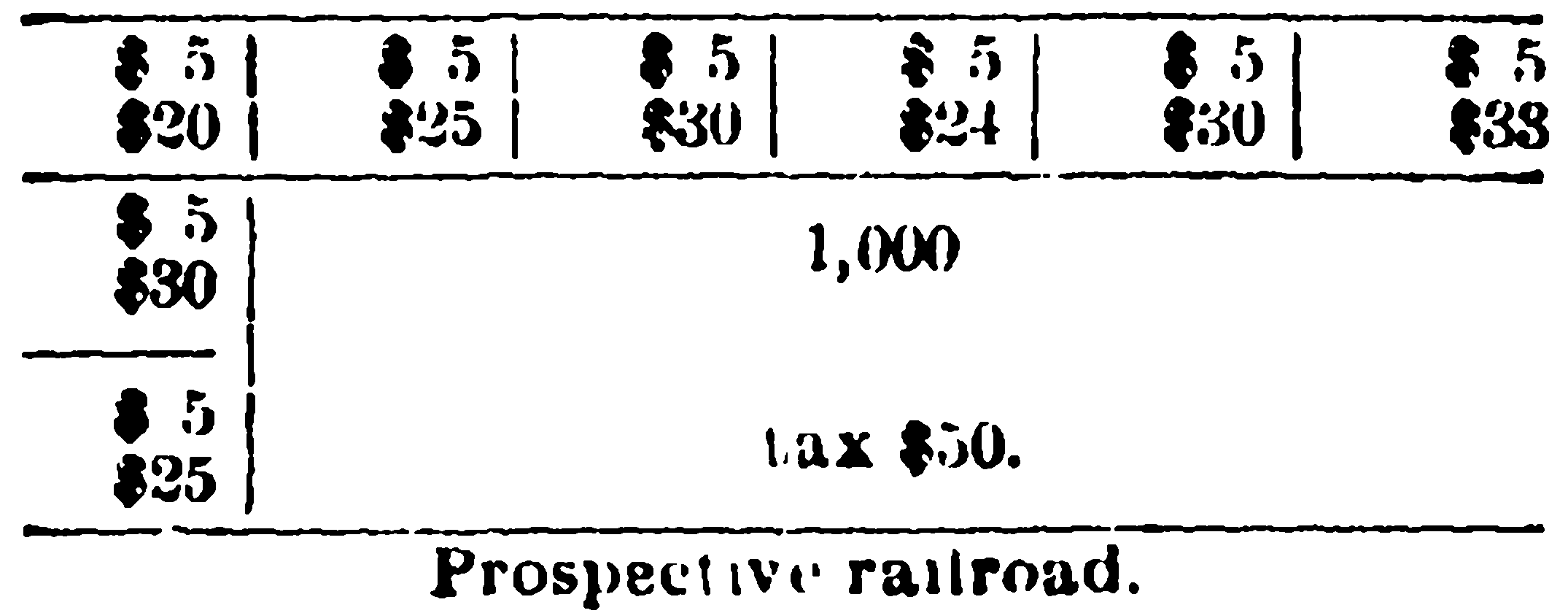 [Diagram: typeset plan
of lots, a top row of six small lots, two more small lots at the left,
beside a large tract; each small lot marked with two dollar figures
(upper “$ 5”, lower a larger figure); the large tract marked “1,000” and
“tax $50.”; caption below.]
Top row (each lot, upper / lower figure): $ 5 / $20 | $ 5 / $25 | $ 5 / $30 | $ 5 / $24 | $ 5 / $30 | $ 5 / $33 Left side, below: $ 5 / $30 ; $ 5 / $25 Large tract: 1,000 / tax $50. Prospective railroad.
“My friend, taxation is heavy.”
Friend—Yes, indeed it is.
“Now look at this plan, my dear sir. A few settlers buy their lots of an eastern syndicate for $1,000 apiece, and before improving are taxed $5. When they get their land improved they are taxed $20, $25, $30, etc., as the second figures in the diagram show. Now, you see as they put their labor on their place they are taxed heavily, while the syndicate that lives in some other state, and probably in a foreign country, which owns the best land, that nearest the prospective railroad, and who do not hire any labor to improve their holding, and who own more land than all the rest, are only taxed $50.”
Friend—Yes, I see; but how do you propose to remedy it?
“Take all taxes off of improvements, and put it on the rental value of land. It takes $267 taxes to run this small township. These small farmers have 100 acres apiece, and the syndicate holds 1,000 acres, all of equal value. Make the taxes $15 on each 100 acres, and then the eight farmers will pay altogether $120 on the value of their land, and the syndicate $150. In that way, my friend, the syndicate will hire labor to go to work on the land to make something out of it, and the poor farmers can improve all they want to and won’t be taxed any more.”
Friend—That’s fair and just.
“A political economist has showed us how this can be done.”
Friend—Who is he?
“Henry George.”
Friend—Henry George is right.
CONNECTICUT.
AN ORGANIZATION WANTED IN WATERBURY—W. J. GORSUCH IN MADISON.
G. W. McDonald, Waterbury.—In reading “the roll of states” for a considerable length of time, I find you print no report from this city. That is strange, when it is considered that we have between five and six hundred single tax men here somewhat “afraid of their horse,” it is true, but still single tax men. I think it is well, in view of the good news coming from all parts of the country, to wake up here in Waterbury. The question of organizing a single tax club has been discussed for some time, but no active steps have been taken. Who will start the ball?
In conversation with one of our largest manufacturers the other day (who had just paid an enormous price for a piece of swampy land for the purpose of extending his factory), he berated land owners in general, and used language not too complimentary to them. I thought it a good time to explain the single tax to him, and closed by continued on p. 13 →
[page ends mid-sentence; the Waterbury letter presumably continues on the following page, but no continuation line is printed]
Page 13 of 16contents
February 12. 1890. | THE STANDARD | 13
p. 13, col. 1 ← continued from p. 12 asking if he saw “the cat.” He rather astonished me by the originality of his answer, which was to the effect that he began to see it rather indistinctly, but was deep in love with its kitten, “free trade.” I then armed him with THE STANDARD, “Progrese and sic,” and “The Land Question,” for which he thanked me heartily, and said he would study impartially. I look to him to be a leader, for I know him as a man true to his convictions and a rather good speaker.
William C. Miner, Madison.—Feeling strongly impressed with a desire to do something to spread the gospel, your humble servant took it upon himself to call together his neighbors and friends for several evenings to talk to them in a familiar way concerning the condition of society, and not, he hopes, without good results. On Tuesday, the 21st, we were addressed by W. J. Gorsuch, of Bridgeport, Conn., who treated in a masterly way the evils of society and showed most successfully the beauties of the single tax. I am sure the truth, as THE STANDARD sees it, will get a footing here. Let THE STANDARD come and come regularly. Call me late to dinner if you must, but don’t fail to produce THE STANDARD on time.
NEW JERSEY.
MOVING ON THE BUREAU OF STATISTICS—THE LEGISLATIVE COMMITTEE ON BALLOT REFORM TO TAKE EVIDENCE.
J. A. Craig, Paterson.—Our club has passed resolutions congratulating Governor Abbett on that part of his resolution relating to ballot reform, excepting the section relating to the distribution of official ballots prior to the holding of an election. We do not think that Census Superintendent Porter will investigate the mortgaged indebtedness of the country, so we passed the following:
Resolved, That Mr. James Bishop, chief of the state bureau of statistics, be and is hereby requested to examine into and report upon the percentage of people in the state who occupy their own homes and farms, and what proportion are tenants; and of those who occupy their own homes and farms, what proportion have their property free from debt; and of the homes and farms which are under mortgage, what percentage of the value is so mortgaged; and
Resolved, That single tax clubs, farmers’ associations, local and district assemblies of the Knights of Labor, and all other associations of whatever kind throughout the state, be and are hereby requested to pass resolutions, urging the said Mr. James Bishop to make such investigation and report thereon in his next annual report.
The press committee are under instructions to ascertain and publish the assessed valuations along with the selling price of real estate sold each week.
S. T., Trenton.—The joint committee on ballot reform of the legislature issued a notice last week to all persons interested to appear before them on Tuesday, February 11.
A. W. Davis, Oxford.—I have sent twenty-three signatures to the committee, all either Knights of Labor or farmers. The light is breaking, and soon all good knights will fall into line.
OHIO.
SINGLE TAX FROM A CONGREGATIONAL PULPIT—ORGANIZED IN COLUMBUS.
E. P. F., Cincinnati.—At the Monday evening economic class of the Storrs Congregational church, of which Rev. E. P. Foster is pastor, the president of the City single tax club, James Semple, gave on February 3 a rousing address on the single tax. The church was well filled, and after the address was over discussion was opened and kept up enthusiastically until the janitor suddenly darkened good counsel by turning off the gas and thus turning out the oratorical lights.
H. Struby Swank, Columbus.—According to appointment a goodly number of single taxers met on last Monday night at the office of the Triumph artificial limb company, and organized a single tax club, which will meet hereafter at half-past 3 o’clock every Sunday. All single taxers in the vicinity should, by their presence at each meeting, aid us in spreading the doctrine.
C. A. Potwin, Zanesville.—The officers of our single tax club for the ensuing term are: President, W. H. Loughead; vice-president, E. C. Crumbaker; secretary, Wm. Quigley; treasurer, J. J. Roll.
A. R. Wynn, Toledo.—The enrolment committee is doing better than they know.
S. T., Sheffield.—The Unity club, attached to the Unitarian church, recently discussed the single tax in a very thorough manner, the pastor, Rev. Lewis J. Duncan, showing a more than passing interest in the discussion.
Wm. A. Cronenberger, Cleveland.—That petition is a great thing. I like to talk on the single tax, and asking a man to sign the petition gives me the opportunity I seek.
James R. Angier, Akron.—The progress of our principles is best seen in the increased respect for and willingness to investigate the claims of the single tax. Our club has p. 13, col. 2 emerged from the quiescent state into which it had fallen last summer, and is now doing excellent work, and holding public meetings twice a week. Rev. C. Elwood Nash, our Universalist minister, has done much to aid the single tax by the indorsement of it in his sermons.
S. T., Colman.—The St. Louis league some time ago sowed single tax seed here which is now showing results. A meeting will be shortly held, at which J. S. Berry will speak on the single tax.
INDIANA.
THE INDIANAPOLIS CLUB MEET IN THEIR NEW ROOMS.
L. P. Custer, Indianapolis.—The first public meeting of our club in our new rooms took place Sunday evening, February 2. There was a large attendance. C. H. Krause gave a reading, and Thomas J. Hudson a talk on “trust principles;” then Judge Fellows spoke on the moral side of the single tax doctrine. The judge was followed by Wendel Vondersaar. The Rev. Daniels of the New church will address us at our next meeting. On Tuesday, February 4, the club conducted a mock trial of A. V. Hahn, on the charge of bribing a voter (Mr. Buell) at the recent election of the club (which was conducted under the new state law, the Australian plan). While it was the cause of great fun, it afforded considerable information as to the provisions of the new bribery act also passed by the legislature.
Mr. sic has presented the club with a bound volume of THE STANDARD, and a number of friends have sent in miscellaneous works and periodicals.
ILLINOIS.
JAMES MALCOLM TALKS TO THE STENOGRAPHERS—A COUNTY CONFERENCE PROBABLE—A GRAIN SPECULATOR REACHES OUT FOR THE TRUTH, BUT MISSES IT—“THAT PETITION IS A GREAT THING.”
Warren Worth Bailey, Chicago.—James Malcolm, one of the brainiest men in our organization and one of the very cleverest with the pen that I know anywhere, had a paper at last night’s meeting which was addressed particularly to the stenographers, but which was broad enough in its scope to include and interest all classes. There was a fine audience present. Marshal Beck and Messrs. Van Ornum, Place, Devannon, Meadows and others participated in the discussion that followed.
On Thursday evening, February 27, sic C. F. Peterson, who has but recently joined the club, will speak on “The Single Tax in the Light of the New Church.” This will be a notable address, and I hope the friends throughout the city will help to make the occasion what it should be.
The collection of statistics relating to local assessments continues under the supervision of that indefatigable worker, Mr. J. T. Ripley. He is aided most efficiently by Mr. Malcolm, Mr. A. H. Adair and others, and a sensation is promised when the facts are ready for publication. One of the leading papers of Chicago has promised to give the results of the committee’s work all the space that it may deserve.
There is some talk of holding a county conference in June, and on Thursday evening next the matter will be thoroughly considered.
S. T., Chicago.—The Economic club, which meets in the recital hall, Auditorium building, on Sunday evenings, had as the lecturer last Sunday evenings, February sic, Robert Lindblom, known for nearly twenty-five years as a successful operator on the Chicago board of trade. The subject selected for him, “The influence of speculation on prices,” was one about which he was supposed to know a great deal; and that he did transpired in the course of his lecture. Here are some of the things he said that will be of interest to our friends:
An article can have three values, to wit: A utilitarian value, a commercial value and a speculative value; and it can have each or all.
Everybody believes, or affects to believe, that values are governed by the supply and demand. If, then, to the utilitarian and commercial demand is added that other demand which does not really exist, but which so-called speculators create by anticipating a demand later on, the effect must be to increase the demand while the supply remains the same, and values must be enhanced for the time being at least.
Short selling is a new invention, and is the very reverse of speculation as generally understood.
A speculator always buys in hopes of an advance in prices, and only sells what he actually possesses or controls by virtue of contracts.
VERY FEW PEOPLE REALIZE THE FACT THAT THERE IS BUT ONE SOURCE FROM WHICH WEALTH CAN BE PRODUCED; ONLY ONE, AND THAT IS FROM LAND. Every business enterprise, every industry, every artisan, depends upon the products of the land for the production of wealth, either by directly extracting, exchanging, by refining or transporting the same. ALL WEALTH HAS TO COME FROM LAND, JUST AS SURE AS ALL LIFE OR sic DEPENDS ON AIR AND SUN.
I want to emphasize this proposition: That all wealth is produced by applying labor to land, or by refining or transporting the products which labor has extracted from land.
p. 13, col. 3 > I want you to bear with you from this hall this one idea, that THERE HAS NOT BEEN AND NEVER CAN BE ANY WEALTH IN THE WORLD THAT HAS NOT BEEN PRODUCED BY APPLYING MANUAL, PHYSICAL LABOR TO LAND. > > Get this one idea firmly established in your mind and heart and you will view the economic questions of the day from a very different platform than at present. You will then see how absurd it is to make land so dear that labor has no chance to apply itself to it and produce wealth. You will then understand how criminal it is to speculate in vacant lands; that it is a crime against humanity to permit anybody to fence in vacant land and prevent willing and needy labor to apply itself on that vacant land and produce wealth. You will understand that because “A” has bought a lot for $1,000 and sold it for $2,000 he has produced no wealth. He has simply kept vacant land, that he had no use for himself, out of use until somebody’s real or fancied necessities compelled them to pay him $2,000 for the privilege of using that land. Mind you, there is no scarcity of land all this time. More than one half of the city of Chicago is vacant land on which no wealth is produced; but if some laborer should undertake to apply his skill and energy on any of this vacant land in order to support his family the owner would have him arrested. Not because the owner wanted to use it himself, but because the owner had a paper deed to that land by which he was given the privilege to speculate upon the necessities of his fellow-men. Knowing sic we cannot live except by applying labor to land, speculators take advantage of it by fencing in vacant land, by making land dear and by reaping the benefit of other men’s labor on other land, without working themselves in producing wealth. Land is as necessary to existence as air and water, and I ask you what more right has anybody to withhold from the public land that he does not want to use than he has to deprive you of air and water that he does not want to use. There is as much propriety in claiming ownership to land that we cannot or will not use, and if the lawmakers were better informed they would not rest content with preventing the forestalling of the markets for certain products of the soil, but would strike at the very root of the evil, and prevent speculation in vacant lands. Prohibit this gambling in the soil given to humanity in common and without which man cannot exist. Let all men have all the land they can use, but do not permit them to prevent others from using all they need so long as nobody’s equal rights are interfered with. > > Speculation in land, tending as it does, to make it dear, is a curse of the present. The greatness of America is not due to superiority over all other countries, but is due mainly to the fact that until recently vacant land has been practically free. There have been fences and paper deeds to a large portion, but there has been enough land outside these fences that people willing to work could apply their labor to and produce wealth. Speculators are, however, getting the land market cornered rapidly, and it will not be very long before in free America white slavery such as exists in Europe to-day will take the place of African slavery, and you will find that the land owner in America will be even worse than the land owner in Ireland. If it is a crime to forestall the market value of breadstuffs, is it not more criminal to manipulate the price of land on which all breadstuff is produced? > > In advancing the price of breadstuff some compensating benefit accrues to the farmer, but in advancing the value of vacant lands nobody is benefited, unless it be some speculator who has a certificate of ownership on something that he does not use, does not need, and which somebody else is ready to use for the purpose of creating wealth but for the fence around it. These are but pirates on the sea of commerce, but drones in a busy hive, producing nothing, and entitled to no consideration whatever in the economic regulations of the world. I hope the time will soon come when speculation in vacant land will be prohibited just as speculation in cards and dice is prohibited. > > With the present order of society speculation is a necessity perhaps, but when we become educated up to a realization of how useless and foolish it is to try to profit by the necessities of our fellowmen then speculation will be unknown, but that will be in the far future, and while we are waiting for it our next [best?] thing to do is to legalize a plan for selling real estate short. I wish it could be done now. With land graded and classified as grain and provisions are now, so that equally good land could be delivered on contract, the bears would soon make land so plenty that sic would cease and every wage worker would be his own landlord, because there is plenty of land for everybody if only the fences were torn down.
MISSOURI.
A RABBI ADDRESSES THE ST. LOUIS LEAGUE—FATHER HUNTINGTON’S COMING ADDRESS—NEWS FROM OTHER POINTS.
Percy Pepoon, St. Louis.—Rabbi Samuel Sale of Shaare Emeth synagogue addressed p. 13, col. 4 us at our last meeting, his subject being “Ethical socialism.” The address was an earnest and able one. At some future time he will address the league again, specially discussing “Progress and Poverty,” because, as he said, he needs enlightenment on a portion of it.
While the growth of our league is steady, it seems to partake of the nature of a boom. There were fifteen applications for membership at the last meeting.
Arrangements are progressing for Father Huntington’s address. Every clergyman that we have thus far communicated with has promised to announce this lecture at all services, and the Knights of Labor assemblies are going to turn out in a body.
B. A. Birmingham, Kansas City.—The single tax is booming in this part of the country, and we are all doing our part to keep it going.
R. H. Hasenritter, Hermann.—We are circulating single tax tracts and Henry George’s works. We are somewhat under a disadvantage, as the population here is principally German and republican. However, we are moving on. If any of our friends have tracts on free trade or the land question that they would like to have distributed we would be glad to have some of them here.
Gus. A. Menger, St. Louis.—Mr. George’s visit to this city has done the cause a deal of good. Having been elected vice-president of the trades and labor union, I have now an opportunity to preach our doctrines among the toilers, and I shall do all I can. Success to the single tax cause!
MICHIGAN.
THE HENRY GEORGE ASSEMBLY OF THE K. OF L. HOLD A PUBLIC MEETING.
S. T., Detroit.—An open meeting of Henry George assembly of the K. of L., was held at their hall on Sunday, February 3. Jordan Grenell, M. W., announced that the purpose of the meeting was to gather together the scattered single tax elements of Detroit and enrolling them, and then he called upon Judge Henry A. Robinson, who presented briefly the single tax theory. The remarks of Mr. Bridge were also very instructive and were received by the audience with marked approval. Wm. E. Thornton, one of the leading members of the typographical union of this city, also made a most excellent speech. He had put on a “sub” in order to attend the meeting.
At the close of the addresses eighteen of the audience signed the roll.
Another meeting of the same kind will be held under the patronage of the famous Henry George assembly two weeks hence.
KANSAS.
H. MARTIN WILLIAMS’S LECTURE AT TOPEKA—SOME KANSANS WHO WERE DISAPPOINTED.
S. T., Topeka.—H. Martin Williams of Missouri recently delivered, at Trades assembly hall, an address upon the reckless sales and gifts of public lands in this country. He figured up that since 1827 there have been granted to canals 4,405,986 acres; for education, 77,493,162 acres; to railroads, 191,903,957 acres; or in all, 273,803,105 acres, an area greater by 17,000 square miles than the combined area of the six New England states and New York, New Jersey, Delaware, Maryland, Pennsylvania, Ohio, Indiana, Illinois, Michigan, Wisconsin, Iowa and Missouri, or all the states east of the Mississippi and north of the Ohio rivers, including all the populous and wealthy states, now containing forty million people and not yet half settled. In addition to this, [12,963,593?] acres of public lands have been illegally inclosed by cattle and other syndicates, largely composed of foreign nobles.
Fifty-six foreign syndicates and noblemen own [26,213,354?] acres in various part of the sic, which is 860,630 acres more than the entire area of Indiana, or enough to give 140,615 American citizens a farm each of 160 acres. This enumeration is incomplete and it is believed that aliens own at least 40,000 square miles of United States territory.
Mr. Williams enumerated twenty-nine American citizens and corporations owning 14,036,000 acres, and this is only a very small part of the number of American land owners, who hold from 5,000 to 1,000,000 acres each.
Andrew Reddick, Abilene.—We thought Mr. George would pass through here on his continued on p. 14 →
[Advertisement] Ely’s Cream Balm
 [Illustration: display
advertisement with large decorative lettering; at right, a profile of a
human head (phrenology-style) inscribed with the names of ailments, with
the product name on the neck. Text of the picture panel: “THE CURE FOR
CATARRH COLD IN HEAD” / “HAY FEVER” / “DEAFNESS” / “HEADACHE” / “ELY’S
CREAM BALM” / “50c” / “TRADE MARK” (small, vertical).]
Ely’s Cream Balm
THE CURE FOR CATARRH HAY-FEVER AND COLD IN HEAD
Ely’s Cream Balm is not a liquid, snuff or powder. Applied into the nostrils it is quickly absorbed. It cleanses the head, allays inflammation, heals the sores. Sold by druggists or sent by mail on receipt of price.
50c ELY BROTHERS, 56 Warren Street, NEW YORK. 50c
Page 14 of 16contents
14 | THE STANDARD. | Vol. VII, No. 7
p. 14, col. 1 ← continued from p. 13 way to Denver, and there was a crowd at the depot to see him. At Solomon City, Mr. E. L. Butcher had prepared, in the name of the single tax club of that city, an address wishing him good speed to Australia.
TENNESSEE.
THE LEADING GERMAN PAPER OF THE SOUTH INDORSES THE SINGLE TAX.
S. T., Memphis.—The Sudliches sic, in an editorial on “Reforms” in its issue of the 1st inst., after speaking of the Australian system sic voting, goes on to say:
A second reform, to which we desire to draw attention in this connection, is the single tax. It is simple, just and easy to assess It sic a powerful means to prevent land speculation, speculation in building lots, etc., and to encourage industry and thrift. As it is now, if a street is run through, the man who allows his lots to remain idle will become wealthy through the increase in land values, and that without effort on his part, while the man who invests his capital in houses is punished for his enterprise through higher taxes. Tax the building lots and leave free that which is built thereon and the poor will not want for houses nor the laborer for factories. The greedy land speculator will not be in a position to allow a building lot to remain vacant for years, because it will be devoured by taxes. He must sell or build, and if it be farm land or pasture land he must cultivate or sell. The single tax would transfer the ownership from the few to the many. These reforms are attainable and will be brought about if only such men are sent to the legislature as promise to support them.
This is one of the leading German papers in the south, and it is worthy of remark that so clear a statement of and indorsement of the single tax should be found in its columns.
Of course the single tax will not prevent the holding of pasture land and the use of such land as pasture, but this small error does not prevent the above from being an excellent statement of the doctrine.
COLORADO.
A STATE ASSOCIATION FORMED—GAINING CONVERTS.
Henry C. Niles, Denver sic have formed a state association of single tax societies. At our first meeting nine counties were represented, and we received letters from nearly every portion of the state. We adopted the following constitution:
Article 1. It shall be the object of this organization to secure the abolition of all taxes upon labor and the products of labor, and in lieu thereof to place all taxes, national, state and local, upon land values, irrespective of improvements. This organization shall use every opportunity to secure the adoption in the state of Colorado of a secret ballot law, which shall provide:
First—That all ballots shall be official and shall be printed and distributed at public expense.
Second—That the names of all candidates for the same office shall be printed on the same ballot.
Third—That all ballots shall be delivered to the voter within the polling place on election day by sworn public officials.
Fourth—That only official ballots so delivered shall be voted.
Fifth—That the voter shall be guaranteed absolute privacy in preparing his ballot and that the secrecy of the ballot be made compulsory.
Sixth—That voters shall have the right to nominate candidates by properly certified petitions.
Article 2. Name—The name of this organization shall be the Colorado state single tax association.
Article 3. Officers—The officers of this organization shall be a president, one vice-president from each county in the state, a secretary and a treasurer.
Article 4. Elections—The president, secretary and treasurer shall hold office for a period of two years, beginning with January 1, 1890, and shall be elected on the first day each biennial sic by the ballots of all qualified electors of this association.
Article 5. Vice-presidents—The president shall appoint one vice-president for each county, who shall be a resident of the county for which he is appointed, upon the recommendation, if any, of the single tax men of that county.
Article 6. Qualifications of Electors—No member shall be allowed to vote at the biennial election of officers who shall be in arrears for dues to this association. All other members shall send their ballots to the secretary on or before the first day of January in each election year. The secretary shall then count the ballots and notify the president and each vice-president of the result of the election.
Article 7. Meetings and Quorum—The regular meetings of this association shall be held in Denver, Col., upon the call of the executive committee, and five members shall constitute a quorum.
Article 8. Each member shall pay to the treasurer of this association the sum of $1 per year, and it shall be the duty of the treasurer to prepare a quarterly statement of receipts and disbursements, a copy of which shall be sent to each officer of the association.
Article 9. The officers of this association shall constitute an executive committee.
Article 10. Any person subscribing to the principles of this association may become a member.
Article 11. Constitution may be amended by majority of executive committee.
The election of officers followed, resulting in the selection of the following, all of whom are Denver men: President, Andrew W. Elder; secretary, H. C. Niles, [2,946?] Marion street; treasurer, George Champion, 1,516 [Wazee?] street.
p. 14, col. 2 In order that effective work may be done, the co-operation of all friends of our cause will be required, and it is hoped that they will forward their names to the secretary for enrolment, and in addition to the annual dues, notify the treasurer of the stated sum which they are willing to contribute each month for the work. The time is evidently ripe for a concerted effort, and the attitude of thoughtful men in every community toward us and our principles makes the present a peculiarly favorable time for propaganda work. The lectures here were a success in every way, and have aroused an immense amount of discussion and study.
W. H. Clayton, Alamosa.—I am quite certain of gaining a good many to our cause in this locality. They are more anxious to see the light than a year ago.
NEW HAMPSHIRE.
Edward Jewett, Nashua.—This is a hard state—this granite state—in which to make an impression with our ideas; but I have hopes to stip sic some workers in the cause before I get through.
PENNSYLVANIA.
H. T. Paul, Philadelphia.—I see at last signs of a small harvest. Several gentlemen of my acquaintance are reading “Progress and Poverty” and other works of Henry George. Among the petitions I have sent to the enrolment committee are two property owners, members of the Society of Friends, of which I am also a member.
MARYLAND.
W. J. Ogden, Baltimore.—The Herald of last Sunday, February 2, gave an editorial on Mr. Shearman’s lecture which was very close to “coming out.”
GEORGIA.
Garrat Mahan, Savannah.—I have taken a big contract on myself: I am going to talk workingmen out of the notion, now so prevalent among them, that they do not pay taxes.
IOWA.
James S. Mott, Mason City.—The purring of the cat can be heard on our streets. No trouble to get signatures to the petition when I can get about; but I have to work twelve hours a day to keep the wolf from the door, so cannot give as much time to propaganda work as I would like. There’s a good time coming, though.
FROM OTHER LANDS.
CANADA.
SPLENDID WORK IN TORONTO—“THE FIRST SINGLE TAX MAN WAS JOSEPH.”
J. L. Dawkins, Toronto, Ont.—The single tax idea is making steady progress here. Five or six of our city aldermen are in sympathy with the movement, and at a recent meeting of the council Alderman Hallam carried a motion that the Ontario legislature be petitioned to exempt all personal property and incomes from taxation, and also to abolish all exemptions on real estate.
Last Monday a deputation from this society waited upon the Hon. O. sic, the premier of Ontario, and urged upon him the necessity of taking some decided step toward concentrating all taxes on land values.
Last Sunday the Rev. Mr. Burton, pastor of a congregational church in this city, started a class for the study of land tenure, and other social questions, sic a biblical point of view.
George G. Serviss, Cardinal,. sic.—The Rev. John Burton of Toronto delivered a lecture in this place last evening on the “Bible and the Land Question.” He quoted from Genesis to prove that the first single man was sic. He put the single tax into practice after getting possession of the land, by appropriating one-fifth for Pharaoh or government. The audience was large and attentive.
We have sent our petition for exemption on dwellings to Mr. French, our local member, with ninety names of voters on it, who are mostly freeholders. This is about one-half of the voters of the place.
ENGLAND.
[Fredk?] Verinder, London.—On January 28 a mass meeting was held at St. James hall, sic, to protest against the buying out of Irish landlords at the expense of British taxpayers. William Saunders, of the London county council, presided, and Michael Davitt and John Burns delivered the addresses.
NEW ZEALAND.
S. T., Auckland.—Our society has just received an interesting letter from Mr. John Farrell, of the Australian Standard, who is touring New Zealand in the interests of the Australian press and at the same time organizing a reception for Henry George. Mr. Farrell writes that there are now in New South Wales more than fifty newspapers supporting the teachings of Henry George, among them being the Daily Telegraph, the most influential paper in that colony, while the societies for the promulgation of his teachings number thousands of members and are daily increasing. Mr. Farrell predicts for Henry George such a reception in Sydney as no other living man would get. The secretary was instructed to wire to Mr. Farrell as to future engagements and invite him to address a meeting in Auckland on the subject.
p. 14, col. 3
[Advertisement] Consumption Cured.
An old physician, retired from practice, having had placed in his hands by an East India missionary the formula of a simple vegetable remedy for the speedy and permanent cure of Consumption, Bronchitis, Catarrh, Asthma and all sic and lung affections, also a positive and radical cure for Nervous Debility and all nervous complaints, after having tested its wonderful curative powers in thousands of cases, has felt it his duty to make it known to his suffering fellows. Actuated by this motive and a desire to relieve human suffering, I will send free of charge to all who desire it this recipe, in German, French or English, with full directions for preparing and using. Sent by mail by addressing with stamp, naming this paper, W. A. Noyes, 820 Powers’ Block, Rochester, N sic
[Advertisement] CATARRH.
Catarrhal Deafness—Hay Fever—A New Home Treatment.
Sufferers are not generally aware that these diseases are contagious, or that they are due to the presence of living parasites in the lining membrane of the nose and eustachian tubes. Microscopic research, however, has proved this to be a fact, and the result of this discovery is that a simple remedy has been formulated whereby catarrh, catarrhal deafness and hay fever are permanently cured in from one to three simple applications made at home by the patient once in two weeks.
N. B.—This treatment is not a snuff or an ointment; both have been discarded by reputable physicians as injurious. A pamphlet explaining this new treatment is sent free on receipt of stamp to pay postage, by A. H. Dixon & Son, 337 and 339 West King street, Toronto, Canada.—[Christian Advocate.
Sufferers from Catarrhal troubles should carefully read the above.—[Adv.
[Advertisement] Scott’s Emulsion
 [Illustration: display
advertisement; a fisherman in a hat and coat stands carrying a huge cod
slung over his shoulder, ships and a pier behind him; ornamental
lettering above.]
Scott’s EMULSION OF Pure Cod-Liver Oil AND HYPOPHOSPHITES
ALMOST AS PALATABLE AS MILK.
So disguised that the most delicate stomach can take it.
Remarkable as a FLESH PRODUCER. Persons gain rapidly while taking it.
SCOTT’S EMULSION
Is acknowledged by Physicians to be the FINEST and BEST preparation of its class for the relief of CONSUMPTION, SCROFULA, GENERAL DEBILITY, WASTING DISEASES OF CHILDREN, and CHRONIC COUGHS.
ALL DRUGGISTS. Scott & Bowne, New York.
[Advertisement] The Wonderful Luburg Chair
 [Illustration: display
advertisement with cuts of a reclining chair marked “50 CHANGES”, a man
seated in a wheel chair, and a baby coach.]
THE WONDERFUL LUBURG CHAIR. 50 CHANGES. COMBINING 5 ARTICLES OF FURNITURE IN ONE
100 STYLES BABY COACHES
INVALID SUPPLIES AND WHEEL CHAIRS
[W]e retail at the lowest [w]holesale factory prices, and [s]hip goods to be paid for on [de]livery. Send stamp for [C]atalogne. Name goods desired.
Automatic Brake on all Coaches FREE WHEEL CHAIRS TO HIRE. SPECIAL FREE DELIVERY.
[L]UBURG MFG. CO., 145 N. 8th St., Philadelphia, Pa.
[Advertisement] Cheap Printing
 [Illustration: small
cut of a hand printing press, heavily inked.]
Cheap Printing
Do it yourself. Card press $3. Circular press $8. Size for small newspaper $44. Everything easy, printed rules. Send 2 stamps for Catalogue of presses, type, paper, cards, [e]tc., to factory.
KELSEY & CO., Meriden, Conn.
[Advertisement] Holland’s
HOLLAND’S COFFEE AND DINING ROOMS
[143?] Fourth avenue, bet. 13th and 14th sts.
[Advertisement] Concord Co-operative Printing Company
CONCORD CO-OPERATIVE PRINTING COMPANY (Ld.), 104 Elm street, cor. CANAL, N.Y
[line obscured: bottom line of the advertisement printed only as the tops of the letters]
[Advertisement] Jas. Hogan
JAS. [HOGAN?], Principal Agent for James Means’ [$3?] and [$4?] shoes. [136?] Bowery, near Prince st.
p. 14, col. 4
THE SINGLE TAX BROTHERHOOD OF RELIGIOUS TEACHERS.
ANNOUNCEMENTS.
Ministers of all denominations are earnestly and cordially invited to join the brotherhood.
The headquarters of the brotherhood are at 27 Clinton place, New York city.
All meetings and receptions of the brotherhood will be held (unless otherwise announced) at the headquarters.
The monthly business meetings will be held on the first Monday of each month at 2.30 p. m.
The publications of the brotherhood and “books recommended” can be obtained from the secretary. Specimen copies can be seen in the library of the brotherhood at headquarters.
Please address all communications (including those containing donations, subscriptions and dues) to the secretary, the
REV. DR. THACKERAY,
Newtown, L. I., N. Y.
THE CONSTITUTION.
I. Title.
The name of this society shall be “The Single Tax Brotherhood of Religious Teachers.”
II. Membership.
The membership shall be confined in general to ministers of recognized standing in any religious denomination.
Any such minister of religion who is in favor of the adoption of the “single tax on land values” may be proposed for admission to the brotherhood, and if elected by the executive committee he thereupon becomes a member.
III. Principles of the Brotherhood.
The ownership of the land is and must ever remain in the hands of the Creator alone.
The Creator gives to every generation in succession (during its lifetime only (the sic of possession in order that it may enjoy the usufruct (i. e , the sic and benefit) of the land.
Every individual of each generation has an equal right to share in the usufruct of the land.
The conditions on which the possession of land is permitted to individuals should be such as to ensure impartially to all a share in the Creator’s bounty.
IV. Declaration.
We believe that these principles find their legal and economic expression in the single tax on land values, and we therefore earnestly hope and labor for its speedy adoption.
V. Work and Aims of the Brotherhood.
To direct the attention of ministers of religion to the distinctively religious aspects of the single tax movement.
To encourage ministers of religion in presenting these aspects of the single tax movement to their congregations.
To promote the furtherance of the movement by any other means in their power.
VI. Methods of Work.
The means adopted and recommended for the prosecution of this work are:
The circulation and recommendation of books, leaflets, tracts and other literature relating to the single tax and kindred subjects.
The delivery and publication of sermons and addresses relating to single tax subjects.
Work through the public press.
Personal influence and social intercourse whenever opportunity offers.
VII. Organization.
The brotherhood will extend its operations chiefly (but not exclusively) throughout the United States and Canada, and will have its headquarters in New York city.
Local branches may be affiliated with it.
A printed list of all the brethren shall be issued annually, or at convenient intervals, and a copy sent to every brother in good sic
Dues, one dollar per annum.
VIII. Meetings.
The brethren will meet for business usually once a month
At these meetings the order of business shall be as follows:
Agenda. Part I.
- Silent prayer.
- Reading of minutes.
- Reading of communications by the secretary.
- Reports of officers and special committees.
- Notices and announcements of future meetings and arrangements.
- Unfinished business.
- New business.
Agenda. Part II.
The business of Part I being concluded, then may follow, either:
(a.) A paper to be read. (b.) An address by an invited speaker. Or (c.) A discussion initiated on some subject connected with the single tax or cognate matters.
IX. Receptions.
Occasional meetings or receptions will be held by the brethren to welcome ministers and others; and opportunity will be afforded to these sic may desire to obtain information or to state difficulties and discuss objections to the single tax in friendly conversation or informal discussion with the brethren.
Invitations for a like purpose from ministers and others will also be cordially welcomed by the brethren.
BY-LAWS.
I. The regulation and management of the affairs of the brotherhood shall be in accordance with the constitution and by-laws which are now or may hereafter be enacted for that purpose.
The officers shall include an executive committee of not less than seven members, a secretary and treasurer. The secretary and treasurer shall be ex-officio members of the executive committee. The government of the brotherhood shall be in the hands of the executive committee, subject to the constitution and by-laws. A quorum of the committee shall consist of not less than three members, not counting members sic
The executive committee, the secretary, the treasurer and any other officers shall be elected by the brethren annually for each year. Their term of office shall expire on December 31 or as soon thereafter as their successors shall be elected.
Whenever any office of the brotherhood shall become vacant (otherwise than by expiration of term) notice of the vacancy shall be given at the ensuing monthly meeting and a member shall be elected by the brethren to fill the vacancy at the monthly meeting next after.
V. No alteration or addition shall be made to the constitution and by-laws except by a two-thirds vote of the brethren present at two consecutive monthly meetings.
[Advertisement] Beecham’s Pills
 [Display heading
(lettering cut): “PAINLESS” and “EFFECTUAL” in the upper corners;
“BEECHAM’S PILLS” in large arched letters; at left “THE GREAT ENGLISH
MEDICINE”; at right “WORTH A GUINEA A BOX”.]
For Bilious and Nervous Disorders, such as Wind and Pain in the Stomach, Sick Headache, Giddiness, Fullness, and Swelling after Meals, Dizziness and Drowsiness, Cold Chills, Flushings of Heat, Loss of Appetite, Shortness of Breath, Costiveness, Scurvy, Blotches on the Skin, Disturbed Sleep, Frightful Dreams, and all Nervous and Trembling Sensations, &c. THE FIRST DOSE WILL GIVE RELIEF IN TWENTY MINUTES. This is no fiction. Every sufferer is earnestly invited to try one box of these Pills, and they will be acknowledged to be a Wonderful Medicine.—“Worth a guinea a box.”—
BEECHAM’S PILLS, taken as directed, will quickly restore females to complete health. For a
WEAK STOMACH;
IMPAIRED DIGESTION;
CONSTIPATION;
SICK HEADACHE;
DISORDERED LIVER;
they ACT LIKE MAGIC:—a few doses will work wonders upon the Vital Organs; Strengthening the muscular System; restoring long lost Complexion; bringing back the keen edge of appetite, and arousing with the ROSEBUD OF HEALTH the whole physical energy of the human frame. These are “facts” admitted by thousands, in all classes of society, and one of the best guarantees to the Nervous and Debilitated is that BEECHAM’S PILLS HAVE THE LARGEST SALE OF ANY PATENT MEDICINE IN THE WORLD. Full directions with each Box.
Prepared only by THOS. BEECHAM, St. Helens, Lancashire, England.
Sold by Druggists generally. B. F. ALLEN & CO., [365?] and [367?] Canal St., New York Sole Agents for the United States, who, (if your druggist does not keep them),
WILL MAIL BEECHAM’S PILLS ON RECEIPT OF PRICE, 25 CENTS A BOX.
But inquire first of your druggist. In ordering mention THE STANDARD.
Page 15 of 16contents
February 12, 1890. THE STANDARD. 15
p. 15, col. 1
SINGLE TAX ORGANIZATIONS.
(Secretaries of clubs are requested to send any corrections in the list below, and all newly formed organizations are asked to report promptly, either to the Enrollment committee or The Standard.)
ARKANSAS.
LITTLE ROCK.—Little Rock single tax club. Every alternate Thursday evening, 717 Main st. sic., Sol F. Clark; sec., O. D. Hemming, 1910 Main st.
CALIFORNIA.
SAN FRANCISCO.—California single tax society. Every Sunday evening, St. George’s hall, 909½ Market st. Library and reading room open from 9 a.m. to 10 p.m., 841 Market st. Pres., H. L. [Pleace?]; sec., G. A. Hubbell. Address of all officers, 841 Market st.
SACRAMENTO.—Single tax club of Sacramento. Every Friday evening, Dr. Reed’s office, 6th and K sts. Pres., Dr. Thos. B. Reed; sec., C. W. Farnsworth, 1406 4th st.
OAKLAND.—Single tax club No. 1 meets every Friday evening at St. Andrews hall, 1056½ Broadway. Pres., A. J. Gregg; sec., W. H. Messenger.
LOS ANGELES.—Los Angeles single tax club. Pres., A. J. Gray; sec., Clarence A. Gray, rooms 24-25 Bryson-Bonebrake block.
SAN DIEGO.—San Diego single tax county committee. Every Monday evening, 139 10th st. Chairman, Geo. B. Whaley, box 1088.
BLACK DIAMOND.—Contra Costa county single tax committee. Jeff. A. Bailey, sec.
COLORADO.
DENVER.—Denver single tax association. Every Thursday evening, 1448 Lawrence st. Pres,, G. H. Phelps; sec., F. H. Monroe, 2951 Marion st.
PUEBLO.—Commonwealth single tax club. First and Fourth Thursdays at office of D. B. V. Reeve, Union av. Pres., D. B. V. Reeve; sec., J. W. Brentlinger, Pueblo Smelting and Refining Co.
GRAND JUNCTION.—Mesa county single tax and ballot reform club. Pres., James W. Bucklin; sec., Geo. Smith.
CANYON CITY.—Single tax committee; sec., Dr. Frank P. Blake.
HAWKXHURST.—Plateau Valley single tax club. Pres., John W. Hawkxhurst; sec., E. H. Parkenson.
CONNECTICUT.
NEW HAVEN.—Tax reform club. Every Friday evening, room 11, 102 Orange st. Pres., Willard D. Warren; sec., Alfred Smith, 105 Day st.
MERIDEN.—Meriden single tax club. 3 p. m. every Sunday, Circle hall. Pres., Wm. Hawthorne; sec., Wm. Williss, P. O. box 1342.
DAKOTA.
STATE.—South Dakota single tax association. Pres., Judge Levi McGee of Rapid City; sec., W. E. Brokaw, box 146, Bristol.
RAPID CITY.—Black Hills single tax league. Last Saturday in each month, Library hall. Pres., Judge Levi McGee; sec., Francis H. Clark.
MADISON.—Lake county single tax club. Chairman, Prof. E. H. Evanson.
DISTRICT OF COLUMBIA.
WASHINGTON.—Washington single tax league; always open; regular meeting Friday evening, 609 F street, N. W. Pres., Paul T. Bowen; sec., Wm. Geddes, M. D., 1719 G st., N. W.
FLORIDA.
PENSACOLA.—Pensacola single tax club No. 1. Tuesday evenings, K. of L. hall, corner of Zaragosa and Palafox sts. Pres., J. Davis Wolfe; sec., James McHugh.
TAMPA.—Thomas G. Shearman single tax league. First Monday in each month, business meeting; Sundays, public speaking. Pres., C. E. Ainsworth; sec., John H. McCormick.
GEORGIA.
ATLANTA, Ga.—Atlanta single tax club No. 1. Pres., J. M. Beath; sec., J. Henley Smith, 67 Whitehall st.
AUGUSTA.—Augusta single tax club. Every Friday evening, Hussar hall. Pres., Ed. Flury; sec. George Haines, care of Loflin & Meyer.
ILLINOIS.
CHICAGO.—Single tax club No. 1. Every Thursday evening, club room 4, Grand Pacific hotel. Pres., Warren Worth Bailey; sec. T. W. Wittler, 426 Milwaukee ave.
SPRINGFIELD.—Sangamon single tax club. Pres., Joseph Farris; sec., James H. McCrea, 623 Black ave.
JACKSONVILLE.—Morgan county single tax club. Pres., Col. Wm. Camm of Murrayville; sec., Chas. W. Alexander of Jacksonville.
SPARTA.—Single tax committee. Sec., Wm R. Bailey.
QUINCY.—Gem City single tax club. Every Friday evening, Opera house building. Pres., C. F. Perry; cor. sec., Duke Schroer, 327 S. 3d.
INDIANA.
STATE.—Indiana single tax league. Pres., Henry Rawie, Anderson; vice-pres., L. P. Custer, Indianapolis; sec., Thos. J. Hudson, 155 Elm st., Indianapolis. State executive committee, Henry Rawie, Anderson; S. W. Williams, Vincennes; L. O. Bishop, Clinton; Dr. C. A. Kersey, Richmond; Chas. G. Bennett, Evansville; Wm. Henry, Connersville; W. E. McDermut, Ft. Wayne; T. J. Hudson, J. F. White, L. P. Custer, Indianapolis.
CLINTON.—Single tax club; Sunday afternoons, 3 o’clock, Argus office. Pres., W. V. Wells; sec., L. O. Bishop.
FORT WAYNE.—Single tax club. Pres., W. E. McDermutt; vice pres., J. M. Schwerzgen; sec., Henry Cohen.
INDIANAPOLIS.—Indianapolis single tax league. Every Tuesday evening, 8 p. m., Mansur hall, n. e. cor. Washington and Alabama sts. Pres., Dr. Brown; sec., L. P. Custer.
EVANSVILLE.—Single tax association. Pres., Edwin Walker; sec., Charles G. Bennett.
RICHMOND.—Single tax club. Pres., C. S. Schneider, 105 South Third st.; sec., M. Richie, 913 South A st.
IOWA.
BURLINGTON.—Burlington single tax club. First and third Wednesday of each month, 313 Jefferson st. Pres., Richard Spencer; sec., Wilbur Mosena, 920 Hedge ave.
DES MOINES.—Single tax club. Pres., H B. Allison, box 4; sec., J. Ballangee.
COUNCIL BLUFFS.—Council Bluffs single tax club; second and fourth Sunday of each month, 2.30 p.m.; [724?] Sixth st. Pres., Chas. [Stevenson?]; sec., L. Kinnehan, [826?] W Broadway
p. 15, col. 2 ALLERTON.—Tax reform club. Every Thursday evening, Vest’s hall. Pres., A. J. Morgan; sec., D. D. Shirley.
MASON CITY.—Single tax committee; 1st and 3d evenings of each month at Dr. Osborne’s office. Pres., J. A. Scranton; sec., J. S. Mott.
KANSAS.
ABILENE.—Single tax club. Pres., C. W. Brooks; vice-pres., H. Charters; sec., A. L. Russel.
GROVE HILL.—Grove Hill single tax club. Thursday evenings, Grove Hill school house, Lincoln township, Dickman sic. Pres., E. Z. Butcher; sec., Andrew Reddick.
LOUISIANA.
NEW ORLEANS.—Louisiana single tax club. Second, third and fourth Thursdays of each month, at 205 Canal st. Pres., John S. Watters, Maritime association; sec., Geo. W. Roberts, 326 Thalia st.
MAINE.
AUBURN.—Auburn single tax club. Saturday evenings, room 3, Phœnix block, Main st.; reading room open every evening. Pres., Thos. Marsden; sec., W. E. Jackson, 122 7th st.
sic tax committee. Every Wednesday evening, 79 Summer st. Chairman, F. D. Lyford; sec., Joseph Walsh, 79 Summer st.
MARYLAND.
BALTIMORE.—Single tax league of Maryland. Every Thursday evening, 415 N. Eutaw st. Pres., Wm. J Ogden; sec., J. W. Jones, 31 N. Caroline st.
MASSACHUSETTS.
BOSTON.—Boston single tax league, Wells’s memorial hall. Pres., Hamlin Garland; sec., Edwin M. White, 27 Pemberton square.
Neponset single tax league. Every Thursday evening, 389½ Neponset ave., Boston. Sec., Q. A. Lothrop, 43 Walnut st.
Dorchester single tax club. Every other Wednesday evening, Field’s building, Field’s Corner. Pres., Ed Frost; sec., John Lavis, 13 Leonard st.
Roxbury single tax club. Pres., Frank W. Mendum; sec., Henry C. Romaine, 250 Ruggles st.
STONEHAM.—Stoneham single tax league. Pres., Dr. W. Symington-Brown, Stoneham.
LYNN.—Lynn single tax league. Pres., C. H. Libbey st., 331 Washington sic.; sec., John McCarthy, 140 Tunson st.
WORCESTER.—Tenth district single tax league of Worcester. Friday evenings, Swedish hall, 32 Front st. Pres., Thomas J. Hastings; sec., Edwin K. Page, Lake View, Worcester.
LAWRENCE.—Lawrence single tax club. Every Thursday evening, Col. J. P. Sweeney’s office. Pres., Col. John P. Sweeney; sec., John J. Donovan, city clerk’s office.
HYDE PARK.—Single tax club. Sec., F. S. Childs, 40 Charles st.
ORANGE.—Single tax league of Orange. First Wednesday of each month, pres. and secretary’s residence. Pres., H. W. Hammond; sec., Charles G. Kidder.
NEWBURYPORT.—Merrimac assembly. Saturday evenings, 48 State st. Pres., Dennis F. Murphy; sec., W. R Whitmore, 236 Merrimac st.
MALDEN.—Single tax club. Meetings fortnightly at Deliberative hall, Pleasant st. Pres., Geo. W. Cox, Glenwood st.; sec., Edwin T. Clark, 100 Tremont st.
MICHIGAN.
STURGIS.—Sturgis club of investigation. Every Tuesday evening, C. Jacob’s justice court room. Pres., Rufus Spalding; sec., Thomas Harding.
SAGINAW.—Single tax club, rooms 413 Genesee av., East Saginaw. Pres., Edward L. Weggener; sec., Jas. Duffy, 803 State st.
MINNESOTA.
MINNEAPOLIS.—Minneapolis single tax league, 502 First ave. s. Pres., C. J. Buell; sec., J. A. Sawyer.
ST. PAUL.—Pres., H. C. McCartey; sec., R. C. Morgan, Northern Pacific railroad office.
MISSOURI.
ST. LOUIS.—St. Louis single tax league. s. e. cor. 8th and Olive, meets every Tuesday evening Rooms sic every evening. Pres., H. H. Hoffman; sec., J. W. Steele, 2213 Eugenia street.
“Benton School of Social Science.” Saturday, 8 p. m., 6839 Waldemar ave., St. Louis. Pres., Dr. Henry S. Chase; sec., Wm. C. Little.
LA DUE.—The Reform club of La Due. Pres., W. Stephens; sec., Jas. Wilson.
KANSAS CITY.—Kansas City single tax club. Lectures Thursday evenings at 8 o’clock and Sunday afternoons at 3. Headquarters, cor. 15th st. and Grand av.; open every week day until 10 o’clock p. m.; the public cordially invited. Pres., H. S. Julian; sec., J. C. Williams, N. Y. Life building.
HERMANN.—Single tax committee. Pres., R. H. Hasenritter; sec., Dr. H. A. Hibbard.
GATE CITY.—Single tax league. Meetings on alternate Thursdays at the house of W. M. sic. Pres., Wm. Kinkead; sec., J. W. Swaw.
NEBRASKA.
OMAHA.—Omaha single tax club. Sunday afternoons, Gate City hall, cor. 13th and Douglas sts. Pres., Rufus S. Parker; sec., Cyrus F. Beckett, 411 N. 23d st.
WYMORE.—Henry George single tax club. Pres., H. C. Jaynes; sec., J. A. Hamm.
NEW JERSEY.
JERSEY CITY.—Standard single tax club. Public meeting every Sunday night at Humboldt hall, 186 Newark av.; business meetings every other Friday evening at the Avenue house, “Five Corners.” Pres., E. N. Jackson, 23 Magnolia av.; sec., Joseph Dana Miller, 267 Grove st.
NEWARK.—Newark single tax club. Pres., Herbert Boggs, 82 Broad sic ; sec., M. G. Gaffney 43 Warren sic.
PATERSON.—Passaic Co. single tax club. Pres., E. W. Nellis; sec., John A. Craig, 192 Hamburg ave. Meetings every Monday evening at 169 Market street.
S. ORANGE.—S. Orange single tax club. Pres., E. H. Wallace; sec., Henry Haase.
VINELAND.—Vineland single tax and ballot reform club. Pres., Rev. Adolph Roeder; sec., Wm. P. Nichols, box 924.
JANVIER.—Janvier single tax and ballot reform club. Alternate Thursday evenings, Janvier hall. Pres. W. J. Rice; sec., Sydney B. Walsh.
p. 15, col. 3 WASHINGTON.—Washington land and tax club. Pres., John Morrison; sec., W. H, sic.
BAYONNE.—Single tax committee. Chairman, Wm. B. DuBois.
PASSAIC.—Single tax committee of Passaic. Pres., Oscar D. Wood.
NEW YORK.
NEW YORK.—Manhattan single tax club. Business meeting, first Thursday of each month, at 8 p. m.; other Thursdays, social and propaganda. Club rooms, 36 Clinton pl.; open every day from 6 p. m. to 12 p. m. Pres., Louis F. Post; sec., A. J. Steers.
Harlem single tax club, room 3, 247 West 125th st. Business meeting every Tuesday, 8.30 p. m. Whist and social evening every Thursday. Pres., Eugene G. Muret; sec., Chas. H. Mitchell.
The West Side single tax club. Every Thursday evening, 490 Eighth ave. Pres., Dr. David Wark; sec., Daniel Cavanago, 387 8th ave.
BROOKLYN.—Brooklyn single tax club. Club house, 56 Livingston st. Open every evening. Discussions Wednesday evenings. Business meetings Friday evenings. Lectures Sunday evenings. Pres., Peter Aitken; cor. sec., Robert Baker, 884 Greene av.
The Eastern District single tax club. Wednesday evening, Oriental hall, 316 Bedford ave. Pres., John Britton; sec., Joseph McGuinness, 215 Ross st.
BUFFALO.—Tax reform club. Every Wednesday evening, Central labor union hall. Pres., S. C. Rogers; sec., H. B. Buddenburg, P. O. box 190.
ROCHESTER.—Rochester single tax union. Wednesday, 8 p. m.; Sunday, 3 p. m.; 80 Reynold’s Arcade. Pres., J. H. Bluntach; sec., J. M. Campbell, 30 Charlotte st.
ALBANY.—Single tax club. Tuesday evening, 8 p. m., 68 Washington ave. Rooms open every evening. Pres., Alexander Gregory; cor. sec., James J. Mahoney, 2 Division st.
SYRACUSE.—Syracuse Single tax club. 113 Walton street. Pres., F. A. Paul; sec., H. R. Perry, 149 South Clinton st.
POUGHKEEPSIE.—Single tax club. Every Thursday evening, 8 p. m., 226 Union st. Pres., W. C. Albro; sec., F. S. Arnold.
AUBURN.—Single tax club. Mondays, 7.30 p. m., College hall. Pres., Dan. Peacock; sec., H. W. Benedict, 6 Morris st.
ELLENVILLE.—Single tax club of Ellenville. First and third Monday of each month, Canal st., over E. Bevier’s drug store. Pres., Wm. Lambert; sec., Benj. Hull.
FLUSHING.—Single tax club. Pres., D. C. Beard; sec., Fred Sheffield.
NEW BRIGHTON, S. I.—Richmond county single tax club. Every Monday evening, Parabola hall, New Brighton. Pres., J. S. Cogan; sec., A. B. Stoddard, W. New Brighton.
NORTHPORT.—Single tax committee. Sec., J. K. Rudyard.
OWEGO.—Single tax committee. Sec., Perry Hyde.
TROY.—Single tax club. Meetings weekly at 576 River st. Pres., Henry Sterling; sec., B. B. Martis, 576 River st.
COHOES.—Single tax committee. Pres., P. C. Dandurant; sec., J. S. Crane 128 Ontario sic.
GLOVERSVILLE.—Single tax committee. Chairman, A. P. Slade; sec., Dr. Wm. C. Wood, 30 S. Main st.
SCHUYLERSVILLE.—Schuylersville single tax club. Every Friday evening, residence of J. H. Bullard. Pres., J. H. Bullard; sec., R. S. Wells.
JAMESTOWN.—Single tax club of Jamestown. Last Saturday evening of each month. Pres., Adam Stormer; sec., F. G. Anderson, 300 Barrett st.
YONKERS.—The Jefferson club, 85 Main st. Always open. Business meeting every Tuesday evening at 7.45.
OHIO.
STATE.—Ohio Single tax league. State executive board: Pres., W. F. Bien, 1638 Wilson av., Cleveland; vice-pres., J. G. Galloway, 263 Samuel st., Dayton; treas., Wm. Radcliffe, Youngstown; sec., Edw. L. Hyneman, room 3, 348½ S. High st., Columbus.
CLEVELAND.—Cleveland single tax club. Every Wednesday evening, 8 p. m., 144 Ontario st., room 16. Pres., Tom L. Johnson; sec., C. H. Nau, room 25, Standard block.
CINCINNATI.—Cincinnati single tax club. Every Sunday afternoon. Club room, Bradford’s block, n.w. cor. 6th and Vine sts. Pres., James Semple, 478 Central av.; sec., Alfred H. Henderson, 23 Clark st.
COLUMBUS.—Central single tax club. Sec., Edw. L. Hyneman, 348½ S. High st.
sic tax committee. Sec., Dr. H. F. Barnes.
HAMILTON.—Hamilton single tax club. Every Saturday evening at 314 High st. Pres., Howard Rich; sec., Ambrose Strang, 742 E. Dayton st.
GALION.—Galion single tax club. Every Monday evening, residence of P. J. Snay, 103 S. Union st. Pres., P. J. Snay; sec., Maud E. Snay.
DAYTON.—Free land club. Pres., John Birch; Sec., W. W. Kile; 108 E. 5th sic.
AKRON.—Akron single tax club. Pres, Jno. sic; sec., Sam Rodgers.
MIAMISBURG.—Land and labor association of Miamisburg. Pres., C. F. Beall; sec., J. F. Beals.
MANSFIELD.—Mansfield single tax club. Pres., Dr. T. sic. Bristor; sec., W. J. Huggins, 66 W. 1st st.
TOLEDO.—Single tax club No. 1 meets at 112 Summit st. every Sunday at 10 a. m. Pres., A. R. Wynn; sec., J. P. Travers.
YOUNGSTOWN.—Every Thursday evening, Ivorites hall. Pres., Billy Radcliffe; sec., A. C. Hughes, 6 S. Market st.
ZANESVILLE.—Central single tax club. Pres., W. H. Loughead; sec., Wm. Quigley.
OREGON.
PORTLAND.—Portland ballot reform and single tax club. 2d and 4th Thursdays of each month, Grand Army hall. Pres., R. H. Thompson; sec., S. B. Riggen, 48 Stark st.
PENNSYLVANIA.
PHILADELPHIA.—Henry George club. Every Thursday, 8 p.m., 904 Walnut st. Cor. sec., A. H. Stephenson, 214 Chestnut st.
Kensington single tax club. Every Tuesday evening, 8 p.m., [2001?] Frankford ave.,
p. 15, col. 4 Philadelphia. Pres., James Wright; sec., Jno. Moore, 2188 E. Huntingdon st.
PITTSBURG.—Pittsburg single tax club. 1st, 3d and 5th Sundays at 2:30 p.m., 102 Fourth av. Pres., Edmund Yardley; sec., Mark F. Roberts, 140 24th st., S. S.
BRADFORD.—Single tax club, St. James place. Open every evening. Meetings Wednesday evening and Sunday afternoon at 3 p. m. Pres., Phil. D. Tangney; sec., J. C. De Forist.
READING.—Reading single tax society. Monday evenings, 402½ Penn st. Pres., C. S. Prizer; cor. sec., Grant Nagle, 208 S. Third st.
ERIE.—Erie tax reform league. Pres., W. G. McKean; sec., J. L. Babcock.
EDWARDSVILLE.—Jefferson ballot reform and single tax club. First Friday of each month. Pres., J. J. Smythe, M. D.; sec., J. P. Hammond.
LEBANON.—Lebanon single tax and land club. Pres., Adam Behny; sec., J. G. Zimmerman, 111 N. Fourteenth st.
SCRANTON.—Henry George single tax club. 1st and 3d Friday evenings of each month, Noake’s hall, cor. Franklin ave. and Spruce st. Pres., Duncan Wright; sec., Arthur McGee, 914 Capouse ave.
SHENANDOAH.—Single tax club. Sundays, 3 p.m., 415 W. Coal st. Pres., Morris Marsh; sec., Thomas G. Potts.
UPPER LEHIGH.—Single tax committee. Pres., J. B. Carr; sec., George McGee.
JOHNSTOWN, Pa.—Henry George club. Meets every Monday evening for public discussion. Pres. A. J. sic; sec., Richard Eyre.
POTTSTOWN.—Single tax club. Meetings 1st and 3d Friday evenings each month in Weitzenkorn’s hall. Pres., D. L. Haws; sec., H H sic, 530 Walnut st.
RHODE ISLAND.
PROVIDENCE.—Single tax association of Rhode Island. Alternate Friday evenings, room 22, Slade building, cor. Washington and Eddy sts. Pres., Dr. Wm. Barker; sec., Geo. D. Liddell, 145 Transit st.
PAWTUCKET.—Single tax association. sic Wednesday evening, Main st. Pres., Edward Barker; sec., Edgar Farnell, 220 Mineral Spring ave.
TENNESSEE.
MEMPHIS.—Memphis single tax association. Sundays, 4.30 p. m., Luehrman’s hotel. Pres. Dr. T. J. Cro[illegible]ord; sec., M. H. McDowell, care of Townsend, Cowie & Co.
TEXAS.
STATE.—Texas tax reform association. Pres., H. F. Ring, Houston; sec., J. B. Cochran.
EL PASO.—El Paso tariff reform club. 1st and 3d Saturdays of each month, county court room, court house. Pres., G. E. Hubbard; sec., A. W. Thomas.
HOUSTON.—Single tax committee. Pres., H. F. Ring; sec., E. W. Brown, care of Germania house.
SAN ANTONIO.—Single tax club. Meets first and third Thursday in each month. Pres., Geo. Marks; sec., Theo. Kunzmann, 11 Crockett st.
WEST VIRGINIA.
sic.—Single tax league. Every Saturday night, 500 Market st. Pres., W. H. Curry; sec., W. F sic.
EVOLUTION OF THE PLUTOCRAT.
H. Breitenstein in Union Pacific Employes’ Magazine.
A young man goes to some large city, and is bent on making his fortune; he first begins to talk about old fogies, and holds in contempt many of the regulations of trade; he loudly denounces monopoly, shouts for fair play, and is a real democrat. But after a while he finds that the tariff makes his business a success. Whea he has succeeded and lives in a palace with his name in gilt letters on his door, his monogram on coach and spoons, then instead of shouting for liberty, he will call for more police, he will then say we want protection, the rabble must be kept down. When his employes strike because they are poorly paid or over-worked, he will say that the American laborer is not reliable, we must have reliable men, and he usually gets them if he has to import them from Italy or China.
INEXPRESSIBLY SHOCKING.
Headline N. Y. Press.
Stonecutter Laird scratches a free trader and finds a democrat.
[Advertisement] NEW PUBLICATIONS. ASSORTMENTS OF TRACTS.
NEW PUBLICATIONS.
ASSORTMENTS OF TRACTS.
During the late campaign quantities of our best tracts were assorted for special work, and many of these not having been used, we now place them, with some of a more recent date, in convenient packages, at a low price.
Packages may be had at 50c. and $1.00.
Address, THE STANDARD, 12 Union Square, NEW YORK.
[Advertisement] HANDY BINDERS FOR THE STANDARD.
HANDY BINDERS FOR THE STANDARD.
A lot of Handy Binders, made especially for filing THE STANDARD, are now ready.
Price 75 cents to any address,
Address THE STANDARD, 12 Union Square, New York City
[Advertisement] VOLUME FIVE OF THE STANDARD.
VOLUME FIVE OF THE STANDARD.
NOW READY.
A limited number of bound volumes of THE STANDARD in heavy boards, are offered for sale at the following sic
Separate volumes………. $3.50 Volumes 3 and 4, bound together………. 6.50 Volumes 2, 3 and 4………. 9.00 Volumes 2, 3, 4 and 5………. 12.00
(Expressage extra.)
Address THE STANDARD, 12 Union square New sic.
[Advertisement] AS SOME of the back numbers
AS SOME of the back numbers of THE STANDARD are growing scarce, we will send 15 cents’ worth of tracts in exchange for any of the sic
Vol. I—No. 2. Vol. II—Nos. 1 and [32?].
Page 16 of 16contents
16 THE STANDARD. Vol. VII, No. 7
p. 16, col. 1
A NEW METHOD OF TREATING DISEASE.
Hospital Remedies.
What are they? There is a new departure in the treatment of disease. It consists in the collection of the specifics used by noted specialists of Europe and America, and bringing them within the reach of all. For instance the treatment pursued by special physicians who treat indigestion, stomach and liver troubles only, was obtained and prepared. The treatment of other physicians, celebrated for curing catarrh was procured, and so on till these incomparable cures now include disease of the lungs, kidneys, female weakness, rheumatism and nervous debility.
This new method of “one remedy for one disease” must appeal to the common sense of all sufferers, many of whom have experienced the ill effects, and thoroughly realize the absurdity of the claims of Patent Medicines which are guaranteed to cure every ill out of a single bottle, and the use of which, as statistics prove, has ruined more stomachs than alcohol. A circular describing these new remedies is sent free on receipt of stamp to pay postage by Hospital Remedy Company, Toronto, Canada. sole sic.—[Adv.
[Advertisement] GLENN’S SULPHUR SOAP.
[Illustration: two oval portraits of a young woman, the left with a blotched, spotted face, the right with a clear complexion. Ribbon labels: “BEFORE USING” / “AFTER USING.”]
A DIVINE CREATURE.
In poetry and song we are never without enchanting descriptions of some divine creature who is the compeer of all in loveliness. But how impossible is it to imagine such a divinity without the requisite charm of
A LOVELY COMPLEXION.
And with what positive certainty a skin as fair as a
NEW-BLOWN ROSE
Is sure to follow the use of
GLENN’S SULPHUR SOAP.
This most wonderful of all purifiers removes every possible blemish from the face, and leaves the complexion as fair as a
HEAVEN-BORN LILY.
For sale by all druggists. Beware of Imitations.
Glenn’s Soap will be sent by mail for 30 cts. for one cake, or 75 cts for three cakes, by C. N. CRITTENTON, Sole Proprietor, 115 Fulton Street, New York City.
[Advertisement] Keystone Dust-Proof Watch (“What did this wreck cost?”)
[Illustration: a wrecked locomotive and a damaged railway car. Lettering on the cut: “What did this wreck cost?”]
Above is an exact copy of a photograph of a Railroad wreck. Had the engineer carried a Keystone Dust-Proof Watch, which is not subject to variations arising from dust and dampness, the wreck would probably never have occurred.
A KEYSTONE DUST-PROOF RAILROAD WATCH costs $43.00—the WRECK COST MANY THOUSANDS OF DOLLARS.
These watches are for sale either for ALL CASH or in our Co-operative Clubs for ONE DOLLAR A WEEK. If we have no selling agent in your town, better write us at once for terms, &c.
THE KEYSTONE WATCH CLUB CO.,
Main Office in Co.’s own building.
904 Walnut St. Philadelphia, Pa.
[Advertisement] Can You Get One Dollar Easier?

[Illustration: watch-case emblem with a keystone and locomotive; lettering around the rim: “THE KEYSTONE WATCH CLUB CO.” / “904 WALNUT ST.”]
We want to know exactly the value of this advertising medium, and will pay you to tell us, as it may save us thousands. Mail a postal or letter giving name of this paper and we will send you absolutely free, a receipt for One Dollar on account of one of our [$43?] Keystone Dust-proof Railroad Watches, and a handsome charm case-opener. You know our Keystone Dust-proof Watches are the best, and we have selling agents almost everywhere. We want one in your city. We sell watches in our Co-operative clubs at the lowest cash prices for One Dollar a Week.
THE KEYSTONE WATCH CLUB CO.
Main Office in Company’s Own Building.
904 WALNUT ST., PHILADELPHIA, PA.
[Advertisement] THE TRUE CHRISTIAN RELIGION.
By EMANUEL SWEDENBORG, 1,000 octavo pages, cloth. Mailed prepaid for [$1.30?] by the American Swedenborg Printing and Publishing Society, 20 Cooper Union, New York city
p. 16, col. 2
NEW PUBLICATIONS.
[Advertisement] THE SINGLE TAX LIBRARY.
- A Syllabus of Progress and Poverty. Louis F. Post. 8 pages.
- Australian System. Louis F. Post. 4 pages.
- First Principles. Henry George. 4 pages.
- The Right to the Use of the Earth. Herbert Spencer. 4 pages.
- Farmers and the Single Tax. Thomas G. Shearman. 8 pages.
- The Canons of Taxation. Henry George. 4 pages.
- A Lawyer’s Reply to Criticisms. Samuel B. sic . 16 pages.
- Back to the Land. Bishop Nulty. 16 pages.
- The Single Tax. Thos. G. Shearman. 8 pages.
- The American Farmer. Henry George. 4 pages
- Unemployed Labor. Henry George. 4 pages.
- The Case Plainly Stated. H F. sic. 8 pages.
- Social Problems. 342 pages, 12mo. Paper, 35c.
- Objections to the Land Tax. Thos. G. Shearman, sic.
- Land Taxation. A Conversation Between David Dudley Field and Henry George. 4 pages.
- How to Increase Profits. A. J. Steers. 2 pages.
- The New Political Economy. E. O. Brown. 4 pages
- Thy Kingdom Come. Henry George. 4 pages.
- The Functions of Government. Henry George. sic.
- The Menace of Plutocracy. Thomas G. Shearman. 8 pages.
- Tenement House Morality. J.O.S. Huntington. 4 pp. 22, 23, 24, out of print.
- Taxing Land Values. Henry George. 8 pages.
- Henry George’s Mistakes. Thomas G. Shearman. 8 pages.
- The Democratic Principle. Henry George. 8 pages
- Progress and Poverty. Henry George. 512 pages. 35 cents.
- The New Ballot System. Louis F. Post. 4 pages
- Property in Land. Henry George. 77 pages. 15c.
- The Cat. 2 pages.
- The Single Tax in a Nutshell. 2 pages.
Prices of Single Tax Library: Two page tracts—1 copy, 1 cent; 40 copies, 10 cents; 100 copies, 20 cents; 1,000 copies, $1.50.
Four-page tracts—1 copy, 2 cents; 20 copies, 10 cents; 100 copies, 40 cents; 1,000 copies, [$3?].
Eight-page tracts—1 copy, 3 cents; 10 copies, 10 cents. 100 sic, 80 cents; 1,000 copies, $6.
Sixteen-page tracts—1 copy, 4 cents, 5 copies, 10 cents; 100 copies, $1.60; 1,000 copies, $12.
No extra charge by mail.
The following numbers of the “Land and Labor Library” are still in stock:
- Settler’s Nightmare. Louis F. Post. 4 pages.
- Mysterious Disappearance. Lewis Freeland. [6?] pp.
- Sailors’ Snug Harbor and the Randall Farm. W. T. Croasdale. 12 pages.
- The Collegiate Church and Shoemaker’s Field. W. T. Croasdale. 12 pages.
- It is the Law of Christ. Rev. [S.?] H. Spencer. 4 pp.
- Christianity and Poverty. Father Huntington 4 pp.
- Socialism—Its Truth and Its sic. Henry George. 4 pages.
- “God Wills It.” Henry George. 4 pages.
- How John’s Father Saw the Light. W.C. Woods. 2 p.
- Ten Thoughts for Christian Thinkers. Rev. Jobn W. sic. 4 pages.
- Hints as to What You Can Do. Henry George. 4 pp.
- My Butcher Woman and My Grocery Man. William McCabe. 4 pages.
- A Republican’s Reasons for Supporting Cleveland. Judge Frank T. Reid. 2 pages.
- Jefferson and Hamilton. Chauncey F. Black. 8 pp.
GERMAN TRACTS.
- First Principles. Henry George. 4 pages.
- Socialism—Its Truth and Its Error. Henry George. 4 pages.
- Taxing Land Values. Henry George. 8 pages.
- It is the Law of Christ. Rev. S [H.?] Spencer. Henry, Ill. 4 pages.
- Sailors’ Snug Harbor. Wm. T. Croasdale. 12 pages.
SWEDISH TRACTS.
52 The Case Plainly sic. H. F. Ring. 8 pages,
TARIFF TRACTS.
- Protection as a Universal Need. Henry George. pages.
- The Tariff Question. Henry George. 4 pages.
- American Protection and British Free Trade. Henry George. 4 pages.
- Protection and Wages. Henry George. 8 pages.
- Protection the Friend of Labor? Thomas G. Shearman. 8 pages.
- A Short Tariff History. Thomas G. Shearman. 2 pages.
- Plain Talk to Protectionists. Thomas G. Shearman. 4 pages.
- An Address to Workingmen on the Tariff Question, Henry George. 4 pages.
A set of Tariff Tracts will be sent to any address for ten cents.
Address THE STANDARD,
12 Union square, New York City.
[Advertisement] THE GREATEST ADVANCE in LIFE INSURANCE (Berkshire Life Insurance Co.)
THE GREATEST ADVANCE
in
LIFE INSURANCE
in the
NINETEENTH CENTURY.
PAID UP AND CASH VALUES GUARANTEED
by the
PERFECTED MASSACHUSETTS INSURANCE ACT OF 1887.
THE BERKSHIRE LIFE INSURANCE CO.,
of Pittsfield, Mass.
INCORPORATED 1851.
GEO. W. ENGLISH, MANAGER,
For New York and New Jersey.
NEW YORK OFFICE:
271 BROADWAY,
Corner of Chamber St.
[Advertisement] Pennsylvania Agricultural Works, York, Pa.
Pennsylvania Agricultural Works, York, Pa.
Farquhar’s Standard Engines and Saw Mills.
[Illustration: a portable steam engine on wheels driving a saw mill by a belt.]
Send for Catalogue. Portable, Stationary, Traction and Automatic Engines a specialty. Warranted equal or superior to any made.
Address A. B. FARQUHAR & SON, York, Pa.
[Advertisement] PISO’S CURE FOR CONSUMPTION

[Display cut: a framed panel. Top bar: “PISO’S CURE FOR”; bottom bar: “CONSUMPTION” (letters partly broken); side posts: “[2]5 CTS” (left; the right post illegible).]
CURES WHERE ALL ELSE FAILS. Best Cough Syrup. Tastes good. Use in time. Sold by druggists.
p. 16, col. 3
[Advertisement] Pears’ Soap (“Good morning”) [spans c3–c4]

[Display lettering in script: “Good morning”]
“Paris Exposition, 1889.
Pears obtained the only gold medal awarded solely for toilet SOAP in competition with all the world. Highest possible distinction.”
[Advertisement] HENRY GEORGE & CO., PUBLISHERS, [spans c3–c4]
HENRY GEORGE & CO., PUBLISHERS,
NO. 12 UNION SQUARE.
PROGRESS AND POVERTY.
An inquiry into the cause of industrial depression and of increase of want with increase of wealth. The remedy.
By HENRY GEORGE.
512 pages. Cloth, $1.50. Paper covers, 35 cents. Half calf or half morocco, $3.00.
PROTECTION OR FREE TRADE?
An examination of the tariff question with especial regard to the interests of labor.
By HENRY GEORGE.
Cloth, $1.50. Paper covers, 35 cents. Half calf or half morocco, $3.00.
THE LAND QUESTION.
What it involves and how alone it can be settled.
By HENRY GEORGE.
87 pages. Paper covers, 20 cents.
p. 16, col. 4
[Henry George & Co. list, continued]
PROPERTY IN LAND.
A Passage-at-Arms Between the Duke of Argyll and Henry George.
77 pages. Paper covers, 15 cents.
FORTSCHRITT UND ARMUTH.
(Progress and Poverty in German).
Translation of C. D. F. Gutschow.
430 pages. Paper covers, 35 cents.
PROGRES ET PAUVRETE.
(Progress and Poverty in French).
Translation of P. L. LeMonnier.
542 pages. Paper covers, $2.75.
PROTECTION OU LIBRE-ECHANGE?
(Protection or Free Trade? in French).
Translation of Louis Vossion.
436 pages. Paper covers, $2.75.
PROGRESSO E POVERTA.
(Progress and Poverty in Italian).
Translation of Ludovico Eusebio.
352 pages. Paper covers, $2.50.
p. 16, col. 3
[Henry George & Co. list, concluded, spanning c3–c4:]
SETS OF THREE.—PROGRESS AND POVERTY, SOCIAL PROBLEMS, PROTECTION OR FREE TRADE? BOUND ALIKE, IN HALF CALF OR HALF MOROCCO, $7.50.
[Advertisement] ECONOMIC WORKS. [spans c3–c4; list in two sub-columns]
By way of answering inquiries constantly received, we append a list of some economic and social works of various kinds, with prices, at which they will be forwarded post paid. Any work not mentioned procurable in New York will be sent on receipt of publisher’s price.
WILLIAM LLOYD GARRISON.—THE story of his life. Told by his children. 4 vols, cloth, $12 sic.
ESSAYS ON POLITICAL ECONOMY.—By FREDERICK BASTIAT. 12mo, cloth, $1.25.
SOPHISMS OF PROTECTION.—WITH preface by Horace White. By FREDERICK BASTIAT. 12mo, cloth, $1.00.
HISTORY OF POLITICAL ECONOMY IN EUROPE.—By JEROME ADOLPHE BLANQUI. 8vo, cloth, $3.00.
AN INQUIRY INTO THE NATURE AND CAUSES OF THE WEALTH OF NATIONS.—By ADAM SMITH. Edited by Theobold sic. $1.25.
WORK AND WAGES.—BY THOS. BRASSEY. 16mo, cloth, $1.00.
p. 16, col. 4
[Economic Works list, right sub-column:]
THE AUSTRALIAN BALLOT SYSTEM as embodied in the legislation of various countries. By J. H. WIGMORE. Cloth, $1.50.
FREE LAND AND FREE TRADE.—THE Lessons of the English Corn Laws Applied to the United States. By Hon. SAMUEL S. COX. 8vo, cloth, 75 cts.
THE HISTORY OF THE FREE TRADE MOVEMENT IN ENGLAND.—By AUGUSTUS MONGREDIEN. 16mo, cloth, 50 cts.
POSTULATES OF ENGLISH POLITICAL ECONOMY.—By WALTER BAGEHOT. Cloth, $1.00.
THE TARIFF HISTORY OF THE UNITED STATES.—Containing “Protection to Young Industries,” and “The History of the Present Tariff, 1860-1883.” By F. W. TAUSSIG. 8vo, cloth, $1.25.
[Across c3–c4:]
Any of the above Books will be sent postpaid on receipt of price.
HENRY GEORGE & CO.,
12 Union Square, New York City.
p. 16, col. 3
[Advertisement] BURROUGHS, WELLCOME & CO. [spans c3–c4]
BURROUGHS, WELLCOME & CO.
Importers, Exporters,
Manufacturing Chemists
AND
AMERICAN MERCHANTS,
SNOW HILL BUILDINGS,
LONDON, E. C.
[Illustration: halftone of a large multi-storey commercial building.]
B. W. & Co.’s Offices and Warehouses, Occupying Seven Floors in all.
B. W. & Co. manufacture only NEW and IMPROVED forms of Chemical and Pharmaceutical Products, and are the sole makers of the only Original and Genuine TABLOIDS of Compressed Drugs, as prescribed by the Medical Profession throughout the world, and as supplied to H. M. STANLEY and other great Explorers and Travelers (vide published reports.)
B. W. & Co. make a Specialty of PALATABLE and PORTABLE Drugs and Outfits for Ships, Exploring Expeditions, Missionaries, Planters, Mining Companies, Caravans, etc.
[Illustration: an open medicine chest with fitted compartments; a word on the lid partly legible, “…Medic…”]
B. W. & CO.’S CONGO MEDICINE CHEST, as supplied to Stanley and others. Fitted with TABLOIDS of compressed Drugs. Less than one-tenth the bulk of ordinary Medicines.
[Advertisement] SINGLE TAX CIGAR.
SINGLE TAX CIGAR.
SIMON VAN VEEN,
Sole Manufacturer.
These cigars are the best and cheapest in the market for the money. They are put up 50 to a box, and the inside of cover contains a beautiful photo engraving of the Cat, with the inscription below,
“Have You Seen the Cat?”
Whenever placed on view it is sure to provoke discussion, and is an excellent method of bringing our principles before the public.
Price per box, $2.75.
A liberal discount to the trade. All orders will receive prompt attention by addressing
S. VAN VEEN,
[71?] Wooster st.
p. 16, col. 4
[Advertisement] RECRUIT SUBSCRIPTION BOOKS.
RECRUIT SUBSCRIPTION BOOKS.
The Books are handsomely bound in heavy “Alligator” paper, and are sold at prices regulated by the number of blanks each contains, as follows:
Five subscriptions, - - - - - - - - $1 00 Twelve subscriptions, - - - - - - - - 2 00 Thirty-five subscriptions, - - - - - - - [3?] 00
THE STANDARD, 12 UNION SQUARE.
[Advertisement] READ THE MASTER WORKMAN.
READ THE MASTER WORKMAN.
1 copy, 10 cts.; 10 copies, 80 cts; [25?] copies, $1.75; 100 copies, $6. Sent post or express. Address,
HENRY J sic.
[221?] Gordon street, Allentown, Pa.
SOCIAL PROBLEMS.
By HENRY GEORGE.
342 pages. Cloth, $1.00. Paper covers, 35 cents. Half calf or half morocco, $2.50.