Page 1 of 8contents
THE STANDARD
NO. 94—VOL. IV, NO. 16. | NEW YORK, SATURDAY, OCTOBER 20, 1888. | PRICE FIVE CENTS
p. 1, col. 1
THE STANDARD FOR THE CAMPAIGN.
Subscriptions to THE STANDARD from now to the close of the campaign will be received at the following rates:
Single subscription . . . . . 24c Ten or more, each . . . . . 20c One hundred or more, each . . . 16c
“The Standard” is sent this week to a number of persons whose friends have paid to have the paper forwarded to them for four weeks in the hope that they may be induced to read it, examine the principles it advocates and become regular subscribers. Those who receive the paper without having ordered it will understand that it has been sent in this manner and will be sent for four successive weeks without charge to them.
Terms of subscription will be found on the fourth page.
Subscribers of the “Chicago Enquirer” will receive “The Standard” until the expiration of their terms of subscription to that paper.
CONTENTS:
The Candidates for Mayor. The Australian System in Voting (Illustration). Something to Remember. Against Governor Hill—The Electoral Reform Meeting. In [Full?] Swing—What the Single Tax Cleveland Men are Doing. To Whittier (a poem). Frei Handel and sic. Twenty “Reasons.” Conversion by Absorption. Collisions by Sea and Land. The Lesson of Chicago’s Strike. Sinking to Second Place. Society Notes. Protection the Enemy of Wages. The Campaign “Standard” Fund. Charities and Correction (a sketch). Queries and Answers. Current Thought. The Beating of the Drums. A Protectionist Catechism. Tom Johnson. New Ideas, Methods and Inventions.
A correspondent asks how I would advise our friends in New York city to vote in the mayoralty election.
I have no advice to give. I am not running a political party. nor have I engaged to act as mentor to those who think as I do as to certain great principles. On the contrary, I am anxious that these principles should be kept as free as possible from the entanglements and dissensions of small and personal politics. Our first and most important interest in this campaign is the election of Cleveland and Thurman because of their attitude on the tariff question, and the incidental election of as many free trade congressmen as possible. In this state the interest in ballot reform of such of us as appreciate its importance, also concerns us in seeking the defeat of Governor Hill, who prevented the adoption of this greatest of all political reforms. But we have kept the two things separate. The skeleton organization formed for the purpose of indicating and concentrating the support of Cleveland by single tax men has carefully confined its efforts to that. It has declared no preference on the gubernatorial question, and at none of its meetings has the matter of electing Cleveland been combined with that of defeating Hill.
And for my own part, while I have spoken against Hill at meetings called for that purpose, under other than single tax auspices, I have. in the speeches I have made for Cleveland, confined myself entirely to the national issue. We are anxious to get every vote we can for Cleveland, irrespective of how it may be cast on state issues. And while the great majority of thorough single tax men in New York are opposed to Hill, we recognize the fact that the ballot reform appeals to many men who do not believe in the single tax. THE STANDARD has supported these two principles of free trade and ballot reform, and urged the support or rejection of typical candidates accordingly; but there is no reason for going further and taking any side in politics in which these principles are not clearly involved. And that there is no principle involved in the mayoralty contest which would give me any ground for presuming to urge the support of any of the candidates upon our friends, is shown by the division of opinion that exists among them. Of those who are united in advocacy of the two principles, some will vote for Grant, some for Hewitt, some for Erhardt, and some for Coogan, as personal preferences or opinions incline. There is no common ground on which to unite them.
Mr. Hugh J. Grant, the nominee of the Tammany democratic machine, is a rich young man who some years ago determined to go into politics. Being a rich young man, he did not have to start a liquor saloon, which would have been the most promising method of entering politics had he been a young man of moderate means. He simply joined the dominant political machine, put up the necessary funds, and had himself nominated and elected alderman. He made a respectable member of the board, distinguished himself by voting against the boodle ring, won the favor of John Kelly, then the “boss” of the Tammany ma- chine, and was made the Tammany nominee for mayor. In the effort for election he spent an enormous sum of money, but was beaten by William R. Grace, the nominee of the county democracy machine, an abler man, with a still longer purse. To p. 1, col. 2 recompense him for his great outlay —which in the eyes of his machine showed a patriotism that deserved recompense and encouragement—he was nominated for the lucrative office of sheriff in 1885, and elected. He is a man of good personal reputation—for in our politics it is nothing derogatory to a man’s reputation that he should spend great sums of money to corrupt elections—but he represents nothing in particular except his machine, and, so far as he has gone, the clean discharge of duty. While recouping himself, as was intended by his machine, for his expenses in the unsuccessful candidacy for mayor, he has confined himself to the legitimate profits of the shrievalty, and has introduced into that office strict business methods. He has been chosen by Tammany partly for this reason, and partly for his ability and readiness to spend money. Some previous mention had been made of Congressman S. S. Cox, a man of talent, experience and national fame, whose nomination would have honored the local democracy. But Mr. Cox was never seriously thought of. He is, as a matter of fact, ineligible, for the reason that he is not a rich man. It is as much as he has been able to do to pay the regular assessment necessary to keep himself in congress. If he had grown rich in congress without too seriously diminishing his popularity, he might easily have aspired to the mayoralty. But as it is, he has in the regular course of machine politics got about as high as he can get.
Mr. Abram S. Hewitt, nominee of the county democracy machine, of which he is one of the originators. is also a rich man, who has always paid the assessments and other expenses necessary to secure election, with sufficient freedom. though not, perhaps, with the prodigality which so endears Mr. Grant to his machine. He has the advantage of Mr. Grant in maturity, in experience, and probably in intellectual vigor and brilliancy, but is at a disadvantage in the item of manners. So very bad are his manners, according to his own account, that they are the only thing that has prevented him from becoming president of the United States years ago.
Mr. Hewitt represents more than his machine. Above suspicion of personal corruption, he has discharged the duties of mayor cleanly and well, and has found time during his incumbency of the office for an unexampled number of speeches, interviews and letters, which, while they have irritated some, have greatly amused and pleased a large section of the public. Mr. Hewitt, as in a less degree Mr. Grant, is a type not so much of the machine politicians as of the rich men, who, recognizing “things as they are,” use machines when it suits their purpose, as necessary means of forwarding a natural and by no means blameworthy ambition. Two years ago, when Tammany and the county democracy were forced into combination by the movement which placed me in the field as a candidate for mayor, and which threatened the machines with defeat, Mr. Hewitt was the candidate selected to save them. He called it then “saving society.” He was elected only by the full exertion of all the worst powers of the machine—slander, bribery, intimidation and the prostitution of the influence of the municipal departments. He saw nothing out of the way in this, for not only had he gotten himself into a frame of mind in which it doubtless actually seemed to him, as he declared, that a general destruction of society amid all the horrors of the French revolution would follow my election as mayor by unpurchased votes, but, as he said at the time, “I am not so impracticable as to refuse the methods by which society at any given time is governed,” and “my experience teaches me that politicians are very willing to avail themselves of the services of able and honest candidates.”
Now, however, his experience seems somewhat to have changed. Society having been saved, Tammany has manifested a disposition to save itself, and Mr. Hewitt and his friends have had their eyes opened to the depravity of professional politicians and the wickedness of machine methods—at least, so far as relates to Tammany.
Mr. Hewitt is a man of decided though somewhat varying opinions, and has from time to time frankly expressed them. He has stopped the raising of other than American flags upon the city hall, believes that the term for naturalization, except in the case of distinguished strangers, should be twenty-one years, and is bitterly opposed to labor associations and their methods, while having a completely blind eye for the wrongs which provoke them. He is, moreover, a stanch believer in local self-government. He is alive to the great necessity for rapid transit, though the plan he proposed amounted to little more than that the city should build p. 1, col. 3
THE AUSTRALIAN SYSTEM IN OPERATION.
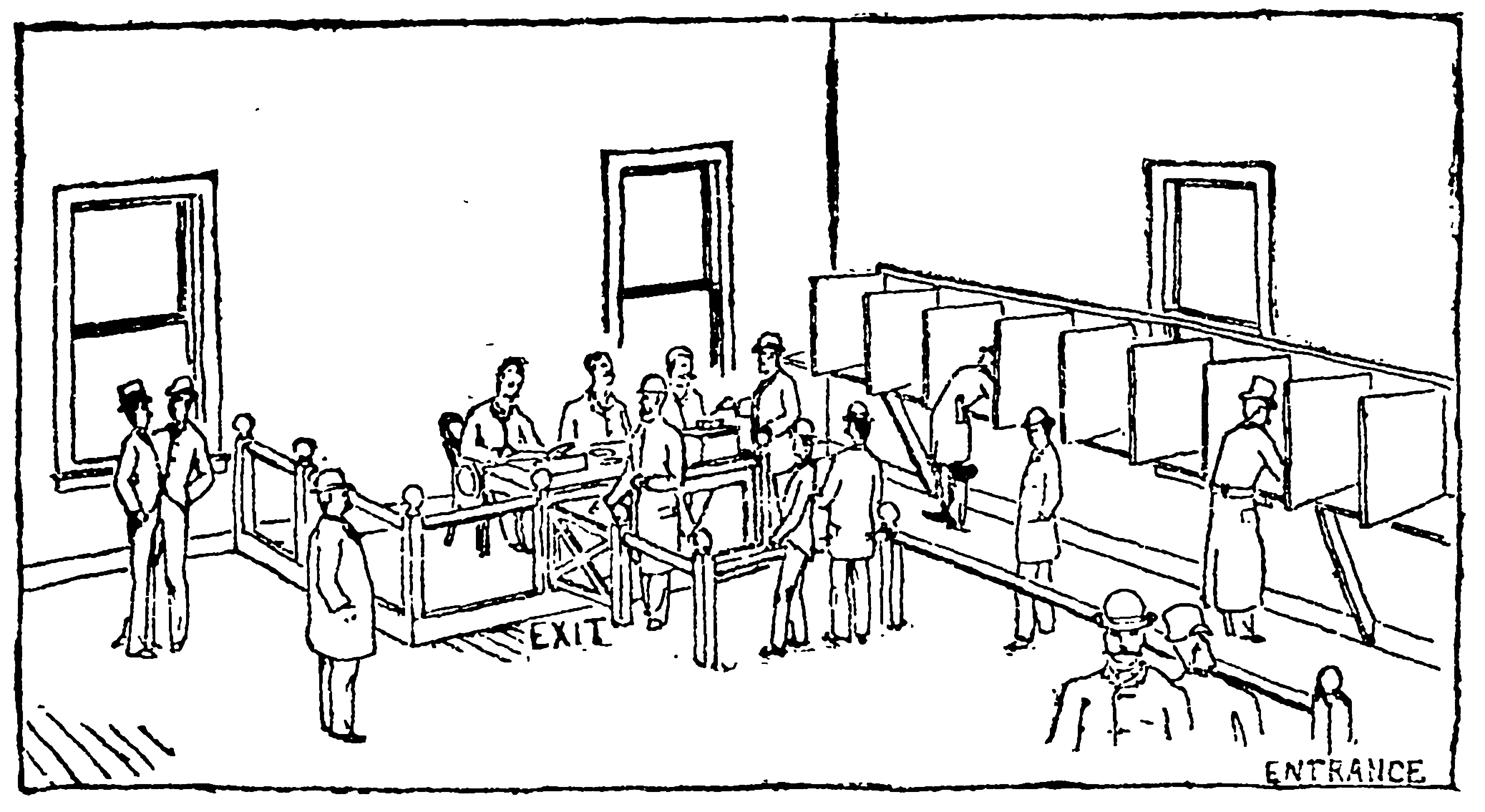
[Illustration: interior of a polling place seen from above. Voters enter at a railed passage at lower right marked “ENTRANCE”, go to a row of open-backed voting booths along the right wall where one man stands marking his ballot, then to a central railed enclosure where election inspectors sit at a table beside the ballot box; a gate in the railing at front centre is marked “EXIT”. Men in hats stand about the room. Labels: “ENTRANCE”; “EXIT”.]
The voter entering the polling place has already received from the proper officer a single ballot, on which are plainly printed the various officials to be voted for, and the candidates for each office, with the parties they represent. Passing behind the railing at the point marked “Entrance,” the voter enters one of the booths, where he finds full instructions posted, and there arranges his ballot, placing a cross against the name of each candidate he votes for. He then passes to the ballot box, depositing his vote in the presence of the inspectors of election, and passes out at the gate marked “Exit.”
a road and turn it over to the New York Central corporation. He believes that a higher class of men should be appointed police justices, and would probably make such appointments; and he is, it is understood, in favor of the Australian ballot system, though I know of no public expression of his on the subject, and he has had nothing whatever to say about Governor Hill’s veto. Two years ago he declared that the proposition to abolish taxation upon buildings and improvements, and to levy taxes upon the value of land. irrespective of improvements, was unjust and immoral, while to appropriate economic rent by taxation would be to reduce society to a state of chaos, in which brute force would predominate and only the cunning and strong would survive. Yet in a most able message, since he became mayor, he has proposed the exemption of all personal property from taxation. In this, however, he seems to be perfectly unconscious that he is advancing at all in our direction, as, since that time and on various occasions during his incumbency, he has seen fit to make public and semi-official allusion to myself and those who hold to the single tax idea, as men who would destroy all property rights.
Mr. Joel B. Erhardt, who has been nominated by the republican machine in default of getting a man of greater wealth, served in the army during the war, and rose from the ranks to a captaincy. He has since been successively United States district attorney for Brooklyn, one of the police commissioners of New York, and United States marshal for the southern district. He afterward became receiver of the insolvent New York and Northern railroad, and then its president. In all his official positions Mr. Erhardt has maintained a high reputation for integrity and fidelity, yet is at the same time a strong man with his machine.
Mr. James J. Coogan is the nominee of the united labor party—or, rather, to distinguish it from the united labor party of last year, of what has been left of the united labor party after its abandonment by the great majority of single tax men. He is also, like Mr. Hewitt. the nominee of a number of citizens, mostly members of the Central labor union, but, like Mr. Hewitt, he declined to run until he had received the nomination of some formal convention. This the united labor convention gave him as a matter of course, as it has been for some time understood that it was the pawn upon Mr. Coogan’s political chess board.
Mr. Coogan is a man of great wealth and strong ambition—at least in the direction of the mayoralty. The fortune which he has made for himself in the furniture business is popularly estimated at some two million dollars, and he has inherited through his wife a large tract of land in the upper part of the city, which he is now improving and which has enormously increased in value. He is, in fact, one of the largest owners of New York, and the estate which he controls must soon rank in value among the first in the list headed by that of the Astors. Mr. Coogan has never held any public position, but his business ability, which has enabled him at an early age to make a large fortune. is beyond question. In ability, education and business reputation he is quite up to the ordinary standard of mayors. and the affairs of the city would doubtless be safe in his hands.
Mr. Coogan has long and ardently desired to be mayor of New York; and seeing, as a practical business man, that it requires the spending of a great deal of money to become mayor of New York, he has had no hesitation in declaring his willingness to spend, in getting the office, as much or more than any candidate for p. 1, col. 4 mayor has ever yet invested in politics. Eight years ago it was understood that he would “put up” one hundred thousand dollars if he could get the Tammany nomination. Two years ago he desired the nomination of the labor associations which was tendered to me. It was urged by and for him that he would spend a great deal of money, and with this nomination could get the nomination of Tammany Hall. For this year, his programme was to get the nomination of the united labor party and then get the indorsement of the republicans. This programme has evidently fallen through. But Mr. Coogan has determined to make a fight with the united labor nomination alone, and his ability to supply funds will infuse into his canvass a great deal of vigor. The conjuncture is peculiarly fortunate for him to try the experiment, as there are a great number of men, not likely to vote the republican ticket, who find it difficult to say which they detest most—Mr. Hewitt and his machine on the one side or the Tammany machine on the other.
Mr. Coogan is a strong protectionist, and in national politics a republican, but he is of course not particular as to what local ticket he runs on, since what he wants is “to get there.” In accepting the united labor party nomination he accepted its platform, which, despite some modifications, is substantially that on which I ran two years ago. In accepting this he formally accepts the declaration that all taxes on buildings and improvements should be abolished. This, however, does not make him a representative of the single tax idea. He has never. so far as I have heard, given any sign of adhesion to that principle. nor even of having seriously considered it. He has, however, always been extremely friendly toward organized labor, and liberal in his contributions to the various funds which labor associations have undertaken to raise; and he has devoted a good deal of consideration to schemes for rapid transit, especially to those which would give readier access to his lands. Mr. Coogan has always been open and above board in his desire to be mayor, and his readiness to pay largely for the honor; but there is nothing whatever to indicate that he desires the place from any sordid motives.
As, with the exception of Mr. Coogan’s, their letters of acceptance have, as I write, not yet been published, this is, as far as I can make it, a fair, impartial review of the mayoralty candidates and what they stand for. My correspondent can see for himself that there is no ground on which I should be justified in basing any advice to sic or any other single tax man. The most obvious moral of the whole situation is the necessity of adopting the Australian method of voting. And the best way to make a ballot count in this election for the Australian system is to cast it against David B. Hill, the democratic nominee for governor, and for Warner Miller, the republican nominee.
HENRY GEORGE.
SOMETHING TO REMEMBER.
The assemblymen who in the last state legislature voted for the electoral reform bill were as follows—republicans in roman and democrats in italics:
Messrs. Acker, Adams, Ainsworth, Aspinall, Bagley. Baucus, Beatty, Brown, Brownell, Brundage. Burns, Bush, Cashow, Harrison Cheney, W. W. Cheney, Clark, Comstock, S. M. Coon. Cottrell, Cromwell, Crosby, Curtis, Davis, Defendorf, DeWitt, Dinehart, Edwards, Emery, Enz, Flaherty, Fort, Frost, Fuller, Gallagher, Gallup. Goerss, Greene, Hadley, Hamilton, Hughes. Hunting, Husted, Kimball, Latimer, Lewis, Mabie, Magner, John Martin, Mase, Mathison, Maynard, McAdam, McEvoy, McKenzie. Moody, Morgan, Nixon, O’Reilly, Prime. Rhodes, Roesch, Rosenthal, Savery, Sexton, M. A. Smith, Tallmadge, Thompson, Tisdale, p. 1, col. 5 Van Gorder, Weidner. Whipple, White, Yates, Youngman and the speaker—75. Those who voted against it were: Messrs. Blumenthal, Brennan, Church. Conger, Connelly, A. B. Coons, Dalton, Endres, Finn, Gordon, Gorman, Guenther. Hagan, Haggerty, Hayes, Herrmann, Hogins, Kent, Longley, McCann, McKenna, McLaughlin, O’Connor, O’Neil, Platt, Rannow, Ryan. Shea, Sheehan, Sheldon, Thomas Smith, jr., P. A. Sullivan, T. D. Sullivan, Weed, Wemple and Wissig—36.
The full names and districts of the democrats who in the assembly broke their party line and voted for election reform are as follows:
JOHN H. BAGLEY JR., Greene county. ROBERT P. BUSH, Chemung county. JOHN CASHOW, Queens county. FLETCHER A. DEFENDORF, Monroe county. GEORGE W. GREENE, Orange county. THOMAS F. MAGNER, Kings county. JOHN MARTIN, New York. GEORGE F. ROESCH, New York. SOL. D. ROSENTHAL, New York. CHARLES H. WEIDNER, Ulster county.
In the senate the votes in favor of the bill were Messrs. Arnold, Coggeshall. Deane, Erwin, Hawkins, sic, Kellogg, Lewis, Laughlin, Linson, McNaughton, O’Connor, Raines, Robertson, Russell, Sloan, Sweet, Vedder, Walker and Worth.
The eight senators—all democrats—who voted against the bill were:
Jacob A. Cantor, New York; Eugene S. Ives, New York; George F. Langbein, New York; Michael C. Murphy, New York; Edward F. Reilly. New York; Charles A. Stadler, New York; James F. Pierce, Brooklyn, and John Foley, Saratoga Springs.
Voters who desire the triumph of ballot reform should study these lists carefully.
The Big Brooklyn Meeting.
The single tax men of Brooklyn are confident that the rally in the big Clermont avenue rink next Tuesday night will be big enough to astonish the town and boom the movement in Kings county. The rink is the largest audience hall in the state excepting Madison square garden, and although many meetings have been held in it this year it has been filled on one occasion only—when Warner Miller visited the city and the organized strength of the republican machine was exerted. If the single tax men, working without organization and without the resources of the campaigners of the old parties, can fill the rink it will be a glorious accomplishment. Every single tax man and every free trader in Brooklyn should be there. Thomas G. Shearman will preside and addresses will be made by Henry George, Hugh O. Pentecost and Louis F. Post.
Mr. Johnson’s Candidacy.
CLEVELAND, O.—The single tax men of this place are jubilant over the nomination of Mr. Tom L. Johnson for congress by the democrats of the Twenty-first district of Ohio. This district is a stronghold of protection, and the republican party had counted on a walkover for their candidate; but the nomination of Mr. Johnson has struck terror to their hearts. They know the esteem in which he is held by the workingmen, who comprise two-thirds of the voters, irrespective of party. Since coming to Cleveland Mr. Johnson has revolutionized the street car business of the town. He has paid his employes better wages and worked them shorter hours than any other street car employers in the city. Before he came it was usual for drivers and conductors to work not less than sixteen hours per day for $1.50. He has reduced the day to twelve hours and increased the wages thirty per cent, and compelled other companies to follow his lead. Besides this he has given us the best street car service in the country. These are facts which every workingman in the city and districts knows, and no won- der the protectionists despair of being able to cram their exploded fallacies down workingmen’s throats when a man like Tom Johnson, whose name is synonymous with all that is just and fair in the treatment of labor, is seeking their suffrages.
But to single tax men his nomination means more than to anyone else, for he has been closely identified with the movement as president of Land and labor club No. 9. We scarcely dared hope for such help to our cause as his nomination and acceptance gives us. His nomination has put life into the old democratic party of this district, and I confidently expect to see him triumphantly elected in November.
JOHN BENBOW.
The Prospect in California.
A gentleman, who from his extensive business relations has most excellent opportunities of knowing the drift of opinion in California, writes to THE STANDARD:
I have taken pains to make inquiry and observe as carefully and as impartially as I could, and I am convinced that for the past six weeks the tide in California has steadily turned in favor of Cleveland and Thurman, and I find prevailing in the ranks of the democracy a great increase of confidence. There are some changes of democrats to the republican side, but more the other way. I don’t, of my own knowledge, know of a single democrat who will not vote his ticket. I do know of eight republicans who have told me that they would not vote for Harrison and Morton, and would vote for Cleveland. Cleveland is a man of unusual ability and exceptional courage and honesty, and devotion to the common people, and, as a western orator said, “As the American people are not a fool they will re-elect him.”
Regarding ex-Governor Downey, who has come out for Harrison, it appears that he had gotten his claws on thousands of acres of land in Oregon in an irregular way, and the administration wrenched it from him and restored it to the public domain.
They Won’t Debate With Real Free Traders.
OBERLIN, Ohio—After four distinct challenges to debate the tariff question this summer I have got no one to accept.
The democrats are making a quiet campaign, chiefly by literature, and I begin to hope they may carry the state.
Rah! for Tom Johnson!!! Wish he was in this district.
EDWARD B. HASKELL.
p. 1, col. 6
AGAINST GOVERNOR HILL,
AND IN FAVOR OF ELECTORAL REFORM.
A Mass Meeting in Cooper Union that Meant Something—Powerful Speeches by William M. Ivins, Chamberlain of New York, and Henry George—How the Anti-Hill Meeting and the Pro-Hill Meeting Compared.
The audience which crowded into the big hall in Cooper union on Monday night to show their disapproval of Governor Hill’s veto of the electoral reform bill and give expression to their opposition to his candidacy for reelection very materially differed from the audience which a few nights before had gathered in the same place and roared itself hoarse at the governor’s gross misrepresentations and fulsome flattery. The one had come to hear facts and weigh evidence, and to gather information regarding one of the most important and fundamental reforms pressing upon the citizens of this state for enactment. The other came to go through the form of listening to the governor’s misleading explanations for blocking the way to such reform, and to fling up its hat and wildly cheer for the creature of a political machine.
Throughout long and detailed explanations of the changes proposed in the existing laws, which would have emptied the hall of any other audience, this audience on Monday night sat a close and deeply interested listener, catching up each point as it fell from the lips of the speaker and showing its approval by loud and hearty applause. It was clear that the assemblage was made up of men and women who had come there on a matter of serious business, and when the meeting disbanded each one went away with a good deal to think and talk about.
At a few minutes before eight Director Beggs waved his baton, and the Single tax band burst into the martial air of the “Cleveland March.” When the music had ceased and the applause had subsided, William T. Croasdale stepped forward and proposed William McCabe for chairman of the meeting, at which the audience manifested its approval by loud applause.
Mr. McCabe said:
We are here to-night to enter our protest against the man who vetoed the electoral reform bill (applause); to let the people who make politics a business understand that we are tired of letting the machines make the nominations; that when there is a capable man, whether he has money or not, we want the people to put him up and elect him at the expense of the state. (Applause.) Ladies and gentlemen, the first speaker of the evening will be William M. Ivins, chamberlain of the city of New York.
Mr. Ivins’s Address.
Mr. Chairman, Ladies and Gentlemen: For the first time in the history of our country we have a political campaign which is really in the truest and best sense of the word a great educational institution. (Applause.) The present campaign has done more toward educating the people than any campaign we have ever had before in this country; and, so far as I know, more than any campaign in any country whatever extending over no greater length of time.
WHAT GROVER CLEVELAND HAS DONE.
This is due in the first instance to the courage of a single man (applause), Grover Cleveland. (Great applause.) Here was a man who found his party timid, conservative and weak upon one of the greatest issues that could possibly be presented to the people of this country, the issue as to whether or not war taxes should be maintained in perpetuity and a hundred million dollars a year stored up in the national treasury as a standing menace to the state. He said this problem must be settled. He spoke against the voice of many of the strongest men in his party. It was an act of pure and exalted courage on his part, and it has had this effect: that now we will have to divide on this great issue—those who believe in the protective tariff principle must stand on one side, and those who believe in free trade or a reduction of the present tariff must stand on the other side. (Applause.) It is well for both parties that this thing was done, and it is well for this nation that Grover Cleveland had the heroism and the courage of his convictions on this subject, sic.)
But this same principle of courage should run through the entire canvass. We can not say that we should be courageous in the declaration of our principles in regard to national matters and should display vulgar cowardice as to our views in regard to state matters. (Applause.) The same courage which has led men to declare in behalf of Grover Cleveland should lead men of convictions in regard to pure politics to declare against David B. Hill. (Great applause.) In this campaign, as Grover Cleveland stands for pure administration and strength and purity of character in national matters, so I believe that Warner Miller (applause) stands for the same things in state matters.
A few people in the back of the hall here attempted to create disorder, but they were sharply rebuked by Mr. Ivins, and Captain McCullagh promptly notified them that any further attempts at disorder would be at once suppressed by the police. Mr. Ivins also alluded to the course of the Sun, and the name of the paper evoked hisses from all parts of the hall. He declared that Hill’s opponents in the democratic party are making an open and manly fight against him, and he thus continued:
I wish to say nothing that is unfair. I wish to say nothing that is untrue; but as a public official of the city of New York I want to have it said that at least one official has openly stood up for the honor and dignity and property of the city against the grasping political hand of David B. Hill. (Applause.)
HILL’S FRIENDSHIP FOR THE WORKINGMAN.
David B. Hill has declared profusely that he is the friend of the workingman (laughter), and as the friend and representative of the laboring classes he asks their votes. I want to ask whether or not it is necessary that the friend of the laboring classes, while chief magistrate of the state of Ne v sic, should set the example of an open defiance of the law by raising $15,000 on his own notes for political expenses in his own election, and then have those notes paid out of the aqueduct fund of the city of New York? If that be friendship to the workingman, then the workingman must have some interest distinct from the interest of the community at large.
Mr. Ivins reviewed at some length Mr Hill’s pretense of devotion to the workingman continued on p. 2 →
Page 2 of 8contents
2 THE STANDARD, SATURDAY, OCTOBER 20, 1888.
p. 2, col. 1 [continued from page 1]
← continued from p. 1 calling forth laughter and applause, and his declaration that Hill’s friends, the rumsellers, were the bitterest enemies and not the friends of the workmen, was greeted with cheers. He showed how the governor had lent himself to promote jobbery in this city and Brooklyn and thus continued:
Some time ago I attended here a meeting of single tax Cleveland men (applause) and heard Henry George (applause) address a large audience. There are many points on which I differ with Mr. George, as men will differ among themselves, but the next morning I wrote to him that a more brilliant teacher and a more brilliant class I did not think there was in the world. Now that teacher and that class have joined hands with a vast body of men throughout our state in favor of reform in our electoral laws. (Applause.)
One week ago to-night David B. Hill stood on this platform and wove a tissue of falsehoods such as no man without the practiced political imagination of the hardened wire puller could ever have conceived. (Applause and laughter.)
THREE POLITICAL MONOPOLIES.
In the city of New York there are to-day three strong parties with their roots thrown down in the past. One of these, Tammany hall, is already hoary with age and with sins. (Laughter.) Another, the county democracy, is somewhat younger and sinful accordingly. (Laughter.) The republican party in this city, so far as our municipal affairs are concerned, has not had the opportunity to test its capacity for sinfulness so much as either of the others. (Laughter.) But these three organizations between them to-day absolutely hold the monopoly of political power in this city of a million and a half souls; and unless you join one or the other of these organizations it is impossible for you to make your voice heard in primary meetings, and nominations once having been made, unless you vote for the candidate of one or the other of these parties, you might as well cancel your vote altogether. The result is this: That on election day we go to the polls to make a choice of evils; and the evils which stare us in the face in the present election are numerous enough, God knows, and how to choose between them is difficult to determine. I believe that a large number of people in the city of New York will feel it impossible to make a choice and simply refrain from voting altogether. If this comes to pass it is due to our laws, and if there be such a disfranchisement the law alone is to blame.
WHAT PARTY ORGANIZATIONS STAND ON.
Here party organizations are built upon two things. In the first place they are built upon their ability to levy large assessments of money upon candidates whom they nominate. In the second place they are built upon the fact that their followers in all departments of the city government hold places and make strong and concentrated nuclei of active workers for the purposes of the leaders of the organizations and for their own purposes. The county democracy, for instance, has an enrollment by election districts. Who constitute that enrollment? To begin with, two or three men in an election district who hold some sort of place, some sort of job, who have a son “in the department,” or a father “in the department,” or a cart at work on the streets. Those two or three men can watch the polls on election day. These two or three men can always bring a handful of people to meetings of one kind or another. They really determine who shall be the representatives in the county committee, or assembly district committees, for that particular election district. What is the result? In the county democracy, for instance, there are [2,200?] or 2,300 members of what is known as the county committee, and a vast majority of them fill offices or are otherwise beneficiaries of the city treasury. And they are beneficiaries on special occasions of the treasury of the several machines. On election day they go to the polls, peddle the tickets at $5 or $10 a day, or they get appointed as inspectors of election, or poll clerks, or deputy United States marshals.
These political machines having a permanent existence arrogate to themselves the right to speak for their parties in any and all circumstances. They call primaries, and this is the way in which the voice of the people is misrepresented. For instance, the question arises as to who shall be the candidate for assembly in a certain district. The assembly district leader determines that; the people do not. He determines it with the aid and assistance of his superior—one of the larger bosses. The same rule obtains with regard to aldermen. When it comes to the nomination of a county clerk or sheriff or mayor, that nomination is determined by three or four men, no more, and then the orders are given to the convention to ratify the nominations. That is all the convention is there for, the ratification of the will of two or three irresponsible leaders.
But why is their rule so strong, why can it so enforce itself on all occasions? It is because of this—because its following is a bread and butter following so largely that it really does not possess its own soul, does not stand for anything except the man who gives that bread and butter.
But how is it possible, it may be asked, for these leaders to carry on their organizations as they do? That can be answered in a word. It is because of one serious, fundamental fault in our system of elections. It is because the law has taken under its charge all the machinery of the elections but one great central wheel, the actual driving wheel of the election machinery—the printing and distribution of the ballots. (Applause.)
The nomination of Tammany hall is worth something. The nomination of the county democracy is worth something. The nomination of the republican party is worth something—to vanity, if nothing more. (Laughter.) The republican party in the city of New York is, in my judgment, unfortunately in a very small minority. I believe it would be better if in the city of New York our parties were more evenly balanced. Still, a republican nomination is a money compelling nomination.
If a man be nominated by Tammany hall he knows this—that there are 854 election districts in the city of New York. He knows that ballots have to be printed and distributed in those districts. If a man is running as a stump candidate he is confronted, in the first place, by this fact: That he must find sufficient money to print his ballots; second, he must find sufficient money to get the ballots into the hands of men for distribution; third, he must find money to pay those men to dis- tribute them. No man can successfully run for office in the city of New York unless he can have three men at each polling place—three $10 workers; three $5 workers would not do. Thirty dollars an election district is, by tradition, held to be necessary.
THE EXPENSES OF A CANDIDATE.
Suppose we say that Captain McCullagh wants to be mayor (great applause, cheers and laughter, during which that gallant police officer hid his blushes behind his helmet). We will say that he wants to declare against a great ring as represented by the county democracy and Tammany hall. We will say such a wicked deal has been made as whenever the two organizations have come together, and when, as in 1880, they put some slips in a hat and Mr. Kelly pulled out one slip and said, “That gives me the assemblyman,” and Mr. Thompson pulled out the next slip and said,
p. 2, col. 2 “That gives me the alderman,” and so on. We will say that Captain McCullagh is an honest man and wants to carry on the fight against such an iniquity to the bitter end. Suppose that the captain had 10,000, 30,000, possibly 68,000 (applause) friends in the city of New York (a voice: “He has more”—applause). Now, what will he do? He must first turn himself into a public beggar. He must go from friend to friend asking each to contribute $10, $15, $25, $100 to this particular cause. The money would have to be raised, would have to be put into the election districts at the rate of at least $30 a district to begin with. That is $24,000 and more to begin with, and Captain McCullagh is a poor man. But he would have to pay for the printing of his tickets, and that would cost him from $10,000 to $15,000 more. And he would have to pay several times for Cooper institute. Then he would have other expenses at the election; and one of the great expenses would be this, to see that his own men at the polling places dealt fair; and having watchers, he would have to put on watchers to watch the watchers. (Applause and laughter.) They cost more. He would have to set fifty men and women to work to address the entire registry, and he would pay two cents apiece for the stamps to see that his tickets were sent to each voter; and that single item is alone $9,000. There is no way in which Captain McCullagh could run for mayor without the expenditure on his part, or on the part of his friends, of $50,000 in the campaign.
WHY THE EXPENSES ARE NECESSARY.
What necessitates this? The fact that the law which provides inspectors of elections and ballot boxes does not provide one thing which registers the will of the people, and that is the ballots. (Applause.) In a word, here is the machine which has every wheel in it necessary but the driving wheel, and that is missing, and in place of that wheel we find two or three bosses, who own the politics of the whole city.
Now, we appeal to the law and say the driving wheel must be put into the machine. The people have had an education on this subject. I think it was learned some two years ago by many men in this room how difficult it was to run a candidate and what it cost. It was discovered that when every candidate has a right to print his own ballots, when every assembly district leader can bunch the ballots and has the power to destroy them, or work them over as he desires, that all this militates against the principle of fairness and freedom. It was learned in that campaign what political inequality was because of the condition of the laws.
So two years ago the struggle for the reform was taken up in good earnest. It was shown that in the last presidential election in the city of New York there was expended at least $700,000, and possibly somewhat more than a million. It is impossible for us to have an election in the city of New York to-day without the expenditure on the part of the several machines for the purpose of supplying the machinery which the law does not supply of at least from one-fourth to one-third of a million of dollars.
The man, consequently, who takes a nomination from Tammany hall must be a man who can pay his assessment; and so with the county democracy and the republican party. We begin then with the principle of universal exclusion, that no man who is not approximately a millionaire can run for any office at all—that is, for a great county office. If he be approximately a millionaire he knows he gets goods for his money and he pays his $25,000 without hesitation, because the machine can run his campaign for one half what it would cost him to run it alone. But the very fact that he gets this service in return and can afford to pay for it, is the fact which lies in the bottom of the power of the machines which control the nominations.
HOW THE AUSTRALIAN SYSTEM WOULD PREVENT BRIBERY.
It was readily seen, when the subject came up for discussion, that if the law supplied and distributed the ballots, the excuse for these tremendous assessments would be done away with. (Applause.) It was also seen that the something which lies behind these great assessments would be done away with—that is, the use of the present system as a means of defeating the law against bribery. (Applause.) On the election day which we are to have here in November there will actually be under pay, in the city of New York, over twenty-two per cent of the entire voting population of the city. Those men are under pay in one form or another.
If, in addition to printing and distributing the ballots, they should be so printed that the names of all candidates for the same place appeared on the same ticket, and that those tickets were not delivered to the voter until he went to the polling place, it would put an end to the use of men in any form around the polls except as sworn and paid officers of the law (applause), which officers would suffer the penalty of the law for wrong doing.
GOVERNOR HILL’S OBJECTION.
Governor Hill, when he vetoed the Saxton bill, said that it is a tremendous thing to put such power in the hands of ballot clerks. May be. It is a still more tremendous thing to have those ballots in the hands of irresponsible hirelings of irresponsible bosses. (Applause.) Governor Hill said that these men have such power that were they to misuse it great wrong would be done, and that therefore this function should not be exercised by officers of the law, but left in the hands of the bosses. My answer is: If it is argued that because men sometimes misuse power and office the office should not therefore exist, then the governorship of the state of New York should be abolished. (Great applause.) By parity of reasoning we should not have poll clerks or inspectors of election, because they might do wrong; and therefore the first man who comes along should inspect at $5 a day. (Applause.) Just in proportion as this function lies at the root of political freedom and equality, just to that extent ought it to be put under the safeguard and sanction of the law.
The work of drafting the reform bill was begun early in the winter of 1887. Draft after draft was made, the most sedulous care was given to every sentence in the measure, and every principle involved was fully discussed. Finally, when that bill was prepared, it was presented to Mr. Yates for introduction by him in the assembly. There had, however, already been introduced two other bills—one by Mr. Hamilton the other by Mr. Saxton. All these bills were referred to the judiciary committee of the assembly. That committee gave hearings on the measures, and after great care and thought (because this was a most serious piece of legislation) they reported what was subsequently known as the Yates-Saxton bill, which was passed both by the assembly and the senate.
The bill went to Governor Hill for his signature. What reasons does Governor Hill give for not having signed it? I cannot do better than to quote from the tissue of misrepresentation reprinted in the paper of the high priest of misrepresentation. I speak of the report of Governor Hill’s speech published in the New York World. (Hisses.) He says: “In the first place it is insisted that the bill was not distinctively a labor measure.” Who ever declared it was distinctively a labor measure? It was a citizens’ measure, a freeman’s measure. (Applause.) Does the laboring man want a system of voting unlike that of other men? Is the laboring man going to re-
p. 2, col. 3 cognize the principle that the rich man can have a system different from his own? There is only one system—the system of the people. (Applause.) He asked: “It was not introduced by a labor representative, but by a bitter partisan republican.” But I ask, if the bill be just, what right has Governor Hill as the chief magistrate of the state of New York and the representative of all the people, to say by whom it was introduced, provided it was passed by the legislature which is supposed to represent the voice of the people. (Applause.)
Governor Hill says: “It was no more a labor measure than was the high license bill.” What has the high license to do with this bill? Who ever claimed that the high license measure was a labor measure; although the veto of that was a blow in the face of honest labor. (Great applause.)
In the second place, the bill was purposely made objectionable so that it could not consistently be approved, and was one of a number of similar measures designed simply to embarrass the democratic executive.
He wants us to think that the legislature exists simply to embarrass the governor of this state. “The sole object of most of the important legislation passed by the republican legislature during the past few years has been the openly avowed one of putting the governor in a hole.” This is both most untruthful and most disingenuous, and is an appeal to partisanship and ignorance, absolutely without any justification in fact. The governor has not to think of his embarrassment, but of his duty.
“For this purpose,” he says, “the Saxton bill was held back and delayed and so manipulated that it only passed in the closing hours of the session, and did not reach the executive until after the adjournment of the legislature.” Why it was held back was in order to have the best care and attention of the legislature while it was pending, and also because the legislature was hampered in its work by Governor Hill, Muller and their friends. They did not want the bill to get to the governor; but it got there nevertheless.
The governor next says: “The system of election proposed by the Saxton bill is a mongrel one, and it is conceded that it has not been tested anywhere in this country.” In the first place, it is not a mongrel one. In the next place, although it has not been tested anywhere in this country, it has been carefully tested with the best possible results in other countries. And unless we are to start out with the great American principle that the rest of the world are fools, we have got to accept the result of experience in other places. The legislature of the state of Massachusetts passed this same bill (applause), and it was signed by the governor of that state, so that it is now the law of the state.
If Governor Hill’s reasoning be good in order, to save the bill from being a mongrel, we ought to have taken the thing as a whole without a change from the Australian law. What changes were made? These only, that as far as possible the new measure should recognize the existing law and conform to it, with as few changes as possible. The bill, therefore, recognized the pre-existing manner of counting the tickets, of printing the ballots, so far as the number of ballots was concerned, and of the use of the registry.
Hereafter, by this bill, you will have, as heretofore you have had, seven or eight tickets, according to the number of officers to be elected. The law now requires that the names of presidential electors shall be voted on a single ticket. Hereafter it will be the same. At the top of the ticket would be the democratic or republican electors, as the case might be, with a bracket and the word “democratic” or “republican” outside the bracket. The democratic or republican ticket, as the case might be, comes next, the prohibition ticket comes next, the labor ticket, and so on. And each list of electors would have the name of the party opposite it. Consequently the only difference would be in the length of the ticket. The man who went to the polls would have the names of all the electors before him, and all properly arranged, so that he could at one single stroke vote for all the electors of the party. (Applause.)
As to the state ticket, we have, for instance, in this coming election, a judiciary ticket. The judiciary ticket would contain the names of the candidates for the court of appeals. You would have the republican candidate with the word “republican” opposite it, the democratic candidate with the word “democratic” opposite it, and so on. So that the ticket would have two or three or four names on it, and yet be no longer than it is to-day, no more difficult to handle or manage.
When it came to the city ticket you would have the entire democratic city ticket printed together, the entire republican city ticket together, the labor ticket printed together, and so on, but all on one ballot. The voter who went to the polls could then pick out the men for whom he wished to vote, and could not be made the victim of bunching, trading, dealing or bargaining. (Applause.)
The governor says: “It is not believed that this change, so far as it prohibited parties and candidates from furnishing their own tickets, is a wise and necessary one.” The governor thus plants himself in opposition to the principle of the state, and the state exclusively, printing the ballots. He still would allow candidates to print their own ballots. If that were continued it would render impossible the printing of the ballots in a particular way which I have described, and which par- ticular way is absolutely essential to the success of the system. “Even if the state shall furnish ballots there can be no reasonable objection to others furnishing them also.” It is the fact of others furnishing them that brings about corruption and the nullification of the popular will. “But by the terms of this crude and imperfect measure every one else was actually prohibited from doing so.” This was the design of the bill, to prohibit exactly that thing. The design of the bill was that others should not do it. That is evidence not of its crudeness but of its perfection. (Applause.)
He goes on again and says: “It was to the unwise and crude details of the bill that I objected and not to the principle involved.” In his veto message he objected to this bill because he said it deprived the people of opportunities to find out who the candidates are to be. But in this speech we find exactly the opposite objection. If any one wants to have his friends vote for him and has not had his name put on the ticket, his friends may vote for him by using one of the blank spaces on the tickets and writing in the name or using a paster. If he does not want to do that he can come out in the open and declare himself a candidate fifteen days before election. He has the same privilege that the other candidates have of getting his name printed.
“This provision is clearly in the interest of the political machine, because it absolutely prevents the successful bolting of candidates nominated just fifteen days prior to the election.” But if the bill becomes a law, the machines will no longer have the monopoly of power to make nominations, and there will be no more occasion for bolting. The word will no longer have a meaning because the law will permit all men to make such nominations as they wish, and put all in a position of equality.
The solicitnde of the governor to protect the people against the machine is beautifully exemplified all the way through.
It may be safely asserted that it should not be placed in the power of any one offi-
p. 2, col. 4 cial to disfranchise at his will the people of a whole county or city and thereby control the result of a state or presidential election.
The bill on its face shows that to be a palpable untruth. The ballot clerk can do nothing of the kind. He is amenable to the law. If the argument amounts to anything, it is equivalent to a condemnation of the democratic system of government, for it means that it is not safe to trust official power to the representatives of the people. The logic of that is anarchy. (Applause.)
Going on, the governor said:
The bill also destroyed the secrecy of the ballot, by providing that electors should enter a booth or compartment, and there in the presence of the two poll clerks, make out his ballot by placing a cross over the names of those for whom he desired to vote, and then the poll clerks place their initials upon the back of the ballot. This, in my judgment, is a dangerous, wholly useless, and unnecessary proceeding.
Nothing of the kind. The poll clerks place their initials on the ballot before it is delivered to the voter. When the mark is made by the clerks it is still a blank ballot. Sec- tion [22?] of the proposed law says: “On receipt of the ballot the elector shall forthwith, and without leaving the voting place, retire alone to one of the booths, and there prepare his ballot.” There is the law, and there is the governor. (Laughter.) Everything he has said about this bill is about as accurate as that.
He says that it virtually destroys every element of secrecy. He described it as a spy system; and then speaks of England. He states that there “the government has virtually the control and inspection of election, and can easily ascertain how the electors are voting whenever it is deemed necessary.” It would be a spy system if it provided that, but it does not provide that. The governor stood here on this platform, and boldly misrepresented the bill in order to deceive and delude his audience:
I would cheerfully approve a well considered measure which should provide, substantially, that each elector, just before depositing his ballot, should enter a separate compartment or booth provided for that purpose, where he can alone assort and arrange his ticket to suit himself.
At present he usually assorts his tickets at home. If he is a dishonest voter he takes the bunch handed him by the man who at the same time hands him a two dollar or five dollar bill. The man who takes the bribe makes it apparent to the man who pays him that he has only one set of ballots. This he could do as well after the change proposed by the governor as now. What is wanted is not a place to sort out a lot of ballots for numberless sic for the same office, but to have the law compel the printing of the names of all these candidates on the same ballot. Then the voter would have all the names before him. There would be no sorting, but simply the enforced necessity of making a deliberate choice.
THE REAL REASON.
As illustration of the governor’s idea of our simplicity he says:
It seems sic to suggest that no considerations personal to myself enter or could have entered into the disposition which I officially made of this measure. The bill was vetoed because it was fatally defective, and, acting in accordance with my judgment and the obligations of my official duty, I could not consistently approve it.
It did benefit him. David B. Hill is the product of the machine and a representative of the machine, and he knew that he could not get a renomination if he signed this bill. He knew that seventy-two votes from New York city, coming from Tammany hall and the county democracy, would be massed against him if he tried to put any end to their monopoly of power.
When Henry George (applause) argued in favored of the sic, who appeared in opposition? Tammany hall and the county democracy. The Kings county democratic bosses also were bitterly opposed to that bill. Hill’s signature to it would have defeated his renomination. He therefore vetoed it. This was the consideration personal to himself.
While governor of the state of New York he personally raised $15,000 on his own paper for campaign expenses, in open violation to the law. He believes in the system of expenditure of money in elections. He believes in the existing methods. He advocated it here, he advocated it in his veto message, and he guaranteed the machine because they could guarantee his renomination.
The whole record of the governor on this measure is a record of deceit, made for the purpose of deluding the weak, the credulous and the ignorant. But they will be undeceived when Warner Miller is elected governor (great applause and three cheers); when David B. Hill is told by the people of this state that he cannot again be governor because he has not only been faithless to his trust as a public officer, but that he has shown an absence of character, without which no man is fit to be governor of this state. (Great applause.)
After this election we will have a legislature which will pass a ballot reform bill. That is certain. We will have a governor who will sign it. (Applause.) This reform movement must result in perfect achievement. And whether we succeed now or later, we will not have half so long a fight as the nation had half a century ago in a cause which, while it was greater, deeper and broader in the principles involved, neverthe- less involved a no more vital principle than that for which we are struggling to-day. (Great applause.)
A REMINDER FROM CHAIRMAN M’CABE.
At the conclusion of Mr. Ivins’s remarks, Chairman McCabe said: My friends, you have heard a great deal of how politics are given to us in New York. It is a revelation to me. To the men in the audience who work for their living, members of our labor organizations, I want to tell something that you may perhaps have forgotten. You remember the impending strike of the engineers on the elevated railroads in this city. You remember the street car strikes in this city. And how suddenly they were stopped by a railroad commissioner who came to this city and demanded that the street car and elevated corporations obey the law. And you remember that those two strikes were settled in four hours. You remember also that the workingmen of New York city sent a petition to the state capital asking that John O’Donnell be reappointed railroad commissioner; and you remember also that he was not reappointed. (Applause.) Those two strikes gave a greater impetus to the labor movement than anything that has happened since; and that one man who demanded that the railroad corporations obey the law, the laboring people asked the governor to reappoint him, and the governor refused. That is one reason why I am against him. (Great applause.) The trade to which I belong, two thousand citizens of them, signed the petition to the governor. Don’t forget that, you men who work. The next speaker will be Henry George. (Applause and cheers.)
Henry George’s Speech.
Mr. George said:
Mr. Chairman, Ladies and Gentlemen: If reasons why Governor Hill should not be elected were as plenty as blackberries, I would give but one. To me it makes no difference whether he be the best man or the
p. 2, col. 5 worst man that ever sat in the executive chair. I am opposed to him in this election because he has stood in the way of what I deem the most fundamental, the most important of political reforms; because he represents the perpetuation of that system of election which degrades American character and which destroys the efficacy and beneficence of republican institutions. (Applause.)
It is one hundred and twelve years since through the elms of Philadelphia not merely the great declaration of American independence but the great declaration of the fundamental rights of man rang out. (Applause.) Thirteen colonies banding themselves together as an independent people—a nation, up to that time unknown, without a king, without an hereditary aristocracy, without a privileged class. That fringe of settlement along the Atlantic coast has in a little over a century grown until it has covered the wide continent, and to-day the American republic is the greatest nation in the world. (Applause.) It is impossible to speak in anything like sober terms of the natural greatness of its future, of the destiny that awaits it in the century that is coming. The greatest nation of the world already, in the next century she must be to the modern world what Rome was to the ancient world. (Applause.) And yet to-day it is an open question whether American democracy is a success or a failure.
If it were clearly a success, there would not be to-day a crowned head in Europe. (Applause.) It is not a success. Measurably through the whole country, and clearly and decisively in our great cities, democratic government has broken down. We, who boast of our equal political rights; we, who spurn the idea of titles of nobility; are yet divided into rulers and ruled.
HOW OUR CITIES ARE GOVERNED.
To-day the average American city does not get as good government as the cities of England, Ireland or Scotland. (Applause.) Aye, or of the continent of Europe. We are subjected to a virtual property disqualification. No man in ordinary times can go before his fellow citizens, asking with any hope of success for their suffrages, unless he be either rich or unscrupulous. (Applause.) We have no dukes, no marquises, no lords; but we do have the boss. (Applause and laughter.) We have no class of hereditary rulers, but we do have the machine.
Take San Francisco. Only a couple of months ago the grand jury of that city declared that it was ruled by the criminal class. An ex-gambler is the boss of San Francisco. Come to New York. What is the fact? Ex-Superintendent of Police Walling recently wrote a book in which he recounted the varied experiences of many years spent in this city as superintendent of police. He states as a cold matter of fact that no one who knows will venture to deny that New York is virtually governed—but I will read his own words:
The city of New York is actually ruled by some 20,000 office holders, most of whom are taken from and controlled by the very worst element in the community. Our judiciary and prosecuting officers are elected and controlled in a great measure by the very elements they are called to keep in check and to punish. (Applause.)
If this is the best democracy can do, then democracy is a failure. (Applause.) This whole system does not afford us even the chance that government by an hereditary class does; for the accidents of birth may in such cases put good men, true men and progressive men in office. But the tendency of these machine politics of ours is to put in office only men unscrupulous enough to pay the price and to do the service. Their effort is to select, not the best, but the worst. (Applause.)
WHAT THE MACHINE SYSTEM HAS DONE.
What Mr. Ivins has stated of the necessity of paying money for the chance to present one’s self to the suffrage of his fellow citizens is true of this city and true of all our great American cities. Here in New York city $20,000 is the regular assessment for even a district judge. Five thousand dollars, I believe, is the regular assessment for members of congress. And during the campaign in which I ran for mayor (applause)—a campaign, by the by, which to my mind decisively proved that no independent movement, no matter how strong or well supported, could succeed until we had changed our ballot law (applause)—in that election a young man, a newspaper man on one of our daily papers, came to me and told me that he had been offered the nomination for the assembly. He is a man who would adorn the position, a man of intelligence, wide information and high character. I asked him why he did not take it. He said it would cost him to get the nomination $2,500. I asked him what the salary was. He said $1,500. (Laughter.)
That is common. Do you wonder that in Albany legislation is made a matter of merchandise? (Applause.)
This is not the fault of democracy. It is simply the fault of this system of voting that we have outgrown. Our election laws necessitate the machine. They give to men who make a business of politics, and to those who furnish money to run the machinery of politics, an overweening and irresistible advantage; and there can be but one result—only the men who have money of their own and are willing to pay that money for the honor of public place, or men who take public office as a matter of speculation and expect to make money out of it, can in ordinary times in our politics aspire to public place. And the inevitable result is the corruption of our government from bottom to top (applause)—from our boards of aldermen, selling franchises, to the senate of the United States, where sit, not the representatives of sovereign states, but the representatives of railroad corporations and trusts. (Applause.)
Make politics expensive, make large amounts of money and great organizations necessary, and you inevitably take political power from the masses and put it in the hands of the rich. (Applause.) That we have done. The consequence is that all over the world our name is a by-word and a hissing for corruption. I never fully appreciated the spirit of democratic institutions. I never felt myself so much a republican, until I went to the other side of the water during the beginning of the great Irish movement and saw what monarchy and what aristocracy really are. But I did not dare, and no American does dare, to whisper to a man on that side of the Atlantic one word of reproach as to the queen, as to the house of lords, as to—(A voice: “Do you remember Athenry?) Yes, I remember Athenry, and will speak of Ireland further on. Let him dare to speak disrespectfully of monarchy or aristocracy and see how quickly he will be taunted with the corruption of American politics, with the ring rule of the American cities, and the corruption of American legislatures. He will be asked if political corruption in the United States is not more costly and tyrannous than a crowned head and house of lords. (Applause.)
WHAT THE AUSTRALIAN SYSTEM HAS DONE FOR IRELAND.
Athenry! Yes, I remember it; that whole western part of Ireland, cursed by long years of landlord rule, tenanted by a people who, until a little while ago, stood bareheaded and trembling in the presence of the landlord, who could visit on them with one word that sentence of eviction that was equivalent to a sentence of death. Do you imagine that if
p. 2, col. 6 that people had our voting system they ever could have elected nationalistic members of parliament? (Applause, several times repeated.)
That there is an Irish movement, that Charles Stewart Parnell (great applause) and the men he leads sit to-day in St. Stephens, that they constitute the base of the movement that at the next election is going to bring Gladstone into power (great applause), and is going to give Ireland home rule, is due to the great reform that gave Ireland the Australian voting system. (Applause.) Did they vote in Ireland as we vote, had men going up to the polls been forced to take a ballot from some heeler who stood around, there is no district in Ireland in which the power of the landlords and the privileged classes would not have returned whom they willed. It is the absolute secrecy given by the Australian ballot system that, preventing bribery and preventing intimidation, has enabled the Irish people, crushed under the very heel of landlordism, to rear their heads. (Great applause.) I saw that in Ireland, and I saw coming to the front a set of men such as I knew could not come to the front here.
PERSONAL EXPERIENCE.
When I was a younger man I once desired an office, desired it from honorable motives and desired it ardently; I wanted to go to the lower house of the California legislature. I believed I could distinguish myself there. I was popular, I think, with the party, and the nomination was offered me, but on condition that I should pay to a ring $500. And the $500 was offered to me. An acquaintance of mine, a man who had large interests, said: “That is nothing; $500 is very cheap; I will pay the $500; take the offer and say nothing about it.” And I refused. (Great applause.) That refusal cost me far more than it would to-day to refuse a nomination for the presidency of the United States. (Applause.) But I refused and I was kept out. I never took my seat in any legislative body, and I made up my mind that my career must be other than a political career.
NO ASSESSMENTS IN IRELAND.
But I saw in Ireland such men as Sexton, such men as Healy, such men as the Red- monds, the whole list of them—you can name them over—being nominated, being elected, without being asked to pay one single penny to any ring. (Applause.) All these men are poor men. Parnell was the only man of any means among them all. In the United States, whether in California or New York, such men cannot come to the front. To go even to our state assemblies poor men must, save in rare conjunctures, put around their necks the collar of some corporation or bargain away their votes in advance. (Applause.)
LOOKING BACKWARD.
Look back to the early history of the republic. They were intellectual giants who gathered around its cradle. It is not merely the glamor of the past that makes them loom so large. They were great men. Why? Not that men were greater than they are now, but that the country then selected her best men. (Applause.) No less a man than Benjamin Franklin (applause), a man whom the French academy, the most brilliant assemblage of the aristocracy of intellect in the world at that time welcomed as the modern Solon, represented in the Pennsylvania as- sembly for some ten or twelve years the city of Philadelphia, until he was called away to be sent to London to represent the colonies there. Could such a man as Benjamin Franklin, such a man as Thomas Jefferson (applause) represent so long one of our great cities in state assemblies to-day unless he would consent to “put up” for a nomination or to wear the collar of some ring? (Applause.
GOVERNOR HILL’S MISSTATEMENTS.
This simple reform is a far reaching one. Governor Hill when he stood on this platform the other night deliberately misstated facts. (Applause.) He distorted the bill. He misrepresented his own acts. He said that he had vetoed the bill because of certain technical faults. Any inspection of his veto message, as Mr. Ivins has shown, will prove conclusively that he vetoed the bill for the reason that it would do what we wanted it to, it would kill the machine. (Applause.) It would make it possible for any few citizens to select a man who represented their opinions, to put him up and give him as good a show before the public as the nominee of the strongest party. That is why that bill was vetoed, that is why we want it. That is why I, for one, without any other reason, will vote to the last against any man who stands in the way of this reform. (Applause.)
And it is not merely because I wish political regeneration, political cleanliness, political equality, that I consider it the most important thing before us in this state election, that we show by our votes that we demand this measure, but that this clearing of our political methods is necessary to social reform. (Applause.)
WHAT WORKINGMEN NEED.
Governor Hill stood upon this platform the other night and told what great things he had done for the workingmen. I always distrust any man who comes before his fellow citizens and attempts to pose as a friend of the workingmen. (Applause.) What labor wants is not friendship; it is simple justice. (Applause.) Workingmen are not an inferior class to be protected and to be provided for and to have special legislation in their favor. The man who has really at heart the best interests of the workingmen seeks simply in legislation the best interests of the whole people. (Applause.) But this I believe, that the only cure for the labor difficulties, the only remedy for that gross injustice which gives us a class of men who can be called a laboring class in a world where all men ought to labor (applause)—the only road to the abolition of poverty, the only road to the emancipation of labor—is by political action. (Applause.) We must go into politics with our principles. We must carry them out through politics. And in order to do that we want clean politics. (Applause.) We want a system where the rich shall have no advantage over the poor; a system that will destroy the power of money in elections, and let brains and character come to the front. (Applause.)
AMERICA’S GREATEST CITY.
As I go through vast districts of this city, as I read the daily newspapers morning after morning, I feel that we are yet not more than half civilized. (Applause.) Look at the pavements of this city. They would not be tolerated in any of the great cities in the effete monarchies of the old world. Consider this magnificent site, the grandest of any city in the world. Then go along our wharves. Ride over the elevated roads through those great festering blocks of tenement houses. Think of the fact that not more than four per cent of the families of this great metropolis have houses to themselves; that over sixty-five per cent of our people are crowded more than two families to a single floor; that in this city overflowing with wealth are constantly people suffering from hunger; that in this great city thousands and thousands of men are every day going around looking for the chance to make the barest living by the hardest toil (applause); that in this great city tender women, who ought to be in homes of their own, and little children who ought to be at play, are constantly forced to the hardest, most wearisome, most wearing toil. Read the newspaper reports of men rushing to death; aye, men and women, because it seems as if this world had no place for them, as if they could not get a living. See the thousands and thousands of little children who are growing up under conditions that only a miracle can save them from untimely deaths or distorted and debased lives. See our population of beggars, our population of tramps, our great criminal element. What is the remedy continued on p. 3 →
[text breaks off mid-sentence at the foot of the column; no jump line printed — presumably continued on page 3]
Page 3 of 8contents
THE STANDARD, SATURDAY, OCTOBER 20, 1888. 3
p. 3, col. 1 [continued from page 2] ← continued from p. 2 for all this? Not in charity, not in kindness, but in justice. (Applause.)
THE REMEDY OF THE BALLOT.
These things are the results of misgovernment. (Applause.) They can only be remedied by the intelligent use of the ballot. (Applause.) And therefore this reform that will give intelligence a chance to use the ballot, this reform that will do away with a monstrous condition in which two or three men on one side and two or three men on the other dictate to the people the only choice they can have; this monstrous condition that is demoralizing the whole people and teaching us to look upon an election as a carnival of fraud and corruption, shall be done away with. (Applause.)
And so it is that to me this ballot reform is the greatest and the first of all reforms. (Applause.) And though David B. Hill were the best man that had ever sat in the executive chair, though I agree with him on all other positions, I would consider it my solemn duty—my duty to my nation, my duty to my state, my duty to my children, my duty to my fellows and to the world, to vote against him at this election. (Applause.)
DISTINCT FROM NATIONAL POLITICS.
I would far rather vote at this election for a democratic candidate than for a republican candidate (applause), because I recognize in the forward step that the democratic party is making under the leadership of Grover Cleveland (great applause) a return to those principles of Jeffersonian democracy (applause) on which alone this republic can be safely based and by which alone its ideal can be secured.
Warner Miller (great applause) represents the very opposite of my national politics; but this single question leaves to me no doubt. If we want this great reform that will kill the machines we must prepare to sacrifice everything else and vote for it. (Cries of “good,” “good.” and applause.) I do not delude myself by believing that the republican machine is any more in favor of it than the democratic machine. (Applause.) I can well understand and well appreciate the fact that republicans in both houses of the legislature last year voted for it because they felt they were in the minority in the state; but nevertheless if we want to have them to vote for it and to have a governor who will sign it we must at this election show that we who are in favor of it are in earnest. (Applause.) If we beat David B. Hill because he vetoed the electoral bill we will have the electoral bill at the very next session. (Applause.)
THE CAMPAIGN OF ’86.
We New Yorkers know what our elections now are. Two years ago, when I ran for the mayoralty on the nomination tendered me by the conference called by the trade and labor associations, we felt all the disadvantages that attach to this system of voting. Had we voted as they vote in Ireland, in England or in Australia, I would have been elected. (Applause.) We lost many thousands of votes simply for the reason that we were unable to get our tickets around. Why? Because thousands of American citizens in this city of New York, as they approach the polls on election day, fear to refuse to take the ballot that is handed to them by a political heeler and to march up to the polls and put it in. And this evil is worse in the country than it is in the city. And so there is a great class of men who regularly on election day make merchandise of their votes, selling them for prices ranging from two dollars up as high sometimes as $25. There are towns in this state were it is sic that one third of the vote is purchasable.
In Albany, where I stopped two weeks ago, one of our friends told me incidentally of a judge sitting on the bench who, after his court was adjourned, went down to the polls and began buying votes. (Laughter and hisses.) This thing cannot go on forever and get no worse. There is only a certain period in the history of any people during which they can reform a corrupt government. When a corrupt government brings about corruption of the people themselves—when the nation becomes corrupt—then nothing can save it—no change of men, no change of institutions. It must go on that path which leads to destruction. Time is yet with us in this republic, and it is for us of this generation to act.
THE REPUBLIC OF THE FUTURE.
The republic, the true republic, is not yet here. (Applause.) That republic of which Jefferson dreamed is yet to be founded. (Applause.) Ours is the highest privilege of taking part in bringing it into being; of taking part in making this a nation that all the world shall look to with admiration and with love; that all the world shall turn to, and, seeing the glory and grandeur of democratic institutions, follow in our lead.
In this election let us vote for that. In this election, whosoever else we vote for, or whosoever else we vote against, let us—every man of us who values the cause of good government, every man of us who values political purity—put in a vote for the Australian ballot system by voting against David B. Hill; and because that is the most effective mode of doing it, by voting for Warner Miller. (Great applause and cheers.)
Personal.
Richard W. Stiffey of Beaver, Beaver county, Pa., has been nominated as the democratic candidate for assembly. Mr. Stiffey is well know to sic an active single tax man. He wrote some time ago a series of articles in the local papers reviewing Whalen’s “Political Economy” from the single tax standpoint, and has been outspoken in his advocacy of absolute free trade. It is significant of the movement that is going on that he was nominated without his own solicitation or that of his friends, and with the understanding that he should take an active part in the campaign untrammeled by the party utterances and unrestricted by the party policy. In short, he has been nominated because he is a single tax man and an absolute free trader.
Too Much for Him.
He was a big, brawny fellow and he stood with a few others listening to a protectionist curbstone orator tell how if the barriers to trade were thrown down, England would swamp us with cheap goods, how she would destroy our industries, and, in short, ruin the country. The big fellow listened with a mingled expression of scorn and contempt until he could retain himself no longer.
“Say,” he cried, interrupting the protectionist gentlemen in the sic of one of his most eloquent descriptions of the horrors of English free trade, “What’s all this about England cleaning us out? Why, England’s no bigger than a cent! Give that calf more rope, will you! Phoo-o-o-o.” And he walked off in disgust, leaving the protectionist advocate and the remainder of his audience in a state of wonder as to what it was that dropped.
No Use for Galley Slaves.
Estimating that six men could accomplish work at the oars equivalent to one horsepower exerted through the screws of such a vessel as the City of New York, and allowing that a man could work twelve hours a day, it would take 234,000 galley slaves to propel that vessel continuously day and night as fast as the 19,500 horsepower engines.
“Surprised” Silk Manufacturers.
“The Surprise silk works,” is a sign in the window of 105 Franklin street. An Evening Sun man asked an attendant why they so named their works, and he said: “We are surprised we are running, considering the pro and con tariff talk one hears nowadays.”
Why Not the Entire Product of Their Own Labor?
St. Paul Clobe.
When the issue in the present campaign is stripped of surplusage and the ornamental word painting which usually adorn platforms and distinguish conventions, it narrows down into a plain struggle on the part of working people to get a fair share of the product of their own labor.
p. 3, col. 2
IN FULL SWING.
THE SINGLE TAX PLAN OF CAMPAIGN.
Speakers and Organizers Hard at Work—Meetings During the Past Week—Somo of Them sic the Regular Party Meetings—Plans for the Future—Extracts from Correspondence.
The single tax and free trade Cleveland and Thurman meetings, the only political gatherings at which a man can ask a question and expect a reply from the speaker, are doing a great deal of good. Even the old party newspapers are beginning to recognize their moral and educational effect, as will be seen by the quotations printed in THE STANDARD. Outside of New York city there have been meetings under the auspices of the single tax committee in Brooklyn and in New Jersey towns, some of which have cast into the shade any of the regular party meetings, and there is no doubt that if Cleveland carries the state of New Jersey it will be largely a single tax victory. Meetings have been held during the last week as follows:
William J. Gorsuch spoke before residents of the Eighth congressional district at New Windsor hall, Grand street, on Thursday, October 11.
The following day the single tax men of the Seventh congressional district met at 12 Union square, adopted a constitution and organized by electing H. B. Epstein chairman, and P. V. Jones secretary.
The Sixth congressional district was organized at a meeting held on Saturday, October 13, at which W. J. Gorsuch and J. R. Abarbanelle delivered addresses. Preparations were made to hold a meeting shortly in Bleecker hall.
On the same evening the Ninth congressional district of the Free trade club held a meeting at 105 Second avenue. W. T. Croasdale, M. J. Murray and C. H. Hopkins of Syracuse made speeches.
Louis F. Post went to Nutley. N. sic., the same day (Saturday), and addressed a meeting composed largely of laboring men and old hard shell democrats. Mr. Post was told not to talk free trade, as it would not be relished by his audience, but he gave them a full hour of straight tariff abolition talk, and they listened to him.
On Monday, October 15, Mr. Post had a large and enthusiastic audience at Schiellein’s hall, East New York. He made a short speech, and then answered questions.
On Tuesday, the 16th, Thos. G. Shearman spoke at Albany; and on Wednesday, the 17th, there were meetings in Passaic, N. J., Philadelphia and the Tenth congressional district of this city. L. F. Post and E. W. Nellis were the speakers for the Passaic meeting, and Mr. Pentecost for Philadelphia.
The Sixth congressional district single tax Cleveland and Thurman club effected permanent organization on Tuesday evening, October 16, by electing the following officers: Jacob Steinburner, chairman; Morgan E. Stevenson, 30 Cornelia street, secretary.
Meetings which will take place after THE STANDARD goes to press are as follows:
Henry George will speak on Wednesday, Oct. 17, at Dunkirk, N. Y. Thursday, Oct. 18, Lockport, N. Y. Friday, Oct. 19, Rochester, N. Y. Saturday, Oct. 20, Syracuse, N. Y. Tuesday, Oct. 23, Brooklyn, N. Y. Thursday, Oct. 25, Harrisburg, Pa. Friday, Oct. 26. Ithaca, N. Y. Saturday, Oct. 27. Binghamton, N. Y. Monday, Oct. 29, Morristown, N. J. Thursday, Nov. 1, New York city.
On Thursday, October 18, L. F. Post and W. J. Gorsuch will speak at Wendell’s hall, West Forty-fourth street between Eighth and Ninth avenues; and the same evening the Eighth congressional district will hold a meeting in New Windsor hall, 412 Grand street. A. J. Steers and J. R. Abarbanelle will speak.
Thos. G. Shearman will answer questions on free trade and the single tax at Cooper union on Friday October 19.
On Saturday the 20th, the Eighth congressional district will hold a meeting in Goodfellow’s hall, 97 Essex street. Everett Glackin and F. C. Leubuscher will sic. And the same evening the Ninth congressional district branch of the free trade club meets at 105 Second avenue.
Hugh O. Pentecost and W. J. Gorsuch will speak in Parepa hall, Eighty-sixth street and Third avenue. This will be the principal meeting on the east side of the city, next to the Cooper union meetings. It will be under the auspices of the Twelfth congressional district single tax men.
At Cooper union, on Wednesday, October 24, Hugh O. Pentecost will speak. On the same evening L. F. Post and W. J. Gorsuch will speak at Arthur hall, Sixth avenue, between 126th and 127th streets.
The Harlem branch of the New York free trade club will hold a public meeting at Temperance hall, Lexington avenue and 125th street, Friday, October 26. Hon D. H. sic is expected to make the address.
On November 1 there will be a grand final rally at Cooper union, when Henry George, Thomas G. Shearman, Hugh O. Pentecost and L. F. Post will speak.
At Philadelphia, Thomas G. Shearman will speak at Musical fund hall on Wednesday, October 24.
At Brooklyn, a grand rally will be held on Tuesday, October 23, at the Rink, to be addressed by Henry George, Thomas G. Shearman, Hugh O. Pentecost and L. F. Post.
The following extracts give a fair idea of the letters which the Single tax Cleveland committee has received during the past week:
T. J. Griffiths, Quanah, Tex.—It is with much pleasure that I send you my name for enrollment. I am a constant reader of THE STANDARD, having read every copy since it was started (except the first) and generally read each copy two to five times over. I look forward for its coming as a boy does for the circus. It is the best paper on earth and to an isolated believer is as “the shadow of a great rock in a weary land.”
M. Carroll, New York.—While walking out yesterday I ran across one of those “George cranks” from the west. He had to return home without hearing Henry George which he very much regretted. But he sent his name as a supporter of Cleveland, Thurman and single tax. He went back with tracts and STANDARDS, armed for bear.
O. B. F., Olympia, Wash. Ter.—Enclosed find a list of nine names. There are many more men here who believe as we do, but for some reason or other they shrink from signing. We do not lack aggressive men, however, and they have been so able and active that protectionists decline to any longer debate with them. Seven of the men whose names I send were republicans.
ROCHESTER, N. Y.—Herewith is evidence of my intentions to vote at the approaching election in favor of “free trade” or as much of it as is practicable at the present time. I have been a republican ever since the formation of the party. Before then I used to take the whig and democratic tickets and select the men according as I deemed them the best for the offices for which they were nominated. During all the succeeding time I have wished that I might live to do the same again, and now the time has arrived.
I have been a free trader ever since the re- p. 3, col. 3 peal of the English “corn laws.” I was there to read or hear the threats of the landlords and monopolists, and the arguments and demonstrations of the league lecturers as well as the moanings and the expressed dread of both the farmers and their laborers, who said that they were sure to be ruined and the country to come to desolation if not to destruction. After I migrated to this country in 1848 I heard and read of the tariff reform miscalled free trade and its results. In 1867 I visited my native country and found everything vastly improved; laborers and mechanics better clothed, better fed, more intelligent and with a more conscious interest in public affairs as well as more hopeful of the future. While the republican party was that of freedom I was enthusiastic in its support, but now that I deem it the party against freedom and favoring monopoly, and some of its advocates trying to excuse, if not justify, such conspiracies as organizations called (I don’t know why) trusts, I claim to be no longer a republican, but an independent voter—for the best men and the best measures as I understand them.
George H. Lambert, Minneapolis, Minn.—Enroll my name for Cleveland and Thurman and free trade. I have been a greenbacker and I voted for Ben Butler in 1884, but now I am a single tax man and I will do all I can to spread the light. I have made a free trader of a protectionist with last week’s STANDARD. Those two articles “The handle to the ax” and the account of the meeting at which you answered questions, were the best suited I have seen for some time, to convert men to the single tax.
Frances M. Milne, San Luis Obispo, Cal.—I inclose post office order for $1.06 from my mother and myself, for which please send ten single tax campaign buttons. The six cents extra is to cover postage. We would like to receive them as soon as possible, for we hope to sell a few among those who have signed the roll of Cleveland voters. I send three more names; I think I have sent twenty-nine in all. No doubt many more could have been secured if a man had taken hold of the work—but a woman’s power in such a direction is necessarily very limited. Was there ever a time like the present when those words should ring in our ears and hearts: “Whatsoever thy hand findeth to do, do it with thy might?” I can imagine no bitterer regret than to awaken, when the opportunity is past, to a sense of what it meant and of one’s own failure to respond. We are making good use of THE STANDARDS containing those noble speeches by sending them where they will be read; perhaps some day we may reap the reward in the joy of a willing convert showing his faith by subscribing. We know of a professional man who is reading them all. The advocacy of Cleveland was the entering wedge with him. A few months ago you could not have induced him to hear single tax mentioned. It is a curious fact that another regular reader here is an unconverted protectionist republican. Yet he is a thoroughly honest hearted, good and intelligent man. How he can read THE STANDARD and yet remain so completely bewildered by protection sophistries is beyond comprehension. He fears to let go of protection till he has the single tax. I told him I feared the single tax might delay forever on that plan.
D. T. Murphy, South Norwalk, Conn.—Inclosed find names of eight single tax men who will vote for Cleveland and Thurman. Two of them were Blaine men four years ago. Will send more soon.
Austin Dimmitt, Kansas City, Mo.—Living or dead, I want to be on record as a single tax man. Write me down as such.
Thomas H. McGeoch, New York.—I met not long since a young man employed by one of the wealthiest firms in this city, who had fattened upon and grown to be rich millionaires through protection. Of course this firm is for Harrison. The young man has been a democrat, and I have labored heretofore to make a single tax man of him, but to no purpose. But his protectionist employers are doing what I could not do. It came about in this way: My young man was given to understand by his employers that if he voted the democratic ticket this year he must expect to work for less wages next year. That riled my young man, and he informed his employer then and there that he was an American; that his vote was his to do with as he chose.
“What!” said the employer, “you will vote for free trade?”
“Yes,” he said; “for free trade, job or no job.”
My young man was a Randall protectionist three months ago. Now he is on the high road to freedom. I’ll get him yet, with his employers’ help.
And so the work goes on; and in my opinion nearly all the converts are free trade converts. The tactics of the large republican employers are about the same as in 1876, when they threatened to, and in some cases did, shut down the mills. But that won’t work this time. It raises the ire of the men, and will prove a political boomerang. I think Cleveland will carry this state, and that the single tax men can and will beat Hill.
I am a tradesman; all my associates are workingmen, whose pulse I take every opportunity to feel. I find that mugwumps are mugwumps still, with a strong free trade leaning, and that they are the easiest ones to be got to examine our doctrine, and that democratic workmen are not afraid of the cry of “Free traders.” All this goes to show that Henry George was right in the stand he took for Cleveland, and that democrats are being forced our way in spite of themselves.
J. H. Felber, Hartington, Neb.—I have never voted a democratic state or national ticket, and have been a voter for twenty-four years, but you can put me down as a single tax man who will vote for Cleveland and Thurman, and I send you with this the signatures of nineteen other men who will do likewise.
J. C. F. Grumbine, Syracuse, N. Y.—Put me down for Cleveland and Thurman and against Hill for governor. We must kill this political octopus known as protection, and thus restore to the people the rights they covet. What we want is free trade and the single tax.
J. A. Nill, Galveston, Tex.—Here are nine signatures. The single tax seed has been planted, and in its own good time will bring forth a most plentiful harvest.
D. M. Smith, Moscow P. O., Lamville Co., sic.—I wish to be enrolled. I have always voted the republican ticket, but thanks to THE STANDARD, I have got my eyes open to the truth.
Jesse Keen, Baltimore, Md.—Three of the seven men whose names I send were formerly republicans. I myself voted for Mr. Blaine in 1884, but THE STANDARD since caused me to see the light, and from a Christian standpoint I cannot ever again vote for a protective tariff. I have now friends who will gladly sign if I can find time to see them. I heard a preacher say the other night that he fasted in the presence of several sic my friends–that he fasted and prayed three days in 1884 for Mr. Blaine’s election. But now this same preacher intends to vote for Cleveland because he bebelieves Cleveland is going toward freedom. I gave out some tracts and sample copies of THE STANDARD at a republican meeting the other night and they went off like hot cakes. The people were anxious to get them. Please put me down as one who has the cause of justice at heart.
F. H., Portland, Ore.—I have of late been a p. 3, col. 4 reader of THE STANDARD. I commenced to read you with a prejudiced mind, having been nurtured from my earliest youth on the inconsistencies of “protection.” I now thoroughly sympathize with you, and see the wisdom of your course in supporting Cleveland, which I at first doubted.
To Whittier.
You sang of slaves, made so by man; You said you loathed the bondman’s name; And singing, saw your brother plan To have the slave without the shame.
O count them slaves whose wage is nought But food and raiment, though they wear The name of freeman, while is wrought Another’s wealth from their despair.
What need of law to hold him fast Whom bitter need hath made thine own? Whose life is labor, overcast By shadows from a vulgar throne?
So many souls have nought. Few lift Their eyes undaunted to the sun— Yet are they free, since none will sift The faults of freedom, one by one!
How shall they all be free, these men, While some are strong and stoop to pain Their brothers? Not by stroke of pen Shall freedom find her own again.
No; but by union! Clasp him fast Who shares thy sorrow, and ring round The license of the few who cast Such seed on freedom’s open ground.
O brother, battling in the night! O brother, dreaming freedom won! Awake, and turn thy torch’s light On other battles scarce begun!
McMeekin, Florida. S. B. RUSS.
The Size of the Meeting Surprised Even the Politicians.
PATERSON, N. J.—Monday, the 8th, was a red letter day for Passaic county single tax men; incidentally it was a red letter day for tariff reformers and a “blue Monday” for high tariffers. Under the auspices of the Passaic county single tax campaign committee Henry George addressed the largest audience Paterson has seen for many years, and kept people standing for over two hours. Washington hall, the place of meeting, will seat some twenty-seven hundred people, and it was filled until the walls bulged. There must have been fully three thousand people there. The democrats have ever since worn yard wide smiles, and the republicans have worn them yard long. The platform was filled with prominent single tax people, and their sisters, and their cousins, and their aunts; among them Messrs. Rose, Carroll, Breen, Craig, Parkins, Hill, Poirer, Agnew, Hogg and Nellis. The audience was remarkable for the large number of ladies it contained. Since then the meeting has been the talk of the town, and none have been more surprised at the strength developed by the single tax men with their radical utterances than the politicians.
AN ONLOOKER.
To Single Tax Men in Massachusetts.
BOSTON, Mass., October 12.—The attention of the free traders of Massachusetts is called to the fact that the tariff reform league of Massachusetts, whose office is at 66 State street, Boston, is sending out literature in great variety to those who will properly circulate it in districts where it will do the most good. Whatever may be the opinion as to party affiliation, the defeat of the protection candidates for congress is a consummation deveutly to be sic.
Workingmen in all the localities where the local democracy is negligent or distrustful of tariff agitation should apply at once for some of this literature for distribution at meetings and in the shops.
EDWIN M. WHITE, Secretary Single Tax League.
Nearly Four Hundred Years Behind.
WEST NEW BRIGHTON, S sic.—Here is an extract from “Grafton’s Abridgement of the Chronicles of Englande” which would seem to show that we Yankees, so far from being the shrewdest business men on the face of the earth, are about four hundred years behind the good citizens of Antwerp in knowledge of the way to get wealth:
“This yere (149[6?]) the English marchaunts (being long absent out of Flaunders) retornyng thether againe were receaued into Andwarp with a folemne sic, so glad was the town of their retornyng, which was by their absence greatly hindered and impouerished.”
S. M. G.
To Organize in Kansas City.
KANSAS CITY, Mo.—Several friends and myself awakening to the propitious state of circumstances, have resolved to attempt the organization of a single tax club, and we most earnestly desire the co-operation of all who are favorable to the idea. All parties so disposed will please communicate with me at once.
WM. MAHONEY, 2,417 Mercier street.
To Single Tax Men of Cleveland, Ohio.
There will be a meeting of all George men in Cleveland on Monday evening, October 22, at 8 o’clock, in Land and labor club rooms, 56 Public square, where business of special importance to the single tax cause will be transacted. Come and lend your aid.
WM. A. CRONENBERGER, R. ALLEN, Committee.
Every Laborer His Own Banker.
Workers in American cotton mills where wages average $245 a year: silk factory hands who average $292 a year, or the highly paid iron and steel workers of Pennsylvania who make $10 a week, will see the fine point to this little story which appeared in a New York evening paper:
The other day one of the New York Central railroad employes called on Mr. Depew and complained that his salary was not large enough to live comfortably.
“Well,” said the railroad magnate, “I’ll tell you a little story. Some years ago a man who was in our employ, getting a much smaller salary than yours is, came to me with the same complaint you are now making. I asked him how many cigars he smoked a day, and he said four.
“‘And how many do you give away?’
“‘About four more.’
“‘Well,’ said I, ‘economize in your tobacco and you will learn to be saving in other things.’
“I told him to try my advice and see how he liked it. I didn’t see anything of him for about a year; but one day he came in and asked me how he could best invest $1,000 which he had saved. I advised him to buy New York, New Haven and Hartford stock, which was at that time very low. He put his money into $5,000 worth of stock, happening to strike a particularly good bargain, and to-day he is worth $300,000. Now I do not claim that this man’s success is attributable to my suggestion, but I do declare that if a person tries to economize he will be surprised at the result.”
The applicant for an increase in salary listened with keen interest while Mr. Depew was talking, and then remarked that he guessed there was something in economy and that he would try it on for a while.
Promising.
Single tax papa and little girl out walking.
Little Girl—What building is that, papa?
Single Tax Papa—That’s your Uncle Sam’s post office.
Little Girl—But he doesn’t own it, does he?
Single Tax Papa—Yes, he owns it.
Little Girl—Well, the land isn’t his, any way. That belongs to the people.
p. 3, col. 5
FREI HANDEL UND SCHUTZZOLL.
“Vell I suppose you gome here to talk about frei handel, too,” said Kreuscher to me as I entered his grocery store the other day. “Frei handel und schutzzoll, free trade und brotection. You vould dink dose peobles lif on free trade und brotection.”
I ventured to suggest that a good many people lived by trade, but mighty few by protection, although those few lived on the fat of the land.
“Ya, ya; I hear dot all before many dimes. I hear from all sides. I haf von gustomer vot trades here aboud vonce a week only; he buys dree cents’ vorth of grackers. und den he sits down und eats dose grackers und dells me dot if it vos not for brotection my gustomers vould haf no money und could not buy so much from me.”
“Well, now, tell me, Mr. Kreuscher,” I said, “what made New York so big? Wasn’t it business, trade?”
“Ya; business brings here dose peobles; but here are too many peob———”
“Yes, I know; but suppose the trade stopped and the people had to go away, how could the grocery business get along?”
“Ach, ya; I hear all dot before; I hear dot before.”
“Well then if you agree to that, how about this wages question? Does protection make high wages?”
“Does dot schutzzoll make high vages? Ach, ya; geviss. Ya, ya; dot schutzzoll makes higher dose vages.”
“Now just tell me how that is.”
“Vell, dot schutzzoll makes eferyding cost tvice too much; und ven a man haf to bay more for eferyding dann must he haf more vages.”
“Yes; but the protectionists say that protection don’t make things cost more.”
“Ya, ya; I hear dot all before. Dot vas a choke; a boliticians’ choke! See here vonce. Here is mein store. Noding in mein store vot could be imborted can you get so sheap here als in Europa—matches, sugar, brunes, bickles, cheese, glassvare (I gif some glassvare avay mit tea und coffee)—all dose dings. Und cloding! Lieber Herr Gott! You can get so goot a coat in Chairmany for fife dollars als here in New York for nine oder ten dollars. Efery man vot lifed in Chairmany knows dot. Dhey laugh demselfs sick aboud such chokes vot dose brotectionists makes. Ya; a man gets more vages here because he haf to bay more for vot he vants. Und he also here vork tvice so hardt als in Europa.”
“Then if you know that protection is a fraud, and trade makes more customers, why don’t you come out and talk for Cleveland?”
“Vot I care about frei handel oder schutzzoll? It is all de same; alvays you vill haf rich men who own dose factories and poor men who vork in dose factories; you vill haf bik Fifd avenue stores like Bark und Tilford’s store, und liddle gorner krocery stores like mine; you vill haf kreat men vot wrides kreat books, und fool men vot wrides newspapers; und alvays you vil haf Idalian organ krinders und Chairman musikers und Irish boliticians und American landlords. Und for vhy vos dot so? Because efery man is not yust de same like efery oder man.”
“But,” I said, “Bismarck and every great statesman think it is a very important question, this protection or free trade.”
Mr. Kreuscher laughed immoderately for a minute or so; then he said: “Ya, ya; Bismarck is ein grosser kerl; he dinks it is fery imbortant; fery imbortant dat he gets for dot koferment fiel money; fery imbortant dot he gan haf money to gif to Krupp to make cannonen und muskets; fery imbortant dot he gan make Chairmany do eferyding himself und not haf noding to do mit Frankreich; fery imbortant dot die boor peobles don’d know how much money dey bays in taxes. Ach, ya; dot Bismarck is ein grosser kerl. But Bismarck dinks for himself, und Kreuscher dinks for himself.”
W. B. SCOTT.
Starting on the March.
JANVIER, N. J., Oct. 10.—We had a good meeting here on Saturday night under the auspices of the Janvier improvement society to listen to an address by Mr. H. V. Hetzell of the Henry George club of Philadelphia. Mr. Hetzell by request spoke more on the principles of the single tax than on free trade, and his audience sat deeply interested for over two hours.
This is only a small community but we are making good headway in the cause. I believe that this was the first meeting in south Jersey that has been addressed on the single tax question, and I am satisfied that it will not be the last, for when once men get the “inside track” of this subject they cannot dismiss it from their minds. I myself strongly opposed it for over a year, but now see plainly that it was only because I did not understand it. A few copies of THE STANDARD did more for me than all my friend’s (Mr. S. B. Walsh’s) button-holing. I am sure that the strong yet simple manner in which Mr. Hetzell put the subject cannot have failed to make a deep impression on all present.
THOS. A. JOHNSTON.
They Do Tell the Truth Sometimes.
HUTCHINSON, Kan.—As I passed along the street last evening I heard a republican explaining the beauties of protection to a small circle of listeners, and I stopped awhile to try if I could learn anything. I found he was telling a good deal of truth. “Gentlemen,” said he, “the United States is the greatest country in the world to-day. We have gone ahead of England; we have gone ahead of France; we have gone ahead of Germany; we have gone ahead of Russia. We are to-day the greatest nation in the world. When I was a boy my father told me there was only one millionaire in this country and that was John Jacob Astor of New York. He made some fortunate deals in New York real estate and was worth more than a million of dollars. But when the war came we put on a protective tariff and shut out foreign competition and kept American markets for the benefit of Americans. Now, gentlemen, look where we are. We have got thousands of millionaires now. We have got more millionaires than any other country in the world.”
I walked on and left him, but I could not help thinking how much truth he was telling. Then I thought about what Charles Dickens said when he was visiting in this country about thirty years ago. In his “American Notes” he says that the sight of a beggar in the city of Boston would cause almost as much surprise as the sight of an angel. But p. 3, col. 6 if he could visit Boston to-day he would find thousands of beggars.
If a protective tariff has made millionaires more plentiful it has also made beggars more plentiful, and this is just what we single tax folks claim it does. It takes the wealth of one class of people away from them and gives it to another class. It takes from him that has not and gives it to him that has, in order that he may have more abundantly.
J. G. MALCOLM.
To Help Single Tax Strangers.
The following list contains the names and addresses of men active in the single tax cause in their respective localities, with whom believers wishing to join in the movement may communicate:
Akron O—Jas R Angier, 109 Allyn street. Albany, N Y—Robert Baker, 178 Madison avenue; J C Roshirt, 22 Third avenue, or James J Mahoney, secretary Single Tax Cleveland and Thurman club, 25 Myrtle avenue. Alhambra, Mon Ter—W E Brokaw. Altoona, Pa—Joseph Sharp, jr., secretary Single tax club, 411 Tenth street; Albert C Ro[u?]zee, 924 First avenue. Amsterdam, N Y—Harvey Book. Anacostia, D C—Carroll W Smith, office Anacostia tea company, Harrison and Monroe streets. Anton Chico, N M—Lewis T Granstam. Arkansas City, Kas—James B Hassett. Auburn, Me[?]—F W Beals, secretary Single tax club. Avon, N Y—Homer Sabin. Baltimore, Md—John W Jones, sec Single tax league of Maryland, 125 N Bond street; John Salmon, Pres Henry George club, 415 N Eutaw street; Dr Wm N Hill, 1438 E Baltimore street. Bayside, Long Island, N Y—Antonio M Molina. Braceville, Ill—William Matthews, secretary Tariff reform club. Bradford, Pa—J C De Forest, secretary Land and labor club, 26 Newell place. Binghampton, N sic—[L?] S Hinman, 12 Prospect ave. Boston, Mass—Edwin M White, 45 Eliot street; J R Roche, president Anti-poverty society, 15 Bowdoin street. Brooklyn, N Y—J Hickling, 41 Sidney place, president Single tax club. Burlington, Iowa—James Love, bookseller, or Richard Spencer. Burlington, Vt—Charles N Monahan, cigar manufacturer. Canisteo, N Y—H W Johnson, P O box 265. Chamberlain, Dak—James Brown. Charles City, Iowa.—Irving W Smith, M D, office opposite Union house. Chicago, Ill—Frank Pearson, secretary Land and labor club No 1, 45 La Salle street. Cincinnati, O—Charles H Fitch, care Henry George club. Clanton, Ala—O M Mastin or Alex G Dake[?]. Cleveland, O—Frank L Carter, 132 Chestnut street. Cohoes N Y—J S Crane. Columbus, O—E J Brackens, president Single tax club, 515 North High street; Sam F. Caen[?], corresponding secretary, care Edward Hyneman, 345 1-2 South High street. Cornwall, Cal—Jeff A Bailey. Cramer Hill, Camden county, N J—Chas P Johnston. Dayton, O—W W Kile, 33[?] E Fifth street; J G Galloway, 263[?] Samuel street. Denver, Col—Charles G Buck, chairman State executive committee National tax reform association, new Feitch[?] block. Detroit, Mich—J K Finehart, 45 Waterloo street; J F Duncan, secretary Tax reform association. Diamond Springs, Eldorado county, Cal—J V Lanston. Dunkirk, N Y—Francis Lake. East Cambridge, Mass—J F Harrington, St John’s Literary Institute. Eastport, Long island, N Y—J K Rudyard. East Rindge, N H—Edward Jewett. Elizabeth, N J—Benjamin Urner. Elmira, N Y—William Bergman, 712 East Market street. Farmington, Iowa—[F?]. W. Rockwell. Gardner, Ill—T S Cumming. Glen Cove, Long Island, N Y—Herbert Doromer. Glens Falls, N Y—John H Quinlan. Gloversville, N Y—Wm C Wood, M D. Grand View-on-the-Hudson, N Y—Henry L Hinton. Harrison, Tex—[illegible] J McCollum. Hartington, Neb—J H Feiler[?]. Haverhill, Mass—Arthur F Brock. Hornellsville, N Y—George H Van Winkle. Hot Springs, Ark—W Albert Chapman. Hoosick Falls, N Y—F S Hammond. Houston, Tex—H F Ring, corporation attorney. Hutchinson, Kas—J G Malcolm, M D. Ilion, N Y—George Smith, P O box 302[?]. Indianapolis, Ind—Herman Kuehn, 14 Talbot block; or L P Custer, member of Single tax club. Ithaca, N Y—C C Platt, druggist, 75 East State street. Janvier, N J—Thos A Johnston. Jersey City, N J—Joseph Dana Miller, secretary Hudson county Single tax league, 86 Ege avenue. Kingston, N Y—Theodore M Romeyn. Lonsdale, R I—Dr Garvin. Lexington, Ky—James Erwin. Los Angeles, Cal—W H Dodge, 30 North Alameda street; W A Cole, 149 South Hill; or A Vinette, P O box 492. Lynchburg, Va—Thos Williamson, cor Fifth and Church streets. Lynn, Mass—Theodore P Perkins, 14 South Common street. Madison, Dak—E H Evenson. Manistee, Mich—Albert Walkley or W R Hall. Marlborough, N Y—C H Baildon. Mart[?], Tex—J L Caldwell, chairman Ninth congressional district organizer. Massillon, O—Samuel T Wright, 63 West Main street. Memphis, Tenn—R G Brown, secretary Tariff reform club, 59 Madison street. Middletown, Conn—John G Hopkins, P O box 580. Middletown, N Y—Chas H Fuller, P O box 115 Minneapolis, Minn.—C J Buell, president Anti-poverty society, 402[?] W Franklin avenue. Murrayville, Ill—William Camm, president Democratic club. Nashville, Tenn—P H Carroll, 255 N High street, secretary American land league. Neponset, Mass—Q A Lothrop, member Henry George club, 45 Walnut street. Newark, N J—Rev Hugh O Pentecost, 56 Oriental street. Newburg, N Y—D J McKay, secretary Single tax club 258[?] Broadway. Newport, Ky—Joseph L Schraer, secretary Single tax league, 2[illegible] Southgate street. Oberlin, O—Edw B Haskell. Ordway, Dak—R H Garland, member Tax reform association. Passaic, N J—J J Barnard[?], P O box 181[?]. Paterson, N J—E W Nellis, Chairman Passaic county Single tax Cleveland campaign committee, 89 North Main street. Parkersburg, W Va—W I Boreman, member of Single tax league. Pawtucket, R I—Edward Barker, 23[?] Gooding street. Peoria, Ill—J W Avery. Philadelphia, Pa—Wm J Atkinson, 926 Chestnut street; or A. H. Stephenson, 214 Chestnut street, secretary Henry George club Piermont, N Y—Charles R Hood, P O box 13. Pittsburg, Pa—Mark F Roberts, 1[illegible]7 Carey alley. Plymouth, Mass—C E Marks, box 51. Portland, Ore—S B Riggen, 48[?] Stark street, or James P Kohler, 134 Grand street. Poughkeepsie, N Y—William C Albro. Pulaski, N Y—C V Harbottle. Ravenswood, Ill—W H Van Ornum. Reading, Pa—Chas S Prizer, 1013 Penn street. Ridgeway, N Y—D C Sullivan. River Falls, Wis—George H Bates. Rochester, N Y—Charles Avril, 7 Morrill street. Roselle, N J—Read Gordon. Rutland, Vt—T H Brown, 11 Cherry street. San Francisco, Cal—Judge James G Maguire, Superior court. San Luis Obispo, Cal—Mrs Frances M Milne. Seneca Falls, N Y—Wm H Atkinson, P O box 56. South Gaston, N C—W L M Perkins. Sparrow Bush, Orange county, N Y—C L Dedrick, president Progressive association; John Sheehan, secretary. Spirit Lake, Iowa—J W Schrimpf, secretary Tariff reform club. Springfield, Mo—H A W Juneman, 665 Nichols street. St. Louis, Mo—Geo S Bonsell, president Single tax league, 1527 Leffingwell avenue; Miss Sarah N Gates, secretary, 13[illegible] Washington avenue. Stockton, Cal—D A Learned. Syracuse, N Y—Charles S Hopkins, 9 Seymour street; A R Perry, 1[illegible]9 South Clinton street; or F A Paul, 4 Walton street; or James K McGuire, secretary Single tax club, 59 Greene street. Thomaston, Conn—Andrew Leary, sec Land and labor club, P O box 298[?] Trenton, N J—H R Mathews, 9 Howell street. Troy, N Y—B B Martin[?]. Tuckahoe, N Y—Albert O Young. Unionville, Conn—John McAuliffe. Utica, N Y—Thomas Sweeney, 156 Elizabeth street, or Daniel M Buckley, grocer, southwest corner First and Catharine. Vincennes, Ind—Hon Samuel W Williams, rooms 2 and 3 Opera block. Waco, Tex—Frank Grady[?]. Washington, D C—Dr. William Geddes, 22[illegible] E street, N W, secretary anti-poverty society. Weatherford, Tex—William M[illegible]. West New Brighton, Staten Island, N Y—[A?] B Stoddard. Whitestone, Long Island, N Y—George Harnwell[?]. Wilmington, Del—Geo W Kreer, 717 West Ninth street. Woodstock, Ill—A W Cutting[?]. Worcester, Mass.—E K Page, Lake View. Yonkers, N Y—Joseph Sutherland. Youngstown, O—[illegible] Ratcliffe, Ratcliffe house. Zanesville, Ohio—W H Longhead[?], 2[illegible] Van Buren street.
[Advertisement] MASS MEETING
MASS MEETING Under the auspices of THE SINGLE TAX CLEVELAND & THURMAN COMMITTEE in COOPER UNION, on FRIDAY, OCTOBER 19, at which THOMAS G. SHEARMAN, after a brief Address on THE TARIFF QUESTION, will ANSWER ALL QUESTIONS Bearing on the Issue put to him from the audience.
Page 4 of 8contents
4 THE STANDARD, SATURDAY, OCTOBER 20, 1888.
p. 4, col. 1
THE STANDARD.
HENRY GEORGE, Editor and Proprietor.
Published weekly at
12 UNION SQUARE, NEW YORK CITY.
TERMS, POSTAGE FREE.
One year, $2.50; six months, $1.25; single copies, 5 cents.
Entered at the postoffice, New York, as second class matter.
Communications and contributions are invited, and will be attentively considered. Manuscripts not found suitable for publication will be returned if sufficient stamps are sent for return postage. No notice will be taken of anonymous communications.
Contributions and letters on editorial matters should be addressed to THE EDITOR OF THE STANDARD, and all communications on business to the PUBLISHER OF THE STANDARD.
THE STANDARD wants an agent to secure subscribers at every postoffice in the United States, to whom liberal terms will be given.
THE STANDARD is for sale by newsdealers throughout the United States. Persons who may be unable to obtain it will confer a favor on the publisher by notifying him promptly.
Sample copies sent free on application.
SATURDAY, OCTOBER 20, 1888.
THE STANDARD is forwarded to subscribers by the early morning mails each Thursday. Subscribers who do not receive the paper promptly will confer a favor by communicating with the publisher.
THE STANDARD advocates the abolition of all taxes upon industry and the products of industry, and the taking, by taxation upon land values irrespective of improvements, of the annual rental value of all those various forms of natural opportunities embraced under the general term, Land.
We hold that to tax labor or its products is to discourage industry.
We hold that to tax land values to their full amount will render it impossible for any man to exact from others a price for the privilege of using those bounties of nature in which all living men have an equal right of use; that it will compel every individual controlling natural opportunities to either utilize them by the employment of labor, or abandon them to others; that it will thus provide opportunities of work for all men and secure to each the full reward of his labor; and that as a result involuntary poverty will be abolished, and the greed, intemperance and vice that spring from poverty and the dread of poverty will be swept away.
TWENTY “REASONS.”
The San Francisco Chronicle gives “twenty reasons why the United States should continue the protective system.” To these reasons a correspondent calls our attention as a specimen of “the brazen effrontery” of protectionists, and asks us to reply to them. It is a wearisome task, this duty of exposing such misrepresentations. If we could feel assured that they were the speculations of ignorance the burden might be borne with patience; but when it is as clear as in this case and so many similar ones, that the part ignorance plays is subordinate to deceit, patience almost ceases to be a virtue. It is not often, however, that so much pretentious trash about the tariff is exhibited in a single collection, and we comply with our correspondent’s request.
The first of these reasons for continuing the protective system is that “the most patriotic Americans have favored it,” and as examples, Washington, Jefferson, Hamilton, Jackson, Madison, Monroe, the two Adamses and Lincoln are mentioned as protectionists.
To what primary grade of school boys is this kind of reasoning addressed? The statement is false, and the logic is so puerile that it is incapable of deceiving a man of even the meanest intelligence if he will read it a second time.
The second reason is “because free trade and secession are alike the products of sectional jealousy,” and “the first serious attempt to destroy the Union was promoted by free traders, and in 1861 every secessionist was a free trader.”
In the same way that every secessionist was a free trader every secessionist was a Christian, and free trade was a product of sectional jealousy just as the Garden of Eden was. Free trade being natural trade, and sectional jealousy having set in some time after nature was fairly at work, sectional jealousy could no more have produced free trade than a boy could be the father of his mother.
The war of the rebellion which is alluded to as the first serious attempt to destroy the Union, was begun to restrict freedom, not to promote it, and the question of tariffs had no more to do with it than the ebb and flow of the tides.
If the Chronicle wants it understood that slave owners opposed a protective tariff, however, it is conceded. But what do the protectionists take by sic. How can they ask a tariff for the benefit of labor, when they claim that labor owners were opposed to a tariff? Do they suppose that the men who owned labor, and controlled it absolutely, did not have a pretty clear idea of what would make labor most valuable?
The third reason is “because the policy of free trade is of English origin and was confessedly originated to benefit the people of Great Britain.”
A moment ago free trade was produced by sectional jealousy between the north and the south, but now it is of English origin. Which is right? Neither. It originated with the first exchange of property between one man and another, long before either England or America was known.
What is really referred to by the alleged English origin of free trade is the abolition of the corn laws in England about half a century ago. The tories of England put a tariff on corn for the benefit of English landlords, and English democrats
p. 4, col. 2 abolished it. What was there wrong about that? Who could complain except the landlords? That this was confessedly for the benefit of the people of Great Britain is true. That it resulted in their benefit is also true. And why should we continue protection? Because we do not want to benefit the American people? Is that the reason?
The English tories always have been and are now protectionists, while English liberals are free traders. After which of these two classes of Englishmen shall we copy—the liberals or the tories? We cannot be either protectionists or free traders unless we copy to some extent after one or the other.
The fourth reason is that “there is a necessary commercial antagonism between the United States and Great Britain.” If this were true, no tariff would be necessary to prevent trade between the two countries. Peoples who are commercially hostile do not trade with each other. A protective tariff for this reason would be like an act of congress to prevent the like poles of two magnets from coming together. The best evidence that these two countries have no necessary commercial antagonism is the fact that when left to themselves the people of each country trade freely with the people of the other, and even when interfered with, still they trade as best they can.
The fifth reason is that under the protective system “the United States has reached the position of the wealthiest nation on the globe.”
Has she?
If she has is it due to protection? Has free trade between the states had nothing to do with it?
Has not England been more prosperous under free trade than she was under protection?
China has a more perfect protective system than ours; how has she prospered under it?
The sixth reason is that “by the aid of protection we have created a manufacturing industry which has no rival in magnitude.”
Have we?
If we have, is it due to protection? Why not to domestic free trade? Why not to the war of the rebellion? Why not to paper money? Why not to the long business depression of the seventies? Why not to tramps? Why not to the seven-by-eight commission? Why not to the Atlantic cable? All these things we have had concurrently with the establishment of our manufacturing industries; and that we have had protection during the same period is the only reason suggested for claiming that protection did it or aided in doing it?
The seventh reason is that “by greatly stimulating productivity and mechanical ingenuity, protection has put within the reach of wage earners comforts undreamed of by kings a couple of centuries ago.”
Has it?
Kings a couple of centuries ago had substantial dreams of a decent living; do wage earners now get a decent living in this country?
If protection has done this in twenty-seven years in America, why did it not do it in two hundred years in Europe?
Did protection discover the use of steam or invent its engines? Did it invent the telegraph? Did it invent the countless labor saving devices of the day? If it did, why is China so far behind in all these advantages, when she has had the benefit of the protective system for centuries?
The eighth reason is that protection “has created an enormous home market for the farmer, without which he would always have been subjected to the vicissitudes of a varying foreign demand.”
Has it?
Is not the price of wheat in America governed by its price abroad?
Was not the home market for the farmer created by the wants of the people, rather than by protection? And if the people were unrestricted in their desire to trade, would they not trade more, and thus make for themselves, farmers included, better opportunities to trade?
The ninth reason is that protection has brought the shop and the farm close together, and thereby greatly enhanced the value of all agricultural lands in the United States.”
Has it?
Have not the railroad and the telegraph, instead of protection, done this? Is not our farming region in the far west and our shop region in the east? And do not railroads and telegraphs unite them in free trade?
And, by the way, whom does it benefit to have dear agricultural lands? Surely, not the working farmer, for it makes it more difficult for him to get a farm to work. It benefits no one but the land owner, and injures everybody else.
The tenth reason is that protection “has enabled us in a brief period to pay off the major part of an immense national debt incurred in the suppression of a war waged for slavery and free trade.”
The war was waged for slavery, yes. But it was not waged for free trade; not, at least, so far as the north was concerned, for had secession succeeded, we should have had a tariff wall against the south as we now have against the rest of the world, and to that extent our free trade area would have been diminished.
Has protection enabled us to pay off this debt? How? By making our people
p. 4, col. 3 pay high taxes on all the foreign goods they bought and on all domestic goods into which foreign materials entered; and not only a tax on these, but numerous private profits on the tax. And who paid these taxes and profits? Not the rich, but the poor—the working people—whose sic of highly taxed articles is far greater than the consumption of the rich.
Could not this debt have been paid by a direct tax? Yes.
Would it not have been cheaper to collect a direct tax? Yes.
On whom would the burden of the direct tax have fallen heaviest? On the rich.
Then what benefit have we derived from paying off the debt by means of a tariff? None.
The eleventh reason is that protection has always kept the treasury in a solvent condition. But any tax would do that if heavy enough.
The twelfth reason is that protection “helps the workingman to secure a fair compensation for his services by shielding him from the fierce competition of the pauper labor of Europe.”
Indeed!
What workingman gave this information?
Workingmen have met the “fierce competition of the pauper labor of Europe” in their own workshops and mines, on their own farms and upon the streets of their own cities. That the protective tariff prevents this competition is the most brazen falsehood in the whole armory of protection lies. There is no workingman old enough to have graduated from the milk bottle who does not know that no benefits which protection may confer ever came to him except through bitter strikes and in the face of Pinkerton’s rifles.
The thirteenth reason is the joke of the collection. Here it is: “Because it is a fair system of taxation which compels the foreigner to pay for the privilege of entering our markets, thus relieving the home producers of a portion of his burden.”
Then, since free trade was originated in England “to benefit the people of Great Britain,” the people of Great Britain did not want to be relieved of a portion of their burden by charging foreigners for entering their markets!
If the foreigner pays for the privilege of of entering our markets we must pay for the privilege of entering foreign protected markets, and as our exports exceed our imports, the arrangement promises to be a losing one. Our only hope is that England will not adopt a protective tariff, for if she does our excess of exports will soon bankrupt us in the foreign taxes we must pay for the privilege of entering foreign markets.
Fire crackers are taxed one hundred per cent. It appears then that Chinamen send fire crackers here for nothing. True, they get their price, but they immediately pay all they get into our national treasury! Who pays the freight?
Could anything be more transparently absurd than the notion that one nation can force another to pay its taxes? If a foreigner sells us his goods at his usual price, how can he afford to pay a high tariff out of what he receives? It is perfectly safe to challenge the naming of any imported article, not monopolized or produced under exceptional conditions, which does not sell for as much more here than where produced as our tariff on it amounts to.
The fourteenth reason is that “protection is a national system inculcating the idea that it is wise for a nation to be self-sustaining.”
That is the way China looks at it. Happy China!
Again, fifteenth, protection “has stimulated national pride by developing our resources on a grand scale.”
Now what answer can be made to that? Idiocy is sometimes too profound for analysis, and this is a case in point. It is equaled, though, by the sixteenth reason, which credits protection with having “compelled the foreigner to recognize our country as a great one.”
According to the seventeenth reason, protection “elevates to the first place the producer, considering his interests as of more importance than those of the mere consumer, who is too often of the class that toils nor spins not.”
Evidently, to take a personal example, the Chronicle regards Mr. Carnegie as a producer who has been elevated to the first place, and whose interests are of more importance than those of his locked out workmen, who are mere consumers of the class “that toils nor spins not.”
The eighteenth reason is that protection “promotes good workmanship,” an allusion apparently to the shoddy goods that we manufacture, because the tariff on materials makes it unprofitable to manufacture a better article; and the nineteenth, that it “condemns as an economic error the theory that it is wise to put men on the level of beasts in order to secure cheapness for the consumer.” It may be that protection does condemn this; but whether it does or not, it puts men “on the level of beasts in order to secure” wealth for monopolists. Protected industries furnish ample proof of the fact that there is no antagonism between protection and reducing men to the level of beasts.
The twentieth and final reason for continuing
p. 4, col. 4 the protective system is that “it is American.”
Why, protection was in full blast before America was discovered. China has had it since time whereof the memory of man runneth not to the contrary. It has flourished on the continent of Europe for centuries. England was better protected down to 1846 than we ever have been or ever will be. It wasn’t invented here. It was brought over by the colonists along with slavery and other evils, and witchcraft and other superstitions.
But suppose it were American. What of it? It would not be the only American humbug.
Here is what purports to be a serious and comprehensive statement of reasons for continuing protection. They abound in misstatements of facts, there is not one principle in the whole collection, in all the twenty “reasons” there is not a single reason, and they consist of shameless appeals to ignorance and prejudice. Altogether it would be difficult to compare a more exasperatingly puerile sic of knaves to fools. Yet this collection of imbecilities compares favorably both in sense and veracity with the average protection argument.
CONVERSION BY ABSORPTION.
Every now and again our newspapers give evidence of the absorbing process going on in the editorial mind, whereby the single tax idea is forcing itself into the every day thought of public teachers. Sometimes their expressions are so significant, though apparently guarded, as to excite the suspicion that a shrewd single tax man with an editorial pen in his hand has put his honest sentiments into his work, to be read between the lines by the initiated. But this suspicion is probably unfounded, the better explanation being that the truth has partially forced its way into the thought and distinctly colored the writings of newspaper editors. What appear to be intentional allusions to single tax principles are in fact unconscious suggestions of those principles, and what seem like guarded expressions intended to hoodwink a conservative publisher, are merely vague statements of ill considered thoughts,
The latest example of this kind of writing is an editorial in the New York Times of last Monday, entitled “The homes of American workingmen.”
The writer discusses the burdens which protection imposes upon American workingmen and thinks the latter must recognize the fact that they are not reaping the benefits of the free institutions under which they live. That they are not reaping these benefits the Times writer concedes as frankly as any radical could wish. Then, without claiming that it explains fully why workingmen do not reap these benefits, he goes on to show that if the American workingman “has higher wages than are paid to the Englishman who is doing the same kind of work, it is because he has more opportunities for making a living and is more efficient;” and having made this perfectly true statement, the writer proceeds somewhat after the manner of a man who has “seen the cat.”
Mark these passages: “The greater efficiency of the workingmen of this country is not compensated;” “the rule of progress seems to be that efficiency increases at a very much greater ratio than wages;” “the workingman must see that this law, although fixed under present conditions, is not just;” “there is no reason why his share of the product should decrease as his efficiency increases.”
Sentiments like these would have seemed strangely out of place in the Times but a little while ago.
An editorial admission in one of the most conservative upper class papers of America that the wages of American workingmen fall short of their earnings! Is it not an inevitable inference that somebody is getting something he does not earn—that American laborers are victims of systematic robbery?
An admission that, with progress the efficiency of labor increases at a very much greater ratio than wages! What is this but another form of stating the doctrine of “Progress and Poverty,” that the proportion of wages to product diminishes as progress goes on? And if the proportion of wages to product diminishes, the proportion of something else must increase. What is that something else? We say it is rent. Does the Times’ writer call it by another name?
An admission that although this law is fixed, it is only under present conditions that it is fixed, coupled with an admission that it is unjust! What is the inference but that the conditions which fix the law are themselves unjust? And what are those unjust conditions? We say they are monopoly of natural opportunities. What else could induce the producer to surrender to non-producers an increasing proportion of his product? What shall we suppose the Times’ writer imagines them to be?
An admission that there is no reason why the workman’s share of his product should decrease as his efficiency increases! Of course the writer means that there is no natural reason, for he has already given a reason which is not natural in his allusion to the conditions that fix the law he condemns. And there is no natural reason. The natural wages of labor are the earnings, the product, of labor. Natural wages, therefore, must increase with the increase of efficiency. And if wages do not so increase, it is because there is some artificial obstruction which diverts a proportion of the products of labor—according to the candid admission of the Times, an increasing proportion—
p. 4, col. 5 from the laborer to the owners of the sources from which is drawn the material without which workmen cannot work. Thus the workman is forced to discount his earnings for an opportunity to earn at all. And as demand for such opportunities increases with the increase of efficiency, it follows that under conditions in which part of the people are permitted to own the natural source of labor’s materials, the land, efficiency will increase in greater ratio than wages.
Let us be patient. The truth is slowly but surely making its way, and it is not too much to hope that at no distant day those who now admit the injustice of conditions which reduce wages as efficiency increases, will be able to distinguish the unjust conditions and recognize the simplicity of the single tax as a means of removing them.
COLLISIONS BY SEA AND LAND.
Within the past three weeks two accidents have happened on two different transportation lines. Both were collisions, and both involved serious loss of life. One occurred upon the ocean, off the banks of Newfoundland; the other upon land, in the state of Pennsylvania.
In the ocean collision, a great transatlantic liner, rushing along at full speed, clashed through and over a French fishing vessel, sinking her immediately and drowning twenty out of her crew of twenty-four. The survivors insist that they were displaying the proper red and green lights, showing that they were under way and in what direction they were moving. The deck officer of the English steamer admits that he saw a light, but claims that it was white instead of red or green, leading him to suppose that the vessel showing it was at anchor. On both sides it is allowed that the night was slightly foggy, though not sic so to prevent a light being seen at a reasonable distance.
The other collision occurred at Mud Run, on the line of the Lehigh valley railroad. A train crowded with passengers was waiting for orders at the station. A brakeman had been sent back with a red light. Suddenly a second train came whirling up, disregarded the signal to stop, and dashed into the rear of the standing train, killing more than sixty people and maiming many others, In this sic, as in the ocean disaster, there is a dispute about the lights. The engineer of the moving train denies that any red light was shown; the brakeman asserts with equal positiveness that he displayed it.
It is worth noting how differently these two disasters have affected the public mind. In the case of the railway accident there is a stern and general demand that the matter shall be sifted to the very bottom. If a man was at fault, the man must be punished; if a system, the system must be changed. There must be not only punishment for the past, but security against the future. It is safe to say that the disaster at Mud Run will lead to such additional precautions in the running of trains as will probably make another collision of that kind impossible. And nobody is more eager in the investigation than the governing officials of the railway company. For on the railway the pecuniary loss of the collision falls with tremendous weight. To say nothing of the damage to its property, it is liable in an enormous sum for compensation to the injured and the families of the killed. It pays it to be careful. It would not take many such disasters to bankrupt it.
But the collision of the Queen with the Madeline is quite a different matter. Twenty poor Frenchmen—five-sixths of the Madeline’s entire crew—have been absolutely slaughtered by somebody’s blunder, or by some defect of system; but there is no imperious call for an investigation, no demand that such disasters shall be rendered impossible for the future. Least of all do the owners of the steamship make any fuss about the matter. They don’t care. Why should they? There is scarcely one chance in a thousand that they will ever have to pay for the sunken vessel; and it is absolutely certain that they will never even be asked to pay for the lives lost. The public cares but little. It was a disaster of the sea—an “act of God.” The owners of the French ship were probably insured; if they weren’t, they should have been. And as for the sailors, they’re used to it; it is part of their profession to be drowned.
Yet it is just as easy to prevent collisions on water as on land. And it would be far less expensive. They are not prevented because, in the first place, it is cheaper to endure the accidents than to prevent them; and in the second place an ignorant superstition, where ocean disasters are concerned, lays upon heaven the responsibility that really should attach to men. Man’s carelessness killed the sixty odd people at Mud Run, but God himself is supposed to have ordained the drowning of those twenty sailors in the Madeline. It is a superstition worthy of the middle ages, and handed down to us from them.
Few people realize at what a frightful cost of human life the maritime commerce of the world is carried on. The men who suffer cannot speak, and those who profit by their suffering will not. The passenger who is rushed across the ocean in a Cunarder knows no more of seafaring life and dangers than does a traveler in a Pullman car of the life of a brakeman on a freight train. He knows nothing of vessels “built to lose;” of ships half manned, over laden, leaky, poorly sparred and fitted, sent to sea on the chance that they may survive the voyage and with the
p. 4, col. 6 comfortable assurance that if lost they will be magnificently paid for. Yet such ships are; not exceptionally, but commonly. And when to this brutal greed of their owners is superadded the risk of such disasters as befell the Madeline, the total of suffering and death becomes appalling.
THE LESSON OF CHICAGO’S STRIKE.
The strike on the Chicago street railways adds another to the many illustrations of the impolicy of allowing public franchises to be controlled by individuals. Because a corporation quarrels with its employes about wages, the people of Chicago have for days together been deprived of a necessity of life to which they have an absolute right, and to obtain which they have submitted to a heavy taxation of their industry. People have been forced to trudge through mud and rain when they had a right to ride. Merchants have been compelled to see their goods remain unsold, because purchasers lacked the usual convenience to come and buy. Production has been impeded, health injured, men and women thrown out of work; and all because the owners of the street railway franchises and the men employed by them were at variance. The situation of Chicago’s citizens has been that of people crowded into a space across which two hostile armies were firing. The stoppage of the cars has hurt the railway syndicate, and hurt the strikers; but it has hurt the public, for whose convenience and by whose permission the railways exist, far more.
Monopoly breeds monopoly; and the end of monopoly breeding is always an impossible situation. Fenced out from the opportunities of nature by the monopoly of private land ownership, the defrauded laborers can do nothing but endeavor to set up a monopoly of their own—a monopoly of labor. Fostered by the private land ownership monopoly, the monopoly of public franchises grows and flourishes. Between the two—the franchise monopoly and the labor monopoly—there is, and must always be, while monopolies are left in private hands, a clash of interests, a smothered war, flaming out fiercely now and then, as lately in Chicago. It is a phase of that industrial struggle about which men talk so much and think so little. And when the flames do break forth, it is always upon the real owners of the franchise monopoly—upon the public who have granted away that which they had a right to use but not to give away—that the heaviest punishment falls. Nature’s laws never fail to avenge themselves upon those who break them. They may be nullified by statutes, but they cannot be repealed.
The street railway, like every other railway, is a monopoly whose value depends upon the growth of population. It is the rightful property of the living community; and it should be operated under their control and for their exclusive benefit.
SINKING TO SECOND PLACE.
The Evening Post quotes from the annual statistical report of the Vienna international grain market an estimate of the wheat supply of the world for the present year, according to which there is a deficiency in the current year’s supply of about 65,000,000 bushels, offset by a surplus in the supply of 1887 of 78,000,000 bushels. The figures are, of necessity, mere approximations; and no estimate is even attempted of the quantity of last year’s surplus remaining unused.
But what is noticeable in these estimates is the marked extent to which the United States is losing ground as a wheat exporting country. Whereas this country and Canada had last year available for export 130,000,000 bushels, they are relied on this year for 102,000,000 only. On the other hand, Russia, which exported last year only 68,000,000 bushels, is expected to furnish this year fully 90,000,000. India holds her own with [37,600,000?] bushels, and Australia and Chili are credited with an increase from 17,000,000 to 20,000,000 bushels available for export.
There is no mistaking the significance of these figures. They tell us that we are fast losing our position in the food market of the world. We are driving our customers away from us, forcing them to go elsewhere to make their purchases, and developing the agricultural resources of Russia, India, Australia and South America at the expense of our own. We do our best to prevent Americans from trading with wheat buying countries, by seizing and confiscating a portion of whatever they accept in exchange for wheat; and we have only ourselves to blame if our merchants, thus handicapped, are unable to maintain their position in the world’s market.
Protection discourages agriculture by forcing the farmer to accept in exchange for his bushel of wheat fewer of the other things he needs. Let him take pay in what he will—in clothes, in dress goods, in tin ware, in crockery, in boots and shoes, in sewing machines, or in wages—he gets less than he would do if the markets of the world were open to the merchant who is his agent in the line of exchanges. Hence it is that, with men standing idle in every western town, and with millions of fertile acres untouched by the plow, we are gradually sinking to the second place among producers of the world’s great cereal.
The strike of coal miners in Birmingham, Alabama, against a reduction of wages from fifty cents a ton to forty-five, comes at a bad time for the protectionists who hope to win this election by the “pauper labor” cry. The tariff on coal is seventy-five cents a ton, or twenty-five cents more than the Birmingham miners continued on p. 5 →
Page 5 of 8contents
THE STANDARD, SATURDAY, OCTOBER 20, 1888. 5
p. 5, col. 1 [continued from page 4]
← continued from p. 4 have been getting, and thirty cents more than the mine owners are willing to pay them. So it appears that the people are taxed from twenty-five to thirty cents more than the entire cost of labor in producing coal. Yet, in England, where there is no tariff on coal, the miners get about eighty cents a ton. What then becomes of the theory that our tariff is levied to increase wages and that foreign cheap labor would inundate us with coal if the tariff were abolished?
Ashbel P. Fitch has been nominated for congress by Tammany hall in the Twelfth district of New York. Four years ago General Viele, the democratic candidate, carried the district by a large majority. While he was in the house the Morrison tariff reform bill came up, and he voted against it. Nevertheless, two years ago Tammany hall renominated him, and Mr. Fitch was his republican opponent. Mr. Fitch, though not a declared free trader, was a tariff reformer, and the free traders of the district gave him their support in a body. So effective was this support that General Viele’s large majority of two years before was changed to a majority against him. Last winter, when the Mills bill was before the house, Mr. Fitch, true to the sentiment he represented, spoke for it and voted for it and for this the protectionists undertook to expel him from the republican club of his district. Tammany hall now appreciates its error of two years ago, and regardless of Mr. Fitch’s republican antecedents, but alive to the strength of the free trade sentiment toward which Mr. Fitch’s principles tend, have made him their candidate. There can be no doubt of his election, but every single tax man of the Twelfth district should do his utmost to make Mr. Fitch’s majority as decisive as possible. In the election to congress of such men as Ashbel P. Fitch, in districts where we cannot get Tom Johnsons, lies the hope of our movement.
President Pullman announced at the annual meeting of his car company that the 4,598 persons employed in the company’s shops at Pullman, Ill., earn an average of $60.40 monthly; which, he says, is a much higher average per person than exists in any community where similar work is performed. Apparently Mr. Pullman thinks his employes a remarkably lucky set of fellows. It would be interesting to hear from him how he would enjoy life on $60.40 a month, and whether he thinks an American citizen, in this age of invention and machinery, can really produce only $724.80 worth of wealth per year.
At the same meeting Mr. Pullman announced the gratifying fact that the company, after adding $100,000 to its reserve fund, was able to declare its usual quarterly dividend of two per cent. Evidently the Pullman workers do produce rather more that sic worth monthly. Only they don’t get it. Eight per cent a year and a surplus every quarter for capital and $60.40 a month for labor sounds somewhat uneven.
SOCIETY NOTES.
Tuxedo is coming rapidly to the front. Many Newport people like Mrs. W. W. Astor, Mrs. Lorillard Spencer and Mrs. Louis Lorillard, who have luxurious homes there, and who do not own cottages in Lenox, have preferred to wait for their mountain breezes until their Tuxedo houses were ready for them. There is scarcely any amusement that Tuxedo cannot furnish for those who can afford to pay for it, and who are accounted worthy to exchange their dollars for the luxurious enjoyments of the place. Pheasant shooting, trout and bass fishing, boating, racing, dancing, tennis and polo playing all come into the multiform attractions of the club; and when to these are added the most picturesque mountain scenery, roads that are like parquet floors in their hardness and smoothness, a club house perfect in its appointments and most dainty in its service, it is hardly to be wondered at that the wealthy and the pleasure loving are making their autumn homes there. The number of cottages that have gone up already is surprising.—[New York Sun.
James Dolan, a miner, in Jeansville, Pa., discharged from work a few days ago for trivial cause, and given five days notice to leave his house, started out to look for work elsewhere, and while riding on a coal train fell and was instantly killed. He leaves a wife and eight small children destitute and helpless, and under the merciless lease system they will be compelled to leave the town.
William K. Vanderbilt has purchased a splendid estate in Newport—the A. G. Stout villa on Bellevue avenue. The property he has purchased runs from the cliffs to Bellevue avenue. On one side he has William W. Astor for a neighbor and on the other William Astor. The property was first conveyed to Francis Riggs, and by him transferred to Mrs. W. K. Vanderbilt as a gift from her husband. The price paid was $200,000. Mr. Vanderbilt is going to make some very extensive improvements.—[New York San.
Mrs. Sterne Forder, a woman forty-eight years old, was found dead in her rooms at 309 West Indiana street, this morning, having died some time during the night under circumstances which led the neighbors to think she died of starvation and neglect. Mrs. Forder had been an invalid for about four months, but had a stove in her rooms where she cooked her food until she was too sick to do that. The neighbors had at times supplied her with food. Mrs. Wicker, a neighbor, says that it was nothing less than starvation which caused Mrs. Forder’s death.—[Chicago Mail, Oct. 5.
The Essex, N. J., hunt, composed of a score of men, has arranged the following schedule of runs for October: Wednesday, October 17, in Upper Montclair; Saturday, October 20, in Summit; Wednesday, October 24, in Roseland; Saturday, October 27, in Whippany; and on Wednesday, October 31, in Caldwell. Some of the items of expense may be gathered from the following: Huntsman, at $50 a month, $600; two helpers, at $30 a month each, $720; rent, $300; keeping of hounds, $576; purchase of hounds, $400; incidentals, $204; damages paid, $500; total, $3,300.
A well dressed man swallowed Paris green in the police station at Hoboken last week, where he had been given lodgings for the night. His name was James Farrell and he lived at 346 Baltic street, Brooklyn. He had been out of work for a long time and took his life in a fit of despondency.
Maurice Maynard, a young French artist, tried to kill himself by taking a big dose of laudanum at 57 West Third street, this city, last Saturday. He could not get enough work to support himself. He is said to be a major in the Lafayette guards.
p. 5, col. 2
PROTECTION, THE ENEMY OF WAGES.
From Belford’s Magazine.
It is a great mistake ever to concede that any tariff whatever is needed, either to compensate manufacturers for the difference between American and foreign wages, or to preserve to American workmen their advantages in this respect. On the contrary, it is the unquestionable fact that, so far as American workmen receive higher wages than others, Americans produce more than any others; that high wages always mean cheap labor; and that while American wages are the highest, American labor is for that very reason the cheapest in the whole world.
This fact is clearly stated in Secretary Manning’s admirable treasury report; but it was also stated briefly, but, if possible, with more emphasis, by two of the most fanatical protectionists who ever held the office of secretary of state. William M. Evarts, in his report dated May 17, 1879, said: “The average American workman performs from once and one-half to twice as much work as the average European workman.” James G. Blaine, in his report dated June 25, 1881, said: “Undoubtedly the inequalities in the wages of English and American operatives are more than equalized by the greater efficiency of the latter and their longer hours of labor.” Both the protectionist senators from Rhode Island, at a public dinner on March 25, 1886, expressly admitted that the cost of labor in every yard of cloth made in Rhode Island was less than in any corresponding yard of cloth made in England.
Statistics, whether taken in mass or in detail, establish the fact thus admitted so clearly that none but thoroughly dishonest advocates of protection pretend any longer to dispute it. The value of production per hand, in all the combined metal and textile industries, in 1880, was, in America, $1,684. sic in England, only $780. Thus the value of each American workman to his employer was 116 per cent greater than the value of each Englishman; yet the utmost claim which can be made as to difference in wages is that made by Senator Chace, to wit, 62 per cent. It is well known that the real difference does not exceed 45 per cent. But in any case it is certain that the American employer, after paying 50 per cent higher wages, is still 50 per cent better off, on the labor item, than his English competitor.
The silk makers of Crefeld, Germany, publish an annual statement showing the amount of their production, the cost of materials and the rates of wages. The statement for 1881, as analyzed by Mr. Schoenhof, showed that the average cost of their labor was 53 per cent of their product. The census returns showed that the cost of labor in American silk was only 36 per cent of the product. Yet the weekly rates of wages in America were much more than double those paid in Crefeld.
But it is unnecessary to multiply illustrations of this notorious fact. Unfortunately, the ignorance of the country on this whole subject is so dense that, until recently, scarcely any congressman ventured to assert that no protection whatever was needed on account of high wages in America. It was taken for granted that the labor of a man who earned $10 a week must be more costly than that of one who earned only $5; although every man’s daily experience taught that this was not true. Slave labor was always more costly than paid labor; and everybody knew that slaves could not be possibly employed in manufacturing. New England would have laughed at the idea of putting up a tariff to protect her from being flooded with the cotton or woolen manufactures of the slave states; and yet she clamored for such a tariff to protect her from the “pauper labor of Europe,” forgetting that no labor could be so thoroughly pauperized as that of the south, which she never dreaded.
Indeed, if a tariff is needed to compensate for the difference between the wages of American and foreign workmen, then a tariff is quite as much needed between different sections of this country, in order to protect the wage earners of one section against the competition of inferior wage earners in another; and such a tariff would have to be one of the most remarkable statutes which was ever framed by mortal man. New England must have a high tariff on cotton goods to protect it against the pauper competition of Georgia and North Carolina. Illinois must have a high tariff upon iron and steel to protect it from the pauper labor of New England, New York and eastern Pennsylvania. Pittsburg must have such a tariff to protect it from the pauper labor of Philadelphia. All the northern states must have a high tariff upon wheat, corn and other agricultural products to protect them from the poorly paid farm laborers of the south. The carpenters of New York and Brooklyn must have a tariff of fifty per cent to protect them from the pauper competition of carpenters in Jersey City and Philadelphia.
For the census of 1880 shows that enormous differences existed then, as they exist still, between the rates of wages in all these different places, and that wages in some industries were higher in New England than in the west, while wages in other industries were higher in the west than in New England. These differences were in many cases greater than the differences between the average rates of wages in the very same lines of manufacture in England and in the United States. For example, in the cotton manufacture the annual average rate was in Massachusetts $258, in New York $216, in Georgia $182, and in North Carolina $136. But in England the average rate of wages was certainly not less than $240, as is shown by the reports of Mr. Carroll D. Wright and of Consul Albert D. Shaw, both of them republicans and holding office under a high tariff administration when these reports were made, and making them indeed for the very purpose of persuading American workmen that they were better off than English workmen. Yet it will be seen that English wages in the cotton manufacture were higher than those paid in New York or in any point south of that state. Obviously, the cotton manufacture of New England needs far
p. 5, col. 3 more protection against the pauper labor of New York and Georgia than it does against that of Lancashire.
So, in the woolen manufacture, the average rate of wages in Massachusetts was $316, while in Ohio it was only $193. In England it was about $250. Clearly, Massachusetts needs a high tariff upon woolen goods against the productions of Ohio, more than it does against the productions of England.
But when we turn to iron, we find the case entirely reversed. Wages in the iron manufacture of Ohio and throughout the northwest are very much higher than in New England or anywhere on the Atlantic coast. Indeed, wages of iron workers west of the Alleghany mountains have been for many years thirty or forty per cent higher than wages in precisely the same branches east of those mountains. A high tariff is, therefore, emphatically required in favor of the western states to protect them against the competition of iron makers in the eastern states, while a like tariff must be put upon all textiles in favor of the east and against the west.
This is a perfectly logical and irresistible conclusion from the concession of the democratic platform, that some protection is needed to compensate workmen for getting high wages. Yet everybody knows that the conclusion itself is absurd. The manufacture of cotton and woollen goods is more firmly settled in New England than ever before, and it has nothing to fear from the competition of the west. On the other hand, the manufacture of iron and steel is concentrating itself in the west, and it not only has nothing to fear from the competition of the east, but is absolutely crushing out the life of the iron manufacture on the Atlantic shore. Wherever the highest wages are paid in any particular manufacture, to that point does that manufacture irresistibly tend. If a tariff is needed for compensation at all, whether to manufacturers or workmen, it is always the district in which low wages are paid and pauper labor employed which needs the protection of a tariff against the competition of high wages and skillful workmen.
There is not the slightest need, therefore, of any tariff whatever, on account of high wages in America, either to keep up those wages or to compensate our iron and steel association for being so generous as to pay them. But, more than this—the high tariff is a direct cause of low wages; and wages only rise as the clutch of the tariff is taken off. Freedom is the mother of high wages. Every tariff, high or low, cuts down wages; and the higher the tariff, the more it reduces wages.
Let us look at facts first before theorizing about them. Wages are always highest when importations are largest. This is true under any and every tariff. There is but one year in the last sixty in which wages did not follow the fluctuations of imported merchandise, rising with the rise of imports and falling with their fall; and that is the last year of the war. But even that year is no exception to the rule; because in that year wages, reckoned in gold, as our imports were, actually fell, although, in paper valuations, they seemed to rise. But why do importations increase? Because the tariff, although unaltered in form, has become less effectual, and fails to exclude foreign goods, as it was meant to do.
No one will pretend that a tariff, of itself alone, has any power to raise wages. The reason assigned for its doing so is always that it excludes foreign productions, and so “keeps our work for our home workmen.” But this is only another form for saying that if we succeed, in any way, in excluding importations, wages will rise. The fact is, undeniably, that wages do not rise when importations fall off and do rise when importations increase.
Again, the general advance in wages, even in manufactures, has always been more rapid under low tariffs than under high ones. The average rate of wages in manufactures in 1850 was $247, and in 1860, after ten years of a very low tariff, $289. In 1870, after ten years of high tariffs, it was only $302 in gold, and in 1880, $346. But if wages had increased at the same ratio under the high tariffs as under the low tariffs, they would have been $338 in 1870 and $395 in 1880. It may be said that it is not reasonable to expect the same percentage of increase upon the larger amount as upon the smaller. But, allowing for this, still the fair and natural increase should have been to not less than $335 in 1870, and $385 in 1880. A simple increase at the same arithmetical rate as that which manifested itself under low tariffs would have brought up wages to a point $27 higher than they actually were in 1880.
Although there are no census statistics on the subject prior to 1850, there are facts enough on record to prove that wages never were aided by the high tariffs of earlier days. Iron and other manufacturers, clamoring for protection, reported on this subject in 1841 and 1845; and in no instance did they pretend that they had raised wages under the enormous tariffs of 1828 and 1842. The Iron and steel association are even now flooding the country with tracts setting forth the miserably low wages which prevailed under the high tariffs of 1824 and 1828.
Nature built a protective wall between the eastern and western states of this union, in a range of mountains and a broad expanse of forests. Sixty years ago Pittsburg was protected against Philadelphia pig iron by a cost of $80 a ton for transportation, and Chicago by a like cost of $150. By that abominable invention of British free trade, known as Bessemer steel rails, these protective duties have been reduced almost to nothing, say to $2 or $3 a ton. The west had ten times more reason to dread the competition of the east than either east or west had to dread the competition of Great Britain. The east had all the capital, all the experience, low rates of interest, cheaper labor and every other advantage which makes our chicken hearted manufacturers turn pale when they look across the Atlantic. If ever an infant industry needed protection against pauper labor and superior capital, it was the iron manufacture of the west as against that of the east. It did not get it; on the contrary, the protection which it had has been ruthlessly destroyed. Within the last twenty years the last shred has been taken away. Railroad
p. 5, col. 4 rates have been so greatly reduced that the actual cost of sending Scotch iron to Chicago, including the duty, which has been trebled since 1860, is now less than half what it was under the low tariff of 1860. The poor west has been thrown open to the piratical incursions of both Great Britain and the Atlantic states.
Well, what has ensued? Has the western iron manufacture been crushed, as Judge Kelley and Mr. Randall would have predicted that it must be? Have western wages been cut down to meet the pauper labor of the east? Nothing of the sort. “Westward the star of iron bends its way.” At least two-thirds of all American iron is made in the west. Pittsburg has crushed out Philadelphia and New York; and Chicago is threatening to crush Pittsburg. With every reduction of its natural “protection,” the west has gained enormously; and even in 1880 the greater part of American iron was made west of the Alleghany mountains. The eastern miners are being ruined by the competition of the west; and the western mine owners now declare publicly and arrogantly that eastern men have no business to make iron at all! Has this result been attained by paying lower wages than in the east? No: the western wages have been continuously one-third higher than those paid in the east. Indeed, in 1886 we heard the owners of eastern iron mines state, before congress, that they paid only 80 to 90 cents a day: while the owners of western mines reluctantly admitted that they had “cut down” their wages to $1.75 a day.
In view of these facts, we are ready for a theory which will fit the facts. A tariff is simply a barrier to exchange; and every such barrier directly reduces wages. If a flood of goods comes in from foreign countries, a flood of our goods must go out to pay for them; and a flood of wages must go to the workman to pay him for producing those goods. When a tariff stops the foreign goods from coming in, it necessarily stops an equal amount of our goods from going out, and so throws out of employment all the men engaged in making those goods. The things which we were importing were things which we wanted; the things which we were exporting were things which we did not want and could not use. The whole country is poorer, because we have refused bread and kept a stone. It will be said, “The men thrown out of employment on our exports will be employed in making the things which we used to import.” Suppose they are: still they are no better off. They only change one employment for another. But they are worse off. They cannot produce as much value in a business to which they are unused as they could at their old trade: and therefore they cannot earn as much wages. The very reason why a tariff has been put upon the imported goods is that our country is not yet ready to make them as well and cheaply as other countries. So long as this is the case, workmen employed in making such things cannot earn as much as they would at another trade, because they cannot produce as much value; and the value of the product necessarily limits wages. Moreover, years pass before the new industry is fairly settled here, and can give employment to as many workmen as the tariff has thrown out. Just as long, therefore, as a tariff has any protective effect at all, it cuts down wages.
Again, our American tariff always has expended and always will expend its main force upon materials used by manufacturers. The amount of finished manufactures imported in a form ready for immediate use has always been small; and such manufactures have not sufficient strength in politics to secure a tariff for their benefit. Take away from our tariff all the support which it derives from the wool growers, the makers of pig, bar and sheet iron and steel, the owners of timber lands, iron mines, copper mines, and lead mines, and the makers of cotton, woolen and silk piece goods, not fit to be used for clothing without the work of the tailor or dressmaker, and it would collapse within thirty days. It is idle to talk about the benefits of a tariff upon finished manufactures, which should allow the materials for such manufactures to come in free. Such a tariff is a political impossibility. We must take facts as they are, always have been, and always will be. The ideal tariff which protectionists are always talking about is an ideal absurdity. The only tariff which we ever had or ever can have is one which taxes the material of manufacture fully as heavily as the finished manufactures themselves,
Now the nature of things, which is too strong even for an all-wise congress, makes it practically impossible that really finished manufactures should ever be very largely imported. The best proof of the inherent difficulty in the way is the fact that, under our present tariff, which seems as if it were framed for the very purpose of encouraging the importation of finished goods rather than of materials for manufacture, they still do not come in. Thus, in 1881, out of [$33,000,000?] of iron imported, $28,000,000 worth was used exclusively in manufacturing, and only $75,000 worth for domestic use. Twenty-four millions worth was used in the iron manufacture itself! Reckoning railroad building as a branch of manufacture—and why not?—ninety-nine per cent of the duties on iron fell upon manufacturers in the first instance. Tin was taxed $1,195,000; of which $1,148,000 fell upon tin manufacturers. Wood was taxed $1.536,000; of which $1,145,000 were paid by wood workers. Wool and woolens paid taxes to the amount of $27,285,000; of which tailors and other manufacturers paid $24,612,000, or over nine-tenths of the whole. Excluding food, drink, and tobacco, the whole amount of articles imported in a state ready for family or personal use amounted to less than one-sixteenth part of all the imports. The proportion remains much the same now, and has varied but little ever since any statistics have been kept from which the facts could be ascertained.
Now how can a tariff, which thus spends its whole force in adding to the cost of manufacturing materials, help to raise the wages of men engaged in working up those materials? How can it fail to reduce those wages? It deprives the manufacturer of ability to pay natural wages, by making the cost of his materials so high
p. 5, col. 5 that the margin between the cost and the price which he can get for his goods is too small to leave him the power of paying high wages. If he raises the price of his productions to correspond with the cost of his materials, his market shrinks: he cannot sell as many articles as he could at a lower price; and as a matter of course he needs fewer workmen It is never to the interest of workmen that prices should be high. Low prices, in the long run, mean a much greater sale of goods; and the wider the sale, the more numerous the articles made, and therefore the greater demand for men to make them.
These are only a small part of the reasons why a tariff always does and must reduce wages; but they are enough for the present. It is true that the tariff is not able entirely to overcome the natural tendency of wages to rise, in a country which still contains vast tracts of cheap land, any more than it is able to prevent all imports from flowing in. The forces of nature are too strong for it. But it is only when the tariff fails to keep foreign goods out that it fails to keep home wages down.
What the American workman needs, therefore, in order to secure to him higher wages, is as near an approach to free trade as possible, so that a flood of goods may come in, to be distributed among American workmen in payment for making the flood of American goods which will then go out.
THOMAS G. SHEARMAN.
THE CAMPAIGN “STANDARD” FUND.
ELIZABETH, N. J.—Inclosed please find $1 toward STANDARD campaign fund. Knowing that every little helps, I willingly send my mite. This city has been like a debating club since Henry George was here. I know several republicans who intend voting for Cleveland as result of that speech.
Some of the single tax men here make it a point to attend republican meetings and ask such questions as only single tax men can answer. At a meeting last night several of them attended an open air meeting and bothered the speaker so with questions that he begged of them to let him finish his discourse, when he promised he would answer them. But alas, when he finished his speech he ordered the band to play and vanished. After that the chairman took the rostrum and told the audience to look out for those George men, for they were attending every meeting and interrupting the speaker with all kinds of foolish questions. He said republicans did not mind the democrats, but “those free traders, you want to look out for them.”
GEORGE FROGGOTT.
Mr. Froggott’s letter points the way toward effective work that any one can do. If single tax men throughout the country would turn their neighborhoods into debating clubs—if they would make a point of asking protectionist speakers and writers to “explain things,” the work would go on much faster than it does.
It is a good thing to ask a protectionist for explanations. It forces him to think, and it forces his audience to think, too. And all we need ask is that men shall really think—that they shall give over believing things to be true because somebody else says they are true, and test them for themselves—to make sure of starting them on the road that leads to our ranks.
Keep on sending your contributions to the campaign fund. Double them and treble them, if you can. That is the way to sow the seed. But such work as Mr. Froggott describes is the cultivation that follows the seed sowing—the hoeing and the weeding and the watering that aid the tender shoots to grow and bear fruit abundantly.
And right on top of Mr. Froggott’s letter comes one from Ohio, telling how a land and labor club man there has found his field of usefulness.
AKRON, O.—Inclosed find postal note for $1.25 “chipped in” by a few friends of the cause here for the Campaign STANDARD fund. About all the single tax men in this vicinity, with perhaps three or four exceptions, will vote for Cleveland and Thurman, although a majority of us supported Blaine four years ago.
One of the leaders of our club, J. Skelding, has been doing excellent work for free trade in this city, and his ability being recognized by the democratic state central committee, he has been secured by the national committee for work in Indiana. One club here proposes to do some hard and effective work in this district as soon as the present political excitement has ended. Our feature of our sic is the holding of a course of lectures during the winter—not less than three—and we hope to secure the co-operation of other land and labor clubs in the state, so as to make a lecture circuit and get the most prominent men in our ranks as speakers. I send my name for enrollment as a supporter of Cleveland and Thurman.
JAS. R. ANGIER.
Here are a couple more letters from men who want to have their names enrolled in the proposed “sowing society.”
CLEVELAND, O., Oct. 10.—I want to enlist for the war. I wish to have my name enrolled with the single tax sowing society as a charter member. Inclosed find twenty-five cents to pay my dues for October.
P. S. FAY, [242?] Liberty street.
NEW YORK CITY.—Please find inclosed twenty-five cents, for which please, enroll me as member of the single tax sowing society.
MICHAEL CARROLL.
We shall be glad to hear from other STANDARD readers on this subject. The proposed society could find a great field of usefulness if its membership were sufficiently large. It proposes, for the present, nothing more than to bind its members to a monthly contribution of twenty-five cents each, to be used for disseminating STANDARDS. But we have little doubt that plenty of work could be found for it in cultivating as well as in seed sowing.
And the campaign fund—the work that is now all important—how does that come on? Of this every STANDARD reader can judge for himself. Here is the weekly statement and the usual batch of letters. If your name appears, or has already appeared as a contributor, then, as far as you are concerned, the fund is doing well. If not, then it is doing far worse than it ought to.
How many people are there who read THE STANDARD and believe its teachings? Thirty thousand?—Fifty thousand?—we have no means of knowing. But this we know for a certainty: that if every believer in the single tax who reads THE
p. 5, col. 6 STANDARD would “chip in” according to his means, even at the cost of some little sacrifice, the seed sowing would go on much faster than it does.
BOSTON, Mass.—Inclosed please find list of names. Also $1.00 to use as you see fit. It is the best I can do just now, but I never let an opportunity pass to talk single tax and seldom fail to get some one interested.
Please let me know when my sic runs out. I would not be without THE STANDARD if it cost twice as much.
E. J. F.
NEW YORK.—Inclosed $2 is for the campaign fund, to help to remove some of the bricks from the pile described by Thomas G. Shearman in his Cooper union speech.
TORONTO, Can.—Inclosed please find post office order for $5 for STANDARD campaign fund. I am certain we are making progress here which will bear fruit in legislative action very shortly. There is little visible enthusiasm, but a lot of real thinking, and I do not think there are many political leaders in Canada who, if they chose, could not tell all about the single tax, and many who would not favor it if they had the chance. I believe you will live to see it in full operation.
ROBERT CARTWRIGHT.
TORONTO, Ont.—Inclosed find money order for $5, fifty cents of which is for short subscription to THE STANDARD to the inclosed address, and the remainder for the campaign fund. I meet a good number of men in the course of business and embrace every opportunity to introduce the single land tax. I have come out with very good results. I keep five copies of “Progress and Poverty” on hand all the time, and I have induced quite a number of men to read. I find women take an interest in the subject also.
A. C. STANNERS.
PHILADELPHIA.—I inclose check for $5, which you will please use in whatever way you think will do the most good. I have, by pointing out certain particularly interesting articles, induced some members of my household to read THE STANDARD and afterward have mailed it to others.
H. S. P.
DETROIT, Mich.—Find herewith $10 (check), $2.50 for one year’s subscription for THE STANDARD, and $7.50 to be applied at your discretion.
The writer of this is a man well advanced in years, comfortably poor, but not exempt from the necessity of working for a living. He owns a little property, the value of which will be impaired by your success. But the comparatively paltry interest of the individual cannot obscure his vivid sense of the horrible injustice of the existing order of things. It is clear that until the monster evil of land monopoly is destroyed the benefits resulting from all other remedies must in the nature of things gravitate into its insatiable maw as inevitably as the rivers flow into the sea. Therefore, the writer, though he can afford but trifling help in money, is with you in heart and soul, praying daily for your success.
NICODEMUS MINOR.
YOUNGSTOWN, O.—You made a mistake in your paper of October 6. You gave me the credit of sending $2 to the campaign fund. That was from Thomas Taylor, and I now inclose you $1 for Thomas Taylor and $2 for myself. Now give Thomas Taylor credit for $3 and let my credit for last week stand and we have it right. Yours,
BILLY RADCLIFFE.
RED HOOK N. Y.—Please find inclosed a little additional aid for the campaign fund of THE STANDARD. Would it were $200 rather than cents.
A. D. W.
Here is the record of the fund for the past week:
[List in very small, badly printed type; names partly illegible in the scan. Words in brackets are best guesses.]
Michael Carroll, city ………. 25 Thomas Taylor, Youngstown, O. ………. 3 00 [Nicodemus Minor?], Detroit, Mich. ………. 7 50 A. D. W., Red Hook, N. Y. ………. 2 [00?] George Froggott, Elizabeth, N. J. ………. 1 00 George Hawkins, city ………. 50 [Jones?] Gaunt, city ………. 25 00 L. N. [Lindall?], Brigham City, Utah ………. 50 Robert Cartwright, Toronto, Can. ………. 5 00 W., city ………. 2 00 A. S. [Skibber?], Boone, Iowa ………. 50 Aug. McGrath, [Cambridgeport?] ………. 1 00 P. S. Fay, Cleveland, Ohio ………. 25 A. C. Stanners, Toronto, Can. ………. 4 50 H. [S.?] P., Philadelphia, Pa. ………. 5 00 E. [Redding?], Dubuque, Iowa ………. 1 00 S. S. [Stanton?], Far Rockaway, L. I. ………. 10 00 Isaac Leach, Philadelphia, Pa. ………. 2 50 E. Herrman, St. Paul, Minn. ………. 1 00 J. R. Angier, Akron, Ohio ………. 1 25 J. J. Hasbrouck, [Bell Vale?] ………. 2 50 G. [Leigh?], Pittsburg, Pa. ………. 1 00 J. A. [Haggstrom?], St. Paul, Neb. ………. 1 00 J. L. Barker, Santa Barbara, Cal. ………. 20 00 J. P. C. Crawford, Brooklyn ………. 50 00 F. F. [Avery?], [Beloit?], Kan. ………. 1 00 Robert [Lenox?], Newark, N. J. ………. 2 00 A. H. Sawyer, [Geneva?] ………. 75 D. A. Learned, Stockton, Cal. ………. 5 00 E. J. F., Boston, Mass. ………. 1 00 Thompson, Merrill and Quimby, Concord, N. H. ………. 9 00 Chas. [McAllister?], Philadelphia, Pa. ………. 2 50 A. [Skibba?], Boone, Iowa ………. 1 00 J. E. Baker, Kingston, Ontario ………. 1 00 J. S. [Atwood?], Brooklyn, N. Y. ………. 1 00 C. P. Cooper, Brooklyn, N. Y. ………. 5 00 J. M. [Beath?], Atlanta, Ga. ………. 5 00 Richard Power, Astoria, Ore. ………. 3 25
Total for the week ………. $185 75 Previously acknowledged ………. [3,397?] 91
Total to date ………. $3,583 66
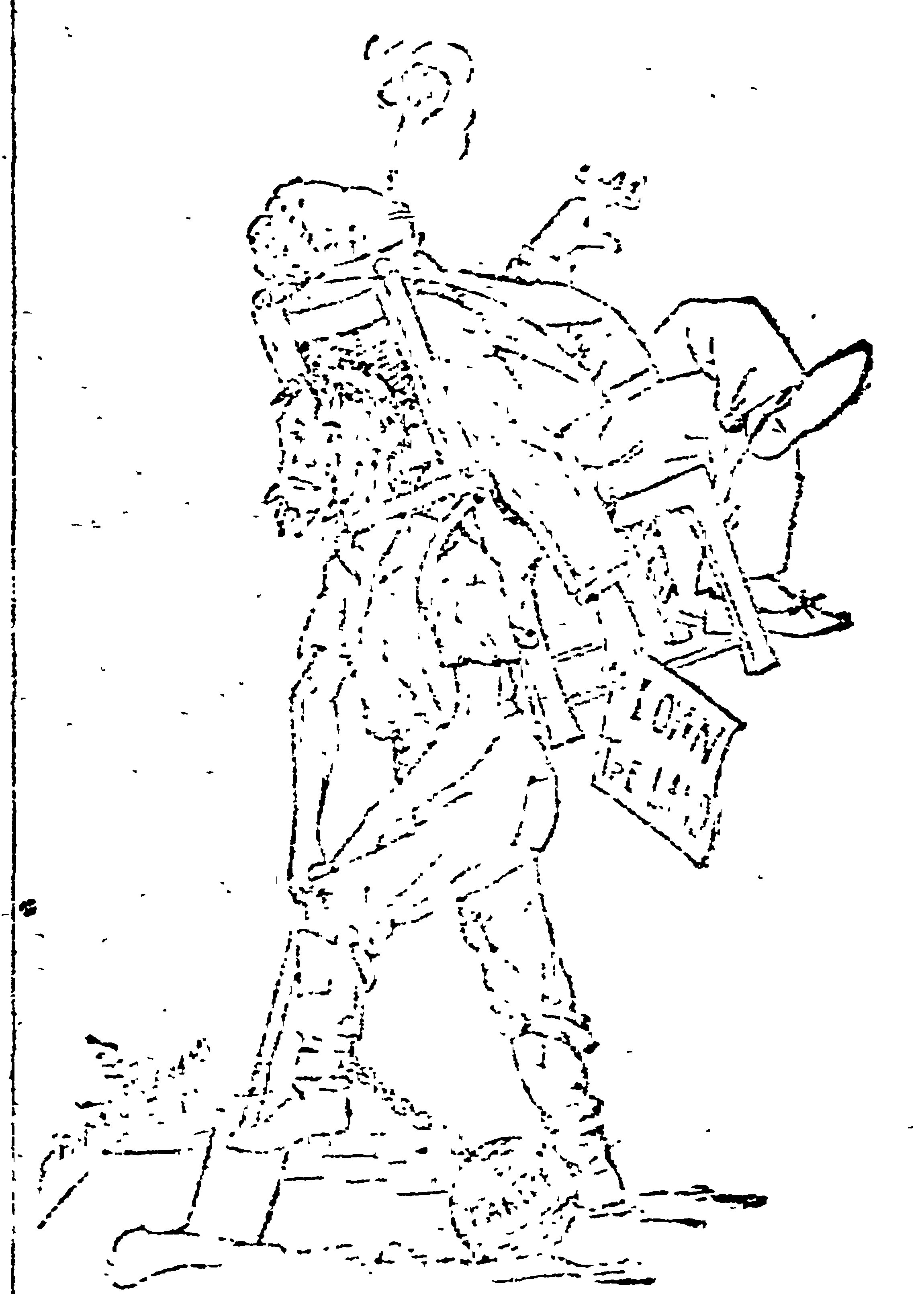
[Cartoon: a stooping, ragged laborer, ball and chain at his ankle, carries on his back a chair strapped to him in which sits a well-dressed man holding a placard. Placard (partly legible): “I OWN THE LAND”. Ball (partly legible): “[TARIFF?]”. No other caption above the quotation below.]
That a people can be enslaved just as effectually by making property of their lands as by making property of their bodies, is a truth that conquerors in all ages have recognized, and that, as society developed, the strong and unscrupulous who desired to live off the labor of others, have been prompt to see. The coarser form of slavery, in which each particular slave is the property of a particular owner, is only fitted for a rude state of society, and with social development entails more and more care, trouble and expense upon the owner. But by making property of the land instead of the person, much care, supervision and expense are saved the proprietors; and though no particular slave is owned by a particular master, yet the one class still appropriates the labor of the other class as before.—[Social Problems, page 207.
And the Tariff is the Prolific Mother of Trusts.
St. Paul Globe.
Trusts are the prolific mother of strikes, lockouts, and poverty to labor.
Page 6 of 8contents
6 THE STANDARD, SATURDAY, OCTOBER 20, 1888.
p. 6, col. 1
CHARITY AND CORRECTION
The eastern shore of Manhattan island, above the foot of Twenty-sixth street, curves inward, forming a little cove or harbor, sheltered from the force of the swift flowing tides of the East river. Here is a favorite anchorage for the steam yachts of New York’s aristocracy, and during the season a fleet of half a dozen or more may generally be seen there, riding placidly at anchor. Beautiful vessels they are, too, charming to the eye of the sailorman, who can appreciate fine lines and graceful sheer and other factors of seaworthiness and speed; charming also to the landsman, who looks with delight at their polished sides, their snow white decks, their gleaming brasswork, the trim rake of masts and smoke stacks, the neat uniforms of the crews. There is one —the lovely white one yonder—preparing for a start. The smoke is pouring from her funnel. Here comes the boat with the owner and friends—how gallantly she dashes to the gangway ladder. In bow, out boat hook—So, rowed of all. Out flies the boat hook, in come the oars, falling on the thwarts with a single clash—a pull upon the starboard yoke line, and there she lies, her after thwart even with the gangway. A knowing corinthian this, who handles his boat in true man-o’-war fashion. The yawl drops back beneath the davits, the tackles are overhauled and hooked on, the men stand ready at the falls. Who-o-o, whe-e-e, pipes the boatswain, and up comes the little vessel out of the water. Who-o-o, whit, whit, whit, whit, the boatswain pipes belay and the hands coil down the falls. There goes the steam windlass-ker-lank, ker-lank, ker-lank, ker-lank—you can see the ship fairly rushing to her anchor. Now the chain tends up and down, and the windlass for a moment has a hard time of it. Ker——lank; ker——lank; ker——lank—the palls fall slowly and more slowly. Aha! that last heave did it! Ker-lank, ker-lank, ker-lank, the anchor is atrip, and coming to the bow. One bell in the engine room. The screw begins to churn, and the yacht is started on her voyage. There goes the jingle for full speed, and away she dashes toward the Sound, spurning light feathers of spray from her bows in graceful curves, and leaving a wake whose smoothness charms the sailor’s eye. Good luck go with you, gallant little ship, type of man’s mastery over matter. A few short years, or months, or weeks ago, and the materials which now combine to form you and to drive you through the waters like a living thing, lay untouched in nature’s store house. Human labor and intelligence tore the ore from the mine, the lumber from the hills, the coal from its million year old bed, and brought them cunningly together, that you might be and move. And if a million like you should be wanted, are there not materials in plenty? Truly, the great store house is filled to overflowing, and the skill and labor are not lacking. Only, somehow, the store house is locked up, and the skill and labor, alas! are standing idle, waiting till the keys be found. God send we find them quickly!
But the cove at the foot of Twenty-sixth street has other attractions besides the pretty little fleet of pleasure ships we have been watching. For there the pier, sacred to the department of charities and correction of the city of New York, juts out into the river; and from it the good steamer Thomas S. Brennan starts three times a day for the various city institutions on the East river islands, carrying the city’s outcasts to receive, under official superintendence, their dole of charity, or meed of correction. Through the covered entrance to this pier stream daily two tides of humanity, moving in opposite directions—one setting towards charity, and correction, the other returning from the receipt of gifts, or the endurance of punishment, to renew the struggle with the world, and the blind unconscious search for that mislaid bunch of keys. A Stranger was anxious to follow for a little distance the course of the outflowing human tide—to see something of the sort of charity and correction a wealthy city administers to its needy and depraved ones. A kindly Guide had offered to conduct him. And thus it happened that on a bright autumn morning, the Guide and the Stranger stood together upon the pier waiting for the coming of the boat.
The building at the shore end of the pier is divided into several apartments. In one, passage tickets to the various island landings are sold, at prices ranging from twenty to forty cents, to persons who have obtained passes from the commissioners. Another is a passengers’ waiting room. A third is for the reception of patients in process of transfer to the work house hospital. A fourth is the waiting room for female prisoners. A fifth, the waiting room for male prisoners. There may be others, but these are all of which the Stranger took note. As he and the Guide stood on the open pier space beyond the building, two men appeared, carrying between them a sort of cot bed with handles. A woman was in the bed—an elderly gray haired woman—somebody’s wife, somebody’s mother, somebody’s sister—who can say?—somebody’s daughter, at all events. They bore her into the waiting room, to wait till the steamer should come to take her away.
“Look there,” said the Guide.
The Stranger turned and faced a large window set with iron bars—the window of the female prisoners’ waiting room. It was filled with faces, peering out. They were women’s faces; but oh! such women’s faces! Women’s faces from which every trace of womanhood had been wiped—faces hard, defiant—eyes staring, not immodestly, but with a horrible unconsciousness of the existence of such thing as sic—cheeks on which it would have been profanity to imagine a blush—lips, to think of whose kisses was a horror—women’s faces, smiling, laughing, scowling, vacant, but not one with a woman’s soul behind it. A sight to be remembered.
A woman on the pier put her head close to the window and shouted through the glass to one of the faces, “What yer got?”
p. 6, col. 2 The face inside grinned and held up one hand twice. Ten days, that meant; ten days of charity and correction; ten days of combined official tenderness and official justice.
The steamer was in her berth alongside the pier, and the Guide and the Stranger walked towards her. Right before them marched the two men carrying the cot with handles on which somebody’s daughter was lying. Somebody’s daughter didn’t seem to mind much what was done to her. The men broke step once or twice, and swerved abruptly to avoid an approaching hand truck; but Somebody’s daughter never said a word. Mrs. Vanastorbilt would moan with terror at the bare thought of being carried through the streets and down a pier on her bed; but Somebody’s daughter took it all as a matter of course.
The Thomas S. Brennan is manned by a paid crew, but is discharged and loaded by laborers detailed from the workhouse. These latter did not seem to work with enthusiasm, though the Stranger could not see that there was any very open shirking. Among other tasks, they had to get on board a great double horse truck with several slabs of granite lying on it. A dozen or more laid hold of the pole, while another gang mustered behind and pushed. The truck moved slowly up the gangplank, moved more slowly, and then stopped.
“Those men behind are not pushing,” said the Guide.
The Stranger thought that if he were one of the gray coated pushers he would do mighty little pushing himself, and said so.
“But it’s a good thing to push,” replied the Guide. “They ought to push. It’s just the want of pushing that has brought them here.”
The Stranger suggested that perhaps they had been unable to find anything to push against; that social conditions might have been too hard for them; briefly, that the mislaying of the storehouse keys might account for their destitution, moral as well as physical. But the Guide would have none of this.
“I grant you,” said the Guide, “all you say about the storehouse and the keys. But if the storehouse doors stood open never so wide, these men, and others like them, would be little better off. It is their own invincible laziness, their thriftlessness, their want of perseverance, their drunken habits that make them what they are. Give them a chance to do better and they wouldn’t improve it. Many of them have had a chance and wasted it. And right here,” said the Guide, “is where I find fault with you advocates of the single tax idea. You tell these men that society has wronged them; that if justice were done they would be comfortably off. You tell them that men ought to be able to live with very little work. You urge them to be discontented with society, when in fact they ought to be discontented with themselves. It would be a dreadful thing if men could live without work.”
To this the Stranger answered that he said these unfortunates were robbed because they were robbed; that society had no right to excuse its own crime by abusing its victims; that ignorance and vice were unnatural conditions of humanity, bred of foul and unwholesome surroundings, as fungi of decay and darkness; that while occupation was a necessity for men, drudgery was by no means to be desired; that if, under present conditions, all the outcasts of society could be converted into sober, frugal, industrious toilers, the result would be to make life harder for all other workingmen; that the popular appreciation of this truth might be seen in the opposition to convict labor; finally, that men’s natures varied within very narrow limits; that the most degraded of the horrible women staring out of the waiting room window might, under different conditions, have been a happy wife and mother; and that there was no sane human being that did not, in some feeble way, strive to follow the precept of Christ, and do good to some, at least, among his fellow men.
While the Stranger was speaking there drove down to the boat a wagon, in which, seated upon boxes of groceries or other stores, were three women. Rum soaked, bloated, coarse, untidy looking creatures they were, fished up out of the city’s slums and tossed into the work house to see what that might do for them. But every woman had a baby in her lap—not her own baby, but a public baby, a child of charity and correction. And it was wonderful to see the tenderness of those women with those babies—how carefully they held them, how they smiled at them, and tickled their chins to make them laugh, and cooed baby talk to them. The boat hands came and carried the little ones away, and as they did so the women’s faces grew hard and reckless and defiant—own sisters to the faces behind the window.
“Will those children live?” asked the Stranger.
The Guide shook his head sic. “There’s a chance for them,” he said; “but considering the life before them, one is almost tempted to wish they might die now.”
The workhouse prisoners came trooping down, males and females separately, and were marched into the cabins set apart for them; the penitentiary prisoners were escorted into their private room; the Thomas S. Brennan blew her whistle, the Stranger and the Guide stepped on board, and the great steamer, with her load of social offal, headed up the river, following the course of the trim pleasure ship that had left her anchorage an hour before.
The Thomas S. Brennan is divided into two parts by the hurricane deck. Above that deck the respectable members of society are carried—the folks who have not yet been found out, or whose happy circumstances have thus far saved them from sufficient temptation. Below it the criminals and paupers are stowed, with more regard to security than comfort. Along the guards, on each side the boat, is a row of rooms into which the prisoners are sorted according to sex and the institutions to which they are bound—male workhouse in one, female workhouse in p. 6, col. 3 in another, male penitentiary in a third, female penitentiary in a fourth, male lunatics, female lunatics, work house hospital patients, etc., in others. The door of the hospital apartment was open, and the Stranger and the Guide went in.
A little room, bare floored, comfortless but clean. Somebody’s daughter was there, in her little portable cot, staring blankly upward. It seemed to the Stranger that Somebody’s daughter could hardly be very comfortable, lying there on her back with her arms fastened to her sides by the tightly drawn bedclothes, without power to turn over or to brush a fly from her face if one should happen to light there. And to the Stranger it was horrible to see that Somebody’s daughter clearly had no idea that she wasn’t comfortable. The expression on her face was not one of resignation or endurance, but rather of a pathetic content. Evidently there was to her nothing discordant to the harmonies of the universe in the phenomenon of an elderly woman, fastened down to a portable cot, in process of transfer to a straw pallet in a charity hospital. She didn’t act like an invalid. She claimed none of those little privileges of discontent that Mrs. Vanastorbilt asserts when she is stricken. She didn’t moan or ask for water, or compel attention in any way—just lay there blankly staring, and apparently not even thinking. It struck the Stranger with a sense of terror to feel that he could no more see into that old woman’s [mind?] than he could into a dog’s.
In another corner of the little cabin the three babies were lying upon as many female laps—whether official or non-official the Stranger did not notice. One baby was sucking at a bottle and puking at intervals as naturally as it could have done had it been a regular born Fifth avenue baby. The other two had apparently concluded their refreshment, and lay placidly content, blinking and smiling at their nurses. The Stranger thought of what the Guide had said to him about thriftlessness and vice and people’s own faults, and wondered if a score of years hence some other guide would point some other stranger to these same human waifs and strays, and tell how all their poverty and wretchedness sprang from their own neglect of opportunities.
The gray coated freight handlers from the work house were scattered about the lower deck, and with one or two of these the Stranger held brief conversation. One was a ’longshoreman, a bright eyed, clean built, active looking young fellow, who swore with fluency and precision. How did he get there? Oh, well, he made an adverbially double adjectived fool of himself, got full, and had a fight with another fellow. Ever been there before? No, by God, and he’d take double adjectived fine care he never got there again. It was all a mistake his being there this time. The policeman was a friend of his, and only meant to arrest the other feller, but the roundsman happened along, and so the cop had to run ’em both in. Could the Stranger—whom he courteously addressed as Boss—oblige him with a chew of tobacco. The Stranger could, and did. And under the benign influence of the weed the corrected one expounded his views of the work house.
“Some fellers gets themselves committed to this place and comes here because they like it. I reckon a man must be a pretty low down bum before he’d take any pleasure in comin’ to a hole like this. I’m an American, I am, and able to work for my livin.’ It’s got to be pretty tight times along South street when I can’t get a job. Do I think it does anybody any good to come here? Naw! I don’t. The young ones picks up mischief and the old ones teaches it. The bums just comes up here and gets the rum out of ’em, and then they goes down to the city to git drunk agin.”
Mindful of what the Guide had said about shiftlessness, etc., the Stranger asked:
“Why don’t you knock off drinking and save your money? You might get to be something better than a ’longshoreman in time.”
“Well, boss, I know I’m a—a complicated string of adjectives—fool fur gettin’ on a spree. But what the devil is a fellow to do? The boys all drinks, and there ain’t no denyin’ that there is times when it does a feller good. And then one glass brings on another, and so it goes. It’s about all the enjoyment fellers like me has, anyways.”
This man was not degraded—as yet. So far as the Stranger could judge, he had no greater natural tendency to vice than most other men. He was simply drifting with the tide of circumstance—the tide that, in these times of ours, sweeps men of his kind so swiftly toward poverty and crime.
Through a spacious office, in which several clerks were busy on the official records of charity and correction, the Stranger and the Guide passed into the great central hall of the male workhouse. Along the middle a broad passageway runs the length of the building, open from floor to roof. On either side, tier above tier, are narrow galleries connected by iron stairways, giving access to the rows of cells, the dining rooms, etc. Close to the entrance hangs a wooden panel, on which is conspicuously inscribed:
The darkest hour in the history of any young man [or old] is when he sits down to study how to get money without honestly working for it.
HORACE GREELEY.
The Guide half smiled as he called the Stranger’s attention to this inscription. The grim irony of it was too palpable. It is officially supposed to have some occult, fetich-like effect upon the poor creatures who pass before it, tending to make them long for honest work, at such wages as the competition of the market allows. The interpolation of the words “or old” in brackets, is a decided improvement upon the original quotation, and shows that the commissioners of charities and correction have studied the social question even more closely than good old Horace Greeley.
A door from the main hall gives entrance to what may be termed the receiving room, where the daily load of human garbage is dumped upon arrival, to be officially sifted and sorted and bathed and clothed. Before the door a screen. Before p. 6, col. 4 the screen the deputy superintendent, standing at a desk, with an assistant (an inmate of the workhouse) beside him. On the right hand side of the sic the morning’s batch of “committals,” just landed from the steamer.
The deputy superintendent has before him the committal sheets from the various police courts, showing the names of the prisoners and the terms for which they are committed. From these he reads the names, and one by one the prisoners step forward.
“William McKeever,” calls the deputy superintendent. William McKeever rises from his bench and looks stupid. The assistant beckons to him, and points to him to stand before the desk.
“How old are you, McKeever?”
“Thirty-two, sir.”
“Where were you born?”
“New York.”
“What’s your trade?”
“Paper hanger, sir.”
“Married or single?”
McKeever hesitates. He knows what “married” means, but the term “single” is too much for him. The assistant puts the question in another form: “Are you married?” “No, sir,” says McKeever, and down goes the answer.
“Catholic or Protestant?”
“Catholic, sir.”
“Can you read and write?”
“No, sir.”
“That’ll do.” The assistant motions McKeever to the left side the sic and the deputy superintendent calls another name.
And so the sifting goes on. Most of the prisoners seem familiar with the routine of the establishment, and answer the questions glibly, almost before they are asked. But now a name is called to which nobody answers. “John Doody,” says the deputy superintendent. “John Doody,” repeats the assistant, after a pause, but no John Doody speaks. The deputy superintendent passes Doody by, and goes on sifting the remainder of the heap. Presently Edward Gallagher is summoned.
A bright looking boy steps forward and answers his questions smartly. A boy who doesn’t look like either a criminal or a pauper—clean, poorly but neatly clothed, looking his questioner straight in the face. Of him the Guide takes special note, designing to look into his case.
As the sifting process goes on, the Stranger becomes sensible of a smell. Not an honest, straightforward stench, but an indescribable smell that is not a smell—such as one might expect to find in the dark recesses of a cave—a suffocating smell that loads the air and makes it difficult to breathe. The Guide whisperingly explains that it is the prison smell, brought by the prisoners from the various police cells of the city. The Stranger finds it excessively nasty, and longs for fresh air; but seeing that the Guide makes no complaint, endures it stoically.
The committal sheets are all checked off, and one prisoner remains over, who, by this process of exclusion, is identified as the missing John Doody. John Doody, come forward.
John Doody, still mutely protesting against being so called, is made to understand what is wanted of him, and takes his place before the desk. A little, gray headed, bent, withered up old man.
“Doody, how old are you?”
But Doody only stares apologetically, and sic something that sounds like “No speaka Anglis.” The assistant addresses the bunch of prisoners, and inquires: “Who speaks Italian?” A good looking negro from Martinique comes forward as interpreter. The examination proceeds successfully until it reaches the inquiry about religion. Then it halts.
“Questa religione?” says the interprepreter. John Doody stares vacantly, as though he had been asked to state a theorem in conic sections.
“Siete Catolico?” asks the Guide; but John Doody still stares vacantly. Evidently the conversation has got beyond his depth. So the inquiry is abandoned, and John Doody—which clearly is not the old man’s name—stands registered as born in Italy, one year in the United States, organ grinder by trade, and of blank religion. Stand aside, John Doody. And the sifting is finished.
Now come this way, Edward Gallagher, and tell us how you happen to be here. You are a district telegraph boy, employed on night duty and living with your parents. You were arrested for breaking a fence, with intent to procure lumber to mend a cellar door, tried before a police justice, and sent here for three months. That will do, Edward. You can go now. Go, to associate for three months to come with the vilest of the city’s scum; to be locked up every night with a select gang of past masters in iniquity, who will give you a complete and thorough training in the theory of vice. Be off, Edward Gallagher, and see what the city’s charity and the city’s correction will do for you.
But even while the Stranger and the Guide are discussing poor Edward’s lot, a thing occurs that to the Stranger’s unaccustomed mind appears extraordinary. An order comes from the justice for Gallagher’s release. The boy is free to leave the island, and does leave it by the next boat. Truly the law has given him a useful lesson. It has taught him the advantage of having a “pull” with the authorities. A three months’ sentence will have no terrors for him hereafter. He knows that to the misdemeanant with sufficient “pull” it is a mere formality.
The modern dining room is a school of courtesy and self respect. The contrast between medieval barbarism and the culture of to-day is nowhere more sharply emphasized than around the dinner table. Men who have learned to eat together decently and courteously have certainly taken a forward step in social evolution. If we really want to correct these broken images of God—to patch them up and make them, if not sound throughout, at least decent as to outward appearance—surely the dining room is a good place in which to begin the work. Come, now, into the workhouse dining room, and see the images at their meals. Those latest arrivals, at whose sifting we assisted a while ago, have been bathed, and shaved, and clothed, and are trooping to their dinners. Come and see what lessons of p. 6, col. 5 refinement and courtesy are being taught them.
These are the tables—these broad, bare, heavy planks that stretch across the room, with an aisle down the center. We don’t give our brothers tablecloths and napkins, you observe. What have broken images to do with such refinements? These are the chairs—these narrower planks that at a lower level parallel the tables. What have such human scum to do with separate seats that can be adjusted to the table, or shifted to the sitter’s convenience? Suppose they are rheumatic, some of them, and faint and weary, what need to pamper them with chairbacks? This is the table furniture—these tin pans and spoons. What more is needed?
It is Friday, and because Christ died for them on Friday, the broken images may eat no meat to-day. We are tender of their souls, although we damn their bodies. Salvation is so cheap—and really so impossible to control in any money making way—that we make them freely welcome to it. So it is fast day in the work house, and the meal consists of dry bread and fish chowder. Dinner is served a la Russe—after a fashion. A great tin boiler full of chowder stands in one corner, with a tin cup for ladle; and beside it is a pile of bread, cut in great hunches. The service is simple. Each man dips a cupful of the chowder into his pan, snatches a hunch of bread, and takes his seat. The Stranger tasted the chowder, and found it vile. The bread was good, but pretty tough eating without butter.
There they sat, those broken images of God Almighty, munching their dry bread and supping their thin fish soup. As the Stranger looked at them he thought how easy it would be to train a lot of dogs to go through the same performance. The broken images didn’t seem to mind. It was all perfectly natural and proper to them—the usual way of winding up a spree. The Stranger thought of young Vanastorbilt winding up one of his sprees. And he wondered, if by any chance the Vanastorbilts and the broken images should hereafter get to the same heaven, how God would manage to make it comfortable for all of them. Of course, on earth its very sic. Vanastorbilt is providentially placed above the necessity of working for a living, and these poor wretches are beneath it—not providentially, of course, but by their own faults. It’s a comfortable doctrine—very much like covering your head up with the blankets when you hear burglars in the house. Yet it has its weak point, somehow.
This good looking, intelligent boy who meets us in the hall is Fritz Muller of Hamburg, sixteen years of age, speaking no English, and sent here for three months because of a can of milk, which Fritz protests he never meant to steal, and didn’t steal, but picked up because he was told to and put down again when ordered. Fritz has no “pull,” like lucky Edward Gallagher, and so must serve his time, a month or more of which has already passed. “A good boy,” says the deputy superintendent. “I have put him in the bakery, and do the best I can to keep him from being ruined.” And he looks like a good boy, of whom any parents might be proud. He came to the United States alone, seeking his fortune. And the United States has welcomed him—to the work house.
Strolling through the building and about the grounds, the Stranger learned from officials and from other sources a variety of facts about charity and correction.
It often requires influence to get into the work house, as well as to get out of it. To some poor wretches the work house food, and warmth, and shelter are luxuries so transcending ordinary experience as to be eagerly sought for. Against the too frequent intrusion of such as these the work house is guarded by the law. A man may not present himself at the gates and demand admission, simply because he is out of work and starving. He must be regularly sentenced by a police justice for a stated term; and that ended, he must go back to the city, to seek a recommittal. Of course, it is easy enough to secure a sentence by committing a misdemeanor and getting arrested; but for men who have not yet developed sic ingenuity to commit a crime for the sake of the punishment, the committal, for any term worth speaking about, is not always easily obtained without the aid of influence. A curious obstacle to the improvement of the work house is thus developed. The more it is improved, the better the class of people it will attract. With work house life made more agreeable, it is quite conceivable that the various political machines should reward their heelers with twelve months’ sentences; thus at once providing for them at the public charge and keeping them safe and sound until the next year’s election comes around.
Even as it is the committals are of a better class of people than ever before. There are just as many as ever. But the old “bums” are noticeably thinned out—perished in the blizzard, maybe—and their places are being taken by men a grade higher in the social scale. The tide of poverty is rising.
Within the last week or two there has been a curious relaxation of judicial severity. Men are sent up for ten days who at other times would get three months. How much of this is due to the fact that election day is close at hand, it is impossible to say.
Among the inmates are many skilled laborers and artisans—masons, bricklayers, shoemakers, tailors, etc. These are employed, within certain very narrow limits, in producing things for the use of the inmates. The shoemakers make shoes—by hand only—for the inmates’ wear. The tailors are employed at cleaning and repairing the wretched garments in which the prisoners arrive. But no shoemaker or tailor, however skillful he may be, or however little workhouse work there may be for him, is allowed to earn an honest penny by making shoes or clothes for people able and willing to pay for them. So, too, the bricklayers and masons are compelled to work as unskilled laborers upon a new building now erecting—carrying stones, or bricks, or mortar p. 6, col. 6 to the workmen whom the contractor for the building has hired from the outside world. It is in this way that charity and correction makes practical comment on the quotation from Horace Greeley in the entrance hall.
Of course the real reason for this repression of productive industry is the desire to avoid competing with the men who have not yet been forced into the work house. The Stranger bethought him of what the Guide had said about men coming to the work house by their own fault, and smiled to see how carefully, within the work house, the lesson was enforced that the world could not provide honest work enough to go round—that some men must stand idle while the rest produce, ot all sic to a common level of destitution—that a man once sunk into the mire must stay bemired, or thrust another down to take his place while he himself gets up.
The actual capacity of the work house is 1,250, males and females, allowing each inmate a cot. It has contained at one time [1,658?], and the average for the year ending June 30, 1887, was 1,408. Out of 5,002 persons committed during the first three months of 1887, 2,688 had been previously committed; 11 had been committed twenty times or over; 165 had been committed seven times, [623?] three times and 1,094 twice.
“The Lord is thy keeper.” “Despise not little sins.” “Blessed are the pure in heart.” “Be merciful unto me, oh Lord.” These are the mottoes, prettily illuminated, that decorate the walls of the workhouse hospital, for the spiritual improvement of the patients. This is a place sacred to charity alone. We don’t send men to the hospital for correction.
A sufficiently neat apartment, clean, tidy, well ventilated, with rows of beds along each side. But feel this mattress. A simple bag of straw. And this pillow. Another bag of straw, or something equally unyielding. How would you enjoy sleeping on it for a single night? How would you like to sleep on it for two long months, as that boy yonder—he with inflammatory rheumatism—has been doing? Oh! of course! Straw mattresses are good enough for people of this class. They’re used to them. I don’t say nay, my friend. But wouldn’t they be better if they weren’t used to them? Is there no refining influence in a hair mattress? Will not a man to whom a straw pallet is utterly distasteful be apt to bestir himself with energy to secure the better bed, without which he cannot be comfortable? Is there no moral education in luxury? Only there aren’t hair mattresses enough to go around, and till that missing bunch of keys be found there cannot be. Some folks must sleep on bags of straw, and better these than us. A comfortable philosophy, so long as the straw bag fellows don’t get dissatisfied. But if we strive to keep these men contented with their lot, with what face can we blame them that they don’t attempt to better it. Our safety, if indeed those keys cannot be found, lies in their degradation. Fancy, if they all wanted hair mattresses and feather pillows, and insisted on having them!
Here is one of the cells in which the inmates of the workhouse sleep and spend their leisure time. It is empty now, the men being away at work. Sufficiently airy, isn’t it? Clean, too. Yes, but study it more closely.
These iron stanchions are the bed posts; and the sheets of coarse brown ticking stretched between them are the prisoners’ beds—two tiers of them, an upper and a lower. No mattresses. On each piece of ticking are two neatly folded blankets; one to sleep on, the other to sleep under. And a pillow. Such a wretched ghost of a pillow—a tiny bag of ticking filled with straw. And in this room, smaller than many a lady’s boudoir, with a sink at one end for common use, twenty-six human beings sleep every night under lock and key. Try to fancy it. Think of a boy of sixteen, sent here for throwing stones or fighting, locked up in this room all night long, for ten nights in succession, or perhaps for months, with a constantly changing crowd of human swine, to whom cleanliness is a mockery, virtue a jest, and vice a normal condition. Think of what must go on behind those iron doors after they are closed for the night—the brutal obscenity, the filthy stories, the horror of vice competing against vice. Imagine—if you dare imagine it—your own boy exposed to such contamination, and say if you would not rather, a thousand times, see him in his coffin. Yet the boys who are exposed to it are of flesh and blood and brain, the same as yours, fed with the same food, hurt with the same weapons, subject to the same diseases, warmed and cooled by the same winter and summer. If you prick them, they bleed. If you tickle them, they laugh. If you poison them, they die. And if you wrong them, shall they not revenge? Aye! truly! And they are revenging! We force them to eat the sour grapes, but ours are the teeth that are set on edge!
Into the female side of the work house the Stranger did not penetrate, and can consequently say nothing about it from his own observation. What sort of a place it is, however, may be judged by the following extract from the matron’s report, quoted by Commissioner Lowell in her report to the state board of charities, July 12, 1887:
Among the 1,200 or more women and girls of the work house can be found all classes of vice and misery; drunken, discouraged wives; wives, the victims of family troubles; the unfortunate; the improvident; some who are unable to work through failing health; the unwary; the wayward; the indolent; the discharged convict; the old, hardened, drunken prostitute, and the young and bold prostitute; these last two classes form two-thirds of the entire number of the daily census, many of the older ones boasting of having come to “the island” for eighteen or twenty years. Lamentable instances came under my observation of those whose first experience in the work house was their first introduction to a prostitute life.
A pleasant picture, isn’t it?
Back to the city the Stranger carried with him this impression on his mind: A great public institution, devoted to the effort to achieve impossibilities—to keep continued on p. 7 →
[continued on page 7] (no “continued” line is printed; the sentence runs on at the top of page 7, col. 1: “men alive by charity…”)
Page 7 of 8contents
THE STANDARD, SATURDAY, OCTOBER 20, 1888. 7
[continued from an earlier page; page not stated — opening article begins mid-sentence]
p. 7, col. 1 ← continued from p. 6 men alive by charity, while making them daily more unfit to live—to cure them, by correction, of contented degradation, while carefully avoiding everything that can excite ambition. It is like striving to check an epidemic by forcing sick and well to herd together in a pest house, and then sending them forth, with disease upon them, to mingle with their fellow men.
In that vast building, with its iron stanchioned mockeries of beds, it sic hospitals, its tin panned dining room, its goody-goody quotations and texts, its covered up moral filth and degradation, the awful problem of society stands reduced to its last analysis—a problem that must be solved, if society would live. The sphinx of Nature, dreadful in her calm, impassive, remorseless patience, is watching and waiting while we wrestle with her riddle. What are we going to do with these men and women whom we have trampled in the mire, and who now rise up, filthy, stained, dehumanized, confronting us? To treat them as we do is but to spread the infection of their degradation. To treat them better would be to put a premium on vice and idleness. We give them texts, and they laugh at us. We give them charity, and they laugh at us. We give them correction, and they laugh at us. Preaching, kindness, harshness—publicly or privately, we have tempted them with all, but they are deaf to our charming. We let them die by scores and hundreds, but their ranks are forever swelling. And the sphinx is waiting.
Oh! my Guide through that great cesspool of humanity—tender of heart, loving your fellows, working so eagerly, yet, alas! so vainly, at your task of Sisyphus. Do you never see, flaming in the sky, the light that blinded Saul and taught the Roman emperor to conquer? Look up, and read: “By this sign shalt thou overcome.” What these poor, degraded brothers and sisters of ours need—these caricatures of Christ’s humanity that we are making by the thousands and the tens of thousands—what they need is, not the bitter bread of charity, nor the sharp stinging of the lash of correction, but simple justice. The God who made them provided for them liberally. Dare we, who have stolen their inheritance, reproach them because they will not bend and twist themselves as we would have them do? Are we greater than God, that we should nullify His laws and think to rearrange the universe. Look abroad and listen. From the fertile soil, the teeming sea, the living spring, the leafy forest, the darkened mine, comes the universal chorus, the very voice of the Creator speaking through His works: Take no thought, saying, What shall we eat? or, What shall we drink? or, Wherewithal shall we be clothed? for your Heavenly Father knoweth that ye have need of all these things. But seek ye first the kingdom of God and His righteousness, and all these things shall be added unto you.
Ah! if God had ordained the world upon the plan we vainly try to substitute for his—if He should take a notion to treat us as we treat these our brothers and our sisters—if He should lock the storehouse and insist on keeping the key—what a giant work house, what a veritable hell, this fair and fruitful earth would be for all of us!
T. L. MCCREADY.
Why We Cannot at Present Compete With England in Cotton Fabrics.
NEW YORK.—One of your correspondents, Mr. John C. Hubbard, desires to know why we cannot compete with England in the manufacture of cotton fabrics, since we have the advantage in raw material which England must buy of us.
Your answer was conclusive, but it does not exhaust the reasons. In support of your reply I would refer Mr. Hubbard to a leaflet issued by the Home market club (protectionists) of [36?] Bedford street, Boston, entitled “Facts for Workingmen.” It says: “Machinery is fifty per cent higher here than in Scotland, buildings 100 per cent higher, and coal (this is an important item) costs three times as much.”
Mr. Blaine, as secretary of state in his report on the “cotton goods trade of the world,” is my authority for asserting that wages are not higher in Massachusetts than in Lancashire, England. He says:
In the two prime factors which may be said to form the basis of the cotton manufacturing industry, namely, raw material and labor, we hold the advantage over England in the first, and stand upon an equality with her in the second.
The United States consular report, special issue No. 14, tells the whole story. Mr. Schoenhof, consul, has examined into this very subject, and on page [253?] of the above mentioned report sums it up in these words: “The yarn used in England is finer, conse- quently a greater length of yarn to the pound, which, if of the same number of picks per inch, must give a greater number of yards to the pound than in sic,, where an average of at least five numbers coarser is used. True, this makes the American goods stouter—more cottony—while the English prints have a finer yarn, but contain more dressing. Whatever may be said in favor or against one or the other’s merit or demerit, the result is certainly a considerable cheapening in the price of cloth.”
From this it will be apparent that England’s lighter weight cotton cloth has a decided advantage over the American make in the markets of China and India; with their warm climates they prefer a light weight cotton, especially as it costs less.
BENJ. DOBLIN.
Let Every Ohio Single Tax Man Pitch In.
In pursuance of the action taken by the recent conference of single tax men of Ohio, the executive board, consisting of W. H. Beecher, First district, Cincinnati; C. S. Walker, Second district, Cincinnati; W. W. Kile, Dayton district; Mr. Hance, Zanesville district; J. J. sic, Akron district; I. K. McDonald, Springfield district; P. J. Suay, Bellefontaine district; C. E. Siemon, Twenty-first district, Cleveland; William Radcliffe, Eighteenth district, Youngstown; —— Wynn, Toledo district; Edw. L. Hyneman, Thirteenth district, Columbus, has got to work and appeals to every organization sympathizing with the movement to go energetically about raising all the money possible for aiding in systematic work in the state, such sums, together with the names and addresses of signers to petitions, to be sent to the secretary of the board, Edward L. Hyneman, 318½ South High street, Columbus.
Let every Ohio single tax man off with his coat and pitch in.
p. 7, col. 2
QUERIES AND ANSWERS.
The Australian System.
BROOKLYN, Oct. 8—Please answer the following questions:
Who was the first one that brought the Australian system of voting before the American people?
Thomas G. Shearman said at last Friday’s meeting: “When Brazil levied an export duty on coffee Brazil paid the duty herself.” Please state how she paid it and why the consumer did not have to pay it?
HENRY.
The earliest presentation of the subject to my knowledge was made by Henry George in the North American Review of May, 1883.
Brazilians could not get more for their coffee in the markets of the world than coffee raisers in other coffee producing countries got. This price Brazilians could have obtained if they had not been forced by their government to pay an export tax, and as they were unable to get more after paying that tax, they were out of pocket just the amount of the tax they paid. See the report of Mr. Shearman’s speech in THE STANDARD of October 13.
NEW YORK.—Will you please inform me through THE STANDARD whether or not you would tax church property by your land theory?
WM. OBERLIES, JR.
Personal property and improvements, no. Whether the land on which churches were built should be exempt would be a question of local policy. The single tax does not require that all land shall be taxed, but that all valuable land held for private benefit or advantage shall be. The land on which court houses were erected might be exempt without violating the single tax principle; and if in any community churches were regarded as public institutions the land on which they stood might be exempt equally without violating that principle.
Speaking for myself, I should favor taxing church land if it was valuable, for a church is a private affair. Its members have interests in common with each other, but its membership has no such interest in common with the rest of the community as to entitle it to a special privilege.
WILMINGTON, Del.—Please state in your next issue the difference between taxing land values and nationalization of land, and oblige
I. MCMANUS.
Taxing land values without taxing them high enough to absorb the annual value is a fiscal system having much the same relation to land nationalization that tariff reduction has to free trade—it is a step in that direction. But the taxation of land to its full rental value differs from land nationalization only in mode. It is essentially the same thing accomplished in a simpler and more effectual way, and in a way not liable to the abuses which might attach to land nationalization on a large scale, such as centralization of power, corruption, and so forth.
Notes.
D. C. Hasbrouck, Peekskill, N. Y.—Send in the names of some of the people to whom you refer for recruit subscriptions to THE STANDARD, at the expense of the recruit fund.
LOUIS F. POST.
Who Will Pay the Land Tax?
DENVER, Col.—A frequent query arises concerning the taxation of land by the state to its full rental value. Where the owner, whom we will consider as a lessee of the state, paid such rental tax, if he underlet the premises held, would he not make the sub-tenant pay a higher rent than under the present system? Therefore, would not the actual occupant be the real sufferer? Such questions are asked frequently by the uninitiated. How can they be answered logically?
B. M.
If we tax houses the owners will charge more for their use, for no one would build a house unless he could get back the tax and make a fair profit besides. What is true of houses is also true of shoes, or wheat, or any article of human production; the tax is added to the price; and at the same time it lessens the production on account of the risk the producer runs, that the taxed article will be left on his hands. Land, however, is a fixed quantity. Taxing it does not make it scarcer. Hence the price to the user is always a monopoly price, “all the traffic will bear.”
The competition of low priced land, or land of no value, is what determines the rent of valuable land; and as a tax on land according to its value would not raise the price of the land that has no value, it of course could not raise the price of valuable land, for the valuable land would have just as cheap a competitor as before.
The rent of houses is determined by the cost of producing more houses; and a tax on houses being a tax on production, it will make all houses dearer.
Tract No. 37 of the Land and labor library explains this.
Cost of Maintaining Paupers.
AMSTERDAM, N. Y.—Please give through THE STANDARD the comparative cost of supporting paupers in Europe and in America in the public institutions for that purpose.
JAMES BARTLEY.
The report of the New York state board of charities dated December 10, 1886, says the cost of supporting the paupers and insane in the Erie county poor house and asylum averaged for the year $110 per head, “this being about the same as in other poor houses and county asylums of the state.” Of course rent does not figure in this, while presumably cost of attendance does. We have no figures for European institutions.
To Whom Should Rent Go?
JOHNSTOWN, Pa.—Please enlighten me on a few questions concerning “single tax.”
Generally speaking, is not intellectual advancement the principal factor in determining the increase of land values?
Does a drone help increase land values, and is he entitled to any of the fund?
Does a common laborer increase land values as much as an artisan?
Would the single tax cure “the news company monopoly?”
BRUSH HEAP.
No; the increase of population is the principal factor in increasing the value of land. The increase of population necessitates intellectual advancement.
A drone, by the mere fact of living, increases the demand for land, and thus helps to increase land values. As an equal heir to all the gifts of nature a drone
p. 7, col. 3 or do-nothing has a right to an equal share of the rent of those opportunities. If a man lives without doing anything under just conditions, he does so by having his wants supplied gratuitously, by some one else; that does not in any way affect his title to his share in nature’s gifts.
Supposing that the artisan accomplishes more than the laborer, he increases land values more; but (under just conditions) he gets proportionally more pay. He is not entitled to any more of the rent fund than any other citizen. The right of every man to an equal share of ground rent comes from his ownership in common with other men of the earth itself. If another man does more to make the earth valuable this does not affect the title of either.
The oppressive power of aggregated capital, which is exemplified in the news company, would be destroyed were the single tax in force and such monopolies as railroads and telegraphs owned by the people.
The Panic of 1873.
BINGHAMTON, N. Y.—In discussing the tariff a few days ago with a democrat who is a protectionist, he claimed that the panic in 1873 was caused by a horizontal reduction of the tariff of ten per cent in 1872. If you will kindly give a little light on this question through the columns of THE STANDARD it will be very much appreciated by myself and others of your followers in this place.
R. A. COE.
There was a horizontal reduction of ten per cent in 1872 which applied to all the principal protective duties. At the same time the salt duty was reduced one-half, the duty on coal was cut down from $1.25 to seventy-five cents a ton, and tea, coffee and many articles used in manufactures were put on the free list. The bill was a concession to the demand for reduction occasioned by the collection of $100,000,000 a year of surplus revenue for two years preceding. The panic of 1873, like those of 1837 and 1857, came, therefore, right after a large surplus had accumulated in the treasury, and like them it was caused by wild speculation. Other causes contributed to it, one of which was the corner in gold by Gould, Fisk and others which brought on the well known “Black Friday” crisis.
Blaine’s Mines and Miners.
ATLANTIC, Cass county, Iowa.—(1) Did Mr. Blaine ever, over his own signature, deny having any share or interest in the Hocking valley mines, or has it ever been proven that he had any interest in those mines?
- Please give average wages given in those mines; and (3) the average wages paid in the woolen factories.
THOS. EVANS.
It was proved that Blaine had an interest in the Hocking valley mine. He made some sort of a statement to the effect that he had nothing to do with the regulation of the men’s wages, but did not deny that he owned stock.
At that time the men were paid lower wages than in other districts.
According to the census of 1880 the average wages paid in woolen factories, including carpet, hosiery, wool hat factories, etc., were $293 a year, or $5.64 a week.
The Pacific Railroads.
GREENVILLE, S. C.—Last spring the crisis in the affairs of the Pacific railways brought to public attention the methods by which their constructors had robbed the people. Various remedies were proposed, and bills and resolutions introduced in congress. I would like to know what befell the several bills and resolutions, whether congress took any action in the premises, and what is the present status of the matter.
N. H. WHITNEY BROWN.
None of the bills or resolutions came to a vote—at least none of any importance. The whole matter is about where it was except that the people and newspapers have access to a good deal more information on the subject than they had before.
W. B. SCOTT.
[Advertisement] Scott’s Emulsion
IF YOU HAVE
CONSUMPTION | COUGH OR COLD BRONCHITIS | Throat Affection SCROFULA | Wasting of Flesh
Or any Disease where the Throat and Lungs are Inflamed, Lack of Strength or Nerve Power, you can be Relieved and Cured by
SCOTT’S EMULSION OF PURE COD LIVER OIL
With Hypophosphites.
PALATABLE AS MILK.
Ask for Scott’s Emulsion, and let no explanation or solicitation induce you to accept a substitute.
Sold by all Druggists.
SCOTT & BOWNE, Chemists, N. Y.
[Advertisement] The Great American Tea Company
[Illustration: trade mark of The Great American Tea Company — a large black “T” shape with the words “THE GREAT AMERICAN” across the top bar and “T E A” down the stem, “COMPANY” across the base]
GOOD NEWS TO LADIES.
Greatest offer. Now’s your time to get orders for our celebrated Teas, Coffees and Baking Powder, and secure a beautiful Gold Band or Moss Rose China Tea Set, Dinner Set, Gold Band Moss Rose Toilet Set, Watch, Brass Lamp, Castor, or Webster’s Dictionary. For particulars address
THE GREAT AMERICAN TEA CO., P. O. Box 289. 31 and 33 Vesey St., New York.
[Advertisement] Campaign Banner and Outfit Co.
CAMPAIGN BANNER AND OUTFIT CO., 46 VESEY STREET, NEW YORK.
[Illustration: an American flag on a staff with a cord and tassel]
OPEN WORK POLITICAL NET BANNERS,
With first-class Portraits of all Candidates.
Largest Manufacturers of Net Banners and Campaign Equipments in the United States.
[Advertisement] Unity Congregation
UNITY CONGREGATION.
HUGH O. PENTECOST, MINISTER.
MASONIC TEMPLE, Sixth avenue and Twenty-third street
SERVICES, Sunday Morning, 11 o’clock.
p. 7, col. 4 NEW PUBLICATIONS.
[Advertisement] The Tariff Question.
THE TARIFF QUESTION.
PROTECTION OR FREE TRADE? by Henry George; paper, 35 cents.
THE EXISTING TARIFF fully indexed so that the rate on each article can readily be found, 25 cents.
LEADING SPEECHES ON THE MILLS BILL, containing the speeches of Mills of Texas, McMillan of Tennessee, Wilson of West-Virginia, Scott of Pennsylvania, Cox of New York and Carlisle of Kentucky on the democratic side, and Reed of Maine, McKinley of Ohio, Burrows of Michigan, Butterworth of Ohio and Kelley of Pennsylvania on the republican side: 50 cents.
Sent, postage paid, on receipt of price, or
THE THREE BOOKS FOR ONE DOLLAR.
PUBLISHER STANDARD, 12 Union Square, New York.
[Advertisement] Bound Volumes of The Standard.
BOUND VOLUMES OF THE STANDARD.
A limited number of bound volumes of THE STANDARD, in heavy boards, are offered for sale at the following prices:
Volumes 1, 2, and 3, bound in single volumes,….$3 50 The three volumes……………………………… 9 00
(Expressage extra.)
Address THE STANDARD, 12 Union square, east, New York.
[Advertisement] Prang’s Art Books.
PRANG’S ART BOOKS.
Golden Milestones. Choice selections of poetry. Ten full page monotint and color illustrations by L. K. Harlow. Inclosed in hand painted cover of pretty design. 7 3-4x6 1-8……………….. $1 50
Mount Desert. A sic for autographs. Profusely illustrated in colors by Louis K. Harlow. In a handsome hand decorated cover. 7 1-8x7 3-8………. $2 00
The Old Garden. By Rose Terry Cooke. (From Grandma’s Garden, arranged by Kate Sanborn.) Choicely illustrated in colors by Harriet D. Andrews and Mary K. Talcott. In sateen cover, printed in colors. 9 3-8x10 3-4……………….. $1 50
Come, Sunshine, Come. A poem. From the French of Charles Vincent. Six exquisite full page illustrations in photogravure by Louis K. Harlow. Vignettes by F. Schuyler Mathews. In fine hand decorated cover, prettily fastened with ribbons and bows. 8 1-2x10 1-2……………….. $4 00
Old Stories in New Attire. Costume pictures. By Mrs. Rose Mueller Sprague. Eight familiar characters from Mother Goose Rhymes and Fairy Tales in color, exquisitely designed. Illuminated cover. 7 3-8x9 1-2……………….. $2 00
The Home of Shakespeare. Profusely illustrated after water color sketches taken on the spot, by Louis K. Harlow. Appropriate quotations from Shakespeare. Cloth, fine gilt stamp, tinted edges. 11 1-2x8 1-2……………….. $3 00
Louisa May Alcott.—The Children’s Friend. By Edna D. Cheney. Illustrated by Lizbeth B. Comins. A biographical sketch of the eminent author, with characteristic poems. Frontispiece in colors, representing Miss Alcott surrounded by crowds of children. 10x7. Cloth……………….. $1 00
Baby’s Lullaby Book.—Mother Songs. By Charles Stuart Pratt. Water colors by W. L. Taylor, music by G. W. Chadwick. A sumptuous volume. Mother songs, one for each month, by the author, original music for each by the eminent young composer, and sixteen exquisite full page illustrations in color, besides numerous vignettes, etc., in monochrome, by the artist. Probably the most unique and artistic publication of the kind ever published. In surah sateen cover, printed with a special design in colors by W. L. Taylor……………….. $7 50
Autograph Recipes. Illustrations by Alice G. Sheldon and Jean H. Ward. A novel book for the reception of cooking receipts in autograph. Containing over 100 leaves of fine writing paper. Fancy titles and monochrome illustrations for each section, with appropriate humorous verses. In sateen cover elegantly printed in colors. 10x7……………….. $2 50
This unique book cannot fail to be popular, as it will give lasting and increasing pleasure. It is intended to contain cooking receipts of well proved value, writ- ten in autograph by the possessor’s dear friends as in an ordinary autograph album. It will therefore be in time an interesting memento and a valuable cook book at the same time. It will be an excellent present for a housewife or a bride.
SHAPE BOOKS.
Christmas Mince Pie with Shakespearean Spice. By Lizzie K. Harlow. Illustrations in monochrome of the ingredients of a mince pie, with appropriate selections from Shakespeare. Fastened in a cover of realistic piece of pie, and cut to shape…$0 50
Flotsam and Jetsam. By L. K. Harlow. Illustrations in color and monochrome of marine views, with appropriate text, fastened in cover in shape of realistic yacht’s mainsail; the sail of satin, with hand painted title; mast, gaff and boom nickel plated, rigging of silk cord. A very pretty conceit…….$2 00
These books for sale by all first class dealers. If not found, they will be sent on receipt of price.
[Advertisement] A Rare Opportunity. Portrait of Henry George in Colors.
A RARE OPPORTUNITY.
PORTRAIT OF HENRY GEORGE IN COLORS.
Only One Dollar.
The man whose right principles and deep convictions have made the great movement for the single tax on land values thus far successful, must be dear to thousands who watch and approve his course.
But his features are not so familiar, and the esteem in which he is held has prompted many requests for the publication of his picture in worthy and permanent form.
Realizing this urgent demand, we beg to announce the publication of an entirely new and very striking portrait of
HENRY GEORGE.
It is in colors and is full life size, designed to be framed to an inside measurement of 17x22 inches.
A similar picture of the eminent
DOCTOR M’GLYNN
is offered at the same price, which is as near as possible to actual cost, to bring these pictures within the reach of all who desire to purchase.
Either picture will be sent, on receipt of price, by mail, postpaid. Remittances may be made either by check, post office order, registered letter, or postal note.
L. PRANG & CO., ART PUBLISHERS, Boston, Mass.
NEW YORK—38 Bond street. CHICAGO—[79?] Wabash avenue. SAN FRANCISCO—529 Commercial street.
A descriptive list of Christmas and New Year cards, novelties, booklets and satin art prints sent on application.
[Advertisement] Single Tax Doctrines in a Nut Shell.
SINGLE TAX DOCTRINES IN A NUT SHELL.
Thirty pamphlets on various phases of the social problem. The question of the hour. All should understand it. Will be sent post paid on receipt of fifteen cents in stamps, or will be sent free to any one sending twenty-five cents for six months’ subscription to the Tax Reformer, a sixteen page journal. Address, SINGLE TAX PRESS, [illegible] Lexington ave., N. Y.
[Advertisement] The Democrat.
THE DEMOCRAT.
A RADICAL REVIEW MONTHLY.
The Democrat advocates Land Resumption and those reforms which are necessary to make the English people a free people. It asks “compensation” not for those who have benefited by unjust legislation, but for those who have suffered thereby.
For one dollar the Democrat is supplied for 18 months to any address in the United States or Canada.
Address 5 New Bridge street, London, E. C.
[Advertisement] George Wilson, Importing Tailor.
GEORGE WILSON.
(Formerly with Henry Poole, London.)
Importing Tailor.
206 East Fourteenth St., N. Y.
“’Tis not in mortals to command success; But we’ll do more, Sempronius; we’ll deserve it.”
SAMPLES AND RULE FOR SELF MEASUREMENT SENT ON APPLICATION.
New Imported Fabrics, Latest Choice Patterns, An Elegant Selection.
The Best Looms in the West of England
contribute to an entirely new and valuable stock of goods, which for richness of quality, durability of wear and moderation of price, possesses advantages not held by other houses receiving goods through resident buyers. Why? They were bought in London by G. Wilson.
[Advertisement] Concord Co-operative Printing Company
CONCORD CO-OPERATIVE PRINTING COMPANY (Ld.)
101 Elm street, cor. Canal, N. Y.
BOOK, JOB AND NEWSPAPER PRINTING.
[Advertisement] Holland’s Coffee and Dining Rooms
HOLLAND’S COFFEE AND DINING ROOMS, [illegible] Fourth avenue, Bet. 13th and 14th sts.
[Advertisement] Mrs. Agatha Munier Atkins
MRS. AGATHA MUNIER ATKINS WILL continue to receive pupils in solo singing and vocal sight reading at her residence. [223?] E. [32d?] street, New York.
[Advertisement] James Bogan
JAMES BOGAN, PRINCIPAL AGENT for James Means’ $3 and $4 shoes. 226 BOWERY, near Prince street.
p. 7, col. 5 NEW PUBLICATIONS.
[Advertisement] Belford’s Magazine.
BELFORD’S MAGAZINE.
Edited by Donn Piatt.
BELFORD’S MAGAZINE, published monthly, is devoted to politics, fiction, poetry, general literature, science and art.
In politics the new magazine will give an independent support to the democratic party and to the present sic. It will advocate the extinguishment of the surplus by a reform of the present iniquitous and burdensome tariff in the direction of free trade, or of a tariff for revenue only.
The department of fiction will be exceptionally full. Instead of a serial story, dragging its length through several months, and exhausting the patience of the reader, a complete novel will be published in each number; and each issue will also contain one or more short stories complete.
Colonel Donn Piatt is assisted by a staff of sub-editors, and also by a large number of able contributors, among whom are
David A. Welles, | Gen. H. V. Boynton, Hon. Frank H. Hurd, | Sarah B. M. Piatt, Prof. W. G. Sumner, | Edgar Fawcett, J. S. Moore (Parsee Merchant), | Joel Benton, Hon. John G. Carlisle, | Ella Wheeler Wilcox. Henry Watterson, | Rev. George Lorimer, Henry George, | E. Heron-Allen, Julian Hawthorne, | Coates Kinney, Edgar Saltus, | James Witcomb sic, John James Piatt, | Soule Smith (“Falcon”), Thos. G. Shearman, | Gertrude Garrison.
BELFORD’S MONTHLY is a first class medium for advertising, as the publishers guarantee a bona-fide circulation of at least 70,000 copies per month.
Price, $2.50 a year, or 25 cents per number.
[Advertisement] Tariff Books.
TARIFF BOOKS.
THE TARIFF ON IMPORTS INTO THE UNITED STATES, AND THE FREE LIST,
As contained in act of March 3, 1883; also the Hawaiian Reciprocity Treaty, and extracts from the Navigation and Oleomargarine acts. Indexed. 12mo. Paper covers, 25 cents.
A most useful book. In a moment you can find the exact tax on any article imported into the United States, and the names of everything on the free list. Invaluable to editors and all interested in the great tariff question now so freely discussed.
AN APPEAL TO THE AMERICAN PEOPLE AS A JURY.
SPEECHES ON THE TARIFF delivered in the House of Representatives in the great debate, April 17—May 19, 1888.
SPECIALLY SELECTED FROM BOTH SIDES.
Carefully revised and published by authority. Compiled by William G. Terrell. Large 12mo. cloth, $1; paper, 50 cents.
The following is a list of the names of the honorable gentlemen whose speeches are printed in the work:
Hon. Mr. Mills of Texas. Hon. Mr. Kelley of Pennsylvania. Hon. Mr. Scott of Pennsylvania. Hon. Mr. Wilson of West Virginia. Hon. Mr. McKinley of Ohio. Hon. Mr. McMillin of Tennessee. Hon. Mr. Butterworth of Ohio. Hon. Mr. Cox of New York. Hon. Mr. Burrows of Michigan. Hon. Mr. Reed of Maine. Hon. Mr. Carlisle of Kentucky.
Special editions of not less than 2,000 copies for campaign purposes made at greatly reduced prices. If required, all the republican speeches can be had in a separate volume, or all the democratic ones likewise.
THE PROTECTIVE TARIFF: WHAT IT DOES FOR US.
BY GENERAL HERMANN LIEB.
Fourth edition, with revisions and additions. 12mo. Cloth, $1.00.
THE PRESS UNANIMOUS IN ITS PRAISE.
This book shows the practical effect of the protective system upon the country. Perhaps the most conspicuous feature of the book is its exact alignment with the message of President Cleveland. But for the fact that the General’s work was in print before the message was made public, it might be supposed he had written it to defend the president’s position on the tariff.
The position of Mr. Blaine’s “Twenty Years in Congress” is taken up, his assertions upon the tariff are analyzed, criticised and made to furnish their own refutation.
The arrangement of the subject is in a most convenient form, and renders what is usually considered a most sic subject easy of comprehension. It would serve as a tariff primer for the learner as well as a text book for the learned.
For sale everywhere, or may be had of the publishers on receipt of price, free of postage.
A Great Literary Hit.
OLD MAN GILBERT.
By Elizabeth W. Bellamy.
Small 8vo, cloth……………….. $1.00 Paper covers……………….. 50 cts.
Originally published in Belford’s Magazine.
WHAT DREAMS MAY COME.
A Romance by Frank Lin.
12mo., Cloth, $1.00. Paper Covers, 50 cents.
A book, which although undoubtedly unconventional, yet is in no wise dependent upon that quality for its success. Its interest lies in its absorbing plot, in its strong dramatic treatment, and in the bold yet logical handling of one of the most difficult and least used subjects in literature.
WHY WAS IT?
A Novel. By Lewis Benjamin.
12 mo., Cloth, $1.50. Paper Covers, 50 cents.
This book tells the story of the loving devotion of a gifted woman who gives up her life to the task of saving a man, equally gifted, from threatened ruin.
The scenes are laid in Washington, California and the new West. The incidents at the Capital are true to life, and deeply interesting. The descriptions, especially the war scenes and scenes in the west, are very clear and graphic, and in parts very beautiful. Each dramatic climax is well brought about, and the tone and sentiment is pure throughout. Whoever reads the first chapters of this book will read it to the end, and the publishers believe that it will be warmly welcomed by a very large class of readers.
MARIE, A SEASIDE EPISODE.
By J. P. Ritter, Jr. With Illustrations by Coultaus.
Cloth, $1. Paper Covers, 50 cents.
In this poem the author tells an interesting love story in an exceedingly bright, clever and amusing fashion that reminds one a good deal of Byron’s “Beppo.” Incidentally, he satirizes society in a light vein of humor, and in a style that is graceful and epigrammatic. The volume contains over forty illustrations, and is an admirable specimen of the book maker’s art.
THE PRINCESS DAPHNE.
12mo. Cloth, $1.00.
In paper covers, illustrated by a remarkable and unique drawing by E. Hamilton Bell, 50 cents.
The heroine of this thrilling story is a creole descended from two of the original settlers of New Orleans. The story deals with phases of [Bohemian?] life in New York and London; with love, mesmerism, death, transmigration and reincarnation; it is told in an undisguised realistic fashion that reminds one of Daudet’s “Sapho;” and it has a most startling denouement.
EDEN.
By Edgar Saltus,
Author of “The Truth About Tristem Varick,” etc.
Cloth, $1.00. Paper, 50 cents.
In this novel Mr. Saltus describes an episode in a honeymoon. The plot is dramatic, the action nervous, and the scene Fifth avenue. As a picture of contemporaneous life it will be condemned by every lover of the commonplace.
EROS.
A Novel by Laura Daintrey,
Author of “Miss Varian of New York,” “Caprice,” etc., etc.
12mo., cloth, $1; paper cover, 50 cents.
Strong, interesting and a seller.
Order at once to secure a supply from first edition.
BELFORD, CLARKE & CO., PUBLISHERS, Chicago, New York and San Francisco.
p. 7, col. 6 NEW PUBLICATIONS.
[Advertisement] American Swedenborg Printing and Publishing Society
HEAVEN AND ITS WONDERS, THE WORLD OF SPIRITS AND HELL, described from things heard and seen, by EMANUEL SWEDENBORG, “Servant of the Lord Jesus Christ.” Also THE LAST JUDGMENT, as witnessed by him in the spiritual world in 1757; The Doctrine of Life, The Sacred Scriptures, The New Jerusalem and its Heavenly Doctrine, in all, 750 octavo pages mailed prepaid for $1.00. Discount to the trade. Address, American Swedenborg Printing and Publishing Society, 20 Cooper Union, New York City.
[Advertisement] Own a Single Tax Paper.
OWN A SINGLE TAX PAPER. MUCH effective work in and after the campaign can be done by the publication of a local paper. We can furnish [500?] [20-column?] papers, containing much free trade single tax matter, for [$2.50?] per issue. These will be headed and dated at any village or city. At a little extra expense items of local interest, making points against local opponents, will be inserted. The publisher will have complete control over his own paper; he can insert in it any reading matter or advertisements he pleases, collecting his own pay for subscriptions, sales and advertising. All we have to do with the plan is to furnish the work from a central office and divide the expense among the publishers. These papers can be entered at local post offices as second class matter, and can then be mailed at a cost of four cents per 100 copies for postage. This is a very important item for clubs and groups to consider. Samples free. Write for fuller information to
TAX REFORM COMPANY, 52 Concord street, Brooklyn, N. Y.
[Advertisement] Henry George’s Works.
HENRY GEORGE’S WORKS.
PROGRESS AND POVERTY,
An Inquiry Into the Cause of Industrial Depression and of Increase of Want With Increase of Wealth—The Remedy.
BY HENRY GEORGE.
[512?] pages. Cloth, $1.00. Paper covers, 35 cents. Half calf or half morocco, $2.50.
SOCIAL PROBLEMS.
BY HENRY GEORGE.
342 pages. Cloth, $1.00. Paper covers, 35 cents. Half calf or half morocco, $2.50.
PROTECTION OR FREE TRADE?
An Examination of the Tariff Question with Especial Regard to the Interests of Labor.
BY HENRY GEORGE.
Cloth, $1.50. Paper covers, 35 cents. Half calf or half morocco, $3.00.
THE LAND QUESTION.
What It Involves, and How Alone It Can Be Settled.
BY HENRY GEORGE.
87 pages. Paper covers, [10?] cents.
PROPERTY IN LAND.
A Passage-at-Arms Between the Duke of Argyll and Henry George.
[77?] pages. Paper covers, [15?] cents.
FORTSCHRITT AND ARMUTH.
(Progress and Poverty in German.)
TRANSLATION OF C. D. F. GUTSCHOW.
430 pages. Paper covers, 35 cents.
For sale by all booksellers, or sent postpaid on receipt of price. Foreign editions of these books imported on order.
HENRY GEORGE, 12 Union square, New York.
[Advertisement] Land and Labor Library
LAND AND LABOR LIBRARY
The following is a list of tracts in print:
- First Principles. Henry George. 4 pages.
- Land and Taxation. David Dudley Field and Henry George. 4 pages.
- Right to the Use of the Earth. Herbert Spencer. 4 pp.
- A Christian Minister on the Remedy for Poverty. Hugh O. Pentecost. 2 pages.
- A Sum in Proportion. T. L. McCready. 2 pages.
- Settler’s Nightmare. Louis F. Post. 4 pages.
- New York’s Docks. J. W. Sullivan. 4 pages.
- Unemployed Labor. Henry George. 4 pages.
- Mysterious Disappearance. Lewis Freeland. 6 pp.
- How to Increase Profits. A. J. Steers. 2 pages.
- The American Farmer. Henry George. 4 pages.
- Sailors’ Snug Harbor and the Randall Farm. W. T. Croasdale. 12 pages.
- The Collegiate Church and Shoemaker’s Field. W. T. Croasdale. 12 pages.
- Only a Dream. Abner C. Thomas. 4 pages. [18?]. It is the Law of Christ. Rev. S. H. Spencer. 4 pp.
- My Landlord. John Jones. 4 pages.
- “Thou Shalt Not Steal.” Henry George. 8 pages.
- Christianity and Poverty. Father Huntington. 4 pp.
- Poverty and Christianity. H. O. Pentecost. 8 pages. [25?]. The Single Tax. Thomas G. Shearman. 8 pages. [26?]. Religion vs. Robbery. Rev. Dr. McGlynn. 8 pages.
- Back to the Land. Bishop Nulty. 16 pages.
- Anti-slavery and Anti-poverty. H. O. Pentecost. 8 pp.
- Tenement House Morality. J. O. S. Huntington. 4 pp.
- The Case Plainly Stated. H. F. Ring. 8 pages.
- Questions by Rev. Howard Henderson, with answers by Henry George. 2 pages.
- Objections to the Land Tax. Thos. G. Shearman. 4 pp.
- Socialism—Its Truth and Its Error. Henry George. 4 pages.
- Horse Sense. W. C. Woods, M. D. 2 pages. [37?]. Taxing Land Values. Henry George. 8 pages.
- “God Wills It.” Henry George. 4 pages. [39?]. What We Want. Everett Glackin, ex-president Typographical union No. 6. 2 pages.
- How John’s Father Saw the Light. W. C. Woods. 2 pp. [49?]. The Distribution of Wealth. T. G. Shearman. 16 pp. [51?]. Ten Thoughts for Christian Thinkers. Rev. John W. Kramer. 4 pages. [54?]. What the United Labor Party Want. Henry George. 2 pages.
- Stories for Farmers. 4 pages. [56?]. Electoral Reform. A. T. Rice. 4 pages. [61?]. A Practical Illustration. Hugh B. Brown. 2 pages. [64?]. Hints as to What You Can Do. Henry George. 4 pp. [65?]. Tom Bookkeeper. Bartholomew Appleby. 2 pages [66?]. A Lawyer’s Reply to Criticisms. Samuel B. Clarke. 16 pages. [67?]. A Piece of Land. The late Francis G. Shaw. 2 pp. [68?]. The Tax on Buildings. William T. Croasdale. 8 pp.
- My Butcher Woman and My Grocery Man. William [McCabe?]. 4 pages.
- [Ballot?] Reform. Louis F. Post. 12 pages.
- A [Republican’s?] Reasons for Supporting Cleveland. [illegible]. 2 pages.
- The Single Tax in Canada. 2 pages. [82?]. The Onward March. William Lloyd Garrison. 4 pp. [84?]. A Catechism. [D. A. S.?] 2 pages.
- A Republican’s Reasons for Supporting Cleveland. Judge Frank T. Reid. 2 pages.
GERMAN TRACTS.
- First Principles. Henry George. 4 pages. [43?]. Socialism—Its Truth and Its Error. Henry George. 4 pages. [45?]. Taxing Land Values. Henry George. 8 pages. [47?]. It is the Law of Christ. Rev. S. H. Spencer of Henry, Ill. 4 pages. [48?]. The Case Plainly Stated. H. F. Ring. 8 pages. [53?]. Progress and Poverty. Henry George.
- Sailors’ Snug Harbor. Wm. T. Croasdale. 12 pages.
SWEDISH.
- The Case Plainly Stated. H. F. Ring. 8 pages.
TARIFF TRACTS.
- Protection as a Universal Need. Henry George. 4 pages. [63?]. The Tariff Question. Henry George. 4 pages. [69?]. American Protection and British Free Trade. Henry George. 4 pages. [70?]. Protection and Wages. Henry George. 8 pages. [71?]. The Common Sense of the Tariff Question. Thomas G. Shearman. 8 pages.
- Protection the Friend of Labor? Thomas G. Shearman. [6?] pages.
- A Short Tariff History. Thomas G. Shearman. 2 pages.
- Plain Talk to Protectionists. Thomas G. Shearman. 4 pages.
- An Address to Workingmen on the Tariff Question. Henry George. 4 pages.
A set of these tracts will be sent to any address for ten cents.
Prices, free by mail: 2-page tracts—[50?] copies, 10 cents; 100 copies, 15 cents; 1,000 copies, [$1.?]; 5,000 copies, $[?].25.
Four-page tracts—25 copies, 10 cents; 100 copies, 25 cents; 1,000 copies, $[?]; 5,000 copies, $[?].
Six-page tracts—25 copies, 15 cents; 100 copies, 37 cents; 1,000 copies, $3; 5,000 copies, $12.75.
Eight-page tracts—25 copies, 20 cents; 100 copies 50 cents; 1,000 copies, $4; 5,000 copies, $[17?].
Twelve-page tracts—25 copies, 30 cents; 100 copies, 75 cents; 1,000 copies, $6; 5,000 copies, $[25.50?].
Sixteen-page tracts—25 copies, 40 cents; 100 copies, $1; 1,000 copies, $8; 5,000 copies, $[34?].
A special selection, comprising thirty or more of the most popular tracts, will be sent for 20 cents.
Other numbers in preparation.
Address THE STANDARD, 12 Union square, New York city.
Page 8 of 8contents
8 THE STANDARD, SATURDAY, OCTOBER 20, 1888.
p. 8, col. 1
CURRENT THOUGHT.
The railroad paper in Scribner’s Magazine for October is by Arthur T. Hadley, and treats of “The Railroad in Its Business Relations.” It is, in reality, an ably put argument for government ownership of railways, although its author, unconvinced by his own reasoning, is by no means inclined to admit such a conclusion.
Mr. Hadley begins by pointing out that the tendency of railroad systems toward consolidation, pooling, and consequent monopoly, is the result of a natural process of evolution:
People at first thought of railroads as merely an improved highway, which should charge tolls like a turnpike or canal, and on which the public should run cars of its own, independent of the railroad company itself. In many cases, especially in England, long sheets of tolls were published, based on the model of canal charters, and naming rates under which the use of the road bed should be free to all. This plan soon proved impracticable. If independent owners tried to run trains over the same line it involved a danger of collision and a less of sic. The former evil could perhaps be avoided; the latter could not. The advantage of unity of management was so great that a road running its own trains could do a much larger business at lower rates than if ownership and carriages were kept separate. The old plan was as impracticable as it would be for a manufacturing company to own the buildings and engines while each workman owned the particular piece of machinery which he handled. Almost all the technical advantages of the new methods would be lost for lack of system. The railroad company, to serve the public well, could not remain in the position of a turnpike or canal company, but must itself do the work of carriage.
This was not all. The same economy which resulted from the union of road and rolling stock under one management was still further subserved by the consolidation of connecting lines. This change did not come about so suddenly as the other. Half a century had elapsed before it was fully carried out. At first there was no need of it. The early railroads were chiefly built for local traffic, and especially for the carriage of local passengers. They were like the horse railroads of the present day in the simplicity of their organization and the shortness of their lines. England in 1847 had chartered 700 companies, with an average authorized length of hardly fifteen miles each. The line from Albany to Buffalo and Niagara Falls was in the hands of a dozen independent concerns. These were but types of what existed all over the world. As torough sic, and especially through freight traffic, grew in importance, this state of things became intolerable. Frequent transshipment was at once an expense to the railroad and a burden to the public. Even when this could be avoided, there was a multiplication of offices and a loss of responsibility. The system of ownership and management had to adapt itself to the technical necessities of the business. The change was not the result of legislation; nor was it, except in a limited sense, the work of men like Vanderbilt or Scott. It occurred in all parts of the world at about the same time. It was the result of business necessity, strong enough to shape legislation, and to find administrative leaders who could shape its demands.
As this process of consolidation and extension went on wars of rates broke out and were carried on with increasing fierceness. Wherever two railroads crossed, competition for traffic was inevitable. And this competition was intensified by the fact that a large part of the expenses of a railroad are fixed charges—such as maintenance of way, interest on bonds, payment of officials, etc.—which are but very slightly affected by the amount of business done. Hence, “if for any reason a particular piece of business cannot or will not pay its share of the fixed charges, it is better to secure it at any price above the bare expense of loading and hauling, without regard to the fixed charges. For if the business is lost, these charges will run on just the same, without any added means of meeting them.”
The consequence of this rivalry was that every railroad was compelled to have two standards of charges, one for its traffic to places where competition was impossible, and the other for competing points, where business could only be secured by bidding against other roads. It resulted that rates were often less for long distances than for short ones; and producers complained, with apparent justice, that they were compelled to pay more for a haul of one hundred miles than their competitors in business for one of a thousand. Attempts were made, especially in some of the western states, to remedy the evil by legislation, reducing all rates to the level of competitive ones; but it became immediately evident that the only effect of this would be to force the railroads out of existence altogether. Meantime the roads themselves were forced by circumstances to attack the problem from another direction. Instead of reducing non-competitive they sic to establish something like equality by raising competitive rates, and the pool, or railway trust, came into being.
To comprehend the evolution of the railway pool one must understand to what an amazing extent the interests of the various railway lines and systems are intertangled. To confine a war of rates to one competing point, or even to two or three of them, is an absolute impossibility. For in such a war each road is bound, in self defense, to strike at every vulnerable point of its antagonists; and the effort to do so inevitably drags in fresh combat-
p. 8, col. 2 ants, who in turn involve others, and extend the conflict over a constantly increasing area. A struggle between two rivals for Chicago business, if not promptly checked, will involve every road of importance in the country and demoralize the business of the continent. All this the railway pool, with very considerable success, endeavors to prevent; and short of direct government control, or consolidation on a continental scale, it is apparently the only remedy.
But competitive rates and railway wars have been by no means the worst accompaniments of railway development. It was when the roads began to interfere in the business rivalries of their patrons that they inflicted the greatest evil on society. The competition for business led to the making of rates by special bargain; and the system of making rates by special bargain led to the making of specially favorable rates for shippers who could control, or make the railways think they could control, an extraordinary amount of traffic. Thus monopolies like the Standard oil company were fostered. The producer who secretly enjoyed an advantage in cost of transportation could undersell and often utterly ruin his competitors. And there was no logic of events to force the railways to seek a remedy for this evil. The growth of productive monopolies was no injury to them. The remedy had to be applied by society itself, and the interstate commerce law was the outcome of the special bargain system. But how great an amount of evil had been done before the passage of that law, the American people are only now beginning to discover.
Still another result of railway development along the line of private management has been to provide such opportunities for dishonesty as the world never saw before:
The manager of a large railroad system has under his control a great deal of property besides his own—the property of railroad investors which has been placed in his charge. Two lines of action are open to him. He may make money for the investors, and thereby secure the respect of the community; or he may make money out of the investors, and thereby get rich enough to defy public opinion. The former course has the advantage of honesty, the latter of rapidity. It is a disgrace to the community that the latter way is made so easy, and so readily condoned.
Let us take a specific case. An inside ring issues stock certificates to the value of a million dollars, on which perhaps a hundred thousand is paid in. They then publish their prospectus and place on the market two millions of bonds with which the road is to be built. They sell the bonds at 80, reimburse themselves for the $100,000 advanced by charging the moderate commission of 5 per cent for services in placing the loan, and have at their disposal $1,500,000 cash. These same directors now appear as a construction company, and award themselves a contract to pay $1,500,000 for work which is worth $1,200,000 only. The road is finished and probably does not pay interest on its bonds. It passes into the hands of a receiver. Possibly the old management may have an influence in his appointment. At the worst, they have got back all the money they put in, plus the profits of the construction company; in the case supposed 300 per cent. The bondholders, on the other hand, have paid $1,600,000 for a $1,200,000 road.
But the troubles of the bondholders and the advantages of the old directors by no means end here. When the receiver takes possession he discovers that valuable terminals, necessary for the successful working of the road, are not the property of the company, but of the old directors. He finds that the road owns a very inadequate supply of rolling stock and that the deficiency has been made up by a car trust—also under the control of the old directors. Each of these things, and perhaps others, must be made the subject of a fight or of a compromise. The latter is often the only practicable alternative, and almost always the cheaper one; by its terms the ring perhaps secures hundreds of thousands more, at the expense of the actual investors.
These are but a few of the many ways in which a few years’ control of property may be made profitable to the officials at the expense of legitimate interests.
Of the problem of the relations between the railways and their employes, Mr. Hadley says but a few words, but they are weighty ones:
Of the questions arising between the railroad and its employes we are just beginning to realize the full importance. They are not matters to be settled by private agreement or private war. If they involve a serious interruption of the business of the community they concern public interests most vitally. The community cannot afford to have its business interrupted by railroad strikes. On the other hand, it cannot allow the men to make this public duty of the railroad the means of enforcing their own will on every occasion, to the detriment of all discipline and responsibility, or in disregard of investors’ rights. How to compromise between these two conflicting requirements is one of the most serious problems of the immediate future. Little progress in this direction has as yet been made, or even systematically attempted.
Surely, it would be difficult to adduce stronger reasons than those which Mr. Hadley has given us for the placing of our railways under government control. Against the doing so Mr. Hadley’s chief argument appears to be that the state would hardly be likely to “choose better representatives and agents than a private corporation.” It would be astonishing if
TO SINGLE TAX CLEVELAND VOTERS.
The conference of single tax men held at Cooper union, New York, on Monday, August 6, decided to make an enrollment of all single tax men who propose to support Cleveland and Thurman. All who desire to have their names added to this roll can do so by signing the blank given below and forwarding it to this office. One blank can be made to serve for a number of signatures by clipping it out and pasting it on a sheet of paper.
I authorize the enrollment of my name on the list of voters who propose to support Cleveland and Thurman in the coming election, on the ground that any step toward tariff reduction tends toward the abolition of all taxes on the products of labor, and the final transfer of such taxes to land values.
NAME,……………………………………….
ADDRESS,……………………………………
Send this blank when signed to THE STANDARD office, 12 Union square, New York.
p. 8, col. 3 it should. But it would choose representatives and agents who would have no more opportunity to oppress or favor individuals or localities than have our post office officials. The time is past when any railway could be operated as an entirely separate independent concern. Each road is of necessity part of a continental monopoly which disregards even national boundaries and tariff lines. And a monopoly created by the people and intended to be operated for their benefit, should be controlled by the people. To leave it in private hands is a simple farming out of the privilege of taxation.
A Ship Owner on the Tariff.
“The Tariff and Its Evils, or Protection which does not Protect,” is the title of a work by John H. Allen, concerning which THE STANDARD will have more to say hereafter. The author is a ship owner and merchant of long experience and justifies his conclusions against protection by the test of actual fact. The book is published by G. P. Putnam’s Sons, New York.
THE BEATING OF THE DRUMS.
In Minnesota the democrats have the call on conversions over the republicans by about two to one.—[St. Paul Globe.
The protective tariff affords no protection to the wage worker, and none to the mass of the people.—[Dayton Workman.
The one great demand of the people of the whole country is for relief from needless and oppressive taxes on the necessaries of business and of life.—[Philadelphia Times.
The organizations of the working people throughout the country do not send up their representatives to demand a continuance of the war taxes.—[Minersville, Pa., Press.
The republican party of to-day is no more the party of Lincoln, Sumner, Garrison and the hundreds of thousands of honest men who have composed the republican party in the past, than darkness is like daylight.—[Lynn, Mass., Bee.
If high wages are to be attributed to a protective tariff, why is it that the members of unorganized labor do not command equal wages with those belonging to trades unions and the Knights of Labor?—[Governor Hill at Cooper union.
But, coming back to the fact of free trade, it is undeniable that this is the ultimate policy of the democratic party, and the Mills bill is only a step toward its consummation. And for that day we pray, “God send it soon.”—[Memphis Appeal.
It is the opinion of the Journal that Cleveland’s election will be for the best interests of the nation—the people—the majority. Governor Hill vetoed the electoral reform bill. Therefore the Journal opposes his election.—[Cohoes, N. Y., Journal.
The newly reported tariff bill of the republicans is acknowledged in republican quarters to be even more favorable to the sugar trust than that of Mr. Mills. Why either party should aid this great monopoly is not explained.—[Boston Herald (ind.).
The republicans delight to insist upon the assertion that the present high rate of wages which the workingmen of the country enjoy is attributable to the existence of a high tariff I emphatically sic the truth of the statement.—[Governor Hill at Cooper union.
In the United States to-day there is a “trust” combination in nearly every one of the thirty or forty articles which go into the daily use of the people, and there is a tariff on the articles which makes it possible for the “trusts” to exist.—[Norfolk, Va., Landmark.
The house bill, commonly called the Mills bill, makes its reduction solely in the interest of industry and aims at the destruction of extortionate trusts and combines. The senate bill does not attempt to destroy or weaken a single trust robbery of the country.—[Philadelphia Times.
The Omaha World has closed its novel debate on the tariff question. For three months it gave two columns, side by side, to a discussion between a revenue reformer and a protectionist. Each side was presented ably, and at its conclusion the World has come out for revenue reform.
The truth is that Carnegie and his kind deliberately refuse to supply the “home market” with steel rails except at extortionate prices. It is these robber prices that they desire to have protected, not the wages of their men, for whom they care much less than for their horses.—[Boston Globe.
Remove the tariff on all textiles, and in ten years from to-day the manufacturing industries in Laredo engaged in the manufacture of rope cordage, bagging and paper, would surpass in value the present value of the sheep owned in Webb and Encinal counties.—[Laredo, Texas, Daily Gate City.
Cornell university will have to be disciplined likewise. No less than twenty-five of the professors of that institution have joined the tariff reform club in Ithaca. A large number of the students have followed the professors’ example, and they all have a vote in Ithaca, too.—[Boston Herald (ind.).
Common sense must be eliminated from the Canadian people before any one can hope to persuade them that they would not gain by the abolition of American taxes on their products, and by untaxed liberty to buy whatever necessaries or comforts the Americans had to sell.—[Toronto Globe (liberal).
Reports from the east, from some of the very hotbeds of protection, indicate that the workingmen are getting well over the protectionist scare, and are beginning to understand how their loyalty to the Union has been made to serve the selfish interests of the capitalist class.—[Hayes Valley, Cal., Advertiser.
Grover Cleveland denies that he ever said, “I believe in free trade as I believe in the Protestant religion.” We are unacquainted with Mr. Cleveland’s religious faith, but be it ever so intense, it were a credit to him to have made the statement which he now denies and to have stuck to it.—[Eagle Pass, Tex., Guide.
Taxation of personal property sic to those who manufacture or produce the subjects taxed an unjust advantage over those who consume them, and affords a protection to manufacturers and producers that has in our day under our vicious system of taxation cropped out into wicked monopolies and despotic trusts.—[Pearsall, Tex., Sun.
Mr. Blaine again refers to the financial panic of 1857 as due to the low tariff, notwithstanding that it has been shown again and again to have been the result of other causes. How is it that he never ascribes the great panic of 1873 and the unprecedented depression of the following years to the high tariff?—[Springfield, Mass., Republican (rep).
If American manufacturers should be granted free raw materials, and they should use the best of the materials in the manufacture of their goods, it would not matter to them, to their employes or to the consumer what the duty might be on foreign goods—our manufacturers could then outsell those of the other countries of the world.—[Philadelphia Record.
Protection From the Pauper Labor of the Angels.
Eagle Pass, Tex., Guide.
What a pity that Moses never read Horace Greeley or Carey! It would have been interesting to note the effects of a high tariff on manna to protect the Israelitish workmen from the pauper labor of the angels.
p. 8, col. 4
A PROTECTION CATECHISM.
Is demand for goods demand for labor? If not, why not?
When we buy foreign goods do we set foreigners at work? If not, why not?
When foreigners buy our goods do they set us at work? If not, why not?
Will foreigners send their goods into this country unless we send our goods out? If not, why not?
Does the importation of goods reduce wages here? If so, how?—[STANDARD, Oct. 6, 1888.
Mr. Taylor Off the Track.
NEW YORK.—Mr. S. F. Taylor of Portland, Me., undertook to answer THE STANDARD’S protection catechism in last week’s paper, but it seems to me that he failed to give a satisfory answer to Question 4. He said that foreigners will not send their goods into this country unless we send our goods out, “unless they have a surplus and we have a shortage.” Mr. Taylor fails to explain what sort of a surplus the foreigner must have, and what sort of a shortage we must have, in order that we might trade our shortage for their surplus. I never saw a trade but that both parties to it had a surplus. All trade is an exchange of surpluses. We never import what we have a surplus of nor do we export what we are short of. We never import and export the same thing from the same locality at the same time. We never import anything unless it is more profitable to do so, cost of transportation considered, than to produce it at home, and we never export anything unless we can get more value for that thing abroad than we can get at home. Therefore, whenever we send any product of labor to the outside world we must get our pay in the products of the labor of the outside world, because it has nothing else to give us in payment; and we always demand products of greater value to us than the products we give, else there would be no inducement for us to make the trade.
PERCY VIVIAN.
Mr. Taylor’s Argument Proves Too Much, or It Proves Nothing.
BROOKLYN, N. Y.—Your correspondent, S. K. sic, may see how satisfactory are his answers to the “Catechism” questions by changing the form of the second question and his answer as follows:
- When Maine folks buy New York goods, do they set New Yorkers at work? If not, why not?
Answer—They do; but why not buy their home goods, and so set their own people at work?
He can similarly change the wording of all the questions and answers, and he will see that his argument, if good for anything, proves the necessity of an interstate tariff. It proves too much, or it proves nothing; that is the story.
GEORGE WHITE.
The System Is Here Already.
KENNEDY, Ohio—In THE STANDARD of October 6 is a quotation from the New York Mail and Express which reads, “If the British free trade system were adopted in this country the British system of direct taxation would be taken with it and we should find the government compelling every one to pay an annual tax for the privilege of doing business and adding to the prosperity of the country. In England a man who is an auctioneer is fined $50 a year, a banker is fined $150. . . . We call these taxes fines because they are penalties for being enterprising. We would not like the system in this country.”
Well, we have the system in this country, whether we like it or not, and under our blessed tariff and without the British free trade. Let the good Shepard of the Mail and Express go to the city of Winfield or Kingman, Kansas, and start himself in any business or occupation that will “add to the prosperity of the country,” and see if he will not have the tax collector after him to compel him to pay an “occupation tax” of so much per year. This may be true of plenty of other towns and cities for aught I know, but I have personal knowledge that it is true of these places.
THOMAS HUNT.
TOM JOHNSON.
An Independent Paper Gives Its Reasons for His Election.
From the Cleveland Press.
What sort of a man does the district need? Surely one who is capable of honestly representing all the interests of the district, and one who can ably contend for the principles indorsed by the district.
Tom Johnson the more nearly fills this list of requirements.
Tom Johnson has a well deserved reputation for sagacity.
He is a good listener rather than talker, and he is a tireless worker.
He is an intelligent, honest and sober citizen.
He is of the people. He has treated his railway employes like men, whether other corporation employes were so treated or not. He is a friend of all the people, from car driver to bank president, and no deserving man ever applied to him for help in vain. He would not go to congress as the representative of any clique or class. This is the sort of a man that Tom Johnson has shown himself to be when he was not running for office, and that is the time to form opinion of a man.
This much concerning his personal character. But there are other and quite as forcible reasons why independent people should admire and support him.
So fearful have the democratic managers in this community become lest the principle of radical tariff reform should be accredited to them that like cowards they are willing to swallow even that degree of reform which the monopolists themselves dish up for them. When Henry Watterson was to speak in Music hall, recently, he was urged not to advance arguments for radical tariff reform. He agreed, made a wishy-washy speech and returned to his home disgusted with a set of reformers who reform by crawling into their holes and pulling the holes in after them. Next day these same reformers nominated Tom Johnson. They went into prayer with their nominee. Don’t tell how much of a reformer you are, Tom, they said. Just accept and let the people be deceived as to how you stand on the only issue. Be a demagogue a few short weeks, for the sake of the office, they urged. You needn’t abandon your principles, but just keep quiet and you will get a great many votes of people who don’t know how you stand on this dangerous question.
And what was Tom Johnson’s answer? Did he quibble? Did he equivocate? Did he agree to put on the infamous disguise?
No!
He spoke like a man: I do not want this nomination, but will accept it if the party demands it of me. But I absolutely refuse to deceive one solitary voter as to my position on a matter that affects his wages, his home and the happiness of his wife and children. If I cannot get enough votes without deceiving those with whom I sympathize, I shall never go to congress.
This is the kind of man that will manfully correct the errors he makes, when convinced that they are errors.
This is the kind of a man that you can trust with your pocket book.
This is the sort of a man that deserves and is worthy of the votes of honest, intelligent Americans. He is somewhat of an anomaly in politics, but district Twenty-one has got him. It ought not to be necessary to attack any other nominee’s private record to elect such a man. It will not be wise to ask the voters to support Tom Johnson simply because some other man has dirt on his hands.
Nor would it be wise to run his campaign on any other recommendation than that he would plunge the knife to the hilt into the rampant and brutal parent of the rascally trusts and then twist on the hilt.
[Advertisement] Pears’ Soap
[Display advertisement: large ornamental type]
Pears’ Soap
Fair white hands
Bright clear complexion
Soft healthful skin.
p. 8, col. 5
NEW IDEAS, METHODS AND INVENTIONS
A Paris firm has produced porous glass for window panes. The pores are too fine to admit a draught, but they assist in ventilation.
Chicago will shortly have a new supply of water from Lake Michigan. A tunnel will be excavated from a point two miles out in the lake, where an enormous steel caisson will be sunk as soon as it can be towed out.
Dr. M. M. Waldron of Hampton, Va., and Dr. W. H. Gardner of the United States army both testify to the value of oxalate of cerium in cases of seasickness. It is taken in fifteen or twenty grain doses every couple of hours either dry or in a tablespoonful of water.
In iron and steel manufacturing, especially in the manufacture of steel ships, electricity now plays a great part. In the ship yards of Macmillan in Dumbarton, England, it performs two functions in connection with the boring and riveting machines—acting through an electro magnet it holds the machines tightly against the steel side of the ship or to whatever is being worked, and then, acting through electric motors, it supplies the power by means of which the boring and riveting is done. An electric machine of this kind will bore a hole three-fourths of an inch in diameter through a steel plate an inch and a half thick in one sic and three quarters. A half horse power riveting machine will strike fifty or sixty blows a minute, each representing fifty pounds of striking force.
The material known as woodite, devised by Mrs. Wood, a clever Englishwoman, promises to become a very useful substance. Its chief ingredient is rubber. During the past few months it has given good results for a variety of purposes. According to Sir Edward Reed, M. P., it has been produced in divers forms, such as fine sheets and ribbons for waterproof articles, dense blocks for resisting the blows of shot and shell, and particularly satisfactory rings for engine packing. One process converts it into an elastic, sponge-like substance, and another, in which it is mixed with whalebone cuttings, gives it a rough or frictional quality suitable for mats. Some curious naval applications have been worked out. It is made into armor plates, which, on being penetrated by a shot, close so tightly that no water is admitted, and it is also formed into light and convenient cylinders for carrying compressed air to drive life boats, torpedo boats and scout boats.—[Dominion Mechanical and Milling News.
The British consul-general at Frankfort, Germany, thus describes the Industrial museum at that place: “The Frankfort export museum serves as the means of informing the manufacturers and merchants of the district as to the articles most current abroad, giving them the prices realized, stating the mode of packing most in favor, the quantities sold, the local charges, the period for which credit is asked and given, and so forth. An import museum forms an essential part of the Frankfort institution, its object being to make manufacturers and merchants acquainted with the raw materials which may be made useful for various technical and industrial purposes. All possible information is given as to these materials. An information office constitutes another part of the Frankfort museum. It contains statistics of all kinds, technical and commercial periodicals, reports, particulars of customs tariffs, and so on. Information, samples, etc., are constantly received by all these museums from the German consulates all over the world. At Frankfort there are also export sample rooms where there are exhibited samples, designs, show cards, price lists, etc., giving exact prices, weights, measures and all other necessary details in German, English and French.”
Mr. A. Lagerman’s new type setting inventions, called the Lagerman typotheter and justifier, were inspected last week by a large number of gentlemen interested in the production of printing, at the premises of Messrs. R. Clay & Sons, Bread street hill, Queen Victoria street, where the machines are in actual operation. The typotheter is a machine used for composing or setting type, and is used in connection with a printer’s case of the ordinary construction, and requires no change in the type, material or appliances now in use. Any one who has been accustomed to the usual method of setting type can go to work with facility with the new machine after a few hours’ practice. It is claimed by those who have practical knowledge that a compositor can “set” three times as much in an hour by this machine as by hand, as both hands are at liberty to pick up the letters, which he drops into a funnel that feeds the mechanism below the case. It makes no difference whether the letters are wrong end up or faced about when they drop into the funnel, which, while large at the mouth, like a speaking tube, converges at the end, so that, as a letter passes through it takes its place upright in a groove. By machine power each letter is thrust along this groove until it encounters a pair of metallic fingers, which turn it if it be upside down and leave it alone if it is not, while a little further on the letter encounters another pair of fingers, which release it when the nicks are turned the right way. The letters, right side up, then enter another groove, from which they are delivered into a galley in lines. By an ingenious contrivance the conclusion of a line is notified by the ringing of a small electric bell. Even more ingenious is the second machine, or “justifier,” to which the type set up by the typotheter is taken. The “justifier” is really a necessary adjunct to give value to the typotheter, and it spaces out the lines with great regularity and in so short a time that 20,000 ens per hour is about the average output, while it also inserts the “leads” between the lines as required. The precision with which this justifying machine does its work is really remarkable. One “justifier” is required to four typotheters, and it is stated that such a set of machines would do the work of about twelve men, though only employing five.—[London Pall Mall Gazette.
A Word for “The Standard.”
Pearsall, Tex., Sun.
Henry George is doing great work for Cleveland and Thurman. His paper, THE STANDARD, is the ablest advocate of the rights of the people in America. In it will be found pure, unadulterated democracy. We advise everybody who wants to get to the bottom of all political questions to send for it.
p. 8, col. 6
[Advertisement] J. H. Bauerlein & Co., Kansas City
KANSAS CITY, MO.
FIVE YEARS REAL ESTATE FIRST MORTGAGE COUPON BONDS,
in sums of $1,000 to $10,000 each, bearing interest at the rate of eight per cent per annum. Interest payable semi-annually. These bonds are secured by first mortgages on Kansas City property worth three and four times the amount of bonds. Prompt payment of principal and interest guaranteed at maturity. Interest collectable through your own bank, with New York exchange added. Recorded mortgage forwarded with each bond.
CERTIFICATES OF DEPOSIT
issued in amounts of $100 and upward, bearing interest at the rate of eight per cent per annum. Certificates of deposit are secured by first mortgage bonds deposited with a trustee, a special deposit receipt to that effect, from the trustee, is attached to each certificate issued, therefore making the certificate of deposit an absolutely safe investment.
When ordering securities write your name in full, also that of your city, county and state.
J. H. BAUERLEIN & CO.,
Security Building.
KANSAS CITY, MISSOURI.
[Advertisement] M. R. Levy & Co., campaign equipments
HEADQUARTERS
FOR
POLITICAL NET BANNERS,
TRANSPARENCIES,
AND
CAMPAIGN EQUIPMENTS.
M. R. LEVY & CO.,
27 WOOSTLR sic, NEW YORK.
[Advertisement] Ingersoll & Bro., Nutshell Printing Outfit
[Illustration: the printing outfit in its box, with type and printed specimen cards; lettering on the box [illegible]]
ONLY THE NUTSHELL PRINTING OUTFIT 50 CTS —
A complete Printing Office,-Linen Marker,-Card Printer, Amusing and Instructive. [4?] Alphabets of Type, Indelible Ink, [Pads?] &c. Postpaid 50cts.
AGENTS WANTED for new specialties. CIRCULARS FREE
ALSO BUSINESS OUTFIT [$1.00?] COMMERCIAL OUTFIT $1.50
Ingersoll & Bro., 45 Fulton St., N.Y.
[Advertisement] Piso’s Cure

[Display advertisement: ornamental lettering]
THE BEST COUGH MEDICINE, PISO’S CURE FOR CONSUMPTION
[Advertisement] The Keystone Watch Club Co.
[Illustration: ornamental border of ribbons with branch-office labels; circular seal at upper right]
[Top border: lettering [illegible]]
[Seal:] PHILA. OFFICE 904 WALNUT STREET — THE KEYSTONE WATCH CLUB CO. — NEW YORK. PHILA. BALT’O. [?]
[Left border ribbons:] DETROIT, 100 GRISWOLD ST. [?] — WASHINGTON, D.C., [illegible] PENN’A AVE. [?] — ST. PAUL, 480 DRAKE BLOCK [?] — PITTSBURGH, 7TH & PENN AVE. [?]
[Right border ribbons:] BOSTON, [illegible] TREMONT ST. [?] — CHICAGO, McVICKER’S THEATRE BLDG. [?] — BALTIMORE, 20 N. LIBERTY ST. [?] — ST. LOUIS, [illegible]
THE BEST WAY To get a First-Class Watch is in our Co-Operative Clubs.
Fine Watches at the Lowest Cash Prices, ONLY $1.00 A WEEK.
Thousands of the best $38.00 Gold Watch ever made are selling in our Co-Operative Clubs. This is the Best, Cheapest. Most Convenient, and only co-operative System of selling watches. The watches are American Lever Stem Winders, containing every essential to accuracy and durability, and have in addition, numerous other improvements found in no other watch. They are absolutely the only Dust and Damp-proof Movements made in the World, and are jeweled with genuine Rubies. The Patent Stem Wind and Set is the strongest and simplest made. They are fully equal for appearance, accuracy durability and service to any $75 Watch. Our co-operative Club System brings them within the reach of every one.
The Keystone Watch Club Co
904 Walnut St. PHILADELPHIA, PA.
$10 OUR 14-Karat Gold Filled CHAIN is guaranteed to wear 20 Years, and is 33⅓ [?] 14-Karat Solid Gold
Look for the stamps —K.W.C. Co. 14 K. FLD.— and buy the BEST.
AGENTS WANTED.
We refer to any Commercial Agency. 6
For Sale by
[Advertisement] Coogan Bros.
[Illustration: front of the Coogan Bros. store building, with horse-drawn delivery wagon and carriage and pedestrians in the street. Signs on the building, top to bottom: COOGAN BROTHERS — WHOLESALE & RETAIL FURNITURE CARPETS [&c.?] — BEDDING WAREROOMS — MANUFACTURERS — 125 COOGAN BRO’S 121]
COOGAN BROS.,
CARPET AND FURNITURE DEALERS.
COR. BOWERY AND GRAND STS.
[Advertisement] The Single Tax Military Band and Orchestra
THE SINGLE TAX MILITARY BAND AND ORCHESTRA.
JAMES BEGGS, DIRECTOR.
Music Furnished for Parades, Meetings, Concerts, Entertainments, Parties, Balls, and other occasions.
Strictly Union Music for Union Rates. Communications addressed to JAMES BEGGS, “Standard” Office, 12 Union Square, or [154?] Seventh Avenue, Brooklyn, will be promptly attended to.
SINGLE TAX CLUB MEETINGS.
THE ST. LOUIS SINGLE TAX LEAGUE meets every Sunday evening at 7:30 p. m., at Ninth street and Franklin avenue. Secretary, B. E. Bloom, 3925 Lucky street.
[Advertisement] Briggs’ Pianos
[Illustration: upright piano in a framed panel with a laurel spray beneath; a scroll beside it reads “SEND FOR CATALOGUE”]
BRIGGS’ PIANOS
C. C. BRIGGS & CO.
5 APPLETON ST. BOSTON MASS.
MANUFACTURERS OF
GRAND · · SQUARE · · & · · UPRIGHT
PIANO FORTES
GRACEFUL DESIGNS · · SOLID CONSTRUCTION
MATCHLESS TONE · · BEAUTIFUL FINISH.