Page 1 of 8contents
THE STANDARD
NO. 95—VOL. IV, NO. 17. | NEW YORK, SATURDAY, OCTOBER 27, 1888. | PRICE FIVE CENTS
p. 1, col. 1 “The Standard” is sent this week to a number of persons whose friends have paid to have the paper forwarded to them for four weeks in the hope that they may be induced to read it, examine the principles it advocates and become regular subscribers. Those who receive the paper without having ordered it will understand that it has been sent in this manner and will be sent for four successive weeks without charge to them.
Terms of subscription will be found on the fourth page.
Subscribers of the “Chicago sic” will receive “The Standard” until the expiration of their terms of subscription to that paper.
CONTENTS:
“Untwisting the Rope” (cartoon) Bishop Huntington’s Position. Mr. Hewitt on Labor Organizations. The Australian Ballot. Thomas G. Shearman in the Campaign. More Questions and Answers—The Fifth Great Single Tax Mass Meeting. Mr. Wanamaker’s Ribbons. Wet Through and Don’t Know It. The Eagle is Blown sic). Men and Things. The Campaign “Standard” Fund. Notes from Correspondents. Society Notes. From the Hub. Little Homes. The Beating of the Drums. Where Wages Come From (illustrated). Straws Which Show the Wind. Why I Am a Free Trader. Notes from Conversations. Evil Omens. Queries and Answers. Current Thought. Police Court—a sketch.
The following extract from a private letter of Right Rev. F. D. Huntington, bishop of Central New York, to a relative in this city, is printed by permission of the writer:
SYRACUSE, Oct. 22, 1888.
My dear ——— . . . You are well aware that my convictions are and have been for years on the side of what is known as Free Trade. They rest, however, as you know equally well, on grounds of Christian morals, or the Truth of the Brotherhood of men under the Fatherhood of God, rather than on any philosophy or economy in politics. That political action, official or personal, can be separated from Christian morality, or from the principles of justice and right by any Christian man, of course I do not believe. What is required by the laws of the Kingdom of God, as declared in the New Testament, must be always and everywhere best for human society, in all its conditions and nationalities, and it will so appear in the long run, whatever may happen this Fall. The same standard of conduct that makes me always a “Free Trader, makes sic this year in this state a voter for Electoral Reform and High License.
. . . . . . Yours faithfully,
F. D. HUNTINGTON.
I rejoice that such a man as Bishop Huntington puts his support of free trade upon religious grounds, and avows his belief in a Christianity which has as much to do with the social relations of men as with their personal relations. If the teaching that we should do unto others as we would they should do unto us does not condemn the hostile tariffs by which nation is separated from nation, what does it condemn? If the message of peace and good will is not essentially and diametrically opposed to a doctrine which teaches us to regard all other peoples as our enemies, and which proclaims it as a natural law, and therefore a law of God, that nations can only prosper by imposing restrictions upon trade with all other nations, to what is it opposed? If it is not a violation of the command “Thou shalt not take the name of the Lord thy God in vain” to make every man and woman who passes under the statue of “Liberty enlightening the world,” call on the Almighty to witness what is in their trunks and carpet bags, in what does such a violation consist? If it is not a violation of the command “Thou shalt not steal” to take a portion of his property from everyone who brings wealth into the country from foreign parts, what is? If the essential truths of Christianity are losing their hold upon the great masses of our people, the main reason is that as it is preached it is a Sunday religion which leaves workdays alone; a religion which ignores all the great and vital questions of the day. If this were a truly Christian country it would have no tariff and no almshouses; no monstrous fortunes on the one side, and no equally monstrous poverty on the other.
In speaking of the various candidates for the mayoralty of New York in the last issue of THE STANDARD, I said of Mr. Hewitt, among other things:
Mr. Hewitt is a man of decided though somewhat varying opinions, and has from time to time frankly expressed them. He . . . is bitterly opposed to labor associations and their methods, while having a completely blind eye for the wrongs which provoke them.
Of this a much valued correspondent writes:
120 EAST THIRTIETH ST., Oct. 20, 1888.
EDITOR STANDARD—Dear Sir: You are certainly making a great mistake and doing a great injustice in saying that Mr. Hewitt is opposed to labor organizations. Please to read and reprint extracts from his speech on “The Emancipation of Labor,” delivered April 30, 1884, in the house of representatives.
Mr. Hewitt has declared his opposition to the boycott, but no friend of organized labor will claim that the two are necessarily connected, or that opposition to the former means opposition to the latter.
Truly yours, J. S. LOWELL.
I strive to be just to everybody, and toward Mr. Hewitt I desire to be something more than just. But, even in the light of the speech, Mrs. Lowell sends me,
p. 1, col. 2
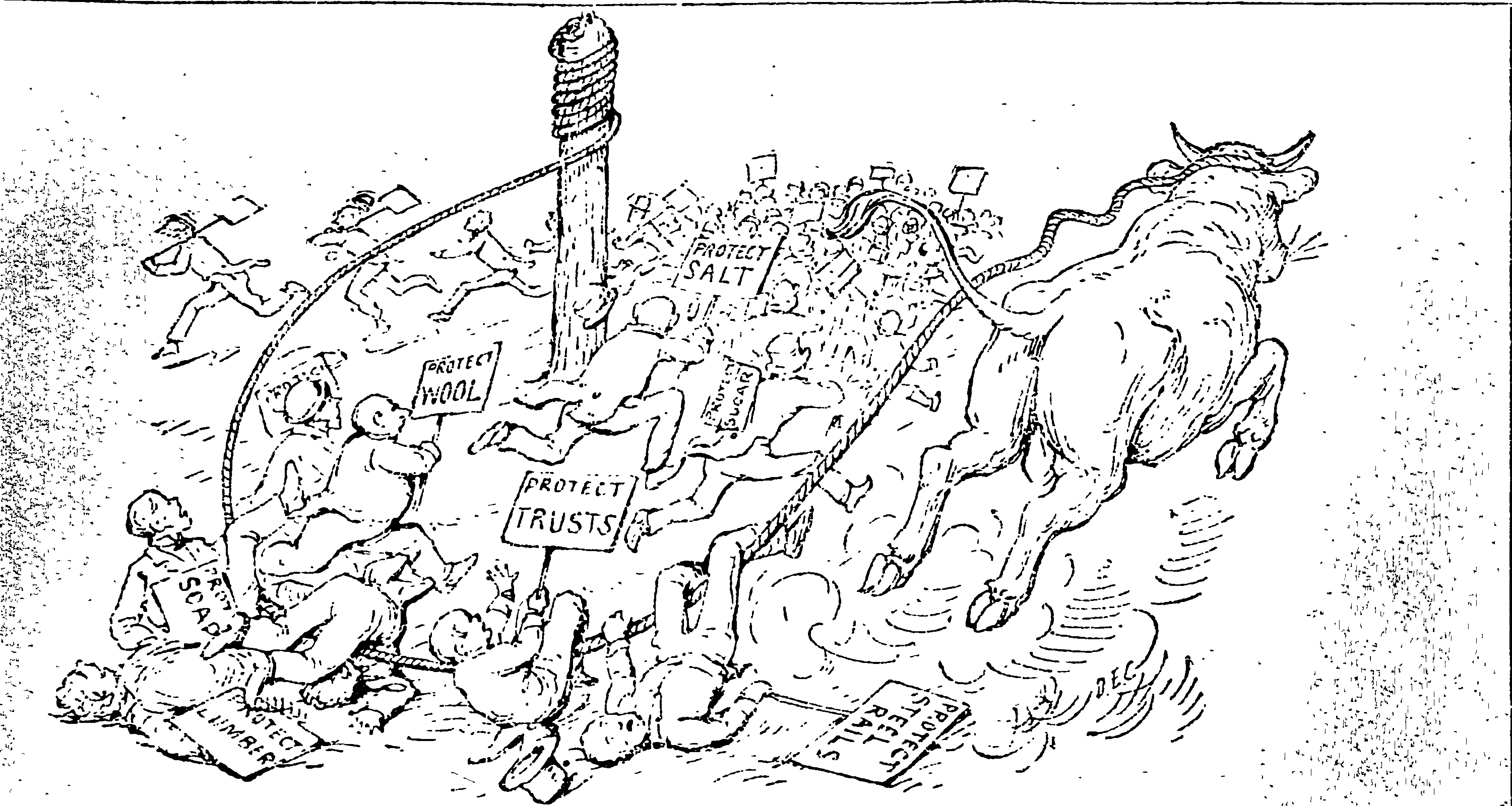
[Cartoon: a crowd of men holding placards haul on a rope tied to a post, while a charging bull at the other end untwists the rope, dragging them along and knocking them over in a cloud of dust. Placards read: PROTECT WOOL; PROTECT SALT; PROTECT TRUSTS; PROTECT SUGAR; PROTECT SOAP; PROTECT LUMBER; PROTECT STEEL RAILS; one further placard reads PROTECT [illegible]. Artist’s initials: D.E.C.]
“UNTWISTING THE ROPE.”
See Introductory Chapter “Protection or Free Trade?”
I cannot concede that I have done him injustice. If my correspondent thinks so it can only be because she has not read the speeches of Mr. Hewitt since 1884—or at least since his occupancy of the mayoralty. Taking this speech of 1884 in connection with these later expressions, the only change I could make in what I said last week would be to make the reference to the variance in his views more forcible, and style him “a man of decided but frequently entirely opposite opinions.” When a man expresses diverse opinions it is only fair to take the latest as defining his present position. Mr. Hewitt’s later speeches do show him, as I said, bitterly opposed to labor associations and their methods. The statement made since I wrote last week, that he is having a large edition of his speech of 1884 reprinted for circulation may, however, give some ground for thinking he has again reversed his opinion. Probably the fairest thing that can be said of Mr. Hewitt, as to this and other matters, is that he has nothing that can be called real, digested opinions, but is a pure “child of impulse,” to whom a thing is altogether white or altogether black, just as at the moment he may happen to look at it.
The speech of 1884, which Mrs. Lowell sends me, was made in support of the tariff reduction bill of that year. It is entitled “The Emancipation of Labor,” and in making it Mr. Hewitt stated that he addressed himself to an audience outside of the house—“an audience of men who work with tools, and who govern this house by the ballot.” In beginning it he made this manly declaration:
I fear that perhaps a majority of the great army of workers in this country stand where I stood in 1872, when I wrote the letter which the gentleman from Maine (Mr. Dingley) has just quoted. They are still in the bonds of prejudice, of false training, and of ignorance, where I was then myself. I have no apologies to make for having progressed out of the night of darkness into the open sunshine of truth. But I should have apologies to make, if, having reached conclusions which contradict those that I held years ago, I should fail in this house and everywhere to announce them with that frankness which belongs to an honest man and faithful representative.
In this speech Mr. Hewitt made a good many strong points against protection, which it is to be regretted that he has not found some opportunity to repeat, now that Mr. Cleveland’s message and candidacy has brought the question before the masses of the people in a way which has secured it an attention altogether lacking in 1884. In fact, were it not that he declared that to abolish protective duties at once would ruin manufacturers and dislocate labor, Mr. Hewitt might have passed for a thoroughgoing free trader. And one statement he made which is worth recalling, viz.: That there had been a steady degradation in the condition of American workingmen during the previous twenty years. This declaration Mr. Hewitt supported in 1884, when he was attacking protection, by citations of official reports and by his own personal testimony. But in 1886, while he was engaged in saving society, he declared that the condition of workingmen was better than it had ever been in the history of the country, and that they were getting “a constantly increasing portion of a constantly increasing product.” No one need make any apologies for Mr. Hewitt that in this matter he has progressed out of the night of darkness and into the sunshine of truth. But which he now regards as the night of darkness and which the sunshine of truth, it certainly puzzles one to say. Since he is now republishing his speech of 1884, how are we to tell? Can Mrs. Lowell see any other way of doing Mr. Hewitt justice than that of printing his contradictory statements in parallel columns?
But to return to the matter of labor associations. The degradation of labor to which Mr. Hewitt testified in 1884 he attributed to protection, his main charge
p. 1, col. 3 against protection being, at that time, that it paralyzed trades unions. In this speech he set forth trades unionism as the great cure-all of labor difficulties, the true emancipator of labor. He declared emphatically and categorically for the repeal of all conspiracy laws; said trades unions were indispensable to improvement in the condition of labor; wanted the workingmen of the country to comprehend the great fact that they have no means of bringing their employers to terms except through their labor associations; quoted approvingly the method of the trades unions of England, that of “selecting one concern at a time and putting the men there employed upon a strike until their demands had been acceded to;” and the declaration of one of the chief officers of the English association of amalgamated engineers that they proposed to continue this process until they secured all the net earnings of the railways, except a fair remuneration for capital actually employed and fair salaries for administration; and asserted the organization into trades unions “whereby labor is pooled for its own protection” to be “the weapons of attack and defense which free trade has created for the protection of workingmen, and all the protection that the workingman needs.” He closed by an eloquent picture of what the world would be in the day when industrial freedom should fully come; and declared that the way to reach this freedom was through the organization of labor.
But after all this indorsement and laudation of trades unions and their methods, Mr. Hewitt has passed, since he became mayor, to the very opposite extreme. He has not merely denounced boycotts, which are only an application of the principle of the strike, but he has denounced in the bitterest terms the very associations he before lauded, styling them secret organizations which seek to enslave labor and subject it to the irresponsible domination of men unknown. And when American railroad hands attempted to do the very thing for which he in 1884 commended the English railroad hands, he denounced them as worse than burglars and highwaymen, and declared them to be robbers of the whole community. In short, he has by many expressions too numerous and fresh to need special reference, indicated his bitter opposition to trades unionism and all its necessary methods.
In what I last week wrote of Mayor Hewitt and the other candidates I was endeavoring as well as I could to state facts rather than to make comments. But I am free to say that while regarding Mr. Hewitt’s laudations of trades unionism in 1884 and his denunciations of them in 1887-8 as equally one sided, I rather prefer the latter to the former. Trades unions, and all similar organizations of labor, as I have never hesitated to say when addressing men who belonged to them, are in their nature not good, but evil. They involve coercion, and can only be effective through coercion or the fear of coercion. The organization of men into trades unions, like the organization of men into armies, must necessarily be at the sacrifice of individual liberty, and while the methods of the one are those of passive war, and those of the other of active war, they are both destructive methods—both aim at the infliction of loss and suffering upon those who oppose them, even at the expense of loss and suffering to those who belong to them. The justification of both trades unions and armies, is not their essential goodness, but the existence of other evils which make them for a time necessary for the maintenance of a partial liberty.
The indiscriminate and unqualified laudation of trades unions and trades union
p. 1, col. 4 methods which Mr. Hewitt made in 1884 was as unjust and as unbalanced as his later indiscriminate denunciations. And it was perhaps even more injurious, as better calculated to confuse in the public mind the ideal of freedom, and to distract attention from the means by which alone it can be attained. To organize a whole people into trades unions, to pool labor and pool capital in all branches of industry, would result, not in freedom, but in an Egyptian system of caste in which freedom, and the idea of freedom, would utterly perish. Most bitterly unjust as is the denunciation of trades unions without denunciation of the monopolies which provoke and compel workingmen to combine in these defensive associations; the railing condemnation of boycotts on the part of laborers without one word in recognition of the perpetual boycott which shuts labor out from the natural opportunities for labor—it is more likely to carry with it its own antidote than is the declaration by such a man as Mr. Hewitt that trades unionism is the way, and the only way, to the emancipation of labor.
The great fact that underlies all labor difficulties is the fundamental wrong which makes the laboring class a disinherited class, and which compels men to beg and to fight for those opportunities of employing labor in the production of wealth which the lavish bounty of a merciful Creator has provided in practically limitless abundance. It cannot be said that Mr. Hewitt is entirely ignorant of this, for in 1880, in an interview in the Brooklyn Eagle, he expressed his appreciation of the impolicy and injustice of permitting what John Stuart Mill called the unearned increment of wealth to go to individuals who happened to hold possession of land which increased in value by the growth of the community. But both in his laudation of trades unionism and in his denunciations of it, he has utterly ignored this great wrong.
All this, however, is beside the question whether Mr. Hewitt is or is not, on the whole, the best choice the ordinary citizen can make among the candidates between whom he is permitted to choose. If he had not such an unfortunate habit of bobbing out of darkness into light, and then out of the light back again into darkness, there are some expressions of his which, if uncontradicted, would give him in this campaign the enthusiastic support of every single tax man. As it is, some single tax men will vote for him and some will vote against him, according as they fear the domination of one great machine, or think that one machine may ultimately be easier to overthrow than a number of smaller machines.
The one great lesson of this mayoralty campaign, is the necessity for the adoption of the Australian ballot system. What are considered the legitimate expenses of Mr. Hewitt’s campaign will, I am informed by a friend of his who has made a conservative estimate, hardly fall short of $100,000.
Mr. James J. Coogan, who now represents the united labor party, has announced his intention of sending three separate tickets bearing his name by registered letter to each voter. This will probably cost at least $35,000, while at the rate he is said to be drawing checks, employing workers and buying entertainment tickets the hundred thousand dollars which he has avowed himself ready to spend in the campaign will be fully needed in addition. Hugh J. Grant, the nominee of the Tammany machine, owes his nomination to his reputation for spending enormous sums of money, and with the hope of the control of the city government before it, his machine will add to his expenditure all it possibly can. Mr. Erhardt, the nominee of the equally
p. 1, col. 5 corrupt little republican machine, can hardly match the expenditures of the other candidates, but must still spend a great sum if he is to have any chance.
The election of any man as mayor is of trivial and temporary importance as compared with the pressing need of changing the system of elections which thus operates to the virtual exclusion from office of any but the rich or the unscrupulous. And the only way in this election to cast a vote for the purification of our politics at their foundation for the doing sic with the necessity for, and the temptation to such enormous expenditures, and the prevention of the bribery and intimidation that goes on at the polls—is to vote against David B. Hill and for Warner Miller.
The same difficulties which have made democratic government a farce in the city of New York exist in greater or less degree in every city of the union. In San Francisco, for instance, Boss Buckley, an ex-gambler and liquor saloon keeper, has through his control of nominations long been the ruler of the city government, including many of the courts. He has maintained his power by working in combination with the republican machine, so as to give to the ordinary voter but the Hobson’s choice between a democratic spoilsman and a republican spoilsman. A revolt has now been organized against machine domination in the citizen’s league, which has put up a ticket irrespective of political nicknames, and which includes republicans, democrats and single tax men. The chairman of the league is a man of the purest and highest character, my old friend Edward R. Taylor, whom the readers of “Progress and Poverty” will recognize by the verse from his pen which is prefaced as a motto to one of the books. Mr. Taylor was the law partner of Governor Haight, and though a democrat of the Jeffersonian school, has hitherto withheld himself from taking any part in practical politics. The nominee for mayor is Charles A. Sumner, late representative in congress, also a man of high character and ability; and noted for his opposition to everything that savors of machine rule. The ticket is made up of the best men of all parties, including Judges Jas. V. Coffey and James G. Maguire, who, for the very reason of their incorruptibility and impartiality; have sic the hostility of the Buckley ring. Whether this ticket can be elected or not remains to be seen. If elected it will give to San Francisco for one term good and pure government, but if nothing more is done the banded thieves will inevitably in time regain their control. The Australian ballot is the only thing that can secure good government to San Francisco, as it is the only thing that can secure good government to New York.
We use a great part of the space in this week’s STANDARD for a verbatim report of the meeting in Cooper union on last Friday night, at which Mr. Thomas G. Shearman answered questions as they were addressed to him. But, as every reader will see, the speech and answers are well worthy of the space they occupy. Mr. Shearman is doing work in this campaign that nobody else could have done as well. It is one of the enormous advantages of our single tax movement that it has afforded him and other free traders an opportunity to exert an influence in this campaign that the timid policy of the democratic management would have denied them.
The great meeting in the Brooklyn rink[,?] Tuesday evening, addressed by Thomas G. Shearman, Louis F. Post, Hugh O. Pentecost and myself, was a remarkable demonstration of the hold that the single tax idea has taken on the people of Brooklyn, and at the same time a striking vindication of the wisdom displayed by our single tax people in going into the campaign on behalf of Cleveland as a separate organization. No one who watched the meeting from the stage could possibly doubt that the arguments advanced made converts who could never have been reached by the paltry arguments of the tariff reformers who declare against free trade. The single tax and absolute free trade were presented as it would be impossible to present them from any strictly democratic platform, and the most radical utterances in behalf of a complete reform of the existing system of taxation were received with an applause that increased in volume as the meeting proceeded. Though the last speaker did not finish his address until nearly 11 o’clock, the audience held to the close, and thousands still clustered around the platform eager to hear the questions and replies, and remained there till half past 11. Many of the queries seemed to be prompted by honest doubt and called forth
p. 1, col. 6 illuminating replies; and at least one man, who had been vociferous in his applause of the name of the protectionist McKinley asked of Mr. Shearman an explanation of the goods for goods theory, and at its conclusion publicly declared that he was satisfied. There were a very large number of republicans at the meeting, and it cannot be doubted that many of them went away with their belief in protection fatally shattered. The Brooklyn members of the single tax committee deserve credit for the zeal and enthusiasm which brought out, so large an attendance of the people on a stormy night.
I spoke last week in Dunkirk, Lockport, Rochester and Syracuse, to large audiences, among whom in all cases were a great number of republicans. My opinion, from all I saw and heard, is that Cleveland and Thurman will carry New York. I am to speak on Thursday in Harrisburg, on Friday in Ithaca, and on Saturday in Binghamton.
HENRY GEORGE.
Organized in Cambridgeport.
CAMBRIDGEPORT, Mass., Oct. [22?].—The single tax people of this locality are not inactive. Sunday a meeting was held in East Cambridge for the purpose of forming a local organization to work in concert with other societies, having Boston for a center. Mr. J. F. Harrington was elected president and William Ford secretary. Single tax men are very numerous in Cambridge, notably among the Knights of Labor, which is due in no small degree to the labor of Mr. Hanaford, who is one of our most efficient workers.
Meanwhile the political situation deserves our attention. The democrats sic nominated for congress Thomas Wentworth Higginson, author, soldier and statesman. He will poll a large independent and colored vote in addition to the enthusiastic support of the single tax people, who are very numerous in the district and whose support will be very important. This is also the home of candidate Russell, who will poll a very large vote. He is an able supporter of the “ballot reform bill,” and has won the favor of organized labor.
All citizens of Cambridge and vicinity who sympathize with the single tax movement are requested to communicate with
WILLIAM FORD, 10[6?] Norfolk street.
From Another Pennsylvania Town.
AUDENRIED, Pa., Oct. 18.—The outlook in this section of Pennsylvania for the cause of the single tax and the death of the protective superstition is most encouraging. Our people cannot be hoodwinked any longer as to “protection.” It is encouraging to see the tactics the protectionist has to resort to in order to have a respectable hearing at all. Four years ago no one dared say that he favored free trade. But now our people are eager to cast off the cloak of darkness and embrace the light of truth. The only drawback we experience is due to the faint heartedness of men who stand in the way and who are afraid of their own convictions. I am happy to say, however, that we have some democrats who are not afraid to tell the truth, and they are eagerly listened to by the people.
JAMES F. SWEENEY.
Henry George in Syracuse.
SYRACUSE, N. Y., Oct. 21.—Henry George last night addressed the largest and most enthusiastic meeting that has been held in Syracuse for many years. Shakespeare hall was crowded with 2,500 people, and hundreds were outside unable to gain admission. The Herald (republican) says the meeting was the most exciting since the days of the anti-slavery meetings. When Mr. George in the beginning of his speech announced himself in favor of free trade a storm of groans, hisses and imprecations greeted him from the many protectionists in the audience, but an hour later many of the groaners were loudest in their cheers and plaudits of the convincing [logic?] and clear reasoning of the economis[illegible]s vicinity has for years been a hotbed o[illegible]tionism, and there was undoubtedly [illegible] [organized?] attempt made to disturb th[illegible] but the logic of the arguments [illegible] [vast?] audience to continued [illegible] [applause?], which effectually s[illegible] [hissing?] of the geese. Mr. Ge[illegible] questions propounde[illegible] created a sensation. [illegible] more good for the sin[illegible] [previous?] meeting held in [illegible]
[illegible] M.
[illegible] [Dunkirk?].
DUNKIRK, [illegible].—The announcement that [illegible] would speak and answer quest[illegible] [tariff?] issue filled the Opera house [illegible] [illegible] on Wednesday evening. Mr. Francis Lake, mainly to whom the successful management of the meeting was due, and Mr. M. J. Smith, accompanied the speaker on the stage. The latter presided. The close attention with which Henry George’s address was received and the loud cheers that greeted his most radical utterances leave little doubt of the inefficiency of the old time protection bugaboo of free trade. If a further proof were wanted that the meeting was not without fruit it may be stated that no less than seventeen men have since declared themselves out and out free traders.
A SINGLE TAX MAN.
An Organization Formed in Germany.
At a recent meeting held in Frankfort-on-the-Main, Germany, [118?] citizens who advocate the appropriation of ground rents by the government formed an organization, to be called the “League for the reform of land holding.” Michael Flurscheim, the editor of Deutsch Land, and the leader of the movement in Germany, was unanimously chosen president of the league, but gave reasons for declining, whereupon Dr. Wehberg, of Dusseldorf, was elected to fill the position. A constitution and declaration of principles were adopted, and Deutsch Land was made the official organ of the organization.
To Organize in Norfolk.
There will be a single tax club started in Norfolk, Va., immediately after the November election. All who wish to join are requested to correspond with Edward K. Robertson, Marine bank, Norfolk, Va.
Page 2 of 8contents
p. 2, col. 1
MORE QUESTIONS AND ANSWERS.
THOMAS G. SHEARMAN STANDS UP FOR CROSS EXAMINATION.
Another Single Tax Mass Meeting in Cooper Union—Protectionists Out in Big Numbers—Mr. Shearman’s Pungent Replies—The Indirect Taxation Dodge—Taxes Compared with Income—Absurdity of Protection in New York—What the Mills Bill Would Do—What Free Trade Has Done for Ireland—Our Markets—Effect of Free Trade on Foreign Prices—Protection and Free Trade in Australia—Pauper Labor—The South.
The announcement that Thomas G. Shearman would answer questions attracted an unusual number of protectionists on Friday evening, October 19, to the fifth great mass meeting in Cooper union, held under the auspices of the single tax Cleveland and Thurman campaign committee, for although they “do not look with favor on joint debates” and respectfully decline to be questioned in public meeting regarding the faith which is in them, they come out in a swarm when there is any prospect of giving the “other fellows” something hard to explain. So, true to his nature, Mr. Protectionist was here, there and everywhere in the Cooper union meeting, ready with questions, and the time for questioning had hardly been announced when there arose a confusion of voices clamoring for recognition by the chair.
Mr. Shearman never appeared to better advantage. His replies were sharp, clear and logical, and more than once he convulsed his audience with some curious conceit or witticism.
Owing to a misunderstanding a large number of people left the hall after Mr. Shearman’s preliminary speech, but things got warmed up to such a degree when the question and answer business got under way that the audience did not want to leave off when the regular time for adjournment arrived, and the chairman was compelled to continue the meeting for half an hour longer.
Promptly at eight o’clock Louis F. Post came forward as chairman, and after a few appropriate remarks, explaining the reason of the meeting, introduced the speaker of the evening.
Mr. Shearman’s Opening Remarks.
Mr. Chairman, Ladies and Gentlemen: I find all over the country that there are so many people who do not understand how they can be taxed at all when they never pay taxes themselves to the federal government, and who do not understand where and how protection comes in, that I have concluded that, even in talking to the most intelligent audience, it is right to assume that there are forty or fifty people present who do not understand this thing. (Laughter.)
In the few remarks which I am about to make my only purpose is to state facts in such a way as to draw out questions—the more questions the better. And I shall not undertake to reason or to explain in this speech, but simply state some conclusions.
THE sic TAXATION DODGE.
Most of you will perfectly understand in the beginning that the national government raises about $400,000,000 a year in taxes without taking one cent directly from the real taxpayers. That is a remarkably clever dodge. (Laughter.) The United States government puts its hands in all your pockets and extracts therefrom $400,000,000 a year, and yet no United States collector ever comes around to you; you never know that you have paid it, and you cannot see how you have paid it. Most of you are intelligent enough to know that you have paid it—yet there is not one who can tell exactly what he has paid; no, nor come within gunshot of telling how much he has paid. Only one thing you can tell to a dead certainty, and that is, that all that money has come out of your pockets. Another thing you can tell to a certainty, and that is that another amount, varying in different years, goes from you to the poor manufacturer, land owner and lumber stumpage owner. When you pay them only $250,000,000 a year for their share of the taxes they howl and say the country is going to the dogs. When they say that the country is prosperous, that the American workman is the prince of labor, and that he carries his three-storied dinner pail with joy to his work, that means that you are putting $600,000,000 a year into the pockets of—I cannot say manufacturers—but the mine owners, the land owners, the lumber stumpage owners, who stand behind the manufacturers. (Applause.)
WHO GETS THE BENEFIT?
The manufacturers milk you, and then the owners of the natural opportunities, land, mines and lumber, milk them. (Laughter.) That is where that $600,000,000 go, in a good booming year. That is where the $250,000,000 go, in years when everybody is wailing because the competition of the pauper labor of Europe has reduced the wages of the workingmen in America. (Laughter.)
You pay these taxes to retailers, for instance a little trifle of 80 per cent on sugar. I think that the most intelligent man does not know what 80 per cent means, applied this way; but if the government proposed taking 80 per cent off his body, it would leave nothing but his head (applause and laughter), which I think, in view of the millions of men who vote to have their own wages cut down for the sake of supporting a few rich men, is a superfluous part of the human body in many voters of the United States. (Applause.) You pay to the retail grocer 80 per cent on your sugar. The grocer pays all that to the refiner. But the grocer has got to be paid for attending to that little business of paying the 80 per cent; so he charges his little profit on that. And the refiner has to pay that over to the producer of the raw sugar; and he has his profit on that. Sugar, however, is one of the articles in which there is the least intermediate profit.
AN ILLUSTRATION.
The best illustration is a little piece of cloth. I know something about that. I never pretended to pay more wages than my neighbor did. The only difference between me and the protected manufacturers and land owners is that out of their generosity and largeheartedness they pay the same munificent wages which I pay out of my stinginess—because they can’t help it.
I am not a cloth dealer; but I have invested a little of my surplus, which I got by working for it, while Uncle Sam gets his by taking it out of your pockets, pretending he knows how to spend it better than you do. (Laughter.) I put a little of my surplus in the business of selling cloth, so I happen to know something about it. Some of that cloth is made in this country and some of it is imported. On all alike there is a tax averaging about 60 per cent. It is not more than that for this reason, that we sell it to the rich folks. If we sold it to poor folks the tax p. 2, col. 2 would be from 80 to 100 per cent—that is for the better protection of the workingman. (Laughter.) Sometimes we pay that sixty per cent to Uncle Samuel; sometimes we pay it to the protected manufacturer. When we pay that 60 per cent, of course you don’t object to our adding it on to the price of our goods. You wouldn’t be so unreasonable as that; and if you did object, we would do it all the same. (Laughter.)
So you pay the 60 per cent joyfully. Ah, but you haven’t got through yet! Before we paid the 60 per cent we bought the piece of cloth from somebody else who paid that 60 per cent, and who charges a profit of 10 per cent for doing it. But you think he only charges his profit on the original cloth, without the tax. Not a bit of it. He charges the 10 per cent profit on the 60 per cent duty as well. So we pay 66 per cent. When we get it into our shop and sell it to the gentlemen and ladies who come in, do you suppose we are so tender hearted that we charge a profit only on what the things would have cost if we had paid no tax? Oh, no! We want the small and reasonable profit of 50 per cent. Nothing mean about me. (Laughter and applause.) And we tack that 50 per cent on the 66 per cent. And where does it land then? That is 99 per cent added to the original cost; and yet we could do better in our business without this extra profit, because we could sell three times as many goods if we didn’t pay that 66 per cent.
Mind you, it is now 99 per cent, or rather 100 per cent. You remember the sportsman who boasted of having killed 99 ducks by one shot. Somebody asked him why he didn’t say 100 ducks. He drew himself up proudly and said: “Do you think I would tell a lie for one duck?” (Laughter.) So I will admit that we charge you 100 per cent, where we pay 66 in taxes. That is a pretty fair statement of the average course of business.
There are some lines of business—for instance, in earthenware and glass—where the loss from breakage is so great that they have to charge large profits in order to reimburse themselves; and the usual profit is about 75 per cent before it gets to the consumer. That 75 per cent is added to the 60 per cent which Uncle Samuel charges on every plate which you use, unless it is a piece of blank white plate; on that he lets you off with 50 per cent; but with the least decoration on it, it costs 60 per cent. The usual profit is 75 per cent to cover breakage, insurance, etc. That makes the tax cost you 105 per cent, instead of 60.
That is the way in which you pay your taxes. You pay large commissions to wholesale and retail dealers for the privilege of paying your tax to an agent, instead of paying it directly. If you would step up to Uncle Samuel’s office in the custom house and pay your own 60 per cent, you would get off with that. But you will not do that, and prefer to pay 100 per cent instead. When all this comes to be added up, there is a very nice little bill for the American tax payer.
TAXES COMPARED WITH INCOME.
Now I see before me some of the horny handed sons of toil, the princes of American labor. (Laughter.) I see also some gentlemen who do not look any more horny handed than I do; but I should judge there are some men in this audience whose income is not more than $500 a year. I will tell you a secret about that. The man who is employed at $15 a week thinks he gets $750 a year, because he figures it out at fifty or fifty-two weeks, without deduction. If he would only count up the loss of time, he is a lucky man if he gets $600 a year. The man who gets $10 a week does not average $450 a year. I talked lately with an intelligent workingman, who was receiving wages at the rate of $15 per week. He never lost an hour by negligence, never took a vacation willingly; but when he came to the end of the year, he found that his income was considerably less than $500.
If your income is $500 or less, this system of indirect taxation takes out of your pockets about $75 a year. That is nothing but a trifle to the American workingman earning $500 a year. Why shouldn’t he cheerfully hand $75 to Uncle Samuel? But wait. If there were no taxes at all, this man could live at an expense of $400 a year and save $100. So he has only $100 out of which he can pay these taxes. He cannot pay it out of what he has eaten and drank and worn. That cannot be done; it must be paid out of what you save. You could not save out of $500 more than $100; and then comes Uncle Samuel and says: “My dear boy, for the sake of keeping up your wages to $500 a year, to protect you from the pauper labor of Europe—although you have worked more hours and done more work every hour of your life than any laborer of Europe, and have produced three times as much as he to your employer—still for the purpose of protecting you against the competition of this pauper labor I am going to tax you $75. Thirty dollars of that I will get, and forty-five I will divide between your employer, the wholesale and retail dealers and a few other people, patriots all.” (Laughter.)
What has the workingman left when he gets through? He is taxed 75 per cent of his average savings; but the average of the mechanic’s tax is a great deal more than that; it is fully 80 per cent of what he can possibly save. How about his neighbor across the way who has an income of ten thousand dollars a year? How, for instance, about that eminently respectable gentleman, Hon. Levi P. Morton? (Hisses and applause.) The tax upon him is possibly 10 per cent of his savings. How about the tax on Mr. Carnegie? How about the tax on Mr. Mackay? How about the tax on Senator Stanford, who has just come back post haste from Europe for the express purpose of keeping up high wages for workingmen? What tax does he pay? Mr. Stanford does not pay a tax of more than 3 per cent on his annual savings; I doubt if he pays more than 2, but he possibly pays 3. The average workingman in this audience pays about thirty times as much.
When you get to the day laborer, the real horny handed son of toil, he pays 90. But there is one class that is especially protected by all our high tariff friends, and they clean them out altogether. That is the poor sewing girls. They tax them 100 per cent on their savings. (Applause.) That is the price that the working classes pay for the maintenance of this system. They are stripped of their last dollar in order to protect them from wasting it in riotous living.
THE ABSURDITY OF PROTECTION IN NEW YORK.
What is the object of the system? It is to prevent foreign goods from coming in here. Look at the special absurdity of it in the city of New York. The cities of New York and Brooklyn would hardly exist if it were not for foreign commerce. I do not mean to say that all of our business consists in commerce. On the contrary, we are the two largest manufacturing cities in the Union. More manufacturing is done in New York city than in any other city in the Union, and Brooklyn comes close after it. Why is it that these are the largest manufacturing cities? Why does not manufacturing concentrate more largely in Pittsburg, St. Louis, Cincinnati, or other places which are more central, for the center of population is now west of Cincinnati. Why does not Cincinnati, which is surrounded by population on all sides, while New York can only supply people westward, outstrip New York in manufacture? There is only one answer. New York is convenient to the ocean, convenient of access to those materials for manufacture which come from foreign countries; p. 2, col. 3 and it has unsurpassed, unrivaled advantages in the introduction of the materials for manufacture, which is the basis, the foundation, the life, the essence of manufacture in the city of New York. (Applause.)
And yet they say that there 100,000 sic in the city of New York who are going to vote, so far as it lies in their power, to put up a Chinese wall to prevent the entrance of materials for manufacture. For you must understand that this tariff of ours concentrates its force upon the materials for manufacture, not upon finished goods, not upon luxuries for the rich, but, exclusive of mere articles of food and drink, it concentrates seven-eighths of its force to exclude those materials without which manufacture in these great cities could not be carried on.
THE PRESIDENT’S POSITION.
One party proposes to raise the duties on these materials; and though Grover Cleveland (great applause)—though Grover Cleveland (renewed applause) does not go as far as we could wish, he has put up that thick neck of his (heaven make it thicker!) and he has said: “Gentlemen, I will live or die, I will sink or swim, on one principle, and that is, so far as I have the power, that materials for the manufacture of American goods, materials which are to be used by American workingmen, materials in the using of which American workingmen will earn American wages, shall come in untaxed.” (Applause.) That is why on this issue I am for Grover Cleveland. (Applause.) And I will tell you another reason why. It would be a capital thing of itself, that alone, if it can be carried, if you can only carry this little “Mills bill” (applause), it will raise manufacturing wages in this country. (Applause.) That one little bill, little as it is, would raise manufacturing wages in this country all around within twelve months after it went into operation, at least ten per cent, and keep them there. (Applause.) That would be reason enough for me; but there is an additional reason.
WHAT THE MILLS BILL WOULD DO.
When Grover Cleveland and Roger Q. Mills (applause)—he deserves your applause—succeed in striking out this so-called protection to raw materials, that is, a protection to the land owners and the mine owners and the stumpage owners which enables them to monopolize the materials upon which American workmen alone can work, they will have knocked out the keystone of the whole tariff system. sic.) After the keystone is pulled out the whole bridge will come down. One end of the bridge is built upon the bodies and bones of the day laborers of this country; and the other end is built upon the slender frames, the worn nerves, the toil and the tears of the sewing girls and hard worked women of this country. (Applause.)
There is still another reason. You remember the fable of the tortoise and the hare. The hare could have beaten the tortoise in the race easily, but the hare fell asleep half way, while the tortoise came crawling steadily along and got there first. They say Grover Cleveland is slow. So he is. They say he is not particularly a bright man. Perhaps he is not. But you notice there is one thing about him, he takes no step backward. (Applause.) He went into the governor’s chair in this state knowing nothing about the tariff, as ignorant of it as any man need be, and the first message he sent to the legislature was in favor of increasing the taxation on personal property—about as foolish a proposition as any one could make. That was the beginning, mind you. He got such a scoring that you never heard of it again. He did not say: “I have once committed myself and I will never change;” but he dropped that scheme because he found the potato hot. (Laughter.) He went into the presidential chair knowing almost nothing about the tariff. The pressure of circumstances upon him, the steady force of his own duty, led him to study the subject for himself. Gentlemen who had labored with him, gentlemen who had understood this subject, were much discouraged at the beginning because he seemed to take so little interest in it; but he was quietly absorbing the truth; he was reading for himself. He was like an engineer, with his finger upon the pulse of the engine; he held the lever in his hands. Although he was very slow, still he learned the lesson well, and never, never will forget it. (Applause.)
They used to say that he wore a No. 6 hat and a No. 18 collar; in reply to which I say the only fault I find with him is that he don’t wear a No. 24 collar. (Laughter.) What you need in the presidential chair is a man of honesty, good intentions and ability, and also with an enormously thick neck. They can’t frighten, bamboozle or bulldoze him. (Applause.)
CLEVELAND’S COURAGE.
We are trying to get a long way ahead of where Grover Cleveland expects to land. And any one who read his message, and a brave message it was, for he had the presidential nomination and election in his pocket, as one of his friends said, as securely as his jackknife; and he risked the hostility of the men who are now making millions from this tariff system, with which they expect to buy you up—he risked all that to go where his convictions carried him. Many a political hare is going to stop when a quarter of the way in the right direction and then turn around and go back; but this great old tortoise of a Grover Cleveland is going right ahead. (Great applause.) I tell you, in the very best sense, he will get there. (Applause.) Whether he is elected president of the United States this time or not is a small matter (a voice, “He will be elected!”), a much smaller matter than perhaps you think. If by the use of their money and their corrupt influences they defeat him now, there is no other man that the democratic party can afford to nominate in 1892, if he lives, than Grover Cleveland. (Applause.) And by the time Grover Cleveland has made four years more of this tortoise-like progress and has had four years more education (and he will get it), when 1892 comes the difference between what we want and what he wants will be so small that it will take a microscope to find it out. (Applause.)
A FEW FACTS.
Now, gentlemen, I have talked too long. (Cries of “go on, go on.”) Questions stir me up more than talk. I hope there are plenty of good protectionists here, and I hope they will ask plenty of questions—the more silly the questions the better. Now then, only a word or two in the way of facts. I assert as a fact that whenever this country has approximated toward free trade there has been a great and a steady increase of prosperity. I assert as a fact that although panics have come under a reduction of the tariff as well as under an increase of the tariff—because we don’t pretend that even absolute free trade will cure every evil in the world—I assert nevertheless, as a fact, that in proportion as the tariff was reduced the country has recovered more rapidly from these difficulties, and that panics under low tariffs have affected the wages of workingmen much less than similar panics have done when they have taken place under a high tariff.
I also assert that high tariffs have always tended to repress the wages of workingmen by resisting that tendency inherent in machinery and in the progress of society to raise wages; and the higher the tariff, the smaller relatively the wages of the workingmen. I assert that if you have absolute free p. 2, col. 4 trade declared to-night, the average price of manufactured goods would not fall below the original cost to the manufacturers. They might have to sell out their stock at cost without profit; but the whole world could not furnish enough goods to supply the demand. The demand would within one year be three times as great as the demand that exists now. Prices would rally within a month. While imports would increase, those imports would be mostly in the shape of materials for manufacture. There would be a demand within twelve months for 40 per cent more men than are now employed in this country, and the wages of manufacturing workmen would rise at least 25 per cent.
I advocate free trade because I fully believe, on principle, on theory, and from the evidence of facts, that every step toward free trade helps to raise wages (applause), and that absolute free trade would produce greater increase of wages—I mean in money as well as in purchasing power—in manufacturing industries as well as in farm labor, than you have ever known before. That is why I am in favor of free trade.
Now let me say a word to my single tax friends. My honored and noble friend, Henry George (great applause), has, in my judgment, laid rather too much emphasis upon the abstract philosophical fact that, when this great improvement came to pass in the condition of workingmen under mere free trade, without the substitution of direct taxation on land values, it would be gradually be taken from sic by increasing rents. While I agree with him that all taxes except the one on land values should be abolished, still I want to call your attention to this fact: When a great mass of millions of workingmen get a great improvement in their conditions, with the advantages of education and association which would come with this, let them control the government as they do here, and you give to those workingmen such a grip that nothing could permanently take it away from them.
WHAT FREE TRADE HAS DONE FOR IRELAND.
What is the reason that the Irish people are now, for the first time in their history, getting a grip on the land? What is the reason, notwithstanding all that the Salisburys and Balfours can do, that they have a grip on the government? Why is it that, if an election were held to-day, William E. Gladstone would be returned by 500,000 majority? (Applause.) There never was greater nonsense talked than that about England being the enemy of Ireland. The real England, the real English people, are the best friends that Ireland has. But if you mean by England only the aristocrats and dandies, the tories or protectionists, that is another thing. Every protectionist in England is an enemy of Ireland, and nineteen-twentieths of the free traders in England are friends of Ireland, better friends than all the cheap orators in this country, because they are willing to risk their fortunes and honors to do justice to Ireland. Political promotion is to be got cheaply here by flattering Ireland and Irishmen; but when Gladstone and his followers made up their minds that justice should be done to Ireland, what did they do? When nearly eighty years sic age, Gladstone sacrificed all his honors and staked his popularity for the sake of Ireland. Even then, although he was defeated by a combination of all the rich and aristocratic in England, a large majority of English workingmen voted with him.
But what I wanted to call your attention to is that, even without the tax on land values, the Irish people have got a pretty firm grip. And it is because of free trade that they have for the first time been able to get that grip. Free trade has raised wages of Irish laborers fourfold since the days of Daniel O’Connell. (Applause.) O’Connell himself declared that twelve cents a day was a full rate of wages for Irish field laborers in 1844, under “protection.” I have the report of the United States consul at Cork showing that the average rate of wages for field laborers in the neighborhood of Cork had risen under partial free trade to fifty-seven cents a day. That is not enough; but there is a world of difference between twelve cents and fifty-seven cents. It is, first, because the laborers have got a better start under free trade, and secondly, because they have the Australian ballot. (Applause.) That is why the Irish people have got a foothold; and they will not be shaken off.
Stop paying taxes out of your small savings to your employers for the sake of having them hire you. Stop paying taxes in the proportion of eighty per cent out of your savings while the Goulds, Vanderbilts and Stanfords only pay three per cent, and you will get such a grip, such a foothold, that nobody can shake you off. (Great applause.)
When the applause had subsided, and after the collection had been taken up, the chairman said: When Mr. Morton’s name was mentioned there was considerable applause. I assume from that, that there are protectionists here, who have come to ask questions. I assume they have come to ask them in a candid manner and in a fair spirit; and I trust they will be received candidly by the rest of the audience. These protectionists who are here to-night, are here at our invitation. We have invited them to come and ask questions, not for the purpose of raising any contest between members of the audience and the speaker but for the purpose of getting at the truth of the subject that is now agitating the American people. And let us treat those guests politely as guests. (Applause.) When a gentleman rises in his place and addresses the chair, I will recognize him, and having recognized him he will be at liberty to state his question, which I hope he will do as briefly as possible. At the same time, if his question requires some explanatory remarks, he may make them.
Mr. Shearman Answers Questions.
The chairman had hardly the last word out of his mouth before a dozen men were on their feet, and the first man recognized asked:
Q.—Mr. Chairman, please tell me why the average wages of the working people of the city of New York are not five dollars a week the year around? Is it not because too many immigrants land upon our shores who compete with us?
Mr. Shearman—That has something to do with it. In particular places, such as the city of New York, undoubtedly it has a good deal to do with it. But I must say I do not attach so much importance to that, as even Mr. Cleveland does. I do not think that that is the solution of the whole question; I do not think that that applies to the whole country. It requires a little explanation to state just what I do think is the effect. These immigrants are brought in, sometimes by special inducements, sometimes in such unnatural numbers, that the market is unable to absorb them, and when they are poured in by the hundred thousand, undoubtedly they do very seriously depress wages. Then, if artificial efforts are made to bring them in, as they have been made again and again, they do cut down wages. But if immigrants are left to come in in their own natural way and without any artificial inducements by tariff, or otherwise, they could not come in in too great numbers, naturally and of their own accord, because they would only fill up places where they were wanted.
THE COBDEN CLUB BUGABOO AGAIN.
Q.—Does not the free trade Cobden club pay your expenses here to-night?
The Chairman—This meeting was called p. 2, col. 5 for the purpose of allowing gentlemen to ask gentlemanly questions in a gentlemanly way. (Great applause.) And as chairman of the meeting I shall not permit any other kind of person to insult the speaker. (Applause.)
Mr. Shearman—Nevertheless, Mr. Chairman, if you will allow me, I will make an offer now which I have made frequently before. You know that the only protectionist member of congress from this end of the state is Mr. S. V. White of Brooklyn, a highly respectable gentleman, a warm personal friend of James G. Blaine (hisses and groans and applause) and a very warm protectionist. Now, I will leave it to Mr. S. V. White, with liberty to him to employ an accountant and go through all the books of the single tax Cleveland and Thurman campaign committee, with liberty to examine all my books, private and otherwise, and I think Mr. Post will give him liberty to examine his books, Mr. Croasdale his books, and Mr. George his books; and if, at the end of that time, Mr. S. V. White will certify, over his signature that he honestly believes that the Cobden club or any British organization, or even any unnaturalized Englishman, has contributed as much as $5 toward the expenses of this campaign committee which pays for this hall, I will give to the gentleman who asked that question $1,000. (Applause.) Mr. White will guarantee that I will do what I say. (Applause.)
WOOL AND WORKMEN.
Q.—What would be the consequences if wool imported from England free should cause an over production, and could not be exported to other protected countries on account of high tariffs? Wouldn’t it be detrimental to to sic engaged in such industry in this country?
A.—I will answer the question seriously presently, but it is a little amusing. It reminds me of the girl who was discovered weeping over a boiler. She was asked what she was crying for, and she said that if she should ever get married, and should have a little baby, and that little baby should fall into the boiler and be scalded to death, how unhappy she would be. (Great laughter.) The reason why it reminds me of this story is this: The question is confined to England—what will be the consequence if England should export too much wool to us. England cannot afford to export to us one single pound of wool, because she does not grow enough wool in all England, Scotland and Ireland to supply within two hundred million pounds a year, the needs of her own manufacturers. (Applause.)
The same questioner—Take Australia!
A.—Very well; substitute Australia, or we will say South America, for wool ought to come from Buenos Ayres in immense quantities. Suppose that causes an over production. Why should it cause an over production? I cannot see for the life of me why it should, for such a thing never happened and never can; but if it did, the consequences would be indeed calamitous. It would result in the frightful condition of every workingman in this country having one suit of clothes more than he knew what to do with. (Laughter.) I have traveled a little about this country, and gone into a good many taverns and into some houses, and it is my judgment, after considerable inquiry, that not one-third of the American people at this day have two all wool suits of clothes to their backs, and that not one-half of them have a genuine woolen blanket in the house. (Applause.) I think that it would take all the wool that all the world grows for use in this country, to the entire exclusion of other countries, before we could begin to have an over production. It is impossible that there should be an over production; and if such a ruinous state of things should occur as that the price of woolen goods should be only one-half or even one-quarter of what it is now, however ruinous it might be to those engaged in the industry, it would be beneficial to all other people in the country; and they are in the proportion of a hundred to one.
Q.—What rate per cent, independent of the tariff, would a workingman have to pay for taxes to carry on the government?
THE SINGLE TAX.
A.—Under strictly direct taxation, which of course would follow the total abolition of the tariff, the workingman would not pay one penny more for the benefit of good government than he would pay if there were no government at all. (Applause.) I will tell you why. Of course, whether there was a government or not, he must pay his rent; and under direct taxation all the taxes would be taken out of rent. The workingman would not pay any more rent. Therefore, under the abolition of the tariff, the workingman—I mean the man under $500 a year—would pay no per cent at all. The tax would fall on land and not on labor. (Applause.)
A GARBLED sic.
Q.—If free trade would be an advantage to this country—and according to the report of a speech made by Mr. Mills at St. Louis on September 25, he desired to place the workingmen of this country on an equality with European labor—how is it that we have so much immigration to this country from those countries? (Applause.)
A.—I will answer that first by saying that there is a text in the bible which reads, “There is no God.” That is in the bible; no mistake about it. But that is only part of the verse. (Applause.) Now, what my friend has quoted from Mr. Mills is not exactly correct; but on that I lay no stress, because he has quoted it honestly from the paper which cut out that piece without the context, in other words, quoted part of the verse. My friend is honest about it; but the paper which he read is not quite as honest as he. (Applause.)
What Mr. Mills said in substance was that he wanted to give the American workingman the same opportunity to export to foreign countries as the foreign workingman has. (Applause.) Then Mr. Mills went on to show what he meant by that—which is always carefully suppressed. As things are now, American workingmen in the woolen factories are carefully prevented from making any more than is necessary to supply the people of the United States. Our exports of that commodity are now ridiculously small. His idea is to take sic the tariff on wool so that the American workingmen could make three times the quantity of woolen goods he makes now, get 25 per cent more for making them, and then export them to foreign countries.
IRELAND.
Q.—I would like to know why it is, if in free trade Ireland, according to your argument, wages have risen 400 per cent, contributions are sent from this high protective country to help those people along?
A.—Two men starved to death at the same time. (Laughter.) One man starved to death because he could only get one ounce of bread a day, and the other starved to death because he was only able to get two ounces. The man who gets two ounces is better off than the man who gets one; but two ounces are not enough to live upon. Ireland has improved very greatly by the introduction of free trade; but Ireland has been in the grip of the landlords all this time, notwithstanding free trade; and the landlords have managed up to this time to extract from the poor people the greater part of the advantages which free trade gave them. (Applause.) But if it had not been for free trade you would have had to contribute far more to Ireland than you have done.
OUR MARKETS.
Q.—From which quarter of the globe are p. 2, col. 6 we to expect this extra demand for our goods if free trade should be adopted?
A.—I will tell you by starting a little back of that. In very round numbers—these numbers are not accurate, but they will do—in round numbers we send on an average [$350,000,000?] worth of goods every year to Great Britain; and we only receive back from it $150,000,000 worth. Do you think that Britain does not pay us for what we send? Do you think that she pays those other $200,000,000 in gold? Not a bit of it. We get paid for those extra $200,000,000 in coffee, sugar, and other things, which come from South America, the Indies, Germany, France, Italy and other countries, and we don’t pay these countries for the goods we got from them. Who does? John Bull. He pays them with his manufactures. If we had absolutely raw sic we would make those goods at home, and we would send them to Cuba and South America; and there is a market right at our doors waiting and hungry for at least two hundred millions of our exports. (Applause.)
So great is our hatred of England that, in order to punish her, we insist in sending all this trade around through England, instead of doing it ourselves. We employ English ships and pay them freight, and pay 2½ per cent commission to their merchants on all this commerce, and pay 2 per cent insurance to their companies on all this commerce, and pay them a banking commission of 1 per cent, and give them a little profit to boot. All this because we hate England so. (Laughter.) If we had free trade, our bankers would get that 1 per cent commission, our merchants would get that 2½ per cent commission, our insurance companies would get that 2 per cent insurance, and our workingmen would be employed in making those things which are now made by John Bull.
TAXES ON MATERIALS.
Q.—Mr. George said that this country has only been scratched. Wouldn’t it be better to encourage the scratching of the country by putting taxes on the material that comes out of the land, and abolishing the tariff on materials that cannot be produced in this country?
A.—You know we are nothing but moon struck theorists; that the practical men are all on the other side. (Laughter.) But let us be practical. Let us try lumber. Lumber is produced in this country. I wish all the gentlemen present who own standing forests which are desirable for lumber would please rise. Who is there that owns a forest here? Please stand up. (Continuous laughter as Mr. Shearman paused for a full minute while no one arose.) Oh, I see! it is because you are all great lumber owners. You all own standing trees in Maine, and Michigan, and Georgia and Oregon, and so on, don’t you? If you do, certainly, by all means, tax all the foreign lumber that comes in this country; because then the people outside of this hall, the few millions who do not own the lumber forests, will have to pay you the stumpage, which is from one dollar and a half to two dollars a thousand feet. One or two United States senators are said to have made about five million dollars each on stumpage. Mr. Alger, who has a barrel and was talked of for the presidency, has made about two millions. An excellent gentleman, who is a personal friend of mine and who I shall not name, has made over seven millions in that way; and all without turning their hands or doing a single stroke of work.
If you want to put more money into the pockets of the millionaires who own the lands on which these forests stand, by all means keep up the tariff on lumber. (Applause.) But if you don’t, don’t. (Laughter.)
This leads me to speak of it from another point of view. If the whole people of this country owned the forests and the mines, should we then put an import duty on things from abroad? No. It is an injury to this country to have these forests cut down, except where they are a nuisance; but they are no longer a nuisance. It is a permanent injury that never can be healed, to take away the iron and other ores under the soil. It is a necessary evil. We must have the metals, and yet we destroy the soil in getting them. If you have ever been in a mining district and seen how the country is covered for miles and miles with slag and refuse, you will see how the country is desolated and destroyed by what is called “developing its resources.” It is a necessary evil; but why shouldn’t we let other countries exhaust themselves first and we get the benefit of it?
In the next place, unfortunately, we should have to continue mining here, for the reason that there is not iron enough or copper enough or material enough in the whole world outside to supply our wants. We could not get one-third iron enough from abroad even if we had free trade.
Q.—Admitting that free trade would be for the best interests of the people of the United States as a whole, does not the fact remain that the establishment of free trade would close some industries here and transfer them to Europe? If so, how are the workers in those industries to be made to see that free trade is for their interest?
A.—I will answer that there are a few such industries. They are very few, and they are industries of such a kind that about once in every five years they do close up anyhow, and the men are all turned out and have to find other work. It is generally assumed by protectionists that people in every kind of industry are always at work under this tariff.
I don’t like to read from any but a protectionist paper, and here I have a pretty protectionist story from the New York Sun:
“Elk Garden, West Virginia.” This is two years old, but the tariff was just as high then. For the last year nothing has been done.
That is a protected industry; so well protected that never a ton of foreign coal ever reached West Virginia or ever will. It is protected by the tariff and protected by nature. The business of building railroads in this country is not protected by the tariff, but you cannot build them in foreign countries; so there is no foreign competition. Yet every four years from 100,000 to 300,000 men are turned out from this work to seek some other industry. As late as [1883?] almost 400,000 men were turned out. If you are going to get up a tariff for the sake of protecting that, your tariff will have to be so far-reaching that the effort to invent it will put any man into a lunatic asylum. (Laughter.)
My friend has probably heard that the men engaged in the iron, cotton and woolen industries will be thrown out of employment. In each one of those industries it will be utterly impossible for the whole world, if the whole world concentrated its energies, to supply us with what we need. The fact is, that every one of those home industries would be very largely increased under free trade. (Applause.)
EFFECT OF FREE TRADE ON FOREIGN PRICES.
Q.—I wish to ask one question in two parts: It has been assumed here that the price added to the imported article increased the price of that article to that extent. Now, in the case of Brazil, in 1872 the tariff of eight cents a pound was removed from coffee. Yet coffee remained stationary for several months and did not vary its price. The question is, why did not the price go down to the extent of the duty removed? (Applause.)
A.—My answer to that would be, probably, threefold. In the first place, I at any rate do not assume any such thing. I do not assume that the whole duty is added to the price of the article, provided that article is continued on p. 3 →
[article breaks off mid-sentence at the foot of column 6; no continuation line is printed on this page]
Page 3 of 8contents
THE STANDARD, SATURDAY, OCTOBER 27, 1888. 3
p. 3, col. 1 [continued from page 2]
← continued from p. 2 produced on a large scale in this country. On the contrary, the manufacturer at home only adds as much of that duty to his price as he can get. In the case of coffee and tea every cent of duty was added to the price; and yet, when the duty was taken off both coffee and tea, it is a fact that the price of tea in China went up a little, and of coffee in Brazil a good deal, and that the price in this country was not for a considerable time reduced by the amount of the duty—
The same questioner (interrupting)—Why did the coffee rise in Brazil at the very time that the duty was taken off here?
A.—It happened then as it would happen now. A cable message was sent to Brazil to all the principal merchants there, announcing that the duty on coffee was repealed, and they knew that the price would fall in this country. They knew that if that fell there would be an increased demand for coffee. They knew that even before the price fell very shrewd merchants here would rush into the market and speculate in coffee, expecting that they would get it cheap in Brazil. Hence orders were sent to Brazil—more orders than could be filled at once. The demand was expected to increase because the price fell somewhat, say a cent a pound. Brazil was not ready to supply us with all the coffee we wanted. Coffee cannot be grown in a day. It took at least a year to supply the new demand. Until that could be supplied, there being an increased consumption in America and no increased production in Brazil, the price in Brazil necessarily went up.
Then the Brazilian government said to the merchants: “You shall now pay a tax of two cents a pound for the privilege of allowing coffee to go out of the country.” This discouraged the growth of coffee in Brazil. Therefore there was not as much coffee raised in Brazil as there would have been if coffee had not been taxed; and, again, we did not get all the coffee we wanted. So for the time we had to pay a higher price by reason of the export tax. It was first paid by the Brazilian producers and part of it refunded by us.
That lasted but two years. Ever since that time the Brazilian government has gone on taxing the Brazilian merchants. The Brazilians have paid that; and they have got two cents less a pound than exporters in other countries, and we do not have to pay one single cent of that export tax. (Applause.)
The same questioner—Why do you state that the Brazilian government put an export tax on coffee, when the Brazilian minister wrote an article which appeared in the Nation and in the Evening Post, and a personal letter to me, denying that the Brazilian government had put an export duty on coffee?
A.—Assuming your statement to be correct, the Brazilian minister was more likely to know and tell the truth than the protectionist newspaper from which I took my figures. I know that these papers often contain untrue statements, but I prefer to take their own figures, and confute their own conclusions with them.(1) (Applause.)
If the whole tariff were abolished to-night—as I pray to God that some night it may be (great applause)—if it were abolished to-night, the cable would be loaded with messages from merchants in this country ordering the purchase of goods all over Europe at the prices which prevailed this morning; and they could not get them filled. When the market opened in the morning European prices would go up about one-half of the duties. Why? Because the merchants abroad would not be able to supply at once the immense quantities that we should want.
What would be the next result? Prices of some articles would fall, not by the full amount of the duty, but by about one-third of it. What next would happen? I can tell you what happened in woolen goods. A large concern, thinking that the Mills bill might pass, sent out a circular, announcing that the price of woolen goods would be reduced by one-fourth. Within less than two weeks that concern was selling three times as many goods as it had been selling before. (Applause.)
The tariff removed, the demand would be so great, not only on this but on the other side of the water, that we should mutually add to each other’s wealth. Prices would equalize like two bodies of water when the dam between them is taken away (applause); and there would be more than twice as much wealth produced.
Q.—When and where did the free trade system originate?
A.—When Cain emigrated to the land of Nod and Seth traded with him. (Laughter and applause.) Now, shall I tell you when the protectionist system originated? When the devil came to Cain and whispered: “You cannot afford to trade with your brother Seth, but you must put a high protective tariff against him to make him poor.” (Laughter.)
PROTECTION AND FREE TRADE IN AUSTRALIA.
Q.—In the two colonies of Australia, in one of which protection flourishes and in the other free trade—what is the relative condition of those two colonies?
A.—Those two colonies—one called New South Wales and the other Victoria—were originally all one. After gold was discovered in them in 1851, they were divided. For years they went along side by side under what the protectionists call free trade, that is, low revenue tariffs, and they made the most wonderful progress that has ever been known in the history of countries so distant from the mother country and from civilization.
In 1866 the colony of Victoria, being then the larger of the two and more prosperous, having more manufactures, its people took it into their heads to establish protection. At the end of twenty-two years there are more manufactures in New South Wales under free trade than in Victoria under protection. (Applause.) The emigrants whom you are told flee from free trade countries, are not doing anything of the sort there. They flee from the blight of protection in Victoria to get under free trade in New South Wales.
The reason why wages are not much higher in New South Wales is that the protected Victoria workingmen go over to New South Wales, and so keep wages down to a level. In shipping, in manufactures, in wealth, in population, in every element of prosperity, the free trade colony is ahead.
Now let me branch off a little to illustrate a protectionist trick. A paper owned by the tariff league of this country, which is the anti-Cobden club of America, reported while I was in Europe that John Jarrett had crushed me in debate by his statement that there were lately 6,000 men in New South Wales who were going about and calling for bread or blood. In that debate Mr. Jarrett had been accorded the last word, after having opened and I had answered; and he reserved this last piece of comment until he had his last word, which I was not allowed to answer. The truth of the matter is that about four years ago New South Wales adopted a protective tariff; and before this protective
- I find the fact of an export duty being placed on coffee by Brazil distinctly asserted by Secretary Frelinghuysen (Exec. Doc. No. [50?], 1885, p. [illegible]); and I, therefore, believe it to be true. It is, however, a matter of no importance. Possibly the Brazilian government put on a “tax” and did not call it a “duty[;?]” just as Mr. McKinley puts on a “duty” and insists that it is not a “tax.”
p. 3, col. 2 tariff had lasted twelve months people in Sydney were going about calling for bread or blood. (Laughter and applause.) In two years they had another parliamentary election, and by a tremendous majority they made Sir Henry Parkes prime minister, who swept away that protective tariff; and they have heard nothing more about bread or blood since. (Applause.)
MISCELLANEOUS QUESTIONS.
Q.—Are there any industries now in this country that owe their establishment or existence entirely to a protective tariff? If so, is it a good thing for the country to have those industries or not?
A.—I should say no to both questions. I do not believe that there are any such industries; and if there are any, we do not want them. They are paupers. (Applause.) We do not want pauper industry anywhere; and if we must unfortunately have it in any part of the world, for heaven’s sake let the paupers and the pauper industries stay in Europe. (Applause.)
Q.—What is the proportion of the protected industries and the industries not protected in the United States?
A.—I heard Secretary Fairchild state, as the result of a very careful examination which he had just caused to be made, that not more than four protected men of all classes, manufacturers, workingmen, and all, were to be found in this country as compared with ninety-six unprotected; and I think that is a fair statement. (Applause.)
Q.—If a seventy per cent tariff were imposed on tin plates, how would that increase the wages of the men who are carrying tin dinner pails? (Laughter.)
A.—Exactly in the same way in which any tariff increases the wages of any workingmen whatever—that is, by making the employers of one-twentieth of their number so much richer, that, if they chose to, they could pay better wages—but they won’t. (Laughter and applause.)
Q.—What benefit did the workingmen in this country derive from the tax on tea and coffee?
A.—Well, you know I don’t think he derived any; but I do say this, that if the workingman is to be taxed on what he eats and drinks and wears, and if he is to go on paying 80 per cent, while the millionaire only pays [3?] per cent, and he likes it (as he seems to do), he had better pay that tax all to Uncle Sam, as he did on tea and coffee, than to put it into the pockets of even so excellent a man as Mr. Carnegie.
Q.—When you want to buy a machine here, don’t you have to pay $80 to the manufacturers who export the same machine for only $40?
A.—Of course my friend will not ask me to assume that that is the case upon everything; but it is the fact that in a very large class of manufactures you can buy for $60 for export what you can buy only for $80 if you buy it to use at home. I can well conceive that, in such articles as steel beams, it might be as 40 to 80. But the principle of the question is sound.
For example, take cordage. The great cordage manufacturers of Brooklyn who have just been appealing to congress to increase duties, do a large business by selling for export those things at a very much lower price than they do at home. Why is that? It is because a drawback of duties has been provided. Our protectionist friends first undertook to kill commerce by a tariff; and then they tried to revive it by the drawback. And if the American manufacturer has worked over purely foreign material for export, he can get back from Uncle Samuel nine-tenths of the duties he has paid.
If you workingmen want a piece of twine to tie up your groceries, you have got to pay the full price and tax; but if the pauper laborer of Europe wants it to tie up his groceries, he gets nine-tenths of the tax paid back. That is for the better protection of the American workingman. (Great applause.)
THE RENT TAX.
Q.—If you take the tax off all other commodities and place it on land how are you to prevent the landlord from raising the rent of the workingman by adding on the tax? (Laughter.)
A.—If you deal with a landlord who does not now charge you as much rent as he can get out of somebody else, then if he were taxed he would raise his rent on you; but I am not acquainted with any such landlords. (Laughter.) The landlords I know—and I am one myself—charge all the rent they can get. If John Smith goes into my house at $500 and at the end of his term John Jones offers $600, John Jones gets the house. I am getting now all that anybody can afford to pay. I take good care of that. (Laughter.) I want you to understand that I am a land owner, and I am going to make money out of it as long as I can. Why shouldn’t I? When I have taken my share I can afford to give some back—perhaps to help you to think about it.
The same questioner—If the burden is placed on you, and you are charging me now the full value of the house, do you lose it or do I get it?
A.—You are stating a different case now. You said “land” before, and now you say “house.”
The same questioner—We don’t live on land, but in houses. (Great laughter.)
A.—They are building some tall houses now, but I never saw one that did not rest on land. My friend does not understand the distinction between land and houses. Whether the tax be put on land or houses, I am now getting all I can. But here is the distinction, which most of this audience perfectly understand. If the tax is only put on the value of the land—for example, if the lot would sell for $4,000 and no more, and the annual rental of that would be, say [$240?]—the tax might be $240, and yet I could not increase the rental, because I am already getting all that it is worth; and I can neither make nor unmake the land. If I get disgusted with the legislature and say, “I cannot pay this tax on the land,” the tax assessor says, “I will sell it to somebody who will.” If they tax the house, I shall put that on you; and if it is not paid, I could afford to keep it empty for a year, because all the other landlords would do the same and no one would increase the number of houses by building in that locality until the tenants were willing to pay the tax. In a very short time the tenants would agree to pay the tax on the houses. But if you try to add the land tax to the tenant’s rent, and houses are not taxed, hundreds of men will be glad to put up houses and rent them at a fair interest on the cost of the houses, the tenants paying nothing for the land except the tax. So I should be forced to let my houses upon the same terms.
BRICKS AND WAGES.
Q.—The New York Sun stated that a question was asked Mr. George in Williamsburg which he did not answer; and this is the question: The weekly wages of brickmakers in England is $3.54, in the United States it is $11.86 per week. Bricks are put on the free list in the Mills bill. What would be the effect on the brickmakers at Haverstraw if that bill goes through? (Applause.)
A.—As usual with protectionist statistics, this reminds me of Josh Billings’s question: “Whether it is better not to know so many things, or to know so many things that ain’t so.” (Laughter.) That statement of the difference of wages is not true. I know precisely where that is taken from. I have the book at home. It is taken from one of Carroll
p. 3, col. 3 Wright’s reports, in which he does not pretend that $3.54 is the average rate of wages of brickmakers in England at all, but that that is the average rate of wages of a very inferior class of workmen, mere boys. And $11.86 is not the average rate of wages in Haverstraw, as they all know very well, but the wages of the best men engaged in that industry. There is no comparison between those two things. The real statement of Mr. Wright is: American average, men’s wages, [$8.68?]; English, [$5.45?]. (Mass. Labor Rep. 1884, p. 158.)
Now I have learned of people who are engaged in certain industries in this country who only receive twenty-five cents a day, and I know of people engaged in the same industry in England who receive $2.50 a day. (A voice, “What industry is it?”) It is the tailoring business. But it is inexperienced girls who get twenty-five cents a day here, and they are employed in the sweating shops, of which you have as many as England has; but in England those getting $2.50 per day are very superior workmen.
However, to get to the spirit of the question, undoubtedly the workmen in English brick yards do not get as much as the American brickmakers. The American workman may get 50 or even 100 per cent more than the English workman. But the Haverstraw brickmaker makes about three times as many bricks as the English brickmaker.
I like to read from protectionist authorities, as you know. (Laughter.) I read from the New York Press of Sunday, October 14, Robert P. Porter, editor, who was until lately an officer of the great American tariff league, to which all rich protectionist manufacturers belong, and which spends thousands and scores of thousands of dollars in this campaign purely for the sake of keeping up the wages of American workingmen. (Laughter.) What says the New York Press, apropos of a question just like that in the shoe business, where the English wage worker gets $5.80 per week and the American $10.73? It says: “The explanation is very simple: The better paid American worker makes three times as many shoes as the English workman does. This increased effectiveness of labor makes the country three times as rich. The same effectiveness of American labor includes other products in the same way.” That is, bricks included; and then it winds up: “This is how the workingman gets more for his labor here than in England.” You told the truth, Mr, sic, just exactly (great sic)—wages less than double, production more than threefold. (Applause.) High wages one-third cheaper to the employer than low wages.
sic” SEAMEN.
Q.—Please let me know why American seamen get $20 to $25 and Germans about $12 per month?
A.—There are no American seamen. (Laughter and applause.) Under your protective tariff you have blotted them from the ocean. There are no American fishermen; they are all bluenoses. You are going to war with Canada and England for the privilege of hiring foreign bluenoses to run American fishing boats with bluenose captains. You have blighted American shipping and nearly destroyed American seamen. I know that three-fourths of the crews in our ships make oath that they are native born or naturalized citizens, they don’t know which. Most of them are willing to swear that they are native born, because they do not know the difference in their language between “native born” and “naturalized.” (Laughter.) But few of them are Americans at all.
Thirty years ago, when we owned three-fourths of the ships crossing the ocean—because we had approximate free trade—we did have genuine American seamen and paid them from twice to thrice the wages which English seamen received, for the same reason as in the case of the bootmaker and the brickmaker—they did three times the work and received twice the pay. If we had absolute free trade we would control an absolute majority of the shipping and commerce of the world. (Applause.)
Q.—If a protected article is sold here as cheaply as it is abroad, is not that a proof that no protective tariff is needed on that sic. (Applause.)
A.—I should say it was; but the protectionists don’t think so; they want protection just as much as ever. They profess that they are able to make many things here as cheaply as abroad; and they do it in many cases, even though they are actually taxed on the materials they use.
That reminds me of the clever little Press again. It has been exhibiting for some time suits of clothes which it says are as cheap as the same you can buy in London, which I will concede, for the sake of the argument, though I do not believe it. If it is true, then the American manufacturer, who has paid fifty per cent more than the English manufacturer for his material, must have reduced the cost of labor so much more than the cost of English labor on the finished article as to save out of wages what he paid in taxes.
PAUPER LABOR.
A young man arose and shouted: “There is a man sitting near me who says you won’t give a direct answer to a question he can ask.”
The chairman said: “Let us hear the question;” and an old man put the following question in an I-have-got-him-now-tone:
Q.—Does your being protected, Mr. Shearman, make a pauper of you? (Laughter.)
A.—It has not thus far; but I wasn’t aware that I was protected. I have been petitioning the legislature for years past to grant me one favor, as I have often told you. I want to be protected against all other kinds of labor except pauper labor. I want to compete with pauper lawyers and no others. What I object to is the competition of rich lawyers like Mr. Evarts. (Laughter.)
Q.—Can labor be a pauper?
A.—A man is a pauper if he does not labor. If he does honest labor he is not a pauper. (Applause.) The paupers of Europe do not labor and do not compete with you at all: There is no such thing as pauper labor.
Q.—Wouldn’t the farm laborer be benefited under free trade, he producing bread and meat, which are literally cheaper in this country than in Europe; and wouldn’t it be unfair for him to have this benefit while the mechanic and manufacturing workman would be thrown into competition with the cheaper labor of Europe, not being able to produce his goods as cheaply as they can be produced abroad? (Applause.)
A.—That sums up the whole protectionist argument in a nutshell; and I thank the gentleman for the question. Because the farmer earns his own living, without begging for protection, he is to be taxed for the support of others, who can earn their own living as well as he can. The competition, between farm laborers here and abroad, so far as wages is concerned, is more unfair than the competition between American mechanics and European mechanics. There are many mechanics in Europe who get as good wages as are received in many parts of America. The average wages of cotton operatives in England are higher than their average wages in the United States, outside of New England. The average wages of the coal miners of England are larger than the average wages of miners of the same kind of coal in Pennsylvania. That is not true all around. Generally,
p. 3, col. 4 mechanics’ and miners’ wages are higher here than in Europe.
But the American farm laborer’s wages are much higher than in Europe, and yet they compete with the farm laborers of Europe and beat them out of the field. (Applause.) Why? I have here the speech of Senator William P. Frye, in which he says he has traveled all over Europe and watched the laborers at work; and that the farm laborers there do not do one-sixth of the work done by farm laborers here in the same time.
There is not as high a duty on the import of wheat and grain and other farm products. as on sic; and that duty is confessed to be a humbug and only imposed in order to catch the farmers’ votes.
DIRECT TAXATION.
Q.—Under the present social system, if there were no tariff, what rate would the workingmen have to pay for sic revenue? You claim he now pays 80 per cent. I doubt it.
A.—Do you also mean no indirect tax? When I say no tariff I mean that which follows as a necessary consequence—the total abolition of all indirect taxation. (Applause.) When that is done I would like to see any system under which any government could get a large amount in direct taxation from the average laboring man in this community.
We had an income tax during the war. There never was a time in which an income of at least $600 was not exempted under the income tax. How many mechanics, how many small farmers get $600 a year? In the second year the exemption was increased by allowing house rent also. How many mechanics came under that provision? If you raise all your taxes by an income tax, the mechanics and laboring classes would not be touched at all and would not pay a cent.
Mr. Post suggests that this would only be so if we make an exemption. But there is not a country in the world which does not make an exemption, even Germany. England makes an exemption of $600. No workman would pay one cent of income tax. That is why, for one reason, you cannot get the income tax. (Laughter.) That is why the income tax was abolished.
Still, I am not in favor of restoring the income tax, for another reason. You cannot collect it honestly; only the honest man would pay, and the dishonest man would swear off. (Applause.)
THE SOUTH.
Q.—How is it that the greatest advocates of free trade in this country never paid labor anything? I refer to the southern slaveholders.
A.—I should like to know by what right the gentleman calls the southern slaveholders the greatest advocates of free trade?
The same questioner—Because their constitution provided for it.
A.—They were out of the Union then; and so they were not the greatest advocates in the Union. In the next place, the south has never been the advocate of real and absolute free trade. They never wanted it. They wanted a tariff for revenue only, and a uniform tariff of 20 per cent on everything.
Among the greatest advocates of free trade, absolute and entire free trade, was a man whom I never supposed was a southerner or ever loved by the south. His name happened to be William Lloyd Garrison. (Great applause.)
I try to meet the spirit of all questions, and though I may wander a little at times, it is only to illustrate some important points suggested by the subject. It is true that since 1824 the bulk of the southern vote has been in favor of a tariff for revenue only, and is getting more and more so all the time. Was it because they had slavery? (A voice, “They loved England.” Laughter.) When the south governed this country we were quarreling with England all the time, on the verge of a war with England half a dozen times, and actually made war once. (Laughter.) The war of 1812 was forced on by the south. The reason why the south was in favor of a tariff for revenue only is perfectly simple. They were an agricultural people. They did not know how to manufacture; they did not care to manufacture. Their climate was unfavorable for manufacture; but it was favorable for the raising of cotton and similar raw materials. Their interests were on the side of having a large export trade and buying their goods as cheaply as possible. They did not have among them thirty or forty thousand manufacturers making money out of the system, as the north did.
But the south was in favor of many other things. South Carolina was the only state in the Union which before the war never had any divorce laws. The south as a whole was in favor of very stringent rules of morality. The south as a whole was very devoted to the Christian religion. Louisiana and Maryland were the best Catholic states in the Union. Does that make Catholicism a bad thing? Some of the other southern states were among the most devoted Protestant states in the Union. Does that make Protestantism a bad thing?
But the south had one evil thing; it had slavery. Some of the men who compelled the south to relinquish the slavery of the black man are anxious to impose upon us the slavery of the white man. (Great applause and cheering continued for several minutes.) I am against slavery, whether white or black. The Lord be praised that he makes the wrath of the wicked to praise him. The Lord be praised that he sets one kind of evil over against another, and that one set of sinners is disposed to fight another. When rogues fall out, honest men get their dues.
Our friend wouldn’t have one thief fall out with another. I would. That is our only chance. That is the only chance we had in the past. While the south was stealing one kind of labor it fought against the man who was stealing another kind. I helped the north to stop the stealing of one kind of labor and would do it again, and now I will help the south to stop the stealing of another kind of labor. What I want is freedom—free trade, free land, and free men. (Great applause.)
WAGES AGAIN.
Q.—Under a lower tariff, in 1857, what were the wages of cotton weavers as compared with the high wages of 1867 under a high protective tariff, and why the difference?
A.—I lived in both those periods. You couldn’t have selected two more unlucky years for the protection theory if you tried The sic of the cotton employes in 1867, when estimated in gold and in purchasing power as compared with the prices of their goods, were notoriously, uniformly and unquestionably lower than they were in 1857, that being a free trade year and the other a high protectionist year. (Applause.)
[NOTE.—The increase in cotton weavers wages in New York between 1860 and 1867 was [3?] per cent in gold, but the increase in the cost of living was 27 per cent in gold. See sic, [312?], [328?]]
Q.—Isn’t it the fact that the tariff produced another industry besides the pauper industry—the industry of the trusts? (Laughter.)
A.—Notoriously.
Q.—If the tax were place on the sic, how could we get sufficient taxes to govern this city, provided this city was valued at the sum of $25, its original cost. (Laughter.)
A.—Give it up. (Laughter.)
Q.—Is not the competition among manufacturers
p. 3, col. 5 here in the United States great enough to keep the goods at such prices that they only make a very small margin of profit? If so, how much do the consumers contribute to the support of the government, assuming that we all use American goods?
A.—If we all used only American goods, the national government would go into bankruptcy. I sat at a table on the [25th?] of March with the Commercial club at Providence. Senator Aldrich sat on one side of me, Senator Chace on the other. Senator Aldrich was displeased because there were some half dozen woolen manufacturers there who wanted free wool; and he informed the audience that they were making [$500,000?] a year apiece. They were getting a little margin of profit, weren’t they?
You know that Mr. Carnegie has acknowledged to making $1,500,000 in one year. He has indeed given largely of this to the cities of Pittsburg and Allegheny and to charities, but he has some margin left over and above that. Mr. Hewitt demonstrated that the Edgar sic steel works had earned on their capital and had secretly divided over three millions of dollars among a few stockholders. The thirteen steel rail companies made a profit of over $20,000,000 a year for several years.
When consumers buy American goods they contribute nothing to the support of the government; but the whole of their contributions go into the pockets of protected manufacturers, mine owners and stumpage owners.
The meeting closed with cheers, several men crowding around Mr. Shearman to ply him with further questions, which he courteously answered.
LITTLE HOMES.
A Washington Man, Who Owns a Small Piece of Property, Figures Out Just How Shifting All Taxes to Land Values Would Affect Him.
WASHINGTON, D. C.—A point raised in a discussion not long since in the rooms of the Young men’s Christian association of this city between members of that organization and single tax advocates, upon the merits of the single tax, set me to thinking. It was not the charge of “immorality,” nor the cries of “communism” or “confiscation,” nor yet the fear of public officials making any greater misuse of their power or of public moneys than at present that affected me. They had long since been answered to my satisfaction. What disturbed me was the question as to what would be the effect of exempting from taxation “all the magnificent residences of Washington, its costly warehouses, with their immense stocks of merchandise; its banks with their hoards of wealth; its street railways, its gas works—in short, everything that constitutes a city as distinguished from the land itself on which the city rests—exempting all these and placing the whole burden of taxation upon landowners—many of them persons in very moderate circumstances, who by years of hard work and close economy have managed to secure little homes, the present tax on which they can hardly pay.”
Precisely what the financial result of piling up all taxes upon the owners of the soil would be was a question which, as I returned home from the discussion, I could not answer.
The point simply stated was here: My home, consisting of a lot assessed (much below its market value) at $300 and a home assessed (also much below its market value) at $1,300, cost me in taxes, at the rate of one and a half per cent, $24 a year.
It will be seen that more than three-fourths of the tax fell upon the house. Considering the matter as an original proposition, I should have argued that for working hard during all the years from boyhood till the prime of life, for having by self-denial and frugality saved up nickels and dimes enough to have got my home, and then by giving employment to cellar diggers, brick layers, plasterers, carpenters, plumbers, painters, furniture dealers and many other workmen—I really deserved a bounty, not a tax, and that I should at least have been free of the tax of almost twenty dollars which fell upon my house. But while I reflected the time worn simile of the fish in the frying pan occurred to me. Might not the adoption of the single tax work a still worse effect upon me? In other words, if all the taxes which, under the present system, are paid by men who live in residences a hundred fold more costly than mine—by the merchants and bankers and bond holders and other wealthy men of this rich city—were all concentrated upon land values, would not my share of the tax amount to more than the sum which I was already paying?
Not until very recently have I been able to obtain the data that would enable me to answer this question. But the officials of the district have just made public the statistics of the assessed valuation of property within their jurisdiction. They are as follows:
Washington city—value of ground, $49,648,393 —improvements, 53,237,650 Total value of real estate, . $102,886,043
Georgetown is to Washington city what Brooklyn is to New York—being separated by Rock creek, which is only from twenty to fifty feet wide. Here are the figures given for
Georgetown—value of ground, . $2,981,532 —improvements, . . 3,006,350 Total value of real estate, . . $5,987,882
Besides Washington and Georgetown there are in the district a number of suburban villages:
Smaller villages—value of ground, $2,045,750 —improvements, . 1,750,350 Total value of real estate, . . $3,796,100
Summing up the above, we find the value of the city and village real estate to be $112,670,025, and the tax levied thereon, at the rate of 1½ per cent, would amount to $1,690,050.
There is in this district certain land not wholly covered by cities or villages that is called “agricultural land.” Such land is assessed at a low price and taxed at only one per cent. This is done ostensibly out of consideration for the farmers; but, bless you, there is no farming in the proper sense of the word carried on in the District of Columbia. This land is nearly all owned by real estate speculators or syndicates, who are “holding it for a rise,” and it is for their benefit, and not that of the farmers, that it is taxed as “agricultural lands.
Agricultural land—value of ground. [$2,607,928?] —improvements . . 905,150 Total . . . . . $3,513,070
The revenue from this land at one per cent would be $35,130.
All the personal property that can be found in the district amounts to $11,728,672; the revenue from which, at 1½ per cent, would be $175,930.
Adding together the revenue from the several sources above mentioned, we find the aggregate revenue expected would, in round numbers, amount to $1,901,000.
Now the question is: In order to raise this $1,901,000 by a tax on land alone, what would the rate of taxation need to be?
The value of the ground alone in the District of Columbia amounts to: Washington, $49,648,393; Georgetown, [$2,981,532?]; other villages,
p. 3, col. 6 $2,045,750; miscalled agricultural land, [$2,607,928?]; total, [$57,283,603?].
The proportion which the revenue to be raised, $1,901,000, bears to the value of the land in the district, [$57,283,603?], is a little less than 3 1-3 per cent.
So if the single tax plan were in operation here, the tax upon my lot, assessed at $300, would be $9.95, a little less than $10.
And now, in view of the objections raised by my young Christian association friends to the single tax, I would like to inquire:
If it would be “communism” for me to pay into the common treasury $10 a year tax for the use of this land, which I did not make nor hire any one to make for me, what is the correct name for it now when I pay into the common treasury $24 a year, principally for a house which I built or hired some one to build?
If the payment of $10 a year tax would “practically amount to the confiscation” of my property, what does the payment of a tax of $24 a year practically amount to?
If in paying $10 a year tax I should be furnishing a share of the public revenue that ought to be paid by the bankers and merchants and bondholders and other capitalists of the city, whose share of taxation is being shifted on to my shoulders now, when I pay a tax of $24 a year?
If I can cultivate my love of home and all the attendant virtues, and rejoice in the thought that I have a permanent abode, a place to lay my head when I become old and unable to work, a home hallowed by a thousand endearing associations to transmit to my children after I am gone—if I can do this now, when I am paying a tax of $24 a year upon it, what would hinder my doing the same if the tax were only $10 a year? And why, or in what respect, would my home be in greater jeopardy at the hands of irresponsible or corrupt government officials in the one case than in the other?
I pause for a reply.
J. L. MCCREERY.
Tidings from Scotland.
CAMPBELTOWN, Scotland, Oct. 6.—Our local paper devotes more than two columns of space to an account of a meeting the Scottish land restoration league held here a few days ago. The speaker of the evening was the noted Donald Macrae, school master at Ballallan, in the island of Lewis, who figured prominently in the deer raid in Lewis not long since, and who, when he was tried before the lords in Edinburgh, declared he would meet the solicitor general at Philippi. He has fulfilled his promise. During the holidays he has been down at the island of Arran, the solicitor general’s constituency, and has been holding forth on the land question at a fine rate. While traveling through Arran one of the first surprises he met with was when handed a copy of THE STANDARD, your paper, in one of the most unexpected places in the world.
Mr. Macrae’s Campbeltown address was one of the best expositions of the land question which our people have heard since Henry George was among us, and his declaration that “we want the restoration of the land to the people of the Highlands on fair terms and at a fair rent,” struck a responsive chord in the breast of every one of his listeners.
The land reform movement of Scotland has sustained a severe blow in the death of Mr. Finlay Bell of Glasgow, who by his personal services and with his means did much to spread the truth. It was he who induced me to join the land league and to become a subscriber to THE STANDARD.
But though some of us fall, the truth “goes marching on,” and we have been able to return to parliament one more member in favor of land law reform.
J. BREAKENRIDGE.
Personal.
Mr. James Clancey of the New York Herald last week attended a republican meeting in Clifton, New Jersey, and being taken for an orthodox Harrison man, was pressed to make a speech. Beginning with a glowing laudation of the greatness and prosperity of the nation, which excited much applause, Mr. Clancey, to the mingled amusement and disgust of the audience wound up with a fervent appeal for Belva Lockwood.
A. J. [Kintz?] of Canton, Ohio, is advocating absolute free trade in the Canton News-Democrat. He is a single tax man.
Why He Is a Free Trade Republican.
J. H. Crossman of Washington recently sent to the Post of that city the following letter, which must be very interesting reading for protectionists:
I have been a republican since that party was organized. Lately I have considered myself a “free trade” republican. But I am left out of the party by its leaders, and am told there is no room for me with my present views in its ranks. A scrap of local history will suggest to the reader [one?] of the reasons that influenced me toward free trade. The state of Ohio is now a great and powerful state. Seventy-five years ago it was an infant state, and its industries were of an infant character. Prior to that time a few enterprising young men, mostly from New England, took each an ax in his pack, and started for the Ohio river. On arriving there they encamped on the west bank of the stream. There, having handled their axes with the native hickory (still considered the best in the country), they commenced to construct a state. For a generation they carried on a conflict with natural obstacles and native Indian foes. As communication began to open with the east a new difficulty presented itself. There was no tariff and nothing but high rates of freight to prevent a flood of eastern goods coming to them. Any quantity of axes could be [shipped?] out to them at lower prices than the home blacksmith could make them for. But they had no money to pay for them, so for a while their smiths made them and took their pay in corn, charcoal and pork.
They soon began to raise corn and cattle and manufacture [plain?] lumber. Not having an eastern market for these, they constructed flat boats and started down the Ohio and Mississippi rivers to New Orleans. Here they found cotton brokers and cash. The planter could sell his cotton for gold and with it buy their cargo. Therefore, exchanging their hoop poles for Cuba molasses, they took money for the balance and started home. On reaching home they found the Yankee trader there with plenty of all kinds of goods, which he offered to ship by water to New Orleans and then reship to where Pittsburg now is. So the Ohioans bought what they most needed and paid cash. The Yankees never lost sight of them after that time.
But the Ohio boys did not want to pay out all cash for goods; therefore they exerted themselves to produce such things as eastern people would take in exchange for their commodities. They offered hickory, corn, cattle and wool for codfish, furniture and crockery. After awhile Ohio discovered that her natural resources were greater than those of New England, and that if she had the labor she could outsell and undersell New England in everything but fish and Atlantic Monthlies. And that is what she is doing to-day. And the history of Ohio illustrates to my mind the folly of protection. Is it possible that Ohio could have reached her present greatness with a line of custom houses around her borders and an army of paid officials prying into the domestic affairs of each household? And if she, under a simple “free trade” policy from the start, has protected herself against the cheap labor and cheap goods of her sister states in the east, what is to prevent her from protecting herself against far off England and other European governments and countries? The other and primary reason for my being a free trader is found in its justice.
Page 4 of 8contents
4 THE STANDARD, SATURDAY, OCTOBER 27, 1888.
p. 4, col. 1
THE STANDARD.
HENRY GEORGE, Editor and Proprietor.
Published weekly at
12 UNION SQUARE, NEW YORK CITY.
TERMS, POSTAGE FREE.
One year, $2.50; six months, $1.25; single copies, 5 cents.
Entered at the postoffice, New York, as second class matter.
Communications and contributions are invited, and will be attentively considered. Manuscripts not found suitable for publication will be returned if sufficient stamps are sent for return postage. No notice will be taken of anonymous communications.
Contributions and letters on editorial matters should be addressed to THE EDITOR OF THE STANDARD, and all communications on business to the PUBLISHER OF THE STANDARD.
THE STANDARD wants an agent to secure subscribers at every postoffice in the United States, to whom liberal terms will be given.
THE STANDARD is for sale by newsdealers throughout the United States. Persons who may be unable to obtain it will confer a favor on the publisher by notifying him promptly.
Sample copies sent free on application.
SATURDAY, OCTOBER 27, 1888.
THE STANDARD is forwarded to subscribers by the early morning mails each Thursday. Subscribers who do not receive the paper promptly will confer a favor by communicating with the publisher.
THE STANDARD advocates the abolition of all taxes upon industry and the products of industry, and the taking, by taxation upon land values irrespective of improvements, of the annual rental value of all those various forms of natural opportunities embraced under the general term, Land.
We hold that to tax labor or its products is to discourage industry.
We hold that to tax land values to their full amount will render it impossible for any man to exact from others a price for the privilege of using those bounties of nature in which all living men have an equal right of use; that it will compel every individual controlling natural opportunities to either utilize them by the employment of labor, or abandon them to others; that it will thus provide opportunities of work for all men and secure to each the full reward of his labor; and that as a result involuntary poverty will be abolished, and the greed, intemperance and vice that spring from poverty and the dread of poverty will be swept away.
MR. WANAMAKER’S RIBBONS.
Mr. John Wanamaker is a candidate for presidential elector on the republican ticket in Pennsylvania. He is also a store keeper in Philadelphia, where by dint of courtesy, fair dealing and strict attention to business, he has succeeded in building up an establishment of which the Quaker City is justifiably proud.
In his capacity of candidate Mr. Wanamaker regards the purchase of things from foreigners as sinful. The man who buys a suit of clothes from an Englishman when, by merely paying a few more dollars, he could buy almost as good a suit from an American, is guilty of an offense against public policy, and ought to be restrained by law. But in his capacity of storekeeper Mr. Wanamaker adjusts his conduct to an altogether different code of ethics. His storekeeping conscience permits him to do freely those things which his political conscience denounces as crimes. He actually sends men over to France and England and Germany every year, and sometimes twice a year, on purpose to purchase things for him. And when he gets the things he promptly puts them on sale in his store, and by cunning advertisements and otherwise does his best to induce his fellow citizens to buy them; thus, on well known protectionist principles, striking deadly blows, day by day, at American labor.
In one of his storekeeping moments Mr. Wanamaker bought a lot of ribbons from a European pauper, and brought them to this country. He didn’t do it in any underhanded way. He went up to the custom house and confessed the crime. He told them what he had paid for the ribbons, and produced a certificate from an American consul in Europe to show he wasn’t lying. The custom house men thought a fine of half the value of the ribbons would be about right. Mr. Wanamaker protested that they were really too hard on him; but nevertheless paid the fine and took away the goods. Then he added a profit to the cost of the ribbons, and another profit to the duty on the ribbons, and stuck an advertisement in a protectionist newspaper urging Philadelphia femininity to come and buy a magnificent lot of imported ribbons, offered at prices far below their real value. The Philadelphia fair responded with a rush, and the ribbons sold like hot cakes.
Then, when the ribbons were all gone and he had got back all the money he had paid in fines, and a profit on it besides, Mr. Wanamaker the storekeeper, consulted a lawyer, and brought suit against the head custom house man of Philadelphia, claiming that the proper punishment for importing the ribbons should have been a fine of twenty per cent instead of fifty. And the court has decided in Mr. Wanamaker’s favor, so that, unless the case is appealed and the decision reversed, he will get back sixty cents out of every dollar he paid in custom house fine. His account with each dollar’s worth of that lot of ribbons will then stand thus:
DR.
To cost of ribbon . . . . . . . . . . $1 00
To duty paid on same . . . . . . . . 50
$1 50
CR.
By sale of ribbon at, say 20 per cent profit on cost and duty. $1 80
By duty refunded . . . . . . 30
2 10
Net profit on transaction . . . . $0 60
So that Mr. Wanamaker the store p. 4, col. 2 keeper, as the result of his pauper labor transaction, will pocket a profit of sixty per cent on the cost of the goods, or forty per cent on the price paid for them by consumers; and has done it so deftly, and in such a roundabout, hocus pocus kind of a way, that he can actually defy competition by smaller store keepers while realizing this enormous profit. No wonder Mr. Wanamaker the candidate should support a system that enables Mr. Wanamaker the store keeper to exploit his customers in such glorious fashion.
But where Mr. Wanamaker the candidate makes a mistake, is in supposing that the American people are willing to keep on sacrificing themselves for the sake of Mr. Wanamaker the storekeeper. Women who want French ribbons are actually beginning to ask themselves if they couldn’t be bought, on the whole, in some more economical fashion than by paying Mr. Wanamaker the storekeeper $1.80 for every dollar’s worth of them. Storekeepers who are being crowded out of existence by Mr. Wanamaker’s great bazar are beginning to see that if it were not for the protective duty juggle they could do more business on less capital and thus make the crowding out process more difficult. Farmers who find the prices of their products regulated by the competition of foreign farmers in foreign markets are inquiring if it might not be a good thing to subject Mr. Wanamaker to a little of that same competition. And lastly, the men and women who work in “protected” silk mills and other industries are observing that while they grow poor producing “protected” goods, Mr. Wanamaker gets rich by selling the very foreign “pauper made” things he is pretending to protect them against. In short, the American people are discovering that the “protection” Mr. Wanamaker the candidate is so anxious to secure is protection for Mr. Wanamaker the store keeper; and that his anxiety about pauper made goods is not by any means that the people shouldn’t buy them, but only that his establishment should have a monopoly of selling them.
WET THROUGH AND DON’T KNOW IT.
The truth soaks into some people without their knowledge or intent, just as excited men get wet with rain without knowing it. Here is a little story which the Press published on Sunday last with no more perception of its real meaning than an expert parrot would be likely to have of the Sermon on the Mount. To the Press the story is nothing but a moderately good joke. It heads it, “A new kind of brick. An inquisitive little boy and a puzzled father’s dialogue. Translated from the German.” As a matter of fact, it is a single tax tract, which was first printed about six years ago:
A rich man was taking a walk in his brick yard with his little boy one morning, when the following conversation took place:
Tommy—What sort of a place is this, pa?
“This, my boy, is a brick yard.”
“Who does it belong to?”
“It belongs to me, my son.”
“Does that big pile of brick belong to you, too, pa?”
“Yes, Tommy, it belongs to me.”
“Do those dirty looking men belong to you, too, pa?”
“No, my son; in this glorious land of liberty there can be no slavery. They are free men.”
“Why do they work so hard?”
“I don’t know, my son.”
“Does anybody steal what they make?”
“Of course not, Tommy. How do you come to ask such questions?”
“But, pa, don’t the bricks belong to those men who make them?”
“No, my son, they belong to me.”
“What are the bricks made of, pa?”
“Of clay, Tommy.”
“What? Out of that dirt?”
“Yes, Tommy.”
“And nothing else?”
“No, Tommy.”
“Who does the clay belong to?”
“To me.”
“Did you make it?”
“No, my son; God made it.”
“Did God make the clay especially for you?”
“No, I bought it.”
“Well, pa, did you buy the clay from God?”
“No; I bought it just as I buy anything else.”
“Did God sell the clay to the man you bought it from?”
“I don’t know, Tommy. You ask more silly questions than I can ever answer.”
“It’s a good thing you own the clay, ain’t it, pa?”
“Why, Tommy?”
“Because if you didn’t you would have to work like those dirty men. Will I have to work when I get to be a man?”
“No; I will leave you all my property when I die.”
“When these men die won’t they all turn to clay?”
“Yes; we all return to clay when we die.”
“When are you going to die, pa—pretty soon?”
“I don’t know, my son. Why do you ask?”
“I was just thinking what a nice lot of bricks you would make after you are dead.”
We are anxiously watching the columns of the Press for the second part of this little dialogue, in which Tommy, observing the stream of buyers for his father’s bricks, inquires:
“Why do they come to buy of you, pa?”
“Because they can not help themselves, my son.”
“But are there not other people who make bricks as well as you?”
“Yes, my son; but my customers are not allowed to buy from anybody else. If they should do so they would be fined or imprisoned.”
“Is that right, pa?”
“Quite right, my son. Because if they were allowed to buy elsewhere I should have to sell bricks cheaper, and my industry of owning a clay bed would be discouraged.”
“Then if there were no clay bed here, your customers would get bricks cheaper than they do now?”
“Yes, my son; but in that case I should have to go to work like any common man. As it is, the Tariff protects my industry and enables me to live without work.”
“Pa, did God make the Tariff?”
“No, my boy; the men who buy bricks from me made it.”
p. 4, col. 3 > “But did God make them?” > > “Yes, my son. Why do you ask?” > > “Because I think he didn’t make ’em very smart.”
The man who drew the resolutions adopted at Tammany hall last week ought to try his hand at such work once more and then have a statue erected to his memory. The resolutions “especially approve of the principle recognized in the Mills bill,” and would have been a model for brevity and good sense had they stopped there. But they went on to define the principle recognized in the Mill’s sic, and oh, what a definition! “That all tariff laws should be based as far as possible upon the difference in the rate of wages in the United States and in European countries”—this part of the definition, all things considered, is not so bad; but keep your face straight and read the continuation—“while admitting free of duty those raw materials which are essential to the development of our manufactures, and in the production of which labor is not an essential element!” Does Tammany hall suppose that the Mills bill admits mineral deposits and lumber forests free? These are indeed raw materials “in the production of which labor is not an essential element,” and so are all other kinds of land; but they are a kind of raw material that we do not, and are never likely, to import. And aside from land in its natural state, or possibly the brains of a Tammany resolutionist, we should very much like to know what “raw materials” there are “in the production of which labor is not an essential element.”
The democrats of Colonel Merriman’s district have refused to renominate him on the ground that he voted against the Mills bill, and he threatens to run as an independent candidate. We hope he will. Let him go before his constituents with his record. If they are protectionists he ought to be returned; if they are not he should be defeated. His independent candidacy is to be welcomed. It will make the canvass in that district, which is colorless, turn upon the tariff question, and force the democratic candidate to take a more radical position than otherwise can be expected.
THE CAMPAIGN “STANDARD” FUND.
Here are two more “sowing society” letters:
NEWARK, N. J.—I hereby join the “sowing society.” I see no reason why the roll of membership should not soon surpass Credo’s expectations.
W. E. DORN.
NEWARK, N. J.—Credo’s idea for sowing the seed has my hearty approbation. I inclose twenty-five cents, and take pleasure in joining the sowing society. May its members become legion.
AUG. DORN.
The campaign fund has only a little while longer to live. Scarcely more than a week remains during which we can hope to influence men’s votes by STANDARD arguments and single tax literature.
But a great deal can be done in a week. A great deal can be done, if only the means to do it [are forthcoming?]. It rests with you, STANDARD readers, to say whether it shall be done or not.
Here are one or two stories of what some STANDARD readers have been doing:
DUNKIRK, N. Y.—Inclosed find $1, for which send THE STANDARD to the address below until the close of the campaign, and use the balance for spreading the light.
I feel very happy to-day after your lecture of last night. I only wish that those republicans that came there to trouble you could feel as happy. You have my best wishes that you may succeed in the gigantic work you have undertaken. God bless you.
MRS. F. LEAKE.
WINCHESTER, Cal.—I send you $1 for the campaign fund. I wish I were able to send more; it would give me great pleasure to do so. I am a single tax man, a free trader, and will vote for Cleveland and Thurman. I send you the name of another single tax man that will do the same.
JOHN NICHOLSON.
NEW YORK CITY.—Inclosed find check for $25, a contribution to THE STANDARD fund from my father, S. Mendelson.
WALTER MENDELSON.
Here is the story of the fund for the past week:
J. McDonough, City . . . . . . $5 00
J. T. Ford, Binghamton, N. Y . . . . . . 5 00
Aug. Dorn, Newark, N. J . . . . . . 25
W. E. Dorn, Newark, N. J . . . . . . 25
A. Granger, City . . . . . . 1 00
G. A. McFarlance, Jasper, Ala . . . . . . 2 00
C. A. Crouch, Barlow on Sound, N. Y . . . . . . 25
Herman Kuehn, Indianapolis, Ind . . . . . . 30
R. G. Kent, Indianapolis, Ind . . . . . . 50
F. S. Briggs, New Hamton, sic . . . . . . 3 00
Ben Carman, Brooklyn, N. Y . . . . . . 1 00
James McKinley and G. Harnwell, Whitestone, L. I . . . . . . 2 00
E. F. Billings, Boston, Mass . . . . . . 2 00
Mrs. F. Lake, Dunkirk, N. sic . . . . . . 1 00
S. A. Schmidt, Augusta, Ga . . . . . . 50
Dr. M. W. Mabry, Augusta, Ga . . . . . . 1 00
George Haines, Augusta, Ga . . . . . . 50
A. F. Allen, Bradford, Pa . . . . . . 50
John Nicholson, Winchester, Cal . . . . . . 1 00
P. Knap, Baltimore, Md . . . . . . 1 00
S. Mendelson, New York city . . . . . . 25 00
W. H. Sellers, San Francisco, Cal . . . . . . 3 00
Wm. H. Mathews, New York city . . . . . . 4 00
Magnus Gross, jr., New York city . . . . . . 75
F. J. Miller, Plainfield, N. J . . . . . . 2 00
Total for the week . . . . . . $63 sic
Previously acknowledged . . . . . . 3,583 66
Total to date . . . . . . $3,646 81
Influence of the Single Tax Men in New York.
A gentleman who is traveling through the state of New York writes: I thought it might interest you to hear from me that you have educated at least 70,000 men how to vote on Nov. 6 next. Before I started out on this tour I felt sure that the republican cry of “the Mills bill means free trade” had scared the workingmen and that they would surely vote the other way. Well, I have discussed the question with all the workingmen I could reach, and I have been surprised to find that they don’t scare worth a cent. To draw them out I have argued from the republican standpoint, but in the twinkling of an eye my adversaries have doubled me up and wiped the floor with me and my arguments. Wherever I meet THE STANDARD (and I meet it everywhere) I find men who do not hesitate to call themselves free traders, and who are playing the mischief with the notion that labor needs “protection.” Judging from the parts of the state I have so far visited Cleveland is sure to carry New York.
p. 4, col. 4
MEN AND THINGS.
William, Thomas and Norman Gubbins and James Godfrey are four stalwart young farmers, of whom the youngest is twenty-six years old and the oldest thirty. They were born and brought up in the principality of Wales, in the kingdom of Great Britain, and are, so far as is known, honest, hard working, respectable, God-fearing young men, who would be a credit to any country. But not long ago his grace the duke of Buckingham, who owns that part of the earth in which these sic then resided, made up his mind that he had too many Welshmen on his estates, and decided to thin them out. Perhaps he wanted more room for partridges; perhaps he reckoned it would pay better to raise sheep than human beings; any way, he sic to “weed out” his stock of men. So he shipped off the Gubbins boys and Godfrey to this country, paid their passages to New York, gave them $30 in money, and told them to make their way to Manitoba, and go to work there raising wheat for use in England, 4,000 miles away. And on Wednesday of last week the young fellows arrived here by the steamship Wyoming and were landed at Castle garden.
Then a complication arose. It was, of course, evident to the Castle garden authorities that there was no room in this country for four able bodied young men, if they expected to make a living by work. This is no place for men who only want to work, no matter how able bodied and willing they may be. We are glad to see tourists who have money to spend; or gentlemen immigrants—like Mr. Scully, for example—who want to buy pieces of our country and then charge us for the privilege of living on them; but when it comes to mere workingmen—fellows who have an insane idea that they can get rich by just going to work and making things—why it behooves us to be careful. So when it appeared that these four young men had only thirty dollars in money amongst them, the inspector at once became suspicious, and sent word in hot haste to Collector Magone that perfidious Albion was trying to shove off some more of her paupers on us.
Of course this was very disagreeable to the four young Welshmen. The rotunda of Castle garden is by no means as pleasant a place as the rotunda of the Astor house, and existence there becomes monotonously disagreeable after the first twenty-four hours. But, curiously enough, what affected these Welshmen most was not the insult to their own manhood, but the insult to the duke of Buckingham. To them his grace was, if not exactly a fourth person in the Godhead, at all events a good deal higher than any mere archangel; and when they saw mere ordinary men, and custom house men at that, contravening his expressed wishes, they shuddered, just as the protectionists did when Mr. Cleveland sent in his message, and whispered, awe strickenly, that “his grace would be much offended!” And his grace was much offended, too; for as soon as he heard of the outrage he telegraphed to the consul general of Great Britain that he would pay the four men’s passage to Manitoba. Which fact the consul general officially communicated to Superintendent Jackson at Castle garden. And it being thus made certain, under ducal guarantee, that these four hale, hearty, industrious young men would make no effort to embarrass the United States by settling within its territory, they were allowed to proceed without further question, and the superintendent resumed his every day work of passing Italian and Hungarian laborers.
Speaking of immigration, it is interesting to note that the arrivals at Castle garden for the first nine months of the present year have been 323,014 against 300,643 for the same period in 1887. The time was, and not so very long ago either, when these figures would have been quoted with approving delight all over the country, and Fourth of July orators would have pasted them carefully in their hats for use when expatiating on the grandeur and hospitality of the Great Republic. In those days the school books used to tell the children that the Mississippi valley alone was destined to support a free and happy population of 500,000,000 souls. The great valley is there still, but its capacity somehow seems to have sadly narrowed.
Louis Keitowitch is a tailor resident in Bayard street, this city, who has been having a pretty hard time. His wife died some six weeks ago, leaving him with four little children, the youngest two years old. Naturally these little ones took up a good deal of Louis Keitowitch’s time, and very possibly they hampered him somewhat in his work—keeping him at home when he ought to be hunting jobs abroad, and hindering his steady application to needle and goose after the jobs had been secured. It’s a way that children have, to interfere with grown people’s occupations; and under proper social conditions, of course, only people who could afford to knock off work now and again would be allowed to have any children. However, there was Louis Keitowitch and there were his children, and the children had to be attended to. So Louis Keitowitch did the best he could, with the net result that when the police broke into the Keitowitch apartment one night last week, the whole family was found starving to death.
Of course they fed Louis Keitowitch and his tribe. Our humanitarian civilization prohibits people from absolutely dying of of sic, in public. So they gave them food. And what next? Did they clap Louis Keitowitch on the back and bid him cheer up, and tell him the world was wide enough for all the people in it, and the God who made the world was wise enough and good enough to provide food for everybody? Well, no; they didn’t do that exactly, but they provided for Louis Keitowitch in another way quite as efficiently. They took his children away from him and sent them to the Five Points house of industry. Louis is all right now. Death has taken his wife, and man has taken his children. He can recommence the world with this ad- p. 4, col. 5 vantage over his fellows, that he has learned from experience to avoid making a fool of himself again with any sentimental nonsense.
It was always held the worst feature of chattel slavery that it parted parents and children so remorselessly. How thankful we should be that in these happy days of ours chattel slavery is unknown and workingmen are never parted from their children—except, of course, when they happen to be out of work.
The Bugle is Blown.
We wait for the bugle; the night dews are cold, The limbs of the soldiers feel jaded and old; The field of our bivouac is windy and bare, There is lead in our joints, there is frost in our hair; The future is veiled and its fortunes unknown, As we lie with hushed breath till the bugle is blown.
—T. W. Higginson.
The bugle is blown, is blown! Up, comrades! it calls to the fray; The tremulous dark is all sown With gleams of the swift coming day. What matter the bivouac dreary? Like a dream of the night, it has sped. What matter limbs stiffened and weary? They thrill to new life as we tread.
The bugle is blown, is blown! Fall in! for the battle is on; No quarter to error be shown, No truce till the guerdon is won. Tho’ mighty the serried forces That marshal our steps to oppose, We know that the stars in their courses Fight still against liberty’s foes.
The bugle is blown, is blown! The bugle eternal of truth! On the wings of the wind it hath flown— The call that was heard in our youth. O, heart! to its music once beating, O soul! that once leaped in reply, Do ye hearken the summons repeating The mandate of liberty’s cry?
The bugle is blown, is blown! How thought ye its strain could be stilled? Oh! clear as of old it was blown; The pulse of the world it hath thrilled. While a wrong yet remains for redressing, While brotherhood’s claim is denied, To hope and to anguish confessing That clarion note hath replied.
The bugle is blown, is blown! Up comrades! it calls to the fray. Strong soul, there is need that is shown, For loyalty’s valor to-day. Oh, hearken! for fuller and higher It swells on the ambient air— The summons to souls that aspire For freedom to do and to dare.
San Luis Obispo, Cal. FRANCES M. MILNE.
NOTES FROM CORRESPONDENCE.
D. C. sic, Peekskill, N. Y.—I would rather lose all my other papers than my STANDARD.
J. R. Barry, Philadelphia, Pa.—I have been a constant reader of every number of your valuable paper since its start, and must in candor acknowledge that I think it the ablest paper published on the subjects of which it mainly treats.
In a business correspondence with THE STANDARD, Mr. Thomas Williamson writes under date of the 21st: “I spoke before a democratic club last night at Madison, Va., a little village opposite Lynchburg, and prepared some ground for single tax seed. I find men every day who see portions of the cat.”
A. W. Kennedy, San Jose, Cal.—As an admirer and reader of THE STANDARD for a year, I want to add my testimony to the hundreds of others that I have read in it, that its equal as a disseminator of living truths cannot be found in the world. I preach the single tax whenever the opportunity presents itself. It is astonishing to see how quickly people learn. Rely upon me as a persistent worker.
Why a Mine Owner Wants Free Trade.
KANSAS CITY, Mo., Oct. 16.—I own several low grade gold and silver mines in the state of Colorado, but they are closed now owing to the great cost of mining. I can work them profitably if not compelled to go through the numerous toll-gates of protection to purchase the powder, fuse, steel, tools, machinery, cars, car tracks and lumber required in developing them, and in addition give to each of my laborers extra pay in order that they may get by another string of gates to buy their food, clothing and housing; also recompense the smelters and railroad companies with whom I deal for the toll they have paid in building and running their mills and roads. My business is not protected. I must seek the competition markets of the world when I dispose of my mineral. I wish to purchase in the same market my needed supplies. The laws of my ignorant countrymen force me, like the farmer, to sell in the cheapest market and buy in the dearest. Give us free trade, and the tens of thousands of low grade gold and silver mines now idle, from one end of the Rocky mountains to the other, can be operated, furnishing profitable employment for millions of men, not only digging ore but manufacturing more machinery and tools, building more mills, smelters and railroads. What the owners of low grade mines want is not protection, but freedom to exchange their mineral for all needed commodities produced on any part of this earth, and the liberty to bring them home without passing through the great American squeeze room known as the custom house.
Voters! Unchain us so that we can go to work.
F. A. TAPPAN.
Keeping at It in Indianapolis.
INDIANAPOLIS, Ind., Oct. 13.—Herman Kuehn has returned to this city and will remain awhile, and we expect to reassemble our society, which was adjourned over the heated season and accelerate our progress toward the great reform. Many of us have been active, dropping the good seed here, there and yonder, and I am satisfied it has not all fallen on stony ground.
We are going to have an independent campaign meeting next week and give the wayfarer in the east end a taste of real democracy.
H. Martin Williams went home to Missouri yesterday after hard work in the southern part of the state.
Hudson is doing much good. He is to have a joint discussion next week with a bold advocate of protection, north of the city. I have no doubt of the outcome. He will simply make the gentleman weary before he gets fairly started.
I am working up a sentiment in favor of ballot reform, and have promise of some influential assistance in the near future. Petitions will be circulated.
L. P. CUSTER.
Here’s a Candidate for Congress Who’s Not Afraid.
The democrats of the Eleventh congressional district of Massachusetts have nominated William Skinner of Holyoke, one of the largest silk manufacturers of New England. His platform, according to the Boston Herald, is a belief in “the ability of American industries to hold their own against the competition of the world.”
p. 4, col. 6
SOCIETY NOTES.
Nothing thus far has happened in the world of society to bring back for any permanency the fashionable contingent which figures so extensively later on. Fleeting trips to town have been made for an opportunity to hear Coquelin and Hading, Mr. Daly’s company or the new Gilbert and Sullivan opera. Familiar faces have been seen at all representations by these companies, but they disappear again and return to the country until the season shall be in full sway.—[New York Tribune, Oct. 21.
A policeman on duty in Central park near West Sixty-fourth street last Sunday heard a pistol shot, and, after a search, found a man who had just shot himself in the head. He died shortly after being found. Letters in his clothing proved that the man was M. Strauss, a Jewish rabbi, and that he had killed himself because he could not find employment as a teacher. He was sixty years old, and a note which he had written before shooting himself alluded pathetically to the fact that he should find himself in such a condition at that time of life.
In the death of A. Wright Sanford New York society not only loses one of its most prominent figures, the theaters their most persistent and popular first nighter, but the sporting world, in its highest sense, one of its most generous and steady patrons. In early life he inherited a handsome fortune. He never engaged in business pursuits. As one of his warmest friends remarked to-day: “He lived and spent his money like a gentleman.” He was a member of the Union, Manhattan, Coney island jockey and American jockey as well as many other clubs.
Sanitary Commissioner Day has been instructed to have the house 7 James street, New York, vacated within ten days. Solomon Jacobs of 116 East Seventy-ninth street, the owner the sic, has neglected to repair the plumbing until the house has become unfit for human habitation. Orders were given to diminish the population in the overcrowded houses 9, 13, 17, [23?], [44?], 48, 51, 55 and 56 Forsyth street.
A scion of the sewing machine Singer family will soon celebrate his coming of age in Devonshire with great state. He will produce “Faust” on a scale of lavish magnificence in a private theatre. He intends to play the part of Mephistopheles in person; Mlle. Van Zandt gets 10,000 francs for coming over specially from Paris to sing twice as Marguerite, and both Lafarge and Mme. Trebelli will probably be in the cast. The Duc and Duchesse Decazes, Mr. Singer’s relatives, will help to do the honors.
When word reached the Eldridge street police station on Tuesday night last week that the children of Louis Keitowitch at 6 Bayard street, were starving, Captain Cassidy went around to investigate. In one corner of a little room in the heart of the house sat the man holding in his arms a baby. The child was crying piteously, while the father rocked it to and fro and tried to quiet it. Three other little children sat upon the floor near by. All were moaning, and all bore upon their faces the pinched, wan look that told the want of proper food and care. The room was destitute of furniture; the little it had contained had been pawned. The father said he was a tailor and had found work enough to keep his family until his wife died, and then, having no one to care for his children while he was away from home, he despaired and had determined to give up the fight. The father, like the children, was nearly starved. The children were sent to the Five Points house of industry.
A Press reporter interviewed some of New York’s leading dressmakers a few days ago. He found that Mme. Donavan does not make any robes cheaper than $125. The prices range from this figure to an average of $400, though many of the more elaborate ball dresses to be worn this season will sic from $1,000 to $2,000. Mme. Connelly smiled when she was asked about the particular wardrobes she was to furnish this fall. “It would not be proper for me to give you the names of my customers,” she said, “but I know many who are possessed of over 100 dresses.” Her assistant said: “Among society ladies the idea prevails that it would never do for a lady to be seen twice in the same dress. For this reason it becomes necessary for every lady in the circle to have a new dress for each separate occasion. In the winter, what with operas, balls, dinners and all, I suppose a new dress nearly every day is the rule. At least five new dresses a week is the average. In the winter season I suppose that every married lady has at least fifty new dresses. I should think that the number would average 100 dresses a year. The prices range from $250 upward for married ladies. For young ladies the price runs from $150 upward.”
A refined looking young woman, whose face showed signs of overwork and anxiety, was arraigned before Judge White of Chicago a few days ago. The officer said she had been caught in the act of stealing $13 worth of goods from a State street store. Before coming to the station he went to her home with her. It was in a respectable neighborhood, but the lack of furniture showed the extreme poverty. Here and there were paintings and sketches which the woman, who was an artist, had painted. She had spent all she had in sic her talent for painting, and though she had just got two or three pupils they did not support her, so she stole to keep from starving. The proprietor of the store refused to prosecute.
Mrs. Moses Fraley, who has recently been dazzling the fashionable world at Long Branch by her extravagance, is the wife of a former Baltimore newsboy. She is put down as the possessor of a million dollars’ worth of jewelry. It is said she rarely appears in the same dress twice.
A case of pitiable destitution was unearthed yesterday by a coroner’s deputy in a tenement at 220 East Ninety-seventh street. He was called upon to investigate the death of Eliza Cox, a respectable colored woman who had died suddenly. She had died of consumption in a meagerly furnished room, beside her two children, who were sick from want of care and food. They had been deserted by their mother’s husband, who is Horan Cox, a colored wood peddler. The children are in a precarious condition.—[New York World, Oct. 13.
The dining rooms of the Union club have just been redecorated and are now ready for use. The ceiling of the main hall consists of three panels, divided by two heavy beams. The center of each panel is of an apple green color, gradually merging into gold. The intervening work of the dividing beams is of the brightest blue, with tapestry effects, and the cornices are of incised work. The walls are paneled in leather, with oak moldings. The rooms have been refurnished throughout with drapings and carpets. The house is lit by candles. They are placed in silver sticks with screen attachments for shades. There are no chandeliers or lighting apparatus other than these candles.
The agents of the Society for the prevention of cruelty to children found twelve-year-old John Alberts and his little sister Julia living over a stable at 227 Mott street. The boy had built a fireplace of bricks, and when found he was cooking something in an old tea kettle. An examination of the kettle showed it contained unpeeled potatoes, cabbage leaves rescued from garbage boxes and a piece of meat. The boy said he supported himself and his sister.
A Poser.
Little girls playing school.
Teacher—Who owns the land?
First Pupil—The mayor.
Teacher—Wrong. Next.
Second Pupil—My father.
Teacher—Wrong answer. Next.
Third Pupil—I don’t know.
Teacher, triumphantly—Everybody owns the land. Henry George says so, and he knows.
Page 5 of 8contents
THE STANDARD, SATURDAY, OCTOBER 27, 1888. 5
p. 5, col. 1
CLOSING UP.
CAMPAIGN WORK NEARING ITS END.
Meetings Held During the Past Week—Meetings for the Future–The Single Tax Being Everywhere Thrust Into Public Notice—Extracts From Correspondence.
As the election draws near the single tax meetings become, if possible, even more interesting. The politicians in this city have so often been shocked by the doings of “those land tax cranks” that they have become used to it; indeed, some of them are so thoroughly galvanized that they are now prepared to shock other people. But the out-of-town meetings have astonished the natives. Items which appear in THE STANDARD give some idea of what is being accomplished here and elsewhere, and a condensed account of the week’s work is given below:
Henry George sic on Wednesday of last week at Dunkirk, Thursday at Lockport, Friday at Rochester and Saturday at Syracuse—on all occasions to crowded audiences. The answering of questions was a feature at each meeting. Mr. George also spoke at the Brooklyn rink on Thursday of this week.
Hugh O. Pentecost had a successful meeting in Philadelphia, at Music fund hall, on Wednesday of last week, and L. F. Post spoke before a great meeting in Passaic, N. J. On the same day the Tenth congressional district single tax club met at Grocers’ hall in East Twenty-third street, and had a general debate. The protectionists who took part got a pretty lively shaking up.
On Thursday, Oct. 18, W. J. Gorsuch and L. F. Post spoke at Wendell’s hall, in West Forty-fourth street, Mr. Post answering questions. After adjournment the question and answer debate was continued on the sidewalk by some of the audience until long after midnight.
The same night A. J. Steers and J. R. Abarbanell spoke before a good meeting at New Windsor hall, 412 Grand street.
On Friday, the 19th. Thomas G. Shearman answered questions at Cooper union. A full report will be found in another column.
The Eighth congressional district men had a meeting at Goodfellow’s hall, 97 Essex street, on Saturday, the 20th, at which Everett Glackin and F. C. Leubuscher spoke; and the Ninth congressional branch of the free trade club met at 105 Second avenue, L. F. Post being the speaker of the evening.
On Monday of this week a great east side meeting was held in Parepa hall, Eighty-sixth street and Third avenue, in the Twelfth Congressional district. Hugh O. Pentecost and L. F. Post spoke. It was a crowded and very successful meeting.
On Tuesday the grand rally in the Brooklyn rink was held, at which Henry George, Thos. G. Shearman, L. F. Post and Hugh O. Pentecost spoke. This was a big and enthusiastic meeting, and brought together men from all parts of that city and New York.
The meetings for Wednesday were at Cooper union in this city where Hugh O. Pentecost and W. B. Estell were the speakers; at Arthur hall, 126th street and Sixth avenue, where Henry George and W. J. Gorsuch were the speakers; at Medina, N. Y., where L. F. Post spoke, and at Philadelphia, where Thomas G. Shearman spoke.
On Thursday of this week W. J. Gorsuch and W. B. Estell will speak at Middletown, N. Y., and L. F. Post will speak at Auburn, N. Y.
In this city on the same day there will be a debate between representatives of the Tenth congressional district organization of single tax men and of the Harrison and Morton club which has headquarters at the Chimney corner, corner of Sixth avenue and Twenty-fifth street, where the debate will take place. All single tax men are invited.
The Harlem branch of the New York free trade club will hold a public meeting at Temperance hall, Lexington avenue and 125th street, Friday, October 26. Hon. D. H. Chamberlain is expected to make the address.
On the same date L. F. Post and William T. Croasdale will speak at the German club room in Stapleton, Staten island.
Thomas G. Shearman speaks at Middletown, N. Y., on Saturday the 27th.
On Monday, Oct. 29, Thomas G. Shearman and Hugh O. Pentecost will address a mass meeting of the single tax voters of the Sixth congressional district at the Bleecker building, corner of Bleecker and Morton streets. Mr. Shearman will give special attention to the assertion recently made to the voters of that district by Senator Fry that free trade has ruined Ireland.
On Tuesday, Oct. 30, Thomas G. Shearman and Louis F. Post will speak at Arion hall in Brooklyn.
On Wednesday, Oct. 31, Henry George will speak at some hall yet to be designated on Staten island.
On November 1 there will be a grand final rally at Cooper union, when Thomas G. Shearman, Hugh O. Pentecost, L. F. Post and Henry George will speak.
L. F. Post will speak at Ellenville, N. Y., on Friday, Nov. 2.
Henry George speaks on Thursday, Oct. 25, Harrisburg, Pa. Friday, Oct. 26. Ithaca, N. Y. Saturday, Oct. 27, Binghamton, N. Y. Monday, Oct. 29, Morristown, N. J. Thursday, Nov. 1, New York city. Friday, Nov. 2, Pawtucket, R. I.
These are all the extracts from the correspondence of the Single tax campaign committee which the crowded condition of THE STANDARD columns will permit us to publish:
A. E. K., Milwaukee, Wis.—Inclosed find the names of my father and myself for enrollment. Four years ago I cast my first vote for James G. Blaine because there was then no principle at stake, but this year I vote for Cleveland because “he is right.” Whenever the opportunity offers I announce myself a free trader and a red hot debate follows. I have led many men, all of them republicans, to consider the land tax and free trade.
A. D. Strong, Ashtabula. O.—When THE STANDARD started I was the only single tax man that I know of in Ashtabula. Now I think, although we have no organization, we have at least 99 more and the number is rapidly increasing. Put me down for Cleveland and Thurman, although I have never voted for a democratic president.
Charles W. Grove, Louisville, Ky.—I send you a list of eight single tax men. I have taken THE STANDARD since it was first issued and think it the very best paper in the United States. After reading a copy I generally give it to some of my friends.
L. O. Bishop, Clinton, Ind.—Inclosed find Cleveland and Thurman pledge. I supported Blaine four years ago, and voted the republican ticket two years ago. But this year I am advocating the election of Cleveland because I recognize in this election a firm advance toward free trade and the single tax.
Warren Danner, Bonham, Tex.—I send you inclosed blank cut from STANDARD. Some people here say, that as I am so good a democrat, I should not recognize Henry George or his paper. “Progress and Poverty,” THE
p. 5, col. 2 STANDARD, common sense, good health and Texas have made me a convert.
F. A. Tappan, Kansas City, Mo.—Herewith my name for enrollment. I am a republican deserter.
Moses sic, Detroit, Mich.—Put me and my two friends down as single tax Cleveland and Thurman voters.
John H. McCormack, Key West, Fla.—Inclosed please find the names of four single tax Cleveland men. Two of us will cast our first democratic ticket. The other two are democrats who have recently seen the cat. Our newsman sells eight STANDARDS where a month ago he sold only one, and that one to me. He is going to raise the order to twelve next week, as I secure him against all loss. We single tax men here are working slowly but surely, and you will yet hear from Key West.
Thomas B. Moore, Fassett, Pa.—I have voted the republican ticket since 1856, but will not this year vote with the party that nominated the innocent gentleman of Indiana. The single tax is as yet new here, though it cannot long continue to be held in disfavor, for we come down to a pretty low ebb. Brush, Canada thistles and rag weed are spreading over the fields while men anxious and willing to work, but unable to pay the high price asked for the land, are compelled to stand idle.
Charles A. Crouch, Bartow on Sound, N. Y.—Inclosed find pledge. The reason why I am so late in sending it in is because although I believed myself a single tax man I was blind to the presence of the “animal” which all true single tax men are supposed to have seen. A close study of “Protection or Free Trade?” and attendance at the Cooper union meeting opened my eyes and caused me to see the quadruped at last. Like a good many other signers of the pledge I marched with the Blaine cohorts in 1884, but I march no more.
J. W. Avery, Peoria, Ill.—I cannot say or approximate very nearly to the number of single tax men here, but the few whose names I send are prominent, active and intelligent men. We have a society for discussion of all subjects, which meets every Sunday afternoon, two and a half hours’ time being allotted. This society is a permanent fixture of many years’ standing and is supported by some of the brightest minds, legal and professional, in our city. Last meeting the discussion was on the tariff; the essayist, a chosen champion of protection, acknowledged the system of free trade or fair trade to be right, but utopian and impossible of realization. The protectionists had their best backers on hand, but free traders and Henry George men made them haul their flag down to about half mast. I am sixty-five years old and never voted the democratic ticket before. I shall vote for tax reform this time.
R. W. Kersey, Los Angeles, Cal.—The republicans are having up hill work here since they tried the operation of swapping horses in the middle of the stream. Their papers only recently declared that there was no surplus. Now they advocate the senate idea of reducing what they didn’t have. Altogether their work is a dreary botch.
Wm. Baumgartel, Holland, Mich.—I send you herewith five names, including my own, to be placed on your list. I am a single tax man from my feet up and will not be satisfied until I see it in operation, and will support any movement that in my judgment will reach the desired result the quickest.
Wm. Spalding, Chicago, Ill.—Enroll my name among the single tax Cleveland and Thurman voters. It will be my first democratic vote—not because it is democratic but because it is right. I have been a republican for thirty years, but the party has departed from its traditions of freedom and I cannot follow. “Free trade, free land, free men” is my political creed.
Jos. C. Rehling, Newport, Ky.—Four Knights of Labor want their names placed on the enrollment list. They will vote for Cleveland because he is going our way. Two of them will cast their first vote. My assembly of the K. of L. discusses political economy and every Thursday night the single tax is preached.
A. Severance, Sugartown, La.—Inclosed I send slips for enrollment containing my own name and others who authorized me to forward them. I have always been a democrat, but with a decided leaning toward absolute free trade. I could never see clearly, if all revenue tariffs were abolished, how money could be raised for the expenses of the government except by direct taxation. But a friend having sent me some sample copies of THE STANDARD I soon saw the point, and am now an advocate of absolute free trade and the “single tax” doctrine. Give us free trade and it will lead us at once to the single tax question.
John McAuliffe, Unionville, Conn.—The tracts and sample copies of THE STANDARD which I got from you some time ago were distributed with a result that many men who were going to vote for Cleveland “because he is a democrat” will work and vote for him because he is for tariff reform. Workingmen here have advanced wonderfully since the campaign began. They are all convinced that the tariff has nothing to do with wages, but that wages are regulated by competition. I have an old copy of “Progress and Poverty” which during the past two months I have in turn handed to four different men, all of whom read it and accepted its teachings.
W. B. McColn, Cherokee, Kan.—I send you my name and four others to be added to the list of single tax voters who will cast their ballots for Cleveland and Thurman. I voted for Blaine in 1884, but am now an absolute free trader in the broadest sense of the term.
H. Reggio, New Orleans, La.—Inclosed find names of twenty-one single tax Cleveland voters. When I started out on the work of conversion there seemed little hope of accomplishing much.
J. R. Barry (and indorsed by B. B. Robbins), Philadelphia, Pa.—I am an old time radical and abolitionist, having voted in the interest of universal freedom before the formation of the once great and grand republican party. My vote has since been cast with that party, but I am free to confess that for over a year I have been convinced that this great party, having accomplished the mission that called it into existence, has of late allowed itself to become the mere tool of the aristocratic and monopolistic class, and as such is no longer the party of progress and reform. And hence, for the same reason that I entered it and worked and voted for its success, I find myself obliged to leave it and cast my vote where I think it will do the most good. I cheerfully announce myself as fully convinced that the positions you so ably maintain are reasonable and right, and for the good of all humanity. I sincerely believe that a vote now for Cleveland is a vote for progress and reform that will not stop until every vestige of the present system of wage slavery shall have been wiped out as thoroughly as has been its twin sister, chattel slavery. And I am more sanguine of living to see that day than I was of living to see negro slavery abolished when I first voted for the party that was moving in that direction over forty years ago.
T. E. Malone, New Castle, Pa.—Inclosed find an enrollment blank properly filled out. We have in this town several advocates of
p. 5, col. 3 the single tax, and they will all vote for Cleveland on the 6th of November.
John A. Moley, Jersey City.—Here are seven signatures for your enrollment list. One of these men has heretofore been a republican. Protectionists here do not like to meet “those Henry George men;” and once a George man gets interested in a debate between a democrat and a republican the democrat generally gives the floor to the George man, as he fears nothing and the result is knock down arguments
Phil Smith, Schellsburg, Pa.—I herein send my signature to be enrolled with the Cleveland and Thurman single tax voters. I was a protectionist in 1884, and voted for Blaine, but have since seen “the cat.” A short time since, in a friendly discussion with a Quaker minister, I led up to the single tax, and explained as best I could the teachings of “Progress and Poverty.” When I was through he said: “Then you are not a Henry George man?” “That,” said I, “is Georgeism.” He was surprised, and wished to know more. I did the best I could to make him understand the ultimatum of the single tax. “If that is Georgeism,” said he. “then I too sic a George man.” He saw part of “the cat.” But I could not quite get him to abandon the worship of the fetich—protection. However, I loaned him “Progress and Poverty,” “Social Problems” and “The Land Question.” There are plenty of men here tired of things as they are, but wonderfully slow to change. I lose no opportunity to talk free trade and single tax. I loan my STANDARDS and such other literature as I have, and in time my efforts will have a good result.
J. R. Hinckle, Gunnison, Col.—Inclosed I hand you my name to be added to those who pledge themselves to vote for Cleveland and Thurman on the ground that they are going our way, i. e., toward the abolition of the infernal system of indirect taxation that so paralyzes all who have no opportunity to shift it. The “Old Roman” may pass over the river—as he is now quite old—ere he comes to see the beauty of a single tax on land values; but if Grover continues to learn in the future as he has in the past, I doubt not that in four years more he will be fit to lead a single tax national campaign. I voted for Blaine in 1884, and, like many other fools, believed that the salvation of the country depended upon his election. I am heartily glad now to know that there were not enough fools in the country to do it.
Follow It Up.
We’re going to vote for Cleveland, I’ll tell you the reason why— He slugged the fetich on the jaw Which made the humbug die. —Tom Boyles.
We’re going to vote more freedom; That’s just the thing we “nade.” And if it works to suit us, Next time we’ll vote free trade.
Reduction first, next free trade, You bet your bottom cent; And if they go on nicely, We’ll vote to tax ground rent.
Bellefontaine, O. F. M. MARQUIS.
An Echo from Oakland.
Not long ago THE STANDARD published a letter from a friend in Oakland, California, in which he told how a great land owner named Adams was, by his money and influence, preventing the city from extending its limits so as to take in his great tract of 172 acres, which is now outside of the city. Mr. Adams knows that if it were within the limits it would be assessed as city property, whereas now it is assessed as suburban or farm land. The tract is said to be worth at the very lowest $500,000. The other small owners near by want to have the city limits extended so as to take their places in and give them the benefits in the way of lights, police, etc., which city enjoys. On this matter the Oakland Echo has this to say:
A well known Oaklander went to Adams once and asked the price per acre of a portion of this land. The price asked was $1,200 per acre. Harens agreed to pay it. Adams raised the price to $1,500. Harens agreed to pay. Adams immediately raised his price to $1,800; Harens raised his figure to meet Adams’s. Adams again and again advanced his price, until he reached $3,000 an acre, and when that sum was offered him withdrew the land altogether, refusing to sell at any price. Yet a few short years ago, before railroads gridironed western Alameda and the ferry facilities built up a city only second in the state to San Francisco, the land would have been dear at $20 an acre. The readers of THE STANDARD may ask how much this son of Adam did toward building up the city whose wealth and population have made him a millionaire? Not a dollar. The only buildings on this tract are one or two broken, rotten, shanties unfit for pigstys, near the water front, on which the assessor placed no value. But Adams owns also largely within the city limits, and these lots have an aggregate value in the city assessor’s books of $183,000. But not one cent of this large sum is for improvements. Not one brick, not one stick of timber has Edson Adams laid on another on his half million dollars’ worth of land in Oakland city any more than he has outside of it.
Mr. Adams, however, resides near Oakland on another property, and there the assessor did find something to tax besides land. Adams’s assessment on his home place is $30,000 for land, $6,500 for improvements and $5,000 for personal property. As the improvements consist of an old clap board frame house, which would not sell for $300 to move, a small servant’s cottage and a fine stable, the assessor appears to have done his whole duty when he succeeded in finding something to assess besides land. Mr. Adams’s conscience does not trouble him; on the contrary, he and many of his fellow citizens who have obtained wealth by similar means, consider that he did his whole duty to society, his county, state and country when he sat down and watched others work and toil while he made the profit.
Billy Radcliffe Gets There.
YOUNGSTOWN, O., Oct. 16.—Mr. Arnold Hughes and myself dropped in at Warren, this state, on Saturday night and gave them the usual surprise party. We got a good crowd and held them two hours in rain and mud, giving them free trade and single tax. We handed out tracts and STANDARDS, and left them with something to read and think over for Sunday.
I inclose you the names of three gentlemen who wish to take THE STANDARD, and I also send you the money for the same. You may hear from others there who may want to take the paper after reading the sample papers we left with them.
I also inclose a few more names of Cleveland and Thurman single tax voters gathered by Thomas Taylor. Yours in the cause,
BILLY RADCLIFFE.
Single Tax Men in Baltimore Take Notice
BALTIMORE, Md.—A meeting of all believers in the single tax on land values is called to meet at 306 West Fayette street, Friday, October 26, 1888. It is important for everyone to be present. By order of
COMMITTEE.
The superiority of artificial pisciculture to the natural method is illustrated in the case of shad. Of the 100,000 eggs which a shad produces in the course of a year only 5,000 are hatched naturally, while 98,000 is said to be the number developed into fish by the artificial process. The cost of this delicate food can thus be kept within reasonable limits.
p. 5, col. 4
FROM THE HUB.
Lots of Life There—An Open-Air Single Tax Meeting That Lasted All Day–Indoor Meetings—Worrying a Protectionist Candidate–What Made Mr. Roche’s Tenant Stop to Think—Danny, the Office Boy’s’ sic.
BOSTON, Mass., Oct. 15—I send you a list of sixty-three single tax free traders, all employed in the composing room of the Boston Herald, and one other, who is the chairman of the ward and city committee of the labor party here in Boston.
The Single tax league of Boston, formerly the anti-poverty society, is still doing good work. During the summer months we have held weekly meetings on the common Sunday afternoons, at which we have had very attentive and fair sized audiences and have sold many copies of “Progress and Poverty,” “Protection or Free Trade?” etc., and distributed many free tracts. Our last open air meeting occurred two weeks ago yesterday, and lasted from 10:30 in the morning till 8 o’clock in the evening, and we had a good audience all day—one of the city papers estimated the average attendance at 300.
A week ago yesterday we held our first indoor meeting for the season at Well’s memorial sic, where we will continue to hold similar meetings every Sunday evening during the winter. At the first meeting Professor Garland gave an interesting account of his western trip in a telling speech, and Rev. John Hayes made one of his forcible arguments in favor of free trade and the single tax. At the meeting last night Dr. Brown of Stoneham, Mass., Rev. Samuel Brazier and Mr. J. W. Stillman were the speakers, and all three devoted themselves to the free trade issue. Most of us are free traders, and will vote the democratic national ticket for that reason, but there are a very few among us who have not yet seen the tail of the “cat.”
Alanson W. Beard, the “old republican war horse,” as he is called, is the protectionist candidate for congress in the Third congressional district against John F. Andrews, one of our old sic governors, and a true blue reformer. The old “war horse” has been doing considerable prancing lately, and quoting statistics and “forty years’ experience” till you can’t rest. A few weeks ago he spoke before the Malden deliberative assembly, which has devoted many of its meetings lately to discussions of the tariff question, pro and con. The chairman announced that after the lecture Mr. Beard would answer questions from the audience, and a cyclone of questions almost lifted the old “war horse” off his feet when the time came. Mr. Beard started out in life as a “farm help” at $10 a month, “and look at me now”—that was the burden of his remarks. Several mechan- ics in the audience took notes during the speech, and at its close they had some tough questions ready for the speaker. I remember one or two. Mr. Beard had dwelt at considerable length on the “balance of trade” humbug, and as a clincher, exclaimed: “Why in the year (I forget the year) the balance of trade under a low tariff was so heavily against us that we were obliged to ship our gold direct from the mines to London.” One of the audience asked the speaker, at the close, referring to this statement, what was the difference between shipping one of our products, gold, from our mines and another, wheat, from our fields? Mr. Beard did not attempt to answer the question, but took some documents from his breast pocket and gave a lot of figures relating to outputs of gold and wheat, and many other products, in different years, winding up with the old chestnut that has been roasted and found hollow long ago, that unless we send more goods away than we receive in return we are doing a losing business. But Mr. Beard stepped into a much deeper hole when he spoke of the wool question. “I have had an experience of over forty years in the clothing business,” he said in effect, “and never have I seen woolen clothing sold so cheap as it is to-day.” Then, later on in his speech, in refutation of the claim that free wool would be of benefit to the manufacturer and consumer, he triumphantly produced a sample of “all wool” cloth made in a New England woolen mill, accompanied by a letter from the superintendent of said mill stating that but one thread in ten in the cloth was of wool and the rest were of shoddy and cotton. One of the note takers had got these two statements together and floored Mr. Beard with the question as to whether this was the “woolen cloth” he had spoken of as being so cheap. Altogether, the meeting was a great success from a free trade standpoint, and I don’t think Mr. Beard went away feeling he had made much of an impression on his audience. The fact is the “old war horses” of politics are getting left way behind in the study of political economy that is going on among ordinary men.
I have a tenant (for you must know that I am a bloated land monopolist myself, with a big mortgage), and often during the warm evenings of the past summer my tenant and myself have sat on the veranda and smoked and discussed the land and the tariff questions. My tenant is a nice fellow and is a rising young merchant of Boston, but he believes in protection as he believes in his religion, and by no argument have I been able to convince him of its fallacy, and on the land question he couldn’t or wouldn’t see the cat if it was held up by the neck before his very eyes. But lately he has caught a glimpse of the head and ears, and perhaps a claw or two, and it will not be long before he’ll be able to see the whole body of the animal in all its sleekness. We met on the horse car one evening, bound for home, and talking of the slow time made by the horse cars led us to talk of elevated roads, and more especially of the proposed elevated road to run near my house.
“That will be of great benefit to the people of Malden,” he said, and then he went on to expatiate at great length about how it would enhance the value of property and give rapid transportation to and from the city.
I asked him if he meant it would benefit all the people of Malden.
“Oh, yes.”
“Well, how would it benefit you, for instance?” I asked.
“Why, I wouldn’t have to waste so much time getting to and from the city,” he answered.
“That means,” said I, “that my house would be a much more desirable place of residence; in other words, that the value of my property would be enhanced, and therefore that I, while getting my own share of the benefit that ought to come to the people of Malden in rapid transit, could make you pay me for your share in increased rent, for the increased demand for houses in Malden would give me that privilege.”
“Yes, that’s so,” he said; “but you know d——d well that that would be no sort of a fair deal.”
“I do know it,” said I, “and that’s what I have been trying all summer to make you know.”
He did not answer, but sat in a study. I had said enough; the seed was sowed and harrowed. Now the thing was to leave it un- disturbed to grow. We talked a little more on the way home, only a few remarks on indifferent subjects. I have not chatted with
p. 5, col. 5 my tenant since, but I feel sure that “he’s all right.”
“May I take some of those old papers, sir?” said Danny one evening before leaving the office. “I want them for the old man—they keep him quiet,” he added.
“What old man, Danny?”
“Me father,” he answered; but I knew he was a stepfather. I told him to help himself to all he wanted, and took a STANDARD from my pocket and gave him that also. Next morning I asked Danny if he had succeeded in keeping the “old man” quiet the night before.
“Oh, yes,” said Danny. “He sted in the house and smoked his pipe and read. But he got clean stuck on that last one you gi’ me—THE STANDARD—and mother had hard work to get him to bed.”
The following week I gave Danny another STANDARD to take home. Next morning I heard from it.
“Mother says that STANDARD must be the divil’s own paper,” said Danny. “The ‘old man’ has to get up at four in the morning to go to work, and last night it was one o’clock before she could get him to bed.”
The following week I gave Danny another STANDARD to take home, and next morning “McKeever raised the divil in our house last night,” said he. On questioning him I learned that the said McKeever was one of the “old man’s” cronies; and perhaps missing him from his accustomed evening haunts, had dropped in to see what was the matter. The “old man” looked up from THE STANDARD and bid McKeever the “time o’ day” with a sort of superior air—“in a high-toned way,” Danny said—and then resumed his reading.
“What paper have ye there?” ventured McKeever.
“The New York STANDARD,” answered the old man blandly, with a flourish on the New York.
“Isn’t that Henry George’s paper?” question sic.
“Not much,” answered the “old man.”
“Oh, but it is, though,” persisted McKeever.
Danny here came forward and showed them how they could find out, and sure enough, there on the fourth page was the legend, “THE STANDARD—Henry George, editor and proprietor.”
As soon as the “old man” realized the awful truth he exclaimed, “Take it away! take it away!” “And with that he flung it clean across the room,” said Danny.
But listen to the last chapter. The morning following Danny had another story to tell. The “old man” after supper the night before lit his pipe, and picked up first one paper and then another of the ones Danny had supplied, but could find nothing in them interesting, and seemed to be very restless and out of sorts. Finally, “Danny, have ye any idea whatever became o’ that STANDARD?”
“Yes, sir?” answered Danny.
“I laid it up on the shelf last night,” he explained to me. “I knew he’d want it again.”
JOHN R. ROCHE.
Oh, Yes; They Mean What They Say.
BROOKLYN—“Benjamin Harrison, the soul of manhood,” exclaims the Press: “when he says ‘protection’ he means ‘protection,’ without evasion or apology. When one thinks of Levi P. Morton there is neither doubt nor hesitation in the meaning of his utterances.”
We suppose the editor means to assert that these gentlemen mean what they say, when they advocate high tariff. No one doubts it. But when he asserts that when Mr. Harrison says “protection” he means “protection,” he ought to define. Does he mean the workingman or the monopolist? It does not protect the workingman against competition from abroad; it does not secure him a share of the extra profits. It taxes the clothes he wears, the tools he uses, the materials of his trade, the furniture he needs. He cannot touch a good thing from his cradle to his grave that does not cost him more in consequence of the tariff, but it never puts a cent into his pocket.
It does protect the monopolist from healthy competition; while it shuts out foreign competition it enables him to crush home competition by means of trusts. It has allowed the iron barons to blackmail the nation within twenty five years sic on rails alone, and as much more on machinery and building materials. Oh, yes! no doubt they both mean what they say when they advocate high tariff.
S. W. LAIDLER.
The Declaration of Independence on Free Trade and Immigration.
NEPONSET, Mass.—As the protectionists are fond of referring to the “British free trade” that we rid ourselves of when the Declaration of Independence was drawn up, it may perhaps be worth while quoting a passage or two. In the complaints preferred against the king of Great Britain we find the following: “He has combined with others for cutting off our trade with all parts of the world.”
What an indictment against the republican party. Is it not trying to cut off our trade with foreign ports? If any comparison is to be made between these times and those at the penning of the Declaration of Independence. then the free sic of to-day certainly represent the “spirit of ’76,” and the protaxionists (to use the Boston Globe’s new word) stand in the shoes of George III.
It may also be in order to submit the following passage to the consideration of Mr. T. V. Powderly:
He has endeavored to prevent the population of these states; obstructing the laws for naturalization of foreigners; refusing to pass others to encourage their migration hither, and raising the conditions of new appropriations of lands.
Q. A. LOTHROP.
On the Pacific Coast.
FARMINGTON, Cal.—On my way here from Chicago I had an opportunity to see how the land lay. In Vancouver, B. C., the greater part of the land was given to the railroad as a subsidy. In return the road to-day sells the land back to the people in city lots. They will only sell a couple of lots on each block, and the purchasers must build one thousand dollar houses immediately after buying. The rest of the land the road holds for a rise. In Seattle and Tacoma, W. T., the land speculators are misrepresenting the conditions so as to induce eastern men to come and settle. They say there is a great demand for labor and good pay, whereas on the streets are able-bodied men asking for a job. I distributed twenty copies of “Progress and Poverty” and several of “Protection or Free Trade?” on my journey.
Our men in San Francisco are doing splendid work. Judge Maguire is addressing great democratic meetings on the tariff question. We have a lot of fine, intelligent men there.
E. EFFTING.
This Helps Tom L. Johnson.
District assembly 47, Knights of Labor, which includes all local assemblies of Cuyahoga, Lorain Lake and Geauga sic, Ohio (the Cleveland district), have adopted resolutions calling on all the local assemblies to actively oppose the election of T. E. Burton, the republican candidate for congress, and opponent of Tom L. Johnson. The reason for their opposition is that as a member of the city council, Burton voted against an ordinance fixing eight hours as a day’s work in all city departments, which was in direct opposition to the twenty-first plank in the declaration of principles of the Knights of Labor.
p. 5, col. 6
THE BEATING OF THE DRUMS.
No workingman should be gulled into the belief that the tariff has been the means of better wages in this country.—[Williamsport, Pa., Labor Record.
It is said that at the present time there are seventy-two protected millionaires in Pittsburg and [35,000?] idle “protected” workingmen.—[Rhode Island Democrat.
Cutting down the protective tax on ribbons, Mr. Wanamaker, from 50 per cent to [20?] per cent was a deeper cut than Mr. Mills would have dared to make.—[Philadelphia Record.
The tariff is a tax insidious in its operations and only dimly seen, but is nevertheless as direct and absolute as any levied in feudal times by an irresponsible baron on helpless vassals.—[St. Paul Globe.
Foreign trade is simply barter, the same as our home trade, and foreigners cannot buy of us unless we buy of them. When barter is not mutually profitable it will not take place.—[Detroit Evening News.
The history of the world, and of our own country in particular, is full of facts and figures showing how little any country’s progress and prosperity can be promoted by taxation.—[St. Louis Post-Dispatch.
We think Cleveland’s splendid step forward last December has put the people of this country on the right road. We work hard enough to be happier than we are—and we will be, some of these days.—[Philadelphia Record.
If any one can show cause why a California farmer should oppose the reduction of the war taxes it would be interesting to hear his argument. On the face of it it would appear that there is absolutely nothing to be said on that side of the question.—[San Francisco Examiner.
The trusts are fools. They had better quietly accepted a miserable 5 per cent reduction of their dear little protection scheme than to have started the terrible, searching, withering agitation and discussion which is now sweeping the country like wildfire.—[Clinton, Ind., Saturday Argus.
The term “American system of protection,” as used in the republican platform, means the republican system of protection for overgrown “combines” and “trusts,” and no protection for the American people. The monopolistic influences that control the republican organization may be uncompromisingly in favor of it, but the people are not.—[St. Paul Globe.
“The tariff is purely a question of wages,” has been sung to the workingmen in all the keys of the partisan organ, but no instance is given where the tariff increases wages. “The tariff is purely a question of profits,” seems to the observant mind more nearly the truth. It will be strange, indeed, if the labor vote does not show a marked change in thought on the question of wages in this presidential year.—[Cleveland Union.
Ballot Reform Wanted in Tennessee.
At a meeting held on October 7, there was formed a trades and labor federation at Nashville, Tenn. P. H. Carroll, a single tax man, was temporary chairman. Among the resolutions adopted was one favoring the Australian system of voting in national elections. This resolution was debated at length and passed unanimously.
And Yet the Go Aheads are Afraid of the Stand Stills.
Electrical World.
> We are hardly prepared to learn from so good an authority as Professor Ayrton that in the whole of Great Britain there are hardly one hundred electric motors at work at the present time, as compared with six thousand at work in this country. It would be difficult to prove, we think, that the much abused English electric lighting act is entirely responsible for this state of backwardness, and we are confirmed in this opinion by the very neat definition which Professor Ayrton has given of the difference of the term “inertia.” as looked at from the English and American standpoints. As Professor Ayrton puts it, inertia, from the foreign standpoint, is a “resistance to motion,” whereas, looked at from the American standpoint, it means “resistance to standing still.” Thus, while our English > cousins boast that they are ahead of us so far as science is concerned, and even assert that their machines are better than ours, the fact remains that while they are waiting for developments and improvements we go ahead and attain our ends by actual experience; and thus, so far as actual results are concerned, ascertain the best practice, not by speculation, but by work.
The Doctrine of “Consent.”
Chicago Knights of Labor.
[Set in two parallel half-columns; left half first, then right half.]
Chicago, Aug. 15.—A meeting of the Western window glass manufacturers’ association was held here yesterday. It was decided to keep all the factories controlled by the association out of blast until October 8.
B. F. Jones: Our works will close down to-morrow and remain closed until a satisfactory, that is, a lower, scale is presented to us by the workmen.
[right half-column]
J. G. Blaine: I say here that the wages of the American laborer cannot be reduced except with the consent and with the votes of the American laborer himself.
[Announcement] LAST GREAT MASS MEETING
LAST GREAT MASS MEETING of SINGLE TAX MEN who favor the election of CLEVELAND & THURMAN in COOPER UNION, on THURSDAY, NOVEMBER 1, at which SPEECHES WILL BE MADE by LOUIS F. POST, Chairman; REV. HUGH O. PENTECOST, THOMAS G. SHEARMAN and HENRY GEORGE.
EVERY BELIEVER IN THE SINGLE TAX SHOULD ATTEND AND BRING A FRIEND.
[Advertisement] CURE FOR THE DEAF
[Advertisement cut: decorative display heading “CURE FOR THE DEAF” in ornamented letters, with a small engraved head of a woman (or child) cupping a hand to the ear at left of the text.]
CURE FOR THE DEAF
Peck’s Pat. Improved Cushioned Ear Drums PERFECTLY RESTORE THE HEARING whether Deafness is caused by colds, fever or injuries to the natural drums. Invisible, comfortable, always in position. Music, conversation, whispers heard distinctly. Successful where all other remedies fail. Sold only by F. HISCOX, 853 Broadway, cor. 14th St., New York. Write or call for illustrated book of proofs FREE.
Page 6 of 8contents
6 THE STANDARD, SATURDAY, OCTOBER 27, 1888.
p. 6, col. 1
WHERE WAGES COME FROM
Protectionist—I see that Henry George in his speech in Cooper union the other night said: “Labor is paid in the products of labor. The wages of labor are really a part of what labor itself brings into being.” What an absurdity! How can people be misled by such stuff when every one knows that wages are paid with the money of the capitalist?
Tariff Reformer—They are, are they? Well, I can show you how a capitalist without money pays a worker out of his own earnings. My youngest boy is something of an artist, and though he has attended but three of Louis F. Post’s lectures he fully understands how “labor is [paid?] in the products of labor.” He has been making some pictures on the back fence. Come and let me show them to you.
 [Cartoon: a grinning
shoemaker in a vest and polka-dot tie, seated at his bench, holds up a
sign. Sign lettering: “A GOOD SHOE MAKER WANTED”]
- Shoemaker—(cogitating)—Here I am this morning without a cent! O, if I had only bet on the bob-tail instead of that sorrel yesterday. I haven’t had half enough sleep, and my head aches. I can’t work to-day. Yet I must do something, for the landlord will be around the first of the month. “Ah! a happy thought! I will turn capitalist! Indeed, I am one already, for there is a bench and tools and enough leather to make four pair of four-dollar shoes. I will put this sign,”A good shoemaker wanted,” in the window.
 [Cartoon: a journeyman
shoemaker in a cap, seen in profile on a street with houses and a
lamp-post, looks at a sign in a shop window. Sign lettering (partly
legible): “GOOD SHOE MAKER WANTED” [lower line largely illegible]]
- Journeyman shoemaker, out early looking for a job, sees sign in window; enters the shop and applies for work.
Capitalist—Are you a quick workman?
Workman—Yes.
Capitalist—How many pairs of low shoes, like these I have on, can you make in a day?
Workman—Two.
Capitalist—How soon can you go to work?
Workman—Right away.
Capitalist—How much wages do you want?
Workman—Two dollars a day.
Capitalist—I will give you a dollar and a half. I can get lots of good workmen for that. Why, that sign hasn’t been in there ten minutes. If the wages suit you sit down and go to work. I will show you the size I want.
Journeyman looks out of the window, sees another applicant coming, sits down and goes to work. By noon he has finished a pair of shoes.
 [Cartoon: the capitalist,
smiling, hands a pair of shoes to a seated bearded customer. No
lettering.]
- Capitalist takes the shoes and goes out to a customer.
Capitalist—I hear you were in my shop yesterday inquiring for a pair of shoes. I was taking a little vacation down at Coney island. Here’s a pair just your size—the kind you generally wear.
Customer—All right. Let me try them on. (Tries them on.) How much are they?
Capitalist—Those are a four dollar and and a half sic; but I will let you have them for four dollars.
Customer—All right; here’s your money.
Capitalist buys a cigar and goes back to his shop.
 [Cartoon: the capitalist
lounges back in a chair with his feet up, smiling, while the journeyman
works at the bench behind him; a cat lies on the floor. A small sign on
the back wall carries lettering that is [illegible].]
- Capitalist (calculating)—Let’s see. I must put aside $1.50 for this man’s wages.
p. 6, col. 2 The cost of the leather, rent, etc., will leave me $1.67. (Smokes and dozes in his chair until evening.)
The workman finishes a second pair of shoes and the capitalist inspects them.
A customer enters and inquires for a pair of low shoes. Capitalist sells him the second pair and receives $4.
Capitalists pays the sic and finds, after deducting his wages and the cost of production, that he has made $3.34.
Capitalist—I say, my man, what are your politics?
Workman—I am going to vote for tariff reduction and Cleveland and Thurman.
Capitalist—What! you are going to vote against protection to American labor? Against your own wages?
Workman—Protection has nothing to do with wages. They are regulated by competition. A protectionist don’t pay any more for labor than a low tariff man.
Capitalist—He don’t, eh! How do you suppose I could employ you if it wasn’t for the thirty per cent duty on shoes? If it wasn’t for that, every capitalist shoemaker in the country would have to close his shop and we would be flooded with cheap shoes from the old country.
Workman—All right! I have to wear shoes myself, and I could then afford to buy a good pair cheap.
Capitalist—But what would become of all the shoemakers here if they were thrown out of work?
Workman—That is only a bugbear of the protectionist. Shoes can be made here as cheaply as anywhere in the world. Besides, a reduction of the tariff tax would give us more money to spend, more shoes would be bought, and the shoe industry would thrive better than ever. But even supposing there was any foundation for your assertion, and all the shoemakers should be locked out unless their employers were protected by a tax, what right have these employers to impose a tariff tax on millions of poor people for the sake of following a trade that won’t support them in sufficient style without such bounty? If they can’t make a living at shoe making, let them try horse doctoring or something else.
Capitalist—I say! Look here, my man! That’s enough! I won’t allow any anarchist to work in my shop! You needn’t come to-morrow. I shall go down to Castle garden and hire a man that don’t want to see the industries of this country ruined—one who can keep a civil tongue in his head when addressing his employer. Now, go!
DAVID EDWARD CRONIN.
STRAWS WHICH SHOW THE WIND.
There is no reason why the president should indorse Governor Hill or any one else. These are times when every tub should stand on its own bottom.—[St. Paul Globe (dem.).
The demand for ballot reform in Rhode Island is an encouraging sign of the times. Here is a matter on which all honest citizens should be united—[Springfield, Mass., Republican.
Nothing has been better established than that the consumer pays all the taxes. Taxation of personal property—national and state taxation is the source from which many monopolies and trusts spring.—[Pearsall, Texas, Sun.
It is true that refinement and virtue most frequently go hand in hand with prosperity, and that most of the sin and sorrow that beset the footsteps of men are the product of poverty. Properly distributed, there is wealth enough in this land to make happy half the nations of the earth.—[St. Paul Dispatch.
Land has been regarded as a convenient investment, to be treated tenderly. If emphasis be laid on its necessity to the people for homes and independent enterprise, there is created a sentiment which may at least go so far as to insist that land is not exceptionally spared while industry is being taxed.—[Galveston News.
The movement in favor of the Australian system of voting is steadily progressing. It is now certain that the reform, although it has as yet passed into law only in Massachusetts, has taken such a hold on public attention that its adoption all over the Union is only a question of a little time.—[Albany Press and Knickerbocker.
The men in opposition to the republican party certainly represent the honored names identified with Massachusetts’ history this year. Here are a portion of them: Adams, Quincy, Andrew, Garrison, Everett, Hoar, Higginson. The Hoar family is divided, but the younger branch of it takes the progressive side.—[Boston Herald (Ind).
The tax on land values, while apparently favoring rich men and corporations would result in giving increased opportunities for employment, and consequent prosperity to all. Every candidate for the legislature, no matter on what ticket, should be made to understand the principles involved in a single tax on land values.—[Detroit Onward.
It is of more importance than the people are generally attributing to it, in this stress of our exciting presidential election, that the necessity of a bill similar to the Saxton election bill, should be passed by the next legislature. It is one of the weak points in Governor Hill’s canvass that he is under the necessity of defending his veto of that admirable bill.—[Rochester Daily Times.
The vicious and purchasable voters are increasing constantly in numbers, and machine politicians can figure to a fraction on the quantity of corrupt suffrages they can absolutely control. There is a sure, sensible and effective remedy for this monstrous and perilous condition of affairs, and it can be found in the general adoption of the Australian system of voting.—[Chicago Farmer’s Voice.
The secret ballot question is one that is bound to come to the front. We find in discussing this question with men of all parties, they invariably agree that a secret ballot is the one thing needful in this country to-day, and there is no argument that can be used against it without the one who makes it admits that he is opposed to every one having a chance to vote as he pleases.—[Lewiston, Me., National Advocate.
The advocates of the single tax theory are after bigger game than single individuals. They would reform an important principle upon which society is founded, rather than waste their efforts in complaints about individual members of society who may be guilty of no offense against the principles as they now exist. That sort of thing challenges respectful attention and sets all good men to thinking. The net result cannot be otherwise than good.—[Minneapolis Journal (rep).
If Henry George has done nothing else, he has at least instructed thousands of workingmen up to a point of comprehension of the tariff question. Evidence of this is seen by all who go about among the toilers. Nobody who attends one of the meetings in the Cooper union at which Mr. George speaks, and invites questions from his audience of workingmen, can fail to be struck with the intelligence which they manifest and their earnest sympathy with his free trade sentiments. A gentleman who has made a careful study of the subject says that, in his opinion, President Cleveland, if he is re-elected, will owe his success to the work which Henry George has done in arousing workingmen to the necessity of reform in the tariff more than to any other cause.—[Worcester, Mass., Times.
p. 6, col. 3
WHY I AM A FREE TRADER
New York Independent.
I am a free trader in the full and literal meaning of the words. I would abolish all tariffs because I believe—
1st. That the right to trade is a natural right, which, in justice, can only be impaired or restricted by the community when this is necessary to the well being of all, and only to the extent of that necessity.
2d. That trade increases human powers, augments human satisfactions, binds men together in relations of mutual service and amity, and is, in short, the great promoter of civilization.
Believing trade to be good and the promoter of good, I regard restriction upon it as evil and the begetter of evil.
The impulse to trade and the beneficial results of trade arise from the nature of man, and the constitution of the world in which he is placed.
To designate him as “The Trading Animal” would be a sufficient definition to separate man from all other animals. It is natural for him to trade, and it is necessary for him to trade, since it is only by the co-operation trade makes possible that his wants can be satisfied and his higher powers developed.
The wants of the beast are few and simple; they are met by what it finds provided by nature in any particular locality adapted to its habitation, and when these wants are satisfied the beast desires nothing more.
The wants of man are many and complex; they are not satisfied with what nature provides. Man finds in nature only the raw material for the satisfaction of his wants, nor does he find all of this material in any one particular locality; while as his wants are satisfied, new wants arise, and higher desires develop.
In short (with some instances of limited co-operation which seem prompted and governed by instinct), the individual powers of the beast age sic sufficient for the satisfaction of its individual wants, the development of its capacities and the fulfillment of its life. But the individual powers of man are not. When each individual or each family has to get its own food, provide its own shelter, makes its own sic and manufacture its own weapons and tools, it is only under most favorable natural conditions that the primary physical wants of man can be met. In such conditions, human life, with all its wondrous capabilities, cannot rise much, if any, higher than beast life. It is only as trade permits the division of labor and enables individuals to devote themselves to procuring direct from nature the things which satisfy some wants, which they can exchange with others who have devoted themselves to procuring things that satisfy other wants, that skill can be developed, knowledge organized, inventions made and economies in production secured—that human powers begin to meet human needs, and the ability to produce can so gain upon the requirements for maintaining life that capital can be accumulated and leisure become possible. The difference between half naked savages, possessed only of the merest rudiments of the arts, cowering in ignorance and weakness before the forces of nature, inferior in some respects even to the beasts—and the wealth, the power and the knowledge of man in his highest civilization, is a difference, not in inindividual development, but in social development. And social development is only made possible by trade.
The necessity of trade to human development is not only attested by the constitution of man himself, but by the constitution of the earth. What the earth yields to man is so distributed, the natural powers and opportunities so differ in different localities, an advantage for the production of one thing so often involves disadvantages for the production of others, that it is not only impossible to produce all the things that satisfy human wants in any one locality, but between localities where things of the same kind may be produced there are wide differences as to quality, and wide differences as to ease of production. Thus trade not only permits, by the division of labor, the employment of the human factor of production in its highest powers, but it also permits the utilization of the highest powers of the natural factor. As trade extends, its tendency is to the production from nature of each particular thing where it can be produced of the best quality and with the greatest ease, thus giving to all within the circle of trade the advantage of natural powers, from which without trade they would be debarred.
It is, therefore, by virtue of natural law, that, as we see in the history of mankind, trade is always the enricher, the educator, the refiner, the elevator; the destroyer of anti-social prejudices and hatreds; the substitutor of peace for war. It is as trade arises that civilization begins. It is as trade extends that civilization advances and that man, in some respects the feeblest and most delicate of animals, not merely becomes the master of all other animals, but presses into his service the mightiest forces of nature.
A tariff, as the word is used in the political controversy of to-day, is a system of taxes imposed on the bringing of goods into a country.
All tariffs short of the prohibition point yield revenue. All tariffs check the bringing in of goods. But what are called revenue tariffs have for their main object the raising of revenue; their effect in the keeping out of goods being an incident, and from the true tariff for revenue only standpoint, a regretable incident. Protective tariffs, on the other hand, have for their main object the keeping out of goods; the raising of revenue being only an incident, and, at times, to the thorough going protectionist, as in this country to-day, a regretable incident. Whether a protective tariff is a good thing depends upon whether it is good to keep goods from coming into a country. Whether a revenue tariff is a good thing depends upon whether a tariff is a good way of raising revenue.
To protect is to prevent something, to preserve or defend from something.
Tariff protection prevents the bringing in of goods. It preserves or defends a country from goods.
Now what are goods? They are the raw material of nature worked up by human exertion into forms that fit them for the satisfaction of man’s desires. They are, in short, as the word implies, good things—things that men want, and toil for, and strive to get. As an individual acquires them or command of them, we call him rich; as he lacks them we call him poor. As they increase in any country, that country grows in wealth. As they diminish, it is impoverished. These are the things that protection prevents from from sic into a country. These are the things it preserves or defends the people of that country from. If this is good, then pirates, robbers, storms, all natural or artificial sic in the way of bringing goods into a country must also be beneficial to that country; and railroads, steamships, all the improvements that facilitate the bringing of goods into a country, must be bad. When one nation goes to war with another nation, the first thing it does is, if it can, to send war ships to blockade the ports of its enemy, and make it difficult to bring goods in. Protection teaches us to do to ourselves in time of peace what our enemies try to do to us in time of war.
Observe that what protective tariffs aim to
p. 6, col. 4 prevent is, not what other people want to do, but what we ourselves want to do. Goods are not things that all people try to get rid of; they are things that all people try to get; that, except from affection, generosity or compulsion, they do not give to others unless they get other goods, to them still more desirable, in return.
The impelling motive to trade, whether between individuals or between nations, is on each side, not the desire to give, but the desire to get. Whether goods are brought here by American importers or are sent here by foreign exporters, the cause of their coming here is that they are asked for by the American people, who would rather have them than what they have to give for them. It is the demand of purchasers at retail that causes goods to be imported. Thus protection by tariff is not the prevention by a people of what other peoples want to do to them to their injury, but of what they themselves want to do for their own benefit.
Can this be the way to make a country prosperous?
Consider! When it is said that protection promotes prosperity, a universal social law is affirmed. If the way to make a country rich is by keeping goods out of it, then that must be the way to make all countries rich. And since what we mean by a country is merely an arbitrary political division, that has no reference to soil, climate, race or industry, the idea of protection, if carried to its logical conclusion, must require not only the protection of nations against the goods of other nations, but the protection of all political subdivisions against the goods of other subdivisions. If it be good for a nation to surround itself by a protective tariff, then it must be good for every township to so “preserve its own home market.” If it be good for nations to be prevented from buying from other nations what they themselves might make for themselves, then it must be good for every individual or every family to be prevented from getting from others, by exchange, things which he or it might produce.
Carried to its logical conclusion, protection would destroy civilization and bring mankind to savagery.
But carry free trade to its logical conclusion, and what will it result in? In trade free from all restrictions; that is, in natural trade—trade prompted by co-relative desires, and carried on to the enrichment of all the parties to it.
A detailed examination of the arguments usually urged for the protective system will not alter the conclusion derived from the application of first principles, but will resolve them all into transparent fallacies. Protection is, in truth, not protection to the country, nor protection to the men who sell their labor for wages; but protection to those, necessarily the few, whose profits it artificially enhances. The keeping of foreign goods out of the country, or the making it more costly to bring them into the country, enables domestic producers of similar goods to get higher prices. This advantage does not, however, remain with these producers—at least as producers. For not only is the advantage lessened, and in some cases entirely destroyed, by the increased cost of production due to duties imposed on other goods, but the law of competition, where domestic competition is possible, soon brings the profits of capital in the protected industries to the same general as in the sic industries. It is only to those who, in addition to being protected from foreign competition by the tariff, are also able to defend themselves from domestic competition by the possession of peculiar natural opportunities, patent rights or trade secrets, or trusts, that protection can give any permanent advantage. Thus in the last analysis, protection can only benefit monopoly. It is a scheme essentially of the same kind as the payment of bounties to favored individuals or corporations—the difference being merely that under the bounty system taxes are collected from the whole people and paid into the hands of a favored few; while, under the protective system, the favored few are permitted to collect the taxes for themselves in higher prices.
The special interests that are thus enlisted in favor of protection constitute its active strength, and in appealing to public opinion and in influencing legislation have all the advantage that a concentrated special interest always has over diffused general interests. But this of itself will not explain the strength of protection. What gives protection its hold among the masses is not the transparent sophism that by increasing the profits of certain employers, the wages of their workmen will be by their generosity increased, and that this increase of the earnings of a comparatively few workmen will increase the earnings of all workmen; but the great fact that in our country, as in all civilized countries, there is apparently a surplus of labor; more men seeking work than can find work. Thus, men who do not look below the surface come to think that there is an actual scarcity of work, and naturally favor any proposition for keeping our own work for our own workers, by preventing the importation of the results of the work of foreigners. Trade is the first and greatest of labor savers in the sense of enabling the same amount of labor to obtain a greater product. It is the mother and condition of all labor saving devices and inventions above the very rudest. Protection, which is a restraint of trade, does thus make more work, in the sense that the breaking of ginger beer bottles. the sic of convicts in idleness, the keeping up of useless navies and armies, the prohibition of machinery, the destruction of railroads or the burning down of houses would “make more work.” And it is to the vague popular apprehension of this, that the special interests enlisted by protection really appeal. The true strength of protection among the masses lies in a habit of thought which regards the necessity of work, not the results of work, as desirable, and which looks on wages as coming from some definite fund which will be diminished if those who hold it buy the products of foreign labor instead of employing domestic labor.
These ideas are in themselves absurd. It is not work in itself, but the results of work, that are desirable. And the fund from which wages are paid is obviously the fund created by the labor itself. But the fact remains that the men who want work for the purpose of supplying their wants find difficulty in getting it, and that there is at all times a seeming surplus of labor.
What is the explanation of this fact? It is not only the heart of the dispute between protection and free trade, but of all vexed social problems.
Its explanation lies in the restrictions imposed upon the use of the passive factor of all production—land. Labor, the active factor in production, is utterly helpless when debarred from the use of that element without which men can neither produce nor live. We have in this country natural resources which, even in the present stage of the productive arts, could maintain a thousand million of people, instead of the sixty-five million who are here. But everywhere that labor presses upon land, it finds the sic and speculator ahead of it, and land that nobody is using held at a price based, not upon present value, but upon the expectation of future value. Thus, like all civilized countries, we have a class who are the “laboring class,” not in the sense that they alone labor, but in the sense that they possess only the power of labor, and for the employment of their labor
p. 6, col. 5 must depend upon the permission of some one else. To these men the very necessity of work, which may compel some one else to employ them, comes to be regarded as a thing desirable in itself.
A revenue tariff is not a good way of raising revenue. It is an expensive, wasteful and unjust way. Like all forms of indirect taxation it is in the nature of a farming of the revenue. Those who first pay the tax are enabled to add it with profits upon it to their prices, and thus swelling as it is passed from hand to hand, the ultimate taxpayer, the consumer who buys at retail, pays much more than the government receives. Being paid willingly by the first payer (for all such taxes concentrate business and favor monopoly) and not being generally recognized by the ultimate payers, it leads to governmental extravagance and corruption. And while revenue tariffs check trade and add to prices, thus diminishing production, they necessarily fall on the poor more heavily than on the rich, insomuch as they tax men, not on their means, but on their consumption.
Trade is a mode in the production of wealth, and all tariffs are bad because they restrain trade. Our common interest is that there should be as much wealth as possible. Therefore, if there is any alternative, we should not impose any tax either on the bringing of goods into the country or on their production in that country. Since we all want more wealth, all taxes upon the production, possession or accumulation of wealth are bad. They are, moreover, a denial and impairment of the right of property—that “sacred right of property,” which is the basis and bond of civilization, and which by natural law gives to the producer an exclusive right to the things he produces—a right to hold, enjoy, give, sell or bequeath, by a perfect title, as against all others.
No matter how much wealth an individual may honestly accumulate—let it be millions, or hundreds of millions, if that be possible—we are wrong in trying to wrest any of it from him, and in doing so we lessen the incentive to the production of wealth and thus diminish the common stock.
But there are some articles of property that are not wealth, just as slaves were not wealth. Land, for instance, is not wealth. When a country increases in wealth we do not mean that its land increases. Wealth consists in the raw material drawn from land and worked into valuable forms by human labor, and it is as these increase that wealth increases.
And there is a source from which public revenues may be drawn without any tendency to diminish wealth—without restriction of trade; without restraint upon production; without lessening by an iota the reward of industry, enterprise and thrift; without impairing in the slightest degree the true right of property.
In speaking to the readers of the Independent, I am speaking to those who believe, as I do, in an intelligent Creator. Whoever will look may see that in His laws provision has been made for the social needs of the highest civilization as clearly as provision has been made for physical needs in the adjustments of the human frame.
As social life develops and civilization grows, the need for public revenue begins and increases. And with social growth there arises and grows a fund which no individual can justly claim, but which properly belongs to the whole. As population increases and the arts advance there attaches to land a value, due not to what the user or improver has done, but to the growth and improvement of the community. We have but to take this by taxation—not of land, but of land values—to provide for public needs without taking from any one the reward of his exertion or thrift, and without imposing any restriction on the production of wealth. On the contrary, if we take this for public purposes, we not only apply to common uses that which the common growth begets, but we destroy the incentive to the forestalling and monopolization of the necessary element of production. Land would then become valueless except to the user. The primary source of all employment would be open to labor. That monstrous and unnatural thing, a man willing to work for the supply of his needs and yet unable to find work, would be known no more. Wages would cease to be fixed by the competition of men who must find some employer or starve. The difficulties and dangers arising from what is mistakenly called “the conflict of labor and capital” would cease; and men no longer turning to restriction to cure the evils that restriction has caused, would begin to recognize that in doing to others as we would have them do to us, lies the road to the greatest wealth, the highest prosperity and the fullest development of all that is noble in man’s nature.
This would be free trade carried to its logical conclusion.
HENRY GEORGE.
NOTES FROM CONVERSATIONS.
More Illustrations of Protectionist Methods.
Just before the opening of the meeting of the Eighth congressional Cleveland and Thurman campaign club the other night, I got into conversation with a protectionist, who said that free trade was the system of the confederacy; that it was the first article of faith in their constitution. He assumed that, as the confederacy was sic with slavery, free trade was slavery.
“Look here,” I replied, “if, as you contend, free trade decreases the wages of the laborer, it is quite clear that that was not what the slave owner would have inaugurated, for he appropriated to himself the full earnings of the slave, less the cost of maintaining him in working condition. If, therefore, free trade decreased the slave’s earnings, his master was the loser.”
This was a stumper for the protectionist, and he moved away into the crowd, evidently wondering why the argument when examined, did not square with the theory.
One rarely meets a protectionist who don’t do as this one did—move away—when he is cornered. I recall only two instances in my experiences. The first was when talking with a friend in the woolen jobbing trade. I asked him how free trade would affect his business.
“It would do us sic harm,” he answered. “Our customers know the agents’ price to us of domestic woolens, and therefore we can sell to them only at a fair profit. But in the case of foreign goods they can’t tell whether it’s John Taylor’s or Brown and Palmer’s we are selling, and so can’t dispute our asking a larger profit. But should the tariff be abolished, the price of foreign goods would have to come down, and so good-by to big profits. See the point?”
My other instance of a protectionist standing his ground was when I asked a representative of a German house which exports hatters’ fur to this country, if he did not think that, since we could not produce that kind of fur here, we should admit it free, instead of taxing it twenty-five per cent ad valorem?
“Why, no,” said he; “I would not care to have the tax abolished, because with no duty, or even a reduced duty, it would require less capital to engage in the selling of hatters’ fur. This would attract others into the business; competition would be keener and profits would be less.”
I had nothing to say.
BENJAMIN DOBLIN.
p. 6, col. 6
EVIL OMENS.
Signs of a Mighty Social Change in England.
LONDON, England.—The opening of the public mind in the population centers of Great Britain to the injustice of present taxation will of course be made known to you week after week as it goes on. But I cannot forbear expressing a fear that the agitation here in England will pass through an extreme of violence. Even the sudden and gracious resolution of the church of England in conference to “cultivate friendly relations with socialists,” and to study social economy seems on the verge of being too late.
The helplessness of the police and the panic of society here in London over a few unavenged murders recently do not augur well for a serene passage through the coming winter—exceptionally full of hopeless destitution and desperation as it promises to be for tens of thousands. Bread riots and pillaging and the knife of the crazed will have their lesson to write, and perhaps the indifferent will read. I thought I had seen wretchedness, but the utter hopelessness, the physical and moral rottenness, the shameful abortions of men and women to be met with in great London have appalled me—the cry of all these wronged souls is heart rending.
With prayer for your success in America, which I am enabled to note weekly, yours in the cause,
ROBERT BALMER.
To Help Single Tax Strangers.
The following list contains the names and addresses of men active in the single tax cause in their respective localities, with whom believers wishing to join in the movement may communicate:
Akron O—Jas R Angier, 169 Allyn street.
Albany, N Y—Robert Baker, 176 Madison avenue; J C [Roshirt?], 22 Third avenue, or James J Mahoney, secretary Single Tax Cleveland and Thurman club, 25 Myrtle avenue.
Alhambra, Mon Ter—W E Brokaw.
Altoona, Pa—Joseph Sharp, jr., secretary Single tax club, 111 Tenth street; Albert C [Rouzee?], 921 First avenue.
Amsterdam, N Y—Harvey Book.
Anacostia, D C—Carroll W Smith, office Anacostia tea company, Harrison and Monroe streets.
Anton Chico, N M—Lewis T Granstam.
Arkansas City, Kas—James R Hassett.
Ashtabula, Ohio—A D Strong.
Auburn, Me—F W Beals, secretary Single tax club.
Avon, N Y—[Homer?] Sabin.
Baltimore, Md—John W Jones, sec Single tax league of Maryland, 125 N Bond street; John Salmon, Pres Henry George club, [415?] N Eutaw street; Dr Wm N Hill, [1153?] E Baltimore street.
Bayside, Long Island, N Y—Antonio M Molina.
Braceville, Ill—William Matthews, secretary Tariff reform club.
Bradford, Pa—J C De Forest, secretary Land and labor club, 26 Newell place.
Binghampton, N Y—E S Hinman, 42 Prospect ave.
Boston, Mass—Edwin M White, 45 Eliot street; J R Roche, president Anti-poverty society, 15 Bowdoin street.
Brooklyn, N Y—J Hickling, 41 Sidney place, president Single tax club.
Burlington, Iowa—James Love, bookseller, or Richard Spencer.
Burlington, Vt—Charles N Monahan, cigar manufacturer.
Cambridgeport, Mass—Wm Ford, 116 Norfolk street, secretary Single tax organization.
Canisteo, N Y—H W Johnson, P O box [265?].
Chamberlain, Dak—James Brown.
Charles City, Iowa—Irving W Smith, M D, office opposite Union house.
Chicago, Ill—Frank Pearson, secretary Land and labor club No 1, 45 La Salle street.
Cincinnati, O—Charles H Fitch, care Henry George club.
Clanton, Ala—O M Mastin or Alex G Dake.
Cleveland, O—Frank L Carter, 132 Chestnut street.
Clinton, Ind—L O Bishop, editor Argus.
Cohoes N Y—J S Crane.
Columbus, O—E J Brackens, president Single tax club, [565?] North High street; Sam F. Caen, corresponding secretary, care Edward Hyneman, 38 1-2 South High street.
Cornwall, Cal—Jeff A Bailey.
Cramer Hill, Camden county, N J—Chas P Johnston.
Dayton, O—W W Kile, [37?] E Fifth street; J G Galloway, [287?] Samuel street.
Denver, Col—Charles G Buck, chairman State executive committee National tax reform association, new Fritch block.
Detroit, Mich—J K [Finehart?], 45 Waterloo street; J F Duncan, secretary Tax reform association.
Diamond Springs, Eldorado county, Cal—J V Langton.
Dunkirk, N Y—Francis Lake.
East Cambridge, Mass—J F Harrington, St John’s Literary Institute.
Eastport, Long island, N Y—J K Rudyard.
East Rindge, N H—Edward Jewett.
Elizabeth, N J—Benjamin Urner.
Elmira, N Y—William Bergman, [712?] East Market street.
Farmington, Iowa—F. W. Rockwell.
Gardner, Ill—T S Cumming.
Glen Cove, Long Island, N Y—Herbert Doremer.
Glens Falls, N Y—John H Quinlan.
Gloversville, N Y—Wm C Wood, M D.
Grand View-on-the Hudson, N Y—Henry L Hinton.
Harrison, Tex—I J McCollum.
Hartington, Neb—J H Feller.
Haverhill, Mass—Arthur F Brock.
Hornellsville, N Y—George H Van Winkle.
Hot Springs, Ark—W Albert Chapman.
Hoosick Falls, N Y—F S Hammond.
Houston, Tex—H F Ring, corporation attorney.
Hutchinson, Kas—J G Malcolm, M D.
Ilion, N Y—George Smith, P O box [592?].
Indianapolis, Ind—Herman Kuehn, [19?] Talbot block; or L P Custer, member of Single tax club.
Ithaca, N Y—C C Platt, druggist, 75 East State street.
Janvier, N J—Thos A Johnston.
Jersey City, N J—Joseph Dana Miller, secretary Hudson county Single tax league, 86 Ege avenue.
Kansas City, Mo—Chas E Reid, [2223?] Woodland avenue.
Kingston, N Y—Theodore M Romeyn.
Lansingburgh, N Y—James McMann, 21 Eighteenth st.
Lonsdale, R I—Dr Garvin.
Lexington, Ky—James Erwin.
Los Angeles, Cal—W H Dodge, 30 North Alameda street; W A Cole, 139 South Hill; or A Vinette, P O box [42?].
Lynchburg, Va—Thos Williamson, cor Fifth and Church streets.
Lynn, Mass—Theodore P Perkins, 11 South Common street.
Madison, Dak—E H Evenson.
Manistee, Mich—Albert Walkley or W R Hall.
Marlborough, N Y—C H Baildon.
Mart, Tex—J L Caldwell, chairman Ninth congressional district organizer.
Massillon, O—Samuel T Wright, 83 West Main street.
Memphis, Tenn—R G Brown, secretary Tariff reform club, [59?] Madison street.
Middletown, Conn—John G Hopkins, P O box [580?].
Middletown, N Y—Chas H Fuller, P O box [115?].
Minneapolis, Minn—C J Buell, president Anti-poverty society, 402 W Franklin avenue.
Mt Pleasant, Iowa—A O Pitcher, M D.
Murrayville, Ill—William Camm, president Democratic club.
Nashville, Tenn—P H Carroll, [255?] N High street, secretary American land league.
Neponset, Mass—Q A Lothrop, member Henry George club, 43 Walnut street.
Newark, N J—Rev Hugh O Pentecost, 55 Oriental street.
Newburg, N Y—D J McKay, secretary Single tax club, [278?] Broadway.
Newport, Ky—Joseph L Schraer, secretary Single tax league, 217 Southgate street.
Norfolk, Va—Edward K Robinson, Marine bank.
Oberlin, O—Edw B Haskell.
Omaha, Neb—John F Ehbler, 822 Virginia avenue.
Ordway, Dak—R H Garland, member Tax reform association.
Passaic, N J—E J Barnard, P O box [151?].
Paterson, N J—E W Nellis, Chairman Passaic county Single tax Cleveland campaign committee, [52?] North Main street.
Parkersburg, W Va—W I Boreman, member of Single tax league.
Pawtucket, R I—Edward Barker, [25?] Gooding street.
Peoria, Ill—J W Avery.
Philadelphia, Pa—Wm J Atkinson, 926 Chestnut street; or A. H. Stephenson, 214 Chestnut street, secretary Henry George club.
Piermont, N Y—Charles R Hood, P O box 18.
Pittsburg, Pa—Mark F Roberts, [1727?] Carey alley.
Plymouth, Mass—C E Marks, box 51.
Portland, Ore—S B Riggen, [48?] Stark street, James P Kohler, 134 Grand street, or R H Thompson.
Poughkeepsie, N Y—William C Albro.
Pulaski, N Y—C V Harbottle.
Ravenswood, Ill—W H Van Ornum.
Reading, Pa—Chas S Prizer, 1013 Penn street.
Ridgeway, N Y—D C Sullivan.
River Falls, Wis—George H Bates.
Rochester, N Y—Charles Avril, 7 Morrill street.
Roselle, N J—Read Gordon.
Rutland, Vt—T H Brown, 11 Cherry street.
San Francisco, Cal—Judge James G Maguire, Superior court.
San Luis Obispo, Cal—Mrs Frances M Milne.
Seneca Falls, N Y—Wm H Atkinson, P O box [56?].
South Gaston, N C—W L M Perkins.
Sparrow Bush, Orange county, N Y—C L Dedrick, president Progressive association; John Sheehan, secretary.
Spirit Lake, Iowa—J W Schrimpf, secretary Tariff reform club.
Springfield, Mo—H A W Juneman, [663?] Nichols street.
St. Louis, Mo—Geo S Bonnell, president Single tax league, 1527 Leffingwell avenue; Miss Sarah N Gates, secretary, [1500?] Washington avenue.
Stockton, Cal—D A Learned.
Syracuse, N Y—Charles S Hopkins, 9 Seymour street; A R Perry, 139 South Clinton street; or F A Paul, 4 Walton street; or James K McGuire, secretary Single tax club, 59 Greene street.
Thomaston, Conn—Andrew Leary, sec Land and labor club, P O box [298?]
Trenton, N J—H R Mathews, 9 Howell street.
Troy, N Y—B B Martin.
Tuckahoe, N Y—Albert O Young.
Unionville, Conn—John McAuliffe.
Utica, N Y—Thomas Sweeney, [156?] Elizabeth street, or Daniel M Buckley, grocer, southwest corner First and Catharine.
Vincennes, Ind—Hon Samuel W Williams, rooms 2 and 3 Opera block.
Waco, Tex—Frank Grady.
Washington, D C—Dr. William Geddes, [221?] E street, N W, secretary anti-poverty society.
Weatherford, Tex—William M Buell.
West New Brighton, Staten Island, N Y—A B Stoddard.
Whitestone, Long Island, N Y—George Harnwell.
Wilmington, Del—Geo W Kreer, [416?] West Ninth street.
Woodstock, Ill—A W Cummins.
Worcester, Mass.—E K Page, Lake View.
Yonkers, N Y—Joseph Sutherland.
Youngstown, O—Billy Radcliffe, Radcliffe house.
Zanesville, Ohio—W H Loughead, 27 Van Buren street.
Page 7 of 8contents
THE STANDARD, SATURDAY, OCTOBER 27, 1888. 7
p. 7, col. 1
QUERIES AND ANSWERS.
English and American Wages.
BROOKLYN.—If free trade would be such a great benefit to workingmen as you affirm (and this I do not question) how is it that wages are generally lower in free trade Great Britain than in protection America? The familiar answer quotes our “great natural resources,” etc. But in proportion to its area England is as rich a country as our own. Furthermore, is it not a fact that the landlord does not get the difference between the low English wages and the high American wages? For my English friends tell me that they pay much less house rent for similar accommodations in London than they have to pay in New York or Brooklyn. Is the difference in the wages of the two countries due solely to the harder work, longer hours and greater production of the worker in America?
H. H. M.
If you read in last week’s issue of THE STANDARD the chapter from “Progress and Poverty,” you will better understand the subject.
Wages are not lower in England than in America. A workman may get less for a given period of labor, but this is not the measure of wages. Wages is the part of a product which goes to reward the laborer who produced it. Thus, if a hatter in England got four hats for making five, while in the United States he got six for making eight, his time wages might be less, depending on how long he took to make the five hats; but his real wages, his share in the product, would clearly be more than the American’s.
Waiving this, and assuming that wages are lower in England than here, the familiar answer, “our great natural resources,” quite fully explains it. The reason it does not explain it to you is that you do not understand the answer. When it is asserted that our wages are naturally higher than English wages because of our great natural resources, it is not meant merely that our resources are greater in proportion to area, but that they are greater irrespective of area, and cheaper. Land is the regulator of wages. If land is cheap it is easier to make a living than if it be dear, and this makes men more independent and therefore less disposed, either from inclination or necessity, to underbid others for employment.
That house rents in England are low compared to house rents here is true, as I am informed. But it is not so easy to get access to land in England as it is here, which makes competition for employment keener than here, and tends to more greatly depress wages.
So far as investigation has gone it indicates that the difference in wages—time wages—of the two countries is due to the greater production of the worker here. That is to say, the American working here earns as much without working harder, and working harder earns more. This result of investigation is in harmony with the obvious general principle, that wages tend to an equality. Suppose the English hatter makes five hats in a given time, say a week, and gets the value of four hats for his work; and suppose the American in the same time makes ten and gets the value of eight. Their wages are equal, for each gets sic of his product. But though equal as a proportion, the American’s wages would be greater as an income. This would attract immigration until the American’s wages fell to four hats for making ten, or the value of four hats a week. Then wages for equal exertion would be less here than in England. Now let the American work harder, producing twelve hats a week and getting the value of five for his wages, and though his wages as an income would be higher than English wages, immigration would not be attracted because the higher wages would represent harder work. And this about illustrates the difference between wages in England and in the United States. Wages here are as an income higher, but as a proportion of product they are lower; and as an income the difference is more than made up by the greater intensity of labor which is habitual here.
If you have no copy of last week’s STANDARD, read the chapters on wages in “Progress and Poverty.”
Timber Land and Free Trade.
ESCANABA.—(1) It is necessary for single tax men who live in a timber country to be able to answer certain objections to a single tax on their particular kind of land. Mr. George in his conversation with Mr. D. Dudley Field touched this subject in a general way, but said nothing that can be applied to questions I have met with.
Mr. George said “Natural timber is a part of the land; when it has value it adds to the value of the land.” He also said that “on general principles land denuded of timber would (under a single tax system) be taxed less than land that has timber, where the value of the land is therefore lessened.” Now is there not a difference between the value of the timber and the value of the land? True, neither is created by individual exertion, but here the similarity ends. Timber can be capitalized even under a single tax system; land cannot. The former can be removed, transferred and disappear; the latter is stationary and can always be identified. When the holder of land refuses to pay taxes on it the land will revert to the community, but who is to pay the taxes on the natural value of timber after it is cut and disposed of? Will not timber have to be regarded as a value different in nature from the value of the land it is standing on, and as it belongs to the people for the same reasons land values do, must not the whole value of such timber be paid over to the state, before taken possession of, rather than be included in the value of the land and be paid as rent?
- Also allow me to ask a question in regard to the tariff. I am a life long free trader, but I have doubts about attaining any even temporary improvement of the conditions of the working classes by unobstructed international trade. Is not under our present social system our ability to consume limited? Is not, therefore, the quantity of work that is to be done fixed? And is not everything that tends to increase our producing power with a decrease of exertion, free trade included, causing a diminished demand for the only article the toiler has to sell—labor?
Hoping that I will find this sic answered in THE STANDARD, I remain,
C. A. CARLSON.
- I assume that throughout you speak of natural standing timber and at no point of cultivated timber or timber reduced by labor to personalty.
There is no difference between the
p. 7, col. 2 timber and the land. True, timber can be capitalized; but so can the land. True, timber can be removed; but so can coal. True, land is stationary; but so is timber. You ask who is to pay taxes on the natural value of timber after it is cut and disposed of. No one. In that condition timber is to be exempt from taxation. The single tax will not fall on cut timber, but on the privilege of cutting it in places where that privilege has a value. Here are two timber regions, one so near to market as to have value and the other so far away as to have none; or, one producing such superior lumber as to have value and the other such inferior lumber as to have none. Then the first will be taxed while the other will be exempt. If you go to work in the first region you will produce more value in lumber with given capital and labor than in the other; and if the privilege of working there is secured to you, you will have an advantage over the man who, from lack of better opportunity, is compelled to work in the second region. For that privilege you will pay a tax based on the value of the land on which you work, while the other man will pay no tax. But your product equally with his will be free.
It would not be well to require the whole value of standing timber to be paid to the state. That would promote monopolies in timber land. The single tax would operate here precisely as in a coal region. Some timber land would be at the margin of production just as some coal land would be, and then any one could work without price, rent or tax. But other timber land would be above the margin—perhaps solely because it was timber land; and then the occupier would be taxed according to the value of the land. Thus the single tax would equalize opportunities in lumbering, just as it would equalize opportunities in farming, mining and building.
- Our ability to consume is limited, but only by our opportunities to produce. Therefore, the quantity of work to be done is not fixed except by limitations upon opportunities to produce. Everything that tends to increase producing power, free trade included, does reduce demand for labor; but only as it increases demand for land. The primary effect of free trade, however, is to increase demand for labor and to decrease demand for certain land, thus raising wages. For example, a tariff on coal tends to increase the value of domestic coal, which ultimately raises the value of domestic coal mines, and by restricting opportunities to labor reduces wages. Abolish that tariff, and domestic coal will fall, bringing down the value of domestic coal mines and by enlarging opportunities to work increasing wages. But if nothing more were done, this increased productive power would again raise the value of land, not locally, perhaps, as under protection, but generally, and wages would fall again. What must be done to prevent this result is to continue the free trade movement to its logical conclusion. Having abolished restrictions upon trade by doing away with custom house tariffs, we must abolish restrictions upon production by doing away with all other taxation, and by so taxing land that unused land will be free.
Shifting the Tax.
READING, Berks, England.—There is one point connected with the single tax theory which I should like to name to you. Granted that the single tax is right theoretically, how would it work in the case more particularly of town property (house and land)? Suppose the full land value is collected from the landlord, what is there to prevent him from recouping himself by raising the rent on house and land combined. In London, for instance, where it might not be easy for a tradesman to get a site on which to build, or to get another shop convenient for his business connection, what would prevent the landlord from raising the rent and getting back the tax paid on the land. If the rent already paid was a fair rent it would clearly be a hardship to the tenant (1) to have his rent raised; (2) to be compelled to move to another shop. Number 2 might involve more serious loss in business connection and a man might prefer to bear the ills he had rather than fly to others, etc. Still it seems to me that it would be a very serious objection to the single tax if a tenant had not sic against a grasping landlord, determined if possible to recoup himself. Of course in a town where opportunities on a large scale existed for building the landlord might be deterred from taking such a course by the prospect of losing his tenant; but where opportunities were scarce this check upon the landlord would be absent.
THOMAS REED.
This objection is frequently made. To one who is not familiar with the law of rent, but understands that a tax on commodities increases the price, it is a very natural objection. The fallacy is in the supposition that a land value tax is like a tax on commodities. A tax on commodities increases the price, not because the seller wills it so, but because such a tax, by tending to diminish supply, tends to enhance value. But a tax on land values, so far from tending to diminish the supply of land, tends to increase the supply by making it more difficult to keep land out of market. Hence, a tax on land values cannot increase, but must rather diminish the value of land, unless the landlord, unlike the seller of goods, can by force of his own will increase these values. Now a landlord can no more raise his rent by willing it than a seller can raise the price of commodities in that way. If he could he would not wait for a land value tax before raising his rent—he would raise it at once.
If you consider you will see there is a confusion of thought in the question. It assumes that the tax will increase land values, and at the same time it assumes that the landlord may arbitrarily increase them. But that he can not arbitrarily increase them you must concede, for if he could he would; and the best evidence that he cannot is the fact that he does not. The proposition that they may be increased rests, therefore, solely on the idea that the tax itself will produce that effect. But the tax cannot produce it. You cannot make land more valuable by taxing its value, and unless it is made more valuable landlords cannot get higher rents. A tax on land values falls upon used land and unused land alike, in accordance with value, and by forcing the sale of unused land cheapens all land.
p. 7, col. 3 Higher rents for cheaper land is practically impossible.
The particular difficulty in your mind is probably this: You realize that a shop keeper would not submit to an increase of rent if he could remove his shop to vacant land; but since this is impossible in thickly settled cities, you infer that the shop keeper’s landlord would have him in a corner and compel him to pay the higher tax or go to a poorer place. What you ignore is the fact that it is not necessary for the shop keeper to move to vacant land. Perhaps this shop keeper could not move more than a block away; but on that next block there would be men who could move a block or two further; and at this further point there would be others who could move further still; and so on until vacant land was reached. Now, the very fact that this could be done would save the necessity of doing it, for there would be no general rise of rent above the normal at any point, and if one landlord undertook to raise his rent sic all the adjoining owners would be glad to accommodate his tenants at market rates.
That a landlord might allow his premises to stand empty rather than take market rent is quite true. But there are not many such landlords under the present system of low land taxes, and under the single tax there would be none for any length of time. It would be too expensive.
LOUIS F. POST.
The Sort of Argument Used Against Tom L. Johnson.
Cleveland Leader.
> No one who has ever read any of Mr. Henry George’s books or heard him speak will deny that he is a man of sic ability. He is a revolutionist of the French school of Proudhon and Jean Jacques Rousseau, and like them he aims at the complete overthrow of the present social system. In his lecture in this city at Music hall he said, in the presence of several hundred people, that all wage workers were slaves. That every man who worked for wages was a slave. He also said that all ownership of real estate was robbery, and that no man had a right to buy or sell a foot of land, or own a house and lot.
Tom L. Johnson represents the views of Henry George as completely as any one man ever represented the doctrines of another. He believes in Georgeism and has spent thousands of dollars in circulating Henry George’s writings. He believes that no man has a right to own a foot of real estate and that workingmen are slaves. He is heart and soul with Mr. George in a struggle to revolutionize society. The first step in their programme is to secure free trade. This, they know, would unsettle the present condition of society, throw hundreds of thousands of men out of work, cause innumerable strikes and lockouts, and in the midst of the general disorder and widespread misery and want the Georgeites would present their doctrine as a cure for the prevailing trouble.
If the people of Cleveland favor this revolutionary programme let them vote for Mr. Johnson.
[Advertisement] Scott’s Emulsion
WHAT
SCOTT’S EMULSION CURES
CONSUMPTION SCROFULA BRONCHITIS sic COLDS Wasting Diseases
Wonderful Flesh Producer.
Many have gained one pound per day by its use.
Scott’s Emulsion is not a secret remedy. It contains the stimulating properties of the Hypophosphites and pure Norwegian Cod Liver Oil, the potency of both being largely increased. It is used by Physicians all over the world.
PALATABLE AS MILK.
Sold by all Druggists.
SCOTT & BOWNE, Chemists, N. Y.
[Advertisement] THE TARIFF QUESTION.
PROTECTION OR FREE TRADE? by Henry George; paper, 35 cents.
THE EXISTING sic fully indexed so that the rate on each article can readily be found, 25 cents.
LEADING SPEECHES ON THE MILLS BILL, containing the speeches of Mills of Texas, McMillan of Tennessee, Wilson of West Virginia, Scott of Pennsylvania, Cox of New York and Carlisle of Kentucky on the democratic side, and Reed of Maine, McKinley of Ohio, Burrows of Michigan, Butterworth of Ohio and Kelley of Pennsylvania on the republican side: 50 cents.
Sent, postage paid, on receipt of price, or
THE THREE BOOKS FOR ONE DOLLAR.
PUBLISHER STANDARD 12 Union Square, New York.
[Advertisement] BOUND VOLUMES OF THE STANDARD.
BOUND VOLUMES OF THE STANDARD.
A limited number of bound volumes of THE STANDARD, in heavy boards, are offered for sale at the following prices:
Volumes 1, 2, and 3, bound in single volumes,….$3 50 The three volumes……………………………… 9 00 (Expressage extra.)
Address THE STANDARD, 12 Union square, east, New York.
[Advertisement] THE SINGLE TAX MILITARY BAND AND ORCHESTRA.
THE SINGLE TAX MILITARY BAND AND ORCHESTRA.
JAMES BEGGS, DIRECTOR.
Music Furnished for Parades, Meetings, Concerts, Entertainments, Parties, Balls, and other occasions.
Strictly Union Music for Union Rates. Communications addressed to JAMES BEGGS, “Standard” Office, 12 Union Square, or 154 Seventh Avenue, Brooklyn, will be promptly attended to.
[Advertisement] UNITY CONGREGATION.
UNITY CONGREGATION.
HUGH O. PENTECOST, MINISTER.
MASONIC TEMPLE, Sixth avenue and Twenty-third street.
SERVICES, Sunday Morning, 11 o’clock.
[Advertisement] HOLLAND’S
HOLLAND’S COFFEE AND DINING ROOMS, [116?] Fourth avenue, Bet. 13th and 14th sts.
SINGLE TAX CLUB MEETINGS.
THE ST. LOUIS SINGLE TAX LEAGUE meets every Sunday evening at 7:30 p. m., at Ninth street and Franklin avenue, Secretary, B. E. Bloom, 3925 Lucky street.
p. 7, col. 4
NEW PUBLICATIONS.
[Advertisement] THE RELATION OF CHRISTIANITY TO CIVIL SOCIETY
A VOLUME OF SPECIAL INTEREST TO the readers of THE STANDARD.
THE RELATION OF CHRISTIANITY TO CIVIL SOCIETY,
By sic Harris, D. D., LL.D.,
Late Bishop of Michigan.
222 pages, cloth binding, price $1.00.
Before Dr. S. S. Harris, the late Bishop of Michigan, entered the ministry of the Episcopal church he was a lawyer in successful practice in New York city. He brought to his new profession a certain legal breadth and trained ability which are not always found among clergymen, and his Bohlen lectures on “The Relation of Christianity to Civil Society,” which have just appeared, are a fine illustration of the type of thought which Christian men are coming to hold concerning the relations of Christianity to the state. . . . . What really arrests attention in his little treatise, however, is not so much the details of plan as the bold and honest statement of the position in which Christianity rightly stands toward our civil institutions. This position is imperfectly understood, even by many intelligent religionists, and Bishop Harris is one of the first to state it so broadly and thoroughly that no one can go behind it. This is the substantial merit of his treatises.—Boston Daily Advertiser.
*** Copies sent postpaid for $1.00.
Address THOS. WHITTAKER, 2 and 3 Bible House, New York.
[Advertisement] PRANG’S ART PUBLICATIONS.
PRANG’S ART PUBLICATIONS.
WHO TAKES THE PRIZE?
 [Illustration: six babies
seated side by side under a blanket, the one at left in a bonnet;
outline engraving of Prang’s “Prize Babies” picture. No caption or
lettering within the picture.]
The above illustration gives only the outlines of a picture which bids fair to be one of the most popular we have ever issued. It is one of our latest productions, and has all the charm of novelty. It is called the
PRIZE BABIES
and represents a baby judging upon the respective merits of a row of the most bewitching little babies that the suns of six months have shone upon. The face of the sweet baby judge is clothed in doubt, and well it may be, for surely such a collection of ideal darlings was never seen before.
The colors are exquisitely soft and tender, and the expression of the baby faces run the whole gamut of delight and wonder. It is a picture which will appeal forcibly to every mother’s heart, and is altogether an admirable selection for a Christmas gift.
The picture comes mounted with a wide mat of two styles, one plain and one on which in choice hand decoration are daisies on meadow grass. Size, ready for framing, 17 by 11 inches.
Copies of this latest and most attractive picture can be found at any leading stationers. Ask for Prang’s “Prize Babies.” We will supply them by mail, if not found in stores, post paid on receipt of price, viz.: In plain mat, $1; in daisy mat, $2.
We want also to call the attention of mothers and fathers to our
NON-POISONOUS COLORS
for the use of children learning to paint.
These paints represent all the latest art colors and tints, and can be given to even the youngest children with absolute safety. They come mounted upon neat, tin palettes, or in tin boxes. They are all specially prepared for us by the most eminent manufacturer of colors in Europe—Mr. Gunther Wagner, of Hanover, Germany. They must not be classed with ordinary children’s paints, put up in cheap form and made of injurious and poisonous materials. They are really fine art colors in convenient form for use and made especially non-poisonous for the needs of children.
PRANG’S OUTLINE PICTURES.
With these non-poisonous colors for children we issue several series of outline illustrations of familiar subjects as practice sheets. The original design is furnished in each case by some leading artist, and is strictly correct in form and detail. Directions how to paint them are furnished with every series. One specimen sheet of each series is furnished, colored by hand, in order to serve the children as a guide for harmonious coloring, and as an example of artistic work is the foundation of taste. The instruction is all the more successful because supplied in the form of amusement.
PRICE OF PRANG’S NON-POISONOUS COLORS:
Palette Colors— Palette A, containing six colors with brush, 10 cents. Palette B, containing nine colors with brush, 15 cents.
Eagle Colors— Box No. 2, containing eight colors and brush, 25 cents. Box No. 4, containing twelve colors and two brushes, 40 cents.
One box No. 2 of Prang’s non-poisonous colors and one package of Prang’s outline pictures (eight in a package with an extra copy of one of them painted by hand and full directions) 50 cents.
Or one box No. 2 of Prang’s non-poisonous colors and three packages of Prang’s outline pictures (each package different in design), $1.00.
To be found at all leading stationers, or will be sent by mail postpaid on receipt of price.
A RARE OPPORTUNITY.
PORTRAIT OF HENRY GEORGE IN COLORS.
Only One Dollar.
The man whose right principles and deep convictions have made the great movement for the single tax on land values thus far successful, must be dear to thousands who watch and approve his course.
But his features are not so familiar, and the esteem in which he is held has prompted many requests for the publication of his picture in worthy and permanent form.
Realizing this urgent demand, we beg to announce the publication of an entirely new and very striking portrait of
HENRY GEORGE.
It is in colors and is full life size, designed to be framed to an inside measurement of 17x22 inches.
A similar picture of the eminent
DOCTOR M’GLYNN
is offered at the same price, which is as near as possible to actual cost, to bring these pictures within the reach of all who desire to purchase.
Either picture will be sent, on receipt of price, by mail, postpaid. Remittances may be made either by check, post office order, registered letter, or postal note.
L. PRANG & CO., ART PUBLISHERS, Boston, Mass. NEW YORK—38 Bond street. CHICAGO—79 Wabash avenue. SAN FRANCISCO—529 Commercial street.
A descriptive list of Christmas and New Year cards, novelties, booklets and satin art prints sent on application.
[Advertisement] SINGLE TAX DOCTRINES IN A NUTSHELL.
SINGLE TAX DOCTRINES IN A NUTSHELL.
Thirty pamphlets on various phases of the social problem. The question of the hour. All should understand it. Will be sent post paid on receipt of fifteen cents in stamps, or will be sent free to any one sending twenty-five cents for six months’ subscription to the Tax Reformer, a sixteen page journal. Address, SINGLE TAX PRESS, 1791 Lexington ave., N. Y.
[Advertisement] THE DEMOCRAT.
THE DEMOCRAT.
A RADICAL REVIEW MONTHLY.
The Democrat advocates Land Resumption and those reforms which are necessary to make the English people a free people. It asks “compensation” not for those who have benefited by unjust legislation, but for those who have suffered thereby.
For one dollar the Democrat is supplied for 18 months to any address in the United States or Canada.
Address 5 New Bridge street, London, E. C.
[Advertisement] GEORGE WILSON, Importing Tailor
GEORGE WILSON,
(Formerly with Heury sic, London.)
Importing Tailor,
206 East Fourteenth St., N. Y.
“’Tis not in mortals to command success; But we’ll do more, Sempronius; we’ll deserve it.”
SAMPLES AND RULE FOR SELF MEASUREMENT SENT ON APPLICATION.
New Imported Fabrics, Latest Choice Patterns, An Elegant Selection.
The Best Looms in the West of England
contribute to an entirely new and valuable stock of goods, which for richness of quality, durability of wear and moderation of price, possesses advantages not held by other houses receiving goods through resident buyers. Why? They were bought in London by G. Wilson.
[Advertisement] MRS. AGATHA MUNIER ATKINS
MRS. AGATHA MUNIER ATKINS WILL continue to receive pupils in solo singing and vocal sight reading at her residence. [223?] E. 32d street, New York.
p. 7, col. 5
NEW PUBLICATIONS.
[Advertisement] BELFORD’S MAGAZINE.
BELFORD’S MAGAZINE.
Edited by Donn Piatt.
BELFORD’S MAGAZINE, published monthly, is devoted to politics, fiction, poetry, general literature, science and art.
In politics the new magazine will give an independent support to the democratic party and to the present administration. It will advocate the extinguishment of the surplus by a reform of the present iniquitous and burdensome tariff in the direction of free trade, or of a tariff for revenue only.
The department of fiction will be exceptionally full. Instead of a serial story, dragging its length through several months, and exhausting the patience of the reader, a complete novel will be published in each number; and each issue will also contain one or more short stories complete.
Colonel Donn Piatt is assisted by a staff of sub-editors, and also by a large number of able contributors, among whom are
| David A. sic, | Gen. H. V. Boynton, |
| Hon. Frank H. Hurd, | Sarah B. M. Piatt, |
| Prof. W. G. Sumner, | Edgar Fawcett, |
| J. S. Moore (Parsee Merchant), | Joel Benton, |
| Hon. John G. Carlisle, | Ella Wheeler Wilcox, |
| Henry Watterson, | Rev. George Lorimer, |
| Henry George, | E. Heron-Allen, |
| Julian Hawthorne, | Coates-Kinney, |
| Edgar Saltus, | James Witcomb sic, |
| John James Piatt, | Soule Smith (“Falcon”), |
| Thos. G. Shearman, | Gertrude Garrison. |
BELFORD’S MONTHLY is a first class medium for advertising, as the publishers guarantee a bona-fide circulation of at least 70,000 copies per month.
Price, $2.50 a year, or 25 cents per number.
[Advertisement] TARIFF BOOKS.
TARIFF BOOKS.
THE TARIFF ON IMPORTS INTO THE UNITED STATES, AND THE FREE LIST.
As contained in act of March 3, 1883; also the Hawaiian Reciprocity Treaty, and extracts from the Navigation and Oleomargarine acts. Indexed. 12mo. Paper covers, 25 cents.
A most useful book. In a moment you can find the exact tax on any article imported into the United States, and the names of everything on the free list. Invaluable to editors and all interested in the great tariff question now so freely discussed.
AN APPEAL TO THE AMERICAN PEOPLE AS A JURY.
SPEECHES ON THE TARIFF delivered in the House of Representatives in the great debate, April 17—May 19, 1888.
SPECIALLY SELECTED FROM BOTH SIDES.
Carefully revised and published by authority. Compiled by William G. Terrell. Large 12mo. cloth, $1; paper, 50 cents.
The following is a list of the names of the honorable gentlemen whose speeches are printed in the work:
Hon. Mr. Mills of Texas. Hon. Mr. Kelley of Pennsylvania. Hon. Mr. Scott of Pennsylvania. Hon. Mr. Wilson of West Virginia. Hon. Mr. McKinley of Ohio. Hon. Mr. McMillin of Tennessee. Hon. Mr. Butterworth of Ohio. Hon. Mr. Cox of New York. Hon. Mr. Burrows of Michigan. Hon. Mr. Reed of Maine. Hon. Mr. Carlisle of Kentucky.
Special editions of not less than 2,000 copies for campaign purposes made at greatly reduced prices. If required, all the republican speeches can be had in a separate volume, or all the democratic ones likewise.
THE PROTECTIVE TARIFF: WHAT IT DOES FOR US.
BY GENERAL HERMANN LIEB.
Fourth edition, with revisions and additions. 12mo. Cloth, $1.00.
THE PRESS UNANIMOUS IN ITS PRAISE.
This book shows the practical effect of the protective system upon the country. Perhaps the most conspicuous feature of the book is it’s exact sic with the message of President Cleveland. But for the fact that the General’s work was in print before the message was made public, it might be supposed he had written it to defend the president’s position on the tariff.
The position of Mr. Blaine’s “Twenty Years in Congress” is taken up, his assertions upon the tariff are analyzed, criticised and made to furnish their own refutation.
The arrangement of the subject is in a most convenient form, and renders what is usually considered a most sic subject easy of comprehension. It would serve as a tariff primer for the learner as well as a text book for the learned.
For sale everywhere, or may be had of the publishers on receipt of price, free of postage.
A Great Literary Hit.
OLD MAN GILBERT.
By Elizabeth W. Bellamy.
Small 8vo, cloth………………………………$1.00 Paper covers………………………………………50 cts.
Originally published in Belford’s Magazine.
WHAT DREAMS MAY COME.
A Romance by Frank Lin.
12mo., Cloth, [$1.00?] Paper Covers, 50 cents.
A book, which although undoubtedly unconventional, yet is in no wise dependent upon that quality for its success. Its interest lies in its absorbing plot, in its strong dramatic treatment, and in the bold yet logical handling of [illegible] the most difficult and least used subjects in lite[illegible]e.
WHY WAS IT?
A Novel. By Lewis Benjamin.
12 mo., Cloth, $1.50. Paper Covers, 50 cents.
This book tells the story of the loving devotion of a gifted woman who gives up her life to the task of saving a man, equally gifted, from threatened ruin.
The scenes are laid in Washington, California and the new West. The incidents at the Capital are true to life, and [deeply?] interesting. The descriptions, especially the war scenes and scenes in the west, are very clear and graphic, and in parts very beautiful. Each dramatic climax is well brought about, and the tone and sentiment is pure throughout. Whoever reads the first chapters of this book will read it to the end, and the publishers believe that it will be warmly welcomed by a very large class of readers.
MARIE, A SEASIDE EPISODE.
By J. P. Ritter, Jr. With Illustrations by Coultaus.
Cloth, $1. Paper Covers, 50 cents.
In this poem the author tells an interesting love story in an exceedingly bright, clever and amusing fashion that reminds one a good deal of Byron’s “Beppo.” Incidentally, he satirizes society in a light vein of humor, and in a style that is graceful and epigrammatic. The volume contains over forty illustrations, and is an admirable specimen of the book maker’s art.
THE PRINCESS DAPHNE.
12mo. Cloth, $1.00.
In paper covers, illustrated by a remarkable and unique drawing by E. Hamilton Bell, 50 cents.
The heroine of this thrilling story is a creole descended from two of the original settlers of New Orleans. The story deals with phases of Bohemian life in New York and London; with love, mesmerism, death, transmigration and reincarnation; it is told in an undisguised realistic fashion that reminds one of Daudet’s “Sapho;” and it has a most startling denouement.
EDEN.
By Edgar Saltus,
sic of “The Truth About Tristem sic,” etc.
Cloth, $1.00. Paper, 50 cents.
In this novel Mr. Saltus describes an episode in a honeymoon. The plot is dramatic, the action nervous, and the scene Fifth avenue. As a picture of contemporaneous life it will be condemned by every lover of the commonplace.
EROS.
A Novel by Laura Daintrey.
Author of “Miss Varian of New York,” “Caprice,” etc., etc.
12mo., cloth, $1; paper cover, 50 cents.
Strong, interesting and a seller.
Order at once to secure a supply from first edition.
BELFORD, CLARKE & CO.,
PUBLISHERS,
Chicago, New York and San Francisco.
p. 7, col. 6
NEW PUBLICATIONS.
[Advertisement] OWN A SINGLE TAX PAPER.
OWN A SINGLE TAX PAPER. MUCH effective work in and after the campaign can be done by the publication of a local paper. We can furnish [500?] [20-column?] papers, containing much free trade single tax matter, for $2.50 per issue. These will be headed and dated at any village or city. At a little extra expense items of local interest, making points against local opponents, will be inserted. The publisher will have complete control over his own paper; he can insert in it any reading matter or advertisements he pleases, collecting his own pay for subscriptions, sales and advertising. All we have to do with the plan is to furnish the work from a central office and divide the expense among the publishers. These papers can be entered at local post offices as second class matter, and can then be mailed at a cost of four cents per [100?] copies for postage. This is a very important item for clubs and groups to consider. Samples free. Write for fuller information to
TAX REFORM COMPANY, 52 Concord street, Brooklyn, N. Y.
[Advertisement] HENRY GEORGE’S WORKS.
HENRY GEORGE’S WORKS.
PROGRESS AND POVERTY,
An Inquiry Into the Cause of Industrial Depression and of Increase of Want With Increase of Wealth—The Remedy.
BY HENRY GEORGE.
[530?] pages. Cloth, $1.00. Paper covers, 35 cents. Half calf or half morocco, $2.50.
SOCIAL PROBLEMS.
BY HENRY sic.
342 pages. Cloth, $1.00. Paper covers, 35 cents. Half calf or half morocco, $2.50.
PROTECTION OR FREE TRADE?
An Examination of the Tariff Question with Especial Regard to the Interests of Labor.
BY HENRY GEORGE.
Cloth, $1.50. Paper covers, 35 cents. Half calf or half morocco, $3.00.
THE LAND QUESTION.
What It Involves, and How Alone It Can Be Settled.
BY HENRY GEORGE.
87 pages. Paper covers, 10 cents.
PROPERTY IN LAND.
A Passage-at-Arms Between the Duke of Argyll and Henry George.
77 pages. Paper covers, 15 cents.
FORTSCHRITT AND sic.
(Progress and Poverty in German.)
TRANSLATION OF C. D. F. GUTSCHOW.
430 pages. Paper covers, 35 cents.
For sale by all booksellers, or sent postpaid on receipt of price. Foreign editions of these books imported on order.
HENRY GEORGE, 12 Union square, New York.
[Advertisement] LAND AND LABOR LIBRARY
LAND AND LABOR LIBRARY
The following is a list of tracts in print:
- First Principles. Henry George. 4 pages.
- Land and Taxation. David Dudley Field and Henry George. 4 pages.
- Right to the Use of the Earth. Herbert Spencer. 4 pp.
- A Christian Minister on the Remedy for Poverty. Hugh O. Pentecost. 2 pages.
- A Sum in Proportion. T. L. McCready. 2 pages.
- Settler’s Nightmare. Louis F. Post. 4 pages.
- New York’s Docks. J. W. Sullivan. 4 pages.
- Unemployed Labor. Henry George. 4 pages.
- Mysterious Disappearance. Lewis Freeland. 6 pp.
- How to Increase Profits. A. J. Steers. 2 pages.
- The American Farmer. Henry George. 4 pages.
- Sailors’ Saug Harbor and the Randall Farm. W. T. Croasdale. 12 pages.
- The Collegiate Church and Shoemaker’s Field. W. T. Croasdale. 12 pages.
- Only a Dream. Abner C. Thomas. 4 pages.
- It is the Law of Christ. Rev. S. H. Spencer. 4 pp.
- My Landlord. John Jones. 4 pages.
- “Thou Shalt Not Steal.” Henry George. 8 pages.
- Christianity and Poverty. Father Huntington 4 pp.
- Poverty and Christianity. H. O. Pentecost. 8 pages.
- The Single Tax. Thomas G. Shearman. 8 pages.
- Religion vs. Robbery. Rev. Dr. McGlynn. 8 pages.
- Back to the Land. Bishop Nulty. 16 pages.
- Anti-slavery and Anti-poverty. H. O. Pentecost. 8 pp.
- Tenement House Morality. J. O. S. Huntington. 4 pp.
- The Case Plainly Stated. H. F. Ring. 8 pages.
- Questions by Rev. Howard Henderson, with answers by Henry George. 2 pages.
- Objections to the Land Tax. Thos. G. Shearman. 4 pp.
- Socialism—Its Truth and Its Error. Henry George. 4 pages.
- Horse Sense. W. C. Woods, M. D. 2 pages.
- Taxing Land Values. Henry George. 8 pages.
- “God Wills It.” Henry George. 4 pages.
- What We Want. Everett Glackin, ex-president Typographical union No. 6. 2 pages.
- How John’s Father Saw the Light. W. C. Woods. 2 pp.
- The Distribution of Wealth. T. G. Shearman. 16 pp.
- Ten Thoughts for Christian Thinkers. Rev. John W. Kramer. 4 pages.
- What the United Labor Party Want. Henry George. 2 pages.
- Stories for Farmers. 4 pages.
- Electoral Reform. A. T. [Rice?]. 4 pages.
- A Practical Illustration. Hugh B. Brown. 2 pages.
- Hints as to What You Can Do. Henry George. 4 pp.
- To a Bookkeeper. Bartholomew Appleby. 2 pages
- A Lawyer’s Reply to Criticisms. Samuel B. Clarke. 16 pages.
- A Piece of Land. The late Francis G. Shaw. 2 pp.
- The Tax on Buildings. William T. Croasdale. 8 pp.
- My Butcher Woman and My Grocery Man. William McCabe. 4 pages.
- Election Reform. Louis F. Post. 12 pages.
- A Republican’s Reasons for Supporting Cleveland. Judge Frank T. Reid. 2 pages.
- The Single Tax in Canada. 2 pages.
- The Onward March. William Lloyd Garrison. 4 pp.
- A Catechism. D. A. [49?]. 2 pages.
- A Republican’s Reasons for Supporting Cleveland. Judge Frank T. Reid. 2 pages.
- The Onward March. William Lloyd Garrison. 4 pp.
- Jefferson and Hamilton. Chauncey F. Black. 8 pp.
GERMAN TRACTS.
- First Principles. Henry George. 4 pages.
- Socialism—Its Truth and Its Error. Henry George. 4 pages.
- Taxing Land Values. Henry George. 8 pages.
- It is the Law of Christ. Rev. S. H. Spencer of Henry, Ill. 4 pages.
- The Case Plainly Stated. H. F. Ring. 8 pages. [54?]. Progress and Poverty. Henry George. [53?]. Sailors’ Snug Harbor. Wm. T. Croasdale. 12 pages.
SWEDISH.
- The Case Plainly Stated. H. F. Ring. 8 pages.
TARIFF TRACTS.
- Protection as a Universal Need. Henry George. 4 pages. [60?]. The Tariff Question. Henry George. 4 pages.
- American Protection and British Free Trade. Henry George. 4 pages. [69?]. Protection and Wages. Henry George. 8 pages. [70?]. The Common Sense of the Tariff Question. Thomas G. Shearman. [8?] pages.
- Protection the Friend of Labor? Thomas G. Shearman. 8 pages.
- A Short Tariff History. Thomas G. Shearman. 2 pages.
- Plain Talk to Protectionists. Thomas G. Shearman. [8?] pages.
- An Address to Workingmen on the Tariff Question. Henry George. 4 pages.
- Protection, the Enemy of Wages. Thomas G. Shearman. 4 pages.
A set of these Tracts will be sent to any address for ten cents.
Prices, free by mail: [2-page?] tracts—[50?] copies, 10 cents; 100 copies, 15 cents; 1,000 copies, $1; [5,000?] copies, $4.25.
Four-page tracts—25 copies, [10?] cents; 100 copies, 25 cents; 1,000 copies, $2; 5,000 copies, [$8.50?].
Six-page tracts—25 copies, [15?] cents; 100 copies, [37?] cents; 1,000 copies, $3; 5,000 copies, $12.75.
Eight-page tracts—25 copies, [20?] cents; 100 copies 50 cents; 1,000 copies, $4; 5,000 copies, $17.
Twelve-page tracts—25 copies, 30 cents; 100 copies, 75 cents; 1,000 copies, $6; 5,000 copies, [$25.50?].
Sixteen-page tracts—25 copies, 40 cents; 100 copies, $1; 1,000 copies, $8; 5,000 copies, [$34?].
A special selection, comprising thirty or more of the most popular tracts, will be sent for [20?] cents.
Other numbers in preparation.
Address THE STANDARD, 12 Union square, New York city.
[Advertisement] CAMPAIGN BANNER AND OUTFIT CO.
CAMPAIGN BANNER AND OUTFIT CO., [16?] VESEY STREET, NEW YORK.
 [Illustration: an
American flag on a pole with tasselled cord, beside the text of the
advertisement. No lettering in the picture.]
OPEN WORK POLITICAL NET BANNERS,
With first-class Portraits of all Candidates.
Largest Manufacturers of Net Banners and Campaign Equipments in the United States.
Page 8 of 8contents
8 THE STANDARD, SATURDAY, OCTOBER 27, 1888.
p. 8, col. 1
CURRENT THOUGHT.
A Business Man on the Evils of Protection.
Mr. John H. Allen has produced a book worth reading—a study of the question of protection or free trade by a practical business man, a ship owner and merchant of many years experience (1). It is by no means a perfect piece of literary work; the style is involved, and the ideas not always arranged in their true sequence. But all the more does it impress us as a record of the honest thought of a man who has not been afraid to do his own thinking, and who has brought to his task a magnificent equipment of experimental knowledge.
Mr. Allen’s argument rests upon the postulate that men produce special things in excess of their own requirements, in order that they may exchange the surplus for the surplus of other things that other people have produced in excess of their requirements. Thus the farmer raises more wheat than he and his family can consume, in order that he may exchange the surplus wheat for the surplus shoes, clothing, blankets, tin ware, etc., produced by other workers. This exchange of surpluses, facilitated by the use of money and credit, constitutes trade or commerce, whether domestic or foreign. International trade is simply the exchange by the individuals of one nation of their surplus products against the surplus products of the individuals of other nations. Frenchmen having more silk than they need themselves, and wanting wheat, trade with Americans, who have a surplus of wheat and a deficit of silk. Both parties are the gainers, for both have exchanged what they do not want for what they do.
Now, it is evident that the value of a commodity—wheat, for example—at the most distant or least accessible point to which it is sent to be exchanged for other things, is, and must be, the measure of its value at the place of original production and at all intermediate places. When wheat is worth $1 a bushel in Liverpool, its value in Chicago will be $1, less the expenses and profits involved in forwarding it to Liverpool. The occasional apparent exceptions to this rule in reality go to prove it. When wheat is higher in Chicago than the English quotations warrant, the meaning is simply that Chicago owners of wheat are speculating on a rise in the English market: and if that rise fails to take place very shortly the Chicago price falls. Did the Chicago price not fall, it would be an evidence that the wheat crop of the United States was insufficient for home consumption.
At this most distant point of exchange, wherever it may be, the producer of a commodity has to meet the competition of all other producers of that commodity who, by reason of natural advantages for production, facility of access, or other causes, may be enabled to find a profit in sending their product to that point. In the corn exchanges of England the wheat producers of Great Britain, America, Russia, India and other countries meet on common ground, and fix a common price by the friction of demand and supply. It results from this that the price of wheat or any other commodity has a constant tendency toward that figure at which the most advantageously situated producer can afford to sell it in the common market. Thus the Dakota farmer can, in the long run, get no more for his wheat in Chicago or St. Paul than the price at which the East Indian cultivator can lay his wheat down in England, less the expense of sending wheat from Chicago or St. Paul to the English market. From this competition no protective tariff can save him. His only hope lies in getting more wheat for his year’s work by increasing the efficiency of his labor, in lessening his need for capital by cheapening the cost of his plows, wagons, buildings, etc., and in securing easier access to the place of competition by improvements in transportation, cheaper steel rails, cars and engines, etc. It is easy for any farmer to judge for himself how much of all this is secured to him by the protective system.
What protection really does do for the American farmer, Mr. Allen shows very plainly:
The American farmer receives less per bushel for his wheat product, whether sold for domestic or foreign consumption, than does the English farmer with whom he competes; but the conditions under which he purchases his needful supplies are radically different, as the following, compiled in many instances from recent actual transactions in the two countries, sufficiently demonstrates:
American farmers, wage workers, and others, pay in excess of their English brethren for—
Per cent. Sugar………. [127?] Rice………. 240 Salt, ordinary coarse………. 156 Soap, common laundry………. 25 Linseed oils………. 43 Castor oil………. 192 White lead………. 54 Crockery and glassware, ordinary, from………. 65 to 115 Common window glass………. 97 Horseshoe nails………. 125 Cutlery, ranging from………. 50 to 95 Common nails………. 70 Stove coal, by the single ton………. 150 Bleached cotton cloths………. [55?] Ordinary serviceable wool hats from………. 50 to 120 Laundry starch………. 82 Spool thread, pins, needles, buttons, etc………. [100?] Serviceable woolen shawls………. 90
- The Tariff and its Evils; or Protection which does not protect. By John H. Allen. New York and London. G. P. Putnam’s Sons.
p. 8, col. 2 Mixed woolen goods (ordinary) including blankets.. 78 Cloth for serviceable clothing………. 92 Ordinary druggets………. 90 Common worsted stockings………. 87 Pig, bar, plate and hoop iron (average)………. 80 Iron and steel for railway plant, bridge and buildings………. 95 to 130 Galvanized wire, from………. 135 to 165 Copper, for ordinary domestic purposes………. 55
Of course, as any one may see, the above comprises the larger and more observable articles of the household economy; but in the innumerable little things which go to make up the comfort and refinement of living, and which every housewife knows are more exhausting to the purse than the greater ones, the excess is even greater—in many instances two and three times over.
It has not occurred to Mr. Allen to consider how it is that the American farmer, thus frightfully handicapped, manages to compete with the English farmer at all? Why is it that in face of this slaughtering oppression of American agriculture English agriculturists keep on coming to this country and Dakota’s wheat growing area increases while Great Britain’s diminishes? Had Mr. Allen asked himself this question, and insisted on a coherent answer, he would have discovered—what he evidently has not discovered yet—how clearly and logically the emancipation of trade leads to the emancipation of industry by the single tax on land values. Our American farmers, oppressed by protection and by distance, compete with their English brethren because the latter are compelled to surrender most of their advantages to the landlords—the men who own the soil of England, and, owning that, own the men who can not live without using it. What protection does for the American farmer the landlord does for the English. If the value of British land—that value that depends upon location and natural advantage—were absorbed by taxation, so that no man could hold a field or city lot in idleness without paying for the privilege, the protected American farmer would be in a bad way indeed. The British wheat grower would meet him in Chicago instead of in London or Liverpool. Great Britain would become a food exporting country. She has land and labor in abundance, if it were not that her owners keep the two apart.
In a loose ended, bungling sort of way protectionists recognize the truth that the value of a commodity at the place of original production is measured by its value at the least accessible place to which it is sent to be exchanged for other commodities. Their notion is that it is a good plan for a country to give its own citizens an artificial advantage over the citizens of other countries by rendering it easier for the former and more difficult for the latter to get access to the point of competition. Where this point is in a foreign country, the only way of accomplishing the object is by a system of bounties on exports. Where the com peting point is within our own borders, the protective system demands that the foreigner be kept at a distance by a tariff wall. That this system is of advantage to individuals, is evident; but it is equally clear that this advantage can only be gained at the expense of the whole community. How it crushes down the farmer we have already seen. How it has repressed activity in other directions is evident to whomever will consider how, notwithstanding our possession of the grandest and most varied store of natural opportunities of any nation on the globe, and of the most efficient labor in the world, we are not only unable to find a market for our manufactures outside our own territories, but are actually compelled to send a considerable portion of our own raw material abroad to be worked up for our own use:
A corporation in England wants 10,000 bales of cotton to work into textiles. Purchases are made, say, in Louisiana, the goods conveyed to Liverpool, thence to Manchester. Counting the cost of this transfer—not the cost of the cotton, be it remembered—from the time it left the factor’s hands till shedded in Manchester, we find it not under $60,000. Meanwhile the corporation has taken account of the food stock, ascertaining that the supply, from the country’s own production, was sufficient for one only in three of the population. Forthwith purchases are made in this country, the commodity being conveyed to Manchester, as was the cotton, its transfer alone costing $30,000. Total cost in shifting position $90,000, it all going to those heartless, aggressive Englishmen, in the cost of commissions and brokerages, freight and insurances, ourselves being counted out as completely as if the product had been made in Timbuctoo. The corporation now have the two elements of their contemplated manufacture, and, by combining with them the third, viz., labor—for there cannot, as will be seen, be more in it than these—produce their fabric, returning it to us with handsome profit to themselves, notwith standing its two trips across the Atlantic, the $10,000 in the transfer charges of the finished product, plus the duty levied on it by ourselves on its entry—designedly so high as to prohibit, as was thought, the reimportation of what we ourselves had so largely made; yet, strange as it may appear, the higher we builded the tariff wall the easier the Englishman flung his manufactures over it, forcing us to take them whether we liked it or not.
By what magic has the English corporation been enabled to perform this feat? Mr. Allen elsewhere explodes the “pauper labor” theory in a very happy manner:
A pauper is an adult who does not through his own labor create a fund equal to his con
[continued in column 3]
TO SINGLE TAX CLEVELAND VOTERS.
The conference of single tax men held at Cooper union, New York, on Monday, August 6, decided to make an enrollment of all single tax men who propose to support Cleveland and Thurman. All who desire to have their names added to this roll can do so by signing the blank given below and forwarding it to this office. One blank can be made to serve for a number of signatures by clipping it out and pasting it on a sheet of paper.
I authorize the enrollment of my name on the list of voters who propose to support Cleveland and Thurman in the coming election, on the ground that any step toward tariff reduction tends toward the abolition of all taxes on the products of labor, and the final transfer of such taxes to land values.
NAME,……….
ADDRESS,……….
Send this blank when signed to THE STANDARD office, 12 Union square, New York,
p. 8, col. 3 [continued from column 2]
sumption, and must needs have the deficiency supplied to him by almsgiving. Who can produce the slightest evidence that this is the condition of the English craftsmen, for it is that class protectionists have in mind when they refer to (by inference the efficiency of) the “pauper labor of England.”
A little reflection must convince any one of the absurdity of this, because, if it were true, . . . in a very short time the substance of the country would be exhausted. If—what is admitted by every protectionist—those paupers produce well enough, but at “starvation wages,” is net that sic protection’s case away?—the whole thing resolving itself into a question, not of free labor and unrestricted exchange against corralled labor and the circumscribed diffusion of its results, but of the more equitable division of the wealth which labor combined with capital produces.
The explanation of the phenomenon is simply that Great Britain, having, to a greater extent than any other country struck the shackles from her traders, has made herself the market—in many cases the only market—for the surplus products of all other nations. Her manufacturers buy where they will, and always where they can buy to most advantage. It would be strange, indeed, if they could not often compete with our fettered and hampered producers, even in our own markets.
The protective system has discouraged American agriculture by making it increasingly difficult for the American farmer to meet the farmers of other nations at the common competing point where the world’s scale of prices is settled. And in doing this it has encouraged agriculture in other food exporting countries to such an extent that already, Mr. Allen tells us, wheat from Calcutta can be landed in New York, “under the present condition of the freighting market, at practically the same price as the western farmer is forced to take for his.” That it is not landed is due simply to the duty of twenty cents a bushel which we should impose on it were it sent. But it is evident that this duty neither enables the western wheat grower to secure a higher price for his product, nor does it in any way enlarge his market. It simply lessens competition in New York and intensifies it in London. The American has still to meet the East Indian in open market. He sells more wheat in New York, and less in England; that is all. The constant tendency of events is to drive him first out of the foreign and next out of the home market. Within another thirty years, protection will make the United States a wheat importing country, just as it has already made it largely dependent on foreigners for its supplies of potatoes, cabbage and eggs.
Now, what protection is in process of doing for the American farmer, it has already done for the American ship owner. It has driven him from the markets of the world, in which he formerly held a more commanding position than the American farmer does to-day. Out of a yearly total of $160,400,000, at which Mr. Allen estimates the freight and passenger money to and from the United States, $140,954,000 is paid to foreigners. And it should be remembered that this sum, vast as it is, is but a mere fraction of what the earnings of the ocean carrying industry ought to be, and would be, were not American products barred out of the markets of the world by our protective system:
Some years since, before Black sea wheat was marketed through the medium of the steam carrier, and India, in the absence of a railway system and the Suez canal, was not thought of as a producer of wheat for European markets, the price of iron ships in England, to build, was £24 sterling per ton; our own, of wood, which we asserted were superior to those of iron notwithstanding the opinion of the world to the contrary (the natural sequence of persistent exclusion) costing when equally well equipped, about the same. Gradually the English price receded through the operation of a regular, recognized, commercial law, we, meanwhile, through statute, bolstering our own, persistently declaring they must be higher, till £15 per ton was reached, ship building at this time, with us, having declined one-half, with a corresponding reduction of our own mercantile marine, English building and carrying increasing in inverse ratio. On went the changes, cheapening the Englishman’s cost of living, and bringing ships to £13 per ton, we still holding to wood and higher prices, but without more than a coasting demand on our yards, the commercial economy esteeming neither our prices nor material. Naturally a decline from £24 to £13 in a very few years for such an important instrument of commerce as a ship was suggestive of disquietude, many imagining that further reduction would check, if not stop, the wheels of commerce; but what signifies the price, provided that every element entering into the ship comes as freely as before? Apparently none whatever, for we have seen the price drop, drop, drop, till £7.15s. is reached for the finest ship that can be put afloat, fully equipped to sail round the world, the wheels of commerce, so far from coming to a standstill, going faster than ever, while those employed in making the ship live in better houses, enjoy more food, wear as good if not better clothing, with more amusement and recreation than when the builder was getting three times the money price for his structure—we, meanwhile, wrapped in exclusiveness and deceived by a misnomer, persistently following the heresies engendered therefrom, built our last ship, practically retiring from the sea, the low priced people, though not necessarily “cheap,” or “poor,” or “pauper,” wholly supplanting us in the world’s commercial economy—thrusting us aside into idleness, indigence and discontent.
Free trade, stimulating industry, quickening production, making labor more efficient, increasing wages while reducing prices, on the one hand. On the other, protection, stifling trade, decreasing efficiency, reducing wages and increasing prices. Such are the histories of the ship building industry in England and in the United States.
Mr. Allen has the courage of his convictions. He believes that all an American citizen—farmer, manufacturer or ship owner—needs, is an equal chance in the markets of the world. He analyzes with sufficient clearness the operation of the subsidy system; showing that “it is, disguise it as we may, nothing less than taking a slice from the resources of other industries (seldom or never easily spared) to maintain a confessedly non-self-supporting one: in other words, pursuing with capital and labor a vocation which does not return the equivalent of the energies expended in it:”
p. 8, col. 4 > In our own, our individual affairs of life, we know where this leads. How can it be different, except perhaps in point of time, with corporations, governments? . . . To South America, the section to which promoters of subsidy schemes are endeavoring to establish steamship lines by taxing the people for their construction and maintenance, the leading maritime nations of Europe, save England, maintain, each, one or more steam lines through subvention. They carry mails, passengers, some light freight, have a semi-naval appearance, assume dignities and circumstance which attract and impress the unwary, but would, as commercial bodies, go to pieces in a month if the subsidy props were knocked from under them. . . . Free commercia sic—paying not a penny of subsidy to shipping and putting her mai sic on any steamer, regardless of flag, if belonging to a regularly established rapid line—if she cannot be said to engross, nevertheless predominates in Central and South American commerce.
And having thus proved his case against protection by subsidy, Mr. Allen goes on to show the folly of the coasting trade monopoly:
In the absence of our destructive, because repressive and restrictive, tariff laws, and with direct taxation to meet the incidental expenses of simple, economical, democratic governing, free registry never could have given us a moment’s disturbing thought, for the very reason that we would to-day, as we did aforetime under the wood era, be building iron and steel steamers and sailing ships for the world—what England is doing, though she does not possess for the work one-tenth of the natural and acquired advantages which nature and circumstances have thrown in our way, but which we, with a fatuousness born of the system, are utterly incapable of turning to profitable account. We could long ere this have opened our coasting trade to the world, welcoming all who fancied they could do it cheaper and better than ourselves. If there could be found people who would do it for nothing, who will question the assertion that we alone would be the gainers?
In all the history of this country we have ever encouraged the alien individual to this calling, while at the same time rigorously excluding his vehicle, the implement of his trade, as if we would not be the richer with both than one; yet with an inconsistency, the attempted explanation of which would only confound confusion, we invite all other workers to us, admitting with them their implements of trade or calling without restriction and without taxation.
Once more Mr. Allen supports his argument by historic fact. For half a sic Great Britain has thrown her home commerce open to the world. Close to Great Britain are the Scandinavians, essentially a maritime people, enterprising, sic, and working for lower wages than Englishmen. According to protectionist notions the Scandinavians ought to be driving the Englishmen from their own home commerce. Yet the entries and clearances of British vessels, coastwise with cargoes, have increased from 35,777,049 tons in 1872 to 51,401,775 in 1886; while similar entrances and clearances of foreign vessels have decreased from 244,998 tons in 1872 to 229,883 tons in 1886!
It would be easy to find fault with some parts of Mr. Allen’s book. He still clings to the heresy of a wages fund, and seems to think that a laborer could not engage in production without a capitalist to set him to work. He reckons land values as wealth, and seems amazed and withal somewhat puzzled, to find that the most prosperous nations in the world could maintain existence but a very short time without productive work. But all this means simply that Mr. Allen has not carried his own line of thought to its legitimate conclusion. So far as he has carried it he has done so with a vigor, boldness and accuracy which cannot be too highly commended.
The Democrats Up in the Coal Regions Feel the Thrill of the New Ideas.
UPPER LEHIGH, Pa., Oct. 15.—Our cause is making slow but sure progress in this stronghold of protection. The campaign is conducted on the educational still hunt line. The democratic state committee has abandoned the old mode of campaign by appealing to men’s hearts and are now appealing to their heads. Every democratic voter in the state is being supplied with campaign literature that cannot fail to produce good results. Many of the democratic campaign speakers are making radical free trade speeches. Colonel Martin of Wilkesbarre, for instance, spoke at Freeland on the 27th ult., and surprised the natives by denouncing all tariffs. The strength of Mr. Martin’s reasoning led him to the inevitable conclusion, which he boldly asserted, that land is an indispensable factor in the production of wealth and should bear the brunt of taxation. If Mr. Martin were accused of being a “George man” I believe he would feel offended, but he is all right, nevertheless.
As an instance of the great change which has come over the democratic press here, in what has for so long been the hot bed of “protectionism,” I clip the following from a controversy going on between two miners in the columns of the Wilkesbarre Plain Dealer, which two years ago would not have thought of granting space to a free trade writer in its columns:
I think my friend will admit that “labor is the creator of all wealth,” and that money or its equivalent is the product of labor. I believe also that my friend will agree with me when I say that when foreign manufacturers ship their commodities to this country they want our money or other commodities in exchange for them. Now if all the wheels of our country’s industries would cease to revolve, as my friend asserts would be the case if the tariff were lowered, if the great majority of our wealth producers were idle, in short, if production of wealth had ceased, where would we get money or commodities to exchange for the so called pauper made products of other lands? Would the foreign manufacturers be generous enough to give us their good things for nothing? It seems to me that tariffs restrict and tax trade and production, and certainly afford no protection to labor. On the contrary, it has a ten dency to make labor more helpless and dependent than what it would be if free and natural trade were permitted to obtain.
A SINGLE TAX FREE TRADE MINER.
A Land Owner’s Testimony.
WYOMING, Pa., Oct. 16.—Inclosed please find $2 for tracts—“Protection as a Universal Need” and “Objections to the Land Tax.” I want to distribute them. The feeling among the democrats is quite general toward the adoption of free trade absolute. I am owner of considerable valuable land, but I am heartily in favor of the principle that the land belongs to the people in general, and should be used only for the public good. With many wishes for the speedy success of the principle of free trade and single tax on land values,
WM. HANCOCK.
p. 8, col. 5
[Advertisement] Pears’ Soap
[display ad spanning columns 5–6 at top of page]
 [Display lettering, set
as a picture block: “Pears’ Soap” in large outline letters]
Pears’ Soap
Fair white hands
Bright clear complexion
Soft healthful skin.
POLICE COURT.
By Our Own Reporter.
Toronto Grip.
John Jenkins, forty-five, salesman, was placed in the dock.
The P. M.—Jenkins, you are charged with building a new brick house on Rose avenue. What have you to say?
Prisoner.—I am guilty, your worship, but as this is my first offense—
The P. M.—I can’t accept any excuses. This sort of thing is so prevalent in Toronto nowadays that it won’t do to deal leniently with you. What did the house cost you?
Prisoner.—$2,500, your worship.
The P. M.—(after figuring a moment) I will fine you [$56.25?] without cost. Call the next case.
Court Crier.—Thomas Strugglard!
The P. M.—Bring in Thomas Strugglard.
The prisoner, a respectable looking man, was brought in and given a seat in the dock.
The P. M.—Stand up, prisoner. What is your name?
Prisoner.—Thomas Strugglard, your worship.
The P. M.—Strugglard, you are charged with building a new veranda, a fence and a summer house on your property on Manning avenue, and with making sundry improvements upon your dwelling house. What have you to say to the charge?
Prisoner.—Your worship, the place really needed fixing up, and I thought I was doing no more than a good citizen ought to do in improving the city.
The P. M.—Oh; you thought so; did you? Well, I’ll have to teach you to do less thinking of that kind hereafter. I am informed the improvements cost you $500. Is that so?
Prisoner—Yes, your worship, something thereabouts.
The P. M. (figuring)—You are fined $10 or two months in jail. Next case!
James Sharkey was next brought in.
The P. M.—Sharkey, you are charged with building a row of residences on Oak street in this city. Guilty or not guilty?
Prisoner—Not guilty, your worship. I have a vacant lot on that street, but I am not fool enough to build on it. I am holding it for a rise; land is getting in great demand just now, you know.
The P. M.—How much did you pay for the lot?
Sharkey—I didn’t pay anything. Inherited it from my father, who got it in a deed from the crown.
The P. M.—And who did the crown get it from?
Prisoner—I don’t know, but I suppose the crown first took it from the original owners.
The P. M.—And who were they?
Prisoner—Why the people in general, of course.
The P. M.—Well, prisoner, I will have to discharge you, as you are not guilty of the charge in the information. I am here to execute the law, not to make it, which is lucky for you, as otherwise I could send you down for being found in possession of stolen property. That is what your lot is, according to your own account. The law, however, does not regard that as an offense; it is only the improving of vacant lots that is punishable by fine in this enlightened community. You are discharged.
Court then adjourned.
After adjournment your reporter made inquiry respecting these rather novel cases, and learned that they had come before the magistrate in accordance with a recent by-law of the council transferring the business of the taxation department to the police court.
Progress of the Single Tax in Texas.
Texas Tax Reformer.
J. G. Burge of Dallas writes us that he has the names of over ninety prominent business men in that city upon the tax reform memorial, two-thirds of whom are wholesale dealers. He says all classes of people, including doctors and lawyers, are signing the single tax petition.
The Galveston county tax reform club are doing magnificent work in that city. The following is the plan pursued by them in regard to the petition: The tract entitled “The Single Tax Doctrine,” together with a copy of the tax reform memorial with space enough for half a dozen signatures, and a circular letter addressed to the citizens of Galveston, inclosed in an envelope, has been left at 5,000 residences in that city. The circular letter contains a request that all persons favoring the movement sign the petition and mail it to the Galveston tax reform club.
These petitions, signed by some of the most prominent men in Galveston, are being daily received by the club through the mail. A house to house canvass has so far secured the signatures of two-thirds of the people personally approached. Lack of funds to pay for the actual time of a canvasser will alone prevent the securing, within a few months, of the signatures of an overwhelming majority of the people of that city.
The Honorable C. B. Sabin, United States district judge for the eastern district of Texas, residing at Galveston, was one of the parties caught in the net which the Galveston tax reformers have thrown out in that city. He very promptly signed the tax reform petition, and mailed it to the club.
Isn’t This a “Single Tax” Community?
Paris American Register.
Klingenberg-on-Main, famous for its red wine, enjoys, financially, a thriftiness which few other German communities, or foreign ones for that matter, can boast of. It has no taxpayers within its walls. The yield of its clay pits not only defrays the whole of the communal budget, including school money, but secures besides to every head of a family plenty of firewood and—140 marks hard cash per annum. Happy Klingenberg.
A Desirable “Business.”
Toronto Grip.
Applicant—Do you know where I could get a job, sir?
Citizen—What do you consider yourself best adapted for?
Applicant—Something light would suit me, sir. A situation as landlord, for instance. I can collect ground rents first rate, sir.
[Advertisement] Concord Co-operative Printing Company
CONCORD CO-OPERATIVE PRINTING COMPANY (Ld.)
104 Elm street, cor. Canal, N. Y.
BOOK, JOB AND NEWSPAPER PRINTING.
[Advertisement] James Bogan
JAMES BOGAN, PRINCIPAL AGENT for James Means’ $3 and $4 shoes. 226 BOWERY, near Prince street.
p. 8, col. 6
[Advertisement] J. H. Bauerlein & Co., Kansas City
KANSAS CITY, MO.
FIVE YEARS REAL ESTATE FIRST MORTGAGE COUPON BONDS,
in sums of [$500?] to [$5000?] each, bearing interest at the rate of eight per cent per annum. Interest payable semi-annually. These bonds are secured by first mortgages on Kansas City property worth three and four times the amount of bonds. Prompt payment of principal and interest guaranteed at maturity. Interest collectable through your own bank, with New York exchange added. Recorded mortgage forwarded with each bond.
CERTIFICATES OF DEPOSIT
issued in amounts of [$100?] and upward, bearing interest at the rate of eight per cent per annum. Certificates of deposit are secured by first mortgage bonds deposited with a trustee, a special deposit receipt to that effect, from the trustee, is attached to each certificate issued, therefore making the certificate of deposit an absolutely safe investment.
When ordering securities write your name in full, also that of your city, county and state.
J. H. BAUERLEIN & CO., Security Building, KANSAS CITY, MISSOURI.
[Advertisement] M. R. Levy & Co.
HEADQUARTERS
FOR
POLITICAL NET BANNERS,
TRANSPARENCIES,
AND
CAMPAIGN EQUIPMENTS.
M. R. LEVY & CO.,
27 WOOSTER STREET, NEW YORK.
[Advertisement] Pennsylvania Agricultural Works
Pennsylvania Agricultural Works, York, Pa. Farquhar’s Standard Engines and Saw Mills.
 [Illustration: a portable
steam engine on wheels driving a saw mill by belt]
Send for Catalogue. Portable, Stationary, Traction and Automatic Engines a specialty. Warranted equal or superior to any made.
Address A. B. FARQUHAR & SON, York, Pa.
[Advertisement] Piso’s Remedy for Catarrh
 [Illustration: display ad
with reversed (white-on-black) lettering “CATARRH.” in a cross-shaped
black panel]
Piso’s Remedy for Catarrh is the Best, Easiest to Use, and Cheapest.
CATARRH.
Sold by druggists or sent by mail. 50c. E. T. Hazeltine, Warren, Pa.
[Advertisement] The Great American Tea Co.
 [Illustration: T-shaped
black emblem lettered “THE GREAT AMERICAN T E A COMPANY”]
GOOD NEWS TO LADIES.
Greatest offer. Now’s your time to get orders for our celebrated Teas, Coffees and Baking Powder, and secure a beautiful Gold Band or Moss Rose China Tea Set, Dinner Set, Gold Band Moss Rose Toilet Set, Watch, Brass Lamp, Castor, or Webster’s Dictionary. For particulars address
THE GREAT AMERICAN TEA CO.,
P. O. Box 289. 31 and 33 Vesey St., New York.
[Advertisement] The Keystone Watch Club Co.
 [Illustration: ornamental
border with ribbons naming branch offices; a large open-face watch whose
dial bears the Keystone Watch Club emblem (keystone), lettered around it
“PHILA. OFFICE 904 WALNUT STREET”; branch names on the border ribbons
are only partly legible: “NEW YORK”, “PHILAD.”, “DETROIT”, “WASHINGTON”,
“ST. PAUL”, “PITTSBURGH”, “BOSTON”, “CHICAGO”, “BALTIMORE”, “ST. LOUIS”
[readings of border ribbons uncertain; street addresses in them
illegible]]
THE BEST WAY
To get a First-Class Watch is in our Co-Operative Clubs.
Fine Watches at the Lowest Cash Prices, ONLY $1.00 A WEEK.
Thousands of the best $38.00 Gold Watch ever made are selling in our Co-Operative Clubs. This is the Best, Cheapest, Most Convenient, and only co-operative System of selling watches. The watches are American Lever Stem Winders, containing every essential to accuracy and durability, and have in addition, numerous other improvements found in no other watch. They are absolutely the only Dust and Damp-proof Movements made in the World, and are jeweled with genuine Rubies. The Patent Stem Wind and Set is the strongest and simplest made. They are fully equal for appearance, accuracy durability and service to any $75 Watch. Our co-operative Club System brings them within the reach of every one.
The Keystone Watch Club Co 904 Walnut St. PHILADELPHIA, PA.
$10 OUR 14-Karat Gold Filled CHAIN is guaranteed to wear 20 Years, and is 33⅓ 14-Karat Solid Gold. Look for the stamp —K. W. C. Co. 14 K. FLD.— and buy the BEST.
AGENTS WANTED.
We refer to any Commercial Agency.
For Sale by
[Advertisement] Coogan Bros.
 [Illustration: engraving
of a five-story store front with street traffic; signs on the building
read “COOGAN BROTHERS”, “WHOLESALE & RETAIL FURNITURE CARPETS
&c.”, “BEDDING WAREROOMS”, “MANUFACTURERS”, and over the ground
floor “125 COOGAN BRO’S 121”]
COOGAN BROS.,
CARPET AND FURNITURE DEALERS,
COR. BOWERY AND GRAND STS.
[Advertisement] Briggs’ Pianos
[display ad spanning columns 5–6 at foot of page]
 [Illustration: an upright
piano in a framed vignette with a scroll lettered “SEND FOR
CATALOGUE”]
BRIGGS’ PIANOS
C. C. BRIGGS & CO.
5 APPLETON ST. BOSTON MASS.
MANUFACTURERS OF
GRAND . . SQUARE . . & . . UPRIGHT
PIANO FORTES
GRACEFUL DESIGNS . . SOLID CONSTRUCTION
MATCHLESS TONE . . BEAUTIFUL FINISH.