Page 1 of 8contents
THE STANDARD
NO. 96—VOL. IV, NO. 18. | NEW YORK, SATURDAY, NOVEMBER 3, 1888. | PRICE FIVE CENTS
p. 1, col. 1
“The Standard” is sent this week to a number of persons whose friends have paid to have the paper forwarded to them for four weeks in the hope that they may be induced to read it, examine the principles it advocates and become regular subscribers. Those who receive the paper without having ordered it will understand that it has been sent in this manner and will be sent for four successive weeks without charge to them.
Terms of subscription will be found on the fourth page.
Subscribers of the “Chicago Enquirer” will receive “The Standard” until the expiration of their terms of subscription to that paper.
CONTENTS:
Prospects of the Election. The Australian System and Governor Hill William Lloyd Garrison. They All Got Scared. Protection in Pennsylvania—the Sixth Meeting of the Single Tax Cleveland Men. The Last Week. Campaign Work of Single Tax Men. Tom L. Johnson. A Protectionist to a Certain Extent. “A Tariff is Not a Tax.” Society Notes. Men and Things. Before the Battle (a poem). Personal. A Missionary in Pennsylvania. Those Pay Envelopes. The Beating of the Drums. Another Masterly Speech by William Lloyd Garrison. A Woman’s View of It. Queries and Answers. Current Thought. The “Press” Again. New Ideas, Methods and Inventions.
THE STANDARD of next week may be a day late in reaching its subscribers, as we shall delay one day in going to press in order to get the result of the election.
In response to the friends who have written me asking my opinion as to the result, I can only answer in this way: I think, as I thought in the beginning, that Cleveland and Thurman will be elected. So far as my observation and information go, they will carry New York, New Jersey, Indiana, and, I think, Connecticut, California and Michigan. There is hope also that they will carry Illinois, and, it may even be, one or two of the northwestern states, while in the republican states the majorities will be reduced. This is my judgment dissociated as far as possible from my wish. However, in another week we shall know. I shall not be surprised if the result exceeds our most sanguine expectations. It is certain that the current is running strongly for Cleveland, and running more strongly every day.
I say this as a matter of courtesy to the friends who have asked my opinion, and hope they will take it as a reply to their letters. But our business is to do what we can for the election of Mr. Cleveland regardless of our anticipations. What concerns us is not the election of a man, but the promotion of a principle. The more decisive the victory is, the clearer will it show that the protection superstition has lost its hold on the American people, and the more powerfully will it open the way for bolder advances on the road to freedom. Even in states which there is no sic of carrying our friends should neglect no effort to swell the returns for Cleveland. For our purposes the popular vote will tell as strongly as the electoral vote. The campaign now closing has done more for the economic education of the American people than any in the history of the republic. The larger Cleveland’s majority the stronger the impulse that will be given the movement—the quicker and more numerously will tariff reformers develop into free traders, and free traders into advocates of the single tax.
The first adoption of the Australian ballot in this country was by the legislature of Kentucky, in an act applying the system to municipal elections in Louisville. The bill was introduced by Representative Arthur Wallace of Louisville, and was approved by Governor Buckner on February 24, 1888. It took effect from and after its passage. The provisions of this act are essentially the same as those of the Massachusetts act and of the Yates-Saxton bill, which was vetoed by Governor Hill in this state. In some minor details, however, it more closely follows the English system. For instance, the ballots are to be printed with stubs and bound in books, the stubs forming a record of the votes cast. The clerk is required to enter the voter’s name and residence on the stub, then tear the ballot off, write his own name on the back and hand it thus indorsed to the voter, to whom he must also hand an envelope or paper bag, in which the ballot is to be placed after being marked. The registration of candidates and the printing and custody of the books of stubs and ballots are placed in the hands of the mayor. A candidate for election to a ward office can be registered on the written petition of ten registered voters and the payment of $5; a candidate for the city at large on the written petition of fifty voters and the payment of $20. Nominations close ten
p. 1, col. 2 days before the election. The mayor is required to set up at each voting place wooden compartments, one for each 175 registered voters or fraction thereof. These compartments are to be six feet in height and about three feet square, one side to open and shut as a door, with a narrow shelf affixed to the opposite side. The clerk of each precinct is to put into each of these compartments lead pencils hung by strings. The voter, “when furnished with a ballot and envelope or bag, must step alone into one of the compartments and close the door behind him, and while within the same he shall put on his ballot, after each name of the candidates whom he prefers, a pencil mark in the shape of an oblique cross.” Should he inadvertently spoil a ballot he may return it, and receive one other ballot, the spoiled ballot to be preserved by the clerk and the fact noted by writing the word “spoiled” on the stub. When a voter avows himself to be blind, and is found to be such by the concurrence of the judges of election and the sheriff of the precinct, the clerk is required to accompany him to one of the compartments and make the ballot at his sic. It is provided that the voter shall not occupy the compartment more than three minutes. As he leaves it he is to hand his ballot, folded and within the envelope or paper bag, to the judges, who in his presence drop it into the ballot box, whereupon the voter is at once to withdraw from the room. It is also required that the voting place shall be so arranged as to leave a clear space of fifty feet between the inclosure in which the voting is done and those waiting their turns to vote, and the sheriff and police are required to keep all persons except the the officers of sic, those voting and the candidates or agents of candidates, at that distance from the inclosure. The next municipal election in the city of Louisville will take place on this system, and there can be no doubt that it will soon be adopted for the whole state. The bill does not say anything about illiterate voters, and at first blush it may seem as if no provision was made for their case, but it does require that the mayor shall have “the contents and form of the ballot in the exact shape and size in which it is to be used,” published in one or more of the daily newspapers or in handbill form. By getting a friend to cut holes opposite the names of the candidates he wishes to vote for in one of these fac similes, the illiterate voter or even the blind voter can readily mark the ballot as he wishes without calling in the aid of any one. This, of course, could also be done under the Saxton bill; for both parties would, undoubtedly, as in England, publish card fac similes of the ballots with their chosen candidates marked.
It is to be noted that, under the reasons assigned by Governor Hill for vetoing the Yates-Saxton bill, he would have vetoed the Kentucky bill, the Massachusetts bill, the English bill or the Australian bill—in fact any possible bill for carrying into effect the system. Governor Hill’s objection is, in truth, not to details, but to principle.
There is a great deal of opposition to the election of Governor Hill in Elmira, his own home, where corruption in politics has been open and shameless, and where he is regarded as fully identified with the whole system. The Tax reform club of Elmira has issued an appeal which it is sending to members of both parties, calling attention to the extent to which the corrupt use of money in elections in that city has grown, and inviting consideration of the following facts:
The Saxton electoral reform bill, which was passed by our state legislature, was introduced and urged forward by the concurrent action of labor assemblies. These men believed that if the purity of elections could be secured public questions might come to be decided upon their merits and the powerful would not so easily over ride the weak.
It is not claimed that this bill was perfect in every detail, but it was reasonably so. Its object was good. It was as perfect as is usual in new legislation.
It was the first and only attempt in this state to put the employer and the employe, the humble and the powerful, the honest man and the unscrupulous, on precisely the same equality of opportunity by security from intimidation at the polls.
This measure was vetoed by David B. Hill. His veto was based on technicalities; his objections were frivolous. He could have found just as good excuse, and better, for vetoing many bills approved by him.
David B. Hill, as governor, also prevented the bill which originated among the laboring men of this city, and which aimed to stamp out bribery at the polls, from becoming a law.
Chemung county is justly believed to be politically the worst debauched county in this state, or in the United States.
But this county never had this reputation until David B. Hill came to political chieftainship in our county politics and used vast sums of money in the open and shameless purchase of votes.
Governor Hill’s political ambitions have been promoted and advanced by this wholesale corruption in his own county.
He refused to approve the only serious attempts that have been made to stop this corruption p. 1, col. 3 of the polls. He would not do his part toward stopping it.
Warner Miller stands on a platform distinctly adopting ballot reform. He is pledged to this reform both by his platform and by his public speeches.
The members of this club, representing all shades of political opinion, believe that the interests of pure elections and good government demand the defeat of David B. Hill at the polls. Let us have elections in which honest men cannot be outvoted by promise of political position or money. Do your duty on November 6.
But, not content with this, a number of public spirited citizens have determined to try and put a stop to corruption at the election on next Tuesday, when, owing to the efforts of Governor Hill to carry his own county, the purchase of votes threatened to be more extensive and shameless than ever. They have organized an anti-bribery society, of which Mr. Otto Weyer is president, J. D. W. Roberts secretary and D. F. Shay. sic. They have found such quick response from men of both parties whom they called on for the purpose that they have raised a fund sufficient to employ a large number of detectives, who will be scattered through the town on election day and whose instructions will be to look after, not so much the sellers of votes, as the buyers of votes. A large part of this fund has been contributed by men who have heretofore been in the habit of contributing to the corruption funds of the two parties, under the plea that it was necessary to “fight the devil with fire.” They are going to try and secure for at least one election an honest vote in Elmira. The very agitation of this matter of bribery will induce the casting of many democratic votes against Governor Hill, as he is regarded in his own home as a typical representative of the system.
It would be unjust to Governor Hill to charge upon him alone the shameless bribery that of late years has become habitual in Chemung county, since corruption of the same kind, though perhaps not quite so open and extensive, prevails all over the state. But it is true, as the Elmira tax reform club say, that Chemung county never had such an evil reputation until David B. Hill became a leader in its politics, and the statement that he himself has used money in the open and shameless purchase of votes is amply borne out by the testimony.
I stopped a few hours in Elmira last Friday, and had some conversation with some of the active members of the anti-bribery organization, among whom was Mr. Rufus R. Wilson, associate editor of the Elmira Telegram, and an ardent supporter of Cleveland and Thurman. From them I learned a good deal concerning Governor Hill’s connection with the purchase of votes, which ought, long ere this, to have been put in authoritative form and circulated extensively through the state.
Governor Hill came to Elmira about twenty-five years ago. Although a young man he had already distinguished himself by showing an unexpected mastery of the details of a case of which he was suddenly placed in charge by the absence of the senior lawyer who was to conduct it. Shrewd, careful, painstaking and industrious, he continued to add to his reputation as a successful lawyer, and began early to exhibit the same qualities in practical politics. The Third ward, in which he lived, was, at the time Governor Hill went into practical politics, strongly republican, many of the voters being colored. To overcome this majority Governor Hill commenced the purchase of votes. Going to the polls himself and buying votes in person he made the Third ward democratic and attracted the attention of politicians from all parts of the county, who admired his success without objecting to the means by which it was achieved. Finally the young politician obtained an election as state assemblyman. It was at the time that Tweed was struggling to control legislation for New York city. Assemblyman Hill became the political supporter and friend of Tweed, and as a reward Tweed purchased for him a controlling interest in the Elmira Gazette, which enabled him to further strengthen his hold on his party and to make his influence felt beyond the confines of the city and county. In the meantime as local boss he continued the system of purchasing votes, turning the actual work of vote buying in all the wards and townships except his own over to trusted lieutenants. He is credited by my informants with beginning in Chemung county the practice of keeping a list of the purchasable voters, and of making bargains with them before election, a practice that has ever since been kept up.
When Governor Hill began his career as a practical politician by going to the p. 1, col. 4 polls in the Third ward of Elmira and buying up voters, the prices he paid were very moderate, being in most cases only one or two dollars. But as the practice has grown, the purchasable element has increased, and the price of votes has steadily risen. I mentioned in THE STANDARD a year ago that I had been told while in Elmira of votes bringing as much as thirty dollars apiece, but Mr. Wilson tells me that in the election in which Governor Hill ran for his present position, forty, and even forty-five, dollars a vote was paid.
After serving in the assembly and getting possession of the Elmira Gazette, Governor Hill became an alderman and then secured the nomination for mayor. Samuel J. Tilden, it is said, sent him a check for five thousand dollars to help his campaign. Besides this, he collected other funds, and putting his money “where it would do the most good,” he was readily elected. Even when he had secured the nomination for the office of lieutenant governor on the ticket with Mr. Cleveland, he did not stop the practice of personally buying votes in his own ward, and citizens of Elmira had presented to them the edifying spectacle of the democratic candidate for the second highest office in the state standing at the polls in the Third ward from the time the ballot box was opened until it was closed, buying the votes of all who were willing to sell.
In 1884, when Governor Cleveland was candidate for president, my informants say that Governor Hill was unable to obtain funds from the democratic state and national committees, and, not feeling like contributing from his own resources, very few votes were bought in Elmira for the democratic ticket, the consequence being that Blaine carried Chemung county by 479 majority, and the whole republican local ticket was elected, a thing that had not happened in years. But in 1885, when Governor Hill became the candidate for the governorship, he evidently determined that the experience of 1884 should not be repeated. Three or four days before election he came to Elmira, bringing, it is said, a corruption fund amounting to $45,000, of which the money obtained on his note by the indorsement of [aqueduct?] contractors was probably a part. Though up to this election he had not scrupled to go to the polls and buy votes in person, it is due to him to say that a somewhat tardily awakened sense of propriety kept him at this time, when actually governor of the state, somewhat in the background. He did not at this election buy votes at the polls in person, but on the preceding Sunday night summoned his henchmen from the county districts outside of the city to his law office, and distributed among them fifteen thousand dollars in new and crisp two, five and ten dollar bills. The next night his city lieutenants were called to his office, and twenty-five thousand dollars more in the same kind of money was distributed to them, five thousand dollars being reserved for contingencies. With this great corruption fund scattered through a small town the amounts offered for votes proved a grateful surprise to even the most greedy “floaters.” It was, in fact, so large that some of the more conscientious of the deputy vote buyers could find no use for all the money that had been put in their hands. Mr. Wilson told me of one of these who, after the closing of the polls, came back to the governor and handed him several hundred dollars of the sum that had been given him the night previous. “Bill,” the governor is reported to have said, as he received the money, “I hate to see this stuff come back. It makes me feel as though you had not done all you could for me.” At this election the “floaters” of Elmira almost floated in money. Four thousand dollars was spent in the Fourth ward alone, and a sum even larger in the governor’s own ward, the Third. Votes were purchased on the streets as openly as any article of merchandise, and republican heelers were given as much as one hundred dollars apiece simply to stay away from the polls. As a result Chemung county testified to its high esteem for Governor Hill and the sort of democratic principles he represents, by giving to him one of the largest majorities ever given in the county.
In 1887, Governor Hill came home to Elmira on the Saturday preceding election, and as before, my informants say, brought with him a corruption fund. As the election was not important, this corruption fund was not so great as two years before, amounting only to twenty-five thousand dollars, but it was used as openly and as shamelessly as in 1885. Governor Hill did not go to the polls except to vote, but remained in his law office all day in charge of that part of the corruption fund that had not been dealt out to his henchmen on the night before, p. 1, col. 5 they having been instructed [whenever?] the funds in their hands ran low to come to the governor.
The polling place in the upper district of the Fourth ward of Elmira is at the city hall. The vote buyer for that polling place at the last election was a stanch friend and ex-partner of Governor Hill’s. On the one side of the passage in the city hall is the office of the chief of police and police headquarters, on the other side is the court room. At the end of the passage is a stairway leading to the upper story. Under this stairway, which a gentleman of the Anti-bribery association of Elmira took me to see as one of the sic places of the town, Governor Hill’s friend stood all day at the last election. His position put him within forty feet of the ballot box and but a few feet from the sanctuary of justice on one side and the police office on the other. Here he paid out to the men who were properly certified to as having voted the ballot that had been placed in their hands, the agreed price for their suffrages. The money was inclosed in sealed envelopes. But, so unblushing has bribery become in Elmira, that the majority of “floaters” when they received the envelopes tore them open and counted the money to see that they had not been deceived. The torn envelopes were in most cases thrown upon the floor, which became white with them, and when night came over two hundred of these torn envelopes were gathered up by the janitor of the building.
Governor Hill has of course not confined his corrupt use of money to the purchase of votes at general elections. The man who will buy votes in elections will not hesitate to buy votes in a primary or a convention. In this way Governor Hill has imposed his will on his party and more than a dozen times dictated the nomination of city and county candidates. Only a few weeks ago, my Elmira friends told me, he spent some $1,500 through his law partner and trusted lieutenant, Judge William L. Muller, to secure the democratic nomination for sheriff for one of his retainers.
I speak of these things because [they?] ought to be known, but with no [bitterness?] toward Governor Hill. Though he has organized corruption, and has bought his way up to the highest office in the state, he is not a sinner above other men. Though he has made a practice of going to the polls and buying votes with his own hands, or sitting in his office and parceling out corruption funds, he does not seem to me a whit worse than the highly respectable citizens who when seeking office pay assessments and make contributions which they well know are to be used for vote buying. Mr. Hill was an ambitious man, who saw that the way to power and honor was by means of “practical politics,” and being, as Mayor Hewitt said of himself two years ago, “not so sic as to refuse the methods by which society at any given time is governed,” he has made the corruption of elections a stepping stone to the highest honors of the state. His conscience is the conscience of the school in which he learned and taught, and it is probable that he sees no more harm in buying a vote than in buying a cigar.
But in this election Governor Hill stands as the representative and defender of the system. He has done more than to buy votes, to corrupt politics and to demoralize and degrade his fellow citizens under laws which offered great temptations to bribery. He has as governor used his official power to prevent the beneficial change in the law which would have done away with bribery and intimidation in elections. To Governor Hill, and to Governor Hill alone, is due the fact that there is not on our statute books to-day an act which, after this year, would make the corruption and intimidation of voters as much a thing of the past in this state as it now is in Great Britain and Ireland.
Governor Hill has not only availed himself of a corrupting system of elections, but he kas prevented its sic. All other considerations ought to be cast aside. A vote for David B. Hill is a vote for the systematic corruption of the ballot. A vote against him is a vote for its purity.
In Elmira Governor Hill has pursued the same policy that he has in this city—of attaching to himself the men he supposes to have influence among labor organizations by gifts of position and money. But as well as I can discover the body of Elmira workingmen, as of all honest citizens, look upon him with the utmost distrust. The sentiment against him has become open and pronounced since he at p. 1, col. 6 the last session prevented from becoming a law the anti-bribery bill which originated among the labor organizations of Elmira, and since he afterward vetoed the Saxton electoral reform bill, in which they saw a cure for the shameless state of things which has disgraced Chemung county.
We print in this issue of THE STANDARD a full report of William Lloyd Garrison’s noble address at the Philadelphia single tax Cleveland and Thurman meeting. Mr. Garrison has also written a letter to Sherman Hoar in support of Col. Thomas Wentworth Higginson, whom the democrats have nominated for congress in the Fifth Massachusetts district, and who is running as an avowed free trader against General Banks. The letter, like the speech, is of peculiar interest to republicans who, conscious that the position of the republican party in this campaign is opposed to the principle that once made it glorious, still find it hard to break the bonds of old associations. Mr. Garrison says:
MY DEAR MR. HOAR—I confess to an exceptional interest in the election of Colonel Higginson from the Fifth district. The contest is a peculiar one. A large number of colored voters are to help to determine the result, and both sides are making strenuous efforts to gain their votes. The candidates are as well known in this city as the state house.
A single argument covers the reason for choosing General Banks—he has the nomination of the republican party. That is sufficient to persuade Frederick Douglass that if he had 100 votes to cast he would throw them for the general. Character, fitness and the nature of the issue have no weight with him. Colonel Higginson has everything that his opponent lacks—a back ground of life long devotion to the colored race, an equipment for grappling with the questions pressing for national legislation, and a habit of independence that subordinates party to principle. The single reason given for opposing him is that the democratic party nominates him.
There should be no need of recalling to the colored citizens of Boston the services of Mr. Higginson. His early identification with the abolition struggle, when it meant political and social proscription—his noble words for freedom with voice and pen—his active vigilance in foiling the slave hunters who darkened Massachusetts’ streets—his courageous attempt to rescue Anthony Burns—his efforts to save Kansas—his sympathy and friendship with John Brown—the chivalrous leading of his colored regiment in South Carolina—are a [part?] of anti-slavery history.
[Torn area: the next six lines are partly hidden; through the tear a fragment of other printed matter shows, reading “Post / Musical / …orge in / Hugh O.” at the left and a headline “TOM L. JOHNS…” at the right. These fragments are not part of this text.]
[illegible]pite of all these gifts laid upon the altar o[illegible] [illegible] if, unmindful of his past, he stood [illegible] now, no “pointing with pride” [illegible] one for present recre[illegible] re [invite?] it? Has he [left?] the [illegible] liberty, [illegible] Douglass whose feet wander and whose vision is obscured? One keeps the faith and labors to secure to toil its right to its hard earnings. The other champions the slowly dying cause of restriction, in which even his eloquence can find no spark of inspiration. It is a contest between freedom and monopoly, and no side issue can change its meaning.
I do not forget the one effective argument used to dragoon the colored people into voting for the republican ticket—the unjust suppression of the freedman’s vote. But those who urge it know that the election of General Harrison and General Banks can furnish no remedy for it. The surrender of the power to regular sic to the southern states was made by a republican administration and tacitly acquiesced in by Mr. Douglass, then marshal under President Hayes. Silent then, he protests now when it is too late to reverse the edict. The chief value of the solid south to the republican party is to intimidate independent voters and cover party designs. Its power to conjure with is lost. What shall break up that solid solid sic? Have we not tried the race issue long enough? Cannot the good sense of the colored people lead them to see that it can be divided only on other issues, like the tariff or prohibition, where no purpose can be served in excluding complexional votes? It is untrue and misleading to affirm that the two great parties of the country stand for the same ideas as formerly. Old names have lost their meaning and the world has moved.
I want Colonel Higginson sent to congress because he represents both character and purpose. I want General Banks defeated because he will carry no qualities that are not already a drug in that subservient assembly. We need the measure of a man to represent this district who has convictions and carries always the courage of them. Sincerely,
WM. LLOYD GARRISON.
Mr. Frank B. Thurber sends me the following letter, the printing of which is the best thing I can probably do to carry out his request, as the attention Mr. Thurber has given to matters of state legislation is well known:
NEW YORK, Oct. 30.—I believe you are opposed to Governor Hill; so am I; but I am in favor of Lieutenant Governor Jones, who has always been a constant friend of all measures in the interest of the public; and if you can say a word in his favor in this week’s issue of THE STANDARD it would be doing justice to a really good man. Yours truly,
F. B. THURBER.
Lieutenant Governor Jones was present at the meeting I addressed on Saturday night in Binghamton and sat upon the stage. In response to a call at the close of the meeting he made a few remarks, in which he spoke highly of what he had heard, but gently disclaimed the idea that the democracy were committed to more than tariff reform.
One single tax man, who never yet cast a democratic vote, Silas M. Burroughs of Medina, Orleans county, has crossed the Atlantic at considerable loss of time and money, for the sole purpose of casting his vote for Cleveland and Thurman. In this spirit let us all work up to the closing of the polls on election day, doing each what best he can continued on p. 2 →
Page 2 of 8contents
p. 2, col. 1 THE STANDARD, SATURDAY, NOVEMBER 3, 1888. [running head; page number 2 at left]
[continued from page 1]
← continued from p. 1 However important this election may be to politicians, it is of far more importance to us. It is for us the taking of the first step, the breaking down of the first barrier on the road to complete freedom.
HENRY GEORGE.
THEY ALL GOT SCARED
And Thought It Better for Their Health Not to go to the Debate for Which They Had Issued the Challenge.
The Tenth congressional district single tax Cleveland and Thurman club a few weeks ago received a challenge from W. S. Clarke, in behalf of the Retail dry goods men’s protection club, a Harrison and Morton organization, meeting at the “Chimney corner,” corner of Sixth avenue and Twenty-fifth street, to debate the question of whether or not tariffs increase wages. The challenge was accepted and the debate arranged to take place at the rooms of the dry goods men on Thursday evening, Oct. sic.
The day after sending the note, however, a committee of two rashly waited on the single tax organization at its weekly meeting. It was in an evil hour, for after settling the business of the debate, the committee took the floor in behalf of the cause of protection. Whereupon the single tax club, gathering itself together, swooped down on the poor little committee in such a fashion that its two members wished they had never, never set foot in the hall.
That settled the business. For when the single tax men, armed with books and papers with which to “use up the other fellows,” put in an appearance at the protectionist quarters on the evening appointed for the debate there was nobody to receive them, save a reporter from that eminently pronounced protectionist journal, the New York Tribune, and two gentlemen detailed from the republican headquarters to make “simply republican speeches.”
The three sat together in solitary state on a bench at one of the sic, with single tax men all about them. The vice-chairman had come in, but, knowing the better part valor to be sic, took an early and unceremonious departure.
At 9 o’clock Chairman Benjamin Doblin of the single tax club took the floor and explained why his club had come there, and asked if any officer of the opposing organization was present. There was no response. He then asked if any member of that organization was in the room; still no response.
The Tribune man said it was disgraceful, but the two orators from the republican headquarters, mindful of the old saw about valor and discretion, took mighty fine care, in rounded periods and with graceful gestures, to make it plain that they didn’t know anything about a debate, and that they didn’t want to have anything to do with one.
A more disgusted lot of men than these single tax men was never seen. Somebody momentarily revived their hope by asking one of the republican speakers if he wouldn’t “please make a short address, explaining how tariffs increase wages and then answer some questions?” But the gentleman did no sic.
Then a man in the back of the hall got up and cried out: “Mr. Chairman, I move that the name of this organization be changed from the ‘Harrison and Morton retail dry goods men’s campaign club’ to the ‘Henry George single tax club.’”
That was too much [for?] the three republicans, and they [illegible] [in?] the uproar which [line obscured] there was no debate. [illegible] to do but adjourn.
The single tax men consoled themselves by going down to the mass meeting in Madison garden, where Mr. Blaine was speaking, where they gave out a big pile of Shearman tracts headed: “Protection the friend of labor,” which, being mistaken for protectionist documents, went off like hot cakes.
“Comparisons are Odious.”
NEW YORK, Oct. 22.—The party of privilege, that fosters monopoly, publish and scatter broadcast over the land tabulated statistics contrasting the wages of labor in the United States with that of the same class in England. In these statistics the comparison is odious, in that the conditions existing in the countries named are not equal. If the said party desire to prove the disastrous effects of free trade upon wages, surely England ought to furnish sufficient material for them to do so. Why do they not publish statistics contrasting wages there under protection with the wages now paid in England under free trade? The local conditions being equal, the result should furnish reliable data on which to base conclusions. If they will do this and prove:
That England by modifying her tariff has ruined her manufacturing interests, deprived her laborers of employment and flooded their country with the cheap manufactured products of the pauper labor of France, Germany, Russia, and other protected countries;
That English manufactured products have not enormously increased since they reduced their tariff; thereby creating an increased demand for labor;
That England does not control, or nearly so, the markets and carrying trade of the world;
That her flag does not fly on every sea, and in every harbor on the face of the earth; and
That wages are not higher now than when protection blessed their laborers.
If by reliable statistics the said party can prove all this, then we will freely admit and at every cost maintain that free trade is a delusion and a snare. Until then we shall continue to believe the contrary.
WARREN JAMES.
Confident in California.
LOS ANGELES, Cal., Oct. 18.—I inclose names of twenty men who will vote for Cleveland and who are in favor of the single tax. I was but a few hours in collecting them. This state is all [o. k.?] for Cleveland.
A republican I know of has just bet ten tons of hay that Cleveland will be re-elected. He told his brother that if he had any horses he wanted to bet to bring them over to his place. He is ready to bet fifty tons of barley with anyone that Cleveland will get the greatest number of electoral votes. And still this man is a republican and will vote for Harrison.
I know of several democrats who have from $25 to [$200?] to bet on the election, but they cannot find republicans who care to lose their money unless at fearful odds.
Here is one thing that goes to show the tariff does not regulate wages. The price of lumber dropped $7.50 per thousand some six months ago; still mill hands receive the same wages.
SUN SET.
Straws Which Show the Wind.
The most effective way to deal with trusts is the only way—abolish the tariff.—[Cedar Rapids, Iowa, New Era.
Moneyed men who aspire to a continued monopoly of the fat offices of the land through the potency of the almighty dollar will naturally support David Bennett Hill for governor. Boodle politics would have received a staggering blow between the eyes if Hill had not vetoed the ballot reform bill.—[Cohoes, N. Y., Journal.
p. 2, col. 2
PROTECTION IN PENNSYLVANIA.
POWERFUL SPEECHES BY W. B. ESTELL AND REV. HUGH O. PENTECOST.
The Sixth Single Tax Cleveland Mass Meeting in Cooper Union—A Coal Miner’s Extraordinary Testimony—Stories of Bitter Wrong and Cruel Oppression—Starvation Wages—Brutal Evictions—Children and Aged Men Compelled to Pick Slate to Help Support the Family—Abject Poverty in the Midst of Wealth—But the Hope of the New Faith is Spreading—Mr. Pentecost’s Brilliant Sallies.
Jerome O’Neill, chairman of the city Single tax Cleveland and Thurman committee, presided on Wednesday evening, October 24, at the sixth grand mass meeting held under the auspices of that committee. In his opening remarks Mr. O’Neill said that the best illustration of the condition of labor was portrayed by Henry George in the introductory chapter of “Protection or Free Trade?” There was pictured a great bull tethered by a ring in his nose. Grazing round and round, the bull had wound his rope about the stake until he stood a close prisoner, tantalized by rich grass he could not reach and without wit enough to know how to unwind himself. That illustrated the condition of labor in the world to-day. The strength and stupidity of the bull symbolized the strength and stupidity of labor. The idea of labor, the creator of all wealth, needing protection was preposterous, and if workingmen would but think for a moment they would quickly see through the humbug.
Tariffs, said the speaker, enhance the price of goods. The enhancing of the price of goods decreases the sale of goods. This lessens the production. The decrease in production throws labor out of employment. The only thing that will ever raise wages is demand for labor; and the only way to increase that demand is by increasing the demand for products. (Applause.) What do business men do when they want to increase their sale of goods? They mark down the price. To increase the demand for any article the cost must be decreased. Take off the tariffs and let our manufacturers have the raw materials free and there will be such a demand for labor that all wages will rise without the help of any tariff. (Applause.)
The chairman introduced as the first speaker of the evening William B. Estell of Freeland, Pa., a miner who had commenced at the age of seven to pick slate in the coal breakers, and had all his life since worked in and about the mines. Mr. Estell attempted no oratory nor strained for effect, but told in a frank, straightforward way a tale that aroused in his hearers feelings of astonishment, pity, anger and contempt in turns. During its recital there was little applause, the audience sitting lost in amazement yet closely attentive to every word, but when the story was finished and the speaker had retired, then the assemblage roused up and let itself loose with cheering.
Mr. Estell’s Address.
Mr. Chairman, Ladies and Gentlemen: When I was told [that?] I was to address a meeting at Cooper union I thought that you would expect something very intellectual, so after considerable effort I arranged a story in as nice a way as I knew how, and expected to tell it to you to-night. I must say, however, that coming in front of such an audience has given wings to the nicely arranged sentences. I asked Mr. Post the other day how to talk to an audience here, and he said the best way to make a speech was simply to stand on a platform and talk. (Laughter.) He didn’t charge me anything for the advice either; and it is the first instance I ever knew of a lawyer doing that. It simply illustrates what the single tax doctrine will do even for an attorney. (Applause.) I am going to follow that advice to-night. I will give you instances and illustrations as they come to my mind without regard to arrangement.
I presume that you are aware that I come from the highly protected state of Pennsylvania, from the anthracite coal fields, where labor has been protected into the condition of the bull, and labor does not know in which way to turn, or has not until lately, known how to unwind the rope. (Laughter.) No man who has not lived all his life time in the anthracite coal fields can have any conception of what is meant by the life of a miner, nor of the changes that have taken place in his condition in the past twenty-five years.
THE COAL MINER TWENTY-FIVE YEARS AGO.
I remember when I was a boy, some twenty-five years ago, it was considered a matter of pride for a man to say he was a coal miner, not that the occupation was any more honorable than any other occupation, but simply because there was a sort of sturdy independence about it that made it very desirable to be a successful coal miner. We were then under no man’s thumb. Every man was at liberty to do as he pleased; and if one position did not suit him he was at liberty to leave the mine and obtain employment elsewhere; and the hunt for work was a very small job. All that he had to do was to cross the hill to another colliery.
Miners in those days could earn from $75 to $250 per month. They could earn this with very little toil because of the thickness of the veins of coal and the high prices they received by contract. To-day, however, they do not earn nearly as much as that—not that there is not as much coal now as then, for the veins of coal are inexhaustible—but simply that a system has grown up there by which twenty or thirty men are enabled to monopolize all the opportunities of labor and to dictate to the miners the terms upon which they shall live.
Whether workingmen in Pennsylvania require protection or not, I am not going to say; you can judge for yourselves. One thing is sure: they require something. I know their condition to-day is most deplorable. Mr. Patrick Ford in writing about the poverty of Ireland never depicted a case that cannot be paralleled in the anthracite coal fields of Pennsylvania. (Applause.)
WHEN BIG STRIKES WERE UNKNOWN.
In [1869?] or thereabouts, before we had our miners’ unions, strikes as we had in September, 1887, were entirely unknown. If any difficulty arose between employer and employed it was easily adjusted by the miner going to the employer and explaining the matter. And he was sure of a respectful hearing, for the reason that there was more coal to mine than miners to mine it. It was to the employer’s interest to keep his men. Before he would allow his men to strike he would make every reasonable concession.
This condition of affairs existed until Franklin B. Gowen, the president of the Philadelphia and Reading coal and iron company, conceived and put into execution a plan to get hold of all the anthracite coal fields of the Schuylkill valley. That was in the p. 2, col. 3 seventies. After Mr. Gowen got possession of the coal fields he squeezed the individual mine owners, and the result was that in about two years he had under his control the entire production of the Schuylkill valley. He then began to spread out, and formed a combination with the other mine owners in the anthracite coal region; and the result was that in 1875, when a gigantic strike took place, the organization of the coal miners was completely crushed by this combination.
ALL PAUPER MINERS NOW.
The wages paid coal miners to-day in the anthracite region is just as beggarly as that paid to the so-called pauper miners in England. We are to-day beginning to realize that what we want is, not protection against pauper-mined coal, but protection against pauper miners. (Applause.) We have had foreign miners swarming in on us for the last fifteen years, and the result is we are all pauper miners. (Applause.)
I want to tell you just exactly what we get for mining a ton of coal, for which—if you buy it by the bucketful—you pay about $16 a ton in New York. (Laughter.) The men who go down into the mines, risking limb and even life, receive for every ton of forty eight cubic feet—which is considerably more than a regular ton—from thirty-seven to forty cents. Out of this he has to pay his assistant. He must also pay other expenses, such as for powder, oil, cartridge paper, etc.; and then he must stand what we call “dockage.” This dockage is a very good thing—for the operators. It consists of a regular deduction from the miners’ wages to indemnify the operators for slate and culm that has been carelessly mixed with the coal. Not satisfied with this, however, about eighteen years ago the operators insisted on the miners adding twelve extra cubic feet to each ton in order to further compensate them for slate and culm. This the miners agreed to—because they could not help themselves. The cars that miners use are supposed to hold two tons, and the miners get paid at that rate; but the fact is that they have a capacity of about 105 cubic feet. The docking is done by a man placed in the breaker, who watches carefully, and if he sees any slate or culm, with a piece of chalk marks on the ticket “¼” or “¾” or “½,” or sometimes even “one.” The meaning of this is that when the miner gets a settlement at the end of the month, instead of receiving pay for one car load, he receives pay for ¼ or ¾, as the case may be. There is a tacit understanding between the employer and the dockage boss that enough must be docked to pay his salary. That is one of the ways they have of reducing the wages of the men.
Another way is by charging the men twenty-five to forty per cent more for the necessaries of life, which most of them are compelled to purchase in the company’s “pluck-me” stores, and by charging them about 100 per cent too much for their mine supplies. For instance, powder for which the company pays $1.10 per keg of twenty-five pounds, the miner is compelled to pay $2.75.
STARVATION WAGES.
The system of miners and laborers has been changed in many collieries by making the men partners. Two men working in a chamber can mine and load on an average five cars a day. They receive eighty cents a car. After deducting dockage and necessary expenses it leaves them about twenty cents a ton. You can judge how much a man can make at this rate of payment. The average dockage in the coal region is about ten per cent. Just before I left home I met a sturdy young man, who told me that he and his partner earned for four weeks’ work just one dollar apiece in Eckley B. Coxe’s colliery; that was the net result, after deducting their mining expenses.
When I was seventeen years of age I received $17.82 per week for the same kind of work for which ten years afterward I received only $7.28, and for which the average wages now are about one dollar per day.
I quoted wages in Port Jervis at $6.90; but I was at home last Saturday and came across this ticket, which I obtained from one of the miners of Coxe Bros. & Co.’s colliery. I will withhold his name for reasons which are apparent:
No ——. June —, 1888.
Mr. Kudlich—Dear Sir:
The appointment of —————— is approved as contract miner at Gowen No. 1, as per contract ——— Co. $6 cash.
This Mr. Kudlich is a foreign contract laborer, a Hungarian, not even a citizen of the United States, the principal superintendent of Mr. Coxe, and I think has been studying the tactics of the czar. (Laughter and applause.)
Years ago when a man wanted a job, he simply went to an employer and asked if he needed help, and the invariable answer was “yes.” Now if he applies for employment he is first asked a number of questions similar to these: “What is your name? How old are you? What is your nationality? Married or single? Where did you work last? What is the name of your last employer?” You answer all these questions, and the slip is signed by the mine foreman and sent into the company office. The confidential clerk then sends to your last employer to inquire why you quit him. If you are one of these dangerous labor agitators you may be sure you won’t get any work. If you are a quiet, peaceable fellow, and likely to put up with everything, you are likely to get a job. (Applause and laughter.)
COST OF PRODUCING A TON OF COAL.
I took the trouble of going through the coal fields to find out the items of cost of producing coal. I found that in a colliery producing 500 tons a day, exclusive of interest or capital invested and exclusive of royalty which they are supposed to pay in some instances, including wages paid to miners, the actual cost of producing one ton of coal and putting it into the car for the market is 87 cents. Forty cents is supposed to go to the miner, the other 47 cents go the sic, clerks, etc. You men here in New York pay about $6 a ton—for a ton of 2,000 pounds. Where the difference goes I am not prepared to say; but I think a great deal of it goes into the pockets of the men who have the benefit of the protective tariff that is now on bituminous coal. (Applause.)
THE TARIFF AND ANTHRACITE COAL.
We used to have a protective tariff on anthracite coal; but the mine owners after a while found out that Providence had put the highest kind of a protective tariff upon their coal, for anthracite coal cannot be found any where except in six counties in Pennsylvania. So after the cry against this duty had become too strong, it was taken off. But the duty of seventy-five cents on bituminous coal simply means the same duty of seventy-five cents on anthracite coal, for this reason: Suppose there is a difference in value of one dollar between bituminous and anthracite coal. We have free trade in bituminous coal. If you go to your New York coal dealer and tell him you want a ton of coal, he shows you both kinds, and says you may have the bituminous coal for $2.50 per ton and the anthracite for $3.50. Your experience as a coal burner has demonstrated that the anthracite coal is worth a dollar more than the bituminous, and you agree to pay it. The bituminous mine owner can not charge you more than the market value of bituminous coal because Nova Scotia coal will compete with him. Neither can the anthracite mine owner charge you more, because you know the anthracite p. 2, col. 4 coal is worth only one dollar more than bituminous. Now, then, the bituminous operator or mine owner goes to congress and asks that a duty of seventy-five cents per ton be placed upon Nova Scotia coal or all foreign coal. Congress grants his request, and he immediately advances the price of bituminous coal seventy-five cents a ton. The difference in value between anthracite and bituminous being one dollar, when your coal dealer asks $3.25 instead of $2.50 for bituminous, he at the same time asks you $4.25 instead of $3.50 for anthracite. In this way the anthracite mine owners get the advantage of the seventy-five cents a ton duty on bituminous coal.
The workingmen claim that there is a pool among the mine owners, who deny it. I can’t tell you where it is, but it is there. (Laughter.) We have been trying to hunt it for fifteen years, but can not find it; but take the duty off bituminous coal and it won’t take us long to find the pool.
THE HORRORS OF EVICTION.
I read in the World—the Irish World, which is being circulated a great deal in our region by the republican national committee (laughter)—I read of horrible evictions in Ireland. But I can tell you some equally horrible ones in the coal regions. For instance, one eviction occurred some weeks ago. In the “Society Notes” of THE STANDARD you will find an account of a man named Dolan who was discharged for some cause, and immediately received five days’ notice to quit his house. He started the next day to look for work, and in boarding one of the coal trains fell under the wheels and was killed. His body was brought home the next day; and the letter in which I was told the story concluded by saying that the five days’ eviction notice still holds good, and Mrs. Dolan with her eight little children, the eldest being about thirteen, unless something extraordinary intervenes, will be homeless the day after she buries her husband. I do not think Patrick Ford could find one case in Ireland that will parallel this case.
THE LEASE SYSTEM.
Our lease system can give the Irish system ten points and beat it in a race. (Laughter.) If you are a married man, and are fortunate enough to secure work, the first thing you want is a house. In the coal region you cannot go into a town and examine a number of houses and select one—there are no towns—but you must take the one that the mine owner gives you, because he owns everything in the region of his mines. This is generally the case except in two small places in the middle district, Hazleton and Freeland. I suppose they called it Freeland because at one time it was possible to buy land there at a reasonable price. (Applause.) The lease contains a waiver; and in signing the lease you waive all possible rights a tenant may have under the laws of Pennsylvania. Among other things it gives the mine owner power to evict the workingman for any cause or without any cause by simply giving him five days notice. He can then be dispossessed and have all his effects distrained. Then the coal and iron police thugs come along and fire the man and his family out into the road. In that way they get rid of strikers, and it is very successful. I know how it works myself; I have been there. (Applause and laughter.)
THE WAY THE LEASE SYSTEM WORKS.
One day as I left my work the boss told me that Mr. Hayden, my employer, did not need me any more. That night as I was eating my supper a coal and iron policeman came to my door and said, “Mr. Hayden requires you to leave the house as soon as possible, because he needs it for some of his workmen.” I said I needed the house badly, too. But I left. I knew that for five or six months he had not been wanting me very much. I was very fortunate to have a father-in-law who had a hundred dollars or so, and he was able to help me out in renting a house. Other poor fellows were not so fortunate. For instance, I remember some years ago two men were killed instantly by a fall of coal. One left a widow with three children, the youngest being about three weeks old. Mrs. McGee was accused by a mischievous neighbor of selling liquor on the sly. This same Mr. Hayden heard of it and immediately ordered her to leave the house. Because she refused, his coal and iron policeman loaded her goods on a wagon, hauled them up near a graveyard and piled them there. This was in the middle of March, and March in Pennsylvania is the worst month in the year. Mrs. McGee was left shelterless, no one daring to take her in because that would show a disposition of rebellion and would result in his eviction as well. The mine owners say, “If you don’t like our system you can go somewhere else.” They don’t go (laughter) simply because they can’t.
Since the strike of 1887 seven hundred of our men were discharged, and the majority of them had to travel for miles and miles before they could get anything to do. The reason they could not get anything to do in other collieries was simply because of the combination between the mine owners and the system of requiring answers when application is made, which I before described.
MORE ABOUT THE PAUPER WAGES.
The average pay of miners for 1886 was $31.50 per month. Mr. Harris, president of the Lehigh coal and navigation company, told you people that they earned [$3.87?] a day. Just as soon as we saw it in the paper a committee of our [men?] went to Mr. Harris and offered to work for him at sic day. Mr. Harris refused. He knew from past experience that his miners would, in the words of Mr. Pardee, another mine owner, “go back when their hunger compels them!” And they did go back without $2.87 a day. The wages paid are from 67 to 90 cents a day. This is to outside hands. The wages paid little boys, who are compelled to work by the necessities of their parents, vary from 25 to 40 cents a day. Sitting beside the little boy is frequently seen his grandfather doing the same work, getting about 70 cents a day. I started picking slate when I was seven years old, but mine was an extreme case. In those days they were not compelled generally to do that, because the fathers made enough to support the family.
CHILDREN HAVE TO PICK SLATE.
To-day it does not make any difference if a man has eight or nine children he has got to put every one of them to the breaker. A little boy after his eighth year bids farewell to the school forever. He goes to picking slate, from picking slate to door tending in the mine, then to driving mules, from driving mules to “laboring,” and then to working a breast, and he works a breast until a kind Providence drops a piece of coal on him and he gets out of his misery. (Applause.)
The 35,000,000 tons of coal mined in 1886 cost 279 lives and [909?] serious accidents. These 279 deaths made 144 widows and 490 orphans, who are dependent not upon the mine owners but upon the charity of their equally poor neighbors.
The last year I worked in a coal mine my daily wages averaged $1.18 the year round. You can see I am not a weak looking fellow, and I am able to hold my own with most men. I was considered a pretty good miner; yet after I had deducted rent and the cost of coal from my earnings, and divided the remainder with my family, I had twenty-one cents per day to live on—and the poor laws in the middle district allow the paupers twenty-three cents per day. (Applause.)
The great capital that these miners have p. 2, col. 5 accumulated, and their large landed interests, make it utterly impossible for us to get around this by laws. These side laws do no good. We have elected men as labor members to the legislature, and they have passed laws—semi-monthly pay laws and the like. We have had about a dozen such laws passed, such as the mine ventilation law, weigh scale bill, liability acts, etc. But the mine owners in the anthracite coal fields to-day are more powerful than any law. Although there is a semi-monthly pay law, there is only one or two collieries that pay its men that way. The others cannot make it convenient to do so.
Mr. Pardee, who is a stanch republican protectionist, and gives $10,000 a year to the republican committee, owns something like five towns—and the people who live in them. (Applause.) He posted a notice over the door of his office immediately after the strike of 1887, which stated that hereafter he would pay his employes monthly, as before the passage of the law, because there were no compensating advantages to him in it. That was in Pennsylvania, where the mine owners say their workingmen are a lawless lot of fellows who must be starved into submission. (Applause.)
EMPLOYES FORCED TO SIGN WAIVERS.
Hon. Eckley B. Coxe, who refused to take his seat as state senator because he feared the laws governing elections had been violated in his case, now compels his employes to sign waivers making inoperative the weigh scale bill—a bill that would effectually destroy the dockage system. They haven’t got the weigh scale in any colliery yet. That is one of the laws passed by the legislature of Pennsylvania for the special benefit of the miners. We also had the ventilation law passed, and mining inspectors are appointed by the court to compel its observance. This law, in spite of the inspectors, is being violated every day by this same Mr. Coxe and all the rest of them. This Mr. Coxe is considered to be one of the most philanthropic of the mine owners. There is also a bill making it unlawful for mine owners to employ children under twelve years of age. The mine owners had no objection to the passage of this bill, because they knew perfectly well it was not necessary to employ such children. All they had to do was to starve the men, and the men would compel their children to work. It might be a sin—I don’t know if it is—but when the little folks are starving at home I don’t think it is very wrong for the father to lie a little about the ages of his children. (Applause.) It is hard on the child, but really necessary sometimes.
SINGLE TAX MISSIONARIES.
We have been studying this question in the anthracite coal fields for the past twelve or fifteen years and never seemed to strike a solution of the problem. About two or three years ago some crank began to circulate Mr. George’s “Progress and Poverty” and “Protection or Free Trade?” (great applause), and the single tax doctrine took root there and has been growing since. Since the unions have been crushed by the failure of the strike the single tax missionaries must now do the work single handed. We expect in a few years to have men so educated that they will understand what is necessary to give them a fair pay for a fair day’s work. (Applause.)
I know perfectly well that a protective tariff will not benefit us. (Applause.) I do not see any benefit in bringing in a lot of pauper laborers free and at the same time compelling us to pay more for all our goods. But we cannot do anything without the help and co-operation of the people of New York and of all this country. You men must all take this matter into consideration and see what is the cause of our oppression; why it is that our little folks must go to the breaker before they have their teeth all cut, and stay there until they become full fledged miners, or until a fall of coal, or old age, or asthma comes upon them, when they must go back and pick slate again. (Applause.)
ABOLISH THE TARIFF.
You men here know perfectly well what will remedy this. Let us have free importations of Nova Scotia coal, if necessary. Let us have the duty off bituminous coal, so that competition will compel the mine owners to sell you the coal at a reasonable figure, which will compel the anthracite mine owners to do the same; and when you can buy coal at a reasonable figure you will buy more of it (great applause); and the more coal you buy the more need there will be for our labor to produce it, and the better chance we will have to tell our employers just what we will produce it for. (Applause.)
TO-DAY AND TWENTY YEARS AGO.
Twenty years ago when we had at least the advantage of knowing that we were free American citizens, it was impossible to find a millionaire mine owner in the whole region, while we were comfortably well off. To-day we are the poor fellows. You cannot find one man in the coal regions who would have twenty dollars if he were discharged to-day, except some Hungarians and such men, who live on almost nothing, and except perhaps a few favorites who get “fancy” jobs. But you can also find men there, single mine owners, who could buy up every man in this hall to-night, buy up your Goulds and Vanderbilts, even. There are men in the anthracite region who own miles upon miles of coal lands, containing veins upon veins of coal of some 250 feet thickness, containing the purest kind of anthracite, which can be produced for 87 cents a ton. And yet all the difference between the cost to the mine owners and the cost to you goes into their pockets and into the pockets of railroad companies, which are really the mine owners.
AVARICE OF COAL BARONS.
The culm, for which the men are docked, was formerly considered of no value, but is now sold to the railroads for ballast and used in the collieries for getting up steam. This culm and the slate that the boys pick from the coal lies piled in huge heaps around each breaker. The heaps were utterly useless to the company, but the poor people could pick sufficient coal out of them to keep them warm during the winter months, if the barons would permit them. They won’t, however, because they know the people must have coal, and it’s more business like to sell it to them at [$2.50?] a ton than to allow them to squander their spare moments in picking it for nothing. (Laughter.) There are people, however, whose little boys don’t earn enough to pay this price. They are the widows of the men who have been killed in the mines. They sometimes go to the culm banks on the sly and pick coal. As I sat in a train the other week waiting for it to start, I saw one of these women, a widow with five children, who makes a miserable living in doing washing, coming up the road with a bag filled with the coal she had picked from one of these banks. It held about two bushels. She was bent nearly double as she struggled under her heavy load, and had nearly reached home when one of these pauper laborers that the protective tariff don’t protect us from came up behind her, touched her on the shoulder, and pointed to the culm bank. She knew what this meant, turned quietly, walked back and dumped the coal where she had picked it. Then she went home empty handed. This man, who is a Hungarian, had been placed there by Coxe Bros. & Co. to see that no one took for their own use what was utterly useless to them. How nicely a tariff of seventy-five cents p. 2, col. 6 protects that poor widow. (Laughter and applause.)
ANOTHER INSTANCE.
All around the villages are holes in the ground caused by the mines caving in. The caves have exposed the coal, and men can easily dig enough for their own use. Last winter, when the strike was in our region, and the weather most severe, and money to purchase coal unattainable, we thought it no harm to go to these caves and take coal for our own use. We did this very successfully for a few days, but one morning coal and iron policemen were found stationed around these caves; and the men were told that the coal in them belonged to Mr. Coxe, and he didn’t believe in their risking their lives to get it. The result was that free natural mining was effectually stopped there.
THE REMEDY.
I have told you that if you take the duty off bituminous coal it will give you more and cheaper coal, and give us more employment and higher wages in producing it; but something else is necessary. We have men up there owning miles and miles of coal land. At Freeland is a piece of ninety-two acres, owned by the firm of Markle Bros. & Co., for which they refused $900,000 a few years ago. This is assessed and taxed at $2.75 an acre. (Laughter.) What I think is necessary is to compel Markle Bros. & Co. to pay a tax on a valuation of $900,000 instead of on the valuation of $2.75 an acre. (Great applause.) When we can educate our people to see the advantage of this system of taxation we will have solved the labor problem in the anthracite coal regions of Pennsylvania, and not only there, but all over this broad land. (Applause.) Our labor organizations have wrestled with this problem for years, until their leaders became sick and tired. Now, however, we are beginning to see the light; and if you men will take the matter in hand, do your best to spread the light, tackle, not only this coal question, but all other questions, fearlessly and without prejudice, you will find that the intelligence of the working masses is sufficient to grasp it. (Applause.)
PENNSYLVANIA PAUPER IRON MINERS.
Talking about the protected miners of Pennsylvania, I understand that John Jarrett comes into your city occasionally and tells you how much the protective system has done for the iron workers. I know one thing, that if the duty is necessary on the pauper made iron of Europe it is necessary on the pauper made iron of eastern Pennsylvania. I know from the statistics furnished by the Thomas iron company of Hokendauqua, that the wages are less there than the pauper wages in England. The editor of the Mauch Chunk Democrat asserted some months ago that the men employed in eastern Pennsylvania in the mining of iron ore received only from sixty-five to ninety-five cents a day; and an official of the Thomas iron company came out in a card the next day giving the editor “particular ——.” He proved that the editor lied and that the men received from seventy cents to $1.05 a day. (Laughter.)
THEY WINTER IN THE ALMS HOUSE.
It is the usual thing for the ore miners of eastern Pennsylvania to spend the winter months in the county alms house. Why don’t John Jarrett apply for a protective act for the western Pennsylvania iron workers against those of the eastern part of the state? I am secretary of district assembly No. 87 Knights of Labor. In my drawer at home I have orders from the district to apply to our poor directors for relief for the families of three of our protected miners. After the poor houses are crowded outdoor relief is given. You never hear of a mine owner making a very liberal contribution toward their support. Of course Mr. Coxe has built a hospital. He also furnishes the subjects for the hospital. (Long continued applause.)
I understand that Mr. Pardee has built a college at Easton for the benefit of poor working boys, so that the miners’ sons may be prepared to meet life; but we are compelled to give them that education in the breakers. The friends of the [$7?] a week dudes, the clerks and pets of the company, get the positions in the college; but our boys and girls will follow in the footsteps of their fathers. There will be no more opportunity for their education unless we change the system of land tenure.
GETTING DESPERATE.
If you men in New York can fancy a system of good government under that condition of affairs, I can not. I am not surprised that there are anarchists in Pennsylvania. I am not surprised that bombs were thrown in Chicago, but I am surprised that there have not been any bombs thrown in Pennsylvania. (Applause.) We had the greatest work in the last strike to prevent some men doing it. The very element that mine owners brought in to break us up—the Hungarians, Poles and Swedes—are proving firebrands among them. When they get educated to the necessity of higher wages they are the greatest sticklers for high wages; they are the men whom we had to rein in to prevent them from shedding blood. I, for one, do not propose to prevent them much longer. (Applause.) If I could carry this audience with me and set it down in one of the little mining villages, and show it the miserable shanties—twelve feet high by about fifteen feet long—in which families live; show it the men who are old at forty, and before which time the women are tired of life; show the little children who in winter months go illy fed and scantily clothed, with cotton stockings and thin, cheap shoes on their feet, it wouldn’t be surprised when I say that I would not stay the hand of these firebrands. (Applause.) But we hope soon to bring the mine owners to their senses, not by any half-way measures, but by bringing back the land to the people to whom it belongs.
When Mr. Estell ceased speaking there was an extraordinary exhibition of enthusiasm, the audience rising and cheering for several minutes. Rev. Hugh O. Pentecost was then introduced. His first utterances were in reference to Mr. Estell’s speech:
Mr. Pentecost’s Address.
And yet there are some people who believe there is no hell. (Laughter and applause.) Mr. Blaine said not very long ago (hisses, groans and applause) in one of his speeches, that he did not want to talk with any man in this campaign that was going to talk theories to him. He wanted to find somebody who would talk facts. I recommend him to Mr. Estell. (Applause.)
Mr. Harrison said (hisses)—you seem to know the man I mean (laughter)—that the tariff reformers were people who studied maxims, but not markets. Mr. Estell seems to me to be studying markets. (Laughter.) There is very little maxim in the speech we have heard to-night. And I confess to you, my friends, that not during this campaign or before have I heard a speech so calculated to rouse every generous sentiment in the human heart in favor of the oppressed and the down-trodden of this system, as the speech that I listened to to-night. (Applause.)
I suppose that somebody will call Mr. Estell an anarchist for what he has just said. (Laughter.) It would not surprise me if somebody should go away and say Mr. Estell had tried to incite this audience to mob violence, because he made a vague sort of prophecy that if the condition of things he described was not changed before long there might be danger in the anthracite continued on p. 3 → p. 2, col. 7 region. [rest of column not recoverable from this scan]
[Column 7 is almost entirely lost: the right edge of the scan (or the binding) cuts it off, so only the first one to six letters of each line survive, from the top of the column to the foot of the page. The surviving line-beginnings show that Rev. Hugh O. Pentecost’s address continues through the whole column. Several short centred sub-heads are visible only as single capitals (“A…”, “T…”, “T…”), and the applause markers continue to the bottom. Line-beginnings visible include “I re[…]” (para.), “Our [h…]” (para.), “But […]” (para.), “The […]” (para.), “And [superst…]” (para., after a sub-head), “This […]” (para.), “The […]” (para.), “It ha[…]” (para., after a sub-head), “You[…]” (para., after a sub-head). The text has to be supplied from another copy. Any continuation of the address to another page cannot be seen.]
Page 3 of 8contents
THE STANDARD, SATURDAY, NOVEMBER 3, 1888. 3
p. 3, col. 1 [continued from page 2: “Protection in Pennsylvania. Powerful Speeches by W. B. Estell and Rev. Hugh O. Pentecost”; this part of the article runs under the page 2 sub-head “Mr. Pentecost’s Address.”]
← continued from p. 2 gion. It seems to me that Mr. Estell’s statement is thoroughly justified—that he wonders that those people have been so calm and patient and enduring as they have been. sic.) Now you will go and call me an anarchist. (Laughter.) It wouldn’t be the first time, if you do. (Renewed laughter.)
I really feel that any speech that I can make to you to-night will be tame and pointless beside the speech to which you have listened. I confess that it has moved me beyond expression, and I don’t see how a decent American citizen, after hearing that story from the anthracite coal regions, can have the cold castiron cheek to ever say that protection protects a laborer. (Great applause.)
PROTECTION TO LABOR.
Our friends on the republican side of the house are constantly speaking of “protection to labor,” as if that were a great blessing. We do not believe in protecting labor. We have all the labor that we want now. (Applause.) We wonder why they do not produce some sort of an argument to show that protection protects the laborer; but perhaps it is because they know how untrue that is that they always talk about “protection to American labor.” But protection does not protect the American laborer in the sense of giving him high wages, and it does not keep the wages that he gets at present from becoming all the time lower, certainly all the time relatively lower to the profits of the employer. (Applause.)
But curiously enough the people who believe in protection have actually succeeded in making a vast multitude of laboring people in this country believe that protection is a benefit to them. They have actually succeeded in making them believe that doctrine without one single fact upon which to base it. (Applause.) Nor have protectionists a sound theory upon which to base it. They have have simply sic the working people into believing what is not true. (Applause.)
The protection doctrine changes its form as easily as the chameleon is said to change its color. (Laughter.) Once it was protection to infant industries—the galliest of them haven’t the cheek to call it that now. (Laughter.) After they were driven from that position because there weren’t any more infant industries in the country, and they knew it, and they knew we knew it, they said it was protection to American capital; but the bravest of them wouldn’t go on the stump to-day and say they were clamoring for protection to American capital. (Laughter.) They have changed the doctrine now; it is protection to American labor.
A PURE AND SIMPLE SUPERSTITION.
And that doctrine is a pure and simple superstition. That is to say, it is a belief in something that is not true. (Applause.) Now, some person might be disposed to say, “How does it happen that all these millions of American people are really believing in something that is not true, and that has no kind of foundation upon which to rest?” That is the most natural thing in the world. The doctrines that men believe in most intensely are often the doctrines that are not true. (Applause.) When you get a doctrine that men will fight for and will kill others because they won’t believe in it, but will sic refuse to argue, you can make up your mind that that is not true. (Applause.) And the republicans in this campaign have done a tremendous deal of asserting with reference to protection to labor; they have done a tremendous deal of persecution in the direction of the laboring people who are disposed to be free traders; they have used all the powers of enormous wealth and constituted authority to cram this doctrine down the people’s throats; but in vain have been all the attempts of the Henry George clubs to get one of them to discuss the doctrine. (Applause.)
This doctrine of protection bears every mark of a superstition. It is characterized by blatant assertion and by sneaking cowardice when discussion is asked for. (Applause.)
THE WESTERN MAN’S ARGUMENT.
Let me illustrate what I mean. There was an Englishman who went out west on a tour of pleasure, or for the purpose of buying up enormous quantities of western lands, which the United States government is so unwilling to give to honest settlers and so willing to give to dishonest railroads or to sell to foreigners. This Englishman dropped into a hotel kept by a typical westerner, and when he went to settle his bill he asked what it amounted to. The proprietor told him that the price was $3.50 a day without potatoes and $4.50 a day with potatoes. (Laughter.) “Why,” said the Englishman, “bless my soul, your price is exorbitant, sir. I will not pay such a price.” “Well,” the hotel proprietor said, pulling a revolver about a yard long out of his pocket and shaking it uncomfortably near the Englishman, “will you be kind enough to look out of that window at that little graveyard out there, where a great many are sweetly sleeping who thought my prices exorbitant—then tell me do you think that is a reasonable price or not?” The Englishman thought it was. (Great applause and laughter.) It was not a reasonable price, but the westerner had the drop on him. Very much so is it when a laboring man in this country begins to doubt the orthodox doctrine of protection. Before long he gets an envelope in which his pay is placed, plastered all over with protection doctrines, which is a quiet hint to him that if he wishes to stay in that factory much longer that is the ticket he wants to vote; and the manufacturer, thus having the drop on him, makes him see the beauties of the doctrine of protection. (Applause.) This is the kind of argument that the protectionist will use, and it is the only kind we can get him to use.
The doctrine is a superstition. It is a doctrine built up simply upon the authority of somebody or other. James G. Blaine is a man of such influence in this country that if he stands up and tells the people that this country has been made prosperous under the protective system they believe it because he says so, and for no other reason. (Laughter.)
THE BELIEF IN A PERSONAL DEVIL.
It has always been so. In the middle ages everybody believed in a personal devil, with horns and hoofs and tail. (Laughter.) Everybody believed in it. Nobody had ever seen him. Nobody had ever felt him. Nobody had even smelt him. (Laughter.) But they all believed in the existence of such a creature, and if anybody doubted it they showed him his picture (laughter and applause); and if they doubted after that, they made it as hot for him in the neighborhood of a stake as his satanic majesty himself could have done. (Laughter.) This is the way that doctrine was built up. Somebody said there was such a creature. Somebody made a picture of him. Then everybody was expected to believe it or be burned. There wasn’t any such creature, at least most of us are beginning to think that there wasn’t. (Applause.) No evidence was ever produced; no reasonable argument was ever adduced. It was simply a bald assertion with power behind it; and that is what the doctrine of protection is to-day. (Applause.
THE SUPERSTITION ABOUT WITCHES.
You wonder how it is that this superstition could have been built up in this country; but up to within a comparatively few years ago, and for hundreds of years before that, the most intelligent, the most enlightened, the
p. 3, col. 2 wealthiest and most respectable people of the country—the republicans, so to speak—all believed in witches. The doctors of divinity, the wisest judges that sat on the bench, had an implicit faith in witches, a faith that was demonstrated in the most horrible fashion by their actually burning up old women that they said were witches. (Laughter.) I had the pleasure, in the way of gratifying a curiosity, to read a book not long ago that was written by a famous New England divine, in which he carefully described from A to Izzard all the symptoms of witchcraft. The witch was described, the process of unwitching the being was described. The whole thing was mapped out as carefully and accurately as the map of the state of New York can be made to-day. Everybody believed it. Why? Simply because the authorities said it was so, and nobody rose up to dispute it. That was all. For hundreds of years the thing was asserted, asserted, asserted, and nobody openly doubted it and argued the question from beginning to end, and the people all believed it. You know that is so.
The same thing is true of this doctrine of protection. It has been asserted in this country so long and so persistently by the powers that be, who have the authority and who have the power to make poor people suffer as they are making them suffer in the coal fields of Pennsylvania and in the sweating shops of New York to-day, that multitudes of people believe in that doctrine as they believe in their religion. But just as soon as people begin to argue the question as it has been argued in this campaign, the thing begins to weaken and there cannot be an argument on the subject long before it is doomed to utter extinction.
THE WESTERNER AND THE SHIP.
You have all heard of the westerner that had never seen a ship. He came east here and looked at one of those great black monsters lying in the dock. He was greatly impressed by it, standing as it did, high out of the water, with the masts piercing the sky, a great, ponderous structure. He was taken on board of the ship and looked down one of the hatchways, for the vessel was entirely unloaded. “Why,” he said, “the darn thing’s holler.” (Great laughter.) This doctrine, that seems to be as solid as the foundations of nations, is being looked into now, and you are going to find out that “the darn thing is holler.” (Applause and laughter.)
The doctrine of the republican party is that protection protects labor. If this is true, then it ought to work not only in the United States, but it ought to work everywhere. (Applause.) It so happens that the United States is the only nation on earth that is protected that pays living wages. (Applause.) There is no other protected nation on the face of this globe that does not pay pauper wages (applause); and when you talk about the pauper wages of Europe you are sic about wages paid in protected countries. (Applause.) Don’t forget that.
MOST EMIGRANTS FROM PROTECTED EUROPE.
When Bob Ingersoll made what was considered a stunning reply to somebody who interrupted when he was talking in the Metropolitan opera house, by saying “if free trade is such a benefit, why is the tide of emigration our way,” the audience roared. Isn’t there a man in this audience who does not know that the fewest emigrants come from free trade England (applause), the bulk of them from the protected countries of Europe and from highly protected China, and that the majority of the emigrants go right on to western farms where they are not protected at all? (Applause.)
What is the story about pauper labor in Europe? Russia is the most highly protected country in Europe; wages in Russia are seven cents a day. (Laughter.) Austria is the next highly protected country in Europe; in Austria wages are but a little higher than they are in Russia. Germany is the next most highly protected country in Europe; in Germany wages are a little higher than they are in Austria. Italy is the next most highly protected country; and in Italy wages are a little higher than in Germany. France is the least protected country in Europe; and in France they are higher yet? England is a free trade country; and she has the highest wages in Europe. (Applause.) Does that look as if protection raised wages? (A voice: “Not much.”)
Does that look as if protection was the American policy? Protection is the Russian policy, and the Austrian policy, and the Italian policy, and the policy of Bismarck. Bismarck is a protectionist, workingmen! (Laughter.) And pre-eminently protectionist is the policy of the Chinese government. If protection can protect the workingmen, in heaven’s name why doesn’t it bring some relief to Russia and to Chile, which is also a highly protected country.
These are facts. The only apparent fact that is against them is that the United States happens to pay the best wages in the world. But can any sensible man believe that that must be attributed to the protective tariff when the protective tariff fails everywhere else to pay high wages? These are facts; but when people believe in a superstition, facts don’t go for anything. (Applause.) You can take a man who believes in a superstition and demonstrate that his superstition is utterly false; demonstrate it as positively as that two and two make four, and he will go right on and believe in his superstition just the same, every time. (Laughter.)
WHY DO MONOPOLISTS WANT A TARIFF?
Workingmen, if protection is such a great benefit to you, how does it happen that all the monopolists in this country are so clamorous for that policy? (Applause.) Do you honestly believe that these coal mine owners in Pennsylvania (a voice, “seventy-five cents a ton”), and that these other monopolists, too numerous to mention, are really benevolently concerned for your interests? Do you think that they love you? (Laughter.) Do you think that they are racking their brains to build up a policy in this country that is going to take money out of their pockets and put it into yours? You are not born idiots. If protection raises wages, you may make up your minds that the monopolists would be free traders. (Applause.) The monopolist knows very well that protection takes care of him. He is not afraid that it is going to raise your wages either, because he is going to import pauper labor from Europe and keep down your wages.
Mr. Estell, who has touched our hearts to-night, tells us that the miners gets thirty-five cents a sic. He also tells you that there is seventy-five cents a ton duty. By that showing the workingman gets half the duty, the monopolist the other half and all the coal. (Applause.) Workingmen, if protection keeps up your wages, or keeps your wages from going down, what is the sense of such an organization as the Knights of Labor? What is the meaning of trades unions? Have you banded yourselves together, do you pay your dues, do you put so much of your time in organizations, and do you run so many risks of being forced out of employment in maintaining these organizations, just for fun? (Laughter.) Is that it?
WHY STRIKE IF PROTECTION PROTECTS?
If protection protects you, why is it necessary that you should go on strikes, that is to say, go into an industrial war with your employers for the sake of keeping from starving to death? (A voice, “Because there is free trade in labor!”) That is it; you are right. It demonstrates to anybody who is willing to
p. 3, col. 3 see it that there is no protection in protection. All the protection that you get is in your labor organizations. If you think that protection protects you, disband your labor organizations. I dare you to disband your labor organizations! (Great applause.) You will see how soon the heel of oppression will be upon your neck quite as effectually as upon the neck of the pauper labor of Europe. (Applause.) The inconsistency of a laboring man voting in the belief that protection protects him, and going on strike the next week to protect himself, is perfectly apparent. How a man can believe that protection can protect him when every once in a while, as he does in the coal regions, he has to face the muzzle of a Winchester rifle in the hands of a paid soldier of the monopolist, is more than I can understand. How a man can believe that protection protects him when, with protection and the labor organization he cannot protect himself, is more than I can understand.
These are facts; but as I say when a man believes in a personal devil, with horns and hoofs and tail, the belief is so picturesque that when it is taken away from him he would think he had no religion at all. (Laughter.)
AN ARGUMENT THAT WORKS TWO WAYS.
Did you ever think of one peculiar contradiction in the protectionist argument? This is it: First, wages are so high in the United States that we must have protection in order to compete with the low wages of Europe; second, protection makes wages high in the United States. Cannot you see the fallacy of the thing? (Applause.) When the protectionist goes to the ways and means committee in congress to get a protection law passed, his argument in congress is this: Wages are so high in this country that we must have protection in order to compete with the pauper labor of Europe. When that same protectionist comes out to you he has the cheek to tell you that protection makes wages high in this country. (Applause.) You might just as well say, we have so much light from the sun in the United States that we need the electric light, and then afterward say the electric light produced the light of the sun. (Laughter.) The argument defeats itself, for nothing can be right side up and bottom side up at the same time.
TESTIMONY OF ADAM SMITH AND HAMILTON.
The protectionist tells the truth to the ways and means committee in congress, namely, that wages are high in this country. That is true. And they always have been high in this country as compared with England or Europe, under all kinds of tariff. One hundred years ago Adam Smith said that wages in the colonies—now the United States—were one hundred per cent higher than in England. Hamilton, who is the very embodiment of the protectionist idea, when he made the first report of the condition of labor in the country, said practically the same thing. Before the revolution wages were higher here; after the revolution wages were higher here. No matter what system of tariff we had, they always were higher. Nobody, however, would say to-day, in the very heyday of the protectionist policy, that they are one hundred per cent higher than in England. Nobody would say that to-day,comparatively with Europe, they are not lower than in Europe. It is a grave question whether there is much difference between the wages in this country and in England.
If protection keeps wages up, how does it happen that it don’t keep them up all over the United States in the same way? (Applause.) There is more difference between some states in this Union than there is between this country and other countries. Wages in Colorado are three times as high as in North Carolina; wages in Nevada twice as high as in Alabama; wages in California at least twice as high as in Virginia; and wages in Illinois much higher than in Virginia. If this policy has such a marvelous effect upon wages, why doesn’t it have the same effect all over the United States? How do you account for the difference? Does protection do it? How does it happen that a carpenter in New York or Brooklyn gets more wages than a carpenter in Jersey City? If protection protects, why don’t it protect all alike?
WHY WAGES ARE HIGH OR LOW.
I said that in order to show you that wages are high or low for other reasons than for protection. (Applause.) The law of supply and demand, the productiveness of labor, control the price of labor in this country and all countries. (Applause.) The quantity of land that is accessible to the people and the ease with which they can get at it, largely enters into the question. In a sparsely settled community wages are high; in a crowded community wages are low. Protection has nothing to do with it.
If protection protects the laboring man, isn’t this a curious fact that in all the unprotected industries wages are low? How do you account for it? You have heard the story from Pennsylvania? Go up into Massachusetts in the cotton mills; you will find the lowest wages in the United States paid in the most highly protected industries. You will find the cotton workers of Massachusetts working, not only for nominally less wages, but for really less wages, than in England, and working more hours than in England in the same industry. It is a very curious fact, isn’t it?
You don’t need to go outside of New York city. Where do you find the worst paid labor? You find women working in sweating shops highly protected by this blessed law. (Applause.) Can a sensible man be made to believe that protection raises wages in face of the fact that the lowest wages are always paid in the highest protected countries?
HIGH PRICED LABOR THE CHEAPEST.
How much longer are you going to be bamboozled by this doctrine? (Laughter.) How much longer are you going to wear a chain around your leg and call it a blessing? How much longer are you going to allow the three-card-monte man to deceive you? How much longer are you going to be deceived by the bunco man of the republican politician stripe? (Laughter.)
The truth is, that even if wages are really higher in this country, that is no reason why we should be protected; because all clear headed economists know that the cheapest labor in the world is high priced labor. (Applause.) Why do you get high prices? Because your employers are kind hearted? You can make up your mind you get it because you are worth it. They don’t get as high wages in Europe as you get here because they are not worth it. If they were worth it they would get it. (Applause.) A man from England whom I know went out west and was perfectly sic at the productive methods in use on western farms. He saw the trains of cars, the splendid machinery and the high wages that were paid. He went back home and told his men about all these things, the high wages included, and the men said: “Why don’t you pay us such wages as that?” “Because you are not worth it; because you don’t do half the work.” (Laughter.) He told the truth. No man gets more wages than he is worth.
THREE CARPENTERS.
I saw a boss builder the other day in Newark superintending the erection of a house. He pointed out to me three men who were working within arm’s length of us. He said to me: “To those two men I pay the union price, and it is too much for them; but that man working alongside of them I pay $1.50 a
p. 3, col. 4 day more than the union price.” I said: “What do you do that for?” “Because he is the cheapest man I have got. I pay that man $1.50 more than the others, and I do it willingly. Whenever I build I go after him and try to get him away from other sic That man was making $1.50 a day more than the union price. Why? Simply because he was worth it.
In Russia they pay the iron workers seven cents a day; in England, with their comparatively high priced labor, they will produce a ton of iron as cheaply as they will in Russia. The difference is in the labor. It does not cost any more to build a mile of railroad in the United States than it does in England. In India a man or woman will make a yard of cloth in one day and get ten cents for it. In England a man at a machine will in one day make one hundred yards; and if you pay him twenty times the wages of India you will get your goods for one-fifth of the price.
COMPARATIVE STATISTICS.
In the United States mechanical workers of all kinds produce on the average, according to statistics taken from the census of 1880, nearly two thousand dollars in wealth a year—each mechanical worker in this country. In England workers of the same class produce $780 in wealth. Yet the wages of the two are very nearly the same. In the cotton industry in this country the workers will produce $1,200 worth of goods in a year. They get about [$349?] for it. In England they will produce $710 a year; and there is every reason to believe that they get more wages for it than in this country.
Why are wages higher here in some industries? Simply because the American workman is the most productive workman on the earth; and the higher wages he gets are really the cheap wages of the world. (Applause.)
Now it seems to me that not the protectionist has the American spirit in him, not the man who clamors that a baby act may be passed for protection to this country, but the man who says as I say—because I honestly believe it—that if you will give this Yankee nation, with all her brains, her enterprise, her splendid machinery, a fair and square chance in this country, she will beat the world in trade as she has beaten the world in everything else. (Applause.)
MR. BLAINE’S LITTLE EXPLANATION.
It seems to me that we should not be deceived any more by the mere assertions of the protectionists. How a man can be tricked by the assertions of Mr. Blaine I cannot understand. How he can believe that figures will not lie after listening to one of Mr. Blaine’s speeches, I cannot understand (laughter)—a man who takes the history of this country and uses it simply for his own purpose, a man who in the New York polo grounds, after showing what free trade had done, came to the period between 1846 and 1860, in which wages increased almost seventeen per cent, admitted the fact that under the almost free trade policy of that period wages went up, but said that the war with Mexico, the Crimean war, the famine in Ireland—three happy accidents—had caused that prosperity. (Laughter.) What would happen to us in the way of prosperity if we could only have the smallpox, the yellow fever and an earthquake once in a while? (Laughter.) But so it is. Anything that is good, protection gives us; anything that is wrong, some other cause; that is the story always.
My friends, you are too intelligent to believe that you can be made prosperous by taxing yourselves. (Applause.) My earnest hope is that the light that has been thrown upon this subject during this campaign will begin to work upon the people, that it will incline them to begin to unwind themselves, like the bull at the stake, first the coil representing the protected tariff, and then the internal revenue, and then the personal property tax, and then the house tax, and then we will have the single tax and freedom!
Prolonged cheering, after which the meeting adjourned.
Judge Maguire Couldn’t Get an Opponent.
SAN FRANCISCO, Oct. 18.—Protectionists must certainly, during this campaign, have proved themselves cowards to any who before doubted the fact. A recent manifestation of this was to be seen here. The Tariff reform club, composed of representative business and professional men of the city, challenged the republican state central committee of California to furnish speakers for a public debate on the tariff question. A large audience gathered in Metropolitan hall in expectation of a discussion, but was disappointed. The tariff abolishers were there; but the tariff defenders were not.
Judge James G. Maguire came upon the platform with a bundle of books. “Don’t be alarmed,” he cried. “These books were to be used upon the republican orators who were to meet us here.” To which there were cries in the audience of “Where is he?” “Echo answers ‘where?’”
Then the judge stepped to the front and put the situation in a nutshell. Said he:
Is it not an extraordinary thing in this campaign, throughout the whole Union, that the people who are posing as the friends of labor under the guise of protection refuse to come forward and discuss with us the question of tariff reform? We do not invite them to appear before an audience of capitalists; we do not invite them to appear before an audience of Britishers; we do not invite them to appear before an audience of foreigners; but we do ask them to come before an audience of American laborers.
Of this the audience showed its hearty approval by loud cheers.
F. T.
A Debate in South Amboy.
SOUTH AMBOY, N. J., Oct. 27.—It may give some comfort to the single tax men who unsuccessfully advertised in the New York Press for a protectionist to meet them, to know that we single tax men here found a Harrison and Morton club which had the courage of its convictions. An estimable gentleman, Mr. John Roberts took the affirmative in a debate upon the question, “Does protection benefit the industrial class and create better wages?” Isaac Broome took the negative. He had the opening and the affirmative the closing. Knowing that sixty minutes, the time allotted him, gave but little time to cover the question, Mr. Broome prepared a carefully condensed statement of principles and a complete chain of argument. His opponent gave statements from a long and varied experience of the condition of labor and wages years ago; backing them with quotations from politicians and newspaper writers; and he held persistently to the idea that the high prices of manufactures enabled wages to be maintained, and made as good an argument as any one can make from such an assumed basis. But while Mr. Roberts’s “facts and figures” had no more effect on his auditors than water does on a duck’s back, Mr. Broome’s propositions and illustrations set many to thinking. I have never seen such rapt and respectful attention and such serious expressions as were exhibited in the faces of the advocates of protection present.
The long and the short of it is that men are beginning to use their brains.
SINGLE TAX.
p. 3, col. 5
THE LAST WEEK.
FINISHING UP SINGLE TAX CAMPAIGN WORK.
Meetings to Be Held—A Cart Tail Campaign—Pushing the Free Trade Issue—Meetings Held During the Last Week—Some Republicans the Single Tax Has Brought Over to Cleveland.
The busiest and most interesting part of the campaign is not yet over so far as the single tax men of this vicinity are concerned. All the speakers who have been sent from the city to other towns, are engaged till Saturday; the grand rally takes place Thursday, and as far as work in this city goes, all the available single tax speakers have combined with democratic and mugwump free traders and tariff reformers in a scheme which has taken the town by surprise. Fifty or seventy-five of these speakers agreed to start out at noon on Monday of this week on four trucks, and keep them going in different parts of the city every afternoon and evening this week. Every time a crowd collected the trucks were to stop, and after the delivery of speeches and distribution of literature to go on to some other place.
The trucks, named the “Old Roman,” “Old Hickory,” “Grover Cleveland,” and “Samuel J. Tilden,” in charge of E. Ellery Anderson, Michael J. Murray, W. J. Gibson and Francis Lynde Stetson, respectively, have already covered a good part of the city and their tours, fully reported in the daily papers, have undoubtedly been of great service to the cause of free trade. The speakers confine themselves entirely to the tariff question and to “knocking out” the protection superstition. Among the well known speakers on the trucks are, in addition to the captains, Everett P. Wheeler, W. B. Estell, Lindley Vinton, W. J. Gorsuch, Washington E. Paige, W. T. Croasdale, John De Witt Warner and John H. Dougherty.
The other meetings of the week past have been as follows:
Wednesday, October 24, Thomas G. Shearman spoke before a large audience in Musical fund hall in Philadelphia. Mr. Pentecost and W. B. Estell addressed a large audience at Cooper union. Henry George and W. J. Gorsuch spoke at Arthur hall in Harlem, Mr. George taking the place of Mr. Post, who was announced last week to speak there. Mr. Post spoke to a very enthusiastic audience at Medina, N. Y.
On Thursday, October 25, Mr. Post spoke at Auburn and Mr. Gorsuch and W. B. Estell at Middletown.
On Friday, October 26, Louis F. Post and W. T. Croasdale spoke at the German club room at Stapleton.
On Saturday, October 27, Thomas G. Shearman spoke at Middletown.
On Monday, October 29, a very successful and enthusiastic meeting was held at Bleecker hall and addressed by Louis F. Post and Hugh O. Pentecost. Mr. Shearman was announced to appear at this meeting, but a severe cold contracted at Middletown prevented his speaking.
Tuesday, October sic, Henry George consented to speak at Arion hall in Brooklyn, Mr. Shearman still being ill. Mr. Louis F. Post spoke at Raines’ Hall in Baltimore.
On Wednesday, October 31, Louis F. Post and William Lloyd Garrison spoke in Musical fund hall, Philadelphia, Henry George in Knickerbocker hall in Brooklyn, and Hugh O. Pentecost at Elizabethport, N. J.
The following speeches will be made after THE STANDARD goes to press:
Thursday, Nov. 1—Messrs. George, Shearman, Pentecost and Post at Cooper union; Gorsuch and Estell at the opera house, Olean, N. Y.
Friday, Nov. 2—Henry George at Pawtucket, R. I.; Louis F. Post at Ellenville, N. Y.; and Pentecost and Estell, Atheneum, Brooklyn.
Saturday, Nov. 3—Henry George at Passaic, N. J.
Mr. George’s out of town engagements during the past week have been: Thursday, October 25, at Harrisburg; Friday, October 26, at Ithaca; Saturday, October 27, at Binghamton, and Monday, October 29, at Morristown, N. J.
Here are some extracts from letters which show the important part the single tax doctrine is playing in the presidential canvass, in bringing over to Cleveland men who four years ago voted for one of his opponents—the majority having been strong protectionists and having voted for Blaine.
Stoughton Cooley, Chicago, Ill.—I inclose three names for enrollment. I wish to speak more particularly of F. S. Greenleaf, editor of the Savanna, Ill., Journal. Mr. Greenleaf is a young active man of great promise and his opinion carries much weight and has much influence with his neighbors. He has always been a republican and published a republican paper, though he has not been a blind party man, but once he saw the single tax cat he boldly came out for Cleveland and Thurman. He quotes extensively from THE STANDARD in his paper.
Ole Bjerke, Emporia, Kansas.—I send a few additional names, and have distributed blanks among friends in the country round about this place. I saw Mr. Roberts of Neosho Rapids a day or so ago; he said he had just sent you about one hundred names. Mr. J. A. Gingerich, the postmaster at Reading, reports that he sent you about sixty, “many of them,” he says, “either old time republicans or men who have been sic.
Jasper White, Buffalo, N. Y.—My presidential votes were for Grant, Hayes, Garfield and Blaine. This year I am for Cleveland and against Hill.
David Jacobson, Brooklyn, N. Y.—Two of the five men whose names I send for enrollment are first voters—one voted for Blaine in 1884.
George W. Kiersted, Jersey City, N. J.—I am a single tax man and for Cleveland and Thurman, and I send you the names of nine other men who believe as I do. I was a republican until two years ago.
Martin Quinn, Pertland, sic.—I inclose names of two others besides myself who favor Mr. Cleveland for president. I voted for Butler four years ago. The progress of the single tax idea is very encouraging. Your plan of campaign has given a tremendous impetus to the movement—has jumped it ahead five years at least. The sale of STANDARDS is increasing, and the sale of your works is increasing, I know, because I work in a book store and news stand.
John F. McQuaide, East Cambridge, Mass.—Four years ago I voted for Butler; I am a single tax Cleveland man sic. I know a number of workingmen in this vicinity who were rabid protectionists but have had their eyes opened to the single tax light and will vote the democratic ticket.
D. Quill, Sparrowbush, N. Y.—I never voted the democratic ticket before, but shall this year. I am for tariff reform and the single tax, for this is the question that will be before the people soon.
Mark F. Roberts, Pittsburg Pa.—Inclosed is a partial list of men who were protectionists until the single tax opened their eyes. Ninety
p. 3, col. 6 per cent of our club are for Cleveland; they were all protectionists before.
F. A. Clark, Newark, N. J.—Of the six men whose names are inclosed, four voted for Blaine last sic. They are all right now.
Geo. E. Dummer, Washington, D. C.—Here are two names for enrollment. One of the men is an ex-soldier and ex-republican.
Chas. Rutger, Cleveland, O.—The list I send contains the names of four men who have always hitherto voted the republican ticket, but now believe in the single tax and will vote for Cleveland.
George W. Spencer, Chicago Ill.—Inclosed are four names for enrollment; two of these men voted for the magnetic sic last presidential election.
L. E. Siemon, Cleveland, Ohio.—I hand you herewith a list of fourteen single tax Cleveland and Thurman votes. Of the seven men about whose previous political belief I know anything five were republicans.
A friend in Grand Rapids, Mich., writes: I have bought four copies of “Progress and Poverty” and two copies of “Protection or Free Trade?” but have not one of either in my house—they are all out on their mission; but I have never subscribed for THE STANDARD, the reason being that I cannot save up enough money. Every Saturday evening I buy as many copies from the news stores as I possibly can afford and pass them around.
My mode of work is to select a man who I think will be useful when caught, then work him patiently, pick up an economic discussion, hand him a tract now, a STANDARD then, and so forth, till at last it dawns in his mind and he gets sight of the whole cat. Then he is a missionary, usually a red hot one, too, and I am through—to go gunning for somebody else. Don’t be discouraged because THE STANDARD campaign fund swells slowly. This slow increase is a better sign than it looks for from the outside. This is a poor man’s fight against might and ignorance, and most of us who are in for it have all we can do right at hand without sending our means over to headquarters to get used. In short, it means that we are all going into the fight for all there is in it, and do not think of hiring any substitutes, and only few can afford any more ammunition than they have use for themselves.
I don’t want to appear like an optimistic crank, but I believe that the single tax question will be the issue in the next presidential campaign, and I believe that the year 2000 will see the civilized world engaged in a jubilee in modernized Hebrew fashion.
John A. Hughes, Roadside, Pa.—Inclosed find the names of single tax men who will support Cleveland and Thurman. Three of them were formerly republicans.
George H. Metzger, New York city.—I send three names for enrollment. As for myself, I was a dyed in the wool protectionist in 1884, but have since learned to do my own thinking on the tariff question with the help of “our” paper, THE STANDARD.
W. H. Stuart, Los Angeles, Cal.—Put my name on your single tax Cleveland list. I supported the republican ticket up to the last election., Am now an absolute free trader.
George R. Gage, New York.—Enroll me as a single tax advocate. Have voted for every republican candidate from Lincoln to Blaine. Will now vote for Cleveland and “tariff reform” as leading to ultimate free trade and the single tax. Although but a car driver, I can give satisfactory reasons for the faith that is in me. Herewith I send five names to be added to your list. Many others will vote that way who decline to give their names for publication. May God speed the work.
TOM L. JOHNSON.
He is Making the City of Cleveland [Hot?] With His Canvass.
Here are some notes that show how the wind is blowing in Cleveland:
LAND AND LABOR CLUB NO. 9.—CLEVELAND, O., Oct. [23?].—I hand you herewith list of fourteen single tax Cleveland and Thurman voters. I also want to add a little with regard to the progress of matters in the Twenty-first district. We are steeped in war paint from sole to pate, and the way we are bringing down republicans in the congressional canvass is astonishing.
Without any ostentation and any particular noise we are steadily setting our faces “Johnson-ward,” and through the efforts of men who see a grand possibility opening up before us the Twenty-first district of Ohio will be represented in the next congress by one who is more than a revenue tariffite.
L. E. SIEMON.
CLEVELAND, Ohio, Oct. [22?].—If all the republicans who have agreed to vote for Tom Johnson keep their word, and he gets, as he undoubtedly will, the entire democratic vote, he will be elected by such a majority as no representative from this district ever had before. Any number of men say that they will vote for Harrison, Morton and Johnson.
W. F. BIEN.
At a workingmen’s mass meeting Mr. Johnson said:
Everyone knows that wages are lower here than formerly. Why? Not because the country is poorer or the people less intelligent, but because something is wrong with the law of distribution. You pay more than you would need to if it were not for the protective tariff. The beauty of the political situation is that it is clearing the minds of men of this superstition that we want protection. What we do want is evenhanded justice. When the tariff and other questions are disposed of the greatest of all questions—the labor question—will be before the people and it will be decided whether freedom or restriction is the solution of the problem. I claim freedom. (Applause and cheers.)
Here are two newspaper extracts:
T. E. Burton is a professional talker and Tom L. Johnson a business man, who works instead of talking. Hence Mr. Burton thought it safe to challenge Mr. Johnson to a debate on the tariff. To Mr. Burton’s surprise Mr. Johnson promptly accepted the challenge. Then the challenger began to crawl back [into?] his hole, and yesterday disappeared into [it?] and pulled the hole in after him.
Burton, after receiving Tom Johnson’s acceptance of his challenge to a series of tariff debates, softly mused to himself:
“He who jaws and runs away May live to jaw another day; But he who in debate is slain Will have no chance to jaw again.”
That’s why Burton ran away instead of meeting Tom Johnson.
Burton is beaten for congress, and his closest managers know it.—[The Plaindealer.
Mr. Tom L. Johnson of Ohio, a noted and very wealthy manufacturer, is an absolute and thorough going free trader. So is Mr. John H. Bass of Fort Wayne, Ind., the largest railroad car wheel manufacturer in the world, and the owner of several coal and iron mines in Alabama. J. B. Sargent of New Haven is the largest manufacturer in his line, and he is a free trader, and William Marshall of Brooklyn, the largest cordage maker in America, is a free trader. These men rise far above mere self-seeking to the plain and level of justice and fair play, and have no wish to prosper by the wholesale robbery of the people by the robber war tariff.—[Memphis Appeal.
Page 4 of 8contents
[Page header:] 4 THE STANDARD, SATURDAY, NOVEMBER 3, 1888.
p. 4, col. 1
THE STANDARD.
HENRY GEORGE, Editor and Proprietor.
Published weekly at
12 UNION SQUARE, NEW YORK CITY.
TERMS, POSTAGE FREE.
One year, $2.50; six months, $1.25; single copies, 5 cents.
Entered at the postoffice, New York, as second class matter.
Communications and contributions are invited, and will be attentively considered. Manuscripts not found suitable for publication will be returned if sufficient stamps are sent for return postage. No notice will be taken of anonymous communications.
Contributions and letters on editorial matters should be addressed to THE EDITOR OF THE STANDARD, and all communications on business to the PUBLISHER OF THE STANDARD.
THE STANDARD wants an agent to secure subscribers at every postoffice in the United States, to whom liberal terms will be given.
THE STANDARD is for sale by newsdealers throughout the United States. Persons who may be unable to obtain it will confer a favor on the publisher by notifying him promptly.
Sample copies sent free on application.
SATURDAY, NOVEMBER 3, 1888.
THE STANDARD is forwarded to subscribers by the early morning mails each Thursday. Subscribers who do not receive the paper promptly will confer a favor by communicating with the publisher.
THE STANDARD advocates the abolition of all taxes upon industry and the products of industry, and the taking, by taxation upon land values irrespective of improvements, of the annual rental value of all those various forms of natural opportunities embraced under the general term, Land.
We hold that to tax labor or its products is to discourage industry.
We hold that to tax land values to their full amount will render it impossible for any man to exact from others a price for the privilege of using those bounties of nature in which all living men have an equal right of use; that it will compel every individual controlling natural opportunities to either utilize them by the employment of labor, or abandon them to others; that it will thus provide opportunities of work for all men and secure to each the full reward of his labor; and that as a result involuntary poverty will be abolished, and the greed, intemperance and vice that spring from poverty and the dread of poverty will be swept away.
Lamenting the fact that nearly a hundred thousand Philadelphia poll tax receipts have been purchased in bulk by the political committees, to be given to voters who without them cannot vote, the Philadelphia Record says:
The cure for the evil is to so amend the law as to prevent the sale of tax receipts to any other than the person from whom the tax is due.
The cure for the evil is to abolish the tax.
American apples are shipped to England in increasing quantities every year. Already, during the present season nearly 335,[000?] barrels have been shipped, against 177,[illegible] barrels up to the corresponding date last year.
American farmers have to sell their apples in England in competition with English apple growers. But with the money received for their apples, English farmers can buy, on the average, more than twice as much as American farmers. This is what protection does for the American [farmer?].
William Saunders, editor of the Democrat of London, who passed hurriedly through New York some weeks ago on a trip to Mexico, will be back in a few days. If he can remain until after the election we should give him some kind of a public reception. A man who has done and is doing so much for the good cause on the other side of the Atlantic should not be permitted to pass through New York without some recognition on our part. Mr. Saunders represented East Hull in the last parliament. He will represent Wandsworth in the next.
According to the Sun all that Roger Q. Mills is “waiting, watching, hoping and trusting for, before plunging a knife into the body of protection, is a foothold firm enough to deliver the decisive blow with safety to his own political standing.” That Mr. Mills places the safety of his own political standing above other considerations we do not believe; but that he aims to plunge a knife into the body of protection we do believe, and that he is watching for a foothold firm enough to deliver the blow with effect we have no doubt. He would not be a statesman if he did not secure a firm foothold before delivering the blow, and if, having the opportunity, he withheld the blow, he would be accessory to a system of public robbery.
The World informs its readers that “an income tax on all sums above a reasonable living limit is the justest tax that can be laid. . . . An income tax should be a part of every revenue system.”
But to tax incomes above the living limit is only a roundabout, clumsy and imperfect method of taxing land values and franchise monopolies. A tax on Mr. Astor’s income, so long as it did not exceed the yearly value of Mr. Astor’s land, would necessarily be paid by Mr. Astor himself and could not be shifted to any one else. But if the tax were increased so as to take in part of the yearly value of Mr. Astor’s houses, that part would be shifted on to Mr. Astor’s tenants and would be an indirect tax on their industry.
The World will see this clearly enough if it will take the trouble to do a little thinking.
It is estimated by the Star that the legitimate expenses of this campaign to the county democracy and Tammany hall alone will amount to half a million p. 4, col. 2 dollars, or more than twice as much as the official expenses to be paid directly out of the public treasury. When to these expenses are added the legitimate expenses of the republicans, and the Coogan party, most of which must be borne by candidates, a faint idea may be had of the burdens upon candidacy which make it well nigh impossible for poor men to run for office without mortgaging themselves. But this is not all, nor the heaviest pecuniary burden upon candidates. The corruption fund, raised in the same way, the magnitude of which no one can estimate, is doubtless many times greater than the legitimate expense fund. The Saxton bill would abolish all these burdens. It would make the corruption fund useless, and would enormously lessen the legitimate expenses and divide them among the tax payers, where such expenses belong. That was the bill Governor Hill vetoed, and for doing so the vote of every believer in free and pure elections should be cast against him.
The Press has somewhere picked up a parrot which knows how to tell the truth. It says, “the tariff is a tax,” and sticks to it. To this persistent bird the Press opposes a steady stream of people who make statements of small relevancy to the tariff question, but which the Press somehow thinks are unanswerable arguments for protection. Generally these dialogues are simply silly, but once in a while they rise to a certain dignity of comicality.
The other day the Press sent against the parrot a car driver who, when he heard the bird proclaiming the self-evident truth, talked back after this fashion:
“What are you giving us?” he yelled at the bird. “Don’t you know that the trade and navigation reports of the finance department of the Dominion of Canada show that Canada imported $7,759 worth of car wheels from us last year and $5,031 from England? They got $3,547 worth of horseshoe nails from us and none from England. They got $139,836 worth of cars from us and none from England; they got $86,694 worth of carriage hardware from us and $5,200 worth from England. And they have the same tariff on the products of both countries, too.”
It appears from this that a tariff is a tax or not a tax, according as it is levied on goods from one country or another. The Canadian protective duty on car wheels is a tax on Canadian industry if the car wheels come from England, but not if they come from the United States. What it would be if the car wheels came from England via the United States, and entered Canada loaded with a double duty, the Press car driver didn’t say.
The poor parrot did the best he could. His vocabulary wasn’t extensive enough to permit of his calling the car driver an ass. He simply repeated the statement about the tariff, and left the driver to discover the other self-evident proposition for himself.
A PROTECTIONIST TO A CERTAIN EXTENT.
Mr. Edward T. Steel is what may be called a limited protectionist. He thinks forced trade necessary to freedom up to a certain point, and destructive to it beyond. He wants protection for everything Edward T. Steel has to sell, and free trade in everything Edward T. Steel wants to buy. This, he says, is the only way to make the country prosperous. It will be seen at once that Mr. Steel is a very modest and patriotic man. Most protectionists are.
Mr. Steel is a manufacturer of woolen goods. What the country needs, he says, is a protective duty of forty per cent on woolen goods, and no duty at all on wool. This will “insure a prosperous and thriving community, because it will enable the masses to be liberal consumers.” In explanation of this remarkable theory, Mr. Steel informs us that there is “little or no percentage of labor represented in wool,” whereas there is a great deal of labor represented in the woolen goods. We judge from this that Mr. Steel, when he speaks of “labor,” means himself. He also remarks that he has not a very profound knowledge of tariffs and their effects, and in this he is probably correct.
These things and more, Mr. Edward T. Steel says in a letter to two gentlemen of Philadelphia, which the Times of that city prints with expressions of joyous approval. Mr. Steel and the Times will both know more when they shall have lived longer.
“A TARI F IS NOT A sic.”
It is one of the staple dogmas of protectionists that a tariff is not a tax upon the people of the country imposing it, but a price which foreigners are compelled to pay for the privilege of trading—no, selling, for according to protectionists foreigners do not trade—in the markets of the protected country. It is an ingenious device by which the people of one nation collect their revenues from the people of another!
Usually when protectionists attempt to fortify this dogma with argument they expose its weakness, and when they fall back upon their well known base of supplies, “facts,” the facts selected prove to be recognized exceptions to the laws of trade, or else facts by brevet only.
Thus the Press instances the case of two fishermen, one an American and the other a Canadian, who, having caught each a ship load of fish on the high seas, put in at New York to sell their cargoes. The American sold his for $5,000, and the Canadian could get no more. But the Canadian was compelled to pay a duty of $1,000, which came out of his receipts, leaving him but $4,000. Hence, it is argued, the Canadian paid the tariff, and therefore a tariff is not a tax.
The facts in this case are called up for the occasion like one of the genii in the Arabian Nights. But there are cases in which, p. 4, col. 3 under similar circumstances, the foreigner would pay the duty; and this case of the two fishermen might be one of them if the figures were largely modified. If the fishermen should complete their cargoes near an American market, and our duty on the Canadian were less than the cost of carrying his cargo to a Canadian market, and the American market were well supplied, the Canadian would pay the duty rather than carry his fish home, for, though either course might involve a loss, this would be the more profitable of the two. But if in any great number of instances the Canadian sells his fish here and pays the duty on them, it proves that he can afford to do so, and therefore, if there were no tariff, that he could afford, and under the spur of competition would afford, to sell them here for what he now nets. This would bring down the price of fish by the amount of the tariff, a result which demonstrates that it is not the Canadian, after all, but the American consumer, who, under general and normal conditions, pays our tariff duties.
Regarding this transaction of the fishermen as something in regular course of trade, and not exceptional, the Press states it backward. It is not correct to say that the Canadian fisherman pays $1,000 tariff out of the value of a $5,000 cargo. It is the American fisherman who gets $1,000 bonus on a $4,000 cargo. American consumers are forced by law to pay $10,000 for $8,000 worth of fish.
But occasionally a protectionist writer presents the proposition with more caution and greater plausibility. A recent writer in Frank Leslie’s Illustrated Newspaper makes one of these exceptions to the protection habit.
“The duty,” he says, “is one of the expenses which the foreign producer must pay to obtain access to the American market; it is a charge not differing in its nature or effect from the cost of transportation, insurance, rent, interest or wages; and whether he can add the whole of these charges or but a part of them to the price of the commodity depends entirely upon the state of the market, the demand for the commodity and the kind and degree of competition which he encounters in making sales.”
Inasmuch as the writer makes no distinction, and declares a general principle, it must be assumed that he is speaking of competitive and not of monopolized commodities. Now, the price of a competitive commodity is fixed, except during temporary fluctuations in the market, by cost of production, including the ordinary profits of capital. Prices inevitably tend toward this point. A producer is selling a commodity in England, let us say, at 40. If he could sell it for less and make the ordinary profit on his capital, he would be forced by competition to do so. If he tried to sell for more, competition would head him off. The price in England, therefore, gravitates to 40. And this is all the Englishman can get if he exports to the United States. If he tries to get more, or can sell for less, and refuses to, his English competitors will underbid him. Therefore the English price, plus expenses of transportation, must be the American price for that English commodity, and any American tariff must be added to that price and be paid by the consumer.
What object could the Englishman have in paying for the privilege of entering the American market? How much would such a privilege be worth? If the tariff were 100 per cent, it is obvious that by paying the duty he would be literally giving the goods to us. And if the tariff were as low as sic per cent, he must either charge 50 for the article worth 40, or by selling it for 40 prove that he can afford to produce it for 30. If he does the latter, domestic competition is likely to be excited. But if not, since one Englishman as well as another can produce the article for 30, English competition in our markets would bring the price down to 30. That being so, if the price still rules at 40, it follows that we and not the Englishman are paying the tariff.
But Englishmen do not in regular trade send their goods to us; our importers send to them for their goods. They may solicit our importers to buy, but the purchase is made in the English market and under English competition. We pay the prices that prevail in English markets, and it is upon these prices that ad valorem tariffs are computed. Now, if our importers buy ten thousand dollars’ worth of English goods in English markets at English prices, and the tariff is even so low as five per cent, it is manifestly impossible for the importers to profitably sell those goods here without adding the five per cent tariff to the price they have paid for the goods. If the Englishman, to effect the sale, will make a discount of five per cent to the New York importer, he can and will make the same discount to Edinburgh, Berlin or Paris importers to effect sales in those cities. The price after all discounts is the price at which the producer can sell with ordinary profit. He will sell as low as that, not alone to a protected importer, but to all importers and to home dealers. But he will sell no lower even for the privilege of getting into a protected market. The English producer is not in quite such a state of mental confusion as the apple woman who sold her goods for less than cost, expecting to make her profits on increased sales.
It is a little unfortunate for the Leslie writer that he should have declared the tariff “a charge not differing in its nature or effect from the cost of transportation, insurance, rent, interest or wages.” He must have written that sentence while lighting a fresh cigar and dreaming of the latest play.
The tariff differs in nature from most of these things, just as the payment of a wager differs from the purchase price of a hat. For the one there is no equivalent; for the other there is. But as to the effect, the writer is right; for in effect the cost of these things increases the price of the goods, and so does a tariff.
The statement that the producer can or can not add these expenses to the price of the commodity, according to “the state of the market, the demand for the commodity, and the kind and degree of p. 4, col. 4 competition which he encounters in making sales,” begs the whole question.
It is true that the market is at times so affected that goods will sell for a great deal more or a great deal less than cost. But this is true only of goods in stock at the time of the disturbance.
It is also true that price depends in part upon demand; but so, reversely, does demand depend upon price. And the equilibrium of demand and supply is marked by a price that on the average will pay all expenses of production and delivery, tariffs included, and the ordinary rate of profit. It is true, too, that the price a producer can demand depends in part upon the kind and degree of his competition. If competition is light he will get large profits until his exceptional prosperity attracts capital in his direction and intensifies his competition to the point of ordinary profit. But if his competition is keen, it can force him to sell at less than cost, only long enough to exhaust the stock he has accumulated before he if he is honest, or his creditors if he is not, discovers the kind of business he is doing.
But after all this is said, the self-evident truth remains that, considering production as a whole, it is utterly impossible for it to go on unless all the expenses, tariffs included, of extracting wealth from the earth and placing it in the hands of the consumer, are paid by the consumer. This conceded—and it cannot be intelligently disputed—what is a tariff if not a tax? Wages are not taxes, for the laborer gives for what he gets. House rent is not a tax, for a similar reason. So of interest and insurance, and of all that part of the cost of transportation which is not due to monopoly. Insurance, though somewhat resembling a tax, is really a voluntary contribution toward the equalization of losses. But a tariff is paid by the producer only in exceptional cases; in all regular trade it is ultimately paid, with its accumulations of profit, by the consumer; it is not a voluntary payment, but is made under legal compulsion; and the final payer receives no equivalent in return for its payment. If it is not a tax on the consumer, Webster needs revising.
It is but just, however, to consider some of the reasoning of the Leslie writer. He tells us that the importer of foreign goods gets the highest price the market will afford. This is true. It is also true, so far as it relates to goods in stock and not to goods to be produced, that “if the article in which he deals is one of the necessaries of life, or for any reason is in constant and great demand, then the question of an inadequate or redundant supply will affect the price irrespective of any element in the cost of production.” But if there is such a redundancy of supply as to bring the price below cost and ordinary profit, production will fall off until price rises to the normal; while, if the supply is sic, production will increase until price falls to the normal. The constant tendency is toward a normal price, which is determined by cost and ordinary profit. Variations from that price are like ripples on the surface of a pond, that neither lift nor lower the general level.
The inference drawn by the Leslie writer from the proposition that price is affected by inadequacy or redundancy of supply, is in part true and in part ridiculous. The true part is his statement that if there is “a reduction of duty made, it will not necessarily inure to the benefit of the consumer, for the trader or importer will take the highest price the market affords.” Even this requires qualification. The reduction will not necessarily inure to the benefit of the consumer immediately; but it will ultimately. The trader or importer will take the highest price the market affords; but as there are many traders and importers competing with each other, the market will not afford a sic that includes duty very long after the duty is removed. The ridiculous part of the inference is the statement that “reduction in the price of the imported article will only be made as a consequence of reduction of duties, where there is a corresponding domestic article which enters into competition with it.” The validity of this pure assumption depends upon absence of competition among foreign producers or among domestic importers. If there be competition among foreign producers, and there is, our importers will be able to buy and consequently to sell imported goods as much cheaper than before as the tariff is reduced; and if there be competition among our importers, and there is, they will be compelled to sell as low as they are able to sell. In that way our consumers will get the benefit of tariff reduction irrespective of any domestic competition except that between importers.
So cautious a writer as the Leslie writer appears to be could not have fallen into such an economic quicksand if he had not been saturated with the absurd notion, which without taking definite form colors all protection reasoning, that foreign nations, as such, export goods to us. A moment’s thought dissipates that notion. It is not foreign nations, as such, but the people of foreign nations competing among themselves for our goods in exchange for theirs, from whom we get foreign goods. And we get goods of those people in accordance with precisely the same laws of trade under which we get goods from our own people.
Akin to this ridiculous inference is the proposition that “the reduction will only be in the amount which may he sic to defeat the domestic producer and to take his market away from him.” The domestic producer can not have his market taken away from him by importation. Importation widens his markets by requiring exports to pay for the imports. But even if that simple and obvious truth be ignored, the foreign producer who has foreign competitors can not regulate his prices in our markets. He must sell as low as any other producer will, whether that other producer be a domestic or a foreign producer.
This writer is singularly unfortunate when he leaves the labyrinth of his argument for an excursion into the open field of illustration. One example, that of p. 4, col. 5 comparing tariffs to wages, transportation and the like, and claiming that the burden of all falls, in greater or less degree, on the producer, I have already called attention to; but here is another which is to the first as diamond to charcoal:
Take a simple illustration of the laws of trade: The producer of potatoes who is twenty-five miles from the market town, and who has to pass through a toll gate to get there, cannot receive any more for his potatoes in the market than the farmer who is only a mile away from it. He pays the cost of getting to market with his potatoes, and he gets the highest price he can obtain for his commodity, that price being fixed by the demand for potatoes and the relation of the supply to that demand, as being inadequate, or sufficient, or redundant. If the toll gate through which the farmer has to pass is abolished, this may be no benefit at all to the consumer, as the farmer may simply add the tolls to his profits.
The first statement in this quotation is an economic inversion. It should read: “The farmer who is only a mile from the market town cannot receive any more for potatoes than the potato producer who is twenty-five miles from it and has to pass through a toll gate to get there.” These two producers compete. The one who is twenty-five miles away competes under the disadvantages of great distance and a toll-gate. He will deliver potatoes at his farm for less than they can be bought in town, but in that case the purchasers must transport them and pay toll. If the farmer himself transports them and pays the toll, he adds that extra expense to the price at which he would deliver on his farm. If he could deliver the potatoes in town by merely wishing them there he would undersell the town farmer, and keep on underselling him, until the price of potatoes in town were as low as at the distant farmer’s farm. But as he cannot get them to town by wishing them there, he is hampered in his competition and the town farmer’s price is kept up by the insufficient supply caused by difficulties and expenses of transportation, including the toll gate.
It may fairly be asked why, if the town farmer has these advantages, he does not undersell his distant competitor and keep him out of the market. The reason is simple though paradoxical. It is because he has that advantage. The advantage does not appear in his profits as a potato raiser; if it did he would undersell. It appears in the rent of his land. If he leases he must pay as much more rent than does the distant farmer as the value of his advantages are superior to those of the distant farmer. If he owns the land it has a value as much higher than that of the distant farmer as his advantages are superior; and on this value, which he treats as part of his capital, he must make as much profit as on what really is his capital. He will therefore undersell his competitors until the price falls to a point at which he cannot make the usual profit, including the value of his land in his estimation of the capital on which his profit is based; or, if he is a tenant, considering in his expenses the rent he pays. This puts the two on a substantial equality as potato raisers. But if the toll gate be removed the distant farmer will have an advantage to that extent which cannot be equalized except through a reduction of the value of the town farm or a rise in the value of the distant farm.
It is true that the distant farmer “pays the cost of getting to market with his potatoes,” and that “he gets the highest price he can obtain,” and that the price is “fixed by the demand for potatoes and the relation of the supply to that demand as being inadequate, or sufficient, or redundant;” but it is also true, and this the Leslie writer forgets to mention, that the relation of the supply to the demand is regulated, not by the cost of production on the town farm, but by the cost of production on the distant farm and transportation thence to the market town, rising as that cost falls and falling as it rises. If the toll gate be abolished the cost will fall and the supply will rise. “The farmer may simply add the tolls to his profits” if he can, and if he can, he will; but he can’t. If he succeeded for a time, other people would take advantage of the removal of the toll gate to share in this farmer’s extraordinary profits, and that would put an end to the extraordinary profits.
If the Leslie writer wants a simple demonstration of the fact that the tariff is a tax on the American consumer, let him, when abroad, buy a few articles for home use and bring them over on his return. Unless he has the influence of Mr. Blaine, who got his trunks and packages chalked without bribery, or the boldness of those protectionists who get theirs chalked by bribery, he will be perfectly satisfied all the rest of his life that on one occasion at least the tariff was a tax on the consumer to the full extent of the duty.
The Leslie writer seems to be as unfortunate in his choice of “facts” as in his invention of illustrations. He is, for a protectionist, remarkably parsimonious in the matter of “facts.” But twice does he favor his readers in this respect.
One of his facts is our importation of “a small quantity of wheat which pays a duty of twenty cents a bushel,” but sells for the same price with domestic wheat. Therefore, and it is a valid therefore, the tariff on this wheat is not paid by the consumer. The difficulty with this “fact” is that the quantity of wheat thus imported is not only small, but so far as effective demand is concerned it is a drug on our market, and it all comes from farmers who live just over the line in countries immediately adjoining ours, and so much nearer to our market towns than to their own in point of expense of transportation that they can better afford to pay the tariff than the cost of transportation to their own towns. A fact like this will prove a principle when one swallow makes a summer.
The other “fact” is that the duty on steel rails has not been a tax on the consumer, because without the tariff there would have been no production of steel rails in the United States, and without such production the English price would not have fallen from $166 a ton to [$30?]. It is a pretty wild assumption that steel rails would not have been produced here p. 4, col. 6 but for the tariff. Without the tariff we should have cheaper iron and coal, which would have had something to do with encouraging steel rail production; and as the labor cost of rails here is considerably less than the tariff and less than the difference between the English and American price, why should we not produce rails here without a tariff? Iron we have in plenty, coal we have in plenty, and in iron, coal and steel our laborers produce more for their wages than English laborers. What is to prevent the manufacture of steel rails here if we do abolish the tariff? But if there had been no production here, would the English price have remained at $166? Would it not have fallen as low as it is now, somewhere about $20? If not, why has it fallen in England? Because of our competition? But our price is so much higher than the English price that we do not compete there. The English price has fallen for the same reason that ours has—improvements in manufacture and the expiration of patents, and if it were not for the tariff we should be buying steel rails for $20 instead of $30, and sic using more and making a greater demand for labor on both sides of the Atlantic.
This article of the Leslie writer is an attack on Mr. Cleveland for having said that the effect of tariff laws is to “raise the price to consumers of all articles imported and subject to duty by precisely the sum paid for such duties,” and that the price of the corresponding domestic article is also increased to that extent; the increased price of the imported article going into the treasury and of the domestic article into the pockets of the manufacturer. Both these propositions are undoubtedly erroneous. The price of the imported article is, as a rule, not increased by precisely the sum paid for duties, but by a good deal more. It is increased by the amount of the duty, plus the compounded profits on that duty of every manufacturer who uses it as material and of every trader through whose stock it passes. The price of corresponding domestic articles, however, is not necessarily increased to that extent. Foreign competition keeps it somewhat below that point and domestic competition may reduce it still further. But the tariff does keep the price of the domestic article above the normal, so long as it has any effect at all. When the domestic article is cheaper than the im- ported, it is folly to credit the result to protection, since it is obviously due to local conditions which give us an advantage over foreign producers.
The sum total of it all is that a tariff on imports is a tax paid by the domestic consumer for the support of the federal government, while the higher prices of domestic articles, resulting from protection, are taxes paid by the consumer for the support of our privileged classes. These classes, however, are not manufacturers as manufacturers, but monopolists who are shielded from domestic competition by trusts and title deeds and from foreign competition by the tariff.
LOUIS F. POST.
SOCIETY NOTES.
Amelie Rives Chanler has set the fashion at afternoon teas of wearing a kid shoe made like a glove, each dainty toe having a separate piece of kid fashioned over it. The shoes are low at the heel, and ladies insist that they are very comfortable.
A woman was arraigned before Judge Duffy last week charged with the larceny of four dollars’ worth of cloth for trousers. “I did it when I hadn’t a cent in the house,” said the woman. “My children were crying for food. I put it in pawn, but I will get it out as soon as I can get the money.” The judge turned to the complainant, and said: “Do not press the charge against the woman; she was tempted. You would do the same in her place.” But the complainant, who was also a woman, demanded either the cloth or the money first before withdrawing the charge. An ex-alderman who was present paid her the four dollars, and the poor woman went away.
After prospecting for an entire summer, William K. Vanderbilt has at last purchased land at Newport with the intention of adding another feature to the architectural beauty of the summer capital. He has purchased the Stout property, lying between the two Astor cottages, and comprising four acres of ground, and has paid $200,000 for it. This is at the rate of $50,000 an acre. He will probably begin building this fall, and the new house may be ready for occupation next season. This gives all the Vanderbilts a location at Newport. Cornelius bought “The Breakers” from Pierre Lorillard a year or so ago, and Frederick Vanderbilt has been building a new house for himself at Newport during the past summer.
Philopena Hoffman, a widow, keeps a news-stand at Fourth street and the Bowery. The other day Walter Michaelson, 32, a homeless man, stole five cents from the stand and fled down the Bowery. He was followed and captured. At the Essex market police court he was held for trial.
The Country club of Westchester county has just purchased the old Van Antwerp place on the west shore of Pelham bay and have made arrangements to build the finest club house in the country. The house will have a frontage on Pelham bay of about [240?] feet. The design is purely colonial, including lots of gables, pillars and small paned windows. The first half floor, the great terrace and the courtyard fence are to be of pressed brick. The body of the house will be of uncolored shingles. A noble hall, finished in hard wood, leads to the right and left into the two great rooms of the house—to the right into a dining room, to the left into the club room, also to be used as a billiard and ball room. Drawing rooms, private dining rooms, a library, the kitchen, a servant’s hall, offices and an elevator are all properly distributed. A billiard table for ladies’ use is to occupy one end of the big hall. Great fireplaces are in each room. Above stairs, on the second floor, are sixteen bed chambers. The third floor is devoted to servants. Races, dinners, coaching, dances, pigeon shooting, tobogganing, polo and base ball are among the amusements of the very select members.
A German carpenter, fifty-three years old, named Charles Diete, hung himself in his room at [408?] Seventh avenue on Monday. He had been out of work for some time and got behind in his board bill, and when told by his landlord that he must move away he went up stairs and hung himself to a nail driven into the frame of the door.
It Will End in Taxing Natural Opportunities to Their Full Rental Value.
Boston Globe.
Are the people of this country lavishing enormous bounties on private individuals in order that they may use their advantage to the end of heading the people of all over the world against relief from extortion in prices? Where will this thing end?
Page 5 of 8contents
THE STANDARD, SATURDAY, NOVEMBER 3, 1888. 5
p. 5, col. 1
MEN AND THINGS.
In the Tombs police court, on Wednesday of last week, Justice Smith being on the bench, Policeman John Kiernan charged Ferdinand Bracocio with keeping an overcrowded lodging house. He testified that the prisoner lived at 346 East 110th street, and that he had visited the place and found it overcrowded. Bracocio, in defense, swore he did not live at the place described. The justice promptly found the accused man guilty and fined him $25.
Then appeared another policeman, looking for his prisoner, from whom he had somehow got separated. And who should this prisoner prove to be but Ferdinand Bracocio, as to whose wickedness Policeman Kiernan had just been testifying. It was evident there must be a mistake somewhere. There being but one Bracocio, it was clear that two policemen could not have brought him in separately.
So Policeman Kiernan bethought himself awhile, and at last remembered that his proper prisoner was not a man named Ferdinand Bracocio, but a woman named Angela Archello. So he took back what he had said about Ferdinand, and resaid it about Angela, who was promptly convicted and fined. Then the justice remitted Bracocio’s fine. And then Bracocio was put in jeopardy a second time for the same offense, convicted on the testimony of the second policeman, and again fined $25.
Only Italians, of course. But still, it might be well to treat even Italians with at least a show of fairness. It isn’t wise to encourage the “lower classes” in the idea that police justices’ justice is altogether a farce.
The venerable Phineas T. Barnum, who has accumulated a fortune by bringing things from other countries for Americans to look at, is of opinion that if other men are allowed to bring things too, the country will be ruined. What is good for Barnum, he thinks, would be bad for everybody else, which seems like a reflection on the inwardness of the greatest show on earth and a confession of personal sinfulness on the part of P. T. B.
Mr. Barnum attended a meeting at Bridgeport the other night, at which he made an explanation and a statement. The explanation was to the effect that his statements are unreliable, and the statement was one which set explanation at defiance.
Mr. Barnum explained that he was never more earnest and sincere than when in 1884 he publicly offered to sell all his real estate in Bridgeport for one-quarter less than its value in case Cleveland was elected president. The proof of the normality of his earnestness and sincerity was that he didn’t do it. He would have done it, he says, if in addition to electing Mr. Cleveland the democrats had secured a majority in the senate; and if, in addition to that, they had gone in for free trade; and if, in addition to that again, the value of real estate had declined in consequence. It will be observed that it is necessary to take Mr. Barnum pretty thoroughly to pieces to get at what he means, especially when he is keyed up to his highest pitch of earnestness and sincerity.
Having thus satisfactorily explained away his previous statement, Mr. Barnum proceeded to lay the foundation for another explanation, to be given in 1892. He is willing—so he says—to put up $50,000 in cash, binding himself to sell every building and every inch of land he owns in Bridgeport for twenty-five per cent less than present prices if Cleveland and a democratic majority in both houses of congress are elected. And he will pay $5,000 to any man who will secure a syndicate before election day that will put up a like sum binding themselves to accept this offer. And this time he says he is really thoroughly in earnest.
We have not yet heard that any syndicate has come forward to cover Mr. Barnum’s $50,000, and we doubt if any real estate broker will try to organize one. The margin for explanation is too great. There is a haziness about that expression, “present prices.” Whose prices? Mr. Barnum’s? There is nothing to hinder him from adding thirty per cent now, so as to afford sufficient margin for taking off twenty-five per cent hereafter. We can secure sale contracts on plenty of landed property on Mr. Barnum’s terms.
If the venerable showman is really and truly in earnest, let him sell his property at auction the day before election, under guarantee that as soon as the democrats shall secure control of both houses of congress in addition to the presidency, he will refund twenty-five per cent of the purchase money. If he will make that kind of an offer, he will find no lack of men to jump at it, and foremost among them will be some of the wealthy protected manufacturers of Bridgeport.
The Memphis grand jury have indicted all the members of the firm of Warren, Jones & Gratz of St. Louis, charging them with unlawfully conspiring to buy up all the bagging in the market and all the output of the mills, with a view to hindering commerce by advancing the price of bagging. Requisition papers have been applied for and the attorney general promises to push the prosecution with vigor.
It is a good sign that the Tennessee authorities should be moving in this energetic manner. But it is to be feared that their efforts will be practically futile. Even supposing, which is by no means a certainty, that the indicted members of the bagging trust are convicted and properly punished, the effect will be mainly visible in a change in the form sic the monopoly. A single corporation will take the place of the combination of corporations, and the oppression will go on as before. The name of the thing will be changed; but the thing itself will be as rampant as ever.
The trust is the creature of the tariff. It is the natural and necessary effort of producers to get the benefit of the monopoly which the protective system expressly undertakes to give them, but which they cannot secure without combination among themselves. It is no benefit to the American manufacturer of
p. 5, col. 2 bagging to be secured against British and East Indian combination, unless he is at the same time guarded against the competition of other bagging manufacturers in his own country. And the only possible way in which he can guard against domestic competition is by combining with other domestic manufacturers to form a trust. He must combine, or perish.
Break down the tariff walls, and the trusts will come to a speedy end.
Before the Battle.
As plummet sinks beneath the sea My heart doth sink within my breast, And ill forebodings mock at me While grewsome sorrows break my rest; For, in the future, as I peer, Grim visions flaunt athwart the sky, And creeping horrors grin and fleer, Portending untold agony.
Mine eyes have seen our peaceful land, Erst home of red men, fierce and wild, Become a nation, brave and grand, The home of freedom, pure and mild. My heart hath yearned with constant love For progress, in her onward strides, For our dear banner raised above Our quiet homes and firesides.
Before mine eyes our noble sons Have caught a higher grace than kings; The virtue that all evil shuns, And strictest honor in all things. Our women, fairest of the earth, And clothed in modesty the while, Than queens are of far greater worth And free from vanity and guile.
The wicked governments abroad— Methinks we scarce conceive our lot— Are built on rottenness and fraud, An oozing sore, a foulsome blot; But we can look with conscious pride On halls of legislation, clean— On senators, than whom beside More humble men were never seen.
But, ah, my heart doth bleed with pain To think me of the future, drear! To see our land a waste again, Our homes in ruins brown and sere! A grievous thing, it seemeth me, That awesome perils rage without; That at our very doors there be Ensanguined foes, who leer and flout.
My pen doth tremble in mine hand; My brain doth whirl with awful rage. The words come slow at my command, And heart bemoaneth my old age— To think that England, erst our foe, Well conquered in the stirring fight, Should threaten with cheap goods and low To wipe our nation out of sight.
My waning powers doth now unfit Me to go forth to battle strong— There must be men of brawn and wit To throttle this most fearful wrong; The bones of sires, moldering, Will rattle in their sunken graves If we permit the dastard thing And yield to be old England’s slaves.
Arise! Arise, Columbia’s sons! Ho, patriots to your tents away! Go forth, with fervent benisons And meet them fairly in the fray. Hold up! hold up the price of things! Pile on the blessed taxes steep; Bescorn their paltry offerings; We must not have our living cheap.
But now mine heart sees cheery light Betinge the dawn that glows ahead. We shall escape the dreary night That erst beshrouded us with dread. The noble lord of Scotch estates, The plumed knight, chivalric, grand— The poor man’s friends—will guard our gates And thump this howling free trade band.
F. L. OPPER.
PERSONAL.
Mr. C. P. Bolen of Whitman, Mass., has arranged to keep THE STANDARD and all other single tax literature on sale at his cigar store.
Rev. E. H. Kellar of Williamsville, N. Y., is another one of those clergymen, who, having come to see the light of the new faith, are not afraid to say so. Before a ministerial association that met in Trey last month he delivered an eloquent address against the irreligion of the Malthusian theory.
Dr. Simpson J. Harmount of Canton, Ohio. sic has always been a republican, comes out in the Democrat of that place for Cleveland and Thurman because he is an absolute free trader and believes in the equal right of all men to natural opportunities, and, consequently, in the single tax.
Henry Ancketell, formerly with THE STANDARD, and at present in Belfast, Ireland, wrote a communication a few weeks ago to the Belfast Evening Telegram in which he showed the impracticability and wrongfulness of an income tax and the benefits which would accrue from levying all taxation on land values. He applied his arguments especially to the case of the city of Belfast.
Mr. J. B. Raby of Waynesboro, Pa., is another one of the able single tax speakers whom the democrats, in looking around for somebody to grapple with protectionist assertions and sophisms, have invited to take the stand for them. In a recent speech before the democratic club of Chambersburg, Pa., he delighted and astonished his audience with the ease with which he shook the tangle out of things. They did not know that all the while he preached good single tax principle.
Campaign “Standard” Fund.
The publisher of THE STANDARD acknowledges the following contributions to the campaign STANDARD fund for this week:
| Alney, Pittsburg, Pa. | $5 00 |
| H. N. Arnold, Pawtucket, R. I. | 10 00 |
| O. M. & L. O. M., fifth installment | 5 00 |
| F. M. Tener, San Luis Obispo | 50 |
| F. M. [Milne?] and F. M. Tener sowing sic | 50 |
| W. C. James, Newport, Ky. | 1 00 |
| W. Wellstood, City | 2 00 |
| W. Rodgers | 1 00 |
| J. E. Emblen, Omaha, Neb. | 2 00 |
| P. & P., Omaha, Neb. | 1 00 |
| J. Hiles, Omaha, Neb. | 1 00 |
| A. E. Kingery, Omaha, Neb. | 50 |
| R. S. Parker, Omaha, Neb. | 1 00 |
| W. R. Pickard, Omaha, Neb. | 50 |
| Josephine Shaw Lowell, New York | 25 00 |
| S. B. Shaw, New York | 50 00 |
| G. Daten, Pittsburg, Pa. | 1 00 |
| C. E. [Morde?], Brooklyn, N. Y. | 1 00 |
| Chas. O’Neill, New York | 3 00 |
| T. M. Romeyn, Kingston, N. Y. | 1 00 |
| Geo. Breed, Cold Spring, N. Y. | 5 00 |
| J. B., Cie Elum | 5 00 |
| C. D., New York | 1 00 |
| Clifford Bobier, Burlington, Mont. Ter. | 2 00 |
| Total for the week | $125 00 |
| Previously acknowledged | 3,646 81 |
| Total to date | $3,771 81 |
Not the Cost of Labor, but Price of Materials, which Prevents Our Manufacturers from Underselling the World.
New York Times.
Here is one of the reasons why Mr. William J. Coombs, revenue reform candidate for congress in the Third district, favors and does not fear a reduction of the tariff. Describing the export trade in which he is engaged, he says: “We began with hardware, afterward added furniture, housekeeping goods, dry goods, jewelry, carriages and wagons, canned provisions, petroleum, lamps, glassware, plated ware, agricultural implements, and, in fact, almost everything made in this country, with the exception of woolen goods, copper goods, anchors and chains, and a few other articles of which the raw materials proved too large a part of the cost.” “Goods which require the most labor and skill in their production are the most easily sold in competition with European goods.” A lower tariff means cheaper raw material, a wider market, and a better demand for labor.
p. 5, col. 3
A PARABLE IN A DREAM.
A few days ago I visited a protectionist friend and stayed over night and dreamed the following dream:
A middle aged negro sat upon a house step on the shady side of a residential street in the large city of B——. It was excessively hot weather, and I did not wonder at him taking comfort in rest from the burden of a heavily laden market basket which was beside him. Something about the man’s attitude excited my special attention. His elbows were on his knees, his body bent forward, with his head resting between his palms. At short intervals he swayed his head from side to side; then he rubbed it with his hands and stamped his foot. On my approach I heard his low, hoarse voice, and gathered from what he said that he was puzzling about the question of the tariff.
I placed my hand upon his shoulder and asked if I could give any help on the subject. He lifted his head and seemed much surprised by my sudden advent. The great thought-lines still stood on his dusky brow. “Let me help you,” I repeated, and then without more ado he drew a long breath and opened out his difficulty.
It was soon plain. His stumbling block was as to who paid the tariff tax—the foreign manufacturer or the Americans? He said that he had heard public speakers say that foreigners paid the tax, while other speakers had declared that it fell upon our own people, and chiefly upon the poor people, at that.
I replied that I would soon set him right, and asked him if he would permit me to empty his basket. He consented, and watched me narrowly. I took the empty basket in my hand and said: “Now let us play at buyer and seller. I have got this basket to sell and you want to buy it.”
“All right,” he said, and began to wonder. But I replied, “Don’t hurry too much, for I am not quite ready to ask a price. I want you to know where and from whom I got this basket. It is one of half-a-dozen I bought from a man who had a hundred dozens. He got those hundred dozens from a warehouse in which there were thousands, all belonging to a foreign manufacturer. This manufacturer had sent them to his agent over here. And we will suppose now that all custom houses and tariff duties were once abolished, and those baskets, of which this is one, were brought to the warehouse without being taxed. Well, now, I will sell you one wicker basket for one dollar.”
A little dumb show took place, after which I picked up the basket again for the second part of my illustration. But this time we supposed baskets to bear a duty of twenty-five cents. Then the basket was offered for [$1.30?]
“Of course,” I said, “I want my profit on the basket, as usual, and five cents profit on the twenty-five cents that was paid down for the tariff duty.” This transaction was completed and I asked: “Who pays the tax?”
The darkey’s eyes shone and his mouth extended nearly from ear to ear. I left him sitting on the step, cooling his body and mind
ALFRED CROSS.
An Extraordinary Mathematician.
BROOKLYN.—One of those marvelous statistical authorities, who do so much to befog the minds of protectionists, has hung some grotesque trappings on the dilapidated scarecrow built up of wool to scare the farmers. He announces himself with the blare of a trumpet as a Vesey street accountant. His miscalculations are so evident that they would answer themselves if people would think on the subject. He evidently believes they will not, or he would scarcely have ventured on anything so self-contradictory. Taking it for granted that the price of wool will be reduced one-third if the Mills bill passes, he calculates that the value of the wool clip of the United States would be reduced from $90,000,000 to $60,000,000. Then by a sleight of hand artifice he makes out a net loss to each farmer of $58.36, estimating the farmers at a little over 500,000 in all. He then suggests that the farmers would transfer their loss to their laborers (whom he computes at [4,658,658?]) by reducing wages $24 per annum, thus recouping their own loss four times over. He thus makes the loss to the laborer $96,000,000, and adds to that the supposed loss to the farmer, $30,000,000; less the reduced cost of clothing, $12,492,000, or $17,508,000, making, with the $96,000,000 loss to the laborer, a loss to the agricultural community of more than $113,500,000.
If our friend the accountant will spend a little of his marvelous ingenuity in making it plain to a simple public how he manages to deduct $113,500,000 from $90,000,000 he will gratify a laudable curiosity.
Will our friend allow us to remind him that he has flung to the winds the central theory of protectionists that what is taken out of one pocket and put in the other, so far from being a loss, is a positive gain. If taxing 64,000,000 people for the benefit of 2,000,000 inures to the enrichment of all, surely deducting from the smaller number for the benefit of the greater number cannot sic. It is all in the family, you know.
The assumption that there would be any reduction in price of wool is, however, altogether unfounded. The injury inflicted on the wool manufacturers as well as on the consumers, does not arise from enhanced cost of ordinary wools. We do not believe their price is materially increased. The injury is inflicted by excluding the fine qualities of wool that cannot be produced here, but which are necessary for the production of the most costly and profitable fabrics, and by loading the coarse carpet wools with a tax that increases the price of carpets and limits our market. The result is that $48,000,000 worth of manufactured articles are imported, which would be made here if they could be made profitably. The free importation of these wools would thus double or treble the product of our mills, enabling our manufacturers to keep their mills at work the year round, and increasing the demand for the home grown wools.
The fact is, such protectionist talks would long ago have been booted out of existence if protectionists were not the most illogical and gullible dupes in existence. They remind one of an ancient cartoon representing a fox preaching to a congregation of geese in the words, “Dearly beloved, how greatly I long for you all in my bowels.”
S. W. LAIDLER.
That Go-West-Young-Man Advice.
SAN DIEGO, Cal., Oct. 15—For the edification of those in the east who contemplate taking Horace Greeley’s advice of “Go west young man,” I herewith submit for their earnest consideration the following advertisement clipped from a local newspaper:
A YOUNG MAN WHO HAS BEEN A BOOKkeeper wants a situation to do any kind of work to earn his board. Address C 42, Bee office.
Now, then, California is the best wage paying country in the world, yet even here there are men compelled to offer themselves for slaves’ wages. My advice to those who depend upon their labor for a living is to remain where they are and fight for free trade and the single tax.
GEORGE B. WHALEY.
Illinois is All Right.
PEORIA, Ill.—All George men here are supporting Cleveland. Look out for a revolution in Illinois.
J. W. BURTON.
p. 5, col. 4
A MISSIONARY IN PENNSYLVANIA.
A Single Tax Man Who Does Some Organizing Makes Some Speeches and Sends Goods sic.
MAHANOY CITY, Pa., Oct. 27.—I reached this city to-day, addressed a meeting and helped to organize a single tax club. The following officers were elected: President, J. N. Becker; secretary, Robert Richardson; treasurer, Thomas Donnelly. The title of the organization will be the Free trade club, a name significant of the growing anti-protectionist sentiment of the workers.
Our folks at Shenandoah organized a club on Wednesday, with Morris Marsh, president; Thomas Potts, secretary; Robert Lees, treasurer. At Locust Dale one was organized on Thursday at a meeting which I addressed. The officers will be elected this week.
From my experience so far I am convinced that an organizer to call and address public meetings and give single tax clubs a start is all that is needed to give the single tax movement a mighty impulse in the coal regions. The conditions favor the spread of our doctrines. In Mahanoy valley there are [3,500?] Irish voters who have been driven from Ireland by landlordism, only to find it as flourishing here. The Philadelphia coal and iron company own almost the entire valley, and, I am told, will not sell even so little as a building lot in it. The company owns the land, the mines, and virtually the people. No wonder the building industry languishes, and that houses and towns are worthy of the ragged edge of civilization.
The people are crowded as much as in the large cities, and the very poor lead as wretched an existence. In Mount Carmel there is a small two-roomed house that accommodates eighty-seven inmates—eighty-six men and one woman.
In Shenandoah I entered houses occupied by Italians. The floors were uncarpeted and muddy, the furniture scant and of the rudest kind. One lower front room had a bedstead made of rough pieces of timber. In a back room a half-dozen poor, begrimed wretches were grouped around a stove. A woman sat by cooking some meat and potatoes in a frying pan. When the meal was ready each would reach into the mess with his dirty fingers. No other worker but the Hun or Chinese can hope to underbid these people in competition for the work which protection so beneficently provides.
The free traders are multiplying hereabouts. At a prohibition meeting held lately in Shenandoah the principal speaker denounced protection on the ground that it was antagonistic to the moral principles on which the prohibition party is founded, and asserted that neither one of the old parties favored free trade. That is an opinion all democrats do not share. They had a meeting at Pine Grove about a week ago. One of the speakers, afraid of frightening the workingmen present, declared that the democrats were not free traders. At once the response came from his hearers, “We are; we are free traders.” After that you may be sure the talk took a more radical turn.
Single tax men say that a bold free trade campaign in this county would have proved far more successful than the present one. Nevertheless, Reilly, the democratic congressional candidate, will defeat [Brumm?], his protectionist adversary.
I expect to address meetings at Delano, Frackville and Shenandoah this week and arrange for others.
J. C. FROST.
Chicago’s Mayor and the Street Railroads—A Political Item.
CHICAGO, Ill., Oct. 30—We have the jolliest and wisest mayor in all the world in Chicago—such a deep thinker withal, and so terse and pointed in his remarks.
During the street car strike here, when two-thirds of all Chicago was footing it to and from their homes or paying ten cents for a ride in an open furniture or coal cart, it was proposed by Judge Black of this city that, as the railroad company had forfeited its charter by not running its cars at certain intervals therein provided, the city council should appoint a receiver to run it, and that the city should eventually buy up the plant and operate it for the benefit of the public. One of our enterprising journals sent a representative to question the mayor regarding this phase of the case.
“Oh,” said he, with a puff at his fragrant Havana and a loud burst of laughter, “that would never do. Why, that would be pure socialism. Ha, ha, ha, that’s a good joke.”
Come, now, let us all laugh with Chicago’s witty mayor.
It was a good joke, wasn’t it? And that’s the way the good people of Chicago take the matter. They get up grievance committees, indignation meetings, talk of starting opposition companies, and the like, but O, no! they really couldn’t think of turning socialists.
The political situation in Illinois is hopeful. Palmer, the democratic candidate for governor, is a strong man, especially with the laboring classes, and the more influential labor leaders here—such men, for instance, as George Schilling, Joe. [Greenhut?], John Z. White, Mark Crawford—men who have for years past been recognized as labor leaders, are this year out boldly for free trade.
J. H. GIFFES.
Another Free Trade Congressional Candidate.
OMAHA, Neb.—Inclosed find contributions to THE STANDARD campaign fund in amounts and by persons named below. All are wage workers who would give ten times as much as they have if their wages afforded them more than a living.
There is an awakening in Omaha. Individual efforts have been succeeding so well of late that the prospects are now favorable for a large and vigorous single tax organization. Our support of Cleveland makes many democratic conversions to the single tax cause, while not a few republicans are joining our ranks through the free trade door. The democratic candidate for congress in this district, Hon. J. Sterling Morton, is making an able and fearless free trade fight. The republican majority in Nebraska will suffer from the tariff debate now going on all over the state.
JOHN E. EMBLEN.
Object Lessons Among the Mills.
PATERSON, Passaic County, N. J.—All but four or five of the single tax men of this county have by this time seen that our true policy is to help the democrats. In 1884 the county went republican by about 1,900 majority, in 1886 by about 1,400; this year the tariff reform and single tax sentiment will probably give the democrats the victory.
The wages scare is nearly defunct. The establishment of “annexes” in Pennsylvania by the silk manufacturers who go there to obtain the benefit of “pauper” wages, has contributed very largely to this result, and the contemplated removal of one of our largest locomotive works to the west, the region of high wages, has also helped. The two facts have shown the workers that wages cut no figure in the tariff controversy, and as kindergarten object lessons in political economy, they come at a good time.
Here is another—A year ago lots could be bought in the southern section of the city for $50 to $100. The Cooke locomotive machine works bought land there and began to build.
p. 5, col. 5 Although their foundations are hardly up yet, the lots already bring from [$500?] to [$800?]. The workers in these shops who do not get any advantage from the removal of the works to cheaper land are beginning to appreciate what the single tax involves.
Last month the Adams mills announced a reduction in the weavers’ wages. The weavers struck, were out two days and more, going back at the old price. Some two weeks after, the cut in wages was again announced and before the weavers went out the celebrated petition to the sic to protect the American wages against the machinations of the wicked Wanamaker was brought into the mill, and the men who had struck and were preparing to strike again against a reduction in their wages were asked to sign it, in order that American wages might be maintained. This was an eye opener even for the “bourbons,” whose wages run from $7 to $10 per week, and their faith in the tariff as a means of protection to wages is fast wavering. And so the work goes on.
E. W. NELLIS.
THOSE PAY ENVELOPES.
Here is what is printed on the “pay envelope” which the republican national committee has been ordering in thousands and distributing among the protectionist manufacturers to use when paying wages to their “protected” workmen:
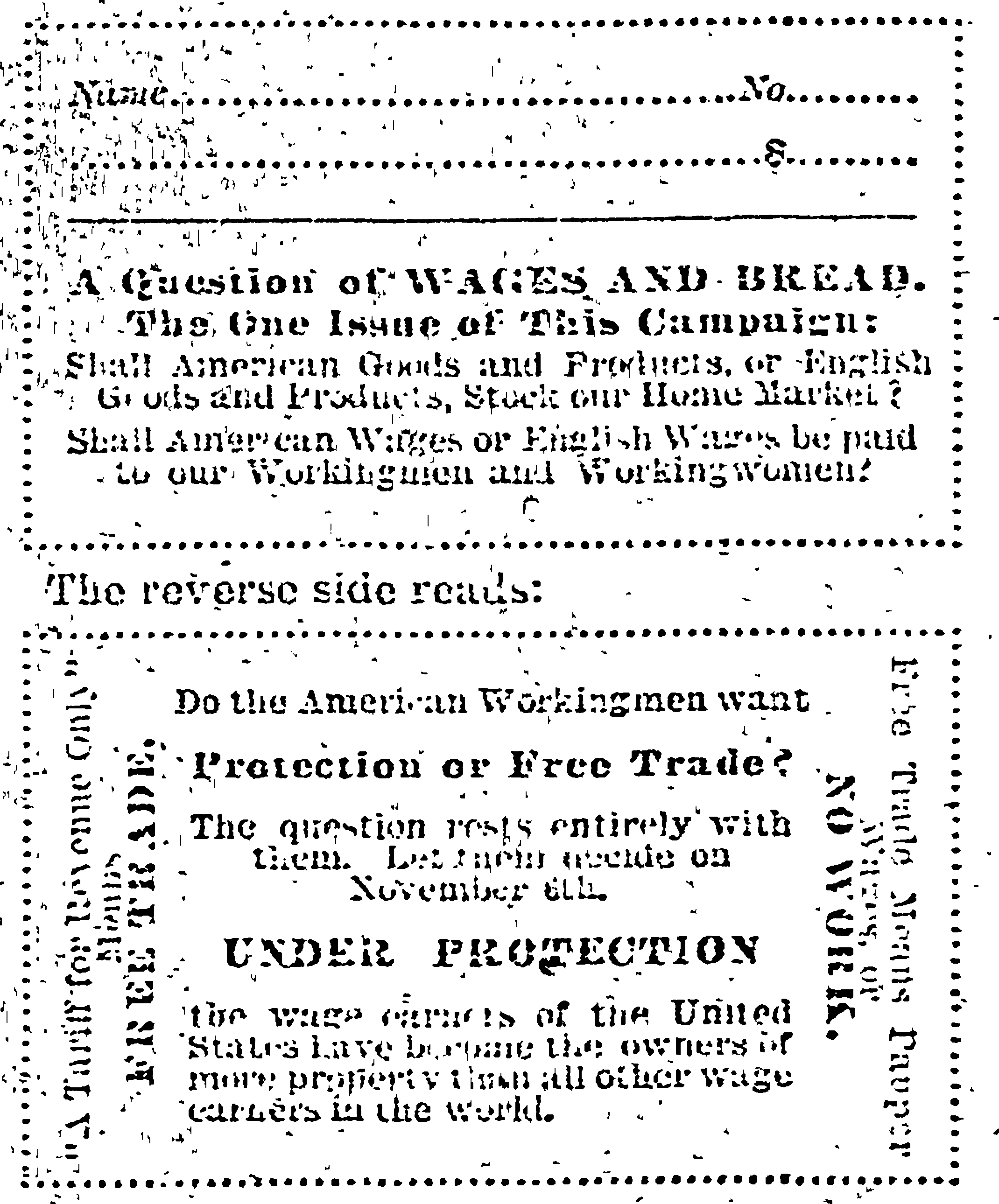
[Facsimile (typeset) of both sides of the republican campaign pay envelope, in dotted-rule boxes; the reverse has side panels set sideways. Text transcribed below.]
Name………………………………………….No……….
……………………………………………………..$……….
A Question of WAGES AND BREAD.
The One Issue of This Campaign:
Shall American Goods and Products, or English Goods and Products, Stock our Home Market?
Shall American Wages or English Wages be paid to our Workingmen and Workingwomen?
The reverse side reads:
[left panel, set sideways, reading upward:] “A Tariff for Revenue Only” Means FREE TRADE.
Do the American Workingmen want
Protection or Free Trade?
The question rests entirely with them. Let them decide on November 6th.
UNDER PROTECTION
the wage earners of the United States have become the owners of more property than all other wage earners in the world.
[right panel, set sideways, reading downward:] Free Trade Means Pauper Wages, or NO WORK.
What the Democrats Are Circulating.
The following circular, first put into use by the Manning, Bowman & Co. corporation of Meriden, Conn., by being posted on every door of the factory, is now being sent out broadcast to large employers of labor by the democratic national committee.
We have no desire to attempt to influence you by covering your weekly pay envelopes with printed instructions concerning the issues of the campaign, or, just as appropriately, what church you shall attend, or the use you must make of your money. Let each of us decide the question as he thinks best. . . . We thank all for so cheerfully standing by the company in discharging their business obligations during the past three months, and now we propose to stand by you in discharging your political obligations to your country according to your convictions. We trust every man will vote conscientiously. Use your own reasoning faculties. Don’t vote the democratic, republican or prohibition ticket to please your employers, or because your brother votes it, or your sisters, cousins and aunts think well of it. We know you will not sell your vote, but do not make a trade of any kind or be induced to stay away from the polls. Maintain the courage of your political convictions, and when the polls close November 6 you will not be ashamed to give reasons for your action. The clear and emphatic expression of your opinions will in the end compel your employers and friends to think vastly more of you, and will secure for you that degree of esteem and respect we all prize so highly. “Let us carry into politics the methods of honest men and the courtesies of gentlemen.” We wish it to be distinctly understood that any person calling at our factory office from the time the polls open until they close, be he democrat, republican or prohibitionist, can see and talk with the man called for, and perfect freedom of thought and action is guaranteed to every man.
Ashbel P. Fitch Nominated by Independent Labor Men.
Independent labor men of the Thirteenth congressional district met in large numbers at Arthur hall, Harlem, last Monday night, for the purpose of declaring Ashbel P. Fitch their candidate for representative in the Fifty-first congress. Mr. Jerome O’Neill was made chairman, and spirited speeches were made by Messrs. F. C. [Leubuscher?], William McCabe and W. J. Gorsuch, all of whom declared themselves, amid great applause, not only for absolute free trade, but for the single tax. Wilbur O. Eastlake then introduced the following resolutions, which were unanimously adopted with great enthusiasm:
Whereas, At a time when the interests of his constituents of this Thirteenth congressional district of New York called upon him for a brave and manly expression of opinion, the Hon. Ashbel P. Fitch, rising above the ties of party, declared himself by speech and vote in favor of that measure of tariff reform known as the “Mills bill,” although the republican party, which had nominated him, was opposed to that measure; and
Whereas, By that vote he has endeared himself to every intelligent and thinking voter, and especially to us who are free and independent men, following the behests of no party, but being actuated by and supporting principle alone:
Therefore be it resolved, That we, the independent labor men of the Thirteenth congressional district, in convention assembled, do nominate as our candidate for the Fifty-first sic of the United States the Hon. Ashbel P. Fitch, and do hereby pledge to him our votes and our support in the coming election.
Our Mauch Chunk Men Get In Some Work.
EAST MAUCH CHUNK, Pa., Oct. 27.—The republicans paraded the streets of East Mauch Chunk on Thursday evening, Oct. 25, after which about seventy-five persons, mostly boys, were addressed by Mr. C. E. Henning of Philadelphia. His speech throughout consisted of waving the bloody shirt and trying to prove that a tariff benefits workingmen. At the conclusion of his address Mr. D. J. Dugan asked him several pointed questions, which he answered in a dodging, angry manner, contradicting his former remarks, admitting that no manufacturer pays more wages than he is compelled to, regardless of what protection he receives through the tariff. The free trade and the single tax are gaining ground. East Mauch Chunk will give Cleveland twice the majority he had in 1884.
CALVIN A. BELTZ.
How They Catch Them.
IRWIN, Pa.—While returning from the post office with the tracts you sent me the other day I met a crowd of men discussing politics on the street. I at once began to distribute the tracts, and found three free traders among the men. The upshot of the thing was a straw ballot, and it was 21 to 20 in favor of Cleveland. Afterward one of the free traders sent word that he wanted to see me, and I called on him to-day. To my surprise he gave me five dollars, telling me to send for more tracts, and I inclose the money herewith. If we could find more such men, the work would go on faster.
WM. PURDY.
p. 5, col. 6
THE BEATING OF THE DRUMS.
Scratch a “trust” and you find a tariff shrieker.—[Rockville, Ind., Tribune.
The more tariff talk workingmen hear the worse it is for the war tariff.—[Buffalo Sunday Truth.
The protection system is a grab game in the very nature of it.—[Grand Rapids, Mich., Workman.
The effect of high tariff is to pauperize the working classes and reduce them to the level of the brute.—[Memphis Appeal.
High tariff may be good for mill and factory owners. But high tariff and no work is good for nobody.—[Hayes Valley, Cal., Advertiser.
No workingman should be gulled into the belief that the tariff has been the means of better wages in this country.—[Jamestown, N. Y., Every Saturday.
Bear in mind that the tariff is a tax levied upon the poor for the benefit of the rich. That is the [whole?] story in a nut shell.—[Nelsonville, Ohio, News.
In practice, the American system of protection is a rank humbug, as has been most clearly proven in the present political campaign.—[Salt Lake Herald.
A protective tariff is a tax on the American consumers. It is a tax laid for the benefit of the few who are thus made rich, and correspondingly impoverishes the many.—[Grand Rapids, Mich., Leader.
Give our manufacturers the world for a market and you inaugurate a period of national prosperity such as this country has never seen.—[West St. Paul, Minn., Times.
A farmer or laborer who votes to continue this robber tariff is voting against his own interests and against the interests of every every sic except the wealth appropriators.—[Sheboygan, Wis., News.
Protection doesn’t protect and never has protected the workingman. It is a device instituted for another purpose. It protects capital and the workingmen pay the bill.—[Jamestown, N. Y., Every Saturday.
Remember that the constant agitation by the labor organizations have raised wages wherever they have been “raised,” and furnished the best “protection,” and not the tariff.—[Hartford, Conn., American Toiler.
The idea that labor, the producer of all wealth, is such a poor, puny, weakly thing that it must be protected—must have guardians like Carnegie to do its buying and selling—is an insult to the dignity and intelligence of labor.—[Clinton, Ind., Argus.
Some of the local manufacturers have a peculiar way of proving their loyalty to the cause of the workingman. They will pay a boy or a bummer twice as much to carry a torch at a political rally as they will their faithful employes for an honest day’s work, and this they do for “protection.”—[Decatur, Ill., Labor Bulletin.
The struggle over the tariff question has but just sic, and will rage still fiercer after election than before. The reason for this is not only that the tariff question itself is a commanding issue, but that [it?] opens the way for the discussion of the greatest of all economic issues—the land question.—[Minneapolis Northwestern Labor Union.
The republican party claims, by a high protective tariff, to make labor contented and happy, and yet it is under their policy that the workingmen of the north and east—in the mines and the “protected” mills and manufactories—are half starved, and ready almost to go into a revolution to better their condition.—[Austin, Tex., Statesman.
If the high tariff is such a blessing for the workingman of the east, why is it that so many of them are constantly leaving that section and coming to the west? It would seem that the emigration ought to be from the west to the east, if work is so plenty and so easy there, and so well paid. But it doesn’t work that way, somehow.—[St. Paul Globe.
In any event, let it not be forgotten that the country can not be “inundated” with foreign goods. Unless we have got something that we produce, which the foreigners want to exchange for the things they produce which we want, we would be as far from foreign goods as the starving man is from bread, though he faces a shop full of it at five cents a loaf.—[Indianapolis News (rep.).
Tariff reformers are becoming as plenty and popular in Pennsylvania as they once were scarce and odious. It causes one to rub his eyes to find in the Fourth congressional district a woolen manufacturer nominated to run against William D. Kelley, “the father of the house,” and most uncompromising champion of the war tariff.—[Springfield, Mass., Republican.
It is well to remind the workingmen of New York that the foreign commerce which passed into and through this city in the year 1887 (imports and exports) amounted to [$763,000,000?], and that any political party which should succeed in driving it away would take the bread out of the mouths of one-half of the people who now find their living here.—[New York Evening Post.
[Advertisement] Last Great Mass Meeting of Single Tax Men
LAST
GREAT MASS MEETING
of
SINGLE TAX MEN
who favor the election of
CLEVELAND & THURMAN,
in
COOPER UNION,
on
THURSDAY, NOVEMBER 1,
at which
SPEECHES WILL BE MADE
by
LOUIS F. POST,
Chairman;
REV. HUGH O. PENTECOST,
THOMAS G. SHEARMAN
and
HENRY GEORGE.
EVERY BELIEVER IN THE SINGLE TAX SHOULD ATTEND AND BRING A FRIEND.
[Advertisement] Frink’s Rupture Remedy
RAREUPT UYOURED? [display heading: “RUPTURED?” with “ARE” and “YOU” set small above, reading “ARE YOU RUPTURED?”]
That is the question. Are you ruptured? If so, use FRINK’S RUPTURE REMEDY, the only quick, safe, sure and [permanent?] cure for hernia (breach) or rupture. This great remedy [has cured?] [many?] persons every year for the last [twenty?] years, and they have stayed cured. It cures by penetrating through the pores of the skin and building up and strengthening the abdominal wall, at the same time closing the hernial opening. The Remedy is generally used in connection with a truss. Children [and infants?] are cured by the remedy alone without the aid of a truss. Soreness caused by chafing or pressure of truss pads, relieved immediately. The pressure can be relaxed gradually and the truss abandoned altogether in six to eight weeks. Price of Remedy, sufficient to cure an ordinary case, $5; sample package, containing enough to show good effect, [$2?]. Sent by mail, postpaid, upon receipt of price. Full directions accompany each package. O. FRINK, sole proprietor, [234?] Broadway, New York. (Opposite the post office.)
Page 6 of 8contents
6 THE STANDARD, SATURDAY, NOVEMBER 3, 1888.
p. 6, col. 1
ANOTHER MASTERLY SPEECH.
WILLIAM LLOYD GARRISON IN PHILADELPHIA.
He Speaks Before a Big Single Tax Cleveland and Thurman Meeting and Preaches the Gospel of Unadulterated Free Trade—Some Points that Have Been Overlooked—Political, Economic and Moral Aspects of the Question.
William Lloyd Garrison delivered the following speech before a large audience in Musical fund hall, Philadelphia, Wednesday evening, Oct. 31, under the auspices of the single tax Cleveland and Thurman committee:
Mr. Garrison’s Speech.
I am glad to address an audience in this great city of protection, where the ideas of Henry C. Carey and William D. Kelley have dominated so long. It is cheering to know that the morning light is breaking over this community at last, and that the medieval darkness of selfish prejudice is retreating. As South Carolina was to slavery, so Pennsylvania has been to protection, the hotbed of fanaticism and unreason. It has exalted private interest above the public welfare, has nursed monopolies into “wealth beyond the dream of avarice,” and has degraded a portion of its labor to a level with the despotisms of Europe. It needs the gospel of unadulterated free trade. The sincerity of the distinguished but misguided men whom I have named has never been been sic any more than that of John C. Calhoun; and having no words of personal reprobation to bestow, I hasten to attack the system they have upheld. Although almost upon the eve of election, I have framed my address without regard to increasing votes. Our movement is to last beyond many presidential contests, and to lead to changes of opinion and law as yet undreamed by current politicians. With the abolition of the protective tariff follows the consideration of indirect revenue taxes, which opens the way for the great land question and the single tax. It is not theories but conditions that spur us to this work. We do not shut our eyes to human nature or existing conditions, and have no utopia to promise. The steps of progress are slow, and of necessity conservative, and nothing resting on fundamental truths can be disturbed or shaken by all the blasts of heresy or speculation. It is for us to open wide the doors of discussion and welcome every honest suggestion and criticism. Assured that the principles we urge are right, we can rest upon the conviction that the results will correspond. The bane and hindrance of reformers is the anxiety about consequences which can not be foreseen and must be trusted. They may safely be left to the Power that rules the universe, and our only concern is to give the natural laws full sway.
A CAMPAIGN OF FUNDAMENTAL IDEAS.
The campaign which now draws to its close will be memorable for its consideration of fundamental ideas and its freedom from personal abuse. It has appealed to the intellect and the conscience of men, and has illustrated the value of a national election with a live issue as an educational force. Many minds have been enlightened and changed, but whether [enough?] to alter the party control will only be determined on November 6.
It is not, however, as a democrat or a republican that I shall speak to-night, desirous as I am of seeing this administration reelected. Under the auspices of this club, my tongue shall wear no party fetters. Our concerning is not so sic with majorities as with right principles, which in good time gather invincible numbers to support them. It matters little whether the selfish prejudices of voters shall outweigh reason and justice at the ballot box this year. There is a day after to-day, and the reformer has “the safe appeal of truth to time.”
Although Mr. Cleveland’s message has made the tariff question all absorbing, forget for a moment that the issue is a political one. The standpoint of politics is the least edifying and profitable. It leads to insincerity, and tempts the speakers to juggle with figures and facts. It forces great statesmen like John Sherman to stultify previous utterances which were the fruit of conviction. When New England drew her prosperity from foreign commerce, when her sails whitened every sea, and the national flag floated proudly from every port of the world, the sentiment of free trade prevailed in Massachusetts, and Daniel Webster defended magnificently in congress the principles we advocate now. Later, when the tariff was forced upon the seaboard states and capital turned from foreign exchanges to the upbuilding of manufactures, the defense of protection was intrusted to the same hands, and the eloquent lips that had vindicated unanswerably the freedom of national trade now gave his law- yer’s plea for the reverse doctrine.
SENATOR SHERMAN’S MEMORABLE WORDS.
Senator Sherman who now defends monopoly, once uttered these memorable words: “Every obstruction to a free exchange of commodities is born of the same narrow and despotic spirit that planted castles on the Rhine to plunder peaceful commerce. Every obstruction to commerce is a tax on consumption. Every facility to a free exchange cheapens commodities, increases trade and promotes civilization.” John Sherman was right, and “it is better to be right than to be president.” I commend to him Tennyson’s lines:
“And, because right is right, to follow right
Were wisdom in the scorn of consequence.”
Therefore we will avoid the shifting standpoints of politicians, who are simply the weather vanes of public opinion. Let us seek rather the secrets of the winds:
Eternal trades, they cannot veer,
And, blowing, teach us how to steer.
Upon one side of this controversy are ranged those who assert that the so-called protective system is necessary to the national growth and prosperity. Upon the other side are those who regard it as a hinderance and mistake. On both sides are moderate men who favor a partial restriction, based on the assumption that the task of accurately sic a tariff, which would require omnipotence itself, can be accomplished by the crude and selfish legislators who predominate in Congress. A few like myself believe the whole system of trade interference pernicious, destructive and indefensible, and it is as an absolute free trader that I shall present my views.
FREEDOM OF INTERNATIONAL TRADE.
I labor for the freedom of international trade which shall knit together the countries of the earth as closely as our railway system binds the states. I strive to bring about an era when the natural instincts of mankind to trade shall find no barriers in custom houses or tax gatherers, and when it shall be impossible for the few legally to draw tribute from the many. This confession stamps me as a “theorist” in the popular phrase. Only those who believe in the possibility of getting rich by self taxation are “practical” men! And yet my life has been passed in the busy haunts of trade where men compete for the
p. 6, col. 2 prizes of material wealth. But I learned early that a merchant is not synonymous with a political economist, and that the selling of a bale of wool, or manufacturing a yard of cloth, confers no occult power to comprehend the tangled problems of exchange. Notwithstanding this, none are so glib in attributing commercial prosperity or distress to tariff or free trade than are tradesmen who have never studied the subject aside from personal interest. What puzzles students presents no difficulties to them. And when they prosper it follows that the country must; so hurrah for protection! “Great is Diana of the Ephesians!” There is food for mirth in such performance, but the sober side touches the hearts of thoughtful men.
ON WHOM THE BURDEN RESTS.
It is upon the defenseless and the poor that the burden always settles. The capitalist, the nimble trader, the men of wit, are competent to recoup themselves for the tax levies and shift them to the shoulders of the weak. The importer adds the duty and his profit to the cost; the commission merchant adds to these his own profit on the enhanced price; the retailer adds thereto another profit, and the consumer pays the whole. No arrangement could be better devised to put the weight where it could be the least easily borne.
It is against this robber scheme that we wage an undying war. We have no compromises to offer, thankful as we are to see any step in the right direction, like the Mills bill; but, relentless as the Roman Cato, we repeat his cry, “Delenda est Carthago!” The system of restriction must be destroyed.
What stands in the way? A people deluded by custom and befogged with sophistries. They are not willingly the abettors of a national wrong. It is not denunciation which they need, although the system does, but patient explanation and reason. In the hope of contributing some little food for thought upon this question I venture to lift up my feeble voice in this assembly. I ask you to bear patiently with me while I combat some of the prominent defenses behind which this false protection covers.
THAT HOME MARKET.
The defenders of the tariff are professedly in love with a home market. They champion the curious idea that, to make trade good it must be confined. Why do not you Philadelphia protectionists act upon that principle? Cut off your railroads and you can foster your home manufactures. Now you have to share your market with the greedy traders from New England and the west, who come here to inundate you with goods. Why do you not frown upon it? Instead, you offer encouragement to the emissaries called drummers, to whom you give the best apartments in your hotels, which rival each other in show rooms for the drummer’s use. There your enemies spread out their tempting goods and entice your dealers to buy their wares. Do they not impoverish you? On your theory, if an Englishman is allowed to sell his goods freely here, the country loses by it. Why does not Philadelphia lose by letting the Yankees from New England sell here without restriction? Explain to me what difference it makes to you whether the salesman comes from Massachusetts or from Canada and performs the same function? Why is it gainful to you in one case and destructive in the other? To hear men talk one would suppose that the foreigner gave away his merchandise for the sake of closing your workshops; but if the Canadian should advertise to-morrow that he had made up his mind to do so, would you think it a calamity? You would be impatient for the cars bearing the gifts to arrive. If the tariff duties were removed, would the merchants of the British province rush to deluge this community with presents? Not one dollar’s worth. They would only bring here certain articles that you want, and that you want to pay for, moreover. And they would take their pay in things that you want to dispose of, just as the merchants you trade with in the states do. To maintain your home market as against Canada you have to consent to a law forbidding you to satisfy your wants. Annex our northern neighbor and not one of you would think of maintaining a customs barrier. You would scramble for his trade, and yet not a single economic condition would be altered under the same flag that now obtains under the two flags. I marvel at the shallowness of thought on this familiar subject.
NATIONS NEVER TRADE.
Reasonable men talk as if England was a monster lying in wait to devour us. They speak with confidence of her purpose to do this and that if we stop taxing ourselves. It is a myth worthy of the twilight days of the race. It is an assumption that exchanges are carried on by nations, and the animating purpose of each is to overreach the other. Nations never trade. It is an individual and not a national function, and it is carried on by people who are mutually benefited. It is as reasonable to talk of Massachusetts threatening Pennsylvania with ruin by forcing her to trade, when profit is the only force in the universe that can compel business trans- actions.
Here is another cobweb of the protective brain, the idea that one can sell without buying. The papers are full of schemes for creating trade with South America by subsidizing steamships and other foolish notions. Trade needs no forcing more than love does. All we have to do with our southern neighbor is to take down the bars. Then commerce will whistle of itself. It is the height of stupidity to think of selling without buying or of buying without selling. One necessitates the other, and when we pass laws to keep out foreign products we legislate to cripple our own industry. Every import compels an export to balance it, and it takes native labor to produce that export. It is every way as profitable to exchange with an Englishman as with a neighbor, and the country is just as rich by the transaction.
A NEIGHBOR WHO WANTS TO TRADE.
South of us flourishes the great Argentine Republic, rich with products that we need, and anxious for the manufactured article we could exchange for its wool and hides. It looks to our republic with admiration, tem- pered only with sorrow that our narrow laws veto a commercial alliance which would bless both. We boast of our rapid development, and fancy that we are beating all creation, but during the past twenty-five years the Argentine Republic has increased in population about seventy-nine per cent, and the city of Buenos Ayres is growing faster than Minneapolis or Denver. Its imports in 1885 were $84,000,000 in value, of which unprotected England furnished one-third of the amount, France and Germany about one-fifth each, while our great republic tags on at the tail of the list with Sweden and Hungary. It should by natural right and ability head the procession.
I know that tariff ridden Pennsylvania scouts the idea. Think of the fine wools of the River Plate coming in free to destroy the dwindling flocks of Washington county! But so much are they wanted, that, in spite of the high duty, they have forced themselves into your markets in quantities along with the fine Australian clips. The tariff remedy which is invoked fails utterly. Suppose we call off the tariff doctors and give nature a chance. If, under the stimulus of free trade, Great Britain can still raise nearly three-quarters as many sheep as we do on this broad conti-
p. 6, col. 3 nent, and send her wool into our markets duty paid, who doubts that we could manage to prosper without the tax? I am convinced that commercial freedom would increase our flocks as emancipation has increased our crop of cotton.
STORY OF THE TWO PUNCTILIOUS ENGLISHMEN.
In the “Bab Ballads” there is a story of two Englishmen who were wrecked on a desert island, but not having been introduced, felt obliged to keep in separate parts of the territory. They were named respectively Peter Gray and Somers:
On Peter’s portion oysters grew—a delicacy rare,
But oysters were a delicacy Peter couldn’t bear; On Somers’ side was
turtle, on the shingle lying thick,
Which Somers couldn’t eat, because it always made him sick.
You see it was quite a protective situation, and etiquette stood in the place of a tariff. After long sighing for the delicacies beyond reach, they were able to speak, through the accidental discovery that they had a mutual friend in England; so they fraternized, inaugurated free trade and happily exchanged their oysters and their turtles. At length a convict ship touches the island and whom should they recognize among the prisoners but their mutual friend Robinson, who had been misappropriating stock! This was enough to dissolve the friendship founded on such a slender basis, and
To allocate the island they agreed by word of mouth;
And Peter takes the north again, and Somers takes the south;
And Peter has the oysters, which he hates, in layers thick,
And Somers has the turtle—turtle always makes him sick.
So the protective nations hug the limited area where their lot has been cast, each wishing for the good things of the others, and anxious to part with things of his own, forbidden by this strange international prejudice. Each heroically denies himself and insists that he is growing rich by isolation. The satire of the ballad is matched by silly nations.
BALANCE OF TRADE AND DANIEL WEBSTER.
I wish there were time to consider the balance of trade theory, which, having been exploded again and again, bobs up its stupid head perennially, and still scares a multitude of excellent people. It is soberly argued that the more wealth we send out of the country, and the less we take into it, the richer we shall be. If a merchant’s income is continually less than his outgo, it is a question of a short time when his note goes to protest. But men who call themselves merchants deplore an excess of imports over exports. Let me borrow an illustration from Daniel Webster’s speech in congress in 1824:
Some years ago, in better times than the present, a ship left one of the towns of New England with 70,000 specie dollars. She pro- ceeded to Mocha, on the Red sea, and there laid out these dollars in coffee, drugs, spices and other articles procured in that market. With this new cargo she proceeded to Europe; two-thirds of it were sold in Holland for $130,000, which the ship brought back and placed in the same bank from the vaults of which she had taken her original outfit. The other third was sent to the ports of the Mediterranean and produced a return of $25,000 in specie and $15,000 in Italian merchandise. These sums make together $170,000 imported, which is $100,000 more than was exported, and is, therefore, proof of an unfavorable balance of trade to that amount in this adventure.
Upon this transaction the custom house here would register as follows: “Exports, $70,000; imports, $170,000.” “Dreadful!” says the protectionist, “the country must pay this $100,000 in gold. So much dead loss!” But the merchant pockets his profits and lets the theorist do the worrying. If the ship had sunk on its passage out the record would have stood: “Exports, $70,000; imports, none.” “Splendid!” says our philosopher,” rubbing his sic, “so much gain for the country!” But the insurance company, pay- ing the loss, takes another view of the situation.
SOME CONUNDRUMS.
We like to ask such conundrums as this to these protective brothers: How is it that the excess of imports in England over exports was £1,000,000,000 the last forty years, and yet, instead of losing gold more specie was imported than sent out, amounting on an average to about one million sterling a year? Instead of England owing this enormous amount to foreign nations it has increased its investments abroad by about £1,000,000,000. Instead of growing poorer it has grown enormously richer while that has been going on. Advocates of protection assume that a tariff creates wealth. It never created anything but a disturbance. If to tax is to create, how easy it is to get rich! As a nation we are trying that impossibility. In the terse language of Professor Sumner, “Pennsylvania taxes New England on raw wool, New England taxes Pennsylvania and Ohio on the finished wools and finished cottons. All tax each other all round, and they are all expected to get rich by the operation.” Now protection can sic from wealth, but is not able to add to it. It has the power to destroy but not to increase resources. It can concentrate capital and labor on special employments, but only at the expense of other occupations. It can change the direction of capital and labor from their natural inclination, just as human interference can alter the channels of streams which it cannot create water to fill. Restrictive laws can build up certain industries because of the monopoly granted, but always at the expense of some other industry, which has suffered or been prevented from developing in consequence.
HOW PROTECTION HAS FOSTERED MONOPOLY.
Let me give an instance recently cited by Mr. Shearman: Some cotton manufacturers persuaded the committee that framed the tariff of 1883 to impose a duty on fine cottons which are used in making ruches. It resulted within a few weeks after the tariff went into effect in throwing out of employment 3,000 women engaged in making ruches, because the material had been made too costly for further use. This in the interest of American labor! The tax on copper ore helped the Calumet and sic mining company to make its favored stockholders rich, but somebody suffered. For one it ruined the smelting works of the Revere copper company, near Boston, which had a capital of $300,000 and employed 100 to 150 hands a year. The ore it brought from Chili gave occupation to vessels which carried, not gold in payment, but our manufactured boots and shoes and cottons. For what end was this destruction? That the richest copper mine in the world, which can compete successfully with all others under freedom, might control the price of copper in this country and market its surplus in Europe many cents cheaper than the people who granted the bounty to the mine were allowed to buy it.
THE QUESTION ONE OF JUSTICE.
The free traders have an embarrassment of riches in facts and figures; but to me the question is one of justice more than arithmetic, although I affirm the perfect agreement between truth and mathematics. There is no conflict between Adam Smith and Euclid. “I warn and entreat you,” said Mr. Gladstone, “never to argue the question of free commerce as if it were a material question alone. It is just as strong in its political, in its social, and in its moral aspects, as it is in its operation
p. 6, col. 4 upon the production and increase of wealth.” I hold, therefore, that the discussion is not an abstract one regarding the wisdom of certain laws affecting the distribution of commodities, but rather the practical one, How much longer will a people submit to impoverishment under the delusion that a tariff protects them? Or, as Mr. Blaine, whose issue I accept, puts it, the question is, “Whether the great mass of the American citizens who earn their bread by the sweat of their brows shall be seriously reduced in their emoluments from day to day—that is the whole pith and moment of the campaign.” It is an interesting question to consider.
WHY MR. BLAINE LOVES THE LABORING MAN.
Why does Mr. Blaine love the laboring man so much about this time? Do you suppose that the means of bettering his condition was the absorbing topic of the magnetic statesman and Mr. Carnegie as they looked at the poor workmen of England from the top of their tallyho coach? Doubtless they thought of him, Mr. Carnegie revolving possibilities of suppressing strikes of his unreasonable employes and Mr. Blaine planning to capture that most valuable possession which the tariff has not yet been able to confiscate—the laborer’s vote.
You remember the story of the man who plunged boldly into the stream and rescued another from drowning. When complimented on his humanity he explained that the drowning man had his jackknife, which was the object of his heroism. Mr. Blaine is talking benevolently about the laborers in order to get that ballot, and appears to be anxious about the reduction of his emolument and whether he must earn less bread by the sweat of his brow. If there were more thinking behind that workman’s brow there would be less sweat to wipe off. When that time comes we shall have manlier statesmen and fewer demagogues.
THE LABORER’S COMMODITY IS HIS LABOR.
A merchant deals in commodities which are more or less affected by the tariff taxes. A duty on woolen goods or iron may for the time bring profit to the producer’s pocket, but the laborer has no commodity to sell except his labor, upon which no tariff exists.
When the claim is made that protection raises the price of labor it is in order for the claimant to prove the fact, which we deny in toto. Wages are as much advanced by the breezes that blow over the Alleghanies as by the tariff. If there is more labor offered than employment, then wages are low. In all new countries, like America and Australia, where opportunities for employment are many compared with the labor offered, wages are high. In Australia, protection exists in Victoria. By its side, in New South Wales, free trade prevails. Wages are about alike in both places, better, if anything, in the unprotected community. France and Germany are highly protected; England has, comparatively, free trade, yet her scale of wages is fifty per cent higher than theirs. In this country wages are higher than in England, which is at once attributed to protection, an explanation which fails to explain. If tariff makes wages higher here, why do they not produce a like result in the protected continental nations?
The protection theorist never faces this question. We practical free traders do.
HIGH WAGES, CHEAP PRODUCTION.
Wages vary as the profits of production vary, and not as tariffs vary. Here profits are large because of the favorable opportunities for enterprise which make production profitable, and wages share the benefit. But the rate of wages is far from deciding the cost of production, for the highest wages are found with the cheapest production. Labor which produces much will receive much. That is the true law. The wages of labor can not be increased by making the product more costly. A tax lessens the output of industry and tends to lower wages. High wages, cheap production. Low wages, costly production. Herein lies the nation’s advantage. We have the cheapest labor in the world be- cause it is the most efficient, the most intelligent, the most thrifty, the most ambitious.
MORAL ASPECT OF THE QUESTION.
In closing, let me lift the discussion from the plane of economics to the plane of morals. We live in a community professing belief in the fatherhood of God and the brotherhood of man. Its ministers proclaim that “God hath made of one blood all the nations of the earth,” and the golden rule furnishes a text for moving sermons. On Christmas, amid the decorations of the churches, high over all may be read the motto, ’Peace on earth and good will to sic.” The spirit of protection is alien to all these sentiments of love and justice. The brotherhood of man is arbitrarily confined to national [limits?]. All outside are natural enemies, to be despoiled and disregarded. “Do unto others as you would they should do unto you” is treated as a glittering generality. Protection embodies the essence of war, retaliation and jealousy, and rejoices in armies and armaments and battleships. Patriotism is exalted above Christianity. Imaginary lines divide human friend- ship, and “mountains interposed make enemies of nations which had else, like kindred drops, been mingled into one.”
In our school geographies we learned as children the civilizing effect of commerce. The pictures of great ships carrying the productions of one clime to exchange with those of another for mutual benefit conveyed a noble lesson. We send out cooling ice to the tropics and bring back luscious fruits in pay. Interdependence is nobler than independence.
A CITIZEN OF THE WORLD.
I aspire to be a citizen of the world and not the subject of any province. Little we dreamed as we conned the lesson of the ship that in manhood we should be asked to believe that commerce is harmful and that scarcity should be the social aim; that Chinese walls were a better emblem than white winged vessels, and that America, with self-destroyed shipping, should worship protection for the sake of protection. Protection is selfishness enthroned, and like all power that builds its throne on outraged rights, its doom is certain. It may hold its unhallowed sway for a time, but it must pass surely into the graveyard of the Spanish inquisition and American slavery, a fit companion of those extinct wrongs.
In a Pennsylvania Town.
MIDDLETOWN, Pa., Oct. 26.—Herewith please find a list of single tax men residing in our town. Four of us heard Henry George’s Harrisburg speech and we regret that all of our people did not hear it. We hope the day is not far distant when he will favor us with a visit to preach to our people the truths of free trade and the single tax. We will do what we can in the meantime to push the cause.
WILLIAM BECK.
“What’s the Matter With”—Everybody Else?
We all know “what’s the matter with” Carnegie, Blaine, Harrison and all their ilk. “They’re all right.” But what’s the matter with everybody else? The old distich answers truly:
Taxed on the blanket, taxed on the crib,
On the old man’s shroud and the young babe’s bib; To fatten the bigot
and pamper the knave,
We are taxed from the cradle plump into the grave.
p. 6, col. 5
A WOMAN’S VIEW OF IT.
The presidential campaign this year is, I think, peculiarly interesting to women. It is essentially a woman’s campaign, inasmuch as it directly concerns her domain, the household and family. Of course, at all times whatever affects the laws of the country concerns the women who must live under them as well as that half of humanity which frames them; but this fact is not so plain at all sic as now. It is no longer “a theory which confronts us, but a condition;” no longer a question of maintaining the supremacy of this or that party, but the simple proposition is whether we would have better clothes to wear, and more of them, blankets and flannels of finer quality for less money, cheaper coal—living expenses, in other words, reduced, and life by so much made easier, or submit to a system whose avowed object is to increase the cost of living and compel us to get along with less comforts or necessities, as the case may be.
There is no subterfuge about the republican platform. It squarely asks for support on the principle that to tax the whole people for the benefit of a few producers is to benefit all, and says that rather than abate any of the duties on imported articles, that is, rather than allow us to get anything we need cheaper than we can at present, they would prohibit any importation whatever, and turn us over to the tender mercies of the home trusts of various kinds, which under such circumstances would be sure to spring up in all great industries, since it has been found that combination is much more comfortable to the controllers of great interests than competition.
The picture conjured up by the protectionists, of America flooded with the products of European pauper labor, is a regular chromo for the democratic party. What an altogether charming thing it would be to be deluged with Parisian bonnets, or gloves, which our friends have formerly smuggled over to us occasionally in small quantities; with English cloths and Scotch ginghams, which we have sighed over in vain at Denning’s or McCreary’s, before reluctantly purchasing the only things within our means—the products of home industry, which get foxey in the one case and won’t stand a season’s washing in the other; to have brought within the range of possible possession the imported cloaks and robes which we have gazed at with longing eyes hitherto as something unattainable; to become the possessor of lovely Lyons silks which can be crushed in the hand without showing a crease when shaken out, instead of the Paterson affair, which shows no such satisfactory results. But why run over the various imported articles which we would very much prefer having if they could only be brought within the reach of our pockets. They must be better than what can be produced at home, or at least are produced at home at present for nearly the same price, or there would be no protection required for the home article.
Now, I am a Jersey girl, and as such have a fondness for my native state, in spite of mosquitoes, malaria, tramps and other attractions of a like nature for which my birthplace bears the palm, and I am glad to have Paterson prosper, and Paterson manufacturers grow fat and comfortable; but my good wishes do not extend to the point of desiring them to prosper at my expense. Neither do I see why the silk men of Paterson should claim my sympathy and protection any more than the carpenters, doctors or ministers, who are left to shift for themselves. Talk of the pauper labor of Europe! It is the pauper manufacturers of this country which impoverish us.
William J. Flagg in Belford’s Magazine for October estimates that protection costs the American people one billion and sixty millions a year, not counting the amount we are forced to pay into the United States treasury on account of it, which is some two hundred millions yearly. It is no wonder that we have an army of tramps and another army just above the tramp line; no wonder farmers are mortgaging their homesteads; that young men find it next to impossible to start a business for themselves, while older men who got started some years ago, when business did not require so much capital, find it hard now to keep going; that capital is forced to combine into pools and trusts to keep from being crushed by greater capital. We are engaging in discouraging industries which should prosper naturally in this country, and fostering to the tune of one billion and sixty million dollars a year enterprises which have no right to be pursued here at all—that is to say, industries which have no right to be pursued here if they cannot be run except by the compulsory charity of the body of the people. There is no way of finding out what industries are natural to this country and what are not, save by withdrawing all support and letting them try their strength.
Why we should keep on propping up unnatural occupations at the expense of legitimate ones to all eternity, is hard to understand. It is not hard to understand, however, why the recipients of our charity, the pauper manufacturers, or tariff robbers, or tax eaters—any one of the titles is equally appropriate—should not yearn to thus test their strength, even if they could get along just as well under freer or free trade. “What is the use of disturbing existing things? Let well enough alone,” is their motto, and such has been the watchword of all special privilege since the beginning of time. Invalids who have been coddled and petted and made much of are slow to put away convalescent accessories; they may be able enough to walk alone and wait on themselves, but it is much pleasanter to continue being waited on. Besides, it is a well known fact that invalids are very likely to grow morbid and believe themselves much weaker than they really are. And so I fancy it is with our pauper invalids who clamor that if the sheltering wall of the tariff be removed, or have even so much as a pin hole pricked in it, and the cold blast of European competition thereby reach their delicate frames, that they will peak and pine and leave us without an object on which to lavish our national care—and a billion and a half dollars. The irreverent are tempted to exclaim, “Even so; what then?” At which we are told by the trembling manufacturer that it is not for himself that he asks protection. Oh no! for himself he cares not, but he cannot consent to abandon us to the unre- stricted use of our own money. If we should cease to pay tribute to him and thereby preserve the home market for him, we would be irretrievably lost. Let but the foreigner invade our sacred home market and he would proceed to deluge us with cheap, horribly cheap goods; silks, carpets, coal, lumber; finished products and raw material; for the foreigner’s sole end and aim in life, his thought by day and dream by night, is to capture our home market. Not for the purpose of taking back to the foreign parts from which he came the products of our market which he desires more than the things he brings, but solely to inundate us with commodities. Noble and disinterested foreigners! Surely, with your advent will come the millennium of America.
For my own part I say, come on and quickly. Stand not on the order of your coming, but come at once. I will surely not be the American who, under these circumstances, will first cry, “Hold! enough.”
But of course the protectionist says this is nonsense, and then proceeds to tell you that the foreigner does not intend to give you these things for nothing. He must be paid. And
p. 6, col. 6 with what? With the product of American labor. How disappointing! So the foreigner does not come to our market to make us gratuitous presents, but simply to get something we have which he wants in exchange for something he has and don’t want and we do. It is only an ordinary trade from which, by the by, the Yankee never came out inglorious. But we shall be greatly benefited, after all, as everybody is who exchanges what he does not care for for what he does.
This aspect, however, does not suit our protectionist mendicant. He says, not so. If you don’t continue paying much more for some American manufactured articles than they are worth the manufacturer of them can not go on. If you stop propping up these exotical industries which require a tariff wall around them, they will surely fall down, and their fall will knock down all the other industries of the country. And then, behold! We won’t have any products to exchange with the foreigner; and then the foreigner will continue to deluge us with his commodities without any return.
But what an absurd thing to imagine this great and glorious country coming to such a condition. This country, which abounds in all that goes to make a nation truly great and wealthy, peopled by men whom we are never tired of declaring the cleverest, the freest and the most inventive of all the peoples of the earth, and who speak with scorn of the workers of the other side of the earth as the “pauper laborers.” Imagine their industries being put to shame by those same contemptible pauper laborers!
When these protected industries are left unprotected, what will happen? Those industries that by right should be run in this coun- try will go on making up in wider sales and a decreased cost of production what they lost in the tariff favoritism, and those who cannot stand alone with a fair field and no favor, those who cannot absolutely exist without charity, will have to close business, and the quicker the better for the American people. How immensely the natural industries which are now hampered and discouraged by the tariff will grow and flourish in that happy time no one can predict; but who can fail to see that with one’s purchasing power increased by the reduction in the cost of an article, one will buy more. By buying more there is created a greater demand for manufactured goods; when more goods are manufactured more labor is employed; the demand for labor raises wages; higher wages enables the laborer to become a greater consumer, and thus we proceed in ever widening circles from the point at which we started—increased purchasing power.
In that condition of wealth and prosperity which we would enjoy through turning our attention to those occupations to which the American soil and people are adapted, and abstaining from taxing ourselves to bolster up those for which we are not adapted, there would even be room for voluntary charity to these national paupers, who confessedly cannot get along without it. Then would be a glorious opportunity for those enigmatical protectionists, who are not enjoying any of the benefits of protection themselves, and yet believe in it—republican doctors, blacksmiths, grocers, actors or undertakers—to show forth their beautiful system of getting rich by taxing themselves, in voluntarily contributing to the support of those unhappy people who have arrived at the winter of their discontent through being deprived of the power of taxing the whole people. They might resolve themselves, for instance, into such an institution as the charity organization society of New York, with its wood cutting plan for tramps, and after finding out if the habits, customs and morals of the various national paupers, whom they, with the rest of the people, are at present sustaining, are quite satisfactory, they might then encourage these worthies at whatever unprofitable labor should seem best at the time. It is hardly likely however that they could devise any scheme which would answer their purpose better than to keep them going in these occupations which they have chosen for themselves, since each pauper has no doubt found out where to get the most protection with the least return to labor.
The benefit of this kind of taxation would be kept wholly to themselves, since no one but a thoroughgoing protectionist would be likely to indulge in such an expensive method for enriching one’s self. They would, however, have to continue [calling?] it a protective tariff, or charity [outright?], to get a woman interested in it, for I have never known a woman yet who did not regard a tax as an unqualified evil. She arrives at that un- doubted truth by one of those intuitive leaps for which the sex is famous. A woman always resents paying a tax or her car fare, and it is being demonstrated [to-day?] that her aversion is well founded. She is being robbed in both cases. Hidden under the cozy, home like name of protection, she will even, as I read lately of a number of women doing, form a regiment and march under a Harrison and Morton banner. If women once realized that the tariff is a tax, it would be doomed. If they realized that the tax off lumber meant the coveted bay window or the long talked of addition to the house; the tax off wool meant warm flannels for the family, a new parlor carpet and winter dresses; the tax off coal more fires and less cinder picking, and this not only lightening her own cares but those of millions of others, she would never rest until husbands, brothers and masculine friends in general had been brought to see the error of their protectionist ways.
And not only of ourselves should we think. While the reduced tariff duties means luxuries for some of us, to others it means a little less toil, a bit of meat oftener, a warm shawl to keep out piercing winter winds, a few more coals to scanty fires. Who that has read the stories with which our daily papers are filled, of the white slaves of our cities, and who understands how our iniquitous tariff laws affect their pitiful earnings, could still the pangs of remorse at their hearts—though sitting warm and cozy at their bright firesides, or buttoned snugly under a sealskin jacket—if they had not raised their voices against the system which, having first robbed these poor sufferers of all the natural opportunities for employing their labor, and forced them to compete with each other for starvation wages, de- prives even these miserable wages of their rightful purchasing power. A woman who begins to think on the subject cannot help talking about the present election, even though she may have declared all her life that she hated politics. But there is something higher than mere politics in this presidential campaign. It is a question of justice, diviner than any charity, of morals, of religion itself. To be on the side of tariff reform is to be on the side of that power which makes for righteousness.
IDA HIBBARD.
Very Cold Days.
The Evening World has offered a prize to the weather prophet who will prognosticate the coldest three days of the coming winter. Here is one of the prophesies:
The coldest three days this winter will be when the landlord comes for his rent and you have not got it; when he orders you out of your rooms; and the third, which will be the coldest of them all, when the marshal comes and sets your things on the sidewalk and you have no place to go to. I think these will sic the coldest days felt this winter.
GEORGE B. WOODRUFF,
152 Tenth avenue.
Page 7 of 8contents
p. 7, col. 1
QUERIES AND ANSWERS.
The Single Tax and Railways.
CHICAGO.—A single tax man of prominence here asserts that absolute free trade is not the single tax applied; that railways could still remain private corporations contemporaneous with the full enforcement of the single tax. That is that the land monopoly and the railway monopoly are in essence distinct; one is the appropriation by individuals of economic rent, the other is not.
I assert on the contrary that the single tax idea does involve the resumption by the state of all such monopolies as the railway; that state resumption of railways is but the taking for public use of economic rent, and is therefore only another form of the application of the single tax. I conclude in this way that any steps toward the banishment of the tariff are in the direction of the accomplishment of our reform—absolute free trade—which has a broader and deeper significance than my disputant understands by the term “single tax.” Please give us your opinion.
JAMES MALCOLM.
Absolute free trade is not the single tax applied. The single tax, that is the tax on land values, is already applied; but other taxes are imposed along with it, of which tariff taxes are largely in the majority. To abolish tariff taxes is to compel direct taxation for federal purposes. This direct taxation might be a land value tax or it might not; but when the necessity of raising these revenues by direct taxation arose, we should be compelled to choose between land values and something else, and there is not much doubt that the land value tax would carry the day. To abolish tariff taxes is to clear the way for the extension of the single tax.
Railways could remain private corporations contemporaneously with the full enforcement of the single tax, but not with the spirit of the single tax idea. You must remember that the single tax is both a means and an end. As a fiscal policy it is an end, but as a mode of securing common property for common use it is a means. As a fiscal policy it does not involve public management of highways, though it would appropriate the value of those natural advantages which railways acquire; but as a mode of equalizing common benefits, the single tax involves the idea of securing to the public the benefit of those franchises from the state which make railways monopolies. But I think you are wrong in claiming that the railway monopoly, as such, is an appropriation by individuals of economic rent. Such monopolies do appropriate economic rent, but it is as land owners and not as railroads. Economic rent has a technical significance, and though railway monopoly is in a restricted degree similar to land monopoly, the two are distinct.
Any step toward the abolition of the tariff is obviously, it seems to me, in the direction of absolute free trade. We are not aiming to create a new form of taxation, but to abolish all existing forms save one.
A Question of Intent.
BROOKLYN, N. Y.—I have been living in this city one year, but on account of a strike which I was in last spring I left the city from about June 6 to July 15. I have already registered, but am told that my vote will be challenged. Have I a right to swear it in?
JAMES A. MILLEN.
If you have lived in this state for a year or more, with the intention of remaining in it permanently, you are a voter in any county in which you have resided for four months prior to November 6. Your absence from Brooklyn from June 6 to July 15 does not affect your right to vote there, unless you left with the intention of remaining away permanently. If when you left you intended to return as soon as your business would permit, you did not lose your residence, and may swear in your vote.
Hatters.
NEW YORK.—I am engaged in the hat trade. (1) What effect would the total abolition of the duties on all materials entering into a hat, also duties on manufactured hats, have on the manufacturers here?
What proportion of the fur is imported, and would it be possible to procure the whole supply in this country?
How do the yearly wages compare in hats between this country and England, also the amount of work done by each? and oblige yours respectfully,
DANIEL J. MCCARTHY, 122 East Twentieth street.
It would reduce cost of production, lessen price, increase demand, expand the trade, make it easier for men of small capital to engage in the business, and augment wages by making demand for more hatters.
I do not know; but whether it would or not, fur would be cheaper and wages higher.
I do not know. You, as a hatter, ought to have means of ascertaining. I do not doubt that in your industry, as in others, the labor cost of making a hat here is less than the labor cost of producing the same kind of hat abroad. Investigate carefully and let me know the result.
Australian Voting.
NEW YORK.—How many votes could be polled in an hour under the Australian sic.
S. EVANS.
It would depend on how many booths were provided. An average of twenty men an hour to each booth would be a fair estimate.
LOUIS F. POST.
Balance of Trade.
PEEKSKILL, N. Y.—Mr. Post in his article entitled “Goods for gold,” speaking of the “balance” resulting from our foreign trade, says: “The real balance never can run that way,” i. e. against America.
May I ask for the authority for that statement—it seems a very important one.
D. C. HASBROUCK.
If you will read the paragraph over you will see that further on Mr. Post says: “When it appears to [run that way] and we are shipping gold to settle balances, it is either because it is then profitable to export gold as goods, or because we are paying rents, bonds, corporation dividends or donations to foreigners, for none of which do we receive either money or goods.” That is, we do not pay for goods in money, we always pay for them in merchandise, whether that merchandise be gold or silver bullion, or grain and carpets and hats and books. We do not send money abroad, nor do other nations
p. 7, col. 2 send us money. What little United States currency you find in a foreign country is what travelers have carried there in their pockets, and the few bills and eagles and dollars which money brokers have on hand to supply as pocket money to those who want to come here.
In trade a nation always gets back more than it sends, in the sense that it sends what it does not need and gets in return what it does need. Therefore, the the balance of sic, if there were such a thing, never could be against a nation. But if you take into consideration the whole trade of a nation with all other na tions, there is no such thing as a balance of trade. If a nation imports more than it exports, as rich England does, or if it exports more than it imports as bankrupt Egypt does, and as the protectionists would like us to do, then it is not on account of trade, but because the people of the country which imports most own lands and railroad bonds and stocks, etc., of other countries, and draw rent and interest from the other countries, and vice versa.
Taxing Chemicals.
CINCINNATI, Ohio.—The following is from McKinley’s speech here on October 17. What is the explanation of this reduction in price?
If Mr. Cleveland had known the history of his own state he would never have committed such a fallacy. I will take him down to the city of Syracuse, under the shadow almost of Buffalo, and point him to a factory there established since 1884, a factory that makes soda ash, which we had never produced in this country prior to 1884. By the tariff of 1883 the republican party put a tariff of $5 per ton on foreign soda ash, and when we had done that a party of gentlemen in that city said: “We will try its manufacture,” and they invested a million and a half of dollars in the plant. They made a success of it. Prior to 1884 we paid $48 per ton for all soda ash used in this country. Now we pay $28 per ton, $5 duty and all.
C. S. W.
Major McKinley stopped when he had reached the “point of least resistance” to his theory. That is all right for a politician, but bad for a political economist. He should have stated that, while the price of soda ash declined to $28 per ton of 2,000 pounds in this country, under a tariff of $5 a ton, it declined to $21.71 a ton in Europe; and that last year we imported 131,637 tons of it in spite of the $5 duty and freight charges; and that under free trade our manufacturers could have bought it for more than $5 less than the $28 rate. Our country is the only country which taxes chemicals heavily, for most chemicals are used in manufactures, and to tax them is to discourage manufactures. Soda ash is one of the chief materials used in glass manufacture, and the $658,185 duty on soda ash which our glass and other manufacturers paid into an overflowing national treasury last year was just so much discouragement to glass making.
A Ribbon Maker’s Yarn.
NEW YORK.—A friend of mine, in politics a protectionist, in every thing else a very reasonable man, is engaged in the manufacture of silk ribbons. He assures me that if the duty was taken off imported ribbons he would have to close his factory, or else reduce wages fifty per cent. Although raw silk comes in free, the manufacturer’s profit is but very meager, and the ribbons made here sell for about the same price as the imported ribbons, in spite of a fifty per cent duty on the latter. How can you effectively answer the above in favor of free trade?
M. BITTINER.
I also am acquainted with a gentleman engaged in the manufacture of silk ribbons, and four years ago, when the democrats did not indulge in one-tenth as much free trade talk as they do this year, he went around saying that if Cleveland were elected he and his partners would probably close up their factory entirely. But Cleveland was elected and they kept on making ribbons. If business was different after than before the election, why they just sic themselves to the changed conditions. Wonderful how easily a man can do that—when he tries. But free trade does not mean that the duty will be taken off ribbons and be retained on other things; it means the abolition of all custom house duties. It means free dyes, free silk thread, yarn or twist (from which the ribbons are woven) and free machinery, as well as the opening up of a great trade with countries that as yet have no silk factories to speak of, and that would take ribbons in payment for their products. Dyes are not so great an item in the cost as might be sup posed, but the thread, yarn or twist which the ribbon makers use to manufacture into ribbons is a very important item, and on this material there is a duty of thirty per cent. Would free trade in silk thread hurt the ribbon maker? Under free trade ribbons would sell for less, much less, for I understand that the manufacturers at present add almost the full fifty per cent duty to the price of their goods. But cheap goods do not mean ruination to business. On the contrary, it is not until inventions make things cheap that there is any great trade or profit in them. There is more money made to-day, ten thousand times over, in making and selling twenty-five cent books than was made by the engrossers of old manuscript books or by the men who printed books in the days when they bound them in metal and wood and chained them to the reading desks.
Cheaper goods mean more wealth, more demand for goods and materials, more employment, more profit. And free trade means cheaper goods. If your friend means to say that American ribbons sell here as low as the foreign ribbon would sell here under free trade, how does he explain the fact that since importer Wanamaker has had ribbons classed as “material for hats” and dutiable only twenty per cent instead of fifty per cent, the ribbon makers are howling that blue ruin is on them? Surely, if our manufacturers sell their ribbons as cheap as the foreigners can, they do not need more than twenty per cent duty.
Distribution of Products.
LYNN, Mass.—What portion of the total production of manufacturing industries in the United States goes to labor in wages?
R. K.
According to the census of 1880 the value of the total product turned out by manufacturing establishments was $5,369,579,000, of which $3,396,824,000 was the value of material used; hence the increased value added by the processes of manufacture was the difference between
p. 7, col. 3 these two, which is $1,972,755,000. This last amount was really the value of the product of our manufacturing industries. It was divided as follows: Wages paid, sic=48 per cent; rent, profits, insurance, sic=52 per cent; total, $1,972,755,000.
Of the value of the completed article 63 1-3 per cent was the value of the material used; 17 2-3 per cent was wages paid; 19 per cent was rent, profits, etc. It is not fair, however, to say that labor gets only 17 2-3 per cent of the product of manufactures, because that does not take in the amount which went to labor in the production of the material. It is fair to presume that 48 per cent of that went to labor, in wages also, as well as 48 per cent of the added value which comes from the final processes of manufacture.
This is the best answer that can be given from the census returns, but there is no doubt that they are far from accurate.
W. B. SCOTT.
Notes.
Charles A. Crouch, Bartow-on-Sound, N. Y.—Of course your answer was right. To admit that business or manufacturing can be helped by making materials, tools and machinery dear, or that wages are raised by a swindling system of indirect larceny, would be to give up the whole strength of your position.
Isaac Feinberg.—See query and answer above entitled “Distribution of Products.”
[Advertisement] Scott’s Emulsion
 [Display advertisement:
decorative display lettering, reproduced as image; text follows]
IF YOU HAVE
CONSUMPTION | COUGH OR COLD BRONCHITIS | Throat Affection SCROFULA | Wasting of Flesh
Or any Disease where the Throat and Lungs are Inflamed, Lack of Strength or Nerve Power. you can be sic and Cured by
SCOTT’S EMULSION
OF
PURE COD LIVER OIL
With Hypophosphites.
PALATABLE AS MILK.
Ask for Scott’s Emulsion, and let no explanation or solicitation induce you to accept a substitute.
Sold by all Druggists.
SCOTT & BOWNE, Chemists, N. Y.
[Advertisement] THE TARIFF QUESTION.
PROTECTION OR FREE TRADE? by Henry George; paper, 35 cents.
THE EXISTING TARIFF fully indexed so that the rate on each article can readily be found, 25 cents.
LEADING SPEECHES ON THE MILLS BILL, containing the speeches of Mills of Texas, McMilian of sic, Wilson of West Virginia, Scott of Pennsylvania, Cox of New York and Carlisle of Kentucky on the democratic side, and Reed of Maine, McKinley of Ohio, Burrows of Michigan, Butterworth of Ohio and Kelley of Pennsylvania on the republican side; 50 cents.
Sent, postage paid, on receipt of price, or
THE THREE BOOKS FOR ONE DOLLAR.
PUBLISHER STANDARD 12 Union Square, New York.
[Advertisement] BOUND VOLUMES OF THE STANDARD.
BOUND VOLUMES
OF
THE STANDARD.
A limited number of bound volumes of THE STANDARD, in heavy boards, are offered for sale at the following prices:
Volumes 1, 2, and 3, bound in single volumes, ….$3 50 The three volumes……………………………. 9 00 (Expressage extra.)
Address THE STANDARD, 12 Union square, east, New York.
[Advertisement] SINGLE TAX DOCTRINES IN A NUTSHELL.
SINGLE TAX DOCTRINES IN A NUTSHELL.
Thirty pamphlets on various phases of the social problem. The question of the hour. All should understand it. Will be sent post paid on receipt of fifteen cents in stamps, or will be sent free to any one sending twenty-five cents for six months’ subscription to the Tax Reformer, a sixteen page journal. Address, SINGLE TAX PRESS, 1791 Lexington ave., N. Y.
[Advertisement] THE DEMOCRAT.
THE DEMOCRAT.
A RADICAL REVIEW MONTHLY.
The Democrat advocates Land Resumption and those reforms which are necessary to make the English people a free people. It asks “compensation” not for those who have benefited by unjust legislation, but for those who have suffered thereby.
For one dollar the Democrat is supplied for 18 months to any address in the United States or Canada.
Address 5 New Bridge street, London, E. C.
[Advertisement] GEORGE WILSON, Importing Tailor
GEORGE WILSON,
(Formerly with Henry Poole, London.)
Importing Tailor,
206 East Fourteenth St., N. Y.
“’Tis not in mortals to command success; But we’ll do more, Sempronius; we’ll deserve it.”
SAMPLES AND RULE FOR SELF MEASUREMENT SENT ON APPLICATION.
New Imported Fabrics, Latest Choice Patterns, An Elegant Selection.
The Best Looms in the West of England
contribute to an entirely new and valuable stock of goods, which for richness of quality, durability of wear and moderation of price, possesses advantages not held by other houses receiving goods through resident buyers. Why? They were bought in London by G. Wilson.
[Advertisement] THE SINGLE TAX MILITARY BAND AND ORCHESTRA.
THE SINGLE TAX MILITARY BAND AND ORCHESTRA.
JAMES BEGGS, DIRECTOR.
Music Furnished for Parades, Meetings, Concerts, Entertainments, Parties, Balls, and other occasions.
Strictly Union Music for Union Rates. Communications addressed to JAMES BEGGS, “Standard” Office, 12 Union Square, or 154 Seventh Avenue, Brooklyn, will be promptly attended to.
[Advertisement] UNITY CONGREGATION.
UNITY CONGREGATION.
HUGH O. PENTECOST,
MINISTER.
MASONIC TEMPLE,
Sixth avenue and Twenty-third street.
SERVICES,
Sunday Morning, 11 o’clock.
[Advertisement] CONCORD CO-OPERATIVE PRINTING COMPANY
CONCORD CO-OPERATIVE PRINTING COMPANY (Ld.)
104 Elm street, cor. Canal, N. Y.
BOOK. JOB AND NEWSPAPER sic.
[Advertisement] HOLLAND’S
HOLLAND’S COFFEE AND DINING ROOMS, [125?] Fourth avenue, Bet. 13th and 14th sts.
[Advertisement] MRS. AGATHA MUNIER ATKINS
MRS. AGATHA MUNIER ATKINS WILL continue to receive pupils in solo singing and vocal sight reading at her residence. 223 E. 32d street, New York.
[Advertisement] THE ORANGE GROVE!
THE ORANGE GROVE! Sample a dime, or 1 year with a box of Florida sea shells, maps, list of lands, $1. Address GROVE, Liverpool, Fla.
SINGLE TAX CLUB MEETINGS.
THE ST. LOUIS SINGLE TAX LEAGUE meets every Sunday evening at 7:30 p. m., at Ninth street and Franklin avenue, Secretary, B. E. Bloom, 3925 Lucky street.
p. 7, col. 4
NEW PUBLICATIONS.
[Advertisement] G. P. PUTNAM’S SONS
G. P. PUTNAM’S SONS,
27 and 29 West 23d Street, New York.
THE TARIFF AND ITS EVILS, or Protection Which Does Not Protect. By John H. Allen. Questions of the Day, No. 53. 12mo, cloth, $1.
A clearly written and sensible treatise. . . . The chapters on the shipping interest are peculiarly valuable.—New York Evening Post.
THE PRESIDENT’S MESSAGE. With Annotations of Facts and Figures. By R. R. Bowker. Questions of the Day, No. 45. 25 cents.
A republication, in convenient form for reference, of the clear and business like statement made by President Cleveland, in his latest message to congress, of the economical issues now before the country for decision.
THE PRESIDENT’S MESSAGE. Edition de luxe. With 18 full page graphic and wood illustrations by Thomas Nast. Large type, square octavo, 25 cents.
RELATION OF THE TARIFF TO WAGES. A simple catechism for those who desire to understand this matter. By David A. Wells. Paper, 20 cents. Questions of the Day, No. 41.
TARIFF CHATS. By Henry J. Philpott. Paper, 25 cents. Questions of the Day, No. 42.
Catalogue of Economic Publications, including the “Questions of the Day,” “American Orations,” etc., sent on application.
Classified catalogue of the more important English and American publications mailed on receipt of stamp.
Please mention THE STANDARD.
[Advertisement] A VOLUME OF SPECIAL INTEREST (Thos. Whittaker)
A VOLUME OF SPECIAL INTEREST TO the readers of THE STANDARD.
THE RELATION OF CHRISTIANITY TO CIVIL SOCIETY,
By Samuel Smith Harris, D. D., LL.D.,
Late Bishop of Michigan.
[222?] pages, cloth binding, price $1.00.
Before Dr. S. S. Harris, the late Bishop of Michigan, entered the ministry of the Episcopal church he was a lawyer in successful practice in New York city. He brought to his new profession a certain legal breadth and trained ability which are not always found among clergymen, and his Bohlen lectures on “The Relation of Christianity to Civil Society,” which have just appeared, are a fine illustration of the type of thought which Christian men are coming to hold concerning the relations of Christianity to the state. . . . . What really arrests attention in his little treatise, however, is not so much the details of plan as the bold and honest statement of the position in which Christianity rightly stands toward our civil institutions. This position is imperfectly understood, even by many intelligent religionists, and Bishop Harris is one of the first to state it so broadly and thoroughly that no one can go behind it. This is the substantial merit of his treatises.—Boston Daily Advertiser.
* * * Copies sent postpaid for $1.00.
Address THOS. WHITTAKER, 2 and 3 Bible House, New York.
[Advertisement] PRANG’S ART PUBLICATIONS.
PRANG’S
ART PUBLICATIONS.
WHO TAKES THE PRIZE?
 [Illustration: outline
engraving of a row of six babies seated side by side, one at left in a
bonnet; no caption or labels within the picture]
The above illustration gives only the outlines of a picture which bids fair to be one of the most popular we have ever issued. It is one of our latest productions, and has all the charm of novelty. It [is called?] the
PRIZE BABIES
and represents a baby judging upon the respective merits of a row of the most bewitching little babies that the suns of six months have shone upon. The face of the sweet baby judge is clothed in doubt, and well it may be, for surely such a collection of ideal darlings was never seen before.
The colors are exquisitely soft and tender, and the expression of the baby faces run the whole gamut of delight and wonder. It is a picture which will appeal [forcibly?] to every mother’s heart, and is altogether an admirable selection for a Christmas gift.
The picture comes mounted with a wide mat of two styles, one plain and one on which in [choice?] hand decoration are daisies on meadow grass. Size, ready for framing, [17?] by [11?] inches.
Copies of this latest and most attractive picture can be found at any leading stationers. Ask for Prang’s “Prize Babies.” We will supply them by mail, if not found in stores, post paid on receipt of price, viz.: In plain mat, $1; in daisy mat, $2.
We want also to call the attention of mothers and fathers to our
NON-POISONOUS COLORS
for the use of children learning to paint.
These paints represent all the latest art colors and tints, and can be given to even the youngest children with absolute safety. They come mounted upon neat, tin palettes, or in tin boxes. They are all specially prepared for us by the most eminent manufacturer of colors in Europe—Mr. Gunther Wagner, of Hanover, Germany. They must not be classed with ordinary children’s paints, put up in cheap form and made of injurious and poisonous materials. They are really fine art colors in convenient form for use and made especially non-poisonous for the needs of children.
PRANG’S OUTLINE PICTURES.
With these non-poisonous colors for children we issue several series of outline illustrations of familiar subjects as practice sheets. The original design is furnished in each case by some leading artist, and is strictly correct in form and detail. Directions how to paint them are furnished with every series. One specimen sheet of each series is furnished, colored by hand, in order to serve the children as a guide for harmonious coloring, and as an example of artistic work is the foundation of taste. The instruction is all the mere sic because supplied in the form of amusement.
PRICE OF PRANG’S NON-POISONOUS COLORS:
Palette Colors— Palette A, containing six colors with brush, 10 cents. Palette B, containing nine colors with brush, 15 cents.
Eagle Colors— Box No. 2, containing eight colors and brush, 25 cents. Box No. 4, containing twelve colors and two brushes, 40 cents.
One box No. 2 of Prang’s non-poisonous colors and one package of Prang’s outline pictures (eight in a package with an extra copy of one of them painted by hand and full directions) 50 cents.
Or one box No. 2 of Prang’s non-poisonous colors and three packages of Prang’s outline pictures (each package different in design), [$1.00?].
To be found at all leading stationers, or will be sent by mail postpaid on receipt of price.
A RARE OPPORTUNITY.
PORTRAIT OF HENRY GEORGE IN COLORS,
Only One Dollar.
The man whose right principles and deep convictions have made the great movement for the single tax on land values thus far successful, must be dear to thousands who watch and approve his course.
But his features are not so familiar, and the esteem in which he is held has prompted many requests for the publication of his picture in worthy and permanent form.
Realizing this urgent demand, we beg to announce the publication of an entirely new and very striking portrait of
HENRY GEORGE.
It is in colors and is full life size, designed to be framed to an inside measurement of [17x22?] inches.
A similar picture of the eminent
DOCTOR M’GLYNN
is offered at the same price, which is as near as possible to actual cost, to bring these pictures within the reach of all who desire to purchase.
Either picture will be sent, on receipt of price, by mail, postpaid. Remittances may be made either by check, post office order, registered letter, or postal note.
L. PRANG & CO., ART PUBLISHERS, Boston, Mass. NEW YORK—38 Bond street. CHICAGO—79 Wabash avenue. SAN FRANCISCO—529 Commercial street.
A descriptive list of Christmas and New Year cards, novelties, booklets and satin art prints sent on application.
p. 7, col. 5
NEW PUBLICATIONS.
[Advertisement] BELFORD’S MAGAZINE.
BELFORD’S MAGAZINE.
Edited by Donn Piatt.
BELFORD’S MAGAZINE, published monthly, is devoted to politics, fiction, poetry, general literature, science and art.
In politics the new magazine will give an independent support to the democratic party and to the present administration. It will advocate the extinguishment of the surplus by a reform of the present iniquitous and burdensome tariff in the direction of free trade, or of a tariff for revenue only.
The department of fiction will be exceptionally full. Instead of a serial story, dragging its length through several months, and exhausting the patience of the reader, a complete novel will be published in each number; and each issue will also contain one or more short stories complete.
Colonel Donn Piatt is assisted by a staff of sub-editors, and also by a large number of able contributors, among whom are
David A. Welles, | Gen. H. V. Boynton, Hon. Frank H. Hurd, | Sarah B. M. Piatt, Prof. W. G. Sumner, | Edgar Fawcett, J. S. Moore (Parsee Merchant), | Joel Benton, Hon. John G. Carlisle, | Ella Wheeler Wilcox, Henry Watterson, | Rev. George Lorimer, Henry George, | E. Heron-Allen, Julian Hawthorne, | Coates-Kinney, Edgar Saltus, | James Witcomb sic, John James Piatt, | Soule Smith (“Falcon”), Thos. G. Shearman, | Gertrude Garrison.
BELFORD’S MONTHLY is a first class medium for advertising, as the publishers guarantee a bona-fide circulation of at least 70,000 copies per month.
Price, $2.50 a year, or 25 cents per number.
[Advertisement] TARIFF BOOKS.
TARIFF BOOKS.
THE TARIFF ON IMPORTS INTO THE UNITED STATES, AND THE FREE LIST,
As contained in act of March 3, 1883, also the Hawaiian Reciprocity Treaty, and extracts from the Navigation and Oleomargarine acts. Indexed. 12mo. Paper covers, 25 cents.
A most useful book. In a moment you can find the exact tax on any article imported into the United States, and the names of everything on the free list. Invaluable to editors and all interested in the great tariff question now so freely discussed.
AN APPEAL TO THE AMERICAN PEOPLE AS A JURY.
SPEECHES ON THE TARIFF delivered in the House of Representatives in the great debate, April 17—May 19, 1888.
SPECIALLY SELECTED FROM BOTH SIDES.
Carefully revised and published by authority. Compiled by William G. Terrell. Large 12mo. cloth, $1; paper, 50 cents.
The following is a list of the names of the honorable gentlemen whose speeches are printed in the work:
Hon. Mr. Mills of Texas. Hon. Mr. Kelley of Pennsylvania. Hon. Mr. Scott of Pennsylvania. Hon. Mr. Wilson of West Virginia. Hon. Mr. McKinley of Ohio. Hon. Mr. McMillin of Tennessee. Hon. Mr. Butterworth of Ohio. Hon. Mr. Cox of New York. Hon. Mr. Burrows of Michigan. Hon. Mr. Reed of Maine. Hon. Mr. Carlisle of Kentucky.
Special editions of not less than 2,000 copies for campaign purposes made at greatly reduced prices. If required, all the republican speeches can be had in a separate volume, or all the democratic ones likewise.
THE PROTECTIVE TARIFF: WHAT IT DOES FOR US.
BY GENERAL HERMANN LIEB.
Fourth edition, with revisions and additions. 12mo. Cloth, $1.00.
THE PRESS UNANIMOUS IN ITS PRAISE.
This book shows the practical effect of the protective system upon the country. Perhaps the most conspicuous feature of the book is its exact alignment with the message of President Cleveland. But for the fact that the General’s work was in print before the message was made public, it might be supposed he had written it to defend the president’s position on the tariff.
The position of Mr. Blaine’s “Twenty Years in Congress” is taken up, his assertions upon the tariff are analyzed, criticised and made to furnish their own refutation.
The arrangement of the subject is in a most convenient form, and renders what is usually considered a most sic subject easy of comprehension. It would serve as a tariff primer for the learner as well as a text book for the learned.
For sale everywhere, or may be had of the publishers on receipt of price, free of postage.
A Great Literary Hit.
OLD MAN GILBERT.
By Elizabeth W. Bellamy.
Small 8vo. cloth………………..$1.00 Paper covers…………………..50 cts.
Originally published in Belford’s Magazine.
WHAT DREAMS MAY COME.
A Romance by Frank Lin.
12mo., Cloth, $1.00. Paper Covers, 50 cents.
A book, which although undoubtedly unconventional, yet is in no wise dependent upon that quality for its success. Its interest lies in its absorbing plot, in its strong dramatic treatment, and in the bold yet logical handling of one of the most difficult and least used subjects in literature.
WHY WAS IT?
A Novel. By Lewis Benjamin.
12 mo., Cloth, $1.50. Paper Covers, 50 cents.
This book tells the story of the loving devotion of a gifted woman who gives up her life to the task of saving a man, equally gifted, from threatened ruin.
The scenes are laid in Washington, California and the new West. The [incidents?] at the Capital are true to life, and deeply interesting. The descriptions, especially the war scenes and scenes in the west, are very clear and graphic, and in parts very beautiful. Each dramatic climax is well brought about, and the tone and sentiment is pure throughout. Whoever reads the first chapters of this book will read it to the end, and the publishers believe that it will be warmly welcomed by a very large class of readers.
MARIE, A SEASIDE EPISODE.
By J. P. Ritter, Jr. With Illustrations by Coultaus.
Cloth, $1. Paper Covers, 50 cents.
In this poem the author tells an interesting love story in an exceedingly bright, clever and amusing fashion that reminds one a good deal of Byron’s “Beppo.” Incidentally, he satirizes society in a light vein of humor, and in a style that is graceful and epigrammatic. The volume contains over forty illustrations, and is an admirable specimen of the book maker’s art.
THE PRINCESS DAPHNE.
12mo. Cloth, [$1.00?].
In paper covers, illustrated by a remarkable and unique drawing by E. Hamilton Bell, 50 cents.
The heroine of this thrilling story is a creole descended from two of the original settlers of New Orleans. The story deals with phases of Bohemian life in New York and London; with love, mesmerism, death, transmigration and reincarnation; it is told in an undisguised realistic fashion that reminds one of Daudet’s “Sapho;” and it has a most startling denouement.
EDEN.
By Edgar Saltus,
Author of “The Truth About Tristem sic,” etc.
Cloth, [$1.00?]. Paper, [50?] cents.
In this novel Mr. Saltus describes an episode in a honeymoon. The plot is dramatic, the action nervous, and the scene Fifth avenue. As a picture of contemporaneous life it will be condemned by every lover of the commonplace.
EROS.
A Novel by Laura Daintrey,
Author of “Miss Varian of New York,” “Caprice,” etc., etc.
12mo., cloth, $1; paper cover, 50 cents.
Strong, interesting and a seller.
Order at once to secure a supply from first edition.
BELFORD, CLARKE & CO.,
PUBLISHERS,
Chicago, New York and San Francisco.
p. 7, col. 6
NEW PUBLICATIONS.
[Advertisement] OWN A SINGLE TAX PAPER (Tax Reform Company)
OWN A SINGLE TAX PAPER. MUCH effective work [during and after?] the campaign can be done by the publication of a local paper. We can furnish [500?] [8-column?] papers, containing much free trade single tax matter, for [$1.50?] per issue. [These?] will be headed and dated for any village or city. At a little extra expense items of local interest, making points against local opponents, will be inserted. The publisher will have complete control over his own paper; he can insert in it any reading matter or advertisements he pleases, collecting his own pay for subscriptions, sales and advertising. All we have to do with the plan is to furnish the work from a central office and divide the expense among the publishers. These papers can be entered at local post offices as second class matter, and can then be mailed at a cost of four cents per [100?] copies for postage. This is a very important item for clubs and groups to consider. Samples free. Write for fuller information to
TAX REFORM COMPANY, 52 Concord street, Brooklyn, N. Y.
[Advertisement] HENRY GEORGE’S WORKS.
HENRY GEORGE’S WORKS.
PROGRESS AND POVERTY,
An Inquiry Into the Cause of Industrial Depression and of Increase of Want With Increase of Wealth—The Remedy.
BY HENRY GEORGE.
[512?] pages. Cloth, $1.00. Paper covers, 35 cents. Half calf or half morocco, $2.50.
SOCIAL PROBLEMS.
BY HENRY GEORGE.
[342?] pages. Cloth, $1.00. Paper covers, 35 cents. Half calf or half morocco, $2.50.
PROTECTION OR FREE TRADE?
An Examination of the Tariff Question with Especial Regard to the Interests of Labor.
BY HENRY GEORGE.
Cloth, $1.50. Paper covers, 35 cents. Half calf or half morocco, $3.00.
THE LAND QUESTION.
What It Involves, and How Alone It Can Be Settled.
BY HENRY GEORGE.
87 pages. Paper covers, 10 cents.
PROPERTY IN LAND.
A Passage-at-Arms Between the Duke of Argyll and Henry George.
77 pages. Paper covers, 15 cents.
FORTSCHRITT AND ARMUTH.
(Progress and Poverty in German.)
TRANSLATION OF C. D. F. GUTSCHOW.
430 pages. Paper covers, 35 cents.
For sale by all booksellers, or sent postpaid on receipt of price. Foreign editions of these books imported on order.
HENRY GEORGE, 12 Union square, New York.
[Advertisement] LAND AND LABOR LIBRARY
LAND AND LABOR LIBRARY
The following is a list of tracts in print:
- First Principles. Henry George. 4 pages.
- Land and Taxation. David Dudley Field and Henry George. 4 pages.
- Right to the Use of the Earth. Herbert Spencer. 4 pp.
- A Christian Minister on the Remedy for Poverty. Hugh O. Pentecost. 2 pages.
- A Sum in Proportion. T. L. McCready. 2 pages.
- Settler’s Nightmare. Louis F. Post. 4 pages.
- New York’s Docks. J. W. Sullivan. 4 pages.
- Unemployed Labor. Henry George. 4 pages.
- Mysterious Disappearance. Lewis Freeland. 6 pp.
- How to Increase Profits. A. J. Steers. 2 pages.
- The American Farmer. Henry George. 4 pages.
- Sailors’ Snug Harbor and the Randall Farm. W. T. Croasdale. 12 pages.
- The Collegiate Church and Shoemaker’s Field. W. T. Croasdale. 12 pages.
- Only a Dream. Abner C. Thomas. 4 pages.
- It is the Law of Christ. Rev. S. H. Spencer. 4 pp.
- My Landlord. John Jones. 4 pages.
- “Thou Shalt Not Steal.” Henry George. 8 pages.
- Christianity and Poverty. Father Huntington. 4 pp.
- Poverty and Christianity. H. O. Pentecost. 8 pages.
- The Single Tax. Thomas G. Shearman. 8 pages.
- Religion vs. Robbery. Rev. Dr. McGlynn. 8 pages.
- Back to the Land. Bishop Nulty. 16 pages.
- Anti-slavery and Anti-poverty. H. O. Pentecost. 8 pp.
- Tenement House Morality. J. O. S. Huntington. 4 pp.
- The Case Plainly Stated. H. F. Ring. 8 pages.
- Questions by Rev. [Howard Henderson?], with answers by Henry George. [2?] pages.
- Objections to the Land Tax. Thos. G. Shearman. 4pp
- Socialism—Its Truth and Its Error. Henry George. 4 pages.
- Horse Sense. W. C. Woods, M. D. 2 pages.
- Taxing Land Values. Henry George. [8?] pages.
- “God Wills It.” Henry George. 4 pages.
- What We Want. [Everett Glackin?], ex-president Typographical Union No. 6. 2 pages.
- How John’s Father Saw the Light. W. C. Woods. 2pp
- The Distribution of Wealth. T. G. Shearman. 16pp
- Ten Thoughts for Christian Thinkers. Rev. John W. Kramer. 4 pages.
- What the United Labor Party Want. Henry George. 2 pages.
- Stories for Farmers. 4 pages.
- Electoral Reform. A. T. [illegible]. 4 pages.
- A Practical Illustration. [Hugh G. Brown?]. 2 pages.
- Hints as to What You Can Do. Henry George. 4 pp.
- [illegible] [illegible] [illegible]. 2 pages
- A Lawyer’s Reply to Criticisms. Samuel B. Clarke. 16 pages.
- A Piece of Land. The late Francis G. Shaw. 2 pp.
- The Tax on [Buildings?]. William T. Croasdale. [9?] pp.
- My Butcher Woman and My Grocery Man. William McCabe. 4 pages.
- Election Reform. Louis F. Post. 12 pages.
- A Republican’s Reasons for Supporting Cleveland. Judge Frank T. Reid. 2 pages.
- The [Sugar Bounty?]. [illegible]. 2 pages.
- The Onward March. William Lloyd Garrison. 4 pp.
- A Republican’s Reasons for Supporting Cleveland. Judge Frank T. Reid. 2 pages.
- A [illegible]. [illegible]. [illegible] pages.
- The Onward March. William Lloyd Garrison. 4 pp.
- Jefferson and Hamilton. Chauncey F. Black. 8 pp.
GERMAN TRACTS.
- First Principles. Henry George. 4 pages.
- Socialism—Its Truth and Its Error. Henry George. 4 pages.
- Taxing Land Values. Henry George. 4 pages.
- It is the Law of Christ. Rev. S. H. Spencer of Henry, Ill. 4 pages.
- The Case Plainly Stated. H. F. Ring. 4 pages.
- Sailors’ Snug Harbor. Wm. T. Croasdale. 12 pages
SWEDISH.
- The Case Plainly Stated. H. F. Ring. [8?] pages.
TARIFF TRACTS.
- Protection as a Universal Need. Henry George. 4 pages.
- The Tariff Question. Henry George. 4 pages.
- American Protection and British Free Trade. Henry George. [4?] pages.
- Protection and Wages. Henry George. 8 pages.
- The Common Sense of the Tariff Question. Thomas G. Shearman. [8?] pages.
- Protection [illegible] Labor? Thomas G. Shearman. [8?] pages.
- A Short Tariff History. Thomas G. Shearman. 4 pages.
- Plain Talk to Protectionists. Thomas G. Shearman. 4 pages.
- An Address to Workingmen on the Tariff Question. Henry George. 4 pages.
- Protection, the Enemy of Wages. Thomas G. Shearman. [illegible].
A set of these Tariff Tracts will be sent to any address for ten cents.
Prices, free by mail: Two-page tracts—[50?] copies, 10 cents; 100 copies, 15 cents; [1,000 copies, $1?]; [5,000?] copies, $[3.25?].
Four-page tracts—[25?] copies, 10 cents; 100 copies, [30?] cents; 1,000 copies, [$2?]; [5,000?] copies, $[8.50?].
Six-page tracts—[illegible] copies, [illegible] cents; 100 copies, [45?] cents; 1,000 copies, $[3.50?]; [5,000?] copies, $[15?].
Eight-page tracts—[25?] copies, 20 cents; 100 copies 50 cents; 1,000 copies, $[4?]; [5,000?] copies, $[17?].
Twelve-page tracts—25 copies, 30 cents; 100 copies, 75 cents; 1,000 copies, $[6?]; [5,000?] copies, $[25?].
Sixteen-page tracts—[25?] copies, [illegible] cents; 100 copies, $1; 1,000 copies, $[8?]; 5,000 copies, $[35?].
A special set of [illegible], [comprising?] fifty or more of the most popular tracts, will be sent for 20 cents.
Other numbers in preparation.
Address [THE STANDARD?], 12 Union square, New York city.
[Advertisement] CAMPAIGN BANNER AND OUTFIT CO.
CAMPAIGN BANNER AND OUTFIT CO., 40 VESEY STREET, NEW YORK.
 [Illustration: an
American flag on a staff with tasselled cord, waving to the left; no
labels]
OPEN WORK POLITICAL NET
BANNERS,
With first-class Portraits of all
Candidates.
Largest Manufacturers of Net Banners and Campaign Equipments in the United States.
Page 8 of 8contents
8 THE STANDARD, SATURDAY, NOVEMBER 3, 1888.
p. 8, col. 1
CURRENT THOUGHT.
Alas, for “Annie Kilburn!” It promised to be so magnificent a story—so true a fiction. In the little world of Hatboro Mr. Howells had gathered such a group of representative characters, with such possibilities of action and reaction. There was Annie Kilburn—type of the wealth and culture that arrogantly fancies its experience in the little pool of “society” will enable it to solve off hand the problems of the wide ocean of humanity—standing amazed at the sudden revelation of her own ignorance, and humbly seeking for instruction. There was Ralph Putney, cynically self searching, scorning hypocrisy, looking squarely at the social paradox, and contemptuously refusing to accept any pretended solution of it—a man strong in his own besetting weakness. There was William Gerrish, the “self made” man, with weighty purse and dirty, shrunken soul—and Lyra, the wealthy woman who had been a “hand,” to whom life was sic a bubble floating down a stream—and towering above them all the grand figure of the preacher, Peck, dimly conscious that the God whom he served is a God for this life as well as for the next—that the gospel of Christ means something more than endurance here below and vague happiness hereafter. With these and the other characters on the stage, what a noble drama of humanity might Mr. Howells have worked out for us. But just as the characters are well introduced, and the mechanism of circumstance has begun to work, suddenly the author knots up his raveled ends, solves an impossible situation with a violent death, and writes down “finis” as calmly as though his work were really done.
Was Mr. Howells afraid of his own story? Did he begin to see that he had no mere puppets to deal with, who would keep step to his piping whatever measure he might play, but men and women of flesh and blood who would insist on going their own way in their own fashion, dragging him along? It would almost seem so. There is a dreadful compelling power sometimes in the children of the imagination.
It seems to us that when Mr. Howells laid out the plan of “Annie Kilburn” he attempted an impossibility. The guiding motive of the story is the truth so definitely stated by Tolstoi, that between the rich and the poor there is a great gulf fixed, across which no arm can stretch, either from one side or the other. The whole man must cross the chasm if he would understand what is on the other side of it. Where Tolstoi errs is in think- ing that the rich man and not the poor man must do the crossing. He would have mankind sink to a common level of poverty, and either stay there, or rise, all together. And it is through a blind adherence to this mistake of Tolstoi’s that Mr. Howells has wrecked his story. The preacher, Peck, feels that to do his true work in the world, he must sink in the social scale and live exclusively among the hands of the Fall River mills. Annie Kilburn, his pupil in the study of the social problem, is struck with the heroism and self-denial of the idea, and at once vows that she also will go live among the the sic, first divesting herself of all her property by way of making the thing seem more real. Then, when she has announced this determination, the full sense of all that is involved in it rushes upon her mind. For her to back out would be to destroy the harmony of the story. The situation is impossible; and Mr. Howells solves it with a railway accident, which kills off Peck and leaves Annie Kilburn free.
What Mr. Howells apparently does not see at all, and what the great Russian whom he follows sees but dimly, is this: That the problem fronting humanity is, not how to do good to the poor, but how to do justice to them, and give them a chance to do good to themselves. The poor suffer because society robs them. What the men who would reform society have to do is simply to put a stop to the robbery. And for this end the rich man can work as efficiently as the poor man if he only will. Had Mr. Howells’s preacher understood this truth there would have been no necessity for killing him off so suddenly, and “Annie Kilburn” would have been a glorious book, indeed.
The Atlantic Monthly for November contains another of Mrs. Chace Wyman’s “Studies of Factory Life,” in the shape of an account of the blacklisting system at Fall River as it prevailed some years ago. It was a very simple matter. The employers had been vexed with strikes. When the strikes were over, they picked out the men who had been most active among the strikers, and made a little private agreement among themselves that those men should have no work. How these martyrs fared under this persecution may be judged from this fragment of the story of one of them:
After seeing his name on the overseer’s paper William F. decided that his fate was sealed and gave up the effort to get work in any cotton mill. He had a small sister dependent on him and the union helped him till he found other occupation. Some of the
p. 8, col. 2 > blacklisted men left Fall River; and I was told that in other places they obtained the opportunity to earn their living and keep themselves from becoming paupers. Their whereabouts was confided to me, with an injunction to preserve a secrecy which I could hardly believe was necessary to insure them against continued persecution. The earnestness of the request, however, served to indicate the fear felt by their friends lest they should be still further molested. Some others took up that one business which never fails to tempt a starving man with the promise of prosperity; they went into rum shops and tended bar. Perhaps the strictest moralist would not consider them wholly responsible for the increase of evil in the world thus resulting from the blacklisting scheme. William F did sic quite so bad as to sell liquor. He became only a book agent and earned more money than he had gained as a spinner. Possibly, however, the experience, while in the end it led to the bettering of his fortunes, led also to his taking a livelier interest than formerly in the “labor question.” Blacklisting is indeed a very good method by which to educate “labor reformers.”
Mrs. Wyman tells of another blacklisted spinner, an Englishman, who had become so far broken by poverty as to pocket his pride and beg to have the ban removed:
Finally, he told us that, worn out with the long struggle with poverty, he had got his name taken off from the blacklist. He sprang to his feet as he spoke and cried out, “I’m humiliated—I’m less of a man than I was! I had to sign a paper, put my name to it”—here he made a rapid pantomime of writing with his finger on the table—“and promise as I would never belong to the union any more, as I would never give my opinion about these things, as I would never join in a strike, if it was voted.”
It is a short and simple story that Mrs. Wyman has to tell, but it is well worth reading. How she herself has been affected by her investigations of factory life and methods, may be judged from the closing sentences of the article under consideration:
There is an element of the pathetic and the heroic in the most foolish strike that has ever been inaugurated. There is an element of loyalty in it; moreover, there is the deliberate preference of a future and an ideal good to the enjoyment of present comfort. It was this faith which sustained the old English spinner, when for months he refused to sign away his independence to get his name off the black list. Demagogues may deceive, honest leaders may make mistakes, but the hearts of the people are sound when they are willing to sink into still deeper poverty in order to maintain what they believe to be their rights. Judged by the standard which has no word for their action but to condemn it as stupid, what could prove more hopeless imbecility than the sacrifice made by many an ignorant farm boy for liberty and the Union in the days of the war for that Union?
Another Leader Among the Farmers Won Over.
The letter printed below was forwarded to THE STANDARD by D. C. David of Ville Platte, La., to whom it was addressed. Mr. David says: “The inclosed sounds to me like the crowing of the cock that heralds the dawn. The writer, Mr. Severance, is lecturer for the Farmers’ union, and lectures four months in the year. He is a forcible speaker, and commands attention whenever he speaks.”
The letter is as follows:
SUGARTOWN, La., Oct. 10.
My Dear Friend: Yours of the 4th instant received and contents noted. Also received two books, “Progress and Poverty” and “Protection or Free Trade?” and slips to be signed and forwarded to THE STANDARD, for all of which you have my thanks. The slips I shall sign and get others to sign and forward with comments. I received, also, by this mail THE STANDARD of September 29. I have not yet had time to read all of Henry George’s answers to questions on the tariff, but enough to satisfy me that his position on the free trade and single tax question is absolutely impregnable. I would that every man in this broad land would see it as he demonstrates it and as I see it now. I am in accord with him on every proposition. Give us freedom by giving us free trade, and tax land values for the maintenance of the government. I see in it the future peace, prosperity and happiness of the toiling, struggling masses of our country. I shall teach and explain the doctrines wherever and whenever I have an opportunity, as I have already done in some speeches I have made, and I find they take well with many of the people. I am no “crank,” and these people very well know it, unless holding to these views makes me one. In that case I am a crank of the first water; and, as you say, I believe we cranks will soon be in the majority.
A. sic,
Wants Free Trade for the Agricultural Implement Industry.
Letter in New York Post.
THE AULTMAN & TAYLOR CO., MANSFIELD, O., Oct. 19, 1888.
I have for nearly twenty years been in charge of the business of the Aultman & Taylor Company. As a company we, of course, take no part in politics, but I have no hesitation in saying that I personally consider a protective tariff an unmitigated humbug, a very bald faced fraud, and, so far as it affects the agricultural implement industry, its operations are, and always have been, highly injurious. It causes increased cost, obliges us to charge all our customers higher prices, reduces their purchasing power, curtails sales, deprives mechanics in this line of manufacture of employment, and keeps their wages lower than they would otherwise be. And it also increases the cost of living for our men. I know of no device, patented or unpatented, which can be said to do more harm in the same time than excessive taxation, such as is commonly called a protective tariff. I hail the Mills bill, with its cheaper raw material, as a blessing to us, to our workmen and to all our customers. We need no protection against foreign competition, would not ask it at the expense of the consumer if we did, and while regarding a revenue tariff as a tax, look upon a protective tariff as robbery, unqualified by any possible good result. Yours, truly,
M. D. HARTER.
N. B.—A protective tariff is an injury, not only to our business, but to every line of manufacture carried on in this city.
TO SINGLE TAX CLEVELAND VOTERS.
The conference of single tax men held at Cooper union, New York, on Monday, August 6, decided to make an enrollment of all single tax men who propose to support Cleveland and Thurman. All who desire to have their names added to this roll can do so by signing the blank given below and forwarding it to this office. One blank can be made to serve for a number of signatures by clipping it out and pasting it on a sheet of paper.
I authorize the enrollment of my name on the list of voters who propose to support Cleveland and Thurman in the coming election, on the ground that any step toward tariff reduction tends toward the abolition of all taxes on the products of labor, and the final transfer of such taxes to land values.
NAME,……………………………………………………..
ADDRESS,……………………………………………………..
Send this blank when signed to THE STANDARD office, 12 Union square, New York.
p. 8, col. 3
THE PRESS AGAIN.
A Few of Its Recent Statements Analyzed.
GENEVA, Switzerland.—A recent copy of the New York Weekly Press, sent me by a good-hearted friend of mine, a printer, reached me a few days ago. Being made up of the cream of the daily editions for a week, the paper gives the sum and substance of the protectionist argument and puts in type the awful terrors of protectionist stage thunder. Its contents, indeed, are calculated to astound the statisticians, puzzle the men of common sense and make the American workingman’s skin creep.
This issue of the Press is strong in history, in prophecy and in reasoning, its strength being that of dogmatic statement and evasive argument.
It asserts: “When we took off the duty on imported coffee, Brazil put on an export duty”—a misstatement, the detailed contradiction of which, made long ago, seems not to have come under its notice. It says: “Free trade breeds monopolies and trusts and destroys small concerns”—a discovery in the science of political economy, it having been commonly thought that the market for a commodity in a single country might be more quickly monopolized than the markets of the world. Of Great Britain it says: “In that happy free trade land a handful of lords and a score of corporations own everything”—which, while evoking a query as to what sort of “lords” are referred to, is not entirely accurate as to the corporations. It parades the growth of production in certain American industries, but makes no reference to the contemporaneous increase of population. It proves the reduction in price of certain commodities during the era of high protection the past twenty-five years and leaves out of the question such causes as increased demand and production, the better organization of industry, the trebling of the number of miles of railroad in America, and the improvements in machinery which outstrip all ever made before in the history of mankind.
In depicting disaster and forewarning the American workingman of worse to come, the paper does its imagination credit. The degraded condition of the European worker moves its pity, and between that degradation and the millions of American toilers it sees only the giant god Protection. If the power of protection is reduced wages must go down to the European level. The consequences of the slightly diminished idol Protection proposed by the Mills’ bill, which can not become a law, have already been most dire. Factories are being closed all over the country, wages are being reduced, the unemployed are beginning to clamor for bread, industries are being destroyed, trade is at a standstill, and “financial ruin stalks through the land.”
This earnest newspaper goes through the motions of arguing. Tho sic of this work is done in patience-exhausting figures—figures, perhaps true, but true or not, of no relevancy to the question; figures apparently true, as far as they go, but halting short of the whole truth, and figures that err, as figures alone can err, since with erroneous figures not only is every type an inaccuracy, but it serves to multiply error beyond the reckoning of arithmetic. What error more glaring than that contained in tables purporting to represent the earnings of wage workers of the same trade in Europe and America, with the assumption that the figures are correct, and that they indicate all the conditions of the workers. One set may be given by an employer, who is inclined to make the figures high, the other by an employe, who puts them low, or both may be made by men ignorant or indifferent as to their truth, such as consuls are apt sometimes to be. One set may give averages for a year, the other the figures for a single week. One set of the wage earners may pay high prices for what they consume, and the other low prices. And other circumstances might lead the man receiving low cash wages to prefer his condition to that of the man who gets the greater amount of money. There are good printers working for $[5?] a week at only a few hours’ distance from New York, who believe they are better off now than when they earned $16 in that city.
The drift of the argument in the Press is to the effect that the commodities produced with the low wages of Europe would drive out of the American market the commodities now produced with the high wages of America. The assumption is constantly made by it, though not as often expressed, that high wages must raise the price of a commodity. This is, at least, not always the case. In the newspaper offices of New York writers and printers receive more in cash for their work than is paid in the newspaper offices in Paris. The force of men in a New York office is larger than that in a Paris office. Yet a New York newspaper usually contains at least twice the matter of a Paris newspaper, and generally sells at half the price. The Press sells at $4 a year. The Paris Temps, with very much less matter and labor, sells at more than $13 a year. American flour is sold generally in Europe. Yet the agricultural laborer is certainly paid more in America than in Europe. A few years ago cheap American watches were driving cheap Swiss watches out of many of the markets of Europe. This while most of the Swiss who make low grade watches live in the villages and mountains, where the cost of living is at the lowest point. The adoption of American machinery in the towns has saved to the Swiss a share of their old trade. America is further away from France and Italy than Russia, yet American petroleum, not Russian, is generally burned by the Italians and French. Here in Geneva there are merchants selling American saws, Yankee notions and agricultural tools, and canned meats from Chicago and canned salmon from Oregon—all competing successfully with the pauper labor of Germany’s factories, Spain’s cattle growing plains and the Mediterranean’s factories. In scores of European cities are shops whose windows are decorated with the photographs of American actresses, used as signs by American manufacturers advertising the sale of American made cigars. One may understand these things after he has been in Europe awhile. There is no such newspaper reading public in Europe as in America. European agricultural methods are often behind the age. Would it be possible in America to see a woman at work with a flail? It can be seen in some parts of Europe every day. American enterprise is pushing in Europe the sale of goods produced by American ingenuity.
What an atrocious attack on the manhood, the genius, the spirit, of Americans it is to assume that Europeans can take their home market from them one may clearly understand when he sees what Americans are doing in the way of taking possession of European markets despite the drawbacks of protection. Deprived of the advantages of buying raw materials where they are cheapest, and dependent upon foreigners to do their freighting across seas, they are putting a great variety of goods on the shelves of European merchants to compete with those made with the much-feared pauper labor. Open to the American manufacturer the markets for raw materials now open to the Europeans and is it not reasonable to suppose he will put his finished products down at the doors of his rival at a price the latter cannot match, and that he will do it largely through the superiority of the American workman—better taught, better fed, better paid, living under better condi-
p. 8, col. 4 tions than the European workman? The Press, instead of shivering at its prophecies of factories closing in case of a move toward lower protection, might well exercise its ingenious statisticians in estimating the loss sustained by the country through the deprivation of the markets of the world through protection.
The Cobden club bugaboo is in good working order with the Press, with it the Cobden club meaning all England. A few days ago the London Daily News, commenting editorially on the political canvass in America, said that the success of the democratic party was not desired by the manufacturers of Great Britain, a remark that it followed up by quoting a critic of Cobden, who declared he could not agree with the latter in constantly recommending free trade to all countries. “For heaven’s sake,” he said, “if we have a good thing let us keep it for ourselves.” This has been the feeling of the English I have met. Cheap American farm products have reduced the value of England’s lands. Cheap American goods might soon affect England’s manufactures in the same way.
In this copy of the Press is an editorial article on the tin plate industry. It wants a high tariff on tin plates. It says:
Why suppress this industry any longer? Because the immediate effect of placing tin plate where it belongs will be a slight increase in the cost of tin ware. What of that? The poor man will have to pay more for his dinner pail and the fruit canner more for his cans, says the free trader. How much more? Admitting that the price increases by the full amount of the duty, and that the increased cost on a vegetable can would be half a cent, on a tin cup a quarter of a cent, on a coffee pot one cent, and a trifle over one cent on a dinner kettle, is there a workman who would not be willing to pay this enhanced cost if he knew that by doing so for a short time an industry worth $[3?]0,000,000 and employing 100,000 of his idle comrades would be established? And more especially is this the case when we bear in mind that the ultimate result would be cheaper tin utensils as the American producers were able to break down the British tin trust, to say nothing of the great advantages resulting from having the mills on this side of the Atlantic.
In this paragraph does not the Press concede the justice of the plea for free trade? Does it not admit that the protective tariff acts as a tax on the consumer, that protected industries are supported by forced contributions levied on the body of the people, that trusts may run the price of goods up to a point just below the cost of their importation, and that when articles can be manufactured in America cheaper than abroad the protective tariff is not necessary. In fact, does it not “give its whole case away?” Is it not a confession similar to that made lately by the Evening Post, when; after it had sic for years against the law of wages as taught in “Progress and Poverty,” it stated that law in words of its own and said that it was its conviction that such was the law?
Pray heaven, to send us more opponents like these.
J. W. SULLIVAN.
Vanstuckenbaum of Kalamazoo.
“Yes, sir!” the old man said, with pride, To those who met him, one by one, “The truth should never be denied— I have shook hands with Harrison!”
“And oh! And ah! Just listen, all! Such honor seldom comes to men! And you, of course, will go this fall And cast your vote for Grandson Ben?
“You would protect our industries, And see that labor is well paid! You’d stimulate home enterprise, And vote against this fool free trade?”
“’Tis true as shines the noon day sun— I’m older than the most of you— I did shake hands with Harrison Vanstuckenbaum of Kalamazoo!”
F. L. OPPER.
Could This Not Have Been Provided For by the Single Tax?
A correspondent writes: “The Scientific American on March 17, contained an article on James Lick and the Mount Hamilton observatory, in which was the following:
“In 1827 he went to California and visited the old mission town of San Francisco. The splendid harbor, the only one on many miles of coast, greatly impressed Mr. Lick and he began purchasing land. Twenty-one years later, when gold was discovered, and when the rush to California began, his investments acquired new value, and he ultimately became immensely rich.
“It is further stated that Mr. Lick gave five millions in all for charitable and scientific purposes.”
Seven Ages of Man in Free America Under a “Protective” Tariff.
Evening Post.
At first, the infant, mewling and puking in the nurse’s arms. For this luxury the baby is taxed:
Castor oil, 5 cents a half-pint. Wicker cradle, 35 per cent. Nursing bottle, glass, 40 per cent. Linen diaper, 35 per cent.
Then, the whining school boy, with his satchel, and shining morning face, creeping like snail unwillingly to school.
School seats, 35 per cent. Bible, 25 per cent. Lead pencils, 30 per cent.
And then, the lover, sighing like furnace, with a woful ballad made to his mistress eyebrow.
This luxury can be indulged in without tax.
Then, a soldier, full of strange oaths, and bearded like the pard, jealous in honor, sudden and quick in quarrel, seeking the bubble reputation even in the cannon’s mouth.
Rubber blankets, 25 per cent.
And then, the justice, in fair round belly, with good capon lined, with eyes severe and beard of formal cut, full of wise saws and modern instances; and so he plays his part.
Silk for gown, 50 per cent.
The sixth age shifts into the lean and slipper’d pantaloon, with spectacles on nose and pouch on side; his youthful hose, well sav’d, a world too wide for his shrunk shank; and his big, manly voice, turning again toward childish treble, pipes and whistles in his sound.
Slippers, 45 cents per pound and 40 per cent. Spectacles, 45 per cent. Hosiery, 40 cents per pound and 35 per cent.
Last scene of all, that ends this strange eventful history, is second childishness, and mere oblivion; sans teeth, sans eyes, sans taste, sans everything.
Easy chair, 35 per cent. Crutches, 35 per cent. Cane, 35 per cent.
FINIS.
Marble tombstone, 50 per cent.
What Free Wool Would Do.
Philadelphia Record.
As everybody knows, the wool grown in this country is not sufficient to make cloths enough for the home demand, and the duties on finer grades of wool are so high that they cannot be profitably imported. Last year the importations of woolen goods amounted to $44,235,243, to say nothing of what was smuggled over on every incoming steamer. The duties on these foreign goods amounted to $29,729,717, making a cost of $73,964,960 before leaving the custom house. The retail cost of these foreign woolens to American consumers was not less than $100,000,000. By putting wool on the free list these enormous importations of foreign woolen goods would not only be checked, but American woolens would be sent abroad, thus affording greatly increased employment to workingmen as well as to capital.
[Advertisement] Pears’ Soap
Pears’ Soap
Fair white hands
Brightclear sic
Soft healthful skin.
p. 8, col. 5
NEW IDEAS, METHODS AND INVENTIONS.
An Englishman has invented an electric gun. There is a small storage battery fixed in the stock, from which a current strong enough to explode one cartridge is communicated. It is said that the charging of the cell will explode 5,000 cartridges.
An application of electricity to iron mining is now proposed. It consists in the crushing of magnetic iron ore by crusher and rolls, and effecting a separation of the ore from the gangue by means of dynamos. An experimental plant is to be erected at one of the Marquette mines, and the machinery best adapted for work on a large scale tested. With the large waste rock piles of magnetite on that range, a due regard to economies and fair prices for ore, it is thought that there should be developed a paying business of handsome proportions.
Experiments in submarine telephony have been made by the French government at Brest. The instrument is called a hydrophone, but is practically a microphone, and was invented by M. Barrare. The sound of a bell weighing [300?] pounds, which was struck under water, was heard at the greatest distance permitted by the configuration of the bay—namely, 5,200 meters (3¼ miles). Excellent results were obtained on board a boat in motion, the bell being distinctly heard 1,400 meters off, as well as the noise of the screw of the tug on board which the surrounding instruments were placed.
There are now millions of tons of coal dust, or culm, as it is called, piled up in great heaps all over the anthracite region. Some efforts have been made to compress it into bricks and use it for fuel, but that has proved too costly, whereas the plan of employing powerful steam blowers to create a draught has enabled some establishments to burn it just as they would coal by using a grate that has very small openings. Colonel J. A. Price of Scranton now proposes that it be used as a fertilizer. He gives chemical reasons for his theories, and these show clearly that if a small quantity of pulverized anthracite is mixed judiciously with light colored soil devoid of the richness so essential to plant life, its value as productive ground will be greatly enhanced. A third method of utilizing the dust is to convert it into fuel-gas, which will take the place of lump coal. The Progressive Age says on this point: “Coal, whether anthracite or bituminous, can of course be utilized for fuel gas; but anthracite contains the largest percentage of carbon. It is almost impossible to calculate the immense amount of fuel gas stored up in the anthracite coal dust when we consider that one ton of it will yield about 100,000 cubic feet of gas. There is no doubt that the time is coming when both bituminous and anthracite coal will be converted into fuel gas, and this gas, instead of the raw coal, will be the fuel of the future.”
Getting Strong in Cincinnati.
The Cincinnati Telegram has opened its columns to a discussion of free trade and the single tax, and single tax men there are improving the opportunity. Some very good letters have already appeared, among them one by W. F. Bien, “An address to the members of the Protective tariff league,” and one by Ernest T. Fries, in which he says, among other things:
If, as Brother Davis asserts, I am “an acknowledged leader and champion in the cause of labor,” I want to say this to my friends in the union labor party, that I am not going to abuse your confidence in me by counseling a course that I believe to be foolish and suicidal; and I honestly believe that your position at this time with a full ticket in the field is simply that of an annex to the republican party. I am a single tax advocate to the core. In the darkness of the unregenerate condition I thought I was a protectionist, and voted for “Trusty Jim” in 1884; but, thanks to Henry George, I have seen the errors of my way, and to-day am an absolute free trader and firm in the belief that in the single tax will be found the true solution of the “labor problem.”
About Time for a Little Truth.
Toronto Grip.
Jim Clearhead—Say, mate, it’s about time that we should sing out against these papers representing labor as the child of capital, clinging to her skirts and asking for ‘protection.’ I’d like to know where capital comes from if it isn’t from labor. And which of ’em was first in America, tell me that?
Tom Soundbrain—Suppose you ask those newspaper fellows that conundrum?
[Advertisement] SIX BOOKS FREE!
SIX BOOKS FREE!
We will send THE PEOPLE’S HOME JOURNAL, our large 16-page, 64 column illustrated Literary and Family Paper, Three Months on trial, upon receipt of only Twelve Cents in postage stamps, and to each subscriber we will also send, Free and post-paid, Six Charming Books, published in neat pamphlet form, as follows:
The Aunt Maguire sic By the author of “THE WIDOW BEDOTT PAPERS.” A ridiculously funny book.
Perfect Etiquette; OR, HOW TO BEHAVE IN SOCIETY. A complete manual for ladies and gentlemen.
Gulliver’s Travels. The remarkable adventures of Lemael sic among the Lilliputians and Giants.
The People’s Natural History. Containing descriptions of beasts, birds, reptiles, fishes and insects. Illustrated.
“A Pleasure Exertion,” and Other Sketches. By “JOSIAH ALLEN’S WIFE.” A collection of very funny sketches.
Ladies’ Fancy Work. A new book, telling how to make many beautiful things for the adornment of homes. Illustrated.
Remember, we send the six books named above, also our charming paper for Three Months, upon receipt of only Twelve Cents; five subscriptions and five sets of the books for 50 cents. This great offer is made to introduce the paper into new homes. Satisfaction guaranteed or money refunded. Address: F. M. LUPTON, 63 Murray St., New York.
[Advertisement] CURE FOR THE DEAF
CURE FOR THE DEAF
 [Illustration: engraved
head of a woman, hand cupped to her ear, beside the advertisement
text]
Peck’s Pat. Improved Cushioned Ear Drums PERFECTLY RESTORE THE HEARING whether Deafness is caused by colds, fever or injuries to the natural drums. Invisible, comfortable, always in position. Music, conversation, whispers heard distinctly. Successful where all other remedies fail. Sold only by F. HISCOX, 853 Broadway, cor. 14th St., New York. Write or call for illustrated book of proofs FREE.
[Advertisement] M. R. Levy & Co.
HEADQUARTERS FOR POLITICAL NET BANNERS, TRANSPARENCIES, AND CAMPAIGN EQUIPMENTS. M. R. LEVY & CO., 27 WOOSTLR sic, NEW YORK.
[Advertisement] James Bogan
JAMES BOGAN, PRINCIPAL AGENT for James Means’ $3 and $4 shoes. 226 BOWERY, near Prince street.
p. 8, col. 6
[Advertisement] J. H. Bauerlein & Co., Kansas City
KANSAS CITY, MO.
FIVE YEARS REAL ESTATE FIRST MORTGAGE COUPON BONDS,
in sums of $1,000 to $10,000 each, bearing interest at the rate of eight per cent per annum. Interest payable semi-annually. These bonds are secured by first mortgages on Kansas City property worth three and four times the amount of bonds. Prompt payment of principal and interest guaranteed at maturity. Interest collectable through your own bank, with New York exchange added. Recorded mortgage forwarded with each bond.
CERTIFICATES OF DEPOSIT
issued in amounts of $[500?] and upward, bearing interest at the rate of eight per cent per annum. Certificates of deposit are secured by first mortgage bonds deposited with a trustee, a special deposit receipt to that effect, from the trustee, is attached to each certificate issued, therefore making the certificate of deposit an absolutely safe investment.
When ordering securities write your name in full, also that of your city, county and state.
J. H. BAUERLEIN & CO., Security Building, KANSAS CITY, MISSOURI.
[Advertisement] Farquhar’s Standard Engines and Saw Mills
[Pennsylvania?] [Agricultural?] WORKS, [York, Pa.?]
Farquhar’s Standard Engines and Saw Mills.
 [Illustration: steam
traction engine belted to a saw mill carriage; ad text set beside
it]
Send for Catalogue. Portable, Stationary, Traction and Automatic Engines a specialty. Warranted equal or superior to any made.
[line obscured; very faint, apparently the firm’s name and address, ending “…SON, York, Pa.”]
[Advertisement] Piso’s Cure for Consumption
 [Display lettering: “BEST COUGH MEDICINE,
PISO’S CURE FOR CONSUMPTION.” in decorative and angled type]
BEST COUGH MEDICINE, PISO’S CURE FOR CONSUMPTION.
It has permanently cured THOUSANDS of cases pronounced by doctors hopeless. If you have premonitory symptoms, such as Cough, Difficulty of Breathing, &c., don’t delay, but use PISO’S CURE FOR CONSUMPTION immediately. By Druggists. 25 cents.
[Advertisement] The Great American Tea Co.
 [Illustration: decorative
T-shaped block reading “GREAT AMERICAN” across the top and “T E A” down
the stem, with small lettering illegible]
GOOD NEWS TO LADIES.
Greatest offer. Now’s your time to get orders for our celebrated Teas, Coffees and Baking Powder, and secure a beautiful Gold Band or Moss Rose China Tea Set, Dinner Set, Gold Band Moss Rose Toilet Set, Watch, Brass Lamp, Caster, or Webster’s Dictionary. For particulars address
THE GREAT AMERICAN TEA CO., P. O. Box 289. 31 and 33 Vesey St., New York.
[Advertisement] The Keystone Watch Club Co.
 [Illustration:
advertisement in an ornamental border of ribbons naming branch cities
(lettering largely illegible; “St. Paul” and “Washington” partly
legible), with a round seal reading “KEYSTONE WATCH CLUB CO.” around a
keystone, lettered “PHILA. OFFICE 904 WALNUT STREET”; small lettering at
top illegible]
THE BEST WAY To get a First-Class Watch is in our Co-Operative Clubs.
Fine Watches at the Lowest Cash Prices, ONLY $1.00 A WEEK.
Thousands of the best $38.00 Gold Watch ever made are selling in our Co-Operative Clubs. This is the Best, Cheapest, Most Convenient, and only co-operative System of selling watches. The watches are American Lever Stem Winders, containing every essential to accuracy and durability, and have in addition, numerous other improvements found in no other watch. They are absolutely the only Dust and Damp-proof Movements made in the World, and are jeweled with genuine Rubies. The Patent Stem Wind and Set is the strongest and simplest made. They are fully equal for appearance, accuracy durability and service to any $75 Watch. Our co-operative Club System brings them within the reach of every one.
The Keystone Watch Club Co 904 Walnut St. PHILADELPHIA, PA.
$10 OUR 14-Karat Gold Filled CHAIN is guaranteed to wear 20 Years, and is [33⅓?] 14-Karat Solid Gold.
¢Look for the stamps —K. W. C. Co. 14 K. FLD.— and buy the BEST.
AGENTS WANTED.
We refer to any Commercial Agency.
For Sale by [illegible]
[Advertisement] Coogan Bros.
 [Illustration: engraving
of a five-story store front with horse-drawn wagons and pedestrians in
the street; signs on the building read “COOGAN BROTHERS”, “WHOLESALE
& RETAIL FURNITURE & CARPETS” [partly illegible], “[illegible]
WAREROOMS”, “[illegible]”, and above the ground floor “125 COOGAN BRO’S
121”]
COOGAN BROS.,
CARPET AND FURNITURE DEALERS.
COR. BOWERY AND GRAND STS.
[Advertisement] Briggs’ Pianos
 [Illustration: ornate
upright piano framed with laurel sprays, beside a slanting card lettered
“SEND FOR CATALOGUE”; display lettering]
BRIGGS’ PIANOS
C. C. BRIGGS & Co. 5 APPLETON ST. BOSTON MASS. MANUFACTURERS OF GRAND · · SQUARE · · & · · UPRIGHT PIANO FORTES
GRACEFUL DESIGNS · · SOLID CONSTRUCTION MATCHLESS TONE · · BEAUTIFUL FINISH.