Page 1 of 16contents
[Manuscript annotation above the masthead, in ink: “Ellery Ware Ellis”; a stamped accession number “43844” and a library stamp (“… PUBLIC LIBRARY … ASTOR, LENOX AND TILDEN FOUNDATIONS … 1903”, partly illegible) overprinted on the masthead and the top of columns 3–4. Not part of the printed text.]
## THE STANDARD {#1890-01-01-p1-a01}
NO. 157—VOL. VII, NO. 1. | NEW YORK, WEDNESDAY, JANUARY 1, 1890. | PRICE FIVE CENTS
p. 1, col. 1
THE STANDARD.
HENRY GEORGE, Editor and Proprietor.
Published weekly at 12 UNION SQUARE, NEW YORK CITY.
Entered at the post office, New York, as second class matter.
TERMS. POSTAGE FREE.
One year, $2.50, six months, $1.25; single copies, 5 cents.
Three or more yearly subscriptions, sent in at one time, will be received at $2.00 each.
ADVERTISING rate thirty cents per agate line each insertion.
REMITTANCES should be made payable to THE PUBLISHER OF THE STANDARD.
RECEIPTS.—The correct filling of orders is evidence of receipt of remittance.
Sample copies sent free on application.
TABLE OF CONTENTS.
Editorial. The Clergy and the Single Tax—“The Master Workman”—The Single Tax Would Not Fall on Labor—Boycotting—Rev. Dr. Huntington’s Idea of God—A Monopoly Fortune—Ohio Democracy on Trial—Free Trade is the Right Phrase—Dr. Dix and Trinity’s Estate.
Notes and Queries. Mr. Cliff S. Walker On the Proposed Conference—Bridging the Atlantic—A Potteries Trust—A Corner in Governors—Taxing Telegraph Companies—Land Values in Kings County—Answers to Inquiries.
Letters to the Editor. A Straw at a Banquet—An Example Worth Following—Against a Conference.
The Social Problem. Nationalism Exploited—To Destroy the Rum Power—Goldwin Smith on Woman Suffrage—A Monarchic Democracy — A Pan-American Supreme Court.
“The Owners of the United States.” Thomas G. Shearman.
Tariff Among the Indians. Thomas Williamson.
Liberals for Land Taxation. Rev. Harold sic.
Activity in France. Charles Marie Garnier.
The Assessments.
Straws That Show the Wind.
Society Notes.
Personal.
Mark Twain as a Social Reformer.
Calvin S. Brice Denounced.
The Free Trade Fight. Warring on Women sic of Miners in Colorado—The Massachusetts League—Press Opinions.
Prizes for Economic Students.
Ballot Reform—The Great Meeting at Cooper Union—Progress of the League—What the Papers are Saying.
Single Tax News. The Petition—Affairs in New York City—Progress in Brooklyn—What Our Friends Are Doing in New York State—New Jersey—Indiana—Speech of A. B. Farquhar at York—Distress in the South—The New Northwestern State—Oregon.
EDITORIAL.
The meeting of clergymen which I addressed in Philadelphia on the morning of the 23d was a large and earnest one. Though held by the Baptist ministers, invitations had been issued to other clergymen, and every branch of the Protestant church seemed to be represented. From the close attention and eager interest, and from the feeling one gets on such occasions, it seemed to me a notable indication of the progress our ideas are making among the clergy. I have also been much gratified by letters which Rev. W. S. Thackeray has shown me during the week from clergymen who have read his book, “The Land and The Community,” and which show either a warm welcome or at least a disposition to candidly consider it. We can hardly expect the clergy as a body to move much in advance of the laity on such a question as this, but the awakening of thought among the clergy is a potent aid in promoting thought among the laity.
I spoke in Vineland, N. J., on the night of the same day that I spoke in Philadelphia, Rev. Mr. Rodever taking the chair. We have here a club of active men, and the single tax is being well discussed.
I have read with real pleasure, and p. 1, col. 2 would like to commend to all our friends, a little pamphlet called “The Master Workman,” by Henry J. O’Neill, of Allentown, Pa. The title carries with it a suggestion of the Knights of Labor, but the master workman really referred to is indicated in the sub-title, “the gifts of God and the fruits of labor.” In an advertisement in THE STANDARD Mr. O’Neill speaks of his pamphlet as “a simple statement of the views and aims of single tax men, designed especially for workingmen.” And despite a little economic slipping, such as that rent enters into price, it is indeed well worthy of this description. It is such a quiet, simple “common sense” presentation of the principle of equal rights in land, the evils that arise from ignoring that principle and the true method of applying it, as seems to me peculiarly adapted to reach the minds of those for whom the author has intended it. I trust it will have a large circulation.
The Mauch Chunk Democrat, whose editor, Rauch, is a veteran abolitionist and stanch free trader, has some difficulty in seeing how the single tax would not be a tax on labor. It supposes a Mahoning valley farmer, who under the single tax would be taxed $200 on the land value of his farm. But it says, that whether this tax is called single tax or double tax, the farmer can only get money to pay it by working his farm. Hence it concludes that “labor alone pays the tax,” and winds up by asking me to explain how it is possible to realize the first dollar from land in taxation without labor to produce the money or its equivalent.
This of course I cannot explain, for that taxes can only be paid in the products of labor follows from the self-evident truth that labor is the producer of sic wealth. But I think I can explain how the single tax would not fall on the laborer—how it would only take such products of labor as the laborer could in no case retain.
There is a confusion in the Democrat’s illustration. It is using the word “farmer” in the sense in which it has been common to use it in the United States—of a man who cultivates his own land with his own labor, thus uniting in the same person both land owner and laborer. If the Democrat will make the distinction between these two economically distinct classes it will see the difference between putting a tax on land values and putting it on the products of labor. If the amount of the tax be the same in both cases it may seem to make no difference to the land-owning farmer whether he pays it as a land owner or as a laborer. But take the cases in which the working farmer is one man and the land owner is another man. Does it not in such cases make a very clear difference? To take taxes off the products of labor and put them on the value of land would be to release the tenant farmer from taxation and to put it on the owner of the land. To be sure the tax might still be paid out of the products of the tenant’s labor, but it would be out of products of his labor which he would have had to give up to the land owner, anyhow.
The user of land, as user of land, never can get the benefit of land values. The editor of the Democrat may see this, either in his own illustration or wherever else he chooses to look. A Mahoning valley farm that under the single tax p. 1, col. 3 would have to pay $200 must have a land value equivalent at least to $200 annually. Supposing that it is in the hands of a farmer who is at once both owner and cultivator, it is as owner, not as cultivator, that he will get this $200 or its equivalent, if it be not taken in taxation. For if he chooses to rent it he can still continue to receive the $200 without doing any of the work of cultivation. Or if he comes to dispose of it to another cultivating owner like himself, he will get in a lumped sum of purchase money the capitalized value of the $200 a year. Thus the purchasing cultivator, as a cultivator, will not receive any more of the product of his labor than the renting cultivator. What more he receives will be as the owner, and for this he will have paid in advance in purchase money.
While the single tax, therefore, must take the products of labor—for it is only in the products of labor, or their representatives, that taxes can be paid—it does not take from the laborer. It only takes that part of the products of labor which the laborers cannot retain, and which if not taken in taxes will go to land owners.
Approaching the matter in this way the question may suggest itself, Ought not the whole product of labor go to the laborer? The answer is, No; the whole product of labor ought to go to the laborer only where the natural opportunity which he uses is such as any other laborer can get. Where the opportunity of which he is accorded the use is a superior one, then in order to secure equality he should contribute for the use and benefit of all an amount equivalent to the superiority of the opportunity which he is permitted to use.
Or to put the matter in another way, Labor is the producer of wealth (or labor products) only in the sense of being the active or human factor. Labor cannot produce without having something to produce from. That something consists of the material and forces of nature, the passive or responsive factor in producing, which are all comprehended under the term land.
These gifts of nature are gratuitous to man, and all are equally entitled to use them. But to say that all men are equally entitled to use them is at the same time to say that no one is entitled to appropriate to himself any special advantage which may come from the use of natural opportunities superior to those that are open to others. In other words, the equal right to land involves the equal right of all to the special advantages presented by particular pieces of land.
Now there are not merely great differences in the natural powers which may be utilized on different pieces of land—differences which are brought out by the growth of population and social development; but the growth of population, the rise of towns and cities, the building of railroad lines, etc., bring out great differences due solely to differences in location with respect to population, in the return which labor may obtain on different pieces of land. To secure equality therefore—to secure to ALL labor its full and fair reward, it is necessary, while leaving to labor exerted on the poorest or worst located land its full earnings, to take from those who have the use of superior land an equivalent for the valuable privilege accorded them, and either to divide this among all, or, what amounts to the same p. 1, col. 4 thing, to apply it to purposes of common benefit.
This is what the single tax does. It would not fall at all on those who were using only land of no special advantage. Such land would have no value, and consequently would be liable to no tax. It would only fall on those who were holding peculiarly valuable land, and on them, not in proportion to their labor, not in proportion to what they did, but in proportion to the special value of the opportunity they held, and from which they, therefore, kept out others—for it is this value of opportunity which gives a value to land irrespective of improvements.
The principle of the single tax is the same principle that prevails among union printers in newspapers, where specially “fat” matter is set in “departments”— that is by special men. Where this is the case, to leave to each workman just what he earned would be manifestly a violation of the principle of equal pay for equal work, since with equal exertion the men on the departments could make a great deal more than the men on the ordinary matter. Therefore the printers’ custom is that the privilege of setting the “departments” is sold by the “chapel,” or body of printers working in the office, for a weekly premium. This premium is each week deducted from the bill of the man who holds a department and is distributed successively among the others, or is placed in the chapel fund to be used for chapel expenses. It is a tax which must be paid in the products of labor, sic it is not a tax on labor. It is simply a tax on special privilege, which operates to secure to labor its fair and just reward.
I have spoken of this matter more fully than was necessary in replying to the Mauch Chunk Democrat, for the purpose of pointing out at the same time how the restriction of titles in land to occupancy and use would fail to secure justice to labor. Even supposing, which it is of course perfectly idle to hope, that speculation could in that way be prevented, the injustice would still remain that some would have possession of land from which the same amount of labor could obtain very much larger returns than on the land which was open to the greater body of laborers. And these special advantages would in no case go to laborers. For the wages of labor are always fixed by what labor can obtain on the poorest land to which labor is applied. Whether they were called occupants, users, or anything else, those who had the privilege of holding the more valuable land would get the advantage as land holders, not as laborers. Suppose, if you please, occupancy and use to be the only title to land, and if you choose that the holding of “vacant land” is also to be prohibited. The wages of labor would necessarily be fixed by what labor could obtain on the best land open to it. Supposing that to be two dollars a day, then the man who by occupancy and use held a piece of land of such superior advantage as to yield to the same amount of labor ten dollars a day, could hire some one to work for him for two dollars a day, and put eight dollars a day in his pocket without doing any work. And his title of occupancy and use would be a valuable title which he could sell for a large sum to the occupier and user who wished to succeed him.
I doubt if there is any better place than continued on p. 2 →
[Editorial continues beyond page 1; no continuation line is printed on this page.]
[Manuscript pencil marks in the bottom margin below column 4 (large letters, apparently “A” and others); not part of the printed text.]
Page 2 of 16contents
2 — THE STANDARD — Vol. VII, No. 1
p. 2, col. 1 [continued from page 1]
← continued from p. 1 Mauch Chunk in which to see the gross injustice of the present system of taxation and the enormous benefits that would follow the application of the single tax. The Mahoning farmers are indeed heavily taxed, but it is mainly on the products of their labor—even that part of the tax levied on the value of their land being so much heavier than on unused land of like value that it becomes in reality largely a tax on labor. Everybody else who does any work or in any way helps to increase wealth is also heavily taxed, too. To say nothing of the tariff taxes and the internal revenue taxes, there is a poll tax on heaving a sic, and an income tax which is levied upon miners and laborers. But the Lehigh coal and navigation company pays taxes this year on the valuation of only $850,000, most of which is levied on its works and improvements. Yet it owns coal lands the value of which was declared ten years ago by President Harris of that company to be over $20,000,000, on a moderate estimate. What little taxes they do pay on coal land is really for working the coal; and on the enormously valuable natural opportunities which they are holding idle and preventing others from using they are paying virtually nothing at all. And so it is through all Pennsylvania. Labor is taxed to death, but monopoly waxes fat, and is enabled by its privileges to starve out labor whenever the crushed worm tries to turn.
Two workingmen belonging to a German labor organization were in New York last week sentenced to three months’ imprisonment each, for distributing boycotting circulars. This is in accordance with the decree of the court of appeals, in affirming Judge Barrett’s decision of two years ago—a decree which the appeals judges had the cowardice to file without accompanying it with an opinion. It is a gross injustice, nevertheless.
On a West Jersey train last week I occupied a seat with a young man who, as I learned from a conversation that went on between him and the occupant of a seat behind, was a butcher in a little west Jersey town. They talked of the weather, of the ice crop and of the condition of the butchering business, and then the man behind asked: “How about that organ trouble. Has it hurt you much?” “Yes, it has hurt me a good deal,” was the reply. “I have lost three of my best customers, one of them a family that was as good as a hotel; for they were constantly having company and constantly sending over for stuff.” And then he went on to tell about the organ trouble. He said he did not want to get into any trouble, but they all came to him and wanted him to lead the choir, and would not take no for an answer. So he agreed to lead the choir, and when he became leader of the choir the rest of the choir wanted him to vote on the organ matter, saying he might just as well have his say. Lizzie M. was very importunate, and when he told her he did not want to vote on the organ matter because there might be some feeling about it and he might lose trade, she was horrified, and said it would be perfectly awful if anybody took away their trade from him on that account. So he and the rest of the choir voted for the kind of an organ they should get. They decided to get a Corliss (or Cornwall) organ and sent for it. But Fannie H. thought her family was influential enough in the church for her to have her say, too, and so she sent for an organ of a different kind. When the two organs came the majority of the choir insisted upon taking and paying for the one they had
p. 2, col. 2 ordered. To try and prevent hard feeling, the minister called a sic of the trustees, and they fought, and fought, and fought over the matter from nine o’clock in the morning until four o’clock in the afternoon, six being in favor of the choir and the Corliss organ and three insisting that a professor be sent for to try the two organs and say which was best. The choir got their organ, but some of the minority—Lizzie M.’s family being the bitterest in the lot—took their trade from the butcher, Lizzie herself leading in what she had declared would be perfectly awful. The butcher said he was losing profitable business in this way, but he was not going to cry about it. I do not know that his resignation could exactly be termed Christian resignation, as he was looking forward to a time in the hot summer weather when the boycotting members of the congregation would be likely to get spoiled meat in having to send so far for it.
So there is boycotting even in choirs and churches as well as by workingmen.
Here is a circular sent shortly before Christmas to every Episcopal clergyman in this city by the executive committee of the Church association for the advancement of the interests of labor. I am not sure that it would not come within the law against boycotting prevailing in the state of New York. It would certainly bring the Church association within the scope of the charge on which I was once tried in Ireland before a magistrate who called the bible a “swear book” every time he spoke of it—of being “reasonably suspected of conspiring with other persons to influence and intimidate divers other persons to refrain from doing what they had a legal right to do:”
222 WAVERLEY PLACE, } DECEMBER 17, 1889. }
DEAR BROTHER: A thousand citizens lately signed a request to the shop keepers of this city, asking that they would pay their employes one-tenth of a day’s wages for each hour of overtime work during the holiday season.
This request was presented to thirty firms by women of character and position. Just eight firms consented to this act of justice. This merely illustrates a well-known fact, that the employes in the shops in this city—most of them young girls—are compelled to work till 10 or 11 o’clock, sic till after midnight, at this season, remaining to put away goods long after the doors of the store are closed, and that for this additional toil they receive nothing whatever.
In place of requital many of them find in their pay envelopes on the Saturday night after New Year’s a note stating that their services will be no longer needed. And it is not the new hands that are discharged, but often those who have served the company faithfully, it may be for years; the young girls just taken on being found willing to work for smaller wages than older ones who have no fathers to support them.
As a priest you are about to celebrate the feast of Christmas and to proclaim afresh the birth of Jesus Christ as the Incarnate God, the Saviour of the world. Will you not do something to make this coming season a time of deliverance and not of enslavement to our defenseless sisters?
If you can do nothing else, will you not on Sunday next urge your hearers not to buy goods in the stores after 6 o’clock in the coming two weeks? Every purchaser at stores usually closed in the evening, except at the stores named, will be using the unrequited labor of the girls and others employed. We cannot see how a self-respecting man or woman could wish to take such a cruel or ignominious position, compelling those weaker than himself to wait upon him without even the support that slaves receive, or begging their attendance as a favor for which no return is made.
We believe that some such appeal from you to your people would rouse their consciences and help to make this Christmas tide a time of “peace to men of good will.”
A note to the circular gives the names of the eight firms who agreed to the request of the committee. They are:
The First Japanese manufacturing and trading company, Broadway and 18th street, and 929 Broadway.
F. H. O. sic, 42 East 14th street.
A. A. Vantine & Co., 877 and 879 Broadway.
G. P. Putnam’s Sons, 27 and 29 West 23d street.
p. 2, col. 3 > Stern Brothers, 32 and 36 West 23d street. > > John Tunley Company, limited, Sixth avenue and 15th street. > > C. Crowe, 257 Sixth avenue. > > Scharles Brothers, 24 West 23d street.
The first on the list, it will be noticed is a Japanese firm. It is hardly fair to these heathen to say that they acceded to the request of the committee. What they said to the ladies was, “Of course! that is what we always have done.”
How many of the Episcopal clergy of New York preached the sermon requested I have no means of knowing. Probably none. And, after all, what little good it would have done if they had. Behind prosperous employers who can afford to pay a little more in wages than they do are unprosperous employers who must clutch every cent or sic. And behind shop girls, compelled to work long hours in the evening without any addition to their scanty pay, are crowds of other girls eager to take their places even on such terms.
It is utterly in vain to hope that benevolence can mitigate the wrongs that come from injustice, or that charity, or combination or any cunning device can hold back that merciless social pressure that comes from the denial to human beings of what their Father in heaven has given them as his bounty.
The Rev. Dr. Huntington, rector of the rich and fashionable Grace church, which stands on the bend of Broadway at the corner of Twelfth street, has printed in the Churchman what he evidently intends as some sort of an answer to that remarkable sketch “The Unheeded Messenger,” which was published some weeks since in THE STANDARD. Dr. Huntington says:
“Why should serious men,” it has been asked, (I am quoting nobody in particular) “Why should serious men, in the face of the great questions that confront Christendom to-day, busy themselves for weeks with the mint, anise, and cummin of liturgical revision? With the problems of land tenure, the equitable division of profits, and the fair adjustment of the hours of labor waiting for a solution, ought the disciples of the workingman of Nazareth to be found deep in discussion over the wording of a collect and the right ordering of a psalm.
And yet, brethren, when we think of it, the church might, perhaps, effect as much toward the solution of the labor problem by putting upon the lips of her children the petitions, “Incline the hearts of employers and of those whom they employ to mutual forbearance, fairness and good will,” and “Suffer not the hire of the laborers to be kept back by fraud,” as if she were to set forth the most brilliant dissertation upon the subject of the wages fund ever given to the world.
What sort of a God is it that the Rev. Dr. Huntington worships, and to whom the Episcopal collects and liturgy are addressed? Does the rector of Grace church really think that the “most merciful Father,” “Our Father which art in heaven,” as in the prayers of the Episcopal church He is styled, is really allowing bitter injustice and want to continue among His children in New York city and elsewhere simply because the Episcopal church does not formally ask Him every Sunday “to suffer not the hire of the laborer to be kept back by fraud.” Does he really think that if the hire of the laborer is kept back or lessened that it is because the righteous God, of whom he believes himself to be an accredited minister on earth really suffers this, in the sense of consenting to it? I would like him to put to himself seriously and soberly this question of questions for the Christian minister: Is the want and the suffering that exists in the centers of our civilization to-day, the bitter struggle among human beings to merely live, and the vice and the crime and the greed that grow out of that struggle, because of God’s neglect, or because of man’s? Is it in accordance with the will of God, or is it because of our violation of God’s will?
p. 2, col. 4 Dr. Huntington can only answer these questions in one way. If he believes at all in a good and just God he will be compelled to say that the things he would ask Him to relieve are wholly due to man’s disregard of God’s will. What then is the duty of the church—of a Christian minister? Is it not to point out this violation and to call upon men to obey God’s law? It is well to pray, “Incline our hearts to keep thy law,” but the man in the church better not pray at all, than thus to pray, while at the same time trying to ignore and hide God’s law.
Now it does not need any “brilliant dissertation upon the subject of the wages fund” to enable anyone who will use his eyes, to see what is the matter upon this earth. What is it, I would like Dr. Huntington to ask himself, what is it that God has given to man whereby he is to be clothed, and fed, and sheltered, and have all his physical wants supplied? It is the earth—that is to say, the land. It is this, and only this, that God gives. He does not furnish clothing and food and shelter in forms adapted to man’s needs. Nor yet does He furnish employers. What God furnishes is the land—the sic of the natural globe. By labor upon this He has ordained that all human wants should be supplied, and this He has given to all.
Here is the great, deep, open wrong—the flagrant violation of God’s law which lies at the bottom of all the social evils which Dr. Huntington would pray to God to redress. He has but to look around him to see there is no niggardliness in God’s bounty. There is land enough and to spare for all our present population, and all who can come. But human laws disinherit God’s children on their very entrance into the world. Dr. Huntington has but to look around and to ask who have the legal right to use the land which his Bible and his common sense must alike tell him God made for all, to see that of the great community of which he is a part and in which he is a minister, not one in a thousand have any legal right whatever to what God gave them.
If he ignores this wrong and robbery and yet prays to God to relieve injustice and want, his prayer is an insult to God and an injury to man.
HENRY GEORGE.
MONTANA’S ONLY HOPE.
“Montana must submit to the domination of the Northern Pacific railroad or adopt the single tax,” says Mr. Kennedy writing from Boulder. In order to understand Mr. Kennedy’s declaration it is necessary that the relations of the Northern Pacific railway company to the new state should be known. When the charter was granted to that company it contained a clause providing that where its line ran through states the corporation was to receive from the government each alternate section for twenty miles on both sides of the roadway, but that where the line ran through a territory, the government grant should be doubled. The result was that which might have been expected. The Northern Pacific built no road through a state where, by any possibility, it could manage to build through a territory. Some of these territories have since become states, Montana among them, but the new sic with which they are endowed does not enable them to recover the enormous belt of their soil given by this extravagant grant to the Northern Pacific road. The company still owns the most of the tremendous belt of land that was once estimated at forty-two millions of acres, and the value of which at the present time runs into hundreds of millions.
Nevertheless, each alternate strip in that great belt belongs to the people, which, according to the logic of the great railway corporation, is equivalent great railway corporation, is equivalent continued on p. 3 →
[continued on page 3]
Page 3 of 16contents
January 1, 1890. THE STANDARD. 3
p. 3, col. 1 [continued from previous page]
← continued from p. 2 to saying that it belongs to nobody. This is a condition of affairs that the land grabber abhors as it used to be said nature abhors a vacuum. But the Northern Pacific people are leaving no stone unturned to put an end to this condition, even if they find that they must themselves assume the burden of owning a strip of land eighty miles wide and running almost entirely through the new state of Montana. All of the existing influence in the federal government is on the side of the land grabber, and Montana, state though she now is, stands practically defenseless, while a great corporation, backed by all of the power of the federal government, is preparing to rob her people of their heritage.
One thing, however, Montana can do, with which the federal government has no power to interfere, and that is to tax, and to tax, and to continue to tax, the growing land value of that great belt, until the Northern Pacific shall either pour into her treasury all of its profits from the grab, or else release the land to settlers who are willing to pay the people of Montana for its use, in order that they may establish upon it homes for themselves and families. Mr. Kennedy sees clearly the solution, and the only solution, of Montana’s difficulty, and happily he is a man capable of making others to see with him. It was he who, as a single tax member of the legislature, introduced the Australian bill which has since become a law, and it was to his zeal, vigilance and energy that the measure owed its success. Now let him carry on the fight, and the land grabbing propensities of the Northern Pacific and the sic attitude of the cormorant administration at Washington may pave a way for enabling Montana to lead in the application of the single tax.
OHIO DEMOCRACY ON TRIAL.
The opposition among thoughtful democrats in Ohio to sending Mr. Calvin S. Brice to the United States senate grows steadily, though whether it will obtain sufficient strength to defeat this attempted betrayal of the democracy, time alone can tell. The Cleveland meeting, a brief report of which will be found elsewhere, was characterized by the bitterness of its opposition to Mr. Brice’s aspirations. Mr. Tom L. Johnson put the matter well when he declared that the real objection to Mr. Brice is, not that he is rich, but that he has given no evidence whatever of his fitness for the duties of such a position. Mr. Johnson very justly ridiculed the pretense that Mr. Brice’s conduct of the last campaign was such as to warrant the bestowal of the United States senatorship upon him, as a reward for his services as chairman of the campaign executive committee.
The simple truth is that Mr. Brice has never displayed any special aptitude for politics, and that he has not even attempted to pose as an exponent of any great political principle. He is a very rich man, who happens to think that he is a democrat, and whose personal ambitions are such as to lead him to desire the success of the democratic party. He was chosen as chairman of the party’s executive committee, chiefly because of his supposed ability to raise a large campaign fund, and of his probable readiness to go down into his own pockets to make good any deficiency that might be caused by the refusal by his fellow plutocrats to subscribe. There may have been a hope that Mr. Brice would display in politics some of that shrewdness and not too scrupulous readiness of resource that characterized his railway operations, but this hope was not realized, and he stands to-day merely as the representative of money in politics. Not a single man who now sic for his election to the senate would dream of him for such a position if he were not the possessor of millions.
The democrats of Ohio must face this situation. They cannot dodge the real issue. The agitation of the tariff question has already run beyond the lines originally laid down for it, and it is rapidly dividing the American people, on new lines, into new parties bearing old names. The issue is going to be between the producers
p. 3, col. 2 and the plutocrats—those who through various forms of monopoly and privilege are gathering into their own hands the greater part of the wealth of the United States. When this process of re-aligning parties is completed, Mr. Brice will inevitably be on the side of the plutocrats, not because he is rich, but because riches sic his only claim to distinction, and he must naturally favor a system which recognizes that claim. Furthermore, he owes his own fortune to conditions that cannot continue when the people recover and resume the exercise of their rightful power.
The democratic caucus at Columbus can do little towards hastening or postponing the coming struggle between the beneficiaries and the victims of the whole system of vicious legislation of which the tariff laws are but a part. The question to be decided by the democratic legislators in Ohio, is whether or not the aggregation of men, calling itself the democratic party, in that state is to be trusted to represent the people’s cause. They will answer that question by their choice of a candidate for senator. If they elect Brice, or any other man, simply on the ground of his possession of a large fortune, they will prove that the Ohio democracy is not to be trusted, and they will doom it to unquestioned defeat at the hands of the very people who alone can lift it from a minority into a majority party. If, on the other hand, they choose a man because of his loyalty to principles and his ability to defend the rights of the people, they will win for their party the respect and adhesion of thousands who are now ready to work loyally with the opponents of monopoly, special privileges and plutocratic rule. It is not the political fortune of Mr. Calvin S. Brice that is at stake, but the political future of the democratic party as now organized in the state of Ohio. The question to be settled is whether or not that party can be trusted to champion the cause of the people in the great political contest on which we are about to enter, and to which the tariff struggle is merely a prelude.
A MONOPOLY FORTUNE.
Some of the papers that oppose the single tax, without in the least understanding it, have actually pointed to the enormous fortune of J. D. Rockefeller, the “oil king,” as one that was gathered without the aid of land monopoly. We print elsewhere an estimate of Mr. Rockefeller’s wealth made by one of his friends, and direct especial attention to the statement of his sources of revenue, which are probably relatively correct, even if the figures are disputed. It is true that the Standard oil company first obtained power through illegal and corrupt combinations with railroads, but its objective point was the control of a great natural opportunity—that is, the land under which the great oil deposits are found. The dividend paying power of the Standard oil trust depends on its control of the output of oil, and hence $68,000,000 of Mr. Rockefeller’s fortune represents a single land monopoly—the monopoly being none the less complete because the company wisely declines to become the nominal owner of the oil lands, preferring that the title shall remain with others so long as it controls the whole product.
Examining the list further one finds that $10,000,000 is invested in real estate, $2,000,000 in the lead trust, $4,000,000 in natural gas stock and $1,000,000 in mines, nearly all of which represents land monopoly, using the word “land” in its economic sense. That is to say, that of the sic, the investment of which is described in detail, $88,000,000 is invested in the monopoly of natural opportunities—land.
But how about the remaining sic? Let the ignorant critics of the single tax remember that the same reasoning that forbids individuals to seize and hold the land values created, not by individual effort, but by the growth of population and the demands of civilization, likewise denies the right to farm out the sovereign power of the whole people to individuals or combinations of individuals for their private benefit. Though
p. 3, col. 3 single tax men have never even sought to arrive at a common understanding as to the best means of remedying the evils arising from the farming out of governmental powers, they are united in recognizing that custom as an evil, and in denouncing the artificial monopolies created by this perversion and misuse of the legislative power of the people. Remembering this, let us see how the investment of the remainder of Mr. Rockefeller’s fortune interests us.
The sum of $5,000,000 is invested in the stock of banks chartered by the federal government, and given by legislation the sic of currency. The sum of $3,000,000 is invested in gas stock which represents an artificial monopoly that actually carries on its business in public streets, confessedly owned by the people. Twenty million dollars is invested in the stocks and bonds of railroad companies, called into existence by legislative grants of power to use the sovereign right of eminent domain to create public highways; which highways these companies are allowed by law and custom, to absolutely monopolize for the profit of private individuals. No more glaring perversion of the sovereign power to sanction the robbery of the community by privileged individuals was ever witnessed in the reign of Henry VIII. or in that of Elizabeth. Here, then, we find $28,000,000 of the remaining $29.000,000 accounted for as invested in some form of monopoly.
There remains the single million of Inman steamship stock that appears to be invested in a sic in which free competition is permitted. That business, however, is carried on under the British flag in order that it may escape the blight and curse of American restrictive legislation.
No such monstrous and dangerous fortune as that of the “oil king” could be piled up without the aid of monopolies established by law. Unless the American people comprehend this, and begin to use their voting power to repeal such legislation, step by step, until that which of right belongs to the whole people is no longer handed over to the few, they will merely waste their breath in denouncing the monstrous disparities of fortune that now threaten the destruction of free institutions in this country. The most effective supporters of the reign of a plutocratic monopoly are the men and newspapers that cry out against it, and at the same time ignorantly denounce the only plan of reform that proposes to go to the root of the evil, and that aims, finally, to extirpate it.
FREE TRADE IS THE RIGHT PHRASE.
The newspapers that were once so particular to accompany every allusion to the tariff agitation by a declaration that tariff reform does not mean free trade, are not quite so careful since the debate has gone further. An article in the New York World of December 22, on the business outlook, says that there is a disposition among the manufacturers to hope for more protection, but that, “on the other hand, it is evident that the free trade issue will not down, but that it is present in the minds of almost all who write. Discussion is education. Men who think will talk, and free trade is only to be understood to be adopted. Manufacturers who now look hungrily toward foreign markets supplied by free trade England, or bounty supported European manufacturers, will probably soon make up their minds that as the country will never consent to the bounty system, they had better have free trade.” This is a little thing, but it offers gratifying evidence of the rapid progress of public sentiment toward the only rational solution of the tariff question.
The New York Herald recently said: “Of course Mr. Cleveland is a free trader. He urged congress to make free the raw material of our industries, and that is free trade, as far as it goes.” The Herald not only used the once dreaded phrase, but it took occasion to remind the friends of restriction, whom it regards as the successors of the Bourbons of a quarter of a century ago, that their predecessors thought it a good thing to shout “abolition”
p. 3, col. 4 at the opponents of slavery in those days, but that this policy not only failed to destroy Lincoln and Seward, sic, on the contrary, helped to popularize abolition. The Herald is right, and the real free traders of this country owe a debt of gratitude to the protectionists for constantly denouncing those who are disposed to remain mere tariff reformers as free traders, and thus compelling them to defend free trade principles. The process is bearing fruit, and the opponents of the protective system are becoming from month to month more accustomed to call themselves free traders instead of tariff reformers.
The single tax men have systematically used the phrase “free trade,” instead of “tariff reform,” and have constantly insisted that the great sic at issue in the politics of the present is that of free trade or protection. To this policy, deliberately adopted and carefully persisted in, is largely due the destruction of the scare that had so potent an influence on the great body of workingmen, so long as those accused of free trade ideas repudiated the doctrine as a horrible heresy that they would not think of promulgating. “Free trade! free land! free men!” has long been the slogan of the organized single tax men, and such words in the mouths of men that they know to be their friends have had a magical effect in overthrowing the un-American prejudice against a phase of true freedom that so long dominated the minds of our wage earners. The republican policy has supplemented the good work of the single tax men, and in the coming congressional campaign the opponents of protection could, if they had the courage to do it, carry at the head of their political processions the pure white banner of free trade—of the fraternity of peoples and of peace on earth—with no other effect than to arouse the masses to an intenser enthusiasm and to win votes for the party of freedom.
Let the democrats have the courage to put aside cowardly fears, to drop selfish appeals to narrow interests, to proclaim to the country that free trade is as natural and sacred as free speech or a free press, and force the fight on these lines. They must come to it in the end, for the republicans cannot leave the tariff question alone, and as the fight progresses will inevitably move forward and occupy themselves the position of tariff reform. After that the democracy, or some other party, will have to raise the banner of free trade or cease to call itself the opponent of the republican party. Let the good work begin now. Let the democrats put an end to paltering and prevarication and boldly declare for free trade and direct taxation.
Reports from the testimony of protectionists before the ways and means committee of the republican house of representatives sound like extracts from secret minutes of the Forty Thieves.
A Baltimore dispatch to the Tribune says the coal miners of western Maryland are making vigorous protests against the removal of the tariff on coal because in “that region it means reduction of wages for the workingmen” and all the rest of it. It is entirely probable that the Tribune’s story is true. The miners of western Maryland send a rampant protectionist to congress, and they are quite capable of believing that some coal operator is now paying them higher wages than he can’t help paying them, and would, therefore, under some other circumstances pay them less.
This does not indicate that the miners of western Maryland are any more stupid than miners elsewhere. It merely shows that they are ignorant because no real attempt has been made to educate them. What else could one expect in a state where the republican party is fanatically devoted to protection, and its only opponent is the kind of democratic party that will accept Hon. Arthur Gorman as its leader and boss. On this question the Maryland senator and the New York Tribune are in complete accord, and Mr. Gorman has, as a coal continued on p. 4 →
[continued on next page]
Page 4 of 16contents
4 THE STANDARD. Vol. VII, No. 1
p. 4, col. 1 [continued from a previous page]
← continued from p. 3 operator and large owner of coal lands, a direct, personal pecuniary interest in deluding miners into believing just such rot as the Tribune puts into the mouths of those in western Maryland.
The remarkably low estimate that Rev. Dr. Dix places on the value of Trinity church property appears to indicate that land in the hands of that corporation has a value that is strangely out of proportion to the value of other land. Trinity church stands on the west side of Broadway, just at the head of Wall street. It owns in that immediate locality several acres of land. The lot bounded by Broadway, Church, Rector and Thames streets, occupied by the church building, contains at least two and a quarter acres. This is occupied by the church, the churchyard and the Trinity office building. A little further up Broadway the Trinity corporation owns the block bounded by Church, Vesey and Fulton streets, containing over one and a half acres, which must, from its situation, be as valuable as the land at Broadway and Wall street.
A recent transaction gives us an excellent opportunity to get at the value of land in that neighborhood. The Union Trust company is erecting a $600,000 building on the east side of Broadway just south of Wall street. The land, with the old building was purchased for $1,175,000 dollars. This was paid for the land alone, as the old buildings were immediately torn down, and in such cases the value of the material rarely, if ever, equals the cost of demolition. The price paid for the lot was $143 per square foot, which is at the rate of $6,229,000 per acre. This transaction gives a fair test of land values in that neighborhood, on Broadway.
Tried by this sic, the Trinity church site is worth over $14,000,000 and the St. Paul’s site is worth a little less than $10,000,000, or the two together, at the rate at which the Union trust company actually bought, are worth $24,000,000. Perhaps Mr. Shearman’s respect for the cloth has led him to accept too readily Dr. Dix’s estimate of the value of the land held by the Trinity corporation. Or, perhaps, Dr. Dix is kept purposely in error by the wicked trustees? The land held by the corporation is many times the area of that occupied by its two down town churches, and it must be worth far more than $30,000,000.
NOTES AND sic-
> SAN sic, Texas.—Three men, A, B and C, own adjoining tracts of land of equal productive value. A has put his land in a high state of cultivation, and cultivates it himself. B has also put his in a high state of cultivation, but does not cultivate it himself; he rents it to another person. C has left his land in its natural or unimproved state. B receives $5 per acre for the use of his land, that being its annual rental value. Now, what I wish to know is, would the single tax, if adopted, take from A, B and C, as taxes, $5 per acre for every acre of the three tracts of land? > > G. W. W. SMITH.
No. It is impossible to tell from the facts you give how much would be taken in taxes under the single tax. The $5 which B receives is in part, if not wholly, the rent of his improvements, and such rent is exempt under the single tax, because it is really not rent at all. but sic for labor. Instead of supposing that B receives $5 an acre for his highly improved land, imagine that C’s land, which is wholly unimproved, has a selling value of $20 an acre. Then $20 an acre would be the basis of taxation for all three tracts. Of course, if one tract possessed greater natural advantages than the others, or were better situated, it would be valued higher for purposes of taxation; but if they were equally fertile and equally well situated, the value of the unimproved tract would furnish the basis of taxation for all three.
The Business men’s democratic association of this city has arranged for a dinner to the democratic governors elected this fall, to take place at the Hoffman house on the evening of St. Jackson’s day, January 8. They hope to have with them Boies of Iowa, Campbell of Ohio, McKinney of Virginia, Abbett of New Jersey and Toole of Montana. The latter will hardly dare come lest the republicans seize the state. Ex-President Cleveland,
p. 4, col. 2 Congressmen Carlisle, Breckenridge and Mills are also invited. Tickets are $12 each, and but 125 persons can be admitted. This appears to be a very business-like attempt at a “corner” in great men.
I. Butler, who describes himself as a “humble toiler,” who has been reading the New York Sun since 1867, writes some verses lauding that paper as the great champion of truth and justice. What an ass the “humble toiler” is, now and then. But why does he advertise the fact?
> ST. JO, Texas.—I readily see how the single tax would operate to throw valuable railroad franchises back into the hands of the community; but how about roadbeds? Not only is the roadbed a public highway, but railroads are of that class of industries which are necessarily monopolistic; and yet, as the construction of roadbeds involves human labor, they are objects to which the single tax does not apply. It is plain that if the sic should build roadbeds it might levy a tax for using them; but how about those already built? > > ALBERT PHILPOT.
Roadbeds are products of labor and would not be taxed under the single tax. But the right of way is not a product of labor; it is a franchise from the state just as any deed to land is. The single tax would reach the value of the right of way irrespective of the value of the roadbed. There is, however, no such constant regulator of values of rights of way as there is of land in general; hence, there is force in the idea that roadbeds should be public property, whether railroads are operated by the state or not. Should it be deemed advisable to have the state own roadbeds, and for that purpose to take possession of existing roadbeds, the value of confiscated roadbeds, as distinguished from the value of the right of way, should of course be paid for.
During the week ending December 14 in the town of New Utrecht, Kings county, this state, substantially the whole of ten farms were sold. sic about 400 acres. The aggregate price paid is announced as $564,900. The Cortelyon farm of 130 acres was bought fifteen years ago for $39,000, and has now been sold for $182,000. This rapid appreciation in the price of realty is joyously noted by a county newspaper. The town of Flatbush is to have a sewerage system. The first installment of expense on this account has gone to swell the general tax levy to unusual proportions, and the local paper has published a letter from some one who has seen the cat, pointing out that a sewerage system will benefit land owners only, and that when the general tax bears part of the expense, home owners pay much more, while sic lot owners pay much less, than their rightful share. A diagram illustrating the situation adds point to the story.
Mr. Cliff S. Walker, of Cincinnati, chairman of the Ohio single tax state committee, in a private letter referring to a recent proposal for a national single tax conference, said:
I am utterly opposed to any conference at present, because it would probably make but a small showing in numbers, our real strength being among those having little wealth, or among men whose business prevents them from openly stating their views. Such a conference would have a depressing influence and really injure us. When the time comes for calling a conference there can be but one body from which the call ought to emanate, and that is the single tax enrolment committee, which has a national acquaintance with trustworthy workers—that is, with the men who can be depended on to carry out such a plan. I sincerely trust that no call will be issued from any other place, unless with the hearty approval of Mr. George and the enrolment committee. I cannot see the necessity for such a call at present. The money the meeting would cost, if expended in tracts, would do a thousandfold more good in gaining converts, while the conference would do little but bring about a more general acquaintance. We know that our present work is that of propaganda, and each club will do much or little, according to the disposition of those opposing it. Here, in Ohio, all the work falls on a few men, and they would do it anyhow. The others merely do little or nothing and merely criticise. Above all, the conference would offer opportunity for the typical crank, from whom God deliver me, the disgruntled “land reformer” and all who oppose the really practical work that we are doing. We have much to fear and little to gain.
Mr. James J. Mead of this city is sic to laugh at Captain J. P. Walker’s plan of bridging the Atlantic and establishing a floating hotel where passengers could stop in mid-ocean and be served with all of the delicacies of the season. Mr. Mead, however, insists that the bridging of the Atlantic is practicable, and sends us a communication from himself
p. 4, col. 3 printed in the New York World some months ago, setting forth the feasibility of erecting pontoon stations, say 100 miles apart, in the direct line of travel of the principal ocean steamships, such pontoons to carry all life saving appurtenances with possibly an electric light, so that in case of disaster in mid-ocean there would be a haven of refuge in short distance and passing vessels could relieve the sufferers. Mr. Mead says that he has thought the subject over, but not being an engineer cannot propose a definite plan.
Twenty-four potteries, including East Liverpool, Ohio; Wellsville, Ohio; Cincinnati; Peoria, Ill.; Philadelphia; Trenton, N. J.; New Milford, Conn.; East Boston, Mass.; East Morrisania, N. Y., and Baltimore, have formed a combination for the purpose of maintaining a uniform discount to the trade with a view of protecting the jobber and preventing discriminations, and at the same time securing their preference for American goods in this line. It will be worth while to watch the doings of this combination, as the potteries are now “protected” by a heavy tariff which a representative of the Rockwood company of Cincinnati recently declared unnecessary. If the combination attempts to keep up prices, it is hard to see how even protectionists can favor the maintenance of the duty.
The United States supreme court has just decided unconstitutional a law of Alabama imposing a tax upon the gross receipts of all telegraph companies for business done within the state; the telegraph company was taxed not only on business done entirely within the state, but on messages sent to or received from other states. The court declared that it had six or eight times within as many years decided that messages sent from one state into another were not subject to taxation, for the reason that such taxation would be an interference with interstate commerce.
G. Pitman Smith, reputed one of the ablest attorneys of Missouri, has given to a client the opinion that the anti-trust law of that state is unconstitutional. It does not appear from the dispatch containing this information whether Mr. Smith regards the law as in conflict with the constitution of the state or with that of the United States.
The Dangler manufacturing company of Cleveland, Ohio, is about to absorb all the vapor stove factories of the country. The business will be controlled by a concern having $200,000 capital. One plant in Cincinnati, one in Chicago and one in Cleveland will do the work of the ten factories.
LETTERS TO THE EDITOR
A Straw at a Banquet.
To the Editor of The Standard—SIR: Some days ago the mayor and council of Montreal, with various and sundry other prominent citizens of the Canadian metropolis, visited Minneapolis and the northwest. They came by invitation of President Van Horn of the Canadian Pacific railway, who wanted to show them the great advantages of opening trade with our territory.
Among others I was invited to meet the Montreal moguls at the West hotel where they were dined and wined and talked at. Other business prevented my going till late, when they had finished dining and were partly through wining and talking. How much we can talk sometimes without saying anything! Most of the talk that evening was of that sort. The importance of friendly intercourse was dwelt upon, the possibility of commercial union was mentioned, and one Canadian gentleman hinted at annexation; but nothing was said as to any practical method of building up trade between Montreal and the northwest until late in the evening, when the master of ceremonies—who, by the way, is a prominent republican protectionist—called on Hugh Harrison, introducing him as the head of one of our largest wholesale grocery houses and late prohibition candidate for governor. Mr. Harrison gave utterance to substantially the following sentiment:
Mr. President and Gentlemen: We are met together here to consider ways and means for building up trade between Montreal and the great American northwest. Nature has done well her part, giving us an almost continuous water way from your sic to ours, and art has supplemented the work of
p. 4, col. 4 > nature by building several lines of railway to make our transit more rapid and continuous. Why, then, do we not exchange products with each other? I buy groceries in Boston, New York and Baltimore. Though nearer to Montreal than to any of those cities, why do I not buy goods of you? Not because means of transportation are lacking, but because a double barrier has been erected along that imaginary line separating your country from ours—an unnatural, law created barrier—you have put up one and we have put another—to prevent ourselves from doing what we want to do—to forbid ourselves from exchanging products with each other. I was introduced to you as a prohibitionist. I am also a free trader. Let us pull down these barriers that obstruct our intercourse. Let us meet each other on a plane of equality and freedom, and let us hope that the day is not far distant when trade between Canada and America shall be just as free as it is between Minnesota and the Dakotas.
Mr. Harrison’s sentiments were roundly applauded, and at the dispersal furnished a topic for animated conversation.
Minneapolis, Minn.
C. J. BUELL.
An Example Worth Following.
To the Editor of the Standard—SIR: A meeting is held every Monday evening in our church in Cincinnati, that is proving a practical success, and which is mentioned in the hope that it may stimulate single tax men to suggest something of the kind in their own localities. The meeting was not organized as a single tax propaganda, but simply as a class for the study of the economical and social problems of the day. We elected a president and secretary, but have as little tangle of parliamentary rules as possible. The class was started in one of the small rooms of the church, but was crowded out into the Sunday school room. At our last meeting there were not far from a hundred men present, beside ladies.
Mrs. Mary L. Geffs, district secretary of the Knights of Labor and editor of a monthly magazine called The Living Issue, read a paper on “The Eight Hour Question.” Then a member of our church, D. P. Rowland, president of the Brotherhood of carpenters and joiners of America, was called to the floor to give his ideas of the question and of the paper read. He said that though he was stronger than the average man, and could “hold up his end” better, yet ten hours a day were making him grow old. Then the chairman of the Ohio single tax league, C. S. Walker, who happened to be present, was called. He stated that any relief from an eight hour law could be but temporary, for wherever prosperity came into a community rents were raised and absorbed it all. The prohibitionists present gave their views also.
There is scarcely a convention of ministers anywhere, but in some form the question is brought up as to how “the church shall reach the masses.” The success of our experiment proves conclusively that the people will come to a church that thinks religion is something different from theologic dogma or ecclesiastical ceremony, and will permit untrammeled discussion of living issues, incarnating Christianity as Christ himself did, in human flesh. Our church is winning the sympathy of the masses in our region of the city, and is prospering as it has never prospered before.
It is contributing to the solution of the social problem also, for in the fire of earnest yet good-natured face-to-face discussion prejudices and misunderstandings between the classes and the masses melt away, and after such discussion, if it could be held everywhere, there would be no need of dynamite as an arbitrator.
There are many churches that would be opened for such classes in the study of practical Christianity, if the suggestion was made to the pastors or to some of the members, and as those who have views on the uplifting of society are glad to trot out their hobbies without charge, the matter of expense need not stand in the way.
E. P. FOSTER,
Pastor Storrs Congregational church.
Cincinnati, Dec. 27, ’89.
Against a Conference.
To the Editor of The Standard—SIR: At the last meeting of the Cincinnati single tax club the following resolution was adopted:
Whereas, The Washington single tax league has issued a circular letter asking for an expression of opinion regarding the calling of a national convention of single tax men; be it
Resolved, That it is the sense of this club that we do not see the necessity, [nor?] sic, of such a conference at this time; and that we believe that from the national acquaintance, and full information on the situation, the calling of such a conference should be left to the enrolment committee.
A. H. HENDERSON, Sec. pro tem.
Cincinnati, December 24.
Page 5 of 16contents
January 1, 1890. THE STANDARD.
p. 5, col. 1
THE SOCIAL PROBLEM.
Nationalism Exploited.
Nationalism finds two advocates in the January issue of the Arena. Lawrence Gronlund essays a reply to the criticism of N. P. Gilman, published in the October issue of the Quarterly Journal of Economics and summarized in this department of THE STANDARD, while John Ransom Bridge, secretary of the Nationalist club, talks at considerable length of sic he calls “Nationalistic Socialism.” It is a pity, by the way, that the advocates of national socialism should have given to the language a verbal malformation similar to that offensive term “agriculturalist,” which so slowly gave place to the better form “agriculturist.”
Mr. Gronlund opens his article with the assertion, already made by Mr. Gilman, that the wide circulation of “Looking Backward” is evidence of deep and widespread discontent with existing social conditions, but Mr. Gronlund goes on to assume that the 1,000,000 readers of Mr. Bellamy’s novel are so many educated Americans who are “dissatisfied with the established order and who are in spiritual communion round a book.” Now it is by no means certain that all Mr. Bellamy’s readers are of the “educated classes” and it is absolutely certain that very many of them, perhaps one-half, and possibly more, read unsympathetically and are not “in spiritual communion” about this volume. Mr. Gronlund thinks it highly important that a socialistic novel should have “served as a mirror to this one million Americans, in which they saw their own ideas objectively reflected,” and so it is “highly important if true,” as old-fashioned newspaper headings used to say.
Mr. Gronlund counts much on the educated classes, and reviews the history of socialism in the United States to show that the nationalist movement repeats the sic of the days of Fourierism, when Charles A. Dana and other benevolent enthusiasts, few of whom happily have become so hardened in iniquity as he, were eager to establish a socialistic order of society. The socialism of 1840 failed, abolition absorbed the benevolent energies of the educated, and socialism slept to awake in strange company, that of the American workingman. The riots of 1877 to Mr. Gronlund’s thinking evidenced the growth of socialism among workingmen, and from that time the German socialistic agitators have been to them what Mr. sic book is to the educated classes. He says that socialistic agitators always find a quick response at meetings of workingmen; cites a socialistic plank in the constitution of the Knights of Labor; says the leaders of the sic of labor are avowed socialists, and asserts that the George movement was formidable so long as it was supposed to be socialistic, and no longer.
Mr. Gronlund follows this up with the following curious example of sanguine misstatement and mixed metaphor:
The present writer years ago was confident that an underground movement was going on, and that socialism was fermenting in the brains of the whole American people, and has ever since been watching for the sprouts that he was sure would sometime and sic appear, and at last he was rewarded by the appearance of the two movements simultaneously — nationalism and Christian socialism.
A brain “fermentation” that “sprouts” into two “movements” is truly a curious phenomenon. It is not more remarkable rhetoric, however, than that contained in another passage of the same article, when he says of glowing descriptions of Fourier: “These very soon commenced to fire the American heart, and like a mighty wave they passed over the whole settled part of the United States from east to west, and, indeed, their dying embers did not expire till fifteen years later.”
However, Mr. Gronlund’s rhetoric is unimportant whatever his matter may be. He regrets that the Germans should have presented socialism in the United States as a class movement, and declares that when the “deplorable bomb” burst in Chicago, a projected socialistic society in that city had to be abandoned. Nationalism and Christian socialism rectify the blunder, however, and the educated classes are rallying to the aid of socialistic workingmen. He finds, too, that, whereas German socialism decries patriotism as narrow, nationalism recognizes it as an ethical sentiment. Doubtless the nationalists would justify protection as a form of patriotism, since it professes to have a care for this country in our supposed economic war with all the rest of the world.
The writer thinks the year 2,000 not so very far ahead, and expects the socialistic revolution to be precipitated by that final strike which is bound to come when the united organized workers and the united trusts of the country grapple for supremacy. The workers must lose, and a new social order must result.
Nationalism teaches that the wage system is an immoral relation and that the present competitive system must fall to pieces of its own weight. English trades unions begin to see this, and even W. H. Mallock advocates a partial state socialism. Mr. Gronlund deplores the waste of the wage system, declares trusts an object lesson in socialism, and says that the American people must shortly make the choice between organized capital or
p. 5, col. 2 organized government for organized business action. He denies the distinction drawn by individualists between semi-public functions and ordinary business, and thinks a drug store or a newstand as much a public affair as a railway or a gas supply. He defends nationalism against the charge that it destroys individualism by saying that this is a misapprehension and that the details of Mr. Bellamy’s plan are not to be accepted as final. He thinks nationalism has come to stay and is charmed at the prospect sic having the change to a socialistic order accomplished under the leadership of his beloved “intellectual classes.” Mr. Bridge’s article is chiefly directed toward marshaling various evidences of discontent as indicative of the need that nationalism is destined to supply.
To Destroy the “Rum Power.”
Henry George affirms in the January issue of the Arena that the way to destroy the “rum power” is to remove restrictions from the sale of sic stimulants. These restrictions are not an effect but the cause of the “rum power” in politics. So long as government does not interfere with any business interest that interest seeks to have no voice in politics. Intemperance has never turned civilization back toward barbarism, but corruption in politics has had such results. For this reason the evils arising from the influence of the saloon in politics are more serious than other results from the prevalent use of ardent spirits. Mr. George instances other business interests that have become a power in politics by reason of legislative interference, and shows how a federal tax on corsets would evoke a “corset power” in national politics. He affirms that Philadelphia’s comparatively new high license law, which has greatly reduced the number of saloons, and also the amount of intemperance and crime, must, by reason of the discretion it lodges in the bench, interest the “rum power” in the nomination and election of judges.
Having shown that it is hopeless to attempt to sic the “rum power” from politics by restrictive legislation, Mr. George argues that “free rum” would accomplish this, and also decrease rather than increase intemperance in the use of strong drinks. Prohibition does not prohibit; laws restraining the sale of strong drink on Sunday are but sic enforced. The enhancement of the cost of liquor by reason of restrictive legislation promotes adulteration. Restricting the sale of liquor cannot discourage the formation of drinking habits, for such habits are formed quite as much at social entertainments as anywhere else. Prohibitory laws do not restrain men from social drinking or from offering drink to others, but the cheapening of strong drink would weaken the treating habit. If whisky were as cheap as water treating would probably disappear. If any one who chose could sell liquor, the saloon-keepers must go out of business. “The liquor saloon, as we know it, is a specialization which can only exist by the concentration of business which restriction causes.” The gorgeous and enticing saloon is a product of the license system; the squalid dive a product of the prohibitive system. Mr. George quotes Adam Smith in support of his position, and then goes on to show that intemperance is only a phase of the general social ill-health. “Intemperance is abnormal. It is the vice of those who are starved and those who are gorged. Free trade in liquor would tend to reduce it, but could not abolish it. But free trade in everything would. I do not mean a sneaking, half-hearted and half-witted ‘tariff reform,’ but that absolute, thorough free trade, which would not only abolish the custom license and the excise, but would do away with every tax on the products of labor and every restriction on the exertion of labor, and would leave everyone free to do whatever did not infringe the Ten Commandments.”
Mr. George closes with a striking extract from a lecture by Thomas Spence, about one hundred years ago an earnest advocate of free land.
Goldwin Smith on Woman Suffrage.
Professor Goldwin Smith, a professional conservative who habitually sits in the seat of the scornful, and holds in open contempt all who believe that suffrage may be safely intrusted to others than a privileged few, talks in the January Forum about the political enfranchisement of women. Thirty years ago, in the days when Professor Smith did not despise and distrust the great mass of his fellow men, he signed John Stuart Mill’s petition to the British parliament in favor of the enfranchisement of women. But he has abundantly repented of that act, and by way of reparation has since advocated the disfranchisement of most men. His article in the Forum is a sic of sic directed to showing the unwisdom of doing that which he would have been glad thirty years ago to see the British parliament do. Professor Smith’s arguments are the familiar ones, and they need not be quoted at length here. A protest from some of the foremost women of England helped to set him right after his error of thirty years ago, and not even Lord Salisbury’s declaration for woman suffrage has since been able to lead the canny Canadian into his old mistake. Apropos of Lord Salisbury’s attitude, Professor Smith says several unkind things about the tory democracy. He would not be surprised to see
p. 5, col. 3 the leader of the opposition bidding for the women’s vote in competition with Lord Salisbury, and this painful thought leads the professor into denouncing his pet aversion, the disposition of some public men to find out what the people want and promise to accord it when elevated to public office. “The demagogic system is a perpetual Dutch auction,” says this good conservative, “the last bid in which it is difficult to foresee.”
Professor Smith then argues the absurdity of confining the franchise to unmarried women, if it is to be accorded to any; rejoices at the conservatism of the United States in contrast with the “unbridled democracy” of England; maintains the absurdity of the idea that the fourteenth amendment to the federal constitution establishes woman suffrage here, and discusses at great length a report favorable to woman suffrage presented to the United States senate by Mr. Blair of New Hampshire.
Professor Smith hopes that the grievance of low wages in women’s employments may in time be removed by a withdrawal of women from business activities to their rightful sphere of home duties, though the Canadian is likely to be the very last man on the planet to recognize the only method by which this desirable end may be compassed. He would expect much sentimental legislation as a result of feminine participation in public affairs, and would like to know how women could enforce sumptuary laws at which the great mass of men should rebel. He closes with this characteristic passage:
Before man hands over the government to woman he ought to be satisfied that he cannot do what is right himself. In an age of “flabby” sentiment and servile worship of change we have had enough of weak and precipitate abdications. To one of them we owe the catastrophe of the French revolution and the deluge of calamity which has followed. To man, as he alone could enforce the law, the sovereign power came naturally and righteously. Let him see whether he cannot make a just use of it, in the interest of his wife and children as well as in his own before he sends in his resignation.
A Democratic Monarchy.
Henry Labouchere, a man of few illusions, great wit and much common sense, talks to the readers of the January Forum about “Democracy in England.” Mr. Labouchere’s clear, simple, incisive style is in pleasing contrast with that of most Britons who write upon serious topics. To his thinking the democracy of England is chiefly confined to the artisan class. The reform act of 1832 left the aristocratic element still supreme. “Voting was open,” he says, administering in these three words a lesson to those who oppose ballot reform in this country; and in rural districts farmers, who constituted the bulk of the electors, voted as the aristocracy wished, while the liberalism of the shopkeepers, the ruling class in towns, was a narrow liberalism hanging on their class interests. A radical in the house of commons was isolated. “Education, however, spread, and the ballot act enabled the electors to vote independently.” The reform acts of 1866 and sic widened the suffrage so that the parliament of 1885 was the most democratic that ever sat.
Mr. Labouchere then says many clever things about the so-called tory democracy now in power. “What they are pleased to term their principles are unchanged; but they seek to attain their ends by concealing them. Lord Salisbury is an aristocrat to the backbone. He regards the house of commons as a necessary evil.” Mr. Labouchere thinks that most of Lord Salisbury’s lieutenants would find it difficult to earn a living in common walks of life. “As to the tory rock in parliament, they have prejudices, but they have no opinions.” He believes it likely that the tories consciously used home rule as a breakwater which may protect them for a time from the incoming tide of democracy. Toryism, however, is not an extinct force. Squires, churchmen, publicans, tradesmen with villas, “every being to whom heaven has given the soul of a flunkey is a tory agent.” In rural districts there is a strong effort on the part of tories to give to humble electors the impression that the ballot is not really secret. The Primrose league seeks through the sic snobbishness of the English middle class to strengthen the tories by according some social recognition to those who otherwise would never touch the hem of fashion’s garments.
The tories, however, do not have a majority in the country, nor would they in parliament, but for the so-called liberal aid. Here Mr. Labouchere pauses to hit off Lord Hartington and Mr. Chamberlain. The former used home rule as an excuse for leaving the liberal party when the power of the radicals alarmed him. The latter used it for the same purpose because his attempts to usurp Mr. Gladstone’s leadership had failed. The liberal unionists are without a future. Third parties have never been long lived in England.
The liberals in parliament and in the country are united, and Mr. Gladstone can not be forced into showing his hand until the right moment has come. People begin to understand that the British empire might survive the creation of an Irish parliament. The Irish are not popular in England because they compete with Englishmen for work. An election now would bring Mr. Gladstone into power.
But while liberals are at one on home rule
p. 5, col. 4 and in support of Mr. Gladstone, they differ as to other points of policy. Some are professional officer sic. Sir William Harcourt and Mr. Morley are the only two “official” liberals who count for much. The former is perhaps a bit versatile in convictions, but he is a tower of strength to any cause. The latter is a trifle too much of the man of letters in politics, but he is honest, conscientious and a man of undoubted ability.
The constituencies have always been more radical than parliament, parliament than the government. Now that artisans and agricultural laborers are enfranchised, the small shop keepers, who like to fancy themselves of common interests with the gentry and aristocracy, have become more or less conservative. Artisans are frankly radical, with no reverence for old abuses, but no special liking for socialism. They detest interference in European politics; desire the abolition of all privilege; ask for such a revision of the incidence of taxation as will insure their not paying more than their proper share of the taxes; would see less money spent on the sic; are opposed to royal grants, and in spite of some faults are “politically the soundest portion of the community.”
When the agricultural laborers have joined the artisans the two will greatly outnumber “the classes” and their hangers-on, whether purchased or otherwise acquired. As yet, however, the agricultural laborers do not know that their votes are free, and it will be many years before they vote in a body without regard to their masters. The agricultural laborers, however, have an “earth hunger” that resents the present state of affairs, in which they can neither own nor rent even half an acre.
Mr. Labouchere thinks the result of the struggle between masses and classes must be to deprive the church of its endowments and apply them to education; to drive the great landlords from the earth and make the occupier of land to all intents and purposes the owner; to place taxation on shoulders best able to bear it; to sweep away privileges; to substitute local self-government for the rule of the village squire; to establish local parliaments throughout the empire; to replace the present house of lords and commons with an imperial senate; and while preserving the monarchy, to destroy all other institutions in conflict with democracy.
Mr. Labouchere closes with the hope that the new social system in England may not, as here, substitute plutocracy for aristocracy; and with a deprecation of too much optimism on the part of democrats.
A Pan-American Supreme Court.
Edward Everett Hale talks about an international high court of arbitration in the social problems department of the January Cosmopolitan. He insists that the congress of American nations must consider some such scheme of keeping the peace in this hemisphere. He believes that the authority of the supreme court of the United States has saved this country from several civil wars; and does not see why an international court of like authority might not save the various nations of this hemisphere from physical conflicts. A tribunal of seven or nine persons, chosen from the most exalted characters of the several countries interested, could sit at one capital and another, meting out justice to the nations.
Suppose, then, there came up some quarrel about fish, about seals, about the boundary between the river San Juan and the river San Miguel, or about the customs duties on a mountain frontier. That contest, while in its infancy, would naturally be submitted to such a court. The governments engaged would send their counsel to argue before this court, and before the mother of mischief had got large enough to make any mischief, the mother of mischief would be killed. The court would make a decision—not on one side, not on the other side, probably, but a decision based on eternal justice. For such a reality as eternal justice there is, and such a court would be able to announce it.
Dr. Hale thinks it might cost a matter of $500,000 a year to keep the court going, but is sure that it would be cheap at any price. All would depend, he adds, upon the character of the Jays and Marshalls who should be first appointed to the court. He intimates that a place on this bench might be worthy of an ex-president’s ambition, but would like to see a few of the first statesmen in Europe included in the court by way of infusing into its composition an element free from local prejudice.
[Notice] New editions
The new editions of “Social Problems” and “Property in Land” are now ready. The unfilled orders for these books have been attended to, and the books forwarded.
A new edition of “Progress and Poverty” in cloth covers is now ready. This edition is in fine press work on heavy paper and will be sold retail for $1.50.
It Will be Easier to Say It Than to Do It
Philadelphia Record.
The American federation of labor had no great difficulty in agreeing upon an eight-hour day after May 1, but when it came to providing ways and means for pushing the reform there was not such general acquiescence. There is a mighty difference between ordering things about and bringing things about. The eight-hour day is a possibility depending upon labor supply. With an oversupply of labor the time of labor might be shortened if wages should also be reduced in proportion to the reduction of hours of work,
Page 6 of 16contents
p. 6, col. 1
“THE OWNERS OF THE UNITED STATES.”
The Forum does not provide any space for correspondence or any other method by which writers of its articles can acknowledge and correct mistakes which they may fall into. I regret this because it gives me pleasure to correct any mistakes which I may make in the same place where they are first published.
In the article entitled as above, published in the November Forum, there were some errors which I beg now to correct.
The error which is most regrettable is the statement that Commissioner Carroll D. Wright had “directed the energies of all his assistants to an investigation on the subject of divorce” because he failed to perceive other subjects of special interest to the laboring class. If Mr. Wright had really on his own motion turned the work of the labor bureau in this direction, while there were so many subjects yet remaining of far more importance to the laboring class, very few of whom trouble the divorce courts, this criticism would have been perfectly just. And such, at the time of writing, I supposed was the fact. But Mr. Wright has courteously called attention to the fact that he was not responsible for this proceeding, but that he simply obeyed the direction of a special act of congress, the passage of which was not due to his influence. Mr. Wright therefore simply did his duty, and deserves commendation, and not unfavorable criticism. I am glad to take this opportunity to say that Mr. Wright is a remarkably faithful and efficient officer, whose work is always creditable to himself and to his office.
My friend, Everett P. Wheeler, has called attention to the over-statement of the wealth of Trinity church. Dr. Dix, the rector of Trinity, has informed the public that the total income of the church was $580,000; and he states positively that my estimate of $150,000,000 is a great exaggeration. I do not doubt the truthfulness of Dr. Dix’s statement, and, therefore, desire to withdraw the estimate published in the Forum. But I am entirely unable to accept the inferences which Dr. Dix and other friends of Trinity draw from the fact which he states. To my mind it simply goes to show that the income-producing property of Trinity church is about $15,000,000; while its land and other non-producing property must certainly amount to several millions more. It must be remembered that the Forum article did not state any incomes, but gave only the amount of so-called wealth belonging to each person, including, of course, vacant land, buildings and other property not producing any income, but which would be salable to other persons who desired to use it for the production of wealth.
For example, Trinity church building and ground occupied by it, must be worth $3,000,000. Of course this produces no income, although usefully employed; but in any estimate of the distribution of wealth, this property must be reckoned at its full value. I do not feel called upon to acknowledge myself careless or unfair in this matter; because the corporation of Trinity church has always sedulously concealed the real state of its affairs from the public, making a fierce fight when necessary fo sic the legislature or any other public authority from investigating the facts. So long as they resist any inquiry, they must expect that over-estimates will be made; and I felt at liberty to accept the largest estimate which any intelligent person was honestly disposed to make. Even in the light of Dr. Dix’s statement, and accepting it absolutely, I should still be disposed to estimate the wealth of Trinity church, if it were held for ordinary commercial purposes, at considerably over sic..
- The last error to be mentioned is really unimportant, The sic of Peter Donohue was given last upon the list among those estimated at $20,000,000. This estimate was made upon the authority of some gentlemen well acquainted with the west, who were positive of its correctness. It seems that the estate was in fact worth only between $4,000,000 and $5,000,000. But the number of names given in the Forum was purposely kept down to seventy; and it was only at the last moment that Mr. Donohue’s name was left in, instead of one out of several others which might have been given. The name of Donohue may be stricken out of the list and the Rhinelander estate, for example, be substituted. This estate unquestionably far exceeds $20,000,000 in sic,
I certainly make no claim to infallibility; p. 6, col. 2 and should not be surprised if a few other errors could be found in the published list. I have already very satisfactory evidence that one of the large estates mentioned is really worth $20,000,000 in excess of what was stated, and practically conclusive evidence that another estate is worth $10,000,000 more than was stated.
Much criticism has been made upon the estimate of the wealth of the late I. V. Williamson. This was one of the six cases in which newspaper reports were accepted without further evidence. And the very same newspapers from which the estimate of $22,000,000 was derived now declare that they grossly exaggerated the facts, and that the proper figures were within $11,000,000. As large estates nearly always produce, in the end, fully twice as much as the first estimate, I respectfully prefer to believe the first statement of the Philadelphia papers rather than their latter one, especially as Mr. Williamson proposed, during his lifetime, to give $12,000,000 to a manual training school, and was not very likely to have given the last dollar which he had for this purpose, leaving himself without a penny for his own support. Nor was he very likely to exaggerate his own wealth, when he was paying taxes only upon $67,500 personal property.
These corrections do not affect, in the smallest degree, the general computations and conclusions of the Forum article. Of the seventy names there given, the estimates concerning fifty were made without any reference to newspaper reports, while fourteen were estimated upon the basis of newspaper statements, as to what had been sworn to in those cases. In only six cases out of the seventy was exclusive reliance placed upon newspapers. In many cases the information was derived from gentlemen who had either examined the official records, inspected the books or visible property of the gentlemen named or had received from their own lips explicit statements concerning their wealth. The statements in the Forum article never (except in one instance) exceeded the amount thus reported, and, in almost every instance, were kept much below.
THOMAS G. SHEARMAN.
TARIFF AMONG THE INDIANS.
Washington Irving in his “Astoria,” page 127, gives an account of the famous Wash-ing-guh-sah-ba or Blackbird’s manner of raising revenue, which shows that even a savage appreciated the beauties of our tariff system.
Blackbird was a great Omaha chief living on the Missouri.
Irving says he showed great sagacity in levying his royal dues.
When a trader arrived in his village, he caused all his goods to be brought into his lodge and opened.
From these he selected whatever suited his sovereign pleasure—blankets, tobacco, whisky, powder, ball, beads and red paint—and laid the articles on one side, without deigning to give any compensation.
Then calling to him his herald or crier, he would order him to mount on top of the lodge and summon all the tribe to bring in their peltries and trade with the white man. The lodge would soon be crowded with Indians bringing bear, beaver. otter and other skins.
No one was allowed to dispute the prices fixed by the trader upon his article , sic took care to indemnify himself five times over for the goods set apart by the chief.
In this way Blackbird enriched himself and enriched the white men, and became exceedingly popular among the traders of the Missouri.
His people, however, were not equally satisfied by a regulation of trade which worked so manifestly against them, and began to show signs of discontent.
And it is well to remember that Blackbird had to strengthen his influence and authority by the use of a knowledge of the properties of arsenic, which secret was imparted to him by an unprincipled trader.
THOMAS WILLIAMSON.
LIBERALS FOR LAND TAXATION.
The National Federation Adopts the Idea With a Strong Resolution—Features of the Great Meeting at Manchester.
HYDE NEAR MANCHESTER, Dec. 7.—Some very remarkable resolutions were passed by the conference of the National liberal federation. I told you a little while ago
p. 6, col. 3 that the tories were contemplating a good deal of socialistic legislation, and you will remember certain letters which were embodied in one of my communications dealt with this circumstance. It was urged in one of those letters which I sent to headquarters that the liberal party must pledge themselves to deal with social questions in a way which the tories could not hope to equal. The leaders of the party have apparently taken this advice. They have been encouraged to do so by the circumstance that our friend Mr. Muspratt, the president of the Financial reform association, Liverpool, propounded a resolution, the terms of which I sent you, to the effect that taxation should be removed from tea, coffee, etc., and placed upon land values. This resolution we got passed by a number of liberal and radical associations throughout the country preparatory to the conference, but, as I think I said in a former letter, I had little hope that the principle of that resolution would be adopted this year. Well, on Wednesday last there was a remarkable meeting in the Free trade hall, Manchester. It was the second session of the annual conference of the National liberal federation. Delegates from all parts of England were assembled. Sir James Kitson, president of the federation, occupied the chair. The platform was crowded with members of parliament and others. Arriving late, the first man I tumbled against was our old friend, Mr. Joseph Biggar; then looking round, I saw, sitting together, two men who were evidently enjoying themselves very much indeed—Mr. William Saunders of London and Mr. Reeve of Reading. I immediately made my way to them. There are placed in my sic the resolutions that had been passed on the previous day, and that only. They were these:
That this council expresses its strongest condemnation of the harsh and unstatesmanlike policy pursued by the government toward the Irish nation and its parliamentary representatives; it expresses its deep satisfaction at the rapid and continuous progress which is being made by the home rule policy, and reaffirms its perfect trust in Mr. Gladstone, the leader of the liberal party, and its belief that no wise or durable settlement of the Irish question can be effected, except by the establishment of an Irish legislative body, for the management of exclusively Irish affairs.
That this council strongly condemns any scheme of land purchase in Ireland which will entail a risk of burdening the British taxpayers for the benefit of the Irish landlords.
The council, at the same time, protests against the application of British funds to the endowment of any Roman Catholic, or denominational, college or university in Ireland, as contrary to the spirit of past legislation, and opposed to the conscientious convictions of the great majority of the British people.
That this council declares its belief that the true policy of Great Britain is to avoid all entanglement in continental quarrels, and to promote the just and wise principle of international arbitration.
That this council considers the present state of the registration laws to be a public scandal and injustice, and declares it to be of the first importance that these laws should be amended—by the appointment of responsible registration officers—by the reduction to three months of the qualifying period; by making “successive occupation” (from any one constituency to any other) universal, and by such other means as are necessary to secure to every duly qualified citizen his full electoral rights.
The council, at the same time, declares that the franchise should be based solely on the principle of “one man, one vote;” that the duration of parliaments should be shortened; that returning officers’ expenses at parliamentary elections should be placed upon the rates; that all elections should be held on one and the same day; and that the principle of payment of members of parliament by the state should be recognized.
I glanced through them and was particularly pleased with the last clause in the last resolution. My ruminations were interrupted, however, by Mr. Saunders, who called my attention to the resolution at that moment under consideration. My feelings may be better imagined than described when I read:
That this council declares that in any reform of the land laws a just and equitable taxation of land values and ground rents is an essential condition; and affirms its repeated declarations that all restrictions upon the free sale and transfer of land should be abolished; that more complete security for compensation should be given to tenants for their improvements, and that the process for obtaining such compensation should be simplified; that means should be found for the enfranchisement of leaseholders; and that compulsory powers, with simplified procedure, should be given to representative local authorities, in town and country, for the acquisition of land for purposes of allotments and small holdings, and for the provision of dwellings for the working classes.
The resolution was being moved by Mr. A. C, sic, a well known authority on the land laws, He sic many good things but it was evident he did not see the cat
p. 6, col. 4 that lay concealed in those first twenty-seven words. Mr. F. A. Channing, member for Vickery and relative of the late Dr. Channing, seconded the resolution with equal innocence, though he seemed to get rather warm in one part of his speech.
Mr. Channing was followed by Mr. Winterbotham, member of parliament for Strand, who was the only speaker who seemed to see that there was more in the resolution than met the common eye, for he appealed to those who wanted the state to acquire the whole of the land to be content with this resolution for the sake of the unity of the party. I turned to a member of parliament sitting near me and said, “There need be no apprehension on that score. This resolution embodies all that Henry George demands.” “Oh, dear no,” was the reply. The worthy gentleman seemed alarmed. “Indeed, yes,” I replied. “Those of us here who represent Mr. George’s views are quite satisfied, and I will venture to say Mr. George will be content enough.”
Presently the question was put and the resolution carried unanimously—and then from the body of the hall a hat flew up into the air and skimmed along far away to the edge of the crowd of delegates—but more of this anon.
The next resolution was moved by Mr. Pictou, M. sic., and supported by Mr. Muspratt. It was as follows:
That this council declares its belief that the abolition of the present duties upon necessary foods, such as tea, coffee and cocoa, is demanded in the interests of the people, and expresses its conviction that the remission of these taxes could be effected with due regard to economy by the adoption of the juster methods of taxation demanded by the federation.
Your readers will see that this is Mr. Muspratt’s resolution, but that the words after “economy” have been substituted for the words with which the previous resolution began. Here, then, is our programme embodied in the programme of the liberal party, and I wish to be among the first to offer my congratulations to Mr. Henry George upon the gratifying circumstance that the principle which he has so finely advocated is accepted by the liberal party of Great Britain.
The subsequent resolutions call for extended local self government down to districts and parishes; disestablishment and disendowment of the established churches in Wales and Scotland; the application of tithes to purely national purposes; the provision of free education in schools under proper representative control; the establishment of continuation schools, and increased facilities for technical and intermediate education; the popular control of the liquor traffic; the equalization of the death duties upon real and personal property; the just division of rates between owner and occupier; the taxation of mining royalties; the better housing of the working classes; the extension of the factory acts, and the “mending or ending” of the house of lords.
As this latter resolution was nearing its passing, Mr. Reeve espied in the body of the hall our friend, Mr. Silas M. Burroughs of Dartford. We made signals and at last attracted his attention, and he joined us on the platform. Then I made an irreverent suggestion—but our jubilation must be my excuse. 1 sic that we should go somewhere and have drinks. Mr. Saunders, though a rigid teetotaller, felt tempted, but suggested instead that we should go and lunch together. We got our things together, but then Mr. Burroughs made the melancholy confession that he didn’t know where his hat was.
“When that resolution passed,” he said, “I threw my hat away.”
It was Burroughs’s hat that we had seen flying through the air. I went off in search of that historic hat, and having found it, we started for the Victoria hotel, congratulating ourselves that our friends in the liberal party had “bagged the cat,” though they were not quite aware what sort of an animal they had got.
It was an interesting occasion, take it all in all. The Irish people might well rejoice. Parnell’s name had the place of honor among the placards in the hall. The Irish members were in evidence. There were John O’Connor and T. P. O’Connor and Joseph Biggar and William Redmond, and many others. But the occasion was more interesting than all, for that the principle of taxing land values was adopted by the great liberal party. For the future, therefore, our efforts will not be separate from, but coincident with, continued on p. 7 →
[article breaks off mid-sentence at the foot of column 4; no continuation line printed — presumably continued on page 7]
Page 7 of 16contents
p. 7, col. 1 [continued from an earlier page]
← continued from p. 6 the efforts of the liberal party. There need be no apprehension that we shall not be able to secure that this question shall take precedence of all others. We are forming a united committee on the taxation of ground rents, and an endeavor is now being made to bring Manchester into connection with it.
HAROLD RYLETT.
ACTIVITY IN FRANCE.
Madame Adam’s Revue Open to the Single Tax Discussion—Louise Michel Studies the Question.
PARIS, Dec. 12, 1889.—Probably the most striking evidence of the value of Henry George’s visit to Paris last summer is a recent article in La Nouvelle Revue, the editor of which is the famous Madame Adam. There have been articles here and there, called out by the Paris sic, but we all feel that Madame Valette’s article in the Revue is the most important straw that shows the direction of the breeze which in France is likely at any moment to turn into a hurricane.
Madame Adam’s magazine and her own personality have given her a lofty position in our literary and political life. How far she herself has gone toward the single tax I cannot say, but we are all full of hope at the presence of such an article in the Revue.
Next to this we put the activity of our genial friend, M. A. Toubeau, the secretary of the Paris conference. He has just published in La Revue Socialiste, a strongly socialistic journal, a paper on Rivadavia, a reformer of Plata, who in the early part of the century realized the necessity of a public ownership of the land. He thought of solving the problem by renting lands on long leases. Reaching power as a minister he tried by a law on May 18, 1826, to put his plan into practice. But it was not long before the great land owners overthrew him and did away with his work.
The same Revue is to publish shortly a “study” of M. Toubeau’s on Malthusianism. The letter of Mr. Thomas Preston of the Now York sic on the single tax movement will appear in the same sheet. By the way, I must not forget to mention that M. Toubeau’s active brain has evolved a happy word for the single tax, which will take well with the French. He has christened it “l’unitaxe.” We like it very much. It strikes me as being a great improvement on the heavy expression, sic unique.”
Among the books which have just come out on social questions I wish to point “Etudes Sociales” (Social Studies), by Secretan, the leading philosopher of the French Protestants. He speaks of Henry George with praise, and presents the single tax as one of the remedies to be applied to the existing social disease.
M. Ardant, another of our well known writers, has just published a volume which, though confined entirely to the land question, is very interesting. He bestows the greatest encomiums on the author of “Progress and Poverty.”
This is what has been done. Now, let me tell of what is to be done. A friend of M. Eugene Simon, the author of the work, “The Chinese City,” which received so much praise at the hands of the Anglo-Saxon press, has finished the manuscript for the printer of a work to be called, “Sur l’Unitaxe” (On the Single Tax). The name of this gentleman is M. Thirion.
Another lady comes to our aid in the person of Madame Desmaulins, whom the delegates to the Paris conference will remember as the woman with the strong features and intellectual head who sat beside a tall, slender gentleman whose long silver hair fell upon his shoulders—her husband, an ancient city counselor of Paris.
In speaking of her in his report of the conference in THE STANDARD, the secretary for the United States, Mr. W. E. Hicks, said that the cause would hear of her soon. He was right. Her clear, strong voice is to be heard in a little while. She has just prepared a very concise and luminous little book on the land question.
M. Eugene Simon is engaged on the production of a large work on the present economic state, and of the cause on the land problem. He will issue it in the shape of articles in Madame Adam’s sic. The first of these series will be published no doubt by Madame sic.
Before leaving Paris, Mr. Hicks called on Louise Michel and directed her attention toward the single tax. The great anarchist, or rather communist, of other
p. 7, col. 2 days is still a power here. She lectures several times a month in the Hall of Conferences in the Boulevard des Capucines, almost across the street from the Grand hotel, where all the Americans stay. I was left by Mr. Hicks to carry on the propaganda sic her. I did so and took several of Mr. George’s works to her. She has finished the “Land Question,” much impressed, and is making copious notes from “Progress and Poverty” for a book she proposes publishing in the near future. I left her the other day after a long and earnest conversation. I am sure that the once savage bitterness has passed out of her soul.
CHARLES MARIE GARNIER.
THE FIFTEENTH OF SEPTEMBER.
From the Sydney, Australia Bulletin.
> ’Chanting their [Io?] triomphe they marched up the green path to the Reformers Tree, with the white and violet Union Jack of Australia, flanked by bouquets and flowers on poles, in the van.”—London Star, Sept. 16.
So behind a flag, our flag, held up by hands that in beseeching Had been stretched to all the world, you’ve walked in triumph, ours and yours— Never will that flag be honored with a crown of honor reaching To a glory passing this, while it or any flag endures; Neither was there homage paid in bygone years to banners fateful Lifted over fields of death like this to ours that, borne above All your shouting sic of thousands, tells of brothers who are grateful Unto brothers, waves the message that to love you answer love.
“Gold, in God’s name, or we famish!” came a cry from out the distance; “Gold, to strengthen us to stand upright one hour and draw one breath, Gold, to help us where we face them, maddened to a last resistance; Gold, to fight the damned tyrants who are driving us to death!” We that listened knew the voices, changed although they were and sic As the cheeks sic them that cried, the toilers fainting in their pain; Gold we sent them by God’s blessing, and with twenty-fold to follow Ere the burden they had spurned their wasted hands should lift again.
What was gold to us to dare withhold a share from trampled kindred, We that, in a time whose memory burns our face like flame, piled hoards In a kingly dole to Murder, by no hint of conscience hindered Hired an angry setting out of sudden sic with naked swords— We that, dazed and drunk with boasting, sent forth these to slay and ravish, Spite of all the bitter laughter and the callings out of shame, Is it wonder that our best gave of their store with hand as lavish At the prayer of those that suffered in the land from which we came?
Dear our brothers! who too long have borne as brutes, and hoped and waited Not from twenty or an hundred, like that offering accurst, Came this gift, but from Australians one and all, who, consecrated To your freeing, bade you turn and bid the drivers do their worst; Not because of any glamor, or for prize of gratulation From the rulers and the mighty were we moved, not now as then, But that human moans and curses, rising from our mother nation, Told us men were making devils out of helpless fellowmen.
For before your trembling lips had dared that “No,” so resolutely Here re-echoed by strong friends with sharp persuasion in their tones, Bravely though you bore the torture, striving well and suffering mutely In a hell where they who earn the bread they ask, receive but stones. This we knew, that you, the sons of mighty soldiers, mighty seamen, Sprung from them that swept oppression from the shores and from the waves, You, whose fathers gave their lives to make the world a place of freemen, Seeing not how you were fettered, vaunting freedom, bent as slaves;
This we knew that some among you, few and scornful, sitting shameless Upon coward heights of privilege o’er all the rest prevailed, Robbing, murdering the myriads who, not knowing, held them blameless, Clothed in purple by wan multitudes who wrung their hands and wailed; Masters lordly robed and sovereign, heirs of acres purchased redly With a letting out of blood, maybe, or meed of harlots gold, Bidding strength and virtue wither down in kennels dim and deadly Where all thought of Christ is barred and shame has prey of young and old!
Oh! we knew that in your England, standing sceptred there and stately By the grace of iron manhood in a past that spoke for right, Things that fiends might shudder thinking of have been so many lately That untroubled earls have merely shrugged their shoulders at the sight; Weary age tricked out for market in a poor disguise of vigor, For an hour of desperate hope has stood among the hungering crowd— Girlhood pale and cowering graveward with a face set from the rigor, Of a youth that had no smiles nor time to stop and sob aloud.
p. 7, col. 3 Wealth and splendor waxing fourfold, ease and luxury and pleasure, Wide domains and waving oaks for them whose lordship held the earth: For the others filth and want, and degradation beyond measure, Sire and sic and stranger huddled in one den of death sic birth— This we knew, and that the tyrants against whom you have so striven In this battle just victorious were not, as you deemed, your worst; They who spurred you without pity, without pity, too, were driven By a power enthroned beyond them, cold, all-mighty, all-accurst.
You but saw who stood the nearest. O, our brothers, shed your blindness; Look beyond the whip that scourges and beyond the hand that drives; There are masters of your masters, at whose nod all loving kindness Dies from hearts of men condemned to fight each other for their lives. Lift your eyes and look in theirs who stand to bar you from God’s bounties, You and others that you strive with in a bitterness of need, Ask them which of all their ancestors made one of England’s counties, Bid them show the Maker’s signature or burn the title deed!
It was little you had asked. What gain? To us among all dowers Time may bring of manly honor until all Time’s course is run; This will stand the first, that you, beneath our flag decked out with flowers Marched to hail the first clear triumph for your right beneath it won. What to you? A gain of brothers, firm to stand for any issue Side by side with you, believing, as in Heaven that is above, In the grander victory coming. So we lean across and kiss you, For to-day and all the future, answering back your love with love!
Lewisham, Oct. 24. JOHN FARRELL.
SOCIETY NOTES.
The Christmas Chimes as They Sounded in Various Places.
Christmas has come and gone, and the jingling of the sleighbells of Santa Claus is dying away in the distance. That he visited New York this year as usual, sic of happy children can testify; but the puzzle in the matter is what the nocturnal saint found to sleigh on. There was no snow—not a trace of it; and no ice except in storehouses and coolers. The weather was the most remarkable feature of Christmas in this city. Shades of Washington Irving! What is Christmas without snow? Mr. Pickwick, would your steaming punch have been so palatable without frost on the window panes? And would not half the fun of your sic Christmas been lacking had there not been good ice on which Mr. Winkle might illustrate bad skating. Christmas traditions would better be laid on the shelf. The informal sic pay no regard to precedent in these degenerate days. Blue skies and a mild temperature, suggestive of that of New Orleans, were what New Yorkers had to endure. But there were signs of enjoyment everywhere. The happy bells rang, though they did not ring across the snow. The mistletoe hung in many a hall, and no home was too poor to be without sprays of evergreens.—[New York Tribune.
The pine bough stood in the center of the room. It was braced upright by pieces of wood, and it was evidently an object of great interest to the children. I looked over it for the presents which customarily adorn Christmas trees in hundreds of thousands of happy homes on the festal day of those who profess the Christian faith. The spectacle was one that was calculated to cause a seasoned man of the world a pang of sympathetic emotion. On one sprig was hung a long pretzel of the kind you buy for a penny. This was for the third child, a boy of seven. A small rag doll of domestic manufacture rested on another twig. It was a gift to the girl of five—a quiet little thing with blue eyes and flaxen hair. A calico apron belonged to the eldest girl. The mother made it with her own rough fingers. The fourth child’s present consisted of a colored advertising card. Here was poverty for you that was as sad to behold as any that I ever met. The traditions of Christmas were impressed on the minds of father and mother. They had taught their little ones that Christmas day meant something aside from the common—that tokens of regard came on the occasion from their only friends. The children received the humble contents of the sic with pleasure. The mother apologized for the tree’s poverty. Times were hard, she said, but she and “the man” wanted to please the children. Pride prevented an explanation of the fact that the family were living from hand to mouth, depending entirely on the $3 a week earned by two boys. The mine was at a standstill, and the average earnings of $1.25 a day that the father had received during the time the colliery had run during the year ended. I refer to the “time” the mine had been in operation. Important point. Continuous work at $1.25 a day for six days every week of the fifty-two would mean independence to the miner and his large family. But the mine owner’s interest demanded that the works should be shut down a portion of the time, and less than 200 days’ work was had. Then came the stop which bids fair to continue for an indefinite period. Hence the barren pine bough. Hence the sad expression on the mother’s face, and for the above-mentioned reason the father placed his hands in his pockets and whistled, not caring to manifest his real feelings. Decent, honest poverty reigned in the hut of the miner. Suppose the boys lose their job? What
p. 7, col. 4 then? The winter’s long. How about pork and cabbage and flour? Will the face of the pretty little girl become pinched by actual want? I trust not. I think not. A father who does not drink will find something to do, but the lines will be very, very hard. sic man told me of some young men in the “patch” who leave their huts at four o’clock these dark mornings and walk six miles over the horrible hill roads to a colliery, where they toil during the day and return home at night. They each earn about $1 a week. Without the pittance women and children would go hungry.—[New York World.
BOSTON, Dec. 25.—At Fanenil sic to-day there was a unique Christmas dinner. An unconditional invitation to all the unemployed and homeless wayfarers of Boston—the tramps, the crooks, the beggars from the cheap lodging houses and the streets—to come and eat a square meal, had been sent out by George Parker, the reformed burglar and gambler, who had got together money enough to pay the bills. For thirty-four years Parker had been “on the turf,” and his varying fortunes gave him personal knowledge of how dreary Christmas day ordinarily is to the average member of the class with whom he had associated.
The hardest looking lot of men in Boston responded and were fed at the table. Every man had a plate of roast turkey, nicely cooked, with a dish of potatoes, another of corn, a cup of coffee, a piece of mince pie, an orange and an apple. No Christmas dinner in Boston was more thoroughly enjoyed. After the dinner there was an affecting scene. The Rev. A. P. Gifford read the parable of the Prodigal Son with such effect as to draw tears from many eyes. Then he made a speech on the ways of the transgressor, and eighty-three confessed sinners arose and asked the clergyman to pray for them. Then a singer sang, “Where is My Boy To-night?” so feelingly that half of the 500 auditors wept. An address on temperance followed, and 330 of the men walked up and signed a pledge not to drink for a year.
In New York city hundreds of committees of good people gave Christmas dinners to such of the poor as came within their scope, with the result that less than the usual number of people went to bed hungry Christmas night; but such as had their hunger satisfied on that occasion will have plenty of time before next Christmas to prepare another one.
PERSONAL.
Charles G. Bennett of Evansville, Ind., devotes a two-column article in the Courier of that city to a discussion of the single tax.
E. A. Phipson of Selly Oak, Worcestershire, England, has a letter on the single tax in the Nonconformist and Independent. An idea of its quality is shown by this: “However we may try to excuse or palliate its iniquity, no argument can justify the gigantic tribute of £200,000,000 a year paid by the industrious classes in England to landlords, not for any services rendered or value received, but merely for permission to use the spontaneous and indispensable resources of nature.”
Major Cronin, the artist whose illustrated articles in THE STANDARD will be remembered, has received a commission from William Waldorf Astor to illustrate a single copy of his latest historical novel “Sforza.” The same artist illustrated “Valentino,” Mr. Astor’s first novel. Major Cronin’s hand-illustrated books now fetch the highest prices of any modern books illustrated in similar style, that is, in pen-and-ink and water colors on the margins and blank spaces. For his illustrations of a single copy of “Grant’s Memoirs,” which was sent to Paris, he received $1,500. Augustin Daly was the purchaser, as he was also of “Goldsmith’s Plays” and “Peg Woffington.” For an illustrated copy of the artist’s memoirs, “The Evolution of a Life,” $3,000 was paid by a member of the New York historical sic, for presentation to that institution. Among his patrons are Colonel Calvin S. Brice, Wm. Allen Butler, H. G. Marquand, Colonel E. D. Church and the New York Holland society. He has been called by an eminent art critic “the Benvenuto Cellini of books.”
One of the Owners of the United States.
New York Times.
A gentleman who knows as much of sic Standard oil affairs as any outsider can possibly know, and who has a closer personal acquaintance with John D. Rockefeller than is usual, even among those counted his friends, makes the following estimate of the wealth now possessed by the president of the Standard trust:
Standard oil stock . . . . . . . $40,000,000 Premium on same . . . . . . . 28,000,000 Real estate . . . . . . . . . 10,000 sic Lead trust . . . . . . . . . sic Railroad stocks and bonds . . . . 20,000,000 Natural gas stock . . . . . . . sic Bank stock . . . . . . . . . 5,000,000 Manufactured gas stock . . . . . 3,000,000 Steamboat stock (Inman line, etc.) 1,000,000 Mines in Utah, Wisconsin, etc. . 4,000 000 Cash on hand . . . . . . . . . 2 000 000 Miscellaneous . . . . . . . . . 10,000,000
Total . . . . . . . . . . . . $12[9?],000,000
“In almost every case here mentioned,” this authority adds, “the investment pays a large return, and besides this Mr. Rockefeller is a heavy operator upon the market, spending at least one-third of each day giving orders to his brokers and seeing them carried out. With his immense capital and opportunities this opens a mine of wealth that is limited by almost nothing except his ambition. If his health holds out I shall expect in ten years to see him the richest man in the world. In the above I have underrated his wealth rather than overrated it.”
Page 8 of 16contents
8 | THE STANDARD. | Vol. VII, No. 1
p. 8, col. 1
MARK TWAIN AS A SOCIAL REFORMER.
Who could have suspected Mark Twain of being a political and social reformer? Yet that is the character he assumes in his latest book.(1) It is as funny as any book he has ever written. In places it is pathetic. And from preface to finish it is written with a serious purpose. Under the guise of a picture of society in the sixth century, unjust laws and customs of later centuries, and even of the present time, are held up to the contempt of the reader. There is no pretense that these particular laws and customs existed in the sixth century: all that is claimed is that as they have existed in later times, it is safe to infer that if any of them sic lacking in that time, “its place was competently filled by a worse one.” The thread of the story offers a license in this respect of which the author makes good use, though he preserves the quaintness with which poetry and romance have invested the days of the Round Table, except when for the sake of the humor he mingles with it the matter of fact flavor of to-day. The power of the noble over the man, of the king over the noble, and of the established church and its superstitions over all, as these conditions existed in not very remote periods of English history, are identified with the present power of the rich over the poor. Villeinage serves as a setting for thinly disguised pictures of our own slavery period. Even protection to American labor appears in this story of sic time. And still worse, because fundamental. sic with which single tax men are doing battle, is faintly suggested by the author and boldly denounced by his illustrator. The illustrations are features of the book, and that is something which cannot be said of all illustrated books.
The hero of the narrative is a Connecticut Yankee who, awaking from unconsciousness caused by a blow upon the head at the hand of an underworkman in the Hartford factory where he is foreman, is confronted by what he takes to be “a fellow fresh out of a picture book.” The Yankee advises this apparition to get back to his circus. But the apparition makes him a prisoner, and takes him to what he supposes is a lunatic asylum. It proves, however, to be King Arthur’s court and the captor Sir Kay the seneschal. Here the Yankee watches Queen Guenever and Sir Launcelot as they flirt before the eyes of the king. and sic Merlin lie in one of his prosy speeches. After seeing the sic carouse at the Table Round, he is told that he is doomed to death at the stake. It is all like a dream at first, and yet there is something about it that makes him fear its reality, and he sets his wits to work to keep his body out of the fire. A page (whom he regards as hardly a paragraph) tells him that the year is 528 and the day the 21st of June. He remembers that a total eclipse of the sun occurred on that day at the hour set for his death, and advises the page to tell the king that if an attempt is made upon his life he will summon his magic power and blot out the light of day. All is in consternation, for it is the habit of the time to believe any kind of yarn without reasoning about it. Nevertheless, Merlin reassures the king, and the execution proceeds. The Yankee is then tied to the stake, and faggots are piled around him. As the pile is about to be lighted he notices the beginning of the eclipse. He knows then that he has really been translated from the nineteenth century to the sixth, and concludes to make the best of his situation. Striking an attitude, he points to the sun. Then the whole scene changes. A shudder sweeps the mass of people like a wave. Merlin shouts to apply the torch. The king forbids it. The Yankee exclaims: “If any man moves—even the king—before I give him leave, I will blast him with thunder, I will consume him with lightnings.” Even Merlin takes a good breath at that, and sinks into his seat. The Yankee is master. Then he makes his bargain: The king is to receive all the honors of kingship, but the Yankee is to be his perpetual executive, and to get for his services one per cent of the actual increase of revenues which he shall create.
The eclipse was then ordered off, and as the Yankee had taken pains to parley
[footnote, foot of column 1:]
(1)A Connecticut Yankee in King Arthur’s Court. By Mark Twain. New York: Charles L. Webster & Company. 1889.
p. 8, col. 2 [Cartoon at top of page, spanning columns 2–3:]
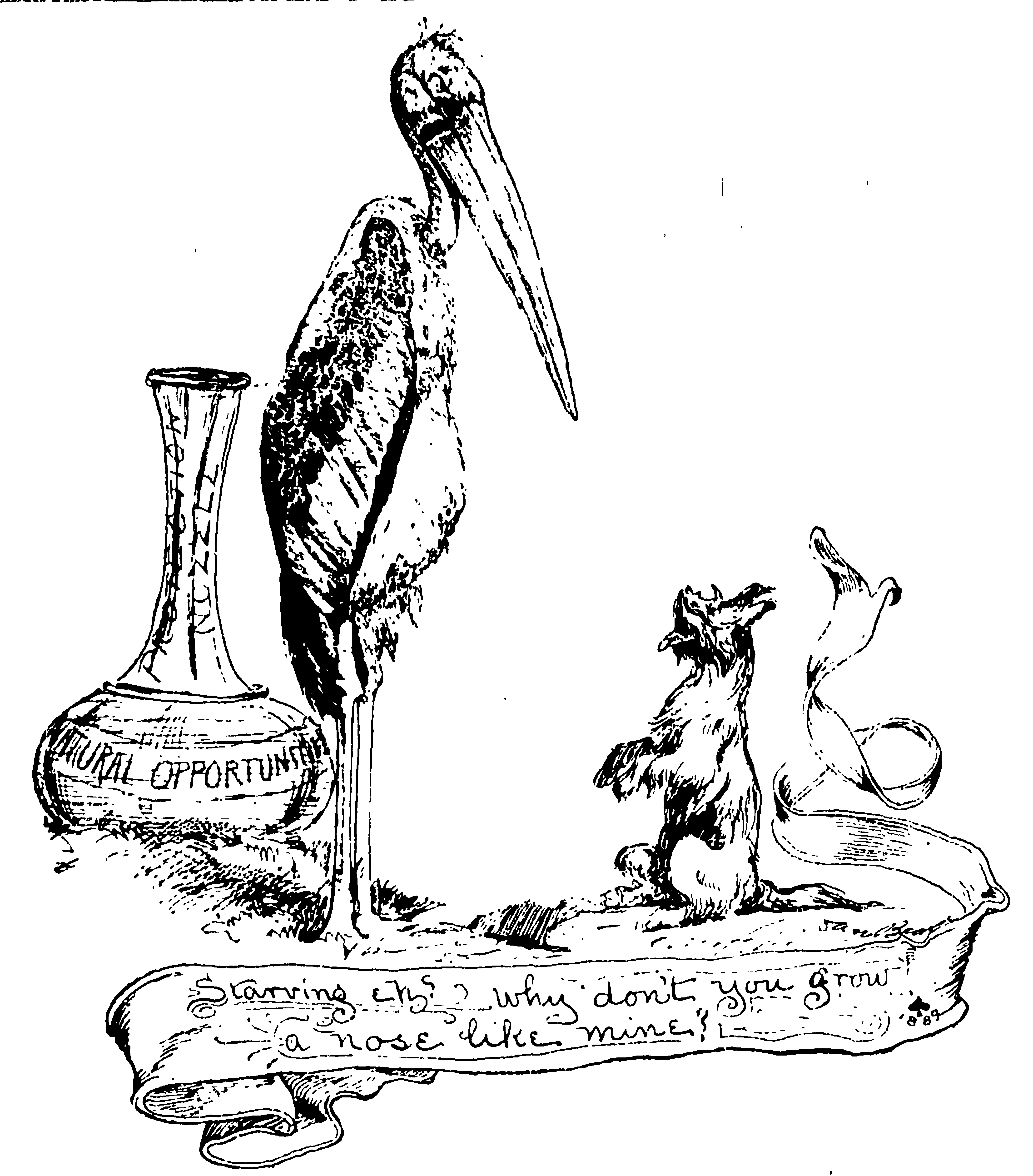
[Cartoon: a gaunt, long-billed stork (adjutant) stands beside a long-necked vase lettered “[NAT]URAL OPPORTUN[ITIES]” on its body (ends hidden by the stork and the edge of the vase) and “PROTECTION” and “NOZZLE” on its neck; a starved little dog sits up begging before it. Artist’s signature on the ground at right: “Dan Beard [?]”; monogram (spade) and “’89” at right of the scroll. Hand-lettered scroll caption:]
Starving, eh? why don’t you grow a nose like mine?
[Mark Twain as a Social Reformer, continued]
until it was at its total, the order was promptly but gradually obeyed. By way of apology to Columbus, who played the same trick on the Indians, the Yankee explains that he was not guilty of plagiarism in imitating Columbus, because he got the trick in nearly a thousand years ahead of that party.
The fame of the Yankee went abroad. Every one wanted to see him perform another miracle; but there was no miracle handy. The nearest approach to one was an eclipse of the moon, but that was two years off. Presently Merlin, whose stock was down and who was green with envy, spread the report that the reason the strange magician did not accommodate the people with a miracle was because he was a humbug and couldn’t perform one. It was necessary to cast Merlin again into the shade. A powder mine was
[Cartoon spanning columns 2–3, set between the upper and lower parts of those columns:]
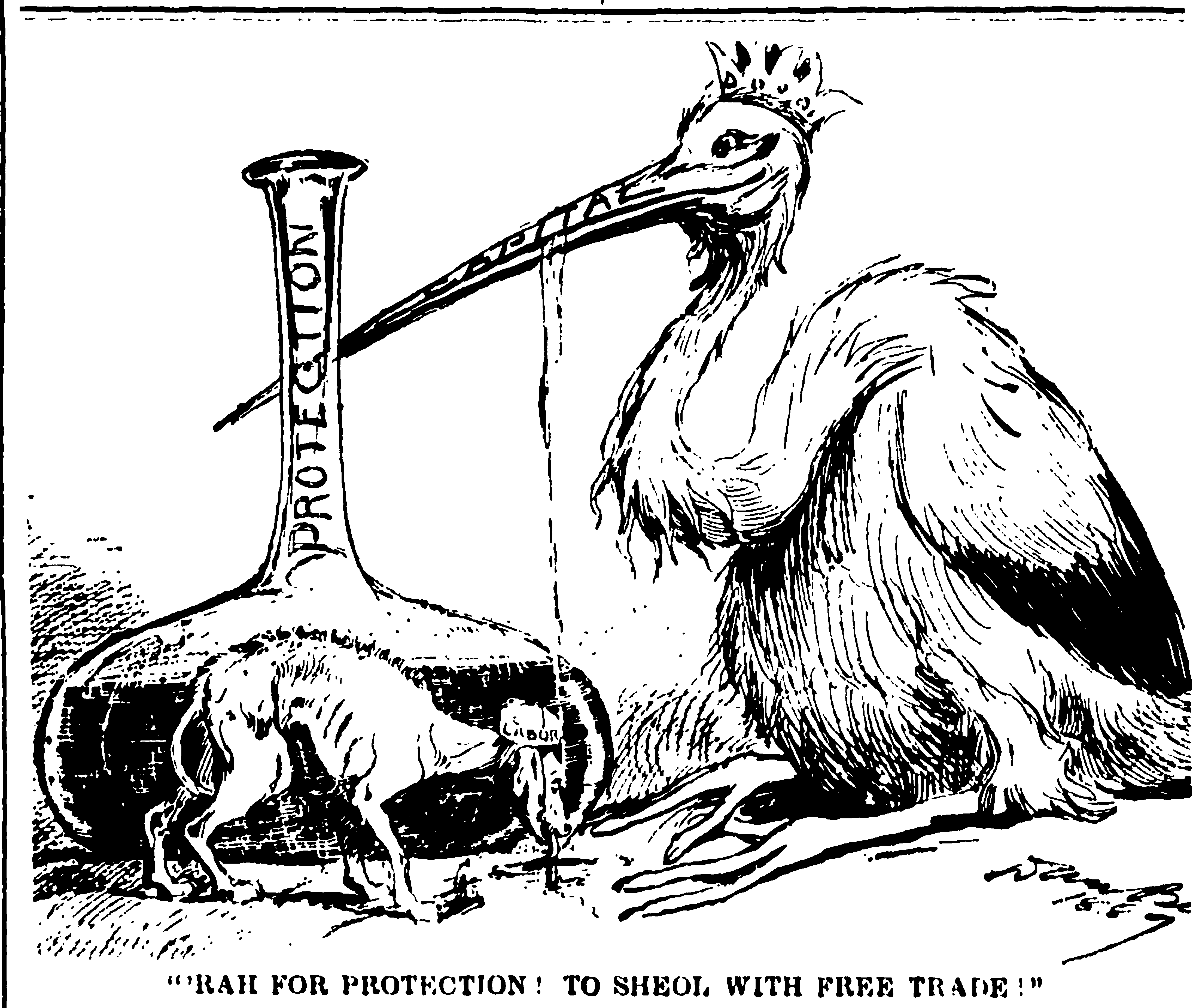
[Cartoon: a crowned stork with its long bill, lettered “CAPITAL”, thrust into the neck of a flask lettered “PROTECTION”; drops fall from the bill to an emaciated dog wearing a collar lettered “LABOR”, which licks them from the ground. Artist’s signature at lower right, “Dan Beard [?]”, with a date. Caption:]
“’RAH FOR PROTECTION! TO SHEOL WITH FREE TRADE!”
[Mark Twain as a Social Reformer, continued from above the cartoon]
secretly placed under Merlin’s tower, with a connecting lightning rod. On a showery day it was announced that lightnings would be called down to destroy the tower, and Merlin was invited to break the enchantment if he could. He tried his incantations, but when the Yankee, who was observing the sky, gave his command, the lightning rod caught onto a surcharged cloud, and up went Merlin’s tower and away scattered the people. Merlin’s stock was lower than ever, and the king wanted to stop his wages.
After that the Yankee was not pressed for miracles, though he occasionally
p. 8, col. 3 [Mark Twain as a Social Reformer, continued]
performed one. He attended strictly to his business of setting up a nineteenth century in the midst of the sixth. His opportunities were unlimited, and he was the greatest man in the kingdom. At first he had no title, but gradually he came to be called “The Boss.” That was indeed a great title. The duke meant no duke in particular, but The King, The Queen and The Boss were specific. He built factories, picked out priests with a view to educating them for reporters on the newspaper he proposed to start, organized a military school, laid underground telegraph and telephone wires, started railroads, tried to remedy abuses in government, encouraged cleanliness, built up a merchant marine, and so on. In most of his work he advanced a little at a time, and so far as possible secretly, for, as he says, it was necessary to prepare the way
[continued below the cartoon]
gradually for a better order of things, and he was turning on his light “one candle-powder at a time.”
Mark Twain’s thoughts about the freemen of the time, which he expresses through the Yankee, are worth giving in his own words as an illustration of the spirit of democracy that pervades the book. He says:
And here were these freemen assembled in the early morning to work on their lord the bishop’s road three days each—gratis; every head of a family and every son of a family three days each gratis, and a day or so added for their servants. Why, it was like reading about France and the French, before the
p. 8, col. 4 > ever memorable and blessed revolution, which swept a thousand years of such villainy away in one swift sic wave of blood—one: a settlement of that hoary debt in the proportion of half a drop of blood for each hogshead of it that had been pressed by slow tortures out of that people in the weary stretch of ten centuries of wrong and shame and misery the like of which was not to be mated but in hell. There were two “reigns of terror,” if we would but remember it and consider it; the one wrought murder in hot passion, the other in heartless cold blood; the one lasted mere months, the other had lasted a thousand years; the one inflicted death upon ten thousand persons, the other upon a hundred million; but our shudders are all for the horrors of the minor terror, the momentary terror, so to speak; whereas, what is the horror of swift death by the ax compared with life-long death from hunger, cold, insult, cruelty and heart break? What is swift death by lightning compared with death by slow fire at the stake? A city cemetery could contain the coffins filled by that brief terror which we have all been so diligently taught to shiver at and mourn over; but all France could hardly contain the coffins filled by that older and real terror—that unspeakably bitter and awful terror which none of us has been taught to see in its vastness or pity as it deserves.
In this connection the Yankee reads nineteenth century people a lesson in political science: “The citizen,” he says, “who thinks he sees that the commonwealth’s political clothes are worn out, and yet holds his peace and does not agitate for a new suit, is disloyal—he is a traitor. That he may be the only one who thinks he sees this decay, does not excuse him; it is his duty to agitate any way, and it is the duty of the others to vote him down if they do not see the matter as he does.” But the Yankee believed in accomplishing political reforms by appropriate means. Applying his own lesson to himself he says:
Here I was in a country where the right to say how the country should be governed was restricted to six persons in each thousand of its population. For the nine hundred and ninety-four to express dissatisfaction with the regnant system and propose to change it, would have made the whole six shudder as one man, it would have been so disloyal, so dishonorable, such putrid black treason. So to speak, I was to become a stockholder in a corporation where nine hundred and ninety-four of its members furnished all the money and did all the work, and the other six elected themselves a permanent board of direction and took all the dividends. It seemed to me that what the nine hundred and ninety-four dupes needed was a new deal. The thing that would have best suited the circus side of my nature would have been to resign the boss-ship and get up an insurrection and turn it into a revolution; but I knew that the Jack Cade or the Wat Tyler who tries such a thing without first educating his materials up to revolution grade is almost absolutely certain to get left. I had never been accustomed to getting left, even if I do say it myself. Wherefore, the deal which had been for some time working into shape in my mind was of a quite different pattern from the Cade-Tyler sic.”
The plan for a new “deal” which the Yankee had in mind began with soap. The bravest knights he could get he turned into soap missionaries by presenting them with suits of armor lettered with soap signs of such barbaric splendor that even the king would have been glad to wear one. These missionaries were taught to spell out the signs, and required to roam over the country and to “gradually and without creating suspicion or exciting alarm, introduce a rudimentary cleanliness among the nobility.” And from the nobility it was supposed “it would work down to the people if the priests could be kept quiet.” The missionary knights were to spell out their signs and then explain to the lords and ladies what soap was; and “if the lords and ladies were afraid of it, get them to try it on a dog.” The missionary’s next move was to get “the family together and try it on himself; he was to stop at no experiment, however desperate, that could convince the nobility that soap was harmless;” and if any final doubt remained he was to catch a hermit, and “if a hermit could survive a wash and that failed to convince a duke, let him alone.” Whenever one of the missionary knights overcame a knight errant he washed him, and “when he got well” swore him to “go and get a bulletin board and disseminate soap and civilization the rest of his days.” Besides being a scheme to get the nation washed, this was a furtive blow at the sic of knight errantry, for the Yankee believed that when the missionary knights got numerous enough “they would begin to look ridiculous, and then even the steel-clad ass that hadn’t any bulletin board would himself begin to look ridiculous because he was out of fashion.”
Beginning thus with soap and leading on to one reform after another, the Yankee proposed “a modified monarchy till Arthur’s days were done, then the destruc- continued on p. 9 →
[The article breaks off mid-word at the foot of column 4; no continuation line is printed.]
Page 9 of 16contents
p. 9, col. 1 [continued from page 8, where the review of A Connecticut Yankee in King Arthur’s Court begins; page 8 ends “the destruc-”]
← continued from p. 8 tion of the throne, nobility abolished, every member of it bound out to some useful trade, universal suffrage instituted, and the whole government placed in the hands of the men and women of the nation, there to remain.” He remembered the phrase which has grown so common in the world’s mouth that it has come to have sense and meaning—the sense and meaning implied when it is used; that is, the phrase which refers to this or that or the other nation as possibly being “capable of self government;” the implied sense of which is that there has been a nation somewhere, some time or other, which wasn’t as able to govern itself as some self-appointed specialists were or would be able to govern it.” But in this phrase he “took no stock.” He believed that “a man is a man at bottom,” and that whole ages of abuse and oppression cannot crush the manhood clear out of him. “Yes,” says the author speaking for his hero, “there is plenty good enough material for a republic in the most degraded people that ever existed—even the Russians; plenty of manhood in them, even in the Germans—if one could but force it out of its timid and suspicious privacy, to overthrow and trample in the mud any throne that ever was set up and any nobility that ever supported it.” His idea of the superiority of kings and nobles is expressed by a prisoner whose crime was a mere remark. The prisoner had said “he believed that men were about all alike, and one man as good as another barring clothes,” and that “if you were to strip the nation naked and send a stranger through the crowd, he couldn’t tell the king from a quack doctor, nor a duke from a hotel clerk.” The Yankee is made to regard this prisoner as “a man whose brains had not been reduced to an ineffectual mush by idiotic training,” and to send him to what he called his “man factory,” where he was educating picked men to be useful, independent and civilized.
After getting his newspaper under way, the Yankee determined, in prosecution of his design to establish equal rights, to familiarize himself with the humbler life of the people by going among them disguised as a petty freeman. When the king learned of this intention he was afire with the novelty of the thing and insisted upon going along. Accordingly the two set out, dressed and barbered like the poor people of the kingdom. The king was a cause of great annoyance and danger to the Yankee, because he would not act toward quality folks with the usual humility of the poor; and early in the enterprise he came near bringing it to a sudden end by insulting a couple of knights, who, thinking him a peasant, were about to ride him down. The knights turned upon the king and would have murdered him; but the Yankee sprang between and diverted their attention so successfully with a choice selection of nineteenth century epithets that they set their lances for him and galloped furiously after him as he ran. When they were fifteen yards away he hurled a dynamite bomb in their direction. The effect resembled “a steamboat explosion on the Mississippi,” and during the next fifteen minutes the king and the Yankee “stood under a steady drizzle of microscopic fragments of knights, and hardware and horseflesh.” And there was a hole in the ground which would afford steady work for all the people of the region for years to come in trying to explain it. This was credited to the Yankee as a miracle, and was “another settler for Merlin;” but inasmuch as the Yankee had no other bomb with him he thought it well to warn the king that “this was a miracle of so rare a sort that it couldn’t be done except when sic atmospheric conditions were just right.”
In the course of this journey the Yankee fell in with “a self made man,” one of the usual sort, a man named Dowley. The Yankee worked Dowley around to his own history for a text and himself for a hero, and then, as he writes, “it was good to sit there and hear him hum.”
After Dowley had told of his life as an orphan without money or friends, how he lived as a slave of the meanest master, how he worked eighteen hours a day for black bread and not enough of that, how his faithfulness attracted the attention of a blacksmith who kindly indentured him for nine years for sic and clothes, and how he had prospered since until he really indulged in fresh meat and white bread as often as twice a year, the Yankee led him up to conversation about the tariff. They were in a little tributary kingdom which enjoyed
p. 9, col. 2 the blessings of protection to home industry. Dowley, being thick headed and selfish hearted, was a thorough going protectionist, and all for the “good of the workingman.” He told the Yankee that wages were double in the tributary kingdom what they were in Arthur’s kingdom, and the Yankee admitted it. It was a fatal admission, for though the Yankee showed Dowley that the cost of living was more than double, Dowley could see nothing but the higher wages; and whenever the Yankee showed him
 [Cartoon: “Evolution”: a row of eight figures—two
upright bear- or ape-like animals, then two shaggy, stooping men holding
out their hands, then four tall, thin, stork-like or crane-like birds
standing upright. A small artist’s mark at lower right.] Caption:
EVOLUTION.
that wages were really lower in the tributary kingdom, Dowley would reason: “Why you have yourself admitted that they are double!” Beyond that the mind of the sixth century protectionist, like that of the nineteenth century species, would not go. “What those people valued,” says the Yankee, “was high wages. It didn’t seem to be a matter of any consequence to them whether the high wages would buy anything or not. They stood for protection, and swore by it, which was reasonable enough, because
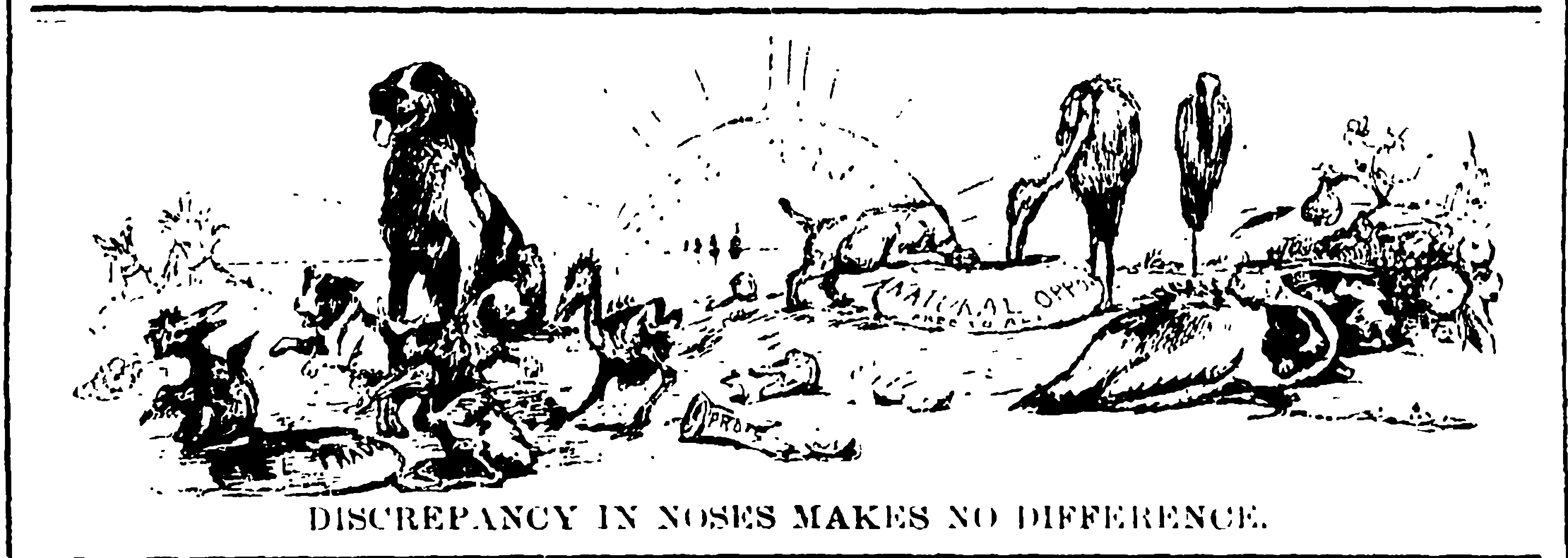 [Cartoon: animals with mismatched noses and beaks
gather in a landscape under a rising sun. At centre a large seated dog;
in the foreground small birds and beasts cluster round a pool labelled
“[FRE?]E TRADE”; an overturned vessel on the ground is labelled
“PROT[ECTION?]” (only “PROT” visible); a long-snouted animal drinks from
a trough labelled “NATURAL OPPO[RTUNITIES?]” with smaller lettering
beneath, “FREE TO ALL” (partly legible); two tall storks stand beside
the trough; a large dead bird lies in the right foreground; at right a
heap of fruit and produce with lettering [illegible].] Caption:
DISCREPANCY IN NOSES MAKES NO DIFFERENCE.
interested parties had gulled them into the notion that it was protection which had created their high wages.” He “proved to them that in a quarter of a century their wages had advanced but thirty per cent, while the cost of living had gone up 100; and that,” in Arthur’s kingdom, “in a shorter time wages had advanced forty per cent while the cost of living had gone steadily down. But it didn’t do any good. Nothing could unseat their strange beliefs.”
The Yankee was smarting under defeat,
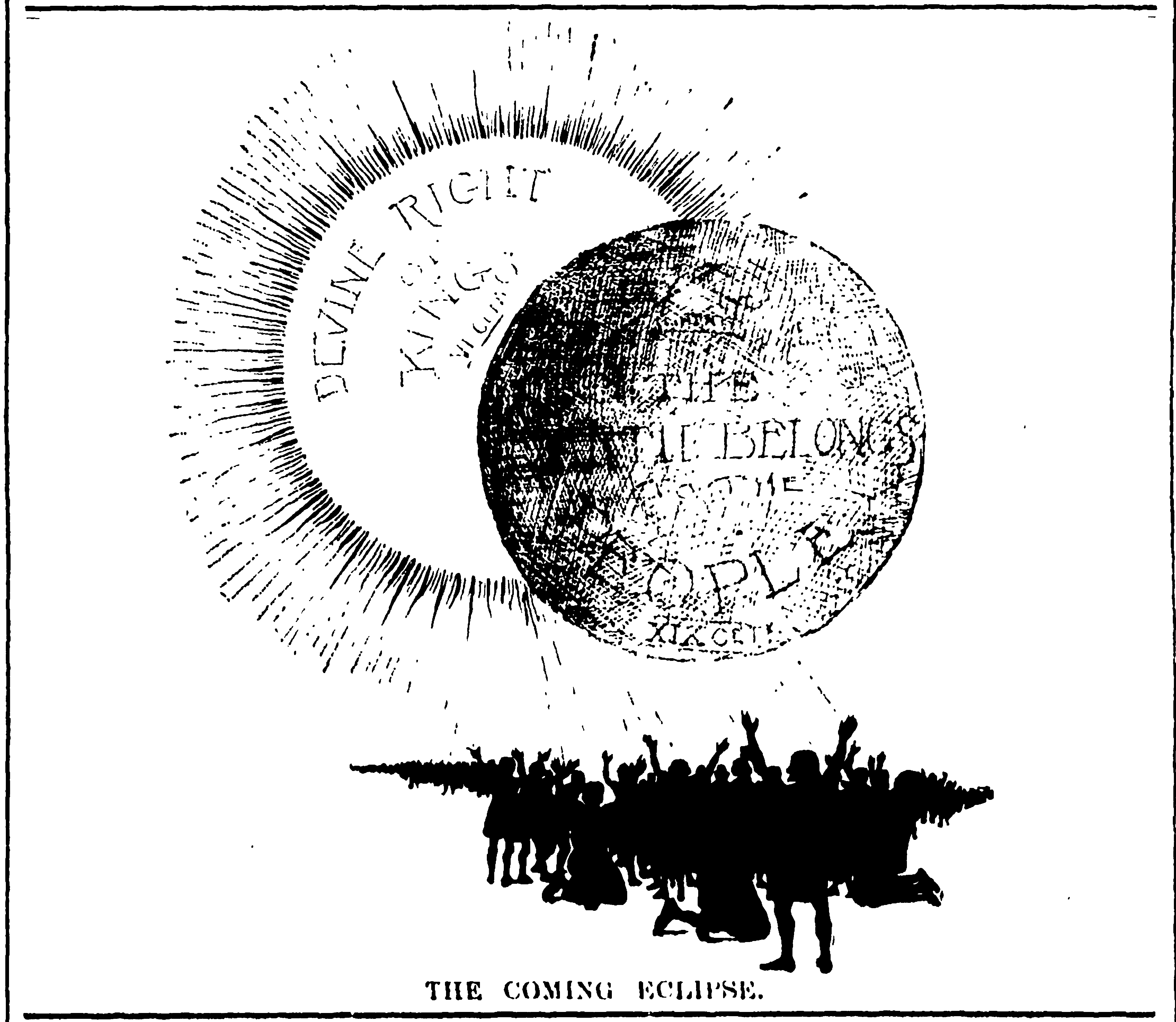 [Cartoon: “The Coming Eclipse”: a radiant sun lettered
“DEVINE RIGHT OF sic VI CENT.” is being covered by a
dark, cross-hatched moon lettered “THE [EARTH?] BELONGS TO THE [PEOPLE?]
XIX CENT.” (first word of the second line and first letters of “PEOPLE”
obscured by the hatching); below, a silhouetted crowd, some kneeling,
raise their arms toward the eclipse.] Caption: THE COMING ECLIPSE.
and determined to hit beneath the belt. During the conversation, with a “hurrah for protection, and to sheol with free trade,” Dowley had told that wages under protection were even as high as a cent a day, and that he himself, in spite of the rate fixed by the magistrate, had paid within the week as high as a cent and fifteen milrays. It was at this confession that the Yankee aimed, and this is the way he hit his mark:
When I make up my mind to hit a man I don’t plan out a love tap. No, that isn’t
p. 9, col. 3 > my way. As long as I am going to sic at all I am going to hit him a lifter, and I don’t jump at him all of a sudden and risk making a blundering, half way business of it. No, I get away off yonder to one side and work up on him gradually so that he never suspects I am going to hit him at all, and by and by, all in a flash, he is flat on his back, and he can’t tell for the life of him how it all happened. That was the way I went for Brother Dowley. I started to talking lazy and comfortable as if I was just talking to pass the time, and the oldest man in the world couldn’t have taken the bearings of my starting place and guessed where I was going to fetch up:
“Boys, there is a good many curious things about law and custom and usage and all that sort of thing, when you come to look at it; yes, and about the drift and progress of human opinion and movement, sic. There are written laws; they perish. But there are also unwritten laws; they are eternal. Take the unwritten law of wages; it says they have got to advance little by little, straight through the centuries, and notice how it works. We know what wages are now, here, there and yonder; we strike an average, and say that is the wages of to-day. We know what the wages were a hundred years ago, and what they were two hundred years ago. That is as far back as we can get. But it suffices sic give us the law of progress, the measure and rate of the periodical augmentation; and so without a document to help us, we can come pretty close to determining what the wages were three and four and five hundred years ago. Good, so far. Do we stop there? No. We stop looking backward and face around and apply the law to the future. My friends, I can tell you what the people’s wages are going to be at any date in the future you want to know, for hundreds and hundreds of years.”
“What, good man, what!”
“Yes, in seven hundred years, wages will have risen to six times what they are now
here in your region; and farm hands will be allowed three cents a day and mechanics six.”
“I would I might die now and live then,” interrupted Smug the mason, with a fine, avaricious glow in his eye.
“And that isn’t all. They’ll get their board besides—such as it is; it won’t bloat them. Two hundred and fifty years later—pay attention now—mechanics’ wages will be—mind you, this is law, not guess work—a mechanic’s wages will then be twenty cents a day.”
There was a general gasp of awed astonishment. Dicken, the wheelwright, murmured with raised hands and eyes:
p. 9, col. 4 > “More than three weeks’ pay for one day’s work.”
“Riches!—of a truth, yes, riches!” muttered Marco, his breath coming quick and short with excitement.
“Wages will keep on rising, little by little, little by little, as steadily as a tree grows, and at the end of three hundred and forty years more there will be at least one country where the mechanic’s average wage will be two hundred cents a day!”
It knocked them absolutely dumb! Not a man of them could get his breath for upward of two minutes. Then the coal burner said prayerfully:
“Might I but live to see it!”
“It is the income of an earl,” said Smug.
“An earl, say ye,” said Dowley; “ye could say more than that and speak no lie. There is no earl in the realm of Bagdmagus that hath an income like that. Income of an earl! It’s the income of an angel!”
“Now, then, that is what is going to happen as regards wages. In that remote day that man will earn, with one week’s work, that bill of goods which takes you upward of five weeks to earn now. Some other pretty surprising things are going to happen, too. Brother Dowley, who is it that determines every spring what the particular wage of each kind of mechanic, laborer and servant shall be for that year?”
“Sometimes the court, sometimes the town council; but most of all the magistrates. Ye may say, in general terms, it is the magistrate that fixes the wages.”
“Doesn’t ask any of those poor devils to help him fix their wages for them, does he?”
“Hm! That were an idea! The master that’s to pay him the money is the one that’s rightly concerned in that sic, ye will notice.”
“Yes; but I thought the other man might have some little trifle at stake in it, too; and even his wife and children, poor creatures. The few, who do no work, determine what pay the vast hive shall have to do work. You see they’re a combine—a trades union, to coin a new phrase—who band themselves together to force their lowly brother to take what they choose to give. Thirteen hundred years hence—so says the unwritten law—the combine will be the other way, and then how these fine people’s posterity will fume and fret and grit their teeth over the insolent tyranny of trades unions! Yes, indeed! The magistrate will tranquilly arrange the wages from now clear away down into the nineteenth century; and then all of a sudden the wage earner will consider that a couple of thousand years or so is enough of this one sided sort of thing, and he will rise up and take a hand in fixing his wages himself. Ah, he will have a long and bitter account of wrong and humiliation to settle.”
“Do ye believe—”
“That he actually will help to fix his own wages! Yes, indeed. And he will be strong and able then.”
“Brave times, brave times, of a truth!” sneered the prosperous smith.
“Oh—and there’s another detail. In that day a master may hire a man for only just one day, or one week, or one month at a time, if he wants to.”
“What?”
“It’s true. Moreover, a magistrate won’t be able to force a man to work for a master a whole year on a stretch whether the man wants to or not.”
“Will there be no law or sense in that day?”
“Both of them, Dowley. In that day a man will be his own property, not the property of magistrate and master. And he can leave town whenever he wants to, if the wages don’t suit him, and they can’t put him in the pillory for it.”
“Perdition catch such an age!” shouted Dowley, in strong indignation. An age of sic; an age barren of reverence for superiors and respect for authority! The pillory—”
“Oh, wait, brother; say no good word for that institution. I think the pillory ought to be abolished.”
“A most strange idea. Why?”
“Well, I’ll tell you why. Is a man ever put in the pillory for a capital crime?”
“No.”
“Is it right to condemn a man to a slight punishment for a small offense and then kill him?”
There was no answer. I had scored my first point. For the first time the smith wasn’t up and ready. The company noticed it. Good effect.
“You don’t answer, brother. You were about to glorify the pillory a while ago, and shed some pity on a future age that isn’t going to use it. I think the pillory ought to be abolished. What usually happens when a poor fellow is put in the pillory for some little offense that didn’t amount to anything in the world? The mob try to have some fun with him, don’t they?”
“Yes.”
“They begin by clodding him; and they laugh themselves to pieces to see him try to dodge one clod and get hit with another.”
“Yes.”
“Then they throw dead cats at him, don’t they?”
“Yes.”
“Well, then, suppose he has a few personal enemies in that mob—and here and there a man or woman with a secret grudge against him—and suppose especially that he is unpopular in the community for his pride or his prosperity, or one thing or another—stones and bricks take the place of clods and cats presently, don’t they?”
“There is no doubt of it.”
“As a rule he is crippled for life, isn’t he?—jaws broken, teeth mashed out—or legs mutilated gangrened, presently cut off!—or an eye knocked out?”
“It is true, God knoweth it.”
“And if he is unpopular he can depend on dying, right there in the stocks, can’t he?”
“He surely can. One may not deny it.”
“I take it none of you are unpopular—by reason of pride or insolence, or sic prosperity, or any of those things that excite envy and malice among the base scum of the village? You wouldn’t think it much of a risk to take a chance in the stocks?” continued on p. 10 →
[continued on page 10]
Page 10 of 16contents
10 THE STANDARD. Vol. VII, No. 1
p. 10, col. 1 [continued from page 9]
← continued from p. 9 > Dowley winced visibly. I judged he was hit. But he didn’t betray it by any spoken words. As for the others, they spoke out plainly and with strong feeling. They said they had seen enough of the stocks to know what a man’s chance in them was, and they would never consent to enter them if they could compromise on a quick death by hanging.
“Well, to change the subject—for I think that I have established my point that the stocks ought to be abolished. I think some of our laws are pretty unfair. For instance, if I do a thing which ought to deliver me to the stocks, and you know I did it and yet keep still and don’t report me, you will get the stocks if anybody informs on you.”
“Ah, but that would serve you but right,” said Dowley; “for you must inform. So saith the law.”
The others coincided.
“Well, all right, let it go, since you vote me down. But there’s one thing which certainly isn’t fair. The magistrate fixes a mechanic’s wage at one cent a day, for instance. The law says that if any master shall venture even under utmost press of business to pay anything over that one cent a day even for a single day, he shall be both fined and pilloried for it; and whoever knows he did it and doesn’t inform, they also shall be fined and pilloried. Now it seems to me unfair, Dowley, and a deadly peril to all of us, that because you thoughtlessly confessed a while ago, that within a week you have paid a cent and fifteen mill—”
Oh, I tell you it was a smasher. You ought to have seen them go to pieces, the whole gang. I had just slipped up on poor, smiling and complacent Dowley so nice and easy and softly that he never suspected anything was going to happen till the blow came crashing down and knocked him all to rags.
A fine effect. In fact, as fine as any I ever produced, with so little time to work it up in.
But I saw in a moment that I had overdone the thing a little. I was expecting to scare them, but I wasn’t expecting to scare them to death. They were mighty near it, though. You see they had been a whole lifetime learning to appreciate the pillory; and to have that thing staring them in the face, and everyone of them distinctly at the mercy of me, a stranger, if I chose to go and report—well, it was awful, and they couldn’t seem to recover from the shock, they couldn’t seem to pull themselves together. Pale, shaky, dumb, pitiful? Why, they weren’t any better than so many dead men. It was very uncomfortable. Of course I thought they would appeal to me to keep mum, and then we would shake hands and take a drink all round, and laugh it off, and there an end. But no; you see I was an unknown person, among a cruelly oppressed and suspicious people, a people always accustomed to having advantage taken of their helplessness and never expecting just or kind treatment from any but of their own families and very closest intimates. Appeal to me to be gentle, to be fair, to be generous! Of course they wanted to, but they couldn’t dare.
The result of this fine effect which the Yankee had extemporized was that he and the king were pursued by a mob of peasants, from whom they were rescued by a slave dealer and chained with a gang of slaves. In describing this experience the Yankee says: “We took up our line of march and passed out of sic at noon, and it seemed to me unaccountably strange and odd that the king of England and his chief minister, marching manacled and fettered and yoked in a slave convoy, could move by all manner of idle men and women, and under windows where sat the sweet and lovely, and yet never attract a curious eye, never provoke a single remark. Dear, dear, it only shows that there is nothing diviner about a king than there is about a tramp, after all. He is just a cheap and hollow artificiality when you don’t know he is a king. But reveal his quality, and dear me, it takes your very breath away to look at him. I reckon we are all fools. Born so, no doubt.”
When the slave convoy reached London the Yankee prepared a scheme for the escape of himself and the king. Getting loose from the chain he telephoned to his page at Camelot to send up a squadron of knights under command of Sir Launcelot. He knew that the knights could not arrive before a certain hour, some two days off. Meantime one of the slaves killed the dealer, and, according to the law of the time, all were condemned to death. Their execution was delayed only until the escaped slave, the Boss himself, could be recaptured. This was finally accomplished through the stupidity of a sixth century detective. The Boss was recognized on the street by one of the slaves who, in charge of an officer, was looking for him, and thereupon, so writes the Yankee—
I turned immediately into a shop, and worked along down the counter, pricing things and watching out of the corner of my eyes. Those people had stopped, and were talking together and looking in at the door. I made up my mind to get out by the back way, if there was a back way, and I asked the shop woman if I could step out there and look for the escaped slave, who was believed to be in hiding back there somewhere, and said I was an officer in disguise, and my pard was yonder at the door with one of the murderers in charge, and would she be good enough to step there and tell him he needn’t
p. 10, col. 2 > wait, but had better go at once to the further end of the back alley and be ready to head him off when I rousted him out.
She was blazing with eagerness to see one of those already celebrated murderers, and she started on the errand at once. I slipped out the back way, locked the door behind me, put the key in my pocket, and started off, chuckling to myself, and comfortable.
Well, I had gone and spoiled it again, made another mistake. A double one, in fact sic were plenty of ways to get rid of that officer by some simple and plausible device; but no, I must pick out a picturesque one; it is the crying defect of my character. And then I had ordered my procedure upon what the officer, being human, would naturally do; whereas, when you are least expecting it, a man will now and then go and do the very thing which it’s not natural for him to do. The natural thing for the officer to do, in this case, was to follow straight on my heels; he would find a stout oaken door securely locked between him and me; before he could break it down I should be far away and engaged in slipping into a succession of baffling disguises which would soon get me into a sort of raiment which was a surer protection from meddling law dogs in Britain than any amount of mere innocence and purity of character. But instead of doing the natural thing, the officer took me at my word, and followed my instruction. And so, as I came trotting out of that cul de sac, full of satisfaction with my own cleverness, he turned the corner and I walked right into his handcuffs.
The escaped slave having been recaptured, the execution was to take place immediately. This was disastrous, for the knights who had left Camelot under the lead of Launcelot could not arrive for several hours. As the slaves stood on the scaffold, both the King and the Boss declared themselves, but their voices were drowned in cries of derision. One of the slaves was blindfolded and hanged. The Boss looked up the road for his knights, but their arrival was out of the possibilities. Then another slave was hanged, and another, and in turn the rope was put around the neck of the king. Just as the King was about to dangle, the eye of the Boss caught sight of his knights, five hundred of them, with Launcelot at their head, mailed and belted, and on bicycles. In a moment the populace were on their knees and the King was as divine as ever. It was a miracle even to the Boss, for he did not know that during his absence his page had got the knights to practicing on the wheel. He was greatly gratified, and pronounced the effect, taking the whole situation all round, as one of the gaudiest he had ever instigated.
After this experience and at a tournament, at which with a lariat and a pair of revolvers he had worsted all the knights, one at a time and all together, the Boss went for rest into Gaul. Upon his return, the little nineteenth century which he had succeeded in building up in the sixth, was all gone. Shipping, telegraphs, telephones, army, navy, factories, railroads, all had disappeared. The church has sic its interdict, and the people, wallowing still in superstition, had given heed to it. Even those who had been fully educated out of awe of the church gave way, and the Boss had none left among his faithful but the boys who were born wholly out of the atmosphere of superstition. With these he made one last stand, protected by lines of breastworks charged with dynamite and guarded with ingenious electrical weapons. One great battle was fought without loss to the Boss’s forces, but with such great loss to the enemy that the dead could not be counted, “because they did not exist as individuals, but merely as homogeneous protoplasm with alloys of iron and buttons.” Upon this victory the Boss issued the following proclamation:
Soldiers. sic of Human Liberty and Equality: Your general congratulates you! In the pride of his strength and the vanity of his renown, an arrogant enemy came against you. You were ready. The conflict was brief; on your side glorious. This mighty victory having been achieved utterly without loss stands without example in history. So long as the planets shall continue to move in their orbits, the battle of the Sand-Belt will not perish out of the memories of men.”
THE BOSS.
Soon after, by a subterfuge, Merlin got into the chamber of the Boss while he slept, and, failing in all other attempts at magic, turned the sleep of a night into a slumber of thirteen centuries. At the end of that long period Mark Twain met the Boss in Warwick castle and got his story.
Though but little is said in the book about specific social or political reforms, it is impossible to read these extracts without seeing that the great American humorist has been moved by the spirit of democracy. Human equality, natural rights, unjust laws, class snobbery, the power of the rich and the dependence and oppression of the poor, are subjects of frequent allusion in the text; and whatever of definiteness the text sic
p. 10, col. 3 lack in pointing out the fundamental cause and radical cure for wrongs, is admirably supplied by Dan Beard in the illustrations. Many of these illustrations we are able, by the courtesy of Mark Twain and his publishers, to reproduce. They need no explanation. Each speaks for itself, and to all who have “seen the cat” they speak with a truth and eloquence that show Mr. Beard to be not only an excellent artist but an intelligent single tax man as well.
CALVIN BRICE DENOUNCED.
Democrats in Ohio Who Regard His Candidacy for the United States Senate as Ominous.
William Heisley, esq., Judge E. J. Blandin, Tom L. Johnson, Virgil P. Kline, esq., J. E. Farrell, Charles Missar and other well known democrats met in the law office of ex-Congressman Foran of Cleveland, Ohio, some days ago to protest against the candidacy of Calvin S. Brice for the United States sen- atorship, and call a public meeting for further expression of opinion on this subject. The latter meeting took place at night in Music hall, and was in session for three hours. An affidavit of Mr. Brice, dated September 19, 1883, and declaring him to be a resident of New York, was read to the meeting. Several of those who called the meeting made speeches. Mr. Johnson said, after declaring that Mr. Brice had not demonstrated that he was a statesman, and affirming that Mr. Brice was largely responsible for the defeat of Mr. Cleveland in 1888—“a crime for which I can never forgive Cal sic:”
We complain, and justly so (the tendency of the times is in the wrong direction)—we complain that money controls the United States. As the power of kings went down, the power of money went up. But who is to blame for that? Do we blame men of money for using that money to get power? You would have to reconstruct men if you expected anything different. The men you should blame for that are yourselves. [Applause.] It is the ignorance of the masses that allows money to control. Now, how does money cut such a figure in elections? It seems to me that our plan of election, from the ballot right straight through to the election of senators, is all schemed out in such a way that money cuts the largest figure. If you want to remedy that do it yourselves by thinking out the question and start at the very foundation. Money figures to-day in the election of men to the smallest office, and you meet and cry out against it. Correct it. Adopt a secret ballot. [Great applause.] Adopt a ballot system whereby a man who wants to vote may know that he can do it secretly, without fear of the inspection of other people. Don’t trust to the prejudices of people. Prejudice is as strong sometimes as the use of money. A man, from mere habit, will take the ticket of his party. He is ashamed to scratch it, ashamed to go to the ticket peddler of the opposing party. If you want independent votes, if you want to destroy the use of money in elections, if you want to keep from this shameful thing of a house of lords whose seats are purchased, start at the beginning, correct the ballot, and I believe you will find in the end that other evils will be abolished. If the use of money in elections is to be destroyed, and you are to be rid of this forever, you must remember the problem is with you, and with no handful of men who call meetings.
Mr. Foran, who was recently connected with the protectionist wing of the democratic party, deplored the disposition to elect men to office merely because they have money. Mr. Foran declared that after six years in congress he came home $20,000 in debt. He wanted no more of it. He added:
Even the lower house has got to be a body now in which no man can go unless he has a pretty long purse. Wealth has become the dominant factor and power in the United States; and this movement inaugurated here to-night—it may be derided by the Plain Dealer, that ought to be a democratic paper, that don’t know what democracy is, that could not learn what democracy is if it tried, that never read Jefferson, that don’t know anything about the theories or principles of Thomas Jefferson—it may be derided by that paper, but this movement is bound to go on. It was organized in the city of Cleveland on the 23d day of December, 1889; it is a movement against the use of money to secure the election of men to the United States senate, and it is going to reverberate and go on from year to year, like the old abolition movement, until the people of the United States shall be disenthralled and freed from this influence. (Applause.)
Perhaps Mr. Foran’s most significant utterance upon the question was contained in a long letter to a local paper.
Still the fact remains—the nation is gaining in power and prestige and the states are losing ground under our system, and to an extent that is not demanded by a liberal interpretation of the constitution—to an extent that is alarming and menacing.
Why is this?
The dominating cause seems to me clear. It is because our fiscal system tends to enrich the nation and impoverish the states; all the easy and popular sources of revenue the federal government reserves to itself, while the states are confined to direct taxation. Those who pay direct taxes scan each item of levy and hold those who expend the taxes to a strict accountability; indirect taxes we do not feel, and their expenditure costs us hardly a thought.
The United States treasury is overflowing—$75,000,000 of a yearly surplus. Every one looks to congress for appropriations and sub-
p. 10, col. 4 > sidies, and the result is that the power and influence of the federal government grows apace. This is the main reason for the present rapid strides of nationalism, and this is the problem which the democratic party is now called upon to solve—to equalize the revenues of the states and thus enlarge their power and influence while that of the federal government is minimized.
But can this be done while the senate is controlled by the advocates of strong government, the advocates of war tariffs, men whose only desire is to protect themselves and their monetary interests, men who believe in a surplus and large appropriations, men who want a large standing army, a powerful navy, frowning forts, and hundred-ton guns by the thousand?
Certainly not!
A New Year Vigil.
In that glad new year, friend of mine, we’re nearing, Which shall be ours, here or otherwhere, We will look backward, all our vision cheering, To these poor days of turmoil and of care.
We will remember, between smiles and sighing, How here we stumbled, tho’ the road was plain, And here, where strongest barrier frowned defying, Still resolute, our pathway we would gain.
And we will bear to think—the anguish over— Of deeper heartache that to us befell; Haply, the need of trial may discover, And feel, with chastened spirit, “all was well.”
But oh, what dearer memories, ever thronging, Their place immortal in our thought shall claim! Of faith and patience, that, to truth belonging, Our weak and eager struggle put to shame.
While we shall wonder we could ever falter, That any mirage could our sight betray, That lips which glowed with fire from God’s own altar, Could ever meet the voice to say them nay!
And shall not glad thanksgiving then be ours— When fought the fight, the glorious guerdon won!— If, looking backward thro’ the shining hours, We may but count some smallest deed our own!
But, hark! the bells are ringing us to duty— The sky aflame with heralds of the sun! Dream we no more of that far dawn of beauty— Find we our part in cycle just begun.
Oh, friends! clasp hand upon this New Year morning: Pledge faith and hope and brotherhood, anew! In God’s great world, no humblest effort scorning, We’ll thank him for the work he gives to do.
FRANCES M. MILNE.
San Luis Obispo, Cal., January 1, 1890.
STRAWS THAT SHOW THE WIND.
Henry George’s single tax scheme is receiving the attention and approval of a large number of the sic men of this and other countries. The time will come when it will be the leading question of the hour.
Why should the land, the common heritage of the people, with all its vast natural sic, be handed over to an army of drones and sensualists, depriving the rightful owners of their share of its sic.—[Canadian Workman.
In the meantime the spirit of rugged democracy, the love of individual liberty and the hatred of centralization are as strong as ever in the hearts of the masses.—[New York Herald.
Mr. George presents a plausible theory, but even if, as Mr. George puts it, the single tax is the solution of all our ills, it will take years to bring the public to adopt it.—[Lynn, Mass., Bee.
The Knights of Labor at their general assembly at Atlanta, Georgia, have taken a step forward by declaring in their platform in favor of the taxation of land values in place of other forms of taxation. Had they taken this important step years ago and pursued their educational programme on this line they would now have been much stronger and their organization far more coherent.—Marinette, Wis., sic.
The Sentinel is of the opinion that long before fifty years Indianapolis will be minded to operate her street railway lines herself. We believe it will be a great mistake to grant any street railway franchise for so long a period to anybody, upon any terms, unless with an option of purchasing the lines at pleasure at a price to be determined by some equitable method.—[Indianapolis Sentinel.
Protection is the Science of Grab.
Philadelphia Record.
The people of Florida want a tariff on oranges of a dollar a box; and the people of California want to be exempted from the tax on the distilled spirits with which they fortify their wines. There is no selfishness like the “protective” selfishness. It begins and ends in the desire of every man to use the taxing power of the government to get the advantage of every other man. It is the science of grab.
Page 11 of 16contents
January 1, 1890. THE STANDARD. 11
p. 11, col. 1
THE FREE TRADE FIGHT.
WARRING ON WOMEN.
A Strong and Striking Arraignment of the Protective System.
“Governmental Aid to Injustice” is the title of a short but significant article by George M. Wallace in the December issue of the Popular Science Monthly. He declares that “we find the successful business man offering for sale a hundred tons of steel rails; beside him is a slender girl offering the labor of her hands for ten hours. The commodity offered by each, by each has been sic; the business man’s by a hundred tons of coal burned beneath a dozen boilers, perhaps; the young girl’s, worked up in a physiological laboratory, comes from a night’s rest, a morning and a midday repast.”
Mr. Wallace does not object to the business man’s greater reward, so long as legitimate business methods alone are adhered to, “but for the government to step into the business arena and assist one party or the other is as immoral, financially, as for the umpire of a baseball game to play upon one side or the other by sic decisions.”
After setting forth a really great truth by the aid of this somewhat absurd comparison, Mr. Wallace goes on to show that by obtaining a protective and well nigh prohibitive duty of $17 per ton on steel rails, the business man has stepped out of the arena of business into that of politics, and obtained from the government part of its taxing power. Meanwhile the “unprotected” girl at a dollar a day pays ten cents a yard for calico that, with lower railway freights, which cheaper steel rails would make possible, she might have got for nine cents. The government interfered to take money from the girl’s pocket and put it into that of the manufacturer.
The non-producing government has wrought a momentous change in the distribution of wealth. It has ceased to be impartial. Ten cents a day from 100,000 of the poor, on whom the bulk of taxes falls, makes $10,000. This is mere blood money. It skimps the food and clothing of the girl; it may mean to her hunger, cold—even death. To the business man it may mean a cigar, a trifle for his child, or, with other forced contributions, a European trip to his daughter. Here is a great captain of industry competing with a delicate girl, and the machinery of government enlisted on his side. Mr. Wallace closes thus:
Thus, in what ought to be the manliest country in the world, or the part of that section of our manhood best fitted by nature for the financial struggle for bread, and aimed by these financial giants at the weakest section of the country, we may talk about the ferocity of the Northmen tossing up babies and catching them on their spears, or about atrocities practiced in Russia to-day; we may imagine a Sullivan calling for steel sic with which to encounter a seven-year-old boy; but we cannot believe that American manhood will not some time rise above the unparalleled meanness of the protective tariff.
PRIZES FOR ECONOMIC STUDENTS.
Personal Property Taxation and Women Wage Earners the Subjects of Prize Essays.
Thomas G. Shearman offers through the American economic association, Richard T. Ely, Baltimore, Md., secretary, a prize of $250 for the best essay on “State and local taxation of personal property in the United sic” Competitors will be expected to discuss the following points: Should personal property be taxed at all? Should some kinds of personal property be taxed, and other kinds exempted from taxation? The relation of personal property taxes, if any exist, to other taxes in a rational system of taxation. The changes in our laws needed to establish a better system of taxation. It is expected that defects in American state and local taxation will be pointed out; that improvements will be suggested; that the competitors will base all conclusions on a careful study of statistical and historical material; finally, that the question will be treated with especial, although not exclusive reference to the farmer. The essay must not exceed 25,000 words, and must be in the hands of the secretary of the association not later than December 1, 1890. Each paper must be type-written, signed by a fictitious name, and accompanied by a sealed envelope containing the name assumed as well as the address of the author.
The American economic association also offers a first prize of $300 and a second prize of $200 for essays on “Women Wage Earners.” It is expected that competitors will deal principally with the American aspect of the subject. It is desired to know the early and present condition of women wage earners, their growth in numbers, both absolutely and in proportion to population, the present extent of their sphere of labor, the economic and social evils connected with their various occupations as wage earners, and remedies for these evils. The terms as to length of essay, type writing and names of authors are the same as in the contest for the prize offered by Mr. Shearman. The essays must be submitted to Mr. Ely before March 1, 1890.
Miner’s Earnings in Colorado.
A. G. Groh, Tortelote, Col.—In the heat of p. 11, col. 2 the last presidential campaign, protectionist speakers dilated on the high wages paid the laborers in this part of Colorado. Timid democrats stood by with trembling knees and gnashing teeth, instead of stepping forward and branding the falsehoods as they deserved. These speakers declared that in Aspen miners’s sic were $3 per day; that by working 300 days the miner could earn $900 while his board would cost him $300, and allowing $100 for current expenses he could save $500 a year. Having then but recently come to this part of Colorado, I half believed their stories, because out of a thousand workingmen not one had the intelligence or courage to gainsay the statements. I have since looked into the subject and find it is true that a miner can save $500 a year—on paper. There is only one little drawback—the lack of a steady job. It is safe to say that sixty men out of a hundred are constantly idle, and that of the remaining forty some are idle part of the time. Just now swarms of men are tramping the streets of Aspen and Leadville, the two largest mining camps in the state, suffering from hunger and cold. These are severe teachers, but some workingmen need them. Probably in the next campaign these same shivering wretches will be shouting for protection to American workingmen against the paupers of Great Britain. Men do make $3 a day while they work, but they are compelled to be idle two-thirds of the time.
The Massachusetts Tariff reform league has on file at its headquarters, 66 State street, Boston, a valuable schedule of information about wool, and speakers or writers may obtain abstracts or transcripts free of charge or on special terms.
Press Opinions.
Congress shows a disposition to investigate the subject of trusts in all its bearings. It will be in order for somebody to ask by and by: What are protective tariffs in the last analysis but trusts, or combinations to defeat natural competition?—[Boston Globe.
Perhaps if Mr. Carnegie had known the fact that the “Rookwood” pottery of Cincinnati, which he quoted as having taken a prize at the Paris exhibition, had always refused to join with American potters in asking for a high protective tariff, he would not have instanced the Rookwood success as due to tariff protection. The owners of the Rookwood works af sic, as well as those of the Low art tile works, of Chelsea, have always been on the tariff reform side. It is not a mere coincidence that they are also the only two American potteries who have secured prizes abroad.—[Boston Transcript.
THE ASSESSMENTS.
Improved Property Taxed at Fifty-nine and a Half Per Cent of Its Selling Price; Unimproved at Forty-one and a Half Per Cent.
The following are some assessments on property sold within the last two weeks, and a comparison of the selling price and sic valuation:
IMPROVED PROPERTY.
No. 33 East Twentieth street, three story dwelling. Sold for $30,500; assessed at $26,000, or 85 per cent of its value.
No. 335 East Thirty-fifth street, four story brick store and tenement. Sold for $11,000; assessed at $5,000, or 45½ per cent of its value.
No. 120 East Seventy-second street, four story stone front dwelling. Sold for $24,100; assessed at $17,000, or 70½ per cent of its value.
No. 444 East Eighty-eighth street, five story brick tenement. Sold for $20,750; assessed at $10,000, or 48 per cent of its value.
No. 35 West 128th street, four story stone dwelling. Sold for sic; assessed at $14,000, or 58 per cent of its value.
No. 347 East 118th street, three story brick dwelling. Sold for $9,000; assessed at $4,500, or 50 per cent of its value.
The average assessment on the above six buildings is 59½ per cent of their selling price.
VACANT LAND.
North side of Fifty-eighth street, 225 feet west of Sixth avenue, three lots. Sold for $50,000; assessed at $27,000, or 54 per cent of their value.
South side of Ninetieth street, 200 feet east of Second avenue, four lots; and south side of Eighty-ninth street, 110 feet east of Third avenue, four lots. All sold for $64,000; assessed at $20,400, or 31½[?] per cent of their value.
North side of 121st street, 95 feet east of Manhattan avenue, two lots. Sold for $13,050; assessed at $5,000, or 37 per cent of their value.
South side of 133d street, 185 feet west of Fifth avenue, two lots. Sold for $15,500; assessed at $5,000, or 32 per cent of their value.
North side of 134th street, 90 feet west of Fourth avenue, three lots. Sold for $10,000; assessed at $5,400, or 54 per cent of their value.
The average assessment in the above parcels of vacant land is 41½ per cent of their selling price.
p. 11, col. 3
BALLOT REFORM.
The Essential Features of Ballot Reform.
First—All ballots shall be official and shall be printed and distributed at public expense.
Second—The names of all candidates for the same office shall be printed on the same ballot.
Third—All ballots shall be delivered to the voter within the polling place on election day by sworn public officials.
Fourth—Only official ballots so delivered shall be voted. The voter shall be guaranteed absolute privacy in preparing his ballot, and the secrecy of the ballot made compulsory.
Fifth—Voters shall have the right to nominate candidates by properly certified petitions.
THE GREAT MASS MEETING.
Grover Cleveland, Chauncey M. Depew, Henry George, Carl Schurz, Charles M. Saxton, T. V. Powderly and Samuel Gompers Invited to Address It.
A great mass meeting under the auspices of the New York ballot reform league will be held in Cooper union on Wednesday evening, January 8, or Thursday, January 9. The arrangements are not yet completed, but invitations to address the meeting have been sent to Grover Cleveland, Chauncey M. Depew, Henry George, Carl Schurz, Charles M. Saxton, T. V. Powderly and Samuel Gompers. It is expected that the meeting will be one of the largest ever held in New York.
PROGRESS OF THE LEAGUE.
How the Work Goes on in the Various Assembly Districts.
At a recent meeting of the New York ballot reform league’s executive committee, organizations were reported in various assembly districts as follows:
Seventh Assembly District: General Committee—Chairman, Cornelius Donovan; secretary, William Michaels; Thomas Hillman, Patrick Moran, Michael Sharkey, John Von Gerichten, A. J. sic. Executive committee—Chairman, A. J Smith; secretary, Patrick Moran; Thomas Hillman, Michael Sharkey, John Von Gerichten.
[stray type character] Eighth Assembly District: General Committee—Chairman, G. W. Everett; secretary, John S. Paine; Samuel Strasberger, Louis Morris, Joseph Abrams, Wm. Fiskert, T. F. Lincoln; executive committee—chairman, Samuel Strasberger; secretary, Louis Morris; Joseph Abrams, Wm. Fiskert, T. F. Lincoln.
Tenth Assembly District: General Committee—Chairman, Joseph McDonough; secretary, T. F. Powers: executive committee, Paul Boesig, chairman; Wm. C. Spahr, A. L. Toole, John Brunig, Emanuel Klein.
Fourteenth Assembly District: General Committee—Chairman, Charles P. Kelly; secretary, John Hamilton. Executive Committee—Chairman, Charles P. Kelly; secretary, John Hamilton.
Fifteenth Assembly District: General Committee—Chairman, John Lane; secretary, Michael Callahan. Executive Committee—Chairman, Maurice H. Nugent; secretaries, L. Mankiewicz, J. Schloss.
Sixteenth Assembly District: General Committee—Chairman, M. J. McDermott; secretary, August C. Fried.
Nineteenth Assembly District: General Committee—Chairman, Dr. Walter Mendelson; secretary, E. J. Shriver.
Twenty-second Assembly District: General Committee—Chairman, M. J. Gross; secretary, W. H. Robinson.
The Tenth assembly organization has invited the Progress republican club to join in sic. A house-to-house campaign will be made.
Press Opinions.
If Governor Hill wants to stand any chance against our Grover he must sign the ballot reform bill that will surely pass the next New York legislature, or else give some better reason for vetoing it than he gave before. The people’s blood is up on this question, and they will not stand any trifling.—[Boston Globe.
The New York ballot reform league, an organization embracing members of all political parties, is going to work in a business-like way to urge the passage of a ballot reform law. Committees are already soliciting in
p. 11, col. 4 assembly districts signatures to a petition to be sent to Albany, and it is proposed to press the undertaking in every election district in this city. This petition is to have at least one hundred thousand signatures. Unless the voice of the people has lost its potency this document should inspire New York’s legislature to undertake something in the ballot reform line.—[New York World.
That Boy’s Educated, Only His Papa Don’t Know It.
Boston Transatlantic.
A rich proprietor is scolding his five-year-old boy.
“Will you, then, learn nothing?”
“Papa!”
“And when you are grown up, what will you do, having learned nothing in your youth?”
“Papa!”
“Answer me! What will you do?”
“Why, papa, I will sign receipts for rent.
Utilizing Wave Power.
The invention of utilizing wave motion consists of a simple construction of gates hanging in the water suspended from piles. The contrivance was used last year to raise salt water for sprinkling purposes at Ocean Grove, N. J. The pressure averaged from 500 to 800 pounds to the square inch. The inventor says that he last year developed from one wooden gate a power equal to raising 6,000 pounds three feet every six seconds. Mr. Bond has had a large, lemon shaped iron float constructed, which, it is estimated, will develop an enormous power with the ordinary swells of the ocean.
GLADSTONE-BLAINE NUMBER.
A considerable portion of this issue being devoted to the Gladstone-Blaine discussion, the number of pages has been increased to make room for the usual variety of articles.
[Advertisement] The North American Review
THE JANUARY NUMBER
of the
NORTH AMERICAN REVIEW
contains a discussion between
RT. HON. W. E. GLADSTONE
and
HON. JAMES G. BLAINE
on
FREE TRADE AND PROTECTION.
Also articles by
JEFFERSON DAVIS on General R. E. Lee.
Prof. R. H. THURSTON on The Borderland of Science.
C. R. TUCKERMAN on By-gone Days in Boston.
CAMILLE FLAMMARION, How I Became an Astronomer.
MARY A. LIVERMORE, AMELIA E. BARR, ROSE TERRY COOKE, JENNIE JUNE, ELIZABETH STUART PHELPS, In a Woman’s Symposium on Divorce.
RODOLFO LANCIANI, A Romance of Old Rome.
Count EMILE DE KERATRY, A Plea for Copyright.
AND OTHER IMPORTANT CONTRIBUTIONS.
For sale by all sic.
Fifty cents a copy; $5.00 a year.
NORTH AMERICAN REVIEW,
3 East 14th Street, - - - New York.
[Advertisement] A Connecticut Yankee in King Arthur’s Court
A CONNECTICUT YANKEE IN KING ARTHUR’S COURT.
BY MARK TWAIN.
A Keen and Powerful Satire on English Nobility and Royalty. A Book that appeals to all True Americans.[?] it will sic to English Nobility and Royalty what Don Quixote was to Ancient Chivalry. This Book contains the Brightest Humor, the Keenest Satire, the Deepest Pathos, of any work published for many years.
The book will be a square octavo of nearly 600 pages, printed on supercalendered paper, and illustrated by about 250 drawings by Dan Beard, and handsomely sic
It is four years since the world has had an original book from Mark Twain; his “Library of Humor,” though remarkably well received, was a compilation, and we were constantly being asked if we had not a new original work by him. Both authors and publishers generally thing sic their latest publication is the best; but, keeping this prejudice in view, we feel safe in saying that this book is the best Mark Twain has ever produced. It is bubbling over with bright and entirely original humor; its satire, though keen, is wholesome, and its pathos true and impressive. The work was written with an object—to show that true nobility is inherent, not inherited; that birth confers no rights not sustained by nature. This object is made agreeably manifest on every page.
Fine Cloth, Stamped in Gold ………. $3 00 Sheep (Library Style) ………. 4 00 Full Seal Russia ………. 4 50 Half Turkey Morocco ………. 5 00
This Book sold by Subscription.—To the better class of experienced solicitors, and to people of intelligence desiring to obtain employment, we invite correspondence regarding this book.
Orders sent direct to us will receive immediate attention. Illustrated Catalogue mailed on application.
CHARLES L. WEBSTER & CO.,
3 East Fourteenth street, New York.
Page 12 of 16contents
12 THE STANDARD. Vol. VII, No. 1
p. 12, col. 1
SINGLE TAX NEWS.
SINGLE TAX PLATFORM.
The single tax contemplates the abolition of all taxes upon labor or the products of labor—that is to say, the abolition of all taxes save one tax levied on the value of land, irrespective of improvements.
Since in all our states we now levy some tax on the value of land, the single tax can be instituted by the simple and easy way of abolishing, one after another, all other taxes now levied, and commensurately increasing the tax on land values, until we draw upon that once sic for all expenses of government; the revenue being divided between local governments, state governments and the general government, as the revenue from direct taxes is now divided between the local and state governments, or a direct assessment being made by the general government upon the states and paid by them from revenues collected in this manner.
The single tax is not a tax on land, and therefore would not fall on the use of land and become a tax on labor.
It is a tax, not on land, sic on the value of land. Thus it would not fall on all land, but only on valuable land, and on that not in proportion to the use made of it, but in proportion to its value—the premium which the user of land must pay to the owner, either in purchase money or in rent, for permission to use valuable land. It would thus be a tax, not on the use or improvement of land, but on the ownership of land, taking what would otherwise go to the owner as owner and not as user.
In assessments under the single tax all values created by individual use or improvement would be excluded, and the only value taken into consideration would be the value attaching to the bare land by reason of neighborhood, etc. Thus the farmer would have no more taxes to pay than the speculator who held a similar piece of land idle, and the man who on a city lot erected a valuable building would be taxed no more than the man who held a similar lot vacant.
The single tax, in short, would call upon men to contribute to the public revenues not in proportion to what they produce or accumulate, but in proportion to the value of the natural opportunities they hold. It would compel them to pay just as much for holding land idle as for putting it to its fullest use.
The single tax, therefore, would—
Take the weight of taxation off of the agricultural districts when land has sic or no value irrespective of improvements, and put it on towns and cities where bare land rises to a value of millions of dollars per acre.
Dispense with a multiplicity of taxes and a horde of taxgatherers, simplify government and greatly reduce its cost.
Do away with the fraud, corruption and gross inequality inseparable from our present methods of taxation, which allow the rich to escape while they grind the poor. Land cannot be hid or carried off, and its value can be ascertained with greater ease and certainty than any other.
Give us with all the world as perfect freedom of trade as now exists between the states of our Union, thus enabling our people to share through free exchanges in all the advantages which nature has given to other countries, or which the peculiar skill of other peoples has enabled them to attain. It would destroy the trusts, monopolies, and corruptions which are the outgrowths of the tariff. It would do away with the fines and penalties now levied on any one who improves a farm, erects a house, builds a machine, or in any way adds to the general stock of wealth. It would leave every one free to apply labor or expend capital in production or exchange without fine or restriction, and would leave to each the full product of his exertion.
It would, on the other hand, by taking for public uses that value which attaches to land by reason sic the growth and improvement of the community, make the holding of land unprofitable to the mere owner and profitable only to the user. It would thus make it impossible for speculators and monopolists to hold sic opportunities unused or only half used, and would throw open to labor the illimitable field of employment which the earth offers to man. It would thus solve the labor problem, do away with involuntary poverty, raise wages in all occupations to the full earnings of labor, make overproduction impossible until all human wants are satisfied, render labor saving inventions a blessing to all, and cause such an enormous production and such an equitable distribution of wealth as would give to all comfort, leisure and participation in the advantages of an advancing civilization.
The ethical principles on which the single tax is based are:
Each man is entitled to all that his labor produces. Therefore no tax should be levied on the products of labor.
All men are equally entitled to what God has created and to what is gained by the general growth and improvement of the community of which they are a part. Therefore, no one should be permitted to hold natural opportunities without a fair return to all for any special privilege thus accorded to him, and that value which the growth and improvement of the community attaches to
p. 12, col. 2 land should be taken for the use of the community.
THE PETITION.
SINGLE TAX ENROLMENT COMMITTEE, 36 CLINTON PLACE, NEW YORK, Dec. 30, 1889.
Mr. George W. Kreer of Wilmington, Del., in a letter to the enrolment committee says: “I think it would be a good idea to get up a blank sheet with a printed heading stating that funds are needed for prosecuting the sic of the committee. Underneath this heading should be rules for names and amounts subscribed, time of payment, etc., the names to be published or not according to the wish of the subscribers themselves. This form could be used by the workers, and many men would give fifty cents or more who will not bother to send it directly to the committee. I will circulate such a paper if one is sent to me.”
Mr. Kreer’s suggestion is a good one, and if it meets the favor of other workers the committee will prepare the cards. The subscription in response to a recent call has not been sufficient to assure the committee of funds to carry on its work through the whole year, but $1,500 more would leave no doubt as to the continuance of the work.
During the last year the greater part of its expenses were met by the voluntary contributions of a few people, most of them residents of New York city. The committee did not think it fair that a few men should thus pay almost the whole cost of a work extending to every state and territory in the Union, and it resolved to make a general appeal to single tax men throughout the country. It cannot doubt that this appeal will eventually be successful, but many men from whom it had hoped to hear have probably overlooked its request. The work of the committee has been a voluntary one, performed by a few people in New York and adjacent states, who have freely given time and money to a work that is essentially national in its character. They have persisted under many discouragements, and will heartily welcome the day when they can forward the petition to congress and turn over to a representative national committee the enormous work of organization and correspondence that has grown up through the circulation of the petition. When a date is fixed for the presentation of the petition, the work of swelling the number of signatures will be systematically pushed in the large cities. The kind of work now going on, however, is far more valuable because every signature obtained is the result of a face to face argument between some single tax man and the signer. This personal canvass has had as much as any one thing to do with the astonishing spread of single tax ideas among people who were hostile or ignorant but a year or so ago. It would therefore be a real injury to the cause to stop this work and compel the premature presentation of the petition.
Subscriptions toward the expenses of this committee’s work for the week ending December 30, are as follows:
Robert Gray, Murray, Utah . . . . 3 00 Rupert Brown, Murray, Utah . . . 3 00 Walter Kleinsorge, Helena, Mont. . 6 00 $12 00 Subscriptions previously acknowledged in THE STANDARD . . . . . 2,619 70 Total . . . . . . . . . . . . . .$2,631 70
The cash contributions for the week are as follows:
Jas. S. Paton, Douglas, Wash. . . . 1 00 Thos. Taylor, Youngstown, Ohio . . 2 00 Wm. Hancock, Wyoming, Pa. . . . 2 00 $5 00 Cash contributions previously acknowledged in THE STANDARD . . 193 38 Total . . . . . . . . . . . . . $198 38
The enrolment now stands as follows:
Reported last week . . . . . . 70,898 Received during the week ending Dec. 30 . . . . . . . . . . . 544 Total . . . . . . . . . . . 71,442
WM. T. CROASDALE, Chairman.
NEW YORK CITY.
A Look Over the Past Year—The Manhattan Club to Have a Mock Congress-It Invites Debate from Protection Republicans on the Tariff Question, and from Hill Democrats on Ballot Reform.
The New York single tax men rested during Christmas week. The active spirits, while enjoying the good things that come to all—that is to say, to some—have been taking a retrospective glance over the year a-gone, and have concluded that good propaganda work has been done for the single tax.
This time last year the Manhattan single tax club was located in a small room at 105 Second avenue. The membership was small, and in order to meet expenses it was necessary to have, in addition to the dues, a private fund, to which those contributed who sic afford it. The Sunday night lectures had been inaugurated, and the attendance had been such as to force upon the club the fact that its quarters were too small. But how were the larger quarters to be paid for? “Well, never mind,” said some; “let’s see if we can’t get a loan of a few dollars from the
p. 12, col. 3 members for a little furniture, move into larger quarters and take the chances on being able to pay for them.” Done! The club moved into a large floor of three rooms at 8 St. Mark’s place, and publicly invited all single tax friends to call, and, if agreeable, join it. It was in these rooms that the members rolled up their sleeves, and with mops and scrubbing brushes and brooms and buckets of water and soap washed the windows and scrubbed the floors and scoured the paint work for four hours one Saturday evening, until what had been a dirty, dingy, ill-smelling place became bright and clean and sweet. It was to these rooms that the members brought their gifts of ornamental and useful articles; and it is pleasant now to go over the files of THE STANDARD and read the names of those who manifested their interest in various practical ways. There was friend Gilholy, who painted signs and the picture of the cat, which still ornaments the walls; Meybohm’s framed picture of Henry George; Doblin’s medallion; Everett’s gifts of books and desks and book cases and other things; Hamilton’s pearl lettering on the entrance door; To. sic work on the chandeliers; the hundreds of valuable books from scores of friends, and other things too numerous to mention.
In the meantime the club grew in membership and influence; and stimulated by its example other single sic were founded in other places. The Sunday night lectures drew large audiences and were the principal means of spreading the doctrine until the cart-tail campaign was inaugurated. It is not necessary to tell here what a success the cart-tail meetings were, nor of the thousands who listened to the truths enunciated by our speakers. These are but recent events. In anticipation of the cold weather the outdoor meetings were suspended; but no sooner did that occur than another avenue opened—the local assemblies of the Knights of Labor; and the cart-tail campaign is being practically continued among them. That brings us to the present, of which there is little to say, except that the Manhattan single tax club expects its members, after the holidays, to arouse themselves. Those who have been taking but a passive interest in the affairs of the club are asked to fall into line with the active men; those in arrears are called on to settle up, and such single tax men in the city as have not yet become members are invited to send in their names immediately.
The managing board of the Manhattan single tax club has determined to arrange for a mock congress to discuss bills pending either in congress or in the legislature. As soon as any tariff bill is presented in congress it will be made the subject of discussion, and the Saxton and Linson bills, when introduced, will likewise be discussed. It is the desire of the board that these shall be real debates; and with a view to making them earnest and attractive, one of the principal republican clubs of the city has been requested to discuss the tariff bills and to send delegates to meet the committee of the Manhattan club to arrange as to the time and place of such discussion. The Manhattan club’s own parlors will be offered for the purpose, but there is a desire that the discussion shall take place on neutral ground other arrangements will be sic. If any democratic organization that looks favorably upon Governor Hill is prepared to defend the governor’s position on ballot reform, the Manhattan club will be exceedingly glad to arrange with it for a joint debate on bills introduced at Albany.
The regular Sunday meeting of the club was addressed by William T. Croasdale, his subject being “The campaign of 1890.”
BROOKLYN.
New Officers for the Single Tax Club—An Address in Favor of Nationalism—From the Eastern District.
The Brooklyn single tax club has elected these officers for the ensuing year: President, Peter Aiken; vice-presidents, George White and E A sic; secretaries, Robert Baker and C. A. Durfee; treasurer, Alfred J. Boulton; chairman house committee, John Hickling; chairman library committee, Geo. N. Olcott; chairman lecture committee, Edwin A. Curley; chairman entertainment committee, Edward K. Morris; chairman agitation committee, James T. O’Neil; chairman finance committee, Gustav W. Thompson.
The speaker at the last Sunday evening meeting was the Rev. H. H. Brown, a Unitarian minister who has recently removed to Brooklyn from Boston. The speaker refrained from anything more than a brief resume of a few of the ills of modern society, with a generally broad statement of the purposes of the nationalists.
Joseph McGuinness, Brooklyn.—The Eastern District single tax club will elect officers on Wednesday, January 8, 1890. The Australian ballot will be used.
All readers of THE STANDARD and single tax men of the Sixth, Tenth and Twelfth wards, who are willing to lend a helping hand to spread the light for the good of the cause in these wards, are hereby respectfully invited to attend a meeting next Friday night, January 3, at eight o’clock, at Reese’s hall, 217 Court street, near Warren street.
ROBT. C. [UTESS?].
p. 12, col. 4
NEW YORK STATE.
Progress in Rochester—Meetings Held and Converts Made.
Harry D. Gawne, Rochester.—We have here a live union, which meets at 80 Reynold’s arcade every Wednesday evening at eight o’clock, and Sunday afternoon at three o’clock. The Wednesday evenings are principally taken up for transaction of business and Sunday for the discussion of single tax and other religious questions. We are awakening no little interest among the people, for the attendance at our Sunday meetings is on the increase, and a good sprinkling of ladies are always present. The Daily Post-Express last week gave over two sic of editorial in discussing a communication on the single tax from Dr. Waters, who, by the way, is one of the brightest members of our union. It is evident that the Post-Express is not far from the truth, for it invites further discussion. The Daily Times is a very good single tax paper; but the other three dailies are not progressive enough to take up any live questions that concern the masses of the people. We do not expect much help from them.
NEW JERSEY.
Seeing the Beauties of the Protective System.
J. A. Craig, Paterson.—In nearly all the protected industries located here wages are being reduced at such a rate that the work men are at last beginning to inquire, “What good is tariff if we don’t get any of it?” Not long ago our vice-president, Mr. Breen, while in conversation with two republicans—one an ex-assemblyman, the other an ex-tax assessor—learned that both of them had heard Henry George speak here during the last campaign. The assemblyman declared that he had listened very attentively, and the ideas advanced didn’t amount to anything; the assessor declared that he, too, had listened very attentively, and that from that night he was a free trader, and now desired to study the single tax. In this way, often unknown to us, the work is going on. Messrs. E. A. sic and E. A. Conley of the Brooklyn club, and W. B. DuBois of Bayonne, visited our club at a late meeting and made short addresses, which were responded to by Chairman Nellis.
PENNSYLVANIA.
Speech of A. B. Farquhar on Introducing Henry George to a York Audience—George in Philadelphia.
Mr. A B. sic, the well known free trader and manufacturer at York, Pa., introduced Henry George to the audience he addressed there on Thursday evening, December 19. Mr. Farquhar said:
The honor has been accorded me of introducing one whom, of all men I know, least needs my patronage and most wants to be simply heard on his merits. If you knew him as I do, I would begin and end with the old classic, “Hear, all ye people”—feeling sure that if you agree with him you will find no difficulty in listening; and if you have any sound fact or reason whatsoever to the contrary, or think you can see your way over him or around him, or have any inquiry to make, of all the thousand million people in this world Henry George will be the one most ready to hear and answer you.
Those of us who will be living fifty years hence may look backward upon this evening as an epoch in our history—a master is here sic us; a genius who, seeing what others do not, traces the path and molds the thought and character of coming generations.
It will be well or ill for us to follow him, as his message may be true or false. But it is due him that we listen without prejudice, remembering that only the true will live.
That the lessons of Christianity are eternal truths is proved by their having become the corner stone of the world’s progress so completely, that without a profession of faith in them, with at least a mite of practice, no nation has achieved lasting prosperity or civilization.
We have accepted Christianity. But Henry George has made it his mission to persuade us to adopt it, believing that if the very little we practice proves such a blessing, the millennium will dawn when we all become Christians in deed as well as creed.
Our creed is “Peace on earth and good will to men,” to love our neighbor as ourselves, and return good for evil, while our deed is to waste the substance of the people in the maintenance of standing armies and navies whose vocation is to destroy and oppress. It is our creed to do as we would be done by; and this we practice by enacting laws, which, under the shallow and unchristian pretense of protecting our people, at the expense of their brothers in other lands, really takes from them their earnings to enrich the protected few, and further impoverishes them by increasing the cost of living. Our creed is to act justly and love mercy; while our deed is to so arrange our laws as to allow great increase to the buried talent while taxing industrial production as though it were a crime, with the result that nine-tenths of the world’s population are in almost hopeless bondage; the avenues for advancement closed; the earth and available water cornered, and men crowded together in wretched tenement houses as though there were not enough of God’s free air to go around.
A kindly disposed millionaire manufacturer, in the last number of the North American Review, advocates giving back to the community, in the form of libraries, parks, or other benefits, a portion of the wealth obtained from them by unjust and unequal taxation. But who does this benefit? Every dollar so given ultimately finds its way back into the pockets of the real estate owner in continued on p. 13 →
[The column ends here in mid-sentence; no continuation line is printed on this page.]
Page 13 of 16contents
p. 13, col. 1 [continued from page 12]
← continued from p. 12 increased value of his property and in advanced rents.
The contrast between the condition of the rich and poor is yearly growing greater—the social abyss widening. There must be a change by evolution or it will come by revolution. The great social problem is agitating the minds of the sic thinkers and statesmen throughout the world. It is indeed the sphinx riddle, which we must either solve or perish in the attempt. It will not be wise to denounce a theory merely because it appears radical. Radical ills require radical remedies. Nor can we find comfort in reflecting upon the result attending past social agitation. Science has revolutionized former conditions. Steam, electricity, and the printing press gather the world together in a single audience, only waiting for the hour and the man. The masses sic the power, and since they are rapidly acquiring the intelligence to use it, they will no longer permit the advantage to rest altogether with the few. They feel that their labor has created the world’s wealth, that they have not received their full share, and have been unjustly treated.
I am not an alarmist. Such meetings as this, with our nineteenth century enlightenment, preclude the possibility of a repetition of a “Reign of Terror.” All past history proves that the few have less reason to fear oppression from the many than have the many from the few. Working people are growing too intelligent to give heed to the ravings of anarchists; they know that only disintegration and chaos would come of their teachings, and that since capital is the product of labor, and, properly speaking, may be said to be its tool to work with, any destruction of capital must entail loss to the worker.
The communist advocates an equal division of wealth among the people. Even if this were possible it would not solve the problem. Within the year it would be as unevenly distributed as before. And after all, since there is not enough food in the world at any one time to supply it a year, nor enough wealth to last five years, without further production, a division would result in no very great or lasting benefit to any one. sic, no one has the right to claim wealth or happiness at the hands of another, or of his government; he has only the inalienable right of all his natural advantages, in order that he may pursue it in his own way untrammeled, so long as he does not interfere with the rights of others.
We have nothing to hope for from socialism. It leaves human nature entirely out of its calculations. The best that can be said of its American oracle, Professor Bellamy, is that he may set us to thinking, or his conceits amuse us. The world must go forward or backward. It will not remain on a dead level; and with no incentive to excel—all of us who did not get out of the weary desert, the socialist would make out of the world, by suicide, would relapse into inanity and barbarism.
He who is instrumental in opening the closed avenues and restoring to mankind their lost inheritance, will prove the world’s greatest benefactor, and will solve the social problem in the only way it can ever be solved.
Mr. George believes that it can be accomplished by free trade and the single tax, resulting in the nationalization of land. He has discovered no new principle in the main, but only to re-enforce and collate what the ablest and noblest thinkers had held before. Thought is the eternal factor, leader and controller in all things. And before condemning it may be well, in considering the higher aspects of the question, to observe what ground the loftiest thought of the world has heretofore held.
Turning to the philosophy of ancient Greece as the highest, we find in Plato’s “Republic” there is no property in land; all is nationalized. In his book of the “Laws” land is assigned, it is true, but expressly under the superior lordship of the government.
Aristotle declares community of goods in general as impracticable, but proceeds to treat the land as owned by mankind, and, in a sense, belonging to the state.
I have now briefly defined Henry George’s position as I understand it, and while I am not prepared to say that he has solved the social problem—possibly for the reason that influenced the young man to go away from his Master sorrowing—I am ready to grant that he is the only one living or dead, at least for more than eighteen hundred years, who has propounded a theory, which has attracted the attention of thinking men everywhere as a reasonable, rational and possible solution. And we should listen to him with the deep respect that his heroic devotion to the cause, and the genius he has displayed in pleading it inspires, and to which his readiness to sacrifice all selfish consideration in sincere and earnest philanthropy, entitle him. And we should honor him—I do, at least—for the good work he has accomplished for ballot reform and free trade, both of which I earnestly advocate. And we may love him for his good heart and spotless life. He has been blessed above most reformers in that he has lived to see so much good come of his labors. Within a few years his pure ballot system will unquestionably be adopted in all our states, and we are now witnessing the whole nation, regardless of party, rising up as a whirlwind to sweep away forever the last vestige of the “protection” fallacy.
PHILADELPHIA.—Henry George lectured at the rooms of the Baptist publication society, at Broad and Chestnut streets, Monday morning, Dec. 23, on the religious aspect of the single tax theory. “All the world,” he said, “is struggling for a living, and even wickedness is practised to avoid what Carlyle calls the hell on earth, poverty. The wretched social conditions that prevail are not of God, but of the men who make the laws. Man cannot create; his mission is in producing and changing, and without the land he cannot do anything.
“Give the land to one party and they will become the masters of the masses. In some countries in Europe the landlords need not
p. 13, col. 2 apply the lash to the people. Hunger will make them his slaves. Hunger is more terrible than the whip. What right had the Indians to sell the land that this house is built on? This world belongs to the living and not to the dead.”
When Mr. George had finished his lecture it was discussed by the ministers. Rev. Dr sic asked whether Jay Gould, with most of his money in railroad securities, should be taxed only upon his smaller holdings of land, and his neighbor, owning no securities should be taxed as much for his land?
INDIANA.
The Value of Personal Correspondence—Friendly Papers.
L. P. Custer, Indianapolis.—The single tax league of our city had a business meeting last night and elected as officers: President, Dr. Brown; secretary-treasurer, L. P. Custer; executive board—Dr. Brown, member ex officio and chairman; Charles H. Krause, Arch. V. Hahn, Samuel P. Porter and Thomas J. Hudson. We are agitating the establishment of a public reading room and club room, and if we succeed in our anticipations we will do away with the weekly public meetings and have them once a month or so, and secure speakers for the occasion. I want to relate an incident:
Some two weeks ago I wrote a personal letter to a wealthy gentleman—a wholesale grocer—of this city, with whom I am acquainted and who was an ardent supporter of the present incumbent of the White House, and with the letter I sent a STANDARD. I asked him to read the paper and investigate the subject, and pointed out the fact that there was no reason why he should not do so; and as I knew him to be interested in many ways in humane and charitable matters, I believed he would be interested in a subject that dealt with such matters in a more practical and justifiable manner. Yesterday I met him on the street, and he told me he was reading the papers—I have sent the two latest numbers—and added that he had forwarded, after reading, the last week’s copy to the Rev. Mr. Haynes, the minister whose remarks are briefly commented therein. From this I take it that he is interested. If we once get the attention of thoughtful and humane individuals we “most always sometimes” convert them. I hope this case will prove successful. The point I wish to indicate is the value of personal letters to those we know, together with a copy of THE STANDARD.
Charles G. Bennett, Evansville.—The Courier and the Tribune, although not openly advocating the single tax, are quite friendly, and not only give us the use of their columns, but editorially they speak favorably of the movement. Quite a number of single tax articles have appeared in these papers within the last few weeks. The Journal, a protection organ, has not a word to say; and while I think it looks on the movement with alarm, as we are rapidly making inroads into the ranks of the faithful, yet I think it fears us and does not dare to attack, and so we cannot provoke discussion. We have quite a number of able writers in our club, and are able to hold our own. Our enemies know this, and wisely let us alone.
FLORIDA.
What Can be Seen in the South—Extortionate Freight Charges.
Richmond Plant, Ocala.—Some idea can be gathered of the great field for usefulness to which the single tax is open in the south by considering the statement of the late Henry W. Grady of the Atlanta Constitution in his speech in Boston. He is reported as saying that last year the south produced seven and a half million bales of cotton, valued at about $450,000,000, and about an equal amount of other produce. And in the same speech he admitted that not more than fifteen per cent of the lands of the south are under cultivation. Is it not clear, if fifteen per cent of the lands will produce this vast amount of wealth, that if a larger percentage of the lands were cultivated it would produce a proportionate increase of wealth? Any one who travels extensively through the south will readily admit that Mr. Grady’s statement of the percentage of lands under cultivation approaches very near the limit. I can mention railroads upon which one can travel for hours at the rate of twenty miles an hour through unbroken forests of timber, owned by speculators, who will not use it themselves nor let others use it. In Arkansas there are miles of such lands; and even in Mississippi the timbered lands, with here and there a broken open patch of cotton, approach in the wild state to the very limits of the cities of sic and Vicksburg. In some of these places there is no demand for farm labor. Around Jackson the average wages paid for farm labor, I have been told, is nine dollars a month. Those who rent cotton lands and are supplied with the use of a mule or horse pay the owner of the land half the crop. Here, as elsewhere, there are laborers in plenty. They are willing to labor, and there are uncultivated lands in plenty upon which they could exercise their labor. But the trouble is they cannot get at it. What benefit is it to the south that eighty-five per cent of its land should not be used? Other sections
p. 13, col. 3 of the south would be greatly improved by the blessing of the single tax.
H. J. Simonton, Dade City.—Everybody here would sign a petition in favor of having the United States take possession of and run the express companies. This is a new country and those that have anything to sell can get for it little or nothing. I sent a barrel of oranges to my son at Fort Wayne, Ind., and it cost me more for the freight than my son would have had to pay for such a barrel of oranges in Fort Wayne. I paid $2.18 freight. Expressage would have been $3.90, and I see by New York reports that oranges are selling there for $1 sic to $1.75 per barrel. A man here shipped 10,000 pounds of cabbages north last spring. They sold for $90. The freight was $125, and the commission $9. Thus the producer was $44 in debt by the transaction. The Florida railroads take all our profits and we live on corn bread and sweet potatoes.
OREGON.
How $100,000 Was sic“—A Moral Pointed.
E. O. [Tramp?], Pendleton, Oregon, says in the East Oregonian: “Many years ago sic J. K. Kelly of Portland took a piece of land supposed to be nearly worthless, lying near Astoria, in payment of an attorney fee which the owner of the land owed him, and could not pay any other way. Last week he sold it, or a part of it, for $100,000.” The above is an actual occurrence. It happens somewhere every day. It is lawful, and considered the best of business. But when one comes to think seriously of it, he sees that ex-Senator Kelly, and a good man, too, against whom I do not and would not cast any reflections, pockets $100,000. The question arises, did he earn it? Speaking from a basis of production, he did not. He got it through the increase of population in the vicinity. If ex Senator Kelly receives $100,000 which sic did not earn by labor, the only source of wealth, it necessarily follows that some one has performed labor for which he has not received corresponding pay. It is absolutely impossible for any one to receive $1 or $100,000 for doing nothing without compelling other people to work and receive nothing for it. This truth is self-evident. As long as the American people allow better returns to speculators than to labor, so long will we enjoy “hard times,” “strikes,” “lock-outs,” strife between capital and labor; ill feeling between man and man; selfishness rampant, and greed for wealth swallowing up everything good and sacred. The single tax will prevent men from pocketing $1, $10, $100, $1,000, $100,000 or more, without earning it, through speculation, and in preventing this it lifts from labor’s shoulders these tributes, of which this $100,000 profit is a sample, amounting to an immense sum daily, which it has been and is paying to those who perform no productive work. The eyes of the producers once pried open they will never shut again until justice is done. Let us all work and hope for that day. We will be all better and happier for it. It will be a day of plenty and of peace. The laborer is worthy of his hire, and he should get it. Let’s help him to get it, and in helping him we help ourselves.
WASHINGTON.
How Tacoma Could be Made the Great City of the Northwest.
Bernard Whalen, Tacoma.—Within this generation the place on which Tacoma stands was a howling wilderness. sic on the east bank of Puget sound, near its head; with a vast agricultural and grain growing country at its back; the terminus of the Northern Pacific railroad; with a water front so ample and the soundings so deep that the largest vessels in the world can with ease anchor against the shore banks; with forests of pine on either side that will take years to work up; with all the advantages that it is possible to think of in the matter of location, climate, etc., what wonder at this time Tacoma is in the field as a rival of Seattle for the supremacy of the Sound country! Seattle recognizes that her younger sister is a dangerous business rival. The newspapers devote a great deal of their space to a discussion of propositions looking to the advancement of their respective cities. One “John Halifax” lately sent a letter to the Tacoma News, in which he said that he had a plan which, if adopted, would forever settle the dispute as to which of the two Sound cities was the leader. “The proposition I refer to,” he said, “is this: Exempt sic from taxation on their plants and businesses. This is a scheme of remarkable simplicity, but it is one that out of a little village will make a great and glorious city. Tacoma, with this in operation, would in two years be as far ahead of Seattle as it could wish to be.” “Halifax” apprehended that there would be some objection to this scheme by some house owners, on the ground that they would have to pay the taxes from which the manufacturers were to be exempted; but after showing that such would be the case, he says that, even if it were, the tax gatherer could recoup himself by adding a dollar or two more to the vacant land assessments. Having met this objection, “Halifax” went on to urge the Tacoma News to press his idea before its readers. His letter has attracted
p. 13, col. 4 great attention, and the right and wrong of taxing manufactures is being vigorously discussed. Many of our citizens see the advantage that would inure to Tacoma by following “John Halifax’s” advice; but there are others—known as the “solid men”—who fail to see it. The News itself seems to be wandering in a Paget sic fog; and after floundering editorially sic three articles on the subject, concludes that the better thing than exempting manufactures from taxation would be to “put the tariffs down and the saloon licenses up.” That may be a sage conclusion from the News’s point of view, but I opine that it is not going to be satisfactory to the mass of our citizens.
FROM OTHER STATES.
Massachusetts.
Levi H. Turner, sic Lloyd Garrison spoke on “Taxation” sic, December 22, at Wells’s memorial hall, under the joint auspices of the Single tax league and the Boston question club. Professor Moses True Brown presided. In spite of the drenching rain the audience was large, and supported the speaker. The next meeting will be at the same place Sunday, January 5, at 3 p. m., when Professor Brown will be the speaker.
Connecticut.
W. J. Gorsuch, Bridgeport.—On Friday last we organized the Social science section by electing Dr. W. T. Van Yorx president and T. E. Peck secretary. Next Friday evening I will deliver the opening address—subject, “Social science.” Our rooms are over the public library, and are finely appointed.
Missouri.
Percy Pepoon, St. Louis.—At last Tuesday evening’s meeting the subject especially considered was the condition of western farmers. A republican lawyer present took up the fight for protection, and the debate flowed like a torrent for two hours, the free trade side being supported not only by the full strength of the league, but also by a number of strangers, much to our gratification. Our protectionist friend began in a very uncompromising style, but before he got through he made several vital admissions, and after a thorough explanation of the single tax he said it looked as though that part, at least, of our programme would work well. The league has made arrangements for an address by Father Huntington next month. He comes to the city under the auspices of one of the most prominent Episcopal churches.
Montana.
Will Kennedy, Boulder.—Montana needs but little cultivation of the right sort to make her a single tax state. I believe this because the single tax will be the only power which can offset the eighty-mile land grant of the Northern Pacific. This belief is strengthened by the effort of the company to secure, beyond doubt, the odd sections in all the great mineral bearing portions of the state. The success of the company’s effort in this line is only a question of time. When that time comes Montana must submit to Northern Pacific domination or adopt the sic tax. Montana responded quickly to the demand for purer elections through the establishment of the secret ballot. I have faith that she will respond as quickly to the greater reform.
A Vessel Propelled by Pumps.
A steamer has just been built in Brooklyn for the Jackson navigation association that will be run with hydraulic pumps instead of the ordinary screw or side wheels. This system is patented by Dr. Walter Marsh Jackson of New York, whose claim covers an “apparatus for propelling or maneuvering a vessel, which consists in developing a pressure exceeding the boiler pressure by means located between the boiler and the water exit, subjecting water received into the vessel to such increased pressure and then discharging it in the form of one or more submerged jets against the water of flotation. The idea of propelling a vessel by pumping in water and then forcing it out under high pressure against the surrounding water at the stern of the vessel is an old one. The first patent upon propelling vessels by water was granted in 1661, the second in 1729, and the third in 1787 to John Rumsey of Virginia. His vessel, tried on the Potomac, December 11, 1787, was the first vessel ever driven by steam power in the world. She carried a vertical pump. During the next one hundred years the records of the patent offices of all countries show nearly four hundred patents granted to inventors in this art. The new vessel, the hull of which has just been launched, is named Evolution. She is sic for speed on the so-called diagonal principle, and is one of the most elegant vessels of her size afloat. Sheathed with cedar and copper bronze and finished with mahogany and hard wood in the interior, she is a fine sight. As to her engines, she will carry a pumping engine, built by the Worthington company, capable of propelling through a nozzle 13-16 of an inch in diameter, [1,000?] gallons of water per minute under a pressure of [2,500?] pounds to the square inch. A large number of prominent men are said to be interested in the new company, and patents have been granted to the inventor in other countries, and are controlled by the company. They hope that the Evolution will develop greater speed than the ordinary vessels with an economy of fuel and space, and give a much greater freedom in maneuvering. The Evolution is somewhat less than 100 tons burden.
Page 14 of 16contents
p. 14, col. 1
[Advertisement] Scott’s Emulsion
[Advertisement illustration: display lettering “Scott’s Emulsion” over a fisherman in sou’wester carrying a large cod on his back; ship and shore behind.]
SCOTT’S EMULSION
OF PURE COD-LIVER OIL AND HYPOPHOSPHITES
ALMOST AS PALATABLE AS MILK.
So disguised that the most sic can take it.
Remarkable as a FLESH PRODUCER. Persons gain rapidly while taking it.
SCOTT’S EMULSION
Is acknowledged by Physicians to be the FINEST and BEST preparation of its class for the relief of CONSUMPTION, SCROFULA, GENERAL DEBILITY, WASTING DISEASES OF CHILDREN, and CHRONIC COUGHS.
ALL DRUGGISTS. Scott & Bowne, New York.
[Advertisement] THE FORUM.
The foremost of our magazines.—New York Times.
CONTENTS FOR JANUARY:
The Tariff and the Farmer. John G. Carlisle. The protectionists’ “home market” fallacy; a reply to Senator Cullom.
Prehistoric Man in America. Major J. W. Powell of the Smithsonian Institution. No scientific evidence of a people preceding the Indians.
The Ethics of Marriage. W. S. Lilly, the eminent English essayist.
Woman’s Place in the State. Prof. Goldwin Smith. An argument against woman suffrage.
Democracy in England. Henry Labouchere, M. P., editor of London Truth. A democrat’s review of present English politics.
The Problem of Air Navigation. Prof. R. H. Thurston of Cornell. A scientific review of experiments which promise results.
Abuses of the Veto Power. Frederick A. Conkling. A review of the granting and of the growth of this power; how it has never been approved by a popular vote; abuses of it at Washington and at Albany.
Magnetism and Hypnotism. Dr J. M. sic of Paris. Statement of the author’s interesting scientific experiments; their physical and psychological significance.
The Wrongs of the Ute Indians. George T. sic
Horace Greeley’s Cure for Poverty. Prof. Rodney Welch sic a western farmer’s chances now are; a skilled laborer who does not get a common laborer’s pay.
Supplement, giving sketch of writers and portraits
50 cents a number; $5 a year.
THE FORUM PUBLISHING CO., 253 Fifth avenue, New York.
[Advertisement] RICHES
RICHES If you desire them no use fooling away time on things that don’t pay, but send $1.00 at once for magnificent outfit of our Great New Stanley Book. If book and terms not satisfactory we will refund your money. No risk. No capital needed. Both ladies and gentlemen employed Don’t lose time in writing. “Step in while the waters are troubled.” Days are worth dollars. Address B. F. JOHNSON & CO., 1009 Main st., Richmond, Va.
[Advertisement] What did this wreck cost?
[Illustration: halftone-style picture of a wrecked railroad locomotive and car, with the display lettering “What did this wreck cost?”]
Above is an exact copy of a photograph of a Railroad wreck. Had the engineer carried a Keystone Dust-Proof Watch, which is not subject to variations arising from dust and dampness, the wreck would probably never have occurred.
A KEYSTONE DUST-PROOF RAILROAD WATCH costs $43.00—the WRECK COST MANY THOUSANDS OF DOLLARS.
These watches are for sale either for ALL CASH or in our Co-operative Clubs for ONE DOLLAR A WEEK. If we have no selling agent in your town, better write us at once for terms, &c.
THE KEYSTONE WATCH CLUB CO.,
Main Office in Co.’s own building.
[904?] Walnut St. Philadelphia, Pa.
[Advertisement] Can You Get One Dollar Easier?

[Illustration: pocket-watch emblem lettered round the rim “THE KEYSTONE WATCH CLUB CO.” and “[904?] WALNUT ST.”]
Can You Get One Dollar Easier?
We want to know exactly the value of this advertising medium, and will pay you to tell us, as it may save us thousands. Mail a postal or letter giving name of this paper anc we sic send you absolutely free, a receipt for One Dollar on account of one of our $43 Keystone Dust-proof Railroad Watches, and a handsome charm case-opener. You know our Keystone Dust-proof Watches are the best, and we have selling agents almost everywhere. We want one in your city. We sell watches in our Co-operative clubs at the lowest cash prices for One Dollar a Week.
THE KEYSTONE WATCH CLUB CO.
Main Office in Company’s Own Building,
[904?] WALNUT ST., PHILADELPHIA, PA.
[Advertisement] THE HOME SEEKER
THE HOME SEEKER—An exponent of Building Society methods and purposes. Published monthly, in the interest of those who seek homes of their own. W. H. Van Ornum, Editor. The hope that one day one “may sit under his own vine and fig tree,” and gather about him his loved ones, “with none to molest or make him afraid,” is the most natural and universal sentiment in man. We believe there is nothing in nature which would prevent the fruition of this hope, but that the causes which hinder it are solely the bad laws by means of which men are cheated out of their earnings, and prevented from enjoying equal access to the natural opportunities to make homes provided by the Author of Nature. Believing this we shall strive to bring about the repeal of those laws by making plain just how bad those laws are, and what they are. Subscription price, [50?] cents a year in advance. Sample copies sent on application. Published by THE HOME SEEKER PUBLISHING CO., Chicago.
p. 14, col. 2
A NEW METHOD OF TREATING DISEASE.
Hospital Remedies.
What are they? There is a new departure in the treatment of disease. It consists in the collection of the specifics used by noted specialists of Europe and America, and bringing them within the reach of all. For instance the treatment pursued by special physicians who treat indigestion, stomach and liver troubles only, was obtained and prepared. The treatment of other physicians, celebrated for curing catarrh was procured, and so on till these incomparable cures now include disease of the lungs, kidneys, female weakness, rheumatism and nervous debility.
This new method of “one remedy for one disease” must appeal to the common sense of all sufferers, many of whom have experienced the ill effects, and thoroughly realize the absurdity of the claims of Patent Medicines which are guaranteed to cure every ill out of a single bottle, and the use of which, as statistics prove, has ruined more stomachs than alcohol. A circular describing these new remedies is sent free on receipt of stamp to pay postage by Hospital Remedy Company, Toronto, Canada, sole proprietors.—[Adv.
[Advertisement] THE GREATEST ADVANCE in LIFE INSURANCE
THE GREATEST ADVANCE
in
LIFE INSURANCE
in the
NINETEENTH CENTURY.
PAID UP AND CASH VALUES GUARANTEED
by the
PERFECTED MASSACHUSETTS INSURANCE ACT OF 1887.
THE BERKSHIRE LIFE INSURANCE CO.,
of Pittsfield, Mass.
INCORPORATED 1851.
GEO. W. ENGLISH, MANAGER,
For New York and New Jersey.
NEW YORK OFFICE:
271 BROADWAY,
Corner of Chamber St.
[Advertisement] THE BEST REMEDY (Titan Salve)
THE BEST REMEDY on earth for Piles! Piles! Piles! Salt sic, Eczema and all painful itching skin diseases is E. S. Parker’s Titan Salve. By all Druggists and [320?] Broadway, Room 4, N. Y. City. Agents sic
E. S. PARKER.
[Advertisement] HOLLAND’S
HOLLAND’S COFFEE AND DINING ROOMS,
143 Fourth avenue,
bet. 13th and 14th sts.
p. 14, col. 3
[Advertisement] GLENN’S SULPHUR SOAP.
GLENN’S SULPHUR SOAP.
[Illustration: two oval portraits of a young woman side by side, the left with a blotched, spotted face, the right with a clear complexion; ribbon labels “BEFORE USING” and “AFTER USING.”]
A DIVINE CREATURE.
In poetry and song we are never without enchanting descriptions of some divine creature who is the compeer of all in loveliness. But how impossible is it to imagine such a divinity without the requisite charm of
A LOVELY COMPLEXION.
And with what positive certainty a skin as fair as a
NEW-BLOWN ROSE
Is sure to follow the use of
GLENN’S SULPHUR SOAP.
This most wonderful of all purifiers removes every possible blemish from the face, and leaves the complexion as fair as a
HEAVEN-BORN LILY.
For sale by all druggists. Beware of Imitations.
Glenn’s Soap will be sent by mail for 30 cts. for one cake, or 75 cts for three sic, by C. N. CRITTENTON, Sole Proprietor, 115 Fulton Street, New York City.
[Advertisement] SINGLE TAX CIGAR.
SINGLE TAX CIGAR.
SIMON VAN VEEN,
Sole Manufacturer.
These cigars are the best and cheapest in the market for the money. They are put up 50 to a box, and the inside of cover contains a beautiful photo-engraving of the Cat, with the inscription below,
“Have You Seen the Cat?”
Whenever placed on view it is sure to provoke discussion, and is an excellent method of bringing our principles before the public.
Price per box, $2.75.
A liberal discount to the trade. All orders will receive prompt attention by addressing
S. VAN VEEN,
27 Wooster st.
[Advertisement] Pennsylvania Agricultural Works, York, Pa.
Pennsylvania Agricultural Works, York, Pa.
Farquhar’s Standard Engines and Saw Mills, [&c.?]
[Illustration: portable steam engine on wheels driving a saw mill by a long belt.]
Send for Catalogue. Portable, Stationary, Traction and Automatic Engines a specialty. Warranted equal or sic any made.
Address A. B. FARQUHAR & SON, York, Pa.
[Advertisement] Ely’s Cream Balm
[Illustration: display lettering “Ely’s Cream Balm / THE CURE FOR CATARRH HAY-FEVER AND COLD IN HEAD”, with an inset of a profile head on a black ground lettered “THE CURE FOR CATARRH COLD IN HEAD”, “HAY FEVER”, “DEAFNESS”, “HEADACHE”, a label “ELY’S CREAM BALM 50c” and “TRADE MARK”.]
Ely’s Cream Balm is not a liquid, snuff or powder. Applied into the nostrils it is quickly absorbed. It cleanses the head, allays inflammation, heals the sores. Sold by druggists or sent by mail on receipt of price.
50c ELY BROTHERS, 56 Warren Street, NEW YORK. 50c
[Advertisement] BEECHAM’S PILLS
[Illustration: display lettering “PAINLESS BEECHAM’S EFFECTUAL / THE GREAT ENGLISH MEDICINE / PILLS / WORTH A GUINEA A BOX”.]
For Bilious and Nervous Disorders, such as Wind and Pain in the Stomach, Sick Headache, Giddiness, Fullness, and Swelling after Meals, Dizziness and Drowsiness, Cold Chills, Flushings of Heat, Loss of Appetite, Shortness of Breath, Costiveness, Scurvy, Blotches on the Skin, Disturbed Sleep, Frightful Dreams, and all Nervous and Trembling Sensations, &c. THE FIRST DOSE WILL GIVE RELIEF IN TWENTY MINUTES. This is no fiction. Every sufferer is earnestly invited to try one box of these Pills, and they will be acknowledged to be a Wonderful Medicine.—“Worth a guinea a box.”—
BEECHAM’S PILLS, taken as directed, will quickly restore females to complete health. For a
WEAK STOMACH;
IMPAIRED DIGESTION;
CONSTIPATION;
SICK HEADACHE;
DISORDERED LIVER;
they ACT LIKE MAGIC:—a few doses will work wonders upon the Vital Organs; Strengthening the muscular System; restoring long lost Complexion; bringing back the keen edge of appetite, and arousing with the ROSEBUD OF HEALTH the whole physical energy of the human frame. These are “facts” admitted by thousands, in all classes of society, and one of the best guarantees to the Nervous and Debilitated is that BEECHAM’S PILLS HAVE THE LARGEST SALE OF ANY PATENT MEDICINE IN THE WORLD. Full directions with each Box.
Prepared only by THOS. BEECHAM, St. Helens, Lancashire, England.
Sold by Druggists generally. B. F. ALLEN & CO., 365 and 367 Canal St., New York Sole sic for the United States, who, (if your druggist does not keep them),
WILL MAIL BEECHAM’S PILLS ON RECEIPT OF PRICE, 25 CENTS A BOX.
But inquire first of your druggist. In ordering mention THE STANDARD.
p. 14, col. 4
SINGLE TAX ORGANIZATIONS.
(Secretaries of clubs are requested to send any corrections in the list below, and all newly formed organizations are asked to report promptly, either to the Enrolment committee or The Standard.)
ARKANSAS.
LITTLE ROCK.—Little Rock single tax club. Every alternate Thursday evening, 717 Main st. Pres., Sol F. Clark; sec., O. D. Hemming, 1910 Main st.
CALIFORNIA.
SAN FRANCISCO.—California single tax society. Every Sunday evening, 909½ Market st. Reading room open every evening, 841 Market st. Pres., H. L. Pleace; sec., G. A. Hubbell, 1135 Mission st.
SACRAMENTO.—Single tax club of Sacramento. Every Friday evening, Dr. Reed’s office, 6th and K sts. Pres., Dr. Thos. B. Reed; sec., C. W. Farnsworth, 1406 4th st.
OAKLAND.—Single tax club No. 1 meets every Friday evening at St. Andrews hall, 1056½ Broadway. Pres., A. J. Gregg; sec., W. H. Messenger.
LOS ANGELES.—Los Angeles single tax club Pres., A J. sic; sec., Clarence A. Gray, rooms 24-25 Bryson-Bonebrake block.
SAN DIEGO.—San Diego single tax county committee. Every Monday evening, [139?] 10th st. Chairman, Geo. B. Whaley, box 1088.
BLACK DIAMOND.—Contra Costa county single tax committee. Jeff. A. Bailey, sec.
COLORADO.
DENVER.—Denver single tax association. Every Thursday evening, 1448 Lawrence st. Pres,, Andrew W. sic; sec., E. McAuley, 906 Holliday st.
PUEBLO.—Commonwealth single tax club. First and Fourth Thursdays at office of D. B. V. Reeve, Union av. Pres., D. B. V. Reeve; sec., J. W. Brentlinger, Pueblo Smelting and Refining Co.
GRAND JUNCTION.—Mesa county single tax and ballot reform club. Pres., James W. Bucklin; sec., Geo. Smith.
CANYON CITY.—Single tax committee; sec., Dr. Frank P. Blake.
HAWKXHURST.—Plateau Valley single tax club. Pres., John W. Hawkxhurst; sec., E. H. Parkenson.
CONNECTICUT.
NEW HAVEN.—Tax reform club. Every Friday evening, room 11, 102 Orange st. Pres., Willard D. Warren; sec., Alfred Smith, 105 Day st.
MERIDEN.—Meriden single tax club. 3 p. m. every Sunday, Circle hall. Pres., Wm. Hawthorne; sec., Wm. Williss, P. O. box 1342.
DAKOTA.
STATE.—South Dakota single tax association. Pres., Judge Levi McGee of Rapid City; sec., W. E. Brokaw, box 146, Bristol.
RAPID CITY.—Black Hills single tax league. Last Saturday in each month, Library hall. Pres., Judge Levi McGee; sec., Francis H. Clark.
MADISON.—Lake county single tax club. Chairman, Prof. E. H. Evanson.
DISTRICT OF COLUMBIA.
WASHINGTON.—Washington single tax league; always open; regular meeting Friday evening, 609 F street, N. W. Pres., Paul T. Bowen; sec., Wm. Geddes, M. D., 1719 G st., N. W.
FLORIDA.
PENSACOLA.—Pensacola single tax club No. 1. Tuesday evenings, K. of L. hall, corner of Zaragosa and Palafox sts. Pres., J. Davis Wolfe; sec., James McHugh.
TAMPA.—Thomas G. Shearman single tax league. First Monday in each month, business meeting; Sundays, public speaking. Pres., C. E. Ainsworth; sec., John H. McCormick.
GEORGIA.
ATLANTA, Ga.—Atlanta single tax club No. 1. Pres., I. M. Beath; sec., J. Henley Smith, 43 South Broad street.
sic single tax club. Every Friday evening, Hussar hall. Pres., Ed. Flury; sec. George sic, care of Loflin & Meyer.
ILLINOIS.
CHICAGO.—Single tax club No. 1. Every Thursday evening, club room 4, Grand Pacific hotel. Pres., Warren Worth Bailey; sec. T. W. sic, 426 Milwaukee ave.
SPRINGFIELD.—Sangamon single tax club. Pres., Joseph Farris; sec., James H. McCrea, 623 Black ave.
JACKSONVILLE.—Morgan county single tax club. Pres., Col. Wm. Camm of Murrayville; sec., Chas. W. Alexander of Jacksonville.
SPARTA.—Single tax committee. Sec., Wm R sic.
QUINCY.—Gem City single tax club. Every Friday evening, Opera house building. Pres , C. F. sic; cor. sec., Duke Schroer, 327 S. 3d.
INDIANA.
STATE.—Indiana single tax league. Pres., Henry Rawie, Anderson; vice-pres., L. P. Custer, Indianapolis; sec., Thos. J. Hudson, 155 Elm st., Indianapolis. State executive committee, Henry Rawie, Anderson; S. W. Williams, Vincennes; L. O. Bishop, Clinton; Dr. C. A. Kersey, Richmond; Chas. G. Bennett, Evansville; Wm. Henry, Connersville; W. E. sic, Ft. Wayne; T. J. Hudson, J. F. White, L. P. Custer, Indianapolis.
CLINTON.—Single tax club; Sunday afternoons, 3 o’clock, Argus office. Pres., W. V. Wells; sec., L. O. Bishop.
FORT WAYNE.—Single tax club. Pres., W. E. McDermutt; vice pres., J. M. Schwerzgen; sec., Henry Cohen.
INDIANAPOLIS.—Indianapolis single tax league. Every Tuesday evening, 8 p. m., Mansur hall, n. e. cor. Washington and Alabama sts. Pres., Dr. Brown; sec., L. P. Custer.
EVANSVILLE.—Single tax association. Pres., Edwin Walker; sec., Charles G. Bennett.
RICHMOND.—Single tax club. Pres., C. S. Schneider, 105 South Third st.; sec., M. Richie, 913 South A st.
IOWA.
BURLINGTON.—Burlington single tax club. First and third Wednesday of each month, 313 Jefferson st. Pres., Richard Spencer; sec., Wilbur Mosena, 920 Hedge ave.
DES MOINES.—Single tax club. Pres., H B. sic, box 4; sec., J. Ballangee.
COUNCIL BLUFFS.—Council Bluffs single tax club; second and fourth Sunday of each month, 2.30 p.m.; 724 Sixth st. Pres., Chas. Stevenson; sec., L. Kinnehan, [328?] W Broadway continued on p. 15 →
Page 15 of 16contents
January 1, 1890. | THE STANDARD. | 15
p. 15, col. 1
[continued from previous page: list of single tax clubs]
← continued from p. 14 ALLERTON.—Tax reform club. Every Thursday evening, Vest’s hall. Pres., A. J. Morgan; sec., D. D. Shirley.
MASON CITY.—Single tax committee; 1st and 3d evenings of each month at Dr. sic office. Pres., J. A. Scranton; sec., J. S. Mott.
KANSAS.
ABILENE.—Single tax club. Pres., C. W. Brooks; vice-pres., H. Charters; sec., A. L. Russel.
GROVE HILL.—Grove Hill single tax club. Thursday evenings, Grove Hill school house, Lincoln township, Dickman county. Pres., E. Z. Butcher; sec., Andrew Reddick.
LOUISIANA.
NEW ORLEANS.—Louisiana single tax club. Second, third and fourth Thursdays of each month, at 205 Canal st. Pres., John S. Watters, Maritime association; sec., Geo. W. Roberts, 355 Dryads st.
MAINE.
AUBURN.—Auburn single tax club. Saturday evenings, room 3, Phœnix block, Main st.; reading room open every evening. Pres., Wm. G. Andrews; sec., H. G. Casey.
sic—Single tax committee. Every Wednesday evening, 79 Summer st. Chairman, F. D. Lyford; sec., Joseph Walsh, 79 Summer st.
MARYLAND.
BALTIMORE.—Single tax league of Maryland. Every Thursday evening, 415 N. Eutaw st. Pres., Wm. J. Ogden; sec., J. W. Jones, 31 N. Caroline st.
MASSACHUSETTS.
BOSTON.—Boston single tax league, Wells’s memorial hall. Pres., Hamlin Garland; sec., Edwin M. White, 27 Pemberton square.
Neponset single tax league. Every Thursday evening, 389½ Neponset sic., Boston. Sec., Q. A. Lothrop, 43 Walnut st.
Dorchester single tax club. Every other Wednesday evening, Field’s building, Field’s Corner. Pres., Ed Frost; sec., John Lavis, 13 Leonard st.
Roxbury single tax club. Pres., Frank W. Mendum; sec., Henry C. Romaine, 250 Ruggles st.
STONEHAM.—Stoneham single tax league. Pres., Dr. W. Symington Brown, Stoneham.
LYNN.—Lynn single tax league. Pres., Willard W. Gray; sec., T. P. Perkins, 14 South Common st.
WORCESTER.—Tenth district single tax league of Worcester. Friday evenings, Swedish hall, 32 Front st. Pres., Thomas J. Hastings; sec., Edwin K. Page, Lake View, Worcester.
LAWRENCE.—Lawrence single tax club. Every Thursday evening, Col. J. P. Sweeney’s office. Pres., Col. John P. Sweeney; sec., John J. Donovan, city clerk’s office.
HYDE PARK.—Single tax club. Sec., F. S. Childs, 40 Charles st.
ORANGE.—Single tax league of Orange. First Wednesday of each month, pres. and secretary’s residence. Pres., H. W. Hammond; sec., Charles G. Kidder.
NEWBURYPORT.—Merrimac assembly. Saturday evenings, 48 State st. Pres., Dennis F. Murphy; sec., W. R. Whitmore, 236 Merrimac st.
MALDEN.—Single tax club. Meetings fortnightly at Deliberative hall, Pleasant st. Pres., sic. W. Cox, Glenwood st.; sec., Edwin T. Clark, 100 Tremont st.
MICHIGAN.
STURGIS.—Sturgis club of investigation. Every Tuesday evening, C. Jacob’s justice court room. Pres., Rufus Spalding; sec., Thomas Harding.
SAGINAW.—Single tax club, rooms 413 Genesee av., East Saginaw. Pres., Edward L. Weggener; sec., Jas. Duffy, 803 State st.
MINNESOTA.
MINNEAPOLIS.—Minneapolis single tax league, 502 First ave. s. Pres., C. J. Buell; sec., E. L. Ryder, editor Northwest Trade.
ST. PAUL.—Pres., H. C. McCartey; sec., R. C. Morgan, Northern Pacific railroad office.
MISSOURI.
ST. LOUIS.—St. Louis single tax league. s. e. cor. 8th and Olive, meets every Tuesday evening sic open every evening. Pres., H. H. Hoffman; sec., J. W. sic Walnut street.
“Benton School of Social Science.” Saturday, 8 p. m., 6839 Waldemar ave., St. Louis. Pres., Dr. Henry S. Chase; sec., Wm.C. Little.
KANSAS CITY.—Kansas City single tax club. 3 p. m., 2d and 4th Sundays of each month, and also 1st and 3d Tuesdays. Club rooms, cor. 15th st. and Grand av.; open every evening at 7:30. Pres., Warren Wassen; sec., B. A. Birmingham, 16th and Woodland.
HERMANN.—Single tax committee. Pres., R. H. Hasenritter; sec., Dr. H. A. Hibbard.
NEBRASKA.
OMAHA.—Omaha single tax club. Sunday afternoons, Gate City hall, cor. 13th and Douglas sts. Pres., Rufus A. Parker; sec., Cyrus F. Beckett, 411 N. 23d st.
WYMORE.—Henry George single tax club. Pres., H. C. Jaynes; sec., J. A. Hamm.
NEW JERSEY.
JERSEY CITY.—Standard single tax club. Public meeting every Sunday night at Humboldt hall, 186 Newark av.; business meetings every other Friday evening at the Avenue house, “Five Corners.” Pres., E. N. Jackson, 23 Magnolia av.; sec., Joseph Dana Miller, 267 Grove st.
NEWARK.—Newark single tax club. Pres., Herbert Boggs, 82 Broad sic; sec., M. G. Gaffney 43 Warren sic.
PATERSON.—Passaic Co. single tax club. Pres., E. W. Nellis; sec., John A. Craig, 192 Hamburg ave.
S. ORANGE.—S. Orange single tax club. Pres., E. H. Wallace; sec., Henry Haase.
VINELAND.—Vineland single tax and ballot reform club. Pres., Rev. Adolph Roeder; sec., Wm. P. Nichols, box 924.
JANVIER.—Janvier single tax and ballot reform club. Alternate Thursday evenings, Janvier hall. Pres. W. J. sic; sec., Sydney B. Walsh.
WASHINGTON.—Washington land and tax club. Pres., John Morrison; sec., W. H, sic.
BAYONNE.—Single tax committee. Chairman, Wm. B. DuBois.
PASSAIC.—Single tax committee of Passaic. Pres., Oscar D. Wood.
p. 15, col. 2
[Box spanning columns 2–4 at top of page]
[Advertisement] RECRUIT SUBSCRIPTION BOOKS.
The Books are handsomely bound in heavy “Alligator” paper, and are sold at prices regulated by the number of blanks each contains, as follows:
Five Subscriptions, - - - - - - - - - - - - - - $1 00 Twelve Subscriptions, - - - - - - - - - - - - - 2 00 Thirty-five Subscriptions, - - - - - - - - - - - 5 00
THE STANDARD, 12 UNION SQUARE.
SAMPLE PAGE.
[Facsimile of a blank: stub at left printed sideways, perforated line, order form at right in script type]
[Stub, printed sideways:]
☞ Keep your own record of persons to whom you have sent papers, and see them or write to them again.
Name……………………………………
P. O.……………………………………
State……………………………………
[Perforated line]
This order will be accepted in full payment for THE STANDARD for four weeks.
Signed…………………………………… FOR THE STANDARD.
[Form:]
RECRUIT SUBSCRIPTION.
Publisher of THE STANDARD, 12 UNION SQUARE, NEW YORK.
Please send “The Standard” for four weeks, beginning with next issue, to
Name……………………………………
P. O…………………………………….
State……………………………………
and discontinue same at the expiration of that time, unless the person designated shall renew the subscription. Yours truly,
Name……………………………………
Address,……………………………………
These Recruit Subscription books are designed to enable our friends conveniently to send THE STANDARD on trial to persons they hope to interest in the principles it advocates. They are in handy form for carrying in the pocket, and they enable volunteer missionaries to effectively conclude a single-tax argument by offering to send THE STANDARD for four weeks to one who will agree to read it.
Fill in the name and address of the person to whom you want the paper sent, tear off the blank at the perforated line, and mail it to THE STANDARD. The person designated will be notified that it is sent, at your request, for four weeks, and will be discontinued at the end of that time unless he himself subscribes.
A stub is attached to each blank for your convenience in keeping a record of those tr sic you have ordered the paper sent.
[End of box]
NEW YORK.
NEW YORK.—Manhattan single tax club. Business meeting, first Thursday of each month, at 8 p. m.; other Thursdays, social and propaganda. Every Sunday, 8 p. m., lecture. Club rooms, 36 Clinton pl.; open every day from 6 p. m. to 12 p. m. Pres., Louis F. Post; sec., A. J. Steers.
Harlem single tax club, room 3, 247 West 125th st. Business meeting every Tuesday, 8.30 p. m. Whist and social evening every Thursday. Pres., Eugene G. Muret; sec., Chas. H. Mitchell.
The West Side single tax club. Every Thursday evening, 490 Eighth ave. Pres., Dr. David Wark; sec., Daniel Cavanago, 387 8th ave.
BROOKLYN.—Brooklyn single tax club. Club house, 56 Livingston st. Open every evening. Discussions Wednesday evenings. Business meetings Friday evenings. Lectures Sunday evenings. Pres., Peter Aitken;cor. sec., Robert Baker, 884 Greene av.
The Eastern District single tax club. Wednesday evening, Oriental hall, 316 Bedford ave. Pres., John Britton; sec., Joseph McGuinness, 215 Ross st.
BUFFALO.—Tax reform club. Every Wednesday evening, Yox hall, cor. Watson and Howard sts. Pres., S. C. Rogers; sec., H. B. Buddenburg, 824 Clinton st.
ROCHESTER.—Rochester single tax union. Wednesday, 8 p. m.; Sunday, 3 p. m.; 80 Reynold’s Arcade. Pres., J. H. Bluntach; sec., J. M. Campbell, 30 Charlotte st.
ALBANY.—Single tax club. Tuesday evening, 8 p. m., 68 Washington ave. Rooms open every evening. Pres., Alexander Gregory; cor. sec., James J. Mahoney, 2 Division st.
SYRACUSE.—Single tax club of Onondaga. 26 Butler block. Pres., F.A. Paul; sec., H. R. Perry, 149 South Clinton st.
POUGHKEEPSIE.—Single tax club. Every Thursday evening, 8 p. m., 226 Union st. Pres., W. C. Albro; sec., F. S. Arnold.
AUBURN.—Single tax club. Mondays, 7.30 p. m., College hall. Pres., Dan. Peacock; sec., H. W. Benedict, 6 Morris st.
ELLENVILLE.—Single tax club of Ellenville. First and third Monday of each month, Canal st., over E. Bevier’s drug store. Pres., Wm. Lambert; sec., Benj. Hull.
FLUSHING.—Single tax club. Pres., D. C. Beard; sec., Fred Sheffield.
NEW BRIGHTON, S. I.—Richmond county single tax club. Pres., J. S. Cogan; sec., A. B. Stoddard.
NORTHPORT.—Single tax committee. Sec., J. K. Rudyard.
OWEGO.—Single tax committee. Sec., Perry Hyde.
TROY.—Single tax club. Meetings weekly at 576 River st. Temporary pres., Henry Sterling; tem. sec., Frank H. King.
COHOES.—Single tax committee. Pres., P. C. Dandurant; sec., J. S. Crane 128 Ontario sic.
GLOVERSVILLE.—Single tax committee. Chairman, A. P. Slade; sec., Dr. Wm. C. Wood, 30 S. Main st.
SCHUYLERSVILLE.—Schuylersville single tax club. Every Friday evening, residence of J. H. Bullard. Pres., J. H. Bullard; sec., R. S. Wells.
JAMESTOWN.—Single tax club of Jamestown. Last Saturday evening of each month. Pres., Adam Stormer; sec., F. G. Anderson, 300 Barrett st.
YONKERS.—The Jefferson club, 85 Main st.
p. 15, col. 3
Always open. Business meeting every Tuesday evening at 7.45.
OHIO.
STATE.—Ohio Single tax league. State executive board: Chairman, C. S. Walker, foot of Evans st., Cincinnati; vice chair sic, L. E. Siemon, 7 Greenwood st., Cleveland; treas., W. W. Kile, 23 E. 5th st., Dayton; sec., Edw. L. Hyneman, room 3, 348½ S. High st., Columbus.
CLEVELAND.—Cleveland single tax club. Every Wednesday evening, 8 p. m., 144 Ontario st., room 16. Pres., Tom L. Johnson; sec., C. H. Nau, room 25, Standard block.
CINCINNATI.—Cincinnati single tax club. Every Sunday afternoon at Douglass Castle hall, cor. 6th and Walnut sts. Pres., David De Beck, M.D., 139 W. 9th st.; sec., Wm. C. Wulff, 272 Vine st.
COLUMBUS.—Central single tax club. Sec., Edw. L. Hyneman, 348½ S. High st.
sic—Single tax committee. Sec., Dr. H. F. Barnes.
HAMILTON.—Hamilton single tax club. Every Saturday evening at 314 High st. Pres., Howard Rich; sec., Ambrose Strang, 712 E Dayton sic.
GALION.—Galion single tax club. Every Monday evening, residence of P. J. Snay, 103 S. Union st. Pres., P. J. sic; sec., Maud E. Snay.
ZANESVILLE.—Central single tax club. Pres., C. A. Potwin; sec., W. H. Loughead, 47 Van Buren st.
sic—Free land club. Pres., John Birch; Sec., W. W. Kile; 108 E. 5th sic.
AKRON.—Akron single tax club. Pres, Jno. sic; sec., Sam Rodgers.
MIAMISBURG.—Land and labor association of Miamisburg. Pres., C. F. Beall; sec., J. F. Beals.
MANSFIELD.—Mansfield single tax club. Pres., Dr. T. J. Bristor; sec., W. J. Huggins, 66 W. 1st st.
TOLEDO.—Single tax club’ No. sic meets at 112 Summit st. every Sunday at 10 a. m. Pres., A. R. Wynn; sec., J. P. Travers.
YOUNGSTOWN.—Every Thursday evening, Ivorites hall. Pres., Billy Radcliffe; sec., A. C. Hughes, 6 S. Market st.
OREGON.
PORTLAND.—Portland ballot reform and single tax club. 2d and 4th Thursdays of each month, Grand Army hall. Pres., R. H. Thompson; sec., S. B. Riggen, 48 Stark st.
PENNSYLVANIA.
PHILADELPHIA.—Henry George club. Every Thursday, 8 p.m., 904 Walnut st. Cor. sec., A. H. Stephenson, 214 Chestnut st.
Kensington single tax club. Every Tuesday evening, 8 p.m., 2021 Frankford ave., Philadelphia. Pres., James Wright; sec., Jno. Moore, 2188 E. Huntingdon st.
PITTSBURG.—Pittsburg single tax club. 1st, 3d and 5th Sundays at 2:30 p.m., Union veteran legion hall, 77 Sixth ave. Pres., Edmund Yardley; sec., Mark F. Roberts, 147 24th st., S. S.
BRADFORD.—Single tax club, St. James place. Open every evening. Meetings Wednesday evening and Sunday afternoon at 3 p. m. Pres., Phil. D. Tangney; sec., J. C. De Forist.
READING.—Reading single tax society. Monday evenings, 402½ Penn st. Pres., C. S. Prizer; cor. sec., Grant Nagle, 208 S. Third st.
ERIE.—Erie tax reform league. Pres., W. G. McKean; sec., J. L. Babcock.
p. 15, col. 4
EDWARDSVILLE.—Jefferson ballot reform and single tax club. First Friday of each month. Pres., J. J. Smythe, M. D.; sec., J. P. sic
LEBANON.—Lebanon single tax and land club. Pres., Adam Behny; sec., J. G. Zimmerman, 111 N. Fourteenth st.
SCRANTON.—Henry George single tax club. 1st and 3d Friday evenings of each month, Noake’s hall, cor. Franklin ave. and Spruce st. Pres., Duncan Wright; sec., Arthur McGee, 914 Capouse ave.
SHENANDOAH.—Single tax club. Sundays, 3 p.m., 415 W. Coal st. Pres., Morris Marsh; sec., Thomas G. Potts.
UPPER LEHIGH.—Single tax committee. Pres., J. B. Carr; sec., George McGee.
JOHNSTOWN, Pa.—Henry George club. Meets every Monday evening for public discussion. Pres A. J. sic; sec., Richard Eyre.
POTTSTOWN.—Single tax club. Meetings 1st and 3d Friday evenings each month in Weitzenkorn’s hall. Pres., D. L. Haws; sec., H H sic, 530 Walnut st.
RHODE ISLAND.
PROVIDENCE.—Single tax association of Rhode Island. Alternate Friday evenings room sic, Slade building, cor. Washington and Eddy sts. Pres., Dr. Wm. Barker; sec., Geo. D. Liddell, 145 Transit st.
PAWTUCKET.—Single tax association. sic Wednesday evening, Main st. Pres., Edward Barker; sec., Edgar Farnell, 220 Mineral Spring ave.
TENNESSEE.
MEMPHIS.—Memphis single tax association. Sundays, 4.30 p. m., Luehrman’s hotel. Pres. Dr. T. J. sic; sec., M. H. McDowell care sic Townsend, Cowie & Co.
TEXAS.
STATE.—Texas tax reform association Pres., H. F. sicsic, Houston; sec., J. B. Cochran.
EL PASO.—El Paso tariff reform club. 1st and 3d Saturdays of each month, county court room, court house. Pres., G. E. Hubbard; sec., A. W. Thomas.
HOUSTON.—Single tax committee. Pres H. F. Ring; sec., E. W. Brown, care of Germania house.
SAN ANTONIO.—Single tax club. Meets first and third Thursday in each month. Pres.,Geo. Marks; sec., Theo. Kunzmann, 11 Crockett st.
WEST VIRGINIA.
PARKERSBURGH.—Single tax league. Every Saturday night, 500 Market st. Pres., W. H sic; sec., W. F. Thayer.
[Advertisement] The Wonderful Luburg Chair
[Illustrated advertisement (engraved cut with display lettering): at left, a reclining chair shown in several positions; at right, a wicker baby coach with parasol; centre, a man seated in a wheel chair. Text in the cut, word for word:]
THE WONDERFUL LUBURG CHAIR.
COMBINING 5 ARTICLES OF FURNITURE IN ONE
50 CHANGES
100 STYLES BABY COACHES
INVALID SUPPLIES AND WHEEL CHAIRS
We retail at the lowest wholesale factory[?] prices, and ship goods to be paid for on delivery. Send stamp for Catalogue. Name goods desired.
Automatic Brake on all Coaches
FREE WHEEL CHAIRS TO HIRE.
SPECIAL FREE DELIVERY.
LUBURG MFG. CO., 145[?] N. 8th[?] St., Philadelphia, Pa.
[Advertisement] Concord Co-operative Printing Company
CONCORD CO-OPERATIVE PRINTING COMPANY (Ld.), 104 Elm street, cor. CANAL, N.Y. BOOK, JOB AND NEWSPAPER PRINTING.
Page 16 of 16contents
16 THE STANDARD. Vol. VII, No. 1
p. 16,
col. 1 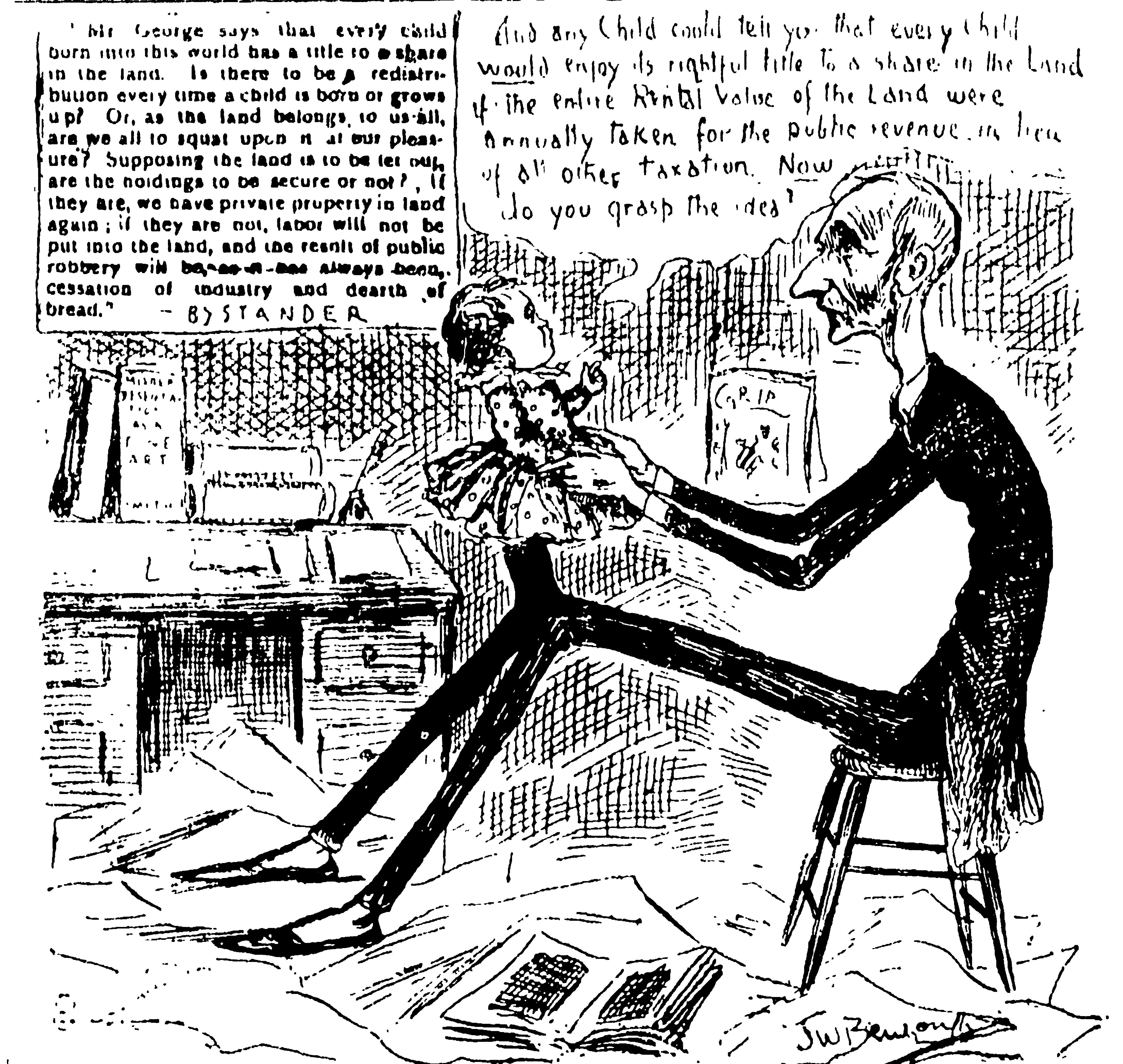
[Cartoon: a tall, gaunt professor in a dark coat sits on a high stool, holding a small child on his knee and lecturing her; behind them a desk with papers and books (a book spine with lettering, partly legible: “… FINE ART …”), a framed picture marked “GRIP” on the wall, and papers and an open book strewn on the floor. Signed “J. W. Bengough”. At upper left a printed newspaper clipping is pasted into the picture; at upper right a hand-lettered speech balloon.]
[Clipping in cartoon:] “Mr George says that every child born into this world has a title to a share in the land. Is there to be a redistribution every time a child is born or grows up? Or, as the land belongs to us all, are we all to squat upon it at our pleasure? Supposing the land is to be let out, are the holdings to be secure or not? If they are, we have private property in land again; if they are not, labor will not be put into the land, and the result of public robbery will be[, as it has?] always been, cessation of industry and dearth of bread.” —BYSTANDER
[Speech balloon:] And any Child could tell you that every Child would enjoy its rightful title to a share in the Land if the entire Rental Value of the Land were annually taken for the public revenue in lieu of all other taxation. Now do you grasp the idea?
From the Toronto Grip.
THE VERY OBTUSE PROFESSOR
(Or, in Other Words, the Professor Who Professes to be Very Obtuse).
It Would be a Good Plank for Them to Adopt Again.
From Republican Party Platform of 1852.
Resolved. That all men have a natural right to a portion of the soil, and that the use of the soil being sic to life, the right of all men to the soil is as sacred as their right to life itself.
[Advertisement] CATARRH.
Catarrhal Deafness—Hay Fever—A New Home Treatment.
Sufferers are not generally aware that these diseases are contagious, or that they are due to the presence of living parasites in the lining membrane of the nose and eustachian tubes. Microscopic research, however, has proved this to be a fact, and the result of this discovery is that a simple remedy has been formulated whereby catarrh, catarrhal deafness and hay fever are permanently cured in from one to three simple applications made at home by the patient once in two weeks.
N. B.—This treatment is not a snuff or an ointment; both have been discarded by reputable physicians as injurious. A pamphlet explaining this new treatment is sent free on receipt of stamp to pay postage, by A. H. Dixon & Son, 337 and 339 West King street, Toronto, Canada.—[Christian Advocate.
Sufferers from Catarrhal troubles should carefully read the above.—[Adv.
NEW PUBLICATIONS.
[Advertisement] ASSORTMENTS OF TRACTS.
During the late campaign quantities of our best tracts were assorted for special work, and many of these not having been used, we now place them, with some of a more recent date, in convenient packages, At a low sic.
Packages may be had at 50c. and $1.00.
Address, THE STANDARD, 12 Union Square, NEW YORK.
[Advertisement] HANDY BINDERS FOR THE STANDARD.
A lot of Handy Binders, made especially for filing THE STANDARD, are now ready.
Price 75 cents to any address.
Address THE STANDARD, 12 Union Square, New York City
[Advertisement] VOLUME FIVE OF THE STANDARD.
NOW READY.
A limited number of bound volumes of THE STANDARD in heavy boards, are offered for sale at the following prices
Separate volumes……………………………… $3.50 Volumes 3 and 4, bound together……………… 6.50 Volumes 2, 3 and 4……………………………. 9.00 Volumes 2, 3, 4 and 5…………………………. 12.00
(Expressage extra.)
Address THE STANDARD, 12 Union square, New York.
[Advertisement] [untitled] As some of the back numbers
AS SOME of the back numbers of THE STANDARD are growing scarce, we will send 15 cents’ worth of tracts in exchange for any of the following
Vol. I—Nos. 5, 7, 8 and 11. Vol. II—Nos. 1 and [32?].
[Advertisement] PISO’S CURE FOR CONSUMPTION
[Display advertisement: a black frame lettered in white “PISO’S CURE FOR” at top and “CONSUMPTION” at bottom, with “25 CTS” running vertically on each side post.] PISO’S CURE FOR CONSUMPTION. CURES WHERE ALL ELSE FAILS. Best Cough Syrup. Tastes good. Use in time. Sold by druggists. 25 CTS.
p. 16, col. 2
NEW PUBLICATIONS.
[Advertisement] THE SINGLE TAX LIBRARY.
- A Syllabus of Progress and Poverty. Louis F. Post. 8 pages.
- Australian System. Louis F. Post. 4 pages.
- First Principles. Henry George. 4 pages.
- The Right to the Use of the Earth. Herbert Spencer. 4 pages.
- Farmers and the Single Tax. Thomas G. Shearman. 8 pages.
- The Canons of Taxation. Henry George. 4 pages.
- A Lawyer’s Reply to Criticisms. Samuel B. sic . 16 pages.
- Back to the Land. Bishop Nulty. 16 pages.
- The Single Tax. Thos. G. Shearman. 8 pages.
- The American Farmer. Henry George. 4 pages
- Unemployed Labor. Henry George. 4 pages.
- The Case Plainly Stated. H F. sic. 8 pages.
- Social Problems. 342 pages, 12mo. Paper, 35c.
- Objections to the Land Tax. Thos. G. Shearman. sic.
- Land Taxation. A Conversation Between David Dudley Field and Henry George. 4 pages.
- How to Increase Profits. A. J. Steers. 2 pages.
- The New Political Economy. E. O. Brown. 4 pages
- Thy Kingdom Come. Henry George. 4 pages.
- The Functions of Government. Henry George. sicsic.
- The Menace of Plutocracy. Thomas G. Shearman. 8 pages.
- Tenement House Morality. J.O.S. Huntington. 4 pp. 22, 23, 24, out of print.
- Taxing Land Values. Henry George. 8 pages.
- Henry George’s Mistakes. Thomas G. Shearman. 8 pages.
- The Democratic Principle. Henry George. 8 pages
- Progress and Poverty. Henry George. 512 pages. 35 cents.
- The New Ballot System. Louis F. Post. 4 pages
Prices of Single Tax Library: Two page tracts—1 copy, 1 cent; 40 copies, 10 cents; 100 copies, 20 cents; 1,000 copies, $1.50.
Four-page tracts—1 copy, 2 cents; 20 copies, 10 cents; 100 copies, 40 cents; 1,000 copies, $3.
Eight-page tracts—1 copy, 3 cents; sic copies, 10 cents 100 copies, 80 cents; 1,000 copies, $6.
Sixteen-page tracts—1 copy, 4 cents, sic copies, 10 cents; 100 copies, $1.60; 1,000 copies, $12.
No extra charge by mail.
The following numbers of the “Land and Labor Library” are still in stock:
- Settler’s Nightmare. Louis F. Post. 4 pages.
- Mysterious Disappearance. Lewis Freeland. 6 pp.
- Sailors’ Snug Harbor and the Randall Farm. W. T. Croasdale. 12 pages.
- The Collegiate Church and Shoemaker’s Field. W. T. Croasdale. 12 pages.
- It is the Law of Christ. Rev. S. H. Spencer. 4 pp.
- Christianity and Poverty. Father Huntington 4 pp.
- Socialism—Its Truth and Its Error. Henry George. 4 pages.
- “God Wills It.” Henry George. 4 pages.
- How John’s Father Saw the Light. W.C. Woods. 2 p.
- Ten Thoughts for Christian Thinkers. Rev. John W. Kramer. 4 pages.
- Hints as to What You Can Do. Henry George. 4 pp.
- My Butcher Woman and My Grocery Man. William McCabe. 4 pages.
- A Republican’s Reasons for Supporting Cleveland. Judge Frank T. Reid. 2 pages.
- Jefferson and Hamilton. Chauncey F. Black. 8 pp.
GERMAN TRACTS.
- First Principles. Henry George. 4 pages.
- Socialism—Its Truth and Its Error. Henry George. 4 pages. [46?]. Taxing Land Values. Henry George. 8 pages.
- It is the Law of Christ. Rev. S. H. Spencer. Henry, Ill. 4 pages.
- Sailors’ Snug Harbor. Wm. T. Croasdale. 12 sic,
SWEDISH TRACTS.
52 The Case Plainly sic. H. F. Ring. 8 pages
TARIFF TRACTS.
- Protection as a Universal Need. Henry George. pages.
- The Tariff Question. Henry George. 4 pages.
- American Protection and British Free Trade. Henry George. 4 pages.
- Protection and Wages. Henry George. 8 pages.
- Protection the Friend of Labor? Thomas G. Shearman. 8 pages.
- A Short Tariff History. Thomas G. Shearman. 2 pages.
- Plain Talk to Protectionists. Thomas G. Shearman. 4 pages.
- An Address to Workingmen on the Tariff Question. Henry George. 4 pages.
A set of Tariff Tracts will be sent to any address for ten cents.
Address THE STANDARD, 12 Union square, New York City
[Advertisement] Cheap Printing (Kelsey & Co.)

[Cut: a small hand printing press.]
Cheap Printing
Do it yourself, Card press $3, Circular press $8. Size for small newspaper $[44?]. Everything easy, printed rules. Send 2 stamps for Catalogue of presses, type, paper, cards, etc., to factory.
KELSEY & CO., Meriden, Conn.
[Advertisement] ATTENTION!—A YOUNG IRISHMAN
ATTENTION!—A YOUNG IRISHMAN, aged 20, desires any kind of work to earn a living. HONEST, care of Standard Office.
p. 16, col. 3
[Advertisement] Pears’ Soap — “Good morning”

[Display lettering in script: “Good morning”.]
“Paris Exposition, 1889.
Pears obtained the only gold medal awarded solely for toilet SOAP in competition with all the world. Highest possible distinction.”
[Advertisement] HENRY GEORGE & CO., PUBLISHERS,
NO. 12 UNION SQUARE.
PROGRESS AND POVERTY.
An inquiry into the cause of industrial depression and of increase of want with increase of wealth. The remedy.
By HENRY GEORGE.
512 pages. Cloth, sic . Paper covers, 35 cents. Half calf or half morocco $2.50.
PROTECTION OR FREE TRADE?
An examination of the tariff question with especial regard to the interests of labor.
By HENRY GEORGE.
Cloth, $1.50. Paper covers, 35 cents. Half calf or half morocco, $3.00.
THE LAND QUESTION.
What it involves and how alone it can be settled.
By HENRY GEORGE.
87 pages. Paper covers, 20 cents.
p. 16, col. 4
PROPERTY IN LAND.
A Passage-at-Arms Between the Duke of Argyll and Henry George.
77 pages. Paper covers, 15 cents.
FORTSCHRITT UND ARMUTH.
(Progress and Poverty in German). Translation of C. D. F. Gutschow. 430 pages. Paper covers, 35 cents.
PROGRES ET PAUVRETE.
(Progress and Poverty in French). Translation of P. L. LeMonnier. 542 pages. Paper covers, $2.75.
PROTECTION OU LIBRE-ECHANGE?
(Protection or Free Trade? in French). Translation of Louis Vossion. 436 pages. Paper covers, $2.75.
PROGRESSO E POVERTA.
(Progress and Poverty in Italian). Translation of Ludovico Eusebio. 352 pages. Paper covers, $2.50.
p. 16, col. 3 SETS OF THREE.—PROGRESS AND POVERTY, SOCIAL PROBLEMS, PROTECTION OR FREE TRADE? BOUND ALIKE, IN HALF CALF OR HALF MOROCCO, $7.00.
[Advertisement] ECONOMIC WORKS.
By way of answering inquiries constantly received, we append a list of some economic and social works of various kinds, with prices, at which they will be forwarded post paid. Any work not mentioned procurable in New York will be sent on receipt of publisher’s price.
THE LAND AND THE COMMUNITY.—IN three books by Rev. S. W. THACKERAY, M.A. LL.D. Trin. Coll. Cantab. With preface by Henry George. 12mo, cloth Price sic,
WILLIAM LLOYD GARRISON.—THE story of his life. Told by his children. 4 vols, cloth, $12.00.
ESSAYS ON POLITICAL sic —By FREDERICK BASTIAT. 12mo, cloth, $1.25.
SOPHISMS OF PROTECTION.—WITH preface by Horace White. By FREDERICK BASTIAT. 12mo, cloth, $1.[00?].
HISTORY OF POLITICAL ECONOMY IN EUROPE.—By JEROME ADOLPHE BLANQUI. 8vo, cloth, $3.00.
THE TARIFF HISTORY OF THE UNITED STATES.—Containing “Protection to Young Industries,” and “The History of the Present Tariff, 1860-1883.” By F. W. TAUSSIG. 8vo, cloth, $1.25.
p. 16, col. 4 THE AUSTRALIAN BALLOT SYSTEM as embodied in the legislation of various countries. By J. H WIGMORE sic, $1.50.
WORK AND WAGES.—BY THOS. sic . 16mo, cloth, $1.00.
FREE LAND AND FREE TRADE.—THE Lessons of the English Corn Laws Applied to the United States. By Hon. SAMUEL S. COX. 8vo, paper, 50 cts.; cloth, 75 cts.
THE HISTORY OF THE FREE TRADE MOVEMENT IN ENGLAND.—By AUGUSTUS MONGREDIEN. 16mo, cloth, 50 cts.
POSTULATES OF ENGLISH POLITICAL ECONOMY.—By WALTER BAGEHOT. Cloth, $1.00.
AN INQUIRY INTO THE NATURE AND CAUSES OF THE WEALTH OF NATIONS—By ADAM SMITH. Edited by Theobold sic. $1.00.
p. 16, col. 3 Any of the above Books will be sent postpaid on receipt of price.
HENRY GEORGE & CO., 12 Union Square, New York City.
[Advertisement] Burroughs, Wellcome & Co.
PARIS EXHIBITION, 1889.
BURROUGHS, WELLCOME & CO.,
Importers, Exporters and Manufacturing Chemists,
SNOW HILL BUILDINGS, LONDON, E. C.,
Specially invite the attention of the Medical Profession and Drug Trade to their Exhibits, as follows:
At Stand No. 575, British Food Section, Kepler Extract of Malt, an agreeable vitalizing reconstructive and digestive. Kepler Solution of Cod Liver Oil, An ideal form for the administration of fat.—British Medical Journal.
Also at Stand No. 311, British Industrial Section, Chemical and Pharmaceutical Products, &c. The Congo Medicine Chest, as taken by H. M. Stanley, for the relief of Emin Pasha, fitted with Tabloids of Compressed Drugs, &c. The Livingstone, Gordon and Indian Traveler’s Medicine Pocket Cases and Portable Medicine Chests. Vereker’s Chloride of Ammonium Inhaler, for Catarrh, &c. The Pinol-Eucalyptia Dry Inhaler, for the antiseptic treatment of Consumption and diseases of the air passages. Lanoline, Lanoline Toilet Soap, Cold Cream Pomade and Toilet Lanoline.
Also at Stand No. 594, American Section, Hazeline. Distilled active principles obtained by distillation from the American Witch Hazel, Hamamelis Virginica, for inflammation and irritated surfaces. The Fairchild Pepsine and Pepsine Tabloids, Zymine Peptonizing Powders, &c., sic
Formulæ and price lists supplied to the Medical Profession and Drug Trade on request.
BURROUGHS, WELLCOME & CO.
p. 16, col. 3
[Advertisement] THE TRUE CHRISTIAN RELIGION.
By EMANUEL SWEDENBORG. 1,000 octavo pages, cloth. Mailed prepaid for $1.30 by the American Swedenborg Printing and Publishing Society, 20 Cooper Union. New York sic
[Advertisement] JAS. HOGAN
JAS. HOGAN, Principal Agent for James Means’ $[3?] and $[4?] shoes, [illegible] Bowery, near Prince st.
p. 16, col. 4
[Advertisement] THE MASTER WORKMAN.
A simple statement of the views and aims of single tax men, designed especially for workingmen,
Single copies, 10 cents, ten sic, 80 cents; twenty five copies, $1.75; one hundred cooies, $6.00.
Sent post or express prepaid on receipt of the above prices. Address,
HENRY J. O’NEILL, [331?] Gordon St., Allentown, Pa.
SOCIAL PROBLEMS.
By HENRY GEORGE.
342 pages. Cloth, $1.00. Paper covers, 35 cents. Half calf or half morocco, $2.50.