Page 1 of 16contents
THE STANDARD
NO. 158—VOL. VII, NO. 2. | NEW YORK, WEDNESDAY, JANUARY 8, 1890. | PRICE FIVE CENTS
p. 1, col. 1
THE STANDARD.
HENRY GEORGE, Editor and Proprietor.
12 UNION SQUARE, NEW YORK CITY.
Entered at the post office, New York, as second class matter.
TERMS. POSTAGE FREE.
One year, $2.50, six months, $1.25; single copies, 5 cents.
Three or more yearly subscriptions, sent in at one time, will be received at $2.00 each.
ADVERTISING rate thirty cents per agate line each insertion.
REMITTANCES should be made payable to THE PUBLISHERS OF THE STANDARD.
RECEIPTS.—The correct filling of orders is evidence of receipt of remittance.
Sample copies sent free on application.
TABLE OF CONTENTS.
Editorial. The Liberal Council on Taxation—Letter from Rev. Heber Newton—The Church’s Attitude Toward the Labor Question—Rev. Dr. Huntington’s Proposed Prayer—A Case Put to the Baptist Ministers—Dr Thackeray’ssic Book—Bishop Huntington and the Single Tax—James E. Mills and the New Churchmen’s Single Tax League—A Remarkable Convert in California—The Increasing Intensity of Labor—Pennsylvania’s Governorship—The Boston Dinner—Police Interference in Elections—A Natural Hill Man—The True Issue Becomes Plainer—Notes.
Notes and Queries. How the Growth of Land Values will Affect Poor House owners—Failures in the Wool Trade—Democratic Senators Defy Hill—The Government and Hat Trimmings.
Farewell Dinner to Henry George on Monday Evening, Jan. 20.
Among Women—Chautauquans Especially. Mrs. Frances E. Russell.
Morley on Land Taxation. Rev. Harold Rylett.
The Gospel and the People—Address of Bishop Huntington Before the Evangelical Alliance.
Society Notes.
The Social Problem. Marx, Gunton and the Single Tax—A Coincidence, Not a Cause.
The Cat in Strange Garrets.
Ballot Reform. The Cooper Union Meeting Postponed Until January 16—Jerseymen to Confer—Mr. Cleveland Writes a Letter—Mr. Powderly Urges the Reform—The New Saxton Bill—Governor Brackett on the New System.
Letters to the Editor. Ballot Reform in Maryland—The Census and Mortagessic—No Room for Him in a Republican Town.
The Free Trade Fight—English Ships Not Subsidized, by Captain John Codman—The Boston Dinner—Why He is a Free Trader—Gladstone and Blaine—Trusts and the Tariff—A Michigan Free Trade Club.
Personal.
Single Tax News. The Petition—The Manhattan Club Talkers Addressing K. of L. Assemblies—James A. Herne to Give a Reading in Brooklyn—Activity Throughout New York State—Matters in Massachusetts—Lectures in Connecticut—Literary Societies and Churches Discussing the Question in Pennsylvania—Meeting of the Oniosic Single Tax State Committee to be Held January 19—The Memphis, Tennessee, Single Tax Association at Work—Lack of Opposition in Iowa—Milwaukee Shown How to Become Great—Canvassing Texas for Signatures—Progress in California—News from Numerous Other States—The Ontario Government Asking Opinions on Taxation—Getting Ready to Receive Mr. George in Australia.
Recent Sales and Assessments.
EDITORIAL.
The meeting of the council of the National Liberal Federation,in the free trade hall in Manchester, so graphically described by the Rev. Harold Rylett in the last number of THE STANDARD, was indeed an occasion important enough to justify the enthusiasm of Silas M. Burroughs in throwing away his hat. As Mr. Rylett says, the resolutions adopted by this highest representative body of the great liberal party at a meeting which has the same rank in English politics that a national convention has in ours, give the English single tax men all they could at this time have asked for. The repudiation of the scheme of Irish land purchase, which has had the support of
p. 1, col. 2 the whig element in the party, and was in fact first practically proposed by Mr. Gladstone and supported by Mr. Parnell, and the declaration that in any reforms of the land laws a just and equitable taxation of land values and ground rents is an essential condition, gives to the thin end of the single tax wedge the official sanction and indorsement of the party. This is all that at present is needed. It is the formal surrender of the conservative element of the party to the more vigorous radical element, and the line of advance of the party that Mr. Gladstone is yet leading must in the future be the line of the single tax.
The resolution of the council in favor of the abolition of the duties on tea, coffee and cocoa, and of the adoption in place of these duties of “the juster methods of taxation demanded by the federation,” is also significant. It means that the thorough free traders who are represented by the Financial reform association propose pressing forward to real free trade on single tax lines. The other features of the liberal platform are admirable, putting clearly the democratic demands.
GARDEN CITY, Jan. 2, 1890.
Dear Mr. George: In this week’s issue of THE STANDARD, in commenting upon the admirable letter sent out by the Church association for advancing the interests of labor to the rectors of Episcopalian churches in our city, urging them to speak to their congregations concerning the wrong of extra hours in our stores during the holiday season without extra pay, you say that “probably none” complied with this request.
You will be glad, I am sure, to know that you were in error in thus judging our clergy. How many spoke as requested I have no means of knowing. For one, I was glad to say my word on this subject. I notice also that, according to the Churchman, Dr. Rainsford spoke plainly on the subject. I am morally sure, moreover, that others did the same thing. Many of our clergy are neither indifferent to the social problem nor restrained by any unworthy timidity from speaking out their minds, insofar as their minds are clear. That number is steadily growing.
As to whether this particular exhortation could avail aught there may be a different conclusion, even from your own premises. Granting the whole of the argument in “Progress and Poverty,” it remains that to the application of this land reform there is needed not only intellectual persuasion of its rightfulness, but moral enthusiasm, the awakening of conscience, the subordination of selfish interests to social welfare, the rousing of the will to do the right. Everything, then, that helps awaken the thoughtless to the wrongs of our present social disorder and to stir the selfish to the desire to do justly to their fellows is a positive reinforcement of the ranks on which THE STANDARD must rely to carry the day for its more radical reform. This particular little bit of reform is so far away from the coming of that kingdom for which we pray at this time that it may seem unworthy of serious consideration, in the light of those vastly larger measures toward which society is surely being led. None the less, if it eases the strain for some thousands of our fellows and educates their employers morally, it is worth the doing, if only as a means toward the greater end.
Thus I am led to offer a word on behalf of one who is amply able to speak for himself, if only he is wise enough to read THE STANDARD and thus observedsic its strictures. Dr. Huntington’s remarks, on which you animadvert, are capable of another interpretation than that which you put upon them. Doubtless he would own quite as frankly as THE STANDARD that man, and not God, is at fault for the evils of our present state of things. Most assuredly, Dr. Huntington never dreamt of urging the value of prayer in social reform because of its efficacy in enlightening God, or in calling forth in Him due action. But there is, none the less, a veritable social dynamics in prayer. Prayer determines the action of men by determining their ideals and sympathies. The prayer of superstition to a god who is the personification of egoism, of arbitrariness and partiality, educates selfishness and cruelty and class feeling. The prayer of reasonable and righteous religion, addressed to the power which is making for righteousness,educates unselfishness and sympathy and brotherliness. To intelligently say, “Our
p. 1, col. 3 > Father, Thy kingdom come, Thy will be done on earth as it is done in heaven,” is to set any earnest man questioning as to what is the divine order, and thus to desiring that the will of God may get itself done on our earth in customs and legislation, as now it is done in the heavens of the ideal realms. Surely, to lead one to commune with the power in whom we live and move and have our being as the power planning for justice, willing for justice, to teach men that truly to pray is to desire that justice, and thus the establishing of the divine kingdom—surely this is to feed the fires which are to gender the motor for all reform. > > Whether or not prayer affects God, it surely thus affects man in his innermost thoughts and desires, in his will and action. The Crusades were determined, when from the great host under the spell of the Hermit’s preaching the cry went up, “God wills it.” > > Yours cordially, R. HEBER NEWTON.
I stand corrected. I am sorry I said, “probably none,” and now that I know that there were at least two Episcopalian ministers who responded to the appeal, I think it exceedingly probable there were more. And I am glad to say that I think Mr. Newton is right as to there being a considerable and growing number of Episcopalian clergymen who are taking an interest in social questions, and who are not restrained by timidity from speaking out.
Nor am I insensible to the usefulness of little things. The circular of the Church association for the advancement of the interests of labor, I think extremely useful as bringing before the Episcopal clergy and the public generally a most telling fact in regard to the conditions of labor in this city—a fact well calculated to excite the sympathy and arouse the conscience of people whose tolerance of things as they are comes from their seeing the world only through the medium of their own surroundings. And I certainly think that the “little bit of reform” at which the circular directly aimed—the getting for shop girls of extra pay for extra work during the Christmas season—a good thing in itself. But I do not think that any such little reforms ought ever to be urged, or even assented to, by those who see the need for larger reforms, without an explicit declaration of their insufficiency—an explicit declaration that that which can alone solve the social question is not charity, but justice. And I confess to a feeling akin to disgust at the persistency with which such little reforms—that in most cases amount to nothing at all, even temporarily—are advocated by people who ought to be engaged in larger and better work. They seem to serve in many cases as palliatives for conscience and to divert and waste energies that, rightly directed, would be capable of accomplishing something real. See the tremendous force that has been spent wastefully in the organized labor movements of the United States, through being directed to little things—the establishing of bureaus of labor statistics, eight hour laws, inspectorates, and the gaining here and there of a little advance in wages. Something has been gained by all this agitation, to be sure, but nothing compared with what might have been gained had this energy been concentrated on measures capable of largely and permanently improving the conditions of labor.
With reference to Dr. Huntington, I may not clearly have expressed my thought, and I may as well take this opportunity of correcting a typographical blunder which made me speak of “the man in the church” when I meant to
p. 1, col. 4 speak of “the man or the church.” But I certainly did not intend in any way to question the efficacy of prayer or to attribute any impropriety to the presentation in prayer of evils which we desire to remedy. While I believe that the Almighty knows far more than we can tell Him, and while it also seems to me that His government must be a government by law, yet I know that the impulse to prayer springs from the depths of human nature, and would be far from denying that there may not be within that law some provision by which prayer may have an efficacy beyond its effect upon ourselves. My objection to Dr. Huntington’s suggested amendment to the liturgy was not that he proposed to pray about the labor question, but that the prayer he proposed on the labor question was not honest. The injustice which he proposes that the faithful should ask God not to suffer, is not the real, great, deep, injustice, which is everywhere oppressing and robbing men of what God intended for them, and which has rich and powerful backers, but a little, trivial, secondary injustice that has no avowed friends anywhere.
What Dr. Huntington proposes as the church’s contribution to the settlement of the labor question is that she should put these two clauses in her liturgy: “Incline the hearts of employers, and of those whom they employ, to mutual forbearance, fairness and good will,” and “Suffer not the hire of the laborers to be kept back by fraud.” There can be no objection to these petitions in themselves, and in spirit, at least, they are already in the prayers of the Episcopal church. Mutual forbearance, fairness and good will are good things between everybody, and the keeping back of the hire of laborers, or any other just debt, by fraud, is a bad thing.
But to put forward these petitions by way of asking God to solve the labor question seems to me blasphemous—first, because they do not make an honest presentation of the labor question, but hide and cover up its real root and cause; and second, because they involve the assumption that God has so poorly previdedsic for the great masses of His children that ill-will or fraud on the part of a small minority called employers can produce the widespread poverty and suffering which festers through our so-called Christian civilization. I believe as fully as does Mr. Newton in the social power of prayer, and realize what he points out, that to lead men really to pray for the overthrow of injustice, is, at the same time, to lead them to work for it. But what effect would the prayers that Dr. Huntington proposes have in his congregation? Would the prayer for mutual forbearance and goodwill arouse in the fashionable worshipers in Grace church the slightest suspicion that there is any social wrong that needs righting? “Suffer not the hire of the laborers to be kept back by fraud.” To whom would they imagine this to apply, except to some wicked sweaters down in the Bowery, of whom they occasionally hear through the newspapers?
Now the plain, clear, God’s truth is, that the labor problem does not spring from the want of forbearance or good will on the part of employers or employed, or from the fact that some employers swindle the employed when they get a chance, continued on p. 2 →
[page ends mid-sentence; no continuation line printed]
Page 2 of 16contents
2 THE STANDARD. Vol. VII, No. 2
[continued from page 1]
← continued from p. 1 and that some of the employed swindle their employers when they get a chance. The labor problem, with all the vice, crime, and greed that grow out of want and the fear of want, springs from the fact that what the Creator has given equally to all His children our laws have made the private property of some of them, and Dr. Huntington’s proposed prayers are simply an attempt to cover up and lead away from this patent fact.
I should like to put to Mr. Newton a case I put to the Baptist ministers when I addressed them in Philadelphia a couple of weeks ago: “A rich man goes away to a distant land leaving to a large family of children an estate amply sufficient to bountifully support and provide for them all. No sooner is he gone than some of the stronger and more cunning of the children set up a claim that the estate is theirs alone, and deny to the others all right or use of it, so asserting, reiterating and teaching their claim that the despoiled children for the most part have themselves come to accept it, and many of them to look on the story that they have a loving father as a superstitious fable. The result is, there is suffering and want where there should be abundance, and that where their father intended peace, happiness and brotherly love, there is pride, envy, malice and greed. Some of the children are gorged to repletion, and become diseased by surfeit, while others of them do not get enough to eat and are growing up hungry, dirty, ignorant and vicious. What would you say of the friend of the father, the trusted representative and exponent of his will to these children, who, seeing all this, should not have one word to say about the gross perversion of the trust, the clear violation of the father’s will, but who, on the contrary, should prate of mutual forbearance and mutual love, and ask the overfed children to give cold victuals to the starving children and tell the hungry, squalid, disinherited ones that their father loves them very much, though he has given them very little, and that if they will be good and contented he will some time or other take them to another place where there will be enough for all? Would you have words bitter enough to express your contempt for such a false friend, such a faithless representative, such a traitor to a sacred trust? And yet, that to-day is the attitude of the majority of Christian ministers.
Mr. Newton says that to intelligently say the “Our Father” is “to set any earnest man questioning as to what is the divine order, and thus to desiring that the will of God may get itself done on our earth, in customs and legislation, as now it is done in the heavens of the ideal realms.” To intelligently say it, yes! But the crime of the church has been that its practical teachings have stifled these intelligent questionings, and that it has taught men to believe that there was nothing seriously the matter with our customs and legislation, and that the aspiration for the kingdom of God on earth was simply a sort of pious request to God that when it suited Him, He should come in power and glory to establish the kingdom for Himself, not that we should strive to bring it here.
But, thank God, a new life, a more earnest spirit, is manifesting itself in the Christian church, and by no means least in the Episcopalian branch of the church. The circular of the church association for advancing the interests of labor is one of the indications of this; the attitude of Mr. Newton himself is another, and the Rev. Dr. Thackeray’s book, “The Land and the Community,” and the hospitable reception it is having among the clergy of
p. 2, col. 2 the Episcopal church, are other indicacations. Here is a letter from Professor Richey, who occupies the chair of ecclesiastical history in the general theological seminary of the Episcopal church, and who is regarded as the most learned man on such subjects in the American church. The letter is guarded, vetsic it means a good deal:
> 5 CHELSEA SQUARE, NEW YORK, > December 26, 1889. > > My Dear Dr. Thackeray:—I have to thank you for your very thorough and valuable treatise. It is by far the most satisfactory treatment of the whole question it deals with I have had the good fortune to read, and I am of the opinion that it would be a very valuable acquisition to our library. I have to congratulate you on the accuracy with which it is printed, a thing not ordinarily met with in American books. I am sure the treatise will do much good. It must commend itself even to those who may be disposed to differ from the conclusions you have arrived at. The subject is one of the most important our time has to deal with. As a student of history I can appreciate the value of the contribution you have made to its satisfactory solution. > > With best wishes for many happy returns of the season, I am faithfully yours, > > THOMAS RICHEY.
And here is a still more striking indication. A second edition of “The Land and the Community” will soon be needed. At the request of Dr. Thackeray, the Right Rev. F. D. Huntington, Bishop of Central New York, has written the following preface for it:
> Whether measured by the gravity of its intrinsic, economic and moral claims, by the arguments of its advocates, or by its considerable progress in public favor, the theory which it is the object of the following treatise to support deserves to be understood. To that understanding Mr. Thackeray appears to me to contribute a valuable help, while he meets difficulties and objections with fairness of reasoning and in a temperate spirit. To one class of thinking men this scientific aspect of the work will offer the principal attraction. With others, and they ought not to be few, a yet deeper and larger interest must pertain to the subject because of its practical relations to the Christian religion. Representatives of the single tax doctrine like this author, who postulate their social system on the primal religious ordinance that the earth is the Lord’s and not man’s, and is only held in trust anywhere by a nation or organized people, cannot separate their political economy from their faith. They believe that the remedies which this law of divine ownership provides go down to the very roots of the manifold evils and wrongs which now afflict, threaten and endanger society to an alarming degree, and which they believe to be symptoms of a diseased condition rather than the disease itself. Were it otherwise, were the question only political or secular, it might well enough be left in the hands of laymen. Nor is it a question of sentiment, but of what is right in law, human and divine. Ministers of Christ are called and sent for the building up on the earth of a kingdom of justice and love, of righteousness and peace, which is the kingdom of the Son of Man. In that brotherhood of impartial rights, equal privilege and universal freedom, the only church of which Jesus Christ is the Founder and Master, how would it strike the judgment and intuitions of men if it were now proposed for the first time, private titles to land being yet unknown, to cut up a country or continent into lots large or small and dispose of the whole landed estate, for absolute and permanent possession, to favored individuals or families irrespective of occupancy or use? In the following pages this inquiry, with others akin to it, is carried back along the lines of authentic history and into the regions of ethical principles, with a firm and evidently an honest hand. > > F. D. HUNTINGTON. > > Syracuse, Epiphany, 1890.
Mr. Newton is indeed right. Many of the Episcopalian clergy “are neither indifferent to the social problem nor restrained by any unworthy timidity from speaking out their minds in so far as their minds are clear.” And here now at their head is a Bishop.
It is to the lasting honor of the Protestant Episcopal church of America that the second Christian Bishop in the whole world to come out frankly, fully, unhesitatingly and uncompromisingly for the practical restoration to men of the gift of their Creator is a member of her episcopacy.
And not the least significant of all the gathering indications of the new life that p. 2, col. 3 is coming into the Christian church is the remarkable address recently delivered before the Evangelical alliance at its meeting in Boston by Bishop Huntington. Since none of the church papers has seen fit to print this address, THE STANDARD, crowded as are its columns, publishes it in full, and we hope that the readers of THE STANDARD will see that it reaches as many of the clergy and active laity of all denominations as is possible. For it breathes in revivifying freshness the spirit of that apostolic catholic church that knows no denominations and no classes,and that bears one message of life and liberty and peace and joy to all mankind. As this spirit wakes, then indeed arises that greatest of all powers for social reformation, and the cry “God wills it!” will gather men into a movement wider, higher, holier than the crusades.
On Monday night the New Churchmen’s single tax league gave a reception in the house of John R. Waters, on East Eightieth street, to James E. Mills of California, the spacious parlors being filled with influential men and women of the New church. Mr. Mills, who was a pupil and assistant of the elder Agassiz, is best known as a geologist. He has resided for a number of years in California, devoting himself in part to the exploration of mines, but mainly to investigations in the interest of pure science. From early years he has been an ardent disciple of Swedenborg, and at one time acted as the pastor of the Brooklyn society.
It is a pity that we are not able to present to the readers of THE STANDARD a report of Mr. Mills’s address. It was mainly an exposition of how completely the single tax fills every requirement of Swedenborg’s philosophy; how the central doctrine of the love of God and the dependence of all things upon the Divine implies the equal right of all men to the use of what God has provided for them in the material universe; how it denies the validity of private property in land as we understand it, and requires that the only title that men can have to the earth is that title of possession for use which will be secured bvsic the single tax. Swedenborg’s doctrine of the law of use—the doctrine that it is the highest duty and the deepest pleasure of every man to render service to others, and that he is only entitled to receive in proportion to the service which he thus renders to his fellows, Mr. Mills brought to the same focus and point. Did we only recognize, said he, the great truth that this is God’s world and that we are all placed upon it for the limited term of our existence here, with equal rights to enjoy what He has provided, and to develop our faculties in accordance with His laws, the social difficulties that now seem so dark would disappear. A young man, then, growing up to manhood could set before himself only one object—that of honestly, faithfully and joyfully doing what he could to help on the work and advance of the world; and in doing this he need have no fear that every need he might have would not be amply provided for. He could take himself a wife and bring up children without the harassing thought that he might not be able to provide for them, or if taken away, that he must leave them destitute. For so great have been the advances of the awakened intellect of man during the past century that the powers of production, if we would only give them play and secure fair distribution, are already sufficient to provide for every one in abundant comfort. But as it is now, the effort of men is, not to render service, but to acquire the means of compelling others to give to them without
p. 2, col. 4 rendering anything in return. We are cultivating the brains at the expense of the heart; we are cultivating the lower grasping instincts at the expense of the higher ones; and, as a consequence of this unnatural state of society, marriage is steadily decreasing, and insanity and crime are steadily increasing. The race that made New England strong and free is dying out, not merely giving way to foreigners in some places, and passing on to others, but dying out by diminution in the birth rate.
Very striking were some of Mr. Mills’s pictures. “Forty years ago,” said he, “I lived on what was then the frontier, on the prairies of Illinois, where free land was being taken up. I remember still the sturdy independence of the people, and I gloried in it. I thought, ‘when the railroads come here, what a paradise it will be!’ But when the railroads came, that spirit of independence disappeared. I have lived the best part of my life on the frontier, and I have seen this change steadily going on. When a boy I worked for a while in a logging camp in Maine. Among all the young fellows there, there was not one who did not look forward to getting married and making himself a home. In my camp in the Sierras now, I have a hundred and fifty picked men, who have been chosen from hundreds who have been working under my charge. They are all or nearly all American born, and of American parents. They are all men of some education and some of them of high education. They are sober and industrious. And yet none of these men, I think, looks forward to marrying and making himself a home. They belong to that great class to be found in the west, whose employment is irregular and not long to be counted on,and who are liable to be compelled to travel long distances in search of work. Many of them have now passed middle age in the fruitless effort to get a ‘stake’ or foothold that would justify them in marrying. This is a general tendency. And the cause is plain. It is to be found in the appropriation of land whenever there is any demand or any likelihood of its use—in the locking up of natural opportunities and in the making of labor, deprived of the natural opportunities for the exertion of labor, a poor, dependent, helpless thing.”
But with the fervor of a man whose faith in God is as firm as the rocks whose story it has been his life work to interpret, Mr. Mills went on to speak of the new spirit that is coming over the nation, of the new aspiration and new hope that are taking shape in the demand for the single tax; and to predict for this a certain triumph.
There is another Mills in California—W. H. Mills, formerly editor of the Sacramento Record-Union, and for the last ten years or so general land agent of the Southern Pacific railroad company. He is an exceedingly able man, gifted with a remarkable faculty of clear and orderly expression, but from his party affiliations and from the position he holds, he is one of the last men I would have thought of as coming out for the single tax. Yet Mr. J. E. Mills tells me that at a recent meeting of the Chit-chat club of San Francisco Mr. W. H. Mills, first speaking of the accumulation of great and permanent fortunes on the one side and the growing degradation and helplessness of labor on the other, and alluding to the fact that the great body of the land still being sold by the Pacific roads, and secured from the United States government, is passing into the hands of those who never intend to use it themselves, declared that the only thing that can remedy this is the continued on p. 3 →
[article breaks off mid-sentence at the foot of the column; no continuation line printed]
Page 3 of 16contents
January 8, 1890. THE STANDARD. 3
[continued from page 2]
← continued from p. 2 single tax, and announced himself unequivocally for it. Writing to me from San Francisco, Judge Maguire thus speaks of the same incident:
Last Monday evening I was invited to the annual dinner of the Chit-chat club, at which an essay on “Land Ownership and Values” was read by Mr. W. H. Mills, for many years land agent for the Southern Pacific railroad company.
After a splendid historical review of the land question he pictured the decline of independence, and the decay of morality among American citizens; attributed these deplorable results to the monopoly of the lands of our country, and declared himself for the single tax as the only rational and constitutional remedy offered for the growing evil of popular degradation. The essay produced a marked sensation, but discussion disclosed the presence of several single tax men where but a year ago F. B. Perkins and myself were its only supporters.
One thing that is hardly realized bvsic those who complacently write on labor questions is the increasing intensity of work in many branches of industry. It is not merely that the machine has been increasingly speeded, and that the man, woman or child has had to keep up with it, but that the system of piece work which has been so generally adopted tends to set the pace at the highest possible. For instance, in the machine shops of the Pennsylvania railroad at Altoona a man gets the same price for making eight axles in 1890 that he got for making four in 1872. The machinery has not been improved. On the contrary, where in 1872 he had two lathes to work with, he now has but one, and more dexterity is required. The difference is in the increased skill of the workman and in the increased intensity which he throws into his work. Thoroughly experienced workmen make as much now as they did in 1872, but they put more of their litesic into a day’s work, are more exhausted when the day’s work is done, and will have fewer days to work before breaking down.
On a Pennsylvania Central train a few weeks since I heard incidentally a story which illustrates how the American farmer is being crowded out. A friend of my informant’s wife some fifteen or twenty years ago married a young, inteligentsic and well educated farmer who felt himself comparatively rich, having inherited from his father 240 acres of land on the Illinois Central railroad, about one hundred miles from Chicago. The two women had kept up a correspondence, and it had been the intention of the Pennsylvania people to make a long deferred visit to the Illinois people this year. But the Illinois woman has recently written to say that her husband has lost his farm. Some eight years ago he bought eighty acres of adjoining land and put a mortgage on the whole 320 acres in order to get the purchase money. With the low prices for products, he has been steadily running behind on his interest payments and at last has been forced to give up, surrendering the whole place to the mortgagee. His stock and implements only brought $1,250 at auction, although one item was a carriage for which, in better days, he had paid $600, and had recently had put in good order. The man and his wife are about to remove to Rockford, Ill., where he has a relative in the coopering business, and where he expects, after working for nothing for a sufficient time to get a knowledge of the trade, to get $9 a week.
I had curiosity to ask about this man’s politics, and found he was a sturdy republican who voted five years ago for Blaine and last year for Harrison. He was also a stanch prohibitionist—so that drink can hardly be said to have caused his ruin—and voted the prohibition ticket except when he deemed protection in danger! My informant said that the farmer’s wife spoke with bitter regret of the mistake they had made in not renting
p. 3, col. 2 the farm before they got so deeply involved, as in this way they might have paid the interest and perhaps something more. This, she said, the new owner would do.
That is to say, the American farmer of whom we have made our boast is being protected off the farm and into the city to compete with other wage workers, while his place is being filled with tenants, largely foreigners, who, accustomed to a meaner scale of life than he was, can exist where he could not.
A. Van Duesensic of this city writes from Lakewood, N. J., where he is temporarily staying on account of illness in his family, sending a check for $200, which he wishes appropriated to the Enrolment committee, the Ballot reform league and some other purposes. He says:
I have had several circulars of late inviting me to be present at meetings of the Ballot reform league, and my absence, which was caused by absence from the city, should not be construed as indifference to the success of the movement. Next to free trade, I really regard this ballot reform movement as a matter of the most vital importance of any political measure before the country to-day. It is in fact the forerunner of free trade. Voters must have the privilege of depositing their ballots uninfluenced by friend or foe, and this can only be done through a secret ballot. The hope for all political reform lies first, it seems to me, in the secresy of the ballot. The ballot system properly regulated, it only remains to educate the people as to what is for their best interests, to have a republic that will be a model for all the world.
The gubernatorial election in Pennsylvania next yearsic is beginning to attract attention, and some opposition is develingsic in the republican party to Mr. Quay’s candidate. But it is pretty safe to say that Mr. Quay will nominate his candidate for governor, and will elect him, too, unless such a thing should happen as that the democratic sentiment should take possession of the democratic party. That, however, can only be done by something like a revolution on the part of the masses. The same great interests manage both parties in Pennsylvania, and even when Mr. Randall is run out of the democratic party, it remains for William L. Scott and Eckly B. Coxsic to supply the money and manage the machine. The best representative of all that is good and true in the Pennsylvania democracy is Chauncey F. Black. He was nominated by sheer popular strength in 1886, and could have been elected had not the democratic bosses turned in for the republican candidate. He could be nominated, and with a vigorous campaign that would appeal to the popular sentiment could be elected in 1890. But to the managing powers in the democratic party in Pennsylvania this would be worse than the election of a republican, and they would never willingly consent to Black’s nomination. It is time, however, that the managing men were set aside by the democratic masses. If the democratic clubs could once get enough of the fire of their predecessors’, the republican societies of Jefferson’s day, to demand the nomination of a man who really represents the Jeffersonian idea, they would force the convention and carry the election. Underneath all, there is a sturdy sentiment in Pennsylvania that is heartily sick of corporation domination and boss rule.
R. Q. Mills made as good a speech at the Boston tariff reform dinner on the last night of the year as a man afraid of his horses can make. Mr. Mills is doing himself a great injustice by posing as a revenue tariff man when he ought to be declaring for absolute free trade. Nor is he deceiving anybody. The protectionists do not love him a whit better, nor trust him a whit the more becausessic he proposes to keep up some sort of a custom house.
p. 3, col. 3 But the absolute free traders, the men who are not afraid to avow that their aim is to utterly abolish custom houses, had a worthy representative in Boston in Thomas G. Shearman. His ringing speech, which we will publish next week, struck no false note of timidity or compromise. “When you have swept protection out of the tariff,” said Mr. Shearman, “the American people will be logical enough to sweep the tariff after it.”
It is time that Mr. Mills and Mr. Carlisle and Mr. Breckinridge got out of their equivocal position. They are free traders. Why should they fear to say so?
I expect to leave New York on January 22; to lecture at Bradford, Pa., on the 23d; at Denver, Col., on the 27th and 28th; Los Angeles, Cal., on January 31 and February 1; to reach San Francisco February 4, and to sail for Sydney on February 8.
HENRY GEORGE.
POLICE INTERFERENCE IN ELECTIONS.
The work of reorganizing Tammany in the Third assembly district has incidentally brought out an exposure that is decidedly interesting, coming from such a source. Mr. Wood, the lieutenant of the deposed leader, Mr. Slevin, declared to the committee of reorganization that Tammany had suffered at the last election from the hostility of the police. Mr. Wood evidently did not resent police interference on principle, but complained that the interference had been on the wrong side. He said that he had taken a “certain party connected with the police department” around and introduced him to several saloon keepers and election district captains, and the very next day this “certain party” went around to the saloon keepers and worked against Tammany.
Register Fitzgerald, who is one of the committee of re-organization, asked with apparent astonishment: “Are the police such a factor that they can influence the liquor dealers?” Colonel Wood, who is a veteran in the Tammany service, guardedly answered that influence was used, but he was not prepared to say whether it was used in all the districts. He knew, however, that it was used in the Third. Thereupon, James Fitzpatrick, leader of the Ninth, said that the police were against Tammany in his district and that he got along all the better without them. Colonel Wood evidently felt that they did not get along better without them in the Third. He would not positively say that he knew, of his own knowledge, that the liquor dealers had been influenced by the police, but he declared that he did know of liquor dealers who were supposed to be with Tammany, but who, after being visited by the police officials, worked for the county democracy. The chairman of the reorganization committee that elicited this guarded statement of facts was Warden Joseph P. Keating, and, as the investigation proceeded, he grew nervous and interrupted it by inquiring if there was any one there to oppose reorganization. Receiving no answer, he summarily adjourned the inquiry.
Of course the apparent surprise of Register Fitzgerald and the nervousness of Warden Keating will be amusing to all men really familiar with the part that the police and the liquor dealers play in city politics. It is not probable that there are so many as a dozen liquor saloons on the whole island of Manhattan that do not habitually violate the law, and violate it with the full knowledge of the police. This being the case, every liquor seller is completely at the mercy of the force, since he may at any time be arrested and fined, while, if his offense be grave enough, his license may be revoked. It must be understood, however, that the offense, the gravity of which determines the penalty, is not against the law but against the police. If a saloon keeper can “keep himself straight” with the officers of his district, he may sell liquor every hour of the twenty-four, seven days cfsic the week,
p. 3, col. 4 if he pleases. One result of this is, that the police are largely bribed to wink at violations of the law, and the other is, that their power over the saloon keepers is practically unlimited. Under such circumstances, the faction that can get hold of the police exercises a tremendous influence in politics.
The excise legislation of this state has welded the liquor dealers into a compact, organized force, which acts of its own volition in many instances, and is forced to obey the behests of the police in others. So long as this legislation is maintained the rum power in politics will continue to be exerted, and the stricter the legislation the more compact and vigorous that power will be. It is impossible, however, to make the temperance agitators comprehend this fact, and they will doubtless go on adding strength and force to the liquor power by their attempts to repress it. If liquor could be sold as freely as bread, there would be no more possibility of a union of liquor dealers in behalf of one or the other party than there would be of a union of bakers for such a purpose.
Such misuse of police power as was complained of in this Tammany investigation, however, can be remedied without any change in excise legislation. The passage of a ballot reform bill will put an end to it. But unhappily, Tammany, in the long run, makes more than it loses by police interference and other methods of coercing voters, and though it cryssic out when it gets hurt by the system, it is bitterly opposed to its abolition.
A NATURAL HILL MAN.
The New York Times of January 2 printed a full exposure of the shameful career of T. C. Callicot, whom David B. Hill’s lieutenants have selected as the editorial representative of the democratic state administration. The record shows that Callicot was elected as democratic member of the assembly from the Third Brooklyn district in 1863. The house was a tie, and the balloting for speaker continued for more than three weeks, seventy-eight ballots being taken. The deadlock was broken by the election of Mr. Callicot as speaker by his own vote and the votes of sixty-four republicans. The rage of the democrats was so great that threats of personal violence against the traitor were common, and on one occasion he secreted himself, fearing an assault. He was hanged and burned in effigy by the democrats of his own district, and on the floor of the house democratic members openly paraded proofs that, when previously a member of the legislature, Callicot had sold his votes by borrowing $100 or so from people interested in bills that awaited his favorable report.
The circumstances of his election as speaker were investigated, and of course a white washing report was made, but a minority report accompanied it declaring that Callicot had received from Hamilton Harris, a member of the republican state committee, the sum of $1,200, which was nominally a loan, though Mr. Harris had not any acquaintance whatever with the borrower previous to the transaction and exacted no security. It was generally supposed that the infamy of the transaction would never be forgotten, for when Callicot ran again as a candidate for the legislature, he received only 275 votes in his district. Shortly afterward, through the influence of his republican friends, he obtained an appointment as special cotton agent in the south, and a few months later was appointed by President Johnson internal revenue collector.
After a few months of service in that position he was charged with fraud and corruption, and he was convicted and sentenced to two years’ imprisonment and a fine of $10,000. Before the expiration of his term he was pardoned, and, after trying some literary work, was given a position by Manning and Cassidy on the Argus newspaper at Albany. This was an act of weakness on the part of Mr. Manning that he regretted till the day of his death. The wrath of the democrats was so great that the Argus had to turn the ex-convict adrift, and from that time on Callicot dis- continued on p. 4 →
[article breaks off mid-word at the foot of column 4; no jump line is printed]
Page 4 of 16contents
4 THE STANDARD. Vol. VII, No. 2
[continued from page 3]
← continued from p. 3 played the utmost venom against Mr. Manning and his friends.
Callicot managed to buy an interest in the Evening Times and became its chief editor. The paper professed to be independent, though Callicot, personally, claimed to be a democrat, apparently in order that he might have better opportunities for profitable treachery. His career since has been a peculiar one. It was a common saying among republican politicians that they could have the Times whenever they were willing to pay for it. The paper violently opposed Governor Tilden’s nomination for president, and during the succeeding campaign Callicot did what he could to injure Mr. Tilden by posing as a democrat and lamenting the mistake his party had made. During the terrible excitement attending the electoral controversy that followed, the Times expressed no opinion as to the merits of the case, but continually bewailed the party’s mistake in nominating Mr. Tilden, thus willfully contributing toward the creation of a sentiment that should sanction the seating of Mr. Hayes. In the gubernatorial campaign of 1879 Callicot took part in the Tammany bolt and supported John Kelly for governor against Lucius Robinson, thereby turning the power of the state over to the republicans. Soon after Mr. Cleveland was elected governor, the Times began to attack his administration, and before the convention of 1884 it violently opposed Mr. Cleveland’s nomination for president. After Mr. Cleveland was nominated the Times professed to support him, and did so by reprinting all of the screeds that appeared from time to time in the New York Sun attacking the democratic candidate. Next year Callicot gave a hearty support to David B. Hill. Hill is probably the only man, democrat or republican, to whom he has always given a constant and consistent support.
These facts require no comment. They are simply given to show to the people of the country the kind of men chosen by the governor of New York as his tools and associates.
THE TRUE ISSUE BECOMES PLAINER.
In an article defending and advising a continuance of the alliance between the liberal unionists and the tories the London Spectator says the first aim of the liberal unionists is “the securing of a progressive policy on the part of the government,” while their “second great aim” is “to secure the government against the encroachment of an aggressive radicalism such as is now springing into existence—a radicalism the apparent aim of which is to break down all the chief safeguards of our existing society, just because they are safeguards; to trench upon the rights of individual property, and especially property in land, because property in land seems to have a separate fascination of its own.”
The attempt of the Spectator to assign unworthy motives to those who especially attack the justice of private property in land is hardly worthy of serious comment. It is impossible to believe that such a paper can fail to understand that the “separate fascination of its own” that property in land has, is due to the fact that, since the abolition of slavery, it offers the only reasonable certainty to idlers and nonproducers that they can live at ease on the enforced contributions of the producers of wealth.
The important thing about this utterance is its acknowledgment of that difference, deeper than any merely political Irish question, which divides the liberal unionists from the main body of liberals and makes them the natural allies of the tory party, which must absorb them as soon as a new general election takes place in England. Despite the studied ignorance of the spokesmen and organs of the land owning class, the land question has come to the front, and the debate once started can never end until the ideas of the contestants on both sides clarify and the great battle is fought out that must end finally in the triumph of the single tax.
The mass meeting under the auspices of
p. 4, col. 2 the New York ballot reform league that was announced for Thursday, Jan. 9, has been postponed for one week, partly on account of conflicting engagements that prevented the presence of invited speakers, and partly on account of the prevailing epidemic. Probably not a single member of the committee of arrangements, and but few, if any, of the speakers invited, have escaped.
Mr. Thomas G. Shearman contributes to the Springfield Republican another article on the single tax, in which he demonstrates that a tax on land values cannot be shifted. The Republican, in referring to the article editorially, says, “It will be found of general interest as bearing on a question of growing importance which refuses to ‘down’ at the bidding of any considerable part of the American community.” In demonstrating that the tax cannot be shifted, the Republican insists that it at once forces the consideration of the “justice of the single land tax, which would load the cost of government on a single class of the community, and as to its bearing on the problem of wealth concentration.” It says that Mr. Shearman will discuss these questions in another article. It is a mark of decided progress that the Republican recognizes the single tax question as one of “growing importance. which refuses to ‘down’” at the bidding of any one. As it will be perfectly easy for Mr. Shearman to demonstrate that the single tax is entirely just, and that its effect will be to assure the more just distribution of wealth, we await curiously the paper’s comments on his next article.
The new ways and means committee of the house of representatives went into the old, old business of tariff hearings on December 26, and has kept it up ever since. Iron ore was the first subject, and the mine owners who profit by the present duty of 75 per cent were on hand with the customary tearful protests against any reduction that would injure the American workingman, George H. Ely, presidentsic of the Western iron ore association, was one of these champions of labor, and he insisted on it that the laborers in Spanish mines should receive better pay for shorter hours before this free republic consents to take ore from them and work it up into steel. Mr. Ely was animated solely by benevolent regard for the workingmen and made no allusion to any such selfish considerations as the profits of the Western iron ore association.
In marked contrast was the selfish appeal of George Tobey of Massachusetts, who demanded on behalf of the New England manufacturers of iron and steel that foreign pauper iron ore and coal should be admitted free. He declared that the present system discriminates in favor of one or two states against New England’s once prosperous iron industries, and that they are simply being crushed out. He said Massachusetts demands cheaper raw material. Her contest is not with England, but with highly protected Pennsylvania. If this be not treason, Pig Iron Kelly has lived in vain and McKinley of Ohio was born too late.
Of course the democratic members of the committee, all of them southerners, made desperate and treasonable efforts to force some of the witnesses to make specific statements as to the exact cost of the labor in a ton of iron ore, but the patriotic manufacturers of the north refused to be caught in any such rebel trap, and evaded the questions. The number of things they did not know about their own business would fill a book. Such delicate subjects are not to be discussed with enemies. The exact extent of the advantage the laborer derives from the tariff is one of the sacred mysteries, reserved for the knowledge of the initiated, and not to be trifled with by the vulgar and profane.
One of the most devout and earnest of the faithful who appeared before the committee was Charles Fisher of Trenton, New Jersey, who demanded more protection for the three remaining anvil
p. 4, col. 3 manufacturers of the country. The number of the native manufacturers has been thus reduced, from a former total number of twenty-five, through the reprehensible selfishness of American blacksmiths, who will use imported pauper anvils because they are cheaper than the native anvils patriotically produced at the Jersey capital. Still there is nothing revengeful in Mr. Fisher’s protest, and he promises that if congress will only put a duty of two and three-tenths cents a pound on anvils, his and the two other concerns engaged in the business will presently reduce the price of anvils.
But why go on? The tin plate cormorants were there. Old General Imboden, a professed democrat from Virginia, was on hand opposing any reduction of duties on iron ore and coal, in the interest of owners of Virginia mines, and there was the customary degrading spectacle of a mob of greedy, self-seeking men, praying congress to force up the price of this or that commodity for the sole benefit of this or that special interest, and all of them lying like pirates, and swearing that their sole purpose was the maintenance of high wages for their own workmen. Why repeat or follow it up? It will continue as long as we have any tariff, and free trade alone will put a stop to this shameful and demoralizing annual exhibition of impudence, mendacity and greed.
The Brooklyn Real Estate Review and Record knows so little about the single tax that we cannot readily imagine why it devotes so much space to it. It thinks there is something grotesque about any co-operation between farmers and single taxers. If the Brooklyn Review and Record will first take the trouble to find out what the single tax is, and then give a little study to the incidence of taxation, it will come to the conclusion that such a combination is not so very funny after all. Quite a number of our correspondents have called attention to some of the paper’s recent utterances, but THE STANDARD cannot afford to set up a primary school for the instruction of people who have never given the slightest study either to the single tax or to any other system of political economy.
The Boston Globe seems disposed to favor the proposition of the executive business association of that city, to exempt personal property from taxation and to tax nothing but land and buildings. The Globe frankly admits that this is “a double tax,” and not “the single tax,” and it says in favor of it that the tax on buildings is easily shifted and that the tenants will therefore be obliged to pay it. On the other hand, the justice of shifting all taxes to land is questioned by the Globe, because it does not think that land owners should pay all of the expenses of the government. It triumphantly declares that Mr. Thomas G. Shearman “recently admitted that if ‘real estate’ is construed to mean land only, then the tax could not be shifted.” We have no doubt that Mr. Shearman made this remarkable “admission.” Such things have been done before. There is no longer any question that Wendell Phillips at one time in his career publicly admitted that slavery was wrong, and early in his administration Abraham Lincoln likewise admitted that the southern states were then in rebellion.
Governor Hill has arbitrarily removed Mr. Philo H. Backus from the position of bookkeeper in the state treasurer’s office, and appointed a Hill man to succeed him. Mr. Backus is a well known Cleveland man, a Union veteran, and was formerly a clerk of the democratic state committee. Mr. Hill’s action is believed to be a direct violation of the civil service law of this state, and Mr. Backus will go into court to apply for a mandamus to compel the payment of his salary. This is good news. Another Cleveland man has been found who will hit back. May their tribe increase! We need in this state only a few good, earnest, straightforward fighters to overthrow David B. Hill completely
p. 4, col. 4 before the end of his administration. He means open war on Mr. Cleveland, and no longer disguises the fact. Are the friends of the ex-president going to stand idly by till they are driven one by one from every position of political influence?
The newspapers print a story of one of Governor Hill’s intrigues that serves to illustrate his methods. The state agricultural society has hitherto been an entirely non-partisan organization. The secretary of the society, who receives a salary of $3,000 a year, has for a long time been in the habit receiving the proxiessic of many members who do not ordinarily attend the annual meeting. Mr. Hill has concluded that his friend, Lawrence A. Fitzgerald, late state treasurer, ought to be rewarded in some conspicuous way for acting with Comptroller Wemple and Secretary Cook to transfer the state printing to Callicot’s Times. He has therefore determined that Mr. Fitzgerald, who is president of a wagon manufactory that does a large business with farmers, shall succeed Mr. James Woodward of Mount Kisco as president of the society.
An open declaration of this purpose would probably have been sufficient to defeat it; but Mr. Hill does not work in open ways. J. O. Woodward does not differ so greatly from J. S. Woodward, when signed to a letter, especially if such a letter goes to men who are in the habit of sending communications voluntarily to J. S. Woodward. Now, there is a certain J. O. Woodward in Albany who belongs to that large class of men known in this state as “Hill republicans,” and this gentleman has sent out from Albany to all of those persons who are not in the habit of attending the annual meeting of the society, a letter asking them to send him their proxies for the purpose of electing Mr. Fitzgerald as president of the society. It is said that a large number of the members of the society have been deceived in this fashion, and that among them is Vice-President Morton. The trick has probably been exposed in time to prevent its success, but it gives to a large number of people a good idea of Mr. Hill’s methods, and probably will be the first evidence received by numerous democrats throughout the country of the existence of the clan known as the “Hill republicans.” Yet that clan was large enough to elect Mr. Hill governor when Mr. Cleveland lost New York’s vote for the presidency.
The Sun of this city on the last Sunday of the year printed a review of the business situation that consisted of interviews with a large number of speculators, stock gamblers, bankers and manufacturers, headed by Jay Gould. All of the gentlemen interviewed expressed their high satisfaction with existing conditions. The Herald of New Year’s day printed a large number of New Year’s greetings from prominent men, and it was a notable fact that nearly all of the very wealthy men included in the list expressed entire satisfaction with the existing condition of affairs.
It is a pity that the Herald did not send to the farmers of the northwestern states and territories, the laborers of the coal regions in Pennsylvania and Illinois, and to the great army of producers generally, for New Year’s greetings. It would have been highly interesting, and the publication of these expressions and those of the millionaires, grouped together in blocks of two, would have afforded one of those broad contrasts in which newspapers delight. The Sun could not be expected to adopt such a course, but it is not too late for the Herald to supplement its autograph interviews with a series of letters from farmers and laborers, which should, in order that they might be in keeping with the time of their appearance, be printed on Good Friday.
The president and secretary of the Manhattan single tax club announce elsewhere a farewell dinner to Henry George on Monday evening, January 20, at the Metropolitan hotel, corner Broadway and continued on p. 5 →
[continued on page 5]
Page 5 of 16contents
January 8, 1890. THE STANDARD. 5
[continued from previous page]
← continued from p. 4 Prince streets. THE STANDARD is requested by the committee to urge on those desiring to attend the dinner the importance of responding promptly to the request to send in their names to Mr. Steers. It is practically impossible to make proper arrangements for a public dinner without a pretty accurate knowledge in advance of the number of guests to be provided for.
If Mr. Brice’s senatorial aspirations can be defeated only by a bolt, a bolt ought to be made. The bolters who refuse to permit a democratic victory to be turned into a plutocratic agency for adding to the number of millionaires in the senate, will some time be the leaders of the real democracy of Ohio.
NOTES AND QUERIES.
NEW YORK —Suppose a man buys a lot for $200, and builds a house upon it for $1,500. The single tax being in force, he pays as taxes, say five per cent on the value of the land, or $10 a year. The community grows, and the land becomes so valuable that his tax rises to $750 a year. He can no longer pay it, and a rich man takes the land. What provision is there in your plan for compensating the first occupant for his house?
COLERIDGE A. HART.
The first occupant would have possession and nominal ownership, as he has now. It would, therefore, lie with him to say who should be his successor. This power of possession would enable him to deal with applicants for the place, and inasmuch as the tax would never be ideally perfect, that is, it would always be less than the full value of the site, he would usually be able to get the value of his improvements from some applicant who was more anxious to get the place than he was to keep it. This would be the practical effect.
Looking at the matter theoretically, the first occupant would get the value of his improvements before land values increased sufficiently to make it desirable for him to move. Twenty years’ use of improvements is pretty near to full use.
From the stand point of substantial justice, considering the question in its worst possible aspect, which is better, that in exceptional cases a house owner should lose a part of its value, or that in all cases the producer should have part of his product confiscated to private use for the privilege of producing? The single tax, by opening natural opportunities, would increase the profits of business and the wages of labor, and make business and employment steady as well as remunerative. For the class of men to whom your question applies, which condition of society would be better, that in which an individual now and then gets paid for his old house, with a large profit, through the sale of the lot at a great advance, and all other individuals are perpetually robbed of their earnings and their earnings are made to fluctuate and fall, or one in which now and then an individual loses part of the value of an old house, but all individuals, the unfortunate included, have steady employment and high wages?
As a lawyer, you understand that ideal justice cannot be attained. All we can do, whether in jurisprudence or social science, is to approximate to ideal justice as nearly as possible. Therefore, while we aim at ideal justice, we can only hope for substantial justice. And we should have substantial justice under the single tax, even though now and again some house holder was required to lose the use of an old house because it happened to stand on land of a value too high for any use to which he chose to put it.
Turning again to the practical operation of the tax, it would not necessarily compel the owner to lose the value of his house. If it had a value he could sell it; if it had no value he might nevertheless get enough by selling his prior right of possession of the lot to compensate him for loss of use of the house. If it had no value, and he could not sell his priority of possession, he might tear the house down and himself build a structure adapted to the higher value of the land. If it was adapted to a better class of residence than he could afford to live in, he could build a residence and rent or sell it. If it was adapted to a business in which he did not want to engage, he could put up a business building and rent that. The instance is really only an imaginary case of hardship, and would be found to be such when the single tax went into operation. Idneedsic, if you consider the general operation of the tax, p. 5, col. 2 instead of confining your imagination to its effects in individual cases to the exclusion of general effects, you can now see that no such hardship as you fear would arise. Any possibility which may be conceived is neutralized by general beneficent results in which the victim of the supposed hardship would participate.
Bradstreet’s publishes lists showing in 1889 61 failures in the wool manufacturing industry, with $5,651,000 assets and $8,149,000 liabilities, and 11 failures among wool dealers, with $1,381,000 assets and $2,293,000 liabilities. The figures for 1888 were: Failures in wool manufacturing industries, 49, with $1,723,000 assets and $3,101,000 liabilities, and 8 failures among wool dealers, with $253,000 assets and $536,000 liabilities.
Governor Hill’s wish to substitute Mr. Jacobs for Mr. Cantor as democratic leader in the state senate was disregarded by the caucus, and Cantor was unanimously chosen. The governor’s motive for wishing to make the change is said to be his fear of Tammany hall.
> With the tea lands of China yielding $1,000 per acre, as they are reported to have done this year, it seems as though John might live comfortably enough at home.—[Philadelphia Times.
Which John—the few Johns who own the tea land, or the 300,000,000 Johns who compete with each other for the privilege of hoeing tea?
The supreme court of the United States holds that silk and cotton ribbons used exclusively as hat trimmiag are dutiable at 20 per cent, under the provision in the tariff act of 1883 for “trimmings for hats, bonnets and hoods,” and not at 50 per cent, under the provision for materials, of which silk is the component of chief value. The government will, by this decision, be compelled to refund about $6,000,000 to importers in New York, Philadelphia, Boston and other places.
FAREWELL DINNER TO MR. GEORGE.
The Manhattan Single Tax Club will Manage It, but the Demonstration will Not be Confined to Single Tax Men.
The Manhattan single tax club will give a farewell dinner to Mr. Henry George at the Metropolitan hotel, corner Broadway and Prince street, on Monday evening, January 20, at 7 o’clock. Mr. George will leave New York on the 22d inst. for the Pacific coast, and will sail from San Francisco on February for Australiasic. He visits that continent on the invitation of the liberal and free trade party of New South Wales, to address a series of public meetings in preparation for the coming parliamentary campaign in that colony, in which the free traders and single tax men will join in a contest with the protectionists on the question of protection or absolute free trade.
Mr. George will be absent more than half a year, returning by way of Great Britain, and he will address audiences in several cities on his way to San Francisco, and in Great Britain on his journey home.
Invitations to the dinner are not confined to the advocates of the single tax. It is not intended to be simply a single tax demonstration, but a testimonial to Mr. George from those of his fellow citizens who appreciate the work he has done in popularizing free trade and ballot reform in the United States, and who wish him success and Godspeed in his mission to Australia.
As it is absolutely essential that the number desiring to participate shall be known in advance, those wanting tickets should address A. J. Steers, No. 39 Nassau street, on or before Friday, the 17th inst.
Tickets can be had every evening at the Manhattan single tax club, 36 Clinton place, and during the day at THE STANDARD office, 12 Union square.
LOUIS F. POST, President.
A. J. STEERS, Secretary.
Montreal May Adopt the Single Tax.
Montreal Star.
> Henry George’s theories are having a practical effect in Toronto, where a motion was carried by a public meeting in favor of assessing all land within the city at the full selling value at which it is held by the owners. A number of aldermen supported the motion. For cities this is undoubtedly the true system. Vacant lots would not under it be held by speculators for a rise. Cities would be more compact, better built, and the man who improves his property would not be placed in a more disadvantageous position than the man who does not. If this law were put in force in Montreal, real estate would be sold for actual value, vacant lots would disappear, industry and enterprise would be relieved of a large share of their present burdens, and the whole community would enjoy p. 5, col. 3 > the unearned increment which now goes into the pockets of speculators, who hold real estate, not to improve it, but to make money by the labor of those who improve property in their vicinity.
AMONG WOMEN–CHAUTAUQUANS ESPECIALLY.
“Well, I’ll—be—jiggered!”
This expression of Lord Fauntleroy’s friend Hobbs smote my ear like thunder from a clear blue sky, as I sat absorbed in writing. It came from lips all unused to slang.
In response to my look of amazement and amusement, a young maiden hastened to explain, apologetically, but with some excitement:
“Here, in this Chautauqua article, ‘What Shall the State Do For Me,’ is the whole George theory!—if I know it when I see it.”
Sure enough! I took the magazine and read the article with pleasure. It was reprinted in THE STANDARD for December 7, but was erroneously credited to the December number instead of that for November. The December number contained its counterpart—“What Shall I Do for the State?”—where the single tax was again presented under the subject of taxation.
Our Chautauqua student belongs to a circle where every member brings in a question on each study pursued and on each “required reading” for that week in the Chautauquan. As her question on the article referred to, our Chautauquan presented this: “State the doctrine of Henry George as given by the author of this article.”
“Why!” exclaimed the lady president, “Henry George is not mentioned.”
“No, but his land doctrine is given there,” said our student.
Then the young man to whom her question fell took the cue, and said he thought she must mean the writer’s idea that all members of the state should have an equality of privilege in the use of the land, this being secured to them by the taxation of land values for the revenue of the state.
All over the country the subject of political economy has been studied in Chautauqua circles since the classes began their work in October. The book used is Professor Ely’s “Introduction to the Study of Political Economy,” over 350 pages. It will be completed before the new year begins. The course has been quite too rapid for the greatest benefit to students, allowing very little time for discussion. This seems a pity, as the same study will not come again till the four years’ course brings around the studies of this year, all Chautauquans, whether freshmen or seniors, being at the same time engaged upon the same studies, any consecutive four years covering the whole course, whatever its beginning.
A friend in another city writes me of the work done in their circle, where a minister leads the political economy experiences. He takes the Dawn and reads some of her copies of THE STANDARD. My friend wrote early in November as follows:
“We thoroughly enjoy political economy and have many interesting discussions on topics it furnishes. It fell to me to make the programmes for the month of November. So I put in one on Christian socialism, to be led by the Congregationalist and Methodist ministers. Then I made one programme for a special meeting at which there should be no lessons. The following is the programme:
Roll call. Quotations in regard to socialism.
Music.
Discussion. Taxation—what is its true object and what are the best methods of obtaining it? To be led by an editor and the Methodist minister.
Debate. Resolved, that by granting private ownership of land the state permits a monopoly of one of the bounties of nature.
The most of our circle have very good ideas about the brotherhood of man and think very seriously about it, and when we have finished the political economy willsic have still better ideas. Another year I hope to belong to a club which will discuss this and kindred subjects. This year it is not practicable for me to do so. If there were one here I should certainly enjoy it, but with my Chautauqua work and church work I can’t take the responsibility of starting one.”
This lady needed only a few copies of THE STANDARD, which I sent her along with some other papers, to induce her to p. 5, col. 4 ask me to add her name to our club of subscribers. Along with the letter quoted above she sent me a clipping from a STANDARD with this question penciled on the margin: “Ought not the basis of taxation to be the amount of protection given by the government?” which shows that the single tax was not clear to her then.
She wrote again Nov. 23:
My Dear Friend—The world moves—it does really. I went up to the Normal the other morning at half-past eight to hear an essay on the single tax. The lady who has charge of literary work of that nature told me there was a young gentleman writing on that subject and I sent him a lot of STANDARD tracts. He gave me a very fair presentation of the subject, but spoiled it all at the close by giving some very weak reasons as to why it would not do what its supporters claim it will do, showing that he himself did not believe in it. Well, before sending the school to their recitation rooms, the president made some remarks very much in this style: “I was much pleased with the essay that was read this morning. I think it a very good idea to take for the subject of your essays some of the practical questions of the day rather than some of the musty old encyclopedia subjects that you know nothing about until you have read the encyclopedia through. The single tax is attracting a great deal of attention now, and will for some time, and while I cannot fully indorse it myself, it is worth while to study it. I wish that after awhile some one of you who can would write from the other side, from the side of the believer in it.” Then he changed the subject, and went on to say:
“I have just finished reading a little book which is creating a remarkable sensation at present. It is ‘Looking Backward’ by Edward Bellamy. It is a wonderful book. I mean to get a number of copies and place it in the library here, and I trust that you will all read it. After a while I hope we shall have several papers read on that book.” I thought when I got home that I should sit right down and write you about it, but I did not get around to do it till now.
It is a beautiful morning. Yours as ever.
I find here in my letter case, in the accumulation of only a few weeks, letters and cards from five different women on the single tax. Some are believers, some inquirers. Here, for instance, is a letter from a woman I have never met in the flesh, but we have read each other’s contributions to the same periodicals and are acquainted in that way. As she seems to me one of the clearest thinkers among women, I couldn’t help feeling a little flattered to have her write me the other day: “I would much like your opinion of the letter by C. C. C. in the Journal of United Labor, which I mail you with this—especially the lines that I have marked. They seem to me very convincing, but there may be in them a fallacy that I do not discover.” When the paper came I felt less flattered, as the article was written by one who does not understand the single tax, and was misleading to readers who have given it little attention. My correspondent said she had not been able to interest herself in the copies of THE STANDARD she had seen—seems to think it does not go far enough, and its “remedy” would leave the masses still exposed to spoliation. She will now receive copies of THE STANDARD upon which my blue pencil has been freely used, and when she does come into our camp I believe she will be an effective worker for our cause.
THE STANDARD ought to teach A B C in every paper, as there are always beginners who cannot see the drift of much that is of great interest to those who have read longer.
FRANCES E. RUSSELL.
St. Paul, Minn., Dec. 17.
MORLEY ON LAND TAXATION.
The English Scholar in Politics Apparently Awakening to the Truth.
MANCHESTER, December 14.—On the whole, I think, the most notable event since I last wrote is a speech delivered by Mr. John Morley at Dundee. It is a deliverance of considerable importance following, as it does, close upon the meetings of the National liberal federation held the previous week in this city. In some respects the speech at Dundee is simply an amplification of a speech delivered by Mr. Morley at a dinner of the Eighty club about the middle of November. The committee of the Eighty club requested the right honorable gentleman to deal with social questions, and he did so. Speaking of the question of free meals to hungry children in the elementary schools, Mr. Morley was constrained to express the opinion that “we ought, in looking forward to social reform, to rely as much as we possibly can on organized co-operation outside of the law.”
“But at the same time I fully admit,” said Mr. Morley, “that a man must be very foolish and blind who does not perceive that our population has now grown so enormous in relation to the old machinery that we must recognize the obliga- continued on p. 6 →
[continued on page 6]
Page 6 of 16contents
6 THE STANDARD. Vol. VII, No. 2
[continued from a previous page]
← continued from p. 5 tions in many and various forms of government. But I insist, for my part, upon one thing, and that is that as far as we can, whenever we can and wherever we can, the obligations of government shall be discharged—the increased power which I say government ought to have, shall be discharged through municipal and local bodies.”
And then, among other things, these municipal and local bodies “ought all to have what some now have—power of acquiring the control and administration of certain great and simple monopolies.”
Among these great and simple monopolies Mr. Morley includes the land, and upon this point he made the following remarks, which I think it will be agreed indicate that “eminent statesmen” are rapidly realizing that the single tax is the magic wand by which the social problem may be most effectually solved.
Why, in 1875 a project for artisans’ dwellings was before the house of commons, and my friend Mr. Shaw-Lefevre reminded the house that in nearly every state of the American Union there is a provision by which, if an owner of land and houses is benefited by improvements made by the public, he must contribute under the name of “betterment” to the expense of those operations which have enhanced the value of his own property.
Well, it takes about twenty years for a good idea to make its way in the house of commons. And I suppose that about 1895 this idea will perhaps be accepted in the house of commons. But it will be accepted there sooner, perhaps, if gentlemen like you, who go and speak in London and the provinces, point out to those whom you address this monstrous iniquity—that landlords whose property is enhanced in value owing to expenditure to which they do not contribute, are allowed to pocket that enhancement of value. It may last till 1895, but I do not think it will. But whether it does or not, let us make up our minds what we are to tell our constituents and to the audiences that we address in the country. Let us tell them that those who derive most of the permanent benefit of the enhanced value are those who contribute least to the expenditure that produces that enhancement. Let us go to those men and say to them, “You shall not go on pocketing this increased value; you shall not go on taking permanent advantages and paying none of the cost; you shall bear a fair and a good share of the expenditure which produced that advantage.” Surely, gentlemen, that is all plain common sense and justice. We need not go into the metaphysics of land nationalization, nor into absolute ethics or relative ethics. The plain common sense of Englishmen will tell them that this is a system which ought now, without delay, to be peremptorily brought to an end. I am not now going into details. I know that there is more than one school among the advecatessic of this great reform of rating ground values for local purposes. I am not going into that on this occasion; but let those who say that this is a very difficult process understand that though difficult its difficulties are not insuperable. Lawyers, competent lawyers, skillful lawyers, trained lawyers, are agreed that it is possible to value land apart from buildings, and to charge a rate on that value, making the persons entitled to any interests issuing out of the land up to the amount of value contribute in the proper ratio to their interest.
One other secondary point, the rating of vacant land. Is it not monstrous that in Kensington, the skirts of which we are upon, there is land vacant to the value of £1,700,000 practically not rated at all, while certain fields with a selling value of £400,000 are rated at £62 toward the relief of the rates. In no country but ours with the popular franchise would that state of things be tolerated; and I do trust and I know that it will not be tolerated very much longer. Do not forget that the injustice of our rating system is aggravated and not lessened by the incidence of taxation. Do not forget—it has now become very common on platforms, but still we must drive it into the public mind—do not forget that relief will not be complete in this respect unless the capital value of land apart from rent be fairly taxed; and that can only be done—or at any rate can only be done well and effectually—by so dealing with the death duties that land and personalty, freehold property and leasehold property, shall be placed upon an absolutely equal footing.
Now the importance of this deliverance will be the better appreciated when it is remembered that the Eighty club is a group of gentlemen, many of whom are candidates for parliament and all of whom are pledged to go anywhere through the country and address public meetings upon the leading questions of the day.
Following upon the speech came the adoption of the resolutions at Manchester, a record of which I sent you last week. It will be remembered that the most important of these was that which declared that in any proposal to deal with the land question “the equitable taxation of land values was an essential condition.”
Now follows Mr. Morley’s speech at Dundee, in which he went over pretty much the same ground. One extract must suffice:
There is another point of fundamental importance on which let me say a few words, because I observe upon it an immense advance of opinion in Scotland since first I began
p. 6, col. 2 > to observe public opinion—I mean the land. I believe that no subject has moved more rapidly in Scotland than that of the land question. I remember that John Stuart Mill—who was a very wise and virtuous teacher—to whom I, at least, owe a debt which I have but ill repaid. Mr. Mill in 1870 formed a land tenure reform association, and the objects of that association were to remove the remains of feudality in our land, to restrict, within narrow limits, the power of tying up land—which created the greatest consternation at the time—and above all, to secure for the benefit of the state the interception by taxation of the increase in the value of land accruing without any effort on the part of the proprietor, but merely through the growth of population or its growth in wealth. Well, in 1870, that was thought a most monstrous proposal, and that land tenure reform association had scarcely begun to live when it passed away. Now opinion has changed enormously, and opinion in Scotland and England has ripened in an uncommon degree, now that Elgin and Nairn have returned a gentleman who put a plan of land nationalization upon his programme. I am not going into that particular scheme of land nationalization. It may have been wise or it may have been unwise. But I say, if the fact is a fact, it shows that the promulgation of his scheme did that successful candidate no harm. That can only arise from the circumstance that a good many people, both in Elgin and Nairn and in other parts of Scotland—I know it is true of parts of Scotland—must have made up their minds that the value accruing to the soil, not from the exertions of the landlords, but from the exertions of the landlords, but from the exertions of the community, ought in some shape or other to be intercepted for the benefit of the community.
This declaration being received with enthusiastic cheering, Mr. Morley added: “I am glad, then, again, that I have seen that I have rightly read the opinion at all events of the radicals of Dundee.”
Considering that Mr. Morley is regarded in England as perhaps the most serious statesman we have next to Mr. Gladstone, it will be admitted that these utterances of his are of the first importance.
Labor all over the country is practically in open revolt. The struggle, as usual, is between labor and capital. But the result is sure—the reconciliation of labor and capital and the destruction of land monopoly, for there is no strike now pending but shows how readily employers can obtain men to fill the places of strikers, and it is seen that as long as there are twenty men running after one boss, it is vain to attempt to improve the condition of the laborer. And so the question is being daily asked, How can this be reversed and twenty bosses set a-hunting after one man?—and gradually it is dawning upon men’s minds that the only way is to destroy land monopoly, and so enlarge the opportunity of labor.
HAROLD RYLETT.
“THE GOSPEL AND THE PEOPLE.”
Stirring Address of Bishop Huntington of Central New York. Delivered Before the Evangelical Alliance in Boston.
From time to time this gospel, always in itself the same gospel, encounters a new or special opposition. Inasmuch as it is impossible to hold the faith without a responsibility to extend it, it becomes the business of its believers, who must therefore be its advocates and heralds, to know, point by point, what the particular resistance is. Just now it lies somewhere between us who are here, an allied band of gospelers, and those men and women, a multitude about us and close to us, who, in the title of my subject are called “the people.”
Whatever else the difficulty may be, it is not in the good news. We should none of us open our lips, or be here, if we took the gospel to be a thing to be mended. Its original substance and power, which is Christ, is not changed. Time, climate, society, government, races, classes, do not change it, because they do not change the Son of Man. Literary revision, theological modification, ecclesiastical platform building, are here no part of our concern. The “News,” the evangel, ever new in the vigor of life, ever old in the heart of God, is as “good” as it was in the shops and farm houses of Judea, for every heart and life of man.
Is the obstacle in “the people?” Three things are to be said. If it is in the people we cannot put it out of the way till we get at the people. Whatever they are, within or without, whatever in them rejects our message, we cannot alter them a whit till we come in contact with them. So far they are a fixed factor. We have to take them as we find them, if we take them at all. Then we have a general faith, I suppose, that our religion is, in some real sense, expressly and divinely adapted to every condition of humanity alike. Further, if Christianity is not suited to the class now considered, there was some singular mistake at its beginning, and in the mind of its author; for Christ took pains to show and to say that of all classes in society this was the one that first and most readily received it and welcomed it.
The third and remaining factor is ourselves. If there is a special obstacle to this kind of evangelizing, it seems to be reduced and brought home to the door of the church—
p. 6, col. 3 closer than that, to you and me who venture to stand here and speak for the church. Do we understand the gospel? Do we understand the people? Do we understand the errand whereon we are sent?
We will lay chief stress on what lies at the bottom of the whole matter. When there was first a gospel there was no question that the gospel and the people belonged together. Neither one made the other, not the people the gospel nor the gospel the people, but each was made for the other, as light for the eye and the eye for light, as bread for the body and the body for bread. Nothing in the plan of God, then, came in between gospel and people—not even political economy. In the gloria in excelsis we hear no allusion to an influential class, to leading citizens, or to first families. Prophecy had recognized social distinctions only to smite them with its hammer and storm at them with prophetic thunder and lightning. The Apostolic Catholic church, when it was actually catholic and simply apostolical, did not begin its exhortation by saying “Dearly beloved brethren” and go on to draw lines of class distinction or feel obliged to inquire by what novel and particular process it should “reach the masses,” masses always supposed to be somewhere and somehow out of its doors. How did they happen to be out of doors? Apostolic mission chapels were not meant for an evangelical but only for a territorial necessity, built for an outlying heathendom, not for an included heathendom of the ill-clothed and unpolished, a device for circumventing the original divine ordinance that rich and poor should meet and worship together. No way was then found of abrogating that ordinance unless by denying the foundation of the spiritual kingdom, the fact that the Lord is the maker and father of them all. It is clear therefore that, however well justified my subject is to-day, there, in the primitive constitution and movement of the church, any speech implying a want of adaptation between Christ’s religion and an unprivileged part of the population would have been, at the very least, a surprise. Perhaps we might go farther and say that occasion had not yet arisen for the Christian alliance itself.
We must admit that classes are mentioned in the New Testament by name—social classes. Notice what they are. They are scribes, pharisees, chief priests and rulers, names that represent culture, property and propriety, official ecclesiastical eminence and political power. You know how they are mentioned. Are they mentioned at all as if it was for them that the kingdom of Christ was especially designed, revealed and thrown open? “Have any of the pharisees or rulers believed on Him?” Make the question, my friends, as fair, as clean cut, as sharp, as unsparing as you please. Does it look, does it read, as if either wealth or knowledge, social control or social standing or social refinement formed the conditions on which the Son of God expected His spiritual family to be set up on the earth? Another question follows instantly after that: we cannot put it aside, or hide from it. Is it not possible, is it not likely, that it is a practical forgetting or denial of that fundamental, inherent, evangelical and catholic fact, i. e., letting the kingdom of this world into the kingdom of Christ, letting the secular usurp the spiritual, which is the secret clog that cunningly holds back all our evangelizing enterprise, the honey-flavored poison that taints and diseases all our missionary energy, the shining serpent that eats out the heart of our creed and fattens on its blood? Are we not looking after ways of bringing the gospel and the people together because, whatever our apostolicity amounts to, the putting of them apart is our apostacy?
Look from the law of the kingdom to the source and reason of that law in its inmost life. The gospel is the Son of Man. Beyond the written or spoken message is the living word, incarnate. In that personal revelation, the incarnation, we find the most absolute of all possible prohibitions of all partialities in the church—of race, nation, color, rank, property or environment. Why? Because what Christ took upon Him, to make Him a mediator, was humanity, simple, whole, undivided. There is no piecing it off among classes any more than among nationalities. Out of the one whole Christ, God’s Life made man, must come the church, creed, sacraments, ministry, missions and the New Testament. It is integral. If it could be apportioned, graded by any blue blooksic, stamped by any society mark, classified by any sociology or anthropology, the mediatorial glory would be gone because the reality would be gone, and the light of the world would be eclipsed. Into every willing heart that life enters alike. Imagine if you can Jesus of Nazareth to have been announced and born and crucified for a corporation, a guild, an order, for any conceivable privileged division of mankind. The idea shocks our Christendom, untrue to Him as we are, like a sacrilege. At the missionary meetings we get used to hearing it said that he died for Hottentots, slaves and Modocs. Dear friends, it is harder for us to believe in our parlors and dining halls that there can be a marriage supper where the servants down stairs, the office clerk and his wife, the blacksmith and his daughter, will sit down at our side and be as graciously welcomed as we are by the master of the feast. Yet the only master is He who, at Simon’s table and in the Parable of Dives
p. 6, col. 4 and Lazarus and when He bent down with the basin and towel to wash and wipe the feet of Judas and Thomas, abolished every inch of the wall between rich and poor, between “high and low.” Many explanations have been lately given in our church congresses and mission boards and conferences why the lower classes, or “masses,” do not accept the gospel that we preach. Why not consider that it may be because what we preach. Why not consider that it may be because what we preach is not the gospel? Is there any other gospel than the fatherhood of God and the brotherhood of man? Is it brother that says to brother, “Stand thou there by thyself, or sit here under my footstool?”
Clear Christ’s religion of all false sentiment, false terrors, false promises; keep it what in Christ it was and is, not a tyrant or magician, not an artifice or a costume, not a recruiting officer or a paroxysm, but health of body and soul, light and joy, the very strength and glory of humanity. Once let it be seen that the Lord’s messengers are sent to show men that man anywhere is never so much a man as when he is a Christian, that genuine Christianity will better every part and faculty of him, fashioning him into the measure of the stature of a manhood comprehensive and complete, and that by proclaiming God to be a father it proclaims equality in a human Brotherhood under one law of righteousness with atonement and forgiveness for the penitent; it taxes our credulity to believe that this is not a gospel for the people. That would be a terrible doctrine of men’s depravity which would dare presume that there is nothing in them to leap toward it as the panting heart to the waterbrook.
The hospitalities of the Lord’s house reach a good deal deeper than a mere matter of buildings and pew sittings. Social customs or expediencies are not to confuse the logic or upset the principles of the primary divine plan. The kingdom cannot act by one rule and its accredited agencies by another. What is the one grand central fact which makes the Christian system the supreme and gracious “power” that it is? It is God giving himself to men. It is infinite love stirring itself and reaching out to our race, voluntary, unprompted, unsought, unbought, and unbargained for. Love never bestows itself by contract. Connect with the idea of the incarnation, with Bethlehem, with Calvary, with the Savior’s three-and-thirty years, with the going forth of the twelve apostles, any thought of stipulation, or of pecuniary conditions precedent, or of financial limits set to the sweep of that benignant wave of light flowing from on high, and you not only strip this religion of its distinctive and singular glory as a revelation, but you alter its character radically as a redemption. You put into it another and alien element which, if it prevails far enough, leaves it a “gospel” no more. Even human love, in all our common habitations, has this for its secret charm, the mystical beauty of its blessing, that it gives itself. Love takes of its own and puts it away, parting with it at whatever cost or pain to itself for the good of some other soul. Even the poor imitation gospel of the nineteenth century positivists must borrow this splendor to crown its faithless philosophy, and calls it by the pagan name of altruism. All the interchanges of unselfish affection and friendly sacrifice which play to and fro between one heart and another, ranging down in their celestial order from the archangel to the slave, have the “Word made flesh” and crucified, for their source and pattern. That was the fountain gift—unpurchased grace. The coarse cradle, the homeless years in Galilee, the sermon on that mount which became the pulpit of all centuries, the parables which illuminated the whole natural world with supernatural significations, the miracles of patient gentleness which sought to break open by acts of mercy to men’s bodies a pathway to a better healing for their disordered souls, the agonies of the garden, the opening of the gates of the everlasting morning on the third day—these are only the magnificent particulars of the one inestimable free gift. Christianity is gratuity, through and through.
So much for the organic law and the lifeblood of the kingdom. Again there was one age when the Lord, the founder, permitted all after ages to see how He would have His church behave and do its work. We look thither, and, behold, what strikes us first is that the gospel is invariably given away. There are absolutely no terms of price, outside the breast of those who speak and hear, on which the message is to be delivered. Christ is to be preached, the church is to gather its converts, train its children, and do all its work. No tax is laid on the privilege of being converted. Why should a Samaritan at Sychar, a Jew at Alexandersic, a Greek at Lystra, a Roman at Philippi, a heathen anywhere, pay money to get a religion for which he cares nothing, but which he disbelieves? Why should a doubting, or indifferent, or worldly man do that in any village or city of America? In the apostolic time there is no financial policy whatever. God gives the gospel; Christ gives himself. Ministers give the message, and live on what believers give them; if sanctuaries are wanted, believers will build them and set their doors open. The door was always open. Nobody was so ragged, so dirty, so dark with despair, fallen so far down or lost in a wilderness so wild, nobody so skulking, continued on p. 7 →
[continued on a following page; no jump line printed]
Page 7 of 16contents
January 8, 1890. | THE STANDARD. | 7
[continued from a previous page]
← continued from p. 6 ashamed, or afraid, coming from any corner of a wicked world, but he could come if he would, and be welcome. The object is not to get something, not even an equivalent, but to impart something. The moment the church says to the community, “You can have me by paying for me—you can share my feast for a ticket at the door,” it blocks its own path, because it speaks to those who at that moment neither desire what the church offers nor know what the feast is. Hence the primitive church is both a missionary churensic and a free church. The motive for church propagation is within the Christian heart. The love of Him whose name is on the disciples’ lips constrains them in every ecclesiastical step. The bride appears only in the character of her unseen bridegroom—a giver of life.
We are very stupid, it seems to me, my dear friends, if, while we sit snugly in our decorated sanctuaries we never care for what thousands of our lost brothers and sisters are not only whispering to each other, but saying out louder and louder every year till you begin to hear it in your lectures and read it in your morning papers. This is somewhat the fashion of their doubt: “What is it that you Christian people mean by your ‘gospel?’ What is the upshot of it? We hear that you have got a fine set of arguments to prove it, and that you call them ‘Evidences of Christianity.’ What they are we never knew, for you and we were never together long enough for us to find them out. But some things we can see. We see your equipages roll by to the church on Sunday morning. If we follow and look in, we see a building that you put up for your own accommodation; no places made there for such as some of us are, or, if any, only a nook in some untidy corner. And when you have hidden us well out of your way—our wives from your wives, and our daughters from your daughters—then you rise up and call us all ‘Dearly beloved Brethren.’ We get confused about these things. We hear you read sometimes of a marvelous kind Shepherd of long ago, who went out into the mountains seeking His sheep—His own feet torn very often with the rocks, His hands bleeding with the briers, when He rescued the perishing. Is that your way with us? When you ask us in, is it because you heartily love us as you love yourself, or is it that you want to count us in with your number over against the rival religious establishment across the way? On the whole, we will do without your Christianity.” We here can see, I hope, the exaggeration in these rough questions, and where the line runs in them between truth and anger. Run the line where you will—the fact stands out that most of the sheepfolds are virtually private property Let us be brave enough to own that unless we right that wrong, it will not be very long before Pantheism and its academies, Atheism and its play houses, infidelity and its beer shops, will have hung out their flaring signals along streets where open churches ought to have gained the people’s heart to the Shepherd who really does care for them. We shall cry in vain to the unbeliever, to the publicans and sinners, unless we cry with the old prophet, “Come ye to the waters without money and without price; whosoever will, let him come.”
That Christian care for the weaker part of society quickens spiritual life has become recognized as a law, and on a large scale. It alarmed the first assailants of the faith like Celsus. By extraordinary privileges secured to slaves it gave liberty to the early church. It brought back a breath of life from the St. Lawrence and the fever swamps of South America to revive the dying piety of papal Europe. The monks of the west kept their hold on heaven more by their active charity than by their austerities. The Church of England woke from something worse than sleep when a few young men of the universities went out with the story and grace of the cross among the poor; and there are few brighter spots in Christendom at this moment, it seems to me, than the voluntary missions of English cities. Those denominations in this country that were quickest to see and expose the wrongs of American slavery gained by that sympathy a vital invigoration, notably the Congretionalistssic.
No doubt socialism—French, German, American—captivates the working classes. I shall not, for one, call it by any disreputable name; for, as more than one wise mind has seen and said, socialism is only a blind yearning after liberty and equality. It is the unsteady and brilliant dream of an earthly republic, which can be realized only in the church of God. “Crush the poor with wrong, and socialism becomes the counterfeit of Christ’s kingdom to them.” Show them that they have the hearty and practical sympathy of the church, because Christ ennobled poverty by being poor Himself, and you can “defy all the restless agitators of the world.”
The fact is our regular churches, the finest and best, built by free gift, ought to be for the middle and poor classes, and our missionaries sent to the rich, who are the hardest to be converted. If you can Christianize the west end, East London or Anne street will come after.
Northern churchmen in the late triennial convention were eager to rebuke their southern brethren for shutting off negro freedmen from equal ecclesiastical rights and privileges with the whites. But, in how many of our northern fashionable city churches would
p. 7, col. 2 it be possible to have a day laborer or a house servant, black or white, no matter what his character, for a warden or a vestryman or a deacon, or to accommodate a ragpicker as a worshiper in a pew on the broad aisle? Victor Hugo was right when he said, “Democracy does not mean ‘I am as good as you,’ it means ‘You are as good as I.’”
If the meaning of the Annunciation hymn which is sung sweetly by professional choirs in our churches fifty times a year were put into practice it would revolutionize their “temporalities” and disgust an untold number of leading parishioners.
It is pleaded that the contrast between the original and the modern Christianity is to be excused by modified states of society and population. There are two answers. Christ and His apostles were prophets. They did actually predict the shame and glory of the church. It does not appear that they made room in its latter periods for things that had no place in the earlier; for a parochial system which would make commercial interests masters of the soul, money a trade mark of church offices, appoint thriving men of the world to select and employ preachers and pastors to feed Christ’s flock, gather rich families into All Saints church and poor families into Nazareth chapel, pay godless singers for singing God’s praise, set up pew doors and pew taxes that seclude better clad worshippers who say they believe God has forbidden any man or woman to giorysic save in the cross of Christ by whom they are crucified to the world and the world to them. Such a shifting as this of the standards, tests and habits of Christ’s religion would, it seems to me, have been predicted if it were to be justified. It is not a modification, but a revolution.
Furthermore, it is not understood that, in any government, constitutional principles are changed by changes in economy or customs, or the coming in of alien elements. Now in the kingdom of Christ an impartial fatherhood and brotherhood are principles if there are any principles. Rationalistic criticism undertakes to rewrite the Scriptures here and there, but it has not objected, I believe, to the second chapter of St. James, comparing a worshipper with a gold ring in goodly apparel, and a poor man in vile raiment. Our subject obliges us to reflect on the different impressions made by the whole passage on a comfortable parishioner at All Saints, whose incomeissic a hundred thousand a year, and a keen-witted, honest father of a family of seven children working for the All Saints vestry man or deacons, getting a dollar a day, and nothing when business is dull, the market is clogged, or the machinery of the mills is undergoing repairs. I am not limiting the theme you gave me.
The recent pressure of the difficulty is only a phase of the great familiar struggle between the privileged and unprivileged members of society. There are three causes.
One is modern competition. In the former social and political conditions, the dividing lines were fixed. A stable condition is one of comparative contentment. With peasantry, tradesmen, servants, soldiers, landed proprietors, holding relative positions unchanged from generation to generation, the mind accommodates itself to its place. Great prizes are out of reach. The religious sense shares in this quiescence. What is offered as Heaven’s provision is accepted. Doubt, pride, rebellion, resentment, scarcely interfere with ecclesiastical arrangements whatever they may be. All this has passed away. We are plunged into the tossing sea of modern competitive activity, all classes alike, from the top to the bottom. In the universal scramble, whether for money, or position, or display, with its fearful temptation to selfishness, every virtue and grace peculiar to the gospel is imperiled. Into the terrific struggle goes the church. How easy it will be for the passions of the conflict, on either side, at both extremes, to hinder the entrance of the gospel in its simplicity into the heart is plain enough.
Another disturber is a quickened mental movement, bringing with it, in the class that has least privilege, a keener sense of suffering if not of wrong. The overworked or ill-paid have found out what they are, and what they might be, what rights are restricted, what injustices are organized and inflicted, what inequalities might be leveled. They know what political economy has to say. They know the meaning of a ballot. They know the origin of power in a republic. Kossuth said of the new age and new armies in Europe, “The bayonets think.” It is now the spade and trowel, hammer and plow, loom and needle, that think; nor only that, they read, debate, ask questions, combine and invent. It follows that workingmen are both competent and likely to think about Christianity, so far at least as to compare its professions with its practice, its creed with its life, its representative operation with Him whose name it bears. Too much trouble has been taken by our contemporysic controversialists on both sides with the question whether poverty is more or worse now than it was half a century or more ago. The vital question is whether the disabilities are more felt, more aggravating, more inexcusable, more out of proportion to intelligence and character, and whether the gap between owners and hired men, or great fortunes and privation, is widening. In that inquiry Christianity has a voice; for its settlement the church will be held answerable.
We are warned that inequality, excessive p. 7, col. 3 and arbitrary as it is, results from competition and that competition is a necessity of civilization. Competition limited by justice and charity has been without doubt a civilizer. Competition in our present unnatural conditions, unscrupulous, greedy, cruel, heedless of all benevolence, creating boundless injustices, leads by a sure course to barbarism. That it has done so over and over again in the great communities of east and west has been shown by an acute historical analysis which is indisputable. So is Christianity a necessity of civilization. Christianity is another name for justice and love. Its motive power is righteousness. The motive power of sheer competition is self-aggrandizement. To bring these into harmony is the practical problem of Christendom and of the church. Standing once by my Presbyterian brother and college friend, now in paradise, Roswell Hitchcock, I heard him say: “It is no procession of peaceful industries that I see moving now. Labor and capital, from opposing camps are moving on toward one another, it may be to meet as Pompey and Cæsar met at Pharsalia, though as yet I see no Cæsar and find on our map no Rubicon—rather I hope and believe to meet as Esau and Jacob met among the mountains of Gilead, to be reconciled.”
A civilization that drives the two poles of society farther and farther apart, that widens the gap and intensifies the jealousy between one class and another, that heightens the contrast, in city or country, between the comfort of the rich and the hardships of the poor, which overtasks or underpays wage workers in order to add superfluous affluence and irresponsible power to the estates of a few, which helps a hundredth part of the population to own half of the property, which exposes innumerable women to moral ruin for a living, which drives pale and emaciated and rickety children daily from pestilential tenements to factories and mines, which countenances as a conspicuous parish leader in the commercial capital of its best community an owner of real estate who has pocketed four millions of dollars by the rental of four nests of misery and dens of vice five stories high, which lets fifteen thousand children die within a year after they are born in these cellars and garrets, without uttering a sound of indignation or alarm, which robs the citizen voter of his independence and manliness at the polls, enslaving him by fear or want to a landlord or employer, which increases the rate of suicide and insanity every year, which steadily multiplies the influence of money irrespective of character, which sells offices of trust in the state to the highest bidder, which puts the loftiest trusts in the government of great cities into the hands of saloon keepers, gamblers, jockeys and their patrons, a social condition where legislatures are bribed and juries are packed, where in most industries “one man is master and many serve,” where the magnitude of a fraud is security against punishment—this is not a civilization under the command of the religion of Christ. Prophets and priests of God are not to be deceived or overawed by it. The gospel is not to compromise with it. The church is not to lean upon it, flatter it, eat and drink at its dinner tables, or accept its bribes.
My brothers of the Christian faith here humanity is crying aloud, and we had better hear and heed the cry. Make all abatements and apologies you please. Exhibit the tokens of popular progress in their most charming and flattering array; entertain your amiable optimism to any rational measure of hope; here will stand, visibly and undeniably, one great division of society, its persons and its households secure day and night in comfortable possession of advantages which make it easy to live. To that division you belong. Over against it is another great division where toil and sleep take well nigh all of the life of men, where, for women, care and overwork and anxiety for the future cut off every week many coveted, substantial and reasonable good things for themselves or for their children. Who dares to pretend, remembering that there is a God and despising a lie, that it is merit, that it is human worth or human faithfulness, industry or character, that cuts the line and marks the contrast and keeps visible the distance between the two? In which one of them the Savior of the world lived all His days and died, the church knows, and the world knows. Can it be that the family He created, the brotherhood that He gathered and consecrated, the church which lives only in His life, the gospel He sent out to save the notionssic and sanctify them, has no practical work to do in reducing the sorrowful disparity, leveling the partition wall, healing the bleeding hurt, binding the sundered members of the body together in one? In these grand ameliorations, assistance and cheer will come to the church from the instincts and sympathies of human nature itself. “The earth helped the woman.”
Every little while we hear it said, What an interesting time this is to live in, with its eager activities and rapid gains, its marvelous inventions and triumphant forces, its conquests by hand and brain, its telling out aloud of the secrets of the earth, and sea, and air, and stars! But we are living, all of us, in the presence of a far more majestic movement, and it is the old miracle of the Galilean mountain side, and the hungry wayfarers over again. Underneath, within, beyond all these mechanisms and expositions of mortal energy and skill there is building silently another commonwealth, a house of p. 7, col. 4 almighty justice and love for the brotherhood of man, a cry of God out of heaven, not reared by the builders of roads or factories or ships or empires or universities. Ministers of the gospel proclaim it; statesmen may help bring it on; scholars may serve in it—but so can every one of us, like the common men who before they were apostles handed the bread to the multitude—our young men and boys like the lad with the loaves. Out of the class rooms of colleges, out of libraries, lecture halls, work shops and the fields ought to come workmen in that work, and master workmen. Out of the homes of a believing and thankful people and the arms of gracious mothers should come laborers just as needful and just as true as those of Galilee, who find it honor enough and mastery enough to follow the steps and share the homely lot of Him who is the Master of us all. And all this will be the people’s gospel.
SOCIETY NOTES.
The Two Principal Events of a Day Slightly Mixed.
During the intervening time the covered sidewalk, which was well heated and lighted and the floor of which was covered with rugs, made a very pretty and animated scene, filled as it was with handsomely cloaked women and their escorts exchanging the animated remarks born of the enthusiasm and excitement attendant on the occasion.
A sad case of destitution came to the notice of the police last evening by the finding of a half-starved woman and her famished infant lying on the sidewalk near her home, which she was too weak to reach, She wassic Josephine Pokorny, aged twenty-eight years, and her six-week’s-old baby, Frank.
Passing the doorkeepers, the arriving guests encountered gorgeously attired flunkeys in silk and plush, and were passed on to the line of men leading to the men’s coat room and the stairways leading to the women’s cloak room upstairs.
They were found in a heap, the poor mother, scantily dressed, hugging her babe close to her to keep it from freezing. They were quickly removed to the East Fifty-first street station, and while nourishment was given the woman, an interpreter was summoned, as the woman could not speak English.
It was 11 o’clock and the whole interior of the opera house, the lobby and the vestibule, the stairways and the corridors and the ball room itself, was full of life and movement that varied in overshiftingsic color.
She said that she has four children, the other three having been left at home, at No. 317 East Fifty-first street. Her husband Joseph, who is a tailor, had been out of employment for several weeks, and yesterday morning he was removed to the German hospital, where he will probably die of hasty consumption.
Mrs. Astor’s jewels consisted of one of her three celebrated diadems of diamonds made up of several hundred gems, with the points surmounted by enormous pearls. She also wore a necklace composed of three strands of pure white stones and a stomacher of similar gems.
During her husband’s enforced idleness it became necessary to sell or pawn almost everything they had, to keep the wolf from the door. Finally the last of their furniture and even bedclothes had to go toward paying for medicines for the father and a little food for the children.
By midnight the ball was at its height, and with the lights and decorations, the superbly dressed women on the floor, the display of costumes and the flashing of priceless jewels, with the beauty of debutantes and the graceful dancing of both debutantes and their youthful partners, and the music floating across the scene, alternately from the Hungarian band and Lander’s orchestra, a scene was made up, which, to use a trite phrase, will long be remembered by those who witnessed it.
As a last resort the woman succeeded in having her husband removed to the hospital, and with starvation staring the rest of the family in the face the mother became well-nigh frantic.
The quadrille was beautifully done. When it was over it was pretty near the hour set for supper, and after an intervening waltz a start was made for the supper room. The supper tables were upstairs in the assembly rooms and hallway. Plates were laid for 1,200 persons. Pinard was ready to serve all comers by 11 o’clock. The table for the committee and lady patronesses occupied the center of the main assembly room. It was large and square, with twenty-four plates, and was adorned with three huge floral pieces. Other large official tables surrounded it. The room was decorated with Christmas greens.
Leaving her three elder children at home crying for food, Mrs. Pokorny started out yesterday afternoon with her baby in her arms to ask for assistance from her husband’s late employers. In this she was unsuccessful, however, and she turned her steps homeward. She was too weak, however, from lack of food to reach her wretched abode, and fell, where she was found by the officer. Not a mouthful of food of any description was found in the place. The children were moved to the society’s rooms, and after the craving of their little stomachs were somewhat appeased, they were taken to the Catholic protectory. The mother and her baby were taken to Bellevue hospital, and thus the little family has been scattered.
Page 8 of 16contents
8 THE STANDARD. Vol. VII, No. 2
p. 8, col. 1
THE SOCIAL PROBLEM.
Marx, Gunton and the Single Tax.
George Gunton attacks in the December issue of the Quarterly Journal of Economics Karl Marx’s “Theory of Surplus Value.” This theory Mr. Gunton regards as “the economic basis of socialism” and his article bears this title. He says that socialism affirms two general propositions; first, that the injustice of deducting rent, interest and profits fromsic the laborer’s rightful income is inevitable in capitalistic production, and that economic reform should be directed to the elimination of these exactions; and second, that the law of historic evolution and the specialization of productive methods naturally tend toward an industrial as well as a political democracy, in which public or collective administration will necessarily supersede private ownership and private control in economic production. Mr. Gunton says that if these propositions are true we must accept socialism. But he does not believe that they are true and his article is directed toward proving their fallacy.
Marx’s theory of value as set forth in that much-sightedsic and, we suspect, little read volume, “Capital,” is substantially that of Ricardo. Marx treats labor as a commodity whose price is determined, like that of all else, by the quantity of labor consumed in its production. He assumes that the cost of maintaining a laborer and his family twenty-four hours and the production of three shillings in gold consume the same amount of labor power, and hence that three shillings represent the economic value of a day’s labor. Marx then shows how his surplus value is created. He assumes that the raw cotton in ten pounds of yarn costs ten shillings; that the wear and tear of machinery costs two shillings, and that the labor costs three shillings. The actual value of the yarn, then, is fifteen shillings, or eighteen pence per pound. The capitalist has bought all the things that go into the yarn for the sum named, and no surplus value has been created. Three shillings support the laborer’s family twenty-four hours, but to earn this sum the laborer worked only six hours. The capitalist now makes him work twelve hours at the same pay, and behold twenty pounds of yarn are produced, with all the elements of cost doubled save that of labor, or at a total cost of twenty-seven shillings. But ten pounds of yarn, as we have seen, sold for fifteen shillings; so, of course, says Marx, twenty pounds will sell for thirty shillings, and the capitalist has created a surplus value of three shillings, which he keeps. This is exactly equal to labor’s pay.
Mr. Gunton then examines this reasoning and finds that Marx makes 10s. plus 2s. plus 3s. equal 15s.; but 20s. plus 4s. plus 3s. equal 30s. “Now by what duplication of his own law of value, according to which 15 shillings’ cost can only produce 15 shillings’ value, can he make 27 shillings’ cost produce 30 shillings’ value?” “To assume that while a cost of 15 shillings can not yield a value of more than 15 shillings, a cost of 27 shillings can yield a value of 30 shillings, is to violate alike the laws of logic and the rules of arithmetic; and this self-contradiction destroys the whole basis of his theory. Manifestly, surplus value was no more created in the production of the twenty pounds of yarn than in that of the ten pounds. The three shillings here paraded as surplus value is a pure invention of Marx. True, ‘the trick has at last succeeded’; but it was performed by Marx and not by the capitalist. It was obviously a trick of metaphysics and not of economics. The only exploitation here revealed is the exploitation of socialistic credulity and not of economic labor power.”
Mr. Gunton then says that the laborer in the second case has added only half as much value to each pound of wool as in the first case. If the price of labor were the same in each case and the price of raw material were reduced three shillings in the second case, the cost of the twenty pounds of yarn would still be twenty-seven shillings, but Mr. Gunton is persuaded that this would not necessarily enable the capitalist to sell it for thirty shillings, and he thinks that Markssic would not assert anything of the sort. “Otherwise cheap raw material and improved machinery would have no influence in reducing the price of commodities.”
Mr. Gunton thinks that the primary error of Marx was in accepting Ricardo’s assumption that “the quantity of labor and cost of labor are equivalent expressions.” This, however, is only true so long as the cost of labor per unit of time remains the same. Since labor power, like every other factor in production, can only affect the value of the product as an item of cost, it is very clear, no matter how much the quantity of labor may vary, that the value of the product will vary only with the variation in the aggregate cost of that labor. Therefore, in the last analysis, it is not the quantity, but the cost of that quantity which affects the value.” If the laborer should work for nothing he would add nothing to the value of the product, and if the cost of labor per unitesic were doubled the value of the product would increase in the same proportion without any increase in the quantity of labor expended in its production.
From this Mr. Gunton goes on to set forth the familiar principle that high priced labor
p. 8, col. 2 is really cheap labor, and vice versa, that the labor of the Coolie at nine cents a day is more costly than that of the American at twenty times as much. He follows this up by his own theory of “how economic profits are equitably evolved.” He finds that in ordinary manufactures some capitalists are enabled for various reasons to produce at a lower price than others. The average selling price cannot be lower than the actual cost of production to the manufacturer who continuously produces under least advantageous conditions, and of course the profits of other producers will be measured by the difference between his cost of production and theirs. The “profits thus evolved are not only economic and equitable, they are actually beneficial to the community.” As fast as the dearest producer is undersold profits pass to the public, and the only means by which the diminution of profits can be checked is by capital making another draught upon nature.”
If Marx holds the capitalist a robber because he sells product for more than it cost him, Mr. Gunton thinks that he must so regard a laborer who does the same thing with his labor. Mr. Gunton at the same time finds that the true source of laborers’ savings must lie in economic living, and since the cost of a day’s labor to the laborer is to be measured by the cost of a day’s living, the laborer who lives cheaply may sell in the open market his labor for more than its cost. While the capitalist who furnishsic the most expensive portion of the supply of commodities, and the poorest and lowest in their class, the laborers who furnish the most expensive portion of the supply of labor power are the best and highest in their class. These two are the price makers. Thus the highest and most expensive laborers are constantly obtaining the advantages created by the most competent capitalists, and the wages of the lower and cheaper laborers are being advanced by the efforts of the dearest laborers.
Marx’s system of estimating the profits of capital as a percentage of the wages of labor is then reviewed. Marx finds that the profits of capital often equal the whole of labor’s wages. Taking the case as Marx puts it Mr. Gunton finds that for eight years (1881-1888) the product of the “ten most successful corporations in Fall River, Mass.,” was made up of these percentages: Raw material, plant, etc., 66.05; wages, 28.52; profits, 5.43; ratio of wages to profits, 5 25-100 to 1. He considers other industries in like fashion and finds that profits run from ten per cent down to a little less than one and one-half per cent of the product. From this and other statistics, he concludes that the theory that profits equal wages is as baseless in fact as the doctrine of the exploitation of labor power is false in theory.
Of course those who understand and accept the doctrine of the single tax perceive that neither Marx nor Gunton tells the whole truth. If Marx’s capitalist is able to exact twelve hours’ labor for six hours’ pay, it is not because he is a capitalist, but because he controls access to natural opportunities. In the same way the “superior advantages” that enables Mr. Gunton’s manufacturer to reap profits that less advantageously situated producers can not reap, lie in the hold upon similar natural opportunities, or some other from of monpolysic. In either case the capitalist is entitled only to interest on his capital and wages of superintendence. All profits beyond this come from monopoly.
A Coincidence, Not a Cause.
Benjamin Reece, writing in the January issue of the Popular Science Monthly, seeks to trace a relation between “public schools and crime and vice.” He thinks it startling that a large proportion of our prison population is of the educated class. He is shocked and astonished, too, that a body of philanthropists, publicists and statesmen refused to be suprisedsic at learning that in South Carolina, more than half of whose population is illiterate, the educated negroes furnished a large proportion of the criminals. Furthermore, Mr. Reece is led to distrust the public schools because he finds that as a rule the states showing the highest percentage of illiteracy show the lowest average of insanity and crime. He sums up his statistics in a table, of which the subjoined are the most significant figures as regards the subject under discussion:
| Illiterates ten years of age and over. 1880. Percentage. | Ratio of insane and criminal. 1880. | |
|---|---|---|
| Fifteen illiterate states(1)…… | 40 4-10 | 1 in 402 |
| Northern states west of Ohio… | 7 | 1 in 379 |
| Northern states east of Indiana | 5 3-10 | 1 in 265sic |
| Average…………………. | 17 | 1 in 332 |
(1)Having above 17 per cent of illiterates.
From all this Mr. Reece is led to ask:
Do not the facts disclosed by our social statistics cause it to appear that, in the adjustment of our schools, we have gone too far in our aim for material advancement and development of wealth, and that we are correspondingly losing in the direction of the moral growth and culture?
THE STANDARD does not wish to defend the public schools, but Mr. Reece has not proved that they promote crime, nor has he even so much as proved that they fail to lessen crime. Mr. Reece’s conclusions are based on insufficient investigation and we invite his attention to the appended table, which is in part taken from his own already given and in part from his original source of information, the official
p. 8, col. 3 reports of the Tenth census (1880). In this table the item “paupers” includes homeless children and “paupers in almshouses.” “Outdoor paupers” are not included for the reason that the compiler of this department of the census himself discredits the accuracy of the returns under this head.
| Illiterates ten years of age and over. Percentage. | Ratio of insane and criminal. | Paupers. | |
|---|---|---|---|
| Fifteen illiterate states……….. | 40 4-10 | 1 in 402 | 1 in 860 |
| Northern states west of Ohio.. | 7 | 1 in 379 | 1 in 605 |
| Northern states east of Indiana. | 5 3-10 | 1 in 265 | 1 in 239 |
| 17 | 1 in 332 | 1 in 405 |
This table shows these things: That in the fifteen “illiterate” states, which happen to be the old slave states exclusive of Missouri, where arable land is still comparatively abundant in proportion to population, and there are few great cities with congested crime-breadingsic slums, the proportion of insane and criminal, like the proportion of paupers, is small; that in the northern states west of Ohio, where the land monopoly especially in cities and in mining districts begins to be strongly felt, the proportion of insane and criminal, like the proportion of paupers, is much larger than in the group of states first considered; and, finally, in the old and long settled states northeast of Indiana, where land monopoly, especially in the great cities and in mining regions, is becoming well nigh unbearable, the proportion of insane and criminal, like the proportion of paupers, is vastly larger than in either of the other groups of states. The table proves, in fact, that not the public schools, but land monopoly is responsible not only for the insane persons and criminals, but for the kindred evil of pauperism.
The fact that actual prison statistics prove that a considerable proportion of criminals can read and write does not necessarily sustain Mr. Reece’s contention. The criminal class comes chiefly from cities, where the facilities for education are vastly better than in rural districts. Furthermore, whatever may be the moral effect of public education as a whole no one will pretend that a mere rudimentary knowledge of reading and writing has any magic to keep men sane or to deter men from crime.
The more the figures are exrminedsic the more clearly this appears, and if more is needed to show that Mr. Reece has mistaken a coincidence for a cause abundant data can be found by consulting the very census report upon which his conclusions are based. The states of Connecticut, Massachusetts and New York are manufacturing commonwealths in which there is a low percentage of illiteracy and a dense urban population suffering from many of the ills that afflict civilization. Iowa, Kansas and Minnesota are chiefly agricultural states with few considerable cities, and a population having a low percentage of illiteracy and not yet oppressed with the worst form of land monopoly, though less purely agricultural than the south. These things being borne in mind, the appended table tells its own story:
| Illiterate. | Paupers. | Insane and Criminal. | |
|---|---|---|---|
| Connecticut…………… | 5.7 | 1 in 787 | 1 in 255 |
| Massachusetts………… | 6 5 | 1 in [230?] | 1 in 205 |
| New York……………… | 5.5 | 1 in 178 | 1 in 228 |
| Iowa…………………… | 3.9 | 1 in 1,050 | 1 in 485 |
| Kansas…………………. | 5.6 | 1 in 1,872 | 1 in 434 |
| Minnesota…………….. | 6.2 | 1 in 1 945sic | 1 in 496 |
It will be seen that in these six states insanity and criminality keep pace with pauperism. All have a low percentage of illiteracy, but there is no discoverable relation between this and criminality, for Massachusetts and Minnesota, which are nearest equal in the one are furthest apart in the other. The struggle for existence which drives thousands in Connecticut, Massachusetts and New York into crime, pauperism and insanity, is as yet a little less fierce and fatal in Iowa, Kansas and Minnesota, but the census of 1890 will undoubtedly show an increase of these evil symptoms in the latter three states, no matter which way the ratio of illiteracy may have moved.
THE CAT IN STRANGE GARRETS.
Mr. Oliver Sumner Teall, the head of the Republican volunteer association and chairman of the enrolment committee of the Ballot reform league, has been greatly impressed with the earnestness of the single tax workers he has met lately, he never having heard of the “single tax” before the Ballot reform league was formed. “A principle that will make young and old men work so disinterestedly as does the ‘single tax’ creed must have some good in it and is worth study,” said he.
Landing from the elevated station a few days ago, he met a legal friend, whom he invited to lunch. Reaching the down town club, and having ordered their viands, Mr. Teall at once broached the subject then weighing on his mind:
“I have lately had my attention called to the land question by meeting several single tax men, and I have come to the conclusion that a principle that makes men act as they do must have some good in it. Now, I want to get some fellow like you to read Henry George’s book and give me a cold, disinterested opinion on what the system really amounts to.”
p. 8, col. 4 “Well, really, Teall, I’d like to oblige you, but the fact is you had better try some one else; for, frankly, I am a thorough single tax man myself.”
“You don’t mean to tell me you are a tariff reformer, do you?” exclaimed Mr. Teall, astonished.
“Oh! no,” said his friend; “I’m a tariff abolitionist.”
* * *
A friend of the single tax has lately been called by the needs of his business among the coffee brokers of the metropolis. A few days ago, after having made to one of these a sale of the patent gas burner which he is engaged in selling, he felt tired, and, seeing that things were quiet in the office of his customer, he observed: “How do you find business, Mr. Blank?”
“Very dull indeed,” was the reply.
“No signs of the boom, eh?” queried our friend.
His customer looked up at him with a keen glance to see if he were joking; and, seeing the calm and childlike expression, always characteristic of the single tax inquirer, irradiating his countenance, sneeringly said, “You mean the Harrison boom, don’t you?”
“Yes, yes, the Harrison boom. It don’t appear to have struck you yet.”
“Nary a boom has come down our street,” said the coffee man, “since his grandfather’s grandson got into Cleveland’s shoes. How in thunder can you expect a boom when it takes three bushels of a Kansas farmer’s corn to buy a pound of coffee?”
And then our single tax man saw he had got into a democratic den and said, “You must be a free trader?”
custom houses.”
“But how would you raise the revenues for the government?” said our friend.
“Oh,” said the coffee man, “I would raise them by a direct tax on the values of land.”
And then the grin of the cat grew broad and wide.
* * *
President L. F. Post of the Manhattan single tax club, is astonished, large as is his experience, at the crop of new single tax men. He has lately taken a contract to get together his personal friends among the club’s membership for one of the many excellent objects dear to the organization, and so he has lately been overhauling the roster of the club. In the course of his labors he came across a familiar name, and the next day met in the street a gentleman of the same name, but known to him as a bright light in Tammany hall—a district leader, president of the Jefferson club of his district and an uncompromising democrat, whom Mr. Post had always rated as of the Hill persuasion.
“How are you, Post? Merry Christmas and all the compliments,” said his friend.
“Same to you and many returns,” replied the genial Louis. “By the way, is there any other lawyer in New York of your name?”
“Not to my knowledge.”
“Are your initials ‘W. J. L.?’” continued Post.
“Why, yes. But why do you ask?”
“Because, then, you must be a member of the Manhattan single tax club.”
“Oh, yes! I’m a member.”
“Well, I’ve lately been elected president, and I want to ask as a favor that my personal acquaintances should come round to meetings and give us the benefit of their presence and advice. We want the club to prosper and increase; and now that meetings are only once a month, cannot I count on you coming?”
“I’ll be there,” said W. J. L., and then they shook hands and parted.
* * *
A single tax man visiting a hospitable republican family in the state of Delaware, and being asked by a democratic relative of the family to explain the single tax, was promptly and warmly seconded in his defense of the idea by two of the republican members of the family. A third brother listened with much interest to the discussion, and declared the single tax at first sight to be remarkably fascinating. A retired physician in the same town spoke admirably of Mr. George, and was much impressed with his reception in Europe.
* * *
Some days since, at a meeting not a hundred miles from New York, a single tax speaker was earnestly exhorting his audience. Straying into proverbial phrase, he exclaimed, slightly mixing, a la Dundreary, his proverbs: “You cannot dig pearls from sow’s ears.” And so intent was the audience on the “problem” that they never even smiled.
Working the People, So to Speak.
Harrisburg Patriot.
The leaven of tariff reform is working. As to the tariff itself it is also working.
Page 9 of 16contents
[Running head: January 8 1890. THE STANDARD. 9]
p. 9, col. 1
BALLOT REFORM.
The Essential Features of Ballot Reformsic.
First—All ballots shall be official and shall be printed and distributed at public expense.
Second—The names of all candidates for the same office shall be printed on the same ballot.
Third—All ballots shall be delivered to the voter within the polling place on election day by sworn public officials.
Fourth—Only official ballots so delivered shall be voted. The voter shall be guaranteed absolute privacy in preparing his ballot, and the secrecy of the ballot made compulsory.
Fifth—Voters shall have the right to nominate candidates by properly certified petitions.
THE MASS MEETING POSTPONED.
The Cooper Union Meeting to Take Place on Thursday Evening, January 16.
The ballot reform mass meeting announced for Thursday evening next has been postponed until Thursday evening, January 16. The work of preparation was hurried, in order that the meeting might take place before the measure could be introduced in the legislature. but other engagements in some instances, and illness in others, stood in the way of securing some of the speakers invited, and as there is now no probability of hurried action at Albany, it was at the last moment deemed best to postpone the gathering one week.
Ex-President Cleveland, while expressing his approval of the objects of the league, has declined to be one of the speakers. Mr. Chauncy M. Depew will probably speak and Wheeler H. Peckham, Henry George, Senator Saxton and Samuel Gompers have promised to speak. T. V. Powderly is at home ill, but it is hoped he may be well enough a week hence to make his appearancesic. Influenza in various forms has prostrated several members of the committee and deprived it of the aid of several speakers.
With more time for preparation the meeting will doubtless be one of the greatest ever held in New York.
SAXTON’S NEW BILL.
Some Interesting Modificationssic Put—The Exclusive Official Ballot Retained.
Mr. Saxton has not included general registration in his new ballot reform bill, nor will he yield to Governor Hill’s demand for a modification of the exclusive official ballot featuresic. It provides for the blanket ballot. To a correspondent of the Times he said of the arrangement of candidates’ names: “My plan is to group the candidates for the different offices in regular order, if it is practicable. For instance, if a republican should head one group a republican will head every group on the ballot.”
“What do you think of the plan proposed by the Albany Argus to allow the voter to strike out the names of all candidates except the one he votes for?”
“That is a good suggestion, and I am willing, for several reasons, to yield my position if in the judgment of the republicans and democrats, the thing is practicable.”
The changes in the bill are as follows: Section 10 empowers the county clerk to print the ballots in the newspapers within six days of election day in the county or as soon thereafter as possible.
Section 13 provides that objection to any nomination shall be made within five days, and that the candidates thus objected to shall be promptly notified.
Section 17 meets one of Governor Hill’s objections. Two ballots are allowed, one a general, which shall include national, state, and county, and candidates elected by districts, and another municipal, to contain all the candidates for city offices. When presidential and vice-presidential electors are voted for, the names of the candidates for president and vice-president will be printed underneath those of the electors; municipal ballots for the city officers shall be arranged as to party and political principles, under the designation of the first officer mentioned in the ballot, and this system shall be pursued all the way through, so that the candidates of the several parties shall occupy the same relative position throughout the entire list of names appearing on the ballot. Blank spaces are to be left at the foot to allow the voter to write in the name of any candidate he pleases.
Section 21 provides that if the official or unofficial ballots are wanting, unofficial ballots made substantially in the form of official ballots may be used.
Another new section follows the Massachu settssic law as to the shelves, booths, or compartments to be used by the voter, who is allowed to destroy four ballots, which, when destroyed, are to be returned to the county clerk, who shall receive from the ballot clerk the day after election a report of all ballots received by him. Failure to comply with this provision is a misdemeanor.
The “ignorant clause,” reads: “Any voter who declares under oath to the inspectors that he cannot read or write, may, upon a request made by him, receive the assistance
p. 9, col. 2 of two election officers in making his ballot, the said officers to be of different political parties, and to be selected by the board of inspectors.”
The general ballot shall be first counted. Every voter is allowed two hours on election day for voting, provided he has notified his employer beforehand, and interference with an employe or an effort made to restrain or interfere with him, makes his employer liable to punishment for misdemeanor.
This bill places town and village elections under its operations, which last year’s bill exempted.
On the same day the ballot reform bill is presented, Mr. Saxton will introduce the corrupt charges bill, which is founded on the English law.
JERSEYMEN TO CONFER.
The Knights of Labor Call a Meeting of All Friends of True Ballot Reform
J. T. Altemus. Jersey City, Jan. 5.—Ballot reform is the principle questionsic discussed now throughout the state of New Jersey. Earnest ministers have begun to preach ballot reform sermons, making demands for only the Australian system of ballot reform; meetings are being held in different parts of the state, and the petitions are being circu latedsic at a lively rate. Innumerable ballot reform billssic have been prepared by rising statesmen, who hope to gain capital out of their introduction. To prevent the confusion that might arise from the introduction of so many bills, the legislative committee of the Knights of Labor has issued a call to all associations organized for the purpose of securing genuine ballot reform to attend a conference. The circular says:
If your organization is earnestly in favor of a bill embracing all the essential features of absolute secrecy of voting, the right of nomination by petition, and the printing of an exclusively official ballot at public expense, to be distributed only at the polling places on election day, we respectfully invite you to appoint delegates to attend the conference which will be held in Union square assembly rooms, 340 Third street, near Newark avenue, Jersey City, on Thursday, January 9, 1890, at 1 p. m.
Every effort has been made to make this conference a success. Single tax organizations in the state that have not received a copy of the call will be entitled to send delegates. The committee sent the call to all the organizations of single-tax men that they know of, but a few may have been overlooked. It is intended at this conference to discuss the whole subject and to appoint one committee to take charge of the work at Trenton.
From what I have seen and heard during the past few days, I feel confident that we will have the genuine bill passed and signed this session. There will be a surprise for a good many people when the legislature convenes.
I have received word from William Porter of Cape May City that he has organized a ballot-reform association there and that the members are making an active canvass of the whole of Cape May county for signatures to the petition.
An association has been formed in Vineland and the members are doing excellent work.
Rev. John L. Scudder, the pastor of the Tabernacle in Jersey City, will preach a sermon on ballot reform on Sunday evening, the 12th instant. Mr. Scudder has been at work on this sermon for several weeks. He will make a demand for only the genuine bill, containing every essential feature of the Australian system.
Mr. Cleveland Writes a Letter.
Ex-President Cleveland, in acknowledging notice of his election as ansic honorary member of the Onondaga democratic club of Syracuse, wrote thus to James K. McGuire, secretary of the club:
I have received your letter informing me of my election as an honorary member of the Onondaga democratic club, and I desire through you to express my thanks to the members of the club for the courtesy thus extended to me. I regard it as an honor to be in any way related to an organization formed for the purpose of “propagating democratic principles,” and I am especially pleased to learn that your club is pledged to ballot reform. This and the other reforms to which our party is, or ought to be, devoted furnish a rich field for patriotic effort and for political labor, which, to be effective, must be instant and continuous. I hope that the Onondaga democratic club will at all times be found at the front in this work. Yours truly,
GROVER CLEVELAND.
A Pamphlet From Cincinnati.
“Ballot Reform. Honest Politics the People’s Cause,” is the title of a small pamphlet issued by the ballot reform league of Cincinnati. It incorporates part of a telling article on the necessity of ballot reform, written several years ago by William M. Ivins of this city, and quotes leading newspapers on the Australian ballot system.
Governor Brackett on the New System
Governor Brackett of Massachusetts, in addressing the legislature of Massachusetts on the first day of its session, spoke thus of the new ballot system:
The first of the elections under what is popularly known as the Australiansic system, have recently been held, and have demon-
p. 9, col. 3 strated the great advantages of the new method of voting. In view of its success, and of the importance of the primary meetings in influencing our elections, I suggest that you consider the advisability of legislation, applying the new method, as far as is practicable, to such meetings. The legislature has already enacted a law for their regulation. and any additional measures which would increase public interest and strengthen confidence in themsic, and render them more fully representative of the will of the people, would be promotive of good government.
Mr. Powderly Urges the Reform.
General Master Workman Powderly of the Knights of Labor has just published an earnest plea for the Australian ballot. “Did we import nothing more hurtful than a just system of ballot reform, we should indeed be deserving of congratulation.” He describes the system and then says of ticket peddling by mill and mine superintendents:
Put yourself in the place of a workman who has a wife and five or six helpless children depending on him for support; look into the cellar on that early morning in raw November and count the number of barrels of flour, bushels of potatoes, or pounds of beef. Count the number of little feet that will require shoes during the winter; sum up the expenses of the household, and then look into a pocketbook with nothing in it but the hope of next pay day. Then walk up before the man who can at a word deprive you of the chance to earn a dollar during the whole winter and refuse to take the ticket he offers you. It is expecting too much of human nature to ask a man to starve his children for the sake of his vote, yet right here in Scranton men have been discharged because they did not vote at the dictation of a petty boss, who exercised the right to peddle tickets as a silent intimidator. What is true of Scranton is true of every other industrial center in the United States.
Mr. Powderly meets the objection urged against the system by those who say it will disfranchise the illiterate, and declares that it will afford the man who cannot read greater security than he can possibly receive under existing laws. He advocates the amendment of the Pennsylvania constitution in the interest of the reform, and urges the citizens to organize ballot reform clubs, and pledge every candidate for the legislature to vote for the system, and refuse to enter any party caucus on the measure.
“Billy” Radcliffe of Youngstown, Ohio, distributes 5,000 copies of an advertising broadside, much of which is devoted to setting forth the beauties of the Australian system of voting. Sample ballots appear on the broadside, and “Billy” invites readers to come to his hotel and sign a petition in favor of ballot reform in Ohio.
A Song of Labor.
Then haughty pridesic must fall;
The king upon his throne,
The lordling in his hall,
Shall wilt and wither all,
Like noxious weeds new mown,
For none shall heed their call
When labor has its own.
When land is free as air
Then labor shall be free,
And hollow featured care
Shall cease from sea to sea,
And every life shall be
Earth-modeled, round and fair,
The thorny curse shall flee,
When land is free as air.
When toilers prize a vote
Above the power of gold,
And use it to denote
The minds of freemen bold,
Then wealth shall loose its holdsic
On labor’s strangled throat,
On earth’s life-giving mold,
When toilers prize a vote.
WILLIAM M. GILL.
Poverty Has Increased in a Greater Ratio Than Population.
From an address by A. B. Farquhar before the Glen Rock democratic society.
When we reflect that the wealth of the United States has increased more than 500 fold within the past century, that there is enough now to give over $1,000 to each man, woman and child in the nation, while then a division would have given each one less than $50: yet with all this marvelous growth in wealth, poverty has increased in a greater ratio than the population, we know that something is all wrong and it is our mission and duty to discover what it is.
Let’s See: Did Dana Favor or Oppose Him?
The New York Sun calls President Harri sonsic “a snuffy, commonplace hoosier.” That being the case, the Sun should have been more earnest than it was in opposing his election.
Solemn Night Reading.
Louisville Courier-Journal.
The Kansas farmer sits by the light of his burning corn when he wants to read his mortgage. For reading in the long winter evenings there is nothing like a well-written farm mortgage.
Just Like the New York “Hill Democrats.”
St. Louis Republic.
The Ohio republicans are getting ready to fight ballot reform. No Ohio republican ever hears the word reform without feeling a desire to resent it as an insult.
p. 9, col. 4
LETTERS TO THE EDITOR.
Ballot Reform in Maryland.
To the Editor of the Standard—SIR: I desire to call the attention of Maryland ballot reformers to the advisability of having the names of candidates printed in alphabetical order under the title of the office for which they are nominated instead of grouped under the title of their political party. Having been a member of the sub-committee that drafted the ballot reform bill presented in the Pennsylvania legislature, I have given much attention to and heard intelligent discussion upon the various points of this system. Single tax people, particularly, should oppose the plan of grouping partisan candidates on the ticket, as it most seriously interferes with independent voting, because so great a number of voters rather than trouble scanning the list, because of only “slight preferences,” will make one mark aside the partisan ticket. Then, again, outsider watchers can know by the rapidity of the marking that the voter voted the “entire ticket.” There is much said about the illiterate voter, and that the grouping of party nominations is for his benefit, as it is easily voted. This I acknowledge, but is it not also true that we should first aim to ascertain the preference of the intelligent voter, and offer all inducements to have him scrutinize the names of the nominees and select therefrom the names that an intelligent mind dictates should make desirable and capable servants of the people?
I trust our Maryland friends will endeavor to make this change. Yours very truly,
A. N. CHANDLER.
Philadelphia, Dec. 27, 1889.
The Census and Mortgages.
To the Editor of The Standard–SIR: Referring to the proposed amendment to the census act to have the next enumeration show what proportion of the people of this country occupy their own homes and their own farms, and what proportion are tenants, and to show what percentage of the value of the homes and farms are under mortgage, your Washington correspondent, in his letter of the 16th inst., says that “the Eleventh census will lack this most important information concerning the material welfare of the mass of the citizens of the country;” this expression being based upon Superintendent Porter’s attitude toward the idea.
It is by no means certain that the next census will lack this information. Under the act as it is now, the facts cannot be coilectedsic; but all the democrats are in favor of amending the act, and the republicans will be given ample opportunity to vote on it before the session ends, whether they want to do so or not. They will have to go on record, either for or against it. Nor does it require more than a few republican votes to adopt the amendment; and good judges express the belief that there are enough republican congressmen from western states, who have heard unmistakably from their farming constituents, and who therefore will not dare vote against it to insure its passage.
B. C. KEELER.
Memphis, Tenn., Dec. 21.
No Room for Him in a Republican Town.
To the Editor of The Standard—SIR: Some six weeks ago I wrote you about my candidacy for county superintendent of schools here. The republican majority of about 800 was reduced to 600, but I could not overcome that stolid element that votes its ticket and asks no questions about principles or qualifications. The result to me is that I must go elsewhere to engage in school work. I stood for true democratic principles and for genuine prohibition as opposed to republican hypocrisy, but, nevertheless, I received a good vote from intelligent, thinking republicans.
I shall leave here this week for Solon, Johnson county, Iowa, to remain there until a position is obtained. I hope this will be by January, 1890, but it may be a longer time. I have sown considerable of single tax seed in this county, which will fruit in time, Would be glad to stay and cultivate the sowing, but must go where work can be had. Am heading southwest, but may be in Nebraska, Kansas or Missouri. In any case, I want to keep up my knowledge of the single tax movement, and as soon as located “keep pegging away.”
W. M. MARTIN,
Goldfield, Iowa.
Page 10 of 16contents
p. 10, col. 1
THE FREE TRADE FIGHT.
ENGLISH SHIPS NOT SUBSIDIZED.
Captain John Codman Answers a Standard Correspondent and Disposes of a Current Protectionist Falsehood.
The persistence with which the protectionists and bounty beggars have declared that the English commercial marine owes its success to governmental bounties, has actually misled some free traders, and it is a notorious fact that some of those calling themselves democrats are eager in their demands for subsidies for steamship lines. The fact that a fad for establishing a sort of sea militia has led the British government to aid in the construction of a few merchant steamers, which it may at any time call into its service, has created in some minds the idea that all the steamers flying the British flag are thus constructed, whereas the number is really insignificant and the advantage dubious, even for these.
Next comes the fact that the English steamers carry the mails. It is taken for granted that they are overpaid for this, and beyond this false assumption there still remains a general undefined idea that the British government actually hires vessels to carry the British flag by means of a universal system of subsidies.
Of course THE STANDARD has been under no such delusion, but having recently received from one of its correspondents—a free trader who evidently believes in the British subsidy story—an inquiry on the subject, it was determined to hand the letter for answer to one who can speak with authority on the subject. It was accordingly sent to a well known writer, who from experience at sea and through study on land is in such matters one of the best posted men in the world—Captain John Codman. The inquiry and reply are as follows:
The Inquiry.
BUFFALO, N. Y., Dec., 1889.—How can the United States secure her share of the carrying trade of the world, if we do not treat our merchant marine the same as foreign nations treat theirs?
If England, notwithstanding the advantages that free trade gives her, pays her merchant marine a subsidy or bonus—no matter what it is called—that enables her trading vessels to go to Brazil or any other foreign country and carry freight from there for less money per ton than our vessels can carry it for, how are we going to get the freight unless we do the same thing—subsidize our merchant marine?
Granting that all other conditions of the carrying trade were equal between our marine trade and the English, if they subsidized theirs, would they not have the advantage of us, even if we had full free trade; and how would we overcome it unless we did likewise?
I am led to ask you these questions for information upon this point, for I see in certain quarters a disposition to denounce subsidy, but as yet I see no road out of the difficulty while other nations do the same thing.
R. H. FERGUSON.
The Reply.
The first question is a very proper one, and the ready answer is that the United States cannot secure her share of the carrying trade unless she treats her merchant marine as other nations treat theirs. All of them, without exception, recognize the fact that their various systems of tariff and free trade cannot apply to the ocean, which is the common property of the world. They know that, all other things being equal, the cheapest ships will take the freights—because they have less interest and insurance to pay on their capital invested in them. Consequently, if their domestic shipbuilders cannot or will not—at any rate do not—provide them with such ships, they allow their people to provide themselves with them wherever they can obtain them to the best advantage. The United States, by listening to the remonstrance of shipbuilders against this otherwise universal practice, have shut themselves out of the world’s carrying trade, and with the desire of protecting shipbuilders who do not build ships, we have, to the great satisfaction of England and other nations, protected them against our own citizens in carrying the cargoes which in a great degree we furnish.
The other questions are all predicated on a false assumption. England does not encourage her merchant marine with subsidy bounty bonus or anything of the kind, directly or indirectly.
Where it is necessary to send mails, she sends them and pays steamers for carrying them, either in round sums or postages. Her postage system is not a tax upon her people, as subsidy would be upon ours, because she actually receives more in postages than she pays out.
No one pretends to say that her sailing p. 10, col. 2 vessels receive any subsidy or bounty. They outnumber her steamers, and their flags are seen in every part of the globe. Moreover, many of them are owned and commanded by Americans, who are obliged to sail under the British flag because our government will not allow them to hoist their own flag on their own property. Why are not American sailing ships as plentiful as the British? Simply because iron has taken the place of wood, and it costs thirty per cent more to build an iron ship in the United States than in England.
The same is true in regard to steamers which it is pretended are all subsidized. So far is this from true that the fact is that not more than two per cent of the British steam fleet derive any emolument from postages.
It could be readily demonstrated that an extensive practice of subsidy would be an injury rather than a benefit to a merchant marine. If, for instance, one-half of the British steam fleet was subsidized, the other half would be at a great disadvantage in the same routes. But in this case the proportion necessarily receiving government pay for carrying the mails, and for no other purpose whatever, is so small that it does not interfere with the independent business of the ninety-eight per cent that are not “subsidized.”
JOHN CODMAN.
GLADSTONE AND BLAINE.
Free Trade Championed by the One and Protection Feebly Defended by the Other.
“A duel” is what the editor of the North American Review somewhat sensationally calls the discussion on free trade and protection by Mr. Gladstone and Mr. Blaine in the January issue of that publication. The name thus given to the discussion is hardly accurate, since Mr. Gladstone’s article seems to have been written mainly in answer to a campaign pamphlet by Nat. McKay, and without regard to the prospect of Mr. Blaine’s replying. If a duel at all it is a “one-sided duel,” and quite as unfair to Mr. Gladstone as was Captain Marryatt’ssic famous three-cornered duel” to two of the three persons engaged in that contest.
Mr. Gladstone cheerfully greets the argument of the American protectionist as an old friend with a new face. “Mr. McKay and protection, now made vocal in him, terrify the American workman by threatening him with the wages of his British comrade, precisely as the English landlord coaxed our rural laborers, when we used to get our best wheats from Dantzig, by exhibiting the starvation wages of the Polish peasant.” America now diets on the cast-off reasoning of English protectionism. “Like a phonograph of Mr. Edison, the American protectionist simply repeats on his side of the Atlantic what had been first and often, and long ago, said in ours.”
But despite the low wages of the continent, England broke down every protective wall and flooded the country with the corn and other commodities of the whole world. But English wages instead of sinking to the level of the continent, rose to the highest point ever knowsic in Great Britain. Mr. Gladstone says that protection and high wages may co-exist, but not as cause and effect, since the tendency of protection is to diminish the “fund out of which wages and profits are alike drawn.” Here, as elsewhere, Mr. Gladstone clings to the old political economy.
Mr. Gladstone then proceeds to demonstrate the untruth of much contained in the American campaign pamphlet to which he is replying, and then to show from the statistics of Robert Giffen that during England’s first fifty years of free trade wages greatly rose in nearly all industries.
Proceeding with the discussion of principles, Mr. Gladstone lays down these axioms: that international commerce is based upon the unequal distribution among men and regions of aptitudes to produce the several commodities which are necessary or useful for the sustenance, comfort and advantage of human life, and that if every country could produce all commodities to equal advantage it would be contrary to common sense to incur the charge of sending them from one country to another. Foreign commerce arises naturally, and the free trader believes that the legislature should not interfere with this natural law of distribution “save as imperative fiscal necessity may require it.” All interference to encourage dear production at home in preference to cheaper production abroad, means simply a dimunition of national wealth, and this dimunition must in the end fall upon both capital and labor. Such legislation is ’an invitation to waste promulgated with the authority of law.” Protection bids the producer “waste a certain amount of labor and capital, and do not be afraid, for the cost of your waste shall be laid on the shoulders of a nation which is well able to bear it.” If protection is high enough the home manufacturer is free from the wholesome necessity of producing at the cheapest possible rate, and more waste is caused. Protection cannot be made to aid all, for the unprotected producer sells in the free markets of the world and the price of his product is fixed by competition with all of its kind.
But while protection specifically takes from p. 10, col. 3 the unprotected classes, it also diminishes the aggregate national wealth. This aggregate depends upon “the net surplus left by the prices of industrial products after defraying out of them the cost of production.” It is diminished and the nation is so far impoverished to the extent that protective laws induce men to produce articles leaving a smaller surplus instead of articles leaving a larger one. “In America it makes you produce more cloth and more iron at high prices instead of more cereals and more cotton at low prices.” From all this Mr. Gladstone concludes: “First, that the extra price imposed on Class A for the benefit of Class B, without compensation, is robbery, and robbery not rendered (in the abstract) more respectable because the state is the culprit. Secondly, that protection means dear production and dear production means, pro tanto, national impoverishment.”
Mr. Gladstone then examines the argument that protection aids a country by keeping capital employed at home. If that is true then Great Britain should protect pine-apples to induce their product in that island, since such an industry on a large scale would require an extremely large outlay of labor and capital “at home.” If protection is a good thing you cannot have too much of it, and absolute prohibition of foreign trade would be a still better thing. “If protection is necessary to keep American capital at home, why is not the vast capital now sustaining your domestic agriculture and raising commodities for sale at free trade prices exported to other countries? Or, conversely, since vast capitals find an unlimited field for employment in cheap domestic production without protection, it is demonstrated that protection is not required in order to keep your capital at home.”
Mr. Gladstone thinks that his adversaries will not answer this by saying that profits are larger in the protected than in the unprotected industries, because he informs us that in the latter profits are hard pressed by wages, since “protection, resting upon artificial stimulants, tends to disturb and banish all natural adjustment.”
Admitting for a moment that protection keeps capital at home, Mr. Gladstone shows that the enhancement of prices by protection makes it necessary for the distributing classes to employ larger capital, to their great detriment and without corresponding gain to the community.
Mr. Gladstone then examines the relation between protection and high wages. A country cannot raise its aggregate of wages by protection, and must, indeed, reduce it. Apparently uninformed as to the absolute prohibition of the importation of ships into this country, Mr. Gladstone argues upon the assumption that we have a prohibitory duty on ships. Of course the argument would proceed in the same manner in either case, but the revelation of Mr. Gladstone’s misinformation on this point is somewhat curious. He argues, justly enough, however, that the effect of discriminating against foreign-built ships and taxing raw materials has been to increase the outlay of American ship owners, and to make American ship builders do a comparatively small trade with a relatively large capital, instead of doing as in earlier days, the very reverse. The laborer can not get any advantage from the monopoly created by our shipping laws, unless the labor market happens to be restricted. Assuming that one-half the salable production of the United States is protected and the other half is not, Mr. Gladstone argues that the wages of laborers in the unprotected class cannot be raised by the protection afforded to the other class. All things considered, however, the free trade laborer’s wages are as good as those of the protected laborer.
Mr. Gladstone then considers the great natural advantages which enable the United States to endure the drain of protection without being ruined. Our enormous production of breadstuffs and other raw materials is one of these, the laborers in such industries being fined to maintain protection upon other industries; we obtain much capital from abroad; we have free trade in labor; we draw upon a bank of natural resources so large “that it easily bears those deductions of improvidence which simply prevents the results from being vaster still.”
Mr. Gladstone then instances as other of our advantages the enterprising character of our people, our inventiveness, and the absence of class legislation. He mourns, as evidence of class legislation, the fact that the abnormal prices paid for lands vastly enhanced the cost of British railways, and says that parliament in countenancing this really applied the protective principle.
He closes by exposing the immorality of protection, and declares that its effect must be injurious to public morals. He also gives a warning word as to the growth of an American plutocracy.
If Mr. Gladstone’s article is not directed at Mr. Blaine, neither is Mr. Blaine’s an answer to Mr. Gladstone’s, though it certainly is intended to be. Mr. Blaine opens by insisting that though free trade may be a good thing for a small, densely populated country like Great Britain, it is not necessarily a good thing for a continent such as ours, a “world within itself,” as Mr. Gladstone styles it. Mr. Blaine then reviews the tariff history of the United States and professes to find that every non-protective tariff was followed by a panic, which was cured by the imposition of a protective tariff. Of course it has been p. 10, col. 4 abundantly shown that low tariffs have not been responsible for our panics any more than high tariffs have been for revivals of business. Mr Blaine then makes the old plea against free traders as doctrinaires, and insists that questions of trade can not be regulated by an exact science any more than crops can be produced with accurate forecast. Of course, the comparison is not a happy one and it is not true that the practical experience of nations disproves the well established principles of political economy. Mr. Blaine, curiously enough, accounts for our prosperity under the low tariff of 1846 by the artificial stimulus to business caused by the Mexican war, the European wars and the discovery of gold in California, and for the panic of 1873, under a high tariff, by the fact that we were then feeling the effects of our own civil war. Manifestly, Mr. Blaine regards war as “good God” or “good devil,” as best suits his economic convenience. He is convinced, too, that tariff taxation was the only thing that made it possible for us to carry the civil war to a successful issue.
Mr. Blaine summons Bismarck’s protectionism as an offset to Gladstone’s free trade, apparently forgetting that whatever may be Gladstone’s forte, economics is not Bismarck’s. But better than the opinion of either statesman, to Mr. Blaine’s thinking, is the progress of the United States under protection as compared with that of the United Kingdom under free trade. He gives the figures, but carefully ignores the fact that the different conditions of the two countries, which he put in evidence early in his argument, easily account for this difference in rate of development. It would be strange indeed if this country, with forty times the territory of Great Britain to feed upon and crowded Europe as a reservoir from which to draw for population, should not prosper in spite of clogs upon trade. Mr. Blaine also cites the cheapening of steel rails as an evidence of what protection can do, forgetting this time that, as ex-Speaker Carlisle has shown, the banded steel-rail monopolists were enabled by the tariff to rob this country of $159,000,000 in thirteen years, and that the price of rails in England has always been far below their price here until recent stagnation in railway business caused the trust to place its prices much below the average for the last five years. He instances the effect of protection on the carpet trade—a subject that no honest man can thoroughly examine without blushing for his country’s policy.
But the most dishonest thing in Mr. Blaine’s whole argument is his wresting to his own purposes an unscientific term of Mr. Gladstone’s. If Mr. Blaine is a political economist he knows that when Mr. Gladstone advised us to raise more cotton and cereals at a low price and make less iron and cloth at a high price, he meant in each case “cost of production,” when he used the word “price.” Mr. Blaine knows, too, that it is to the advantage of both producer and consumer to produce at a low cost; but he takes Mr. Gladstone’s term and triumphantly asks American farmers what they think of this advice to produce more things at a low price.
Mr. Blaine is delighted also with Mr. Gladstone’s assertion that profits in the protected industries are not higher than in the unprotected industries. Here again Mr. Blaine wilfully misunderstands He ought to know that in the long run—monopolies left out of account—not even protection can protect against home competition; but he knows also that in many of the protected industries monopoly in one form or another enables the landlord capitalist to reap vast profits from an artificially created market. He professes to believe, too, that whatever gain in wages the protected laborer gets from protection is shared with the unprotected laborer, ignoring the fact that the great mass of laborers are unprotected and that such a distribution would be little to each, much less than is extorted from them to maintain protection.
Mr. Blaine late in his argument arraigns Mr. Gladstone as believing in “sea-protection,” that is, subsidies to shipping lines, repeats the old untruth about British steamship subsidies and makes an eloquent plea for such subsidies in this country.
To Mr. Gladstone’s arraignment of protection as immoral Mr. Blaine’s answer is that only one great fortune in this country has been built up by a protected industry. It is pleasant to see that Mr. Blaine, in a foot note, calls Mr. Cleveland the leader of the free trade party.
WHY HE IS A FREE TRADER.
There Seems to be No Protection for Native Americans in the American Tariff
L. W. Bradford, Ayr, Cass Co., North Dakota.—Crops in this region have failed for two years and stories of our poverty that have reached the east, cannot be far wrong. Still our people have sand and still maintain confidence in the country. There is a fine chance for a free trade propaganda in the republican majority out here. S. D. Robinson, a young man whose father had written him an upbraiding letter because the son had voted the democratic ticket, obtained some good advice and sent in reply a letter that has been published in the Northwestern Farmer and Breeder. Here it is:
My Dear Father: I am sorry you feel so cut up at my voting the democratic ticket. continued on p. 11 →
[text breaks off at the foot of the page; no jump line printed — presumably continued on the following page]
Page 11 of 16contents
[continued from preceding page]
← continued from p. 10 You say you think I have been badly influenced and that I should vote according to my own judgment. I will try to tell why I voted as I did.
The most of the talk out here was about tariff, and I can’t see any good any more in a high tariff on things poor people want to buy, so I just voted for the low tariff party. I have to work pretty hard for every dollar I get, and I want things that I use to be cheap, and I am sure tariff doesn’t make labor any higher. You know how it came that I lost my job in the mills at Pittsburg; they just fired me and put an Italian in my place, and at the same time bounced Jo Wheeler and put a new arrived Scotchman to helping the engineer at $1.75 less per week than Jo had been getting. You used to tell us that the tariff was to protect us against the foreign labor. It didn’t seem to work in Jo’s case or in mine. I held it down for three months in Beaver Falls, but it is just about the same there: those mills are full of foreigners. I made only $31 in twenty-six days, and seldom got in over five days in a week, I paid $4.25 board, so you can see about how I came out. Protection didn’t seem to do me any good there, and so I lit out for the “wild west.” The first place I struck here was a big farm owned by an old fellow named Staples. I walked from the station to his place with two Swedes; one, just over, could not speak a word of English. Staples seemed like a nice sort of a man, asked me where I was from and offered to give me dinner, but he hired both the Swedes, and let me “move on.” The next place I tried for work was at the Elgin farm. The boss, a fellow named Todd, told me he had nothing but Polanders on his place. I heard about him afterward that he was a regular crank and when he wanted a hand he would drive all over the country hunting a Pole. Well, then I went to the Park farm, about 7,000 acres; they gave me my dinner but I couldn’t get a job. There were twenty-eight men at the table; all but four were Scandinavians. I am told that all the big farmers out here would rather hire Norwegians or Swedes than Americans, and some of the big farmers send over and bring gangs of them. They say the foreigners work for lower wages and are easier suited with regard to board and other accommodations. Now, if the tariff is to help the like of me, there should be a duty of $500 a head on foreign laborers. One Swede where I am working now seems like a pretty decent sort of a chap. He came over with his uncle a year ago last spring. His uncle has a farm in Minnesota and loaned this young man $60 and told him to buy clothes with it to bring over with him. He says he has enough to do him for five years. He showed me a woolen shirt he said cost him over there $1.25 in our money. I paid $2.50 the other day for one I tried to trade for his. Now, Pap, how in thunder am I helped by the tariff? I have to pay more for that shirt, and all the way from Pittsburg to Dakota I have to buck against these foreigners that, if not exactly paupers, can do as this young Swede, bring in enough clothes to do five years. If they protect one American manufacturer they ought to protect all of them, but as soon as these fellows who hire laborers find out that I was manufactured in this country, they tell me to take a walk and run in the foreign article. So now you know why I’ve gone back on the old party, as you say. If I am off my base, let me know. Your affectionate son,
S. D. ROBINSON.
TARIFF REFORMERS DINE.
Messrs. Mills and Shearman Boldly Talk Free Trade at the Banquet.
Members of the Massachusetts tariff reform league gathered in force at the Tremont house in Boston, on the night of December 31, the occasion being the annual dinner of the organization. Henry L. Pierce presided, and among the more notable men present were Roger Q. Mills of Texas, Thomas G. Shearman of New York, Edward Atkinson, William E. Russell, John M. Forbes, J. S. Farlow, Robert Bleakie, President Eliot of Harvard, Charles Francis Adams, John F. Andrew, Jerome Jones, Robert Treat Paine and P. A. Collins. In opening the after dinner exercises Mr. Pierce made a brief address, and his reference to Grover Cleveland as “the most interesting personality in American life,” called out a striking response. The assembly arose and cheered and applauded, closing with three cheers and a tiger. Addresses were made by Mr. Mills, Mr. Atkinson, Mr. Shearman and Dr. William Everett, and Mr. Forbes read a paper. Mr. Mills said, among other things:
Our production is outstripping our consumption and the lines of divergence are constantly growing wider. We can from our manufactories turn out in nine months of the year all that our people can consume in twelve. In agriculture the excess of production over consumption is even greater. We must find other consumers and open the way to reach them. Do the active, intelligent and patriotic men of New England want to see our harbors filled with American-built vessels, manned by American seamen, carrying the products of American labor, plowing all the waters of the multitudinous seas and introducing once more to the world in all its ports and harbors the gorgeous ensign of the great republic? Do you want to see the products of New England skill and workmanship in all the markets and among all the peoples and tongues of earth? Do you want to see her hills and valleys lighted by the fires of prosperous industries? her people finding profitable employment at home instead of hunting other lands in which to fight out the battle of life? Do you want to see the land covered with neat and comfortable cottage homes filled with contented and happy people? Then sever the chain with which avericesic and greed have bound her hands. Draw back the bolts, throw wide the doors and emancipate the genius which superstition has imprisoned.
p. 11, col. 2 Mr. Shearman in his address first noted the movement among New England manufacturers for free raw materials, and thence proceeded to a consideration of the question of the decline of American shipping. He closed by telling the “moderate reformers” that they were setting in motion a tide which would not stop with a Mills bill in 1893, but alonesic with the complete abolition of the customs revenue. Here are a few of the things he said:
I do not know how you moderate reformers feel, but we radicals are entirely happy. We fought honestly with you for that little bit of reform known as the Mills bill. And we were defeated, thank God! Had we been nominally successful in 1888 we should have had a little mite of reform, which would have produced no perceptible effect, and which would have been a good excuse for delaying all further progress for years to come. The protectionists are—or were some months ago—happy, because they had elected Benjamin Harrison president in 1888. We are much more happy, because we know that, unless death or some other miracle intervenes, we shall elect Grover Cleveland in 1892. Even another defeat of mere tariff reform has no terrors for me. The tide is rising and swelling. If the gates are opened a little now the fierce pressure will be relieved; and the final destruction of oppressive privilege and unjust taxation will be postponed. One more protectionist victory, purchased by the bribes and threats of monopolists, would simply put another feeble plank in the path of the mighty stream, delaying it until the tide, roaring and swelling, would with one crash burst through all barriers, and unjust taxation would be utterly destroyed.
Edward Atkinson came next, and held the attention of his hearers, as always, renewing the advice that reformers should take what they can get—the same that he gave at last year’s banquet.
A CRY FOR FREE WOOL.
Woolen Manufacturers Get a Hearing Before the Ways and Means Committee.
“Free wool” was the cry of many woolen manufacturers who testified at a tariff hearing last week before the ways and means committee of the house of representatives. Frank P. Bennett, editor of the American Wool Reporter of Boston, presented a peti tion for the removal of the raw wool tariff. It bears the signatures of 530 wool manufacturers and dealers. Among the signers are Moses T. Stevens of North Andover, Mass., the largest individual woolen manufacturer in the United States; G. Z. Silsbee, treasurer of the famous Middlesex woolen company of Lowell, Mass.; Arthur T. Lyman, treasurer of the great carpet mills at Lowell; Galen C. Moses, treasurer of the Worumbo manufacturing company, the largest woolen manufacturing establishment in the state of Maine; Jesse Metcalf, one of the largest woolen manufacturers and most influential citizens of Rhode Island; James Kitchenman, a large manufacturer and a leading republican of the city of Philadelphia, and one of the men who helped raise the celebrated Philadelphia campaign fund in the last presidential campaign; Howland Croft, a leading and well known manufacturer of worsted yarns in Camden, N. J. The astonishing feature of this unexpected list of names in favor of free wool lies not only in the character, but in the number of the signers. It has been hitherto asserted, on very high authority, that the only manufacturers in favor of free wool are a few officers of large corporations, the number of whom does not exceed ten. But this list of signatures shows that the rank and file of smaller manufacturers are as willing to express their opinions in regard to wool duties as are the great leaders of the trade. Among the manufacturers who petition for free wool in New Hampshire, Charles J. Amidon of Hinsdale is a very influential republican; A. W. Sulloway of Franklin Falls is an influential democrat of national reputation.
A petition in favor of lower ad valorem duties on wool has been signed by more than 200 woolen manufacturers and wool dealers.
NOT AFRAID OF FREE TRADE.
Outspoken Utterances at the Meeting of the Wisconsin Tariff Reform League.
At the recent annual meeting of the Wisconsin tariff reform league, held in Milwaukee, President Ras Winslow spoke hopefully of proving to the people the great wrong they suffer from “an obnoxious and unnecessary tariff.” Dr. Krackowizer did not like the half hearted attitude of the democratic party. Henry Smith announced himself an absolute free trader and eager for the contest.
Colonel W. F. Vilas, of Mr. Cleveland’s late cabinet, made the chief address of the meeting. He emphasized the fact that the democratic party is the party of the people, and to it alone can the people look for relief from the burdens with which they are loaded. A man has the right to the full proceeds of his hard labor to use in obtaining necessities and comforts for his family. The laboring man under our present system of taxation is oppressed on every hand. One thing of which the speaker felt particularly proud, was the fact that the late democratic administration had at least brought forward one new idea, and that in spite of the overwhelming influence brought to bear against it, had the strength and honesty to
stand unflinchingly by the principles relegated to it by a Jefferson and a Jackson.
A discussion arising as to the objects of the league, a resolution was offered and adopted, without a dissenting voice, adding to the declaration of principles in the constitution, “The object of the league shall be to promulgate the principle of the reduction of tariff taxation to the necessities of government,” the words, “economically administered, and its adjustment so as not to impose upon the public at large for the benefit of favored classes.”
The plan of disseminating tariff reform literature for the information of the people at large was discussed at length, the principal point being as to how the funds to pay the expenses of such distribution should be raised. All the gentlemen present pledged their localities for their due proportion of whatever amount was necessary for that purpose.
Here’s an Educational Campaign.
Among the proclaimed objects of the Grand Rapids free trade club are these: To teach the science of government; to expose the defects of our present system; to determine what benefits, if any, society would derive from the abolition of the present system of indirect taxation through custom houses and the internal revenue department and the substitution therefor of direct taxation upon incomes, fixed property and other products of labor; to determine what benefits, if any, society, would derive from the entire abolition ofsic the present system of indirect taxation upon land values exclusive of any and all improvements.
Trusts and the Tariff.
Justice, Philadelphia.
1. The steel rail trust, buttressed by a tariff tax of $17 per ton.
The nail trust, by a tariff tax of $1.25 per 100 pounds.
The iron nut and washer trust, by a tax of $2 per 100 pounds.
The barbed fence wire trust, by a tax of 60 cents per 100 pounds.
The copper trust, by a tax of $2.50 per 100 pounds.
The lead trust, by a tax of $1.50 per 100 pounds.
The slate pencil trust, by a tax of 30 per cent.
The nickel trust, by a tax of $15 per 100 pounds.
The zinc trust, by a tax of $2.50 per 100 pounds.
The sugar trust, by a tax of $2 per 100 pounds.
The oil cloth trust, by a tax of 40 per cent.
The jute bag trust, by a tax of 40 per cent.
The cordage trust, by a tax of 30 per cent.
The paper envelope trust, by a tax of 25 per cent.
The castor oil trust, by a tax of 80 cents per gallon.
The linseed oil trust, by a tax of 25 cents per gallon.
The cottonseed oil trust, by a tax of 25 cents per gallon.
The borax trust, by a tax of $5 per 100 pounds.
The ultramarine trust, by a tax of $5 per 100 pounds.
Press Opinions.
The situation is bad, but it would be worse were it not for the fact that this workman and his fellows are beginning to believe the truths told about the tariff and the protective policy that protects everybody but the consumer. They begin to realize that the scheme is easy to understand; that it’s as simple as any other kind of stealing; that the tariff is a tax; that the consumer pays it, and the protected manufacturers, east and west, get more of it than they have any reasonable or rational use for.—[Pittsburg Post.
Major L. S. Bent of the Pennsylvania steel company, who is out for the removal of duties on raw materials, is an old Boston boy, and his views on the necessity of tariff reform show that he is a pretty good Yankee yet. “Give me free ore,” he says, “and I’ll sell pig iron in Liverpool and send steel rails to London. What we want is free opportunity.”—[Boston Herald.
The western farmers begin to see that Grover Cleveland and the democratic party were right in the campaign of 1888, and next fall they will express themselves thus in no uncertain terms through the ballot box.—[Santa Barbara Weekly Herald.
In advocating complete free trade with Canada before the Manufacturers’ club of Philadelphia, the Hon. Ben Butterworth shows that he partially recognizes the mischiefs of tariff restraints upon American industry and commerce. Let the distinguished Ohio representative extend his range of vision, and he will see that the commercial evils which the tariff inflicts upon this country extend far beyond the trade with Canada.—[Philadelphia Record.
The democrats will not be induced to spare northern monopolies because their principles require them to abolish or greatly lessen the tariff on sugar. They will treat the sugar growers, the wool raisers, the salt spring owners, the copper mine syndicate and the Carnegie steel combination without regard to the section of the country in which they are located, or the political ticket they vote, but with an eye only to the good of the whole people.—[Brooklyn Citizen.
p. 11, col. 4
PERSONAL.
Robert McKechnie, of the compositorial staff of the New York Herald, and his estimable wife, celebrated the twenty-fifth anniversary of their marriage last week, at their home in Hoboken. A number of printer friends of Mr. McKechnie and wife gathered there on that evening and presented the couple with a silver tea set, the sugar bowl of which was filled with silver dollars. The evening was enjoyably passed, and when the friends departed it was with pleasant wishes for the future of the couple.
F. W. Rockwell, editor of the Farmington, Iowa, Herald, has written a series of letters on the single tax for the St. Charles, Mo., News. They are to be followed with a number of letters on the tariff from the same pen. These articles are attracting considerable attention in Missouri.
Mr. J. Addison [Tack?] of 4 Proctor street, Gloucester, Mass., has just added Hamlin Garland’s “Under the Lion’s Paw” to his list of readings. Single tax clubs in the eastern states who are thinking of getting up meetings will do well to bear this fact in mind.
Mr. James K. McGuire, secretary of the Onondaga democratic club, to whom Mr. Cleveland’s letter, printed elsewhere, is addressed, is the well-known single tax leader at Syracuse. Such men as he make democratic clubs really democratic.
The daughter of J. W. Campbell, corresponding secretary of the Rochester single tax club, is very ill at her home on Charlotte street, Rochester.
Frank H. Ringemann of Cincinnati, Ohio, has “An appeal to the general furniture interests” in the Furniture Worker of December 25. Mr. Ringemann names all the causes commonly given for dullness in the furniture trade—which will apply as well to any other trade—and then points out that in his opinion the real cause may be found in our land tenure system. He then points out what good the single tax would do for all workers. The editors of the Furniture Worker have been liberal to Mr. Ringemann, allowing him to take up nearly three pages of their space, which is evidently very valuable; but while thus showing interest in what Mr. Ringemann has to say to the furniture workers, they give him plainly to understand that they “cannot indorse the single tax theory,” and they promise that at another time—probably later on—they “will discuss the subject at length.” We are thankful that the Furniture Worker has given Mr. Ringemann such a magnificent opportunity to explain our doctrine to its readers. Meanwhile, with bated breath—barring an influenzical sneeze or two—the single tax men await the time when the editors “will discuss the subject at length.”
On the occasion of a wedding in New York last month, some of the bride’s friends in Paris sent over a package of handsome and costly presents. They asked John DeWitt Warner to take the package out of the custom house, and draw on them for the duty. This Mr. Warner gladly undertook to do. When he sent the duty (which in this particular case, it must be admitted, was to be paid by the foreigners), he was surprised to get so much change back. He was only surprised, however, for, being a man who wouldn’t pay any duty if it were not that Uncle Sam is stronger than himself. it gavesic him no concern to learn that the duty was very much below what he had supposed it would be. When the package was delivered it contained, instead of costly silver ware, a choice collection of bologna sausage and similar products of the slaughter house. And now Mr. Warner wants to know whether the wedding presents were stolen and sausage substituted as a sort of conscience offering, or whether the custom house accidentally changed the packages. If the latter, some one is probably enjoying the beginning of a new year with profound gratitude for what must seem like a special providence of the most miraculous order—the turning of sausages into silverware.
Colonel George A. Miller, the Wall street lawyer and single tax correspondent of the Evening Post, was recently summoned as a juror. He went before the commissioner and insisted that he was the most exempt man who had ever been summoned. Ordered to be sworn and to state his exemption, he said: “In the first place, I am a counselor at law; in the second place, I have served a full term in the state militia; in the third place, I am now in active service in the militia; in the fourth place, I am not worth $250, and in the fifth place, I reside in the state of New Jersey.” He was excused.
A letter addressed to James Edmond, post marked New South Wales, has been received at THE STANDARD, and will be forwarded on application.
[Advertisement] B. Doblin & Co.
B. DOBLIN & CO.,
Successors to S. Fisher.
HIGHEST HATS GRADE
No. [852?] Broadway, Morton House, N. Y.
We aim to maintain the highest standard of excellence.
Page 12 of 16contents
12 THE STANDARD. Vol. VII, No. 2
p. 12, col. 1
SINGLE TAX NEWS.
SINGLE TAX PLATFORM.
The single tax contemplates the abolition of all taxes upon labor or the products of labor—that is to say, the abolition of all taxes save one tax levied on the value of land, irrespective of improvements.
Since in all our states we now levy some tax on the value of land, the single tax can be instituted by the simple and easy way of abolishing, one after another, all other taxes now levied, and commensurately increasing the tax on land values, until we draw upon that once sourcesic for all expenses of government; the revenue being divided between local governments, state governments and the general government, as the revenue from direct taxes is now divided between the local and state governments, or a direct assessment being made by the general government upon the states and paid by them from revenues collected in this manner.
The single tax is not a tax on land, and therefore would not fall on the use of land and become a tax on labor.
It is a tax, not on land, bnt on the valuesic of land. Thus it would not fall on all land, but only on valuable land, and on that not in proportion to the use made of it, but in proportion to its value—the premium which the user of land must pay to the owner, either in purchase money or in rent, for permission to use valuable land. It would thus be a tax, not on the use or improvement of land, but on the ownership of land, taking what would otherwise go to the owner as owner and not as user.
In assessments under the single tax all values created by individual use or improvement would be excluded, and the only value taken into consideration would be the value attaching to the bare land by reason of neighborhood, etc. Thus the farmer would have no more taxes to pay than the speculator who held a similar piece of land idle, and the man who on a city lot erected a valuable building would be taxed no more than the man who held a similar lot vacant.
The single tax, in short, would call upon men to contribute to the public revenues not in proportion to what they produce or accumulate, but in proportion to the value of the natural opportunities they hold. It would compel them to pay just as much for holding land idle as for putting it to its fullest use.
The single tax, therefore, would—
Take the weight of taxation off of the agricultural districts when land has littlesic or no value irrespective of improvements, and put it on towns and cities where bare land rises to a value of millions of dollars per acre.
Dispense with a multiplicity of taxes and a horde of taxgatherers, simplify government and greatly reduce its cost.
Do away with the fraud, corruption and gross inequality inseparable from our present methods of taxation, which allow the rich to escape while they grind the poor. Land cannot be hid or carried off, and its value can be ascertained with greater ease and certainty than any other.
Give us with all the world as perfect freedom of trade as now exists between the states of our Union, thus enabling our people to share through free exchanges in all the advantages which nature has given to other countries, or which the peculiar skill of other peoples has enabled them to attain. It would destroy the trusts, monopolies, and corruptions which are the outgrowths of the tariff. It would do away with the fines and penalties now levied on any one who improves a farm, erects a house, builds a machine, or in any way adds to the general stock of wealth. It would leave every one free to apply labor or expend capital in production or exchange without fine or restriction, and would leave to each the full product of his exertion.
It would, on the other hand, by taking for public uses that value which attaches to land by reason of the growth and improvement of the community, make the holding of land unprofitable to the mere owner and profitable only to the user. It would thus make it impossible for speculators and monopolists to hold natural opportunities unused or only half used, and would throw open to labor the illimitable field of employment which the earth offers to man. It would thus solve the labor problem, do away with involuntary poverty, raise wages in all occupations to the full earnings of labor, make overproduction impossible until all human wants are satisfied, render labor saving inventions a blessing to all, and cause such an enormous production and such an equitable distribution of wealth as would give to all comfort, leisure and participation in the advantages of an advancing civilization.
The ethical principles on which the single tax is based are:
Each man is entitled to all that his labor produces. Therefore no tax should be levied on the products of labor.
All men are equally entitled to what God has created and to what is gained by the general growth and improvement of the community of which they are a part. Therefore, no one should be permitted to hold natural opportunities without a fair return to all for any special privilege thus accorded to him, and that value which the growth and improvement of the community attaches to
land should be taken for the use of the community.
THE PETITION.
36 CLINTON PLACE,
NEW YORK, Jan. 4, 1890.
The single tax enrolment committee is circulating a petition asking the United States house of representatives to appoint a special committee to make inquiry into and report upon the expediency of raising all public revenues by a single tax upon the value of land, irrespective of improvements, to the exclusion of all other taxes, whether in the form of tariffs upon imports, taxes upon internal productions or otherwise. It will send blank petitions on application to any address, and single tax men are urged to obtain petitions and obtain signatures as a most convenient and effective way of starting the discussion of our principles.
Subscriptions toward the expenses of this committee’s work for the week ending January 4, are as follows:
W. H. Brown, Palmyra, N. J. . . . . 4 00
“Single Tax,” Pennsylvania. . . . 60 00
L. W. Hock, Adrian, Mich. . . . . . 4 00
$73 00
Subscriptions previously acknowledged in THE STANDARD . . . . . 2,631 70
Total . . . . . . . . . . . . . . $2,704 70
The cash contributions for the week are as follows:
John Lavis, Dorchester, Mass. . . 50
W. B. Shaw, Montreal, Canada. . . 50
Wm. Lloyd Garrison, Boston, Mass. 10 00
Wm. J. Atkinson, Philadelphia, Pa. 20 00
Louis Prang, Boston, Mass. . . . 25 00
$57 00
Cash contributions previously acknowledged in THE STANDARD . . 198 38
Total . . . . . . . . . . . . . $255 38
The enrolment now stands as follows:
Received during the week ending Jan. 4. . . . . . . . . . . . 264
Total . . . . . . . . . . . . 71,706
WM. T. CROASDALE, Chairman.
NEW YORK CITY.
La Grippe Among Single Tax Men—Yonkers and Staten Island Listening for the Voice.
Several members of the Manhattan single tax club have the prevailing grip more or less seriously.
At the first regular meeting of the new year, held last Thursday, there was an unusually large attendance. The new chairman, L. F. Post, presided. Among other important matters discussed was one to increase the dues. A vote showed that those present were unanimously in favor of it. It will be finally passed upon at the next meeting.
A committee of Yonkers carpenters appeared at the rooms last Sunday, their mission being to invite some single tax speakers to address them. They were told that speakers would be in Yonkers when wanted.
Staten island has been pretty hard territory for the doctrine, but the repeated visitations of our friends from the city has at last awakened some of the people over there. Mr. Wolf says that once the single tax gets a start over there it will spread like a prairie fire.
Individual members of the Manhattan club have contributed over thirty dollars, to be devoted to literature for use among the heathen in this city, Yonkers and Staten island, The cart-tail committeesic will disburse the money.
Dr. Boyd delivered the lecture last Sunday evening, his subject being “The disease and the remedy.” Horace Deming, a prominent member of the Reform club, will be the speaker next Sunday evening.
BROOKLYN.
Satisfactory Work Done for the Single Tax Last Year—James A. Herne to Give a Reading Before the Club January 12.
The new officers of the Brooklyn single tax club were installed Friday, Jan. 3.
The reports of the outgoing officers showed that excellent work had been accomplished by the club during the past year. The treasurer’s report showed the club’s finances to be in a healthy condition; so much so that the managing board contemplate using about $100 to complete the furnishing of the club house, for carpets, a book case, additional chairs, etc. It is believed that with this sum the club can make its rooms one of the most attractive headquarters for single tax men in the country.
The speaker for last Sunday evening was Mr. J. R. Abarbanell of Jersey City, who spoke of “Manual Training in Its Relation to the Single Tax.”
There will be no meeting at the club rooms Sunday, January 12, as James A. Herne will read Hamlin Garland’s sketch, “Under the Lion’s Paw,” under the auspices of the club at Avon hall, Bedford avenue near Fulton street. At this meeting P. Aitken and Louis Post will make short addresses illustrative of the principles of the single tax, preparatory to the reading by Mr. Herne. Members of
p. 12, col. 3 the club are requested to call at the club rooms, 56 Livingston street, and obtain tickets of admission for distribution among their friends, the desire being to get as many non-single taxers present as possible. The meeting, if largely attended, cannot fail to have a very beneficial effect for the cause in Kings county.
NEW YORK STATE
Encouraging News from Various Districts—A Course of Lectures in Buffalo.
W. M., New Brighton, Staten island.—One of the members of our club, Charles W. Deshon, has promised to donate a large amount of money to our club for propaganda purposes. The republican leader in this county, a protected manufacturer, attended our last public meeting, and is favorably impressed with the idea, but he can’t see the connection between free trade and the single tax. We would earnestly suggest to single tax men on the island the necessity of attending our Monday night meetings in order to impress people with our strength.
J. K. Rudyard, East Northport, L. I.—Judge Lacombe has decided that the bottom of Huntington bay belongs to the people. This is a victory for the single tax men in this vicinity, who have been earnestly watching this case and using all their influence to bring about the result mentioned above. Our citizens all rejoice over the happy termination of this contest.
T. M. Crowe, Buffalo.—The Central labor nnionsic has decided to establish a course of lectures, and has appointed a committee to take charge of the matter. We will have two lectures a month. The principal of our high school has written me that he will not only attend the lectures himself, but will announce them, with the names of the lecturers, to his school. The United States attorney for this district will be one of the lecturers.
Meyer Stork, Oneida.—The taxpayers here are grumbling very much on account of the heavy tax levied on them. For instance, my neighbor last spring put up a little shed behind his house, and his taxes were increased $3 more. The assessor told him that was little enough, because he improved his property considerably by putting up some shade trees. I suppose my neighbor will have to pay taxes for the trees when the assessor comes around again.
W. H. Brown, Palmyra.—My folks say I am a visionary. Well, so are all who look from the narrow circle in which they daily walk to the possibilities of life free from immoral restraint, when all who want to labor can take their labor to the highest market and buy the products of the labor of others in the cheapest—that is, where we can exchange our labor or its products for the most of value.
Harry D. Gawne, Rochester.—On January 2 Father Huntington lectured under the auspices of our union on “Human Greed.” Rev. Myron Adams of Plymouth church presided, and on the platform were Rev. J. W. A. Stewart of the First Baptist church, Rev. H. Clay Peeples of the Park avenue, Rev. C. G. Sneffe of St. Andrews, Rev John A. Copelandsic and others. Great good will come from this meeting.
Hoosick Falls.—Father Huntington addressed a large and appreciative audience here on January 4, under the auspices of local assemblies No. 1,752 and No. 5,560. The lecture, “Labor and Taxation,” was a masterly presentation of the land question from a single tax point of view. The speaker was introduced by the Rev. George D. Silliman, rector of St. Mark’s Episcopal church.
MASSACHUSETTS.
A Newspaper Discussion in a Boston Tariff Paper—Work in Marlboro.
W. L. Crosman, Boston.—I am having a little newspaper discussion on “Unimproved land and taxation.” My opponent argues in favor of the present system, while I show the benefits of our plan. The fact that the Boston Journal, the leading protectionist daily of New England, is printing our letters, is a very encouraging sign. I know of one Boston daily that professes to be independent in politics and supports tariff, ballot and civil service reform, in the columns of which a controversy on local taxation was refused a few months ago.
George A. E. Reynolds, Marlboro.—Ballot reform, tariff reform and free trade are the great issues of the day. The agitation of economic questions will bring the masses to see the great wrong inflicted upon them by the monopolization of natural opportunities. Three of our local papers—the Enterprise, Times and Star—have a good deal to say, lately, on the rise in the value of land and the unjust method of assessing “unimproved property.” The Star also speaks of the way “the advocates of the new (single tax) system are gaining ground and drawing into their ranks some of the greatest thinkers and writers of the day.”
p. 12, col. 4
CONNECTICUT.
A Course of Lectures Arranged in Bridgeport, Leading to the Single Tax.
W. J. Gorsuch, Bridgeport.—I addressed the social science section last Friday evening. We had a large audience, and from the interest shown I feel sure good work was done. Next Friday Mr. Johnson will speak to us on “The Origin of Society.” The seed of the single tax is bound to sprout and grow even in conservative Bridgeport. Our rooms are furnished with electric lights and contain magnificent geological habitat and other exhibits. The Secor collection of tools, implements and weapons of ancient man, which has just been presented to the society, is said to be one of the most complete and perfect in existence. All interested in the betterment of man’s condition are invited to join the section just formed, without money and without price; and if the citizens of Bridgeport do not take advantage of tho opportunitysic and make the section a strong power for good it will simply prove they are as yet satisfied to remain slaves to the prseent inequitysic.
F. A. Grassee, Wallingford.—I find it very easy to get signatures; in fact I had the petitions all signed before I thought of signing one for myself.
PENNSYLVANIA.
A Daniel Who Had Almost Come to Judgment—Letters Wanted With Which to Enlighten an Editor.
A. H. S., Philadelphia.—We pushing the good worksic here in a way which I am sure is very effective—getting the literary societies or church organizations to discuss the question and then sending a good speaker to represent our side. One of the best things about this plan is that the members have to read up to inform themselves, and of course some of them have to take our side for purposes of debate. This is very apt to make them single tax men. Last week we had a very interesting evening with what is called the Knowledge seeking society, which is composed of the members of one of the Jewish congregations, of which the Rabbi Joseph Krauskopf is pastor. Mr. W. C. Ferguson, chairman of the Henry George Club, opened the debate by giving a brief outline of the single tax, and was followed by members of the society and a few single taxers who were present. Rabbi Krauskopf presided and very wisely suggested that the rightfulness of property in land would be enough to discuss for that evening. The result of the debate may be readily seen from the remarks of the chairman. At the conclusion he arose and summed up substantially as follows:
“If,” said he, “all men have equal rights, then private property in land is wrong and the single tax is right.” [“A Daniel come to jugdmentsic.”] “But I would also call your attention to the fact that the Declaration of Independence has been questioned on that point, and it is an open question whether men have equal rights.” But the best was to follow: “If, however,” he said, “some children inherit from their parents better qualities than other children, then all men do not have equal rights and the single tax is wrong.” He might also have added that if some babies weigh more than others, then slavery is justifiable. Had this come from John Wanamaker or some man like him I should not have been surprised, but the rabbi is quite a different kind of a man. However, it only shows what absurd positions men have to take who oppose the single tax principle.
E. D. Burleigh, Germantown.—We had a lively and interesting time at our club last Thursday. Mr. Hanson’s views were under consideration, and he was present to do what he could to maintain them, but he could not hold his own against the single tax arguments.
U. T., box 56, Bryn Mawr.—Having found an editor willing to publish letters on the single tax, and whose paper is largely read by farmers and others most desirable to reach, I would be pleased to receive letters from single tax men, explaining the single tax, from all parts of the United States. Letters not to exceed 800 words, ready for publication and prepaid. Clergymen could explain the moral, and others the fiscal, side of the cause. If agreeable, sign full name and address. Now is the time, as people, especially farmers, have leisure to read, and moreover, the taxgatherer is abroad. Those of your readers who in the past have sent me single tax literature will please accept my thanks. Although all kinds of single tax literature is welcome, to reach certain people it is desirable to distribute, beside THE STANDARD, 1, 4, 5, 6, 8, 9, 10, 11, 12, 14, 18, 20, 21, 25 and 26 of the Single tax library; also “Property in Land” and “The Land Question.” Those of your readers, and others, who have the shekels but have no opportunity to work, may, if so inclined, purchase tho goodssic, and I will deliver them. I am in a delicate position, and too poor to do more. Address as above.
Walter Hening, Frankfort Springs, Beaver county.—This county seems to be particularly strong soil for the introduction of our doctrines, it being an isolated place. Wool was continued on p. 13 →
[text breaks off at the foot of the column; no continuation line is printed]
Page 13 of 16contents
[continued from previous page]
← continued from p. 12 the staple product until the discovery of petroleum.
OHIO.
The State Committee to Meet at Columbus January 19.
COLUMBUS, Ohio, Jan. 4, 1890.
To Ohio Single Tax Men.—Your attention is called to the meeting of the state committee at Columbus on Jan. 19, at 10 a. m.
We have a grand opportunity before us in Ohio during 1890 and ’91, and should strain every nerve to take advantage of it. With a strong and close organization great good can be accomplished, and the meeting of Jan. 19, should be the first step toward a vigorous and aggressive campaign, commencing with an immediate attack on the decennial real estate assessors, and ending with the constitutional convention.
To throw an effective force on the decisive point, a state organization, with a central directing body is absolutely necessary. If we are to enjoy the fruits of victory, systematic work, as well as enthusiasm is necessary.
All clubs are earnestly urged to send representatives authorized to act, and single tax men, where there are no organizations, are invited to participate. This is a most important meeting, and clubs should arrange to cover the expense of representatives, so that there may be no lack of attendance.
Plans for future work must be arranged. A new executive board is to be elected, and a practicable method adopted for raising funds to cover expenses of printing, stationery, etc., needed by the executive board. To accomplish anything a small but reliable income should be guaranteed the board, and raised by assessment on the clubs.
The present executive board in issuing this urgent appeal, does so hoping that apathy among our friends may not prevent our successors taking full advantage of this opportunity.
CLIFF S. WALKER, Chairman.
EDW. L. HYNEMAN, Sec’y.
TENNESSEE.
The Memphis Single Tax Association to Edit a Column of the Weekly Appeal.
Memphis.—The Mempnissic single tax association will hereafter edit and be responsible for one column of the Weekly Appeal. The association believes that it has a message for the readers of the Appeal, especially for the farmers. All it asks is a fair hearing. This column is to be the medium through which single tax democrats will communicate with their brother democrats about this great reform. All, and especially members of the Farmers’ alliance and wheel organizations are invited to write and ask any questions. Address your letters to the “chairman of the editing committee.” In this column the Memphis association reports that “in a quiet way a great deal of work has been done by single tax men in Arkansas, Louisiana, Tennessee, Mississippi and Alabama, until now the air is full of the question, and men hold the belief without knowing that it is the single tax. While the legislatures of Alabama and of Arkansas were in session the New York STANDARD was regularly sent to every member. The following circular was then sent to every member of the legislatures of Mississippi, Arkansas auksic Alabama: ‘A gentleman, desirous of interesting you in the single tax movement, has made arrangements to send THE STANDARD to you for one year. If you are willing to receive it, please send us your private address.’ We received 215 answers to this circular, and at an expense of $400 to THE STANDARD supplied these 215 gentlemen with one year’s subscription. The lists of members of the different legislatures who expressed a willingness to read THE STANDARD foot up as follows: Mississippi, 93; Arkansas, 63; Alabama, 59. These gentlemen have now received THE STANDARD for nine months, and have, no doubt, made up their minds as to the single tax. If by sending them this paper for a year we have contributed to their pleasure, we hope they will not consider as unreasonable the request we are about to make of them. Each one of them will receive a marked copy of this paper, and we will be much obliged if each one will write to Mr. Bolton Smith, No. 59 Madison street, Memphis, Tenn., and tell him what he thinks of the single tax. His name will, under no circumstances, be given to the public if he wishes it withheld, but we would like to know what has been the effect of the 10,000 STANDARDS we have sent to them. It is a pretty good paper, and we hope to hear that dozens and dozens of these gentlemen have ‘seen the cat,’ as the saying goes, and will use their influence to make others see it.”
WISCONSIN.
One of Milwaukee’s Most Prominent Citizens Shows How That City Can Become Great.
Peter McGill, Milwaukee.—Yenowine’s News has invited a number of prominent and representative Milwaukeeans to give an expression of their views on “What can be done to advance the interests of Milwaukee.” Among those responding is John Johnston, one of our most influential citizens and distinguished for his great ability as a financier. Indeed, he was prominently mentioned in connection with the secretaryship of the reasury under Mr. Cleveland, and could, I
p. 13, col. 2 think, have secured the position had he not requested that his name be withdrawn. I do not know that he would claim to be a “Henry George man,” but he seems to be a good enough single tax man for all practical purposes at present. As Mr. Johnston is wealthy and as his influence is very great, it is to be hoped he will continue along his present line of thought until he “sees the cat” in all its symmetry. Here are several of Mr. Johnston’s suggestions as to what, in his opinion, would advance the interests of Milwaukee:
The interests of Milwaukee will be largely advanced by a liberal policy in our owners of real estate. Those who own tracts of land on lines of railway, in the suburbs of the city, should be willing to dispose of part of their land at nominal figures to anyone desirous of building a factory. They should have the necessary faith and public spirit to see that both they and the whole city would be benefited by such a policy.
Those who own lots in the center of the city, which are either vacant or occupied by shanties, should be ready to build for any good party who is willing to pay reasonable interest on the investment. In some cities men are to be found owning choice lots, who will neither sell nor build, veritable dogs in the manger. Such men are a drawback to any city and if we have any such they must be set in motion if we are to advance.
If Milwaukee is to advance and keep in the field against Chicago and other competing cities, we must be relieved from an unjust system of taxation. A merchant in Milwaukee with a stock of goods worth $100,000, but on which he owes $50,000, pays a tax on the whole $100,000, at least I so understand it. He actually pays a tax on what he owes, which is manifestly unjust and handicaps him very much in his competition with other cities. I think that a revision of the law taxing personal property would be very beneficial to the interests Milwakeesic and the whole state. While the tax on banks, insurance companies and other corporations may remain as it is, the rest of our taxes should be drawn from real estate and an extension of the system of licenses. Real estate would distribute its burden; at any rate it is only by the presence of personal property that real estate is worth anything. That which confers the benefit should be encouraged and relieved of taxes, while that which receives the benefit should bear the burden. I have no doubt a great deal of Milwaukee money is loaned in Iowa, Minnesota and Dakota, because if it were loaned on bond and mortgage here it would be taxed. The tax on mortgages hurts our city by taxing property twice and by driving capital away which would remain here and help to develop the city. I have little hope of any revision of the law taxing personal property, because any injustice to the merchants of Milwaukee does not appeal very strongly to rural constituencies.
It will advance the interests of Milwaukee if we keep taxes down to the lowest possible limit. The United States, the commonwealth of Wisconsin, the city and county, are all busy abstracting under one guise or another, the hard earned dollars from our pockets. Uncle Samuel has an annual surplus of $100,000,000, which he does not know what to do with, of which Milwaukee contributes over $300,000. Still as other cities are treated in the same way this does not affect us in the strife for trade. Our city and county taxes, however, do affect us, and every dollar of tax has some effect in loading down our business men in the race for trade.
IOWA.
Everything Satisfactory Except the “Lack of Opposition.”
J. Hagerty, Burlington.—Everything is satisfactory here except the lack of opposition. We may coax, challenge or try any other way to bring out champions of things as they are, but they prudently decline to enter the lists.
W. M. Martin, Goldfield, advertises in the Solon Reporter that he is willing to make addresses on the single tax.
TEXAS.
Canvassing the State for Signatures—Watching Men Grow Wealthy from Increase of Land Values.
H. Burge, Dallas.—I have just returned from a canvass in the western part of this district with the single tax petition. I have visited Waxahotchiesic, Itasca, Hillsborough, Grand View, Alvarado, Cleburne, Fort Worth and Arlington. I delivered a lecture on the single tax to a meeting of farmers in a school house out in Ellis county, and a majority of those present signed the petition. Were the single tax made plain to the farmers of Texas four-fifths of them would sign the petition. There are about 82,000 tenant farmers in this state, and the poor man seeking a home in Texas finds it easier to rent than to buy land, because the land monopolist has laid his hand on our territory. I have the signatures of three-fifths of the business men in the towns already named; that of the county judge of Johnson county, and of the editor of the Fort Worth Gazette and of a banker or two. I bavesic rather more than four hundred names, with six more towns to canvass.
James Fitzgerald, Dallas.—The eight hour league is very strong here, but the leaders need light very badly. I attended a meeting the other day, at which I was probably the only single tax man present. Just think of a leader of a labor movement of any kind contending that “labor-saving inventions were a detriment to the best interests of workingmen generally, because each such invention threw thousands of men out of work.” And
p. 13, col. 3 the other speakers agreed with him. But here and there a man can be found who is open to conviction. The Dallas News has come out in favor of ballot reform and in support of the Australian system.
James Brace, Waco.—The principles of the single tax are understood and favorably entertained by many strong and capable men in this community, but our repeated efforts to organize have not been a success so far. I am a house carpenter, old and infirm, with a family depending upon my fast decreasing ability to work. I have lived in this city for thirty-five years and have been an observer of its growth, and I can say that I can not point to a single individual who is to-day wealthy who has not realized his gain almost wholly from the growth of land values.
CALIFORNIA.
An Editorial Tangle—Single Tax Men Becoming Plenty in the Golden State.
H. L., San Francisco.—The editor of the Pacific Rural Press of San Francisco concluded a short time ago that he would devote one day to the study of the single tax. He did so and placed his conclusions before his readers. But he made such a mess of his “studies” that he was only too grateful when Judge Maguire offered to help him out of his dilemma. In the succeeding issue of the Rural Press appeared an article from the pen of the judge in which he put the single tax before its readers “as it am.” It is said that the next time the Rural Press editor goes forth to study political economy of any kind he will devote at least a day and a half to it.
Rabbi Samuel Freuder spoke before the single tax society December 22, his remarks being largely devoted to the relations between single tax advocates and nationalists.
A. W. Kennedy, San Jose.—Single tax men are getting quite thick here and others are beginning to see the “cat,” and will soon fall into line. Reasons—land speculators and dull times.
C. A. M., Los Angeles.—The Los Angeles single tax club was organized on December 8. Its immediate purposes are mutual acquaintance, instruction, encouragement and training along the lines indicated by its name. No permanent place of meeting has been yet selected. The present officers are: President, A. J. Gray; secretary, Clarence A. Miller, rooms 24 and 25 Bryson-Bonebrake block. Circumstances indicate that the club will be permanent and successful.
S. Byron Welcome, Los Angeles.—I send the enrolment committee one hundred signatures, mostly business men and about twenty-five lawyers. On an average, forty per cent of those approached with the petition gave me their signature, though some required considerable argument, and nine out of ten express a desire to hear Mr. George lecture when he comes. We have just formed a single tax club with good material, and expect to do work which counts.
FROM OTHER STATES.
Indiana.
P. H. Carroll, Evansville.—Two years ago, in this city, I was denounced as a fool for advocating our doctrine; to-day all persons are ready to listen, and I am at last looked upon as respectable. We have a strong club, and have among its membership several wealthy and leading citizens, and two of the daily papers are with us. Quite a change in two years, isn’t it?
Illinois.
Robert Cumming, Du Quoin.—I have some difficulty in getting signatures to the petition from my fellow coal miners here, because they think there is an intimation of opposition to the protective idea somewhere in it. Just think of coal miners being afraid of tariff reform or free trade? The miserable wretches, groveling in poverty, make me mad, and I pitch into them with all my might. But the single tax men here will convert them yet.
Florida.
H. J. Simonton, Dade City.—I have some hard cases here, principally lawyers and some M. D.s. Very few farmers refuse to sign our petition. I have two preachers that refused to sign who gave as a reason that the poor would pay no taxes. That is too bad. Only think of the “poor” escaping taxation! Well, such is life. By the way, put me down single tax unlimited; you have it now limited. Money is scarce here, and that makes people think.
Michigan.
W. Harmer, Manistee.—Us cranks are agitating for a free street railway. The very least we ask is that no franchise be given to a private company, as the council seems to be about to do.
Missouri.
Arthur Grover, La Due, Henry County.—I have been playing a lone hand, but at last the seed is bearing fruit. Next Monday we will organize a single tax committee or a club. Some of my converts are turning to advocates; former violent opponents to see
p. 13, col. 4 the cat; others have ceased to oppose, and the whole neighborhood is leavened more or less. I have some “anxious inquirers” to whom I am feeding single tax pabulum, as fast as they can assimilate, and when we get our club running with open sessions and public debates we expect to make the wool fly. We are poor at this place; can do nothing but work or vote; farmers are all under mortgage; comsic is low; consequently doctors, merchants and laborers, et al., are living from hand to mouth, but our poverty is our opportunity. Men are beginning to ask, “What is the matter?” and single tax men are the only ones who can give a direct and truthful answer. I have been worrying O. L. Amereaux, in the Chicago Express. He has quit discussion and commenced asking questions. Occasionally I send a rocket among the country papers and often send a tramp on his way rejoicing after having divided my lunch with him and pointed out to him his inheritance, and shown him how he may enter upon it.
Percy Pepoon, St. Louis.—Our New Year’s eve meeting was more largely attended than any meeting for a year, with one exception. The address was made by the Hon. N. O. Nelson, his subject being “Co-operation and Profit Sharing.”
Minnesota.
A. C. Carpenter, Lakeville.—December 19 my brother came down to Farmington from Minneapolis and gave our alliance a talk on the single tax, which was listened to with interest, after which a number of questions were asked. Monday, December 23 he spoke in Lakeville at a meeting got up by M. J. Lenihan, a merchant. It was a great success and has created a great deal of talk.
Colorado.
J. W. Brentlinger, Pueblo.—I was requested by the editor of the Sunday Opinion, a weekly republican paper of this city, to explain the single tax to his readers. I did so, using five columns of his paper. The article has caused some comment. I hope for a reply that will enable me to create more interest in the matter by answering it.
Moses Hulisic delivered two lectures here on the labor problem, having about 500 workingmen at each lecture. Inquiry is excited and our cause is progressing.
North Dakota.
A. S. Froslid, Hatton.—The single tax is growing slowly batsic surely here. It is making its impression upon those who think quietly, and is preparing the public mind for the inevitable. I could mention a large number of editors in the state who believe in the single tax, and say (not always in their papers) that it is only a matter of time when we must come to this system; but I shall mention no names, since they themselves have chosen to avoid the name of single tax man. Nearly every day for some time past the Fargo Argus has contained something about the tax problem, and whoever knows that any discussion of this question helps the single tax must appreciate Mr. Edward’ssic past and present work. An organization for North Dakota has not been effected as yet.
South Dakota
W. E. Brokaw, Bristol.—To show how the leaven is working I give an incident. I was soliciting signatures to my school land petition, trying to get a merchant to sign. A farmer came up and I handed the blank to him. “Why not petition them to adopt the single tax?” said he. I thought he was poking fun at me. But when I said that the people were not ready for that, but that they were ready for leasing school lands, he said: “Why not petition for both?” Then turning to the merchant he said: “The single tax would be a good thing for us, wouldn’t it?” The merchant replied that it might be, he didn’t know. Upon questioning the man I found he had never read George’s works or THE STANDARD. He hardly knew where he got his idea of the single tax. I had him come home with me and load himself with literature, and inclose his name, as he was anxious to sign a single tax petition. I have been invited to furnish editorial matter for a number of papers in this section.
NEWS FROM AUSTRALIA.
Making Ready for the Single Tax Campaign.
Mr. E. W. Foxall, writing from Sydney, N. S. W., under date of November 27, says that preparations for the single tax campaign are being pushed rapidly forward, and that the outlook is very satisfactory. As indicating the general tendency of things, he further writes:
We are continually making single tax converts from the best of the free traders. “Borne on by the impulse of controversy,” they soon find that the position we occupy is the only logical one, and in a short time it will be quite fashionable for the free trade orator to make a respectful allusion to “Henry George” and the “single tax,” and then, finding the name greeted with immense applause, to publicly avow his belief in our principles, and receive a still more enthusiastic ovation. Everywhere already Henry George’s name evokes the wildest outbursts of cheering, and it may be truly said continued on p. 14 →
[continued on next page]
Page 14 of 16contents
14 THE STANDARD. Vol. VII, No. 2
[continued from preceding page]
← continued from p. 13 of New South Wales that the spirit of our reform is in the air.
Some weeks ago I delivered an address on “The relationship between free trade and the single tax” before the South Sydney branch of the free trade and liberal association, and met with a most attentive hearing. The chairman, at the conclusion, and amid the applause of the whole meeting, stated his conviction that the ultimate destination of free trade must be the single tax, and claimed that I had succeeded in proving that the present free trade was not more than a short step in the right direction.
On Friday evening, November 19, I accepted an invitation to address a meeting of protectionists at the Globe (a populous suburb of Sydney). I felt something like Daniel must have felt in the lion’s den, and if the angel didn’t shut the lion’s mouth something helped me to do it. I regard it, myself, as the most successful public appearance I have yet made upon the question.
From New Zealand.
DUNEDIN, N. Z, Nov. 27.—I am writing from Dunedin, the chief city of New Zealand, to which I have come on newspaper business and to arrange as far as possible for Henry George’s coming visit. There is no part in the Australian colonies in which he has such enthusiastic and uncompromising supporters in a large and public sense as here. Sir Robert Stout, formerly premier, Sir George Grey, formerly governor, Mr. Ballance and other prominent politicians, have long ago declared in favor of land value taxation and endeavored to have it put into effect.
I grow more and more certain from sufficient signs all around that Henry George’s mission to the Australian colonies will prove a great success.
JOHN FARRELL.
CANADA.
The Ontario Government Asks for Official Opinions on the Subject of Taxation.
J. L. Dawkins, Toronto.—The Ontario government has just issued a circular on the subject of taxation to the municipalities, asking for a reply to be made at the next meeting of the council, that takes place in January. Let every single taxer in Ontario endeavor to secure a reply to the government approving of the removal of taxation from labor products. The meeting of municipal officers lately held in this city revealed somewhat unexpectedly the strength of the single tax movement; and continued activity on the part of our sympathizers will soon make itself felt in our legislative halls. The anti-poverty society of this city has lately issued a pamphlet on “Taxation and Exemption,” copies of which they will gladly furnish gratis to any one addressing the secretary, Richmond Hall, Toronto.
RECENT SALES AND ASSESSMENTS.
IMPROVED PROPERTY.
No. 347 West Twenty-fifth street, three story brick. Sold for $15,000; assessed at $6,000, or 40 per cent of its value.
No. 42 West Twenty-second street, four story stone front. Sold for $30,000; assessed at $15,000, or 50 per cent of its value.
No. 258 West Seventy-third street, four story brick. Sold for $40,000; assessed at $22,000, or 55 per cent of its value.
No. 415 East 116th street, three story brown stone. Sold for $15,000; assessed at $7,800, or 52 per cent of its value.
No. 73 East 115th street, five story brick. Sold for $16[illegible] assessed at $11,000, or 66½ per cent of its value.
No. 75 East 115th street, five story brick. Sold for $16,750; assessed at $11,000, or 66½ per cent of its value.
No. 205 East Seventeenth street. Sold for $22,000; assessed at $10,000, or 45½ per cent of its value.
The average assessment on the above seven buildings is 55 per cent.
VACANT LAND.
South side of Ninety-fourth street, 102.2 feet east of Fifth avenue, three lots. Sold for $36,750; assessed at $16,500, or [44¾?] per cent of their value.
Northwest corner of 116th street and Madison avenue, 100x110. Sold for $40,000; assessed at $11,100, or 27¾ per cent of its value.
Northeast corner of 106th street and Eleventh avenue. Sold for $22,750; assessed at $7,500, or [31¾?] per cent of its value.
South side of Ninety-ninth street, 175 feet west of Eighth avenue, 25x100.11. Sold for $6,100; assessed at $3,000, or 49 per cent of its value.
Northwest corner of 105th street and Fourth avenue, 50.5x80. Sold for $16,000; assessed at $3,500, or 21¾ per cent of its value.
South side of 112th street, 95 feet east of Third avenue, 20x100.10. Sold for $7,450; assessed at $2,700, or 36 per cent of its value.
South side of 132d street, 335 feet west of Fifth avenue, 50x99.11. Sold for $17,000; assessed at $3,200, or 18 per cent of its value.
The average assessment on the above 7 parcels of land is [32⅓?] per cent.
[Advertisement] Holland’s
HOLLAND’S COFFEE AND DINING ROOMS
[143?] Fourth avenue,
bet. [13th?] and 14th sts.
p. 14, col. 2
[Advertisement] Scott’s Emulsion
SCOTT’S EMULSION
OF PURE COD LIVER OIL
AND HYPOPHOSPHITES
Almost as Palatable as Milk.
So disguised that it can be taken, digested, and assimilated by the most sensitive stomach, when the plain oil cannot be tolerated; and by the combination of the oil with the hypophosphites is much more efficacious.
Remarkable as a flesh producer.
Persons gain rapidly while taking it.
SCOTT’S EMULSION is acknowledged by Physicians to be the Finest and Best preparation in the world for the relief and cure of
CONSUMPTION, SCROFULA, GENERAL DEBILITY, WASTING DISEASES, EMACIATION, COLDS and CHRONIC COUGHS.
The great remedy for Consumptiansic, and Wasting in Children. Sold by all Druggists.
[Advertisement] The Berkshire Life Insurance Co.
THE GREATEST ADVANCE
in
LIFE INSURANCE
in the
NINETEENTH CENTURY.
PAID UP AND CASH VALUES GUARANTEED
by the
PERFECTED MASSACHUSETTS INSURANCE ACT OF 1887.
THE BERKSHIRE LIFE INSURANCE CO.,
of Pittsfield, Mass.
INCORPORATED 1851.
GEO. W. ENGLISH, MANAGER,
For New York and New Jersey.
NEW YORK OFFICE:
271 BROADWAY,
Corner of Chamber St.
[Advertisement] Single Tax Cigar
SINGLE TAX CIGAR.
SIMON VAN VEEN,
Sole Manufacturer.
These cigars are the best and cheapest in the market for the money. They are put up 50 to a box, and the inside of cover contains a beautiful photo-engraving of the Cat, with the inscription below,
“Have You Seen the Cat?”
Whenever placed on view it is sure to provoke discussion, and is an excellent method of bringing our principles before the public.
Price per box, $2.75.
A liberal discount to the trade. All orders will receive prompt attention by addressing
S. VAN VEEN,
27 Wooster st.
[Advertisement] Riches
RICHES If you desire them no use fooling away time on things that don’t pay, but send $1 00 at once for magnificent outfit of our Great New Stanley Book. If book and terms not satisfactory we will refund your money. No risk. No capital needed. Both ladies and gentlemen employed Don’t lose time in writing. “Step in while the waters are troubled.” Days are worth dollars. Address B. F. JOHNSON & CO., 1009 Main st., Richmond,,Vasic.
p. 14, col. 3
[Advertisement] Glenn’s Sulphur Soap
GLENN’S SULPHUR SOAP.
[Illustration: two oval portraits of a young woman side by side, joined by an ornament; on the left her face is covered with blemishes, on the right it is clear. Banner labels: “BEFORE USING.” / “AFTER USING.”]
A DIVINE CREATURE.
In poetry and song we are never without enchanting descriptions of some divine creature who is the compeer of all in loveliness. But how impossible is it to imagine such a divinity without the requisite charm of
A LOVELY COMPLEXION.
And with what positive certainty a skin as fair as a
NEW-BLOWN ROSE
Is sure to follow the use of
GLENN’S SULPHUR SOAP.
This most wonderful of all purifiers removes every possible blemish from the face, and leaves the complexion as fair as a
HEAVEN-BORN LILY.
For sale by all druggists. Beware of Imitations.
Glenn’s Soap will be sent by mail for 30 cts. for one cake, or 75 cts for three cakes, by C. N. CRITTENTON, Sole Proprietor, 115 Fulton Street, New York City.
[Advertisement] The Keystone Watch Club Co.
[Illustration: a wrecked locomotive with a smashed wooden railroad car riding up over it. Lettering at upper left: “What did this wreck cost?”]
Above is an exact copy of a photograph of a Railroad wreck. Had the engineer carried a Keystone Dust-Proof Watch, which is not subject to variations arising from dust and dampness, the wreck would probably never have occurred. A KEYSTONE DUST-PROOF RAILROAD WATCH ccstssic $43.00—the WRECK COST MANY THOUSANDS OF DOLLARS. These watches are for sale either for ALL CASH or in our Co-operative Clubs for ONE DOL LAR A WEEK. If we have no selling agent in your town, better write us at once for terms, &c.
THE KEYSTONE WATCH CLUB CO.,
Main Office in Co.’s own building.
904 Walnut St. Philadelphia, Pa.
[Advertisement] Keystone Watch Club Co. — Can You Get One Dollar Easier?
Can You Get One Dollar Easier?

[Illustration: a pocket watch with a keystone emblem on its face, lettered around the case “THE KEYSTONE WATCH CLUB CO” and “904 WALNUT ST.”]
We want to know exactly the value of this advertising medium, and will pay you to tell us, as it may save us thousands. Mail a postal or letter giving name of this paper and we will send you absolutely free, a receipt for One Dollar on account of one of our $43 Keystone Dust-proof Railroad Watches, and a handsome charm case-opener. You know our Keystone Dust-proof Watches are the best, and we have selling agents almost everywhere. We want one in your city. We sell watches in our Co-operative clubs at the lowest cash prices for One Dollar a Week
THE KEYSTONE WATCH CLUB CO
Main Office in Company’s Own Building.
904 WALNUT ST., PHILADELPHIA, PA.
[Advertisement] Beecham’s Pills

[Display heading (engraved lettering): “PAINLESS” / “BEECHAM’S PILLS” in large curved letters / “EFFECTUAL” / “THE GREAT ENGLISH MEDICINE” / “WORTH A GUINEA A BOX”]
For Bilious and Nervous Disorders, such as Wind and Pain in the Stomach, Sick Headache, Giddiness, Fullness, and Swelling after Meals, Dizziness and Drowsiness, Cold Chills, Flushings of Heat, Loss of Appetite, Shortness of Breath, Costiveness, Scurvy, Blotches on the Skin, Disturbed Sleep, Frightful Dreams, and all Nervous and Trembling Sensations, &c. THE FIRST DOSE WILL GIVE RELIEF IN TWENTY MINUTES. This is no fiction. Every sufferer is earnestly invited to try one box of these Pills, and they will be acknowledged to be a Wonderful Medicine.—“Worth a guinea a box.”—
BEECHAM’S PILLS, taken as directed, will quickly restore females to complete health. For a
WEAK STOMACH;
IMPAIRED DIGESTION;
CONSTIPATION;
SICK HEADACHE;
DISORDERED LIVER;
they ACT LIKE MAGIC:—a few doses will work wonders upon the Vital Organs; Strengthening the mnscularsic System; restoring long lost Complexion; bringing back the keen edge of appetite, and arousing with the ROSEBUD OF HEALTH the whole physical energy of the human frame. These are “facts” admitted by thousands, in all classes of society, and one of the best guarantees to the Nervous and Debilitated is that BEECHAM’S PILLS HAVE THE LARGEST SALE OF ANY PATENT MEDICINE IN THE WORLD. Full directions with each Box.
Prepared only by THOS. BEECHAM, St. Helens, Lancashire, England.
Sold by Druggists generally. B. F. ALLEN & CO., 365 and 367 Canal St., New York Sole Agents for the United States, who, (if your druggist does not keep them),
WILL MAIL BEECHAM’S PILLS ON RECEIPT OF PRICE, 25 CENTS A BOX.
[But?] inquire first of your druggist In [writing?] mention THE STANDARD.
p. 14, col. 4
SINGLE TAX ORGANIZATIONS.
(Secretaries of clubs are requested to send any corrections in the list below, and all newly formed organizations are asked to report promptly, either to the Enrollment committee or THE STANDARD.)
ARKANSAS.
LITTLE ROCK.—Little Rock single tax club. Every alternate Thursday evening, 717 Main st. Pressic., Sol F. Clark; sec., O. D. Hemming, 1910 Main st.
CALIFORNIA.
SAN FRANCISCO.—California single tax society. Every Sunday evening, 909½ Market st. Reading room open every evening, 841 Market st. Pres., H. L. [Pleace?]; sec., G. A. [Hubbell?], [1135?] Mission st.
SACRAMENTO.—Single tax club of Sacramento. Every Friday evening, Dr. Reed’s office 6th and K sts. Pres., Dr. Thos. B. Reed; sec., C. W. Farnsworth, 1406 4th st.
OAKLAND.—Single tax club No. 1 meets every Friday evening at St. Andrews hall, 1056½ Broadway. Pres., A. J. Gregg; sec., W. H. Messenger.
LOS ANGELES.—Los Angeles single tax club Pres., A J. Gray; sec., Clarence A. Gray, rooms 24-25 Bryson-Bonebrake block.
SAN DIEGO.—San Diego single tax county committee. Every Monday evening, 139 10th st. Chairman, Geo. B. Whaley, box 1088.
BLACK DIAMOND.—Contra Costa county single tax committee. Jeff. A. Bailey, sec.
COLORADO.
DENVER.—Denver single tax association. Every Thursday evening, 1448 Lawrence st. Pres,, Andrew W. Elder; sec., E. McAuley, 906 Holliday st.
PUEBLO.—Commonwealth single tax club. First and Fourth Thursdays at office of D. B. V. Reeve, Union av. Pres., D. B. V. Reeve; sec., J. W. Brentlinger, Pueblo Smelting and Refining Co.
GRAND JUNCTION.—Mesa county single tax and ballot reform club. Pres., James W. Bucklin; sec., Geo. Smith.
CANYON CITY.—Single tax committee; sec., Dr. Frank P. Blake.
HAWKXHURST.—Plateau Valley single tax club. Pres., John W. Hawkxhurst; sec., E. H. Parkenson.
CONNECTICUT.
NEW HAVEN.—Tax reform club. Every Friday evening, room 11, 102 Orange st. Pres., Willard D. Warren; sec., Alfred Smith, 105 Day st.
MERIDEN.—Meriden single tax club. 3 p. m. every Sunday, Circle hall. Pres., Wm. Hawthorne; sec., Wm. Williss, P. O. box 1342.
DAKOTA.
STATE.—South Dakota single tax association. Pres., Judge Levi McGee of Rapid City; sec., W. E. Brokaw, box 146, Bristol.
RAPID CITY.—Black Hills single tax league. Last Saturday in each month, Library hall. Pres., Judge Levi McGee; sec., Francis H. Clark.
MADISON.—Lake county single tax club. Chairman, Prof. E. H. Evanson.
DISTRICT OF COLUMBIA.
WASHINGTON.—Washington single tax league; always open; regular meeting Friday evening, 609 F street, N. W. Pres., Paul T. Bowen; sec., Wm. Geddes, M. D., 1719 G st., N. W.
FLORIDA.
PENSACOLA.—Pensacola single tax club No. 1. Tuesday evenings, K. of L. hall, corner of Zaragosa and Palafox sts. Pres., J. Davis Wolfe; sec., James McHugh.
TAMPA.—Thomas G. Shearman single tax league. First Monday in each month, business meeting; Sundays, public speaking. Pres., C. E. Ainsworth; sec., John H. McCormick.
GEORGIA.
ATLANTA, GA.—Atlanta single tax club No. 1. Pres., J. M. Beath; sec., J. Henley Smith, 67 Whitehall st.
AUGUSTA.—Augusta single tax club. Every Friday evening, Hussar hall. Pres., Ed. Flury; sec. George Haines, care of Loflin & Meyer.
ILLINOIS.
CHICAGO.—Single tax club No. 1. Every Thursday evening, club room 4, Grand Pacific hotel. Pres., Warren Worth Bailey; sec. T. W. Wittler, 426 Milwaukee ave.
SPRINGFIELD.—Sangamon single tax club. Pres., Joseph Farris; sec., James H. McCrea, 623 Black ave.
JACKSONVILLE.—Morgan county single tax club. Pres., Col. Wm. Camm of Murrayville; sec., Chas. W. Alexander of Jacksonville.
SPARTA.—Single tax committee. Sec., Wm R. Bailey.
QUINCY.—Gem City single tax club. Every Friday evening, Opera house building. Pres., C. F. Perry; cor. sec., Duke Schroer, 327 S. 3d.
INDIANA.
STATE.—Indiana single tax league. Pres., Henry Rawie, Anderson; vice-pres., L. P. Custer, Indianapolis; sec., Thos. J. Hudson, 155 Elm st., Indianapolis. State executive committee, Henry Rawie, Anderson; S. W. Williams, Vincennes; L. O. Bishop, Clinton; Dr. C. A. Kersey, Richmond; Chas. G. Bennett, Evansville; Wm. Henry, Connersville; W. E. McDermut, Ft. Wayne; T. J. Hudson, J. F. White, L. P. Custer, Indianapolis.
CLINTON.—Single tax club; Sunday afternoons, 3 o’clock, Argus office. Pres., W. V. Wells; sec., L. O. Bishop.
FORT WAYNE.—Single tax club. Pres., W. E. McDermutt; vice pres., J. M. Schwerzgen; sec., Henry Cohen.
INDIANAPOLIS.—Indianapolis single tax league. Every Tuesday evening, 8 p. m., Mansur hall, n. e. cor. Washington and Alabama sts. Pres., Dr. Brown; sec., L. P. Custer.
EVANSVILLE.—Single tax association. Pres., Edwin Walker; sec., Charles G. Bennett.
RICHMOND.—Single tax club. Pres., C. S. Schneider, 105 South Third st.; sec., M. Richie, 913 South A st.
IOWA.
BURLINGTON.—Burlington single tax club. First and third Wednesday of each month, 313 Jefferson st. Pres., Richard Spencer; sec., Wilbur Mosena, 920 Hedge ave.
DES MOINES.—Single tax club. Pres., H B. Allison, box 4; sec., J. Ballangee.
COUNCIL BLUFFS.—Council Bluffs single tax club; second and fourth Sunday of each month, 2.30 p.msic .; 724 Sixth st. Pres., Chas. Stevenson; sec., L. Kinnehan, 826 W Broadway continued on p. 15 →
Page 15 of 16contents
January 8, 1890. | THE STANDARD. | 15
p. 15, col. 1
[continued from previous page: single tax club directory]
← continued from p. 14 ALLERTON.—Tax reform club. Every Thursday evening, Vest’s hall. Pres., A. J. Morgan; sec., D. D. Shirley.
MASON CITY.—Single tax committee; 1st and 3d evenings of each month at Dr. Osborne’s office. Pres., J. A. Scranton; sec., J. S. Mott.
KANSAS.
ABILENE.—Single tax club. Pres., C. W. Brooks; vice-pres., H. Charters; sec., A. L. Russel.
GROVE HILL.—Grove Hill single tax club. Thursday evenings, Grove Hill school house, Lincoln township, Dickman countysic. Pres., E. Z. Butcher; sec., Andrew Reddick.
LOUISIANA.
NEW ORLEANS.—Louisiana single tax club. Second, third and fourth Thursdays of each month, at 205 Canal st. Pres., John S. Watters, Maritime association; sec., Geo. W. Roberts, 355 Dryads st.
MAINE.
AUBURN.—Auburn single tax club. Saturday evenings, room 3, Phœnix block, Main st.; reading room open every evening. Pres., Wm. G. Andrews; sec., H. G. Casey.
LEWISTON—Single tax committee. Every Wednesday evening, 79 Summer st. Chairman, F. D. Lyford; sec., Joseph Walsh, 79 Summer st.
MARYLAND.
BALTIMORE.—Single tax league of Maryland. Every Thursday evening, 415 N. Eutaw st. Pres., Wm. J. Ogden; sec., J. W. Jones, 31 N. Caroline st.
MASSACHUSETTS.
BOSTON.—Boston single tax league, Wells’s memorial hall. Pres., Hamlin Garland; sec., Edwin M. White, 27 Pemberton square.
Neponset single tax league. Every Thursday evening, 389½ Neponset ave., Boston. Sec., Q. A. Lothrop, 43 Walnut st.
Dorchester single tax club. Every other Wednesday evening, Field’s building, Field’s Corner. Pres., Ed Frost; sec., John Lavis, 13 Leonard st.
Roxbury single tax club. Pres., Frank W. Mendum; sec., Henry C. Romaine, 250 Ruggles st.
STONEHAM.—Stoneham single tax league. Pres., Dr. W. Symington Brown, Stoneham.
LYNN.—Lynn single tax league. Pres., Willard W. Gray; sec., T. P. Perkins, 14 South Common st.
WORCESTER. — Tenth district single tax league of Worcester. Friday evenings, Swedish hall, 32 Front st. Pres., Thomas J. Hastings; sec., Edwin K. Page, Lake View, Worcester.
LAWRENCE. — Lawrence single tax club. Every Thursday evening, Col. J. P. Sweeney’s office. Pres., Col. John P. Sweeney; sec., John J. Donovan, city clerk’s office.
HYDE PARK.—Single tax club. Sec., F. S. Childs, 40 Charles st.
ORANGE.—Single tax league of Orange. First Wednesday of each month, pres. and secretary’s residence. Pres., H. W. Hammond; sec., Charles G. Kidder.
NEWBURYPORT.—Merrimac assembly. Saturday evenings, 48 State st. Pres., Dennis F. Murphy; sec., W. R. Whitmore, 236 Merrimac st.
MALDEN.—Single tax club. Meetings fortnightly at Deliberative hall, Pleasant st. Pres., Geo. W. Cox, Glenwood st.; sec., Edwin T. Clark, 100 Tremont st.
MICHIGAN.
STURGIS.—Sturgis club of investigation. Every Tuesday evening, C. Jacob’s justice court room. Pres., Rufus Spalding; sec., Thomas Harding.
SAGINAW.—Single tax club, rooms [413?] Genesee av., East Saginaw. Pres., Edward L. Weggener; sec., Jas. Duffy, 803 State st.
MINNESOTA.
MINNEAPOLIS. — Minneapolis single tax league, 502 First ave. s. Pres., C. J. Buell; sec., E. L. Ryder, editor Northwest Trade.
ST. PAUL.—Pres., H. C. McCartey; sec., R. C. Morgan, Northern Pacific railroad office.
MISSOURI.
ST. LOUIS.—St. Louis single tax league. s. e. cor. 8th and Olive, meets every Tuesday evening Rooms opensic every evening. Pres., H. H. Hoffman; sec., J. W. Steele, 2224 Walnut street.
“Benton School of Social Science.” Saturday, 8 p. m., 6839 Waldemar ave., St. Louis. Pres., Dr. Henry S. Chase; sec., Wm. C. Little.
KANSAS CITY.—Kansas City single tax club. 3 p. m., 2d and 4th Sundays of each month, and also 1st and 3d Tuesdays. Club rooms, cor. 15th st. and Grand av.; open every evening at 7:30. Pres., Warren Wassen; sec., B. A. Birmingham, 16th and Woodland.
HERMANN.—Single tax committee. Pres., R. H. Haseuritter; sec., Dr. H. A. Hibbard.
NEBRASKA.
OMAHA.—Omaha single tax club. Sunday afternoons, Gate City hall, cor. 13th and Douglas sts. Pres., Rufus A. Parker; sec., Cyrus F. Beckett, 411 N. 23d st.
WYMORE.—Henry George single tax club. Pres., H. C. Jaynes; sec., J. A. Hamm.
NEW JERSEY.
JERSEY CITY.—Standard single tax club. Public meeting every Sunday night at Humboldt hall, 186 Newark av.; business meetings every other Friday evening at the Avenue house, “Five Corners.” Pres., E. N. Jackson, 23 Magnolia av.; sec., Joseph Dana Miller, 267 Grove st.
NEWARK.—Newark single tax club. Pres., Herbert Boggs, 82 Broad st ; sec., M. G. Gaffney 43 Warren place.
PATERSON.—Passaic Co. single tax club. Pres., E. W. Nellis; sec., John A. Craig, 192 Hamburg ave.
S. ORANGE.—S. Orange single tax club. Pres., E. H. Wallace; sec., Henry Hause.
VINELAND.—Vineland single tax and ballot reform club. Pres., Rev. Adolph Roeder; sec., Wm. P. Nichols, box 924.
JANVIER.—Janvier single tax and ballot reform club. Alternate Thursday evenings, Janvier hall. Pres. W. J. Rice; sec., Sydney B. Walsh.
WASHINGTON.—Washington land and tax club. Pres., John Morrison; sec., W. H, Christinesic.
BAYONNE.—Single tax committee. Chairman, Wm. B. DuBois.
PASSAIC.—Single tax committee of Passaic. Pres., Oscar D. Wood.
p. 15, col. 2
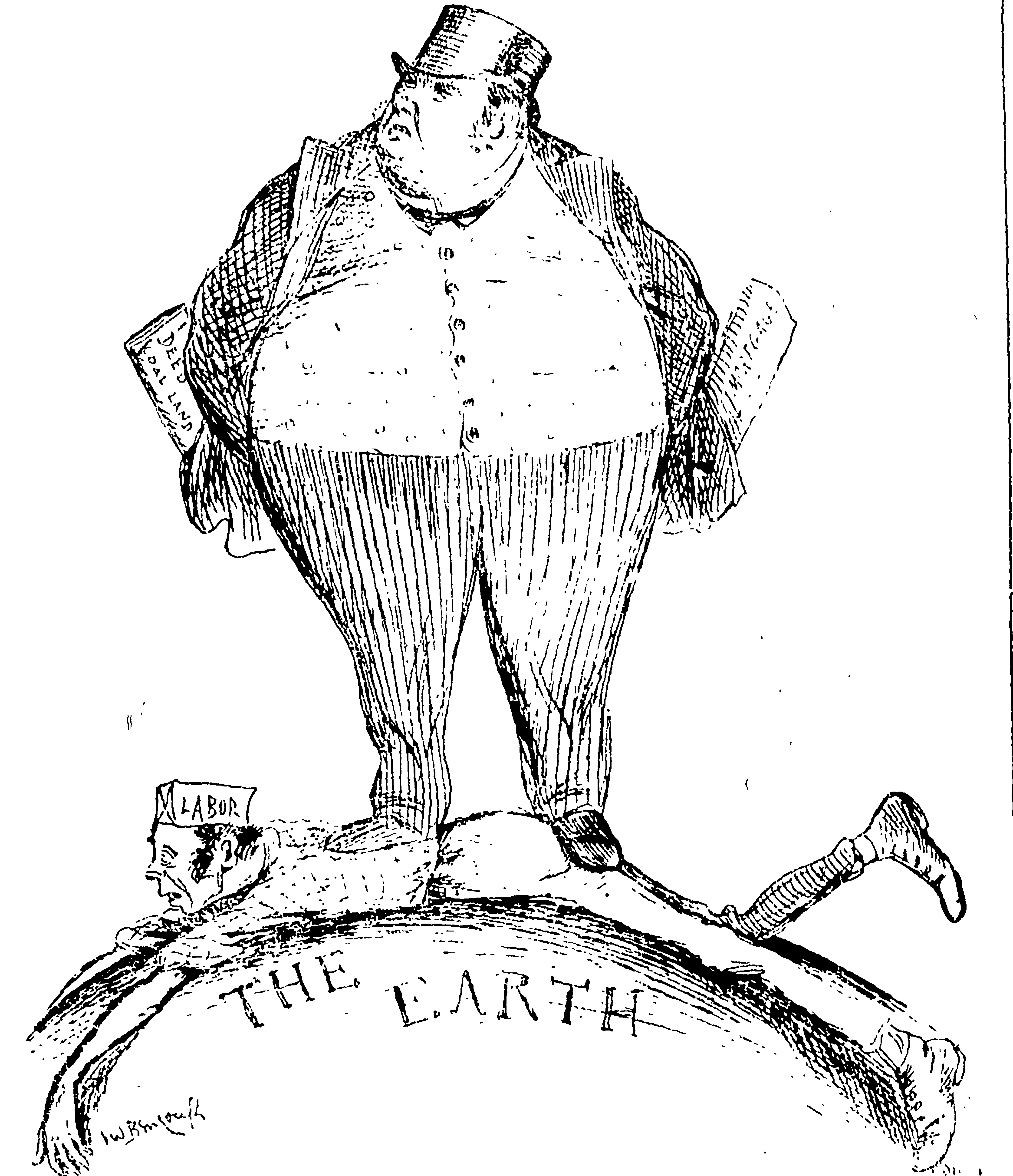
[Cartoon: A grossly fat rich man in a top hat, open coat and striped trousers stands upright, hands in pockets, on the back of a thin workman lying face down across the top of a globe; the workman’s cap is labeled LABOR. A paper sticking out of the rich man’s left coat pocket (viewer’s left) reads DEED COAL LAND; one in the right-hand pocket reads MORTGAGE. Lettered on the globe: THE EARTH. Artist’s signature at lower left, hand-lettered: “W B M[illegible]” (possibly “W B McCough”?).]
“INTERDEPENDENCE.”
To the Editor of THE STANDARD—SIR: The Kings County Gazette (protection organ), in a recent editorial, says:
To attempt to inflame one man against another is simply madness, as the rich man knows that his mortgages, deeds and notes are not worth the ink with which they are written were it not for the muscle and industry of the intelligent laboring man; and the workman in turn knows that his muscle and brawn and energy are only waste material without the rich man’s purse to keep them employed We aresic as dependent upon each other as sunshine and shadow, as vegetation and the refreshing shower, as perpendiculars and horizontals.
Here we have the picture: The rich man, perpendicular, stands on the poor man, horizontal. Unquestionably the rich man is dependent upon, supported by the poor man. But what is the poor man supported by? Surely not the feet of the upright rich man. By what, then? Do you see the cat?—[Vide Standard of last weeksic.
NEW YORK.
NEW YORK.—Manhattan single tax club. Business meeting, first Thursday of each month, at 8 p. m.; other Thursdays, social and propaganda. Every Sunday, 8 p. m., lecture. Club rooms, 36 Clinton pl.; open every day from 6 p. m. to 12 p. m. Pres., Louis F. Post; sec., A. J. Steers.
Harlem single tax club, room 3, 247 West 125th st. Business meeting every Tuesday, 8.30 p. m. Whist and social evening every Thursday. Pres., Eugene G. Muret; sec., Chas. H. Mitchell.
The West Side single tax club. Every Thursday evening, 490 Eighth ave. Pres., Dr. David Wark; sec., Daniel Cavanago, 387 8th ave.
BROOKLYN.—Brooklyn single tax club. Club house, 56 Livingston st. Open every evening. Discussions Wednesday evenings. Business meetings Friday evenings. Lectures Sunday evenings. Pres., Peter Aitken; cor. sec., Robert Baker, 884 Greene av.
The Eastern District single tax club. Wednesday evening, Oriental hall, 316 Bedford ave. Pres., John Britton; sec., Joseph McGuinness, 215 Ross st.
BUFFALO.—Tax reform club. Every Wednesday evening, Yox hall, cor. Watson and Howard sts. Pres., S. C. Rogers; sec., H. B. Buddenburg, 824 Clinton st.
ROCHESTER.—Rochester single tax union. Wednesday, 8 p. m.; Sunday, 3 p. m.; 80 Reynold’s Arcade. Pres., J. H. Bluntach; sec., J. M. Campbell, 30 Charlotte st.
ALBANY.—Single tax club. Tuesday evening, 8 p. m., 68 Washington ave. Rooms open every evening. Pres., Alexander Gregory; cor. sec., James J. Mahoney, 2 Division st.
SYRACUSE.—Single tax club of Onondaga. 26 Butler block. Pres., F.A. Paul; sec., H. R. Perry, 149 South Clinton st.
POUGHKEEPSIE.—Single tax club. Every Thursday evening, 8 p. m., 226 Union st. Pres., W. C. Albro; sec., F. S. Arnold.
AUBURN.—Single tax club. Mondays, 7.30 p. m., College hall. Pres., Dan. Peacock; sec., H. W. Benedict, 6 Morris st.
ELLENVILLE.—Single tax club of Ellenville. First and third Monday of each month, Canal st., over E. Bevier’s drug store. Pres., Wm. Lambert; sec., Benj. Hull.
FLUSHING.—Single tax club. Pres., D. C. Beard; sec., Fred Sheffield.
NEW BRIGHTON, S. I.—Richmond county single tax club. Every Monday evening, Parabola hall, New Brighton. Pres., J. S. Cogan; sec., A. B. Stoddard, W. New Brighton.
NORTHPORT.—Single tax committee. Sec., J. K. Rudyard.
OWEGO.—Single tax committee. Sec., Perry Hyde.
TROY.—Single tax club. Meetings weekly at 576 River st. Temporary pres., Henry Sterling; tem. sec., Frank H. King.
COHOES.—Single tax committee. Pres., P. C. Dandurant; sec., J. S. Crane 128 Ontario st.
GLOVERSVILLE.—Single tax committee. Chairman, A. P. Slade; sec., Dr. Wm. C. Wood, 30 S. Main st.
SCHUYLERSVILLE.—Schuylersville single tax club. Every Friday evening, residence of J. H. Bullard. Pres., J. H. Bullard; sec., R. S. Wells.
p. 15, col. 3
JAMESTOWN.—Single tax club of Jamestown. Last Saturday evening of each month. Pres., Adam Stormer; sec., F. G. Anderson, 300 Barrett st.
YONKERS.—The Jefferson club, 85 Main st. Always open. Business meeting every Tuesday evening at 7.45.
OHIO.
STATE.—Ohio Single tax league. State executive board: Chairman, C. S. Walker, foot of Evans st., Cincinnati; vice chairman, L. E. Siemon, 7 Greenwood st., Cleveland; treas., W. W. Kile, 33 E. 5th st., Dayton; sec., Edw. L. Hyneman, room 3, 348½ S. High st., Columbus.
CLEVELAND.—Cleveland single tax club Every Wednesdaysic evening, 8 p. m., 144 Ontario st., room 16. Pres., Tom L. Johnson; sec., C. H. Nau, room 25, Standard block.
CINCINNATI.—Cincinnati single tax club. Every Sunday afternoon at Douglass Castle hall, cor. 6th and Walnut sts. Pres., David De Beck, M.D., 139 W. 9th st.; sec., Wm. C. Wulff, 272 Vine st.
COLUMBUS.—Central single tax club. Sec., Edw. L. Hyneman, 348½ S. High st.
TIFEFNsic—Single tax committee. Sec., Dr. H. F. Barnes.
HAMILTON.—Hamilton single tax club. Every Saturday evening at 314 High st. Pres., Howard Rich; sec., Ambrose Strang, 742 E Dayton st.
GALION.—Galion single tax club. Every Monday evening, residence of P. J. Snay, 103 S. Union st. Pres., P. J. Snay; sec., Maud E. Snay.
ZANESVILLE.—Central single tax club. Pres., C. A. Potwin; sec., W. H. Loughead, 47 Van Buren st.
DAYTON —Free land club. Pres., John Birch; Sec., W. W. Kile; 108 E. 5th st.
AKRON.—Akron single tax club. Pres, Jno. McBride; sec., Sam Rodgers.
MIAMISBURG.—Land and labor association of Miamisburg. Pres., C. F. Beall; sec., J. F. Beals.
MANSFIELD.—Mansfield single tax club. Pres., Dr. T. J. Bristor; sec., W. J. Huggins, 66 W. 1st st.
TOLEDO.—Single tax club No. 1 meets at 112 Summit st. every Sunday at 10 a. m. Pres., A. R. Wynn; sec., J. P. Travers.
YOUNGSTOWN.—Every Thursday evening, Ivorites hall. Pres., Billy Radcliffe; sec., A. C. Hughes, 6 S. Market st.
OREGON.
PORTLAND.—Portland ballot reform and single tax club. 2d and 4th Thursdays of each month, Grand Army hall. Pres., R. H. Thompson; sec., S. B. Riggen, 48 Stark st.
PENNSYLVANIA.
PHILADELPHIA.—Henry George club. Every Thursday, 8 p.m., 904 Walnut st. Cor. sec., A. H. Stephenson, 214 Chestnut st.
Kensington single tax club. Every Tuesday evening, 8 p.m., 2021 Frankford ave., Philadelphia. Pres., James Wright; sec., Jno. Moore, 2188 E. Huntingdon st.
PITTSBURG.—Pittsburg single tax club. 1st, 3d and 5th Sundays at 2:30 p.m., Union veteran legion hall, 77 Sixth ave. Pres., Edmund Yardley; sec., Mark F. Roberts, 147 24th st., S. S.
p. 15, col. 4
BRADFORD.—Single tax club, St. James place. Open every evening. Meetings Wednesday evening and Sunday afternoon at 3 p. m. Pres., Phil. D. Tangney; sec., J. C. De Forist.
READING.—Reading single tax society. Monday evenings, 402½ Penn st. Pres., C. S. Prizer; cor. sec., Grant Nagle, 208 S. Third st.
ERIE.—Erie tax reform league. Pres., W. G. McKean; sec. J. L. Babcock.
EDWARDSVILLE.—Jefferson ballot reform and single tax club. First Friday of each month. Pres., J. J. Smythe, M. D.; sec., J. P. Hammond
LEBANON.—Lebanon single tax and land club. Pres., Adam Behny; sec., J. G. Zimmerman, 111 N. Fourteenth st.
SCRANTON.—Henry George single tax club. 1st and 3d Friday evenings of each month, Noake’s hall, cor. Franklin ave. and Spruce st. Pres., Duncan Wright; sec., Arthur McGee, 914 Capouse ave.
SHENANDOAH.—Single tax club. Sundays, 3 p.m., 415 W. Coal st. Pres., Morris Marsh; sec., Thomas G. Potts.
UPPER LEHIGH.—Single tax committee. Pres., J. B. Carr; sec., George McGee.
JOHNSTOWN, Pa.—Henry George club. Meets every Monday evening for public discussion. Pres. A. J. Moxham; sec., Richard Eyre.
POTTSTOWN.—Single tax club. Meetings 1st and 3d Friday evenings each month in Weitzenkorn’s hall. Pres., D. L. Haws; sec., H H Johnson, 530 Walnut st.
RHODE ISLAND.
PROVIDENCE.—Single tax association of Rhode Island. Alternate Friday evenings room 22, Slade building, cor. Washington and Eddy sts. Pres., Dr. Wm. Barker; sec., Geo D. Liddell, 145 Transit st.
PAWTUCKET.—Single tax association. Ev’ry Wednesday evening, Main st. Pres., Edward Barker; sec., Edgar Farnell, 220 Mineral Spring ave.
TENNESSEE.
MEMPHIS.—Memphis single tax association. Sundays, 4.30 p. m., Luehrman’s hotel. Pres. Dr. T. J. Crofford; sec., M. H. McDowell care of Townsend, Cowie & Co.
TEXAS.
STATE.—Texas tax reform association Pres., H. F. Ring, Houston; sec., J. B. Cochran.
EL PASO.—El Paso tariff reform club. 1st and 3d Saturdays of each month, county court room, court house. Pres., G. E. Hubbard, sec., A. W. Thomas.
HOUSTON.—Single tax committee. Pres H. F. Ring; sec., E. W. Brown, care of Germania house.
SAN ANTONIO.—Single tax club. Meets first and third Thursday in each month. Pres., Geo. Marks; sec., Theo. Kunzmann, 11 Crockett st.
WEST VIRGINIA.
PARKERSBURGH.—Single tax league. Every Saturday night, 500 Market st. Pres., W. H Curry; sec., W. F Thayer.
[Advertisement] CATARRH.
Catarrhal Deafness—Hay Fever—A New Home Treatment.
Sufferers are not generally aware that these diseases are contagious, or that they are due to the presence of living parasites in the lining membrane of the nose and eustachian tubes. Microscopic research, however, has proved this to be a fact, and the result of this discovery is that a simple remedy has been formulated whereby catarrh, catarrhal deafness and hay fever are permanently cured in from one to three simple applications made at home by the patient once in two weeks.
N. B.—This treatment is not a snuff or an ointment; both have been discarded by reputable physicians as injurious. A pamphlet explaining this new treatment is sent free on receipt of stamp to pay postage, by A. H. Dixon & Son, 337 and 339 West King street, Toronto, Canada.—[Christian Advocate.
Sufferers from Catarrhal troubles should carefully read the above.—[Adv.
[Advertisement] RECRUIT SUBSCRIPTION BOOKS.
The Books are handsomely bound in heavy “Alligator” paper, and are sold at prices regulated by the number of blanks each contains, as follows:
Twelve subscriptions, - - - - - - - 2 00
Thirty-five subscriptions - - - - - - 5 00
THE STANDARD, 12 UNION SQUARE
[Advertisement] The Wonderful Luburg Chair
[Illustrated display advertisement: a folding reclining chair at left, a baby carriage at upper right, a man in an invalid’s wheel chair at lower centre, a second carriage at right. Display lettering, word for word as legible: THE WONDERFUL LUBURG CHAIR | COMBINING 5 ARTICLES OF FURNITURE IN ONE | 50 CHAIRS (on chair, partly hidden) | 100 STYLES BABY CARRIAGES | INVALID SUPPLIES AND WHEEL CHAIRS | Automatic Brake on all Coaches | FREE | WHEEL CHAIRS TO HIRE. | SPECIAL FREE DELIVERY.]
We retail at the lowest wholesale factory prices, and ship goods to be paid for on delivery. Send stamp for Catalogue, [Name goods wanted?]
LUBURG MFG. CO., [145?] N. [8th?] St., Philadelphia, Pa.
[Advertisement] Pennsylvania Agricultural Works, York, Pa.
[Illustrated advertisement: engraving of a portable steam engine and a traction engine drawing a sawmill outfit.]
Pennsylvania Agricultural Works, York, Pa.
Farquhar’s Standard Engines and Saw Mills [&?]
Send for Catalogue. Portable, Stationary, Traction and Automatic Engines [a Specialty?]. Warranted equal or superior to any made.
Address A. B. FARQUHAR & SON York Pa.
[Advertisement] THE BEST REMEDY
THE BEST REMEDY on earth for Piles! Piles! Piles! Salt Rheum, Eczema and all painful itching skin diseases is E. S. Parker’s Titan Salve. By all Druggists and 320 Broadway, Room 4, N. Y. City. Agents wanted
E S PARKER
[Advertisement] CONCORD CO-OPERATIVE PRINTING
CONCORD CO-OPERATIVE PRINTING COMPANY (Ld.), 104 Elm street, cor. CANAL, N.Y. BOOK, JOB AND NEWSPAPER PRINTING.
Page 16 of 16contents
16 THE STANDARD. Vol. VII, No. 2
p. 16, col. 1
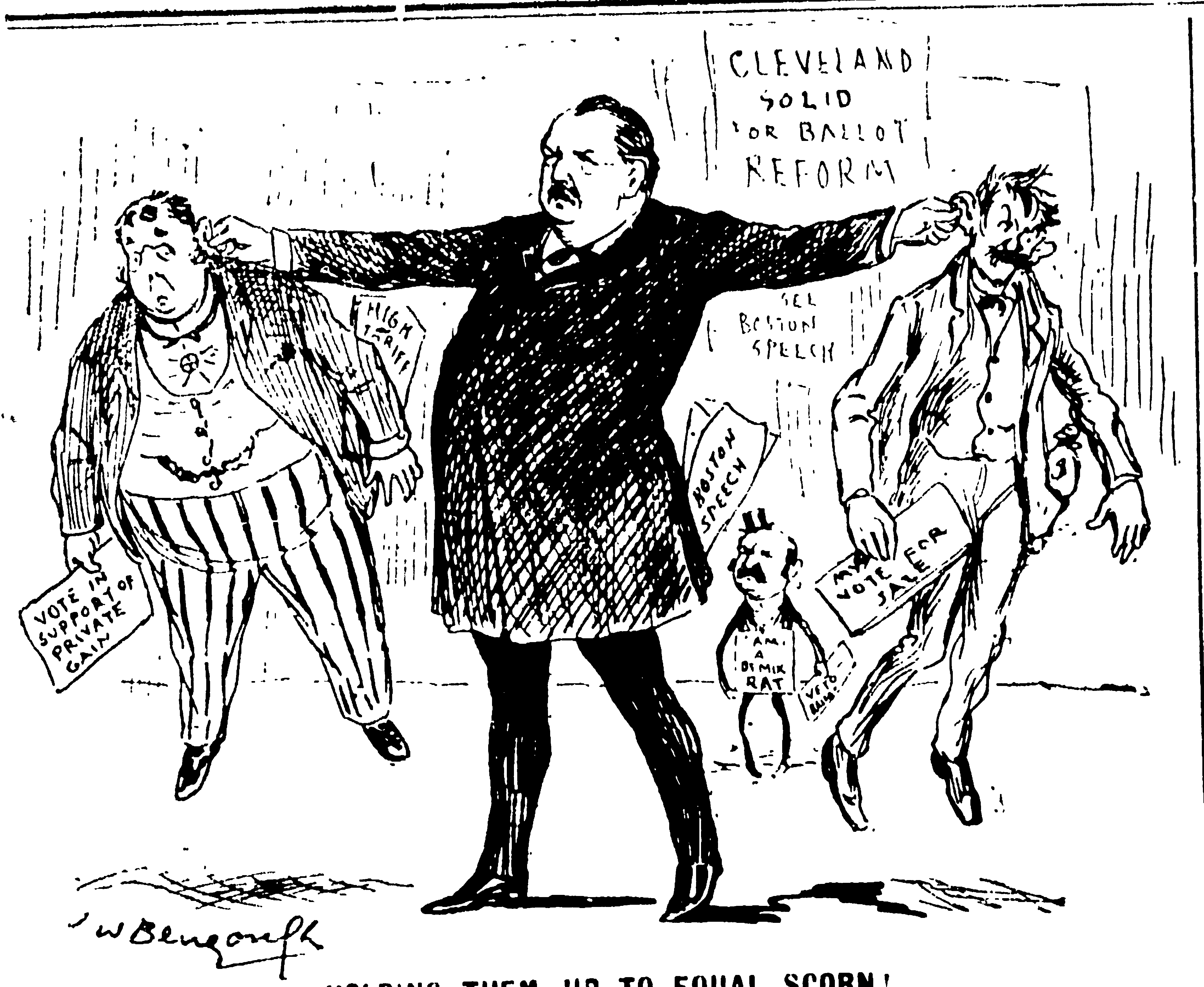
[Cartoon, signed J. W. Bengough: Grover Cleveland, standing in the centre before a poster, holds at arm’s length by the ear a fat man in striped trousers (left) and a shabby, dishevelled voter (right); a small top-hatted figure stands at his feet. Labels: poster “CLEVELAND SOLID FOR BALLOT REFORM”; placard “HIGH TARIFF”; wall notice “SEE BOSTON SPEECH”; paper “BOSTON SPEECH”; paper held by fat man “VOTE IN SUPPORT OF PRIVATE GAIN”; paper held by voter “MY VOTE FOR SALE”; sign on small figure “I AM A DEMIK RAT”; paper at his side “VETO [BILLS?]”; signature “J W Bengough”.]
HOLDING THEM UP TO EQUAL SCORN!
“We need not stifle our scorn and contempt for the wretch who basely sells his vote, and who for a bribe betrays his trust of citizenship. And yet the thought will intrude itself that he but follows in a low and vulgar fashion, the example of those who proceed upon the theory that political action may be turned to private gain.”—Ex-Pres. Cleveland’s speech at Boston merchants’ banquet
A NEW METHOD OF TREATING DISEASE.
Hospital Remedies.
What are they? There is a new departure in the treatment of disease. It consists in the collection of the specifics used by noted specialists of Europe and America, and bringing them within the reach of all. For instance the treatment pursued by special physicians who treat indigestion, stomach and liver troubles only, was obtained and prepared. The treatment of other physicians, celebrated for curing catarrh was procured, and so on till these incomparable cures now include disease of the lungs, kidneys, female weakness, rheumatism and nervous debility.
This new method of “one remedy for one disease” must appeal to the common sense of all sufferers, many of whom have experienced the ill effects, and thoroughly realize the absurdity of the claims of Patent Medicines which are guaranteed to cure every ill out of a single bottle, and the use of which, as statistics prove, has ruined more stomachs than alcohol. A circular describing these new remedies is sent free on receipt of stamp to pay postage by Hospital Remedy Company, Toronto, Canada. sole proprietors.—[Adv.
NEW PUBLICATIONS.
ASSORTMENTS OF TRACTS.
During the late campaign quantities of our best tracts were assorted for special work. and many of these not having been used, we now place them, with some of a more recent date, in convenient packages, at a low price.
Packages may be had at 50c. and $1.00.
12 Union Square,
NEW YORK.
[Advertisement] HANDY BINDERS FOR THE STANDARD.
FOR
THE STANDARD.
A lot of Handy Binders, made especially for filing THE STANDARD, are now ready.
Price 75 cents to any address.
12 Union Square, New York City
[Advertisement] VOLUME FIVE OF THE STANDARD.
VOLUME FIVE OF THE STANDARD.
NOW READY.
A limited number of bound volumes of THE STANDARD in heavy boards, are offered for sale at the following prices
Volumes 3 and 4, bound together ………. 6.50
Volumes 2, 3 and 4 ………. 9.00
Volumes 2, 3, 4 and 5 ………. 12.00
(Expressage extra.)
12 Union square, New York.
[Notice] AS SOME of the back numbers
AS SOME of the back numbers of THE STANDARD are growing scarce, we will send 15 cents’ worth of tracts in exchange for any of the following
Vol. II—Nos. 1 and [22?].
[Advertisement] Cheap Printing

[Cut: a small hand printing press beside the display heading.]
Cheap Printing
Do it yourself. Card press $3. Circular press $8. Size for small newspaper $44. Everything easy, printed rules. Send 2 stamps for Catalogue of presses, type, paper, cards, etc., to factory.
KELSEY & CO., Meriden, Conn.
[Advertisement] AGENTS WANTED EVERYWHERE!
AGENTS WANTED EVERYWHERE! Capable Men and Women to SELL the Celebrated MISSOURI [STEAM?] WASHER. Dirtiest Clothes Washed Clean [by?] Hot Steam, No Rubbing. Fits all Stoves. [Sample?] [on?] two weeks’ trial on Liberal Terms. Particulars [free?]
J. WORTH, Sole [Manu’fr?], St. Louis, [Mo?]
[Advertisement] Piso’s Remedy for Catarrh
[Display advertisement: the word CATARRH in white letters on a black bar framed by two black uprights.]
Piso’s Remedy for Catarrh is the Best, Easiest to Use, and Cheapest.
CATARRH
Sold by druggists or sent by mail. 50c. E. T. Hazeltine, Warren, Pa.
NEW PUBLICATIONS.
[Advertisement] THE SINGLE TAX LIBRARY.
- A Syllabus of Progress and Poverty. Louis F. Post. [8?] pages.
- Australian System. Louis F. Post. 4 pages.
- First Principles. Henry George. 4 pages.
- The Right to the Use of the Earth. Herbert Spencer. 4 pages.
- Farmers and the Single Tax. Thomas G. Shearman. 8 pages.
- The Canons of Taxation. Henry George. 4 pages.
- A Lawyer’s Reply to Criticisms. Samuel B. Clark. 16 pages.
- Back to the Land. Bishop Nulty. 16 pages.
- The Single Tax. Thos. G. Shearman. 8 pages.
- The American Farmer. Henry George. 4 pages
- Unemployed Labor Henry Georgesic. 4 pages.
- The Case Plainly Stated. H F. Ringsic. 8 pages.
- Social Problems. 342 pages, 12mo. Paper, 35c.
- Objections to the Land Tax. Thos. G. Shearmansic. pages.
- Land Taxation. A Conversation Between David Dudley Field and Henry George. 4 pages.
- How to Increase Profits. A. J. Steers. 2 pages.
- The New Political Economy. E. O. Brown. 4 pages
- Thy Kingdom Come. Henry George. 4 pages.
- The Functions of Government. Henry George. pagessic.
- The Menace of Plutocracy. Thomas G. Shearman. 8 pages.
- Tenement House Morality. J.O.S. Huntington. 4 pp. 22, 23, 24, out of print.
- Taxing Land Values. Henry George. 8 pages.
- Henry George’s Mistakes. Thomas G. Shearman. 8 pages.
- The Democratic Principle. Henry George. 8 pages
- Progress and Poverty. Henry George. 512 pages. 35 cents.
- The New Ballot System. Louis F. Post. 4 pages
- The Cat. 2 pages.
- The Single Tax in a Nutshell. 2 pages.
Prices of Single Tax Library: Two page tracts—1 copy, 1 cent; 40 copies, 10 cents; 100 copiessic, 20 cents; 1,000 copies, $1.50.
Four-page tracts—1 copy, 2 cents; 20 copies, 10 cents; 100 copies, 40 cents; 1,000 copies, $3.
Eight-page tracts—1 copy, 3 cents; 10 copies, 10 cents 100 copies, 80 cents; 1,000 copies, $6.
Sixteen-page tracts—1 copy, 4 cents, 5 copiessic, 10 cents; 100 copies, $1.60; 1,000 copies, $12.
No extra charge by mail.
The following numbers of the “Land and Labor Library” are still in stock:
- Settler’s Nightmare. Louis F. Post. 4 pages.
- Mysterious Disappearance. Lewis Freeland. 6 pp.
- Sailors’ Snug Harbor and the Randall Farm. W. T. Croasdale. 12 pages.
- The Collegiate Church and Shoemaker’s Field. W. T. Croasdale. 12 pages.
- It is the Law of Christ. Rev. S. H. Spencer. 4 pp.
- Christianity and Poverty. Father Huntington 4 ppsic. [33?]. Socialism—Its Truth and Its Error. Henry George. 4 pages. [38?]. “God Wills It.” Henry George. 4 pages.
- How John’s Father Saw the Light. W.C.Woods. 2 p.
- Ten Thoughts for Christian Thinkers. Rev. John W. Kramer. 4 pages.
- Hints as to What You Can Do. Henry George. 4 pp.
- My Butcher Woman and My Grocery Man. William McCabe. 4 pages.
- A Republican’s Reasons for Supporting Cleveland. Judge Frank T. Reid. 2 pages. [88?]. Jefferson and Hamilton. Chauncey F. Black. 8 pp.
GERMAN TRACTS.
- First Principles. Henry George. 4 pages.
- Socialism—Its Truth and Its Error. Henry George. 4 pages.
- Taxing Land Values. Henry George. 8 pages.
- It is the Law of Christ. Rev. S. H. Spencer. Henry, Ill. 4 pages. [53?]. Sailors’ Snug Harbor. Wm. T. Croasdale. 12 pages,
SWEDISH TRACTS.
52 The Case Plainly Stated. H. F. Ring. 8 pages,
TARIFF TRACTS.
- Protection as a Universal Need. Henry George. pagessic.
- The Tariff Question. Henry George. 4 pages.
- American Protection and British Free Trade. Henry George. 4 pages.
- Protection and Wages. Henry George. 8 pages.
- Protection the Friend of Labor? Thomas G. Shearman. 8 pages.
- A Short Tariff History. Thomas G. Shearman. 2 pages.
- Plain Talk to Protectionists. Thomas G. Shearman. 4 pages.
- An Address to Workingmen on the Tariff Question, Henry George. 4 pages.
A set of Tariff Tracts will be sent to any address for ten cents.
12 Union square, New York City
[Advertisement] THE HOME SEEKER
THE HOME SEEKER—An exponent of Building Society methods and purposes. Published monthly, in the interest of those who seek homes of their own. W. H. Van Ornum, Editor. The hope that one day one “may sit under his own vine and fig tree,” and gather about him his loved ones, “with none to molest or make him afraid,” is the most natural and universal sentiment in man. We believe there is nothing in nature which would prevent the fruition of this hope, but that the causes which hinder [it?] are solely the bad laws by means of which men are cheated out of their earnings, and prevented from enjoying equal access to the natural opportunities to make homes provided by the Auther of Naturesic. Believing this we shall strive to bring about the repeal of those laws by making plain just how bad those laws are. and what they are. Subscription price, [50?] cents a year in advance. Sample copies sent on application. Published by THE HOME SEEKER [PUBLISHING?] CO. Chicago.
[Advertisement] ATTENTION!—A YOUNG IRISHMAN
ATTENTION!—A YOUNG IRISHMAN, aged [20?], desires any kind of work to earn a living. [HONEY?], care of Standard Office.
p. 16, col. 3
[Advertisement] Pears’ Soap — “Good morning”

[Display lettering: “Good morning” in engraved script.]
Good morning
“Paris Exposition, 1889.
PEARS obtained the only gold medal awarded solely for toilet SOAP in competition with all the world. Highest possible distinction.”
[Advertisement] HENRY GEORGE & CO., PUBLISHERS,
HENRY GEORGE & CO., PUBLISHERS,
NO. 12 UNION SQUARE.
PROGRESS AND POVERTY.
An inquiry into the cause of industrial depression and of increase of want with increase of wealth. The remedy.
By HENRY GEORGE.
512 pages. Cloth, $1.50sic. Paper covers, 35 cents. Half calf or half morocco $2.50sicsic.
PROTECTION OR FREE TRADE?
An examination of the tariff question with especial regard to the interests of labor.
By HENRY GEORGE.
Cloth, $1 50. Paper covers, 35 cents. Half calf or half morocco, $3.00.
THE LAND QUESTION.
What it involves and how alone it can be settled.
By HENRY GEORGE.
87 pages. Paper covers, 20 cents.
PROPERTY IN LAND.
A Passage-at-Arms Between the Duke of Argyll and Henry George.
77 pages. Paper covers, 15 cents.
FORTSCHRITT UND ARMUTH.
(Progress and Poverty in German).
Translation of C. D. F. Gutschow.
430 pages. Paper covers, 35 cents.
PROGRES ET PAUVRETE.
(Progress and Poverty in French).
Translation of P. L. LeMonnier.
542 pages. Paper covers, $2.75.
PROTECTION OU LIBRE-ECHANGE?
(Protection or Free Trade? in French).
Translation of Louis Vossion.
436 pages. Paper covers, $2.75.
PROGRESSO E POVERTA.
(Progress and Poverty in Italian).
Translation of Ludovico Eusebio.
352 pages. Paper covers, $2 50.
SETS OF THREE.—PROGRESS AND POVERTY, SOCIAL PROBLEMS, PROTECTION OR FREE TRADE? BOUND ALIKE, IN HALF CALF OR HALF MOROCCO, $7.00.
[Advertisement] ECONOMIC WORKS.
By way of answering inquiries constantly received, we append a list of some economic and social works of various kinds, with prices, at which they will be forwarded post paid. Any work not mentioned procurable in New York will be sent on receipt of publisher’s price.
THE LAND AND THE COMMUNITY.—IN three books by Rev. S. W. THACKERAY, M.A. LL.D. Trin. Coll. Cantab. With preface by Henry George. 12mo, cloth. Price $1.00.
WILLIAM LLOYD GARRISON.—THE story of his life. Told by his children. 4 vols, cloth, $12 00sic.
ESSAYS ON POLITICAL ECONOMY.—By FREDERICK BASTIAT. 12mo, cloth, $1.25.
SOPHISMS OF PROTECTION.—WITH preface by Horace White. By FREDERICK BASTIAT. 12mo, cloth, $1.00.
HISTORY OF POLITICAL ECONOMY IN EUROPE.—By JEROME ADOLPHE BLANQUI. 8vo, cloth, $3.00.
THE TARIFF HISTORY OF THE UNITED STATES.—Containing “Protection to Young Industries,” and “The History of the Present Tariff, 1860–1883.” By F. W. TAUSSIG. 8vo, cloth, $1.25.
THE AUSTRALIAN BALLOT SYSTEM as embodied in the legislation of various countries. By J. H WIGMORE Cloth, $1.50sic.
WORK AND WAGES.—BY THOS. BRASSEY. 16mo, cloth, $1.00.
FREE LAND AND FREE TRADE.—THE Lessons of the English Corn Laws Applied to the United States. By Hon. SAMUEL S. COX. 8vo, cloth, 75 cts.
THE HISTORY OF THE FREE TRADE MOVEMENT IN ENGLAND.—By AUGUSTUS MONGREDIEN. 16mo, cloth, 50 cts.
POSTULATES OF ENGLISH POLITICAL ECONOMY.—By WALTER BAGEHOT. Cloth, $1.00.
AN INQUIRY INTO THE NATURE AND CAUSES OF THE WEALTH OF NATIONS.—By ADAM SMITH. Edited by Theobold Rogerssic. $1.00.
Any of the above Books will be sent postpaid on receipt of price.
12 Union Square, New York City.
[Advertisement] PARIS EXHIBITION, 1889. Burroughs, Wellcome & Co.
PARIS EXhIBITION, 1889.
BURROUGHS, WELLCOME & CO.,
Importers, Exporters and Manufacturing Chemists,
SNOW HILL BUILDINGS, LONDON, E. C.,
Specially invite the attention of the Medical Profession and Drug Trade to their Exhibits, as follows:
At Stand No. 575, British Food Section,
Kepler Extract of Malt,
an agreeable vitalizing reconstructive and digestive.
Kepler Solution of Cod Liver Oil,
An ideal form for the administration of fat.—British Medical Journal.
Also at Stand No. 311, British Industrial Section,
Chemical and Pharmaceutical Products, &c.
The Congo Medicine Chest, as taken by H. M. Stanley, for the relief of Emin Pasha, fitted with Tabloids of Compressed Drugs, &c.
The Livingstone, Gordon and Indian Traveler’s Medicine Pocket Cases and Portable Medicine Chests.
Vereker’s Chloride of Ammonium Inhaler, for Catarrh, &c.
The Pinol-Eucalyptia Dry Inhaler, for the antiseptic treatment of Consumption and diseases of the air passages.
Lanoline, Lanoline Toilet Soap, Cold Cream Pomade and Toilet Lanoline.
Also at Stand No. 594, American Section,
Hazeline. Distilled active principles obtained by distillation from the American Witch Hazel, Hamamelis Virginica, for inflammation and irritated surfaces.
The Fairchild Pepsine and Pepsine Tabloids, Zymine Peptonizing Powders, &c., &c
Formulæ and price lists supplied to the Medical Profession and Drug Trade on request.
BURROUGHS, WELLCOME & CO.
[Advertisement] HEAVEN AND HELL.
HEAVEN AND HELL.
By EMANUEL SWEDENBORG.
Four hundred and twenty pages, paper cover. Mailed pre-paid for [14?] cents by the American Swendenborg Printing and Publishing Societysic, [20?] Cooper Union, New York City.
[Advertisement] JAS. HOGAN
JAS. HOGAN, Principal Agent for James Means’ [$3?] and [$4?] shoes, [illegible] Bowery, near Prince st.
[Advertisement] THE MASTER WORKMAN.
THE MASTER WORKMAN.
A simple statement of the views and aims of single tax men, designed especially for workingmen,
Single copies, 10 cents, ten copiessic, [80?] cents; twenty five copies, $1.75; one hundred copies, $6.00.
Sent post or express prepaid on receipt of the above prices. Address,
[331?] Gordon St., Allentown, Pa.
SOCIAL PROBLEMS.
By HENRY GEORGE.
342 pages. Cloth, $1.00. Paper covers, 35 cents. Half calf or half morocco, $2.50.