Page 1 of 16contents
THE STANDARD
NO. 159—VOL. VII, NO. 3. | NEW YORK, WEDNESDAY, JANUARY 15, 1890. | PRICE FIVE CENTS
p. 1, col. 1
THE STANDARD.
HENRY GEORGE, Editor and Proprietor.
12 UNION SQUARE, NEW YORK CITY.
Entered at the post office, New York, as second class matter.
TERMS. POSTAGE FREE.
One year, $2.50, six months, $1.25; single copies, 5 cents.
Three or more yearly subscriptions, sent in at one time, will be received at $2.00 each.
ADVERTISING rate thirty cents per agate line each insertion.
REMITTANCES should be made payable to THE PUBLISHER OF THE STANDARD.
RECEIPTS.—The correct filling of orders is evidence of receipt of remittance.
CHANGES OF ADDRESS.—When changing address send old as well as new address.
Sample copies sent free on application.
TABLE OF CONTENTS.
Editorial. A Letter from Rev. Heber Newton, and the Answer Thereto—The Thin End of the Wedge—Progress Must Be Step by Step—The Duty of the Clergy—A Remarkable Utterance by the New York Times—Our Astonishing Navy—Governor Hill and Ballot Reform—Through a Glass, Darkly—Mr. Porter Afraid of Becoming Extravagant and Inquisitorial—A Fight to the Death–A Challenge–Notes.
Notes and Queries. Mr. E. O. Brown on “The Abolition of Privilege”—Topolobampo—Does the Single Tax Mean Land Nationalization?—Land Grabbing in Florida—Cleveland on Party Principles—What Makes Land Values—Probable Strength efsic Candidates in the Next Democratic National Convention.
Letters to the Editor. How Vain is Industry—Knights and the Petition—Work for the Ladies.
The Farewell Dinner to Henry George.
The Ignorant Voter. E. J. Shriver.
An Important Suggestion. Rev. J. O. S. Huntington.
Gladstone and Parnell. Rev. Harold Rylett.
The Social Problem—A Socialistic View—Two Critics of Bellamy—Socialism and Religion.
Free Trade in Massachusetts—Speech of Thomas G. Shearman.
The Purring of the Cat.
Mr, Spencer Heckled.
Society Notes.
Ballot Reform. The Mass Meeting at Cooper Union—How it Works in Indiana—Governor Campbell’s Lame Conclusion—Mr. Cleveland’s Interest in the Reform—The Union League Club—The Press on Hill’s Attitude.
Personal.
The Free Trade Fight. A Knight of Labor Paper Denounces the Protection Humbug—Colonel Lathers Attacks Hill and Randall—Newspaper Opinion.
Urging Free Pews.
New Ideas, Methods and Inventions.
Single Tax News. The Petition to Congress—A Delegation to Testify Before the Committee of Ways and Means—Mr. Herne Addresses the Brooklyn Club—Growth in Pennsylvania—A Protected Manufacturer Comes Out for Free Trade and the Single Tax at St. Louis—A School House Campaign in South Dakota—Light Needed in Nebraska—What the Present System Does in Texas—Good Work in Many Other States—An Important Move in Canada.
Who Own New York?
Recent Sales and Assessments.
EDITORIAL.
My Dear Mr. George: In your notes upon my letter in this week’s STANDARD, you address a personal question to me which I do not feel like even seeming to shirk. You say, “I would like to put to Mr. Newton the question I put to the Baptist ministers when I addressed them in Philadelphia a couple of weeks ago:”
A rich man goes away to a distant land leaving to a large family of children an estate amply sufficient to bountifully support and provide for them all. No sooner is he gone than some of the stronger and more cunning of the children set up a claim that the estate is theirs alone, and deny to the others all right or use of it, so asserting, reiterating and teaching their claim that the despoiled children for the most part have
p. 1, col. 2 themselves come to accept it, and many of them to look on the story that they have a loving father as a superstitious fable. The result is. there is suffering and want where there should be abundance, and that where their father intended peace, happiness and brotherly love, there is pride, envy, malice and greed. Some of the children are gorged to repletion, and become diseased by surfeit, while others of them do not get enough to eat and are growing up hungry, dirty, ignorant and vicious. What would you say of the friend of the father, the trusted representative and exponent of his will to these children, who, seeing all this, should not have one word to say about the gross perversion of the trust, the clear violation of the father’s will, but who, on the contrary, should prate of mutual forbearance and mutual love, and ask the overfed children to give cold victuals to the starving children and tell the hungry, squalid, disinherited ones that their father loves them very much, though he has given them very little, and that if they will be good and contented he will some time or other take them to another place where there will be enough for all? Would you have words bitter enough to express your contempt for such a false friend, such a faithless representative, such a traitor to a sacred trust? And yet, that to-day is the attitude of the majority of Christian ministers.
That is a rather long question, and I must very naturally shift upon you the burden of responsibility for having to quote so much before proceeding to my answer. Your words are strong—no stronger than they should be. if they are called for.
Everything turns upon one little clause; What would you say of the friend of the father, the trusted representative and exponent of his will to these children, who, seeing all this, would not have one word to say about the gross perversion of the trust. etc. The clergyman is just like the layman in that before he can be expected to denounce a wrong he must be persuaded that it is a wrong. His eyes must be opened before he can see anything. His eyes are just as apt to be closed by the force of education and surrounding opinion as the eyes of a layman. He is not to be blamed for not denouncing what he does not see. Before the clergy can be expected to speak in any such language concerning private proprietorship of land they must be made to see that it is in itself absolutely indefensible—a perversion of the divine trust. If when they come to see this they have nothing to say, then they are veritably traitors to God.
An intellectual education thus must precede the moral action. Now, it is not assuming too much to say that nine-tenths of the clergy as yet have not got their eyes open thus far. It is no wonder that their eyes should not be opened thus far, inasmuch as the eyes of the whole world have been closed to it for so long a time.
Even in this preliminary work of intellectual education there are two distinctions to be made. There is implied, in the first place, the recognition of a broad general moral principle, and then, secondly, the application of this principle in the form of economic laws. The broad general principle concerns the nature of land and its relation to the other factors in the production of wealth—capital and labor. This raises the moral aspect of the land question which has been so clearly shown in your great work, which has appealed so searchingly to the consciences of earnest men. This, however, is complicated with the inevitable outworking of this general principle into the details of economic law–its application to the means and methods of enforcing the principle.
Without pursuing this analysis any further in abstract form, I can better answer your question, which you have chosen to put to me directly, by answering it as directly, in the first person, singular. You must be responsible for this seemingly personal character of my friendly reply. I the less regret it since I am sure that what I have to say for myself will interpret what others are
p. 1, col. 3 more or less clearly saying for themselves. Before “Progress and Poverty” appeared, my own mind had reached the conviction which was expressed in an essay, since reprinted in my Social Studies, concerning this general principle. I had come to recognize the fact that land was the basic factor among the three factors going to the production of wealth; that it had a peculiar quality of its own, demanding peculiar treatment; that it lifted the religious aspect of the social question more distinctly into view than did either of the other factors. I had expressed my conviction that, in the trend of social progress, if it be found necessary, society would exercise its inherent right of readjusting its tenure of land in the interests of the community at large, and, if found needful, would hold land as common property in some way or other. I was delighted and entranced, as hosts of others were, with the magnificent setting forth of this truth in “Progress and Poverty.” I have never lost for an hour the intense sympathy that that work awakened in me. It still searches me through and through with its moral and religious appeal as no other economic work that I have ever read. Why, then, have I not been an out-and-out disciple? Why have I not thrown in my lot heartily with the movement you have so courageously and magnificently led? Simply because, while perfectly clear on this general principle, I never have been clear concerning your application of it. I have, at any moment, been ready to go as far in the expression of my belief in the general principle as did not commit me to the special method of working it out which you have embodied in “Progress and Poverty” and made the very point of the work. I well recall going over this ground with you, soon after the appearance of “Progress and Poverty,” and remonstrating with you for the conclusion of your great argument. My ground was that it would have been better to have let the principle stand by itself and work its own way out; that your method involved a wholly novel experiment in taxation, concerning whose practical results history gave us no light whatever; that the time was not ripe for any such radical and revolutionary method of applying the principle; that its premature enunciation would drive hosts of men from your side who might otherwise be found rallying around you; that no man was prophetic enough to anticipate the evolution which time carries on, and say by what means and methods a great idea is to be worked out; that your methods seemed to me to ignore the fundamental law of social evolution, viz., that of taking one step at a time and going slowly and carefully in the right direction. Such was the substance of my criticism of your method. I have not been so much offended as have been many by the appearance of confiscation involved in your method, though I knew how this would act upon a large part of the community. The old dictum that the public safety is the supreme law made me see that when needful even such a measure would be justifiable. The law which the supreme court has recently enunciated concerning the brewery plants in Iowa ought to have made it clear to any one that when the time comes any vested interest which stands in the way of social welfare should be brushed aside at whatever cost. But insofar as I have read history, all attempts to apply previously untried, radical and heroic measures to the social evils have been fraught with monstrous dangers. The French revolution is the most striking illustration of this in the records of history. The difference between the French and the English story is a differ-
p. 1, col. 4 ence between ideal legislation heroically applied and in anticipation of growth, and slow, successive, gradual modifications, in which nothing valuable in the past was lost, while the past was continually being led up into a nobler future.
At any moment during the last half a dozen years I could have stood by your side, heart and soul, in all your work, as far as the principle is concerned, had you seen wise to admit of a slower and experimental application of it. Possibly you were right and I am wrong. Time will prove. I have as unquestioning a trust in your sincerity now as I had years ago. Only for myself, I must follow my own light. I could work with you heartily, as far as my health allowed, if you would but allow of any affiliation other than that of complete discipleship.
Had I strength—that indispensable qualification for any work of social reform—I should have been trying what will seem to you the preposterous attempt to crystallize a sentiment around your own principle, applied in a different practical method. For example: It seems to me that the time is entirely ripe for the application of that principle in certain forms. We could sweep the country within half a dozen years upon two points. First, the retention of all mineral resources hereafter to be opened as the property of the people at large. This would secure an enormous public fund for many of the states, whereby their educational system could be developed as never has been done in history, and vast beneficences be wrought for the public good. It would also be the introduction of the thin end of the wedge, in which would be the recognition of the principle of the right of the people at large to land, of the wrong of private proprietorship in the purely natural resources of the land. Secondly, the time seems to me ripe for the application of that form of the principle which is already coming to the front in England, in the taxation of unused land in our great cities and towns up to their full value, thus to prevent their speculative holding. I say our towns and cities, because it is here that the evil concentrates itself, though of course it is felt in other directions. The judgment of so competent an economist as Professor Sedgwicksic accepts this as timely. This, again, would introduce the thin edge of the wedge, would recognize the principle.
I have profound faith in the thin edge of the wedge. When it is once in, we can force it in further with great ease. I have profound faith in the value of securing the recognition of a general principle. Nothing is so logical as an idea. Work that idea into legislation and it will work itself out to its own conclusion. If the results expected from the radical and heroic measures of “Progress and Poverty” are to be reaped by experience, the results to be achieved by two such measures would be so far fruitful of good as to convince the skeptical and dispel the fears of the timid and to strengthen the minds of land reformers for more sweeping measures—out of which would come in due time the full application of the great principle—“the land is Mine.”
I have thus answered your question at large—at no inordinately relative length to the question that was put to me. My heart and soul are with you in the endeavor to secure the introduction of the great principle which, with you, I believe, will be so fruitful of good. If God ever grants me strength again I shall try in my own little way to work out my own application of the problem, however foolish it may seem to you, if you do not meanwhile secure the single tax.
In the meantime, so far as I go, I should be utterly a traitor to my religious faith if I ceased to proclaim from every house top to which I can climb this truth that I continued on p. 2 → [continued on page 2]
Page 2 of 16contents
[Running head: 2 THE STANDARD. Vol. VII, No. 3]
[continued from page 1]
← continued from p. 1 have thus expressed. I trust that this is so with every clergyman whose eyes are open. Yours cordially,
R. HEBER NEWTON.
Garden City, January 11, 1890.
Mr. Newton seems to have completely misunderstood me in supposing that the question which I put to him had reference to his own course. What it referred to was to the matter under discussion—the proposition made by Dr. Huntington of Grace church, that the Episcopal church, by way of contributing to the settlement of the labor question, should put two clauses into her liturgy, one asking God to incline the hearts of employers and employed to mutual forbearance and goodwill and the other asking Him not to suffer the hire of laborers to be kept back by fraud. It was in relation to the attitude of Dr. Huntington in proposing such prayers, while saying nothing whatever about the great wrong that lies at the root of all social difficulties. that I put to Mr. Newton this question. I put it to him because in the letter on which I was commenting, he had excused the position of Dr. Huntington. Nothing was further from my thoughts than the implication that Mr. Newtousic himself was one of these faithless ministers. On the contrary, in almost the next paragraph I spoke of his attitude as one of the indications that a new life, a more earnest spirit, was manifesting itself among the Episcopal clergy.
I have made no criticism, and have no criticism to make, on the conduct of Mr. Newton. On the contrary, he seems to me to be one of those ministers who have been brave and true. He has not seen things precisely as I have seen them, and has never, I think, attached to the land question the supreme importance which it holds in my mind, but he has seen that there is a great wrong in our social organization of to-day, and the essay to which he refers is one of the most striking presentations of this fact ever made. And despite any differences of opinion, he, of all the Episcopalian ministers in this city, is the one who has done most to give to the doctrine which I have represented, an audience. He presided at the second lecture I ever delivered in New York. He opened his church to me on a Sunday evening for the delivery of a lecture upon Moses, which clearly and strongly presents the same idea. It was through him, or through his brother, Rev. Wilberforce Newton, that I was invited to address the congress of the Episcopalian church at Detroit, and afterward the general church congress. When I ran for mayor of New York iu 1886sic as a representative of the idea of equal rights in land, Heber Newton, at the risk of seriously offending influential members of his congregatiorsic, came out openly in my support. If Heber Newton had done nothing else—and, on the contrary, he has done many things—to show his sympathy with social reform and his desire to bring out the truth, not to cover it up, these actions of his would have made it impossible for me to allude to him as one of those who were attempting to lead away from social wrong.
On another point I think Mr. Newton misunderstands me. He says he could have stood by my side as far as the principle is concerned had I seen wise to admit of a slower and experimental application of it, and that he could work with me heartily if I would allow of any other affiliation than that of “complete discipleship.” I have never asked any discipleship, nor have I ever admitted or recognized any. If the duke of Argyle called me a prophet it was but in scorn. I have never set up for a prophet. I have never sought to impress my
p. 2, col. 2 views, as my views, upon any one, and I think I could almost count upon my ten fingers the men whom I have personally asked even to read anything I have written. I have never wanted Heber Newton to stand any closer by my side than he has done, or than his own judgment and wish would lead him. I have looked on him as one who was doing his share of the good work in his own way, and have never sought nor desired any closer affiliation, for I could well see how that might embarrass him and raise in his way prejudices that had attached to me. This has been my general attitude. I have never asked any man to sacrifice position or influence, or arouse antagonism by taking the position I have held. On the contrary, where men have written to me—and many have written—asking my advice on this point as a matter of conscience, I have always advised them to act with prudence, and if there was any danger of the loss of position or influence from a too open avowal of their belief, not to risk it unless they felt compelled to, telling them they could always find private opportunities of propagating the truth, even if public opportunities were denied them, and that the time would come when they could speak openly. I am not making any reference in this to Mr. Newton, since he has never spoken to me in this way, nor I to him. I am merely explaining that I have never sought to make any man my disciple or felt irritated because he did not openly go with me. And for Mr. Newton, though his ill health and hard work and my close occupation have for some time prevented us from seeing as much of each other as I could have wished, I entertain not merely a warm personal friendship but the highest appreciation and esteem. I have recognized in him not merely great ability, but qualities higher yet—sincerity and courage and helpfulness—and I have been perfectly content that he should work in his own way, as I in mine. He has never been ouesic of those ministers who have lulled the consciences of their hearers by telling them that social conditions were all that they ought to be, but he has, on the contrary, steadily insisted that there was something wrong in social conditions, and that the highest duty of men and of Christians was to right this wrong.
With this explanation and with the understanding that I make no reference to Mr. Newton in what I may have to say of the clergymen whom in his charity he is excusing, let me reply to the general points raised in his letter:
I, also, have profound faith in the thin end of the wedge. I have believed from the first that the triumph of the principle of equal rights to natural opportunities would come by gradual and successive steps, and I have from the first stated my belief that these steps, one after another, would be carried by the aid of men who at the time did not expect to go any further. I have been uncompromising in my advocacy of principle, and have refused in this to swerve one hair’s breadth either to the right or to the left. But I have never despised the day of small things, and have never refused to work heartily in support of anything which led toward the application of the principle, even though it went only a little way. So far from ignoring what Mr. Newton styles “the fundamental law of social evolution–that of taking one step at the time and going slowly and carefully in the right direction”–I have from the first always recognized it. In my first publication on the land question, “Our Land and Land Policy,” I abstained from saying anything directly against private property
p. 2, col. 3 in land, merely pointing out the justice of taxing land values and the substantial equality with regard to natural opportunities that could thus be secured. In “Progress and Poverty” I say:
It is an axiom of statesmanship, which the successful founders of tyranny have understood and acted upon, that great changes can best be brought about under old forms. We, who would free men, should heed the same truth. It is the natural method. When nature would make a higher type she takes a lower one and develops it. This, also, is the law of social growth. Let us work by it. With tbesic current we may glide fast and far. Against it, it is hard pulling and slow progress.
In the “Land Question,” written when I first came to New York, in 1880, I urged the leaders of the Irish movement to lift the true standard of natural rights, to raise their movement above the level of a mere local and national class movement, and to make it the van of a world-wide struggle. I said to them:
Let the time servers, the demagogues, the compromisers, to whom nothing is right, and nothing is wrong, but who are always seeking to find some half-way house between right and wrong—let them all go their ways. Any cause which can lay hold of a great truth is the stronger without them. If the earnest men among the Irish leaders abandon their present hal fheartedsic, illogical position, and take their stand frankly and firmly upon the principle that the youngest child of the poorest peasant has as good a right to tread the soil and breathe the air of Ireland as the oldest son of the proudest duke, they have put their fight on the right line. Present defeat will pave the way to future victory, and each step won make easier the next.—[Land Question, p. 47.
But I at the same time pointed out that to do this would make possible an easy and gradual advance, that it would enable them to avail themseivessic of the rising tide of British democracy and to effect again that combination of labor and capital that had proved its power in the free trade struggle of 1846, and that could again force the entrenchments of the landed aristoeracysic. And I pointed out that the practical measures by which they could best carry forward the movement in Great Britain were small ones in themselves:
Englishmen of all classes have happily been educated up to a belief in free trade, though a very large amount of revenue is still collected from customs. Let the land reformers take advantage of this by proposing to carry out the doctrine of free trade to its fullest extent. If a revenue tariff is better than a protective tariff, then no tariff at all is better than a revenue tariff. Let them propose to abolish the customs duties entirely, and to abolish as well harbor dues and light-house dues and dock charges, and in their place to add to the tax on rent, or the value of land exclusive of improvements. Let them in the same way propose to get rid of the excise, the various license taxes, the tax upon buildings, the onerous and unpopular income tax, etc., and to saddle all public expenses on the landlords.
This would bring home the land question to thousands and thousands who have never thought of it before; to thousands and thousands who have heretofore looked upon the land question as something peculiarly Irish, or something that related exclusively to agriculture and to farmers, and have never seen how, in various, direct and indirect ways, they have to contribute to the immense sums received by the landlords as rent. It would be putting the argument in a shape iu whichsic even the most stupid could understand it. It would be directing the appeal to a spot where even the unimaginative are sensitive—the pocket.—[Land Question, p. 55.
And the same principle I have stated even more clearly in “Protection or Free Trade?”
The advocates of a great principle should know no thought of compromise. They should proclaim it in all its fullness, and point to its complete attainment as their goal. But the zeal of the propagandist needs to be supplemented by the skill of the politician. While the one need not fear to arouse opposition, the other should seek to minimize resistance. The political art, like the military art, consists in massing the greatest force against the point of least resistance; and, to bring a principle most quickly and effectively into practical politics, the measure which presents it should be so moderate as (while involving the principle) to secure the largest support and excite the least resistance. For whether the first step be long or short is of little consequence. When a start is once made in a right direction, progress is a mere matter of keeping on.
. . . It makes no difference how little we can hope at once to do, social progress is
> by steps, and the step to which we should address ourselves is always the next step.
I have always acted upon the principle thus stated—the principle that the avowed friends of a great truth should in their propaganda declare it fully and uncompromisingly, but that in practical measures they should always support those who were willing to go ever so short a distance, provided it was in the right line. In England and Scotland, although strongly urged to do so, I refused to palter with the idea of compensation. But at the same time I urged our friends, when it came to practical measures, to make their demands the lowest possible that would embrace the principle, and the Rev. Harold Rylett well knew my mind when he said in the recent National liberal conference that the mere recognition of the principle of taxing land values irrespective of improvements was as good a declaration as at this time I would have asked the liberal party to make. So in this country, I was the first to propose, and in the mayoralty campaign of 1886 was the first to carry into a political movement, a demand for the Australian ballot, but I, and the men who acted with me, have always been willing to work behind and to give our most loyal support to those who subseqentlysic took it up and have carried it so far forward. So, too, we, single tax men, had no prepossessions in favor of Mr. Cleveland, but the moment he took the step of carrying into practical politics even a timorous demand for tariff reform we gave him our support and will continue loyally to support him as long as he shall move in this direction. So with any proposition to abolish a tax on personal property, to increase the assessment on unused land, or to give the people a larger interest in the mineral lands. We have supported and will support all such measures, so long as they are on our lines, it makes no difference how small we may consider such measures in themselves. For instance, the single tax men of North Dakota worked like beavers for the constitutional provision recently adopted by that state, which provides that “the coal lands of the state shall never be sold, but the legislative assembly may, by general laws, provide for leasing the same.”
Now as to the clergy. It is true that their intellectual eyes are just as apt to be closed by the force of education and of surrounding opinion as the eyes of laymen. But they are moral teachers; and they ought to be quicker in the appreciation of moral truth. And especially ought they to be quicker in the appreciation of a moral truth that lies at the very foundation of the religion they profess, as does the truth that the Creator is the Father of all His human creatures; and in bringing them into this world has equally endowed them with the right to use its materials and forces; has given them an equal right to bring forth by their labor from the storehouses He has provided the things which may satisfy the wants He has made the necessary consequence of their physical existence. I have not blamed any clergyman for not seeing clearly how the common right to land may be carried into practical effect without any violation of the individual right to the thesic products of exertion; nor have I presumed to blame those who, from motives of personal prudence, refrain from open avowals of the truth. But the relations between land and labor, the relations between the monopoly of the natural element necessary to all life and indispensiblesic to all production and the poverty that festers in the midst of our civilization, have now been sufficiently discussed to put all moral teachers at continued on p. 3 →
Page 3 of 16contents
[Running head: January 15, 1890. THE STANDARD. 3]
[continued from page 2]
← continued from p. 2 least upon inquiry. And for the professed moral teachers, the professed shepherds of Christ’s sheep, who not merely refrain from pointing out this relation, but who persistantlysic try to close the eyes of others to it by ignoring and leading away from it, I have a profound contempt. We ought not, perhaps, to expect too much from the clergy. They are but men. But have we not a right to expect some little? Are they not the professed servants of the God of Justice; the professed teachers of righteousness—that is to say, of right doing? And when they become, either wilfully or negligently, the bulwark of social wrong, when they not merely close their own eyes to injustice, but endeavor to close the eyes and quiet the consciences of those who look up to them; when in the face of bitter suffering due to flagrant wrong they preach that the duty toward God and one’s neighbor consists in prayer and praise and giving alms, what feeling can any right minded man have for them but that of scorn?
But that, no matter who stands forth for it or who puts himself in the way of being crushed by it, the truth has only to be brought into discussion to make its way, the progress of single tax ideas is showing more and more clearly every day. Men are coming to accept them, not because they consciously receive them from any one else, but because their attention, being unconsciously aroused, they find them obviously true. Every week the columns of THE STANDARD contain some significant illustration of this, but this week there has occurred one of more than usual significance. Governor Hill, in his message to the New York legislature, shows himself so far affected by this drift of thought and opinion as. to abandon his previous declarations in favor of attempting to tax everything, to make a confused recognition of single tax principles as possibly true, and to admit that the effort to compel each citizen to make a return of his property, which he has heretofore favored, “is odious to the American people,” and “is a constant temptation to loose swearing or downright perjury,” while “each man’s perjury encourages his neighbor to like falsifications to escape paying his just share.” Thereupon he suggests a graduated inheritance and succession tax.
Commenting on this the daily Times of this city, in an editorial entitled “The Taxation Question,” published on the 10th of January, says:
If the governor had any clear ideas on the subject and any capacity for logical consistency, instead of making these muddled suggestions he would boldly recommend the abolition of personal taxation, which cannot be made equitable. He says, in his muddle headed way, that it may be true “theoretically, as some assert, that the burden of a real property tax, by the working otsic natural laws, is finally distributed equitably upon all wealth, because all wealth is primarily derived from land,” but he thinks it must be conceded that the process is slow, and that “vast fortunes of personal property may change hands many times while a real property tax is claimed to be slowly working out a distribution of its burden upon the owners of personal property.” This is utter and hopeless nonsense. There is nothing theoretical or slow about the diffusion of real estate taxes. It is eminently practical and prompt. The taxes of the real estate owner are as “certain as death,” and he calculates upon them all the time. He fixes his rents with reference to them, and every tenant pays his equitable share. All traffic is carried on by the occupation of real estate, and prices are affected by the factor of rent and taxation. There is no escape from it for any person who occupies a building or a room in a building or who buys anything for the sale of which a building or a piece of ground is necessary. The equity of the operation lies in the fact that the tax is finally distributed in exact proportion to the use that is made of real estate by the different members of the community, and that varies as near as may be with wealth and the ability to pay.
> We have no hesitation in declaring our belief
p. 3, col. 2 > that the ideal of taxation lies in the single land tax, laid exclusively on the rental value of land independent of improvements. It is the real estate tax pushed to its logical result, but it is so far unattainable as to be beyond the range of practical discussion for present purposes. But the abolition of direct personal property taxation is entirely practicable and a step in the direction of equity. As another step toward the solution of the problem, it would be well if the revenue for state purposes could be derived from other sources than the direct assessment of property in the hands of individual owners, so that the question of assessment might be left to local authorities. We could then get rid of the inequalities due to varying standards of assessment in different counties and the arbitrary action of so-called boards of equalization, and the way would be prepared for further progress.
The significant sentence in this article—so significant as to be worth repeating, is this:
We have no hesitation in declaring our belief that the ideal of taxation lies in the SINGLE LAND TAX, laid exclusively on the rental value of land independent of improvements.
This is the first time that one of the great American daily papers has clearly announced its adhesion to the principle of the single tax. It makes no difference that the Times adds that this principle is beyond the range of practical discussion for present purposes. The declaration of the Times that it is right, is one of the most significant indications that the day of its entrance into practical discussion is at hand.
The circulation of the Times is much larger than that of THE STANDARD; but THE STANDARD, nevertheless, goes to some places where nothing is known of American daily journals. It may be worth while then to say that the Times is perhaps the most careful and least sensational of the great American papers. It was the journal that led in the exposure and destruction of the Tweed ring, and though not the paper of largest circulation, has in certain respects something of the relative standing and better qualities of the London Times. That it was in the beginning most bitter and unjust toward the single tax and its advocates only makes its present attitude more significant.
One of the peculiarities of the Times is that it is a sort of army and navy gazette. As showing the utter failure of our attempt to make sailors by educating an aristocratic class at the naval academy, I recently quoted a remarkable story from the Times, of how a mere boatswain saved one of the finest ships in our “new navy”—the Idaho—during a cyclone in the Indian ocean, by taking charge of her when all the commissioned officers had lost their heads and the captain had fled to his cabin, fallen on his knees and commenced to pray for the safety of his ship.
Here is a similar story taken from the Times of the 13th, concerning the Yorktown, one of the “squadron of evolution” recently sent across the Atianticsic at an enormous expense to American taxpayers in chaagesic of an admiral who had not been to sea for twenty years:
The official report by Admiral Walker confirmed the stories first published concerning the very rough experience of the Yorktown and the loss of one of her small boats, which had been used as a drag, as fully told in the columns of the Times of January 5.
It is now asserted that the cruiser had a much narrower escape than the official reports seem to indicate, and a letter received in this city from an able-bodied seaman on the vessel is quoted as authority for the assertion.
According to this letter, the drag was put out to steady the vessel in an attempt to bring her before the wind. Orders were given from the quarterdeck to reverse the engines and turn, but in the confusion the Yorktown backed on the drag and there was imminent danger of the line which held the drag fouling the screw. Had this occurred the Yorktown would certainly have foundered. A German-American quartermaster saw what must inevitably happen, and, without
p. 3, col. 3 out waiting for orders or asking permission, he seized a deck ax and cut the rope. The vessel was then brought to and another drag was got out, and for the next two hours the quartermaster practically had control of the ship.
The true democratic note is sounded by the Saturday Globe, which declares against a system of army, navy and seacoast defenses as utterly inconsistent with Jeffersonian democracy. It says:
Admitting the necessity and efficiency of a naval force, embodying all the improvements of the time in which it is to be brought into action, Mr. Jefferson’s observation that “a nation which could count on twelve or fifteen years of peace would gain by burning its navy, and building a new one in time,” is more obviously sensible in this age than it was in his. The changes effected by science and invention are so frequent and radical that a vessel of the most approved construction to-day may be entirely worthless in a few months.
Moreover wars are no longer fought out, as in old time, by embodied mercenaries. Wealth fights. Wealth alone can maintain great and strenuous conflicts, and sufficient wealth will evoke every agency of defense or offense, whenerversic that agency shall be urgently required. Increasing, therefore, the wealth of our country, we increase in the most practical way its defensive power. To this end we want principally that which Mr. Jefferson sought in the platform, drawn by his own hand, and upon which he was elected to the Presidency, namely, “free commerce with all nations, political connection with none, and opposition to the policy of a standing army in time of peace, which might overawe the public sentiment, and to a navy, which by its own expenses and the wars in which it will implicate us, will grind us with public burdens and sink us under them.”
But if we must have a navy, let us have one officered by sailors. The way to get this is to aboiishsic the aristocratic system of appointing boys to be educated for commissioned officers, and to make every admiral come into the service “through the hawse hole.” At the present time we have so many officers that no places can be found for them even with our enormous expenditure of over $30,000,000 per year. The short way to make room for promotion would be to at once dismiss every enlisted man and send our ships to sea manned completely by officers. This would soon “make room in the navy” and would certainly make sailors of the survivors.
HENRY GEORGE.
We have no hesitation in declaring our belief that the ideal of taxation lies in the SINGLE LAND TAX, laid exclusively on the rental value of land independent of improvements.–[New York Times, January 10.
GOV. HILL AND BALLOT REFORM.
In his message to the legislature Governor Hill expresses his conviction that any ballot bill which that body may pass will be unconstitutional if it requires either an exclusively official ballot or a ballot containing the names of all the candidates. From this it must be inferred that he intends to warn the legislature that if such a bill is passed he will veto it.
He recommends both an official and an unofficial ballot, the former to be printed at public expense and delivered by ballot clerks to each elector upon his entering the polling place, and the latter to be provided and distributed by political parties and individuals at discretion. Also that there shall be booths into which every voter shall be compelled to enter for the purpose of examining or preparing his ballots, and from which he shall proceed directly to the ballot box unattended by any one. The professed object of these recommendations is to prevent intimidation and bribery by securing secrecy.
It may be that Governor Hill really supposes secrecy would be secured in this way, but it is hard to believe it. The dependent voter who dared to take an official ballot from the ballot clerks would be spotted at once, and a bribed voter would know that to take an official ballot would forfeit his bribe. Every dependent or bribed voter would go into the booth without an official ballot, and, unless he were expert at sleight of hand, with no ballot whatever but the one that had
p. 3, col. 4 been placed in his hands by his briber or intimidator. And when he got into the booth, what opportunity would he have to arrange his ballots, even if he succededsic in smuggling in others than such as he was expected to vote? The bribed voter who remained within the booth for an instant would lose his bribe, and the dependent workingman who did it would lose his job. The reform which Governor Hill recommends seems to be skillfully contrived to aid bribery and intimidation by making it impossible for a voter to vote in secret without taking pains to show that he wants to vote in secret. For a dependent or bribed voter to do that is to declare in effect that he intends to vote independently, and even an innocent minded governor ought to know how such a declaration would affect the voter.
To prevent intimidation and bribery it is necessary not only that there should be official ballots, but also that there should be none of any other kind; it is necessary not only that the voter should be compelled to go into the booth for the purpose of preparing his ballots, but that he should be required to prepare them there. All this Governor Hill strenuously opposes. He is determined to retain unofficial ballots, whatever else is done; and since even the unofficial ballot might promote secrecy if it contained the names of all candidates, he opposes that feature of the reform also. His purpose may not be to encourage bribery and intimidation, nor even to maintain opportunities for bribery and intimidation. It would not be nice to infer that a governor was actuated by motives so mean. However that may be, there is an obvious purpose on the part of the governor to keep up the ring machine in politics. A great deal has been said about the expense of providing ballots as a burden on candidates and as a mask under which campaign funds are collected for bribery purposes. Governor Hill dwells upon this in his message, and assumes that official ballots would remove the evil even though unofficial ballots were also allowed. But Governor Hill is careful to speak of the matter as if only the cost of printing were the burden and the mask. This would appear to be a willful evasion. The cost of printing is comparatively slight. The great burden, the impenetrable mask, is not the printing of ballots, but their distribution. If unofficial ballots were allowed at all, candidates and parties would have their army of poll workers just as they have them now, and the candidate who did not would be at a disadvantage, just a hesic is now. Therefore, candidates would be fleeced for money, ostensibly to pay workers, but really in great part to use in bribery; and the irresponsible machine that gives or withholds nominations, according to the means and liberality or the subserviency of candidates, would be as powerful as ever. It is this machine that Governor Hill and his friends want to perpetuate, for it is only in politics dominated by such a machine that they can hope to flourish; and that this machine may be perpetuated he demands such a modification of the ballot reform as will continue the machine as a necessity in politics. He says he instituted an investigation of the workings of the Massachusetts ballot law, and in some respects found it sadly defective; but perhaps in no other particular did it appear to him quite so sadly defective as in the effect it had of utterly doing away with the presence of the “worker” at the polls.
There is a spirit of compromise in the governor’s message. He admits the necessity of electoral reform, and proposes a mode of securing a secret ballot for every voter, however dependent or however venal, who has the desire and the hardihood to make up his ballot in secret when the law does not compel him to. But the governor cannot sanction an exclusively official ballot, nor one containing the names of all candidates; first, because he does not want to, and second, because there are three constitutional objections. The first constitutional objection is that, with an exclusively official ballot, no one could vote unless nominations continued on p. 4 →
[continued on page 4]
Page 4 of 16contents
[Running head: THE STANDARD. Vol. VII, No. 3]
p. 4, col. 1
← continued from p. 3 tions were made, and if no nominations were made in a district the voters of that district would be disfranchised. The governor must have searched for this objection with a magnifying glass of great power: and now that he has found it, it does not seem to have been worth the trouble. There is about as much danger that no nominations will be made in a district as there is that no one will want to vote there. But Mr. Saxton can so easily obviate the objection by a simple provision for blank official ballots when nominations are not made that the objection is not worth discussing.
The governor’s second constitutional objection is that an exclusively official ballot, containing the names of all candidates and making it necessary for the voter to place a cross opposite the name of his choice, makes an educational qualification. The Massachusetts ballot law, he says. is not open to this objection, because in that state the constitution requires every elector to be able to read and write the English language. This is an unfortunate citation for the governor’s argument, for it is not true that the Massachusetts constitution requires every elector to be able to read and write the English language. It makes this requirement only of citizens who have become voters since the year 1857, and there is a large body of illiterate voters in Massachusetts yet, for whom the ballot law of that state providesic, as the proposed Saxton bill does, namely, by allowing them to call in the aid of election officers.
The governor’s third constitutional objection borders on the comic. It is unconstitutional, he says. “to require an elector to vote an exclusively official ballot containing the names of all the candidates nominated.” The reason for this is that the constitution requires elections to be by “ballot,” and at the time of the adoption of the constitution the revised statutes defined a ballot to be a paper ticket containing the names of the persons for whom the elector intends to vote, and, therefore, “by necessary implication the constitution says the ballots shall contain no other names.” The governor declines to argue the proposition. He intends, he says, to “simply state it.” That is a pity. An elaborate argument of such a proposition as an objection to the Australian and the Massachusetts form of ballot would have made the governor’s message one of the airiest state documents that ever gathered dust in a pigeon hole, Once, in a New England state, the law required voting to be done by means of a “written” ballot. While this law was in force printed ballots were offered, and some Governor Hill in embryo raised the point that printed ballots were not lawful because they were not “written” ballots. When the question came before one of the distinguished jurists of New England he disposed of it summarily in favor of the printing press. Had he decided the other way, Governor Hill would have been able to cite the decision as a precedent in support of his objection that a ballot containing the names of all candidates, one of which the voter is required to mark as his choice, is not a paper ticket containing the name of the person for whom the elector intends to vote.
It is only fair to Governor Hill to say that he credits his constitutional objections to “the briefs of several able jurists,” which have been submitted to him; but it was decidedly unfair to the jurists not to give their names. The names of jurists so acute ought not to pass into oblivion unhonored and unsung.
THROUGH A GLASS, DARKLY.
A correspondent, Mr. J. H. Sheets, writing to Farm, Stock and Home, an excellent agricultural paper published at Minneapolis, tells the editor that many of his articles bear unconscious testimony for the single taxsic. The editor replies that he regards with favor “the system of taxing landsic values, as defined by Henry George,” but that he is opposed to the single tax. The paper says:
It is our belief that taxing land values, regardless of improvements, and making unimproved lands pay for whatever advantages
p. 4, col. 2
come to them from improvements on adjacent lands, would be a wise and helpful system, one that would do much towards modifying land monopoly, if not substantially destroying it; and we believe it would have the ultimate effect of decreasing city rentals, and in various other ways would lighten the burdens of labor in both city and country.
Many will at first ask how a paper can state such views and yet oppose the single tax. Yet Farm, Stock and Home does so, and it does it on the ground that though a tax on the rental value of land, exclusive of improvements. is a good thing of itself. there are other forms of taxation that ought to continue. It cannot see why it is wise to put all taxes on land values and none on the stock of the merchant who owns no land.. It knows that the answer to this will be that the consumer ultimately pays the taxes and the merchant shifts his to his customers. and that since competition will compel him to sell goods at the lowest margin of profit, be cansic and will sell them at a lower price if he pays no tax on them.
“This,” says Farm, Stock and Home, “is the theory of the protective system, the practical operation of which has done so much to bring about the present unsatisfactory condition of our farming interests.” But unfortunately, it continues, the theory does not work, because the beneficiaries of the system are not bound to pay higher wages, to create a home market, to enrich the farmer or to do any of the things they said they would do if protection were accorded them. It therefore fears that if the merchant, the banker and the transporter were exempted from taxation they would pocket the benefit instead of lowering their charges.
The difficulty with Farm. Stock and Home is its failure to recognize the essential difference between land and all species of property resulting from human labor or ingenuity. Yet it sees clearly enough some of the results arising from this difference. It acknowledges, for instance, that the tendency of competition is to reduce the price of commodities. Why? Would such a tendency exist as to any necessary commodity if all of it that now exists or ever could exist were in a few hands? The reason that competition lowers prices under normal conditions must be found in the fact that increased demand tends to compel increased production. Let men try, under conditions of free competition, to keep up the prices of goods that have been exempted from taxation and others will soon appear who will be more than willing to produce such goods at a reasonable profit. It is true that by means of the trust the tariff protected manufacturers have at times checked this tendency, but they are not subjected to free competition. The tariff is maintained for the avowed purpose of shielding them from competition with foreign manufacturers, whose demand, nevertheless, fixes the prices of our farm products. Does not Farm, Stock and Home see that the essential condition that makes competition wholesome cannot apply to land, the total area of which can neither be increased nor diminished?
Why does our Minnesota contemporary approve of taxing land values regardless of improvements? Is it not because it sees that taxing improvements makes fewer improvements, whereas a tax on land values, instead of making less land, tends to force more land into use, and thus promotes production. Surely Farm, Stock and Home must see this, or else it would not favor what it calls the “land tax,” as distinguished from “the single tax.” If this is true, as between the taxation of land values and the taxation of improvements, it is true as between the taxation of land values and the taxation of all other products of human labor. To tax land makes it cheaper instead of dearer by forcing more of it into use. To tax the products of labor makes them dearer by retarding production. This is a good reason for taxing land values only and abolishing all other taxes, and we cannot doubt that a paper that sees so far as Farm, Stock and Home will eventually acknowledge that this is a sufficient reason for establishing the single tax,
It will then cease to bother its head
p. 4, col. 3
about the merchant, banker, manufacturer and transporter. Private parties should never have been permitted to control public highways so as to monopolize transportation, but, even if the private ownership of the land occupied by railroads were still permitted. the single tax would compel such owners to put that land to the best possible use, in order that they might earn something for themselves over and above the tax they would have to pay to the state. Holding railroads out of use to help other lines would cease to be profitable, and fortunes would have to be made by working railroads instead of wrecking them. Free competition and the abolition of special privileges would meet the case of the others, and more would be “bound” to do the right thing, not by futile statutes, but by natural law as fixed and certain as gravitation.
MR. PORTER AFRAID OF BECOMING EXTRAVAGANT AND INQUISITORIAL.
Mr. Porter, the census superintendent, in his recent circular acknowledges that “many single tax clubs, Knights of Labor assemblies and other organizations have requested” him to ascertain what percentage of people in this country occupy their own homes and farms and what proportion are tenants, and also to ascertain the amount of mortgage indebtedness on homes and farms nominally owned by their occupants. Mr. Porter declares, somewhat hastily, we think. that these statistics cannot be got from records. and can only be obtained by a house to house canvass. He thinks even a house to house canvass would fail, because a similar attempt in Massachussettssic, according to the answers received. indicated that only nineteen per cent of the inhabitants of the state are land holders, leaving eighty-one per cent who acknowledged themselves as tenants or did not answer at all. Why does Mr. Porter regard this as a failure? It would not be remarkable if the proportion of land holders in Massachusetts were even less than nineteen per cent. Here in New York it has been estimated that less than four per cent of the inhabitants are land owners, and probably a rigid scrutiny will reduce this estimate. If pushed far enough, such an examination would reveal the interesting fact that absentee landlordism is almost as notable here as in Ireland, and probably show that nearly the whole American colony in Paris lives on revenues drawn from the business men and working people of New York.
Mr. Porter suggests that the work asked for could not be accomplished without the expenditure of a million dollars and the institution of queries that would be inquisitorial. Now, when did Mr. Porter ever before see any objection to spending a million dollars for the payment of a new lot of republican office holders? He certainly cannot expect anybody in the United States to attach the slightest weight to this objection. Again, when did Mr. Porter, or any other protectionist who advocates the breaking open of trunks at the custom house in order to see how many boots and shoes, stockings, coats and hats an American may desire to bring home with him, first begin to feel a prejudice against being inquisitorial? Mr. Porter is the advocate of a policy that would not hesitate to search a woman’s pockets, and that does break open merchants’ desks in its quest for objects of taxation. Too inquisitorial, indeed! It is only when the inquiry turns toward the revelation of the monstrous fortunes made by monopoly and the exposure of the impoverishing effect of existing laws on the condition of farmers, wage workers and producers generally, that Mr. Porter begins to think that government should not be too inquisitorial.
The single tax men and the Knights of Labor have done a good thing thus far in compelling Mr. Porter to acknowledge to the country that there is a wide demand for such an investigation. There their duty ends, so far as Mr. Porter is concerned. The work now lies with congress, Let men flood their own members with petitions and letters demanding that
p. 4, col. 4
the census, which will cost millions of dollars, shall really let the people know their own financial condition. If there is to be any step at all beyond a mere enumeration, this is the first step that should be taken. It is all very well to know how many head of horses and cattle, and how many looms and spindles there are in this country, but horses, cattle, looms and spindles do nothing for the country, except as they contribute to the wealth of the people, and what is now asked is that the government, even if it has to sacrifice some of these usual statistics, shall “take stock” and tell the people of the United States, first, what they have, and next, how it is divided.
Press your petitions upon congressmen, and however reluctant Mr. Porter and Secretary Noble may be, the republican members of congress from the west dare not vote to continue to keep this knowledge from their constituents. Let the good work continue, but waste no more time on Mr. Commissioner Porter.
A FIGHT TO THE DEATH.
Mr. J. S. Moore, who is described by the New York Times as “the well known advocate of tariff reform,” but who is better known as “the Parsee merchant,” appeared last week before the ways and means committee to advocate “free raw materials.” The room was crowded by importers, manufacturers and members of congress, and much interest was displayed. The Times says:
The republican members of the committee subjected Mr. Moore to a severe cross-fire of questions and comments, and got little comfort out of his answers. They seemed, however, to be greatly pleased with his assertion that be wassic in favor of such customs duties as would make up for the high cost of labor in the United States.
It is not to be wondered at that they were pleased, since Mr. Moore, if correctly reported, practically granted all that they desire in order to enable them to maintain any kind of tariff that the greed of their masters may demand.
We hope that Mr. Moore is incorrectly reported. He has, in the past, rendered real service to the cause of tariff reform. He used to call himself a free trader. This was at a time when the nominal advocacy of free trade meant nothing more than tariff for revenue; when its advocates shrank from publicly calling themselves free traders, and constantly threw tubs to the protection whale. They met in parlor conferences to consult in whispers as to how far the people could be fooled into going toward free trade without understanding what they were doing. Of course there were among these “pioneers” some bold and brave spirits, who chafed under such restraint, and scared their associates now and then by boldly proclaiming their real thoughts. These are the only ones that are fit to take part in the battle for free trade that has now begun.
The day for concealment and compromise has gone by. The bated-breath, back parlor era is at an end. We are beating our drums and holding our banner aloft. We are at last out in the open, fighting a fight that now confessedly means death to protection, and that will soon go further and demand the destruction of the whole tariff system. We are not playing at politics now. We have gone in to win; and we are asking the American people, and especially the working people, to down this whole protective system. We declare that protection is a fraud, a humbug and a lie. We insist that a tax on commodities does not and cannot protect labor, and has no power to increase wages, whether the duty be one per cent, twenty per cent or one hundred per cent. The working men, so long deluded and robbed, are beginning to see this, and the farmers are coming to see it also. Until enough of them do see it, and vote accordingly, we cannot win.
Let no man mistake the issue. The question is not the rate of duty adequate for protection. We got beyond that during the first congressional debate on the Mills bill. Free traders and tariff reformers stand together to-day, denying that any kind of a tariff tax can or does continued on p. 5 →
Page 5 of 16contents
[Running head: January 15, 1890. THE STANDARD. 5]
p. 5, col. 1 ← continued from p. 4 protect labor, and any man who fails to see this is practically out of the fight.
A CHALLENGE.
The New York Press in its “Talks on the Tariff,” promises to present to its readers a common sense political economy that shall be readily understood by all who can read. It complains of the confusion of the old political economy, and declares that thesic advocates of the “dismal science” refuse to meet the Press on its own ground. A sample of the simple political economy that the junior protection organ proposes to inculcate is given in its columns. Here is an interesting extract from it:
But is economic science so simple a matter that we can in so direct a manner arrive at a principle so important? Even so. That is what common sense tells us. Look at it once again. A thing costs what we give, what we part with for it. What does a national association of producers and consumers give, part with, for what it gets by production? The materials used up in the process–that is all.
So that is all, is it? Do the American people constitute ’a national association of producers and consumers” who trade, as a whole, with other peoples? If this assumption holds good, is it to be taken for granted that if the trade is a bad one, all suffer alike, while if it is advantagoussic to our people, all benefit alike? Can we permit the assumption that in swapping the products of our labor for the products of other people’s labor, all of the labor expended here counts for naught, and we pay out only the materials used up in the process? If this be true, and we get the foreign raw material, plus the product of the labor upon it, the bargain would seem to be a pretty good one for the “national association of producers and consumers,” and the dividends to the individual members of the association ought to be handsome. If this were true, however, according to the Press, it would be all wrong, and, somehow or other, it injures us and benefits the foreigners. Perhaps we do not understand exactly what the Press means, and perhaps the Press does not understand what it means itself. There is apt to be confusion and misunderstanding in debates conducted by men who do not know or see each other.
THE STANDARD is not an advocate of the old school of political economy, but it takes issue with that which the Press calls common sense. If the Press represents any considerable body of men, it is probable that among the number are many who can tell what they think and defend their opinions, and the Press ought certainly be able to pick out such men from among its editors and admirers. We invite it to do so.
We have in this town a comparatively small organization that advocates and defends the politico-economic doctrines that THE STANDARD represents. It is called the Manhattan single tax club. This club is now endeavoring to organize a mock congress for debating the measures that come before the real congress and legislature. It proposes that these debates shall take place in public, and desires that men who really believe in protection shall meet its members in earnest and sincere discussion of the differences that divide them. Now let the Press see to it that the people it represents take advantage of this opportunity to enlighten a considerable number of New York voters. We challenge them to the contest.
We have no hesitation in declaring our belief that the ideal of taxation lies in the SINGLE LAND TAX, laid exclusively on the rental value of land independent of improvements.–[New York Times, January 10.
The Madison square garden company, which is building a great amphitheater, theater, restaurant and concert hall, occupying the block between Twenty-sixth and Twenty-seventh streets, and Fourth and Madison avenues, is trying to float a first mortgage of $1,250,000. The firm engaged in placing the bonds declares that the land without the building is estimated by R. V. Harnett, the well known
p. 5, col. 2 real estate man, at $1,509 500[?], and it is announced that the building will cost over $1,000 000. This shows the value of land in a portion of the city that is thus far considerably north of the business center. The structure promises to be a magnificent one, but the land is valued at one and a half times the cost of the building.
THE STANDARD commented on the letters on the land question, printed in the London Times, at the time of their appearance, publishing Mr. Spencer’s letter in full. These letters have since been reprinted in the Popular Science Monthly, and a condensation of them is given elsewhere. Mr. Greenwood’s remonstrance with Mr. Spencer for saying something that may prove dangerous, if taken up by the uninstructed masses, is as beautiful a bit of toryism as we have seen for a long time. The small crowd of “superior people” who think that it is their mission to rule this earth, but that, in order to do so comfortably, they must keep what they are doing from the masses, are an amusing lot, and some specimens of them ought to be saved before the march of democracy buries them in oblivion.
The Indianapolis Journal quotes Mr. Shearman’s declaration, “When you have swept protection out of the tariff the American people will be logical enough to sweep the tariff after it;’ and Frank Hurd’s declaration that”Mr. Cleveland is the acknowledged champion of free trade;” and it remarks “that the abolition of all tariffs, and the razing to the ground of customs buildings, which cannot be devoted to other purposes (which Mr. Mills once prayed for), is undoubtedly a day and a half’s journey toward the millennium: but how will the money be raised to pay the expenses of the government? Having asked this old, old question in triumphant fashion, it answers itself by the declaration that”there will be but one way to raise money for the government, and that will be direct taxation.”
Mr. Calvin S. Brice was elected to the United States senate yesterday by the Ohio legislature. This simply means that the Ohio democracy is not the party of the people, as its name would imply. The objection to Mr. Brice is not that he is rich, but that his election is due to his riches. Wealthy men are not necessarily excluded from power in a true democracy, but when they obtain power because of their wealth ,democracysic is at an end and plutocracy has taken its place.
We call the particular attention of ballot reformers to the description given elsewhere of the method of voting in Indiana, under the new law of that state. It is, in some respects, less satisfactory than the Massachusetts system; but it does secure the essential features of an official ballot, delivered to the voter on election day at the polls, which he is compelled to mark in absolute secrecy. The plan demands careful stndysic, because it is rumored that some members of our legislature, who object to some of the details of the Saxton bill, are likely to introduce the Indiana plan as an amendment. If such is the case, the friends of ballot reform should give the matter careful consideration in advance.
Governor Brackett, of Massachussettssic, devotes a considerable part of his message to the question of taxation. He recommends a succession and legacy tax, and expresses a hope that such a system would relieve the state from its present necessity of raising $2,000,000 by a direct state tax. The governor says that there are grave inequalities in the present system, and that rates vary from $4 on the $1,000 in the town of Cohasset to $23[?] on the $1,000 in the towns of Florida and Hawley. The Boston Globe recently declared that farms can be bought in the town of Florida for just about the cost of improvements. Referring to the fact that Governor Brackett’s message shows that Florida’s tax rate is the highest in the state, the Globe says: “Doubtless the two facts have some relation to each other. High taxes
p. 5, col. 3 on land make land cheap.” The Globe begins to see things in their true light. If the town of Florida will stop taxing buildings and tax land alone, land will be cheaper still and buildings more numerous.
The Toledo Daily Commercial thinks it is one of the peculiarities of the age that the owners of broad acres should see any merit in the single tax theory. It then quotes the comments from an eastern exchange on what it calls “the plan” of the Denver anarchists. It evidently thinks this is the single tax idea. The paper also lays down the novel proposition that if the government owned all the land–which, by the way, the single tax does not require—that it could tax nothing but its own property, and could therefore have no revenue. The reasoning here is somewhat mysterious, because the people who now own the land receive from it in the way of rent a much larger revenue, taking it altogether. than any government on earth has ever enjoyed. This Ohio editor ought to read the papers. He does not know what is going on.
Those republicans in Iowa who entertain the old fashioned notion that their party was created to serve the state instead of accepting the modern idea that the state was created to serve the party, are doing their best to prevent the reelection of Senator Allison—a free trader who has abjured his principles to serve the robber tariff, and a corporation attorney who has represented the railroads that employed him more faithfully than he has represented the state that sent him to the senate. It is to be hoped that the angry protest of these Iowa republicans will be heeded, but if they fail there will be at least one good result; these people will learn that the right way to get rid of protectionism and all other forms of monopoiysic is to defeat the party that represents protectionism. This is a very simple little lesson, but the anti-monopolists in Iowa have been slow to learn it.
NOTES AND QUERIES.
Pamphlet No. 5 of the political economy and public laws series of the University of Pennsylvania deals with “Prison Statistics of the United States for 1888.” The pamphlet was prepared by Roland F. Parkersic, Ph. D. Statistics of sex, race, nativity, education, religion, occupation, intemperance and conjugal condition are embraced in the tables given. It will perhaps please Mr. Benjamin Reece, who seeks to trace a relationship between crime and education, to know that in several states from 54 to 82 per cent of prisoners have attended Sunday school.
The St. Louis Republic has been figuring on the next democratic national convention. The states will be called in alphabetical order, and there is no doubt that on the choice between Hill and Cleveland, Hill would be defeated before New York was reached. With the new states, and on the basis of 828 convention votes for the states, with 415 votes a majority, the following states would vote alphabetically before New York:
| Alabama | 20[?] | Kentucky | 26 |
| Arkansas | 14 | Louisiana | 16 |
| California | 16 | Maine | 22 |
| Colorado | 6 | Maryland | 16 |
| Connecticut | 12 | Massachusetts | 28[?] |
| North Dakota | 6 | Michigan | 26 |
| South Dakota | 8 | Minnesota | 14 |
| Delaware | 6 | Mississippi | 18 |
| Florida | 8 | Missouri | 32 |
| Georgia | 21[?] | Montana | 6 |
| Illinois | 44 | Nebraska | 10 |
| Indiana | 30 | Nevada | 6[?] |
| Iowa | 26 | New Hampshire | 8 |
| Kansas | 15[?] | New Jersey | 18 |
Total voting before New York…….. 491[?]
Conceding Hill a total strength of seventy votes outside of New York and in states preceding New York in alphabetical order, he would still be defeated by a majority of the convention before New York was reached.
The democratic press of Alabama is waging war on the Farmers’ alliance of that state because of its recently formed relations with the Knights of Labor. In a published card the delegates deny that they concurred in that resolution which declared that “we will support for office only such men as can be depended on to enact these principles into statute law un-
p. 5, col. 4 influenced by party caucuses.” The Hon . R. F. Kolb, state agricultural commissioner, who was on the delegation, is a candidate for governor, but he has been generally denounced as untrue to the democratic party, and his chances for the nomination are slim.
The Vermont state commissioner of agricultural and manufacturing interests has just published a new map of Vermont, showing the locations of towns in which are unoccupied farms and lands unoccupied. The descriptive text on the margin of the map is printed in both the English and the Swedish language. The published list includes sixty towns, which are designated on the map by being colored red. The commissioner states that good farms with fair buildings and maple sugar orchards can be purchased at from $3 to $5 per acre. Others, with better buildings and near railroads or villages, can be bought for from $5 to $10 an acre. None of these lands are far from a ready market, and all are adapted to dairy purposes. Payments made easy. Farm labor is in great demand at good wages. Now let Vermont adopt the single tax and those neglected farms will blossom as the rose.
Silas Manville urges, in the London Political World, the single tax as a means to raise wages, and says: “The ground rents of London are £15.000 000 a year; of the whole kingdom, £200,000.000. If a law had been passed in London twenty years ago that any future increase in land values should go to the public treasury in taxes, it would be quite sufficient to pay all municipal taxation, and the ground landlords would be no poorer now than then.
C. C. Remley, who joined a year ago the communistic colony at Topolobampo, in the state of Sinaloa, Mex , has returned to the United States with the usual gloomy reports that the colonists bring back. He says that ,the colonists now number 110 persons, mostly old men and women embittered by disappointment. If it were easy to get away not twenty colonists would remain. All work is paid for in time checks, which the directors refuse to cash on the ground that they have no funds. The colonists eat black-eyed beans and corn bread three times a day and most of them are too poor to buy meat.
“The History and Burden of Taxation” is the subject of an article by O. M. Roberts in the December Bulletin of the University of Texas. Mr. Roberts battles manfully for free trade, but feels round rather awkwardly for subjects of taxation, when the broad acres of Texas, upon which monopoly has already laid hands, furnish the only natural source of public revenues. If Mr. Roberts will re-examine his own arguments in the light of the single tax theory he will abandon them.
In Mr. Gladstone’s opinion, the following are ripe for settlement:
Home rule for Ireland.
Reform of the registration laws.
“One man, one vote.”
4 The taxation of ground rents.
The transfer of the police to the county council.
The control over the liquor traffic by the county council.
The establishment of district and parochial councils.
The reform of the allotment law.
Disestablishment in Scotland and Wales.
10 Dwellings of the poor. 11. Enfranchisement of leaseholds.
Crofters’ legislation.
Free education.
Shorter parliaments.
Provisions in the direction of home rule in Scotland and Wales.
16 Currency reform.
- Reform of the house of lords.
“The Abolition of Privilege” is the title of an address delivered by Edward Osgood Brown at the economic conference in Chicago on January 5th. Mr. Brown’s address is a clear and masterly setting forth of the ideas that THE STANDARD has urged as inseparable from the single tax theory. He draws clearly the line of [demarkation?] between public and private enterprise, and while acknowledging the beauty of the socialistic dream, he battles sturdily for individualism and realizes the intolerable tyranny that state socialism would set up.
According to the estimates of the Baltimore Sun the Maryland legislature contains fifty democrats friendly to Mr. Cleveland,and,onlysic one friendly to Govern- continued on p. 6 →
Page 6 of 16contents
[Running head: 6 THE STANDARD. Vol. VII, No. 3]
p. 6, col. 1 ← continued from p. 5 or Hill, a pleasing evidence of wholesome democracy in Maryland.
Nineteen flour mills at St. Louis, with an estimated value of $2,675,000, may be formed into a trust if the owners can dodge the St. Louis anti-trust law.
> WASHINGTON, D. C.—What is meant by the nationalization of land? Would the single tax nationalize land? When “Progress and Poverty” proposes to assert “the common right to land by taking rent for public uses,” does it mean nationalization of land?
T. F. W.
Nationalization of land is a vague term. In the sense in which socialists propose to “nationalize land and machinery,” the single tax would not nationalize land. It is only in the sense that it would take rent for common use that the single tax would nationalize or municipalize land. The single tax is a mode of making land common property in effect without incurring the dangers and difficulties involved in making it common property in form.
A trust of the window glass manufacturers of the United States has at last been effected. All the details were arranged at a meeting between the Ohio and Indiana association of window glass manufacturers, representing twenty-nine factories; the United window glass company, composed of ten houses in different parts of the country, with headquarters in Chicago; the Pittsburg window glass association and the Chambers, McKee & Co.’s tank houses at Jeannettasic. The head of this syndicate will be in Chicago, and the officers of the association are Thomas F. Hart of Muncie, Ind., president, and M. G. Baker of Findlay, secretary and treasurer. This combine, which embraces every factory of any standing in the United States, places the window glass business well in the front as one of the greatest trusts now operating in this country. Hereafter buyers of window glass must pay higher prices than at any time within the last five years.
A rubber trust has been formed at Trenton, N. J., and British capitalists will own $3,000,000 worth of stock. There are eight rubber companies in Trenton, and we may look now for higher prices, lower wages and bigger profits.
> Quarry, Iowa.—Suppose A had a farm, and the single tax on the land was $100 a year. Since he would have to pay the tax out of his crops, would not the tax be a tax upon his industry? As the value of his land increased, his tax would become heavier; but, as his farm would not be more productive, would not the tax tend to eat up his crops?
M. J. MCCABE.
It would not be a tax upon his industry, because it would fall upon a value due solely to the natural fertility and the situation of his land. Whether he worked harder and produced more, or not so hard and produced less, his tax would be the same. As the value of his land increased his tax would be higher; but his land would be more productive. Land does not naturally rise in value except as it rises in productive power. Speculative holdings have the effect of making it rise above its present productive power, but the single tax would stop speculation by making it unprofitable.
Senator Call of Florida says that through agencies unsupported by law 11,000,000 acres of land in Florida, nearly one-third of the state’s area, have been seized or placed in doubt by railway corporations. One man who had built up a farm on wild land and was under any system entitled to free use and possession until the presence of a community should give the land a rental value, complains that a railway company has set up a claim to the whole section in which his farm is situated. He adds that many of his neighbors are in the same box. Are any of the imaginary hardships of the single tax system much harder than this?
Grover Cleveland knows that party names are less important than party principles, and he conveyed the idea admirably in these words in a recent letter to the Falmouth club of Portland, Me: “I believe the day is at hand when blind adherence to partisan creed because it is partisan creed will be less common, and when our people will be inclined to review the practical lessons they have learned, and test their usefulness in the light of our country’s advance and growth and its changed conditions.”
We have no hesitation in declaring our belief that the ideal of taxation lies in the
p. 6, col. 2 SINGLE LAND TAX, laid exclusively on the rental value of land independent of improvements.—[New York Times, January 10.
LETTERS TO THE EDITOR
How Vain Is Industry.
To the Editor of The Standard—SIR: One of the saddest illustrations of the power of the landlord to appropriate to himself the results of another man’s labor exists in this town. The persons in question were a young man and his wife, who came here about five years ago and started a store in a building located on one of the principal streets of this town. His rent at first was $40 per month, and he had to work hard to pay it, to establish his business, and provide for himself and wife. In watching his store I could see that his stock increased very slowly. In fact, his showing to-day is little better than when he started five years ago. In conversation with him—for I suspected what I afterwards found out—he told me that he was now paying $50 per month. Taking off his cap he showed me his hair, which was streaked with gray, and he said that he did not have one gray hair in his head on coming here. He is twenty-eight years old, and he certainly looks considerably older. He says he arises at 6 o’clock in the morning, and he is kept going from that time until 12 and 12.30 o’clock next morning, often falling asleep at his work. He is assisted by his wife, and until recently by an animal, whom a kind providence laid away in a much-needed grave. He has come to the conclusion that the game is not worth the candle, and will, as soon as he can procure employment—about 400 people idle on our island—give up his business after devoting five of the best years of his life to working for his landlord. He fully realized the injustice that he has been subjected to, and declared that he would not be $100 ahead of the game if he was sold out to-morrow. The landlord in the case is a jolly, whole-souled fellow, given to works of charity. But I do not think that he realizes the injustice done his tenant. It did not take me five minutes to make a single tax man out of his tenant.
J. S. C.
New Brighton, S. I.
Knights and the Petition.
To the Editor of The Standard—SIR: E. Moore in THE STANDARD of December 23, 1889, asks the question: “Can a Knight of Labor reasonably refuse to sign our petition to congress?” I think not, no matter how it is presented, if he will only do a little thinking for himself. Every member of our assembly, 3,717, signed the petition before it was out sixty days. A good many signed who were not members. I think it is the imperative duty of every member of the K. of L. to sign and get all others he can to do the same, even to the officers of the G. A.
I am glad to see that Bro. Moore and a good many other members are taking an active part for the single tax petition. I hope that some of our single tax brothers in the large cities will take the matter in hand and see to it that every Knight of Labor has a chance to sign the petition.
I still keep the ball rolling in Seneca Falls.
WM. H. ATKINSON.
Seneca Falls, N. Y.
Work for the Ladies.
To the Editor of the Standard—SIR: Very unconsciously Mr. Henry Hoffman, president of the St. Louis single tax league, in his last letter to THE STAND- ARD gives the strongest testimony to the necessity for a women’s single tax union. Mr. Hoffman is surprised that the St. Louis ladies who so promptly came forward and announced their approval of the “union” idea have not called at the league’s headquarters. He should see that that is simply an evidence that the league does not interest the ladies, or at least a number who are willing to work for the cause. His declaration that if the ladies will but call on the league “work shall not be wanting,” may prove a detriment rather than a spur. It sounds too much as if somebody were there ready to do a little patronizing of the ladies. This cut and dried work the ladies do not wautsic. I am certain that they would like to cut out their own work. The St. Louis ladies need no defense against the charge of apathy or indifference, in the presence of such a letter as Mrs, Milne wrote from California. No one will deny the energy and enthusiasm of that woman, and yet she feels
that a woman’s union would enable her to do more than she can do now.
It seems to me that if President Hoffman will look about him he will see that the ladies should have some meeting where they can go unattended by men, where they can talk and plan and hope only as women do among themselves. They should have an opportunity to meet at such hours as suit their household duties, not at the sweet will of the men who always want evening meetings. The mixed temperance societies were totally unfitted for woman’s work. No further proof of that is needed than the Woman’s Christian temperance union, the most splendid potential temperance organization the world has ever seen.
W. E. HICKS.
New York, December 29.
We have no hesitation in declaring our belief that the ideal of taxation lies in the SINGLE LAND TAX, laid exclusively on the rental value of land independent of improvements.—[New York Times, January 10.
THE FAREWELL DINNER TO MR. GEORGE.
Final Announcement—A Distinguished List of Speakers.
The farewell dinner to Henry George, tendered by the Manhattan single tax club of this city, will take place at the Metropolitan hotel, corner Broadway and Prince street, on Monday evening next, January 20, at 7 o’clock.
As was announced by the president and secretary of the club, in the last issue of THE STANDARD, it is not intended to make this simply a single tax demonstration, but all those in sympathy with any of the reforms advocated by Mr. George, are invited to take part.
This particularly applies to free traders, since Mr. George is going to Australia, to take part in a vigorous campaign in behalf of free trade in New South Wales; though he will lecture in New Zealand, before reaching Australia, and afterward in several of the Australian colonies.
Amoagsic the seakerssic will be Mr. Wheeler H. Peckham, president of the New York ballot reform league; Captain John Codman, Thos. G. Shearman, Dan E. Beard, the artist; James A. Hearnesic, A. Augustus Healy, president of the Brooklyn democratic club; Rev. Lyman Abbott, Louis F. Post, Tom L. Johnson, the guest of the evening, and many others.
The managing board of the Manhattan club want it distinctly understood that all who are in sympathy with the object of the gathering are invited without further notice to attend. All are, however, earnestly urged to promptly send in their names to Mr. A. J. Steers, 39 Warren street, in order that proper arrangements for the accomodationsic of all may be made and crowding and confusion be avoided Tickets at $2 each may be obtained of Mr. Steers; at the Manhattan clnbsic, 36 Clinton place or at THE STANDARD office
Wake Up, Friends!
Edgely, North Dakota, Mail.
Ballot reform seems to be taking a rest in North Dakota. The friends of this reform should see that the matter does not get pigeonholed this winter as it did once before. It would be quite natural, though, to have it shelved on the ground of economy, while the members busy themselves in voting unnecessary appropriations.
Nevertheless, the Light is Breaking In on Them.
Philadelphia Record.
Thanks to the beneficent influence of the tariff, the farmers of Iowa and Kansas find in their corn a fuel cheaper than anthracite or bituminous coal. Yet, strange to say, they do not seem to rejoice over their blessing.
By All Means, Print the News.
Louisville Courier-Journal.
The republican press is cheating its readers in refusing to publish the very rich testimony of manufacturer Macbeth, of Pittsburgh. Republican readers are certainly entitled to know what is going on.
Too Cruel!
St. Paul Globe.
The New York Sun says the Australian ballot system is undemocratic. The Sun is usually good authority on what is undemocratic, but in this instance has lost its bearings. Any sort of democracy that objects to purifying the ballot is of the bastard type.
Just Follow Your Argument to Its Logical Conclusion.
New York Times.
The pecuniary benefits of the Brooklyn bridge, great as they are, are indirect and accrue to the owners of land, which the bridge brings into the market by making more accessible.
This Makes Us Sad.
Quincy, Ill., Journal of Industry.
The single tax theory is like the prohibition movement, the tail end of a nothing.
p. 6, col. 4
THE IGNORANT VOTER.
In the current discussion of ballot reform, some of its friends, as well. as its foes, are to blame for some of the difficulties placed in the way of its general popular acceptance. Governor Hill’s deliberate attempts to confuse and misrepresent the issues involved are not perhaps of as much importance in repelling possible supporters of the reform as the mere fact that it is so strongly advocated by certain independents, whose pharisaical course has made the name of mugwump a reproach rather than a title of honor. And in addition to this purely personal objection, which so many men have, to training in such company—really unreasonable though it be—one important obstacle in convincing voters is the failure generally on the part of friends of the reform to meet the opposition to an exclusively official ballot, which is based upon the ground that it would practically disfranchise the ignorant voter. We know, of course, that the official ballot is essential, because anything else opens the way to bribery through the door of the Tasmanian dodge; but, on the other hand, the alternative suggested of allowing an illiterate voter to be accompanied by an election official into the booth, is equally objectionable; not on the ridiculous ground urged by Governor Hill, but because this plan, too, will make bribery easy in the districts where it is worst. Nor will the majority of our people consent to an educational qualification, directly or indirectly, which is, indeed, of very doubtful expediency.
But the stencil device, invented in Louisville, by which a voter can mark his ballot mechanically, even if he cannot see it, is open to objection from no quarter, except it be from those who are apparently anxious that men shall be compelled to vote “split” tickets, whether they wish to or not, and who therefore seek to destroy all chances for party organizations to keep their voters in line, even when the conscientious fealty of those voters is unquestioned. It may be often necessary under existing conditions for an intelligent voter to “scratch” his party ticket; but the natural condition ought to be that—parties representing principles and putting forward good candidates as a rule—a man should rather be proud of keeping within the ranks of his friends than of bolting them on the least excuse. And the sentiment which leans this way, even under faulty party organization, is entitled to respect and consideration for itself, as well as because most American citizens share it. Looking at it from this point of view, we should make it as easy for a voter to cast his straight party ballot when he desires to do so of his own volition, as we should make it hard for him to do so as the result of corruption or coercion. And the true way to accomplish both ends is to forbid anyone, official or otherwise, to enter the booth with him; but to explicitly allow the use of a previously prepared stencil or other mechanical device, by means of which a voter who cannot read or even one who is blind, can put the marks on the ballot according to arrangements devised for him by either his friends or his party leaders.
234 Pearl St.
EDW. J. SHRIVER.
AN IMPORTANT SUGGESTION.
The time seems to have come for an advance all along the line, an aggressive movement, upon the various bodies of Christian believers that are sometimes grouped together and called without discrimination “the Church.” That word seems to belong by first right to the society established by Jesus Christ, but for present purposes it may be used in its loose, popular signification as embracing as well the many voluntary societies that have sprung up in the past two or three hundred years. Now in this institution we have, as it were, a great system of machinery admirably adapted for our purpose in spreading the truth of the rights of the people in the land. More than that, as many of us believe, the constitution of the church not only adapts it to our use as a propagandizing agency, but the truth we declare is essentially that which the church stands pledged to deliver, so long, at least, as the church professes to be the messenger and witness of Jesus Christ. And the church, when once laid hold of, would furnish us with much that we need for our work—buildings, audiences, speakers, newspapers and other literature, workers and schools, to say nothing of the accompaniments of music, art and continued on p. 7 →
Page 7 of 16contents
[Running head: January 15, 1890. THE STANDARD. 7]
p. 7, col. 1
← continued from p. 6 social influence. And beyond this, does not religion, even when imperfectly presented, supply motives of the strongest character; does it not call forth the sense of duty, enthusiasm, generosity, self-sacrifice, love? All this mainly on the human side. Were I to speak of the church as created by God to be his universal spiritual kingdom I should have higher things to say, but I should be giving to the word a definite and proper, not an accomodatedsic meaning.
Why should not this aggressive movement be begun? Suppose, for example, that one of our single tax clubs in a good sized town were to go to the pastor of one of the churches and request him at his regular service on some Sunday evening to preach a sermon on the subject of “The land as God’s gift to his children,” or “The duty of making it possible for all to obey the Divine command ‘Six days shalt thou labor,’” or “What is the kingdom which we pray may come, and how may we hasten it;” suppose the club promises the pastor the presence of fifty or a hundred men on the evening named and offers to advertise the sermon and invite people to come and hear it, is there much doubt that in almost every such town one of the pastors would have the manliness to accept the invitation? And if Bethesda chapel were crowded this Sunday evening would not the pastor of the First church feel aggrieved if he were not asked for a discourse next week? Naturally the club would be glad to furnish the preacher with any modern literature bearing on the exegesis of such texts as: Ex. 20:12; Lev. 25:23, 24; Deut. 26:9-11, 15; and 15:4; I Kings 8:36; Nehemiah 5:1-13; Psalm 24:1, 2; 50:10-12; 89:11, 12; 115:15-18; 135:12; Isaiah 5:8 and 66:1, 2; Amos 2:7; and might even offer to make some contribution to enrich his theological library. Those who attended would of course have to make some sacrifice on their part; they would have to be present at forms of worship that might be unfamiliar or distasteful, but all that would be really necessary would be that they should preserve a respectful attitude, joining as far as they could in the devotions of the congregation, and for the rest taking the time for private self examination as to their motives in taking up the cause of their fellows and for fresh resolution to work more strenuously in time to come.
I submit the whole subject to the consideration of your readers. Fraternally,
JAMES O. S. HUNTINGTON, O. H. C.
GLADSTONE AND PARNELL.
The English Statesman Entertains the Irish Leader—Bright Prospects for the Next General Election.
HYDE NEAR MANCHESTER, Dec. 21.—We have spent a most remarkable week. Mr. Parnell has addressed a great public meeting at Nottingham, and been received with immense enthusiasm; he has visited Mr. Gladstone at Hawarden castle; he has been entertained at a public banquet in Liverpool and presented with a check for £3,500 as a contribution toward the expenses of defending his character before the Parnell commission. Apart altogether from the speeches which Mr. Parnell delivered the events are intensely interesting to those of us who have been identified with the Irish cause from the land league times. Who of us does not remember with what bitterness Mr. Gladstone assailed Mr. Parnell in that famous Leeds speech in which he described the Irish leader as marching through rapine and blood to the disintegration of the empire? Mr. Parnell’s retort at Wexford was memorable, too. Mr. Parnell had not seen Mr. Gladstone’s speech, and it was handed to him on the train by John Ferguson on the way down to Wexford. Parnell made no remark, but quietly glanced through the speech. When he spoke at the meeting an hour later, however, he made the best fighting speech he had ever made. Mr. Gladstone had spoken of previous Irish leaders with respect; of Mr. Parnell he had spoken with scorn. Parnell, raised to indignation, retorted that Mr. Gladstone could not speak with respect of any of his opponents until they were dead, and he made such a speech as landed him in Kilmainham a day or two later. I remember well, we all felt that Kilmainham would follow that Wexford speech. “And it was so.” And Mr. Gladstone went that selfsame day to the land league banquet at the Guild hall, and flourishing a telegram he announced amid a scene of the wildest enthusiasm the arrest of Mr. Parnell.
It seems a century ago, but really it
p. 7, col. 2 was only eight years ago. I wonder where were the thoughts and feelings of the two men as they sat together in the privacy of the Hawarden library! Mr. Parnell, the whilom prisoner, now the honored guest of the grand old man, must have experienced a strange thrill as he stepped across the threshold of Mr. Gladstone’s magnificent house, and Mr. Gladstone could not have been free from a curious sensation. How true it is that “all things come to him who waits.”
Both in his speech at Nottingham and in that at Liverpool, Mr. Parnell showed himself a maker of political tactics. He made but slight allusion to the attacks upon his character. He dwelt rather upon the positive aspects of the Irish case. Taking into account that the English are regarded as a practical people, he showed that what he wanted for Ireland was simply the management of her own domestic affairs because they, the Irish people, knew better what they wanted, and knew better how to do what required to be done. I need not, however, dwell upon the contents of the speeches. No doubt you have all read them. I need only observe that, in my opinion, these two speeches of Mr. Parnell’s are admirably calculated to serve the desired end, viz., the conversion of those who have not yet accepted home rule. There can be no doubt that the next election will be a swinging victory for the liberal party. I never knew Mr. Parnell to assume the role of prophet unless he was quite certain that his prophecy would come true, and at Liverpool the other day the Irish leader, replying to an address presented to him by his fellow countrymen resident in the city, urged his hearers to get their names on the register and then said very emphatically “recollect that in all probability this struggle which is now going on will be the crowning and the final one.” This was his word to his own immediate followers. At Nottingham Mr. Parnell was just as careful to assure the English working classes that the Irish people would carefully remember their obligations to their English workingmen friends, and would help them to get what they were aiming at. I trust it may be so, but nevertheless the English workingmen will be careful to watch their own interests.
That they are doing so with some success may be judged from the fact that Mr. E. Dillon Lewis has been accepted unanimously as the liberal candidate for Rotherhithe. At the meeting at which this decision was arrived at, Mr. Lewis spoke and declared that he was for ending and not mending the house of lords, while upon the land question he agreed with the views of Henry George.
The revolt of labor proceeds apace, but the workers are in many instances most unwisely led and subject themselves to terrible rebuffs. In this strike epidemic the only thing that is gratifying is that it becomes more and more clear that something serious will have to be attempted in the way of bettering the lot of the toilers. No liberal statesman has yet seen his way to declare what the effect of the taxation of land values and ground rents would be. It is said that Mr. John Burns has declared that the tories are willing to do all the socialists ask. That may be. To hamper trade by restrictions of every sort is the traditional tory policy, and so long as the tories can keep the workers divided, they will be prepared to do anything the workers ask in the way of regulating, restricting and hampering commerce.
But spare, oh spare, our old nobility!”
That is the tory policy. We may look for more explicit announcements from leading English statesmen presently, however, when they themselves realize the significance of the resolution relating to taxation of land value and ground rents which they passed with such unanimity at Manchester; then they will see that the remedy for strikes, the way to secure shorter hours of labor, a fairer share of the produce of labor, and better conditions of life for toilers generally, is to embody the principle of their resolution in legislation at the earliest possible moment.
I think the opportunity will not be long delayed. I venture to prophesy that we shall have a general election next autumn. But at any rate, whether the opportunity come soon or come late, it is high time that leading statesmen began the exposition of the significance of taxation of land
values. Mr. Morley defends it on the score of its justice.
And so far, good. But the English workingman, though he greatly admires principle, will fight harder for interest, and once let him see that the taxation of land values, by opening up opportunity to labor, will have the effect of sending twenty bosses after one man, instead of, as now, twenty men after one boss; it will surprise everybody how popular the principle will become. Moreover, let the great captains of industry, the leaders of British commerce, once see that by the taxation of land values the opportunity of labor is enlarged, and they will see that the opportunity of capital is similarly enlarged. It is true that the employer of labor would have to pay higher wages, fairer wages, but no honest man objects to pay a fair day’s wage for a fair day’s work. I look, in the very near future, for the fullest realization, by all engaged in industry and commerce, that we are in the throes of a revolution which will be bigger with blessing than the free freesic trade revolution of Cobden and Bright.
HAROLD RYLETT.
HYDE NEAR MANCHESTER, Dec. 28.–The events of the week closing to-day have not been important. Christmas week is the great eating and drinking week in England. But one or two matters call for notice that should have been mentioned in my last letter.
Last week a new organization came into existence at the National liberal club, London, entitled the “Taxation and expenditure reform league.” I don’t think it amounts to very much, but it shows the direction in which men’s thoughts are tending. Mr. Handel Cossham, M. P., presided, and among others present were Mr. Halley Stewart, M. P.; Mr. Pictousic, M. P.; Mr. John Noble, secretary; Mr. B. T. L. Thompson, liberal candidate for Stepney; and Mr. J. Stewart Wallace, liberal candidate for Limehouse, and our friend Mr. William Saunders.
From the report of the executive committee, it appeared that the league had been established in pursuance of a resolution of the political committee of the National liberal club. The league advocated as an immediate measure of practical reform a division of the payment of rates between owners and occupiers, the equalization of the death duties on real and personal property, the taxation of land on its capital value, of mining royalties, and of the unearned increment of land values. It also demanded the total and immediate abolition of the duties on tea, coffee, chicory, cocoa, and dried fruits, which pressed with severity on the poor, and of the duty on gold and silver plate, which harassed an important national industry and prevented its development.
Mr. Halley Stewart, in supporting a resolution approving of the policy of the league, said he was of opinion that for every man who labored the load of taxation ought to be lifted, as by his labor, if it were genuine labor, he benefited the community. The cost of government was constantly growing, and he should like to see that cost wedded to the unearned increment, so that the laborers–and by that term he included all who toiled for their living—might be relieved. He took the view that all taxation, direct and indirect, was a calamity and a curse, and should never be resorted to until idleness had borne its equal share.
Mr. Pictou moved another resolution calling upon the league to assist the liberal party to realize the resolutions passed at Manchester, and then Mr. Saunders moved the following resolution:
That the taxation now levied upon land, both as regards imperial and local revenues, is wholly inadequate to meet the demands of justice; that the landlords, by the exercise of their undue parliamentary power, have for more than two centuries evaded the obligations under which they hold their statessic; and that no reform of taxation will be satisfactory which does not prevent the continued alienation from the community of unearned land values and the subjection of the people to taxes and imposts which they ought never to have borne.
Mr. Saunder’ssic resolution was seconded by Mr. James Beal, who combated the statement that the proposal made by the London county council in reference to the cost of the Strand improvement was a new proposal; so far from that being the case, a proposal embodying the identical principle was to be found in the act passed in the reign of George III.
The proposal in the county council, it will be remembered, involves the adoption of the “betterment” principle. The
p. 7, col. 4 proposal has given rise to a good deal of correspondence in the press and the tories on the council are using all sorts of obstructive methods to evade the scheme. Some of the remarks made are funny. The scheme if carried out will enormously augment the value of certain property consisting of rather second or third rate shops, and we are asked to pity these poor people. The correspondent of the Times asks us to pity the poor man who, though the site of his shop is enormoaslysic increased in value, nevertheless has a tumble down house and premises!
But in spite of this the contagion is spreading to Manchester. The other day the city council adopted a resolution that all ground or chief rents, freehold and mineral royalties, should contribute equitably toward the financial burdens of the community. An amendment extending the scope of the proposal to incomes from funded and other capital received only two votes, and was lost.
But in Manchester as in London we are met with the same ingenious aid to humorous writers of “Letters to the Editor.” The following appeared in the Manchester Guardian:
Sir: When the corporation four per cent debenture stock was selling at par I possessed a piece of property in the city which I divided into two lots, both of which I sold, one of them out and-outsic and the other subject to a ground rent. The purchase money which I received for the former lot was invested in corporation four per cent debentures, and yields £50 a year. For the lot sold on chief I receive the same amount of income. I should like to know why the income which I receive from the ground rent should be taxed for local purposes, while the income which I receive in respect of the portion which I sold out-and-out should be exempt from such taxation? Yours, etc.
CITIZEN.
Of course all this means that the essential principle for which we have been contending and do still contend is being gradually apprehended by the public mind.
HAROLD RYLETT.
Luxury for Paupers.
London Punch.
> At the Chester board of guardians yesterday, a discussion took place as to whether, in view of the Christmas dinner, it would be advisable to allow the inmates to have knives to cut their meat. It was explained that at present the paupers had to tear the meat to pieces with their fingers and teeth. . . . The Rev. O. Rawson proposed that they should buy knives and forks. . . . Mr. Charmley, farmer, opposed the proposal. . . . The motion to hire knives and forks on Christmas day only was put, and carried by thirteen votes to ten.—[London Standard, December 5.
The fair noblesse of Chester, and the cult of Vere de Vere;
And we’re conscious of our lavishness—we’re deeply conscious–when
The paupers get their dinner at the closing of the year.
With open hospitality we give those beggars meat—
Real meat and genuine gravy—but our noble souls are vexed
When a democratic party votes them forks with which to eat,
As if the brutes were duchesses. They’ll give them toothpicks next!
Makes starving women drown themselves before they’ll ask our help;
And serve them right for sinful pride–yes, let the beggars drown,
Or let them take their food like dogs, and tear, and scratch, and yelp.
What they can want with knives and forks is more than we can see.
We are the Upper Ten, and they’re the dirt beneath our feet,
And the dirtier we make them the prouder we shall be.
They Also “Pose” as the Friends of the “Labor [Element?].”
Indianapolis News.
The Hill Gorman class of corruptionists in the democaticsic party have a powerful catchphrase in the totally false asseveration that the Australian ballot system tends to disfranchise ignorant voters. It enables them to pose as the friend of the “pore” man. The attitude is totally false, but an ignoramus is at great disadvantage in an effort to learn the truth of anything.
C. A. [Dana?] “is Positively Incapacitated.”
Grover Cleveland to a reporter.
I can say to the representative of the Herald that it will save him and other decent reporters trouble, and me annoyance, if they will remember that the New York Sun is positively incapacitated from giving any information of any of my future movements over which I have the least control.
[So?]
Louisville Ky., Post.
We would rather believe Mr. Cleveland than Mr. Dana
Page 8 of 16contents
[Running head: 8 THE STANDARD. Vol. VII, No. 3]
p. 8, col. 1
THE SOCIAL PROBLEM.
A Socialistic View.
“Organized Labor” is the subject of a short essay by Laurence Gronlund in the January issue of the New Ideal. He finds a parallel to present economic and social conditions in those existing in the Roman republic at the time of its decline. The hopeful difference, however, is the existence of labor organizations in our time. He believes that these organizations now contain the most clear-sighted sociologists in the country. They have felt the pinch of social evils and in consequence have given these subjects their deepest thought. Mr. Gronlund believes that organized labor must lay the ground for the future social order. He affirms that profit sharing, which some benevolent capitalists offer as the solution of the problem is vain. In profit sharing the laborers themselves create the “bonus” out of which their share of profits comes. The eight-hour idea appears to Mr. Gronlund a statesmanlike proposition, partly because a shorter working day would decrease the number of the unemployed. It is the essayist’s belief that trades unionism will soon be incorporated in our industrial and political systems. “The unions are the type for the coming democracy.” A mere government of numbers would soon end in anarchy, but a government modeled on the trades union idea, where “administration belongs to the capable,” and citizens hold the administrators to their responsibility, would be easily possible in a community animated by true republicanism.
Mr. Gronlund believes that trades unions will furnish the industrial outlines of the future order, and that every useful citizen, even judges and teachers, will belong to what, for convenience, may be called a trades union. This, he thinks, a wisersic philosophy than that of Carnegie and W. B. Weedon, who style labor organizations an “Asiatic despotism.”
Two Critics of Bellamy.
William J. Potter, who praised Bellamy’s “vision” in the December issue cfsic the New Ideal, resumes the discussion in the January issue, this time to criticise. His first stumbling block is intemperance. Mr. Bellamy ascribes nineteen-twentieths of crime to inequalities of fortune, but Mr. Potter finds strong drink a fruitful source of crime. Of course one need not be a socialist to know that a large proportion of intemperance is due to inequalities of fortune, or more accurately, to poverty, so that strong drink is really only a secondary cause of crime. But Mr. Potter rejects this idea.
Mr. Potter finds a more serious danger to Mr. Bellamy’s ideal society in the sexual passion, and believes that a nation in which all men would have leisure after the age of forty five, would be particularly subject to ugly scandals.
Mr. Potter’s final objection is the strongest, namely, that the social tyranny of Mr. Bellamy’s Eden would be unendurable to free men. He believes that there would be “a revolt in the industrial army before the first twenty years’ period had expired.”
Another critic of Mr. Bellamy is Peter McGill, a single taxer of Milwaukee, who discusses “state socialism” in a recent newspaper article. Mr. McGill points out that the unfettering of natural opportunities would accomplish with ease every desirable aim of the state socialists. He sees, too, that trade would not be abolished in the socialistic state, and that Mr. Bellamy’s “credit card” is really a government note. Poverty, in Mr. McGill’s opinion, is to be abolished by removing restrictions, not by imposing new ones. He says in conclusion: “Fierce and furious as the battle of life may rage around us at the present day, I would rather participate in it as a freeman giving and receiving lusty blows, but conscious of my individual responsibility, than to be a regular soldier in Mr. Bellamy’s industrial army and subject to the orders of a centralized power.”
What Mr. McGill has written is merely a new illustration of the fact that single taxers occupy the sole impregnable fort of individualism, and present the only solid front against real dangers to society, which muddle headed conservatives dimly see but whose relations to genuine social reform they do not understand.
Socialism and Religion.
Socialism, in the opinion of O. B. Frothingham, is a form of religion, and as such has a spiritual aim, that is to discover, announce and apply a rational faith. Mr. Frothingham talks of this “aim” in the January issue of the New Ideal. The faith that liberalism is to discover “is entirely devoid of superstition, unecclesiastical, undogmatic, unartificial, informed, not in the smallest degree dictatorial or arbitrary, with a hearty recognition of criticism and science and philosophy, willing to surrender anything on the production of convincing evidence, but demanding evidence as a condition of surrender.”
He regards religion as the adaptation of the individual to the universal and the aim of a rational religion to affect this interior reconciliation. No element of superstition mingles with this theory. “There is no Mediator, no authoritative Word, no sacrament, no dogma, no institution or form of usage. I would not insist on the primary conceptions
of theism, a belief in God or in personal immortality.”
Love of man is fully half of religion, because the reconciliation of the individual to his race is an essential part of that general reconciliation which religion contemplates. Socialism Mr. Frothingham regards as the scientific statement of this sentiment. There remain the reverence of what is below us and the reverence of that which is above us. So that socialism, even if it could carry out its purposes,—could equalize human circumstances, could distribute wealth, could shorten the hours of labor, could abolish the wage system, could nationalize land,—and at present it does not seem to be agreed in regard to a plan for doing these things,—would still leave ample room for more ideal powers.”
Mr. Frothingham thinks that no mere change of condition will bring change of character. Apparently he fears the result of releasing men from the discipline of poverty and constant labor; he believes that some require, not more money, leisure, privilege, opportunity, but less; that the workingman, suddenly supplied with all these things, would at first spend their new leisure in “unholy ways.”
“So the two stimulators—socialism and rereligionsic—must exert themselves together. And ‘liberalism’ can do this better than other modes of religion because it is least encumbered with ecclesiastical and dogmatical furniture, is more social, and appeals more directly to human instincts, to natural cravings and natural development.”
FREE TRADE IN MASSACHUSETTS.
Address of Thomas G. Shearman at the Annual Dinner of the Massachusetts Revenue Reform League.
At the annual dinner of the Massachusetts revenue reform league, which took place in Boston on the evening of December 31, 1889, and of which we have already given a general report, the feature of the evening which seems to have given the most satisfaction to the protectionist papers was the radical free trade speech of Thomas G. Shearman. The speech of Hon. Roger Q. Mills was by no means conservative in its tone, but still it was mild when compared with that of Mr. Shearman. The fact that his most thoroughgoing declarations in favor of absolute free trade were welcomed with enthusiasm by a party which was supposed to consist mainly of moderate tariff reformers was noticed by all the Boston newspapers the next morning, and has since been repeatedly referred to by the protectionists as evidence that tariff reform means ultimate free trade. In order that our readers may see precisely what heresies found favor with the tariff reformers in Massachusetts, we now give a full report of Mr. Shearman’s speech.
Is there not some mistake this evening? Is it possible that tariff reform has any respectable supporters in New England, and, above all, in old Massachusetts? Is this really the hub of the universe, or has it been displaced? Does not Massachusetts owe all its prosperity to protective tariffs? (Applause.) Has it not been rescued from the horrors of free trade as they existed in 1860, when, as you all are aware, the tariff was reduced to the lowest point in our history, and, therefore, there could have been no factories, no wealth, no industry, no savings banks, and no wages in this undefended state? Do we not all know that New England would have perished long ago if it had not been supported by the pillars of the custom house? What true-born Yankee could ever earn his living in unprotected competition with the pauper labor of Europe? Doth not wisdom cry and the New York Tribune put forth her voice, saying that “the tariff is the pedestal of American prosperity?” Do not the two choice, consummate flowers of your statesmanship, your senators, echo these words of wisdom? And still, can it be that ruthless hands, Massachusetts hands, are put forth to shake that pedestal, to profane the sacred ark?
As never to himself hath said
This is my own, my native—tariff?
(Laughter.) Perhaps not; but there are many indications that a large number of Yankees who used to say this say it no more.
Massachusetts has at last waked up to see, what many of us have long seen, that this blessed tariff has strangled some of her natural industries, and is strangling more. Boston has no iron or coal, it is true; but Chicago has none and Pittsburg not much. Yet Chicago and Pittsburg increase their make of iron and steel, while neither Boston nor any other city in Massachusetts is permitted to make them. If there were no tariff to prevent, all the materials for making steel could be assembled on the coast of New England at less cost than in the district which now has a practical monopoly of the manufacture, while the finished articles would be made here in constantly increasing quantities. Instead of this, the iron and steel manufacture of Massachusetts has been crushed almost out of existence by prohibitory taxes upon its necessary materials.
At last Massachusetts begins to protest against this burial of her natural industries, and to demand a little relaxation of the clutch upon her throat. But Pittsburg, which is entirely satisfied, insists that Massachusetts
p. 8, col. 3 shall lie still and permit the funeral to go on. The situation is like that of the Irishman who woke up in his coffin to find his widow and friends loudly comforting themselves over his early decease, and who, when he raised his head to protest against being buried alive, was pushed back by a mourning friend with the judicious advice: “Be aisy, Pat, and don’t be afther disturbin’ the harmony of the wake!” (Laughter.) The obvious truth is that the manufactures of Massachusetts owe their existence to foreign commerce, and that whenever the dream of the Home market club is realized, and Americans have an absolute monopoly of the American market, the manufactures of Massachusetts will perish. So lie down in your coffin, Governor Ames, and all you other iron manufacturers. (Laughter and applause.)
Where is the home market for your productions? Is it not entirely in the west? Why are not the things which you make made in the interior, in the very center of your markets? Why should not Pittsburg, Cleveland, Cincinnati, Chicago, St. Louis, which are surrounded with customers on every side, not outstrip you in every line of production, when you have customers only on one side, and those nearer to them than to you? There is but one possible answer. You owe your superiority to your nearness to the sea, the cheap highway to the foreign market, which enables you to procure, at less cost than your rivals, many things which are indispensable to the productions in which you excel. Yet you have for sixty years, almost without intermission, striven to destroy the only advantage which you have over your interior rivals. No wonder that Pittsburg has applauded your folly, and is indignant at your change of mind. The sentiment of the western iron men was admirably summed up in a single sentence, which I heard a great representative of that class shout in the ways and means committee room: “Them eastern men ain’t got no right to make iron!”
The history of the iron manufacture in this country is in itself the most complete demonstration that absolute free trade is the best stimulus to home manufactures. The immense natural protection to western industry, which was afforded by the enormous cost of transportation from the east, gave to western iron producers a monopoly of their market down to 1860. But the extensions of railroads rapidly broke this monopoly and destroyed this natural protection. The increase in tariff duties on all forms of iron has been much more than counterbalanced by the reduction in freights. If there had been the slightest truth in the protective theory, iron made by the pauper labor of Europe, and, still more, iron made by the cheaper labor and capital and greater experience of manufacturers east of the Alleghanies, ought to have inundated the west Didsic it? Nothing of the kind. The west, with dearer labor, less capital, higher rates of interest, and less experience, has crushed out the iron makers of the east. You in the east have had the full benefit of the tariff. The increased duties on iron, amounting to from $1 to $15 a ton, have not been neutralized by any equal reductions in ocean freights. Yet you are perishing, while your unprotected rivals in the west are flourishing. Indeed, they insist that you shall still be protected, in order to make sure of your death.
Why is it that New England, which, forty years ago, led the world in ship building, has now lost her grand position and sunk into insignificance? Is the difference between rates of wages in Scotland and New England any greater now than it was in 1850? On the contrary, it is less. Are New England workmen any less efficient now than they were then? We all know that the change from wood to iron, and from iron to steel, has made it impossible under present conditions for Boston to compete with Glasgow. But why should not Boston have been able to change her methods as easily as Glasgow? Indeed, since Glasgow had no experience in ship building, and few workmen skilled in the art, while Maine and Massachusetts abounded with them, why should not Boston have constantly excelled Glasgow in building iron ships? The reason is plain. Boston shut out iron and steel by an absurd tariff, while Glasgow welcomed them. Everything necessary for the building of a ship was obtainable in Glasgow on the cheapest terms, and in Boston only on the dearest terms. If iron and steel had been admitted here free of tax, Yankee ship builders would have changed their work from wood to steel, with even greater readiness and success than British ship builders did. The same ingenuity and industry which enabled Maine to sell her clipper ships all over the world would have enabled her to make similar ships from steel plates, imported across the sea, at trifling expense. But with strange blindness, Maine and Massachusetts voted to shut out the very articles which were absolutely essential to the continuance of ship building. And now they marvel that they cannot build ships!
It cannot be necessary, in speaking to an audience so intelligent, to refute the argument, so successfully addressed to the hayseed constituencies, that materials for ship building are admitted free. You know that the principlesic materials necessary for building iron and steel ships are not admitted free, but are enormously taxed; and you know also that the pretence of admitting anything free
p. 8, col. 4 is nullified by the exclusion of ships, built with such materials, from the free use of our coasting trade. Who wants to buy a ship which he cannot use for any and every purpose for which a ship is fitted? But you do need to be reminded that the history of the decline of American ship building affords a demonstration of the correctness of the radical theory, proving that a low tariff is just as fatal to many industries as a high one. Protectionists delight to point out that this decline began in 1855, under a thirty per cent tariff, and continued under a twenty-four per cent tariff, and it is true. But this fact only proves the ruinous effects of any and every tariff. American ship building flourished so long as wood was the chief material of ships, because wood could be had here as cheaply as anywhere else. It began to decline the moment that iron was substituted for wood, because, even under a revenue tariff, Americans were not allowed to buy iron except at a price exceeding by twenty or thirty per cent the price at Glasgow. American ship building cannot regain its lost ground, and American manufactures cannot gain their natural share of the markets of the world, under anything short of absolute free trade in all things, except perhaps liquors and tobacco.
I do not know how you moderate reformers feel, but we radicals are entirely happy. We fought earnestly with you for that little bit of reform known as the Mills bill. Strange freak of fortune that the name of one of the best and most logical radicals in the country should be attached to such an ultra conservative measure. (Laughter.) But we honor Roger Quarles Mills even more for the sound good sense which made him willing to fight bravely for the sixteenth part of a loaf than for the clear insight which inspires him to continue the fight until he gets the whole. (Applause.) He and we were defeated, thank God! Had we been nominally successful in 1888 we should have had a little mite of reform, which would have produced no perceptible effect, and which would have been a good excuse for delaying all further progress for years to come. Now we can wait until Mr. Mills introduces his great measure in the congress of 1893[?] (cheers and applause) which will sweep away all taxes on wool, coal, ores and all other crude materials, which will reduce the taxes on the poor man’s window glass from one hundred per cent to twenty-five per cent; cut down the taxes on iron, steel and all other metals by more than one-half, and which I hope (as I know he hopes) will put an end to the abominable system of specific duties, which, under the pretence of avoiding fraud, taxes every article used by the poor man at double the rate imposed upon the rich (Applause.) The protectionists are—or were some months ago—happy, because they had elected Benjamin Harrison president in 1888. We are much more happy, because we know that, unless death or some miracle intervenes, we shall elect Grover Cleveland in 1892. (Tremendous cheers and applause.)
The future is ours! The future, with tariff reform, civil service reform and ballot reform. Yea, and whatsoever things are of good report, we shall have a president who will think on those things. I do not expect that he will conduct family prayers in the parlor car on his way to Washington. (Laughter.) I am well assured that he will not appoint me to any cabinet office, although I do run a Sunday school. (Laughter.) He will probably be like the wise man who, when asked what religious faith he held, replied, “I have no religion—to speak of.” (Cries of “Good!”) But he will have that noblest quality, which the ancient Persians boasted for their young prince—he will know how to speak the truth. That which he promises he will perform. (Cries of “That’s it!”) Is not this far better for him and for us than would have been a nominal success in 1888[?]? For him the honor of a re-election, after an interval of one term, will be one without precedent in our national administration. For us there will be the vast advantage flowing from the intellectual development of the man, which has always gone on somewhat slowly but quite surely in the right direction. For both him and the people there will be the great advantage that his hands will be more free, his power increased, his earnest desire to do right backed up by the sober second thought of the people declared, as it will be declared, by an overwhelming majority.
But, my friends, you are setting in motion a tide which will not stop flowing when Grover Cleveland signs the Mills bill of 1894. Grover Cleveland set the people to repeating “Unnecessary taxation is unjust taxation.” But the people are beginning to say, ’Unjustsic taxation is unnecessary taxation.” You are rousing the masses to see that the use of the taxing power as a means of levying tolls upon them for the enrichment of a small class is robbery. You are making them understand that the tariff is now and always has been used as a most convenient method of robbing the poor for the benefit of the rich. The protectionists are retorting, with perfect truth, that a revenue tariff is so monstrously unjust to the poor that it ought not to be endured, unless some way can be found of compensating the poor for its oppressions. They profess to have found such a contrivance. You do not even profess to be able to do so; on the contrary, you say, and say truly, that none can be found. When you have swept protection out of the tariff the American people will be logical enough to sweep the tariff after it. (Applause.) When that time comes, possibly Mr. Mills may be a conservative. But I look forward to it with a radiant faith. Even another defeat of mere tariff reform has no terrors for me. The tide is rising and swelling. If the gates are opened a little now the fierce pressure will be relieved; and the final destruction of oppressive privilege and unjust taxation will be postponed. One more protectionist victory, purchased by the bribes and threats of monopolists, would simply put another feeble plank in the path of the mighty stream, delaying it until the tide, roaring and swelling, would with one crash burst through all barriers, and unjust taxation would be utterly destroyed. (Great applause.)
Page 9 of 16contents
[Running head: January 15 1890. THE STANDARD. 9]
p. 9, col. 1
THE FURRING OF THE CAT.
That the single tax is a good thing in more ways than one the following incident will prove. In June, 1888, Mr. H. Kustenmacher, then of this city, a believer in the new political economy, bought a littlesic cottage and a piece of ground for $2,200 in West New Brighton, Staten island, moved there, and became his own landlord. He had not lived in his new home long before he found that there was a great discrepancy in the assessments, as his neighbor to the south valued his place at $3,600[?], and the one north of him thought $3 000 was a reasonable price for his property. Yet Mr. Kustenmacher was assessed on a higher valuation than either of them. The opposite side of the street is vacant, only one house standing on the upper corner of the block. The owner of this vacant block asks a gilt-edged price for lots, as the improvements across the street have almost filled out that side of the street. This was the situation when the tax levy for 1890 was being made. In thinking over the injustice of the present method of taxation, Mr. Kustenmacher determined to let the assessors know that there was a better system, and accordingly, when they met, he appeared before them and pointed out that if the assessment on vacant lots were raised, that on improvements could be lowered; that it would cheapen land, knock speculative prices silly, and induce building in the gaps now held open by speculation; this would increase the demand for labor and benefit general business. After some further remarks in this vein, he referred to the street on which he lived as a glaring example of how the present system works. Evidently the assessors saw in part the justice of what Mr. Kustenmacher had been saying, for when he concluded the chairman said: “Well, sir, we’ll knock off one hundred dollars from you” Mr. Kustenmacher closed his argument right there, and went home with a feeling of duty well performed. That evening he told his son of his experience, and in conclusion said, with a twinkle in his eye, “My boy, if the George idea works like that, it’s a great thing, and no mistake.”
* * *
Frederick Villiers, the brilliant war correspondent of the London Graphic and a thoroughgoing conservative, made an unconscious argument the other evening in favor of the right of man to land, in telling a story of his visit to New Zealand. Said Mr. Villiers: “I met an old tattooed chief of the Maori race and asked him how his people were treated by the English. ‘Very well, now,’ said the old man, ‘but they did us a bad turn when they first came to our island. They sent us missionaries who taught us to look upward to God, and while we were looking upward they stole our land. Then when we objected the red coats were sent to kill us.’”
* * *
William Hancock of Wyoming, Pa., loaned a copy of “Social Problems” to a young and talented lawyer of Wilkes-Barre. The lawyer has an extensive practice among men of large coal and other real estate interests, and is a supporter of a protective tariff. He lately told Mr. Hancock he was obliged to fight against the tendency of his mind to dwell upon the subject suggested by the book, for fear of its so engrossing his thoughts as to prevent him from attending to his legal business.
* * *
Writing further, Mr. Hancock says: “I often have conversations with farmers and ask them why farm lands are decreasing in value while cities are growing immensely in wealth. They acknowledge generally their inability to explain the cause. I tell them that the farming population, directly and indirectly, contributes largely to the creation of the immense value of land in the cities, and being so created should in some way be returned to its creator, instead of which this value is put into the pockets of a landlord class, while the farmer is compelled to deprive himself of everything but the bare necessaries of life in order to pay tariff, and other taxes. I know of quite a number of farmers who are very ardent single tax men, but they are in the minority. Generally their work is so constant that they have but little time for reading or thought upon questions requiring mental efforts, as these economic questions do; but when they are fairly converted you have a support to be relied upon.”
* * *
While talking with the head of one of the prominent merchant tailoring establishments of Minneapolis and a traveling man, the other day, upon the dull times and the many things that hindered prosperity of the merchants the editor of the Northwestern, Minn., Labor Union ventured the proposition that merchants ought not to be compelled to pay taxes on their stocks of goods, for the reason that a man who brought here a fine assort-
p. 9, col. 2 ment of merchandise was doing a very good thing for the city; something which he should be encouraged and rewarded, not punished, with taxes for doing.
“Well, I don’t know about that,” said this wise merchant, with a sage shake of the head. “Why. what are taxes collected for, anyway? Isn’t it to support the city government, the police and fire departments, and so on? And who gets a greater amount of benefit from the fire department, for instance, than the merchants? Their taxes are not so very big, and they can well afford to pay all they have to.”
“Yes,” interposed the pencil pusher, “but you would hardly say that they should, in justice, be required to pay double taxes, would you?”
“Why, of course not; but they don’t pay double taxes,” said the W. M.
“Indeed they do,” said the P. P.
W. M.—How do you make that out?
P. P.—Just by lockingsic at the plain facts which are as follows: You pay one tax to the city treasurer and one tax to your landlord. And by the same token the last is much the larger tax of the two. Yet both these taxes are collected of you for the same reason and purpose, viz: because you live and do business here on a certain lot in this city. Now, I say it is entirely wrong to collect double taxes of a merchant when one tax is all that is necessary and, indeed, much more than enough.
W.M.—Hold on, though; one of these double taxes you are talking about is rent.
P. P.–And what is rent? Is it not the very high price per year which you pay for the use of a certain piece of land in this city, just because all around that little piece of land are paved streets, sidewalks, watermains, sewerage, fire engines and men to run them, excellent police protection, etc., and 200,000 people who need all these things and also the things which you merchants have to sell? And now, my dear wise merchant, when you have paid tax to the landlord once for all these good things, why should you be called on to pay for them a second time to the city treasurer?
And the wise merchant rubbed his whiskers, as does the cat when in deep thought.
We have no hesitation in declaring our belief that the ideal of taxation lies in the SINGLE LAND TAX, laid exclusively on the rental value of land independent of improvements.—[New York Times, January 10.
MR. SPENCER HECKLED.
His Correspondence on the Land Question with Laidler, Huxley and Sir Louis Mallet
“Letters on the Land Question” is the title under which the Popular Science Monthly for January publishes the recent discussion in the London Times between Herbert Spencer, Frederick Greenwood, Profsssorsic Huxley, Sir Louis Mallet and John Laidler. The first of these letters, that in which Mr. Spencer sought to escape from the logical outcome of his utterances on the land question in “Social Statics,” was published in THE STANDARD of November 23.
Mr. Greenwood’s letter, which follows, refers to the heckling of Mr. Morley at Newcastle, already reported in THE STANDARD, and descants, in what might easily be taken for an ironical tone, did not we know the stupid solemnity of Mr. Greenwood’s conservatism, upon the danger of putting forth radical philosophic theories, however well founded, in this age of reading masses. He consoles with Mr. Spencer upon his mistake in putting forth an unwelcome truth, and does so in these weighty words:
So much does it become political philosophers to be careful. Some medicines are also poisons; such medicines should never be issued over the counter to any and every purchaser without a warning label; and this I hope I may say without seeming disrepectsic for Mr. Herbert Spencer.
Professor Huxley, having put the familiar case of A. B., the man who has bought and paid for his land and paid taxes upon it for years, asked whether because Ivanhoe took forcible possession of this land while it was in the hands of Ceuricsic the Saxon, the state shall now dispossess the present holder. He says:
What we want to know is this: According to “absolute political ethics,” has A. B. a moral as well as a legal right to his land or not?
If he has not, how does “absolute political ethics” deduce his title to compensation? And, if he has, how does “absolute political ethics” deduce the state’s right to disturb him?
No question is raised here as to the right of the state to deal with A. B.’s land or anything else he possesses on grounds of public utility or necessity; nor do we want to know what may be done by the wisdom or the folly of future generations. “Absolute political ethics” should be independent of time and space: and it ought to be able to tell us whether, in foro conscientiæ, A. B., if he continue to hold his land under the circumstances supposed, is an honest man or a receiver of stolen goods.
p. 9, col. 3 > I intervene in this discussion most unwillingly, but I have long been of opinion that the great political evil of our time is the attempt to sanction popular acts of injustice by antiquarian and speculative arguments. > > My friend Mr. Spencer is, I am sure, the last person willingly to abet this tendency. But I am afraid that, in spite of all Mr. Spencer’s disclaimers, the next time Mr. Morley visits his constituents his pertinacious “heckler” will insist that, after all, the younger and the older philosopher are not disagreed in principle; and that the difference of “footing” between ownership primarily based on force and other ownership can not be cured by efflux of time, and justifies the state now, or at any future period, in dealing differently with the two. > > In Ireland confiscation is justified by the appeal to wrongs inflicted a century ago; in England the theorems of “absolute political ethics” are in danger of being employed to make this generation of land owners responsible for the misdeeds of William the Conqueror and his followers.
Sir Louis Mallet then more boldly champions private ownership in land. He finds the same reason for this as for the abolition of human slavery—the justice and wisdom of personal liberty. He who holds the land is bound by his own interests to protect it from undue pressure upon the soil by reason of the demands of increasing population. If the family is the economic unit personal authority may effect this object; but if the commune or the central government be the land holder, the responsibility of providing food and shelter for increasing population will cause inroads upon accumulated capital. He adds:
The distinction drawn by Mr. Herbert Spencer, in common with the late Mr. Mill, between private property in land and private property in things produced by labor, is one which I believe to have no economic justification whatever. It ignores the fundamental principle, on which the institution of private property is grounded, viz., that a due relation between demand and supply can be maintained in no other way consistently with personal freedom.
From this point of view the fact that the supply of land is practically limited, and that it is therefore a natural monopoly, renders it not less but more necessary that it should be allowed to be the subject of private appropriation.
Mr. Spencer’s second letter is chiefly devoted to answering Professor Huxley’s sneer at abolutesic political ethics, and the philosopher comes perilously near defending the very ideas which his first letter was written to deprecate. He recovers himself, however, and absolutely refuses to answer Sir Louis Mallet or further continue the subject. Of course a reply to Sir Louis would have brought Mr. Spencer to champion his own sound land doctrine laid down in “Social Statics.” He reminds Professor Huxley that the latter has acknowledged the state’s right to seize land, and says among other things:
We may fairly assume that, in these modern days at least, all legislation aims at a better; and the conception of a better is not possible without conception of a best. If there is rejoicing because certain diseases have been diminished by precautions enforced, the implied ideal is a state in which these diseases have been extinguished. If particular measures are applauded because they have decreased criminality, the implication is that the absence of all crime is a desideratum. Hence, however much a politician may pooh-pooh social ideals, he can not take steps toward bettering the social state without tacitly entertaining them.
Mr. Laidler’s letter declares the writer as thoroughly well satisfied with the argument for the nationalization of land as set forth in the ninth chapter of “Social Statics.” He then summarizes the argument, using in large part the language of Mr. Spencer. The summary is as follows:
Given a race of beings having little claims to pursue the objects of their desires, and a world into which such beings are similarly born, it unavoidably follows that they have equal rights to the use of this world. Conversely, it is manifest that no one, or part of them, may use the earth in such a way as to prevent the rest from similarly using it.
Equity, therefore, does not permit property in land. Otherwise landless men might equitably be expelled from the earth altogether.
We find yet further reason to deny the rectitude of property in land. Violence, fraud, the prerogative of force, the claims of superior cunning—these are the sources to which titles may be traced. Could valid claims thus be constituted? Hardly. If not, what becomes of the pretensions of all subsequent holders of estates so obtained?
Not only have present land tenures an indefensible origin, but it is impossible to discover any mode in which land can become private property. Cultivation cannot give a legitimate title.
Why not agree to a fair sub-division of the land? Until we can demonstrate that men born after a certain date should be doomed to slavery, we must consider no such allotment permissible.
Either men have a right to make the soil private property or they have not. No compromise is possible. If they have such a right, then the duke of Sutherland may justifiably banish Highlanders to make room for sheep walks.
After all, nobody does implicitly believe in landlordism. If a canal, a railway, or a turnpike road is to be made, we do not scruple to seize just as many acres as may be requisite. If we decide that the claims of individual ownership must give way, then we imply that the right of the nation at large to the soil is supreme.
To what does this doctrine, that men are equally entitled to the use of the earth, lead? Instead of being in the possession of
p. 9, col. 4 individuals, the country would be held by the great corporate body—society.’ Instead of leasing his acres from an isolated proprietor, the farmer would lease them from the nation. Clearly, on such a system, the earth might be inclosed, occupied and cultivated in entire subordination to the law of equal freedom.
9 No doubt great difficulties must attend the resumption, by mankind at large, of their rights to the soil. The question of compensation to existing proprietors is a complicated one—one that perhaps cannot be settled in a strictly equitable manner. But there are others besides the landed class to be considered. The rights of the many are in abeyance. To deprive others of their rights to the use of the earth is to commit a crime inferior only in wickedness to the crime of taking away their lives or personal liberties.
- The right of man to the use of the earth, limited only by the like rights of his fellow men, is immediately deducible from the law of equal freedom. The maintenance of this right necessarily forbids private property in land. The theory of the coheirship of all men to the soil is consistent with the highest civilization, and, however difficult it may be to embody that theory in fact, equity sternly commands it to be done.
SOCIETY NOTES.
Work is progressing on the construction of George Vanderbilt’s palace on the summit cfsic one of the peaks of the Blue Ridge mountains in North Carolina. The stone used will be the native granite and limestone. The workingmen are at present laying out the innumerable drives, and are busy at landscape gardening on about as grand a scale as has ever been attempted. By next spring the grounds, it is expected, will give a hint of what they will be when the park is completed. The site of the house is at an altitude of 2,500 feet, and it will be reached by a most beautiful drive from Ashville Junction, a little more than five miles away. With an outlay of several millions on a home, Mr. Vanderbilt should be well rewarded with a beautiful one.
A pale faced, seedy looking young man snatched a pocket book from an old lady in Union square the other day. He was arrested and at the police court gave his name as Frank Wilson. He said he was out of work, hungry and without a place to sleep. Two months ago he lost his position as a lamp trimmer on the Atlas line. He had tried to beg, but could not obtain a penny by the operation. He had attended the missions on Bleecker street, but they could do nothing for him there. Yesterday he wandered to Union square, and the impulse came over him to steal. He houghtsic he could get away with the lady’s satchel, which contained only forty-one cents, and accordingly yielded to his criminal impulses. Upon being questioned by Justice Ford, Wilson admitted that he had been in the Elmira reformatory, from which place he was discharged six years ago. Rather than go there again, he said, he would go to state prison. Justice Ford held him in $1,000 bail for trial.
Mrs. William Astor gave a dinner to twenty-four people the other evening, which was of course a very superb affair. The table was loaded down with silver and with flowers, and some of the famous Hock was brought out and appreciatively discussed. Mrs. Astor’s dinner table is one of the most notable in town, and for a long time her dinners had no rival. At present, however, those of Cornelius Vanderbilt equal them in interest and social importance. Vanderbilt’s dinners are somewhat more modern than those of Mrs. Astor, her dinners having been described as French affairs with an English flavor. Mr. Vanderbilt’s dinners on the other hand may be referred to as thoroughly American. Inspiration is drawn from the coisinessic of France and England, but a distinct American character is added to the basis thus obtained.
Edward Hursey died of starvation at his residence, 208 Schenck street, Brooklyn. He was a ship carpenter, and was for many years employed in the navy yard. In April last he lost his place, and did not find other work until three weeks ago, when he was taken back at the navy yard. His strength had been impaired by lack of food while he was idle, and Thanksgiving night he died. He leaves a widow and a son, William, fifteen years old, who are destitute. The coroner said it was clearly a case of starvation, the body wasting slowly for want of nourishing food. When he got work again he was overjoyed at the prospect of being able to maintain his family again, and probably overtaxed his strength, which was enfeebled by long fasting.
When Mrs. Louis Sherry’s house in Fifth avenue is completed she will have, perhaps, the most beautiful ballroom and banquet hall in New York. Located on the corner of Thirty-seventh street, every advantage is afforded for superior ventilation and stained glass effects. The ballroom, which is in Thirty-seventh street, is fifty feet square and forty feet high, and roofed with a dome of stained glass to harmonize with the decorations and through which the glare of the electric light will be softened. At one end of the room is the musicians’ balcony, over which is to be a sounding board and under which Chesterfield seats and cushioned divans will be placed for the dowagers. The finishing of the room will be done in white and gold after the court of Louis XVI.; the walls will be draped with ivory and pale green brocade, and the hangings will be of heavy tapestry cloth. Beside the dome lights there will be sconces of French gilt along the side walls, and the floor will be as perfect as it can be made. Adjoining is the supper-room of colonial architecture, to be finished in enamel and gold. The banquet hall is to have a pink interior, and for tea and lunch parties there is a suit of three smaller rooms to be known as the pink, yellow and blue parlors. These apartments will be decorated after models by Cauvertsic and [Salembier?].
Page 10 of 16contents
[Running head: 10 THE STANDARD. Vol. VII, No. 3]
p. 10, col. 1
BALLOT REFORM.
The Essential Features of Ballot Reform.
First—All ballots shall be official and shall be printed and distributed at public expense.
Second—The names of all candidates for the same office shall be printed on the same ballot.
Third—All ballots shall be delivered to the voter within the polling place on election day by sworn public officials.
Fourth—Only official ballots so delivered shall be voted. The voter shall be guaranteed absolute privacy in preparing his ballot, and the secrecy of the ballot made compulsory.
Fifth—Voters shall have the right to nominate candidates by properly certified petitions.
THE MASS MEETING.
Secretary Fairchild, Senator Saxton, Henry George, Wheeler H. Peckham, and Others to Address the Meeting.
Arrangements have been completed for the mass meeting under the auspices of the New York ballot reform league, to be held at Cooper union to-morrow (Thursday) evening, January 16. Mr. Wheeler H. Peckham, president of the league, will preside; and addresses will be made by Hon. Chas. S. Fairchild, ex-secretary of the treasury; Hon. Charles T. Saxton, author of the pending measure; Mr. Henry George, Hon. J. Sloat Fassett and Mr. Samuel Gompers.
Mr. T. V. Powderly was expected to be present, but was detained at home by illness. All persons, irrespective of party, who favor the principles of the league as outlined at the head of the ballot reform news in THE STANDARD, are invited to attend. There is every reason to believe that the meeting will be a large and enthusiastic demonstration in behalf of the true principles of ballot reform.
HILL’S SHAM REFORM.
No Ballot Reformer Regards His Message as More Than Plausible.
These resolutions have been adopted by the executive committee of the New York ballot reform league:
Resolved by the New York ballot reform league, That Governor Hill’s position on ballot reform, as exhibited in his message, shows him to be the determined enemy of an honest ballot and the firm friend of machine politics.
Resolved, That a bill permitting the use of an unofficial ballot would present no safeguard against bribery or intimidation, since the voter could give proof positive as to how he had voted, either by bringing out the official ballot unused, or refusing to accept such ballot.
Resolved, That this league accepts the proclamation of the continued hostility to this reform as proof that he fears and distrusts the people, and as a notification that true ballot reform can only be looked for by the passage of a bill over his veto.
Messrs. Wheeler H. Peckham, Horace E. Deming, Lawrence Duubamsic, William J. Coombs, Walter S. Logan and Oliver Sumner Teall, all of the ballot reform league, have denounced to a Herald reporter Governor Hill’s so-called ballot reform recommendations as vain. A. J. Steers of the league ably defended the reform system in an interview with a Tribune reporter. Thomas F. Gilroy of Tammany, when questioned by a reporter of the Evening Telegram, professed absolute ignorance of the Australian system, while City Chamberliansic Croker, the “boss” of Tammany, declared that if the Saxton bill promised any benefit whatever to the democratic party the republicans would not pass it. Recorder Smyth is satisfied with the present system in this state. Judge Martine would not commit himself to any bill, but expressed anxiety to see some measure of ballot reform. State Senator Ives thinks the present system bad, and Mayor Grant has been too busy to examine the question Simon Sterne, William R Grace, Henry R. Beekman and Charles W. Dayton are for the right sort of ballot reform, while Assemblyman Connolly is opposed to the exclusively official ballot. Here is what the newspapers say:
In his labored argument upon this issue the governor seems to be incapable of treating it fairly. He says there are only two arguments worthy of notice in favor of an exclusively official ballot, namely, that it will prevent a failure of ballots and that it will remove the excuse for assessing candidates for the expense of printing. The first of these has hardly been used by advocates of the reform at all, and the other is by no means their chief argument. The main consideration is that it makes secrecy absolute and compulsory. The governor’s objections to it still seem to us to be either trivial, insincere, or due to unfounded fears. It is impossible within reasonable space to examine them in detail, and his claims as to the unconstitutionality of the exclusive ballot are too preposterous for serious consideration. The question is really a practical one, and the main point is what the practical result of the two methods of voting would be.—[Times,
The people agree with Hill that at every election we wade knee deep in the mud of political corruption. But there is popular conscience enough left to make an effort to haul the polling booths out of the hands of heelers and bribers. The secret ballot, which has been tried successfully in Massachusetts, offers the opportunity to achieve this de-
> sirable result. The honest men of both parties are in favor of it.
Professional politicians who deal in blocks of five, who purchase voters, then march them up to the polls and see that they deliver the ballot which has been paid for, are opposed to it. Their occupation, together with accruing perquisites, will be gone if such a bill passes. Fifty per cent or more of the scoundrelism which blackens our elections will cease.
Governor Hill sides with the politicians rather than the people. Not openly, but by means of cunning and diplomatic objections which he well knows have no foundation either in fact or law.—[Herald.
Governor Hill pays a striking tribute to the importance of the ballot reform question by giving more than one-half of his annual message to its discussion. As sent out to the press his message fills thirty-six printed pamphlet pages, and no less than twenty of them are devoted to electoral reform—five-ninths of the whole. The tone is explanatory and apologetic, and in decided contrast with that of the governor’s former official utterances upon the subject. He had the difficult task to perform of inventing an almost entirely new set of objections to the Australian system, for the complete success of the Massachusetts law destroyed all his old ones. The only one of them which he retains in its entirety is the claim that an exclusively official ballot is “unconstitutional,” and he is obviously conscious that this does not carry much weight, for he puts it forward at the close in rather a half-hearted manner.—[Evening Post.
The truth is that the state now prescribes an official ballot and the proposed law simply says that it shall be exclusive. It is noticeable that the sole opposition to ballot reform is made by politicians who are interested in preserving the present system of management and manipulation, or by newspapers which pander to them in the hope of gain. It is unfortunate for Governor Hill that he chooses to array himself with and to lead the obstructionists of this reform.—[World.
As Hill is nothing if not a relentless partisan, his tears for the illiterate voter amount to a charge that ignorance is the bulwark of the democratic vote. This is an infamous insult to the great intelligent masses of the party and should be resented as it deserves. But how? By the manhood and independence of the party’s representatives at Albany. The signs of revolt against the Hill dictatorship are promising enough now to warrant the belief that a ballot reform act, fair in its terms, can be passed over his veto.
The good name and salvation of the democratic party can be secured in no other way.—[Evening Telegram.
No one who has followed the popular and official discussion of this measure for the last few years need take the trouble to read what the governor says. There is nothing new in it. He went over the ground he now covers in his message vetoing this bill from year to year as it has been passed. The legal points he seeks to make are derived from briefs submitted to him by democratic partisans on occasions when the bill has been before him. The general objections are as small and trifling as peanuts. The constitutional difficulties the governor pretends to discover in the way cannot fail to bring a smile to every intelligent man who reads them.—[Press.
Many of these views are sound, some of them are important; but the fact that the governor still insists upon the use of unofficial ballots separates him from the recognized friends of genuine ballot reform. They hold that the official ballot is of the essence of ballot reform; that without it it is useless to attempt to check bribery and corruption at the polls or prevent candidates from being swindled under cover of assessments. The arguments which the governor employs against an exclusive official ballot are not new. He made them last May in his veto of the Saxton bill, and they were disposed of at that time.—[Tribune.
Governor Hill is still opposed to the use of the official ballot only—which would reduce election expenses to a point where a man of moderate means could enter the race for public honor. Two democratic newspapers of prominence and influence, however—the New York World and Buffalo Courier—stand steadfastly for this necessary feature of an Australian ballot. The New York county democraysic, the Central labor union, the Reform club and all democratic and labor organizations not controlled by D. B. Hill take a similar position.—[Albany Journal.
HOW IT WORKS IN INDIANA.
The Hendricks Club Successfully Tests the New Ballot System.
Indiana’s new ballot, modeled on the Australian system, was used at the recent election of the Hendricks club of Indianapolis. There were four tickets running, and all four were printed side by side on a blanket ballot. Each ticket had at its head a distinguishing device—as a rooster, an eagle, a star, an owl. Just below the device was printed the date of the election and the name of the club. Below this came the name of the party ticket—as “regular ticket,” “mascot ticket,” “hustlers’ ticket,” “winning ticket.” Then came, on each ticket, the names of the officers and the candidates. At the left of each name was an abbreviation of the ticket, inclosed in dotted lines—as “reg.” for regular, “mas.” for mascot, “hus.” for hustler, “win.” for winning. The tickets were separated on the ballot by straight black lines.
Sample tickets of pink paper were distributed around liberally. and these were to help the voter arrive at a decision before he entered the voting room. Having scanned the form of ticket, all printed upon one sheet of paper, and having decided whether to vote it straight or scratch it, he was ready to fall into the line and move slowly toward the ballot box. The election board consisted of
an inspector, two judges, two clerks and two sheriffs.
The first officer encountered on the way to the voting room was a sheriff who stood a short distance away from the door in a narrow space, roped in where the voters were moving forward. The challengers, champions of the respective tickets, stood on the outside of the ropes, viewing the line as it passed by. No objection being raised by these gentlemen the three forward men of the line were admitted to the apartment reserved for the purpose of exercising the right of suffrage. They first had to pass the outer sheriff and then the inner one, who stood on the threshold and kept an eye on both ways. The two clerks scrutinized the three comers and asked the names by which they would know them. Receiving the proper replies two pens scratched rapidly over white sheets of ruled paper and then the prospective voter was handed a ticket, not a pink one but a white one, on the back of which was inscribed the initials of both clerks. Every ticket had to be accounted for. If one was destroyed the fact had to be entered opposite the name of the man that destroyed it. With the ticket the voter was handed a rubber stamp something like a tinsmith’s punch, with a star on the end. On getting these two instruments the voter retired into one of three stalls, each possessing a shelf for him to lean on. Before him lay an ink pad. Having inked the stamp on the pad, he stamped a star opposite the name of each candidate for whom he wished to vote. If he wished to vote a straight ticket he stamped a star at the top of the column opposite the party name, and made no other mark. He then returned the stamp to the inspector, and having folded his ballot, so as to show the clerks’ initials, gave the ballot to the inspector. That officer slipped it into the ballot box, and sang out the voter’s name with the addition, “voted.”
The polls were open two hours and five minutes, and in that time 164 votes were cast. The law under which this system will operate provides that election precincts shall not contain more than 250 votes, and the polls shall be open twelve hours, so that the test proves the system a success beyond a doubt.
Governor Campbell’s Lame Conclusion.
C. A. Potwin has prepared a reformed ballot bill to be presented in the Ohio legislature at the present session. It has the salient features of the Australian system. Meanwhile Governor Campbell, in his inaugural address on Monday last, commended the Australian system, and combatted the idea that it would disfranchise illiterate voters, but added that public sentiment was not educated up to such a law.
Sound Ballot Reformers at Toledo.
A. R. Wynn, Toledo, Ohio.—The Toledo society for economic discussion recently discussed ballot reform. Mr. George’s article descriptive of the working of the Australian system in Massachusetts was read to the meeting, and Governor Hill’s attitude toward the question was denounced.
At a meeting cfsic the recently organized ballot reform organization of the Twenty-second assembly district, held in the parlors of the Harlem republican club, these officers were elected: Chairman, Simon Stern; secretary, E. M. Cutler; assistant secretary, C. F. J. Doody, and members of the executive committee, Charles W. Dayton, John A. Mason, Jerome O’Neill, James Lynch and Percy D. Adams. Resolutions were passed asking the legislature to pass a ballot reform bill embodying the principles of sound ballot reform.
According to a Washington dispatch of the Detroit News, Mr. Cleveland assured Senator Vest in a recent interview that he was devoting the energies at his command to the cause of ballot and tariff reform. Continuing, he said that if he had any friends in the south he desired them to assume the initiative in pushing the fight for a fair ballot and a fair count. In his opinion, should the democratic party do so, all outrages upon suffrage perpetrated, not only in the south, but elsewhere, would surely be crushed.
The Union league club’s committee on political reform made a report last week advocating ballot reform and urging republican members of the legislature to vote for the Saxton bill and retain as one essential feature “the exclusively official ballot.” The league indorsed the report.
The Rev. John L. Scudder, pastor of the Jersey City tabernacle, recently urged ballot reform in a sermon preached from the text “Take the stumbling block from out of the way of the people.”
Press Opinions.
Ballot reform is progressing. The formation on a distinctively non-partisan, or rather pan-partisan, basis of so strong a league as the new one in New York is an omen for good. It is funny to read in some papers, e. g., the Sun, that it is a scheme for defrauding a large part of the democratic party of the privilege of exercising their rights of citizenship. By the way, what are “rights of citizenship?” It might do some people no harm to study the question, and
p. 10, col. 4 > if possible free their minds of the idea that such rights exist as a result of the claim to live from the public purse without rendering any adequate return in labor.—[New York Voice.
Senator Gorman has most likely not said the things which are charged to him, but if he has, he will find himself as powerless as the humblest man in the Union to turn back the tide which has set in favor of this most important reform. It has been made a democratic issue, not only by the platforms of late democratic conventions, but by the timely and aggressive presentation of it by ex-President Cleveland in his Boston speech.—[Saturday Globe.
In New York also, as in Massachusetts, the organization of the ballot reform league includes republicans as well as democrats, the movement being entirely free from all taint of partisan control. It remains to be seen whether the obstinacy of Governor Hill will again avail to thwart the demand for an honest ballot which is so rapidly increasing in emphasis.—[Boston Post.
We have no hesitation in declaring our belief that the ideal of taxation lies in the SINGLE LAND TAX, laid exclusively on the rental value of land independent of improvements.—(New York Times, January 10.
PERSONAL.
T. V. Powderly, general master workman of the K. of L., was unable to deliver a promised lecture last week before National trades district 210. He succeeded in escaping all the malicious warrants out for his arrest, but the grip caught him.
The Hon. Chauncey F. Black of Pennsylvania made one of his unwilling pilgrimages to New York last week, and after seeing a few friends, hurried back to his farm in York county. “I must get over to Princeton,” said Mr. Black, with a smile; “my boy’s over there at college, and do you know, I’d rather see that fellow than anybody in New York.”
Charles Mackay, the English poet, is dead. THE STANDARD has republished many of his stirring lyrics, and his pen was always busy on the side of the oppressed.
W. J. Browne, a well-known member of the West side single tax club, has gone into the printing business on his own account. His office is at 120 Liberty street and his firm is Wesnage & Brown.
Thomas J. Hudson, president of the Indianapolis single tax club, is the author of an address that was issued by the Indiana tariff reform league to the people of Indiana. The Indianapolis Journal attacked it, calling it “a stupid free trade address” that “reeks with foolishness from beginning to end.” These remarks stirred up Mr. Hudson, who forthwith spread himself to the extent of a column and a half of the Indianapolis Sentinel, in which the protectionist Journal is severely and summarily scored.
The Toronto Social Reformer, in its December issue, prints a synopsis of T. B. Preston’s article, “What shall the state do for me?” printed some weeks ago in THE STANDARD.
Samuel P. Herron of Newcomb, Tenn., has a letter in a late number of the Cotlettsburgsic, Ky., Democrat, in which he urges “the Christian members of all denominations in eastern Kentucky” to take up the study of the single tax doctrine.
F. Harmer of Onekama, Mich., writes to the Manistee Broadaxe, making a comparison between Bellamy’s “Looking Backward” and “Progress and Poverty.” The first, he says, “delights the imagination,” the second, “appeals to the reason.”
Richard Welton, late of Mount Vernon, started west some months ago, since when nothing has been heard of him. But now comes the Republican of Emporia, Kan., December 29, and its first two columns are taken up with an article from him entitled, “A Christmas Sermon to Clergymen.” Mr. Welton takes for his text, “And peace on earth, good will toward men;” and then he goes on to say that the average Christmas sermon “usually falls so far short of the real spirit of Christianity, their sentimentalities are so little practical, that it is necessary I should interpret the meaning of the words quoted above, and point the way to their fulfillment.” And then he points out what the words of the text really means.
Peter McGill of Milwaukee, in compliance with the request of many citizens of that city that he explain what the single tax is, publishes a letter in the News, in which he gives an outline of it.
The Northwestern Labor Union of Minneapolis, of December 28, prints a letter from a Mr. Edwards in which the single tax theory is relegated to the rear and the beauties of the “broader idea of nationalism” are brought to the front. W. E. Brokaw evidently does not like the arrangement, for in the succeeding number of the Labor Union he goes for Mr. Edwards’s argument and conclusions in a manner calculated to make that gentleman wince.
Charles T. Greve read a paper on “The Australian ballot system” before the Literary club of Cincinnati on January 4.
The Idea Spreads.
Topeka, Kas., Jeffersonian.
The demand for free raw materials by manufacturers is spreading and will give the republican party lots of trouble.
Page 11 of 16contents
[Running head: January 15, 1890. THE STANDARD. 11]
p. 11, col. 1
THE FREE TRADE FIGHT.
SOUND DEMOCRACY PREACHED.
Colonel Lathers Assai’ssic Hill and Randall at the Jackson Day Banquet.
Governor Hill and Samuel J. Randall must have found the report of the Jackson day banquet of the Business men’s democratic association in this city unpleasant reading, while the doings and sayings at the dinner made glad the hearts of free traders. Governor Hill, having received a hint of what would occur, at the last moment telegraphed that he could not attend the banquet, while his friends, ex-Judge Muller, Commissioner of Electrical Control Gibbens, John O’Brien, John C. Sheehan of Buffalo, E. L. Ridgway of Kings county, Generals J. Varian, D. D. Wylie and F. P. Earle of the governor’s staff and Colonel Hilton, left the room just before the most significant speech of the evening was delivered.
The address that kept Governor Hill away and drove his friends from the unfinished banquet was that of Colonel Richard Lathers, who responded to the toast “Business men in politics.” It was a severe though temperate assault upon Hill, Randall and other so-called democrats who obstruct their party’s progress. Here are some of its gems:
The victory at New Orleans marked the closing scenes of our first contest for “free trade and sailors’ rights” against a foreign power. These inspiring words, you will recollect, were inscribed on the battle flag of our gallant little navy under which the great Lawrence fell, exclaiming, “Don’t give up the ship!” words which I now commend to inspire our courage under recent defeat in the modern conflict at home for “free trade and sailors’ rights” against corporate monopolies, trusts and centralization.
Permit me here particularly to commend Jackson’s example to a distinguished democrat of Pennsylvania, to whose obstructive course in congress, while posing as a democrat, we are indebted for the defeat of the important, and, indeed, vital measures of the democratic party.
By his opposition he became an important ally of the republican party and an enemy of the labor of the country, by preventing the passage of laws mitigating the heavy war taxes in time of peace imposed on the necessities of life, by an iniquitous protective tariff which the democratic party was pledged to reform.
I would also commend the political course of Jackson to a distinguished public man of our own state, and, with all courtesy, but with candor due to the subject, and in common with thoughtful men of our party, regret the very lax way in which the important measures of democratic reform have been sustained by him, while the greatest labor and zeal have been employed by himself and his friends for his own official success and for measures not contemplated nor essential for reforms set forth by the principles and the platform of the democratic party.
These new measures are openly advocated as the popular avenue to suffrage, and, as we know, large contributions to his personal election fund, and there can be no doubt that this is the chief cause of the defeat of Grover Cleveland in the last contest in our state. This feeling is intensified when the gubernatorial candidate is elected by so decisive a majority which cannot be the result of his special popularity. I hope these two gentlemen, so popular, so clever, and so ambitious, seeking to be ranked as democratic statesmen, will seriously contemplate the advantage of fealty to their party and utilize their talents and popularity more in accordance with their permanent political interests; but, if they cannot find their sympathies in harmony with the principles and measures of the democratic party, I hope they will abandon it for their own dignity and the advantage of the reforms contemplated by the party. No party can benefit by this class of support.
On the whole, Mr. President, we will find by careful consideration that the reason of the uniform democratic success in its various administrations of national and state governments, from their origin to the present time, is cleariysic that we have conservatively adhered to the principles of our form of government, and the success has been the more marked as we have the more adhered to them. And, hence, desiring to perpetuate these principles, we hope to re-elect Grover Cleveland, to repeat his former administration, which has challenged the admiration of the best elements of all parties for its dignity and statesmanship, and we trust that no personal influences of ambitious leaders of factions will be permitted to defeat the national desire for his unanimous nomination as our next chief magistrate,
Grover Cleveland sent a brief letter of regret and Governor Boies of Iowa a longer one, in which he sounded a free trade note. He said, among other things:
In the name of my state let me this night clasp the hands of the business men of New York and assure them that never in her history—not even for gain personal to herself—will she knowingly advocate a policy that is unfair to a single state of the Union of which she is a loyal member. But let me tell them, too, that a policy which was engrafted into the legislation of this nation as a war measure, and which is being retained for the protection of the few at the expense of the many, is slowly strangling the great industry which is the life and the hope of our people, and that it is to you, as representatives of the business interests otsic the Empire state, that she appeals for aid to rid the country of laws that, unlike the dews of heaven, rain blessings upon one class and burdens upon all others.
Mr. Cleveland’s name was received with prolonged cheers. Among the one hundred and fifty diners were, Governor Abbett, W.
p. 11, col. 2
E. Russell of Massachusetts, Congressman W. C. P. Breckenridge, Mayor Chapin of Brooklyn and ex-Governor Hoadlysic
GOOD SENSE FROM PATERSON.
A K. of L Newspapersic That Knows and Prints the Truth About Protection.
The Lance of Paterson, N. J., official organ of District assembly No. 100, Knights of Labor, is an advocate of free trade, ballot reform and, above all, the single tax. In a recent issue a correspondent signing himself “A True Knight,” insists that free trade must ruin the silk weavers of Paterson and the iron workers everywhere. To this the editor replies:
The tariff has had nothing to do with the wages which have been earned in the silk business, and consequently its removal could have no tendency to reduce the wages earned in that business. The tendency of the average wages, not alone in the silk business but in all our protected industries, as well as those that are not protected, is downward, and the tariff is not interfering to prevent this gradual but inevitable fall; nor can it do it. . .
If this country cannot compete with Belgium naturally, without a tariff, it cannot compete with it with a tariff. Tariffs destroy or shut off competition so that it cannot operate naturally. Free traders believe that competition should not be boxed up any more than men should be boxed. It should be free. What Mr. Knight means is that there should be no competition between this country and Belgium, so that our manufacturers can have our market at their mercy, sell what they like, when they like, how they like and charge as much as they please for it. If Belgium can do this work cheaper than it can be done here, then Belgium should do it and we should devote ourselves to the doing of something that we can do cheaper than the Belgians and exchange with them. This is sound economy.
But free trade in silk and iron products would be a good thing in itself. It would be good because it is the right, the natural trade. It would be good because, while not tending to reduce wages, it would lessen the cost of the finished products to the consumer. It would be good because, in freeing competition, it would reduce to a minimum the opportunities now offered to form trusts and monopolies in these industries. But good as assic it might be, it would be a far better thing to have free trade in all our industries.
There is a movement to abolish the tariff on German looking glass plates, which are said to compete with no grade of glass manufactured in this country. The St. Louis Furniture News urges the abolition of the duty as an unnecessary and oppressive burden on industry.
Press Opinions.
Helen Campbell describes 100,000 women in New York who toil from twelve to fourteen hours for fifty cents a day. Yet the high protectionists are never tired telling us how stunningly high wages are in this country.—[Boston Globe.
An Illinois farmer, after reading the president’s recommendation to congress to subsidize ships to carry our manufactured goods to South America, asks this question: “Is the manufacturer to have both tariff and subsidies and the farmer his low prices and his mortgages?” This is an original way of putting it, but the next time the manufacturers have the “fat fried out of them” the Illinois farmer will know what it is for.—[Boston Post.
Senator Stanford said to an interviewer in Montreal: “I am in favor of protection, and so is a majority of the people. They want protection in some form or other.” A minority of the people declared for the republican idea of protection a year ago, and at the late election the vote against this idea was specially emphasized. Mr. Stanford, a representative millionaire, wilfully perverts facts.—[Kansas City Star.
The fact is that northern capitalists, made such by high protection, control largely the mines of the south, and through southern mouth pieces are urging the retention of the tariff that their fortunes may be doubled. The sympathy plea for the impoverished south is brought in to aid the movement—[Milwaukee News.
Twenty-five years of high protective tariff has given us a home market in which we can realize three cents for hogs, fifteen cents for corn, twelve cents for potatoes, and other things in proportion. Verily, the promised home market is a thing of beauty, a joy forever.—[Keokuk Constitution.
In America, as elsewhere, we need anchors and ballast, solid timbers and clear lower spars. There may be a tendency to attribute to Mr. Cleveland more merits than he possesses; but consider the demand and supply, and how much more abundant and ineffective the critics of Cleveland are than Cleveland’s. A high value is put on him because he can lift more foot tons of public good than a dozen of his critics.—[Kansas City Times.
What say the protectionists to the proposition of Canadian annexation to the United States? In case of annexation there would be entire free trade between the north and south side of the St. Lawrence. Would that ruin our American manufacturers?—[Mauch Chunk Democrat.
We have no hesitation in declaring our belief that the ideal of taxation lies in the SINGLE LAND TAX, laid exclusively on the rental value of land independent of improvements.—(New York Times, January 10.
p. 11, col. 3
URGING FREE PEWS.
Dr. Da Costa and Father Huntington on the Poor and the Church.
Five hundred communicants of the Episcopal church, mostly workingmen and women, met in Annex hall opposite Cooper union last week to hear about the Church association for the advancement of labor, otherwise known as the “Cail.” The meeting adopted a resolution demanding that “all buildings consecrated as parish churches or chapels to the worship of God should be open and free to all His children,” and that “no seats should be sold for any service.”
The Rev. Dr. Da Costa made a speech, in the course of which he said:
Money in New York is what makes the man; you all know it. I know there is a notion that anybody can get a living if he really tries, but it isn’t true. There is not work enough for all the men who want work, and it is because the opportunities God gives are locked up away from the men who want to use them and whom God intended should use them. We want you to help us to unlock those withheld resources, so that every man and woman, not every child—no child labor for us—but so that every man and woman who can work and will work shall have an opportunity to work and make an honest living.
Our purpose is to try and bring about closer relations between the rich and the poor, but we must be plain. Many rich believe that poverty must endure to the end of time, that it is impossible to do more than mitigate it: some of them actually say in substance, not right out in words, but in substance, that the poor are so much rotten stone, created by the bountiful providence of God, for the rich to use to polish up their beautiful qualities of charity and love. Are you willing to be rotten stone? If you are you deserve to be. Let us try to bring Christ and God down to earth and to show the people, not the commercial, political-economy Christ of the present, not a financial God, but the old living God, and Christ the mechanic.
“The church of the first three centuries,” said Father Huntington, “was not the friend of the poor; it was the poor. Fifteen centuries have passed and now the church is the friend of the poor, not the poor.”
You are the poor; you know what I mean. You know that you don’t feel at home in many of the churches of this city. Perhaps you are welcomed into them, but I tell you a man doesn’t want to be welcomed into his own house. People and clergy get together and talk about how they are going to reach the poor, how they are going to bring the poor in, as though the poor were something beyond their reach outside of the church. Perhaps it is true that you are outside, but it oughtn’t to be. The idea seems to prevail that God has imposed it upon the rich, who are good, to carry the gospel to the poor, who are bad.
We have got to get back to first principles. I want you to join me in feeling that upon us rests a heavy responsibility—the responsibility for the salvation of the world. You must realize that you are the church, because you are poor. You’ve got to go and carry the gospel to the rich. It’s an awful thing to say, but it’s the truth. They are your brothers and sisters; they kneel, many of them, at the same altars with you, yet you know that they are constantly surrounded by temptations that never assail you. They have temptations to pride and to luxury, to sloth and to indifference, to cruelty, to forgetfulness of you, their brethren; they are tempted to go off to their balls and parties over the bodies of their poor brothers and sisters.
You are spared from such temptation; won’t you help to rescue them from their slavery? Will you leave them to carry upon their souls the blood of the shop girl cut down in her pay, of their miners locked out and their workmen starved? Won’t you teach them that God’s will is that His opportunities should be open to all men; that the world is His, and that men are but his stewards? Ask them if they are not shutting out, in one way or another, from their brethren the opportunities that God has given for the free use of all.
Better be a tramp on the highway than a millionaire with the blood of his fellows on his soul. Use all means to this end of the salvation of the rich. Use the press; teach the world that God may appear even in the columns of the daily newspaper. Use the ballot, saying by it that the nation shall not be run by a set of rogues and sharpers, for the nation is a great opportunity that God has put into our hands for the good of mankind.
A richly dressed woman said she had been asked to come there as a representative of the class supposed to be opposed to most of those present. “I want to ask you to remember,” she said, “that our hearts beat the same as yours do, and that way down in the bottom of our natures all of us in one way or
[Advertisement] Ely’s Cream Balm
 [Display heading:
advertisement lettering in ornamental and heavy display type across two
columns] Ely’s Cream Balm THE CURE
FOR CATARRH HAY-FEVER AND COLD IN HEAD
THE CURE FOR CATARRH COLD IN HEAD HAY FEVER DEAFNESS HEADACHE ELY’S CREAM BALM 50c
Ely’s Cream Balm is not a liquid, snuff or powder. Applied into the nostrils it is quickly absorbed. It cleanses the head, allays inflammation, heals the sores. Sold by druggists or sent by mail on receipt of price.
50c ELY BROTHERS, 56 Warren Street, NEW YORK. 50c
p. 11, col. 4
another acknowledge the brotherhood of man. We ponder over how to reach you; solve the problem by coming to us.”
The Rev. Dr. Wilson, assistant rector of St. George church, made a speech in favor of the resolution for free seats.
A workingman told how he had been thrice put out of pews in a fashionable church. He was inclined to defy ejectment next time. A workingman said that the overpowering cordiality of some church members was as unpleasant as the coldness of others. A young man urged that churches whose pews are not free should be boycotted.
Nearly all of those present signed cards signifying their desire to join the call. Bishop Huntington of central New York is the president of the society, and Edward Kenney of the Church of the Nativity is the secretary.
NEW IDEAS, METHODS AND INVENTIONS
Eiffel Tower Resistance.
From calculations made concerning the resistance which the Eiffel tower can offer, it is ascertained that it is able to sustain a normal wind pressure of 881 pounds to the square yard, or a total pressure of more than 6,000,000 pounds. So that, if at any time a hurricane of such unheard of force should come to exert its force against it, the tower would bravely stand its ground, while in all probability most of the surrounding monuments in Paris would be demolished.—[New York Telegram.
Painted Houses the Healthiest.
Statistics show that people live longer in a brick house than in stone, and that wooden houses are the healthiest. This suggests the idea of using paint on masonry. An authority states that one hundred years ago it was fashionalsic to paint brick buildings white, and many charming structures remain to attest the value of a coat of paint in preserving the masonry, and its pleasant, homelike effect is a foil to the vines and shrubs with which even city houses are now commonly adorned. If it should prove, as might be easily ascertained, that the painted brick houses preserve their inhabitants more effectually from sickness or premature death than the unpainted ones, it would be worth while to revive the ancient fashion, and, with our greater resources in the way of materials and ideas, exterior colorings might become as important an accessory to the architecture of the twentieth century as it was to that of the twelfth or thirteenth.
Experiments and Information.
In Germany they are making coffee from linseed meal roasted to a dark color and mixed with some glutinous substance before passing through machines which form it in the shape of beans.
Experiments during three months taken to determine the velocity of the wind at the top of the Eiffel tower show a mean velocity three times greater at the summit than at the base.
The electric light of twenty million candle power in the lighthouse at Hanstholm, coast of Jutland, said to be the most powerful light in the world, is now lighted for service.
The climate in the Caucasus is found to be well suited for the cultivation of the tea plant.
No; but the Farmers are Talking Tariff to Each Other Like Sixty.
Philadelphia Record.
With corn selling at eighteen cents a bushel and oats for still less in the west, Governor Larrabee (republican) of Iowa remarks complacently to a newspaper interviewer: “We are not talking tariff a great deal to the farmers just now.”
Now Let Immigration Pour in There, and Then See the Result.
Boston Post.
The town of Hanover, Oxford county, in Maine, has neither doctor, lawyer, minister nor pauper, and last year had money enough in the treasury to meet expenses without assessing the inhabitants for poll taxes.
Would be a Dangerous Witness.
Kansas City Star.
The Kansas farmer who hauled as much corn to market the other day as two mules could pull, and who took back home with him a keg of nails, would make the kind of a witness that the ways and means committee at Washington doesn’t want.
At Last Labor Asserts Itself.
Topeka, Kas., Jeffersonian, December 31.
We were compelled to omit publication this week, the printers insisting on their right to take a holiday.
So It Does.
Topeka, Kan., Jeffersonian.
Page 12 of 16contents
[Running head: 12 THE STANDARD Vol. VII, No. 3[?]]
p. 12, col. 1
SINGLE TAX NEWS.
SINGLE TAX PLATFORM.
The single tax contemplates the abolition of all taxes upon labor or the products of labor–that is to say, the abolition of all taxes save one tax levied on the value of land, irrespective of improvements.
Since in all our states we now levy some tax on the value of land, the single tax can be instituted by the simple and easy way of abolishing, one after another, all other taxes now levied, and commensurately increasing the tax on land values, until we draw upon that once source for all expenses of government; the revenue being divided between local governments, state governments and the general government, as the revenue from direct taxes is now divided between the local and state governments, or a direct assessment being made by the general government upon the states and paid by them from revenues collected in this manner.
The single tax is not a tax on land, and therefore would not fall on the use of land and become a tax on labor.
It is a tax, not on land, bntsic on the value of land. Thus it would not fall on all land, but only on valuable land, and on that not in proportion to the use made of it, but in proportion to its value—the premium which the user of land must pay to the owner, either in purchase money or in rent, for permission to use valuable land. It would thus be a tax, not on the use or improvement of land, but on the ownership of land, taking what would otherwise go to the owner as owner and not as user.
In assessments under the single tax all values created by individual use or improvement would be excluded, and the only value taken into consideration would be the value attaching to the bare land by reason of neighborhood, etc. Thus the farmer would have no more taxes to pay than the speculator who held a similar piece of land idle, and the man who on a city lot erected a valuable building would be taxed no more than the man who held a similar lot vacant.
The single tax, in short, would call upon men to contribute to the public revenues not in proportion to what they produce or accumulate, but in proportion to the value of the natural opportunities they hold. It would compel them to pay just as much for holding land idle as for putting it to its fullest use.
The single tax, therefore, would—
Take the weight of taxation off of the agricultural districts when land has little or no value irrespective of improvements, and put it on towns and cities where bare land rises to a value of millions of dollars per acre.
Dispense with a multiplicity of taxes and a horde of taxgatherers, simplify government and greatly reduce its cost.
Do away with the fraud, corruption and gross inequality inseparable from our present methods of taxation, which allow the rich to escape while they grind the poor. Land cannot be hid or carried off, and its value can be ascertained with greater ease and certainty than any other.
Give us with all the world as perfect freedom of trade as now exists between the states of our Union, thus enabling our people to share through free exchanges in all the advantages which nature has given to other countries, or which the peculiar skill of other peoples has enabled them to attain. It would destroy the trusts, monopolies, and corruptions which are the outgrowths of the tariff It would do away with the fines and penalties now levied on any one who improves a farm, erects a house, builds a machine, or in any way adds to the general stock of wealth. It would leave every one free to apply labor or expend capital in production or exchange without fine or restriction, and would leave to each the full product of his exertion.
It would, on the other hand, by taking for public uses that value which attaches to land by reason cfsic the growth and improvement of the community, make the holding of land unprofitable to the mere owner and profitab’e only to the user. It would thus make it impossible for speculators and monopolists to hold natural opportunities unused or only half used, and would throw open to labor the illimitable field of employment which the earth offers to man. It would thus solve the labor problem, do away with involuntary poverty, raise wages in all occupations to the full earnings of labor, make overproduction impossible until all human wants are satisfied, render labor saving inventions a blessing to all, and cause such an enormous production and such an equitable distribution of wealth as would give to all comfort, leisure and participation in the advantages of an advancing civilization.
The ethical principles on which the single tax is based are:
Each man is entitled to all that his labor produces. Therefore no tax should be levied on the products of labor.
All men are equally entitled to what God has created and to what is gained by the general growth and improvement of the community of which they are a part. Therefore, no one should be permitted to hold natural opportunities without a fair return to all for any special privilege thus accorded to him, and that value which the growth and improvement of the community attaches to
land should be taken for the use of the community.
THE PETITION.
36 CLINTON PLACE,
NEW YORK, Jan. 14, 1890.
The single tax enrolment committee is circulating a petition asking the United States house of representatives to appoint a special committee to make inquiry into and report upon the expediency of raising all public revenues by a single tax upon the value of land, irrespective of improvements, to the exclusion of all other taxes, whether in the form of tariffs upon imports, taxes upon internal productions or otherwise. It will send blank petitions on application to any address, and single tax men are urged to obtain petitions and obtain signatures as a most convenient and effective way of starting the discussion of our principles.
As the committee has received but two applications for subscription cards, the issue of which was suggested by Mr. Kreer of Wilmington, Del., we do not think it worth while to go to the expense of preparing them.
Subscriptions toward the expenses of this committee’s work for the ten days ending January 14, are as follows:
George A. Hollis, New York city . . 24 00
$30 00
Subscriptions previously acknowledged in THE STANDARD . . . . . 2,704 70
Total . . . . . . . . . . . . . . $2,734 70
The cash contributions for the same period are as follows:
Single Tax League of Md., Baltimore 5 00
Thomas [Giblin?], Auburn N. Y. . . . . 1 00
“Banker,” New York city . . . . . 50 00
K. J Heirzen, Boston. Mass. . . . . 2 00
A Van Duesen, New York city . . . 100 00
David Wasserzug, Baltimore, Md. . . 50
Edward O. Brown, Chicago, Ill. . . . 5 00
A. B. Clark, Silver Plume, Col. . . . 1 00
Wm. D. D. Banks, Rockford, Wilmington. Del. . . . . . . . . . 25
Jas. A. B. Dilworth, New York city 6 00
R. H Thompson, Portland, Ore. . . . 5 00
Sundry contributions in postage stamps . . . . . . . . . . . . . 1 91
$179 00
Cash contributions previously acknowledged in THE STANDARD . . 255 38
Total . . . . . . . . . . . . . $435 04
The enrolment now stands as follows:
Received during the week ending Jan. 4. . . . . . . . . . . . . . 482
Total . . . . . . . . . . . . . 72,188
WM. T. CROASDALE, Chairman.
NEW YORK CITY.
The Manhattan Single Tax Club Will Try to Send Some Witnesses Before the Ways and Means Committee—The Yonkers Carpenters Don’t Think the Single Tax a Part of the Labor Problem.
At the last meeting of the managing board of the Manhattan single tax club the following was adopted:
Resolved, That the Manhattan single tax club shall open a subscription for the purpose of raising a fund to pay the expenses of a limited number of producers, either employers or employes, to Washington, where they can appear before the ways and means committee, and, as consumers, protest against the continuance of the present rate of tariff taxation, or any increase thereof.
The idea of the board is that a number of representative handicraftsmen of the single tax persuasion shall be sent by the Manhattan club to appear before the ways and means committee and demonstrate that the present system of tariff taxation is a burden on the industries they represent; and that they know of a system which would not only lift that burden, but would make many wheels of industry to turn where now there is but one. A. J. Steers, the secretary of the club, 39 Nassau street, or the Manhattan club rooms, 36 Clinton place, is authorized to receive and acknowledge all subscriptions.
THE STANDARD mentioned last week that a committee of carpenters from Yonkers had called at the rooms of the Manhattan single tax club and asked for speakers at a public meeting shortly to be held under the auspices of the carpenters’ union of Yonkers The speakers were secured, and the committee went home and reported to their union, incidentally mentioning that the single tax would be the subject at the lecture. This part of the report raised a storm, and the result was that the order for the public meeting was reversed on the ground that “the single tax is not a proper subject of discussion before organizations of labor, as it forms no part of the labor problem!” A carpenter from Yonkers, speaking of this action the other evening, said: “Carpenters who would pass such a stupid resolution as that adopted in Yonkers ought to have their heads sawed into thin slats so that people could see what they were made of.”
H. De Forest Baldwin, secretary of the reform club, delivered the address last Sunday evening, his subject being “Liberty, Equality, Fraternity.” Horace Deming, who was announced for last Sunday, will speak this Sunday evening.
p. 12, col. 3
BROOKLYN.
James A. Herne Addresses the Brooklyn Single Tax Club—The Single Tax versus Prohibition.
Last Sunday, January 12, was a red letter day in the history of the Brooklyn single tax club, for on that occasion James A. Herne delivered a speech and read Professor Hamlin Garland’s sketch, “Under the Lion’s Paw.” The club had secured Avon hall, at Bedford avenue and Fulton street, for the occasion, and had made what they regarded as suitable provision for the accommodation of their friends, but long before the time set for the meeting the hall was crowded. President Aitken opened the meeting by making a brief explanation of the single tax and spoke of the need for a thorough reform in our election laws, after which he introduced James A. Herne.
Mr. Herne’s address was a most powerful appeal for a candid study of the problems that confront civilization at the present time. His audience listened closely throughout. His vivid description of the evils that spring from a denial of natural right, of the equal right of all to access to natural opportunities, was evidently a revelation to many present. He proceeded to show that the much vaunted philanthropy of those who had obtained possession of millions through the monopoly of the evil, in its various forms, was an insult to those compelled to accept it, and his arraignment of such men as Andrew Carnegie was merciless in the extreme. He showed that what man wanted was not charity, but justice. After paying a high tribute to Hamlin Garland, Mr. Herne read the professor’s story, “Under the Lion’s Paw,” with great effect. Frederick Scrimshaw will deliver the address next Sunday, his subject being “Something Better Than Nationalism.”
On Thursday, January 9, Messrs. Aitken and Thompson, representing the club, debated with Dr. Funk and Mr. George B. Scott, representing the prohibitionists, at Rescue temperance hall.
NEW YORK STATE.
B B. [Martis?], Troy.—We have affected a permanent organization of our club by electing Henry Sterling president and myself secretary. If any of our friends happen to come this way, and will consent to talk, they can help us very materially. A little literature would be welcome.
FENNSYLVANIAsic.
Encouraged by the Steady Growth of the Movement.
William Hancock, Wyoming.—If the cause which we advocate makes as wonderful progress in the coming year as in the past all doubt of its ultimate success in the near future will be removed. I came across a young commercial traveler, who dissented vehemently from the doctrines of Henry George; but after I fully set forth the theory and methods, he said he had been misled by men claiming to be followers of Mr. George, whom he supposed advocated a general distribution of all property. After showing him the perfect justice, feasability and evident beneficial results of our system, he expressed himself as being greatly attracted to our cause. He procured from me a copy of “Progress and Poverty,” and said he would read it with special care. This is one instance of dozens within my experience.
Mark F. Roberts, Pittsburg.—Our league has removed to a more central location, being now located at 102 Fourth avenue, where we will hold our meetings in future.
MISSOURI.
A Protected Manufacturer Who Has Become a Single Taxer—Great Activity in St. Louis.
Percy Pepoon, St. Louis.—Mr. Nelson, who spoke at our last meeting (mentioned in THE STANDARD last week), probably stands as high in the respect and affections of all classes as any citizen of St. Louis. He is a protected manufacturer who runs his business on the profit sharing plan, and believes in free trade, and though he was elected to his present seat in the city council as a republican he is now a member of the single tax league, having made application and been elected to membership some months ago. The speakers who followed him were Hamlin Russell, Bronson C. Keeler, Sidney A. Redal and an entire stranger, who made a stirring speech in favor of our ideas. One of the surprises of the evening was W. L. Sheldon, lecturer of the St. Louis society for the promotion of ethical culture, who arose from where he had been sitting, unobserved, and closed the discussion. He has promised us an address. Mr. Tatum, a republican prohibitionist who has seen the shadow of the cat, also addressed the meeting in advocacy of the establishment of a “primary grade” in connection with the league, to which investigators of all beliefs should be eligible for membership, pledging his financial and active support. This proposal will be considered at the business meeting. Interest continues to increase in the Sunday afternoon meetings. Two meetings a week by no means overtax the capacity of the league.
Tuesday evening Mr. Bronson C. Keeler
p. 12, col. 4 addressed the single tax league on “Municipal Control of Monopolies.” Mr. Keeler is thoroughly at home with this subject, having contributed an exhaustive article on municipal ownership of gas works to a late number of the Forum. After Mr. Keeler’s address Mr. Wolff, of the Manhattan single tax club of New York, spoke briefly but pleasantly, and Messrs. Deyo, Hemmey and others talked free trade.
During 1890 the St. Louis single tax league expects to largely extend its field. Over fifty of the most prominent citizens of the city, of all professions and occupations, have agreed to address the league.
Mr. Sheldon sent a special invitation to single tax men to attend his next Sunday morning’s address, which will be generally accepted. Will Schuyler, a member of the single tax league, will take Mr. Sheldon’s place on the ethical platform two Sundays this month.
District assembly 17, Knights of Labor, last week elected O R Lake master workman and Benjamin E. Bloom worthy foreman. Both are members of the single tax league, and the Knights of Labor of St. Louis now seem to be with us solidly.
I would like to again urge the members of the league to attend all of its meetings. The attendance of outsiders and strangers is large and perfectly satisfactory, but a majority of the members are lax in this respect.
H. Martin Williams has engagements for addressing tariff reform clubs throughout Missouri all this month. This trip will carry him as far as Farmington, Iowa, where he will deliver a course of three lectures on free trade and the single tax.
Father Huntington will speak here in February at Memorial hall. He comes on the invitation of the rector of one of the Episcopal churches.
NEBRASKA.
A Correspondent Wants Light Sent Into His State.
S. T., Lincoln.—In a late issue the editor of the Western Resources, the chief agricultural and stock breeding journal of this region, said he desired to make his paper more instructive and interesting to its readers, and that he intended to introduce into its columns “the discussion of some of the first principles of political and social life.” Then he proceeds with an editorial on the rights of man. Now, Nebraska needs the light, and needs it badly. It seems to me that this editor is inclined to give those who will an opportunity to throw a ray or two into the Egyptian darkness which at present envelopes us. Anyhow, it would do no harm to try him. Let some of our friends who are handy with the mighty pen surround this editor with a calcium light of truth. Whatever he prints from our standpoint will be clear gain for us.
SOUTH DAKOTA.
W. E. Brokaw’s Experiences at a School House Lecture.
W. E. Brokaw, Bristol.—I have been having a little experience in the West Virginia method of schoolhouse campaigns lately. December 31 I received a card from an assessor living about eleven miles north, as follows: “There will be a literary meeting at the school house in District 3 Thursday evening January 2. Subject, Single Tax. We would like you to come out and take the affirmative.” The next day a school teacher from seven miles north, whom I had never met, came in to see me. He said he had been assigned to the affirmative in the debate above mentioned, and that he was a protectionist republican and did not believe in the single tax, did not understand it. He desired, therefore, that I come to help him out. He said that if I came the president of the society—a free trade republican–would lead the negative.
The morning of January 2 I crawled out of bed at 4 30 unable to sleep longer because of the cold. At daylight it was 22 below zero. At 2 P. M. I started out, the mercury at 10 below, to face a keen breeze. I drove seven miles and stopped with the farmer that boarded the school teacher. A few snow drifts on the road made pulling the buggy rather hard for one horse. After supper we all went two miles and a half west to the school house in a wagon. There was quite a turnout of old and young, and both sexes. The big stove was red as a cherry, but the room was cold. On my arrival the president spoke to the school teacher and then told me that they had decided not to have a debate, but have me lecture on the single tax, as they wanted information. So I talked to them an hour or so, explaining it from various standpoints. Then I offered to answer questions.
The president was not versed in parliamentary usages, and being anxious to show how easily he could “down” me, had taken a few notes, and proceed to “pitch into” me. He asked a question, and before I finished answering it asked another regarding a portion of my answer. He could not see the difference between a tax on land and a tax on land values. After an hour or so of disorderly discussion, in which he tried to confuse me, but several times made it plain to the rest that he was defending the speculators’ interests, he thought he had cornered me when he asserted that the Bible said God gave the land to man, therefore man could continued on p. 13 →
[continued on page 13]
Page 13 of 16contents
[Running head: January 15 1890. THE STANDARD 13]
p. 13, col. 1 ← continued from p. 12 do absolutely what he pleased with it, and that as he had pleased to give it to individuals, through his representatives, the individuals had an absolute right to it. I soon made him admit that if the right depended upon the law, changing the law would make the single tax right. At the close I distributed literature. I heard several express dissatisfaction with the action of the president. They wanted information, but his preventing my answering qnestionssic, by arguing every point, consumed the time without their securing their object. We got to bed about one a.m. the 31sic. I drove home before noon, I had the fortune to have the wind in my face again and the mercury at ten below. They want me out there to debate the school land question, iasic another school house, the 14th. Last week the Grant County Review told its readers that this week it would publish a presentation of the single tax by me, and urging them to read it. Other papers are calling for single tax articles.
TEXAS.
A Pathetic Illustration of the Effects of Private Land Ownership.
E. J. Perego, Wichita Falls.—If I had the means I would place THE STANDARD and single tax literature at the door of every man in this county. Immigrants are coming in fast, and I find that many of them have never heard of the single tax; and the conditions they find when they come here are such as will make them open their minds to our ideas. But I haven’t the money—not even enough to pay my subscription. For five years I have not been able to do manual labor, have a large family, have tried hard to procure a home, but have been evicted by those owning acres by the tens of thousands, so that now I have not even a place in which to shelter those belonging to me. And this in a country where land is plenty— or, at least, we are told it is. But over that land speculators hold high carnival. notwithstanding at this very moment hundreds are living in little open hen coop houses, and the cold north winds are singing a sighing song over half starved and ragged inmates, made thus deplorable by laws made in the interests of the devil. Sometimes I feel heartsick and discouraged to see the apparent indifference of the toiling masses in everything save how they can gain the favor of their masters. But now and then a wave of light shines, across the darkened pathway and stimulates me to go on, to work and wait, for wrong cannot always triumph over right.
CALIFORNIA.
San Francisco Will Welcome George With Open Arms.
San Francisco, Jan. 8.—All the indications are that Mr. George will have an immense audience at his coming lecture in San Francisco. He has many friends here who will take hold of this matter with energy. When I applied at Sherman & Hyde’s music store for permission to place tickets to the lecture on sale there. there was a prompt and cordial response at the name of Mr. George, and a desk was offered for the use of the committee in charge of the affair.
The building in which the single tax club has its headquarters caught fire a few days ago, and the library and other property of the club would have been destroyed had it not been for the vigilance and energy of Captain Maynard. As it happened, no harm was done by the fire, for which the club has thanked the captain by a vote. Meetings are held every Sunday evening.
FROM OTHER STATES.
Massachusetts.
L. H. Turner, Boston.—A meeting under the joint auspices of the single tax league and question club was held at Well’s Memorial hall, Boston, Sunday, January 5, at 3 p. m. Professor Moses True Brown, principal of the Boston school of oratory, spoke, his subject being “Who owns the land?” Professor Hamlin Gariandsic presided. Mr. Brown’s address was an able one, and his method of treating the subject was characteristic and pleasing.
H. C. Romaine, Roxbury —The Roxbury single tax club will hold a public meeting on Wednesday evening, January 22, at the Grand army of the republic hall, corner of Washington and Dudley streets. William Lloyd Garrison, James R Carrett and William Bell will be the speakers. Mr. Garrison will repeat the same general talk on taxation which he gave in Well’s Memorial hall a few weeks ago.
Illinois.
Charles Boone, Warren, Jo Daviess county. —Among the subjects to be discussed during the new year in our grange are:
Would it be to the advantage of the American farmer to permit unrestricted trade with the whole world?
Ought the people to take possession of the railroads and run them in their own interests?
How would the system of taxation advocated by Henry George affect farmers?
Should the Australian system of voting be enacted?
Chicago.—W. H. Van Ornum has issued a new weekly paper, The Hearthstone, to take
p. 13, col. 2 the place of his monthly, The Home Seeker. He announces in his salutatory that he has done this because he did not consider that his monthly paper fully occupied the place he desired to fill. The Hearthstone “will treat all questions editorially from the standpoint of the single tax, believing that it offers a complete remedy for every social evil from which the world suffers to-day.”
Ohio.
A. H. Henderson, Cincinnati.—At the semi-annual meeting of our single tax club, held January 7 at Musikverein hall, the following officers were elected: president, James Semple; vice-president, Charles Piatt; secretary, Alfred H. Henderson; treasurer, W. H. Beecher; librarian, Dr. David De Beck; ex-ecutive committee, J. F. Jones, M. J. Patton, Ralph Wright and William C. Wulff. There is great regret that Mr. George cannot visit us before departing for Australia.
West Virginia.
W. I. Boreman, Parkersburg.—Work goes on here all the time. A farmer was in the store the other day asking for speakers. A debate on the single tax was up for the next evening, and each side was looking about for allies. The farmer lived ten’ or eleven miles out in the country, but as we have been going further than that he came to us.
This debate is one of the fruits of our last fall’s campaigning. We held a public meeting at the court house here several weeks back, and the result is that hardly a day passes but some one speaks of having got a clear idea of our great question at that meeting. The court house was comfortably full and the speaker, Chas. Abramson, one of the school house campaigners, was the speaker.
The crowd was gathered by curiosity but left with a few earnest thoughts that will be the means of doing them and the cause great good.
Iowa,
Wilbur Mosina, Burlington.—Our club drew up a petition to ex Governor Gear, our representative in congress, calling on him to use his vote and influence toward securing a reduction of the surplus by reducing the tariff tax on the necessaries of life instead of a reduction of the internal revenue tax on tobacco and whisky, to which we have secured the signatures of fifty of the most prominent republicans in the district. We could have got more, but thought the names of a few of the prominent ones sufficient. Editor Waite of the Daily Hawkeye evidently thinks sugar is the only absolute necessity, and is determined not to be misunderstood on that point, as he refused to sign the petition when presented to him unless we would strike out the words necessaries of life and substitute for them the word sugar. But knowing as we do that Mr. Waite is making a gallant fight for free sugar, and hoping that after he gets free sugar he will get sweeter on free trade in general, we refused to amend our petition.
Muscatine.—On January 6 Thomas F Binnie read a paper on “The single tax” before our Academy of science. It has caused a great deal of discussion.
Minnesota.
C. J. Buell, Minneapolis.—E L Ryder, the late secretary of our club, has gone to New York to study law, and J. A. Sawyer has been elected as secretary in Mr. Ryder’s place.
Minneapolis Tribune Star: C. J. Buell is the author of a little measure which he hopes to secure the adoption of by the next legislature. He wants a bill passed which will allow any community—city, town or village or a county even—to raise its taxes as it sees fit. It is called “local option taxation.”
Colorado.
F. H. Monroe, Denver.—The Denver single tax association has taken action toward calling a conference of single tax men in Colorado to meet at 1,448 Lawrence street, Denver, at 2 p.m , Sunday, January 26 It is hoped that all single tax men will make a strong effort to be present.
South Dakota.
Rowland Hill, Frankfort.—The public mind is in a very favorable condition for the reception of our principles. Every one I meet is convinced that there is something radically wrong, and as firmly convinced that some drastic remedy is needed, but from whence comes the difficulty or what must be the remedy, few are agreed. Many of the farmers are strongly in favor of government control of railroads, and others are equally outspoken for free trade or tariff reform. I feel quite positive that a majority of the people favor a radical reduction of the tariff, and would vote for it if freed from other issues. A large number of republicans are for free raw materials. and Governor Mellette is reputed to be firmly convinced of the truths of free trade. The single tax no longer appears the dream of a visionary, though native obtuseness be alto-gether too thick for complete penetration. One other very encouraging sign is the disposition to consider the single tax seriously by those who know little about it. My brother recently secured two new subscribers to THE STANDARD, neither of whom are converts; one, however, had read “Protection or Free Trade?” and declared with warmth that no intelligent man could read that book
carefully and remain a protectionist, unless he were also a knave.
CANADA.
An Important Move by Toronto Single Tax Men.
J. L. Dawkins, Toronto.—In order to concentrate opinion as much as possible when answering the government circular on the subject of taxation, our society has issued to the municipalities, the labor unions and others, the following resolutions for them to adopt if they approve them:
Whereas it is affirmed, That there are farmers living on lands so barren that even with the utmost toil of themselves and their families they can obtain only a very meager subsistence; that many farmers cannot pay the interest on their mortgages, and many others cannot pay their rents; that many families cannot obtain in the year more than three or four hundred dollars with which to provide the necessaries of life; that in Toronto there are women making pants at fifteen to eighteen cents per pair, and overalls at eighty cents per dozen, the women providing their own thread: that all these parties are by our present method of taxation, compelled to surrender many days every year simply for the maintenance of government; that in our large commercial centres ground rentals amount to enormous figures, sometimes ranging as high as fifty thousand dollars per acre per annum, and the appropriators of these rentals are under no compulsion to surrender one hour for the support of government. Thus while those who have not an hour to spare in the year are compelled to surrender many days, those who may enjoy a lifetime of leisure are under no compulsion to surrender one hour; therefore be it
Resolved, That we urge that a committee be appointed by the house of commons to inquire into the foregoing allegations, and if they be found correct, then that some steps be taken to change the method of taxation so that a greater amount of these large ground rentals be taken for taxes, and thus some relief be afforded to those who are now so overburdened; and that a copy of this resolution be sent to the member for this riding.
We have no hesitation in declaring our belief that the ideal of taxation lies in the SINGLE LAND TAX, laid exclusively on the rental value of land independent of improvements.—(New York Times, January 10.
WHO OWN NEW YORK?
Immense Land Holdings of the Astors, Rhinelanders, Goelets and Others.
“Will they own the town?” is the title of a significant article on landlordism in New York published in the Sunday News of December 15. The writer of the article declares that had the people of New York any conception of the great land holdings of a few families and corporations they would be astonished and appalled. He begins his discussion with the Astors, who are the greatest land owners in the city. Old John Jacob Astor began the family confidence in city real estate which has resulted in putting his decendantssic in possession of miles of houses and acres of land, on which other houses will in time be built. Persons acquainted with the physiognomy of New York can trace much of the Astor properties by their house fronts. It is a thrifty race, which, when it builds a row of houses, makes one architect’s plan serve the lot.
In addition to improved property the Astor estate owns an unknown quantity within the city limits that is as yet unimproved. On the Harlem river it monopolizes the most valuable part of the water front. In the waste places of the town its brand rests everywhere. But you can be sure, if you are a New Yorker who knows his city, that wherever you find an Astor lot, whether it be perched on unblasted rock or buried under stagnant water, it is in a part of the town that will in time be precious. They do not play at real estate as gamblers play at poker. The only chances they take are those of an earthquake or the end of the world. Moreover, they are never in a hurry about anything. They own tumbledown old houses here and there which people wonder that they do not rebuild. But if you will inquire into the matter you will find that these houses adjoin other tumbledown houses that belong to somebody else. If the Astors improved their property the value of their neighbors would go up, and he would want more for it when it came to selling it. They wait till the neighbor is ready to sell, at their price, and then, with the vast voracity of countless cash, they gobble up the whole plot and promptly cover it with an addition to their rent roll. Says the writer:
I remember one block in this city of which, fifteen years ago, they owned all but three pieces. After six or seven years’ patient waiting they secured two of these, paying fair prices for them. Last year the last came to them at a good figure. Now they are finishing the buildings they waited fourteen years to begin, and the ground, with the improvements they have put upon it, is worth, in cold cash to-day, twenty times what it was in 1875. No other investment of money would have brought such interest, and while they were waiting they got rentals from their rookeries that paid the taxes and left them a handsome profit beside.
This tremendous property goes on increasing in value even though the holders neglect to improve; for the growth of population creates an increment, unearned by the Astors but promptly turned into their treasuries.
p. 13, col. 4 The estate cannot help growing richer, and every year it grows rich faster than the year before, because it has more interest to draw interest upon, along with its capital. Give such a capital a half century only to grow in, and the result will be simply mountainous. The fact is that to-day the Astors have got so much money, and can find so few real estate investments to suit them, that for the first time in the family history they have gone into outside ventures to utilize their surplus.
Now comes the main point. There is a good deal of desirable property in this city tied up in trusteeships of estates, whose heirs are yet in their minority, that within the next decade will be in the market, consequent upon the necessity of settling the estates. Other properties in litigation or in supine proprietary hands, which must in time relax their grip upon it, will swell the score. When the Astors get their opportunity at these prizes they will own such a slice of New York as would make people open their eyes to see it in black blocks on a map, and be the largest proprietors of realty with the limitssic of any municipal corporation in the world. In 1869 a couple of clerks and a little two-room office on Prince street served the interests of the Astor estate. In 1889 these interests require a complicated commercial establishment in Twenty-sixth street and branch offices up and down town. In 1991sic the estate will demand one of its own big buildings, with its various departments, property provided with their various heads and corps of assistants, and, perhaps, be compelled to print a newspaper in the basement to fulfill its autonomic functions.
The Goelet estate is then taken up in like fashion. Its handsome office in Seventeenth street, where the chief agent receives a higher salary than any bank president in New York, is described, and the policy of the estate is set forth:
Old Peter Goelet and his brother, who died before him, were land misers. They bought, but never sold. After a time, a comprehension of the real value of their property grew upon them and then they ventured into broader speculations. They would not themselves build houses on the property they owned, but they leased the property for others to build. The present generation of Goelets is, however, one of builders. It improves every foot of property it can and generally makes a neat job of it, too. The Goelet houses are as handsome as those of the Astors are not. They go in for architecture, do the Goelets, and the Judge building and the new hotel at Broadway and Thirty-first street are fair samples of the sort of buildings they believe in. Their predilection appears to be for central locations, which they never allow to lie idle. Like the Astors, the Goelets own a great deal of old property which is not improved, but in their case this is mainly due to the long ground leases old Peter Goelet and his brother made. Their business policy was to give a tenant a long lease on a vacant lot and thus encourage him to build upon it, for when his lease was up whatever improvement he made on the ground reverted to the owner. The tenant bore the brunt of taxation and assessment, and helped to make up the income on which compound interest might be drawn by the man who owned the ground. So far, indeed, did the Goelets carry this policy that they would not only lease lots to a tenant, but lend him the money, secured by mortgage of course, to build upon them. If he did well they received the interest on their mortgage, and in due time the principal. If he did badly they foreclosed and re-leased the property. At any rate they were certain that when the ground leasehold was up they would own everything. No matter which way the gold fish swam they had to leave their scales in the Goelet net at last.
The Rhinelanders, like the Astors and the Goelets, inherited their landed property, or at least the foundation of it, from ancestral investment. It is again the fate of purchasing worthless lots at the price of dirt or less and holding on to them till they became richer than the gold mines of El Dorado or the diamond diggings of Golconda. The Rhinelanders began with sugar. To-day they are the possessors of a saccharine loaf that grows without any trouble of refining. The Rhinelanders are even less conspicuous as improvers than the Astors. They simply allow things to take their natural course and collect the rents. They waste no money on useless expenditures on new houses while the old ones still stand. When one of these falls down the estate gives its contractor a job. They accumulate less real estate than their great rivals, because they have to divide their interest up among more people, but they keep on compounding all the same.
After brief reference to the vast properties owned by Trinity church, Grace church and the Sailors’ Snug Harbor, the article turns to estates owned by the great life insurance corporations.
What with mortgages and actual purchases, the companies have been acquiring what will soon be square miles of city property. The companies, thanks to their resources of capital, are in the position to purchase anything offered. They advance money on mortgage on a $5,000[?] frame house, or buy for cash a block of brand new, sky-scraping buildings. Sunken lots and gilt edged property are about the same to them, as long as the prices are equally agreeable, although one of them is now reported to be a seller. They do not figure on these transactions themselves, of course, but their agents are pretty well known, and when sales are recorded to one of them, or mortgages recorded by them, or any other operations in the same line made public, the real estate men can readily locate the principal in the matter. When the names of Lynch and Maddox, for instance, come up on the real estate exchanges, the brokers murmur “Equitable Life.” Another active figurehead for the Mutual company, I believe, unless he may also be one of the Equitable men, is Dore Lyon, who was once the husband of Kate Claxton, the actress. The life insurance com- continued on p. 14 →
Page 14 of 16contents
[Running head: 14 THE STANDARD. Vol. VII, No. 3]
p. 14, col. 1
← continued from p. 13 panies are the most perilous, perhaps, of all the land grabbers in New York.
The article closes with a prophecy that before long the most valuable land holdings in the world will be those of the great New York landlords:
Half of this city to day, it may be safely assumed, is the private property of not more than twenty-five individual estates or corporations, or is hopelessly loaded with obligations to them. The greater such ownership grows the more difficult it is for small owners to resist the process of freezing out by which their small holdings must eventually be forced into the possession of their gigantic neighbors. There was a time when the proprietorship of city property was measured by feet. We used to say of a man that he owned so many lots, and estimated his wealth accordingly. To estimate the property of the Astors to-day one must do it by miles; to get at that of the Goelets one must compute it by acres. A city block means no more to the great landlords of New York than did a city lot to their predecessors, and the period is at hand when the city lot as an individual possession will be a mere traditional term of no special significance or meaning.
Beauties of the Tariff.
From Kate Field’s Washington.
My great-grandfather’s clock, which stood in the kitchen of the old home in Scotland for more than a century, and which, with the house itself, was bequeathed to my father by his father, I brought to this country some years ago. After stating the facts, I was assessed—and paid—forty dollars duty upon it.
This year I brought over among my personal luggage, and “declared” upon the dock, a number of antique wine glasses of obsolete shape. They were picked up in the curiosity shops of a dozen towns in the provinces of England and Scotland, and were for my own personal use. They cost me about six pounds sterling. The duty assessed—and paid–was nine dollars. In this instance I felt that I was taxed to protect the ghosts of the men in this country who could not have manufactured that particular kind of glassware if they had tried.
On the 2d of November last I received by foreign express a case containing casts of the skull of Robert Burns and of the dead faces of men like Tom Moore, Coleridge, Edmund Burke, Sir Isaac Newton and R. B. Sheridan. These are for my own private collection and are bequeathed in my will to the Metropolitan museum. They are not articles of commerce, and they are not art products. They cost me, packed and delivered to the express company in London, three pounds sterling. The receipted bill I sent to the express company here when I received notice of the arrival of the goods; notwithstanding my statement that the goods cost me less than fifteen dollars, they were appraised at twenty dollars, and my bill was as follows:
Cartage….. 50
Expressage….. 6 25
Custom house fees and expenses….. 20
Custom house brokerage….. 2 50
Public store expenses….. 75
Postage, etosic….. 05
$21 25
Deducting expressage and cartage….. 6 75
The duty and custom house charges
were….. $14 50
or very nearly one hundred per cent of the original cost.
Three of the casts at the top of the case, the death-masks of Benjamin Robert Haydon, of Elihu Burritt and of Jeremy Bentham, were broken and ruined when delivered at my door. The case had been opened in the custom house, of course, and the supposition naturally is, from the position of these particular casts in the case, that the damage was done there.
I have no complaint to make of the express company, which was prompt in its delivery and fairly moderate in its charges, nor of the officers of the custom house here, who seem to have made no charges which it was not their duty to make. But I do object to a valuation of my property at twenty-five per cent above what I declare to be its cost; and I would like to ask the government of the United States what persons and what interests I protect when I pay a tax at the rate of cent per cent, for the privilege of hanging upon the wall of my study the plaster cast of the dead face of a man who has been resting in Westminster Abbey for a hundred and sixty-two years.
LAURENCE HUTTON.
New York, December 19.
They Make Interesting Reading, Don’t They?
Henry George exhibits a grim humor in his paper, THE STANDARD, under the heading “Society Notes.” One item recounts the wealth and the doings of the families of fashionable millionaires. The next item tells the story of a mother who, crazed by poverty, killed her children that she might not see them starve before her eyes. Such notes alternate throughout the column.
A Case of Absent Mindedness.
Philadelphia Record.
Secretary Blaine missed a point when he forgot to remind Mr. Gladstone that the farmers of the western states are so prosperous that they can afford to use sugar-corn to warm their mortgaged hearthstones.
[Advertisement] RECRUIT SUBSCRIPTION BOOKS.
The Books are handsomely bound in heavy “Alligator” paper, and are sold at prices regulated by the number of blanks each contains, as follows:
Twelve subscriptions,….. 2 00[?]
Thirty-five subscriptions,….. 3 00[?]
THE STANDARD, 12 UNION SQUARE.
p. 14, col. 2
RECENT SALES AND ASSESSMENTS.
IMPROVED PROPERTY.
No. 138 West Third street, two story brick. Sold for $12.375sic; assessed at $5,000, or 40¼ per cent of its value.
No. 635 East Ninth street, four story brick store and tenement. Sold for $10,000; assessed at $5,000, or 50 per cent of its value.
No. 340 East Sixty-first street, five story brick tenement. Sold for $19,000; assessed at $12,500, or 65¾ per cent of its value.
No. 204 East 112th street, three story frame. Sold for $7,450; assessed at $3,000, or 40¼ per cent of its value.
No. 72 East 127th street, three story frame. Sold for $12,000; assessed at $5,500, or 45⅚ per cent of its value.
No. 166 West Seventy-sixth street. Sold for $26,500; assessed at $16,000, or 60¼ per cent of its value.
The average assessment on the above six properties is 50¼ per cent.
VACANT LAND.
South side of 123d street, 475 feet east of Eighth avenue, 25x100. Sold for $9,250; assessed at $4,000, or 43¼ per cent of its value.
North side 122d street, 237.11 feet east of First avenue, 16.8x100.11. Sold for $9,500; assessed at $4,250 or 44½ per cent of its value.
North side 121stsic street, 200 feet east of Third avenue, 25 6x100 10. Sold for $8,000; assessed at $3,200, or 40 per cent of its value.
South side of 148th street, 275 feet east of Eighth avenue, 125x99, five lots. Sold for $21,250; assessed at $7,500, or 35¼ per cent of its value.
North side of Seventy-first street, 275 feet west of Eighth avenue, 74.11x102.2, four lots. Sold for $42,501; assessed at $21,000, or 49¼ per cent of its value.
Southeast corner of avenue A and Seventy-first street, 102x98, four lots. Sold for $32,550; assessed at $11,000, or 33⅘ per cent of its value.
The average assessment on the above six parcels of land is 40 per cent.
[Advertisement] What Scott’s Emulsion Has Done!
Over 25 Pounds Gain in Ten Weeks. Experience of a Prominent Citizen.
SAN FRANCISCO, July 7th, 1886.
I took a severe cold upon my chest and lungs and did not give it proper attention; it developed into bronchitis, and in the fall of the same year I was threatened with consumption. Physicians ordered me to a more congenial climate, and I came to San Francisco. Soon after my arrival I commenced taking Scott’s Emulsion of Cod Liver Oil with Hypophosphites regularly three times a day. In ten weeks my avoirdupois went from 155 to 180 pounds and over; the cough meantime ceased.
C. R. BENNETT.
SOLD BY ALL DRUGGISTS.
[Advertisement] Cheap Printing
[Illustration: small printing press, solid black cut] 
Cheap Printing
Do it yourself. Card press $3, Circular press $8. Size for small newspaper $44. Everything easy, printed rules. Send 2 stamps for Catalogue of presses, type, paper, cards, tcsic., to factory.
KELSEY & CO., Meriden, Conn.
[Advertisement] The Best Remedy (Titan Salve)
THE BEST REMEDY on earth for Piles! Piles! Piles! Salt Rueumsic, Eczema and all painful itching skin diseases is E. S. Parker’s Titan Salve. By all Druggists and 330[?] Broadway, Room 4, N. Y. City. Agents wanted
E. S PARKER.
[Advertisement] Holland’s Coffee and Dining Rooms
COFFEE AND DINING ROOMS
143 Fourth avenue,
bet. 13th and 14th sts
[Advertisement] Beecham’s Pills
[Display heading: Beecham’s Pills, large curved display lettering]
PAINLESS EFFECTUAL BEECHAM’S PILLS
THE GREAT ENGLISH MEDICINE WORTH A GUINEA A BOX 
For Bilious and Nervous Disorders, such as Wind and Pain in the Stomach, Sick Headache, Giddiness, Fulness, and Swelling after Meals, Dizziness and Drowsiness, Cold Chills, Flushings of Heat, Loss of Appetite, Shortness of Breath, Costiveness, Scurvy, Blotches on the Skin, Disturbed Sleep, Frightful Dreams, and all Nervous and Trembling Sensations, &c. THE FIRST DOSE WILL GIVE RELIEF IN TWENTY MINUTES. This is no fiction. Every sufferer is earnestly invited to try one box of these Pills, and they will be acknowledged to be a Wonderful Medicine.—“Worth a guinea a box.”—
BEECHAM’S PILLS, taken as directed, will quickly restore females to complete health. For a
IMPAIRED DIGESTION;
CONSTIPATION;
SICK HEADACHE;
DISORDERED LIVER;
they ACT LIKE MAGIC:—a few doses will work wonders upon the Vital Organs; Strengthening the muscular System; restoring long lost Complexion; bringing back the keen edge of appetite, and arousing with the ROSEBUD OF HEALTH the whole physical energy of the human frame. These are “facts” admitted by thousands, in all classes of society, and one of the best guarantees to the Nervous and Debilitated is that BEECHAM’S PILLS HAVE THE LARGEST SALE OF ANY PATENT MEDICINE IN THE WORLD. Full directions with each Box.
Prepared only by THOS. BEECHAM, St. Helens, Lancashire, England.
Sold by Druggists generally. B. F. ALLEN & CO., 365[?] and 367 Canal St., New York Sole Agents for the United States, who, (if your druggist does not keep them),
WILL MAIL BEECHAM’S PILLS ON RECEIPT OF PRICE, 25 CENTS A BOX.
But inquire first of your druggist. In ordering mention THE STANDARD.
p. 14, col. 3
[Advertisement] GLENN’S SULPHUR SOAP.
[Illustration: two oval portraits of a young woman, her face blotched
at left and clear at right, on a decorative ground; scroll labels
“BEFORE USING” and “AFTER USING.”] 
A DIVINE CREATURE.
In poetry and song we are never without enchanting descriptions of some divine creature who is the compeer of all in loveliness. But how impossible is it to imagine such a divinity without the requisite charm of
A LOVELY COMPLEXION.
And with what positive certainty a skin as fair as a
NEW-BLOWN ROSE
Is sure to follow the use of
GLENN’S SULPHUR SOAP.
This most Wonderfusic of all purifiers removes every possible blemish from the face, and leaves the complexion as fair as a
HEAVEN-BORN LILY.
For sale by all druggists. Beware of Imitations. Glenn’s Soap will be sent by mail for 30 cts. for one cake, or 75 cts for three cakes, by C. N. CRITTENTON, Sole Proprietor, 115 Fulton Street, New York City.
[Advertisement] Keystone Dust-Proof Watch
[Illustration: photograph-style cut of a wrecked railroad locomotive
and car, with the lettering “What did this wreck cost?”] 
What did this wreck cost?
Above is an exact copy of a photograph of a Railroad wreck. Had the engineer carried a Keystone Dust-Proof Watch, which is not subject to variations arising from dust and dampness, the wreck would probably never have occurred. A KEYSTONE DUST-PROOF RAILROAD WATCH costs $43.00 — the WRECK COST MANY THOUSANDS OF DOLLARS. These watches are for sale either for ALL CASH or in our Co-operative Clubs for ONE DOLLAR A WEEK. If we have no selling agent in your town, better write us at once for terms, &c.
Main Office in Co.’s own building.
904 Walnut St. Philadelphia, Pa.
[Advertisement] Can You Get One Dollar Easier?
[Illustration: pocket watch enclosing a keystone with a locomotive,
lettered “THE KEYSTONE WATCH CLUB CO. 904 WALNUT ST.”] 
We want to know exactly the value of this advertising medium, and will pay you to tell us, as it may save us thousands. Mail a postal or letter giving name of this paper and we will send you absolutely free, a receipt for One Dollar on account of one of our $43 Keystone Duat-proofsic Railroad Watches, and a handsome charm case-opener. You know our Keystone Dust-proof Watches are the best, and we have selling agents almost everywhere. We want one in your city. We sell watches in our Co-operative clubs at the lowest cash prices for One Dollar a Week.
Main Office in Company’s Own Building.
904 WALNUT ST., PHILADELPHIA, PA.
p. 14, col. 4
SINGLE TAX ORGANIZATIONS.
(Secretaries of clubs are requested to send any corrections in the list below, and all newly formed organizations are asked to report promptly, either to the Enrollment committee or The Standard.)
ARKANSAS.
LITTLE ROCK.–Little Rock single tax club. Every alternate Thursday evening, 717 Main st. Pressic., Sol F. Clark; sec., O. D. Hemming, 1910 Main st.
CALIFORNIA.
SAN FRANCISCO.—California single tax society. Every Sunday evening, 909½ Market st. Reading room open every evening, 841 Market st. Pres., H. L. Pleace; sec., G. A. Hubbell, 1135 Mission st.
SACRAMENTO.—Single tax club of Sacramento. Every Friday evening, Dr. Reed’s office, 6th and K sts. Pres., Dr. Thos. B. Reed; sec., C. W. Farnsworth, 1406 4th st.
OAKLAND.—Single tax club No. 1 meets every Friday evening at St. Andrews hall, 1056½ Broadway. Pres., A. J. Gregg; sec., W. H. Messenger.
LOS ANGELES.—Los Angeles single tax club Pres., A. J. Gray; sec., Clarence A. Gray, rooms 24-25 Bryson-Bonebrake block.
SAN DIEGO.—San Diego single tax county committee. Every Monday evening, 139 10th st. Chairman, Geo. B. Whaley, box 1088.
BLACK DIAMOND.—Contra Costa county single tax committee. Jeff. A. Bailey, sec.
COLORADO.
DENVER.—Denver single tax association. Every Thursday evening, 1448 Lawrence st. Pres,, G. H. Phelps; sec., F. H. Mouroesic, 906[?] Holliday st.
PUEBLO.—Commonwealth single tax club. First and Fourth Thursdays at office of D. B. V. Reeve, Union av. Pres., D. B. V. Reeve; sec., J. W. Brentlinger, Pueblo Smelting and Refining Co.
GRAND JUNCTION.—Mesa county single tax and ballot reform club. Pres., James W. Bucklin; sec., Geo. Smith.
CANYON CITY.—Single tax committee; seosic., Dr. Frank P. Blake.
HAWKXHURST.—Plateau Valley single tax club. Pres., John W. Hawkxhurst; sec., E. H. Parkenson.
CONNECTICUT.
NEW HAVEN.—Tax reform club. Every Friday evening, room 11, 103[?] Orange st.. Pres., Willard D. Warren; sec., Alfred Smith, 105 Day st.
MERIDEN.—Meriden single tax club. 3 p. m. every Sunday, Circle hall. Pres., Wm. Hawthorne; sec., Wm. Williss, P. O. box 1342.
DAKOTA.
STATE.—South Dakota single tax association. Pres., Judge Levi McGee of Rapid City; sec., W. E. Brokaw, box 146, Bristol.
RAPID CITY.—Black Hills single tax league. Last Saturday in each month, Library hall. Pres., Judge Levi McGee; sec., Francis H. Clark.
MADISON.—Lake county single tax club. Chairman, Prof. E. H. Evanson.
DISTRICT OF COLUMBIA.
WASHINGTON. — Washington single tax league; always open; regular meeting Friday evening, 609 F street, N. W. Pres., Paul T. Bowen; sec., Wm. Geddes, M. D., 1719 G st., N. W.
FLORIDA.
PENSACOLA.—Pensacola single tax club No. 1. Tuesday evenings, K. of L. hall, corner of Zaragosa and Palafox sts. Pres., J. Davis Wolfe; sec., James McHugh.
TAMPA.—Thomas G. Shearman single tax league. First Monday in each month, business meeting; Sundays, public speaking. Pres., C. E. Ainsworth; sec., John H. McCormick.
GEORGIA.
ATLANTA, Ga.—Atlanta single tax club No. 1. Pres., J. M. Beath; sec., J. Henley Smith, 67 Whitehall st.
AUGUSTA.–Augusta single tax club. Every Friday evening, Hussar hall. Pres., Ed. Flury; sec. George Haines, care of Loflin & Meyer.
ILLINOIS.
CHICAGO.—Single tax club No. 1. Every Thursday evening, club room 4, Grand Pacific hotel. Pres., Warren Worth Bailey; sec. T. W. Wittler, 426 Milwaukee ave.
SPRINGFIELD.—Saugamonsic single tax club. Pres., Joseph Farris; sec., James H. McCrea, 623 Black ave.
JACKSONVILLE.—Morgan county single tax club. Pres., Col. Wm. Camm of Murrayville; sec., Chas. W. Alexander of Jacksonville.
SPARTA.—Single tax committee. Sec., Wm R. Bailey.
QUINCY.—Gem City single tax club. Every Friday evening, Opera house building. Pres., C. F. Perry; cor. sec.,Duke Schroer, 327 S. 3d.
INDIANA.
STATE.—Indiana single tax league. Pres., Henry Rawie, Anderson; vice-pres., L. P. Custer, Indianapolis; sec., Thos. J. Hudson, 155 Elm st., Indianapolis. State executive committee, Henry Rawie, Anderson; S. W. Williams, Vincennes; L. O. Bishop, Clinton; Dr. C. A. Kersey, Richmond; Chas. G. Bennett, Evansville; Wm. Henry, Connersville; W. E. McDermut, Ft. Wayne; T. J. Hudson, J. F. White, L. P. Custer, Indianapolis.
CLINTON.—Single tax club; Sunday afternoons, 3 o’clock, Argus office. Pres., W. V. Wells; sec., L. O. Bishop.
FORT WAYNE.—Single tax club. Pres., W. E. McDermutt; vice pres., J. M. Schwerzgen; sec., Henry Cohen.
INDIANAPOLIS.—Indianapolis single tax league. Every Tuesday evening, 8 p. m., Mansur hall, n. e. cor. Washington and Alabama sts. Pres., Dr. Brown; sec., L. P. Custer.
EVANSVILLE.—Single tax association. Pres., Edwin Walker; sec., Charles G. Bennett.
RICHMOND.—Single tax club. Pres., C. S Schneider, 105 South Third st.; sec., M. Richie, 913 South A st.
IOWA.
BURLINGTON.—Burlington single tax club. First and third Wednesday of each month, 313 Jefferson st. Pres., Richard Spencer; sec., Wilbur Mosenasic, 920 Hedge ave.
DES MOINES.—Single tax club. Pres., H B. Allison, box 4; sec., J. Ballangee.
COUNCIL BLUFFS.—Council Bluffs single tax club; second and fourth Sunday of each month, 2.30 p.m.; 724[?] Sixth st. Pres., Chas Stevenson; sec., L. Kinnehan, 226[?] W Broadway continued on p. 15 →
Page 15 of 16contents
[Running head: January 15, 1890. THE STANDARD. 15]
p. 15, col. 1 ← continued from p. 14 ALLERTON.—Tax reform club. Every Thursday evening, Vest’s hall. Pres., A. J. Morgan: sec., D. D. Shirley.
MASON CITY.—Single tax committee; 1st and 3d evenings of each month at Dr. Osborne’s office. Pres., J. A. Scranton; sec., J. S. Mott.
KANSAS.
ABILENE.—Single tax club. Pres., C. W. Brooks; vice-pres., H. Charters; sec., A. L. Russel.
GROVE HILL.—Grove Hill single tax club. Thursday evenings, Grove Hill school house, Lincoln township, Dickman county. Pres., E. Z. Butcher; sec., Andrew Reddick.
LOUISIANA.
NEW ORLEANS.—Louisiana single tax club. Second, third and fourth Thursdays of each month, at 205 Canal st. Pres., John S. Watters, Maritime association; sec., Geo. W. Roberts, 326 Thalia st.
MAINE.
AUBURN.—Auburn single tax club. Saturday evenings, room 3, Phœnix block, Main st.; reading room open every evening. Pres., Wm. G. Andrews; sec., H. G. Casey.
LEWISTON—Singlesic tax committee. Every Wednesday evening, 79 Summer st. Chairman, F. D. Lyford; sec., Joseph Walsh, 79 Summer st.
MARYLAND.
BALTIMORE.—Single tax league of Maryland. Every Thursday evening, 415 N. Eutaw st. Pres., Wm. J Ogdensic; sec., J. W. Jones, 31 N. Caroline st.
MASSACHUSETTS.
BOSTON.—Boston single tax league, Wells’s memorial hall. Pres., Hamlin Garland; sec., Edwin M. White, 27 Pemberton square.
Neponset single tax league. Every Thursday evening, 389½ Neponset ave., Boston. Sec., Q. A. Lothrop, 43 Walnut st.
Dorchester single tax club. Every other Wednesday evening, Field’s building, Field’s Corner. Pres., Ed Frostsic; sec., John Lavis, 13 Leonard st.
Roxbury single tax club. Pres., Frank W. Mendum; sec., Henry C. Romaine, 250 Ruggles st.
STONEHAM.—Stoneham single tax league. Pres., Dr. W. Symington Brown, Stoneham.
LYNN.—Lynn single tax league. Pres., Willard W. Gray; sec., T. P. Perkins, 14 South Common st.
WORCESTER.—Tenth district single tax league of Worcester. Friday evenings, Swedish hall, 32 Front st. Pres., Thomas J. Hastings; sec., Edwin K. Page, Lake View, Worcester.
LAWRENCE.—Lawrence single tax club. Every Thursday evening, Col. J. P. Sweeney’s office. Pres., Col. John P. Sweeney; sec., John J. Donovan, city clerk’s office.
HYDE PARK.—Single tax club. Sec., F. S. Childs, 40 Charles st.
ORANGE.—Single tax league of Orange. First Wednesday of each month, pres. and secretary’s residence. Pres., H. W. Hammond; sec., Charles G. Kidder.
NEWBURYPORT.—Merrimac assembly. Saturday evenings, 48 State st. Pres., Dennis F. Murphy; sec., W. R. Whitmore, 236 Merrimac st.
MALDEN.—Single tax club. Meetings fortnightly at Deliberative hall, Pleasant st. Pres., Geosic. W. Cox, Glenwood st.; sec., Edwin T. Clark, 100 Tremont st.
MICHIGAN.
STURGIS.—Sturgis club of investigation. Every Tuesday evening, C. Jacob’s justice court room. Pres., Rufus Spalding; sec., Thomas Harding.
SAGINAW.—Single tax club, rooms 413 Genesee av., East Saginaw. Pres., Edward L. Weggener; sec., Jas. Duffy, 803 State st.
MINNESOTA.
MINNEAPOLIS.—Minneapolis single tax league, 502 First ave. s. Pres., C. J. Buell; sec., J. A. Sawyer.
ST. PAUL.—Pres., H. C. McCartey; sec., R. C. Morgan, Northern Pacific railroad office.
MISSOURI.
ST. LOUIS.—St. Louis single tax league. s. e. cor. 8th and Olive, meets every Tuesday evening Roomssic open every evening. Pres., H. H. Hoffman; sec., J. W. Steele,2224sic Walnut street.
“Benton School of Social Science.” Saturday, 8 p. m., 6839 Waldemar ave., St. Louis. Pres., Dr. Henry S. Chase; sec., Wm.C. Littlesic.
LA DUE.—The Reform club of La Due. Pres., W. Stephens; sec., Jas. Wilson.
KANSAS CITY.—Kansas City single tax club. 3 p. m., 2d and 4th Sundays of each month, and also 1st and 3d Tuesdays. Club rooms, cor. 15th st. and Grand av.; open every evening at 7:30. Pres., Warren Wassen; sec., B. A. Birmingham, 16th and Woodland.
HERMANN.—Single tax committee. Pres., R. H. Hasenritter; sec., Dr. H. A. Hibbard.
NEBRASKA.
OMAHA.—Omaha single tax club. Sunday afternoons, Gate City hall, cor. 13th and Douglas sts. Pres., Rufus A. Parker; sec., Cyrus F. Beckett, 411 N. 23d st.
WYMORE.—Henry George single tax club. Pres., H. C. Jaynes; sec., J. A. Hamm.
NEW JERSEY.
JERSEY CITY.—Standard single tax club. Public meeting every Sunday night at Humboldt hall, 186 Newark av.; business meetings every other Friday evening at the Avenue house, “Five Corners.” Pres., E. N. Jackson, 23 Magnolia av.; sec., Joseph Dana Miller, 267 Grove st.
NEWARK.—Newark single tax club. Pres., Herbert Boggs, 82 Broad stsic ; sec., M. G. Gaffney 43sic Warren place.
PATERSON.—Passaic Co. single tax club. Pres., E. W. Nellis; sec., John A. Craig, 192 Hamburg ave.
S. ORANGE.—S. Orange single tax club. Pres., E. H. Wallace; sec., Henry Haase.
VINELAND.—Vineland single tax and ballot reform club. Pres., Rev. Adolph Roeder; sec., Wm. P. Nichols, box 924.
JANVIER.—Janvier single tax and ballot reform club. Alternate Thursday evenings, Janvier hall. Pres. W. J. Ricesic; sec., Sydney B. Walsh.
WASHINGTON.—Washington land and tax club. Pres., John Morrison; sec., W. H, Christinesic.
BAYONNE.—Single tax committee. Chairman, Wm. B. DuBois.
(Toronto Grip.)
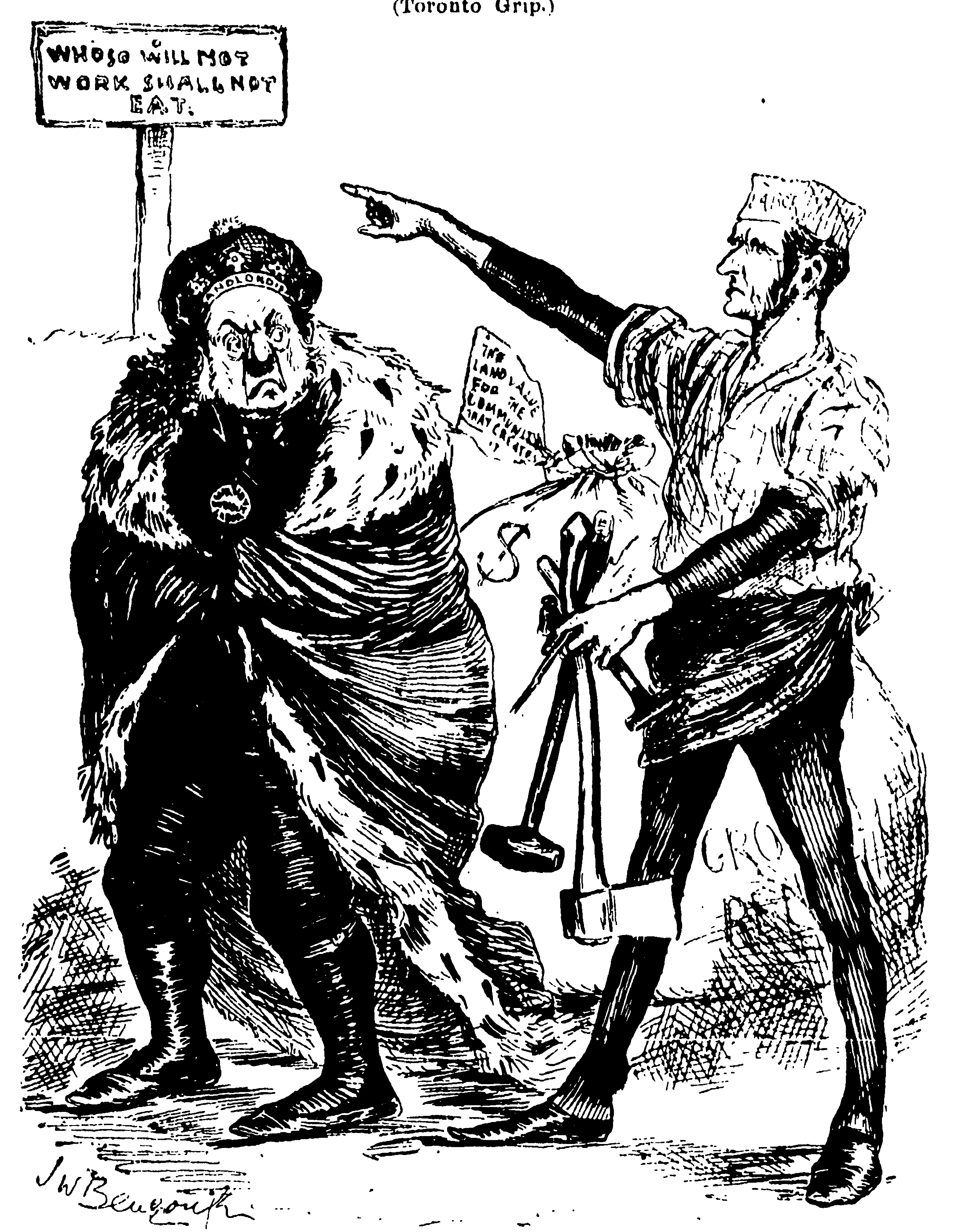 [Cartoon: a scowling
landlord in crown and ermine robe is ordered off by a workman in a paper
cap, who points away and hands him a money bag and a bundle of tools
(sledge, axe, chisel); behind the landlord a signpost; lettering in
order: signpost, crown band, paper tied to the bag, bag, partly hidden
lettering on the mound behind the workman, signature; cap and medallion
lettering illegible] WHOSO WILL NOT
WORK SHALL NOT EAT. LANDLORDISM[?] THE LAND VALUE FOR THE COMMUNITY THAT
CREATES IT $ GRO[illegible] RE[illegible] J W Bengough
KING LANDLORDISM.
THE NEXT DOM PEDRO WHO WILL HAVE TO GO.
(He will not receive a handsome money bonus, however, but an outfit of tools with which he may hereafter make a living for himself.)
PASSAIC.—Single tax committee of Passaic. Pres., Oscar D. Wood.
NEW YORK.
NEW YORK.—Manhattan single tax club. Business meeting, first Thursday of each month, at 8 p. m.; other Thursdays, social and propaganda. Every Sunday, 8 p. m., lecture. Club rooms, 36 Clinton pl.; open every day from 6 p. m. to 12 p. m. Pres., Louis F. Post; sec., A. J. Steers.
Harlem single tax club, room 3, 247 West 125th st. Business meeting every Tuesday, 8.30 p. m. Whist and social evening every Thursday. Pres., Eugene G. Muret; sec., Chas. H. Mitchell.
The West Side single tax club. Every Thursday evening, 490 Eighth ave. Pres., Dr. David Wark; sec., Daniel Cavanago, 387 8th ave.
BROOKLYN.—Brooklyn single tax club. Club house, 56 Livingston st. Open every evening. Discussions Wednesday evenings. Business meetings Friday evenings. Lectures Sunday evenings. Pres., Peter Aitken; cor. sec., Robert Baker, 884 Greene av.
The Eastern District single tax club. Wednesday evening, Oriental hall, 316 Bedford ave. Pres., John Britton; sec., Joseph McGuinness, 215 Ross st.
BUFFALO.—Tax reform club. Every Wednesday evening,Yox hallsic, cor. Watson and Howard sts. Pres., S. C. Rogers; sec., H. B. Buddenburg, 824 Clinton st.
ROCHESTER.—Rochester single tax union. Wednesday, 8 p. m.; Sunday, 3 p. m.; 80 Reynold’s Arcade. Pres., J. H. Bluntach; sec., J. M. Campbell, 30 Charlotte st.
ALBANY.—Single tax club. Tuesday evening, 8 p. m., 68 Washington ave. Rooms open every evening. Pres., Alexander Gregory; cor. sec., James J. Mahoney, 2 Division st.
SYRACUSE.—Single tax club of Onondaga. 26 Butler block. Pres., F.A. Paulsic; sec., H. R. Perry, 149 South Clinton st.
POUGHKEEPSIE.—Single tax club. Every Thursday evening, 8 p. m., 226 Union st. Pres., W. C. Albro; sec., F. S. Arnold.
AUBURN.—Single tax club. Mondays, 7.30 p. m., College hall. Pres., Dan. Peacock; sec., H. W. Benedict, 6 Morris st.
ELLENVILLE.—Single tax club of Ellenville. First and third Monday of each month, Canal st., over E. Bevier’s drug store. Pres., Wm. Lambert; sec., Benj. Hull.
FLUSHINOsic.—Single tax club. Pres., D. C. Beard; sec., Fred Sheffield.
NEW BRIGHTON, S. I.—Richmond county single tax club. Every Monday evening, Parabola hall, New Brigntonsic. Pres., J. S. Cogan; sec., A. B. Stoddard, W. New Brighton.
NORTHPORT.—Single tax committee. Sec., J. K. Rudyard.
OWEGO.—Single tax committee. Sec.,Perrysic Hyde.
TROY.—Single tax club. Meetings weekly at 576 River st. Pres., Henry Sterling; sec., B. B. Martis, 576 River st.
COHOES.—Single tax committee. Pres., P. C. Dandurant; sec., J. S. Crane 128sic Ontario stsic,
GLOVERSVILLE.—Single tax committee. Chairman, A. P. Slade; sec., Dr. Wm. C. Wood, 30 S. Main st.
SCHUYLERSVILLE.—Schuylersville single tax club. Every Friday evening, recidencesic of J.H. Bullardsic. Pres., J. H. Bullard; sec., R. S. Wells.
JAMESTOWN.—Single tax club of Jamestown. Last Saturday evening of each month.
Pres., Adam Stormer; sec., F. G. Anderson, 300 Barrett st.
YONKERS.—The Jefferson club, 85 Main st. Always open. Business meeting every Tuesday evening at 7.45.
OHIO.
STATE.—Ohio Single taxsic league. State executive board: Chairman, C. S. Walker, foot of Evans st., Cincinnati; vice chairman, L. E. Siemon, 7 Greenwood st., Cleveland; treas., W. W. Kile, 33 E. 5th st., Dayton; sec., Edw. L. Hyneman, room 3, 348½ S. High st., Columbus.
CLEVELAND.—Cleveland single tax club. Every Wednesday evening, 8 p. m., 144 Ontario st., room 16. Pres., Tom L. Johnson; sec., C. H. Nau, room 25, Standard block.
CINCINNATI.—Cincinnati single tax club. Every Sunday afternoon at Douglass Castle hall, cor. 6th and Walnut sts. Pres., James Semple, 478 Central av.; sec., Alfred H. Henderson, 23 Clark st.
COLUMBUS.—Central single tax club. Sec., Edw. L. Hyneman, 348½ S. High st.
TIFEFN—Singlesic tax committee. Sec., Dr. H. F. Barnes.
HAMILTON.—Hamilton single tax club. Every Saturday evening at 314 High st. Pres., Howard Rich; sec., Ambrose Strang, 742 E Daytonsic st.
GALION.—Galion single tax club. Every Monday evening, residence of P. J. Snay, 103 S. Union st. Pres., P. J. Snay; sec., Maud E. Snay.
ZANESVILLE.—Central single tax club. Pres., C. A. Potwin; sec., W. H. Loughead, 47 Van Buren st.
DAYTON.—Free land club. Pres., John Birch; Sec., W. W. Kile; 108sic E. 5th st.
AKRON.—Akron single tax club. Pres, Jnosic. McBride; sec., Sam Rodgers.
MIAMISBURG.—Land and labor association of Miamisburg. Pres., C. F. Beall; sec., J. F. Beals.
MANSFIELD.—Mansfield single tax club. Pres., Dr. T. J. Bristor; sec., W. J. Huggins, 66 W. 1st st.
TOLEDO.—Single tax club No. 1 meets at 112 Summit st. every Sunday at 10 a. m. Pres., A. R. Wynn; sec., J. P. Travers.
YOUNGSTOWN.—Every Thursday evening, Ivorites hall. Pres., Billy Radcliffe; sec., A. C. Hughes, 6 S. Market st.
OREGON.
PORTLAND.—Portland ballot reform and single tax club. 2d and 4th Thursdays of each month, Grand Army hall. Pres., R. H. Thompson; sec., S. B. Riggen, 48 Stark st.
PENNSYLVANIA.
PHILADELPHIA.—Henry George club. Every Thursday, 8 p.m., 904 Walnut st. Cor. sec., A. H. Stephenson, 214 Chestnut st.
Kensington single tax club. Every Tuesday evening, 8 p.m., 2021 Frankford ave., Philadelphia. Pres., James Wright; sec., Jno. Moore, 2188 E. Huntingdon st.
PITTSBURG.—Pittsburg single tax club. 1st, 3d and 5th Sundays at 2:30 p.m., 102[?] Fourth av. Pres., Edmund Yardley; sec., Mark F. Roberts, 140 24th st., S. S.
BRADFORD.—Single tax club, St. James place. Open every evening. Meetings Wednesday evening and Sunday afternoon at 3 p. m. Pres., Phil. D. Tangney; sec., J. C. De Forist.
READING.—Reading single tax society.
Monday evenings, 402½ Penn st. Pres., C. S. Prizer; cor. sec., Grant Nagle, 208 S. Third st.
ERIE.—Erie tax reform league. Pres., W. G. McKean; sec., J. L. Babcock.
EDWARDSVILLE.—Jefferson ballot reform and single tax club. First Friday of each month. Pres., J. J. Smythe, M. D.; sec., J. P. Hammond.
LEBANON.—Lebanon single tax and land club. Pres., Adam Behny; sec., J. G. Zimmerman, 111 N. Fourteenth st.
SCRANTON.—Henry George single tax club. 1st and 3d Friday evenings of each month, Noake’s hall, cor. Franklin ave. and Spruce st. Pres., Duncan Wright; sec., Arthur McGee, 914 Capouse ave.
SHENANDOAH.—Single tax club. Sundays, 3 p.m., 415 W. Coal st. Pres., Morris Marsh; sec., Thomas G. Potts.
UPPER LEHIGH.—Single tax committee. Pres., J. B. Carr; sec., George McGee.
JOHNSTOWN, Pa.—Henry George club. Meets every Monday evening for public discussion Pressic. A. J. Moxham; sec., Richard Eyre.
POTTSTOWN.—Single tax club. Meetings 1st and 3d Friday evenings each month in Weitzenkorn’s hall. Pres., D. L. Haws; sec., H H Johnsonsic, 530 Walnut st.
RHODE ISLAND.
PROVIDENCE.—Single tax association of Rhode Island. Alternate Friday evenings room 22, Slade building, cor. Washington and Eddy sts. Pres., Dr. Wm. Barker; sec., Geo D. Liddellsic, 145 Transit st.
PAWTUCKET.—Single tax association. Ev’ry Wednesday evening, Main st. Pres., Edward Barker; sec., Edgar Parnell, 220 Mineral Spring ave.
TENNESSEE.
MEMPHIS.—Memphis single tax association. Sundays, 4.30 p. m., Luehrman’s hotel. Pres. Dr. T. J. Croffordsic; sec., M. H. McDowell caresic of Townsend, Cowie & Co.
TEXAS.
STATE.—Texas tax reform association Pres., H. F. Ringsic, Houston; sec., J. B. Cochran.
EL PASO.—El Paso tariff reform club. 1st and 3d Saturdays of each month, county court room, court house. Pres., G. E. Hubbard, secsic., A. W. Thomas.
HOUSTON.—Single tax committee. Pres H. F. Ring; sec., E. W. Brown, care of Germania house.
SAN ANTONIO.—Single tax club. Meets first and third Thursday in each month. Pres.,Geo. Marks; sec., Theo. Kunzmann, 11 Crockett st.
WEST VIRGINIA.
PARKERSBURGH.—Single tax league. Every Saturday night, 500 Market st. Pres., W. H. Curry; sec., W. F Thayersic.
[Advertisement] CATARRH.
Catarrhal Deafness—Hay Fever—A New Home Treatment.
Sufferers are not generally aware that these diseases are contagious, or that they are due to the presence of living parasites in the lining membrane of the nose and eustachian tubes. Microscopic research, however, has proved this to be a fact, and the result of this discovery is that a simple remedy has been formulated whereby catarrh, catarrhal deafness and hay fever are permanently cured in from one to three simple applications made at home by the patient once in two weeks.
N. B.—This treatment is not a snuff or an ointment; both have been discarded by reputable physicians as injurious. A pamphlet explaining this new treatment is sent free on receipt of stamp to pay postage, by A. H. Dixon & Son, 337 and 339 West King street, Toronto, Canada.—[Christian Advocate.
Sufferers from Catarrhal troubles should carefully read the above.—[Adv.
NEW PUBLICATIONS.
[Advertisement] ASSORTMENTS OF TRACTS.
During the late campaign quantities of our best tracts were assorted for special work, and many of these not having been used, we now place them, with some of a more recent date, in convenient packages, at a low price.
Packages may be had at 50c. and $1.00.
12 Union Square,
NEW YORK.
[Advertisement] HANDY BINDERS FOR THE STANDARD.
A lot of Handy Binders, made especially for filing THE STANDARD, are now ready.
Price 75 cents to any address.
12 Union Square, New York City
[Advertisement] VOLUME FIVE OF THE STANDARD.
NOW READY.
A limited number of bound volumes of THE STaNDARDsic in heavy boards, are offered for sale at the following prices
Volumes 3 and 4, bound together…… 6.50[?]
Volumes 2, 3 and 4…… 9.00
Volumes 2,3, 4 and 5…… 12.00
(Expressage extra.)
12 Union square, New York.
AS SOME of the back numbers of THE STANDARD are growing scarce, we will send 15 cents’ worth of tracts in exchange for any of the following
[Advertisement] PISO’S CURE FOR CONSUMPTION
 [Display heading: white
letters on a black frame, “PISO’S CURE FOR” above and “CONSUMPTION”
below, side panels with vertical lettering (probably the price), mostly
illegible] PISO’S CURE FOR CONSUMPTION
CURES WHERE ALL ELSE FAILS.
Best Cough Syrup. Tastes good. Use in time. Sold by druggists.
Page 16 of 16contents
[Running head: 16 THE STANDARD. Vol. VII, No. 3]
p. 16, col. 1
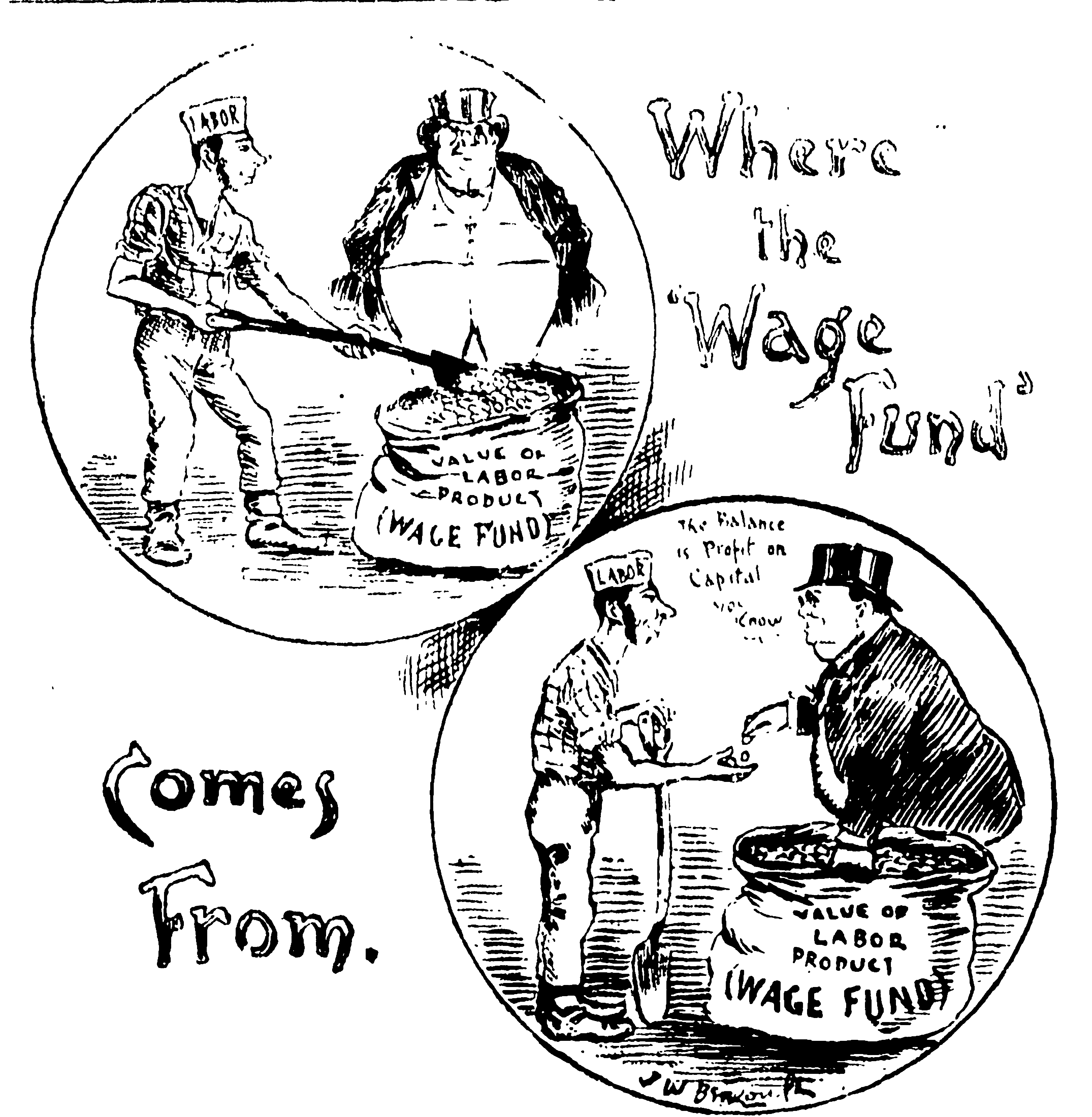
[Cartoon: two round panels spanning columns 1 and 2. Upper: a workman in a cap marked LABOR shovels coin into a sack labelled VALUE OF LABOR PRODUCT (WAGE FUND) while a stout figure in a top hat looks on. Lower: the same workman receives a few coins from a top-hatted capitalist seated at the full sack.]
Where the “Wage Fund” Comes From.
LABOR
VALUE OF LABOR PRODUCT (WAGE FUND)
LABOR
The Balance is Profit on Capital you know
VALUE OF LABOR PRODUCT (WAGE FUND)
J W Bengough[?]
[Advertisement] A NEW METHOD OF TREATING DISEASE.
Hospital Remedies.
What are they! There is a new departure in the treatment of disease. It consists in the collection of the specifics used by noted specialists of Europe and America, and bringing them within the reach of all. For instance the treatment pursued by special physicians who treat indigestion, stomach and liver troubles only, was obtained and prepared. The treatment of other physicians, celebrated for curing catarrh was procured, and so on till these incomparable cures now include disease of the lungs, kidneys, female weakness, rheumatism and nervous debility.
This new method of “one remedy for one disease” must appeal to the common sense of all sufferers, many of whom have experienced the ill effects, and thoroughly realize the absurdity of the claims of Patent Medicines which are guaranteed to cure every ill out of a single bottle, and the use of which, as statistics prove, has ruined more stomachs than alcohol. A circular describing these new remedies is sent free on receipt of stamp to pay postage by Hospital Remedy Company, Toronto, Canada, sole proprietors.—[Adv.
[Advertisement] THE GREATEST ADVANCE
in
LIFE INSURANCE
in the
NINETEENTH CENTURY.
PAID UP AND CASH VALUES GUARANTEED
by the
PERFECTED MASSACHUSETTS INSURANCE ACT OF 1887.
THE BERKSHIRE LIFE INSURANCE COsic.,
of Pittsfield, Mass.
INCORPORATED 1851.
GEO. W. ENGLISH, MANAGER,
For New York and New Jersey.
NEW YORK OFFICE:
271 BROADWAY,
Corner of Chamber St.
[Advertisement] THE WONDERFUL LUBURG CHAIR
[Illustration: advertisement cut showing a reclining chair, an invalid’s wheel chair with a seated man, and a baby coach, with lettering in panels]
THE WONDERFUL LUBURG CHAIR COMBINING 5 ARTICLES OF FURNITURE IN ONE
50 CHANGES[?]
100 STYLES OF BABY COACHES
INVALID SUPPLIES
WHEEL CHAIR
Automatic Brake on all Coaches FREE
WHEEL CHAIRS TO HIRE. SPECIAL FREE DELIVERY.
We retail at the lowest wholesale factory prices, and ship goods to be paid for on delivery. Send stamp for Catalogue. Name goods desired.
LUBURG MFG. CO., 145[?] N. 8th[?] St., Philadelphia, Pa.
[Advertisement] CONCORD CO-OPERATIVE PRINTING COMPANY
CONCORD CO-OPERATIVE PRINTING COMPANY (Ld.), [illegible] Elm street, cor. CANAL, N.Y
BOOK, JOB AND NEWSPAPER PRINTING.
p. 16, col. 2
[Advertisement] NEW PUBLICATIONS.
THE SINGLE TAX LIBRARY.
- A Syllabus of Progress and Poverty. Louis F. Post 8 pagessic.
- Australian System. Louis F. Post. 4 pages.
- First Principles. Henry George. 4 pages.
- The Right to the Use of the Earth. Herbert Spencer. 4 pages.
- Farmers and the Single Tax. Thomas G. Shearman. 8 pages.
- The Canons of Taxation. Henry George. 4 pages.
- A Lawyer’s Reply to Criticisms. Samuel B. Clarksic . 16 pages.
- Back to the Land. Bishop Nulty. 16 pages.
- The Single Tax. Thos. G. Shearman. 8 pages.
- The American Farmer. Henry George. 4 pages
- Unemployed Labor Henry George. 4 pages.
- The Case Plainly Stated. H F. Ring. 8 pages.
- Social Problems. 342 pages. 12mo. Paper, 35c.
- Objections to the Land Tax. Thos. G. Shearman. pages.
- Land Taxation. A Conversation Between David Dudley Field and Henry George. 4 pages.
- How to Increase Profits. A. J Steers. 2 pages.
- The New Political Economy. E. O. Brown. 4 pages
- Thy Kingdom Come. Henry George. 4 pages.
- The Functions of Government. Henry George. pages.
- The Menace of Plutocracy. Thomas G. Shearman. 8 pages.
- Tenement House Morality. J.O.S. Huntington. 4 ppsic. 22, 23, 24, out of print.
- Taxing Land Values. Henry George 8 pagessic.
- Henry George’s Mistakes. Thomas G. Shearman. 8 pages.
- The Democratic Principle. Henry George. 8 pages
- Progress and Poverty. Henry George. 512 pagessic. 35 cents
- The New Ballot System. Louis F. Post. 4 pages
- The Cat. 2 pages.
- The Single Tax in a Nutshell. 2[?] pages.
Prices of Single Tax Library: Two page tracts—1 copy, 1 cent; 40 copies, 10 cents; 100 copies, 20 cents; 1,000 copies, $1.50.
Four-page tracts—1 copy, 2 cents; 20 copies, 10 cents: 100 copies, 40 cents; 1,000 copies, $3.
Eight-page tracts—1 copy, 3 cents; 10 copies, 10 cents 100 copies, 80 cents; 1,000 copies, $6.
Sixteen-page tracts—1 copy, 4 cents, 5 copies, 10 cents; 100 copies, $1.60; 1,000 copies, $12.
No extra charge by mail.
The following numbers of the “Land and Labor Library” are still in stock:
- Settler’s Nightmare. Louis F. Post. 4 pages.
- Mysterious Disappearance. Lewis Freeland. 6 pp.
- Sailors’ Snug Harbor and the Randall Farm. W. T. Croasdale. 12 pages.
- The Collegiate Church and Shoemaker’s Field. W. T. Croasdale. 12 pages.
- It is the Law of Christ. Rev. S. H. Spencer. 4 pp.
- Christianity and Poverty. Father Huntington 4 pp.
- Socialism—Its Truth and Its Error. Henry George. 4 pages. 38[?]. “God Wills It.” Henry George. 4 pages.
- How John’s Father Saw the Light. W.C.Woods. 2 p.
- Ten Thoughts for Christian Thinkers. Rev. John W. Kramer. 4 pages.
- Hints as to What You Can Do. Henry George. 4 pp.
- My Butcher Woman and My Grocery Man. William McCabe. 4 pages.
- A Republican’s Reasons for Supporting Cleveland. Judge Frank T. Reid. 2 pages. 88[?]. Jefferson and Hamilton. Chauncey F. Black. 8 pp.
GERMAN TRACTS.
- First Principles. Henry George. 4 pages.
- Socialism—Its Truth and Its Error. Henry George. 4 pages. 46[?]. Taxing Land Values. Henry George. 8 pages.
- It is the Law of Christ. Rev. S. H. Spencer. Henry, Ill. 4 pages. 53[?]. Sailors’ Snug Harbor. Wm. T. Croasdale. 12 pages,
SWEDISH TRACTS.
52[?] The Case Plainly Stated. H. F. Ring. 8 pages
TARIFF TRACTS.
- Protection as a Universal Need. Henry George pages.
- The Tariff Question. Henry George. 4 pages.
- American Protection and British Free Trade. Henry George. 4 pages. 69[?]. Protection and Wages. Henry George. 8 pages.
- Protection the Friend of Labor? Thomas G. Shearman. 8 pages.
- A Short Tariff History. Thomas G. Shearman. 2 pages.
- Plain Talk to Protectionists. Thomas G. Shearman. 4 pages.
- An Address to Workingmen on the Tariff Question. Henry George. 4 pages.
A set of Tariff Tracts will be sent to any address for ten cents.
12 Union square, New York City
[Advertisement] Pennsylvania Agricultural Works, York, Pa.
[Illustration: advertisement cut of a steam traction engine driving a saw mill by belt]
Pennsylvania Agricultural Works, York, Pa.
Farquhar’s Standard Engines and Saw Mills.
Send for Catalogue. Portable, Stationary, Traction and Automatic Engines a specialty. Warranted equal or superior to any made.
Address A. B. FARQUHAR & SON, York, Pa.
[Advertisement] JAS. MULLAN[?]
JAS. MULLAN[?], Principal Agent for James Means’ $3[?] and $4[?] shoes. [illegible] Bowery, near Prince st.
p. 16, col. 3
[Advertisement] Pears
[Display heading: script lettering]
Good morning
“Paris Exposition, 1889.
Pears obtained the only gold medal awarded solely for toilet SOAP in competition with all the world. Highest possible distinction.”
[Advertisement] HENRY GEORGE & CO.. PUBLISHERS.
NO. 12 UNION SQUARE.
PROGRESS AND POVERTY.
An inquiry into the cause of industrial depression and of increase of want with increase of wealth. The remedy.
By HENRY GEORGE.
512 pages. Cloth, $1.50. Paper covers, 35 cents. Half calf or half morocco $3.00.
PROTECTION OR FREE TRADE?
An examination of the tariff question with especial regard to the interests of labor.
By HENRY GEORGE.
Cloth. $1.50. Paper covers, 35 cents. Half calf or half morocco, $3.00.
THE LAND QUESTION.
What it involves and how alone it can be settled.
By HENRY GEORGE.
87[?] pages. Paper covers, 20 cents.
PROPERTY IN LAND.
A Passage-at-Arms Between the Duke of Argyll and Henry George.
77 pages. Paper covers, 15 cents.
FORTSCHRITT UND ARMUTH.
(Progress and Poverty in German).
Translation of C. D. F. Gutschow.
430 pages. Paper covers, 35 cents.
PROGRES ET PAUVRETE.
(Progress and Poverty in French).
Translation of P. L. LeMonnier.
PROTECTION OU LIBRE-ECHANGE?
(Protection or Free Trade? in French).
Translation of Louis Vossonsic.
436 pages. Paper covers, $2.75.
PROGRESSO E POVERTA.
(Progress and Poverty in Italian).
Translation of Ludovico Eusebio.
352 pages. Paper covers, $2.50.
SETS OF THREE.—PROGRESS AND POVERTY, SOCIAL PROBLEMS, PROTECTION OR FREE TRADE? BOUND ALIKE, IN HALF CALF OR HALF MOROCCO, $7.50.
[Advertisement] ECONOMIC WORKS.
By way of answering inquiries constantly received, we append a list of some economic and social works of various kinds, with prices, at which they will be forwarded post paid. Any work not mentioned procurable in New York will be sent on receipt of publisher’s price.
WILLIAM LLOYD GARRISON.—THE story of his life. Told by his children. 4 vols, cloth, $12.00.
ESSAYS ON POLITICAL ECONOMY—By FREDERICK BASTIAT. 12mo, cloth, $1.25[?].
SOPHISMS OF PROTECTION.—WITH preface by Horace White. By FREDERICK BASTIAT. 12mo, cloth, $1.00[?].
HISTORY OF POLITICAL ECONOMY IN EUROPE.—By JEROME ADOLPHE BLANQUI. 8vo, cloth, $3.00.
AN INQUIRY INTO THE NATURE AND CAUSES OF THE WEALTH OF NATIONS—By ADAM SMITH. Edited by Theoboldsic Rogers. $1.00.
WORK AND WAGES.—BY THOS. BRASSEY. 16mo, cloth, $1.00.
THE AUSTRALIAN BALLOT SYSTEM as embodied in the legislation of various countries. By J. H WIGMORE Cloth, $1.50.
FREE LAND AND FREE TRADE.—THE Lesson of the English Corn Laws Applied to the United States. By Hon. SAMUEL S. COX. 8vo, cloth, 75 cts.
THE HISTORY OF THE FREE TRADE MOVEMENT IN ENGLAND.—By AUGUSTUS MONGREDIEN. 16mo, cloth, 50 cts.
POSTULATES OF ENGLISH POLITICAL ECONOMY.—By WALTER BAGEHOT. Cloth, $1.00.
THE TARIFF HISTORY OF THE UNITED STATES.—Containing “Protection to Young Industries,” and “The History of the Present Tariff, 1860-1883.” By F. W. TAUSSIG. 8vo, cloth, $1.25.
Any of the above Books will be sent postpaid on receipt of price.
HENRY GEORGE & CO.,
12 Union Square, New York City.
[Advertisement] PARIS EXhIBITIONsic, 1889.
BURROUGHS, WELLCOME & CO.,
Importers, Exporters and Manufacturing Chemists,
SNOW HILL BUILDINGS, LONDON, E. C.,
Specially invite the attention of the Medical Profession and Drug Trade to their Exhibits, as follows:
At Stand No. 575, British Food Section,
Kepler Extract of Malt,
an agreeable vitalizing reconstructive and digestive.
Kepler Solution of Cod Liver Oil,
An ideal form for the administration of fat.—British Medical Journal.
Also at Stand No. 311, British Industrial Section,
Chemical and Pharmaceutical Products, &c.
The Congo Medicine Chest, as taken by H. M. Stanley, for the relief of Emin Pasha, fitted with Tabloids of Compressed Drugs, &c.
The Livingstone, Gordon and Indian Traveler’s Medicine Pocket Cases and Portablsic Medicine Chests.
Vereker’s Chloride of Ammonium Inhaler, for Catarrh, &c.
The Pinol-Eucalyptia Dry Inhaler, for the antiseptic treatment of Consumption and diseases of the air passages.
Lanoline, Lanoline Toilet Soap, Cold Cream Pomade and Toilet Lanoline.
Also at Stand No. 594, American Section,
Hazeline. Distilled active principles obtained by distillation from the American Witch Hazel, Hamamelis Virginica, for inflammation and irritated surfaces.
The Fairchild Pepsine and Pepsine Tabloids, Zymine Peptonizing Powders, &c., &c
Formulæ and price lists supplied to the Medical Profession and Drug Trade on request.
BURROUGHS, WELLCOME & CO.
[Advertisement] SINGLE TAX CIGAR.
SIMON VAN VEEN,
Sole Manufacturer.
These cigars are the best and cheapest in the market for the money. They are put up 50 to a box, and the inside of cover contains a beautiful photo-engraving of the Cat, with the inscription below,
“Have You Seen the Cat?”
Whenever placed on view it is sure to provoke discussion, and is an excellent method of bringing our principles before the public.
Price per box. $2.75.
A liberal discount to the trade. All orders will receive prompt attention by addressing
S. VAN VEEN,
77[?] Wooster st.
[Advertisement] THE MASTER WORKMAN.
A simple statement of the views and aims of single tax men, designed specially for workingmen.
Single copies, 10 cents, ten copies, 80 cents; twenty five copies, $1.75; one hundred copies, $6.00.
Sent post or express prepaid on receipt of the above prices. Address,
HENRY J. O’NEILL,
221[?] Gordon St. Allentown Pa.
[Advertisement] THE TRUE CHRISTIAN RELIGION.
By EMANUEL SWEDENBORG. 1,000 octavo pages, cloth. Mailed prepaid for $1.30 by the American Swedenborg Printing and Publishing Society, 20 Cooper Union, New York city
SOCIAL PROBLEMS.
By HENRY GEORGE.
342 pages. Cloth. $1.00. Paper covers, 35 cents. Half calf or half morocco, $2.50.