Page 1 of 16contents
THE STANDARD
NO. 160—VOL. VII, NO. 4. | NEW YORK, WEDNESDAY, JANUARY 22, 1890. | PRICE FIVE CENTS
p. 1, col. 1
THE STANDARD.
HENRY GEORGE, Editor and Proprietor.
Published weekly at 12 UNION SQUARE, NEW YORK CITY.
Entered at the post office, New York, as second class matter.
TERMS, POSTAGE FREE.
One year, $2.50, six months, $1.25; single copies, 5 cents.
ADVERTISING rate thirty cents per agate line each insertion.
REMITTANCES should be made payable to THE PUBLISHER OF THE STANDARD.
RECEIPTS.—The correct filling of orders is evidence of receipt of remittance.
CHANGES OF ADDRESS.—When changing address send old as well as new address.
Sample copies sent free on application.
TABLE OF CONTENTS.
Editorial. Ballot Reform—Governor Campbell Strongly Favors It—Governor Abbett’s Able Message—The Governor of West Virginia on the Right Side—Chauncey F. Black’s Strong Letter—Hill Stands Alone—Secretary Fairchild’s Contribution to the Discussion—An Association of Single Tax Clergymen—A Brand New Tax System—The Fall of Foraker—Unequal Assessments—Evils of the Existing System Admitted.
Notes and Queries. The Rapid Transit Bill—English Money in Another Protected Industry—The Story of Johnstown—Labor Troubles—Questions Answered.
The Social Problem. A Lesson to Chautauquans—Things That Professor Huxley Does Not Understand.
Brotherhood of Religious Teachers.
Mme. Vallette’s Essay. W. E. Hicks.
Events in England. Rev. Harold Rylett.
Straws That Show the Wind.
Society Notes.
Personal.
Recent Sales and Assessments.
The George Dinner. The Great Banquet at the Metropolitan Hotel.
Single Tax News. The Petition—Single Tax Men Address the Brassworkers—Brooklyn Considers Something Better Than Nationalism—Oswego Knights of Labor Indorse the Single Tax—Johnstown, Pa., Displaying New Interest in the Cause—Ohio, Illinois, Tennessee, Missouri, Texas, California and Other States—Interest in Foreign Lands.
Ballot Reform. The Great Mass Meeting in Cooper Union—Wheeler H. Peckham Exposes a Contemptible Piece of Garbling by Governor Hill—The Press on the Meeting—Trades Unionists Indorse the Reform—A Good Suggestion from California.
An Actor on the Single Tax. Address by James A. Herne.
The Free Trade Fight. Iowa Democrats Not Afraid of Either Free Trade or Single Tax—Free Trade and Not Subsidies Needed.
EDITORIAL.
The New York Saturday Globe, which, though an exceedingly able and thoughtful paper, is intensely democratic, both in the general and in the partisan sense, and evidently aims at always keeping inside of and representing the regular organization, had in its issue of January 11 an article on the Australian ballot. In this, with refreshing coolness, it quietly ignores the fact that the republican state of Massachusetts was the first to adopt the Australian ballot, and that a similar bill has twice been passed in this state, the republicans in the legislature voting unanimously for it, and has twice been vetoed by a democratic governor. In spite of this and similar facts the Globe unblushingly assumes that the Australian ballot is a democratic measure, saying that “the sentiment of the masses of the voters has made it impossible for any leader, whatever may be his personal interests or ambition, to resist it successfully,” and that “those who want to oppose ballot reform must get outside the democratic party and find other associates.” It winds up by saying:
The democracy will contend for the Australian ballot until we have it in all its beneficent perfection, and every voter, rich or poor, white or black, in this blessed land shall be able to cast his ballot according to his own will, without fear of molestation or
p. 1, col. 2 > punishment from any quarter. When that good time comes the political vocation of the monopolist and the boodler will be at an end, and republican campaigns, if run at all under such discouraging circumstances, will not be run by the Quays, the Dudleys and the Platts.
This cool ignoring of all that republicans have done and are doing for the Australian ballot, this claiming of it as a democratic measure, has, however, its gratifying side. It does show how the more observant democratic leaders and organs are becoming conscious of the irresistible tide of public opinion that is forcing onward ballot reform. And since this article in the Globe was written its declaration that those who want to oppose ballot reform must go outside the democratic party has received notable indorsements from the messages of three newly inaugurated democratic governors—Campbell of Ohio, Abbett of New Jersey, and Wilson of West Virginia.
In the last issue of THE STANDARD a brief note stating that Governor Campbell had commended the Australian system, but had added that public sentiment was not educated up to such a law, did Governor Campbell great injustice. Its cause was the extremely bad condensation of the governor’s inaugural which appeared in the New York papers. After commending the Australian ballot system, Governor Campbell went on to speak of a class of electors who cannot be hired to vote against their party prejudices, but who will not vote for their party candidate unless paid to do so. The governor says these people resort to such subterfuges as demanding payment for a day’s work. He adds that it is difficult to see any remedy for this except in making voting compulsory, but that public opinion is not at present educated up to such a measure. This remark closed that part of the governor’s message referring to the ballot. Following the plan of condensing with a pair of shears, too common among the overworked American newspaper men, the editor of the dispatch to the New York papers clipped out all that intervened and made the governor’s final remark seem to apply to the Australian system. So far from any statement in his inaugural that the Australian system is not supported by public opinion, Governor Campbell makes a magnificent argument for its adoption.
The inaugural of the governor of New Jersey will be a most gratifying surprise to those friends of ballot reform who have feared that Governor Abbett belonged to the same school of democratic obstructors and intriguers as Hill of New York and Gorman of Maryland. Among single tax men it will be a vindication of the course of those of them, like J. T. Altemus and J. R. Abarbanell, who have all along had faith in Governor Abbett.
While the retiring governor, in his farewell message took occasion to unsay what he had previously said for ballot reform and virtually to join the little gang of democratic politicians of the baser sort, who regard Governor Hill as their leader, Mr. Abbett, in assuming for the second time the office of governor, appears to have decisively made his choice and taken his stand with the democracy of reform and of principle—that new democracy which is the old—that is destined in the next presidential election to sweep the country as Jeffersonian republicanism did in 1800.
Governor Abbett thus begins that part
p. 1, col. 3 of his message that relates to the ballot:
The best sentiment of the country in all the states demands ballot reform and honest elections.
The safeguards which the law has thrown around the ballot have been found insufficient to prevent fraud, the intimidation of the voter and the corrupt use of money in elections. The oaths of election officers have not always prevented them from tampering with the ballot box, and receiving and counting fraudulent votes. The great mass of election officers are honest and conscientious in the discharge of their duty, but there are a few who will violate their oaths of office and run the risk of punishment to change or attempt to change the result of elections. There are citizens entitled to the ballot who, notwithstanding the penalties of the law, deliberately sell their votes, or demand money for voting in accordance with their political convictions. Men of high standing contribute large sums of money which, in many instances, is used by disreputable party agents to bribe voters or election officers. The penalties of the law seem impotent to stop these practices. This condition of affairs is an evil that every honest citizen should use his best energies to stamp out by radical measures.
Governor Abbett then goes on to say that the law should embrace the following features:
First—Registration of every voter in the state, with a registry list subject to judicial revision.
Second—Absolute secrecy of the ballot.
To secure this there should be an inclosure within which the voter shall be free from all influence, supervision or sic. In that inclosure there should be a compartment which he must enter and where in secret he would have the opportunity to prepare his ballot. From this compartment he should proceed directly to the ballot box with a folded ballot. This he should offer to the election board, who should deposit it in the box in the same condition, subject only to rejection for legal reasons. If the ballot is rejected it should be returned to the voter without inspection.
Third—There should be an exclusively official ballot, printed and distributed by the state, so that one ballot cannot be distinguished from another when it is folded and ready for voting. The law should prohibit the use of any ballot except the official ballot.
Fourth—Provision for judicial action, by which an election in any precinct may be set aside and a new election ordered therein, whenever the judge or court shall be satisfied that there has been fraud, bribery or other illegal practices which would affect the result, or where, by reason of death or resignation of any candidate, the failure to supply voters with tickets, or for any other cause, the electors have been deprived of a fair opportunity to express their choice at the ballot box. All such proceedings should be summary. When a new election is ordered it should be called for the earliest possible day. The court or judge should be empowered to make a final certificate of election whenever such new election changes the result.
Fifth—The right of nomination by petition should be given when a certain percentage of the voters ask therefor.
Sixth—No ticket should be printed or distributed unless the parties nominated thereon have signified in writing their acceptance of such nomination.
Seventh—Provision that certain judicial officers shall provide for the printing and distribution of official ballots where there has been failure to act on the part of the proper officers.
Eighth—All forms of intimidation, bribery or illegal practices should be declared to be criminal. Every voter should have secured to him the opportunity to vote, and sufficient time should be allowed him therefor. It should be made a crime to infringe upon this right or to impose any penalty or disadvantage upon the voter exercising such right.
Ninth—There should be a limitation of the amount which may be legally spent in or for any election. An election should be declared void if such limit shall be knowingly exceeded by a candidate or by any persons acting for or in his behalf with his knowledge. An election in any precinct should also be declared void wherever any judicial officer shall ascertain that such limitation has been grossly exceeded in that precinct, even without the knowledge of the candidate, if the vote of such precinct might change the result of the election.
Tenth—The law should provide for publicity of election expenditures, and a candidate should be required to publish and file of record immediately after an election an
p. 1, col. 4 > itemized statement, under oath, of all the moneys expended at such election by him, or with his knowledge. The failure to file such a statement should vacate his office and render void his election. The court should be given the power to compel the appearance of any person before it to be examined under oath concerning political expenditures, and also to require, on such examinations, the production of the books and papers of corporations, associations or individuals.
Eleventh—It should compel everyone offering a bribe or receiving a bribe, either as a voter or as an election officer, to testify in regard thereto, with a provision that such testimony should not be used against such witness in any criminal or other proceeding whatever.
The act should provide, so far as the constitution will permit, for the disqualification thereafter of any voter, or other person, violating any provision of such statute.
These principles embrace all the essential features of the Australian system and all that the most ardent ballot reformers have ever asked for. But not stopping here, Governor Abbett goes on to take advanced ground. The admission by ballot reformers of a provision by which illiterate voters could have their ballots marked for them by an official, has been in reality but a concession to the clamor of the opponents of reform. Governor Abbett proposes to do away with this feature altogether, and to make no provision whatever for the illiterate voter. He very properly says that even where the voter may lack educational qualifications there is no difficulty in teaching him to mark an official ballot without the intervention of an election officer, either by the use of such symbols or devices as under the Indiana law are to designate the political parties or by the use of non-official fac simile tickets. He objects to the provision in some of the laws which have been passed requiring two election officers at each polling place, authorized to assist the voter in marking his ticket where he states his inability to do it himself, on the ground that it is needless, expensive and dangerous. He says:
The fact that these election officers were sworn officials would no more prevent them, if dishonest, from destroying the secrecy of the ballot, or practically intimidating a voter by their knowledge of his ballot, than would the official oath of a dishonest election officer prevent him from tampering with the ballot box or knowingly receiving fraudulent votes.
These election officers would become the political agents of the different parties, and every voter who accepted their intervention would feel that there was no secrecy as to his ballot, and that such election officers might expose to others how he had exercised the right of suffrage.
In districts where there were dishonest election officers, men might be bribed to vote a certain way and be instructed to ask the “assistance” of these officers. Such an official could inform the bribe-giver how the elector voted, and thus practically nullify the law.
It would be an aid to bribery and would destroy the secrecy of the ballot. It would be much safer to trust to the illiterate voter, or the voter physically disqualified, to ascertain some mode of expressing his choice, than to destroy the essential feature of such a system of reform, by making the secrecy of the ballot depend, not upon the law, but upon the conscience of the election officer. In some states these extra election officers mark the ballots. Any such marking by them is a destruction of secrecy. When a ticket is marked, the mode of marking it and the place where it is marked can be so controlled by dishonest election officers that the ballot can be traced, and the action of the voter ascertained. The voter may be practically intimidated by his fear of just such illegal action.
Governor Abbett’s reasoning on this point seems to be conclusive, and it is a matter of legitimate congratulation to the democracy, which has been charged with being the party of illiteracy, that the first of our governors to squarely propose that all attempts to make special continued on p. 2 →
[continued on page 2]
Page 2 of 16contents
2 THE STANDARD. Vol. VII, No. 4
p. 2, col. 1 [continued from page 1]
← continued from p. 1 provision for the illiterate voter should be abandoned, is a strict party democrat.
Governor Abbett goes on to recommend the distribution of official ballots before election, so that voters might, if they wished to, mark their ballots at home, arguing that this would not entail any more expense than would the printing of official ballots, and that it would be possible to require some distinctive act on the part of the voter which should insure his remaining in the secret compartment long enough to mark his ballot if he chose to. This recommendation, if carried into effect, would completely nullify one of the great objects of requiring an official ballot, but to all this Gov ernor Abbett appends the saving clause:
Although my own convictions are clear, I shall cheerfully yield them on this point, if the legislature shall deem it wise to limit the distribution of official ballots to the polling places.
Like Governor Campbell of Ohio, Governor Abbett does not seem to have faith in the mere secrecy of the ballot preventing corruption. He says:
The wholesale bribery of voters is the most dangerous evil that threatens free institutions. The secrecy of the ballot will not appreciably prevent the use of money to purchase voters. The bribe giver will confidently and safely rely upon the promise of the elector to vote the ticket agreed upon. The claim made that there would be no bribery where the ballot was secret, because the bribe giver would fear that the voter would cheat him and vote some other ticket, rests upon theoretical speculation and not upon practical knowledge of the class of men who sell their votes. There is an old adage that there is “honor among thieves”—the same kind of honor would, in nine cases out of ten, deliver the purchased vote as promised.
The provision of law for limiting election expenditures, and permitting the public to know by verified statements the extent thereof, with severe penalties for violation of the law in these particulars, is of vital consequence if real electoral reform is to be secured. Only a certain amount of money can be honestly spent in an election; such expenditure needs no concealment. Under the present system men of large wealth, who are often pecuniarily interested in the result of an election, secretly contribute large sums of money for election purposes. It is impossible to prove that these men know that this money is to be used illegally, but the moral sense of every one is convinced that such contributor is willing that it should be so used. If these contributions were no longer secret, but known by every one, an aroused public sentiment would soon ostracise such men, and find means to prevent their acts, or punish them criminally. The result of raising large sums by one political party is almost certain to lead the others to attempt to do the same thing. In such cases it becomes a contest of money on each side, where candidates are sought and often selected, not for their honesty and intelligence, but for their ability to make or secure from others heavy contributions of money. The limitation of election expenditures, and the publicity thereof, would do more than anything else to prevent the raising and use of large sums of money to bribe voters and election officers.
Going on to urge the complete registration of voters, subject to judicial revision of the lists, Governor Abbett says that as the two great political parties are represented in the senate and assembly, a joint committee should be appointed for the consideration of the whole question, which should be dealt with as one in which honest men of both parties are equally interested, and that differences of opinion should be discussed in the spirit of yielding individual opinions, if necessary, in order to gain the best possible legislation.
Governor Campbell and Governor sic have so long been used to the state of things in which votes are bought and voters are habitually paid to vote the ticket of their preference, that neither of them fully recognize, how certainly the Australian ballot will end all this. The idea that the buyers of votes will not trust to the “honor among thieves” is not a theoretical speculation, but a fact. The Australian ballot, wherever adopted, has ended bribery, even where it was deep-seated and had long continued. The bribery of voters was, in many
p. 2, col. 2 parts of England prior to the adoption of the Australian system, more common and deeprooted than it is now in any part of the United States. But it has since become practically unknown, not so much by the requirements and penalties of the Corrupt practices act as by the secrecy of the ballot. A proof of this, and one that completely shows how Governor Abbett’s recommendation of the distribution of the official ballots would destroy the system, is that in Australia the only way that, after an experience of thirty years, has been found to warrant the expenditure of money in bribing voters is what is called the “Tasmanian dodge,” which has been explained in THE STANDARD by one of its Australian correspondents. This consists in giving a voter a bribe on condition that he votes a blank piece of paper and brings out of the booth the official ballot which he receives. This ballot is marked and given to another voter, who, as proof that he voted it, brings back an official ballot; and so the process is continued. This “dodge” is made impossible by the provision of law which requires a facsimile signature or some similar identification on the outside of the official ballot, so that nothing but an official ballot can be put into the box. Human nature is neither better nor worse in the United States than it is anywhere else. American “floaters” are not more honorable, nor are American corruptionists a whit more sic than they are in Australia or Great Britain, and we may confidently expect the same results here that have followed there. Indeed, this has already been proved in the United States wherever the Australian system has been tried.
Practically, however, the failure of Governor Campbell and Governor Abbett to see the full benefits of the Australian ballot does not weaken the significance of the position they have taken or detract from the pleasure with which it will be regarded by the friends of the great reform. Governor Abbett, while making a recommendation that would, indeed, largely nullify the benefits of the reform, expressly states that he is ready to yield this point. And that he will be not merely as good as his word, but a little better than his word, the ballot reformers of New Jersey have in his present position a most gratifying indication. That he has resisted great temptations and stood up against enormous pressure in going as far as he has gone is certain. Against all this—against the influence which induced Governor Green to make a retrograde step, Leon Abbett has stood bravely, and he now ought to find rallying behind him and giving him not a half-hearted but a warm and generous support—all the strength of the reform sentiment. He has definitely cut away from the retrograde wing of the democratic party. He has definitely joined the wing of advance and reform, and his hands ought to be strengthened in every way that it is possible to strengthen them. That for himself he has made a wise choice time will surely show,
Chauncey F. Black of Pennsylvania, president sic the Democratic Societies, has written a letter to Colonel John Huggard, president of the Young Democratic Battalion, which, though sic no means his first utterance on this subject, emphasizes the drift of democratic opinion in favor of the Australian ballot, and gives additional point to the declaration of the Globe that “those who want to oppose ballot reform must get outside of the democratic party.” It is worth reprinting in full:
YORK, Pa., Jan. 7, 1890.
MY DEAR SIR: I am truly sorry I cannot be with you at the Jackson dinner; but I find
p. 2, col. 3 > it impossible, and must be as nearly content as I can under the circumstances. > > If General Jackson were here to-day in the flesh, with his great love of human freedom and his mighty spirit, as they were when he fought the battles of the people against the “money power,” what admonition would he deliver to us with most solemnity? Would it be other than that which the foremost of living democratic leaders delivered at Boston? Preserve the purity and the power of the ballot! sic it with every possible safeguard. Keep it as the best, the last, indeed the only certain resource of the citizen against the selfish encroachments of monopoly or the tyranny of power. Looking far and near over the Union with that jealous eye, marking every invasion of popular right, whether actual or only possible, and observing a political party in coalition with a vast aggregation of business monopolies, would General Jackson hesitate a moment to declare either the danger or the remedy? He would see the only safety of our institutions in the complete independence of the individual citizen, and to that end he would, with Mr. Cleveland, demand the Australian ballot, alike beyond purchase and intimidation. He would mince no words. He would tell his countrymen that, in the present condition of our affairs, the inviolable secrecy of the ballot is essential to the security of our liberties not less than to the honesty of our government. And we need it here in Pennsylvania more perhaps than anywhere else in the Union. We are told by the best friends and the wisest counselors of our workingmen, that vast numbers of them sic know what it is to cast a free vote. Can this go on? And if it does, who will own and manage our grand old commonwealth, the people or the intimidators? If the provisions of our constitution stand in the way, it is easy to amend it. If, as we are informed by the highest authority, large masses of our most intelligent citizens are practically disfranchised by brutal menaces, threatening their bread and homes, would not even the expense of a constitutional convention be a very inconsiderable price to pay for their enfranchisement? > > I am, as ever, truly yours, > > CHAUNCEY F. BLACK.
As for Governor Hill, the mill stones of the gods are surely closing on him. He has made the mistake that in times when great tides of sentiment and opinion begin to run always prove fatal to men of his class. An astute politician of the baser sort, an experienced corruptionist, who from his first entrance into public life has made the weaknesses and vices of men his stepping stones, Governor Hill’s cunning has failed him in the larger politics. Without realization of the strength of ideas, without confidence in the intelligence and virtue of the masses, he has made the mistake of taking for the unsupported demand of a few enthusiasts and doctrinaires what has now shown itself to be a mighty revolution. He has utterly killed his presidential chances. The one democrat in the United States that no democratic convention could nominate is David B. Hill of New York. He has deliberately got himself into a position where he cannot retreat without stultification and cannot remain without destruction. He has prevented New York from having the honor of being the first state in the Union to adopt the Australian ballot and has given that honor to the commonwealth of Massachusetts. But although he may delay he can no more prevent the adoption of that system in New York and the country generally than he can prevent the rising of the sun to-morrow morning. The same fate has overtaken him that overtook those dough-faced politicians who, counting on the long dominance of slavery, believed they could face the sentiment against it, without realizing that the critical time had come and its death knell had been sounded. The rising tide of democratic opinion, a most significant indication of which is the action of the three democratic governors of Ohio, West Virginia and New Jersey, makes it every day more probable that the necessary democratic votes will be found to pass the Saxton bill over Governor Hill’s veto, sic that is so or not, that veto will only be the erection of the tombstone over the political grave which he has already dug for himself.
Ex-Secretary of the Treasury Fairchild,
p. 2, col. 4 in his interesting speech at the ballot reform meeting last Thursday night, pointed out that the Australian ballot would free the voters of the country districts in ways that the people of our cities hardly realize. Mr. Fairchild said in effect that the evils of our present system of voting are not confined to actual intimidation and direct bribery. He pictured the farmer coming into town to vote, with serious doubts in his mind as to the position of the party he had been accustomed to vote for or as to the fitness of some of the candidates whom it had nominated. The store at which this farmer does his trading is his club, his exchange, his place of social intercourse and recreation. He finds at the polls the storekeeper, or a prominent member of the coterie that assembles there, who offers him a ticket. He feels that to refuse that ticket or to take it aside and mark it before voting it, while not subjecting him to pecuniary loss or to actual injury, will make it unpleasant for him at the store; and that he will lose caste and excite distrust among the acquaintances he meets there. The consequence is that the farmer generally takes the ticket and votes it.
There can be no doubt that it is pressure of this kind that makes the party vote throughout our country districts so sic and hard to change. The Australian ballot will give it mobility and make it far more quickly responsive and critical. The first general effect, a sort of rebellion against the influences that have dominated was shown in Massachusetts by the democratic loss in the city of Boston and the republican loss in the country. And though the full effect of ballot reform will not be seen immediately, it will inevitably be that parties and party conventions will be held to a closer account—that mere machine politicians will go to the rear and men of brains and character will come to the front.
In the last STANDARD I said incidentally that I was the first to propose the Australian ballot in this country. Mr. George Wallace of Freeport, Long Island, writes to correct this, stating that he advocated this system of voting, though not under the same name, in the Independent in 1880.
An association of clergymen has been started in this city under the name of the Single tax brotherhood of religious teachers. It comprises already representatives of the Catholic, Presbyterian, Protestant Episcopal, Methodist, Baptist and English churches. Rev. Dr. S. W. Thackeray, author of “The Land and the Community,” who is likely to remain in this country for some time owing to the illness of his wife, who is an American, is temporarily acting as secretary, his address being Newtown, Long sic. The brotherhood anxiously request that ministers of every denomination who sympathize with the movement will communicate with the secretary, who will forward them copies of the constitution.
At the reception given him before his departure for Rome, Archbishop Corrigan took occasion to repeat his old slanderous insinuation that the workingmen’s movement in this city in 1886, of which I was the candidate, was against the rights of property, and again to wrest the declarations of various pontiffs in favor of the natural rights of property into condemnations of any questioning of the right of private property in land. Archbishop Corrigan is either grossly ignorant or wantonly mendacious. Those whom he assails by implication have never questioned the right of property, and no authority of the Catholic church has ever con continued on p. 3 →
[continued on page 3]
Page 3 of 16contents
January 22, 1890. THE STANDARD. 3
p. 3, col. 1 [continued from page 2]
← continued from p. 2 demned the questioning of the right of private property in land. Bishop Nulty of Meath, who in the most express and emphatic terms has asserted the common and equal rights of all men to land, and who has recently taken occasion to renew his declaration on this point, is still in the full exercise of his functions, and a committee of the inquisition, headed by Cardinal Mazzella, to whom my books were referred, reported, as I am credibly informed, that there was nothing in them that could be condemned. When in Europe, in the early part of this year, I was informed, on high authority, that, not satisfied with this, the Pope had commissioned Bishop Persico to make a personal examination and report to him, and with the same result.
I leave New York this evening (Wednesday) for San Francisco. I expect to lecture in Bradford, Pa., on the 23d; in Denver on the 27th and 28th; in Los Angeles on the 31st and 1st of February; in San Francisco on the 4th and 7th, and on the 8th, to sail for Sydney. I shall come back by way of England, and hope to reach New York again before the political campaign of the fall begins. THE STANDARD during my absence will be in charge of Mr. William T. Croasdale. I shall endeavor to correspond with it as often as possible, but from the nature of the trip will not be able at first to do so regularly. To my many friends, the readers of THE STANDARD, I take this opportunity to say good-bye.
HENRY GEORGE.
THE FALL OF FORAKER.
The congressional investigation now in progress is likely to put an end to the noisy and turbulent political career of ex-Governor Foraker of Ohio. There is nothing in the political history of Mr. Foraker to cause regret at his “taking off.” He is a noisy demagogue and unscrupulous intriguer, whose principal claim to anything like popularity depended on his appeals to the resentments and passions arising out of the civil war.
So long, however, as his political opponents remained the only victims of his coarse denunciations and his dishonorable intrigues he retained his hold on a majority of his fellow partisans in Ohio, but his connection with the famous ballot box forgery of the last campaign has now been laid bare, and whatever may be the finding as to Mr. Foraker’s relations to the criminal conspiracy in the beginning, there is no longer room to doubt that he sought to put the forgeries to a base use. This might be pardoned and condoned by the republican party of Ohio, had Governor Campbell, a democrat, been the only man at whom he struck a foul blow in the dark; but there is no longer room to doubt that Governor Foraker intended to use the forged document to advance his own personal interests within his party by dragging down Senator John Sherman, Representatives William McKinley, Benjamin Butterworth and others.
This story is a curious one. During the recent campaign in Ohio the Cincinnati Commercial-Gazette, edited by Murat Halstead, printed a story that Governor Campbell was pecuniarily interested in a patent ballot box in behalf of which he had sought legislative action, and in proof of its statement published a facsimile of Mr. Campbell’s alleged signature to a contract. Mr. Campbell denounced it as a forgery and instantly resorted to proceedings that compelled Halstead to admit that the document was a forgery. These proceedings brought out the fact that Halstead had obtained the forged document from Foraker, and that not only Campbell’s name, but the names of John Sherman, Benjamin Butterworth, William McKinley, jr., and of senators and congressmen from several other states had been forged. Foraker appears to have believed the signatures genuine,
p. 3, col. 2 and without a moment’s hesitation he accepted the document as conclusive evidence against the honesty of his friends. He was bothered about using it however, though it is quite clear that he desired to hold it over all three of those named, and especially over Butterworth, as a club. He finally turned the document over to Halstead, who unhesitatingly printed it, suppressing the other names and publishing that of Mr. Campbell alone. Halstead also accepted the document as conclusive evidence of the guilt of Sherman, McKinley and Butterworth. It was entirely in accord with Mr. Halstead’s ideas of morality to suppress the other names and hold them for further use, while publishing that of Campbell in order to damage him in the canvass then in progress. Mr. Foraker in his testimony protested that he did not think this conduct on the part of Mr. Halstead “dishonorable.” This is an evidence of Mr. Foraker’s standard of morality in politics that shows how much reason all decent men have for rejoicing in the probable abrupt ending of his political career.
There is possibly a still darker interpretation of Foraker’s action. Wood, who had the forged document prepared, swears that he acted on Foraker’s suggestion and that the governor knew the papers were not genuine. Wood’s testimony is contradictory, however, and he is evidently not worthy of belief on oath. If Foraker knew the paper was forged he could not have depended on it as a means for silencing Butterworth and would hardly have dared give it to Halstead for publication. It is not necessary to bring home to Foraker guilty knowledge of the forgery in order to prove that he is a sic political trickster, deserving of public contempt. The accusation of the forger, Wood, may be dismissed without examination. Foraker’s own defence destroys him.
UNEQUAL ASSESSMENTS.
We have been printing for some time past in THE STANDARD a comparison of the assessments of improved and unimproved property. The basis of valuation is the actual price at which the property is knocked down at the auction sales of the real estate exchange, and the assessed value of the property is thereupon ascertained . sic contrasted with its auction value. Of course, these comparisons apply only to a limited list of properties, sold at the exchange, and there are thousands of cases in which the difference in the assessments of improved and unimproved property are probably much greater than is shown by our figures.
The readers of THE STANDARD and the public generally are invited to assist in the important work of bringing the facts concerning the existing inequality of assessments to public attention. Anyone who thinks that his taxes on a lot and building are unduly high, as compared with those of similarly situated vacant land, may write to THE STANDARD, and we will endeavor to investigate the matter, and to offer advice as to the best means of securing the righting of the wrong.
Where the inequality is between two improved properties, there is no necessity for adopting this course. The person aggrieved, in that case, should apply at the sic office, in the Staats-Zeitung building, on Park Row and Chambers street, and request a reduction. The office furnishes prepared blanks for the use of the applicant, who must state his reasons for demanding a reduction. It is probable that the disposition of the office is to bring about equality in such cases. What THE STANDARD is fighting against is the settled policy of undervaluing vacant land, as compared with improved property.
EVILS OF THE EXISTING SYSTEM ADMITTED.
Mr. Joseph Gaston of Portland, Ore., recently wrote a communication to the Portland Oregonian carefully explaining and illustrating the single tax and showing what its effect would be if applied in
p. 3, col. 3 that state. The Oregonian is the principal paper of the northwest, and it makes Mr. Gaston’s article the subject of a leading editorial. It says that the “value arising from or developed by favoring circumstances, location, increase of population, organization of society, transportation facilities and the progress of the age” can be taxed as fairly under our present system as under any other, and that it is only necessary to enforce the existing laws in order to take it. The Oregonian admits that vacant lots in Portland are greatly undervalued, but points out that the law requires their assessment at their true cash value, and defines “true cash value” to be that which the “property would sell for at voluntary sale, made in the ordinary course of business, and not what it would bring at public auction or forced sale.” The paper says it is only necessary to obey this law in order to get a fair assessment of all property, and that under such a system there would be as close an approximation to the single-tax as justice would sanction.
The Oregonian still insists that it is unjust and impracticable to attempt to transfer all taxation to land values; but it clearly admits the gross inequality of existing taxation, and says that it is due to the failure of public opinion to insist on fair assessments. It sees no remedy, except by arousing public opinion. This is certainly a step forward, and if the paper will do its best to arouse public opinion on this subject we have no doubt that its own readers will in the course of time bring it to see that a tax on land values, alone, will be fairer than any system, however well enforced, that fines industry by levying a tax on the products of labor.
A BRAND NEW TAX SYSTEM.
The Fargo, North Dakota, Argus advocates a scheme of taxation that appears to be unique. It would first abolish all personal property taxes and levy an arbitrary tax of, say ten cents an acre, on land within the state, whether owned by residents or non-residents, individuals or corporations. This would yield an annual tax of $16 for every quarter-section, which the owner would have to pay until he could show the assessor that he had made improvements to the amount of $1,000, whereupon his tax would be dropped to $8. As this would not bring a sufficient revenue to meet the municipal, county and state demands, the Argus proposes to raise the amount necessary by imposing a license or occupation tax upon merchants, bankers, brokers, real estate dealers, insurance agents, ministers, auctioneers, machinery agents, auction houses, peddlers and “middle men of every description.” It would then abolish all other taxes, and thus, of course, greatly reduce and simplify the machinery of collection.
It is singular that a paper which sees so clearly the necessity of changing the existing methods of taxation, should have committed itself to such a scheme, when the true system was easily within its reach. The proposal to tax each acre of ground the same amount without regard to quality or location is based on no consideration of justice. Certainly some land in the state, well watered and fertile, is worth more than other land, and yields a larger return. Again, land in Bismarck, Fargo and other cities is, by reason of the concentration of population, much more valuable than any agricultural land, and the privilege of occupying it is worth more; while mining land is more valuable still. Why, then, should land not be taxed according to the value that nature or the concentration of population has given it?
In answer to a correspondent who attacks its sic the paper says that if any one has a better method than that it advocates, the Argus will be pleased to hear him. It seems to us that this is an invitation to the single tax men of North Dakota to present a better plan with great promptitude. They can, with their knowledge of the facts, easily show that if the state of North Dakota owned all of the land within its borders, and particularly
p. 3, col. 4 that large body of land which the United States government undertook to give away to the Northern Pacific railroad, it could rent the land and thus obtain a revenue for the state that would meet all its necessary sic and permit the undertaking of great public enterprises that are now entirely beyond its reach.
If the Fargo Argus can be brought to see this, and then begins the usual lament that it is too late to do it, because the land has already been given away, let our single tax men drive it into the head of the editor that it is not too late and never will be sic late to tax; and that North Dakota, by the use of its taxing power, can take for itself all of the unearned increment that the Northern Pacific company and other speculators are expecting to obtain through the mistakes of the past. The contemplation of the possibility of such a system will enable the Argus to see the cat, and no further effort will be needed to show it how unwise sic unjust would be any attempt to tax occupations. The greater the number that can be induced to engage in profitable business in North Dakota, the greater would be the revenue of the state from the tax on land values, and all of the difficulties of the situation would vanish.
This number of THE STANDARD is a good one to send to democrats who fail to see any connection between the tariff agitation and the single tax, and to single tax men who do not see why we should take any interest in the democratic party.
The Southern Times, published at Norfolk, undertakes to dispose of the single tax proposition in a single article. Suppose, it says, that a primitive community takes a piece of land which its members hold in common, and that they tax this land to support their government, “would not the value of this land,” it asks, “be then derived from the products of the labor which gave sustenance to the people?” Then, “If a tax were levied on the value of land,” it asks, “would it not be indirectly a tax on the land itself; and would it not tax labor through this land value?”
The Southern Times, however, supposes a condition under which land is owned in common. Let it suppose that its colony is settled under existing conditions of private ownership. Does it not know that the first thing each settler would do, after acquiring the land he desired to cultivate, would be to grab a larger quantity of land, which he proposed to hold for a rise? Does it not know that in the course of a few years, if immigration flowed into the colony, or in the course of a few generations, if the population grew by natural increase, that the possession of this vacant land, on which no labor whatever had been expended, but to which men desired access in order that they might labor, would enable its owners to compel other men to pay them for the privilege of living and working on such land? Surely our Norfolk contemporary can see this; and it must at the same time see that the increased value of this land is not due to any industry on the part of its possessors, but to the industry, thrift and growth of the colony as a whole. Why, then, should not the colony as a whole have and enjoy the value that it thus creates?
The single tax must of course be paid out of the product of labor. It is now thus paid, but it is not paid to the community, to come back to each individual in public service, but to a favored few who did not create the values they appropriate. The consequence is that the producers, after paying this tax to the landlords, have in addition to pay numerous and burdensome taxes to support their government, which they would not have to pay if the government took for the community the land values that the community, as such, gives rise to, We sic the Southern Times will think further about its primitive community continued on p. 4 →
[continued on page 4]
Page 4 of 16contents
4 THE STANDARD. Vol. VII, No. 4
p. 4, col. 1 [continued from page 3]
← continued from p. 3 and then print another article on the sic tax.
It is a disputed question as to whether Calvin S. Brice, in his speech accepting the democratic caucus nomination for senator, said “tariff reform is now of great interest,” or that “tariff reform is now the great necessity.” All reports agree, however. sic he added: “But, gentlemen, with tariff reform accomplished, new issues will demand the attention of sic where then will be the man whose only claim to democracy is that of the temporary issue of a reform of the tax schedule?’ The question may well be asked, and standing alone it would carry with it a severe reflection on the mere tariff reformers who see nothing in this contest but a question of the proper rate of customs duties.
But, unhappily. sic. sic is himself a tariff reformer of this kind, and his question goes to show his utter incapacity to understand the great sic sic the present contest. Back of any question of rates, back even of the argumentative question as to the exact effect of tariff taxes on industry lies, the more vital question as to the right of the government to pervert its taxing power into a legal device for assisting a small number of its citizens to make a profit out of the mass. Does Mr. Calvin Brice think that great masses of men can be swayed by enthusiasm and fired by zeal over a question of percentage?
The man whose only claim to democracy rests on such a temporary and trumpery question is a poor democrat, indeed; but the real democrats—those who are not deceived by a mere name or blinded by partisanship; those who would instinctively form a democratic party if no existing organization had pre-empted the name—are not fighting the protection superstition on any question of percentages. They feel that the battle between freedom and monopoly, between individualism and paternalism, between democracy and plutocracy, between the masses and the classes, has begun. They are ready for the new issues. and sic those issues come these democrats will be found electing legislators who will not betray their trust and the people’s cause by sending to the United States senate any millionaire simply because he is a millionaire.
The action of the Young men’s democratic club of this city, in declaring for real ballot reform, on Monday evening, was taken after a contest and against the strong opposition of the president of the club, Mr. Arnold, president of the board of aldermen. The meeting was not a large one, but the majority in favor of the reform was overwhelming. Motions to reconsider were made by the defenders of Governor Hill in order to bring the question up at the next meeting. The true friends of ballot reform ia the sic must rally once more, not merely with a view to helping that measure, but in order that they may save the democratic party in New York from the disgrace and injury of appearing to unanimously sustain the position in which it has been put by Governor Hill.
The Boston merchants’ association recently held its annual meeting and listened to the report of Jonathan A sic, its president. The report relates to the efforts of the association in behalf of the passage of the administrative tariff law, providing for reforms in the methods of valuation, to a reduction of postage, and to other matters of special interest to the Boston merchants. Special prominence is given in the report to the efforts of the association to secure the exemption of personal property from local taxation. President Lane says that he “believes the result to be obtained ultimately is the non-taxation of personal property by the local assessor and the assessment of all local expenditures upon real estate alone.” This is a movement that is gradually gathering great force in Boston, and is very properly described
p. 4, col. 2 by the Boston Globe as a proposal for double taxation; that is, the taxation of both land and buildings. The Boston merchants’ association is a powerful body, and its committal to this reform cannot fail to be of great service in turning men’s minds in the direction of true tax reform. Mr. Lane is an enthusiast on the subject, and his re-election by the association goes to show that that body is substantially in agreement with him.
Mr. L. E. Siemon, of No 7 sic street, Cleveland, Ohio, issued on January 1, his second circular to the single tax letter writing corps. Mr. Siemon is putting energy and enthusiasm into this excellent work, and he deserves the assistance of single tax men generally. It is more than probable that he will realize his hope of making it a formidable organization for pushing the single tax free trade propaganda. In order to join the corps, it is only necessary to send to Mr. Siemon twelve envelopes addressed to one’s self, in order that the monthly circular may be sent to each member. However, the work ought not to stop with this, but all interested should endeavor to keep Mr. Siemon posted as to the work they are doing.
Five thousand citizens of San Francisco, in mass meeting assembled, have passed resolutions reciting the wanton cruelties inflicted on three sic sailors in Alaska by a brutal captain in the United States revenue service, named W. A. Healy. The men belonged to the American bark Estella, and were assisting in coaling the Bear, commanded by Captain Healy, when the latter ordered them to be seized and “triced up.” The arms of the men were shackled behind their backs, and a rope was run through the shackles and the men lifted up until their whole weight rested on their arms. The torture was excruciating, but the brutal captain subjected them to it twice and then tortured them in other ways before putting them ashore on an Arctic coast and leaving them unprovided for. It speaks well for the people of San Francisco that they are moved to hot indignation against this cruel monster, who is said to have committed the barbarous act in a drunken frenzy, without provocation; but the indignation should not stop here. It should demand the abolition of the devilish system that makes such acts possible. These tortures were not inflicted by the hands of the fiend that ordered them. Men who sympathized with their victims and who loathed the monster who was responsible, committed these cruelties because they dared not, under pain of the loss of life or liberty, refuse to obey any order issued by a drunkard in uniform. The man who actually tortured the men at Captain Healy’s command, was present at the meeting to denounce the cruelty his own hands had inflicted.
In a speech before the Presbyterian union the Rev. Dr. Howard Crosby said: “We have no more right to instruct freely the children of all citizens in the higher mathematics and the calculus and philosophy than we would have to tax the people to give each child a thousand to set him up in business.” But Dr. Crosby as a protectionist believes in taxing the people to set full bearded men up in business. Why should he discriminate against children?
With its first issue for 1890, Grip, the humorous illustrated paper of Canada, published at Toronto, entered on its thirty-fourth volume and its seventeenth year. Grip is an admirable humorous paper, and its political cartoons really represent ideas. Mr. Bengough, its artist and editor, needs no introduction to the readers of THE STANDARD, as his cartoons frequently appear in our pages. It is rather remarkable that the leading humorous paper of the Dominion should be undisguisedly an advocate of the single tax; but such is the gratifying fact. Grip is published at the low price of two dollars a year, at 26 Front street west, Toronto, Ontario, and American single
p. 4, col. 3 tax men, who can afford it, ought to subscribe for it.
The Indianapolis Journal has been so busy with issues of a quarter of a century ago that it has no understanding whatever of the real issues of to-day. A good many of the western papers are singularly behind the times, considering the fact that the western people have the reputation of being brighter and more progressive than their sic of the east. If the Indianapolis Journal had any real comprehension of the political situation it would understand that, of course, the older and more conservative democrats, who have been swept into the tariff agitation since Mr. Cleveland forced the issue, are democrats of the kind that always shrank from the logical outcome of their own arguments, and protested that they were not free traders but wanted some sort of a tariff. But, while recognizing this, the paper, if awake, would also see that the men who are now pressing these people forward, and who will pass beyond them, and lead the free trade fight, when the mossbacks attempt to stop, are determined to have direct taxation, not merely in order to get rid of the tariff, but because they believe direct taxation is the most honest and just taxation that can be levied. Furthermore, it would see that among those sharing these views, is a still more active, determined and logical body of men, constantly growing in numbers, who insist that the direct taxation of land values, so far from being a burden, is the only method by which that which belongs to the people can be restored; and a form of robbery even worse than that now fostered by the protective tariff, be stopped. Let the Indianapolis Journal wake up.
NOTES AND QUERIES.
Mt. Pleasant, Mich.—A friend who admits that land ought to belong to the community, puts the following question: Under the single tax, people with vast fortunes could settle upon comparatively worthless land, or upon the water, and thus escape paying their share for the protection of property. I tell him that they would be harming no one, since they would not monopolize natural opportunities; but he thinks every one should pay for his protection according to his wealth.
JAMES M. JARVIS.
Your answer is right. Men should be taxed, not according to what they produce, but according to the special privileges they enjoy. The rich men to whom your friend refers would have no special privileges. They would have nothing but what they produced. And since they used no land, they would have to make all things, as in the beginning the Creator did, out of nothing. Men who could do that ought to be encouraged.
The real point in your friend’s mind probably is that rich men would go upon valueless land; for he certainly does not expect them to live or produce without land. Even if they went upon the water they would still be on land, and would have to resort to other land for supplies. If rich men should go upon valueless land, they should not be taxed, for they would enjoy no privilege which everyone else might not enjoy if he chose. Valueless land is land of which there is so much that it is free to anyone; that is, land of the same kind is still common. If rich men chose to utilize this it would be a good thing for everybody; and the poor people who monopolize the good land ought to pay for the privilege. If, however, your friend will use his eyes and his ears instead of his imagination, he will learn that rich people are not in the habit of settling upon valueless land. They often monopolize such land for the purpose of holding it until it becomes valuable, but they do not settle upon it.
A gang of eight Chinamen arrived in this city from California last Saturday. They are to be employed as laborers, and if their work is satisfactory it is the intention of a number of our contractors to have their laboring work down by sic altogether. They have been brought here by one of the big Chinese companies, and the agent says that he knows they will give satisfaction. He says:
They have been doing the same kind of work for years in California, and always got along well. They are just as good hod carriers and general laborers as others. Then,
p. 4, col. 4 > they will do the work for just about half the wages paid other men and they never strike, but are content to take the same pay forever.
And yet the Chinese are good trades unionists; good even to the point of forming the unions of separate trades into trusts, as is shown by testimony brought out in Jersey City last week. One witness testified that the laundrymen of Jersey City, New York and Brooklyn had all entered into one organization for the proper and equal distribution of the business of laundering and for the purpose of driving out of business all laundrymen who refused to join it. Our American laborers are opposed to Chinese labor being allowed to enter into competition with theirs, yet the laundries carried on by the Chinese in this vicinity are all flourishing. It is said their rates for washing are low. Who supports them?
> 1. In some of his books, Mr. George says private property in land has existed for only about 200 years. Was it not acknowledged in the twenty-fourth chapter of Joshua, thirty second verse? > > 2. What would prevent the owners of valuable mineral land from shifting their tax to the consumer if you taxed them for holding natural opportunities vacant? > > 3 If sic or stocks represent land or the productive agencies applied to land, in what way would you tax them under the single tax? > > FARMER.
1. Joshua, twenty-fourth chapter and thirty-second verse, refers to Joseph’s burial place, and if you choose to regard it as proof that private land ownership is more than 200 years old no one will object. If Mr. George ever stated what you say, it was in reference to private ownership of land in England. He does not dispute that the system was older elsewhere. On the contrary, he attributes the decline of Rome to it. In England absolute ownership does not yet exist in theory, but practically it has existed since the abolition of military tenures which in crude form recognized the obligation of land owners to support the government.
The owners of mineral land could not shift their single tax. To do so they would have to operate their mines and add the tax to the price of their product. But if they attempted that they would come into competition with the product of less valuable mines, which would compel them to drop their price to a point at which it would not pay to work the less valuable mines. The same principle applies in this case as in all others, sic : The price of an article is measured by the cost of production on the poorest land in use; better land will yield rent to the owner, but it will not yield a higher price to the producer. If then you tax the rent of better land, the owner must pay it; for, on the one hand the producer will not take less than he could get by working poorer land, and on the other, the consumer would not pay more than he would have to pay for the product of poorer land.
By taxing the value of the land which the bonds or stocks represented.
The aqueduct commissioners are reducing the working force on the big aqueduct as fast as possible. Mind you, they are reducing the number of men on the working force, not the number of commissioners employed in bossing the job.
The dispatches from Albany say there is considerable excitement in labor circles there over the fact that the Albany penitentiary will put convicts at work in a prison laundry. A former employe of the penitentiary has secured a contract which is to run for three years from January 15, 1890, and he agrees to employ continuously not less than 100 male convicts, while he can have as high as 150. The signs are that this contract is but the first of many others to follow, until the entire convict population of our state prisons is again put at work under contract. And, as if to strengthen the position taken by the prison authorities in contracting out the prison labor, news comes from Brooklyn that the counsel to the Kings county board of charity commissioners has submitted an opinion declaring a contract made with V. Henry Rothschild & Co., for the labor of convicts in the Kings county penitentiary, at tailoring, to be perfectly legal. This will be sad news to the labor men, who have in past years built their hopes of an amelioration of the condition of working people on stopping the contract system of labor in our prisons.
> New York.—If vacant land were free would other land be worth [anything?] Would continued on p. 5 →
[continued on page 5]
Page 5 of 16contents
January 22, 1890. THE STANDARD. 5
p. 5, col. 1 ← continued from p. 4 > not the occupants of other land go to the free land rather than pay anything for the land they occupied, and would not that destroy the value of the latter? > ABOLITIONIST.
If vacant land were free other land would be cheaper than it is now, but it would not be valueless. If occupants of other land would go to free land rather than pay anything for the land they occupied, why do not occupants of dear land go to cheap land rather than pay a high rent for the land they now occupy? The fact, and it is a fact, that they do not, is one of many proofs that free land would not abolish rent. To abolish rent advantages in location must be abolished. sic nothing short of a return to the nomadic state can do that.
There is trouble in the Cincinnati post office. The carriers are in a state of insubordination. A letter, signed “Many Carriers,” appeared in the Times-Star of that city the other day, in which it is charged that Postmaster Rowland, in order to sic a good record at headquarters in Washington, was trying to crowd eleven hours’ work on the part of the carriers into eight. Of course, the thing itself is impossible; but this is the way the “Many Carriers” charge the postmaster with doing in order to perform sic “impossible:” He prepared a set of resolutions, which he required all the carriers to sign, “that they do not work over eight hours a day in their employment. He then prepared a schedule for carriers to report at the office by. This schedule does not permit the carrier to place his time down earlier than 6:45 a. m., but many carriers, owing to the great amount of mail received, were compelled to report at 6 o’clock, not getting any credit for the extra forty-five minutes. Then the postmaster prepared a second schedule for the carriers to return to the office on, and under it it matters not whether the carrier has twenty letters, or twenty thousand, to deliver, or whether it takes the allotted time, or two hours longer, he is not permitted, under penalty, to put down the actual time engaged, but he must put down that already prepared for him. sic there is an intermission created for the carriers between trips, when they are supposed, the”Many Carriers” say, to eat their lunch or do other things, which is deducted from their working time; but the real fact is that they eat while they are preparing their mail matter for their next trip. And so on, and so on, through dozens of grievances. In the opinion of the “Many Carriers” the abuses here become so flagrant that a committee is preparing a statement of the condition of affairs to forward to the congressmen from Cincinnati, and requesting their intervention in bringing the matter to the attention of the postmaster general.
The Albany Journal tells of a Chicago clergyman, pastor of one of the most fashionable parishes in the city, who is in trouble with his congregation because he preaches sermons which interest “common people,” who are so fond of hearing him that they throng to the church, to the great annoyance of the pew owners. The Journal says it really feels for Chicago’s “four hundred,” and fears that “the next thing that may happen will be that the common herd will get converted and go to heaven when they die; and then the ‘four hundred’ will be forced to meet a vulgar rabble not only in this world but in the next.”
> Pueblo, Col.—Henry George says that “men who work for wages are not sellers of commodities; they sell labor in order that they may buy commodities.” Is this statement true? > J. W. BRENTLINGER.
Yes. In the last analysis laborers sell commodities. They exchange the products of their labor for the products of the labor of others. But the contract under which they sell is made in advance of production, and therefore the competition to which they are subjected is a competition for such a contract. A law which keeps commodities out of a country diminishes competition among sellers of commodities and raises the price; but, since laborers do not have commodities for sale, but such opportunities to produce commodities, such a law does not diminish competition among them. A commodity is composed of two things—land and labor. Of these two things the laborer can offer but one—the labor; hence the price of labor is governed by competition between him and others who, like himself, have nothing but labor to
p. 5, col. 2 offer, while the price of commodities is governed by competition between those who have commodities to sell, or, what amounts to the same thing, between those who can control both factors of production. It was in this relation that Mr. George spoke of laborers as having nothing but labor to sell, and in this relation it is true.
President Gompers of the American federation of labor has issued an appeal to all unions affiliated with the federation asking them to make contributions in aid of a fund for the agitation of the eight-hour movement between now and May 1. He has also issued a proclamation in regard to the plan of action that is to be followed. Each circular has at its head the legend, “Labor omnia sic.” That is a declaration of kingship, while the matter in the body of the circular seems to indicate that the laborers are slaves.
G. W. Goodwin, writing to the Kingston, Ont., British Whig on “What Deposits in Savings Banks Indicate,” says he “takes no stock whatever in the ‘buncombe’ argument that the prosperity of a country is evidenced by the savings banks deposits.” Then he goes on to prove his case. He hardly needed to have done that, for it has been shown time and time again.
> Silverton, Ore.—A correspondent of the Voice says that money and not land should bear the burden of taxes. Please report on this. > T. W. DAVENPORT.
We prefer to withhold a report until somebody finds a way of making money bear the burden of taxes.
The New York Herald speaks of an object lesson that was given in “the value of New York’s business plots” [or to use single tax language, “land values”] in the real estate exchange the other day. “The old fogies” looked on “in amazement at what appeared to them reckless bidding” for property by the young men. The lot which was up for sale is located at Prince and Greene streets, and is fifty by ninety-five feet. It brought $175,000—at the rate of nearly $37 a square foot—or just one dollar more for each square foot than the whole of this island cost when purchased from the Indians. If the Herald considers the sale of that property an object lesson, and if the “old fogies” were amazed at the price paid, it would perhaps not be out of order to suggest to them all that they search for the reason, and give the public the benefit of the moral they might happen to draw as the result of their examinations.
The Harrisburg Telegram is preparing a complete history of the Johnstown disaster, which will be published shortly in an elegant volume. It is proposed to make the book a valuable souvenir of the great calamity, excellent alike in matter and illustration. The text will be from the pen of the editor, who is thoroughly acquainted with the subject and with the district, while the most eminent artists will furnish portraits and views engraved from original drawings and photographs.
One sound feature of the new bill to provide rapid transit for this city is that which requires that the right to construct a roadbed and provide transportation over it shall be sold for a term of years, the proceeds of such sale to go to the city and full possession of roadbed and franchises to revert to the city at the expiration of the term, the company to be paid for all its property taken. It is an instructive fact that just as this bill comes before the legislature, the Chambers and Grand street surface railroad should have been leased to the Houston, West street and Pavonia ferry railroad company for 999 years, at a rental beginning at sic a year, and finally reaching $48,000 a year. If the privilege of running one small surface railway is worth so much, think what an income the city might obtain from rapid transit franchises.
An English syndicate has just paid $1,400,000 for five potteries at Trenton. The chief potteries of this country, it will be recalled, recently formed a combination to keep up prices and thus get all the benefits of the tariff tax by destroying domestic competition. It is easy to understand why English capital seeks such investments, since the selling price of American pottery is hedged about by monopoly and there is absolute free trade in labor.
p. 5, col. 3
THE SOCIAL PROBLEM.
A Lesson to Chautauquans.
Mr. T. B. Preston followed his article, “What Shall the State Do for Me?” published in the November Chautauquan, with an article entitled “What Shall I Do for the State?” in the December issue of the same magazine. In this second article Mr. Preston discusses the incidence of taxation and naturally leads up to the necessity for the single tax. With the growth of society arise new relations and opportunities, and it is unjust that these should be seized by individuals. Hence the necessity of a state to see that opportunities arising from social growth are not used by the few as a means of extorting toll from the many. From the necessity for a state flows the necessity for public revenue, and hence the question of taxes.
Mr. Preston then presents the familiar arguments for and against indirect taxation, and afterward seeks to find the general principles that answer the question, “What Shall I Do for the State?” He notes the popular argument in favor of taxation in proportion to wealth, which finds its supposed justification in the theory that the state is a business partnership, toward the expense of which each should contribute in proportion to his share. He notes, also, the theory that each should pay taxes in proportion to the amount of property he possesses in need of police protection. He reviews the familiar arguments in favor of private ownership of land, and the assertion that none are involuntarily idle. Finally, he asserts that it is the duty of the state not only to protect the citizen in person and property, sic also “to preserve for the individual his natural rights, while admitting him to the participation of the advantages that accrue from society, from social growth, from civilization.”
Good government, in Mr. Preston’s view, should be to the social world what air and sunshine are to the vegetable world—common benefit, freely given and freely participated in. He argues that a man’s right to enjoy good government cannot be based upon his contribution to its support. Mr. Preston is cheered by the prevalent disposition to refer all things to fundamental principles, and to ask, not “Is it in accordance with law?” but “Is it just?” By contemplating anew the argument that men should contribute to the state in proportion to the cost of affording them protection in person and property, Mr. Preston is led to ask, “Should the state receive compensation for what it does for me?” When the state arrests a burglar in the act of burglary not only is the citizen whose property is saved benefited, but the whole community. When the state carries a letter, however, the service is rendered to the writer and the recipient. In the latter case the individual should pay as nearly as possible the cost of the service, but in the former case the cost should fall upon the community. The post office acts upon this principle of affording facilities to the individual at cost, but those who administer kindred monopolies, as railways and telegraphs, charge a profit, pocket fortunes, and, exacting a tax from labor, interfere with individual liberty. When the state assumes these duties they will not be social services done to community without cost to the individual, but individual services to be charged for at cost of production. Otherwise the whole people will pay for benefits that do not accrue to all, or not to all in equal proportion.
Whence shall come the state’s revenue? To this Mr. Preston’s answer is the single tax. As population grows the demand for the use of natural opportunities increases, and those who enjoy those opportunities should pay the community for the privilege. Mr. Preston shows that this system would result in the taxation of all who participate in the benefits of government. No one could escape taxation unless he applied his labor to free natural opportunities, and such opportunities would be found where there was no community, and consequently no government to be supported.
What Prof. Huxley Does Not Know.
Professor Huxley writes in the January Nineteenth Century on the natural inequality of men, and evidently believes that he is answering the arguments of those who believe that the private ownership of land is unjust. Of course Professor Huxley has not answered such as take their stand upon the single tax, and it is a little surprising to find so distinguished a man so little acquainted with the attitude of those whom he assails. He regards Rousseau as the political father of those who now urge the injustice of private land ownership, and is surprised that they do not go Rousseau’s whole length and demand the abolition of private ownership in products of the soil. He has a strong conviction that the “revived Rousseauism” of the present day is doing much harm—this in part from his observation of the problem of individual land ownership, in connection with fisheries.
Coming down to the question of freedom and equality, Professor Huxley ridicules with much show of British humor the idea that all men were born “free and equal,” but utterly fails to make an effective argument against the theory that all men are born with the right to personal liberty and to equal access to natural opportunities. He is convinced that the witless man will serve his
p. 5, col. 4 brothers, proclaim human equality as loudly as you like. “Freedom used foolishly and equality asserted in words, but every moment denied by the facts of nature are things of which it seems to me we have rather too much already. If I mistake not, one thing we need to learn is the necessity of limiting individual freedom for the general good; and another, that, although decision by a majority of votes may be as good a rough-and-ready way as can be devised to get political questions settled, yet that, theoretically, the despotism of a majority is as little justifiable and as dangerous as that of one man; and yet another, that voting power, as a means of giving effect to opinion, is more likely to prove a curse than a blessing to the voters, unless that opinion is the result of a sound judgment operating upon sound knowledge. Some experience of sea life leads me to think that I should be very sorry to find myself on board a ship in which the voices of the cook and the sic boys counted for as much as those of the officers, upon a question of steering, or reefing topsails; or where the great heart of the crew was called upon to settle the ship’s course.”
Professor Huxley concludes that the doctrine of freedom and equality is utterly baseless fiction, and he intimates that the idea that freedom and equality are desirable is no better. It is from this point on that the great physicist demonstrates his failure to understand the land doctrine. He insists that if the necessarily limited quantity of land is an argument against its appropriation by a few, that the products of land, which he regards also as necessarily limited, are equally unfit subjects of private ownership. This is an unfortunate juxtaposition of ideas for Professor Huxley’s argument; for while all single taxers will admit that the quantity of land can not be increased by man’s endeavor, they all know that the products of land can be so increased, and that this is the essential difference between land and its products—the one thing that make the latter a proper object of private ownership and the other not.
Professor Huxley assumes that those who deny the right of private ownership in land will find a difficulty in reconciling their belief with the possession of parts of the earth by single nations, and conjectures that Mr. Morley’s “hecklers” would be prompt to repel a foreign invasion of English soil. True enough, but they would not deny the right of the stranger who might settle in Great Britain to access to natural opportunities. He then wastes a good deal of force upon the history of land tenure by way of proving that force and fraud were not primarily responsible for private ownership. To this of course the single taxer’s reply is that whatever the historic truth about land tenures, no title deed, however ancient and free from taint of force or fraud, is good against the inalienable right of the child born yesterday. This seems to have occurred to the professor, and he conjures up by way of answer the harmless bugbear of Malthusianism. “In view of the ravages of the terrible monster of over-multiplication,” cries Professor Huxley, “all other riddles sink into insignificance!” Yet it would be hard for Professor Huxley to demonstrate that any considerable area of the earth is now or ever has been overpopulated.
Brotherhood of Religious Teachers.
There has just been formed in this city, a society called “The single tax brotherhood of religious teachers.” The membership is confined in general to ministers of recognized standing, in any religious denomination. Any minister of religion who is in favor of the adoption of the single tax on land values is eligible to membership. The principles of the brotherhood are as follows:
The ownership of the land is and must ever remain in the hands of the Creator alone.
The Creator gives to every generation in succession (during its lifetime only) the right of possession in order that it may enjoy the usufruct, i. e., the use and benefit of the land.
3 sic individual of each generation has an equal right to share in the usufruct of the land.
- The conditions on which the possession of land is permitted to individuals should be such as to insure impartially to all a share in the Creator’s bounty.
The constitution declares that these principles find their legal and economic expression in the single tax on land values and declares that it is the purpose of the organization to encourage ministers to present the religious aspects of the single tax movement to their congregations and to promote the furtherance of the movement by any other means in their power.
The brotherhood will extend its operation chiefly, but not exclusively, throughout the United States and Canada, and will have its headquarters in New York city.
The constitution in full will be published in the next issue of THE STANDARD.
More Truth Than Poetry in This Paragraph
Alpena, Mich. Journal.
> It is not very likely that the “land plank” in the Knights of Labor platform will be any more than a dead letter, until the knights become intelligent enough to know what they do want, and acquire enough moral backbone to dismiss the office seekers from their ranks and demand their rights in a manner that will carry conviction and assure success.
Page 6 of 16contents
6 | THE STANDARD. | Vol. VII, No. 4
p. 6, col. 1
MME. VALLETTE’S ESSAY.
Not long since the editor of La Nouvelle Revue, the most famous magazine of Paris, asked for a complete analysis of prevailing ideas on the question of land reform. Though standing upon a Tros Tyrius que sic reserve, the editor does not hesitate to speak of Mme. Vallette’s paper already referred to in THE STANDARD, and entitled “La Question Agraire,” as a “remarkable study.” The paper was was sic in the Revue in response to the editorial request.
Mme. Vallette traces the development of the single tax idea up through the ages to “Progress and Poverty.”
After dwelling on the personal characteristics of Mr. George, she gives a perspicacious resume of the main principles of “Progress and Poverty.” In her citations and her comments upon them she is singularly forceful. Then she asks this question: “In what condition does this great principle of ‘land for labor’ exist in the various countries?”
She passes in succinct review the land conditions of Ireland, England, Scotland, France and Germany, with which single tax people are generally familiar. Then the essayist wonders if “the people of the Orient are more farseeing than we in what concerns the land.” She cites China and Russia as answers.
“Strange thing!” she says. “In Russia, the country par excellence of aristocracy, the number of small cultivating proprietors increases from day to day.” In England, France, America, the small land owners are being slowly but surely swallowed, but in Russia it is not so. The soil may be said to be nationalized. This statement of the French writer does not agree with a recently expressed desire of Count Tolstoi, the Russian, to see the land of his country nationalized, but evidently the Nouvelle Revue essayist speaks of nationalization in a restricted sense. Then Mme. Vallette proceeds to give a very good review of the Russian system of land holding. In her opinion the “mir” is largely responsible for whatever is sic in the position of the Russian peasant in respect to his native land.
The unit of the mir is the family or the collection of families living under the same roof; the male members are co-proprietors. They can “indebt” the land, that is, burden it with debts, or sell it, but only with the consent cf sic. They can dissolve the community with a two-thirds majority. The members collectively are responsible for the tax. They periodically share the land among the families according to the working power and the wants of each family. A widow with little children incapable of cultivating the ground does not receive any land, but when these children reach the age of manhood they regain their portion.
In the mir then, proceeds the reviewer, we find erected into a law, the principle according to which labor gives the right of property in the product. On this principle of the mir property is only temporarily owned.
If it happens, for example, that the family through having become too numerous is compelled to separate, the members share what is to be divided, proportionally to the number of those having a right to labor; and all the male members—step sons, sons-in-law,adopted sons, illegitimate sons—receive their portion corresponding to the number of years during which they have worked for the benefit of the community.
It also occurs that a part of the members of the family leave the mir to go into some industrial center in search of work. The emigrant, then, can sell his house; moreover, he can, with the authority of the community, rent it subject to reclamation, which for him is infinitely more advantageous, seeing that in case of sickness or stoppage of work, he is always sure to find the house again as a refuge. Consequently certain of these emigrants leave the mir only temporarily, sure that they can find again in a crisis, the rural hearth, which will receive them hospitably.
Thus, thanks to the existence of the mir, the Russian worker is not exposed to the risks and perils of our proletariat, and as long as this salutary influence shall last a fraction only of the industrial population of Russia can undergo the lot of the masses of workingmen in western Europe, over whom is constantly suspended a sword of Damocles under the form of a reduction or a “laying off,” the results of which are famine and the poor house.
The mir is to be thanked that in Russia agriculture and industry are not placed
p. 6, col. 2 face to face against each other in the position of antagonism which befalls them elsewhere. In Russia they aid each other.
More than all descriptions, the following table, prepared by Mme. Vallette, gives an idea of the place which is held by the mir in Russia:
Class of proprietors. | Amount held, in hectares. 1. State…………………………………… 4,100,000 2. Ecclesiastical and municipal corporat’ns.. 2,500,000 3. The mir…………………………………..29,600,000 4. Private property of peasant associations 471,000 5. Individual property……………………….21,200,000
Thus it is seen that more than half of of the sic belong to the mir.
A still more interesting table is that representing the division of proprietors:
| Class of proprietors. | Number of proprietors. | Holding in hectares. |
|---|---|---|
| Mir……………………… | 7,647,925 | 29,600,000 |
| Peasant associations……… | …….. | 471,000 |
| Nobles…………………… | 38,102 | 16,045,000 |
| Ecclesiastics…………….. | [1,594?] | 42,000 |
| Citizens without rank…….. | 20,407 | 3,171,000 |
| Foreigners……………….. | 89 | 23,000 |
| Peasants…………………. | 147,886 | [2,033,000?] |
The mir, however, is not found everywhere in the Russian territory. In Kiev, sic,” Poland and Little Russia we find the old idea according to which manses are considered as properties of the family.
Regarding individual peasant proprietorship the reviewer says the number of peasant proprietors is not less than 3,785,000 persons. This number is continually increasing, but not as in the case of the German colonists by the partition of the portion of a disinherited son, but by the sharing of a mir.
Legislation has fixed an average of land plots below which the manse cannot suffer partition. Besides. the sic is inalienable. Another effect of the law of 1861 is that none but a peasant can become the proprietor of a peasant manse. To prevent the formation of the latifundia no peasant is allowed to own more than three manses in the same commune.
But in spite of the mir the condition of the Russian peasant is better than his occidental brother’s only in appearances. He is crushed by the enormous debt. Under Peter the Great the Russian peasant was taxed 74 kopecks a head; in 1818, 3 roubles 30 kopecks; in 1862, 2 roubles 50 kopecks; Alexander the Third reduced it ten per cent in general, and fifty per cent for the majority of peasants, and at last abolished it entirely for peasants without land and the workmen of factories.
Although reduced one-half for the great number, yet for those who cultivate ancient seignorial domains, this state head tax is heavy, and condemns to misery entire populations who could live in independence and happiness. The Russian peasant does not see the hand that strikes him. The poor fellow cries out that they have not given him enough land. The evil is not there, says the essayist.
Each manse has a greater extent than the little domain of our peasants, which rarely exceeds a limit of three hectares (seven and a half acres.)
To show further that this cry is not reasonable, Mme. Vallette presents a table of statistics of two districts, one an agrarian district (a), pure and simple, and the other an industrial district (i):
| Land Possessed by a Peasant. Area. | —Number of Peasants.— District (a) | District (i) |
|---|---|---|
| 1 deciatine or less……………… | 2[illegible]4,125 | 46,186 |
| 1 to 2 deciatines ……………… | 348,935 | 156,375 |
| 2 to 3 deciatines ……………… | 1,413,288 | 448,634 |
| 3 to 4 deciatines……………… | 1,165,787 | 1,000,790 |
| 4 to 5 deciatines ……………… | [683,745?] | 668 sic |
| 5 to 6 deciatines ……………… | 516,662 | 304,514 |
| 6 deciatines and more………… | 442,357 | 245,522 |
The essayist does not let this further difference between the Russian peasant and the occidental escape notice, namely, that “the Russian land furnishes subsistence to only one class of individuals, the working proprietor or working peasant, whereas our land has to suffice for three classes—the renting proprietor, the farmer and the ‘hand,’ not to speak of a fourth class, the agents or managers of the large estates.”
Another fact is worthy of consideration, says the sic:
The small property and the communal property are formed in Russia at the expense of the latifundia, and that by a very simple means, legal withal, by purchase. That which the associations of peasants and the individual peasant proprietors own—say two and a half deciatines—has been entirely bought since the emancipation. The government in such cases is the first to favor the peasant. Banks are created by the government to aid the peasant purchasers of lands of nobles or of the state. The peasant pays seven or eight per cent per annum ordinarily and extinguishes his debt in twenty-four or thirty-four years and a half.
One of the most regrettable abuses attaching to the mir is the existence of the koulakis, or “buyers of souls” as they are called. To sell one’s soul in Russia means to sell one’s right to a lot of ground. This is done but rarely, however, by the poor peasants of the mir.
In giving an exposition of the princi-
p. 6, col. 3 ples which obtain in China Mme. sic draws largely upon the “Chinese City,” which has been reviewed extensively in THE STANDARD.
W. E. HICKS.
EVENTS IN ENGLAND.
O’Shea’s Charges Against Parnell—Frederic Harrison’s Annual Address—A New Book on Socialism.
HYDE NEAR MANCHESTER, Jan. 4.—The event of the week is of course the O’Shea divorce case. In regard to the case itself, it is perhaps wise to say as little as possible. Of course, a man would not put his wife to open shame in this fashion unless he were either convinced of her guilt or had for some reason conceived an intense hatred toward her. The latter is quite conceivable in this case, and knowing as we all do what Mr. Parnell’s enemies, the Irish landlord or castle party, are capable of, and knowing to what desperate shifts they have been put in times past, to check the growth of sympathy on the part of England toward Ireland, we must be prepared for a good deal. We must remember the old saying, Whom the gods propose to destroy they first drive mad. Only a maddened and despairing faction could have ventured upon the calculated villainy of the forged letters.
The explanation of the letter question is very simple. The entire truth will be be told at no distant date. Meantime this much may be said. The castle party or the garrison have for many years been watching the development of events in England; they have not failed to observe that the tendency of the popular mind in England has been increasing in the direction of the discrediting of the Irish governing faction; and accordingly they have persistently sought to discredit the Irish movement in every possible way. They have incited the people to violence; they have manufactured outrages; they have sic the people’s leaders; they have by themselves and their agents shrunk from nothing, however vile, to discredit the Irish popular movement, and it must never be forgotten that the Irish castle party includes among its members some of the most loathsome creatures wearing the semblance of manhood. The conspiracy of the letter was deliberately organized and subsidized for the purpose of crushing Mr. Parnell. There were men engaged in that conspiracy who would, I believe, rather die than have their connection with it known. And no one must imagine that we have heard the last of this business. I believe that before all is over there will be some startling revelations.
Now, it is quite on the cards that this O’Shea movement is part of the same game. It must be borne in mind that Mr. Parnell has been on the most intimate terms with the O’Sheas for many years. Indeed the Irish leader has practically had his home with them since 1880, and has frequently resided under Captain O’Shea’s roof when the “gallant” captain has been wandering about the world—for the captain is notoriously a man who is fond of “seeing life.” Mr. Parnell has suffered somewhat for his preference for the company of the O’Sheas before to-day. More than one member of the parliamentary party has been heard to complain that Parnell kept them at arm’s length, never dining with them, seldom acknowledging their existence, indeed, but always ready to recognize O’Shea, who after all was not “one of them.” These are the poor, small minded creatures who have never known the greatness of their leader. For Mr. Parnell it has been imperative that he should have a quiet resting place where he could ponder deeply the development of events and mature the masterly policy by which he had at length succeeded in making the Irish question the question of the hour for the British empire. Mr. Parnell found that quiet resting place under the roof of the O’Sheas, and up to the year 1886 not a syllable had Mr. O’Shea to breathe against the honor of his wife or of their mutual friend. But in that year Captain O’Shea and Mr. Parnell had a difference. Mr. Parnell at much cost to himself has insisted upon the captain having a seat in the house of commons, but when the moment came for putting every man to the test, O’Shea failed. He would not vote for the home rule bill. Since then the old friendship has been broken so far as Mr. Parnell and the captain have been concerned. Three years have passed, and not until the beginning of this year does Captain O’Shea complain that the relations of Mr. Parnell with Mrs. O’Shea have not been perfectly proper. Let it be
p. 6, col. 4 here carefully noted that the conspiracy of the letter has absolutely failed and worse than failed. It had positively issued in tremendous advantage to Mr. Parnell. The Irish leader was gradually becoming the most popular man in England, next to Gladstone. At the annual gathering of the liberal party at Manchester, early in December, remarkable evidence was afforded of the sentiments entertained toward Mr. Parnell. In fact the tendency of popular opinion was emphatically in the direction most dreaded by the castle party.
People who had previously been opposed to Mr. Parnell’s policy came round and declared that the forgery of these letters revealed a state of things they could not tolerate—showed in fact that so far from Mr. Parnell being unworthy of confidence, it was his enemies who were not to be trusted. Evidence was accumulating rapidly that Mr. Parnell was growing so popular in England that it would be his scheme of home rule that would ultimately be accepted. The Irish leader was welcomed at Nottingham with more than royal enthusiasm; he was the honored guest of Mr. Gladstone at Hawarden; he was accorded a splendid reception at Liverpool. His detractors were at their wit’s end what to do, and they “got at” Captain O’Shea. Although the “gallant” captain had been in the enemy’s camp for three years, and had moreover threatened more than once what he would do, he was unable to screw his courage to the sticking point until this movement. Why? Because, in all probability, he knew very well that he could not do anything. The chances are that a ground of difference between Mrs. O’Shea and her “gallant” husband, involving somebody’s guilt, but probably neither Mrs. O’Shea’s nor Mr. Parnell’s has been made the reason for striking this blow at the Irish leader. We shall see whether the case will ever come up before the court; or if it comes before the court, we shall see whether Captain O’Shea will enter the witness box. All this may sic, for the conspiracy of the letters shows us what Mr. Parnell’s foes—Ireland’s foes—can do in the way of suborning perjurers and forgers, but still we all know how the principal witness in the letter conspiracy ended his career of infamy, and no one need be surprised if history should repeat itself. I, for one, believe that this O’Shea case is nothing more nor less than another conspiracy of the same kind and having the same origin and end as the Houston and sic affair, and because I know something of the dismal depths of villainy to which the Irish landlord and castle faction can go, I shall require the deliberate confession of Mr. Parnell and Mrs. O’Shea before I shall be prepared to believe in their guilt. It has been my misfortune, perhaps, that I have not at all times been able to appreciate at their own estimate the services which the parliamentarians have rendered to the Irish cause, and I have not always agreed in every particular with some of the minor points of detail in Mr. Parnell’s policy; but in view of the tremendous issues involved, and especially in view of the attempts which the castle party have made to discredit the Irish movement through its recognized head, it appears to me that it is the plain duty of all who have had the honor of being associated, however humbly, with Mr. Parnell in that movement, to declare their determination to measure their confidence in him by the hatred meted out to him by the common enemy.
This is the view generally taken in Ireland. Among the leading men of the party at home the feeling is one of deep regret for the sake of the cause, while it is felt that if the charge should be sic it will mean an inglorious termination of what might have been a brilliant political career. It is also felt that for the first time Parnell is assailed on a matter in which his friends can render him no assistance. “As yet,” a private correspondent says, “the charge alone is made, and made by a contemptible hound who is a personal enemy of Parnell’s. Therefore the people of Ireland in the absence of proof, will hold him in the same trust and esteem in which he stood toward them before this charge was leveled against his character.” It is felt by those who are in the know that if Mr. Parnell goes down before this new attack the parliamentary party would elect Dillon, certain, though, as one correspondent says, “he would be the most incompetent leader Ireland ever had, though he would be one of the most honest.” I do not share this opinion continued on p. 7 →
[continued on page 7]
Page 7 of 16contents
January 22, 1890. THE STANDARD. 7
p. 7, col. 1 [continued from page 6?]
← continued from p. 6 in its entirety. I should like to see an absolutely honest man leading a political party. I believe the effect would be wonderful. Still John Dillon is absolutely lacking in all the characteristics which are said to be essential to a leader in these days. He is possessed of others, however, that would make him perhaps the most dangerous man in the British empire if he should ever be leader of the party. Sexton is far away the best all around man, but he has not the following that Dillon has. But the London correspondent of one of the Manchester papers names Mr. Davitt. There can be no question that from the point of view of statesmanlike capacity Davitt would be in every way the best man. His masterly conduct of the case before the Parnell commission has won him golden opinions from all sorts of people, and it is quite certain that, failing Parnell, the man in whom the English masses would have most confidence is Michael Davitt. But Davitt is impossible as a parliamentary leader. If Parnell should go down under this storm—mark my words—Irish parliamentarianism will require more watching than ever before, and it would be imperative that Davitt should keep out of Westminster and watch over the springs of national virtue at home.
There is one consideration to be weighed here. It has been said that if he knew that this action was hanging over his head Mr. Parnell ought not to have visited Mr. Gladstone. But not only did Mr. Parnell not know that the action was pending, but he knew, what everybody knows, that there are many men eminent in English political life who are in similar positions, and if they were to regulate their goings in and comings out with reference to possible actions of this sort, social intercourse would be considerably restricted. It was not without significance that the Pall Mall Gazette remarked that the unionists at all events should remember the adage that people who live in glass houses should not throw stones.
Of course some of the mud that will be thrown in this case will stick. I met a man the other day who believed that Parnell did really write the letters, and that it was Labouchere who persuaded Piggott to confess that he forged them. And so, no doubt, though Mr. Parnell should come out of this new trouble with clean hands, there will be found plenty of ignorant fools who will know better. And there can be little question that the Irish cause will suffer to some extent. It may have been remarked that earlier in this letter I spoke of the position in which Mr. Parnell had succeeded in placing the Irish question. The meaning of that is that the Irish question does not now absorb public attention as it once did. Those parliamentarians who hailed with such delirious delight the proposal of Mr. Balfour to endow a Catholic university taught many of the most earnest radicals to concentrate their attention upon the English social question. This O’Shea business will have a similar effect. So that it is an ill wind that blows nobody any good.
And I am very happy to say that the English social question continues to make rapid strides. We shall, as I have before said, go to the country on an English as well as an Irish programme. The epidemic of strikes shows no sign of abatement, and there are indications that some among the employing class are realizing that labor must have a larger share of the product. Several profit sharing schemes have been announced this week, and it is not at all unlikely that we may have an epidemic of these as a set off against the strikes.
A notable event this week is the publication of Mr. Frederic Harrison’s annual address, in the course of which that gentleman made the following significant remarks:
The characteristic fact of the past year had been precisely that movement to which the positivists had now for thirty years in vain called out for the serious attention of the public—the claims of the workmen to a fairer division of the common product. The last six months had witnessed a series of determined efforts, extending over the country and reaching by sympathy the whole of the English-speaking races, to better the cause of labor. They need not pretend to approve everything said or done in all these struggles, but they could wholly sympathize with the general result whereby the weakly and more numerous orders of laborers had won for themselves advances such as their stronger and more disciplined fellow workers had gained long ago. It was another step in the long march toward the goal which they (the positivists) saw far off—the incorporation of the workmen everywhere into the full benefits of society and a fair share
p. 7, col. 2 > of their own labors, and it was a step from which there was no going back. . . . The urgency of the social problem, moreover, promised indirectly to solve the great crux of our time, the condition of Ireland. All pointed to the hope that the hour of deliverance was at hand. They could wait a little longer, as the Irish people also showed a willingness to wait. Two years ago he said that the attempt to introduce the methods of despotic government in the midst of parliamentary and democratic society was a sorry farce. The curtain was about to descend on the farce, for the English, the Scotch, and the Welsh people, both in towns and in the country, now saw that this desperate struggle to govern Ireland despotically was, at the bottom, a conspiracy of the landlords to secure their rents and to keep control over their tenants. The Irish question was a landlords’ question. The Irish landlord was the twin brother of the English landlord—the landlord in towns quite as much as the landlord in counties—and in towns and counties in England and Scotland as much as in Ireland the people were firmly grasping the conviction that the titular owners of the soil had for generations made land laws to secure their own interests. The taxation of ground values, allotments to peasants, and the rest were all features of one and the same problem—the claim of the people as house holders to broaden and socialize the land laws, sic thus virtually the same problem as the land problem of Ireland. The deliverance of Ireland from landlordism was at hand, because the deliverance of England from landlordism was at last begun in earnest.
Another event worthy of observation is the publication of the “Fabian Essays in Socialism.” This consists of a neatly printed, and indeed very handsome, volume of essays by seven of the most competent of English writers on socialism, viz.: G. Bernard Shaw, Sidney Webb, William Clarke, Sydney Olivier, Annie Besant, Graham Wallas and Hubert Bland. One of the writers, our friend Clarke, tells me that I ought to get “more enlightenment” on socialism from this book, “for it is,” he says, “not merely or even chiefly a question of remedy for present disorders, but what the historic evolution is leading up to.” At present I have read but one of the essays—the first, by Bernard Shaw. I cannot say that I have received much enlightenment from its perusal, but I have got much pleasure out of it—as a maker of sic, for Bernard Shaw is always brilliant and always intensely in earnest. But I shall perhaps have more to say of this book on another occasion.
HAROLD RYLETT.
STRAWS THAT SHOW THE WIND.
Tariff protection of labor is about exploded, and the home market fraud played out. When the farmers are convinced that protection is a myth, as far as they are concerned, they may vote the other way.—[Nebraska Farmers’ Alliance.
Not much longer will people be humbugged into the belief that it is the will of God that some should be poor and others rich. Not much longer will they believe that they can be taxed into prosperity.—[Tilford, S. Dak., Times.
The restriction in the ownership of vacant lands in limiting the quantity that may be centered in one interest is a principle that will have to be recognized in this country sooner or later.—[Evansville, Ind., Tribune.
The land plank is the first and the only sound plank that was ever adopted by the Knights of Labor.—[Alpena, Mich., Journal.
Let us hope that taxes will be raised, for it is certain to bring about the further degradation of society, and the greater the impetus given to the work of degradation the sooner and surer will the reformation that is brewing take form and strength.—[Grand Rapids, Mich., Workman.
Now that the principles of Henry George are being given a foremost place, let those who either advocate or oppose them make a careful study of “Progress and Poverty.” In all your getting, get understanding.—[Minersville, Pa., Free Press.
One great charm of the single tax is its justice. Another is its simplicity as compared with taxes upon personal property.—[London Democrat.
“Waterman’s Journal calls Senator Blair ‘the leading socialist member of the senate.’ Great heavens! ‘Our Henry’ a socialist.—[Manchester Union.” Of course Blair is a socialist. Didn’t New Hampshire people know that when they elected him? In his socialism he stands by no means alone among republican statesmen, either. The whole republican party is fast becoming a sort of engineer corps for socialism.—[Boston Globe.
Oh, Chestnuts!
New York Mail and Express.
And the beauty of it all is that every dollar that comes out of American pockets for that 400,000 tons of steel rails, instead of finding its way across the seas as our free trade friends would have it do, goes straightway into American pockets again, supporting the workman and his family in comfort.
But That Proves We are Right, for the Bottom of the Sea is Common Property, While Dry Land is Not.
Quincy, Ill., Journal of Industry.
Daniel McGinty has positively refused to join the single tax club. Dan says he seen better things at the bottom of the sea.
p. 7, col. 3
SOCIETY NOTES.
A private cablegram received in this city recently announced the wedding in Paris of Honore Sosthenes Marie Charles d’Albert, Duc de Luynes et de Chevreuse, and Miss Simone d’Uzes de Crussal, the eldest daughter of the Duchess d’Uzes. It is a pleasure to offer to the World’s fair readers the first communication concerning the bride’s outfit which comes directly from Paris, sent by Felix, the celebrated couturier, by letter dated November 24 and addressed to the “Countess Suzanne de Kappelle.”
A traveling dress, made of ecossais cloth, cut in bias, very plain and straight, retained at the neck and at the belt by a large gold braid, with very puffing sleeves of green myrtle velvet.
Several visiting dresses, one of bengaline old sevres color, marguerite de faust style, slightly draped at the hips; the bodice with a shoulder-piece of velvet to match, terminated at the back by two braces descending to the lower part of the skirt.
A charming dress, recamier style, in bengaline of almond color, straight skirt, with sic at the foot. The body crossed in plaitings in the front is held by a broad empire belt, richly embroidered with gold and mother-of-pearl.
A very elegant dress, being simply composed of a narrow peluche skirt, molding the features in all its movements, by which the sapphire color of the peluche is reflecting. The skirt is finished with a large streak of black fox fur, crowned with a tiny trimming of sapphire blue and silver mixed, a short wrap to match fitting at the waist.
A marvelous dress of black velvet, with a medicis collar made of open-worked jet trimming, decollete, and veiled by black silk crape.
A splendid reception and dinner dress with long train of sky-blue brocart interwoven with silver; crepe de chine front, with releve fastened with silver cords.
A gown of light blue oriental crape, draped in the Greek style, showing a robe of silk gauze, trimmed with rare Malines laces.
Extremely pretty is the dress which was worn on the occasion of the signing of the wedding contract—white peau de soie, having a border of very pale pink roses and sic covered with a cloud of white silk gauze.
Several ball dresses in silk crape, one being of pale violet color and another in water green color, lightly embroidered with gold and silver; one in pink tulle, scattered all over with petals of flowers, sprinkled with dew drops of crystal; one of sky blue, scattered with pearls and diamond dust.
Among the splendid furs of the bride’s trousseau, besides the traditional sealskin pelisse, martre zibeline ranks the first, principally for carriage wraps. Indeed, nothing harmonizes better with the emerald, sapphire and ruby colors of the velvet dresses than the rich gold-brown hue of this expensive skin.
The future Duchess of Luynes wore a dress composed of silver-gray peluche, crossed by long strips of martre zibeline.—[New York World.
A poorly clad little woman carrying a dead child in her arms stood for a few minutes on the corner of Twenty-sixth street and Lexington avenue yesterday afternoon, and then mysteriously disappeared. She was weeping when seen by Mr. Love, of the drug store under the Ashland house, who was on his way to dinner with a friend, and was altogether such an unusual spectacle of misery that the two men stopped to inquire what her trouble was. On closer inspection, that trouble appeared to be poverty, and they slipped two silver quarters into her hand. Mr. Love caught sight of the infant’s face and was startled at its pallor.
“Why, your child is silk,” he said; “it must be looked after immediately.”
“Yes,” said the woman, “she is very sick,” and she hugged it to her breast.
Mr. Love placed his hand on the child’s head and found that it must have been dead for several hours. He told the woman so kindly and asked her where she lived.
“No, no,” she answered, weeping and clasping the dead infant tightly in her arms, “she is not dead, but she is very sick. No, she is not dead—not dead.”
The woman’s words were very incoherent, but Mr. Love managed to gather from what she said that she was a house servant who had been turned away.
“They said I might go out and take my dead baby in my arms,” she said; “but she is not dead.”
While he was endeavoring to ascertain the address of the place where the woman had worked, Mr. Love and his friend were hailed by an acquaintance on a neighboring doorstep. They turned and exchanged a few words with him, and then excused themselves, with the intention of looking after the woman and her dead child. But to their surprise she had disappeared, and no trace of her could be found. The hospitals were visited and the police notified, but nothing further was learned of the strange case. The woman was diminutive and poorly clad in dark clothes. The child appeared to be several months old.—[New York World.
RECENT SALES AND ASSESSMENTS.
IMPROVED PROPERTY.
No. 368 West Twenty-third street, four story brick. Sold for $40,000; assessed at $17,000, or 42½ per cent of its value.
No. 336 West Thirty-fifth street, three story brick Sold for $12,500; assessed at $5,500, or [44?] per cent of its value.
No. [202?] [East?] Fiftieth street, three story brick. Sold for $8,500; assessed at $4,500, or 53 per cent of its value.
No. 209 West Sixty-second street, five story brick. Sold for $20,600; assessed at $10,000, or 50 per cent of its value.
No. 321 East Seventy-fourth street, five
p. 7, col. 4 story brick tenement. Sold for $15,250; assessed at $8,500, or 55¾ per cent of its value.
No. 513 East sic street, three story stone front. Sold for $12,000; assessed at $6,000, or 50 per cent of its value.
No. 125 East 112th street, two story frame. Sold for $4,350; assessed at $3,500, or 80½ per cent of its value.
No. 314 East 115th street, four story brick tenement Sold for $11,500; assessed at $6,500, or 56½ per cent of its value.
No. 419 East 122d street, three story stone front. Sold for $9,500; assessed at $4,500, or 47¼ per cent of its value.
The average assessment on the above nine buildings is 53¼ per cent.
VACANT LAND.
South side of Fifty-sixth street, 175 feet east of Tenth avenue, 25x100. Sold for $9,000; assessed at $2,500, or 27¾ per cent of its value.
South side Fifty sixth street, 200 feet east of Tenth avenue, 25x100. Sold for $9,000; assessed at $2,500 or 27¾ per cent of its value.
North side Sixty-first street, 150 feet west of Eighth avenue, 25x100 5 Sold for $15,000; assessed at $7,000, or 46½ per sic of its value.
North side of Sixty-seventh street, 350 feet east of Third avenue, 27.6x100.10 Sold for $11,000; assessed at $4,500, or 40¾ per cent of its value.
North side of Eighty-ninth street, 82.2 feet west of Park avenue, 100x100. Sold for $38,500; assessed at $22,000, or 57 per cent of its value.
South side of 104th street, 295 feet west of Ninth avenue, 80x100.11. Sold for $33,000; assessed at $12,200, or 36¾ per cent of its value.
South side of 104th street, 155 feet west of Fourth avenue, 25x100.11. Sold for $5,850; assessed at $2,200, or [37½?] per cent of its value.
North side 141st street, 250 feet east of Eighth avenue, 50x99.11. Sold for $9,100; assessed at $4,000, or 43¾ per cent of its value.
North side of 141st street, 200 feet east of Eighth avenue, 50x99.11. Sold for $9,100; assessed at $4,000, or 43¾ per cent of its value.
The average assessment on the above nine parcels of land is 40 per cent.
PERSONAL.
General Workman Powderly was arrested last week at his home in Scranton on the Callaghan conspiracy charge. He is on bail, and the grip keeps him home.
John R. Burton of Detroit has a letter on the single tax in the Grand Rapids, Mich., Workman. Mr. Burton is a student on the great questions of the day, and is an energetic defender of the single tax.
The Revs. William Rollinson and Mr. De Hart of New Jersey are discussing “Henry George’s Propositions” in the Somerville Unionist-Gazette—Mr. De Hart taking the negative and Mr. Rollinson the affirmative.
Warren Worth Bailey has written a strong letter to the Chicago Evening Journal on the subject of “Taxes for Drainage.” He favors their being raised by special assessment.
The Knights of Labor Advocate of Boston claims that Mr. William Murray, of local assembly 3123, Boston, was the first person to advocate the Australian ballot in that state, and perhaps in this country. He convinced James Sumner Miller of the value of the system, and the latter when running as greenback candidate for governor of Massachusetts, in 1885, in his letter of acceptance, advocated the Australian system. Sometime early in 1886, Mr. Murray urged the passage of such a law before the special committee of the Massachusetts legislature.
H. W. Allen of Kansas City makes a suggestion to the Star of that city, which, if carried out, he thinks, would give Kansas City an advantage over other cities as a manufacturing center. Mr. Allen’s plan is to guarantee to all flour mills, manufactories or other industrial enterprises locating there, exemption from all taxation whatsoever on buildings, machinery and fixtures for a term of, say, thirty years.
William Wolf, a late esteemed member of the Manhattan single tax club, has removed to St. Louis. Mr. Wolf’s friends, while regretting the loss of his counsel and aid here, congratulate our St. Louis single tax men on the valuable addition made to their numbers.
H. Martin Williams of St. Louis is traveling in Kansas, delivering lectures on the single tax and the tariff question.
John R. Fellows, district attorney of New York city, has been dropped from the Young men’s democratic club for non-payment of dues. He was several years in arrears. The dues are $5 a year. The disappearance of Mr. Fellows’s name from the rolls of the club suggests that his fellow members can scarcely have shown a pressing anxiety for his company.
James A. Herne and company opened at the Harlem theater on Monday night in “Drifting Apart,” to a crowded and appreciative audience.
Respectfully Referred to Socialists and Nationalists.
Chief Justice Fuller,
We are apt to be unmindful of the fact that it is the duty of the people to support the government and not of the government to support the people.
Page 8 of 16contents
8 THE STANDARD. Vol. VII, No. 4
p. 8, col. 1
THE GEORGE DINNER.
THE GREAT BANQUET AT THE METROPOLITAN HOTEL.
Speeches by Rev. Dr. Abbott, Wheeler A. sic, John De Witt Warner, William Lloyd Garrison, James F. Mills, George Inness, Thomas G. Shearman, Peter Aitken, A. Augustus Healy, Daniel C. Beard and Henry George—Letters of Regret from Congressmen, College Professors, Clergymen, Authors, Lawyers and Business Men—Over Two Hundred Guests Applaud the Single Tax, Free Trade and the Guest of the Evening.
The farewell dinner given to Henry George by the Manhattan single tax club at the Metropolitan hotel, in this city, on Monday evening, January 20, was in every respect a notable success. Simply as a dinner, it was excellent. and it sic well for the resources of the hotel that, though owing to the failure of people to notify the committee of their intended presence, dinner was ordered for but one hundred and fifty, over two hundred were taken care of with apparent ease.
Louis F. Post, president of the Manhattan single tax club, occupied the chair, with Henry George, the guest of the evening, on his right, and Rev. Dr. Lyman Abbott, pastor of Plymouth church, on his left. At half-past 8 Chairman Post rapped for order, whereupon Mr. A. M. Molina, on behalf of the Flushing single tax club, presented Mr. George with a handsomely bound copy of Mark Twain’s latest book, “A Yankee at the Court of King Arthur,” which was illustrated by Mr. Daniel C. Beard, president of the Flushing club. Mr. Molina, who is one of the oldest and most ardent single tax men in the country, bade Mr. George godspeed on his journey, and promised that the single tax men of the United States would not during his absence abate their zeal, but would vigorously carry forward the propaganda, so that their number might be vastly enlarged before Mr. George again returned to his native land after making a circuit of the globe.
Mr. George, in a few brief words, accepted the gift, saying that he highly appreciated the work, and especially the illustrations, from almost everyone of which “the cat” peeped out. The incident was received with hearty applause from an enthusiastic audience, which during the remainder of the evening missed no chance to demonstrate its zeal in behalf of free trade and the single tax.
Letters of Regret.
The following letters addressed to Louis F. Post, president of the Manhattan single tax club, were read by Mr. A. J. Steers, secretary of the club: continued on p. 9 →
FROM THE BISHOP OF WESTERN NEW YORK.
SYRACUSE, Jan. 15, 1890.
My Dear Sir: Let me thank you for giving me so good an opportunity to wish our friend, a modern apostle of humanity, safe sailing, teachable audiences, and an early and happy return My imperative sic this month forbid my taking the journey to New York or making any new engagement. Very sincerely yours,
F. D. HUNTINGTON.
FROM THE RECTOR OF ALL-SOULS CHURCH.
GARDEN CITY, Jan. 18. sic.
My Dear Mr. Post: I thank you very much for the invitation to be present at the dinner next Monday, to speed our parting friend on his round-the-world trip. I wish most heartily that it was in my power to accept. It would give me very great pleasure to be with you and to express in person my feelings toward Mr sic, personally, and toward the work with which he is identified.
All such pleasures are ruled out for me, at present, by my physical condition and my stress of work.
I cannot refrain, however, from taking advantage of this opportunity to express in a brief word what I should have expressed more fully and to much better point could I have been with you.
Mr. George may disclaim the title which the duke of Argyll fastened upon him, in reproach, but his friends are not so modest on his behalf. Like many another nick-name, from the time of the early church on, what has been thus meant for sarcasm is turning into seriousness, and ironical praise into a just eulogium. Whatever difficulties I have had, personally, concerning Mr. George’s method of reaching his point, I have never hesitated a moment in the recognition of the fact that he has been raised up by Providence to recall to the thought and conscience of our generation a long forgotten truth, a truth which, being forgotten, has perplexed and bewildered us all, as we have been groping in the dark amid the intricacies of our social problem. It has been given him to see clearly and to say courageously a great truth which closely concerns human welfare; to preach a true evangel, good tidings of great joy, which have been received into many hungry
p. 8, col. 2 and weary hearts as a veritable message from on high, persuading them that what the dismal science has so long preached concerning the disorders of earth is not a gospel of science at all, no good spell, but a veritable bad spell, a lie from the evil one himself. Had Mr. George done nothing else he would have earned our lasting gratitude because of the renewed faith he has enkindled in men’s hearts that things need not be as they are; that things were not meant to be as they are. In so far as I can see, the worst doubt of our day is not an intellectual one, but a moral one. The doubts which have been raised in the minds of men in our generation by the flood of new knowledge which is poured so suddenly upon us seem to me trifling in comparison with those deeper doubts which have been stirred in the hearts of men by the appalling disorders of earth, by the sight of its suffering and misery and wretchedness and sin, and by the belief taught us in our childhood, as the very science of society, that all this was inevitable. I believe that “Progress and Poverty” has been one of the mightiest factors in renewing faith in our day. And for this I thank Mr. George with all my heart, as thousands are thanking him, on finding, as he found, the old faith returning at the close of an economic argument; as from the mount of vision sight has been caught of the New Jerusalem descending from God out of heaven upon earth, beautiful, blessed. My gratitude to Mr. George does not end here however. It is not simply that he has renewed men’s faith in the city of God, but that he has laid bare the foundations thereof. With him, I believe thoroughly that the principle enunciated in the Levitical legislation lies at the base of a true social order—“the land is Mine.” In the recognition of the truth that the bounties of nature are the provision of Providence for man’s welfare, and that all use thereof must be in accordance with the needs of the people at large, a solid foundation is laid for the social superstructure. The failure to recognize this, in the generations past, has left the foundations of the social structure shaky. Whatever may be the form in which this principle shall be recognized, I am sure that it is to be recognized and embodied in our laws. This being done, the way will be open for whatever other developments society shall stand in need of. With hosts of others, I thank Mr. George from my heart for the clear and powerful enunciation of this cardinal truth concerning land.
May his present trip greatly aid in enlightening men’s minds on this basic truth and in inspiring their wills to seek to fulfill all righteousness. Yours cordially,
R. HEBER NEWTON.
FROM THE PRESIDENT OF COLUMBIA sic
BROOKLYN, January 15, 1890.
My Dear Mr. Post: Your letter inviting me to speak at the dinner to Mr Henry sic has just reached me, as I do not yet go to the college every day. It will be impossible for me to attend the dinner, my time being completely taken up day and night in my final preparations for removal to New York and the new duties which await me there. I feel that Mr. George has done the country a great service in the impulse he has given to ballot reform, and generally in his genuine American method of agitating his views. While, as you surmise, I am not able wholly to agree with him, I still value very highly the work he is doing in making men think about questions of such fundamental importance. The truth, wherever it may lie, will not suffer from free and open discussion. Asking you to present my best wishes to Mr. George for a pleasant trip and a safe return, I am, yours very truly,
SETH LOW.
FROM THE PRESIDENT OF BROWN UNIVERSITY.
BROWN UNIVERSITY, PROVIDENCE, R I, Jan. 13, 1890.
My Dear Sir: Your invitation to be present as the guest of the Manhattan single tax club at the farewell dinner to Henry George is received with thanks. I should be delighted to be present, and would be but for circumstances which render it virtually impossible. I have the utmost respect for Mr. George, which I lose no occasion to proclaim. Very respectfully yours,
E. BENJ. ANDREWS.
FROM A YALE PROFESSOR.
NEW HAVEN, Jan. 12, 1890.
Dear Sir: I am extremely sorry to say that I have another sic for the evening of the 20th, which I cannot possibly break. Let me thank you sincerely both for the invitation itself and for the manner in which it was given. Please assure the committee of my appreciation of their courtesy, and my regret at being unable to accept it. Very truly yours,
ARTHUR T. HADLEY.
FROM THE AUTHOR OF THE “MILLS sic”
WASHINGTON, D. sic., Jan. 15, 1890.
Dear Sir: I have yours of the 13th inst., inviting me to attend a farewell dinner to Mr. Henry George on the eve of his departure for Australia. I regret that public business here will prevent me from accepting your invitation, and bidding Mr. George a safe and pleasant journey to the distant land to which he goes. I do not think he is acting for the best for America in leaving it at this time. He is doing a great work here in organizing op-
p. 8, col. 3 position to commercial strangulation, falsely called protection. I do not agree with him in his single tax ideas, but I do thoroughly agree with him in his opposition to monopolies, trusts and combinations to plunder the people. I hope you may have a happy reunion, and he may have a safe return to his native land. Yours truly,
R. Q. MILLS.
FROM EX-SPEAKER CARLISLE.
HOUSE OF sic, U. S., WASHINGTON, D. C., Jan. 16, 1890.
Dear Sir: I regret that I shall be unable to attend the farewell dinner to be given Mr. George, but the nature of my duties here requires my constant sic
I am thankful for the kind invitation, and join with Mr. George’s friends in wishing him a pleasant voyage and a safe return to this country. Very respectfully,
J. G. CARLISLE.
FROM THE GREAT FREE TRADE sic.
HOUSE OF REPRESENTATIVES, U. S., WASHINGTON, D C., Jan. [14?], 1890.
Dear Sir: Yours of the 13th just received, and I thank you for the invitation. I would not hesitate to accept it if it were not that, if I can be absent from Washington on that evening, I have an engagement to answer a toast at another banquet. I am never afraid of committing myself by my presence at such a supper as that given in honor of Henry George. Of course every one knows who has read what he has written and what I have printed, that there are subjects upon which we do not agree, and views which we do not entertain in common; but I am glad of an opportunity to express my sincere admiration for his talents, his attainments and his services to the general cause of the reformation of taxation, and to express my own obligations to him for both the pleasure and the profit I have derived from his publications. I do sincerely unite with those who desire to testify a personal regard for him and to wish for him a pleasant journey to Australia and a safe and happy return. I am, very truly yours,
WM. C. P. BRECKINRIDGE.
MR. BRECKINRIDGE OF ARKANSAS.
COMMITTEE ON WAYS AND MEANS, HOUSE OF sic, WASHINGTON, Jan. 18, 1890.
Dear Sir: I greatly regret that it will not be possible for me to attend the banquet in honor of Mr. George. Recognizing his ability and patriotism, it would give me much pleasure to participate in any event in his honor. While I cannot subscribe to his more advanced views yet I fully subscribe to the doctrine that taxes on commerce are an evil, as all taxes are, and that to tax the trade of a country, as we now do, is a peculiar hardship upon the laboring people who work for a daily wage, and that it needs extensive reform. Sincerely yours,
C R. sic.
FROM THE GRAND MASTER WORKMAN OF THE KNIGHTS OF LABOR.
SCRANTON, Pa., Jan. 15, 1890.
Dear Sir: I have been forced to cancel an engagement to speak on the evening of the 20th inst., at Cohoes, owing to throat trouble, resulting from a combined attack of quinsy and la grippe. I have canceled several engagements on the advice of my doctor, who strongly urges that I do no more speaking this winter. I will not be able to do any speaking and, as a consequence, could not respond to a toast at the farewell dinner to be given to Mr. George.
Convey my regrets to the guests and particularly to Mr. George, and in doing so express for me the sentiment that Mr. George may enjoy a pleasant journey to Australia, and that his stay there may be productive of the greatest good to the cause of land reform.
I hope to be able to welcome him on his return to America with the assurance that the converts to the true doctrine of land taxation have been doubled during his absence.
With sincerest regards, I remain, very truly yours,
T. V. sic,
FROM THE EDITOR OF HARPER’S WEEKLY.
WEST NEW BRIGHTON, S. I., N. Y., January 17, 1890.
Dear Sir: I am sincerely obliged to you for your friendly invitation to the dinner which it is proposed to give to Mr. Henry George on the 20th of January as a testimony of personal admiration and regard, and I am very sorry that an unusual pressure of occupation and a specific engagement compel me to decline.
I am aware, as you say, that attendance at the dinner would not necessarily imply agreement with the views of Mr. George. But that apprehension would not alarm me. Whatever may be the degree of my agreement with those views, I am always glad to testify my sympathy with Mr. George’s aims and my high appreciation of the ability and temper with which he maintains his opinions. Indeed, an old Brook Farmer who has not renounced the humane hopes and ideals of his youth must always regard with the utmost interest those who are more impressed by the fact of human suffering than by the con- viction of its necessity, and whose lives are earnestly devoted to devising means for its permanent relief. Truly yours,
GEORGE WILLIAM sic.
p. 8, col. 4
LETTERS FROM LEADING LAWYERS.
NEW YORK, Jan. 17, 1890.
My Dear Sir: I regret that I am unable to attend the dinner to be given to Mr. Henry George on the occasion of his departure for New South Wales. It is a long journey that he is about to make, but he cannot travel far or fast enough to reach any country or station where his remarkable utterances shall not have run before him preparing an expectant audience.
Mr. Samuel B. Clarke has clearly proved that Mr. George is entitled to a hearing. But where does he fail to get a hearing whether he is entitled to it or not? Some question has been raised as to the originality of his theories, but though they were as old as Saint George of Cappadocia, it is solely by reason of his extraordinary clearness of statement that they have laid hold upon this generation as both novel and useful.
I do not pretend to accept all that Mr. George teaches, but I do admire and entertain his views on the following points: (1) The individual is to each individual of far more consequence than the government. (2) The government should interfere as little as possible with the individual. (3) The taxes necessary for the support of government economically administered, might well in a normal condition of affairs be levied upon lands exclusive of the value of the improvements thereon. (4) Neither the necessities of man nor his willingness to work or save should be made the basis or measure of taxation. This proposition challenges tariff and income taxes. (5) All franchises derived from the public should contribute to the public treasury a share of their earnings, without unduly increasing the cost of service to that portion of the public making use of the franchise. In the latter event the result is simply that a part instead of all of the public pay a tax in disguise.
Indirect or disguised taxation is always objectionable. One of the most prominent and enthusiastic of our high tariff manufacturers, who writes as well as he works, said to me a few weeks since: “Of course, theoretically the only correct tax is a direct tax, but I want to be practical.” A few years ago, sitting next to a genial and distinguished candidate for the republican nomination for the presidency, I said: “Not as a disputant but as a learner, I should like to hear from you a statement of the underlying principle of protection. Certainly no one can state it better than you.” He answered: “There isn’t any principle about it; protection is purely a matter of experience.” In the recent debate between Mr. Gladstone and Mr. Blaine, the champion of protection relied solely upon an array of facts which he chose to ascribe, as the case might be, to high tariff or low tariff legislation. In the case of each of these three high priests in the temple of protection it thus appears that practical experience of protection for more than a hundred years, under manifold and varying conditions and countries, is not yet old enough or broad enough to permit the induction of a general law.
As between such leaders groping in the dark, and Mr. George carrying a lamp, I should prefer to follow Mr. George, though I must confess that sometimes the lamp seems to me to smoke a little, somewhat obscuring rights of property, without which I doubt whether men would be as industrious as now; and if less industrious less useful and virtuous.
However, in his mission to New South Wales I wish Mr. George “Godspeed,” believing that he will successfully contest the sophisms of high protection. His contest fortunately is to be waged in a jurisdiction where the Australian ballot is in operation under the best possible conditions. I am, your obedient servant,
FRANCIS LYNDE STETSON.
NEW YORK, Jan. 8, 1890.
Dear Mr. Post: I am very much obliged to you for your invitation of this date, and should be very glad to be present at the dinner; but my engagements are such that week that this will be impracticable. I regret this the more because I feel very sensibly how much the cause of reform, both of taxation and of the tariff, owes to Mr. George. Yours faithfully,
E. P. WHEELER.
NO. 31 NASSAU STREET, NEW YORK, Jan. 15, 1890.
Dear Mr. Post: I am just about over an attack of the fashionable malady, and it hardly yet seems prudent for me to undertake the strain, delightful as it would be, of a public dinner. There is an obligation upon me, as upon every American who deems himself liberal, to express his gratitude to Henry George for the light and hope which he has spread through the masses of American men, and for the broader conceptions of social movements and problems to which he has introduced very many men, exceptionally equipped as they supposed themselves, and as they really were, to deal with such movements and problems. I say this the more because I am hostile to some, or at least one, of Mr. George’s propositions (the treatment of present land values), and because I see some of the political bearings of the questions and the practical duties of public men very differently from most of my single tax friends. Whether, however, I be right or wrong in my views, I am clear that there is far larger hope in public life, and that the world is saner, and that the masses of men are not continued on p. 9 →
[text breaks off mid-sentence at the foot of the page; no continuation line is printed, and the letter’s signature does not appear on this page]
Page 9 of 16contents
p. 9, col. 1 [continued from page 8]
← continued from p. 8 only more courageous, but more reasonable, for Henry George, to whom, whether he go to the Antipodes or return to older and needier communities, I wish a God-speed.
Faithfully yours,
EDWARD M. SHEPARD.
FROM THE PRESIDENT OF THE NATIONAL ASSOCIATION OF DEMOCRATIC CLUBS.
YORK, sic , Jan. 16, 1890.
My Dear Sir: It would give me the purest pleasure to be able to join with Mr. George’s friends in formal farewell to him on the 20th. But I can not promise myself the indulgence. If I could leave my office at that time. I would sic compelled to accept another invitation for the 20th, from the democratic society of New Jersey, which came to me many days before this.
If my good wishes could temper the winds which are to speed Mr. George around the world, he would sail over very smooth seas and to the largest opportunities of usefulness, which even his great genius could improve. Though present with you I do not think I would care to avail myself of your generous hint respecting differences of opinion. I would prefer not to measure differences with Mr. George, but, instead, to welcome agreements. The latter are plain enough and important enough for all present purposes. And remembering how the cruel and corrupt society of the time, nineteen centuries since, recoiled from the “extreme views” embodied in the golden rule, merely because that rule was death to tyranny and extortion, I am not inclined to think evil of the new teaching for the sole reason that it is, like Christianity at the period mentioned, “everywhere spoken against.” Time and examination will doubtless furnish better tests of truth than the sic of hoary abuses, attacked in their strongholds. I remain very truly yours,
CHAUNCEY F. BLACK.
FROM MARK TWAIN.
HARTFORD, Jan. 13, 1890.
Dear Sir: I am cluttered up with engagements and shall not be able to be there, greatly as I should like to help do honor to the faith and courage and steadfastness which Mr. George has shown in his course. He is working in the interest of the pauper; I have promised to do what I can to assist both prince and pauper that night, and so am to be present at the first representation of a dramatization of one of my books which tries to take care of those two extremes of human society. Truly yours,
S. L. CLEMENS.
FROM A WELL KNOWN BANKER.
JAN. 8, 1890.
My Dear Mr. Post: Your kind invitation is tempting, as I have a large admiration for Mr. George, and should be glad at some time if I could, to say so, but I am not a speaker, and do not think I should be able to attend that evening. Regretting that I cannot be with you, I am yours very truly, with many thanks,
GEO. FOSTER PEABODY.
FROM A FREE TRADE MANUFACTURER.
YORK, Pa., Jan. 17, 1890.
My Dear Sir: Many thanks for your thoughtful invitation to be the guest of your club at the farewell dinner to Mr. George, Monday evening. I have delayed reply in hopes that la grippe would slacken its hold upon me. But there is now so little chance of that that I am constrained to send my regrets.
There is no one in this world whom I more love to honor than the great humanitarian, Henry George. I believe him to be one of the greatest and best men living. Certainly no one deserves more of his fellow man, or fills a larger place in the history of his time. My heart is with him in his noble work for peace and industrial liberty, the first and great step toward which is free trade throughout the world.
With kind regards to all of you, and my love and best wishes and bon voyage to your great chief, I am very truly, your friend,
A. B. FARQUHAR.
A GREETING FROM JUDGE MAGUIRE.
The following telegram arrived too late to be read at the dinner:
SAN FRANCISCO, Jan. 20, 1890.
To Henry George, Metropolitan Hotel, New York: While New York honors, California is waiting to greet you.
JAMES G. MAGUIRE,
Chairman of Reception Committee.
← continued from p. 8 The letters were listened to carefully and received hearty but thoroughly discriminating applause. The letter of Mr. Stetson was interrupted again and again by applause as the various articles of his brief confession of faith were read.
At the conclusion of the reading of the letters Mr. Post said:
In one of his writings our guest has said that beneath every social problem there lies a social wrong. We believed that in this opinion the pastor of Plymouth church and the editor of the Christian Union would heartily agree. sic.)
We have therefore asked him to respond to the sentiment:
“RIGHTEOUSNESS EXALTETH A NATION.”
“With want destroyed; with greed changed to noble passions; with the fraternity that is born of equality taking
p. 9, col. 2 > the place of the jealousy and fear that now array men against each other; with mental power loosed by conditions that give to the humblest comfort and leisure, and who shall measure the heights to which our civilization may soar? Words fail the thought! It is the golden age of which poets have sung and high raised seers have told in metaphor! It is the glorious vision which has always haunted man with gleams of fitful splendor. It is what he saw, whose eyes at Patmos were closed in a trance. It is the culmination of Christianity. The city of God on earth with its walls of jasper and its gates of pearl! It is the reign of the Prince of Peace.”
I now have the pleasure of introducing to you the
Rev. Dr. Lyman Abbott.
Mr. Chairman and Gentlemen: I presume that I am invited here to-night not because I am a single tax man and certainly not to speak in favor of the single tax theory. If I can judge anything of your sentiments from the expressions which you have already given to them, any speaking in favor of the the single tax theory would be bringing “coals to Newcastle,” a kind of commerce I never have had any ambition for. (Applause ) Besides, I must say frankly that objections to certain phases of the single tax theory which I have entertained have not always been as promptly answered by the advocates of that theory as one of these objections was to-night by the gentleman advocating that theory who accompanied me to this room. He is a member of Plymouth church, and when occasionally we have a question in our church involving some expenditure of money, and some conservative gentleman (for there are some conservative gentlemen even in Plymouth church) questions where the money will come from, this friend of mine, at a certain stage of the discussion, has a habit of putting his hand in his pocket as though after his pocket book, and saying, “If the church don’t raise the money, I will pay the deficit,” and that settles the discussion. To-night as I came down into the dining room I found a double tax man attacking my single tax friend, and just as I entered the room the double tax man said, “How do you know that a single tax will pay all the expenses of the government?” “Well,” responded Mr. Shearman, “I am very sure it will, and at all events (and there the habit came out in him) if it does not I will pay the deficit.” (Laughter and continued applause.)
I observe, gentlemen, that your toastmaster has had due consideration to the constitutional conservatism, not to say timidity, which is supposed to characterize the cloth. If you had asked me to-night, for instance, to speak to the text, “After ballot reform—justice,” I might have arisen to-morrow morning and been sun-struck (laughter), or if you had asked me to speak to the text “Progress and Poverty,” which you have very appropriately assigned to the artist representative, it might have been that in combining those two words and connecting them with the artist profession I was trenching a little too close on facts to be courteous, or if you had asked me to speak to the text to which my friend Mr. Healy is to speak, and I were to begin by saying, “I am a democrat,” I would certainly be deluged with protection letters on the morrow. But surely I may speak on the text “Righteousness exalteth a nation,” without the fear of being called to order for my heresy, either by conservative theologians or by conservative politicians.
I think we all of us must and do recognize a great sic of movements in our day, which to those that have not thought seriously on the subject appear to be isolated movements, and to some even to be the notions of separate individualistic cranks. We have the demand for profit sharing and co-operation by such men as Maurice and Kingsley of England; we have the demand for labor organization and all the possibilities that may grow out of it by such men as Mr. Powderly and Mr. Arthur of this country; we have the hope of a future millennium by such—shall I say prophets, or shall I say dreamers?—as Mr. Bellamy, and we have, or must have, tax reform by such reformers as Mr. Henry George. (Applause.) But as I look at it, these are not isolated and idiosyncratic movements, but they are parts of one great movement; they are movements along converging lines to one great ultimate end; they are all animated by one great controlling and noble purpose. If I may be allowed to take an illustration from my own profession, the difference between these various movements are somewhat similar to the differences that exist in the church of Christ between different denominations. These differences are exaggerated and exalted beyond degree, while the great purpose which animates these reformers and the great common end to which all these converging lines are tending is apt to be forgotten.
We are entering upon an agitation which is broader than a tax reform agitation, though I believe that the reform of taxation is first and fundamental. I speak to-night not as a democrat, nor as a republican; I speak to-night not as a single tax man, and certainly not as an opponent or critic of single tax philosophy. (Applause.) And I do not think it is necessary for me to say that I do not believe everything Mr. George says, for the simple reason that I have never yet seen a man with whom I could agree in everything. But I speak to-night before a representative people, before a large body
p. 9, col. 3 of men who are imbued with this general purpose, who are looking to this general end, and who are ready, however they may differ in details, to give God-speed to their prophet and their leader who is marching in the direction of a broad and humanitarian movement.
I use the word “democracy” in no bad sense when I say that we are first and last and all the time believers in democracy. (Applause.) We believe in political democracy; we believe that it is the right of the people to rule themselves, not because we think the common people are always competent to govern, but because we are sure they are more competent to govern themselves than anybody is to govern them. (Continued applause.) We believe in government by the people, not because we think the people will make no mistakes, but because we believe they will learn quicker by their blunders than they will learn by the wisdom of any aristocracy set over them. But, gentlemen, it is government by the people, for the people, of the people; not government of the machine, by the machine and for the machine. (Cries of “Hear, hear,” loud applause.)
In spite of satire, irony and assumed argument on the part of organs and officials who claim to speak for the democracy, we believe in a guarded ballot box, because we believe that of all aristocracies the worst and the most dangerous is a plutocracy. Government by a single king or monarch may be wise if he be a noble man; government by the mass of the people will always, we believe, issue in beneficial results if you will give the people time enough to ponder over the problem and reach the results. But the one great evil. thoroughly and sic, root and branch, abominable, is that government, apparently by the great mass of the people, but in which they are bought and sold at the ballot box.
And we believe in educational democracy. We believe that the common people are competent for education, and for the higher education. It is by no accident that all of the men who are interested in this great industrial upheaval are thorough and radical believers in the public school system, whether they are in the Roman Catholic or the Protestant church; whether they are in the one party or in the other. We believe in the power of the people to understand; we believe in the capacity of the people to comprehend, and we believe it is the duty of the republic to throw open the school house door and to open the way to all education that is necessary for a complete and large and noble citizenship. (Applause )
Now, gentlemen, having believed in political democracy—the government of the people—and having believed in educational democracy—the instruction of the people—we believe also in a democracy of wealth. We believe in a commonwealth that really means what that noble word should mean—a wealth that is common. It is impossible that we should have in this country political institutions that rest on the great body of the people, educational institutions that develop the great body of the people and at the same time industrial institutions that are in essential elements monarchial. You cannot build your political structure as a pyramid on a broad base, and your educational structure as a pyramid on a broad base, and then build your industrial edifice as a pyramid and keep it balanced on the apex.
The great problem of political economy in the past has been how to accumulate wealth. The great problem of political economy in the future is, how to distribute wealth. (Applause ) Not by a rough and rash method of distribution, not by a divide and a divide again, not by flinging it out as coppers are flung to scrambling beggars in the street, but by systems of industry from bottom to top and from root to utmost branch on broad and democratic principles. This means certainly a reform in taxation. It means, in my judgment, such a reform in taxation as will give us two fundamental principles wrought into the national organism—taxation on wealth, not expenditure, and taxation direct, not indirect. So long as you are paying your taxes to the grocer or iron monger or drygoods dealer, you only grumble at your wife when the bills are excessive. When you pay them to the tax gatherer you will ask congress to see that the taxes are fair and equitable.
We believe—at least I believe—that the wages system is to give place to a better one in which, in one form or another—probably in many different forms—there shall be the full and complete and ready recognition of the fact that capital and labor are partners, not one the boss and the other the servant. We believe in the right of labor to organize. We have indeed no great admiration for this gathering of capital into one organized camp and a gathering of labor into another organized camp, and the two tussling together, while the community grows cold and hungry until they fight their battle out. But in the right of men to organize for their own protection and for the enhancement if need be of their own wages, we believe, and for it we stand. But above all things we believe in man, and we believe in those other rights because we believe in man. We believe that the issue is unceasingly to be presented to this country. I think I may say, we (but if you prefer I will take the personal pronoun and say I), may look for the issue of whether corporations shall control the people or the
p. 9, col. 4 people shall control the corporations, and when that issue is presented we have no question into what box our ballot shall be cast. We believe—or if you prefer, I believe—that the great highways of the nation that are its iron and steel muscles and the electric wires of the nation that are its nerves are to be under the control, if not under the ownership of the body politic.
We do not believe—at least I do not—that government is a necessary evil and the less we have of it the better. We have no wish to go back to a paternal government; we certainly have no wish to go back of that to the barbarism of individualism, but we do look forward to a fraternal government in which the people bodied together in one great brotherhood shall have learned not to have things done for them by a king or an aristocracy, but to do, in their common wisdom, by their common will, and with their common industry—to do the things that are for their common well being. (Applause.) If this were merely a political question, I say frankly, sic, I should not be here to-night. With me it is a religion. I hold that it is as infidel to deny the brotherhood of man as to deny the fatherhood of God, and the first infidelity is far more common in this country than the second. I look back to the words of Him whom I love to call my Master; I read His declaration at a time when all power was lodged in the hands of a single imperial despot; when all the wealth was concentrated in the hands of a few great landowners in Rome, and when all education was confined to a few schools in academic groves. I look back to that time and I see my Master saying to his followers and disciples, “Whosoever will be great among you, let him be as him that serveth. Call no man master, for ye are all brethren.” And I enlist myself gladly in the war which will not end until “bossism” has been driven from industry as it has from education and from politics. I cannot think that the slavery of to-day is comparable in cruelty to the slavery from which the pen of Abraham Lincoln and the sword of General Grant emancipated at once both north and south. But so long as there are women in this city who buy their food only by selling their womanhood, so long as there are men in the rich coal fields of Illinois that must stand without, shivering at the door with pick in hand and ready muscle eager for work, while wealth locks the coal fields up against them and against a shivering population; so long as in the iron fields of Pennsylvania men are working their twelve hours a day, with no time even to court their wives or kiss their children, so long my hand and my heart are enlisted in any and every movement that gives fair promise for the emancipation of man by the emancipation of industry. (Applause.)
I am not an expert in political economy. Where doctors disagree I do not pretend to decide. The difficult questions that grow out of taxation I wait for experts to determine, but I give my warmest greeting and my heartiest hand-shake and my best God-speed to him who, in this great movement, has been one of its first, its chiefest and its noblest prophet, leading us not to any one particular or special conclusion, but leading us, as other men in other fields have led, toward the emancipation of humanity and the brotherhood of man.
Mr. Post said:
Australia has sent to some of our states a method which they have adopted of reforming the ballot. We have not received it yet in this state, but nevertheless we in this state feel that we owe a debt to Australia; and he proposed the following toast:
OUR DEBT TO AUSTRALIA.
“In all the great American cities there is to-day as clearly defined a ruling class as in the most aristocratic countries of the world. Its members carry wards in their pockets, make up the slates for nominating conventions, distribute offices as they bargain together, and—though they toil not, neither do they sic the best of raiment and spend money lavishly. . . . They stand to the government of these cities as the prætorian guards did to that of declining Rome. He who would wear the purple, fill the curule chair, or have the fasces carried before him, must go or send his messengers to their camps, give them donations and make them promises.”
Wheeler H. Peckham,
in replying, said:
The debt which we owe to Australia is that she has furnished us a text from which Henry George has preached.
For many years I had thought and looked in every direction for some solution of the problem which should enable every man and compel every man to cast the vote which was the product of his own honest convictions and which should exclude from the ballot box every vote not so cast. And, lo! from thousands of miles across the waters, from the newest country on the face of the globe, comes the simple solution of the Australian method of casting the ballot.
No one here has given to that subject so much of the attention and the clearness of thought which have made it so acceptable to the American people as the guest whom to-night you delight to honor. I will not stop to discuss the matter, as it will need no discussion to convince you of the benefit of that scheme and of its many advantages, but I call to mind some few of the reasons which I know have animated your honored guest in continued on p. 10 →
[continued on page 10]
Page 10 of 16contents
10 THE STANDARD. Vol. VII, No. 4
p. 10, col. 1 [continued from previous page]
← continued from p. 9 causing him to make those strenuous exertions which have already produced fruit so abundantly. It is not with him or with any of us the only reform; nor does he look to it exclusively as something that is to produce a millennium upon earth, for I have heard him express the sentiment upon a platform before thousands of people, that the great object of ballot reform to him was that through this reform he might carry out other and greater reforms. It was because he despaired and because we all despaired of securing anything that was to better and improve the human race, unless we could first get them to give it their honest attention and then to give it their honest vote. What is the use of tax reform, or tariff reform, or civil service reform, or any other reform, or the advantage of the several schemes that have gone deep into the hearts of the people, if they feel that no matter what they do, upon the scale opposite is placed the heavy weight of dollars in the balance. Therefore, first, in order to accomplish anything we may desire, this ballot system must be reformed.
If our institutions are really to rest upon a universal suffrage, which is the term applied for manhood suffrage; if it be true that they can safely rest on that basis, and if such universal suffrage is to be the solution of governmental problems, it must be a suffrage in which any man who casts a vote expresses his convictions, and shows that he has thought enough to comprehend the problem that was before them, and to express it honestly in the ballot box. And the reason why I think that never before was there a subject presented for the consideration of the American people of so great an import as this question of the reformation of the ballot, is that it will necessarily cast on every man as he goes into the secrecy of that inclosure, as he stands alone in that booth in a presence wherein he himself and his God alone are present, the duty of coming to some individual conclusion in his own mind as to what he wants, and will give him the opportunity of expressing it thereby without intimidation and without corruption. (Applause.)
I want every man who goes there to feel that he has not that pressing want upon him which makes him swerve from duty because his own interest and the lives and fortunes of those close to him are so bound up in the present. I want him to feel that the American manhood is strong within him, that its sic is upon him, that he is wielding the right of an American citizen, and that he is discharging the sacred duty that there has fallen upon him, even the necessity of doing something to solve the great problem, that has just been pictured to us by the first speaker. That is why, it seems to me, this problem is so important. That it why sic honor and revere a man who is its prominent and strongest representative in America.
Mr. sic said that the single tax men looked on the purified ballot as simply a weapon for carrying on a greater fight and proposed as the next toast:
AFTBR BALLOT REFORM—JUSTICE!
“To give the suffrage to tramps, to paupers, to men to whom the chance to labor is a boon, to men who must beg, or steal, or starve, is to invoke destruction. To put political power in the hands of men embittered and degraded by poverty, is to tie fire brands to foxes and turn them loose amid the standing corn; it is to put out the eyes of a Samson and to twine his arms around the pillars of national life.”
John De Witt Warner
in responding said the previous speaker had left but little for him to say. He had just returned from addressing a meeting on the state of the tariff question, and he described the evil times that had fallen upon what was once the most prosperous farming region of the world. Yet, he said, so strong was old prejudice and the fear of the ostracism to which men who change their politics in rural communities are subjected, that men who see the necessity for a change hesitate to vote to bring it about. Mr. Warner said that he returned from this trip more than ever impressed with the importance of ballot reform. Nevertheless, he did not believe that tariff reform could not be accomplished even under present conditions, as he believed that the people would before long turn upon the existing system in wrath and the tide would run so strong that it would overwhelm the bribers and the bribed. He would have preferred that the text should have read, “Through ballot reform, justice.”
Mr. Post said that the notice of his proposed toast had failed to reach the next speaker on the programme, and he would therefore simply call on
William Lloyd Garrison
for a speech. Mr. Garrison said:
This is the second time within six months that I have helped send Mr. George off to another continent. At Liverpool last July on his embarkation for home it was my privilege at the Rotunda hall to bid him “hail and farewell.” I confidently expect that about the time he sails from Melbourne, after having converted Australia, he will be sweeping around the horizon with his telescope to see if he can discover me in New Zealand or the Sandwich islands and summon me to help him get away. Like the constable in “Bleak
p. 10, col. 2 House” who prodded little Joe, I am apparently considered good at making folks “move on.” Unlike the constable, I do not want this person to move on, but am myself constrained to push him. I would much rather have been invited to Australia to receive and welcome him.
For he goes upon this embassy prouder than if he wore the badge of the national government and had diplomatic triumphs in his eye, or if, having the sectarian stamp of a missionary, he troubled us to decide whether his views on probation were sufficiently sound to let him go. Fortunately he is more concerned to make a heaven of this world than to discover a hell in the next, and, better than a patriot or bishop, he goes as the representative of all mankind.
It is the marked distinction to our movement that in whatever realm or zone our friend shall set his foot, wherever civilization exists, there will he have a gospel of mercy to deliver. The antagonisms of nations, the strife of creeds, are swallowed up in the grander sentiments of universal brotherhood and justice, which follow and keep step with the single tax in its march around the world. It is the messenger of love and white winged peace.
As our friend loses sight of the fading land, and the Golden gate can no longer be discerned from the steamer’s deck, he can console himself with the thought that on that portion of the earth’s surface over which he tosses, no landlord has yet been able to set his marks or bounds and collect his unearned increment.
We burden Mr. George with no credentials. It is he who could confer them upon us. We ask him to carry our cordial greeting to far away friends, and to bring back more blessings, if he can like the Australian ballot. As yet, no tariff forbids their entrance to our ports, but when found and shipped let nothing be whispered of the expected import, especially if congress be in session. Would that we could return by our guest’s hands a product fit to pay for the great boon received.
As it is the glory of our cause that it transcends all racial differences, so it is to the honor of Mr. George that he transcends the conventional barriers which deprive one sex of equal rights. It is appropriate, therefore, that we include in our good wishes Mrs. George, the faithful and devoted wife and mother. I know the toils and sacrifices of reformer’s sic. The household anxiety and drudgery are theirs, and they are fated to know the poverty better than the progress of society. It is true the husband has to face a frowning world and suffer the disfavor of majorities, but he gathers to himself a personal devotion and an inspiration sweeter than the world knows. His potent arms are upheld by the self-abnegation and devotion of his silent and unnoticed helpmeet, and, without her, many a hero whom history preserves would have failed to transmit a name.
So both the Georges in our toast shall mingle;
’Tis only taxes that we wish were single.
The next toast was, “The Prophet of San Francisco.” Responded to by
James E. Mills.
We are here to bid Mr. George good-bye, but speaking for his friends of San Francisco, I anticipate their greeting and bid him welcome to the city where he began his efforts to secure to all men their inheritance of earth and to every man who labors the fruits of his labor.
San Francisco has won a position among the new cities of the world, but its highest distinction is that it is the birth-place of a political economy which accords with the spirit of Christianity, and which, tested by broad, generally relieved sic of right and reason, proves to be founded in the nature and needs of man and in his relations to the earth.
The history of San Francisco is a short one, but it has its traditions, some of them sufficiently striking and picturesque; and among them the most interesting are traditions of the origin of the work on “Progress and Poverty,” the lectures by its author, and the meetings at which he and a little circle of friends came together for discussion of its principles and for mutual encouragement. What I have heard of these traditions recalls a picture of Columbus with his fellow voyagers peering westward while the sun was setting in the waters. He knew that there was land somewhere farther west, for the earth was round—but how sic. So Mr. George used to declare that the true principles of economics must in time prevail, for they were justice—but when? How far forward would the dreary waste of present wrongs stretch out? The traditions are but ten or twelve years old, and yet the glad tidings of entirely attainable just economic conditions have gone around the world, and when Mr. George leaves San Francisco again it will be to sail westward in the wake of his own God-given thought which goes on before him freighted with blessings to his fellow men.
In the grand march of events, which by its very order and unity proves the guidance of infinite wisdom, each age has its own question to settle. The need becomes urgent, the circumstances become favorable for considering it, agitation and conflict arise, a thousand arbitrary adjustments are proposed, but there is no rest until that question is settled according to law existing in
p. 10, col. 3 the nature of things—impressed upon the nature of things by the Creator.
Now the question is the economic question. The need is urgent, the circumstances, especially widespread intelligence and the representative character of government, are favorable for consideration of the matter and action upon it; the thought of all advanced peoples is aroused to the subject, the deepest and best sympathies are enlisted, a thousand artificial and temporary adjustments or makeshifts are proposed, but there will be no rest until the law of the matter existing in the nature of man and his relation to his environment is accepted and applied. Our San Franciscoan is no prophet, but he is the herald of this law, and we thank God he has such a message to bear such service sic render to the world. (Applause.)
Following Mr. Mills’s address came the toast and sentiment:
PROGRESS AND POVERTY.
“The association of poverty with progress is the great enigma of our times. It is the central fact from which spring industrial, social and political difficulties that perplex the world and with which statesmanship and philanthropy and education grapple in vain. From it come the clouds that overhang the future of the most progressive and self-reliant nations. It is the riddle which the sphinx of fate puts to our civilization, and which not to answer is to be destroyed.”
George Inness.
It has been assumed, and is still assumed generally, that poverty is a natural evil, and under present circumstances I am willing to accept it as such; but I think in one who accepts the doctrine of the single tax, it must be a logical conclusion that when that doctrine comes to be applied, that poverty will become an unnecessary evil. (Applause.) For although I accept the great democratic ideal which involves that of absolute justice I see, being an idealist, that that proposed ideal can never be absolutely attained. But without that ideal no progress can be made. (Applause.)
The ideal is ever the precursor of all that is done, and could we reach any condition which we assumed to be the ideal, the ideal would cease to exist. The evil of poverty will become unnecessary under the adoption of the single tax, because then we can trace the poverty to the individual as the author of his own difficulty. At present we can not help seeing it arises out of false social conditions. Under such a condition of things ae we sic will come about with the adoption and practice of the single tax, the laborer will be no longer obliged to give the whole of his labor to the one who employs him. Again, he will not be obliged to beg of another work that he needs and bread to live upon.
Now I am a believer in spiritual trust because I believe that spiritual trust lies at the bottom of all voices of truth. I do not necessarily, therefore, believe in any story that may be presented to me; it may be true and it may not be true; it may be like the story of the cock and bull, but the substance involved in many that appear untrue frequently contains truths more profound than the political or financial prophets are capable of perceiving.
We hear a great deal of talk now about the goodness of the human heart; I deny it in toto. I do not believe a bit of it. I believe the heart is positively and distressingly weak. It is against sound logic, and a man who begins business or would commence to do anything on that theory is pretty sure to fail. (Applause.)
Some think there will be a great struggle in the single tax. Single tax is a straightforward, rational truth, and it will appear little by little to every individual mind until the majority will grow so large that the other side will be as nothing. It grows as the tree grows, naturally; it will develop to the ideal as I desire to have my picture developed, naturally, by attending not to my own desire, but in approaching an ideal.
There is much of sic, there is much of false policy in the world at present; false thinking, false education, all this will disappear as soon as the man is free from that necessary want that exists under our present political condition. And your science, your literature will increase and the general intelligence of the whole community will increase the freer you make the individual, for society is made up by the individual, and if the individual is wrong society will be wrong.
At present there is one principle, a commercial principle, I mean a financial principle, that is universally accepted, that is that a thing that will not pay for itself must be discontinued. Society at this present day is not self-supporting: instead of being self-supporting it is supported by the individual. The individual has certain rights to that which he pays for. That which he does not create belongs to the community, and that is land.
Saying that there are two kinds of single tax men, limited and unlimited, though it is sometimes difficult to distinguish between them, Mr Post proposed the toast:
THE SINGLE TAX
“Given a community with republican institutions in which the few roll in wealth and the many seethe with discontent at a condition of things they know not how to
p. 10, col. 4 > remedy, and power must pass into the hands of jobbers who will buy and sell it as the prætorians sold the Roman purple.”
Thomas G. Shearman,
in responding, said: I see that we are invited to speak in honor of a gentleman whom I don’t know. We are invited to meet “Mr.” Henry George; I don’t know him. (Laughter.) I never heard of Mr. George Washington; I never heard of Mr. Benjamin Franklin, and I remember once after the war was over being asked by a gentleman who didn’t want a certain other gentleman to be elected, who was this Mr. Grant, anyhow, and I told him very frankly I did not know. And I have noticed somewhat that although we used to hear of one Mr. Cleveland, in the days when he was growing big, about the country, a good deal; lately I have not met a single man who was in favor of Mr. Cleveland. I hope our friend who shines for all will take comfort from that fact. (Laughter.) I don’t think there is a single man in the United States in favor of Mr. Cleveland for any office whatever, but there is no part of this land in which any one of you can go where you will not find any amount of enthusiastic citizens in favor of Grover Cleveland. (Cheers and applause.) When a man has distinguished himself and served his country and his people by bringing to their heads, and to their hearts, and to their convictions, and their imagination, and to their thoughts, any great idea; when a man has proved himself as broad as humanity itself, we cease to label him “Mister,” and I know no one for my own part except “Henry George.” (Applause.) Now, I see a little extract from his writings is given me as a theme, but it is so large a subject that it is utterly impossible to do justice to it or to do more than run very briefly over it. Henry George’s originality has been disputed by some moon-struck theorists, and every one who has any intelligent conception of history knows that there is no man who is purely and strictly original—who has a purely and strictly original idea, and I believe, though I never was a Mason because I never took the grip, there is a motto that we give only that which we receive, and certainly none of us give anything but that which we receive. But it is the test of a great man whether he knows how to absorb from the multitude of others who have had ideas but have not been able to make them practicable, and to give them practical sic. Such a man, finding in the pages of past history or present literature a formless idea floating about, gives it form and grasping the remedy, seeks to emancipate man from corruption and plutocracy. The man who knows how to bring the remedy to the want, is the man who is entitled to the credit of the discovery. It is not to be divided half and half between the man who saw the want and the man who saw the remedy. Mr. George has never claimed to be the original discoverer of his theories. The very name “single tax” is practically a translation of the phrase ot M. sic, whom everybody talks about now and nobody reads.
I have no patience with the saying that the thing is good in theory but will not work in practice. Nothing can be sound in theory which will not work in practice, and nothing can be good in practice which is not sound in theory. (Applause.) It is often said that there is no science in taxation; that is simply because men who say so don’t know what the science is. Was there no science in the cooking of food when men were eating but knowing nothing of the qualities of food? All science existed in the bosom of God before it was known to man. There is a science in taxation, and it is only our ignorance which prevents us from knowing it, but it is not destroyed because men are ignorant of it.
Mr. Shearman went on to explain the science of taxation, showing how from different standpoints he and Mr. George had arrived at practically the same conclusions.
THE SINGLE TAX MOVEMENT.
> “The advocates of a great principle should know no thought of compromise. They should proclaim it in its fulness, and point to its complete attainment as their goal. But the zeal of the propagandist needs to be supplemented by the skill of the politician. While the one need not fear to arouse opposition, the other should seek to minimize resistance.”
Peter Aitken, President Brooklyn Single Tax Club.
Before responding to my toast I would say we are here to-night to honor ourselves by honoring a brave soldier and an able general in the fight for freedom. We can not honor ourselves more than by assuring him of our allegiance to the principles for which we with him are fighting. (Applause.) Although, like St. Paul, we are not fighting with flesh and blood, yet like him we have to antagonize principalities and powers and wickedness in high places. This text reminds me of a man I used to know who was a close student of the scripture, and, like some other students, he had a very definite idea of what they ought to teach; so whenever he came across a passage which he couldn’t quite square with his creed—which of course he often did—having a smattering of Greek and Latin, he went to the original and made a new translation to suit himself. You know St. Paul said his fight was against spiritual wickedness. Now, I wonder if we couldn’t get a new translation which would make continued on p. 11 →
[text breaks off mid-sentence at the foot of the page; presumably continued on the next page, but the paper gives no jump line]
Page 11 of 16contents
January 22, 1890. THE STANDARD. 11
p. 11, col. 1 [continued from page 10]
← continued from p. 10 spiritual read political. It is true there is nothing very spiritual about politics at present, but we might stretch a point to quote St. Paul as an advocate of ballot reform. Principalities and powers there are none in this country. Across the waters where they have them the fight grows more and more interesting. The lines of action are being more clearly defined. The recreants to the cause of liberty are seeking their natural allies. The faithful leaders are being heckled into shape, and rapidly learning the new war cry, “Tax ’em out from the rank and file.” A few preliminary skirmishes have already been fought with most encouraging results, and everything points to a decisive victory in the coming battle.
In this favored land we seem to have our hands full with political wickedness in high places; and while we have every reason to hope for the speedy success of ballot reform, is it not a disgrace that we need a secret ballot? Is it not shameful that in this Christian land free American citizens should be denied the privilege of openly proclaiming their honest choice, through fear of hunger and cold and banishment, not only for themselves but for their loved ones? This is a foul blot on our civilization which the secret ballot will help us to remove. To single tax men this is its chief recommendation. sic.)
“I AM A DEMOCRAT.”
“The most ominous political sign in the United States to-day is the growth of a sentiment which either doubts the existence of an honest man in public office or looks on him as a fool for not seizing his opportunities.”
A. [(Augustus)?] Healy, President Brooklyn Democratic Club.
I am a democrat, and as such I take profound satisfaction in joining in this tribute of respect to the guest of the evening. And I say this without declaring myself for the single tax. I read “Progress and Poverty,” as everybody does, because it has a power to charm; but I thought it advocated a dangerous and revolutionary measure; and I thought at that time, and I have thought since, in view of the proposition to limit the land tax to the economic requirements of government, that there were other measures of relief which would meet the evil portrayed by Mr. George, and I had in my mind, which was only incidental in his view, that great reform and emancipation which our leader, Grover Cleveland (applause), had in view. But whatever may be the views advocated by Mr. George, every person must admire the sincerity and honesty and noble impulse and warm regard that evidently animated him in his public work. I will also say that, however chimerical we regard the single tax idea, we must respect the profound thought as well as the orderly manner in which it has been agitated.
I can see one great positive benefit, moreover, which is likely to flow from this agitation, that is, the overhauling of the subject of taxation. (Applause.) Everybody knows that the present taxation is monstrously unjust, and that in respect to personal tax it becomes a farce, and if this movement will lead to the abolition of perjury and bribery the single tax movement will have fully justified itself. Mr. George, our guest here this evening, is not looked upon now by us democrats as the same enfant terrible that he was some years ago. (Laughter and applause.) When he brought to our standard a large number of trusted men all this was changed—in 1888, when he became an active ally of the democratic party; when he recognized the fact that tariff reform was the one issue in that campaign. (Applause.) That issue has come, indeed, and it will remain the one issue until it is settled forever, and when it is settled rightly. (Applause.) When Mr. Cleveland launched out upon congress that tariff reform message, from that moment there passed into the veins of the democratic party a righteous cause. It gathered enthusiasm and was strengthened by moral agitation, and like the anti-slavery agitation, so now the effort to bring about industrial freedom has filled the democratic party with a noble ardor and earnestness of purpose and conviction that will carry that banner to certain victory. In a conversation with the Rev. Henry Ward Beecher, one day, I urged that free trade was a greater cause than the abolition of slavery; he was hardly prepared to admit that, but he said: “They are certainly both branches of the same tree—the tree of liberty.” With all our boasted free institutions in America, we are far from enjoying liberty. The freedom that most concerns the millions of people and adds to the comforts of life and make burdens easier to bear is the freedom to exchange our labor and goods to the best advantage. Tariff legislation in congress is in the interests of the small classes to the prejudice of the great masses of the people. We have lately seen the representatives of these favorite classes trooping into the sic of congress, each with his particular little ax to grind, and how very modest they are in their demand: 50 per cent, 100 per cent and 150 per cent tax on the people in their interest is considered as nothing by some of them. You remember the remark made by a tailor when he saw the great Niagara for the first time: “God, what a place to sponge your coat!” (Laughter.)
p. 11, col. 2 So looking at the enormous power of congress, at the enormous power wielded by that legislative body, they say: “God, what a place to sponge the people!” (Laughter.)
This whole horrid system, which deprives us of personal liberty, retards trade, discourages the farmer, reduces the purchasing power of wages and has swept our merchant marine from the high seas, which promotes duplicity and perjury and fraud, which preaches a gospel of selfishness and prevents a friendly feeling which would bring about a brotherhood of nations. The democratic party has declared war against this monstrous system of taxation (applause), and welcomes as allies all single tax men in this great battle for commercial and industrial freedom, and if it is on a similar mission of labor that Mr. George goes to Australia, with all heartiness and sincerity we bid him God-speed.
“THE CAT” IN BLACK AND WHITE.
“As land is necessary to the exertion of labor in the production of wealth, to command the land which is necessary to labor is to command all the fruits of labor save enough to enable labor to exist. So simple and so clear is this truth, that to fully see it once is always to recognize it. There are pictures which though looked at again and again present only a confused labyrinth of lines or scroll work—a landscape, trees, or something of the kind, until once the attention is called to the fact that these things make up a face or a figure. This relation once recognized is always afterward clear. It is so in this case. In the light of this truth all social facts group themselves in an orderly relation, and the most diverse phenomena are seen to spring from one great principle.”
Daniel C. Beard.
Mr. Chairman and Gentlemen: When Mr. Post asked me to say a few words, I consented, not on account of the compliment nor my sympathy with Henry George’s brave fight. I knew no more how to refuse such an invitation than I do to respond to it now I am here.
My predicament reminds me of the Mississippi river and its steamboats on which the pilots are continually changing their watches or hours of duty. sic the same time the channel is changing and the pilots constantly exchange views on its depths. A man in the bow is kept busy throwing the lead. He calls to a sailor on the hurricane deck, the sailor in turn repeating to the pilot at the wheel. One day I was coming up this great river. It was raining and foggy. The man who threw the lead was ill, and the mate called to a son of Erin and asked him if he could do the work. “Indade I can!” he replied. The mate waited for the sic musical call of “mark twain; deep twelve; no bottom,” etc. Pat threw the lead and shouted “Chu-li-u-liili o-O!” “What,” cried the mate, “do you call that?” “Well, sir, I knew the chune, but clane forgot the words!” answered Pat. (Laughter.)
With Henry George at the wheel we all know we will learn the cry of “Mark twain,” or whatever it is, and progress with him to the mouth of the great Mississippi in advanced thought. (Applause.) . . .
Mr. Post, in a few eloquent words, paid a high tribute to Mr. George’s work, bade him good bye, with hearty wishes for his safe return, and proposed the closing toast:
OUR GUEST.
He dipt into the future, far as human eye could see,
Saw the vision of the world, and all the wonder that would be;
. . . . . .
Till the war-drum throbbed no longer, and the battle flags were furl’d
In the Parliament of man, the Federation of the world.
Henry George.
It is too late for me to say much more than “Good bye.” A speech I will make you, God sparing me and keeping me, when I shall have come back. It has been some years now since our friends in the far south have been pressing me to go there. For a long while I resisted it. I thought, as Mr. Mills has done me the honor of saying, that there was work for me to do here; but at length I yielded to their requests and made them a definite promise. I have looked on it half regretfully until now it begins to seem very pleasant to me—very pleasant again to see the blue waters of the Pacific—very pleasant to see the constellation that I saw when a boy—very pleasant to go back to my old home. It is ten years now, almost, since I left California and came to New sic. I knew then almost nobody here. My old California friend, William McCabe, who is here to-night, I met in the street about where THE STANDARD office now stands, and as I have sat here and looked over this gathering and listened to your speeches, that time came back to me.
In those ten years how our cause has gone ahead! (Applause.) Has there been anything like it in the history of such movements before? And I feel now that we have reached a point in which our success, the success of our cause, is only a matter of a little time. It makes no difference now who lives or who dies; it makes no difference now who slinks back or who goes forward. Every wind that blows fills our sails, every current sets in our direction all over the English speaking world; and all over the civilized world our ideas are beginning to spread. Mr. Garrison, you know that meeting in the Rotunda at Liverpool and the friends we saw and the enthusiastic cheers that rose. And now, as I
p. 11, col. 3 leave New York, your greetings follow me. In San Francisco I will meet our friends, tried and true, but no longer the little handful Mr. Mills spoke of, but a strong and ardent band. In New Zealand, in New South Wales, in Victoria, in South Australia, there are those who hold these truths; and who feel that victory is almost within their grasp. The Australians that I met in England this summer told me that in Australia the single tax is going into operation first; our friends in England and Scotland believe that it is there. I don’t know. Wherever it comes first, it comes for us all, and the people who bring it first, to them be the honor and glory and leadership. But, as an American, I have never yet given up the hope that we here may lead. (Applause.) Perhaps—who knows?—it will be in this very state of New York
Mr. Healy, president of the Democratic Club of Brooklyn, representative here to-night of the coming democratic party, we reciprocate your compliments. The democratic party, under the leadership of Grover Cleveland, came rather timorously, but still well and nobly, to our aid, year before last. (Applause.) And again the democratic party, under the leadership of Grover Cleveland, is coming fast to our aid in this effort to purify our election system. (Applause.) For such democrats as the governor of New York state, there will soon be no place in the democratic party. (Applause) Tariff reform! It does well enough for a beginning, but there is no resting ground, no standing place, for tariff reform. Your tariff reformer, if he goes on, as our protectionist friends are going to take very good care that he shall go on, will become a free trader, and you free traders cannot go on without becoming single tax men. (Great applause and laughter.) For only in the single tax—only in the appropriation of that natural fund of which our friend Shearman has spoken; that fund that I think we can confidently say that God, the Creator, has intended for the needs of the community—only by taking that fund and applying it to its proper purpose, can we secure freedom, not merely of exchange, but of all production. The single tax is the ideal and perfect culmination of free trade. (Applause.)
I am going to the ends of the earth; I am going to the Antipodes, but I am going to a community that is really nearest to our American people; to a community that speaks our tongue; that holds our traditions; that on a new continent is building up a great nation. We ought to be close together; we are far apart. The thing that keeps us so far apart, the reason that we of the United States know so little of what is going on in Australia, feel so little of the brotherhood we ought to feel, is not the obstacle of thousands of miles of ocean so much as those artificial obstacles that have been raised by this accursed system that is miscalled “protection.” (Applause.)
I am a citizen of the world, as every man must be who really rises to an appreciation of that great truth of which our friend, Dr. Abbott, has so eloquently spoken, who really understands that the blackest atheism lies in the denial of the brotherhood of man (applause); who really appreciates that He who made the earth for man, and put man upon the earth, is no niggard, no blunderer, but has provided enough and to spare for all. And as such I hope that the future may see something grander than this union of states—a league of the nations of English speech that will be the prelude to the parliament of man, the federation of the world. (Great applause.) To make us one great people we want but perfect freedom of trade—the rest would follow.
I don’t care particularly whether the United States annexes Canada, or Canada annexes the United States (laughter); but I want to see those artificial barriers down, that one may cross the suspension bridge at Niagara Falls without passing a lot of custom house officers on this side, and then another lot of custom house officials on the other side. (Laughter and applause.) They are the real separators of peoples[!?] The movement that is beginning here, the movement against this vile protectionist superstition, against this legalized piracy and legitimatized thieving, is indeed a movement toward the federation of the world.
I hope to come back here next summer to find that more tariff reformers have become free traders, and more free traders single tax men (applause); to find that Mr. Powderly’s proposed plan has been carried out. If it prove that the democratic party in the state of Pennsylvania has sense enough to put at the head of its ticket that true Jeffersonian democrat whose letter has been read here to-night, Chauncey F sic (applause), I hope to be back in time to do what I can in my native state to insure his triumphant election.
In the meantime I think I express the sentiment of all single tax men here, of all single tax men on the other side of the Atlantic, of all single tax men in Australia, when I say that we are grateful to the democratic party for the help it has already afforded us, and still more grateful in our expectations of what it will do in the future. And as a response to the speeches of some of our friends, it will sic be inappropriate that we now conclude by drinking the health of the democrat who is leading forward the democratic party in the direction of true democracy—Grover Cleveland. (Great applause.)
p. 11, col. 4
SINGLE TAX NEWS.
THE PETITION.
SINGLE TAX ENROLMENT COMMITTEE,
36 CLINTON PLACE,
NEW YORK, Jan. 21, 1890.
The single tax enrolment committee is circulating a petition asking the United States house of representatives to appoint a special committee to make inquiry into and report upon the expediency of raising all public revenues by a single tax upon the value of land, irrespective of improvements, to the exclusion of all other taxes, whether in the form of tariffs upon imports, taxes upon internal productions or otherwise. It will send blank petitions on application to any address, and single tax men are urged to obtain petitions and obtain signatures as a most convenient and effective way of starting the discussion of our principles.
Subscriptions toward the expenses of this committee’s work stand as reported last week, viz., $2,731.70.
Cash contributions for the week ending January 21 are as follows:
| James B. Jones, Philadelphia, Pa. . | 50 |
| Louis Story, Cedar Rapids, Iowa . | 50 |
| Herman Benz, New York city . . . | 5 00 |
| P. J. McLean, Burke, Idaho . . . | 1 00 |
| Charles S. Prizer, Reading, Pa. . . | 50 |
| $7 50 | |
| Cash contributions previously acknowledged in THE STANDARD . . | 435 04 |
| Total . . . . . . . . . . . . | $442 54 |
The enrolment now stands as follows:
| Reported last week . . . . . . . | 72,188 |
| Received during the week ending Jan. 21 . . . . . . . . . . | 622 |
| Total . . . . . . . . . . . | 72,810 |
WM. T. CROASDALE, Chairman.
NEW YORK CITY.
Single Tax Men Before the Brassworkers—A Budget of Manhattan Single Tax Club News—A Club to be Organized in the Annexed District.
A most interesting meeting was held at Clarendon hall, Thirteenth street, last Sunday afternoon. It was called by L. A.’s 2291 and 4838 (brassworkers’ assemblies) of the Knights of Labor, and they had before them as speakers A. J. Wolf, Charles P. Kelly, A. J. Steers and William McCabe, who had been invited by the brassworkers to enlighten them on the single tax and kindred questions connected with the labor problem. The attendance was not large, only about seventy persons being present, but the influence excited by the meeting will make itself felt throughout the brassworking industry in this locality. Mr. Wolf talked mainly on the single tax, referring incidentally to the tariff; Mr. Kelly discussed the ethics of the labor problem; Mr. Steers spoke on ballot reform, and William McCabe the benefits to be gained by workingmen by the adoption of absolute free trade. For nearly two hours after the speakers closed questions were asked and answered, and when the meeting ended the single tax men were surrounded by the audience and warmly thanked for the information they had given the brassworkers on vital questions connected with the labor problem. The projectors of the meeting were delighted, and they say that they will get up another meeting next month, at which they hope that single tax men would again speak.
L. A. 2291, K. of L. (brassworkers), meets every Friday evening at Military hall, Bowery; and they ask for single tax knights to visit them and talk on the single tax.
Horace Deming was to have spoken before the Manhattan single tax club last Sunday evening, but he is very ill. Lindley Vinton took his place, and he spoke on “Privileges to None—Equal Rights to All.” Percival Grubb will be the speaker next Sunday evening; subject, “Work and Its Reward.”
The managing board of the club had received contributions sufficient to warrant the sending of six single taxers to Washington to appear before the ways and means committee to testify as indicated in the last issue of THE STANDARD. Last Thursday notice was received from Washington that no more oral testimony would be received, but that the committee would receive written communications. Henry George had intended appearing before the committee.
The club intends adding the social feature to the club; a piano now ornaments the rooms, and Benj. Doblin has arranged a series of entertainments for the pleasure of the members and their friends. The Sunday night lectures will be dispensed with, owing to the difficulty of securing speakers for that evening, and another evening will be set apart for them. The programme so far arranged is as follows:
Thursday, January 30, 8 p. sic., concert. Ladies particularly welcome. Music, singing, reading and recitations.
Thursday, February 6, 8 p. m , regular club meeting.
Thursday, February 13, 8:30 p. m., progressive whist, sic who desire to enter the lists will please send their names to the chairman of the agitation committee, so that arrangements can be made. A prize will be awarded to the player making the highest score and a booby prize for the poorest score. continued on p. 12 →
Page 12 of 16contents
[Running head: 12 | THE STANDARD | Vol. VII, No. 4]
p. 12, col. 1 [continued from page 11]
← continued from p. 11 Thursday, February 20, 8 p. m., lecture.
Saturday, February 22 Washington’s birthday, an informal dinner. A charge of thirty-five cents will be made to cover the expenses. Applications will be received up to February 20. Each participant is expected to tell a story, sing a song, recite or otherwise entertain the crowd. No evening dress permitted.
Thursday, February 27, 8:30 p. sic , smokers, pipes and tobacco, and refreshments will be supplied by the club gratis.
All these entertainments are open for the members and their friends.
James R. Small, Morrisania—We single-tax men of the Annexed district are going to organize a single tax club to be known as the North New York single tax club, and if possible would be pleased if those of our friends who live in the Twenty-third and Twenty-fourth wards would send in their names to James R Small, 528 Tinton avenue, so we can call a meeting. We have now known to us fifteen good men to start the club.
BROOKLYN.
F. Scrimshaw on “Something Better Than Nationalism”—Rev. S. J. Laidler Addresses the Eastern Division Club.
Last Sunday evening F. Scrimshaw delivered an address before the Brooklyn single tax club on “Something better than nationalism.” The speaker showed how impossible it was to pin the nationalists down to any definite propositions. He showed that their disclaimer of the use of force in carrying out the ideal state pictured in “Looking Backward” was untenable. In the speaker’s opinion their proposition to compel all between the ages of twenty-one and forty-five to engage in some productive occupation was in direct contradiction to their oft repeated assertions that no force would be used. Noncompliance with this law would simply result in the individual being ostracised, the most terrible form of force. After demonstrating that nationalism was collectivism, the speaker went on to show how, under the single tax, the individual would have the fullest possible scope for the exercise of his powers, and that his reward would only be limited by his ability and application.
Hereafter discussions of the single tax and kindred subjects will be a more conspicuous feature of the regular Wednesday evening meetings. January 23 protection and free trade will be discussed. Many who have heretofore refrained from participating in the Wednesday evening meetings will no doubt be more frequent in attendance.
John Britton, Brooklyn, E. D.—The Eastern district single tax club of Brooklyn held its first meeting under the provisions of the new constitution and by-laws Wednesday evening, January sic, at their new rooms, Prohibition hall, corner Bedford avenue and South Third street. The meeting was treated to a magnificent address on the subject, “The effects of free trade on a nation” by the Rev. S. J. Laidler of Brooklyn. As an argument for the total abolition of the whole protective robbery this address has never been excelled. If I may take the liberty I would suggest to single tax clubs in the vicinity that they now have a splendid opportunity of asking Mr. Laidler to repeat this lecture before them.
NEW YORK STATE.
The Oswego Seamen and the Single Tax—Albany and the Electric Light Question.
Alexander Skillin, Oswego.—At the last meeting of the Oswego seamen’s benevolent assembly, Knights of Labor, the following resolutions were unanimously adopted:
Resolved, That we favor the abolition of taxes upon industry and the products of industry, and the taking by taxation upon land values, irrespective of improvements, of the annual rental value of all those various forms of natural opportunities embraced under the general term—land.
Resolved, That we hold that to tax labor or its product is to discourage industry.
Resolved, That we hold that to tax land values to their full amount will render it impossible for any man to exact from others a price for the privilege of using those bounties of nature which all living men have an equal right of use. That it will compel every individual controlling natural opportunities to either utilize them by the employment of labor, or abandon them to others; that it will thus provide opportunities of work for all men, and secure to each the full reward of his labor, and that as a result involuntary poverty will be abolished, and the greed, intemperance and vice that springs from poverty and the dread of poverty will be swept away.
Albany.—Our single tax club has taken hold of the electric light question in a vigorous manner. At the meeting of Sunday, January 12, delegates were present from about twelve of the local assemblies of the Knight of sic. The result of correspondence with the mayors of those cities which operated their own plants were read, and a committee appointed to draft a suitable petition to be circulated among the people of Albany.
FENNSYLVANIA.
News from Johnstown, Philadelphia, Pittsburg and Bradford.
Richard Eyre, Johnstown.—The lecture of Henry George on December 17 has done us
p. 12, col. 2 much good. There has been increased interest in the work of our club since that time, and there have been a number of new members admitted. Mr. Moxham delivered the first lecture of the new series on Monday evening, January 6, his subject being “Wages are paid out of the laborers’ earnings and not by capital.” The Monday following each lecture will be devoted to a debate on the subject previously lectured upon, one member taking the affirmative and one the negative side. Each person present will be asked to take sides, and interesting meetings should take place.
Partly through the single taxers a Jeffersonian democratic club will soon be formed here, and we think we may be able to do some good in the ranks of the Jeffersonians.
William J. Campbell, Philadelphia.—I feel that the great mass of people seem to desire some sort of freedom, and I can safely say they will ultimately drift toward the single tax. Such is the power of truth.
Edward Hill, Pittsburg.—We are getting many of the old-time protectionists into the doubtful column. One year ago it was hard work to get men to talk about tariff reform, but now we single tax men can talk free trade and single tax all we please and find listeners. We are moving along the line fast.
W. E. Proctor, Bradford.—Bradford is heavy on the single tax question.
OHIO.
Skilled Workmen Invited to Stay Away from Cleveland.
Cleveland.—At the last meeting of the Central labor union the reports of trades were: Bakers, dull; brewers, dull; Carpenters’ union No. 11, dull; Carpenters’ union No. 234, dull; Carpenters’ union No. 449, dull; cigarmakers, dull; Molders’ No. 27, dull; Molders’ No. 218, quiet; Molders’ No. 247, quiet; painters and decorators, dull; patternmakers, fair; printers (English), good; printers (German), dull; salesmen, good; tailors, dull. This is a notice to stay away.
ILLINOIS.
Mapping Out a Plan of Campaign in Chicago—other News.
Chicago—The committee on local taxation of the single tax club held a meeting last week for the purpose of mapping out a line of campaign in the approaching election for city assessors. It is intended to make a vigorous fight for the nomination, by either one or the other of the two dominant parties, of candidates pledged to reform in the rating of vacant and improved lots. The single taxers, backed by a large contingent of business and professional men and nearly all the labor organizations, complain that improved property is discriminated against in the most outrageous manner. the sic lots, held purely for speculative purposes, escaping with light and inadequate taxation. It is held that the houses of laboring men, the business and professional men, the workers, are assessed unreasonably high, while the speculator, holding out of use land equally as valuable as that which is improved, escapes his just burden of the expense of government.
Edward Osgood Brown, who spoke recently before the economic conference at the Auditorium on the “Abolition of Privilege,” will deliver an address under the auspices of the single tax club at the Grand Pacific hotel on Thursday evening, January 30. His subject will be “The Legal Aspect of the Single Tax,” and a special invitation to attend the meeting will be given to the legal profession.
Father sic will return to Chicago about February 12 to unite in marriage a well known single tax journalistic writer of Chicago to a single tax lady. Father sic will be in the city about ten days, and will deliver several addresses.
Municipal ownership of gas and water works and means of transportation within sic, the subject discussed by two hundred members of the Sunset club at a dinner a short time since, brought out the fact that a majority of them were in favor of municipal ownership of all monopolistic franchises. The gathering was composed to representative sic.
MISSOURI.
Forging Ahead in Kansas City—Progress in St. Louis.
H. W. Allen, Kansas City.—Our club is in a most prosperous condition. We find our new club rooms just what were needed. They are open every evening, and any one is welcome to come in. A picture of Henry George rests in a nice frame on the wall and a STANDARD file is on the table. Our meetings are conducted according to strict parliamentary rules. All visitors are given perfect liberty to oppose our doctrines. At our last meeting Mr. Gilmer read a paper on “Nationalism.” Our club is full of nationalists, if you modify the term to mean those who believe that the state should own all monopolies. Indeed, the writer of this letter is secretary of the National club here, and he yields to none as a single taxer unlimited.
Percy Pepoon, St. Louis.—The St. Louis
p. 12, col. 3 single tax league, at its January business meeting, elected the following officers for the ensuing six months: Henry H. Hoffman, president; Percy Pepoon, vice-president; J. W. Steele, recording secretary; T. J. Donohue, financial secretary; L. F. Meyer, treasurer. A dozen new members were admitted, among the number being several quite prominent citizens. Arrangements are being made for a complimentary dinner to Mr. George on the 24th, if he can stop here on his way to the Pacific coast.
TENNESSEE.
The Memphis Scheme Working Admirably—They Are Coming Our Way.
Memphis.—The last issue of the Weekly Appeal contains a column and a half of single tax matter edited by Boiton sic for the Memphis single tax association.
Malcolm H. McDowell, Memphis.—I never miss on sic to talk for the cause, and it is encouraging to see how many are coming our way.
TEXAS.
A Labor Paper Comes Over to the Single Tax.
James Fitzgerald, Dallas.—Hitherto I have not been as energetic as I might in obtaining signatures to the petition, but I have resolved with the new year to turn over a new leaf.
W. J. Morrison, San Antonio.—We are now in a position to do good propaganda work, having a good supply of literature on hand. The Texas Labor Journal used to be strong on the greenback question, but continued single tax talk and the position of Powderly on the land question has changed the paper into a first class single tax paper.
CALIFORNIA.
Waiting for George—Eyes Opened Amid the Orange Groves.
George M. Craig, Los Angeles.—The hard times and difficulty in raising money with which to pay taxes is opening the eyes of the people here, and they will talk and reason with us now. The best result of the present condition of affairs here is the effect it is having on the single tax men. They want to be at work doing something practical; so I have sent to the enrolment committee for petition blanks, which I will give to our friends, and they can then employ themselves in procuring signatures. Great interest is manifested in Mr. George’s contemplated visit and lecture here.
FROM OTHER STATES.
Massachusetts.
Willard W. Gray, Lynn.—At the last meeting of our club the following officers were elected for the ensuing year: C. H. Libby, president; S. C. Bryant, vice-president; John McCarty, secretary; James J. Gage, treasurer.
Rhode Island.
Edward Barker, Pawtucket.—Mr. Thomas G. Shearman, representing the single tax men of Rhode Island, had a hearing a few days ago before a joint special committee of the legislature, appointed to examine into state taxation. The hearing took place in the senate chamber and there were present many legislators, literary men, business men and lawyers. Mr. Shearman presented the single tax idea clearly and eloquently, and was heard with close attention.
Senator Garvin, a leader in the single tax movement, introduced Mr. Shearman and afterward spoke upon figures set forth by John McCaffrey of Pawtucket, These sic show an astonishing undervaluation of land on the main street of this town. Mr. McCaffrey has shown that the land alone is worth at least $400,000 more than the assessed value of land and buildings. One legislator questioned the accuracy of Mr. McCaffrey’s estimates, but the latter gave convincing evidence of their trustworthiness by quotations from recent sales.
FROM FAR-OFF LANDS.
England.
The London Democrat, Jan. 1.—Many of the reforms for which the Democrat pleaded a few years ago, like the voice of one crying in the wilderness, have already been accepted by the liberal party in council assembled. But most important of all is the advance of that reform which is at once the basis and the safeguard of all other reforms, without which all other reforms are in the long run little worth. The year that witnessed the “Henry George campaign” of 1889 would in any case be a noteworthy epoch in the history of land reform. That campaign has brought forth fruit speedily and abundantly, and Christmas finds the liberal party in London and throughout England definitely pledged to the taxation and rating of ground rents and values; while largely owing to the action of the London county council in demanding that those who benefit by public improvements shall no longer escape paying their share of the cost, the same question looms larger than ever before in municipal
p. 12, col. 4 politics. It ought not to be necessary to remind readers of the Democrat how much of this progress is due to the untiring work of the English land restoration league and the “united committee,” or to bespeak for those societies the continued support which will enable them to enter upon the work of the new year with renewed energy and hope.
Denmark.
Fernando Linderberg of Frederiksberg is pushing the single tax propaganda vigorously in sic. He is not only editor of a little paper called Programmet, but has also published a small volume of 150 pages called “Henry George og hans Social Program.” In this book he sketches Mr. George’s life and work to the year 1879, states the leading principles of “Progress and Poverty,” and shows how the single tax idea may be brought into practical politics in Denmark. Mr. Linderberg intends to publish a second volume giving an account of single tax propaganda in various countries, and especially dealing with the land restoration movement in Great Britain.
Scotland.
Dundee.—In not a few of the counties of Scotland the gage of battle has been thrown, and the conflict between landlords and tenants—rent receivers and rent payers—will soon be raging with full force. The cause of war is the election of county councillors. Experience has given painful proof that owners [landlords] as a class are more prejudiced and self-interested in their deliberations and decisions than tenants; and it would be suicidal to place the lairds in a position enabling them to afford additional evidence of their extreme aptitude for taking care of themselves. The very fact that so many of them are already seeking seats at the county boards should warn the electors to be shy of accepting their services.
Australia.
New South Wales.—A correspondent of the Nonconformist, referring to the way in which the single tax is winning adherents among the English Congregationalists, says:
At one time George’s theories were supposed to be quite unworthy of serious consideration by English economists; now they seem in a fair way to be the ideas of land reformers everywhere. Certainly, in Australia Henry George is exercising great influence over reformers. The free trade conference had to accept as one of the possible articles of “liberalism” the doctrine of the single tax. Many kick lustily against it; others are afraid what may come out of such revolutionary doctrines; but the people here—and you may spell it with a big P—are becoming converts to the American’s view of things, and they are pressing for the application of the principle to land reform in this country. And the disciples of George, too, are active. They are making their voices heard everywhere—at election meetings, in debating societies, in political clubs, and even in the legislative assembly. In recent discussions in the assembly, one can easily trace the influence of this new teacher.
New Zealand.
Wellington.—A single tax society has been organized here, the members of which are devoting themselves to spreading the doctrine.
South America.
Rio de Janeiro.—There ought to be a vigorous land restoration movement in Brazil, and probably soon will be as a result of the abolition of chattel slavery. Such a movement is wanted. To Dom Pedro is personally due the honor of slave emancipation. Where he did not go far enough was on the land question. It seems hardly credible, but the involved, irrational English law for the tenure of real property was imported into Brazil, when this century was young. A number of statutes have since been passed which favor the creation of great estates and prevent them being broken up. The duties on the transfer of land are so heavy as to prevent it being sought after as an investment by small agriculturists, who can only lease it. If things were suffered to go on for fifty years more as they have been doing, the whole territory of Brazil, vast though its area is, would be in the hands of fewer persons than the territory of Great Britain at the present hour. Comte d’Eu, the Jesuits and other religious orders were grand appropriators; gigantic tracts remained out of cultivation. Each great land holder waited to see what some other might do in the way of making a road. Railways latterly were developed to a length of 4,000 miles, and steam navigation woke up the lovely coast towns to activity. Emigrants poured in from Italy, Portugal, Germany and the Basque country, and found that the imperial government had no land to give or sell them. There was a greedy class of courtiers waiting for the “unearned increment” which the laborious strangers were going to create. Thousands stayed in coast towns because they did not want to work on plantations. Some of them went to the Argentine Republic, where there is absolute equality and the land tenure is better, to say nothing of the climate.
These Be Brave Words.
J. P. Weaver,
Every law which denies to man his natural God-given rights, is null and void, an insult to the race.
Page 13 of 16contents
January 22, 1890. THE STANDARD 13
p. 13, col. 1
BALLOT REFORM.
THE GREAT BALLOT REFORM MEETING.
Cooper Union Filled With Enthusiasm and Citizens Who Know What They Want and Are Going to Have It.
That was a great meeting at Cooper union last Thursday evening, in the interest of ballot reform. And it was in the truest sense a non-partisan meeting. Every shade of political and economic belief was represented on the platform. There were Wheeler H Peckham, Charles S sic of the treasury, William M. Ivins and ex-Senator Thomas C. Dunham and James Daly, of the democracy; Charles Taintor, J. W. Beekman, L. Van Allen, Oliver Sumner Teall and William Jay, of the republican party; Henry George, Wm. T. Croasdale, Louis F. Post, A. J. Steers, Reed Gordon of New Jersey, and others of the band of men who first injected the idea of reforming the ballot into the politics of this county; Patrick Rock, C. F. J. Doody, John Lane, Thomas F. Kenny and James Albertson, representing the men who work; John Jacob Astor, jr., and Coleman Drayton, representing the large land holders of New York city. Then there were Lawrence Dunham, Walter S Logan, Abraham C. Bernheim, J. H. Dougherty and John Brooks Leavitt of the Reform club; Charles N. Taintor, W. H Bellamy, Leopold Leo of the West side republican club; R. W. G. Welling of the Commonwealth club; Herbert P. Brown, Henry L. Burnett, F. Lyon Henry, Charles H. Leland, Julien T. Davis, H. W. Cannon and H. L. Satterlee of the Republican volunteer association; James W. Pryor, C. Wheeler Barnes, Rignal D. Woodward of the City reform club; A. J. Wolf, Benjamin Doblin, Charles P. Kelly and Thomas C Myers of the Manhattan single tax club; J. H. Phipps and H. D. Hunt of the Federal club; P. H. McNamee and J. F. McCarthy of the Irish-American republican club. Carl Schurz regretted that illness kept him from the meeting; T. V. Powderly also wrote that he was ill; S Gompers had another engagement, and several others sent their regrets.
The audience was composed mainly of single tax men and their friends, as was shown by the greeting accorded to Henry George when he appeared on the stage and by the calls for him during the proceedings, and the enthusiastic reception he met with when he advanced to the front to make his sic
Wheeler H. Peckham, president of the New York ballot reform league, under whose auspices the meeting was held, opened the proceedings by making a clear statement of what kind of election laws were now in vogue, and the objections to them; what kind of election laws the league, acting on behalf of the people, demanded of the legislature, and what it was expected would be accomplished by them. Mr. Peckham took occasion during his address to severely score Governor Hill for sic vetoes of the Saxton bill, and, as a member of the democratic party, acting on his own behalf, Mr. Peckham said he repudiated such a democrat. While reading a portion of the governor’s objections to the Saxton bill in his late message, Mr. Peckham referred to an objection made on constitutional grounds in which the governor resorted to the methods of a shyster in order to make his argument hold.
But, said Mr. Peckham, happening to read the message in my library, I took down my copy of the Revised Statutes, and there I read sic only what the governor had quoted, but also the rest of the paragraph. The governor’s quotation was as follows:
The ballot shall be a paper ticket, which shall contain written or printed, or partly written and partly printed, the names of the persons for whom the elector intends to vote, and shall designate the office to which each person so named is intended by him to be chosen.
But the remainder of the paragraph, which the governor failed to quote, says:
But no ballot shall contain a greater number of names of persons as designated to any office than there are persons to be chosen at the election to fill such office.
Now it is not difficult to see that the only “names of persons designated to any office” on the Australian ballots are the names opposite which crosses have been marked, since the cross is the means of designation.
The Ballot reform league, said Mr. Peckham in conclusion, is composed of young, energetic, worthy citizens, who are determined that the ballot bill sic should be passed. They had done all that could be done up to the present time. It now lay with the sic then assembled in Cooper union to continue the work that would result in the adoption of the Australian system of balloting.
After electing the officers of the New York ballot reform league as officers of the meeting, Secretary Dunham read the following resolutions, which were unanimously adopted:
Whereas, There is throughout the country a general recognition of the imperative necessity for such a reform in the methods of voting as will effectually guard against the growing evils of bribery and intimidation;
And whereas, The governor of this state has, in his message to the legislature, confessed the need of such a reform in the state of New York;
Resolved, By this meeting of citizens, representing all shades of political belief, that
p. 13, col. 2 we demand that an effective measure of ballot reform shall be enacted by the legislature and signed by the governor at the earliest practicable time during the present session.
Resolved, That any effective measure of ballot reform must have all of the following features:
First—All ballots shall be official and shall be printed and distributed at public expense.
Second—The names of all candidates for the same office shall be printed on the same ballot.
Third—All ballots shall be delivered to the voter within the polling place on election day by sworn public officials.
Fourth—Only official ballots so delivered shall be voted. The voter shall be guaranteed absolute privacy in preparing his ballot, and the secrecy of the ballot made compulsory.
Fifth—Voters shall have the right to nominate candidates by properly certified petitions.
Resolved, That all believers in fair elections and government by the people are urged not only to sign the petition prepared by the New York ballot reform league, but to lend their active assistance in procuring signatures, and in aiding otherwise the work of the league, in order that those who represent New York city in the legislature may know that public sentiment here demands the passage of an effective measure of ballot reform.
Resolved, That the people of the state of New York owe a debt of gratitude to the people of the commonwealth of Massachusetts for their demonstration of the value and entire practicability of a ballot reform measure embracing all the features set forth in the second of these resolutions.
The chairman then introduced W. J Combs, who read an address, after which Senator Fassett made a witty speech on practical politics.
Oliver Sumner Teall, the chairman of the enrolment committee, then made a report of progress, showing that very satisfactory work had been done in procuring signatures despite the prevailing epidemic and the complicated method that had been in use. Under a simpler method adopted by the committee the enrolment would proceed much faster, and he expected soon to have a mammoth petition for presentation to the legislature. Mr. Teall had concluded his written report with a high tribute to the energy and self-sacrifice of the single tax men who, he said, had been unremitting in their efforts to bring success to the ballot reform movement, but at the request of many single tax men he struck it out.
In introducing Henry George, Mr. Peckham announced that this would be Mr. George’s farewell speech, as it was his intention to sail for Australia, to be absent for a long time. Mr. George, who was greeted with hearty applause, said:
My farewell address will be very brief. Let me say that whether Governor Hill signs that bill or not, I care nothing. It is the greatest of all political reforms, but I would a little rather see it passed over his head without his signature. If he chooses to sign it, well and good. If he wants to get out of the way of the locomotive the way is open for him, but I don’t care whether he does or not.
When I made my last political speech in this hall on the eve of election, I said that I would vote the republican ticket with one exception—that exception to show that I am with the democratic party in national affairs because that party is the party of free trade—but I didn’t do it. (Laughter.) I went to Boston and saw the working there of the new ballot system. I am convinced that in time this system will not be known as the Australian, but as the American system, as it ought to be.
It is in the nature of things that Governor Hill should oppose reform. Do you suppose that under a pure ballot system such a man as David B. Hill could be the governor of the Empire state? (A tornado of “noes” from the audience here interrupted the speaker). He feels instinctively that a pure ballot system means his own political downfall. He couldn’t be expected to favor a reform. You might as well expect the bosses of Tammany hall to favor it.
The proposed system is not valuable alone because it prevents intimidation and removes incentive to bribery, but because in the power of making nominations it gives the people an opportunity to exercise their might.
Mr. George announced that he would start next Wednesday for Australia. He hoped that the cable would inform him that the Saxton bill had become a law. “You may depend upon it,” said he, in closing, “that if Governor Hill does not sign the bill he is politically dead.”
Rev. Dr. Charles H. Hall, president of the Brooklyn ballot reform league, said that a meeting would be held in his city soon.
Charles S. Fairchild, secretary of the treasury under Mr. Cleveland, was the last speaker. He arrived at the meeting late, but his reception was none the less hearty. He said that he had come to the meeting to express his sympathy as a democrat and a citizen with ballot reform. “These propositions,” he said of the Saxton bill, “if enacted into law, will promote independence in citizenship. Therefore it is fitting that I, having held office under a democratic president, should be here. My feeling is that those who care for ballot reform should try hard for it; sacrifice details if agreeing in essentials. We who care for independence in voting ought to make every sacrifice we can except in principles to get it. If anybody is to defeat us, there should not be a foot of
p. 13, col. 3 rightful ground for that man to stand on, whoever he may be. (Cheers.) I came here to say that I am one of you.” (Applause.) Mr. Fairchild’s indirect warning to David B. Hill was instantly understood and greatly applauded by the audience. It was one of the most significant points of the evening. After Mr. Fairchild ceased speaking, Mr. Peckham dismissed the audience with a few appropriate words.
Miniature petitions addressed to the legislature asking for the passage of the ballot reform bill, with blank places for the signature and residence of the signer, had been distributed at the doors as the people arrived. Several thousand were signed during the proceedings and were gathered up in baskets at the close of the meeting by Mr. Teall’s committee. The petitions will be sent to Albany with the more pretending memorials.
The Press on the Great Meeting.
The Times: The ballot reform meeting at the Cooper Union was large and enthusiastic and gave evidence of a widespread interest in the cause among men of all parties. . . . It is not a party question in any proper sense, for Charles S. Fairchild and Wheeler H. Peckham are quite as likely to represent the actual democratic sentiment in this state as David B. Hill, and it is certain that if Hill succeeds again in postponing this reform—for he cannot defeat it—he can never more command the united support of his party in New York. It will be the death knell of his political hopes.
The Herald: You can’t raise chickens out of porcelain eggs; neither can you have any reform whatever if you have an unofficial ballot. . . . If Governor Hill insists upon an unofficial ballot we know why.
The World: The gathering of so great a crowd to hear speeches on a political subject when no political contest is in progress indicates the extent to which the people are interesting themselves in the purification of elections.
The Tribune: How deep and widespread is the interest in ballot reform is indicated by the fact that Senator Saxton has already received 300 applications for copies of his bill.
The Press: The ballot reform meeting at the Cooper union ought to satisfy any republican member of the legislature who had doubts on the subject, that the improved system of voting provided for in the Saxton bill has ample public sentiment behind it.
The Star: Ex-Secretary Fairchild’s address at the ballot reform meeting on Thursday night was pronouncedly democratic. . . . He declared that ballot reform is essentially a democratic measure, because the democratic party would necessarily profit most by the suppression of election corruptions.
The Mail and Express: The ballot reform meeting in Cooper union last Thursday night was a big success. There was a large and intelligent audience; the speeches were brilliant, well reasoned and unanswerable. The enthusiasm never flagged. . . . At any rate, the bill should be and will be passed, leaving Governor Hill, if he chooses to put in a third veto, to encounter the storm of disapproval that would follow from every right minded citizen of the Empire state.
The Morning Sun, the Evening Sun and the Evening News are silent. They are probably waiting for word from above—that is to say, Albany.
An Example Worth Imitating.
The New York Times and the Press have printed the blank of the New York ballot reform league in their columns for the convenience of their readers who may desire to sign it, with instructions to convey them to headquarters. This will be a valuable aid to the enrolment committee, and will largely increase the enrolment.
The Binghamton Trades Federation Favor the Official Ballot.
At the last meeting of the trades federation of Binghamton the principal subject of discussion was ballot reform, and a resolution was adopted favoring the adoption by the legislature of a bill containing the five points set forth elsewhere in this department.
Here is a Good Idea.
Alexander George, San Francisco.—Now that a new year has begun, and that the agitation in favor of the Australian ballot system is being renewed, it would be well that we should know exactly what has been accomplished in relation to this reform, and what remains to be done. As you are aware, it was stated last year that the Australian plan had been adopted in Tennessee, while it now turns out that the application of the law is limited to the three cities, Nashville, Memphis and Chattanooga, with the counties containing the first two of these. I would suggest, therefore, that our friends in the different states be invited to answer the following questions: Was an Australian ballot bill introduced at the last session of the legislature of your state! Did it pass! If so, what is the scope of its application? In regard to my own state, I may say that an Australian ballot bill was rejected at the last session of the legislature, being opposed by
p. 13, col. 4 a majority of both parties. Now, however, the leading democratic papers of this city advocate the Australian plan, while the leading republican paper opposes it.
Are These Hints From Hills?
New York Star.
Democrats should not omit to advert to the sic of impartial annual general registration as part of any new election law. The republican game is to shirk the registration issue under the pretense that that subject could best be dealt with in a separate act. In fact, no plan for adapting the Australian method to our elections can be effective without it. The work of reformation must be done by “leveling up.” The registration all over the state must be made to conform to the standard of that which has proved so sic in the city New sic.
New York Fun.
The first step in the direction of real ballot reform in this state must be the adoption of a law by the republican legislature making registry uniform throughout the state, so that the republican farm hand or factory worker, equally with the democratic farmer or artisan, must, by personal attendance in advance of the election, have his name inscribed on the list of qualified voters.
The second step in the direction of real ballot reform must be the enumeration of all the voters of the sic as provided for by the constitution, to the end that there may be a new apportionment—deferred by the republicans since 1885—so that the legislature to be elected may be truly representative of the voters. To alter the form of ballot, without altering the injustice of non-representation, would be to aggravate, not to abate, grave existing evils.
Perceives the Signs of the Times.
Boston Globe.
Governor Hill has evidently perceived the signs of the times. While he concedes the value of the secret compartment, he is opposed to the uniform official ballot. But this would perpetuate one of the chief abuses of the old system, which is the assessment of candidates on pretext of expenses in printing the ballots. That makes it well nigh impossible for an honest poor man to run for office and is one of the chief things to be reformed.
Press Opinions.
“Voting cattle” would be a worthless commodity under such a law. Governor Hill does not wish their market destroyed.—[Chicago News.
The ward worker will have none of his honest dues abated if Governor Hill can prevent it.—[Memphis Avalanche.
Mr. Hill wants to reform the ballot without injecting the first principles of ballot reform. —[Minneapolis Journal.
Governor Hill rolls up his sleeves manfully to the task of showing that the Australian ballot system is not a success, and ought not to be adopted in New York. But he doesn’t succeed. It’s too late to stop the progress of ballot reform.—[Cambridge, Mass., Tribune.
The universal success of the Australian ballot system wherever it has been tried in America has made it clear even to the opponents of the law that it is the correct solution to our election troubles.—[Louisville Post.
Governor Hill comes slowly, mulishly and ungracefully over to the side of ballot reform. He has got both hands and one leg over on the right side of the fence, so that his sole remaining objection is the official ballot. There is nothing in his objections that cannot be smoothed away without giving up the official ballot.—[Philadelphia Record.
If Governor Hill and Tammany are among the obstructionists the people will send them back into private life with an explosion of universal indignation that will resemble the crack of doom. We want ballot reform, and we propose to have it. To those who oppose it we simply say, remember the story of Stephenson and the cow.—[New York Herald.
Hill’s Soliloquy.
What shall I do? The vulgar throng, To precedent submissive long Now clamor loudly ’gainst the wrong Of ballots bought and sold; Nor humbly do they take their stand, But loud and fierce is their demand That swept shall be from out the land The briber and his gold.
What shall I do? Insult the boys? Deprive them of election’s joys? Disturb the sacred equipoise Of heelers’ souls content? What would become of Tammany? And, oh! what would become of me? How it would please old Grover C. If I should but consent!
Yet if I thought this clam’rous crew, Who seek election systems new, Had strength enough to bear me to The chair of Harrison, Oh! quickly would I sign the law, Nor care if ev’ry heeler’s paw From labor new should blister raw, Before the set of sun.
But pshaw! The beggars only score One ballot each. I value four Good heelers worth, for voting, more Than fifty of their kind. So let them howl. I’ll do the same— A DEMOCRAT myself proclaim— Deception is the road to fame; The bill shall not be signed!
[MUGWUMP?].
Page 14 of 16contents
p. 14, col. 1
AN ACTOR ON THE SINGLE TAX.
James A. Herne’s Address Before the Brooklyn Single Tax Club.
In THE STANDARD of last week we printed a brief report of the reading and lecture given by James A. Herne in Avon hall under the auspices of the Brooklyn single tax club. Mr. Herne’s speech was an eloquent presentation of the single tax doctrine, and at the request of many who listened to it with delight we give it in full. It was as follows:
It is with extreme pleasure that I embrace the opportunity to meet you here this evening, to say what little I can say in aid of the stupendous task undertaken by Henry George and his followers; the task of abolishing involuntary poverty by that radical, just, positively effective, yet simple method of tax reform known as the single tax.
At a meeting in Chickering hall, Boston, a few weeks since, Professor Hamlin Garland delivered an address, in the course of which he gave the definition of poverty, which was new to me, and which I considered quite remarkable. I will quote it. Said he: “Poverty does not necessarily mean starvation, rags and a hovel; poverty is the inability of a man to gratify his reasonable wants by the fruits of his industry or skill.” Does not this seem to you just? Does it not seem right that a man should be able to gratify his reasonable wants by his industry or skill? Yet when you reflect it is not the case in general. How many hundreds of thousands of men, who toil ten to sixteen and eighteen hours a day, and are unable to obtain the bare necessities of life, to say nothing of their reasonable wants.
I am here to-night to lend my hand to the abolition of involuntary poverty. I consider this the greatest reform movement of the nineteenth century; I regard it as the corner stone of absolute liberty, perfect equality, and unshrinking fraternity. The religion of man and the gospel of Christ himself, he who taught that true Christianity, the brotherhood of man. True, he taught humility, but he did not teach injustice. He taught the humility of the soul, the humility of men before the Great Creator, not the humility of the worldly poor toward the worldly rich. He taught not the divinity of kings, but the divinity of men, and that that man was most Godlike who was most just to his fellowmen. No man has ever lived to more purpose than Jesus Christ. He came into the world, and dedicated himself to a mission; the mission of justice. He preached against tyranny and wrong; he lifted up the lowly, downtrodden and oppressed; he blest the little children; he honored the mothers; he restored the right; he healed the sick; he clothed the naked, and he fed the hungry. Was not this of a verity a divine mission; and if there be divinity of origin, had not he, above all men, the right to claim it? He died; he left many followers and disciples, but alas, while they have preached the divinity of Christ they utterly lost sight of the humanity of Christ; and this is one of the reasons why it is, that after eighteen hundred years of Christianity and civilization, with thousands of costly, architecturally grand churches, and tens of thousands of gorgeously surpliced and magnificently paid priests and ministers, with high salaried sopranos and altos and contraltos, with first and second tenors, with baritones and bassos, with madrigal boys, with organs and cornet soloists, with church dignitaries and pillars, with velvet shod ushers, with lights and glitter, with memorial windows, beautifully blending with the heavens’ sunlight, with gold and silver, with rituals and anthems, with baptism and sacraments, with iron-tongued, deep-throated bells, and carefully attuned chimes, and all the pomp and circumstance of glorious, modern religion, with charitable institutions, with reformatories, with jails and penitentiaries, with free schools and libraries, with science and invention taxed to the uttermost, to lighten the labor and add to the blessings of humanity, it comes to pass that after eighteen hundred years, we find oppression still oppressive; tyranny still tyrannous, and labor still laborious. Poverty no longer sulks in the shadow, but stalks boldly forth, as if to mock the sun; the nakedness of old has given place to the hideousness of rags and filth, and vice has walked hand in hand and kept perfect step with death.
Man has subjugated the very elements to his will, but he has not been able to banish hunger from a land that overflows with milk and honey. The world at large has found Christ, the man unprofitable, so it withholds justice, and bestows charity in the name of God the Father; grinds down the poor, robs them of their wages, and builds churches to the glory of God on high. Many of you here to-night will deny this; others will pause to ask sic, “Can this be true?” All will want to know whence comes this power of the rich, to so oppress the poor; of the few, to enslave the many. I will answer the question. It is through that legalized infamy, the right of inheritance in and individual ownership of land. Henry George denies the right of such inheritance, of such ownership, and asserts and maintains, with sublime justice, that the only property which can be honestly bequeathed or owned, is that which is the product of individual industry or skill, and which can be retained and increased in value, only through the industry and skill of the inheritor or p. 14, col. 2 owner. True, human statutes have legalized the individual ownership of land, and thus have greed and avarice thriven. By this acquired right have the privileged few been able to control the bounties of nature; and to turn these gifts into a lash with which to scourge the backs of the poor—an instrument to crush the creators of wealth. How few inventors and how few workers profit by their work. The rich grow richer and the poor poorer. Every improvement introduced into a village, town or city, means an increase of rent, an additional burden to the poor; light a town with electricity or gas, up goes the rents. Introduce water, build a sewer, improve the sanitary condition of a loathsome quarter, and sic go the rents, while all the time fewer and fewer become the opportunities for work. The struggle for work becomes fiercer, the employer takes advantage of the situation, and down go the wages.
Do you not see that unjust taxation and exorbitant rents are the fixers of wages; that the more tax you put on bread, the hungrier the workingman must go; the more exorbitant the rents, the more abject the hovel he must occupy, the more fiercely he must struggle to obtain even this, the more willing he must be to do any kind of work at any kind of wages, so that he may at least partially clothe and feed the bodies of his wife and children. You ask, how does all this misery and suffering profit the rich man? I answer, destroy the accursed privilege of land monopoly, give every man an equal chance at the opportunities of the earth, and you place it beyond the power of any one man, rich or poor, to oppress any other man. The abolition of slavery was a great thing; it meant emancipation of a portion of the human race lawfully held in bondage. The abolition of poverty is greater; it means the emancipation of the entire human race, now lawfully held in bondage. If it were wrong for one man to own another, merely because that other was born black, surely it is tenfold more wrong to-day for one man to own another merely because that other was born poor. Were there no special privileges, there would be no involuntary poverty; were there no special privileges, there could be no fixers of wages. What I mean by “fixer” is that no man could pay another fifty cents for doing a dollar’s worth of work, and coolly place the other fifty cents, which he did not earn, in his own pocket. Were there no special privileges, one class could not live in insolent luxury upon the sweat and blood of the other; could not purchase foreign titles for their silly daughters—daughters who are believed to be representative American ladies. I have read much of the insults of the American flag by anarchists and others, but I can conceive no greater insult to that beautiful emblem than that offered by these traffickers in titles. Born beneath the flag of Freedom, and bartering through ownership and wealth for the very titles which the designers of that flag sic their lives to abolish. What an insult to the signers of the Declaration of Independence! The divinity of kings I deny, but I maintain the divine right of every child born into this world to start the race of life upon free and equal conditions with every other child born at the same moment. Nationality, creed or color should be no barrier to that perfect equality designed for all by the great Creator of the universe. The right of the child to exist is manifested by its birth, as is its right to a just share of this earth, land or sea, and to all of this world’s goods that it may through life acquire by honest industry, frugality and skill.
I believe in the right of the laborer to labor, of the merchant to trade, the painter to paint, the teacher to teach, the statesman to guide, the actor to act, and the poet to sing; and believe that whosoever abridges the opportunity of any one of these abridges the opportunities of all, and that whosoever demands tribute from any one of these forces tribute from all, and is therefore a robber and oppressor, whether his name be Nero or Carnegie, whether he dwell in ancient Rome, or live in modern free America. By the way, Mr. Carnegie has an article in the December North American sic, entitled, “The Best Fields of Philanthropy,” in which he asserts that vast wealth must inevitably remain in the hands of the few exceptional managers of men, but says that this surplus wealth should be regarded as a sacred trust, to be administered during the lives of the owners for the benefit of the community in which and from which it has been acquired. For the benefit of the community in which and from which it has been acquired! There is the truth, and the only truth in that statement, and he insists that the benevolent millionaire shall not administer this trust so as to pauperize his beneficiaries; “for as I know them,” says Mr. Carnegie, “there are few millionaires, very few indeed, who are free from this sin of having made beggars.” “A Daniel come to judgment,” say I. Mr. Carnegie suggests as some of the best uses of this wealth as palliative for bodily ills the founding of schools of learning and free libraries, the opening of public parks, the erection of statues, the building of public halls, the opening of free swimming baths, the building of churches, etc. Do not you see that all these would bear the sic, and perpetuate the memory of the donors! Mr. Carnegie is not a philanthropist, nor are any of the p. 14, col. 3 millionaires philanthropists. By philanthropy they mean charity; a vastly different thing.
The single tax is philanthropic; it despises charity; it dispenses only broad, even handed justice. The great Norwegian philosopher, Ibsen, says there must be one aristocracy, and only one; not the aristocracy of wealth, not the aristocracy of birth, not even the aristocracy of intellect; but the aristocracy of individuality, the aristocracy of will, of mind, of character. The mind, to see the truth, the will to dare to speak it, a character for justice, and this aristocracy will come from the woman and the workingman. I know of no one to-day who comes nearer to fulfilling all the conditions of this aristocracy than Henry George. He has the mind to see the truth; he has a will to dare to speak it, and his character for justice is unimpeachable. He, too, like his master of eighteen hundred years ago, has a mission in this world; a mission of justice. He would lift the yoke of tyranny from the necks of the down trodden and oppressed; he would bless little children by vouchsafing them their birthright; he would honor the mother by placing the star of liberty above the cradle of her sleeping babe; he would heal the sick by making it possible for them to breathe the pure air of heaven instead of the death dealing atmosphere of the pest-ridden tenement house; he would feed the hungry, by giving them the opportunity to earn their daily bread; he would clothe the naked in habiliment of industry, frugality and honesty; all these would he accomplish by the simple method of tax reform. By tax reform, I do not mean tariff reform; for while tax is tariff and tariff is tax, a fact disputed and denied by many, still there is a distinction and a difference between tax reform and tariff reform. Tariff reform may mean much or little; there can be no doubt about the signification of tax reform; it means the abolition of all taxes on industry, and the levying of one single tax upon land values; not upon land, mark you, but upon the site values of the land; not upon anything which individual man has devised, invented, created or wrought, but upon that which the Creator has devised for the benefit of mankind at large; that which can derive value only from the community to whom it belongs, and for whose common benefit, a rental or single tax should be collected from the individual enjoying an exclusive privilege in its use. It means the absolute right of one man to freely trade the product of his labor for that of another. It means the abolition of custom houses throughout the land; it means that no man shall hold land out of use to the detriment of his fellow man; it means the destruction of all trusts and corners; it means to render it impossible for any man to grow rich through idleness, and possible for all men to thrive by honest industry; it means the destruction of land speculation, and through this, the death of all monopoly with its attendant train of ulcers that are festering and eating into the very heart of our civilization.
The single tax denies the charge of oversupply and limited demand; it asserts that there is demand enough, but that that demand has not the opportunity to earn the wherewithal to purchase the supply. It asserts that there are no more people than the earth can sustain; it denies that there is an oversupply of houses, of coal, of iron, of oil and gas, of woolens and cottons, of hides and tallow, of boots and shoes, of breadstuffs and salt. It asks you to walk with it any winter’s night, and it will take you through the public parks, and through the quarters of the city’s poor and show you the throngs of ragged, freezing, starving, shoeless, houseless men, women and little children, to be met with on every hand. It will then ask you if you are not convinced that there is demand enough; if that demand had but the power to satisfy its needs. It denies that these men, women and children freeze, starve, beg and steal from choice. It charges their condition to our unjust system; to unjust taxation. It points to the fact, as shown by Thomas G. Shearman, that 250,000 men own half the wealth of these United States; and that that wealth has been concentrated within thirty years through special privileges in land appropriation, and it asks you to ponder upon it. It asks, if these privileges continue unhindered for the next thirty years, if the same 250,000 men, or their inheritors, will own the other half of the country, and with it 70,000,000 or 80,000,000 of slaves. All the inequalities which I have here set forth can be equalized by tax reform, and without infringing one hair’s breadth upon the rights of any individual millionaire or pauper.
The single tax does not ask the equalization of wealth; it asks the equalization of opportunity. Then let the capacity assert itself. No, my friends, you who have come here to-night, who have not believed with us, who do not even now believe with us, we do not come to tear down the houses in which you live, but to build you other and better houses, and to ask you to occupy them, and when you have done so, you have enjoyed their improvements, their better sanitary condition, their improved heating and ventilating, the magnificent views from their windows and balconies; we will ask you to look back and tell us candidly, if you are not astonished, that you could have enjoyed the old house so long. And you, the women, here to-night, we call your attention to the fact that the single tax is fighting p. 14, col. 4 your cause equally with that of the men; fighting for those rights which have been so long and so unjustly denied you; the right of a voice in all the great, essential and political questions of the day; a right to a voice and representation in that government which has control over the destinies of the lives you bring into the world; the right above all things to demand for yourself and your daughters a man’s wages for doing a man’s work.
I have been asked by some of my brother actors how the labor struggle can possibly concern the actor in his art. I will not go into detail, as I expect to deliver an exhaustive address on this part of the whole question at an early day. I will merely say here that all art is dependent upon trade, trade upon labor, and so on to the end, and that labor must be aided by art in its unequal struggle against oppression, to the end that art herself may assert her prerogative and lighten the pathway of the thousands of humble toilers who are prevented from coming to her support only by the unjust restriction of labor. I assert that the depression in our art to-day is the direct result of the depression of labor. I say that the best patrons of dramatic art are to be found in the middle classes, among the workingmen and women, and will be found in a relative degree among the common laborers just as soon as the common laborers are given time to do anything but to toil and sleep. I say to the actors, better the condition of your workingman and your laborer and you will increase the number of patrons of the dramatic art. Increase the patrons of dramatic art, and you must increase the number of dramatic temples. Increase the number of dramatic temples, and you must increase the demand for actors. Increase the demand for actors, and you must increase the salaries of actors. Increase the salaries of actors, and you better the social condition of actors. That is exactly what labor has to do with art and art with labor. I confess that I have not always seen thus clearly. It is less than a year ago since I met a man named Hamlin Garland. He was attracted to me by my dramatic work and we met. He says he found me a thinker; I found him a scholar and a philosopher; a giant in intellect; a woman in pity. His great heart was surcharged with the wrongs of the workingmen and the oppression of the privileged class. We talked of men and things, and finally of Henry George. He fairly glowed as he uttered that name. He seemed inspired; he pictured to me the man who had dared, almost unaided and alone, to inaugurate a war against the combined wealth and monopoly of the world; a man who was conducting the campaign against poverty, wherever the English tongue has sic. Among other things he said: “Herne, in less than fifty years, there will be statues to Henry George in every capital city of the civilized world; in less than fifty years you will see a statue to Henry George on Boston common.” I have pondered much on his words; I believe they are true; the statue will be there, but alas, I fear I will not be there to see it. He placed in my hand a book called “Social Problems.” I read it. I purchased another, called “Progress and Poverty.” I read it, and the scales fell from my eyes and I saw clearly.
Therefore, since Hamlin Garland sowed the seed, it is but fair that he should reap a portion of the harvest; and thus it is that in loving tribute to him I have selected his sketch “Under the Lion’s Paw,” to read in my platform work for our cause. So if you will come with me, I will lead you to the vast prairies of the far west; that territory of free land, that paradise of free men. I will show you how unjust taxation and oppression exist there, just the same as here; that man is as surely crowded out there, where he has not a neighbor within five miles of him, as he is here in the city, with hundreds of thousands of inhabitants. Professor Garland has lived in the far west; he has felt the sting of the lash, the weight of the lion’s paw; he knows whereof he writes.
Australia Ahead of Us.
National Advocate.
The colony of sic, in Australia, owns its railroads, its post-offices, its telegraph lines and its express franchise, It sic all these at a profit to the state. Its profits from railroads last year were sic and from its postal service, telegraph and express business, $1,140,000. Its surplus on last year’s transactions of railroads, post-offices, telegraph and express offices was sic. Victoria has a debt of $165,000,000, but as nearly all of this was contracted in building railroad, waterworks, etc., which pay a sic profit, the colony is not worrying over its indebtedness. It is about the size of Kansas and has the same population.
A Central Truth.
Seattle, Wash., Workingman.
Taxes tend to discourage the thing taxed. The higher the tax the greater the discouragement.
[Advertisement] Consumption Cured.
An old physician, retired from practice, having had placed in his hands by an East India missionary the formula of a simple vegetable remedy for the speedy and permanent cure of Consumption, Bronchitis, Catarrh, Asthma and all throat and lung affections, also a positive and radical cure for Nervous Debility and all nervous complaints, after having tested its wonderful curative powers in thousands of cases, has felt it his duty to make it known to his suffering fellows. Actuated by this motive and a desire to relieve human suffering, I will send free of charge to all who desire it this recipe, in German, French or English, with full directions for preparing and using. Sent by mail by addressing with stamp, naming this paper, W. A. Noyes, [illegible] Powers’ Block, Rochester, N. Y.
Page 15 of 16contents
p. 15, col. 1 January 22, 1890. THE sic. 15
THE FREE TRADE FIGHT.
NOT AFRAID OF FREE TRADE.
Democrats in Iowa Unhesitatingly Sign the Single Tax Petition.
Robert Cumming, Du Quoin, sic.—In seeking signatures for the single tax petition I have found many free traders. Protectionists are more wary than ever, and often refuse to sign on seeing the words “to the exclusion of all other taxes, whether in the form of tariffs upon imports, etc.” They seem to see the weakness of their cause and to be conscious of its fast approaching doom. Democrats, on the other hand, seem conscious of being right and confident that the future is theirs.
The wisdom of the policy of seeking to advance our principles along the line of least resistance by throwing ourselves into the free trade fight and aiding those who are doing our work and going our way, must be clear by this time to every unprejudiced single tax man. Here in the city of Du Quoin, I, an avowed absolute free trader, an out-and-out unlimited single tax man, am warmly welcomed by the leading democrats. They unhesitatingly sign the single tax petition. They introduce me to each other with the recommendation that what I want them to sign “is sound democratic doctern.”
On hearing read the arguments printed on the back of the petition that brought forth the general approval of those present, Mayor Solomon in the heartiest manner said, after signing: “If Cleveland is nominated in ’92, that will be the platform on which he’ll stand.” Of course free trade will not be the declaration of the platform, but that will be its meaning and that is what our mayor meant. And we have but to keep our eyes and ears open to be convinced of the rapidly growing popularity of the single tax and to know that free trade will mean free trade with the right source for public revenues to come from. Only a few weeks ago our postmaster confessed to me that, having studied political economy, he did not see how any one acquainted with that science could help being a free trader, but he thought it would not do for him to call himself a free trader. But now, not he alone, but nearly all democrats with whom I have been made acquainted speak of themselves freely as free traders, and it won’t be long until democrats everywhere will have the strength and courage to stand alone, and like true, independent American citizens, be ready to say, “I am a free trader.”
Another willing signer is the Hon. J. J. Higgins, ex-member of the state senate. Contrary to the advice of his friends in 1884, who cautioned him against such radical speeches as he had been making with Morrison (whose congressional district comprises part of this senatorial district), he gave the miners here credit for better sense than to be frightened by what he had to say. He was elected, though his predecessor received a republican majority. The strike in the northern part of this state, so long and bitter, resisting a reduction of wages which the men were finally, after horse flesh eating experiences among them, forced to accept, and that following the campaign cry that “protection fills the dinner pail,” has destroyed the faith of many of the miners in protection, who now swear that they will never again vote the republican ticket.
Free Trade and Not Subsidies.
John F. Hume talks of subsidies in the January issue of Belford’s Magazine. “The business which had begun with congress subsidizing Pacific Mail,” says Mr. Hume, “ended with Pacific Mail attempting to subsidize congress.” This, he believes, will be the history of future government subsidies. The first grant merely paves the way for later and larger grants. He shows that one reason why our trade with South America is small lies in the fact that both countries are mainly agricultural. In addition to this, we put up a tariff wall against many South American products, as wool, for example, and thus directly discourage trade. Finally, through our tariff on raw materials, we make it impossible for our manufacturers to compete in South American markets with European manufacturers.
Mr. Hume affirms that the farmers are the real sufferers by protection and subsidies. He notes, too, the inconsistency of those protectionists who after having preached the home market theory, now demand subsidies to build up a foreign market for their wares. “The intended subsidy would be another straw put upon the back of that ‘patient Issachar’ of American politics, the already overburdened husbandman.” Furthermore, there can be no trade without reciprocity. If we sell to South Americans we must buy of them. Why, then, not begin by tearing down the tariff wall raised to discourage trade. “What is wanted is facility, not subsidy.” Then, too, if ships are needed they must be cheap ships, not ships built of taxed raw materials. If we are to have trade with South America, instead of subsidizing dear ships we must make it possible to buy cheap ships, whether built at home or abroad.
Wants No “Protective” Duty.
Boston Post.
Mr. Macbeth, the glass manufacturer of Pittsburg, who surprised Mr. McKinley’s
p. 15, col. 2 committee by declaring that he wanted no “protective” duty on his wares, but only free materials, has continued his heretical talk since returning from Washington. “In private,” he says, “there are lots of men right here in Pittsburg who acknowledge the truth of my position, but they are afraid to do so in public.” The situation, indeed, appears to be much the same with the glass manufacturers of Pittsburg as with the manufacturers of iron and wool in Massachusetts. Until within a comparatively short time, the latter also have been dumb as to the needs of their own industries; but since one or two of the more courageous or independent dared to open their mouths the habit of speech has become general. It is possible that Mr. Macbeth’s example may have a similar effect in Pennsylvania. All the flint glass industries, he says, would be benefited by free raw material, and with that advantage could compete with the whole world without “protection.” Mr. Macbeth, who seems to be a shrewd sort of man, has taken the measure of the ways and means committee, and gives it as his opinion that “the majority of the committee are trying to collect enough evidence to form a basis for an excuse to increase the duty on everything.”
Election of Officers.
The faculty of the Order of the Triangle for New York, at their last meeting, elected the following officers, to serve until the meeting of the General Triangle, which meets next Fourth of July:
General officers—Principal, Charles O’Conor Hennessy; vice-principal, Magnus Gross, jr.; general secretary, M. Battle; assistant general secretary, Joseph J. sic: general bursar, William T. Croasdale; general auditor, W. H. Faulhaber; general lecturer, Benjamin Doblin; general counselor, Louis F. Post; secretary of the tontine, W. C. Kip; secretary of the death benefit fund, George White; secretary of the sick benefit fund, James Ferrier, M.D.
The faculty—Professors J. McGuiness, John Briton, George L. Titus, C. Matelene, M. J. O’Neill, H. E. Juster, W. L. Ross, W. J. Horan, F. H. Marsh, E. Ferguson, M. Van Veen, E. M. Klein, F. Schneider, Nellie M. Houston, Elizabeth Burns Battle.
[Advertisement] CATARRH.
Catarrhal Deafness—Hay Fever—A New Home Treatment.
Sufferers are not generally aware that these diseases are contagious, or that they are due to the presence of living parasites in the lining membrane of the nose and eustachian tubes. Microscopic research, however, has proved this to be a fact, and the result of this discovery is that a simple remedy has been formulated whereby catarrh, catarrhal deafness and hay fever are permanently cured in from one to three simple applications made at home by the patient once in two weeks.
N. B.—This treatment is not a snuff or an ointment; both have been discarded by reputable physicians as injurious. A pamphlet explaining this new treatment is sent free on receipt of stamp to pay postage, by A. H. Dixon & Son, 337 and 339 West King street, Toronto, Canada.—[Christian Advocate.
Sufferers from Catarrhal troubles should carefully read the above.—[Adv.
NEW PUBLICATIONS.
[Advertisement] ASSORTMENTS OF TRACTS.
During the late campaign quantities of our best tracts were assorted for special work, and many of these not having been used, we now place them, with some of a more recent date, in convenient packages, at a low price.
Packages may be had at 50c. and $1.00.
Address, THE STANDARD, 12 Union Square, NEW YORK.
[Advertisement] HANDY BINDERS FOR THE STANDARD.
A lot of Handy Binders, made especially for filing THE STANDARD, are now ready.
Price 75 cents to any address.
Address THE STANDARD, 12 Union Square, New York City
[Advertisement] VOLUME FIVE OF THE STANDARD.
NOW READY.
A limited number of bound volumes of THE STANDARD in heavy boards, are offered for sale at the following prices
Separate volumes……………………………… $3.50 Volumes 3 and 4, bound together……………… 6.50 Volumes 2, 3 and 4………………………………… 9.00 Volumes 2, 3, 4 and 5…………………………… 12.00
(Expressage extra.)
Address THE STANDARD, 12 Union square, New York.
[Advertisement] [Back numbers wanted] AS SOME of the back numbers…
AS SOME of the back numbers of THE STANDARD are growing scarce, we will send 15 cents’ worth of tracts in exchange for any of the following
Vol. sic, 5, 7, 8 and 11. Vol. II—Nos, 1 and [22?].
[Advertisement] B. DOBLIN & CO.,
Successors to S. Fisher,
HIGHEST HATS GRADE
No. 852 Broadway, Morton House, N. Y.
We aim to maintain the highest standard of excellence.
p. 15, col. 3
[Advertisement] WHY YOU SHOULD USE Scott’s Emulsion
WHY YOU SHOULD USE Scott’s Emulsion OF Cod Liver Oil WITH HYPOPHOSPHITES.
It is used and endorsed by Physicians because it is the best.
It is Palatable as Milk. It is three times as efficacious as plain Cod Liver Oil. It is far superior to all other so-called Emulsions. It is a perfect Emulsion, does not separate or change. It is wonderful as a flesh producer. It is the best remedy for Consumption sic, Bronchitis, Wasting Diseases, Chronic Coughs and Colds.
Sold by all Druggists.
SCOTT & BOWNE, Chemists, N.Y.
[Advertisement] LOOKING BACKWARD. / UNCLE TOM’S CABIN. (Houghton, Mifflin & Co.)
275TH THOUSAND.
LOOKING BACKWARD.
By Edward Bellamy. A story which describes a possible golden age just before us. It has excited a wider and deeper interest than any book since “Uncle Tom’s Cabin.” $1.00 in cloth; 50 cents in paper.
UNCLE TOM’S CABIN.
By Mrs. Stowe. Popular edition, large type, bound in cloth, $1.00.
Mailed on receipt of price by
HOUGHTON, MIFFLIN & CO.,
Boston, Mass.
[Advertisement] RECRUIT SUBSCRIPTION BOOKS.
The Books are handsomely bound in heavy “Alligator” paper, and are sold at prices regulated by the number of blanks each contains, as follows:
Five Subscriptions, - - - - - - - - - $1 00 Twelve subscriptions, - - - - - - - - 2 00 Thirty-five subscriptions, - - - - - - 3 00
THE STANDARD, 12 UNION SQUARE
[Advertisement] Ely’s Cream Balm
[Illustrated advertisement: large display lettering beside a profile of a human head (phrenology-style) with words lettered across it. Main text: “Ely’s Cream Balm / THE CURE FOR CATARRH / HAY-FEVER / 50 Cts. / COLD IN HEAD”. Lettering on the head: “THE CURE FOR CATARRH COLD IN HEAD / HAY-FEVER / DEAFNESS / HEADACHE. / ELY’S CREAM BALM 50c”]
ELY BROTHERS, 56 Warren St., New York.
[Advertisement] Cheap Printing (Kelsey & Co.)
[Cut: a small hand printing press, heavily inked; no lettering]
Cheap Printing
Do it yourself. Card press $3 Circular press $8. Size for small newspaper $44. Everything easy, printed rules. Send 2 stamps for Catalogue of presses, type, paper, cards, etc., to factory.
KELSEY & CO., Meriden, Conn.
[Advertisement] HOLLAND’S
HOLLAND’S COFFEE AND DINING ROOMS 143 Fourth avenue, bet. 13th and 14th sts.
p. 15, col. 4
[Advertisement] GLENN’S SULPHUR SOAP.
[Illustration: two oval portraits of the same young woman joined by an ornamental band; on the left her face is covered with spots, on the right it is clear. Labels: “BEFORE USING” / “AFTER USING.”]
A DIVINE CREATURE.
In poetry and song we are never without enchanting descriptions of some divine creature who is the compeer of all in loveliness. But how impossible is it to imagine such a divinity without the requisite charm of
A LOVELY COMPLEXION.
And with what positive certainty a skin as fair as a
NEW-BLOWN ROSE
Is sure to follow the use of
GLENN’S SULPHUR SOAP.
This most wonderful of all purifiers removes every possible blemish from the face, and leaves the complexion as fair as a
HEAVEN-BORN LILY.
For sale by all druggists. Beware of Imitations.
Glenn’s Soap will be sent by mail for 30 cts. for one cake, or 75 cts for three cakes, by C. N. CRITTENTON, Sole Proprietor, 115 Fulton Street, New York City.
[Advertisement] What did this wreck cost? (Keystone Watch Club Co.)
[Illustration: a wrecked railroad scene — a locomotive and a railway car thrown together on the track. Lettering: “What did this wreck cost?”]
Above is an exact copy of a photograph of a Railroad wreck. Had the engineer carried a Keystone Dust-Proof Watch, which is not subject to variations arising from dust and dampness, the wreck would probably never have occurred. A KEYSTONE DUST-PROOF RAILROAD WATCH costs $43.00—the WRECK COST MANY THOUSANDS OF DOLLARS. These watches are for sale either for ALL CASH or in our Co-operative Clubs for ONE DOLLAR A WEEK. If we have no selling agent in your town, better write us at once for terms, &c.
THE KEYSTONE WATCH CLUB CO., Main Office in Co.’s own building. 904 Walnut St. Philadelphia, Pa.
[Advertisement] Can You Get One Dollar Easier? (Keystone Watch Club Co.)
Can You Get One Dollar Easier?

[Illustration: a pocket watch whose face shows a locomotive head-on; lettered around the case “THE KEYSTONE WATCH CLUB CO.” and “904 WALNUT ST.”]
We want to know exactly the value of this advertising medium, and will pay you to tell us, as it may save us thousands. Mail a postal or letter giving name of this paper and we will send you absolutely free, a receipt for One Dollar on account of one of our $43 Keystone Dust-proof Railroad Watches, and a handsome charm case-opener. You know our Keystone Dust-proof Watches are the best, and we have selling agents almost everywhere. We want one in your city. We sell watches in our Co-operative clubs at the lowest cash prices for One Dollar a Week.
THE KEYSTONE WATCH CLUB CO. Main Office in Company’s Own Building. 904 WALNUT ST., PHILADELPHIA, PA.
[Advertisement] BEECHAM’S PILLS

[Display lettering (picture): “PAINLESS / BEECHAM’S / EFFECTUAL”; below, “THE GREAT ENGLISH MEDICINE / PILLS / WORTH A GUINEA A BOX”]
For Bilious and Nervous Disorders, such as Wind and Pain in the Stomach, Sick Headache, Giddiness, Fullness, and Swelling after Meals, Dizziness and Drowsiness, Cold Chills, Flushings of Heat, Loss of Appetite, Shortness of Breath, Costiveness, Scurvy, Blotches on the Skin, Disturbed Sleep, Frightful Dreams, and all Nervous and Trembling Sensations, &c. THE FIRST DOSE WILL GIVE RELIEF IN TWENTY MINUTES. This is no fiction. Every sufferer is earnestly invited to try one box of these Pills, and they will be acknowledged to be a Wonderful Medicine.—“Worth a guinea a box.”—
BEECHAM’S PILLS, taken as directed, will quickly restore females to complete health. For a
WEAK STOMACH; IMPAIRED DIGESTION; CONSTIPATION; SICK HEADACHE; DISORDERED LIVER;
they ACT LIKE MAGIC:—a few doses will work wonders upon the Vital Organs; Strengthening the muscular System; restoring long lost Complexion; bringing back the keen edge of appetite, and arousing with the ROSEBUD OF HEALTH the whole physical energy of the human frame. These are “facts” admitted by thousands, in all classes of society, and one of the best guarantees to the Nervous and Debilitated is that BEECHAM’S PILLS HAVE THE LARGEST SALE OF ANY PATENT MEDICINE IN THE WORLD. Full directions with each Box.
Prepared only by THOS. BEECHAM, St. Helens, Lancashire, England.
Sold by Druggists generally. B. F. ALLEN & CO., 365 and 367 Canal St., New York, Sole Agents for the United States, who, (if your druggist does not keep them),
WILL MAIL BEECHAM’S PILLS ON RECEIPT OF PRICE, 25 CENTS A BOX.
But inquire first of your druggist. In ordering mention THE STANDARD.
Page 16 of 16contents
16 THE STANDARD. Vol. VII, No. 4
p. 16, col. 1
A FRIENDLY HINT TO GOVERNOR HILL.
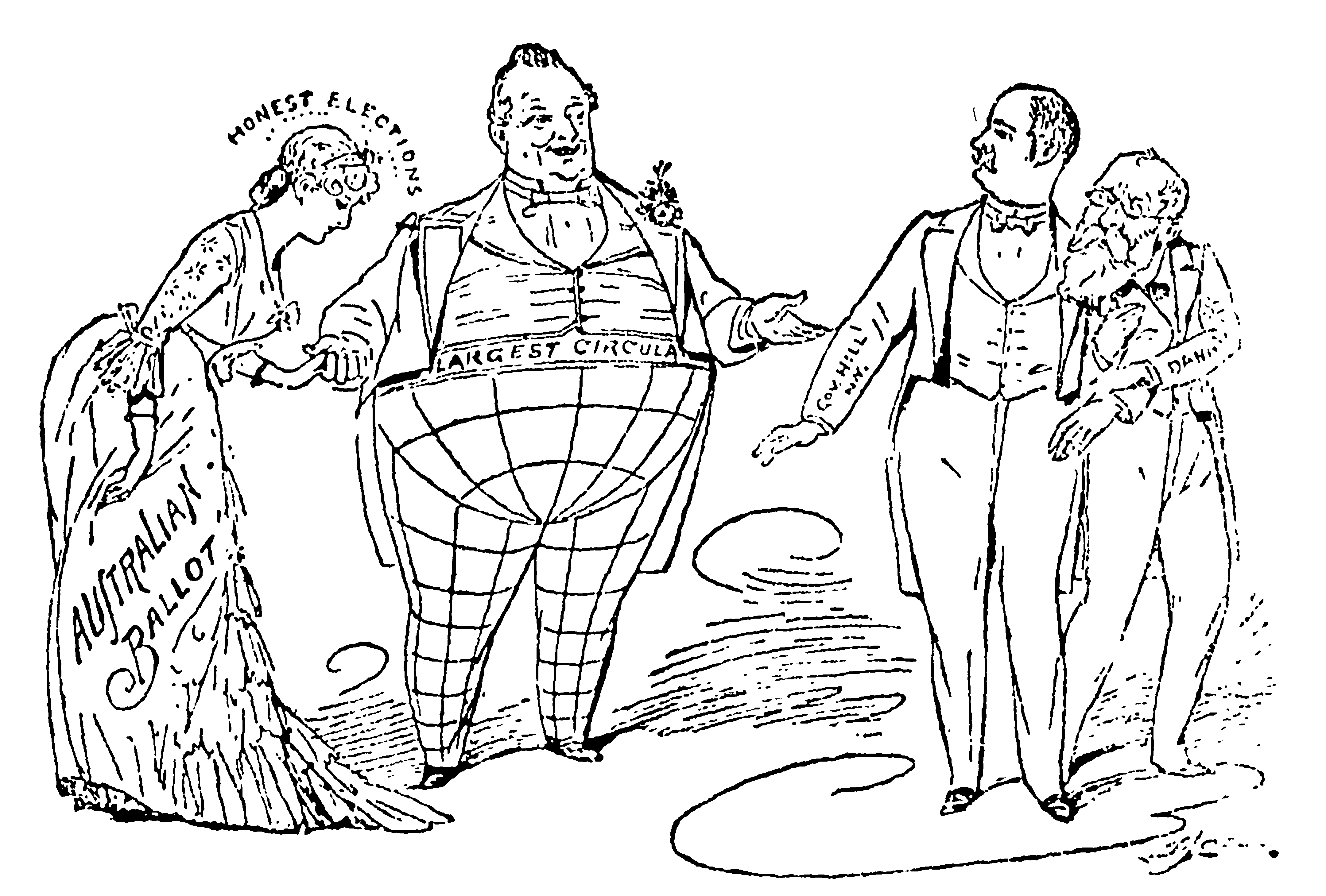
[Cartoon: A stout man labeled “LARGEST CIRCULA[TION]” across his waistband, his trousers patterned like a globe, presents a young woman in a long gown to Governor Hill, who turns away; an elderly bearded man stands behind Hill holding his arm. Labels: on the lady’s halo, “HONEST ELECTIONS”; on her skirt, “AUSTRALIAN BALLOT”; on the stout man’s waistband, “LARGEST CIRCULA”; on Hill’s sleeve, “GOV. HILL N.Y.”; on the old man’s sleeve, “DANI[ELS?]” (partly hidden). Artist’s signature at lower right, illegible.]
The Boston Globe Man (to Governor Hill of New York)—Permit me, Governor, to present this young lady—Miss Australian Ballot. She is a great Massachusetts favorite, and is quite the political belle of the period. You will make a mistake, Governor, if you turn your back on her.
[Advertisement] A NEW METHOD OF TREATING DISEASE.
Hospital Remedies.
What are they? There is a new departure in the treatment of disease. It consists in the collection of the specifics used by noted specialists of Europe and America, and bringing them within the reach of all. For instance the treatment pursued by special physicians who treat indigestion, stomach and liver troubles only, was obtained and prepared. The treatment of other physicians, celebrated for curing catarrh was procured, and so on till these incomparable cures now include disease of the lungs, kidneys, female weakness, rheumatism and nervous debility.
This new method of “one remedy for one disease” must appeal to the common sense of all sufferers, many of whom have experienced the ill effects, and thoroughly realize the absurdity of the claims of Patent Medicines which are guaranteed to cure every ill out of a single bottle, and the use of which, as statistics prove, has ruined more stomachs than alcohol. A circular describing these new remedies is sent free on receipt of stamp to pay postage by Hospital Remedy Company, Toronto, Canada. sole sic.—[Adv.
[Advertisement] THE BERKSHIRE LIFE INSURANCE CO.
THE GREATEST ADVANCE
in
LIFE INSURANCE
in the
NINETEENTH CENTURY.
PAID UP AND CASH VALUES GUARANTEED
by the
PERFECTED MASSACHUSETTS INSURANCE ACT OF 1887.
THE BERKSHIRE LIFE INSURANCE CO.,
of Pittsfield, Mass.
INCORPORATED 1851.
GEO. W. ENGLISH, MANAGER,
For New York and New Jersey.
NEW YORK OFFICE:
271 BROADWAY,
Corner of Chamber St.
[Advertisement] THE WONDERFUL LUBURG CHAIR
[Illustrated display advertisement: a reclining chair at left, a man seated in a wheel chair at centre, and a baby carriage at right, with lettering in white on black panels.]
THE WONDERFUL LUBURG CHAIR. COMBINING 5 ARTICLES OF FURNITURE IN ONE
100 STYLES [illegible] BABY COACHES
INVALID SUPPLIES [illegible] WHEEL CHAIRS
[On the chair at left, partly legible: “CHAIRS”]
We retail at the lowest wholesale factory prices, and ship goods to be paid for on delivery. Send stamp for Catalogue. Name goods desired.
Automatic Brake on all Coaches FREE WHEEL CHAIRS TO HIRE. SPECIAL FREE DELIVERY.
LUBURG MFG. CO., 145 N. [8th?] St., Philadelphia, Pa.
[Advertisement] THE BEST REMEDY
THE BEST REMEDY on earth for Piles! Piles! Piles! Salt Rheum, Eczema and all painful itching skin diseases is [E. S.?] Parker’s Titan Salve. By all Druggists and [820?] Broadway, Room 4, N. Y. City. Agents wanted
[E. S.?] PARKER.
[Advertisement] AGENTS WANTED EVERYWHERE
AGENTS WANTED EVERYWHERE; Capable Men and Women to [sell?] the Celebrated MISSOURI STEAM WASHER. Dirtiest Clothes Washed Clean by Hot Steam, No Rubbing. Fits all Stoves. Sample [illegible] on Liberal Terms. Particulars free. J. WORTH, Sole Manu’fr, St. Louis, Mo.
[Advertisement] [illegible] CO-OPERATIVE PRINTING
[Heavily over-inked; most of this three-line notice cannot be read.] O[illegible] CO-OPERATIVE PRINTING [illegible] N.Y. [illegible] [line obscured]
p. 16, col. 2
[Advertisement] NEW PUBLICATIONS. THE SINGLE TAX LIBRARY.
NEW PUBLICATIONS.
THE SINGLE TAX LIBRARY.
- A Syllabus of Progress and Poverty. Louis F. Post [8?] pages.
- Australian System. Louis F. Post. 4 pages.
- First Principles. Henry George. 4 pages.
- The Right to the Use of the Earth. Herbert Spencer. 4 pages.
- Farmers and the Single Tax. Thomas G. Shearman. 8 pages.
- The Canons of Taxation. Henry George. 4 pages.
- A Lawyer’s Reply to Criticisms. Samuel B. sic . 16 pages.
- Back to the Land. Bishop Nulty. 16 pages.
- The Single Tax. Thos. G. Shearman. 8 pages.
- The American Farmer. Henry George. 4 pages
- Unemployed Labor Henry sic. 4 pages.
- The Case Plainly Stated. H F. sic. 8 pages.
- Social Problems. 342 pages. 12mo. Paper, 35c.
- Objections to the Land Tax. Thos. G. Shearman. sic.
- Land Taxation. A Conversation Between David Dudley Field and Henry George. 4 pages.
- How to Increase Profits. A. J sic. 2 pages.
- The New Political Economy. E. O. Brown. 4 pages
- Thy Kingdom Come. Henry George. 4 pages.
- The Functions of Government. Henry George. sic.
- The Menace of Plutocracy. Thomas G. Shearman. 8 pages.
- Tenement House Morality. J.O.S. Huntington. 4 pp. 22, 23, 24, out of print.
- Taxing Land Values. Henry George 8 pages.
- Henry George’s Mistakes. Thomas G. Shearman. 8 pages.
- The Democratic Principle. Henry George. 8 pages
- Progress and Poverty. Henry George. 5[1?]2 pages. 35 cents 29 The New Ballot sic. Louis F. Post. 4 pages
- The Cat. 2 pages.
- The Single Tax in a Nutshell. [2?] pages.
Prices of Single Tax Library: Two page tracts—1 copy, 1 cent; 40 copies, 10 cents; 100 copies, 20 cents; 1,000 copies, $1.50.
Four-page tracts—1 copy, 2 cents; 20 copies, 10 cents; 100 copies, 40 cents; 1,000 copies, $3.
Eight-page tracts—1 copy 3 cents; 10 copies, 10 sic 100 copies, 80 cents; 1,000 copies, $6.
Sixteen-page tracts—1 copy, 4 cents, [5?] sic, 10 cents; 100 copies, $1.60; 1,000 copies, $12.
No extra charge by mail.
The following numbers of the “Land and Labor Library” are still in stock:
- Settler’s Nightmare. Louis F. Post. 4 pages.
- Mysterious Disappearance. Lewis Freeland. [6?] pp.
- Sailors’ Snug Harbor and the Randall Farm. W. T. Croasdale. 12 pages.
- The Collegiate Church and Shoemaker’s Field. W. T. Croasdale. 12 pages.
- It is the Law of Christ. Rev. S. H. sic. 4 pp.
- Christianity and Poverty. Father Huntington 4 sic. [33?]. Socialism—Its Truth and Its Error. Henry George. 4 pages. [38?]. “God Wills It.” Henry George. 4 pages.
- How John’s Father Saw the Light. W.C.Woods. 2 p.
- Ten Thoughts for Christian Thinkers. Rev. John W. Kramer. 4 pages.
- Hints as to What You Can Do. Henry George. 4 pp.
- My Butcher Woman and My Grocery Man. William McCabe. 4 pages.
- A Republican’s Reasons for Supporting Cleveland. Judge Frank T. Reid. 2 pages. [89?]. Jefferson and Hamilton. Chauncey F. Black. 8 pp.
GERMAN TRACTS.
- First Principles. Henry George. 4 pages. [43?]. Socialism—Its Truth and Its Error. Henry George. 4 pages. [44?]. Taxing Land Values. Henry George. 8 pages.
- It is the Law of Christ. Rev. S. H. Spencer. Henry, Ill. 4 pages. [5?]. Sailors’ Snug Harbor. Wm. T. Croasdale. 12 pages.
SWEDISH TRACTS.
52 The Case Plainly sic. H. F. Ring. 8 pages.
TARIFF TRACTS.
- Protection as a Universal Need. Henry George. pages.
- The Tariff Question. Henry George. 4 pages. [63?]. American Protection and British Free Trade. Henry George. 4 pages. [66?]. Protection and Wages. Henry George. 8 pages.
- Protection the Friend of Labor? Thomas G. Shearman. 8 pages.
- A Short Tariff History. Thomas G. Shearman. 2 pages.
- Plain Talk to Protectionists. Thomas G. Shearman. 4 pages.
- An Address to Workingmen on the Tariff Question Henry sic. 4 pages.
A set of Tariff Tracts will be sent to any address for ten cents.
Address THE STANDARD, 12 Union square, New York City
[Advertisement] Pennsylvania Agricultural Works, York, Pa.
[Illustration: a portable steam engine driving a saw mill by a long belt; a man stands at the saw.]
Pennsylvania Agricultural Works, York, Pa.
Farquhar’s Standard Engines and Saw Mills.
Send for Catalogue. Portable, Stationary, Traction and Automatic Engines a specialty. Warranted equal or superior to any made.
Address A. B. FARQUHAR & SON, York, Pa.
[Advertisement] CATARRH
[Display advertisement: the word CATARRH in white letters on a black band between two black posts.]
Piso’s Remedy for Catarrh is the Best, Easiest to Use, and Cheapest.
CATARRH
Sold by druggists or sent by mail. [50c.?] E. T. Hazeltine, Warren, Pa.
[Advertisement] JAS. [MORGAN?], Principal Agent for James Means’ shoes
[Heavily over-inked.] JAS. [MORGAN?], Principal Agent for James Means’ [$3?] and [$4?] shoes. [illegible] Bowery, near Prince st.
p. 16, col. 3
[Advertisement] Pears’ Soap
[Display advertisement: “Good morning” in large script lettering at upper left.]
Good morning
“Paris Exposition, 1889.
Pears obtained the only gold medal awarded solely for toilet SOAP in sic with all the world. Highest possible distinction.”
[Advertisement] HENRY GEORGE & CO., sic,
HENRY GEORGE & CO.. PUBLISHERS,
NO. 12 UNION SQUARE.
PROGRESS AND POVERTY.
An inquiry into the cause of industrial depression and of increase of want with increase of wealth. The remedy.
By HENRY GEORGE.
512 pages. Cloth, $1.50. Paper covers, 35 cents. Half calf or half morocco, $3.00.
PROTECTION OR FREE TRADE?
An examination of the tariff question with especial regard to the interests of labor.
By HENRY GEORGE.
Cloth, $1.50. Paper covers, 35 cents. Half calf or half morocco, $3.00.
THE LAND QUESTION.
What it involves and how alone it can be settled.
By HENRY GEORGE.
87 pages. Paper covers, 20 cents.
p. 16, col. 4
PROPERTY IN LAND.
A Passage-at-Arms Between the Duke of Argyll and Henry George.
77 pages. Paper covers, 15 cents.
FORTSCHRITT UND ARMUTH.
(Progress and Poverty in German).
Translation of C. D. F. Gutschow.
430 pages. Paper covers, 35 cents.
PROGRES ET PAUVRETE.
(Progress and Poverty in French).
Translation of P. L. LeMonnier.
542 pages. Paper covers, sic.
PROTECTION OU LIBRE-ECHANGE?
(Protection or Free Trade? in French).
Translation of Louis Vossion.
436 pages. Paper covers, $2.75.
PROGRESSO E POVERTA.
(Progress and Poverty in Italian).
Translation of Ludovico Eusebio.
352 pages. Paper covers, $2 50.
[The rest of the Henry George & Co. advertisement runs across columns 3–4; its two-part book list is given left half first, then right half.]
SETS OF THREE.—PROGRESS AND POVERTY, SOCIAL PROBLEMS, PROTECTION OR FREE TRADE? BOUND ALIKE, IN HALF CALF OR HALF MOROCCO, $7.50.
ECONOMIC WORKS.
By way of answering inquiries constantly received, we append a list of some economic and social works of various kinds, with prices, at which they will be forwarded post paid. Any work not mentioned procurable in New York will be sent on receipt of publisher’s price.
WILLIAM LLOYD GARRISON.—THE story of his life. Told by his children. 4 vols, cloth, $12 sic.
ESSAYS ON POLITICAL sic FREDERICK BASTIAT. 12mo, cloth, $1.[25?].
SOPHISMS OF PROTECTION.—WITH preface by Horace White. By FREDERICK BASTIAT. 12mo, cloth, $1.00.
HISTORY OF POLITICAL ECONOMY IN EUROPE.—By JEROME ADOLPHE BLANQUI. 8vo, cloth, $3.00.
AN INQUIRY INTO THE NATURE AND CAUSES OF THE WEALTH OF NATIONS.—By ADAM SMITH. Edited by Theobold sic. $1.00.
WORK AND WAGES.—BY THOS. BRASSEY. 16mo, cloth, $1.00.
THE AUSTRALIAN BALLOT SYSTEM as embodied in the legislation of various countries. By J. H WIGMORE sic, $1.50.
FREE LAND AND FREE TRADE.—THE Lesson of the English Corn Laws Applied to the United States. By Hon. SAMUEL S. COX. 8vo, cloth, 75 cts.
THE HISTORY OF THE FREE TRADE MOVEMENT IN ENGLAND.—By AUGUSTUS MONGREDIEN. 16mo, cloth, 50 cts.
POSTULATES OF ENGLISH POLITICAL ECONOMY.—By WALTER BAGEHOT. Cloth, $1.00.
THE TARIFF HISTORY OF THE UNITED STATES.—Containing “Protection to Young Industries,” and “The History of the Present Tariff, 1860-1883.” By F. W. TAUSSIG. 8vo, cloth, $1.25.
Any of the above Books will be sent postpaid on receipt of price.
HENRY GEORGE & CO., 12 Union Square, New York City.
[Advertisement] PARIS EXHIBITION, 1889. BURROUGHS, WELLCOME & CO.
[Spans columns 3–4.]
PARIS EXHIBITION, 1889.
BURROUGHS, WELLCOME & CO.,
Importers, Exporters and Manufacturing Chemists,
SNOW HILL BUILDINGS, LONDON, E. C.,
Specially invite the attention of the Medical Profession and Drug Trade to their Exhibits, as follows:
At Stand No. 575, British Food Section,
Kepler Extract of Malt,
an agreeable vitalizing reconstructive and digestive.
Kepler Solution of Cod Liver Oil,
An ideal form for the administration of fat.—British Medical Journal.
Also at Stand No. 311, British Industrial Section,
Chemical and Pharmaceutical Products, &c.
The [Congo?] Medicine Chest, as taken by H. M. Stanley, for the relief of Emin Pasha, fitted with Tabloids of Compressed Drugs, &c.
The Livingstone, Gordon and Indian Traveler’s Medicine Pocket Cases and Portabl Medicine sic.
Vercker’s Chloride of Ammonium Inhaler, for Catarrh, &c.
The Pinol-Eucalyptia Dry Inhaler, for the antiseptic treatment of Consumption and diseases of the air passages.
Lanoline, Lanoline Toilet Soap, Cold Cream Pomade and Toilet Lanoline.
Also at Stand No. 594, American Section,
Hazeline. Distilled active principles obtained by distillation from the American Witch Hazel, Hammamelis sic, for inflammation and irritated surfaces.
The Fairchild Pepsine and Pepsine Tabloids, Zymine Peptonizing Powders, &c., &c
Formulæ and price lists supplied to the Medical Profession and Drug Trade on request.
BURROUGHS, WELLCOME & CO.
[Below the Burroughs, Wellcome advertisement the two columns divide again: column 3 first, then column 4.]
[Advertisement] SINGLE TAX CIGAR.
[Column 3.]
SINGLE TAX CIGAR.
SIMON VAN VEEN,
Sole Manufacturer.
These cigars are the best and cheapest in the market for the money. They are put up 50 to a box, and the inside of cover contains a beautiful photo-engraving of the Cat, with the inscription below,
“Have You Seen the Cat?”
Whenever placed on view it is sure to provoke discussion, and is an excellent method of bringing our principles before the sic,
Price per box, $2.75.
A liberal discount to the trade. All orders will receive prompt attention by addressing
S. VAN VEEN, [71?] Wooster st.
[Advertisement] THE MASTER WORKMAN.
[Column 4.]
THE MASTER WORKMAN.
A simple statement of the views and aims of single tax men, designed especially for workingmen.
Single copies, 10 cents, ten sic, 80 cents; twenty five copies, $1.75; one hundred copies, $6.00.
Sent post or express prepaid on receipt of the above prices. Address,
HENRY J. O’NEILL, [991?] Gordon St. Allentown, Pa.
[Advertisement] HEAVEN AND HELL.
HEAVEN AND HELL.
By EMANUEL SWEDENBORG.
Four hundred and twenty pages, paper cover. Mailed pre-paid for 14 cents by the American sic Printing and Publishing Society, 20 Cooper Union, New York City.
SOCIAL PROBLEMS.
By HENRY GEORGE.
342 pages. Cloth, $1.[00?] Paper covers, 35 cents. Half calf or half morocco, $2.50sic.