About the Land and Labor Library
The full list of Land and Labor Library tracts is online at www.henrygeorgethestandard.org/lll/index.html; this page provides some background information.
The Land and Labor Library was first announced in The Standard, Issue #010, 1887-03-12, on the Editorial page, as follows:
As a means for the more efficient propagation of the true principles of land reform The Standard has commenced the publication of a series of tracts, illustrating in concise and striking forms the causes of poverty and the easy method of its abolition.
Friends of the cause can do great good by aiding in the circulation of these tracts. They can be distributed among acquaintances, inclosed in letters and parcels, or given out at public meetings or from house to house. Their price has been fixed to cover merely the cost of printing.
The 4-page tracts were priced at 25 copies for 10 cents; 100 copies for 25 cents; 1000 copies for $2, 5,000 copies for $8.50, and 10,000 copies for $15. The 2-page tracts were priced at 50 copies for 10 cents; 100 copies for 12½ cents; 1000 copies for $1, 5,000 copies for $4.50, and 10,000 copies for $7.50. The first five tracts were listed.
On the last page of that same issue, a display ad listed some other tracts, three of which would form the foundation for the L&LL:
The Right to the Use of the Earth, by Herbert Spencer [L&LL, Tract #03]
First Principles, by Henry George, in English or German [L&LL, Tract #01]
The Great-Great-Grandson of Captain Kidd, by Henry George
Land and Taxation, David Dudley Field and Henry George [ L&LL Tract #02]
Platform New York Labor Convention, in English or German
Declarations and Resolutions, Cooper Union Mass Meeting
After that date, there was a classified ad for the Land and Labor Library’s tracts on the 7th or 8th page of The Standard every week.
In Issue #026, the last in Volume 1, there appears this paragraph, which may help explain the documents selected for reprinting:
And now we want to say a word about the tracts of the land and labor library. Every man or woman whose heart is in the work ought to keep a full set of these tracts on hand all the time, so as to be able to pick out just the one that is needed to combat a particular objection, or set at rest a particular doubt. If a friend tells you, for instance, that people wouldn’t improve land unless they could own it absolutely, give him “The Sailors’Snug Harbor,” and let him see for himself that men do erect magnificent buildings on land they don’t own, and never can own. If you are arguing with a lawyer, let him read “The Single Tax,” by Thomas G. Shearman, one of the foremost lawyers of the country. Bishop Nulty’s letter, “Back to the Land,” will show Catholics how a prelate of their church views the subject; Protestants may read with profit the sermons and addresses by Mr. Pentecost and Father Huntington and Mr. S. H. Spencer. To a farmer, give “The American Farmer,” by Henry George; to a doubting merchant, Mr. Steeler’s tract, “How to Increase Profits,” will carry conviction. The student may read “First Principles,” or “The Right to the Use of the Earth;” the careless unbeliever whom you want to set to thinking will be interested in “The Mysterious Disappearance,” or “Only a Dream,” or “My Landlord.” Don’t throw your tracts around carelessly, but consider the character of the person you want to approach, and select your tract accordingly.
A scan of L&LL tract #21, dated 1887-06-25, Christianity and Poverty, Father Huntington’s Address at the Third Meeting of the Anti-poverty Society, is online at _____. It’s a 4-page tract, with the speech printed as two columns per page. The speech, about 2550 words, takes up a bit over 2 pages (a full page of text is about 1225 words). It is followed by a poem, “On Earth as It Is in Heaven,” by H. T. R. Marston, which appeared in The Standard, Issue #019, 1887-05-14. Below that is an article addressed “To Applicants for Membership.” The fourth page lists the 21 tracts then available, and concludes with a membership form for the ANTI-POVERTY SOCIETY. The speech was given Sunday night, 1887-05-15, and was published in Issue #020 of The Standard (1887-05-21) and the word count was identical. Tract #21 first was advertised in Issue #021, 1887-05-28 – a month before the date which appears on the tract’s heading. The transcription of Tract #21, along with a membership card in the Anti-Poverty Society, is online at www.henrygeorgethestandard.org/lll/lll-21-christianity-and-poverty-by-rev-j-o-s-huntington.pdf.
These are the only case tracts for which we have both the article as printed in The Standard and the full L&LL tract. (If you have others, please share!)
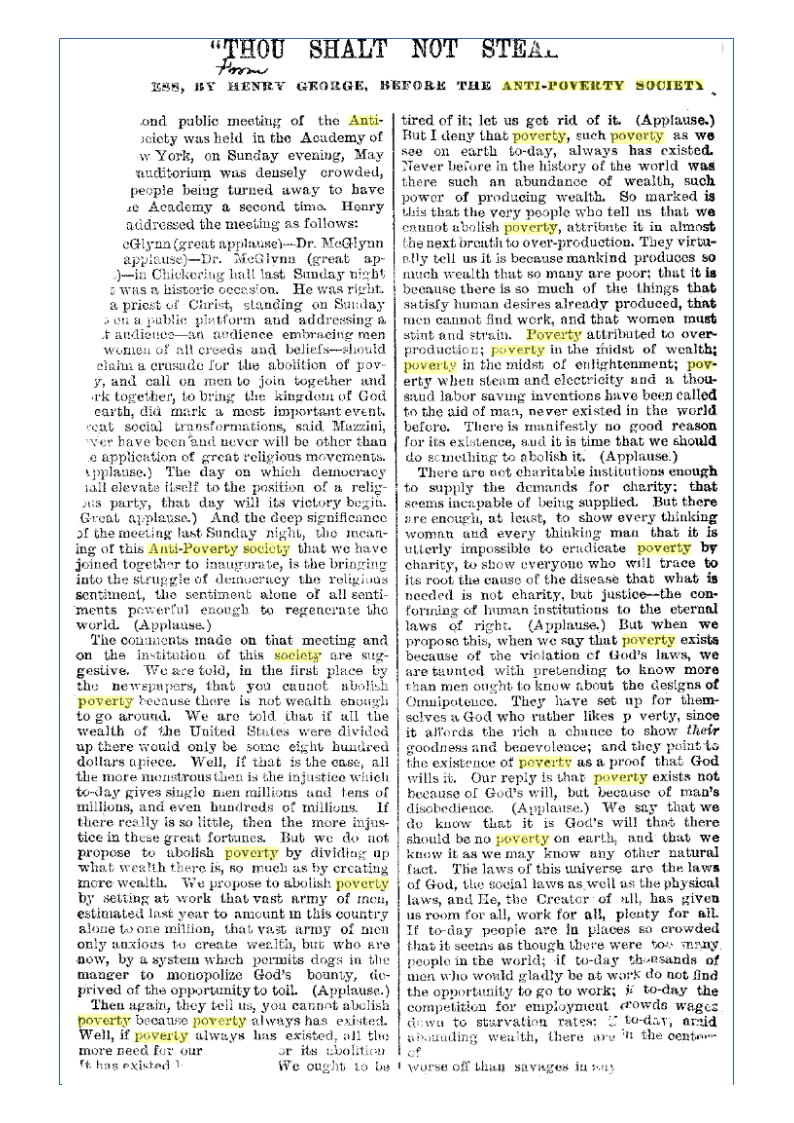
An image of the first page of L&LL tract #20, Thou Shalt Not Steal, Henry George’s speech before the Anti-poverty Society, is below. The speech was reprinted as part of a collection of labor pamphlets under the title “A Home of its Own for Every Family,” online at https://books.google.com/books?id=UErNhfjvLH0C&pg=PP84#v=snippet&q=%22deny%20that%20poverty%22&f=false It is an 8-page tract, with the speech filling nearly 6 pages. The 6th page is completed with a verse by Mathilde Blind entitled “The Landlord,” which appeared in The Standard, Issue #019, 1887-05-14, the same issue in which Thou Shalt Not Steal was printed. The 7th page has a verse by Mrs. Elizabeth Johnson entitled “Thy Kingdom Come,” which had appeared in Issue #016, 1887-04-23. The final page lists the first 20 tracts and information about the Anti-Poverty Society.
Comparing the Tract and the original printing of the speech in The Standard, it appears that the columns of the tract were exactly the same width as the lines of type in The Standard. Where the account in The Standard included the notation “(applause),” so did the tract.
An 1891 issue of The Standard, online at http://savingcommunities.org/docs/george.henry/standard0913.html, features The Single Tax Library, with a separate numbering system, and then offers the remaining inventory of Land and Labor Library tracts:
Here’s The Single Tax Library collection:
1. A Syllabus of Progress and Poverty. Louis F. Post. 8 pages 3
2. Out of print.
3. First Principles. Henry George. 4 pages 2
4. The Right to the Use of the Earth. Herbert Spencer. 4 pages 2
5. Farmers and the Single Tax. Thomas G. Shearman. 8 Pages 3
6. The Canons of Taxation. Henry George. 4 pages 2
7. A Lawyer’s Reply to Criticisms. Samuel B. Clark. 16 pages 4
8. Out of print
9. The Single Tax. Thomas G. Shearman. 8 pages 3
10. The American Farmer. Henry George. 4 pages 2
11. Unemployed Labor. Henry George. 4 pages 2
12. The Case Plainly Stated. H. F. Ring. 8 pages 3
13. Social Problems. 342 pages. ¿lsmo.? Paper 25
14. Objections to the Land Tax. Thomas G. Shearman. 4 pages 2
15. Land Taxation. A Conversation Between David Dudley Field and Henry George. 4 pages 2
16. How to Increase Profits. A. J. Steers. 2 pages 1
17. The New Political Economy. E. O. Brown. 4 pages 2
18. Thy Kingdom Come. Henry George. 4 pages 2
19. The Functions of Government Henry George. 8 pages 3
20. The Menace of Plutocracy. Thomas G. Shearman. 8 pages 3
21. Tenement House Morality. J. O. S. Huntington. 4 pages 2
22. Out of Print
23. Out of Print
24. Out of Print
25. Taxing Land Values. Henry George. 8 pages 3
26. Henry George’s Mistakes. Thomas G. Shearman. 8 pages 3
27. The Democratic Principle. Henry George 8 pages 3
28. Progress and Poverty. Henry George. 512 pages 35
29. Out of Print
30. Property in Land. Henry George. 77 pages 15
31. Out of Print
32. Out of Print
33. Out of Print
34. Single Tax Platform. By Henry George. 2 pages 1 1
35. Justice the Object - Taxation the Means. Henry George. 8 pages 2
36. Out of Print
… and a set of Tariff Tracts, for 10 cents:
57. Protection as a Universal Need. Henry George. 4 pages.
60. The Tariff Question. Henry George. 8 pages.
69. Protection and Wages. Henry George. 8 pages.
70. The Common Sense of the Tariff Question. Thomas G. Shearman. 8 pages
72. Protection the Friend of Labor? Thomas G. Shearman. 8 pages.
75. A Short Tariff History. Thomas G. Shearman. 2 pages.
67. Plain Talk to Protectionists. Thomas G. Shearman. 4 pages.
Eventually, this transcription project will catch up, and we will have published at least all the tracts which appeared in The Standard.
No. 1. First Principles
Henry George
Chapter 9 of Social Problems1
by Henry George (1883)
WHOEVER considers the political and social problems that confront us, must see that they center in the problem of the distribution of wealth, and he must also see that, though their solution may be simple, it must be radical.
For every social wrong there must be a remedy. But the remedy can be nothing less than the abolition of the wrong. Half-way measures, mere ameliorations and secondary reforms, can at any time accomplish little, and can in the long run avail nothing. Our charities, our penal laws, our restrictions and prohibitions, by which, with so little avail, we endeavor to assuage poverty and check crime, what are they, at the very best, but the device of the clown who, having put the whole burden of his ass into one pannier, sought to enable the poor animal to walk straight by loading up the other pannier with stones?
In New York, as I write, the newspapers and the churches are calling for subscriptions to their “fresh-air funds,” that little children may be taken for a day or for a week from the deadly heat of stifling tenement rooms and given a breath of the fresh breeze of seashore or mountain; but how little does it avail, when we take such children only to return them to their previous conditions — conditions which to many mean even worse than death of the body; conditions which make it certain that of the lives that may thus be saved, some are saved for the brothel and the almshouse, and some for the penitentiary? We may go on forever merely raising fresh-air funds, and how great soever be the funds we raise, the need will only grow, and children — just such children as those of whom Christ said, “Take heed that ye despise not one of these little ones; for I say unto you, that in heaven their angels do always behold the face of my Father” — will die like flies, so long as poverty compels fathers and mothers to the life of the squalid tenement room. We may open “midnight missions” and support “Christian homes for destitute young girls,” but what will they avail in the face of general conditions which render so many men unable to support a wife; which make young girls think it a privilege to be permitted to earn three dollars by eighty one hours’ work, and which can drive a mother to such despair that she will throw her babies from a wharf of our Christian city and then leap into the river herself! How vainly shall we endeavor to repress crime by our barbarous punishment of the poorer class of criminals so long as children are reared in the brutalizing influences of poverty, so long as the bite of want drives men to crime! How little better than idle is it for us to prohibit infant labor in factories when the scale of wages is so low that it will not enable fathers to support their families without the earnings of their little children! How shall we try to prevent political corruption by framing new checks and setting one official to watch another official, when the fear of want stimulates the lust for wealth, and the rich thief is honored while honest poverty is despised?
Nor yet could we accomplish any permanent equalization in the distribution of wealth were we forcibly to take from those who have and give to those who have not. We would do great injustice; we would work great harm; but, from the very moment of such a forced equalization the tendencies which show themselves in the present unjust inequalities would begin to assert themselves again, and we would in a little while have as gross inequalities as before.
What we must do if we would cure social disease and avert social danger is to remove the causes which prevent the just distribution of wealth.
This work is only one of removal. It is not necessary for us to frame elaborate and skilful plans for securing the just distribution of wealth. For the just distribution of wealth is manifestly the natural distribution of wealth, and injustice in the distribution of wealth must, therefore, result from artificial obstructions to this natural distribution.
As to what is the just distribution of wealth there can be no dispute. It is that which gives wealth to him who makes it, and secures wealth to him who saves it. So clearly is this the only just distribution of wealth that even those shallow writers who attempt to defend the existing order of things are driven, by a logical necessity, falsely to assume that those who now possess the larger share of wealth made it and saved it, or got it by gift or by inheritance, from those who did make it and save it; whereas the fact is, as I have in a previous chapter shown, that all these great fortunes, whose corollaries are paupers and tramps, really come from the sheer appropriation of the makings and savings of other people.
And that this just distribution of wealth is the natural distribution of wealth can be plainly seen. Nature gives wealth to labor, and to nothing but labor. There is, and there can be no article of wealth but such as labor has got by making it, or searching for it, out of the raw material which the Creator has given us to draw from. If there were but one man in the world it is manifest that he could have no more wealth than he was able to make and to save. This is the natural order. And, no matter how great be the population, or how elaborate the society, no one can have more wealth than he produces and saves, unless he gets it as a free gift from some one else, or by appropriating the earnings of some one else.
An English writer has divided all men into three classes — workers, beggars and thieves. The classification is not complimentary to the “upper classes” and the “better classes,” as they are accustomed to esteem themselves, yet it is economically true. There are only three ways by which any individual can get wealth — by work, by gift or by theft. And, clearly, the reason why the workers get so little is that the beggars and thieves get so much. When a man gets wealth that he does not produce, he necessarily gets it at the expense of those who produce it.
All we need do to secure a just distribution of wealth, is to do that which all theories agree to be the primary function of government — to secure to each the free use of his own powers, limited only by the equal freedom of all others; to secure to each the full enjoyment of his own earnings, limited only by such contributions as he may be fairly called upon to make for purposes of common benefit. When we have done this we shall have done all that we can do to make social institutions conform to the sense of justice and to the natural order.
I wish to emphasize this point, for there are those who constantly talk and write as though whoever finds fault with the present distribution of wealth were demanding that the rich should be spoiled for the benefit of the poor; that the idle should be taken care of at the expense of the industrious, and that a false and impossible equality should be created, which, by reducing every one to the same dead level, would destroy all incentive to excel and bring progress to a halt.
In the reaction from the glaring injustice of present social conditions, such wild schemes have been proposed, and still find advocates. But to my way of thinking they are as impracticable and repugnant as they can seem to those who are loudest in their denunciations of “communism.” I am not willing to say that in the progress of humanity a state of society may not be possible which shall realize the formula of Louis Blanc, “From each according to his abilities; to each according to his wants,” for there exist today in the religious Orders of the Catholic Church, associations which maintain the communism of early Christianity. But it seems to me that the only power by which such a state of society can be attained and preserved is that which the framers of the schemes I speak of generally ignore, even when they do not directly antagonize — a deep, definite, intense, religious faith, so clear, so burning as utterly to melt away the thought of self — a general moral condition such as that which the Methodists declare, under the name of “sanctification,” to be individually possible, in which the dream of pristine innocence should become reality, and man, so to speak, should again walk with God.
But the possibility of such a state of society seems to me in the present stage of human development a speculation which comes within the higher domain of religious faith rather than that with which the economist or practical statesman can concern himself. That nature, as it is apparent to us here, in this infinitesimal point in space and time that we call the world, is the highest expression of the power and purpose that called the universe into being, what thoughtful man dare affirm? Yet it is manifest that the only way by which man may attain higher things is by conforming his conduct to those commandments which are as obvious in his relations with his fellows and with external nature as though they were graved by the finger of Omnipotence upon tablets of imperishable stone. In the order of moral development, Moses comes before Christ —“Thou shalt not kill;” “Thou shalt not commit adultery;” “Thou shalt not steal;” before “Thou shalt love thy neighbor as thyself.” The command, “Thou shalt not muzzle the ox that treadeth out the corn,” precedes the entrancing vision of universal peace, in which even nature’s rapine shall cease, when the lion shall lie down with the lamb, and a little child shall lead them.
That justice is the highest quality in the moral hierarchy I do not say; but that it is the first. That which is above justice must be based on justice, and include justice, and be reached through justice. It is not by accident that, in the Hebraic religious development which through Christianity we have inherited, the declaration, “The Lord thy God is a just God,” precedes the sweeter revelation of a God of Love. Until the eternal justice is perceived, the eternal love must be hidden. As the individual must be just before he can be truly generous, so must human society be based upon justice before it can be based on benevolence.
This, and this alone, is what I contend for — that our social institutions be conformed to justice; to those natural and eternal principles of right that are so obvious that no one can deny or dispute them — so obvious that by a law of the human mind even those who try to defend social injustice must invoke them. This, and this alone, I contend for — that he who makes should have; that he who saves should enjoy. I ask in behalf of the poor nothing whatever that properly belongs to the rich. Instead of weakening and confusing the idea of property, I would surround it with stronger sanctions. Instead of lessening the incentive to the production of wealth, I would make it more powerful by making the reward more certain. Whatever any man has added to the general stock of wealth, or has received of the free will of him who did produce it, let that be his as against all the world — his to use or to give, to do with it whatever he may please, so long as such use does not interfere with the equal freedom of others. For my part, I would put no limit on acquisition. No matter how many millions any man can get by methods which do not involve the robbery of others — they are his: let him have them. I would not even ask him for charity, or have it dinned into his ears that it is his duty to help the poor. That is his own affair. Let him do as he pleases with his own, without restriction and without suggestion. If he gets without taking from others, and uses without hurting others, what he does with his wealth is his own business and his own responsibility.
I reverence the spirit that, in such cities as London and New York, organizes such great charities and gives to them such magnificent endowments, but that there is need for such charities proves to me that it is a slander upon Christ to call such cities Christian cities. I honor the Astors for having provided for New York the Astor Library, and Peter Cooper for having given it the Cooper Institute; but it is a shame and a disgrace to the people of New York that such things should be left to private beneficence. And he who struggles for that recognition of justice which, by securing to each his own, will make it needless to beg for alms from one for another, is doing a greater and a higher work than he who builds churches, or endows hospitals, or founds colleges and libraries. This justice, which would first secure to each his own earnings, is, it seems to me, of that higher than almsgiving, which the Apostle had in mind, when he said, “Though I bestow all my goods to feed the poor, and though I give my body to be burned, and have not charity, it profiteth me nothing.”
Let us first ask what are the natural rights of men, and endeavor to secure them, before we propose either to beg or to pillage.
In what succeeds I shall consider what are the natural rights of men, and how, under present social adjustments, they are ignored and denied. This is made necessary by the nature of this inquiry. But I do not wish to call upon those my voice may reach to demand their own rights, so much as to call upon them to secure the rights of others more helpless. I believe that the idea of duty is more potent for social improvement than the idea of interest; that in sympathy is a stronger social force than in selfishness. I believe that any great social improvement must spring from, and be animated by, that spirit which seeks to make life better, nobler, happier for others, rather than by that spirit which only seeks more enjoyment for itself. For the Mammon of Injustice can always buy the selfish whenever it may think it worth while to pay enough but unselfishness it cannot buy.
In the idea of the incarnation — of the God voluntarily descending to the help of men, which is embodied not merely in Christianity, but in other great religions — lies, I sometimes think, a deeper truth than perhaps even the churches teach. This is certain, that the deliverers, the liberators, the advancers of humanity, have always been those who were moved by the sight of injustice and misery rather than those spurred by their own suffering. As it was a Moses, learned in all the lore of the Egyptians, and free to the Court of Pharaoh, and not a tasked slave, forced to make bricks without straw, who led the Children of Israel from the House of Bondage; as it was the Gracchi, of patrician blood and fortune, who struggled to the death against the land-grabbing system which finally destroyed Rome, as it must, should it go on, in time destroy this republic, so has it always been that the oppressed, the degraded, the downtrodden have been freed and elevated rather by the efforts and the sacrifices of those to whom fortune had been more kind than by their own strength. For the more fully men have been deprived of their natural rights, the less their power to regain them. The more men need help, the less can they help themselves.
The sentiment to which I would appeal is not envy, nor yet self-interest, but that nobler sentiment which found strong, though rude, expression in that battle-hymn which rang through the land when a great wrong was going down in blood:
In the beauty of the lilies, Christ was born across the sea,
With a glory in his bosom to transfigure you and me;
As he died to make men holy, let us die to make men free!
And what is there for which life gives us opportunity that can be compared with the effort to do what we may, be it ever so little, to improve social conditions and enable other lives to reach fuller, nobler development? Old John Brown, dying the death of the felon, launched into eternity with pinioned arms and the kiss of the slave child on his lips — was not his a greater life and a grander death than though his years had been given to self-seeking? Did he not take with him more than the man who grabs for wealth and leaves his millions? Envy the rich! Who that realizes that he must some day wake up in the beyond can envy those who spend their strength to gather what they cannot use here and cannot take away! The only thing certain to any of us is death. “Like the swallow darting through thy hall, such, O King, is the life of man!” We come from where we know not; we go — who shall say? Impenetrable darkness behind, and gathering shades before. What, when our time comes, does it matter whether we have fared daintily or not, whether we have worn soft raiment or not, whether we leave a great fortune or nothing at all, whether we shall have reaped honors or been despised, have been counted learned or ignorant — as compared with how we may have used that talent which has been intrusted to us for the Master’s service? What shall it matter, when eyeballs glaze and ears grow dull, if out of the darkness may stretch a hand, and into the silence may come a voice:
“Well done, thou good and faithful servant: thou hast been faithful over a few things, I will make thee ruler over many things: enter thou into the joy of thy Lord!”
I shall speak of rights, I shall speak of utility, I shall speak of interest; I shall meet on their chosen ground those who say that the largest production of wealth is the greatest good, and material progress the highest aim. Nevertheless, I appreciate the truth embodied in these words of Mazzini to the working-classes of Italy, and would echo them:
Working-men, brothers! When Christ came and changed the face of the world, he spoke not of rights to the rich, who needed not to achieve them; nor to the poor, who would doubtless have abused them, in imitation of the rich; he spoke not of utility, nor of interest, to a people whom interest and utility had corrupted; he spoke of duty, he spoke of love, of sacrifice and of faith; and he said that they should be first among all who had contributed most by their labor to the good of all.
And the word of Christ breathed in the ear of a society in which all true life was extinct, recalled it to existence, conquered the millions, conquered the world, and caused the education of the human race to ascend one degree on the scale of progress.
Working-men! We live in an epoch similar to that of Christ. We live in the midst of a society as corrupt as that of the Roman Empire, feeling in our inmost souls the need of reanimating and transforming it, and of uniting all its various members in one sole faith, beneath one sole law, in one sole aim — the free and progressive development of all the faculties of which God has given the germ to his creatures. We seek the kingdom of God on earth as it is in heaven, or, rather, that earth may become a preparation for heaven, and society an endeavor after the progressive realization of the divine idea.
But Christ’s every act was the visible representation of the faith he preached; and around him stood apostles who incarnated in their actions the faith they had accepted. Be you such and you will conquer. Preach duty to the classes about you, and fulfill, as far as in you lies, your own. Preach virtue, sacrifice and love; and be yourselves virtuous, loving and ready for self-sacrifice. Speak your thoughts boldly, and make known your wants courageously; but without anger, without reaction, and without threats. The strongest menace, if indeed there be those for whom threats are necessary, will be the firmness, not the irritation, of your speech.
No. 2. Land and Taxation
A Conversation Between
David Dudley Field And Henry George
This exchange of views between economic reformer Henry George (1839-1897) and legal reformer David Dudley Field (1805-1894)2 was published in the “North American Review,” July, 1885, online at http://unz.org/Pub/NorthAmericanRev-1885jul-00001.
Mr. David Dudley Field. Will you explain to me how you expect to develop, in practice, your theory of the confiscation of land to the use of the State?
Mr. Henry George. By abolishing all other taxes and concentrating taxation upon land values.
F. Then suppose A to be the proprietor of a thousand acres of land on the Hudson, chiefly farming land, but at the same time having on it houses, barns, cattle, horses, carriages, furniture; how is he to be dealt with under your theory?
G. He would be taxed upon the value of his land, and not upon the value of his improvements and stock.
F. Whether the value of his land has been increased by his cultivation or not?
G. The value of land is not really increased by cultivation. The value that cultivation adds is a value of improvement, which I would exempt. I would tax the land at its present value, excluding improvements; so that such a proprietor would have no more taxes to pay than the proprietors of one thousand acres of land, equal in capabilities, situation, etc., that remained in a state of nature.
F. But suppose the proprietor of such land to have let it lie waste for many years while the farmer that I speak of has devoted his time and money to increasing the value of his thousand acres, would you tax them exactly alike?
G. Exactly.
F. Let us suppose B, an adjoining proprietor, has land that has never yielded a blade of grass, or any other product than weeds; and that A, a farmer, took his in the same condition when he purchased, and by his own thrift and expenditure has improved his land, so that now, without buildings, furniture, or stock, it is worth five times as much as B’s thousand acres; B is taxed at the rate of a dime an acre; would you tax A at the rate of a dime an acre?
G. I would certainly tax him no more than B, for by the additional value that A has created he has added that much to the common stock of wealth, and he ought to profit by it. The effect of our present system, which taxes a man for values created by his labor and capital, is to put a fine upon industry, and repress improvement The more houses, the more crops, the more buildings in the country, the better for us all, and we are doing ourselves an injury by imposing taxes upon the production of such things.
F. How are you to ascertain the value of land considered as waste land?
G. By its selling price. The value of land is more easily and certainly ascertained than any other value. Land lies out of doors, everybody can see it, and in every neighborhood a close idea of its value can be had.
F. Take the case of the owner of a thousand acres in the Adirondack wilderness that have been denuded of trees, and an adjoining thousand acres that have a fine growth of timber. How would you value them?
G. Natural timber is a part of the land; when it has value it adds to the value of the land.
F. The land denuded of timber would then be taxed less than land that has timber?
G. On general principles it would, where the value of the land was therefore lessened. But where, as in the Adirondacks, public policy forbids anything that would hasten the cutting of timber, natural timber might be considered an improvement, like planted timber, which should not add to taxable value.
F. Then suppose a man to have a thousand acres of wild timber land, and to have cut off the timber, and planted the land, and set up buildings, and generally improved it, would you tax him less than the man that has retained his land with the timber still on it?
G. I would tax the value of his land irrespective of the improvements made by him, whether they consisted in clearing, in ploughing, or in building. In other words, I would tax that value which is created by the growth of the community, not that created by individual effort. Land has no value on account of improvements made upon it, or on account of its natural capabilities. It is as population increases, and society develops, that land values appear, and they rise in proportion to the growth of population and social development. For instance, the value of the land upon which this building stands is now enormously greater than it was years ago, not because of what its owner has done, but because of the growth of New York.
F. I am not speaking of New York City in particular; I am speaking of land generally.
G. The same principle is generally true. Where a settler takes up a quarter section on a western prairie, and improves it, his land has no value so long as other land of the same quality can be had for nothing. The value he creates is merely the value of improvement. But when population comes, then arises a value that attaches to the land itself. That is the value I would tax.
F. Suppose the condition of the surrounding community in the West remained the same; two men go together and purchase two pieces of land of a thousand acres each; one leaves his with a valuable growth of timber, the other cuts off the timber, cultivates the land, and makes a well ordered farm. Would you tax the man that has left the timber upon his land more than you would tax the other man, provided that the surrounding country remained the same?
G. I would tax them both upon the value of the land at the time of taxation. At first, I take it, the clearing of the land would be a valuable improvement. On this, as on the value of his other improvements, I would not have the settler taxed. Thus taxation upon the two would be the same. In course of time the growth of population might give value to the uncut timber, which, being included in the value of land, would make the taxation upon the man that had left his land in a state of nature heavier than upon the man that had converted his land into a farm.
F. A man that goes into the western country and takes up land, paying the Government price, and does nothing to the land; how is he to be taxed?
G. As heavily as the man that has taken a like amount of land and improved it. Our present system is unjust and injurious in taxing the improver and letting the mere proprietor go. Settlers take up land, clear it, build houses, and cultivate crops, and for thus adding to the general wealth are immediately punished by taxation upon their improvements. This taxation is escaped by the man that lets his land lie idle, and, in addition to that, he is generally taxed less upon the value of his land than are those who have made their land valuable. All over the country, land in use is taxed more heavily than unused land. This is wrong. The man that holds land and neglects to improve it keeps away somebody that would, and he ought to pay as much for the opportunity he wastes as the man that improves a like opportunity.
F. Then you would tax the farmer whose farm is worth $1,000 as heavily as you would tax the adjoining proprietor, who, with the same quantity of land, has added improvements worth $100,000; is that your idea?
G. It is. The improvements made by the capitalist would do no harm to the farmer, and would benefit the whole community, and I would do nothing to discourage them.
F. In whom would you have the title to land vested – in the State, or in the individuals, as now?
G. I would leave the land titles as at present.
F. Your theory does not touch the title to land, nor the mode of transferring the title, nor the enjoyment of it; but it is a theory confined altogether to the taxing of it?
G. In form. Its effect, however, if carried as far as I would like to carry it, would be to make the community the real owner of land, and the various nominal owners virtually tenants, paying ground rent in the shape of taxes.
F. Before we go to the method by which you would effect that result, let me ask you this question: A, a large landlord in New York, owns a hundred houses, each worth say $25,000 (scattered in different parts of the city); at what rate of valuation would you tax him?
G. On his houses, nothing. I would tax him on the value of the lots.
F. As vacant lots?
G. As if each particular lot were vacant, surrounding improvements remaining the same.
F. If you would have titles as now, then A, who owns a ten thousand dollar house and lot in the city, would still continue to be the owner, as he is at present?
G. He would still continue to be the owner, but as taxes were increased upon land values he would, while still continuing to enjoy the full ownership of the house, derive less and less of the pecuniary benefits of the ownership of the lot, which would go in larger and larger proportions to the state, until, if the taxation of land values were carried to the point of appropriating them entirely, the state would derive all those benefits, and, though nominally still the owner, he would become in reality a tenant with assured possession, so long as he continued to pay the tax, which might then become in form, as it would be in essence, a ground rent.
F. Now, suppose A to be the owner of a city lot and building, valued at $500,000; who would give a deed to it to B?
G. A would give the deed.
F. Then supposing A to own twenty lots, with twenty buildings on them, the lots being, as vacant lots, worth each $1,000, and the buildings being worth $49,000 each; and B to own twenty lots of the same value, as vacant lots, without any buildings; would you tax A and B alike?
G. I would.
F. Suppose that B, to buy the twenty lots, had borrowed the price and mortgaged them for it; would you have the tax in that case apportioned?
G. I would hold the land for it. In cases in which it became necessary to consider the relations of mortgagee and mortgager, I would treat them as joint owners.
F. If A, the owner of a city lot with a house upon it, should sell it to B, do you suppose that the price would be graduated by the value of the improvements alone?
G. When the tax upon the land had reached the point of taking the full annual value, it would.
F. To illustrate: Suppose A has a city lot, which, as a vacant lot, is worth annually $10,000, and there is a building upon it worth $100,000, and he sells them to B; you think the price would be graduated according to the value of the building; that is to say, $100,000, after the taxation had reached the annual value of $10,000?
G. Precisely.
F. To what purpose do you contemplate that the money raised by your scheme of taxation should be applied?
G. To the ordinary expenses of government, and such purposes as the supplying of water, of light, of power, the running of railways, the maintenance of public parks, libraries, colleges, and kindred institutions, and such other beneficial objects as may from time to time suggest themselves; to the care of the sick and needy, the support of widows and orphans, and, I am inclined to think, to the payment of a fixed sum to every citizen when he came to a certain age.
F. Do you contemplate that money raised by taxation should be expended for the support of the citizen?
G. I see no reason why it should not be.
F. Would you have him fed and clothed at the public expense?
G. Not necessarily; but I think a payment might well be made to the citizen when he came to the age at which active powers decline that would enable him to feed and clothe himself for the remainder of his life.
F. Let us come to practical results. The rate of taxation now in the city of New York, we will suppose, is 2.30 upon the assessed value. The assessed value is understood to be about sixty percent of the real value of property. Land assessed at $60,000 is really worth $100,000, and being assessed at 2.30 when valued at $60,000, should be assessed at about 1.40 on the real value; you would increase that amount indefinitely, if I understand you, up to the annual rental value of the land?
G. I would.
F. Which we will suppose to be five percent; is that it?
G. Let us suppose so.
F. Then your scheme contemplates the raising of five percent on the true value of all real estate as vacant land, to be used for the purposes you have mentioned. Have you thought of the increase in the army of office-holders that would be required for the collection and disbursement of this enormous sum of money?
G. I have.
F. What do you say to that?
G. That as to collection, it would greatly reduce the present army of office-holders. A tax upon land values can be levied and collected with a much smaller force than is now required for our multiplicity of taxes; and I am inclined to think, that, directly and indirectly, the plan I propose would permit the dismissal of three-fifths of the officials needed for the present purposes of government. This simplification of government would do very much to purify our politics; and I rely largely upon the improvement that the change I contemplate would make in social life, by lessening the intensity of the struggle for wealth, to permit the growth of such habits of thought and conduct as would enable us to get for the management of public affairs as much intelligence and as strict integrity as can now be obtained for the management of great private affairs.
F. Supposing it to be true that you would reduce the expense of collection, would you not, for the disbursement of these vast funds, require a much larger number of efficient men than are now required?
G. Not necessarily. But, whether this be so or not, the full scheme I propose can only be attained gradually. Until, at least, the total amount needed for what are now considered purely governmental purposes were obtained by taxation on land values, there would be a large reduction of office-holders, and no increase.
F. How do you propose to divide the taxation between the state and the municipalities?
G. As taxes are now divided. As to questions that might arise, there will be time enough to determine them when the principle has been accepted.
F. Your theory contemplates the raising of nearly four times as much revenue in the State of New York as is now raised; how many office-holders would it require to disburse this enormous sum of money among the various objects that you have mentioned?
G. My theory does not require that it should be disbursed among the objects I have mentioned, but simply that it should be used for public benefit.
F. Do you not think that the present rate of taxation is more than sufficient for all purposes of government?
G. Under the state of society that I believe would ensue, it would be much more than sufficient for the present purposes of government. We should need far less for expenses of revenue collection, police, penitentiaries, courts, almshouses, etc.
F. Then, to bring the matter down to a point, you propose for the present no change whatever in anything, except that the amount now raised by all methods of taxation should be imposed upon real estate considered as vacant?
G. For a beginning, yes.
F. Well, what do you contemplate as the ending of such a scheme?
G. The taking of the full annual value of land for the benefit of the whole people. I hold that land belongs equally to all, that land values arise from the presence of all, and should be shared among all.
F. And this result you propose to bring about by a tax upon land values, leaving the title, the privilege of sale, of rent, of testament, the same as at present?
G. Yes.
F. Your theory appears to be impracticable. I think that the raising of such an enormous sum of money, placing it in the coffers of the state, to be disbursed by the state in the manner you contemplate, would tend to the corruption of the government beyond all former precedent. The end you contemplate – of bettering the condition of the people – is a worthy one. I believe that we – you and I – who are well to do in the world, and others in our condition, do neglect and have neglected our duty to those in a less fortunate condition, and that it is our highest duty to endeavor to relieve, so far as we can, the burdens of those who are now suffering from poverty and want. Therefore, far from deriding or scouting your theory, I examine it with respect and attention, desirous of getting from it whatever I can that may be good, while rejecting what I conceive to be erroneous. Taken altogether, as you have explained it, I do not see that it is a practicable scheme.
G. But your objections to it as impracticable only arise at the point, yet a long distance off, at which the revenues raised from land values would be greater than those now raised. Is there anything impracticable in substituting for the present corrupt, demoralizing, and repressive methods of taxation a single tax upon land values?
F. I think it possible to concentrate all taxation upon land, if that should be thought the best method. Many economists are of opinion that taxes should be raised from land alone, conceiving that rent is really paid by every consumer, but they include in land everything placed upon it out of which rent comes.
G. Then we could go together for a long while; and when the point was reached at which we would differ, we might be able to see that a purer government than any we have yet had might be possible. Certainly here is the gist of the whole problem. If men are too selfish, too corrupt, to co-operate for mutual benefit, there must always be poverty and suffering.
F. My theory of government is that its chief function is to keep the peace between individuals and allow each to develop his own nature for his own happiness. I would never raise a dollar from the people except for necessary purposes of government. I believe that the demoralization of our politics comes from the notion that public offices are spoils for partisans. A large class of men has grown up among us whose living is obtained from the state – that is to say, out of the people. We must get rid of those men, and instead of creating offices we must lessen their number.
G. I agree with you as to government in its repressive feature; and in no way could we so lessen the number of office-holders and take the temptation of private profit out of public affairs as by raising all public revenues by the tax upon land values, which, easily assessed and collected, does not offer opportunities for evasion or add to prices. Though in form a tax, this would be in reality a rent; not a taking from the people, but a collecting of their legitimate revenues. The first and most important function of government is to secure the full and equal liberty of individuals; but the growing complexity of civilized life and the growth of great corporations and combinations, before which the individual is powerless, convince me that government must undertake more than to keep the peace between man and man – must carry on, when it cannot regulate, businesses that involve monopoly, and in larger and larger degree assume co-operative functions. If I could see any other means of doing away with the injustice involved in growing monopolies, of which the railroad is a type, than by extension of governmental functions, I should not favor that; for all my earlier thought was in the direction you have indicated – the position occupied by the democratic party of the last generation. But I see none. However, if it were to appear that further extension of the functions of government would involve demoralization, then the surplus revenue might be divided per capita. But it seems to me that there must be in human nature the possibility of a reasonably pure government, when the ends of that government are felt by all to be the promotion of the general good.
F. I do not believe in spoliation, and I conceive that that would be spoliation which would take from one man his property and give it to another. The scheme of the communists, as I understand it, appears to me to be not only unsound, but destructive of society. I do not mean to intimate that you are one of the communists; on the contrary, I do not believe you are.
G. As to the sacredness of property, I thoroughly agree with you. As you say in your recent article on industrial co-operation in the North American Review3, “To take from one against his will that which he owns and give it to another, would be a violation of that instinct of justice which God has implanted in the heart of every human being; a violation, in short, of the supreme law of the Most High;” and my objection to the present system is that it does this. I hold that that which a man produces is rightfully his, and his alone; that it should not be taken from him for any purpose, even for public uses, so long as there is any public property that might be employed for that purpose; and therefore I would exempt from taxation everything in the nature of capital, personal property, or improvements – in short, that property which is the result of man’s exertion. But I hold that land is not the rightful property of any individual. As you say again, “No one can have private property in privilege,” and if the land belongs, as I hold it does belong, to all the people, the holding of any part of it is a privilege for which the individual holder should compensate the general owner according to the pecuniary value of the privilege. To exact this would not be to despoil any one of his rightful property, but to put an end to spoliation that now goes on. Your article in the Review shows that you see the same difficulties I see, and would seek the same end – the amelioration of the condition of labor, and the formation of society upon a basis of justice. Does it not seem to you that something more is required than any such scheme of co-operation as that which you propose, which at best could be only very limited in its application, and which is necessarily artificial in its nature?
F. Undoubtedly. The hints that I have given in the article to which you refer, would affect a certain number of persons, not by any means the whole body politic. I conceive that a great deal more is necessary. There should be more sympathy, more mutual help. I think, as I have said, that we are greatly wanting in our duty to all the people around us, and I would do everything in my power to aid them and their children. I do not think that we have arrived at the true conception of our duty, of the duty of every American citizen to all other American citizens.
G. I think you are right in that; but does it not seem as though it were out of the power of mere sympathy, mere charity, to accomplish any real good? Is it not evident that there is at the bottom of all social evils an injustice, and until that injustice is replaced by justice, charity and sympathy will do their best in vain? The fact that there are among us strong, willing men unable to find work by which to get an honest living for their families is a most portentous one. It speaks to us of an injustice that, if not remedied, must wreck society. It springs, I believe, from the fact that, while we secure to the citizen equal political rights, we do not secure to him that natural right more important still, the equal right to the land on which and from which he must live. To me it seems clear, as our Declaration of Independence asserts, that all men are endowed by their Creator with certain unalienable rights, and that the first of these rights – that which, in fact, involves all the rest, that without which none of the others can be exercised – is the equal right to land. Here are children coming into life today in New York; are they not endowed with the right to more than struggle along as they best can in a country where they can neither eat, sleep, work, nor lie down without buying the privilege from some of certain human creatures like themselves, who claim to own, as their private property, this part of the physical universe, from the earth’s center to the zenith?
F. I was not speaking of charity, but of sympathy leading to help – helping one to help himself – that is the help I mean, and not the charity that humbles him.
G. Then I cordially agree with you, and I look upon such sympathy as the most powerful agency for social improvement. But sympathy is little better than mockery until it is willing to do justice, and justice requires that all men shall be placed upon an equality so far as natural opportunities are concerned.
F. How would you secure that equality? Take the case of a child born today in a tenement house, in one of those rooms that are said to be occupied by several families, and another child born at the same time in one of the most comfortable homes in our city. The parents of the first child are wasteful, intemperate, filthy; the parents of the second are thrifty, temperate, cleanly; how would you secure equality in opportunities of the first child with that of the second?
G. Equality in all opportunities could not be secured; virtuous parents are always an advantage, vicious parents a disadvantage; but equality of natural opportunities could be secured in the way I have proposed. And in a civilization where the equal rights of all to the bounty of their Creator were recognized, I do not believe there would be any tenement houses, and very few, if any, parents such as those of whom you speak. The vice and crime and degradation that so fester in our great cities are the effects, rather than the causes, of poverty.
F. The principle announced in the Declaration of Independence to which you have referred, is one of the cardinal principles of the American government – the unalienable right of all men to “life, liberty, and the pursuit of happiness.” That, however, does not mean that all men are equal in opportunities or in positions. A child born today is entitled to the labors of its parents, or rather to the products of their labor, just as much as they are entitled to it until he is able to take care of himself. One of the incentives to labor is to provide for the children of the laborer. The aim of our American civilization ought to be to furnish, so far as can be done rightfully, to every child born into the world, an equal opportunity with every other child, to work out his own good. This, however, is the theoretical proposition. It is impossible in practice to give to every child the same opportunity; what we should aim at is, to approximate to that state of things; that is the work of the philanthropist and Christian. In short, my belief is that the truest statement of political ethics and political economy is to be found in the doctrines of the Christian religion.
G. In that I thoroughly agree with you. But Christianity that does not assert the natural rights of man, that has no protest when the earth, which it declares was created by the Almighty as a dwelling-place for all his children, is made the exclusive property of some of them, while others are denied their birthright – seems to me a travesty. A Christian has something to do as a citizen and lawmaker. We must rest our social adjustments upon Christian principles if we would have a really Christian society. But to return to the Declaration of Independence, the equal right to life, liberty, and the pursuit of happiness, does it not necessarily involve the equal right to land, without which neither life, liberty, nor the freedom to pursue happiness is possible?
F. You do not propose to give to every child a piece of land; you only propose to secure its right, if I understand you, by taxing land as vacant land in the mode you propose.
G. That is all, but it is enough. In the complex civilization we have now attained it would be impossible to secure equality by giving to each a separate piece of land, or to maintain that equality, even if once secured; but by treating all land as the property of the whole people, we would make the whole people the landlords, and the individual users the tenants of all, thus securing to each his equal right.
F. In how long a time, if you were to have such legislation as you would wish, do you think we should arrive at the condition that you have mentioned?
G. I think immediately a substantial equality would be arrived at, such an equality as would do away with the spectacle of a man unable to find work, and would secure to all a good and easy living, with a mere modicum of the hard labor and worriment now undergone by most of us. The great benefit would not be in the appropriation to public use of the unearned revenues now going to individuals, but in the opening of opportunities to labor, and the stimulus that would be given to improvement and production by the throwing open of unused land and the removal of taxation that now weighs down productive powers. And with the land made the property of the whole people, all social progress would be a progress towards equality. While other values tend to decline as civilization progresses, the value of land steadily advances. Such a great fact bespeaks some creative intent; and what that intent may be, it seems to me we can see when we reflect that if this value – a value created not by the individual, but by the whole community – were appropriated to the common benefit, the progress of society would constantly tend to make less important the difference between the strong and the weak, and thus, instead of those monstrous extremes toward which civilization is now hastening, bring about conditions of greater and greater equality.
F. As a conclusion of the whole matter, if I understand this explanation of your scheme, it is this: that the State should tax the soil, and the soil only; that in doing so it should consider the soil as it came from the hands of the Creator, without anything that man has put upon it; that all other property – in short, everything that man has made – is to be acquired, enjoyed, and transmitted as at present; that the rate of annual taxation should equal the rate of annual rental, and that the proceeds of the tax should be applied, not only to purposes of government, but to any other purpose that the legislature from time to time may think desirable, even to dividing them among the people at so much a head.
G. That is substantially correct.
F. I am glad to hear your explanation, though I do not agree with you, except as I have expressed myself.
No. 3. The Right To The Use Of The Earth
Herbert Spencer
By Herbert Spencer
(Chapter IX of Social Statics, 18514)
§ 1. Given a race of beings having like claims to pursue the objects of their desires — given a world adapted to the gratification of those desires — a world into which such beings are similarly born, and it unavoidably follows that they have equal rights to the use of this world. For if each of them “has freedom to do all that he wills provided he infringes not the equal freedom of any other,” then each of them is free to use the earth for the satisfaction of his wants, provided he allows all others the same liberty. And conversely, it is manifest that no one, or part of them, may use the earth in such a way as to prevent the rest from similarly using it; seeing that to do this is to assume greater freedom than the rest, and consequently to break the law.
§ 2. Equity, therefore, does not permit property in land. For if one portion of the earth’s surface may justly become the possession of an individual, and may be held by him for his sole use and benefit, as a thing to which he has an exclusive right, then other portions of the earth’s surface may be so held; and eventually the whole of the earth’s surface may be so held; and our planet may thus lapse altogether into private hands. Observe now the dilemma to which this leads. Supposing the entire habitable globe to be so enclosed, it follows that if the landowners have a valid right to its surface, all who are not landowners, have no right at all to its surface. Hence, such can exist on the earth by sufferance only. They are all trespassers. Save by the permission of the lords of the soil, they can have no room for the soles of their feet. Nay, should the others think fit to deny them a resting-place, these landless men might equitably be expelled from the earth altogether. If, then, the assumption that land can be held as property, involves that the whole globe may become the private domain of a part of its inhabitants; and if, by consequence, the rest of its inhabitants can then exercise their faculties — can then exist even — only by consent of the landowners; it is manifest, that an exclusive possession of the soil necessitates an infringement of the law of equal freedom. For, men who cannot “live and move and have their being” without the leave of others, cannot be equally free with those others.
§ 3. Passing from the consideration of the possible, to that of the actual, we find yet further reason to deny the rectitude of property in land. It can never be pretended that the existing titles to such property are legitimate. Should any one think so, let him look in the chronicles. Violence, fraud, the prerogative of force, the claims of superior cunning — these are the sources to which those titles may be traced. The original deeds were written with the sword, rather than with the pen: not lawyers, but soldiers, were the conveyancers: blows were the current coin given in payment; and for seals, blood was used in preference to wax. Could valid claims be thus constituted? Hardly. And if not; what becomes of the pretensions of all subsequent holders of estates so obtained? Does sale or bequest generate a right where it did not previously exist? Would the original claimants be nonsuited at the bar of reason, because the thing stolen from them had changed hands? Certainly not. And if one act of transfer can give no title, can many? No: though nothing be multiplied for ever, it will not produce one. Even the law recognizes this principle. An existing holder must, if called upon, substantiate the claims of those from whom he purchased or inherited his property; and any flaw in the original parchment, even though the property should have had a score intermediate owners, quashes his right.
“But Time,” say some, “is a great legaliser. Immemorial possession must be taken to constitute a legitimate claim. That which has been held from age to age as private property, and has been bought and sold as such, must now be considered as irrevocably belonging to individuals.” To which proposition a willing assent shall be given when its propounders can assign it a definite meaning. To do this, however, they must find satisfactory answers to such questions as — How long does it take for what was originally a wrong to grow into a right? At what rate per annum do invalid claims become valid? If a title gets perfect in a thousand years, how much more than perfect will it be in two thousand years? — and so forth. For the solution of which they will require a new calculus.
Whether it may be expedient to admit claims of a certain standing, is not the point. We have here nothing to do with considerations of conventional privilege or legislative convenience. We have simply to inquire what is the verdict given by pure equity in the matter. And this verdict enjoins a protest against every existing pretension to the individual possession of the soil; and dictates the assertion, that the right of mankind at large to the earth’s surface is still valid; all deeds, customs, and laws, notwithstanding.
§ 4. Not only have present land tenures an indefensible origin, but it is impossible to discover any mode in which land can become private property. Cultivation is commonly considered to give a legitimate title. He who has reclaimed a tract of ground from its primitive wildness, is supposed to have thereby made it his own. But if his right is disputed, by what system of logic can he vindicate it? Let us listen a moment to his pleadings.
“Hallo, you Sir,” cries the cosmopolite to some backwoodsman, smoking at the door of his shanty, “by what authority do you take possession of these acres that you have cleared; round which you have put up a snake-fence, and on which you have built this log-house?”
“By what authority? I squatted here because there was no one to say nay — because I was as much at liberty to do so as any other man. Besides, now that I have cut down the wood, and ploughed and cropped the ground, this farm is more mine than yours, or anybody’s; and I mean to keep it.”
“Ay, so you all say. But I do not yet see how you have substantiated your claim. When you came here you found the land producing trees — sugar-maples, perhaps; or may be it was covered with prairie-grass and wild strawberries. Well, instead of these, you made it yield wheat, or maize, or tobacco. Now I want to understand how, by exterminating one set of plants, and making the soil bear another set in their place, you have constituted yourself lord of this soil for all succeeding time.”
“Oh, those natural products which I destroyed were of little or no use; whereas I caused the earth to bring forth things good for food — things that help to give life and happiness.”
“Still you have not shown why such a process makes the portion of earth you have so modified yours. What is it that you have done? You have turned over the soil to a few inches in depth with a spade or a plough; you have scattered over this prepared surface a few seeds; and you have gathered the fruits which the sun, rain, and air, helped the soil to produce. Just tell me, if you please, by what magic have these acts made you sole owner of that vast mass of matter, having for its base the surface of your estate, and for its apex the center of the globe? all of which it appears you would monopolize to yourself and your descendants for ever.”
“Well, if it isn’t mine, whose is it? I have dispossessed nobody. When I crossed the Mississippi yonder, I found nothing but the silent woods. If some one else had settled here, and made this clearing, he would have had as good a right to the location as I have. I have done nothing but what any other person was at liberty to do had he come before me. Whilst they were unreclaimed, these lands belonged to all men — as much to one as to another — and they are now mine simply because I was the first to discover and improve them.”
“You say truly, when you say that ‘whilst they were unreclaimed these lands belonged to all men.’ And it is my duty to tell you that they belong to all men still; and that your ‘improvements’ as you call them, cannot vitiate the claim of all men. You may plough and harrow, and sow and reap; you may turn over the soil as often as you like; but all your manipulations will fail to make that soil yours, which was not yours to begin with. Let me put a case. Suppose now that in the course of your wanderings you come upon an empty house, which in spite of its dilapidated state takes your fancy; suppose that with the intention of making it your abode you expend much time and trouble in repairing it — that you paint and paper, and whitewash, and at considerable cost bring it into a habitable state. Suppose further, that on some fatal day a stranger is announced, who turns out to be the heir to whom this house has been bequeathed; and that this professed heir is prepared with all the necessary proofs of his identity: what becomes of your improvements? Do they give you a valid title to the house? Do they quash the title of the original claimant?”
“No.”
“Neither then do your pioneering operations give you a valid title to this land. Neither do they quash the title of its original claimants — the human race. The world is God’s bequest to mankind. All men are joint heirs to it; you amongst the number. And because you have taken up your residence on a certain part of it, and have subdued, cultivated, beautified that part — improved it as you say, you are not therefore warranted in appropriating it as entirely private property. At least if you do so, you may at any moment be justly expelled by the lawful owner — Society.”
“Well, but surely you would not eject me without making some recompense for the great additional value I have given to this tract, by reducing what was a wilderness into fertile fields. You would not turn me adrift and deprive me of all the benefit of those years of toil it has cost me to bring this spot into its present state.”
“Of course not: just as in the case of the house, you would have an equitable title to compensation from the proprietor for repairs and new fittings, so the community cannot justly take possession of this estate, without paying for all that you have done to it. This extra worth which your labour has imparted to it is fairly yours; and although you have, without leave, busied yourself in bettering what belongs to the community, yet no doubt the community will duly discharge your claim. But admitting this, is quite a different thing from recognising your right to the land itself. It may be true that you are entitled to compensation for the improvements this enclosure has received at your hands; and at the same time it may be equally true that no act, form, proceeding, or ceremony, can make this enclosure your private property.”
§ 5. It does indeed at first sight seem possible for the earth to become the exclusive possession of individuals by some process of equitable distribution. “Why,” it may be asked, “should not men agree to a fair subdivision? If all are co-heirs, why may not the estate be equally apportioned, and each be afterwards perfect master of his own share?”
To this question it may in the first place be replied, that such a division is vetoed by the difficulty of fixing the values of respective tracts of land. Variations in productiveness, different degrees of accessibility, advantages of climate, proximity to the centres of civilisation — these, and other such considerations, remove the problem out of the sphere of mere mensuration into the region of impossibility.
But, waiving this, let us inquire who are to be the allottees. Shall adult males, and all who have reached twenty-one on a specified day, be the fortunate individuals? If so, what is to be done with those who come of age on the morrow? Is it proposed that each man, woman, and child, shall have a section? If so, what becomes of all who are to be born next year? And what will be the fate of those whose fathers sell their estates and squander the proceeds? These portionless ones must constitute a class already described as having no right to a resting-place on earth — as living by the sufferance of their fellow men — as being practically serfs. And the existence of such a class is wholly at variance with the law of equal freedom.
Until therefore, we can produce a valid commission authorizing us to make this distribution — until it can be proved that God has given one charter of privileges to one generation, and another to the next — until we can demonstrate that men born after a certain date are doomed to slavery, we must consider that no such allotment is permissible.
§ 6. Probably some will regard the difficulties inseparable from individual ownership of the soil, as caused by pushing to excess a doctrine applicable only within rational limits. This is a very favourite style of thinking with some. There are people who hate anything in the shape of exact conclusions; and these are of them. According to such, the right is never in either extreme, but always half way between the extremes. They are continually trying to reconcile Yes and No. Ifs, and buts, and excepts, are their delight. They have so great a faith in “the judicious mean” that they would scarcely believe an oracle, if it uttered a full-length principle. Were you to inquire of them whether the earth turns on its axis from East to West, or from West to East, you might almost expect the reply — “A little of both,” or “Not exactly either.” It is doubtful whether they would assent to the axiom that the whole is greater than its part, without making some qualification. They have a passion for compromises. To meet their taste, Truth must always be spiced with a little Error. They cannot conceive of a pure, definite, entire, and unlimited law. And hence, in discussions like the present, they are constantly petitioning for limitations — always wishing to abate, and modify, and moderate — ever protesting against doctrines being pursued to their ultimate consequences.
But it behoves such to recollect, that ethical truth is as exact and as peremptory as physical truth; and that in this matter of land-tenure, the verdict of morality must be distinctly yea or nay. Either men have a right to make the soil private property, or they have not. There is no medium. We must choose one of the two positions. There can be no half-and-half opinion. In the nature of things the fact must be either one way or the other.
If men have not such a right, we are at once delivered from the several predicaments already pointed out. If they have such a right, then is that right absolute, sacred, not on any pretence to be violated. If they have such a right, then is his Grace of Leeds justified in warning-off tourists from Ben Mac Dhui, the Duke of Atholl in closing Glen Tilt, the Duke of Buccleugh in denying sites to the Free Church, and the Duke of Sutherland in banishing the Highlanders to make room for sheep-walks. If they have such a right, then it would be proper for the sole proprietor of any kingdom — a Jersey or Guernsey, for example — to impose just what regulations he might choose on its inhabitants — to tell them that they should not live on his property, unless they professed a certain religion, spoke a particular language, paid him a specified reverence, adopted an authorized dress, and conformed to all other conditions he might see fit to make. If they have such a right, then is there truth in that tenet of the ultra-Tory school, that the landowners are the only legitimate rulers of a country — that the people at large remain in it only by the landowners’ permission, and ought consequently to submit to the landowners’ rule, and respect whatever institutions the landowners set up. There is no escape from these inferences. They are necessary corollaries to the theory that the earth can become individual property. And they can only be repudiated by denying that theory.
§ 7. After all, nobody does implicitly believe in landlordism. We hear of estates being held under the king, that is, the State; or of their being kept in trust for the public benefit; and not that they are the inalienable possessions of their nominal owners. Moreover, we daily deny landlordism by our legislation. Is a canal, a railway, or a turnpike road to be made? we do not scruple to seize just as many acres as may be requisite; allowing the holders compensation for the capital invested. We do not wait for consent. An Act of Parliament supersedes the authority of title deeds, and serves proprietors with notices to quit, whether they will or not. Either this is equitable, or it is not. Either the public are free to resume as much of the earth’s surface as they think fit, or the titles of the landowners must be considered absolute, and all national works must be postponed until lords and squires please to part with the requisite slices of their estates. If we decide that the claims of individual ownership must give way, then we imply that the right of the national at large to the soil is supreme — that the right of private possession only exists by general consent — that general consent being withdrawn it ceases — that general consent being withdrawn it ceases — or, in other words, that it is no right at all.
§ 8. “But to what does this doctrine, that men are equally entitled to the use of the earth, lead? Must we return to the times of uninclosed wilds, and subsist on roots, berries, and game? Or are we to be left to the management of Messrs. Fourrier, Owen, Louis Blanc, and Co.?”
Neither. Such a doctrine is consistent with the highest state of civilization; may be carried out without involving a community of goods; and need cause no very serious revolution in existing arrangements. The change required would simply be a change of landlords. Separate ownerships would merge into the joint-stock ownership of the public. Instead of being in the possession of individuals, the country would be he held by the great corporate body — Society. Instead of leasing his acres from an isolated proprietor, the farmer would lease them from the nation. Instead of paying his rent to the agent of Sir John or his Grace, he would pay it to an agent or deputy-agent of the community. Stewards would be public officials instead of private ones; and tenancy the only land tenure.
A state of things so ordered would be in perfect harmony with the moral law. Under it all men would be equally landlords; all men would be alike free to become tenants. A, B, C, and the rest, might compete for a vacant farm as now, and one of them might take that farm, without in any way violating the principles of pure equity. All would be equally free to bid; all would be equally free to refrain. And when the farm had been let to A, B, or C, all parties would have done that which they willed — the one in choosing to pay a given sum to his fellow-men for the use of certain lands — the others in refusing to pay that sum. Clearly, therefore, on such a system, the earth might be inclosed, occupied, and cultivated, in entire subordination to the law of equal freedom.
§ 9. No doubt great difficulties must attend the resumption, by mankind at large, of their rights to the soil. The question of compensation to existing proprietors is a complicated one — one that perhaps cannot be settled in a strictly-equitable manner. Had we to deal with the parties who originally robbed the human race of its heritage, we might make short work of the matter. But, unfortunately, most of our present landowners are men who have, either mediately or immediately — either by their own acts, or by the acts of their ancestors — given for their estates, equivalents of honestly-earned wealth, believing that they were investing their savings in a legitimate manner. To justly estimate and liquidate the claims of such, is one of the most intricate problems society will one day have to solve. But with this perplexity and our extrication from it, abstract morality has no concern. Men having got themselves into the dilemma by disobedience to the law, must get out of it as well as they can; and with as little injury to the landed class as may be.
Meanwhile, we shall do well to recollect, that there are others besides the landed class to be considered. In our tender regard for the vested interests of the few, let us not forget that the rights of the many are in abeyance; and must remain so, as long as the earth is monopolised by individuals. Let us remember, too, that the injustice thus inflicted on the mass of mankind, is an injustice of the gravest nature. The fact that it is not so regarded, proves nothing. In early phases of civilization even homicide is thought lightly of. The suttees of India, together with the practice elsewhere followed of sacrificing a hecatomb of human victims at the burial of a chief, show this: and probably cannibals consider the slaughter of those whom “the fortune of war” has made their prisoners, perfectly justifiable. It was once also universally supposed that slavery was a natural and quite legitimate institution — a condition into which some were born, and to which they ought to submit as to a Divine ordination; nay, indeed, a great proportion of mankind hold this opinion still. A higher social development, however, has generated in us a better faith, and we now to a considerable extent recognise the claims of humanity. But our civilization is only partial. It may by-and-by be perceived, that Equity utters dictates to which we have not yet listened; and men may then learn, that to deprive others of their rights to the use of the earth, is to commit a crime inferior only in wickedness to the crime of taking away their lives or personal liberties.
§ 10. Briefly reviewing the argument, we see that the right of each man to the use of the earth, limited only by the like rights of his fellow-men, is immediately deducible from the law of equal freedom. We see that the maintenance of this right necessarily forbids private property in land. On examination all existing titles to such property turn out to be invalid; those founded on reclamation inclusive. It appears that not even an equal apportionment of the earth amongst its inhabitants could generate a legitimate proprietorship. We find that if pushed to its ultimate consequences, a claim to exclusive possession of the soil involves a landowning despotism. We further find that such a claim is constantly denied by the enactments of our legislature. And we find lastly, that the theory of the co-heirship of all men to the soil, is consistent with the highest civilization; and that, however difficult it may be to embody that theory in fact, Equity sternly commands it to be done.
No. 4. A Christian Minister on the Remedy for Poverty
Rev Hugh Pentecost
First printed in The Standard, February 12, 1887, p. 1: “THE LAND DOCTRINE. THE REV. MR. PENTECOST PREACHES HIS SECOND SERMON ON IT.”. The tract follows that text closely.
A Sermon by the Rev. Hugh O. Pentecost of Newark, N. J.
At the Belleville Avenue Congregational church in Newark, last Sunday, Rev. Hugh O. Pentecost preached his second sermon on “Henry George’s Remedy for the Labor Troubles.”5 Though the day was rainy the immense auditorium, one of the largest in the city, was literally packed with people, among whom were some of the richest of Newark’s citizens, as well as a larger number of workingmen than have probably been in a Protestant church for many years. The discourse, which was delivered entirely without manuscript notes, and which occupied more than an hour, was listened to with close attention, and frequently interrupted by bursts of applause following the statements of Mr. George’s views and evincing their general diffusion an growing popularity. He began in his usual calm way, which gave place at times to impassioned fervor, saying:
“Last Sunday evening I discussed the disease and found it to be an apparently hopeless tendency to poverty among the laboring classes in the midst of abounding wealth, and in spite of the application of all those instruments for increasing the power of labor to produce wealth which have been devised by discovery and invention known as laborsaving machinery. I showed the failure of remedies in present use, such as legislation, co-operation and labor combinations, whose only weapons are arbitration and strikes, very little of the former, a great deal of the latter.
“Mr. George’s remedy is much more radical than any of these, and as he thinks, and I am inclined to believe, goes to the bottom of the difficulty and removes the single cause of the whole complication of disorders.
“He denies the correctness of commonly received doctrines of political economy which are based upon the theory of Malthus, that population increases faster than the supplies of nature for its sustenance, and must therefore be reduced by prudential restraints upon propagation, and the destructive results of misery, crime, disease and war, in order to maintain the equilibrium, and the common doctrine of all the leading authorities upon the subject that labor is paid by capital, and hence that the rate of wages is determined by the ratio of the number of laborers employed and the amount of capital available for their sustenance and remuneration. If there are few laborers and much wealth the wages will be high. If the number of laborers increases wages must fall, since the subdivision of the existing amount of capital must be more minute.
“Henry George attempts,” he said, “to show that if population upon the whole earth is really increasing at all, or if the tendency of its increase is to press upon the means of subsistence, the process is so slow that it is no more to be taken into consideration by political economists for practical purposes than the ultimate tumbling of the earth upon the sun. Population shifts, but the barren wastes which were once the seats of vast empires, and the tendency of highly favored families, as among the English aristocracy, to die out, raise the question as to increase, and the ability of man to augment the productiveness of nature warrants the presumption that he may thus compensate for any disproportion between increase and supply. The Irish peasantry were just as poor as now [sic] when they were not more than one-fourth as numerous.
“He also holds that instead of capital employing labor, labor, in fact, employs capital, since there can be no wealth except what is produced by labor. A naked man standing on the bare earth is a picture of society reduced to its elements, and at once shows that wealth can only exist as the result of labor. The complications of exchange obscure but do not alter the truth. This being true, other things being equal, an increase in the number and efficiency of laborers ought to, and actually does, increase the amount of wealth. Upon this point his argument amounts to a mathematical demonstration, such as is not possible in the preceding one, owing to the necessary absence of correct data.
“Why, then, do not those who produce wealth obtain enough of it to lift them above the point of bare subsistence? And how is it that while the army of wealth producers are half starved another army of non-producers have more than the largest abundance? There is plenty of wealth, but it is unequally distributed. While multitudes are in want, there are men in New York who could stand on a pier and pitch silver dollars into the bay as rapidly as possible, one by one, all through a long life without materially reducing their possessions. Who always gets the lion’s share, and how does he get it? Let us see.
“Land, labor and capital are the factors in the production of wealth. Without land, man cannot labor; without labor, land is unproductive; without capital, which is that portion of the product of labor that is used to get more wealth, labor is inefficient. The distribution of wealth, therefore, ought to be fairly made among the three factors or those who represent them. The landholder should get rent, the laborer wages, the capitalist interest in fair proportion. But is wealth thus fairly distributed? Manifestly not. With the increase of population and the increased efficiency of labor the tendency is to less wages and less interest and more rent. In new settlements wages and interest are high because rent is nothing or nominal, but as the community grows land becomes more valuable, and rent goes up till it can get no higher, wages and interest go down till they can get no lower without crowding the laborer out of life and the capitalist out of business. (This point was enforced by illustrations.) Nothing can be done to change this. Economy in government cooperation, labor combinations, legislative enactments, greater distribution in land ownership, improvement in machinery, all result in enriching the landowner, since he owns that without which wealth cannot produce. The man who owns the land owns the whole landless community. During the development of this point illustrations were used to show the hopelessness of any human law operating successfully against “the nature of things,” which, under the present system, bear down wages and buoy up rent; to show that however cooperative measures may help a few laborers, they could not possibly benefit all; to show that even if a strike succeeds in raising wages in one place it can only be for a time, for the tendency of wages to find a common level is as strong as the similar tendency of water; to show that more general distribution of land ownership could not ward off its ultimate monopolization. If multitudes of those who now work for starvation wages could have easy access to land they could better themselves and would do so and thus relieve the so-called overstocked labor market. But they cannot go to the land because it is owned, very much of it, by men who are hoarding it for a rise in value. They will not use it nor let others use it. The laborer on the land could make a good living; but because he cannot get to the land he must work on any terms, starve, or become a criminal. Now, suppose this is true, what is the remedy? Make the land the common property of the people, as according to natural law it really is. The land was made by God; it cannot, therefore, be wealth, since wealth is what man produces. It is the common property of all God’s children; of one individual as well as another; of one generation as well as another. An individual has a right to himself and what he can produce by labor and the use of capital — nothing more.
“Private ownership stands in the way of this. It is at this point proper, then, to inquire how land came into private possession. The answer is easy: By conquest, appropriation, grants by those who had the might but not the right to take or give. The land in this country has passed to its present owners by purchase from those who originally obtained it from pope, king or Indian, neither of which had the right to give individual title to it.
“All this is perfectly clear, and it is generally conceded that the original owners had no right to the land; but the more serious difficulty arises out of the fact that land at present is held by innocent possessors, many of whom have bought it with their earnings. How can these persons be rightfully dispossessed?
“This is the only difficulty worthy of the name which presents itself to any one not blinded by selfishness to the absolute justness of the new political economy. All other objections relate to methods, not to principle. Let us, therefore, consider this difficulty. It is said that private possession in land is based upon the act of government in instituting laws favoring it as being for the general good. To this it is replied that when the people (that is, the government) become convinced that the laws are not for the general good they can unmake them, particularly as they were made by generations long since dead and who had no right to legislate for us. [Applause.] It is said again that it is a principle of common law that possession for a certain length of time gives right. It is replied that it is also a principle of common law that the deed of the buyer cannot be better than that of the seller [applause]; and going deeper than common law we have the right to ask how long it takes a wrong to become a right. It is said that present holders of the land have it by legal right. It is replied that they have it not by natural right [applause], and this is the real point at issue. Which is greater, a natural or legal right? It is common to say that Henry George’s doctrine is immoral, but that is to declare that it is wrong to keep millions of human beings in dreadful misery out of their natural rights because to restore them it will be necessary to take from a few highly favored persons their legal rights. I always suspect the decisions of a conscience which is not outraged by a wrong done to the whole people, but shrieks with horror at the thought of disturbing the use of a few in the enjoyment of their ‘vested rights,’ without even stopping to consider whether it is not possible that there may be ‘vested wrongs.’”
Here the speaker referred to the fact that although Newark is suffering for pure water she cannot get a drop without paying enormous sums to private persons who own every stream and spring in New Jersey. He supposed the case of a syndicate getting the privilege, which he said they could if they had money enough, of erecting a great fence around Newark and shutting off all air except what comes across the malarial meadows, and compelling people to pay for the privilege of boring holes in the fence to suck a little fresh air. He described the workings of a coal pool. These were cited to illustrate the injustice of legal as against natural right, and helped him to a decision. He then continued:
“The case is precisely analogous in principle, eliminating the incidental difference between property in human beings and property in what is the natural right of human beings, to that of the Vermont judge who, when a fugitive slave was sought to be reclaimed by his owner, who presented his deed of purchase, asked the slave owner,”But where is your deed from God Almighty, sir?’ It is a question of legal right against natural right. Under the influence of a pure religion, and in a free government, men must sooner or later give up what they can show no title to from God Almighty.”
“For my own part it is clear to me that Henry George is in the stronger moral position, and since the great body of humanity always end in doing what is right, the time will probably come when all rents will go to the general government; that is to say, to the whole people, instead of to a few, just as, in effect, wages and interest do now. It is folly to talk of compensation to present owners, further than what they would get by the general improvement of society, for the interest on the debt thus created would be as great a drain on industry as rent now is.
“It may be a long time before this comes about, for it is a question which must be decided by votes cast under convictions resulting from conscientious, intelligent reflection. Mr. George is not an anarchist; he does not appeal to passion, but to reason and conscience; he well knows that established laws cannot be successfully violated; he does not wish them violated; he desires them changed.
“It remains to ask the practical question what the result of such a change of laws would be? To the man who owns only as much land as he needs for business or residence purposes, practically nothing, since what he now pays to government in taxes on all kinds of possessions he would then pay in rent on the bare land, regulated by its selling value, say five percent, all his other property being free from all kind of taxation. He would still hold the title to the land guaranteed to his perpetual use, to transmit to his children or to sell. His land would not be taken from him; he would simply pay rent for its use in lieu of every other form of taxation. The only change would be that those who now hold more land than they can use themselves, or entirely unused land for speculative purposes, would have to give up what they could not afford to pay rent on, precisely as they would now if they could not pay the existing taxes. Land under the new order, being the property of all, would have to furnish all the revenue for the common expenses, instead of the product of industry and thought, which is the rightful property of the individual, having to furnish most of that common fund, as now. Wages and interest would go where they should go — to the laborer and capitalist — rent would go where it should go — into the common treasury for the common good.”
Mr. Pentecost concluded by saying he was “aware he had taken his life in his hands by preaching this sermon similar in sentiment to that which had caused the ‘downfall,’ as it is called, of the noble McGlynn, but he had confidence to believe that under the right of private judgment, he would not be crushed for it.” The hearty applause at the close of the sermon seemed to indicate that he was in no danger.
No. 5. A Sum in Proportion
T. L. McCready
First printed in The Standard, March 5, 1887, p. 7: “A SUM IN PROPORTION. With Some Considerations on the Profitableness of Doing Nothing.”. The tract follows that text closely.
by T. L. McCready
Issue #009 – 1887-03-05
A SUM IN PROPORTION
With Some Considerations on the Profitableness of Doing Nothing.
Three hundred and twenty-five thousand dollars! Don’t you wish you had it?
If you had $325,000, my friend, you could – you could – well now let’s consider a moment and study out just what a sum like that really means.
Four percent is not a very heavy rate of interest, with good security. Let us suppose that you invest your money at four percent. At that rate your $325,000 would bring you in an income of $13,000 a year.
The average annual earnings of American wage workingmen are, let us say, about $600; of women – young, old, middle-aged, healthy and infirm – say $300, and of children, we may suppose, about $150.
Your $13,000 a year, then, will command the work for one year of:
Twenty-one men, and four-sixths of a man over;
Or of forty-three women, and one-third of a woman over;
Or of eighty-six children, and two-thirds of a child over.
Or, to put it another way, it gives you the power to call on the people of New York to furnish you yearly with something like:
Two hundred and sixty beeves,6
Or three thousand sheep,
Or twenty-six hundred barrels of flour,
Or one hundred and thirty thousand loaves of the best bread.
I needn’t multiply the illustrations. You can amuse yourself for an hour, if you like, by figuring out what $13,000 a year represents, first in one thing and then in another.
And is this the kind of idle talk with which I propose to disfigure the columns of The Standard! Haven’t I anything better to tell you than a lot of old “chestnuts” about the command that money gives a man over the producing powers of his fellows? Wait a bit.
A few weeks ago a block of vacant land, comprising thirty-two full city lots, bounded by 121st and 122d streets, Mount Morris Park and Sixth avenue, was sold by the Astor estate for $325,000.
Vacant land, mind you! Not land that had been built upon, or improved by tillage, or utilized for any purpose under heaven; but just land that had been kept vacant.
And simply in return for signing a piece of paper containing its gracious consent that somebody else shall have the right to keep those thirty-two lots of land vacant if he wants to, the Astor estate has received authority to call on the people of the city of New York to furnish, year by year, henceforth and forever, free of charge, the men and women and children and beeves and sheep and barrels of flour and loaves of bread represented by an income of $13,000 a year. I’m not altogether certain what an Astor estate is, but I would to God I were one! I would to God that by signing some sort of a written permission to some other fellow to do nothing if he chose to, I could secure the free services of an assortment of humanity, consisting, we’ll say, of ten men, fifteen women and a dozen or so of children, with a few society saviors or similar job lots thrown in to make full count. The situation might not be strictly ethical, but I’ll warrant it would be comfortable – for me, that is.
You think this sort of talk is nonsense, eh? and wonder what I mean by it? My dear fellow, I never was more strictly serious in my life. Regarded solely as the owner of those thirty-two vacant lots, the Astor estate has not only produced absolutely nothing – has not only never done the first hand’s turn of work itself, but it has gone farther still and actually prevented other people from producing wealth by putting a fence round the land on which they might have worked. The world is not a penny the richer nor a heart’s thrill the happier for anything the Astor estate has ever done on or to those thirty-two vacant lots. On the contrary, it is many a dollar the poorer and by many a bitter pang more miserable. Mothers’ hearts have been rent with anguish for their little ones stewed to death in tenement houses for want of the fresh air that overblows those vacant lots. Strong men have walked the streets workless and an-hungered who would have gladly delved in that sacred soil. Houseless girls have sought in dens of sin the shelter that they might have found on that idle, unused land. God has been defied, and Christ blasphemed, and prisons filled, that the fences round those lots might be inviolate. Year after year men who wanted homes for wives and little ones have tried to bribe the Astor estate to let them build upon that land: and year after year the Astor estate has steadily refused. As population grew denser and denser, the proffered bribes have risen higher and higher, until at last even an Astor estate’s cupidity has been satisfied, and it has graciously accepted the privilege of taxing the people of the city of New York to the tune of $13,000 a year forever, and in return – done what? – pulled down its fences and restored the land to the outraged people whose mere presence and pressure had created its value? Deuce a bit of it! It has turned the fences over to some one else, who hopes to hold them inviolate until he, in turn, can squeeze an extra privilege of taxation out of the crowding, struggling myriads to whom the fathers of the Christian church proclaim that God Almighty made this pleasant earth for the benefit of a favored few! Think it out until you realize the robbery! Ponder on it until you comprehend the wrong!
And then, consider yet a little more. For the privilege of using or not using less than two acres of bare ground, which God made and no man can add to or diminish, we of the city of New York consent to give the Astor estate, forever, the labor of twenty-one men out of our number.
There are on this island of Manhattan 137,000 city lots.
Some of these lots have less rental value than those the Astor estate has just disposed of, but many of them have far more. The thirty-two lots we have been considering represent, if anything, less than the average. It’s a simple sum in rule of three. If we allow the Astor estate to tax us $13,000 a year because it “owns” thirty-two lots, how much taxes do we pay the whole body of landowners because they “own” 137,000 lots?
32 : $13,000.00 :: $55,656,250.00.
Correct; go up head. And now tell me how you like it.
Fifty-five millions of dollars yearly – the labor of nearly 100,000 able-bodied men year in and year out; the toil of 200,000 weary women – that is what we have pledged in perpetuity that Astor estates may be and saviors of society grow rich and foolish priests malign their God by pretending that He approves it all!
And, mind you, we pay an extra dollar or two in the shape of taxes – you and I and other landless ones whom God allowed to come into the world by mistake!
Ah, think of it! think of it! Fifty-five millions of dollars yearly; well nigh sixty dollars for each and every man, woman and child that lives upon this island of Manna-hatta – this island whose rental value we and our forbears have increased from nothing to this prodigious sum, and are still increasing. It is all our own. We made it and are making it; and we only have a right to it, as those who come after us will have the right in their turn. How long shall we wait ere with united action we stretch forth our hands to take our own again?
__________
I know that it is written in the Gospel of Things as They Are that God’s laws were never meant to prevent poverty – that He, the loving One, is powerless to abolish it, even if He would. I have heard it preached from pulpit and rostrum, but I don’t believe it. Nor do you. For neither you nor I can imagine a Father in heaven loving enough to devise a scheme to save our souls from the pit of hell, yet cruel enough to leave our bodies wallowing and writhing in the dismal slough of poverty. From the lips of Him who died to save our souls came the precept that shall suffice to save our bodies: “Whatsoever ye would that men should do unto you, even so do ye also unto to them.” Only this – a short, but all-sufficing rule. Quench and quell that dog-in-the-manger spirit that seeks to claim the monopoly of God’s free gifts to man – acknowledge once for all that our God is a just God and knows no favorites among His children – and poverty shall vanish away like some dank miasm before the rising sun; and though the Astor estate may have no slaves to work for it, it will yet find ample comfort in its just share of the bounties Heaven has provided for us all. T. L. McCready.
No. 6. A Settler’s Nightmare: A Curious Dream Retold and Interpreted
Louis F. Post
First printed in The Standard, March 12, 1887, p. 7: “A SETTLER’S NIGHTMARE”. The tract follows that text closely.
7 Louis F. Post
Uncle Sam Meets One of His Nephews and Tells Him All About It — A Farmer Learns How to Lift the Load of Taxation From His Shoulders.
Short Hills, N.J., March 3.— The Standard is anything but soporific, yet I must confess I fell asleep while reading the last number. No doubt the hearty dinner I had just eaten had something to do with my mental condition, and it will be quite in order for you to say that the dream which I am about to relate, and which I beg you to interpret, is due to the same cause.
We do things in our dreams that we should never think of doing in our waking moments, and this will explain why, as the paper fluttered to the floor, I started west, bought a tract of government land and went to farming. I built a cabin for my family, by hard work cleared up a part of my land, and, having sold my first crop, I was thinking about replacing my oxen with faster animals, when a horse dealer happened along and, after the customary bargaining on my part and much wrestling with the truth on his, I bought a good, strong animal.
Just when that horse had established his character and become the pet and pride of the family the horse dealer returned one night with a pale face and a frightened manner. Taking me out behind the barn, and speaking in a tremulous whisper, the man told me that he had stolen the horse he sold to me.
“It’s a case of downright conscience with me,” said the penitent horse thief, and as he said this he hitched his belt around, accidentally of course, but it brought the stock of a revolver under the moon’s rays. “I want to do the square thing,” he continued, “so I’ll give you back your money, and will take the horse and return him to his owner.”
I soon saw that the horse thief’s desire to lead a better and a nobler life was so strong that he would not hesitate to use his pistol against any one who attempted to swerve him from the straight and narrow path of rectitude on which he had just entered; so I gave up the horse and got back the one hundred and twenty dollars I had paid for him. The next day I discovered that half the money was counterfeit; but, as it was in the reformed thief’s power to have paid me the whole in spurious paper, I reasoned that, for a man with such a past, he had made a very fair start in his new career.
The next day I had another visitor, a tall, ungainly man, with long leathery jaws, keen gray eyes, and a tuft of chin whiskers. He wore a high woolly hat, his trousers were alternate stripes of red and white, and they were kept from flying above his knees by strong straps. He had an old-fashioned blue coat with long spiked tails, and about the breast and collar there was a galaxy of thirty eight stars, half of them woolen and the rest cotton.
“Let me introduce myself as a kinsman of yours,” said the stranger with an air of mingled kindness and authority. “I am your Uncle Sam.”
I shook hands with the gentleman and was wondering if he had heard of the counterfeit money, which I had neglected to destroy, when he set my mind at rest as to his visit by saying:
“You must give up your title to this farm, my son.”
“Why so?” I asked, in surprise.
“Because it is no good,” he growled.
“But, sir, I got it from you and paid for it.”
“That’s all very true, my son; but since that little deal I have discovered that I had not the power to parcel out to a few what really belongs to all the people; and then, between you and me, my original title was smirched.”
Then sinking his voice to a whisper and bringing his mouth close to my ear he added, “I stole the land in the first place from the Indians.”
“Then let the Indians come and claim what is theirs,” I said, angrily. “The fact is, I am ready to be interviewed by Indians — a few at a time.”
“Oh, the Indians have been killed off or cooped up; and then, you know, they’ve got no votes. I guess their title has lapsed; at any rate, they won’t debate that point with me. But though it’s a little late, I’m now going to do the fair thing. You must surrender your separate title to this farm, and pool it with the common domain.”
“But,” I asked, angrily, “when did you learn that the title you gave me was not good?”
“Since I have been studying Henry George’s books on the land question. You read them carefully and prayerfully, my son, and you will become not only reconciled to the change, but glad of it.”
“And my buildings, improvements and crops?” I groaned.
“Oh,” said Uncle Sam quickly, “they are the fruits of your own labor and belong to you. And let me console you by saying that you can continue to reside on this land and work it as you will, provided you pay the same rental as others may be willing to pay for the adjoining quarter sections.”
“So,” I said, “another man, without paying one cent to you, can take his money to improve the leased land, and he is taxed no more than I am?”
“Just so.”
“Then the money I paid is a dead loss?”
“Oh, no,” replied Uncle Sam, as he stroked his goatee and looked thoughtfully up at the sky. “Your few hundred dollars are enjoying the aristocratic company of a great many millions I have locked up in my vaults at Washington. But read Mr. George’s books and you will see clearly that landowners should not be compensated. The ablest men in the country are coming to this conclusion.”
“But the honest men!” I shouted.
“Honest men! Come, my son, I have a world of patience, and my capacity for long suffering is oceanic in its immensity, but when you reflect against my honesty it stirs my dander like all creation gone mad! What I am after now is the common good, not the uncertain rights of the individual. There is my much beloved nephew, Dr. McGlynn. He gives up a steady job and makes Rome howl on the land question, for which he receives nothing. Another nephew, not so well known, is Dr. Pentecost, and he is fast getting the people of New Jersey to believe that it would be better if they owned the state themselves than permit the railroads to buy and sell it as they please.”
At this juncture I recalled the substance of a motto I had seem on a banner in a labor procession, and I interrupted by shouting out:
“An injury to the least is the concern of all! Take my land, for, like the horse thief, you have the power, but imitate the thief by returning me a part at least of the hard earned money I paid you in such good faith.”
“Ha! Methinks I sniff an incipient rebellion! I am accustomed to stamping out such things.”
Uncle Sam raised his foot and he must have kicked me, for the next instant I awoke on the floor.
Now, that dream still perplexes me; for I recall that tens of thousands of honest, hardworking men have invested their savings in a part of the public domain, believing that the authority that gave them their deeds would protect them in their rights. Would you refund the money to those poor people — it is the fruit of their labor — or would you say that ignorance of a fundamental law is no excuse for its violation, and so these people must pay the penalty, just as if they violated any other natural law?
Here to me is the heart of the land question. If the individual can have no vested rights in realty, then in common honesty the government should return every dollar it has received as purchase money from the settler. What do you say?
Wilson Godfrey.
You do not tell your dream as it occurred, nor all of it. It was not a penitent horse thief who came to you; it was the lawful owner of the horse, and he did not show you the stock of a revolver, but a writ of replevin. Nor did he return the purchase price half in counterfeit money; he gave you nothing. You had bought something to which the seller had no title, and when the real owner came you were compelled to yield up the property to him. Thus far there is nothing remarkable in your dream. The same thing happens every day, as many a luckless buyer of stolen goods can tell you. In actual experience instances far more unfortunate may be cited. For example, if you had dreamed you bought a farm, and that in consequence of some fundamental law which you had overlooked the title proved defective, and that the farm with all your new improvements was taken from you without compensation, and that you were forced to pay over all the profits you had made during your occupancy, the dream would not have been in the slightest degree fanciful.
Your report of the interview with your Uncle Sam is singularly defective. He did not say you must give up your title to the farm; he told you he was going to take all taxes off your improvements and crops and put them on the value of land in its natural condition. It was in that connection that he told you the improvements were the fruits of your own labor. You misunderstood him because you were influenced by the paper over which you fell asleep, which, by the way, was the Evening Post, and not The Standard.
It is true that you, in the mental confusion to which men are subject in dreams, exclaimed:
“Then the money I paid for this farm is a dead loss?”
But your Uncle Sam did not reply as you report him. He asked you how much your clearing, buildings, fences, stock and crops were worth, and you replied a thousand dollars. He then asked how much your land was worth, and you told him five hundred dollars.
“Well, my dear nephew,” said he, “wouldn’t you rather pay taxes on five hundred dollars, the value of your land, than on $1,500, the value of all you own?”
This almost woke you up, but your Uncle Sam went on: “Now, for nearly everything you buy at the store you must pay a protective tariff price. I intend to abolish the tariff, so you will be freed from that tax, too. Have you any objection, my boy?”
It was at this point that you mumbled something about other people who get land for nothing having the same advantages, while you were out of pocket what you paid for your land. To use your own expression, which is as nearly correct as could be expected under the circumstances, you said: “So another man, without paying one cent to you, can take his money to improve the leased land and he is taxed no more than I am.”
But you blushed, in your dream, when your Uncle Sam told you that this other man might be your own son, who without this change of policy, would, when he came of age, have to pay a great deal more than you did for a piece of land, or else move a long distance away, or be somebody else’s hired man.
The dream might have ended here, but you, influenced by the organ of avarice that put you to sleep, tried the old man’s patience by shouting something to the effect that honest men were opposed to the plan.
“Honest men,” your Uncle Sam cried. “I have a world of patience, and my capacity for long suffering is oceanic in its immensity; but when you talk about the opposition of honest men you make me mad. Honest men, who own millions of acres which they are holding until the necessities of the people enable them, by selling or renting it, to live on the labor of others! Honest men, who fence in thousands of building lots in cities and crowd the poor into squalid tenements, neither building nor letting others build, merely for their own enrichment at the expense of the thrifty and industrious! Honest men, who encourage the withdrawal from use of the greater part of the surface of the country, so as to increase the number of the unemployed, and by making competition among workingmen, press wages down to the lowest point! Honest men, who put a private tariff on coal mines, ore mines, gold and silver deposits and oil wells, and when they want to raise the tariff lock them up! Honest men, who to perpetuate their own plundering, appeal to the avarice of fools like you! Honest men, indeed!
“Why, you eternal idiot, if these beggars were bribed to stop their piracy, who would have to pay the bribe? You and the rest of the donkeys, wouldn’t you? And if you got back what you paid me for this pesky little farm of yours, how much of it would you have left after paying the fellows that are trying to tomfool you?
“Here you’ve got 160 acres of ground. There ain’t a neighbor within two miles of you. When you want to go to the store or the blacksmith shop you must travel twenty miles. What you buy you have to pay two prices for on account of the tariff tax. Once a year the assessor comes around and taxes you on everything you’ve got, and the harder you work, the more you produce, the higher he taxes you. And all around you is just as good land as yours, which nobody uses because some dog-in-the-manger owns it and wants a big price for it. Now I come around and propose to tax land values instead of other things, so as to bring all this land in use and give you plenty of neighbors, and bring your store and blacksmith shop twenty miles nearer, and give you goods for one price, and make the assessor confine his taxes to the value of the land you use, regardless of whether you work hard or not or produce little or much, and open up land free for your son when he comes of age and wants a farm, instead of forcing him to work for someone else for a mere living — and you haven’t any more gratitude than to whine about that $200 you paid me, and talk about honesty! Was there ever such a fool?
“Why, you talk about taxing the value of your land; what do you suppose your land is worth, anyhow? Not a single red! You say it’s worth $500. So it is now, because all this other land is taken up and kept out of use, and people would rather pay $500 for a piece of land like this than not have any land. But when I take taxes off other things and put them on land values the speculators who hold this vacant land will drop it like a hot potato, and a man can get all the land he wants to use, just as good as yours, for nothing. What will your land be worth then? It won’t be worth anything, for there ain’t any fools to buy land when they can get just as good for nothing. And if your land ain’t worth anything you won’t pay any taxes at all when all taxes are put on land values, will you? Now, my dear boy, for I think a good deal of you in spite of your stupid greed, just charge that $200 to profit and loss, and with your wages and capital freed from all taxes, and your land free, too, until population grows so think around you that it acquires a real value, go to work and make up the loss, which you will do on the first crop; and don’t cry if your son does get the same advantages that you have under a good system without losing $200 as you did under a bad system.”
At this your eyes twinkled, in your dream, for you thought you had your benevolent uncle in a corner when you said:
“Uncle Sam, I’ll pardon these complimentary remarks of yours if you will tell me how you expect to raise any taxes if all taxes are to be put on land values and land is to have no value.”
“Well I never!” said Uncle Sam. “Had ever a man such a jackass for a nephew? I didn’t say land was to have no value. I said your land, away out on the prairie, twenty miles from anywhere, and nothing much but vacant land between, wouldn’t have any value. How would I expect to raise taxes? Why, out of the bloodsuckers who own land in New York worth from a million dollars an acre down; out of the saviors of society who own twenty and thirty thousand acres of valuable land in the immediate neighborhood of New York; out of the men that own coal mines in Pennsylvania, iron mines in New Jersey, and city lots and fancy farms in all the states. Wouldn’t that be enough? I guess so. I wouldn’t have any custom houses to keep up or customs officers to pay; a great part of the taxing machinery in all the states would be abolished; registers for recording titles would go out of business pretty near; almshouses wouldn’t have any tenants; police forces could be reduced; and in a great many other ways my expenses would be cut down. Enough! Why, I would have enough left over running expenses to keep up good schools everywhere, maintain resorts for widows and orphans, hospitals for the sick, public halls, libraries, parks and art galleries; and what’s more, I wouldn’t have a million nephews hunting around for a job to keep the wolf from the door. No one who wanted to work would have to beg for a chance.”
Your Uncle Sam raised his foot to go, and, as you awoke on the floor the next instant, you thought he had kicked you; but you were mistaken. The Evening Post fell on your toes and the pain awoke you.
No. 7. New York’s Docks: The True Mode of Raising Revenue
J. W. Sullivan
First printed in The Standard, March 12, 1887, p. 2: “THE CITY’S DOCKS.”. The tract follows that text closely.
8 J. W. Sullivan
How a Part of the Public Property is Utilized for Public Benefit — The City Provides the Piers and the Tenants Build the Improvements.
The city of New York is the manager and supervisor of the entire water front of Manhattan island. It is the owner of about one-half of the docks, and in time will be the owner of all; for the laws of the state give to the city the power to acquire gradually the wharf property not already in its possession, bonds being issued from time to time for the construction and repair of piers and the purchase of wharves from private owners. Since 1870, when the water front passed from the control of the legislature to the newly formed department of docks, the aggregate issue of dock bonds has been twelve million dollars. The rental accruing from the public wharves in the same period has been nearly thirteen millions. The revenue from this source in 1886 was $1,200,000. The rent for ferry slips is collected by the finance department, and in 1886 was $315,000.
The expenses of the dock department in1886 were $376,789, as follows: For construction of new piers, $249,418; repairs, $70,918; office rent, clerk hire and general expenses, $56,332, and searches of title, $122.
The department of docks has divided the water front of the city into eleven districts, each in charge of a dockmaster, and so apportioned as to equalize the duties of these officers. District No. 1 extends along the East river from the Battery to the foot of Wall street, a distance measuring a quarter of a mile. District No. 10 includes the waterfront on the North river from 57th street to Yonkers, and that on the Harlem from Spuyten Duyvil to Kingsbridge, in all a distance of about ten miles. The rent yielded in district No. 1 is $60,000, while that in No. 10 is but $20,000. Large expenditures are being made in District No. 10, while those in district No. 1 are comparatively small. The rent roll of the department shows that the rent paid for a pier does not depend on its cost. In 1879 pier 36 North river was bought by the department of docks for $203,000, a new dock was built on it at a cost of $37,000, and it was leased for ten years to the Inman steamship company at $30,000 a year, a rental that yielded about 14 percent on the capital invested by the city. The lease of pier 37 was offered at public sale in 1883, the upset price being fixed by the commissioners at $35,000, that amount yielding an ample interest on its cost. It fetched $70,000 per annum because of a competition for its possession. The rent of the piers let by the department of docks yields, on an average, 15 percent of the purchase money, it being in some cases 10 percent, and in others as high as 20.
The public piers are leased at auction to the highest bidder for a term of years. The lessees usually erect their pier buildings, and make such other improvements as are required in their business. Pier No. 1, for example, was leased May 1, 1881, for ten years to the Iron steamboat company at $30,000 per annum, and piers 20 and 21, with an adjoining bulkhead, are rented by the New York, Lake Erie and Western railroad company, under a lease expiring in 1891, at $95,000 per annum.
The water front of Manhattan island is limited in area. New York city has decided that that water front shall never be monopolized by a knot of landlords. The municipality will hold this part of its “land” as the common property of the people. With respect to its water front the city is in business. It is a corporation in which every citizen is a stockholder. As the commerce of the city increases and the area of its business district extends, the rental value of its wharves will be enhanced. The rent, instead of passing into the pockets of men of wealth, as it would if the water front were private property, will swell the city treasury. In other words, the city, having foreseen the increment in value certain in obedience to a familiar law to accompany an increase in the demand for wharf sites, will possess itself of the monopoly of those sites and distribute to its citizens the price paid for their use. The income from the department of docks is distributed directly to the tax payers, for the rate of municipal taxation is brought down accordingly as the aggregate rent of the docks goes up. The city’s investments through the department of docks already pay 10 percent yearly more than the average returns for capital in New York. This excess is the share of the city’s interest in the monopoly of the water front, the remainder being held by private parties — the measure of the unearned increment that accrues from the growth of population and business.
New York, in selling the use of its piers at auction, gives to all who may wish to use them an equal opportunity to obtain possession of them. The value of the privilege that the city thus grants is in this way accurately adjusted. Each lessee, on taking possession, knows that he has the indisputable right to his pier. He is more secure in his claim to it than if he had bought the pier outright from private owner, for he gets his title direct from the city. As a matter of fact, there is a cloud on the title of a large proportion of the wharf property still held in private ownership.
Pier rent is a city tax fixed in the ratio of demand by the payers of the tax. Each tenant pays no more for his franchise than its value to him. When his term expires its worth to him and to the city is again ascertained in the open market.
The city, in imposing the tax on the pier itself, is assured of a revenue that is easily and cheaply collected. If, as is done in some seaports, it took its tax out of the quantity or value of freight that found its way over a pier, the lessee might misrepresent the value of his freight or declare the tonnage to be less than it really was, and if the city employed men to assess values and measure and weigh freight the cost of collecting its rent-tax would be enormous, the valuation at different piers would vary, and doubtless much freight would somehow pass over the piers without being seen by the assessors. As it is, at an expense of a few thousand dollars, the city now collects a million and a half in wharf rent.
Let us here give the subject of public revenue — call it rent or tax — a passing glance. Imagine the water front of Manhattan island a tax line. Suppose that New York city had been in dire distress a quarter of a century ago. Suppose, too, that the city fathers in power at that time had in their wisdom undertaken to replenish the treasury by selling the public docks to private individuals, and by imposing a tariff on the shoes and clothing and the raw materials from which they are made passing the tax line into the city. They might have quoted arguments from high economic authorities in support of the tariff. They could have said that it would help build up shoe and clothing manufactories in New York, and, as rich and poor alike wear shoes and clothing, all citizens would be interested in the promotion of home industries. It would tend to keep out the products of the ten-dollar-a-week labor of Paterson and Long Island, and serve to maintain the rate of wages for New York workingmen at thirteen dollars a week; and especially would it be a boon to the two hundred thousand starving sewing women here, for a brisk shoe and clothing trade would give them work. It would reduce the burdens of taxation borne by real estate, and it would give to our city manufacturers exclusively the great market for shoes and clothing within the tax line. After following this policy for twenty-five years what would probably be the results? Could wages in the Bowery range higher, all things considered, than wages in Paterson, while Paterson shoemakers and tailors would pass duty free within the tariff line? Would New York manufacturers be able to produce shoes and clothing as cheap as New Jersey manufacturers and compete with them in any market outside of New York, when the raw materials brought into the city would have to pay the additional tax at the tariff line? And being thus prevented from seeking other markets for their goods, would not the manufacturers of New York soon suffer from an “overproduction” of them, and would not many shops be closed up in consequence, leaving their employes, and especially the poor sewing women, to compete with one another for work either in these or other occupations? Would not the fate of the ruined manufacturers be a warning to capitalists not to start up new shoe and clothing factories, and would not the few surviving houses hold the monopoly of the shoe and clothing business, restrict production, fix prices, and pay no higher wages than the necessities of unemployed and competing men and women would compel them to work for?
And what would be the spectacle presented at the water front tax line? Would there not be squads of customs officers at every pier, and all along the open river side, watching for dutiable goods? Would people not go to Jersey City in old clothes and come back in new? And would there not be corrupt officials and unscrupulous importers of New Jersey goods swearing falsely as to valuations? One need not merely guess at the replies to these questions.
Who would finally pay the tariff on shoes and clothing? It would inevitably be the masses who wore them and could not avoid their extra cost by shifting it upon some one else in the shape of enhanced prices for whatever they sold or rented. The tariff would not only advance the price of shoes and clothing, but also of provisions and fuel and house rent.
The beauties of the tariff we are considering would be seen by those manufacturers who would at length hold, under it, the monopoly of the shoe and clothing business. They would build fine houses and make such a display of wealth, as to cause statesmen to boast that the city enjoyed astonishing prosperity. They could employ writers to coin catching phrases tending to create the impression that New York kept its work for New Yorkers; that under its free institutions men who began life with nothing could earn millions of dollars; that protection and patriotism were one. There would be newspapers teeming with figures to prove that the workingman of New York was better off than his brother across the river, and there would be coatless and shoeless workingmen voting for the preservation of the tariff line to save them from the ruinous competition of the men in rural New Jersey working regularly for three dollars a week less than they themselves made — when they could find employment.
The men who had bought the public docks would also be rich. The ten percent of unearned increment now accruing annually to the city from their rent would be enjoyed by their owners. The rent would be, in most cases, far higher than it is now, for the landlords would fix the rent on the principle followed by them the world over. Every cent would be exacted that the tenant could pay. And the water’s edge would present the appearance that city streets so often do now — patches of vacant land alternating with strips of improved land.
But the glaring evils of the city tariff would in time give origin to a political party calling for its abolition. That tariff would be wiped out under the anathemas of an outraged people. The city would also hasten to repossess itself of its docks. Perhaps it would not stop there. If its citizens were consistent in principle, if they should reason and act upon the lesson they had learned, they would look around and see if there were not within the city limits other natural opportunities, the monopoly of which entailed the very evils remedied in a measure by her policy of municipal dock ownership. If the city could take possession of a narrow strip of land on the edge of the island, why might not the system thus begun be carried further and the ownership of all the island and the annexed district be assumed? If the municipality declined to permit private ownership of wharves to inflict damage upon its commerce, why then should it allow private owners to hold more than half of the city’s area vacant and barren, while people were crowding one another on the other half, at some points even to death?
New York has learned the certainty and cheapness of collecting revenue through the rent of her wharf sites. Moreover, she has learned its justice, for she recognizes that the use of the water front is a necessity to every citizen, either directly or through the agents who supply his wants. All the land of the city is also a vital necessity to the citizens. Justice urges the community to abolish the monopoly in home sites precisely as it has done in the case of its wharf sites, and to take the annual unearned increment in land values and put it in the city treasury.
Had New York ever established a water front tariff line, it would have done only what the United States government has done on its boundaries. In the city the disastrous effects would have been felt immediately, whereas in the country at large the consequences have been but gradually perceived by the people, inasmuch as the cause has been somewhat further removed. The injustice of our whole system of national and state taxation — internal revenue, customs tariff and personal property tax — is aptly illustrated in what would obviously have occurred in New York had the city government established a water front tariff line, or assessed the freight passing over piers instead of taxing the piers themselves. Uncertainty, costliness, inequality of burdens and irresistible corrupting power are the offshoots of the clumsy tax system under which Americans now live.
Dock rents reduce all other taxes in New York. A single tax on New York ground rent would permit the abolition of all other taxes. This principle of taxation, true for New York, is also true for the entire country. Just as the maintenance of a water edge tariff line would entail frauds and burdensome expense, so do our war tariff and our revenue taxes and our taxes on personal property notoriously result in disgraceful fraud, and in an unnecessary outlay in collection of revenue for the government. If the only tax collected by the general government were a rent-tax, imposed after the manner of that upon the New York docks, as a return for the use of what belongs to all men — the land, the reservoir from which all men must draw their subsistence and in which all have a right under broad principles of justice — it would be collected with unfailing certainty, with amazing economy, and without injustice to any individual. As one district of the department of docks yields thirty or forty times as much rent, calculated by area, as another for which there is less competition, so would city land pay many times more than farming land, the proportion being similarly graded. The farmers and workingmen would be benefited above all others by the change; for they use the tools and machines and consume the bulk of the provisions and clothing, the prices of which are increased by the tariff and by all other taxes save that on land. All land now held for a rise in price would lose its fictitious value; for the law would require from its owners the current rate of taxes on land of the same status in relation to demand, and hence force them to use it or surrender it to the national domain. Like the unoccupied public wharf sites uptown in New York, the only value that the open public land could obtain would be the rent which men would consent to pay for its use. One man could not hold it in expectation of a coming time when he might wring from another a tribute for the privilege of using it. Hence the now vacant New York city lots would speedily be leased and built upon, as the demand for them is pressing, and a lot in the suburbs could probably be obtained by a workingman for an annual rent about equal to what he now pays each month to a landowner for the use of a much smaller area; and this lot would be held, as land is now held, by him and his heirs so long as the taxes should be paid. Great areas of unimproved agricultural land everywhere held by speculators would be thrown open to men who would use them, while the owner of a small homestead in city or country would pay directly to the public treasury a much smaller tax than he now pays indirectly in the form of higher prices for the taxed goods he consumes.
Then would ensue a redistribution of population. A movement similar to that of the emigration to the western country, now checked by the exhaustion of available public lands, would take place toward the land restored to the public domain. The tenement population of the cities would build homes on the now vacant city lots. Wages would advance everywhere, for thousands of working people would save what now goes for rent, and could refuse to work for low wages, and the overcrowded cities would discharge their propertyless surplus workers into the free and open land of the country.
No. 8. Unemployed Labor
Henry George
First printed in The Standard, April 23, 1887, p. 7: “UNEMPLOYED LABOR.”. The tract follows that text word for word.
Chapter XIII of Social Problems
by Henry George (1883)
Consider this terrible phenomenon, the tramp9, 10 — an appearance more menacing to the republic than that of hostile armies and fleets bent on destruction. What is the tramp? In the beginning, he is a man able to work, and willing to work, for the satisfaction of his needs; but who, not finding opportunity to work where he is, starts out in quest of it; who, failing in this search, is, in a later stage, driven by those imperative needs to beg or to steal, and so, losing self-respect, loses all that animates and elevates and stimulates a man to struggle and to labor; becomes a vagabond and an outcast — a poisonous pariah, avenging on society the wrong that he keenly, but vaguely, feels has been done him by society
Yet the tramp, known as he is now from the Atlantic to the Pacific, is only a part of the phenomenon. Behind him, though not obtrusive, save in what we call “hard times,” there is, even in what we now consider normal times, a great mass of unemployed labor which is unable, unwilling, or not yet forced to tramp, but which bears to the tramp the same relation that the submerged part of an iceberg does to that much smaller part which shows above the surface.
The difficulty which so many men who would gladly work to satisfy their needs find in obtaining opportunity to do so, is so common as to occasion no surprise; nor, save when it becomes particularly intensified, to arouse any inquiry. We are so used to it that, although we all know that work is in itself distasteful, and that there never yet was a human being who wanted work for the sake of work, we have got into the habit of thinking and talking as though work were in itself a boon. So deeply is this idea implanted in the common mind that we maintain a policy based on the notion that the more work we do for foreign nations and the less we allow them to do for us, the better off we shall be;11 and in public and in private we hear men lauded and enterprises advocated because they “furnish employment,”12 while there are many who, with more or less definiteness, hold the idea that labor saving inventions13 have operated injuriously by lessening the amount of work to be done.
Manifestly, work is not an end, but a means; manifestly, there can be no real scarcity of work, which is but the means of satisfying material wants, until human wants are all satisfied. How, then, shall we explain the obvious facts that lead men to think and speak as though work were in itself desirable?
When we consider that labor is the producer of all wealth, the creator of all values, is it not strange that labor should experience difficulty in finding employment? The exchange for commodities of that which gives value to all commodities ought to be the most certain and easy of exchanges. One wishing to exchange labor for food or clothing, or any of the manifold things which labor produces, is like one wishing to exchange gold dust for coin, cotton for cloth, or wheat for flour. Nay, this is hardly a parallel; for, as the terms upon which the exchange of labor for commodities takes place are usually that the labor is first rendered, the man who offers labor in exchange generally proposes to produce and render value before value is returned to him.
This being the case, why is not the competition of employers to obtain workmen as great as the competition of workmen to find employment? Why is it that we do not consider the man who does work as the obliging party rather than the man who, as we say, furnishes work?
So it necessarily would be, if in saying that labor is the producer of wealth, we stated the whole case. But labor is only the producer of wealth in the sense of being the active factor of production. For the production of wealth labor must have access to pre-existing substance and natural forces. Man has no power to bring something out of nothing. He cannot create an atom of matter or initiate the slightest motion. Vast as are his powers of modifying matter and utilizing force, they are merely powers of adapting, changing, recombining, what previously exists. The substance of the hand with which I write these lines, as of the paper on which I write, has previously formed the substance of other men and other animals, of plants, soils, atmospheres, probably of other worlds and other systems. And so of the force which impels my pen. All we know of it is that it has acted and reacted through what seem to us eternal circlings, and appears to reach this planet from the sun. The destruction of matter and motion, as the creation of matter and motion, are to us unthinkable.
In the human being, in some mysterious way which neither the researches of physiologists nor the speculations of philosophers enable us to comprehend, conscious, planning intelligence comes into control, for a limited time and to a limited extent, of the matter and motion contained in the human frame. The power of contracting and expanding human muscles is the initial force with which the human mind acts upon the material world. By the use of this power other powers are utilized, and the forms and relations of matter are changed in accordance with human desire. But how great soever be the power of affecting and using external nature which human intelligence thus obtains — and how great this may be we are only beginning now to realize — it is still only the power of affecting and using what previously exists. Without access to external nature, without the power of availing himself of her substance and forces, man is not merely powerless to produce anything, he ceases to exist in the material world. He himself, in physical body at least, is but a changing form of matter, a passing mode of motion, that must be continually drawn from the reservoirs of external nature.
Without either of the three elements, land, air and water, man could not exist; but he is peculiarly a land animal, living on its surface and drawing from it his supplies. Though he is able to navigate the ocean, and may some day be able to navigate the air, he can only do so by availing himself of materials drawn from land. Land is to him the great storehouse of materials and reservoir of forces upon which he must draw for his needs. And as wealth consists of materials and products of nature which have been secured or modified by human exertion so as to fit them for the satisfaction of human desires(1)14, labor is the active factor in the production of wealth, but land is the passive factor, without which labor can neither produce nor exist.
All this is so obvious that it may seem like wasting space to state it. Yet, in this obvious fact lies the explanation of that enigma that to so many seems a hopeless puzzle — the labor question.15 What is inexplicable, if we lose sight of man’s absolute and constant dependence upon land, is clear when we recognize it.
Let us suppose, as well as we can, human society in a world as near as possible like our own, with one essential difference. Let us suppose this imaginary world and its inhabitants so constructed that men could support themselves in air, and could from the material of the air produce by their labor what they needed for nourishment and use. I do not mean to suppose a state of things in which men might float around like birds in the air or fishes in the ocean, supplying the prime necessities of animal life from what they could pick up. I am merely trying to suppose a state of things in which men as they are were relieved of absolute dependence upon land for a standing place and reservoir of material and forces. We will suppose labor to be as necessary as with us, human desires to be as boundless as with us, the cumulative power of labor to give to capital as much advantage as with us, and the division of labor to have gone as far as with us — the only difference being (the idea of claiming the air as private property not having been thought of), that no human creature would be compelled to make terms with another in order to get a resting place, and to obtain access to the materials and forces without which labor cannot produce. In such a state of things, no matter how minute had become the division of labor, no matter how great had become the accumulation of capital, or how far labor saving inventions had been carried, there could never be anything that seemed like an excess of the supply of labor over the demand for labor; there could never be any difficulty in finding employment; and the spectacle of willing men, having in their own brains and muscles the power of supplying the needs of themselves and their families, yet compelled to beg for work or for alms, could never be witnessed. It being in the power of every one able to labor to apply his labor directly to the satisfaction of his needs without asking leave of any one else, that cut throat competition, in which men who must find employment or starve are forced to bid against each other, could never arise.
Variations there might be in the demand for particular commodities or services, which would produce variations in the demand for labor in different occupations, and cause wages in those occupations to somewhat rise above or fall below the general level, but the ability of labor to employ itself, the freedom of indefinite expansion in the primary employments,16 would allow labor to accommodate itself to these variations, not merely without loss or suffering, but so easily that they would be scarcely noticed. For occupations shade into one another by imperceptible degrees, no matter how minute the division of labor — or, rather, the more minute the division of labor the more insensible the gradation — so that there are in each occupation enough who could easily pass to other occupations, to readily allow of such contractions and expansions as might in a state of freedom occur. The possibility of indefinite expansion in the primary occupations, the ability of every one to make a living by resort to them, would produce elasticity throughout the whole industrial system.
Under such conditions capital could not oppress labor. At present, in any dispute between capital and labor, capital enjoys the enormous advantage of being better able to wait. Capital wastes when not employed; but labor starves. Where, however, labor could always employ itself, the disadvantage in any conflict would be on the side of capital, while that surplus of unemployed labor which enables capital to make such advantageous bargains with labor would not exist. The man who wanted to get others to work for him would not find men crowding for employment, but finding all labor already employed, would have to offer higher wages, in order to tempt them into his employment, than the men he wanted could make for themselves. The competition would be that of employers to obtain workmen, rather than that of workmen to get employment, and thus the advantages which the accumulation of capital gives in the production of wealth would (save enough to secure the accumulation and employment of capital) go ultimately to labor. In such a state of things, instead of thinking that the man who employed another was doing him a favor, we would rather look upon the man who went to work for another as the obliging party.
To suppose that under such conditions there could be such inequality in the distribution of wealth as we now see, would require a more violent presumption than we have made in supposing air, instead of land, to be the element from which wealth is chiefly derived. But supposing existing inequalities to be translated into such a state, it is evident that large fortunes could avail little and continue but a short time. Where there is always labor seeking employment on any terms; where the masses earn only a bare living, and dismissal from employment means anxiety and privation, and even beggary or starvation, these large fortunes have monstrous power. But in a condition of things where there was no unemployed labor, where every one could make a living for himself and family without fear or favor, what could a hundred or five hundred millions avail in the way of enabling its possessor to extort or tyrannize?
The upper millstone alone cannot grind. That it may do so the nether millstone as well is needed.17 No amount of force will break an eggshell if exerted on one side alone. So capital could not squeeze labor as long as labor was free to natural opportunities; and in a world where these natural materials and opportunities were as free to all as is the air to us, there could be no difficulty in finding employment, no willing hands conjoined with hungry stomachs, no tendency of wages toward the minimum on which the worker could barely live. In such a world we would no more think of thanking anybody for furnishing us employment than we here think of thanking anybody for furnishing us with appetites.
That the Creator might have put us in the kind of world I have sought to imagine, as readily as in this kind of a world, I have no doubt. Why He has not done so may, however, I think, be seen. That kind of a world would be best for fools. This is the best for men who will use the intelligence with which they have been gifted. Of this, however, I shall speak hereafter. What I am now trying to do by asking my readers to endeavor to imagine a world in which natural opportunities were as “free as air,” is to show that the barriers which prevent labor from freely using land are the nether millstone against which labor is ground, the true cause of the difficulties which are apparent through the whole industrial organization.
But it may be said, as I have often heard it said, “We do not all want land! We cannot all become farmers!”
To this I reply that we do all want land, though it may be in different ways and in varying degrees. Without land no human being can live; without land no human occupation can be carried on. Agriculture is not the only use of land. It is only one of many. And just as the uppermost story of the tallest building rests upon land as truly as the lowest, so is the operative as truly a user of land as is the farmer. As all wealth is in the last analysis the resultant of land and labor, so is all production in the last analysis the expenditure of labor upon land.
Nor is it true that we could not all become farmers. That is the one thing that we might all become. If all men were merchants, or tailors, or mechanics, all men would soon starve. But there have been, and still exist, societies in which all get their living directly from nature. The occupations that resort directly to nature are the primitive occupations, from which, as society progresses, all others are differentiated. No matter how complex the industrial organization, those must always remain the fundamental occupations, upon which all other occupations rest. just as the upper stories of a building rest upon the foundation. Now, as ever, “the farmer feedeth all.” And necessarily, the condition of labor in these first and widest of occupations determines the general condition of labor, just as the level of the ocean determines the level of all its arms and bays and seas. Where there is a great demand for labor in agriculture, and wages are high, there must soon be a great demand for labor, and high wages in all occupations. Where it is difficult to get employment in agriculture, and wages are low, there must soon be a difficulty of obtaining employment, and low wages, in all occupations. Now, what determines the demand for labor and the rate of wages in agriculture is manifestly the ability of labor to employ itself – that is to say, the ease with which land can be obtained. This is the reason that in new countries, where land is easily had, wages, not merely in agriculture, but in all occupations, are higher than in older countries where land is hard to get. And thus it is that, as the value of land increases, wages fall, and the difficulty in finding employment arises.
This whoever will may see by merely looking around him. Clearly the difficulty of finding employment, the fact that in all vocations, as a rule, the supply of labor seems to exceed the demand for labor, springs from difficulties that prevent labor finding employment for itself — from the barriers that fence labor off from land. That there is a surplus of labor in any one occupation arises from the difficulty of finding employment in other occupations, but for which the surplus would be immediately drained off. When there was a great demand for clerks no bookkeeper could suffer for want of employment. And so on, down to the fundamental employments which directly extract wealth from land, the opening in which of opportunities for labor to employ itself would soon drain off any surplus in derivative occupations. Not that every unemployed mechanic, or operative, or clerk, could or would get himself a farm; but that from all the various occupations enough would betake themselves to the land to relieve any pressure for employment.18
======
No. 10. A Mysterious Disappearance
Lewis Freeland
First printed in The Standard, April 2, 1887, p. 7: “A MYSTERIOUS DISAPPEARANCE.”. The tract follows that text closely.
“Oh, dear! Oh, dear!” exclaimed Qui Fassett,21 throwing himself at full length on the lawn, “shall I ever be able to sell these lots?”
Mr. Fassett was a real estate lawyer, of the firm of Fassett, Peralium & Percy. His office was in the city, but his home during the summer was in the country. Mr. Fassett’s father had been a lawyer, too, when he lived. While Fassett was a mere child the old gentleman bought a parcel of vacant land in the upper part of the city, which had until then been a farm, taking title in the name of his son, saying to himself: “When Qui grows up this may do him some good, and as it costs me so little I might as well tie up the title for the boy and let the land lie vacant.
On coming of age Qui Fassett (he always signed himself “Q. Fassett”) had an opportunity to sell his land for a great advance of what the elder Fassett paid, but the old gentleman advised against it. “There’s nothing like real estate for investment, my son – nothing like real estate!” he used to say to Qui; and so Qui, although he had frequent offers for his land, always wanted a little more than any one would pay, a policy in which he was encouraged by the fact that every subsequent offer was higher than his previous demand.
When Qui Fassett threw himself on the lawn and made the exclamation with which this narrative opens, he had just refused the latest offer. An enterprising builder wanted the land and had offered Mr. Fassett $8,000 a lot. Although this was more than a hundred times what his father paid for the land, and twice what he offered to take five years before, and $1,000 more than he tried to get twelve months ago, Qui Fassett was not satisfied. He now wanted $9,000, “for,” said he, “if this property has increased in value $1,000 a lot the past year, why should it not increase $1,000 next year?”
But the builder was stubborn. “I am anxious to put up a row of houses there,” he said, “because I know they will sell readily, and as my capital is lying idle and most of the men I usually employ are out of work, I want to get at the job at once. But I can’t afford to give more than eight thousand; even at that figure I take a big risk. Better let me have the lots.”
“No,” replied Mr. Fassett; “nine thousand or no trade.”
“All right,” said the builder, extending his hand, “then I must say ‘good bye’ and run along for the train. I’ll have to hunt up some other lots.”
“Don’t believe you can do any better,” said Mr. Fassett, shaking the builder’s hand. “No one will sell lots in such locations for any less.”
“Perhaps not, perhaps not,” rejoined the builder; “and then I’ll have to put off the job until things get in better shape. But I am sorry for the men, and that’s a fact. Why, if I could get those lots, I’d have five hundred at work in a week.”
“What a philanthropist you are, to be sure,” said Mr. Fassett good naturedly; and the two men parted, the builder to go to his train and Mr. Fassett to stretch himself on his cool lawn, and exclaim, “Oh dear! oh, dear! shall I ever be able to sell these lots?”
For a while Mr. Fassett mentally speculated in his vacant lots, but before he knew it he was watching the movements of a flock of crows in a neighboring field, thinking of their free and easy life, noting that the scarecrow erected to worry them did not frighten them at all, and wondering if they had any of the carking cares that worry men. In a moment, almost unconsciously, he said aloud:
“I wish I was a crow!”
“Well, you are,” came in crowing tones from the branches of the tree over his head.
“What in thunder is that?” inquired Mr. Fassett, somewhat startled for a man usually so cool.
“I’m a crow, too,” the croaking voice replied.
“Oh you are, are you? Well, what do you mean?” asked Mr. Fassett.
“You said you wished you were a crow, and you are,” was repeated.
It suddenly dawned on Mr. Fassett that he had fallen asleep, and the absurdity of his little dream made him laugh outright.
But what a laugh! It frightened him as he heard it. Instead of the round, hearty, whole-souled laugh to which his friends were accustomed, and which was not without music to his own ear, he heard nothing but a croaking – “aw! aw! aw!”
Mr. Fassett raised his hand to his face to assure himself that he was really awake, and from sheer awkwardness tangled his claw in his feathers. In extricating his claw and smoothing his ruffed coat, he saw himself as he was, and realized that he had indeed become a crow.
The crow in the tree had been watching Fassett’s movements with amused interest, and now asked him if he would like to join the flock. Almost before he knew it Qui’s wings were outspread, and he was fluttering upward. Alighting on the branch alongside his new friend, he asked what he was doing there.
“Watching this tree,” said the crow.
“What for?”
“To keep crows from building nests here.”
“Much obliged to you,” said Fassett, “for taking so much care of my property.”
“Your property!” said the crow, “well I guess not! Aw! Aw! Aw! that is rich! Your tree! Why this tree belongs to old Jim Crow. He’s down south now. Didn’t come up with the rest of the crows. Too lazy to fly such a distance. Don’t you know this is the best tree for building crows’ nests in all this section?”
“It is, eh? Well, why in thunder do you keep crows from building nests in it, then?”
“You are green. You don’t seem to know as much as you did when you were Q. Fassett, Esq. I’m an officer of the law, I am; an officer of crow law, and old Jim Crow owns this tree, and if the law didn’t protect him every crow would want to build a nest in its branches and not pay old Jim anything for it. That’s why I’m here. I guess I know my duty. My number is 2061, and if you want to know anything about me you just go over to the station house. May be you’d like to build a nest here yourself. Well, you just try it on and I’ll run you in so quick it’ll make you dizzy.”
“Well,” said Mr. Fassett meekly, “I thought I owned this tree, but if it belongs to Mr. James Crow I wish you would tell me how he came to own it.”
“That’s easy enough. He bought it from another crow. Ask me something harder.”
“How did the other crow get it?”
“His grandfather gathered twigs and built a nest in it once, and the family has kept a policeman here ever since,” replied the crow with an air that said as plain as could be, “that settles it,” and Mr. Fassett’s knowledge of the law assured him that it did settle it.
The two crows were silent for a time. Fassett’s thoughts reverted to his interview with the builder, and he had just begun to wonder whether he would ever sell those lots when his companion told him he mustn’t be loitering there, but move on. So Fassett moved on. Spreading his wings he was surprised to find how easily he sailed through the air. Passing over the corn field he recognized his hired man and flew toward him, but his hired man let fly a charge of bird shot, which whistled past Mr. Fassett and assured him that his hired man made up in vigilance what he lacked in marksmanship.
Taking flight again, Fassett went in the direction of a large tree in the forest, where he expected to alight; but just as he reached it a whole flock of crows flew at him from the branches, croaking, “scab! scab! scab!”
Not understanding what this meant, Fassett continued in his course, when the crows rushed upon him, and but for the timely interference of two other crows, policemen, as he afterward learned, Mr. Fassett would have been denuded of every feather on his body. As it was, he nearly lost the use of one eye. But he had the satisfaction of seeing the ringleaders of his assailants taken before a magistrate, a half-demented old crow, who administered severe punishment, after lecturing the offenders on the freedom of labor and the criminality, not to say heartlessness, of preventing any crow from working for a living.
All this seemed very strange to Mr. Fassett, who was not yet familiar with crow usages, but he subsequently learned that the tree toward which he was going was a great manufactory of crow nest materials, and the crows that worked there were on strike. They mistook him for a scab, and hence the trouble.
By this time Fassett was quite hungry, and curiously enough his appetite suggested worms as a tempting bill of fare. So he flew down into a corn field, and was scratching away, when a flock of strange crows ordered him off.
“But I’m hungry,” said Mr. Fassett.
“No doubt of it,” said the leader of the flock; “but why don’t you work for a living like an honest crow?”
“Do crows work for a living?”
“Of course they do. How do you suppose they get a living?”
Mr. Fassett thought a good many of them got a living by stealing his seed corn, but remembering that he was a crow himself he didn’t say so. He only asked what they worked at.
“Some of them make up nest materials, some gather the materials, some collect corn, some build nests, some guard the trees that belong to absent crows, and some guard worm preserves,” replied the crow boss. “If you are really an honest crow,” he continued, “and want to make a living, you can join my flock and I’ll give you a job.”
“What’s the pay,” asked Mr. Fassett, falling in with the humor of this conceit.
“A worm three times a day and a place to roost.”
Mr. Fassett accepted the job, and found that the principle duties of the flock were to guard the worm preserves of his boss from the invasions of other crows. He was required in addition to gather worms for the boss’ meals, and whenever he found a grain of corn or other non-perishable food to carry it to the boss’ warehouse in the trunk of a large tree in the forest. He came near getting into serious trouble once with the crow authorities by eating a grain of corn that he found; but the boss refrained from making a complaint on account of Mr. Fassett’s ignorance of crow law. At night Mr. Fassett roosted with the rest of the flock on the limb of a tree, in which the boss and his family had a comfortable nest. Fassett found that the crow he worked for was not the worst of birds; but he got tired of three worms a day and nothing but the limb of a tree to roost on, in return for hard work, and one day he told the boss that he was going to leave and look after himself.
“Better keep a good place while you’ve got it,” said the boss. “You are entirely unskilled, and you have been so improvident, eating up all your wages from day to day, that you have nothing to fall back on if you don’t get work.”
“Well,” replied Mr. Fassett, “if I can’t get work for somebody else, I guess I can hunt worms and corn on my own account, can’t I?”
“Yes, if you can find a place to hunt them.”
“Must be plenty of places. Why, I know all this country. It’s full of cornfields and things, and I’m a poor sort of crow if I can’t scratch up enough to live on.”
The boss crow was astonished at Mr. Fassett’s simplicity.
“Why,” said he, there ain’t a cornfield in a day’s flight where you’ll be allowed to scratch. I hire this field; that one belongs to another crow; that one yonder to another; that one to a crow corporation, and so on. The trouble is that this country is crowded with crows.”
“I used to think so myself,” said Mr. Fassett, “and I hired a man to shoot them; but since I’ve been a crow it doesn’t seem to me that there are very many. Why, I never see any flock but ours in this field?”
“Of course you don’t. I have to pay old Roger Rook a good round sum of money for this field, and I would be a fool to let anybody but my own crows come here. And if you ain’t going to work for me–“
“Who is Roger Rook?” Qui interrupted.
“Roger Rook! Roger Rook! Don’t know Roger Rook!” exclaimed Qui’s boss in astonishment. “Well, I declare! Why, Roger Rook belongs to one of the best families. He can trace his ancestry back ever so far. He owns all the best nest building trees in that forest, he and Jim Crow, and he owns corn fields till you can’t rest. Inherited them, you know. But, say, if you ain’t going to work for me any longer I want you to leave my property. I don’t allow any tramps around here.”
“Well,” said Mr. Fassett firmly, “I’ve had enough of this, and I shall leave.”
“Where’ll you roost tonight?” asked the boss. “Can’t let you stay in my tree, you know.”
“I’ll find a roost,” replied Mr. Fassett; and saying goodbye in a friendly way to his boss, he rose upward and soared away.
“In my eye, you’ll find a place to roost,” croaked the boss, as he returned to his work of superintending the operations of the flock in his field.
Poor Fassett! Little did he realize what he had done.
After flying till he was tired, he headed for a large tree in the middle of the forest. To his surprise he found its branches filled with crows. They looked suspiciously on him, and he overheard occasionally a word that sounded like “spy.” For a time no crow came near him, but after a little one old fellow walked toward him sideways along the limb of the tree.
“Where’d you come from?” the stranger asked.
“Just gave up a job,” replied Qui.
“What at?” the other persisted.
“Watching a worm preserve.”
“Why’d you give it up?”
“Got tired working for another fellow for grub and roost,” said Qui.
The conversation continued cautiously for a time on the part of the stranger, but after a while with greater freedom. Qui found that this was a meeting of crows, who, like himself, had quit working because they were not satisfied with the pay. They had managed among them to make up a little pile of corn, with part of which they hired the tree in which they were roosting and were living on the remainder.
“But our funds won’t hold out long,” said the old crow, “and as there are so many crows out of a job I am afraid we shall have to give in and go to work.”
“Why do we want funds?” Qui asked.
“Why do you want funds!” replied the old crow, “Well, we want funds because we’ve got to have something to eat and a place to roost.”
“Surely you don’t need funds on that account. You can scratch for worms and corn, can’t you?”
“Some of us can, but some of us only know how to build nests. Some can’t even do that; they have gathered nest materials all their lives, and others have done nothing but make up the materials for the builders.”
“That’s all right,” said Fassett, “I think I can get you out of your trouble. Now if you”–
“Hold on!” interrupted the old crow in excitement. “Hold on! Hallo, fellows, I say, here’s a chap what says he can get us out of our fix. Shall we let him in and hear what he has to say?”
“What’s his line?” was croaked from the crowd.
“Used to watch a worm preserve,” responded the old chap.
“Naw, we don’t want any o’ them detective thugs among us.”
“Tell them,” said Qui, “that I am a lawyer.”
“Oh thunder, no!” spluttered the stranger. “They’re down on lawyers worse’n the devil. Let me attend to this.”
Qui’s new chum went among the flock, leaving Qui alone. There was a great commotion and croaking, but the old crow carried his point and Qui was invited in.
“You mustn’t think,” said Qui, “that I’ve got any new fangled inventions. I have only a single suggestion to make, and I don’t understand why it hasn’t occurred to you long ago. Perhaps it’s because you are used to this sort of thing and I am not. Now this old crow tells me you are in great distress because you have lost your work and haven’t any worms or corn, and when your lease on the tree expires you won’t have any place to roost. At the same time he tells me that some of you know how to scratch for grub, that others know how to make up the materials, and others know how to build nests. What more do you want?”
“Mr. Chairman,” croaked a crow of tender years on the edge of the crowd, “does this fool think we can scratch for grub without a field to scratch in, or build a nest without a limb to build it on?”
“I was just about to speak of that,” Fassett went on. “I was going to ask, ‘What more do you want than trees and fields?’”
“That’s so; that’s all we want.” said some one in the flock.
“Well, there are plenty of trees and fields – a good many more than enough for all the crows that have ever lived since the flood,” said Fassett.
“Maybe so,” interrupted an intelligent looking crow, “but they’re too far away and in a bad climate. Some of our folks emigrated last year and had to come back.”
“I don’t mean away off there,” Fassett replied, “I mean right here. This forest is full of trees in which there isn’t a single crow’s nest, and on each side of it there are cornfields full of worms in which you won’t find more than one small flock of crows. Why don’t you go to work scratching in these fields and building nests in these trees.”
“We can’t pay the rent!” was the reply in chorus.
“Why should you pay rent? Haven’t you as much right to scratch in these fields and build nests in these trees as any other crow?”
For a little while there was silence. Every crow was thinking. The quiet was broken by a voice from above. “Agitator! Socialist! Com-mew-nist! Robber! Thief!” it croaked.
Qui looked up and saw an angry crow, whose feathers were tipped with red. “That’s Roger Rook’s chaplain,” said Qui’s chum under his breath.
Just then there was a great croaking among the flock at the appearance of another crow with red-tipped wings. To him the whole situation was explained, and turning to Qui he said:
“My friend, I believe you are right. There are plenty of trees and plenty of corn fields here, and no crow need be hungry or without a nest. But some of these crows with the devil in them have called these trees and corn fields theirs, and the police keep other crows off, and so most of our crows have to work for other crows for almost nothing or starve. It’s a shame and a sin, and if our impoverished crows knew their rights they would stop it.”
“But, Father Caw,” one of the crows asked, “you would pay Roger Rook, and Jim Crow, and the rest of the crows that own fields and trees, wouldn’t you?”
“If I could,” said Father Caw indignantly, “I would confiscate every field and tree without one barleycorn of compensation to their miscalled owners.”
The anger of Roger Rook’s chaplain when he heard this was beyond description.
“We’ll see about that, you villain! We’ll see about that!” he fairly shrieked as he flew away. Pretty soon he returned with a crow whose breast was covered with red, followed by flock after flock, an immense throng of crows, all croaking and screaming, “They want to rob us!” “Call the police!” “Kill the anarchists!” “Society is in danger!” “Com-mew-nists!” and so on.
The crow with the red breast was very mild of manner toward Father Caw. “Such sentiments as Roger Rook’s chaplain reports to me are unworthy of you, Father Caw,” he said. “There must be a mistake. Surely you would not take away a crow’s property and let any other crow use it. Think of the labor that has been spent in building crows’ nests in these trees and in gathering grub of different kinds. It would be robbery to take these away from their owners without pay.”
“I did not say that, your redness,” replied Father Caw, humbly. “I said I would take away the trees and fields and let all crows use them to scratch for grub and to build nests.”
“But it is the same thing” his redness responded. “No crow would scratch for grub if he didn’t own the field, nor build nests if he didn’t own the tree.”
“Yes, he would,” Qui interrupted. “My boss didn’t own the field; he only hired it, and not one of his flock had any interest in it.”
His redness glanced superciliously at Qui, and Roger Rook’s chaplain exclaimed, “What impudence!” at the same time twisting his neck first one way and then the other for the approval of the crowd.
When the excitement caused by Qui’s interruption had subsided, Father Caw said:
“Your redness, it is not necessary to own a forest of trees for the purpose of building nests in one. See all the empty trees, and see these poor creatures without nests! Nor is it necessary to own a whole cornfield in order to scratch for grub. See all the cornfields in our region – how few crows are allowed to scratch in them – and see these famished crows! It is one thing to own the grub you scratch, and another to own the field in which you find the grub. It is one thing to own the nest you build and another to own the tree in which you build it, or worse, to own empty trees in which you allow no other crow to build. Crows make nests and scratch grub, but crows neither make trees nor plant grub!”
“That’s so! That’s so!” croaked several crows in the crowd.
“Shut up, you fools!” shouted Roger Rook’s chaplain; “what do you know about it?” and the fools shut up.
The red-breasted crow was as mild as ever, but his duty was plain. “Such irreligious sentiments strike at the very base of society,” he said. “A nest is part of a tree; grub is part of a cornfield. If a crow cannot own a tree or a cornfield he cannot own nests or grub – the greater includes the less. I beg you to retract.”
“I cannot,” Father Caw answered.
“Then you must bear the consequences,” said his redness; and forthwith Father Caw was seized, stripped of his feathers, and thrown to the ground.
Meantime Qui Fassett had been forgotten. But when Father Caw was disposed of the attention of the crowd was turned to the shameless agitator. He was arrested and carried before the same magistrate who had punished the crows that had called him a scab. When the charge was explained, the magistrate, with all the severity he could command, said to Qui:
“I am surprised that a crow so intelligent should be a disturber, arousing discontent among the crows and preaching doctrines that no one ever heard of before.”
“I was only preaching the doctrine I heard you teach,” replied Mr. Fassett.
“What!” croaked the magistrate, half angry at Qui’s imprudence, and half curious to know what he meant. “Explain yourself, sir!”
“When I first became a crow,” said Qui, “I was insulted and attacked as a scab by a flock of working crows. The ringleaders were brought before you and you punished them.”
“Yes; that’s so; I remember it,” the magistrate mumbled, bobbing his head.
“Well,” Qui went on, “when you punished them you lectured them.”
“I always do,” said the magistrate.
“You lectured them on the criminality and heartlessness of preventing other crows from working for a living.”
“True enough,” said the magistrate; “but what has that to do with your case?”
“This,” answered Qui. “When I went to look for work, I found that a few crows owned all the corn fields and all the trees, and they wouldn’t let me scratch in the fields unless I would give them all the grub I got except three worms a day, and I couldn’t get a place to roost except on a limb of the tree where my boss had his nest. And I found other crows in the same predicament. This, said I to myself, is an ingenious way of preventing crows from working for a living, and it is criminal and heartless, just as the good magistrate said.”
“Ten days!” exclaimed the magistrate, and don’t come here again.
So poor Qui was taken to the trunk of an old tree and pushed through a knot hole. After fluttering around the hollow trunk, he finally fell to the bottom among a crowd of filthy crows, who pecked at him, pulled out his feathers and made fun of him as the crow that wanted to divide up crow property.
At last Qui’s term of imprisonment expired and he took to flight. He was a sad looking crow, and whenever he tried to alight on the limb of some tree that had a particularly deserted appearance a policeman crow would fly over to warn him off the property. Sometimes, forced by hunger, he would stealthily drop down into a corn field and scratch for grub; but he never got enough to satisfy him before the approach of a flock of crows from an adjoining field would warn him to leave. Having had many escapes from arrest for trespass, and not a few for stealing, and finding it utterly impossible to get a place to build a nest or a piece of ground in which he could scratch for grub on his own account, Qui hunted for a job; but to every crow to whom he applied his appearance was so repulsive, he was so evidently a mere tramp crow, that all employment was refused.
Finally, one day, half starved, ragged, dirty and despondent, he was overjoyed at seeing his own house. Flying quickly toward it he alighted on the porch. There was his wife and little girl, but neither saw him. “I do wish,” he overheard the little girl say, “That papa would come back.” His wife made no reply. She only wept.
“May, dear,” said Mr. Fassett, “papa is back.”
His wife and child started, and Qui was about to rush at them both with open arms, when the little girl exclaimed:
“Oh, it’s only an old crow, mamma; but how tame it is.”
All of Qui’s joy forsook him. In the excitement he had forgotten that he was a crow, but his daughter’s exclamation reminded him of his helpless condition. His wife, still weeping, went into the house, while the little girl approached her father cautiously, lest he might fly away, and taking him in her lap smoothed his ruffled feathers. He tried to make himself known to her, but all his efforts to talk resulted only in croaks, intelligible enough to a crow, but meaningless to the child. To Qui’s astonishment, however, the cat – his old pet cat – understood him, and her miaous were as intelligible to him as the dialect of the Swede who worked on his farm. While puss looked up at the crow, occasionally uttering a long drawn miaou, and the crow croaked, the child feared the cat wanted to dine off of her crow and that the crow was frightened; but that wasn’t the case at all. The cat and Mr. Fassett were engaged in conversation, from which Fassett learned that he had disappeared some three months before, and that the greatest excitement had prevailed in the community, while his wife had suffered intensely.
“And I have missed you very much myself, Mr. Fassett,” said the cat.
Qui learned a great deal from the cat about what had happened, but that was nothing to him beside the instruction it gave him in the way of becoming himself once more. “You cannot change back again,” explained the cat, “unless you go to the same spot on the lawn where you became a crow, and in the hearing of the last person you talked to while you were Q. Fassett, Esq., say aloud the last words you used before this spell came over you.”
Qui waited impatiently many days for the builder to come to his house. He was well fed now and had some thing better than the bare limb of a tree for a bed, for the little girl took excellent care of him; but often enough he feared that he would not see the builder until the family returned to the city and then he would have to remain a crow all winter. But one day, to his great joy, he saw the builder coming up the walk. His daughter had him in her hands at the time, and before she could grasp him tightly his wings were spread and he was away. Up over the tree he went and then down upon the lawn where he had thrown himself in the early summer. He lost no time, for he feared the builder might get out of his hearing, and opening his bill to the utmost he croaked:
“Oh dear! oh dear! shall I ever be able to sell those lots!”
But it was not a croak. It was the veritable voice of Q. Fassett, Esq., and there stood Qui in his own proper person.
“My God!” ejaculated the builder.
Mr. Fassett’s little girl never saw her pet crow again.
__________
Though there are many mysterious disappearances recorded in the police archives, few are ever explained. Some attempts at explanation have been made, but they are mainly speculative. The most plausible speculation of this kind was elaborated by a journalist a few years ago, who attributed these disappearances to holes in space, into which the victims accidentally tumble, and are forever afterward invisible, intangible, immortal and incapable of escaping. The mystery of Qui Fassett’s disappearance is truthfully given here. His case may be an isolated one, but is it wholly improbable that transformations such as his occur, and that the victims are helpless for want of the aid of some intelligent and friendly cat? Lewis Freeland
No. 11. How to Increase Profits
A. J. Steers
First printed in The Standard, April 9, 1887, p. 5: “HOW TO INCREASE PROFITS. The Sure and Easy Way to Lessen Merchants’ Expenses and Increase Their Sales.”. The tract follows that text closely.
The Sure and Easy Way to Lessen Merchants’ Expenses and Increase Their Sales
To the merchant of limited capital, to him who belongs to the vast middle class, about to start business for himself, or who perchance has been carrying on business on his own account, the query, How may profits be increased? will appear of a certain interest; and if we assure him at the outset that the plan we propose is certain to do what we promise – viz., to increase profits – he may think it worth while to read our method and weigh its value.
“A penny saved is twopence gained,” is a wise old saw. First, then, we propose to increase profits by diminishing expenses.
“A nimble penny is better than a slow six-pence,” is another equally valuable adage. Second, we propose to increase profits by making more and quicker sales.
Is it within your power, oh, citizen merchant, to decrease your expenses and add to your sales by one and the same method?
It is! And, as before said, the method is certain; and, unlike most now followed by the ordinary trader, it is perfectly just. It will harm none. It will benefit all. What is it?
Abolish all taxes save one upon the values of land.
But that is Henry George’s theoretical humbug!
Yes, friend! and it is a sure and certain remedy for your lack of business and for the numberless failures of men who, like you, with limited resources, have started to build up a business in the midst of our merciless modern competition.
Listen, then, to how we propose to diminish expenses.
What is your largest single expense? The rent of your store, is it not? Well, we propose to lower that rent. Is that practical enough for you? How? Well, thus. The rent you now pay is of two kinds; one on the store building you occupy and the other for the land that building stands upon.
The first it is perfectly just you should pay; but the last, that paid for the land, is not just – at present.
Now if you and others like you would join with the other workers of the city or town or village where you live and labor, and instruct your legislative representative in congress and in the state legislature, to so modify the present methods of taxation that all the taxes should be placed upon the values of land irrespective of improvements, you can easily see that values of land would fall.
No one who held land would continue to hold it without using it; for if he did, the tax upon its value would soon eat him up. Land would under such a condition be a useless thing to the holder unless he used it. Every owner of land would either put it into use himself, or, perforce, dispose of it to somebody else who would.
New buildings, new dwelling houses, new stores for selling and dealing in, would go up wherever they could be put up – and coming into the market and competing with the stores and dwellings now built and in use would cause rents to fall. And as this would be a general state of affairs it would affect all buildings and every neighborhood. So we should diminish your main expense – rent.
Next, by the same means, we would increase your sales.
For, if taxes were gathered alone from the values of land, as has been before stated, no man would hold land unless he used it. Improving, building, employing of labor in some way upon the land would at once become the necessary condition of affairs.
Everywhere builders would be at work – painters, bricklayers, masons busy at all times.
But workmen won’t work unless they are paid? True! therefore as the same condition that compelled their employment would cause money to circulate that is now locked up, capital would flow out into building and the various ways of improvement of land, and the pockets of the workers would be filled with wages.
Now, as you know, these workmen need for themselves, their wives and children, the goods in which you deal. When they had full and steady pay they would buy more generously of you, and when your store was always full of customers your sales would increase, would they not?
So, then, by this same means we would increase your sales and diminish your expenses.
Merchant, storekeeper, worker of the middle class, is not this true?
Do you know that in our country between 1870 and 1885 – fifteen years – of every 100 men who went into manufacturing or storekeeping, 97 failed?
Do you know that in that same fifteen years ninety-five percent of all the failures in business that took place, were of men of $5,000 capital or less?
Knowing these things, if you are a member of either the worn out and decayed republican party or the dishonest and rotten democracy, neither of which attempt to give a reason or a cure for such a truly damnable condition of affairs, is it not time you put on your thinking cap, and asked yourself, What are you going to do about it?
No. 12. The American Farmer
Henry George
First printed in The Standard, April 16, 1887, p. 7: “THE AMERICAN FARMER.”. The tract follows that text closely.
23 by Henry George
Social Problems, Chapter XX.
…The average farmer may at first start at the idea, but given time for discussion and reflection, and those who are already trying to persuade him that to put all taxation on the value of land would be to put all taxation on the farmer, have as little chance of success as the slaveholders had of persuading their negroes that the northern armies were bent on kidnapping and selling them in Cuba. The average farmer can read, write and cipher – and on matters connected with his own interests ciphers pretty closely. He is not out of the great currents of thought, though they may affect him more slowly, and he is anything but a contented peasant, ignorantly satisfied with things as they are and impervious to ideas of change. Already dissatisfied, he is becoming more so. His hard and barren life seems harder and more barren as contrasted with the excitement and luxury of cities;24 and the great fortunes accumulated by men who do nothing to add to the stock of wealth arouse his sense of injustice. He is beginning to feel that he bears more than his fair share of the burdens of society and gets less than his fair share of its benefits; and his thought, with the decadence25 of old political issues, is more and more turning to economic and social questions.
It is clear that the change in taxation which I propose as the means whereby equal rights to the soil may be asserted and maintained, would be to the advantage of farmers who are working land belonging to others, to the advantage of those whose farms are virtually owned by mortgagees, and to the advantage of those who are seeking farms. . . . The farmer who cultivates his own farm with his own hands is a landowner, it is true, but he is in greater degree a laborer, and in his ownership of stock, improvements, tools, etc., a capitalist. It is from this labor, aided by this capital, rather than from any advantage represented by the value of his land, that he derives his living. His main interest is that of a producer, not that of a landowner.
There lived in Dublin, some years ago, a gentleman named Murphy – “Cozy” Murphy, they called him, for short, and because he was a very comfortable sort of a Murphy. Cozy Murphy owned land in Tipperary; but as he had an agent in Tipperary to collect his rents and evict his tenants when they did not pay, he himself lived in Dublin, as being the more comfortable place. And he concluded, at length, that the most comfortable place in Dublin, in fact the most comfortable place in the whole world, was – in bed. So he went to bed and stayed there for nearly eight years; not because he was at all ill, but because he liked it. He ate his dinners, and drank his wine, and smoked his cigars, and read, and played cards, and received visitors, and verified his agent’s accounts, and drew checks – all in bed. After eight years’ lying in bed, he grew tired of it, got up, dressed himself, and for some years went around like other people, and then died. But his family were just as well off as though he had never gone to bed – in fact, they were better off; for while his income was not a whit diminished by his going to bed, his expenses were.
This was a typical landowner – a landowner pure and simple. Now let the farmer consider what would become of himself and family if he and his boys were to go to bed and stay there, and he will realize how much his interests as a laborer exceed his interests as a landowner.
It requires no grasp of abstractions for the working farmer to see that to abolish all taxation, save upon the value of land, would be really to his interest, no matter how it might affect larger landholders. Let the working farmer consider how the weight of indirect taxation falls upon him without his having power to shift it off upon anyone else; how it adds to the price of nearly everything he has to buy, without adding to the price of what he has to sell; how it compels him to contribute to the support of government in far greater proportion to what he possesses than it does those who are much richer, and he will see that by the substitution of direct for indirect taxation he would be largely the gainer. Let him consider further, and he will see that he would be still more largely the gainer if direct taxation were confined to the value of land. The land of the working farmer is improved land, and usually the value of the improvements and of the stock used in cultivating it bear a very high proportion to the value of the bare land. Now, as all valuable land is not improved land, to substitute for the taxation now levied upon improvements and stock, a tax upon the naked value of land, irrespective of improvements, would be manifestly to the advantage of the owners of improved land, and especially of small owners, the value of whose improvements bears a much greater ratio to the value of their land than is the case with larger owners; and who, as one of the effects of treating improvements as a proper subject of taxation, are taxed far more heavily, even upon the value of their land, than are larger owners.
The working farmer has only to look about him to realize this. Near by his farm of eighty or one hundred and sixty acres he will find tracts of five hundred or a thousand, or, in some places, tens of thousands of acres, of equally valuable land, on which the improvements, stock, tools and household effects are much less in proportion than on his own small farm, or which may be totally unimproved and unused. In the villages he will find acre, half-acre and quarter-acre lots unimproved or slightly improved, which are more valuable than his whole farm. If he looks further he will see tracts of mineral land, or land with other superior natural advantages having immense value, yet on which the taxable improvements amount to little or nothing; while, when he looks to the great cities he will find vacant lots twenty-five by one hundred feet, worth more than a whole section26 of agricultural land such as his; and as he goes toward their centers he will find most magnificent buildings less valuable than the ground on which they stand, and block after block where the land would sell for more per front foot27 than his whole farm. Manifestly, to put all taxes on the value of land would be to lessen relatively and absolutely the taxes the working farmer has to pay.
So far from the effect of placing all taxes upon the value of land being to the advantage of the towns at the expense of the agricultural districts, the very reverse of this is obviously true. The great increase of land values is in the cities, and with the present tendencies of growth, this must continue to be the case. To place all taxes on the value of land would be to reduce the taxation of agricultural districts relatively to the taxation of towns and cities. And this would be only just; for it is not alone the presence of their own populations which gives value to the land of towns and cities, but the presence of the more scattered agricultural population, for whom they constitute industrial, commercial and financial centers.
While at first blush it may seem to the farmer that to abolish all taxes upon other things than the value of land would be to exempt the richer inhabitants of cities from taxation and unduly tax him, discussion and reflection will certainly show him that the reverse is the case. Personal property is not, never has been and never can be, fairly taxed. The rich man always escapes more easily than the man who has but little; the city more easily than the country. Taxes which add to prices bear upon the inhabitants of sparsely settled districts with as much weight, and in many cases with much more weight, than upon the inhabitants of great cities. Taxes upon improvements manifestly fall more heavily upon the working farmer, a great part of the value of whose farm consists of the value of improvements, than upon the owners of valuable unimproved land, or upon those whose land, as that of cities, bears a higher relation in value to the improvements.
The truth is, that the working farmer would be an immense gainer by the change. Where he would have to pay more taxes on the value of his land, he would be released from the taxes now levied on his stock and improvements, and from all the indirect taxes that now weigh so heavily upon him. And as the effect of taxing unimproved land as heavily as though it were improved would be to compel more holders to sell, and to destroy mere speculative values, the farmer in sparsely settled districts would have little or no taxes to pay. It would not be until equally good land all about him was in use, and he had all the advantages of a well settled neighborhood, that his land would have any taxable value.
What the farmer who owns his own farm would lose would be in the selling value of his land; but its usefulness to him would be as great as before – greater than before, in fact, as he would get larger returns from his labor upon it; and as the selling value of other land would be similarly affected, this loss would not make it harder for him to get another farm if he wished to move, while it would be easier for him to settle his children or to get more land if he could advantageously cultivate more. The loss would be nominal; the gain would be real. It is better for the small farmer, and especially for the small farmer with a growing family, that labor should be high than that land should be high. Paradoxical as it may appear, small landowners do not profit by the rise in the value of land. On the contrary they are extinguished. But before speaking of this, let me show how much misapprehension there is in the assumption that the small independent farmers constitute, and will continue to constitute, the majority of the American people.
Agriculture is the primitive occupation; the farmer is the American pioneer; and even in those cases, comparatively unimportant, where settlement is begun in the search for the precious metals, it does not become permanent until agriculture in some of its branches takes root. But as population increases and industrial development goes on, the relative importance of agriculture diminishes. That the non-agricultural population of the United States is steadily and rapidly gaining on the agricultural population is of course obvious. According to the census report the urban population of the United States was in 1790 but 3.3 percent of the whole population, while in 1880 it had risen to 22.5 percent.(1)28 Agriculture is yet the largest occupation, but in the aggregate other occupations much exceed it.
According to the census, which, unsatisfactory as it is, is yet the only authority we have, the number of persons engaged in agriculture in 1880 was 7,670,493 out of 17,392,099 returned as engaged in gainful occupations of all kinds. Or, if we take the number of adult males as a better comparison of political power, we may find, with a little figuring, that the returns show 6,491,116 males of sixteen years and over engaged in other occupations. According to these figures the agricultural vote is already in a clear minority in the United States, while the preponderance of the non-agricultural vote, already great, is steadily and rapidly increasing.(2)29
But while the agricultural population of the United States is thus already in a minority, the men who own their own farms are already in a minority in the agricultural population. According to the census the number of farms and plantations in the United States in 1880 was 4,008,907. The number of tenant farmers paying money rents or share rents is given by one of the census bulletins at 1,024,601. This would leave but 2,984,306 nominal owners of farms out of the 7,679,493 persons employed in agriculture. The real owners of their farms must be greatly less even than this. The most common form of agricultural tenancy in the United States is not that of money or share rent, but of mortgage. What proportion of American farms occupied by their nominal owners are under mortgage, we can only guess. But there can be little doubt that the number of mortgaged farms must largely exceed the number of rented farms, and it may not be too high an estimate to put the number of mortgaged farms at one half the number of unrented ones.(3)30 However this may be, it is certain that the farmers who really own their farms are but a minority of farmers, and a small minority of those engaged in agriculture.
Further than this, all the tendencies of the time are to the extinction of the typical American farmer – the man who cultivates his own acres with his own hands. This involvement has only recently begun, but it is going on, and must go on under present conditions, with increasing rapidity. The remarkable increase in the large farms and diminution in the small ones, shown by the census figures of 1880, is but evidence of the fact – too notorious to need the proof of figures – that the tendency to concentration, which in so many other branches of industry has substituted the factory for self-employing workmen, has reached agriculture. One invention after another has already given the large farmer a crushing advantage over the small farmer, and invention is still going on. And it is not merely in the making of his crops, but in their transportation and marketing, and in the purchase of his supplies, that the large producer in agriculture gains an advantage over the small one. To talk, as some do, about the bonanza farms31 breaking up in a little while into small homesteads, is as foolish as to talk of the great shoe factory giving way again to journeymen shoemakers with their lapstones and awls. The bonanza farm and the great wire-fenced stock ranch have come to stay while present conditions last. If they show themselves first on new land, it is because there is on new land the greatest freedom of development; but the tendency exists wherever modern industrial influences are felt, and is showing itself in the British Isles as well as in our older states.
This tendency means the extirpation of the typical American farmer, who with his own hands and the aid of his boys cultivates his own small farm. When a Brooklyn lawyer or Boston banker can take a run in a palace car out to the new northwest, buy some sections of land, contract for having it broken up, seeded, reaped and threshed, leave on it a superintendent, and make a profit on his first year’s crop of from six to ten thousand dollars a section, what chance has the emigrant farmer of the old type, who comes toiling along in the wagon which contains his wife and children, and the few traps that with his team constitute his entire capital? When English and American capitalists can run miles of barbed wire fence, and stock the great enclosure with large herds of cattle, which can be tended, carried to market, and sold at the minimum of expense and maximum of profit, what chance has the man who would start stock raising with a few cows?
From the typical American farmer of the era now beginning to pass away, two types are differentiating – the capitalist farmer and the farm laborer. The former does not work with his own hands, but with the hands of other men. He passes but a portion of his time, in some cases hardly any of it, upon the land he cultivates. His home is in a large town or great city, and he is perhaps a banker and speculator as well as a farmer. The latter is a proletarian,32 a nomad – part of the year a laborer and part of the year a tramp, migrating from farm to farm and from place to place, without family or home, or any of the influences and responsibilities that develop manly character. If our treatment of land continues as now, some of our small independent farmers will tend toward one of these extremes, and many more will tend toward the other.
But besides the tendency to production on a large scale, which is operating to extirpate the small independent farmer, there is, in the rise of land values, another powerful tendency operating in the same direction.
At the looting of the summer palace at Pekin by the allied forces in 1860, some valuable jewels were obtained by private soldiers. How long did they remain in such possession? If a duke of Brunswick were to distribute his hoard of diamonds among the poor, how long would the poor continue to hold them? The peasants of Ireland and the costermongers33 of London have their donkeys, which are worth only a few shillings. But if by any combination of circumstances the donkey became as valuable as a blooded horse, no peasant or costermonger would be found driving a donkey. Where chickens are cheap, the common people eat them; where they are dear, they are to be found only on the tables of the rich. So it is with land. As it becomes valuable it must gravitate from the hands of those who work for a living into a possession of the rich.
What has caused the extreme concentration of land ownership in England is not so much the conversion of the feudal tenures into fee simple, the spoliation34 of the religious houses, and the enclosure of the commons,35 as this effect of the rise in the value of land. The small estates, of which there were many in England two centuries and even a century ago,(1)36 have become parts of large estates mainly by purchase. They gravitated to the possession of the rich, just as diamonds or valuable paintings or fine horses gravitate to the possession of the rich.
So long as the masses are fools enough to permit private property in land, it is rightly esteemed the most secure possession. It cannot be burned or destroyed by an accident; it cannot be carried off; it tends constantly to increase in value with the growth of population and improvement in the arts. Its possession being a visible sign of secure wealth, and putting its owner, as competition becomes sharp, in the position of a lord or god to the human creatures who have no legal rights to this planet, carries with it social consideration and deference. For these reasons land commands a higher price in proportion to the income it yields than anything else, and the man to whom immediate income is of more importance than a secure investment finds it cheaper to rent land than to buy it.
Thus, as land grew in value in England, the small owners were not merely tempted or compelled by the vicissitudes of life to sell their land, but it became more profitable to them to sell it than to hold it, as they could hire land cheaper than they could hire capital. By selling and then renting, the English farmer, thus converted from a landowner into a tenant, acquired, for a time at least, the use of more land and more capital, and the ownership of land thus gravitated from the hands of those whose prime object is to get a living into the hands of those whose prime object is a secure investment.
This process must go on in the United States as land rises in value. We may observe it now. It is in the newer parts of our growing cities that we find people of moderate means living in their own houses. Where land is more valuable we find such people living in rented houses. In such cities block after block is put up and sold, generally under mortgage, to families who thus endeavor to secure a home of their own. But I think it is the general experience, that as years pass by and land acquires a greater value, these houses and lots pass from the nominal ownership of dwellers into the possession of landlords, and are occupied by tenants. So, in the agricultural districts, it is where land has increased little if anything in value that we find homesteads which have been long in the possession of the same family of working farmers. A general officer of one of the great trunk railroad lines told me that his attention had been called to the supreme importance of the land question by the great westward emigration of farmers, which, as the result of extensive inquiries, he found due to the rise of land values. As land rises in value the working farmer finds it more and more difficult for his boys to get farms of their own, while the price for which he can sell will give him a considerably larger tract of land where land is cheaper; or he is tempted or forced to mortgage, and the mortgage eats and eats until it eats him out, or until he concludes that the wisest thing he can do is to realize the difference between the mortgage and the selling value of his farm and emigrate west. And in many cases he commences again under the load of a mortgage; for as settlement is now going, very much of the land sold to settlers by railroad companies and speculators is sold upon mortgage. And what is the usual result may be inferred from such announcements as those placarded in the Union depot at Council Bluffs, offering thousands of improved farms for sale on liberal terms as to payment. One man buys upon mortgage, fails in his payments, or gets disgusted, and moves on, and the farm he has improved is sold to another man upon mortgage. Generally speaking, the ultimate result is that the mortgagee, not the mortgageor, becomes the full owner. Cultivation under mortgage is, in truth, the transitional form between cultivation by the small owner and cultivation by the large owner or by tenant.
The fact is, that the typical American farmer, the cultivator of the small farm of which he is the owner, is the product of conditions under which labor is dear and land is cheap. As these conditions change, labor becoming cheap and land becoming dear, he must pass away as he has passed away in England.
It has already become impossible in our older states for a man starting with nothing to become by his labor the owner of a farm. As the public domain disappears this will become impossible all over the United States. And as in the accidents and mutations of life the small owners are shaken from their holdings or find it impossible to compete with the grand culture of capitalistic farming, they will not be able to recover, and must swell the mass of tenants and laborers. Thus the concentration of land ownership is proceeding, and must proceed, if private property in land be continued. So far from it being to the interest of the working farmer to defend private property in land, its continued recognition means that his children, if not himself, shall lose all right whatever in their native soil; shall sink from the condition of free men to that of serfs.
No. 13. Sailors’ Snug Harbor and the Randall Farm
Wm. T. Croasdale
First printed in The Standard, April 2, 1887, p. 1: “SAILORS’ SNUG HARBOR.”. About 50% of the tract’s text is the same as there.
37 William T. Croasdale
Sailors’ Snug Harbor38
“They that go down to the sea in ships, that do business in great waters,”39 lead a life of peril, hardship and excitement that makes any home ashore a very haven of rest when, worn out and weather beaten, they abandon the sea. How doubly delightful then must it be to such men to find themselves heirs to a life estate in a palace by the salt water, fanned by sea breezes, and in full view of the shipping of a great harbor crowded with craft flying the flags of all nations. Such may be the happy lot of every sailor, of whatever nationality, who can prove that he has sailed for five years under the flag of the United States, and such also is the privilege, it is whispered, of some who have never seen a foreign port or sailed five years under any flag, provided they have what our local politicians call the necessary inflooence.
On the shore of Staten Island, within thirty minutes’ sail of the Battery, stands a group of stately buildings surrounded by a group of stately buildings surrounded by handsome grounds and known as the “Sailors’ Snug Harbor.”40 The closely shaven lawns are shaded by beautiful elms and dotted here and there with statuary. Old men stroll along the well paved walks, and beneath the trees a group of bronzed old tars may often be seen seated and listening, for perhaps the hundredth time, to some well-spun yarn, in happy unconsciousness of the invention of the chestnut bell.41 Inside the building a comfort and elegance worthy of the exterior are maintained. The hard wood and encaustic tile floors are literally swept and garnished. A library is open to all, and across the hall is a reading room furnished with newspapers and current periodicals. The dormitories are clean and cool and each man has an iron bedstead and a comfortable bed to himself, though three or four generally sleep in a room. Long dining rooms, capable of seating nearly a thousand men, are kept scrupulously neat. Every man’s seat is designated by a brass number, and should he desire to “go ashore,” as they put it, he unscrews this number and takes it to the governor, and it is kept until he returns. Two noble buildings serve as hospitals, and the sick have the best of medical attendance and nursing, and should they die they are buried in a cemetery on the grounds.
Occupations of the Inmates
The inmates of Snug Harbor are furnished with food, clothing, tobacco and the other necessities of life — among which grog is not counted — free of cost, and they are under no obligation to do any work whatever. Most of them do work, however, in order to obtain money of their own. Some want money to send to children or other relatives, and a good many want it to buy that one commodity not furnished by the management — rum. There is, however, comparatively little intemperance among them, as a habitual drunkenness would forfeit their right to their home. A number of the best informed inmates are employed by the management as guides, and they are paid by the institution for their service. These men show visitors over the buildings and grounds and courteously answer the many questions put to them. One of these guides, Mr. Storer, a man of New England birth, appears to have made a study of the institution, and he is as familiar with its past as with its present. Another set of inmates wait on those who are dining and receive monthly pay for their services. Others work on the farm, if so inclined, while a great many work at making baskets, mats, miniature vessels, hammocks, etc. The institution furnishes rooms especially fitted up for this purpose, and the men buy their own material. This at least was the custom, but the relation of employer and employed has grown up among them. Some of the men having the necessary capital buy palm, cane and cordage in quantities and make contracts to deliver a given quantity of goods to city dealers, and these hire others to work for them. Quite an industry of this kind has sprung up through a recently created demand in the fancy goods stores for doll hammocks. But though the relation of employer and employed has grown up, there is no conflict between labor and capital. If any man does not like his wages, he quits working for an employer and sets up in business for himself; though, of course, he has not so sure a market as has the “contractor” who has engaged to furnish baskets, hammocks or mats to a city store. No fear of want drives the workman to submission, and a few dollars of capital, easily earned, will set him up in business for himself. Neither is he confined to Snug Harbor in seeking opportunities for business or pleasure. He can walk out of the gate when he chooses, and has merely to give notice to the governor, such as any member of a family would give to its head, in order to “go ashore” and stay as long as he pleases. When he is ready he goes back, sure that his bed and place at table are awaiting him. Some inmates, overcome by a longing for the sea, go off for a voyage and remain away a year or so, while the number absent on visits to friends or relatives is always considerable. Snug Harbor is, in fact, a true home, where inmates enjoy that liberty to come and go without which it would be considered a prison.
Not Paupers, But Heirs To An Estate
This liberty is not to be wondered at, when we remember that these men are not paupers, but the heirs to a handsome estate. During the revolutionary war a Scotchman named Randall, who had settled in New Orleans, then a Spanish colony, finding that port open for the sale of the prizes of Yankee privateers, entered actively into privateering as a business, and by the close of the war had amassed a moderate fortune, which he left to his children. Robert Richard Randall,42 his eldest son and principal heir, settled in New York, having exchanged estates with an old New Yorker, who found himself compelled to reside south on account of impaired health. In 1801 Robert Richard Randall called in Alexander Hamilton and Daniel D. Tompkins, not for consultation on some grave question of statesmanship, but for the purpose of making his will. After making numerous bequests to relatives and servants, he consulted the two lawyers as to the best disposition of the remainder of his property, and it is said that it was Hamilton who suggested that a fortune made on the sea might well be devoted to making comfortable the declining years of worn out and disabled seamen. Randall accepted the suggestion and [garbled] with appointing as trustees to carry out his purpose the chancellor of the state of New York, and the president and vice-president of the marine society, the president of the chamber of commerce, the senior minister of the Episcopal church and the senior minister of the Presbyterian church, in the same city. The selection appears to have been a wise one, as the purposes of the testator have been faithfully carried out, and the constitution of the board is such that it cannot become a self perpetuating body.
Map Caption: ROBERT RICHARD RANDALL’S FARM.
The lines given show the farm as it originally appeared. In adapting it to the lines of the city as now laid out, some changes have necessarily been made. Otherwise the estate would have owned the fronts of some lots only, and would have owned the rear of other lots having no access to the street. Again, the old Sandy Hill road, which at first formed the southern boundary of the estate, was in time replaced by the Greenwich road, which in turn gave way to the present Waverly Place. This gave the estate a front on the last named street for all of the lots between University place and Fifth avenue that appear on the diagram to be cut off by the old boundary line. This is one of the most valuable pieces of the whole property. On it stand the fine row of handsome houses fronting Washington square.43
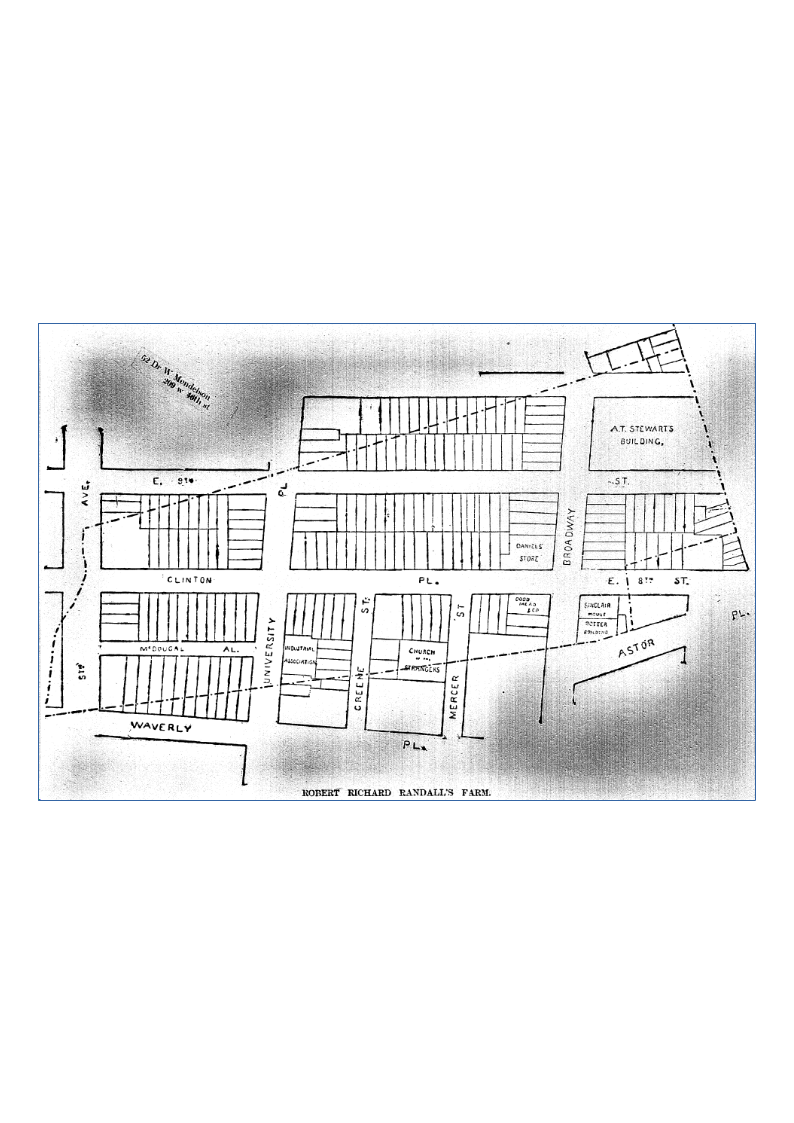
The Randall Farm
One would suppose that the estate bequeathed to these trustees was a truly magnificent one, if it enabled them to maintain in the style described a number of inmates increasing from 33, admitted at the opening of the institution in 1833, to 844, the number now in Snug Harbor. An examination of the property bequeathed must, however, have caused the first trustees to conclude that it would be some time before the income at their disposal would be sufficient to maintain the fifty sailors mentioned in the will as the proper number to start with. The principal property bequeathed to them was the farm of twenty-one acres on which the testator had lived. Anyone leaving New York for a stroll into the rural districts in the year 1800 would after a walk of a mile or so, have come to a pale fence at a point where Broadway and Astor place now meet, and he would, there have found the entrance to Randall’s farm. On the property were a mansion house and stables. This farm was bounded on the north by the property of Henry Brevoort, on the east by what is now Fourth avenue,44 on the south by the Sandy Hill road, a portion of which is now part of Waverly place, and on the west by a run which disappeared many years ago beneath the then newly opened Fifth avenue.45 It was a good farm, however, containing an excellent orchard and market garden, and the prophetic eye of the real estate men of that early day saw that it was a gift not to be despised. The trustees managed the estate at first as executors of Robert Richard Randall, but the frequent changes in their personnel caused inconvenience, and in accord with one of the provisions of the will they applied to the legislature for an act of incorporation, which was granted February 6, 1806. The preamble of this act recites that “the said trustees have represented that the said estate is of considerable value, and if prudently managed will, in time, enable them to erect such hospital.” The facts at the time appeared to warrant the hope, for the reported income from the estate in 1806 was $4,243; eight years later in 1814 it had increased to almost $6,000, and in 1817 it was $6,659.92. The growth of population from 1800 to 1810 had been more than fifty percent, but the war of 1812 caused an actual loss of population, which from 96,373 in 1810 fell to 93,634 in 1816. This accounts for the failure of the income from the farm to increase much between 1814 and 1817. In 1820, however, the population numbered 123,706, and then began that rapid increase which soon caused the estate to advance greatly in value. This began to be so apparent in 1817 that the trustees applied again in that year for legislation permitting them to buy elsewhere less valuable land on which to erect their buildings. The petition was not granted until eleven years later, and during the intervening time the trustees had their hands full in defending their title to the estate, which by that time had clearly become a valuable prize, well worth fighting for. This great law suit largely absorbed the revenue of the estate, and it was not until 1830 that the United States supreme court rendered its decision sustaining the will. In May of the following year the trustees purchased a farm of 130 acres on Staten Island (the present site of the institution) for $10,000, and they subsequently added twenty-one acres with a water privilege at a cost of $6,000. The corner stone was laid in October, 1831, and the institution was opened Aug. 1, 1833.
Rapid Increase In Value
During the ten or twelve years of litigation that prevented the development of the estate, between 1817 and 1830, the population of New York had more than doubled, and by 1855 it had again more than doubled, that is to say, from 93,634 in 1816 it had increased to 515,547 in 1855, and hence it is not remarkable that the income of Snug Harbor estate had increased from $6,659.92 in 1817 to the handsome sum of $75,000 in 1855. As the population has since grown to nearly one and a half millions the advance in income has continued, and it has been further increased by judicious investments of the surplus funds. In 1870 the income of the estate was $127,000; in 1875 it was $262,808.31, of which $248,612.50 was derived from rents, and in 1886 it was $302,643.24, of which $276,196.71 was derived from rents. The annual report for 1886 is dated March 9, 1887, and has just been forwarded to the proper officers. It is as follows:
The annual report of the comptroller of the “Sailors’ Snug Harbor in the city of New York,” showing the receipts and disbursements of the trust, from the 1st day of January to the 31st day of December, 1886; showing also the present state of the funds and an estimate of the income for the year 1887:
| Receipts. | ||
| Balance of cash on hand Dec. 31, 1885 | $24,335 94 | |
| Amount of New York city bonds maturing May 1, 1885 | 54,500 00 | |
| Balance due on P. Whearty’s bond | 8,000 00 | |
| Dividends on Marine bank balance | 4,052 72 | |
| For sundries sold by the governor of the institution for account of the trustees and for the use of the harbor, docks, etc | 3,965 18 | |
| For rents during the year | 276,196 71 | |
| For interest on investments, etc. | 22,481 35 | |
| Disbursements | ||
| Purchase of $100,000 United States 4 percent bonds | $127,781 25 | |
| Improvements and repairs on the institution buildings | 38,216 85 | |
| Expenses of the Institution for maintenance of the inmates, including taxes. | 178,686 22 | |
| Balance of cash Dec. 31, 1886 | 28,847 58 | |
| ____________ | ____________ | |
| $393,581 90 | $393,581 90 | |
| Statement of the Funds | ||
| Buildings and lots obtained by foreclosure of mortgage, etc., at cost | $362,367 74 | |
| Loans on bond and mortgage | 212,500 00 | |
| United States bonds, par value | 150,000 00 | |
| New York city bonds, par value | 50,000 00 | |
| Temporary deposits in trust company | 70,000 00 | |
| Marine bank balance | 20,263 60 | |
| Balance of cash December, 1885 | 28,847 58 | |
| __________ | ||
| $325,092 50 |
New York, December 31, 1886.
THOS, GREENLEAF, Comptroller.
Meager Reports
In 1816, some difficulty having previously been experienced in ascertaining who were the senior members of the Episcopal and Presbyterian churches, the legislature passed an act designating the rector of Trinity church and the minister of the Presbyterian church, then located on Wall street, as the clerical trustees of the corporation, and at the same time it added a clause requiring the trustees to make an annual report to the legislature of the state and the common council of the city of New York. That given above is the report made in obedience to this requirement for the year 1886. These reports appear to grow less explicit from year to year. That for 1875 specified certain buildings from which rent was derived and gave the ground rents in a separate item. The report just made puts all rents under a single head. The report for 1875 showed that there had been paid out for salaries $16,166.64, for wages $10,925, and for supplies $48,175.76; that for the past year lumps all of these items in a single line, “Expenses on the institution for maintenance of the inmates, $178,686.22.” A much more remarkable instance of official reticence is shown in the statement of the property held by the trustees. In the report for 1875 the dwelling houses at 8 and 10 Clinton place were mentioned and valued at $17,774.12; in the last report this item has risen to “buildings and lots obtained by foreclosure of mortgage, etc., at cost, $362,367.74,” and in neither report is any estimate given of the value of the ground in this city from which the trust derives its income, or of that on Staten Island on which the institution is situated. This policy extends to the withholding of a map of the company’s property from the register’s office, and to a general reticence about the extent and value of the property. Mr. Greenleaf, the comptroller of the corporation, positively refused to permit the writer of this article to have a copy of an interesting and curious map of the Randall farm before it was intersected by streets and cut up into building lots. He curtly declared, “It is our private property,” and said that no one outside of the company had any right to see it. It is not presumed that this reticence covers up anything that there is cause for concealing, unless, perhaps, a generous salary list, but it appears to be common to all corporations holding large blocks of real estate in this city. Trinity church,46 for instance, conducts its affairs with such absolute secrecy that even those county officers whose business it is to deal with real estate, are refused a copy of its maps, and no information whatever concerning the source, extent or disposition of the enormous revenue of the corporation can be obtained by any individual. In the interest of honest tax valuations, if for no other reason, the legislature ought to compel public reports and the filing of maps by all such corporations.
Accumulating Wealth
The last annual report shows that the income of the estate exceeded by more than a hundred thousand dollars the expense of maintaining the institution. Included in these expenses are not only the liberal salaries of the governor, chaplain, physician, steward and numerous other officers of Snug Harbor, but the wages of superintendence paid to the people who perform for the property in this city those duties usually undertaken by landowners and their agents in the management of private estates. The blind and confusing annual report of the trustees offers no clew for ascertaining the amount thus allowed, but the style maintained in their elegant offices in Wall street and the air of prosperity attending their servants indicates that such payments are not niggardly, and are sufficient to secure whatever ability is required for the successful management of a great property. Yet, despite such liberal expenditure, there is a steady and rapid increase in the company’s property outside of and beyond its original real estate. The annual report for 1875 showed such property amounting in value to $279,449.93, but the report for 1886 showed that this species of property owned by the trustees had advanced in value to $893,978.92. As a corporation of this kind can have no object in accumulating property beyond what is necessary to yield an income sufficient to discharge its trust, the presumption is that such increase arises through mere necessity of the case, and that the inevitable tendency of land ownership is to bring about enormous aggregations of wealth. To this tendency, rather than to the possession of any unusual sagacity on the part of their possessors must probably be attributed the tremendous increase of values in the Astor, Rhinelander and other great estates.
Another obvious inference to be drawn from the great and ever increasing surplus of the Snug Harbor estate is that seafaring men are a notably thrifty class. It is true that this has not been the general opinion, but it appears that in this, as in many other matters, common opinion is wrong. How can it be otherwise when we find that, with such a delightful home as Snug Harbor open to all sailors who have seen five years of service under the American flag, a sufficient number do not apply for admission to absorb the current income of an estate devoted to that purpose; for, of course, the trustees would not keep any out with a view to increasing the capital at their disposal. That would be a breach of their trust.
The Lease System
The system of leases by which the trustees of the Sailors’ Snug Harbor rent their lands is simple, and inures in the long run to the benefit of the lessors. The leases usually run for twenty-one years, and they stipulated, before the property was all covered, the character of the building to be erected. They generally contain a clause providing for renewal for a like term at their expiration, but at a new rental based on a valuation of the land made at the time of such renewal. In case of disagreement between the lessor and lessee, provision is made for a separate valuation of the land and the building by disinterested parties, and if the lessee refuses to pay the rent thus fixed upon he must surrender his building to the trustees at the valuation placed upon it by the arbitrators. Furthermore, if a lessee defaults on interest or taxes, which latter he obligates himself to pay, he, after a stipulated time, forfeits his lease, and his building is only worth to him what it will bring at a forced sale, which is substantially whatever the trustees choose to offer. It would seem that in these ways considerably over $300,000 worth of buildings have passed into possession of the trustees within the past ten years. The estate is therefore constantly becoming richer, not only by the increased value of the bare ground, but by this falling of buildings into the company’s possession. So far as the trustees are concerned, they do not pretend to do anything to add to the value of the estate. Their policy is the safe and conservative one of ground rents, and hence the growth of land values through the pressure of population is admirably shown in this case. The fact that this increase is devoted to a worthy and generous public purpose only makes it more clear that the diversion of the unearned increment to public purposes in all cases would have an enormous influence for good, while the existence of such magnificent stores as the Stewart building and many others is a conclusive refutation of the theory that the public taxation of land values to an extent that would destroy speculative values would prove a bar to the erection of handsome and permanent buildings. The tenants of the Snug Harbor not only pay ground rents that increase enormously with each renewal, but they pay all the city and other taxes on the property they occupy, and yet the estate has been steadily improved and the temporary set back given it a few years ago through the removal of retail business uptown has already been recovered to an extent that promises further building operations.
Values And Population
That the increase in land values is due solely to the pressure of population is absolutely demonstrated in the case of this property. In 1790 the population of New York was but 33,131, and Mr. Randall obtained his twenty-one acres as a country seat at rural land prices. In 1800 the population had risen to 60,489, and when he came to make his will, a year later, it was seen that the property was likely to become valuable. The extent of the rise in value was not imagined, however, since it was the original intention to build the Snug Harbor on the farm itself. The relation between increase in population and the rise in the value of land after that time is shown as follows:
| Population | Income from Estate | |||
| 1805 75,770 | 1806 $ 4,343 00 | |||
| 1816 93,634 | 1817 6,659 92 | |||
| 1855 515,547 | 1855 75,000 00 | |||
| 1870 942,292 | 1870 127,000 00 | |||
| 1875 1,646,037 | 1875 262,808 31 | |||
| 1880 1,296,590 | 1880 No report discoverable |
|||
| 1886 (estimate) 1,500,000 | 1886 302,643 24 |
These figures cover the eighty-one years that have elapsed since the growth of the city northward began to add to the prospective urban value of the Randall farm. During that time the population of the city has grown twenty times as great as it was in 1805, but the income of the Randall farm has become more than seventy times as great during the same period. Nor is this all. The system of leasing adopted by the trustees does not permit the estate to feel so quickly the result of this pressure of population as it is felt by property privately owned. There are doubtless today numerous leases having from five to ten years to run that will be renewed at a great increase in rent at their expiration, and that could be renewed now at a large increase if the property were for any reason thrown on the company’s hands.
New York below Forty-second street covers 3,905 acres, which are, on an average, as valuable as the twenty-one acres on the Randall farm. Some of this area is owned by Trinity church and other large corporations or estates, but most of it is in private hands. It is not likely that its owners fail to get from it at least as high ground rent as is obtained under the Snug Harbor long lease system. It is 186 times as great as the Randall farm, and the ground rents derived from the remainder of this area, taking Snug Harbor’s last year’s receipts of $298,127.50 as a basis, would amount to $55,058,587. Here, after making all conceivable allowance for the unselfish good that the possessors of Trinity and other such estates would have us believe that they do with their money, is the evidence that private individuals are able to levy for their own use and benefit an annual tax of over $50,000,000 a year on the 813,076 people who occupy that portion of Manhattan island. They gather this tax not as hire for buildings erected by their enterprise, not in return for any service they have rendered to the public, and not, as do the Snug Harbor trustees, for any object of benevolence and public benefit, but they obtain this money as their reward for possessing land that over 800,000 people must use on almost any terms, and they spend it solely for their own gratification.
This illustrates the manner in which rent sucks the life out of a community, appropriating the fruits of labor and the interest of capital while rendering no return, depriving men in their prime of the just returns of their toil, and neglecting to make for them, when they become worn out, such provision as enjoyed by the old sailors at Snug Harbor, who, if they were engaged in the carrying trade of this port, did do something to add to that growth of land values of which they are now reaping the benefit. It is certainly vastly better that more than eight hundred old tars, who have in their time done their full share of the world’s work, shall thus enjoy the benefit of the rise in value of Robert Richard Randall’s twenty acre farm than that a few heirs, their successors and assigns, should live in luxurious idleness by means of the privilege of taxing for its use those who have given that land a value that has increased its capacity to yield income more than seventy fold in four score years.
What Snug Harbor Demonstrates
This hasty, and necessarily imperfect, study of the history of one of the many farms since covered by New York, demonstrates the folly of the existing system of land tenure and gives us a glimpse of the blessings attainable from the ownership of land by the people as a whole. Here we find a little farm, lying on the outskirts of the city fourscore years ago that was then worth less than many a potato patch or cabbage garden of equal area on Long Island is worth today. It fell, almost by accident, into the hands of trustees, whose duty it became to maintain the property intact and nurse its revenues for a specific purpose. They did not fertilize it or cultivate it. No use of the ground for agricultural purposes would have ever made it capable of supporting eight, much less eight hundred, men in comfort and idleness. Neither did the trustees attempt to increase its value by building on it or otherwise rendering it suitable for human habitation. It was the commonality of the city of New York, to use the expressive phrase of the city charter, who laid out the present streets, build beneath them the sewers necessary to health in a dense population, brought to the city pure water, lighted the streets and paid the police to preserve order. It was the whole people, acting through their municipality, that thus wrought the direct improvement necessary to make the Randall farm a compactly built portion of a great city. Again, it was the private activity and enterprise of these same people that caused the growth of business and crowding of population which brought the farm in demand for residential purposes.
Lastly, it was the private capital and labor of these same people that built the dwellings on the property, the builders paying roundly for the privilege. At no stage of this growth did the trustees need to so much as raise a finger to promote the increase in the value of the land committed to their control. All they needed to do was to hold on. The city was bound to grow northward, and it must grow over the Randall farm. The trustees were in a position to block the way of that growth unless their terms were complied with. For not interposing such an obstacle; for consenting that the whole people should make their land valuable and that private individuals should, by their labor and capital, adapt it to human use, these trustees were enabled to demand the rents that now yield a splendid revenue beyond their power to spend in the discharge of their trust. In thus playing the dog in the manger and levying blackmail on the labor and capital of the whole people, to which, as trustees, they contributed nothing, these men but fulfilled their trust and obeyed the law. They deserve praise not blame for their conduct, and no one can censure the thousands of private owners of land who followed the same course, reaped where they had not sown and ate bread earned in the sweat of the faces of other men. It was the law and custom, and appeared, both to the oppressor and the oppressed, to be the natural order of affairs, as unquestionable and as fixed as then appeared the right of a white man to own a “nigger.” Had the law been different; had the whole of taxation for municipal purposes been laid on land values, and had such tax been increased so as to appropriate the continued increase in land values for the benefit of the people who caused it, we should not perhaps have had this single institution for the benefit of the small and ever decreasing class, but we should have had something far better – the fairest and stateliest city on earth, dotted with parks, intersected by perfectly paved streets, connected with the main land by tunnels and with Long Island by numerous bridges, spreading over miles and miles of the adjacent country, and closely knit together by a perfect system of street transportation, owned and operated by the people for the public comfort and convenience. No private greed would have suggested the erection of vile tenement houses to be crowded to suffocation by miserable creatures, and no such abject poverty as now curses our people would have dragged down human beings into a willingness to occupy habitations unfit for dogs.
No debt of millions would now press upon the people occupying the territory over which the city would have grown, and though human nature might not have been changed, we may, at least, believe that a prosperous people, occupying individual homes and filled with a sense of a share in the common ownership of the soil on which they lived, would have been more public spirited and virtuous than a population partly scattered beyond the limits of their city and largely made up of those condemned to live in abject poverty amidst the most degrading surroundings.
That the money to make such a city was easily obtainable is perfectly manifest from a study of the growth in value of the Randall farm. The people who built upon and occupied that land paid not merely a ground rent, averaging five percent on the valuations of the land at the time the lease was made, but they paid all of the city and state taxes on the property in addition. Had the whole of this gone to the public, to whom alone the increase in values was attributable, it would have been over seven percent on the value, a tax which it appears that the tenants found themselves able to pay. Taking the Snug Harbor ground rents as a basis for calculation, it is seen that, omitting the revenues of that and all other charitable institutions, over fifty millions of dollars is paid annually for the use of the ground on this island below Forty-second street, and probably nearly as much is obtained for the use far greater area north of that street. Be this as it may, a tax on land values that would be sufficient to appropriate their gradual increase to public use would certainly yield something more than fifty millions annually, and perhaps as much as seventy-five or one hundred millions. In either event the receipts would be ample for the expenses of government, paving, etc., leaving a surplus for improvement that would pay for a Brooklyn bridge in a single year, and lay car tracks on every street where they are needed, or accomplish any other desirable improvement. If the sum reached the larger figure many other desirable things might be accomplished.
Would People Build?
But, it is constantly asked, would people build on land practically owned by the public. To this it would be a sufficient answer that people will build themselves as comfortable homes as they can afford on almost any tenure that will assure them possession during the ordinary length of time in which a man expects to remain engaged in a profitable business. But the Snug Harbor experience is a practical answer to the query. None of the older portions of the city of New York is better built upon than the Randall farm. It is occupied by vastly better buildings than the properties immediately north and south of it. Any man who wanted to erect a house for himself could arrange to build it on the estate without spending money for a site for his dwelling. He was assured possession for twenty-one years, with an understanding that, if he would agree to an advance in rent at the time, based on the increased value of land, irrespective of the value of his house, he should have a renewal of the lease for twenty-one years more. On these terms men were glad, forty or fifty years ago, to build substantial houses. The tenure was not in any way more secure than it would be under a system that established practical public ownership of the soil by levying a sufficient tax on land values. In the latter case the tenure would be perpetual, provided the tax were paid, without any fear that a satisfactory agreement could not be made at the end of twenty-one years. It is true that the revaluation would be more frequent, and probably from year to year; but this would subject the builder of the house to no risk that he does not now run. The increased assessments could only come on the value of the lot, while he is now, under the Snug Harbor leases, bound to meet the taxes on such annual assessments on both the house and lot. The question is one of fact, not argument. Stewart’s up town store, the costly building at Broadway and Astor place, and the handsome residences on North Washington square, afford sufficient evidence that just as grand buildings are erected on leased ground as on land owned in fee, and, the land under the system here advocated, would not be leased ground, but land held in fee, and subject to a tax sufficiently high to give to the people the publicly created values now absorbed by individuals.
Land Values and Labor
The effect on labor of the constant expenditure in improvements of the public revenue derived from the ground rents and of the activity in building assured by the inevitable spreading the existing population over the unused ground now held in the grasp of speculation, will be manifest to all who will let their minds dwell upon it.
The growth in values of Randall’s farm not only gives us a hint of the revenues that would thus be made available for public use and benefit, but the disposition of the Snug Harbor funds suggests a method of disposing of any surplus over and above that needed for public works. Every civilized state now recognizes its obligation to see to it that the old and infirm shall, if necessary, be cared for at the public expense. The conditions under which such aid has been extended have, however, been made such by the ruling class that its acceptance carries with it a disgrace often more dreaded than death by starvation. Yet men are not, under the circumstances, chary of receiving pensions. The United States government pays out millions annually to the soldiers in the late war, not one of whom feels any disgrace in accepting what has been awarded him. He has done the nation a service, for which his pension is, in part, the reward. Again, the inmates of Sailors’ Snug Harbor do not account themselves as in any way humiliated by the acceptance of the bounty that the hand of a dead man gathers from a considerable number of the present generation of New Yorkers and freely hands over to them. They are no paupers, but the heirs to a great landed estate sufficient to provide them with all of the necessities of life. Have they not, too, through years of perilous toil rendered the state some service? Should the state of the future conclude to thus pension to the extent of its ability all who had reached a certain age, or fallen wounded or sick in the battle of life, why might not the shame-bearing word “alms” disappear from our legal vocabulary and such people accept pensions without loss of self-respect? What would become of the labor problem in a community where constant activity provided abundant work for all able-bodied men, where access to natural opportunities elsewhere took away all incentive to overcrowding, and where the old and the infirm were honorable pensioners upon a well filled public treasury, it is not difficult to imagine. The question is not, however, left to the imagination to settle. The labor problem of the world would be somewhat like the labor problem in Snug Harbor. Enterprising men would still become employers, as enterprising sailors now do there. The certainty of a market, the necessity of supervision or other causes would still make it profitable for many men to work for these employers, so long as the latter did not exact too much in return for their enterprise, sagacity or skill. If such extortion were attempted workmen would drop off from such employers to work for themselves, the most intelligent and skillful being naturally the first to leave, since they would be the men best able to set up in business for themselves, or to adapt themselves to the use of opportunities open to them elsewhere. On the other hand, if men demanded so much wages as to leave to the employer no compensation for his capital, sagacity or skill, he would go to work himself rather than yield. Thus the bargain of industry would be made fairly between equals, and not between an employer on one side who aims starvation as a weapon at the heads of the other parties to the bargain, while these others hold in reserve a threat to stop work which cannot, under existing conditions, be made good unless ultimately backed up by at least the suggestion of lawless violence. In short, Snug Harbor, while it is the outgrowth of a vicious system of topsy turvy political economy, which disinherits God’s children of God’s earth, and gives rule over many a fair and populous province to the mere whim of men whose eyes closed in death while such places were yet a wilderness, nevertheless is full of suggestions of a better condition of society, in which there shall be neither master nor slave, landlord nor tenant, where God’s will shall at last be done on earth, and his disinherited children, restored to their patrimony, grow up into a race worth Christ’s dying for — a race living joyously in a fair and fruitful land, in which the hopes and heroism of high patriotism shall be justified and Liberty’s dream of the ages be fulfilled.
The Randall Farm
The eloquence and logic of Dr. McGlynn’s recent address at the Academy of Music,47 and perhaps also the number and enthusiasm of his hearers, caused a profound impression on at least one of the papers that have hitherto attempted to ignore the great cause in behalf of which the orator asked his audience to take up “the cross of a new crusade.” That paper48 acknowledges that the “address is entitled to rank with those great orations which, at critical times and from the mouths of men of genius, have swayed the course of public opinion and changed the outward movement of nations.” After such a declaration and in the face of such a speech, animated by the loftiest Christian feeling, the attempt to stigmatize the doctrine of the land for the people as immoral was necessarily abandoned, but the journal in question attempted, in a patronizing way, to show that the money necessary to accomplish the objects sought could not be obtained through the taxation of land to its full rental value. The argument put forth is that the annual expenditures of our city government “are about $32,000,000, while the aggregate value of all the real estate within the city limits, improvements included, is $1,257,275,903. Deducting only half of this amount for the value of improvements, which is much too little, there remains $628,637,951, and a rental of even four percent of this sum, which would be more than could be obtained by the city government, would be only $25,145,518, or nearly $7,000,000 less than we now obtain.”
It is certainly a great step forward to have thus had the cant and moral false pretense of the opponents of reform in taxation brushed aside and the discussion transformed to the economic aspects of the measures proposed. But in this, the first attempt in this direction, the unfairness that has marked the advocacy of the existing conditions in the earlier stages of the discussion is still displayed. No one having the slightest knowledge of the taxing system imagines for a moment that the figures of the assessment above quoted represent the selling value of the land and buildings within the city limits. On the contrary, it is universally acknowledged that the assessment does not aim to include more than sixty percent of such value. The figures given above are, therefore, intentionally misleading, and if all of the other assumptions in the calculation quoted were admitted, the corrected figures would give a total value of $1,760,186,264. The half of this would be $880,093,132, and a tax of four percent on this would yield $35,203,725, bringing in a handsome surplus over the present expenditures as stated. Thus the argument absolutely fails the moment that one of the false premises on which it is based is corrected. But this is by no means the only false premise in the quoted statement. Not only is it a notorious fact that the assessment is designed to cover but sixty percent of the selling value of improved property, but it is equally well known that the assessment is proportionately much lower on unimproved lots, and hence in any attempt to make it the basis for a valuation of the bare land within the city limits, it is a gross error to assume that the buildings are equal in value to the land, or even nearly equal. Again, the assumption that four percent is the highest rental value that could be obtained by a great and growing city from the ground included within it is mere guess work, and entirely without foundation in fact. Few if any ground rents are now fixed at so low a rate, and yet occupants of property thus leased pay this rent to private claimants, and, in addition, pay to the public the full taxation imposed by the city on the land and also on the buildings that they have erected on it.49
What Randall’s Farm Rents Demonstrates
This is not a matter of mere argument or opinion. The old Randall farm, owned by Sailor’s Snug Harbor, described and illustrated in the last number of The Standard,50 is in the heart of this city. It contains property valuable for business purposes on and adjacent to Broadway, and other property available for private residences and boarding houses. It is a fairly representative tract of the city. Its ground on Broadway will not for rent anything like the sum easily attainable for Broadway property down town, or even for property on the same street between Fourteenth and Thirtieth streets. Its land occupied by the handsome residences on Fifth avenue and Washington square cannot be compared in value with land further up Fifth avenue, while the remainder of the land, occupied by less pretentious dwellings and small stores, certainly does not yield rents equal to the average for all that portion of the city lying below Forty-second street. This is no assumption resting on guess work, but an obvious fact that will be admitted by every honest man whose avocation makes him familiar with real estate values. This estate, as has already been shown, has increased in rental value more than seventy fold during a period occupied in increasing our population to twenty times the number it had when the growth of the town toward the Randall farm began. It has been shown that this tract occupies but the one hundred and eighty-sixth part of the area of the city below Forty-second street, and that its owners, starting with practically nothing but the bare ground, have, in eighty years, been able to establish and support an extensive home for sailors, acquire many of the buildings erected by others on these lands, create a surplus of nearly a million dollars, and bring their rent roll up to $276,196.71 in 1886, and to estimate an increase to more than $300,000 for the present year. It is furthermore shown that this splendid revenue has been derived solely from ground rents until quite a recent date, and that such additions to it as have since been made arise from a surplus accumulated through ground rents.
A Hundred Millions A Year
No better basis than this can be found for making a moderate estimate of the rental value of bare land in New York city. Of course, in many cases the owner of the ground also owns the building. In no such case, however, does the selling value of the bare land fail to become an important factor in fixing the rent, while the shorter leases in such cases enable the owner to tax the increase in value more frequently than is possible under the long Snug Harbor leases. It is therefore certain that such owners obtain a higher ground rent than is yielded to the trustees of the Sailors’ Snug Harbor by the five percent paid to them on valuations of their land made every twenty-one years. The estimate based on their experience must therefore fall short of the total amount of ground rents derived by private individuals, estates and corporations from the possession of the soil of New York city. Taking, then, as the basis for such calculation, the actual rents from the Randall farm for 1886 and omitting all other income, it is clear that the ground rents for that portion of this city south of Forty-second street were at least, for that year 186 times $276,191.71, or $51,072,588, or, taking the whole revenue as a basis, over $55,000,000. This is no guess work, but a safe and moderate calculation based on actual business experience. For reasons already given it is manifest that this is much below the amount for the whole of that area. It is therefore clear a ground rent on the bare land of the lower half of Manhattan island can and does yield to somebody more than $50,000,000 a year, an amount to be increased for the present year (1887), according to the Snug Harbor estimates, to $55,451,715. But large as are these figures they fail to indicate what it is possible for the city to derive from a tax that shall appropriate to public use the full rental value of land. The people who paid the sums to the Snug Harbor trustees as a five percent rent on the values of the Randall farm, also paid the city taxes amounting to about half as much more. It is therefore evident that the city and the owners together are able to obtain fully $75,000,000 out of the land of this island below Forty-second street; and it is certainly a moderate estimate that the land above that street would, if thus taxed to its full rental value, yield half as much more, and thus give to the public $100,000,000 a year, $32,000,000 of which is now taken by the city and $68,000,000 by private individuals. However great an allowance may be made for a reduction of rental values through the stimulus given to building by the encouragement given to the use of land now held vacant, the necessary remainder will still be great enough to show how absurd is an estimate of $25,000,000 as the full ground rent of this city, while actual experience shows how erroneous is the declaration that four percent is the maximum that the city could levy as a land tax.
Future Increase of Revenue
The advocates of the land for the people doctrine are not, however, to confine themselves to the consideration of present land values. There is not a land speculator in New York who does not know that the marvelously rapid rise in these land values in the past is sure to continue in the future. So certain is this that millions of dollars have been unhesitatingly staked upon it. The income from the Randall farm has increased more than seventy fold during the past eighty years. The testimony of the late Edward H. Ludlow, recently quoted in The Standard,51 showed that the gross value of the land of this city had increased more than a thousand millions of dollars during his lifetime. The total income of the Snug Harbor estate has increased over one hundred and thirty-eight percent during the past sixteen years, and the last annual report of the trustees contains an estimate of income for the present year showing that the increase in rents for 1887 over that of 1886 will be more than 7½ percent, a ratio but little below that of the past sixteen years. If so much can thus be done under private ownership, how much more can be done when the vast revenue derived from the land shall be expended in public improvements and in other additions to the comfort and attractiveness of city life? “Cold arithmetic,” so far from playing havoc with the attractive picture drawn by Dr. McGlynn in his address on “The Cross of a New Crusade,”52 fortifies all of his statements, and opens up a vista that even enthusiasts may well hesitate to attempt to describe.
How the System Works
The history of the Randall farm answers most of the queries propounded by the ignorant and incredulous as to the practical working of the proposed system of land taxation. It proves that men will not only build upon and improve property not their own, but that they will contract in advance to pay rental, in time, on the increased values created by themselves and others, and to surrender at an appraised price the improvements that they have themselves made. Here is a copy of a clause that appears in the Snug Harbor leases:
It is hereby mutually covenanted and agreed, that if, at the expiration of the term hereby granted the said parties hereto shall agree upon a renewal of this lease for a further term of twenty-one years, and shall by mutual consent fix upon the annual ground rent to be reserved in such renewed lease, then the said parties of the first part, their successors or assigns, shall and will execute to the said party of the second part his executors, administrators or assigns, at his or their expense, a new lease of the aforesaid premises for the further term of twenty-one years, and after the expiration of the term hereby granted at the annual ground rent, payable half yearly, agreed upon between the said parties aforesaid. But if, at the expiration of the term hereby granted, the said parties shall not agree upon a renewal of this lease or upon the amount of the rent to be reserved for such renewed term, then each party shall choose a disinterested person, who shall be the owner, in fee simple, of one or more lots of land in the neighborhood of the premises hereby demised, and the said persons so chosen shall under oath appraise the land hereby demised, considering it as a vacant lot at its full and fair worth at private sale, and they shall also under oath appraise the building now erected on the said lot or any other building of like description as its substitute, which shall cover the whole front of such lot, be constructed of brick or stone, two or more stories high, and covered with slate or metal, with its front finished in such style as may be approved of by said parties of the first part, their successors or assigns, at its then actual worth, without reference to the ground on which it stands; and in case the said appraisers shall differ in their valuation or appraisement, either of the lot or building, they shall then choose an umpire qualified as aforesaid, whose decision under oath shall be final and conclusive, and the said parties of the first part, their successors or assigns, shall have the full liberty and choice either to pay to the said party of the second part, his executors, administrators or assigns, the value of the said building, so determined as aforesaid, or to grant a renewal of this lease unto the said party of the second part, his executors, administrators or assigns, at an annual ground RENT OF FIVE PERCENT on the value of the said lot, so determined as aforesaid. And it is further mutually covenanted and agreed that at the expiration of each and every term which may be thereafter granted by each and every subsequent renewal of this lease, the said parties of the first part, their successors or assigns, shall still have and retain the full liberty and choice either to grant a further renewal for the further term of twenty-one years, at such annual rent, payable half yearly, as shall be ascertained and determined in the manner aforesaid, or to pay unto the said party of the second part, his executors, administrators or assigns, the value of the said building or its substitute, to be ascertained as aforesaid. And it is further mutually covenanted and agreed by and between the parties aforesaid that whenever the said parties of the first part, their successors or assigns, shall refuse to grant a renewal of this lease as aforesaid the said building or its substitute shall be valued and paid for as aforesaid.
Provided, always, that the said party of the second part, his executors, administrators or assigns, shall not be compelled to surrender the premises until such payment be made as intended.
The party of the second part to pay and discharge all duties, taxes and assessments during the term hereby granted.
Thus it appears that numbers of people have been found willing to agree to erect houses of a style prescribed by the lessors, paying for the ground a rental of five percent on its value at private sale and giving the lessor at the expiration of the lease full liberty either to take their buildings at an appraised value or to renew the lease at five percent on the value of ground at the time of such renewal. This is a conclusive answer to one of the objections most frequently urged against the proposal to concentrate all taxation on land values. The tenure of land under such a system would be much more secure than it is under the Snug Harbor leases, which give the lessee an assurance of but twenty-one years’ possession, and obligate him to surrender his building at an appraised value if the trustees demand it, even though the tenant be willing to pay the increased rent. Under the system of taxing land values advocated by the united labor party of New York the occupant would have full liberty of choice as to whether he would pay the increased tax or sell his building (probably at its appraised value) to some one else, and so long as he chose to pay the tax he would hold the land, not on any twenty-one years’ lease, but in fee,53 by a right perpetual and transferable. Again, when rental values shall have been fully ascertained under the new system it is not likely that the increase in taxes will be any more rapid than it has, under the existing system, been on this Randall farm, all of which increase has been met by the tenants and not by the owners of the property. It is folly, then, in the face of such an experience to say that the levying of all taxation on land values would prevent building.
The Increase In Rents54
The rapid increase in the total income from the Randall farm has already been shown. A few examples taken at random from the recorded leases in the register’s office will show how this has affected individual properties during the past forty or fifty years. A plan showing the size and location of each lot referred to is herewith given. The first is a lot 25 by 92 feet, situated on the south side of Tenth street, 100 feet from Broadway.55
This lot was leased May 1, 1844, to Asher Kursheedt for twenty-one years at $200 per year. The same lot was leased May 1, 1865, to John Thornley for twenty-one years at $500 a year, and at the expiration of that term it was leased again on May 1, 1886, to Jefferson M. Levy for twenty-one years at $650 a year.
The next lot is on the south side of Ninth street near University place.56
It was leased May 1, 1844, to Charles B. Hatch for twenty-one years at $175 a year. Leased again May 1, 1865, to Alexander Van Rensselaer for twenty-one years at $400 a year, and again on May 1, 1886, to Louisa Van Rensselaer for twenty-one years at $500 a year.
The next lot is in the same block, a few doors east of the one last described.57
This was leased May 1, 1844, to Barzilla Deming for twenty-one years at $175 a year; on May 1, 1865, to Hiram Geer, executor of Margaret Geer, deceased, for twenty-one years at $400 per year, and in May 1, 1886, to Sarah A. De Venny for twenty-one years at $500 a year.
The next lot is at the corner of Clinton place and University place.58
It was leased May 1, 1835, to Edgar Jenkins for seventeen years at $168.50 a year; on Nov. 1, 1852, to Morgan L. Smith for twenty-one years at $300 a year, and on Nov. 1, 1873, to the same for twenty-one years at $750 a year.
The next lease is that of a lot on the south side of Ninth street.59
It was leased May 1, 1833, to Gordon Burnham for twenty-one years at $100 a year; on May 1, 1854, to Ross W. Wood for twenty-one years at $200 a year, and on May 1, 1875, to the same for $500 a year.
The next property is on University place.60
It was leased Nov. 1, 1841, for thirteen and a half years to Anson Baker for $72 a year; on May 1, 1855, to the same for twenty-one years at $600 a year.
The next lot is on the north side of Ninth street, near Broadway.61
It was leased May 1, 1855, to Marcius S. Hutton for twenty-one years at $200 a year, and again leased to him May 1, 1876, for twenty-one years at $500 a year.
The next lot is on Clinton place, near University place.62
It was leased May 1, 1855, to Ann Bunker for twenty-one years at $200 a year, and again on May 25, 1885, to Albertina Matthews and Caroline Homer for eleven years eleven months and five days at $500 a year.
These leases are representative of the less valuable property of the estate, and do not include any property on Broadway or Washington square. They show that the rental value of the land has tripled during the past forty or forty-five years, the increase varying with the location. In a few instances the same person has held through a twenty-one years’ lease and made a renewal, but usually death or some other cause has prevented this. It appears, however, that no serious difficulties have been encountered in such cases in making transfers, since the property was taken at the expiration of the lease at as high a rental as was paid by those who held on through a period of twenty-one years and then renewed the lease.
On Broadway the advance in rents, through not proportionately so great, reaches figures that enable one to understand the enormous growth in the income of the estate. The block bounded by Ninth and Tenth streets, Broadway and Fourth avenue, was leased to A. T. Stewart63 on May 1, 1869, for twenty-one years, with the privilege of renewal, at an annual rent of $12,000 for the first four years, and at an annual rent of $36,000 for the remaining seventeen years. At the time this negotiation began there were some twenty odd leases of lots on this block made to divers persons from 1848 to 1852, yielding to the trustees an aggregate rent of $5,220.64 Mr. Stewart bought these leases up and surrendered them to the trustees, and then received a lease for the whole block on the terms stated. The trustees, it will be seen, did nothing, but the tenant rendered an enormous service to the estate and agreed to a great increase of rent for the mere privilege of occupying the bare ground.
A lot one hundred feet deep, having a front of twenty-five feet on Broadway, was leased in May, 1850, to James Blackstock for twenty-one years at $275 per annum, and this lease was renewed May 1, 1871, for twenty-one years at an annual rent of $3,700.
The lot at the southeast corner of Broadway and Ninth street, having a front of 23 feet 4 inches on Broadway and of 93 feet 11 inches on Ninth street (now occupied by Fredericks, the photographer), was leased Nov. 1, 1852, to George P. Parker for twenty-one years at an annual rental of $600. It was again leased Nov. 1, 1873, to Elizabeth M. Campbell, administratrix of George P. Parker, for twenty-one years at a rent of $3,500 a year.
A lot 100 feet deep, with a front of 23 feet, on the east side of Broadway, above Eighth street, was leased in May, 1850, to Samuel R. Johnson at an annual rent of $225, and the lease was renewed on May 1, 1871, at a rent of $3,250 a year. Large as the increase on the rental of the ground occupied by Stewart’s store appears, it was not proportionately so great as the increase of rent on these small lots, on which rent advanced tenfold in twenty-one years.
Buildings On The Property
New Yorkers are familiar with the many conspicuous buildings on the Snug Harbor tract, but readers outside of the city will be interested in knowing that some of the finest buildings in the city have been erected on this old farm, on which the bare ground of a single lot, 25×100 feet, now rents for more than a fair-sized farm devoted to agricultural purposes and improved by buildings. On Broadway, occupying the whole block from that street to Fourth avenue, and from Ninth to Tenth streets, stands the great iron building erected by A. T. Stewart, and still commonly known as “Stewart’s up-town store.”65 A block below, on Broadway, stands the Sinclair house, a well known hotel, and adjoining it is the handsome and costly building owned by Mr. Potter and occupied as a large clothing house. Opposite the Sinclair house is the handsome building erected by the Snug Harbor trustees and occupied by Dodd, Mead & Co., the publishers. On the same side of Broadway are the well known retail dry-goods houses of Daniels & Son and Kaughran & Co. On Waverly place, between University place and Fifth avenue (known as North Washington square), stands a solid and handsome row of dwelling houses, in what was some years ago the most fashionable residential part of New York, and which is still one of the most desirable and costly places of residence in the city.66 On the Fifth avenue front of the Randall farm stands the famous Brevoort house. The Church of the Strangers on Mercer street, half a block from the New York hotel, stands on the property, as does also the building on University place formerly occupied by the Union Theological seminary. Clinton place (Eighth street) and Ninth street, from Broadway to Fifth avenue, run through the property, and are lined with dwelling houses from three to four stories in height and very largely used as boarding houses. In fact, this little farm now has a population of thousands, and in numbers, business activity and in the style of buildings surpasses many of the smaller cities of the country. Not a foot of this land has ever been sold to any of the occupants who have covered it with fine buildings, and, of course, no such sale can be made. Had this unearned increment gone to the people who created it, not only in this but in all cases, this city would have been burdened with no debt, no taxation could have been borne by its inhabitants beyond an amount equal to that which they have paid as rents to private individuals and the activity and enterprise of the metropolis would have made it not only the greatest city, but the most comfortable place of residence on the continent.
how this increase in values is brought about
The increase in the value of the Randall farm has been manifestly brought about solely by the pressure of population, supplemented by the labor and capital of the tenants. There is not as much as a peg on which to hang a doubt in the case. An old man about to die, some eighty years ago, was in doubt as to what disposal he should make of his property. He accepted the suggestion of his counsel that he should devote its income to the maintenance of disabled seamen. He named as his executors and trustees a number of men occupying positions to which they were appointed without any thought that they would be thus associated in the control of this property. Many of them are men having no claim to special sagacity in business or to any peculiar fitness for the management of real estate. The claim of prescience or shrewdness often set up in behalf of private owners of land cannot be made here. All that these men had to do was maintain their grip on twenty-one acres of Manhattan island and wait for the community to do the rest. They made no outlay on the property. They opened no streets, graded no lots, built no sewers, paid for no light or water. All of that, by the terms of every lease, they made their tenants obligate themselves to do. The owners of the property built no houses on the land. That also was done by the tenants. As soon as these tenants had built so many as ten houses every remaining vacant lot on the Randall farm had an increased rental value, which went, not to the builders of the houses, but to the owners of the land. Without ceasing, though varying from time to time, this increase has gone on, and the estimates for the coming year show that it is still going on. The people who cause it do not obtain one cent of the increase in rental value of this land. It all goes to the trustees, who make no pretense of doing anything to bring it about, and through them, ultimately, it goes to the sailors who are so comfortably taken care of down at Snug Harbor. It would be difficult to find a more perfect illustration of how the whole community causes the increase in land values, or one more fully demonstrating how a few landowners, who render no service whatever in return, absorb the whole of such increase. In this case the revenue thus obtained is devoted to a charitable purpose. But this is but the one hundred and eighty-sixth part of Manhattan island below Forty-second street. From the vast remainder of the area now included within the city limits thousands of private land owners, who, as such, render no service to the community, draw yearly tens of millions of dollars of income from values created by the whole community, just as existing values of the Randall farm have been created by the community. Every consideration of justice, equity and social progress demands that this process shall be stopped, and the advocates of the new system, so far from being subject to the reproach of a immoral attack on the rights of property, may justly claim that they are the only people having the sagacity to perceive and the courage to oppose the continuance of a system that enables a favored class to appropriate that which it has no hand in bringing into existence, and to rob others of the fruits of their labor. The injustice that has been done cannot now be undone, but every delay that greed or ignorance is able to interpose to the recovery by the people of that increase in values, which they are still creating from day to day, is a crime against the most sacred rights of property and a blow at the rights, the happiness, the freedom and the prosperity of generations yet unborn.
No. 14. The Collegiate Church and the Shoemaker’s Field
William T. Croasdale
First printed in The Standard, April 23, 1887, p. 1: “THE SHOEMAKER’S FIELD.”. About 50% of the tract’s text is the same as there.
67 William T. Croasdale
The Collegiate Church
The Protestant Reformed Dutch church of New York is, as its name indicates, an offshoot of the Protestant Reformed church of Holland. The name Protestant was given to followers of Luther in 1529, when six princes of the German empire formally protested against the decrees of the diet of Spires. Later on doctrinal disputes arose among Protestants, many differing from Luther concerning the “real presence” at the Lord’s supper. Those who agreed with the Protestant leader became known as Lutherans and the churches rejecting his views called themselves “Reformed.” The Lutherans were largely confined to Germany, and the “Reformed” churches of France, Switzerland, Germany, Scotland and Holland fraternized. They not only agreed in their views as to the Lord’s supper, but accepted the Presbyterian form of church government – that is, government by presbyters, bishops as a separate order of the clergy not being recognized. After the settlement of New York by the Dutch a branch of their national church was naturally the first established here.
The present Dutch Reformed church in the city dates back to 1628,
when the Lord’s supper was first administered here to fifty communicants
by Rev. Jonas Michaelius; but religious meetings had been held before
that date in a large room over a “horse mill” or a “water mill” –
accounts vary – built by Francois Molemaker in 1626. The religious
services were conducted by the zienkentroosters (comforters of the
sick), who came over with the earliest colonists. In 1633 the first
dominie, Everardus Exodus, came over with Governor Wonter Van Twiller,
whereupon a plain wooden building was erected on the banks of the East
river, near what is now Old slip68, in which the
emigrants continued to worship until 1642. The Dutchmen appeared quite
well satisfied with this primitive structure until the famous navigator,
David Peterson De Vries, called the attention of Governor Kieft to the
marked contrast between this “old barn” and the New England meeting
houses. The pride of the Dutch burghers was thus aroused, and they set
up about building a new stone church, at a cost of 2,500 guilders,
which, for the sake of safety, they placed within the fort (now the
Battery). They occupied this building until they gave it up to the
British as a garrison chapel in 1693. The Dutch in that year opened
their new church in Garden street (now Exchange place).69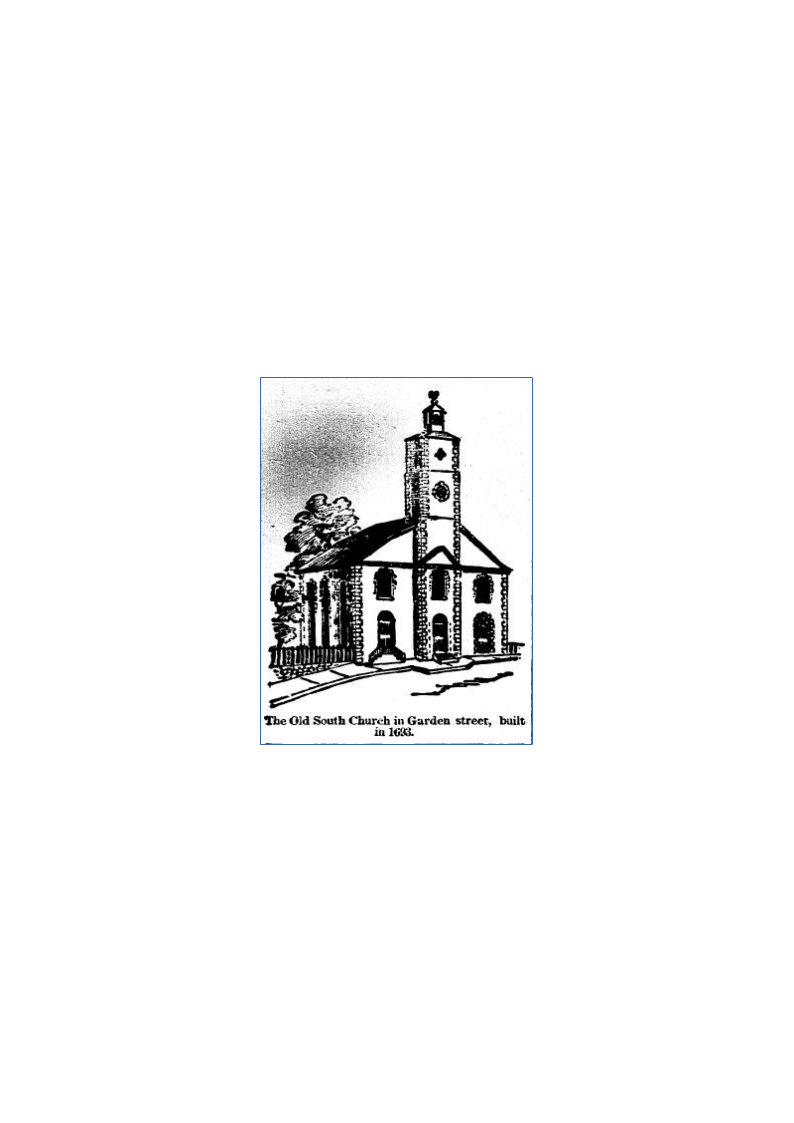 A register of the members of
this church, with their residences, is still extant, from which it
appears that Wall street was then the most northerly thoroughfare of the
city. The church was quite a simple, but substantial, structure and cost
64,178 guilders or $27,671.
In July, 1726, a lot of ground on Nassau street was bought from David
Johnson for £575 as a site for a new church. This building was opened in
1729. It stood on Nassau street, between Cedar and Liberty.70 It was altered and its seating
capacity increased by the erection of galleries in 1704. It was used for
worship until 1844, when it was leased to the United States for a post
office, and in 1861 it was sold to the Mutual life insurance company,
which tore down the church to make way for the magnificent building now
occupying the site.71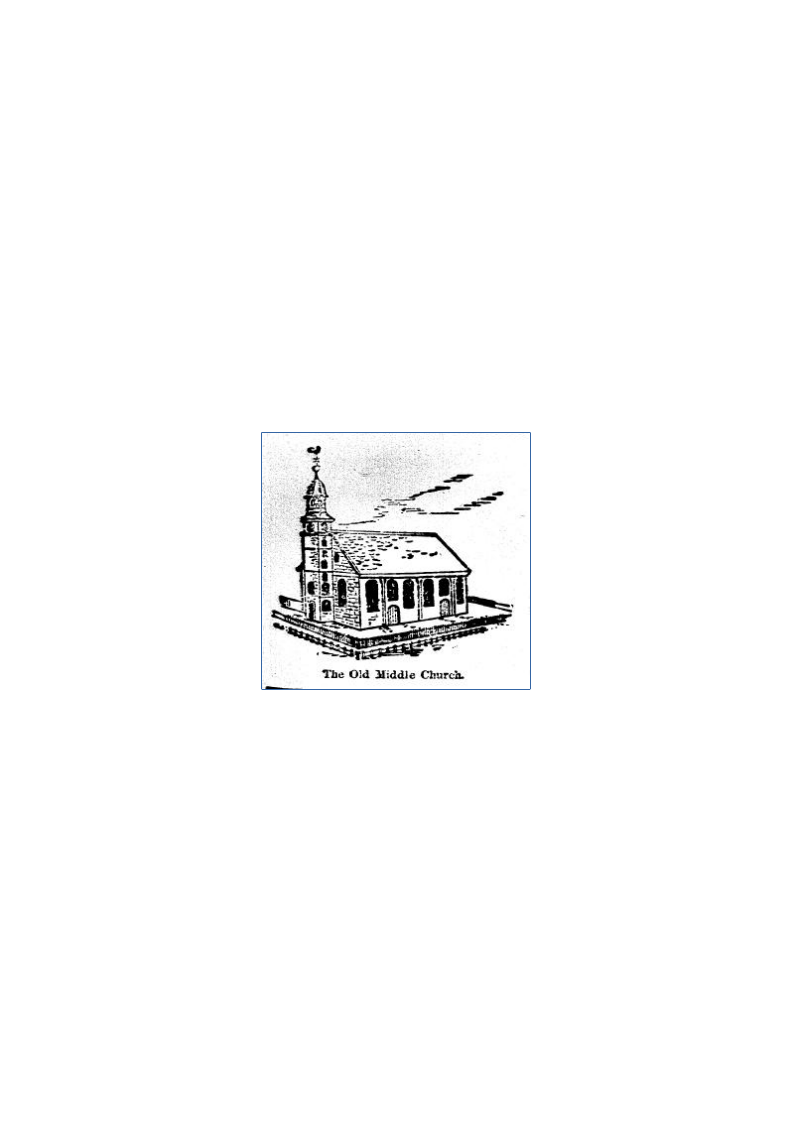 In time this came to be known as
the Old Middle Dutch church. A picture of the structure as it appeared
when first erected was struck off and dedicated to the Hon. Rip Van
Dam.
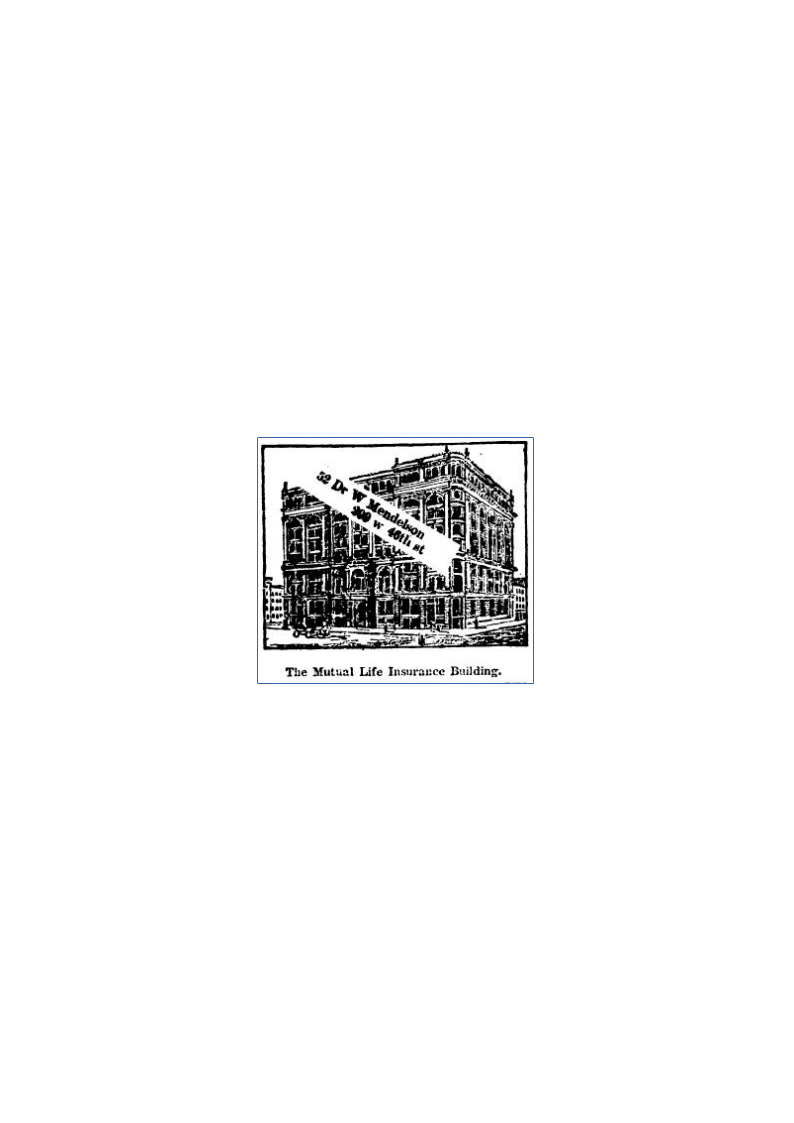
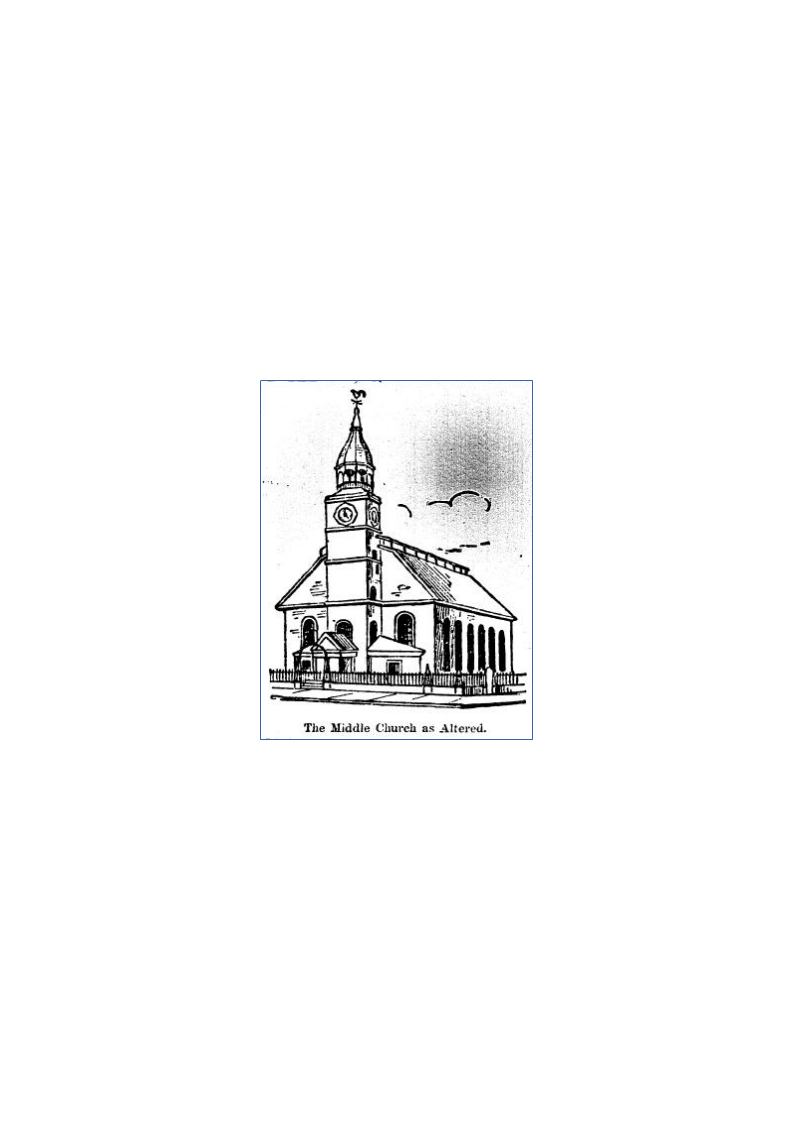 The accompanying picture of the
Mutual Life insurance building, now occupying the site of the old Nassau
street church, will give to our readers outside of New York some idea of
the business structures in this portion of the city.
After long and bitter opposition from the older members, preaching in English in this church was first permitted in 1763, and the result was a growth in the attendance that caused the alterations already alluded to. After these were completed the appearance of the church was materially changed.
The church in time became crowded, and in 1767 measures were taken for erecting a new building. In June of that year it was resolved that “the church should be erected on the ground of Mr. Harpending; that it should be 100 feet in length and 70 in breadth; that it should front Horse and Cart lane, and be placed in the middle of the lot.” In accordance with this resolution the church was built on the corner of William street (then Horse and Cart lane), and Fulton street.72 It was a handsome structure, costing $30,000. Its cornerstone was laid July 2, 1767, and it was dedicated May 25, 1769.
This was, at the time of its erection, one of the handsomest churches
in the city, its only rival being St. Paul’s, the Episcopal church
(still standing on lower Broadway),73 which was opened for
worship in 1766. The site of St. Paul’s was then described as “in the
fields,” and crop of grain was raised upon it the year before ground was
broken for the building. The population was rapidly growing, however,
having advanced from 10,881 in 1786 to 21,863 in 1771. As growth in New
York has necessarily ever been, northward, the consistory74
of the Dutch church also felt encouraged to go as far north as Fulton
street in choosing a site for their new structure. It became known as
the North church, that on Nassau street being called the Middle and that
on Garden street the South church.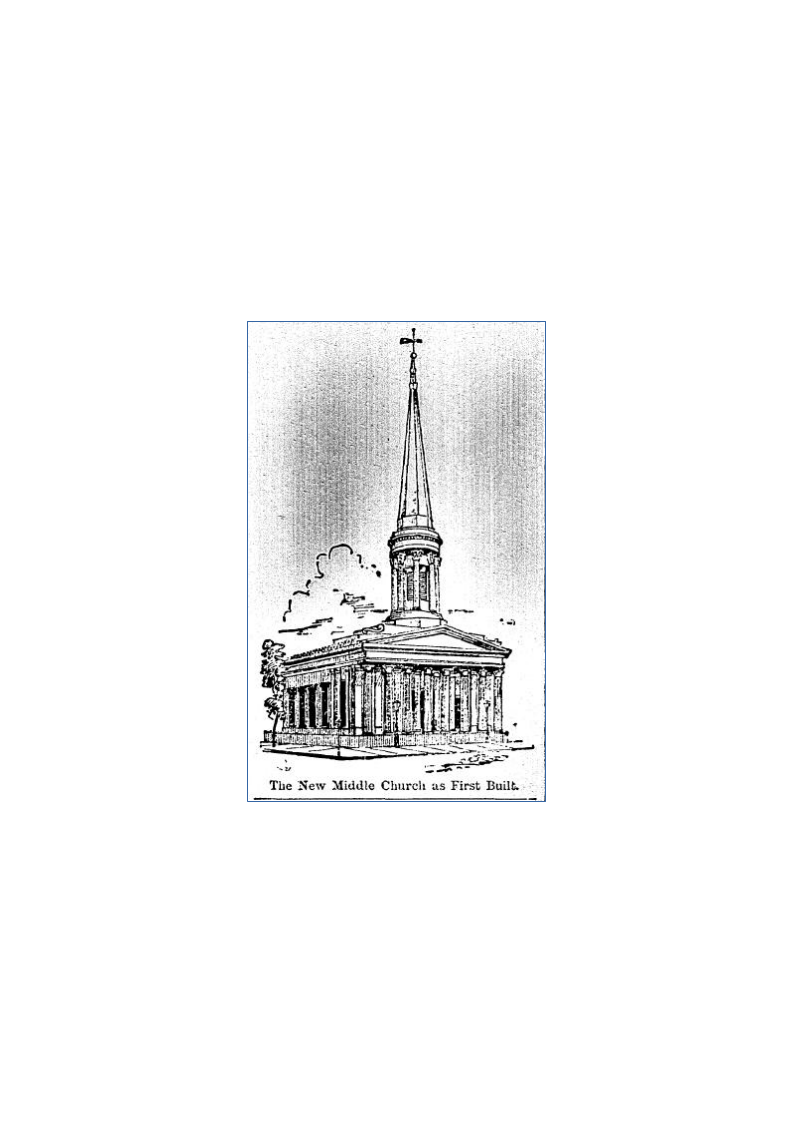
During the revolutionary war most of the communicants of the Dutch church fled from the city on its occupation by the British, and the North and Middle churches were occupied as stables or barracks by the troops. After the war services were resumed in the old Garden street church until the impoverished people could raise funds to put the other churches in order. In course of time this was done, and services were resumed in all. In 1807 the old Garden street structure was taken down and a new one erected on its site, which was occupied until it was burned in the great fire of 1835.
The North church was the only Dutch Reformed church left down town after the Middle church was turned into a post office in 1844. In 1856 it was closed for a number of weeks for extensive repairs, and was reopened on the last Sunday in August of that year, when Rev. Thomas de Witt, D.D., preached a sermon, which he gave a historical sketch of the church, and referred to the change of circumstances that had gradually driven the congregation up town. “Still,” he said, “a large population of another description and of a more fluctuating character, is found, and will remain in this vicinity, to whom the ‘Gospel which is preached to the poor’ should be ministered. For this purpose the consistory of this church have resolved to preserve this edifice and renovate its appearance, in order that the means of grace may be dispensed within its walls in time to come.” It seems, however, that in course of time the consistory found “that gospel which is preached to”75 the rich more in their line, and in 1875, 106 years after its dedication, the venerable structure was pulled down and the site leased for business purposes. A reminder of the old church remains, however, in the Fulton street prayer meeting, begun in the church in 1857, and still continued in a chapel on the second floor of the business building erected on the site.
In 1813 there was a distinct congregation formed in Garden street, leaving the Middle and North churches under the direction of the original church corporation, now familiarly called the Collegiate church. As population was forced up town this separate congregation divided into two, one body building a handsome church at Fifth avenue and Twenty-first street, and the other a church fronting on Washington square and adjoining the university. The corporate church also felt the need of a house of worship further up town, and in 1836 it purchased a building already erected on Ninth street, a little east of Broadway, on the Snug Harbor estate, and occupying a portion of the present site of Stewart’s store. Meanwhile lots were bought on which to erect a handsome new church at the corner of Fourth street and Lafayette place.76 The cornerstone was laid Nov. 9, 1836, and the church was dedicated May 9, 1839. It was built of granite and was adorned with twelve Ionic columns, each a monolith. When first erected it had a tall steeple.
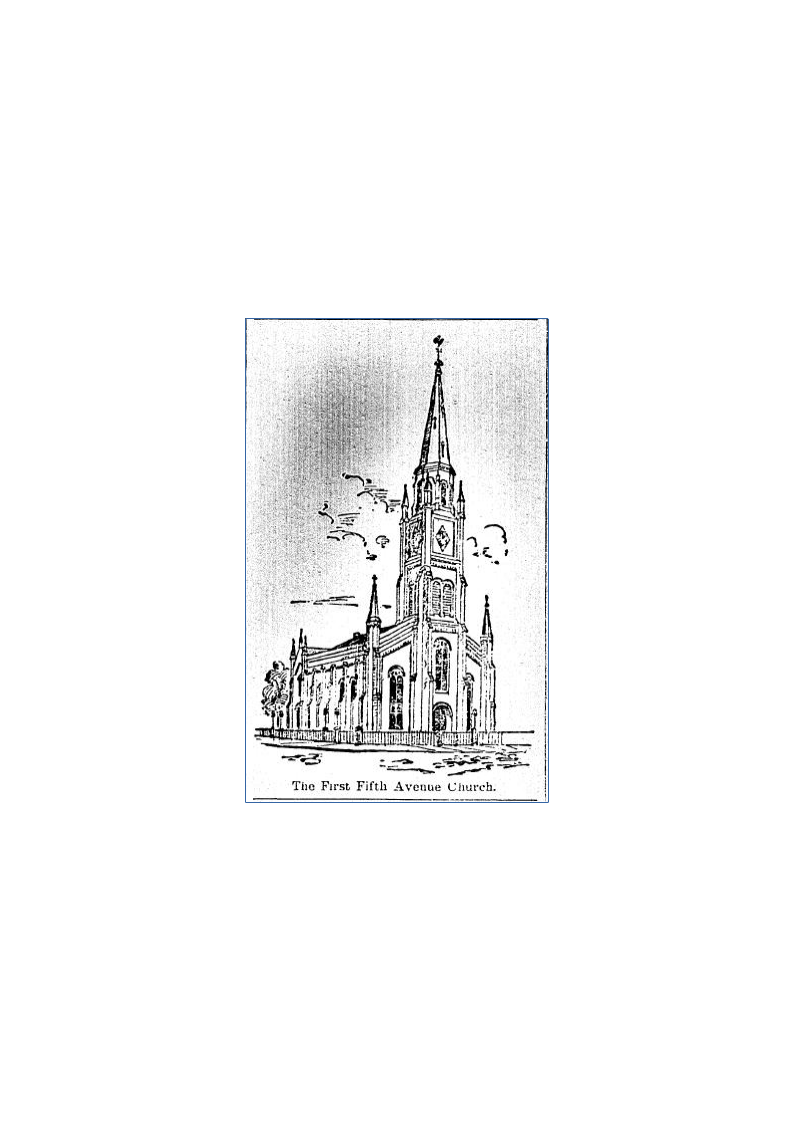 The steeple was inconsistent with
the style of architecture and it was after a few years taken down, after
which the building resembled a Greek temple, and it was until quite
recently one of the finest examples of the Greek style in the city. A
few weeks ago workmen began demolishing the church. The great monolithic
columns, each of which weighed fifty tons and cost $2,000, were offered
by the contractor to any one who would take them away; but no one
appeared to want them, and they were finally thrown down, all but one of
them breaking to pieces in their fall. On the site of the church the
consistory is to put up a large six-story brick building for
manufacturing purposes, which has already been rented, in advance of its
erection, at $12,500 a year for ten years. When this church was built it
was regarded as the center of a thriving suburban neighborhood; but the
northward rush of population continued, and when the old Middle church
was leased to the United States government in 1844 it was already plain
that a church still further up town would have to be erected.
Lots were accordingly procured at Fifth avenue and Twenty-ninth street77, and the corner stone of a new building was laid Nov. 26, 1851, and the church was dedicated Oct. 11, 1854.
This was the most magnificent structure yet erected by the consistory, and on its completion the old church on Ninth street was abandoned. The new church was built of white marble, in the Romanesque style. It fronts Fifth avenue and is 82 feet in width by 113 in depth. At its rear and fronting on Twenty- ninth street is a lecture room 34 by 82. The top of its spire is 215 feet from the ground.
The pressure of population northward still continued, and in 1857 ground at the corner of Forty-eighth street and Fifth avenue was purchased from Columbia college upon which a lecture room was at first erected. In July, 1869, the cornerstone of a new church was laid, but the building was not dedicated until November, 1872. The material is Newark sandstone, and the style of architecture the decorated Gothic of the fourteenth century. It has a front of 70 feet on Fifth avenue and 100 feet on Forty-eighth street. It is a handsome building, in the very center of wealth and fashion, and, it is needless to say, has a wealthy and fashionable congregation.
In addition to these churches the original church corporation has erected chapels at 160 West Twenty-ninth street, on Ninth avenue above Thirty-eighth street, at Seventh avenue and Fifty-fourth street (which has since become an independent church), and the chapel already mentioned within the new business building erected on the site of the old North church at Fulton and William streets. In addition to these chapels the church maintains a school at 160 West Twenty-ninth street, an institution that has recently celebrated its 250th anniversary.
On December 31, 1885, the number of communicants of the three associated churches and the three chapels was 1,669. The Seventh avenue chapel had become a separate congregation, known as Grace Reformed church, during the year, the consistory giving the congregation the church building rent free and guaranteeing it $2,000 a year for three years toward its expenses. This seems to have been the policy toward numerous other independent churches that have grown out of the original church. Such aid is also apparently extended to some independent churches closely allied to the Dutch church in faith and discipline, as the Year Book of 1886 casually mentions the Holland church on West Eleventh street as a “small band of believers, who have been continuously aided by the consistory from the beginning of their enterprise.”
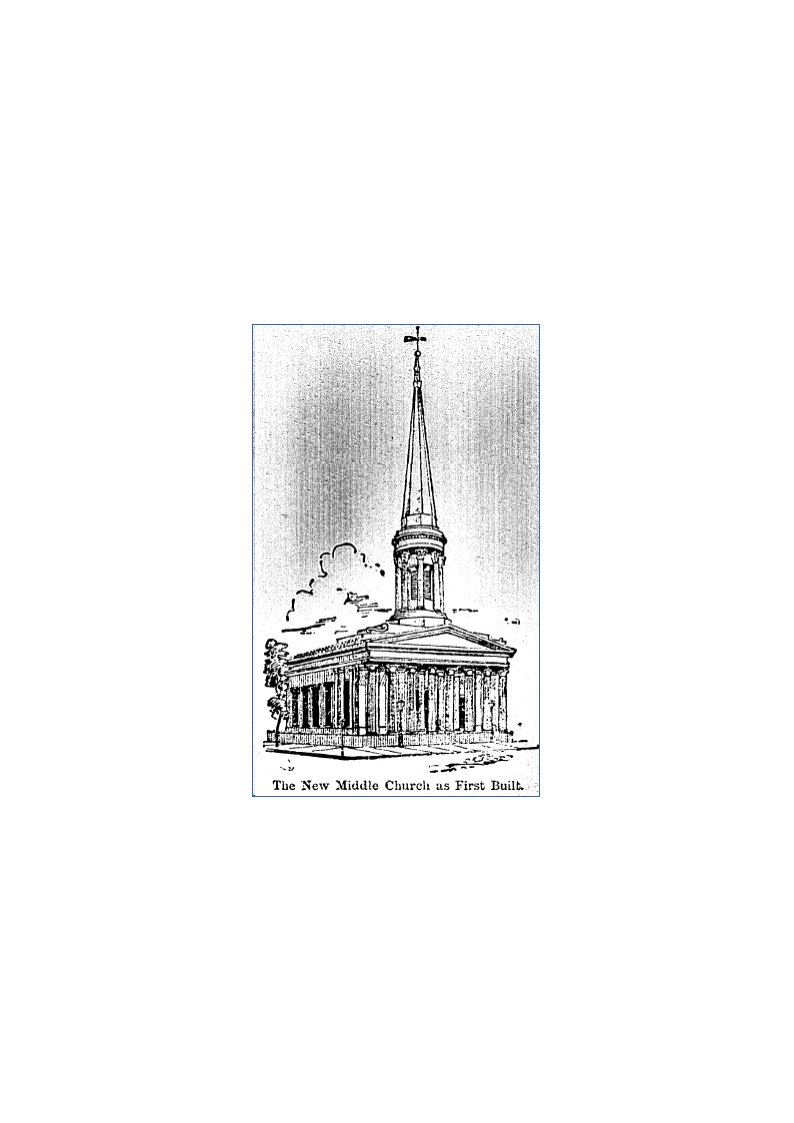 A statement of the work of
the board of deacons for the year 1885 begins thus: “The collegiate
church still finds, as she has done in all past periods of her history,
the truth of the Savior’s words, ‘The poor ye have always with you,’ and
for them she makes constant provision.” The large promise apparently
made in this magniloquent sentence is, however, straightway modified by
the announcement that it is the province of the board of deacons “to
assist only those who are members of our church in full communion,
connected with one of our three associated churches, or with either of
our three associated churches, or with either of the three chapels.” The
report goes on to describe the system for thus giving aid, and states
that the board depends for funds for this purpose on the monthly
offerings of the congregations. These offerings during the year 1885
amounted to $3,615.61. “Consequently,” says the report, “the amount
given to each beneficiary can be but small, and is generally not more
than sufficient to pay a modest rent in some attic or like unpretending
apartment.” A tenement is probably meant. The monthly average of persons
assisted by the board during the year was twenty-six, and the highest
number in any one month thirty-two. A free bed is maintained in the
Presbyterian hospital, and the poor are buried at the expense of the
church. “The congregations are earnestly desired to continue their
liberal provision” for this work.
Here, then, we have a fair indication of the scope of the work of the Collegiate Dutch Reformed church. Since the destruction of the Lafayette place structure it maintains two fashionable churches on Fifth avenue and three chapels in other parts of the city. It assists other congregations of the same faith. As a corporation it does nothing for the poor, except, perhaps, to bury them. The contributions of the various congregations aggregated $3,617.61 in 1885, or $2.16 from each of 1,669 communicants. This sum suffices to maintain in attics or in charitable institutions an average of thirty-two poor people who are members of the church. For the vast remainder of the hopelessly poor of the city the congregations, as such, do nothing.
That those concerned are proud of this achievement was shown by the elaborate celebration of the quarter-millennial anniversary of the founding of the church, which took place Nov. 21, 1878, in the church at Fifth avenue and Twenty-ninth street. On that occasion addresses were made by Dr. Ormiston and Dr. Vermilye, two of the pastors of the church, and by Drs. Dix, Crosby, Anderson, Tiffany, Storrs and others representing various Protestant denominations, all of whom spoke in highly laudatory language of the oldest religious organization in the city.
The church has apparently always been one whose membership consisted of well-to-do people, and it has steadily followed the migration of such people northward. One stand to preserve a church for the poor seems to have been attempted when the old North church was reopened in 1856, and in his sermon on that occasion Dr. DeWitt appeared to intimate that that edifice would be maintained forever for the benefit of that “large population of another description,” namely, the poor. That the church was originally built for a different class is shown in many ways. The coat of arms of the more aristocratic burghers were, as has already been shown, burned in the window panes or hung upon the walls. Dr. DeWitt, in his sermon already quoted, said that when he first become one of the pastors “the most substantial and fashionable citizens” resided within easy walking distance of the down town churches. Very soon afterward the increase of commerce led to a change, whereupon he says “the more respectable citizens” began moving northward and the church followed them. In his quarter-millennial address, in 1878, Dr. Vermilye exhibited a gold-headed cane, which he boasted had, in commemoration of the event, been given to him by “a Van of the Vans.”78 The doctor also dwelt with manifest satisfaction on the thought that but few churches of the denomination had taken advantage of the act authorizing them to commit their temporalities to a board of trustees, an act which he declared was passed “in courtesy to the popular craving for a share of whatever office or power may exist.” In fact, he declared that under the Dutch system a board of trustees is superfluous, and its absence makes it possible “that a troublesome or unqualified member may be quietly dropped – a great blessing often to pastors, consistories and people.”
It is thus manifest that the congregations of the collegiate church do not belong to the class that needs practice the custom of the New England Christians described by Whittier as –
Churchgoers, fearful of the unseen powers,
But grumbling over palpit tax and pew rent,79
Saving, as shrewd economists, their souls
And winter pork with the least possible outlay
Of salt and sanctity.
Probably no congregations of professing Christians have ever existed in New York better able to meet out of their pockets the material expenses of church maintenance or that expenditure for the gratification of sectarian pride quite common to all denominations, and especially strong in this. It was the contrast between their “old barn” and the New England meeting houses, pointed out to them by the navigator De Vries, that stirred the Dutch to erect their first stone church within the fort; and it is a historical fact that it was to the rivalry between this church and other Protestant denominations that the erection of the first handsome church buildings in New York was due.
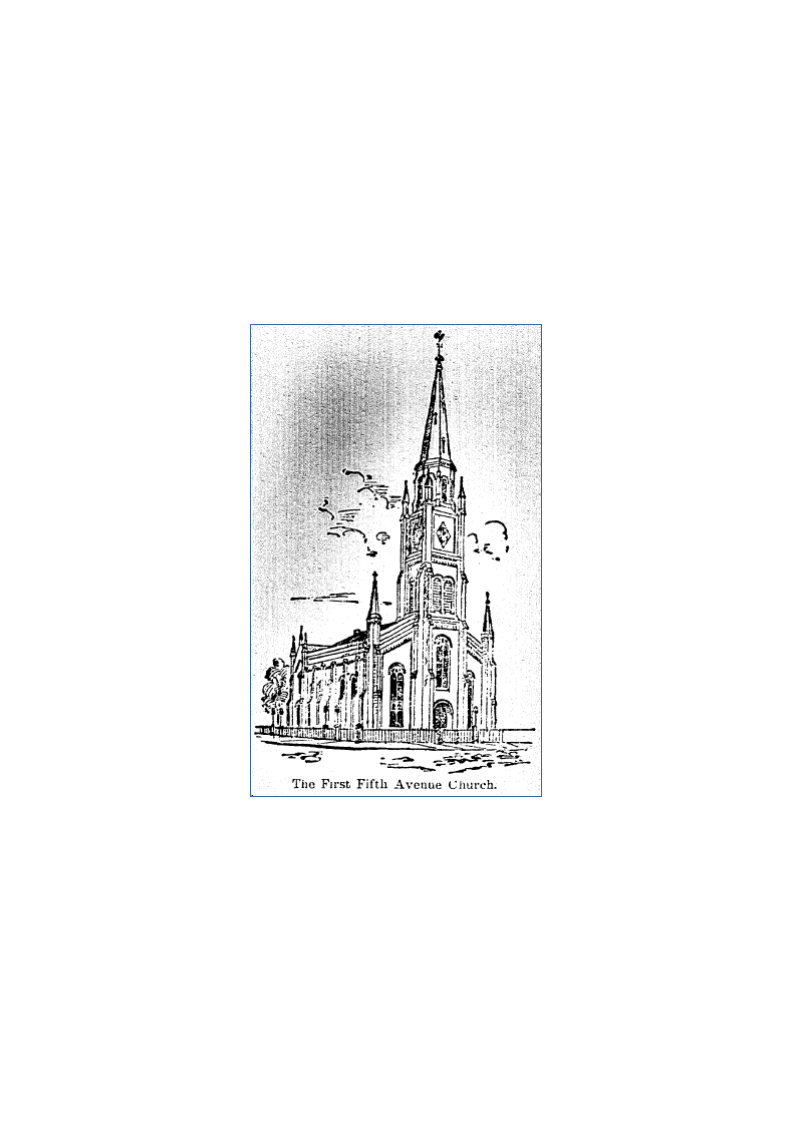 Yet, despite all this, the
Collegiate church has never been supported by the contributions of its
members. The first step after the resolution had been taken to erect a
church in the fort was to apply to the West India company for
assistance, and in 1665 we find the governor authorizing the mayor and
council to raise 1,200 guilders to support the Dutch ministers of the
city. These public donations, however, long ago ceased to be necessary,
for shortly after 1722 the consistory of the church acquired the power
to levy an ever increasing tax on a considerable tract of land in the
heart of the business portion of the city; – a right that it still
continues to exercise, deriving therefrom an income that has enabled it
to pay princely salaries to its ministers, to build the handsome
churches and chapels it now holds and to erect great business buildings,
such as that which will shortly occupy the site of the old Lafayette
place church. What its revenue is no man outside the inner circle of
control can say, but there is no difficulty in showing that its power to
levy a land tax on the sites of business houses on Broadway, Maiden lane
and John, William and Fulton streets80 yield it a yearly
income of probably more than $150,000, to say nothing of the rents it
derives from the church sites that it has given over to secular use, or
the profits it derives from the investment of the proceeds of the sale
of such properties as that now occupied by the Mutual Life insurance
building. This property was sold by the church to the United States
government in 1860 for $200,000. The government sold it to its present
owners in 1882 for $400,000 which was regarded as a price so low that it
subjected those making the sale to severe criticism. The transaction,
however, gives a hint as to the recent appreciation in value of the
large amount of land in that neighborhood held by this old church
organization.
The history of these lands, of their acquisition by the church and of the celebrated lawsuit that ended in leaving them in the possession of the church, is a most interesting one, and it will be given to the readers of The Standard next week. It is sufficient, at present, to say that some of the most wealthy and fashionable congregations in this city obtain “salvation free” through the invalid bequest of a dead shoemaker to a corporation prohibited by law at the time from owning real estate having an annual value of more than £200. These facts have been freely admitted in a court of justice, but the right of taxation thus conferred by a dead shoemaker has been upheld on the ground that, though the church has no actual right to this property, no heir at law to John Harberdinck has ever turned up, and on this basis the rents have been collected and appropriated, splendid churches have been erected and a vast estate has been built up, while in return those who have enjoyed all of these advantages on earth and a greater prospective inheritance in the world to come, have maintained in attics and tenement houses an average of twenty-six poor people at an annual cost of $2.16 per annum to each communicant, while the attempt to preach the gospel to those less respectable people, the poor, has long since been abandoned.
This history recalls vividly the scriptural suggestion as to obstacles encountered by the rich in a heavenward journey, and enforces one interpretation of the ancient belief that there can be no worship without sacrifice. It is not, under the circumstances, remarkable that even those concerned should have a glimmering consciousness that this deadhead parlor car route to the realms of eternal bliss is a limited one, and that congregations ready to support their churches from their own pocketbooks are likely to be more zealous and effective. Such, at least, is the reasonable inference from some remarks in the Year book of 1886 in relation to the erection of the Seventh avenue chapel into a separate and independent congregation. After referring to the various steps taken, the report says: “The pastor states that already the wisdom of organizing Grace Reformed church is demonstrated. It is influencing for good a far larger number of persons than formerly. It is training its members in self-respect and self-denial, as was impossible under the chapel system. It is a far less heavy burden on the society for Christian work. Above all, it is winning souls to Christ whom it could not reach before.”
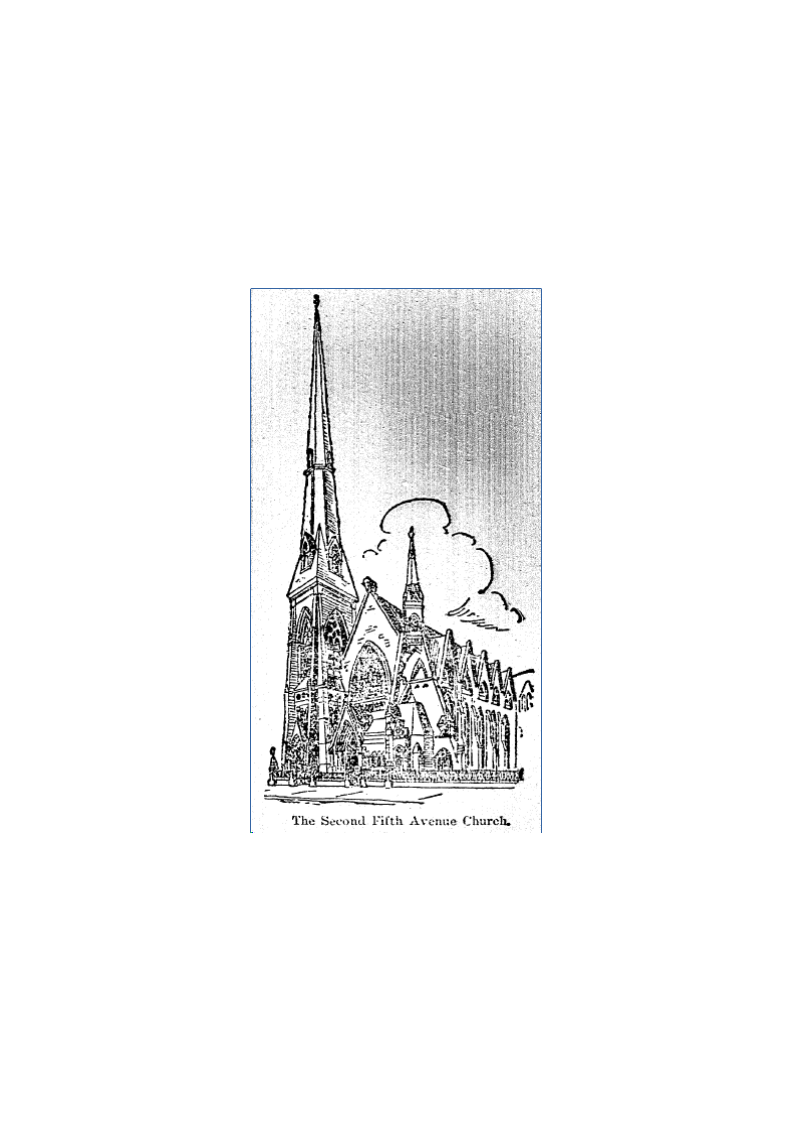 Thus from the official report
of this wealthy church corporation it appears that John Harberdinck’s
bequest was as unwise as it was illegal. The church thus endowed with
the power to tax the land neither preaches the gospel to the poor nor
ministers to their temporal necessities. It cultivates pride, and even
the branches it puts forth find themselves incapable of “winning souls
to Christ” until they shake off the incubus of this wealth and cultivate
the sense of self respect and the capacity for self denial that come
from working for the Lord on their own account instead of leaning on the
unjust power given by an old shoemaker, long since dead, and upheld by a
system of judicial interpretation that awards the surface of God’s earth
to the holder of the most dubious title rather than to the whole people,
to whom it naturally belongs. Should a new system, in course of time,
appropriate these net ground rents to the public use and benefit, it is
clear that the cause of Christianity will in no wise suffer by the
change.
The Shoemaker’s Field.
In the days when New York was regarded as a walled city and its whole population was crowded on the southern point of Manhattan island, certain sanitary reformers objected to the continuance within the city limits of the tan pits81 maintained by a number of shoemakers in the old swamp, which then lay on both sides of what is now Broad street. The result was that the shoemakers were driven to seek a new location beyond the city walls, and in a marshy valley along Maiden’s path, now known as Maiden lane, they obtained some sixteen acres of land, on which they established tan pits, it being the custom at that time for cordwainers or shoemakers to tan their own leather. It appears that the original owners of the land were Conrad Ten Eyck. Jacob Abrahams, John Harpending (or Harberdinck) and Carsten Luersen. There is some confusion as to these Barnes in the early annals, for at the time of the division of the property in 1696 it appears that the owners were John Harberdinck, Heiltje Clopper (described as the widow of one of the original grantees), Charles Lodwick (described as a merchant who had in the year 1694 bought the interest of Hendrick Ten Eyck), Abraham Santvoort (apparently the same man called Jacob Abrahams in the earlier account) and Carsten Luersen.
In 1696 a deed of partition, accompanied by a map, was made and filed, by which it appeared that John Harberdinck (so he signed his name to his will), became the owner of certain lots indicated by shading on the accompanying reproduction of the old map, and also of all the lots on Broadway not included in the shading, now the property of various individuals. This John Harberdinck, or Harpendinck, who was also called John Harpending, speaks of himself in his will as a cordwainer82 and also as a merchant. He is described as “an aged, excellent and influential member of the church, who frequently officiated as elder and deacon.” He was married in this city in 1667, shortly after the transfer of the colony from the Dutch to the English, and he died in 1722 at an advanced age, leaving no children. By a will dated April 22, 1722, John Harberdinck, after giving a number of specific legacies to certain relatives of his own in Holland and also to certain relatives and connections in this country, made the following bequest:
“I, the said John Harberdinck, do hereby give, devise and bequeath unto the said minister, elders and deacons of the Reformed Protestant Dutch church of the city of New York, and their successors forever all that my testator’s right, fifth interest and property to an equal fifth part, share and proportion of all that tract or parcel of land situate, lying and being upon Manhattan island, within the city of New York, called or known by the name of Shoemakers field, or lane, on the northeast side of Maiden lane or path which leads into a certain street called Queen’s street; the which said tract or parcel of land contains, by estimation, about sixteen acres, and by mutual consent, agreement and approbation of all the proprietors or part owners therein concerned some years past was surveyed and laid out into one hundred and sixty-four lots, with convenient streets and lanes to accommodate the same, as may fully and amply appear by a certain instrument of indenture . . . by which . . . it is declared that John Harberdinck’s property share in the said one hundred and sixty-four lots shall be and consist in five and thirty lots, . . . together with four other lots or pieces of ground more out of the five lots mentioned,” lying on Broadway.
All of this property, owned by him at that time, indicated on the accompanying map83 by shaded hues, he devised to the ministers, elders and deacons of the church, and to their successors forever, “immediately after the death and decease of my wife, Mayken Harberdinck, and only to the proper use, benefit and behoof,84 and for the payment and satisfying of the yearly stipend, salary and maintenance of the respective minister or ministers which from time to time and at all times hereafter shall be duly and legally called to the ministry of said church, and to no other use whatsoever. . . . Provided always that it shall not be within the power of the said lawful ministers, elders and deacons,. . . . nor in the power of any other person or persons whatsoever hereafter, to make sale, dispose or alienate any part of the said lands and premises, nor any of the profits, benefits, revenues or advantages arising out of the same to any other use or uses whatsoever, but that the same shall be forever and remain to the only proper use, benefit and behoof as above is recited, declared and expressed.”
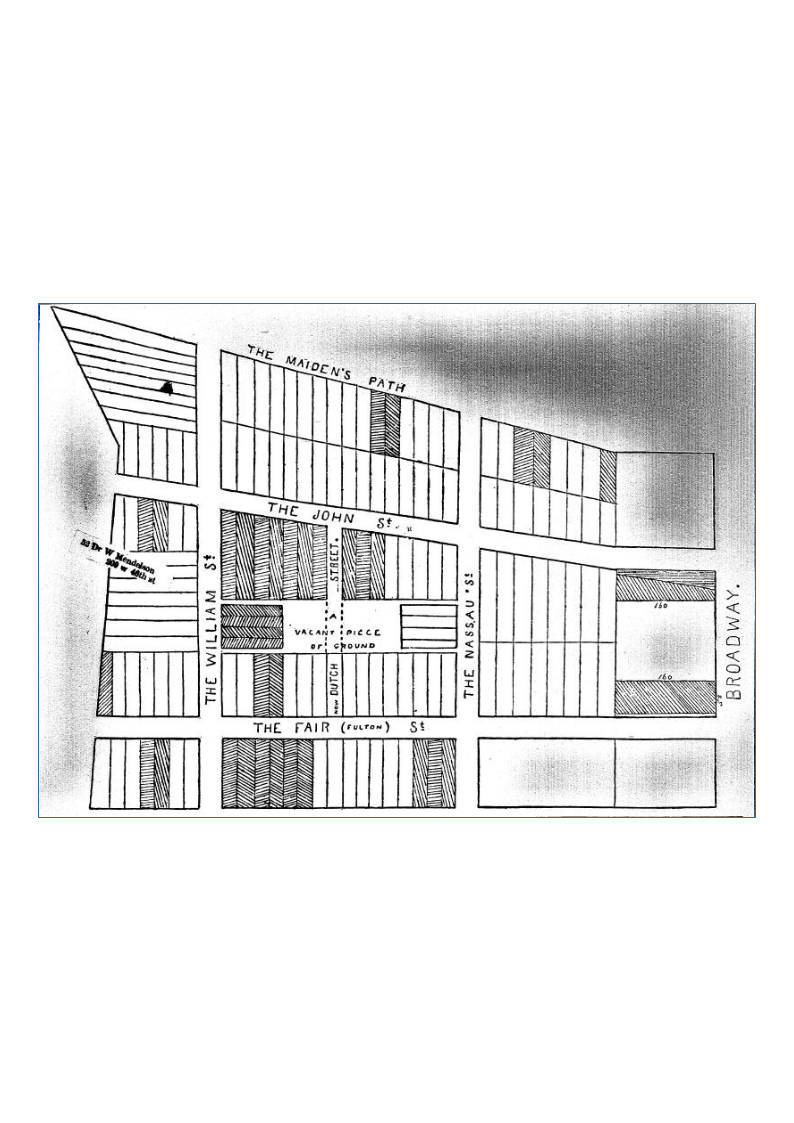
The property thus bequeathed is, as a glance at the map will show, in the very heart of the business portion of lower New York, and it has been the source of the magnificent revenue of the Collegiate Dutch church, the history of which was given in last week’s STANDARD. A liberal construction of the terms of the will would appear to forbid any application of the funds derived from the estate to any other purpose than the payment of ministers’ salaries, and were the fund thus applied the revenue now probably would be sufficient to provide for the support of a hundred Christian ministers in as many parts of the city.
The Reformed Protestant Dutch church of the city of New York was incorporated by letters patent under the great seal of the colony of New York, May 11, 1696, by which the church was then erected and certain lands were granted and confirmed to the corporation, and it was authorized to purchase and hold other lands not exceeding a yearly value of £200. More than half a century ago it became evident to the casual observer that the church was deriving a revenue vastly beyond £200 a year from its property on the old shoemakers field, and one Van Kleeck, a descendant of one of the residuary legatees under John Harberdinck’s will, came forward to question the right of the church to its rich heritage. He demanded that it should be compelled to declare the title by which it claimed to hold these lands, and that it should make an exhibit of its accounts so as to show the sources and extent of its income. The applicant showed that after his bequest to the church John Harberdinck gave the remainder of his estate to his wife, Mayken Harberdinck, for her life, and, after her, to various parties, one fourth of it going to the children of Baltus Van Kleeck, through whom the plaintiff claimed. He further claimed that even if the land described in the deed of partition was legally the property of the church that a certain undivided piece of land between Fulton and John, Nassau and William streets, marked in the map as a vacant lot and declared in the said deed to be still held by the original owners in common, was not included in the bequest to the church.
The case was vigorously contested by able lawyers on both sides, and it reached the court of appeals in 1838. Van Kleeck declared his belief that the lands held by the church at the filing of his affidavit yielded a yearly income of $30,000, and he complained that the officers of the corporation had refused to be sworn. The church apparently made no attempt to defend its legal title to the land in question on any other ground than that of possession. It simply denied that Van Kleeck had any claim to it under the will, and insisted that he could not compel the church corporation to make any disclosure of its title or render any statement of its affairs. The question practically narrowed itself down to this: Admitting that the church has no legal right to these lands, to whom do they fall, the residuary legatee or the heir at law? This was the question argued before the court of appeals, and the final decision of the majority was that the residuary legatee had no claim whatever to the property under the will, and that, therefore, Van Kleeck had no standing in court and was not entitled to compel any disclosure on the part of the trustees.
Chief Justice Nelson read the opinion, and he said: “It is admitted, for the purpose of this decision, that the devise to the church is void, that body being incapable, as the law stood at the time, of taking or holding real property by devise. The question is, ‘Does the property go to the residuary devisees?’” The decision of the court was that, on the contrary, the testator especially excluded them from the property devised, and that the only claimant entitled to dispute the title of the church is the heir at law. Justice Cowan, in a dissenting opinion, said: “Were it necessary to consider the question in respect to the exception of bodies corporate in the statute of devises of Henry VIII the point would not be so clear. This country was, except in the greater amount of unseated land, as much open to the evil of corporate perpetuities, especially those of ecclesiastical concoction, as the country from which we immediately derive our blood, our habits, our laws and our religion. The church has in all ages had agents whose mistaken zeal was ready to turn the dying fears of testators to the purposes of pious testamentary donations. The question, therefore, lay between depriving it of corporate powers altogether or restricting its power of taking by devise, and the latter was adopted. It is a policy, in fact, to this day common both to the English statutes and to our own.”
The statute of devises of Henry VIII alluded to by Justice Cowan is claimed by some to be a part of the law of the land in this country, because it was in force at the time of our separation from England and has never been specifically repealed. It was only one of many statutes enacted from time to time in England to guard against the very abuse referred to by Justice Cowan. Such a devise of land to any body politic, ecclesiastical or lay, was forbidden by statute of Edward I, and the lord of the fee was authorized to take possession of such lands, and in his default it was enacted that such lands should go to the king. In the course of time this provision was extended to all lands purchased for the use of guilds, fraternities and so on. When testamentary power over freehold lands was granted during the reign of Henry VIII, bodies politic and corporate were especially excluded from the benefit of the statute. It is greatly to be regretted that a similar jealousy against surrendering the control of land to an undying corporation in perpetuity has not characterized legislation and legal rulings in the United States. It may, however, turn out in the end that such abuses as have grown up, particularly in this city, will serve a useful purpose of recalling to men’s minds the ancient doctrine and usage which makes the sovereign — that is, in this country, the people — sole owner of the soil. When such a principle comes to be recognized we shall have an end of the doctrine of adverse possession by which the Dutch Reformed and Trinity churches claim and exercise the power to levy enormous taxes for corporate benefit on the land of this island. Then, in the case of a void bequest, like that of John Harberdinck, to a corporation forbidden by law to receive such a bequest, where no man having any legal right as a tenant appears, the paramount lords of the soil, the people, will be awarded the land, the right to possess which is in dispute.
The Reformed Protestant Dutch church of New York possesses a fifth of the old shoemaker’s field by a title that cannot be defended on moral grounds. It puts the revenue from that property, as has been shown in a previous paper, to no public use. It uses its funds to pay aristocratic preachers for ministering in costly churches, built from the revenue of the estate, to rich and fashionable congregations abundantly able to build churches for themselves and to pay for such preaching as suits them. The exact income thus derived and spent it is not possible to state. That it is very great is however beyond dispute. Estimates as to the income derived by the church from the shoemaker’s field property vary from $125,000 to $150,000 a year. In a few instances we have definite facts. The lot having a twenty foot front on Broadway and running one hundred and sixty-two feet ten inches along John street, and indicated on the map, is in some respects undesirable, because the straightening of John street since the original plot was made has greatly narrowed its Broadway front. On May 1, 1886, this lot was leased to Austin Corbin for twenty-one years at $18,000, it being a part of the bargain that Mr. Corbin should within three years erect thereon a brick and stone building to cost at least $200,000. At the end of the twenty-one years, according to the lease, the annual rental value of the ground and the value of the building are to be fixed by arbitrators, and the church may choose whether it will buy the building at the appraised value or renew the lease at the rent thus fixed.
Another lot at Broadway and Fulton street, now occupied by the Evening Post building, was leased to William E. Fleming, George Roll, John Belger and Charles L. Fleming in May, 1865, for twenty-one years at $19,000 a year on condition that the tenants should erect a building thereon, worth at least $50,000. Between the lot thus leased and Fulton street there was a strip four feet eleven inches in width, running the whole length of the lot. Fleming and others transferred their lease to William Cullen Bryant85 and Isaac Henderson on Feb. 27, 1873, and Mr. Bryant transferred his interest to Mr. Henderson on the first of May following. Henderson had, in some way, acquired possession of the narrow strip on Fulton street, and he sold it to the church for $120,000, and the church thereupon leased the whole lot thus enlarged to Henderson for sixty-three years from May 1, 1874, at $31,000 a year for the first twenty-one years, $35,000 a year for the second twenty-one years, and at not less than $35,000 a year for the third twenty-one years. Mr. Henderson thereupon built the present Evening Post building on the lot. Adding to this $31,000 the $18,000 paid by Austin Corbin, it appears that the church receives $49,000 a year in ground rent from its two Broadway lots. It is difficult to estimate its exact receipts from the remaining lots. Four and a half lots appearing on the original plan have since been subdivided into ten lots, yielding the estate $14,000 a year, which would be at the rate of $3,111 for each of the original lots. A lot on William street having a front of 40 feet and a depth of 96 feet, which rented in 1845 for $1,080, was leased again last May for $1,900. A lot fronting on John street 25 feet, leased in 1865 for $700, was again leased last year at $1,100 a year. This is one of the smallest lots on the tract, and doubtless represents the minimum rent. It would be a moderate estimate to put the average rent of each lot at $2,000 a year, or $70,000 for the whole 35. Adding to this the $49,000 received for the two Broadway lots, we have a total income for the church of $119,000 a year from the fifth part of the old swamp granted to the five shoemakers for their tan vats. This calculation leaves out the interest of the church in what was formerly the undivided vacant lot shown on the map, which is now thickly built up. Allowing but $3,000 for this, the annual income is brought up to $122,000 a year.
This, however, is not the whole revenue of the corporation. The lot on which the old post office stood was not a part of the Harberdinck bequest and it was alienable. The church sold it to the federal government for $200,000. It probably sold the site of the old Garden street church and invested the money. The consistory purchased the site of the Lafayette street church when land was cheap in that neighborhood, and now that building has been torn down to make way for a large building for manufacturing purposes on its site which has already been rented in advance of its erection at $12,500 a year. This shows that the income of the estate is growing more rapidly than the consistory can spend it, so that, if no change be made, it will fifty years hence be another one of the rich corporations authorized by absurd laws to levy an enormous land tax on the business people of New York to raise funds for no useful purpose whatever.
But old John Harberdinck only bequeathed a fifth part of the shoemakers field to the Dutch church. The other four-fifths of the property passed to private persons, whose heirs or assigns have from that time to the present derived proportionately as great an income from the estate as has the Dutch church. Leaving the Broadway property out of the calculation we find that the church is drawing at least $73,000 a year in ground rent from its other lots. The total rent then obtained by all the owners from that portion of the old field is $305,000 a year. That is to say, a number of land owners are permitted by law to levy a tax of $1,000 a day on the limited number of people doing business on that small spot.
But though recent maps leave out the Broadway lots in indicating the Shoemaker’s field, there appears to be no reason for doing so. Broadway is given in the old maps as the western boundary of the tract. The original deed of partition, as recorded in the register’s office, distinctly mentions all of the Broadway lots as included in the sixteen acres and assigns them to John Harberdinck. They extended along Broadway from Maiden lane a sufficient distance beyond Fulton street to include the Knox building. The two lots bequeathed to the church do not include a tenth part of the Broadway front. The remainder of it, though now owned by various individuals, must be taken into account in making any estimate of the appreciation of this property in value. The tenth part owned by the church we have found is rented for $49,000 a year. It is a moderate estimate to put down all of these lots as yielding a ground rent of ten times that, or $490,000. Add to this the $365,000 annual rent for property off of Broadway, and we have a total rental of $855,000 a year derived from this old field. To this must be added the taxes paid by tenants, which, as the buildings are included in the valuation, must yield nearly half as much more. It thus appears that private parties and the city together can obtain over a million dollars a year for permitting a comparatively small number of people to use for business purposes sixteen acres of this island between Ann street86 and Maiden lane.
The fact that the buildings are included in the present assessment does not militate against this statement, for recent sales have shown that the assessment does not cover more than half of the value of both building and land at auction sale, and the land is almost invariably worth more than the building. Mr. Corbin agrees, for instance, to put up a building to cost $200,000 on the lot at Broadway and John street. The interest on this at six percent is $12,000, while he contracts to pay $18,000 a year rent, supposably five percent on the value of the land. It is entirely safe, then, to assume that the present assessment on houses and lots does not reach an amount equal to the selling value of the land alone.
Taking the revenues of the Randall farm87 as a basis for calculation, it was recently shown that by a tax levied exclusively on land values the municipality of New York could easily raise a revenue of $100,000,000 a year without increasing the burden now laid upon the people by rents paid to private owners and taxes directly or indirectly paid to the city. Randall’s farm embraced twenty-one acres, thus covering the one hundred and eighty-sixth part of this island below Forty-second street, a portion of the city which at the time of the last census still held two-thirds of our whole population. The shoemaker’s field, which is easily capable of bearing a tax of $1,000,000 a year on land values, contains but sixteen acres, or the two hundred and fortieth part of the territory below Forty-second street. Taking it as a basis it would appear that a revenue of $240,000,000 annually could be obtained. Such a calculation would, however, be misleading, for unquestionably the rental value of this land is above the average for the territory named. These figures, nevertheless, go to show the moderation of the calculation based on actual results in a portion of the city occupied for both business and residential purposes, and where neither stores nor residences yield rents so high as are paid in other parts of the city.
Neither of the estates described in these articles was selected on account of any special knowledge of its revenues. It is unquestionably the design of all those who control such pieces of property to conceal the facts concerning them. The Sailors’ Snug Harbor is compelled by law to make some kind of a report to the city. The one it makes is blind and confusing enough, but it suffices to give at least a basis for calculating annual rents and for making a safe estimate of the steady and enormous increase in land values. In the case of the shoemaker’s field the results are even more startling. Less than two centuries ago this property was a vacant swamp outside the city limits, to be had almost for the asking; fifty years ago it was a prize well worth struggling for in the courts; today it is yielding in ground rent and taxes a sum amounting to a million dollars a year. Let us suppose for a moment that the city had retained in its possession this and the adjacent property. Such a course would not have prevented its improvement. That fifth part of the property conveyed to the Collegiate church by John Harberdinck’s invalid will is as thoroughly improved as the portion divided up among individuals. At least one contract to erect a building costing $200,000 on one of these lots has been made by a shrewd business man within a few years. The conditions arising from practical public ownership would have given a more secure tenure than the twenty-one years’ lease taken by Austin Corbin for the lot at the corner of Broadway and John street. In the other case the builder would have had a guarantee of perpetual possession, provided he continued to pay a tax no greater than that he will pay to the Collegiate church and the city combined. The municipality would have had, however, the benefit of the vast sums now paid to private individuals for the privilege of occupying this ground. It could, without encountering any enormous expense, have widened John, Fulton, Nassau, Ann and other streets. It could have covered these and all other streets with perfect pavements, erected public buildings wherever they were needed, instead of paying heavy rents to individuals as it now does, and such a great public improvement as the Brooklyn bridge could have been readily built out of the annual surplus without placing a mortgage on the industry and enterprise of the future in the shape of a public debt.
It must be plain to the dullest comprehension that all of this would have been easily possible had the citizens asserted the doctrine of the land for the people while the municipality was still possessed of vast tracts of common land on this island. The past is irrecoverable, but the future is in our own hands. The increase in land values continues at an accelerated pace, and it will be vastly greater during the coming century than it has been during the past two hundred years. The question is, shall this generation go on repeating the blunder of the past, or will it, even at this late day, secure to the people the values that their mere presence on this island creates. This is the issue of present politics that dwarfs all others into insignificance, and no one who comprehends all that such a change assures can have any hesitation in giving his best energies to assist in bringing it about. Happily the workingmen, whose wits have never been befogged by a false system of political economy, who have personally experienced the abomination of overcrowding, while they see thousands of acres lying unused and vacant within the city limits, have found and declared the truth; but the reform that they purpose will not benefit only those technically called workingmen. Every renter in this city has an equal interest in bringing about a change that will multiply homes, cheapen the rent of dwellings, promote building and other industries, and which, though it may not lower the ground rents of business places, will divert those rents from private pockets to the municipal treasury to be used in works of public utility for the common benefit. Let the retail storekeepers, especially, think what it would mean to them to have established a system that would set an army of men to work in building up the waste places of New York, and thus give an impulse to every trade in the city.
No. 15. Only A Dream
Abner Thomas
First printed in The Standard, March 19, 1887, p. 6: “ONLY A DREAM.”. The tract follows that text word for word.
88 Abner C. Thomas
It was the close of a tiresome day. Vexed and wearied with many chores I had seen my four little ones tucked away in their clean and comfortable beds, and, seated in the great armchair, which is my own special possession, I tried to read a little, but I was so exhausted that I nodded and dreamed.
I was in a little boat on a great river. Clouds of darkness were all around me; the heavens held no stars, and the water on which I sailed was turbulent and black as ink. A shadowy form stood at the prow, and with a single oar and steady strokes propelled me. Amid silence and darkness, and with a feeling of meek submission to whatever might await me, I was ferried over the river of death.
As I reached the further shore I noticed a slight lifting of the clouds. No place for human habitation was in sight and no human companionship seemed available. I felt that a journey was before me and looked around to see what course I should pursue. Two roads started from where I stood, one narrow and steep, but straight and tending toward the right; the other broad and of easy grade and better traveled. The boatman, without a word, intimated by gesture that I would do well to keep to the right, and, in a moment, I stood alone on the unknown shore.
My feet seemed very heavy; I was broken with burdens and anxious for rest, but in full trust that my Great Father had provided the boat for me, and that one of these roads must lead to his house of many mansions, I chose the narrow road, and laboriously began to climb. This continued for a long time and without apparent change, but at last I came to where the light was better and the air softer and sweeter than it had been at the river side.
Little by little this change became more pronounced. The trees by the wayside were more numerous; the foliage was greener, and I rejoiced within myself because of the pleasant land into which I was being conducted. The road still continued steep, but the light kept growing, as in the early morning of a summer’s day, and increased far beyond the glories of the sun until I became conscious that I stood within a short distance of the great and wonderful city whence comes the light to enlighten the nations. The gates of pearl were before me, and here on either side lay the crosses and burdens of multitudes of travelers who had gone before.
My heart was full of thanksgiving then, for, I said within myself, “Here I shall see and know my Father whose care has always blessed me, and here I shall find rest.” And so with eager haste to join in the song of blessing and eulogium, I knocked at the great door to crave admission.
The door was promptly opened by a man whose face shone with the glory of a tender affection for his fellow man, and from whose shoulders there sprang a pair of white wings which, when folded, were long enough to touch the ground. He wore a single white garment of a white, soft substance, which looked as if it might be fresh and cool. My own garments of earthly texture had been taken away before I found myself in the boat, and I stood before this beautiful spirit naked and travel soiled.
“Who are you, and where do you come from?” was inquired of me.
I gave my name and said that I came from the city of New York.
“That name is a familiar one to me,” said the angel, “we have heard of you and are glad to have you among us. You are known to have been industrious and prudent during your stay on the earth, and we feel that you will be a useful citizen of New Jerusalem.”
An invitation was then given me to enter and my eyes were almost blinded with the beauties of the heavenly place. My new friend asked me to come with him into his office to register my name, and after I had done so urged that I sit with him a while.
“You will stay here many years,” said he, “and it is important that you should start right, particularly in a social way. You must be very careful as to forming acquaintances and not attach yourself to undesirable angels.”
“You surprise me!” I exclaimed. “Surely all children of the Great Father are alike here, are they not? I was told that I would find no rich or poor here, and that all could join in praise and in looking upon the throne of the King.”
“That is all very well,” I was answered. “Of course we understand that we are all children of the King, and many, many years ago the deplorable state of affairs you seem to approve of so much, existed in full force. It used to be that distinctions of rank did not obtain, and there were no poor people at all; but we have seen the advantages of class distinctions, and have, by a very simple device, arranged matters on a new and different plan. Why, sir, the time was when you would have to comb your own wings and polish your own harp unless some other angel would do it for you out of love and kindness; for no angel worked except for himself and those he cherished.”
“Indeed; and how has this change been brought about?” I asked.
“It could not have been done at all in the early days when the King was able to attend in person to all details of city government and when our population was scanty; but about five hundred years ago our previous loose notions of rights in land became enlightened. A code of law, in every respect similar to the law of the state of New York, was put in force, and all of our present methods grew out of this simple change. We chose the laws of that state because they were made by the people, who change them according to their pleasure, and we know that they must be just and fair. The city had been very fairly started before that, and it was agreed that all of the land should forthwith be divided up among the people then in the city; the titles thus acquired have ever since been respected, and all ownership must now be traced from them.”
“I trust,” I remarked, “that in this division some provision was made for me, for the King knew that I was coming, and I came upon his invitation, and I am without purse or scrip. All that I struggled for on the earth, which was not used day by day as I got it, is behind me and will be gathered by I know not whom.”
“Oh no,” said the angel, “that would never have done. The people who were here when the land was being divided allotted the property among themselves. If you were not here that is no fault of theirs, and we are satisfied that the private ownership of land leads to private enterprise, and hence to public benefit. I confidently expect, within a few centuries, to see you one of our real estate owners, and you will then join in approving the change from the primitive methods which formerly obtained here, and which are still talked of by people on the earth. The first thing you had better do is to find a boarding place, and you can then look around and make up your mind what to do.”
“I don’t think I want that,” said I, “for I find that I neither hunger nor thirst, and the air that blows over the city is so sweet and pleasant that I do not care to be sheltered from it. I think I will go to yonder green knoll, beneath the shade of that wild tree, and there rest and brood upon the blessings that the Great King has cast upon me.
“No,” said the angel, “you had better not do that. To be sure, the knoll you speak of is unimproved and no use has ever been made of it, but it forms a part of the estate of a very rich angel named Lazarus,89 formerly a beggar in Judea, but now one of our most prominent citizens. He would resent any trespass, and I don’t think you had better go there.”
“Does Lazarus use it?” I inquired.
“Not at all,” was the reply, “and he would not know that you were occupying it if it were not for the fact that our police angels are very strictly cautioned not to permit trespassing. I think you’ll have to get board, for the regulations against tramps are necessarily very stringent. It is always summer here, and our mild climate encourages tramps amazingly.”
“I had hoped to rest,” I sighed, “but if work is the rule here and the King wishes me to do so, I will work with the best of you. What industries are permissible?”
“There may be a little trouble about getting work for you,” said my companion. “You see, what with the immense pauper immigration into the city, we are very fully supplied with laborers. Just look at that great company of them. They fill our streets and are becoming a sad nuisance.”
I looked as I was bid, and there beheld a great number of men and women and children with sad and weary faces.
“The difficulty with all these people is,” said my friend, “that they are so lazy and improvident. They try to dictate the amount of the wages that they are to get, and refuse to submit to the regulations of the employing angels. I fear that the socialistic influence among them is very injurious. There are many industries here, but the principal ones are the raising of flowers and the manufacturing of harps and crowns. Which of these would you prefer to engage in?”
“I know nothing of either,” I sadly replied, “for I have been only a lawyer, and I doubt if I could do anything at my profession in a place where I am entirely unknown. But I love flowers. and I would enjoy to delve in the soil which our Great Father has made, and to raise flowers which might beautify the city to His honor and glory. May I not go on some piece of vacant and sterile ground and there strive to do this work?”
My guide laughed at this and said: “Your idea is far more romantic than practical, for the land, as I have already said, is all taken up and divided among others. Your better plan is to seek some work that will not require the use of the ground, for that cannot be had without capital, which you do not possess. You must first get work and live prudently, and by and by you will be able to save enough to buy yourself a piece of ground. Every angel ought to have some interest in the soil and build himself a home. It makes him a more useful citizen. Now if you had just a little capital I could suggest a purchase which could not fail to be a good one. Do you see that charming piece of rolling land on the shore of the Jasper sea?”
I looked and beheld a tract of country so fair that it delighted my eyes, and right adjoining it was a sheet of water as pure as crystal.
“That piece of property,” the angel continued, “was purchased many years ago by Judas, formerly of Galilee, for thirty pieces of silver.90 It was a great bargain at the time, and since then it has largely increased in value, and he has cut it up into plots and will doubtless make an excellent thing out of it. We did not like Judas very much at first; I think there was something unfortunate in his earthly career, but he is certainly an excellent business man, and the exact nature of the criticisms once made against him has gradually been forgotten. He has lived it down, as it were.”
“What did Judas do that made this property so valuable?” I inquired.
“I didn’t say that Judas did anything,” was the answer. “In fact, he has lived out of town a great part of the time because of social reasons; but the population has increased in that vicinity and the improvements were all made without any effort on his part. Judas is very shrewd at a bargain, you may be sure. He does not offer the whole of it for sale now, but he will sell alternate plots, so that the improvements made on them will enhance the value of the remainder; and if you had anything at all, I would strongly advise you to purchase. If you wait only a few years the price will surely advance.”
“From what you tell me I should judge that I cannot be allowed to stay in the city unless I can persuade some owner of the land to permit me to do so, and that this can only be done on condition that I shall labor for him. Is this true?” said I.
“Oh well, now,” the angel answered, “that is hardly correct, you know. To be sure you cannot stay on private property without compensating the owner. You wouldn’t propose to confiscate property, I’m sure. But then the citizens of this city are very charitable, and there are asylums and poor-houses and other places of that kind for the infirm and suffering poor. You will be provided with wings by the King without charge, and these you can hypothecate91 for any immediate needs and I know that you will get along nicely. Others do. I might mention many cases of citizens of your native place who are doing excellently. There is, for instance, a certain Cornelius,92 who is a boatman on the Jasper sea. He started with nothing, but he owns his own boat now and is kept quite busy. He talks about a railroad, the cars to be drawn by poor angels whose wings have been lost by foreclosure, but I fear that the King would object to that. He is very enterprising, Cornelius is.”
All of this made me very sad, and I left the angel and walked forth into the street, and into a park around which benches had been placed for homeless wanderers such as I seemed to be. I sat on one of these and wept myself to sleep. I was startled by a touch on my shoulder and fancied that it was from a police angel with a command to “move on,” but awaking suddenly I looked up through tearful lashes at the face of my wife, and found that I was still sitting in my chair in my New York home.
I have told the story in my little family, and we all rejoice that it was a dream and that we can still trust in the promises of the Great Father and hope for better things.93
Abner C. Thomas.
No. 16. The Anti-Poverty Society
Dr. McGlynn
First printed in The Standard, May 7, 1887, p. 2: “Dr. McGlynn’s Speech.”. The tract follows that text closely.
94 Dr. McGlynn’s Address at the First Meeting95
Mr. Chairman, Ladies and Gentlemen — I am intensely conscious that we stand here tonight upon an historic platform; that those who are the first to form this Anti-Poverty society will treasure as something exceeding precious the little bits of paper96 that certify that they were among the first to conceive the thought and to carry into action the purpose of this society; and that you, who form this vast audience, will be proud to tell to your children and your children’s children that you helped to encourage this work in its infancy. And conscious thus, as I am, of the importance of this platform; feeling as I do its sanctity and its dignity, I may well say without affectation that I am conscious of the difficulty of satisfying the expectations that such an occasion might well raise in the minds of all. And yet the name, the object, is full of eloquence. It contains in itself most exquisite and most touching poetry. It is full of pathos; it is all radiant with heavenly light. It tells us of what is best and tenderest and most humane. It recalls for us the precepts, the examples, the tender human love that was more than love and more than human, of the heart of the best and gentlest of men that also was a heart that translated into human emotions the very thoughts and the love of the Godhead. It is not amiss that I, a priest of the Christ, should stand here tonight to speak in behalf of the cause that aims not merely to diminish, to alleviate, to soothe, poverty as best we may, but to do something better, to pluck out the very heart of the horrid thing! Not to coddle and to pet it by merely applying here a plaster and there a poultice, but going to the very root of the evil,97 purifying the blood, purging the system, plucking out the accursed, the perennial and the fruitful root of this horrid poverty — which is the injustice of man in violating the law of God.
It is, therefore, with more than my wonted diffidence, that I rise to address you; but I am emboldened by a sense of duty, feeling that I were recreant98 to my manhood, and, still worse, recreant to my Christian profession, and, still worst of all, recreant to my Christian priesthood, if I should falter and speak in any uncertain sound the word I am commanded to utter. Surely, dear friends, it should hardly need an apology from a Christian priest to love the poor of Christ. Surely, I need hardly defend my position upon this platform, the one object of which is to abolish that poverty that Christ came into the world largely to abolish, that He sought to abolish by teaching men the new and the better law of perfect equality among men, because all are equally the children of one common Father. And by those lessons of righteousness, of justice, that He came to teach by word of mouth, and, still better, to inculcate by His most sweet and lovable examples, He sought to bring back man to a better knowledge of the law of his own being, of his origin and of his destiny. Man in primeval days, in the very beginning of creation, taught by the Creator himself with the fresh impulses of His heart, with the best energies of His mind, knew that he was the Lord of creation, that he bore upon him the very image of the King; that he alone of all created things was capable of reflecting a light that never was upon land or sea, the consecration and the poet’s dream — the true, the good and the beautiful — truth, which is above material things; goodness, of which the beauties of all the wonders of the visible creation are but the types and symbols. And so man walked the earth in the dawn of creation with the conscious pride of the child of God, the heir of his father and the king of the world. And all men who came into the world came with these same godlike instincts, with this God-given knowledge of their origin and of their destiny; that, being endowed with the capacity to know the true, to love the good, to enjoy the beauty that is something more than the thing of sense, they were made for something higher and better than all these visible things.
With reverent submission to the will of the Creator, man acknowledged from the beginning that the visible works of God — all wondrous in their beauty, in their number, in their order, in their proportions — were but the school into which the Father had led His well beloved child; that learning to read aright the handwriting upon the rocks and upon the sea sands and upon the stars of heaven, he might at length say, with the sweet singer of Israel, “The heavens are telling the glory of God.”
Man felt, man knew, that he could well spurn the earth, because he was the child of the King; that the Father desired that he should earn the blessed reward of perfect favor and perfect love by working out his destiny; and so that this world was not only a school in which man might learn to read aright the Father’s glory and will that is written in unmistakable characters upon all His works, but also a workshop into which the wise Father led His child; that by the proper, the reasonable, the proportionate exercise of all his faculties he might make out of these raw materials that God has placed in such abundance around him things new and strange, and thus proclaim also, in some measure, his likeness to the King his Father by exercising in some sense the creative faculty.
God gave to man then this power to know the truth, to discover the laws of nature, and from the laws of nature to rise to the knowledge of nature’s God, to admire and to love all that is good in God’s visible works, and in the wondrous beauty of the multitudinous works of God to discover a rhythm and a harmony and a charming melody, the harmony of the spheres.
And so to man was given — and man from the earliest day became conscious of the gift — the power to take of the crude things of the earth, and so to transform them that of the mere clays of earth he might make things of beauty that the tooth of time and the hand of man should scarcely dare to desecrate; that man should do something far more than merely feed the animal body, than merely shelter it from the winter’s blast or clothe it for the necessary purpose of comfort or decency; that man with his aesthetic sense, making him like to God, should introduce the sense of beauty even into the feeding of the animal, into the clothing of the man, into his architecture; and that man should feel permitted, even here on earth, to use these material things with which to erect temples that should not seem entirely unworthy that God should be asked to call them His house and His home.
As a necessary consequence of this primeval truth that was impressed by the Creator upon the minds and the hearts of His children, came that other great truth that if God has made us His children by making us in His likeness, with the capacity to know Him and to love Him and to enjoy Him, then as we are all children of God, surely we are all brethren of but one family, and that regardless of differences of age, of race, of physical gifts, of mental endowments and acquirements; in spite of differences of color or of condition, all the children of men are equally the children of God, and therefore all brethren one to the other.
Another immediate and necessary deduction from these great primal truths is this: If God is a father, then he is not a stepfather. If God is a just God, if God is a wise God, if God is a good and a loving God, he cannot have sent the great mass of His children into this world to be cursed forever with something that He calls evil, and have sent a chosen few to be blest with the exclusive possession of those material things out of which all God’s children are required or condemned, if you will, to work out their earthly salvation. It requires not the inspired word of the Psalmist of Israel to make us know, but it is the natural instinct of the mind and heart of man that as the heaven of heavens is the Lord’s, so He has given the earth to the children of men.
The very laws of our nature require that we should labor. It were a mistake to say that labor is entirely a curse. The very muscular capacities with which we are endowed, our physical well being, the proper cultivation and the healthy enjoyment of our physical energy, require that we should work. Work, then, is not entirely a curse. Work, as God intended it from the beginning, was to be a necessary and a most useful and enjoyable part of man’s education, to fit him, in God’s good time, for a higher school; or, better still, to fit him at last equipped in the fullness of his stature of manhood to leave school, and after his day’s work in the world, to return to the rest, the peace and the quiet, the calm of the blessed light of his Father’s everlasting home.
Labor is not a bad thing; labor is not an accursed thing. It is a part of the very law of God stamped upon the nature of man. It arises from the very necessity of our condition here as part and parcel of his material world. It is stamped upon the very fibers of our being, in the fact that we are land animals, that every mouth that comes in this world is to be fed; that God has admirably provided in the world for the feeding of the mouth by the hands that he has sent into the world with which it shall be fed.
In the beginning man will find ready sustenance while the human family is still composed of but very small numbers, in the fishes of the streams, in the fruit that has grown without his culture; but that is not the highest and the best order for man. With increased population comes more and more the necessity that man shall make the earth fruitful; that by many devices he shall cheat the earth of her secrets and rob her of her treasures. The earth, the waters, the mines, all these general natural bounties were forming under the beautiful providence of God, by the magnificent laws of creation, in the silent ages before man was. And it was when the world was ripe for the habitation of God’s best and noblest and latest work that man sprang into existence, not one moment before his time. And then it was that the visible universe at last found its purpose. Then, and not till then, did the material universe find a voice to praise the Creator; then, and not till then, was creation responsive to the voice, to the truth, to the love of Him who made it. And so, by a wondrous providence, has clod of earth become a being of which the psalmist truthfully could say, “Thou hast made him but little less than the angels.”
Now, just because we have been made with these animal as well as with rational spirits, it becomes our right, our duty, so to use these animal bodies and so to use their energies that we shall not fail to carry out the magnificent and beneficent purposes to which they have ordained by a wise and a loving Father. Labor then is good, labor is necessary, labor is the fruitful source of all the great things that enable man more and more to annihilate space and time, to discover the deeper depths of the mysteries of nature, to penetrate the heavens and to measure and to weigh the suns, to dive deep into the bowels of the earth and raise from them their treasures; that enable men who have been separated by vast distances, by wars, by prejudices, by hatreds, to annihilate space and time, to make the mountains that separate them no longer barriers, to hasten the day when thousands of millions of God’s creatures shall be more truly one family than were the few men and women who at one period of the earth may have found shelter under a single shepherd’s tent.
“The earth He hath given to the children of men.” He hath given it as a gratuitous gift; and he, I care not who he may be; the law, I care not what it be, or by whom it may have been written; the teacher or preacher, I care not of what church or sect, who would rob men of what God hath given them, is a sacrilegious thief, and all the more sacrilegious if he presumes to speak in the very voice and in the very words of God. The one truth that lies at the very bottom of this much mooted labor question, the one truth the teaching of which is the main object of this Anti-Poverty society, is contained in these truths which I have just preached to you: That all men are created by Almighty God with certain inalienable rights, that these inalienable rights are rights to life, liberty and the pursuit of happiness; that life cannot be had without proper access to the materials of which this earth is made; and that therefore God has given an equal and indefensible right to each and every one of His children of access to these materials; that no prescription, no vested right, no law can deprive the child of a beggar that may be born in a barn tonight of the same right as the child that is born to inherit an imperial throne, to equal common proprietorship, or tenancy, if you will, of the natural bounties of God.
It is a part of the teaching of natural theology, it is in perfect consonance with the teachings of Him whom nearly all of us call our Lord and Master, that we should call all men equal before God our Father.
The poverty that we would abolish arises from the inability to get work, or from the low wages that are paid for work. The inability to get work arises from the lamentable fact that in most countries, in most civilized countries especially, and in those countries that have attained to the highest civilization and have the densest population, which is an immense factor in high civilization, the general bounties of nature are appropriated as private property by a few — by a class, and the masses are literally deprived of their divine inheritance. And so, instead of having the equal right to get at the general bounties of nature, and thus fulfill the duty, as well as exercise the right, of supporting themselves and their families — the same equal chances as every other man in the world may have, they have to go cringing and begging of the few — of the classes — who are the unjust monopolists of the general bounties of God, for the boon99 to labor. They have to crave as a blessing the chance to get work; and where there is an unseemly competition, a scramble like that of brute beasts at the trough, it rests with the monopolists to give the work to the one who will content himself with the least and the poorest fare of all — to the one who will consent to live and reproduce his species with the least proportion of the products of his labor.
This is the result of the monopolizing by the few, by the classes, of the divinely given inheritance of the masses. Through their ignorance as much as through their cupidity;100 through their stupidity as much as through avarice,101 the classes fence in these general bounties. They exclude God’s children from them; they appropriate to themselves, as if their fellow creatures had no existence, a large part of the bounties of God; they create an artificial scarcity of land by fencing it in, and allow no man to use it, though they are not using it themselves. They create an artificial scarcity of marble, or of coal, or of silver, or of gold, or of iron by shutting up or shutting down the mines, refusing to use them themselves and not allowing anybody else to use them. And so they deprive men of the opportunity to labor and reduce them literally to starvation. Then men are ready to work for little or nothing; they are willing to work for such little sustenance that they can only protract102 for a little while a miserable existence. Thus it is by a necessary law that wages have reached the very lowest point at which it is possible for men to exist and to reproduce their species. This is the necessary law that in every country, sooner or later, must be brought to bear with irresistible force upon the working classes; and during a good part of the time, by the commercial depressions that are brought about through the stupidity of the rich as much as by their cupidity, the masses are out of work, and must consume their slender savings. And while they are working, they are working in such conditions and with such reward as utterly degrades God’s child from the noble thing that God intended him to be, in mind, in soul, in heart and in body, to a thing that often seems scarcely to bear any trace of the dignity of humanity.
And the men thus prematurely aged by want, by hunger, by exposure, by inhuman toil, transmit images of themselves to their children; and too many of the children of the poor inherit impaired constitutions — constitutions that by an almost irresistible instinct crave for a stimulant that shall enable them to forget their miseries, that shall give to them, for a moment at least, that energy and that sense of force that they have not inherited by nature or that they have lost through improper food, through improper air, through want of proper rest.
The solution of many moral questions, of all moral questions, must begin with the eradication of the wrong and the outrage, the blasphemy and the sacrilege that have been committed under the name of the law all the world over, and too often under the authority of sweet religion. And men living in palaces and guilty apparently of the self-same sin that Dives was guilty of, dining sumptuously every day and being clothed in purple and fine linen, find it in their hearts to condemn and almost to curse the preachers of the blessed doctrine — as we are preaching it — of the fatherhood of God and the brotherhood of men. Men who call themselves disciples and lovers and followers and even representatives of Him who loved the poor; of Him who said, “I feel compassion for them, lest they should faint by the wayside;” and invoked the power of His Father to work miracles to cure them of all their distempers,103 lest they should curse God and die: — men who call themselves friends and followers, and (God forgive them) even preachers of the Christ, find it in their hearts to tell us that we are sinning against God; that we are violating the teachings of religion; that we are sinning against that commandment which says, “Thou shalt not steal;” that we are guilty of the most horrible crime, apparently, that any being could be guilty of, in invading the sacred rights of property, when we — whether priests all shaven and shorn, or prophets full bearded and bald — (here the speaker turned and indicated Mr. George) — take it into our heads to say that this thing has been going on too long, and have the impudence to say to the land grabber: “Thou shalt not steal;” to say to the lawmakers that continue to sanction this robbery, “You shall not steal;” to the man that is robbing the poor of their legitimate access to the coal that would warm them, to the land that they should build houses upon to shelter them, “You shall not rob these creatures of God of their equal right with you to share that land, to share those bounties.”
It is a little strange that these people, who are so ready to preach resignation to the poor, to tell them that poverty is good for their souls, if not for their bodies, that they can save their souls rather better under a leaky thatch and on a mud floor and with only a little oatmeal, or, still better, a few potatoes, in their stomachs, than if they lived in palaces and fared sumptuously104 every day, it is a little strange, I say, that we who are every day of our lives thinking of nothing but saving our souls, do not immediately go in for those things which are best for our souls. And so let us tomorrow or next day give up all our marble palaces, and all our purple and fine linen, and all our French cooks, and all these things, and let us go in for the work of saving our souls on a little oatmeal and potatoes, with a few rags on our backs and a leaky thatch over our heads, and a mud floor under our feet. “Consistency is a jewel,” and we are, or say we are, the disciples and representatives of a Man who envied the beasts of the field and the birds of the air, because the beasts had their holes and the birds had their nests, but the Son of Man had nowhere to lay His head. And while in the loving providence of God, to console the poor, who for many a day before had suffered, and for many a day since then have suffered cruel injustice, it was well that He should suffer poverty, that He should be homeless, at the same time, He complained of his homelessness, and He accepted gratefully and lovingly the ministrations of Lazarus and of the loving women, Martha and Mary, who received Him into their homes and ministered unto Him; and He commended as a virtue the doing of hospitality, and He showed His solicitude for these bodily needs of our race, as the chairman of this meeting,105 has so eloquently already told you, by making the helping of men in their bodily needs the very test of fellowship in His kingdom. “Inasmuch as you have done it unto the least of these my brethren, you did it unto Me.” “Inasmuch as you have refused to do it unto the least of these my brethren, ye have refused to do it unto Me.”
It were a very great mistake for you to suppose, you would be doing us a very grave injustice if you should think, that we, who are among the first to raise the banner of this crusade against poverty, take a low, a gross, a mere material view of the subject. I can say safely for myself, and with equal safety I can say it for the man who presides here tonight, and I think I can say it for all of my fellow members among those who have signed the roll of the declaration of principles of this Anti-Poverty society, that we are attracted to this work largely, chiefly, entirely, I will say, by the religion that is in it. And so while it is entirely true, and it is extremely important that it should be made clear that we are not establishing a new church or a new religious society in the ordinary, hackneyed acceptance of the term — that we are not getting up a little bit of a church to make war upon existing multitudinous and warring churches (there are enough of them to fight already without adding to their number) — at the same time we are engaged in a movement the direction of which is chiefly religious, the needs and objects of which are chiefly religious, the inducement to which is chiefly religious; and I can say for myself and many another on this platform, that if it were not for the religious features of the movement, we should be counted out from the beginning. We are attracted to this movement because we find in it the very essence and the very core of all religion, the doctrine of the fatherhood of God and the brotherhood of man; the doctrine that teaches man that he is here for something else than merely to eat and to drink and be merry, for tomorrow he shall die;106 the doctrine that fills with divine enthusiasm the minds of those upon whom it has taken a firm hold; the doctrine that gives a divine poetic frenzy to the fancies of men; the doctrine that makes the hearts of strong men tender and soft as those of women to sympathize with the wronged, and courageous and bold as those of lions to do battle against the wrong.
This doctrine has all this strange potency and fascination simply because it is not of earth, because it takes the character of that light and that beauty that never was upon earth or sea — the consecration and the poet’s dream, which is but a revelation of the ideal truth, and the ideal goodness, and the ideal beauty, of which material things are but the mere outward signs and symbols.
It is because this movement is all filled with the fire of a divine enthusiasm of humanity that it has for us the fascination and the attraction of sweet religion; and shall it continue to be necessary for us week after week to apologize for talking religion upon this apparently secular platform? While it were indecorous107 for us to intrude upon promiscuous108 audiences the dogmas that we know to be true of our holy religion, at the same time it should need no apology for man or woman anywhere to tell these great truths that are of the very essence of the dignity of human nature itself. And I can assure you, dear friends, from something more than mere speculative conviction — from actual experience — that the very movement in which we have been engaged for some time has proved its efficacy to bring men back to God. Men who were soured against what stood to them for religion, men whose lips were full of curses for systems held out to them in the very name of God, that outraged their natural sense of justice, have been brought back to a sweet and gentle sense of reverence, since they have learned from the man who presides here tonight, since they have heard from others engaged with him in the same great movement, the beautiful law of justice, and that the poverty that we would abolish, the misery that is in the world, the degradation of want and the still worse degradation of the fear of want; the avarice, the cupidity, the countless crimes of which poverty, bred of injustice, is the fruitful mother, are not the result of the laws of a beneficent Father, but of the blasphemous violation of them. And if we have had to bring this much of religion upon this platform in Chickering hall, it is because the ministers of the churches in too great measure refuse to preach it in their pulpits, and some of them, for preaching it, were no longer permitted to preach anything; but as, by long training and experience and force of habit they had got to be good for not much anything else than preaching, what would you have them do but continue to preach? and if, because they have ventured to preach on platforms the doctrine that God is the Father of all and all men are his equal children, and that his natural bounties were given by him equally to all — if for teaching such doctrines they are forbidden to preach in any pulpits, then small blame to them if they continue to preach the same doctrines wherever they get the chance, whether from the platform of Chickering hall, or from a boat by the sea sands, or from the midst of a crowd in the market place, or from the tail of a cart. A good thing is a good thing, no matter where you find it; and if some of these pulpits have got to be so high and dry and musty and moth-eaten that a good breeze of fresh, healthy doctrine would blow them all to pieces, perhaps it is just as well for us to avoid that too, too unutterable calamity, and, leaving them to the enjoyment of those who like them, and to get down before audiences like this (I would not say congregations), to preach the truths that are the only salvation of the churches.
And now it occurs to me that it may not be entirely amiss for me to make a profession of faith:
“Is it true, Father McGlynn, that you had some notion of establishing a new church?” “No!”
“Is it true that you are going to turn Protestant?” “No!”
“Is it true that you are going to come out and preach a crusade against the pope?” “Oh, no!”
“But we have heard something about a crusade that you have been preaching; and there is a man over in Brooklyn named Justin D. Fulton,109 and isn’t he preaching a crusade? Is your crusade the same as Justin D. Fulton’s crusade?” “No. He is preaching against the pope, but I am for the pope!”
“So you are going to remain a Catholic, Father McGlynn?” “To be sure; do you mean to insult me by asking such a question as that?”
“Then why is it that you are not preaching in a Catholic pulpit?” “Because they will not let me!”
“And why is it that you are not saying mass?” “For the very same reason.”
“But why won’t they let you preach in the pulpit and why won’t they let you say mass?” “Because somebody has made a mistake; that’s all. Some old gentleman in Rome110 has been told that there is a man in New York preaching all sorts of heresies. ‘Is that so? Let him be suspended.’ Then somebody got hold of some letters four years old. ‘Why, this man was teaching heresy about some Irish land league, and this is the same doctrine now — let’s suspend him.’ The joke of it all is, that not long ago, I received a note from an American bishop in Rome saying that this self-same old gentleman in Rome acknowledges now that he never even examined the doctrine. Don’t you see that it is all a mistake? And when he commences to examine it, probably he will be good enough to say that there is something in it. So the doctrine has not been condemned. Better still, it cannot be condemned.”111
Yes, I am a Catholic, and I am going to live and die a Catholic; and, better still, I am going to be, as long as I live, nothing but a Catholic priest. In all seriousness I ask this vast audience to bear me witness that I give each and every one of you permission to detest me with all the energy of which you are capable, as a man treacherous to what he holds most precious, if ever I shall raise my hand against what I hold to be the very Ark of God; if ever I shall be guilty of the crime and the folly of seeking to preach against one tittle of any of its sacred truths; if ever I shall be before the altar of the Catholic church anything else but a reverent and a most loving worshiper. And, if I shall not be permitted to minister at those holy altars, to the service of which I consecrated the enthusiastic reverence of my youth, and my dedication to which I have never for an instant repented of in my maturer years, I shall submit patiently to the holy will of God, and I shall be before those altars ever, at least, an humble and a reverent worshiper. And if I shall not be permitted to minister to the souls of men those heaven-given sacraments — that divine food and medicine which I most profoundly believe is contained in the sacraments of Christ, I shall regret the privation; for nothing was ever dearer to my heart than to minister to the mind diseased — than to pour balm into the hearts that were bruised with sorrow and contrite for sin. But if I shall not be permitted to minister those sacraments I shall to the latest breath of my life continue to be as I have been ever, a believer in their divine and perennial efficacy, and a frequent, and I trust a not entirely unworthy, recipient of them. And in order to make this still more clear I may mention what under other circumstances it might be perhaps a little indecorous to mention of one’s private devotions, that this blessed Sunday morning I knelt reverently before a Catholic altar to receive the holy sacrament of the body of Christ, and I hope to do so tomorrow. And as I knelt there in meditation and prayer, before that altar of Christ, and reverently received that holy sacrament, I thought thought it no blasphemy and no sacrilege, with all the earnestness of my being to beg Him to bless His ministry in which I believe I am now engaged, and to bless my mind, and to give words to my tongue, and to give strength and attractiveness to my voice when I should stand here tonight upon this platform, to teach nothing contrary to what He has taught, but rather to seek to win the minds and the hearts of men to the love of the Father, and for the Father’s dear sake, to the perfect love of all their brethren.
They were guilty of a strange mistake, and guilty of worse than a mistake, of a very serious calumny,112 who would say of us that we are setting up a new church against the church of Christ; that we, in raising the cross of a new crusade, are raising an ensign in hostility to the cross of Christ. We rather are raising a banner upon which we would impress the holy sign of Christ’s redemption, in order to invoke most earnestly upon our cause and our banner his sweet benediction.
It is because we find in this gospel of the fatherhood of God and the brotherhood of man — in the abrogation of the laws that sanction the cardinal injustice that gives to the privileged few the inheritance of all God’s children — it is because we find in this gospel the very justice that comes from God, and that equal justice to and love of our brethren which was but the primal law of God, re-enacted by Christ with new force and fervor, even as it had been taught amid the thunders of Sinai and inscribed upon the tablets of stone, it is because of this that we may well, without seeking to establish a church, hold in the stillness of the blessed Sunday evenings the meetings of this Anti-Poverty society. If it is not a church there is much religion in it, and the day is not desecrated by the doings of this society. If it is not a church, there will be more of the essence of religion in the words which you will hear than in many of the high and dry pulpits that are, almost in mockery, called Christian. Ours is no gospel of hate for any man; our hearts are full of pity for the oppressor as well as the oppressed. We pity the poor rich men as much as we sympathize with the poor poor men, for we cheerfully acknowledge that the great majority of the wealthy who are enjoying as their private property what does not belong to them are themselves the victims of a horrid mistake, of a system of which they are not the authors, and for which, in but comparatively small degree, are they responsible. Have they not the sanction of your laws, laws that have been made and customs that have grown up by the act of your chosen legislators, or by your tacit and equally criminal acquiescence? And so we have but little right and less inclination to curse the rich, and our hearts are full of sympathy and charity and benediction for the poor, even if they misunderstand us, even if in their ignorance they misrepresent and calumniate us. If, like many a man sick with a distemper of mind, they would tear and bite the kind physician who comes to save them, we would be like Him whom we call Master — we would be full of compassion for the poor. And while He many a time uttered burning words of menace to the rich, it was chiefly to the rich, you may be sure, who were conscious of their own injustice, who became rich by the doing of wrong; but never do we find anything upon his lips but words of tenderness and pity and comfort and hope for the poor. And so, while establishing no church, I for one, and I am sure many of those who are associated with me would do so, too, would spurn as a calumny any assertion that we are anything but humble, reverent and enthusiastic followers of Christ.
One of the chief attractions that this movement has for us is that it will bring back religion to the world. It is a most notorious, and it is a most lamentable, fact that religion has been vanishing from the world; that in your so-called Christian countries of Europe, Protestant and Catholic, a very large portion of the people, the majority of them, I should say, are bitterly hostile to the church; and because the church in their minds seems to have been necessarily connected with religion, does it happen that many men in the bitterness of their hearts at the undue interference churchmen in all affairs, and especially in politics, and conscious of a great injustice supported by churchmen, have become embittered even against religion. It is by showing them that true religion has nothing in it contrary to legitimate national aspiration, to progress, to liberty, to the magnificent Christian doctrine of the equality, the liberty and the fraternity of men — it is, I say, by showing this that we shall soften hearts that have become hard, that we shall call to many an eye that has not known the solace of a tear the comforting dew and raindrops of sweet devotion in the silent closet or in the public temple. Many have said to me, as many have said to him who presides here tonight, that the words he has written and some words I have spoken have brought them back to God again; that they have plucked the bitterness out of their hearts and trampled it under foot; that they have regretted the curses that have risen to their lips; that where they once cursed they now bless; that where they were once defiant they now ask a benediction.
It was by preaching to the poor the glad tidings of redemption, the blessed doctrine of the fraternity and the equality of men, the beautiful fatherhood of God, that the Christ and His apostles and their martyred successors, century after century, went on conquering the Roman world with all its powers, subduing to the beautiful lessons of the gospel of Christ the subtle intelligence of Grecian sages and philosophers; calling into the temples of Christ the cultivated fancies of Grecian poets, and teaching the pencil and chisel of great artists to find new inspiration in the great lesson of Him who taught all men, regardless of whatsoever distinction, to look up and say, “Our Father who art in heaven, hallowed be Thy name; Thy kingdom come, Thy will be done on earth as it is in heaven.” This is the gospel and the prophets. In the sublime prayer that He himself taught us, He has given us the epitome of all his teachings, of all the beatitudes of the Sermon on the Mount that tells us of our Godgiven and Godlike capacities here, to which is added a Godlike life hereafter.
Religion will never be right until it conquers the world by precisely the same arts, by precisely the same weapons as those with which it conquered so great a part of it. You will bear with me if I repeat a somewhat facetious saying of mine, which bears, I think, repetition. Although it is facetious, it conveys a great truth. It is this: that religion will never be right until we shall see a democratic pope walking down Broadway with a stovepipe hat and a frock coat and a pair of trousers, and a umbrella under his arm; and in my poor opinion that man will be the greatest of all the popes; and instead of being carried on men’s shoulders he will have the laugh on them, because he will carry them all in his heart, and they will carry him in theirs.113
The gentleman who is presiding here has given me a hint that I have talked long enough, and I must now come to a close. I will close with a little poetic flourish, not my own, for any poetry I may produce will be all in prose. I shall read to you two stanzas of a poem by Mrs. Browning:114
“Do ye hear the children weeping, oh, my brothers,
Ere the sorrows comes with years?
They are leaning their young heads against their mothers.
And that cannot stop their tears.
The young lambs are bleating in the meadows,
The young birds are chirping in the nest,
The young fawns are playing with the shadows,
The young flowers are blowing toward the west;
But the young, young children, oh, my brothers,
They are weeping bitterly—
They are weeping in the playtime of the others,
In the country of the free.
“And well may the children weep before you!
They are weary ere they run;
They have never seen the sunshine, nor the glory
Which is brighter than the sun;
They know the grief of man, without his wisdom;
They sink in man’s despair, without his calm—
Are slaves, without the liberty in Christdom—
Are martyrs, by the pang without the palm—
Are worn, as if with age, yet unretrievingly
The blessings of the earthly love and heavenly:
Let them weep! Let them weep!”
Let them weep — yes, let them weep — since it is their only solace, and it were cruel of us to deprive them even of the comfort of their tears; but just because the children are weeping, and while they are weeping, let their hot tears scald our hearts, let their inarticulate groans and wails stir up within us all that is manly and womanly and all that is Christlike, to do what we can to dry their tears, to stop the inarticulate sobbings of their breaking hearts. Let us, just because they are weeping, feel all the more impelled to heed the voice, to believe the words, to accept the call of the Master, stimulated by His example to do what we can to take away the cause of their tears. Let us, attracted by His powerful benedictions, encouraged by His promises, and awed by his menaces, do what we can to right the wrong and to cause the blessed day of justice to dawn. And the dawn of the day of justice will be the beginning of the doing on earth of the will of the Father as it is done in heaven. It will be the beginning of the reign of the Prince of Peace.
No. 17. The Cross Of The New Crusade
David Rorty
First printed in The Standard, May 7, 1887, p. 1: “THE CROSS OF THE NEW CRUSADE.”. The tract follows that text closely.
And the stars in its light grow dim and gray.
It blesses as sunshine and gladdens the sight
Of the hopeless sunk in the shades of night.
Despair is banished, and sorrows fade
In the light of the Cross of the New Crusade.
Here is hope for all; here is truth at last;
And the powers of evil stand aghast
And curse the emblem whose coming rives
Their vested injustice and legal gyves.
They falter and palter and shrink dismayed
In the light of the Cross of the New Crusade.
Long—ah! Long ago, the glorious sign
Was seen by the conquering Constantine;
And in later ages its radiance beamed
As crusaders through forest and valley streamed;
But the light of their emblem was but a shade
To the light of the Cross of the New Crusade.
For here is justice and brotherhood:
Love, Liberty, Peace, and the gladsome brood
Of joys that where truth is law increase;
Here social and credal hatreds cease.
Their voodoo and fetish ghosts are laid
In the light of the Cross of the New Crusade.
Hosanna! the day of oppression dies
And with it the hoary-headed lies
Made sacred by age. The “right divine”
To mountain and lake, to meadow and mine,
To enclose and to rob, is impotent made
In the light of the Cross of the New Crusade
No. 18. It is the Law of Christ
Rev. S. H. Spencer, Henry, Ill
First printed in The Standard, May 14, 1887, p. 7: “[IT?] IS THE LAW OF CHRIST.”. The tract follows that text closely.
117 Rev. S. H. Spencer
And all that believed were together, and had all things in common; and sold their possessions and goods, and parted them all as every man had need — Acts ii, 44, 45.
Here is communism, a term which has lately come to have a very unpopular meaning. How long or to what extent this communism existed among the early Christians we have no certain means of knowing.118 But whatever else we may infer from the account here given, this generous division of property certainly indicates a high degree of brotherly love.
I have selected this text, not because I think it points out the course to be generally pursued, nor because I think it sanctions what is now commonly understood as communism or socialism, terms suggestive of anarchy as the means and of encouragement of idleness as the object of social reform; but because while this generous division of property would be impracticable in society at large, it nevertheless suggests that brotherly love, or the golden rule, is the true foundation principle. And if this principle can be embodied in civil law, and at the same time offer sufficient incentive to individual exertion, it must, if the Christian religion is to be depended upon, be the only hope of society for permanent happiness and peace and elevation to that high condition which this religion contemplates.
Society, as it now exists, is not founded on Christian principles. The corner-stone is not Christ, but selfishness119 — just the opposite of the spirit shown in the text. True, we have free institu-tions, such as free representative governments, free competition in business, free schools, free churches, and so on; but having sprung from a stock whose rights were those of conquest, we have but transplanted the branches of the parent tree in a newer soil and freer atmosphere. We have charitable institutions, too — asylums, almshouses, hospitals, secret fraternities and church missions of various kinds, all tending to alleviate present suffering, and making poverty a little more endurable; but all of these charities together give no more than temporary relief, merely healing over the eruptive diseases that originate in the impure blood of the social system. And the more radical the defects of this system, the more need will there ever be of charities of this kind; so that multiplicity of charities, instead of indicating the Christian character of our civilization, do rather indicate the opposite. The theory of our social system is not the golden rule. It is Darwin’s “survival of the fittest.” It is every fellow for himself. While it is not impossible for an individual to live by the golden rule, even in a country where monopoly flourishes under the protection of law, it must certainly be admitted that “the game of grab” is not favorable to the cultivation of Christian principles, when played in earnest, and when the whole country is put into the bag. The acquisition of all that God has provided in this country for the sustenance and well-being of his children is only a “game of grab.” It is just as if a parent having many children of various ages and degrees of strength should bring home every day their food, clothing and toys in a basket, and overturning the basket, allow big and little, strong and weak, to grab and struggle for the contents, some getting more than they can appropriate, others going half clad and half starved, and some even dying of privation and disease. Such conduct among God’s children is not conducive to the real happiness or welfare of those even who are successful in the strife, because it is destructive of sympathy, mercy, justice and every other element of Christian manhood.
The true theory for the formation and welfare of civil society lies between the generous and unregulated extreme shown in the text, and the other extreme now exhibited on so grand a scale in the greedy monopolies of the civilized world. Both of these, wherever tried, have been productive of bad results, and can end only in the downfall of any nation or community that is built upon them.
This golden mean we find in the theory of Henry George. The key words of this theory, as nearly as I can see, are community of benefits by means of laws founded on natural justice. Surely this ought not to be objectionable, providing the theory can be realized in practice without violent change. Anarchy may well be dreaded by any people, and wise heads are necessary in the conduct of great reforms. Henry George is not an anarchist. Neither is he a socialist according to the common acceptation of the term. That he has been so regarded because supported by the laboring class as candidate for mayor of New York city is not strange; for when people are inflamed against anarchists, they are likely to be too sweeping in their denunciations. Excited prejudice is blind to just distinctions. I find his writings pervaded with a deep sense of justice and right. They indicate a more genuine love of God and humanity than I have seen in any other writings on political economy. And as “the fear of God is the beginning of wisdom, and to depart from evil is understanding,”120 he seems from his regard for the eternal principles of God, to comprehend the problem of our national future with a clearness unknown to others. The eye that is single is full of light. His careful regard for existing interests also goes to show that his aim is only good, and his judgment not that of an enraged or excited anarchist. He has certainly every quality to commend him to the candid consideration of any Christian and humanity-loving people. If what he says in his writings or his speeches adds to the discontent already prevailing among wage laborers, it also controls and wisely directs this discontent. He is law-abiding, and urges reform by constitutional methods. He appeals not to lawless passions, but to reason and conscience.
But the ideas this man has, these are what you want; and then you want to know how these will better the condition of society.
The main feature of this reform relates to the ownership of land. We are land animals, so to speak. We are made to live on the land. Every human being, then, has a birthright here — a birthright to the land — and an equal right. The land is as truly God’s natural gift to all as is the air for breathing or the water for drinking; and no one has any god-given right, whatever other right he may have, to appropriate to himself, and own for himself, what is common property. Natural right is before legal right. Individual ownership of land came originally by conquest, or superior might. Might does not and can not make right; but right, though it be ignored and rejected of men and buried in the tomb of forgetfulness for centuries, can and will eventually rise to unmake and overflow might; for what is of man must come to naught, and only what is of God can stand. Thus men are finally compelled to recognize the laws of God, because every wrong has its consummation. “Because sentence against an evil work is not executed speedily, therefore the heart of the sons of men is fully set in them to do evil;”121 but no sentence of God goes unexecuted. Neither individual nor nation can disregard divine laws, whether spiritual or natural, with impunity. These laws are written in the nature of things, and must supersede all human laws not in harmony therewith. It is just as much a transgression of divine law that a few men, or many men, acquire and hold all the land, as it is that they acquire and hold the bodies of all the rest of mankind. This is illustrated by supposing a people on an island, and having no means of getting away. If a few men own the entire island, they thereby own the bodies of all the other inhabitants, having the power of life and death; for if the tenants do not accede to the terms of the land owners, they must be ejected into the sea. The land is the basis of all property and all means of subsistence; and they who monopolize this monopolize freedom and even earthly existence. It is God’s law that land be held by governments for the common benefit. Here is the justice of George’s liberty.
As to wealth produced by labor, this is altogether different. It is just that every man have the products of his own labor. Wealth represented by labor cannot justly be made common property. It cannot justly be taxed for public uses. Only land — naked land — should be taxed, whether farms, city lots or harbors — taxed without reference to improvements upon them, but with reference to location and to such other values as have been created by the whole people. It is unjust that speculators, whether small or great, hold land for increase of value made only by increase of settlement; and it requires no over-scrupulous conscience to perceive this.
Here a number of questions present themselves; and I will endeavor to answer them one by one:
1. What will be done with lands already owned by individuals or companies? Nothing, except to put all the taxes of that individual or that company upon the land, and none upon improvements or personal property. All will hold their lands as they do now while they pay the tax, which is only another name for rent paid to the people.
2. What benefits will result from this? It will induce all land speculators in country and in city to give up all the land they cannot profitably make use of, withholding it no longer from settlement or occupation. If, for instance, I own a piece of land which is bringing me a certain sum annually in rent or increase of value, it will cease to be a profitable investment if I can get no more rent or rise of value from it than I have to pay as tax to the state or government. I will then sell my improvements on that land, the land going with them, if I cannot utilize the land myself. This will furnish homes to the homeless upon equal terms with their more fortunate neighbors. It will make wage workers scarce, or in demand; and manufacturers and merchants, who will have no other taxes to pay but on their lots, will pay what they now pay as other taxes in higher wages to workmen. It will also, in time, put a check upon the accumulation of interest-drawing capital by equalizing the opportunities for money making and lessening the opportunities for speculating and monopolizing; but this involves some other questions which I must not now stop to consider. It will set all people to work, every one at some useful avocation, and eventually break down those artificial class distinctions now widening to such an extent as to threaten the safety of our republic.
3. What will be done with the taxes or rents received by the people’s agents, the tax collectors? They will be used for the common benefit. Besides the expenses of government, which will be greatly reduced by the incentives given to industry, these funds will be expended upon national, state and local improvements for the convenience, happiness and education of the people; so that all will realize the benefits; and even the aged and helpless, being provided for from these funds, will not feel humiliated at the thought of an almshouse, but feel that they are receiving only what is justly due them.
4. How will this reform affect other reforms? It lies at the bottom of all others. As all wealth comes originally from the earth through the labors of men, and the whole vast superstructure of civilization rests upon the land as its foundation, so the character of civilization begins here. When the stone which the builders of our present civilization have rejected shall have become the head of the corner, then will the whole “building, fitly joined together, grow into a holy temple of the Lord.” Enforced idleness removed, crime and vice are removed. What is a tramp? It is a man who, unable to find living employment where he is, starts in quest of employment elsewhere; but, finding nothing better, becomes discouraged, begs, loses self-respect, steals from necessity, is treated as a nuisance, and ends his career in a wretched death, perhaps in a civilized prison! From this discontented and suffering element of society, whether composed of actual tramps or not, our saloons derive no small portion of their support. Troubled men seek temporary relief in the intoxicating bowl and in all sorts of sensual diversions. And pampered wealth is the other root of the giant evil tree122 intemperance, which we are vainly trying to destroy by cropping off its branches.123 Give men opportunities and they will rise in the scale of being. The downtrodden are the criminals. Give them incentives to procure homes and provide comfortably for their wives and little ones, and natural affection will stimulate them to improve such opportunities. If you say there is an element in this country from the slums and jails of European cities, who have nothing human left in them to be appealed to, remember what has brought them into this condition, even in their native land, onwhose God-given soil they had no legal right. Our present land system is the same in substance.
There is now a great rush to California. Land speculators are reaping a golden harvest because this tide of population is giving increased value to those unoccupied lands. But what does all this boom called national prosperity do for the great army of wage workers in this country? National prosperity! It is to them a mockery and robbery; and say what we may against their expressing the sentiment, it is a sad and fearful fact that the American flag, while it floats over such partial prosperity, cannot, in the nature of things, appeal strongly to their patriotism. They feel that both state and church are against them, and as outcasts indeed they naturally become infidels and rebels. Let reformers look to the origin of things — to the root of all our evils — to the necessities that drive men to crimes and drunkenness and women to prostitution, and let them apply the ax to this root. Self-examination is as wholesome for nations as it is for individuals.
Besides its productiveness of want, crime, vice, and finally of revolution, this land system, now upheld by all civilized governments, has given rise to the Malthusian doctrine that population naturally tends to increase faster than means of subsistence; and that it is necessary, therefore, that famines, pestilences, disasters and wars shall come to kill off occasionally the surplus in order that the rest may be supported. This not only unchristian but murderous doctrine is the legitimate conclusion of our present social system. Our christianity is one thing, and our civilization quite another. Religion, it is admitted, is incompatible with business. If we should appeal to the God and Father of us all for a solution of all our national questions, I think the solution would be plain and easy.
There are some important but minor problems that would demand consideration in a more elaborate effort to present this theory — problems whose solution would make what I have said more complete. But I must be content with the fundamental principles and with showing that these are just and divine principles. They are the principles of the “New Jerusalem” ultimated in civil government; and any one whose perceptions have been quickened by that higher sense of the sacred Scriptures, which is the Lord’s coming, cannot with unprejudiced eyes, it seems to me, fail to see that yet unpopular and yet to be persecuted theory of Henry George, Herbert Spencer and others, is that embodiment of heaven-revealed justice, unselfishness, mercy and divine purpose, which will verify the prophesy not only of a new heaven but a new earth. The writings of Henry George abound in these heaven-born sentiments, and this is the very secret of the bitter enmity they must incur. It is the dragon against the new-born child of the church. That “old serpent which deceiveth the whole world,” disturbed and writhing under the painful light of heaven, will misrepresent, will sneer in his glitter of wealth and pride, and will use every possible means to devour this child of the new age.
The better to show the spirit of this reform, I will quote from the writings of the author:124
“All we need do to secure a just distribution of wealth is to do that which all theories agree to be the primary function of government — to secure to each the free use of his own powers, limited only by the equal freedom of all others; to secure to each the full enjoyment of his own earnings, limited only by such contributions as he may be fairly called upon to make for purposes of common benefit.
“I wish,” he says, “to emphasize this point, for there are those who constantly talk and write as though whoever finds fault with the present distribution of wealth were demanding that the rich should be spoiled for the benefit of the poor; that the idle should be taken care of at the expense of the industrious, and that a false and impossible equality should be created, which, by reducing every one to the same dead level, would destroy all incentive to excel and bring progress to a halt. In the reaction from the glaring injustice of present social condition, such wild schemes have been proposed and still find advocates. But to my way of thinking, they are as impracticable and repugnant as they can seem to the loudest denunciators of ‘communism.’”
Speaking of the communistic state of society existing among the early Christians, he goes on to say that such state can be attained only by what these wild schemers, the modern socialists, ignore — “a deep, definite, intense religious faith, so clear, so burning as to utterly melt away the thought of self.” “But the possibility of such a state of society seems to me,” he says, “in the present stage of human development, a speculation that comes within the higher domain of religious faith rather than that of practical statesmanship. . . . . Yet it is manifest that the only way by which man may attain to higher things (than he now enjoys) is by conforming his conduct to those commandments which are as obvious in his relations with his fellows . . . as though they were engraved by the finger of Omnipotence on tablets of imperishable stone. In the order of moral development, Moses comes before Christ. ‘Thou shalt not kill’ — ‘not commit adultery’ — ‘not steal’ before ‘Thou shalt love thy neighbor as thyself.’ . . . That justice is the highest quality in the moral hierarchy, I do not say; but it is the first. That which is above justice must be reached through justice. It is not by accident that the old testament declaration, ‘The Lord thy God is a just God,’ precedes the sweeter revelation of a God of love. Until the eternal justice be perceived, the eternal love must be hidden. As the individual must be just before he can be truly generous, so must human society be based upon justice before it can be based on benevolence.”
Such are the sentiments, and such is the theory, of a man whom wealth and partisanship combined to represent to us as one of the rabble when he ran for the mayoralty of New York city. Such is the man of whom, when he had since spoken in one of our smaller western cities, it was said. “Our people did not turn out largely to hear him, because they were not much interested.”
Concerning the man, I will not venture a prediction. In the ultimate triumph of his theory I have much confidence, because it is founded on the eternal and omnipotent principles of true religion. It is the only theory, it seems to me, that can solve permanently and peacefully the greatest and most serious problem of the ages. It is the only remedy for the intestine125 strife that threatens to destroy our republic, and indeed disturbs the peace of all civilized nations. In this view I am not influenced by its unpopular reception. Only a moment’s reflection is necessary to convince us that such is the first reception of every doctrine or theory that aims at radical and thorough reform. It is the persecuted Babe of Bethlehem over and over again. If we want to be on the side of truth, we shall most likely find it on the unpopular side. But it is none the less the duty of the watchman on Zion’s walls to watch for the morning, so that when inquirers shall ask, “What of the night,” he may be ready to answer, “The morning cometh, and also the night; if ye will inquire, inquire ye: return, come.” (Isa. xxi. 12). “O earth, earth, earth, hear the word of the Lord.” (Jer. xxii. 29)
No. 19. My Landlord
John Jones
First printed in The Standard, May 14, 1887, p. 7: “MY LANDLORD.”. The tract follows that text word for word.
126 John Jones
I met him first some five-and-thirty years ago. I was a little shaver then, and he a man just verging on middle age; and I remember him patting me on the head one afternoon when he called to collect the rent, and telling my father I was a bright looking boy, and would be sure to make my way in the world. I asked my father who he was, after he had gone, and learned that he owned the house we lived in. “He’s a lucky fellow,” said my father; “he’s got plenty, and can live without work; but never mind, my boy, there’s a chance for every man in this country, and if you’re only industrious and saving, you’ll be as well off some day as he is now.”
That was a darling house we lived in, in those days. It was on Prince street,127 not a great way from Broadway; a nice, roomy, twenty-five foot front house, two stories and a half high, with a great long garden in the rear, where I and my sisters used to play. It seems to me now as though that garden must have been at least a quarter of a mile long. I suppose it really was about fifty feet. Any way, it was a noble playground, and there was a beautiful elm tree in it, where we children had a swing rigged up in summer time. We paid $600 a year rent, and I remember my father saying $600 was as much as he could afford, and that if the landlord should raise the rent we should have to move.
Well, at last the landlord did raise the rent. He was very nice about it — so nice that to my boyish mind it almost seemed as if he were doing us a favor. He said we were good tenants, and he was really anxious to keep us; but the house was actually worth a great deal more than we were paying for it. “You see, Mr. Jones,” he said to father, “the city is really growing at a prodigious rate, and property is advancing all over, I am offered a thousand a year for this house, and in justice to myself I can’t refuse it. But I don’t intend to lose you for a tenant if I can help it, so I tell you what I’ll do. I’ve been buying some houses up in the Ninth ward lately, near Greenwich avenue — delightful neighborhood, quiet and respectable — and I’ll let you have one of those for the same rent you’ve been paying here.” So of course we moved.
The new house wasn’t anything like as pleasant as the dear old Prince street home. To begin with, it was only twenty feet wide, and the rooms were so much smaller that we really felt cramped in them. Then, in place of our beautiful garden we had a miserable yard, too small to play “tag” or anything else in; as for the tree and swing, of course they were out of the question. When mother asked a lady neighbor where her children went to play she laughed and said, “Why, in the street, of course.” It gave mother quite a shock at first, but she soon got over it, and we youngsters played in the streets like the rest of the children. Mother used to cry once in a while, and say we were getting into bad company and learning bad habits, but father told her it couldn’t be helped, and indeed I don’t believe it could.
I was some years older by this time, and was beginning to think a little and to ask questions about things; and one day I asked my father how the landlord got the house — a subject that had been bothering me for some time.
“Why, my son,” replied the governor, “he owns it because he built it. He hired the men to lay the brick and mix the mortar and do the carpenter work and all the rest of it, and so the house is his.”
“But where did he get the money to hire them?” I asked.
“Oh! he saved that out of the rents he got from his other houses.”
I was a persistent youngster, and I was bound to understand this thing, so I kept on:
“But where did he get those houses?”
“Why,” said my father, “his grandfather owned a farm when New York was quite a little town, and when the city grew bigger and people wanted land to build houses on he sold them part of the farm, and with the money he got for it he built houses on the rest of the farm land, and then he died and left it all to his son, the landlord. That’s how he got his houses first.”
Well, I couldn’t quite see through it all, and it seemed to me as though neither the landlord, nor his father, nor his grandfather had ever done any work for the houses; but father said it so straightforwardly that I supposed it must be all right and asked no more questions.
We lived in that Ninth ward house for ten years or more, and the landlord raised the rent on us three times, until at last we were paying $1,200 a year, and mother had to take in boarders to make both ends meet. Then father died, and I had to tell the landlord that I couldn’t pay the rent any longer. He was very sorry and very kind; said we had been his tenants for a great many years, and he would like to do something to help us along; he had some houses up in Sixtieth street that he was renting for $600 a year; wouldn’t we like to take one of them? Mother and the girls and I talked the thing over. I was a clerk then at $15 a week, and on that and what she could get from boarders, mother thought she might get along, and so we took the house. We had to sail pretty close to the wind, but we clung together, and somehow we managed to pull through.
One day about this time I was in the neighborhood of Prince street, and I turned down it to have a look at the dear old house I remembered so well. But the house and the one next [to] it had disappeared, and in their place there stood a magnificent seven-story granite building, full of stores and offices. When next I saw my landlord, I spoke to him about it, and said I supposed he had sold the old house.
“Oh dear no!” he answered. “I never sell. I’ve leased the lots; that’s all.” He was quite confidential, being always friendly and good humored with me, and told me how he had leased the land for forty-two years. The tenant paid $3,000 a year ground rent and erected the building; and at the end of the lease the building would belong to my landlord. “I shan’t be here to enjoy it,” he said, “but it will be a comfortable thing for the children, and meantime I get my rent, so I don’t grumble.”
After a time my sisters got married one by one, and our little circle grew smaller and smaller, until at last only mother and I were left. Sixtieth street got to be quite thickly settled, and it really seemed to me as though every time somebody else built a new house my landlord raised my rent. Of course I couldn’t blame him, but I couldn’t help wishing people would stay away and not come up there to live. It used to make me blue every time I saw the workmen starting to dig a new foundation, for I knew it meant at least fifty dollars a year more out of my salary. At last, one March day, my landlord called to say that he would have to charge me $1,200 for the next year, and if I couldn’t decide to stay I mustn’t object to his putting up a bill. I couldn’t afford it, and so he advertised the house; but before May day128 came mother sickened and died and I was left alone in the world.
I was a young fellow still, ambitious and determined to get on. I was getting a good salary, and I made up my mind, now that I was alone in the world, to save money to get into business for myself. So I told off all our furniture, lived in a boarding house, put by every cent I could spare, and in a couple of years found myself possessed of a little capital of $2,000, and began to look around me for something to go into. I knew I must begin small and work hard, and I was quite ready to do it.
One day my landlord called on me. He had been building a whole block of houses in a new neighborhood on one of the uptown cross streets, and if I cared to rent the store on the ground floor of the corner house, why, he wanted to give me a lift, and I should have it cheap. How cheap? Well, he’d strain a point, and say $600 a year. It was just the place for a book and stationery store — nothing of the kind within half a mile in any direction; and if I chose to say yes, he would give me a three years’ lease, and fit the store up for me just as I wanted it.
It seemed to me that this was just about the chance I had been looking for. I knew something about the stationery trade, and I felt as though I had it in me to build up a tidy business. I didn’t look forward to being rich, but I thought I could make a good living, be my own master, and lay up some sort of decent provision for my later days.
And then there was Eva. I haven’t said anything about her yet; but Eva was the girl I loved — and I love her still, though she is no longer a girl. Eva and I were engaged, and being both practical minded, sensible young folks, we had postponed our marriage until the great question of my going into business should be settled. Now that it was settled, of course the wedding followed as a matter of course. Eva had no high and mighty ideas, and was quite willing to begin life with me in a very modest way. So we decided that we would fit up the little room back of the store for a living apartment, and avoid the expense of boarding. The future looked very rosy to Eva and myself just about that time, and we used to amuse ourselves with planning how at the end of two years we would take a little house, at the end of five years move into a bigger one, and by the time the children began to grow big — this was my own private air castle which I didn’t speak of to Eva then, though I have since learned that her thoughts ran very much in the same direction — be able to buy a house somewhere, with a big garden behind it, like the dear old Prince street home. Those were happy days.
So I signed the lease and bought the stock, and Eva and I were married, and we moved in and went to work. And we really did work, too. I canvassed the neighborhood for blocks around, and developed a really paying paper route. We started a circulating library, which was well patronized. We dealt in plain and fancy stationery, and books of every kind, and Christmas and Easter cards, and toys, and, in short, in everything by which we could turn an honest penny. Eva made a most successful little saleswoman. I did all the buying, delivered the papers and the parcels, and managed the outdoor department generally, and at the end of the first year we found we had more than doubled our stock, didn’t owe a dollar in the world, and felt we were on the high road to prosperity.
The time came when Eva had to stop being saleswoman for a space, and her sister came on a visit and took her place behind the counter, while I had to take my meals at odd times in the store and sleep where I could; but all was happily over at last, and then it was pleasant to see how our lady customers flocked to the little store to congratulate dear Mrs. Jones and take just one peep at that darling little baby. My blushing little Eva was really popular, and though an opposition store was started less than two blocks away, it never hurt our business one bit, and the opposition store was vacant within a month.
At the end of the second year we were doing better still, and could have gone to housekeeping in a house of our own if we had wanted to. But Eva was prudent; she said we could increase our stock to advantage, and so we decided to wait another year.
My landlord commenced to come round pretty often this third year, and was loud in his praises of our enterprise and thrift. He told Eva how I had been a tenant of his practically all my life, and what an interest he took in my getting on. It was very pleasant. I spoke to my landlord several times about renewing my lease, but he always told me it was all right, I needn’t worry — and I didn’t.
And so the 1st of May drew near, when our lease was to terminate. The 1st of April came, and my landlord called to collect his rent as usual. The good man’s face was troubled, as though something lay heavy on his mind.
“Jones,” he said, “I’m really very sorry, but I’ve got to raise your rent.”
Well, I had expected to pay a little more, so I wasn’t very much troubled, and asked him, half carelessly, how much more he expected to squeeze out of me.
“Well, Jones,” said he, “the simple fact is, there’s another man after this store, and he wants it badly. He offers $3,000 a year for it.”
“And have I got to pay you $3,000 a year? Why, work as hard as we may, we can hardly earn that much.”
“I’m afraid that’s about the size of it,” said my landlord.
“But we’ve made this place! Good heavens! If we hadn’t worked and slaved as we have this location wouldn’t be worth a $1,000 a year! And now you want to take it all! Why, it’s simply infamous!”
“Tut! tut! my boy,” said my landlord, “don’t lose your temper. I’m just as sorry for you as one man can be for another; but business is business, you know. I’ve got a family and I must do my duty by them.129 I’ll leave you now and call tomorrow for your answer.” And then he went away.
Eva and I slept none that night. We talked the matter over and tried to find a way out of the trouble; but there was no way. We might move our stock, but we couldn’t move the good will of our business, and to sell the stock at auction would be simple ruin to us. We were caught in a trap, and my landlord had us in his power and could flay us at his pleasure. So we stayed and were flayed exceedingly. But the spring and energy and push were gone out of us. At the end of the year we were $1,500 in debt, and when my landlord clapped another $500 on the rent we just gave up. Our stock was sold at auction and barely realized enough to pay what we owed; and with four wasted years of life behind us we faced the world again.
My landlord was very kind. He offered to do anything in his power to help us, and showed us that he really wasn’t responsible for our misfortunes; it surely wasn’t his fault if rents went up; and we were so broken spirited and down hearted that we accepted his assistance eagerly. He got me a situation as clerk with one of his friends downtown, and rented me a flat at $25 a month. He seemed to expect to be thanked for his kindness, and so I thanked him.
We live in that flat now. Its rent has risen by degrees to $40 a month, which is all we can afford by the closest economy; and now that our landlord says he really must charge us $45, we have made up our minds to move. We have been in some doubt where to go, but my landlord is still our friend. He has some cottages on the outskirts of a village over in Jersey, and he offers us one of these cheap until the place develops. We are going to take it, and we shall put up a fervent prayer to God each night that the development may be slow.
My landlord is seventy years old, and I am forty-five. He is in good health, lives well, has a happy family around him, and looks forward to another ten years of life. I am bowed and broken, and my Eva is pale and faded before her time. My children are at work, and between us all we manage to get along, though if sickness or death should come to me, God knows what my darlings would do. I often look back to that dear old house in Prince street, with its shady tree where the swing hung in the summer days, and I and my sisters played together. I have tried to do my best. I have risen early and toiled late; been honest, frugal and industrious. I have earned money and saved money, and my landlord has it all.
John Jones
No. 20. Thou Shalt Not Steal
Henry George
First printed in The Standard, May 14, 1887, p. 2: “ANTI-POVERTY.”. About 90% of the tract’s text is the same as there.
130 Henry George
Dr. McGlynn (great applause) — Dr. McGlynn (great applause) — Dr. McGlynn (great applause) — in Chickering hall last Sunday night131 said it was a historic occasion. He was right. That a priest of Christ, standing on Sunday night on a public platform and addressing a great audience — an audience embracing men and women of all creeds and beliefs — should proclaim a crusade for the abolition of poverty, and call on men to join together and work together, to bring the kingdom of God on earth, did mark a most important event. Great social transformations, said Mazzini,132 never have been and never will be other than the application of great religious movements. (Applause) The day on which democracy shall elevate itself to the position of a religious party, that day will its victory begin. (Great applause) And the deep significance of the meeting last Sunday night, the meaning of this Anti-Poverty society that we have joined together to inaugurate, is the bringing into the struggle of democracy the religious sentiment, the sentiment alone of all sentiments powerful enough to regenerate the world. (Applause.)
The comments made on that meeting and on the institution of this society are suggestive. We are told, in the first place by the newspapers, that you cannot abolish poverty because there is not wealth enough to go around. We are told that if all the wealth of the United States were divided up there would only be some eight hundred dollars apiece. Well, if that is the case, all the more monstrous then is the injustice which today gives single men millions and tens of millions, and even hundreds of millions. If there really is so little, then the more injustice in these great fortunes. But we do not propose to abolish poverty by dividing up what wealth there is, so much as by creating more wealth. We propose to abolish poverty by setting at work that vast army of men, estimated last year to amount in this country alone to one million, that vast army of men only anxious to create wealth, but who are now, by a system which permits dogs in the manger to monopolize God’s bounty, deprived of the opportunity to toil. (Applause.)
Then again, they tell us, you cannot abolish poverty because poverty always has existed. Well, if poverty always has existed, all the more need for our moving for its abolition. It has existed long enough. We ought to be tired of it; let us get rid of it. (Applause) But I deny that poverty, such poverty as we see on earth today, always has existed. Never before in the history of the world was there such an abundance of wealth. So marked is this that the very people who tell us that we cannot abolish poverty, attribute it in almost the next breath to over-production. They virtually tell us it is because mankind produces so much wealth that so many are poor; that it is because there is so much of the things that satisfy human desires already produced, that men cannot find work, and that women must stint and strain. Poverty attributed to overproduction; poverty in the midst of wealth; poverty in the midst of enlightenment; poverty when steam and electricity and a thousand labor saving inventions have been called to the aid of man, never existed in the world before. There is manifestly no good reason for its existence, and it is time that we should do something to abolish it. (Applause.)
There are not charitable institutions enough to supply the demands for charity; that seems incapable of being supplied. But there are enough, at least, to show every thinking woman and every thinking man that it is utterly impossible to eradicate poverty by charity,133 to show everyone who will trace to its root the cause of the disease that what is needed is not charity, but justice — the conforming of human institutions to the eternal laws of right. (Applause.) But when we propose this, when we say that poverty exists because of the violation of God’s laws, we are taunted with pretending to know more than men ought to know about the designs of Omnipotence. They have set up for themselves a God who rather likes poverty, since it affords the rich a chance to show their goodness and benevolence; and they point to the existence of poverty as a proof that God wills it. Our reply is that poverty exists not because of God’s will, but because of man’s disobedience. (Applause.) We say that we do know that it is God’s will that there should be no poverty on earth, and that we know it as we may know any other natural fact. The laws of this universe are the laws of God, the social laws as well as the physical laws, and He, the Creator of all, has given us room for all, work for all, plenty for all. If today people are in places so crowded that it seems as though there were too many people in the world; if today thousands of men who would gladly be at work do not find the opportunity to go to work; if today the competition for employment crowds wages down to starvation rates; if today, amid abounding wealth, there are in the centers of our civilization human beings who are worse off than savages in any normal times, it is not because the Creator has been niggardly; it is simply because of our own injustice — simply because we have not carried the idea of doing to others as we would have them do unto us into the making of our statutes. (Great applause.)
This Anti-poverty society has no patent remedy134 for poverty. We propose no new thing. What we propose is simply to do justice. The principle that we propose to carry into our laws is neither more nor less than the principle of the golden rule.135 We propose to abolish poverty by the sovereign remedy of doing to others as we would have others do to us; by giving to all their just rights. And we propose to begin by assuring to every child of God who, in our country, comes into this world, his full and equal share of the common heritage. Crowded! Is it any wonder that men are crowded together as they are in this city, when we see men taking up far more land than they can by any possibility use, and holding it for enormous prices?136 Why, what would have happened if, when these doors were opened, the first people who came in had claimed all the seats around them, and demanded a price of others who afterward came in by the same equal right? Yet that is precisely the way we are treating this continent. That is the reason why people are huddled together in tenement houses; that is the reason why work is difficult to get; the reason that there seems, even in good times, a surplus of labor, and that in those times that we call bad, the times of industrial depression, there are all over the country thousands and hundreds of thousands of men tramping from place to place, unable to find employment. (Applause.)
Not work enough! Why, what is work? Productive work is simply the application of human labor to land; it is simply the transforming into shapes adapted to gratify human desires, the raw material that the Creator has placed here. Is there not opportunity enough for work in this country? (Applause.) Supposing that, when thousands of men are unemployed and there are hard times everywhere, we could send a committee up to the high court of Heaven to represent the misery and the poverty of the people here, consequent on their not being able to find employment. What answer would we get? “Are your lands all in use? Are your mines all worked out? Are there no natural opportunities for the employment of labor?” (Applause.) What could we ask the Creator to furnish us with that is not already here in abundance? He has given us the globe, amply stocked with raw material for our needs. He has given us the power of working up this raw material. If there seems scarcity, if there is want, if there are men who cannot find employment, if there are people starving in the midst of plenty, is it not simply because what the Creator intended for all has been made the property of the few? (Great applause.)
In moving against this giant wrong, which denies to labor access to the natural opportunities for the employment of labor, we move against the cause of poverty. We propose to abolish it, to tear it up by the roots,137 to open free and abundant employment for every man. We propose to disturb no just right of property. As Dr. McGlynn said last Sunday night, we are defenders and upholders of the sacred right of property — that right of property which justly attaches to everything that is produced by labor; that right which gives to every one a just right of property in what he has produced — that makes it his to give, to sell, to bequeath, to do whatever he pleases with, so long as in using it he does not injure any one else. That right of property we insist upon, that we would uphold against all the world. To a house, a coat, a book — anything produced by labor — there is a clear individual title, which goes back to the man who made it. That is the foundation of the just, the sacred right of property. It rests on the right of the individual to the use of his own powers, on his right to profit by the exertion of his own labor; but who can carry the right of property in land that far? (Applause.) And until the man who claims the exclusive ownership of a piece of this planet can show a title originating with the Maker of this planet; until he can produce a decree from the Creator declaring that this city lot or that great tract of agricultural land, or that coal mine, or that gas well, was made for him — until then we have a right to hold that land was intended for all of us. (Great applause.)
Natural religion and revealed religion alike tell us that God is no respecter of persons; that He did not make this planet for a few individuals; that He did not give it to one generation in preference to other generations, but that He made it for the use during their lives of all the people that His providence brings into the world. (Applause.) If this be true, the child that is born tonight in the humblest tenement in the most squalid quarter of New York, comes into life seized with as good a title to the land of this city as any Astor or Rhinelander. (Tumultuous applause.)
How do we know that the Almighty is against poverty? That it is not in accordance with His decree that poverty exists? We know it because we know this, that the Almighty has declared, “Thou shalt not steal.” (Applause.) And we know for a truth that the poverty that exists today in the midst of abounding wealth is the result of a system that legalizes theft. (Great applause.)
The women who by the thousands are bending over their needles or sewing machines thirteen, fourteen, sixteen hours a day; these widows straining and striving to bring up the little ones deprived of their natural breadwinner; the children that are growing up in squalor and wretchedness, underclothed, underfed, under-educated even, in this city without any place to play — growing up under conditions in which only a miracle can keep them pure — under conditions which condemn them in advance to the penitentiary or the brothel — they suffer, they die, because we permit them to be robbed, robbed of their birthright, robbed by a system which disinherits the vast majority of the children that come into the world. (Great applause.) There is enough and to spare for them. Had they the equal rights in the estate which their Creator has given them, there would be no young girls forced to unwomanly toil to eke out a mere existence, no widows finding it such a bitter, bitter struggle to put bread in the mouths of their little children; no such misery and squalor as we may see here in the greatest of American cities (applause), misery and squalor that are deepest in the largest and richest centers of our civilization today. (Great applause.)
These things are the results of legalized theft, the fruits of a denial of that commandment that says, “Thou shalt not steal.” (Applause.) How is this great commandment interpreted today, even by the men who pretend to preach the gospel? “Thou shalt not steal.” Well, according to them, it means: “Thou shalt not get into the penitentiary.” (Laughter.) Not much more than that with any of them. You may steal, provided you steal enough, and you do not get caught, and you may have a front seat in the churches. (Laughter and applause, and cries, “That is so!”) Do not steal a few dollars — that may be dangerous, but if you steal millions and get away with it, you become one of our first citizens. (Applause.) “Thou shalt not steal;” that is the law of God. What does it mean? Well, it does not merely mean that you shall not pick pockets! It does not merely mean that you shall not commit burglary or highway robbery! There are other forms of stealing which it prohibits as well. It certainly means (if it has any meaning) that we shall not take that to which we are not entitled, to the detriment of others. (Great applause.)
Now, here is a desert. Here is a caravan going along over the desert. Here are a gang of robbers. They say, “Look! There is a rich caravan; let us go and rob it, kill the men if necessary, take their goods from them, their camels and horses and walk off.” But one of the robbers says, “Oh no; that is dangerous; besides, that would be stealing! Let us, instead of doing that, go ahead to where there is a spring, the only spring at which this caravan can get water in this desert. Let us put a wall around it and call it ours, and when they come up we won’t let them have any water until they have given us all the goods they have. (Applause.) That would be more gentlemanly, more polite and more respectable; but would it not be theft all the same? (Great applause.) And is it not theft of the same kind when men go ahead in advance of population and get land they have no use whatever for, and then, as people come into the world and population increases, will not let this increasing population use the land until they pay an exorbitant price? That is the sort of theft on which our first families are founded. (Applause) Do that under the false code of morality which exists here today and people will praise your forethought and your enterprise, and will say you have made money because you are a very superior man, and that anybody can make money if he will only work and be industrious! (Laughter and applause.) But is it not as clearly a violation of the command, “Thou shalt not steal,” as taking the money out of a man’s pocket? (Applause.)
“Thou shalt not steal.” That means, of course, that we ourselves must not steal. But does it not also mean that we must not suffer anybody else to steal if we can help it? (Applause.) “Thou shalt not steal.” Does it not also mean, “Thou shalt not suffer thyself or anybody else to be stolen from?” (Applause.) If it does, then we, all of us, rich and poor alike, are responsible for this social crime that produces poverty. (Applause) Not merely the men who monopolize land — they are not to blame above anyone else, but we who permit them to monopolize land are also parties to the theft. The Christianity that ignores this social responsibility has really forgotten the teachings of Christ. Where He in the gospels speaks of the judgment, the question which is put to men is never, “Did you praise me?” “Did you pray to me?” “Did you believe this or did you believe that?” It is only this: “What did you do to relieve distress; to abolish poverty?” To those who are condemned, the judge is represented as saying: “I was ahungered and ye gave me not meat, I was athirst and ye gave me not drink, I was sick and in prison and ye visited me not.” Then they say, “Lord, Lord, when did we fail to do these things to you?” The answer is, “Inasmuch as ye failed to do it to the least of these, so also did you fail to do it unto me; depart into the place prepared for the devil and his angels.” On the other hand, what is said to the blessed is, “I was ahungered and ye gave me meat, I was thirsty and ye gave me drink, I was naked and ye clothed me. I was sick and in prison and ye visited me.” And when they say, “Lord, Lord, when did we do these things to thee?” the answer is, “Inasmuch as ye have done it unto the least of these ye have done it unto me.” (Applause.)
Here is the essential spirit of Christianity. The essence of its teaching is not, “Provide for your own body and save your own soul!” but, “Do what you can to make this a better world for all!” It was a protest against the doctrine of “each for himself and devil take the hindermost!” It was the proclamation of a common fatherhood of God and a common brotherhood of men. (Applause.) This was why the rich and the powerful, the high priests and the rulers, persecuted Christianity with fire and sword. It was not what in so many of our churches today is called religion that pagan Rome sought to tear out — it was what in too many of the churches of today is called “socialism and communism,” the doctrine of the equality of human rights! (Great applause.)
Now imagine when we men and women of today go before that awful bar that there we should behold the spirits of those who in our time under this accursed social system were driven into crime, of those who were starved in body and mind, of those little children that in this city of New York are being sent out of the world by thousands when they have scarcely entered it — because they did not get food enough, nor air enough, nor light enough, because they are crowded together in these tenement districts under conditions in which all diseases rage and destroy. Supposing we are confronted with those souls, what will it avail us to say that we individually were not responsible for their earthly conditions? What, in the spirit of the parable of Matthew, would be the reply from the judgment seat? Would it not be, “I provided for them all. The earth that I made was broad enough to give them room. The materials that are placed in it were abundant enough for all their needs. Did you or did you not lift up your voice against the wrong that robbed them of their fair share in what I provided for all?” (Great applause.)
“Thou shalt not steal!” It is theft, it is robbery that is producing poverty and disease and vice and crime among us. It is by virtue of laws that we uphold; and he who does not raise his voice against that crime, he is an accessory. The standard has now been raised, the cross of the new crusade at last is lifted. Some of us, aye, many of us, have sworn in our hearts that we will never rest so long as we have life and strength until we expose and abolish that wrong. We have declared war upon it. Those who are not with us, let us count them against us. For us there will be no faltering, no compromise, no turning back until the end. (Great applause and cheering.)
There is no need for poverty in this world, and in our civilization. There is a provision made by the laws of the Creator which would secure to the helpless all that they require, which would give enough and more than enough for all social purposes. These little children that are dying in our crowded district for want of room and fresh air, they are the disinherited heirs of a great estate.
Did you ever consider the full meaning of the significant fact that as progress goes on, as population increases and civilization develops, the one thing that ever increases in value is land? Speculators all over the country appreciate that. Wherever there is a chance for population coming; wherever railroads meet or a great city seems destined to grow; wherever some new evidence of the bounty of the Creator is discovered, in a rich coal or iron mine, or an oil well, or a gas deposit, there the speculator jumps in, land rises in value and a great boom takes place, and men find themselves enormously rich without ever having done a single thing to produce wealth.
Now, it is by virtue of a natural law that land steadily increases in value, that population adds to it, that invention adds to it; that the discovery of every fresh evidence of the Creator’s goodness in the stores that He has implanted in the earth for our use adds to the value of land, not to the value of anything else. This natural fact is by virtue of a natural law — a law that is as much a law of the Creator as the law of gravitation. What is the intent of this law? Is there not in it a provision for social needs? That land values grow greater and greater as the community grows and common needs increase, is there not a manifest provision for social needs — a fund belonging to society as a whole, with which we may take care of the widow and the orphan and those who fall by the wayside — with which we may provide for public education, meet public expenses, and do all the things that an advancing civilization makes more and more necessary for society to do on behalf of its members? (Great applause.)
Today the value of the land in New York city is over a hundred millions annually.138 Who has created that value? Is it because a few land owners are here that that land is worth a hundred millions a year? Is it not because the whole population of New York are here? Is it not because this great city is the center of exchanges for a large portion of the continent? Does not every child that is born, every one that comes to settle in New York, does he not add to the value of this land? Ought he not, therefore, to get some portion of the benefit? And is he not wronged when, instead of being used for that purpose, certain favored individuals are allowed to appropriate it? (Applause.)
We might take this vast fund for common needs, we might with it make a city here such as the world has never seen before — a city spacious, clean, wholesome, beautiful — a city that should be full of parks; a city without tenement houses; a city that should own its own means of communication, railways that should carry people thirty or forty miles from the City hall in a half hour, and that could be run free, just as are the elevators in our large buildings; a city with great museums, and public libraries, and gymnasiums, and public halls, paid for out of this common fund, and not from the donations of rich citizens. (Applause.) We could out of this vast fund provide as a matter of right for the widow and the orphan, and assure to every citizen of this great city that if he happened to die his wife and his children should not come to want, should not be degraded with charity, but as a matter of right, as citizens of a rich community, as coheirs to a vast estate, should have enough to live on. (Applause.) And we could do all this, not merely without imposing any tax upon production; not merely without interfering with the just rights of property and abolishing the taxes that now weigh on production. We have but to throw off our taxes upon things of human production; to cease to fine a man that puts up a house or makes anything that adds to the wealth of the community; to cease collecting taxes from people who bring goods from abroad or make goods at home, and put all our taxes upon the value of land — to collect that enormous revenue due to the growth of the community for the benefit of the community that produced it. (Applause.)
Dr. Nulty, bishop of Meath (great applause), has said in a letter addressed to the clergy and laity of his diocese139 that it is this provision of the Creator, the provision by which the value of land increases as the community grows, that seems to him the most beautiful of all the social adjustments; and it is to me that which most clearly shows the beneficence as well as the intelligence of the creative mind; for here is a provision by virtue of which the advance of civilization would, under the law of equal justice, be an advance toward equality, instead, as it now is, an advance toward a more and more monstrous inequality. (Applause.) The same good Catholic bishop in that same letter says: “Now, therefore, the land of every country is the common property of the people of that country, because its real owner, the Creator, who made it, hath given it as a voluntary gift unto them. ‘The earth has He given to the children of men.’ And as every human being is a creature and a child of God, and as all His creatures are equal in His sight, any settlement of the land of this or any other country that would exclude the humblest from his equal share in the common heritage is not only an injury and a wrong done to that man, but an impious violation of the benevolent intention of his Creator.” (Great applause.) And then Bishop Nulty goes on to show that the way to secure equal rights to land is not by cutting land up into equal pieces, but by taking for public use the values attaching to land. (Applause.) That is the method this society proposes. I wish we could get that through the heads of the editors of this city. We do not propose to divide up land. (Laughter.) What we propose to do is to divide up the rent that comes from land; and that is a very easy thing. (Applause.)
We need not disturb anybody in possession, we need not interfere with anybody’s building or anybody’s improvement. We only need to remit taxes on all improvements, on all forms of wealth, and put the tax on the value of the land, exclusive of the improvements, so that the dog in the manger who is holding a piece of vacant land will have to pay the same for it as though there were a building upon it. In that way we would treat the whole land of such a community as this as the common estate of the whole people of the community. And as the Sailors’ Snug Harbor, for instance, out of the revenues of comparatively a little piece of land in New York can maintain that fine establishment on Staten Island, keeping in comfort a number of old seamen,140 so we might make a greater Snug Harbor of the whole of New York. (Great applause.)
The people of New York could manage their estate just as well as any corporation, or any private family, for that matter. But for the people of New York to resume their estate and to treat it as their own, it is not necessary for them to go to any bother of management. It is not necessary for them to say to any land holder, this particular piece of land is ours, and no longer yours. We can leave land titles just as they are. We can leave the owners of the land to call themselves its owners; all we want is the annual value of the land. Not, mark you, that value which the owner has created, that value which has been given to it by improvements, but simply that value which is given to the bare land by the fact that we are all here — that has attached to the land because of the growth of this great community. (Applause.) And, when we take that, then all inducement to monopolize the land will be gone, (applause); then these very worthy gentlemen who are holding one half of the area of this city idle and vacant will find the taxes upon them so high that they either will have to go to work and build houses or sell the land, or, if they cannot sell it, give it away to somebody who will build houses. (Great applause.)
And so all over the country. Go into Pennsylvania, and there you will see great stretches of land, containing enormous deposits of the finest coal, held by corporations and individuals who are working but little part of it. On these great estates the common American citizens who mine the coal, are not allowed even to rent a piece of land, let alone buy it. They can only live in company houses; and they are permitted to stay in them only on condition (and they have to sign a paper to that effect) that they can be evicted at any time on five days’ notice. The companies combine, and make coal artificially dear here and make employment artificially scarce in Pennsylvania. Now, why should not those miners, who work on it half the time, why shouldn’t they dig down in the earth and get up coal for themselves? (Applause.) Who made that coal? There is only one answer — God made that coal. Whom did he make it for? Any child or any fool would say that God made it for the people that would be one day called into being on this earth. (Applause.) But the laws of Pennsylvania, like the laws of New York, say God made it for this corporation and that individual; and thus a few men are permitted to deprive miners of work and make coal artificially dear. (Applause.)
A few weeks ago, when I was traveling in Illinois, a young fellow got in the car at one of the mining towns, and I entered into conversation with him. He said he was going to another place to try and get work. He told me of the condition of the miners, that they could scarcely make a living, getting very small wages and only working about half the time. I said to him, “There is plenty of coal in the ground; why don’t you employ yourselves in digging coal.” He replied, “We did get up a co-operative company, and we went to see the owner of the land to ask what he would let us sink a shaft and get out some coal for. He wanted $7,500 a year. We could not raise that much.” Tax land up to its full value and how long can such dogs-in-the-manger afford to hold that coal land away from these men? And when any man who wants work can go and employ himself, then there will be no million or no thousand unemployed men in all the United States. (Applause.)
The relation of employer and employed is a relation of convenience. It is not one imposed by the natural order. Men are brought into the world with the power to employ themselves, and they can employ themselves wherever the natural opportunities for employment are not shut up from them. No man has a natural right to demand employment of another, but each man has a natural right, an inalienable right, a right given by his Creator, to demand opportunity to employ himself. (Great applause.) And whenever that right is acknowledged, whenever the men who want to go to work can find natural opportunities to work upon, then there will be as much competition among employers who are anxious to get men to work for them as there will be among men who are anxious to get work. Wages will rise in every vocation to the true rate of wages, the full, honest earnings of labor. That done, with this ever increasing social fund to draw upon, poverty will be abolished, and in a little while will come to be looked upon as we are now beginning to look upon slavery — as the relic of a darker and more ignorant age. (Great applause.)
I remember — this man here remembers (turning to Mr. Redpath) even better than I, for he was one of the men who brought the atrocities of human slavery home to the heart and conscience of the north — I well remember, as he well knows, and all the older men and women in this audience will remember, how property in human flesh and blood was defended; how the same charges were hurled upon the men who protested against human slavery as are now made against the men who are intending to abolish industrial slavery. (Applause.) We remember how the dignitaries of the churches, and the opinion of the rich members of the churches branded as a disturber, almost as a reviler of religion, any priest or any minister who dared to get up and assert God’s truth — that there never was and there never could be rightful property in human flesh and blood. (Applause.)
So it is now said that men who protest against this system, which is simply another form of slavery, are men who propose robbery. Thus the commandment, “Thou shalt not steal,” they have made, “Thou shalt not object to stealing.” When we propose to resume our own again, when we propose to secure its natural right to every child that comes into being, such people talk of us advocating confiscation — charge us with being deniers of the rights of property. The real truth is that we wish to assert the just rights of property, that we wish to prevent theft. (Applause.) Chattel slavery was incarnate theft of the worst kind. That system, which made property of human beings, which allowed one man to take away the proceeds of another’s toil, which permitted that tearing of the child from the mother, and which permitted the so-called owner to hunt with bloodhounds the man who escaped from his tyranny — that form of slavery is abolished. (Applause.)
So far as that goes the command, “Thou shalt not steal,” has been vindicated, but there is another form of slavery.
We are selling land now in large quantities to certain English lords and capitalists141 who are coming over here and buying greater estates than the greatest in Great Britain or Ireland; we are selling them land, they are buying land. Did it ever occur to you that they do not want that land? They have no use whatever for American land; they do not propose to come over here and live on it. They cannot carry it over there to where they do live. It is not the land that they want. What they want is the income from it. They are buying it not that they themselves want to use it, but because by and by, as population increases, numbers of American citizens will want to use it, and then they can say to these American citizens, “You can use this land provided you pay us one-half of all you make upon it.” What we are selling those foreign lords and capitalists is not really land; we are selling them the labor of American citizens; we are selling them the privilege of taking, without giving any return for it, the proceeds of the toil of our children. (Applause.)
So here in New York you will read in the papers every day that the price of land is going up. John Jones or Robert Brown has made a hundred thousand dollars within a year in the increase in the value of land in New York. What does that mean? It means he has the power of getting so many more coats, so many more cigars, so much more wine, drygoods, horses and carriages, houses or food. He has gained the power of taking for his own so much more of these products of human labor. But what has he done? He has not done anything. He may have been off in Europe or out west, or he may have been sitting at home taking it easy. If he has done nothing to get this increased income, where does it come from? The things I speak of are all products of human labor — some one has to work for them. When the man who does no work can get them, necessarily the men who do work to produce them must have less than they ought to have. (Applause.)
This is the system that the Anti-poverty society has banded together to war against, and it invites you to come and swell its ranks. It is the noblest cause in which any human being can possibly engage. What, after all, is there in life as compared with a struggle like this? One thing and only one thing is absolutely certain for every man and woman in this hall, as it is to all else of human kind — that is death. What will it profit us in a few years how much we have left? Is not the noblest and the best use we can make of life to do something to make better and happier the condition of those who come after us — by warring against injustice, by the enlightenment of public opinion, by the doing all that we possibly can do to break up the accursed system that degrades and embitters the lot of so many? (Applause.)
We have a long fight and a hard fight before us. Possibly, probably, for many of us, we may never see it come to success. But what of that? It is a privilege to be engaged in such a struggle. This we may know, that it is but a part of that great, world wide, long continued struggle in which the just and the good of every age have been engaged; and that we, in taking part in it, are doing something in our humble way to bring on earth the kingdom of God, to make the conditions of life for those who come afterward, those which we trust will prevail in heaven. (Long continued applause.)
======
Mathilde Blind144
“To him belonged the glens with all their grain;
To him the pastures spreading in the plain;
To him the hills whence falling waters gleam;
To him the salmon swimming in the stream;
To him the forests desolately drear,
With all their antlered herds of fleet-foot deer;
To him the league-long rolling moorland bare,
With all the feathered fowl that wing the autumn air.
For him the hind’s interminable toil;
For him he plowed and sowed and broke the soil;
For him the golden harvests would he reap;
For him would tend the flocks of wooly sheep;
For him would thin the iron-hearted woods;
For him track deer in snow-blocked solitudes;
For him the back was bent, and hard the hand,
For was he not his lord, and lord of all that land.”
========
O God, and still Thy children suffer want!
And haggard fathers seek from day to day
For work in vain, and babes cry for bread,
And heartsick mothers with dry eyes look on,
Too sad to weep, too hopeless far to pray,
As happy Christians do, “Thy kingdom come.”
Thy kingdom come. How often has the prayer
Gone up to Thee since Christ, the poor man’s friend,
First told His humble followers how to pray.
From million homes the prayer goes up today
To thee, and still no answer dost Thou send,
Or so it seems, for want and crime are here.
And yet, O Father, wherefore the delay?
Whose fault that want and crime walk hand in hand?
Whose fault but ours, for wealth enough is here.
But selfish Greed, and Ignorance, and Fear,
A band of triple tyrants, rule the land
And thwart the prayer they offer day by day.
O God! I see a home — a million homes
So poor and comfortless, bare even to tears;
Nor paint, nor carpet on the hard, rough floor;
Some chairs, a table, bed and stove, no more;
And they have lived in such a home for years,
And still the prayer goes up, “Thy kingdom come.”
And hard the father toils through long, long hours:
The mother drudges, and the children, too,
Must work to eke out the poor meager fare.
No chance for knowledge to gain entrance there;
No chance the gentler virtues there to woo,
But chance enough for all the evil powers.
And when the father drinks — the children swear,
Or steal, or worse — and bitterness and hate
Fills every heart where should be only love —
With cold philosophy free thinkers prove
’Tis law that millions dooms to such a fate;
’Tis God, the Christians say, then wherefore care?
Or wherefore vex and sadden all our years
In feeling all the woes of wretched men
Whom God has doomed to toil, and want, and sin,
That the elect, the wealthy few, may win
Leisure for wisdom, virtue, joy, and then,
At last, a place where comes not death or tears?
We do not like to hear of poverty,
That hot bed of disease, and sin, and crime,
We preach that thrift and virtue is its dower.
With eyes, we see not. Have we lost the power?
Has self and greed, then, made us deaf and blind?
And made our worship worse than blasphemy?
We quote, “Ye always with you have the poor,”
And make a prophecy of what was meant
But as a statement of the facts that then
Existed. But a time in vain seek, when
The Christ or prophet in God’s Bible lent
His voice to justify so curst a state.
Let us not dare to pray — giving the while
A paltry sum, degrading charity,
To those our ignorance or greed has robbed
Of justice, their divine inheritance.
And doomed them slaves when God has made them free.
Let us not dare to pray “Thy kingdom come!”
Let us not dare, till we have done our part
With voice or pen or freeman’s vote to win
Them justice and to blot this deadly stain
From off our souls. Nor ignorant remain
Of all their wrongs, for ignorance is sin.
Let us not dare to harden still the heart.
For God is just. He will avenge the wrong
Done to his children by their brothers here.
The silent, voiceless agony ascends
From prisoned souls to Him in heaven, and lends
New strength to outraged laws divine.
Then fear eternal justice, sure, and swift and strong.
—Mrs. Elizabeth Johnson.
Pictou, Ont., April 13, 1887.
No. 21. Christianity and Poverty
Rev. J. O. S. Huntington
Father Huntington’s Address
at the Third Meeting of the Anti-Poverty Society145
This is the first time that I have had the pleasure of coming to one of the meetings of the Anti-poverty society. Some things I have seen about these meetings in the papers — some things on the one side, some things on the other.
I want, in the first place, to speak of one accusation that has been made against this society, an accusation that, it seems to me, ought to fill us with profound surprise. We had a right to be looked upon as cranks; we were used to that. We had a right to expect that people would tell us that our plans were altogether impracticable and would not work in a land of monopolies and corporations. But there is one charge I think we had a right not to expect, and that is that this society rests on an un-Christian basis.
I say I think that that is an extraordinary charge — the charge that because this is an anti-poverty society and because we are trying to got rid of poverty we are somehow flying in the face of Providence. It is said to be unscriptural. That charge is in the minds of a great many good, respectable people who are rather timid withal and afraid somehow that this is going against the church and the faith and Christianity.
The trouble is just here, that people do not understand what the word “poverty” means. They do not know what the thing is that this society is working against. Poverty and wealth are relative terms. The other day in one of the magazines it was said that the condition of the peasantry of Italy is so bad that they regard the man who grinds an organ here as a sort of millionaire. That shows the relative nature of poverty and riches. If poverty means a condition in which men must do some work in order to live, then that is not the poverty against which we fight, for we believe in the dignity of toil. But that is not what poverty means. The word means, as we use it, a condition of things under which men live as their Maker never meant them to live.
The Bible does not say that we have got to keep people in such poverty as that. I know well that my Master said, “The poor ye have with you always.” And we have had them for 1,800 years. He did not say you should keep them poor always. We need not, therefore, rob a man of half his earnings and pen him up in a sty for fear that the Master’s words won’t come true. I know there is a blessing on poverty. “Blessed are the poor in spirit, for theirs is the kingdom of Heaven” — and they can be thankful for it, too! There are some other blessings: “Blessed are ye when men shall persecute you and revile you” — but I never knew that it was the spirit of Christianity to persecute men for fear they won’t win that blessing. No more do I think it is necessary to keep people in such poverty as we are organized to oppose for fear that, otherwise, they won’t get into the kingdom of heaven.
If it is true that Christ came into the world to keep people in poverty, it is very strange that His apostles should have begun by instituting a state of things in which poverty was practically impossible. Yet that is exactly what they did. This is what was said of the state of things immediately after the ascension of our Lord; “Neither was there any among them that lacked; for as many as were possessors of lands or houses sold them, and brought the prices of the things that were sold and laid them down at the apostles’ feet, and distribution was made unto every man according as he had need.”
That does not sound like poverty. It is presumed that these men knew what the Master wanted. Let us see what, thirty years after that, St. Paul laid down as one of the rules for Christians: “For I mean not that other men be eased and ye burdened, but by an equality that now at this time your abundance may be a supply for their want; that their abundance also may be a supply for your want; that there may be equality.”
That does not sound like poverty either, does it? If we are to be told we are “flying in the face of Providence” and called “un-Christian” because we have formed an anti-poverty society, will they please explain these passages to us. The truth is that real poverty is not a blessing; it is a curse, just as persecution is a curse, sickness is a curse, death is a curse. The cross of Christ has power to turn even these curses into blessings, but Christ came to remove the curse. He healed the sick, He raised the dead, He taught men to love and not to hate, and He came to make men not poor, but rich. This is what St. Paul says: “For ye know the grace of our Lord Jesus Christ, that, though he was rich, yet for your sakes he became poor that ye, through his poverty, might be rich.” Christ came into the world for the very purpose of eradicating the poverty against which we are working, and the church has been the great anti-poverty society of the ages, only she should have done her work more thoroughly. If she had we would not now stand here with these awful problems to meet and deal with in such ways as we can.
I dare say some people will find fault with me for being here tonight—on Sunday night.
I say, is there not a cause? If the church is still leaving the poor in their misery because she does not yet oppose as she might the injustice in the world, then I say is not there reason for every man who has a love of righteousness in his breast to rise up and say to every other man who feels the same love burning in his heart, “Let us stand together and do what we can to set things right?” And I think that there is something more to be said. I think that those who are faulting this movement as being un-Christian have a good deal to answer for to One to whom we must all answer. It seems to me an insult to the God that made us and to the Christ that died for us to say that it is His will and purpose that we should keep men’s bodies cramped, their eyes dimmed, their minds stupefied and their souls hardened with vice that we may have the poor with us.
The conditions of life in large tracts of this city are such that many of you do not realize them and do not understand them. I saw in the papers last Monday morning flings at this audience because it was well dressed. I do not know much about dress; but I think that that is a great thing to feel encouraged about that people who can wear good clothes should be standing up for the rights of people who have not much more than rags to cover them. I think it is something to be encouraged over that men who have a roof over their heads should be looking out for those who live in hovels where the rain beats in, I think it is something that you are looking out for your brethren. That seems to promise that better times are coming. The thousands that gather at these meetings here — although many of their names may not be enrolled in the books of the Anti-poverty society — are yet members of that society in their hearts when they say, “Never mind whether we make anything out of it or not, we will see that the poor get their rights.”
Once more I say their rights, for it is not almsgiving that the poor want, or charitable institutions or beneficial societies or pious patronage so much as simple justice. Remember Christ teaches that only those can be truly merciful who are hungering and thirsting after justice — for all mankind.
I do not think that you all really understand the conditions under which many men and women are living. I do not think that I understand them. My mind gets perplexed when I try to take in the misery of our great tenement house districts, and when I put it on paper I tear it up and say it cannot be like that — as bad as that; and yet I can verify every word of it in the tenement houses and back yards of the east side of New York. I do not think that we can, without an experience of years, really put ourselves in the places of these people. It is not only physical suffering; that is bad enough. It is bad enough to see every other child up and down the: streets with granulated eyelids; it is bad enough to see the discouraged men and women; it is bad enough to see in the tenement houses the weary way in which the women toil up the stairs; it is bad enough to be told of mothers who have not enough nourishment in their bodies to feed their little babes. All this is, indeed, bad enough; but these conditions are not only cramping the body, enfeebling the mind and making the death rate so high, but they are dragging men and women into utter sin and vice.
Men and women want to do right, but they cannot because of the conditions of life which surround them.
Let me tell you one case that will stand for thousands in this city — the case of a girl about sixteen years old. She had been confirmed, she had had her first communion; she was trying to do right; was at church every Sunday. She was working in a shop, but was rather dull and did not get along very well. Her father, naturally a good man, but hardened by the lowering life and ceaseless toil of a tenement tailor shop, told her that if she lost her place he would turn her out of house and home. She simply could not do the work and was turned away. She did not dare to tell her people at home, and for a whole week she looked for a job that would give her an honest livelihood, going out as if to the shop in the morning and coming back at night. She looked all that week and did not find any. She came home and said that the boss was going to pay Monday night. That night she did not dare to go home. The next thing I heard, her father was hunting for her up and down the Bowery till 12 o’clock at night. This Christian city had practically said to her, “You shall not have even the privilege of living except at the price of sin.”
Something has got to be done to stop that. It is all wrong. You and I feel that there must be some chance given at least to the children growing up, that they may have an opportunity of earning their living in an honorable way, and not be driven into sin and shame by the pressure of the greed and avarice and indifference and heartlessness of those who hold the poor in their grasp.
In those houses people are crowded together in such a way that it is almost inevitable that the bad should drag down the good; and there is no chance for the good to lift up the bad. It is just a great heterogeneous mass of human beings of all races and nationalities and beliefs crushed together in a pestilent atmosphere, where every influence of harm goes out upon men’s bodies and souls to drag them down, where there cannot be a quarrel in a family but it is heard all over the house, and where the children rise up and lie down with the sound of oaths and impurity in their ears. There is not a trace of beauty anywhere in the district. And boys and girls craving just a little of the brightness and happiness of the world are growing up in dirt and stench, robbed of all the loveliness of life.
That is what is going on, and it is bearing its expected fruits. You can see in the faces of many people — even children of ten and twelve years — the hard, bitter, unhappy look that comes from such education. It is against poverty of this sort that we are organized. It is in the endeavor to bring the light and air into such lives that we come here tonight. That is the work which our Master has given us to do, and every man and woman who believes that God has given the earth and sun and air to the children of men is bound to see that these wronged brothers and sisters have their share of the inheritance.
What can be done? Holding meetings is one thing. We have got to have action. It is not enough to talk and shout and then go away feeling rather stirred and yet leave the poor in their misery. You and I are here to find out what that action shall be — to get light and knowledge for ourselves and for others. I think we begin to see some opening by which this misery can be put away and by which the poor can have their chance. You and I, many of us people that are here, begin to see the light. Many people all over the land are beginning to see the light
I will read you what was written to me a short while ago by a young physician of this city: “Until Henry George showed that it was, not the injustice of God, but the greed and injustice of man, that caused all this misery, I, like nearly all, thought that this condition from some inscrutable reason had to be, and that while we might relieve individual suffering, the condition itself we could never remove! Now, thank God, the light has come. The path is as bright as day and we must all hang together to pursue it.”
That is what we mean, that is what we are after, that is the call that is ringing out all over this land. Remember the words spoken here go out from these walls, east, west, north and south, rousing men up. You hear of men far away beyond the Sierra Nevadas who are upholding the truth. What you and I must do is to stand firm, and stand together, and say we will not stop because of all the sneers of newspapers, because of all the cavils of complainers. We will not stop until we have found out the way by which this wrong can be righted and by which the poor shall have the heritage that is theirs from the Father of us all.
H. T. R. Warston.
What is the sweet springtime to them
Who sicken in city slums,
Where never a flower puts forth her bloom,
And never a wild bee hums?
The glory of summer flushes full
On mountain, moor and lea;
But the human swarms in alley and court
The glory do not see.
And when the autumn, with ruddy sheaves,
Brings in the bounteous time,
The moiling million still grinds and grieves
In poverty, dirt and crime.
Have they not human lives to live,
And human souls to save?
Are they foredoomed to be cradled in want.
And to lie in a pauper’s grave?
Have they no hope of the life to come?
No claim on the Father’s love?
Did not the Lord of the angels stoop
For them from His throne above?
Oh I slander no longer the love of God
With the arch deceiver’s lie —
That the poor were meant to slave on earth,
And be happy when they die!
The rich in their pomp, and the great in their pride,
Have their purple and linen due;
But the poor are the heirs of the kingdom of God,
And the land of corn and wide.
No. The poor shall enter His kingdom now.
For its portals are free and wide,
Though Mammon and luxury block the path,
And prejudice leagued with pride.
All beautiful, true and holy things
The poor with the rich shall share;
And theirs shall a double portion be
Who have double of want and care.
For the human life in us all is one,
And a sweet and a sacred thing;
And the one great God is the lover of all,
The Father of all and King.
For the broad green earth He made for the poor,
As well as the broad blue sky;
And He means that the poor shall be happy here,
As well as when they die.
TO APPLICANTS FOR MEMBERSHIP.
The object and principles of the Anti-Poverty Society are set forth on the other side ol this sheet.
Aside from the initiation fee all contributions will be voluntary. Envelopes addressed to the Treasurer will be distributed through the hall at each meeting. Contributions may be placed in these and handed to the collectors, or the envelope can be taken home and mailed as addressed.
To those willing to make regular contributions, envelopes for use each week will be furnished.
Though money for hall rent, printing and other expenses is absolutely necessary, members who will work can be just as useful as those who contribute money; and all who are willing actively to engage in distributing tracts, or in otherwise promulgating the principles of the Society, are requested to notify the Secretary.
To each applicant will be sent a certificate of membership, signed by the President and. Secretary,
EDWARD McGLYNN, President.
Michael Clarke, Secretary,
1996 Fulton avenue, Brooklyn,
Benjamin Urner, Treasurer,
6 Harrison street, New York.
Land and Labor Library
No. 1. “First Principles.” By Henry George. 4 pages.
No. 2. “Land and Taxation.” A conversation between David Dudley Field and Henry George. 4 pages.
No. 3. “The Right to the Use of the Earth.” By Herbert Spencer. 4 pages.
No. 4. “A Christian Minister on the Remedy for Poverty.” A sermon by the Rev. Hugh O. Pentecost of Newark, N. J. 2 pages.
No. 5. “A Sum in Proportion.” By T. L. McCready. 2 pages.
No. 6. “The Settler’s Nightmare.” By Louis F. Post. 4 pages.
No. 7. “New York’s Docks. The True Mode of Raising Revenue.” By. J. W. Sullivan. 4 pages.
No. 8. “Unemployed Labor.” By Henry George. 4 pages.
No. 9. “Voices for Reform.” 2 pages.
No. 10. “A Mysterious Disappearance.” By Lewis Freeland. 6 pages.
No. 1l. “How to Increase Profits.” By A. J. Steers. 2 pages.
No. 12. “The American Farmer.” By Henry George. 4 pages.
No. 13. “Sailors’ Snug Harbor and the Randall Farm.” By W. T. Croasdale. 12 pages.
No. 14. “The Collegiate Church and the Shoemaker’s Field.” By W. T. Croasdale. 12 pages.
No. 15. “Only A Dream.” By Abner C. Thomas. 4 pages.
No. 16. “The Anti-Poverty Society.” Dr. McGlynn’s address at the first meeting. 8 pages.
No. 17. “The Cross of the New Crusade.” A poem by David Rorty. 2 pages.
No. 18. “It Is the Law of Christ.” By Rev. S. H. Spencer of Henry, Ill. 4 pages.
No. 19. “My Landlord.” By John Jones. 4 pages.
No. 20. “Thou Shalt Not Steal.” An address by Henry George before the Anti-Poverty Society. 8 pages.
No. 21. “Christianity and Poverty An address by Father Huntington before the Anti-poverty society.” 4 pages.
2-page tracts – 50 copies, 10 cents; 100 copies, 15 cents; 1,000 copies $1; 5,000 copies $4.25\
Four-page tracts – 25 copies, 10 cents; 100 copies, 25 cents; 1,000 copies $2; 5,000 copies $8.50\
Six-page tracts – 25 copies, 15 cents; 100 copies, 37 cents; 1,000 copies $3; 5,000 copies $12.75\
Ten-page tracts – 25 copies, 30 cents; 100 copies, 75 cents; 1,000 copies $6; 5,000 copies $25.50
Other Numbers in Preparation.
These tracts furnish a cheap and efficient means of arousing intelligent interest in the great social question, and popularizing the truth that its solution is to be found in the restoration to all men of equal rights in the land. By sending for a quantity of these tracts, and inclosing them in letters or handing them to organizations, every friend of the cause may do something to help it. Address Publisher Standard, 25 Ann Street., New York.
THE STANDARD,
Editor and Proprietor, HENRY GEORGE.
Published Weekly at 25 Ann Street, New York, Yearly Subscription, $2.50; Six Months, $1.25;
Single Copies, 5 cents.
No one interested in the great social and economic questions which are demanding solution with such portentous energy can afford to neglect reading THE STANDARD. Its columns are crowded with matter of vital interest to every American citizen, and present week by week, to clear and readable form, the current history of the movement for the emancipation of labor.
FOR SALE BY ALL NEWSDEALERS.
Secretaries of Land and Labor Clubs Local Assemblies K. of L., and other organizations who are willing to canvass for subscribers to THE STANDARD on a liberal commission, are invited to address the Publisher of THE STANDARD, 25 Ann street, New York.
HENRY GEORGE’S WORKS.
PROGRESS AND POVERTY, cloth, $1.00; paper, 30c.
SOCIAL PROBLEMS, cloth, $1.00; paper, 20c.
THE LAND QUESTION, paper, 10c. i
PROPERTY IN LAND, paper, 15c, PROTECTION OR FREE TRADE? cloth, $1.50
Sold by all Booksellers, or sent postpaid on receipt of price.
Liberal Commissions to Agents
Address, HENRY GEORGE A. CO..
25 Ann street, New York.
The objects of the Anti-Poverty Society are sufficiently explained in the blank form of application for membership given below. Persons wishing to join the society can cut out and fill in the blank and send it, with one dollar initiation fee, to the treasurer, Benjamin Urner, Q Harrison street, New York.
ANTI-POVERTY SOCIETY.
Believing that the time has come for an active warfare against the conditions that, in spite of the advance in the powers of production, condemn so many to degrading poverty and foster vice, crime and greed, the undersigned desires to become a member of the Anti- Poverty Society. The object of the Society is to spread, by such peaceable and lawful means as may be found most desirable and efficient, a knowledge of the truth that God has made ample provision for the needs of all men during their residence upon earth, and that poverty is the result of the human laws that allow individuals to claim as private property that which the Creator has provided for the use of all.
Name ……………………………………………………………………..
Address …………………………………………………………………..
Inclosed please find One Dollar Initiation Fee.
====
While this image is not part of the tract, it seems relevant to place it here:
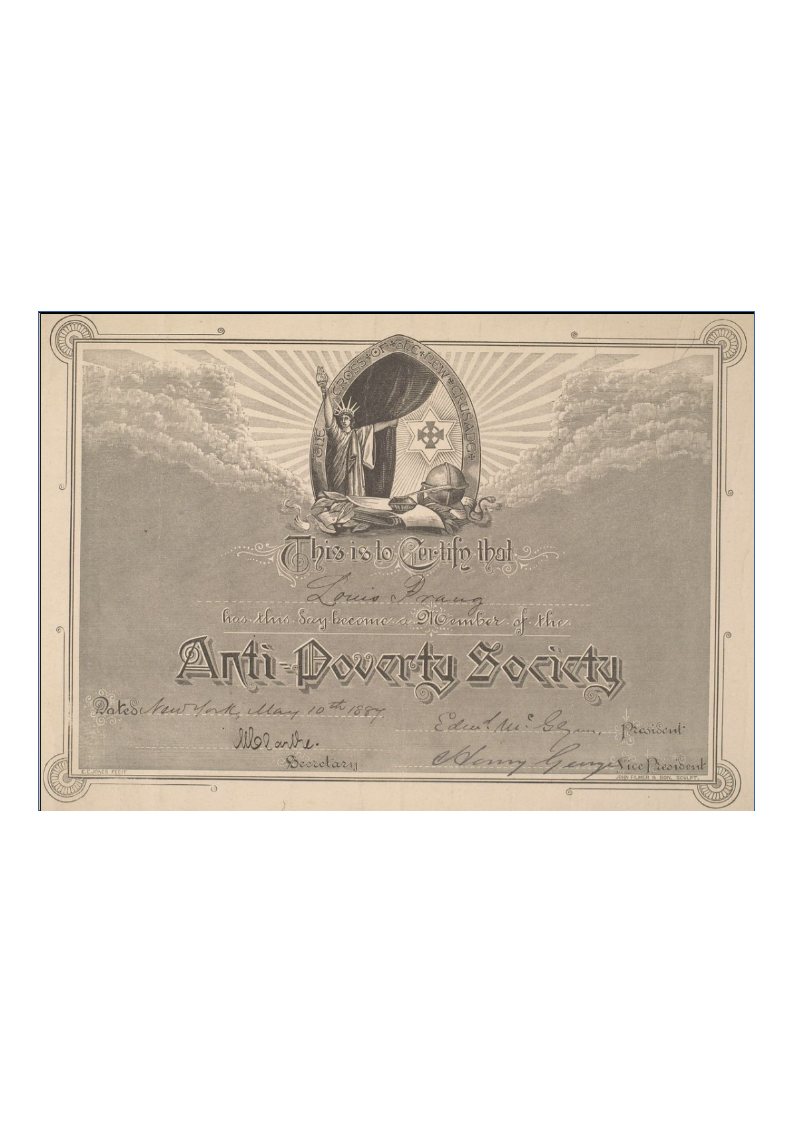
No. 22. “Poverty and Christianity”
Rev. Hugh O. Pentecost
An address by Rev. Hugh O. Pentecost before the Anti-poverty society146,147
Ladies and Gentlemen — and since I have just seen a collection taken up I feel like saying Brethren and Sisters — I wouldn’t have believed you were so glad to see me. (A voice, We know you.) I came over from Newark tonight pitying you and pitying myself. Who ought not to be commiserated who has to stand in a place that has been occupied two or three times by the “Peter the Hermit” of the new crusade, Edward McGlynn (applause), and two or three times by the “Paul” of the new Christianity, Henry George (applause), and also by that other disciple, who, like his Master, has become voluntarily poor in order that through his poverty others might be made rich, Father Huntington. (Applause.) Who ought not to be commiserated who, having listened to the eloquence of these men, must now listen to any one else whomsoever. I pity you and I pity myself.
But we will not spend time upon our miseries. Rather let us come together in this bond of mutual pity, and hope for the day when the Anti-poverty society shall have so many great speakers in New York that it shall not have to send over to the moist places of Jersey for the little ones, as this city has to go over there to quench her Sunday thirst. (Laughter.) Perhaps the time will come when the chief priests and the scribes will take up the cross of the new crusade, for there is a time when the chief priests and scribes are ready to take up the cross — when it is the sign of assured victory. (Laughter.) Perhaps the time will come when even the chief priests and the scribes will join us in this crusade for the reclamation of the holy land and the driving out of the Turk that has grabbed it and dispossessed the children of God. Who knows how soon that time may come. (A voice, Next week.) Those of us who feel the fire of the new crusade burning in our bosoms, and who feel how it burns with increasing fervor from day to day, would not be surprised at any time to see this movement sweep through the land like a prairie fire! And why shouldn’t it?
Isn’t every citizen of these United States an anti-poverty man? Isn’t each one a little anti-poverty society with reference to himself, as our mayor is — your mayor, I mean? (Hisses.) Are not those great corporations which some rude people speak of sometimes as soulless monopolies, anti-poverty societies? I don’t know whether they are really as benevolent as one of your newspapers tries to make us believe, or as unselfish, but I do know they are simply organized anti-poverty societies. The number of persons to whom their operations will ultimately apply is somewhat limited, indeed, but the principle is there. They are so persistently opposed to poverty for themselves that they are willing to plunge tens of thousands of people into poverty in order to accomplish their quite natural desire.
Now, what our Anti-poverty society wishes to do is to inject into the whole people this anti-poverty spirit. We want the thousands and thousands, aye, millions of people who are suffering poverty in quiet, peaceful, stupid content to form themselves into an anti-poverty society that shall never cease to labor until, in a constitutional manner, the laws can be so changed that pocket picking of the public purse shall no longer be a respectable occupation. (Applause and laughter).
The man who goes up to Harlem and buys a lot for $10,000 because be knows that in a few years he can sell it for $20,000 and in that way put into his pocket $10,000 which he did nothing to earn, and which, therefore, must come out of the pockets of other people, is a little anti-poverty society. The object of that society is himself. And when people complain against that anti-poverty society, as some people complain against this one, he says to the ten or twenty people who are more or less impoverished by that transaction, “You ought not to complain; there have to be enterprising men in every community (laughter); there have to be men who can look ahead and use their brains for the improvement of a community; and then, besides, Jesus Christ said, ‘the poor ye always have with you;’ God intends that some people shall be rich and other people shall be poor; if that was not so there wouldn’t be any opportunity for the good rich people to practice their charities. (Laughter.) And then, if there were no poor people, who would clean our streets and cart away our garbage?”
Now, we want to have the whole people inspired with this anti-poverty spirit. We want to have the people look upon that man and say: “We are going to take lessons from you and do just what you do, not, however, for ourselves, but for all people. (Applause.) And we are going to try and have the laws so fixed in this world that when you put another ten thousand dollars in your pocket you will have to work for it.” (Applause.) In other words, we are going to say to that man we want a little hand in this anti-poverty game ourselves. (Applause.)
Now, all this seems very shocking to the “saviors of society.” (Hisses.) There are ministers, and, I suppose, priests, and I know editors (hisses), who say that all this is very immoral. But it seems to us — so dull is our moral comprehension in certain directions — that if it was right to make laws so that the taxes for the support of the government should be shifted from land upon the products of industry, with the effect of tying up land, we don’t see why it shouldn’t be just as right when we get the power — and we hope to have it before long — to march up to the ballot box with our little vote in our hands and make laws — or elect men who will make them for us — to take that tax off the products of industry and put it on the land, where it belongs. (Great applause) We don’t see why, if one of those operations is moral, the other is not moral, too.
We are not starting any new society, as you see; we are simply following in the footsteps of our betters. (Laughter and applause.) We say to this man that buys the land, or steals it, we say, you have a magnificent little scheme here which we begin to understand (applause), and we are going to take that same little scheme and work it for the benefit of the whole people (Applause.) We don’t want to take your land away from you. Nobody wants that. You can take that and do whatever you please with it. If you want to fence it in and stand on your head on it for a year, you can do it. But we find that there is an unceasing and increasing stream of rent that is running out of the public purse and into your pocket, and it is making a very successful anti-poverty society out of you. We are going to try and turn that stream of rent out of your pocket into the public purse (applause), where you can at any time, if you like, find your share (laughter and applause), your whole share, and nothing but your share. (Great applause.)
We want an anti-poverty society that shall be so big that it will just take in all these others. That is the tendency now, you know — centralization (laughter); the big organization swallows up the little ones. (Laughter.) We don’t want any competition. (Wild cheers.) We are not going to have an anti- poverty society that applies to one class or one color or one nationality. (Applause.) We are going to have an anti-poverty society, if we can, in which a manufacturer and a laborer shall stand upon an equal footing, in which a black man and a white man shall be the same (applause); in which an Irishman and a Russian and an American [a voice — an Englishman?] — yes, and an Englishman, too (applause), and even a Pole, and by and by, when we get to it, a Chinee (applause) — in which all these shall take their places as the children of one Heavenly Father. We believe that there is room enough upon this earth for them all, that there is provision enough in this earth for them all; and we want them all in. [Here a woman in the top gallery screamed, in a marked German accent, “Any kind of a guntree!”] Yes, any kind of a country — a little “accent” over there, but we understand it; it sounds like the language of the kingdom of God and the brotherhood of man. (Applause.)
Now, some people tell us that poverty is the result of conditions that inhere in individuals, and that it is a part of the settled plan of God. I read, not long ago, two able editorials in two able Christian newspapers, in which both editors said that pauperism was a very bad thing; that a society for the abolition of pauperism was a good society, but that poverty was a great blessing, one of the most beneficent means God ever employed for sweetening and mellowing human character, and that some people would not know how to get along without it — (laughter) — they have derived so much blessing from it — and that any attempt to do away with poverty was a kind of impiety, and that the Anti-poverty society itself was a kind of an impious institution. The gentlemen who wrote those editorials were suffering from cobwebs on the brain. (Uproarious laughter and applause.)
Demonstrate to us that the laws and customs of this world, in so far as man is related to man, are just and fair; demonstrate to us that the laws and customs by which a man secludes for himself upon any terms a portion of the surface of this earth, which extends, in fact, to the zenith and to the center, are consonant with natural laws and natural rights, and then we may begin to say that poverty has some place in the plan of God for this world. But until you can demonstrate that we are living under perfectly just and fair laws as between man and man, we will never be guilty of the impiety of charging God with what we know is chargeable to the greed and wickedness of men.
Poverty is the result of individual conditions, you tell us. There is some reason, inherent in these people, why ten should be rich and ten thousand poor. Let us look at that for a moment. The population of this earth is estimated at 1,400,000,000. Divide these people up into families of five each. Put each family on half an acre, so you have ten to the acre, and you can put them all on 140,000,000 acres. The state of Texas has 188,000,000 acres of ground. You can take the population of this earth, divided up into families of five, put them into the state of Texas and have enough room left to dispose of four times the population of the United States in the same manner.148 Then people expect us to believe that poverty is part of the merciful plan of God. We will not believe that just yet. (Cries of “No, no,” and applause.)
Open this country to the population of the world, and we will take them all — if you will free the land — and live infinitely more comfortably than we live now; we will live peaceably and in harmony; we will beat our swords into steam plowshares and the lion and that lamb will lie down together (applause), and the lamb will be on the outside. (Laughter and applause)
It is not the Lord of this universe that is making all this trouble; it is another kind of a lord — the landlord. He is well called a lord; for if you put into his possession the planet he might as well be a god; he might as well own the air; might as well monopolize all the corn, as Joseph did away back in Egypt.149 England has about thirty-two and a half millions of acres of land; four and a half millions of those acres are owned by twelve men, eight of whom own more than two hundred and twenty thousand acres apiece, one of whom, the Duke of Sutherland,150 owns one million three hundred thousand acres. (Hisses.) There are only two counties in England larger than the estate of the Duke of Sutherland, which he inherited from the man who originally stole it. A man with all that land in his possession has untold power over the happiness of other men. Put men like that into a “combine” and it would not be long before they would have the power of life and death over the whole nation. And the reason why these men have that power today in England is because what old crusty, grumpy Thomas Carlyle151 said was true — that England was populated with forty millions of people, mostly fools. And the enterprising New York speculator who buys land in this town for speculative purposes is doing the same thing in principle, and will continue to do it just as long as the United States are populated by sixty millions of people — mostly fools. (Laughter.)
This society has not any creed. We don’t even ask a man that he shall believe that there is any God at all. But I think we are all agreed that if there is a God, and He cares anything at all for His reputation among fair-minded men, He wouldn’t have distributed wealth as it is distributed in this world today. He wouldn’t have given so many people all the “pie” who don’t seem to need it or deserve it. Why do you ask us to believe such a thing as that when we know better.
Some time ago the employees of one of our great railroads began to practice on the railroads what the railroads had been practicing on the community for a long time. They saw how easy it was to effect things by making a “combine;” so they made a combine and found a way to break into sealed cars and steal goods — monopolize them, hypothecate them. (Applause and laughter.) Now, when the people who shipped these goods discovered that the goods were lost, and went to the officers of this railroad company, did the railroad company sit down and say to these men, “There is a kind of mysterious providence in this world by which goods seem to disappear. Wealth in the process of transmission from the sender to the receiver to a certain extent will always disappear by providence”? Did they say that and then sit down and pay for that loss, charging it up to profit and loss? Not they. They said, if goods disappear out of these cars, somebody is stealing along the line of this railroad, and we are going to find out who it is. They put detectives on their track, and soon they found them out. The trouble with these men was that they hadn’t taken the precaution to get laws passed beforehand by which they could do the stealing legally, and they had to suffer the consequences. (Applause and laughter.)
We look out upon society, and we say something like that is going on. In the process of the transmission of wealth to the wealth producer, a good deal of it seems to disappear, and we go to the saviors of society and ask them to explain this thing. Some of them try to make us believe that it is not so. Mr. Edward Atkinson (hisses) got out a spectrum the other day in Boston for the purpose of the spectrum analysis of one hundred thousand yards of cotton cloth in process of manufacture; and then he showed on a chart, by a long, long line, how much of the money used in that operation went to labor, and by a wee bit of a line how little of it went to capital.152 We have all read fairy stories before. We remember the story of the great big bear and the wee little bit of a bear. Mr. Atkinson says it is not so; that labor gets it all — most. And Mr. Chauncey M. Depew (hisses) told the locomotive engineers and firemen that this year the Hudson river railroad would make thirty-four million dollars,153 and that the employees of the road would get thirty million dollars, and the dear little stockholders would only have four millions left to buy oatmeal with, and that as many of the stockholders were little lone, lorn widows, nobody ought to grudge them this little four millions, even if they wanted to put some sugar on their oatmeal. Or the New York Tribune will tell us (hisses) — I didn’t mean to mention the name of that paper, because I was afraid you would not like it — that the Standard oil company (hisses) is not really making any money at all; that all it exists for is to shower oily blessings on the people; that its sole object is to make oil so cheap that all the poor people can have it for very little money. This is the way they tell us we are mistaken.
But some really admit that somebody in this world is not getting his fair share of wealth. It is alas! too true, they say; but it is one of those mysterious dealings of Providence, and it isn’t best to inquire too much into it, because you might find out some of the secrets of the Lord, and then, besides, Jesus said “the poor ye shall always have with you;” and if you should abolish poverty, the Bible wouldn’t seem to say the truth, and you would give great encouragement to infidelity. (Laughter and applause.)
That won’t satisfy us; we have got beyond the infant period. We have been protected in our infancy until we are men now. We know better than that.
It so happens that there has been raised up for the people a detective concerning this thing. That detective has been on the track of the thieves. He knows where they are, and who they are, and he has got evidence to convict them sure. That detective is Henry George. (Wild and long continued applause.) The document containing the evidence collected is “Progress and Poverty” — the most important and significant book that has appeared in this world since the publication of the New Testament. The thieves are the men who put in their pockets the unearned increment of the land. The witnesses are all the poor people in this world. The bar before which these thieves are to be brought is right reason and right conscience concerning the inalienable equal rights of men. The judge is Almighty God! The prosecuting attorney is the Anti-poverty society. (Wild applause and waving of handkerchiefs.) There may be a stay of proceedings for a little while (laughter), but we will extend the court so that you can’t change the venue. There won’t be anywhere for the thieves to go where it won’t be equally dangerous for them.
Men tell us that a large part of the poverty in this world, if not all of it, is attributable to indolence and intemperance. Let us look at that a little bit. There are 70,000 unmarried women in the state of New York. (Great laughter.) The Lord knows what the cause of that is, I don’t; I merely state the fact. Now listen: there are 200,000 women in the state of New York, not including household servants, who do days’ work for a living. One hundred and thirty thousand women of this state who are married have to work to help the husbands take care of the family. (Hisses.) Do you expect us to believe that all this is because of some reason peculiar to these persons? (A voice, “No, never!”) There are 9,000 children in New York today under the age of twelve years, many being only four and five years old, who are working long hours in filthy tenement houses to help support their families. Do you mean to tell me that this is the result of drunkenness and indolence? Many of these women make only from twenty to thirty cents a day. They could take a week’s wages or a month’s wages and not get very drunk on it. (Laughter and applause.) They are the most slavishly industrious people on the face of this earth, because they have to be or starve. No, no; you can’t make us believe that, not while we have detectives on the track.
Another one of these detectives in his line is a certain Dr. Wiss,154 one of those patient painstaking Germans who get at the roots of things, who tells us that in London, with a population of four millions, two million people, half the population, live in single rooms. Six hundred thousand families in London, more families than there are in all New York together, live in one room to each family. The working people of London live, on the average to each family, in one and one-fifth of a room. In many cases, families of six, with two boarders who are poorer than they are, live together in one room nine feet square. One quarter of the wages of these working people is paid down for rent155 (hisses), and this is in a land that permits twelve men to own one-seventh of the whole kingdom, that permits one man to own 1,300,000 acres himself! You ask us to believe that all that squalor and poverty comes from the drunkenness and indolence of those people! (Cries of “no, no, never,” from all parts of the audience).
All this overcrowding, all this huddling of people together in dens and sties not fit for wild beasts to live in — and ’tis the same thing in Paris and Berlin and St. Petersburg and New York, according to their size and condition — all that, says the Christian Union, which also says that our proposition to lay the tax on the value of land is immoral, is due alone to the monopoly of the land. And the Christian Union is right.
Dear friends, we are beginning to see through some of these things, and we think we are beginning to help other people to see through them, too. Free the land by putting the taxes on the value of it; and if, in two generations after that thing is done, these people remain in the condition they are now, then I will join you or anybody in saying that the Being who sits on the throne of this universe is the most unspeakable fiend ever conjured in the crazy brain of man. Then I will join you, if you like, in breaking up the Anti-poverty society and uniting with the Shakers and going in for rigorous celibacy, with the intention of wiping the population of this earth off its accursed face, as soon as possible; then, I say, let us reel in one brief carousal to death and the devil — a carousal compared with which the maddest riot of history would be child’s play; then, I say, let some one who has the power pronounce the crack of doom upon this infernal civilization that ruins people by making them too rich or too poor, that spreads festering sores over the body of the whole community; then, I say, let us sink at once into the eternal night, and tumble the universe into chaos, rather than that generation after generation shall follow each other, each more selfish and fiendish in its greed and hypocrisy than the one that precedes it. (Wild, long continued and enthusiastic applause.)
But if you will free the land, and in freeing land free men who must live on the land; if you will do that, you will see these people swarming from their pestiferous dens and spreading over the smiling face of the earth more equally than now. You will see wages rise, as the tide rises, by a natural law. You will see poverty slinking away from the abodes of men where it does not belong. You will then see something like the kingdom of God, because when poverty goes drunkenness and crime will go, and purity and peace will come in its place. Then there will be a kingdom of God; then it will be possible to talk to men about trusting in God once more.
I have not told a poor man to trust in God for a long time, because when I exhort a poor man to trust in God, the social conditions under which we live fling that exhortation back in my teeth and stifle it. There is not much use trusting in God when a few men own the earth. (Applause and cheers.) God is said to be all powerful. You let a few men continue to own the earth, and you take the power out of His hands. It is a solemn fact that God himself can do nothing for his own people against this infernal monopoly of land, except — and mark the exception — to wake up their consciences and brains and hearts, and lead them by such movements as this to abolish the private ownership of land. He can do that and he is doing it.
Suppose I should go to a poor man and use the Savior’s lovely words to him. Suppose I should say to a poor man in one of those sweltering tenements, “Consider the lilies of the field,” he would not know what I was talking about. If I should say, “Consider that sickly-looking piece of geranium that you have stuck in a tomato can,” he would know what I was talking about. But suppose I should say, “Consider the lilies of the field; they toil not, neither do they spin; but your Heavenly Father clotheth them with a glory greater than Solomon’s. Behold the fowls of the air; for they sow not, neither do they reap, nor gather into barns; yet your Heavenly Father feedeth them. Are you not much better than they?”
Now, he would say the birds of the air and the lilies of the field are all right just as long as they have got plenty of land (applause) but a man with a grubbing hoe would break up that little providential arrangement for the lily, and a man with a gun or a cage would change the conditions under which the birds of the air live very quickly. That man would say to me, if he thought a little way on this subject, you put me in the conditions in which the birds of the air were and the lilies of the field were and I will be all right; you relieve me from this burden of taxation that rests on the products of my industry and put it on the land, where it belongs, and in that way free the land so that I can at least be a free man in this world, then I will be all right; then I will trust in God. But there is no use now, for if He should rain down manna or coats and pantaloons I wouldn’t get any use of them; the man who owned the land on which they fell would gobble them. (Wild applause and laughter and cries of “Go on, go on,” as the speaker seemed about to cease).
Mr. Edward Atkinson said in that Boston speech where he got out his spectrum:156 “You poor men have nothing to complain of; if you don’t like the job you have got, all you have got to do is to give it up and go somewhere else.” Now, where under the heavens will you go? You will go to another job where you won’t be paid a bit better than where you are. You can’t go on the land, because, though it seems to invite you, you will run right up against a signboard which says, “No trespassing here.” You can’t become a tramp, for that is against the law. The law makes men tramps, and then says there shall not be any tramps. (Laughter.) There is one place that you can go to — you can go to that self-dumping garbage scow of Christian civilization, the poor house, which we seem to be so proud of. We point back to heathen civilization, before this Christian civilization came in, and say: “Ah, they had no poorhouses, though.” If Christianity and poorhouses necessarily go hand in hand, for heaven’s sake let us look forward to more heathenism.
Some men glory in the magnificent charities of this day, which are magnificent, there is no denying that; but so long as our land laws remain as they are, every charitable institution in the United States is a blot and a shame on our civilization. (Applause.) We don’t want charity — we want justice. (Applause.) When you have been just, then you can be generous; but then you won’t have so much to be generous with, my friend.
If Jesus Christ should come upon this earth today — and I beg you, my friends, do not think that I mention these names with anything but the profoundest reverence — if Jesus Christ should come upon this earth today with nothing but His kit of carpenter’s tools, it would be impossible for Him to become a rich man, whatever some of these men may have become who like to boast of it now. Because, now I make the statement with great deliberation — and God forgive me if it is not true — it is impossible for men to become what we call rich honestly. (Uproarious applause.) I don’t mean to say that every man who is a rich man knows that he has become rich dishonestly; but I say that a man who has become rich through the conditions under which we live now, will find it very difficult to disprove the statement I have just made. At any rate, he has become rich by resorting to means which Jesus Christ would not resort to. He would remain a carpenter or He might go to preaching, but He wouldn’t do any better at that because there isn’t a church in Christendom today that would ordain him to the ministry, unless he has changed His views since He was on this earth. (Great applause, wild excitement and cheering long continued.) And if He should happen to get into a church and speak His mind and speak His honest convictions, it would not be long before the cardinal or presbytery or synod or council would sit down upon Him. And I am sure that there is not a church in Christendom that would stand what He would have to say against humbugs and Pharisees in His church. And He would associate with common people, and they never would forgive that. And He would preach the land doctrine and join the Anti-poverty society. Ah, my friends, a civilization which would receive the Son of the Living God into God’s earth, and so crowd Him that He couldn’t get His fair share of God’s bounty, as it now crowds so many of God’s children in precisely the same way, is a civilization that we must — by peaceable means, it is to be hoped, and I believe — get rid of forever. (Applause.)
Men tell me that riches are the reward of intelligence. I was up in Central park not long ago and I saw a thing in a dogcart (laughter) driving a tandem team round and round in the park. It would not go out on the road where the real men were. And I saw it once afterward on the street, and then it had on pantaloons twenty-three inches wide, that hung around its legs like a pair of petticoats, and No. 10 shoes in length, “English, you know,” and about a forty-two size club walking stick carried upside down, and it wore a No. 6 hat, and it looked like a No. 1 idiot. (Uproarious laughter.) I inquired about it, and found it was worth three millions of dollars, which it had inherited from that member of its family that preceded it upon this continent, and who had died of shame, I presume, because he had to be responsible for it. You tell me that riches are the rewards of brains? I know any number of greasy mechanics, as they are called, poor people who have to work, who have more brains in a minute than that thing will ever have. (Laughter.) But they have not got three millions of dollars. My dear friends, land was what gave that its money — not brains.
Now, people talk about brains and industry and sobriety, as if we didn’t believe in these things. We believe in brains, we believe in industry, we believe in sobriety. We believe a man is a stupid fool who gets drunk (applause), and we believe a man that will take the money that belongs to his wife and little children and squander it among the boys anywhere is a bad man. You may call him generous hearted, if you like, but we would like to see him generous hearted at home. We know that there are some reasons why he may have become a drunkard which makes us pity him; but that does not alter the fact. We believe in all these things, and what we are working for is that things may be so fixed in this world that brains and industry and sobriety may have a square chance.
People talk as if we were opposed to riches. We are not opposed to riches. The Anti-poverty society opposed to riches! It is what we want. We are not opposed to rich men. We say that if there is a man on this green earth who can make a million dollars honestly by brain or hand, not even the government should take one penny of that money away from him. We don’t want any income tax. (Applause.) If a man can make for himself honestly a great income, then it is his against the world. (Applause.) The men who say that we advocate the taking away of their property say what is — (a voice —“A chestnut”157) — yes, and it is a mighty old and worm-eaten chestnut by this time. We are the people who of all people on this earth are making the most desperate fight for property. We believe in its sacredness. But we say that land is not property. (Good, good.) Land is a natural opportunity.
All we want is this: That if a man is going to be a thief, he shall make it known in public that he is a thief. He shall not be a thief in such a way that he can still be a leader in society and wear the garments of sanctity.
If he is a thief in the sight of God, whether he knows it or not, we want him to get out of that front seat in the church and take his place among the other thieves. We don’t like to have two kinds of thieves around. We don’t like one kind of a thief that is a thief because he steals in disobedience to the law, or rather because he gets found out. We don’t like even the kind that steals in accordance with the laws. We don’t like the two kinds. We don’t want to have any thieves if we can help ourselves. But if a man is a thief, we want him to be branded as a thief.
I know it seems all very rude to say such things, but the time has come when some plain speaking must be done. (Applause.) Now, dear friends, it does not seem to me that our desires upon this point are so very unreasonable or that it is so impossible to get them carried out. I will tell you why! Because this Anti-poverty society appeals to the two strongest motives in human nature — religion and selfishness.
You must not think that this is a purely political movement. I tell you that this is a great moral and religious movement. What we want we want because it is right. We have to argue a great deal with people who go into the expediency of the matter, but we want what we want because it is right, and that alone. We don’t fear consequences, because we know that a thing that is right in theory will work right if you will ever let it. We say this! It is impossible for a man to get a rightful title to land. It is impossible! Nobody by any possible reasoning can show how any man on earth can get the right to take a piece of land and make it his as against all other people. We say again that the value that accrues to land is the product of the community; and our principle is that what a man produces, or a dozen or a thousand men produce, is theirs. We want you to take what you produce, and give the community what the community produces. So the thing is right.
We feel, as a gentleman who is sitting before me tonight said to me, “When I read ‘Progress and Poverty’ I felt for the first time in my life what the fatherhood of God meant.” That is the way we all feel. The more we consider it the deeper become our moral and religions convictions on the subject, and when it gets hold of us we can’t keep our mouths shut. Men are asking all around whether Dr. McGlynn (great applause) will ever be silenced. Great Scott! you can’t silence him! (Tumultuous applause.) I want you to understand that when a good man — and a man doesn’t walk who will say that Dr. McGlynn is not a good man — when a good man gets a profound religious conviction fairly into his mind and his soul, popes and councils and cardinals and powers that be have not the power to silence that man. (Great and long continued applause.) You may take him to the palace in Rome, and, like Paul the apostle, he will preach the gospel in the palace. You may take him, if you please, and send him to the center of Africa and he will collar a naked darkey and preach it to him. You may shut him up in a cloister and he will talk the land doctrine to another monk. Why, dear friends, when we see clear through this subject to the bottom and understand the misery that we firmly believe would be wiped off this earth if it could only be brought to pass, we must talk, we would talk to a wooden Indian in front of a tobacco store if we had nothing better to talk to. (Laughter.) Now, remember that is the kind of thing you have got to deal with when you talk about suppressing the men who have elevated the standard of the new crusade. You can’t suppress them.
We are going for the New Jerusalem. One of the New York papers said when the first meeting was held in Chickering hall that Mr. George’s face shone as if he had just been elected mayor of the New Jerusalem. We want to take this rotten old town and turn it into the New Jerusalem; and who should be the mayor of the New Jerusalem but Henry George. (Great and long continued applause.)
But, mark you, we don’t live altogether in the clouds. We have this heavenly vision of the New Jerusalem. We are glad we have it. It inspires us in waking and in sleeping hours. It makes us, I hope, brave enough to bear whatever punishment organized society puts upon us. But that is not all. We are down on this earth at the same time. Now listen: We have this most powerful religious motive, and, curiously enough, we have another motive that is not very religious, but that works in this time with the religious motive. It is this: It is simply old-fashioned human selfishness.
Why, under the sun, do you pay taxes on everything you use, when you might just as well put them on the men who own the land? Why do you pay ten cents for a cigar when you might just as well get it for five?158 Why do you pay twenty-five dollars for a suit of clothes, when you could have it for twelve dollars and a half, and bigger wages to buy it with? Why do you pay taxes for your carriage and your horse and cow, and dog and billy goat,159 when you might just as well take all that tax off and shift it on to the land? (Applause.) Here is a good sign. When I was talking about the profound religious motive with which we are working this house went wild with enthusiasm. (Cries of “Good, good.”) But when I talk about this mean little selfishness you have hard work to get up a little applause. If that isn’t a good sign in the Anti-poverty society, I will give it up. But these two motives work side by side — this profound religious conviction and this little mean, selfish motive. With many people we must first begin with their selfish motives. It takes some time for people to see how this is; but they are going to see it some day. And when they see it clearly, then the thing going through, and it is going through with a rush! (Applause.) When men see that God’s will and their own interest work together for once, then the two horses are going to pull this chariot to victory.
Now, we don’t claim, because we don’t know, that the simple abolition of private ownership in land is going to cure all the trouble. But this we do claim! That you can’t do anything for the amelioration of the condition of the poor in this world so long as this giant stands in the way. There may be other giants, but this great big giant must first be throttled and killed. When he is killed we will do as Jack the Giant Killer did, go into the great giant’s palace, and if we find other giants — railroad giants, Standard oil giants — if you kill the great giant, you can go in there and kill all the little giants, and set those prisoners free.
No. 23. The Single Tax
Thomas G. Sheaman
Martin I. Townsend,162 a distinguished lawyer of Troy, always prominent in the politics of this state, and being for several years a member of congress, and until lately United States district attorney for the northern district of New York, was one of the members of the constitutional convention of 1867.
In the course of a speech made by him on the subject of taxation, he said: “I insist that a people cannot prosper whose officers either tell or work lies. There is not an assessment roll made out in this state that does not both tell and work lies.” Mr. Townsend’s facts were sounder than his philosophy. Every assessor in this state, and, so far as we can ascertain, every assessor in any other state, has gone on both telling and working lies for twenty years since Mr. Townsend spoke, and yet national prosperity has gone on, and our people are fully persuaded, apparently, that all is for the best in this best of all possible lands. And, according to the doctrine accepted by a majority of the American people, American prosperity is mainly due to the almost superhuman wisdom of our legislators. Their genius in administration and their providential foresight in devising statutes have been the sole barrier which has prevented us from being flooded with the products of pauper labor and reduced to the pitiable condition of Hindoos and Chinese.
Yet it is quite certain that, under all this magnificent scheme of law and administration upon which we gaze so admiringly, there exists today, and has existed for forty years, at least, the most complete system of fraud, injustice and inequality in the local taxation of this state and of most other states in the Union which could possibly have been devised if the genius of evil had set himself at work to frame it. In New York the amount of conscious perjury is probably less, while the inequality of taxation is probably greater, than in such states as Massachusetts, Connecticut and Ohio. In those and all other states which secure to any considerable extent the personal oaths of tax-payers to their tax lists, the inequality of taxation is somewhat less than in this state, but the amount of perjury is enormously more. Under the laws of New York the burden of taxation is mainly shifted from the shoulders of the rich to those of the comparatively poor. In the states where a rigid inquisitorial system prevails, the burden of taxation is shifted from the dishonest to the honest. We hear much clamor about frauds in the administration of the national custom houses; but those frauds are but a trifle, either in pecuniary amount or in the extent to which they debauch the conscience of the community, compared with the universal demoralization which follows all over the country from the attempt to tax personal property. It would be difficult to name any other civilized country in which, outside of courts of justice, there is half as much perjury committed in any year as there is in this.
The details which abundantly justify this statement would be far too long for a statement on this occasion. Those who desire to inform themselves of the facts can find them given in an admirably condensed form in the reports of Mr. David A. Wells163 to the legislature in 1871 and 1872, and in a diffuse form in the debates of the constitutional convention of 1867. Those who appreciate the testimony of figures can find enough to satisfy themselves in a simple comparison between the assessed value of personal property, as reported by the censuses of 1860 and 1880 respectively. The assessed valuation of personal property in the whole country largely declined during that period. But, as slavery was abolished during the same period, thus obliterating an immense value in personalty, it is not fair to include the former slave states in the comparison. Omitting them, the assessed value of real estate increased from $4,564,000,000 in 1860 to $10,470,000,000 in 1880, or at the rate of 130 percent. But the valuation of personal estate in 1860 was $2,015,000,000 and in 1880 was $2,872,000,000, an increase of only 43 percent. The valuation of real estate in New York increased in the same twenty years at the rate of 118 percent, but the valuation of personal estate increased by much less than 1 percent.
The governor of the state tells us that the valuation of personality has decreased from $407,000,000 in 1875 to $332,000,000 in 1885. So, after a little fluctuation, it remains substantially where it was a quarter of a century ago.
Of course, no one believes for a moment that these official valuations at all correspond with the truth. Every one knows that the amount of personal property in this state, as well as in all others, has immensely increased. The fact is, as was shown by the late Mayor Opdyke, in an able treatise written nearly forty years ago, that the value of the land is at all times almost exactly equal to the combined value of all that is on the land: the price of land always reflecting the value of its accumulated productions. The rate of increase, therefore, is the same in both real and personal estate.
The facilities for evading taxation upon personal property in the state of New York are almost boundless. No one can be forced to pay any tax upon personal property other than bank stock, and not always then. But the assessors of other states, with the aid of more stringent laws, do succeed in reaching large amounts of personal property. Yet when Mr. Wells made his report, sixteen years ago, it was conceded that in Massachusetts and Connecticut, which had the most stringent and best administered laws upon this subject, more than one-third of all personal property still escaped taxation. If this one-third had been equally distributed among all taxpayers, there would have been no objection to the system; but it is notorious that the very reverse is the fact, and that innocent and simple-minded people pay taxes upon almost every dollar of their personal estate, while dishonest or excessively shrewd persons pay taxes on amounts varying from one-quarter in one-half of their actual possessions.
Since Mr. Wells made his report the assessed value of personal property has declined in Massachusetts by over thirty percent and in Connecticut by over fifty-five percent.
All systems of ordinary direct taxation on personal property bear most disproportionately upon women, and with tremendous severity upon widows and orphans.
The system bears disproportionately upon small property owners, because they are generally too timid and too ignorant of the ingenious devices by which great capitalists escape taxation to avail themselves of these methods. Women naturally belong to the class of small property owners, and, to the disadvantages of this class, they add a peculiar helplessness and ignorance of the devices by which taxation may be evaded. Their peculiarly economical spirit leads them always to consult the assessor, instead of going to a lawyer; and they thus throw themselves at once into the hands of the officials. Any one who is present at the annual revision of the tax list will be able to verify this statement. The women who attend upon these occasions invariably appeal to the assessors for advice; and this the assessor gives in the most fatherly manner, asking all the details of their property, brushing aside every feeble excuse for a reduction of the assessment, and candidly advising them to pay taxes upon every penny which they have upon the tax list, whether it is exempt or not.
Widows and orphans are precisely the class whose property is mainly in the hands of trustees. These trustees have no personal advantage to gain by evading taxation. They have no power to borrow money to use in the temporary purchase of government bonds or other non-taxable property; they do not feel authorized to pay fees for advice as to methods of avoiding taxation; and, unless they are peculiarly tender-hearted and considerate of their wards, they let the assessment go as it is officially made out, unless it palpably exceeds the assets in their hands. The assessors have ready means of finding out what is in the hands of these trustees, by simply referring to the inventories which the probate court compels them to file; and such estates are taxed upon the full amount of the inventory.
This state of things is not new, but has existed ever since any serious attempt was first made to collect taxes upon personal property. Precisely the same difficulties were experienced in the time of ancient Rome; and so shrewd were men even then in evading taxation that the use of torture, for the purpose of extracting a true account of their means, became universal. Few things contributed more to the destruction of the Roman empire than this system of taxation. So rigidly was it enforced, and so disastrous were its effects, that multitudes of citizens either sold themselves into slavery or fled across the boundary to live among barbarians, whom they dreaded as much as our western settlers do the Indians, for the sake of escaping the grinding operation of Roman taxation.
After centuries of experiment in this direction, most European countries entirely abandoned the attempt and resorted to methods of indirect taxation, by which the same result could be more surely accomplished without the constant inquisition and persecution involved in the old system of direct taxation upon personal property. But with that childlike faith in the power of American genius to make water run up hill which is one of the great characteristics of our countrymen, we in America have been engaged for a hundred years in the attempt to do, under free institutions and without the power of using those arbitrary methods and tremendous punishments which were at the command of Roman tax gatherers, what the ancient Romans never were able to do. We are nearly all convinced that all that is required is more statutes; although we have heaped statute upon statute, and found them all ineffective. The only proposition which is received with general favor is one for securing the collection of taxes by requiring more oaths. The federal government during the war established an income tax which depended entirely upon the oaths of tax payers to secure its assessment. At first, returns were made with tolerable fullness and honestly; but, with each successive year, human honesty proved weaker and weaker, until finally the returns of the last two or three years were a perfect farce, and, if they could have been believed, would have demonstrated that the nation was sinking to abject poverty. The number of persons paying an income tax in 1868 was 250,000, falling soon to 116,000, and finally to 71,000. A very slight survey of the census returns for 1870 makes it clear that not less than 400,000 persons must have been justly liable to this tax. In 1868, the amount exempted being only $1,000, at least 1,000,000 persons ought to have paid the tax. Yet the power of examination and punishment, which was at the command of the officers of the national government for the enforcement of the income tax, was vastly superior to anything which is or ever can be within the power of the several states. If a taxpayer is prosecuted in one state, he has no difficulty in fleeing to another; but if he is persecuted by the United States, he can stop nowhere short of Canada or Europe. Nevertheless, all the efforts of the United States to collect direct taxes out of personal property proved substantial failures.
It would be quite a sufficient answer to the arguments made in favor of taxing personal property to point to the fact that it never has been equally and fairly taxed, and to the necessary inference that it never can be. Laws can be passed which will lead to much hard swearing and to much unequal taxation by guess work, where oaths are not relied upon; and laws could probably be passed by which visible and tangible personal property, such as merchandise exposed for sale, could be approximately valued. But no law ever was or ever can be passed which will enable assessors to find the great mass of personal property, or to assess with even tolerable fairness that which they do find. All efforts, therefore, to tax personal property directly, ought to be abandoned, upon the simple ground that it is impossible that they should ever be both effective and just in their operation.
But this is by no means all of the case. The effort to tax personal property is a double evil, in that, first, it cannot be done, and, second, if it could be done, it would only result in collecting, at enormous expense, inconvenience and public demoralization, the same amount of taxes which could be collected by a natural and easy system, which would distribute its burdens with far greater equality than would be possible under the best imaginable system of taxing personal property.
If we may be indulged in an apparently remote illustration, let us suppose that a poll tax164 should be levied upon men who all lived in rooms surrounded by mirrors. Let us stretch our imagination to the supposition that the poll tax could be collected from a man’s reflection in the mirror, as easily as from himself. Is it not obvious that, in such a case, it would be absurd for the tax collector to insist upon half the tax being paid by the man and half by his reflection in the glass? If he collected the whole tax from the reflection, why should he trouble himself any further about the man? Or, if he collected from the man, why should be trouble himself about the portrait in the glass? Now, this illustration, which doubtless perplexes much when used in this precise form, is nevertheless the best possible picture of what actually takes place in estimating the wealth of the world. It has been found, as the result of innumerable experiments, that the value of land, exclusive of all improvements upon it, corresponds everywhere and at all times to the total value of all improvements and personal property situated upon the land. Of course this must not be taken so literally as to mean that this is true of every acre, quarter acre or city lot; but it is true of every district, which ought to be taken collectively, such as a city, a town or a state separated from other communities by natural boundaries. Thus, roughly speaking, the land of the state of New York bears a market value almost exactly equal to that of all other property resting upon that land, and the land of Dakota bears a market value corresponding to that of all other property situated within the limits of Dakota. The reason is that mere land has itself no real value, and its entire market value consists of that which is reflected upon it by the movable property situated thereon, including houses and structures of all kinds. It must be admitted that this calculation depends largely upon estimates and is somewhat vague in its nature; but it is entirely certain that, whether the valuation of the land and the valuation of other property are really equal or not, they do at least vary in the same proportion everywhere, the price of land rising or falling with the value of the property upon it, in exactly the same ratio in New York city as in the wildest part of Texas. The value of all kinds of personal property is accurately reflected by the land on which it is situated; and if we concentrate all taxes upon the reflection, we attain exactly the same result as if we divided those taxes accurately between the reflection and the original.
The result, therefore, to the state, of concentrating all taxes upon the value of land, excluding all improvements and all personal property, would be the same as if all these various things could be accurately assessed. The immediate result to the community of such a concentration of taxes would be to put an end to substantially all the unfairness and inequality of the present system. There is not an assessor fit for his office, and there are very few assessors, even among those who are now most unfit, who could not estimate the value of unimproved land165 with substantial accuracy. The value of dwellings or stores is always difficult to ascertain; and, in places where interior decorations and improvements abound, it is practically impossible for assessors to make any decent estimate of value from that outside inspection which is all that they can give. But the value of the land itself can be ascertained by the simplest inquiry. No matter whether it is estimated upon the asking price, the price at which it could be sold in the usual way, or the price which it would realize at auction, any of these values can be readily ascertained, even if an assessor, by his constitution of mind, should be given to overvaluing or undervaluing land, this would be of no importance, except for the purpose of state equalization, since he would make the same error with regard to every lot which he valued, and thus bring about substantial equality among all.
The only difficult question is whether such a system divides the burdens of taxation equally between all classes of the community. Does it or does it not cast all those burdens upon a single class, and does it allow enormous sums accumulated in personal property go free? It is undoubtedly generally believed that it does; and for this reason it is strongly objected to.
Before inquiring whether an exclusive land tax would relieve owners of personal property from their proper share of the public burdens, let us first ask what personal property is. Almost everyone who attempts to answer this question will begin by mentioning stocks in corporations, mortgages, bonds, promissory notes. But not one of these is a substantial thing. Every one of them is merely an evidence of a right to property, and is not even the right itself. More than this, the great majority of these paper evidences will prove to consist of rights in or to what is called real estate, that is to say, land and visible permanent improvements upon the land. What is stock in a railroad company? It is nothing but a statement of the company’s officers that A B has a certain fractional title to the land, tracks, engine houses, locomotives, trains, etc., standing in the name of the company. Except the engines and cars, all of this is real estate; and the engines and cars are themselves simply movable houses, which are of no value whatever when taken off railroad tracks. The fact that they are movable does not make them personal estate within the meaning of the term as now used, any more than the fact that an ordinary house can be moved with little injury makes a house personal estate. Stock in railroad companies, telegraph companies, etc, is therefore a mere evidence of title to real estate.
What are mortgages and the bonds secured by them? Obviously, nothing but evidences of additional title to real estate. A mortgagee has practically a title superior to that of the nominal owner. His portion of the title must be satisfied first before the nominal owner can take anything. Mortgages, therefore, are clearly a part of real estate, within the present meaning of that term. Not only mortgages, but bonds and notes, unsecured by mortgage, very often depend for their principal value upon real estate belonging to the debtor. Where this is the case, they represent a right on the part of the creditor to take so much of the debtor’s real estate as may be necessary to satisfy these claims; and they are therefore nothing but an indirect title to real estate.
There remains a vast mass of notes and other debts which do not represent real estate. These represent tangible chattels,166 cotton, provisions, shipping, manufactures, etc. No doubt if these notes and debts could be reached by the assessor, personal property would be taxed; and it would not be necessary for him to seek for the chattels represented by these debts, since to do so would be to subject property to double taxation. But at this point we strike the insuperable difficulties of the system. These evidences of debt, when in private hands, cannot be followed up. Assessors can know nothing about them, except what the taxpayer chooses to tell. If they are taxed, the burden upon them would be so heavy as, in many parts of the country, to obliterate their value. We therefore encounter here, again, the original difficulty that it is impossible to trace and equally tax these obligations.
It will be said: “Why not, then, tax all tangible, visible personal property, such as furniture, bales of cotton, goods in stores, etc?’ The answer is simple. How are you going to assess these things, and to whom? Can the assessors make the rounds of all the stores, houses and farms in one day, to examine and value all the goods on hand? Could they make a decently fair valuation, if they had unlimited time in which to do it? The thing is impossible. They would have to rely upon returns made by the owners themselves; and these returns would be as far from the truth as any other returns of personal property. Merchants would take care not to own any large amount of visible property on the valuation day. If required to calculate an average for the year, there would be an ample margin for elastic consciences. Moreover, a vast amount of goods stored in this state are not owned in it. The tax, in short, would be ruinous to honest men, because they alone would pay it and could not compete with their unscrupulous neighbors who did not. They would soon be driven out of business; and then the valuation of personal property would fall lower than ever.
We now arrive at a point where it has been usual to stop and to propose the concentration of taxes upon real estate, including all improvements thereon. But the taxation of improvements upon land is in effect taxation upon a single class of productions of human labor and skill. To tax these improvements without taxing other human productions is obviously unequal, because it selects producers of buildings for exclusive taxation, and discourages production in that direction, which is one of the most important for the elevation of the human race. But even a tax upon real estate, as at present defined, would be less objectionable than the attempt to tax so-called personal property in addition, because there would at any rate be a certain uniformity of injustice, which would enable the community to adapt itself to the case; and, knowing that a certain fixed and definite amount of injustice would always be done, and no more, men would shape their affairs accordingly.
If the foregoing conclusions are correct, and they are so universally admitted by all who have carefully studied the subject as really to need no further argument in their support, it follows that none of the existing systems of taxation are even approximately just and equal, and that no partial modifications of them, such as have usually been proposed, can be made equal. Let us briefly recapitulate the conclusions which follow from the previous statements:
First—All indirect taxes, such as duties upon imports, internal revenue taxes and the like, are unequal, because they fall in the end upon men in proportion to what they are obliged to consume, and not in proportion to their wealth, or to the benefits conferred upon them by society. And, as it is impossible to collect taxes out of anything except human savings, the inequality of indirect taxes must be measured by the proportion which they bear to the possible savings of the poor, as compared with the possible savings of the rich. Estimated in this manner, the burden of indirect taxation weighs on an average at least ten times as heavily upon the poor as it does upon the rich.
Second—All so-called “direct taxes” upon personal property, except, perhaps, household furniture and a few other things not used in productive industry, are in reality indirect taxes, because they increase the cost of production, and are therefore ultimately transferred by those who pay them to those who finally consume the things thus taxed. These taxes are, therefore, in the long run, nearly as oppressive to the poor as those first mentioned.
Third—The so-called “direct taxes” upon improvements of real estate are in their nature the same as taxes upon personal property. They suffice to check the production of buildings until their rent can be raised sufficiently to reimburse the owner for the taxes. Such taxes, therefore, fall mainly upon the poor in the same proportion as indirect taxes.
Fourth—It is impossible to assess the value of personal property with even a decent approach to accuracy, as between different tax payers. The rigidly honest, the ignorant, and those whose property is in the hands of trustees will always bear four or five times their proper share of the burden as compared with others.
Fifth—Although buildings can be assessed with much more accuracy than personal property, it is impossible to assess the value of buildings with anything like the accuracy with which the value of land can be assessed. Buildings can only be assessed with reference to their outside appearance; and one who spends more on interior decoration and comfort than on the outside will always escape his share of taxation. And, as the houses of the poor have far less decoration in proportion than others, a disproportionate share of taxes on buildings will always fall upon farmers, mechanics, laborers and the poorer classes generally.
Sixth—If, on account of the palpable impossibility of a fair and equal assessment of personal property, taxation in that direction should be abandoned, but taxation should be retained upon buildings, this will only remove one-half of the disadvantages of the present system. Buildings really belong to the class of personal property. A tax upon them is a tax upon consumption; and it especially discourages the production of the most useful class of property and the most indispensable to civilization, namely, the people’s homes.
It will be seen, therefore, that the objection so much insisted upon, that the taxation of land exclusively is unequal in its operation, would, if true, apply with even more force to every form of tax upon personal property or improvements upon the land. All such taxes fall with at least as much inequality upon different classes of the community as could possibly be asserted with respect to the land tax; and they are subject to the further objection that they ultimately fall upon the consumer, and therefore, even if equally and fairly assessed, would still fall in enormous disproportion upon the poor. Even if the land tax should be deemed unequal in its operation, it is no worse in this respect than every other form of taxation which can be suggested.
But is the land tax really unequal in its operation? It is not unequal in its bearing upon different tax payers, because land can be assessed with more accuracy than any other property; and therefore its burdens can be divided among those who pay the taxes with a degree of equality which is impossible under any other system. If it is true, as claimed by some, that this tax also will distribute itself upon consumers, and therefore is also unjust to the poor, yet this would be its only fault; and, if it is subject to this objection, it is simply because no tax can be invented which is not. The hostility which this form of taxation arouses is, however, sufficient evidence that Ricardo, Mill and all other economists were correct in holding that a pure land tax could not be shifted from the shoulders of the taxpayers. The truth is that this tax is now levied in the shape of rent for the benefit of private owners of land, and that, in this form, its burden is distributed among consumers and does bear with inevitable disproportion upon the poor. But that is inherent in the nature of things. This tax, which is now called rent, cannot be collected twice. If the government takes it from the landlord, under the form of a tax apportioned exactly to his rent, the landlord cannot raise the rent, because he has already taken the highest rent which he could get, taxes or no taxes.
_____
II.
It is said that an exclusive land tax would bear severely upon farmers and rural residents, allowing property in large cities to escape. Let us see. In California, land has been, ever since 1879, assessed separately from all improvements thereon. It therefore furnishes the best illustration for the purpose of determining this question on a large scale. In 1879 and 1880 a new constitution and system of assessment thereunder were adopted, providing for the most stringent methods of ascertaining and assessing all property of every kind, but especially personal property. In the first year of this assessment, an especial raid being made upon money, a large increase in the assessment consisted of cash on hand, which was, of course, taxed at its full value. But in the second year this part of the new system collapsed, and has ever since remained a ludicrous failure; money being either actually or nominally driven out of the state, and, at any rate, being placed where the assessors have been unable to track it. While for the convenience of comparison we take the assessment of 1880 as a basis, we exclude from it altogether the assessment upon money, which was comparatively large for that year, because the demonstrated impossibility of reaching that particular kind of property would make any comparison on that basis misleading. Excluding cash on hand, however, the assessment of the city of San Francisco and of the remainder of the state respectively was as follows:
| Land | Improvements | Personal Property | Total | |
| San Fran | $122,000,000 | $43,000,000 | $69,000,000 | $234,000,000 |
| State | $227,000,000 | $100,000,000 | $81,000,000 | $408,000,000 |
| Total | $349,000,000 | $143,000,000 | $150,000,000 | $642,000,000 |
Now, let us suppose that the whole amount required for public purposes in California was $6,420,000 per annum, which would be just one percent on the whole assessed value of all kinds of property. The amount required would be neither more nor less, whatever system of assessment would be adopted. Let us relatively compare the burdens of city and country under each plan of assessment. The result would be as follows:
| Taxes on | Real and Personal | Land and Improvements | Land Alone |
| San Francisco | $2,340,000 | $2,150,000 | $2,245,000 |
| State | $4,080,000 | $4,270,000 | $4,175,000 |
| Total | $6,420,000 | $6,420,000 | $6,420,000 |
It will be seen at once that the proportion of burden which the rural districts would bear under a valuation of the land alone would be but very little greater than under the present system of taxing all real and personal property which can be found, and that this small difference would all disappear, were it not for two peculiar provisions of the constitution of California, one reducing the valuation of cultivated land to the level of uncultivated land, and the other specially exempting all growing crops from taxes, thus at one stroke exempting more than $80,000,000 of farming property. If the latter exemption alone were not allowed, the balance would turn the other way; and as there is no such exemption here, there can be no doubt that if we had the same means of comparison for this state which we have for California it would appear that the rural districts would be very greatly benefited by the abolition of all taxes upon personal property.
When we come to pass upon a question supposed to be far more difficult, that of exempting visible improvements on the land from taxation, the assessment of California shows convincingly that this measure would relieve the rural districts from a portion of the taxes which they now bear, and would slightly increase the burden of cities and large towns. It appears by this table that under an assessment of land without any valuation of improvements, the city of San Francisco would pay about five percent more on the gross amount of its taxes than it would on an assessment including improvements, while it would only pay four percent less than it would under a system of assessment on all kinds of personal property. Yet, this result again, it is to be observed, is obtained under a system which gives to the farmers of California an enormous advantage in assessment over the residents of cities; and, therefore, if we could only procure similar statistics for New York or any of the eastern states, the advantage to be gained by the rural population by the adoption of an exclusive land tax would be far greater than would appear from these tables.
City taxpayers, however, will naturally ask what advantage this system can then offer to them? Do they not now pay more than their fair share of taxes, and do not state boards of equalization always heap fresh burdens upon the shoulders of long suffering city men? The answer to these questions is extremely plain. The present system, or no system, not only by its gross inequalities and irregularities works more like a system of robbery than of any legitimate taxation, but by discouraging investment, alarming property owners and imposing heavy penalties upon industry of every kind, and preeminently upon the production of buildings, and by compelling capital to take devious courses in order to hide itself from the assessor, inflicts such continual injuries upon all large towns that they could well afford to bear an increase of twenty-five percent upon their present burden of taxation, if only allowed to collect it by assessment upon the land irrespective of improvements. Population would increase, wealth would increase still faster, the demand for labor would increase in full proportion with the increase of wealth, and the prosperity of all classes would far more than compensate for any increase in nominal taxation.
The only serious question then is whether this method of taxation allows the owner of strictly personal property, such as jewelry, coin, furniture and merchandise, to go free of tax. It is quite clear that most of these things now go free of public taxation, through the impossibility of finding them out. But where are such things to be found? Do they abound on the plains of Dakota or the peaks of the Rocky mountains? Are they even to be found upon cultivated farms? Are they to be found to any large extent in rural villages? Are they to be found, in short, on any land worth even as little as $100 an acre?
These questions answer themselves. Any man who owns $100,000 in jewelry will certainly keep that jewelry, if not in actual personal use, on some of the most valuable land in a large town or city. He may keep it in a large and handsome building or in a shabby one; but he certainly will not keep it in a low neighborhood, but will select some place like Broadway, Nassau street or Fifth avenue, if he keeps it for his own personal enjoyment. Under the present system he pays for the privilege of having his jewelry in a safe place by paying rent to a landlord or by buying, at a large price, a city lot, and thus capitalizing his rent. When the government taxes this lot on the basis of its rent, it in effect taxes the owner of the jewelry. Instead of paying that tax to a private individual, as he does now, he would pay it to the state.
The same principle applies to all merchandise. When it comes to be sold it has to be placed upon very valuable land, generally worth not less than $10,000, and in New York city $500,000, per acre. If the state taxes that land in proportion to its value, its revenue really comes, not out of the land, but out of the merchandise situated upon the land, which gives to that land its value. To recur to our former illustration, the state, which is never able to find jewelry, and rarely able to find merchandise, when it seeks it for purposes of direct taxation, can, without the slightest difficulty, find the reflection of both jewelry and merchandise upon the land in the shape of enormously increased rental value; and, by taxing this rental value, it taxes jewelry, coin and merchandise with a degree of accuracy impossible under any other system.
The objection, however, remains that, under the present system the owners of jewelry, coin and merchandise are thus taxed for the benefit of private owners of land, and that it is proposed to deprive these owners of that benefit; and this is called injustice, because it taxes vested rights out of existence.
It might be sufficient to say that no considerations of injustice in the incidence of taxation have ever been taken into account under the present system. For centuries systems of taxation have prevailed — and they still prevail — under which the poor, who are considered to have no vested rights, have been ground into the dust. But the moment that it is proposed to tax those who have property, instead of those who have none, an outcry is made that this is an interference with vested rights. It really means — as all other outcries against reforms in taxation have always meant — that the rich and powerful want to continue the exemption which they have so long enjoyed. Precisely this argument was used at and before the time of the French revolution. The nobility of France were exempted from nearly all taxation. Thousands had purchased titles to nobility for the very purpose of securing this exemption, and when Turgot and other reformers proposed to annul these exemptions, the clamor against the radicalism which proposed to destroy vested rights was as loud in opposition as it is now, and with precisely as much reason.
Individual land owners may have made their investments under sanction of the state; but the state has never pledged itself that it would not tax them, or that it would not tax them unequally, or that it would not tax them up to the entire value of their property. It has repeatedly done this, not only to land owners, but to the owners of other property; and it is under no express or implied obligation to refrain from doing so.
If taxation is to bear unequally upon anybody, it is impossible to select a class who have less reason to complain cf its inequality than the individual owners of land, a class to which we belong. It is true that most of us at the present time have paid some one else for our land; but, considered as mere landlords, what we have bought is a power to tax other people for the privilege of working, without being obliged to work ourselves. Our property may justly be compared to a corporate franchise. The state gives such franchises; but it reserves to itself the right to tax them to any extent which it sees fit.
But, moreover, land owners would receive a very large compensation under the system of land taxation exclusively. They would be exempted from all taxes upon their improvements, whether present or future. These improvements now represent one-third of their property, and would under the proposed system represent one-half. The result, therefore, would be, upon the average, to relieve land owners who had improved their property from a very large proportion of the taxation which might otherwise fall upon them. It would give them absolute security for future improvements, and would enable them in a few years to compensate themselves for most of the loss which they would suffer from the introduction of a system of exclusive land taxation. The burden would only be oppressive upon owners of land who have not improved it and do not intend to, but who are simply playing a waiting game and refusing to allow the community to cultivate or build upon the land without paying them toll. This speculative class of land holders requires no particular sympathy. Land speculation is really the very worst form of speculation known. It has been the cause of more disasters than any other kind of speculation, whether in stocks, provisions or merchandise. Speculation for a rise in food leads to the production of more food; and, therefore, whatever effect it may have upon the fortunes of the speculators, it rather tends to benefit the world than otherwise. But speculation for a rise in land leads to less food and less production of every kind, because the speculator shuts up the land from use, with the exception of obtaining an increased rent when he permits it to be cultivated or built upon. If any class of persons should be taxed out of existence decidedly this is the class.
____
III.
It will be seen, of course, that these views coincide very largely with those of which Henry George is the foremost representative. His name is just now the red specter among capitalists, and seems to produce everywhere a terror similar to that inspired among Europeans nearly a century ago by the French revolution — a terror so abject as to deprive every one affected by it of his reasoning. powers. The conclusions here expressed have been reached, however, by starting from a different, point, and by following closely the line of reasoning started by those economists who certainly considered themselves the best friends of capital; some of them so much so as to have been discreditably indifferent to the welfare of the laboring classes. In looking at this whole matter, I have sought to consider it from a thoroughly practical point of view, disregarding nil sentimental nonsense on either side, and believing that there is fully as much nonsense, if not more, advanced on behalf of the rich as there is on behalf of the poor. I have started from the eminently practical ground of inquiring first what is possible, instead of what is desirable, and have allowed abstract considerations of right or wrong, justice or injustice, to take only a minor place in the discussion. Mr. George starts out with an abstract proposition of right as the basis of his argument. In doing so, he has appealed successfully to the hearts of multitudes of men who never could be stirred by such cold logic as mine. He has, on the other hand, equally stirred into hatred and fury a large number of persons who fancy that they are interested in the maintenance of the present system, although most of them are under an entire delusion in this respect. It is quite enough for me to see clearly that the concentration of all public burdens upon the rental value of land, assessed separately from its improvements, is not merely the best system of taxation, but is absolutely the only one which has ever yet been suggested under which property can be accurately valued, equally assessed, and encouraged to its fullest development. It is the only system under which no discouragement is put upon the production of wealth and no interference made with its natural distribution.167 It is the only system under which capital is left entirely free to flow in those channels in which it will make the most profit for itself, and in which it will therefore confer the most benefit upon the community. These considerations alone would be enough to command my assent. But, even if such a confession should be deemed to convict me of that “sentimentality” which the blind adherents of existing systems charge upon any one who professes a desire to relieve the poor from burdens, I have no hesitation in saying that what arouses my enthusiasm in behalf of the land tax is that it is the only system which can be honestly worked among honest men, under which the great mass of human beings, struggling to maintain themselves on an average income of less than $100 a year (which is more than the average), can be relieved from paying taxes in a proportion bearing upon them with more than ten times the severity with which it bears upon any one in this audience. To recapitulate, then, briefly, the various steps which have led me to these conclusions, I submit:
First—That it is a demonstrated impossibility for public taxgatherers to ascertain and assess one-half of the amount of so-called personal property in existence.
Second—That this failure to reach and assess personal property does not work with equality or anything approximating thereto. It results, not in assessing the property of each of ten thousand taxpayers at about half its value, but roughly stated in taxing the property of one thousand up to its full value, of two thousand to three quarters of its value, of two thousand more to one-half of its value, and of the rest in proportions varying from one-tenth of their property down to none at all. Such a system of so-called taxation has many of the effects of legalized robbery.
Third—The assessment of visible improvements upon land is only an assessment upon one class of what is in its essence personal property — that is to say, of human productions. Such an invidious distinction is not quite as bad as the outrageous distinction made between different owners of so-called personal property, because the burden is more equally distributed; but it is none the less an unjust and unfounded distinction between different classes of human productions, loading the burden upon one branch of industry which it has been found impossible to put upon all. The tax is distributed, it is true; but this does not remedy the whole evil. Even if it did not bear inconveniently upon individuals, it bears inconveniently upon the community, for the reason that it puts a tremendous discouragement upon the production of buildings; that particular industry being loaded down with a taxation which is not borne by any other industry. Moreover, the assessment of buildings is and must always be in proportion to their outside appearance, and especially to their front. Interior improvements can never be assessed to any appreciable extent. A tax upon buildings is, therefore, a premium upon shabby and mean outsides. In the city of Brooklyn, for example, it is the principal cause of two and a half and three and a half story buildings, low in the front but high in the rear, because it has been found by experience that this makes a great difference in the annua1 burden of taxation.
Fourth—The income tax, which is practically the only tax other than that on land which is not capable of being shifted from the tax payer upon the mass of consumers, is a tax which it is impossible to collect with any approach to equality and justice. It probably is as fair a tax as could be devised, if assessors were only gifted with omniscience, so that they could tell precisely what a man’s income was by looking into his face; but until that happy day arrives it is a tax which will only be paid by men in proportion to their honesty or their want of ingenuity. If, then, we want a system of taxation equal in its assessment, certain in its operation and hindering no form of industry, putting no restraint or discouragement upon capital and relieving labor from all burdens, we are shut up to the exclusive tax upon land assessed without its improvements. Whatever injustice the adoption of this tax might inflict upon individuals or classes would not exceed or equal that which is inflicted by the systems now in operation, while it would relieve so many burdens and discouragements which now bear heavily upon the vast majority of land owners as would amply compensate them for all the apparent increase of their taxes.
In submitting these views, it is not expected that they will at all change the course of current events. It was said by a wise man, two thousand years ago, that the people love to be deceived; and the public relish for being swindled shows but small signs of dying out. When the ethical spirit has so far penetrated the minds of the majority of any community that they desire above all things to know the truth and to do what is fair and just rather than to follow leaders who promise them some selfish and unjust advantage over others, they will have no difficulty in reaching the conclusion that no system of taxation ought to stand which cannot be honestly and impartially executed, and that no rights of property are worth having which interfere with the well being and development of society as a whole. That day is far distant; and until it arrives the majority of men will prefer to perpetuate systems of taxation which delude the American workman with the idea that he can gain something by starving his European brother; which delude the farmer with the notion that he can devise some scheme for extorting unjust advantages from the residents of cities; which delude the laborer into fancying that some kind of “bunco” game can be invented in public affairs in which he can play against capitalists and win every time, and which delude the capitalist into the belief that his class will gain in the long run by extorting wealth from the mass of laborers under the guise of taxing them a dollar in order to increase their wages fifty cents, and then not increasing them.
No. 27. Back to the Land
Rev. Dr. Thomas Nulty
168 by Most Rev. Dr Thomas Nulty,169
Bishop of Meath170
DEDICATION
To the Clergy and Laity of the Diocese of Meath:
Dearly Beloved Brethren,–
I venture to take the liberty of dedicating the following Essay171 to you, as a mark of my respect and affection. In this Essay I do not, of course, address myself to you as your Bishop, for I have no divine commission to enlighten you on your civil rights, or to instruct you in the principles of Land Tenure or Political Economy. I feel, however, a deep concern even in your temporal interests — deeper, indeed, than in my own; for what temporal interests can I have save those I must always feel in your welfare? It is, then, because the Land Question is one not merely of vital importance, but one of life and death to you, as well as to the majority of my countrymen, that I have ventured to write on it at all.
With a due sense of my responsibility, I have examined this great question with all the care and consideration I had time to bestow on it. A subject so abstruse and so difficult could not, by any possibility, be made attractive and interesting. My only great regret, then, is that my numerous duties in nearly every part of the Diocese for the last month have not left me sufficient time to put my views before you with the perspicuity, the order and the persuasiveness that I should desire. However, even in the crude, unfinished form in which this Essay is now submitted to you, I hope it will prove of some use in assisting you to form a correct estimate of the real value and merit of Mr. Gladstone’s coming Bill.
For my own part, I confess I am not very sanguine in my expectations of this Bill — at any rate, when it shall have passed the Lords. The hereditary legislators will, I fear, never surrender the monopoly in the land which they have usurped for centuries past; at least till it has become quite plain to them that they have lost the power of holding it any longer. It is, however, now quite manifest to all the world — except, perhaps, to themselves — that they hold that power no longer.
We, however, can afford calmly to wait. While we are, therefore, prepared to receive with gratitude any settlement of the question which will substantially secure to us our just rights, we will never be satisfied with less. Nothing short of a full and comprehensive measure of justice will ever satisfy the tenant farmers of Ireland, or put an end to the Land League agitation.
The people of Ireland are now keenly alive to the important fact that if they are loyal and true to themselves, and that they set their faces against every form of violence and crime, they have the power to compel the landlords to surrender all their just rights in their entirety.
If the tenant farmers refuse to pay more than a just rent for their farms, and no one takes a farm from which a tenant has been evicted for the non-payment of an unjust or exorbitant rent, then our cause is practically gained. The landlords may, no doubt, wreak their vengeance on a few, whom they may regard as the leaders of the movement; but the patriotism and generosity of their countrymen will compensate these abundantly for their losses, and superabundantly reward them for the essential and important services they have rendered to their country at the critical period of its history.
You know but too well, and perhaps to your cost, that there are bad landlords in Meath, and worse still in Westmeath, and perhaps also in the other Counties of this Diocese. We are, unfortunately, too familiar with all forms of extermination, from the eviction of a Parish Priest, who was willing to pay his rent, to the wholesale clearance of the honest, industrious people of an entire district. But we have, thank God, a few good landlords, too. Some of these, like the Earl of Fingal, belong to our own faith; some, like the late Lord Athlumny, are Protestants; and some among the very best are Tories of the highest type of conservatism.
You have always cherished feelings of the deepest gratitude and affection for every landlord, irrespective of his politics or his creed, who treated you with justice, consideration and kindness. I have always heartily commended you for these feelings.
For my own part, I can assure you, I entertain no unfriendly feelings for any landlord living, and in this Essay I write of them not as individuals, but as a class, and further, I freely admit that there are individual landlords who are highly honorable exceptions to the class to which they belong. But that I heartily dislike the existing system of Land Tenure, and the frightful extent to which it has been abused, by the vast majority of landlords, will be evident to anyone who reads this Essay through.
I remain, Dearly Beloved Brethren, respectfully yours,
THOMAS NULTY.
BACK TO THE LAND
THE ESSAY
____
Our Land System Not Justified by its General Acceptance.
Anyone who ventures to question the justice or the policy of maintaining the present system of Irish Land Tenure will be met at once by a pretty general feeling which will warn him emphatically that its venerable antiquity entitles it, if not to reverence and respect, at least to tenderness and forbearance.
I freely admit that feeling to be most natural and perhaps very general also; but I altogether deny its reasonableness. It proves too much. Any existing social institution is undoubtedly entitled to justice and fair play; but no institution, no matter what may have been its standing or its popularity, is entitled to exceptional tenderness and forbearance if it can be shown that it is intrinsically unjust and cruel. Worse institutions by far than any system of Land Tenure can and have had a long and prosperous career, till their true character became generally known and then they were suffered to exist no longer.
Human Slavery Once Generally Accepted.
Slavery is found to have existed, as a social institution, in almost all nations, civilised as well as barbarous, and in every age of the world, up almost to our own times. We hardly ever find it in the state of a merely passing phenomenon, or as a purely temporary result of conquest or of war, but always as a settled, established and recognised state of social existence, in which generation followed generation in unbroken succession, and in which thousands upon thousands of human beings lived and died. Hardly anyone had the public spirit to question its character or to denounce its excesses; it had no struggle to make for its existence, and the degradation in which it held its unhappy victims was universally regarded as nothing worse than a mere sentimental grievance.
On the other hand, the justice of the right of property which a master claimed in his slaves was universally accepted in the light of a first principle of morality. His slaves were either born on his estate, and he had to submit to the labor and the cost of rearing and maintaining them to manhood, or he acquired them by inheritance or by free gift, or, failing these, he acquired them by the right of purchase — having paid in exchange for them what, according to the usages of society and the common estimation of his countrymen, was regarded as their full pecuniary value. Property, therefore, in slaves was regarded as sacred, and as inviolable as any other species of property.
Even Christians Recognized Slavery.
So deeply rooted and so universally received was this conviction that the Christian religion itself, though it recognized no distinction between Jew and Gentile, between slave or freeman, cautiously abstained from denouncing slavery itself as an injustice or a wrong. It prudently tolerated this crying evil, because in the state of public feeling then existing, and at the low standard of enlightenment and intelligence then prevailing, it was simply impossible to remedy it.
Thus then had slavery come down almost to our own time as an established social institution, carrying with it the practical sanction and approval of ages and nations, and surrounded with a prestige of standing and general acceptance well calculated to recommend it to men’s feelings and sympathies. And yet it was the embodiment of the most odious and cruel injustice that ever afflicted humanity. To claim a right of property in man was to lower a rational creature to the level of the beast of the field; it was a revolting and an unnatural degradation of the nobility of human nature itself.
That thousands upon thousands of human beings who had committed no crime, who had violated no law, and who had done no wrong to anyone, should be wantonly robbed of their liberty and freedom; should be deprived of the sacred and inalienable moral rights, which they could not voluntarily abdicate themselves; should be bought and sold, like cattle in the markets; and should be worked to death, or allowed to live on at the whim or caprice of their owner, was the last and most galling injustice which human nature could be called on to endure.
The World’s Approval Cannot Justify Injustice.
To arrest public attention, and fix its gaze effectively on the intrinsic character and constitution of slavery, was to seal its doom; and its death knell was sounded in the indignant cry of the great statesman who “denied that man could hold property in man.” Twenty millions of British money were paid over to the slave owners as compensation for the loss of property to which they had no just title, and slavery was abolished forever.
The practical approval, therefore, which the world has bestowed on a social institution that has lasted for centuries is no proof that it ought to be allowed to live on longer, if, on close examination, it be found to be intrinsically unjust and cruel, and mischievous and injurious besides to the general good of mankind. No amount of sanction or approval that the world can give to a social institution can alter its intrinsic constitution and nature; and the fact of the world’s having thus approved of an institution which was essentially unjust, cruel and degrading to human nature, only proves that the world was wrong: it furnishes no arguments or justification for allowing it to live on a moment longer.
Irish Land Tenure the Twin Sister of Slavery.
The system of Land Tenure in Ireland enjoyed a long and similarly prosperous career, and it, too, has created a state of human existence, which, in strict truth and justice, can be briefly characterizd as the twin sister of slavery. The vast majority of tenant farmers of Ireland are at the present moment slaves. They are dependent for their peace of mind, for their material comforts, for the privilege of living under the roof beneath which they were born, and for the right of earning their bread on the farms which their forefathers enriched with their toil, on the arbitrary and irresponsible will of their landlord.
Abject, absolute and degrading dependence of this kind involves the very essence, and is, in fact, the definition of slavery. They toil like galley slaves in the cultivation of their farms from the opening to the close of the year, only to see substantially the whole produce of their labor and capital appropriated by others who have not toiled at all, and who even leave them not what would be allowed for the maintenance of slaves who would be expected to work, but what hardly suffices to keep them from dying of want.
When grazing on land had been found more remunerative than tillage, and the people consequently became too numerous, the superfluous multitudes, who were now no longer wanted under the new state of things, were mercilessly cleared off the lands by wholesale evictions to make room for the brute beast, which paid better. Such of the evicted as had the means left to take themselves away were forced to fly for refuge as exiles into almost every land; and the thousands who could not leave were coolly passed on through hunger and starvation to premature graves.
Let anyone who wishes visit this Diocese and see with his own eyes the vast and boundless extent of the fairest land in Europe that has been ruthlessly depopulated since the commencement of the present century, and which is now abandoned to a loneliness and solitude more depressing than that of the prairie or the wilderness. Thus has this land system actually exercised the power of life and death on a vast scale, for which there is no parallel even in the dark records of slavery.
But the attention of the civilised world is now steadily fixed on the cruel and degrading bondage in which it still holds a nation enslaved, and therefore its doom is inevitably sealed.
Justice, Not Vested Right, Should Prevail.
Some wise and thoughtful men can see no longer objections to the abolition of Landlordism now than were alleged not so long ago against the abolition of slavery. If the public good demanded the summary dismissal of landlords from an important position of trust, which as a class, they have so grievously abused, and, on the other hand, that they had been compensated for the real or fictitious property which it is assumed they possess in their lands, the justice of such a course could not for a moment be questioned. Yet I am afraid that few prudent, practical and experienced men could be found who would advocate the policy of a measure of so sweeping and radical a character. Undoubtedly a universal or a general peasant proprietary; not, however, the result of a sudden, hasty and unnatural change, but the gradual and natural growth of years — may probably be found to be the final settlement of the question of the land.
Hence the great majority of those who have thought the question out thoroughly regard the measure known as the “three F’s,” accompanied with largely increased facilities, and largely increased pecuniary encouragement, for the gradual establishment of a peasant proprietary, as the fullest measure of justice which the nation can just now expect from an Act of Parliament. But on whatever line the “new departure” may start, it is essential that the eternal and immutable principles of justice which determine the character of property in land shall in no instance be departed from by the people. Ours is a struggle for justice and for right, and we must not furnish our enemies even with a pretext to reproach us with dishonest or unfair dealing.
Justice of Private Property in the Results of Labor.
The following are the acknowledged principles of justice that have a practical bearing on the question: —
Every man (and woman, too) has a natural right to the free exercise of his mental and corporal faculties; and whatever useful thing anyone has produced by his toil and his labor, of that he is the rightful owner — in that he has in strict justice a right of property. Any useful thing that satisfies any of our necessities, relieves any of our wants, ministers to our comforts or enjoyments, or increases our material happiness or contentment, may be an object of property, and the person whose toil and labor has produced that thing possesses in it a strict right of property.
The two essential characteristics of property therefore are: First, the thing itself must be useful for some purpose; and, secondly, it must be the product or the result of our labor.
Now, the effort or exertion demanded by labor is irksome, distasteful and repulsive to the indolence and self-indulgence that is natural to us and, therefore, no one will voluntarily subject himself to the painful inconvenience of labor who is not stimulated by the prospect of the remuneration and enjoyment which the fruit of his labor will return him.
Whoever, then, has voluntarily subjected himself to the painful operations of labor has, in strict justice, a right of property in the product or result of that labor; that is to say, he, and he alone, has a right to all the advantages, enjoyments, pleasures and comforts that are derivable from the results of his labor. Others cannot complain of having been excluded from the enjoyment of a thing whose production cost them nothing; which be was not bound to produce for their use, and which, were it not for his efforts, would not have existed at all.
Producer’s Right of Disposal.
Use and exclusion are, therefore, the two essential peculiarities of the enjoyment of a right of property. The power to dispose of legitimate property is almost absolute. Property may be devoted by its owner to any purpose he pleases that is not inconsistent with the public good and does not interfere with the rights of others. He may keep it for his own use and enjoyment if he wishes, or he may exchange it by barter or sale for an equivalent in value of the property of others; he may alienate it by free gift when living, or bequeath it to anyone he pleases, as a voluntary legacy, when dying. He might even destroy it and do no wrong to anyone.
If Michael Angelo, in that delirium of artistic frenzy in which he called on his celebrated statue of Moses “to speak,” had dealt it a blow of his mallet, which would have created not merely a rent in its knee, but had actually shattered it into atoms, the world might indeed deplore the destruction of this immortal work as an irreparable loss, but it could not complain that he did it an injustice or a wrong. Michael Angelo was master of his own free actions, and he was not bound to spend years of labor and toil in producing that incomparable statue to delight and please the world, and, even after he had produced it, he was not bound to preserve it for its enjoyment. “He might do as he liked with his own.”
Every individual whose labor produces an article of property makes a substantial addition to the wealth of the nation; and a nation’s general prosperity and happiness, and the degree and abundance in which it possesses all the comforts, the enjoyments, the luxuries and pleasures of life, depend entirely on the numbers engaged in industrial productiveness, and on the skill and efficiency of their labor. Every man, no doubt, works for his own self-interest, for his own benefit and happiness, but whether he wishes it or not, he works, too, for the increased enjoyment and prosperity of others. No man consumes all that his labor produces, and the benefit of the superfluous products of his labor, if not enjoyed by himself, is sure to be enjoyed by some to whom he has transferred it. If a bootmaker does not himself wear all the boots he produces, somebody else is sure to wear them for him. It is, therefore, highly in the interest of the community, as well as of individuals, to encourage the production, the multiplication and accumulation of objects of wealth; and, therefore, to stimulate the activity and energy of the labor necessary for their production.
The laws of all nations, as well as the law of nature, have regarded as sacred and inviolable the right of property which a man enjoys in what he produces.
Institution of Private Property Springs from the Necessity for Labor.
The first form of property ever seen or held on this earth was undoubtedly connected with land. Although political economists never dream of adverting172 to it, it is, nevertheless, an unquestionable fact that the institution of Private Property is one of the sad effects of original sin. It springs directly from the barrenness and sterility with which the earth was cursed in punishment of the crime of original sin. That curse deteriorated and to a great extent destroyed the primeval and teeming fertility with which the earth had been in the beginning created.
Before the fatal words, “maledicta terra in opere tuo,”173 had been pronounced the land needed not the labor of man to produce all that was superabundantly sufficient for the sustenance of man — all that satisfied to the full his wants, wishes, and desires. The rich and delicious fruits with which it spontaneously teemed were as unlimited as the waters of the seas, as the air we breathe, as the atmosphere in which we live. Like the manna, on which the children of Israel lived in the desert for forty years, everyone took all he wanted, and as the supply was as certain in the future as in the present, it would be folly to take more than was wanted for present use.
In the unlimited superabundance that then prevailed there was no room for the existence of Private Property at all. It was only when the earth had been cursed by sterility and barrenness, and that the supply of human food consequently became limited when the produce it yielded became proportioned to the labor expended on it, and that every man had to work for his living, that Private Property became not only lawful but a necessary institution of society. Man’s labor became a necessary means to reverse the result of this curse, and to restore to the earth, at least partially, the primeval fertility of which it had been despoiled in punishment of his sin.
The productiveness thus imparted or restored to the earth became, in strict justice, the property of the individual by whose labor it had been created, and this Property in Land is the first form of Private Property on record.
Necessity for Labor Proves the Common Right to Land.
Although the earth, even in its present deteriorated state, is a splendid inheritance provided by the liberality of God for the maintenance of man, it is, nevertheless, an inheritance which places him under the necessity of patient, laborious toil in its cultivation and improvement, in order to extract from it the means necessary for his subsistence.
The human race cannot now any longer live on the earth if they refuse to submit to the inevitable law of labor. No man can fairly emancipate himself from that universal decree which has made it a necessity for every one “to earn his bread in the sweat of his brow.”
Now, the land of every country is to the people of that country or nation what the earth is to the whole human race — that is to say, the land of every country is the gift of its Creator to the people of that country; it is the patrimony and inheritance bequeathed to them by their Common Father, out of which they can by continuous labor and toil provide themselves with everything they require for their maintenance and support, and for their material comfort and enjoyment.
The Land of Every Country the Common Property of Its People.
God was perfectly free in the act by which He created us; but, having created us, He bound Himself by that act to provide us with the means necessary for our subsistence. The land is the only means of this kind now known to us.
The land, therefore, of every country is the Common Property of the people of that country, because its real owner, the Creator who made it, has transferred it as a voluntary gift to them. “Terram autem dedit filiis hominum.”174
Now, as every individual in that country is a creature and child of God, and as all His creatures are equal in His sight, any settlement of the land of a country that would exclude the humblest man in that country from his share of the common inheritance would be not only an injustice and a wrong to that man, but, moreover, would be an impious resistance to the benevolent intentions of his Creator.
How Best to Use the Common Estate.
The great problem, then, that the nations, or, what comes to the same thing, that the Governments of nations have to solve is — what is the most profitable and remunerative investment they can make of this common property in the interest and for the benefit of the people to whom it belongs? In other words, how can they bring the largest, and, as far as possible, the most skilled amount of effective labor to bear on the proper cultivation and improvement of the land? — how can they make it yield the largest amount of human food, human comforts and human enjoyments — and how can its aggregate produce be divided so as to give everyone the fairest and largest share he is entitled to without passing over or excluding anyone?
Security of Possession Necessary to Secure the Rights of the Improver.
It is because the principle of Private Property fulfils all these conditions, satisfies all these requirements and secures all these results, that it has been regarded by all nations as a necessary social institution under all forms of government.
The most active, energetic, and, at the same time, the most powerful principle of human action that we know of, is self-interest, and self-interest is the principle of Private Property. This principle of self-interest is deeply embedded and engrained in our nature; its activity is constant, uniform and irrepressible, and whether we advert to it or not, it is the secret and inexhaustible spring of nearly all our actions, efforts and endeavors. We labor with untiring energy, earnestness and perseverance, when we know that we are working for ourselves, for our own interests and benefits.
If, therefore, the land of a country was surrendered up to the self-interests of the people of that country; if it was given up to the operations of the most powerful moral force known to man, which is everywhere present and everywhere supremely active and energetic, and which would throw its whole force and strength into the effort needed for the proper cultivation and improvement of the soil, then we might expect the largest possible returns of human food and human enjoyments that the land could possibly yield.
Wherever, therefore, the principle of Private Property in Land is carried out to the full extent that its justice and the interests of the community demand, the land of that country will be parcelled out in larger or smaller lots among its people, on the plain principle of justice, that the increased fertility and productiveness which they shall have imparted to the soil shall be their own, and that they shall have a strict right of property in the returns — no matter how abundant — it shall yield to their capital and labor.
With this disposition adopted the powerful principle of self-interest will be brought to bear effectively and with all its energy and force on the cultivation and improvement of the soil; and as the cultivators or farmers will have a strict right of property in the products which it shall yield to their labor and capital, so it will be their highest interests, and they will make their best efforts to make them as large and as abundant as possible. The returns, therefore, from the land will be the highest it is capable of yielding. To stimulate the production and enlarged growth of that invaluable property which is created in the development and improvement of the soil, and to secure to its owner the certainty of enjoying all its uses and benefits, he must have a right to the continued and undisturbed possession of his land.
The labor and capital necessary for the production of property of this kind are immediate; the returns to be derived from it may be spread over many years, perhaps over all future time. No man will incur the expenditure if others, not himself, are to be benefited by it. He might, no doubt, enjoy the full benefit of improvements already made after a certain term of years; but to stimulate him to make further and larger improvements in the soil, and, at the same time, to secure him a certainty of enjoying the full fruits of those he has already made, no term of years can produce on men’s minds what has been most felicitously called “the magical effect of perpetuity of tenure.”
Non-Improvers Can Have No Rights in Land.
The arguments, therefore, which prove that, in strict justice, as well as in the interests of the nation at large, a landholder who is constantly improving and increasing the productiveness of his farm has a right to the continued occupation of it, prove, too, that a non-improving landholder has no right to be left in the possession of it at all. The people of a nation have too deep an interest in the productiveness of the land of the nation and in the amount of human food it will yield, to be able to allow any portion of it to remain in the hands of a man through whose criminal indolence or incapacity it either produces nothing at all, or what will be much less than it is capable of yielding.
Thus, an improving land-holder has by that very fact, in strict justice and in the higher interests of the public, the title, and, indeed, the only unquestionable title that exists to the continued and undisturbed possession of his land.
The occupier’s rights of property in the agricultural products of the land, in the permanent improvements he has made in the productiveness of the soil, and in the undisturbed occupation of his farm, while he continues to improve it, are all deeply rooted in the clearest principles of natural justice.
Security of Possession and Full Ownership of Products for the Common Good.
They are, moreover, necessary and sufficient to secure the highest permanent and progressive improvement of the soil, and to draw from it the largest and most profitable returns it is capable of yielding. The legislature, therefore, which is bound to strive in every reasonable way for the advancement of the public good, can hardly withhold its sanction and protection from clear natural rights, which are of vital interest, not only to the cultivators themselves, but also to the wellbeing of the nation at large.
The agricultural products of the land of the nation will then be disposed of or distributed among the people of the nation by the cultivators who produced them, on the principle of competitive sale, and everyone will receive a share of the whole at the price that it cost to produce it, and that will be considerably less than it would cost himself to produce it. No one, therefore, has been called on to surrender his share in the common property of the nation without getting an equivalent in return. No one has surrendered his share in this property; everyone has simply made a most profitable and remunerative investment of it.
A Just Right of Property in Improvements, But Not in Land Itself.
In the foregoing exposition of the principles of justice on the question of the Tenure of Land, I have made no distinction between the landlords of a country and the tenant farmers who hold land under them, for in truth, on the question of Property in Land there is no room for any such distinction. I am, however, quite ready to allow the full benefit of the rights of Property in Land, as I have explained them, to any landlord or tenant who has created such property; but I cannot allow either to landlord or tenant any other or further rights of Property in land than those I have just enumerated.
No individual or number of individuals can have a right of Private Property in the land of a country in its original state, and antecedently to human culture; for in that state the land of a country was and is still the Public Common Property of the people of that country. Undoubtedly the people, by their combined labor and industry, “have not made the land” of their country, but they have received it as a voluntary free gift, and as a necessary means for their subsistence, from their Common Father and Creator, who did make it.
What Right of Exclusion Implies.
Besides, a right of Property in Land implies, as I have observed, a right of exclusion as well as of use in its enjoyment; and, therefore, if any privileged class had a right of property in the land of a country they would have a right to the exclusive use of the land of that country — that is to say, they would have a right to the exclusive use of all the necessaries of life in that country, and the people would have no right to exist at all. Not only, then, would the well-being but the very existence of the nation depend on the whim and caprice of a single class of the community.
Again, no class of men could have such a right of private property in the land of a nation — firstly, because they could not by their own labor and industry have created such a right themselves, for “no man has made the land”; and, secondly, because they could not have received that right, either by contract or free gift, from anyone who was competent to give it. The people of the nation could not give it, for if they were to barter, or sell, or give away the land, they would expropriate the means that were necessary for their own subsistence, and that would be tantamount to a nation committing suicide.
Individuals May Rightfully Collect Payment for Improvements in Land.
The tracts of country known in England as the Bedford Level,175 and in Flanders as the Pays des waes,176 were, not so very long ago, as sterile, as barren, and even more useless than the bogs of our own country at this moment. By an enormous expenditure, however, of capital and labor they have been drained, reclaimed and fertilised, till they have at last become among the most productive lands in Europe. That productiveness is entirely the result of human labor and industry, for nature did hardly anything for these lands.
If the question, then, was asked: Who has a right to charge or demand a rent for the use of the soil of these lands for agricultural or industrial uses? the answer undoubtedly would be, the person who by his labor and capital had created all their productiveness, who had imparted to them all the value they possess. In charging, therefore, a rent for the use of what he had produced he is only demanding a most just and equitable return for his capital — a fair and honest remuneration for his labor. His right to demand this could not possibly be disputed.
Now, the artificial productiveness of these tracts of country hardly equals, and certainly does not surpass, the natural fertility of large districts of rich, luxuriant, arable and pasture lands in the County of Meath, in this Diocese. If it were asked, then, who has a right to charge a rent for the use of the soil of these highly favored districts in Meath for agricultural or industrial purposes, the answer should be that if human industry or labor had imparted to these lands a real and substantial amount of artificial productiveness, by the cultivation and permanent improvement of the soil, then the person who had created that productiveness had a perfect right to demand a rent for the use of it.
Exaction by Individuals of Rent for Land is Wanton Injustice.
But who, it may be further asked, has a right to demand a rent for the natural fertility of these lands “which no man made,” and which, in fact, is not the result of human industry and labor at all? The answer here, also, should be, he who had produced it.
But who produced it? God. If God, then, demanded a rent for the use of these lands, He would undoubtedly be entitled to it. But God does not sell His gifts or charge a rent for the use of anything He has produced. He does not sell; but He gives or bestows, and in bestowing His gifts He shows no respect of persons.
If, then, all God’s creatures are in a condition of perfect equality relatively to this gift of the land, no one can have an exceptional right to claim more than a fair share of what was intended equally for all, and what is, indeed, directly or indirectly, a necessary of life for each of them.
When all, therefore, relatively to this gift, are perfectly equal, and nobody has any real claim to it; when all equally need the liberality and generosity of God in it, and no one can afford, or is willing, to part with his share in it — to alienate it from any or all of them would be to do them a wanton injustice and grievous wrong, and would be a direct disappointment to the intentions of the Donor besides.
The Whole People the True Owners of the Land.
When, therefore, a privileged class arrogantly claims a right of private property in the land of a country, that claim is simply unintelligible, except in the broad principle that the land of a country is not a free gift at all, but solely a family inheritance; that it is not a free gift which God has bestowed on His creatures, but an inheritance which he has left to His children; that they, therefore, being God’s eldest sons,177 inherit this property by right of succession; that the rest of the world have no share or claim to it, on the ground that origin is tainted with the stain of illegitimacy. The world, however, will hardly submit to this shameful imputation of its own degradation, especially when it is not sustained by even a shadow of reason.
I infer, therefore, that no individual or class of individuals can hold a right of private property in the land of a country; that the people of that country, in their public corporate capacity, are, and always must be, the real owners of the land of their country — holding an indisputable title to it, in the fact that they received it as a free gift from its Creator, and as a necessary means for preserving and enjoying the life He has bestowed upon them.
Distinction Between Individual Rights and Community Rights.
Usufruct,178 therefore, is the highest form of property that individuals can hold in land. On the other hand, I have shown that the cultivator’s right of property in the produce of the land, in the improvements he has made in the productiveness of the land, and in its undisturbed occupation as long as he continues to improve it — that these various rights are all founded on the strictest principles of justice, and that their recognition and protection by the State will secure for the land the highest culture and improvement it is capable of receiving, and will draw from it, without fail, the largest returns of human food it is capable of yielding.
On these immutable principles of justice and right, the order, progress and welfare of society depend. They allow free scope and hold out the highest encouragement to the fullest development of the energy and activity of human industry and enterprise, by securing to everyone the full fruits of his labor, and recognising in him a right of property to all that his hands produce. They guarantee to him immunity and protection from disturbance as long as he devotes himself with earnestness and zeal to his industrial pursuits.
On the other hand, if a man, through indolence or incompetence, allows his land to run wild, to return to its primitive sterility and barrenness, so as to produce nothing at all, or at all events, much less than it is capable of yielding, it is no hardship to that man if these principles call on him to surrender a trust which he held from society, and which, to the great detriment of society, he has so grievously abused.
Finally, it is no injustice to refuse the remuneration of labor to those who have not labored at all. This usufruct, therefore, is a right of property in land, which is held mainly for the benefit of the public and for the advancement of the general interests of the community. And yet the general interests of the community art hardly distinguishable from the private interests of the usufructuary.179 The larger the amount of permanent improvements made in the soil, and the richer and more abundant returns it will yield, the better will it be for both interests.
Public and Private Interests.
An usufructuary or farmer who labors might and main180 for his own self-interests, labors with the same amount of earnestness and zeal for the interests of the public as well. But it is the consideration of the public interests that will determine the continuity of his occupancy. The continuity of his occupancy entirely depends on the continuity of its real, practical effectiveness for the advancement of the interests of the public. The moment it ceases to be useful and beneficial to the public welfare, that moment it ceases to have a right to exist any longer. If individuals could have a right of Private Property in Land, that right would not be fettered by these responsibilities; in fact, it would not be liable to any responsibility at all.
The ownership of reclaimed tracts like the Bedford Level approximates closely, without, however, fully realizng, to a right of private property in land. The Bedford Level owner is not responsible to society for the management of that property, nor is he bound to have any regard to its interests in the use he wishes to make of it. Being master of his own free actions, he was not bound to create that property for the benefit of society, but for his own, and he may now make whatever use he pleases of it. If through mismanagement it produces less than it is capable of yielding, that is his own affair altogether. If he allowed it to return to its original sterility society might regret that it suffered a great loss, but it could not complain that he did it an injustice or a wrong.
The distinction, therefore, between the two rights of property in land is essential and fundamental, and it is absolutely necessary to apprehend it clearly and to bear it distinctly in mind.
Economists on the People’s Rights in the Land.
Now, there is nothing novel or startling in the common and inalienable right of property which I have shown every people possesses in the land of its country. I know of no writer on political economy who disputes it, although I am familiar with the works of many of the most eminent.
Bastiat, the great defender of the property classes in France, certainly does not dispute it; on the contrary, he assumes it as a settled principle of justice throughout his entire treatise.
The late Mr. Cairnes, though by far the most able and eloquent of all the modern advocates of landlords’ rights and privileges, as far as I know, at least, does not controvert it either. The facts and principles set forth in some of the most powerful and best written passages of his works prove the manifest injustice of allowing to anyone, except the people, a right of private property in the land of their country.
Mr. Mill, in his great work on Political Economy, after having accepted the universally received definition of property exactly as I have given it, says: “The essential principle of property being to assure to all persons what they have produced by their labor and accumulated by their abstinence, this principle cannot apply to what is not the produce of labor, the raw material of the earth.” And again: “When the sacredness of property is talked of, it should always be remembered that any such sacredness does not belong in the same degree to landed property. No man made the land: it is the inheritance of the whole species.”
In the remainder of this chapter Mr. Mill lectures the proprietors of land on their obligations and responsibilities to society in the management of it, and consequently he must be addressing himself to owners who have only the right of usufruct in their lands. Such admonitions, if addressed to men who had an absolute right of private property in land, would be simply an impertinence, as they would not be obliged to account to him or to anyone else for “what they did with their own.” Further on Mr. Mill adds: “Those who think that the land of a country exists for the sake of a few thousand landowners, and that as long as rents are paid society and government have fulfilled their function, may see in this consummation a happy end to Irish difficulties. But this is not a time, nor is the human mind now in a condition in which such insolent pretensions can be maintained. The land of Ireland, the land of every country, belongs to the people of that country.”
Mr. McDonnell, in his excellent work on the land question of England and Scotland, says, it became a trite and popular phrase to say “that the land was the property of the people.”
Mr. Arthur Arnold, Member of Parliament for the Borough of Salford, in his work on Free Land, published quite recently (1880), writes: “The land belongs to the nation, to the State, to the people. It is not possible to sever the interests of a beggar crouching at the gates of a park from that land. Infinitesimal they may be, but their existence cannot be denied.” He adds: “There is no such thing as private property in land held by individuals known to English law, or the law of the land.” He quotes the highest legal authority in proof of his statement.
Williams, on “The Law of Real Property,” thus writes: “The first thing the student has to do is to get rid of the idea of absolute ownership. Such an idea is quite unknown to the English law. No man is in law the absolute owner of lands. He can only hold an estate in them.”
Even Mr. Froude, in an extract given by Arnold, although he does not give the reference, thus writes:
“Seeing that men are born into the world without their own wills, and being in the world they must live on the earth’s surface, or they cannot live at all, no individual or set of individuals can hold over land that personal and irresponsible right which is allowed them in things of less universal necessity.”
Land Rent for the Community a Design of Divine Providence.
I think, therefore, that I may fairly infer, on the strength of authority as well as of reason, that the people are and always must be the real owners of the land of their country.
This great social fact appears to me to be of incalculable importance, and it is fortunate indeed that on the strictest principles of justice it is not clouded even by a shadow of uncertainty or doubt. There is, moreover, a charm and a peculiar beauty in the clearness with which it reveals the wisdom and the benevolence of the designs of Providence in the admirable provision He has made for the wants and the necessities of that state of social existence of which He is the author, and in which the very instincts of nature tell us we are to spend our lives.
A vast public property, a great national fund, has been placed under the dominion and at the disposal of the nation to supply itself abundantly with resources necessary to liquidate the expenses of its government, the administration of its laws and the education of its youth, and to enable it to provide for the suitable sustentation and support of its criminal and pauper population. One of the most interesting peculiarities of this property is that its value is never stationary; it is constantly progressive and increasing in a direct ratio to the growth of the population; and the very causes that increase and multiply the demands made on it increase proportionately its ability to meet them.
Landlordism Takes the Patrimony of the People.
Let the democracy of England as well as of Ireland, learn the melancholy fate that has overtaken this splendid inheritance which God has placed in their hands, and which would have saved them eighty millions sterling which they now annually pay by direct and indirect taxation for the government of the country. That patrimony was once theirs by right, and by right it is theirs still; but, in fact, it is theirs no longer: a class has wrested the land from the people of the country and now hold a strict monopoly in it. They sell it out to the people as if it were an ordinary article of private property and solely the result of their own capital and labor.
The rents which the landlords draw from their lands is an income which they derive from the sale of what are avowedly God’s gifts, which “no man made.” If they had only claimed the right of selling the use of the permanent improvements they had made in the soil, by the capital and labor they had expended on it, no one could dispute the Justice of their demand; but any element of income that might possibly be derived from this source is called in the language of political economy, not Rent, but Profit.
Political economists who have written with scientific precision on the nature and properties of Rent, confine it exclusively to the moneys which the landlord receives for allowing the tenant the use of the original and natural productiveness of the soil.
How Political Economists Define Rent
Adam Smith says: “Rent may be considered as the produce of those powers of nature the use of which the landlord lends to the farmer. It is the work of nature which remains after deducting or compensating all that can be regarded as the work of man. It is seldom less than a fourth, and frequently more than a third of the whole produce.” The part then of the agricultural products of the land which is the result of the operations of the powers of nature is sometimes more than a third of the whole — and that is the Rent of the landlord.
Ricardo, the inventor of the celebrated theory of Rent, called after his name (Ricardo’s “Theory of Rent”), defines Rent to be: “That portion of the produce of the earth which is paid to the landlord for the use of the original and indestructible powers of the soil. It is often confounded with the interest and profit of capital… . In the future pages of this work, then, whenever I speak of the Rent of land, I wish to be understood as speaking of the compensation which is paid to the owner of the land for the use of its original and indestructible properties.”
Scrope writes of it: “The value of land and its power of yielding a Rent are due to two circumstances. 1. The appropriation of its natural power. 2. The labor applied to its amelioration. Under the first of these relations Rent is a monopoly. It restricts our usufruct and enjoyment of the gifts which God has given to men for the satisfaction of their wants.”
Senior thus speaks of Rent: “The instruments of production are labor and natural agents. Natural agents having been appropriated, proprietors charge for their use under the form of Rent, which is the recompense of no sacrifice whatever, and is received by those who have neither labored nor put by, but who merely hold out their hands to accept the offerings of the rest of the community.”
McCulloch defines it: “What is properly termed Rent is the sum paid for the use of the natural and inherent powers of the soil. It is entirely distinct from the sum paid for the use of buildings, enclosures, roads or other ameliorations.” Rent is, then, always a monopoly.
Lastly, Mill says: “The land is the principal of the natural agents which are capable of being appropriated, and the consideration paid for its use is called Rent. . . .It is at once evident that Rent is the effect of a monopoly.”
Land Monopoly Usurps God’s Gifts to All.
Thus, on the highest and most unquestionable authority, are we forced to conclude that, owing to the monopoly which the landlords have usurped in the land of the nation, they sell out the “use of the original and indestructible powers of the soil”; of “the natural and inherent powers of the soil”; of “the natural powers of the soil”; that is to say, they sell the use of God’s gifts like so many articles of private property, and as if they were purely the result of their own toil and labor.
If the “Bedford Level,” and the rich tract of land in Meath with which I have compared it, were to be leased out to tenant farmers for a given term of years, the one would fetch quite as high a rent as the other. The farmer would not concern himself much in inquiring into the source from which the fertility of the land was derived; all his solicitude and inquiries would be directed to the existence of the fact that the fertility was there, and which of them possessed it in the higher degree. The rent which the owner of the “Bedford Level” would receive for the use of his land would be the just and equitable remuneration to which he was entitled for the expenditure of his labor and capital, while the Meath proprietor would receive as high a reward for having done nothing at all. Only that his income is so woefully wanting in justice, the condition of the Meath proprietor would certainly be enviable.
The Price of Land a Monopoly Price.
This privileged class not merely sells the use of God’s gifts, but extorts for them a price which is most unjust and exorbitant; in fact, they hardly ever sell them at less than scarcity or famine prices. If a man wants to buy a suit of broadcloth, the price he will be required to pay for it will amount to very little more than what it cost to produce it — and yet that suit of clothes may be a requirement of such necessity or utility to him that he would willingly pay three times the amount it actually cost rather than submit to the inconvenience of doing without it. On the other hand, the manufacturer would extort the last shilling he would be willing to give for it, only that he knows there are scores of other manufacturers ready to undersell him if he demanded much more than the cost of its production. The price, therefore, of commodities of all kinds that can be produced on a large scale, and to an indefinite extent, will depend on the cost required to produce them, or at least that part of them which is produced at the highest expense.
But there is a limited class of commodities whose selling price has no relation or dependence at all on the cost at which they have been produced; for example, rare wines that grow only on soils of limited extent; paintings by the old masters; statues at exquisite beauty and finish by celebrated sculptors; rare books, bronzes and medals, and provisions or articles of human food in cities during a siege, and more generally in times of scarcity and famine — these commodities are limited in quantity, and it is physically impossible in the circumstances existing to increase, multiply, or augment them further. The seller of these commodities, not being afraid of competition, can put any price he pleases on them short of the purchasers’ extreme estimate of the necessity, utility, or advantage to themselves of such commodities.
Fabulous sums of money, therefore, have been expended in the purchase of such commodities — sometimes to indulge a taste for the fine arts; sometimes to satisfy a passion for the rare and the beautiful; and, sometimes, too, to gratify a feeling of vanity or ambition to be the sole proprietors of objects of antiquarian interest and curiosity. On the other hand, enormous sums of money have been paid in times of scarcity or during a siege for the commonest necessaries of life, or, failing these, for substitutes that have been requisitioned for human food, the use of which would make one shudder in circumstances of less pressing necessity.
The Landlord the Greatest Burden on the Land.
The land is a commodity that strictly belongs to this class. It is limited in extent, and no human power can enlarge or extend its area. The competition for it is excessive, the competitors struggling for its attainment — not for the purpose of satisfying a taste for the fine arts, or to gratify a passion for the rare or beautiful, but to secure a necessary means of existence: for they must live on and by the land, or they cannot live at all. The owner, therefore, of that land can put on it any rent he pleases, and the poor people competing for it have no choice but to accept his terms or die in a ditch or a poorhouse. Under the present system of Land Tenure, the owners are not only enabled, but actually exact for the use of the land the last shilling the tenant is able to pay, leaving him only what is barely sufficient to keep him from dying.
Mr. Mill, who is the highest of all authorities on this subject, thus writes on the letting of land as it is actually carried out in Ireland: “With individual exceptions (some of them very honorable ones) the owners of Irish estates do nothing for the land but drain it of its produce. What has been epigrammatically said in the discussions on ‘peculiar burdens’ is literally true when applied to them, that the greatest ‘burden’ on the land is the landlords. Returning nothing to the soil, they consume its whole produce, minus the potatoes strictly necessary to keep the inhabitants from dying of famine.”
Landlordism Confiscates the Work of Improvers.
But the present system of Land Tenure not merely enables a class to exact from the people of the country a famine price for the use of the land which God made: it also enables them to charge a rent for the use of the improvements on the land which the people themselves made, which are purely the result of their own industry and capital, and which, in fact, on the strictest principles of justice are their own private property. With the knowledge and experience which we have acquired all our lives long of the transactions that are daily taking place between landlords and tenants, the clearest and most convincing proof that can be given of this fact will perhaps be found in the plain and simple statement of it.
The land of Ireland would at this moment still be in its original state of nature had it not been drained, cleared, reclaimed and fertilised by the enormous outlay of labor and capital which has been expended on it by the people of the present and their forefathers in past generations. The landlords contributed nothing, or next to nothing, for its improvement.
Mr. Mill thus writes of the improvement of land in Ireland: “Whenever in any country the proprietors, generally speaking, cease to improve their lands, political economy has nothing to say in defence of landed property as there established.
Landed property in England is very far from completely fulfilling the conditions which render its existence economically justifiable. But if insufficiently realised, even in England, in Ireland those conditions are not complied with at all. With individual exceptions . . . the owners of Irish estates do nothing for the land but drain it of its produce.”
Reports of Government Commissions.
The Bessborough and Richmond Commissions recently appealed directly to the nation for information on this important point. The answer which the nation returned was (as everyone knew should be the case), that all, or nearly all the permanent improvements in the soil of the country were effected by the labor and capital of the people of the country. The Bessborough Commissioners write in their report: “As a fact, the removal of masses of rock and stone which, in some parts of Ireland, encumbered the soil, the drainage of the land and erection of buildings, including their own dwellings, have generally been effected by the tenants’ labor, unassisted, or only in some instances assisted, by advances from the landlord.”
The Work of the Tenants.
The Liberal section of the Richmond Commission write, in their report on the same subject: “In a country like Ireland, where the dwelling houses, farm buildings and other elements of a farm, including often the reclamation from the waste of the cultivated land itself, have been, and must, in our opinion, continue to be, for the most part, the work of the tenants.”
Even the Tory section of this Richmond Commission, composed as it is of men of the highest type of Conservatism and Landlordism, observe with a frankness that shows the force of the evidence brought before them:
“Bearing in mind the system by which the improvements, and equipments of a farm are very generally the work of the tenant, and the fact that a yearly tenant is at any time liable to have his rent raised in consequence of the increased value that has been given to his holding by the expenditure of his own capital and labor, the desire for legislative interference to protect him from an arbitrary increase of rent does not seem unnatural.”
But further argument in proof of this fact is quite unnecessary, seeing that both Houses of the Legislature bear emphatic testimony to it in that section of the Land Act of 1870, which declares that “all permanent improvements in the soil and on the farm are assumed to have been made by the tenant, except in those cases in which it has been clearly proved they have been made by the landlord.” The vast property thus created by the labor and capital of the people, in the permanent improvement of the soil and in the buildings and equipments of their farms, and which has been growing and accumulating for centuries, covers a very considerable part of the aggregate value of the land of the country.
Driven From the Land.
The question then arises, what has become of this enormous property? The correct answer to this question will, I think, be found to be that one part of it has been wantonly wasted and destroyed; that the landlords have coolly appropriated to their own use a second part of it; and that the people pay, at the present moment, a rent for the use of the residue of what was once all their own property.
In the one County of Meath, in this Diocese, there are about 369,000 acres of land laid down in grass seeds or pasture. That vast territory was nearly all parcelled out about the commencement of this century in farms of various sizes, ranging from ten to seventy, eighty or a hundred acres each. These farms were dotted over with clean, commodious, comfortable, whitewashed dwellings, with offices, outhouses and the plant of well-to-do farmers. These dwellings were occupied by a race of the most laborious, industrious, hardworking and virtuous people that ever lived in any country. But, owing to the iniquitous system of Land Tenure, they have been almost all mercilessly evicted and swept away, and every vestige of the vast amount of human life, industry, contentment and happiness that once flourished on these lands has been so carefully obliterated that, looking at them in their present melancholy solitude, one would imagine them to have always been “prairie lands” since the creation.
The property which these poor people possessed in their dwellings and farm houses has been thus wantonly destroyed, and the permanent improvements they had created in the productiveness of the soil were coolly appropriated by the landlords who evicted them.
How Tenants are Rack-rented.
Until the Irish Land League interfered with their operations, these exterminators sold out by public auction every year the use of the people’s property, as well as the natural productiveness of the soil, to cattle dealers, for a term of nine, ten or eleven months, and at a rent ranging from £4 to £6 an acre; and they drew from their estates an income twice, and in many instances three times as large as the few honest and honorable proprietors in their neighborhood who never evicted anyone at all. I need hardly direct attention to the notorious fact that those who have been suffered to remain, were only too glad to be allowed the privilege of paying a rent for the use of the residue of what was once their own property.
The proof of this is plain. Proprietors, in letting their land, do not distinguish between the enormous value superadded to the land by the people’s labor and capital for centuries, and the value it has inherited from nature, and, perhaps in some instances, from their own improvements.
They let its whole value from every source at the highest price it will bring. And yet this sorely aggrieved class of men complain that they can not now let their lands as they always let them before, and as all other owners are allowed to sell their property still, on the principle of open competition and free sale!
During the long, large and varied experience the world has had of the letting of land on that principle, was it ever heard that an owner let his land at less than its fair value? — and surely that fair value included the people’s improvements on the land as well as his own. We have seen, on the high authority of Mr. Mill, that it is the almost universal practice of Irish landlords to exact from their tenants in the form of rent the whole produce of the land minus the potatoes that are necessary to keep them from dying of hunger; and surely rack-rents like these cover every form of value the land possesses, and consequently the people’s improvements.
Landlordism Prevents Improvements.
But the truth is, if the landlords only confiscated the enormous property created on the land by the people’s capital and labor for ages up to the present moment, a word of complaint would not be heard against them. The great grievance of which the people complain is that, even still, if the tenant has the folly to expend his labor and capital in the permanent improvements which the soil so sadly requires, the landlords are on the lookout to appropriate it at once, and put a fresh increase of rent on him for the use of his own property.
Quite recently, therefore, the nation has earnestly appealed to the Legislature, through the Bessborough and Richmond Commissions, to protect the property which the people were ready to create in the permanent improvement of the soil, by barring the landlord’s right to appropriate it or charge a fresh rent for its use.
Even the Tory section of the Richmond Commission were so struck with the manifest injustice of the arbitrary power by which the landlord can put any rent he pleases not only on the land, but on the tenant’s permanent Improvements in the land, that they virtually recommend the Government to leave the tenants no longer at their mercy. “Bearing in mind,” they say, “the system by which the improvements and equipments of a farm are very generally the work of the tenant, and the fact that a yearly tenant is at any time liable to have his rent raised in consequence of the increased value that has been given to his holding by the expenditure of his own capital and labor, the desire of the tenant for legislative interference to protect him from an arbitrary increase of rent does not seem unnatural”
The Bessborough Commissioners deplore the extent to which this arbitrary power has been abused in constantly imposing a fresh increase of rent on every fresh improvement made in the land by the tenants’ capital and labor. The weight of evidence, they say, proves that the larger estates are in general considerately managed, but that on some estates, and particularly on some recently acquired, rents have been raised both before and since the Land Act to an excessive degree, not only as compared with the value of the land, but even so as to absorb the profit of the tenant’s own improvements.
This process has gone far to destroy the tenant’s legitimate interest in his holding. In Ulster, in some cases, it has almost “eaten up” the Tenant Right. Elsewhere, where there is no Tenant Right, the feeling of insecurity produced by the raising of the rent has had a similar effect.
The Liberal section of the Richmond Commission thus write of the extent to which rents are generally raised: “But we are satisfied that large proportion of the occupiers of land are living in fear of an increased demand of rent upon any signs of increased ability to pay, and sometimes subjected to rents which do not admit of hopeful industry, and make contentment impossible. This state of things is found in its worst form upon the poorer tillage lands, upon the smaller properties, and especially, though not exclusively, upon those which have come into the hands of new owners since the famine of 1846-47, and down to the present time. We have had strong evidence, both from our Assistant Commissioners, Professor Baldwin and Major Robertson, and from private witnesses, that the practice of raising rents at short and uncertain intervals prevails to an extent fully sufficient to shake the confidence of the tenants, and to deter them from applying due industry and outlay to the improvement of their farms.” And they conclude “that this condition of things has created injustice in the past, and is fatal to the progress so much needed for the future.”
An Open Violation of the Principles of Justice
Under such a state of things one may well ask, is it in human nature that anyone could have the heart or the enterprise to expend his labor and capital on the permanent improvement of the soil exclusively for the benefit of others, and with a certainty that he will be charged an increased rent for the use of his own property?
How can any government allow the land of a nation to remain in the hands of a class of men who will not improve it themselves, or allow others to improve it either? How can any just government suffer any longer a system of Land Tenure which inflicts irreparable ruin on the general industry and prosperity of a nation, and which is maintained solely for the purpose of giving the landlords an opportunity of plundering the class of industrious, improving tenants which it is specially bound to protect and defend?
Such open violations of the fundamental principles of justice and of public morality, would make one who has thoroughly thought the case out, ask himself whether he was really in the region of hard, stern facts and realities, or only in an ideal of fancy or fiction.
The essential and immutable principles of justice used certainly to be: —
That everyone had a right of property in the hard-earned fruits of his labor; that whatever property a man had made by the expenditure of his capital, his industry and his toil, was really his own; that he, and he alone, had a right to all the benefits, the advantages and enjoyments that that property yielded; and that if anyone else meddled with that property against his will, or interfered with him in its enjoyment, he was thereby guilty of the crimes of theft and of robbery, which the eternal law of God, as well as the laws of all nations, reprobated and punished with such severity.
But the principles which underlie the existing system of Land Tenure, and which impart to it its specific and distinctive character, are exactly the reverse of these. The principles on which that system is based are: —
That one privileged class do not require to labor for their livelihood at all: that they have an exclusive right to all the advantages, comforts and enjoyments that can be derived from a splendid property, which exacted no patient, painful or self-denying efforts of labor to create it or acquire it, and which, in fact, they inherited without any sacrifice at all: that, being a singularly favored race, and being all God’s eldest sons, the rest of the world must humbly acknowledge themselves to be their inferiors in rank, lineage, condition and dignity: that this superiority of rank gives them a right to sell out God’s gifts as if they were purely the products of their own labor and industry, and that they can exact in exchange for them famine or scarcity prices. Finally, that they enjoy the enviable privilege of appropriating the hard-earned property of others against their wills, and do them no wrong even if they charge them a rent for the use of what would really appear to be their own.
Landlordism Robs All Classes.
Hitherto we have confined ourselves almost exclusively to the consideration of the various forms of injustice, and the spoliation181 of private property which the existing system of Land Tenure enables the proprietors of the soil to inflict on the tenant farmers of Ireland.
But the tenant farmers, though a numerous, influential and important section of the nation, are, after all not the nation. Despite our cruel misgovernment in the past, some few of our national industries still survive, as well as that of cultivation of the soil. Then there are, moreover, certain trades and professions whose services are indispensable to any nation that has any claims to be considered civilised. The vast numbers who are engaged and live by their labor, industry and skill in the various trades and professions form an important and an influential section of every civilised community.
Now, any form of injustice, oppression or wrong that can possibly exist in any of the great trades or industries of a nation is only felt by the individuals who belong to that industry or trade, and who earn their livelihood by their labor and skill in it. Outside, in the other greater or lesser of the national industries, it is hardly felt at all. But the Irish system of Land Tenure wrongs and impoverishes not only those who live by and of the land, but all other classes in the community as well! It robs not only the cultivators of the soil, but every man in the community, of a substantial portion of the hard-earned fruits of his labor, no matter in what trade or profession he may labor for his living. It is, therefore, not a local or a particular grievance, but a great national injustice, and that, I think, is its most objectionable peculiarity.
I have already shown that the land of every country is the public property of the people of that country, and consequently, that its exclusive appropriation by a class is a substantial injustice and wrong done to every man in that country,” whom it robs of his fair share of the common inheritance. The injustice of this appropriation is enormously enhanced by the fact that it further enables the landlords, without any risk or trouble, and in fact makes it a matter of course for them, to appropriate a vast share of the earnings of the nation besides. They plundered the people first of God’s gifts in the land, and that act of spoliation puts them under a sort of necessity of plundering them again of an enormous amount of their direct earnings and wages. The line of argument that leads directly to this conclusion seems abundantly clear.
Land Values intended by Providence for Public Purposes.
I have already observed that the chief peculiarity of the land of a country was that its value was never stationary, that it was always progressive and rising, that in fact it increased in a direct ratio with the growth of the population and the advancing progress of the industry of the nation.
It would seem as if Providence had destined the land to serve as a large economical reservoir, to catch, to collect and preserve the overflowing streams of wealth that are constantly escaping from the great public industrial works that are always going on in communities that are progressive and prosperous.
Besides the permanent improvements that are made in the land itself, and which increase its productiveness and value, there are other industrial works not carried out on the land itself, but on its surroundings and in its vicinity, and which enhance its value very considerably. A new road is made for the accommodation of a district; a new bridge is thrown across a river or a stream to make two important localities accessible to each other; a new railway passes close by and connects it with certain large and important centers of industry; a new factory or a new mill is erected, or a new town is built in the neighborhood.
Industrial works like these add very materially to the value of all the land in their vicinity. It is a well-known fact that a new railway has in several instances doubled the value of the land through which it passed, in consequence of the increased facilities it had afforded for the sale of its agricultural products.
In every state of society, which is progressive and improving, such industrial works are continually going on, and hence the value of the land is rising also everywhere. But its value rises enormously with the enlarged growth of the population of a nation, and with the increased productiveness of its industry.
Wages Do Not Keep Pace.
The United Kingdom furnishes an example that is singularly illustrative of this fact. Says Mr. Cairnes: “A given exertion of British labor and capital will now produce in a great many directions five, ten or twenty times, in some instances perhaps a hundred times the result which an equal exertion would have produced a hundred years ago. It is not probable that industry is, in any direction whatever, less productive now than it was then; yet the rate of wages, as measured by the real well-being of the laborer, has certainly not advanced in anything like a corresponding degree; while it may be doubted if the rate of profit has advanced at all.” A given amount, then, of British capital and labor is now ten or twenty times more effective than a hundred years ago, while, on the other hand, the quantity of such effective labor and capital now engaged in British industrial production is perhaps twenty times larger now than formerly.
Value of British Industrial Production.
The total aggregate result of British industrial production is therefore something enormous, and its gross pecuniary value must be proportionately large. What that total pecuniary value is I suppose it would be impossible to determine, even approximately. We know, however, that the pecuniary value of the foreign goods imported annually into England amounted for several years past to considerably more than £300,000,000 sterling.
Now, as barter, or the mutual exchange of commodities, is the principle of international trade, these foreign goods could be paid for only by the export of English manufactured goods to such an amount that their aggregate pecuniary value would be substantially equal to that sum. If to these three hundred millions we add the price of the British manufactured goods consumed at home that sum would probably realise a few hundred millions more.
But to guard against the possibility of a pretext to object to our argument, let us assume that the total pecuniary value of British manufactured goods, whether consumed at home or abroad, only amounted to £300,000,000 sterling. Now, that being the sum realised by the sale of the fruits of British industrial production, becomes, of course, the natural and just remuneration of the labor and capital that produced them. The part of that sum that must be apportioned for the remuneration of capital must be comparatively small, seeing that the rate of profit on capital for years past has been as low as, perhaps lower than, at any previous period. Vastly the larger portion of it, therefore, must pass into the hands of the laborers, who will spend it, perhaps, to the last shilling.
Wise and thoughtful men have often bitterly deplored the want of that spirit of selfdenial in the British operative which would induce him to save and “put by,” with the view of improving his condition, or, at all events, of making provision for the evil day of sickness or of old age. The clothing of the British workman is not very expensive, and, with the exception of the outlay necessary for that purpose, the remainder of the vast sums he has earned will be spent on food.
Landlords Sow Not, But They Reap.
Now, the ordinary food of the operatives and people of every country is what is called “the raw products of the soil”; that is to say, the beef, the mutton, the bacon, the poultry, the eggs, the milk, the butter, the flour, the meal, the potatoes, and the vegetables that spring directly from the soil, and that require only the simplest and the most inexpensive industrial processes to fit them for immediate use. “The raw products of the soil” will then be sold to the operatives as to other people at the highest price they will bring, on the principle of open competition and free sale.
When, therefore, the competition is thus for the necessaries and luxuries of life, and that the competitors must be reckoned by millions, and that their means for purchasing must be reckoned by hundreds of millions, the demand for the raw products must be enormous, and the prices which they will bring must range very high. This enormous demand will exhaust all the food-producing resources of the country till a point is reached at which a further supply of food from the soil would cost more than its production in foreign countries, plus the expense of its carriage and delivery here.
The prices, therefore, of “the raw products” thus ranging very high, the value of the soil which produced them also rises enormously; indeed, the vast sums which the nation pays for its food, for nearly all the necessaries and many of the luxuries of life, pass directly, and with little expense or trouble, into the hands of those who hold the ownership of the land, with the single deduction of the remuneration due to the usufructuaries or farmers.
If the land had not been appropriated by individuals and diverted from the original purpose for which Providence had intended it, the high prices which the nation thus imposes on itself by the vastness of its numbers and the abundance of its wealth, in the purchase of the raw products of the soil, should be regarded as a most just and natural tax, which it instinctively levies on itself to realize the large sums that are necessary for the support of its public burdens.
The Great National Property Which Landlords Are Permitted to Appropriate.
But now the great national property which Providence has destined for the support of the public burdens of society has been diverted from its original purpose to minister to the wants, the necessities, and perhaps the extravagance of a class. The explanation of this extraordinary act of national spoliation will be found in the fact that hitherto this class could just do as it pleased; the government of the country lay for centuries exclusively in its hands, and despite the combined influence of “English radicalism” and “Irish obstructionism” it is practically in its hands still. The enormous value, then, thus superadded182 to the land from the two sources just indicated passes directly with the land itself into the hands of those who own it.
Those who hold the ownership of the land hold also the ownership of all the accessions of value it receives from all quarters. This increase in the value of their property cost no sacrifice, demanded no painful effort of labor. Even while they slept their rent rolls went on increasing and multiplying.
The value continually imparted to the land by the industrial exertions of the community, in the construction of harbors and bridges, in the making of new roads and railways, in the erection of new factories, mills and houses, etc., has all gone with the land, has all been confiscated and appropriated by the owners of the soil.
Professor Cairnes feels sorely perplexed to account for some of the anomalous results of this appropriation. He says: “A bale of cloth, a machine, a house, owes its value to the labor expended upon it, and belongs to the person who expends or employs the labor; a piece of land owes its value, so far as its value is affected by the causes I am now considering, not to the labor expended on the land, but that expended on something else — the labor expended in making a railroad or in building houses in an adjoining town; and the value thus added to the land belongs not to the persons who have made the railroads or built the houses, but to someone who may not have been aware that these operations were being carried on — nay, who perhaps has exerted all his efforts to prevent their being carried on. How many landlords have their rent rolls doubled by railways made in their despite!”
Professor’s Unwitting Testimony
It never occurred to Mr. Cairnes that he had here given, quite unconsciously to himself, an unanswerable argument, ex absurdo, to prove the injustice of the appropriation of the land. If the land had not been confiscated no such absurd or unjust result could have followed. The value imparted by labor to the land, exactly like “the bale of cloth, the house or the machine,” would belong to the persons who expended or employed that labor, that is to say, to the public, by whose industrial exertions it had been created.
Lastly, the vast accessions of value which the land is constantly receiving from the proceeds of that “self-imposed tax” which the nation levies on itself in the high prices it pays for the “raw products of the soil,” together with the increased productiveness of the soil itself, go all, as Mr. Cairnes is forced to confess, “neither to profits nor to wages nor to the public at large, but to swell a fund ever growing, even while its proprietors sleep — to the rent roll of the owner of the soil.”
Private Property in Land the Real Robber of Labor.
Thus the appropriation of God’s gifts in the land led naturally, and as a matter of course, to the appropriation of an enormous amount of the wages and earnings of the nation, which, in the designs of Providence, kept constantly dropping into the land, accumulating on the land, and adding to the value of the land, not for the enrichment of the landlords, but for the support of the public burdens of the State.
Now a system of Land Tenure which thus despoils the people of a nation of a vast amount of their earnings, which transfers a valuable property which they have created by patient, painful and self-denying efforts of their labor, to a class who do not labor at all, and make no sacrifices whatever, can, I think, be fairly characterised as a system of national spoliation. The hardworking, industrious masses of the nation are taxed twice, and for an enormous amount each time. They are taxed first for the benefit of the owners of the soil, to supply them with all the comforts, enjoyments and luxuries which they desire, and are taxed again to the amount of eighty millions annually for the government and defense of the country.183
With two such enormous drains on the productive industry and labor of the country, I cannot share in the astonishment which Mr. Cairnes feels at finding that, notwithstanding the increased productiveness of British industry, “the rate of wages, as measured by the real well-being of the laborer,” has not improved to any material extent, “while it may be doubted whether the rate of profit has advanced at all.”
Both Capital and Labor are Exploited.
Both capitalists and operatives, therefore, are intensely disappointed and supremely dissatisfied with these disheartening results, and mutually reproach each other with fraud and foul dealing in the division of their common earnings. Their mutual misunderstandings and rival claims to a larger share than they actually receive have given rise to “lockouts” on the one side and “strikes” on the other; to combinations of capitalists among the employers and “Trade Unions” among the laborers. Thus their mutual relations, which ought to be of the friendliest character, have at last settled down into the permanent form of an insane internecine war, which inflicts irreparable injury on the common interests of both.
It never occurs to either side that a third party could possibly be liable to blame. I think I have shown that neither party has received, or at all events can retain for his own use and enjoyment, its fair share of their common earnings. The existing system of Land Tenure, like a great national thief, robs both parties of an enormous amount of their earnings for the benefit of a class who do not labor at all.
As the operatives complain the louder, so the case they make against the capitalists seem really the weaker and the worse founded of the two. Mr. Cairnes, with many others, proved to evidence that unless in rare and exceptional cases it is perfectly impossible for the capitalist to withhold from the operatives their fair share in their common earnings.
Higher Money Wages but Lower Purchasing Power.
Does it therefore follow that the strong, widespread and permanent feeling of discontent which prevail among the laborers is the result of fancy or imagination, having no solid foundation whatever in fact?
Undoubtedly this feeling proves the laborers to have substantial grievances, although I think they have failed to trace them to the causes that have really produced them. The money wage of the English operative is now considerably higher than in any past period of English history. But if his money wage is now high, the price of the raw products of the soil, that is to say, of the necessaries and comforts of life, is vastly higher still.
A given amount of money will not now procure for him the same quantity of food and of the other necessaries of life as formerly. In purchasing the raw products of the soil, he must pay not only for the necessaries and comforts of life which he enjoys himself, but also for the comforts and luxuries which go to the enjoyment of the owners of the soil. The price, therefore, of the raw products is a payment and a tax; a payment for what he consumes himself, and a tax for what is consumed by others.
Then again, a vast margin of the earnings of the English people is expended in direct and indirect taxation. The public burdens of every nation fall mainly on the vast masses of that nation, and the operatives of England are the vast masses of the English nation.
If the English operatives could only retain for their own use and benefit the vast sums which, under the existing system of Land Tenure, go on the one hand to the owners of the soil, and the sums that an economical system of taxation would save for them on the other, their material comforts and enjoyments would be multiplied a hundred fold. Under the existing state of things their condition is utterly incapable of any improvement in the future.
Economist’s Revolting Doctrine of Despair.
Political economists can see no possible way in which English operatives can permanently improve their condition, except they have recourse to that revolting and unnatural expedient of voluntarily restraining and limiting their numbers. “This, then,” says Mr. Cairnes — the limitation of his numbers — “is the circumstance on which, in the last resort, any improvement at all of a permanent kind in the laborer’s condition turns.”
If the self-commissioned apostles who preach this new doctrine only warned the people against the consequences of reckless and improvident marriages, I would join and go with them heartily. But when they advise them (as they seem to me to do) to increase and multiply according to the requirements of trade, and in such proportions as they may be wanted, for the benefit of their betters; when they advise them to increase and multiply only when trade is prosperous, prices are high and commerce flourishes, I am heartily opposed to them.
These teachings appear to me not only unchristian, but revolting and unnatural; and their wickedness is only surpassed by the astounding ignorance of human nature which they reveal in men who ought to be better informed.
The Only Hope for Labor — “Back to the Land.”
The British workman has no need to have recourse to such an unnatural expedient for the purpose of improving his condition. The chief, the fundamental obstacle he will have to overcome, will be found in the existing system of Land Tenure. British operatives and capitalists, of all men living, appear to me to have the largest and deepest interest in a thorough and radical reformation in the system of Land Tenure in our country as well as in their own.
Trades Unions, therefore, instead of wasting their energies and resources in a fruitless struggle with capitalists, would do well to turn their attention in this direction. They have a wide field here for their efforts, and their labors here cannot possibly be fruitless.
The rallying cry of capitalists and laborers ought then to be —
“Back to the Land”
The tracts as The Standard advertised them
Compiled each time the site is built from the weekly lists in the issues transcribed so far: each tract’s number, title and description as last printed, its length, and the first issue, among those transcribed so far, in which it is listed. The list and the dates fill in as the transcription goes on.
| No. | Title | Described as | Pages | First listed |
|---|---|---|---|---|
| 1 | First Principles | By Henry George | 4 | March 12, 1887, p. 4 |
| 2 | Land and Taxation | A conversation between David Dudley Field and Henry George | 4 | March 12, 1887, p. 4 |
| 3 | The Right to the Use of the Earth | By Herbert Spencer | 4 | March 12, 1887, p. 4 |
| 4 | A Christian Minister on the Remedy for Poverty | A sermon by the Rev. Hugh O. Pentecost of Newark, N. J | 2 | March 12, 1887, p. 4 |
| 5 | A Sum in Proportion | By T. L. McCready | 2 | March 12, 1887, p. 4 |
| 6 | The Settler’s Nightmare | By Louis F. Post | 4 | March 26, 1887, p. 7 |
| 7 | New York’s Docks. The True Mode of Raising Revenue | By J. W. Sullivan | 4 | March 26, 1887, p. 7 |
| 8 | Unemployed Labor | By Henry George | 4 | March 26, 1887, p. 7 |
| 9 | Voices for Reform | 2 | April 16, 1887, p. 8 | |
| 10 | A Mysterious Disappearance | By Lewis Freeland | 8 | April 16, 1887, p. 8 |
| 11 | How to Increase Profits | By A. J. Steers | 2 | April 16, 1887, p. 8 |
| 12 | The American Farmer | By Henry George | 4 | April 23, 1887, p. 8 |
| 13 | Sailors’ Snug Harbor and the Randall Farm | By W. T. Croasdale | 12 | April 30, 1887, p. 8 |
| 14 | The Collegiate Church and the Shoemaker’s Field | By W. T. Croasdale | 12 | April 30, 1887, p. 8 |
| 15 | Only a Dream | By Abner C. Thomas | 4 | May 7, 1887, p. 8 |
| 16 | The Anti-Poverty Society | Dr. McGlynn’s address at the first meeting | 8 | January 7, 1888, p. 7 |
| 17 | The Cross of the New Crusade | A poem. By David Rorty | 2 | January 7, 1888, p. 7 |
| 18 | It is the Law of Christ | By Rev. S. H. Spencer of Henry, Ill | 4 | January 7, 1888, p. 7 |
| 20 | Thou Shalt Not Steal | An address by Henry George before the Anti-Poverty Society | 8 | January 7, 1888, p. 7 |
| 21 | Christianity and Poverty | An address by Father Huntington before the Anti-poverty society | 4 | January 7, 1888, p. 7 |
| 22 | Poverty and Christianity | An address by Rev. Hugh O. Pentecost before the Anti-poverty society | 8 | January 7, 1888, p. 7 |
| 23 | The Single Tax | By Thomas G. Shearman | 8 | January 7, 1888, p. 7 |
| 24 | Hymns of the New Crusade | No. 1 | 4 | January 7, 1888, p. 7 |
| 25 | Hymns of the New Crusade | No. 2 | 4 | January 7, 1888, p. 7 |
| 26 | Religion vs. Robbery | Address by Rev. Dr. McGlynn before the New York Anti-poverty society June 12, 1887 | 8 | January 7, 1888, p. 7 |
| 27 | Back to the Land | Bishop Nulty’s letter to the clergy and laity of his diocese | January 7, 1888, p. 7 | |
| 28 | Anti-Slavery and Anti-Poverty | An address by the Rev. Hugh O. Pentecost before the New York Anti-Poverty Society, June 19 | 8 | January 7, 1888, p. 7 |
| 29 | Tenement House Morality | Rev. J. O. S. Huntington in the Forum | 4 | January 7, 1888, p. 7 |
| 30 | The Case Plainly Stated | A speech by H. F. Ring before the Knights of Labor at Houston, Texas | 8 | January 7, 1888, p. 7 |
| 31 | Questions and Answers | Questions by Rev. Howard Henderson of the Sixty-first street M. E. church of New York; with answers by Henry George | 2 | January 7, 1888, p. 7 |
| 32 | Objections to the Land Tax | By Thomas G. Shearman | 4 | January 7, 1888, p. 7 |
| 33 | Socialism—Its Truth and Its Error | Henry George | 4 | January 7, 1888, p. 7 |
| 34 | Horse Sense | W. C. Woods | 2 | January 7, 1888, p. 7 |
| 36 | Citycus and Rusticus | Tudor S. Jenks | 4 | January 7, 1888, p. 7 |
| 37 | Taxing Land Values | Henry George. 8 pp | January 7, 1888, p. 7 | |
| 38 | God Wills It | Henry George | 4 | January 7, 1888, p. 7 |
| 39 | What We Want | Everett Glackin, president Typographical Union No. 6 | 2 | January 7, 1888, p. 7 |
| 40 | Protection or Free Trade | Henry George. Price, 35 cents | January 7, 1888, p. 7 | |
| 42 | First Principles | (German.) Henry George | 4 | January 7, 1888, p. 7 |
| 43 | Socialism—Its Truth and Its Error | Henry George | 4 | January 7, 1888, p. 7 |
| 44 | How John’s Father Saw the Light | W. C. Woods, M. D | 2 | January 7, 1888, p. 7 |
| 45 | Taxing Land Values | (German.) Henry George | 8 | June 23, 1888, p. 7 |
| 46 | Taxing Land Values | (German.) Henry George | 8 | January 7, 1888, p. 7 |
| 47 | It is the Law of Christ | (German.) Rev. S. H. Spencer | 4 | January 7, 1888, p. 7 |
| 48 | The Case Plainly Stated | (German.) H. F. Ring | 8 | January 7, 1888, p. 7 |
| 49 | The Distribution of Wealth | Thomas G. Shearman | 16 | January 7, 1888, p. 7 |
| 50 | Progress and Poverty | (German.) Henry George | January 7, 1888, p. 7 | |
| 51 | Ten Thoughts for Christian Thinkers | Rev. John W. Kramer | 4 | January 7, 1888, p. 7 |
| 52 | The Case Plainly Stated | (Swedish). H. F. Ring | 8 | January 7, 1888, p. 7 |
| 53 | Sailors’ Snug Harbor | (German.) Wm. T. Croasdale | 12 | January 7, 1888, p. 7 |
| 54 | What the United Labor Party Want | Henry George | 2 | January 7, 1888, p. 7 |
| 55 | Stories for Farmers | 4 | January 7, 1888, p. 7 | |
| 56 | Electoral Reform | A. T. Rice | 4 | January 7, 1888, p. 7 |
| 57 | Protection as a Universal Need | Henry George | 4 | January 7, 1888, p. 7 |
| 58 | To a College Professor | Bartholomew Appleby | 4 | January 7, 1888, p. 7 |
| 59 | Before a Royal Commission | W. A. Douglass | 4 | January 7, 1888, p. 7 |
| 60 | The Tariff Question | Henry George | 4 | January 7, 1888, p. 7 |
| 61 | A Practical Illustration | Hugh B. Brown | 2 | January 7, 1888, p. 7 |
| 62 | Progress and Poverty | Henry George. Price, 35 cents | January 7, 1888, p. 7 | |
| 63 | American Protection and British Free Trade | Henry George | 4 | January 7, 1888, p. 7 |
| 64 | Hints as to What You Can Do | Henry George | 4 | January 7, 1888, p. 7 |
| 65 | To a Bookkeeper | Bartholomew Appleby | 2 | January 28, 1888, p. 8 |
| 66 | A Lawyer’s Reply to Criticisms | Samuel B. Clarke | 16 | February 4, 1888, p. 7 |
| 67 | A Piece of Land | By the late Francis G. Shaw | 2 | March 10, 1888, p. 7 |
| 68 | The Tax on Buildings | William T. Croasdale | 8 | March 10, 1888, p. 7 |
| 69 | Protection and Wages | Henry George | 8 | April 7, 1888, p. 7 |
| 70 | The Common Sense of the Tariff Question | Thomas G. Shearman | 8 | May 19, 1888, p. 7 |
| 71 | My Butcher Woman and My Grocery Man | William McCabe | 4 | May 19, 1888, p. 7 |
| 72 | Protection the Friend of Labor? | Thomas G. Shearman | 8 | May 19, 1888, p. 7 |
| 73 | Property in Land | Henry George. Price, 15 cents | June 23, 1888, p. 7 | |
| 74 | Social Problems | Henry George. Price, 35 cents | June 23, 1888, p. 7 | |
| 75 | A Short Tariff History | Thomas G. Shearman | 2 | June 23, 1888, p. 7 |
| 76 | Plain Talk to Protectionists | Thomas G. Shearman | 4 | June 23, 1888, p. 7 |
| 77 | An Address to Workingmen on the Tariff Question | Henry George | 4 | June 30, 1888, p. 7 |
| 78 | Election Reform | Louis F. Post | 10 | July 7, 1888, p. 7 |
| 79 | A Republican’s Reasons for Supporting Cleveland | Judge Frank T. Reid | 2 | August 25, 1888, p. 7 |
The tracts, with their sources
The Land and Labor Library
No. 1. “First Principles.” By Henry George. 4 pages. — Social Problems
No. 2. “Land and Taxation.” A conversation between David Dudley Field and Henry George. 4 pages.
No. 3. “The Right to the Use of the Earth.” By Herbert Spencer. 4 pages.
No. 4. “A Christian Minister on the Remedy for Poverty.” A sermon by the Rev. Hugh O. Pentecost of Newark, N. J. 2 pages.
No. 5. “A Sum in Proportion.” By T. L. McCready. 2 pages.
No. 6. “The Settler’s Nightmare.” By Louis F. Post. 4 pages.
No. 7. “New York’s Docks. The True Mode of Raising Revenue.” By J. W. Sullivan. 4 pages.
No. 8. “Unemployed Labor.” By Henry George. 4 pages.184
No. 9. “Voices for Reform.” 2 pages.
No. 10. “A Mysterious Disappearance.” By Lewis Freeland. 6 pages.
No. 11. “How to Increase Profits.” By A. J. Steers. 2 pages.
No. 12. “The American Farmer.” By Henry George. 4 pages.
No. 13. “Sailors’ Snug Harbor and the Randall Farm.” By W. T. Croasdale. 12 pages.
No. 14. “The Collegiate Church and the Shoemaker’s Field.” By W. T. Croasdale. 12 pages.
No. 15. “Only A Dream.” By Abner C. Thomas. 4 pages.
No. 16. “The Anti-Poverty Society.” Dr. McGlynn’s address at the first meeting. 8 pages.
No. 17. “The Cross of the New Crusade.” A poem by David Rorty. 2 pages.
No. 18. “It Is the Law of Christ.” By Rev. S. H. Spencer of Henry, Ill. 4 pages.
No. 19. “My Landlord.” By John Jones. 4 pages.
No. 20. “Thou Shalt Not Steal.” An address by Henry George before the Anti-Poverty Society. 8 pages.
No. 21. “Christianity and Poverty: An address by Father Huntington before the Anti-poverty society.” 4 pages.
No. 22. “Poverty and Christianity.” An address by Rev. Hugh O. Pentecost before the Anti-poverty society. 8 pages. — Issue #021, 4th meeting
No. 23. “The Single Tax.” By Thomas G. Shearman. 8 pages. — Issue #021
No. 24. “Hymns of the New Crusade”—No. 1. 4 pages
No. 25. “Hymns of the New Crusade”— No. 2. 4 pages.
No. 26. “Religion vs. Robbery.” Address by Rev. Dr McGlynn before the New York Anti-poverty society June 12,1887. 8 pages.
No. 27. “Back to the Land.” Bishop Nulty’s letter to the clergy and laity of his diocese. 16 pages. Price 5 cents.
No. 28. “Anti-Slavery and Anti-Poverty.” An address by the Rev. Hugh O. Pentecost before the New York Anti-Poverty Society, June 19. 3 pages.
No. 29. “Tenement House Morality,” Rev. J. O. S. Huntington in the Forum. 4 pages.
No. 30. “The Case Plainly Stated.” A speech by H. F. Ring before the Knights of Labor at Houston, Texas. 8 pages.
No. 31. “Questions and Answers” Questions by Rev. Howard Henderson of the Sixty-first street M. E. church of New York; with answers by Henry George. 2 pages. 185
No. 32. “Objections to the Land Tax.” By Thomas G. Shearman. 4 pages.
No. 33. “Socialism—Its Truth and Its Error.” Henry George. 4 pages.186
No. 34. “Horse Sense.” W. C. Woods. 2 pages.
No. 35. The Syracuse Platform. 2 pages.
No. 36. “Citycus and Rusticus.” By Tudor S. Jenks. 4 pages.
No. 37. “Taxing Land Values.” By Henry George. 8 pages
No. 38. “God Wills It.” By Henry George. 4 pages.
No. 39. “What We Want.” By Everett Glackin, president, Typographical Union No. 6. 2 pages.
No. 40. “Protection or Free Trade.” By Henry George. Price 25 cents.
No. 41. The Syracuse Platform. (German.) 2 pages.
No. 42. “First Principles.” (German.) By Henry George. 4 pages
No. 43. “Socialism—Its Truth and Its Error. (German:) By Henry George. 4 pages.
No. 44. “How John’s Father Saw the Light.” By W. C. Woods, M. D. 2 pages.
No. 45. Platform of the United Labor Party. 2 pages.
No. 46. “Taxing Land Values.” (German.) By Henry George. 8 pages.
No. 48. “The Case Plainly Stated” (German) By H. F. Ring. 8 pages
No. 49. “The Distribution of Wealth.” By Thomas G. Shearman. 16 pages.
No. 50. “Progress and Poverty.” (German.) By Henry George.
No. 51. “Ten Thoughts for Christian Thinkers.” By Rev. John W. Kramer. 4 pages.
No. 52. “The Case Plainly Stated.” (Swedish.) By H. F. Ring. 8 pages.
No. 53. “Sailors’ Snug Harbor.” (German.) By Wm. T. Croasdale.
No. 54. “What the United Labor Party Want.” By Henry George. 2 pages
No. 55. “Stories for Farmers.” 4 pages
No. 56. “Electoral Reform.” A. T. Rice. 4 pages.
No. 57. “Protection as a Universal Need.” By Henry George. 4 pages.
No. 58. “To a College Professor.” By Bartholomew Appleby. 4 pages.
No. 59. “Before a Royal Commission.” By W.A. Douglas. 2 pages.
No. 60. “The Tariff Question.” By Henry George. 4 pages.
No. 61. “A Practical Illustration.” By Hugh B. Brown. 2 pages.
No. 62. “Progress and Poverty.” By Henry George. 520 pages. Price 35 cents.
No. 63. “American Protection and British Free Trade.” By Henry George. 4 pages.
No. 64. “ Hints as to What You Can Do.” By Henry George. 4 pages.
No. 65. “To a Bookkeeper.” By Bartholomew Appleby. 2 pages.
No. 66. “ A Lawyer’s Reply to Criticisms.” By Samuel B. Clarke. 16 pages.
No. 67. “ A Piece of Land.” By the late Francis G. Shaw. 2 pages.
No. 68. “ The Tax on Buildings.” By William T. Croasdale. 8 pages.
No. 69. “ Protection and Wages.” By Henry George. 8 pages.
No. 70. “The Common Sense of the Tariff Question.” By Thomas G. Shearman. 8 pages.
No. 71. “My Butcher Woman and My Grocery Man.” By William McCabe. 4 pages.
No. 72. “ Protection the Friend of Labor?” By Thomas G. Shearman. 8 pages.
No. 73. “Property In Land.” A controversy with the Duke of Argyll. By Henry George. Price 15 cents.
No. 74. “Social Problems.” By Henry George. Price 85 cents.
No. 75. “A Short Tariff History.” By Thomas G. Shearman. 4 pages
No. 76. “Plain Talk to Protectionists.” By Thomas G. Shearman. 4 pages
No. 77. “An Address to Workingmen on the Tariff Question.” By Henry George. 4 pages
No. 78. “Election Reform.” By Louis F. Post. 12 pages
No. 79.
No. 80. “The Single Tax in Canada.” 2 pages.
No. 83. “The Onward March.” By William Lloyd Garrison. 4 pages
No. 84. “A Republican’s Reasons for Supporting Cleveland.” By Judge Frank T. Reid. 2 pages [was #79 at one point]
No. 85. “A Catechism.” D. A. 46. 2 pages
No. 88. “Jefferson and Hamilton.” By Chauncey F. Black. 8 pages
No. 89. “Protection, the Enemy of Wages.” By Thomas G. Shearman. 4 pages
See also About the Land and Labor Library, online at _________
** prices, free by mail:\
2-page tracts – 50 copies, 10 cents; 100 copies, 15 cents; 1,000 copies $1; 5,000 copies $4.25\
four-page tracts – 25 copies, 10 cents; 100 copies, 25 cents; 1,000 copies $2; 5,000 copies $8.50\
six-page tracts – 25 copies, 15 cents; 100 copies, 37 cents; 1,000 copies $3; 5,000 copies $12.75\
eight-page tracts – 25 copies, 20 cents; 100 copies, 50 cents; 1,000 copies $4; 5,000 copies $17\
twelve-page tracts – 25 copies, 30 cents; 100 copies, 75 cents; 1,000 copies $6; 5,000 copies $22.50\
sixteen-page tracts – 25 copies, 40 cents; 100 copies, $1; 1,000 copies $8; 5,000 copies $34
About this text
The tracts are given from Wyn Achenbaum’s transcriptions (2017 to 2023), made from the texts as printed in The Standard and in the tract editions. Her introduction and her list of the tracts with their sources are included.
Of the tracts numbered 1 to 27, these are given: 1 to 8, 10 to 23 and 27. Tract 9 (“Voices for Reform”) and 24 to 26 are not yet transcribed.
Her file for tract 11 began from her file for tract 16 and kept its heading; the heading has been corrected to the tract’s own title.
Notes are the editor’s. Spelling and punctuation follow the source.